The Broad Ax
Saturday, February 12, 1921
Chicago, Illinois
Page text (machine-generated)
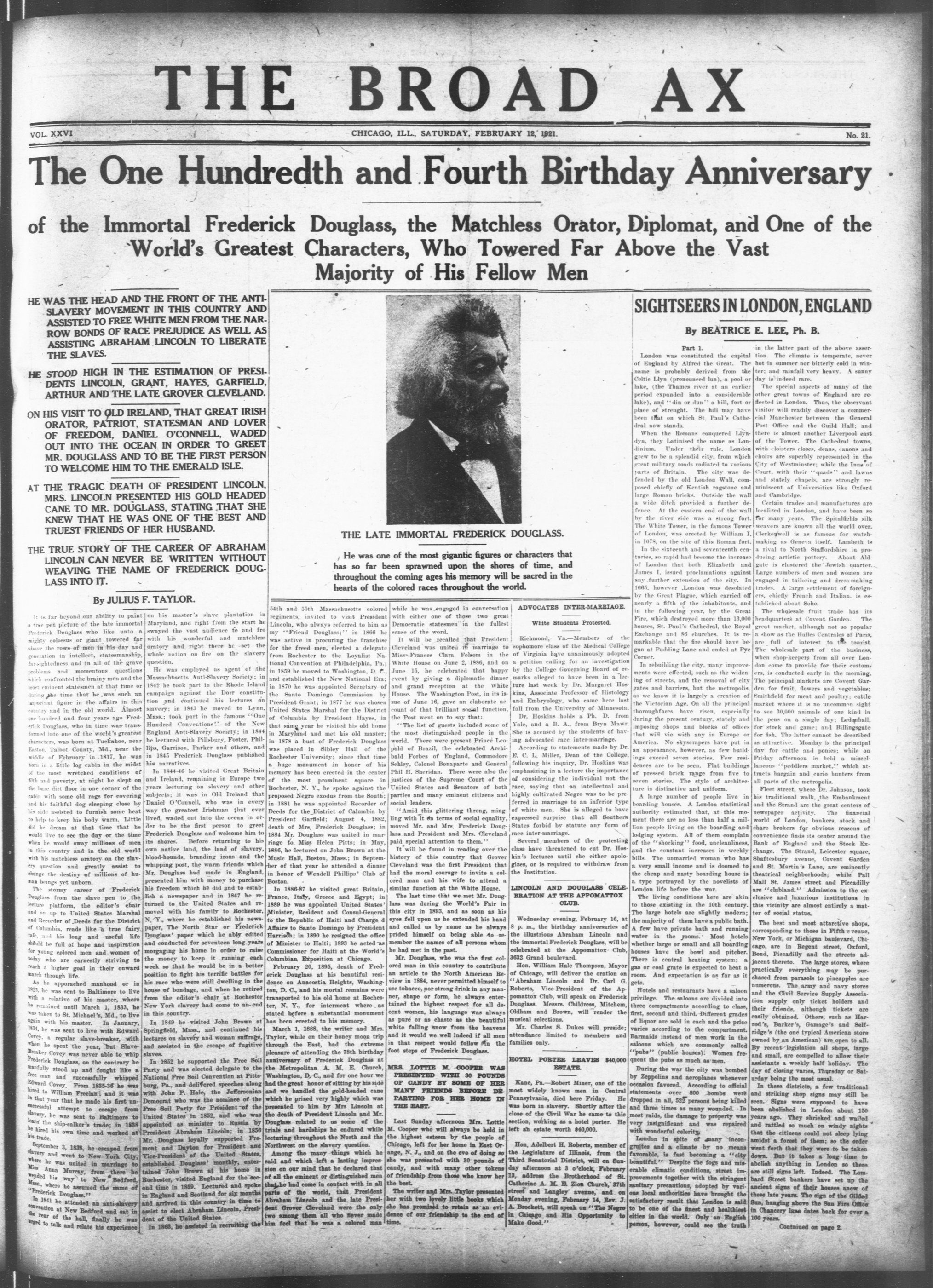
The One Hundredth and Fourth Birthday Anniversary
of the Immortal Frederick Douglass, the Matchless Orator, Diplomat, and One of the World's Greatest Characters, Who Towered Far Above the Vast Majority of His Fellow Men
The On
of the Imm
W
HE WAS THE HEAD AND
SLAVERY MOVEMENT
ASSISTED TO FREE W
ROW BONDS OF RAC
ASSISTING ABRAHAM
THE SLAVES.
HE STOOD HIGH IN THE
DENTS LINCOLN, GRE
ARTHUR AND THE LA
ON HIS VISIT TO OLD IRE
ORATOR, PATRIOT,
OF FREEDOM, DAN
OUT INTO THE OCEE
MR. DOUGLASS AND
TO WELCOME HIM TO
AT THE TRAGIC DEATH
MRS. LINCOLN PRESE
CANE TO MR. DOUGE
KNEW THAT HE WAS
TRUEST FRIENDS OF
THE TRUE STORY OF THE
LINCOLN CAN NEVER
WEAVING THE NAM
LASS INTO IT.
HE WAS THE HEAD AND THE FRONT OF THE ANTI-SLAVERY MOVEMENT IN THIS COUNTRY AND ASSISTED TO FREE WHITE MEN FROM THE NARROW BONDS OF RACE PREJUDICE AS WELL AS ASSISTING ABRAHAM LINCOLN TO LIBERATE THE SLAVES.
HE STOOD HIGH IN THE ESTIMATION OF PRESIDENTS LINCOLN, GRANT, HAYES, GARFIELD, ARTHUR AND THE LATE GROVER CLEVELAND.
ON HIS VISIT TO OLD IRELAND, THAT GREAT IRISH ORATOR, PATRIOT, STATESMAN AND LOVER OF FREEDOM, DANIEL O'CONNELL, WADED OUT INTO THE OCEAN IN ORDER TO GREET MR. DOUGLASS AND TO BE THE FIRST PERSON TO WELCOME HIM TO THE EMERALD ISLE.
AT THE TRAGIC DEATH OF PRESIDENT LINCOLN, MRS. LINCOLN PRESENTED HIS GOLD HEADED CANE TO MR. DOUGLASS, STATING THAT SHE KNEW THAT HE WAS ONE OF THE BEST AND TRUEST FRIENDS OF HER HUSBAND.
THE TRUE STORY OF THE CAREER OF ABRAHAM LINCOLN CAN NEVER BE WRITTEN WITHOUT WEAVING THE NAME OF FREDERICK DOUGLASS INTO IT.
By JULIUS F. TAYLOR.
It is far beyond our ability to paint a true pen picture of the late immortal Frederick Douglass who like unto a mighty colossus or giant towered far above the rows of men in his day and generation in intellect, statesmanship, far-sightedness and in all of the grave problems and momentous questions which confronted the brainy men and the most eminent statesmen at that time or during the time that he, was such an important figure in the affairs in this country and in the old world. Almost one hundred and four years ago Frederick Douglass, who in time was transformed into one of the world's greatest characters, was born at Tuekahoe, near Easton, Talbot County, Md., near the middle of February in 1817, he was born in a little log cabin in the midst of the most wretched conditions of filth and poverty, at night he slept on the bare dirt floor in one corner of the cabin with some old rags for covering and his faithful dog sleeping close by his side assisted to furnish some heat to help to keep his body warm. Little did he dream at that time that he would live to see the day or the time when he would sway millions of men in this country and in the old world with his matchless oratory on the slavery question and greatly assist to change the destiny of millions of human beings yet unborn.
The stormy career of Frederick Douglass from the slave pen to the lecture platform, the editor's chair and on up to United States Marshal and Recorder of Deeds for the District of Columbia, reads like a true fair tale, and his long and useful life should be full of hope and inspiration for young colored men and women of today who are earnestly striving to reach a higher goal in their onward march through life.
As he appraached manhood or in 1823, he was sent to Baltimore to live with a relative of his master, where he remained until March 1, 1833, he was taken to St. Michael's, Md., to live again with his master. In January, 1834, he was sent to live with Edward Covey, a regular slave-breaker, with whom he spent the year, but Slave-Breaker Covey was never able to whip Frederick Douglass, on the contrary he manfully stood up and fought like a free man and successfully whipped Edward Covey. From 1835-36 he was hired to William Freeland and it was in that year that he made his first unsuccessful attempt to escape from slavery, he was sent to Baltimore to learn the ship-calker's trade; in 1838 he hired his own time and worked at his trade.
September 3, 1838, he escaped from slavery and went to New York City, where he was united in marriage to Miss Anna Murray, from there he wended his way to New Bedford, Mass, where he assumed the mame of "Frederick Douglass." In 1841 he attended an anti-slavery convention at New Bedford and sat in the rear of the hall, finally he was urged to talk and relate his experience
VOL. XXVI
THE BROAD AX
on his master's slave plantation in Maryland, and right from the start he swayed the vast audience to and fro with his wonderful and matchless oratory and right there he set the whole nation on fire on the slavery question.
He was employed as agent of the Massachusetts Anti-Slavery Society; in 1842 he took part in the Rhode Island campaign against the Dorr constitution and continued his lectures on slavery; in 1843 he moved to Lynn, Mass.; took part in the famous "One Hundred Conventions"—of the New England Anti-Slavery Society; in 1844 he lectured with Pillsbury, Foster, Phillips, Garrison, Parker and others, and in 1845 Frederick Doulgast published his narratives.
In 1844-46 he visited Great Britain and Ireland, remaining in Europe two years lecturing on slavery and other subjects; it was in Old Ireland that Daniel O'Connell, who was in every way the greatest Irishman that ever lived, waded out into the ocean in order to be the first person to greet Frederick Douglass and welcome him to its shores. Before returning to his own native land, the land of slavery, blood-hounds, branding irons and the whipping post, the warm friends which Mr. Douglass had made in England, presented him with money to purchase his freedom which he did and to establish a newspaper and in 1847 he returned to the United States and removed with his family to Rochester, N. Y., where he established his newspaper, The North Star or Frederick Douglass' paper which he ably edited and conducted for seventeen long years morgaging his home in order to raise the money to keep it running each week so that he would be in a better position to fight his terrific battles for his race who were still dwelling in the house of bondage, and when he retired from the editor's chair at Rochester New York slavery had come to an-end in this country.
In 1849 he visited John Brown at Springfield, Mass., and continued his lectures on slavery and woman suffrage and assisted in the escape of fugitive slaves. In 1852 he supported the Free Soil Party and was elected delegate to the National Free Soil Convention at Pittsburg, Pa., and delivered speeches along with John P. Hale, the Jeffersonian Democrat who was the nominee of the Free Soil Party for President of the United States in 1852, and who was appointed as minister to Russia by President Abraham Lincoln; in 1856 Mr. Douglass loyally supported Fremont and Dayton for President and Vice-President of the United States, established Douglass' monthly, entertained John Brown at his home in Rochester, visited England for the second time in 1859. Lectured and spoke in England and Scotland for six months and arrived in this country in time to assist to elect Abraham Lincoln, President of the United States.
In 1863, he assisted in recruiting the
CHICAGO, ILL., SATURDAY, FEBRUARY 12, 1921.
THE LATE IMMORTAL FREDERICK DOUGLASS. He was one of the most gigantic figures or characters that has so far been sprawned upon the shores of time, and throughout the coming ages his memory will be sacred in the hearts of the colored races throughout the world.
54th and 55th Massachusetts colored regiments, invited to visit President Lincoln, who always referred to him as a "Friend Douglass;" in 1866 he was active in practicing the franchise for the freed men, elected a delegate from Rochester to the Loyalist National Convention at Philadelphia, Pa. in 1859 he moved to Washington, D. C. and established the New Era; in 1870 he was appointed Secretary of the Santo Domingo Commission by President Grant; in 1877 he was chosen United States Marshal for the District of Columbia by President Hayes, in that same year he visited his old home in Maryland and met his old master; in 1878 a bust of Frederick Douglass was placed in Sibley Hall of the Rochester University; since that time a huge monument in honor of his memory has been erected in the center of the most prominent square in Rochester, N. Y., he spoke against the proposed Negro exodus from the South; in 1881 he was appointed Recorder of Deeds for the District of Calumbia by President Garfield; August 4, 1882, death of Mrs. Frederick Douglass; in 1884 Mr. Douglass was united in marriage to Miss Helen Pitts; in May, 1886, he lectured on John Brown at the Music Hall, Boston, Mass.; in September of that year he attended a dinner in honor of Wendell Phillips' Club of Boston.
In 1886-87 he visited great Britain, France, Italy, Greece and Egypt; in 1889 he was appointed United States' Minister, Resident and Consul-General to the Republic of Haiti and Charge d'Affairs to Santo Domingo by President Harrison; in 1890 he resigned the office of Minister to Haiti; 1893 he acted as Commissioner for Haiti at the World's Columbian Exposition at Chicago. February 20, 1895, death of Frederick Douglass at his beautiful residence on Anacostia Heights, Washington, D. C., and his mortal remains were transported to his old home at Rochester, N. Y., for interment where as stated before a substantial monument has been erected to his memory. March 1, 1888, the writer and Mrs. Taylor, while on their honey moon trip through the East, had the extreme pleasure of attending the 78th birthday anniversary of Frederick Douglass at the Metropolitan A. M. E. Church, Washington, D. C., and for one hour we had the great honor of sitting by his side and we handled the gold-headed cane which he prized very highly which was presented to him by Mrs Lincoln at the death of President Lincoln and Mr. Douglass related to us some of the trials and hardships he endured while lecturing throughout the North and the Northwest on the slavery question.
Among the many things which he said and which left a lasting impression on our mind that he declared that of all the eminent or distinguished men that he had come in contact with in all parts of the world, that President Abraham Lincoln and the late President Grover Cleveland were the only two among them all who never made him feel that he was a colored man
[Image of a man with a long, curly beard and a mustache, wearing a black suit and a white shirt. He is looking slightly to the right of the frame.]
while he was engaged in conversation with either one of those two great Democratic statesmen in the fullest sense of the word.
It will be recalled that President Cleveland was united in marriage to Miss Frances Clara Folsom in the White House on June 2, 1886, and on June 15, he celebrated that happy event by giving a diplomatic dinner and grand reception at the White House. The Washington Post, in its issue of June 16, gave an elaborate account of that brilliant social function, the Post went on to say that:
"The list of guests included some of the most distinguished people in the world. There were present Prince Leopold of Brazil, the celebrated Archibald Forbes of England, Commodore Schley, Colonel Bonaparte and General Phil H. Sheridan. There were also the justices of the Supreme Court of the United States and Senators of both parties and many eminent citizens and social leaders.
"Amid this glittering throng, mingling with it on terms of social equality, moved Mr. and Mrs. Frederick Douglass and President and Mrs. Cleveland paid special attention to them."
It will be found in reading over the history of this country that Grover Cleveland was the first President that had the moral courage to invite a colored man and his wife to attend a similar function at the White House.
The last time that we met Mr. Douglass was during the World's Fair in this city in 1893, and as soon as his eyes fell upon us he extended his hand and called us by name as he always prided himself on being able to remember the names of all persons whom he had met in the past.
Mr. Douglass, who was the first colored man in this country to contribute an article to the North American Review in 1884, never permitted himself to use tobacco, nor strong drink in any manner, shape or form, he always entertained the highest respect for all decent women, his language was always as pure or as chaste as the beautiful white falling snow from the heavens and it would we well indeed if all men in that respect would follow in the foot steps of Frederick Douglass.
MRS. LOTTIE M. GOOPER WAS
PRESENTED WITH 30 POUNDS
OF CANDY BY SOME OF HER
MANY FRIENDS BEFORE DEPARTING FOR HER HOME IN THE EAST.
Last Sunday afternoon Mrs. Lottie M. Cooper who will always be held in the highest esteem by the people of Chicago, left for her home in East Orange, N. J., and on the eve of doing so she was presented with 30 pounds of candy, and with many other tokens of friendship from those who know her the best.
The writer and Mrs. Taylor presented her with two lovely little books which she has promised to retain as an evidence of our friendship to the end of time.
ADVOCATES INTER-MARRIAGE.
White Students Protested.
Richmond, Va.—Members of the sophomore class of the Medical College of Virginia have unanimously adopted a petition calling for an investigation by the College Governing Board of remarks alleged to have been in a lecture last week by Dr. Margaret Hoskins, Associate Professor of Histology and Embryology, who came here last fall from the University of Minnesota. Dr. Hoskins holds a Ph. D. from Yale, and a B. A., from Bryn Mawr. She is accused by the students of having advocated race inter-marriage. According to statements made by Dr. E. C. L. Miller, Dean of the College, following his inquiry, Dr. Hoskins was emphasizing in a lecture the importance of considering the individual not the race, saying that an intellectual and highly cultivated Negro was to be preferred in marriage to an inferior type of white men. She is alleged to have expressed surprise that all Southern States forbid by statute any form of race inter-marriage. Several members of the protesting class have threatened to cut Dr. Hoskin's lectures until she either apologizes, or is required to withdraw from the Institution.
LINCOLN AND DOUGLASS CELEBRATION AT THE APPOMATTOX CLUB.
Wednesday evening, February 16, at 8 p.m., the birthday anniversary of the illustrious Abraham Lincoln and the immortal Frederick Douglass, will be celebrated at the Appomattox Club, 3632 Grand boulevard.
Hon. William Hale Thompson, Mayor of Chicago, will deliver the oration on "Abraham Lincoln and Dr. Carl G. Roberts, Vice-President of the Appomattox Club, will speak on Frederick Douglass. Messrs. Childress, Mitchel, Oldham and Brown, will render the musical selections.
Mr. Charles S. Dukes will preside; attendance limited to members and families only.
HOTEL PORTER LEAVES $40,000
ESTATE.
Kane, Pa.-Robert Miner, one of the most widely known men in Central Pennsylvania, died here Friday. He was born in slavery. Shortly after the close of the Civil War he came to this section, working as a hotel porter. He left an estate worth $40,000.
Hon. Adelbert H. Roberts, member of the Legislature of Illinois, from the Third Senatorial District, will on Sunday afternoon at 3 o'clock, February 13, address the Brotherhood of St. Catherine A. M. E. Zion Church, 37th street and Langley avenue, and on Monday evening, February 14, Rev. J. A. Brockett, will speak on "The Negro in Chicago and His Opportunity to Make Good."
SIGHTSEERS IN LONDON, ENGLAND
By BEATRICE E. LEE. Ph. B.
London was constituted the capital of England by Alfred the Great. The name is probably derived from the Celtic Llyn (pronounced lun), a pool or lake, (the Thames river at an earlier period expanded into a considerable lake), and "din or dun" a hill, fort or place of strenght. The hill may have been that on which St. Paul's Cathedral now stands.
When the Romans conquered Lyndon, they Latinised the name as Londinium. Under their rule, London grew to be a splendid city, from which great military roads radiated to various parts of Britain. The city was defended by the old London Wall, composed chiefly of Kentish ragstone and large Roman bricks. Outside the wall a wide ditch provided a further defence. At the eastern end of the wall by the river side was a strong fort. The White Tower, in the famous Tower of London, was erected by William I, in 1078, on the site of this Roman fort. In the sixteenth and seventeenth centuries, so rapid had become the increase of London that both Elizabeth and James I, issued proclamations against any further extension of the city. In 1665, however, London was desolated by the Great Plague, which carried off nearly a fifth of the inhabitants, and in the following year, by the Great Fire, which destroyed more than 13,000 houses, St. Paul's Cathedral, the Royal Exchange and 86 churches. It is remarkable that the fire should have begun at Pudding Lane and ended at Pye Corner.
In rebuilding the city, many improvements were effected, such as the widening of streets, and the removal of city gates and barriers, but the metropolis, as we know it is largely a creation of the Victorian Age. On all the principal thoroughfares have risen, especially during the present century, stately and imposing shops and blocks of offices that will vie with any in Europe or America. No skyscrapers have put in an appearance, however, as few buildings exceed seven stories. Few residences are to be seen. Flat buildings of pressed brick range from five to seven stories. The style of architecture is distinctive and uniform.
A large number of people live in boarding houses. A London statistical authority estimated that, at this moment there are no less than half a million people living on the boarding and lodging system. All of them complain of the "shocking" food, uncleanliness, and the constant increases in weekly bills. The unmarried woman who has a very small income and is doomed to the cheap and nasty boarding house is a type portrayed by the novelists of London life before the war.
The living conditions here are akin to those existing in the 10th century. The large hotels are slightly modern; the majority of them have a public bath. A few have private bath and running water in the rooms. Most hotels whether large or small and all boarding houses have the bowl and pitcher. There is central heating system; a gas or coal grate is expected to heat a room. And expectation is as far as it gets.
Hotels and restaurants have a saloon privilege. The saloons are divided into three compartments according to class, first, second and third. Different grades of liquor are sold in each and the price varies according to the compartment. Barmaids instead of men work in the saloons which are commonly called "pubs" (public houses). Women frequent the pubs as much as men.
During the war the city was bombed by Zeppelins and aeroplanes whenever occasion favored. According to official statements over 800 bombs were dropped in all, 525 persons being killed and three times as many wounded. In most raids, the damage to property was very insignificant and was repaired with wonderful celerity.
London in spite of many incongruities and a climate by no means favorable, is fast becoming a "city beautiful." Despite the fogs and miserable climatic conditions, street improvements together with the stringent sanitary precautions, adopted by various local authorities have brought the satisfactory result that London is said to be one of the finest and healthiest cities in the world. Only an English person, however, could see the truth
in the latter part of the above assertion. The climate is temperate, never hot in summer nor bitterly cold in winter; and rainfall very heavy. A sunny day is indeed rare.
The special aspects of many of the other great towns of England are reflected in London. Thus, the observant visitor will readily discover a commercial Manchester between the General Post Office and the Guild Hall; and there is almost another Liverpool east of the Tower. The Cathedral towns, with cloisters closes, deans, canons and choirs are superbly represented in the City of Westminster; while the Inns of Court, with their "quads" and lawns and stately chapels, are strongly reminiscent of Universities like Oxford and Cambridge.
Certain trades and manufactures are localized in London, and have been so for many years. The Spatialfields silk weavers are known all the world over. Clerkwell is as famous for watchmaking as Geneva itself. Lambeth is a rival to North Staffordshire in producing artistic pottery. About Aldgate is clustered the Jewish quarter. Large numbers of men and women are engaged in tailoring and dress-making trades. A large settlement of foreigners, chiefly French and Italian, is established about Soho.
The wholesale fruit trade has its headquarters at Covent Garden. The great market, although not so popular a show as the Halles Centrales of Paris, are full of interest to the tourist. The wholesale part of the business, when shop-keepers from all over London come to provide for their customers, is conducted early in the morning. The principal markets are Covent Garden for fruit, flowers and vegetables; Smithfield for meat and poultry; cattle market where it is no uncommon sight to see 30,000 animals of one kind in the pens on a single day; Leddahall, for stock and game; and Billingsgate for fish. The latter cannot be described as attractive. Monday is the principal day for cattle and ponies; while on Friday afternoon is held a miscellaneous "peddlers market," which attracts bargain and curio hunters from all parts of the metropolis.
Fleet street, where Dr. Johnson, took his traditional walk, the Embankment and the Strand are the great centers of newspaper activity. The financial world of London, bankers, stock and share brokers for obvious reasons of convenience finds its center around the Bank of England and the Stock Exchange. The Strand, Leicester square, Shaffesbury avenue, Covent Garden and St. Martin's Lane, are eminently theatrical neighborhoods; while Pall Mall St. James street and Pieceadilly are "elnbland." Admission to the exclusive and luxurious institutions in this vicinity are almost entirely a matter of social status.
The best and most attractive shops, corresponding to those in Fifth avenue, New York, or Michiganbaulevard, Chicago, are in Regent street, Oxford, Bond, Piceadilly and the streets adjacent thereto. The large stores, where practically everything may be purchased from parasols to pineapples are numerous. The army and navy stores and the Civil Service Supply Association supply only ticket holders and their friends, although tickets are easily obtained. Others, such as Harrod's, Barker's, Gamage's and Selfridge's (the one typical American store owned by an American) are open to all. By recent legislation all shops, large and small, are compelled to allow their assistants a weekly half holiday. The day of closing varies, Thursday or Saturday being the most usual.
In these districts, a few traditional and striking shop signs may still be seen. Signs were supposed to have been abolished in London about 150 years ago. They shrieked and wailed and rattled so much on windy nights that the citizens could not sleep lying amidst a forest of them; so the order went forth that they were to be taken down. But it takes a long time to abolish anything in London so there are still signs left. Indeed. The Lombard Street bankers have set up the ancient signs of their houses anew of these late years. The sign of the Gilded Sun, hanging above the Sun Fire Office in Chancery lane dates back for over a 100 years.
Continued on page 2.
THE BROAD AX
In this city since July 15th, 1899 without missing one single issue. Republicans, Democrats, Catholics, Protestants, Single Taxers, Priests, infidels or anyone else can have their say as long as their language is proper and responsibility is fixed. The Broad Ax is a newspaper whose platform is broad enough for all, ever claiming the editorial right to speak its own mind. Local communications will receive attention. Write only on one side of the paper. Subscriptions must be paid in advance.
Advertising rates made known on application.
Address all communication to
THE BROAD AX
6206 So. Elizabeth St., Chicago, Ill
Phone Wenworth 2597
JULIUS F. TAYLOR
Editor and Publisher
Associate Editor
DR. M. A. MAJORS
4700 South State Street
Phone Drexel 1416
FEBRUARY 12, 1921.
Vol. XXVI. No. 21.
Entered as Second-Class Matter Aug
19, 1942. Under Art of March 8, 1942.
SIGHTSEERS IN LONDON, ENG.
Concluded from page 1.
One general sign is the representation of a red jar of singular form. It is almost the same shape as the vessels in which the ancient Romans kept their wine; it is, in fact, an Italian oil jar. It marks the "Italian warehouse." Once olive oil was the chief commodity sold at such places. Now the oil is more paraffin than olive; and soda, matches and firewood are to be had under the sign of the oil jar.
Then there are the particular signs which were once addresses. Thus, "Goats and Compasses," probably and heraldic sign; and the sign of the Bible in Cheapside," would render the number of the house an unnecessary addition. Such signs survive now principally on tavern. Many of them are armorial, adopted in honor of great lords of ancient houses.
THE NEGRO CONFERENCE
Tuskegee Inst. Ala.—Following the meeting of the annual Tuskegee Negro Conference, a special meeting of representatives of leading health organizations was held here, at which time plans were outlined for co-operating with Tuskegee Institute in the National Negro Health Week. The organizations represented and the persons who attended this conference were as follows:
Dr. Rosece C. Brown, Director of Colored Work, Public Health Service, Washington, D. C., Franklin O. Nichols, Assistant Director, Department of Educational Activities, the American Social Hygiene Association, New York City, P. Rivers Barnwell, of Texas, the Public Health Service Waco Texas, Miss Belle Davis, Secretary of the Circle for Negro Relief, New York City, T. M. Campbell and Harry Simms, U. S. Agri-
[Image of a man in a suit with a bow tie].
[Name]
The hustling President of the Norris-Wa the best city oil inspector that Chicago has is a strong supporter of Mayor William H
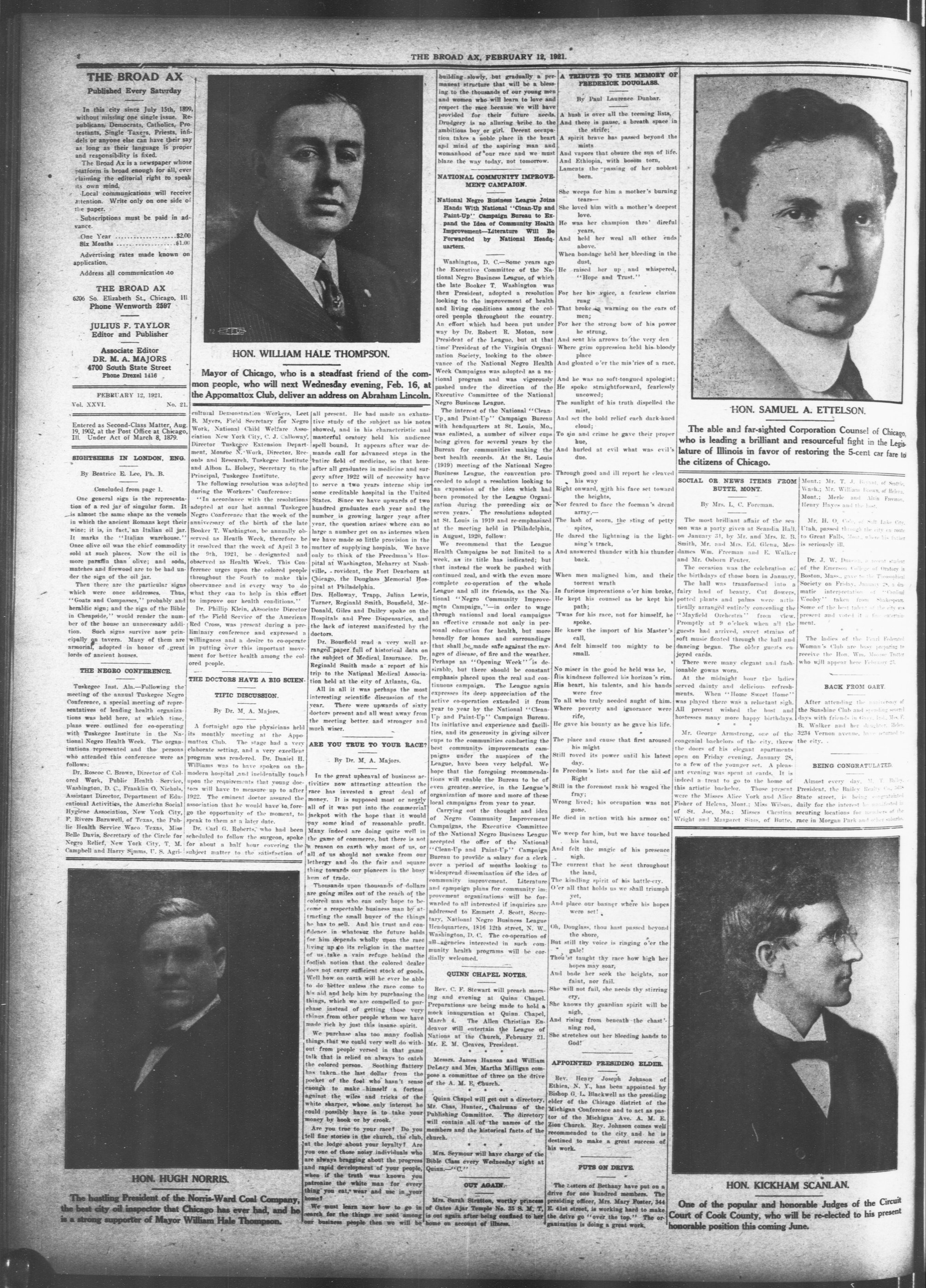
The hostling President of the Norris-Ward Coal Company, the best city oil inspector that Chicago has ever had, and he is a strong supporter of Mayor William Hale Thompson.
72
Mayor of Chicago, who is a steadfast friend of the common people, who will next Wednesday evening, Feb. 16, at the Appomattox Club, deliver an address on Abraham Lincoln, cultural Demonstration Workers, Leet B. Myers, Field Secretary for Negro Work, National Child Welfare Association New York City, C. J. Calloway, Director Tuskegee Extension Department, Monroe N. Work, Director, Records and Research, Tuskegee Institute and Albon L. Hoseley, Secretary to the Principal, Tuskegee Institute. The following resolution was adopted during the Workers' Conference:
"In accordance with the resolutions adopted at our last annual Tuskegee Negro Conference that the week of the anniversary of the birth of the late Booker T. Washington, be annually observed as Heath Week, therefore be it resolved that the week of April 3 to the 9th, 1921, be designated and observed as Health Week. This Conference urges upon the colored people throughout the South to make this observance and in every way to do what they can to help in this effort to improve our health conditions." Dr. Phillip Klein, Associate Director of the Field Service of the American Red Cross, was present during a preliminary conference and expressed a willingness and a desire to co-operate in putting over this important movement for better health among the colored people.
THE DOCTORS HAVE A BIG SCIEN
A fortnight ago the physicians held its monthly meeting at the Appomattox Club. The stage had a very elaborate setting, and a very excellent program was rendered. Dr. Daniel H. Williams was to have spoken on the modern hospital and incidentally touch upon the requirements that young doctors will have to measure up to after 1922. The eminent doctor assured the association that he would have to forego the opportunity of the moment, to speak to them at a later date. Dr. Carl G. Roberts, who had been scheduled to follow the surgeon, spoke for about a half hour covering the subject matter to the satisfaction of
The
The
The
Norris-Ward Coal Company, Chicago has ever had, and he William Hale Thompson.
TIFIC DISCUSSION.
By Dr. M. A. Majors
all present. He had made an exhaustive study of the subject as his notes showed, and in his characteristic and masterful oratory held his audience spell bound. It appears after war demands call for advanced steps in the entire field of medicine, so that hereafter all graduates in medicine and surgery after 1922 will of necessity have to serve a two years interne ship in some creditable hospital in the United States. Since we have upwards of two hundred graduates each year and the number is growing larger year after year, the question arises where can so large a number get on as internes when we have made so little provision in the matter of supplying hospitals. We have only to think of the Freedman's Hospital at Washington, Meharry at Nashville, rovident, the Fort Dearborn at Chicago, the Donglass Memorial Hospital at Philadelphia.
Drs. Holloway, Trapp, Julian Lewis Turner, Reginald Smith, Bousfield, MeDonald, Giles and Dailey spoke on the Hospitals and Free Dispensaries, and the lack of interest manifested by the doctors.
Dr. Bousfield read a very well arranged paper full of historical data on the subject of Medical Insurance. Dr. Reginald Smith made a report of his trip to the National Medical Association held at the city of Atlanta, Ga. All in all it was perhaps the most interesting scientific discussion of the year. There were upwards of sixty doctors present and all went away from the meeting better and stronger and much wiser.
ARE YOU TRUE TO YOUR RACE?
In the great upheaval of business activities now attracting attention the race has invested a great deal of money. It is supposed most or nearly all of it was put into the commercial jackpot with the hope that it would pay some kind of reasonable profit. Many indeed are doing quite well in the game of commerce, but there is not a reason on earth why most of us, or all of us should not awake from our lethergy and do the fair and square thing towards our pioneers in the busy hum of trade.
Thousands upon thousands of dollars are going miles out of the reach of the colored man who can only hope to become a respectable business man by attracting the small buyer of the things he has to sell. And his trust and confidence in whatever the future holds for him depends wholly upon the race living up go its religion in the matter of us take a vain refuge behind the foolish notion that the colored dealer does not carry sufficient stock of goods. Well how on earth will he ever be able to do better unless the race come to his aid and help him by purchasing the things, which we are compelled to purchase instead of getting those very things from other people whom we have made rich by just this insane spirit.
We purchase alas too many foolish things, that we could very well do without from people versed in that game talk that is relied on always to catch the colored person. Soothing flattery has taken the last dollar from the pocket of the fool who hasn't sense enough to make himself a fortress against the wiles and tricks of the white sharper, whose only interest he could possibly have is to take your money by hook or by crook.
Are you true to your race! Do you tell fine stories in the church, the club, at the lodge about your loyalty! Are you one of those noisy individuals who are always bragging about the progress and rapid development of your people, when if the truth was known you patronize the white man for every thing you eat, wear and use in your home!
THE BROAD AX, FEBRUARY 12, 1921
building slowly, but gradually a permanent structure that will be a blessing to the thousands of our young men and women who will learn to love and respect the race because we will have provided for their future needs. Drudgery is no alluring bribe to the ambitious boy or girl. Deent occupation takes a noble place in the heart and mind of the aspiring man and womanhood of our race and we must blaze the way today, not tomorrow.
NATIONAL COMMUNITY IMPROVE
MENT CAMPAIGN.
National Negro Business League Joins Hands With National "Clean-Up and Paint-Up" Campaign Bureau to Expand the Idea of Community Health Improvement—Literature Will Be Forwarded by National Headquarters.
Washington, D. C.—Some years ago the Executive Committee of the National Negro Business League, of which the late Booker T. Washington was then President, adopted a resolution looking to the improvement of health and living conditions among the colored people throughout the country. An effort which had been put under way by Dr. Robert R. Moton, now President of the League, but at that time President of the Virginia Organization Society, looking to the observance of the National Negro Health Week Campaigns was adopted as a national program and was vigorously pushed under the direction of the Executive Committee of the National Negro Business League.
The interest of the National "Clean-Up, and Paint-Up" Campaign Bureau with headquarters at St. Louis, Mo., was enlisted, a number of silver cups being given for several years by the Bureau for communities making the best health records. At the St. Louis (1919) meeting of the National Negro Business League, the convention proceeded to adopt a resolution looking to an expansion of the idea which had been promoted by the League Organization during the preceding six or seven years.' The resolutions adopted at St. Louis in 1919 and re-emphasized at the meeting held in Philadelphia, in August, 1920, follow:
We recommend that the League Health Campaigns be not limited to a week, as its title has indicated; but that instead the work be pushed with that instead zeal, and with the even more complete co-operation of the whole League and all its friends, as the National "Negro Community Improvement Campaign,"—in order to wage through national and local campaigns an effective crusade not only in personal education for health, but more broadly for homes and surroundings that shall be made safe against the ravages of disease, of fire and the weather. Perhaps an "Opening Week" is desirable, but there should be constant emphasis placed upon the real and continuous campaign. The League again expresses its deep appreciation of the active co-operation extended it from year to year by the National "Clean-Up and Paint-Up" Campaign Bureau. Its initiative and experience and facilities, and its generosity in giving silver cups to the communities conducing the best community improvements campaigns under the auspices of the League, have been very helpful. We hope that the foregoing recommendations will enable the Bureau to be of even greater service, in the League's organization of more and more of these local campaigns from year to year.
Carrying out the thought and idea of Negro Community Improvement Campaigns, the Executive Committee of the National Negro Business League accepted the offer of the National "Clean-Up and Paint-Up" Campaign Bureau to provide a salary for a clerk over a period of months looking to widespread dissemination of the idea of community improvement. Literature and campaign plans for community improvement organizations will be forwarded to all interested if inquiries are addressed to Emmett J. Scott, Secretary, National Negro Business League Headquarters, 1816 12th street, N. W., Washington, D. C. The co-operation of all agencies interested in such community health programs will be cordially welcomed.
QUINN CHAPEL NOTES.
Rev. C. F. Stewart will preach morning and evening at Quinn Chapel. Preparations are being made to hold a mock inauguration at Quinn Chapel. March 4. The Allen Christian Endeavor will entertain the League of Nations at the Church, February 21. Mr. E. M. Cleaves, President.
Messrs. James Hanson and William DeLacy and Mrs. Martha Milligan compose a committee of three on the drive of the A. M. E. Church.
Quinn Chapel will get out a directory, Mr. Chas, Hunter, Chairman of the Publishing Committee. The directory will contain all of the names of the members and the historical facts of the church.
Mrs. Seymour will have charge of the Bible Class every Wednesday night at Quinn.—"C."
OUT AGAIN
M. Sarah Stratton, worthy princess of Gatee Ajar Temple No. 25 S, M, T, is out again after being confined to her home on account of illness.
A TREIBE TO THE MEMORY OF
PREDEKER DOUGLASS.
By Paul Laurence Dunbar.
A hush is over all the teeming lists.
And there is pause, a breath space in
the strife;
A spirit brave has passed beyond the
mists
And vapors that obscure the sun of life.
And Ethiopia, with bosom torn,
Laments the passing of her noblest born.
She weeps for him a mother's burning tears—
She loved him with a mother's deepest love.
He was her champion thro' direful years,
And held her weal all other ends above.
When bondage held her bleeding in the dust,
He raised her up and whispered, "Hope and Trust."
For her his voice, a fearless clarion rung
That broke in warning on the ears of men;
For her the strong bow of his power he strung
And sent his arrows to the very den
Where grim oppression held his bloody place
And gloated o'er the mis'ries of a race.
And he was no soft-tongued apologist;
He spoke straightforward, fearlessly unewed;
The sunlight of his truth dispelled the mist,
And set the bold relief each dark-hued cloud;
To sin and crime he gave their proper hue,
And hurled at evil what was evil's due.
Through good and ill report he cleaved his way
Right onward, with his face set toward the heights,
Nor feared to face the foeman's dread array.
The lash of scorn, the sting of petty spites,
He dared the lightning in the lightning's track,
And answered thunder with his thunder back.
When men maligned him, and their torrent wrath
In furious imprections o'er him broke,
He kept his counsel as he kept his path;
Twas for his race, not for himself, he spoke.
He knew the import of his Master's call,
And felt himself too mighty to be small.
No miser in the good he held was he, his kindness followed his horizon's rim.
His heart, his talents, and his hands were free
To all who truly needed aught of him.
Where poverty and ignorance were rife.
He gave his bounty as he gave his life.
The place and cause that first aroused his might
Still roved its power until his latest day.
In Freedom's lists and for the aid of Right
Still in the foremost rank he waged the fray;
Wrong lived; his occupation was not gone.
He died in action with his armor on!
We weep for him, but we have touched his hand,
And felt the magic of his presence nigh.
The current that he sent throughout the land.
The kindling spirit of his battle-ery.
O'er all that holds us we shall triumph yet,
And place our banner where his hopes were set!
Oh, Douglass, thou hast passed beyond the shore,
But still thy voice is ringing o'er the gale!
Thou'st taught thy race how high her hopes may soar,
And bade her seek the heights, nor faint, nor fail.
She will not fail, she needs thy stirring ery,
She knows thy guardian spirit will be nigh,
And rising from beneath the chast'ning rod,
She stretehes out her bleeding hands to God!
APPOINTED PRESIDING ELDER
Rev. Henry Joseph Johnson of Ethica, N. Y., has been appointed by Bishop G. L. Blackwell as the presiding elder of the Chicago district of the Michigan Conference and to act as pastor of the Michigan Ave. A. M. E. Zion Church. Rev. Johnson comes well recommended to the city and he is destined to make a great success of his work.
PUTS ON DRIVE
Theasters of Bethany have put on a drive for one hundred members. The presiding officer, Mrs. Mary Foster, 344 E. 41st street, is working hard to make the drive go "over the top." The organization is doing a great work.
M.
HON. SAMUEL A. ETTELSON
The able and far-sighted Corporation Counsel who is leading a brilliant and resourceful fight lature of Illinois in favor of restoring the 5-cen the citizens of Chicago.
and far-sighted Corporation Counseling a brilliant and resourceful fight Illinois in favor of restoring the 5-cen of Chicago.
The able and far-sighted Corporation Counsel of Chicago who is leading a brilliant and resourceful fight in the Legislature of Illinois in favor of restoring the 5-cent car fare to the citizens of Chicago.
SOCIAL OR. NEWS ITEMS FROM
BUTTE. MONT.
Mont.: Mr. T. J. Beynard of Seattle
Wash.: Mr. William Langer of Bellevue
The most brilliant affair of the season was a party given at Scandia Hall on January 31, by Mr. and Mrs. R. B. Smith, Mr. and Mrs. Ed. Glenn, Mesdames Wm. Freeman and E. Walker and Mr. Osborn Fenter.
The occasion was the celebration of the birthdays of those born in January. The hall was transformed into a fairy land of beauty. Cut flowers potted plants and palms were artistically arranged entirely concealing the "Mayfield Orchestra" from view. Promptly at 9 o'clock when all the guests had arrived, sweet strains of soft music floated through the hall and dancing began. The older guests enjoyed cards.
There were many elegant and fashionable gowns worn.
At the midnight hour the ladies served dainty and delicious refreshments. When "Home Sweet Home" was played there was a reluctant sigh. All present wished the host and hostesses many more happy birthdays.
Mr. George Armstrong, one of the congenial bachelors of the city, threw the doors of his elegant apartments open on Friday evening, January 28, to a few of the younger set. A pleasant evening was spent at cards. It is indeed a treat to go to the home of this artistic bachelor. Those present were the Misses Alice York and Alice Fisher of Helena, Mont.; Miss Wilson, of St. Joe, Mo.; Miss Chestina Wright and Margaret Sinus, of Butte,
```markdown
```
[Name]
```markdown
```
HON. KICKHAM SCANLAN
One of the popular and honorable Judges
Court of Cook County, who will be re-elected
honorable position this coming June.
a popular and honorable Judges of the County, who will be re-elected to the election this coming June.
One of the popular and honorable Judges of the Circuit Court of Cook County, who will be re-elected to his present honorable position this coming June.
Corporation Counsel of Chicago
and resourceful fight in the Legis
restoring the 5-cent car fare to
Mont.; Mr. T. J. Boynt, of Seattle
Wash.; Mr. William Brown, of Helen,
Mont.; Merle and Alvin Freeman,
Henry Hayes and the host.
Mr. H. O. Coly, of Salt Lake City,
Utah, passed through the city on route
to Great Falls, Mont., where his father
is seriously ill.
Dr. J. W. Duncan, a recent student of the Emerson College of Ontario in Boston, Mass., gave to the Tuscaloosa Society on Friday, January 28, a dramatic interpretation of "Charles Woolsy" taken from Shakespeare. Some of the best talent at the city was present and voted it a fine entertainment.
The ladies of the Pearl Felentel Woman's Club are busy preparing to receive the Hon. Wim. Moore Tucker who will appear here February 23.
BACK FROM GARY
After attending the university of the Sunshine Club and spending several days with friends in Geneva, India, M.F. B. Walker and her daughter, Belen 3234 Vernon avenue, have returned to the city.
BEING CONGRATULATED
Almost every day, M. T. Bailey President, the Bailey Realty Co., 365 State street, is being congratulated daily for the interest he mentioned in securing locations for members of the race in Morgan Park and other salaries.
```markdown
```
orable Judges of the Circuit will be re-elected to his present June.
THE DANCE AND RECEPTION BY
THE MEMBERS OF THE APPO-
MATTOX CLUB WAS A HIGHLY
ENJOYABLE APFAIR.
Mrs. Lottie M. Cooper of New York
City was on That Occasion the Hon-
ored Guest of Mr. and Mrs. Julius P.
Taylor.
Last Thursday evening the far
famed Appomattox Club gave a de-
finitive formal reception and dance at
the Unity Club, 3140 Indiana avenue,
at the same time the officers elected
last December for the coming year
were installed into offices by Hon. Ed-
ward H. Wright, Master of Ceremonies.
The club has five hundred and eight
members and it was the first time, that
the vast majority of its members and
their families had the pleasure of
mingling together under one roof.
All the ladies present were costumed in the hight of fashion and were be- locked with diamonds and other jew-etry. The majority of the gentlemen present were full dress evening suits. President and Mrs. S. A. T. Watkins were kept busy all the time in an effort to make it pleasant for all the members and their families. Mrs. Lottie Meredith Cooper, of East Orange, N. J., and New York City, was the honored guest of Mr. and Mrs. Julius F. Taylor on that very enjoyable occasion. Mrs. Cooper was costumed in a black lace gown, ornaments, diamonds and pearls. She had the time of her life and came near wearing her feet out in dancing.
FT. DEARBORN HOSPITAL NOTES.
Mrs. Janetella Weaver, who was oper-ated on by Dr. Gordon Jackson at the Ft. Dearborn Hospital a few days ago is convalescing.
Mrs. Edwina Johnson, who recently met with an automobile accident was discharged from the Ft. Dearborn Hospital. February 7.
Mrs. Maggie Armfield, who has been convalescing in the Ft. Dearborn Hospital for two weeks, was discharged Monday.
Mrs. Lessee B. Farbee is to be oper-ated on at the Ft. Dearborn Hospital within the next day or two! Mrs. Farbee has been under the care of Dr. C. P. Conner.
. . .
Mrs. Elizabeth Lawrence is in the Ft. Dearborn Hospital under the care of Dr. A. Wilberforce Williams. Miss Lawrence's condition shows improvement at this writing.
* * * * *
Mrs. Eugene Smith, who was admitted to the Ft. Dearborn Hospital several days ago, under the care of Dr. Prol C. Cade, was discharged Tuesday completely convalesced.
* * * * *
Mrs. Naney Hawkins, wife of Dr Hawkins, is in the Ft. Dearborn Hospital, where she expects a visit from the stork soon. She is under the care of Dr. S. W. Smith.
The Nurses' Training School of the Pt. Dearborn Hospital, expects an of social inspection by the Board of Registration and Education of the State which will give it recognition and national standard.
CARRY ON
Campigning for the Kiddles
On recent dates a number of articles have appeared in The Broad Ax giving our school children a place in the public eye.
The value of educational worth has been brought more fully within range of the intellectual vision of our more advanced scholars and an invitation is herew extended by The Broad Ax to the high school graduates to express themselves along the line—after graduation—What? Responses received will be given publicity under caption, "The Periscope."
The Arbor Vitae Club met at the residence of Mrs. W. C. Cleena, 4315 Forrestville avenue, on the 4th inst. Competition for the prizes was very keen and resulted in award of first prize, a cut glass compete, to Mrs. Eugene Howard; second prize, a sandwich plate, to Mrs. Maude Sommels.
AN ACTIVE WORKER
Mrs. Eliza Jackson, 3729 Elmwood avenue, state grand queen of A. U. K. and D. A., is actively engaged in pushing forward the work of the organization. Mrs. Jackson is now preparing for the annual meeting to be held in this city in August.
REACHES MARK
The Pyramid Building & Loan Association, offices at 5539 State street, the only corporation of its kind operated by members of the race in the state, has reached the one thousand dollar mark. The receipts last Monday evening totaled more than one thousand dollars. During its two years of existence, the association has loaned the members of the race more than $30,000 to help pay off mortgages on their homes.
TO GIVE SUPPER
Bath Temple No. 72, S. M. T., will entertain its members and friends at a chili supper at the home of Mrs. L. Uage, 310 E. 31st street.
JAMES W. KENNEDY
LAWRENCE COOPER
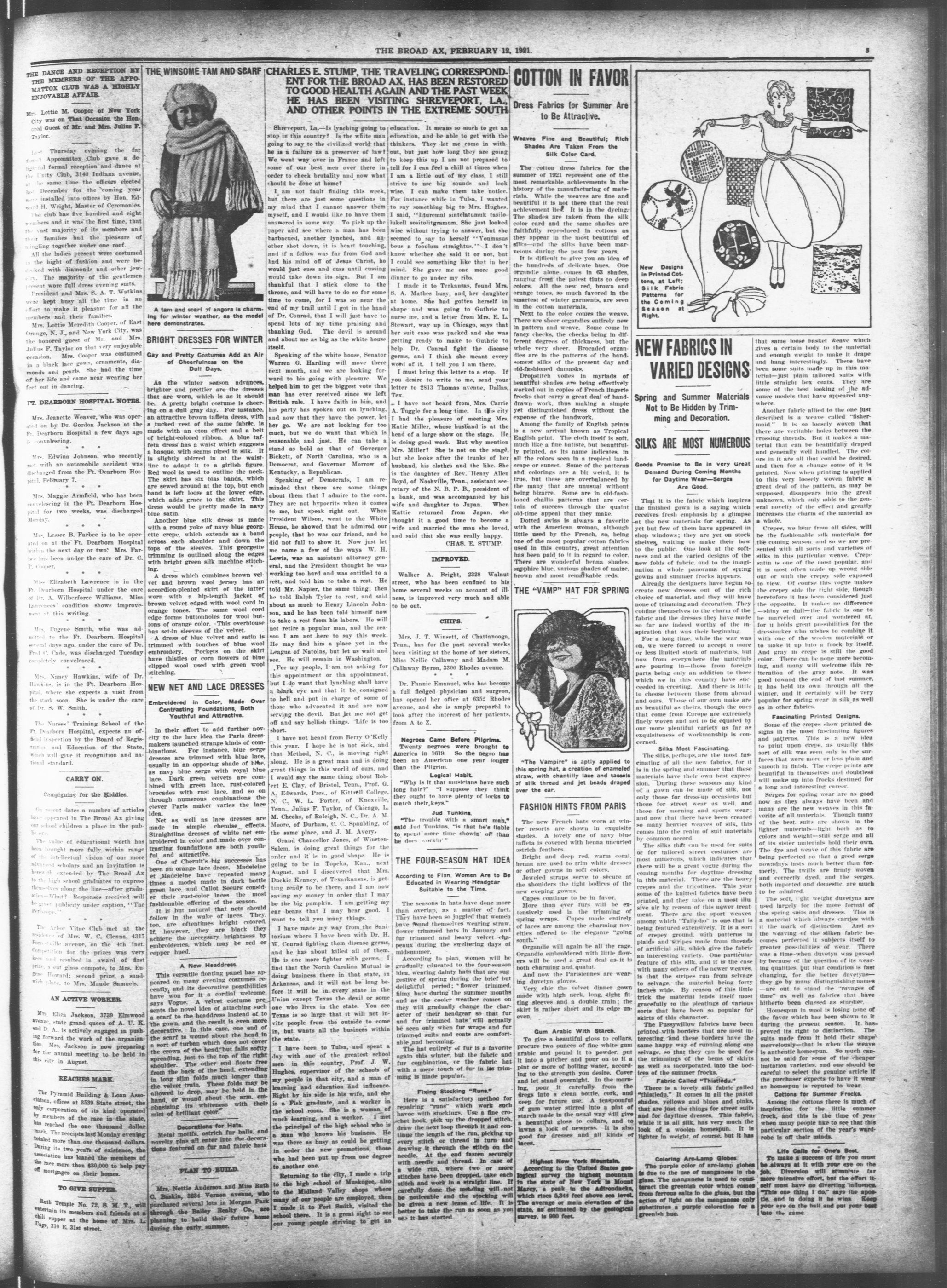
A tam and scarf of angora is charming for winter weather, as the model here demonstrates.
BRIGHT DRESSES FOR WINTER
As the winter season advances, brighter and prettier are the dresses that are worn, which is as it should be. A pretty bright costume is cheering on a dull gray day. For instance, an attractive brown taffeta dress, with a tucked vest of the same fabric, is made with an eton effect and a belt of bright-colored ribbon. A blue taffeta dress has a waist which suggests a basque, with seams piped in silk. It is slightly shirred in at the waistline to adapt it to a girlish figure. Red wool is used to outline the neck. The skirt has six blas bands, which are sewed around at the top, but each band is left loose at the lower edge which adds grace to the skirt. This dress would be pretty made in navy blue satin.
Another blue silk dress is made with a round yoke of navy blue georgette crepe, which extends as a band across each shoulder and down the tops of the sleeves. This georgette trimming is outlined along the edges with bright green silk machine stitching.
A dress which combines brown velvet and brown wool jersey has an accordion-pleated skirt of the latter worn with a hip-length jacket of brown velvet edged with wool cord in orange tones. The same wool cord edge forms buttonholes for wool buttons of orange color. This overlouse has set-in sleeves of the velvet.
A dress of blue velvet and satin is trimmed with touches of blue wool embroidery. Pockets on the skirt have stitches or corn flowers of blue clipped wool used with green wool stitching.
NEW NET AND LACE DRESSES
Embroidered In Color, Made Over Contrasting Foundations, Both Youthful and Attractive.
In their effort to add further novelty to the lace idea the Paris dressmakers launched strange kinds of combinations. For instance, blue serge dresses are trimmed with blue lace, usually in an opposing shade of blue, as navy blue serge with royal blue lace. Dark green velvets are combined with green lace, rust-colored broaches with rust lace, and so on through numerous combinations the clever Paris maker varies the lace idea.
Net as well as lace dresses are made in simple chemise effects. Straightline dresses of white net embroidered in color and made over contrasting foundations are both youthful and attractive.
One of Cheruit's big successes has been an orange lace dress. Madeline et Madeline have repeated many times a model made in dark bottle green lace, and Callot Soeurs consider their rust-color laces the most fashionable offering of the season.
It is but natural that nets should follow in the wake of laces. They, too, are oftentimes bright colored. If, however, they are black they achieve the necessary brightness by embroideries, which may be red or corner hued.
A. New Headdress
This versatile floating panel has appeared on many evening costumes recently, and its decorative possibilities have won for it a cordial welcome, says Vogue. A velvet costume presents the novel idea of attaching such a scarf to the headaddress instead of to the gown, and the result is even more decorative. In this case, one end of the scarf is wound about the head in a sort of turban which does not cover the crown of the head, but falls softly spreading, just to the top of the right shoulder. The other end floats free from the back of the head, extending in long slim folds much longer than the velvet train. These folds may be allowed to drop, may be held in the hand, or wound about the arm, emphasizing its whiteness with their mist of brilliant color.
DECORATION
Metal motifs, ostrich fur halls, and novelty pins all enter into the decorations featured on fur and fabric hats
PLAN TO BUILD
Mrs. Nettie Anderson and Miss Ruth G. Baskin, 3234 Vernon avenue, who purchased several lots in Morgan Park through the Bailey Realty Co., are planning to build their future home during the early summer.
Shreveport, La.—Is lynching going to stop in this country? Is the white man going to say to the civilized world that he is a failure as a preserver of law? We went way over in France and left some of our best men over there in order to check brutality and now what should be done at home?
I am not fault finding this week, but there are just some questions in my mind that I cannot answer them myself, and I would like to have them answered in some way. To pick up the paper and see where a man has been barbecued, another lynched, and another shot down, it is heart touching, and if a fellow was far from God and had his mind off of Jesus Christ, he would just cuss and cuss until cussing would take down its sign. But I am thankful that I stick close to the throne, and will have to do so for some time to come, for I was so near the end of my trail until I got in the hand of Dr. Conrad, that I will just have to spend lots of my time praising and thanking God. The devil is around and about me as big as the white house itself.
Speaking of the white house, Senator Warren G. Harding will move there next month, and we are looking forward to his going with pleasure. We helped him to get the biggest vote that man has ever received since we left British rule. I have faith in him, and his party has spoken out on lynching, and now that they have the power, let her go. We are not looking for too much, but we do want that which is reasonable and just. He can take a stand as bold as that of Governor Bickett, of North Carolina, who is a Democrat, and Governor Morrow of Kentucky, a Republican.
Speaking of Democrats, I am reminded that there are some things about them that I admire to the core. They are not hypocrites when it comes to me, but speak right out. When President Wilson, went to the White House, he showed that he admired our people, that he was our friend, and he did not fail to show it. Now just let me name a few of the ways W. H. Lewis, was an assistant attorney general, and the President thought he was working too hard and was entitled to a rest, and told him to take a rest. He told Mr. Napier, the same thing; then he told Ralph Troy to rest, and said about as much to Henry Lincoln Johnson, and he has been told himself now to take a rest from his labors. He will not retire a popular man, and the reason I am not here to say this week. He may find him a place yet in the League of Natoins, but let us wait and see. He will remain in Washington.
For my people, I am not asking for this appointment or the appointment, but I do want that lynching shall have a black eye and that it be consigned to hell and put in charge of some of those who advocated it and are now serving the devil. But let me not get off and say hellish things. Life is too short.
I have not heard from Berry O'Kelly this year. I hope he is not sick, and that Method, N. C., is moving right along. He is a great man and is doing great things in this world of ours, and I would say the same thing about Robert E. Clay, of Bristol, Tenn., Prof. G. A. Edwards, Pres., of Kittrell College, N. C., W. L. Lorter, of Knoxville, Tenn., Julius F. Taylor, of Chiego, G. M. Cheeks, of Raleigh, N. C., Dr. A. M. Moore, of Durham, C. C. Spaulding, of the same place, and J. M. Avery,
Grand Chancellor Jones, of Winston-Salem, is doing great things for the order and it is in good shape. He is going to be in Topeka, Kan., next August, and I discovered that Mrs. Duckie Kenney, of Texarkansas, is getting ready to be there, and I am now saving my money in order that I may be the big pumpkin. I am getting my ear beans that I may hear good. I want to tell you many things.
I have made my way from the Sanitarium where I have been with Dr. H. W. Conrad fighting them disease germs, and he has about killed all of them. He is one more fighter with germs. I find that the North Carolina Mutual is doing business there in that state, in Arkansas, and it will not be long before it will be in every state in the Union except Texas the devil or some one who lives in the state. You see Texas is so large that it will not invite people from the outside to come in, but wants all the business within the state.
I have been to Tulsa, and spent a day with one of the greatest school men in this country, Prof. J. W. Hughes, supervisor of the schools of my people in that city, and a man of learning and education and influence. Right by his side is his wife, and she is a Fisk graduate, and a worker in the school room. She is a woman of much learning, and a worker. I met the principal of the high school who is a man who knows his business. He was there as busy as could be getting in order the new promotions, those who had been put up from one degree to another one.
Returning to the city, I made a trip to the high school of Muskogee, also to the Midland Valley shops where many of our people are employed, then I made it to Fort Smith, visited the school there. It is a great sight to see our young people striving to get an
THE BROAD AX. FEBRUARY 12. 1921
education. It means so much to get an education, and be able to get with the thinkers. They let me come in without, but just how long they are going to keep this up I am not prepared to tell for I can feel a chill at times when I am a little out of my class, I still strive to use big sounds and look wise. I can make them take notice. For instance while in Tulsa, I wanted to say something big to Mrs. Hughes. I said, "fitturemul sintelatummus tasiolukell sositolitgramum. She just looked wise without trying to answer, but she seemed to say to herself "Vomusmus beus a foolum straightus." I don't know whether she said it or not, but I could see something like that in her mind. She gave me one more good dinner to go under my ribs.
I made it to Terkausas, found Mrs. S. A. Mathes busy, and her daughter at home. She had gotten herself in shape and was going to Guthrie to nurse me, and a letter from Mrs. E. L. Stewart, way up in Chicago, says that her suit ease was packed and she was getting ready to make to Guthrie to help Dr. Conrad fight the disease germs, and I think she meant every word of it. I tell you I am there.
I must bring this letter to a stop. If you desire to write to me, send your letter to 2813 Thomas avenue, Dallas, Tex.
I have not heard from, Mrs. Carrie A. Tuggle for a long time. In *his* city I had the pleasure of meeting Mrs. Katie Miller, whose husband is at the head of a large show on the stage. He is doing good work. But why mention Mrs. Miller? She is not on the stage, but she looks after the trunks of her husband, his clothes and the like. She is the daughter of Rev. Henry Allen Boyd, of Nashville, Teen., assistant secretary of the N. B. P. B., president of a bank, and was accompanied by his wife and daughter to Japan. When Kattie returned from Japan, she thought it a good time to become a wife and married the man she loved and said that she was really happy. CHAS. E. STUMP.
IMPROVED.
Walker A. Bright, 2328 Walnut street, who has been confined to his home several weeks on account of illness, is improved very much and able to be out.
CHIPS.
Mrs. J. T. Winsett, of Chattanooga, Tenn., has for the past several weeks been visiting at the home of her sisters, Miss Nellie Callaway and Madam M. Callaway Byron, 3300 Rhodes avenue.
Dr. Pannie Emanuel, who has become a full fledged physician and surgeon, has opened her office at 6352 Rhodes avenue, and she is amply prepared to look after the interest of her patients, from A to Z.
Negroes Came Before Pilgrims. Twenty negroes were brought to America in 1619. So the negro has been an American one year longer than the Pilgrim.
Logical Habit
"Why is it that musicians have such long hair?" "I suppose they think they ought to have plenty of locks to match their keys."
Jud Tunkina
"The trouble with a smart man," said Jud Tunkins, "is that he's liable to spend more time shown' off than he does 'workin'."
THE FOUR-SEASON HAT IDEA
According to Flan, Women Are to Be Educated in Wearing Headgear Suitable to the Time.
The seasons in hats have done more than overlap, as a matter of fact. They have been so juggled that women have found themselves wearing straw, flower trimmed hats in January and fur trimmed and heavy velvet chapeaux during the sweltering days of midsummer.
According to plan, women will be gradually educated to the four-season idea, wearing daly hats that are suggestive of spring during the brief but delightful period; flower trimmed, filmy hats during the summer months and as the cooler weather comes on they will gradually change the character of their headgear so that fur and fur trimmed hats will actually be seen only when fur wraps and fur trimmed suits and coats are comfortable and becoming.
The hat entirely of fur is a favorite again this winter, but the fabric and fur combination, or the fabric hat with a mere touch of fur in its trimming is made popular.
Finding Stocking "Runs"
Pixing Stocking Runs
Here is a satisfactory method for repairing "runs" which work such havee with stockings. Use a fine crochet hook, pick up the dropped stitch, draw the next loop through it and continue the length of the run, picking up every stitch or thread in turn and drawing it through the stitch on the needle. At the end fasten securely with needle and thread. In case of a wide run, where two or more stitches have been dropped, take each stitch and work in a straight line. If carefully done the meading will not be noticeable and the stocking will be given a new lease of life. It is better to take the run as soon as you see it has started.
COTTON IN FAVOR
COTTON IN FAVOR
Dress Fabrics for Summer Are to Be Attractive.
Weaves Fine and Beautiful; Rich Shades Are Taken From the Silk Color Card.
The cotton dress fabrics for the summer of 1921 represent one of the most remarkable achievements in the history of the manufacturing of materials. While the weaves are fine and beautiful it is not there that the real achievement lie. It is in the dyeing. The shades are taken from the silk color card and the same shades are faithfully reproduced in cottones as they appear in the most beautiful of silks—and the silks have been marveled during the past few years. It is difficult to give you an idea of the hundreds of delicate hues. One organdie alone comes in 63 shades, ranging from the palest tints to deep colors. All the new red, brown and orange tones, so much favored in the smartest of winter garments, are seen in the cotton materials.
Next to the color comes the weave. There are sheer organdies entirely new in pattern and weave. Some come in fancy checks, the checks being in different degrees of thickness, but the whole very sheer. Brocaded organdies are in the patterns of the handsomest silks of the present day and old-fashioned damasks. Dropstitch volles in myriads of beautiful shades are being effectively worked out in copies of French lingerie frocks that carry a great deal of hand-drawn work, thus making a simple yet distinguished dress without the expense of the handwork.
Among the family of English prints is a new arrival known as Tropical English print. The cloth itself is soft, much like a fine batiste, but beautifully printed, as its name indicates, in all the colors seen in a tropical landscape or sunset. Some of the patterns and colorings are a bit weird, it is true, but these are overbalanced by the many that are unusual without being bizarre. Some are in Old-fashioned challis patterns that are certain of success through the quaint old-time appeal that they make.
Dotted swiss is always a favorite with the American woman, although little used by the French, so, being one of the most popular cotton fabrics used in this country, great attention has been paid to it in regard to color. There are wonderful benna shades sapphire blue, various shades of maize brown and most remarkable reds.
THE "VAMP" HAT FOR SPRING
A
"The Vampire" is aptly applied to this spring hat, a creation of enameled straw, with chantilly lace and tassels of silk thread and jet beads draped over the ear.
FASHION HINTS FROM PARIS
The new French hats worn at winter resorts are shown in exquisite shades. A lovely one of navy blue lafftaffa is covered with henna uncurled ostrich feathers. Bright and deep red, warm coral, henna are used to trim white dresses or other gowns in soft colors. Jeweled straps serve to secure at the shoulders the tight bodices of the new evening gowns. Capes continue to be in favor. More than ever furs will be extensively used in the trimming of spring wraps. Capes made entirely of laces are among the charming novelties offered to the elegant "going south." Organdle will again be all the rage. Organdle embroidered with little flowers will be used a great deal as it is both charming and quaint. And now the Parisiennes are wearing duveten gloves.
Very chic the velvet dinner gown made with high neck, long, tight fitting sleeves and a double train; the skirt is rather short and its edge uneven.
Gum Arabic With Starch
Gum Arabic
To give a beautiful gloss to collars, procure two ounces of fine white gum arable and pound it to powder, put it into a pitcher and pour on to it a pint or more of boiling water, according to the strength you desire. Cover and let stand overnight. In the morning, pour it carefully from the dregs into a clean bottle, cork, and seep for future use. A teaspoonful of gum water stirred into a plint of starch made in the usual way will give a beautiful gloss to collars, and to lawns a look of newness. It is also good for dresses and all kinds of lace.
Highest New York Mountain
According to the United States geological survey the highest mountain in the state of New York is Mount Marcy, a peak in the Adirondacks, which rises 5,544 feet above sea level. The average or main elevation of the state, as estimated by the geological survey, is 900 feet.
New Designs in Printed Cotton, at Left; Silk Fabric Patterns for the Coming Season at Right.
NEW FABRICS IN VARIED DESIGNS
Spring and Summer Materials Not to Be Hidden by Trimming and Decoration.
SILKS ARE MOST NUMEROUS
Goods Promise to Be in very Great Demand During Coming Months for Daytime Wear—Serges Are Good.
That it is the fabric which inspires the finished gown is a saying which receives fresh emphasis by a glimpse at the new materials for spring. As yet but few of them have appeared in shop windows; they are yet on stock shelves, waiting to make their bow to the public. One look at the softness and at the varied designs of the new folds of fabric, and to the imagination a whole panorama of spring gowns and summer frocks appears.
Already the designers have begun to create new dresses out of the rich choice of material, and they will have none of trimming and decoration. They confine themselves to the charm of the fabric and the dresses they have made so far are indeed worthy of the inspiration that was their beginning.
For a long time, while the war was on, we were forced to accept a more or less limited stock of materials, but now from everywhere the materials are pouring in—those from foreign parts being only an addition to those which we in this country have succeeded in creating. And there is little to choose between those from abroad and ours. Those of our own make are as beautiful as theirs, though the ones that come from Europe are extremely finely woven and not to be equaled by our more plentiful variety as far as exquisiteness of workmanship is concerned.
Silks Most Fascinating.
The silks, perhaps, are the most fascinating of all the new fabrics, for it is in the spring and summer that these materials have their own best expression. During these seasons any kind of a gown can be made of silk, not only those for dress-up occasions but those for street wear as well, and those for morning and sport wear; and now that there have been created so many heavier weaves of silk, this comes into the realm of suit materials by common accord.
The silks that can be used for suits or for tailored street costumes are most numerous, which indicates that there will be a great vogue during the coming months for daytime dressing in this material. There are the heavy crepes and the tricotines. This year some of the knitted fabrics have been printed, and they take on a most illusive air by reason of this newer treatment. There are the sport weaves among which "tally-ho" is one that is being featured extensively. It is a sort of creepy ground, with patterns in plains and stripes made from threads of artificial silk, which give the fabric an interesting variety. One particular feature of this silk, and it is the case with many others of the newer weaves, is that the stripes run from selvage to selvage, the material being forty inches wide. By reason of this little trick the material lends itself most gracefully to the pleatings of various sorts that have been so popular for skirts of this character.
The Pussywillow fabrics have been printed with borders that are most interesting, and these borders have the same happy way of running along one selvage, so that they can be used for the trimnings of the hems of skirts as well as incorporated into the bodices of the summer frocks.
Fabric Called "Thistlèdu."
There is a lovely silk fabric called "thistlèdu." It comes in all the pastel shades, yellows and blues and pinks, that are just the things for street suits and for daytime dresses. This fabric, while it is all silk, has very much the look of a woolen homespun. It is lighter in weight, of course, but it has
Coloring Arc-Lamp Globes
Coloring Arc-Lamp globes
The purple color of arc-lamp globes is due to the use of manganese in the glass. The manganese is used to counteract the greenish color which comes from ferrous salts in the glass, but the action of light on the manganese only substitutes a purple coloration for a greenish hue.
3
that same loose basket weave which gives a certain body to the material and enough weight to make it drape and hang interestingly. There have been some suits made up in this material—just plain tailored suits with little straight box coats. They are some of the best looking of the advance models that have appeared anywhere.
Another fabric allied to the one just described is a weave called "fishermaid." It is so loosely woven that there are veritable holes between the crossing threads. But it makes a material that can be beautifully draped and generally well handled. The colors in it are all that could be desired, and then for a change some of it is printed. Now when printing is applied to this very loosely woven fabric a great deal of the pattern, as may be supposed, disappears into the great unknown, which only adds to the general novelty of the effect and greatly increases the charm of the material as a whole.
Crepes, we hear from all sides, will be the fashionable silk materials for the coming season, and so we are presented with all sorts and varieties of silks in this particular weave. Crep satin is one of the most popular, and it is most often made up wrong side out or with the creepy side exposed to view. Of course this vogue makes the creepy side the right side, though heretofore it has been considered just the opposite. It makes no difference—shiny or dull—the fabric is one to be marveled over and wondered at, for it holds great possibilities for the dressmaker who wishes to combine it with one of the wooden materials or to make it up into a frock by itself. And gray in crepe is still the good color. There can be none more becoming, and many will welcome this reiteration of the gray note. It was good toward the end of last summer, it has held its own through all the winter, and it certainly will be very popular for spring wear in silk as well as in other fabrics.
Eascinating Printed Designs.
Some of the crepes show printed designs in the most fascinating figures and patterns. This is a new idea to print upon crepe, as usually this sort of silk was seen only in the surfaces that were more or less plain and smooth in finish. The crepe prints are beautiful in themselves and doubtless will make up into frocks destined for a long and interesting career.
Serges for spring wear are as good now as they always have been and many are the new weaves in this favorite of all materials. Though many of the best, suits are shown in the lighter materials—light both as to colors and weight—still serge and all of its sister materials hold their own. The dye and weave of this fabric are being perfected so that a good serge nowadays lasts much better than formerly. The twills are firmly woven and correctly dyed, and the serges, both imported and domestic, are much to be admired.
The soft, light weight duvetyns are used largely for the more formal of the spring suits and dresses. This is a material which always carries with it the mark of distinction. And as the weaving of the silken fabric becomes perfected it subjects itself to greater possibilities of wear. There was a time when duvetyn was passed by because of the question of its wearing qualities, but that condition is fast changing, for the better duvetyns—they go by many distinguishing names—are out to stand the "ravages of time" as well as fabrics that have hitherto been classed as studier.
Homespun in wool is losing none of the favor which has been shown to it during the present season. It has proved its right to distinction. The suits made from it hold their shape marvelously—that is when the weave is authentic homespun. So much cannot be said for some of the cheaper imitation varieties, and one should be careful to select the genuine article if the purchaser expects to have it wear as homespun is reputed to wear.
Cottons for Summer Frocks.
Among the cottons there is much of inspiration for the little summer frock, and this is the time of year when many people like to see that particular section of the year's wardrobe is off their minds.
Life Callie for One's Best
To make a success of life you must be always at it with your eye on the job. Diversion will stimulate far more intensive effort, but the effort itself must have no diverting influence. "This one thing I do," says the apostle, and in doing it he wins. Keep your eye on the ball and put your best into the game.
Beware of Apologizing.
Apologizing—a very desperate habit
—one that is rarely cured. Apologizing
is only egotism wrong gide out.
Nine times out of ten, the first thing
a man's companion knows of his short-
comings is from his apology.—Olliver
Wendell Holmes.
Squeaking Shoes a Good Omen.
Thetheatrical people have many super-
stititions and they cling to the profession closely, one being if an actor's shoes squeak, ever so little, as he makes the first entrance, he is assured of a welcome from the audience.
Capital Stock( $100,000
Binga Sta
OF CH
FULLY OR
BINGA STATE BANK,
C. N. LANGST
Stock( $100,000 Surp
Binga State Bank
OF CHICAGO
FULLY ORGANIZED
BINGA STATE BANK, 3633 So. State St
C. N. LANGSTON, Cashier
DIRECTORS
JESSE BINGA,
President.
CREAS, S. JACKSON,
Underwriter, Vice-President.
R. S. ABBOTT,
Editor Chicago Detender.
W. A. ROBINSON,
Attorney-at-Law.
HOWARD U.
WASHINGT
J. STANLEY DURKEE, A.
EMMETT J. SCOTT, A.M.,
EDWARD UNIVERSE
WASHINGTON, D. C.
STANLEY DURKEE, A. M., Ph. D., Presid
METT J. SCOTT, A. M., LL. D., Secretary-Tre
J. STANLEY DURKEE, A. M., Ph. D., President EMMETT J. SCOTT, A.M., LL.D., Secretary-Treasurer
Collegiate and Professional Schools
Collegiate and Professional Schools
Junior College, covering the Freshman and Sophomore years, and leading to the Senior Colleges.
Senior College, consisting of the Schools of Liberal Arts, Education, Journalism, and Commerce and Finance, granting respectively the degrees. A. B. or B. S.; A. B. or B. S. in Education; B. S. in Journalism; B. S. in Commerce.
School of Applied Science, four year course, giving degree, B. S. in C. E.; B. S. in E. E. B. S. in M. E., B. S. in Architecture; B. S. in Agriculture, and B. S. in Household Economics.
School of Music, four year course, giving degree of Mus. B.
School of Religion, three year course, giving degree of B. D. (Also Diploma and Correspondence Courses.)
School of Law, three year evening course, giving degree of LL.B.
School of Medicine, including Medical, Dental, Pharmaceutical Colleges. Four year course for Medical and Dental Students; three years for Pharmaceutical students. Following degrees given: M. D., D. D. S., Phar. C.
Students may enter for Collegiate Work at the beginning of any quarter.
Junior College, covering the Freshman leading to the Senior Colleges.
Senior College, consisting of the School Journalism, and Commerce and Business degrees. A. B. or B. S.; A. B. or B. Nalism; B. S. in Commerce.
School of Applied Science, four years, C. E.; B. S. in E. E. B. S. in M. in Agriculture, and B. S. in Houses.
School of Music, four year course, g.
School of Religion, three year course, ploma and Correspondence Course.
School of Law, three year evening course.
School of Medicine, including Medical degrees. Four year course for Med years for Pharmaceutical studies. M. D., D. D. S., Phar. C.
Students may enter for Collegiate quarters.
REGISTRATION:
Autumn Quarter.....
Winter Quarter.....
Spring Quarter.....
For Catalog and Information write:
DWIGHT O. W. HOU
Howard University.
BOOKS
ASTROLOGY
A COMPLETE EXPOSITION
ASTROLOGY. 200
Also
6th and 7th Books of Moses, Magical
Ancient Hebrew. 19
Rev. J. M. Webb's famous books,
Civilization," 85c. Albe
The Negro Year Book By
Other good books worth reading.
HAYES' BOOK STORE. 3640 ST.
College, covering the Freshman and Sophomore
going to the Senior Colleges.
College, consisting of the Schools of Liberal Arts,
Literature, and Commerce and Finance, granting respite
to A. B. or B. S.; A. B. or B. S. in Education; B. S.
; B. S. in Commerce.
Applied Science, four year course, giving degree
B. S. in E. E. B. S. in M. E., B. S. in Architect-
iculture, and R. S. in Household Economics.
Music, four year course, giving degree of Mus. B.
Religion, three year course, giving degree of B. D.
and Correspondence Courses.)
Law, three year evening course, giving degree of
Medicine, including Medical, Dental, Pharmace-
ture, four year course for Medical and Dental Stud-
s for Pharmaceutical students. Following degr-
D. D. S., Phar. C.
may enter for Collegiate Work at the beginning
quarter.
REGISTRATION:
Autumn Quarter.....September 27 to 29, 190
Winter Quarter.....January 8, 190
Spring Quarter.....March 19 and 21, 190
catalog and Information write
DWIGHT O. W. HO-MES, Registrar
University, Washington
KS ASTROLOGY BOOK
COMPLETE EXPOSITION OF THE SCIENCE
ASTROLOGY. 200 PAGES—$1.50
Also
Books of Moses, Magical Spirit-Art, Translated
Ancient Hebrew. 190 Pages—$1.50
M. Webb's famous books, "The Black Man, Fa-
civilization," 8sc. Alberta Magnet, $1.50
The Negro Year Book By Monroe N. Work.
Good books worth reading. Send all money ordi-
BOOK STORE, 3640 STATE ST., CHICAGO
REGISTRATION:
Autumn Quarter.....September 27 to 29, 1920
Winter Quarter.....January 8, 1921
Spring Quarter.....March 19 and 21, 1921
For Catalog and Information write
DWIGHT O. W. HO...MES, Registrar
Howard University,
Washington, D. C.
BOOKS ASTROLOGY BOOKS
A COMPLETE EXPOSITION OF THE SCIENCE OF
ASTROLOGY. 200 PAGES—$1.50
Also
6th and 7th Books of Moses, Magical Spirit-Art, Translated from the
Ancient Hebrew. 190 Pages—$1.50
Rev. J. M. Webb's famous books, "The Black Man, Father of
Civilization," 85c. Alberta Magnet, $1.50.
The Negro Year Book By Monroe N. Work.
Other good books worth reading. Send all money orders to
HAYES' BOOK STORE, 3640 STATE ST., CHICAGO, ILL.
CU-COL
For Co
A THROAT AND LU
Prepared for the immediate reli
Hoarseness, Bronchitis, Sore Th
Blood and all Pulmonary Diseases
Montrose W.
REGISTERED PH
3550 So. State St.
Established 1897
For Colds
A THROAT AND LUNG BALSAM
For the immediate relief of Coughs, Cold
S, Bronchitis, Sore Throat, Asthma, Spi
all Pulmonary Diseases.
Montrose W. Rankin
REGISTERED PHARMACIST
State St. CH
1897 Telephone Dot
Prepared for the immediate relief of Coughs, Colds, Croup, Hoarseness, Bronchitis, Sore Throat, Asthma, Spitting of Blood and all Pulmonary Diseases.
Groceries and Meats
HOME MADE SAUSAGE A SPECIALTY
VEGETABLES AND FRUITS IN SEASON
We are as near you as your telephone, and all calls receive prompt attention.
Phone Boulevard 1812
8636 South State Street CHICAGO
The Magic Square.
The origin of the magic square is usually ascribed to the Chinese as the Yih King, an early classic, describes it. The magic square was known to the Hindoos and to the Arabian astrologers.
Chinamen Outdress Women.
In China the men as a rule are more extravagant; in dress than the women.
The Boozer's Fiances.
From an English Story—In her luxurient black tresses nestled a large, red nose.
Surplus, $20,000
State Bank
CHICAGO
GANIZED
3633 So. State Street
TON, Cashier
H. R. SMITH,
Physician.
OOL. JOHN R. MARSHALL,
Member of State Board of Pardons.
U. G. DAILEY,
Physician and Surgeon.
C. N. LANGSTON,
Cashier.
UNIVERSITY
ON, D. C.
A. M., Ph. D., President
C. L. D., Secretary-Treasurer
Human and Sophomore years, and
Schools of Liberal Arts, Education,
Finance, granting respectively the
B. S. in Education; B. S. in Jour-
course, giving degree, B. S. in
E. B. S. in Architecture; B. S.
Schold Economics."
Giving degree of Mus. B.
Giving degree of B. D. (Also Di-
ses.)
Giving degree of LL.B.
Giving Dental, Pharmaceutical Col-
cal and Dental Students; three
PAGES. Following degrees given:
Work at the beginning of any
September 27 to 29, 1920
January 8, 1921
March 19 and 21, 1921
LMES, Registrar
Washington, D. C.
BOOKS
OF THE SCIENCE OF
PAGES—$1.50
Spirit-Art, Translated from the
Pages—$1.50
The Black Man, Father of
Tata Magnet, $1.50
Monroe N. Work.
Send all money orders to
ATE ST., CHICAGO, ILL.
LDS
UNG BALSAM
of Coughs, Colds, Croup,
Crost, Asthma, Spitting of
Rankin
PHARMACIST
CHICAGO
Telephone Douglas 1890
118 N. La Salle Street CHICAGO
Residence Telephone
3342 Calumet Ave. Douglas 1275
JAMES G. COTTER
ATTORNEY AT LAW
145 NORTH CLARK STREET
SUITE 407
Telephone Central 8354
CHICAGO
Formerly
Assistant Attorney General
State of Illinois
Res. 3648 Grand Boul.
Doug. 4397
J. GRAY LUCAS
ATTORNEY-AT-LAW
129 E. 31ST STREET
Suite 16-17
Phone: Douglas 6381
CHICAGO
F. Dunn, J. R. McCahay,
Trustees
Tel: Oakland 1552, 1551, 1550
JOHN J. DUNN
Established 1877
WHOLESALE AND RETAIL
COAL
Fifty-First and Federal Streets
CRICAGO
Residence, 1262 Mcalister Place
16th, monte, 411
MILES J. DEVINE
ATTORNEY AT LAW
SUITE 818-320 REAPER BLK.
Clark and Washington Streets
Phone Central 1230
CHICAGO
Notary Public
Phones: Office Main 4153; Residence,
4751 Champlain Avenue.
Phone Kenwood 5611
Walter M. Farmer
ATTORNEY AND COUN-
SELOR AT LAW
Suite 708-184 W. Washington St.
CHICAGO
Acondance 3855 Prairie Ava.
Phopa Douglas $123
Phones: Main 2017 Auto 83-385
A. L. WILLIAMS
ATTORN BY AND
COUNSELOR AT LAW
Suite 706 Firmenich Bullding
84 W. Washington Street
CHICAGO
Telephone Oakland 346
E. K. CALDWELL
Sussexer to
C. E. KREYSSLER
DRUGGIST
5057 South State Street Near 51st St.
Not On the Corner CECAGO
Telephone Central 5832
Residence Douglas 2616
Mrs. Warner
Painless Chiropody
15 Year' Experience
Opposite Palmer House
120 Se. State Street CHICAGO
Phones Douglas 6302 and Douglas 653
Nights call Douglas 7078
J. S. DORSEY
Reliable
Druggist
Full Line of Fresh Drugs and Toilet
>Articles Prescriptions Filled
With Accuracy.
494 East 31st Street
Chicago, Ill.
THE BROAD AX, FEBRUARY 12, 1821.
THE BENETTON FUNCTES
The Sign of America
Where's Your
Surplus Fund?
Where's Your Surplus Fund?
We are not n the least particular about the size of your first savings deposit; any amount from a dollar up will start you. It's a distinct asset to be a depositor in a strong bank such as ours, with a Capital and Surplus of $15,000,000.
EXELEM QUININE POINT
If your druggist cannot send 25c in stamps or size package.
Use EXELEMTO SINGLE
An ointment for darken
Used in treatment of ailments.
Agents Wanted E
Write for Parties.
EXELEMTO MEDICINE CO.
Arabs Long on Ha
When friendly Arabs saturation is almost they shake hands seven and sometimes repeat other.
Special Hours for Savings
Saturdays, All Day to 8 P. M.
ILLINOIS TRUST
& SAVINGS BANK
La Salle at Jackson ... Chicago
West E
Ashland
West Englewood shland State Ba
West Englewood Ashland State Bank
CAPITAL AND SURPLUS $300,000.00
1610 West 63rd Street
Comparative Statement of Deposits
November 18, 1912, $836,605.23
November 17, 1914, $912,005.69
November 17, 1916, $1,132,750.72
November 18, 1918, $1,284,084.24
November 17, 1919, $2,359,636.62
November 15, 1920, $3,224,633.09
OFFICERS
JOIN BAIN, President
MICHAEL MAISEL, Vice President
EDW. C. BARRY, Cashier
W. MERLE FISHER, Assistant
ARTHUR C. UTESCH, As
JOIN BAIN. President
MICHAEL MAISEL, Vice President
EDW. C. BARRY, Cashier
W. MERLE FISHER, Assistant Cashier
ARTHUR C. UTESCH, Asst. Cashier.
AIN. President
HAEL MAISEL, Vice President
EDW. C. BARRY, Cashier
W. MERLE FISHER, Assistant Ca
ARTHUR C. UTESCH, Asst.
TELEPHONE DOUGLAS 1
GEORGE F. B.
REAL
Up-to-Date or Modern
and Store
3101 COTTAG
Corner 31st S
Office Phone:
KERSEY, McGOWA
CHICAGO'S RE
RGE F. HARDING,
REAL ESTATE
Date or Modern Houses, Apartm
and Stores to Rent
COTTAGE GROVE A
Corner 31st Street, Chicago
Office Phone: Douglas 8285
SEY, McGOWAN AND MORSELL
CHICAGO'S REPRESENTATIVE
GEORGE F. HARDING, JR.
Up-to-Date or Modern Houses, Apartments and Stores to Rent 3101 COTTAGE GROVE AVE. Corner 31st Street, Chicago
KERSEY, McGOWAN AND MORSELL
CHICAGO'S REPRESENTATIVE
UNDERTAKERS
Finest Establishment in the U. S.
GEO. T. KERSEY D. A. McGOWAN WM. J. MOR
Proprietors
3515 INDIANA AVENUE CHICAGO
ERSEY D. A. McGOWAN WM. J. MC
Proprietors
MANA AVENUE CHICAGO
GEO. T. KERSEY D. A. McGOWAN WM. J. MORSELL Proprietors
ARNEST H. WILLIAMSON
UNDERTAKER
PHONE: KENWOOD 455
Officer 5028-5030 S. State Street
The Cunningham Car
SOFT
SILKY
HAIR
At last a reliable hair-grower that makes short, kinky hair quickly grow long, soft and silky. Stops fall hair, removes dandruff, clears the scalp and feeds the hair roots.
EXELENTO
QUININE POMADE
If your drugstreet cannot supply you, send SKO in stamps or coin for full size package.
Use EXELENTO SKIN BEAUTIFIER, an ointment for dark, shallow skin. Used in treatment of skin troubles.
Agents Wanted Everywhere
Write for Particulars
EXELENTO MEDICINE CO., Atlanta, Georgia
Arabs Long on Handshaking.
When friendly Arabs meet their salutation is almost grotesque, for they shake hands seven or eight times, and sometimes repeatedly kiss each other.
And That Is Not Much.
Jud Tunkins says there have been some specimens of propaganda that you couldn't attach any more importance to than you could to a valentine.
Persian Men Must Not Laugh.
In Persia a man who laughs is considered effeminate, but free license is given to feminine merriment.
CERS
ce president
Cashier
ISHER, Assistant Cashier
R C. UTESCH, Asst. Cashier.
ARDING, JR.
STATE
In Houses, Apartments
to Rent
GROVE AVE.
Street, Chicago
Douglas 8255
AND MORSELL
PRESENTATIVE
OWAN WM. J. MORSELL
tors
CHICAGO, ILL.
OFFICERS
Phones: Victory 7897, Beverly 2873
James A.
DEALER
WALL P
Decorator Hou
James A. East
DEALER IN
WALL PAPER
Decorator House Painter
e Street
out this Subscription Blank and
2619 State Street
Cut out this Subscription
Cut out this Subscription Blank and Mail it to
THE BROAD AX
$1.00 FOR 6
6206 S. Elizabeth St., Chicago, Ill.
$2.00 PER
JULIUS F. TAYLOR, Please enter my name as a s
to THE BROAD AX. I enclose herewith Two Dollars, the
subscription to same, or One Dollar for six months.
Name ...
Town ...
Date .....191.... State .....
F. TAYLOR, Please enter my name
AD AX. I enclose herewith Two
same, or One Dollar for six more
Name ...
Town ...
101.... State
JULIUS F. TAYLOR, Please enter my name as a subscriber to THE BROAD AX. I enclose herewith Two Dollars, the annual subscription to same, or One Dollar for six months.
FROM THIS DATE ONWARD
THE BROAD AX CAN ALWAYS
BE FOUND ON SALE AT THE
FOLLOWING NEWS STANDS:
George W. Boyd, News Stand,
Laundry Office and Shoe Shining
Parlors, 3620 S. State street.
Mrs. L. Myers, Notion Store,
Laundry Office and News Stand, 5012
S. State street.
Thomas Bell, News Stand, Ice
Cream Parlors and Laundry Office,
7 W. 53rd street, near State.
Mrs. Moses Ratcliff, President of
the Willing Workers' Club, of St.
Catherine A. M. E. Zion Church, 3739
Smilwood Ave.
Phone Douglass
The Mist
Billiard
GEO. W. HOLT
Phone Douglas 8620
The Mission
Billiard Hall
GEO. W. HOLT, Propr.
3504 SOUTH STATE STREET
CHICAGO, ILL.
---
---
The Cranford Apartment Bldg. 3600 WABASH AVENUE
The finear building ever opened to Colored tenants in Chicago Steam heat, electric lights, tile baths, marble entrance Phone Main 263 J.W. Casey, Agt. 133 W. Washington St.
ion Blank and Mail it to
use enter my name as a subscriber
herewith Two Dollars, the annual
dollar for six months.
State
R. T. Kirby, Shoe Shining, Hat
Cleaning Parlor and News Stand, 20
E. 35th street, near L Station.
F. Bishop, Cigars, Tobacco and
News Stand, 8 W. 27th street, near
State.
A. D. Hayes, Cigars, Tobacco, No-
tion, Stationery and News Stand,
3640 S. State street.
Dodson's Shoe Shining Parlors and
News Stand, Southwest corner 35th
and State streets.
News items left with any of the
above news agents prior to Wednes-
day mornings of each week, will had
their way into the columns of The
Broad Ax.
ission
d hall
DLT, Propr.
A
CHICAGO
$1.00 FOR 6 MONTHS
$2.00 PER YEAR