The Broad Ax
Saturday, December 10, 1921
Chicago, Illinois
Page text (machine-generated)
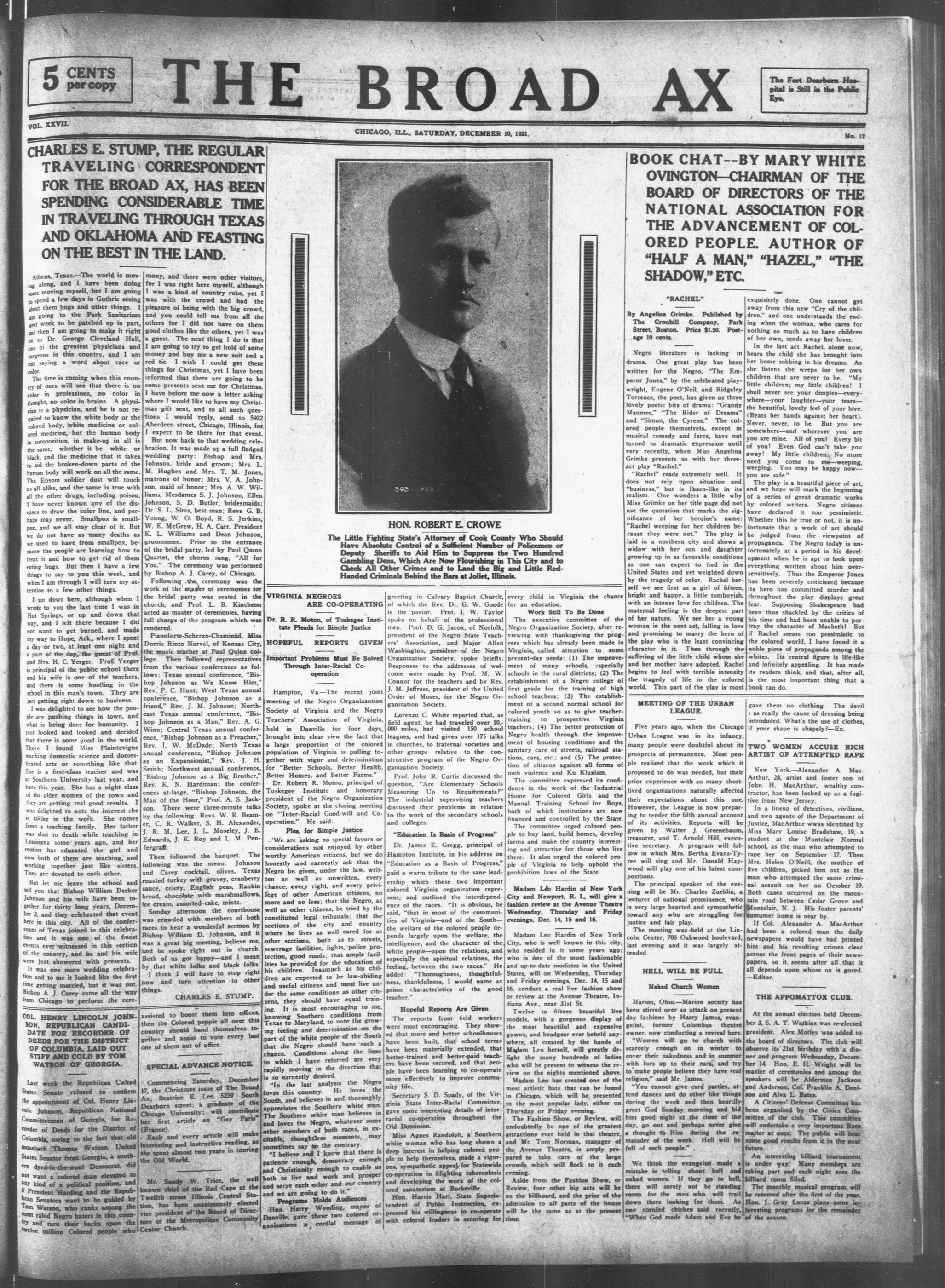
CHARLES E. STUMP, THE REGULAR TRAVELING CORRESPONDENT FOR THE BROAD AX, HAS BEEN SPENDING CONSIDERABLE TIME IN TRAVELING THROUGH TEXAS AND OKLAHOMA AND FEASTING ON THE BEST IN THE LAND.
5 CENTS per copy
VOL. XXVII.
CHARLES E. STUM
TRAVELING
FOR THE BROAD
SPENDING CON
IN TRAVELING
AND OKLAHOM
ON THE BEST I
Athens, Texas.—The world is moving along, and I have been doing some moving myself, but I am going to spend a few days in Guthrie seeing about them bugs and other things. I am going to the Park Sanitarium next week to be patched up in part, and then I am going to make it right on to Dr. George Cleveland Hall, one of the greatest physicians and surgeons in this country, and I am not saying a word about race or color.
The time is coming when this country of ours will see that there is no color in professions, no color in thought, no color in brains. A physician is a physician, and he is not required to know the white body or the colored body, white medicine or colored medicine, but the human body in composition, in make-up in all is the same, whether it be white or black, and the medicine that it takes to aid the broken-down parts of the human body will work on all the same. The Epsom soldier dust will touch us all alike, and the same is true with all the other drugs, including poison. I have never known any of the diseases to draw the color line, and perhaps may never. Smallpox is smallpox, and we all stay clear of it. But we do not have as many deaths as we used to have from smallpox, because the people are learning how to treat it and how to get rid of them eating bugs. But then I have a few things to say to you this week, and when I am through I will turn my attention to a few other things.
I am down here, although when I wrote to you the last time I was in Hot Springs, or up and down that way, and I left there because I did not want to get burned, and made my way to Hope, Ark., where I spent a day or two, at least one night and a part of the day, the guest of Prof. and Mrs. H. C. Yerger. Prof. Yerger is principal of the public school there and his wife is one of the teachers, and there is some hustling in the school in this man's town. They are just getting right down to business.
I was delighted to see how the people are pushing things in town, and what is being done for humanity. I just looked and looked and decided that there is some good in the world. There I found Miss Plaintevigne teaching domestic science and domesticated arts or something like that. She is a first-class teacher and was at Southern University last year, and here this year. She has a night class of the older women of the town and they are getting real good results. I was delighted to note the interest she is taking in the work. She comes from a teaching family. Her father was shot to death while teaching in Louisiana some years ago, and her mother has educated the girl and now both of them are teaching, and working together just like sisters. They are devoted to each other.
But let me leave the school and tell you that Bishop William Decker Johnson and his wife have been together for thirty long years, December 3, and they celebrated that event here in this city. All of the conferences of Texas joined in this celebration and it was one of the finest events ever witnessed in this section of the country, and he and his wife were just showered with presents.
It was one more wedding celebration and to me it looked like the first time getting married, but it was not. Bishop A. J. Carey came all the way from Chicago to perform the cere-
COL. HENRY LINCOLN JOHNSON, REPUBLICAN CANDIDATE FOR RECORDER OF DEEDS FOR THE DISTRICT OF COLUMBIA, LAID OUT STIFF AND COLD BY TOM WATSON OF GEORGIA.
Last week the Republican United States Senate refused to confirm the appointment of Col. Henry Lincoln Johnson, Republican National Committeeman of Georgia, for Recorder of Deeds for the District of Columbia, owing to the fact that old mossback Thomas Watson, United States Senator from Georgia, a southern dyed-in-the-wool Democrat, did not want a colored man elevated to any kind of a political position, and if President Harding and the Republican Senators want to be guided by Tom Watson, who ranks among the most rabid Negro haters in this country and turn their backs upon the twelve million Colored people who
---
THE BROAD AX
money, and there were other visitors, for I was right here myself, although I was a kind of country rube, yet I was with the crowd and had the pleasure of being with the big crowd, and you could tell me from all the others for I did not have on them good clothes like the others, yet I was a guest. The next thing I do is that I am going to try to get hold of some money and buy me a new suit and a red tie. I wish I could get these things for Christmas, yet I have been informed that there are going to be some presents sent me for Christmas. I have before me now a letter asking where I would like to have my Christmas gift sent, and to all such questions I would reply, send to 5922 Aberdeen street, Chicago, Illinois, for I expect to be there for that event. But now back to that wedding celebration. It was made up a full fledged wedding party: Bishop and Mrs. Johnson, bride and groom; Mrs. L. M. Hughes and Mrs. T. M. Jones, matrons of honor; Mrs. V. A. Johnson, maid of honor; Mrs. A. W. Williams, Mesdames S. J. Johnson, Ellen Johnson, S. D. Butler, bridesmaids; Dr. S. L. Sims, best man; Revs G. B. Young, W. O. Boyd, R. S. Jeukins, W. E. McGrew, H. A. Carr, President K. L. Williams and Dean Johnson, groomsmen. Prior to the entrance of the bridal party, led by Paul Quinn Quartet, the chorus sang, "All for You." The ceremony was performed by Bishop A. J. Carey, of Chicago. Following the ceremony was the work of the master of ceremonies for the bridal party was seated in the church, and Prof. L. B. Kincheon acted as master of ceremonies, having full charge of the program which was rendered.
Sunday afternoon the courthouse was crowded with members of both races to hear a wonderful sermon by Bishop William D. Johnson, and it was a great big meeting, believe me, and he spoke right out in church. Both of us got happy—and I mean by that white folks and black folks. I think I will have to stop right now and turn attention to other things.
assisted to boost them into offices, then the Colored people all over this country should band themselves together and assist to vote every last one of them out of office.
SPECIAL ADVANCE NOTICE.
Commencing Saturday, December 17, the Christmas issue of The Broad Ax; Beatrice E. Lee, S259 South Dearborn street; a graduate of the Chicago University; will contribute her first article on "Gay Paris" (France). Each and every article will make interesting and instructive reading, as she spent almost two years in touring the Old World.
Mr. Sandy W. Trice, the well known chief of the Red Caps at the Twelfth street Illinois Central Station, has been unanimously elected vice president of the Board of Directors of the Metropolitan Community Center Church.
390 PED
The Little Fighting State's Attorney of Cook County Who Should Have Absolute Control of a Sufficient Number of Policemen or Deputy Sheriffs to Aid Him to Suppress the Two Hundred Gambling Dens, Which Are Now Flourishing in This City and to Check All Other Crimes and to Land the Big and Little Red-Handed Criminals Behind the Bars at Joliet, Illinois.
The Little Fighting State's Attorney of Cook County Who Should Have Absolute Control of a Sufficient Number of Policemen or Deputy Sheriffs to Aid Him to Suppress the Two Hundred Gambling Dens, Which Are Now Flourishing in This City and to Check All Other Crimes and to Land the Big and Little Red-Handed Criminals Behind the Bars at Joliet, Illinois.
Dr. R. R. Moton, of Tukeagee Institute Pleads for Simple Justice
Important Problems Must Be Solved Through Inter-Racial Co-
Hampton, Va.—The recent joint meeting of the Negro Organization Society of Virginia and the Negro Teachers' Association of Virginia, held in Danville for four days, brought into clear view the fact that a large proportion of the colored population of Virginia is pulling together with vigor and determination for "Better Schools, Better Health, Better Homes, and Better Farms." Dr. Robert R. Moton, principal of Tuskegee Institute and honorary president of the Negro Organization Society, spoke at the closing meeting on "Inter-Racial Good-will and Cooperation." He said:
Plea for Simple Justice
We are asking no special favors or considerations not enjoyed by other worthy American citizens, but we do honestly and earnestly ask that the Negro be given, under the law, written as well as unwritten, every chance, every right, and every privilege of other American citizens, no more and no less; that the Negro, as well as other citizens, be tried by the constituted legal tribunals: that the sections of the city and country where he lives as well cared for as other sections, both as to streets, sewerage facilities, lights, police protection, good roads; that ample facilities be provided for the education of his children. Inasmuch as his children are expected to be law-abiding and useful citizens and must live under the same conditions as other citizens, they should have equal training. It is most encouraging to me, knowing Southern conditions from Texas to Maryland, to note the growing feeling and determination on the part of the white people of the South that the Negro should have such a chance. Conditions along the lines to which I have referred are very rapidly moving in the direction that is so earnestly desired.
"In the last analysis the Negro loves this country. He loves the South, and believes in and thoroughly appreciates the Southern white man. The Southern white man believes in and loves the Negro, whatever some other members of both races, in excitable, thoughtless moments, may sometimes say to the contrary.
"I believe and I know that there is patience enough, democracy enough and Christianity enough to enable us both to live and work and prosper and serve each other and our country and we are going to do it."
Programs Holds Audiences
Hon. Harry Wooding, mayor of Danville, gave these two colored organizations a cordial message of
HON. ROBERT E. CROWE
greeting in Calvary Baptist Church, of which the Rev. Dr. G. W. Goode is the pastor. Prof. I. W. Taylor spoke on behalf of the professional men. Prof. D. G. Jacox, of Norfolk, president of the Negro State Teachers' Association, and Major Allen Washington, president of the Negro Organization Society, spoke briefly. Responses to the addresses of welcome were made by Prof. M. W. Connor for the teachers and by Rev. J. M. Jeffress, president of the United Order of Moses, for the Negro Organization Society.
Lorenzo C. White reported that, as field agent, he had traveled over 10,000 miles, had visited 150 school leagues, and had given over 175 talks in churches, to fraternal societies and other groups relative to the constructive program of the Negro Organization Society.
Prof. John R. Curtis discussed the question, "Are Elementary Schools Measuring Up to Requirements?" The industrial supervising teachers discussed their problems in relation to the work of the secondary schools and colleges.
"Education Is Basis of Progress"
Dr. James E. Gregg, principal of Hampton Institute, in his address on "Education as a Basis of Progress," paid a warm tribute to the sane leadership which these two important colored Virginia organization represent, and outlined the interdependence of the races. "It is obvious, he said, "that in most of the communities of Virginia—and of the South—the welfare of the colored people depends largely upon the welfare, the intelligence, and the character of the white people—upon the relations, and especially the spiritual relations, the feeling, between the two races." He added: "Thoroughness, thoughtfulness, thankfulness, I would name as prime characteristics of the good teacher."
Hopeful Reports Are Given
The reports from field workers were most encouraging. They showed that more and better schoolhouses have been built, that school terms have been materially extended, that better-trained and better-paid teachers have been secured, and that people have been learning to co-operate more effectively to improve community life.
Secretary S. D. Spady, of the Virginia State Inter-Racial Committee, gave some interesting details of interracial co-operation throughout the Old Dominion.
Miss Agnes Randolph, a Southern white woman who has long shown a deep interest in helping colored people to help themselves, made a vigorous, sympathetic appeal for Statewide co-operation in fighting tubercolosis and developing the work of the colored sanatorium at Burkeville.
Hon. Harris Hart, State Superintendent of Public Instruction, expressed his willingness to co-operate with colored leaders in securing for
every child in Virginia the chance for an education.
Work Still To Be Done
The executive committee of the Negro Organization Society, after reviewing with thanksgiving the progress which has already been made in Virginia, called attention to some present-day needs: (1) The improvement of many schools, especially schools in the rural districts; (2) The establishment of a Negro college of first grade for the training of high school teachers; (3) The establishment of a second normal school for colored youth so as to give teacher-training to prospective Virginia teachers; (4) The better protection of Negro health through the improvement of housing conditions and the sanitary care of streets, railroad stations, cars, etc.; and (5) The protection of citizens against all forms of mob violence and Ku Kluxism.
The committee expressed its confidence in the work of the Industrial Home for Colored Girls and the Manual Training School for Boys both of which institutions are now financed and controlled by the State. The committee urged colored people to buy land, build homes, develop farms and make the country interesting and attractive for those who live there. It also urged the colored people of Virginia to help uphold the prohibition laws of the State.
Madam Leo Hardin of New York City and Newport, R. I., will give a fashion review at the Avenue Theatre Wednesday, Thursday and Friday evenings, Dec. 14, 15 and 16.
Madam Leo Hardin of New York City, who is well known in this city, who resided in it some years ago; who is one of the most fashionable and up-to-date modistes in the United States, will on Wednesday, Thursday and Friday evenings, Dec. 14, 15 and 16, conduct a real live fashion show or review at the Avenue Theatre, Indiana Ave., near 31st St.
Twelve to fifteen beautiful live models, with a gorgeous display of the most beautiful and expensive gowns, and headgear ever beheld anywhere, all created by the hands of Madam Leo herself, will greatly delight the many hundreds of ladies who will be present to witness the review on the nights mentioned above.
Madam Leo has created one of the most artistic hats that can be found in Chicago, which will be presented to the most popular lady, either on Thursday or Friday evening.
The Fashion Show, or Review, will undoubtedly be one of the greatest attractions ever held in that theatre, and Mr. Tom Norman, manager of the Avenue Theatre, is amply prepared to take care of the large crowds which will flock to it each evening.
Aside from the Fashion Show, or Review, four other big acts will be on the billboard, and the price of the admission to all parts of the house will be the same as at the present time.
BOOK CHAT--BY MARY WHITE OVINGTON-CHAIRMAN OF THE BOARD OF DIRECTORS OF THE NATIONAL ASSOCIATION FOR THE ADVANCEMENT OF COLORED PEOPLE. AUTHOR OF "HALF A MAN," "HAZEL," "THE SHADOW,"ETC.
"RACHEL"
By Angelina Grimke. Published by The Cronhill Company, Park Street, Boston. Price $1.50. Postage 10 cents.
Negro literature is lacking in drama. One great play has been written for the Negro, "The Emperor Jones," by the celebrated playwright, Eugene O'Neil, and Ridgley Torrence, the poet, has given us three lovely poetic bits of drama: "Granry Maumee," "The Rider of Dreams" and "Simon, the Cyrene." The colored people themselves, except in musical comedy and farce, have not turned to dramatic expression until very recently, when Miss Angelina Grimke presents us with her three-act play "Rachel."
"Rachel" reads extremely well. It does not rely upon situation and "business," but is Ibsen-like in its realism. One wonders a little why Miss Grimke on her title page did not use the quotation that marks the significance of her heroine's name: "Rachel weeping for her children because they were not." The play is laid in a northern city and shows a widow with her son and daughter growing up in as favorable conditions as one can expect to find in the United States and yet weighted down by the tragedy of color. Rachel herself we see first as a girl of fifteen, bright and happy, a little tomboyish, with an intense love for children. The maternal feeling is the deepest part of her nature. We see her a young woman in the next act, falling in love and promising to marry the hero of the play who is the least convincing character in it. Then through the suffering of the little child whom she and her mother have adopted, Rachel begins to feel with terrible intensity the tragedy of life in the colored world. This part of the play is most
MEETING OF THE URBAN LEAGUE.
Five years ago, when the Chicago Urban League was in its infancy, many people were doubtful about its prospects of permanence. Most people realized that the work which it proposed to do was needed, but their prior experience with so many short-lived organizations naturally affected their expectations about this one. However, the League is now preparing to render the fifth annual account of its activities. Reports will be given by Walter J. Greenebaum, treasurer, and T. Arnold Hill, executive secretary. A program will follow in which Mrs. Bertha Evans-Tyree will sing and Mr. Donald Haywood will play one of his latest compositions.
The principal speaker of the evening will be Mr. Charles Zueblin, a lecturer of national prominence, who is very large hearted and sympathetic toward any who are struggling for justice and fair play.
The meeting was held at the Lincoln Center, 700 Oakwood boulevard, last evening and it was largely attended.
HELL WILL BE FULL
Naked Church Women
Marion, Ohio—Marion society has been stirred over an attack on present day fashions by Harry James, evangelist, former Columbus theatre owner, now conducting a revival here.
"Women will go to church with scarcely enough on in winter to cover their nakedness and in summer with furs up to their ears, and try to make people believe they have real religion," said Mr. James.
"You cannot give card parties, attend dances and do other like things during the week and then heartily greet God Sunday morning and bid him good night at the close of the day, go out and perhaps never give a thought to Him during the remainder of the week. Hell will be full of such people."
We think the evangelist made a mistake in telling about hell and naked women. If they go to hell, there will surely not be standing room for the men who will trail down there looking for them. As one cornified chicken said recently, "When God made Adam and Eve he
BY MARY WHITE
HAIRMAN OF THE
DIRECTORS OF THE
ASSOCIATION FOR
ACEMENT OF COLLE.
AUTHOR OF
," "HAZEL," "THE
No.12
exquisitely done. One cannot get away from this new "Cry of the children," and one understands the ending when the woman, who cares for nothing so much as to have children of her own, sends away her lover.
In the last act Rachel, alone now, hears the child she has brought into her home sobbing in his dreams. As she listens she weeps for her own children that are never to be. "My little children; my little children! I shall never see your dimples—everywhere—your laughter—your tears—the beautiful, lovely feel of your love. (Beats her hands against her heart). Never, never to be. But you are somewhere—and wherever you are you are mine. All of you! Every bit of you! Even God can't take you away! My little children. No more need you come to me—weeping, weeping. You may be happy now—you are safe."
The play is a beautiful piece of art, and we hope will mark the beginning of a series of great dramatic works by colored writers. Negro citizens have declared it too pessimistic. Whether this be true or not, it is unfortunate that a work of art should be judged from the viewpoint of propaganda. The Negro today is unfortunately at a period in his development when he is apt to look upon everything written about him oversensitively. Thus the Emperor Jones has been severely criticized because its hero has committed murder and throughout the play displays great fear. Supposing Shakespeare had been thus shackled by the critics of his time and had been unable to portray the character of Macbeth! But if Rachel seems too pessimistic to the colored world, I have found it a noble piece of propaganda among the whites. Its central figure is life-like and infinitely appealing. It has made its readers think, and that, after all, is the most important thing that a book can do.
gave them no clothing. The devil as really the cause of dressing being introduced. What's the use of clothes, if your shape is shaped?—Ex.
TWO WOMEN ACCUSE RICH
ARTIST OF ATTEMPTED RAPE
New York.—Alexander A. MacArthur, 28, artist and foster son of John H. MacArthur, wealthy contractor, has been locked up as a fugitive from New Jersey.
In a lineup of detectives, civilians, and two agents of the Department of Justice, MacArthur wwas identified by Miss Mary Louise Bradshaw, 19, a student at the Montclair Normal school, as the man who attempted to rape her on September 17. Then Mrs. Helen O'Neill, the mother of five children, picked him out as the man who attempted the same criminal assault on her on October 19. Both cases occurred on the mountain road between Cedar Grove and Montclair, N. J. His foster parents' summer home is near by.
If Col. Alexander A. MacArthur had been a colored man the daily newspapers would have had printed him and his revolting crimes clear across the front pages of their newspapers, so it seems after all that it all depends upon whose ox is gored. —Editor.
THE APPOMATTOX CLUB
At the annual election held December 3, S. A. T. Watkins was re-elected president. Alex Motley was added to the board of directors. The club will observe its 21st birthday with a dinner and program Wednesday, December 14. Hon. E. H. Wright will be master of ceremonies and among the speakers will be Aldermen Jackson and Anderson, Col. Franklin A. Denison and Alva L. Bates.
A Citizens' Defense Committee has been organized by the Civics Committee of the club. This committee will undertake a very important Race matter at once. The public will hear some good results from it in the near future.
An interesting billiard tournament is under way. Many members are taking part and each night sees the billiard room filled.
The monthly musical program will be resumed after the first of the year. Hon. J. Gray Lucas plans some interesting programs for the remainder of the season.
1910
THE BROAD AX Published Every Saturday
In this city since July 15th, 1899, without missing one single issue. Republicans, Democrats, Catholics, Protestants, Single Taxers, Priests, infidels or anyone else can have their say as long as their language is proper and responsibility is fixed. The Broad Ax is a newspaper whose platform is broad enough for all, ever claiming the editorial right to speak its own mind. Local communications will receive attention. Write only on one side of the paper. Subscriptions must be paid in advance. One Year . $2.00 Six Months . $1.00 Advertising rates made known on application. Address all communication to THE BROAD AX
So. Elizabeth St., Chicago, Ill
Phone Wenworth 2597
JULIUS F. TAYLOR
Editor and Publisher
Associate Editor
DR. M. A. MAJORS
4700 South State Street
Phone Drexel 1416
DECEMBER 10, 1921.
Vol. XXVII. No. 12
Entered as Second-Class Matter, Aug.
19, 1902, at the Post Office' at Chicago,
Ill. Under Act of March 8, 1879.
M. E. CHURCH SOUTH EDITOR
BACKS DYER BILL
The National Association for the Advancement of Colored People, 70 Firth Avenue, New York, made public the text of a letter sent by Robert B. Eleazer, editor of The Missionary Voice, official organ of the Board of Missions, M. E. Church, South, in which Mr. Eleazer asks Representative Joseph W. Byrnes, of South Carolina, to support the Dyer Anti-Lynching Bill. The letter, copy of which was sent to the National Association for the Advancement of Colored People by Mr. Eleazer, reads as follows:
"Hon. Joseph W. Byrnes,
"Washington. D. C.
"My dear Mr. Byrnes: I write to express the hope that you will do what you can for the passage of the Dyer Anti-Lynching Bill, H. R. 13 which has been favorably reported by the Committee on Judiciary. I have not gone fully into the bill, but it appears to me to be quite reasonable and desirable. It will be opposed, no doubt, on the ground that it is an interference with the state police power, but in view of the fact that so many States have shown themselves either unwilling or unable to protect the citizens from mob violence, it seems to me absolutely necessary, that the government take steps to this end. I trust, therefore, that the bill may have your support.
"Cordially yours,
"ROBERT B. ELEAZER."
STAGE DRIVER WHO CARRIED
LINCOLN DIES AT 89 YEARS
Bloomington.— Dominique Jaquin, 89, pioneer resident of Woodford county, who died Tuesday, operated for many years a stage line throughout central Illinois, connecting with railroads from Metamora, the county seat of Woodford county. He frequently hauled Lincoln, Douglas, Ingersoll and other notables of antebellum days and knew intimately all of these legal lights.
BOOK
014
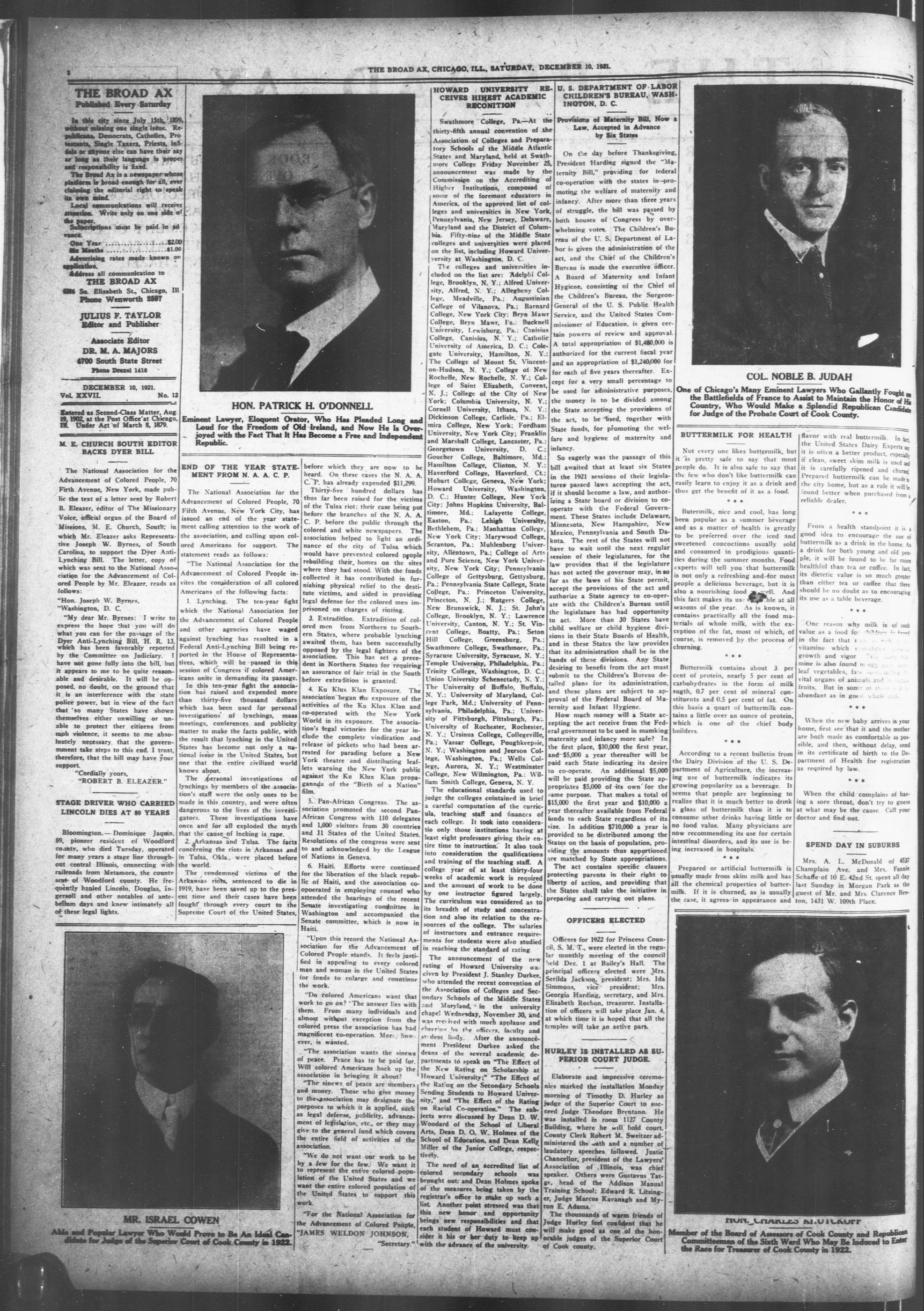
HON. PATRICK H. O'DONNELL Eminent Lawyer, Eloquent Orator, Who Has Pleaded Long and Loud for the Freedom of Old Ireland, and Now He Is Overjoyed with the Fact That It Has Become a Free and Independent Republic.
END OF THE YEAR STATEMENT FROM N. A. A. C. P.
The National Association for the Advancement of Colored People, 70 Fifth Avenue, New York City, has issued an end of the year statement calling attention to the work of the association, and calling upon colored Americans for support. The statement reads as follows:
"The National Association for the Advancement of Colored People invites the consideration of all colored Americans of the following facts:
1. Lynching. The ten-year fight which the National Association for the Advancement of Colored People and other agencies have waged against lynching has resulted in a Federal Anti-Lynching Bill being reported in the House of Representatives, which will be passed in this session of Congress if colored Americans unite in demanding its passage. In this ten-year fight the association has raised and expended more than thirty-five thousand dollars which has been used for personal investigations of lynchings, mass meetings, conferences, and publicity matter to make the facts public, with the result that lynching in the United States has become not only a national issue in the United States, but one that the entire civilized world knows about.
The personal investigations of lynchings by members of the association's staff were the only ones to be made in this country, and were often dangerous to the lives of the investigators. These investigations have once and for all exploded the myth that the cause of lnching is rape.
2. Arkansas and Tulsa. The facts concerning the riots in Arkansas and in Tulsa, Okla., were placed before the world.
The condemned victims of the Arkansas riots, sentenced to die in 1919, have been saved up to the present time and their cases have been fought through every court to the Supreme Court of the United States,
before which they are now to be heard. On these cases the N. A. A.
C. P. has already expended $11,299.
Thirty-five hundred dollars has thus far been raised for the victims of the Tulsa riot; their case being put before the branches of the N. A. A. C. P. before the public through the colored and white newspapers. The association helped to light an ordinance of the city of Tulsa which would have prevented colored people rebuilding their homes on the sites where they had stood. With the funds collected it has contributed in furnishing physical relief to the destitute victims, and aided in providing legal defense for the colored men imprisoned on charges of rioting.
3. Extradition. Extradition of colored men from Northern to Southern States, where probable lynching awaited them, has been successfully opposed by the legal fighters of the association. This has set a precedent in Northern States for requiring an assurance of fair trial in the South before extradition is granted.
4. Ku Klux Klan Exposure. The association began the exposure of the activities of the Ku Klux Klan and co-operated with the New York World in its exposure. The association's legal victories for the year include the complete vindication and release of pickets who had been arrested for parading before a New York theatre and distributing leaflets warning the New York public against the Ku Klux Klan propaganda of the "Birth of a Nation" film.
5. Pan-African Congress. The association promoted the second Pan-African Congress with 110 delegates and 1,000 visitors from 30 countries and 11 States of the United States. Resolutions of the congress were sent to and acknowledged by the League of Nations in Geneva.
6. Haiti. Efforts were continued for the liberation of the black republic of Haiti, and the association cooperated in employing counsel who attended the hearings of the recent Senate investigating committee in Washington and accompanied the Senate committee, which is now in Haiti.
"Upon this record the National Association for the Advancement of Colored People stands. It feels justified in appealing to every colored man and woman in the United States for funds to enlarge and continue the work.
"Do colored Americans want that work to go on? The answer lies with them. From many individuals and almost without exception from the colored press the association has had magnificent co-operation. More, however, is wanted.
"The association wants the sinews of peace. Peace has to be paid for. Will colored Americans back up the association in bringing it about?"
"The sinews of peace are members and money. Those who give money to the association may designate the purposes to which it is applied, such as legal defense, publicity, advancement of legislation, etc., or they may give to the general fund which covers the entire field of activities of the association.
"We do not want our work to be by a few for the few. We want it to represent the entire colored population of the United States and we want the entire colored population of the United States to support this work.
"For the National Association for the Advancement of Colored People, "JAMES WELDON JOHNSON, "Secretary."
THE BROAD AX, CHICAGO, ILL., SATURDAY, DECEMBER 10, 1921.
Swathmore College, Pa.-At the thirty-fifth annual convention of the Association of Colleges and Preparatory Schools of the Middle Atlantic States and Maryland, held at Swathmore College Friday November 25, announcement was made by the Commission on the Accrediting of Higher Institutions, composed of some of the foremost educators in America, of the approved list of colleges and universities in New York, Pennsylvania, New Jersey, Delaware, Maryland and the District of Columbia. Fifty-nine of the Middle State colleges and universities were placed on the list, including Howard University at Washington, D. C.
The colleges and universities included on the list are: Adelphi College, Brooklyn, N. Y.; Alfred University, Alfred, N. Y.; Allegheny College, Meadville, Pa.; Augustinian College of Vilanova, Pa.; Barnard College, New York City; Bryn Mawr College, Bryn Mawr, Pa.; Bucknell University, Lewisburg, Pa.; Canisius College, Canisius, N. Y.; Catholic University of America, D. C.; Colegate University, Hamilton, N. Y.; The College of Mount St. Vincent-on-Hudson, N. Y.; College of New Rochelle, New Rochelle, N. Y.; College of Saint Elizabeth, Convent, N. J.; College of the City of New York; Columbia University, N. Y.; Cornell University, Ithaca, N. Y.; Dickinson College, Carlisle, Pa.; Elmira College, New York; Fordham University, New York City; Franklin and Marshall College, Lancaster, Pa.; Georgetown University, D. C.; Goucher College, Baltimore, Md.; Hamilton College, Clinton, N. Y.; Haverford College, Haverford, Ct.; Hobart College, Geneva, New York; Howard University, Washington, D. C.; Hunter College, New York City; Johns Hopkins University, Baltimore, Md.; Lafayette College, Easton, Pa.; Lehigh University, Bethlehem, Pa.; Manhattan College, New York City; Marywood College, Scranton, Pa.; Muhlenberg University, Allentown, Pa.; College of Arts and Pure Science, New York University, New York City; Pennsylvania College of Gettysburg, Gettysburg, Pa.; Pennsylvania State College, State College, Pa.; Princeton University, Princeton, N. J.; Rutgers College, New Brunswick, N. J.; St. John's College, Brooklyn, N. Y.; Lawrence University, Canton, N. Y.; St. Vincent College, Boatty, Pa.; Seton Hill College, Greensburg, Pa.; Swathmore College, Swathmore, Pa.; Syracuse University, Syracuse, N. Y.; Temple University, Philadelphia, Pa.; Trinity College, Washington, D. C.; Union University Schenectady, N. Y.; The University of Buffalo, Buffalo, N. Y.; University of Maryland, College Park, Md.; University of Pennsylvania, Philadelphia, Pa.; University of Pittsburgh, Pittsburgh, Pa.; University of Rochester, Rochester, N. Y.; Ursusin College, Collegeville, Pa.; Vassar College, Poughkeepsie, N. Y.; Washington and Jeerson College, Washington, Pa.; Wells College, Aurora, N. Y.; Westminster College, New Wilmington, Pa.; William Smith College, Geneva, N. Y.
The educational standards used to judge the colleges coainted in brief a careful computation of the curricula, teaching staff and finances of each college. It took into consideration only those institutions having at least eight professors giving their entire time to instruction. It also took into consideration the qualifications and training of the teaching staff. A college year of at least thirty-four weeks of academic work is required and the amount of work to be done by one instructor figured largely. The curriculum was considered as to its breadth of study and concentration and also its relation to the resources of the college. The salaries of instructors and entrance requirements for students were also studied in reaching the standard of rating.
The announcement of the new rating of Howard University was given by President J. Stanley Durkee, who attended the recent convention of the Association of Colleges and Secondary Schools of the Middle States and Maryland, in the university chapel Wednesday, November 30, and was received with much applause and cheering by the officers, faculty and student body. After the announcement President Durkee asked the deans of the several academic departments to speak on "The Effect of the New Rating on Scholarship at Howard University;" "The Effect of the Rating on the Secondary Schools Sending Students to Howard University," and "The Effect of the Rating on Racial Co-operation." The subjects were discussed by Dean D. W. Woodard of the School of Liberal Arts, Dean D. O. W. Holmes of the School of Education, and Dean Kelly Miller of the Junior College, respectively.
The need of an accredited list of colored secondary schools was brought out; and Dean Holmes spoke of the measures being taken by the registrar's office to make up such a list. Another point stressed was that this new honor and opportunity brings new responsibilities and that each student of Howard must consider it his or her duty to keep up with the advance of the university.
U. S. DEPARTMENT OF LABOR CHILDREN'S BUREAU, WASHINGTON, D. C.
by Six States
On the day before Thanksgiving President Harding signed the "Maternity Bill," providing for federal co-operation with the states in-promoting the welfare of maternity and infancy. After more than three years of struggle, the bill was passed by both houses of Congress by overwhelming votes. The Children's Bureau of the U. S. Department of Labor is given the administration of the act, and the Chief of the Children's Bureau is made the executive officer. A Board of Maternity and Infant Hygiene, consisting of the Chief of the Children's Bureau, the Surgeon-General of the U. S. Public Health Service, and the United States Commissioner of Education, is given certain powers of review and approval. A total appropriation of $1,480,000 is authorized for the current fiscal year and an appropriation of $1,240,000 for each of five years thereafter. Except for a very small percentage to be used for administrative purposes, the money is to be divided among the State accepting the provisions of the act, to be used, together with State funds, for promoting the welfare and hygiene of maternity and infancy.
So eagerly was the passage of this bill awaited that at least six States in the 1921 sessions of their legislatures passed laws accepting the act if it should become a law, and authorizing a State board or division to cooperate with the Federal Government. These States include Delaware Minnesota, New Hampshire, New Mexico, Pennsylvania and South Dakota. The rest of the States will not have to wait until the next regular session of their legislatures, for the law provides that if the legislature has not acted the governor may, in so far as the laws of his State permit, accept the provisions of the act and authorize a State agency to co-operate with the Children's Bureau until the legislature has had opportunity to act. More than 30 States have child welfare or child hygiene divisions in their State Boards of Health, and in these States the law provides that its administration shall be in the hands of these divisions. Any State desiring to benefit from the act must submit to the Children's Bureau detailed plans for its administration, and these plans are subject to approval of the Federal Board of Maternity and Infant Hygiene.
How much money will a State accepting the act receive from the Federal government to be used in mamking maternity and infancy more safe? In the first place, $10,000 the first year, and $5,000 a year thereafter will be paid each State indicating its desire to co-operate. An additional $5,000 will be paid providing the State appropriates $5,000 of its own for the same purpose. That makes a total of $15,000 the first year and $10,000 a year thereafter available from Federal funds to each State regardless of its size. In addition $710,000 a year is provided to be distributed among the States on the basis of population, providing the amounts thus apportioned are matched by State appropriations. The act contains specific clauses protecting parents in their right to liberty of action, and providing that the States shall take the initiative in preparing and carrying out plans.
OFFICERS ELECTED
Officers for 1922 for Princess Council, S. M. T., were elected in the regular monthly meeting of the council held Dec. 1 at Bailey's Hall. The principal officers elected were Mrs. Serilda Jackson, president; Mrs. Ida Simmons, vice president; Mrs. Georgia Harding, secretary, and Mrs. Elizabeth Rochon, treasurer. Installation of officers will take place Jan. 4, at which time it is hoped that all the temples will take an active part.
HURLEY IS INSTALLED AS SUPERIOR COURT JUDGE.
Elaborate and impressive ceremonies marked the installation Monday morning of Timothy D. Hurley as judge of the Superior Court to succeed Judge Theodore Brentano. He was installed in room 1127 County Building, where he will hold court. County Clerk Robert M. Sweitzer administered the oath and a number of laudatory speeches followed. Justic Chancellor, president of the Lawyers' Association of Illinois, was chief speaker. Others were Gustavus Tatge, head of the Addison Manual Training School; Edward R. Litsinger, Judge Marcus Kavanagh and Myron E. Adams.
The thousands of warm friends of Judge Hurley feel confident that he will make good as one of the honorable judges of the Superior Court of Cook county.
1
COL. NOBLE B. JUDAH
One of Chicago's Many Eminent in the Battlefields of France to A Country, Who Would Make for Judge of the Probate Court
One of Chicago's Many Eminent Lawyers Who Gallantly Fought on the Battlefields of France to Assist to Maintain the Honor of His Country, Who Would Make a Splendid Republican Candidate for Judge of the Probate Court of Cook County.
BUTTERMILK FOR HEALTH
Not every one likes buttermilk, but it is pretty safe to say that most people do. It is also safe to say that the few who don't like buttermilk can easily learn to enjoy it as a drink and thus get the benefit of it as a food.
Buttermilk, nice and cool, has long been popular as a summer beverage and as a matter of health is greatly to be preferred over the iced and sweetened concoctions usually sold and consumed in prodigious quantities during the summer months. Food experts will tell you that buttermilk is not only a refreshing and for most people a delicious beverage, but it is also a nourishing food as well. And this fact makes its use valuable at all seasons of the year. As is known, it contains practically all the food materials of whole milk, with the exception of the fat, most of which, of course, is removed by the process of churning.
Buttermilk contains about 3 per cent of protein, nearly 5 per cent of carbohydrates in the form of milk sugth, 0.7 per cent of mineral constituents and 0.5 per cent of fat. On this basis a quart of buttermilk contains a little over an ounce of protein, which is one of the chief body builders.
According to a recent bulletin from the Dairy Division of the U. S. Department of Agriculture, the increasing use of buttermilk indicates its growing popularity as a beverage. It seems that people are beginning to realize that it is much better to drink a glass of buttermilk than it is to consume other drinks having little or no food value. Many physicians are now recommending its use for certain intestinal disorders, and its use is being increased in hospitals.
Prepared or artificial buttermilk is usually made from skim milk and has all the chemical properties of buttermilk. If it is churned, as is usually the case, it agrees-in appearance and
---
1.
Member of the Board of Assessors of Cook County and Republican Committeeman of the Sixth Ward Who May Be Induced to Enter the Race for Treasurer of Cook County in 1922.
***
***
...
***
Lawyers Who Gallantly Fought on Assist to Maintain the Honor of His a Splendid Republican Candidate of Cook County. flavor with real buttermilk. In fact, the United States Dairy Experts say it is often a better product, especially if clean, sweet skim milk is used and if carefully ripened and churned Prepared buttermilk can be made in the city home, but as a rule it will be found better when purchased from a reliable dealer.
From a health standpoint it is a good idea to encourage the use of buttermilk as a drink in the home. As a drink for both young and old people, it will be found to be far more healthful than tea or coffee. In fact, its dietetic value is so much greater than either tea or coffee that there should be no doubt as to encouraging its use as a table beverage.
One reason why milk is of sud value as a food for children is from in the fact that it is rich in vitamine which stimulates growth and vigor. This vitamine is also found in egg yolk leaf vegetables, fats containing vital organs of animals and in fruits. But in some of the abundant as in good whole milk.
When the new baby arrives in your home, first see that it and the mother are both made as comfortable as possible, and then, without delay, send in its certificate of birth to the Department of Health for registration as required by law.
When the child complains of having a sore throat, don't try to guess at what may be the cause. Call your doctor and find out.
SPEND DAY IN SUBURBS
Mrs. A. L. McDonald of 4537
Champlain Ave. and Mrs. Fannie
Schaffe of 10 E. 42nd St. spent all day
last Sunday in Morgan Park as the
guest of Mr. and Mrs. Clarence Benton, 1431 W. 109th Place.
***
***
***
***
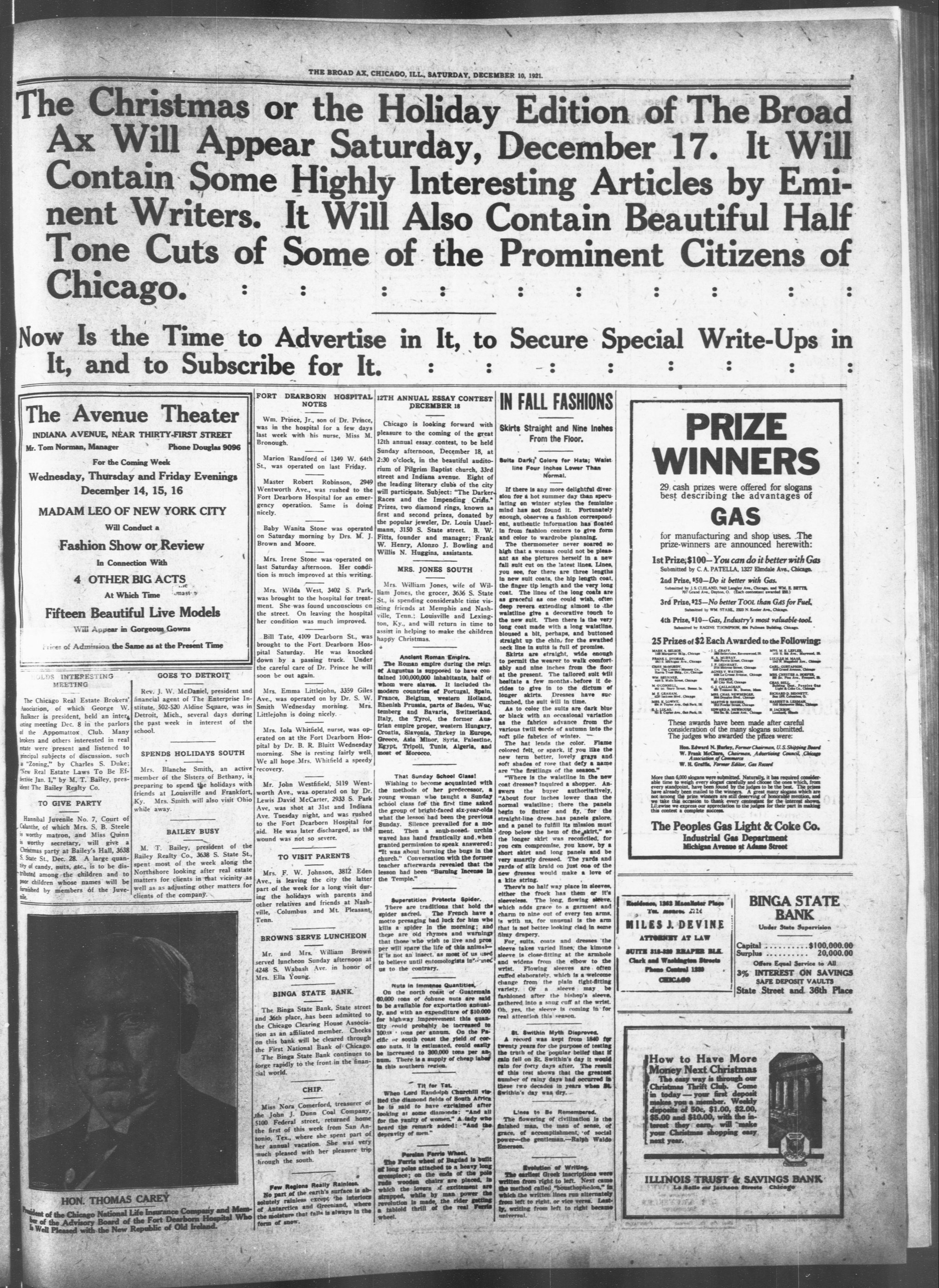
The Christmas or the Holiday Edition of The Broad Ax Will Appear Saturday, December 17. It Will Contain Some Highly Interesting Articles by Eminent Writers. It Will Also Contain Beautiful Half Tone Cuts of Some of the Prominent Citizens of Chicago.
Now Is the Time to Advertise in It, to Secure Special Write-Ups in It, and to Subscribe for It. : : : : : : : : : :
The Avenue Theater
INDIANA AVENUE, NEAR THIRTY-FIRST STREET Mr. Tom Norman, Manager Phone Douglas 9096 For the Coming Week Wednesday, Thursday and Friday Evenings December 14, 15, 16 MADAM LEO OF NEW YORK CITY
Fashion Show or Review
In Connection With
4 OTHER BIG ACTS
At Which Time
Fifteen Beautiful Live Mod
Fifteen Beautiful Live Models Will Appear in Gorgeous Gowns Prices of Admission the Same as at the Present Time
Prices of Admission the Same as at the Present Time
HOLDS INTERESTING MEETING
The Chicago Real Estate Brokers' Association, of which George W. Faulkner is president, held an interisting meeting Dec. 8 in the parlors of the Appomattox Club. Many brokers and others interested in real estate were present and listened to principal subjects of discussion, such a "Zoning," by Charles S. Duke; "New Real Estate Laws To Be Effective Jan. 1," by M. T. Bailey, president The Bailey Realty Co.
TO GIVE PARTY
Hannibal Juvenile No. 7, Court of Calanthe, of which Mrs. S. B. Steele is worthy matron, and Miss Quinn is worthy secretary, will give a Christmas party at Bailey's Hall, 3638 S. State St., Dec. 28. A large quantity of candy, nuts, etc., is to be distributed among the children and to poor children whose names will be furnished by members of the Juvenile.
[Name not visible in the image]
Action With
BIG ACTS
each Time
Ful Live Models
Gorgeous Gowns
name as at the Present Time
GOES TO DETROIT
Rev. J. W. McDaniel, president and financial agent of The Enterprise Institute, 502-520 Aldine Square, was in Detroit, Mich., several days during the past week in interest of the school.
SPENDS HOLIDAYS SOUTH
Mrs. Blanche Smith, an active member of the Sisters of Bethany, is preparing to spend the holidays with friends at Louisville and Frankfort, Ky. Mrs. Smith will also visit Ohio while away.
BAILEY BUSY
M. T. Bailey, president of the Bailey Realty Co., 3638 S. State St., spent most of the week along the Northshore looking after real estate matters for clients in that vicinity as well as as adjusting other matters for clients of the company.
THE BROAD AX, CHICAGO, ILL, SATURDAY, DECEMBER 10. 1921
Wm. Prince, Jr., son of Dr. Prince, was in the hospital for a few days last week with his nurse, Miss M. Bronough.
Marion Randford of 1349 W. 64th St., was operated on last Friday.
Master Robert Robinson, 2949 Wentworth Ave., was rushed to the Fort Dearborn Hospital for an emergency operation. Same is doing nicely.
Baby Wanita Stone was operated on Saturday morning by Drs. M. J. Brown and Moore.
Mrs. Irene Stone was operated on last Saturday afternoon. Her condition is much improved at this writing.
Mrs. Wilda West, 3402 S. Park, was brought to the hospital for treatment. She was found unconscious on the street. On leaving the hospital her condition was much improved.
Bill Tate, 4109 Dearborn St., was brought to the Fort Dearborn Hospital Saturday. He was knocked down by a passing truck. Under the careful care of Dr. Prince he will soon be out again.
Mrs. Emma Littlejohn, 3359 Giles Ave., was operated on by Dr. S. W. Smith Wednesday morning. Mrs. Littlejohn is doing nicely.
Mrs. Iola Whitfield, nurse, was operated on at the Fort Dearborn Hospital by Dr. B. R. Bluitt Wednesday morning. She is resting fairly well. We all hope Mrs. Whitfield a speedy recovery.
Mr. John Westfield, 5119 Wentworth Ave., was operated on by her Dr. Lewis David McCarter, 2933 S. Park Ave. was shot at 31st and Indiana Ave. Tuesday night, and was rushed to the Fort Dearborn Hospital for aid. He was later discharged, as the wound was not so severe.
TO VISIT PARENTS
Mrs. F. W. Johnson, 3812 Eden Ave., is leaving the city the latter part of the week for a long visit during the holidays with parents and other relatives and friends at Nashville, Columbus and Mt. Pleasant, Tenn.
BROWNS SERVE LUNCHEON
Mr. and Mrs. William Brown served luncheon Sunday afternoon at 4248 S. Wabash Ave. in honor of Mrs. Ella Young.
BINGA STATE BANK.
The Binga State Bank, State street and 36th place, has been admitted to the Chicago Clearing House Association as an affiliated member. Checks on this bank will be cleared through the First National Bank of Chicago. The Binga State Bank continues to forge rapidly to the front in the financial world.
CHIP.
Miss Nora Comerford, treasurer of the John J. Dunn Coal Company, 5100 Federal street, returned home the first of this week from San Antonio, Tex., where she spent part of her annual vacation. She was very much pleased with her pleasure trip through the south.
Few Regions Really Rainless. No part of the earth's surface is absolutely rainless except the interiors of Antarctica and Greenland, where the moisture that falls is always in the form of snow.
12TH ANNUAL ESSAY CONTEST
DECEEMBER 18
Chicago is looking forward with pleasure to the coming of the great 12th annual essay contest, to be held Sunday afternoon, December 18, at 2:30 o'clock, in the beautiful auditorium of Pilgrim Baptist church, 33rd street and Indiana avenue. Eight of the leading literary clubs of the city will participate. Subject: "The Darker Races and the Impending Crisis." Prizes, two diamond rings, known as first and second prizes, donated by the popular jeweler, Dr. Louis Usselmann, 3150 S. State street. B. W. Fitts, founder and manager. Frank W. Henry, Alonzo J. Bowling and Willis N. Huggins, assistants.
MRS. JONES SOUTH
Mrs. William Jones, wife of William Jones, the grocer, 3636 S. State St., is spending considerable time visiting friends at Memphis and Nashville, Tenn.; Louisville and Lexington, Ky., and will return in time to assist in helping to make the children happy Christmas.
Ancient Roman Empire.
The Roman empire during the reign of Augustus is supposed to have contained 100,000,000 inhabitants, half of whom were slaves. It included the modern countries of Portugal, Spain France, Belgium, western Holland Rheilhän Prussia, parts of Baden, Wuxemberg and Bavaria, Switzerland Italy, the Tyrol, the former Austrian empire proper, western Hungary, Croatia, Slavonia, Turkey in Europe Greece, Asia Minor, Syria, Palestine Egypt, Tripoll, Tunis, Algeria, and most of Morocco.
That Sunday School Class!
Wishing to become acquainted with the methods of her predecessor, a young woman who taught a Sunday school class for the first time asked the group of bright-faced six-year-olds what the lesson had been the previous Sunday. Silence prevailed for a moment. Then a snub-nosed urchin waved has hand frantically and, when granted permission to speak answered: "It was about burning the bugs in the church." Conversation with the former teacher afterwards revealed that the lesson had been "Burning Incense in the Temple."
Superstition Protects Spider.
There are traditions that hold the spider sacred. The French have a motto presaging bad luck for him who kills a spider in the morning; and these are old rhymes and warnings that those who wish to live and prosper will spare the life of this animal—it is not an insect, as most of us used to believe until entomologists in'...used us to the contrary.
Nuts in Immense Quantities
Nuts in immense quantities.
On the north coast of Guatemala
40,000 tons of cohune nuts are said
to be available for exportation annually,
and with an expenditure of $10,000
for highway improvement this quantity
could probably be increased to
100,000 tons per annum. On the Pacific
or south coast the yield of corozo nuts, it is estimated, could easily
be increased to 300,000 tons per annum.
There is a supply of cheap labels
in this southern region.
Tit for Tat.
When Lord Randolph Churchill visited the diamond fields of South Africa he is said to have exclaimed after looking at some diamonds: "And all for the yanity of women." A lady who heard the remark added: "And the deprivacy of men."
Bernie Farris Wheel.
The Furry wheel of Bagad is built of long poles attached to a heavy long crope; on the ends of the pole rude wooden chairs are placed in which the lovers of excitement are strapped, while by man power the revolution is made, the rider getting a tabloid thrill of the real Furry wheel.
IN FALL FASHIONS
Skirts Straight and Nine Inches From the Floor.
Suita Dark; $ ^{2} $ Colors for Hata; Waist line Four Inches Lower Than Normal.
If there is any more delightful diversion for a hot summer day than speculating on winter styles the feminine mind has not found it. Fortunately enough, observes a fashion correspondent, authentic information has floated in from fashion centers to give form and color to wardrobe planning.
The thermometer never soared so high that a woman could not be pleasant as she pictures herself in a new fall suit cut on the latest lines. Lines, you see, for there are three lengths in new suit coats, the hip length coat, the finger tip length and the very long coat. The lines of the long coats are as graceful as one could wish, deep revers extending almost to the waistline give a decorative touch to the new suit. Then there is the very long coat made with a long waistline, bloused a bit, perhaps, and buttoned straight up the chin, for the swathed neck line in suits is full of promise.
Skirts are straight, wide enough to permit the weaver to walk comfortably and nine inches from the floor at the present. The tailored suit will hesitate a few months before it decides to give in to the dictum of longer skirts. Dresses have succumbed, the suit will in time. As to color the suits are dark blue or black with an occasional variation as the fabrics advance from the various twill words of autumn into the soft pile fabrics of winter. The hat lends the color. Flame colored felt, or spark, if you like the new term better, lovely grays and soft shades of rose that defy a name are "the firelings of the season."
"Where is the waistline in the new coat dresses? Inquired a shopper. Answers the buyer authoritatively,
"About four inches lower than the normal waistline; there the panels begin to flutter and fly, for the straight-line dress has panels galore, and a panel to fulfill its mission must drop below the hem of the skirt," so the longer skirt was recorded, for you can compromise, you know, by a short skirt and long panels and be very smartly dressed. The yards and yards of silk braid on just one of the new dresses would make a love of a kite string.
There's no half way place in sleeves, either the frock has them or it's sleeveless. The long, flowing sleeve, which adds grace to a garment and charm to nine out of every ten arms, is with us, for unusual is the arm that is not better looking clad in some filmy drapery.
For, suits, coats and dresses the sleeve takes varied lines; the kimone sleeve is close-fitting at the armhole and widens from the elbow to the wrist. Flowing sleeves are often cuffed elaborately, which is a welcome change from the plain tight-fitting variety. Or a sleeve may be fashioned after the bishop's sleeve, gathered into a sung cuff at the wrist. Oh, yes, the sleeve is coming in for real attention this season.
St. Swithin Myth Disproved.
St. Swithin my day disappeared. A record was kept from 1840 for twenty years for the purpose of testing the truth of the popular belief that if rain fell on St. Swithin's day it would rain for forty days after. The result of this test shows that the greatest number of rainy days had occurred in these two decades in years when St. Swithin's day was dry.
Lines to Be Remembered.
The flowering of civilization is the finished man, the man of sense, of grace, of accomplishment; of social power—the gentleman.—Ralph Waldo Emerson.
Evolution of Writing
The earliest Greek inscriptions were written from right to left. Next came the method called "bathophorion," in which the written lines run alternately from left to right, or vice versa. Lastly, writing from left to right became universal.
29. cash prizes were offered for slogans best describing the advantages of
for manufacturing and shop uses. The prize-winners are announced herewith:
1st Prize, $100—You can do it better with Gas
Submitted by C. A. PATELLA, 1327 Elmldale Ave., Chicago.
2nd Prize, $50—Do it better with Gas,
Submitted by J. S. CELAND, 743 Langley Ave., Chicago, and W.M. E. BETTA,
707 Grand Ave., Dayton, O. (Each contestant awarded $50.)
3rd Prize, $25—No better TOOL than GAS for Fuel,
Submitted by WM STAHL, 2323 N. Kesler Ave., Chicago.
4th Prize, $10—Gas, Industry's most valuable tool.
Submitted by RAGINE THOMPSON, 804 Pullman Building, Chicago.
25 Prizes of $2 Each Awarded to the Following:
r TOOL than GAS for Fuel.
2523 N Keeler Ave, Chicago.
Industry's most valuable tool.
JON 804 Pulman Building, Chicago.
awarded to the Following:
3rd Prize, $25—better TOOL than GAS for Fuel.
Submited by WM STAHL, 2232 N. Keeler Ave. Chicago.
4th Prize, $10—Gas, Industry's most valuable tool.
Submited by CRIE THOMPSON, 804 Pulman Building, Chicago.
25 Prizes of $2 Each Awarded to the Following:
MRS W E L PLEET
MRS W E L PLEET, Riverview, IL
LUCIA M. LASAL
LUCIA M. LASAL
MRS W E L PLEET, Chicago
LILLIE C. LILLARD, Chicago
MRS CHESTER A. ROWEER
MRS CHESTER A. ROWEER
CRANE BLEE
CRANE BLEE
PENGEL G. LIGHT & C. Co. CHANG
RICHARD D. BONNETT
RICHARD D. BONNETT
MARRIETT L. LEIMAN
MARRIETT L. LEIMAN
J HACKENBURG
J HACKENBURG
MARK A. SELLOH
Prentice Hall, Chicago
MARK E. LEIPFER
Prentice Hall, Chicago
PRANK L. PIVAN
Prentice Hall, Chicago
CRAN MEDWICK
The College of Arts, Chicago
CRAN MEDWICK
The College of Arts, Chicago
WM BRUNER
The College of Arts, Chicago
M GONNELL
M GONNELL
M HAYNE Street, Home, Inc.
M GONNELL
M HAYNE Street, Home, Inc.
MRS. LOWYE
MRS. LOWYE
MRS. LOWYE
I. LULA
I. LULA
I. LULA
These awards have been made after careful consideration of the many slogans submitted.
The judges who awarded the prizes were:
Hon. Edward N. Hurley, Former Chairman, U.S. Shipping Board
W. Frank McChair, Chairman, Advertising Council, Chicago
Association of Commerce
W. H. Graff, Former Editor, Gas Record
More than 6,000 slogans were submitted. Naturally, it has required considerable time to weigh every slogan carefully and choose the ones which, from every standpoint, have been found by the judges to be the best. The prizes have already been mailed to the winners. A great many slogans which are not among the prize winners are still deserving of honorable mention, and we take this occasion to thank every contestant for the interest shown. Likewise we express our appreciation to the judges for their part in making this contest a complete success.
The Peoples Gas Light & Coke Co.
Industrial Gas Department
Michigan Avenue at Adams Street
Naturally, it has required consider-
fully and choose the ones which, from
the judges to be the best. The prizes
are great many dogs which are
deserving of honorable mention, and
very contestant for the interest shown,
to the judges for their part in making
Light & Coke Co.
A Department
at Adams Street
More than 6,000 logans were submitted. Naturally, it has required considerable time to weigh every logan carefully and choose the ones which, from every standpoint, have been found by the judges to be the best. The prizes have already been awarded to the winners, which are not among the prize winners are still deserving of honorable mention, and we take this occasion to thank every contestant for the interest shown. Likewise we express our appreciation to the judges for their part in making this content a complete success.
The Peoples Gas Light & Coke Co.
Industrial Gas Department
Michigan Avenue at Adams Street
BINGA STATE BANK
SUITE 318-820 REAPER B.L.K.
Clark and Washington Streets
Phone Central 1830
CHICAGO
Capital ..... $100,000.00
Surplus ..... 20,000.00
Offers Equal Service to All
3% INTEREST ON SAVINGS
SAFE DEPOSIT VAULTS
State Street and 36th Place
---
How to Have More Money Next Christmas
The easy way is through our Christmas Thrift Club. Come in today — your first deposit makes you a member. Weekly deposits of 50c, $1.00, $2.00, $5.00 and $10.00, with the interest they earn, will make your Christmas shopping easy next year.
ILLINOIS TRUST & SAVINGS BANK
La Belle sur Jackson Streets Chicago
MILES J. DEVINE
ATTORNEY AT LAW
Says her hair was short, coarse and nappy before using this wonderful hair grower.
The soft, silky hair that can be easily dresses has made happy thousands of women who have hair. It will do the same for you. If you and lifeless or if you have dandruff and itching of EXELENTO QUININE POMADE, store. Price by mail 25c on receipt of stamps or coin. GENTS WANTED—Write for Particular.
MEDICINE COMPANY, Atlanta, Georgia.
EXELENTO SKIN BEAUTIFIER, an ointment for dark, shallow skins, used in treatment of skin troubles.
sky hair that can be easily dresses
happy thousands of women who he
will do the same for you. If you
or if you have dandruff and itch
LENTO QUININE POMADE,
lice by mail 25c on receipt of stamps or coin.
NTED—Write for Particular.
THE COMPANY, Atlanta, Georgia
BAUTIFINA, an ointment for dark, sallow skins,
restment of skin troubles.
YOU can have soft, silky hair that can be easily dressed. EXELENTO has made happy thousands of women who had coarse, smappy hair. It will do the same for you. If your hair is brittle and lifeless or if you have dandruff and itching scalp, try a box of EXELENTO QUININE POMADE. For sale at all drug stores, for st�ope or colo. WANTED: Write for Patricia EXELENTO MEDICINE COMPANY, Atlanta, Georgia We make EXELENTO SKIN BRAVATING, an eminent for dark, nallow skins, used in treatment of skin troubles.
YOUR funds should not be idle for a minute. They should be working, accumulating interest, and interest on interest for you.
Present conditions offer golden opportunities to investors who will take advantage of them. These opportunities are rapidly passing, however. Interest rates are being forced down, and the man or woman who hesitates may find it necessary either to sacrifice safety to obtain good in terest, or to accept a lower return than now prevails on good securities.
People who are looking ahead to the time when their money will be "out of a job" are reserving bonds now for later investment.
For example, the man who knows he will have idle money in January is assured of receiving 7% interest with the best of security, simply by asking us to set aside bonds for him which he will pay for as soon as his funds are available.
Write today for information concerning the 7% First Mortgage Real Estate Gold Bonds which have the approval of this bank. Ask for Circular II,
OLN STATE OF CHICAGO
For State Government Superv
and South State St
Telephone Victory 4500
NEW STATE BANK
CHICAGO
Government Supervision
South State Streets
Lee Victory 4500
LINCOLN STATE BANK OF CHICAGO Under State Government Supervision 31st and South State Streets Telephone Victory 4500
TELEPHONE DOUGLAS 1
E F. HARDIN REAL ESTATE
HARDING, JR ESTATE
Up-to-Date or Modern Houses, Apartments and Stores to Rent
3101 COTTAGE GROVE AVE.
Corner 31st Street, Chicago
O
THE BROAD AX, CHICAGO, ILL., SATURDAY, DECEMBER 10, 1921.
HOWARD UNIVERSITY
WASHINGTON, B.C.
Founder by GENERAL O. O. HOWARD
J. STANLEY DURKEE, A. M., Ph. D., D. D., President
EMMETT J. SCOTT, A. M., LL. D., Secretary-Treasurer
COLLEGIATE AND PROFESSIONAL SCHOOLS
Junior College, covering the Freshman and Sophomore years and leading to
the Senior Schools.
Senior Schools, consisting of the Schools of Liberal Arts, Education, Journalism,
and Commerce and Finance, granting respectively the degrees,
A. B. or B. S., A. B. or B. S. in Education; B. S. in Journalism;
B. S. in Commerce and Finance.
School of Applied Science, four year course, granting the degree, B. S.
in Civil Engineering, B. S. in Electrical Engineering, B. S. in Mechanical Engineering, B. S. in Architecture, B. S. in Agriculture,
and B. S. in Household Economics.
Evening Classes. The work of the Junior College and the Senior Schools
may be taken in evening classes with full credit.
School of Music, four year course, granting the degree of Mus. B.
School of Religion, three year course, granting the degrees of B. D. and
Th. B. Courses are offered also by correspondence.
School of Law, three year course, granting the degree of LL. B.
School of Medicine, including Medical, Dental, Pharmaceutical Colleges.
Four year courses for Medical and Dental students; three year course
for Pharmaceutical students.
Following degrees granted: M. D., D. D. S., Phar. C.
Students may enter for collegiate work at the beginning of any quarter.
REGISTRATION
Autumn Quarter ... September 18, 20, 2021
Winter Quarter ... January 8, 4, 2022
Spring Quarter ... March 18, 20, 1922
FOR CATALOG AND INFORMATION WRITE
F. D. WILKINSON, Register
HOWARD UNIVERSITY
WASHINGTON, D.C.
HANDBAGS MUST BE USEFUL
Compartments as Important as Style
—Duvetyn Faille, Silk and Canten Crepe, Materials.
Smart compact bags are the keynote of the novelties featured this season. Paris has set the pace for bulkies appearing handbags, and American manufacturers have adopted this idea with variations to suit the needs of American women.
Bags are carried more for utility than for decoration by American women, it was pointed out, and therefore compartments are as important an element as the style. To give the fast effect and at the same time make it roomy has taxed the ingenuity of manufacturers, but they have succeeded admirably in combining the two. Bags are being made so small and at the same time spacious enough for toilet articles, that the term "vanity" is liberally applied.
The envelope bag, square and oblong shape, is the most stressed style, but bags on frames and draw strings developed in new materials are also conspicuously featured.
Duvetyn fallie, silk and canton crepe are three of the most popular materials used this season and are combined in many cases with steel beads. There is a strong tendency toward 'fur bags'. Some manufacturers are bringing them out in American broadtail and the cheaper rakers are approximating this by using fur fabrics or imitations.
FABRIC GLOVE IS APPROVED
Even Those Accustomed to Wear Kid Have Declared Preference for Newer Handovering.
The fabric glove has found favor with the most fastidious; even those accustomed to wear the kid glove exclusively have declared preference for the fabric glove for general wear. Led by the fancy kid glove, which has had its quota of success, the fabric glove has begun to be decorated in various ways. One of the weaves finding favor comes from France, and, strange to say, it has been developed with all thought for an American clientele. It is an armure of fine cotton which has been passed through an emery process, leaving it with a velvety finish like a dull suede. It is said to be lighter in quality than the chamois, which is the one liked best in the heavier grades. Among the shades preferred, gray and belize are now in the first rank with such differences in tones as shades in each color with white and black and, not infrequently, combinations of the two.
INDIAN DESIGNS ARE LATEST
Indications Are That Sport Clothes Will Copy Navajo Tribe and the Scandinaviana.
If the sweaters which have been seen are an indication of what the coming season fashions are to be, the feminine world of sport clothes levers will resemble the Navajo tribe and Scandinavian sportsmen.
Light backgrounds with Norwegian and Swedish designs in all the primary colors and darker backgrounds with Navajo patterns are the latest things in sweaters. As to colors, the fuchsia shades are in the lead, but every color the rainbow has ever displayed or suggested vies in popularity.
Mending the Blouses
Sometimes, when a favorite suit blouse goes to pieces under the arms, a new piece of material may be be- suit-ticed to the worn place most satisfactorily.
Spread of Bathing in Europe. Bathing came to Europe as one of the good results of the Crusades. The Knights of the Cross found baths in general use among the Saracens, and seeing what good things they were, on returning from those wars took the initiative for their introduction. In this they were highly successful first in England and from that to other countries. So popular did the bath be that it became customary to have one before ceremonies such as marriage or knighthood, and the people have been ever since learning the values of keeping their skins clean.
Longest Shakespeare Play.
"Hamlet is the longest Shakespeare
Song" with 177 lines and
the "Comedy of Errors" the shortest
with 1,777 lines.
The Last Piece of Cake.
It is considered bad luck to take the last piece of cake or other food on the plate. This superstition may be traced as far back as the Bible, where the injunction to "leave some for manners" is found in Ecclesiasticus 31:17.
Olive Oil in Babylon' Diet
Olive Oil in Babies' Diet.
Dr. E. E. Graham of Philadelphia recommends the addition of olive oil to the diet of babies in their first two years. It is digested well by most infants and supplies them with additional fat.
Arrow Deadly as Bullet.
A mounted Indian or white man with bow and buffaloes sometimes could kill more buffaloes than a man could kill with a rifle says the American Forestry Magazine. At close range the arrow was as deadly as the bullet, it made less noise, and arrows could be discharged three or four times as rapidly as bullets from muzzle-loading guns.
Indian Name of Quaint Old City.
The Indians called a strait "Kebec" and the name was given to the site of the present city of Quebec from the peculiar configuration of the St Lawrence river at that point, for the river there grows narrow and from its deep waters rises the bold height on which the ancient city stands. The French-Canadian still pronounces the name Kebec.
Old Buggy His Court
A judge of Livingston, N. J., is on record as holding court from the seat of an old buggy. The case, was that of a tenant who had disregarded notice to vacate property, so the buggy was drawn up within a short distance of the house in question and the trial proceeded.
English Poetry and Prose
If there is anything in literature as wonderful as English poetry it is English prose. Like the twin pillars of a mighty temple stand those two great books, the Bible of 1611, the Shakespeare of 1628, and no other country can show their equal—George Sampson.
Regiment Proud of Long Service.
The Third infantry, the oldest regiment of our army, which dates from 1784, has developed its arms to show its early service in Mexico. One interesting service used by this regiment is a baton crossed with an oldtime bayonet back of the shield. The baton which figures prominently in the regiment's history was made from the flagstaff of the capitol of the City of Mexico and was taken when the city was captured. It is still one of the most highly prized possessions of the regiment.
Electricity and Chinese Demons. Word has come from Shanghai that employees of the China Electric company recently called in a native priest to drive away the demon in an electric buss saw which had cut off two of the operator's fingers. After the ceremony the workmen returned to their tasks contentedly. The manager of the plant felt that, despite the superstition displayed, these Chinese workmen were accepting electricity in their own way.-North American.
THE NEWEST NOTES IN HATS
Lace Still Much Used and Sometimes Seen In Streamers That Hang to the Waletline.
Lace is a becoming and decorative note which is still much used. It is sometimes seen in long streamers that fall from the brim across the back and hang to the waletline, or, again, it is draped at one side. There are some shadow designs, but the Spanish laces are particularly interesting and quite different* from anything used during the summer, because of their definitely heavy pattern and silky weave. Metallic laces in gold and silver are decorative for evening hats.
Soft willow cestrich with long flues, natural or glycerinized cestrich feathers, lacquered quills, and narrow ribbons are used for trimming. Very often, black feathers are tipped with silver.—Vogue.
Clean Velour Hat
If the velour hat is shabby, put some finely powdered salt in the oven. When it is quite hot, rub it into the hat with soft paper. Discard the soiled paper for new occasionally. Brush with a stiff brush.
FUNERAL DIRECTORS
5121 ERNEST H. WILLIAMSON UNDERTAKER
GARAGE
GASOLINE OIL
OPEN DAY & BIGT
Ernest H. Williamson UNDERTAKER
Day Light Chapel, capacity 200, Outside Ventilation—Organ and Organist Free—
I am as near as your Telephone—I give service at a reasonable price—Distance
immaterial, consult me—I save you worry, time and money.
5121 & 5123 SOUTH STATE STREET
CHICAGO, ILLINOIS
118 N. La Salle Street
CHICAGO
Residence 3342 Calumet Ave. Telephone Douglas 1275
JAMES G. COTTER
ATTORNEY AT LAW
145 NORTH CLARK STREET
SUITE 407
Telephone Central 8384
CHICAGO
Formerly
Assistant Attorney General
State of Illinois
Res. 3646 Grand Boul.
Doug. 4897
J. GRAY LUCAS
ATTORNEY-AT-LAW
129 E. 31ST STREET
Suite 18-17
Phone: Douglas 6281
CHICAGO
F. Dunn, J. R. McCahay,
Trustees
Tel: Oakland 1558, 1551, 1550
JOHN J. DUNN
Established 1877
WHOLESALE AND RETAIL
COAL
Fifty-First and Federal Streets
CHICAGO
Academice 3886 Prudie Ave.
Phone Douglas 9188
Phones: Main 2017 Auto 32-396
A. L. WILLIAMS
ATTORNEY AND
COUNSELOR AT LAW
Suite 706 Firmenich Building
84 W. Washington Street
CHICAGO
PHONE KENWOOD 455
Comparative Statement of Deposits
November 18, 1912, $836,605.23
November 17, 1914, $912,005.69
November 17, 1916, $1,132,750.72
November 18, 1918, $1,284,084.24
November 17, 1919, $2,359,636.62
November 15, 1920, $3,224,633.09
OFFICE
JOHN BAIN, President
MICHAEL MAISEL, V
EDW. C. BARRY
W. MERLE H
ARTHUR
IN, President
AEL MAISEL, Vice President
EDW. C. BARRY, Cashier
W. MERLE FISHER, Assistant
ARTHUR C. UTESCH, A
JOHN BAIN, President
MICHAEL MAISEL, Vice President
EDW. C. BARRY, Cashier
W. MERLE FISHER, Assistant Cashier
ARTHUR C. UTESCH, Asst. Cashier.
Something In This.
If a man has the raw material for being a blamed fool, he cannot blame the fakir for taking advantage of opportunities.—Exchange
It Always Costs Him a Stroke.
It Always Costs Him a Stroke.
Nothing is more disconcerting to a middle-aged golfer than to be asked by the young lady who is watching him dvlvc off whether he intends to enter the grandfather's tournament.
The Cranford A
3600 WABAS
The finest building ever opened
Steam heat, electric lights, t
Phone Main 263 J. W. Casey
anford Apartment
600 WABASH AVENUE
ding ever opened to Colored tenants,
electric lights, tile baths, marble
J. W. Casey, Agt. 133 W. W.
THE HOLIDAY HOUSE
The Cranford Apartment Bldg. 3600 WABASH AVENUE
The finest building ever opened to Colored tenants in Chicago Steam heat, electric lights, tile baths, marble entrance Phone Main 263 J. W. Casey, Agt. 133 W. Washington St
FUNERAL DIRECT
DIRECTORS
NCERS
Prince President
Cashier
FISHER, Assistant Cashier
R C. UTESCH, Asst. Cashier.
OFFICERS
Chair Silencera
In rooms where the floor is not covered with a soft carpet the moving of chairs is often the cause of a good deal of noise. The trouble may be remedied in this way: From thick felt cut small rounds to glue on to the feet of the chairs. These can be secured from an old hat or cut from an odd piece of floor covering. The chairs can then be moved about quietly even on the hardest floors.