The Broad Ax
Saturday, April 15, 1922
Chicago, Illinois
Page text (machine-generated)
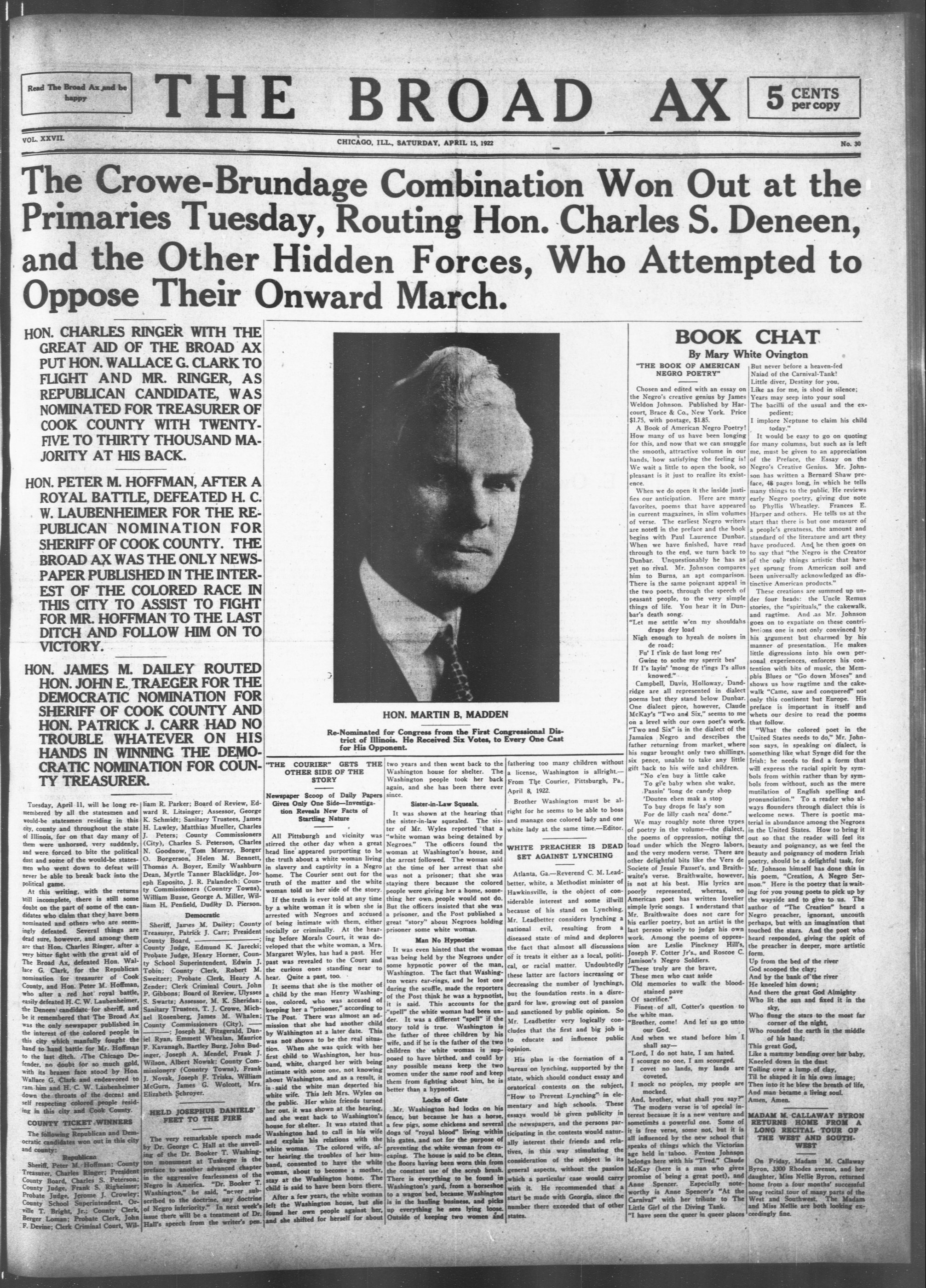
The Crowe-Brundage Combination Won Out at the Primaries Tuesday, Routing Hon. Charles S. Deneen, and the Other Hidden Forces, Who Attempted to Oppose Their Onward March.
HON. CHARLES RINGER WITH THE GREAT AID OF THE BROAD AX PUT HON. WALLACE G. CLARK TO FLIGHT AND MR. RINGER, AS REPUBLICAN CANDIDATE, WAS NOMINATED FOR TREASURER OF COOK COUNTY WITH TWENTY-FIVE TO THIRTY THOUSAND MAJORITY AT HIS BACK.
HON. PETER M. HOFFMAN, AFTER A ROYAL BATTLE, DEFEATED H. C. W. LAUBENHEIMER FOR THE REPUBLICAN NOMINATION FOR SHERIFF OF COOK COUNTY. THE BROAD AX WAS THE ONLY NEWSPAPER PUBLISHED IN THE INTEREST OF THE COLORED RACE IN THIS CITY TO ASSIST TO FIGHT FOR MR. HOFFMAN TO THE LAST DITCH AND FOLLOW HIM ON TO VICTORY.
HON. JAMES M. DAILEY ROUTED HON. JOHN E. TRAEGER FOR THE DEMOCRATIC NOMINATION FOR SHERIFF OF COOK COUNTY AND HON. PATRICK J. CARR HAD NO TROUBLE WHATEVER ON HIS HANDS IN WINNING THE DEMOCRATIC NOMINATION FOR COUNTY TREASURER.
Read The Broad Ax and be happy
VOL. XXVII.
The Crown Primaries and the Opposes
HON. CHARLES R. GREAT AID OF PUT HON. WALLI FLIGHT AND REPUBLICAN NOMINATED FOR COOK COUNTY FIVE TO THIRT JORITY AT HIS
HON. PETER M. HOWYAL BATTLE W. LAUBENHEIM PUBLICAN NO SHERIFF OF COBROAD AX WAS PAPER PUBLISHED EST OF THE CITY TO FOR MR. HOFFMAN DITCH AND FOR VICTORY.
HON. JAMES M. HON. JOHN E. DEMOCRATIC SHERIFF OF COBHON. PATRICK TROUBLE WHAT HANDS IN WIN CRATIC NOMINATY TREASURED
Tuesday, April 11, will be long remembered by all the statesmen and would-be statesmen residing in this city, county and throughout the state of Illinois, for on that day many of them were unhorsed, very suddenly, and were forced to bite the political dust and some of the would-be statesmen who went down to defeat will never be able to break back into the political game.
At this writing, with the returns still incomplete, there is still some doubt on the part of some of the candidates who claim that they have been nominated and others who are seemingly defeated. Several things are dead sure, however, and among them are that Hon. Charles Ringer, after a very bitter fight with the great aid of The Broad Ax, defeated Hon. Wallace G. Clark, for the Republican nomination for treasurer of Cook County, and Hon. Peter M. Hoffman, who after a red hot royal battle, easily defeated H.C. W. Laubenheimer, the Deneen candidate for sheriff, and be it remembered that The Broad Ax was the only newspaper published in the interest of the colored people in this city which manfully fought the hand to hand battle for Mr. Hoffman to the last ditch. The Chicago Defender, no doubt for so much gold, with its brazen face stood by Hon. Wallace G. Clark and endeavored to ram him and H.C. W. Laubenheimer down the throats of the decent and self respecting colored people residing in this city and Cook County.
COUNTY TICKET WINNERS
The following Republican and Democrat candidates won out in this city and county:
Republican
Sheriff, Peter M. Hoffman; County
Treasurer, Charles Ringer; President
County Board, Charles S. Peterson;
County Judge, Frank S. Righeimer;
Probate Judge, Jerome J. Crowley;
County School Superintendent, Orville T. Bright, Jr.; County Clerk,
Berger Loman; Probate Clerk, John
F. Devine; Clerk Criminal Court, Wil-
lian R. Parker; Board of Review, Edward R. Litsinger; Assessor, George K. Schmidt; Sanitary Trustees, James H. Lawley, Matthias Mueller, Charles J. Peters; County Commissioners (City), Charles S. Peterson, Charles N. Goodnow, Tom Murray, Borgen O. Borgerson, Helen M. Bennett, Thomas A. Boyer, Emily Washburn Dean, Myrtle Tanner Blacklidge, Joseph Esposito, J. R. Palandech; County Commissioners (Country Towns), William Busse, George A. Miller, William H. Penfield, Dudley D. Pierson.
Democratic
Sheriff, Jarves M. Dailey; County Treasurer, Patrick J. Carr; President County Board, _____; County Judge, Edmund K. Jarecki; Probate Judge, Henry Horner, County School Superintendent, Edwin J. Tobin; County Clerk, Robert M. Switzer; Probate Clerk, Heary A. Zender; Clerk Criminal Court, John P. Gibbons; Board of Review, Ulysses S. Swartz; Assessor, M. K. Sheridan; Sanitary Trustees, T. J. Crowe, Michael Rosenberg, James M. Whalen; County Commissioners (City), _____; Joseph M. Fitzgerald, Daniel Ryan, Emmett Whealan, Maurice F. Kavanagh, Barthely Burg, John Budinger, Joseph A. Mendel, Frank J. Wilson, Albert Nowak; County Commissioners (Country Towns), Frank J. Novak, Joseph F. Triska, William McGurn, James G. Wolcott, Mrs. Elizabeth Schroyer.
HELD JOSEPHUS DANIEL'S
REET TO THE FIRE
The very remarkable speech made by Dr. George C. Hall at the unveiling of the Dr. Booker T. Washington monument at Tuskegee is the preface to another advanced chapter in the aggressive fearlessness of the Negro in America. "Dr. Booker T. Washington," he said, "never subscribed to the doctrine, any doctrine of Negro inferiority." In next week's issue there will be a treatment of Dr. Hall's speech from the writer's pen.
M.
Re-Nominated for Congress from the First Congressional District of Illinois. He Received Six Votes, to Every One Cast for His Opponent.
"THE COURIER" GETS THE OTHER SIDE OF THE STORY
Newspaper Scoop of Daily Papers Gives Only One Side—Investigation Reveals New Facts of Startling Nature
All Pittsburgh and vicinity was stirred the other day when a great head line appeared purporting to be the truth about a white woman living in slavery and captivity in a Negro home. The Courier sent out for the truth of the matter and the white woman told us her side of the story.
If the truth is ever told at any time by a white woman it is when she is arrested with Negroes and accused of being intimate with them, either socially or criminally. At the hearing before Morals Court, it was developed that the white woman, a Mrs. Margaret Wyles, has had a past. Her past was revealed to the Court and the curious ones standing near to hear. Onite a past, too.
It seems that she is the mother of a child by the man Henry Washington, colored, who was accused of keeping her a "prisoner," according to The Post. There was almost an admission that she had another child by Washington at a later date. This was not shown to be the real situation. When she was quick with her first child to Washington, her husband, white, charged her with being intimate with some one, not knowing about Washington, and as a result, it is said the white man deserted his white wife. This left Mrs. Wyles on the public. Her white friends turned her out, it was shown at the hearing, and she went back to Washington's house for skelter. It was stated that Washington had to call in his wife and explain his relations with the white woman. The colored wife, after hearing the troubles of her husband, consented to have the white woman, about to become a mother, stay at the Washington home. The child is said to have been born there. After a few years, the white woman left the Washington house, but she found her own people against her, and she shifted for herself for about
HON. MARTIN B. MADDEN
two years and then went back to the Washington house for shelter. The Washington people took her back again, and she has been there ever since.
Sister-in-Law Squeals.
It was shown at the hearing that the sister-in-law squealed. The sister of Mr. Wyles reported that a "white woman was being detained by Negroes." The officers found the woman at Washington's house, and the arrest followed. The woman said at the time of her arrest that she was not a prisoner; that she was staying there because the colored people were giving her a home, something her own, people would not do. But the officers insisted that she was a prisoner, and the Post published a great "story" about Negroes holding prisoner some white woman.
Man No Hypnotist
It was even hinted that the woman was being held by the Negroes under some hypnotic power of the man, Washington. The fact that Washington wears ear-rings, and he lost one during the scuffle, made the reporters of the Post think he was a hypnotist, it is said. This accounts for the "spell" the white woman had been under. It was a different "spell" if the story told is true. Washington is the father of three children by his wife, and if he is the father of the two children the white woman is supposed to have birthed, and could by any possible means keep the two women under the same roof and keep them from fighting about him, he is better than a hypnotist.
Locks of Gate
Mr. Washington had locks on his fence, but because he has a horse, a few pigs, some chickens and several dogs of "royal blood" living within his gates, and not for the purpose of preventing the white woman from escaping. The house is said to be clean, the floors having been worn thin from the constant use of the scrub brush. There is everything to be found in Washington's yard, from a horseshoe to a wagon bed, because Washington is in the hauling business, and picks up everything he sees lying loose. Outside of keeping two women and
fathering too many children without a license, Washington is allright.—From The Courier, Pittsburgh, Pa. April 8, 1922. Brother Washington must be alright for he seems to be able to boss and manage one colored lady and one white lady at the same time.—Editor.
WHITE PREACHER IS DEAD
SET AGAINST LYNCHING
Atlanta, Ga.—Reverend C. M. Leadbetter, white, a Methodist minister of Hawkinsville, is the object of considerable interest and some illwill because of his stand on Lynching. Mr. Leadbetter considers lynching a national evil, resulting from a diseased state of mind and deplores the fact that almost all discussions of it treats it either as a local, political, or racial matter. Undoubtedly these latter are factors increasing or decreasing the number of lynchings, but the foundation rests in a disregard for law, growing out of passion and sanctioned by public opinion. So Mr. Leadbetter very logically concludes that the first and big job is to educate and influence public opinion.
His plan is the formation of a bureau on lynching, supported by the state, which should conduct essay and oratorical contests on the subject, "How to Prevent Lynching" in elementary and high schools. These essays would be given publicity in the newspapers, and the persons participating in the contests would naturally interest their friends and relatives, in this way stimulating the consideration of the subject in its general aspects, without the passion which a particular case would carry with it. He recommended that a start be made with Georgia, since the number there exceeded that of other states.
BOOK CHAT
"THE BOOK OF AMERICAN NEGRO POETRY"
Chosen and edited with an essay on the Negro's creative genius by James Weldon Johnson. Published by Harcourt, Brace & Co., New York. Price $1.75, with postage, $1.85.
A Book of American Negro Poetry! How many of us have been longing for this, and now that we can snuggle the smooth, attractive volume in our hands, how satisfying the feeling is! We wait a little to open the book, so pleasant is it just to realize its existence.
When we do open it the inside justifies our anticipation. Here are many favorites, poems that have appeared in current magazines, in slim volumes of verse. The earliest Negro writers are notled in the preface and the book begins with Paul Laurence Dunbar. When we have finished, have read through to the end, we turn back to Dunbar. Unquestionably he has as yet no rival. Mr. Johnson compares him to Burns, an apt comparison. There is the same poignant appeal in the two poets, through the speech of peasant people, to the very simple things of life. You hear it in Dunbar's death song.
"Let me settle w'en my shouldahs
draps dye load
Nigh enough to hyeah de noises in de road;
Fu' I tink de last long res'
knowed.
Campbell, Davis, Holloway, Dandridge are all represented in dialect poems but they stand below Dunbar. One dialect piece, however, Claude McKay's "Two and Six," seems to me on a level with our own poet's work "Two and Six" is in the dialect of the Jamaica Negro and describes the father returning from market, where his sugar brought only two shillings, six pence, unable to take any little gift back to his wife and children.
"No e'en buy a little cake
To gi'e baby when she wake,
.Passin' long de candy shop
'Douten eben mak a stop
To buy drops fe las'y son
For de illly cash nea done.
We may roughly note three types of poetry in the volume—the dialect, the poems of oppression, noting the load under which the Negro labors, and the very modern verse. There are other delightful bits like the Vers de Societe of Jessie Fauset's, and Braithwaite's verse. Braithwaite, however, is not at his best. His lyrics are poorly represented, whereas, no American poet has written lovelier simple lyric songs. I understand that Mr. Braithwaite does not care for his earlier poetry, but an artist is the last person wisely to judge his own work. Among the poems of oppression are Leslie Pinckney Hill's, Joseph F. Cotter Jr.s., and Roscoe C. Jamison's Negro Soldiers.
"These truly are the brave, These men who cast aside Old memories to walk the blood-stained pave Of sacrifice."
Finest of all, Cotter's question to the white man.
"Brother come! And let us go unto
I mock no peoples, my people are mocked.
And, brother, what shall you say?" The modern verse is 'of special interest because it is a new venture and sometimes a powerful one. Some of it is free verse, some not, but it is all influenced by the new school that speaks of things which the Victorian age held in taboo. Fenton Johnson belongs here with his "Tired." Claude McKay (here is a man who gives promise of being a great poet), and Anne Spencer. Especially noteworthy is Anne Spencer's "At the Carnival" with her tribute to The Little Girl of the Diving Tank. "I have seen the queer in queer places
5 CENTS per copy
No. 30
at the
Deneen,
pted to
But never before a heaven-fed
Naiad of the Carnival-Tank!
Little diver, Destiny for you.
Like as for me, is shod in silence;
Years may seep into your soul
The bacilli of the usual and the exp-
pendent;
I implore Neptune to claim his child
today."
It would be easy to go on quoting
for many columns, but such as is left
me, must be given to an appreciation
of the Preface, the Essay on the
Negro's Creative Genius. Mr. Johnson
has written a Bernard Shaw preface,
48 pages long, in which he tells
many things to the public. He reviews
early Negro poetry, giving due note
to Phyllis Wheatley. Frances E.
Harper and others. He tells us at the
start that there is but one measure of
a people's greatness, the amount and
standard of the literature and art they
have produced. And he then goes on
to say that "the Negro is the Creator
of the only things artistic that have
yet sprung from American soil and
been universally acknowledged as distin-
tive American products."
These creations are summed up under four heads: the Uncle Remus stories, the "spirituals," the cakewalk, and ragtime. And as Mr. Johnson goes on to expiate on these contributions one is not only convinced by his argument but charmed by his manner of presentation. He makes little digressions into his own personal experiences, enforces his contention with bits of music, the Memphis Blues or "Go down Moses" and shows us how ragtime and the cakewalk "Came, saw and conquered" not only this continent but Europe. His preface is important in itself and whets our desire to read the poems that follow.
"What the colored poet in the United States needs to do," Mr. Johnson says, in speaking on dialect, is something like what Syngge did for the Irish; he needs to find a form that will express the racial spirit by symbols from within rather than by symbols from without, such as the mere mutilation of English spelling and pronunciation." To a reader who always flounders through dialect this is welcome news. There is poetic material in abundance among the Negroes in the United States. How to bring it out so that the reader will feel its beauty and poignancy, as we feel the beauty and poignancy of modern Irish poetry, should be a delightful task, for Mr. Johnson himself has done this in his poem, "Creation, A Negro Sermon." Here is the poetry that is waiting for you young poets to pick up by the wayside and to give to us. The author of "The Creation" heard a Negro preacher, ignorant, uncouth perhaps, but with an imagination that touched the stars. And the poet who heard responded, giving the spirit of the preacher in deeper, more artistic form.
And there the great God Almighty
Who lit the sun and fixed it in the
sky,
Who flung the stars to the most far
corner of the night.
Who rounded the earth in the middle of his hand;
This great God,
Like a mammy bending over her baby,
Kneeled down in the dust
Toiling over a lump of clay,
Til he shaped it in his own image;
Then into it he blew the breath of life,
And man became a living soul.
Amen, Amen.
MADAM M. CALLAWAY BYRON RETURNS HOME FROM A LONG RECITAL TOUR OF THE WEST AND SOUTH-WEST
On Friday, Madam M. Callaway Byron, 3300 Rhodes avenue, and her daughter, Miss Nellie Byron, returned home from a four months' successful song recital tour of many parts of the West and Southwest. The Madam and Miss Nellie are both looking exceedingly fine.
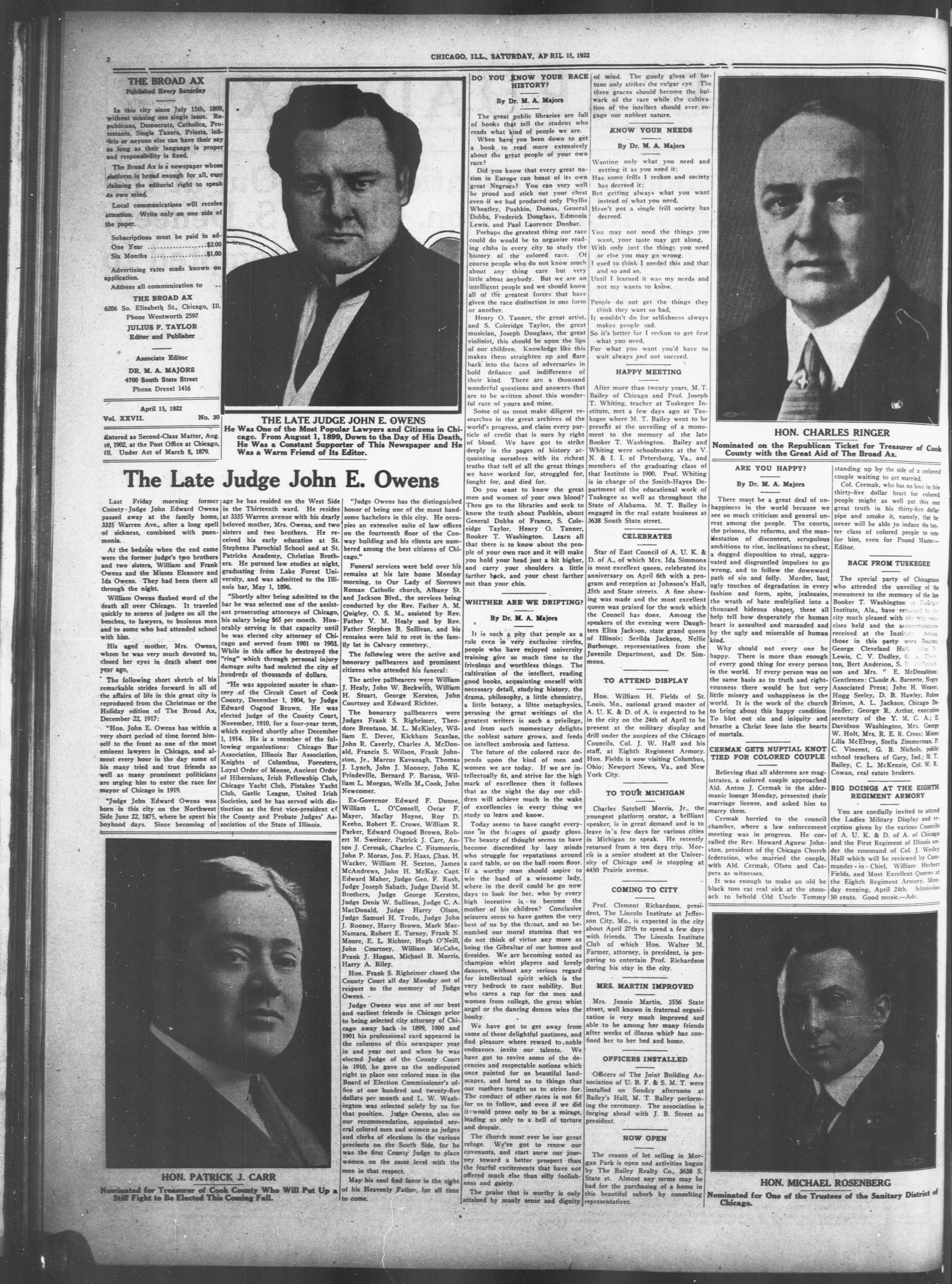
The Late Judge John E. Owens
[Name]
HON. PATRICK J. CARR Nominated for Treasurer of Cook County Who Will Put Up a Stiff Fight to Be Elected This Coming Fall
THE BROAD AX
Published Every Saturday
In this city since July 15th, 1899, without missing one single issue. Republicans, Democrats, Catholics, Protestants, Single Taxers, Priests, infidels or anyone else can have their say as long as their language is proper and responsibility is fixed.
The Broad Ax is a newspaper whose platform is broad enough for all, ever claiming the editorial right to speak its own mind.
Subscriptions must be paid in ad-
One Year ..... $2.00
Six Months ..... $1.00
6206 So. Elizabeth St., Chicago, Ill.
Phone Wentworth 2597
JULIUS F. TAYLOR
Editor and Publisher
DR. M. A. MAJORS
4700 South State Street
Phone Drexel 1416
April 15, 1922
Vol. XXVII. No. 30
Entered as Second-Class Matter, Aug.
19, 1902, at the Post Office at Chicago,
111. Under Act of March 8, 1879.
The Late
Last Friday morning former
County-Judge John Edward Owens
passed away at the family home,
3335 Warren Ave., after a long spell
of sickness, combined with pneumonia.
At the bedside when the end came were the former judge's two brothers and two sisters, William and Frank Owens and the Misses Eleanore and Ida Owens. They had been there all through the night.
William Owens flashed word of the death all over Chicago. It traveled quickly to scores of judges on all the benches, to lawyers, to business men and to some who had attended school with him.
His aged mother, Mrs. Owens, whom he was very much devoted to, closed her eyes in death about one year ago.
The following short sketch of his remarkable strides forward in all of the affairs of life in this great city is reproduced from the Christmas or the Holiday edition of The Broad Ax, December 22, 1917:
"Hon. John E. Owens has within a very short period of time forced himself to the front as one of the most eminent lawyers in Chicago, and almost every hour in the day some of his many tried and true friends as well as many prominent politicians are urging him to enter the race for mayor of Chicago in 1919.
"Judge John Edward Owens was born in this city on the Northwest Side June 22, 1875, where he spent his boyhood days. Since becoming of
---
A.
He Was One of the Most Popular Lawyers and Citizens in Chicago. From August 1, 1899, Down to the Day of His Death, He Was a Constant Supporter of This Newspaper and He Was a Warm Friend of Its Editor.
age he has resided on the West Side in the Thirteenth ward. He resides at 3335 Warren avenue with his dearly beloved mother, Mrs. Owens, and two sisters and two brothers. He received his early education at St Stephens Parochial School and at St Patricks Academy, Christian Brothers. He pursued law studies at night, graduating from Lake Forest University, and was admitted to the Illinois bar, May 1, 1896.
"Shortly after being admitted to the bar he was selected one of the assistant prosecuting attorneys of Chicago, his salary being $65 per month. Honorably serving in that capacity until he was elected city attorney of Chicago and served from 1901 to 1903. While in this office he destroyed the "ring" which through personal injury damage suits had muted the city of hundreds of thousands of dollars.
"He was appointed master in chancery of the Circuit Court of Cook County, December 1, 1904, by Judge Edward Osgood Brown. He was elected judge of the County Court, November, 1910, for a four-year term, which expired shortly after December 1, 1914. He is a member of the following organizations: Chicago Bar Association, Illinois Bar Association, Knights of Columbus, Foresters, Loyal Order of Moose, Ancient Order of Hibernians, Irish Fellowship Club, Chicago Yacht Club, Pistakee Yacht Club, Gaelic League, United Irish Societies, and he has served with distinction as the first vice-president of the County and Probate Judges' Association of the State of Illinois.
CHICAGO, ILL. SATURDAY, AP RIL 15, 1922
"Judge Owens has the distinguished honor of being one of the most handsome bachelors in this city. He occupies an extensive suite of law offices on the fourteenth floor of the Conway building and his clients are numbered among the best citizens of Chicago."
Funeral services were held over his remains at his late home Monday morning, to Our Lady of Sorrows Roman Catholic church, Albany St. and Jackson Blvd., the services being conducted by the Rev. Father A. M. Quigley, O. S. M., assisted by Rev. Father V. M. Healy and by Rev. Father Stephen B. Sullivan, and his remains were laid to rest in the family lot in Calvary cemetery.
The following were the active and honorary pallbearers and prominent citizens who attended his funeral:
The active pallbearers were William J. Healy, John W. Beckwitt, William H. Stuart, George Kersten, John Courtney and Edward Richter.
The honorary pallbearers were Judges Frank S. Righeimer, Theodore Brentano, M. L. McKinley, William E. Dever, Kickham Scanlan, John R. Caverly, Charles A. McDonald, Francis S. Wilson, Frank Johnston, Jr., Marcus Kavanagh, Thomas J. Lynch, John J. Mooney, John K. Prindville, Bernard P. Barasa, William L. Morgan, Wells M. Cook, John Newcomer.
Ex-Governor Edward F. Dunne,
William L. O'Connell, Oscar F.
Mayer, Maclay Hoyne, Roy D.
Keehn, Robert E. Crowe, William R.
Parker, Edward Osgood Brown, Robert M. Sweitzer, Patrick J. Carr, Anton J. Cermak, Charles C. Fitzmorris,
John P. Moran, Jos. F. Haas, Chas. H.
Wacker, William H. Sexton, James
McAndrews, John H. McKay, Capt
Edward Maher, Judge Geo. F. Rush,
Judge Joseph Sabath, Judge David M.
Brothers, Judge George Kersten,
Judge Denis W. Sullivan, Judge C. A.
MacDonald, Judge Harry Olson,
Judge Samuel H. Trude, Judge John
J. Rooney, Harry Brown, Mark Mac
Namara, Robert E. Turney, Frank N.
Moore, E. L. Richter, Hugh O'Neill,
John Courtney, William McCabe,
Frank J. Hogan, Michael B. Morris,
Harry A. Riley.
Hon. Frank S. Righeimer closed the County Court all day Monday out of respect to the memory of Judge Owens.
Judge Owens was one of our best and earliest friends in Chicago prior to being selected city attorney of Chicago away back in 1899, 1900 and 1901 his professional card appeared in the columns of this newspaper year in and year out and when he was elected Judge of the County Court in 1910, he gave us the undisputed right to place one colored man in the Board of Election Commissioner's office at one hundred and twenty-five dollars per month and L. W. Washington was selected solely by us for that position. Judge Owens, also on our recommendation, appointed several colored men and women as judges and clerks of elections in the various precincts on the South Side, for he was the first County Judge to place women on the same level with the men in that respect.
May his soul find favor in the sight of his Heavenly Father, for all time
By Dr. M. A. Majors
The great public libraries are full of books that tell the student who reads what kind of people we are. When have you been down to get a book to read more extensively about the great people of your own race?
Did you know that every great nation in Europe can boast of its own great Negroes? You can very well be proud and stick out your chest even if we had produced only Phyllis Wheatley, Pushkin, Dumas, General Dobbs, Frederick Douglass, Edmonia Lewis, and Paul Laurence Dunbar.
Perhaps the greatest thing our race could do would be to organize reading clubs in every city to study the history of the colored race. Of course people who do not know much about any thing care but very little about anybody. But we are an intelligent people and we should know all of the greatest forces that have given the race distinction in one form or another.
Henry O. Tanner, the great artist, and S. Coleridge Taylor, the great musician, Joseph Douglass, the great violinist, this should be upon the lips of our children. Knowledge like this makes them straighten up and flare back into the faces of adversaries in bold defiance and indifference of their kind. There are a thousand wonderful questions and answers that are to be written about this wonderful race of yours and mine.
Some of us must make diligent researches in the great archives of the world's progress, and claim every particle of credit that is ours by right of blood. We have got to strike deeply in the pages of history acquainting ourselves with its richest truths that tell of all the great things we have worked for, struggled for, fought for, and died for.
Do you want to know the great men and women of your own blood? Then go to the libraries and seek to know the truth about Pushkin, about General Dobbs of France, S. Coleridge Taylor, Henry O. Tanner, Booker T. Washington. Learn all that there is to know about the people of your own race and it will make you hold your head just a bit higher, and carry your shoulders a little farther back, and your chest farther out than your chin.
WHITHER ARE WE DRIFTING?
By Dr. M. A. Majors
It is such a pity that people as a rule even in very exclusive circles, people who have enjoyed university training give so much time to the frivolous and worthless things. The cultivation of the intellect, reading good books, acquainting oneself with necessary detail, studying history, the drama, philosophy, a little chemistry, a little botany, a little metaphysics, perusing the great writings of the greatest writers is such a privilege, and from such momentary delights the noblest nature grows, and feeds on intellect ambrosia and fattens.
The future of the colored race depends upon the kind of men and women we are today. If we are intellectually fit, and strive for the high mark of excellence then it follows that as the night the day our children will achieve much in the wake of excellencies in every thing we study to learn and know.
Today seems to have caught everyone in the fringes of gaudy gloss. The beauty of thought seems to have become discredited by lazy minds who struggle for reputations around a card table, or on the ball room floor. If a worthy man should aspire to win the hand of a winsome lady, where in the devil could he go now days to look for her, who by every high incentive is to become the mother of his children? Conclusive seizures seem to have gotten the very best of us by the throat, and so numbed our moral stamina that we do not think of virtue any more as being the Gibraltar of our homes and firesides. We are becoming noted as champion whist players and lovely dancers, without any serious regard for intellectual spirit which is the very bedrock to race nobility. But who cares a rap for the men and women from college, the great whist angel or the dancing demon wins the booby.
We have got to get away from some of these delightful pastimes, and find pleasure where reward to noble endeavors invite our talents. We have got to revive some of the decencies and respectable notions which once painted for us beautiful landscapes, and lured us to things that our mothers taught us to strive for. The conduct of other races is not fit for us to follow, and even if we did it would prove only to be a mirage, leading us only to a hell of torture and despair.
The church must ever be our great refuge. We've got to renew our covenants, and start anew our journey toward a better prospect than the fearful excitements that have not offered much else than silly foolishness and gaiety.
The praise that is worthy is only attained by manly sense and dignity
of mind. The gaudy gloss of fortune only strikes the vulgar eye. The three graces should be the bulwark of the race while the cultivation of the intellect should ever engage our noblest nature.
KNOW YOUR NEEDS
By Dr. M. A. Majors
Wanting only what you need and getting it as you need it;
Has some frills I reckon and society has decreed it;
But getting always what you want instead of what you need.
Hasn't got a single frill society has decreed.
You may not need the things you want, your taste may get along.
With only just the things you need or else you may go wrong.
I used to think I needed this and that and so and so.
Until I learned it was my needs and not my wants to know.
People do not get the things they think they want so bad.
It wouldn't do for selfishness always makes people sad.
So it's better far I reckon to get first
what you need.
For what you want you'd have to
wait always and not succeed.
HAPPY MEETING
After more than twenty years, M. T. Bailey of Chicago and Prof. Joseph T. Whiting, teacher at Tuskegee Institute, met a few days ago at Tuskegee where M. T. Bailey went to be present at the unveiling of a monument to the memory of the late Booker T. Washington. Bailey and Whiting were schoolmates at the V. N. & I. I. of Petersburg, Va., and members of the graduating class of that Institute in 1900. Prof. Whiting is in charge of the Smith-Hayes Department of the educational work of Tuskegee as well as throughout the State of Alabama. M. T. Bailey is engaged in the real estate business at 3638 South State street.
CELEBRATES
Star of East Council of A. U. K. & D. of A., of which Mrs. Ida Simmons is most excellent queen, celebrated its anniversary on April 6th with a program and reception at Johnson's Hall 35th and State streets. A fine showing was made and the most excellent queen was praised for the work which the Council has done. Among the speakers of the evening were Daughters Eliza Jackson, state grand queen of Illinois; Serila Jackson, Nellie Burbouge, representatives from the Juvenile Department, and Dr. Simmons.
TO ATTEND DISPLAY
Hon. William H. Fields of St. Louis, Mo., national grand master of A. U. K. & D. of A. is expected to be in the city on the 24th of April to be present at the military display and drill under the auspices of the Chicago Councils, Col. J. W. Hall and his staff, at Eighth Regiment Armory. Hon. Fields is now visiting Columbus, Ohio; Newport News, Va., and New York City.
TO TOUR MICHIGAN
Charles Satchell Morris, Jr., the youngest platform orator, a brilliant speaker, is in great demand and is to leave in'a few days for various cities in Michigan to speak. He recently returned from a ten days trip. Morris is a senior student at the University of Chicago and is stopping at 4450 Prairie avenue.
COMING TO CITY
Prof. Clement Richardson, president, The Lincoln Institute at Jefferson City, Mo., is expected in the city about April 27th to spend a few days with friends. The Lincoln Institute Club of which Hon. Walter M. Farmer, attorney, is president, is preparing to entertain Prof. Richardson during his stay in the city.
MRS. MARTIN IMPROVED
Mrs. Jennie Martin, 3556 State street, well known in fraternal organization is very much improved and able to be among her many friends after weeks of illness which has confined her to her bed and home.
OFFICERS INSTALLED
Officers of The Joint Building Association of U. B. F. & S. M. T. were installed on Sunday afternoon at Bailey's Hall, M. T. Bailey performing the ceremony. The association is forging ahead with J. B. Street as president.
NOW OPEN
The season of lot selling in Morgan Park is open and activities begun by The Bailey Realty Co., 3638 S. State st. Almost any terms may be had for the purchasing of a home in this beautiful suburb by consulting representatives.
101
HON. CHARLES RINGER
Nominated on the Republican Ticket for Treasurer of Cook County with the Great Aid of The Broad Ax.
ARE YOU HAPPY?
By Dr. M. A. Majors
There must be a great deal of unhappiness in the world because we see so much criticism and general unrest among the people. The courts, the prisons, the reforms, and the manifestation of discontent, scruppulous ambitions to rise, inclinations to cheat, a dogged disposition to steal, aggravated and disgruntled impulses to go wrong, and to follow the downward path of sin and folly. Murder, lust, ugly touches of degradation in every fashion and form, spite, jealousies, the wrath of hate multiplied into a thousand hideous shapes, these all help tell how desperately the human heart is assaulted and marauded and by the ugly and miserable of human kind.
Why should not every one be happy. There is more than enough of every good thing for every person in the world. If every person was on the same basis as to truth and right-ness there would be but very little misery and unhappiness in the world. It is the work of the church to bring about this happy condition. To blot out sin and iniquity and breathe a Christ love into the hearts of mortals.
CERMAK GETS NUPTIAL KNOT TIED FOR COLORED COUPLE
Believing that all aldermen are magistrates, a colored couple approached Ald. Anton J. Cermak in the aldermanic lounge Monday, presented their marriage license, and asked him to marry them.
Cermak hurried to the council chamber, where a law enforcement meeting was in progress. He corralled the Rev. Howard Agnew Johnston, president of the Chicago Church federation, who married the couple, with Ald. Cermak, Olsen and Caspers as witnesses.
It was enough to make an old he black tom cat real sick at the stomach to behold Old Uncle Tommy
THE MEMORIAL
R. A.
HON. MICHAEL ROSENBERG
Nominated for One of the Trustees of the Sanit
Chicago.
Nominated for One of the Trustees of the Sanitary District of Chicago.
standing up by the side of a colored couple waiting to get married.
Col. Cermak, who has no love in his thirty-five dollar heart for colored people might as well put this one great truth in his thirty-five dollar pipe and smoke it, namely, that he never will be able to induce the better class of colored people to vote for him, even for Pound Master--Editor.
BACK FROM TUSKEGEE
The special party of Chicagoans who attended the unveiling of the monument to the memory of the late Booker T. Washington or University Institute, Ala., have returned to the city much pleased with the trip exercises held and the accommodations received at the Institute. Among those in this party were Doctors George Cleveland Hall, John W. Lewis, C. V. Dudley, G. A. Thompson, Bert Anderson, S. E. McDonaldson and Mrs. S. E. McDonaldson; Gentlemen: Claude A. Barnette, Negro Associated Press; John H. Weaver, Hogg Seeley; John B. Hawley, Ruben Brimm, A. L. Jackson, Chicago Defender; George R. Arthur, executive secretary of the Y. M. C. A.; E. Davidson Washington, Mrs. George W. Holt, Mrs. R. E. R. Cross; Missile Lilia McElroy, Stella Zimmerman, P. C. Vincent, R. B. Nichols, public school teachers of Gary, Ind.; M. T. Bailey, C. L. McKenzie, Col. W. R. Cowan, real estate brokers.
BIG DOINGS AT THE EIGHTH
REGIMENT ARMORY
You are cordially invited to attend the Ladies Military Display and reception given by the various Councils of A. U. K. & D. of A. of Chicago and the First Regiment of Illinois under the command of Col. J. Wesley Hall which will be reviewed by Commander-in-Chief, William Herbert Fields, and Most Excellent Queens at the Eighth Regiment Armory, Monday evening, April 24th. Admission 50 cents. Good music.-Adv.
A. A.
tees of the Sanitary District of
HON. JAMES H. LAWLEY Re-Nominated for One of the Trustees of the Sanitary District of Chicago.
A DAY AT THE URBAN LEAGUE
Few people realize the number and variety of calls which come into the Urban League in the course of a day. From early in the morning, when people in search of work crowd its waiting rooms, until closing time in the evening, scarcely five minutes will pass without a call either in person or by telephone.
All sorts of human problems come through its doors. In the very recent past it has conducted one man to a place where he could have his eye troubles looked after, another through its instrumentality was put on the road to happiness when a friendly guide took him to a specialist in artificial limbs, where he received a brand new bag. Another discharged her Swedish maid and called upon the League for a "cheerful" maid. Another wanted a salesman to introduce a toilet preparation on the South Side. Through the salesman we succeeded in creating and filling places as demonstrators as well. Still another called for a prince took girl, with long black hair to sit as a model for an advertising cut. Also through the League, free books were provided by a school for a boy whose mother was out of work.
This does not include requests for information, use of social service, library, conferences, etc., which make up no small part of the day's work at the League. This is work well worth while.
It is the kind of work which is asking the interest, co-operation, and dollars, of the public in its membership campaign, May 1st to 10th. Mr. J. R. E. Lee, Extension Secretary of the National Urban League is to be in the city April 13th to conduct the drive. The Executive Secretary of the local League branch asks all who believe in this work to participate in this drive. Service on committees, services as solicitors, boosting the League in daily conversation, all are possible ways of spreading information about the service of the League and increasing its usefulness as well as gaining its goal of $10,000 from
M. B.
enthusiastic members. Call at the League office, 3032 South Wabash Avenue or telephone Calumet 0710 what you will do. DO IT NOW WHILE PLANS ARE BEING LAID.
DEATH OF JOHN H. MURPHY
AT BALTIMORE, MD.; HE
WAS 81 YEARS OLD
The middle of this week John H. Murphey, editor and publisher of the Afro-American in that city, came to the end of the road here on this earth. He was more than 81 years old at the time of his death, and was very active almost right up to his last hour on earth. He was one of the most prominent colored masons in the United States. Editor Murphey served as first sergeant in the 30th regiment of Maryland volunteers, serving with General Grant in the Wilderness and at Petersburg, and with General Sherman in North Carolina when General Johnston surrendered his whole Confederate army. Funeral services were held from Bethel A. M. E. Church, of which Mr. Murphey was a prominent lay member.
JACK JOHNSON, THE FORMER HEAVYWEIGHT CHAMPION OF THE WORLD, WILL SOON BE THE HEADLINER AT THE AVENUE THEATER
Starting Sunday, April 23, Jack Johnson, the famous globe trotter, exchampion heavyweight prize fighter of the world and his all star vaudeville company, will hold forth at The Avenue Theater, Indiana Ave. and 31st St. All seats will be reserved, at popular prices. Mr. Tom Norman, manager of the Avenue Theater, has been pulling some great and wonderful attractions to it, recently, and the theater has been filled up chuck ablock to capacity houses, at each performance and the moving pictures, in connection with the five big vaudeville acts or other novelties are all right up to snuff.
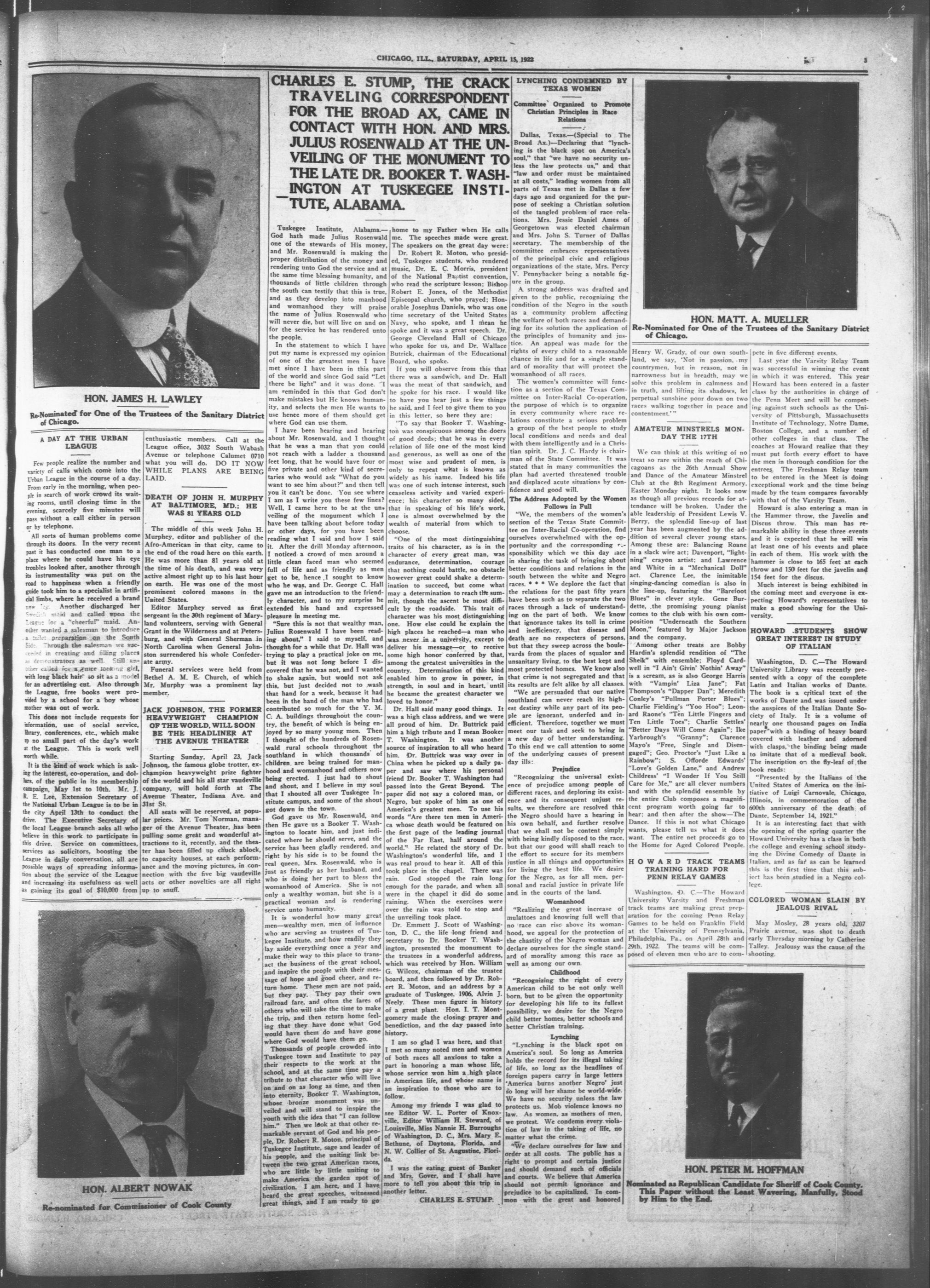
CHARLES E. STUMP, THE CRACK TRAVELING CORRESPONDENT FOR THE BROAD AX, CAME IN CONTACT WITH HON. AND MRS. JULIUS ROSENWALD AT THE UNVEILING OF THE MONUMENT TO THE LATE DR. BOOKER T. WASHINGTON AT TUSKEGEE INSTITUTE, ALABAMA.
Tuskegee Institute, Alabama.—God hath made Julius Rosenwald one of the stewards of His money, and Mr. Rosenwald is making the proper distribution of the money and rendering unto God the service and at the same time blessing humanity, and thousands of little children through the south can testify that this is true, and as they develop into manhood and womanhood they will praise the name of Julius Rosenwald who will never die, but will live on and on for the service he has rendered unto the people.
In the statement to which I have put my name is expressed my opinion of one of the greatest men I have met since I have been in this part of the world and since God said "Let there be light" and it was done. "I am reminded in this that God don't make mistakes but He knows humanity, and selects the men He wants to use hence more of them should get where God can use them.
I have been hearing and hearing about Mr. Rosenwald, and I thought that he was a man that you could not reach with a ladder a thousand feet long, that he would have four on five private and other kind of secretaries who would ask "What do you want to see him about?" and then tell you it can't be done. You see where I am as I write you these few lines! Well, I came here to be at the unveiling of the mopment which I have been talking about before today or other days, for you have been reading what I said and how I said it. After the drill Monday afternoon, I noticed a crowd of men around a little clean faced man who seemed full of life and as friendly as men get to be, hence I sought to know who he was, and Dr. George C. Hall gave me an introduction to the friendly character, and to my surprise he extended his hand and expressed pleasure in meeting me.
"Sure this is not that wealthy man Julius Rosenwald I have been reading about," I said to myself, and thought for a while that Dr. Hall was trying to play a practical joke on me, but it was not long before I discovered that he was not, and I wanted to shake again, but would not ask this, but just decided not to wash that hand for a week, because it had been in the hand of the man who had contributed so much for the Y. M. C. A. buildings throughout the country, the benefit of which is being enjoyed by so many young men. Then I thought of the hundreds of Rosenwald rural schools throughout the southland in which thousands of children are being trained for manhood and womanhood and others now being erected. I just had to shout and shout, and I believe in my soul that I shouted all over Tuskegee Institute campus, and some of the shout got down in the town.
God gave us Mr. Rosenwald, and then He gave us a Booker T. Washington to locate him, and just indicated where he should serve, and the service has been gladly rendered, and right by his side is to be found the real queen, Mrs. Rosenwald, who is just as friendly as her husband, and who is doing her part to bless the womanhood of America. She is not only a wealthy woman, but she is a practical woman and is rendering service unto humanity.
It is wonderful how many great men—wealthy men, men of influence who are serving as trustees of Tuskegee Institute, and how readily they lay aside everything once a year and make their way to this place to transact the business of the great school, and inspire the people with their message of hope and good cheer, and return home. These men are not paid, but they pay. They pay their own railroad fare, and often the fares of others who will take the time to make the trip, and then return home feeling that they have done what God would have them do and have gone where God would have them go.
Thousands of people crowded into Tuskegee town and Institute to pay their respects to the work at the school, and at the same time pay a tribute to that character who will live on and on as long as time, and then into eternity, Booker T. Washington, whose bronze monument was unveiled and will stand to inspire the youth with the idea that "I can follow him." Then we look at that other remarkable servant of God and his people, Dr. Robert R. Moton, principal of Tuskegee Institute, sage and leader of his people, and the uniting link between the two great American races, who are little by little uniting to make America the garden spot of civilization. I am here, and I have heard the great speeches, witnessed great things, and I am ready to go
CHICAGO, ILL., SATURDAY, APRIL 15, 1922
home to my Father when He calls me. The speeches made were great. The speakers on the great day were Dr. Robert R. Moton, who presided, Tuskegee students, who rendered music, Dr. E. C. Morris, president of the National Baptist convention, who read the scripture lesson; Bishop Robert E. Jones, of the Methodist Episcopal church, who prayed; Honorable Josephus Daniels, who was one time secretary of the United States Navy, who spoke, and I mean he spoke and it was a great speech. Dr. George Cleveland Hall of Chicago who spoke for us, and Dr. Wallace Butrick, chairman of the Educational Board, who spoke.
If you will observe from this that there was a sandwich, and Dr. Hall was the meat of that sandwich, and he spoke for his race. I would like to have you hear just a few things he said, and I feel to give them to you in this letter, so here they are:
"To say that Booker T. Washington was conspicuous among the doers of good deeds; that he was in every relation of life one of the most kind and generous, as well as one of the most wise and prudent of men, is only to repeat what is known as widely as his name. Indeed his life was one of such intense interest, such ceaseless activity and varied experience: his character so many sided, that in speaking of his life's work, one is almost overwhelmed by the wealth of material from which to choose.
"One of the most distinguishing traits of his character, as is in the character of every great man, was endurance, determination, courage that nothing could battle, no obstacle however great could shake a determination to succeed, but come what may a determination to reach the summit, though the ascent be most difficult by the roadside. This trait of character was his most distinguishing one. How else could he explain the high places he reached—a man who was never in a university, except to deliver his message—or to receive some high honor conferred by that, among the greatest universities in the country. Determination of this kind enabled him to grow in power, in strength, in soul and in heart, until he became the greatest character we loved to honor."
Dr. Hall said many good things. It was a high class address, and we were all proud of him. Dr. Buttrick paid him a high tribute and I mean Booker T. Washington. It was another source of inspiration to all who heard him. Dr. Buttrick was way over in China when he picked up a daily paper and saw where his personal friend Dr. Booker T. Washington had passed into the Great Beyond. The paper did not say a colored man, or Negro, but spoke of him as one of America's greatest men. To use his words "Are there ten men in America whose death would be featured on the first page of the leading journal of the Far East, half around the world." He related the story of Dr. Washington's wonderful life, and I was real proud to hear it. All of this took place in the chapel. There was rain. God stopped the rain long enough for the parade, and when all were in the chapel it did do some raining. When the exercises were over the rain was told to stop and the unveiling took place.
Dr. Emmett J. Scott of Washington, D. C., the life long friend and secretary to Dr. Booker T. Washington, presented the monument to the trustees in a wonderful address, which was received by Hon. William G. Wilcox, chairman of the trustee board, and then followed by Dr. Robert R. Moton, and an address by a graduate of Tuskegee, 1906, Alvin J. Neely. These men figure in history of a great plant. Hon. I. T. Montgomery made the closing prayer and benediction, and the day passed into history.
I am so glad I was here, and that I met so many noted men and women of both races all anxious to take a part in honoring a man whose life, whose service won him a high place in American life, and whose name is an inspiration to those who are to follow.
Among my friends I was glad to see Editor W. L. Porter of Knoxville, Editor William H. Steward, of Louisville, Miss Nannie H. Burroughs of Washington, D. C., Mrs. Mary E. Bethune, of Daytona, Florida, and N. W. Collier of St. Augustine, Florida.
I was the eating guest of Banker and Mrs. Gover, and I shall have more to tell you about this trip in another letter.
CHARLES E. STUMP.
LYNCHING CONDEMNED BY
TEXAS WOMEN
Dallas, Texas.—(Special to The Broad Ax.)—Declaring that "lynching is the black spot on America's soul," that "we have no security unless the law protects us," and that "law and order must be maintained at all costs," leading women from all parts of Texas met in Dallas a few days ago and organized for the purpose of seeking a Christian solution of the tangled problem of race relations. Mrs. Jessie Daniel Ames of Georgetown was elected chairman and Mrs. John S. Turner of Dallas secretary. The membership of the committee embraces representatives of the principal civic and religious organizations of the state. Mrs. Percy V. Pennybacker being a notable figure in the group.
A strong address was drafted and given to the public, recognizing the condition of the Negro in the south as a community problem affecting the welfare of both races and demanding for its solution the application of the principles of humanity and justice. An appeal was made for the rights of every child to a reasonable chance in life and for a single standard of morality that will protect the womanhood of all races.
The women's committee will function as a section of the Texas Committee on Inter-Racial Co-operation the purpose of which is to organize in every community where race relations constitute a serious problem a group of the best people to study local conditions and needs and deal with them intelligently and in a Christian spirit. Dr. J. C. Hardy is chairman of the State Committee. It was stated that in many communities the plan had averted threatened trouble and displaced acute situations by confidence and good will.
The Address Adopted by the Women Follows in Full
"We, the members of the women's section of the Texas State Committee on Inter-Racial Co-operation, find ourselves overwhelmed with the opportunity and the corresponding responsibility which we this day ace in sharing the task of bringing about better conditions and relations in the south between the white and Negro races. * * * We deplore the fact that the relations for the past fifty years have been such as to separate the two races through a lack of understanding on the part of both. We know that ignorance takes its toll in crime and inefficiency, that disease and death are no respecters of persons, but that they sweep across the boulevards from the places of squalor and unsanitary living, to the best kept and most protected homes. We know also that crime is not segregated and that its results are felt alike by all classes. "We are persuaded that our native southland can never reach its highest destiny while any part of its people are ignorant, underfed and inefficient. Therefore, together we must meet our task and seek to bring in a new day of better understanding. To this end we call attention to some of the underlying causes of present day ills;
Prejudice
"Recognizing the universal existence of prejudice among people of different races, and deploring its existence and its consequent unjust results, we therefore are resolved that the Negro should have a hearing in his own behalf, and further resolve that we shall not be content simply with being kindly disposed to the race, but that our good will shall reach to the effort to secure for its members justice in all things and opportunities for living the best life. We desire for the Negro, as for all men, personal and racial justice in private life and in the courts of the land.
Womanhood
"Realizing the great increase of mulattoes and knowing full well that no race can rise above its womanhood, we appeal for the protection of the chastity of the Negro woman and declare ourselves for the single standard of morality among this race as well as among our own.
Childhood
"Recognizing the right of every American child to be not only well born, but to be given the opportunity for developing his life to its fullest possibility, we desire for the Negro child better homes, better schools and better Christian training.
Lynching
"Lynching is the black spot on America's soul. So long as America holds the record for its illegal taking of life, so long as the headlines of foreign papers carry in large letters 'America burns another Negro' just so long will her shame be world-wide. We have no security unless the law protects us. Mob violence knows no law. As women, as mothers of men, we protest. We condemn every violation of law in the taking of life, no matter what the crime.
"We declare ourselves for law and order at all costs. The public has a right to prompt and certain justice and should demand such of officials and courts. We believe that America should not permit ignorance and prejudice to be capitalized. In common with the great and honored
IRELAND
HON. MATT. A. MUELLER Re-Nominated for One of the Trustees of the Sanitary District of Chicago.
Henry W. Grady, of our own southland, we say, 'Not in passion, my countrymen, but in reason, not in narrowness but in breadth, may we solve this problem in calmness and in truth, and lifting its shadows, let perpetual sunshine pour down on two races walking together in peace and contentment."
pete in five different events.
Last year the Varsity Relay Team was successful in winning the event in which it was entered. This year Howard has been entered in a faster class by the authorities in charge of the Penn Meet and will be competing against such schools as the University of Pittsburgh, Massachusetts.
AMATEUR MINSTRELS MON-
DAY THE 17TH
We can think at this writing of no treat so rare in the reach of Chicagoans as the 26th Annual Show and Dance of the Amateur Minstrel Club at the 8th Regiment Minstrel Easter Monday night. It looks now as though all previous records for attendance will be broken. Under the able leadership of President Lewis V. Berry, the splendid line-up of last year has been augmented by the addition of several clever young stars. Among these are: Balancing Roane in a slack wire act; Davenport, "lightning" crayon artist; and Lawrence and White in a "Mechanical Doll" act. Clarence Lee, the inimitable singing-dancing comedian is also in the line-up, featuring the "Barefoot Blues" in clever style. Gene Burdette, the promising young pianist comes to the club with his own composition "Underneath the Southern Moon," featured by Major Jackson and the company.
"Among other treats are Bobby Hardin's splendid rendition of "The Sheik" with ensemble; Floyd Cardwell in "I Ain't Givin' Nothin' Away" is a scream, as is also George Harris with "Vampin' Liza Jane"; Fat Thompson's "Dapper Dan"; Meredith Conley's "Pullman Porter Blues"; Charlie Fielding's "Yoo Hoo"; Leonard Raone's "Ten Little Fingers and Ten Little Toes"; Charlie Settles's "Better Days Will Come Again"; Ike Yarbrough's "Granny"; Clarence Mayo's "Free, Single and Disengaged"; Geo. Proctor's "Just Like a Rainbow"; S. Offored Edwards"Love's Golden Lane," and Andrew Childress" "I Wonder If You Still Care for Me," are all clever numbers and with the splendid ensemble by the entire club composes a magnificent program worth going far to hear; and then after the show—The Dance. If this is not what Chicago wants, please tell us what it does want. The entire net proceeds go to the Home for Aged Colored People.
H O W A R D TRACK TEAMS
TRAINING HARD FOR
PENN RELAY GAMES
Washington, 4.D. C.-The Howard University Varsity and Freshman track teams are making great preparation for the coming Penn Relay Games to be held on Franklin Field at the University of Pennsylvania, Philadelphia, Pa., on April 28th and 29th, 1922. The teams will be composed of eleven men who are to com-
PETER H. BURKE
HON. PETER M. HOFFMAN Nominated as Republican Candidate for Sheriff of Cook County. This Paper without the Least Wavering, Manfully, Stood by Him to the End.
Nominated as Republican Candidate for Sheriff of Cook County. This Paper without the Least Wavering, Manfully, Stood by Him to the End.
pete in five different events.
Last year the Varsity Relay Team was successful in winning the event in which it was entered. This year Howard has been entered in a faster class by the authorities in charge of the Penn Meet and will be competing against such schools as the University of Pittsburgh, Massachusetts Institute of Technology, Notre Dame, Boston College, and a number of other colleges in that class. The coaches at Howard realize that they must put forth every effort to have the men in thorough condition for the entrees. The Freshman Relay team to be entered in the Meet is doing exceptional work and the time being made by the team compares favorably with that of the Varsity Team.
Howard is also entering a man in the Hammer throw, the Javelin and Discus throw. This man has remarkable ability in these three events and it is expected that he will win at least one of his events and place in each of them. His work with the hammer is close to 165 feet at each throw and 150 feet for the javelin and 154 feet for the discus.
Much interest is being exhibited in the coming meet and everyone is expecting Howard's representatives to make a good showing for the University.
HOWARD STUDENTS SHOW
GREAT INTEREST IN STUDY
OF ITALIAN
Washington, D. C.-The Howard University Library was recently presented with a copy of the complete Latin and Italian works of Dante. The book is a critical text of the works of Dante and was issued under the auspices of the Italian Dante Society of Italy. It is a volume of nearly one thousand pages on India paper with a binding of heavy board covered with leather and adorned with clasps, the binding being made to imitate that of a medieval book. The inscription on the fly-leaf of the book reads: "Presented by the Italians of the United States of America on the initiative of Luigi Carnovale, Chicago, Illinois, in commemoration of the 600th anniversary of the death of Dante, September 14, 1921."
It is an interesting fact that with the opening of the spring quarter the Howard University has a class in both the college and evening school studying the Divine Comedy of Dante in Italian, and as far as can be learned this is the first time that this subject has been studied in a Negro college.
COLORED WOMAN SLAIN BY
JEALOUS RIVAL
May Mosley, 28 years old, 3207
Prairie avenue, was shot to death early Thursday morning by Catherine Talley. Jealousy was the cause of the shooting.
are soft, silky hair that can be
has made happy thousands of
hair. It will do the same to
and lifeless or if you have darn
k of EXELENTO QUINING
nge stores. Price by mail 2c on receipt
AGENTS WANTED--Write for Partic
MEDICINE COMPANY, A
ALENTO SKIN BEAUTIFIES an element for
used in treatment of skin troubles.
YOU can have soft, silky hair that can be easily dressed.
EXELENTO has made happy thousands of women who had
coarse, nappy hair. It will do the same for you. If your
hair is brittle and lifeless or if you have dandruff and itching
scalp, try a box of EXELENTO QUININE POMADE.
For sale at all drug stores. Will fit for stamp or coin.
EXELENTO MEDICINE COMPANY, Atlanta, Georgia
EXELENTO MEDICINE COMPANY, Atlanta, Georgia
We make EXELENTO SKIN BEAUTIFIER, an element for dark, shallow skins,
used in treatment of skin troubles.
TELEPHONE DOUGLAS 1
GEORGE F.
E F. HARDIN REAL ESTATE
Up-to-Date or Me
and S
3101 COTTA
Corner 31s
Phon
FURN
Brass and Wood
Refrigerators,
Hardwa
HENRY
2515-19
JAS. B. McCAHEY, President
FRANK J. DUNN, Vice-President
ESTAB
e or Modern Houses,
and Stores to Rent
COTTAGE GROVE
ner 31st Street, Chicago
Up-to-Date or Modern Houses, Apartments and Stores to Rent
3101 COTTAGE GROVE AVE.
Corner 31st Street, Chicago
FURNITURE
Wood Beds, Electric
Operators, Stoves, Paint
Hardware, Linoleum
NRY STUCKA
2515-19 ARCHER AVE.
President PHILIP J.
Vice-President H. X. COMER
ESTABLISHED 1877
Brass and Wood Beds, Electric Washers, Refrigerators, Stoves, Paint, Oil, Hardware, Linoleum HENRY STUCKART 2515-19 ARCHER AVE.
JAS. B. McCAHEY, President PHILIP J. DUNN, Secretary
FRANK J. DUNN, Vice-President H. X. COMERFORD, Treasurer
ESTABLISHED 1877
JOHN J. DUNN
COAL CO.
Telephone Oakland 1550
5100 Federal Street CHICAGO
Phone Main 2017
Residence, 1262 Macalister Place
Telephone Monroe 2714
reet
A. L. WILLIAMS
ATTORNEY AND
COUNSELOR AT LAW
Suite 706 Firmenich Building
184 W. Washington St.
CHICAGO
Residence 3685 Prairie Ave.
Phone Douglas 9133
BILL is a good substa who, like many up to a short time ago, his money systematically
What Ralph wrote to Bill
BILL is a good substantial citizen who, like many of us, had, up to a short time ago, never saved his money systematically.
He never really thought seriously of investing in bonds until he was married a few years ago. Being inexperienced in financial matters, he wrote several letters to Ralph, an attorney friend of his, who answered all his questions in a very simple and clear manner.
We have just published a booklet called "An Investor's Letters" which contains all of Ralph's and Bill's correspondence. You will find it very interesting and it may clear up some of the questions you have in your own mind about investment matters.
We shall be glad to and "An Investor's Letters" free of charge or obligation to anyone who requests it.
LINCOLN STATE BANK
OF CHICAGO
Under State Government Supervision
31st and South State Streets
Telephone Victory 4500
Sicily Greer Praises
EXELENTO QUININE
POMADE
Says her hair was short, coarse
and nappy before using this
wonderful hair grower.
silky hair that can be easily dressed.
made happy thousands of women who had
It will do the same for you. If your
less or if you have dandruff and itching
EXELENTO QUININE POMADE.
Price by mail 12c can receipt of stamp or coin.
WANTED—Write for Particulars.
CINE COMPANY, Atlanta, Georgia
IN BRAUTISER, an eminent for dark, shallow skins.
in treatment of skin troubles.
F. HARDING, JR.
REAL ESTATE
Modern Houses, Apartments
Stores to Rent
STAGE GROVE AVE.
31st Street, Chicago
Phone Yards 27
UNITURE
Food Beds, Electric Washers,
ors, Stoves, Paint, Oil,
ilware, Linoleum
STUCKART
19 ARCHER AVE.
PHILIP J. DUNN, Secretary
H. X. COMERFORD, Treasurer
ESTABLISHED 1877
CHICAGO
Residence, 1262 Macalister Place
Telephone Monroe 2714
MILES J. DEVINE
ATTORNEY AT LAW
Suite 318-320 Reaper Block
Clark and Washington Sts.
CHICAGO
Telephone Central 1239
BILL is a good substantial citizen
who, like many of us, had,
up to a short time ago, never saved
his money systematically.
CHICAGO
CHICAGO, ILL., SATURDAY, APRIL 15, 1922
It's not the money you earn, but the money you save—that's the reward for your labor. A savings account started now will bring satisfaction and pleasure throughout your life, as the principal and interest grow. Start today in this large bank, where your savings are safe.
T & SAVINGS BANK
Jason Streets Chicago
ILLINOIS TRUST & SAVINGS BANK
La Salle and Jackson Streets Chicago
[Picture of a man in a suit with a tie].
Who Is This?
Office Phones: Main 1612, 1854
W. G. Anderson
Attorney-At-Law
Notary Public
184 W. Washington St., Cor. Wells
Suite 603, Firmenich Bldg.
Residence: 3354 Vernon Avenue
Phone Douglas 6045
CHICAGO
Seemed to Be Something Wrong.
Kenneth's mother had been to the hospital and Kenneth was waiting impatiently for her return. The day of her homecoming he took a chair up to the window and watched every auto pass with his little nose flattened against the window pane. Suddenly an auto pulled up, his mother looked out and waved, and Kenneth dashed madly out to the steps to greet her. Mother was overjoyed at seeing him, she began to cry, and Kenneth looked at her and said: "Ooh, mother dear, aln't you all well yet?"
Oldest American Newspaper
The New York Globe was founded on December 9, 1793, by Noah Webster, as the "American Minerva." It was renamed "The Commercial Advertiser" on October 7, 1797 and was again changed to "The Globe and Commercial Advertiser" on February 1, 1804. This is the oldest daily newspaper still in existence in America. A weekly paper, the New Hampshire Gazette, was established in 1756 and is still published. The Hartford Courant was established as a weekly, the Connecticut Courant, in 1764, and is now a daily.
Picturesque Sight
One of the most picturesque sights in the world is the elephants at work in the city of Rangoon, at the mouth of the Irrawaddy river, where the logs artive. At Rangoon the logs float in at an undisturbed inlet. Here they are released from their inclosing boom chains. Then elephants take the logs out of the water and pile in the mill yards such logs as are not required for immediate sawing, and which may need to be stored for one or more years.
Mountain of Sulphur.
By looking on a map of the South seas, one can find the New Hebrides, about 900 miles east of Queensland, Australia, and southeast of the Solomons. At the north end of the group is an island, called Vanua Lava. This island is a mountain, a big one, 1,600 feet high and covering an area of 100 square miles. But the remarkable thing about it is that it is composed wholly of sulphur. Nothing like it is to be found anywhere in the world.
Good "Grain" Results
Artificial "graining" of wood has been practiced for a long time and some of the results obtained by the modern methods of printing from a master roll of real wood are remarkably realistic, says the American Forestry Magazine. Through this means it is possible to impart a good imitation of malagany to plain, colorless woods and to metals.
Really Serious Herrers
Nothing that is admittedly and unmistakably horrible matters very much, because it frightens people into seeking a remedy; the serious horrors are those which seem entirely respectable and normal to respectable and normal men.—Bernard Shaw.
ILLINOIS TRUST
La Salle and Jack
Notary Publi
Phones: Office Main 4153; Residence,
4751 Champlain Avenue
Phone Kenwood 5611
Walter M. Farmer
ATTORNEY AND COUNSELOR
AT LAW
Suite 708—184 W. Washington St.
CHICAGO
Moons of the Planets.
Moons of the Planets.
A moon is an attendant that circles about the planet of a sun. It is the satellite of a satellite. The distinction between moon and planet is not one of size. Two moons in the solar system—Titan of Saturn and Ganymede of Jupiter—are larger than the planet Mercury, and rival the planet Mars. Many moons exceed the asteroids, or tiny planets. A satellite is held in sway by both sun and planet. It is ruled by two masters, and of these the sun is always the stronger partner.
For Violin Backs
When any figure appears on a smooth surface as though in relief, it is called mottle, says the American Forestry Magazine. The fiddle-back mottle appears a series of hills and valleys and derives its name from the common use of maple with such figures in making the backs of violins.
Destructive Volcanic Outburst
Destructive Volcanic Outburst
Rising to a height of 13,000 feet, only a few miles from Kilauea, is the great volcano of Mauna Loa, which has intermittent eruptions, the last one of great violence beginning in October, 1919, and continuing for five months, the flow coming from a split in the mountain far down upon its flank. The black rolls of treacle lava flowed for miles through the sand flats, forests and bare rock slopes, finally emptying into the sea, where giant clouds of steam rose day and night. Myriads of sea fish were killed by the boiling water.
Easy.
"George, you should get married," advised the married man. "It is wonderful to have a home waiting for you when you return at night. There is ecstacy in caring for a garden and a lawn; you can raise a dog from a pup, children adorable and no trouble at all, a wife is an inspiration, and even if she does get suspicious you can always talk her out of it." "I could if I could lie like you can." said the bachelor, thoughtfully.
—Wayside Tales.
Mean Much to Nature Lover
Mean Much to Nature Lover.
The bird upon the tree utters the meaning of the wind—a voice of the grass and the wild wind, words of the green leaf; they speak through that slender tone. . . Nor is it necessary that it should be a song; a few short notes in the sharp spring morning are sufficient to stir the heart.—Jeffries.
Dolly in the "Faucet."
Mildred had lived all her five eventful years in the city, and on so her first visit to the country everything was strange and interesting to her, but nothing seemed to fascinate her as did drawing water from the open well. While watching one day her dolly slipped from her hand over the top of the curb into the water. As it went out of sight she ran screaming to her mother: "Oh, mamma, mamma; my dolly failed in the—in the faucet."
```markdown
```
MINISTRY OF
JUDICIAL
REPRESENTATION
FUNERAL DIRECTORS
5121 ERNEST H. WILLIAMSON UNDERTAKER
GARAGE
GASOLINE OIL
OPEN DAY & NIGHT
Ernest H. Williamson UNDERTAKER
Day Light Chapel, capacity 200, Outside Ventilation—Organ and Organist Free—
I am as near as your Telephone—I give service at a reasonable price—Distance
immaterial, consult me—I save you worry, time and money.
5121 & 5123 SOUTH STATE STREET
CHICAGO, ILLINOIS
PHONE MAIN 2214
A. D. GASH
ATTORNEY AT LAW
118 N. La Salle Street
CHICAGO
Residence Telephone
3342 Calumet Ave. Douglas 1278
JAMES G. COTTER
ATTORNEY AT LAW
145 NORTH CLARK STREET
SUITE 407
Telephone Central 8384
CHICAGO
Formerly
Assistant Attorney General
State of Illinois
Res. 3646 Grand Boul.
Doug. 4397
J. GRAY LUCAS
ATTORNEY-AT-LAW
129 E. 31ST STREET
suite 16-17
Phone: Douglas 6381
CHICAGO
BINGA STATE
BANK
Under State Supervision
Capital ..... $100,000.00
Surplus ..... 20,000.00
Offers Equal Service to All
3% INTEREST ON SAVINGS
SAFE DEPOSIT VAULTS
State Street and 36th Place
Wanted
A live or wide awake newspaper man or solicitor can earn some easy money by calling on or addressing the undersigned.
Julius F. Taylor, 6206 S. Elizabeth street. Phone Wentworth 2597.
PHONE KENWOOD 455
West Englewood Trust & Savings Bank CHICAGO
Capital, Surplus and Undivided Profits, $500,000.00
John Bain, President
Michael Maisel, Vice-Pres.
Edw. C. Barry, Cashier
The Cranford A
ranford Apartment
THE MIDTOWN MUSEUM
The Cranford Apartment Bldg.
3600 WACASH AVENUE The fineat building ever opened to Colored tenants Steam heat, electric lights, tile baths, marble
building ever opened to Colored tenants
heat, electric lights, tile baths, marble
163 J. W. Casey, Agt. 133 W. W.
The finest building ever opened to Colored tenants in Chicago Steam heat, electric lights, tile baths, marble entrance
OUR NEW HOME FUNERAL DIRECT
AL DIRECTOR
Phone Main 263
Arthur C. Utesch, Asst. Cashier
W. Merle Fisher, Asst. Cashier
and Trust Officer
Apartment Bldg.
to Colored tenants in Chicago. tile baths, marble entrance Act. 133 W. Washington St
```markdown
```