The Broad Ax
Saturday, May 6, 1922
Chicago, Illinois
Page text (machine-generated)
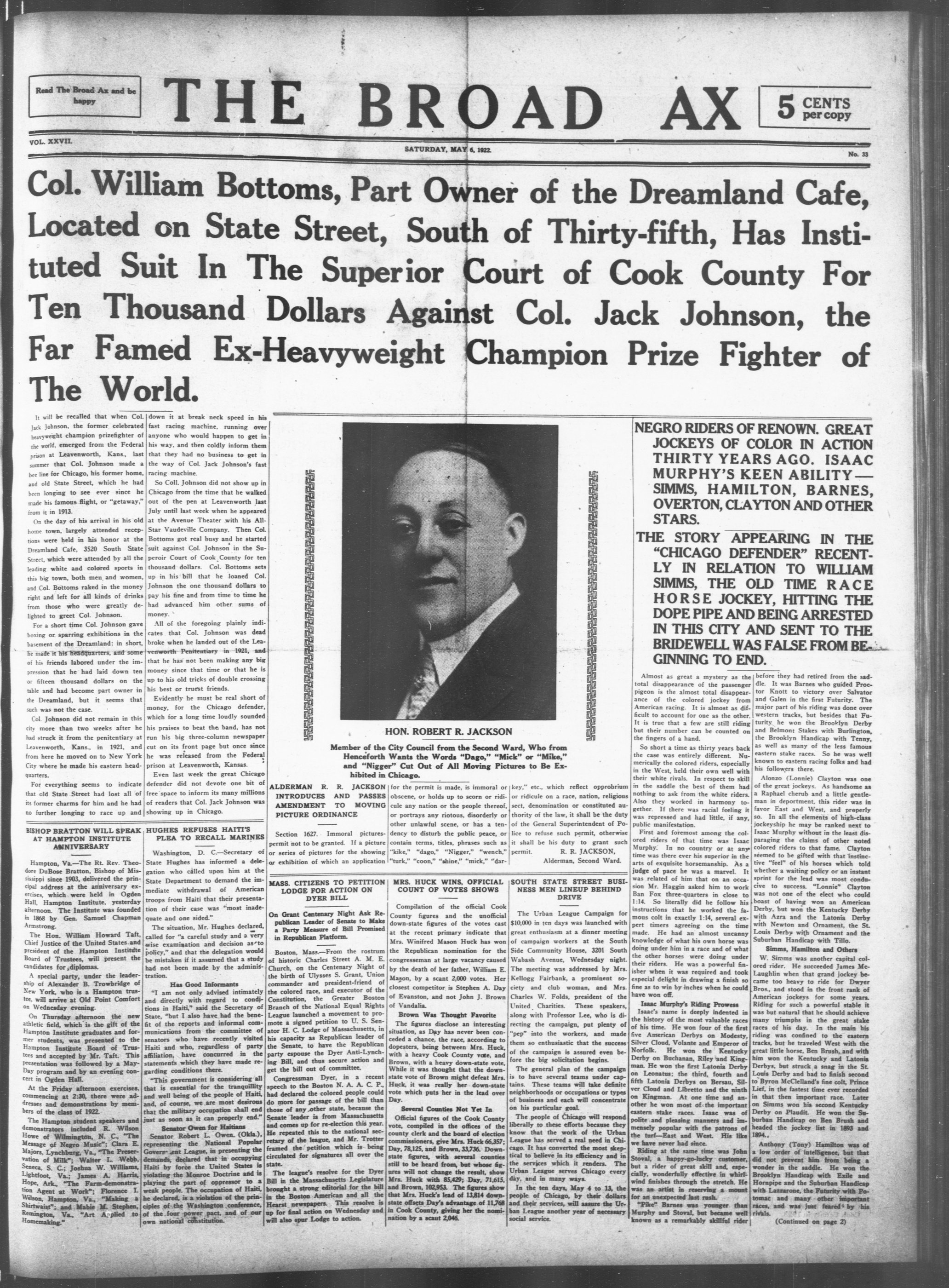
Col. William Bottoms, Part Owner of the Dreamland Cafe, Located on State Street, South of Thirty-fifth, Has Instituted Suit In The Superior Court of Cook County For Ten Thousand Dollars Against Col. Jack Johnson, the Far Famed Ex-Heavyweight Champion Prize Fighter of The World.
Read The Broad Ax and be happy
VOL. XXVII. Col. Will Located tuted Su Ten Th Far Fam The Wo
It will be recalled that when Col. Jack Johnson, the former celebrated heavyweight champion prizefighter of the world, emerged from the Federal prison at Leavenworth, Kans., last summer that Col. Johnson made a bee line for Chicago, his former home, and old State Street, which he had been longing to see ever since he made his famous flight, or "getaway," from it in 1913.
On the day of his arrival in his old home town, largely attended receptions were held in his honor at the Dreamland Cafe, 3520 South State Street, which were attended by all the leading white and colored sports in this big town, both men and women, and Col. Bottoms raked in the money right and left for all kinds of drinks from those who were greatly delighted to greet Col. Johnson.
For a short time Col. Johnson gave boxing or sparring exhibitions in the basement of the Dreamland; in short, he made it his headquarters, and some of his friends labored under the impression that he had laid down ten or fifteen thousand dollars on the table and had become part owner in the Dreamland, but it seems that such was not the case.
Col. Johnson did not remain in this city more than two weeks after he had struck it from the penitentiary at Leavenworth, Kans., in 1921, and from here he moved on to New York City where he made his eastern headquarters.
For everything seems to indicate that old State Street had lost all of its former charms for him and he had no further longing to race up and
BISHOP BRATTON WILL SPEAK AT HAMPTON INSTITUTE ANNIVERSARY
Hampton, Va.—The Rt. Rev. Theodore DuBose Bratton, Bishop of Mississippi since 1903, delivered the principal address at the anniversary exercises, which were held in Ogden Hall, Hampton Institute, yesterday afternoon. The Institute was founded in 1868 by Gen. Samuel Chapman Armstrong.
The Hon. William Howard Taft, Chief Justice of the United States. president of the Hampton Institute Board of Trustees, will present the candidates for diplomas.
A special party, under the leadership of Alexander B. Trowbridge of New York, who is a Hampton trustee, will arrive at Old Point Comfort on Wednesday evening.
On Thursday afternoon the new athletic field, which is the gift of the Hampton Institute graduates and former students, was presented to the Hampton Institute Board of Trustees and accepted by Mr. Taft. This presentation was followed by a May-Day program and by an evening concert in Ogden Hall.
At the Friday afternoon exercises, commencing at 2:30, there were addresses and demonstrations by members of the class of 1922.
The Hampton student speakers and demonstrators included R. Wilson Howe of Wilmington, N. C., "The Message of Negro Music"; Clara E. Majors, Lynchburg, Va., "The Preservation of Milk"; Walter L. Webb, Seneca, S. C.; Joshua W. Williams, Lightfoot, Va.; James A. Harris, Hope, Ark., "The Farm-demonstration Agent at Work"; Florence L. Wilson, Hampton, Va., "Making a Shirtwaist"; and Mabie M. Stephen, Remington, Va., "Art Applied to Homemaking."
THE BROAD AX
down it at break neck speed in his fast racing machine, running over anyone who would happen to get in his way, and then coldly inform them that they had no business to get in the way of Col. Jack Johnson's fast racing machine.
So Coll. Johnson did not show up in Chicago from the time that he walked out of the pen at Leavenworth last July until last week when he appeared at the Avenue Theater with his All-Star Vaudeville Company. Then Col. Bottoms got real busy and he started suit against Col. Johnson in the Superior Court of Cook County for ten thousand dollars. Col. Bottoms sets up in his bill that he loaned Col. Johnson the one thousand dollars to pay his fine and from time to time he had advanced him other sums of money.
All of the foregoing plainly indicates that Col. Johnson was dead broke when he landed out of the Leavenworth Penitentiary in 1921, and that he has not been making any big money since that time or that he is up to his old tricks of double crossing his best or truest friends.
Evidently he must be real short of money, for the Chicago defender, which for a long time loudly sounded his praises to beat the band, has not run his big three-column newspaper cut on its front page but once since he was released from the Federal prison at Leavenworth, Kansas.
Even last week the great Chicago defender did not devote one bit of free space to inform its many millions of readers that Col. Jack Johnson was showing up in Chicago.
HUGHES REFUSES HAITI'S PLEA TO RECALL MARINES
Washington, D. C.-Secretary of State Hughes has informed a delegation who called upon him at the State Department to demand the immediate withdrawal of American troops from Haiti that their presentation of their case was "most inadequate and one sided."
The situation, Mr. Hughes declared, called for "a careful study and a very wise examination and decision as to policy," and that the delegation would be mistaken if it assumed that a study had not been made by the administration.
Has Good Informants
"I am not only advised intimately and directly with regard to conditions in Haiti," said the Secretary of State, "but I also have had the benefit of the reports and informal communications from the committee of senators who have recently visited Haiti and who, regardless of party affiliation, have concurred in the statements which they have made regarding conditions there.
"This government is considering all that is essential for the tranquillity and well being of the people of Haiti, and, of course, we are most desirous that the military occupation shall end just as soon as it can properly end."
Senator Owen for Haitians
Senator Robert L. Owen. (Okla.), representing the National Popular Government League, in presenting the demands, declared that in occupying Haiti by force the United States is violating the Monroe Doctrine and is playing the proxor oppressor to a weak people. The occupation of Haiti, he declared, is a violation of the principles of the Washington conference, of the four power pact, and of our own national constitution.
[Name]
Member of the City Council from the Second Ward, Who from Henceforth Wants the Words "Dago," "Mick" or "Mike," and "Nigger" Cut Out of All Moving Pictures to Be Exhibited in Chicago.
ALDERMAN R. R. JACKSON
INTRODUCES AND PASSES
AMENDMENT TO MOVING
PICTURE ORDINANCE
Section 1627. Immoral pictures-permit not to be granted. If a picture or series of pictures for the showing or exhibition of which an application
MASS. CITIZENS TO PETITION
LODGE FOR ACTION ON
DYER BILL
On Grant Centenary Night Ask Republican Leader of Senate to Make a Party Measure of Bill Promised in Republican Platform.
Boston, Mass.—From the rostrum of historic Charles Street A. M. E. Church, on the Centenary Night of the birth of Ulysses S. Grant, Union commander and president-friend of the colored race, and executor of the Constitution, the Greater Boston Branch of the National Equal Rights League launched a movement to promote a signed petition to U. S. Senator H. C. Lodge of Massachusetts, in his capacity as Republican leader of the Senate, to have the Republican party espouse the Dyer Anti-Lynching Bill, and thus secure action and get the bill out of committee.
Congressman Dyer, in a recent speech to the Boston N. A. A. C. P., had declared the colored people could do more for passage of the bill than those of any other state, because the Senate leader is from Massachusetts and comes up for re-election this year. He repeated this to the national secretary of the league, and Mr. Trotter framed the petition which is being circulated for signatures all over the state.
The league's resolve for the Dyer Bill in the Massachusetts Legislature brought a strong editorial for the bill in the Boston American and all the Hearst newspapers. This resolve is up for final action on Wednesday and will also spur Lodge to action.
SATURDAY, MAY 6, 1922.
art Owner
, South o
erior Cou
Against
eight Cha
HON. ROBERT R. JACKSON
The City Council from the Second Wav
in Wants the Words "Dago," "Micke
er" Cut Out of All Moving Pictu
n Chicago.
for the permit is made, is immoral or
obscene, or holds up to scorn or ridi-
cule any nation or the people thereof,
or portrays any riotous, disorderly or
other unlawful scene, or has a ten-
dency to disturb the public peace, or
contain terms, titles, phrases such as
"kike," "dago," "Nigger," "wench,
"turk," "coon," "shine," "mick," "dar-
MRS. HUCK WINS, OFFICIAL COUNT OF VOTES SHOWS
Compilation of the official Cook County figures and the unofficial down-state figures of the votes cast at the recent primary indicate that Mrs. Winifred Mason Huck has won the Republican nomination for the congressman at large vacancy caused by the death of her father, William E. Mason, by a scant 2,000 votes. Her closest competitor is Stephen A. Day of Evanston, and not John J. Brown of Vandalia.
**Brown Was Thought Favorite**
The figures disclose an interesting situation, as Day has never been conceded a chance, the race, according to dopesters, being between Mrs. Huck, with a heavy Cook County vote, and Brown, with a heavy down-state vote. While it was thought that the down-state vote of Brown might defeat Mrs. Huck, it was really her down-state vote which puts her in the lead over Day.
Several Counties Not Yet In
Official figures of the Cook County vote, compiled in the offices of the county clerk and the board of election commissioners, give Mrs. Huck, 66,357; Day, 78,125, and Brown, 33,736. Downstate figures, with several counties still to be heard from, but whose figures will not change the result, show Mrs. Huck with 85,429; Day, 71,615, and Brown, 102,953. The figures show that Mrs. Huck's lead of 13,814 downstate offsets Day's advantage of 11,768 in Cook County, giving her the nomination by a scant 2,046.
key," etc., which reflect opprobrium or ridicule on a race, nation, religious sect, denomination or constituted authority of the law, it shall be the duty of the General Superintendent of Police to refuse such permit, otherwise it shall be his duty to grant such permit. R. R. JACKSON, Alderman, Second Ward.
SOUTH STATE STREET BUSI
NESS MEN LINEUP BEHIND
DRIVE
The Urban League Campaign for $10,000 in ten days was launched with great enthusiasm at a dinner meeting of campaign workers at the South Side Community House, 3201 South Wabash Avenue, Wednesday night. The meeting was addressed by Mrs. Kellogg Fairbank, a prominent society and club woman, and Mrs. Charles W. Folds, president of the United Charities. These speakers, along with Professor Lee, who is directing the campaign, put plenty of "pep" into the workers, and made them so enthusiastic that the success of the campaign is assured even before the big solicitation begins.
The general plan of the campaign is to have several teams under captains. These teams will take definite neighborhoods or occupations or types of business and each will concentrate on his particular goal.
The people of Chicago will respond liberally to these efforts because they know that the work of the Urban League has served a real need in Chicago. It has converted the most skeptical to believe in its efficiency and in the services which it renders. The Urban League serves Chicago every day, and in many ways.
In the ten days, May 4 to 13, the people of Chicago, by their dollars and their services, will assure the Urban League another year of necessary social service.
NEGRO RIDERS OF RENOWN. GREAT JOCKEYS OF COLOR IN ACTION THIRTY YEARS AGO. ISAAC MURPHY'S KEEN ABILITY SIMMS, HAMILTON, BARNES, OVERTON, CLAYTON AND OTHER STARS. THE STORY APPEARING IN THE "CHICAGO DEFENDER" RECENTLY IN RELATION TO WILLIAM SIMMS, THE OLD TIME RACE HORSE JOCKEY, HITTING THE DOPE PIPE AND BEING ARRESTED IN THIS CITY AND SENT TO THE BRIDEWELL WAS FALSE FROM BE GINNING TO END.
Almost as great a mystery as the total disappearance of the passenger pigeon is the almost total disappearance of the colored jockey from American racing. It is almost as difficult to account for one as the other. It is true that a few are still riding but their number can be counted on the fingers of a hand.
So short a time as thirty years back the case was entirely different. Numerically the colored riders, especially in the West, held their own well with their white rivals. In respect to skill in the saddle the best of them had nothing to ask from the white riders. Also they worked in harmony together. If there was racial feeling it was repressed and had little, if any, public manifestation.
First and foremost among the colored riders of that time was Isaac Murphy. In no country or at any time was there ever his superior in the arts of exquisite horsemanship. As a judge of pace he was a marvel. It was related of him that on an occasion Mr. Haggin asked him to work Ban Fox three-quarters in close to 1:14. So literally did he follow his instructions that he worked the famous colt in exactly 1:14, several expert timers agreeing on the time made. He had an almost uncanny knowledge of what his own horse was doing under him in a race and of what the other horses were doing under their riders. He was a powerful finisher when it was required and took especial delight in drawing a finish so fine as to win by inches when he could have won off.
Isaac Murphy's Riding Prowess
Isaac's name is deeply indented in the history of the most valuable races of his time. He won four of the first five American Derbys on Modesty, Silver Cloud, Volante and Emperor of Norfolk. He won the Kentucky Derby on Buchanan, Riley and Kingman. He won the first Latonia Derby on Leonatus; the third, fourth and fifth Latonia Derbys on Bersau, Silver Cloud and Libretto and the ninth on Kingman. At one time and another he won most of the important eastern stake races. Isaac was of polite and pleasing manners and immensely popular with the patrons of the turf—East and West. His like we have never had since.
Riding at the same time was John Stoval, a happy-go-lucky customer, but a rider of great skill and, especially, wonderfully effective in whirlwind finishes through the stretch. He was an artist in reserving a mount for an unexpected last rush.
"Pike" Barnes was younger than Murphy and Stoval, but became well known as a remarkably skillful rider
5 CENTS per copy
and Cafe,
Las Insti-
nty For
son, the
ighter of
F RENOWN. GREAT
COLOR IN ACTION
ARS AGO. ISAAC
GREEN ABILITY —
BILTON, BARNES,
RAYTON AND OTHER
PEARING IN THE
"FENDER" RECENT-
TION TO WILLIAM
OLD TIME RACE
KEY, HITTING THE
D BEING ARRESTED
AND SENT TO THE
AS FALSE FROM BE-
ND.
before they had retired from the saddle. It was Barnes who guided Proctor Knott to victory over Salvator and Galen in the first Futurity. The major part of his riding was done over western tracks, but besides that Futurity he won the Brooklyn Derby and Belmont Stakes with Burlington, the Brooklyn Handicap with tenny, as well as many of the less famous eastern stake races. So he was well known to eastern racing folks and had his followers there.
Alonzo (Lonnie) Clayton was one of the great jockeys. As handsome as a Raphael cherub and a little gentleman in deportment, this rider was in favor East and West, and properly so. In all the elements of high-class jockeyship he may be ranked next to Isaac Murphy without in the least disparaging the claims of other noted colored riders to that fame. Clayton seemed to be gifted with that instinctive "feel" of his horses which told whether a waiting policy or an instant sprint for the lead was most conducive to success. "Lonnie" Clayton was not one of the elect who could boast of having won an American Derby, but won the Kentucky Derby with Azra and the Latonia Derby with Newton and Ornament, the St. Louis Derby with Ornament and the Suburban Handicap with Tillo.
Simms, Hamilton and Others
W. Simms was another capital colored rider. He succeeded James McLaughlin when that grand jockey became too heavy to ride for Dwyer Bros., and stood in the front rank of American jockeys for some years. Riding for such a powerful stable it was but natural that he should achieve many triumphs in the great stake races of his day. In the main his riding was confined to the eastern tracks, but he traveled West with the great little horse, Ben Brush, and with him won the Kentucky and Latonia Derbys, but struck a snag in the St. Louis Derby and had to finish second to Byron McClelland's fine colt, Prince Lief, in the fastest time ever recorded in that then important race. Later on Simms won his second Kentucky Derby on Plaudit. He won the Suburban Handicap on Ben Brush and headed the jockey list in 1893 and 1894.
Anthony (Tony) Hamilton was of a low order of intelligence, but that did not prevent him from being a wonder in the saddle. He won the Brooklyn Handicap with Exile and Hornpipe and the Suburban Handicap with Lazzarone, the Futurity with Potomac and many other important races, and was just feared by his rivals.
(Continued on page 2)
---
M. H.
THE BROAD AX
In this city since July 15th, 1899, without missing one single issue. Republicans, Democrats, Catholics, Protestants, Single Taxers, Priests, infidels or anyone else can have their say as long as their language is proper and responsibility is fixed.
The Broad Ax is a newspaper whose platform is broad enough for all, ever claiming the editorial right to speak its own mind.
Local communications will receive attention. Write only on one side of the paper.
Subscriptions must be paid in ad-One Year .....$2.00
Six Months .....$1.00
Advertising rates made known on application.
Address all communication to ...
THE BROAD AX
6206 So. Elizabeth St., Chicago, Ill.
Phone Wentworth 2597
JULIUS F. TAYLOR
Editor and Publisher
DR. M. A. MAJORS
4700 South State Street
Phone Drexel 1416
May 6, 1922
Vol. XXVII. No. 33
interested as Second-Class Matter, Aug.
19, 1902, at the Post Office at Chicago,
IR. Under Act of March 8, 1879.
(Concluded from page 1)
INTERESTING STORY OF
MESSRS. MURPHY, SIMMS
AND OTHER RACE
HORSE JOCKEYS
OF OTHER
DAYS
All the foregoing would rank with
Loftus, Sande or any other high-
class jockey of more recent days.
They were not all by any means. Such others as "Monk" Overton, Isaac Lewis, Felix Carr, "Tiny" Williams, E. West, J. Winkfield, Jerry Chorn, Link Jones, Bob Isom, Tommy Knight, James (Soup) Perkins, Tom Britton, James Lee, J. Porter, "Pete" Clay, Chevalier, Hoggett and others that could be mentioned were masterly riders, credited with great feats of horsemanship at one time and another.
James Lee won enduring fame at Churchill Downs July 5, 1916, when he piloted the winners of the day's card of six races.
"Monk" Overton rode the winners of six races at Washington Park July 16, 1891. He had no mount in one of the seven races of the day, but made a clean sweep of the other six. Overton was of the Hamilton type, a square, powerful young man and excelled in holding hard-headed horses together and driving them in a finish when they had a chance.
There never was a greater favorite than Felix Carr was on the Chicago and San Francisco race tracks in the days when he was lightweight rider
---
[Name]
HON. JAMES W. BREEN
First Assistant Corporation Co Wise for His Day and Gene He Has Ably Served As the Chicago and As Its Acting
First Assistant Corporation Counsel of Chicago, Who Is Very Wise for His Day and Generation; Frequently, in the past, He Has Ably Served As the Head Corporation Counsel of Chicago and As Its Acting Mayor.
for Barney Schreiber. For some occult reason among the things not to be accounted for he was immensely popular with the feminine patrons. Their shrill war cry, "Come on you Felix," ascended to the high heavens when his mounts began to show in the stretch and, as a rule, Felix was coming with such effect that these implorings were changed to jubilant notes of rejoicing. He was then a merry little "coon" and he surely could ride.
jockey he saved considerable money, and it will be recalled that only a few months ago the Chicago defender, in order to sell a few extra blood-and-thunder copies of the paper no doubt, published a long story to the effect that William Simms, the once famous colored jockey, who was well and favorably known among race horse men the world over, had sunk so low in the scales of humanity that he was now hitting the real "dope"
R. (Tiny) Williams was a rider of great power and dash and extremely effective on two-year-olds. "Soup" Perkins was good enough for any man's stable. He rode Prince Lief and defeated Simms on Ben Brush in the St. Louis Derby and won the Kentucky Derby on the grand colt Halma. Winkfield was another extremely capable jockey who is still riding, but in France. He had Kentucky Derbys to his credit on His Eminence and Allan-a-Dale in 1901 and 1902. Also a Latonia Derby on Hernando. J. Knight rode Dick Welles in all of his notable races and Pete Clay is inseparable from the fame of the wonderful "Coal Black Lady" Imp, the two being a combination of great celebrity on the New York tracks.
Prior to being nearly killed by a fall at Washington Park, Tom Britton was a star, bold, skillful and a topnotch finisher. He won the Tennessee Derby of 1891 on Valera and of 1892 on Tom Elliott, as well as the Kentucky Oaks of 1891 on Miss Hawkins.—From the Daily Racing Form, Chicago, Ill.
William Simms is still living down in New Jersey, and it is said that while being engaged as a race horse
1910
Counsel of Chicago, Who Is Very Oration; Frequently, in the past, the Head Corporation Counsel of Mayor.
jockey he saved considerable money; and it will be recalled that only a few months ago the Chicago defender, in order to sell a few extra blood-and-thunder copies of the paper, no doubt, published a long story to the effect that William Simms, the once famous colored jockey, who was well and favorably known among race horse men the world over, had sunk so low in the scales of humanity that he was now hitting the real "dope" all the time; that he had been arrested in this city about that time; and that one of the judges of the Municipal Court of Chicago, sitting at the Clark Street police station had fined him for permitting himself to become a common tramp or vagrant, and had sent him to the bridewell for 20 or 30 days.
Mr. Simms read that highly colored up story, which did not contain one grain of truth in it, down at his beautiful home in New Jersey, and he sent a red hot statement back to the Chicago defender which Col. Robert S. Abbott gladly published, retracting or skinning back everything which had appeared in its columns in relation to the arrest of Mr. Simms and being fine and sent to the bridewell in Chicago as a common tramp and heavy user of "dope." Col. Abbott was dead anxious to sidestep a big libel suit and he was almost willing to stand on his head in order to quiet Mr. Simms down.
Col. Dan M. Jackson, Mr. Joseph H. Hudlun, the late Robert T. Motts, and many of the other old timers residing in this city were warm friends of Isaac· Murphy, William Simms and several other of the successful race horse jockeys whom they knew were on the square and whenever they rode in the great American Derbys they would lay a little money down on them coming in under the wire far ahead of the other riders.
ALUMNI MEETING CALLED
The regular biennial meeting of the Alumni Association of the Virginia Normal and Industrial Institute at Petersburg, Va., has been called by the president, M. T. Bailey, 3638 South State Street, to convene on the 8th and 9th of June at the Institute. This is to be the greatest meeting in the history of the Association and every member, wherever they are, have been individually urged upon to come again to the school and to learn of the great work and good being accomplished by the Association under the present administration. M. T. Bailey has served for eighteen years as president.
The welcoming address on behalf of the graduates and members will be delivered by Dr. John M. Gandy, president of the school. The principal address before the Association will be delivered by Mrs. Ora Brown-Stokes of Richmond, a member of the class of 1900.
Dr. Robert R. Moton, principal of Tuskegee Institute, who will deliver the commencement address before the graduating class of the V. N. & I. I., on June 9, has been invited to arrive in time at the Institute to be present at the exercises of the Alumni Association and banquet on June 8.
Among the many graduates who have gone out into the world and who have made a success of life, some holding responsible positions, will return to the old school of learning on this occasion, are Hona. Arthur G. Froe, Recorder of Deeds, Washington, D. C.; John T. Oatneal, Justice of Peace, Washington Courthouse, Ohio; William H. Lewis of Boston; Prof. Joseph L. Whiting of Tuskegee Institute; Dr. G. H. Carroll of Pittsburg, and many others too numerous to mention.
CHICAGO, ILL., SATURDAY MAY 6, 1922
THE LINCOLN ST
BRATED ITS T
SARY AND DE
COMMERCIAL B
ITS OFFICERS AND
AN INFORMAL
MONDAY, MAY
MAY 6.
HON. GEORGE F. L.
DENT OF THE
BANK, WAS PR
MANY HUGE B
CAN BEAUTY R
TIONS BY SOME
BANKERS IN T
OTHER SECTIO
TRY.
THE LINCOLN ST
HAD A REMA
GROWTH SINCE
TEN YEARS A
RANKS WITH
BANKING OR F
TIONS IN THE M
Robert Clark, 37, 502 E. 37th St.
Elizabeth Washington, 31, 2906
Federal St.
Elyar Tennyson, 42, 3616 Grand
Blvd.
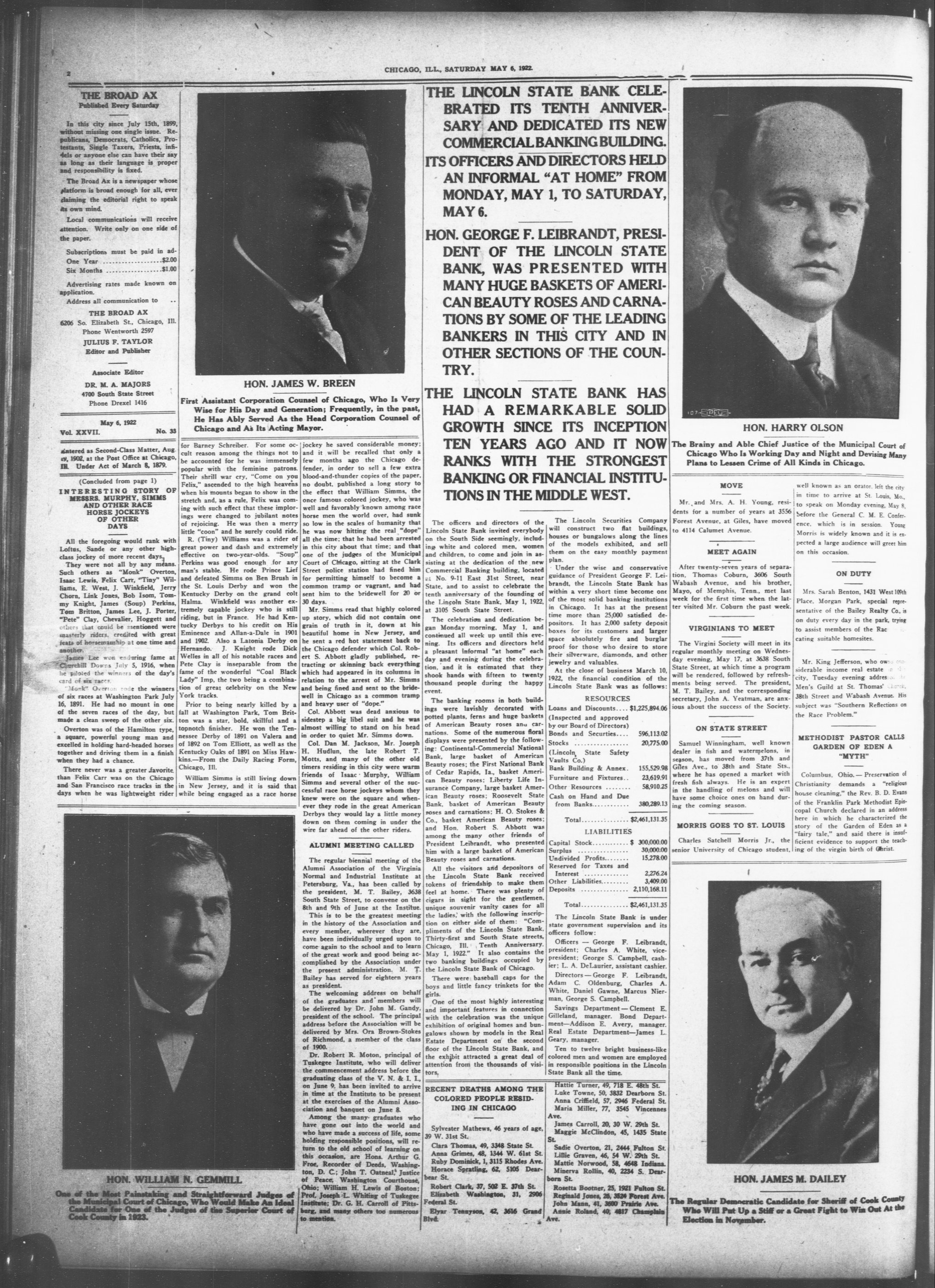
THE LINCOLN STATE BANK CELEBRATED ITS TENTH ANNIVERSARY AND DEDICATED ITS NEW COMMERCIAL BANKING BUILDING. ITS OFFICERS AND DIRECTORS HELD AN INFORMAL "AT HOME" FROM MONDAY, MAY 1, TO SATURDAY, MAY 6.
HON. GEORGE F. LEIBRANDT, PRESIDENT OF THE LINCOLN STATE BANK, WAS PRESENTED WITH MANY HUGE BASKETS OF AMERICAN BEAUTY ROSES AND CARNATIONS BY SOME OF THE LEADING BANKERS IN THIS CITY AND IN OTHER SECTIONS OF THE COUNTRY.
THE LINCOLN STATE BANK HAS HAD A REMARKABLE SOLID GROWTH SINCE ITS INCEPTION TEN YEARS AGO AND IT NOW RANKS WITH THE STRONGEST BANKING OR FINANCIAL INSTITUTIONS IN THE MIDDLE WEST.
The officers and directors of the Lincoln State Bank invited everybody on the South Side seemingly, including white and colored men, women and children, to come and join in assisting at the dedication of the new Commercial Banking building, located at No. 9-11 East 31st Street, near State, and to assist to celebrate the tenth anniversary of the founding of the Lincoln State Bank, May 1, 1922, at 3105 South State Street.
The celebration and dedication began Monday morning, May 1, and continued all week up until this evening. Its officers and directors held a pleasant informal "at home" each day and evening during the celebration, and it is estimated that they shook hands with fifteen to twenty thousand people during the happy event.
The banking rooms in both buildings were lavishly decorated with potted plants, ferns and huge baskets of American Beauty roses and carnations. Some of the numerous floral displays were presented by the following: Continental-Commercial National Bank, large basket of American Beauty roses; the First National Bank of Cedar Rapids, Ia., basket American Beauty roses; Liberty Life Insurance Company, large basket American Beauty roses; Roosevelt State Bank, basket of American Beauty roses and carnations; H. O. Stokes & Co., basket American Beauty roses; and Hon. Robert S. Abbott was among the many other friends of President Leibrandt, who presented him with a large basket of American Beauty roses and carnations.
All the visitors and depositors of the Lincoln State Bank received tokens of friendship to make them feel at home. There was plenty of cigars in sight for the gentlemen, unique souvenir vanity cases for all the ladies, with the following inscription on either side of them: "Compliments of the Lincoln State Bank, Thirty-first and South State streets, Chicago, Ill." Tenth Anniversary, May 1, 1922. It also contains the two banking buildings occupied by the Lincoln State Bank of Chicago.
There were baseball caps for the boys and little fancy trinkets for the girls.
One of the most highly interesting and important features in connection with the celebration was the unique exhibition of original homes and bungalows shown by models in the Real Estate Department on the second floor of the Lincoln State Bank, and the exhibit attracted a great deal of attention from the thousands of visitors.
RECENT DEATHS AMONG THE COLORED PEOPLE RESIDING IN CHICAGO
Sylvester Matthews, 46 years of age
39 W. 31st St.
Clara Thomas, 49, 3348 State St.
Anna Grimes, 48, 1344 W. 61st St.
Ruby Dominick, 1, 3115 Rhodes Ave
Horace Sprattling, 62, 5105 Dearbear St.
The Lincoln Securities Company will construct two flat buildings, houses or bungalows along the lines of the models exhibited, and sell them on the easy monthly payment plan.
Under the wise and conservative guidance of President George F. Leibrandt, the Lincoln State Bank has within a very short time become one of the most solid banking institutions in Chicago. It has at the present time more than 25,000 satisfied depositors. It has 2,000 safety deposit boxes for its customers and larger space absolutely fire and burglar proof for those who desire to store their silverware, diamonds, and other jewelry and valuables.
At the close of business March 10, 1922, the financial condition of the Lincoln State Bank was as follows:
RESOURCES
Loans and Discounts..... $1,225,894.06
(Inspected and approved
by our Board of Directors)
Bonds and Securities..... 596,113.02
Stocks..... 20,775.00
(Lincoln State Safety
Vaults Co.)
Bank Building & Annex..... 155,529.98
Furniture and Fixtures..... 23,619.91
Other Resources..... 58,910.25
Cash on Hand and Due
from Banks..... 380,289.13
Total..... $2,461,131.35
LIABILITIES
Capital Stock..... $ 300,000.00
Surplus..... 30,000.00
Undivided Profits..... 15,278.00
Reserved for Taxes and
Interest..... 2,276.24
Other Liabilities..... 3,409.00
Deposits..... 2,110,168.11
Total..... $2,461,131.35
The Lincoln State Bank is under state government supervision and its officers follow:
Officers — George F. Leibrandt, president; Charles A. White, vice-president; George S. Campbell, cashier; L. A. DeLaurier, assistant cashier.
Directors — George F. Leibrandt, Adam C. Oldenburg, Charles A. White, Daniel Gawne, Marcus Nierman, George S. Campbell.
Savings Department — Clement E. Gilleland, manager. Bond Department—Addison E. Avery, manager. Real Estate Department—James L. Geary, manager.
Ten to twelve bright business-like colored men and women are employed in responsible positions in the Lincoln State Bank all the time.
Hattie Turner, 49, 718 E. 48th St.
Luke Towne, 50, 3832 Dearborn St.
Anna Criffield, 57, 2946 Federal St.
Maria Miller, 77, 3545 Vincennes
Ave.
James Carroll, 20, 30 W. 29th St.
Maggie McClindon, 45, 1435 State
St.
Sadie Overton, 21, 2444 Fulton St.
Lillie Graven, 46, 54 W. 29th St.
Mattie Norwood, 58, 4648 Indiana.
Minerva Rollin, 40, 2234 S. Dearborn St.
Rosetta Bootner, 25, 1921 Fulton St.
Reginald Jones, 28, 3824 Forest Ave.
John Mann, 41, 3600 Prairie Ave.
Annie Roland, 40, 4817 Champlain
Ave.
```markdown
```
107
HON. HARRY OLSON
The Brainy and Able Chief Jus Chicago Who Is Working De Plans to Lessen Crime of Al
MOVE
Able Chief Justice of the M
ho Is Working Day and Night a
Jesen Crime of All Kinds in Chi
The Brainy and Able Chief Justice of the Municipal Court of Chicago Who Is Working Day and Night and Devising Many Plans to Lessen Crime of All Kinds in Chicago.
Mr., and Mrs. A. H. Young, residents for a number of years at 3556 Forest Avenue, at Giles, have moved to 4114 Calumet Avenue.
MEET AGAIN
After twenty-seven years of separation, Thomas Coburn, 3606 South Wabash Avenue, and his brother, Mayo, of Memphis, Tenn., met last week for the first time when the latter visited Mr. Coburn the past week.
VIRGINIANS TO MEET
The Virgini Society will meet in its regular monthly meeting on Wednesday evening, May 17, at 3638 South State Street, at which time a program will be rendered, followed by refreshments being served. The president, M. T. Bailey, and the corresponding secretary, John A. Yeatman, are anxious about the success of the Society.
ON STATE STREET
Samuel Winningham, well known dealer in fish and watermelons, in season, has moved from 37th and Giles Ave., to 38th and State Sts., where he has opened a market with fresh fish always. He is an expert in the handling of melons and will have some choice ones on hand during the coming season.
MORRIS GOES TO ST. LOUIS
Charles Satchell Morris Jr., the senior University of Chicago student
1
1
PETER H.
HON. JAMES M. DAILEY
The Regular Democratic Candidate for Sheriff Who Will Put Up a Stiff or a Great Fight to Election in November.
Democratic Candidate for Sheriff It Up a Stiff or a Great Fight to November.
The Regular Democratic Candidate for Sheriff of Cook County Who Will Put Up a Stiff or a Great Fight to Win Out At the Election in November.
The Regular Democratic Candidate for Sheriff of Cook County Who Will Put Up a Stiff or a Great Fight to Win Out At the Election in November.
MOVE
stice of the Municipal Court of May and Night and Devising Many Kinds in Chicago. well known as an orator, left the city in time to arrive at St. Louis, Mo. to speak on Monday evening, May 8, before the General C. M. E. Conference, which is in session. Young Morris is widely known and it is expected a large audience will greet him on this occasion.
Mrs. Sarah Benton, 1431 West 109th Place, Morgan Park, special representative of the Bailey Realty Co. is on duty every day in the park, trying to assist members of the Rac cating suitable homesites.
Mr. King Jefferson, who owns considerable income real estate in the city, Tuesday evening address Men's Guild at St. Thomas' Church, 38th Street and Wabash Avenue. His subject was "Southern Reflections on the Race Problem."
METHODIST PASTOR CALLS
GARDEN OF EDEN A
Columbus, Ohio. — Preservation of Christianity demands a "religious house cleaning," the Rev. B. D. Evans of the Franklin Park Methodist Episcopal Church declared in an address here in which he characterized the story of the Garden of Eden as a "fairy tale," and said there is insufficient evidence to support the teaching of the virgin birth of Christ.
```markdown
```
State for Sheriff of Cook County Great Fight to Win Out At the
ON DUTY
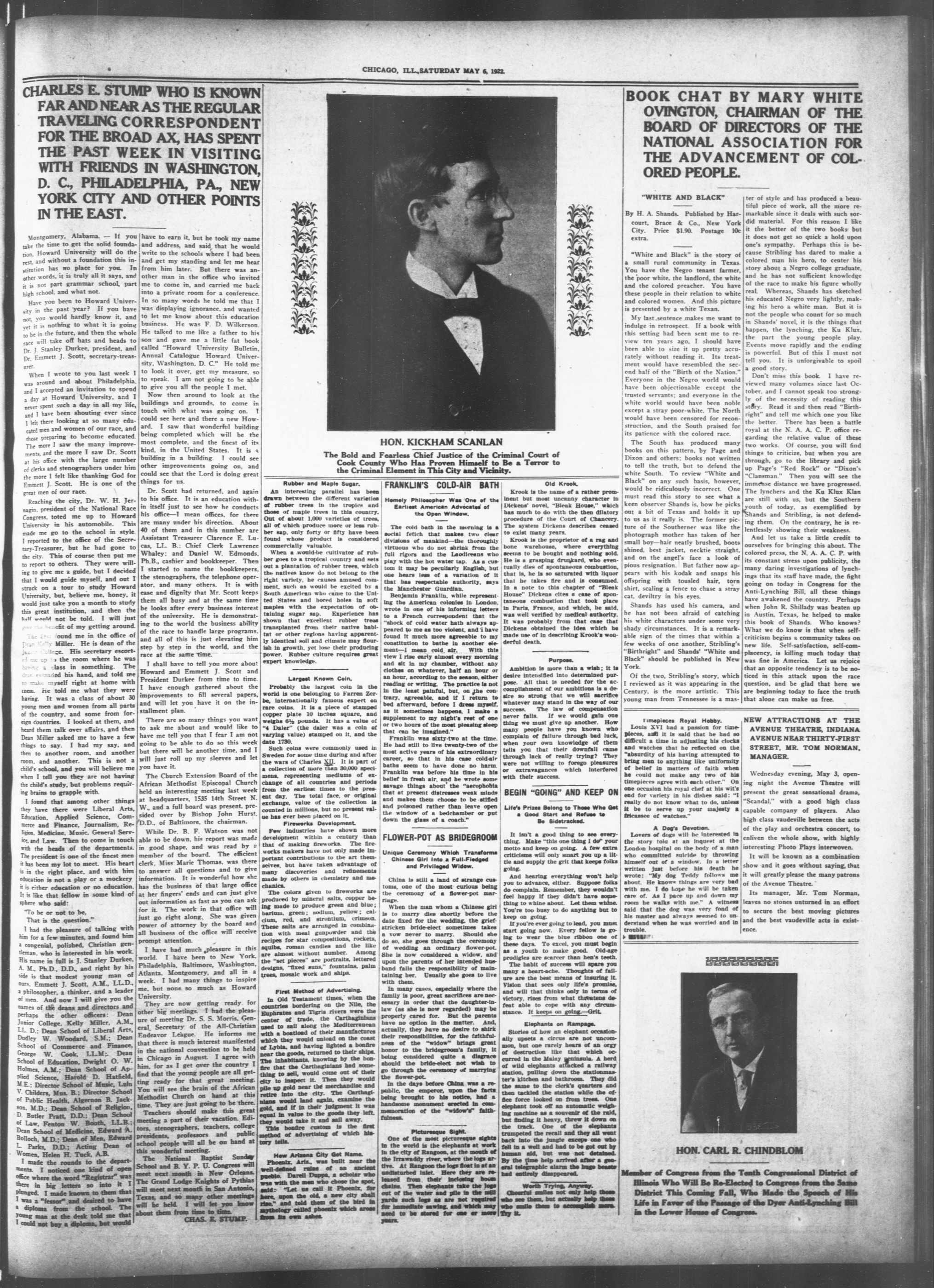
CHARLES E. STUMP WHO IS KNOWN FAR AND NEAR AS THE REGULAR TRAVELING CORRESPONDENT FOR THE BROAD AX, HAS SPENT THE PAST WEEK IN VISITING WITH FRIENDS IN WASHINGTON, D. C., PHILADELPHIA, PA., NEW YORK CITY AND OTHER POINTS IN THE EAST.
Montgomery, Alabama. — If you take the time to get the solid foundation, Howard University will do the rest, and without a foundation this institution has no place for you. In other words, it is truly all it says, and it is not part grammar school, part high school, and what not.
Have you been to Howard University in the past year? If you have not, you would hardly know it, and yet it is nothing to what it is going to be in the future, and then the whole race will take off hats and heads to Dr. J. Stanley Durkee, president, and Dr. Emmett J. Scott, secretary-treasurer.
When I wrote to you last week I was around and about Philadelphia, and I accepted an invitation to spend a day at Howard University, and I never spent such a day in all my life, and I have been shouting ever since I left there looking at so many educated men and women of our race, and those preparing to become educated. The more I saw the many improvements, and the more I saw Dr. Scott at his office with the large number of clerks and stenographers under him the more I felt like thanking God for Emmett J. Scott. He is one of the great men of our race.
Reaching the city, Dr. W. H. Jernagin, president of the National Race Congress, toted me up to Howard University in his automobile. This made me go to the school in style. I reported to the office of the Secretary-Treasurer, but he had gone to the city. This of course then put me to report to others. They were willing to give me a guide, but I decided that I would guide myself, and out I struck on a tour to study Howard University, but, believe me, honey, it would just take you a month to study this great institution, and then the half would not be told. I will just be the benefit of my getting around.
The first found me in the office of Dean Kelly Miller. He is dean of the Junior College. His secretary escorted me up to the room where he was having a class in something. The dean extended his hand, and told me to make myself right at home with them. He told me what they were having. It was a class of about 30 young men and women from all parts of the country, and some from foreign countries. I looked at them, and heard them talk over affairs, and then Dean Miller asked me to have a few things to say. I had my say, and then to another room, and another room, and another. This is not a child's school, and you will believe me when I tell you they are not having the child's study, but problems requiring brains to grapple with.
I found that among other things they have there were Liberal Arts, Education, Applied Science, Commerce and Finance, Journalism, Religion, Medicine, Music, General Service, and Law. Then to come in touch with the heads of the departments. The president is one of the finest men it has been my lot to meet. His heart is in the right place, and with him education is not a play or a mockery it is either education or no education. It is like that fellow in some kind of sphere who said:
To be or not to be.
That is the question."
I had the pleasure of talking with him for a few minutes, and found him a congenial, polished, Christian gentleman, who is interested in his work His name in full is J. Stanley Durkee, A. M., Ph.D., D.D., and right by his side is that modest young man of ours, Emmett J. Scott, A.M., LL.D, a philosopher, a thinker, and a leader of men. And now I will give you the names of the deans and directors and perhaps the other officers: Dean Junior College, Kelly Miller, A.M., LL.D. D; Dean School of Liberal Arts, Dudley W. Woodard, S.M.; Dean School of Commerce and Finance, George W. Cook, LL.M.; Dean School of Education, Dwight O. W. Holmes, A.M.; Dean School of Applied Science, Harold D. Hatfield, M.E.; Director School of Music, Lulu V. Childers, Mns. B.; Director School of Public Health, Algenron B. Jackson, M.D.; Dean School of Religion, D. Butler Pratt, D.D.; Dean School of Law, Fenton W. Booth, LL.B.; Dean School of Medicine, Edward A. Bolloch, M.D.; Dean of Men, Edward L. Parks, D.D.; Acting Dean of Women, Helen T. Huek, A.B.
I made the rounds to the departments. I noticed one kind of open office where the word "Register" was there in big letters so into it I plunged. I made known to them that I was a "fessor" and desired to have a diploma from the school. The young man at the desk told me that I could not hay a diploma, but would
have to earn it, but he took my name and address, and said that he would write to the schools where I had been and get my standing and let me hear from him later. But there was another man in the office who invited me to come in, and carried me back into a private room for a conference. In so many words he told me that I was displaying ignorance, and wanted to let me know about this education business. He was F. D. Wilkerson. He talked to me like a father to his son and gave me a little fat book called "Howard University Bulletin, Annual Catalogue Howard University, Washington, D. C." He told me to look it over, get my measure, so to speak. I am not going to be able to give you all the people I met.
Now then around to look at the buildings and grounds, to come in touch with what was going on. I could see here and there a new Howard. I saw that wonderful building being completed which will be the most complete, and the finest of its kind, in the United States. It is a building in a building. I could see other improvements going on, and could see that the Lord is doing great things for us.
Dr. Scott had returned, and again to his office. It is an education within itself just to see how he conducts his office—I mean offices, for there are many under his direction. About 40 of them and in this number are Assistant Treasurer Clarence E. Lucas, LL. B.: Chief Clerk Lawrence Whaley: and Daniel W. Edmonds, Ph.B., cashier and bookkeeper. Then I started to name the bookkeepers, the stenographers, the telephone operator, and many others. It is with ease and dignity that Mr. Scott keeps them all busy and at the same time he looks after every business interest of the university. He is demonstrating to the world the business ability of the race to handle large programs, and all of this is just elevating him step by step in the world, and the race at the same time.
I shall have to tell you more about Howard and Emmett J. Scott and President Durkee from time to time. I have enough gathered about the improvements to fill several papers, and will let you have it on the installment plan. There are so many things you want to ask me about and would like to have me tell you that I fear I am not going to be able to do so this week but there will be another time, and I will just roll up my sleeves and let you have it. The Church Extension Board of the African Methodist Episcopal Church held an interesting meeting last week at headquarters, 1535 14th Street N. W., and a full board was present, presided over by Bishop John Hurst, D.D., of Baltimore, the chairman.
While Dr. B. F. Watson was not able to be down, his report was made in good shape, and was read by a member of the board. The efficient clerk. Miss Marie Thomas, was there to answer all questions and to give information. It is wonderful how she has the business of that large office at her fingers' ends and can just give out information as fast as you can ask for it. The work in that office will just go right along. She was given power of attorney by the board and all business of the office will receive prompt attention.
I have had much pleasure in this world. I have been to New York, Philadelphia, Baltimore, Washington, Atlanta, Montgomery, and all in a week. I had many things to inspire me, but none so much as Howard University.
They are now getting ready for other big meetings. I had the pleasure of meeting Dr. S. S. Morris, General, Secretary of the All-Christian Endeavor Léague. He informs me that there is much interest manifested in the national convention to be held in Chicago in August. I agree with him, for as I get over the country I find that the young people are all getting ready for that great meeting. You will see the brain of the African Methodist Church on hand at this time. They are just going to be there. Teachers should make this great meeting a part of their vacation. Editors, stenographers, teachers, college presidents, professors and public school people will all be on hand at this wonderful meeting.
The National Baptist Sunday School and B. Y. P. U. Congress will meet next month in New Orleans. The Grand Lodge Knights of Pythias will meet next month in San Antonio, Texas, and so many other meetings will be held. I will let you know about them from time to time. CHAS. S. STUMP
04
The Bold and Fearless Chief Justice of the Criminal Court of Cook County Who Has Proven Himself to Be a Terror to the Criminal Element in This City and Vicinity.
```markdown
```
Rubber and Maple Sugar
An interesting parallel has been drawn between the different varieties of rubber trees in the tropics and those of maple trees in this country. Out of about 1,000 varieties of trees, all of which produce more or less rubber sap, only forty or fifty have been found whose product is considered commercially valuable. When a would-be cultivator of rubber goes to a tropical country and sets out a plantation of rubber trees, which the natives know do not belong to the right variety, he causes amused comment, such as would be excited by a South American who came to the United States and bored holes in soft maples with the expectation of obtaining sugar sap. Experience has shown that excellent rubber trees transplanted from their native habitat or other regions having apparently identical soil and climate may flourish in growth, yet lose their producing power. Rubber culture requires great expert knowledge.
Largest Known Coin.
Probably the largest coin in the world is one belonging to Farren Zerbe, internationally famous expert on rare coins. It is a piece of stamped copper plate 10 inches square, and weighs $6\frac{1}{2}$ pounds. It has a value of "4 Daler" (the daler was a coin of varying value) stamped on it, and the date 1730. Such coins were commonly used in Sweden for some time during and after the wars of Charles XII. It is part of a collection of more than 30,000 specimens, representing mediums of exchange of all countries and periods from the earliest times to the present day. The total face, or original exchange, value of the collection is counted in millions, but no present value has ever been placed on it.
Fireworks Development
Few industries have shown more development within a century than that of making fireworks. The fireworks makers have not only made important contributions to the art themselves, but have taken advantage of many discoveries and refinements made by others in chemistry and mechanics. The colors given to fireworks are produced by mineral salts, copper being made to produce green and blue; barium, green; sodium, yellow; calcium, red, and strontium, crimson. These salts are arranged in combination with meal gunpowder and the recipes for star compositions, rockets, squibs, roman candies and the like are almost without number. Among the "set pieces" are portraits, lettered designs, "fixed suns", fountains, palm trees, mosaic work and ships.
First Method of Advertising.
First Method of Advertising
Old Testament times, when the countries bordering on the Nile, the Euphrates and Tigris rivers were the center of trade, the Carthaginians used to sail along the Mediterranean with a boatload of their manufactures which they would unload on the coast of Lybia, and having lighted a bonfire near the goods, returned to their ships. The inhabitants, knowing by the bonfire that the Carthaginians had something to sell, would come out of their city to inspect it. Then they would pile up gold near the merchandise and retire into the city. The Carthaginians would land again, examine the gold, and if in their judgment it was equal in value to the goods they left, they would take it and sail away.
This bonfire custom is the first method of advertising of which history tells.
New Arizona City Got Man
How Arizona City Got Name.
Phoenix, Ariz., was built near the well-defined ruins of an ancient pueblo. Darell Duppa, a scholar who was with the men who chose the spot, said: "Let us call it Phoenix, for here, upon the old, a new city shall rise," and told them of the bird in mythology called Phoenix which arose from its own ashes.
CHICAGO, ILL., SATURDAY MAY 6, 1922.
HON. KICKHAM SCANLAN
and Fearless Chief Justice of the Cri-
County Who Has Proven Himself to be
criminal Element in This City and Vicinity
FRANKLIN'S COLD-AIR BATH
Homely Philosopher Was One of the Earliest American Advocates of the Open Window.
The cold bath in the morning is a social fetish that makes two clear divisions of mankind—the thoroughly virtuous who do not shrink from the full rigors and the Laodiceans who play with the water hot water. As a custom it may be peculiarly English, but one hears less of a variation of it that has respectable authority, says the Manchester Guardian.
Benjamin Franklin, while representing the American colonies in London, wrote in one of his informing letters to a French correspondent that the "shock of cold water hath always appeared to me as too violent, and I have found it much more agreeable to my constitution to bathe in another element—I mean cold air. With this view I rise early almost every morning and sit in my chamber, without any clothes on whatever, half an hour or an hour, according to the season, either reading or writing. The practice is not in the least painful, but, on the contrary, agreeable, and if I return to bed afterward, before I dress myself, as it sometimes happens, I make a supplement to my night's rest of one or two hours of the most pleasing sleep that can be imagined."
Franklin was sixty-two at the time. He had still to live twenty-two of the most active years of his extraordinary career, so that in his case cold-air baths seem to have done no harm. Franklin was before his time in his belief in fresh air, and he wrote some savage things about the "aerophobia that at present distresses weak minds and makes them choose to be stifled and poisoned rather than leave open the window of a bedchamber or put down the glass of a coach."
FLOWER-POT AS BRIDEGROOM
Unique Ceremony Which Transforma Chinese Girl Into a Full-Fledged and Privileged Widow.
China is still a land of strange customs, one of the most curious being the ceremony of a flower-pot marriage.
When the man whom a Chinese girl is to marry dies shortly before the date fixed for the wedding, the grief-stricken bride-elect sometimes takes a vow never to marry. Should she do so, she goes through the ceremony of wedding an ordinary flower-pot. She is now considered a widow, and upon the parents of her intended husband falls the responsibility of maintaining her. Usually she goes to live with them.
In many cases, especially where the family is poor, great sacrifices are necessary in order that the daughter-in-law (as she is now regarded) may be properly cared for. But the parents have no option in the matter. And, actually, they have no desire to shirk their responsibilities, for the faithfulness of the "widow" brings great honor to the bridegroom's family, it being considered quite a disgrace should the bride-elect not wish to go through the ceremony of marrying the flower-pot.
In the days before China was a republic, the emperor, upon the facts being brought to his notice, had a handsome monument erected in commemoration of the "widow's" faithfulness.
Picturesque Sight
One of the most picturesque sights in the world is the elephants at work in the city of Rangoon, at the mouth of the Irrawaddy river, where the logs arrive. At Rangoon the logs float in at an undisturbed inlet. Here they are released from their inclosing boom chains. Then elephants take the logs out of the water and pile in the mill yards such logs as are not required for immediate sawing, and which may need to be stored for one or more years.
Old Krook.
Krook is the name of a rather prominent but most uncanny character in Dickens' novel, "Bleak House," which has much to do with the then dilatory procedure of the Court of Chancery. The system Dickens describes ceased to exist many years.
Krook is the proprietor of a rag and bone warehouse, where everything seems to be bought and nothing sold. He is a grasping drunkard, who eventually dies of spontaneous combustion, that is, he is so saturated with liquor that he takes fire and is consumed. In a note to this chapter of "Bleak House" Dickens cites a case of spontaneous combustion that took place in Paris, France, and which, he said, was well verified by medical authority. It was probably from that case that Dickens obtained the idea which he made use of in describing Krook's wonderful death.
Purpose.
Ambition is more than a wish; it is desire intensified into determined purpose. All that is needed for the accomplishment of our ambitions is a desire so strong that we will sacrifice whatever may stand in the way of our success. The law of compensation never falls. If we would gain one thing we must give up another. How many people have you known who complain of failure through bad luck, when your own knowledge of them tells you that their downfall came through lack of really trying? They were not willing to forego pleasures or extravagances which interfered with their success.
BEGIN "GOING" AND KEEP ON
Life's Prizes Belong to Those Who Get a Good Start and Refuse to Be Sidetracked.
It isn't a good thing to see everything. Make "this one thing I do" your motto and keep on going. A few extra criticisms will only smart you up a little and supply the grit that keeps folks going.
And hearing everything won't help you to advance, either. Suppose folks do complain. Remember, they wouldn't feel happy if they didn't have something to whine about. Let them whine. You're too busy to do anything but to keep on going.
If you're ever going to lead, you must start going now. Every fellow is going to wear the blue ribbon one of these days. To excel, you must begin as a youth to make good. Old-age prodigies are scarcer than hen's teeth.
The habit of success will spare you many a heart-ache. Thoughts of failure are the best means of insuring it Vision that sees only life's promise, and will that thinks only in terms of victory, rises from what threatens defeat able to cope with any circumstance. It keeps on going.-Grit.
Elephants on Rampage.
Stories of how an elephant occasionally upsets a circus are not uncommon, but one rarely hears of an orgy of destruction like that which occurred in the Malay geminsula. A herd of wild elephants attacked a railway station, pulling down the stationmaster's kitchen and bathroom. They did the same to the clerk's quarters and then tackled the station while the office force looked on from trees. One elephant took off an automatic weighing machine as a souvenir of the raid, but finding it heavy, threw it down on the track. One of the elephants trumpeted the recall and they all went back into the jungle except one who fell in a well and had to be got out by human aid, but was not detained. By the time help arrived after a general telegraphic alarm the huge beasts had entirely disappeared.
Worth Trying, Anyway.
Cherful smiles not only help those who see them, but actually help those who smile them to accomplish more. Twe it.
BOOK CHAT BY MARY WHITE OVINGTON, CHAIRMAN OF THE BOARD OF DIRECTORS OF THE NATIONAL ASSOCIATION FOR THE ADVANCEMENT OF COLORED PEOPLE.
"WHITE AND BLACK"
By H. A. Shands. Published by Harcourt, Brace & Co., New York City. Price $1.90. Postage 10c extra.
"White and Black" is the story of a small rural community in Texas. You have the Negro tenant farmer, the poor white, the landlord, the white and the colored preacher. You have these people in their relation to white and colored women. And this picture is presented by a white Texan.
My last.sentence makes me want to indulge in retrospect. If a book with this setting had been sent me to review ten years ago, I should have been able to size it up pretty accurately without reading it. Its treatment would have resembled the second half of the "Birth of the Nation." Everyone in the Negro world would have been objectionable except the trusted servants; and everyone in the white world would have been noble except a stray poor-white. The North would have been censored for reconstruction, and the South praised for its patience with the colored race.
The South has produced many books on this pattern, by Page and Dixon and others; books not written to tell the truth, to defend the white South. To review "White and Black" on any such basis, however, would be ridiculously incorrect. One must read this story to see what a keen observer Shands is, how he picks out a bit of Texas and holds it up to us as it really is. The former picture of the Southerner was like the photograph mother has taken of her small boy—hair neatly brushed, boots shined, best jacket, necktie straight, and on the angel's face a look of pious resignation. But father now appears with his kodak and snaps his offspring with tousled hair, torn shirt, scaling a fence to chase a stray cat, deviltry in his eyes.
Shands has used his camera, and he has not been afraid of catching his white characters under some very shady circumstances. It is a remarkable sign of the times that within a few weeks of one another, Stribling's "Birthright" and Shands' "White and Black" should be published in New York.
Of the two, Stribling's story, which I reviewed as it was appearing in the Century, is the more artistic. This young man from Tennessee is a mas-
Timepieces Royal Hobby
Louis XVI had a passion for timepieces, and it is said that he had so difficult a time in adjusting his clocks and watches that he reflected on the "absurdity of his having attempted to bring men to anything like uniformity of belief in matters of faith when he could not make any two of his timepieces agree with each other." On one occasion his royal chef at his wif's end for variety in his dishes said: "I really do not know what to do, unless it be to serve up your majesty a frissée of watches."
A Dog's Devotion
Lovers of dogs will be interested in the story told at an inquest at the London hospital on the body of a man who committed suicide by throwing himself out of a window. In a letter written just before his death he wrote: "My dog Teddy they me about. He knows things are very bad with me. I do hope he will be taken care of. As I pace up and down my room he walks with me." A witness said that the dog was very fond of his master and always seemed to understand when he was worried and in trouble.
1900
HON. CARL R. CHINDBLOM
Member of Congress from the Tenth Congressional District of Illinois Who Will Be Re-Elected to Congress from the Same District This Coming Fall, Who Made the Speech of His Life in Favor of the Passage of the Dyer Anti-Lynching Bill in the Lower House of Congress.
ter of style and has produced a beautiful piece of work, all the more remarkable since it deals with such sordid material. For this reason I like it the better of the two books but it does not get so quick a hold upon one's sympathy. Perhaps this is because Stribling has dared to make a colored man his hero, to center his story about a Negro college graduate, and he has not sufficient knowledge of the race to make his figure wholly real. Whereas, Shands has sketched his educated Negro very lightly, making his hero a white man. But it is not the people who count for so much in Shands' novel, it is the things that happen, the lynching, the Ku Klux, the part the young people play. Events move rapidly and the ending is powerful. But of this I must not tell you. It is unforgivable to spoil a good story.
Don't miss this book. I have reviewed many volumes since last October, and I cannot speak too strongly of the necessity of reading this story. Read it and then read "Birthright" and tell me which one you like the better. There has been a battle royal at the N. A. A. C. P. office regarding the relative value of these two works. Of course, you will find things to criticize, but when you are through, go to the library and pick up Page's "Red Rock" or "Dixon's "Clansman." Then you will see the immense distance we have progressed. The lynchers and the Ku Klux Klan are still with us, but the Southern youth of today, as exemplified by Shands and Stribling, is not defending them. On the contrary, he is relentlessly showing their weakness.
And let us take a little credit to ourselves for bringing this about. The colored press, the N. A. A. C. P. with its constant stress upon publicity, the many daring investigations of lynchings that its staff have made, the fight going on today in Congress for the Anti-Lynching Bill, all these things have awakened the country. Perhaps when John R. Shillady was beaten up in Austin, Texas, he helped to make this book of Shands. Who knows? What we do know is that when self-criticism begins a community takes on new life. Self-satisfaction, self-compacency, is killing much today that was fine in America. Let us rejoice that an opposite tendency is to be noticed in this attack upon the race question, and be glad that here we are beginning today to face the truth that alone can make us free.
NEW ATTRACTIONS AT THE AVENUE THEATRE, INDIANA AVENUE NEAR THIRTY-FIRST STREET, MR. TOM NORMAN, MANAGER.
Wednesday evening, May 3, opening night the Avenue Theatre will present the great sensational drama, "Scandal," with a good high class capable company of players. Also high class vaudeville between the acts of the play and orchestra concert, to enliven the whole show, with highly interesting Photo Plays interwoven.
It will be known as a combination show and it goes without saying, that it will greatly please the many patrons of the Avenue Theatre.
Its manager, Mr. Tom Norman, leaves no stones unturned in an effort to secure the best moving pictures and the best vaudeville acts in existence.
be soft, silky hair that can be
has made happy thousands of
hair. It will do the same for
lifeless or if you have da-
y a box of EXELENTO QUIL
stores. Price by mail 2c on receipt
AGENTS WANTED—Write for Particu-
MEDICINE COMPANY, A
EXELENTO SKIN BEAUTIFIER, an ointment for d
used in treatment of skin troubles.
YOU can have soft, silky hair that can be easily dressed. EXELENTO has made happy thousands of women who had coarse, nappy hair. It will do the same for you. If your hair is brittle and lifeless or if you have dandruff and itching scalp, try a box of EXELENTO QUININE POMADE.
TELEPHONE DOUGLAS 1
GEORGE F.
E F. HARDII
GEORGE F. HARDING, JR. REAL ESTATE
Up-to-Date or Mo
and St
3101 COTTAC
Corner 31st
Phone
FURN
Brass and Wood L
Refrigerators,
Hardwa
HENRY
2515-19 A
JAS. B. McCAHEY, President
FRANK J. DUNN, Vice-President
ESTABL
or Modern Houses,
and Stores to Rent
COTTAGE GROW
Enter 31st Street, Chicago
Phone Yards 27
FURNITU
Al Wood Beds, Electric
Lagerators, Stoves, Pain-
t Hardware, Linoleum
NRY STUCKA
2515-19 ARCHER AVE.
President PHILIP J.
Vice-President H. X. COME
ESTABLISHED 1877
Up-to-Date or Modern Houses, Apartments and Stores to Rent
3101 COTTAGE GROVE AVE.
Corner 31st Street, Chicago
Brass and Wood Beds, Electric Washers, Refrigerators, Stoves, Paint, Oil, Hardware, Linoleum HENRY STUCKART 2515-19 ARCHER AVE.
JAS. B. McCAHEY, President PHILIP J. DUNN, Secretary
FRANK J. DUNN, Vice-President H. X. COMERFORD, Treasurer
ESTABLISHED 1877
JOHN J. DUNN
COAL CO.
Telephone Oakland 1550
5100 Federal Street CHICAGO
Phone Main 2017
*
A. L. WILLIAMS
ATTORNEY AND
COUNSELOR AT LAW
Suite 706 Firmenich Building
184 W. Washington St.
CHICAGO
Residence 3655 Prairie Ave.
Phone Douglas 9133
BILL is a good subs
who, like many
up to a short time ago
his money systematica
What
What Ralph wrote to Bill
BILL is a good substantial citizen who, like many of us, had, up to a short time ago, never saved his money systematically.
He never really thought seriously of investing in bonds until he was married a few years ago. Being in-experienced in financial matters, he wrote several letters to Ralph, an attorney friend of his, who answered all his questions in a very simple and clear manner.
We have just published a booklet called "An Investor's Letters" which contains all of Ralph's and Bill's correspondence. You will find it very interesting and it may clear up some of the questions you have in your own mind about investment matters.
We shall be glad to send "An Investor's Letters" free of charge or obligation to anyone who requests it.
LINCOLN STATE BANK
OF CHICAGO
Under State Government Supervision
31st and South State Streets
Telephone Victory 4500
5100 Federal Street
May Gilbert Praises
EXELENTO QUININE
POMADE
Says her hair has grown
28 inches long by using
this wonderful hair grower
is silky hair that can be easily dressed.
made happy thousands of women who had
it will do the same for you. If your
eleless or if you have dandruff and itch-
box of EXELENTO QUININE POMADE.
Price by mail 5c on receipt of stamp or coin.
WANTED-Write for Particulars
CINE COMPANY, Atlanta, Georgia
SIN BEAUTIFIER, an ointment for dark, sallow skins,
and in treatment of skin troubles.
F. HARDING, JR.
Modern Houses, Apartments
and Stores to Rent
STAGE GROVE AVE.
31st Street, Chicago
Phone Yards 27
UNITURE
Food Beds, Electric Washers,
ators, Stoves, Paint, Oil,
Bedware, Linoleum
Y STUCKART
19 ARCHER AVE.
President PHILIP J. DUNN, Secretary
President H. X. COMERFORD, Treasurer
ESTABLISHED 1877
CHICAGO
Residence, 1262 Macalister Place
Telephone Memroe 2714
MILES J. DEVINE
ATTORNEY AT LAW
Suite 318-320 Reaper Block
Clark and Washington Sts.
CHICAGO
Telephone Central 1239
BILL is a good substantial citizen
who, like many of us, had,
up to a short time ago, never saved
his money systematically.
CHICAGO
Plug Up the Hole Do not let your wages slip through your pocket before you know it. Adopt a systematic plan of saving your money. Put a portion of it in our strong bank every pay day and you'll have stopped the leak.
ILLINOIS TRUST & SAV
La Salle and Jackson Streets
IS THIS THE SWELL OR BIG HE
CRAT OF CHICAGO AND THE
IFF OF COOK COUNTY?
ILLINOIS TRUST & SAVINGS BANK
La Balle and Jackson Streets Chicago
A. B.
IS THIS THE SWELL OR BIG HEADED BOSS DEMOCRAT OF CHICAGO AND THE WOULD-BE SHERIFF OF COOK COUNTY?
---
Notary Publici
Phones: Office Main 41533; Residence,
4751 Champlain Avenue
Phone Kenwood 5611
Walter M. Farmer
ATTORNEY AND COUNSELOR
AT LAW
Suite 708—184 W. Washington St.
CHICAGO
ALMOST WORSHIP THE MANGO
Natives of India Have Good Reason
to Think Highly of That Really
Wonderful Tree.
Mango trees line the roads on the hot Indian plains which stretch out level "like the palm of a hand," as far as the eye can see. These trees, about 40 feet in height, clothed in thick, heavy foliage, not only afford a welcome cool shade in the hottest day, but a variety of fruit which is said to have no rival in sweetness, flavor, delicousness and food value. Under these trees the village school is kept in the foreonow, and the village children learn to love them from their childhood.
Nature is very prolific in the tropics, for one mango tree may yield almost half a ton of fruit in one season. The mango is a fruit varying in size from a small pear to a large coconut. The thick skin protects the flavor, and except for the stone, the entire fruit is used in many ways. It is eaten raw, or rather sucked, cut in slices, made into jam, pickles and mango cakes, and is used as a flavor for both sour and sweet foods.
Mango ice cream is a very delicious food, but, perhaps, of all the tree's products, mango chutney is the most famous. Mango is also used as a medicine, and is a specific for sunstroke, which it cures almost instantly. The poor Indian peasant loves this tree to almost adoration because of its wonderful qualities.
Barley Basis of Weight.
During the reign of Henry VIII standards of length and weight were established with actual grains of wheat and barley as a basis. Three barley corn were an inch, and from that was built up our table of inches, feet, ells (yards), perch and acre. One restriction was that the barley corn must be dry and taken from the middle of the car and fld end to end. Under this same system 30 grains of wheat made a pennyweight, and from that as a basis they worked out the Troy pound in which 12 ounces still make a pound. Originally the sizes of shoes were based upon grains or barley, and it is said that these are the same today as in the early days. There were 13 grains of barley to each size. "Furlong" is an old English word meaning "furrow long" and is based upon the length a furrow would be in a square ten-acre field.
Protein Foods.
When we eat protein we consume in reality 18 or 20 substances, known as amino acids, each one of which may have quite special functions in nutrition. Some proteins are deficient in certain of these acids which are lacking in the proteins of corn and grain, and for that reason peanuts are an excellent supplement to a cereal diet, whether in the form of a meal or press-cake feed with corn and cereal feeds to animals or as a supplement to wheat protein when used with wheat flour in bread making.
CHICAGO, ILL., MAY 6, 1922.
ble
ages slip
more you
systematic
key. Put
strong
d you'll
& SAVINGS BANK
on Streets Chicago
NIG HEADED BOSS DEMO-
D THE WOULD-BE SHER-
Y?
Office Phone: Main 1612, 1854
W. G. Anderson
Attorney-At-Law
Notary Public
184 W. Washington St., Cor. Wells
Suite 603, Firmench Bldg.
Residence: 3354 Vernon Avenues
Phone Douglas 6845
CHICAGO
Jimmy was visiting his aunt, who was a good cook, and he enjoyed every meal. One day after an unusually good dinner he glanced at his three cousins, who were fat and rosy, and said: "I know now why you got such fat kids."
The End.
"I'll never ask another girl to marry me as long as I live," groaned the unhappy fellow. "What! Refused again?" asked his sympathetic friend. "No, accepted, you fool!"
Charcoal Eph's Philosophy
Characol Eph 'nise Philosophy
"I ain't got no 'phie fo' a whining man," said Charcoal Eph, in a ruminative mood. "De Lawd made man fo' 't fight an' cuss, an' woman fo' weepin' an' lamentin'. Eat a prune, Mistar Jackson." - Richmond Times-Dispatch
Look Upward.
If we look down, then our shoulders stoop. If our thoughts look down, our character bends. It is only when we hold our heads up that the body becomes erect. It is only when our thoughts go up that our life becomes erect.—Alexander McKenzie.
NEW YORK HINT OF VENICE
Reservoir Is Beautiful Spot, With Stately Homes That Seem to Arise From the Water.
What the Brooklyn bridge is to the resident of Brooklyn the reservoir is to the middle uptown New Yorker—a refreshing and beautiful place for a brisk walk, says the New York Sun. The reservoir, particularly the upper one, with a path on the brink, is a place of romance. Across the water rise stately houses; they seem almost on the edge of the water, like the houses of Venice. Sometimes the water is a sheet of ice. One day it seemed like a stretch of gray taffeta, with inserts of blue crepe where the wind rippled the patches of water that remained. Close to the shore broken bits of ice sinkled continually against a stretch of solid ice, with the sound of sledle bells.
But in summer there is another aspect to the reservoir. Horseback riders gallop around in fetching costumes, while the water sparkles in the sun.
But there is one point at a certain hour that lifts you out of New York, out of America, out of the world. The point is the western stretch of the southern side. The hour is sunset. The magic is produced by the fountain, a thin, high sweep of spray painted with rainbow shades by the setting sun. Up goes the stream, swirling into a gigantic feather in the gentle hands of the breeze. Suddenly the rainbow appears, to vanish as the wind swings the spray in another direction, to reappear again for a few breath-catching seconds. The spray sweeps here and there, covering you for an instant. The sun leaves it for a moment and the fountain becomes a bridal veil. Out comes the sun and the fountain flashes into glory.
---
FUNERAL DIRECTORS
5121 ERNEST H. WILLIAMSON UNDERTAKER
GARAGE
GASOLINE OIL
OPEN BAY & NIGHT
Ernest H. Williamson UNDERTAKER
Day Light Chapel, capacity 900, Outside Ventilation—Organ and Organist Free—
I am as near as your Telephone—I give service at a reasonable price—Distance
immaterial, consult me—I save you worry, time and money.
5121 & 5123 SOUTH STATE STREET
CHICAGO, ILLINOIS
PHONE MAIN 2814
A. D. GASH
ATTORNEY AT LAW
118 N. La Salle Street
CHICAGO
Residence
3342 Calumet Ave.
Telephone
Douglas 1275
JAMES G. COTTER
ATTORNEY AT LAW
145 NORTH CLARK STREET
SUITE 407
Telephone Central 8384
CHICAGO
Formerly
Assistant Attorney General
State of Illinois
Res. 3648 Grand Boul.
Doug. 4897
J. GRAY LUCAS
ATTORNEY-AT-LAW
129 E. 31ST STREET
Suite 16-17
Phone: Douglas 6381
CHICAGO
BINGA STATE BANK
Under State Supervision
Capital .....$100,000.00
Surplus .....20,000.00
Offers Equal Service to All
3% INTEREST ON SAVINGS
SAFE DEPOSIT VAULTS
State Street and 36th Place
Wanted
Advertising Solicitor
A live or wide awake newspaper man or solicitor can earn some easy money by calling on or addressing the undersigned.
Julius F. Taylor, 6206 S. Elizabeth street. Phone Wentworth 2597.
PHONE KENWOOD 455
West Englewood Trust & Savings Bank
Capital, Surplus and Undivided
Profits, $500,000.00
OFFICERS
OFFICERS
John Bain, President Arthur C. Utesch, Ass
Michael Maisel, Vice-Pres. W. Merle Fisher, Ass
Edw. C. Barry, Cashier and Tru
The Cranford A
3600 WABAS
The finest building ever opened
Steam heat, electric lights,
Phone Main 263 J. W. Casey
Cranford Apartment
3600 WABASH AVENUE
building ever opened to Colored tenants
heat, electric lights, tile baths, marble e
263 J. W. Casey, Agt. 133 W. W.
The finest building ever opened to Colored tenants in Chicago Steam heat, electric lights, tile baths, marble entrance Phone Main 263 J. W. Casey, Agt. 133 W. Washington St
FUNERAL DIRECT
RAL DIRECTORS
CERS
Arthur C. Utesch, Asst. Cashier
W. Merle Fisher, Asst. Cashier
and Trust Officer