The Broad Ax
Saturday, June 24, 1922
Chicago, Illinois
Page text (machine-generated)
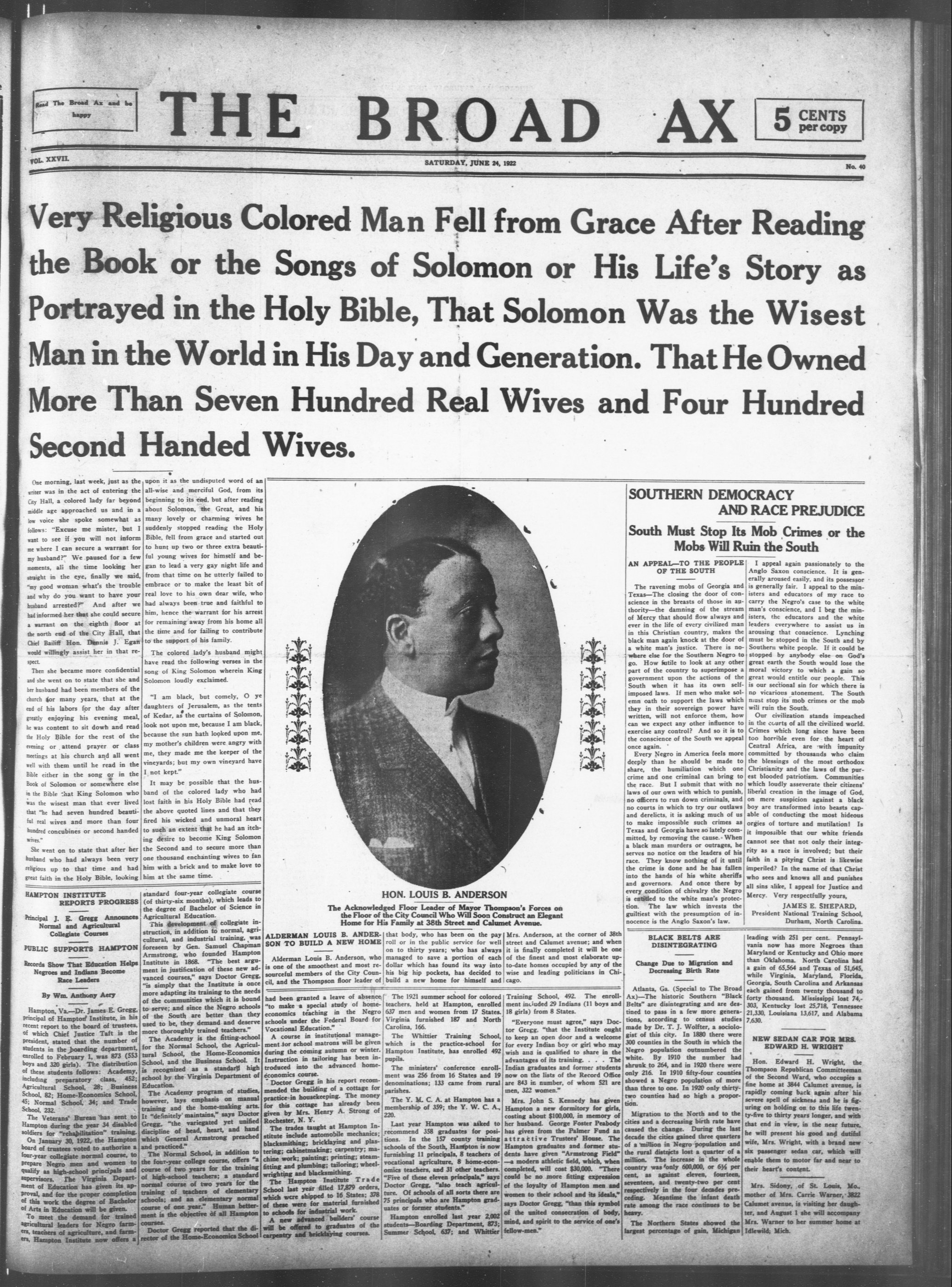
Very Religious Colored Man Fell from Grace After Reading the Book or the Songs of Solomon or His Life's Story as Portrayed in the Holy Bible, That Solomon Was the Wisest Man in the World in His Day and Generation. That He Owned More Than Seven Hundred Real Wives and Four Hundred Second Handed Wives.
One morning, last week, just as the writer was in the act of entering the City Hall, a colored lady far beyond middle age approached us and in a low voice she spoke somewhat as follows: "Excuse me mister, but I want to see if you will not inform me where I can secure a warrant for my husband?" We paused for a few moments, all the time looking her straight in the eye, finally we said, "my good woman what's the trouble and why do you want to have your husband arrested?" And after we had informed her that she could secure a warrant on the eighth floor at the north end of the City Hall, that Chief Bailiff Hon. Dennis J. Egan would willingly assist her in that respect.
Then she became more confidential and she went on to state that she and her husband had been members of the church for many years, that at the end of his labors for the day after greatly enjoying his evening meal, he was content to sit down and read the Holy Bible for the rest of the evening or attend prayer or class meetings at his church and all went well with them until he read in the Bible either in the song or in the Book of Solomon or somewhere else in the Bible that King Solomon who was the wisest man that ever lived that "he had seven hundred beautiful real wives and more than four hundred concubines or second handed wives."
She went on to state that after her husband who had always been very religious up to that time and had great faith in the Holy Bible, looking
HAMPTON INSTITUTE REPORTS PROGRESS
Principal J. E. Gregg Announces Normal and Agricultural Collegiate Courses
PUBLIC SUPPORTS HAMPTON
Records Show That Education Helps Negroes and Indians Become Race Leaders
By Wm. Anthony Aery
Hampton, Va.—Dr. James E. Gregg, principal of Hampton Institute, in his recent report to the board of trustees, of which Chief Justice Taft is the president, stated that the number of students in the boarding department, enrolled to February 1, was 873 (553 boys and 320 girls). The distribution of these students follows: Academy, including preparatory class, 452; Agricultural School, 28; Business School, 82; Home-Economics School, 45; Normal School, 34; and Trade School, 232.
The Veterans' Bureau has sent to Hampton during the year 34 disabled soldiers for "rehabilitation" training.
On January 30, 1922, the Hampton board of trustees voted to authorize a four-year collegiate normal course, to prepare Negro men and women to qualify as high-school principals and supervisors. The Virginia Department of Education has given its approval, and for the proper completion of this work the degree of Bachelor of Arts in Education will be given.
To meet the demand for trained agricultural leaders for Negro farmers, teachers of agriculture, and farmers, Hampton Institute now offers a
THE BROAD AX
upon it as the undisputed word of an all-wise and merciful God, from its beginning to its end, but after reading about Solomon, the Great, and his many lovely or charming wives he suddenly stopped reading the Holy Bible, fell from grace and started out to hunt up two or three extra beautiful young wives for himself and began to lead a very gay night life and from that time on he utterly failed to embrace or to make the least bit of real love to his own dear wife, who had always been true and faithful to him, hence the warrant for his arrest for remaining away from his home all the time and for failing to contribute to the support of his family.
The colored lady's husband might have read the following verses in the song of King Solomon wherein King Solomon loudly exclaimed.
"I am black, but comely, O ye daughters of Jerusalem, as the tents of Kedar, as the curtains of Solomon, look not upon me, because I am black, because the sun hath looked upon me, my mother's children were angry with me, they made me the keeper of the vineyards; but my own vineyard have I not kept."
It may be possible that the husband of the colored lady who had lost faith in his Holy Bible had read the above quoted lines and that they fired his wicked and unmoral heart to such an extent that he had an itching desire to become King Solomon the Second and to secure more than one thousand enchanting wives to fan him with a brick and to make love to him at the same time.
standard four-year collegiate course (of thirty-six months), which leads to the degree of Bachelor of Science in Agricultural Education.
This development of collegiate instruction, in addition to normal, agricultural, and industrial training, was foreseen by Gen. Samuel Chapman Armstrong, who founded Hampton Institute in 1868. "The best argument in justification of these new advanced courses," says Doctor Gregg, "is simply that the Institute is once more adapting its training to the needs of the communities which it is bound to serve; and since the Negro schools of the South are better than they used to be, they demand and deserve more thoroughly trained teachers."
The Academy is the fitting-school for the Normal School, the Agricultural School, the Home-Economics School, and the Business School. It is recognized as a standard high school by the Virginia Department of Education.
The Academy program of studies, however, lays emphasis on manual training and the home-making arts. It "definitely maintains," says Doctor Gregg, "the variegated yet unified discipline of head, heart, and hand which General Armstrong preached and practiced."
The Normal School, in addition to the four-year college course, offers "a course of two years for the training of high-school teachers; a standard normal course of two years for the training of teachers of elementary schools; and an elementary normal course of one year." Human betterment is the objective of all Hampton courses.
Doctor Gregor reported that the director of the Home-Economics School
```markdown
```
ALDERMAN LOUIS B. ANDERSON TO BUILD A NEW HOME
Alderman Louis B. Anderson, who is one of the smoothest and most resourceful members of the City Council, and the Thompson floor leader of had been granted a leave of absence "to make a special study of home-economics teaching in the Negro schools under the Federal Board for Vocational Education."
A course in institutional management for school matrons will be given during the coming autumn or winter. Instruction in tailoring has been introduced into the advanced home-economics course.
Doctor Gregg in his report recommended the building of a cottage for practice in housekeeping. The money for this cottage has already been given by Mrs. Henry A. Strong of Rochester, N. Y.
The trades taught at Hampton Institute include automobile mechanics; blacksmithing; bricklaying and plastering; cabinetmaking; carpentry; machine work; painting; printing; steam-fitting and plumbing; tailoring; wheelwrithing and blacksmithing.
The Hampton Institute Trade School last year filled 17,829 orders, which were shipped to 16 States; 378 of these were for material furnished to schools for industrial work. A new advanced builders' course will be offered to graduates of the carpentry and bricklaying courses.
SATURDAY, JUNE 24, 1922
Man Fell from of Solomon's stable, That Slay and Gen-ed Real W
HON. LOUIS B. ANDERSON
Elected Floor Leader of Mayor Thompson of the City Council Who Will Soon Construct His Family at 38th Street and Calumet A
that body, who has been on the pay roll or in the public service for well on to thirty years; who has always managed to save a portion of each dollar which has found its way into his big hip pockets, has decided to build a new home for himself and
The 1921 summer school for colored teachers, held at Hampton, enrolled 637 men and women from 17 States. Virginia furnished 187 and North Carolina, 166.
The Whittier Training School, which is the practice-school for Hampton Institute, has enrolled 492 pupils.
The ministers' conference enrollment was 256 from 16 States and 19 denominations; 133 came from rural parishes.
The Y. M. C. A. at Hampton has a membership of 359; the Y. W. C. A., 220.
Last year Hampton was asked to recommend 358 graduates for positions. In the 157 county training schools of the South, Hampton is now furnishing 11 principals, 8 teachers of vocational agriculture, 8 home-economics teachers, and 31 other teachers. "Five of these eleven principals," says Doctor Gregg, "also teach agriculture. Of schools of all sorts there are 75 principals who are Hampton graduates or former students."
Hampton enrolled last year 2,002 students—Boarding Department, 873; Summer School, 637; and Whittier
Mrs. Anderson, at the corner of 38th street and Calumet avenue; and when it is finally completed it will be one of the finest and most elaborate up-to-date homes occupied by any of the wise and leading politicians in Chicago.
Training School, 492. The enrollment included 29 Indians (11 boys and 18 girls) from 8 States.
"Everyone must agree," says Doctor Gregg, "that the Institute ought to keep an open door and a welcome for every Indian boy or girl who may wish and is qualified to share in the advantages of its training. . . . The Indian graduates and former students now on the lists of the Record Office are 843 in number, of whom 521 are men, 322 women."
Mrs. John S. Kennedy has given Hampton a new dormitory for girls, costing about $100,000, in memory of her husband. George Foster Peabody has given from the Palmer Fund an attractive Trustees' House. The Hampton graduates and former students have given "Armstrong Field"—a modern athletic field, which, when completed, will cost $30,000. "There could be no more fitting expression of the loyalty of Hampton men and women to their school and its ideals," says Doctor Gregg, "than this symbol of the united consecration of body, mind, and spirit to the service of one's fellow-men."
SOUTHERN DEMOCRACY AND RACE PREJUDICE
South Must Stop Its Mob Crimes or the Mobs Will Ruin the South
AN APPEAL—TO THE PEOPLE OF THE SOUTH
The ravening mobs of Georgia and Texas—The closing door of conscience in the breasts of those in authority—the damning of the stream of Mercy that should flow always and ever in the life of every civilized man in this Christian country, makes the black man again knock at the door of a white man's justice. There is nowhere else for the Southern Negro to go. How fateful to look at any other part of the country to superimpose a government upon the actions of the South when it has its own self-imposed laws. If men who make solenno oath to support the laws which they in their sovereign power have written, will not enforce them, how can we expect any other influence to exercise any control? And so it is to the conscience of the South we appeal once again.
Every Negro in America feels more deeply than he should be made to share, the humiliation which one crime and one criminal can bring to the race. But I submit that with no laws of our own with which to punish, no officers to run criminals, and no courts in which to try our outlaws and derelicts, it is asking much of us to make impossible such crimes as Texas and Georgia have so lately committed, by removing the cause. When a black man murders or outrages, he serves no notice on the leaders of his race. They know nothing of it until the crime is done and he has fallen into the hands of his white sheriffs and governors. And once there by every condition of chivalry the Negro is entitled to the white man's protection. The law which invests the guiltiest with the presumption of innocence is the Anglo Saxon's law.
BLACK BELTS ARE DISINTEGRATING
Change Due to Migration and Decreasing Birth Rate
Atlanta, Ga. (Special to The Broad Ax)—The historic Southern "Black Belts" are disintegrating and are destined to pass in a few more generations, according to census studies made by Dr. T. J. Wolfter, a sociologist of this city. In 1880 there were 300 counties in the South in which the Negro population outnumbered the white. By 1910 the number had shrunk to 264, and in 1920 there were only 216. In 1910 fifty-four counties showed a Negro population of more than three to one. In 1920 only thirty-two counties had so high a proportion.
Migration to the North and to the cities and a decreasing birth rate have caused the change. During the last decade the cities gained three quarters of a million in Negro population and the rural districts lost a quarter of a million. The increase in the whole country was only 600,000, or $6\frac{1}{2}$ per cent, as against eleven, fourteen, seventeen, and twenty-two per cent respectively in the four decades preceding. Meantime the infant death rate among the race continues to be heavy.
The Northern States showed the largest percentage of gain, Michigan
5 CENTS per copy
Reading
the Story as
the Wisest
the Owned
Hundred
OCRACY
O RACE PREJUDICE
as Mob Crimes or the
suin the South
I appeal again passionately to the Anglo Saxon conscience. It is generally aroused easily, and its possessor is generally fair. I appeal to the ministers and educators of my race to carry the Negro's case to the white man's conscience, and I beg the ministers, the educators and the white leaders everywhere to assist us in arousing that conscience. Lynching must be stopped in the South and by Southern white people. If it could be stopped by anybody else on God's great earth the South would lose the moral victory to which a gain so great would entitle our people. This is our sectional sin for which there is no vicarious atement. The South must stop its mob crimes or the mob will ruin the South.
Our civilization stands impeached in the courts of all the civilized world. Crimes which long since have been too horrible even for the heart of Central Africa, are with impunity committed by thousands who claim the blessings of the most orthodox Christianity and the laws of the purest blooded patriotism. Communities which loudly asseverate their citizens' liberal creation in the image of God, on mere suspicion against a black boy are transformed into beasts capable of conducting the most hideous orgies of torture and mutilation! Is it impossible that our white friends cannot see that not only their integrity as a race is involved; but their faith in a pitying Christ is likewise imperiled? In the name of that Christ who sees and knows all and punishes all sins alike, I appeal for Justice and Mercy. Very respectfully yours,
JAMES E. SHEPARD,
President National Training School,
Durham, North Carolina.
leading with 251 per cent. Pennsylvania now has more Negroes than Maryland or Kentucky and Ohio more than Oklahoma. North Carolina had a gain of 65,564 and Texas of 51,645, while Virginia, Maryland, Florida, Georgia, South Carolina and Arkansas each gained from twenty thousand to forty thousand. Mississippi lost 74,303, Kentucky lost 25,718, Tennessee 21,330, Louisiana 13,617, and Alabama 7,630.
NEW SEDAN CAR FOR MRS.
EDWARD H. WRIGHT
Hon. Edward H. Wright, the Thompson Republican Committeeman of the Second Ward, who occupies a fine home at 3844 Calumet avenue, is rapidly coming back again after his severe spell of sickness and he is figuring on holding on to this life twenty-five to thirty years longer, and with that end in view, in the near future, he will present his good and dutiful wife, Mrs. Wright, with a brand new six passenger sedan car, which will enable them to motor far and near to their heart's content.
Mrs. Sidony, of St. Louis, Mo., mother of Mrs. Carrie Warner, 3822 Calumet avenue, is visiting her daughter, and August 1 she will accompany Mrs. Warner to her summer home at Idlewild; Mich.
[Name]
THE BROAD AX
Published Every Saturday
In this city since July 15th, 1899,
without missing one single issue. Republicans, Democrats, Catholics, Protestants, Single Taxers, Priests, infidels or anyone else can have their say as long as their language is proper and responsibility is fixed.
The Broad Ax is a newspaper whose platform is broad enough for all, ever claiming the editorial right to speak its own mind.
Local communications will receive attention. Write only on one side of the paper.
Subscriptions must be paid in ad-
One Year .....$2.00
Six Months .....$1.00
Advertising rates made known on application.
Address all communication to
THE BROAD AX
6206 So. Elizabeth St., Chicago, II.
Phone Wentworth 2597
JULIUS F. TAYLOR
Editor and Publisher
Associate Editor
DR. M. A. MAJORS
June 24, 1922
Vol. XXVII. No. 40
entered as Second-Class Matter, Aug
9, 1902, at the Post Office at Chicago,
il. Under Act of March 8, 1879.
RABIES-A MENACE
Rabies, it should be explained, is not a hot weather menace only. The old theory that dogs went mad only during the so-called dog days in August has long since been exploded. For years the cases of rabies in animals, not human beings, have been practically as numerous during the winter months as during the hot weather months.
Fortunately, cases of rabies in human beings are rare; so rare, in fact, that there a.e. those who assert that no such disease exists and who, therefore, bitterly oppose all laws and ordinances requiring the muzzling of dogs or prohibiting them to run at large and to snap at and bite any and all persons who come in their way. The fact remains, however, that there is rabies among the lower animals and that the bite of a rabid dog or the scratch of an infuriated, ridicat cat causes rabies or hydrophobia in a person so infected. There are cases almost without number in the records which establish this as an incontrovertible fact.
So excellent an authority as Ravenel in Osler's Practice of Medicine says: "Season and temperature have no real influence on the prevalence of the disease." So the general impression that rabies is especially prevalent and fatal in summer is not borne out either by Ravenel or Chicago's experience. Bites of rabid dogs are by far the greatest cause of human rabies in this country; though it is known that all the domestic animals, and even skunks
86 PEU
and wolves, occasionally infect people. In Russia wolves are a frequent source of rabies.
The prevention of this terrible disease in man is primarily a question of controlling the disease in dogs. It is said that there is no rabies in Australia, owing to the strict prohibition against importing diseased animals. England has a law requiring the muzzling of all dogs the year round, as a result of which cases of rabies in that country have been reduced over eighty per cent.
The Chicago ordinances prohibit the running at large of any unmuzzled dog. Dogs not muzzled and not held in leash are subject to arrest and impoundment.
Bureau which then takes the necessary steps to see to it that the patient, if not already being treated by a private physician, is given the treatment at the State Dispensary.
As a matter of public safety, the Commissioner of Health would urge upon citizens who own dogs the importance of complying with the regulations as to keeping them muzzled or held in leash when taking them out for airing. As has been stated already in this article, the control of rabies lies entirely in the efficiency with which the animals who are responsible for it are kept under control. Dogs that are naturally vicious, under the law, are prohibited from being permitted to run at large and are de-
It has happened frequently that, when persons have been bitten by dogs, the dogs were immediately killed and disposed of before an examination could be made to determine whether or not it was really rabid. In any case, however, if the animal is killed, the head should immediately be sent to the Department Laboratory, where proper examination can be made.
In cases, too, where the animal is not killed it must, under the provisions of the ordinance, be placed in the pound in charge of the Commissioner of Health until such time as proper determination can be made as to whether or not it is a rubid animal. The Pasteur treatment for those who have been bitten by rabid animals is now given free to all who are unable to pay at the Jefferson Park Hospital, which has been made the State Dispensary for giving this service. After the examination has been made by the Laboratory of the Department, the result is reported to the Medical
Bureau which then takes the necessary steps to see to it that the patient, if not already being treated by a private physician, is given the treatment at the State Dispensary.
As a matter of public safety, the Commissioner of Health would urge upon citizens who own dogs the importance of complying with the regulations as to keeping them muzzled or held in leash when taking them out for airing. As has been stated already in this article, the control of rabies lies entirely in the efficiency with which the animals who are responsible for it are kept under control. Dogs that are naturally vicious, under the law, are prohibited from being permitted to run at large and are declared to be a nuisance, and are liable to be taken up and impounded in the manner provided by law.
QUALIFIED BUT DISCREDITED
ON ACCOUNT OF RACE
By Dr. M. A. Majors
There is not a colored man in America today that has the hope or belief that some day he will be the president of the United States. There is not a colored lawyer that has the hope or belief that some day he will be the chief justice of the United States. There is not a colored man in the United States that has the hope or belief that he will ever be the president of one of America's great railroads. In fact there are a hundred great positions that lie above our racial hopes and beliefs of attainment. In a great nation like our qualifications that count so much in the wide equation of opportunity for others do not count at all for us, the reason being that prejudice and color schemes overawes genuine fitness. The hopes and beliefs of the colored people must necessarily fall below our many qualifications and no matter what the fitness, ambition or ability of the individual his color must determine his place in the body politic, the commercial life, and the business of the nation.
Is this a sign at all of Negro unfitness? Is it a sign that there is a prearranged plot to, keep the race in a state of general curtailment?
It is hardly conceivable that we could hope or believe that places of great preferment should be given us even when we have evinced the rarest ability to be found. This does not apply to politics, however, and yet we need not hope for great places in this age.
The other races are not sufficiently acquainted with us and our qualifications and foolishly stumble on in their ignorance of what a great people we are by continuing to point to a meagre half dozen of prominent men when we have thousands just as gifted as the beggarly few whom they choose to register, or recognize as leaders.
There are many of us better fitted to sit in congress or the senate or even in the cabinet than some who have been chosen by the white race.
In commerce and business we must make our own leaders and win recognition as great financiers and merchant
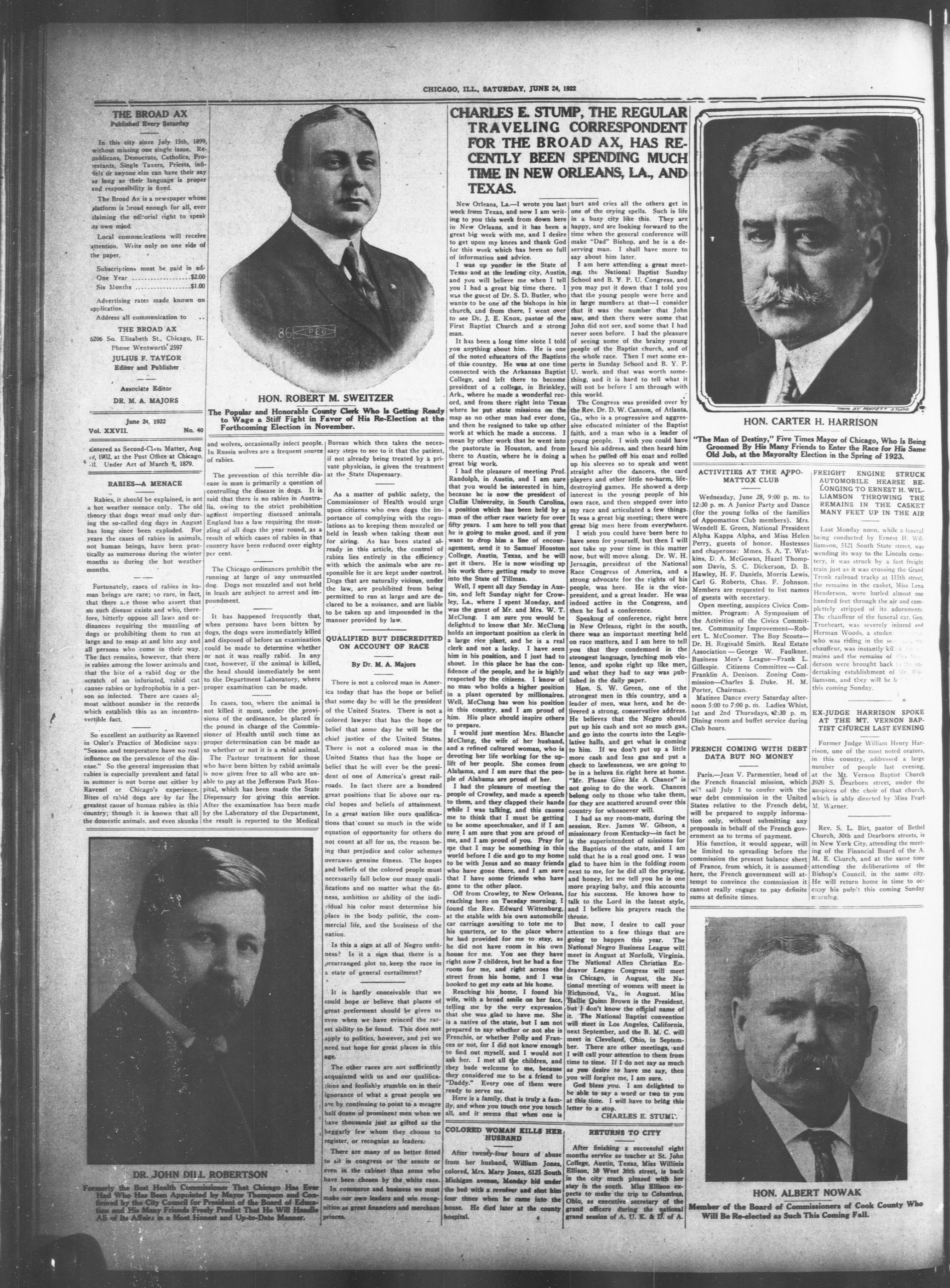
CHARLES E. STUMP, THE REGULAR TRAVELING CORRESPONDENT FOR THE BROAD AX, HAS RECENTLY BEEN SPENDING MUCH TIME IN NEW ORLEANS, LA., AND TEXAS.
CHICAGO, ILL., SATURDAY, JUNE 24, 1922
New Orleans, La.-I wrote you last week from Texas, and now I am writing to you this week from down here in New Orleans, and it has been a great big week with me, and I desire to get upon my knees and thank God for this week which has been so full of information and advice.
I was up yonder in the State of Texas and at the leading city, Austin, and you will believe me when I tell you I had a great big time there. I was the guest of Dr. S. D. Butler, who wants to be one of the bishops in his church, and from there, I went over to see Dr. J. E. Knox, pastor of the First Baptist Church and a strong man.
It has been a long time since I told you anything about him. He is one of the noted educators of the Baptists of this country. He was at one time connected with the Arkansas Baptist College, and left there to become president of a college, in Brinkley, Ark, where he made a wonderful record, and from there right into Texas where he put state missions on the map as no other man had ever done, and then he resigned to take up other work at which he made a success. I mean by other work that he went into the pastorate in Houston, and from there to Austin, where he is doing a great big work.
I had the pleasure of meeting Prof. Randolph, in Austin, and I am sure that you would be interested in him, because he is now the president of Claflin University, in South Carolina, a position which has been held by a man of the other race variety for over fifty years. I am here to tell you that he is going to make good, and if you want to drop him a line of encouragement, send it to Samuel Houston College, Austin, Texas, and he will get it there. He is now winding up his work there getting ready to move into the State of Tillman.
Well, I spent all day Sunday in Austin, and left Sunday night for Crowley, La., where I spent Monday, and was the guest of Mr. and Mrs. W. T. McClung. I am sure you would be delighted to know that Mr. McClung holds an important position as clerk in a large rice plant, and he is a real clerk and not a lacky. I have seen him in his position, and I just had to shout. In this place he has the confidence of the people, and he is highly respected by the citizens. I know of no man who holds a higher position in a plant operated by millionaires. Well, McClung has won his position in this country, and I am proud of him. His place should inspire others to prepare.
I would just mention Mrs. Blanche McClung, the wife of her husband, and a refined cultured woman, who is devoting her life working for the uplift of her people. She comes from Alabama, and I am sure that the people of Alabama are proud of her.
I had the pleasure of meeting the people of Crowley, and made a speech to them, and they clapped their hands while I was talking, and this causes me to think that I must be getting to be some speechmaker, and if I am sure I am sure that you are proud of me, and I am proud of you. Pray for me that I may be something in this world before I die and go to my home to be with Jesus and so many friends who have gone there, and I am sure that I have some friends who have gone to the other place.
Off from Crowley, to New Orleans, reaching here on Tuesday morning, I found the Rev. Edward Wittenburg, at the stable with his own automobile car carriage awaiting to tote me to his quarters, or to the place where he had provided for me to stay, as he did not have room in his own house for me. You see they have right now 7 children, but he had a fine room for me, and right across the street from his home, and I was booked to get my eats at his home.
Reaching his home, I found his wife, with a broad smile on her face, telling me by the very expression that she was glad to have me. She is a native of the state, but I am not prepared to say whether or not she is Frenchie, or whether Polly and Frances or not, for I did not know enough to find out myself, and I would not ask her. I met all the children, and they bade welcome to me, because they considered me to be a friend to "Daddy." Every one of them were ready to serve me.
Here is a family, that is truly a family, and when you touch one you touch all, and it seems that when one is
After twenty-four hours of abuse from her husband, William Jones, colored, Mra. Mary Jones, 6125 South Michigan avenue, Monday hid under the bed with a revolver and shot him four times when he came into the house. He died later at the county hospital.
hurt and cries all the others get in one of the crying spells. Such is life in a busy city like this. They are happy, and are looking forward to the time when the general conference will make "Dad" Bishop, and he is a deserving man. I shall have more to say about him later.
I am here attending a great meeting, the National Baptist Sunday School and B. Y. P. U. Congress, and you may put it down that I told you that the young people were here and in large numbers at that—I consider that it was the number that John saw, and then there were some that John did not see, and some that I had never seen before. I had the pleasure of seeing some of the brainy young people of the Baptist church, and of the whole race. Then I met some experts in Sunday School and B. Y. P. U. work, and that was worth something, and it is hard to tell what it will not be before I am through with this world.
The Congress was presided over by the Rev. Dr. D. W. Cannon, of Atlanta, Ga., who is a progressive and aggressive educated minister of the Baptist faith, and a man who is a leader of young people. I wish you could have heard his address, and then heard him when he pulled off his coat and rolled up his sleeves so to speak and went straight after the dancers, the card players and other little no-harm, life-destroying games. He showed a deep interest in the young people of his own race, and then stepped over into my race and articulated a few things. It was a great big meeting; there were great big men here from everywhere. I wish you could have been here to have seen for yourself, but then I will not take up your time in this matter now, but will move along. Dr. W. H. Jernagin, president of the National Race Congress of America, and a strong advocate for the rights of his people, was here. He is the vice-president, and a great leader. He was indeed active in the Congress, and then he had a conference.
Speaking of conference, right here in New Orleans, right in the south, there was an important meeting held on race matters, and I am here to tell you that they condemned in the strongest language, lynching mob violence, and spoke right up like men, and what they had to say was published in the daily paper.
Hon. S. W. Green, one of the strongest men in this country, and a leader of men, was here, and he delivered a strong, conservative address.
He believes that the Negro should put up his cash and not so much gas, and go into the courts into the Legislative halls, and get what is coming to him. If we don't put up a little more cash and less gas and put a check to lawlessness, we are going to be in a heluva fix. right here at home.
"Mr. Please Give Me A Chance" is not going to do the work. Chances belong only to those who take them, for they are scattered around over this country for whoseover will.
I had as my room-mate, during the session, Rev. James W. Gibson, a missionary from Kentucky—in fact he is the superintendent of missions for the Baptists of the state, and I am told that he is a real good one. I was glad to have him in the folding room next to me, for he did all the praying, and honey, let me tell you he is one more praying baby, and this accounts for his success. He knows how to talk to the Lord in the latest style, and I believe his prayers reach the throne.
But now, I desire to call your attention to a few things that are going to happen this year. The National Negro Business League will meet in August at Norfolk, Virginia. The National Allen Christian Endeavor League Congress will meet in Chicago, in August, the National meeting of women will meet in Richmond, Va., in August. Miss Eileen Quinn Brown is the President, but I don't know the official name of it. The National Baptist convention will meet in Los Angeles, California, next September, and the B. M. C. will meet in Cleveland, Ohio, in September. There are other meetings, and I will call your attention to them from time to time. If I do not say as much as you desire to have me say, then you will forgive me. I am sure.
God bless you. I am delighted to be able to say a word or two to you at this time. I will have to bring this letter to a stop.
CHARLES E. STUMEI.
RETURNS TO CITY
After finishing a successful eight months service as teacher at St. John College, Austin, Texas, Miss Willinia Ellison, 58 West 36th street, is back in the city much pleased with her stay in the south. Miss Ellison expects to make the trip to Columbus, Ohio, as executive secretary of the grand officers during the national grand session of A. U. K. & D. of A.
PHOTO BY MOFFETT STUDIO
HON. CARTER H. HARRISON
"The Man of Destiny," Five Times Mayor of Chicago, Groomed By His Many Friends to Enter the Race Old Job, at the Mayoralty Election in the Spring o
"The Man of Destiny," Five Times Mayor of Chicago, Who Is Being Groomed By His Many Friends to Enter the Race for His Same Old Job, at the Mayoralty Election in the Spring of 1923.
ACTIVITIES AT THE APPOMATTOX CLUB
Wednesday, June 28, 9:00 p. m. to 12:30 p. m. A Junior Party and Dance (for the young folks of the families of Appomattox Club members). Mrs. Wendell E. Green, National President Alpha Kappa Alpha, and Miss Helen Perry, guests of honor. Hostesses and chaperons: Mmes. S. A. T. Watkins, D. A. McGowan, Hazel Thompson Davis, S. C. Dickerson, D. B. Hawley, H. F. Daniels, Morris Lewis, Carl G. Roberts, Chas. F. Johnson. Members are requested to list names of guests with secretary.
Open meeting, auspices Civics Committee. Program: A Symposium of the Activities of the Civics Committee. Community Improvement—Robert L. McCoomer. The Boy Scouts—Dr. H. Reginald Smith. Real Estate Association—George W. Faulkner. Business Men's League—Frank L. Gillespie. Citizens Committee—Col. Franklin A. Denison. Zoning Commission—Charles S. Duke. H. M. Porter. Chairman.
PREEIGHT ENGINE STRUCK AUTOMOBILE HEARSE BE-LONGING TO ERNEST H. WILLIAMSON THROWING THE REMAINS IN THE CASKET MANY FEET UP IN THE AIR
Last Monday noon, while a funeral being conducted by Ernest H. Williams, 5121 South State street, was wending its way to the Lincoln cemetery, it was struck by a fast freight train just as it was crossing the Grand Trunk railroad tracks at 115th street, the remains in the casket, Miss Lena Henderson, were hurled almost one hundred feet through the air and completely stripped of its adornments. The chauffeur of the funeral car, Geo. Trueheart, was severely injured and Herman Woods, a student who was riding in the seahauffeur, was instantly killed in mains and the remains of derson were brought back to undertaking establishment of Mr. Williams, and they will be laid this coming Sunday.
Matinee Dance every Saturday afternoon
5:00 to 7:00 p. m. Ladies Whist
1st and 2nd Thursdays, 2:30 p. m.
m Dining room and buffet service during
Club hours.
FRENCH COMING WITH DEBT
DATA BUT NO MONEY
Paris,—Jean V. Parmentier, head of the French financial mission, which will sail July 1 to confer with the war debt commission in the United States relative to the French debt, will be prepared to supply information only, without submitting any proposals in behalf of the French government as to terms of payment. His function, it would appear, will be limited to spreading before the commission the present balance sheet of France, from which, it is assumed here, the French government will attempt to convince the commission it cannot really engage to pay definite sums at definite times.
[Name]
M.
HON. ALBERT NOWAK
Member of the Board of Commissioners of Co
Will Be Re-elected as Such This Coming Fai
Member of the Board of Commissioners of Cook County Who Will Be Re-elected as Such This Coming Fall.
Ms Mayor of Chicago, Who Is Being
led to Enter the Race for His Same
section in the Spring of 1923.
FREIGHT ENGINE STRUCK
AUTOMOBILE HEARSE BE-
LONGING TO ERNEST H. WILLIAMSON THROWING THE
REMAINS IN THE CASKET
MANY FEET UP IN THE AIR
Last Monday noon, while a funeral
being conducted by Ernest H. Wili-
iamson, 5121 South State street, was
wending its way to the Lincoln cem-
tery, it was struck by a fast freight
train just as it was crossing the Grand
Trunk railroad tracks at 115th street,
the remains in the casket, Miss Lena
Henderson, were hurled almost one
hundred feet through the air and com-
pletely stripped of its adornments.
The chauffeur of the funeral car, Geo.
Trucheart, was severely injured and
Herman Woods, a studen
who was riding in the se-
chaiffeur, was instantly kill-
mains and the remains of
derson were brought back
dertaking establishment of
liamson, and they will be k
this coming Sunday.
EX-JUDGE HARRISON SPOKE
AT THE MT. VERNON BAPTIST CHURCH LAST EVENING
Former Judge William Henry Harrison, one of the most noted orators, in this country, addressed a large number of people last evening, at the Mt. Vernon Baptist Church 3920 S. Dearborn street, under the auspices of the choir of that church, which is ably directed by Miss Pearl M. Warner.
Rev. S. L. Birt, pastor of Bethel Church, 30th and Dearborn streets, is in New York City, attending the meeting of the Financial Board of the A.M. E. Church, and at the same time attending the deliberations of the Bishop's Council, in the same city. He will return home in time to occupy his pulpit this coming Sunday morning.
```markdown
```
issioners of Cook County Who this Coming Fall.
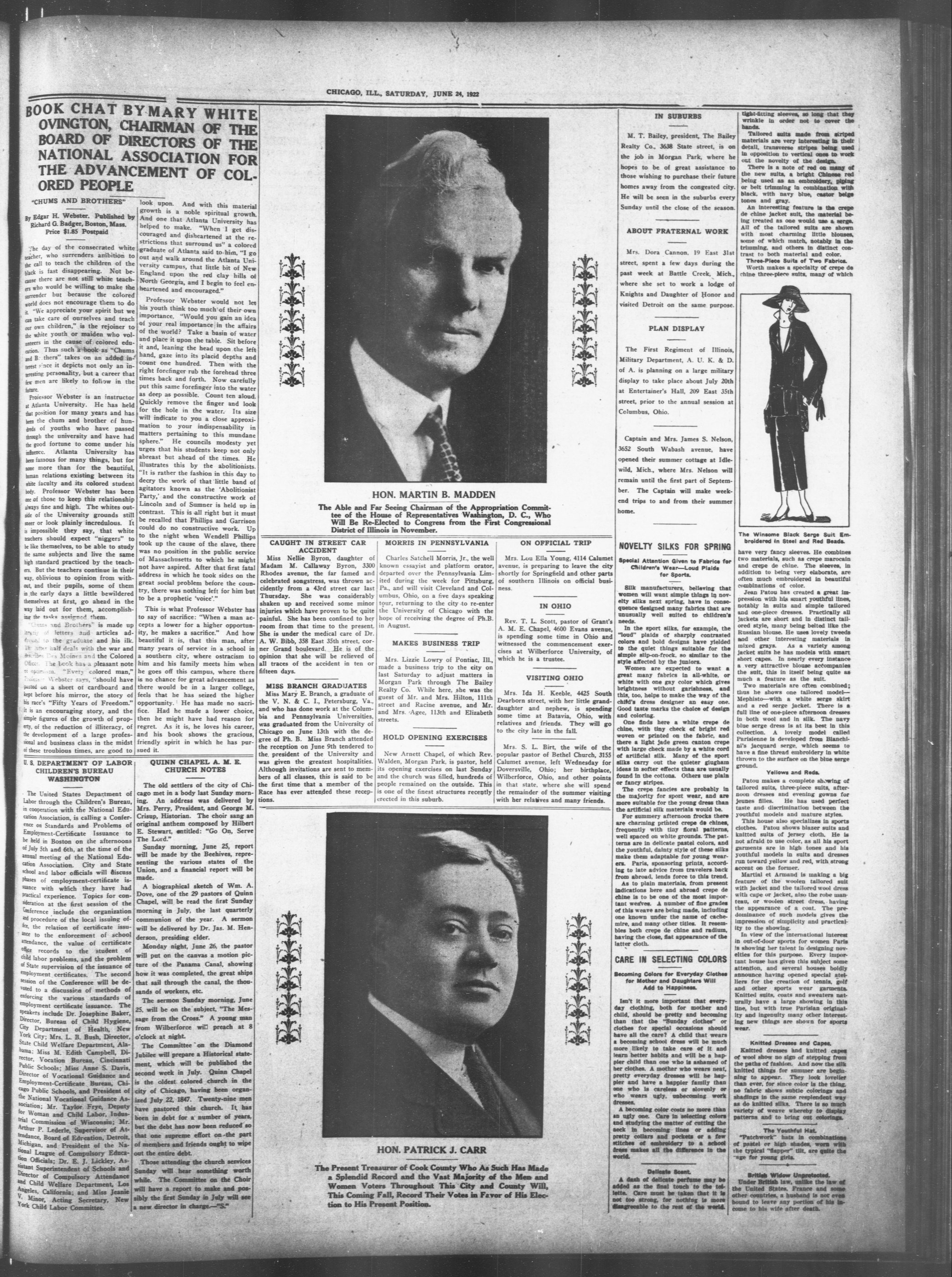
BOOK CHAT BY MARY WHITE OVINGTON, CHAIRMAN OF THE BOARD OF DIRECTORS OF THE NATIONAL ASSOCIATION FOR THE ADVANCEMENT OF COLORED PEOPLE
"CHUMS AND BROTHERS"
By Edgar H. Webster. Published by
Richard G. Badger, Boston, Mass.
Price $1.85 Postpaid
The day of the consecrated white teacher, who surrenders ambition to the call to teach the children of the black is fast disappearing. Not because there are not still white teachers who would be willing to make the surrender but because the colored world does not encourage them to do it. "We appreciate your spirit but we can take care of ourselves and teach our own children," is the rejoiner to the white youth or maiden who volunteers in the cause of colored education. Thus such a book as "Chums and B. thers" takes on an added interest since it depicts not only an interesting personality, but a career that few men are likely to follow in the future.
Proessor Webster is an instructor at Atlanta University. He has held that position for many years and has been the chum and brother of hundreds of youths who have passed through the university and have had the good fortune to come under his influence. Atlanta University has been famous for many things, but for none more than for the beautiful, human relations existing between its white faculty and its colored student body. Professor Webster has been one of those to keep this relationship always fine and high. The whites outside of the University grounds still sneer or look plainly incredulous. It is impossible they say, that white teachers should expect "niggers" to be like themselves, to be able to study the same subjects and live the same high standard practiced by the teachers. But the teachers continue in their way, oblivious to opinion from without, and their pupils, some of them in the early days a little bewildered themselves at first, go ahead in the way laid out for them, accomplishing the tasks assigned them.
"Unus and Brothers" is made up largely of letters and articles addressed to the graduate and his ilk. After half deals with the war and deserts Des Moines and the Colored Office. The Look has a pleasant note of optimism. "Every colored man," Dolores Webster says, "should have posted on a sheet of cardboard and kept before his mirror, the story of his race's "Fifty Years of Freedom." It is an encouraging story, and the simple figures of the growth of property, of the reduction of illiteracy, of the development of a large professional and business class in the midst of these troubious times, are good to
S. DEPARTMENT OF LABOR
CHILDREN'S BUREAU
WASHINGTON
The United States Department of Labor through the Children's Bureau in cooperation with the National Education Association, is calling a Conference on Standards and Problems of Employment-Certificate Issuance to be held in Boston on the afternoons of July 5th and 6th, at the time of the annual meeting of the National Education Association. City and State school and labor officials will discuss phases of employment-certificate issuance with which they have had practical experience. Topics for consideration at the first session of the Conference include the organization and procedure of the local issuing office, the relation of certificate issuance to the enforcement of school attendance, the value of certificate office records to the student of child labor problems, and the problem of State supervision of the issuance of employment certificates. The second session of the Conference will be devoted to a discussion of the various methods of enforcing the various standards of employment certificate issuance. The speakers include Dr. Josephine Baker, Director, Bureau of Child Hygiene, New York City; Mrs. L. B. Bush, Director, State Child Welfare Department, Alabama; Miss M. Edith Campbell, Director, Vocation Bureau, Cincinnati Public Schools; Miss Anne S. Davis, Director of Vocational Guidance and Employment-Certificate Bureau, Chicago Public Schools, and President of the National Vocational Guidance Association; Mr. Taylor Frye, Deputy for Woman and Child Labor, Industrial Commission of Wisconsin; Mr. Arthur P. Lederle, Supervisor of Attendance, Board of Education, Detroit, Michigan, and President of the National League of Compulsory Education Officials; Dr. E. J. Lickley, Assistant Superintendent of Schools and Director of Compulsory Attendance and Child Welfare Department, Los Angeles, California; and Miss Jeanie V. Minor, Acting Secretary, New York Child Labor Committee.
look upon. And with this material growth is a noble spiritual growth. And one that Atlanta University has helped to make. "When I get discouraged and disheartened at the restrictions that surround us" a colored graduate of Atlanta said to him, "I go out and walk around the Atlanta University campus, that little bit of New England upon the red clay hills of North Georgia, and I begin to feel enhearted and encouraged."
Professor Webster would not let his youth think too much of their own importance. "Would you gain an idea of your real importance in the affairs of the world? Take a basin of water and place it upon the table. Sit before it and, leaning the head upon the left hand, gaze into its placid depths and count one hundred. Then with the right forefinger rub the forehead three times back and forth. Now carefully put this same forefinger into the water as deep as possible. Count ten aloud. Quickly remove the finger and look for the hole in the water. Its size will indicate to you a close approximation to your indispensability in matters pertaining to this mundane sphere." He councils modesty yet urges that his students keep not only abreast but ahead of the times. He illustrates this by the abolitionists. "It is rather the fashion in this day to decry the work of that little band of agitators known as the 'Abolitionist Party,' and the constructive work of Lincoln and of Sumner is held up in contrast. This is all right but it must be recalled that Phillips and Garrison could do no constructive work. Up to the night when Wendell Phillips took up the cause of the slave, there was no position in the public service of Massachusetts to which he might not have aspired. After that first fatal address in which he took sides on the great social problem before the country, there was nothing left for him but to be a prophetic 'voice.'"
This is what Professor Webster has to say of sacrifice: "When a man accepts a lower for a higher opportunity, he makes a sacrifice." And how beautiful it is, that this man, after many years of service in a school in a southern city, where ostracism to him and his family meets him when he goes off this campus, where there is no chance for great advancement as there would be in a larger college, feels that he has seized the higher opportunity. He has made no sacrifice. Had he made a lower choice, then he might have had reason for regret. As it is, he loves his career, and his book shows the gracious, friendly spirit in which he has pursued it.
QUINN CHAPEL A. M. E. CHURCH NOTES
The old settlers of the city of Chicago met in a body last Sunday morning. An address was delivered by Mrs. Perry, President, and George M. Crisup, Historian. The choir sang an original anthem composed by Hilbert E. Stewart, entitled: "Go On, Serve The Lord."
Sunday morning, June 25, report will be made by the Beehives, representing the various states of the Union, and a financial report will be made.
A biographical sketch of Wm. A. Dove, one of the 29 pastors of Quinn Chapel, will be read the first Sunday morning in July, the last quarterly communion of the year. A sermon will be delivered by Dr. Jas. M. Henderson, presiding elder.
Monday night, June 26, the pastor will put on the canvas a motion picture of the Panama Canal, showing how it was completed, the great ships that sail through the canal, the thousands of workers, etc.
The sermon Sunday morning, June 25, will be on the subject, "The Message from the Cross." A young man from Wilberforce will preach at 8 o'clock at night.
The Committee on the Diamond Jubilee will prepare a Historical statement, which will be published the second week in July. Quinn Chapel is the oldest colored church in the city of Chicago, having been organized July 22, 1847. Twenty-nine men have pastored this church. It has been in debt for a number of years, but the debt has now been reduced so that one supreme effort on-the part of members and friends ought to wipe out the entire debt. Those attending the church services Sunday will hear something worth while. The Committee on the Choir will have a report to make and possibly the first Sunday in July will see a new director in charge."S."
CHICAGO, ILL., SATURDAY. JUNE 24. 1922
M. J.
The Able and Far Seeing Chairman of the Appropriation Committee of the House of Representatives Washington, D. C., Who Will Be Re-Elected to Congress from the First Congressional District of Illinois in November.
The Present Treasurer of Cook County Who As Such Has Made a Splendid Record and the Vast Majority of the Men and Women Voters Throughout This City and County Will, This Coming Fall, Record Their Votes in Favor of His Election to His Present Position.
```markdown
```
CAUGHT IN STREET CAR
ACCIDENT
Miss Nellie Byron, daughter of Madam M. Callaway Byron, 3300 Rhodes avenue, the far famed and celebrated songstress, was thrown accidently from a 43rd street car last Thursday. She was considerably shaken up and received some minor injuries which have proven to be quite painful. She has been confined to her room from that time to the present. She is under the medical care of Dr. A. W. Bibb, 358 East 35th street, corner Grand boulevard. He is of the opinion that she will be relieved of all traces of the accident in ten or fifteen days.
MISS BRANCH GRADIATES
Miss Mary E. Branch, a graduate of the V. N. & C. I., Petersburg, Va., and who has done work at the Columbia and Pennsylvania Universities, was graduated from the University of Chicago on June 13th with the degree of Ph. B. Miss Branch attended the reception on June 9th tendered to the president of the University and was given the greatest hospitalizations. Although invitations are sent to members of all classes, this is said to be the first time that a member of the Race has ever attended these receptions.
```markdown
```
HON. MARTIN B. MADDEN
Far Seeing Chairman of the Approp
House of Representatives Washington
-Elected to Congress from the Firs
Illinois in November.
MORRIS IN PENNSYLVANIA
Charles Satchell Morris, Jr., the well known essayist and platform orator, departed over the Pennsylvania Limited during the week for Pittsburg Pa., and will visit Cleveland and Columbus, Ohio, on a five days speaking tour, returning to the city to re-enter the University of Chicago with the hope of receiving the degree of Ph.B in August.
MAKES BUSINESS TRIP
Mrs. Lizzie Lowry of Pontiac, Ill. made a business trip to the city on last Saturday to adjust matters in Morgan Park through The Bailey Realty Co. While here, she was the guest of Mr. and Mrs. Hilton, 111th street and Racine avenue, and Mr. and Mrs. Agec, 113th and Elizabeth streets.
HOLD OPENING EXERCISES
New Arnett Chapel, of which Rev. Walden, Morgan Park, is pastor, held its opening exercises on last Sunday and the church was filled, hundreds of people remained on the outside. This is one of the finest structures recently erected in this suburb.
M.
HON. PATRICK J. CARR
Teacher of Cook County Who As S
Record and the Vast Majority of
Others Throughout This City and
Fall, Record Their Votes in Fave
Present Position.
```markdown
```
ON OFFICIAL TRIP
Mrs. Lou Ella Young, 4114 Calumet avenue, is preparing to leave the city shortly for Springfield and other parts of southern Illinois on official business.
IN OHIO
Rev. T. L. Scott, pastor of Grant's A. M. E. Chapel, 4600 Evans avenue, is spending some time in Ohio and witnessed the commencement exercises at Wilberforce University, of which he is a trustee.
VISITING OHIO
Mrs. Ida H. Keeble, 4425 South Dearborn street, with her little grand-daughter and nephew, is spending some time at Batavia, Ohio, with relatives and friends. They will go to the city late in the fall.
Mrs. S. L. Birt, the wife of the popular pastor of Bethel Church, 3155 Calumet avenue, left Wednesday for Dowersville, Ohio; her birthplace, Wilberforce, Ohio, and other points in that state, where she will spend the remainder of the summer visiting with her relatives and many friends.
```markdown
```
IN SUBURBS
M. T. Bailey, president, The Bailey Realty Co., 3638 State street, is on the job in Morgan Park, where he hopes to be of great assistance to those wishing to purchase their future homes away from the congested city. He will be seen in the suburbs every Sunday until the close of the season.
ABOUT PRATERNAL WORK
Mrs. Dora Cannon, 19 East 31st street, spent a few days during the past week at Battle Creek, Mich., where she set to work a lodge of Knights and Daughter of Honor and visited Detroit on the same purpose.
PLAN DISPLAY
The First Regiment of Illinois, Military Department, A. U. K. & D. O. of A. is planning on a large military display to take place about July 20th at Entertainer's Hall, 209 East 35th street, prior to the annual session at Columbus, Ohio.
Captain and Mrs. James S. Nelson, 3652 South Wabash avenue, have opened their summer cottage at Idlewild, Mich., where Mrs. Nelson will remain until the first part of September. The Captain will make weekend trips to and from their summer home.
NOVELTY SILKS FOR SPRING
Special Attention Given to Fabrics for Children's Wear—Loud Plaids for Sports.
Silk manufacturers, believing that women will want simple things in novelty silks next spring, have in consequence designed many fabrics that are unusually well suited to children's needs.
In the sport silks, for example, the "loud" plaids of sharply contrasted colors and bold designs have yielded to the quiet things suitable for the simple slip-on-frock, so similar to the style affected by the juniors.
Women are expected to want a great many fabrics in all-white, or white with one gay color which gives brightness without garishness, and this, too, helps to make the way of the child's dress designer an easy one. Good taste marks the choice of design and coloring.
One finds here a white crepe de chine, with tiny check of bright red woven or printed on the fabric, and there a light jade green cannon crepe with large check made by a white cord of artificial silk. Many of the sport silks carry out the qualer gingham ideas in softer effects than are usually found in the cottonts. Others use plain or fancy stripes.
The crepe fancies are probably in the majority for sport wear, and are more suitable for the young dress than the artificial silk materials would be.
For summery afternoon frocks there are charming printed crepe de chines, frequently with tiny floral patterns, well spaced on white grounds. The patterns are in delicate pastel colors, and the youthful, dainty style of these silks make them adaptable for young wearers. Paris, sponsoring prints, according to late advice from travelers back from abroad, lends force to this trend.
As to plain materials, from present indications here and abroad crepe de chine is to be one of the most important weyes. A number of fine grades of this weave are being made, including one known under the name of cachemire, and many other titles. It resembles both crepe de chine and radium, having the close, flat appearance of the latter cloth.
CARE IN SELECTING COLORS
Becoming Colors for Everyday Clothes for Mother and Daughters Will Add to Happiness.
Isn't it more important that everyday clothing, both for mother and child, should be pretty and becoming than that the "Sunday clothes" or clothes for special occasions should have all the care? A child that wears a becoming school dress will be much more likely to take care of it and learn better habits and will be a happier child than one who is ashamed of her clothes. A mother who wears neat, pretty everyday dresses will be happier and have a happier family than one who is careless or slovenly or who wears ugly, unbecoming work dresses.
A becoming color costs no more than an ugly one. Care in selecting colors and studying the matter of cutting the neck in becoming lines or adding pretty collars and pockets or a few stitches of embroidery to a school dress makes all the difference in the world.
Delicate Scent
A dash of delicate perfume may be added as the final touch to the toilette. Care must be taken that it is not too strong, for nothing is more disagreeable to the rest of the world.
tight-fitting sleeves, so long that they wrinkle in order not to cover the hands.
Tallored suits made from gripped materials are very interesting in their detail, transverse stripes being used in opposition to vertical ones to work out the novelty of the design.
There is a note of red on many of the new suits, a bright Chinese red being used as an embroidery, piping or belt trimming in combination with black, with navy blue, castor belts tones and gray.
An interesting feature is the crepe de chine jacket suit, the material being treated as one would use a serge. All of the tallored suits are shown with most charming little blouses, some of which match, notably in the trimming, and others in distinct contrast to both material and color.
Three-Piece Suits of Two Fabrics.
Worth makes a specialty of crepe de chine three-piece suits, many of which
1
The Winsome Black Serge Suit Embroidered in Steel and Red Beads.
have very fancy sleeves. He combines two materials, such as crepe maracolin and crepe de chine. The sleeves, in addition to being very elaborate, are often much embroidered in beautiful combinations of color.
Jean Patou has created a great impression with his smart youthful lines, notably in suits and simple tailored and one-piece dresses. Practically all jackets are short and in distinct tailored style, many being belted like the Russian blouse. He uses lovely tweeds and other interesting materials in mixed grays. As a variety among jacket suits he has models with smart short capes. In nearly every instance a very attractive blouse accompanies the suit, in itself being quite as much a feature as the suit.
Two materials are often combined; thus he shows one tailored model—Mephisto—with a white serge skirt and a red serge jacket. There is a full line of one-piece afternoon dresses in both wool and in silk. The navy blue serge dress is at its best in this collection. A lovely model called Parisienne is developed from Blanchini's jacquard serge, which seems to have a fine thread embroidery in white thrown to the surface on the blue serge ground.
Yellows and Reda
Patou makes a complete showing of tailored suits, three-piece suits, afternoon dresses and evening gowns for jeunes filles. He has used perfect taste and discrimination between the youthful models and mature styles. This house also specializes in sports clothes. Patou shows blazer suits and knitted suits of jersey cloth. He is not afraid to use color, as all his sport garments are in high tones and his youthful models in suits and dresses run toward yellow and red, with strong accent on the former. Martial et Armand is making a big feature of the woolen tailored suit with jacket and the tailored wool dress with cape or jacket, also the robe manteau, or woolen street dress, having the appearance of a coat. The predominance of such models gives the impression of simplicity and practicality to the showing.
In view of the international interest in out-of-door sports for women Paris is showing her talent in designing novelties for this purpose. Every important house has given this subject some attention, and several houses boldly announce having opened special artillery for the creation of tennis, golf and other sports wear garments. Knitted suits, coats and sweaters naturally have a large showing in this line, but with true Parisian originality and ingenuity many other interesting new things are shown for sports wear.
Knitted Dresses and Capes
Knitted dresses and knitted capes of wool show no sign of stepping from the paths of fashion. And now the silk knitted things for summer are beginning to appear. They look lovelier than ever, for since color is the thing, no fabric shows subtle colorings and shadings in the same resplendent way as do knitted silks. There is so many variety of weave whereby to display patterns and to bring out colorings.
The Youthful Hat
"Patchwork" hats in combinations of pastel or high shades, worn with the typical "flapper" tilt, are quite the age for young girls.
British Wide Unprotected
British Widow Unprotected.
Under British law, unlike the law of
the United States, France and some
other countries, a husband is not even
bound to leave any portion of his income
to his wife after death.
P
be soft, silky hair that can be
has made happy thousands of
hair. It will do the same fife
and lifeless or if you have dane
of EXELENTO QUINING
inspire. Price by mail 25 on receipt
GENTS WANTED-Write for Particular
MEDICINE COMPANY, AU
ENTO SKIN BEAUTIFIER, an ointment for dane
used in treatment of skin troubles.
YOU can have soft, silky
EXELENTO has made hair
coarse, nappy hair. It w
hair is brittle and lifeless or
scalp, try a box of EXEL
Pal, for sale at all drug stores. Price
EXELENTO MEDICINE
We make EXELENTO SKIN BEAUTY
used in trees
YOU can have soft, silky hair that can be easily dressed.
EXELENTO has made happy thousands of women who had
coarse, nappy hair. It will do the same for you. If your
hair is brittle and lifeless or if you have dandruff and itching
scalp, try a box of EXELENTO QUININE POMADE.
For sale at all drug stores, art supplies, or receipt of stamp or coin.
ANOTHER WANTED—Write for Particulars.
EXELENTO MEDICINE COMPANY, Atlanta, Georgia
We make EXELENTO SKIN BEAUTIFIER, an ointment for dark, nallow skins,
used in treatment of skin troubles.
TELEPHONE DOUGLAS 1
GEORGE F.
E F. HARDI
GEORGE F. HARDING, JR.
REAL ESTATE
Up-to-Date or Mo
and St
3101 COTTAC
Corner 31st
Phone
FURN
Brass and Wood
Refrigerators,
Hardwa
HENRY
2515-19 A
JAS. B. McCAHEY, President
FRANK J. DUNN, Vice-President
ESTABL
e or Modern Houses,
and Stores to Rent
COTTAGE GROW
ner 31st Street, Chicago
Up-to-Date or Modern Houses, Apartments and Stores to Rent
3101 COTTAGE GROVE AVE.
Corner 31st Street, Chicago
Phone Yards 27
FURNITURE
All Wood Beds, Electric
Lagerators, Stoves, Paint
Hardware, Linoleum
HENRY STUCKA
2515-19 ARCHER AVE.
J. President PHILIP
Vice-President H. X. COM
ESTABLISHED 1877
Brass and Wood Beds, Electric Washers, Refrigerators, Stoves, Paint, Oil, Hardware, Linoleum HENRY STUCKART 2515-19 ARCHER AVE.
JAS. B. McCAHEY, President PHILIP J. DUNN, Secretary
FRANK J. DUNN, Vice-President H. X. COMERFORD, Treasurer
ESTABLISHED 1877
JOHN J. DUNN
COAL CO.
Telephone Oakland 1550
5100 Federal Street CHICAGO
---
A. L. WILLIAMS
ATTORNEY AND
COUNSELOR AT LAW
Suite 706 Firmenich Building
184 W. Washington St.
CHICAGO
Residence 3655 Prairie Ave.
Phone Douglas 9133
What Ralph
BILL is a good sub
who, like man
up to a short time ago
his money systematic
What Ralph wrote to Bill
BILL is a good substantial citizen who, like many of us, had, up to a short time ago, never saved his money systematically.
He never really thought seriously of investing in bonds until he was married a few years ago. Being in-experienced in financial matters, he wrote several letters to Ralph, an attorney friend of his, who answered all his questions in a very simple and clear manner.
We have just published a booklet called "An Investor's Letters" which contains all of Ralph's and Bill's correspondence. You will find it very interesting and it may clear up some of the questions you have in your own mind about investment matters.
We shall be glad to send "An Investor's Letters" free of charge or obligation to anyone who requests it.
LINCOLN STATE BANK
OF CHICAGO
Under State Government Supervision
31st and South State Streets
Telephone Victory 4500
5100 Federal Street
Phone Main 2017
Sicily Greer Praises EXELENTO QUININE POMADE
Says her hair was short, coarse and nappy before using this wonderful hair grower.
A silky hair that can be easily dressed. Made happy thousands of women who had it. Will do the same for you. If your eless or if you have dandruff and itching EXELENTO QUININE POMADE.
Price by mail 25c on receipt of stamps or coin. WANTED—Write for Particular.
CINE COMPANY, Atlanta, Georgia
SKIN BEAUTIFIER, an ointment for dark, sallow skins, in treatment of skin troubles.
EPHONE DOUGLAS 1
F. HARDING, JR.
Modern Houses, Apartments and Stores to Rent
TAGE GROVE AVE.
31st Street, Chicago
UNITURE
Food Beds, Electric Washers,
ators, Stoves, Paint, Oil,
Hardware, Linoleum
Y STUCKART
5-19 ARCHER AVE.
President PHILIP J. DUNN, Secretary
President H. X. COMERFORD, Treasurer
ESTABLISHED 1877
CHICAGO
Residence, 1262 Macalister Place
Telephone Monroe 2714
ATTORNEY AT LAW
Suite 318-320 Reaper Block
Clark and Washington Sts.
CHICAGO
Telephone Central 1239
BILL is a good substantial citizen
who, like many of us, had,
up to a short time ago, never saved
his money systematically.
CHICAGO
CHICAGO, ILL., SATURDAY, JUNE 24, 1922
You can be one of the rich who lives upon the income from his fortune! Or you can be one of the poor who spends his fortune day by day! If you put the price of frivolities into your bank account, instead of into somebody else's cash-drawer—then you're on the road to "Wealth." $1 is enough to start.
ILLINOIS TRUST & SAVINGS BANK
La Salle and Jackson Streets Chicago
Life's "Cross Road"
Dr. James M. Hall
4406 S. State St. Chicago
Office Phone Droxel 7074
Office Hours: 10 to 13 A. M. 2 to 4 P. M.,
6 to 8 P. M. Sundays by Appointment
Res. 4330 Calumet Avenue
Tel. Oakland 7174-J
HELD SECRET OF HAPPINESS
John Wesley's Nearly Ninety Years Passed With Remarkably Few Periods of Depression.
There was John Wesley. His "Journal," with its record of indefatigable labor, is one of the cheeriest books in the language. What a rare good time he had! When he was eighty-seven he could say, "I do not remember to have felt lowness of spirits for a quarter of an hour since I was born." For more than sixty years this indefatigable pleasure-seeker had been doing as he pleased. Up every day in time to preach at five o'clock in the morning; then over the hills or through the pleasant lanes to preach again at the time lazy citizens were ready for breakfast; off again, on horseback, or by chase or in a lumbering stage coach, for more preaching. . . . Now and then facing a mob, or being wet through in a thunder storm, or stopping to get information in regard to some old ruin. Between sermons he refreshed his mind with all sorts and conditions of books. On the pleasant road to Chatham he reads Tasso's "Jerusalem Delivered." On the road to Aberdeen he loses himself delftedly in the misty sublimities of Ossan. "Orlando Furioso" is good Saturday reading. The eager octogenarian confesses that "Astolpho's shield and horn and voyage to the moon, the lance that unhorses everyone, the all-penetrating sword, and I know not how many impenetrable helmets and helms" are rather too much for his sober English imagination. Still, they afford an agreeable interlude in his missionary Journeys. — Samuel McChord Crothers, in "Among Friends."
YOUTH NOT GOLDEN SEASON
Modern Writer Takes Issue With Others Who Have Dubbed it the Best Period of Life.
Following is from "The Way of All Flesh," by Samuel Butler—not the Seventeenth century poet, but the Nineteenth century novelist:
"To me it seems that youth is like spring, an overprised season—delightful if it happen to be a favored one, but in practice very rarely favored and more remarkable, as a general rule, for biting east winds than general breezes. Autumn is the mellower season, and what we lose in flowers we more than gain in fruits. Fontelle, at the age of ninety, being asked what was the happiest time of his life, said he did not know that he had ever been much happier than he then was, but that perhaps his best years had been those when he was between fifty-five and seventy-five, and Dr. Johnson placed the pleasures of old age far higher than those of youth. True, in old age we live under the shadow of death, which, like a sword of Damocles, may descend at any moment, but we have so long found life to be an affair of being rather frightened than hurt, that we have become like the people who live under Vesuvius, and chance it without much misgiving."
Fireworks In History.
The business of making fireworks and the business of setting off elaborate displays are sometimes called the "art of pyrotechny," the word "pyrotechny" being compounded of two Greek words meaning "fire art." There is an extensive literature on the subject.
References may be found in the writings of Manilius and Vespluc to the fact that fireworks were set off in connection with the circus in ancient Rome, and Claudianus, who wrote in the Fourth century, mentions "whirling wheels and fountains of fire" in connection with the celebration of certain festivals. Fireworks, and which should not be confounded with mere bonfires, were set off as spectacles and ceremonies during the reign of Henry VII, Henry VIII, Elizabeth and other English monarchs. In those early English days dragons spouting fire were a popular form of fireworks. In a book written on the subject in 1048 there is a reference to "trees and fountains of fire sent high up into the air."
Flower "Ad" Big as House. A basket of blossoms as big as an ordinary house was constructed to advertise a flower show held recently in London.
STATE OF NEW YORK
UNIVERSITY OF NEW YORK
UNIVERSITY OF NEW YORK
SAVINGS BANK
in Streets Chicago
TELEPHONE DOUGLAS' 6351
Res. 3646 Grand Boul. Phone Douglas 4397
Advice Free
J. GRAY LUCAS
Attorney-at-Law
204 East 35th Street
Chicago
Corner Indiana Ave., Second Floor
Oldest American Newspaper.
The New York Globe was founded on December 9, 1793, by Noah Webster, as the "American Minerva." It was renamed "The Commercial Advertiser" on October 7, 1797 and was again changed to "The Globe and Commercial Advertiser" on February 1, 1904. This is the oldest daily newspaper still in existence in America. A weekly paper, the New Hampshire Gazette, was established in 1756 and is still published. The Harford Courant was established as a weekly, the Connecticut Courant, in 1764, and is now a daily.
Trial by Ordeal.
Trial by ordeal still exists in some parts of Japan. If a theft takes place in a household, all the servants are required to write a certain word with the same brush. The conscience is supposed to betray its workings in the waves of the ideography written. Tracing an ideography involves such an effort of muscular directness and undivided attention that this device often leads to the discovery of the gullity party. The test is, at all events, more humane than the ordeal of boiling water, to which accused persons were formerly submitted in Japan.
Seemed to Be Something Wrong
Seemed to Be Something Wrong.
Kenneth's mother had been to the hospital and Kenneth was waiting impatiently for her return. The day of her homecoming he took a chair up to the window and watched every auto pass with his little nose flattened against the window pane. Suddenly an auto pulled up, his mother looked out and waved, and Kenneth dashed madly out to the steps to greet her. Mother was overjoyed at seeing him, she began to cry, and Kenneth looked at her and said: "Ooh, mother dear, aln't you all well vet?"
Birds Guard Our Trees.
We can spray orchards and shade trees with polious poisonicides, but we would stand against at the impossible task of spraying all the trees in all the woods, says the American Forestry Magazine. We must perforce depend on the natural enemies of insects to protect our forests. Fortunately, birds and other foes of insects, wherever their numbers are sufficient, act as effective forest guardians.
Mountain of Sulphur.
By looking on a map of the South seas, one can find the New Hebrides, about 900 miles east of Quensland, Australia, and southeast of the Solomons. At the north end of the group is an island called Vanua Lava. This island is a mountain, a big one, 1,600 feet high and covering an area of 100 square miles. But the remarkable thing about it is that it is composed wholly of sulphur. Nothing like it is to be found anywhere in the world.
Hint to Precautious.
Take a piece of heavy copper wire 11 inches long and bend it in the shape of a hairpin. Lock the door, leaving the key in the lock, then place the curved nipple of the wire over the shank or spindle back of the knob and put the two ends of the wire through the head of the key. The key cannot be pushed out nor turned. This is a light device which one can carry in a handbag if so desired and use in hotel rooms when traveling.
Solitaire.
Solitare is a game played on a board invented with 33 or 37 hemisphered hollows, with the same number of balls or marbles. An unoccupied hollow is left by removing one ball, and the balls, or pieces, are then captured as in checkers. No moves are allowed in diagonal directions or ever more than one space at a time. The trick is to leave a solitary ball in the center hole.
Get Author's Point of View.
Much confusion in thought and much bitterness in criticism would be avoided if more readers tried to get the author's point of view. At any rate, proper and improper methods of reading deserve more consideration than they have received. For reading is an art that lends itself to efficiency tests and improvement—Exchange.
FUNERAL DIRECTORS
ERNEST H. WILLIAMSON UNDERTAK
5121 ERNEST H. WILLIAMSON UNDERTAK
GARAGE
CASOLINE OIL
OPEN DAY & NIGHT
Day Light Chapel, capacity 200, Outside Ventilation—Organ and Organist Free— I am as near as your Telephone—I give service at a reasonable price—Distance immaterial, consult me—I save you wor y, time and money.
Notary Public
Phones: Office Main 4153; Residence,
4751 Champlain Avenue
Phone Kenwood 5611
Walter M. Farmer
ATTORNEY AND COUNSELOR
AT LAW
Suite 708—184 W. Washington St.
CHICAGO
W. G. Anderson
Attorney-At-Law
Notary Public
184 W. Washington St., Cor. Wells
Suite 603, Firench Bldg.
Residence: 3354 Vernon Avenue
Phone Douglas 6045
CHICAGO
PHONE MAIN 2214
A. D. GASH
ATTORNEY AT LAW
118 N. La Salle Street
CHICAGO
Residence Telephone
3342 Calumet Ave. Douglas 1275
JAMES G. COTTER
ATTORNEY AT LAW
145 NORTH CLARK STREET
SUITE 407
Telephone Central 8354
CHICAGO
Formerly
Assistant Attorney General
State of Illinois
BINGA STATE
BANK
Under State Supervision
Capital ..... $100,000.00
Surplus ..... 20,000.00
Offers Equal Service to All
3% INTEREST ON SAVINGS
SAFE DEPOSIT VAULTS
State Street and 36th Place
Wanted
Advertising Solicitor
A live or wide awake newspaper man or solicitor can earn some easy money by calling on or addressing the undersigned.
Julius F. Taylor, 6206 S. Elizabeth street. Phone Wentworth 2597.
PHONE KENWOOD 455
West Englewood Trust & Savings Bank
CHICAGO
Capital, Surplus and Undivided
Profits, $500,000.00
OFFICE
John Bain, President
Michael Maisel, Vice-Pres.
Edw. C. Barry, Cashier
The Cranford A
3600 WA AS
The finest building ever opened
Steam heat, electric lights,
Phone Main 263
J. W. Casey
$ \textcircled{8} $
OFFICERS
n, President Maisel, Vice-Pres. Barry. Cashier
Arthur C. Utesch, Ass. W. Merle Fisher, Ass. and Tru
Cranford Apartment
3600 WASH AVENUE
building ever opened to Colored tenants
heat, electric lights, tile baths, marble
263 J. W. Casey, Agt. 133 W. W.
John Bain, President Arthur C. Utesch, Asst. Cashier Michael Maisel, Vice-Pres. W. Merle Fisher, Asst. Cashier Edw. C. Barry, Cashier and Trust Officer
The Cranford Apartment Bldg
The finest building ever opened to Colored tenants in Chicago Steam heat, electric lights, tile baths, marble entrance Phone Main 263 J. W. Casey, Agt. 133 W. Washington St.
OUR NEW HOME
FUNERAL DIRECT
GENERAL DIRECTORS
DRIEST WILLIAMSON
UNDERTAKER
PRIVATE ANNOUNCEMENT
HOURS AT ALL HOURS
ALL LENGTHS ASSE
WILLIAMSON UNDERTAKER
mson UNDERTAKER
side Ventilation—Organ and Organist Free
give service at a reasonable price—Distan
wor y, time and money.
DEPARTMENT Bldg.
SH AVENUE
to Colored tenants in Chicago
tile baths, marble entrance
, Agt. 133 W. Washington
GARAGE
GASOLINE GILLET
OPEN DAY & NIGHT
UNDERTAKER
a and Organist Free—
manable price—Distance
y.
CHICAGO, ILLINOIS
$ \textcircled{8} $