The Broad Ax
Saturday, July 15, 1922
Chicago, Illinois
Page text (machine-generated)
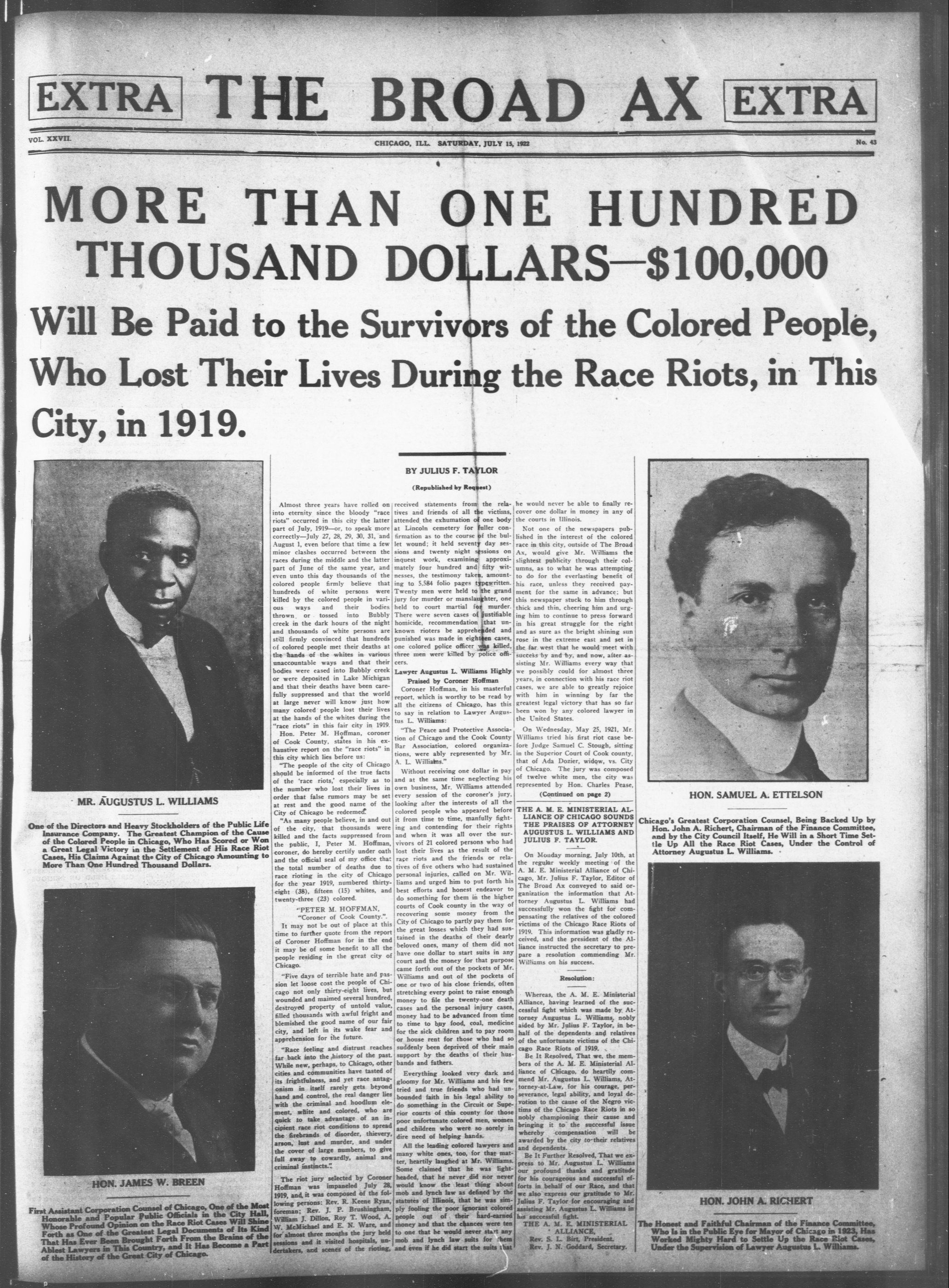
MORE THAN ONE HUNDRED THOUSAND DOLLARS----$100,000
MR. AUGUSTUS L. WILLIAMS
Directors and Heavy Stockholders of the Race Company. The Greatest Champion of Colored People in Chicago, Who Has Sustituted Legal Victory in the Settlement of His Claims Against the City of Chicago or Than One Hundred Thousand Dollars.
One of the Directors and Heavy Stockholders of the Public Life Insurance Company. The Greatest Champion of the Cause of the Colored People in Chicago, Who Has Scored or Won a Great Legal Victory in the Settlement of His Race Riot Cases, His Claims Against the City of Chicago Amounting to More Than One Hundred Thousand Dollars.
[Name]
HON. JAMES W. BREEN
Instant Corporation Counsel of Chicago, Oz
table and Popular Public Officials in the
Profound Opinion on the Race Riot Cas
as One of the Greatest Legal Documen
as Ever Been Brought Forth From the
First Assistant Corporation Counsel of Chicago, One of the Most Honorable and Popular Public Officials in the City Hall, Whose Profound Opinion on the Race Riot Cases Will Shine Forth as One of the Greatest Legal Documents of Its Kind That Has Ever Been Brought Forth From the Brains of the Ablest Lawyers in This Country, and It Has Become a Part of the History of the Great City of Chicago.
Almost three years have rolled on into eternity since the bloody "race riots" occurred in this city the latter part of July, 1919—or, to speak more correctly—July 27, 28, 29, 30, 31, and August 1, even before that time a few minor clashes occurred between the races during the middle and the latter part of June of the same year, and even unto this day thousands of the colored people firmly believe that hundreds of white persons were killed by the colored people in various ways and their bodies thrown, or tossed into Bubbly creek in the dark hours of the night and thousands of white persons are still firmly convinced that hundreds of colored people met their deaths at the hands of the whites in various unaccountable ways and that their bodies were eased into Bubbly creek or were deposited in Lake Michigan and that their deaths have been carefully suppressed and that the world at large never will know just how many colored people lost their lives at the hands of the whites during the "race riots" in this fair city in 1919. Hon. Peter M. Hoffman, coroner of Cook County, states in his exhaustive report on the "race riots" in this city which lies before us;
"The people of the city of Chicago should be informed of the true facts of the 'race riots,' especially as to the number who lost their lives in order that false rumors may be set at rest and the good name of the City of Chicago be redeemed.
"As many people believe, in and out of the city, that thousands were killed and the facts suppressed from the public, I, Peter M. Hoffman, coroner, do hereby certify under oath and the official seal of my office that the total number of deaths due to race rioting in the city of Chicago for the year 1919, numbered thirty-eight (38), fifteen (15) whites, and twenty-three (23) colored.
"PETER M. HOFFMAN.
"Coroner of Cook County." It may not be out of place at this time to further quote from the report of Coroner Hoffman for in the end it may be of some benefit to all the people residing in the great city of Chicago.
"Five days of terrible hate and passion let loose cost the people of Chicago not only thirty-eight lives, but wounded and maimed several hundred, destroyed property of untold value, filled thousands with awful fright and blemished the good name of our fair city, and in its wake fear and apprehension for the future.
"Race feeling and distrust reaches far back into the history of the past. While new, perhaps, to Chicago, other cities and communities have tasted of its frightfulness, and yet race antagonism in itself rarely gets beyond hand and control, the real danger lies with the criminal and hoodlum element, white and colored, who are quick to take advantage of an incipient race riot conditions to spread the firebrands of disorder, thievery, arson, lust and murder, and under the cover of large numbers, to give full sway to cowardly, animal and criminal instincts."
The riot jury selected by Coroner Hoffman was impaneled July 28, 1919, and, it was composed of the following persons: Rev. R. Keene Ryan, foreman; Rev. J. P. Brushingham, William J. Dillon, Roy T. Wood, A. W. McMichael and E. N. Ware, and for almost three months the jury held sessions and it visited hospitals, undertakers and scenes of the rioting.
received statements from the relatives and friends of all the victims, attended the exhumation of one body at Lincoln cemetery for fuller confirmation as to the course of the bullet wound; it held seventy day sessions and twenty night sessions on inquest work, examining approximately four hundred and fifty witnesses, the testimony taken, amounting to 5,584 folio pages typewritten. Twenty men were held to the grand jury for murder or manslaughter, one held to court martial for murder. There were seven cases of justifiable homicide, recommendation that unknown rioters be apprehended and punished was made in eighteen cases, one colored police officer was killed, three men were killed by police officers.
Lawyer Augustus L. Williams Highly
Praised by Coroner Hoffman
Coroner Hoffman, in his masterful report, which is worthy to be read by all the citizens of Chicago, has this to say in relation to Lawyer Augustus L. Williams:
"The Peace and Protective Association of Chicago and the Cook County Bar Association, colored organizations, were ably represented by Mr. A. L. Williams."
Without receiving one dollar in pay and at the same time neglecting his own business, Mr. Williams attended every session of the coroner's jury, looking after the interests of all the colored people who appeared before it from time to time, manfully fighting and contending for their rights and when it was all over the survivors of 21 colored persons who had lost their lives as the result of the race riots and the friends or relatives of five others who had sustained personal injuries, called on Mr. Williams and urged him to put forth his best efforts and honest endeavor to do something for them in the higher courts of Cook county in the way of recovering some money from the City of Chicago to partly pay them for the great losses which they had sustained in the deaths of their dearly beloved ones, many of them did not have one dollar to start suits in any court and the money for that purpose came forth out of the pockets of Mr. Williams and out of the pockets of one or two of his close friends, often stretching every point to raise enough money to file the twenty-one death cases and the personal injury cases money had to be advanced from time to time to buy food, coal, medicine for the sick children and to pay room or house rent for those who had so suddenly been deprived of their main support by the deaths of their husbands and fathers.
Everything looked very dark and gloomy for Mr. Williams and his few tried and true friends who had unbounded faith in his legal ability to do something in the Circuit or Superior courts of this county for those poor unfortunate colored men, women and children who were so sorely in dire need of helping hands.
All the leading colored lawyers and many white ones, too, for that matter, heartily laughed at Mr. Williams. Some claimed that he was light-headed, that he never did nor never would know the least thing about mob and lynch law as defined by the statutes of Illinois, that he was simply fooling the poor ignorant colored people out of their hard-earned money and that the chances were ten to one that he would never start any mob and lynch law suits for them and even if he did start the suits that
he would never be able to finally recover one dollar in money in any of the courts in Illinois.
Not one of the newspapers published in the interest of the colored race in this city, outside of The Broad Ax, would give Mr. Williams the slightest publicity through their columns, as to what he was attempting to do for the everlasting benefit of his race, unless they received payment for the same in advance; but this newspaper stuck to him through thick and thin, cheering him and urging him to continue to press forward in his great struggle for the right and as sure as the bright shining sun rose in the extreme east and set in the far west that he would meet with successes by and by, and now, after assisting Mr. Williams every way that we possibly could for almost three years, in connection with his race riot cases, we are able to greatly rejoice with him in winning by far the greatest legal victory that has so far been won by any colored lawyer in the United States.
On Wednesday, May 25, 1921, Mr. Williams tried his first riot case before Judge Samuel C. Stough, sitting in the Superior Court of Cook county, that of Ada Dozier, widow, vs. City of Chicago. The jury was composed of twelve white men, the city was represented by Hon. Charles Pease.
(Continued on page 2)
THE A. M. E. MINISTERIAL ALLIANCE OF CHICAGO SOUNDS THE PRAISES OF ATTORNEY AUGUSTUS L. WILLIAMS AND JULIUS F. TAYLOR.
On Monday morning, July 10th, at the regular weekly meeting of the A. M. E. Ministerial Alliance of Chicago, Mr. Julius F. Taylor, Editor of The Broad Ax conveyed to said organization the information that Attorney Augustus L. Williams had successfully won the fight for compensating the relatives of the colored victims of the Chicago Race Riots of 1919. This information was gladly received, and the president of the Alliance instructed the secretary to prepare a resolution commending Mr. Williams on his success.
Resolution:
Whereas, the A. M. E. Ministerial Alliance, having learned of the successful fight which was made by Attorney Augustus L. Williams, nobly aided by Mr. Julius F. Taylor, in behalf of the dependents and relatives of the unfortunate victims of the Chicago Race Riots of 1919.
Be It Resolved, That we, the members of the A. M. E. Ministerial Alliance of Chicago do heartily commend Mr. Augustus L. Williams, Attorney-at-Law, for his courage, perseverance, legal ability, and loyal devotion to the cause of the Negro victims of the Chicago Race Riots in so nobly championing their cause and bringing it to the successful issue whereby compensation will be awarded by the city to their relatives and dependents.
Be It Further Resolved, That we express to Mr. Augustus L. Williams our profound thanks and gratitude for his courageous and successful efforts in behalf of our Race, and that we also express our gratitude to Mr. Julius F. Taylor for encouraging and assisting Mr. Augustus L. Williams in his successful fight.
THE A. M. E. MINISTERIAL ALLIANCE.
Rev. S. L. Birt, President.
Rev. J. N. Goddard, Secretary.
M.
HON. SAMUEL A. ETTELSON
Greatest Corporation Counsel, Being Born A. Richert, Chairman of the Finance of the City Council Itself, He Will in a Slave All the Race Riot Cases, Under the Augustus L. Williams.
Chicago's Greatest Corporation Counsel, Being Backed Up by Hon. John A. Richert, Chairman of the Finance Committee, and by the City Council Itself, He Will in a Short Time Settle Up All the Race Riot Cases, Under the Control of Attorney Augustus L. Williams.
[Name]
HON. JOHN A. RICHERT
and Faithful Chairman of the Finance
the Public Eye for Mayor of Chicago
Mighty Hard to Settle Up the Race
Supervision of Lawyer Augustus L.
The Honest and Faithful Chairman of the Finance Committee, Who Is in the Public Eye for Mayor of Chicago in 1923, Has Worked Mighty Hard to Settle Up the Race Riot Cases, Under the Supervision of Lawyer Augustus L. Williams.
J. E. C. 1841
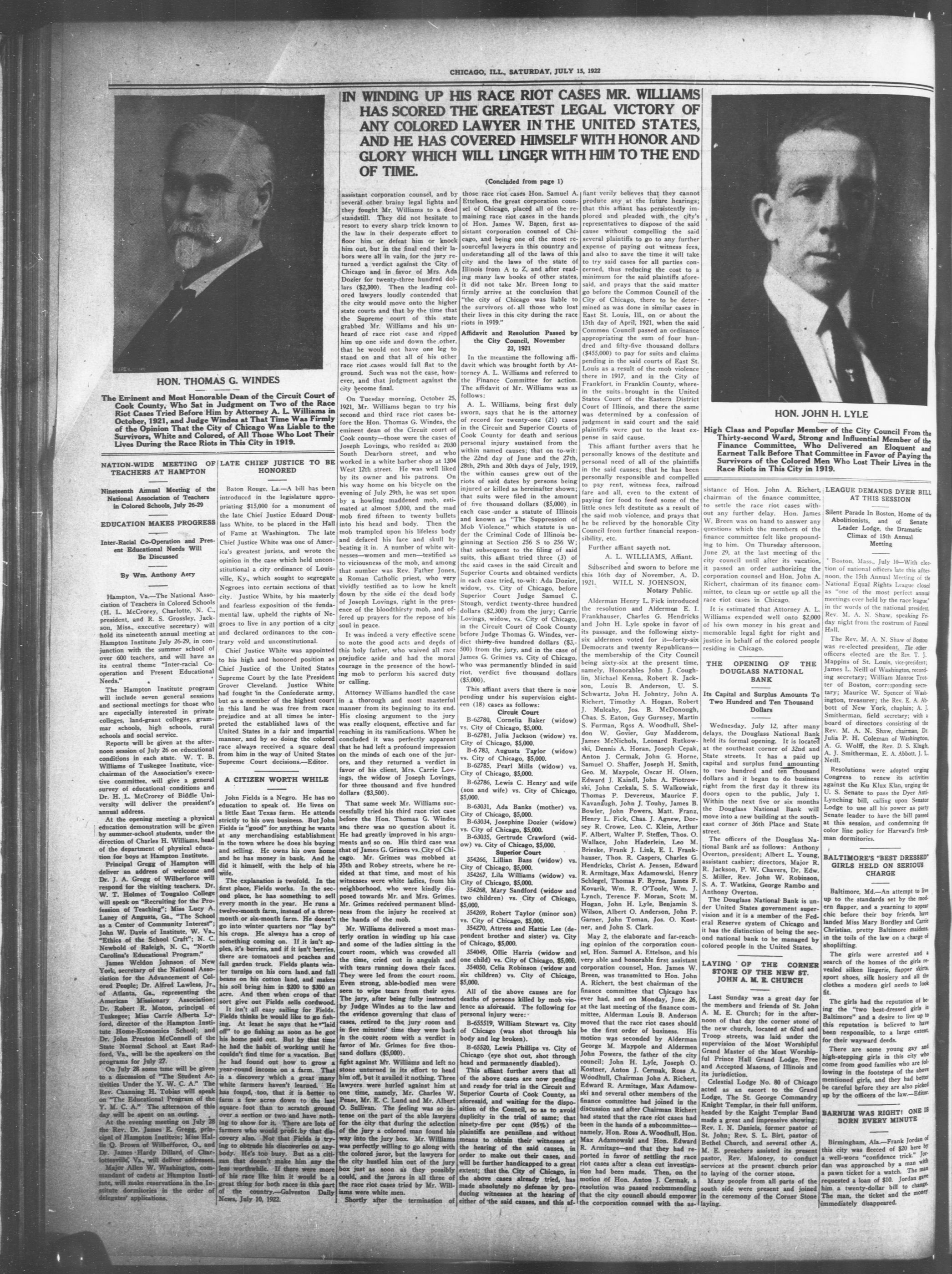
HON. THOMAS G. WINDES
The Eninent and Most Honorable Dean of the Cook County, Who Sat in Judgment on Two Riot Cases Tried Before Him by Attorney A. October, 1921, and Judge Windes at That Time of the Opinion That the City of Chicago Was Survivors, White and Colored, of All Those W Lives During the Race Riots in This City in 1921
NATION-WIDE MEETING OF LATE CHIEF JU TEACHERS AT HAMPTON HONO
The Enricment and Most Honorable Dean of the Circuit Court of Cook County, Who Sat in Judgment on Two of the Race Riot Cases Tried Before Him by Attorney A. L. Williams in October, 1921, and Judge Windea at That Time Was Firmly of the Opinion That the City of Chicago Was Liable to the Survivors, White and Colored, of All Those Who Lost Their Lives During the Race Riots in This City in 1919.
Nineteenth Annual Meeting of the National Association of Teachers in Colored Schools, July 26-29
Inter-Racial Co-Operation and Pres ent Educational Needs Will Be Discussed
Hampton, Va.—The National Association of Teachers in Colored Schools (H. L. McCrorey, Charlotte, N. C. president, and R. S. Grossley, Jackson, Miss., executive secretary) will hold its nineteenth annual meeting at Hampton Institute July 26-29, in conjunction with the summer school of over 600 teachers, and will have as its central theme "Inter-racial Cooperation and Present Educational Needs."
The Hampton Institute program will include seven general sessions and sectional meetings for those who are especially interested in private colleges, land-grant colleges, grammar schools, high schools, rural schools and social service.
Reports will be given at the afternoon session of July 26 on educational conditions in each state. W. T. B. Williams of Tuskegee Institute, vicechairman of the Association's executive committee, will give a general survey of educational conditions and Dr. H. L. McCorey of Biddle University will deliver the president's annual address. At the opening meeting a physical education demonstration will be given by summer-school students, under the direction of Charles H. Williams, head of the department of physical education for boys at Hampton Institute.
Principal Gregg of Hampton will deliver an address of welcome and Dr. J. A. Gregg of Wilberforce will respond for the visiting teachers. Dr. W. T. Holmes of Tougaloo College will speak on "Recruiting for the Profession of Teaching"; Miss Lucy A. Laney of Augusta, Ga., "The School as a Center of Community Interest"; John W. Davis of Institute, W. Va., "Ethics of the School Craft"; N. C. Newbold of Raleigh, N. C., "North Carolina's Educational Program."
James Weldon Johnson of New York; secretary of the National Association for the Advancement of Colored People; Dr. Alfred Lawless, Jr. of Atlanta, Ga., representing the American Missionary Association; Dr. Robert R. Moton, principal of Tukegee; Miss Carrie Alberta Lyford, director of the Hampton Institute Home-Economics School; and Dr. John Preston McConnell of the State Normal School at East Radford, Va., will be the speakers on the programs for July 27.
On July 28 some time will be given to a discussion of "The Student Activities under the Y. W. C. A." The Rev. Channing H. Tobias will speak on "The Educational Program of the Y. M. C. A." The afternoon of this day will be spent on an outing.
At the evening meeting on July 28 the Rev. Dr. James E. Gregg, principal of Hampton Institute; Miss Halle Q. Brown of Wilbeforce, O., and Dr. James Hardy Dillard of Charlottesville, Va., will deliver addresses. Major Allen W. Washington, commandant of cadets at Hampton Institute, will make reservations in the Institute dormitories in the order of delegates' applications.
```markdown
```
Baton Rouge, La.—A bill has been introduced in the legislature appropriating $15,000 for a monument of the late Chief Justice Eduard Douglass White, to be placed in the Hall of Fame at Washington. The late Chief Justice White was one of America's greatest jurists, and wrote the opinion in the case which held unconstitutional a city ordinance of Louisville, Ky., which sought to segregate Negroes into certain sections of that city. Justice White, by his masterly and fearless exposition of the fundamental law, upheld the rights of Negroes to live in any portion of a city and declared ordinances to the contrary void and unconstitutional.
Chief Justice White was appointed to his high and honored position as Chief Justice of the United States Supreme Court by the late President Grover Cleveland. Justice White had fought in the Confederate army, but as a member of the highest court in this land he was free from race prejudice and at all times he interpreted the established laws of the United States in a fair and impartial manner, and by so doing the colored race always received a square deal from him in the way of United States Supreme Court decisions.—Editor.
A CITIZEN WORTH WHILE
John Fields is a Negro. He has no education to speak of. He lives on a little East Texas farm. He attends strictly to his own business. But John Fields is "good" for anything he wants at any merchandising establishment in the town where he does his buying and selling. He owns his own home and he has money in bank. And he did it himself, with the help of his wife.
The explanation is twofold. In the first place, Fields works. In the second place, he has something to sell every month in the year. He runs a twelve-month farm, instead of a three-month or six-month farm. He doesn't go into winter quarters nor "lay by" his crops. He always has a crop of something coming on. If it isn't apples, it's berries, and if it isn't berries, there are tomatoes and peaches and fall garden truck. Fields plants winter turnips on his corn land and fall beans on his cotton land, and makes his soil bring him in $200 to $300 an acre. And then when crops of that sort give out Fields sells cordwood. It isn't all easy sailing for Fields. Fields thinks he would like to go fishing. At least he says that he "laid off" to go fishing as soon as he got his home paid out. But by that time he had the habit of working until he couldn't find time for a vacation. But he found out how to grow a year-round income on a farm. That is a discovery which a great many white farmers haven't learned. He has found, too, that it is better to farm a few acres down to the last square foot than to scratch ground over a section or two and have nothing to show for it. There are lots of farmers who would profit by that discovery also. Not that Fields is trying to obtrude his discoveries on anybody. He's too busy. But as a citizen that doesn't make him any the less worthwhile. If there were more of his race like him it would be a great thing for both races in this part of the country—Galveston Daily News, July 10, 1922.
IN WINDING UP HIS RACE RIOT CASES MR. WILLIAMS HAS SCORED THE GREATEST LEGAL VICTORY OF ANY COLORED LAWYER IN THE UNITED STATES, AND HE HAS COVERED HIMSELF WITH HONOR AND GLORY WHICH WILL LINGER WITH HIM TO THE END OF TIME.
assistant corporation counsel, and by several other brainy legal lights and they fought Mr. Williams to a dead standstill. They did not hesitate to resort to every sharp trick known to the law in their desperate effort to floor him or defeat him or knock him out, but in the final end their labors were all in vain, for the jury returned a verdict against the City of Chicago and in favor of Mrs. Ada Dozier for twenty-three hundred dollars ($2,300). Then the leading colored lawyers loudly contended that the city would move onto the higher state courts and that by the time that the Supreme court of this state grabbed Mr. Williams and his unheard of race riot case and ripped him up one side and down the other, that he would not have one leg to stand on and that all of his other race riot cases would fall flat to the ground. Such was not the case, however, and that judgment against the city become final.
On Tuesday morning, October 25, 1921, Mr. Williams began to try his second and third race riot cases before the Hon. Thomas G. Winds, the eminent dean of the Circuit court of Cook county—those were the cases of Joseph Lovings, who resided at 2030 South Dearborn street, and who worked in a white barber shop at 1304 West 12th street. He was well liked by its owner and his patrons. On his way home on his bicycle on the evening of July 29th, he was set upon by a howling maddened mob, estimated at almost 5,000, and the mad mob fired fifteen to twenty bullets into his head and body. Then the mob trampled upon his lifeless body and defaced his face and skull by beating it in. A number of white witnesses—women and men—testified as to viciousness of the mob, and among that number was Rev. Father Jones, a Roman Catholic priest, who very vividly testified as to how he knelt down by the side of the dead body of Joseph Lovings, right in the presence of the bloodthirsty mob, and offered up prayers for the repose of his soul in peace.
It was indeed a very effective scene to note the good acts and deeds of this holy father, who waived all race prejudice aside and had the moral courage in the presence of the howling mob to perform his sacred duty or calling.
Attorney Williams handled the case in a thorough and most masterful manner from its beginning to its end. His closing argument to the jury was really eloquent, effective and far reaching in its ramifications. When he concluded it was perfectly apparent that he had left a profound impression on the minds of each one of the jurors, and they returned a verdict in favor of his client, Mrs. Carrie Lovings, the widow of Joseph Lovings, for three thousand and five hundred dollars ($3,500).
That same week Mr. Williams successfully tried his third race riot case before the Hon. Thomas G. Winds and there was no question about it. He had greatly improved in his arguments and so on. His third case was that of James G. Grimes vs. City of Chicago. Mr. Grimes was mobbed at 35th and Robey streets, where he resided at that time, and most of his witnesses were white ladies, from his neighborhood, who were kindly disposed towards Mr. and Mrs. Grimes. Mr. Grimes received permanent blindness from the injury he received at the hands of the mob.
Mr. Williams delivered a most masterly oration in winding up his case and some of the ladies sitting in the court room, which was crowded all the time, cried out in anguish and with tears running down their faces. They were led from the court room. Even strong, able-bodied men were seen to wipe tears from their eyes. The jury, after being fully instructed by Judge Winds as to the law and the evidence governing that class of cases, retired to the jury room and in five minutes' time they were back in the court room with a verdict in favor of Mr. Grimes for five thousand dollars ($5,000).
fight against Mr. Williams and left no stone unturned in its effort to head him off, but it availed it nothing. Three lawyers were hurled against him at one time, namely, Mr. Charles W. Pease, Mr. E. C. Lund and Mr. Albert O. Sullivan. The feeling was so intense on the part of the able lawyers for the city that during the selection of the jury a colored man found his way into the jury box. Mr. Williams was perfectly willing to go along with the colored juror, but the lawyers for the city hustled him out of the jury box just as soon as they possibly could, and the jurors in all three of the race riot cases tried by Mr. Williams were white men.
CHICAGO, ILL. SATURDAY, JULY 15, 1922
(Concluded from page 1)
those race riot cases Hon. Samuel A. Ettelson, the great corporation counsel of Chicago, placed all of the remaining race riot cases in the hands of Hon. James W. Bgeen, first assistant corporation counsel of Chicago, and being one of the most resourceful lawyers in this country and understanding all of the laws of this city and the laws of the state of Illinois from A to Z, and after reading many law books of other states, it did not take Mr. Breen long to firmly arrive at the conclusion that "the city of Chicago was liable to the survivors of- all those who lost their lives in this city during the race riots in 1919."
Affidavit and Resolution Passed by the City Council, November 23, 1921
In the meantime the following affidavit which was brought forth by Attorney A. L. Williams and referred to the Finance Committee for action. The affidavit of Mr. Williams was as follows:
A. L. Williams, being first duly sworn, says that he is the attorney of record for twenty-one (21) cases in the Circuit and Superior Courts of Cook County for death and serious personal injury sustained from the within named causes; that on to-wit: the 22nd day of June and the 27th, 28th, 29th and 30th days of July, 1919, the within causes grew out of the riots of said dates by persons being injured or killed as hereinafter shown; that suits were filed in the amount of five thousand dollars ($5,000), in each case under a statute of Illinois and known as "The Suppression of Mob Violence," which statute is under the Criminal Code of Illinois beginning at Section 256 S to 256 W; that subsequent to the filing of said suits, this affiant tried three (3) of the said cases in the said Circuit and Superior Courts and obtained verdicts in each case tried, to-wit: Ada Dozier, widow, vs. City of Chicago, before Superior Court Judge Samuel C. Stough, verdict twenty-three hundred dollars ($2,300) from the jury; Carrie Lovings, widow, vs. City of Chicago, in the Circuit Court of Cook County before Judge Thomas G. Winds, verdict thirty-five hundred dollars ($3,500) from the jury, and in the case of James G. Grimes vs. City of Chicago, who was permanently blinded in said riot, verdict five thousand dollars ($5,000).
All of the above causes are for deaths of persons killed by mob violence as aforesaid. The following for personal injury were::
B-655519, William Stewart vs. City of Chicago (was shot through his body and leg broken).
B-65520, Lewis Phillips vs. City of Chicago (eye shot out, shot through head and permanently disabled).
This affiant further avers that all of the above cases are now pending and ready for trial in the Circuit and Superior Courts of Cook County, as aforesaid, and waiting for the disposition of the Council, so as to avoid duplicity in the trial of same; that ninety-five per cent (95%) of the plaintiffs are penniless and without means to obtain their witnesses at the hearing of the said causes, in order to make out their cases, and will be further handicapped to a great extent; that the City of Chicago, in the above cases already tried, has made absolutely no defense by producing witnesses at the hearing of either of the said causes, and this af-
faint verily believes that they cannot produce any at the future hearings; that this affiant has persistently implored and pleaded with, the city's representatives to dispose of the said cause without compelling the said several plaintiffs to go to any further expense of paying out witness fees, and also to save the time it will take to try said cases for all parties concerned, thus reducing the cost to a minimum for the said plaintiffs aforesaid, and prays that the said matter go before the Common Council of the City of Chicago, there to be determined as was done in similar cases in East St. Louis, III., on or about the 15th day of April, 1921, when the said Common Council passed an ordinance appropriating the sum of four hundred and fifty-five thousand dollars ($455,000) to pay for suits and claims pending in the said courts of East St. Louis as a result of the mob violence there in 1917, and in the City of Frankfort, in Franklin County, wherein the suits brought in the United States Court of the Eastern District Court of Illinois, and there the same was determined by a confession of judgment in said court and the said plaintiffs were put to the least expense in said cause.
This affiant further avers that he personally knows of the destitute and personal need of all of the plaintiffs in the said causes; that he has been personally responsible and compelled to pay rent, witness fees, railroad fare and all, even to the extent of paying for food to feed some of the little ones left destitute as a result of the said mob violence, and prays that he be relieved by the honorable City Council from further financial responsibility, etc.
Further affiant saveth not
A. L. WILLIAMS, Affiant.
A. E. WILLIAMS, Amant
Subscribed and sworn to before me this 16th day of November, A. D.
1921. WILL N. JOHNSON.
Alderman Henry L. Fick introduced the resolution and Alderman E. I. Frankhauser, Charles G. Hendricks and John H. Lyle spoke in favor of its passage, and the following sixty-six aldermen voted for it—forty-six Democrats and twenty Republicans—the membership of the City Council being sixty-six at the present time, namely, Honorables John J. Coughlin, Michael Kenna, Robert R. Jackson, Louis B. Anderson, U. S. Schwartz, John H. Johntry, John A. Richert, Timothy A. Hogan, Robert J. Mulcahy, Jos. B. McDonough, Chas. S. Eaton, Guy Gurnsey, Martin S. Furman, Ross A. Woodhull, Shelldon W. Govier, Guy Maddderon, James McNichols, Leonard Rutkowski, Dennis A. Horan, Joseph Pekton, Jermain J. Cermak, John G. Horne, Samuel O. Shaffer, Joseph H. Smith, Geo. M. Maypole, Oscar H. Olsen, Edward J. Kaindl, John A. Piotrowski, John Kecala, S. Walkowiak, Thomas P. Devereux, Maurice F. Kavanaugh, John J. Touhy, James B. Bowler, John Powers, Matt. Franz, Henry L. Fick, Chas. J. Agnew, Dorsey R. Crowe, Leo C. Klein, Arthur F. Albert, Walter P. Steffen, Thos. O. Wallace, Haderlein, Leo M. Brieske, Frank J. Link, E. I. Frankhauser, Thos. R. Caspers, Charles G. Hendricks, Christ A. Jensen, Edward R. Armitage, Max Adamowski, Henry Schlegel, Thomas F. Byrne, James F. Kovariak, Wm. R. O'Toole, Wm. Lynch, Terence F. Moran, Scott M. Hogan, John H. Lyle, Benjamin S. Wilson, Albert O. Anderson, John P. Garner, John Toman, Jos. O. Kostner, and John S. Clark.
May 2, the elaborate and far-reaching opinion of the corporation counsel, Hon. Samuel A. Ettelson, and his very able and honorable first assistant corporation counsel, Hon. James W. Breen, was transmitted to Hon. John A. Richert, the best chairman of the finance committee that Chicago has ever had, and on Monday, June 26, at the last meeting of the finance committee, Alderman Louis B. Anderson moved that the race riot cases should be the first order of business. His motion was seconded by Alderman George M. Maypole and Alderman John Powers, the father of the city council; John H. Lyle, Joseph O. Kostner, Anton J. Cermak, Ross A. Woodhull, Chairman John A. Richert, Edward R. Armitage, Max Adamowski and several other members of the finance committee had joined in the discussion and after Chairman Richert had stated that the race riot cases had been in the hands of a subcommittee—namely, Hon. Ross A. Woodhull, Hon. Max Adamowski and Hon. Edward R. Armitage—and that they had reported in favor of settling the race riot cases after a clean cut investigation had been made. Then, on the motion of Hon. Anton J. Cermak, a resolution was passed recommending that the city council should empower the corporation counsel with the as-
HON. JOHN H. LYLE High Class and Popular Member of the City Council From the Thirty-second Ward, Strong and Influential Member of the Finance Committee, Who Delivered an Eloquent and Earnest Talk Before That Committee in Favor of Paying the Survivors of the Colored Men Who Lost Their Lives in the Race Riots in This City in 1919.
sistance of Hon. John A. Richert, chairman of the finance committee, to settle the race riot cases without any further delay. Hon. James W. Breen was on hand to answer any questions which the members of the finance committee felt like propounding to him. On Thursday afternoon, June 29, at the last meeting of the city council until after its vacation, it passed an order authorizing the corporation counsel and Hon. John A. Richert, chairman of its finance committee, to clean up or settle up all the race riot cases in Chicago.
It is estimated that Attorney A. L. Williams expended well onto $2,000 of his own money in his great and memorable legal fight for right and justice in behalf of the colored people residing in Chicago.
THE OPENING OF THE DOUGLASS NATIONAL BANK
Its Capital and Surplus Amounts To Two Hundred and Ten Thousand Dollars
Wednesday, July 12, after many delays, the Douglass National Bank held its formal opening. It is located at the southeast corner of 32nd and State streets. It has a paid up capital and surplus fund amounting to two hundred and ten thousand dollars and it began to do business right from the first day it threw its doors open to the public, July 1. Within the next five or six months the Douglass National Bank will move into a new building at the southeast corner of 36th Place and State street.
The officers of the Douglass National Bank are as follows: Anthony Overton, president; Albert L. Young, assistant cashier; directors, Major R. R. Jackson, P. W. Chavers, Dr. Edw. S. Miller, Rev. John W. Robinson, S. A. T. Watkins, George Rambo and Anthony Overton.
The Douglass National Bank is under United States government supervision and it is a member of the Federal Reserve system of Chicago and it has the distinction of being the second national bank to be managed by colored people in the United States
LAYING OF THE CORNER
STONE OF THE NEW ST.
JOHN A. M. E. CHURCH
Last Sunday was a great day for the members and friends of St. John A. M. E. Church; for in the afternoon of that day the corner stone of the new church, located at 62nd and Troop streets, was laid under the supervision of the Most Worshipful Grand Master of the Most Worshipful Prince Hall Grand Lodge, Free and Accepted Masons, of Illinois and its jurisdiction.
Celestial Lodge No. 80 of Chicago acted as an escort to the Grand Lodge, The St. George Commandry Knight Templar, in their full uniform, headed by the Knight Templar Band made a great and impressive showings; Rev. I. N. Daniels, former pastor of St. John; Rev. S. L. Birt, pastor of Bethel Church, and several other A. M. E. preachers assisted its present pastor, Rev. Maloney, to conduct services at the present church prior to laying of the corner stone. Many people from all parts of the south side were present and joined in the ceremony of the Corner Store.
Many people from all parts of the south side were present and joined in the ceremony of the Corner Stone laying.
Paper of the City Council From the
ing and Influential Member of the
to Delivered an Eloquent and
Committee in Favor of Paying the
Men Who Lost Their Lives in the
1919.
LEAGUE DEMANDS DYER BILL
AT THIS SESSION
Silent Parade In Boston, Home of the
Abolitionists, and of Senate
Leader Lodge, the Dramatic
Climax of 15th Annual
* Boston, Mass., July 10—With election of national officers late this afternoon, the 15th Annual Meeting of the National Equal Rights League close as "one of the most perfect annual meetings ever held by the race league" in the words of the national president, Rev. M. A. N. Shaw, speaking Friday night from the rostrum of Faneuil Hall.
The Rev. M. A. N. Shaw of Boston was re-elected president. The other officers elected are the Rev. T. J. Mappins of St. Louis, vice-president; James L. Neill of Washington, recording secretary; William Monroe Troter of Boston, corresponding secretary; Maurice W. Spencer of Washington, treasurer; the Rev. E. A. Abbott of New York, chaplain; A. J. Smitherman, field secretary; with a board of directors consisting of the Rev. M. A. N. Shaw, chairman, Dr Julia P. M. H. Coleman of Washington A. G. Wolff, the Rev. D. S. Klugh A. J. Smitherman, E. A. Abbott, J. L. Neill.
Resolutions were adopted urging Congress to renew its activities against the Ku Klux Klan, urging the U. S. Senate to pass the Dyer Anti-Lynchning bill, calling upon Senator Lodge to use all his power as party Senate leader to have the bill passed at this session, and condemning the color line policy for Harvard's freshman dormitories.
BALTIMORE'S "BEST DRESSED
GIRLS HELD ON SERIOUS
CHARGE
Baltimore, Md.—An attempt to live up to the standards set by the modern flapper, and a yearning to appear chic before their boy friends, have landed Miss Mary Bordley and Carrie Christian, pretty Baltimore maidens, in the toils of the law on a charge of shoplifting.
The girls were arrested and a search of the homes of the girls revealed silken lingerie, flapper skirts, sport shoes, silk hosiery and all the clothes a modern girl needs to look fit.
The girls had the reputation of being the "two best-dressed girls in Baltimore" and a desire to live up to this reputation is believed to have been responsible, to a large extent, for their wavward deeds.
There are some young gay and high-stepping girls in this city who come from good families who are following in the footsteps of the above mentioned girls, and they had better be careful before they are also picked up by the officers of the law. -Editor
BARNUM WAS RIGHT! ONE IS
RORN KYRV MINUTE
Birmingham, Ala.—Frank Jordan of this city was fleeced of $20 here by a well-worn "confidence trick." Jordan was approached by a man with a pawn ticket for a watch. The man requested a loan of $10. Jordan gave him a twenty-dollar bill to change. The man, the ticket and the money immediately disappeared.
```markdown
```
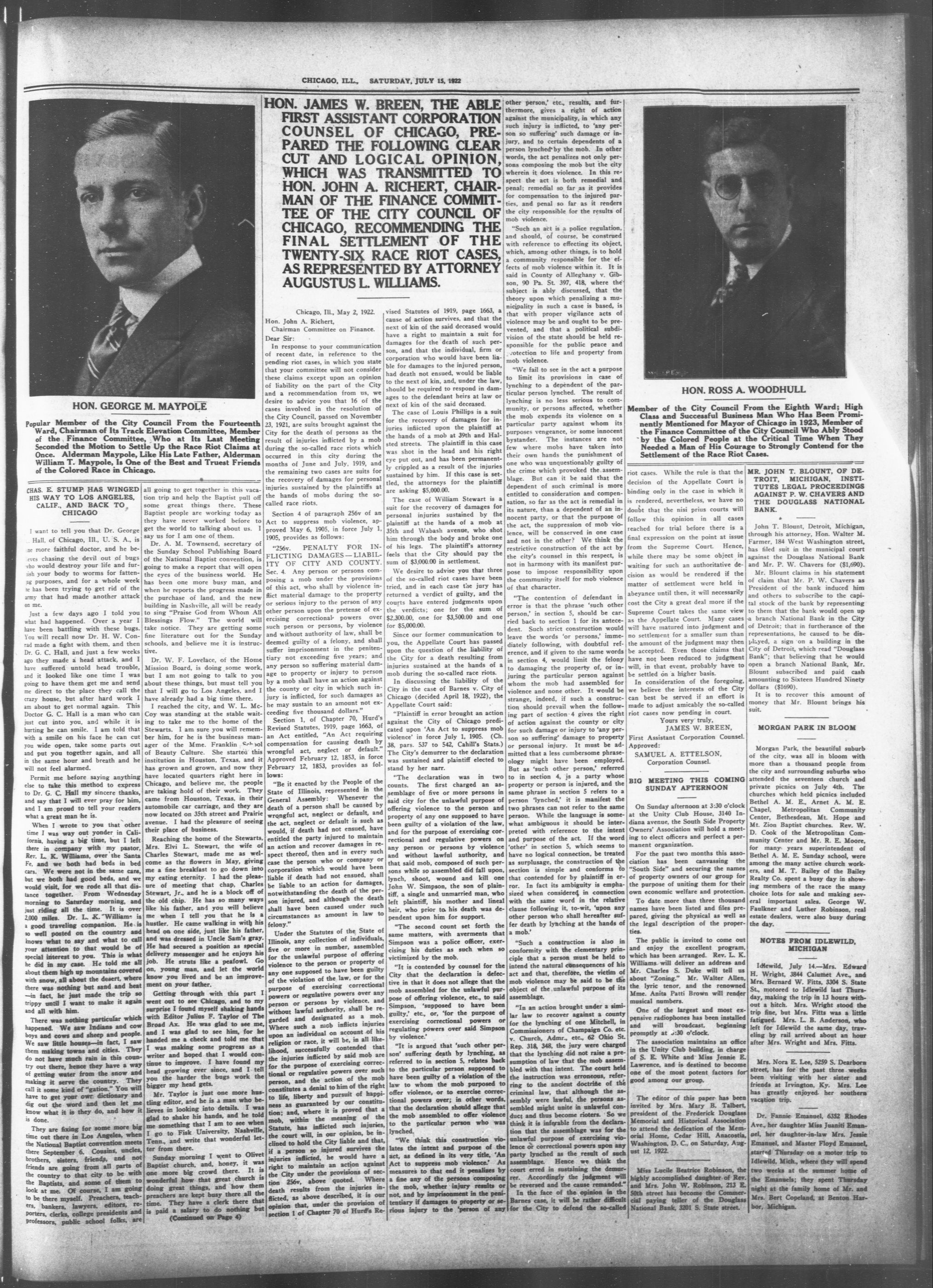
HON. GEORGE M. MAYPOLE
Popular Member of the City Council From the Fourteenth Ward, Chairman of Its Track Elevation Committee, Member of the Finance Committee, Who at Its Last Meeting Seconded the Motion to Settle Up the Race Riot Claims at Once. Alderman Maypole, Like His Late Father, Alderman William T. Maypole, Is One of the Best and Truest Friends of the Colored Race in Chicago.
CHAS. E. STUMP HAS WINGED HIS WAY TO LOS ANGELES, CALIF., AND BACK TO CHICAGO all going to get together in this vacation trip and help the Baptist pull off some great things there. These Baptist people are working today as
I want to tell you that Dr. George Hall, of Chicago, Ill., U. S. A., is one more faithful doctor, and he believes chasing the devil out of bugs who would destroy your life and furnish your body to worms for fattening purposes, and for a whole week he has been trying to get rid of the army that had made another attack on me.
Just a few days ago I told you what had happened. Over a year I have been battling with these bugs. You will recall now Dr. H. W. Conrad made a fight with them, and then Dr. G. C. Hall, and just a few weeks ago they made a head attack, and I have suffered untold head trouble, and it looked like one time I was going to have them get me and send me direct to the place they call the crazy house, but after hard work I am about to get normal again. This Doctor G. C. Hall is a man who can just cut into you, and while it is hurting he can smile. I am told that with a smile on his face he can cut you wide open, take some parts out and put you together again, and all in the same hour and breath and he will not feel alarmed.
Permit me before saying anything else to take this method to express to Dr. G. C. Hall my sincere thanks, and say that I will ever pray for him, and I am proud to tell your readers what a great man he is.
When I wrote to you that other time I was way out yonder in California, having a big time, but I left there in company with my pastor, Rev. L. K. Williams, over the Santa Fe, and we both had beds in bed cars. We were not in the same cars, but we both had good beds, and we would visit, for we rode all that distance together. From Wednesday morning to Saturday morning, and just riding all the time, it is over 2,000 miles. Dr. L. K. Williams is a good traveling companion. He is so well posted on the country and knows what to say and what to call your attention to that would be of special interest to you. This is what he did in my case. He told me all about them high up mountains covered with snow, all about the desert, where there was nothing but sand and heat—in fact, he just made the trip so trippy until I want to make it again and all with him.
There was nothing particular which happened. We saw Indians and cow boys and cows and sheep and people. We saw little houses—in fact, I saw them making towns and cities. They do not have much rain in this country out there, hence they have a way of getting water from the snow and making it serve the country. They call it some kind of "gation." You will have to get your own dictionary and dig out the word and then let me know what it is they do, and how it is done.
They are fixing for some more big time out there in Los Angeles, when the National Baptist convention meets there September 6. Cousins, uncles, brothers, sisters, friends, and not friends are going from all parts of the country to that city to be with the Baptists, and some of them to look at me. Of course, I am going to be there myself. Preachers, teachers, bankers, lawyers, editors, reporters, clerks, college presidents and professors, public school folks, are
all going to get together in this vacation trip and help the Baptist pull off some great things there. These Baptist people are working today as they have never worked before to get the world to talking about us. I say us for I am one of them.
Dr. A. M. Townsend, secretary of the Sunday School Publishing Board of the National Baptist convention, is going to make a report that will open the eyes of the business world. He has been one more busy man, and when he reports the progress made in the purchase of land, and the new building in Nashville, all will be ready to sing "Praise God from Whom All Blessings Flow." The world will take notice. They are getting some fine literature out for the Sunday schools, and believe me it is instructive.
Dr. W. F. Lovelace, of the Home Mission Board, is doing some work, but I am not going to talk to you about these things, but must tell you that I will go to Los Angeles, and I have already had a big time there.
I reached the city, and W. L. McCoy was standing at the stable waiting to take me to the home of the Stewarts. I am sure you will remember him, for he is the business manager of the Mme. Franklin School of Beauty Culture. She started this institution in Houston, Texas, and it has grown and grown, and now they have located quarters right here in Chicago, and believe me, the people are taking hold of their work. They came from Houston, Texas, in their automobile car carriage, and they are now located on 35th street and Prairie avenue. I had the pleasure of seeing their place of business.
Reaching the home of the Stewarts, Mrs. Elvi L. Stewart, the wife of Charles Stewart, made me as welcome as the flowers in May, giving me a fine breakfast to go down into my eating eternity. I had the pleasure of meeting that chap, Charles Stewart, Jr., and he is a block off of the old chip. He has so many ways like his father, and you will believe me when I tell you that he is a hustler. He came walking in with his head on one side, just like his father, and was dressed in Uncle Sam's gray. He had secured a position as special delivery messenger and he enjoys his job. He struts like a peafowl. Go on, young man, and let the world know you lived and be an improvement on your father.
Getting through with this part I went out to see Chicago, and to my surprise I found myself shaking hands with Editor Julius F. Taylor of the Broad Ax. He was glad to see me, and I was glad to see him, for he handed me a check and told me that I was making some progress as a writer and hoped that I would continue to improve. I have found my head growing ever since, and I tell you the harder the bugs work the bigger my head gets.
Mr. Taylor is just one more hustling editor, and he is a man who believes in looking into details. I was glad to shake his hands, and he told me something that I am to see when I go to Fisk University, Nashville, Tenn., and write that wonderful letter from there.
Sunday morning I went to Olivet Baptist church, and, honey, it was one more big crowd there. It is wonderful how that great church is doing great things, and how them preachers are kept busy there all the time. They have a clerk there that is paid a salary to do nothing but (Continued on Page 4)
CHICAGO, ILL., SATURDAY, JULY 15, 1922
HON. JAMES W. BREEN, THE ABLE FIRST ASSISTANT CORPORATION COUNSEL OF CHICAGO, PREPARED THE FOLLOWING CLEAR CUT AND LOGICAL OPINION, WHICH WAS TRANSMITTED TO HON. JOHN A. RICHERT, CHAIRMAN OF THE FINANCE COMMITTEE OF THE CITY COUNCIL OF CHICAGO, RECOMMENDING THE FINAL SETTLEMENT OF THE TWENTY-SIX RACE RIOT CASES, AS REPRESENTED BY ATTORNEY AUGUSTUS L. WILLIAMS.
Chicago, Ill., May 2, 1922.
Hon. John A. Richert,
Chairman Committee on Finance.
Dear Sir:
In response to your communication of recent date, in reference to the pending riot cases, in which you state that your committee will not consider these claims except upon an opinion of liability on the part of the City and a recommendation from us, we desire to advice you that 16 of the cases involved in the resolution of the City Council, passed on November 23, 1921, are suits brought against the City for the death of persons as the result of injuries inflicted by a mob during the so-called race riots which occurred in this city during the months of June and July, 1919, and the remaining two cases are suits for the recovery of damages for personal injuries sustained by the plaintiffs at the hands of mobs during the so-called race riots.
Section 4 of paragraph 256v of an Act to suppress mob violence, approved May 6, 1905, in force July 1, 1905, provides as follows:
"256v. PENALTY FOR INFLICTING DAMAGES—LIABILITY OF CITY AND COUNTY. Sec. 4. Any person or persons composing a mob under the provisions of this act, who shall by violence inflict material damage to the property or serious injury to the person of any other person upon the pretense of exercising correctional powers over such person or persons, by violence and without authority of law, shall be deemed guilty of a felony, and shall suffer imprisonment in the penitentiary not exceeding five years; and any person so suffering material damage to property or injury to person by a mob shall have an action against the county or city in which such injury is inflicted, for such damages as he may sustain to an amount not exceeding five thousand dollars."
Section 1, of Chapter 70, Hurd's Revised Statutes, 1919, page 1663, of an Act entitled, "An Act requiring compensation for causing death by wrongful act, neglect or default." Approved February 12, 1853, in force February 12, 1853, provides as follows:
"Be it enacted by the People of the State of Illinois, represented in the General Assembly: Whenever the death of a person shall be caused by wrongful act, neglect or default, and the act, neglect or default is such as would, if death had not ensured, have entitled the party injured to maintain an action and recover damages in respect thereof, then and in every such case the person who or company or corporation which would have been liable if death had not ensured, shall be liable to an action for damages, notwithstanding the death of the person injured, and although the death shall have been caused under such circumstances as amount in law to felony."
Under the Statutes of the State of Illinois, any collection of individuals, five or more in number, assembled for the unlawful purpose of offering violence to the person or property of any one supposed to have been guilty of the violation of the law, or for the purpose of exercising correctional powers or regulative powers over any person or persons by violence, and without lawful authority, shall be regarded and designated as a mob. Where such a mob inflicts injuries upon an individual on account of his religion or race, it will, in all likelihood, successfully contended that the injuries inflicted by said mob are for the purpose of exercising correctional or regulative powers over such person, and the action of the mob constitutes a denial to him of the right to life, liberty and pursuit of happiness as guaranteed by our constitution; and, where it is proved that a mob, within the meaning of the Statute, has inflicted such injuries, the court will, in our opinion, be inclined to hold the City liable and that, if a person so injured survives the injuries inflicted, he would have a right to maintain an action against the City under the provisions of section 256v, above quoted. Where death results from the injuries as above described, it is our opinion that, under the provision of section I of Chapter 70 of Hurd's Re-
vised Statutes of 1919, page 1663, a cause of action survives, and that the next of kin of the said deceased would have a right to maintain a suit for damages for the death of such person, and that the individual, firm or corporation who would have been liable for damages to the injured person, had death not ensued, would be liable to the next of kin, and, under the law, should be required to respond in damages to the defendant heirs at law or next of kin of the said deceased.
The case of Louis Phillips is a suit for the recovery of damages for injuries inflicted upon the plaintiff at the hands of a mob at 39th and Halsted streets. The plaintiff in this case was shot in the head and his right eye put out, and has been permanently crippled as a result of the injuries sustained by him. If this case is settled, the attorneys for the plaintiff are asking $5,000.00.
The case of William Stewart is a suit for the recovery of damages for personal injuries sustained by the plaintiff at the hands of a mob at 35th and Wabash avenue, who shot him through the body and broke one of his legs. The plaintiff's attorney feels that the City should pay the sum of $3,000.00 in settlement.
We desire to advise you that three of the so-called riot cases have been tried, and in each case the jury has returned a verdict of guilty, and the courts have entered judgments upon the verdicts; one for the sum of $2,300.00, one for $3,500.00 and one for $5,000.00.
Since our former communication to you, the Appellate Court has passed upon the question of the liability of the City for a death resulting from injuries sustained at the hands of a mob during the so-called race riots.
In discussing the liability of the City in the case of Barnes v. City of Chicago (decided April 18, 1922), the Appellate Court said:
"Plaintiff in error brought an action against the City of Chicago predicated upon 'An Act to suppress mob violence' in force July 1, 1905. (Ch. 38, pars. 537 to 542, Cahill's Stats). The City's demurrer to the declaration was sustained and plaintiff elected to stand by her narr.
"The declaration was in two counts. The first charged an assemblage of five or more persons in said city for the unlawful purpose of offering violence to the person and property of any one supposed to have been guilty of a violation of the law, and for the purpose of exercising correctional and regulative powers on any person or persons by violence and without lawful authority, and that said mob, composed of such persons while so assembled did fall upon, lynch, shoot, wound and kill one John W. Simpson, the son of plaintiff, a single and unmarried man, who left plaintiff, his mother and lineal heir, who prior to his death was dependent upon him for support.
"The second count set forth the same matters, with averments that Simpson was a police officer, exercising his duties as such when so victimized by the mob.
"It is contended by counsel for the City that the declaration is defective in that it does not allege that the mob assembled for the unlawful purpose of offering violence, etc., to said Simpson, 'supposed to have been guilty,' etc., or, 'for the purpose of exercising correctional powers or regulating powers over said Simpson by violence.'
"It is argued that 'such other person' suffering death by lynching, as referred to in section 5, relates back to the particular person supposed to have been guilty of a violation of the law to whom the mob purposed to offer violence, or to exercise correctional powers over; in other words, that the declaration should allege that the mob assembled to offer violence to the particular person who was lynched.
"We think this construction violates the intent and purpose of the act, as defined in its very title, 'An Act to suppress mob violence.' As measures to that end it penalizes by a fine any of the persons composing the mob, whether injury results or not, and by imprisonment in the penitentiary if damages to property or serious injury to the person of any
other person', etc., results, and furthermore, gives a right of action against the municipality, in which any such injury is inflicted, to 'any person so suffering' such damage or injury, and to certain dependents of a person lynched by the mob. In other words, the act penalizes not only persons composing the mob but the city wherein it does violence. In this respect the act is both remedial and penal; remedial so far as it provides for compensation to the injured parties, and penal so far as it renders the city responsible for the results of mob violence.
"Such an act is a police regulation, and should, of course, be construed with reference to effecting its object, which, among other things, is to hold a community responsible for the effects of mob violence within it. It is said in County of Alleghany v. Gibson, 90 Pa. St. 397, 418, where the subject is ably discussed, that the theory upon which penalizing a municipality in such a case is based, is that with proper vigilance acts of violence may be and ought to be prevented, and that a political subdivision of the state should be held responsible for the public peace and protection to life and property from mob violence.
"We fail to see in the act a purpose to limit its provisions in case of lynching to a dependent of the particular person lynched. The result of lynching is no less serious to community, or persons affected, whether the mob expends its violence on a particular party against whom its purposes vengeance, or some innocent bystander. The instances are not few where mobs have taken into their own hands the punishment of one who was unquestionably guilty of the crime which provoked the assemblage. But can it be said that the dependent of such criminal is more entitled to consideration and compensation, so far as the act is remedial in its nature, than a dependent of an innocent party, or that the purpose of the act, the suppression of mob violence, will be conserved in one case and not in the other? We think the restrictive construction of the act by the city's counsel in this respect, is not in harmony with its manifest purpose to impose responsibility upon the community itself for mob violence of that character.
"The contention of defendant in error is that the phrase 'such other person,' in section 5, should be carried back to section 1 for its antecedent. Such strict construction would leave the words 'or persons,' immediately following, with doubtful reference, and if given to the same words in section 4, would limit the felony to damaging the property of, or injuring the particular person against whom the mob had assembled for violence and none other. It would be strange, indeed, if such a construction should prevail when the following part of section 4 gives the right of action against the county or city for such damage or injury to 'any person so suffering' damage to property or personal injury. It must be admitted that a less numbersome phraseology might have been employed. But as 'such other person,' referred to in section 4, is a party whose property or person is injured, and the same phrase in section 5 refers to a person 'lynched,' it is manifest the two phrases can not refer to the same person. While the language is somewhat ambiguous it should be interpreted with reference to the intent and purpose of the act. If the word 'other' in section 5, which seems to have no logical connection, be treated as surplusage, the construction of the section is simple and conforms to that contended for by plaintiff in error. In fact its ambiguity is emphasized when considered in connection with the same word in the relative clause following it, to-wit, 'upon any other person who shall hereafter suffer death by lynching at the hands of a mob.'
"Such a construction is also in conformity with the elementary principle that a person must be held to intend the natural consequences of his act and that, therefore, the victim of mob violence may be said to be the object of the unlawful purpose of its assemblage.
"In an action brought under a similar law to recover against a county for the lynching of one Mitchell, in commissioners of Champaign Co. etc. v. Church, Admr., etc., 62 Ohio St. Rep. 318, 348, the jury were charged that the lynching did not raise a presumption of law that the mob assembled with that intent. The court held the instruction was erroneous, referring to the ancient doctrine of the criminal law, that although the assembly were lawful, the persons assembled might unite in unlawful conduct and thus become rioters. So we think it is inferable from the declaration that the assemblage was for the unlawful purpose of exercising violence or correctional powers upon any party lynched as the result of such assemblage. Hence we think the court erred in sustaining the demurre. Accordingly the judgment will be reversed and the cause remanded." In the face of the opinion in the Barnes case, it will be rather difficult for the City to defend the so-called
W. PEDU
Member of the City Council From the Eighth Class and Successful Business Man Who Hnently Mentioned for Mayor of Chicago in 1915 the Finance Committee of the City Council Wby the Colored People at the Critical Time Needed a Man of His Courage to Strongly O Settlement of the Race Riot Cases.
Member of the City Council From the Eighth Ward; High Class and Successful Business Man Who Has Been Prominently Mentioned for Mayor of Chicago in 1923, Member of the Finance Committee of the City Council Who Ably Stood by the Colored People at the Critical Time When They Needed a Man of His Courage to Strongly Contend for the Settlement of the Race Riot Cases.
riot cases. While the rule is that the decision of the Appellate Court is binding only in the case in which it is rendered, nevertheless, we have no doubt that the nisi prius courts will follow this opinion in all cases reached for trial before there is a final expression on the point at issue from the Supreme Court. Hence, while there may be some object in waiting for such an authoritative decision as would be rendered if the matter of settlement were held in abeyance until then, it will necessarily cost the City a great deal more if the Supreme Court takes the same view as the Appellate Court. Many cases will have matured into judgment and no settlement for a smaller sum than the amount of the judgment may then be accepted. Even those claims that have not been reduced to judgment will, in that event, probably have to be settled on a higher basis.
In consideration of the foregoing, we believe the interests of the City can best be served if an effort is made to adjust amicably the so-called riot cases now pending in court.
First Assistant Corporation Counsel.
Approved:
SAMUEL A. ETTELSON,
Corporation Counsel.
BIG MEETING THIS COMING
SUNDAY AFTERNOON
On Sunday afternoon at 3:30 o'clock at the Unity Club House, 3140 Indiana avenue, the South Side Property Owners' Association will hold a meeting to elect officers and perfect a permanent organization.
For the past two months this association has been canvassing the "South Side" and securing the names of property owners of our group for the purpose of uniting them for their own economic welfare and protection.
To date more than three thousand names have been listed and files prepared, giving the physical as well as the legal description of the properties.
The public is invited to come out and enjoy the excellent program, which has been arranged. Rev. L. K. Williams will deliver an address and Mr. Charles S. Duke will tell us about "Zoning." Mr. Walter Allen, the lyric tenor, and the renowned Mme. Anita Patti Brown will render musical numbers. One of the largest and most expensive radiophones has been installed and will broadcast, beginning promptly at 3:30 o'clock. The association maintains an office in the Unity Club building, in charge of S. E. White and Miss Jennie E. Lawrence, and is destined to become one of the most potent factors for good among our group.
The editor of this paper has been invited by Mrs. Mary B. Talbert, president of the Frederick Douglass Memorial and Historical Association to attend the dedication of the Memorial Home, Cedar Hill, Anacostia, Washington, D. C., on Saturday, August 12, 1922.
Miss Lucile Beatrice Robinson, the highly accomplished daughter of Rev. and Mrs. John W. Robinson, 213 E. 50th street has become the Commercial paying teller of the Douglass National Bank, 3201 S. State street.
```markdown
```
From the Eighth Ward; High
ass Man Who Has Been Promi-
of Chicago in 1923, Member of
the Council Who Ably Stood
the Critical Time When They
age to Strongly Contend for the
Cases.
MR. JOHN T. BLOUNT, OF DE-
TROIT, MICHIGAN, INSTITUTES LEGAL PROCEEDINGS
AGAINST P. W. CHAVERS AND
THE DOUGLASS NATIONAL
BANK.
John T. Blount, Detroit, Michigan, through his attorney, Hon. Walter M. Farmer, 184 West Washington street, has filed suit in the municipal court against the Douglass National Bank and Mr. P. W. Chavers for ($1,690). Mr. Blount claims in his statement of claim that Mr. P. W. Chavers as President of the bank induced him and others to subscribe to the capital stock of the bank by representing to them that the bank would open up a branch National Bank in the City of Detroit; that in furtherance of the representations, he caused to be displayed, a sign on a building in the City of Detroit, which read "Douglass Bank"; that believing that he would open a branch National Bank, Mr. Blount subscribed and paid cash amounting to Sixteen Hundred Ninety dollars ($1690).
It is to recover this amount of money that Mr. Blount brings his suit.
MORGAN PARK IN BLOOM
Morgan Park, the beautiful suburb of the city, was all in bloom with more than a thousand people from the city and surrounding suburbs who attended the seventeen church and private picnics on July 4th. The churches which held picnics included Bethel A. M. E., Arnet A. M. E. Chapel, Metropolitan Community Center, Bethesdaean, Mt. Hope and Mt. Zion Baptist churches. Rev. W. D. Cook of the Metropolitan Community Center and Mr. R. E. Moore, for many years superintendent of Bethel A. M. E. Sunday school, were among the many active church workers, and M. T. Bailey of the Bailey Realty Co. spent a busy day in showing members of the race the many choice lots for sale and making several important sales. George W. Faulkner and Luther Robinson, real estate dealers, were also busy during the day.
NOTES FROM IDLEWILD;
MICHIGAN
Idlewild, July 14.—Mrs. Edward H. Wright, 3844 Calumet Ave., and Mrs. Bernard W. Fitts, 3304 S. State St., motored to Idlewild last Thursday, making the trip in 13 hours without a hitch. Mrs. Wright stood the trip fine, but Mrs. Fitts was a little fatigued. Mrs. L. B. Anderson, who left for Idlewild the same day, travelled by rail arrived about an hour after Mrs. Wright and Mrs. Fitts.
Mrs. Nora E. Lee, 5259 S. Dearborn street, has for the past three weeks been visiting with her sister and friends at Irvington, Ky. Mrs. Lee has greatly enjoyed her southern vacation trip.
Dr. Fannie Emanuel, 6352 Rhodes Ave., her daughter Miss Juaniti Emanuel, her daughter-in-law Mrs. Jessie Emanuel, and Master Floyd Emanuel, started Thursday on a motor trip to Idlewild, Mich., where they will spend two weeks at the summer home of the Emanuels; they spent Thursday night at the family home of Mr. and Mrs. Bert Copeland, at Benton Harbor, Michigan.
We soft, silky hair that can be easily dressed
has made happy thousands of women who ha
hair. It will do the same for you. If you
and lifeless or if you have dandruff and itch
by a box of EXELENTO QUININE POMADE.
drug stores. Price by mail 25 on receipt of stamps or coin.
AGENTS WANTED—Write for Particular
MEDICINE COMPANY, Atlanta, Georgia
EXELENTO SKIN BEAUTIFIER, an ointment for dark, shallow skins,
used in treatment of skin troubles.
YOU can have soft, silky hair that can be easily dressed.
EXELENTO has made happy thousands of women who had
coarse, nappy hair. It will do the same for you. If your
hair is brittle and lifeless or if you have dandruff and itching
scalp, try a box of EXELENTO QUININE POMADE.
For sale at all drug stores. Price by mail 25 on receipt of stamp or coin.
AGENTS WANTED—Write for Particulars
EXELENTO MEDICINE COMPANY, Atlanta, Georgia
We make EXELENTO SKIN BEAUTIFIES, an ointment for dark, mallow skins,
used in treatment of skin trouble.
TELEPHONE DOUGLAS 1
GEORGE F.
E F. HARDING, JR.
GEORGE F. HARDING, JR.
REAL ESTATE
Up to Date or More
and S
3101 COTTA
Corner 31s
Phot
FURN
Brass and Wood
Refrigerators
Hardwa
HENRY
2515-19
JAS. B. McCAHEY, President
FRANK J. DUNN, Vice-President
ESTA
or Modern Houses, Apartments and Stores to Rent
COTTAGE GROVE AVE.
ner 31st Street, Chicago
Up to Date or Modern Houses, Apartments and Stores to Rent
3101 COTTAGE GROVE AVE.
Corner 31st Street, Chicago
FURNITURE
11 Wood Beds, Electric Washers,
Lagerators, Stoves, Paint, Oil,
Hardware, Linoleum
NRY STUCKART
2515-19 ARCHER AVE.
President PHILIP J. DUNN, Secretary
Vice-President H. X. COMERFORD, Treasurer
ESTABLISHED 1877
Brass and Wood Beds, Electric Washers, Refrigerators, Stoves, Paint, Oil, Hardware, Linoleum HENRY STUCKART 2515-19 ARCHER AVE.
JAS. B. McCAHEY, President PHILIP J. DUNN, Secretary
FRANK J. DUNN, Vice-President H. X. COMERFORD, Treasurer
ESTABLISHED 1877
JOHN J. DUNN COAL CO.
Telephone Oakland 1550
5100 Federal Street
Phone Main 2017
reet CHICAGO
A. L. WILLIAMS
ATTORNEY AND
COUNSELOR AT LAW
Suits 706 Firmenich Building
184 W. Washington St.
CHICAGO
Telephone Central 1239
What Ralph wrote to Bill
LINCOLN
OF C
Under State Gov
31st and Sou
Telephone
OLN STATE BANK
OF CHICAGO
State Government Supervision
and South State Streets
Telephone Victory 4500
LINCOLN STATE BANK OF CHICAGO Under State Government Supervision 31st and South State Streets Telephone Victory 4500
Residence 3655 Prairie Ave.
Phone Douglas 9133
```markdown
```
Says her hair has grown 28 inches long by using this wonderful hair grower
Phone Yards 27
CHICAGO
Residence, 1282 Macalister Place
Telephone Monroe 2714
MILES J. DEVINE
ATTORNEY AT LAW
Suite 318-320 Reaper Block
Clark and Washington Sts.
CHICAGO
BILL is a good substantial citizen who, like many of us, had, up to a short time ago, never saved his money systematically.
He never really thought seriously of investing in bonds until he was married a few years ago. Being inexperienced in financial matters, he wrote several letters to Ralph, an attorney friend of his, who answered all his questions in a very simple and clear manner.
We have just published a booklet called "An Investor's Letters" which contains all of Ralph's and Bill's correspondence. You will find it very interesting and it may clear up some of the questions you have in your own mind about investment matters.
We shall be glad to send "An Investor"
Letters" free of charge or obligation
to anyone who requests it.
CHICAGO, ILL. SATURDAY, JULY 15, 1922
Stephen Girard, who built "Girard College" for orphan boys, started to work as a cabin-boy at 10 years of age on an ocean vessel. He saved something every day. He died a millionaire. Win wealth yourself — save some money every day. Every deposit in your bankbook is a day's journey nearer wealth!
ILLINOIS TRUST & SAV
La Salle and Jackson Streets
& SAVINGS BANK
on Streets Chicago
ILLINOIS TRUST & SAVINGS BANK
La Balle and Jackson Streets Chicago
J. GRAY LUCAS
Attorney-at-Law
204 East 35th Street
Chicago
Subscriptions must be paid in ad-
die Year ..... $2.00
Six Months ..... $1.00
Miss O
ris Brown
during the
here, Miss
July 15, 1922
Vol. XXVII. No. 43
An old lady of seventy, a member of a long-lived family, had been paying a visit to her mother, aged ninety-five. The aged daughter was rather tearful at the parting. "Good-by, dear mother!" she said, "I hope we shall meet again." "I hope so, my child," her mother briskly retorted. "They tell me you are not looking very well."
---
---
A Thrifty Orphan
THE BROAD AX
Published Every Saturday
In this city since July 15th, 1899, without missing one single issue. Republicans, Democrats, Catholics, Protestants, Single Taxers, Priests, infidels or anyone else can have their say as long as their language is proper and responsibility is fixed.
The Broad Ax is a newspaper whose platform is broad enough for all, ever claiming the editorial right to speak its own mind.
Local communications will receive attention. Write only on one side of the paper.
Advertising rates made known on application.
Address all communication to ...
THE BROAD AX
5206 So. Elizabeth St., Chicago, Ill.
Phone Wentworth 2597
JULIUS F. TAYLOR
Editor and Publisher
DR. M. A. MAJORS
interested as Second-Class Matter, Aug
4, 1902, at the Post Office at Chicago
Under Act of March 9, 1879
CHAS. E. STUMP HAS WINGED
HIS WAY TO LOS ANGELES,
CALIF., AND BACK TO
CHICAGO
(Concluded from Page 3)
look after the books of Olivet and other business there. As I see these things I must just say the "Lord is doing great things for us and we should feel thankful to Him for them all."
Do you see where I am this week? Well, look at me. I am proud of what I have seen and what I have heard. I am looking forward now to attending the meeting of the National Negro Business League in Norfolk, Va., and they are going to have one more big time there, and they are going to get right down to business. I thank God for Booker T. Washington, who brought into life this great organization. The meeting will be August 16.
Hope you will attend the National Allen Christian Endeavor Congress in Chicago in August. All of these will have attention. I am just writing a few remarks this week. God bless you.
MEET WITH ACCIDENT
While out driving Saturday afternoon with a party of friends, Dr. P. Chas, Downs, 3748 Grand boulevard, met with an accident when another car run directly into Dr. Down's car, turning it over and demolishing it completely. The accident occurred at 45th street and Grand boulevard. In the car at the time were Miss Geraldine Jones of Leavenworth, Kan., Prof. Webster Baker of North Carolina and Dr. Downs, all escaping injuries.
MISS REEVES HERE
Miss Jeanette Reeves, teacher in The Olive High School of Winchester, Ky., is in the city taking up science at The University of Chicago during the summer. Miss Reeves is stopping with Miss Ruth C. Baskin, 3234 Vernon Ave.
MRS. JONES IN CITY
Mrs. Pauline Jones of Nashville, Tenn., accompanied by her small daughter, arrived in the city the first of the week to spend some time. Mrs. Jones is stopping at the residence of Mr. and Mrs. John McGavock, 4423 South Dearborn street.
THE
BROOKLYN
CITY
BANK
TELEPHONE DOUGLAS 6381
Res. 3646 Grand Boul. Phone Douglas 4897
Advice Free
Corner Indiana Ave., Second Floor
VISITING IN CITY
Miss Geraldine Jones of Leavensworth, Kans., a teacher in the public schools, is spending some time in the city the guest of Mr. and Mrs. Lawson Alverson, 3748 Grand Blvd.
TAKING MUSIC
Miss C. V. Turne, teacher in Morris Brown College, is taking music during the summer in this city. While here, Miss Turner will stop with Miss Ruth C. Baskin, 3234 Vernon Ave.
VIRGINIANS WILL MEET
The Virginia Society will meet in its regular monthly meeting July 19 at 3638 South State street, at which time Charles Satchell Morris, Jr., the young orator and well known on the platform, will address the society. All Virginians are urged to be present.
WILL SPEAK
Charles Satchell Morris, Jr., well known scholar and orator and now a senior at the University of Chicago, will speak on "The Spirit of Virginia" at the regular meeting of the Virginia Society, July 19, at 3638 State street, at which time all Virginians and friends are urged to be present.
SUMMERING IN CITY
Miss Edna Morris of Charlotte, N.C., is spending the summer in the city the guest of Dr. and Mrs. P. Chas. Downs, 3748 Grand Blvd.
HAS EXERCISES
Star of Bethlehem Council 147, A. U. K. & D. of A. held its anniversary exercises a few evenings ago at 5115 Wabash Ave., at which time an excellent program was rendered. Dr. Serilda Jackson, most excellent queen of the Council, was all in smiles over the occasion. Others who took an active part on the program were: Dts. Anna Longress, M. Ammons, Eleanora Harrison, Bertha Allen, "Sir Knight Wm. Baugh and Sir Knight John Saunders acted as master of ceremonies. A beautiful banner for the Council was unveiled by Geraldine Signor and Pauline Moore.
True Savings.
"The love that causes two hearts to beat as one does not guarantee a continuous performance." wrote the late Edgar Saltus. He also made this true observation: "Life is packed with delights—which the majority of us never enjoy. The world is full of charming people—whom few of us ever meet."
For Violin Backs.
When any figure appears on a smooth surface as though in relief, it is called mottle, says the American Forestry Magazine. The fiddle-back mottle appears a series of hills and valleys and derives its name from the common use of maple with such figure in making the backs of violins.
Odd Name for Village.
In Islay, one of the western islands of Scotland there is a village with a name of only two letters, Oa. There are said to be nearly one hundred places in Britain with names of three letters, such as Nox in Shropshire and Jay in Herefordshire.
Old Lady Not Worrying.
Famous Health Resort
Carlashad, the famous health resort, is built on a crust underneath which is a subranean lake of boiling water, and all the hot sulphur springs have to be ceaselessly watched least the town be destroyed.
FUNERAL DIRECTORS
UNDERTAKER
PRIVATE AND CURRANCE
MOTOS AT ALL HOURS
ALL BENEFITS ASSIST
5121 ERNEST H.WILLIAMSON UNDERTAK
GARAGE
GASOLINE OIL
OPEN DAY & NIGHT
Ernest H. Williamson
Day Light Chapel, capacity 200, Outside Ventilation—Organ and Organist Free—I am as near as your Telephone—I give service at a reasonable price—Distance immaterial, consult me—I save you worry y, time and money.
Notary Public
Phones: Office Main 4153; Residence,
4751 Champlain Avenue
Phone Kenwood 5611
Walter M. Farmer
ATTORNEY AND COUNSELOR
AT LAW
Suite 708—184 W. Washington St.
CHICAGO
W. G. Anderson
Attorney-At-Law
Notary Public
184 W. Washington St., Cor. Wells
Suite 603, Firmenich Bldg.
Residence: 3354 Vernon Avenue
Phone Douglas 6045
CHICAGO
PHONE MAIN 2214
A. D. GASH
ATTORNEY AT LAW
118 N. La Salle Street
CHICAGO
Residence Telephone
3342 Calumet Ave. Douglas 1275
JAMES G. COTTER
ATTORNEY AT LAW
145 NORTH CLARK STREET
SUITE 407
Telephone Central 8354
CHICAGO
Formerly
Assistant Attorney General
State of Illinois
BINGA STATE
BANK
Under State Supervision
Capital ..... $100,000.00
Surplus ..... 20,000.00
Offers Equal Service to All
3% INTEREST ON SAVINGS
SAFE DEPOSIT VAULTS
State Street and 36th Place
Wanted
A live or wide awake newspaper man or solicitor can earn some easy money by calling on or addressing the undersigned.
Julius F. Taylor, 6206 S. Elizabeth street. Phone Wentworth 2597.
PHONE KENWOOD 455
West Englewood Trust & Savings Bank
Capital, Surplus and Undivided Profits, $500,000.00
John Bain, President
Michael Maisel, Vice-Pres.
Edw. C. Barry, Cashier
The Cranford A
3600 WA AS
The finest building ever op
Steam heat, electric lights,
Phone Main 263 J. W. Casey
88
OFFICERS
n. President
Maisel, Vice-Pres.
Barry, Cashier
Arthur C. Utesch, Ass.
W. Merle Fisher, Ass.
and Tru
Cranford Apartment
3600 WA ASH AVENUE
building ever opened to Colored tenants in
heat, electric lights, tile baths, marble en-
263 J. W. Casey, Agt. 133 W. Was
John Bain, President Arthur C. Utesch, Asst. Cashier Michael Maisel, Vice-Pres. W. Merle Fisher, Asst. Cashier Edw. C. Barry, Cashier and Trust Officer
The Cranford Apartment Bldg.
The finest building ever opened to Colored tenants in Chicago
Steam heat, electric lights, tile baths, marble entrance
Phone Main 263 J. W. Casey, Agt. 133 W. Washington St
OUR NEW HOME
FUNERAL DIRECTORS
AL DIRECTORS
CHICAGO