The Broad Ax
Saturday, November 18, 1922
Chicago, Illinois
Page text (machine-generated)
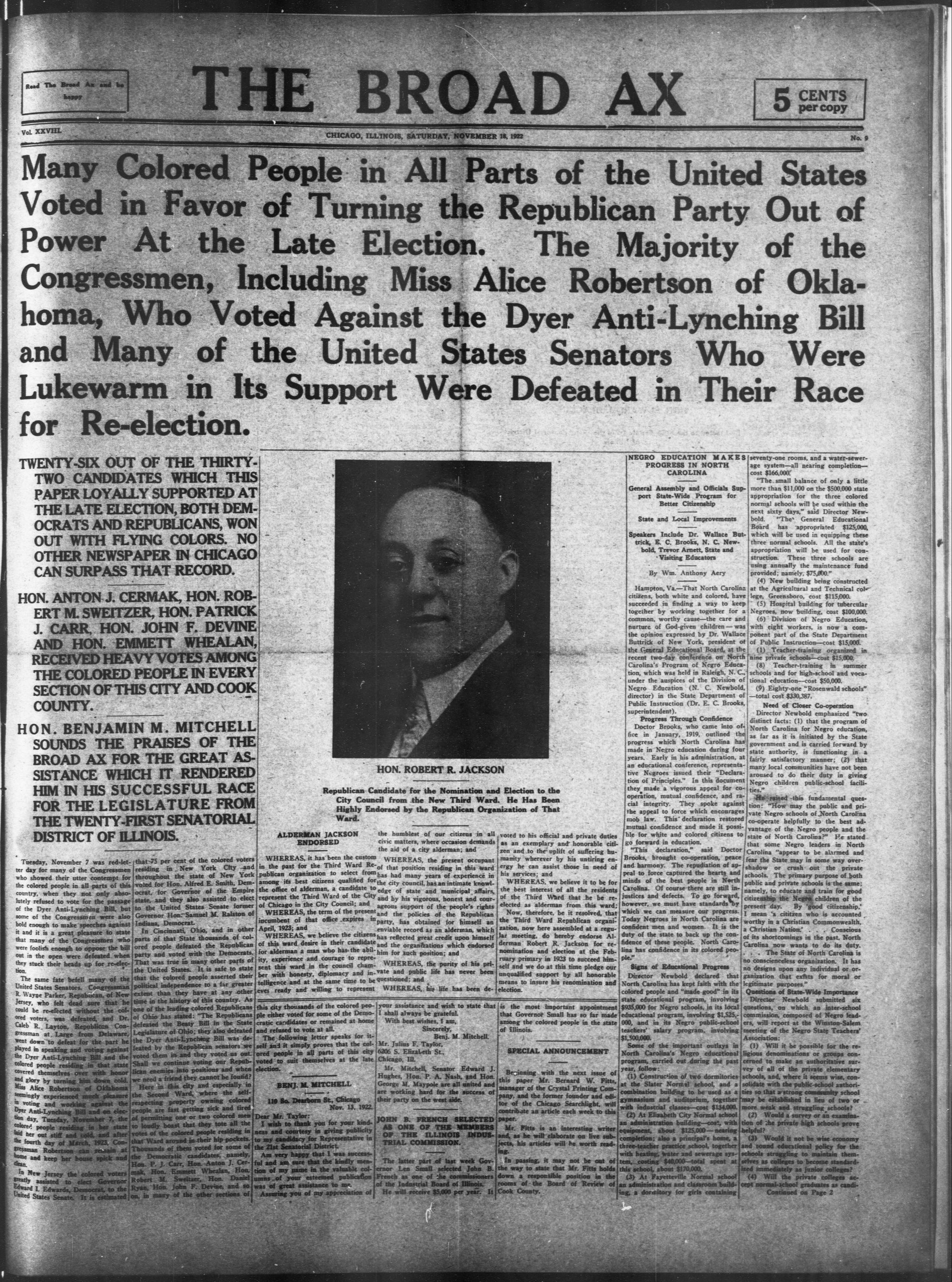
Many Colored People in All Parts of the United States Voted in Favor of Turning the Republican Party Out of Power At the Late Election. The Majority of the Congressmen, Including Miss Alice Robertson of Oklahoma, Who Voted Against the Dyer Anti-Lynching Bill and Many of the United States Senators Who Were Lukewarm in Its Support Were Defeated in Their Race for Re-election.
TWENTY-SIX OUT OF THE THIRTY- TWO CANDIDATES WHICH THIS PAPER LOYALLY SUPPORTED AT THE LATE ELECTION, BOTH DEMOCRATS AND REPUBLICANS, WON OUT WITH FLYING COLORS. NO OTHER NEWSPAPER IN CHICAGO CAN SURPASS THAT RECORD.
HON. ANTON J. CERMAK, HON. ROBERT M. SWEITZER, HON. PATRICK J. CARR, HON. JOHN F. DEVINE AND HON. EMMETT WHEALAN, RECEIVED HEAVY VOTES AMONG THE COLORED PEOPLE IN EVERY SECTION OF THIS CITY AND COOK COUNTY.
HON. BENJAMIN M. MITCHELL SOUNDS THE PRAISES OF THE BROAD AX FOR THE GREAT ASSISTANCE WHICH IT RENDERED HIM IN HIS SUCCESSFUL RACE FOR THE LEGISLATURE FROM THE TWENTY-FIRST SENATORIAL DISTRICT OF ILLINOIS.
The same fate befell many of the United States Senators. Congressman R. Wayne Parker, Republican of New Jersey, who felt dead sure that he could be re-elected without the colored voters, was defeated, and Dr. Caleb R. Layton, Republican Congressman at Large from Delaware, went down to defeat for the part he played in speaking and voting against the Dyer Anti-Lynching Bill and the colored people residing in that state covered themselves over with honor and glory by turning him down cold. Miss Robertson of Oklahoma seemingly experienced much pleasure in voting and working against the Dyer Anti-Lynching Bill and on election day, Tuesday, November 7, the colored? people residing in her state held her out声 and cold, and after the fourth day of March, 1923, Congressman Robertson can retain at home and keep her house spiked and clean.
In New Jersey the colored voters greatly assisted to elect Governor Edward I. Edwards, Democrat, to the United States Senate. It is estimated
THE BROAD AX
that-75 per cent of the colored voters residing in New York City and throughout the state of New York voted for Hon. Alfred E. Smith, Democrat, for Governor of the Empire state, and they also assisted to elect to the United States Senate former Governor Hon. Samuel M. Ralston of Indiana, Democrat.
In Cincinnati, Ohio, and in other parts of that State thousands of colored people defeated the Republican party and voted with the Democrats. That was true in many other parts of the United States. It is safe to state that the colored people asserted their political independence to a far greater extent than they have at any other time in the history of this country. As one of the leading colored Republicans of Ohio has stated: "The Republicans defeated the Beatty Bill in the State Legislature of Ohio; they also defeated the Dyer Anti-Lynching Bill was defeated by the Republican senators we voted them in and they voted as out. Shall we continue voting our Republican enemies into positions and when we need a friend they cannot be found?
Here in this city and especially in the Second Ward, where the self-respecting property owning colored people are fast getting sick and tired of permitting one or two colored men to loudly boast that they tote all the votes of the colored people residing in that Ward around in their hip pockets. Thousands of them voted for some of the Democratic candidates, namely, Hon. P. J. Carr, Hon Anton J. Cermak, Hon. Emmette Whealan, Hon Robert M. Swietzer, Hon. Daniel Ryan Hon. John F. Devine, and so on, in many of the other sections of
1
Republican Candidate for the Nomination and Election to the City Council from the New Third Ward. He Has Been Highly Endorsed by the Republican Organization of That Ward.
this city thousands of the colored people either voted for some of the Democratic candidates or remained at home and refused to vote at all.
The following letter speaks for itself and it simply proves that the colored people in all parts of this city voted to suit themselves at the late election.
HON. ROBERT R. JACKSON
candidate for the Nomination and L
ecil from the New Third Ward.
adored by the Republican Organi
the humblest of our citizens in all
civic matters, where occasion demands
the aid of a city alderman; and
voted to his official and private duties as an exemplary and honorable citizen and to the uplift of suffering humanity wherever by his untiring energy he can assist those in need of his services; and
WHEREAS, we believe it to be for the best interest of all the residents of the Third Ward that he be re-elected as alderman from this ward; Now, therefore, be it resolved, that the Third Ward Republican organization, now here assembled at a regular meeting, do hereby endorse Alderman Robert R. Jackson for renomination and election at the February primary in 1923 to succeed himself and we do at this time pledge our unqualified support by all honorable means to insure his renomination and election.
Hampton, Va.—That North Carolina citizens, both white and colored, have succeeded in finding a way to keep together by working together for a common, worthy cause—the care and nurture of God-given children—was the opinion expressed by Dr. Wallace Buttrick of New York, president of the General Educational Board, at the recent two-day conference on North Carolina's Program of Negro Education, which was held in Raleigh, N.C., under the auspices of the Division of Negro Education (N. C. Newbold, director) in the State Department of Public Instruction (Dr. E. C. Brooks, superintendent).
Progress Through Confidence Doctor Brooks, who came into office in January, 1919, outlined the progress which North Carolina has made in Negro education during four years. Early in his administration, at an educational conference, representative Negroes issued their "Declaration of Principles." In this document they made a vigorous appeal for cooperation, mutual confidence, and racial integrity. They spoke against the appeal to force which encourages mob law. This declaration restored mutual confidence and made it possible for white and colored citizens to go forward in education.
"This declaration," said Doctor Brooks, brought co-operation, peace and harmony. The repudiation of appeal to force captured the hearts and minds of the best people in North Carolina. Of course there are still injustices and defects. To go forward, however, we must have standards by which we can measure our progress. Today Negroes in North Carolina are confident men and women. It is the duty of the state to back up the confidence of these people. North Carolina has confidence in its colored people."
Signs of Educational Progress
Director Newbold declared that North Carolina has kept faith with the colored people and "made good" in its state educational program, involving $935,000 for Negro schools, in its local educational program, involving $1,525,000, and in its Negro public-school teachers' salary program, involving $1,500,000.
Some of the important outlays in North Carolina's Negro educational program, carried out during the past year, follow:
(1) Construction of two dormitories at the Slater Normal school, and a combination building to be used as a gymnasium and auditorium, together with industrial classes—cost $134,000.
(2) At Elizabeth City Normal school an administration building—cost, with equipment, about $125,000—nearing completion; also a principal's home, a three-teacher practice school, together with heating, water and sewerage system, costing $40,000—total spent at this school, about $170,000.
(3) At Fayetteville Normal school an administration and classroom building, a dormitory for girls containing
seventy-one rooms, and a water-sewer- age system—all nearing completion— cost $166,000'
"The. small balance of only a little more than $11,000 on the $500,000 state appropriation for the three colored normal schools will be used within the next sixty days," said Director Newbold. "The. General Educational Board has appropriated $125,000, which will be used in equipping these three normal schools. All the state's appropriation will be used for construction. These three schools are using annually the maintenance fund provided; namely, $75,000."
(4) New building being constructed at the Agricultural and Technical college, Greensboro, cost $115,000.
(5) Hospital building for tubercular Negroes, now building, cost $100,000.
(6) Division of Negro Education, with eight workers, is now a component part of the State Department of Public Instruction—cost $15,000.
(1) Teacher-training organized in nine private schools—cost $15,000.
(8) Teacher-training in summer schools and for high-school and vocational education—cost $50,000.
(9) Eighty-one "Rosenwald schools"—total cost $330,387.
Need of Closer Co-operation
Director Newbold emphasized "two distinct facts: (1) that the program of North Carolina for Negro education, as far as it is initiated by the State government and is carried forward by state authority, is functioning in a fairly satisfactory manner; (2) that many local communities have not been aroused to do their duty in giving Negro children public-school facilities."
HON. DANIEL RYAN
Re-Elected One of the Commissioners of Cook County
Entered as Second-Class Matter, Aug
19, 1902, at the Post Office at Chicago
III. Under Act of March 8, 1879.
NEGRO EDUCATION MAKES
PROGRESS IN NORTH
CAROLINA
Concluded from Page 1 dates for the junior class in a four-year college course?
(5) Will the organizations which own and operate the private Negro colleges be interested in bringing them up to a standard that will entitle them to an accredited rating without question?
(6) Would it be wise to agree upon a common nomenclature by which the same grade of work in public or private institutions would be known by the same name?
Pneumonia, like consumption, is a house disease; also it is a dirty air disease.
This assertion is supported by both the morbidity and mortality figures which show unvaryingly year after year the seasonal rise and decline in the city's pneumonia death rate. These figures also serve to show that during the summer months, the open air season, pneumonia in both cases and deaths reaches its lowest ebb and that so soon as the shut-in season comes, these figures begin mounting steadily month by month until the open air season comes again.
In connection with the number of deaths in Chicago due to this dirty air disease, it is of interest to note that last year there were reported to the Department of Health 8,336 cases with 2,164 deaths. So far this year, up to November 1, there have been 8,145 cases with 2,085 deaths. The figures for 1922 indicate that at the present rate of increase since September the total cases and deaths for this year will exceed last year's figures.
Motson Photo
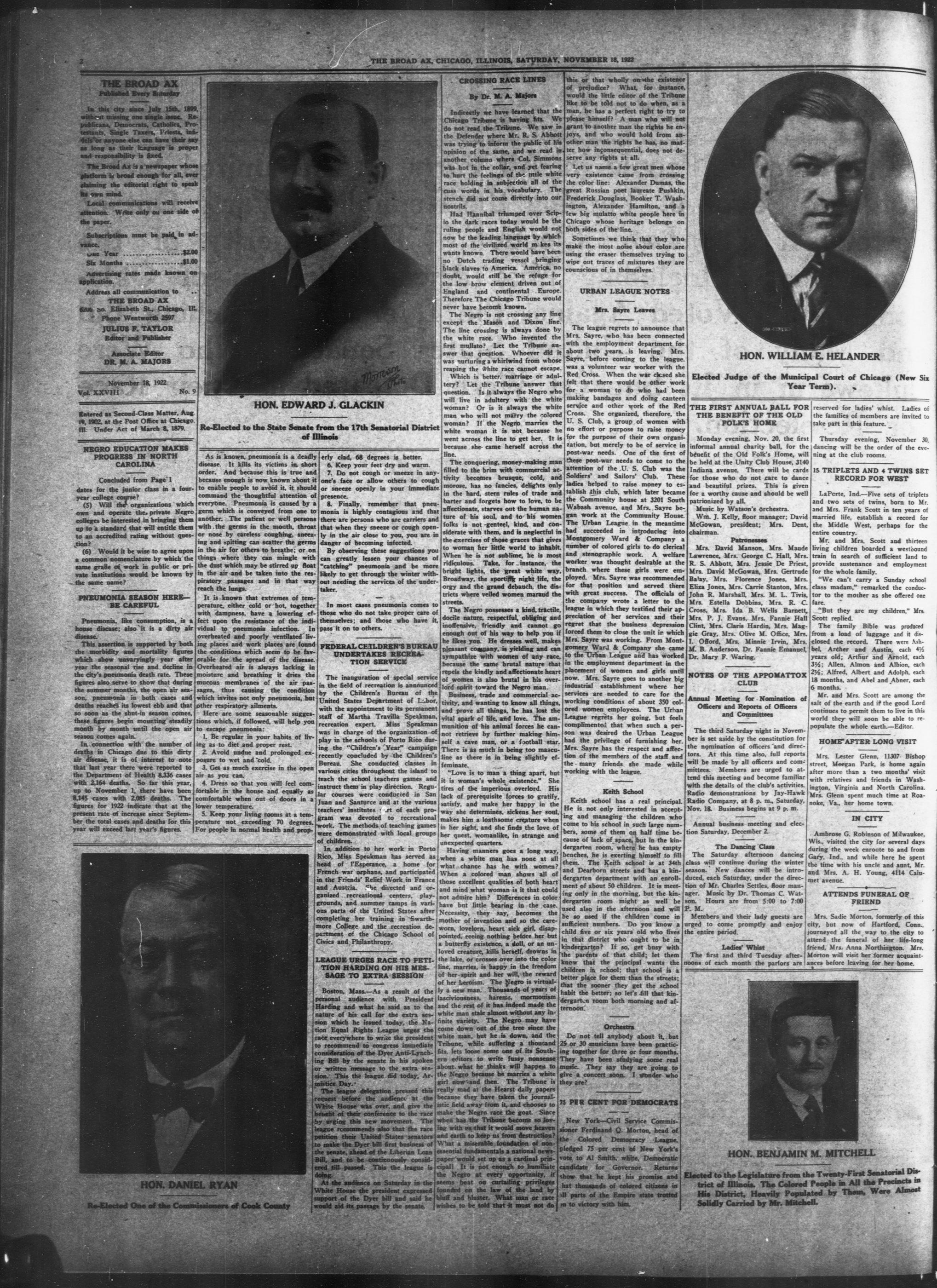
HON. EDWARD J. GLACKIN
Re-Elected to the State Senate from the 17th Senate of Illinois
Re-Elected to the State Senate from the 17th Senatorial District of Illinois
As is known, pneumonia is a deadly disease. It kills its victims in short order. And because this is true and because enough is now known about it to enable people to avoid it, it should command the thoughtful attention of everyone. Pneumonia is caused by a germ which is conveyed from one to another. The patient or well persons with the germs in the mouth, throat or nose by careless coughing, sneezing and spitting can scatter the germs in the air for others to breathe; or on things where they can mingle with the dust which may be stirred up float in the air and be taken into the respiratory passages and in that way reach the lungs.
It is known that extremes of temperature, either cold or hot, together with dampness, have a lowering effect upon the resistance of the individual to pneumonia infection. In overheated and poorly ventilated living places and work places are found the conditions which seem to be favorable for the spread of the disease. Overheated air is always lacking in moisture and breathing it dries the mucous membranes of the air passages, thus causing the condition which invites not only pneumonia, but other respiratory ailments.
Here are some seasonable suggestions which, if followed, will help you to escape pneumonia:
1. Be regular in your habits of living as to diet and proper rest.
2. Avoid undue and prolonged exposure to wet and cold.
3. Get as much exercise in the open air as you can.
4. Dress so that you will feel comfortable in the house and equally as comfortable when out of doors in a lower temperature.
5. Keep your living rooms at a temperature not exceeding 70 degrees. For people in normal health and prop-
---
erly clad, 68 degrees is better.
6. Keep your feet dry and warm.
7. Do not cough or sneeze in anyone's face or allow others to cough or sneeze openly in your immediate presence.
8. Finally, remember that pneumonia is highly contagious and that there are persons who are carriers and that when they sneeze or cough openly in the air close to you, you are in danger of becoming infected.
By observing these suggestions you can greatly lessen your chances of "catching" pneumonia and be more likely to get through the winter without needing the services of the undertaker.
In most cases pneumonia comes to those who do not take proper care of themselves; and those who have it, pass it on to others.
FEDERAL CHILDREN'S BUREAU UNDERTAKES RECREA TION SERVICE
The inauguration of special service in the field of recreation is announced by the Children's Bureau of the United States Department of Labor, with the appointment to its permanent staff of Martha Travilla Speakman recreation expert. Miss Speakman was in charge of the organization of play in the schools of Porto Rico during the "Children's Year" campaign recently concluded by the Children's Bureau. She conducted classes in various cities throughout the island to teach the school teachers games and instruct them in play direction. Regular courses were conducted in San Juan and Santurce and at the various teachers' institutes part of each program was devoted to recreational work. The methods of teaching games were demonstrated with local groups of children.
In addition to her work in Porto Rico, Miss Spekman has served as head of I'Esperance, a home for French war orphans, and participated in the Friends' Relief Work in France and Austria. She directed and organized recreational centers, playgrounds, and summer camps in various parts of the United States after completing her training in Swarthmore College and the recreation department of the Chicago School of Civics and Philanthropy.
TION HARDING ON HIS MESAGE TO EXTRA SESSION
Boston, Mass.—As a result of the personal audience with President Harding and what he said as to the nature of his call for the extra session which he issued today, the Nation Equal Rights League urges the race everywhere to write the president to recommend to congress immediate consideration of the Dyer Anti-Lynching Bill by the senate in his spoken or written message to the extra session. This the league did today, Armistice Day..
The league delegation pressed this request before the audience at the White House was over, and give the benefit of their conference to the race by urging this new movement. The league recommends also that the race petition their United States senators to make the Dyer bill first business of the senate, ahead of the Liberian Loan Bill, and to be continuously considered till passed. This the league is doing.
At the audience on Saturday in the White House the president expressed support of the Dyer bill and said he would aid its passage by the senate.
THE BROAD AX, CHICAGO, ILLINOIS, SATURDAY, NOVEMBER 18, 1922
Indirectly we have learned that the Chicago Tribune is having hits. We do not read the Tribune. We saw in the Defender where Mr. R. S. Abbott was trying to inform the public of his opinion of the same, and we read in another column where Col. Simmons was hot in the collar, and yet fearing to hurt the feelings of the little white race holding in subjection all of the cuss words in his vocabulary. The stench did not come directly into our nostrils.
Had Hannibal triumphed over Scipio the dark races today would be the ruling people and English would not now be the leading language by which most of the civilized world makes its wants known. There would have been no Dutch trading vessel bringing black slaves to America. America no doubt, would still be the refuge for the low brow element driven out of England and continental Europe. Therefore The Chicago Tribune would never have become known.
The Negro is not crossing any line except the Mason and Dixon line. The line crossing is always done by the white race. Who invented the first mullato? Let the Tribune answer that question. Whoever did it was nurturing a whirlwind from whose reaping the white race cannot escape.
Which is better, marriage or adultery? Let the Tribune answer that question. Is it always the Negro who will live in adultery with the white woman? Or is it always the white man who will not marry the colored woman? If the Negro marries the white woman it is not because he went across the line to get her. It is because she came herself across the line.
The conquering, money-making man filled to the brim with commercial activity becomes brusque, cold, and morose, has no fancies, delights only in the hard, stern rules of trade and barter and forgets how to love, to be affectionate, starves out the human nature of his soul, and to his women folks is not genteel, kind, and considerate with them, and is neglectful in the exercises of those graces that gives to woman her little world to inhabit. When he is not sublime, he is most ridiculous. Take, for instance, the bright lights, the great white way, Broadway, the sporting night life, the orgy and the grand debauch, the districts where veiled women maraud the streets.
The Negro possesses a kind, tractile, docile nature, respectful, obliging and inoffensive, friendly and cannot go enough out of his way to help you if he likes you. He dresses well, makes pleasant company, is yielding and can sympathize with women of any race, because the same brutal nature that repels the kindly and affectionate heart of women is also brutal in his overlord spirit toward the Negro man. Business, trade and commercial activity, and wanting to know all things, and prove all things, he has lost the vital spark of life, and love. The ammunition of his animal forces he cannot retrieve by further making himself a cave man, or a football star. There is as much in being too masculine as there is in being slightly effeminate.
"Love is to man a thing apart, but it is woman's whole existence." She tires of the imperious overlord. His lack of prerequisite forces to gratify, satisfy, and make her happy in the way she determines, sickens her soul, makes him a loathsome creature when in her sight, and she finds the love of her quest, womanlike, in strange and unexpected quarters.
Having manners goes a long way when a white man has none at all what chance has he with women. When a colored man shows all of those excellent qualities of both heart and mind what woman is it that could not admire him? Differences in color have but little bearing in the case Necessity, they say, becomes the mother of invention and so the careworn, lovelorn, heart sick girl, disappointed, seeing nothing before her but a butterfly existence, a doll, or an unloved creature, kills herself, drowns in the lake, or crosses over into the color line, marries, is happy in the freedom of her spirit and her will, the reward of her Leroism. The Negro is virtually a new man. Thousands of years of lasciviousness, harems, mormonism and the rest of it has indeed made the white man stale almost without any infinite variety. The Negro may have come down out of the tree since the white man, but he is in the, the Tribute, while suffering a thousand fits, lets loose one of its Southern editors to write fussy nonsense about what he thinks will happen to the Negro because he marries a white girl now and the Tribute is really mad at the Hearst daily papers because they have taken the journalistic field away from it, and chooses to make the Negro race the goat. Since when has the Tribute become so loving with us that it would move heaven and earth to keep us from destruction? What a miserable foundation of nonessential fundamentals a national newspaper would set up as a cardinal principal? It is not enough to humiliate the Negro at every opportunity, it seems best on curtailing privileges founded on the law of the land by bluff and bluster. What man or race wishes to be told that it must not do
this or that wholly on the existence of prejudice? What, for instance, would the little editor of the Tribune like to be told not to do when, as a man, he has a perfect right to try to please himself? A man who will not grant to another man the rights he enjoys, and who would hold from another man the rights he has, no matter how inconsequential, does not deserve any rights at all.
Let us name a few great men whose very existence came from crossing the color line: Alexander Dumas, the great Russian poet laureate Pushkin, Frederick Douglass, Booker T. Washington, Alexander Hamilton, and a few big mulatto white people here in Chicago whose heritage belongs on both sides of the line.
Sometimes we think that they who make the most noise about color are using the eraser themselves trying to wipe out traces of mixtures they are counscious of in themselves.
URBAN LEAGUE NOTES
The league regrets to announce that Mrs. Sayre, who has been connected with the employment department for about two years, is leaving. Mrs. Sayre, before coming to the league, was a volunteer war worker with the Red Cross. When the war closed she felt that there would be other work for a woman to do who had been making bandages and doing canteen service and other work of the Red Cross. She organized, therefore, the U. S. Club, a group of women with no effort or purpose to raise money for the purpose of their own organization, but merely to be of service in post-war needs. One of the first of these post-war needs to come to the attention of the U. S. Club was the Soldiers' and Sailors' Club. These ladies helped to raise money to establish this club, which later became the Community house at 3201 South Wabash avenue, and Mrs. Sayre began work at the Community House. The Urban League in the meantime had succeeded in introducing into Montgomery Ward & Company a number of colored girls to do clerical and stenographic work. A welfare worker was thought desirable at the branch where these girls were employed. Mrs. Sayre was recommended for that position and served there with great success. The officials of the company wrote a letter to the league in which they testified their appreciation of her services and their regret that the business depression forced them to close the unit in which Mrs. Sayre was working. From Montgomery Ward & Company she came to the Urban League and has worked in the employment department in the placement of women and girls until now. Mrs. Sayre goes to another big industrial establishment where her services are needed to care for the working conditions of about 350 colored women employees. The Urban League regrets her going, but feels complimented that when such a person was desired the Urban League had the privilege of furnishing her. Mrs. Sayre has the respect and affection of the members of the staff and the many friends she made while working with the league.
Keith School
Keith school has a real principal He is not only interested in accepting and managing the children who come to his school in such large numbers, some of them on half time be cause of lack of space, but in the kindergarten room, where he has empty benches, he is exerting himself to fill them. The Keith school is at 34th and Dearborn streets and has a kindergarten department with an enrollment of about 50 children. It is meeting only in the morning, but the kindergarten room might as well be used also in the afternoon and will be so used if the children come in sufficient numbers. Do you know a child five or six years old who lives in that district who ought to be in kindergarten? If so, get busy with the parents of that child; let them know that the principal wants the children in school; that school is a better place for them than the streets; that the sooner they get the school habit the better; so let's fill that kindergarten room both morning and afternoon.
Do not tell anybody about it, but
25 or 30 musicians have been practic-
ing together for three or four months.
They have been studying some real
music. They say they are going to
give a concert soon. I wonder who
they are?
398
HON. WILLIAM E. HELANDER
Elected Judge of the Municipal Court of Chica
Year Term).
Elected Judge of the Municipal Court of Chicago (New Six Year Term).
THE FIRST ANNUAL BALL FOR THE BENEFIT OF THE OLD FOLK'S HOME
Monday evening, Nov. 20, the first informal annual charity ball, for the benefit of the Old Folk's Home, will be held at the Unity Club House, 3140 Indiana avenue. There will be cards for those who do not care to dance and beautiful prizes. This is given for a worthy cause and should be well patronized by all.
Music by Watson's orchestra.
Wm. J. Kelly, floor manager; David McGowan, president; Mrs. Dent, chairman.
reserved for ladies' whist. Ladies of the families of members are invited to take part in this feature.
Thursday evening, November 30, dancing will be the order of the evening at the club rooms.
15 TRIPLETS AND 4 TWINS SET RECORD FOR WEST
LaPorte, Ind.—Five sets of triplets and two sets of twins, born to Mr. and Mrs. Frank Scott in ten years of married life, establish a record for the Middle West, perhaps for the entire country.
Patronesses
Mrs. David Manson, Mrs. Maude
Lawrence, Mrs. George C. Hall, Mrs.
R. S. Abbott, Mrs. Jessie De Priest,
Mrs. David McGowan, Mrs. Gertrude
Balay, Mrs. Florence Jones, Mrs.
Eliza Jones, Mrs. Carrie Stanton, Mrs.
John R. Marshall, Mrs. M. L. Tivis,
Mrs. Estella Dobbins, Mrs. R. C.
Cross, Mrs. Ida B. Wells Barnett,
Mrs. P. J. Evans, Mrs. Fannie Hall
Clint, Mrs. Claris Hardin, Mrs. Maggie
Gray, Mrs. Olive M. Office, Mrs.
I. Offord, Mrs. Minnie Irvin, Mrs.
M. B. Anderson, Dr. Fannie Emanuel,
Dr. Mary F. Waring.
NOTES OF THE APPOMATTOX
CLUB
Annual Meeting for Nomination of
Officers and Reports of Officers
and Committees
The third Saturday night in November is set aside by the constitution for the nomination of officers and directors. At this time also, full reports will be made by all officers and committees. Members are urged to attend this meeting and become familiar with the details of the club's activities. Radio demonstrations by Jay-Hawk Radio Company, at 8 p. m. Saturday, Nov. 18. Business begins at 9 p. m.
Annual business meeting and election Saturday, December 3.
The Saturday afternoon dancing class will continue during the winter season. New dances will be introduced, each Saturday, under the direction of Mr. Charles Settles, floor manager. Music by Dr. Thomas C. Watson. Hours are from 5:00 to 7:00 P. M. Members and their lady guests are urged to come promptly and enjoy the entire period.
Ladies' Whist
The first and third Tuesday afternoons of each month the parlers are
HON. BENJAMIN M. MITCHELL
Elected to the Legislature from the trict of Illinois. The Colored His District, Heavily Popul Solidly Carried by Mr. Mitche
Elected to the Legislature from the Twenty-First Senatorial District of Illinois. The Colored People in All the Precincts in His District, Heavily Populated by Them, Were Almost Solidly Carried by Mr. Mitchell.
Cipal Court of Chicago (New Six Term).
reserved for ladies' whist. Ladies of the families of members are invited to take part in this feature.
Thursday evening, November 30, dancing will be the order of the evening at the club rooms.
15 TRIPLETS AND 4 TWINS SET
RECORD FOR WEST
LaPorte, Ind.—Five sets of triplets and two sets of twins, born to Mr. and Mrs. Frank Scott in ten years of married life, establish a record for the Middle West, perhaps for the entire country.
Mr. and Mrs. Scott and thirteen living children boarded a westbound train in search of sufficient land to provide sustenance and employment for the whole family.
"We can't carry a Sunday school class madam," remarked the conductor to the mother as she offered one fare.
"But they are my children," Mrs. Scott replied.
The family Bible was produced from a load of luggage and it disclosed the record. There were Ashbel, Archer and Austin, each 4% years old; Arthur and Arnold, each 3%; Allen, Almon and Albion, each 2%; Alfred, Albert and Adolph, each 18 months, and Abel and Abner, each 6 months.
Mr. and Mrs. Scott are among the salt of the earth and if the good Lord continues to permit them to live in this world they will soon be able to repopulate the whole earth—Editor.
HOME AFTER LONG VISIT
Mrs. Lester Glenn, 11307 Bishop street, Morgan Park, is home again after more than a two months' visit with relatives and friends in Washington, Virginia and North Carolina. Mrs. Glenn spent much time at Roanoke, Va., her home town.
IN CITY
Ambrose G. Robinson of Milwaukee. Wis., visited the city for several days during the week enroute to and from Gary, Ind., and while here he spent the time with his uncle and aunt, Mr. and Mrs. A. H. Young, 4114 Calumet avenue.
Mrs. Sadie Morton, formerly of this city, but now of Hartford, Conn., journeyed all the way to the city to attend the funeral of her life-long friend, Mrs. Anna Northington. Mrs. Morton will visit her former acquaintances before leaving for her home.
the Twenty-First Senatorial Dis- I people in All the Precincts in lated by Them, Were Almost shell.
M.
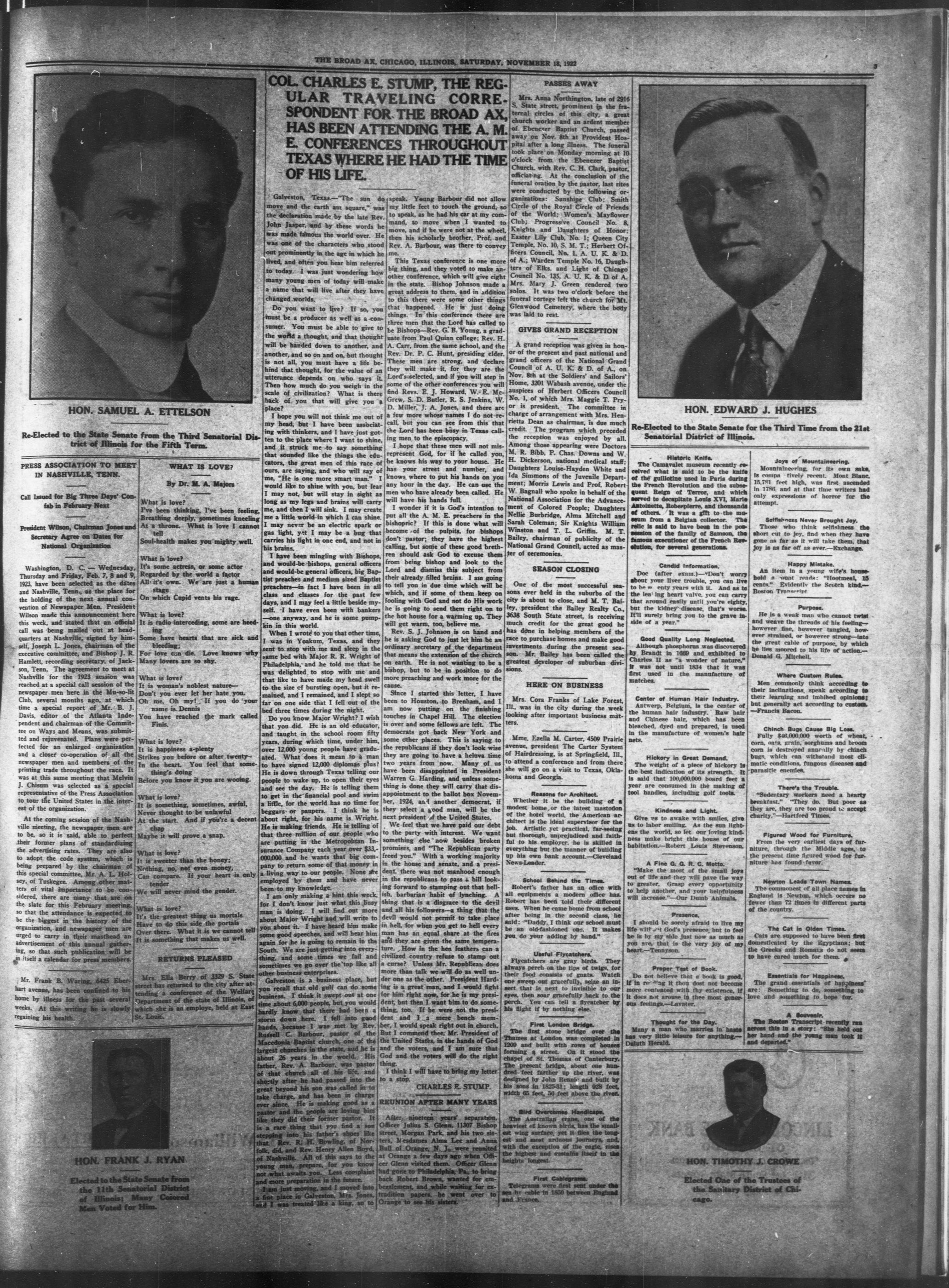
HON. SAMUEL A. ETTELSON
Re-Elected to the State Senate from the Third District of Illinois for the Fifth Term.
PRESS ASSOCIATION TO MEET IN NASHVILLE, TENN.
Call Issued for Big Three Days' Confab in February Next
President Wilson, Chairman Jones and Secretary Agree on Dates for National Organization
WHAT IS IT
By Dr. M. A.
What is love?
I've been thinking, I'm Breathing deeply, some At a throne. What is tell Soul-health makes you What is love?
to the State Senate from the Third Sect
trict of Illinois for the Fifth Term.
ACIATION TO MEET
NVILLE, TENN.
Big Three Days' Con-
February Next
Chairman Jones and
Agree on Dates for
Organization
WHAT IS I
By Dr. M. A.
What is love?
I've been thinking, I'm
Breathing deeply, som
At a throne. What is
tell
Soul-health makes you
What is love?
Re-Elected to the State Senate from the Third Senatorial District of Illinois for the Fifth Term.
Washington, D. C. — Wednesday
Thursday and Friday, Feb. 7, 8 and
9 1923, have been selected as the dates
and Nashville, Tennessee, as the place for
the holding of the next annual con-
vention of Newspaper Men. President
Wilson made this announcement here
this week, and stated that an official
call was being mailed out at head-
quarters at Nashville, signed by him-
self, Joseph L. Jones, chairman of
the executive committee, and Bishop J. R.
Ramlett, recording secretary, of Jack-
son, Tenn. The agreement to meet at
Nashville for the 1923 session was
reached at a special call session of the
newspaper men here in the Mu-so-lit
Club, several months ago, at which
time a special report of Mr. B. J.
Davis, editor of the Atlanta Independent and chairman of the Committee on Ways and Means, was submitted and rejuvenated. Plans were perfected for an enlarged organization and a closer co-operation of all the newspaper men and members of the
printing trade throughout the race. It was at this same meeting that Melvin J. Chisum was selected as a special representative of the Press Association to tour the United States in the interest of the organization.
At the coming session of the Nashville meeting, the newspaper men are to be, so it is said, able to perfect their former plans of standardizing the advertising rates. They are also to adopt the code system, which is being prepared by the chairman of this special committee, Mr. A. L. Holsey, of Tuskegee. Among other matters of vital importance to be considered, there are many that are on the slate for this February meeting, so that the attendance is expected to be the biggest in the history of the organization, and newspaper men are urged to carry in their masthead an advertisement of this annual gathering, so that such publication will be in itself a calendar for press members.
Mr. Frank B. Waring, 6425 Eberhart avenue, has been confined to his home by illness for the past several weeks. At this writing he is slowly regaining his health.
HON. FRANK
Elected to the State
the 11th Senate
of Illinois; 1
Men Voted for
HON. FRANK J. RYAN
Elected to the State Senate from the 11th Senatorial District of Illinois; Many Colored Men Voted for Him.
COL. CHARLES E. STUMP, THE REGULAR TRAVELING CORRESPONDENT FOR THE BROAD AX, HAS BEEN ATTENDING THE A. M. E. CONFERENCES THROUGHOUT TEXAS WHERE HE HAD THE TIME OF HIS LIFE.
Galveston, Texas—"The sun do move and the earth am square," was the declaration made by the late Rev John Jasper, and by these words he was made famous the world over. He was one of the characters who stood out prominently in the age in which he lived, and often you hear him referred to today. I was just wondering how many young men of today will make a name that will live after they have changed worlds.
Do you want to live? If so, you must be a producer as well as a consumer. You must be able to give to the world a thought, and that thought will be handed down to another, and another, and so on and on, but thought is not all, you must have a life behind that thought, for the value of an utterance depends on who says it. Then how much do you weigh in the scale of civilization? What is there back of you that will give you a place?
I hope you will not think me out of my head, but I have been associating with thinkers, and I have just gotten to the place where I want to shine, and it struck me to say something that sounded like the things the educators, the great men of this race of ours, are saying, and who will say of me, "He is one more smart man." I would like to shine with you, but fear I may not, but will stay in sight as long as my legs and brains will carry me, and then I will sink. I may create me a little world in which I can shine. I may never be an electric spark or gas light, yet I may be a bug that carries his light in one end, and not in his brains.
I have been mingling with Bishops and would-be bishops, general officers and would-be general officers, big Baptist preaches and medium sized Baptist preachers—in fact I have been in all class and classes for the past few days, and I may feel a little beside myself. I have even been with bankers—one anyway, and he is some pumpkin in this world.
When I wrote to you that other time, I was in Yoakum, Texas, and they sent to stop with me and sleep in the same bed with Major R. R. Wright of Philadelphia, and he told me that he was delighted to stop with me and that like to have made my head swell to the size of bursting open, but it remained, and I remained, and I slept so far on one side that I fell out of the bed three times during the night.
Do you know Major Wright? I wish that you did. He is an old educator, and taught in the school room fifty years, during which time, under him, over 12,000 young people have graduated. What does it mean to a man to have signed 12,000 diplomas plus? He is down through Texas telling our people to wake up, to open their eyes and see the day. He is telling them to get in the financial pool and swim a little, for the world has no time for beggars or paupers. I think he is about right, for his name is Wright. He is making friends. He is telling of that three million of our people who are putting in the Metropolitan Insurance Company each year over $33,000,000 and he wants that big company to return some of that money in a living way to our people. None are employed by them and have never been to my knowledge.
I am only making a hint this week, for I don't know just what this busy man is doing. I will find out more about Major Wright and will write to you about it. I have heard him make some good speeches, and will hear him again for he is going to remain in the South. We are just getting into everything, and some times we fail and sometimes we go over the top like all other business enterprises.
Galveston is a business place, but you recall that old Gulf can do some business. I think it swept out at one time about 6,000 people, but you would hardly know that there had been a storm down here. I fell into good hands, because I was met by Rev. Russell C. Barbrow, pastor of the Macedonia Baptist church, one of the largest churches in the state, and he is about 26 years in the world. His father, Rev. A. Barbrow, was pastor of that church all of his life, and shortly after he had passed into the great beyond his son was called in to take charge, and has been in charge ever since. He is making good as a pastor and the people are loving him like they did their former pastor. It is a rare thing that you find a son stepping into his father's shoes like that. Rev. R. H. Bowling, of Norfolk, did R. H. Henry Allen Buyd, of Nashville. All of this says to the young man, prepare, for you know not what awaits you. Less complaint and more preparation in the future.
I am just moving, and I moved into a fine place in Galveston, Mra. Jones, and I was treated like a king, so to
T =
speak. Young Barbour did not allow my little feet to touch the ground, so to speak, as he had his car at my command, to move when I wanted to move, and if he were not at the wheel, then his scholarly brother, Prof. and Rev. A. Barbour, was there to convey me.
This Texas conference is one more big thing, and they voted to make another conference, which will give eight in the state. Bishop Johnson made a great address to them, and in addition to this there were some other things that happened. He is just doing things. In this conference there are three men that the Lord has called to be Bishop—Rev. G. B. Young, a graduate from Paul Quinn college; Rev. H. A. Carr, from the same school, and the Rev. Dr. P. C. Hunt, presiding elder. These men are strong, and declare they will make it, for they are the Lord's selected, and if you will step in some of the other conferences you will find Revs. E. J. Howard, W. E. McGrew, S. D. Butler, R. S. Jenkins, W. D. Miller, J. A. Jones, and there are a few more whose names I do not recall, but you can see from this that the Lord has been bisy in Texas calling men to the episcopacy.
I hope that these men will not misrepresent God, for if he called you, he knows his way to your house. He has your street and number, and knows where to put his hands on you any hour in the day. He can use the men who have already been called. He will have his hands full.
I wonder if it is God's intention to put all the A. M. E. preachers in the bishopric? If this is done what will become of the pulpits, for bishops don't pastor; they have the highest calling, but some of these good brethren should ask God to excuse them from being bishop and look to the Lord and diamiss this subject from their already filled brzins. I am going to tell you in due time which will be which, and if some of them keep on fooling with God and not do His work he is going to send them right on to the hot house for a warming up. They will get warm, too, believe me.
Rev. S. J. Johnson is on hand and he is asking God to just let him be an ordinary secretary of the department that means the extension of the church on earth. He is not wanting to be a bishop, but to be in position to do more preaching and work more for the cause.
Since I started this letter, I have been to Houston, to Brenham, and I am now putting on the finishing touches in Chapel Hill. The election is over and some fellows are left. The democrats go back New York and some other places. This is saying to the republicans if they don't look wise they are going to have a heluva time two years from now. Many of us have been disappointed in President Warren G. Harding, and unless something is done they will carry that disappointment to the ballot box November, 1924, and another democrat, if they select a good man, will be the next president of the United States.
We feel that we have paid our debt to the party with interest. We want something else now besides broken promises, and "The Republican party freed you." With a working majority in the house and senate, and a president, there was not manhood enough in the republicans to pass a bill looking forward to stamping out that hellish, barbarian habit of lynching. A thing that is a disgrace to the devil and all his followers—a thing that the devil would not permit to take place in hell, for when you get to hell every man has an equal share at the fives and they are given the same temperature. How in the hen feathers can a civilized country refuse to stamp out a curse? Unless Mr. Republican does more than talk we will do as well under one as the other. President Harding is a great man, and I would fight for him right now, for he is my president, but then I want him to do something, too. If he were not the president and I a mere bench member, I would speak right out in church. But I commend thee: Mr. President of the United States, in the hands of God and the voters, and I am sure that God and the voters will do the right thing.
REUNION AFTER MANY YEARS
After, nineteen years separation,
Officer Julius S. Glenn, 11307 Bishop street, Morgan Park, and his two sisters, Wesdames Alma Lee and Anna Bull of Orange; N. J., were reunited at Orange a few days ago when Officer Glenn visited them. Officer Glenn had gone to Philadelphia, Pa., to bring back Robert Brown, wanted for embezzlement, and while waiting for extradition papers, he went over to Orange to see his sisters.
Mrs. Anna Northington, late of 2916 S. State street, prominent in the fraternal circles of this city, a great church worker and an ardent member of Ebenezer Baptist Church, passed away on Nov. 8th at Provident Hospital after a long illness. The funeral took place on Monday morning at 10 o'clock from the Ebenezer Baptist Church, with Rev. C. H. Clark, pastor, officiating. At the conclusion of the funeral oration by the pastor, last rites were conducted by the following organizations: Sunshine Club; Smith Circle of the Royal Circle of Friends of the World; Women's Mayflower Club; Progressive Council No. 8, Knights and Daughters of Honor; Easter Lily Club, No. 1; Queen City Temple, No. 10, S. M. T.; Herbert Officers Council, No. 1, A. U. K. & D. of A.; Warden Temple No. 16, Daughters of Elks, and Light of Chicago Council No. 135, A. U. K. & D. of A. Mrs. Mary J. Green rendered two solos. It was two o'clock before the funeral cortege left the church for Mt. Glenwood Cemetery, where the body was laid to rest.
GIVES GRAND RECEPTION
A grand reception was given in honor of the present and past national and grand officers of the National Grand Council of A. U. K. & D. of A., on Nov. 8th at the Soldiers' and Sailors' Home, 3201 Wabash avenue, under the auspices of Herbert Officers Council No. 1, of which Mrs. Maggie T. Pryor is president. The committee in charge of arrangement with Mrs. Henrietta Dean as chairman, is due much credit. The program which preceded the reception was enjoyed by all. Among those appearing were Doctors M. R. Bibb, P. Chas Downs and W. H. Dickerson, national medical staff; Daughters Louise-Hayden White and Ida Simmons of the Juvenile Department; Morris Lewis and Prof. Robert W. Bagnall who spoke in behalf of the National Association for the Advancement of Colored People; Daughters Nellie Burbridge, Alma Mitchell and Sarah Coleman; Sir Knights William Winston and T. L. Griffin. M. T. Bailey, chairman of publicity of the National Grand Council, acted as master of ceremonies.
SEASON CLOSING
One of the most successful seasons ever held in the suburbs of the city is about to close, and M. T. Bailey, president the Bailey Realty Co. 3638 South State street, is receiving much credit for the great good he has done in helping members of the race to purchase homes and make good investments during the present season. Mr. Bailey has been called the greatest developer of suburban divisions.
HERE ON BUSINESS
Mrs. Cora Franks of Lake Forest, Ill., was in the city during the week looking after important business matters.
Mme. Ezella M. Carter, 4509 Prairie avenue, president The Carter System of Hairdressing, is at Springfield, Ill., to attend a conference and from there she will go on a visit to Texas, Oklahoma and Georgia.
Reasons for Architect.
Whether it be the building of a modest home, or the latest mastodon of the hotel world, the American architect is the ideal supervisor for the job. Artistic yet practical, far-seeing but thorough, unprejudiced and faithful to his employer, he is skilled in everything but the manner of building up his own bank account.—Cleveland News-Leader.
School Behind the Times.
Robert's father has an office with all equipments a modern office has. Robert has been told their different uses. When he came home from school after being in the second class, he said: "Daddy, I think our school must be an old-fashioned one. It makes you do your adding by hand."
Useful Flycatchers.
Flycatchers are gray birds. They always perch on the tips of twigs, for their food consists of gnats. Watch one sweep out gracefully, seize an insect that is next to invisible to our eyes, then soar gracefully back to the perch. You can tell a flycatcher by his flight if by nothing else.
First London Bridge.
The first stone bridge over the Thames at London was completed in 1200 and built with rows of houses forming a street. On it stood the chapel of St. Thomas of Canterbury. The present bridge, about one hundred feet farther up the river, was designed by John Hennie and built by his sons in 1825-31; length 928 feet, width 65 feet, 50 feet above the river.
Bird Overcomes Handicap.
The Australian crane, one of the heaviest of known birds, has the smallest wing surface, yet it flies the longest and most arduous journeys, and, with the exception of the eagle, rises the highest and sustains itself in the heights longest.
First Cablegrams.
Telegrams were first sent under the sea by cable in 1830 between England and France.
M.
HON. EDWARD J. HUGHES
Re-Elected to the State Senate for the Third Time
Senatorial District of Illinois.
Re-Elected to the State Senate for the Third Time from the 21st Senatorial District of Illinois.
Historic Knife.
The Canavellet museum recently received what is said to be the knife of the gullotine used in Paris during the French Revolution and the subsequent Reign of Terror, and which served to decapitate Louis XVI, Marie Antoinette, Robespierre, and thousands of others. It was a gift to the museum from a Belgian collector. The relic is said to have been in the possession of the family of Samson, the famous executioner of the French Revolution, for several generations.
Candid Information
Doc (after exam.)—"Don't worry about your liver trouble, you can live to be 60 enty years with it. And as to the lea'ing heart valve, you can carry that around easily until you're eighty, but the kidney disease, that's worse. It'll surely bring you to the grave inside of a year."
Good Quality Long Neglected. Although phosphorus was discovered by Brandt in 1689 and exhibited to Charles II as "a wonder of nature," it was not until 1834 that it was first used in the manufacture of matches.
Center of Human Hair Industry. Antwerp, Belgium, is the center of the human hair industry. Raw hair and Chinese hair, which has been bleached, and prepared, is used in the manufacture of women's hair nets.
Hickory in Great Demand. The weight of a piece of hickory is the best indication of its strength. It is said that 100,000,000 board feet a year are consumed in the making of tool handles, including golf tools.
Give us to awake with smiles, give us to labor smiling. As the sun lightens the world, so let our loving kindness make bright this house of our habitation.—Robert Louis Stevenson.
A Fine G. G. R. C. Motto.
"Make the most of the small joys out of life and they will pave the way to greater. Grasp every opportunity to help another, and your helpfulness will increase."—Our Dumb Animals.
Presence.
I should be sorely afraid to live my life will not God's presence, but to feel he is by my side just now as much as you are, that is the very joy of my heart.—Tennyson.
Proper Test of Book.
Do not believe that a book is good,
if in re-reading it thou dost not become
more contented with thy existence, if
it does not arouse in thee most generous feelings—Lavater.
Thought for the Day.
Many a man who marries in haste
has very little leisure for anything—
Dad-th World.
for the Third Time from the 21st is.
Joys of Mountaineering.
Mountaineering, for its own sake, in compa tively recent. Mont Blanc, 15,781 feet high, was first ascended in 1780, and at that time writers had only expressions of horror for the attempt.
Selfishness Never Brought Joy.
Those who think selfishness the short cut to joy, find when they have gone as far as it will take them, that joy is as far off as ever.—Exchange.
Happy Mistake
An item in a young wife's house
hold a count reads: "Hootmeal,
15 cents." Evidently the Scotch kind.
Boston Transcript
He is a weak man who cannot twist and weave the threads of his feeling—however fine, however tangled, however strained, or however strong—into the great cable of purpose, by which he lies moored to his life of action. Donald G. Mitchell.
Where Custom Rules.
Men commonly think according to their inclinations, speak according to their learning and imbibed opinions; but generally act according to custom.
—Francis Bacon.
Chinch Bugs Cause Big Loss.
Fully $46,000,000 worth of wheat, corn, oats, grain, sorghums and broom corn is destroyed annually by chinch bugs, which can withstand most climatic conditions, fungous diseases and parasitic enemies.
There's the Trouble.
"Sedentary workers need a hearty breakfast." "They do. But poor as they are, they are too proud to accept charity."—Hartford Times.
Figured Wood for Furniture.
From the very earliest days of furniture, through the Middle ages, to the present time figured wood for furniture has found favor.
Newton Leads Town Names.
The commonest of all place names in England is Newton, which occurs no fewer than T2 times in different parts of the country.
The Cat in Olden Times.
Cats are supposed to have been first domesticated by the Egyptians; but the Greeks and Romans do not seem to have cured much for them.
Essentials for Happiness.
The grand essentials of happiness are: Something to do, something to learn.
IS YOUR HAIR SHORT OR THIN?
Order Slum nesting pelt
JAS, B. McCAHEY, President
FRANK J. DUNN, Vice-President
ESTABLISHED
JOHN J.
COA
Telephone
5100 Federal Street
A JACKET WITHOUT SLEEVES
French Maker Devises Interesting Garment to Be Worn With Afternoon Dresses.
Many of the most important dressmakers declaim any effort toward the sensational silhouette. To meet the demand for new styles they vary their characteristic lines by beautiful fabrics, stirring colors and trimming details.
Chanel has made no basic changes in the styles which she exploits. Her dresses are straightline, many of them with beautiful embroideries. She uses laces profusely. Among her prettiest models are some frocks of flowered alks, the flowers scattered over a plain background in the form of large motifs. These silks are velled with lace, giving an extremely pleasing effect. Several of her afternoon dresses are accompanied by little steeveless jackets. Such models frequently carry Russian embroideries.
The greatest change in the models made by Callot is in the colorings. There is a considerable showing of paler shades of blue and rose. She has given preference in these paler bues over the rich oriental shades which she used last season. She also used many silks in pumadour effects. Other than in color Callot has done orally nothing new in the way of
Statement of Condition
At Close of Business on Sept. 15th, 1922
RESOURCES
Loan and Discounts ... $1,350,850.10
(Loan and Discounts provided by our Board of Directors)
Bonds and Securities ... 704,824.01
Stocks ... 20,775.00
(Chicago State Safety Vaults On)
Bank Building and Annex ... 156,974.82
Park and Fiction ... 24,624.30
Other Resources ... 10,188.87
Cash on Hand and Dues from Banks ... 664,420.87
Total ... $2,631,290.09
LIABILITIES
Capital Stock ... $ 500,000.00
Senior Stock ... $ 20,000.00
Unsecured Profits ... 26,644.43
Reserved for Taxes and Interest ... 9,126.08
Other Liabilities ... 8,972.03
Deposits ... 2,684,988.07
Total ... $2,631,290.09
Increase in Deposits Since June 30, 1922
($270,000.00)
This Bank invites you to avail yourself of its complete facilities.
For Mortgage-Cash Bonds—suppressed rate investments—yield 7% interest.
Boxes in our completely equipped Safety Deposit Vaults rent for $4.00 per year and upwards.
Interest at the rate of 8% is allowed on all mortgages. Savings amounts open from 9 a.m. to 8 p.m. Saturday.
GEORGE P. LEIBRANDT, President.
CHARLES A. WHITE, Vice-President.
GEORGIE C. CHAPMAN, Counsel.
A. A. DELAUBER, Agent, Cashier.
ADVISON R. AVERY, Mgr. Bond Dept.
LINCOLN STATE BANK
OF CHICAGO
Under State Government Supervision
31st and South State Streets
Telephone Victory 4500
THE LONG RIBBON STREAMERS
Radiating from the center of the crown of her hat over the brim with short lengths in front, lengthening toward the back are ribbon streamers, row upon row. At the back, the streamers reach to the very hem of the skirt, fastened in at the waistline to give an effect charming and distinctive. The dahilas which trim the crown of the hat and the girdle are made of very narrow ribbon, row upon row, surrounding a tiny button.
MILES J. DEVINE
ATTORNEY AT LAW
Suite 318-320 Renper Block
Clark and Washington Sts.
CHICAGO
Telephone Central 1239
Notary Public
Phones: Office Main 4183; Residence,
4751 Champlain Avenue
Phone Kenwood 6011
THE HOTEL
Walter M. Farmer
ATTORNEY AND COUNSELOR
AT LAW
Suite 708-184 W. Washington St.
CHICAGO
The Cranford Apartment Bldg.
3600 WA ASH AVENUE
The finest building ever op ed to Colored tenants in Chicago.
Steam heat, electric lights, tile baths, marble entrance
Phone Main 263 J. W. Casey, Agt. 133 W. Washington St.
FUNERAL DIRECTORS
ERNEST H. WILLIAMSON UNDERTAKER
GARAGE
CASEBOUND OIL
OPEN SATURDAY
Ernest H. Williamson UNDERTAKER
Day Light Chapel, capacity 200, Outside Ventilation—Organ and Organist Free—
I am as near as your Telephone—I give service at a reasonable price—Distance
immaterial, consult me—I save you wort, time and money.
5121 & 5123 SOUTH STATE STREET
CHICAGO, ILLINOIS