The Broad Ax
Saturday, January 6, 1923
Chicago, Illinois
Page text (machine-generated)
EXTRA THE BROAD AX EXTRA
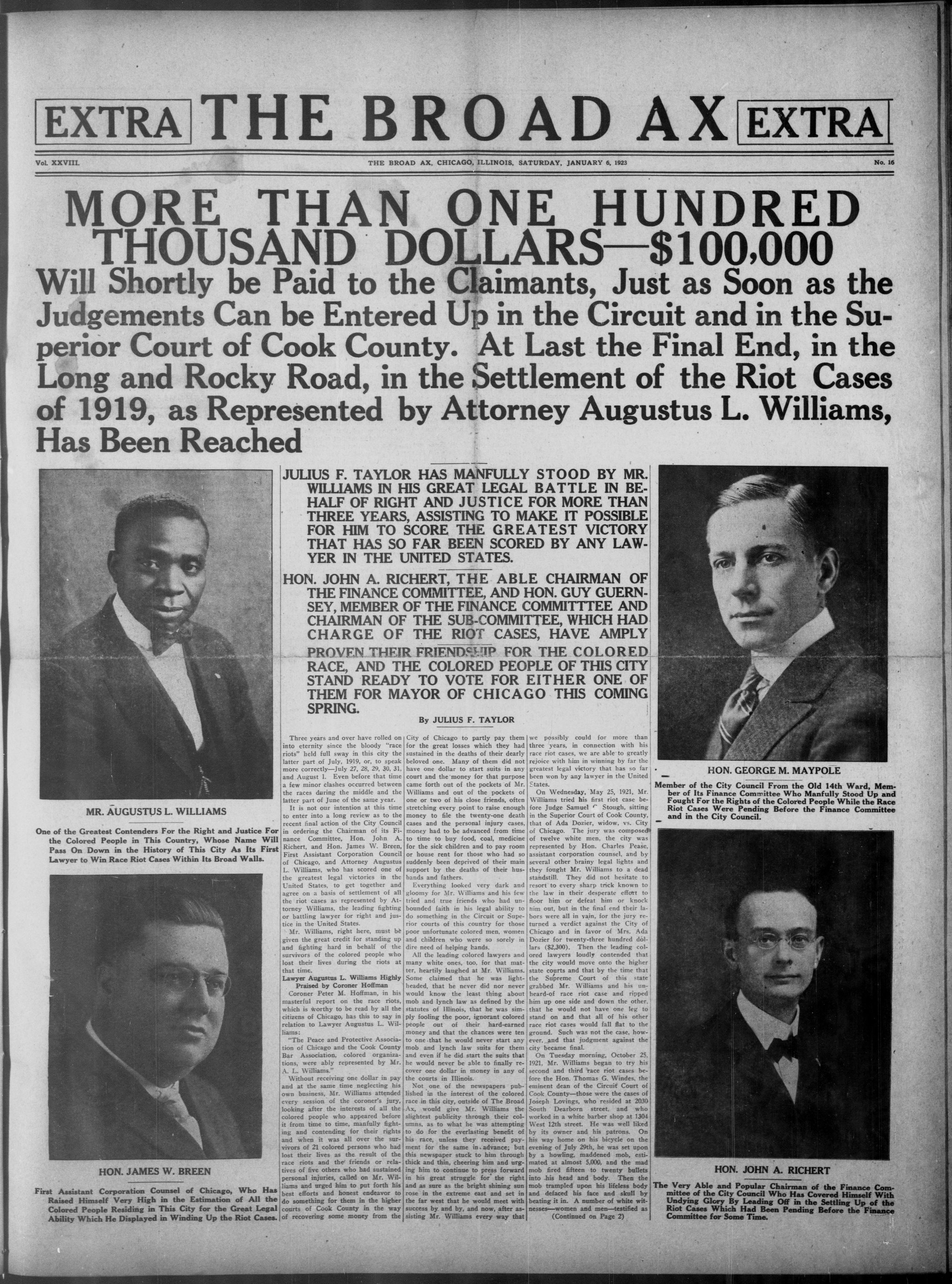
MORE THAN ONE HUNDRED THOUSAND DOLLARS—$100,000 Will Shortly be Paid to the Claimants, Just as Soon as the Judgements Can be Entered Up in the Circuit and in the Superior Court of Cook County. At Last the Final End, in the Long and Rocky Road, in the Settlement of the Riot Cases of 1919, as Represented by Attorney Augustus L. Williams, Has Been Reached
A. E.
MR. AUGUSTUS L. WILLIAMS
Greatest Contenders For the Right and
Red People in This Country, Whose
Down in the History of This City
To Win Race Riot Cases Within Its Bro
One of the Greatest Contenders For the Right and Justice For the Colored People in This Country, Whose Name Will Pass On Down in the History of This City As Its First Lawyer to Win Race Riot Cases Within Its Broad Walls.
[Name]
HON. JAMES W. BREEN
Int Corporation Counsel of Chicago
himself Very High in the Estimation
People Residing in This City for the
Which He Displayed in Winding Up th
First Assistant Corporation Counsel of Chicago, Who Has Raised Himself Very High in the Estimation of All the Colored People Residing in This City for the Great Legal Ability Which He Displayed in Winding Up the Riot Cases.
THE BROAD AX, CHICAGO, ILLINOIS, SATURDAY, JANUARY 6, 1923
JULIUS F. TAYLOR HAS MANFULLY STOOD BY MR. WILLIAMS IN HIS GREAT LEGAL BATTLE IN BEHALF OF RIGHT AND JUSTICE FOR MORE THAN THREE YEARS, ASSISTING TO MAKE IT POSSIBLE FOR HIM TO SCORE THE GREATEST VICTORY THAT HAS SO FAR BEEN SCORED BY ANY LAWYER IN THE UNITED STATES.
HON. JOHN A. RICHERT, THE ABLE CHAIRMAN OF THE FINANCE COMMITTEE, AND HON. GUY GUERNSEY, MEMBER OF THE FINANCE COMMITTTEE AND CHAIRMAN OF THE SUB-COMMITTEE, WHICH HAD CHARGE OF THE RIOT CASES, HAVE AMPLY PROVEN THEIR FRIENDSHIP FOR THE COLORED RACE, AND THE COLORED PEOPLE OF THIS CITY STAND READY TO VOTE FOR EITHER ONE OF THEM FOR MAYOR OF CHICAGO THIS COMING SPRING.
Three years and over have rolled on into eternity since the bloody "race riots" held full sway in this city the latter part of July, 1919, or, to speak more correctly—July 27, 28, 29, 30, 31, and August 1. Even before that time a few minor clashes occurred between the races during the middle and the latter part of June of the same year.
It is not our intention at this time to enter into a long review as to the recent final action of the City Council in ordering the Chairman of its Finance Committee, Hon. John A. Richert, and Hon. James W. Breen, First Assistant Corporation Council of Chicago, and Attorney Augustus L. Williams, who has scored one of the greatest legal victories in the United States, to get together and agree on a basis of settlement of all the riot cases as represented by Attorney Williams, the leading fighting or battling lawyer for right and justice in the United States.
Mr. Williams, right here, must be given the great credit for standing up and fighting hard in behalf of the survivors of the colored people who lost their lives during the riots at that time.
Lawyer Augustus L. Williams Highly
Bachelor of Science, Hoffman
Praised by Coroner Hoffman
Coroner Peter M. Hoffman, in his
masterful report on the race riots,
which is worthy to be read by all the
citizens of Chicago, has this to say in
relation to Lawyer Augustus L. Williams:
"The Peace and Protective Association
of Chicago and the Cook County
Bar Association, colored organizations,
were ably represented by Mr.
A. L. Williams."
Without receiving one dollar in pay
and at the same time neglecting his
own business, Mr. Williams attended
every session of the coroner's jury,
looking after the interests of all the
colored people who appeared before
it from time to time, manfully fighting
and contending for their rights
and when it was all over the survivors of 21 colored persons who had lost their lives as the result of the race riots and the friends or relatives of five others who had sustained
personal injuries, called on Mr. Williams and urged him to put forth his best efforts and honest endeavor to do something for them in the higher courts of Cook County in the way of recovering some money from the
By JULIUS F. TAYLOR
City of Chicago to partly pay them for the great losses which they had sustained in the deaths of their dearly beloved one. Many of them did not have one dollar to start suits in any court and the money for that purpose came forth out of the pockets of Mr. Williams and out of the pockets of one or two of his close friends, often stretching every point to raise enough money to file the twenty-one death cases and the personal injury cases, money had to be advanced from time to time to buy food, coal, medicine for the sick children and to pay room or house rent for those who had so suddenly been deprived of their main support by the deaths of their husbands and fathers.
Everything looked very dark and gloomy for Mr. Williams and his few tried and true friends who had unbounded faith in his legal ability to do something in the Circuit or Superior courts of this country for those poor unfortunate colored men, women and children who were so sorely in dire need of helping hands.
All the leading colored lawyers and many white ones, too, for that matter, heartily laughed at Mr. Williams. Some claimed that he was light-headed, that he never did nor never would know the least thing about mob and lynch law as defined by the statutes of Illinois, that he was simply fooling the poor, ignorant colored people out of their hard-earned money and that the chances were ten to one that he would never start any mob and lynch law suits for them and even if he did start the suits that he would never be able to finally recover one dollar in money in any of the courts in Illinois.
Not one of the newspapers published in the interest of the colored race in this city, outside of The Broad Ax, would give Mr. Williams the slightest publicity through their columns, as to what he was attempting to do for the everlasting benefit of his race, unless they received payment for the same in advance; but this newspaper stuck to him through thick and thin, cheering him and urging him to continue to press forward in his great struggle for the right and as sure as the bright shining sun in the extreme east and set in the far west that he would meet with success by and by, and now, after assisting Mr. Williams every way that
we possibly could for more than three years, in connection with his race riot cases, we are able to greatly rejoice with him in winning by far the greatest legal victory that has so far been won by any lawyer in the United States.
On Wednesday, May 25, 1921, Mr. Williams tried his first riot case before Judge Samuel C Stough, sitting in the Superior Court of Cook County, that of Ada Dozier, widow, vs. City of Chicago. The jury was composed of twelve white men, the city was represented by Hon. Charles Pease, assistant corporation counsel, and by several other brainy legal lights and they fought Mr. Williams to a dead standstill. They did not hesitate to resort to every sharp trick known to the law in their desperate effort to floor him or defeat him or knock him out, but in the final end their labors were in all vain, for the jury returned a verdict against the City of Chicago and in favor of Mrs. Ada Dozier for twenty-three hundred dollars ($2,300). Then the leading colored lawyers loudly contended that the city would move onto the higher state courts and that by the time that the Supreme Court of this state grabbed Mr. Williams and his unheard-of race riot case and ripped him up one side and down the other, that he would not have one leg to stand on and that all of his other race riot cases would fall flat to the ground. Such was not the case, however, and that judgment against the city became final.
On Tuesday morning, October 25, 1921, Mr. Williams began to try his second and third race riot cases before the Hon. Thomas G. Windes, the eminent dean of the Circuit Court of Cook County—those were the cases of Joseph Lovings, who resided at 2030 South Dearborn street, and who worked in a white barber shop at 1304 West 12th street. He was well liked by its owner and his patrons. On his way home on his bicycle on the evening of July 29th, he was set upon by a howling, maddened mob, estimated at almost 5,000, and the mad mob fired fifteen to twenty bullets into his head and body. Then the mob trampled upon his lifeless body and defaced his face and skull by beating it in. A number of white witnesses—women and men—testified as (Continued on Page 2)
HON. GEORGE M. MAYPOLE
The City Council From the Old 14th Finance Committee Who Manfully Were the Rights of the Colored People Who Were Pending Before the Finance Committee City Council.
Member of the City Council From the Old 14th Ward, Member of Its Finance Committee Who Manfully Stood Up and Fought For the Rights of the Colored People While the Race Riot Cases Were Pending Before the Finance Committee and in the City Council.
[Name]
HON. JOHN A. RICHERT
Bible and Popular Chairman of the B
the City Council Who Has Covered
Glory By Leading Off in the Settle
s Which Had Been Pending Before
e for Some Time.
The Very Able and Popular Chairman of the Finance Committee of the City Council Who Has Covered Himself With Undying Glory By Leading Off in the Settling Up of the Riot Cases Which Had Been Pending Before the Finance Committee for Some Time.
The Very Able and Popular Chairman of the Finance Committee of the City Council Who Has Covered Himself With Undying Glory By Leading Off in the Settling Up of the Riot Cases Which Had Been Pending Before the Finance Committee for Some Time.
THE BROAD AX
Published Every Saturday
In this city since July 15th, 1899, without missing one single issue. Republicans, Democrats, Catholics, Protestants, Single Taxers, Priests, infidels or anyone else can have their say as long as their language is proper and responsibility is fixed.
The Broad Ax is a newspaper whose platform is broad enough for all, ever claiming the editorial right to speak its own mind.
Local communications will receive attention. Write only on one side of the paper.
Subscriptions must be paid in advance.
Advertising rates made known on application.
Address all communication to ...
THE BROAD AX
So. Elizabeth St., Chicago, Ill.
Phone Wentworth 2597
JULIUS F. TAYLOR
Editor and Publisher
Associate Editor
DR. M. A. MAJORS
January 6, 1923
Vol. XXVIII No. 16
Entered as Second-Class Matter, Aug.
19, 1922, at the Post Office at Chicago,
III Under Act of March 8, 1879.
MANY BEAUTIFUL CHRISTMAS
AND NEW YEAR'S CARDS
AND OTHER PRESENTS RECEIVED BY MR. AND MRS.
JULIUS F. TAYLOR
The following persons sent lovely
Christmas and New Year's cards to
Mr. and Mrs. Julius F. Taylor:
Prof. and Mrs. Robert R. Moton, Tuskegee Institute, Ala.; Dr. and Mrs. William H. Wallace, Salisbury, N. C.; Dr. Adena C. E. Minott, New York City, N. Y.; Mr. and Mrs. Clarence E. Corbin; Madam Bertha L. Hensely, Mr. and Mrs. George Chapman, Miss Freddie Bass, Mr. and Mrs. H. A. Watkins, Prof. and Dr. William Emanuel, Hon. Benjamin M. Mitchell, member of the Legislature of Illinois, from the 21st Senatorial District; Alderman and Mrs. Louis B. Anderson, Dr. and Mrs. W. H. Davis, Mr. and Mrs. John B. Hart, Hon. and Mrs. Joseph F. Haas, Dr. and Mrs. Harry W. Garnes, Mr. and Mrs. Morris Lewis and family, Mr. and Mrs. W. H. Montgomery, Mr. and Mrs. Stephen Wooten, Miss Beatrice E. Lee, Mr. and Mrs. Sandy W. Trice, Mr. and Mrs. David M. Manson, Mr. John F. Adams, chairman of the Republican National Committee, Washington, D. C.; Mrs. Rosalind Beach, Albany, Ga.
As stated before, the writer and Mrs. Taylor desire to express their greatfulness to their numerous friends who remembered them so generously during the holiday season.
A BEAUTIFUL LARGE SIZED RED CHRISTMAS CARD
The Craftsmen Typesetters and Printers, Inc., 701 S. La Salle Street sent out to its many patrons and well wishers an elegant or classical large red Christmas card, decorated with a large winter scene, done in delicate pastel colors and tied with a bow of white satin ribbon, with the season's greetings, "Best Wishes."
92 77
HON. JOSEPH O. KOSTNER
Democratic Member of the City Council From Ward, Member of its Finance Committee, W. One of Its Recent Sessions That a Sub-Comm Body Be Appointed to Clean Up the Riot Cace
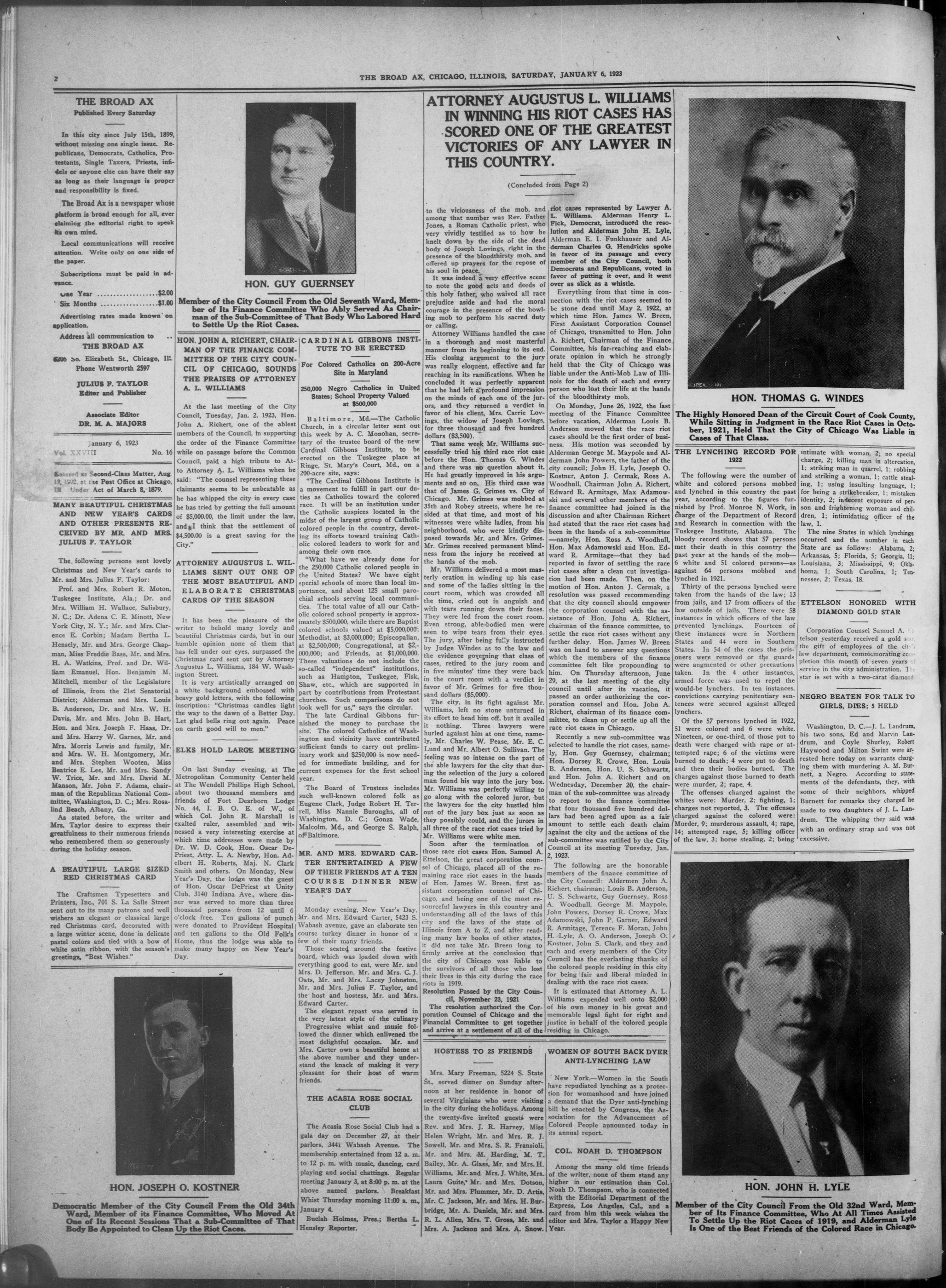
Democratic Member of the City Council From the Old 34th Ward, Member of its Finance Committee, Who Moved At One of Its Recent Sessions That a Sub-Committee of That Body Be Appointed to Clean Up the Riot Caces.
Member of the City Council From the Old Seventh Ward, Member of Its Finance Committee Who Ably Served As Chairman of the Sub-Committee of That Body Who Labored Hard to Settle Up the Riot Cases.
HON. JOHN A. RICHERT, CHAIRMAN OF THE FINANCE COMMITTEE OF THE CITY COUNCIL OF CHICAGO, SOUNDS THE PRAISES OF ATTORNEY A. L. WILLIAMS
CARDINAL GIBBONS, INSTITUTE TO BE ERECTED
For Colored Catholics on 200-Acre Site in Maryland
250,000 Negro Catholics in United
At the last meeting of the City Council, Tuesday, Jan. 2, 1923, Hon. John A. Richert, one of the ablest members of the Council, in supporting the order of the Finance Committee while on passage before the Common Council, paid a high tribute to Atto Attorney A. L. Williams when he said: "The counsel representing these claimants seems to be unbeatable as he has whipped the city in every case he has tried by getting the full amount of $5,000.00, the limit under the law, and I think that the settlement of $4,500.00 is a great saving for the City."
ATTORNEY AUGUSTUS L. WILLIAMS SENT OUT ONE OF THE MOST BEAUTIFUL AND ELABORATE CHRISTMAS CARDS OF THE SEASON
It has been the pleasure of the writer to behold many lovely and beautiful Christmas cards, but in our humble opinion none of them that has fell under our eyes, surpassed the Christmas card sent out by Attorney Augustus L. Williams, 184 W. Washington Street. It is very artistically arranged on a white background embossed with heavy gold letters, with the following inscription: "Christmas candles light the way to the dawn of a Better Day. Let glad bells ring out again. Peace on earth good will to men."
ELKS HOLD LARGE MEETING
On last Sunday evening, at The Metropolitan Community Center held at The Wendell Phillips High School about two thousand members and friends of Fort Dearborn Born No. 44, I. B. O. E. of W., of which Col. John R. Marshall is exalted ruler, assembled and witnessed a very interesting exercise at which time addresses were made by Dr. W. D. Cook, Hon. Oscar DePriest, Atty. L. A. Newby, Hon. Adelbert H. Roberts, Maj. N. Clark Smith and others. On Monday, New Year's Day, the lodge was the guest of Hon. Oscar DePriest at Unity Club, 3140 Indiana Ave., where dinner was served to more than three thousand persons from 12 until 6 o'clock free. Ten gallons of punch were donated to Provident Hospital and ten gallons to the Old Folk's Home, thus the lodge was able to make many happy on New Year's Day.
C. E. F. - 1917
HON. GUY GUERNSEY
CARDINAL GIBBONS INSTITUTE TO BE ERECTED
For Colored Catholics on 200-Acre Site in Maryland
250,000 Negro Catholics in United States; School Property Valued at $500,000
Baltimore, Md.-The Catholic Church, in a circular letter sent out this week by A. C. Monohan, secretary of the trustee board of the new Cardinal Gibbons Institute, to be erected on the Tuskegee place at Ringe, St. Mary's Court, Md., on a 200-acre site, says:
"The Cardinal Gibbons Institute is a movement to fulfill in part our duties as Catholics toward the colored race. It will be an institution under the Catholic auspices located in the midst of the largest group of Catholic colored people in the country, devoting its efforts toward training Catholic colored leaders to work for and among their own race.
"What have we already done for the 250,000 Catholic colored people in the United States? We have eight special schools of more than local importance, and about 125 small parochial schools serving local communities. The total value of all our Catholic colored school property is approximately $500,000, while there are Baptist colored schools valued at $5,000,000; Methodist, at $3,000,000; Episcopalian at $2,500,000; Congregational, at $2,000,000; and Friends, at $1,000,000. These valuations do not include the so-called "independent" institutions, such as Hampton, Tuskegee, Fisk Shaw, etc., which are supported in part by contributions from Protestant churches. Such comparisons do not look well for us," says the circular.
The late Cardinal Gibbons furnished the money to purchase the site. The colored Catholics of Washington and vicinity have contributed sufficient funds to carry out preliminary work and $250,000 is now needed for immediate building, and for current expenses for the first school year.
The Board of Trustees includes such well-known colored folk as Eugene Clark, Judge Robert H. Terrell, Miss Nannie Buroughs, all of Washington, D. C.; Gonza Wade, Malcolm, Md., and George S. Ralph, or Baltimore.
MR. AND MRS. EDWARD CARTER ENTERTAINED A FEW OF THEIR FRIENDS AT A TEN COURSE DINNER NEW YEAR'S DAY
Monday evening, New Year's Day. Mr. and Mrs. Edward Carter, 5423 S. Wabash avenue, gave an elaborate ten course turkey dinner in honor of a few of their many friends.
Those seated around the festive board, which was loaded down with everything good to eat, were Mr. and Mrs. D. Jefferson, Mr. and Mrs. C. J. Oats, Mr. and Mrs. Lacey Johnston, Mr. and Mrs. Julius F. Taylor, and the host and hostess, Mr. and Mrs. Edward Carter.
The elegant repast was served in the very latest style of the culinary Progressive whist and music followed the dinner which enlivened the most delightful occasion. Mr. and Mrs. Carter own a beautiful home at the above number and they understand the knack of making it very pleasant for their host of warm friends.
THE ACASIA ROSE SOCIAL
CLUB
The Acasia Rose Social Club had a gala day on December 27, at their parlors, 3441 Wabash Avenue. The membership entertained from 12 a.m. to 12 p. m. with music, dancing, card playing and social chattings. Regular meeting January 3, at 8:00 p. m. at the above named parlors. Breakfast Whist Thursday morning 11:00 a.m. January 4.
Buelah Holmes, Pres.; Bertha L. Hensley Reporter.
THE BROAD AX, CHICAGO, ILLINOIS, SATURDAY, JANUARY 6, 1923
ATTORNEY AUGUSTUS L. WILLIAMS IN WINNING HIS RIOT CASES HAS SCORED ONE OF THE GREATEST VICTORIES OF ANY LAWYER IN THIS COUNTRY.
(Concluded from Page 2)
to the viciousness of the mob, and among that number was Rev. Father Jones, a Roman Catholic priest, who very vividly testified as to how he knelt down by the side of the dead body of Joseph Lovings, right in the presence of the bloodthirsty mob, and offered up prayers for the repose of his soul in peace.
It was indeed a very effective scene to note the good acts and deeds of this holy father, who waived all race prejudice aside and had the moral courage in the presence of the howling mob to perform his sacred duty or calling.
Attorney Williams handled the case in a thorough and most masterful manner from its beginning to its end. His closing argument to the jury was really eloquent, effective and far reaching in its ramifications. When he concluded it was perfectly apparent that he had left a profound impression on the minds of each one of the jurors, and they returned a verdict in favor of his client, Mrs. Carrie Lovings, the widow of Joseph Lovings, for three thousand and five hundred dollars ($3,500).
That same week Mr. Williams successfully tried his third race riot case before the Hon. Thomas G. Winder and there was no question about it. He had greatly improved in his arguments and so on. His third case was that of James G. Grimes vs. City of Chicago. Mr. Grimes was mobbed at 35th and Robey streets, where he resided at that time, and most of his witnesses were white ladies, from his neighborhood, who were kindly disposed towards Mr. and Mrs. Grimes. Mr. Grimes received permanent blindness from the injury he received at the hands of the mob.
Mr. Williams delivered a most mastersy oration in winding up his case and some of the ladies sitting in the court room, which was crowded all the time, cried out in anguish and with tears running down their faces. They were led from the court room. Even strong, able-bodied men were seen to wipe tears from their eyes. The jury, after being fully instructed by Judge Winds as to the law and the evidence governing that class of cases, retired to the jury room and in five minutes' time they were back in the court room with a verdict in favor of Mr. Grimes for five thousand dollars ($5,000).
The city, in its fight against Mr. Williams, left no stone unturned in its effort to head him off, but it availed it nothing. Three lawyers were hurled against him at one time, namely, Mr. Charles W. Pease, Mr. E. C. Lund and Mr. Albert O. Sullivan. The feeling was so intense on the part of the able lawyers for the city that during the selection of the jury a colored man found his way into the jury box. Mr. Williams was perfectly willing to go along with the colored juror, but the lawyers for the city hustled him out of the jury box just as soon as they possibly could, and the jurors in all three of the race riot cases tried by Mr. Williams were white men.
Soon after the termination of those race riot cases Hon. Samuel A. Ettelson, the great corporation counsel of Chicago, placed all of the remaining race riot cases in the hands of Hon. James W. Breen, first assistant corporation counsel of Chicago, and being one of the most resourceful lawyers in this country and understanding all of the laws of this city and the laws of the state of Illinois from A to Z, and after reading many law books of other states, it did not take Mr. Breen long to firmly arrive at the conclusion that the city of Chicago was liable to the survivors of all those who lost their lives in this city during the race riots in 1919.
Resolution Passed by the City Council, November 23, 1921 The resolution authorized the Corporation Counsel of Chicago and the Financial Committee to get together and arrive at a settlement of all of the
HOSTESS TO 25 FRIENDS
Mrs. Mary Freeman, 5224 S. State St., served dinner on Sunday afternoon at her residence in honor of several Virginians who were visiting in the city during the holidays. Among the twenty-five invited guests were Rev. and Mrs. J. R. Harvey, Miss Helen Wright, Mr. and Mrs. R. J. Sowell, Mr. and Mrs. S. R. Fransioli, Mr. and Mrs. M. Harding, M. T. Bailey, Mr. A. Glass, Mr. and Mrs. H. Williams, Mr. and Mrs. J. White, Mrs. Laura Guite,* Mr. and Mrs. Dotson, Mr. and Mrs. Plummer, M. D. Artis, Mr. C. Jackson, Mr. and Mrs. H. Burbridge, Mr. A. Daniels, Mr. and Mrs. R. L. Allen, Mrs. T. Gross, Mr. and Mrs. A. Jackson and Mrs. A. Snow.
riot cases represented by Lawyer A. L. Williams, Alderman Henry L. Fick, Democrat, introduced the resolution and Alderman John H. Lyle, Alderman E. I. Funkhauser and Alderman Charles G. Hendricks spoke in favor of its passage and every member of the City Council, both Democrats and Republicans, voted in favor of putting it over, and it went over as slick as a whistle.
Everything from that time in connection with the riot cases seemed to be stone dead until May 2, 1922, at which time Hon. James W. Breen, First Assistant Corporation Counsel of Chicago, transmitted to Hon. John A. Richert, Chairman of the Finance Committee, his far-reaching and elaborate opinion in which he strongly held that the City of Chicago was liable under the Anti-Mob Law of Illinois for the death of each and every person who lost their life at the hands of the bloodthirsty mob.
On Monday, June 26, 1922, the last meeting of the Finance Committee before vacation, Alderman Louis B. Anderson moved that the race riot cases should be the first order of business. His motion was seconded by Alderman George M. Maypole and Alderman John Powers, the father of the city council; John H. Lyle, Joseph O. Kostner, Anton J. Cermak, John A. Woodhull, Chairman John A. Richert, Edward R. Armitage, Max Adamowski and several other members of the finance committee had joined in the discussion and after Chairman Richert had stated that the race riot cases had been in the hands of a sub-committee—namely, Hon. Ross A. Woodhull, Hon. Max Adamowski and Hon. Edward R. Armitage—that they had reported in favor of settling the race riot cases after a clean cut investigation had been made. Then, on the motion of Hon. Anton J. Cermak, a resolution was passed recommending that the city council should empower the corporation counsel with the assistance of Hon. John A. Richert, chairman of the finance committee, to settle the race riot cases without any further delay. Hon. James W. Breen was on hand to answer any questions which the members of the finance committee felt like propounding to him. On Thursday afternoon, June 29, at the last meeting of the city council until after its vacation, it passed an order authorizing the corporation counsel and Hon. John A. Richert, chairman of its finance committee, to clean up or settle up all the race riot cases in Chicago.
Recently a new sub-committee was selected to handle the riot cases, namely, Hon. Guy Guernsey, chairman; Hon. Dorsey R. Crowe, Hon. Louis B. Anderson, Hon. U. S. Schwartz, and Hon. John A. Richert and on Wednesday, December 20, the chairman of the sub-committee was already to report to the finance committee that four thousand five hundred dollars had been agreed upon as a fair amount to settle each death claim against the city and the actions of the sub-committee was ratified by the City Council at its meeting Tuesday, Jan. 2, 1923.
The following are the honorable members of the finance committee of the City Council: Aldermen John A. Richert, chairman; Louis B. Anderson, U. S. Schwartz, Guy Guernsey, Ross A. Woodhull, George M. Maypole, John Powers, Dorsey R. Crowe, Max Adamowski, John P. Garner, Edward R. Armigate, Terence F. Moran, John H. Lyle, A. O. Anderson, Joseph O. Kostner, John S. Clark, and they each and every member of the City Council has the everlasting thanks of the colored people residing in this city for being fair and liberal minded in dealing with the race riot cases.
It is estimated that Attorney A. L. Williams expended well onto $2,000 of his own money in his great and memorable legal fight for right and justice in behalf of the colored people residing in Chicago.
WOMEN OF SOUTH BACK DYER
ANTI-LYNCHING LAW
New York—Women in the South have repudiated lynching as a protection for womanhood and have joined a demand that the Dyer anti-lynching bill be enacted by Congress, the Association for the Advancement of Colored People announced today in its annual report.
COL. NOAH D. THOMPSON
Among the many old time friends of the writer, none of them stand any higher in our estimation than Col. Noah D. Thompson, who is connected with the Editorial Department of the Express, Los Angeles, Cal., and a card from him this week wishes the editor and Mrs. Taylor a Happy New Year.
1PEU 101
HON. THOMAS G. WINDES
The Highly Honored Dean of the Circuit Court of While Sitting in Judgment in the Race Riot ber, 1921, Held That the City of Chicago Cases of That Class.
The Highly Honored Dean of the Circuit Court of Cook County, While Sitting in Judgment in the Race Riot Cases in October, 1921, Held That the City of Chicago Was Liable in Cases of That Class.
THE LYNCHING RECORD FOR
1922
The following were the number of white and colored persons mobbed and lynched in this country the past year, according to the figures furnished by Prof. Monroe N. Work, in charge of the Department of Record and Research in connection with the Tuskegee Institute, Alabama. The bloody record shows that 57 persons met their death in this country the past year at the hands of the mob—6 white and 51 colored persons—as against 64 persons mobbed and lynched in 1921.
Thirty of the persons lynched were taken from the hands of the law; 13 from jails, and 17 from officers of the law outside of jails. There were 58 instances in which officers of the law prevented lynchings. Fourteen of these instances were in Northern States and 44 were in Southern States. In 54 of the cases the prisoners were removed or the guards were augmented or other precautions taken. In the 4 other instances, armed force was used to repel the would-be lynchers. In ten instances, convictions carrying penitentiary sentences were secured against alleged lynchers.
Of the 57 persons lynched in 1922, 51 were colored and 6 were white, Nineteen, or one-third, of those put to death were charged with rape or attempted rape; 6 of the victims were burned to death; 4 were put to death and then their bodies burned. The charges against those burned to death were murder, 2; rape, 4. The offenses charged against the whites were: Murder, 2; fighting, 1; charges not reported, 3. The offenses charged against the colored were: Murder, 9; murderous assault, 4; rape, 14; attempted rape, 5; killing officer of the law, 3; horse stealing, 2; being
1920
[Name]
HON. JOHN H. LYLE
Member of the City Council Fri
ber of Its Finance Committe
To Settle Up the Riot Cacoe
Is One of the Best Friends
Member of the City Council From the Old 32nd Ward, Member of Its Finance Committee, Who At All Times Assisted To Settle Up the Riot Caces of 1919, and Alderman Lyle Is One of the Best Friends of the Colored Race in Chicago.
Member of the City Council From the Old 32nd Ward, Member of Its Finance Committee, Who At All Times Assisted To Settle Up the Riot Caces of 1919, and Alderman Lyle Is One of the Best Friends of the Colored Race in Chicago.
intimate with woman, 2; no special charge, 2; killing man in altercation, 1; striking man in quarrel, 1; robbing and striking a woman, 1; cattle stealing, 1; using insulting language, 1; for being a strikebreaker, 1; mistaken identity, 2; indecent exposure of person and frightening woman and children, 1; intimidating officer of the law, 1.
The nine States in which lynchings occurred and the number in each State are as follows: Alabama, 2; Arkansas, 5; Florida, 5; Georgia, 11; Louisiana, 3; Mississippi, 9; Oklahoma, 1; South Carolina, 1; Tennessee, 2; Texas, 18.
ETTELSON HONORED WITH
DIAMOND GOLD STAR
Corporation Counsel Samuel A. telson yesterday received a gold star the gift of employees of the city law department, commemorating completion this month of seven years of service in the city administration. The star is set with a two-carat diamond
NEGRO BEATEN FOR TALK TO
GIRLS. DIES: 5 HELD
Washington, D. C.-J. L. Landrum, his two sons, Ed and Marvin Landrum, and Coyle Shurley, Robert Haywood and Milton Swint were arrested here today on warrants charging them with murdering A. M. Burnett, a Negro. According to statements of the defendants, they, with some of their neighbors, whipped Burnett for remarks they charged he made to two daughters of J. L. Landrum. The whipping they said was with an ordinary strap and was not excessive.
1930
from the Old 32nd Ward, Mema-tee, Who At All Times Assisted as of 1919, and Alderman Lyle of the Colored Race in Chicago.
CHARLES E. STUMP, THE OLD REGULAR TRAVELING CORRESPONDENT FOR THE BROAD AX, CONTINUES TO BE HELD UP IN CHICAGO THROUGH A BAD SPELL OF SICKNESS.
I have told 1922 good-bye, and have said good morning to 1923, for it is here right now as I sit down to write this letter and to say a few things to you to inform you of my health. I am not well at present and hope when these few lines come to hand they may find you enjoying good health.
Of course you are thinking of what last year meant to you. I wonder if it brought you sunshine or sadness or both. It stepped into our flower garden and plucked a few of our choiceest flowers, and then consigned them to mother earth. This was among the unfortunate things that happened during the year. The flowers that were carried away from us had their names, but they filled important places in the flower garden.
I would not begin to name them all, but may mention a few of them. Dr. R. H. Boyd, who was known this country over because of his connection with the National Baptist Publishing Board. This country will know him. He made a place for his son, and handed it right down to Henry Allen Boyd, and then he folded his arms and went to sleep, leaving three daughters and two sons and his widow. Just as we were reading about him, then came the word that Dr. E. C. Morris, the great leader of the Baptists in American, president of the National Baptist Convention, had returned to the God who gave him to us, and his sons and daughters, together with his widow and the whole nation, were thrown into sadness. If you know anything about Elias Camp Morris, you know that he was a leader of men, and the greatest living Baptist. But he is not with us any more, for he has gone to his home, where many of us will some day join him.
Then followed the death of Dr. W. G. Parks, who was the direct successor to Morris, and followed him soon to his home. He was another great flower, but he has gone away from us, and then that great musician, the songbird, Mrs. E. Azelia Hackley, who also has joined the heavenly choir, and I am sure that she made a splendid addition to heaven. She was among the best in America, and I am saying nothing about race or color. But we shall miss her with others.
There is S. Laing Williams, a young man, who made his way up. Attorney Williams worked in the pension office in Washington for a long time, and resigned, came to Chicago, and became a law partner to F. L. Barnett, the firm was known as Barnett and Williams. I do not know how many years they were together, but I do know that they separated, and Williams received an appointment from the President of the United States as an attorney for the government. But he has cashed in and is no longer with us. His widow is one of the best writers of this age, and I am proud of some of the work she has done.
The old landmarks are passing out. I would just like to go back and talk to you about a few of them, commencing with John Q. Grant, Lloyd G. Wheeler, John Jones, John G. Jones, D. W. Dempsey, Solomon Taylor, Blakemore, Grant, Bryant, and a host of others.
Chicago is filled with interesting events, if I could only go back and talk about a few of them. If I could talk about the days when Charles Winter Wood used to play Shakespeare, and that would bring up I. P. Hale, Ada O. Brown, McDowell, and a host of others.
But, friends, we have all stepped over into 1923, and no doubt we have turned over another leaf and started to write on it. We may not be able to fill the page, for death is so certain and life is so insecure. One by one we are stepping out. But we are not to stop because we are born to die, but we must just work as if we were to remain here a thousand years and knew it, and then leave the rest with God. We plan to live now and hereafter. There is a rule for the hereafter and if we are only shrewd enough to follow that rule, then the future will be all right. We do not need to leave off any sleep on account of it.
Some of us have been made to cry, some to cuss and some to pray. I belong to the praying crowd myself, and I am sure that you knew that. I am some praying man. I like to have said that I was a praying baby, but I am not a baby now, but a full-grown
man. But size has nothing to do with a man.
The devil has been getting in his work, and hell has had its sway right here on earth and in some parts of our country. I think it is a heluva mess when a man without trial, without judge or jury, is put to death without a trial, and some are only suspects.
It was a big mistake when the United States Senate refused to pass a law that meant the protection of human life—one aimed to put an end to lynching, and let every offender of the law be punished by it. The republicans were in majority, but the democrats would not let it pass, and I am told that someone said that the republican senators were a lot of cowards. Whether or not this is true I will leave it up to you. But in my opinion President Harding is a good man, but he doesn't measure up to the standard of a statesman and president of all the nations. Is he another like Taft? I ask the question without comment.
As I told you we are facing the future and, honey, put it down that I told you so, that the republicans will have to do some hustling, some real manhood acts, between this and next year, or they will lose out—it matters not whom they nominate. You will never be able to look in my face and tell how I am going to vote in 1924. I am doing some thinking now. Of course you will recall that we are to elect a mayor this year. I am proud of the one we have now. He is just man enough and broad enough to be mayor of all the people and not a favorite few. I am proud to claim him for mine, and if he runs, he can put it down and put it down hard at that that he will have my vote and some of my friends. He is a great man.
There has been some real work done among the churches. We have purchased or contracted for some real good churches from the white folks and, believe me, we are going to church in style now. Go by the other churches and you will find their automobile car carriages in front, and you will pass our churches and see ours, too—from a tin lizard to the Locomobile, the Pierce Arrow, Cadillac and other high class grades.
We are just increasing in business enterprises, and Dr. George Cleveland Hall, that great physician and surgeon, has been working like a trojan to keep me down here in this world of sorrow. It was thought that I would pass out with a bad head of mine, but I am getting to be normal again.
The National Baptist Convention has met, and elected Dr. L. K. Williams, president, but I started out to tell you that Dr. L. K. Williams is putting forth a great program for the betterment of the church. He is going to get the Baptists to do some real work. The department secretaries will meet in Chicago, January 10, and then you will hear from the work. They are just now making plans for big things. I have made some revolutions, or whatever you call them—good things you make when a new year comes in. I am going to be busy all the time, and therefore my brains will not be the devil's workshop. I am going to do right and serve God, and not a cuss word am I going to use.
I have been to call on Dr. R. A. Williams, of the Royal Circle of Friends, and believe me when I tell you there is going to be some big doings in that order, which I will tell you about later. They believe in looking after the sick and in helping one to live. They are doing their part. Dr. R. A. Williams is one of the strong men of our race in this country, and he is a leader of men. To know him is to love him. You wait and see what I am going to say about you soon or about the Royal Circle of Friends. I am going to get acquainted with them all. Good place to prepare for the rainy days. They are bound to come in your life. They have had some big doings in Chicago in churches.
I think I will have to bring this letter to a stop. Look out for the others. I am here being treated by Dr. G. C. Hall, and I am not going to leave until he tells me that he has gotten rid of the bugs which have been trying to make worm food out of me.
You may reach me at 5922 Aberdeen street, Chicago.
CHAS. E. STUMP.
THE BROAD AX, CHICAGO, ILLINOIS, SATURDAY, JANUARY 6, 1923
[Name]
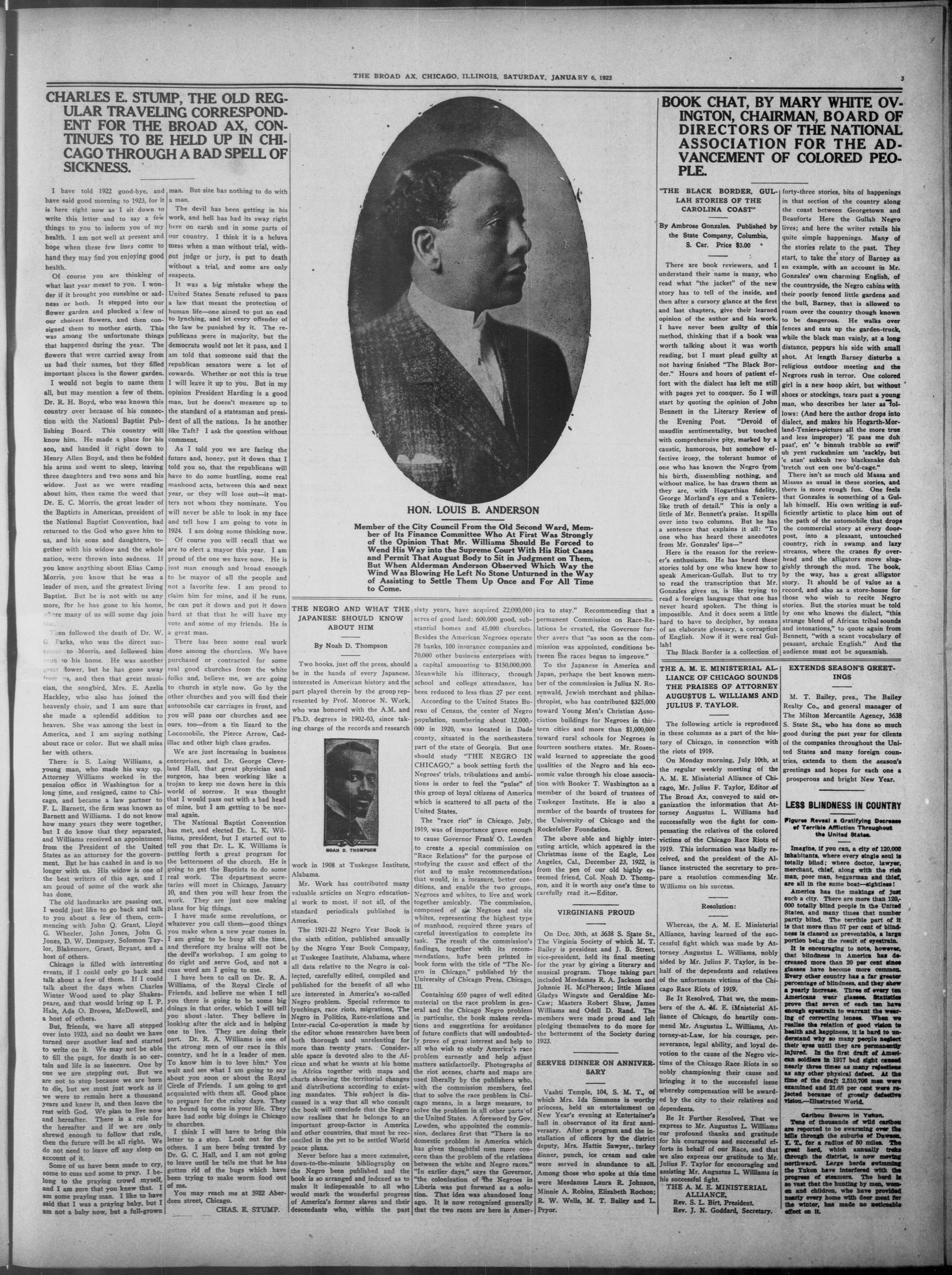
Member of the City Council From the Old Second Ward, Member of Its Finance Committee Who At First Was Strongly of the Opinion That Mr. Williams Should Be Forced to Wend His Way into the Supreme Court With His Riot Cases and Permit That August Body to Sit in Judgment on Them, But When Alderman Anderson Observed Which Way the Wind Was Blowing He Left No Stone Unturned in the Way of Assisting to Settle Them Up Once and For All Time to Come.
THE NEGRO AND WHAT THE JAPANESE SHOULD KNOW ABOUT HIM
By Noah D. Thompson
Two books, just off the press, should be in the hands of every Japanese, interested in American history and the part played therein by the group represented by Prof. Monroe N. Work who was honored with the A.M. and Ph.D. degrees in 1902-03, since taking charge of the records and research
HOLM O. ZUHNBERG
MOAH D. THOMPSON
work in 1908 at Tuskegee Institute,
Alabama.
Mr. Work has contributed many
valuable articles on Negro educational
work to most, if not all, of the
standard periodicals published in
America.
The 1921-22 Negro Year Book is the sixth edition, published annually by the Negro Year Book Company, at Tuskegee Institute, Alabama, where all data relative to the Negro is collected, carefully edited, compiled and published for the benefit of all who are interested in America's so-called Negro problem. Special reference to lynchings, race riots, migrations, The Negro in Politics, Race-relations and Inter-racial Co-operation is made by the editor whose researches have been both thorough and unrelenting for more than twenty years. Considerable space is devoted also to the African and what he wants at his home in Africa together with maps and charts showing the territorial changes and distributions according to existing mandates. This subject is discussed in a way that all who consult the book will conclude that the Negro now realizes that he belongs to an important group-factor in America and other countries, that must be reconciled in the yet to be settled World peace plans.
Never before has a more extensive, down-to-the-minute bibliography on the Negro been published and the book is so arranged and indexed as to make it indispensable to all who would mark the wonderful progress of America's former slaves and their descendants who, within the past
HON. LOUIS B. ANDERSON
sixty years, have acquired 22,000,000 acres of good land; 600,000 good, substantial homes and 45,000 churches. Besides the American Negroes operate 78 banks, 100 insurance companies and 70,000 other business enterprises with a capital amounting to $150,000,000. Meanwhile his illiteracy, through school and college attendance, has been reduced to less than 27 per cent. According to the United States Bureau of Census, the center of Negro population, numbering about 12,000,000 in 1920, was located in Dade county, situated in the northeastern part of the state of Georgia. But one should study "THE NEGRO IN CHICAGO," a book setting forth the Negroes' trials, tribulations and ambitions in order to feel the "pulse" of this group of loyal citizens of America which is scattered to all parts of the United States.
The "race riot" in Chicago, July, 1919, was of importance grave enough to cause Governor Frank O. Lowden to create a special commission on "Race Relations" for the purpose of studying the cause and effect of the riot and to make recommendations that would, in a measure, better conditions, and enable the two groups, Negroes and whites, to live and work together amicably. The commission, composed of six Negroes and six whites, representing the highest type of manhood, required three years of careful investigation to complete its task. The result of the commission's findings, together with its recommendations, have been printed in book form with the title of "The Negro in Chicago," published by the University of Chicago Press, Chicago, III.
Containing 650 pages of well edited material on the race problem in general and the Chicago Negro problem in particular, the book makes revelations and suggestions for avoidance of future conflicts that will undoubtedly prove of great interest and help to all who wish to study America's race problem earnestly and help adjust matters satisfactorily. Photographs of the riot scenes, charts and maps are used liberally by the publishers who, with the commission members, feel that to solve the race problem in Chicago means, in a large measure, to solve the problem in all other parts of the United States. A foreword by Gov. Lowden, who appointed the commission, declares first that "There is no domestic problem in America which has given thoughtful men more concern than the problem of the relations between the white and Negro races." "In earlier days," says the Governor, "the colonization of the Negroes in Liberia was put forward as a solution. That idea was abandoned long ago. It is now recognized generally that the two races are here in Amer-
ica to stay." Recommending that a permanent Commission on Race-Relations be created, the Governor further avers that "as soon as the commission was appointed, conditions between the races began to improve." To the Japanese in America and Japan, perhaps the best known member of the commission is Julius N. Rosenwald, Jewish merchant and philanthropist, who has contributed $325,000 toward Young Men's Christian Association buildings for Negroes in thirteen cities and more than $1,000,000 toward rural schools for Negroes in fourteen southern states. Mr. Rosenwald learned to appreciate the good qualities of the Negro and his economic value through his close association with Booker T. Washington as a member of the board of trustees of Tuskegee Institute. He is also a member of the boards of trustees for the University of Chicago and the Rockefeller Foundation.
The above able and highly interesting article, which appeared in the Christmas issue of the Eagle, Los Angeles, Cal., December 23, 1922, is from the pen of our old highly esteemed friend, Col. Noah D. Thompson, and it is worth any one's time to carefully read it—Editor.
VIRGINIANS PROUD
On Dec. 30th, at 3638 S. State St., The Virginia Society of which M. T. Bailey is president and J. B. Street, vice-president, held its final meeting for the year by giving a literary and musical program. Those taking part included Mesdames R. A. Jackson and Johnnie H. McPherson; little Misses Gladys Wingate and Geraldine McCaw; Masters Robert Shaw, James Williams and Odell D. Rand. The members were made proud and left pledging themselves to do more for the betterment of the Society during 1923.
SERVES DINNER ON ANNIVER
SARY
Vashti Temple, 104, S. M. T., of which Mrs. Ida Simmons is worthy princess, held an entertainment on New Year's evening at Entertainer's hall in observance of its first anniversary. After a program and the installation of officers by the district deputy, Mrs. Hattie Sawyer, turkey dinner, punch, ice cream and cake were served in abundance to all. Among those who spoke at this time were Mesdames Laura R. Johnson, Minnie A. Robins, Elizabeth Rochon, R. W. Wells, M. T. Bailey and L. Pryor.
BOOK CHAT, BY MARY WHITE OVINGTON, CHAIRMAN, BOARD OF DIRECTORS OF THE NATIONAL ASSOCIATION FOR THE ADVANCEMENT OF COLORED PEOPLE.
"THE BLACK BORDER, GUL LAH STORIES OF THE CAROLINA COAST"
By Ambrose Gonzales. Published by the State Company, Columbia,
S. Car. Price $3.00
There are book reviewers, and I understand their name is many, who read what "the jacket" of the new story has to tell of the inside, and then after a cursory glance at the first and last chapters, give their learned opinion of the author and his work. I have never been guilty of this method, thinking that if a book was worth talking about it was worth reading, but I must plead guilty at not having finished "The Black Border." Hours and hours of patient effort with the dialect has left me still with pages yet to conquer. So I will start by quoting the opinion of John Bennett in the Literary Review of the Evening Post. "Devoid of maudlin sentimentality, but touched with comprehensive pity, marked by a caustic, humorous, but somehow effective irony, the tolerant humor of one who has known the Negro from his birth, dissembling nothing, and without malice, he has drawn them as they are, with Hogarthian fidelity, George Morland's eye and a Teniers-like truth of detail." This is only a little of Mr. Bennett's praise. It spills over into two columns. But he has a sentence that explains it all: "To one who has heard these anecdotes from Mr. Gonzales' lips—"
Here is the reason for the reviewer's enthusiasm. He has heard these stories told by one who knew how to speak American-Gullah. But to try to read the transcription that Mr. Gonzales gives us, is like trying to read a foreign language that one has never heard spoken. The thing is impossible. And it does seem a little hard to have to decipher, by means of an elaborate glossary, a corruption of English. Now if it were real Gullah!
THE A. M. E. MINISTERIAL ALLIANCE OF CHICAGO SOUNDS THE PRAISES OF ATTORNEY AUGUSTUS L. WILLIAMS AND JULIUS F. TAYLOR.
The following article is reproduced in these columns as a part of the history of Chicago, in connection with the riots of 1919.
On Monday morning, July 10th, at the regular weekly meeting of the A. M. E. Ministerial Alliance of Chicago, Mr. Julius F. Taylor, Editor of The Broad Ax, conveyed to said organization the information that Attorney Augustus L. Williams had successfully won the fight for compensating the relatives of the colored victims of the Chicago Race Riots of 1919. This information was blady received, and the president of the Alliance instructed the secretary to prepare a resolution commending Mr. Williams on his success.
Resolution
Resolution:
Whereas, the A. M. E. Ministerial Alliance, having learned of the successful fight which was made by Attorney Augustus L. Williams, nobly aided by Mr. Julius F. Taylor, in behalf of the dependents and relatives of the unfortunate victims of the Chicago Race Riots of 1919.
Be It Resolved, That we, the members of the A. M. E. iMnisterial Alliance of Chicago, do heartily commend Mr. Augustus L. Williams, Attorney-at-Law, for his courage, perseverance, legal ability, and loyal devotion to the cause of the Negro victims of the Chicago Race Riots in so nobly championing their cause and bringing it to the successful issue whereby compensation will be awarded by the city to their relatives and dependents.
Be It Further Resolved. That we express to Mr. Augustus L. Williams our profound thanks and gratitude for his courageous and successful efforts in behalf of our Race, and that we also express our gratitude to Mr. Julius F. Taylor for encouraging and assisting Mr. Augustus L. Williams in his successful fight.
THE A. M. E. MINISTERIAL ALLIANCE,
Rev. S. L. Birt, President.
Rev. J. N. Goddard, Secretary.
forty-three stories, bits of happenings in that section of the country along the coast between Georgetown and Beauforts Here the Gullah Negro lives; and here the writer retails his quite simple happenings. Many of the stories relate to the past. They start, to take the story of Barney as an example, with an account in Mr. Gonzales' own charming English, of the countryside, the Negro cabins with their poorly fenced little gardens and the bull, Barney, that is allowed to roam over the country though known to be dangerous. He walks over fences and eats up the garden-truck, while the black man vainly, at a long distance, peppers his side with small shot. At length Barney disturbs a religious outdoor meeting and the Negroes rush in terror. One colored girl in a new hoop skirt, but without shoes or stockings, tears past a young man, who describes her later as follows: (And here the author drops into dialect, and makes his Hogarth-Morland-Teniers-picture all the more true and less improper) 'E pass me duh paat', en' e 'binnuh trabble so swif' uh yent rucknuhize um 'zackly' but 'e stan' sukkuh two blacksnake duh 'tretch out een one bu'd-cage."
There isn't as much old Massa and Missus as usual in these stories, and there is more rough fun. One feels that Gonzales is something of a Gullah himself. His own writing is sufficiently artistic to place him out of the path of the automobile that drops the commercial story at every door-post, into a pleasant, untouched country, rich in swamp and lazy streams, where the cranes fly overhead and the alligators move sluggishly through the mud. The book, by the way, has a great alligator story. It should be of value as a record, and also as a store-house for those who wish to recite Negro stories. But the stories must be told by one who knows the dialect, "this strange blend of African tribal sounds and intonations," to quote again from Bennett, "with a scant vocabulary of peasant, archaic English." And the audience must not be squeamish.
EXTENDS SEASON'S GREETINGS
M. T. Bailey, pres., The Bailey Realty Co., and general manager of the Milton Mercantile Agency, 3638 S. State St., who has done so much good during the past year for clients of the companies throughout the United States and many foreign countries, extends to them the season's greetings and hopes for each one a prosperous and bright New Year.
LESS BLINDNESS IN COUNTRY
Figurez Reveal a Gratifying Decrease of Terrible Affliction Throughout the United States.
Imagine, if you can, a city of 120,000 inhabitants, where every single soul is totally blind; where doctor, lawyer, merchant, chief, along with the rich man, poor man, beggarman and thief, are all in the same boat—sightless!
America has the makings of just such a city. There are more than 120,000 totally blind people in the United States, and many times that number partly blind. The terrible part of it is that more than 57 per cent of blindness is classed as preventable, a large portion being the result of eyestrain.
It is encouraging to note, however, that blindness in America has decreased more than 20 per cent since glasses have become more common. Every other country has a far greater percentage of blindness, and they show a yearly increase. Three of every ten Americans wear glasses. Statistics prove that seven of each ten have enough eyestrain to warrant the wearing of correcting lenses. When we realize the relation of good vision to health and happiness, it is hard to understand why so many people neglect their eyes until they are permanently injured. In the first draft of America can soldiers in 1917 bad sight caused nearly three times as many rejections as any other physical defect. At the time of the draft 2,510,706 men were examined and 21.68 per cent were rejected because of grossly defective vision—Illustrated World.
Carlbou Swarm in Yukon.
Tens of thousands of wild caribou are reported to be swarming over the hills through the suburbs of Dawson, X. T., for a radius of 50 miles. The great herd, which annually treks through the district, is now moving northward. Large herds swimming the Yukon have interfered with the progress of steamers. The herd is so vast that the hunting by men, women and children, who have provided nearly every home with deer meat for the winter, has made no noticeable effect on it.
Miss Eleanor
Miss Eleanor Gain
Soprano
Available for Concerts, Recitals, Etc.
4005 Calumet Avenue, Apt. 2
Phone Douglas 5322
Jno. W. Burr
PHYSICIAN and
OFFICE AND RESIDENCE
201 E. 37th St., Cor. Indiana Ave.
Hours: 11-1, 3-5, 7-9 P. M. Su
RE-ELECT
Alderman Scott
(New) 16th
Make a Cross in the square oppo-
nent Aldermanic Bar
ELECTION, TUESDAY,
Polls Open 6 A. M. t
D. W. Burrell, M.
PHYSICIAN and SURGEON
OFFICE AND RESIDENCE
St., Cor. Indiana Ave.
Hrs: 11-1, 3-5, 7-9 P. M. Sunday, 1-4, 7-8 P.
RE-ELECT
Roman Scott M. H.
(New) 16th Ward
in the square opposite my name
Aldermanic Ballot
ELECTION, TUESDAY, FEB. 27, 1923
Polls Open 6 A. M. to 5 P. M.
Jno. W. Burrell, M. D.
PHYSICIAN and SURGEON
OFFICE AND RESIDENCE
201 E. 37th St., Cor. Indiana Ave. CHICAGO
Hours: 11-1, 3-5, 7-9 P. M. Sunday, 1-4, 7-8 P. M.
RE-ELECT
Alderman Scott M. Hogan
(New) 16th Ward
Make a Cross in the square opposite my name on separate
Aldermanic Ballot
ELECTION, TUESDAY, FEB. 27, 1923
Polls Open 6 A. M. to 5 P. M.
OFFICE TELEPHONE DOUGLAS 6351
J. GRAY LUCAS
Attorney-at-Law
204 East 35th Street
Chicago
Corner Indiana Ave., Second Floor
Res., 3646 Grand Boul. Tel. Douglas 4397
Phone Yards 27
FURNITURE
Brass and Wood Beds, Elec
Refrigerators, Stoves, I
Hardware, Linole
HENRY STUCK
2515-19 ARCHER A
FURNITURE
Hand Wood Beds, Electric W
frigerators, Stoves, Paint,
Hardware, Linoleum
HENRY STUCKA
2515-19 ARCHER AVE.
Brass and Wood Beds, Electric Washers, Refrigerators, Stoves, Paint, Oil, Hardware, Linoleum
HENRY STUCKART
2515-19 ARCHER AVE.
TELEPHONE DOUGLAS 1 GEORGE F. HARDIN
GEORGE F. HARDING
REAL ESTATE
Up-to-Date or Modern Houses, Ap-
and Stores to Rent
3101 COTTAGE GROVE
Corner 31st Street, Chicago
Date or Modern Houses, Ap
and Stores to Rent
COTTAGE GROVE
former 31st Street, Chicago
Up-to-Date or Modern Houses, Apartments and Stores to Rent
3101 COTTAGE GROVE AVE.
Corner 31st Street, Chicago
Statement of Condition
At Close of Business on Sept. 15th, 1922
RESOURCES
Loans and Discounts ... $1,350,980.10
(Inspected and approved by our Board of Directors)
Bonds and Securities ... 704,824.01
Stocks ... 20,775.00
(Lincoln State Safety Vaults Co.)
Bank Building and Annex ... 156,076.85
Furniture and Fixtures ... 24,134.89
Other Resources ... 10,188.87
Cash on Hand and Due from Banks ... 564,420.57
Total ... $2,831,399.09
LIABILITIES
Capital Stock ... $ 300,000.00
Surplus ... 30,000.00
Undivided Profits ... 26,664.48
Reserved for Taxes and Interest ... 3,125.96
Other Liabilities ... 6,973.63
Deposits ... 2,464,635.07
Total ... $2,831,399.09
Increase in Deposits Since June 30, 1922
($270,000.00)
This Bank invites you to avail yourself of its complete facilities.
First Mortgage—Gold Bonds—approved safe investments—yield 7% interest.
Boxes in our completely equipped Safety Deposit Vaults rent for $4.00 per year and upwards.
Increase at the rate of 8% is allowed on all saving accounts. Savings Departments open from 9 a. m. to 8 p. m. Saturdays.
GEORGE F. LEIBRANDT, President.
CHARLES A. WHITE, Vice-President
GEORGE S. CAMPBELL, Cashier.
L. A. DELLAURIER, Asst. Cashier.
ADDISON E. AVERY, Mgr. Bond Dept.
LINCOLN STATE BANK
OF CHICAGO
Under State Government Supervision
31st and South State Streets
Telephone Victory 4500
Chicago, Ill.
THE BROAD AX, CHICAGO, ILLINOIS, SATURDAY, JANUARY 6, 1923
THRIFTY HOMES MAKE A THRIFTY NATION
As the home is, so is the nation! Therefore let us make our homes "Thrifty Homes." This is largely a matter of education and should begin with the children. Open an account for your child in our Bank today, even if it is only for $1.00. The start is the important thing.
ILLINOIS TRUST & SAV
La Salle and Jackson Streets
IS YOUR HAIR SHOR
NOIS TRUST & SAVINGS B
La Salle and Jackson Streets Chicago
HIR HAIR SHORT OR
Does it break off or fall out? Is it
Havs you scalp disease, or more than
of it undruff?
If so, you should get at once, begin
N. A. FRANKLIN'S HAIR GROWER
how many Hair Preparations you h
success, you should not become dis
up before giving my Hair Grower a
motted an abnid growth of hair,
will do the same for you. I also
mail or by person. Write for inform
today.
MY SPECIAL OFFER
To those desiring to try my wonderful
item, I will mail, on request, a SIX
TREATMENT, consisting of Shamu
and Pressing Oil, with full instruction
same, for only $1.10. One trial tr
vince you of its value. Make all ove
MADAME N. A. FRAN
Dept. B, 3342 So. State St. Dept. I
CHICAGO, ILL.
SHORT OR THIN?
Take off or fall out? Is it dry and wiry? Help disease, or more than a normal amount should act at once, begin using MADAME MADLINE'S HAIR GROWER. It matters not personal. You have tried without should not become discouraged and give giving my Hair Grower a trial. It has profound growth of hair for thousands and same for you. I also teach my System by person. Write for information and terms.
MY SPECIAL OFFER
Desiring to try my wonderful Hair Preparation, on request, a SIX WEEKS' TRIAL consisting of Shampoo, Hair Glove, Oil with full instructions how to use the only $1.10. One trial treatment will conform its value. Make all orders to
MADAME N. A. FRANKLIN
42 So. State St. Dept. B, 805 Prairie Ave. CHICAGO, ILL.
PHILIP J. DUNN, Secretary
H. X. COMERFORD, Treasurer
HED 1877
ILLINOIS TRUST & SAVINGS BANK
La Salle and Jackson Streets Chicago
IS YOUR HAIR SHORT OR THIN?
Have you scalp disease, or more than a normal amount of dandruff? You should at once, begin using MADAME N. A. FRANKLIN'S Hair GROWER. It matters not how many Hair Preparations you have tried without success, you should not become discouraged and give up before giving your Hair Grower a chance to grow your hair for thousands and will do the same for you. I also teach my System by mail or by person. Write for information and terms today.
MY SPECIAL OFFER
To those desiring to try my wonderful Hair Preparations, I will mail you the following: WEEK'S TRIAL TREATMENT, consisting of Shampoo, Hair Grower and Pressing Oil, with full instructions how to use the same, for one week. One trial treatment will convince you of its value.
MADAME N. A. FRANKLIN
Dept. B, 3342 So. State St. Dept. B, 805 Prairie Ave., CHICAGO, ILL.
Order from nearest point
Dept. B, 3342 So. State
CHI
JOHN J. DUNN
COAL CO.
Telephone Oakland 1550
Al Street
120 South State Street (Seventh Floor)
Opposite Palmer House
Phone Dearborn 5871
MRS. WARN
Painless Chiropod
MRS. WARNER Painless Chiropodist
WARNER
Chiropodist
Experience
CHICAGO
18 Years' Experience
Center of Human Hair Industry. Antwerp, Belgium, is the center of the human hair industry. Raw hair and Chinese hair, which has been bleached, dyed and prepared, is used in the manufacture of women's hair nets.
When Your Hacksaw Breaks.
If the blade in the hacksaw breaks two or three inches from the frame, it can still be utilized. Hold the blade in the frame of a blow torch, or otherwise heat it, and while still warm drill a hole through it; this can be done with a hand -ill. The blade can then be replaced in the adjustable saw frame, as it will be ready for use.
Give us to awake with smiles, give us to labor smiling. As the sun lightens the world, so let our loving kindness make bright this house of our habitation—Robert Louis Stevenson.
Doc (after exam).)—"Don't worry about your liver trouble, you can live to be so eny years with it. And as to the leaing heart valve, you can carry that around easily until you're eight, but the kidney disease, that's worse. It'll surely bring you to the grave inside of a year."
Hickory in Great Demand.
The weight of a piece of hickory is the best indication of its strength. It is said that 100,000,000 board feet a year are consumed in the making of tool handles, including golf tools.
Pres. Huge
-Pres. Kirkb
Telephone Calumet 805
Harris-Ward Coal C
YARDS AT
South Park; I. C. R. R.
Canal Sts., C. B. & Q. R. R.
Root St., C. R. I. P. R. R.
Telephone Calumet 8
Norris-Ward C
YARDS AT
26th St. and South Park; I. C. R. R.
18th and Canal Sts., C. B. & Q. R. R.
Root St., C. R. I. P. R. R.
Roscoe and Racine Ave.
2556 COTTAGE GROVE AV
Valumet 805
d Coal Co.
S AT
L.
& Q. R. R.
R. R. R.
Racine Aves., C. M. & St. P. R. R.
OVE AVE., CHICAGO
JULIUS F. TAYLOR, Please enter my name as a subscriber to THE BROAD AX. I enclose herewith Two Dollars, the annual subscriptions to same, or One Dollar for six months.
9
JAS. B. McCAHEY, President
FRANK J. DUNN, Vice-President
5100 Federal Street
Residence Phone Douglas 2616
Kindness and Light.
Conceit Not of Real Value.
Conceit may puff a man up for a moment, but never for a long time. It is a mighty poor substitute for that real knowledge of self which values at actual worth. The world has use for only the genuine article.
Essentials for Happiness.
The grand essentials of happiness are:
Something to do, something to love and something to hope for.
Chas. Krutckoff, Pres.
J. E. Ward, Vice-Pres.
STRENGTH
MATTERS
CHICAGO
CHICAGO
Candid Information.
Hugh Norris, Treas.
Kirby Ward, Secy.
FUNERAL DIRECTORS
ERNEST H. WILLIAMSON UNDERTAKER
GARAGE
GASOLINE-OIL
OPEN DAY & NIGHT
Day Light Chapel, capacity 200, Outside Ventilation—Organ and Organist Free—I am as near as your Telephone—I give service at a reasonable price—Distance immaterial, consult me—I save you wor y, time and money.
PHONE MAIN 2214
A. D. GASH
ATTORNEY AT LAW
118 N. La Salle Street
CHICAGO
Phone Main 2017
A. L. WILLIAMS
ATTORNEY AND
COUNSELOR AT LAW
Suite 706 Firmenich Building
184 W. Washington St.
CHICAGO
Residence 3655 Prairie Ave.
Phone Douglas 9133
Residence, 1262 Macalister Place
Telephone Monroe 2714
MILES J. DEVINE
ATTORNEY AT LAW
Suite 318-320 Reaper Block
Clark and Washington Sts.
CHICAGO
Telephone Central 1239
Notary Public
Phones: Office Main 4153; Residence,
4751 Champlain Avenue
Phone Kenwood 5611
ATTORNEY AND COUNSELOR
AT LAW
Suite 708—184 W. Washington St.
CHICAGO
BINGA STATE
BANK
Under State Supervision
Capital $100,000.00
Surplus 20,000.00
Offers Equal Service to All
3% INTEREST ON SAVINGS
SAFE DEPOSIT VAULTS
State Street and 36th Place
Wanted
Advertising Solicitor
A live or wide awake newspaper man or solicitor can earn some easy money by calling on or addressing the undersigned.
Julius F. Taylor, 6206 S. Elizabeth street. Phone Wentworth 2597.
PHONE KENWOOD 455
West Englewood Trust & Savings Bank
Capital and Surplus, $500,000.00
John Bain, President Arthur C. Utesch, Asst. Cashier Michael Maisel, Vice-Pres. W. Merle Fisher, Asst. Cashier Edw. C. Barry, Cashier and Trust Officer Carl O. Seberg, Asst. Cashier
The Commonwealth Edison Company
72 W. ADAMS STREET
PHONE RANDOLPH 1280
The following Electric Shops carry a full line of Electrical Appliances and sell the Federal Washer on Easy Terms:
72 W. Adams St.
4352 Washington Ave.
448 N. Parkside Ave.
3827 Logan Blvd.
2315 Madison Ave.
3452 W. Roosevelt Rd.
NORTH SIDE
Attaun Electric Co.
2622 N. Kellner Electric Shop
2624 Broadway Electric Shop
2151 Broadway & Son
J. B. Collins & Son
John I. Elliott & Co.
1538 N. Kellner Electric Shop
2423 N. Parkside St.
Kersten Hartbart Electric Shop
Davies Electric Shop
3408 Fullerton Ave.
2501 N. Kedzie Ave.
Logan Lake, Lighting Shop
1455 Milwaukee Ave.
Milwaukee Lawrence Ave.
Milwaukee Electrical Workshop
3833 Elston Ave.
Lincoln Ave.
4359 Lincoln Ave.
4359 Lincoln Ave.
1002 E. 63rd St.
2425 Normal Blvd.
2500 E. 92nd St.
Marks Electric Shop
2334 W. Chicago Ave.
2335 W. Madison Ave.
Miller's Electric Shop
Odgen Electric Shop
2030 Ogden Ave.
Berkshire Ave.
4157 W. Madison Ave.
Rex Electric Shop
2424 W. Chicago Ave.
Electric Washing Machine
Chine Ave.
2612 W. 51st St.
Gaga Park Electric Co.
50-92 W. 168th St.
Good Keepsing Co.
1458 E. 51st St.
Harvard Electric Co.
655 E. 39rd St.
Ideal Electric & Fixit
444 Wilton House Co.
Lakeview Electric Co.
O. R. Martin
M. R. Martin
Morse Electric Shop.
1504 Morse Ave.
Morse Electric Shop.
1504 Morse Ave.
3500 Clark St.
Panama Elec. Light Co.
Panama Elec. Light Co.
Principle Electric Co.
3380 Southport Ave.
3380 Southport Ave.
3506 Lincoln Ave.
Sailer's Electric Shop.
Sailer's Electric Shop.
Top Tip Elec. Appliances.
297 Lincoln Ave.
Tilt Top Elec. Appliances.
3833 Irving Park Blvd.
M. T. Wetmore.
4863 Broadway
NORTHWEST
Art Loma Novelty & Gift
8910 Milwaukee Ave.
CHICAGO
al and Surplus, $500,000
OFFICERS
President Arthur C. Utesch
Vice-Pres. W. Merle Fisher
Cashier am
Carl O. Seberg, Asst. Cashier
Commonwealth Edison Co.
72 W. ADAMS STREET
PHONE RANDOLPH 1280
Electric Shops carry a full line
all the Federal Washer on Easy Ter
$ \otimes $
```markdown
```
4039 Lincoln Ave.
4179 Irving Park Blvd.
6245 Normal Blvd.
2525 E. 92nd St.
E. 92nd St.
Marka Electric Shop,
Madeleine Ave. Electric
Madeleine Ave. Electric
2253 W. Madison St.
Madison St.
1811 W. 350 St.
350 St.
2020 Ogden Ave.
Bernard O'Hare,
Bernard O'Hare
Radiant Electric Co.
Radiant Electric Co.
3314 W. Chicago Ave.
3314 W. Chicago Ave.
1137 W. Taylor St.
Richmond Electric Co.
Richmond Electric Co.
Rika Electric Shop,
Rika Electric Shop,
Smoulder Electric Co.
Smoulder Electric Co.
2428 W. North Ave.
North Ave.
0100 Milwaukee Ave.
Davis Electric Shop,
Deluxe Uber-Lift,
De Luxe Uber-Lift,
530 N. Keddie Ave,
4510 Fulbright Ave,
4510 Fulbright Ave,
4550 Milwaukee Ave,
Maine Cooper Ave,
Maine Cooper Ave,
Mid-West Electrical
Service Co.
Patterson Brothers,
Southern Brothers,
1500 Ivy Park Blvd,
6717 Olimated Ave,
6717 Olimated Ave,
4521 W. North Ave.
WEST SIDE
Bazaar & Bazaar
St. Louis Electric Co.
Bridgeport Electric Co.
City Electric Co.
2601 St. Louis
Coleman Electric Co.
4615 W. Madison St.
1745 W. Madison St.
1745 W. Madison St.
4615 W. North Ave.
Fritzlah Electric Co.
Ruth B. Garth.
Ruth B. Garth.
Home Electric Appliance
5850
Chicago Ave.
Lexington Electric Co.
Lexington Electric Co.
SOUTH SIDE
Berry & Co.
Garvey & Co.
Geverty Electric Shop,
1723 W. 958th St.
Brighton Lighting Fix-
K
HOME
6350 S. Halted St.
825 S. Halted St.
825 S. Halted St.
4007 Guden Ave.
4007 Guden Ave.
4174 Cottage Grove Ave.
4174 Cottage Grove Ave.
Electric Washing Ma-
chine, 6187 Cotton Grove Ave.
6188 Cotton Grove Ave.
2612 W. 34th St.
5414 W. 34th St.
Gano Electric Shop.
Gano Electric Shop.
Good Housekeeping Elec-
tric Works.
414 W. 34th St.
Harper Electric Shop.
Harper Electric Shop.
Ideal Electric & Fixiture
Works.
Halstedt St.,
Halstedt St.
L. & H. Electric St.
2509 Archer Ave.
13253 Brandon Ave.
Lincoln Electric Shop.
Lincoln Electric Shop.
Neighborhood Shop.
Neighborhood Shop.
New City Electric Co.
2449 W. 47th St.
W. 47th St.
7024 S. Halstedt St.
7024 S. Halstedt St.
547 W. 34th St.
Quality Electric Shop.
Quality Electric Shop.
Steve Electric Shop.
3017 W. 63rd St.
Vincenten Electric Shop.
Vincenten Ave.
A. Wagener
1227 E. 536th St.
West Palmina Electric
Shop.
611 W. 120th St.
Winchester Store Elec-
tric Works.
6709 Stony Island Ave.