The Broad Ax
Saturday, May 10, 1924
Chicago, Illinois
Page text (machine-generated)
EXTRA THE BROAD AX EXTRA
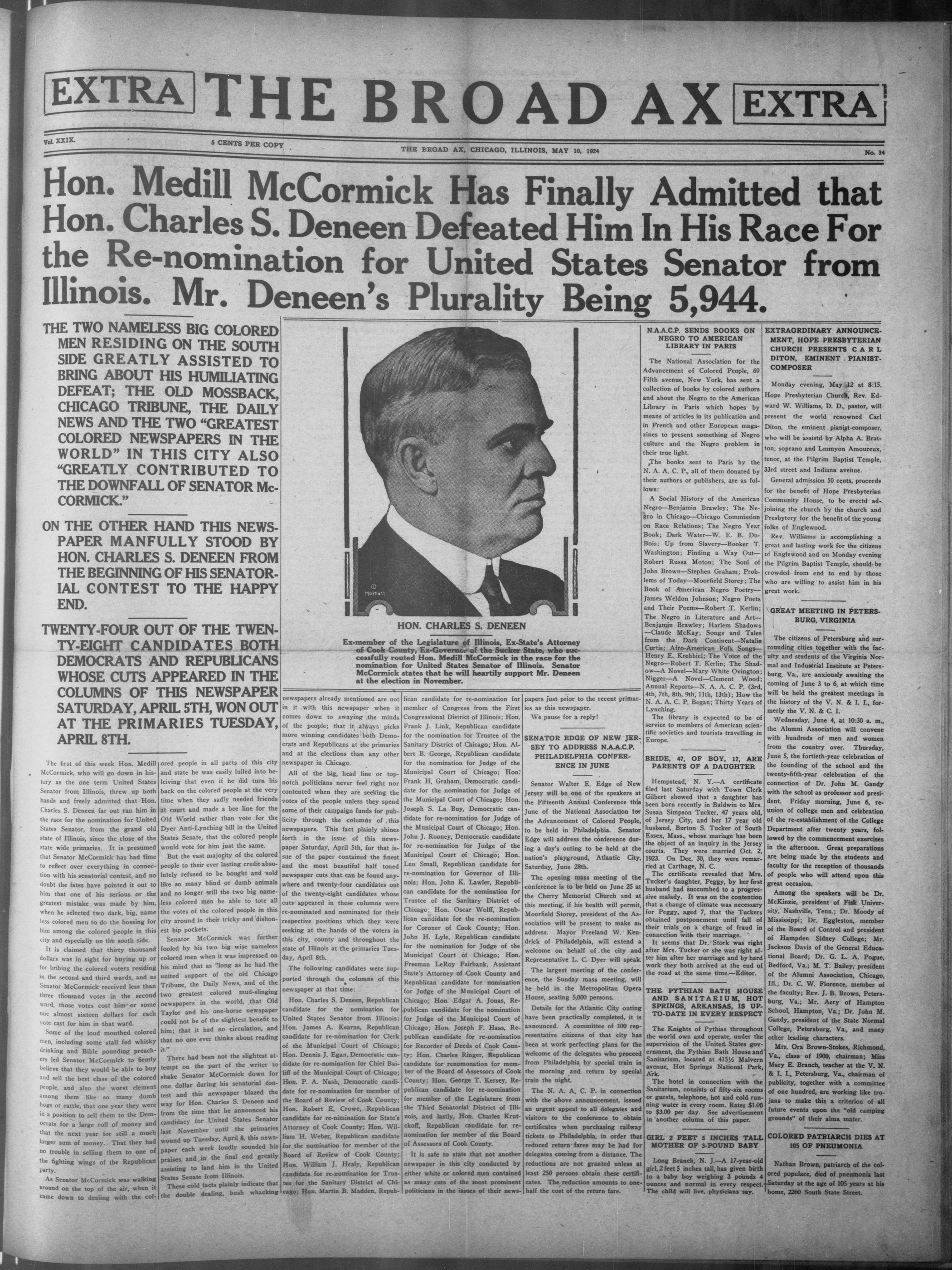
Hon. Medill McCormick Has Finally Admitted that Hon. Charles S. Deneen Defeated Him In His Race For the Re-nomination for United States Senator from Illinois. Mr. Deneen's Plurality Being 5,944.
THE TWO NAMELESS BIG COLORED MEN RESIDING ON THE SOUTH SIDE GREATLY ASSISTED TO BRING ABOUT HIS HUMILIATING DEFEAT; THE OLD MOSSBACK, CHICAGO TRIBUNE, THE DAILY NEWS AND THE TWO "GREATEST COLORED NEWSPAPERS IN THE WORLD" IN THIS CITY ALSO "GREATLY CONTRIBUTED TO THE DOWNFALL OF SENATOR McCORMICK."
ON THE OTHER HAND THIS NEWSPAPER MANFULLY STOOD BY HON. CHARLES S. DENEEN FROM THE BEGINNING OF HIS SENATORIAL CONTEST TO THE HAPPY END.
TWENTY-FOUR OUT OF THE TWENTY-EIGHT CANDIDATES BOTH DEMOCRATS AND REPUBLICANS WHOSE CUTS APPEARED IN THE COLUMNS OF THIS NEWSPAPER SATURDAY, APRIL 5TH, WON OUT AT THE PRIMARIES TUESDAY, APRIL 8TH.
The first of this week Hon. Medill McCormick, who will go down in history as the one term United States Senator from Illinois, threw up both hands and freely admitted that Hon. Charles S. Deneen far out ran him in the race for the nomination for United States Senator, from the grand old state of Illinois, since the close of the state wide primaries. It is presumed that Senator McCormick has had time to reflect over everything in connection with his senatorial contest, and no doubt the fates have pointed it out to him that one of his serious or the greatest mistake was made by him, when he selected two dark, big, name less colored men to do the bossing for him among the colored people in this city and especially on the south side. It is claimed that thirty thousand dollars was in sight for buying up or for bribing the colored voters residing in the second and third wards, and as Senator McCormick received less than three thousand votes in the second ward, those votes cost him or some one almost sixteen dollars for each vote cast for him in that ward.
Some of the loud mouthed colored men, including some stall fed whisky drinking and Bible pounding preachers led Senator McCormick to firmly believe that they would be able to buy and sell the best class of the colored people, and also the worst element among them like so many dumb hogs or cattle, that one year they were in a position to sell them to the Democrats for a large roll of money and that the next year for still a much larger sum of money. That they had no trouble in selling them to one of the fighting wings of the Republican party.
As Senator McCormick was walking around on the top of the air, when it came down to dealing with the col-
5 CENTS PER COPY
MEDILL MCCARLES S. NOMINATED Mr. DEPRESS BIG COLORED BIG ON THE SOUTH Y ASSISTED TO THIS HUMILIATING OLD MOSSBACK, SUNE, THE DAILY TWO "GREATEST NEWSPAPERS IN THE THIS CITY ALSO CONTRIBUTED TO OF SENATOR Mc-
HAND THIS NEWSUALLY STOOD BY S. DENEEN FROM OF HIS SENATOR-TO THE HAPPY
OUT OF THE TWEN-INDIDATES BOTH AND REPUBLICANS APPEARED IN THE THIS NEWSPAPER APRIL 5TH, WON OUT CARIES TUESDAY,
ored people in all parts of this city and state he was easily lulled into believing that even if he did turn his back on the colored people at the very time when they sadly needed friends at court and made a bee line for the Old World rather than vote for the Dyer Anti-Lynching bill in the United States Senate, that the colored people would vote for him just the same. But the vast majority of the colored people to their ever lasting credit absolutely refused to be bought and sold like so many blind or dumb animals and no longer will the two big nameless colored men be able to tote all the votes of the colored people in this city around in their tricky and dishonest hip pockets.
Senator McCormick was further fooled by his two big wise nameless colored men when it was impressed on his mind that as "long as he had the united support of the old Chicago Tribune, the Daily News, and of the two greatest colored mud-slipping newspapers in the world, that Old Taylor and his one-horse newspaper could not be of the slightest benefit to him; that it had no circulation, and that no one ever thinks about reading it."
There had been not the slightest attempt on the part of the writer to shake Senator McCormick down for one dollar during his senatorial contest and this newspaper blazed the way for Hon. Charles S. Deneen and from the time that he announced his candidacy for United States Senator last November until the primaries wound up Tuesday, April 8, this newspaper each week loudly sounded his praises and in the final end greatly assisting to land him in the United States Senate from Illinois.
These cold facts plainly indicate that the double dealing, bush whacking
---
Moffett
Ex-member of the Legislature of Illinois, Ex-State's Attorney of Cook County, Ex-Governor of the Sucker State, who successfully routed Hon. Medill McCormick in the race for the nomination for United States Senator of Illinois. Senator McCormick states that he will heartily support Mr. Deneen at the election in November.
newspapers already mentioned are not in it with this newspaper when it comes down to swaying the minds of the people; that it always picks more winning candidates both Democrats and Republicans at the primaries and at the elections than any other newspaper in Chicago.
All of the big, head line or top-notch politicians never feel right nor contented when they are seeking the votes of the people unless they spend some of their campaign funds for publicity through the columns of this newspapers. This fact plainly shines forth in the issue of this newspaper Saturday, April 5th, for that issue of the paper contained the finest and the most beautiful half toned newspaper cuts that can be found anywhere and twenty-four candidates out of the twenty-eight candidates whose cuts appeared in these columns were re-nominated and nominated for their respective positions which they were seeking at the hands of the voters in this city, county and throughout the state of Illinois at the primaries Tuesday, April 8th.
THE BROAD AX, CHICAGO, ILLINOIS, MAY 10, 1924
HON. CHARLES S. DENEEN
papers just prior to the recent primaries as this newspaper.
SENATOR EDGE OF NEW JER
SEY TO ADDRESS N.A.A.C.P.
PHILADELPHIA CONFER-
Senator Walter E. Edge of New Jersey will be one of the speakers at the Fifteenth Annual Conference this June of the National Association for the Advancement of Colored People, to be held in Philadelphia. Senator Edge will address the conference during a day's outing to be held at the nation's playground, Atlantic City, Saturday, June 28th.
The opening mass meeting of the conference is to be held on June 25 at the Cherry Memorial Church and at this meeting, if his health will permit, Moorfield Storey, president of the Association will be present to make an address. Mayor Freeland W. Kendrick of Philadelphia, will extend a welcome on behalf of the city and Representative L. C. Dyer will speak. The largest meeting of the conference, the Sunday mass meeting, will be held in the Metropolitan Opera House, seating 5,000 persons. Details for the Atlantic City outing have been practically completed, it is announced. A committee of 100 representative citizens of that city has been at work perfecting plans for the welcome of the delegates who proceed from Philadelphia by special train in the morning and return by special train the night.
The N. A. A. C. P. in connection with the above announcement, issued an urgent appeal to all delegates and visitors to the conference to obtain certificates when purchasing railway tickets to Philadelphia, in order that reduced return fares may be had for delegates coming from a distance. The reductions are not granted unless at least 250 persons obtain these certificates. The reduction amounts to one-half the cost of the return fare.
N.A.A.C.P. SENDS BOOKS ON NEGRO TO AMERICAN LIBRARY IN PARIS
The National Association for the Advancement of Colored People, 69 Fifth avenue, New York, has sent a collection of books by colored authors and about the Negro to the American Library in Paris which hopes by means of articles in its publication and in French and other European magazines to present something of Negro culture and the Negro problem in their true light.
The books sent to Paris by the N. A. A. C. P., all of them donated by their authors or publishers, are as follows:
A Social History of the American Negro—Benjamin Brawley; The Negro in Chicago—Chicago Commission on Race Relations; The Negro Year Book; Dark Water—W. E. B. DuBois; Up from Slavery—Booker T. Washington; Finding a Way Out—Robert Russa Moton; The Soul of John Brown—Stephen Graham; Problems of Today—Moorfield Storey; The Book of American Negro Poetry—James Weldon Johnson; Negro Poets and Their Poems—Robert T. Kerlin; The Negro in Literature and Art—Benjamin Brawley; Harlem Shadows—Claude McKay; Songs and Tales from the Dark Continent—Natalie Curtis; Afro-American Folk Songs—Henry E. Krehbiel; The Voice of the Negro—Robert T. Kerlin; The Shadow—A Novel—Mary White Ovington-Nigger—A Novel—Clement Wood; Annual Reports—N. A. A. C. P. (3rd 4th, 7th, 8th, 9th, 11th, 13th); How the N. A. A. C. P. Began; Thirty Years of Lynching.
The library is expected to be of service to members of American scientific societies and tourists travelling in Europe.
BRIDE, 47, OF BOY, 17, ARE
PARENTS OF A DAUGHTER
Hempstead, N. Y.—A certificate filed last Saturday with Town Clerk Gilbert showed that a daughter has been born recently in Baldwin to Mrs. Susan Simpson Tucker, 47 years old, of Jersey City, and her 17 year old husband, Burton S. Tucker of South Essex, Mass., whose marriage has been the object of an inquiry in the Jersey courts. They were married Oct. 2, 1923. On Dec. 30, they were remarried at Carthage, N. C.
The certificate revealed that Mrs. Tucker's daughter, Peggy, by her first husband had succumbed to a progressive malady. It was on the contention that a change of climate was necessary for Peggy, aged 7, that the Tuckers obtained postponement until fall of their trials on a charge of fraud in connection with their marriage.
It seems that Dr. 'Stork was right after Mrs. Tucker or she was right after him after her marriage and by hard work they both arrived at the end of the road at the same time—Editor.
THE PYTHIAN BATH HOUSE
AND SANITARIUM, HOT
SPRINGS, ARKANSAS, IS UP-
TO-DATE IN EVERY RESPECT
The Knights of Pythias throughout the world own and operate, under the supervision of the United States government, the Pythian Bath House and Sanitarium, located at 415% Malvern avenue, Hot Springs National Park, Ark.
The hotel in connection with the Sanitarium, consists of fifty-six rooms or guests, telephone, hot and cold running water in every room. Rates $1.00 to $3.00 per day. See advertisement in another column of this paper.
GIRL 2 FEET 5 INCHES TALL
MOTHER OF 3-POUND BABY
Long Branch, N. J.—A 17-year-old girl, 2 feet 5 inches tall, has given birth to a baby boy weighing 3 pounds 4 ounces and normal in every respect. The child will live, physicians say.
EXTRAORDINARY ANNOUNCEMENT, HOPE PRESBYTERIAN CHURCH PRESENTS C A R L DITON, EMINENT PIANIST-COMPOSER
Monday evening, May 12 at 8:15, Hope Presbyterian Church, Rev. Edward W. Williams, D. D., pastor, will present the world renowned Carl Diton, the eminent pianist-composer, who will be assistd by Alpha A. Bratton, soprano and Lmmyon Amoureux, tenor, at the Pilgrim Baptist Temple, 33rd street and Indiana avenue.
General admission 50 cents, proceeds for the benefit of Hope Presbyterian Community House, to be erected adjoining the church by the church and Presbytery for the benefit of the young folks of Englewood.
Rev. Williams is accomplishing a great and lasting work for the citizens of Englewood and on Monday evening the Pilgrim Baptist Temple, should be crowded from end to end by those who are willing to assist him in his great work.
GREAT MEETING IN PETERSBURG, VIRGINIA
The citizens of Petersburg and surrounding cities together with the faculty and students of the Virginia Normal and Industrial Institute at Petersburg, Va., are anxiously awaiting the coming of June 3 to 6, at which time will be held the greatest meetings in the history of the V. N. & I. I., formerly the V. N. & C. I.
Wednesday, June 4, at 10:30 a. m., the Alumni Association will convene with hundreds of men and women from the country over. Thursday, June 5, the fortieth-year celebration of the founding of the school and the twenty-fifth-year celebration of the connection of Dr. John M. Gandy with the school as professor and president. Friday morning, June 6, reunion of college men and celebration of the re-establishment of the College Department after twenty years, followed by the commencement exercises in the afternoon. Great preparations are being made by the students and faculty for the reception of thousands of people who will attend upon this great occasion.
Among the speakers will be Dr. McKinzie, president of Fisk University, Nashville, Tenn.; Dr. Moody of Mississippi; Dr. Eggleston, member of the Board of Control and president of Hampden Sidney College; Mr. Jackson Davis of the General Educational Board; Dr. G. L. A. Pogue, Bedford, Va.; M. T. Bailey; president of the Alumni Association, Chicago, Ill.; Dr. C. W. Florence, member of the faculty; Rev. J. B. Brown, Petersburg, Va.; M. Aery of Hampton School, Hampton, Va.; Dr. John M. Gandy, president of the State Normal College, Petersburg, Va., and many other leading characters.
Mrs. Ora Brown-Stokes, Richmond, Va., class of 1900, chairman; Miss Mary E. Branch, teacher at the V. M. & I. I., Petersburg, Va., chairman of publicity, together with a committee of one hundred, are working like trojans to make this a criterion of all future events upon the "old camping grounds" of their alma mater.
COLORED PATRIARCH DIES AT
105 OF PNEUMONIA
Nathan Brown, patriarch of the colored populace, died of pneumonia last Saturday at the age of 105 years at his home, 2260 South State Street.
THE BROAD AX
Published Every Saturday
In this city since July 15th, 1899, without missing one single issue. Republicans, Democrats, Catholics, Protestants, Single Taxers, Priests, infidels or anyone else can have their say as long as their language is proper and responsibility is fixed.
The Broad Ax is a newspaper whose platform is broad enough for all, ever claiming the editorial right to speak its own mind. It is neither Democratic nor Republican. It is strictly or absolutely independent in politics.
Local communications will receive attention. Write only on one side of the paper.
Subscriptions must be paid in advance.
One Year ..... $2.00
Six Months ..... $1.00
Advertising rates made known on application.
Address all communications to
THE BROAD AX
206 So. Elizabeth St., Chicago, Ill.
Phone Wentworth 2597
JULIUS F. TAYLOR
Editor and Publisher
Vol. XXIX.
Chicago, May 10, 1924
Entered as Second-Class Matter, Aug.
19, 1902, at the Post office at Chicago.
III. Under Act of March 8, 1879.
INGRATITUDE
There may be meaner traits than ingratitude. One has difficulty in discovering them. Nothing embitters so many good people. Nothing so certainly dries up the fountain of sympathy, generosity, and well service. All about us are spendid men and women who in fine faith started out to lift as they climbed, to be good Samaritans, to befriend the world. They have denied themselves for others only to make enemies out of them. They have jeopardized their fortunes and that of their families for others only to be reviled by them. They have hazarded their lives for others only to be kicked by them. Think of the good people who have been "bitten" by those whom they have fed.
The reaction on such benefactors, for the most part, has been to destroy faith and to atrophy further effort. This result is most unfortunate. Parents, teachers, philanthropists, newspapers, in fact all constructive workers must go to helping. Two considerations are to be taken into account here. All men are not ungrateful. The average is about one out of ten. With further development that average may be increased. Again men must help from principle. The question after all is not so much what others think of us, but rather what we think of ourselves. We probably make too much of the matter of appreciation. Suffice it to say that no man ever rendered a noble service in the right spirit to anybody without receiving himself more good than he gave.
The Negro Newspaper is a case in point. What institution has wrought more effectively and sacrificially for others? What institution has been the victim of baser ingratiitude? The Negro press has been fearless. It has been insistent. It has carried the fight on for human rights through poverty and the shameful ingratiitude, neglect to pay just bills and criticism of Negroes. It has won out in character, power, and influence, until it is not too much to say that the Negro Newspaper stands today far ahead of the pulpit in constructive service. We are only at the beginning of the greater things to be.
CHICAGO HAPPENINGS
A large delegation of Chicagoans in company with bishops and delegates to the General Conference of the A. M. E. Church, are in Louisville, Ky., in attendance at the General Conference.
Mrs. Lou Ella Young, D. G. M. N. G., 4114 Calumet avenue, is touring the state in the interest of the Households of Ruth.
John Shafer, 3566 Vincennes avenue, who was seriously injured several weeks ago and who has been confined to St. Luke's Hospital, is improving slowly.
Sisters of Bethany No. 1 held a very interesting meeting on May 1 at Bailey's Hall, 3638 State street, after which they were addressed by Mrs. Beatrice Tandy, who had spent the winter and early spring in Kansas City, Mo., and other points west, who told of the progress being made by members of the race in that section.
Mrs. Georgia E. Harding, 3710 Indiana avenue, state grand princess, S. M. T. is, now on a tour of Illinois and jurisdiction on her annual visit to the temples under her jurisdiction.
The military ball and Mardi Gras given by the Chicago Division, A. U. K. & D. of A. at Eighth Regiment Armory on April 30 was a success.
Y. W. C. A. NEWS
"Stand By Our Own" will be the rallying cry of Chicago-women May 12-22, when The Indiana Avenue Branch of the Y. W. C. A. will appeal for $6,250, its share of the $183,000 city-wide budget f the Association. The canvass will be carried on throughout Chicago, Evanston and Oak Park and will enlist the aid of club, society and business women in an effort to assure the continuance of Y. W. C. A. activities in the city. Mrs. William Sidley of Winetka is general chairman of the canvass. Mrs. Elizabeth Euper is chairman of the Indiana Avenue Branch division and with her Mrs. Carrie Johnson, Mrs. Samuel Lawson, Mrs. E. H. Carry and Mrs. Nettie Speedy are serving on the campaign committee.
Nearly half the amount necessary has been already raised through the efforts of the women who staged the great Fashion Promenade, according to the announcement of Mrs. Albert George, chairman of the committee of management.
"With this splendid start, we are resolved as never before to push ahead to a complete victory," said Mrs. George. "Last year only about $3,000 of the amount necessary to maintain the branch was contributed by our own people. The rest came from friends from the outside who had the welfare of our girls at heart. This year, however, we believe that for the first time we are going to be able to say that the Indiana Avenue Branch is supported by our own efforts and generosity. We want to prove that we believe in our girls, and are able and willing to give them the opportunities for health, recreation, education and culture that the Y. W. C. A. can and does provide."
"Church leaders, business men and women, mothers and fathers, club and society women as well as the Y. W. C. A. girls themselves are working together to so carry on that when the time is ripe we shall have a modern, beautiful building, well equipped and capable of meeting the many needs of the girls."
According to the report issued by Mrs. George 264 girls made their homes in the residence of the Y. W. C. A. and 309 more were placed in homes throughout the city by the Room Registry Bureau. During the busiest season when the house was crowded and inexpensive rooms were scarce, pallets were made on the floor or temporary beds arranged on the sewing table to accommodate the girls who begged to be allowed to stay under the Y. W. C. A. roof.
The Employment Bureau has done excellent work during the year in finding work for the many girls who come to the city to study and who must work to pay their tuition at the music, art or commercial schools of the city. During the year the Bureau recorded 225 applicants and placed 204. The Girl Reserves, with their program of health, knowledge, service and spirit have grown during the year from one club in January, 1923, to an attendance of 1,000 for one month alone in high school, grade school and church groups. Classes have been offered in dressmaking, millinery, Bible study, gymnastics, business courses, and current topics. Vesper services held Sunday afternoons have been crowded to capacity.
During the canvass daily luncheons will be served to the workers at Central branch, 59 E. Monroe street, when reports of progress made and gifts secured will be made.
The Girl Reserves will broadcast a program over the Daily News Station on Monday, May 12, at 4 p. m. Miss Muriel Rose, who lives in the Indiana avenue branch residence, will play the song which she composed and dedicated to the Girl Reserves. The program will be in charge of Miss Bella Taylor. Girl Reserve Secretary.
—"C."
SPECIAL NOTICE
The Phyllis Wheatley Home Association will render the program at the Metropolitan Community Center (Wendell Phillips) Sunday, May 11, at 8 o'clock, under the auspices of the Sunday Evening Club, Mr. H. A. Watkins, chairman.
Mrs. Harriet Taylor Treadwell, principal of the Scanlan school, ex-president of the Chicago Forum of the League of Women Voters, and a warm friend of our group, will speak.
Mrs. Treadwell is one of the most prominent women in the country, and is in great demand as a public speaker. You and your friends are cordially invited to be present and enjoy this rare treat.
MRS. EMMA MARCHBANKS
President.
Elizabeth Lindsay Davis
Try This Yourself
"When a man is trying to catch your eye and interest you," says Fenwick, "and you don't want to be interested, all you have to do is to look with both your eyes straight at the bridge of his nose. Then he can never hook you. But if you want to hook the other fellow, look with both your eyes into just one of his. This simple little trick has relieved me of many of their self-consciousness and embarrassment." George Allan England.
THE BROAD AX, CHICAGO, ILLINOIS, MAY 10, 1924
Crime and Brutality
By Jack Smothers
Wednesday evening, at 31st and State Streets, two boys were engaged in a fist fight. There were several automobiles standing around, and seemingly eager to avoid running over the boys who were availing themselves of the whole corner advancing and retreating from the opponent as the case demanded. One automobile was a little more eager than the rest to pass the corner and could not exhibit or put into execution the time worn old adage "Have patience and you can have what you will," but one big husky fellow jumped out of the car and advancing toward one of the offenders —brutally kicked him—not once or twice, but until he had him sprawling on the street. He then calmly seated himself in his car and drove off.
The boy never rallied from the licks and when attention was called to his condition and a sight examination made, it was found that he was dead. Just brutally kicked to death.
No one interfered—no one tried to stop the murder—no one said a word—just looked on and in their silence acquiesced the incident.
Perhaps the man who did the deed is sitting quietly in his home—surrounded by his family and friends that make "home enjoyable" and pleasant—the episode forgotten.
Before we can expect to clean up other parts of the city and set a right standard "Home must be cleaned and cleaned thoroughly."
CUT IN LOVER'S QUARREL
The Ever Present Triangle With Us
At the 48th street station, May 1st, Emmet Tramble was tried before Judge Bugee, for cutting Louise Wilson, in a lover's quarrel, after both had indulged too freely in the liquid which was not "as mellow as moonlight."
It appears that Emmet and Louise, both of whom had other lawful companions, had quarreled over the purchase of a hat, and Louise taunted Emmet with the fact that he was "too full" of moonshine to be companionable and called him a vie ugly name. It unfortunately happened that Emmet was caressing her at the time with a small billy barlow and accidentally cut her rather severely below the waist line which the court considered a foul. But in consideration of the hat which the husband present bungledly claimed to have bought and the plea made by Attorney W. E. Mollisom, that Tramble would be punished when he go home by an irate wife, the Judge let him off with a fine of ten-dollars and costs.
THREE MEN SERIOUSLY HURT
BY FALLING FLOOR AT
PALMER HOUSE
As the employees were working late Wednesday night, on what is called the baggage room, in the Palmer House which is being torn to pieces, one of the heavy wooden beams supporting the structure, gave way and crashed suddenly on three workmen, namely, James Farmer, 3247 Wentworth avenue, James Watherall, 1040 Fisk street, and Thomas Wilson of 4753 Federal street, thereby injuring them seriously.
The men were given notice by a workman who noticed the sagging beam, but on account of the noise of crowbars and axes, they failed to hear the warning. The fall of bricks and debris attracted the guests on an upper floor who saw men rushing hither and thither to safety. A few others were shook up and partly covered by the collapsing of the bricks, but only three received serious injury.
ARRESTED FOR CARRYING
WHISKIE AND GUN
Saturday night Officer O'Leary arrested Chas. School, who resides at 4723 Evans avenue, and found in his possession a large bottle of whiskey and a gun.
School's wife and baby were in the court and because of these persons who would be made to suffer if he was incarcerated the Judge was very lenient with him and put him on probation.
HELD UP AND ROBBED
The Lone Bandits Are Still Traveling
Helen Wright, who resides at 1602 Lake Street, was held up and robbed of $40.60 by John Jackson, of 3546 Dearborn Street. Officer French, who was walking in that direction, heard a scream and, although she was not permitted to make more than one, for the lone bandit hastily threw his hands over her mouth and jabbed a pistol in her side, telling her if she screamed or made any noise whatever he would empty all barrels.
He was relieved of the money and also of the gun by the officer, who surprised him in the act.
He was put on a $3,500 bond and held over to the grand jury.
[Image of a man with a bald head and glasses, wearing a suit and tie. The background is a plain, light color. The man's face is centered in the frame, and he appears to be looking directly at the viewer.]
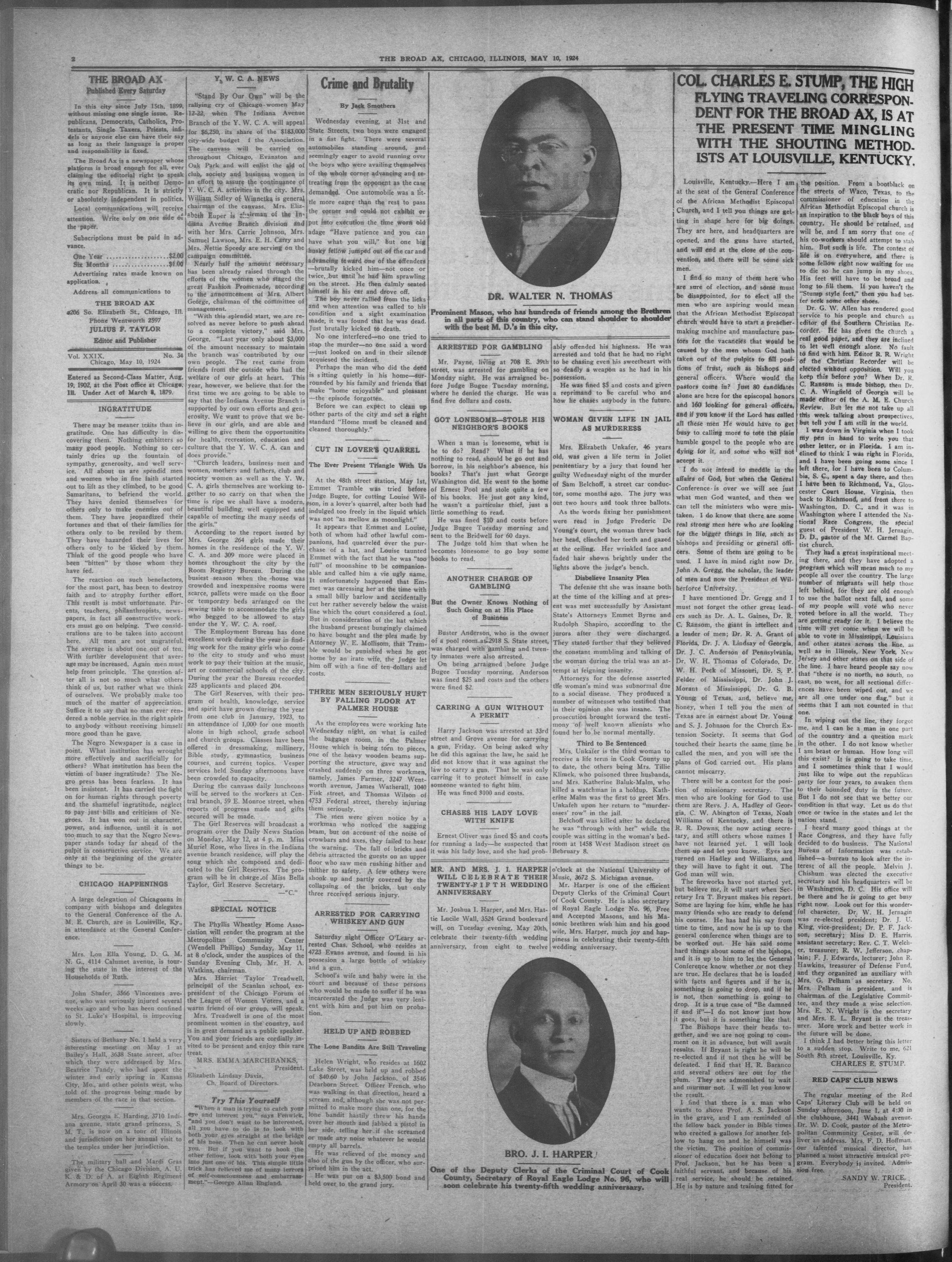
DR. WALTER N. THOMAS Prominent Mason, who has hundreds of friends among the Brethren in all parts of this country, who can stand shoulder to shoulder with the best M. D.'s in this city.
ARRESTED FOR GAMBLING
Mr. Payne, living at 708 E. 39th street, was arrested for gambling on Monday night. He was arraigned before Judge Bugee Tuesday morning, where he denied the charge. He was find five dollars and costs.
GOT LONESOME—STOLE HIS
NEIGHBOR'S BOOKS
When a man is lonesome, what is he to do? Read? What if he has nothing to read, should be go out and borrow, in his neighbor's absence, his books? That's just what George Washington did. He went to the home of Ernest Pool and stole quite a few of his books. He just got any kind, he wasn't a particular thief, just a little something to read.
He was fined $10 and costs before Judge Bugee Tuesday morning and sent to the Bridid for 60 days.
The Judge told him that when he becomes lonesome to go buy some books to read.
ANOTHER CHARGE OF GAMBLING
But the Owner Knows Nothing of Such Going on at His Place of Business
Buster Anderson, who is the owner of a pool room at 2918 S. State street, was charged with gambling and twenty inmates were also arrested.
On being arraigned before Judge Bugeen Tuesday morning, Anderson was fined $25 and costs and the others were fined $2.
CARRING A GUN WITHOUT
A PERMIT
Harry Jackson was arrested at 33rd street and Grove avenue for carrying a gun, Friday. On being asked why he did this against the law, he said he did not know that it was against the law to carry a gun. That he was only carring it to protect himself in case someone wanted to fight him. He was fired $100 and costs.
CHASES HIS LADY LOVE
WITH KNIFE
Ernest Oliver was fined $5 and costs
for running a lady—he suspected that
it was his lady love, and she had prob-
MR. AND MRS. J. I. HARPER
WILL CELEBRATE THEIR
TWENTY-FIFTH WEDDING
ANNIVERSARY
Mr. Joshua I. Harper, and Mrs. Hattie Lucile Wall, 3524 Grand boulevard
will, on Tuesday evening, May 20th,
celebrate their twenty-fifth wedding
anniversary, from eight to twelve
[Picture of a man in a suit with a white shirt and a black tie. The background is a plain, light color. The man's face is centered in the frame, and he appears to be looking directly at the viewer. The image is oval-shaped with a black border.]]
BRO. J. I. HARPER
One of the Deputy Clerks of the Criminal Court of Cook County, Secretary of Royal Eagle Lodge No. 96, who will soon celebrate his twenty-fifth wedding anniversary.
ably offended his highness. He was arrested and told that he had no right to be chasing even his sweetheart with so-deadly a weapon as he had in his possession. He was fined $5 and costs and given a reprimand to be careful who and how he chases anybody in the future.
WOMAN GIVEN LIFE IN JAIL
AS MURDERESS
Mrs. Elizabeth Unkafer, 46 years old, was given a life term in Joliet penitentiary by a jury that found her guilty Wednesday night of the murder of Sam Belchoff, a street car conductor, some months ago. The jury was out two hours and took three ballots. As the words fixing her punishment were read in Judge Frederic De Young's court, the woman threw back her head, clinched her teeth and gazed at the ceiling. Her wrinkled face and faded hair shown brightly under the lights above the judge's bench.
Disbelieve Insanity Plea
The defense tht she was insane both at the time of the killing and at present was met successfully by Assistant State's Attorneys Emmet Byrne and Rudolph Shapiro, according to the jurors after they were discharged. They stated further that they believed the constant mumbling and talking of the woman during the trial was an attempt at feigning insanity. Attorneys for the defense asserted the woman's mind was subnormal due to a social disease. They produced a number of witnesses who testified that in their opinion she was insane. The prosecution brought forward the testimony of well known alienists who found her to be normal mentally.
Third to Be Sentenced
Mrs. Unkaler is the third woman to receive a life term in Cook County up to date, the others being Mrs. Tillie Klimek, who poisoned three husbands, and Mrs. Katherine Baluk-Malm, who killed a watchman in a holdup. Katherine Malm was the first to greet Mrs. Unkafeh upon her return to "murderesses' row" in the jail. Belchoff was killed after he declared he was "through with her" while the couple was sitting in the woman's bedroom at 1458 West Madison street on February 8.
o'clock at the National University of Music, 3672 S. Michigan avenue.
Mr. Harper is one of the efficient Deputy Clerks of the Criminal Court of Cook County. He is also secretary of Royal Eagle Lodge No. 96, Free and Accepted Masons, and his Masonic brethren wish him and his good wife, Mrs. Harper, much joy and happiness in celebrating their twenty-fifth wedding anniversary.
COL. CHARLES E. STUMP, THE HIGH FLYING TRAVELING CORRESPONDENT FOR THE BROAD AX, IS AT THE PRESENT TIME MINGLING WITH THE SHOUTING METHODISTS AT LOUISVILLE, KENTUCKY.
Louisville, Kentucky.-Here I am at the seat of the General Conference of the African Methodist Episcopal Church, and I tell you things are getting in shape here for big doings. They are here, and headquarters are opened, and the guns have started, and will end at the close of the convention, and there will be some sick men.
I find so many of them here who are sure of election, and some must be disappointed, for to elect all the men who are aspiring would mean that the African Methodist Episcopal church would have to start a preacher-making machine and manufacture pastors for the vacancies that would be caused by the men whom God hath taken out of the pulpits to fill positions of trust, such as bishops and general officers. Where would the pastors come in? Just 80 candidates alone are here for the episcopal honors and 160 looking for general officers, and if you know if the Lord has called all these men He would have to get busy to calling more to tote the plain humble gospel to the people who are dying for it, and some who will not accept it.
I do not intend to meddle in the affairs of God, but when the General Conference is over we will see just what men God wanted, and then we can tell the ministers who were mistaken. I do know that there are some real strong men here who are looking for the bigger things in life, such as bishops and presiding or general officers. Some of them are going to be used. I have in mind right now Dr. John A. Gregg, the scholar, the leader of men and now the President of Wilberforce University.
I have mentioned Dr. Gregg and I must not forget the other great leaders such as Dr. A. L. Gaines, Dr. R. C. Ransom, the giant in intellect and a leader of men; Dr. R. A. Grant of Florida, Dr. J. A. Lindsay of Georgia, Dr. J. C. Anderson of Penisylvania, Dr. W. H. Thomas of Colorado, Dr. W. H. Peck of Missouri, Dr. S. P. Felder of Mississippi, Dr. John J. Morant of Mississippi, Dr. G. B. Young of Texas, and, believe me, honey, when I tell you the men of Texas are in earnest about Dr. Young and S. J. Johnson for the Church Extension Society. It seems that God touched their hearts the same time he called the men, and you will see the plans of God carried out. His plans cannot miscarry.
There will be a contest for the position of missionary secretary. The men who are looking for God to use them are Reys, J. A. Hadley of Georgia, C. W. Abington of Texas, Noah Williams of Kentucky, and there is R. R. Downs, the now acting secretary, and still others whose names I have not learned yet. I will took them up and let you know. Eyes are turned on Hadley and Williams, and they will have to fight it out. The God man will win.
The fireworks have not started yet, but believe me, it will start when Secretary Ira T. Bryant makes his report. Some are laying for him, while he has many friends who are ready to defend his course. He has had his say from time to time, and now he is up to the general conference when things are to be worked out. He has said some hard things about some of the bishops, and it is up to him to let the General Conference know whether or not they are true. He declares that he is loaded with facts and figures and if he is, something is going to drop, and if he is not, then something is going to drop. It is a true case of "Be damned if and if"—I do not know just how it goes, but it is something like that. The Bishops have their heads together, and we are not going to comment on it in advance, but will await results. If Bryant is right he will be re-elected and if not then he will be defeated. I find that H. R. Baranco and several others are out for the plum. They are admonished to wait and murmur not. I will let you know the result.
I find that there is a man who wants to shove Prof. A. S. Jackson in the grave, and I am reminded of the fellow back yonder in Bible times who erected a gallows for another fellow to hang on and he himself was the victim. The position of commissioner of education does not belong to Prof. Jackson, but he has been a faithful servant, and because of his real service, he should be retained He is by nature and training fitted fo
the position. From a bootblack on the streets of Waco, Texas, to the commissioner of education in the African Methodist Episcopal church is an inspiration to the black boys of this country. He should be retained, and will be, and I am sorry that one of his co-workers should attempt to stab him. But such is life. The contest of life is on everywhere, and there is some fellow now waiting for me to die so he can jump in my shoes. His feet will have to be broad and long to fill them. If you haven't the "Stump style feet," then you had better seek some other shoes.
Dr. G. W. Allen has rendered good service to his people and church as editor of the Southern Christian Recorder. He has given the church a real good paper, and they are inclined to let well enough alone. No fault to find with him. Editor R. R. Wright of the Christian Recorder will be elected without opposition. Will you keep this before you? When Dr. R. C. Ransom is made bishop, then Dr. C. A. Wingfield of Georgia will be made editor of the A. M. E. Church Review. But let me not take up all this week talking about prospects, but tell you I am still in the world.
I was down in Virginia when I took my pen in hand to write you that other letter, or in Florida. I am inclined to think I was right in Florida, and I have been going some since I left there, for I have been to Columbia, S. C., spent a day there, and then I have been to Richmond, Va., Gloucester Court House, Virginia, then back to Richmond, and from there to Washington, D. C., and it was in Washington where I attended the National Race Congress, the special guest of President W. H. Jernagin, D. D., pastor of the Mt. Carmel Baptist church.
They had a great inspirational meeting there, and they have adopted a program which will mean much to my people all over the country. The large number of migrants will help those left behind, for they are old enough to use the ballot next fall, and some of my people will vote who never voted before in all the world. They are getting ready for it. I believe the time will yet come when we will be able to vote in Mississippi, Louisiana and other states across the line, as well as in Illinois, New York, New Jersey and other states on that side of the line. I have heard people say now that "there is no north, no south, no east, no west, for all sectional differences have been wiped out, and we are all one under one flag," but it seems that I am not counted in that one.
In wiping out the line, they forgome, and I can be a man in one part of the country and a questionmark in the other. I do not know whether I am beast or human. How long will this exist? It is going to take time, and I sometimes think that I would just like to wipe out the republican party for four years, to awaken them to their bounded duty in the future. But I do not see that we better our condition in that way. Let us do that once or twice in the states and let the nation stand.
I heard many good things at the Race Congress, and they have fully decided to do business. The National Bureau of Information was established—a bureau to look after the interest of all the people. Melvin J. Chishum was elected the executive secretary and his headquarters will be in Washington, D. C. His office will be there and he is going to get busy right now. Look out for this wonderful character. Dr. W. H. H. Jernagain was re-elected president; Dr. J. U. King, vice-president; Dr. P. F. Jackson, secretary; Miss D. E. Harris, assistant secretary; Rev. C. T. Welcher, treasurer; R. W. Jefferson, chapain; F. J. Edwards, lecturer; John R. Hawkins, treasurer of Defense Fund, and they organized an auxiliary with Mrs. G. Pelham as secretary. No, Mrs. Pelham is president, and is chairman of the Legislative Committee, and they made a wise selection. Mrs. E. N. Wright is the secretary and Mrs. E. L. Bryant is the treasurer. More work and better work in the future will be done.
I think I had better bring this letter to a sudden stop. Write to me, 621 South 8th street, Louisville, Ky. (GILBERT)
RED CAPS' CLUB NEWS
The regular meeting of the Red Caps' Literary Club will be held on Sunday afternoon, June I, at 4:30 in the clubhouse, 3441 Wabash avenue. Dr. W. D. Cook, pastor of the Metropolitan Community Center, will deliver an address. Mrs. F. D. Hoffman, our talented musical director, has planned a most attractive musical program. Everybody is invited. Admission free.
SANDY W. TRICE.
President.
Chairman of the Board of Directors of the National Association for the Advancement of Colored People
Invites you and your friends to meet the Western Delegation from the Annual Convention now being held in New York City, Tuesday, May 13, 1924, from 8 to 11 P.M. In the Blue Triangle Club Rooms.
"FROM 'SUPERMAN' TO MAN"
By J. A. Rogers. Published by The
Lenox Publishing Company, 2572
7th Avenue, New York City. Price
$1.50. Postage 10 cents.
Anyone who wants to be provided with an enormous stock of information confuting the doctrine of white racial superiority should own this book. It depicts a Negro porter of unfailling humor and courtesy debating with the race question with a rabid Southern Senator. Of course, the author makes the Negro convert his antagonist. Whether he would have done this in real life is very doubtful but he would certainly have silenced him. For the Southerner speaks as most of us would speak on any question that we might chance to debate on a train, from personal observation and from casual reading; whereas, the Negro speaks from a life-long study of his subject. Moreover, he has traveled much and can cite instances of customs among peoples from Missouri to Madagascar. He meets his antagonist fairly and at every point of the bout worsts him. The Southerner goes to bed furious, sure that he will never argue with the "Nigger" again, and yet impelled to take up the battle on the morrow. His conversation at the end, his offering the porter a better job, is a bit of unfortunate sentimentalism. It makes the story unreal, whereas it might have ended on a
SHORT CUTS
(Lincoln News Service)
There are 126 colored school teachers in New York City.
Attorney "Billy" Hueston, of Gary, is a candidate for the Indiana Legislature.
On the average, Hebrew women are said to live longer than those of any other race.
There are 375 colored married males and 1,071 married females under the age of 15 years.
The Prince of Wales, while in Paris, frequented the Montmartre Cafe, which is owned by a colored American.
Birmingham leads all other cities in the number of colored persons engaged in the iron and steel industry.
The colored democrats have found another "Bishop." Are they pulling off a political convention or a church conference.
Although Queen Elizabeth started the style of wearing silk stockings, she did not create the short skirt that goes with them.
An autoist has just been fined for allowing a girl to drive the car while sitting on his lap. Be careful!
Colored business men of New York have purchased a county club on Long Island, where they will have an 18-hole golf course.
The genial Tom Smith of Baltimore has enlarged the seating capacity of his cabaret to accommodate the delegates to the National Colored Democratic Convention.
There are more colored females engaged in domestic and personal service in New York than in any other city, followed by Washington, Philadelphia, Baltimore and New Orleans.
Detroit leads all other cities in the number of colored iron molders, founders and casters, and is followed in the order named by Chicago, Cleveland, Indianapolis and Birmingham.
Word comes that Hon. "Bill" McDonald of Fort Worth is lecturing to packed audiences. He probably handles a packed audience with the same skill he handled "packed" state conventions when he was in the political game.
Editor Nick Chiles, of the Topeka
clever note. After the Negro has gotten the better of the Senator on every point; on slavery, which he shows was common among white as well as black; on sexual passion, he scores very well there; on intermarriage, his facts regarding intermarriage, he takes the city of Chiego as an example, are illuminating; after his thrusts have again and again struck home, the Senator asks: "What would you offer as a solution of the problem?" To which the porter replies, "A sense of humor." "Name something easier," wisely says the white man.
It is this sly sense of humor, which makes the book something more than the platitudinous recital of race equality that is often dished up to us. The porter is poking fun at his antagonist a great deal of the time. He is amused at him. He knows just how to knock the props from under his opponent's arguments and then enjoys with the utmost politeness the Southerner's discomfort. The first night the Senator roars, the second night he fumes, the last night he asks his questions almost with an air of humility. It would be wonderful if such a debate as this happened in real life. There is no reason that it shouldn't—except for the porter. He is too heroic to be anywhere but in fiction. Such self-control would be worthy of the Spingarn Medal. But many might try to approach him. And they could nowhere go for better ammunition with which to do this than to the pages of "From 'Superman' to Man."
Plaindealer, made an unpardonable blunder when he tried to make a "has been" out of T. Thomas Fortune, the erudite editor of The Negro World.
THE QUESTIONNAIRE
1. When and where was the first United States flag unfurled? Who called it "Old Glory?"
* * *
2. In what year were the articles of confederation adopted by the thirteen colonies?
* * *
3. By what treaty was the American Revolution terminated?
* * *
4. In what year did the constitutional convention assemble at Philadelphia? When was the constitution adopted?
Answers
1. In 1776, at Cambridge, Mass., the first Union flag was unfurled. The name "Old Glory" was given to the American flag by Captain William Driver of Salem, Mass., in 1831. It was his salute to a beautiful new flag presented to his ship when starting on a voyage around the world.
2. The articles of confederation were adopted in 1777, by the thirteen colonies.
3. The Treaty of Paris in 1783 terminated the American Revolution.
4. In 1787 the constitutional convention assembled at Philadelphia. The constitution was adopted Sept. 17, 1787.
Red Frog of British Guiana
In the wilds of British Guiana is found a bright-red frog with a voice of astonish volume, according to Miss Ruth Rose of the tropic research station. The native Indians regard these strange creatures as charms of great value. When one is caught the Indians cut it up into as many pieces as there are warriors in the village and each man rubs a piece on his arrows under the assurance that his aim will be infallible.
The Successful Men
The men I have seen succeed best in life have been cheerful and hopeful men, who went about their business with a smile on their faces and took the chances and changes of their normal life like men, facing rough and smooth alike, as it came, and so found the truth of the old proverb, that "Good times and bad times and all times pass over."—Kingsley.
THE BROAD AX, CHICAGO, ILLINOIS, MAY 10, 1924
Like French Mode With Few Changes
American Women Favor Silhouette and Trimming Offered by Paris.
The burden of going forward has shifted from the ingenuous hand of the Paris designer to the graceful shoulders of the fashionable woman, observes a fashion writer in the New York Herald-Tribune. A short time ago the Paris couturier was industriously offering his artistic product to a waiting world. New ideas, some quite radical, were exhibited—certain old motifs were retained, and descriptions and sketches of the new Paris suggestions were broadcast to wherever smart women gathered. The readers know that the new Paris silhouette is straight and affectedly simple, that French skirts miss the ground by some fourteen inches, that elaboration is the essence of the current mode and that plait, flounce and tunic are its principal manifestations. They have seen sketches of the beltless frock and of the low waistline, the severe tailleur and the three-quarter length coat
The next and, to most women, the most important phase of the springtime mode concerns the extent to which the recent innovations will be indorsed. For femininity, despite ideas to the contrary, does not leap boldly from one extreme to another, preferring rather to slowly absorb new ideas and adopt them gradually and in a modified form.
Consider first the skirt length, which has been a much mooted question since the revolutionary days of the war. One season long, one season short, its only consistency is its certainty to change. This season Paris has insisted on very short skirts, reaching on an average to no more than eight inches below the knee. It is not surprising that the American woman, the slimness of whose ankles is proverbial, should have espoused this style with some degrees of enthusiasm—but, always a little more dignified than the Parisienne, she has tempered her acceptance with a becoming modesty.
Admitting the influence of Paris, but subjecting it to domestic revision, the approved skirt length this side the Atlantic has been established at about ten inches above the ground—and it marks a decided improvement both in poise and dignity over the French frocks.
Another instance wherein the word of Paris was accorded something less than its wonted reception concerns its self with the widely bruited strictly tailored suit. Not that there has been any hesitancy about accepting the O'Rossen styled costume. Far from it. The trim, severe lines, the short hip-length jackets and above all the splendidly conceived materials of the Paris-designed tailleur place it in the front ranks of the new clothes. But in France the suit is a necessity, an absolute essential. No Parisienne dares complete her wardrobe without
THE FASHION OF THE TWENTIES
Beltless Dress of Belge Grepe de
Chine; Double Jabot Frill Down
Front; Red Pipings and Buttons.
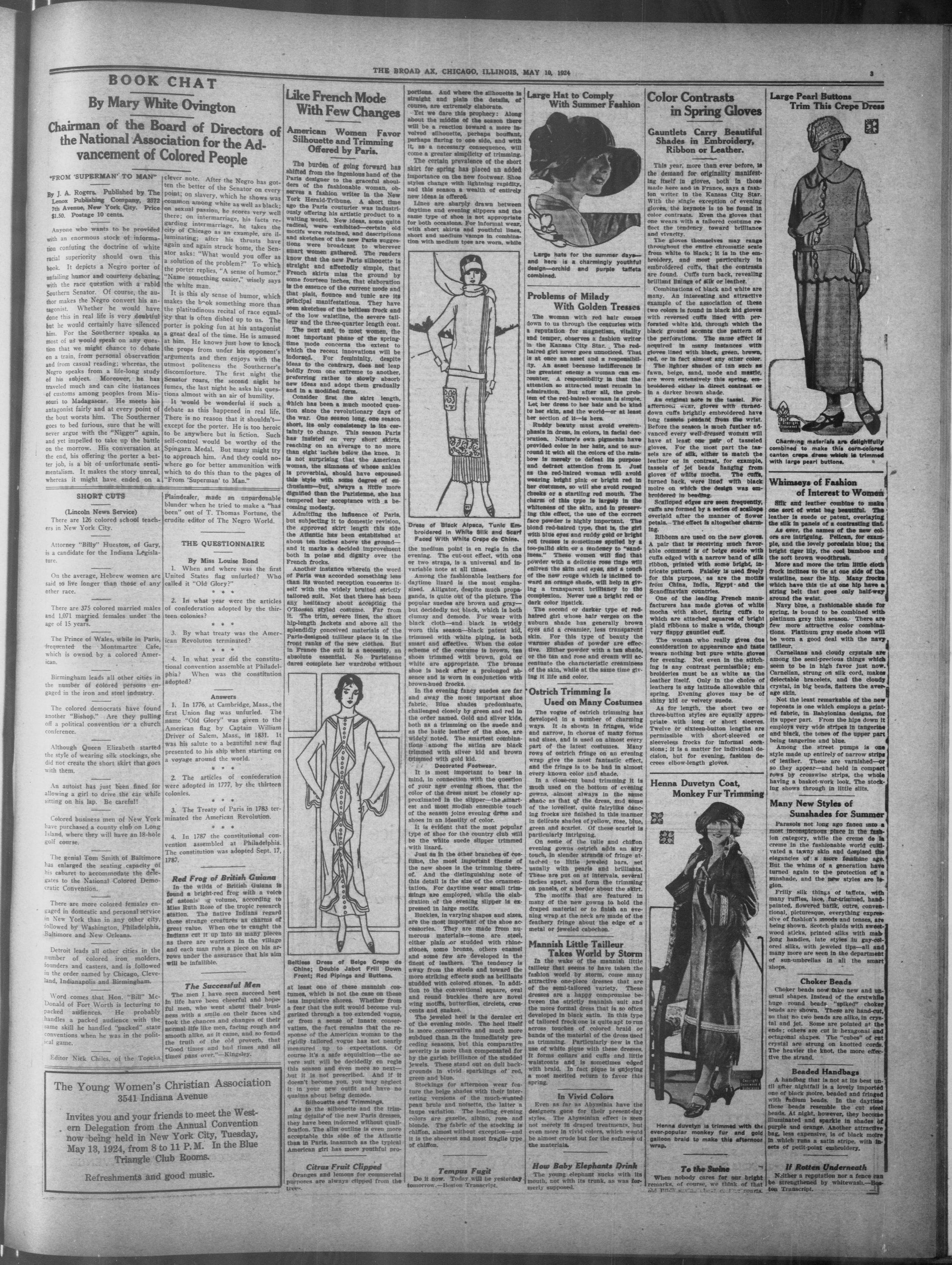
Beltjee Dress of Belge Crepe de Chine; Double Jabot Frill Down Front; Red Pipings and Buttens.
at least one of these mannish costumes, which is not the case on these less impulsive shores. Whether from a fear that the suit would become vulgarized through a too extended vogue, or from a sense of innate conservatism, the fact remains that the response of the American woman to the rigidly tailored vogue has not nearly measured up to expectations. Of course it's a safe acquisition—the severe suit will be decidedly enegle this season and even more so next—but it is not prescribed. And if it doesn't become you, you may neglect it in your new outfit and have no qualms about being demode.
Silhouette and Trimming.
As to the silhouette and the trimming details of the new Paris dresses, they have been indorsed without qualification. The silm outline is even more acceptable this side of the Atlantic than in Paris, inasmuch as the typical American girl has more youthful pro-
Citrus Fruit Clipped
Oranges and lemons for commercial purposes are always clipped from the
portions. And where the silhouette is straight and plain the details of course, are extremely elaborate.
Yet we dare this prophecy: Along about the middle of the season there will be a reaction toward a more involved silhouette, perhaps bountiful, perhaps flaring to one side, and with it, as a necessary consequence, will come a greater simplicity of trimming.
The certain prevalence of the short skirt for spring has placed an added importance on the new footwear. Shoe styles change with lightning rapidity, and this season a wealth of entirely new ideas is offered.
Lines are sharply drawn between daytime and evening slippers and the same type of shoe is not appropriate for both occasions. For informal wear, with short skirts and youthful legs, short and medium vamps in combination with medium toes are worn, white
10
Dress of Black Alpaca, Tunic Embroidered in White Silk and Scarf Faced With White Crepe de Chine. the medium point is en regle in the evening. The cut-out effect, with one or two straps, is a universal and invariable note at all times. Among the fashionable leathers for daytime lizard is the most emphasized. Alligator, despite much propaganda, is quite out of the picture. The popular suedes are brown and gray—but decidedly not black, which is both clumsy and demode. For wear with black cloth—and black is widely worn this season—black patent kid, trimmed with white piping, is both smart and effective. When the color scheme of the costume is brown, tan shoes trimmed with brown, gold or white are appropriate. The bronze shoe is back after a prolonged absence and is worn in conjunction with brown-hued frocks.
In the evening fancy suedes are far and away the most important shoe fabric. Blue shades predominate, challenged closely by green and red in the order named. Gold and silver kids, both as a trimming on the suede and as the basic leather of the shoe, are widely noted. The smartest combinations among the satins are black trimmed with silver kid and brown trimmed with gold kid.
Decorated Footwear.
It is most important to bear in mind, in connection with the question of your new evening shoes, that the color of the dress must be closely approximated in the slipper—the smartest and most modish ensemble of the season joins evening dress and shoes in an identity of color.
It is evident that the most popular type of shoe for the country club will be the white suede slipper trimmed with lizard.
Just as in the other branches of costume, the most important theme of the new shoes is the trimming thereof. And the distinguishing note of this detail is the size of the ornamentation. For daytime wear small trimming are employed, while the elaboration of the evening slipper is expressed in large motifs. Buckles, in varying shapes and sizes, are the most important of the shoe accessories. They are made from numerous materials—some are steel, either plain or studded with rhinestone, some bronze, others enamel and some few are developed in the finest of leather. The tendency is away from the steels and toward the more striking effects such as brillants studded with colored stones. In addition to the conventional square, oval and round buckles there are novel wing motifs, butterflies, circles, crescents and snakes.
The jeweled heel is the dernier cri of the evening mode. The heel itself is more conservative and much more subdued than in the immediately preceding seasons, but this comparative severity is more than compensated for by the garish brilliance of the studded jewels. These stand out on dull backgrounds in vivid sparklings of red, green and blue.
Stockings for afternoon wear feature the beige shades with their interesting versions of the much-wanted peau brûle and notette, the latter a taupe variation. The leading evening colors are gazelle, albino, rose and blonde. The fabric of the stocking is chiffon, almost without exception—and it is the sheerest and most fragile type of chiffon.
Tempus Fugit
Do it now or tomorrow
toward Boston Transit.
Large Hat to Comply
With Summer Fashion
Large hats for the summer day—and here is a charmingly youthful design—orchid and purple taffeta combined.
The woman with red hair comes down to us through the centuries with a reputation for magnetism, vitality and temper, observes a fashion writer in the Kansas City Star. The red-haired girl never goes unnoticed. That is at once an asset and a responsibility. An asset because indifference is the greatest enemy a woman can encounter. A responsibility in that the attention so attracted must remain in admiration. But after all, the problem of the red-haired woman is simple. Let her dress to her hair and be kind to her skin, and the world—or at least her section of it—is hers.
Ruddy beauty must avoid overemphasis in dress, in colors, in facial decoration. Nature's own pigments have provided color in her hair, and to surround it with all the colors of the rainbow is merely to defeat its purpose and detract attention from it. Just as the red-haired woman will avoid wearing bright pink or bright red in her costumes, so will she avoid roughed cheeks or a startling red mouth. The charm of this type is largely in the whiteness of the skin, and in preserving this effect, the use of the correct face powder is highly important. The blond red-haired type, that is, the girl with blue eyes and ruddy gold or bright red tresses is sometimes spotled by a too-pallid skin or a tendency to "sandiness." These women will find that powder with a delicate rose tinge will enliven the skin and eyes, and a touch of the new rouge which is inclined toward an orange shade, will help in giving a transparent brilliance to the complexion. Never use a bright red or dark color lipstick.
The second or darker type of red-haired girl whose hair verges on the auburn shade has generally brown eyes and a creamier, less transparent skin. For this type of beauty the warmer shades of powder are effective. Either powder with a tan shade, or the tan and rose and cream will accentuate the characteristic creaminess of the skin, while at the same time giving it life and color.
Used on Many Costumes
The vogue of ostrich trimming has developed in a number of charming ways. It is shown in fringes, wide and narrow, in chorus of many forms and sizes, and is used on almost every part of the latest costumes. Many rows of ostrich fringe on an evening wrap give the most fantastic effect, and the fringe is to be had in almost every known color and shade.
In a close-cut band trimming it is much used on the bottom of evening gowns, almost always in the same shade as that of the dress, and some of the loveliest, quite fairylike dancing frocks are finished in this manner in delicate shades of yellow, rose, blue, green and scarlet. Of these scarlet is particularly intriguing.
On some of the tulle and chiffon evening gowns ostrich adds an airy touch, in slender strands of fringe attached to little jeweled bars, set usually with pearls and brillants. These are put on at intervals, several inches apart, and form the trimming on panels, or a border about the skirt. The motifs that are featured in many of the new gowns to hold the draped material or to finish an evening wrap at the neck are made of the feathery fringe about the edge of a metal or jeweled cabochon.
Mannish Little Tailleur
Takes World by Storm
In the wake of the mannish little tailleur that seems to have taken the fashion world by storm, come many attractive one-piece dresses that are of the semi-tailored variety. These dresses are a happy compromise between the strictly mannish suit and the more formal dress that is so often developed in black satin. In this type of tailored frock one is quite apt to run across touches of colored braid or bands of the material of the dress used as trimming. Particularly new is the use of white pique with these dresses. It forms collars and cuffs and little waistcoats and is sometimes edged with braid. In fact pique is enjoying a most merited return to favor this spring.
In Vivid Colors
Even as far as Abyssinian have the designers gone for their present-day styles. The Abyssinian effect is seen not merely in draped treatments, but even more in vivid colors, which would be almost crude but for the softness of the materials.
How Baby Elephants Drink
The young elephant sucks with its mouth, not with its trunk, as was formerly supposed.
This year: more than ever before, is the demand for originality manifesting itself in gloves, both in those made here and in France, says a fashion writer in the Kansas City Star. With the single exception of evening gloves, the keynote is to be found in color contrasts. Even the gloves that one wears with a tailored costume reflect the tendency toward brilliance and vivacity. The gloves themselves may range throughout the entire chromatic scale from white to black; it is in the embroidery, and most particularly in embroidered cuffs, that the contrasts are found. Cuffs turn back, revealing brilliant linings of silk or leather.
Combinations of black and white are many. An interesting and attractive example of the association of these two colors is found in black kid gloves with reversed cuffs lined with perforated white kid, through which the black ground accents the pattern of the perforations. The same effect is acquired in many instances with gloves lined with black, green, brown, red, or in fact almost any other color. The lighter shades of tan such as fawn, beige, sand, mode and mastic, are worn extensively this spring, embroidered either in direct contrast or in a darker brown shade.
An original note is the tassel. For afternoon wear, gloves with turned-down cuffs brightly embroidered have long tassels pendant from the wrist. Before the season is much further advanced every well-dressed woman will have at least one pair of tasselled gloves. For the most part the tassels are of silk, either to match the leather or in contrast, for example, tassels of jet beads hanging from gloves of white mocha. The cuffs, turned back, were lined with black mohre on which the design was embroidered in beading. Scalloped edges are seen frequently, cuffs are formed by a series of scallops overlaid after the manner of flower petals. The effect is altogether charming.
Ribbons are used on the new gloves. A pair that is receiving much favorable comment is of beige suede with cuffs edged with a narrow band of silk ribbon, printed with some bright, intricate pattern. Paisley is used freely for this purpose, as are the motifs from China, India, Egypt and the Scandinavian countries. One of the leading French manufacturers has made gloves of white mocha with short, flaring cuffs to which are attached squares of bright plaid ribbons to make a wide, though very flappy gauntlet cuff. The woman who really gives due consideration to appearance and taste wears nothing but pure white gloves for evening. Not even in the stitching is any contrast permissible; embroideries must be as white as the leather itself. Only in the choice of leathers is any latitude allowable this spring. Evening gloves may be of shiny kid or velvet suede.
As for length, the short two or three-button styles are equally appropriate with long or short sleeves. Twelve or sixteen-button lengths are permissible with short-sleeved or sleeveless frocks for informal occasions; it is a matter for individual decision, but for evening, fashion decrees elbow-length gloves.
Henna Duvetyn Coat,
Monkey Fur Trimming
Copyright
Dorothy Wood &
Lloyd Wood
Henna duvetyn is trimmed with the ever-popular monkey fur and gold galloon braid to make this afternoon wrap.
To the Same
When nobody cares for our bright remarks, of course, we think of that old Bildung story, so the poems
Large Pearl Buttons
Trim This Crepe Dress
CAPTAIN'S COAT
Charming materials are delightfully combined to make this corn-colored canton crepe dress which is trimmed with large pearl buttons.
Silk and leather combine to make one sort of wrist bag beautiful. The leather is suede or patent, overlaying the silk in panels of a contrasting that. As ever, the names of the new colors are intriguing. Pelican, for example, and the lovely porcelain blue; the bright tiger lily, the cool bamboo and the soft brown woodthrush. More and more the trim little cloth frock inclines to tie at one side of the waistline, near the hip. Many frocks which have this tie at one hip have a string belt that goes only half-way around the waist. Navy blue, a fashionable shade for spring, is bound to be combined with platinum gray this season. There are few more attractive color combinations. Platinum gray suede shoes will be worn a good deal with the navy tailleur.
Carnelians and cloudy crystals are among the semi-precious things which seem to be in high favor just now. Carnelian, strung on silk cord, makes delectable bracelets, and the cloudy crystal, in big beads, flatters the average skin.
Not the least remarkable of the new topcoats is one which employs a printed fabric, in Babylonian designs, for its upper part. From the hips down it employs very wide stripes in tangerine and black, the tones of the upper part being tangerine and blue.
Among the street pumps is one style made up entirely of narrow strips of leather. These are varnished—or so they appear—and held in compact rows by crosswise strips, the whole having a basket-work look. The stocking shows through in little slits.
Many New Styles of
Sunshades for Summer
Parasols not long ago faced into a most inconspicuous place in the fashion category, while the creme de la creme in the fashionable world cultivated a tawny skin and despised the elegancies of a more feminine age. But the whims of a generation have turned again to the protection of a sunshade, and the new styles are legion. Friilly silk things of taffeta, with many ruffles, lace, fur-trimmed, hand-painted, flowered battik, outre, conventional, picturesque, everything expressive of fashion's moods and tenses, are being shown. Scotch plaids with sweetwood sticks, printed silks with mah-jong handles, late styles in gay-colored silks, with jeweled tips—all and many more are seen in the department of sun-umbrellas in all the smart shops.
Choker Beads
Choker beads now take new and unusual shapes. Instead of the erwinkle huge round beads "spiked" choker beads are shown. These are hand-cut, so that no two beads are alike, in crystal and jet. Some are pointed at the ends; others are cut in hexagonal and octagonal shapes. The "cubes" of cut crystal are strung on knotted cords. The heavier the knot, the more effective the strand.
Beaded Handbags
A handbag that is not at its best until after nightfall is a lovely imported one of black molde, beaded and fringed with radium beads. In the daytime these beads resemble the cut steel beads. At night, however, they become illuminated and sparkle in shades of purple and orange. Another attractive bag, less expensive, is of black molde in which runs a satin stripe, with insets of petit-point embroidery.
If Rotten Underneath
Neither a reputation nor a fence can be strengthened by whitewash.—Boston Transcript.
Hot Radio-Active Water Furnished by the Government For All Baths. Sanitarium has 10 Rooms, Diet and Operating Rooms Hotel has 56 Rooms; Telephone, Hot and Cold Running Water in Every Room. Rates $1 to $3 per day BATH RATES:
Statement of Condition
At the Close of Business on March 31, 1924
RESOURCES
Loans and Discounts ... $1,764,223.65
(Inspected and approved by our Board of Directors)
Bonds and Securities ... 1,130,257.86
Bank Building and Annex: 145,319.98
Furniture and Fixtures ... 20,761.69
Cash on hand and due from Banks ... 584,029.30
Other Resources ... 40,900.53
Total ... $3,685,493.01
LIABILITIES
Capital Stock ... $ 400,000.00
Surplus ... 50,000.00
Undivided Profits ... 11,649.84
Reserved for Taxes and Interest ... 12,009.27
Other Liabilities ... 32,200.98
DEPOSITS ... 3,299,632.90
Total ... $3,685,493.01
This Bank invites you to avail yourself of its complete facilities.
First Mortgage Gold Bonds — approved safe investments — yield 7% interest.
Boxes in our completely equipped Safety Deposit Vaults rent for $4.00 per year and upwards.
Interest at the rate of 3% is allowed on all savings accounts. Savings Department open from 9 a.m. to 8 p.m. Saturdays.
GEORGE F. LEIBRANDT, President
CHARLES A. WIENER, Vice President
GEORGE S. CAMPBELL, Cashier
L. A. DELAURIER, Asst't Cashier
MAURICE H. WOLPE, Asst't Cashier
ADDISON E. AVERY, Mgr. Bond Dept.
LINCOLN STATE BANK
OF CHICAGO
Under State Government Supervision
31st and South State Streets
Telephone Victory 4500
Once my hair was anything but long and silky soft as it is now, and my complexion was sallow, and there were often unsightly pimples on my face.
One day I heard of Exelento Quinine Pomade for the hair and purchased a jar. Almost immediately it stopped all dandruff, made my hair grow long, soft and fine, and gave it a delightful sheen.
Because of the perfectly wonderful results I obtained from Exelento Quinine Pomade, I purchased a jar of Exelento Skin Beautifier. It changed my sallow complexion to a clear, lovely skin, with complexes and other skin blemishes, it has no equal.
If I am as beautiful as people say, it is all due to Exelento preparations. Exelento Quinine Pomade and Exelento Skin Beautifier may be obtained for only 25% at most drug stores, or will be sent postpaid upon receipt of price by the
EXELENTO MEDICINE CO., Atlanta, Ga.
AGENTS WANTED EVERYWHERE
Write For Particular
OFFICE TELEPHONE DOUGLAS 6381
J. GRAY LUCAS
Attorney-at-Law
204 East 35th Street
Chicago
Corner Indiana Ave., Second Floor
Rue., 3848 Grand Boul. Tel. Douglas 4397
Hot Radio-Active Water Furniture For All Baths. Sanitarium has 10
Hotel has 56 Rooms; Telephone Water in Every Room. Rate
BATH RA
Revealed at Last!
Beauty Secrets
Now the Youth and Beauty Secrets of Society's "400"
May Be Yours
By Adena C. E. Minott, D. M.
Begin Today to Grow Younger — to acquire the youthful appearance and beauty that makes you admired and enthralled. Write immediately for this wonderful treatise. Send no money — simply pay the postman $2.00 on delivery plus a few cents postage. Money back if not satisfied. Edition strictly limited. WRITE US TODAY.
CLIO SCHOOL
Suite 14, 246 W. 129th St.
New York City
Where Leprosy Started.
Leprosy had its origin in Central Africa and thence it spread to Asia.
The hordes of the army of Darius brought it to Europe and it was taken to the Americas as an accompaniment of negro slavery, according to a writer in the London Quarterly Review.
W.G. Anderson
Attorney At Law
17 North La Salle Street
CHICAGO
NOTARY PUBLIC
Suite 560 Watson Bldg.
Office Phones: Dearborn 7084-7083
Res. 3354 Vernon Avenue
Phone Douglas 6045
Pythian Bath House
and Sanitarium
Knights of Pythias of N.
A., S.A., E., A., A. and A.
(Operating Under Supervi-
sion of U. S. Government)
415½ Malvern Avenue
Hot Springs Nat. Park, Ark.
Furnished by the Government
10 Rooms, Diet and Operating Rooms
One, Hot and Cold Running
rates $1 to $3 per day
RATES:
10 Baths . . . $6.50
and Calantheans. $8.50
THE BROAD AX, CHICAGO, ILLINOIS, MAY 10, 1924
ERNEST
WILLIAMSON
UNDERTAKER
Quality Service
Reasonable Prices
Calls Promptly Answered
Day or Night
HIGH CLASS FLEET OF
Cunningham
CARS FOR ALL OCCAISIONS
KENWOOD 0455
5121-23-25. SOUTH STATE STREET
JANET sat in the cheerless room and her eyes overflowed in hopeless tears. She could not write home for money—the little sheltering home of her parents was now a memory only—an aching memory of the time when Janie had not been alone. The city had seemed so promising; she knew she might have made her way in business had not that foolish, dominating urge forced her to write. "Write!" Janie whispered the word contemptuously.
Who was she, that she had fancied she might succeed where others worthy had failed? And yet, where had she read—that success is a fickle dame, smiling when least expected. And the editor of the Glenville Star had so praised her stories. One had run on in the village paper until Janie herself scarcely knew where to end it. Her friends had eagerly bought the Star, interested to learn the fate of Janie's heroine.
She had a small legacy to start with in the city, and had moved when the stories failed to sell, to a less pleasant location; then on farther down to the dingy house, where now the rent of the cheerless room was due. She decided to put behind her the dream that had long beckoned; to go out in the morning to seek work—any work, for she was untrained in business. Wiping the tears from wistful eyes, Janile amlessly picked up an evening paper, an interesting headline caught her attention:
"Mary Manners' Council Chamber"—Mary Manners, pictured in a side cut, was very attractive herself, apparently able to advise in questions of the heart. Janie read on enthralled. Janie's thoughts went back to Joel, in the village; Joel, who had been so true, who had frowned upon her dream of a career, had tried to discourage her from it, and had offered in place his honest heart and solitary home. Joel lived alone since his father, the last of the parents to survive, was also gone. Janie had not stopped to consider the possibility of love where Joel was concerned; if she had stopped she was afraid it might have interfered with her enthusiasm in the career. So she turned from Joel's discouragement indignantly and went her determined way to the city. Joel, in injured pride, perhaps in hopelessness, had not written—while Janie told herself that he was but part of a past—forgotten.
But Joel's discouraging prophecy had indeed come true. Here she was, stranded in a friendless city. Impulsively she took up her pencil, wrote
pages, cut her affection down to the accustomed length of column letters—Janie had told in her loneliness and heart-burning the story of her discarded love, and her failure in the career which had falsely lured her. She signed the letter "J. A." for Janie Anderson, which had to be written out in full at the top of the manuscript, for Mary Manners' indentification.
Some way, the outpouring of her grievous problem had strangely comforted Janie. She slept so refreshingly that she was out early the following morning answering an advertisement for "help wanted" that she had read in the same newspaper. The doctor's wife happened to be very busy that morning, with the cook just left and no new mald engaged—so Janie was hired on the spot, to admit patients and to answer doctor's telephone, at a modest wage. She found, however, that after a substantial dinner at the doctor's house she could do with little supper—so the rent might be ready for the cheerless room.
Upon the bleakest night of Janie's return from the office she found a long envelope awaiting her; before the gas grate she read the letter inclosed. The letter was from Mary Manners, and it told her, like the unraveling of a fairy tale, that she, Janie Anderson, had won the newspaper prize offered for the best letter in heart interest submitted to the "Council Chamber." The letter inclosing the ten-dollar prize said Miss Mary Manners, who was about to be married, was so pleased with Janie's remarkable epistle that, looking for a successor to carry on her column, she wished to see Janie Anderson in person.
Breathtlessly Janie ran to the news stand to procure the paper, turned to the "Council Chamber." Yes, it was there, her name published in full, as prize winner. There were none in the city who read, probably, who would consider the problem a true case, but just a clever effort to win a literary prize. But there was one, reading in his lonely village home who would know the story to be true; know now that Janie regretted the love discarded; know, too, that here now lay a promise of her career in writing. She had not considered the possibility of having her name published. Janie's cheeks grew very pink as she thought of Joel. Her untidy landlady climbed the stairs. "A telephone message for you, Miss Anderson," she said. "Long distance."
It was Joel's voice. "I found you at last, Janle," he said, "after reading your letter to the paper. You are on your way to success—your story was sympathetically told—but I wish—I wonder if you might be persuaded to come back here—to visit my sister, while we talk things over. Oh, Janle, how will you decide your problem?" Janle's happy laughter answered. "I have no problem, Joel," she said. "I—am coming home—to stay."
118 N. La Salle Street
CHICAGO
Phone Main 2017
A. L. WILLIAMS
ATTORNEY AND
COUNSELOR AT LAW
Suite 706 Firmenich Building
184 W. Washington St.
CHICAGO
Residence 3655 Prairie Ave.
Phone Douglas 9133
Residence, 1262 Macalister Place
Telephone Monroe 2714
MILES J. DEVINE
Suite 318-320 Reaper Block
Clark and Washington Sts.
CHICAGO
Telephone Central 1239
Notary Public
Phones: Office Main 4153; Residence,
4751 Champlain Avenue
Phone Kewood 5611
ATTORNEY AND COUNSELOR
AT LAW
Suite 708—184 W. Washington St.
CHICAGO
BINGA STATE
BANK
Under State Supervision
Capital . . . . . . . $100,000.00
Surplus . . . . . . . 20,000.00
©Offers Equal Service to All
3% INTEREST ON SAVINGS
SAFE DEPOSIT VAULTS
State Street and 36th Place
S
West Englewood Trust and Savings Bank N. E. Corner 63rd and Marshfield Ave., Chicago, Ill. Telephone Republic 5000
Capital and Surplus $700,000.00
E. L. SCHWEDER
MICHAEL MAISEL
GEOE, WETZEL
DR. W. H. BUILIG
Affiliated Member Chicago Clearing House Ass'n.
Up-to-Date or Modern Houses, Apartments and Stores to Rent
3101 COTTAGE GROVE AVE.
Corner 31st Street, Chicago
Chas. Krutckoff, Pres. Hugh Norris, Treas.
J. E. Ward, Vice-Pres. Kirby Ward, Secy.
Telephone Calumet 805
Norris-Ward Coal Co.
YARDS AT
26th St. and South Park, I. C. R. R.
18th and Canal Sts., C. B. & Q. R. R.
Root St, C. R. I. & P. R. R.
Roscoe and Pacific Aves., C. M. & St. P. R. R.
2556 COTTAGE GROVE AVENUE
CHICAGO