The Broad Ax
Saturday, January 9, 1926
Chicago, Illinois
Page text (machine-generated)
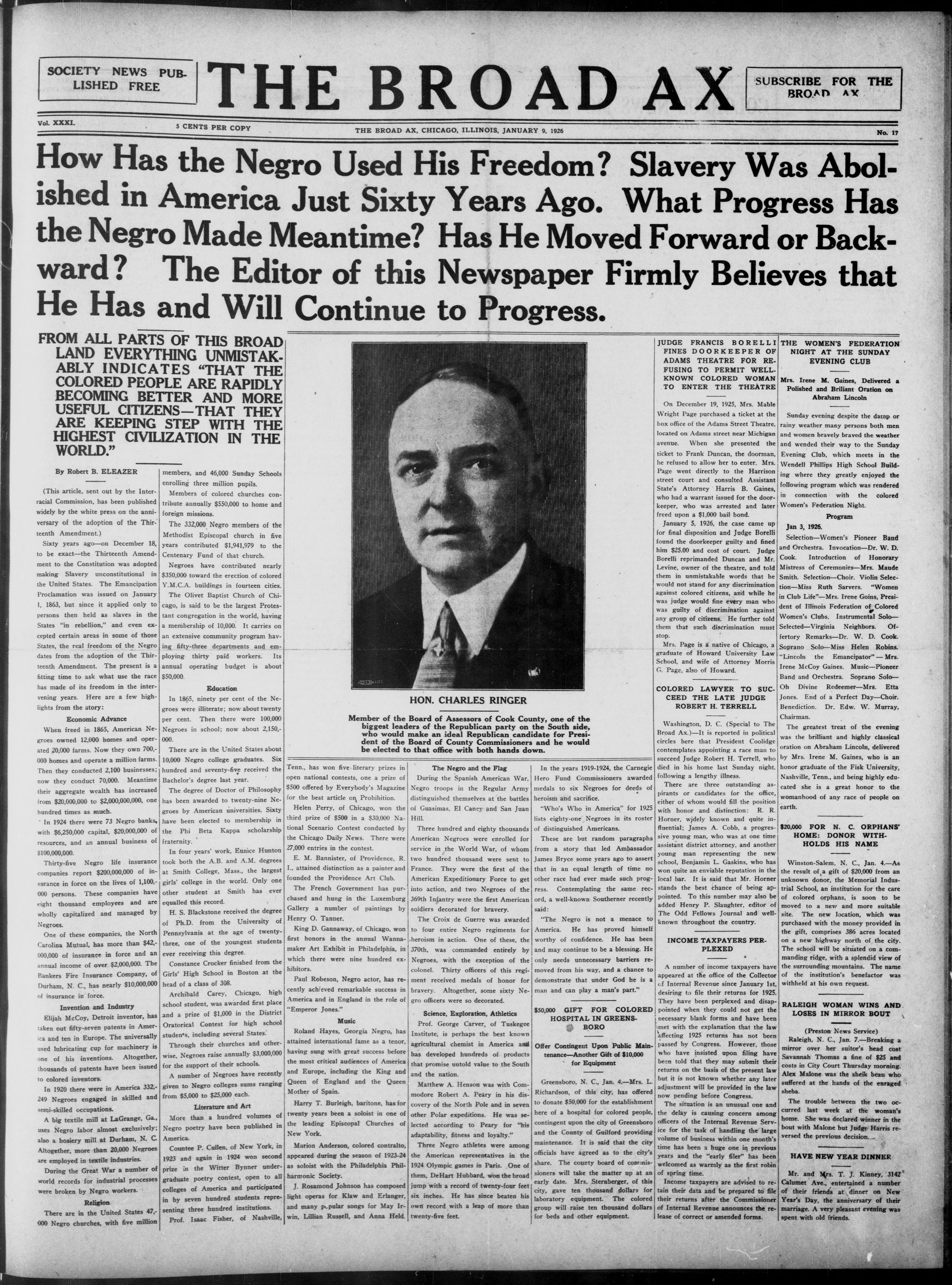
How Has the Negro Used His Freedom? Slavery Was Abolished in America Just Sixty Years Ago. What Progress Has the Negro Made Meantime? Has He Moved Forward or Backward? The Editor of this Newspaper Firmly Believes that He Has and Will Continue to Progress.
SOCIETY NEWS PUBLISHED FREE
Vol. XXXI. 5 C
How Has t
ished in An
the Negro
ward? TH
He Has an
FROM ALL PARTS OF
LAND EVERYTHING
ABLY INDICATES
COLORED PEOPLE
BECOMING BETTER
USEFUL CITIZENS
ARE KEEPING STE
HIGHEST CIVILIZAT
WORLD."
FROM ALL PARTS OF THIS BROAD LAND EVERYTHING UNMISTAKABLY INDICATES "THAT THE COLORED PEOPLE ARE RAPIDLY BECOMING BETTER AND MORE USEFUL CITIZENS-THAT THEY ARE KEEPING STEP WITH THE HIGHEST CIVILIZATION IN THE WORLD."
---
Vol. XXXI.
By Robert B. ELEAZER
(This article, sent out by the Interracial Commission, has been published widely by the white press on the anniversary of the adoption of the Thirteenth Amendment.)
Sixty years ago—on December 18, to be exact—the Thirteenth Amendment to the Constitution was adopted making Slavery unconstitutional in the United States. The Emancipation Proclamation was issued on January 1, 1863, but since it applied only to persons then held as slaves in the States "in rebellion," and even excepted certain areas in some of those States, the real freedom of the Negro dates from the adoption of the Thirteenth Amendment. The present is a fitting time to ask what use the race has made of its freedom in the intervening years. Here are a few highlights from the story:
Economic Advance
When freed in 1865, American Negroes owned 12,000 homes and operated 20,000 farms. Now they own 700,000 homes and operate a million farms. Then they conducted 2,100 businesses; now they conduct 70,000. Meantime their aggregate wealth has increased from $20,000,000 to $2,000,000,000, one hundred times as much.
In 1924 there were 73 Negro banks, with $6,250,000 capital, $20,000,000 of resources, and an annual business of $100,000,000.
Thirty-five Negro life insurance companies report $200,000,000 of insurance in force on the lives of 1,100,000 persons. These companies have eight thousand employees and are wholly capitalized and managed by Negroes.
One of these companies, the North Carolina Mutual, has more than $42,000,000 of insurance in force and an annual income of over $2,000,000. The Bankers Fire Insurance Company, of Durham, N. C., has nearly $10,000,000 of insurance in force.
Invention and Industry
Elijah McCoy, Detroit inventor, has taken out fifty-seven patents in America and ten in Europe. The universally used lubricating cup for machinery is one of his inventions. Altogether, thousands of patents have been issued to colored inventors.
In 1920 there were in America 332,249 Negroes engaged in skilled and semi-skilled occupations.
A big textile mill at LaGrange, Ga., uses Negro labor almost exclusively; also a hosiery mill at Durham, N. C. Altogether, more than 20,000 Negroes are employed in textile industries.
During the Great War a number of world records for industrial processes were broken by Negro workers.
Religion
There are in the United States 47, 000 Negro churches, with five million
THE BROAD AX
5 CENTS PER COPY
is the Negro
America
who Made M
The Edit
and Will
S OF THIS BROAD
THING UNMISTAK-
TES "THAT THE
PLE ARE RAPIDLY
TTER AND MORE
ENS—THAT THEY
STEP WITH THE
IZATION IN THE
members, and 46,000 Sunday Schools enrolling three million pupils.
Members of colored churches contribute annually $550,000 to home and foreign missions.
The 332,000 Negro members of the Methodist Episcopal church in five years contributed $1,941,979 to the Centenary Fund of that church.
Negroes have contributed nearly $350,000 toward the erection of colored Y.M.C.A. buildings in fourteen cities.
The Olivet Baptist Church of Chicago, is said to be the largest Protestant congregation in the world, having a membership of 10,000. It carries on an extensive community program having fifty-three departments and employing thirty paid workers. Its annual operating budget is about $50,000.
Education
In 1865, ninety per cent of the Negroes were illiterate; now about twenty per cent. Then there were 100,000 Negroes in school; now about 2,150,000.
There are in the United States about 10,000 Negro college graduates. Six hundred and seventy-five received the Bachelor's degree last year.
The degree of Doctor of Philosophy has been awarded to twenty-nine Negroes by American universities. Sixty have been elected to membership in the Phi Beta Kappa scholarship fraternity.
In four years' work, Eunice Hunton took both the A.B. and A.M. degrees at Smith College, Mass., the largest girls' college in the world. Only one other student at Smith has ever equalled this record.
H. S. Blackstone received the degree of Ph.D. from the University of Pennsylvania at the age of twenty-three, one of the youngest students ever receiving this degree.
Constance Crocker finished from the Girls' High School in Boston at the head of a class of 308.
Archibald Carey, Chicago, high school student, was awarded first place and a prize of $1,000 in the District Oratorical Contest for high school student*s, including several States.
Through their churches and otherwise, Negroes raise annually $3,000,000 for the support of their schools.
A number of Negroes have recently given to Negro colleges sums ranging from $5,000 to $25,000 each.
Literature and Art
More than a hundred volumes of Negro poetry have been published in America.
Countere P. Cullen, of New York, in 1923 and again in 1924 won second prize in the Witter Bynner undergraduate poetry contest, open to all colleges of America and participated in by seven hundred students representing three hundred institutions.
Prof. Isaac Fisher, of Nashville,
THE BROAD AX, CHICAGO, ILLINOIS, JANUARY 9, 1926
101
Member of the Board of Assessors of Cook County, one of the biggest leaders of the Republican party on the South side, who would make an ideal Republican candidate for President of the Board of County Commissioners and he would be elected to that office with both hands down.
Tenn., has won five literary prizes in open national contests, one a prize of $500 offered by Everybody's Magazine for the best article on Prohibition.
Helen Perry, of Chicago, won the third prize of $500 in a $30,000 National Scenario Contest conducted by the Chicago Daily News. There were 27,000 entries in the contest.
E. M. Bannister, of Providence, R. I., attained distinction as a painter and founded the Providence Art Club.
The French Government has purchased and hung in the Luxemburg Gallery a number of paintings by Henry O. Tanner.
King D. Gannaway, of Chicago, won first honors in the annual Wannamaker Art Exhibit in Philadelphia, in which there were nine hundred exhibitors.
Paul Robeson, Negro actor, has recently achieved remarkable success in America and in England in the role of "Emperor Jones."
Music
Roland Hayes, Georgia Negro, has attained international fame as a tenor, having sung with great success before the most critical audiences of America and Europe, including the King and Queen of England and the Queen Mother of Spain.
Harry T. Burleigh, baritone, has for twenty years been a soloist in one of the leading Episcopal Churches of New York.
Marion Anderson, colored contralto, appeared during the season of 1923-24 as soloist with the Philadelphia Philharmonic Society.
J. Rosamond Johnson has composed light operas for Klaw and Erlanger, and many popular songs for May Irwin, Lillian Russell, and Anna Held.
HON. CHARLES RINGER
Board of Assessors of Cook Coun-
ers of the Republican party on-
make an ideal Republican cand-
Board of County Commissioners
to that office with both hands do
The Negro and the Flag
During the Spanish American War,
Negro troops in the Regular Army
distinguished themselves at the battles
of Guasimas, El Caney and San Juan
Hill.
Three hundred and eighty thousands
American Negroes were enrolled for
service in the World War, of whom
two hundred thousand were sent to
France. They were the first of the
American Expeditionary Force to get
into action, and two Negroes of the
369th Infantry were the first American
soldiers decorated for bravery.
The Croix de Guerre was awarded to four entire Negro regiments for heroism in action. One of these, the 370th, was commanded entirely by Negroes, with the exception of the colonel. Thirty officers of this regiment received medals of honor for bravery. Altogether, some sixty Negro officers were so decorated.
Science, Exploration, Athletics
Prof. George Carver, of Tuskegee Institute, is perhaps the best known agricultural chemist in America and has developed hundreds of products that promise untold value to the South and the nation.
Matthew A. Henson was with Commodore Robert A. Peary in his discovery of the North Pole and in seven other Polar expeditions. He was selected according to Peary for "his adaptability, fitness and loyalty."
Three Negro athletes were among the American representatives in the 1924 Olympic games in Paris. One of them, DeHart Hubbard, won the broad jump with a record of twenty-four feet six inches. He has since beaten his own record with a leap of more than twenty-five feet.
In the years 1919-1924, the Carnegie Hero Fund Commissioners awarded medals to six Negroes for deeds of heroism and sacrifice.
"Who's Who in America" for 1925 lists eighty-one Negroes in its roster of distinguished Americans.
These are but random paragraphs from a story that led Ambassador James Bryce some years ago to assert that in an equal length of time no other race had ever made such progress. Contemplating the same record, a well-known Southerner recently said:
"The Negro is not a menace to America. He has proved himself worthy of confidence. He has been and may continue to be a blessing. He only needs unnecessary barriers removed from his way, and a chance to demonstrate that under God he is a man and can play a man's part."
$50,000 GIFT FOR COLORED HOSPITAL IN GREENS-BORO
Offer Contingent Upon Public Maintenance—Another Gift of $10,000 for Equipment
Greensboro, N. C., Jan. 4.—Mrs. L. Richardson, of this city, has offered to donate $50,000 for the establishment here of a hospital for colored people, contingent upon the city of Greensboro and the County of Guilford providing maintenance. It is said that the city officials have agreed as to the city's share. The county board of commissioners will take the matter up at an early date. Mrs. Sternberger, of this city, gave ten thousand dollars for laboratory equipment. The colored group will raise ten thousand dollars for beds and other equipment.
JUDGE FRANCIS BORELLI FINES DOORKEEPER OF ADAMS THEATRE FOR REFUSING TO PERMIT WELL-KNOWN COLORED WOMAN TO ENTER THE THEATRE
On December 19, 1925, Mrs. Mable Wright Page purchased a ticket at the box office of the Adams Street Theatre, located on Adams street near Michigan avenue. When she presented the ticket to Frank Duncan, the doorman, he refused to allow her to enter. Mrs. Page went directly to the Harrison street court and consulted Assistant State's Attorney Harris B. Gaines, who had a warrant issued for the doorkeeper, who was arrested and later freed upon a $1,000 bail bond.
January 5, 1926, the case came up for final disposition and Judge Borelli found the doorkeeper guilty and fined him $25.00 and cost of court. Judge Borelli reprimanded Duncan and Mr. Levine, owner of the theatre, and told them in unmistakable words that he would not stand for any discrimination against colored citizens, and while he was judge would fine every man who was guilty of discrimination against any group of citizens. He further told them that such discrimination must stop.
Mrs. Page is a native of Chicago, a graduate of Howard University Law School, and wife of Attorney Morris G. Page, also of Howard.
COLORED LAWYER TO SUC
CEED THE LATE JUDGE
ROBERT H. TERRELL
Washington, D. C. (Special to The Broad Ax.)—It is reported in political circles here that President Coolidge contemplates appointing a race man to succeed Judge Robert H. Terrell, who died in his home last Sunday night, following a lengthy illness.
There are three outstanding aspirants or candidates for the office, either of whom would fill the position with honor and distinction: R. R. Horner, widely known and quite influential; James A. Cobb, a progressive young man, who was at one time assistant district attorney, and another young man representing the new school, Benjamin L. Gaskins, who has won quite an enviable reputation in the local bar. It is said that Mr. Horner stands the best chance of being appointed. To this number may also be added Henry P. Slaughter, editor of The Odd Fellows Journal and well-known throughout the country.
INCOME TAXPAYERS PER
PLEXED
A number of income taxpayers have appeared at the office of the Collector of Internal Revenue since January 1st, desiring to file their returns for 1925. They have been perplexed and disappointed when they could not get the necessary blank forms and have been met with the explanation that the law affecting 1925 returns has not been passed by Congress. However, those who have insisted upon filing have been told that they may submit their returns on the basis of the present law but it is not known whether any later adjustment will be provided in the law now pending before Congress.
The situation is an unusual one and the delay is causing concern among officers of the Internal Revenue Service for the task of handling the large volume of business within one month's time has been a huge one in previous years and the "early filer" has been welcomed as warmly as the first robin of spring time.
Income taxpayers are advised to retain their data and be prepared to file their returns after the Commissioner of Internal Revenue announces the release of correct or amended forms.
SUBSCRIBE FOR THE BROAD AX
No. 17
Was Abol- ogress Has d or Back- lieves that
No.17
THE WOMEN'S FEDERATION NIGHT AT THE SUNDAY EVENING CLUB
Mrs. Irene M. Gaines, Delivered a Polished and Brilliant Oration on Abraham Lincoln
Sunday evening despite the damp or rainy weather many persons both men and women bravely braved the weather and wended their way to the Sunday Evening Club, which meets in the Wendell Phillips High School Building where they greatly enjoyed the following program which was rendered in connection with the colored Women's Federation Night.
Program
Jan 3. 1926.
Selection—Women's Pioneer Band and Orchestra. Invocation—Dr. W. D. Cook. Introduction of Honorary Mistress of Ceremonies—Mrs. Maude Smith. Selection—Choir. Violin Selection—Miss Ruth Sarvers. "Women in Club Life"—Mrs. Irene Goins, President of Illinois Federation of Colored Women's Clubs. Instrumental Solo—Selected—Virginia Neighbors. Offertory Remarks—Dr. W. D. Cook. Soprano Solo—Miss Helen Robins. "Lincoln the Emancipator"—Mrs. Irene McCoy Gaines. Music—Pioneer Band and Orchestra. Soprano Solo—Oh Divine Redeemer—Mrs. Etta Jones. End of a Perfect Day—Choir. Benediction. Dr. Edw. W. Murray, Chairman.
The greatest treat of the evening was the brilliant and highly classical oration on Abraham Lincoln, delivered by Mrs. Irene M. Gaines, who is an honor graduate of the Fisk University, Nashville, Tenn., and being highly educated she is a great honor to the womanhood of any race of people on earth.
$20,000 FOR N. C. ORPHANST
HOME: DONOR WITH-
HOLDS HIS NAME
Winston-Salem, N. C., Jan. 4.—As the result of a gift of $20,000 from an unknown donor, the Memorial Industrial School, an institution for the care of colored orphans, is soon to be moved to a new and more suitable site. The new location, which was purchased with the money provided in the gift, comprises 386 acres located on a new highway north of the city. The school will be situated on a commanding ridge, with a splendid view of the surrounding mountains. The name of the institution's benefactor was withheld at his own request.
RALEIGH WOMAN WINS AND
LOSES IN MIRROR BOUT
(Preston News Service)
Raleigh, N. C., Jan. 7.—Breaking a mirror over her suitor's head cost Savannah Thomas a fine of $25 and costs in City Court Thursday morning. Alex Malone was the sheik beau who suffered at the hands of the enraged sheba.
The trouble between the two occurred last week at the woman's home. She was declared winner in the bout with Malone but Judge Harris reversed the previous decision.
HAVE NEW YEAR DINNER
Mr. and Mrs. T. J. Kinney, 3142 Calumet Ave., entertained a number of their friends at dinner on New Year's Day, the anniversary of their marriage. A very pleasant evening was spent with old friends.
THE BROAD AX Published Every Saturday
In this city since July 15th, 1899, without missing one single issue. Republicans, Democrats, Catholics, Protestants, Single Taxers, Priests, infidels or anyone else can have their say as long as their language is proper and responsibility is fixed.
The Broad Ax is a newspaper whose platform is broad enough for all, even claiming the editorial right to speak its own mind. It is neither Democratic nor Republican. It is strictly or absolutely independent in politics.
Local communications will receive attention. Write only on one side of the paper.
Subscriptions must be paid in advance.
One Year .....$2.00
Six Months .....$1.00
Advertising rates made known on application.
Address all communications to
THE BROAD AX
6206 S. Elizabeth St., Chicago.
Phone: Wentworth 2597
JULIUS F. TAYLOR
Editor and Publisher
Vol. XXXI No. 17
Chicago, January 9, 1926
Entered as Second-Class Matter, Aug.
19, 1902, at the Post office at Chicago,
Ill. Under Act of March 8, 1879.
ROLAND HAYES' HOMECOM
ING WAS TRIUMPHAL
EVENT
Atlanta, Ga., Jan. 5.—Roland Hayes homecoming—a concert here December 18, his first appearance in his native state—was one of the greatest triumphs of his remarkable career The vast auditorium where the annual grand opera season is staged was crowded with an audience of five thousand, the two races being represented in nearly equal numbers.
The singer gave a remarkable program, leading off with a number of the great classics and closing with a group of Negro spirituals. He won his audience completely with the first number and held it with increasing power to the very end. At the conclusion he was thronged by hundreds eager to say a word of appreciation. The universal verdict was that the event was a triumph of the highest order. The public and the musical critics alike were most enthusiastic in praise of both the singer's voice and the perfection of his ar. The accompaniment by William Lawrence also received the highest praise.
Many of Atlanta's most prominent music lovers were sponsors of the concert, including the head of the biggest bank, the editors of two of the great daily papers, a well-known millionaire, and many others—both men and women. The colored section of the audience, filling half the vast arena, was equally representative. Many prominent colored people occupied boxes, among them being Dr. and Mrs. M. S. Davago, Dr. and Mrs. J. H. Lewis, Mr. and Mrs. B. J. Davis, Dr. and Mrs. A. L. Butler, Mr. and Mrs. Holsey of Tuskegee, Mrs. Rayfield of Birmingham and Champlain, A. M. Thomas of Columbus.
ALDERMAN ANDERSON AD-
DRESSES CLUB
Hon. Louis B. Anderson, alderman of the Second Ward and an advocate of the great principal of race solidarity delivered an enthusiastic address before the officers and members of the Ft. Dearborn 1926 Marching Club in their beautiful club rooms, 3920 Grand blvd. Sunday afternoon, Jan. 3rd. Mr. Anderson reviewed, with pleasure, the history of the race in the city for the past twenty years. He compared city after city with Chicago and found no city to measure up in progressiveness with Chicago. He sees a brighter future if co-operation, unity and leadership among the race can be of a mutual continuance. Others who made short remarks were Hon. Edward H. Wright, J. C. Martin, E. R.; Atty. J. P. Hardin, P. A. Glanton, Mrs. Ella G. Berry, vice grand daughter ruler; Dr. W. H. Davis, S. J. Fountain, president of the 1926 Marching Club; James M. Brooks, past president of the 1925 Marching Club acted as master of ceremonies.
CALLED TO MICHIGAN
A. E. Pinckney, 4114 Calumet Ave., was called to the bedside of his sick mother at Grand Rapids, Mich., during the holidays. His many friends in the city wish for the complete recovery of Mr. Pinckney's mother.
COLORFUL NEWS MOVIES By THE CAMERAMAN
1. Political Prophecies.
2. "Colour Bar" Hits Africa.
3. Blood Will Tell? Maybe?
4. New Year's Dreams.
5. Art Steps Forward.
Political Prophecies
The year 1925 has ebbed away, leaving, as they say, a dark brown taste in the political mouths of the brethren. "Nothing has been done," they say, to assert the benefices due to real American citizens of the color. In a large measure, this conclusion is correct, and at once gives life to the question of cause. Some one was once artfully logical enough to say that "Charity begins at home;" and we humbly beg leave to add that "Political destinies begin at home." The white man's politics is a highly scientific feature of American Government, and has always been so, for that matter. The Negro's politics was once founded upon the principle of sympathy; and it seems to us that the bulk of the modern Negro "antiquarians" are still viewing the high science of modern politics through a microscope of sympathy. That's wrong, dead wrong; and that's why many things which our group thinks ought to have been done have not been done. The white political world, with which we are called upon to deal, is the acme of organization; while ours is the acme of waste and decay.
Dozens of groups are essaying to speak in open political court. Divided, each pretends to be the true and duly appointed counsel for the Negro group. Our organized contemporary laughs at our clumsy efforts to accomplish, while divided, those things which we can only accomplish when united, from coast to coast, from the gulf to Canada. Why we wantonly continue, by sheer neglect, to permit petty personalities and sectional differences to deter us in presenting an organized front, is one of the disgraceful wonders of the age. The A. F. of L., with half the united membership which could be our politically, receives favors and recognition the country over. We, with a potential vote and the most valuable economic army, proportionately, in the country, continue to sing the political blues without first putting our own house in Cohesion, unity, oneness of purpose, and all the elements which make for real race political organization are the foods for which we are politically starving to death right now—and the other fellow knows all about our dilemmas. Unity and organization will win respect; will establish persuasive force; will make the world know that we want what we want and know how to ask for it according to the rules of Hoyle. This is the first job to be put over before we chirp the blues and sing the political doxology. Booker T. Washington was quite right when he said "Let down your buckets where you are." To apply this simple dictum in our own political well is the first step forward towards forming a partnership with the fellow who is already up and doing. And that's that.
"Colour Bar" Hits Africa
The "Colour Bar" walked right in to the South African mines, turned around and waltzed right out when the Parliament of the Union of South Africa rejected it by a vote of 17 to 13. This particular color bar was a pernicious bill fostered by the Nationalist and Labour Parties, and growing out of the fact that a mine manager had been guilty of employing a black native to control an electric locomotive. The Bill sought to create forever color differential treatment prejudicial to the black laborers in the South African mines. In fact, the bill sought to preserve for Europeans certain specific skilled and semi-skilled occupations to which African native laborers were aspiring. As a matter of fact, several strikes have taken place during the past year because of work antipathies which the whites of the South African mines have steadfastly held against their black brother laborers. Yet, on this side of the sea, we hear the call "Workers of the World, Unite!"
At any rate the "Colour Bar" bill was rejected on a 17 to 13 basis, and black natives can continue to aspire to any place, skilled or highly technical, which is available and for which they are amply prepared. Furthermore, the "Colour Bar" bill, as ill a wind as it was, performed the usual amount of good. It stirred the Transvaal African Congress to pass resolutions "Viewing with alarm the spread of segregation—a segregation resembling the slavery of old." This stirring
THE BROAD AX, CHICAGO, ILLINOIS, JANUARY 9, 1926
sentiment means that irresistible African forces, in a statesmanlike way, are preparing to combat segregation in their own homeland. And when the smoke of protest has cleared away, we doubt not that the "Colour Bar" shall have shrunken down to a minute composite. In fact, it may become converted into common sense, if the Transvaal Congress finishes as strong as it has begun.
Blood Will Tell? Maybe?
And now, after all the sublime years, during which scientists have agreed that there was nothing in the blood corpuscles of man by which black skin tints could be differentiated from white, red, brown or yellow, comes a North Carolina scientist, Dr. L. H. Snyder, announcing that inheritance and race characteristics can be told from chemical reactions of the blood in certain combinations; and that, thus, the "sheep" can be eventually separated from the "goats" in the grand American chase, after so-called racial purity. It is inferred, from the scientist's conclusions, that much aid will thus be available to the courts and other analysts who may be called into duty under such acts as the Virginia Integrity Law or amid such cases as that of the Rhinelanders or the Virginia Indian Case.
The sincere professor of the science of blood almost tears down his little white house when he says: "The experiments are not successful where there has been admixture of races." Furthermore, he admits that the truth of the experiments is always dependent too, upon the purity of the chemical solution used to cause the desired chemical phenomena. With two such glaring weaknesses in an experimentation, it is difficult to see how Dr. Snyder's discovery is going to be of much practical benefit to science. Thus, where alleged Nordicism had made some blood tributaries or become a blood tributary itself, under admixtures, it is difficult to see how accuracy could obtain in the test. Of course, so far as our group is concerned, unfortunately it's upward trend from fast black runs into about fifty-seven shades up to pure white, including the hundreds of thousands who are now classified as pure Nordics. Perhaps it is a good thing that Prof. Snyder's test is not a hundred per center; for constellation might grasp the ranks of some of America's loftiest Nordic families. And what good would it do thus to expose, by mere chemicals, facts which have been believed from a time as to which the memory of man runneth not to the contrary. No, sire; what science needs to do is to bring back the old-fashioned sweet potato; or to eliminate the germs which continue to cause sickness and death. This we think, would benefit man far more than it will to imagine the blood content of his great, great grand parents.
New Year's Dreams
Just before the old year departed, we dozed off into a weird dream. We dreamed we were on a broad thoroughfare in Africa, named Garvey Boulevard, as lively as Lenox Avenue, New York, Beale Avenue, Memphis, and Indiana Avenue, Chicago, all in one. A huge parade was in progress, for it was Dedication Day for the City of Scipio Africanus. In a giant reviewing stand sat Mayor Marcus Garvey and his official guests of honor, while in the far distance, led by a resonant band, the cavalcade of celebrants with lofty banners, had begun the slow march, as the band played "Save Your Sorrow for Tomorrow." As the line of march approached, we could see the faces of the marchers. There was Bill Matthews, with a banner of the U. N. I. A., inscription, under which appeared the simple sentence: "You made me what I am today." Next there came, hand in hand, Emmet Scott and Perry Howard, who were singing that lovable old song: "Comrades, Comrades, Ever Since We Were Boys." Emmett's banner bore the single line: "Helveti et Romani multis proclis dimicant"; while Perry's banner said: "Silver threads among the gold." John D. Gainey hove into sight. He was faultlessly dressed, his natty gloved hand holding aloft an inscription saying: "Never do today that which you can put off until tomorrow." The Mayor shifted uneasily in his chair as Nahum Daniel Brascher walked nobly by the stand. with a "Pay-as-you-enter" banner hanging lightly upon his shoulder. Tom Smith of Baltimore was also in line. He was softly singing to himself: "I'm, lonesome, that's all." A tall figure, which we at once recognized as that of Ar-
[Name]
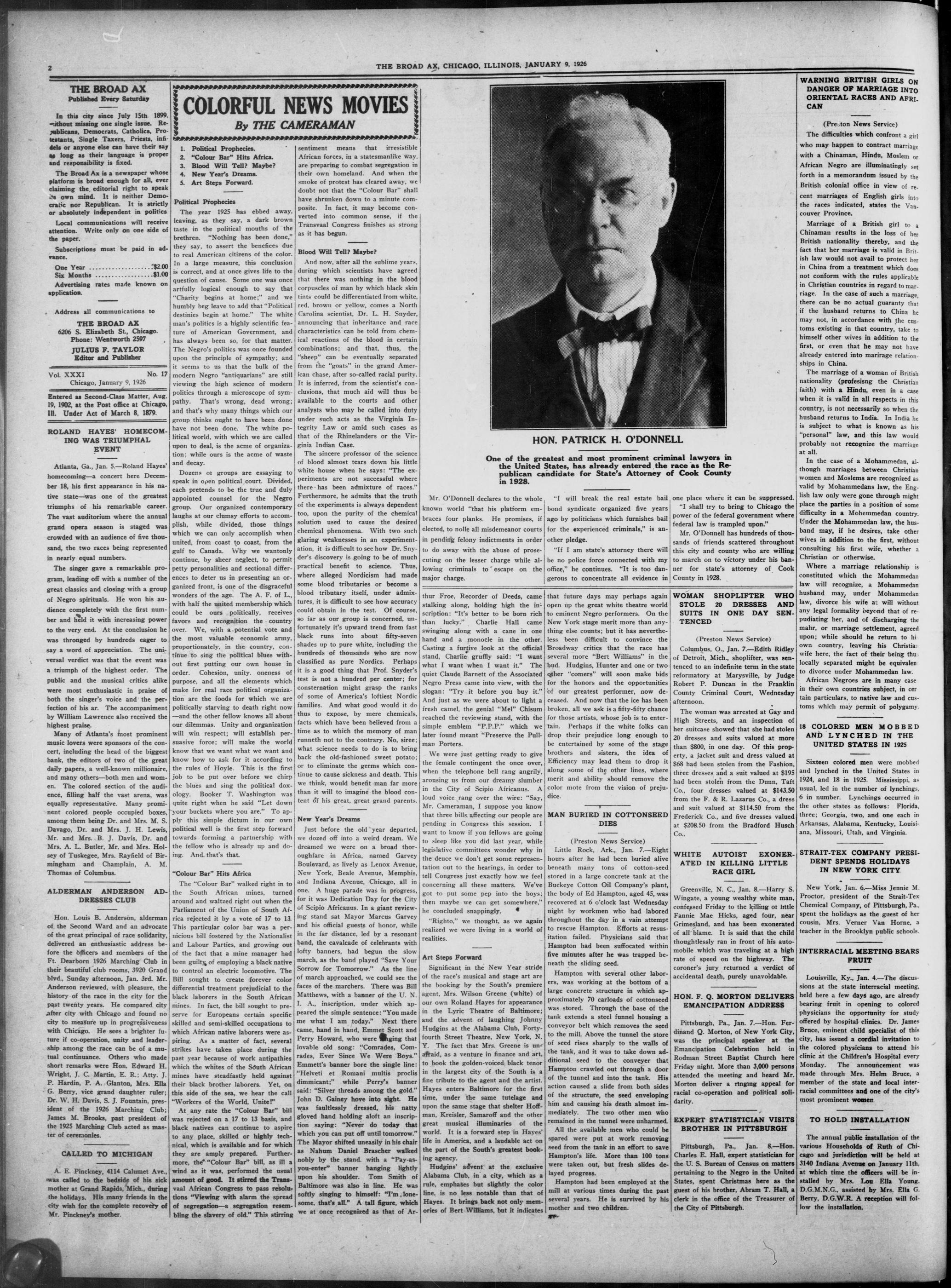
Mr. O'Donnell declares to the whole known world "that his platform embraces four planks. He promises, if elected, to nolle all misdemeanor courts in pending felony indictments in order to do away with the abuse of prosecuting on the lesser charge while allowing criminals to escape on the major charge.
thur Froe, Recorder of Deeds, came stalking along, holding high the inscription: "It's better to be born rich than lucky." Charlie Hall came swinging along with a cane in one hand and a monocle in the other. Casting a furive look at the official stand, Charlie gruffly said: "I want what I want when I want it." The quiet Claude Barnett of the Associated Negro Press came into view, with the slogan: "Try it before you buy it." And just as we were about to light a fresh camel, the genial "Mel" Chisum reached the reviewing stand, with the simple emblem "P.P.P." which we later found meant "Preserve the Pullman Porters.
We were just getting ready to give the female contingent the once over, when the telephone bell rang angrily, arousing us from our dreamy slumber in the City of Scipio Africanan. A loud voice rang over the wire: "Say, Mr. Cameraman, I suppose you know that three bills affecting our people are pending in Congress this session. I want to know if you fellows are going to sleep like you did last year, while legislative committees wonder why in the deuce we don't get some representation out to the hearings, in order to tell Congress just exactly how we feel concerning all these matters. We've got to put some pep into the boys; then maybe we can get somewhere," he concluded snappingly.
"Righto," we thought, as we again realized we were living in a world of realities.
Art Steps Forward
Significant in the New Year stride of the race's musical and stage art are the booking by the South's premiere agent, Mrs. Wilson Greene (white) of our own Roland Hayes for appearance in the Lyric Theatre of Baltimore; and the advent of laughing Johnny Hudgins at the Alabama Club, Forty-fourth Street Theatre, New York, N.Y. The fact that Mrs. Greene is unafraid, as a venture in finance and art, to book the golden-voiced black tenor in the largest city of the South is a fine tribute to the agent and the artist. Hayes enters Baltimore for the first time, under the same tutelage and upon the same stage that shelter Hoffman, Kreisler, Samaroff and the other great musical illuminaries of the world. It is a forward step in Hayes' life in America, and a laudable act on the part of the South's greatest booking agency.
Hudgins' advent at the exclusive Alabama Club, in a city, which as a rule, emphases but slightly the color line, is no less notable than that of Hayes. It brings back not only memories of Bert Williams, but it indicates
HON. PATRICK H. O'DONNELL
"I will break the real estate bail bond syndicate organized five years ago by politicians which furnishes bail for the experienced criminals," is another pledge.
"If I am state's attorney there will be no police force connected with my office," he continues. "It is too dangerous to concentrate all evidence in
that future days may perhaps again open up the great white theatre world to eminent Negro performers. On the New York stage merit more than anything else counts; but it has nevertheless been difficult to convince the Broadway critics that the race has several more "Bert Williams" in the bud. Hudgins, Hunter and one or two other "comers" will soon make bids for the honors and the opportunities of our greatest performer, now deceased. And now that the ice has been broken, all we ask is a fifty-fifty chance for those artists, whose job is to entertain. Perhaps if the white folks can drop their prejudice long enough to be entertained by some of the stage brothers and sisters, the idea of Efficiency may lead them to drop it along some of the other lines, where merit and ability should remove the color mote from the vision of prejudice.
MAN BURIED IN COTTONSEED
DIES
(Preston News Service)
Little Rock, Ark., Jan. 7.—Eight hours after he had been buried alive beneath many tons of cotton-seed stored in a large concrete tank at the Buckeye Cotton Oil Company's plant, the body of Ed Hampton, aged 45, was recovered at 6 o'clock last Wednesday night by workmen who had labored throughout the day in a vain attempt to rescue Hampton. Efforts at resuscitation failed. Physicians said that Hampton had been suffocated within five minutes after he was trapped beneath the sliding seed.
Hampton with several other laborers, was working at the bottom of a large concrete structure in which approximately 70 carloads of cottonseed was stored. Through the base of the tank extends a steel funnel housing a conveyor belt which removes the seed to the mill. Above the tunnel the store of seed rises sharply to the walls of the tank, and it was to take down additional seed to the conveyer that Hampton crawled out through a door of the tunnel and into the tank. His action caused a slide from both sides of the structure, the seed enveloping him and causing his death almost immediately. The two other men who remained in the tunnel were unharmed.
All the available men who could be spared were put at work removing seed from the tank in an effort to save Hampton's life. More than 100 tons were taken out, but fresh slides delayed progress. Hampton had been employed at the mill at various times during the past several years. He is survived by his mother and two children.
one place where it can be suppressed.
"I shall try to bring to Chicago the power of the federal government where federal law is trampled upon."
Mr. O'Donnell has hundreds of thousands of friends scattered throughout this city and county who are willing to march on to victory under his banner for state's attorney of Cook County in 1928.
WOMAN SHOPLIFTER WHO STOLE 20 DRESSES AND SUITS IN ONE DAY SENTENCED
(Preston News Service)
Columbus, O., Jan. 7.—Edith Ridley of Detroit, Mich., shoplifter, was sentenced to an indefinite term in the state reformatory at Marysville, by Judge Robert P. Duncan in the Franklin County Criminal Court, Wednesday afternoon.
The woman was arrested at Gay and High Streets, and an inspection of her suitcase showed that she had stolen 20 dresses and suits valued at more than $800, in one day. Of this property, a jacket suit and dress valued at $68 had been stolen from the Fashion, three dresses and a suit valued at $195 had been stolen from the Dunn, Taft Co., four dresses valued at $143.50 from the F. & R. Lazarus Co., a dress and suit valued at $114.50 from the Frederick Co., and five dresses valued at $208.50 from the Bradford Husch Co.
WHITE AUTOIST EXONER
ATED IN KILLING LITTLE
RACE GIRL
Greenville, N. C., Jan. 8.—Harry S. Wingate, a young wealthy white man, confessed Friday to the killing of little Fannie Mae Hicks, aged four, near Grimesland, and has been exonerated of all blame. It is said that the child thoughtlessly ran in front of his automobile which was traveling at a high rate of speed on the highway. The coroner's jury returned a verdict of accidental death, purely unavoidable.
HON. F. Q. MORTON DELIVERY
EMANCIPATION ADDRESS
Pittsburgh, Pa., Jan. 7.—Hon. Ferdinand Q. Morton, of New York City, was the principal speaker at the Emancipation Celebration held in Rodman Street Baptist Church here Friday night. More than 3,000 persons attended the meeting and heard Mr. Morton deliver a ringing appeal for racial co-operation and political solidarity.
EXPERT STATISTICIAN VISITS BROTHER IN PITTSBURGH
Pittsburgh, Pa., Jan. 8—Hon. Charles E. Hall, expert statistician for the U. S. Bureau of Census on matters pertaining to the Negro in the United States, spent Christmas here as the guest of his brother, Abram T. Hall, a clerk in the office of the Treasurer of the City of Pittsburgh.
WARNING BRITISH GIRLS ON DANGER OF MARRIAGE INTO ORIENTAL RACES AND AFRI CAN
(Preston News Service)
The difficulties which confront a girl who may happen to contract marriages with a Chinaman, Hindu, Moslem or African Negro are illuminatingly seen forth in a memorandum issued by the British colonial office in view of recent marriages of English girls into the races indicated, states the Vancouver Province.
Marriage of a British girl to a Chinaman results in the loss of her British nationality thereby, and the fact that her marriage is valid in British law would not avail to protect her in China from a treatment which does not conform with the rules applicable in Christian countries in regard to marriage. In the case of such a marriage, there can be no actual guaranty that if the husband returns to China he may not, in accordance with the customs existing in that country, take to himself other wives in addition to the first, or even that he may not have already entered into marriage relationships in China.
The marriage of a woman of British nationality (profesising the Christian faith) with a Hindu, even in a case when it is valid in all respects in this country, is not necessarily so when the husband returns to India. In India he is subject to what is known as his "personal" law, and this law would probably not recognize the marriage at all.
In the case of a Mohammedan, although marriages between Christian women and Moslems are recognized as valid by Mohammedans law, the English law only were gone through might place the parties in a position of some difficulty in a Mohammedan country. Under the Mohammedan law, the husband may, if he desires, take other wives in addition to the first, without consulting his first wife, whether a Christian or otherwise.
Where a marriage relationship is constituted which the Mohammedan law will recognize, a Mohammedan husband may, under Mohammedan law, divorce his wife at will without any legal formality beyond that of repudiating her, and of discharging the mahr, or marriage settlement, agreed upon; while should he return to his own country, leaving his Christian wife here, the fact of their being thus locally separated might be equivalent to divorce under Mohammedan law. African Negroes are in many case in their own countries subject, in certain particulars, to native law and customs which may permit of polygamy
18 COLORED MEN MOBBED AND LYNCHED IN THE UNITED STATES IN 1925
Sixteen colored men were mobbed and lynched in the United States in 1924, and 18 in 1925. Mississippi, as usual, led in the number of lynchings. 6 in number. Lynchings occurred in the other states as follows: Florida, three; Georgia, two, and one each in Arkansas, Alabama, Kentucky, Louisiana, Missouri, Utah, and Virginia.
STRAIT-TEX COMPANY PRESIDENT SPENDS HOLIDAYS IN NEW YORK CITY
New York, Jan. 6.—Miss Jennie M. Proctor, president of the Strait-Tex Chemical Company, of Pittsburgh, Pa. spent the holidays as the guest of her cousin, Mrs. Verner Van Horne, a teacher in the Brooklyn public schools.
INTERRACIAL MEETING BEARS
FRUIT
Louisville, Ky., Jan. 4.—The discussions at the state interracial meeting, held here a few days ago, are already bearing fruit in opening to colored physicians the opportunity for study offered by hospital clinics. Dr. James Bruce, eminent child specialist of this city, has issued a cordial invitation to the colored physicians to attend his clinic at the Children's Hospital every Monday. The announcement was made through Mrs. Helm Bruce, a member of the state and local interracial committees and one of the city's most prominent women.
TO HOLD INSTALLATION
The annual public installation of the various Households of Ruth of Chicago and jurisdiction will be held at 3140 Indiana Avenue on January 11th, at which time the officers will be installed by Mrs. Lou Ella Young. D.G.M.N.G., assisted by Mrs. Ella G. Berry, D.G.W.R. A reception will follow the installation.
S.
The wide-awake head of the Police Department Chicago who warns its citizens to write ou properly and prevent the sharpers and the from robbing them out of their hard earned
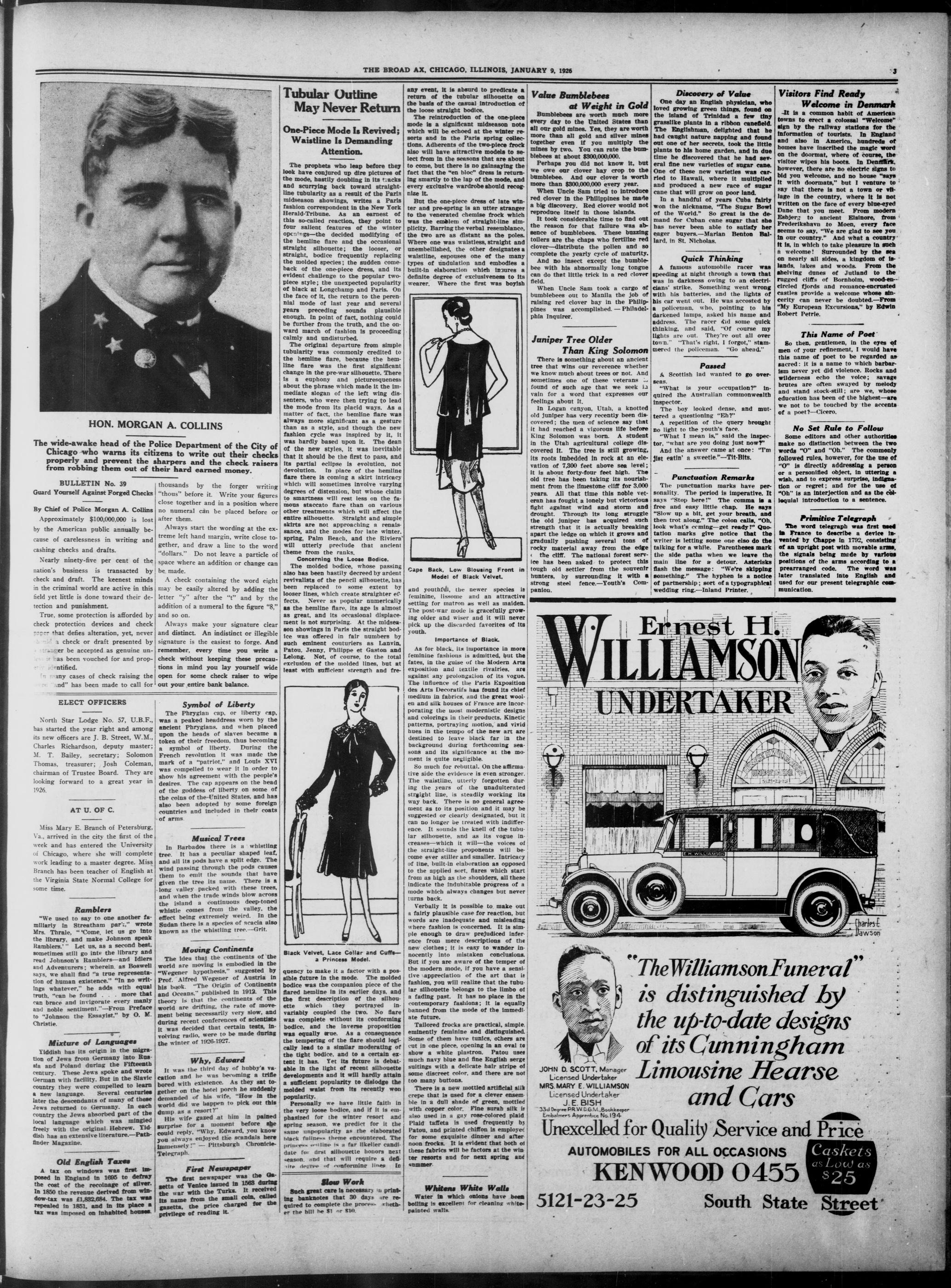
The wide-awake head of the Police Department of the City of Chicago who warns its citizens to write out their checks properly and prevent the sharpers and the check raisers from robbing them out of their hard earned money.
BULLETIN No. 39
Guard Yourself Against Forged Checks
By Chief of Police Morgan A. Collins
Approximately $100,000,000 is lost by the American public annually because of carelessness in writing and cashing checks and drafts.
Nearly ninety-five per cent of the nation's business is transacted by check and draft. The keenest minds in the criminal world are active in this field yet little is done toward their detection and punishment.
thousands by the forger writing "thous" before it. Write your figures close together and in a position where no numeral can be placed before or after them.
Always start the wording at the extreme left hand margin, write close together, and draw a line to the word "dollars." Do not leave a particle of space where an addition or change can be made.
A check containing the word eight may be easily altered by adding the letter "y" after the "t" and by the addition of a numeral to the figure "8."
True, some protection is afforded by check protection devices and check paper that defies alteration, yet, never should a check or draft presented by a stranger be accepted as genuine unless it has been vouched for and properly identified. In many cases of check raising the word "and" has been made to call for
ELECT OFFICERS
North Star Lodge No. 57, U.B.F. has started the year right and among its new officers are J. B. Street, W.M. Charles Richardson, deputy master; M. T. Bailey, secretary; Solomon Thomas, treasurer; Josh Coleman, chairman of Trustee Board. They are looking forward to a great year in 1926
AT U. OF C.
Miss Mary E. Branch of Petersburg, Va., arrived in the city the first of the week and has entered the University of Chicago, where she will complete work leading to a master degree. Miss Branch has been teacher of English at the Virginia State Normal College for some time.
"We used to say to one another familiarly in Streetham par." wrote Mrs. Thrale, "‘Come, let us go into the library, and make Johnson speak Ramblers.’" Let us, as a second best, sometimes still go into the library and read Johnson's Ramblers—and Idlers and Adventurers; wherein, as Boswell says, we shall find "a true representation of human existence." "In no writings whatever," he adds with equal truth, "can be found . . . more that can brace and invigorate every manly and noble sentiment."—From Preface to "Johnson the Essayist," by O. M. Christie
Mixture of Languages
Yiddish has its origin in the migration of Jews from Germany into Russia and Poland during the Fifteenth century. These Jews spoke and wrote German with facility. But in the Slavic country they were compelled to learn a new language. Several centuries later the descendants of many of these Jews returned to Germany. In each country the Jews absorbed part of the local language which was mingled freely with the original Hebrew. Yiddish has an extensive literature.—Pathfinder Magazine.
Old English Taxes
A tax on windows was first imposed in England in 1695 to defray the cost of the recolonage of silver. In 1850 the revenue derived from window-tax was £1,832,684. The tax was repealed in 1851, and in its place a tax was imposed on inhabited houses.
Ramblers
Police Department of the City of citizens to write out their checks sharpers and the check raisers their hard earned money. thousands by the forger writing "thous" before it. Write your figures close together and in a position where no numeral can be placed before or after them. Always start the wording at the extreme left hand margin, write close together, and draw a line to the word "dollars." Do not leave a particle of space where an addition or change can be made.
A check containing the word eight may be easily altered by adding the letter "y" after the "t" and by the addition of a numeral to the figure "8," and so on.
Always make your signature clear and distinct. An indistinct or illegible signature is the easiest to forge. And remember, every time you write a check without keeping these precautions in mind you lay yourself wide open for some check raiser to wipe out your entire bank balance.
Symbol of Liberty
The Phrygian cap, or liberty cap, was a peaked headaddress worn by the ancient Phrygians, and when placed upon the heads of slaves became a token of their freedom, thus becoming a symbol of liberty. During the French revolution it was made the mark of a "patriot," and Louis XVI was compelled to wear it in order to show his agreement with the people's desires. The cap appears on the head of the goddess of liberty on some of the coins of the United States, and has also been adopted by some foreign countries and included in their coats of arms.
Musical Trees
In Barbados there is a whistling tree. It has a peculiar shaped leaf, and all its pods have a split edge. The wind passing through the pods causes them to emit the sounds that have given the tree its name. There is a long valley packed with these trees, and when the trade winds blow across the island a continuous deep-toned whistle comes from the valley, the effect being extremely weird. In the Sudan there is a species of acacia also known as the whistling tree. -Grit.
Moving Continents
The idea that the continents of the world are moving is embodied in the "Wegener hypothesis," suggested by Prof. Alfred Wegener of Austria in his book, "The Origin of Continents and Oceans," published in 1912. This theory is that the continents of the world are drifting, the rate of movement being necessarily very slow, and during recent conferences of scientists it was decided that certain tests, involving radio, were to be made during the winter of 1926-1927.
Why. Edward
It was the third day of hubby's vacation and he was becoming a trifle bored with existence. As they sat together on the hotel porch he suddenly demanded of his wife, "How in the world did we happen to pick out this dump as a resort?" His wife gazed at him in pained surprise for a moment before she could reply, "Why. Edward, you know you always enjoyed the scandals here immensely!" — Pittsburgh Chronicle-Telegraph.
First Newspaper
The first newspaper was the Gazetta of Venice issued in 1563 during the war with the Turks. It received its name from the small coin, called gazetta, the price charged for the privilege of reading it.
THE BROAD AX, CHICAGO, ILLINOIS, JANUARY 9. 1926
Tubular Outline May Never Return
One-Piece Mode Is Revived; Waistline Is Demanding Attention.
The prophets who leap before they look have conjured up dire pictures of the mode, hastily doubling in its tracks and scurrying back toward straight-line tubularity as a result of the Paris midseason showings, writes a Paris fashion correspondent in the New York Herald-Tribune. As an earnest of this so-called reaction, they point to four salient features of the winter openings—the decided modifying of the hemline flare and the occasional straight silhouette; the looser, or straight, bodice frequently replacing the molded species; the sudden comeback of the one-piece dress, and its evident challenge to the popular two-piece style; the unexpected popularity of black at Longchamp and Paris. On the face of it, the return to the perennial mode of last year and several years preceding sounds plausible. In point of fact, nothing could be further from the truth, and the onward march of fashion is proceeding calmly and undisturbed.
The original departure from simple tubularity was commonly credited to the hemline flare, because the hemline flare was the first significant change in the pre-war silhouette. There is a euphony and picturesqueness about the phrase which made it the immediate slogan of the left wing dissenters, who were then trying to lead the mode from its placid ways. As a matter of fact, the hemline flare was always more significant as a gesture than as a style, and though the new fashion cycle was inspired by it, it was hardly based upon it. The dean of the new styles, it was inevitable that it should be the first to pass, and its partial eclipse is evolution, not devolution. In place of the hemline flare there is coming a skirt intricacy which will sometimes involve varying degrees of distension, but whose claim to smartness will rest less on the famous staccato flare than on various other treatments which will affect the entire silhouette. Straight and simple skirts are not approaching a renaissance, and the modes for late winter, spring, Palm Beach, and the Rivieren will utterly preclude that ancient theme from the ranks.
Concerning the Loose Bodice.
The molded bodice, whose passing also has been hastily decreed by ardent revivalists of the pencil silhouette, has been replaced to some extent by looser lines, which create straighter effects. Never as popular numerically as the hemline flare, its age is almost as great, and its occasional displacement is not surprising. At the midseason showings in Paris the straight bodice was offered in fair numbers by such eminent contourers as Lanvin, Patou, Jenny, Philippe et Gaston and Lelong. Not, of course, to the total exclusion of the molded lines, but at least with sufficient strength and fre
1
Black Velvet, Lace Collar and Cuffs—a Princess Model.
quency to make it a factor with a possible future in the mode. The molded bodice was the companion piece of the flared hemline in its earlier days, and the first description of the silhouette which they portrayed invariably coupled the two. No flare was complete without its conforming bodice, and the inverse proposition was equally true. As a consequence the tempering of the flare should logically lead to a similar moderating of the tight bodice, and to a certain extent it has. Yet its future is debatable in the light of recent silhouette developments and it will hardly attain a sufficient popularity to dislodge the molded waist from its recently won popularity.
Personally we have little faith in the very loose bodice, and if it is emphasized for the winter resort and spring season, we predict for it the same unpopularity as the elaborated black fullness theme encountered. The princess outline is a far liker candidate for first silhouette honors next season, and that will require a definite degree of conforming lines.
Slow Work
Such great care is necessary in printing banknotes that 30 days are required to complete the process whether the bill be $1 or $10.
any event, it is absurd to predicate a return of the tubular silhouette on the basis of the casual introduction of the loose straight bodice. The reintroduction of the one-piece mode is a significant midseason note which will be echoed at the winter resorts and in the Paris spring collections. Adherents of the two-piece frock also will have attractive models to select from in the seasons that are about to come, but there is no gainsaying the fact that the "en bloc" dress is returning smartly to the lap of the mode, and every exclusive wardrobe should recognize it.
But the one-piece dress of late winter and pre-spring is an utter stranger to the venerated chemise frock which was the emblem of straight-line simplicity. Barring the verbal resemblance, the two are as distant as the poles. Where one was waistless, straight and unembellished, the other designates a walstil, espouses one of the many types of undulation and embodies a built-in elaboration which ensures a definite degree of exclusiveness to its weaker. Where the first was boyish
1
Cape Back, Low Blossing Front in
Model of Black Velvet.
and youthful, the newer species is
feminine, lissome and an attractive
setting for matron as well as malen.
The post-war mode is gracefully growing
older and wiser and it will never
pick up the discarded favorites of its
youth.
Importance of Black.
As for black, its importance in more feminine fashions is admitted, but the fates, in the guise of the Modern Arts exposition and textile rivalries, are against any prolongation of its vogue. The influence of the Paris Exposition des Arts Decoratif has found its chief medium in fabrics, and the great woolen and silk houses of France are incorporating the most modernistic designs and colorings in their products. Kinetic patterns, portraying motion, and vivid hues in the tempo of the new art are destined to leave black far in the background during forthcoming seasons and its significance at the moment is quite negligible.
So much for rebuttal. On the affirmative side the evidence is even stronger. The waistline, utterly forgotten during the years of the unadulterated straight line, is steadily working its way back. There is no general agreement as to its position and it may be suggested or clearly designated, but it can no longer be treated with indifference. It sounds the knell of the tubular silhouette, and as its vogue increases—which it will—the voices of the straight-line proponents will become ever stiller and smaller. Intricacy of line, built-in elaboration as opposed to the applied sort, flares which start from as high as the shoulders, all these indicate the indubitable progress of a mode which always changes but never turns back.
Verbally it is possible to make out a fairly plausible case for reaction, but words are inadequate and misleading where fashion is concerned. It is simple enough to draw prejudiced inference from mere descriptions of the new clothes; it is easy to wander innocently into mistaken conclusions. But if you are aware of the temper of the modern mode, if you have a sensitive appreciation of the art that is fashion, you will realize that the tubular silhouette belongs to the limbo of a fading past. It has no place in the contemporary fashions; it is equally banned from the mode of the immediate future.
Tallored frocks are practical, simple, ementely feminine and distinguished. Some of them have tunics, others are cut in one piece, opening in an oval to show a white plastron. Patou user much navy blue and fine English serge suitings with a delicate hair stripe of some discreet color, and there are not too many buttons.
There is a new mottled artificial silk crepe that is used for a clever ensemble in a dull shade of green, mottled with copper color. Fine surah silk is also used in a gay rose-colored plaid Plaid taffetta is used frequently by Patou, and printed chiffon is employed for some exquisite dinner and afternoon frocks. It is evident that both of these fabrics will be factors at the winter resorts and for next spring and summer.
Whitens White Walls
Water in which onions have been boiling is excellent for cleaning white-painted walls
Ernest H.
WILLIAMSON
UNDERTAKER
ERNEST H. WILLIAMSON
UNDERTAKER
512-247-78
E. H. WILLIAMSON
Charles E.
Dawson
Value Bumblebees
at Weight in Gold
Bumblebees are worth much more every day to the United States than all our gold mines. Yes, they are worth more than all gold and silver mines together even if you multiply the mines by two. You can rate the bumblebees at about $300,000,000.
Perhaps you did not know it, but we owe our clover hay crop to the bumblebee. And our clover is worth more than $300,000,000 every year.
When Uncle Sam tried to introduce red clover in the Philippines he made a big discovery. Red clover would not reproduce itself in those islands.
It took considerable time to find out the reason for that failure was absence of bumblebees. These buzzing tollers are the chaps who fertilize red clover—distribute the pollen and so complete the yearly cycle of maturity.
And no insect except the bumblebee with his abnormally long tongue can do that little trick in a red clover field.
When Uncle Sam took a cargo of bumblebees out to Manila the job of raising red clover hay in the Philippines was accomplished. — Philadelphia Inquirer.
Juniper Tree Older
There is something about an ancient tree that wins its reverence whether we know much about trees or not. And sometimes one of these veterans found of such age that we seek toain for a word that expresses our feelings about it.
In Logan canyon, Utah, a knotted old juniper has very recently been discovered; the men of science say that it had reached a vigorous life before King Solomon was born. A student in the Utah agricultural college discovered it. The tree is still growing, its roots imbedded in rock at an elevation of 7,300 feet above sea level; it is about forty-four feet high. The old tree has been taking its nourishment from the ilmestone cliff for 3,000 years. All that time this noble veteran has fought a lonely but victorious fight against wind and storm and drought. Through its long struggle the old juniper has acquired such strength that it is actually breaking apart the ledge on which it grows and gradually pushing several tons of rocky material away from the edge of the cliff. The national forest service has been asked to protect this tough old settler from the souvenir hunters, by surrounding it with a strong steel fence—Youth's Companion.
WILLI
UNI
A. B.
JOHN D. SCOTT, Manager
Licensed Undertaker
MRS. MARY E. WILLIAMSON
Licensed Undertaker
J. E. BISH
33d Degree PR W.D.G.M., Bookkeeper
Embalmers Apprentice No.194
Unexcelled for
AUTOMOBILES
KEN
5121-23-25
---
The Williamson Funeral is distinguished by the up-to-date designs of its Cunningham Limousine Hearse and Cars
Discovery of Value
One day an English physician, who loved growing green things, found on the island of Trinidad a few thy grasslike plants in a ribbon caneled. The Englishman, delighted that he had caught nature napping and found out one of her secrets, took the little plants to his home garden, and in due time he discovered that he had several fine new varieties of sugar cane. One of these new varieties was carried to Hawaii, where it multiplied and produced a new race of sugar cane that will grow on poor land. In a handful of years Cuba fairly won the nickname, "The Sugar Bowl of the World." So great is the demand for Cuban cane sugar that she has never been able to satisfy her eager buyers.-Marian Benton Ballard, in St. Nicholas.
Quick Thinking
A famous automobile racer was speeding at night through a town that was in darkness owing to an electricians' strike. Something went wrong with his batteries, and the lights of his car went out. He was accosted by a policeman, who, pointing to his darkened lamps, asked his name and address. The racer did some quick thinking, and said, "Of course my lights are out. They're out all over town." "That's right, I forgot," stammered the policeman. "Go ahead."
Passed
A Scottish lad wanted to go overseas.
"What is your occupation?" inquired the Australian commonwealth inspector.
The boy looked dense, and muttered a questioning "Eh?"
A repetition of the query brought no light to the youth's face.
"What I mean is," said the inspector, "what are you doing just now?" And the answer came at once: "I'm listen eat'in a sweetie." -Tit-Bits.
Punctuation Remarks
The punctuation marks have personality. The period is imperative. It says "Stop here!" The comma is a free and easy little chap. He says "Slow up a bit, get your breath, and then trot along." The colon calls, "Oh, look what's coming—get ready!" Quotation marks give notice that the writer is letting some one also do the talking for a while. Parentheses mark the side paths when we leave the main line for a detour. Asterisks flash the message: "We're skipping something." The hyphen is a notice of partnership; sort of a typographical wedding ring—Inland Printer.
3
Visitors Find Ready
Welcome in Denmark
"It is a common habit of American towns to erect a colossal "Welcome" sign by the railway stations for the information of tourists. In England and also in America, hundreds of homes have inscribed the magic word on the doormat, where of course, the visitor wipes his boots. In Denmark, however, there are no electric signs to bid you welcome, and no house "says it with doormats," but I venture to say that there is not a town or village in the country, where it is not written on the face of every blue-eyed Dane that you meet. From modern Esbjerg; to ancient Elsinore, from Frederikshavn to Moen, every face seems to say, "We are glad to see you in our country." And what a country it is, in which to take pleasure in such a welcome! Surrounded by the sea on nearly all sides, a kingdom of islands, lakes and woods. From the shelving dunes of Jutland to the rugged cliffs of Bornholm, wood-encircled fjords and romance-encrusted castles provide a welcome whose sincerity can never be doubted.—From "My European Excursions," by Edwin Robert Petrie.
This Name of Poet
So then, gentlemen, in the eyes of men of your refinement, I would have this name of poet to be regarded as sacred: it is a name to which barbarism never yet did violence. Rocks and wilderness echo the voice; savage brutes are often swayed by melody and stand stock-still; are we, whose education has been of the highest—are we not to be touched by the accents of a poet?—Cicero.
No Set Rule to Follow
Some editors and other authorities make no distinction between the two words "O" and "Oh." The commonly followed rules, however, for the use of "O" is directly addressing a person or a personified object, in uttering a wish, and to express surprise, indignation or regret; and for the use of "Oh" is an interjection and as the collegial introduction to a sentence.
Primitive Telegraph
The word telegraph was first used in France to describe a device invented by Chappe in 1792, consisting of an upright post with movable arms, the signals being made by various positions of the arms according to a prearranged code. The word was later translated into English and used for our present telegraphic communication.
4
Declare Birds Are
Bavarian scientists claim to have made certain the fact that birds cannot see color, are not affected by it; in fact, any color is good with the birds, even those of bright and gay plumage having no appreciation of the fact that they are better dressed than others. Even the gorgeous display of the male peacock brings no sensation of beautiful colors to the eyes of other birds about.
The test with birds' eyes show, the scientists assert, that birds do not look at things as human beings do, that all flying birds by day see everything in a bright, red orange light and are only sensitive in a slight way to the short waves of light that make blue and violet visible. Night-flying birds are less sensitive to colors than those that make their flight by day, the eyes of all birds being screened from intense light by tiny globules of oil in the retina of the eye that act as color screens. The Bavarian scientists say the Darwin idea, that beautiful plumage of birds is a factor in the selection of mates, is merely a fanciful theory, poetic and interesting but lacking scientific support.
First Loves Lose Out
Few men marry the first woman with whom they fall in love, says Elsa Rema, the Dorothy Dix of Germany. Chance, she says, is mightier than Cupid and usually first loves become separated. . . . Men marry readily when young, Frauliein Rema finds, but when they are confirmed bachelors it takes sympathetic housekeepers to land them. Widowers are easy marks because they no longer know how to live alone. They are used to a home and feminine caresses and are unable to do without the comforts and tenderness that goes with married life. . . . Same on this side of the water, Rema. Same on this side.—Capper's Weekly.
Uncle Knows Everything
Bobby, age seven, who had never seen a negro, was visiting his uncle one day, and his uncle took him to town.
While walking down the street a negro woman passed.
"Uncle," asked Bobby, "why did that lady have her face blacked that way?"
"Why, Bobby, that was her natural color," the uncle informed him. "She's a negress."
"Is she black that way all over?"
"Yes," he was told.
"Gosh, uncle, you know everything, don't you?"
Meats and Digestion
Meat is composed of muscle, connective tissue, and fat. The muscle fibers are composed of thin walls which contain the building material for the body; water, mineral salts and extractives. These fibers are held together by little tissues and between these little muscle fibers are bound together, and the more fat the meat contains the more indigestible the meat. Hence, pork is more indigestible than beef. The digestive juices have a harder time to penetrate the closely bound pork fibers.
Famous European Canal
The Marselle-Rhone canal is a notable European project executed during the war period involving an artificial waterway 51 miles long and extending from the Rhone river at Arles to the Bay of Marselle. It is also notable in that it includes a tunnel $4\frac{1}{2}$ miles long which pierces the mountain ridge north of the city and affords direct access to the harbor. In addition to the tunnel there was involved a breakwater construction between Marselle and Port de Bone.
Historical Heroine
Beatrice Conci was the daughter of a Roman patrician. She was born in Rome February 12, 1577. Her father for many years abused his wife and family in the most cruel way and as a result the family procured his murder. They were tried and sentenced to death. Beatrice was executed September 11, 1599. The circumstances of her life have long caused her to be considered a martyr and her history has been the theme of several poems.
When a Leaf Falls
I would like very much to find a word or sound which would bring to mind the fall of a leaf upon leaves. I know it perfectly—the generic timber—the composite echo etched into my mind by a thousand conscious listenings. But it will not get past my consciousness to my lips, and utterly refuses to descend my arm and pen.—William Beebe.
Maddening
Walker had been going about for two days with a worried look on his usually smiling face. A friend stopped him and asked the reason for the sudden change 'from joy to gloom.
"I fear my wife is going insane. It's those people next door," Walker said.
"What have they done? 'What's the trouble?' the friend asked.
"She can't hear a sound of them all day long."
You Said It
"Good heavens, is there any way of making you women dress decently?" "Certainly there is." "Well, what is it?" "Kill off you men."—London Mall.
Queen Customs
The Zipas, chiefs of the Chibcha Indians, Colombia, were governed by singular rules. Each Zipa was the son of his predecessor's sister, was reared under special guardianship and was forbidden to see the sun or eat salt.
Sultan Evidently Had,
Well, Just a Little!
Mulai Haifd, sultan of Morocco, was a born gambler. While he was still sultan the French resident-general in Morocco gave a party in his honor and, knowing the monarch's passion for gambling, organized a baccarat game. While Mulai Haifd was winning, a British newspaper man named Loris, who was toging, said: "You do wrong to take that money. It's against the teachings of the Koran." That so worried the sultan that he was on the point of giving back his winnings, when he saw nearby the French chief justice, a recognized authority on Mussulman law. "Tell me," said the sultan. " whether it is against the Koran to take this money." The justice remained silent a moment before replying. "Your majesty, if you have played a straight game, you cannot touch this money because it is mere hazard that made you win and it is forbidden by the Koran to take advantage of hazard. But if you—how shall I say?—forced your luck—I mean, cheated a little—you may put the money in your pocket because you won it by your skill and cleverness." The sultan smiled. "Thou art the greatest and most learned judge I have ever met," and he pocketed the money.
Guitar Long Famous
as Musical Instrument
In the National museum at Naples is a statue of Apollo, the god of music, seated and holding the cithara—a small harp-shaped instrument from which the lyre was derived as long ago as 1700 B. C., according to a writer in the Cleveland Plain Dealer. In Greece the cithara was used both to accompany the voice in song and in epic recitation and as a solo instrument at the national games. The Greeks of Asia Minor transformed the cithara into the guitar, and later still the application of the bow to the guitar resulted in the violin. The Moors carried the guitar into Spain, a country where, as in Italy and France, it has always been regarded with the highest favor among all classes. In the early part of the Seventeenth century an Italian guitarist was court musician in England, and playing the guitar became a fashionable accomplishment. In the Eighteenth century it was popular in court circles in Germany; about the beginning of the Nineteenth century Sor of Barcelona, one of the greatest guitarists, again brought it into favor in England; and in the latter part of the Nineteenth century special interest in the guitar appeared in the United States.
Oldtime Wedding Cake
Whatever the moderns may think of the news that the wedding cake is abandoning its Gothic complexities of decoration, it is certain that one rather famous cook would have been horrified at the change. Readers o" "Pendennis" will remember that when M. Alcide Mirobolant wished to signify his undeclared passion for Blanche Amory, he sent up to her a special dinner, the dishes of which were designed from beginning to end to symbolize her maidenly virtues and his own admiration for them. He wound up with "an ice of plombiere and cherries . . . in the form of two hearts united with an arrow, on which I had laid, before it entered, a bridal veil in cut paper, surmounted by a wreath of virginual orange flowers." If Monsieur Mirobolant could do so much with a mere ice, to what heights would his symbolism have soared in the architecture of a wedding cake? It is clear that he would have had no sympathy with a cake which depended on a classical severity of line for its effect.—Manchester Guardian.
Courage
Courage is from first to last a victory achieved over one of the most powerful emotions of human nature. It may fairly be questioned if any human being is naturally courageous. Many are naturally pugnacious, or irasible, or enthusiastic, and these passions when strongly excited may render them insensible to fear. But take away the conflicting emotions, and fear reasserts its dominion; consistent courage is always the effect of cultivation.—John Stuart Mill.
Social Error
Mrs. Miller had her bridge club to luncheon and the afternoon session at cards. As the last guest departed, Theodora, the little blond daughter, remarked:
"Mother, some one her used one of the guest towels."
"Is it possible?" exclaimed her mother. "Some people don't seem to know what guest towels are for, you know."
Identified
"A man is easy to read," said Roberts to nobody in particular as he and a few of his friends loured in the window of the club one evening. Just then a street car stopped in front of the window, and Perkins and his wife and sister got off. "Which one is his wife?" some one wanted to know. Nobody could answer until Roberts remarked: "She is the woman he didn't help off the car."
Refreshing
A Chicago man has invented a machine for making ice cream without using ice. Thus the simple operation is rendered complete. Several years ago numerous manufacturers learned that ice cream could be made without using cream, and now with this newest invention all one has to do to get some ice cream is to get it—Exchange.
THE BROAD AX, CHICAGO, ILLINOIS, JANUARY 9, 1926
Tree of Vast Age
A tree trunk of record size, that grew in the coal-making forests millions of years ago, has been discovered by Prof. Sarl Noe, paleobotanist of the University of Chicago. The find was made in a coal bed of the Carbondale formation, near West Frankfort, Ill. The circumference of the ancient trunk is ten feet, and the length of the section unearthed about five. The whole tree, as it originally grew, may have been in the neighborhood of 100 feet high. Doctor Noe says. The surface of the trunk is covered with close-set pits, which are the scars where the leaves once grew. These ancient trees had few branches, and the leaves grew all over the trunk, like the scales of a fish. The name of the genus, "Lepidodendron," means "scale tree."
Add Motoring Perils
One of Attleboro's fairest little maidens has been having a rush job done at the dentist's. A broken tooth needed expert attention. It was no ordinary mishap, the breaking of that tooth. She and he were motoring and while kisses were being exchanged the car hit a particularly rough spot in the road. There was a facial collision in which lips proved ineffectual bumpers, two sets of teeth met head on—and then came concern on his part, lamentation on her part, and the enlisting of the dentist's services to repair damages sustained in an unusual way.—Boston Globe.
Complimented
When an Edinburgh councillor was traveling to London there was an old man in the same carriage to whom he spoke several times without getting a reply. Just as they neared the en. of the journey the old man leaned forward and asked. "Are we near King's Cross?" The councillor told the old man that he thought him very ill-mannered for not replying when spoken to earlier in the day. Said the aged traveler: "Man, I was feared to answer ye. Ye are awful' like a photograph I saw in the paper of a murderer."—London Tit-Bits.
Nothing in "Stalling"
Robbing Peter to pay Paul may work for a time, but eventually Peter has to be repaid, for he is just as deserving as Paul. No one liquidates indebtedness by paying one creditor and "standing off" another—all must be paid—Gritt.
Grapes Long Cultivated
From the earliest time grapes were grown in the East and in southern Europe. The vine was extensively cultivated by the ancient Israelites, the Greeks and the Romans. Grapes were first grown in Flanders in the Thirteenth century and were taken to England in large quantities during the reigns of the later Plantagenet kings.
Telephone: State 3278
A. D. GASH
ATTORNEY AT LAW
Suite 813, Ashland Block
155 N. Clark Street
CHICAGO, ILL.
Residence, 1262 Macalister Place
Telephone Monroe 2714
MILES J. DEVINE
ATTORNEY AT LAW
Suite 318-320 Reaper Block
Clark and Washington Sts.
CHICAGO
Telephone Central 1239
Phone Main 2017
A. L. WILLIAMS
ATTORNEY AND
COUNSELOR AT LAW
Suite 706 Firmenich Building
184 W. Washington St.
CHICAGO
Residence 3655 Prairie Ave.
Phone Douglas 9133
W.G. Anderson
Attorney At Law
17 North La Salle Street
CHICAGO
NOTARY PUBLIC
Suite 560 Watson Bldg.
Office Phones: Dearborn 7094-7098
Res. 3354 Vernon Avenue
Phone Douglas 6045
Notary Public
Phones: Office Main 4153; Residence
4751 Champlain Avenue
Phone Kenwood 5611
Walter M. Farmer
ATTORNEY AND COUNSELOR
AT LAW
Suite 708—184 W. Washington St.
CHICAGO
Fahrenheit Made First
Thermometer of Value
The first mercurial thermometer was the invention of Gabriel Daniel Fahrenheit, who died September 16, 1786, about ten years after he had made his name immortal by perfecting a device for registering heat. Before his day crude thermometers had been invented by Gallego, Drebbel, Paull, Sarpi and Sanetorio, but it was left to the bankrupt merchant of Dantzig to produce a really dependable device.
Fahrenheit's first thermometer was made with spirits of wine, but he soon found this unsatisfactory and adopted mercury, the medium that is used to this day. His instruments speedily spread throughout the world, and, although the centigrade thermometer affords a more rational method of graduation, the popular mind in England and America clings to the Fahrenheit scale.
Reaumurs and Celsius thermometers, now termed centigrade, are in general use in the continent of Europe. —Chicago Journal.
WALDEN
CORP.
(Formerly the lite
Walden U.
An Approved
Education
Modern in methods and
Throws Christian influence
Places emphasis upon de-
von part of the student.
EXPENSES SU
MODE
Session Begins
For further info
T. R. DAVIS,
Nashville
WEST ENGLE
AND SAVI
Cor. 63rd Street and
JOHN BAIN, President
Vice-President; EDWA
President and Cashier
Assistant Cashier and T
WALDEN COLLEGE
formerly the literary department of
Walden University)
Approved School in
Educational Center
in methods and thorough in sch
Christian influence around the
phasis upon development of the
the student.
EXPENSES SURPRISINGLY
MODERATE
On Begins September
For further information, address:
T. R. DAVIS, PRESIDENT
ET ENGLEWOOD TR
ND SAVINGS BAN
d Street and Marshfield
AIN, President; MICHAEL
Student; EDWARD C. BARR
and Cashier; W. MERLE
Cashier and Trust Officer.
WALDEN COLLEGE
WEST ENGLEWOOD TRUST AND SAVINGS BANK
Cor. 63rd Street and Marshfield Avenue
JOHN BAIN, President; MICHAEL MAISEL, Vice-President; EDWARD C. BARRY, VicePresident and Cashier; W. MERLE FISHER, Assistant Cashier and Trust Officer.
TELEPHONE REPUBLIC 5000
TELEPHONE DOUGLAS
GEORGE F.
GE F. HARDING
GEORGE F. HARDING, JR.
REAL ESTATE
Up-to-Date or Mode
and Store
3101 COTTAG
Corner 31st S
JAS. B. McCAHEY, President
FRANK J. DUNN, Vice-President
ESTABLISHED
Date or Modern Houses, Apt
and Stores to Rent
CLOTAGE GROVE
Corner 31st Street, Chicago
NEY, President PHILIP J. D.
IN, Vice-President H. X. COMERFO
ESTABLISHED 1877
Up-to-Date or Modern Houses, Apartments and Stores to Rent 3101 COTTAGE GROVE AVE. Corner 31st Street, Chicago
JAS. B. McCAHEY, President PHILIP J. DUNN, Secretary
FRANK J. DUNN, Vice-President H. X. COMERFORD, Treasurer
ESTABLISHED 1877
JOHN J. DUNN
COAL CO.
Telephone
5100 Federal Street
Phone: Kenwood 6309
LINCOLN
L. J.
GENERAL AUTO
AND R
Day and N
4621-23 So
Telephone Oakland 1550
1 Street
enwood 6309
COLN GARA
L. Johnston
GENERAL AUTOMOBILE STOR
AND REPAIRING
Day and Night Service
4621-23 So. State Street
LINCOLN GARAGE
L. Johnston
GENERAL AUTOMOBILE STORAGE
AND REPAIRING
Day and Night Service
4621-23 So. State Street
Apple Tree Honored
by Canadian Farmer
A monument in honor of an apple tree stands in Dundas county, in Canada. It is made of marble and stands on or near the spot where the original Nectarh apple tree grew.
It is nearly 130 years since John McIntosh emigrated from Scotland to Canada and settled in Matilda township. That was the day of the pioneer, and "honest John" had to clear his own land. In this process he is said to have come across a number of apple trees, which he spared. One of these produced a orign-colored apple which he called the "McIntosh Red," and it soon became famous.
His son, Allan McIntosh, propagated it, so that now it is grown in many parts of the North American continent.
The o.iginal tree was injured by fire in 1896, but it continued to bear its bright red fruit until 1908, when it failed entirely. To mark their appreciation of a tree that had been so profitable to them, the farmers of the country raised a monument to it.
DEN COLLEGE
University department of
university)
School in an
Central Center
a thorough in scholarship.
once around the student.
development of the initiative
URPRISINGLY
DEARATE
September 21
Information, address
PRESIDENT
Tennessee
WOOD TRUST
INGS BANK
Marshfield Avenue
; MICHAEL MAISEL,
RD C. BARRY, Vice-
W. MERLE FISHER,
trust Officer.
HARDING, JR.
Barn Houses, Apartments
to Rent
E GROVE AVE.
Street, Chicago
PHILIP J. DUNN, Secretary
H. X. COMERFORD, Treasurer
HED 1877
Oakland 1550
CHICAGO
GARAGE
Johnston
MOBILE STORAGE
PAIRING
Light Service
State Street
Phones:
net 6164, Victory 0110, Michigan
ANUEL JACKS
& COMPANY
UNDERTAKERS
FUNERAL HOME
Phones:
Calumet 6164, Victory 0110, Michigan 1010
3400 MICHIGAN AVENUE
2961 SOUTH STATE STREET
NICOLN STATE BANK
OF CHICAGO
Super State Government Supervise
31st and South State Streets
Capital and Surplus $460,000.
State Street's Largest
Mortgage Gold B
Proved Safe Investments yield
interest. $100 Bonds sold on ea
payment plan
Our Mr. Avery of the Bond Depar
DANS MADE ON REAL ESTATE
LINCOLN STATE BANK OF CHICAGO
Under State Government Supervision
31st and South State Streets
Capital and Surplus $460,000.00
South State Street's Largest Bank
First Mortgage Gold Bonds
Approved Safe Investments yield 7% interest. $100 Bonds sold on easy payment plan See our Mr. Avery of the Bond Department
LOANS MADE ON REAL ESTATE Savings Department open from 9 A.M. to 8 P.M. Saturdays
DEPOSIT BOXES for less than
Protect your Valuable Papers, Jewels
STRAIT-TEX
HAIR PREPARATIONS
USE of these preparations in the c
ture of your hair will give you b
results. Start caring for your h
operly by using some of the follo
g:
STRAIT-TEX HAIR REFINING TONIO...$1
STRAIT-TEX HERBS ...1
(straightens and restores color to gray hair)
BOSS-TEX BRILLIANTINE ...1
STRAIT-TEX HAIR GROWER ...1
your hair dresser or druggist cannot supply
her direct from us. Goods sent postpaid
ere in the United States.
AGENTS WANTED; WRITE FOR TERMS
STRAIT-TEX CHEMICAL CO
10 FIFTH AVENUE PITTSBURGH, N
STRAIT-TE
SAFETY DEPOSIT BOXES for less than one cent a day. Protect your Valuable Papers, Jewelry, etc.
STRAIT-TEX
HAIR PREPARATIONS
USE of these preparations in the cult-
ture of your hair will give you best
results. Start caring for your hair
properly by using some of the follow-
ing:
STRAIT-TEX HAIR REFINING TONIO...$1.00
STRAIT-TEX HERBS ... 1.00
(Straightens and restores color to gray hair)
GLOSS-TEX BRILLIANTINE ... 50
STRAIT-TEX HAIR GROWER ... 25
If your hair dresser or druggist cannot supply you,
order direct from us. Goods sent postpaid any-
where in the United States.
AGENTS WANTED; WRITE FOR TERMS
STRAIT-TEX CHEMICAL CO.
600 FIFTH AVENUE PITTSBURGH, PA
STRAIT-TEX
Taylor,
enter my name as a subscriber to '7
use herewith Two Dollars, the annual
One Dollar for six months.
e......
own......
19..... State.....
Please enter my name as a subscriber to THE BROAD AX. I inclose herewith Two Dollars, the annual subscriptions to same, or One Dollar for six months.
D. M. JACKSON
Calumet 6
EMANU
&
UNI
FU
LINCOLN
Under St
31st
Capital
South St
First M
Approvee
interest
See our M
LOANS
SAFETY DEPEN
a day. Protect
Michigan 1010
ACKSON
ANY
KERS
HOME
TE BANK
GO
Best Supervision
Streets
$460,000.00
Largest Bank
Told Bonds
ents yield 7%
old on easy
an
Bond Department
REAL ESTATE
TEX
ATIONS
ions in the cul-
give you best
for your hair
of the follow-
G TONIC...$1.00
1.00
(gray hair)
50
B.....25
cannot supply you,
not postpaid any-
FOR TERMS
MICAL CO.
STSURGH, PA.
TEX
STR
A
I
T
T
E
X
k and Mail it to
$1.00 FOR 6 MONTHS
$2.00 PER YEAR
Subscriber to THE BRO
the annual subscript
State.....
A. A. RAYNER
H. D. LEWIS