The Broad Ax
Saturday, April 10, 1926
Chicago, Illinois
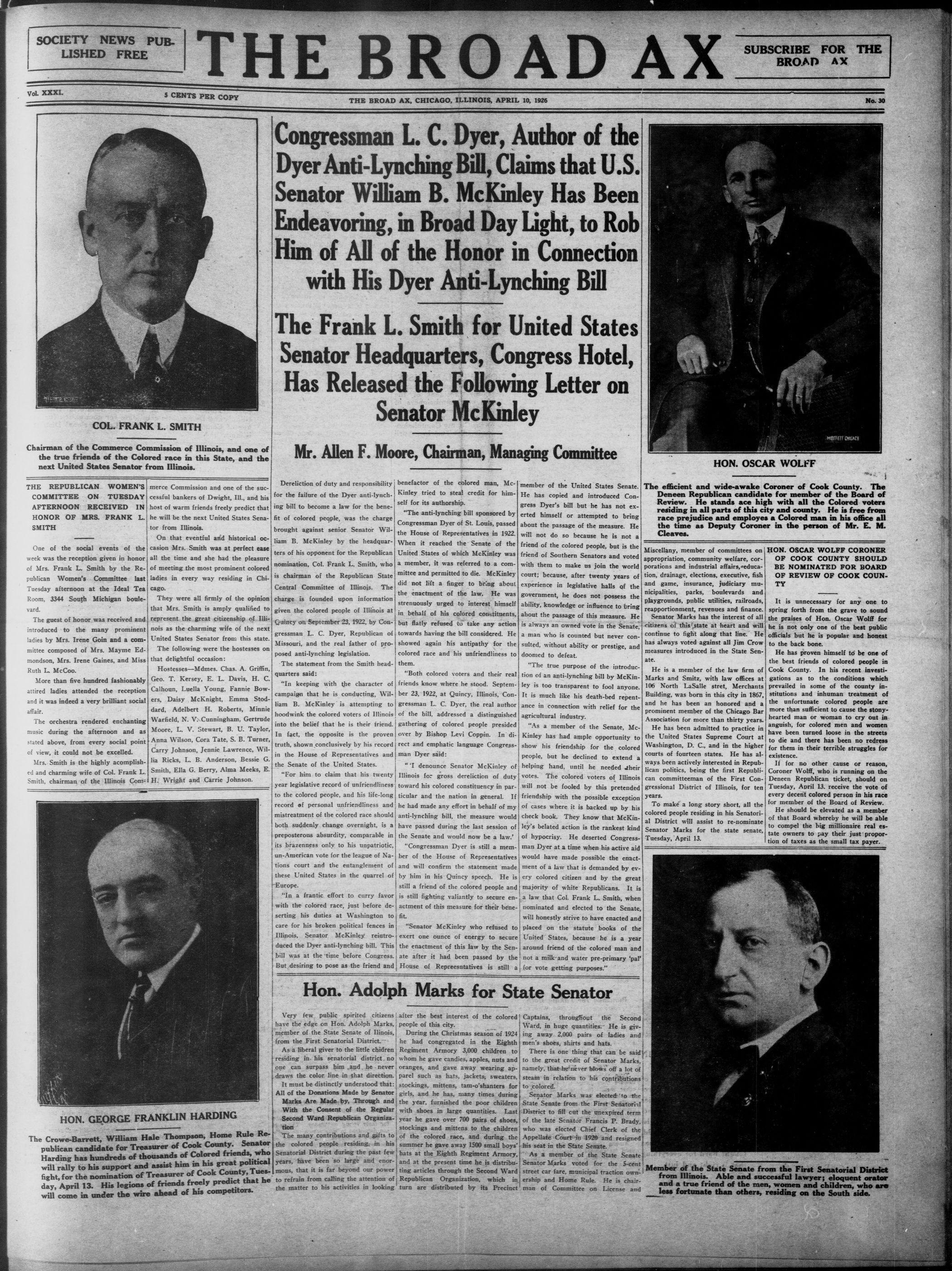
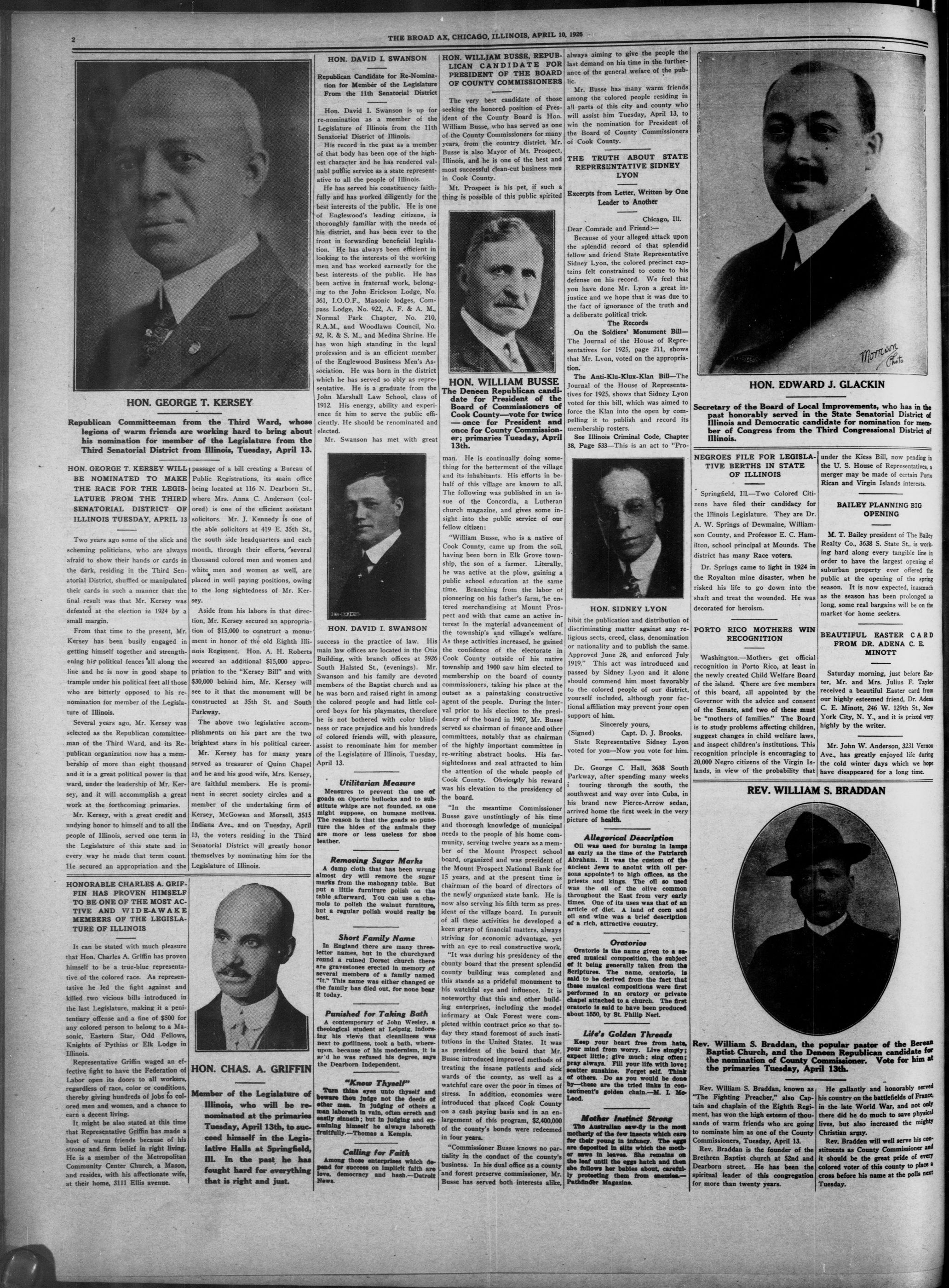
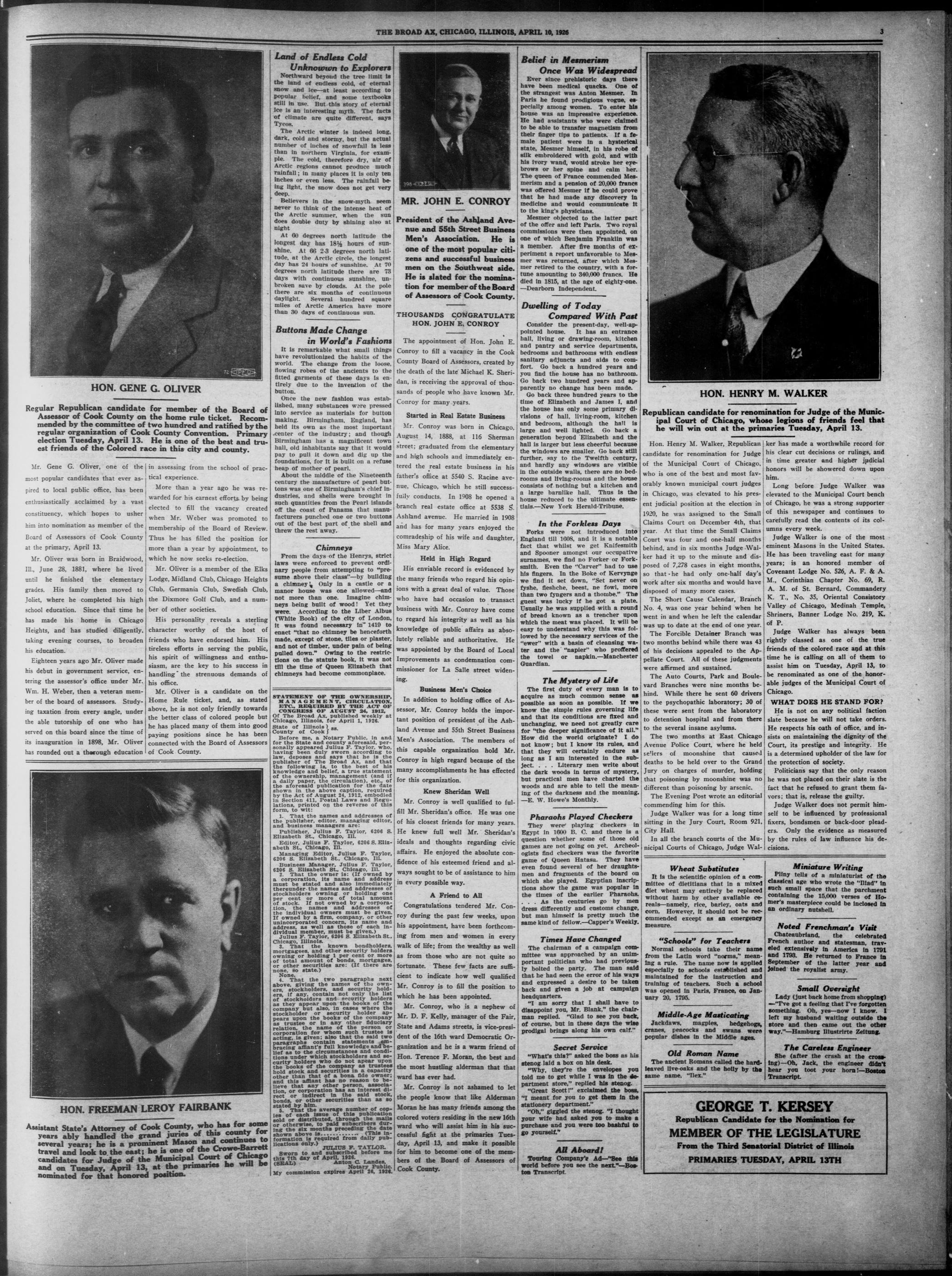
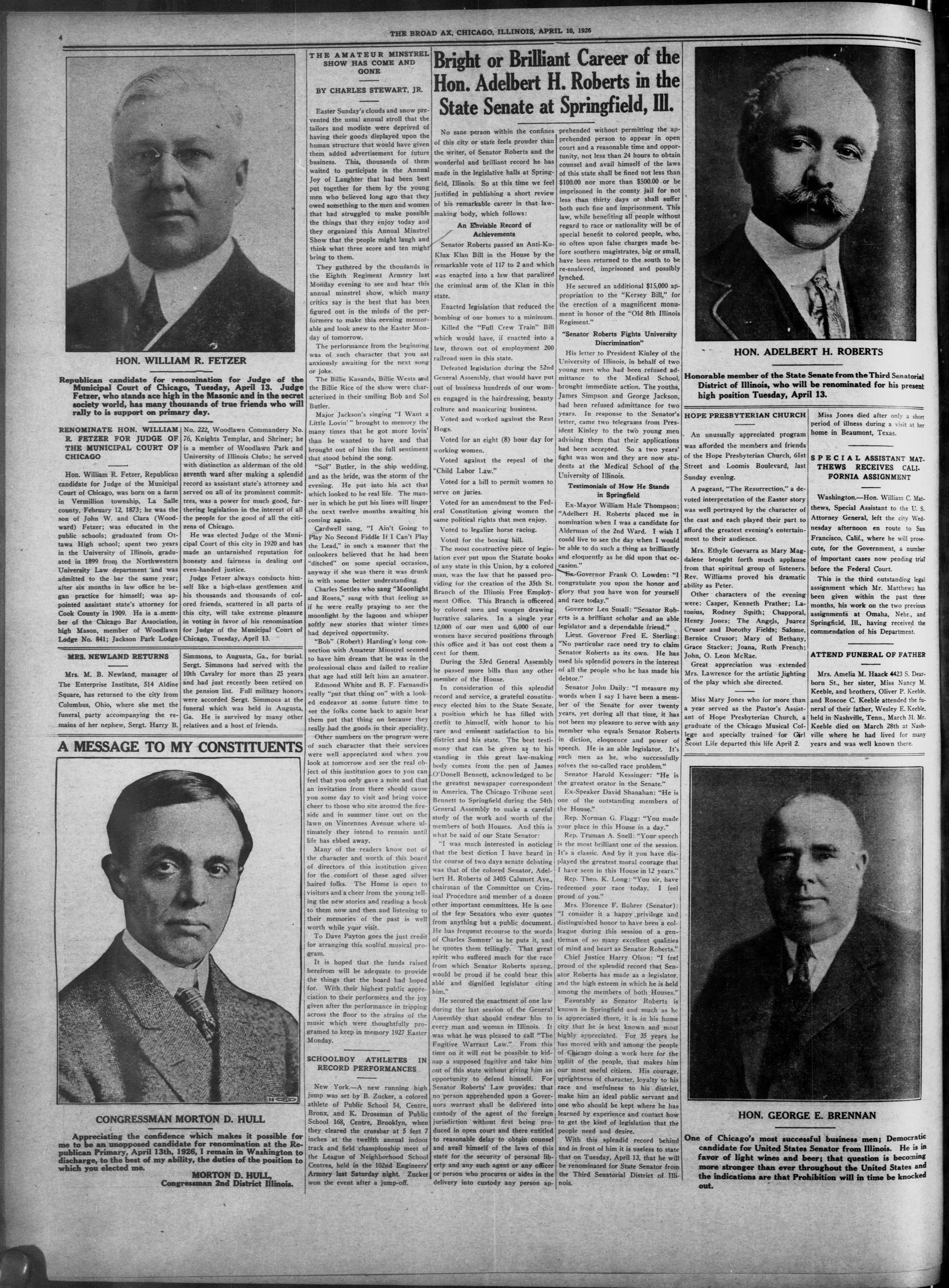
Page text (machine-generated)
SOCIETY NEWS PUBLISHED FREE
Vol. XXXI. 5 C
M.
711228
Chairman of the Commerce Commission of Illinois the true friends of the Colored race in the next United States Senator from Illinois.
The Commerce Commission of Illinois heads of the Colored race in the states Senator from Illinois.
Chairman of the Commerce Commission of Illinois, and one of the true friends of the Colored race in this State, and the next United States Senator from Illinois.
THE REPUBLICAN WOMEN'S COMMITTEE ON TUESDAY AFTERNOON RECEIVED IN HONOR OF MRS. FRANK L. SMITH
One of the social events of the week was the reception given in honor of Mrs. Frank L. Smith by the Republican Women's Committee last Tuesday afternoon at the Ideal Tea Room, 3344 South Michigan boulevard.
The guest of honor was received and introduced to the many prominent ladies by Mrs. Irene Goin and a committee composed of Mrs. Mayme Edmondson, Mrs. Irene Gaines, and Miss Ruth L. McCoo.
More than five hundred fashionably attired ladies attended the reception and it was indeed a very brilliant social affair.
merce Commission and one of the successful bankers of Dwight, Ill., and his host of warm friends freely predict that he will be the next United States Senator from Illinois.
On that eventful and historical occasion Mrs. Smith was at perfect ease all the time and she had the pleasure of meeting the most prominent colored ladies in every way residing in Chicago.
They were all firmly of the opinion that Mrs. Smith is amply qualified to represent the great citizenship of Illinois as the charming wife of the next United States Senator from this state.
The following were the hostesses on that delightful occasion:
Hostesses—Mdmes. Chas. A. Griffin, Geo. T. Kersey, E. L. Davis, H. C. Calhoun, Luella Young, Fannie Bowers, Daisy McKnight, Emma Stodard, Adelbert H. Roberts, Minnie
The orchestra rendered enchanting music during the afternoon and as stated above, from every social point of view, it could not be excelled.
Mrs. Smith is the highly accomplished and charming wife of Col. Frank L. Smith, chairman of the Illinois Com-
---
M. J. H.
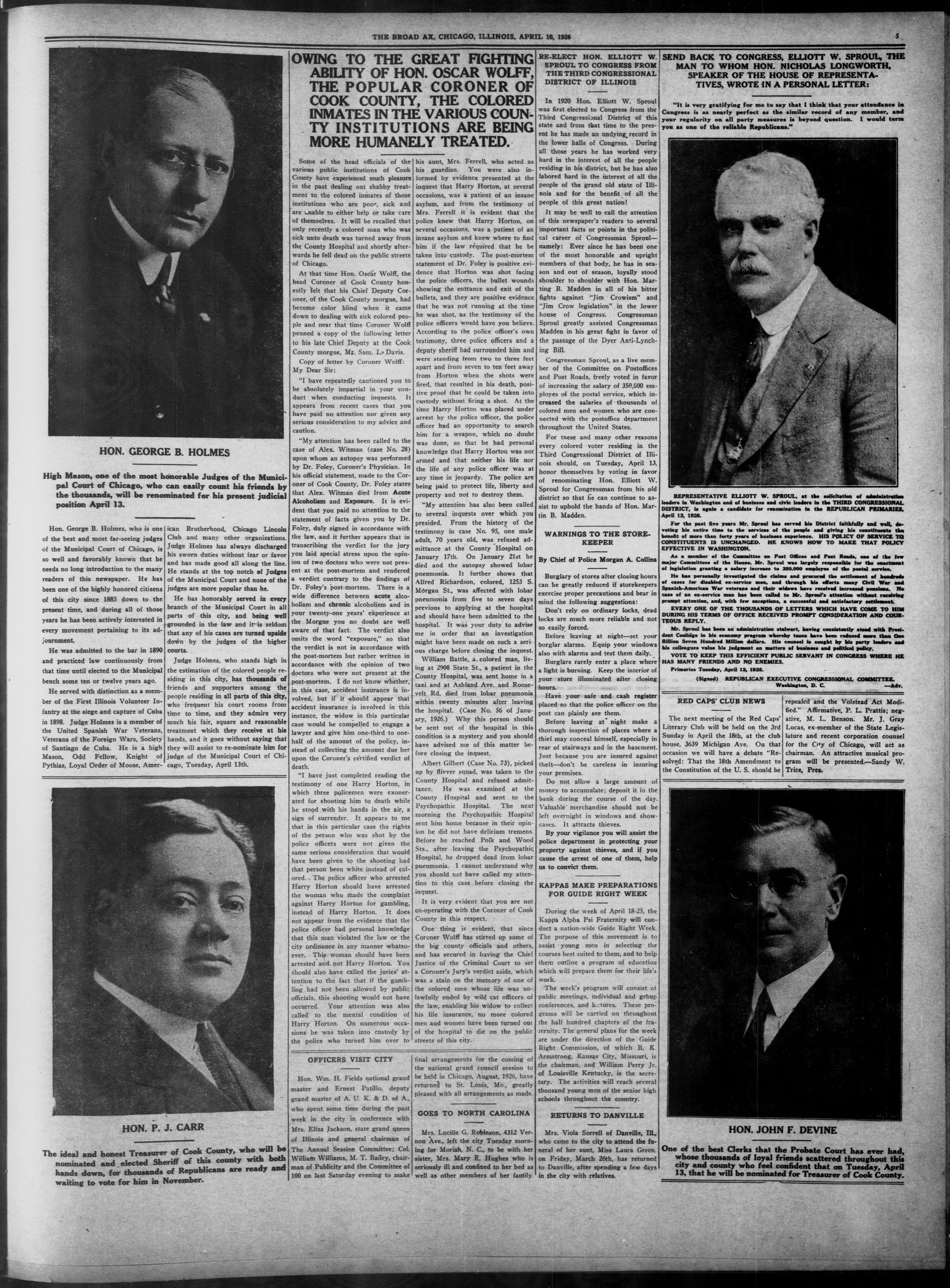
HON. GEORGE FRANKLIN HARDING The Crowe-Barrett, William Hale Thompson, Home Rule Republican candidate for Treasurer of Cook County. Senator Harding has hundreds of thousands of Colored friends, who will rally to his support and assist him in his great political fight, for the nomination of Treasurer of Cook County, Tuesday, April 13. His legions of friends freely predict that he will come in under the wire ahead of his competitors.
5 CENTS PER COPY
1930
commission of Illinois, and one of red race in this State, and the from Illinois.
merce Commission and one of the successful bankers of Dwight, Ill., and his host of warm friends freely predict that he will be the next United States Senator from Illinois.
On that eventful and historical occasion Mrs. Smith was at perfect ease all the time and she had the pleasure of meeting the most prominent colored ladies in every way residing in Chicago.
They were all firmly of the opinion that Mrs. Smith is amply qualified to represent the great citizenship of Illinois as the charming wife of the next United States Senator from this state.
The following were the hostesses on that delightful occasion:
Hostesses—Mdmes. Chas. A. Griffin, Geo. T. Kersey, E. L. Davis, H. C. Calhoun, Luella Young, Fannie Bowers, Daisy McKnight, Emma Stoddard, Adelbert H. Roberts, Minnie Warfield, N. V. Cunningham, Gertrude Moore, L. V. Stewart, B. U. Taylor, Anna Wilson, Cora Tate, S. B. Turner, Carry Johnson, Jennie Lawrence, Willia Ricks, L. B. Anderson, Bessie G. Smith, Ella G. Berry, Alma Meeks, E. H. Wright and Carrie Johnson.
THE BROAD AX
THE BROAD AX, CHICAGO, ILLINOIS, APRIL 10, 1926
Congressman L. C. Dyer, Author of the Dyer Anti-Lynching Bill, Claims that U.S. Senator William B. McKinley Has Been Endeavoring, in Broad Day Light, to Rob Him of All of the Honor in Connection with His Dyer Anti-Lynching Bill
The Frank L. Smith for United States Senator Headquarters, Congress Hotel, Has Released the Following Letter on Senator McKinley
Mr. Allen F. Moore, Chairman, Managing Committee
Hon. Adolph Marks for State Senator
Dereliction of duty and responsibility for the failure of the Dyer anti-Jynching bill to become a law for the benefit of colored people, was the charge brought against senior Senator William B. McKinley by the headquarters of his opponent for the Republican nomination, Col. Frank L. Smith, who is chairman of the Republican State Central Committee of Illinois. The charge is founded upon information given the colored people of Illinois at Quincy on September 23, 1922, by Congressman L. C. Dyer, Republican of Missouri, and the real father of proposed anti-Jynching legislation. The statement from the Smith headquarters said:
"In keeping with the character of campaign that he is conducting, William B. McKinley is attempting to hoodwink the colored voters of Illinois into the belief that he is their friend. In fact, the opposite is the proven truth, shown conclusively by his record in the House of Representatives and the Senate of the United States.
"For him to claim that his twenty year legislative record of unfriendliness to the colored people, and his life-long record of personal unfriendliness and mistreatment of the colored race should both suddenly change overnight, is a preposterous absurdity, comparable in its brazenness only to his unpatriotic, un-American vote for the league of Nations court and the entanglement of these United States in the quarrel of Europe.
"In a frantic effort to curry favor with the colored race, just before deserting his duties at Washington to care for his broken political fences in Illinois, Senator McKinley reintroduced the Dyer anti-lynching bill. This bill was at the time before Congress. But desiring to pose as the friend and
Very few public spirited citizens have the edge on Hon. Adolph Marks, member of the State Senate of Illinois, from the First Senatorial District.
As a liberal giver to the little children residing in his senatorial district, no one can surpass him and he never draws the color line in that direction.
It must be distinctly understood that: All of the Donations Made by Senator Marks Are Made by, Through and With the Consent of the Regular Second Ward Republican Organization
The many contributions and gifts to the colored people residing, in his Senatorial District during the past few years, have been so large and enormous, that it is far beyond our power to refrain from calling the attention of the matter to his activities in looking
benefactor of the colored man, McKinley tried to steal credit for himself for its authorship.
"The anti-lynching bill sponsored by Congressman Dyer of St. Louis, passed the House of Representatives in 1922. When it reached the Senate of the United States of which McKinley was a member, it was referred to a committee and permitted to die. McKinley did not lift a finger to bring about the enactment of the law. He was strenuously urged to interest himself in behalf of his colored constituents, but flatly refused to take any action towards having the bill considered. He showed again his antipathy for the colored race and his unfriendliness to them.
"Both colored voters and their real friends know where he stood. September 23, 1922, at Quincy, Illinois, Congressman L. C. Dyer, the real author of the bill, addressed a distinguished gathering of colored people presided over by Bishop Levi Coppin. In direct and emphatic language Congressman Dyer said:
"I denounce Senator McKinley of Illinois for gross dereliction of duty toward his colored constituency in particular and the nation in general. If he had made any effort in behalf of my anti-lynching bill, the measure would have passed during the last session of the Senate and would now be a law."
"Congressman Dyer is still a member of the House of Representatives and will confirm the statement made by him in his Quincy speech. He is still a friend of the colored people and is still fighting valiantly to secure enactment of this measure for their benefit.
"Senator McKinley who refused to exert one ounce of energy to secure the enactment of this law by the Senate after it had been passed by the House of Repreesntatives is still a
after the best interest of the colored people of this city.
During the Christmas season of 1924 he had congregated in the Eighth Regiment Armory 3,000 children to whom he gave candies, apples, nuts and oranges, and gave away wearing apparel such as hats, jackets, sweaters, stockings, mittens, tam-o'shanters for girls, and he has, many times during the year, furnished the poor children with shoes in large quantities. Last year he gave over 700 pairs of shoes, stockings and mittens to the children of the colored race, and during the summer he gave away 1500 small boys' hats at the Eighth Regiment Armory, and at the present time he is distributing articles through the Second Ward Republican Organization, which in turn are distributed by its Precinct
member of the United States Senate. He has copied and introduced Congress Dyer's bill but he has not exerted himself or attempted to bring about the passage of the measure. He will not do so because he is not a friend of the colored people, but is the friend of Southern Senators and voted with them to make us join the world court; because, after twenty years of experience in legislative halls of the government, he does not possess the ability, knowledge or influence to bring about the passage of this measure. He is always an owned vote in the Senate, a man who is counted but never consulted, without ability or prestige, and doomed to defeat.
"The true purpose of the introduction of an anti-lynching bill by McKinley is too transparent to fool anyone. It is much like his death-bed repentance in connection with relief for the agricultural industry.
"As a member of the Senate, McKinley has had ample opportunity to show his friendship for the colored people, but he declined to extend a helping hand, until he needed their votes. The colored voters of Illinois will not be fooled by this pretended friendship with the possible exception of cases where it is backed up by his check book. They know that McKinley's belated action is the rankest kind of hypocrisy. He deserted Congressman Dyer at a time when his active aid would have made possible the enactment of a law that is demanded by every colored citizen and by the great majority of white Republicans. It is a law that Col. Frank L. Smith, when nominated and elected to the Senate, will honestly strive to have enacted and placed on the statute books of the United States, because he is a year around friend of the colored man and not a milk-and water pre-primary 'pal' for vote getting purposes."
Captains, throughout the Second Ward, in huge quantities. He is giving away 2,000 pairs of ladies and men's shoes, shirts and hats.
There is one thing that can be said to the great credit of Senator Marks, namely, that he never blows off a lot of steam in relation to his contributions to colored.
Senator Marks was elected to the State Senate from the First Senatorial District to fill cut the unexpired term of the late Senator Francis P. Brady, who was elected Chief Clerk of the Appellate Court in 1920 and resigned his seat in the State Senate.
As a member of the State Senate Senator Marks voted for the 5-cent street car fare, municipal traction ownership and Home Rule. He is chairman of Committee on License and
1930
MOFFETT CREACY
HON. OSCAR WOLFF
The efficient and wide-awake Coroner of C Deneen Republican candidate for member Review. He stands ace high with all the residing in all parts of this city and county race prejudice and employs a Colored m the time as Deputy Coroner in the per Cleaves.
wide-awake Coroner of Culican candidate for member stands ace high with all the parts of this city and county and employs a Colored m Deputy Coroner in the per
The efficient and wide-awake Coroner of Cook County. The Deneen Republican candidate for member of the Board of Review. He stands ace high with all the Colored voters residing in all parts of this city and county. He is free from race prejudice and employees a Colored man in his office all the time as Deputy Coroner in the person of Mr. E. M. Cleaves.
The efficient and wide-awake Coroner of Cook County. The Deneen Republican candidate for member of the Board of Review. He stands ace high with all the Colored voters residing in all parts of this city and county. He is free from race prejudice and employs a Colored man in his office all the time as Deputy Coroner in the person of Mr. E. M. Cleaves.
Miscellany, member of committees on appropriation, community welfare, corporations and industrial affairs, education, drainage, elections, executive, fish and game, insurance, judiciary municipalities, parks, boulevards and playgrounds, public utilities, railroads, reapportionment, revenues and finance.
Senator Marks has the interest of all citizens of this state at heart and will continue to fight along that line. He has always voted against all Jim Crow measures introduced in the State Senate.
He is a member of the law firm of Marks and Smitz, with law offices at 106 North LaSalle street, Merchants Building, was born in this city in 1867, and he has been an honored and a prominent member of the Chicago Bar Association for more than thirty years.
HON. OSCAR WOLFF CORONER OF COOK COUNTY SHOULD BE NOMINATED FOR BOARD OF REVIEW OF COOK COUNTY
It is unnecessary for any one to spring forth from the grave to sound the praises of Hon. Oscar Wolff for he is not only one of the best public officials but he is popular and honest to the back bone.
He has proven himself to be one of the best friends of colored people in Cook County. In his recent investigations as to the conditions which prevailed in some of the county institutions and inhuman treatment of the unfortunate colored people are more than sufficient to cause the stony hearted man or woman to cry out in
He has been admitted to practice in the United States Supreme Court at Washington, D. C., and in the higher courts of fourteen states. He has always been actively interested in Republican politics, being the first Republican committeeman of the First Congressional District of Illinois, for ten years.
To make a long story short, all the colored people residing in his Senatorial District will assist to re-nominate Senator Marks for the state senate, Tuesday, April 13.
```markdown
```
M.
Member of the State Senate from the First Senatorial District from Illinois. Able and successful lawyer; eloquent orator and a true friend of the men, women and children, who are less fortunate than others, residing on the South side.
SUBSCRIBE FOR THE BROAD AX
No. 30
MOFFETT CHICAGO
wake Coroner of Cook County. The candidate for member of the Board of race high with all the Colored voters this city and county. He is free from employs a Colored man in his office all Coroner in the person of Mr. E. M.
teees on ore, cor- veduca- love, fish mu- s and railroads, finance. It all and will me. He in Crow
HON. OSCAR WOLFF CORONER OF COOK COUNTY SHOULD BE NOMINATED FOR BOARD OF REVIEW OF COOK COUN- TY
It is unnecessary for any one to spring forth from the grave to sound the praises of Hon. Oscar Wolff for he is not only one of the best public officials but he is popular and honest to the back bone.
He has proven himself to be one of the best friends of colored people in Cook County. In his recent investigations as to the conditions which prevailed in some of the county institutions and inhuman treatment of the unfortunate colored people are more than sufficient to cause the stony-hearted man or woman to cry out in anguish, for colored men and women have been turned loose in the streets to die and there has been no redress for them in their terrible struggles for existence.
If for no other cause or reason, Coroner Wolff, who is running on the Deneen Republican ticket, should on Tuesday, April 13, receive the vote of every decent colored person in his race for member of the Board of Review.
He should be elevated as a member of that Board whereby he will be able to compel the big millionaire real estate owners to pay their just proportion of taxes as the small tax payer.
1937
[Picture of a man in a suit with a tie and a badge on his lapel].
HON. GEORGE T. KERSEY
Republican Committeeman from the Third Ward, whose legions of warm friends are working hard to bring about his nomination for member of the Legislature from the Third Senatorial District from Illinois, Tuesday, April 13.
HON. GEORGE T. KERSEY WILL BE NOMINATED TO MAKE THE RACE FOR THE LEGISLATURE FROM THE THIRD SENATORIAL DISTRICT OF ILLINOIS TUESDAY, APRIL 13
passage of a bill creating a Bureau of Public Registrations, its main office being located at 116 N. Dearborn St., where Mrs. Anna C. Anderson (colored) is one of the efficient assistant solicitors. Mr. J. Kennedy is one of
Two years ago some of the slick and scheming politicians, who are always afraid to show their hands or cards in the dark, residing in the Third Senatorial District, shuffled or manipulated their cards in such a manner that the final result was that Mr. Kersey was defeated at the election in 1924 by a small margin.
From that time to the present, Mr. Kersey has been busily engaged in getting himself together and strengthening his political fences all along the line and he is now in good shape to trample under his political feet all those who are bitterly opposed to his renomination for member of the Legislature of Illinois.
Several years ago, Mr. Kersey was selected as the Republican committeeman of the Third Ward, and its Republican organization now has a membership of more than eight thousand and it is a great political power in that ward, under the leadership of Mr. Kersey, and it will accomplish a great work at the forthcoming primaries.
Mr. Kersey, with a great credit and undying honor to himself and to all the people of Illinois, served one term in the Legislature of this state and in every way he made that term count. He secured an appropriation and the
HONORABLE CHARLES A. GRIF-
FIN HAS PROVEN HIMSELF
TO BE ONE OF THE MOST AC-
TIVE AND WIDE-AWAKE
MEMBERS OF THE LEGISLA-
TURE OF ILLINOIS
It can be stated with much pleasure that Hon. Charles A. Griffin has proven himself to be a true-blue representative of the colored race. As representative he led the fight against and killed two vicious bills introduced in the last Legislature, making it a penitentiary offense and a fine of $500 for any colored person to belong to a Masonic, Eastern Star, Odd Fellows, Knights of Pythias or Elk Lodge in Illinois.
Representative Griffin waged an effective fight to have the Federation of Labor open its doors to all workers, regardless of race, color or conditions, thereby giving hundreds of jobs to colored men and women, and a chance to earn a decent living.
It might be also stated at this time that Representative Griffin has made a host of warm friends because of his strong and firm belief in right living. He is a member of the Metropolitan Community Center Church, a Mason, and resides, with his affectionate wife, at their home, 3111 Ellis avenue.
passage of a bill creating a Bureau of Public Registrations, its main office being located at 116 N. Dearborn St., where Mrs. Anna C. Anderson (colored) is one of the efficient assistant solicitors. Mr. J. Kennedy is one of the able solicitors at 419 E. 35th St., the south side headquarters and each month, through their efforts, several thousand colored men and women and white men and women as well, are placed in well paying positions, owing to the long sightedness of Mr. Kersey.
Aside from his labors in that direction, Mr. Kersey secured an appropriation of $15,000 to construct a monument in honor of the old Eighth Illinois Regiment. Hon. A. H. Roberts secured an additional $15,000 appropriation to the "Kersey Bill" and with $30,000 behind him, Mr. Kersey will see to it that the monument will be constructed at 35th St. and South Parkway.
The above two legislative accomplishments on his part are the two brightest stars in his political career. Mr. Kersey has for many years served as treasurer of Quinn Chapel and he and his good wife, Mrs. Kersey, are faithful members. He is prominent in secret society circles and a member of the undertaking firm of Kersey, McGowan and Morsell, 3515 Indiana Ave., and on Tuesday, April 13, the voters residing in the Third Senatorial District will greatly honor themselves by nominating him for the Legislature of Illinois.
M. B.
Member of the Legislature of Illinois, who will be renominated at the primaries Tuesday, April 13th, to succeed himself in the Legislative Halls at Springfield, Ill. In the past he has fought hard for everything that is right and just.
THE BROAD AX, CHICAGO, ILLINOIS, APRIL 10, 1926
HON. DAVID I. SWANSON
Republican Candidate for Re-Nomination for Member of the Legislature From the 11th Senatorial District
Hon. David I. Swanson is up for re-nomination as a member of the Legislature of Illinois from the 11th Senatorial District of Illinois.
His record in the past as a member of that body has been one of the highest character and he has rendered valuable public service as a state representative to all the people of Illinois.
He has served his constituency faithfully and has worked diligently for the best interests of the public. He is one of Englewood's leading citizens, is thoroughly familiar with the needs of his district, and has been ever to the front in forwarding beneficial legislation. He has always been efficient in looking to the interests of the working men and has worked earnestly for the best interests of the public. He has been active in fraternal work, belonging to the John Erickson Lodge, No. 361, I.O.O.F., Masonic lodges, Compass Lodge, No. 922, A. F. & A. M., Normal Park Chapter, No. 210, R.A.M., and Woodlawn Council, No. 92, R. & S. M., and Medina Shrine. He has won high standing in the legal profession and is an efficient member of the Englewood Business Men's Association. He was born in the district which he has served so ably as representative. He is a graduate from the John Marshall Law School, class of 1912. His energy, ability and experience fit him to serve the public efficiently. He should be renominated and elected.
Mr. Swanson has met with great
HON. DAVID I. SWANSON success in the practice of law. His main law offices are located in the Otis Building, with branch offices at 5926 South Halsted St., (evenings). Mr. Swanson and his family are devoted members of the Baptist church and as he was born and raised right in among the colored people and had little colored boys for his playmates, therefore he is not bothered with color blindness or race prejudice and his hundreds of colored friends will, with pleasure, assist to renominate him for member of the Legislature of Illinois, Tuesday, April 13.
Utilitarian Measure
Measures to prevent the use of goads on Oporto bullocks and to substitute whips are not founded, as one might suppose, on humane motives. The reason is that the goads so puncture the hides of the animals they are more or less useless for shoe leather.
Removing Sugar Marks
A damp cloth that has been wrung almost dry will remove the sugar marks from the mahogany table. But put a little furniture polish on the table afterward. You can use a chamois to polish the walnut furniture, but a regular polish would really be best.
Short Family Name
In England there are many three-letter names, but in the churchyard round a ruined Dorset church there are gravestones erected in memory of several members of a family named "It." This name was either changed or the family has died out, for none bear it today.
Punished for Taking Bath
A contemporary of John Wesley, a theological student at Leipzig, indorsing his views that cleanliness was next to godliness, took a bath, whereupon, because of his modernism, it is so'd he was refused his degree, says the Dearborn Independent.
"Know Thyself"
Turn thine eyes unto thyself and beware thou judge not the deeds of other men. In judging of others a man laboreth in vain, often erreth and easily sinneth; but in judging and examining himself he always laboreth fruitfully.—Thomas a Kempis.
Calling for Faith
Among those enterprises which depend for success on implicit faith are love, democracy and hash.—Detroit News.
HON. WILLIAM BUSSE, REPUBLICAN CANDIDATE FOR PRESIDENT OF THE BOARD OF COUNTY COMMISSIONERS
The very best candidate of those seeking the honored position of President of the County Board is Hon. William Busse, who has served as one of the County Commissioners for many years, from the country district. Mr. Busse is also Mayor of Mt. Prospect, Illinois, and he is one of the best and most successful clean-cut business men in Cook County.
Mt. Prospect is his pet, if such a thing is possible of this public spirited
[Picture of a man with a mustache and a suit].
HON. WILLIAM BUSSE
The Deneen Republican candidate for President of the Board of Commissioners of Cook County—vote for twice once for President and once for County Commissioner; primaries Tuesday, April 13th.
man. He is continually doing something for the betterment of the village and its inhabitants. His efforts in behalf of this village are known to all. The following was published in an issue of the Concordia, a Lutheran church magazine, and gives some insight into the public service of our fellow citizen:
"William Busse, who is a native of Cook County, came up from the soil, having been born in Elk Grove township, the son of a farmer. Literally, he was active at the plow, gaining a public school education at the same time. Branching from the labor of pioneering on his father's farm, he entered merchandising at Mount Prospect and with that came an active interest in the material advancement of the township's and village's welfare. As these activities increased, he gained the confidence of the electorate in Cook County outside of his native township and 1900 saw him elected to membership on the board of county commissioners, taking his place at the outset as a painstaking constructive agent of the people. During the interval prior to his election to the presidency of the board in 1907, Mr. Busse served as chairman of finance and other committees, notably that as chairman of the highly important committee in re-writing abstract books. His farsightedness and zeal attracted to him the attention of the whole people of Cook County. Obviously his reward was his elevation to the presidency of the board.
"In the meantime Commissioner Busse gave unstintingly of his time and thorough knowledge of municipal needs to the people of his home community, serving twelve years as a member of the Mount Prospect school board, organized and was president of the Mount Prospect National Bank for 15 years, and at the present time is chairman of the board of directors of the newly organized state bank. He is now also serving his fifth term as president of the village board. In pursuit of all these activities he developed a keen grasp of financial matters, always striving for economic advantage, yet with an eye to real constructive work.
"It was during his presidency of the county board that the present splendid county building was completed and this stands as a prideful monument to his watchful eye and influence. It is noteworthy that this and other building enterprises, including the model infirmary at Oak Forest were completed within contract price so that today they stand foremost of such institutions in the United States. It was as president of the board that Mr. Busse introduced improved methods of treating the insane patients and sick wards of the county, as well as a watchful care over the poor in times of stress. In addition, economies were introduced that placed Cook County on a cash paying basis and in an enlargement of this program, $2,400,000 of the county's bonds were redeemed in four years."
"Commissioner Busse knows no partiality in the conduct of the county's business. In his dual office as a county and forest preserve commissioner, Mr. Busse has served both interests alike.
always aiming to give the people the last demand on his time in the furtherance of the general welfare of the public.
Mr. Busse has many warm friends among the colored people residing in all parts of this city and county who will assist him Tuesday, April 13, to win the nomination for President of the Board of County Commissioners of Cook County.
THE TRUTH ABOUT STATE REPRESENTATIVE SIDNEY LYON
Excerpts from Letter, Written by One Leader to Another
Chicago, Ill.
Because of your alleged attack upon the splendid record of that splendid fellow and friend State Representative Sidney Lyon, the colored precinct captains felt constrained to come to his defense on his record. We feel that you have done Mr. Lyon a great injustice and we hope that it was due to the fact of ignorance of the truth and a deliberate political trick.
The Records
On the Soldiers' Monument Bill—The Journal of the House of Representatives for 1925, page 211, shows that Mr. Lvon, voted on the appropriation.
The Anti-Klu-Klux-Klan Bill—The Journal of the House of Representatives for 1925, shows that Sidney Lyon voted for this bill, which was aimed to force the Klan into the open by compelling it to publish and record its membership rosters.
See Illinois Criminal Code, Chapter 38. Page 533—This is an act to "Pro
HON. SIDNEY LYON
hibit the publication and distribution of discriminating matter against any religious sects, creed, class, denomination or nationality and to publish the same. Approved June 28, and enforced July 1919." This act was introduced and passed by Sidney Lyon and it alone should commend him most favorably to the colored people of our district, yourself included, although your factional affiliation may prevent your open support of him.
Sincerely yours.
(Signed) Capt. D. J. Brooks. State Representative Sidney Lyon voted for you—Now you vote for him. Dr. George C. Hall, 3638 South Parkway, after spending many weeks i touring through the south, the southwest and way over into Cuba, in his brand new Pierce-Arrow sedan, arrived home the first week in the very picture of health.
Allegorical Description
Oil was used for burning in lamps as early as the time of the Patrarchile Abraham. It was the custom of the ancient Jews to anoint with oil persons appointed to high offices, as the priests and kings. The oil so used was the oil of the olive common throughout the East from very early times. One of its uses was that of an article of diet. A land of corn and oil and wine was a brief description of a rich, attractive country.
Oratorios
Oratorio is the name given to a sacred musical composition, the subject of it being generally taken from the Scriptures. The name, oratorio, is said to be derived from the fact that these musical compositions were first performed in an oratory or private chapel attached to a church. The first oratorio is said to have been produced about 1550, by St. Philip Nerl.
Life's Golden Threads
Keep your heart free from hate,
your mind from worry. Live simply;
expect little; give much; sing often;
pray always. Fill your life with love;
scatter sunshine. Forget self. Think
of others. Do as you would be done
by—these are the tried links in
contentment's golden chain.-M. I. Mo-
Leod.
Mother Instinct Strong
The Australian saw-dy is the most motherly of the few insects which care for their young in infancy. The eggs are deposited in slits which the mother saws in leaves. She remains on the leaf until the eggs hatch and then she follows her babies about, carefully protecting them from enemies. Pathfinder Magazine.
Morrison
Photo
Secretary of the Board of Local Improvements, who past honorably served in the State Senator Illinois and Democratic candidate for nominabler of Congress from the Third Congression Illinois.
Secretary of the Board of Local Improvements, who has in the past honorably served in the State Senatorial District of Illinois and Democratic candidate for nomination for member of Congress from the Third Congressional District of Illinois.
NEGROES FILE FOR LEGISLA
TIVE BERTHS IN STATE
OF ILLINOIS
Springfield, Ill.-Two Colored Citizens have filed their candidacy for the Illinois Legislature. They are Dr. A. W. Springs of Dewmaine, Williamson County, and Professor E. C. Hamilton, school principal at Mounds. The district has many Race voters. Dr. Springs came to light in 1924 in the Royalton mine disaster, when he risked his life to go down into the shaft and treat the wounded. He was decorated for heroism.
PORTO RICO MOTHERS WIN
RECOGNITION
Washington.—Mothers get official recognition in Porto Rico, at least in the newly created Child Welfare Board of the island. There are five members of this board, all appointed by the Governor with the advice and consent of the Senate, and two of these must be "mothers of families." The Board is to study problems affecting children, suggest changes in child welfare laws, and inspect children's institutions. This recognition principle is encouraging to 20,000 Negro citizens of the Virgin Islands, in view of the probability that
REV. WILLIAM
Rev. William S. Braddan, the Baptist Church, and the De the nomination of County C the primaries Tuesday, April
REV. WILLIAM S. BRADDAN
Rev. William S. Braddan, the popular pastor of the Berean Baptist Church, and the Deneen Republican candidate for the nomination of County Commissioner. Vote for him at the primaries Tuesday, April 13th.
Rev. William S. Braddan, known as "The Fighting Preacher," also Captain and chaplain of the Eighth Regiment, has won the high esteem of thousands of warm friends who are going to nominate him as one of the County Commissioners, Tuesday, April 13.
Rev. Braddan is the founder of the Brethren Baptist church at 52nd and Dearborn street. He has been the spiritual leader of this congregation for more than twenty years.
He gallantly and honorably served his country on the battlefields of France, in the late World War, and not only there did he do much to save physical lives, but also increased the mighty Christian army.
Rev. Bradden will well serve his constituents as County Commissioner and it should be the great pride of every colored voter of this county to place a cross before his name at the polls next Tuesday.
```markdown
```
I Improvements, who has in the the State Senatorial District of candidate for nomination for mem-Third Congressional District of under the Kiess Bill, now pending in the U. S. House of Representatives, a merger may be made of certain Porto Rican and Virgin Islands interests.
BAILEY PLANNING BIG
OPENING
M. T. Bailey president of The Bailey Realty Co., 3638 S. State St., is working hard along every tangible line in order to have the largest opening of suburban property ever offered the public at the opening of the spring season. It is now expected, inasmuch as the season has been prolonged so long, some real bargains will be on the market for home seekers.
BEAUTIFUL EASTER CARD
FROM DR. ADENA C. E.
MINOTT
Saturday morning, just before Easter, Mr. and Mrs. Julius F. Taylor received a beautiful Easter card from our highly esteemed friend, Dr. Adena C. E. Minott, 246 W. 129th St., New York City, N. Y., and it is prized very highly by the writer.
Mr. John W. Anderson, 3231 Vernon Ave., has greatly enjoyed life during the cold winter days which we hope have disappeared for a long time.
M S. BRADDAN
a popular pastor of the Berean
neen Republican candidate for
Commissioner. Vote for him at
April 13th.
He gallantly and honorably served his country on the battlefields of France, in the late World War, and not only there did he do much to save physical lives, but also increased the mighty Christian army.
Rev. Bradden will well serve his constituents as County Commissioner and it should be the great pride of every colored voter of this county to place a cross before his name at the polls next Tuesday.
```markdown
```
72
HON. GENE G. OLIVER
Regular Republican candidate Assessor of Cook County or amended by the committee of regular organization of Cock election Tuesday, April 13. est friends of the Colored r
Regular Republican candidate for member of the Board of Assessor of Cook County on the home rule ticket. Recommended by the committee of two hundred and ratified by the regular organization of Cook County Convention. Primary election Tuesday, April 13. He is one of the best and truest friends of the Colored race in this city and county.
Mr. Gene G. Oliver, one of the most popular candidates that ever aspired to local public office, has been enthusiastically acclaimed by a vast constituency, which hopes to usher him into nomination as member of the Board of Assessors of Cook County at the primary, April 13.
in assessing from the school of practical experience.
More than a year ago he was rewarded for his earnest efforts by being elected to fill the vacancy created when Mr. Weber was promoted to membership of the Board of Review. Thus he has filled the position for more than a year by appointment to
Mr. Oliver was born in Braidwood, Ill., June 28, 1881, where he lived until he finished the elementary grades. His family then moved to Joliet, where he completed his high school education. Since that time he has made his home in Chicago Heights, and has studied diligently, taking evening courses, to broaden his education.
Eighteen years ago Mr. Oliver made his debut in government service, entering the assessor's office under Mr. Wm. H. Weber, then a veteran member of the board of assessors. Studying taxation from every angle, under the able tutorship of one who has served on this board since the time of its inauguration in 1898, Mr. Oliver has rounded out a thorough education
M. B.
HON. FREEMAN LEROY FAIRBANK
Assistant State's Attorney of Cook County, who has for some years ably handled the grand juries of this county for several years; he is a prominent Mason and continues to travel and look to the east; he is one of the Crowe-Barrett candidates for Judge of the Municipal Court of Chicago and on Tuesday, April 13, at the primaries he will be nominated for that honored position.
for member of the Board of the home rule ticket. Recomtwo hundred and ratified by the k County Convention. Primary He is one of the best and truce in this city and county.
in assessing from the school of practical experience.
More than a year ago he was rewarded for his earnest efforts by being elected to fill the vacancy created when Mr. Weber was promoted to membership of the Board of Review. Thus he has filled the position for more than a year by appointment, to which he now seeks re-election.
Mr. Oliver is a member of the Elks Lodge, Midland Club, Chicago Heights Club, Germania Club, Swedish Club, the Dixmore Golf Club, and a number of other societies.
His personality reveals a sterling character worthy of the host of friends who have endorsed him. His tireless efforts in serving the public, his spirit of willingness and enthusiasm, are the key to his success in handling the strenuous demands of his office.
Mr. Oliver is a candidate on the Home Rule ticket, and, as stated above, he is not only friendly towards the better class of colored people but he has placed many of them into good paying positions since he has been connected with the Board of Assessors of Cook County.
Land of Endless Cold
Unknowtn to Explorers
Northward beyond the tree limit is
the land of endless cold, of eternal
snow and ice—at least according to
popular belief, and some textbooks
still in use. But this story of eternal
ice is an interesting myth. The facts
of climate are quite different, says
Tycos.
The Arctic winter is indeed long,
dark, cold and stormy, but the actual
number of inches of snowfall is less
than in northern Virginia, for example.
The cold, therefore dry, air of
Arctic regions cannot produce much
rainfall; in many places it is only ten
inches or even less. The rainfall being
light, the snow does not get very
deep.
Believers in the snow-myth seem
never to think of the intense heat of
the Arctic summer, when the sun
does double duty by shining also at
night.
At 60 degrees north latitude the longest day has 18½ hours of sunshine. At 66 2.3 degrees north latitude, at the Arctic circle, the longest day has 24 hours of sunshine. At 70 degrees north latitude there are 73 days with continuous sunshine, unbroken save by clouds. At the pole there are six months of continuous daylight. Several hundred square miles of Arctic America have more than 30 days of continuous sun.
Buttons Made Change
in World's Fashions
in World's Fashions It is remarkable what small things have revolutionized the habits of the world. The change from the loose, flowing robes of the ancients to the fitted garments of these days is entirely due to the invention of the button. Once the new fashion was established, many substances were pressed into service as materials for button making. Birmingham, England, has held its own as the most important center of the industry; and though Birmingham has a magnificent town hall, old inhabitants say that it would pay to pull it down and dig up the foundations, for it is built on a refuse heap of mother of pearl.
About the middle of the Nineteenth century the manufacture of pearl buttons was one of Birmingham's chief industries, and shells were brought in such quantities from the Pearl islands off the coast of Panama that manufacturers punched one or two buttons out of the best part of the shell and threw the rest away.
Chimneys
From the days of the Henrys, strict laws were enforced to prevent ordinary people from attempting to "presume above their class"—by building a chimney. Only in a castle or a manor house was one allowed—and not more than one. Imagine chimneys being built of wood! Yet they were. According to the Liber Albus (White Book) of the city of London, it was found necessary in 1419 to enact "that no chimney be henceforth made, except of stone, tiles or plaster, and not of timber, under pain of being pulled down." Owing to the restrictions on the statute book, it was not till the time of Queen Elizabeth that chimneys had become commonplace.
STATEMENT OF THE OWNERSHIP, MANAGEMENT, CIRCULATION, REQUIREMENTS, THE ACT OF CONGRESS, AUGUST 1922
Of The Broad Ax, published weekly at Chicago, Illinois, for April 1, 1926.
State of Illinois} ss.
County of Cook}
Before me, a Notary Public, in and for the county of Chicago, sonally appeared Julius F. Taylor, who having been duly sworn according to law, deposes and says that he is the publisher of The Broad Ax, and that he has been duly sworn according to knowledge and belief, a true statement of the ownership, management (and if a daily paper, the circulation), etc. of the publication, theICATION, shown in the above position, required by the Act of August 24, 1912, embodied in Section 411, Postal Laws and Regulations, printed on the reverse of this form, wit:
The title names and addresses of the publisher, editor, managing editor, and business managers are:
Publisher, Julius F. Taylor, 6206 S. Elizabeth St., Chicago, III.
Editor, Julius F. Taylor, 6206 S. Elizabeth St., Chicago, III.
Managing Editor, Julius F. Taylor, 6206 S. Elizabeth St., Chicago, III.
Purchases, Managers, Julius F. Taylor,
Business Manager, Julius F. T. Taylor,
604-722-2222
2. That the owner is: (If owned by
a corporation, its name and address
must be stated and also immediately
thereunder the names and addresses of
each individual or holding a
per cent or more of total amount
of stock. If not owned by a corporation,
the names and addresses of each
individual member, must be given.)
Owned by a firm, company, or other
unincorporated concern, its name and
address, as well as those of each
individual member, must be given.)
Granted to 6206 S. Elizabeth St.
Chicago, Illinois.
3. That the known bondholders,
mortgages, and other security holders
of total amount of bonds, mortgages,
or other securities are: (If there are
none, so state.)
That the two paragraphs next above, giving the names of the owners, stockholders, and security holders, if any, contain not only the list of stockholders and security holders as they appear upon the books of the company, but also in case where the stockholder or security holder appears upon the books of the company as trustee or in any other fiduciary relation, the name of the person or corporation for whom such trusts acting, is given; also that the paid two page/graph is the statement of embracing affiant's full knowledge and belief as to the circumstances and conditions under which stockholders and security holders who do not appear upon the books of the company may hold such securities in a capacity as that of a bona fide owner; and this affiant has no reason to believe that any other person, association, or corporation has an interest in direct or indirect in the said stock, bonds, or other securities than as so stated by him.
3. That the average number of copies of each issue of this publication sold or distributed, through the mails or otherwise, to paid subscribers during the six months preceding the shown date. In (This in-location is required from daily publications only.)
Sworn to and subscribed before me
this 7th day of April, 1926.
(SEAL)
Anton C. Landes.
Notary Public.
(SEAL) Anton C. Landes,
My commission expires April 26, 1926.
THE BROAD AX, CHICAGO, ILLINOIS, APRIL 10, 1926
398
MR. JOHN E. CONROY
President of the Ashland Avenue and 55th Street Business Men's Association. He is one of the most popular citizens and successful business men on the Southwest side. He is slated for the nomination for member of the Board of Assessors of Cook County.
THOUSANDS CONGRATULATE
HON. JOHN E. CONROY
The appointment of Hon. John E. Conroy to fill a vacancy in the Cook County Board of Assessors, created by the death of the late Michael K. Sheridan, is receiving the approval of thousands of people who have known Mr. Conroy for many years.
Started in Real Estate Business
Mr. Conroy was born in Chicago, August 14, 1888, at 116 Sherman street; graduated from the elementary and high schools and immediately entered the real estate business in his father's office at 5540 S. Racine avenue, Chicago, which he still successfully conducts. In 1908 he opened a branch real estate office at 5538 S. Ashland avenue. He married in 1908 and has for many years enjoyed the comradeship of his wife and daughter, Miss Mary Alice.
Held in High Regard
His enviable record is evidenced by the many friends who regard his opinions with a great deal of value. Those who have had occasion to transact business with Mr. Conroy have come to regard his integrity as well as his knowledge of public affairs as absolutely reliable and authoritative. He was appointed by the Board of Local Improvements as condemnation commissioner for La Salle street widening.
In addition to holding office of Assessor, Mr. Conroy holds the important position of president of the Ashland Avenue and 55th Street Business Men's Association. The members of this capable organization hold Mr. Conroy in high regard because of the many accomplishments he has effected for this organization.
Knew Sheridan Well
Mr. Conroy is well qualified to fulfill Mr. Sheridan's office. He was one of his closest friends for many years. He knew full well Mr. Sheridan's ideals and thoughts regarding civic affairs. He enjoyed the absolute confidence of his esteemed friend and always sought to be of assistance to him in every possible way.
A Friend to All
Congratulations tendered Mr. Conroy during the past few weeks, upon his appointment, have been forthcoming from men and women in every walk of life; from the wealthy as well as from those who are not quite so fortunate. These few facts are sufficient to indicate how well qualified Mr. Conroy is to fill the position to which he has been appointed.
Mr. Conroy, who is a nephew of Mr. D. F. Kelly, manager of the Fair, State and Adams streets, is vice-president of the 16th ward Democratic Organization and he is a warm friend of Hon. Terence F. Moran, the best and the most hustling alderman that that ward has ever had.
Mr. Conroy is not ashamed to let the people know that like Alderman Moran he has many friends among the colored voters residing in the new 16th ward who will assist him in his successful fight at the primaries Tuesday, April 13, and make it possible for him to become one of the members of the Board of Assessors of Cook County.
Belief in Mesmerism
Once Was Widespread
Ever since prehistoric days there have been medical quacks. One of the strangest was Anton Mesmer. In Paris he found prodigious vogue, especially among women. To enter his house was an impressive experience. He had assistants who were claimed to be able to transfer magnetism from their finger tips to patients. If a female patient were in a hysterical state, Mesmer himself, in his robe of silk embroidered with gold, and with his ivory wand, would stroke her eyebrows or her spine and calm her. The queen of France commended Mesmerism and a pension of 20,000 franc was offered Mesmer if he could prove that he had made any discovery in medicine and would communicate it to the king's physicians.
Mesmer objected to the latter part of the offer and left Paris. Two royal commissions were then appointed, on one of which Benjamin Franklin was a member. After five months of experiment a report unfavorable to Mesmer was returned, after which Mesmer retired to the country, with a fortune amounting to 340,000 francs. He died in 1815, at the age of eighty-one. —Dearborn Independent.
Dwelling of Today
Compared With Past Consider the present-day, well-appointed house. It has an entrance hall, living or drawing-room, kitchen and pantry and service departments, bedrooms and bathrooms with endless sanitary adjuncts and aids to comfort. Go back a hundred years and you find the house has no bathroom. Go back two hundred years and apparently no change has been made.
Go back three hundred years to the time of Elizabeth and James I, and the house has only some primary divisions of hall, living-room, kitchen and bedroom, although the hall is large and well lighted. Go back a generation beyond Elizabeth and the hall is larger but less cheerful because the windows are smaller. Go back still further, say to the Twelfth century, and hardly any windows are visible in the outside walls, there are no bedrooms and living-rooms and the house consists of nothing but a kitchen and a large barnlike hall. Thus is the house reduced to the ultimate essentials—New York Herald-Tribune.
In the Forkless Days
Forks were not introduced into England till 1008, and it is a notable fact that whilst we get Knifesmith and Spooner amongst our occupative surnames, we find no Forker or Forksmith. Even the "Carver" had to use his fingers. In the Boke of Kervynge we find it set down, "Set never on fieshe, fleshechest, beest, fowl more than two fyngers and a thoume." The guest was lucky if he got a plate. Usually he was supplied with a round of bread known as a trencher upon which the meat was placed. It will be easy to understand why this was followed by the necessary services of the "ewer" with a basin of cleansing water and the "napier" who proffered the towel or napkin.—Manchester Guardian.
The Mystery of Life
The first duty of every man is to acquire as much common sense as possible as soon as possible. If we know the simple rules governing life and that its conditions are fixed and unchanging, we need not greatly care for "the deeper significance of it all." How did the world originate? I do not know; but I know its rules, and that they will certainly endure as long as I am interested in the subject. . . . Literary men write about the dark woods in terms of mystery, but practical men have charted the woods and are able to tell the meaning of the darkness and the meaning—E. W. Howe's Monthly.
Pharaohs Played Checkers
They were playing checkers in Egypt in 1600 B. C, and there is a question whether some of those old games are not going on yet. Archeologists find checkers was the favorite game of Queen Hatasa. They have even found several of her draughtsmen and fragments of the board on which she played. Egyptian inscriptions show the game was popular in the times of the earlier Pharaohs. As the centuries go by men dress differently and customs change, but man himself is pretty much the same kind of fellow—Capper's Weekly.
Times Have Changed
The chairman of a campaign committee was approached by an unimportant politician who had previously bolted the party. The man said that he had seen the error of his ways and expressed a desire to be taken back and given a job at campaign headquarters.
"I am sorry that I shall have to disappoint you, Mr. Blank," the chairman replied. "Glad to see you back, of course, but in these days the wise prodigal brings along his own calf."
Secret Service
"What's this?" asked the boss as his stenog sald a box on his desk.
"Why, they're the envelopes you told me to get while I was in the department store," replied his stenog.
"Great Scott!" exclaimed the boss,
"I meant for you to get them in the stationery department."
"Oh," giggled the stenog. "I thought your wife had asked you to make a purchase and you were too bashful to go yourself."
All Aboard!
Touring Company's Ad—"See this world before you see the next."—Boston Transcript.
[Name]
HON. HENRY M. WALKER
Hon. Henry M. Walker, Republican candidate for renomination for Judge of the Municipal Court of Chicago, who is one of the best and most favorably known municipal court judges in Chicago, was elevated to his present judicial position at the election in 1920, he was assigned to the Small Claims Court on December 4th, that year. At that time the Small Claims Court was four and one-half months behind, and in six months Judge Walker had it up to the minute and disposed of 7,278 cases in eight months, so that -he had only one-half day's work after six months and would have disposed of many more cases.
The Short Cause Calendar, Branch No. 4, was one year behind when he went in and when he left the calendar was up to date at the end of one year. The Forcible Detainer Branch was two months behind while there was 43 of his decisions appealed to the Appellate Court. All of these judgments were affirmed and sustained. The Auto Courts, Park and Boulevard Branches were nine months behind. While there he sent 60 drivers to the psychopathic laboratory; 30 of these were sent from the laboratory to detention hospital and from there to the several insane asylums.
The two months at East Chicago Avenue Police Court, where he held sellers of moonshine that caused deaths to be held over to the Grand Jury on charges of murder, holding that poisoning by moonshine was no different than poisoning by arsenic.
The Evening Post wrote an editorial commending him for this.
Judge Walker was for a long time sitting in the Jury Court, Room 921, City Hall.
In all the branch courts of the Municipal Courts of Chicago, Judge Wal-
Wheat Substitutes
It is the scientific opinion of a committee of dietitians that in a mixed diet wheat may entirely be replaced without harm by other available cereals—namely, rice, barley, oats and corn. However, it should not be recommended except as an emergency measure.
"Schools" for Teachers
Normal schools take their name from the Latin word "norma," meaning a rule. The name now is applied especially to schools established and maintained for the instruction and training of teachers. Such a school was opened in Paris, France, on January 20, 1795.
Middle-Age Masticating
Jackdaws, magpies, hedgehogs, cranes, peacocks and swans were popular dishes in the Middle ages.
Old Roman Name
The ancient Romans called the hard-leaved live-oaks and the holly by the same name, "Tlex."
GEORGE T. KERSEY
Republican Candidate for the Nomination for
MEMBER OF THE LEGISLATURE
From the Third Senatorial District of Illinois
PRIMARIES TUESDAY, APRIL 13TH
ker has made a worthwhile record for his clear cut decisions or rulings, and in time greater and higher judicial honors will be showered down upon him. Long before Judge Walker was elevated to the Municipal Court bench of Chicago, he was a strong supporter of this newspaper and continues to carefully read the contents of its columns every week.
Judge Walker is one of the most eminent Masons in the United States. He has been traveling east for many years; is an honored member of Covenant Lodge No. 526, A. F. & A. M., Corinthian Chapter No. 69, R. A. M. of St. Bernard, Commandery K. T., No. 35, Oriental Consistory Valley of Chicago, Medinah Temple, Shriners, Banner Lodge No. 219, K. of P.
Judge Walker has always been rightly classed as one of the true friends of the colored race and at this time he is calling on all of them to assist him on Tuesday, April 13, to be renominated as one of the honorable judges of the Municipal Court of Chicago.
WHAT DOES HE STAND FOR?
He is not on any political faction slate because he will not take orders. He respects his oath of office, and insists on maintaining the dignity of the Court, its prestige and integrity. He is a determined upholder of the law for the protection of society.
Politicians say that the only reason he was not placed on their slate is the fact that he refused to grant them favors; that is, release the guilty.
Judge Walker does not permit himself to be influenced by professional fixers, bondsmen or back-door pleaders. Only the evidence as measured by the rules of law influence his decisions.
Miniature Writing
Pliny tells of a miniaturist of the classical age who wrote the "Iliad" in such small space that the parchment containing the 15,000 verses of Homer's masterpiece could be inclosed in an ordinary nutshell.
Noted Frenchman's Visit
Chateenbruit, the celebrated French author and statesman, traveled extensively in America in 1791 and 1793. He returned to France in September of the latter year and joined the royalist army.
Small Oversight
Lady (just back home from shopping)
—"I've got a feeling that I've forgotten something. Oh, yes—now I know. I left my husband waiting outside the store and then came out the other way."—Hamburg Illustrirte Zeltung.
The Careless Engineer
She (after the crash at the crossing)—Oh, Jack, the engineer didn't hear you toot your horn!—Boston Transcript.
3
P. D. H.
Republican candidate for renomination for the Municipal Court of Chicago, Tuesday, April Fetzer, who stands ace high in the Masonic a society world, has many thousands of true fr rally to is support on primary day.
candidate for renomination for the Court of Chicago, Tuesday, April 20 stands ace high in the Masonic auorld, has many thousands of true fr support on primary day.
Republican candidate for renomination for Judge of the Municipal Court of Chicago, Tuesday, April 13. Judge Fetzer, who stands ace high in the Masonic and in the secret society world, has many thousands of true friends who will rally to is support on primary day.
RENOMINATE HON. WILLIAM
R. FETZER FOR JUDGE OF
THE MUNICIPAL COURT OF
CHICAGO
No. 222, Woodlawn Commandery No.
76, Knights Templar, and Shriner; he
is a member of Woodlawn Park and
University of Illinois Clubs; he served
Hon. William R. Fetzer, Republican candidate for Judge of the Municipal Court of Chicago, was born on a farm in Vermillion township, La Salle county, February 12, 1873; he was the son of John W. and Clara (Woodward) Fetzer; was educated in the public schools; graduated from Ottawa High school; spent two years in the University of Illinois, graduated in 1899 from the Northwestern University Law department and was admitted to the bar the same year; after six months in law office he began practice for himself; was appointed assistant state's attorney for Cook County in 1909. He is a member of the Chicago Bar Association, high Mason, member of Woodlawn Lodge No. 841; Jackson Park Lodge
MRS. NEWLAND RETURNS
Mrs. M. B. Newland, manager of The Enterprise Institute, 514 Aldine Square, has returned to the city from Columbus, Ohio, where she met the funeral party accompanying the remains of her nephew, Sergt. Harry B.
AGE TO MY CONSTITUTE
INGRESSMAN MORTON D. H.
ing the confidence which makes unopposed candidate for renominalary, April 13th, 1926, I remain in the best of my ability, the duties of acted me.
A MESSAGE TO MY CONSTITUENTS
98
CONGRESSMAN MORTON D. HULL Appreciating the confidence which makes it possible for me to be an unopposed candidate for renomination at the Republican Primary, April 13th, 1926, I remain in Washington to discharge, to the best of my ability, the duties of the position to which you elected me.
---
for renomination for Judge of the Chicago, Tuesday, April 13. Judge be high in the Masonic and in the secret thousands of true friends who will primary day.
LIAM
E OF
T OF
publican municipal a farm Salle was the Wood-in the
No. 222, Woodlawn Commandery No. 76, Knights Templar, and Shriner; he is a member of Woodlawn Park and University of Illinois Clubs; he served with distinction as alderman of the old seventh ward after making a splendid record as assistant state's attorney and served on all of its prominent committees, was a power for much good, furthering legislation in the interest of all the people for the good of all the citizens of Chicago.
He was elected Judge of the Municipal Court of this city in 1920 and has made an unattained reputation for honesty and fairness in dealing out even-handed justice.
Judge Fetzer always conducts himself like a high-class gentlemen and his thousands and thousands of colored friends, scattered in all parts of this city, will take extreme pleasure in voting in favor of his renomination for Judge of the Municipal Court of Chicago, Tuesday, April 13.
Simmons, to Augusta, Ga., for burial. Sergt. Simmons had served with the 10th Cavalry for more than 25 years and had just recently been retired on the pension list. Full military honors were accorded Sergt. Simmons at the funeral which was held in Augusta, Ga. He is survived by many other relatives and a host of friends.
DO MY CONSTITUENTS
AN MORTON D. HULL
confidence which makes it possible for candidate for renomination at the Re-33th, 1926, I remain in Washington to any ability, the duties of the position to
MORTON D. HULL,
Congressman 2nd District Illinois.
THE BROAD AX, CHICAGO, ILLINOIS, APRIL 10, 1926
THE AMATEUR MINSTREI
SHOW HAS COME AND
GONE
BY CHARLES STEWART, JR.
Easter Sunday's clouds and snow prevented the usual annual stroll that the tailors and modiste were deprived of having their goods displayed upon the human structure that would have given them added advertisement for future business. This, thousands of them waited to participate in the Annual Joy of Laughter that had been best put together for them by the young men who believed long ago that they owed something to the men and women that had struggled to make possible the things that they enjoy today and they organized this Annual Minstrel Show that the people might laugh and think what three score and ten might bring to them.
They gathered by the thousands in the Eighth Regiment Armory last Monday evening to see and hear this annual minstrel show, which many critics say is the best that has been figured out in the minds of the performers to make this evening memorable and look anew to the Easter Monday of tomorrow.
The performance from the beginning was of such character that you sat anxiously awaiting for the next song or joke.
The Billie Kasands, Billie Wests and the Billie Rice of the show were characterized in their smiling Bob and Sol Butler.
Major Jackson's singing "I Want a Little Lovin'" brought to memory the many times that he got more lovin' than he wanted to have and that brought out of him the full sentiment that stood behind the song.
"Sol" Butler, in the ship wedding, and as the bride, was the storm of the evening. He put into his act that which looked to be real life. The manner in which he put his lines will linger the next twelve months awaiting his coming again.
Cardwell sang, "I Ain't Going to Play No Second Fiddle If I Can't Play the Lead," in such a manner that the onlookers believed that he had been "ditched" on some special occasion, anyway if she was there it was drunk in with some better understanding.
Charles Settles who sang "Moonlight and Roses," sang with that feeling as if he were really praying to see the moonlight by the lagoon and whisper softly new stories that winter times had deprived opportunity.
"Bob" (Robert) Harding's long connection with Amateur Minstrel seemed to have him dream that he was in the professional class and failed to realize that age had still left him an amateur.
Edmond White and B. F. Farnandis really "put that thing on" with a looked endeavor at some future time to see the folks come back to again hear them put that thing on because they really had the goods in their speciality.
Other numbers on the program were of such character that their services were well appreciated and when you look at tomorrow and see the real object of this institution goes to you can feel that you only gave a mite and that an invitation from there should cause you some day to visit and bring voice cheer to those who site around the fireside and in summer time out on the lawn on Vincennes Avenue where ultimately they intend to remain until life has ebbed away.
Many of the readers know not of the character and worth of this board of directors of this institution given for the comfort of these aged silver haired folks. The Home is open to visitors and a cheer from the young telling the new stories and reading a book to them now and listening to their memories of the past is well worth while your visit.
To Dave Payton goes the just credit for arranging this soulful musical program.
It is hoped that the funds raised herefrom will be adequate to provide the things that the board had hoped for. With their highest public appreciation to their performers and the joy given after the performance in tripping across the floor to the strains of the music which were thoughtfully programed to keep in memory 1927 Easter Monday.
SCHOOLBOY ATHLETES IN
RECORD PERFORMANCES
New York.-A new running high jump was set by B. Zucker, a colored athlete of Public School 54, Centre, Bronx, and K. Drossman of Public School 168, Centre, Brooklyn, when they cleared the crossbar at 5 feet 7 inches at the twelfth annual indoor track and field championship meet of the League of Neighborhood School Centres, held in the 102nd Engineers' Armory last Saturday night. Zucker won the event after a jump-off.
Bright or Brilliant Career of the Hon. Adelbert H. Roberts in the State Senate at Springfield, Ill.
No sane person within the confines of this city or state feels prouder than the writer, of Senator Roberts and the wonderful and brilliant record he has made in the legislative halls at Springfield, Illinois. So at this time we feel justified in publishing a short review of his remarkable career in that lawmaking body, which follows:
An Enviable Record of Achievements
Senator Roberts passed an Anti-Ku Klux Klan Bill in the House by the remarkable vote of 117 to 2 and which was enacted into a law that paralized the criminal arm of the Klan in this state.
Enacted legislation that reduced the bombing of our homes to a minimum.
Killed the "Full Crew Train" Bill which would have, if enacted into a law, thrown out of employment 200 railroad men in this state.
Defeated legislation during the 52nd General Assembly, that would have put out of business hundreds of our women engaged in the hairdressing, beauty culture and manicuring business.
Voted and worked against the Rent Hogs.
Voted for an eight (8) hour day for working women.
Voted against the repeal of the "Child Labor Law."
Voted for a bill to permit women to serve on juries.
Voted for an amendment to the Federal Constitution giving women the same political rights that men enjoy.
Voted to legalize horse racing.
Voted for the boxing bill.
The most constructive piece of legislation ever put upon the Statute books of any state in this Union, by a colored man, was the law that he passed providing for the creation of the 35th St. Branch of the Illinois Free Employment Office. This Branch is officered by colored men and women drawing lucrative salaries. In a single year 12,000 of our men and 6,000 of our women have secured positions through this office and it has not cost them a cent for them. During the 53rd General Assembly he passed more bills than any other member of the House.
In consideration of this splendid record and service, a grateful constituency elected him to the State Senate, a position which he has filled with credit to himself, with honor to his race and eminent satisfaction to his district and his state. The best testimony that can be given as to his standing in this great law-making body comes from the pen of James O'Donell Bennett, acknowledged to be the greatest newspaper correspondent in America. The Chicago Tribune sent Bennett to Springfield during the 54th General Assembly to make a careful study of the work and worth of the members of both Houses. And this is what he said of our State Senator:
"I was much interested in noticing that the best diction I have heard in the course of two days senate debating was that of the colored Senator, Adelbert H. Roberts of 3405 Calumet Ave., chairman of the Committee on Criminal Procedure and member of a dozen other important committees. He is one of the few Senators who ever quotes from anything but a public document. He has frequent recourse to the words of Charles Summer' as he puts it, and he quotes them tellingly.' That great spirit who suffered much for the race from which Senator Roberts sprang, would be proud if he could hear this able and dignified legislator citing him."
He secured the enactment of one law during the last session of the General Assembly that should endear him to every man and woman in Illinois. It was what he was pleased to call "The Fugitive Warrant Law." From this time on it will not be possible to kidnap a supposed fugitive and take him out of this state without giving him an opportunity to defend himself. For Senator Roberts' Law provides: that no person apprehended upon a Governors warrant shall be delivered into custody of the agent of the foreign jurisdiction without first being produced in open court and there entitled to reasonable delay to obtain counsel and avail himself of the laws of this state for the security of personal liberty and any such agent or any officer or person who procures or aides in the delivery into custody any person ap-
prehended without permitting the apprehended person to appear in open court and a reasonable time and opportunity, not less than 24 hours to obtain counsel and avail himself of the laws of this state shall be fined not less than $100.00 nor more than $500.00 or be imprisoned in the county jail for not less than thirty days or shall suffer both such fine and imprisonment. This law, while benefiting all people, without regard to race or nationality will be of special benefit to colored people, who, so often upon false charges made before southern magistrates, big or small, have been returned to the south to be re-enslaved, imprisoned and possibly lynched.
He secured an additional $15,000 appropriation to the "Kersey Bill," for the erection of a magnificent monument in honor of the "Old 8th Illinois Regiment."
"Senator Roberts Fights University Discrimination"
His letter to President Kinley of the University of Illinois, in behalf of two young men who had been refused admittance to the Medical School, brought immediate action. The youths, James Simpson and George Jackson, had been refused admittance for two years. In response to the Senator's letter, came two telegrams from President Kinley to the two young men advising them that their applications had been accepted. So a two years' fight was won and they are now students at the Medical School of the University of Illinois.
Testimonials of How He Stands in Springfield
Ex-Mayor William Hale Thompson; "Adelbert H. Roberts placed me in nomination when I was a candidate for Alderman of the 2nd Ward. I wish I could live to see the day when I would be able to do such a thing as brilliantly and eloquently as he did upon that occasion."
Ex-Governor Frank O. Lowden: "I congratulate you upon the honor and glory that you have won for yourself and race today."
Governor Len Small: "Senator Roberts is a brilliant scholar and an able legislator and a dependable friend."
Lieut. Governor Fred E. Sterling: "No particular race need try to claim Senator Roberts as its own. He has used his splendid powers in the interest of all the people who he has made his debtor."
Senator John Daily: "I measure my words when I say I have been a member of the Senate for over twenty years, yet during all that time, it has not been my pleasure to serve with any member who equals Senator Roberts in diction, eloquence and power of speech. He is an able legislator. It's such men as he, who successfully solves the so-called race problem."
Senator Harold Kessinger: "He is the greatest orator in the Senate."
Ex-Speaker David Shanahan: "He is one of the outstanding members of the House."
Rep. Norman G. Flagg: "You made your place in this House in a day."
Rep. Truman A. Snell: "Your speech is the most brilliant one of the session. It's a classic. And by it you have displayed the greatest moral courage that I have seen in this House in 12 years." Rep. Theo. K. Long: "You sir, have redeemed your race today. I feel proud of you." Mrs. Florence F. Bohrer (Senator): "I consider it a happy privilege and distinguished honor to have been a colleague during this session of a gentleman of so many excellent qualities of mind and heart as Senator Roberts."
Chief Justice Harry Olson: "I feel proud of the splendid record that Senator Roberts has made as a legislator, and the high esteem in which he is held among the members of both Houses." Favorably as Senator Roberts is known in Springfield and much as he is appreciated there, it is in his home city that he is best known and most highly appreciated. For 35 years he has moved with and among the people of Chicago doing a work here for the uplift of the people, that makes him our most useful citizen. His courage, uprightness of character, loyalty to his race and usefulness to his district, make him an ideal public servant and one who should be kept where he has learned by experience and contact how to get the kind of legislation that the people need and desire.
With this splendid record behind and in front of him it is useless to state that on Tuesday, April 13, that he will be renominated for State Senator from the Third Senatorial District of Illinois.
HON. ADELBERT H. ROBERTS
Honorable member of the State Senate from the Third District of Illinois, who will be renominated for high position Tuesday, April 13.
member of the State Senate from the Thi of Illinois, who will be renominated forition Tuesday, April 13.
Honorable member of the State Senate from the Third Senatorial District of Illinois, who will be renominated for his present high position Tuesday, April 13.
HOPE PRESBYTERIAN CHURCH
An unusually appreciated program was afforded the members and friends of the Hope Presbyterian Church, 61st Street and Loomis Boulevard, last Sunday evening.
A pageant, "The Resurrection," a devoted interpretation of the Easter story was well portrayed by the character of the cast and each played their part to afford the greatest evening's entertainment to their audience.
Mrs. Ethyle Guevarra as Mary Magdalene brought forth much applause from that spiritual group of listeners. Rev. Williams proved his dramatic ability as Peter.
Other characters of the evening were: Casper, Kenneth Prather; Latonius, Rodney Smith; Chapporal, Henry Jones; The Angels, Juarez Crusor and Dorothy Fields; Salome, Bernice Crusor; Mary of Bethany, Grace Stacker; Joana, Ruth French; John, O. Leon McRae.
Great appreciation was extended Mrs. Lawrence for the artistic lighting of the play which she directed.
Miss Mary Jones who for more than a year served as the Pastor's Assistant of Hope Presbyterian Church, a graduate of the Chicago Musical College and specially trained for Girl Scout Life departed this life April 2.
[Image of a man with a bald head and a mustache, wearing a suit and tie. The background is a plain, dark color.]
[Name]
[Picture of a man in a suit and tie].
HON. GEORGE E. BRENNAN
One of Chicago's most successful business men candidate for United States Senator from Illinois favor of light wines and beer; that question more stronger than ever throughout the United the indications are that Prohibition will in time out.
cago's most successful business men; the for United States Senator from Illinois light wines and beer; that question stronger than ever throughout the United locations are that Prohibition will in time
One of Chicago's most successful business men; Democratic candidate for United States Senator from Illinois. He is in favor of light wines and beer; that question is becoming more stronger than ever throughout the United States and the indications are that Prohibition will in time be knocked out
One of Chicago's most successful business men; Democratic candidate for United States Senator from Illinois. He is in favor of light wines and beer; that question is becoming more stronger than ever throughout the United States and the indications are that Prohibition will in time be knocked out
Senate from the Third Senatorial be renominated for his present 13.
Miss Jones died after only a short period of illness during a visit at her home in Beaumont, Texas.
SPECIAL ASSISTANT MAT
THEWS RECEIVES CALI-
FORNIA ASSIGNMENT
Washington.—Hon. William C. Matthews, Special Assistant to the U.S. Attorney General, left the city Wednesday afternoon en route to San Francisco, Calif., where he will prosecute, for the Government, a number of important cases now pending trial before the Federal Court.
This is the third outstanding legal assignment which Mr. Matthews has been given within the past three months, his work on the two previous assignments at Omaha, Nebr., and Springfield, Ill., having received the commendation of his Department.
ATTEND FUNERAL OF FATHER
Mrs. Amelia M. Haack 4423 S. Dearborn St., her sister, Miss Nancy M. Keeble, and brothers, Oliver P. Keeble and Roscoe C. Keeble attended the funeral of their father, Wesley E. Keeble held in Nashville, Tenn., March 31. Mr Keeble died on March 28th at Nashville where he had lived for many years and was well known there.
1930
fearful business men; Democratics Senator from Illinois. He is in beer; that question is becoming throughout the United States and exhibition will in time be knocked
[Name]
HON. GEORGE B. HOLMES
High Mason, one of the most honorable Judges, pal Court of Chicago, who can easily count the thousands, will be renominated for his position April 13.
one of the most honorable Judges of Chicago, who can easily count hands, will be renominated for his p April 13.
High Mason, one of the most honorable Judges of the Municipal Court of Chicago, who can easily count his friends by the thousands, will be renominated for his present judicial position April 13.
Hon. George B. Holmes, who is one of the best and most far-seeing judges of the Municipal Court of Chicago, is so well and favorably known that he needs no long introduction to the many readers of this newspaper. He has been one of the highly honored citizens of this city since 1885 down to the present time, and during all of those years he has been actively interested in every movement pertaining to its adjournment.
He was admitted to the bar in 1890 and practiced law continuously from that time until elected to the Municipal bench some ten or twelve years ago.
He served with distinction as a member of the First Illinois Volunteer Infantry at the siege and capture of Cuba in 1898. Judge Holmes is a member of the United Spanish War Veterans, Veterans of the Foreign Wars, Society of Santiago de Cuba. He is a high Mason, Odd Fellow, Knight of Pythias, Loyal Order of Moose, Amer-
```markdown
```
PETER H. HARRIS
The ideal and honest Treasurer of Cook nominated and elected Sheriff of the hands down, for thousands of Republ waiting to vote for him in November.
honest Treasurer of Cook County and elected Sheriff of this county, for thousands of Republicans vote for him in November.
The ideal and honest Treasurer of Cook County, who will be nominated and elected Sheriff of this county with both hands down, for thousands of Republicans are ready and waiting to vote for him in November.
The ideal and honest Treasurer of Cook County, who will be nominated and elected Sheriff of this county with both hands down, for thousands of Republicans are ready and waiting to vote for him in November.
onorable Judges of the Munici can easily count his friends by minated for his present judicial
ican Brotherhood, Chicago Lincoln Club and many other organizations. Judge Holmes has always discharged his sworn duties without fear or favor and has made good all along the line. He stands at the top notch of Judges of the Municipal Court and none of the judges are more popular than he.
He has honorably served in every branch of the Municipal Court in all parts of this city, and being well grounded in the law and it is seldom that any of his cases are turned upside down by the judges of the higher courts.
Judge Holmes, who stands high in the estimation of the colored people residing in this city, has thousands of friends and supporters among the people residing in all parts of this city, who frequent his court rooms from time to time, and they admire very much his fair, square and reasonable treatment which they receive at his hands, and it goes without saying that they will assist to re-nominate him for judge of the Municipal Court of Chicago, Tuesday, April 13th.
1914
or of Cook County, who will be veriff of this county with both of Republicans are ready and November.
THE BROAD AX. CHICAGO, ILLINOIS, APRIL 10, 1926
OWING TO THE GREAT FIGHTING ABILITY OF HON. OSCAR WOLFF, THE POPULAR CORONER OF COOK COUNTY, THE COLORED INMATES IN THE VARIOUS COUNTY INSTITUTIONS ARE BEING MORE HUMANELY TREATED.
Some of the head officials of the various public institutions of Cook County have experienced much pleasure in the past dealing out shabby treatment to the colored inmates of those institutions who are poor, sick and are unable to either help or take care of themselves. It will be recalled that only recently a colored man who was sick unto death was turned away from the County Hospital and shortly afterwards he fell dead on the public streets of Chicago.
At that time Hon. Osear Wolff, the head Coroner of Cook County honestly felt that his Chief Deputy Coroner, of the Cook County morgue, had become color blind when it came down to dealing with sick colored people and near that time Coroner Wolff penned a copy of the following letter to his late Chief Deputy at the Cook County morgue, Mr. Sam. L. Davis. Copy of letter by Coroner Wolff: My Dear Sir: "I have repeatedly cautioned you to be absolutely impartial in your conduct when conducting inquests. It appears from recent cases that you have paid no attention nor given any serious consideration to my advice and caution.
"My attention has been called to the case of Alex. Witman (case No. 28) upon whom an autopsy was performed by Dr. Foley, Coroner's Physician. In his official statement, made to the Coroner of Cook County, Dr. Foley states that Alex. Witman died from Acute Alcoholism and Exposure. It is evident that you paid no attention to the statement of facts given you by Dr. Foley, duly signed in accordance with the law, and it further appears that in transcribing the verdict for the jury you laid special stress upon the opinion of two doctors who were not present at the post-mortem and rendered a verdict contrary to the findings of Dr. Foley's post-mortem. There is a wide difference between acute alcoholism and chronic alcoholism and in your twenty-one years' experience at the Morgue you no doubt are well aware of that fact. The verdict also omits the word "exposure," so that the verdict is not in accordance with the post-mortem but rather written in accordance with the opinion of two doctors who were not present at the post-mortem. I do not know whether, in this case, accident insurance is involved, but if it should appear that accident insurance is involved in this instance, the widow in this particular case would be compelled to engage a lawyer and give him one-third to one-half of the amount of the policy, instead of collecting the amount her upon the Coroner's certified verdict of death.
"I have just completed reading the testimony of one Harry Horton, in which three policemen were exonerated for shooting him to death while he stood with his hands in the air, a sign of surrender. It appears to me that in this particular case the rights of the person who was shot by the police officers were not given the same serious consideration that would have been given to the shooting had that person been white instead of colored. The police officer who arrested Harry Horton should have arrested the woman who made the complaint against Harry Horton for gambling, instead of Harry Horton. It does not appear from the evidence that the police officer had personal knowledge that this man violated the law or the city ordinance in any manner whatsoever. This woman should have been arrested and not Harry Horton. You should also have called the juries' attention to the fact that if the gambling had not been allowed by public officials, this shooting would not have occurred. Your attention was also called to the mental condition of Harry Horton. On numerous occasions he was taken into custody by the police who turned him over to
OFFICERS VISIT CITY
Hon. Wm. H. Fields national grand master and Ernest Patillo, deputy grand master of A. U. K. & D. of A., who spent some time during the past week in the city in conference with Mrs. Eliza Jackson, state grand queen of Illinois and general chairman of The Annual Session Committee; Col. William Williams, M. T. Bailey, chairman of Publicity and the Committee of 100 on last Saturday evening to make
his aunt, Mrs. Ferrell, who acted as his guardian. You were also informed by evidence presented at the inquest that Harry Horton, at several occasions, was a patient of an insane asylum, and from the testimony of Mrs. Ferrell it is evident that the police knew that Harry Horton, on several occasions, was a patient of an insane asylum and knew where to find him if the law required that he be taken into custody. The post-mortem statement of Dr. Foley is positive evidence that Horton was shot facing the police officers, the bullet wounds showing the entrance and exit of the bullets, and they are positive evidence that he was not running at the time he was shot, as the testimony of the police officers would have you believe. According to the police officer's own testimony, three police officers and a deputy sheriff had surrounded him and were standing from two to three feet apart and from seven to ten feet away from Horton when the shots were fired, that resulted in his death, positive proof that he could be taken into custody without firing a shot. At the time Harry Horton was placed under arrest by the police officer, the police officer had an opportunity to search him for a weapon, which no doubt was done, so that he had personal knowledge that Harry Horton was not armed and that neither his life nor the life of any police officer was at any time in jeopardy. The police are being paid to protect life, liberty and property and not to destroy them.
"My attention has also been called to several inquests over which you presided. From the history of the testimony in case No. 95, one male adult, 70 years old, was refused admittance at the County Hospital on January 17th. On January 21st he died and the autopsy showed lobar pneumonia. It further shows that Alfred Richardson, colored, 1253 S. Mörgan St., was affected with lobar pneumonia from five to seven days previous to applying at the hospital and should have been admitted to the hospital. It was your duty to advise me in order that an investigation might have been made on such a serious charge before closing the inquest.
William Battle, a colored man, living at 2908 State St., a patient in the County Hospital, was sent home in a taxi and at Ashland Ave. and Roosevelt Rd. died from lobar pneumonia within twenty minutes after leaving the hospital. (Case No. 56 of January, 1926). Why this person should be sent out of the hospital in this condition is a mystery and you should have advised me of this matter before closing the inquest.
Albert Gilbert (Case No. 73), picked up by flivver squad, was taken to the County Hospital and refused admittance. He was examined at the County Hospital and sent to the Psychopathic Hospital. The next morning the Psychopathic Hospital sent him home because in their opinion he did not have delirium tremens. Before he reached Polk and Wood Sts., after leaving the Psychopathic Hospital, he dropped dead from lobar pneumonia. I cannot understand why you should not have called my attention to this case before closing the inquest.
It is very evident that you are not co-operating with the Coroner of Cook County in this respect.
One thing is evident, that since Coroner Wolff has stirred up some of the big county officials and others, and has secured in having the Chief Justice of the Criminal Court to set a Coroner's Jury's verdict aside, which was a stain on the memory of one of the colored men whose life was unlawfully ended by wild cat officers of the law, enabling his widow to collect his life insurance, no more colored men and women have been turned out of the hospital to die on the public streets of this city.
final arrangements for the coming of the national grand council session to be held in Chicago, August, 1926, have returned to St. Louis, Mo., greatly pleased with all arrangements as made.
GOES TO NORTH CAROLINA
Mrs. Lucille G. Robinson, 4312 Vernon Ave, left the city Tuesday morning for Moriah, N. C., to be with her sister, Mrs. Mary E. Hughes who is seriously ill and confined to her bed as well as other members of her family
RE-ELECT HON. ELLIOTT W. SPROUL TO CONGRESS FROM THE THIRD CONGRESSIONAL DISTRICT OF ILLINOIS
In 1920 Hon. Elliott W. Sproul was first elected to Congress from the Third Congressional District of this state and from that time to the present he has made an undying record in the lower halls of Congress. During all those years he has worked very hard in the interest of all the people residing in his district, but he has also labored hard in the interest of all the people of the grand old state of Illinois and for the benefit of all the people of this great nation!
It may be well to call the attention of this newspaper's readers to several important facts or points in the political career of Congressman Sproul—namely: Ever since he has been one of the most honorable and upright members of that body, he has in season and out of season, loyalty stood shoulder to shoulder with Hon. Marting B. Madden in all of his bitter fights against "Jim Crowism" and "Jim Crow legislation" in the lower house of Congress. Congressman Sproul greatly assisted Congressman Madden in his great fight in favor of the passage of the Dyer Anti-Lynching Bill.
Congressman Sproul, as a live member of the Committee on Postoffices and Post Roads, freely voted in favor of increasing the salary of 350,000 employees of the postal service, which increased the salaries of thousands of colored men and women who are connected with the postoffice department throughout the United States.
For these and many other reasons every colored voter residing in the Third Congressional District of Illinois should, on Tuesday, April 13, honor themselves by voting in favor of renominating Hon. Elliott W. Sproul for Congressman from his old district so that he can continue to assist to uphold the hands of Hon. Martin B. Madden.
WARNINGS TO THE STORE- KEEPER
By Chief of Police Morgan A. Collina
Burglary of stores after closing hours can be greatly reduced if storekeepers exercise proper precautions and bear in mind the following suggestions:
Don't rely on ordinary locks, dead locks are much more reliable and not so easily forced.
Before leaving at night—set your burglar alarms. Equip your windows also with alarms and test them daily.
Burglaries rarely enter a place where a light is burning. Keep the interior of your store illuminated after closing hours.
Have your safe and cash register placed so that the police officer on the post can plainly see them.
Before leaving at night make a thorough inspection of places where a thief may conceal himself, especially in rear of stairways and in the basement. Just because you are insured against theft—don't be careless in insuring your premises.
Do not allow a large amount of money to accumulate; deposit it in the bank during the course of the day. Valuable merchandise should not be left overnight in windows and showcases. It attracts thieves.
By your vigilance you will assist the police department in protecting your property against thieves, and if you cause the arrest of one of them, help us to convict them.
KAPPAS MAKE PREPARATIONS
FOR GUIDE RIGHT WEEK
During the week of April 18-25, the Kappa Alpha Psi Fraternity will conduct a nation-wide Guide Right Week. The purpose of this movement is to assist young men in selecting the courses best suited to them, and to help them outline a program of education which will prepare them for their life's work.
The week's program will consist of public meetings, individual and group conferences, and lectures. These programs will be carried on throughout the half hundred chapters of the fraternity. The general plans for the week are under the direction of the Guide Right Commission, of which B. K Armstrong, Kansas City, Missouri, is the chairman, and William Perry Jr. of Louisville Kentucky, is the secretary. The activities will reach several thousand young men of the senior high schools throughout the country.
RETURNS TO DANVILLE
Mrs. Viola Sorrell of Danville, Ill, who came to the city to attend the funeral of her aunt, Miss Laura Green, on Friday, March 26th, has returned to Danville, after spending a few days in the city with relatives.
SEND BACK TO CONGRESS, ELLIOTT W. SPROUL, THE MAN TO WHOM HON. NICHOLAS LONGWORTH, SPEAKER OF THE HOUSE OF REPRESENTA-TIVES, WROTE IN A PERSONAL LETTER:
"It is very gratifying for me to say that I think that your attendance in Congress is as nearly perfect as the similar record of any member, and your regularity on all party measures is beyond question. I would term you as one of the reliable Republicans."
REPRESENTATIVE ELLIOTT W. SPROUL, at the solicitation of administration leaders in Washington and of business and civic leaders in the THIRD CONGRESSIONAL DISTRICT, is again a candidate for renomination in the REPUBLICAN PRIMARIES, April 13, 1926.
For the past five years Mr. Sproul has served his District faithfully and well, devoting his entire time to the services of the people and giving his constituents the benefit of more than forty years of business experience. HIS POLICY OF SERVICE TO CONSTITUENTS IS UNCHANGED. HE KNOWS HOW TO MAKE THAT POLICY EFFECTIVE IN WASHINGTON.
As a member of the Committee on Post Offices and Post Roads, one of the few major Committees of the House, Mr. Sproul was largely responsible for the enactment of legislation granting a salary increase to 350,000 employees of the postal service.
He has personally investigated the claims and procured the settlement of hundreds of cases for disabled ex-service men, and through his efforts many Civil War and Spanish-American War veterans and their widows have received increased pensions. No case of an ex-service man has been called to Mr. Sproul's attention without receiving prompt attention, and, with few exceptions, a successful and satisfactory settlement.
EVERY ONE OF THE THOUSANDS OF LETTERS WHICH HAVE COME TO HIM DURING HIS TERMS OF OFFICE RECEIVED PROMPT CONSIDERATION AND COURTEUS REPLY.
Mr. Sproul has been an administration stalwart, having consistently stood with President Coolidge in his economy program whereby taxes have been reduced more than One Billion Seven Hundred Million dollars. His counsel is sought by his party leaders and his colleagues value his judgment on matters of business and political policy.
VOTE TO KEEP THIS EFFICIENT PUBLIC SERVANT IN CONGRESS WHERE HE HAS MANY FRIENDS AND NO ENEMIES.
(Signed) REPUBLICAN EXECUTIVE CONGRESSIONAL COMMITTEE Washington, D. C. —Adv.
RED CAPS' CLUB NEWS
The next meeting of the Red Caps' Literary Club will be held on the 3rd Sunday in April the 18th, at the club house, 3639 Michigan Ave. On that occasion we will have a debate "Resolved: That the 18th Amendment to the Constitution of the U. S. should be repealed and the Volstead Act Modified." Affirmative, P. L. Prattis; negative, M. L. Benson. Mr. J. Gray Lucas, ex-member of the State Legislature and recent corporation counsel for the City of Chicago, will act as chairman. An attractive musical program will be presented.—Sandy W. Trice, Pres.
[Picture of a man in a suit with a tie].
HON. JOHN F. DEVINE
One of the best Clerks that the Probate Court has ever had, whose thousands of loyal friends scattered throughout this city and county who feel confident that on Tuesday, April 13, that he will be nominated for Treasurer of Cook County.
The Negro--a Patriot. Is He a Courageous Soldier? Has He Ever Faltered? Has He Not Always Defended the Nation's Honor?
How He Fought -- When He Fought -- Where He Fought, to Defend the Flag and Help to Make the Nation Great.
EXTENDED ELOQUENT REMARKS BY HON. MARTIN B. MADDEN, HIGHLY HONORED MEMBER OF CONGRESS FROM THE FIRST CONGRESSONAL DISTRICT OF ILLINOIS.
Mr. Madden. Mr. Speaker, under leave to extend my remarks I insert an article on "The Negro in the World War," which is as follows: THE NEGRO—A PATRIOT
If the Negro soldier was good in the Regular Army, why could he not be made good in this Great War emergency? We have the word of General Bullard that he was good in paratively quiet sector of the Vosges in Alsace-Lorraine, where they relieved the Fifth American Division and the division of French troops August 5, 1918. The very first night in the front line the Germans shelled
(By Hon. Martin B. Madden)
Robert Lee Bullard must have been considered a good military officer, or he would not have been selected to command an army in the war between the United States and Germany. Being a great officer and having had his reputation made for him as a commander of colored troops, one would naturally suppose that when he took command of the Second Army that he would not begin his command by expressing doubt as to the success of a Negro command as great as a division, though he said he found himself with most kindly feelings toward the Negroes.
It always seemed to me that a great commander was a man who would have the ability to co-ordinate the forces under him and make them function successfully in war, but General Bullard says, on page 294 of his book, "The Negro division seems in a fair way to be a failure." He seems to have said that without making much effort to see that the command was co-ordinated.
He goes on later to say, "It is a quiet sector, yet can hardly take care of itself, while to take any offensive action seems wholly beyond its powers." Then he goes on: "I have been here now with it three weeks and have been unable to have it make a single raid upon the enemy." "They are really inferior soldiers." "There is no denying it." "Their Negro officers have an inadequate idea of what is expected of soldiers, and their white officers are too few to leaven the lump." "The Ninety-second Negro Division is not making much, if any, progress toward efficiency, and I am afraid it never will be worth anything as a fighting unit." This coming from a man who professes to be a friend of the Negro soldier seems rather strange, particularly since the general admits in the early part of the chapter from which I quote that his great success as a soldier was in command of Negro troops which he himself recruited.
And he goes on again: "Its division commanding general is not very strong as a military man. I'm inclined to think he will have to be 'S O S'd,' and I'll have to have this done."
As the commander of the Army it was the duty of General Bullard to have generals in command who had strength as military men; men who would be capable of commanding soldiers of any color. If I understand it correctly, to have troops fight with great vigor and bravery they must be commanded by men of vigor and courage.
General Bullard says, "The enemy troops against them were of second or third class, not by any means the best." How does he know that? Why does his class his own troops as the worst, without courage or initiative, and then seem to make that matter still worse by asserting that the troops against them were second or third class?
I quote the general again from page 296: "The Negroes were a great disappointment." But again he admits that there was no need for the Negro soldiers to be a great disappointment, because he says, "This experience did not agree with the experience of the Regular Army of the United States with Negro soldiers." This is but another evidence that the failure was not in the soldiers, if failure there was, but that the failure was in the commanders, whoever they might be, black or white."
The general says: "I could not ascribe the failure to poor quality in their higher officers; these officers generally, as I have said, were good, in most cases excellent."
If the Negro soldier was good in the Regular Army, why could he not be made good in this Great War emergency? We have the word of General Bullard that he was good in the Regular Army.
It is a pity that a great commander would take the time in his history of the war to occupy the space to belittle men of any race who gave themselves freely to their country in defense of its flag. I am sorry that General Bullard did this. He could have been engaged in a better business. As a commander it was his duty to see that these men, and all other men under his charge, were properly commanded, properly treated without discrimination, and encouraged in every way possible to do their duty as soldiers. If he failed to do this as a soldier he should not have availed himself of the privilege of traducing the soldiers of his command when he came to write the history of their service.
There was plenty of opportunity for everybody engaged in the Great War to do their duty. The history of the war should be written without prejudice. Every man who gave himself to his country is entitled to the credit which the sacrifice entailed, irrespective of his color. I think when the history of the war is written without prejudice it will be found that the Negro soldiers did their duty; that they had courage, bravery, and patriotism; that they were willing to make any sacrifice, and that if any failure followed their service it was not the failure of the rank and file, it was the prejudice which existed in the commanders who would not permit them to succeed if it was possible to make them fail.
Might it not be appropriate at this point to recall the fact that the black people have never faltered in their patriotism, nor has history ever recorded among the race a Benedict Arnold. It is, I take it, not improper to suggest the sacrifices of the black soldiers at Lexington, Concord, Bunker Hill, Valley Forge, Red Bank, Groton Heights, and other important battles of the War of Independence. At Lundy Lane, N. Y.; Lake Erie, under Commodore Perry; North Point; Bladensburg; New Orleans, and other actions of the War of 1812-1814. They bore a conspicuous part in all the colonial wars and later against the Indians on the frontier.
At Vera Cruz, Mexico, 1847, under Lieut. Raphael Semmes, when they manned the naval battery in that siege, and again their fidelity to every obligation assumed was tested in no doubtful manner on both sides of the great conflict of 1861. Their loyalty and fidelity to their former owners, their wives, and children during that strenuous period was eloquently described in burning language, May 31, 1918, by Congressman Pou, of North Carolina, and at an earlier date by the late lamented Henry Grady, spokesman of the new South, who declared it challenged his highest admiration as being without a parallel in recorded history.
They were present on every battlefield in the Spanish-American War and with Dewey in Manila Bay. But this is not all. In less militant times they were conspicuously in evidence. Pietro Alonzo, a man of color, was pilot of the Nina in 1492 under Columbus. They were with Lewis and Clark, 1804-1806, and with J. C. Fremont in 1842 in his explorations of the Rocky Mountains. One of their race stood beside Admiral Robert Peary at the North Pole and waved the American flag on the roof of the world.
Now let them tell their own story of their patriotism in the Great War. Here it is:
What Did the Black Troops Actually Accomplish?
After their training behind the line they were first assigned to the com-
THE BROAD AX, CHICAGO, ILLINOIS, APRIL 10, 1926
paratively quiet sector of the Vosges in Alsace-Lorraine, where they relieved the Fifth American Division and the division of French troops August 5, 1918. The very first night in the front line the Germans shelled us and sent out a raiding party which attacked our Third Battalion front.
Colored Soldiers Capture Five Germans First Night
They were repulsed, and Corp. Roscoe Brooks, of Company K, Three Hundred and Sixty-fifth Infantry, Third Battalion, single handed captured five German soldiers and exhibited them at Dennipaire, regimental headquarters, from whence they were sent to general headquarters of the Ninety-second Division. These were the first "ones" of General Bullard's Germans that were captured. Similar activities were carried along our whole front line, which was held by two regiments. There were no orders given for offensive save to take a small position to straighten up our front line, which the Three Hundred and Sixty-seventh Infantry did. The usual reconnaissance were made.
"Perchance the change by promotions and transfers of our white officers probably made the matter of recording the number of enemy and material captured impossible."
After having gotten our seasoning here we were shifted to the Argonne Forest where in the emergency all of our combat troops, save the Three Hundred and Sixty-eighth Infantry (with the possible exception of a few of the Three Hundred and Sixty-seventh), were used to repair the shell-torn roads over which it was absolutely indispensable that ammunition and supplies should pass. But our men did this disagreeable task of road builders and labor battalions without murmur behind the advancing waves of other American troops, though exposed to constant shell fire, which killed some and injured many. (Bullard does not mention this as perhaps this calls for no valor, even though one does have to be under the same bombardment of heavy artillery as attacking troops and has not the inspiration of being able to fight at the fellow who is fighting him.)
Account of the Three Hundred and Sixty-eighth
This leaves the Three Hundred and sixty-eighth to be accounted for. It was ordered, on the evening of September 27, to advance its third battalion to an objective which was surrounded by dense woods and heavy barb-wire entanglements, with nests of machine guns. It was dark and a drizzling rain was falling. Despite the fact, Company K of this regiment moved forward, and after advancing 50 yards under the heavy shell fire of the enemy one of them burst in the first platoon, killing three men and wounding eight.
Captain Smith, of this company, and his men pushed on under shell and machine gun fire, capturing 20 Germans and 4 machine guns by 10 P. M. The men were halted for the night without cover, under high explosive and gas shell bombardment. They stuck. At 5 A. M., September 28, the first and third battalions, under Majors Max Ellser and Norris, both white, were ordered to advance. The men of the third battalion had neither food nor water for two days, but Company K, on the right, and Company I, on the left, advanced through the enemy's barrage of machine guns and shrapnel, arriving in Morrow Valley, a distance of a mile away. Here, because of the inability of the captains of the third battalion to keep in contact with Major Norris (white), whose command post did not advance with his line, decided to hold consultation. While doing so a shell burst 20 feet away, fatally wounding Captain Green, leaving Captain Smith, Company K, to command the two companies in the line without the assistance of a single officer of his com-
pany, all of whom had been wounded, and with but two officers in Company I.
Sergt. William Collier, of Company K, captured on this day of the alleged disorderly retreat 2 machine guns, 12 Germans, killing 3 others. The Second Battalion had not supported the Third Battalion because their white major, Max Ellser, had hidden in a shell hole at the launching of the attack, surrounding himself with a platoon of colored soldiers, and finally after countermanding and rechanging orders to his captains, he fled precipitately to the rear, destroying the morale of his battalion and making them ineffective in this combat. Despite this, his captains held wherever possible the terrain gained and where impossible to do so retired.
Several days after this, Maj. Gen. C. C. Ballou, in the presence of Judge Advocate Maj. A. E. Patterson (colored) said to Maj. Max Ellser, who sat cringing before him, "You cowardly _____, I ought to have you court-martialed, but for the sake of the division, I shall send you to the base hospital, where you stay three weeks."
The inefficiency of Major Norris, of the Third Battalion, was demonstrated by the fact that on the 27th of September while his troops were engaged under heavy and severe artillery and machine gun fire he issued orders for all officers on the line to report to Battalion Headquarters, leaving his thousand soldiers without a single officer while his colored officers had to come backward through the enemy's barrage to his protected dugout and then return through the same enemy's barrage to their exposed positions.
Only Colored Officers Tried for Cowardice
Yes, the colored officers, including Capt. Dan Smith, a veteran of the Twenty-seventh Infantry of the United States Army, who had been awarded a congressional medal of honor for bravery in action, a hero of the Carizal and the Philippines, and who had captured with his company 20 Germans and 4 machine guns on the 27th, were tried for cowardice along with four others. Max Ellser, cowardly major, was promoted after his return from the base hospital to a lieutenant colonelcy and assigned to command the Three Hundred and Sixty-fifth Infantry when he was relieved after two days. Major Norris, of course, was the victim of circumstances of officering colored men. However, in their precipitate retreat the colored officers and men of the Three Hundred and Sixty-eighth Battalion captured 36 Germans, 6 machine guns, killing 3 Germans and wounding others in hand to hand battle. Four of these officers were tried. Captain Smith was sentenced to be shot but reprieved by President Wilson.
The other units of the Ninety-second Division were not engaged, but felt bitter because of the turn of events in the Three Hundred and Sixty-eighth, which we feel were due to cowardly field officers more than anything else. We might mention these trivial circumstances that our equipment was short because our white supply officer of the Three Hundred and Sixty-eighth Infantry had failed to provide our men and officers with the barbed-wire cutters usual and necessary, in such attacks; our own white artillery had failed to make the proper preparation for our immediate sector of advance, leaving the barbed wire untouched so that our second day of attack on the 28th, our commands were caught not only by the German barrage but by the shots of white American artillery who were endeavoring to break up the barbed-wire entanglements. These were the facts that led to the charge of cowardice in that regiment.
THE EDITOR
The honorable member of Congress from the First Congressional District of Illinois, and right here it can be truthfully said that the colored people have never had a better nor a truer friend in the halls of Congress than Hon. Martin B. Madden, and on Tuesday, April 13, he will again be nominated for his highly honored position.
the Three Hundred and Sixty-sixth Infantry the Bois Vovrate, advancing our line to the northern boundary of these woods. This meant the capture of approximately 3 miles of heavily garrisoned and protected woods. The strength of this position can be determined by the fact that the Sengalese had previously been unable to hold the northern edge of the woods except for 60 minutes. White American troops had attacked it, but had been repulsed and left 26 bodies of their troops lying in the first 300 yards of their front line since September 13. I will quote verbatim the One Hundred and Eighty-third Brigade report, page 152: "Our advance was for about a depth of $3\frac{1}{2}$ kilometers." Page 154: "The lines held by the Germans were unusually strong, being the result of four years' stabilization in that sector. Furthermore, their positions were the first line of defense of Metz. The troops (German) occupying them were young, efficient men, and not old soldiers from a rest sector."
Pershing's statement may be illuminating to you. In a letter of March 1, 1920, to Congressman Wood, of Indiana, he says: "The Ninety-second
HON. MARTIN B. MADDEN
Division astride the Moselle attack at 7 A. M., November 10, and at 5 A. M., November '11, renewed the attack. The renewed attack started at 5 A. M., November 11, advanced a short distance, but the troops had retired to cover in the face of reported heavy fire when the commander of the attacking brigade received information at 7:18 A. M. that armistice would be effective at 11 A. M. The brigade commander reports that he ordered all firing stopped by 10:45 A. M., and that the fire so stopped.
You will note in the correct paragraph that reference to the retirement of troops relates solely to the renewed attack started at 5 A. M., November 11, and does not concern the attack of November 10. I think a careful examination of Major Ross' letter shows that his statements as to the work of his battalion do not assert any advance was made by the Second Battalion on November 11. Examination of the records shows that the Second Battalion did take the Bois Freehaut on November 10 and that this battalion held this position until the armistice went into effect.
The orders issued by the One Hundred and Eighty-third Brigade on the evening of November 10 for the operation of November 11 contemplated putting the First Battalion in position in the western part of Bois Freeauh, the Second Battalion, Three Hundred and Sixty-fifth Infantry, being held in its present position in the Bois Freeauh. This clearly shows that the Second Battalion, Three Hundred and Sixty-fifth Infantry, was not expected to attack on November 11 and taken with other evidence shows that the Second Battalion, Three Hundred and Sixty-fifth Infantry, held on November 11 the positions which it had gained on November 10.
The actual statements made by me in my letter of November 21 were correct, based on the reports of several commanders, and I think that Major Ross will agree that there is nothing in what I have said that reflects in any way upon the work of the Second Battalion, Three Hundred and Sixty-fifth Infantry. That battalion appears to have done what was expected of it on November 10 and on November 11. John J. Pershing. Herewith is a quotation from Maj. Warner A. Ross (white), who com-
manded that battalion, from his book, My Colored Battalion, page 69: "All day, all night, and up to 11 o'clock next morning it lasted. By midnight the entire wood fairly reeked with gas. No one dared eat or drink because of it. Despite all our precautions and efforts we were rapidly being wiped out. I have heard of officers and of men and of units, large ones and small ones, white, also colored, that became panic stricken and useless under fire that was feeble and light, both in intensity and duration, compared to this, but I am ready at any time to testify that 1,250 officers and men (colored) did advance and that the command did hold without showing the faintest symptoms of panic or retreat." Major Ross had one white second lieutenant named Foster with him in this battalion. Practically all the remaining white officers save three of the Three Hundred and Sixty-fifth Infantry were evacuated on the morning of November 11, leaving Maj. Warner Ross in command of 3,000 colored troops and 66 colored officers.
In a letter to his officers and men at Camp Upton, N. Y., just before the disbandment, Major Ross says: "Your work in these two days of terrific fighting convinced me fully that the ability of the officers and the loyalty of the men of our battalion was second to none and unquestionably of a character that demonstrated their qualifications for the trust reposed in them by their country. Many deserved a special recognition by way of D. S. C.'s and promotions, in my opinion, and were so recommended by me. Why these earned rewards have not been given is beyond my understanding, but I do hope that the gratitude and recompense that our country shall give you will make amends."
In a telegram dated June 12, 1925, from Devens, Mass., Brig. Gen. Malvern Barnum, in charge of the Army corps of that area, wires:
"The record of the One Hundred and eighty-third Brigade was fine, as shown in the official record of the Ninety-second Division compiled at the War College. Stand on this record.
The only difference between the One Hundred and Eighty-third Brigade, especially the Second Battalion, Three Hundred and Sixty-fifth Infantry, was in the manner in which
the high officers, from the brigade commander to the major, handled their men and officers.
A summary of honors and citations for bravery in battle is herewith given:
To junior officers, one of whom
Lieutenant Campbell, of Three
Hundred and Sixty-eighth Infantry (the regiment accused by
Bullard of cowardice)..... 4
To soldiers (four to soldiers of the
Three Hundred and Sixty-eighth,
accused by Bullard of cowardice) 16
Total ..... 21
Four colored infantry regiments
that had few white American
officers:
Three Hundred and Sixty-ninth ..... 8
Three Hundred and Seventieth
Illinois ..... 21
Three Hundred and Seventy-first. 21
Three Hundred and Seventy-second 14
Total ..... 64
From this source of information we note that this was just one less than the Thirty-third Division, Illinois, received. Are these awarded for cowardice and inefficiency?
Three Hundred and Twenty-fifth Signal Battalion ..... 2
Three Hundred and Forty-ninth Field Artillery ..... 9
Three Hundred and Fiftieth Machine Gun Battalion ..... 1
Three Hundred and Fifty-first Ma-
chine Gup Battalion.
Three Hundred and Sixty-fifth In-
Infantry, one whole battalion (Croix de Guerre).....Three Hundred and Sixty-eighth Infantry (this was the regiment accused by Bullard of cowardice) 14The Three Hundred and Sixty-seventh Infantry, which covered the retreat of Seventh Division and French on November 11, 1918, had a whole battalion to receive Croix de Guerre.As to the record of other units of the black troops in France officered by colored men, an idea can be obtained by an extract from the Disabled American Veteran's Weekly (white), issued May 30, 1925, which states, quoting Congressman Hamilton Fish, Ir., of New York:
"The Three Hundred and Sixty-ninth Infantry was the first Negro combat unit to reach France, and landed at Brest on December 30, 1917 being among the first Negro regiments to see service in the front lines, taking over a quiet sector the first week in April, 1918, and was later the first American regiment to reach the Rhine after the armistice."
All the service of the regiment was on the Champagne front except for 27 days in the Vosges Mountains. Its battle casualties throughout its operation in France were 153 killed, including 15 white officers, and 1,116 wounded. Perhaps the most outstanding feat performed by the regiment was its attack and capture of positions on the height south of Sechault—Champagne—and later in capturing the town itself.
The Three Hundred and Seventieth Infantry—the Eighth of Illinois—"officered almost throughout from colonel down by colored officers as part of the Tenth, Thirty-fourth, Thirty-sixth, Fifty-ninth, and Seventy-third French Divisions. Its battle casualties were 90 killed and 803 wounded. Perhaps the most outstanding feat performed by the Three Hundred and Seventieth Infantry during the World War was its attacks on the Ailete near Pinon—northeast of Soissons—and at Chantrud Farm—northeast Soissons—on November 3, 1918.
The Three Hundred and Seventy-first Infantry served as part of the Thirty-eighth and One Hundred and Fifty-seventh Divisions, and as a part of the Ninth and Thirteenth French Corps. This regiment spent many days in quiet sectors and four days in active sectors. Its battle casualties were 121 killed and 946 wounded. Perhaps the outstanding feat performed by the regiment during the war was its attack upon and capture of a portion of the heights near Sechault (Champagne) in the towns of Ardeuil and Montfauxele (Champagne).
The Three Hundred and Seventy-second Infantry served on the front as a part of the Thirty-fifth, Sixty-third, and Fifty-seventh French Divisions. Its battle casualties were 93 killed and 603 wounded. Perhaps the most outstanding feat performed by the
regiment during the war was its attack on and capture of the Cotes-des-Observatoires (Champagne) on the heights near Sechault and its attack upon the town of Sechault.
These four regiments received over 400 medals of decoration for extraordinary heroism under fire.
We submit to the American public these testimonials of white American officers who were in close enough contact with colored troops and whose minds were not blinded by passion, as an answer to the charge of General Bullard that "the colored officers of the Ninety-second Division failed in battle, could not stand bombardment, and that the Negroes were a great disappointment and that the French had had like experiences with their Negro troops in the army."
Another testimonial is given from the General Order No. 11, One Hundred and Sixty-seventh Field Artillery.
(A. P. Q. 766)
Field Artillery, November 8, 1918.
The commanding general of the One Hundred and Sixty-seventh Field Artillery brigade desires to record in the general orders of the brigade his appreciation of the high qualities displayed by officers and men during the recent operations in this sector. They have been zealous soldiers and skillful artillerymen. Their recompense lies in their knowledge of work well done and in the commendation of those well qualified to speak. By day and by night, often under a hail of shrapnel, often through clouds of deadly gas, they have marched and fought, dragged their guns by hand into the lines, kept open their lines of communication, and brought up their supplies, always with a cheerfulness that earned them the admiration of all. (Most of the officers as well as the men of the One Hundred and Sixty-seventh Field Artillery, Ninety-second Division, were colored.)
Brigadier General Sherburne in the General Order No. 11, One Hundred and Sixty-seventh Field Artillery Brigade, A. E. F., November 8, says: "The commanding general is not unmindful of the splendid manner in which the men received and carried out the order to turn over their equipment. It seemed as if they recognized that no brigade has more at stake than this, and their cheerful compliance was witness to their desire to live up to their responsibility.
"The slightest relaxation in discipline now would bring in its train serious consequences, that would react unfavorably not only upon the soldiers themselves but also upon those in America whom they represent. Maintain what has been won in the training camps and on the fields of battle by the strictest discipline; by its conduct in the line this brigade has earned a prestige that any organization may envy.
"Brigadier General Sherburne,
"Commanding One Hundred and Sixty-seventh Field Artillery."
The efficiency of the Three Hundred and Seventeenth Ammunition Train, commanded by Major Milton D. Dean, which was officered entirely throughout by colored, demonstrates conclusively by their showing from the Battle of Metz, when he supplied not only the Ninety-second Division but the whole army corps, without making a single mistake in shell or fuse.
General Pershing's Remarks
When General Pershing reviewed the troops of the Ninety-second Division at Le-Man, the embarkation center, while waiting to entrain for Brest, the port of embarkation, in speaking to the officers and men, said in part and substance as follows:
"I have read the reports of and watched the work of this division ever since its arrival in France, and I want to assure you that considering the experience and opportunity you have had the work and conduct of both your officers and men have been as good as any in the A. E. F., and merited the opportunity which would have been yours had the armistice been deferred a week longer, and from your past history as soldiers and my personal experience when serving with colored troops I had the utmost confidence that you would have acquitted yourselves with honor, alike to the cause for which you fought, our country, and your race.
In a communication from the mayor of Aix Le Bains, where the colored soldiers of the Ninety-second Division took their vacation leaves, to the general of the Ninety-second Division, written in November, 1918, the mayor says, and it was so published:
"The behavior of your troops while on leave has been most excellent. We welcome them at all times to our city with open arms."
with a
July 22, 1918, the following letter
was written:
"The chief of the cantonment of
Republicans of Illinois!
For United States Senator
Rarecourt certifies that the Three Hundred and Seventieth Regiment, United States Infantry, billeted in this village, has departed, leaving the material of the cantonment in perfect order, and joins the civilian population in thanking the regiment for its proper sanitation and other activities in preserving the good keepup of the cantonment.
"Fouch, Mayor des Cantonment." At Serquex, Haut Marne, the entire civilian population, headed by the mayor, turned out to bid the troops farewell upon their departure for the front lines, loading them with gifts and benedictions, because of the pleasure derived during their stay. The experience of this regiment, the Three Hundred and Sixty-fifth, was duplicated throughout the division. The relationship between the troops and civilians was always most pleasant. Occasional exceptions to this being in centers recently occupied by some of our southern troops, and to their credit it may be said that the French in these places after our stay of a few weeks reversed their attitude completely and soon became most cordial in their welcome to us.
Now, let us turn to the charge of pursuit of French women. It is what our white high command had in mind when he issued this order:
Headquarters Ninety-second Division,
American Expeditionary Forces,
December 26, 1918.
5. It is expected that a local military police detachment will be stationed in every town billeted by organizations of this division. * * * The especial duties with which the military police and sentinels are charged are:
e. To prevent enlisted men from addressing or holding conversation with the women inhabitants of the town.
G. K. Wilson, Chief of Staff.
By command of Brigadier General Erwin:
Major, Infantry, United States Army, Adjutant.
Be it said in justice to the colored officers and men that this order was ignored, and that the French populace did likewise, regarding it as manifestly unfair.
Another testimonial reads as follows (August 12, 1918):
"At the occasion of your departure permit me to express to you my regrets and those of the whole population.
"From the very day of its arrival your regiment, by its behavior and its military appearance, excited the admiration of all of us.
"Of the sojourn of yourself and your colored soldiers amongst us we will keep the best memory and remember your regiment as a picked one.
"From the beginning a real brother-
Republ
X Vote
111 EDP 33
For Uni
Primary D
THE BROAD AX, CHICAGO, ILLINOIS, APRIL 10, 1926
In 1920, you rejected membership in Woodrow Wilson's League of Nations by a vote of 1,420,480 to 534,395. In 1926, Senator William B. McKinley repudiated your verdict, joined 36 Democratic Senators, and voted you into the Supreme Court of this League, hypocritically called the world court. To get out of the League's court and keep out of the League
Loyal Republican, fighting for Republican success as precinct committeeman for thirty-two years, state committeeman for twenty years, state chairman in three great and successful campaigns;
Loyal to American Ideals, the faith of Washington and the verdict of Illinois Republicans, who stands for immediate withdrawal from the League of Nations World court;
Loyal to Illinois farmers and pledged to work for their immediate relief and continued protection;
Loyal to Illinois interests by demanding increased Panama canal tolls, and completion of the Lakes to Gulf and Lakes to Atlantic waterways;
To get recognition for Illinois as a great Republican state; Service in the Senate, like he has given as chairman of the Illinois Commerce Commission, which is saving the people $19,000,000 a year—over $70,000,000 since Smith became chairman.
hood was established between your soldiers and our people, who were glad to welcome the gallant allies of our France.
"Having learned to know them, the whole population holds in great esteem, and we all join in saying the best of them.
"I hope that the white troops replacing your regiment will give us equal satisfaction, but, whatever their attitude may be, they can not surpass your Three Hundred and Forty-ninth Field Artillery.
"Please accept the assurance of my best and most distinguished feelings."
Charges of Rape
As to the charges of rape, we will quote directly the statement of the judge advocate, Maj. A. E. Patterson: "Instead of 50 alleged cases of rape, as stated by General Bullard, there were only 19 charges of criminal assault. Of these 19, 10 were unfounded; of the other remaining 9 only 5 were of a suspicious nature or of such feeble nature that they would have passed unnoticed were the offenders not colored. There were two serious attempts and two convictions—one of the latter, and only one, by a member of the Ninety-second Division, the other man being from a labor battalion within the area of the Ninety-second Division."
This may be confirmed not by personal impressions and prejudices but by the records of the War Department. Ninety-five per cent of the officers trying these cases were white. Had the charges been true in greater number than stated, it is only reasonable to believe there would have been more convictions.
We challenge any division of the American Expeditionary Forces to show a better record in this respect.
First. That their officers (colored) failed in battle, being inefficient and cowardly.
Second. That the black troops were incapable of assimilating tactics of modern warfare, and also inferior.
Third. That they were sensualists and rapists.
We believe that in our presentation of the facts gathered from the records of the white officers and from the United States War Department, we have answered every charge and shown them to be the twisted and distorted prejudices of a senile and paretic mind, which just before the last flicker of light went out from a misanthropic life has endeavored to bemirch the bravery and valor of the living and the honor of the dead.
We believe that he has offended the sense of equity and decency of all fair-minded whites as well as outraging the pride of 14,000,000 Negroes. We realize the fight that must be made for better race relationship in
order that this country may reach its place of destiny, and we believe that after this answer to the gross lie upon us that there will be a more determined effort on the part of those who are in power to see that we carry on and throttle the efforts of those who, like Bullard, would lead us into racial disharmony and distrust.
And so, my friends, you have not only a complete defense and indorsement of the black American troops in France—you now have the record. Our objective was not to solve a race problem but help to win a war. You have read the efforts that we made in this direction. This, despite the fact that we knew of the treachery of our white officers at our rear. This, despite the fact that during our final offensive there were dispatches from our home papers telling of how a white mob 6 miles from Albany, Ga., had disembowled an eight months' pregnant black woman, and one of the mob had crushed the head of her child, delivered by this abdominal section, with his heel when the innocent waif cried out showing its viability.
Sensual! Yes; the black man is more sensual than the white. Four million mulattoes, quadroons, and octoroons of the South today bear eminent testimony of their fathers' sensuality. Whose women, General, does this ravishment represent? Surely black men are not responsible for this. Beware, sir, or you indict yourself before the civilized world not only as a misanthrope but also a buffoon, raised too suddenly to giddy heights of power.
Let us remember that with the whole civilized world laughing at America because of her difficulties over her race problem, because of the malice and envy of the nations, because of our wealth and so-called isolation, we feel that all races and creeds, all colors and religions shall close ranks.
Quit hypocracy. Make the Golden Rule mean a living axiom and not a jumbling mouthful for our Pharisees to quote; make Christianity a living epitome of the principles of life and we will forget our recriminations and faultfindings will cease destruction and begin construction; so that this great country may realize that high destiny that was forecast for it when the principles laid down in the Declaration of Independence and in the preamble of our Constitution were written stating "All men are, and of a right ought to be, created equal."
And rededicated at Gettysburg, in these immortal words of Lincoln: "Now we are engaged in a great Civil War testing whether that nations or any nation so conceived and so dedicated can long endure." And surely that paragraph from this same masterpiece answers the general when it says "The brave men, living and dead, who struggled here have consecrated it far above our power to add or detract."
You have not made black men lose faith in themselves, their soldiers, or officers. You have not even made them lose faith in all their white friends. You have simply shown both to us, and all fair-minded whites, how much must be done to overcome such policies of hate and injustice before any of us can have real advancement. Is it not "rather for us to be dedicated to the great task remaining before us that from 'our honored dead (and your honored dead)',' we take increased devotion to that cause for which they gave the last full measure of devotion—that this Nation and all other nations under God, shall have a new birth of freedom, and Government of the people, by the people, and for the people shall not perish from the earth."
Surely there is glory enough for us all in what has been done in the last war. We do not feel that we have shared more, and most certainly we do not feel that we have shared less, than any troops so engaged. And as we face this new era of peace let us not be too exultant—oh, General—but
Elect a Real County
Elect a Real Republican County Judge
Vote for DANIEL P. TRUDE Republican Candidate
Judge Daniel P. Trude
race, creed or color. The Chicago Bar Association and civic organizations have given him unqualified endorsement. In disposing justice he has tempered it with mercy and has never been swerved by prejudice.
A Proven Friend
Aside from being eminently fair with colored people, he has in numb behalf of a number of individuals. of a colored woman to the Boys' Co. He has interceded in behalf of help without friend or money. He has proven friend.
In seeking the office of Coun believe that he will exhibit the for the law and will not for him. VOTE FOR HIM IN T
Vote for Judge True
Primary Ap
Aside from being eminently fair in all of his years of dealings with colored people, he has in numbers of cases gone to the front in behalf of a number of individuals. He sponsored the appointment of a colored woman to the Boys' Court and one to the Morals Court. He has interceded in behalf of helpless colored people who have been without friend or money. He has shown that he is fair and is a proven friend.
In seeking the office of County Judge it is reasonable to believe that he will exhibit the same fairness, strict regard for the law and will not forget those who helped elect him. VOTE FOR HIM IN THE PRIMARY. April 13th.
ADOLPH·MARKS
Republican Candidate for
STATE SE
From the First Senator
PRIMARIES TUESDAY
DAVID I. SWANSON
Republican Candidate for
STATE REPRESENT
From the Eleventh S
PRIMARIES TUESDAY
SIDNEY
Republican Candidate for
MEMBER OF THE
of Illinois
Republican Candidate for Renomination for STATE REPRESENTATIVE From the Eleventh Senatorial District PRIMARIES TUESDAY, APRIL 13TH
SIDNEY LYON
Republican Candidate for Renomination for
MEMBER OF THE LEGISLATURE
of Illinois
From the Fifth Semenorial District of Illinois
PRIMARIES TUESDAY, APRIL 13TH
GEORGE FRANKLIN HARDING
Republican Candidate on the Home Rule Ticket
For
TREASURER OF COOK COUNTY
PRIMARIES, TUESDAY, APRIL 13
RE-ELECT JUDGE
WILLIAM R. FETZER
Regular Republican Candidate for the Renomination
For
Associate Judge of the Municipal Court
PRIMARY ELECTION TUESDAY, APRIL 13, 1926
rather let us be mindful of those words of Kipling in which he says:
The tumult and the shouting dies,
The captains and the kings depart.
Still be thine ancient sacrifice
A humble and a contrite heart.
Lord God of Hosts, be with us yet,
Lest we forget, lest we forget.
Signed:
Board of Former Officers of the Ninety-second Division.
Clarence H. Payne, M. D.,
Formerly Regimental Gas Officer,
Three Hundred and Sixty-fifth Infantry,
Ninety-second Division.
Julian Dawson, M. D.,
Formerly Regimental Surgeon,
Ninety-second Division.
Maj. A. E. Patterson,
Ninety-second Division Judge Advocate.
Charles C. Dawson, Artist,
Formerly Captain of Company D,
Three Hundred and Sixty-fifth Infantry.
C. Udell Turpin,
Formerly Regimental Intelligence Officer,
Three Hundred and Sixty-fifth Infantry,
Ninety-second Division.
Republican Judge
A Real Republican
Judge Trude was born on the corner of 37th and Wabash Avenue forty-eight years ago. He is a product of the south side and attended Raymond School, 37th and Wabash. For twenty-seven years he has been an active Republican. After fifteen years of law practice he was elected judge of the municipal court in 1918 and was appointed in 1928. He has been a life-long Republican and one of the active Republicans in Republican circles.
Clean Record
As Judge of the Municipal Court, Judge Trude has made a splendid record for fairness, and the judiciary is the judiciary of the law regardless of
air in all of his years of dealings
members of cases gone to the front in
He sponsored the appointment
court and one to the Morals Court.
less colored people who have been
shown that he is fair and is a
County Judge it is reasonable to
the same fairness, strict regard
get those who helped elect
THE PRIMARY, April 13th.
Judge for County Judge
April 13th
for Renomination for
RENATOR
Trial District of Illinois
DAY, APRIL 13TH
for Renomination for
RESENTATIVE
Senatorial District
DAY, APRIL 13TH
Y LYON
for Renomination for
LEGISLATURE
inois
Ernest H.
WILLIAMSON
UNDERTAKER
ERnest H. WILLIAMSON
UNDERTAKER
518-2323
E.H. WILLIAMSON
Charlest
Dawson
Another Boom
A new needle-finding button is said to save the worker's time by encouraging the needle to slide easily into the thread holes. The underside of the button is molded in such a way that wide-mouthed channels guide the needle towards the holes.—London Tit-Bits.
W.G. Anderson
Attorney At Law
17 North La Salle Street
CHICAGO
NOTARY PUBLIC
Suite 560 Watson Bldg.
(Office Phones: Dearborn 7094-7098
Res. 3354 Vernon Avenue
Phone Douglas 6046
HENRY M. WALKER
Republican Candidate for Renomination
For
JUDGE OF THE MUNICIPAL COURT
OF CHICAGO
PRIMARIES, TUESDAY, APRIL 13
OSCAR WOLFF
Republican Candidate for Member
of the
BOARD OF REVIEW
OF COOK COUNTY
PRIMARIES, TUESDAY, APRIL 13
GEORGE B. HOLMES
Republican Candidate for Renomination
For
JUDGE OF THE MUNICIPAL COURT
PRIMARIES, TUESDAY, APRIL 13
RENOMINATE
GENE G. OLIVER
Regular Republican Candidate
For
Member Board of Assessors, Cook County
PRIMARIES, TUESDAY, APRIL 13
JOHN E. CONROY
Democratic Candidate for Member
of the
BOARD OF ASSESSORS
OF COOK COUNTY
To Succeed the Late Michael K. Sheridan
PRIMARIES, TUESDAY, APRIL 13
Ernest H.
WILLIAMSON
UNDERTAKER
FRIENDSHIP WILLIAMSON
UNDERTAKER
5121-2323
S. H. WILLIAMSON
Charleston
Dawson
"TheWilliamsonFuneral is distinguished by the up-to-date designs of its Cunningham Limousine Hearse and Cars
for Quality Service and Price
MILES FOR ALL OCCASIONS
ENWOOD 0455
Caskets
as Low as
$25
25 South State Street
THE BROAD AX, CHICAGO, ILLINOIS, APRIL 10, 1926
Telephone: State 3278
A. D. GASH
ATTORNEY AT LAW
Suite 813, Ashland Block
155 N. Clark Street
CHICAGO, ILL.
Residence, 1262 Macalister Place
Telephone Monroe 2714
Residence, 1262 Macalister Place
Telephone Monroe 2714
MILES J. DEVINE
ATTORNEY AT LAW
Suite 318-320 Reaper Block
Clark and Washington Sts.
CHICAGO
Telephone Central 1239
Notary Public
Phones: Office Main 4153; Residen
4751 Champlain Avenue
Phone Kenwood 5611
Walter M. Farmer
ATTORNEY AND COUNSEL
AT LAW
Suite 708—184 W. Washington St.
P.J.CA
P. J. CARR
B. C.
Democratic Candidate for the Nomination for SHERIFF OF COOK COUNTY Vote for him at the Primaries Tuesday, April 13th
WEST ENGLEWOOD TRUST AND SAVINGS BANK
Cor. 63rd Street and Marsh
Cor. 63rd Street and Marshfield Avenue
JOHN BAIN, President; MICHAEL MAISEL, Vice-President; EDWARD C. BARRY, Vice-President and Cashier; W. MERLE FISHER, Assistant Cashier and Trust Officer.
TELEPHONE REPUBLIC 5000
TELEPHONE REPUBLIC 5000
TELEPHONE DOUGLAS 1
GEORGE F. HARDING, JR.
REAL ESTATE
Up-to-Date or Modern Houses, Apartments and Stores to Rent
3101 COTTAGE GROVE AVE.
Corner 31st Street, Chicago
JAS. B. McCAHEY, President PHILIP J. DUNN, Secretary
FRANK J. DUNN, Vice-President H. X. COMERFORD, Treasurer
ESTABLISHED 1877
JAS. B. McCAHEY, President PHILIP J. DUNN, Secretary
FRANK J. DUNN, Vice-President H. X. COMERFORD, Treasurer
ESTABLISHED 1877
JOHN J. DUNN
COAL CO.
Telephone Oakland 15
5100 Federal Street
Phone: Kenwood 6309
LINCOLN GA
Telephone Oakland 1550
5100 Federal Street CHICAGO
Phone: Kenwood 6309
LINCOLN GARAGE
L. Johnston
GENERAL AUTOMOBILE STORAGE
AND REPAIRING
Day and Night Service
4621-23 So. State Street
---
---
(Formerly the literary department of Walden University)
An Approved School in an Educational Center
Modern in methods and thorough in scholarship. Throws Christian influence around the student. Places emphasis upon development of the initiative on part of the student.
EXPENSES SURPRISINGLY MODERATE
For further information, address
T. R. DAVIS, PRESIDENT
Nashville -- Tennessee
LINCOLN STATE BANK OF CHICAGO
Under State Government Supervision
31st and South State Streets
Capital and Surplus $460,000.00
South State Street's Largest Bank
First Mortgage Gold Bonds
Approved Safe Investments yield 7% interest. $100 Bonds sold on easy payment plan
See our Mr. Avery of the Bond Department
LOANS MADE ON REAL ESTATE
Savings Department open from
9 A.M. to 8 P.M. Saturdays
SAFETY DEPOSIT BOXES for less than one cent
a day. Protect your Valuable Papers, Jewelry, etc.
STRAIT-TEX
HAIR PREPARATIONS
USE of these preparations in the culture of your hair will give you best results. Start caring for your hair properly by using some of the following:
STRAIT-TEX HAIR REFINING TONIC... $1.00
STRAIT-TEX HERBS ..... 1.00
(Straightens and restores color to gray hair)
GLOSS-TEX BRILLIANTINE ..... .50
STRAIT-TEX HAIR GROWER ..... .25
If your hair dresser or druggist cannot supply you,
order direct from us. Goods sent postpaid any-
where in the United States.
AGENTS WANTED; WRITE FOR TERMS
STRAIT-TEX CHEMICAL CO.