The Broad Ax
Saturday, May 1, 1926
Chicago, Illinois
Page text (machine-generated)
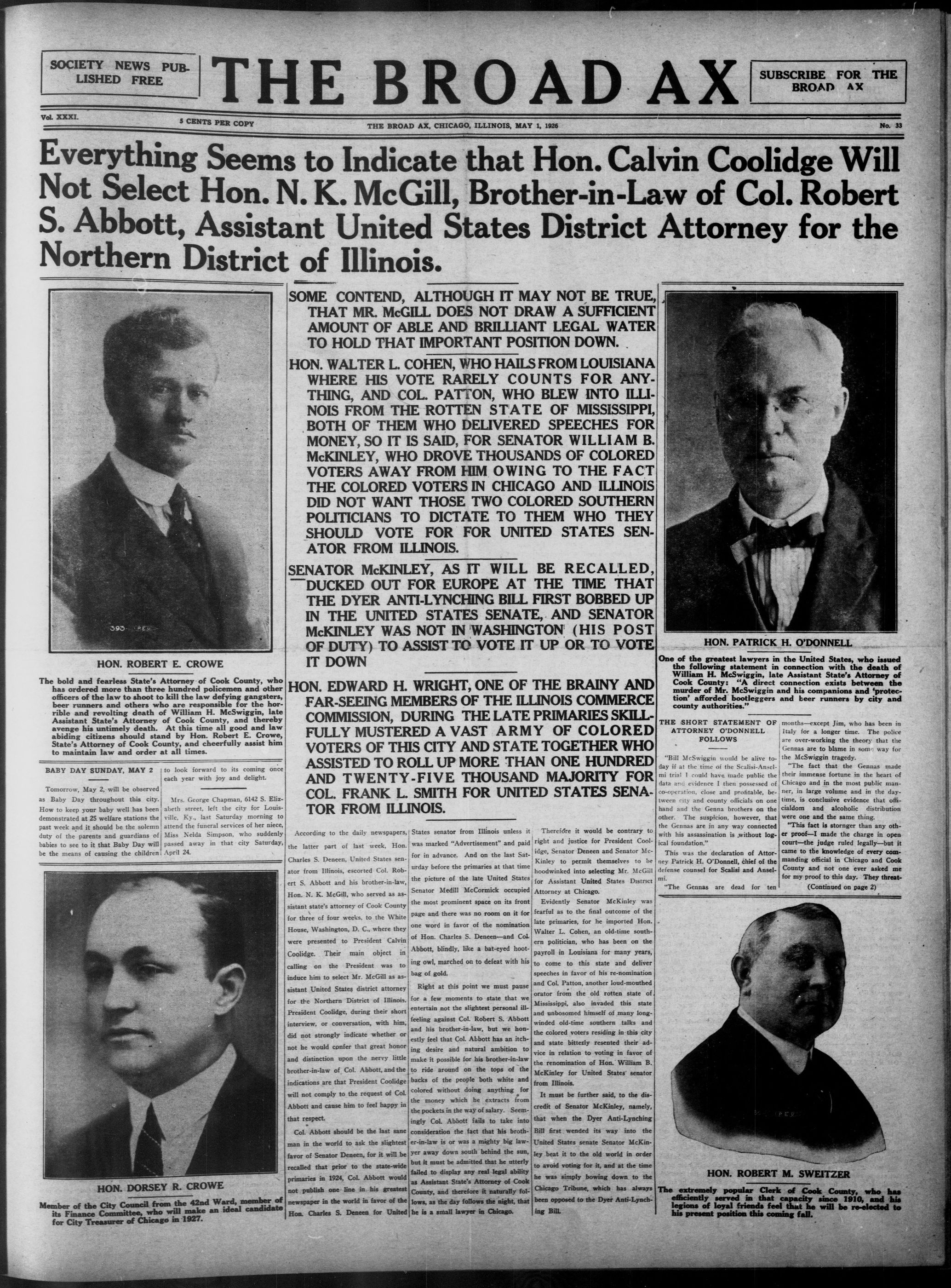
Everything Seems to Indicate that Hon. Calvin Coolidge Will Not Select Hon. N. K. McGill, Brother-in-Law of Col. Robert S. Abbott, Assistant United States District Attorney for the Northern District of Illinois.
SOCIETY NEWS PUBLISHED FREE
Vol. XXXI. 5 C
Everything Not Select
S. Abbott,
Northern I
5 CENTS PER COPY
Everything S
Select H
Abbott, As
Southern Dis
ing Seeme
ct Hon. L
tt, Assista
n District
393 PEU
HON. ROBERT E. CROWER
The bold and fearless State's Attorney of Cook has ordered more than three hundred police officers of the law to shoot to kill the law defender runners and others who are responsible and revolting death of William H. M. Assistant State's Attorney of Cook County, avenge his untimely death. At this time all abiding citizens should stand by Hon. Roy State's Attorney of Cook County, and cheer to maintain law and order at all times.
BABY DAY SUNDAY, MAY 2
to look forward to each year with joy
In fearless State's Attorney of Cook
and more than three hundred police
the law to shoot to kill the law defens
ers and others who are responsible
revolting death of William H. M.
State's Attorney of Cook County
untimely death. At this time all
citizens should stand by Hon. Ror
orney of Cook County, and cheer
in law and order at all times.
Attorney of Cook County, who are hundred policemen and other kill the law defying gangsters, who are responsible for the horof William H. McSwiggin, late of Cook County, and thereby At this time all good and law and by Hon. Robert E. Crowe, county, and cheerfully assist him at all times.
The bold and fearless State's Attorney of Cook County, who has ordered more than three hundred policemen and other officers of the law to shoot to kill the law defying gangsters, beer runners and others who are responsible for the horrible and revolting death of William H. McSwiggin, late Assistant State's Attorney of Cook County, and thereby avenge his untimely death. At this time all good and law abiding citizens should stand by Hon. Robert E. Crowe, State's Attorney of Cook County, and cheerfully assist him to maintain law and order at all times.
BABY DAY SUNDAY, MAY 2
Tomorrow, May 2, will be observed as Baby Day throughout this city. How to keep your baby well has been demonstrated at 25 welfare stations the past week and it should be the solemn duty of the parents and guardians of babies to see to it that Baby Day will be the means of causing the children to look forward to its coming once each year with joy and delight.
Mrs. George Chapman, 6142 S. Elizabeth street, left the city for Louisville, Ky., last Saturday morning to attend the funeral services of her niece, Miss Nelda Simpson, who suddenly passed away in that city Saturday, April 24.
```markdown
```
[Image of a man in a suit with a tie].
PETER H.
M.
Member of the City Council from the 42nd Wav its Finance Committee, who will make an i for City Treasurer of Chicago in 1927.
The City Council from the 42nd W
Committee, who will make an in
treasurer of Chicago in 1927.
from the 42nd Ward, member of
to will make an ideal candidate
go in 1927.
Member of the City Council from the 42nd Ward, member of its Finance Committee, who will make an ideal candidate for City Treasurer of Chicago in 1927.
Tomorrow, May 2, will be observed as Baby Day throughout this city. How to keep your baby well has been demonstrated at 25 welfare stations the past week and it should be the solemn duty of the parents and guardians of babies to see it that Baby Day will be the means of causing the children
THE BROAD AX
THE BROAD AX, CHICAGO, ILLINOIS, MAY 1, 1926
SOME CONTEND, ALTHOUGH IT MAY NOT BE TRUE, THAT MR. McGILL DOES NOT DRAW A SUFFICIENT AMOUNT OF ABLE AND BRILLIANT LEGAL WATER TO HOLD THAT IMPORTANT POSITION DOWN.
HON. WALTER L. COHEN, WHO HAILS FROM LOUISIANA WHERE HIS VOTE RARELY COUNTS FOR ANYTHING, AND COL. PATTON, WHO BLEW INTO ILLINOIS FROM THE ROTTEN STATE OF MISSISSIPPI, BOTH OF THEM WHO DELIVERED SPEECHES FOR MONEY, SO IT IS SAID, FOR SENATOR WILLIAM B. McKINLEY, WHO DROVE THOUSANDS OF COLORED VOTERS AWAY FROM HIM OWING TO THE FACT THE COLORED VOTERS IN CHICAGO AND ILLINOIS DID NOT WANT THOSE TWO COLORED SOUTHERN POLITICIANS TO DICTATE TO THEM WHO THEY SHOULD VOTE FOR FOR UNITED STATES SENATOR FROM ILLINOIS.
SENATOR McKINLEY, AS IT WILL BE RECALLED, DUCKED OUT FOR EUROPE AT THE TIME THAT THE DYER ANTI-LYNCHING BILL FIRST BOBBED UP IN THE UNITED STATES SENATE, AND SENATOR McKINLEY WAS NOT IN WASHINGTON (HIS POST OF DUTY) TO ASSIST TO VOTE IT UP OR TO VOTE IT DOWN
HON. EDWARD H. WRIGHT, ONE OF THE BRAINY AND FAR-SEEING MEMBERS OF THE ILLINOIS COMMERCE COMMISSION, DURING THE LATE PRIMARIES SKILLFULLY MUSTERED A VAST ARMY OF COLORED VOTERS OF THIS CITY AND STATE TOGETHER WHO ASSISTED TO ROLL UP MORE THAN ONE HUNDRED AND TWENTY-FIVE THOUSAND MAJORITY FOR COL. FRANK L. SMITH FOR UNITED STATES SENATOR FROM ILLINOIS.
According to the daily newspapers, the latter part of last week, Hon. Charles S. Deneen, United States senator from Illinois, escorted Col. Robert S. Abbott and his brother-in-law, Hon. N. K. McGill, who served as assistant state's attorney of Cook County for three of four weeks, to the White House, Washington, D. C., where they were presented to President Calvin Coolidge. Their main object in calling on the President was to induce him to select Mr. McGill as assistant United States district attorney for the Northern District of Illinois. President Coolidge, during their short interview, or conversation, with him, did not strongly indicate whether or not he would confer that great honor and distinction upon the nervy little brother-in-law of Col. Abbott, and the indications are that President Coolidge will not comply to the request of Col. Abbott and cause him to feel happy in that respect.
Col. Abbott should be the last sane man in the world to ask the slightest favor of Senator Deneen, for it will be recalled that prior to the state-wide primaries in 1924, Col. Abbott would not publish one line in his greatest newspaper in the world in favor of the Hon. Charles S. Deneen for United
States senator from Illinois unless it was marked "Advertisement" and paid for in advance. And on the last Saturday before the primaries at that time the picture of the late United States Senator Medill McCormick occupied the most prominent space on its front page and there was no room on it for one word in favor of the nomination of Hon. Charles S. Deneen—and Col. Abbott, blindly, like a bat-eyed hooting owl, marched on to defeat with his bag of gold.
Right at this point we must pause for a few moments to state that we entertain not the slightest personal ill-feeling against Col. Robert S. Abbott and his brother-in-law, but we honestly feel that Col. Abbott has an itching desire and natural ambition to make it possible for his brother-in-law to ride around on the tops of the backs of the people both white and colored without doing anything for the money which he extracts from the pockets in the way of salary. Seemingly Col. Abbott fails to take into consideration the fact that his brother-in-law is or was a mighty big lawyer away down south behind the sun, but it must be admitted that he utterly failed to display any real legal ability as Assistant State's Attorney of Cook County, and therefore it naturally follows, as the day follows the night, that he is a small lawyer in Chicago.
Therefore it would be contrary to right and justice for President Coolidge, Senator Deneen and Senator McKinley to permit themselves to be hoodwinked into selecting Mr. McGill for Assistant United States District Attorney at Chicago.
Evidently Senator McKinley was fearful as to the final outcome of the late primaries, for he imported Hon. Walter L. Cohen, an old-time southern politician, who has been on the payroll in Louisiana for many years, to come to this state and deliver speeches in favor of his re-nomination and Col. Patton, another loud-mouthed orator from the old rotten state of Mississippi, also invaded this state and unbosomed himself of many long-winded old-time southern talks and the colored voters residing in this city and state bitterly resented their advice in relation to voting in favor of the renomination of Hon. William B. McKinley for United States senator from Illinois.
It must be further said, to the discredit of Senator McKinley, namely, that when the Dyer Anti-Lynching Bill first wended its way into the United States senate Senator McKinley beat it to the old world in order to avoid voting for it, and at the time he was simply bowing down to the Chicago Tribune, which has always been opposed to the Dyer Anti-Lynching Bill.
Coolidge W
of Col. Rob
torney for
[Picture of a man in a suit with a bow tie].
HON. PATRICK H. O'DONNELL
One of the greatest lawyers in the United States, the following statement in connection with the William H. McSwiggin, late Assistant State's Cook County: "A direct connection exists in murder of Mr. McSwiggin and his companions' afforded bootleggers and beer runners county authorities."
a greatest lawyers in the United States, flowing statement in connection with the H. McSwiggin, late Assistant State's County: "A direct connection exists I of Mr. McSwiggin and his companions, forded bootleggers and beer runners authorities."
One of the greatest lawyers in the United States, who issued the following statement in connection with the death of William H. McSwiggin, late Assistant State's Attorney of Cook County: "A direct connection exists between the murder of Mr. McSwiggin and his companions and 'protection' afforded bootleggers and beer runners by city and county authorities."
THE SHORT STATEMENT OF ATTORNEY O'DONNELL FOLLOWS
"Bill McSwiggin would be alive today if at the time of the Scalisi-Anselmi trial I could have made public the data and evidence I then possessed of co-operation, close and profitable, between city and county officials on one hand and the Genna brothers on the other. The suspicion, however, that the Gennas are in any way connected with his assassination is without logical foundation."
This was the declaration of Attorney Patrick H. O'Donnell, chief of the defense counsel for Scalisi and Anselmi.
"The Gennas are dead for ten months—except Jim, who has been in Italy for a longer time. The police are over-working the theory that the Gennas are to blame in some way for the McSwiggin tragedy.
"The fact that the Gennas made their immense fortune in the heart of Chicago and in the most public manner, in large volume and in the daytime, is conclusive evidence that officialdom and alcoholic distribution were one and the same thing.
"This fact is storger than any other proof—I made the charge in open court—the judge ruled legally—but it came to the knowledge of every commanding official in Chicago and Cook County and not one ever asked me for my proof to this day. They threat-
(Continued on page 2)
```markdown
```
PEE
BUTTERFIELD
HON. ROBERT M. SWEITZER
The extremely popular Clerk of Cook County efficiently served in that capacity since 19 legions of loyal friends feel that he will be his present position this coming fall.
mely popular Clerk of Cook County
only served in that capacity since 190
of loyal friends feel that he will be in
ment position this coming fall.
The extremely popular Clerk of Cook County, who has efficiently served in that capacity since 1910, and his legions of loyal friends feel that he will be re-elected to his present position this coming fall.
The extremely popular Clerk of Cook County, who has efficiently served in that capacity since 1910, and his legions of loyal friends feel that he will be re-elected to his present position this coming fall.
SUBSCRIBE FOR THE BROAD AX
olidge Will
Col. Robert
ey for the
versers in the United States, who issued
sent in connection with the death of
ein, late Assistant State's Attorney of
direct connection exists between the
iggin and his companions and 'protec-
tigers and beer runners by city and
T OF FILL
months—except Jim, who has been in
Italy for a longer time. The police
are over-working the theory that the
Gennas are to blame in some way for
the McSwiggin tragedy.
"The fact that the Gennas made
their immense fortune in the heart of
Chicago and in the most public man-
ner, in large volume and in the day-
time, is conclusive evidence that official
dom and alcoholic distribution
were one and the same thing.
"This fact is storner than any other
proof—I made the charge in open
court—the judge ruled legally—but it
came to the knowledge of every com-
manding official in Chicago and Cook
County and not one ever asked me
for my proof to this day. They threat-
Attor of the Ansel-
(Continued on page 2)
Clerk of Cook County, who has that capacity since 1910, and his is feel that he will be re-elected to is coming fall.
THE BROAD AX Published Every Saturday
In this city since July 15th, 1899, without missing one single issue. Republicans, Democrats, Catholics, Protestants, Single Taxers, Priests, infidels or anyone else can have their say as long as their language is proper and responsibility is fixed. The Broad Ax is a newspaper whose platform is broad enough for all, ever claiming the editorial right to speak its own mind. It is neither Democratic nor Republican. It is strictly or absolutely independent in politics. Local communications will receive attention. Write only on one side of the paper. Subscriptions must be paid in advance.
One Year ..... $2.00
Six Months ..... $1.00
Advertising rates made known on application.
Vol. XXXI No. 33
Chicago, May 1, 1926
Entered as Second-Class Matter, Aug.
19, 1902, at the Post office at Chicago.
Ill. Under Act of March 8, 1879.
ATTY. PATRICK H. O'DONNELL
CONTENDS THAT CIVIL GOVERNMENT HAS BROKEN
DOWN IN CHICAGO.
(Continued from page 1)
ened to, but never called on me for
help in purifying Chicago.
Calls Death a "Notice"
"The tide of crime has arisen until
this brilliant young man was sacrificed
and his death is notice to Chicago
that civil government has broken
down."
In the Scalisi-Anselmi trial, Attorney O'Donnell called Assistant State's Attorney McSwiggin, "the most brilliant and fair prosecutor" he had seen in twenty years in the Criminal Court.
"The gangster," Attorney O'Donnell defined, "is nothing more than the private policeman for the liquor interests. His first duty was to protect his employers and their trade. Later he was given a second duty—to carry the primaries."
BULLETIN NO. 55
FOR YOUR SAFETY
By Chief of Police Morgan A. Collins
Chicago's army of May 1 movers are warned that before taking possession of new apartments or houses to be sure that all keys, including duplicates, are accounted for.
Front and rear doors should be equipped with double bolts, as professional burglarls experience little difficulty in forcing back spring locks.
Change locks to avoid trouble. It is the best investment you can provide for your family's safety. This warning is particularly applicable to large apartment buildings.
Protect your windows with good, strong locks. Cheap locks are worthless as a safeguard. If you can afford it, install electric alarms that will give warning in case of entry.
Fire escapes are frequently used by burglars. They should never be accessible from the ground or an adjoining building.
Securely fasten all windows and doors when you go out. To conceal keys under door mats or over door casings is an invitation to rob your home of everything movable.
Install chain locks or other safety device on your front and back doors to prevent entrance while conversing with strangers. This precaution may save your life.
Help us to protect you. If you see a suspicious person loitering about your premises, call your nearest police station, Police 1313. An ounce of prevention is worth a pound of cure.
COLORED GIRL WINS PLACE
ON NATIONAL HONOR ROLL
Philadelphia.—Ruth Wright, age 15, daughter of Dr. R. R. Wright, Jr., editor of the Christian Recorder, was chosen as a member of the National Honor Society of High and Secondary Schools. Out of over 2,000 students of the West Philadelphia High School for Girls, only 24 were chosen for this honor, and one was a colored girl, Miss Wright, Paul Shock, the principal, said: "This is the highest honor that can be awarded a student in our school. It is given for superiority in character, scholarship, leadership and
12
HON. P. J. CARR
Nominated for Sheriff of Cool loyal friends loudly content opposition and land in the ber election.
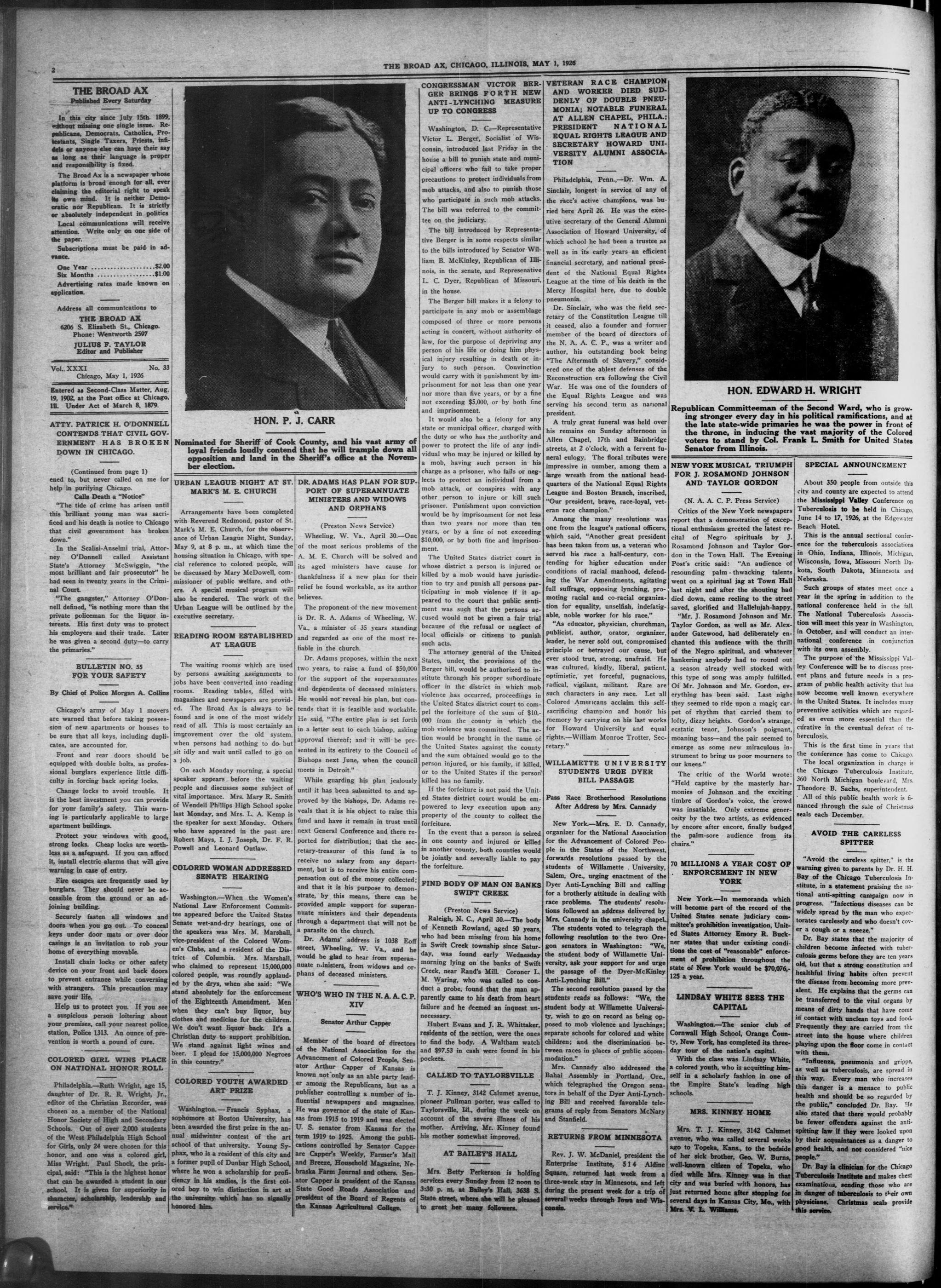
Nominated for Sheriff of Cook County, and his vast army of loyal friends loudly contend that he will trample down all opposition and land in the Sheriff's office at the November election.
URBAN LEAGUE NIGHT AT ST
MARK'S M. E. CHURCH
Arrangements have been completed with Reverend Redmond, pastor of St. Mark's M. E. Church, for the observance of Urban League Night, Sunday, May 9, at 8 p. m., at which time the housing situation in Chicago, with special reference to colored people, will be discussed by Mary McDowell, commissioner of public welfare, and others. A special musical program will also be rendered. The work of the Urban League will be outlined by the executive secretary.
READING ROOM ESTABLISHED
AT LEAGUE
The waiting rooms which are used by persons awaiting assignments to jobs have been converted into reading rooms. Reading tables, filled with magazines and newspapers are provided. The Broad Ax is always to be found and is one of the most widely read of all. This is most certainly an improvement over the old system, when persons had nothing to do but sit idly and wait until called to go on a job.
On each Monday morning, a special speaker appears before the waiting people and discusses some subject of vital importance. Mrs. Mary R. Smith of Wendell Phillips High School spoke last Monday, and Mrs. L. L. A Kemp is the speaker for next Monday. Others who have appeared in the past are: Robert Mays, I. J. Joseph, Dr. F. R. Powell and Leonard Outlaw.
COLORED WOMAN ADDRESSED
SENATE HEARING
Washington.—When the Women's National Law Enforcement Committee appeared before the United States Senate wet-and-dry hearings, one of the speakers was Mrs. M. Marshall, vice-president of the Colored Women's Clubs, and a resident of the District of Columbia. Mrs. Marshall, who claimed to represent 15,000,000 colored people, was roundly applauded by the drys, when she said: "We stand absolutely for the enforcement of the Eighteenth Amendment. Men when they can't buy liquor, buy clothes and medicine for the children. We don't want liquor back. It's a Christian duty to support prohibition. We stand against light wines and beer. I plead for 15,000,000 Negroes in this country."
COLORED YOUTH AWARDED
ART PRIZE
Washington.—Francis Syphax, a sophomore at Boston University, has been awarded the first prize in the annual midwinter contest of the art school of that university. Young Syphax, who is a resident of this city and a former pupil of Dunbar High School, where he won a scholarship for proficiency in his studies, is the first colored boy to win distinction in art at the university which has so signally honored him.
Rx County, and his vast army of that he will trample down all the Sheriff's office at the Novem-
DR. ADAMS HAS PLAN FOR SUPPORT OF SUPERANNUATE MINISTERS AND WIDOWS AND ORPHANS
Wheeling, W. Va., April 30.—One of the most serious problems of the A. M. E. Church will be solved and its aged ministers have cause for thankfulness if a new plan for their relief be found workable, as its author believes.
The proponent of the new movement is Dr. R. A. Adams of Wheeling, W. Va., a minister of 35 years standing and regarded as one of the most reliable in the church.
Dr. Adams proposes, within the next two years, to raise a fund of $50,000 for the support of the superannuates and dependents of deceased ministers. He would not reveal his plan, but contends that it is feasible and workable. He said, "The entire plan is set forth in a letter sent to each bishop, asking approval thereof; and it will be presented in its entirety to the Council of Bishops next June, when the council meets in Detroit."
While guarding his plan jealously until it has been submitted to and approved by the bishops, Dr. Adams reveals that it is his object to raise this fund and have it remain in trust until next General Conference and there reported for distribution; that the secretary-treasurer of this fund is to receive no salary from any department, but is to receive his entire compensation out of the money collected; and that it is his purpose to demonstrate, by this means, there can be provided ample support for supernuate ministers and their dependents through a department that will not be a parasite on the church.
Dr. Adams' address is 1038 Eoff street, Wheeling, W. Va., and he would be glad to hear from superanuate ministers, from widows and orphans of deceased ministers.
WHO'S WHO IN THE N. A. A. C. P.
XIV
Senator Arthur Capper
Member of the board of directors of the National Association for the Advancement of Colored People, Senator Arthur Capper of Kansas is known not only as an able party leader among the Republicans, but as a publisher controlling a number of influential newspapers and magazines. He was governor of the state of Kansas from 1915 to 1919 and was elected U. S. senator from Kansas for the term 1919 to 1925. Among the publications controlled by Senator Capper are Capper's Weekly, Farmer's Mail and Breeze, Household Magazine, Nebraska Farm Journal and others. Senator Capper is president of the Kansas State Good Roads Association and president of the Board of Regents of the Kansas Agricultural College.
---
CONGRESSMAN VICTOR BERGER BRINGS FORTH NEW ANTI-LYNCHING MEASURE UP TO CONGRESS
Washington, D. C.—Representative Victor L. Berger, Socialist of Wisconsin, introduced last Friday in the house a bill to punish state and municipal officers who fail to take proper precautions to protect individuals from mob attacks, and also to punish those who participate in such mob attacks. The bill was referred to the committee on the judiciary.
VETERA AND DENL MONIAL AT AN PRESIDENT EQUA SECRET VERSION
Philade Sinclair, the race's richest native secr
The bill introduced by Representative Berger is in some respects similar to the bills introduced by Senator William B. McKinley, Republican of Illinois, in the senate, and Representative L. C. Dyer, Republican of Missouri in the house.
The Berger bill makes it a felony to participate in any mob or assemblage composed of three or more persons acting in concert, without authority of law, for the purpose of depriving any person of his life or doing him physical injury resulting in death or injury to such person. Conviction would carry with it punishment by imprisonment for not less than one year nor more than five years, or by a fine not exceeding $5,000, or by both fine and imprisonment.
It would also be a felony for any state or municipal officer, charged with the duty or who has the authority and power to protect the life of any individual who may be injured or killed by a mob, having such person in his charge as a prisoner, who fails or neglects to protect an individual from a mob attack, or conspires with any other person to injure or kill such prisoner. Punishment upon conviction would be by imprisonment for not less than two years nor more than ten years, or by a fine of not exceeding $10,000, or by both fine and imprisonment.
The United States district court in whose district a person is injured or killed by a mob would have jurisdiction to try and punish all persons participating in mob violence if it appeared to the court that public sentiment was such that the persons accused would not be given a fair trial because of the refusal or neglect of local officials or citizens to punish such acts.
The attorney general of the United States, under the provisions of the Berger bill, would be authorized to institute through his proper subordinate officer in the district in which mob violence has occurred, proceedings in the United States district court to compel the forfeiture of the sum of $10,000 from the county in which the mob violence was committed. The action would be brought in the name of the United States against the county and the sum obtained would go to the person injured, or his family, if killed, or to the United States if the person killed has no family.
If the forfeiture is not paid the United States district court would be empowered to levy execution upon any property of the county to collect the forfeiture.
In the event that a person is seized in one county and injured or killed in another county, both counties would be jointly and severally liable to pay the forfeiture.
FIND BODY OF MAN ON BANKS
SWIFT CREEK
(Preston News Service)
Raleigh, N. C., April 30.—The body of Kenneth Rowland, aged 50 years, who had been missing from his home in Swift Creek township since Saturday, was found early Wednesday morning lying on the banks of Swift Creek, near Rand's Mill. Coroner L. M. Waring, who was called to conduct a probe, found that the man apparently came to his death from heart failure and he deemed an inquest unnecessary.
Hubert Evans and J. R. Whittaker, residents of the section, were the ones to find the body. A Waltham watch and $97.53 in cash were found in his pockets.
CALLED TO TAYLORSVILLE
T. J. Kinney, 3142 Calumet avenue, pioneer Pullman porter, was called to Taylorsville, Ill., during the week on account of the severe illness of his mother. Arriving, Mr. Kinney found his mother somewhat improved.
AT BAILEY'S HALL
Mrs. Betty Perkerson is holding services every Sunday from 12 noon to 3:30 p. m. at Bailey's Hall, 3638 S. State street, where she will be pleased to greet her many followers.
VETERAN RACE CHAMPION
AND WORKER DIED SUD-
DENLY OF DOUBLE PNEU-
MONIA; NOTABLE FUNERAL
AT ALLEN CHAPEL, PHILA.
PRESIDENT NATIONAL
EQUAL RIGHTS LEAGUE AND
SECRETARY HOWARD UNI-
VERSITY ALUMNI ASSOCIATION
Philadelphia, Penn.,—Dr. Wm. A. Sinclair, longest in service of any of the race's active champions, was buried here April 26. He was the executive secretary of the General Alumni Association of Howard University, of which school he had been a trustee as well as in its early years an efficient financial secretary, and national president of the National Equal Rights League at the time of his death in the Mercy Hospital here, due to double pneumonia.
Dr. Sinclair, who was the field secretary of the Constitution League till it ceased, also a founder and former member of the board of directors of the N. A. A. C. P., was a writer and author, his outstanding book being "The Aftermath of Slavery," considered one of the ablest defenses of the Reconstruction era following the Civil War. He was one of the founders of the Equal Rights League and was serving his second term as national president.
A truly great funeral was held over his remains on Sunday afternoon in Allen Chapel, 17th and Bainbridge streets, at 2 o'clock, with a fervent funeral eulogy. The floral tributes were impressive in number, among them a large wreath from the national headquarters of the National Equal Rights League and Boston Branch, inscribed, "Our president, brave, race-loyal, veteran race champion."
Among the many resolutions was one from the league's national officers, which said, "Another great president has been taken from us, a veteran who served his race a half-century, contending for higher education under conditions of racial manhood, defending the War Amendments, agitating full suffrage, opposing lynching, promoting racial and co-racial organization for equality, unselfish, indefatigable, noble worker for his race."
"As educator, physician, churchman, publicist, author, orator, organizer, leader, he never sold out, compromised principle or betrayed our cause, but ever stood true, strong, unafraid. He was cultured, kindly, liberal, patient, optimistic, yet forceful, pugnacious, radical, vigilant, militant. Rare are such characters in any race. Let all Colored Americans acclaim this self-sacrificing champion and honor his memory by carrying on his last works for Howard University and equal rights."-William Monroe Trotter, Secretary."
WILLAMETTE UNIVERSITY
STUDENTS URGE DYER
BILL PASSAGE
Pass Race Brotherhood Resolutions After Address by Mrs. Cannady
New York—Mrs. E. D. Cannady, organizer for the National Association for the Advancement of Colored People in the States of the Northwest, forwards resolutions passed by the students of Willamette University, Salem, Ore., urging enactment of the Dyer Anti-Lynching Bill and calling for a brotherly attitude in dealing with race problems. The students' resolutions followed an address delivered by Mrs. Cannady in the university chapel.
The students voted to telegraph the following resolution to the two Oregon senators in Washington: "We, the student body of Willamette University, ask your support for and urge the passage of the Dyer-McKinley Anti-Lynching Bill."
The second resolution passed by the students reads as follows: "We, the student body at Willamette University, wish to go on record as being opposed to mob violence and lynchings; separate schools for colored and white children; and the discrimination between races in places of public accommodation."
Mrs. Cannady also addressed the Bahai Assembly in Portland, Ore., which telegraphed the Oregon senators in behalf of the Dyer Anti-Lynching Bill and received favorable telegrams of reply from Senators McNary and Stanfield.
RETURNS FROM MINNESOTA
Rev. J. W. McDaniel, president the Enterprise Institute, 514 Aldine Square, returned last week from a three-week stay in Minnesota, and left during the present week for a trip of several weeks through Iowa and Wisconsin.
HON. EDWARD H. WRIGHT
Republican Committeeman of the Second Ward, ing stronger every day in his political ramified the late state-wide primaries he was the pow the throne, in inducing the vast majority of voters to stand by Col. Frank L. Smith for Senator from Illinois.
Republican Committeeman of the Second Ward, who is growing stronger every day in his political ramifications, and at the late state-wide primaries he was the power in front of the throne, in inducing the vast majority of the Colored voters to stand by Col. Frank L. Smith for United States Senator from Illinois.
NEW YORK MUSICAL TRIUMPH
FOR J. ROSAMOND JOHNSON
AND TAYLOR GORDON
(N. A. A. C. P. Press Service)
Critics of the New York newspapers report that a demonstration of exceptional enthusiasm greeted the latest recital of Negro spirituals by J. Rosamond Johnson and Taylor Gordon in the Town Hall. The Evening Post's critic said: "An audience of resounding palm-thwacking talents went on a spiritual jag at Town Hall last night and after the shouting had died down, came reeling to the street saved, glorified and Halleluiah-happy.
"Mr. J. Rosamond Johnson and Mr. Taylor Gordon, as well as Mr. Alexander Gatewood, had deliberately enchanted this audience with the thrill of the Negro spiritual, and whatever hankering anybody had to round out a season already well stocked with this type of song was amply fulfilled. Of Mr. Johnson and Mr. Gordon, everything has been said. Last night they seemed to ride upon a magic carpet of rhythm that carried them to lofty, dizzy heights. Gordon's strange, ecstatic tenor, Johnson's poignant, moaning bass—and the pair seemed to emerge as some new miraculous instrument to bring us poor mourners to our knees."
The critic of the World wrote: "Held captive by the masterly harmonies of Johnson and the exciting timbre of Gordon's voice, the crowd was insatiable. Only extreme generosity by the two artists, as evidenced by encore after encore, finally budged the palm-sore audience from its chairs."
70 MILLIONS A YEAR COST OF ENFORCEMENT IN NEW
New York.—In memoranda which will become part of the record of the United States senate judiciary committee's prohibition investigation, United States Attorney Emory R. Buckner states that under existing conditions the cost of "reasonable" enforcement of prohibition throughout the state of New York would be $70,076,125 a year.
LINDSAY WHITE SEES THE CAPITAL
Washington.-The senior club of Cornwall High School, Orange County, New York, has completed its threeday tour of the nation's capital. With the class was Lindsay White, a colored youth, who is acquitting himself in a scholarly fashion in one of the Empire State's leading high schools.
MRS. KINNEY HOME
Mrs. T. J. Kinney, 3142 Calumet avenue, who was called several weeks ago to Topeka, Kans., to the bedside of her sick brother, Geo. W. Burns, well-known citizen of Topeka, who died while Mrs. Kinney was in that city and was buried with honors, has just returned home after stopping for several days in Kansas City, Mo., with Mrs. V. L. Williams.
the Second Ward, who is grow-
nis political ramifications, and at
he he was the power in front of
he vast majority of the Colored
bank L. Smith for United States
SPECIAL ANNOUNCEMENT
About 350 people from outside this
city and county are expected to attend
the Mississippi Valley Conference on
Tuberculosis to be held in Chicago,
June 14 to 17, 1926, at the Edgewater
Beach Hotel.
This is the annual sectional conference for the tuberculosis associations in Ohio, Indiana, Illinois, Michigan, Wisconsin, Iowa, Missouri North Dakota, South Dakota, Minnesota and Nebraska.
Such groups of states meet once a year in the spring in addition to the national conference held in the fall. The National Tuberculosis Association will meet this year in Washington, in October, and will conduct an international conference in conjunction with its own assembly.
The purpose of the Mississippi Valley Conference will be to discuss present plans and future needs in a program of public health activity that has now become well known everywhere in the United States. It includes many preventive activities which are regarded as even more essential than the curative in the eventual defeat of tuberculosis. This is the first time in years that the conference has come to Chicago. The local organization in charge is the Chicago Tuberculosis Institute, 360 North Michigan boulevard, Mrs. Theodore B. Sachs, superintendent. All of this public health work is financed through the sale of Christmas seals each December.
AVOID THE CARELESS
SPITTER
"Avoid the careless spitter," is the warning given to parents by Dr. H. H. Bay of the Chicago Tuberculosis Institute, in a statement praising the national anti-spitting campaign now in progress. "Infectious diseases can be widely spread by the man who expectorates carelessly and who doesn't cover a cough or a sneeze."
Dr. Bay states that the majority of children become infected with tuberculosis germs before they are ten years old, but that a strong constitution and healthful living habits often prevent the disease from becoming more prevalent. He explains that the germs can be transferred to the vital organs by means of dirty hands that have come in contact with unclean toys and food. Frequently they are carried from the street into the house where children playing upon the floor come in contact with them.
"Influenza, pneumonia and grippes as well as tuberculosis, are spread in this way. Every man who increases this danger is a menace to public health and should be so regarded by the public," concluded Dr. Bay. He also stated that there would probably be fewer offenders against the antisitting law if they were looked upon by their acquaintances as a danger to good health, and not considered "nice people."
Dr. Bay is clinician for the Chicago Tuberculosis Institute and makes chest examinations, sending those who are in danger of tuberculosis to their own physicians. Christmas seals provide this service.
LAND OVER FOOD
Patou's Ideas of Milady's Apparel
Will the spring and summer of 1926 bring as many significant fashion changes as 1925? That is the important question of the moment, writes Jean Patou in the New York Herald-Tribune. If you will remember, it was just one year ago that I launched my collection and featured the raised waistline, at the same time entirely disregarding the low waist, which had been in vogue for so long before. Some of my good friends assured me that I was foolish—that the raised waistline was doomed to failure. Now I see all those same sturdy defenders of the lowered line slowly but surely adopting the raised waistline and declaring with a charming ingenuousness that they had always been in favor of it. That is the way of the mode. And what is laughed at today may be a tremendous vogue tomorrow. It is always important to bear this in mind.
A Mode of Materials
If the higher waltseal was the outstanding development of 1925, what will be the principal fashion feature of 1926? Let me assure you that there will be no appreciable change in the silhouette. The waltseal will remain at the top of the hips, where I placed it last summer, and the outline in general will not greatly depart from last season's smart silhouette. The most important differentiation between the new mode and the old is a material one—the employment of distinctly new fabrics. In saying new I may not be exactly correct, because one of the two outstanding fabrics of the coming season does not deserve that description. I refer, of course, to taffeta—an ancient friend which is returning vigorously to the scene of former triumphs. Personally I have used taffeta in many models from the tailored walking suit to the formal afternoon dress, and even for coats. However, and this will astonish you, I am sure, I entirely disregard taffeta for the robe de solr, because taffeta, when used in evening dresses leads inevitably to the robe de style, and I have buried that particular type of dress for many years. Nor do I favor it now, despite its apparent popularity this season. The second novelty among materials is a crepe georgette which has almost the weight of cloth and which may be employed in the making of the tailored coat and suit. This material is new in everything but name. It differs from any crepe georgette which has been used in the past.
The dominant note of my entire collection, and one which I believe you will note generally throughout the new spring models of other designers as well, is the duality of tendencies which prevails. On the one hand there is the sports influence, which is making itself felt more and more. The sweater should have a preponderant place in every morning wardrobe—it is quite the vogue for afternoons, and it has even commenced to invade the evening mode. Indeed, even last see
1
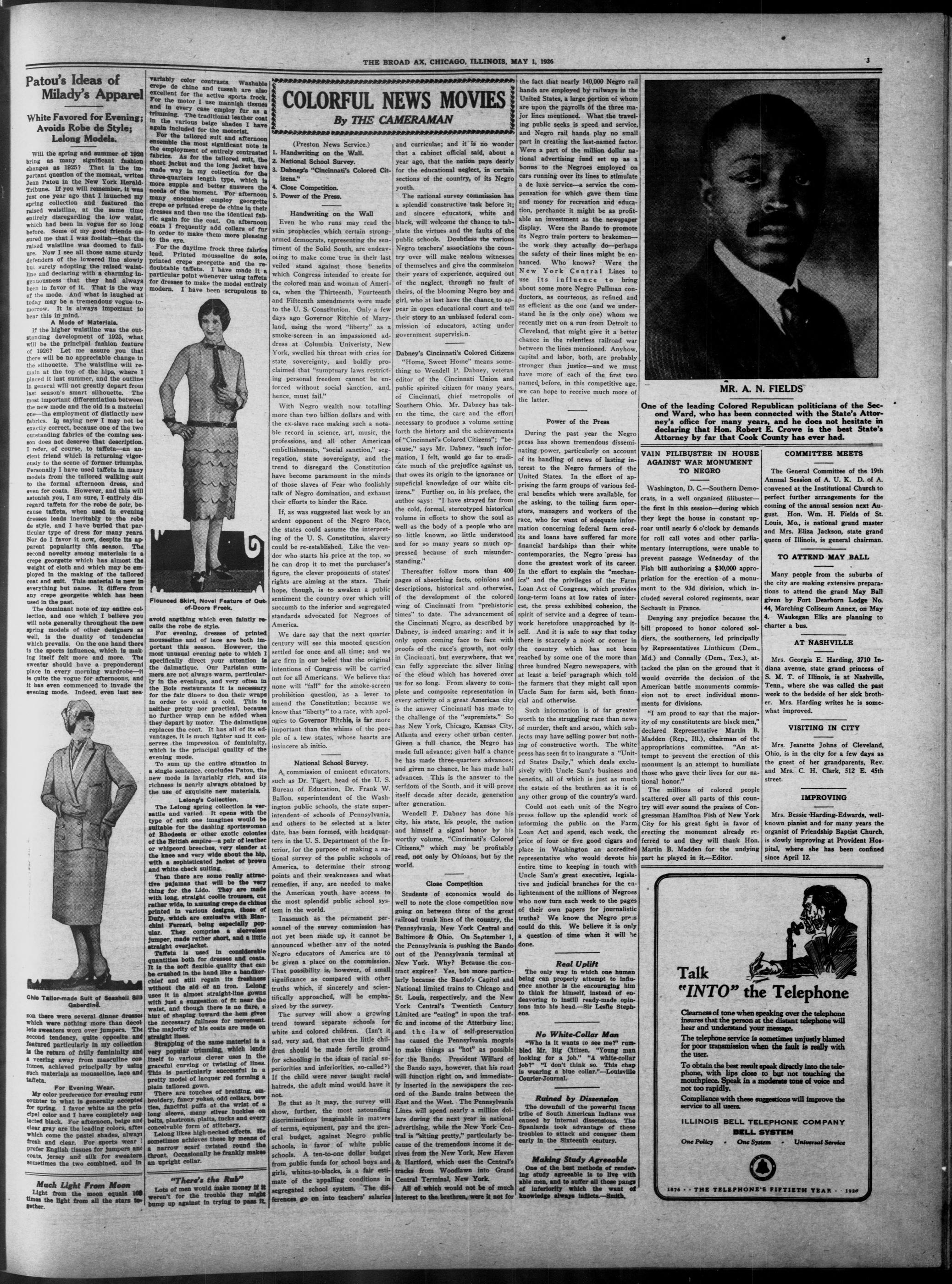
Chlo Tailor-made Suit of Seashell Silk Gaberdinl. son there were several dinner dresses which were nothing more than decolate sweaters worn over jumpers. The second tendency, quite opposite and featured particularly in my collection, is the return of frilly femininity and a veering away from masculine costumes, achieved principally by using such materials as mousseline, lace and taffeta.
For Evening Wear.
My color preference for evening run
counter to what is generally accepted
for spring. I favor white as the princi
pal color and I have completely neg
lected black. For afternoon, belge and
clear gray are the leading colors, after
which come the pastel shades, always
fresh and clear. For sports wear I
prefer English tissues for jumpers and
coats, Jersey and silk for sweaters
sometimes the two combined, and in
Much Light From Moon
Light from the moon equals 100
times the light from all the stars to
together
variably color contrasts. Washable crepe de chine and tussah are also excellent for the active sports frock. For the motor I use mannish tissues and in every case employ fur as a trimming. The traditional leather coat in the crepe beige shades I have again included for the motorist. For the tailored suit and afternoon ensemble the most significant note is the employment of entirely contrasted fabrics. As for the tailored suit, the short jacket and the long jacket have made way in my collection for the three-quarters length type, which is more supple and better answers the needs of the moment. For afternoon many ensembles employ geogette crepe or printed crepe de chine in their dresses and then use the identical fabric against the coat. On afternoon coats I frequently add collars of fur in order to make them more pleasing to the eye.
For the daytime frock three fabrics lead. Printed mousselline de sole, printed crepe georgette and the redtable taffeta. I have made it a particular point whenever using taffeta for dresses to make the model entirely modern. I have been scrupulous to
British Wear & Tidewear
Flounced Skirt, Novel Feature of Out-of-Doors Froek.
avoid anything which even faintly recalls the robe de style.
For evening, dresses of printed mousseline and of lace are both important this season. However, the most unusual evening note to which I specifically direct your attention is the dalmatine. Our Paris summers are not always warm, particularly in the evenings, and very often in the Bols restaurants it is necessary for the fair diners to don their wraps in order to avoid a cold. This is neither pretty nor practical, because no further wrap can be added when they depart by motor. The dalmatine replaces the coat. It has all of its advantages, it is much lighter and it conserves the impression of femininity, which is the principal quality of the evening mode.
To sum up the entire situation in a single sentence, concludes Paton, the new mode is invariably rich, and its richness is nearly always obtained by the use of exquisite new materials.
Lelong's Collection.
The Lelong spring collection is versatile and varied. It opens with the type of suit one imagines would be suitable for the dashing sportswoman of Rhodesia or other exotic colonies of the British empire—a pair of leather or whorcled breeches, very slender at the knee and very wide about the hip, with a sophisticated jacket of brown and white check suitting.
Then there are some really attractive pajamas that will be the very thing for the Lido. They are made with long, straight coolie trousers, cut rather wide, in amusing crepe de chines printed in various designs, those of Dufy, which are exclusive with Bianchini Ferrari, being especially popular. They comprise a sleeveless jumper, made rather short, and a little straight overcoat.
Tuffeta is used in considerable quantities both for dresses and coats. It is the soft flexible quality that can be crushed in the hand like a handkerchief and still regain its freshness without the aid of an iron. Lelong uses it in almost straight-line gowns with just a suggestion of fit near the waist, and though there is no flare, a hint of shaping toward the hem gives the necessary fullness for movement. The majority of his coats are made on straight lines. Strapping of the same material is a very popular trimming, which lends itself to various clever uses in the graceful curving or twisting of lines. This is particularly successful in a pretty model of lacquer red forming a plain tailored gown. There are touches of braiding, embroidery, fancy yokes, odd collar, bowties, fanciful puffs at the wrist of a long sleeve, many silver buckles on belts, plastrons, plaits, tucks and every conceivable form of stitching.
conduct. Lelong likes high-necked effects. He sometimes achieves these by means of a narrow scarf twisted round the throat. Occasionally he frankly makes an upright collar.
"There's the Rub"
Lots of men would make money if it weren't for the trouble they might bump up against in trying to pass it.
THE BROAD AX, CHICAGO, ILLINOIS, MAY 1, 1926
COLORFUL NEWS MOVIES By THE CAMERAMAN
---
3. Dabney's "Cincinnati's Colored Citizens."
4. Close Competition.
5. Power of the Press.
Handwriting on the Wall
Even he who runs may read the vain prophecies which certain strong-armed democrats, representing the sentiment of the Solid South, are endeavoting to make true in their last veiled stand against those benefits which Congress intended to create for the colored man and woman of America, when the Thirteenth, Fourteenth and Fifteenth amendments were made to the U. S. Constitution. Only a few days ago Governor Ritchie of Maryland, using the word "liberty" as a smoke-screen in an impassioned address at Columbia University, New York, swelled his throat with cries for state sovereignty, and boldly proclaimed that "sumptuity laws restricting personal freedom cannot be enforced without social sanction, and, hence, must fail."
With Negro wealth now totalling more than two billion dollars and with the ex-slave race making such a notable record in science, art, music, the professions, and all other American embellishments, "social sanitation," segregation, state sovereignty, and the trend to disregard the Constitution have become paramount in the minds of those slaves of Fear who foolishly talk of Negro domination, and exhaust their efforts to hinder the Race.
If, as was suggested last week by an ardent opponent of the Negro Race, the states could assume the interpreting of the U. S. Constitution, slavery could be re-established. Like the vendor who starts his price at the top, so he can drop it to met the purchaser's figure, the clever proponents of states' rights are aiming at the stars. Their hope, though, is to awaken a public sentiment the country over which will succumb to the inferior and segregated standards advocated for Negroes of America.
We dare say that the next quarter century will see this mooted question settled for once and all time; and we are firm in our belief that the original intentions of Congress will be carried out for all Americans. We believe that none will "fall" for the smoke-screen prohibition question, as a lever to amend the Constitution; because we know that "liberty" to a race, with apologies to Governor Ritchie, is far more important than the whims of the people of a few states, whose hearts are insincere ab initio.
National School Survey.
A commission of eminent educators, such as Dr. Tigert, head of the U. S. Bureau of Education, Dr. Frank W. Ballou, superintendent of the Washington public schools, the state superintendent of schools of Pennsylvania, and others to be selected at a later date, has been formed, with headquarters in the U. S. Department of the Interior, for the purpose of making a national survey of the public schools of America, to determine their strong points and their weaknesses and what remedies, if any, are needed to make the American youth have access to the most splendid public school system in the world.
Inasmuch as the permanent personnel of the survey commission has not yet been made up, it cannot be announced whether any of the noted Negro educators of America are to be given a place on the commission. That possibility is, however, of small significance as compared with other truths which, if sincerely and scientifically approached, will be emphasized by the survey.
The survey will show a growing trend toward separate schools for white and colored children. (Isn't it sad, very sad, that even the little children should be made fertile ground for schooling in the ideas of racial superiorities and inferiorities, so-called?) If the child were never taught racial hatreds, the adult mind would have it not.
Be that as it may, the survey will show, further, the most astounding discriminations imaginable in matters of terms, equipment, pay and the general budget, against Negro public schools, in favor of white public schools. A ten-to-one dollar budget from public funds for school boys and girls, whites-to-blacks, is a fair estimate of the appalling conditions in segregated school system. The differences go on into teachers' salaries
and curriculae; and it is no wonder that a cabinet official said, about a year ago, that the nation pays dearly for the educational neglect, in certain sections of the country, of its Negro youth.
The national survey commission has a splendid constructive task before it; and sincere educators, white and black, will welcome the chance to tabulate the virtues and the faults of the public schools. Doubless the various Negro teachers' associations the country over will make zealous witnesses of themselves and give the commission their years of experience, acquired out of the neglect, through no fault of theirs, of the blooming Negro boy and girl, who at last have the chance to appear in open educational court and tell their story to an unbiased federal commission of educators, acting under government supervision.
Dabney's Cincinnati's Colored Citizens
"Home, Sweet Home" means something to Wendell P. Dabney, veteran editor of the Cincinnati Union and public spirited citizen for many years, of Cincinnati, chief metropolis of Southern Ohio. Mr. Dabney has taken the time, the care and the effort necessary to produce a volume setting forth the history and the achievements of "Cincinnati's Colored Citizens"; "because," says Mr. Dabney, "such information, I felt, would go far to eradicate much of the prejudice against us, that owes its origin to the ignorance or superficial knowledge of our white citizens." Further on, in his preface, the author says: "I have strayed far from the cold, formal, stereotyped historical volume in efforts to show the soul as well as the body of a people who are so little known, so little understood and for so many years so much oppressed because of such misunderstanding."
Thereafter follow more than 400 pages of absorbing facts, opinions and descriptions, historical and otherwise, of the development of the colored wing of Cincinnati from "prehistoric times" to date. The advancement of the Cincinnati Negro, as described by Dabney, is indeed amazing; and it is only upon coming face to face with proofs of the race's growth, not only in Cincinnati, but everywhere, that we can fully appreciate the silver lining of the cloud which has hovered over us for so long. From slavery to complete and composite representation in every activity of a great American city is the answer Cincinnati has made to the challenge of the "supremists." So has New York, Chicago, Kansas City, Atlanta and every other urban center. Given a full chance, the Negro has made full advance; given half a chance he has made three-quarters advances; and given no chance, he has made half advances. This is the answer to the serfdom of the South, and it will prove itself decade after decade, generation after generation.
Wendell P. Dabney has done his city, his state, his people, the nation and himself a signal honor by his worthy volume, "Cincinnati's Colored Citizens," which may be profitably read, not only by Ohioans, but by the world.
Close Competition
Students of economics would do well to note the close competition now going on between three of the great railroad trunk lines of the country, the Pennsylvania, New York Central and Baltimore & Ohio. On September 1, the Pennsylvania is pushing the Bando out of the Pennsylvania terminal at New York. Why? Because the contract expires? Yes, but more particularly because the Bando's Capitol and National limited trains to Chicago and St. Louis, respectively, and the New York Central's Twentieth Century Limited are "eating" in upon the traffic and income of the Atterbury line; and the law of self-preservation has caused the Pennsylvania moguls to make things as "hot" as possible for the Bando. President Willard of the Bando says, however, that his road will function right on, and immediately inserted in the newspapers the record of the Bando trains between the East and the West. The Pennsylvania Lines will spend nearly a million dollars during the next year in national advertising, while the New York Central is "sitting pretty," particularly because of the tremendous income it derives from the New York, New Haven & Hartford, which uses the Central's tracks from Woodlawn into Grand Central Terminal, New York. All of which would not be of much
All of which would not be of much interest to the brethren, were it not for
the fact that nearly 140,000 Negro rail hands are employed by railways in the United States, a large portion of whom are upon the payrolls of the three major lines mentioned. What the traveling public seeks is speed and service, and Negro rail hands play no small part in creating the last-named factor. Were a part of the million dollar national advertising fund set up as a bonus to the Negroes employed on cars running over its lines to stimulate a de luxe service—a service the compensation for which gave them time and money for recreation and education, perchance it might be as profitable an investment as the newspaper display. Were the Bando to promote its Negro train porters to brakemen—the work they actually do—perhaps the safety of their lines might be enhanced. Who knows? Were the New York Central Lines to use its influence to bring about some more Negro Pullman conductors, as courteous, as refined and as efficient as the one (and we understand he is the only one) whom we recently met on a run from Detroit to Cleveland, that might give it a better chance in the relentless railroad war between the lines mentioned. Anyhow, capital and labor, both, are probably stronger than justice—and we must have more of each of the first two named before, in this competitive age, we can hope to receive much more of the latter.
Power of the Press
During the past year the Negro press has shown tremendous disseminating power, particularly on account of its handling of news of lasting interest to the Negro farmers of the United States. In the effort of apprising the farm groups of various federal benefits which were available, for the asking, to the toiling farm operators, managers and workers of the race, who for want of adequate information concerning federal farm credits and loans have suffered far more financial hardships than their white contemporaries, the Negro press has done the greatest work of its career. In the effort to explain the "mechanics" and the privileges of the Farm Loan Act of Congress, which provides long-term loans at low rates of interest, the press exhibited cohesion, the spirit of service and a degree of teamwork heretofore unapproached by itself. And it is safe to say that today there is scarcely a nook or corner in the country which has not been reached by some one of the more than three hundred Negro newspapers, with at least a brief paragraph which told the farmers that they might call upon Uncle Sam for farm aid, both financial and otherwise.
Such information is of far greater worth to the struggling race than news of murder, theft and arson, which subjects may have selling power but nothing of constructive worth. The white press has seen fit to inaugurate a "United States Daily," which deals exclusively with Uncle Sam's business and benefits, all of which is just as much the estate of the brethren as it is of any other group of the country's ward.
Could not each unit of the Negro press follow up the splendid work of informing the public on the Farm Loan Act and spend, each week, the price of four or five good cigars and place in Washington an accredited representative who would devote his entire time to keeping in touch with Uncle Sam's great executive, legislative and judicial branches for the enlightenment of the millions of Negroes who now turn each week to the pages of their own papers for journalistic truths? We know the Negro press could do this. We believe it is only a question of time when it will be done.
Real Uplift
The only way in which one human being can properly attempt to influence another is the encouraging him to think for himself, instead of endeavoring to instill ready-made opinions into his head.—Sir Leslie Stephens.
No White-Collar Man
"Who is it wants to see me?" rumbled Mr. Big Citizen. "Young man looking for a job." "A white-collar job?" "I don't think so. This chap is wearing a blue collar."—Louisville Courler-Journal.
Ruined by Dissension
The downfall of the powerful Incas tribe of South American Indians was caused by internal dissensions. The Spaniards took advantage of these troubles to attack and conquer them early in the Sixteenth century.
Making Study Agreeable
[Name]
MR. A. N. FIELDS
One of the leading Colored Republican politicians of the Second Ward, who has been connected with the State's Attorney's office for many years, and he does not hesitate in declaring that Hon. Robert E. Crowe is the best State's Attorney by far that Cook County has ever had.
VAIN FILIBUSTER IN HOUSE AGAINST WAR MONUMENT TO NEGRO
Washington, D. C.—Southern Democrats, in a well organized filibuster—the first in this session—during which they kept the house in constant uproar until nearly 6 o'clock by demands for roll call votes and other parliamentary interruptions, were unable to prevent passage Wednesday of the Fish bill authorizing a $30,000 appropriation for the erection of a monument to the 93d division, which included several colored regiments, near Sechault in France.
Denying any prejudice because the bill proposed to honor colored soldiers, the southerners, led principally by Representatives Linthicum (Dem., Md.) and Connally (Dem., Tex.), attacked the plan on the ground that it would override the decision of the American battle monuments commission not to erect individual monuments for divisions.
"I am proud to say that the majority of my constituents are black men," declared Representative Martin B. Madden (Rep., Ill.), chairman of the appropriations committee. "An attempt to prevent the erection of this monument is an attempt to humiliate those who gave their lives for our national honor."
The millions of colored people scattered over all parts of this country will ever sound the praises of Congressman Hamilton Fish of New York City for his great fight in favor of erecting the monument already referred to and they will thank Hon. Martin B. Madden for the undying part he played in it. -Editor.
Talk "INTO" the Telephone
Clearness of tone when speaking over the telephone insures that the person at the distant telephone will hear and understand your message.
The telephone service is sometimes unjustly blamed for poor transmission when the fault is really with the user.
To obtain the best result speak directly into the telephone, with lips close to but not touching the mouthpiece. Speak in a moderate tone of voice and not too rapidly.
Compliance with these suggestions will improve the service to all users.
ILLINOIS BELL TELEPHONE COMPANY
BELL SYSTEM
One Policy • One System • Universal Service
1876 • THE TELEPHONE'S FIFTIETH YEAR • 1926
publican politicians of the Sec- connected with the State's Attor- ers, and he does not hesitate in E. Crowe is the best State's County has ever had.
COMMITTEE MEETS
The General Committee of the 19th Annual Session of A. U. K. D. of a convened at the Institutional Church to perfect further arrangements for the coming of the annual session next August. Hon. Wm. H. Fields of St. Louis, Mo., is national grand master and Mrs. Eliza Jackson, state grand queen of Illinois, is general chairman.
TO ATTEND MAY BALL
Many people from the suburbs of the city are making extensive preparations to attend the grand May Ball given by Fort Dearborn Lodge No. 44, Marching Coliseum Annex, on May 4. Waukegan Elks are planning to charter a bus.
Mrs. Georgia E. Harding, 3710 Indiana avenue, state grand princess of S. M. T. of Illinois, is at Nashville, Tenn., where she was called the past week to the bedside of her sick brother. Mrs. Harding writes he is somewhat improved.
Mrs. Jeanette Johns of Cleveland, Ohio, is in the city for a few days as the guest of her grandparents, Rev. and Mrs. C. H. Clark, 512 E. 45th street.
Mrs. Bessie Harding-Edwards, well-known pianist and for many years the organist of Friendship Baptist Church, is slowly improving at Provident Hospital, where she has been confined since April 12.
AT NASHVILLE
VISITING IN CITY
IMPROVING
Ernest H.
WILLIAMSON
UNDERTAKER
ERnest H. WILLIAMSON
UNDERTAKER
1913-1943
E. H. WILLIAMSON
Charleston
Dawson
Nut-Fed Porkers
The principal food of the wild or semi-wild pigs of Cuba is the palmiche—the nut of the royal palm. This nut is almost as rich in carbohydrates as corn. In palm plantations, where sometimes thousands of pigs are turned loose, men and boys are employed to climb the palms and sever the clusters of nuts. Pork fed on palmiche is the favorite meat of all Latin America.
Action Alone Counts
There's too much talk and too little action on the part of most men. Talk is cheap and action costs 'tis true. But if hands would fly as fast as tongues there would be accomplished very much more than now is done.—Grit.
Solid Pudding Helps
No other author has taken the least notice of me, so that, did not my writings produce me some solid pudding, the great deficiency of praise would have quite discouraged me.—Benjamin Franklin.
Make Homes in Desert
Make Homes in Desert
The Sahara desert is a vast arid waste with only a few oases or fertile spots, but it is not wholly uninhabited.
Nearly a half-million people live and make their homes on its treacherous sands.
Travel Far and Fast
Salmon travel long distances in short periods, scientists say. Identified by means of tags placed in their fins, they are often found from 800 to 1,200 miles from their starting point in less than a month.
Origin of Parole
The parole is of military origin. It was a pledge of honor given by prisoners of war that if released they would not take up arms again against the country granting the authority.
W. G. Anderson
Attorney At Law
17 North La Salle Street
CHICAGO
NOTARY PUBLIC
Suite 560 Watson Bldg.
Office Phones: Dearborn 7084-7085
Res. 3384 Vernon Avenue
Phone Douglas 6045
WILL
The Williamson Funeral is distinguished by the up-to-date designs of its Cunningham Limousine Hearse and Cars
Dollar Bill's Short Life
Our paper money, although submitted to the severest kind of tests for wearing qualities, does not last long in circulation. Six months, it has been estimated, is the average life of the much-used dollar bill.
The Finishing Touch
"Yes," said Esther, to her girl friends. "I had my photograph taken and it was lovely! And now I'm going to a beauty specialist to have her make me look like the photograph."—Toronto Telegram.
Not Hard to Pick Out
"I want to bake a cake of soap," said Mrs. O'Brien to her grocer. "What kind? "I can't exactly remember the name," said Mrs. O'Brien, "but its one of those that the advertisements speak of so highly."
Hero's Odd Nickname
Alexander the Great, the most renowned hero for ancient times, was known as the bloomed lord on account of the two horns that were stamped on all his coins minted between 336 and 323 B. C.
Arcade Defined
An arcade is a series of two or more arches and their columns. A row of arches when considered as a unit apart from the building, or the walk, or its roof, is an arcade.
Life's Eternal Loom
We sleep, but the loom of life never stops; and the pattern which was weaving when the sun went down is weaving when it comes up tomorrow. —Beecher.
Faith's Real Value
Faith consists in the willingness to pursue untrifling the things for which we hope. It is the power by which we seek daily to translate possibilities into realities—John Herman Randall,
Another Point of View
If there is anything more distressing to the earnest, thoughtful man than to see so many people live without working, it is to see so many work without living—Boston Transcript.
And He Did
I shall now proceed to drive the argument home, sald a West side man as he took the wheel, while his wife settled herself in the back seat.— Capper's Weekly.
THE BROAD AX, CHICAGO, ILLINOIS, MAY 1, 1926
Figured Wood Popular
Figured Wood Popular From the very earliest days of furniture making among the ancient Egyptians, through the Middle ages, to the present time, figured wood for furniture has found favor.
Man Who Counts
The man to whom an executive is most grateful—the man whom he will work the hardest and value the most—is the man who accepts responsibility willingly. -Gifford Pinchot.
Some Consolation
"Noah had his troubles," said Uncle Eben, "but dat ark enabled him to know foh a little where where an' how his three sons was spendin' delr evenings"—Washington Star.
Explaining a Mystery
It is said that one-third of the telephone operators in this country become brides before they have worked five months. Now one knows why the line is busy so often.
"Hard Water" Costly
A "hard water" town of 40,000 people wastes about a ton of soap daily because of the large proportion of mineral salts in the water.
Some Progress
Along with the increasing popularity of motoring, pedestrianism is progressing by leaps and bounds, observes the Arkansas Gazette.
Watering Grass
Grass watered when the sun is shinning on it causes it to become burned, and if this practice is continued the grass will die out.
Either One as Bad
Jud Tunkins says the person who used to have the last word was a woman, but now it's a traffic cop.—Washington Star.
Hamstringing
The term "hamstrung" denotes the cutting of the large tendon at the back of the hind leg, thus crippling an animal.
Handball of Irish Origin
Handball of Irish Origin
The game of handball originated in Ireland and was first introduced into the United States about 1840.
Hard to "Dig Up"
Hard to "Dig Up"
Taxes never come under the head of
easy payments.—Milwaukee Journal.
Cynic Well Defined
The cynic is one who never sees a good quality in a man, and never falls to see a bad one. He is the human owl, vigilant in the darkness, and blind to light, mousing for vermin and never seeing a noble game.—Henry Ward Beecher.
The Exact Date
When did Columbus discover America?" asked the history teacher. "Oh," answered Johnnie, "I think that was in the first chapter."
Telephone: State 3278
A. D. GASH
ATTORNEY AT LAW
Suite 813, Ashland Block
155 N. Clark Street
CHICAGO, ILL.
State 3278 Phone Main 201 GASH
Residence, 1262 Macalister Place
Telephone Monroe 2714
ATTORNEY AT LAW
Suite 318-320 Reaper Block
Clark and Washington Sts.
CHICAGO
Telephone Central 1239
P. J. C
Central 1239 Suite 708-184 CHIC J. CAR
P.J.CARR
BENNETT
Democratic Candidate
SHERIFF OF C
Vote for h
Vote for him at the
WEST ENGLEW
AND SAVI
Cor. 63rd Street and
JOHN BAIN, President
Vice-President; EDWA
President and Cashier;
Assistant Cashier and T
ATIC Candidate for the Nomination
HERIFF OF COOK COUNTY
Vote for him at the
for him at the November ele
ST ENGLEWOOD TR
ND SAVINGS BAN
d Street and Marshfield
AIN, President; MICHAEL
ident; EDWARD C. BARR
and Cashier; W. MERLE
Cashier and Trust Officer.
Democratic Candidate for the Nomination for SHERIFF OF COOK COUNTY Vote for him at the Vote for him at the November election
WEST ENGLEWOOD TRUST AND SAVINGS BANK
Cor. 63rd Street and Marshfield Avenue
JOHN BAIN, President; MICHAEL MAISEL, Vice-President; EDWARD C. BARRY, VicePresident and Cashier; W. MERLE FISHER, Assistant Cashier and Trust Officer.
TELEPHONE REPUBLIC 5000
TELEPHONE DOUGLAS 1
GEORGE F. H
REAL
Up-to-Date or Modern
and Store
3101 COTTAGE
Corner 31st S
JAS. B. McCAHEY, President
FRANK J. DUNN, Vice-President
ESTABLIS
AGE F. HARDING
REAL ESTATE
Date or Modern Houses, Ap-
and Stores to Rent
COTTAGE GROVE
Corner 31st Street, Chicago
HEY, President
ANN, Vice-President
PHILIP J. D.
H. X. COMERF
ESTABLISHED 1877
Up-to-Date or Modern Houses, Apartments and Stores to Rent 3101 COTTAGE GROVE AVE. Corner 31st Street, Chicago
JOHN J. DUNN COAL CO.
Telephone
5100 Federal Street
Telephone Oakland 1550
d Street
"Where do you live, dear?" asked the new neighbor of wee Dorothy. The little one pointed to a handsome residence with wide verandas. "Why, I live in that broad-brimmed house," she answered.
Rather a Good Idea
Novelist (desperately)—"Unless my book succeeds at once I shall starve to death." Publisher—"By George, that would advertise the work splendidly."—Boston Transcript.
Phone Main 2017
A. L. WILLIAMS
ATTORNEY AND
COUNSELOR AT LAW
Suite 706 Firmenich Building
184 W. Washington St.
CHICAGO
Residence 3655 Prairie Ave.
Phone Douglas 9133
Notary Public
Phones: Office Main 4153; Residence
4751 Champlain Avenue
Phone Kenwood 5611
Walter M. Farmer
ATTORNEY AND COUNSELOR
AT LAW
Suite 708—184 W. Washington St.
CHICAGO
for the Nomination for
WOOK COUNTY
him at the
November election
WOOD TRUST
INGS BANK
Marshfield Avenue
; MICHAEL MAISEL,
RD C. BARRY, Vice-
W. MERLE FISHER,
Just Officer.
HARDING, JR.
ESTATE
Own Houses, Apartments
to Rent
E GROVE AVE.
Street, Chicago
PHILIP J. DUNN, Secretary
H. X. COMERFORD, Treasurer
HED 1877
Oakland 1550
CHICAGO
Expressive
(Formerly the literary department of Walden University)
An Approved School in
Educational Center
cern in methods and thorough in scho
a Christian influence around the s
emphasis upon development of the in
of the student.
EXPENSES SURPRISINGLY MODERATE
For further information, address
T. R. DAVIS, PRESIDENT
le ::- Ten
LINCOLN STATE BANK
OF CHICAGO
Super State Government Supervise
31st and South State Streets
Capital and Surplus $460,000.0
State Street's Largest
Mortgage Gold B
Proved Safe Investments yield
interest. $100 Bonds sold on ea
payment plan
Our Mr. Avery of the Bond Depart
LOANS MADE ON REAL ESTATE
An Approved School in an Educational Center
Modern in methods and thorough in scholarship. Throws Christian influence around the student. Places emphasis upon development of the initiative on part of the student.
EXPENSES SURPRISINGLY MODERATE
LINCOLN STATE BANK OF CHICAGO
Under State Government Supervision
31st and South State Streets
Capital and Surplus $460,000.00
South State Street's Largest Bank
First Mortgage Gold Bonds
Approved Safe Investments yield 7% interest. $100 Bonds sold on easy payment plan See our Mr. Avery of the Bond Department
LOANS MADE ON REAL ESTATE
Savings Department open from
9 A.M. to 8 P.M. Saturdays
TY DEPOSIT BOXES for less than one
Protect your Valuable Papers, Jewel
STRAIT-TEX
SAFETY DEPOSIT BOXES for less than one cent a day. Protect your Valuable Papers, Jewelry, etc.
HAIR PREPARATIONS
USE of these preparations in the culture of your hair will give you bea
sulta. Start caring for your hair
apply by using some of the follow
g:
BRAIT-TEX HAIR REFINING TONIC ..... $1.
BRAIT-TEX HERBS ..... 1.
(straightens and restores color to gray hair)
LOSS-TEX BRILLIANTINE ..... .
BRAIT-TEX HAIR GROWER .....
Cut out this Subscription Blank and Mail it to
Please enter my name as a subscriber to THE BROAD AX. I inclose herewith Two Dollars, the annual subscriptions to same, or One Dollar for six months.