The Broad Ax
Saturday, June 5, 1926
Chicago, Illinois
Page text (machine-generated)
SOCIETY NEWS PUBLISHED FREE
Vol. XXXI. 5 C
Nominated for Sheriff of Cook County, a loyal friends loudly contend that he v opposition and land in the Sheriff's ber election.
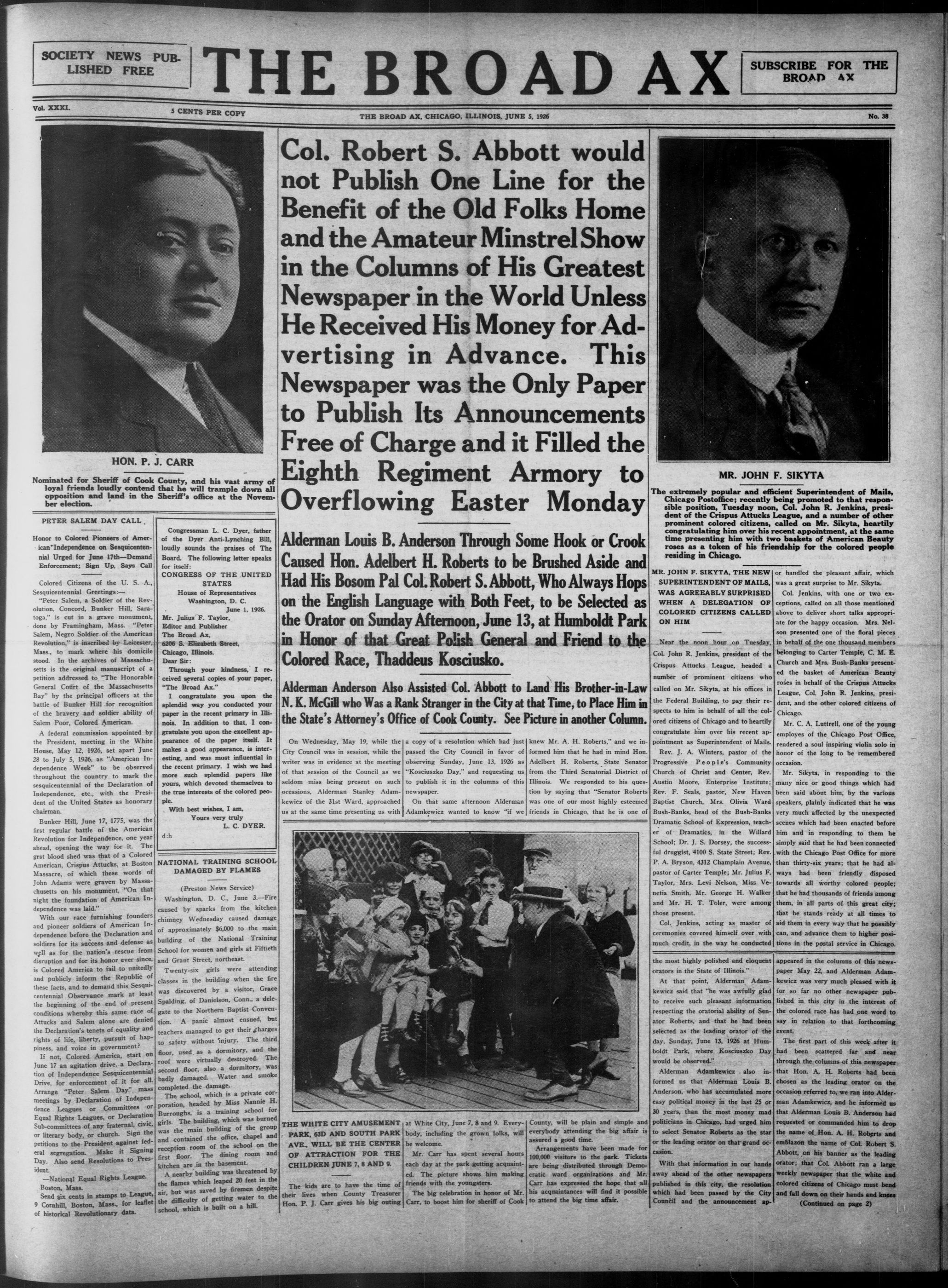
Nominated for Sheriff of Cook County, and his vast army of loyal friends loudly contend that he will trample down all opposition and land in the Sheriff's office at the November election.
PETER SALEM DAY CALL
Honor to Colored Pioneers of American Independence on Sesquicentennial Urged for June 17th—Demand Enforcement; Sign Up, Says Call
Colored Citizens of the U. S. A., Sesquicentennial Greetings:
"Peter Salem, a Soldier of the Revolution, Concord, Bunker Hill, Saratoga," is cut in a grave monument, done by Framingham, Mass. "Peter Salem, Negro Soldier of the American Revolution," is inscribed by Leicester, Mass., to mark where his domicile stood. In the archives of Massachusetts is the original manuscript of a petition addressed to "The Honorable General Court of the Massachusetts Bay" by the principal officers at the battle of Bunker Hill for recognition of the bravery and soldier ability of Salem Poor, Colored American.
Congressman L. C. Dyer, father of the Dyer Anti-Lynching Bill, loudly sounds the praises of The Board. The following letter speaks for itself:
CONGRESS OF THE UNITED STATES
House of Representatives
Washington, D. C.
June 1, 1926.
Mr. Julius F. Taylor,
Editor and Publisher
The Broad Ax.
6206 S. Elizabeth Street,
Chicago, Illinois.
Dear Sir:
Through your kindness, I received several copies of your paper,
"The Broad Ax."
I congratulate you upon the splendid way you conducted your paper in the recent primary in Illinois. In addition to that, I con-
A federal commission appointed by the President, meeting in the White House, May 12, 1926, set apart June 28 to July 5, 1926, as "American Independence Week" to be observed throughout the country to mark the sesquicentennial of the Declaration of Independence, etc., with the President of the United States as honorary chairman. Bunker Hill, June 17, 1775, was the first regular battle of the American Revolution for Independence, one year ahead, opening the way for it. The grst blood shed was that of a Colored American, Crispus Attucks, at Boston Massacre, of which these words of John Adams were graven by Massachusetts on his monument, "On that night the foundation of American Independence was laid."
With our race furnishing founders and pioneer soldiers of American Independence before the Declaration and soldiers for its success and defense as well as for the nation's rescue from disruption and for its honor ever since, is Colored America to fail to unitedly and publicly inform the Republic of these facts, and to demand this Sesquicentennial Observance mark at least the beginning of the end of present conditions whereby this same race of Attucks and Salem alone are denied the Declaration's tenets of equality and rights of life, liberty, pursuit of happiness, and voice in government?
If not, Colored America, start on June 17 an agitation drive, a Declaration of Independence Sesquicentennial Drive, for enforcement of it for all. Arrange "Peter Salem Day" mass meetings by Declaration of Independence Leagues or Committees or Equal Rights Leagues, or Declaration Sub-committees of any fraternal, civic, or literary body, or church. Sign the petitions to the President against federal segregation. Make it Signing Day. Also send Resolutions to President.
National Equal Rights League. Boston, Mass. Send six cents in stamps to League, 9 Cornhill, Boston, Mass., for leaflet of historical Revolutionary data.
5 CENTS PER COPY
1
County, and his vast army of that he will trample down all Sheriff's office at the Novem-
Congressman L. C. Dyer, father of the Dyer Anti-Lynching Bill, loudly sounds the praises of The Board. The following letter speaks for itself:
CONGRESS OF THE UNITED STATES
House of Representatives
Washington, D. C.
June 1, 1926.
Mr. Julius F. Taylor,
Editor and Publisher
The Broad Ax,
6206 S. Elizabeth Street,
Chicago, Illinois.
Dear Sir:
Through your kindness, I received several copies of your paper,
"The Broad Ax."
I congratulate you upon the splendid way you conducted your paper in the recent primary in Illinois. In addition to that, I congratulate you upon the excellent appearance of the paper itself. It makes a good appearance, is interesting, and was most influential in the recent primary. I wish we had more such splendid papers like yours, which devoted themselves to the true interests of the colored people.
With best wishes, I am.
Yours very truly
L. C. DYER.
d:h
NATIONAL TRAINING SCHOOL
DAMAGED BY FLAMES
Washington, D. C., June 3.—Fire caused by sparks from the kitchen chimney Wednesday caused damage of approximately $6,000 to the main building of the National Training School for women and girls at Fiftieth and Grant Street, northeast.
Twenty-six girls were attending classes in the building when the fire was discovered by a visitor, Grace Spalding, of Danielson, Conn., a delegate to the Northern Baptist Convention. A panic almost ensued, but teachers managed to get their charges to safety without injury. The third floor, used as a dormitory, and the roof were virtually destroyed. The second floor, also a dormitory, was badly damaged. Water and smoke completed the damage.
The school, which is a private corporation, headed by Miss Nannie H. Burroughs, is a training school for girls. The building, which was burned was the main building of the group and contained the office, chapel and reception room of the school on the first floor. The dining room and kitchen are in the basement. A nearby building was threatened by the flames which leaped 20 feet in the air, but was saved by firemen despite the difficulty of getting water to the school, which is built on a hill.
THE BROAD AX
THE BROAD AX, CHICAGO, ILLINOIS, JUNE 5, 1926
Col. Robert S. Abbott would not Publish One Line for the Benefit of the Old Folks Home and the Amateur Minstrel Show in the Columns of His Greatest Newspaper in the World Unless He Received His Money for Advertising in Advance. This Newspaper was the Only Paper to Publish Its Announcements Free of Charge and it Filled the Eighth Regiment Armory to Overflowing Easter Monday
Alderman Louis B. Anderson Through Some Hook or Crook Caused Hon. Adelbert H. Roberts to be Brushed Aside and Had His Bosom Pal Col. Robert S. Abbott, Who Always Hops on the English Language with Both Feet, to be Selected as the Orator on Sunday Afternoon, June 13, at Humboldt Park in Honor of that Great Polish General and Friend to the Colored Race, Thaddeus Kosciusko.
Alderman Anderson Also Assisted Col. Abbott to Land His Brother-in-Law N. K. McGill who Was a Rank Stranger in the City at that Time, to Place Him in the State's Attorney's Office of Cook County. See Picture in another Column.
THE FUNNY FRIENDS
On Wednesday, May 19, while the City Council was in session, while the writer was in evidence at the meeting of that session of the Council as we seldom miss being present on such occasions, Alderman Stanley Adamkewicz of the 31st Ward, approached us at the same time presenting us with
THE FIRST DAY OF THE FIRST WORLD FOOTBALL CUP
THE WHITE CITY AMUSEMENT PARK, 63D AND SOUTH PARK AVE., WILL BE THE CENTER OF ATTRACTION FOR THE CHILDREN JUNE 7, 8 AND 9.
The kids are to have the time of their lives when County Treasurer Hon. P. J. Carr gives his big outing
a copy of a resolution which had just passed the City Council in favor of observing Sunday, June 13, 1926 as "Kosciuszko Day," and requesting us to publish it in the columns of this newspaper.
On that same afternoon Alderman Adamkewicz wanted to know "if we
THE FUNNY FESTIVAL
at White City, June 7, 8 and 9. Everybody, including the grown folks, will be welcome.
Mr. Carr has spent several hours each day at the park getting acquainted. The picture shows him making friends with the youngsters.
The big celebration in honor of Mr. Carr, to boost him for sheriff of Cook
knew Mr. A. H. Roberts," and we informed him that he had in mind Hon. Adelbert H. Roberts, State Senator from the Third Senatorial District of Illinois. We responded to his question by saying that "Senator Roberts was one of our most highly esteemed friends in Chicago, that he is one of
J
County, will be plain and simple and everybody attending the big affair is assured a good time.
Arrangements have been made for 100,000 visitors to the park. Tickets are being distributed through Democratic ward organizations and Mr. Carr has expressed the hope that all his acquaintances will find it possible to attend the big time affair.
SUBSCRIBE FOR THE BROAD AX
No. 38
[Picture of a man in a suit with a tie].
The extremely popular and efficient Superintendent Chicago Postoffice; recently being promote sible position, Tuesday noon, Col. John n dent of the Crispus Attucks League, and a prominent colored citizens, called on Mr. congratulating him over his recent appoint time presenting him with two baskets of roses as a token of his friendship for the residing in Chicago.
and efficient Superintendent of Mails, recently being promoted to that respon- ay noon, Col. John R. Jenkins, presi- ttucks League, and a number of other citizens, called on Mr. Sikyta, heartily over his recent appointment, at the same with two baskets of American Beauty his friendship for the colored people
The extremely popular and efficient Superintendent of Mails, Chicago Postoffice; recently being promoted to that responsible position, Tuesday noon, Col. John R. Jenkins, president of the Crispus Attucks League, and a number of other prominent colored citizens, called on Mr. Sikyta, heartily congratulating him over his recent appointment, at the same time presenting him with two baskets of American Beauty roses as a token of his friendship for the colored people residing in Chicago.
MR. JOHN F. SIKYTA, THE NEW SUPERINTENDENT OF MAILS, WAS AGREEABLY SURPRISED WHEN A DELEGATION OF COLORED CITIZENS CALLED ON HIM or handled the pleasant affair, which was a great surprise to Mr. Sikyta.
Col. Jenkins, with one or two exceptions, called on all those mentioned above to deliver short talks appropriate for the happy occasion. Mrs. Nel-
Near the noon hour on Tuesday, Col. John R. Jenkins, president of the Crispus Attucks League, headed a number of prominent citizens who called on Mr. Sikyta, at his offices in the Federal Building, to pay their respects to him in behalf of all the colored citizens of Chicago and to heartily congratulate him over his recent appointment as Superintendent of Mails. Rev. J. A. Winters, pastor of the Progressive People's Community Church of Christ and Center, Rev. Austin Moore, Enterprise Institute; Rev. F. Seals, pastor, New Haven Baptist Church, Mrs. Olivia Ward Bush-Banks, head of the Bush-Banks Dramatic School of Expression, teacher of Dramatics, in the Willard School; Dr. J. S. Dorsey, the successful druggist, 4100 S. State Street; Rev. P. A. Bryson, 4312 Champlain Avenue, pastor of Carter Temple; Mr. Julius F. Taylor, Mrs. Levi Nelson, Miss Venetia Smith, Mr. George H. Walker and Mr. H. T. Toler, were among those present. Col. Jenkins, acting as master of ceremonies covered himself over with much credit, in the way he conducted
the most highly polished and eloquent orators in the State of Illinois."
At that point, Alderman Adamkewicz said that "he was awfully glad to receive such pleasant information respecting the oratorial ability of Senator Roberts, and that he had been selected as the leading orator of the day, Sunday, June 13, 1926 at Humboldt Park, where Kosciuszko Day would be observed."
Alderman Adamkewicz also informed us that Alderman Louis B. Anderson, who has accumulated more easy political money in the last 25 or 30 years, than the most money mad politicians in Chicago, had urged him to select Senator Roberts as the star or the leading orator on that grand occasion.
With that information in our hands away ahead of the other newspapers published in this city, the resolution which had been passed by the City Council and the announcement ap-
```markdown
```
(continued on page 2)
or handled the pleasant affair, which was a great surprise to Mr. Silkyta.
Col. Jenkins, with one or two exceptions, called on all those mentioned above to deliver short talks appropriate for the happy occasion. Mrs. Nelson presented one of the floral pieces in behalf of the one thousand members belonging to Carter Temple, C. M. E. Church and Mrs. Bush-Banks presented the basket of American Beauty roses in behalf of the Crispus Attucks League, Col. John R. Jenkins, president, and the other colored citizens of Chicago.
Mr. C. A. Luttrell, one of the young employees of the Chicago Post Office, rendered a soul inspiring violin solo in honor of the long to be remembered occasion.
Mr. Sikyta, in responding to the many nice or good things which had been said about him, by the various speakers, plainly indicated that he was very much affected by the unexpected scenes which had been enacted before him and in responding to them he simply said that he had been connected with the Chicago Post Office for more than thirty-six years; that he had always had been friendly disposed towards all worthy colored people; that he had thousands of friends among them, in all parts of this great city; that he stands ready at all times to aid them in every way that he possibly can, and advance them to higher positions in the postal service in Chicago.
appeared in the columnus of this newspaper May 22, and Alderman Adamkewicz was very much pleased with it for so far no other newspaper published in this city in the interest of the colored race has had one word to say in relation to that forthcoming event.
The first part of this week after it had been scattered far and near through the columns of this newspaper that Hon. A. H. Roberts had been chosen as the leading orator on the occasion referred to, we ran into Alderman Adamkewicz, and he informed us that Alderman Louis B. Anderson had requested or commanded him to drop the name of Hon. A. H. Robgrts and emblazon the name of Col. Robert S. Abbott, on his banner as the leading orator; that Col. Abbott ran a large weekly newspaper that the white and colored citizens of Chicago must bend and fall down on their hands and knees (Continued on page 2)
THE BROAD AX Published Every Saturday
In this city since July 15th, 1899,
without missing one single issue. Republicans, Democrats, Catholics, Protestants, Single Taxers, Priests, infidels or anyone else can have their say as long as their language is proper and responsibility is fixed.
The Broad Ax is a newspaper whose platform is broad enough for all, ever claiming the editorial right to speak its own mind. It is neither Democratic nor Republican. It is strictly or absolutely independent in politics.
Local communications will receive attention. Write only on one side of the paper.
Subscriptions must be paid in advance.
One Year ..... $2.00
Six Months ..... $1.00
Advertising rates made known on application.
Vol. XXXI No. 38
Chicago, June 5, 1926
Entered as Second-Class Matter, Aug.
19, 1902 at the post office at Chicago.
Ill. Under Act of March 8, 1879.
ALDERMAN LOUIS B. ANDERSON AND COL. ROBERT S.
ABBOTT ARE OLD TIME
PALS
(Continued from page 1)
to him; that he is the dark king among
the colored people in this section of
the United States or words to the same
effect.
After Alderman Adamkewicz had finished blowing the horn of Alderman Anderson who is ever ready to deal out a big stack of dirty, vile and unprintable stories on the colored people and none on the white people, we simply informed Alderman Adamkewicz "that Col. Abbott might run the greatest newspaper in the world but that did not indicate that he is the greatest orator in the world."
On all occasions Col. Abbott always thrust himself forward and proclaims to the whole world that he represents the brains of the colored people in this country and right here will some one please hand us a smelling bottle or a large dose of knock-out drops.
Coming right down to the colored man in the wood pile, Col. Abbott absolutely refused to publish one line free in the columns of his newspaper in connection with the benefit for the Old Folks Home given by the Amateur Minstrel Club, which held forth at the Eighth Regiment Armory, Easter Monday evening and as long as Col. Abbott claimed "that he was too poor and money was too tight at that time for him to aid the Old Folks Home in any manner, shape or form, he does not represent the better class of colored people in this city, for the best class of colored people in Chicago are filled full of race pride and they firmly believe in supporting the Old Folks Home.
As further evidence that Col. Abbott and Alderman Anderson are one and the same thing, that every time that Alderman Anderson sneezes real low, Col. Abbott coughs very loud, and some of their friends claim that Alderman Anderson writes his own articles which appear in the greatest newspaper in the world and covers himself over with much gush or soft mush, so it was no wonder that Alderman Anderson joined in the number with those who called on Hon. Robert E. Crowe, state's attorney of Cook County, the latter part of April, 1925 (see picture in another column of this newspaper), and urged him to select N. K. McGill, brother-in-law of Col. Abbott to a fat job in his office, which for some cause or other he was incapable of holding down.
REV. JONES TO VISIT
Rt. Rev. E. D. W. Jones, bishop of the A.M.E. Zion Connection of Washington, D. C., who has many friends and acquaintances made during his pastorage of The Walters A.M.E. Zion Church, this city, is expected to visit the annual conference during its June session at 38th and S. Dearborn Sts.
[Picture of a man in a suit with a tie].
HON. JAMES W. BREEN
Ex-First Assistant Corporation make a tip-top Republican of the Circuit Court of Cool
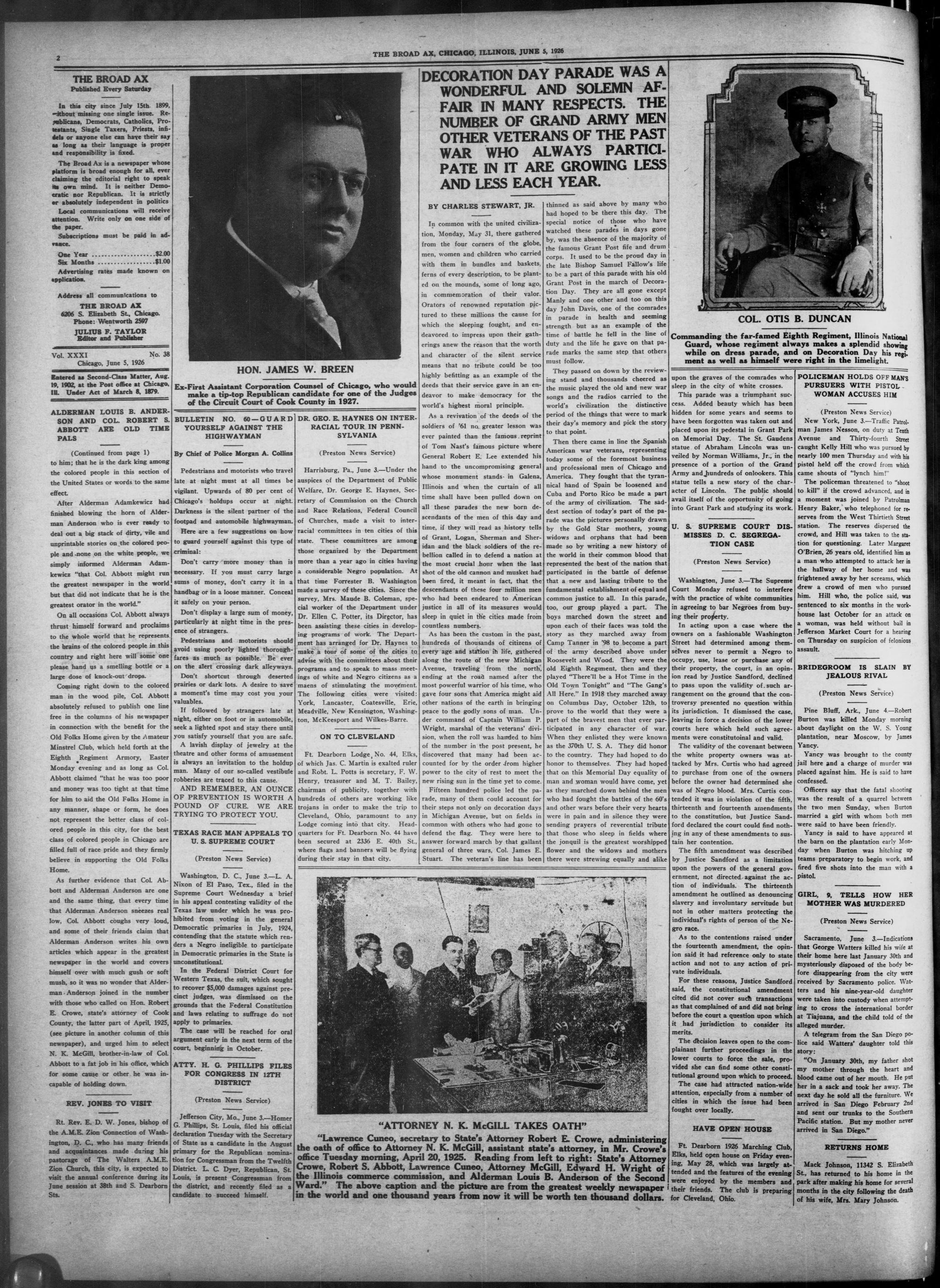
Ex-First Assistant Corporation Counsel of Chicago, who would make a tip-top Republican candidate for one of the Judges of the Circuit Court of Cook County in 1927.
BULLETIN NO. 60—GUARD
YOURSELF AGAINST THE
HIGHWAYMAN
DR. GEO. E. HAYNES ON INTER-
RACIAL TOUR IN PENN-
SYLVANIA
By Chief of Police Morgan A. Collins
Pedestrians and motorists who travel late at night must at all times be vigilant. Upwards of 80 per cent of Chicago's holdups occur at night. Darkness is the silent partner of the footpad and automobile highwayman. Here are a few suggestions on how to guard yourself against this type of criminal:
Don't carry more money than is necessary. If you must carry large sums of money, don't carry it in a handbag or in a loose manner. Conceal it safely on your person.
Don't display a large sum of money, particularly at night time in the presence of strangers.
Pedestrians and motorists should avoid using poorly lighted thoroughfares as much as possible. Be ever on the alert crossing dark alleyways. Don't shortcut through deserted prairies or dark lots. A desire to save a moment's time may cost you your valuables. If followed by strangers late at night, either on foot or in automobile, seek a lighted spot and stay there until you satisfy yourself that you are safe. A lavish display of jewelry at the theatre and other forms of amusement is always an invitation to the holdup man. Many of our so-called vestibule robberies are traced to this cause.
AND REMEMBER, AN OUNCE OF PREVENTION IS WORTH A POUND OF CURE. WE ARE TRYING TO PROTECT YOU.
TEXAS RACE MAN APPEALS TO
U. S. SUPREME COURT
(Preston News Service)
Washington, D. C., June 3—L. A. Nixon of El Paso, Tex., filed in the Supreme Court Wednesday a brief in his appeal contesting validity of the Texas law under which he was prohibited from voting in the general Democratic primaries in July, 1924, contending that the statute which renders a Negro ineligible to participate in Democratic primaries in the State is unconstitutional.
In the Federal District Court for Western Texas, the suit, which sought to recover $5,000 damages against precinct judges, was dismissed on the grounds that the Federal Constitution and laws relating to suffrage do not apply to primaries.
The case will be reached for oral argument early in the next term of the court, beginning in October.
ATTY. H. G. PHILLIPS FILES FOR CONGRESS IN 12TH DISTRICT
(Preston News Service)
Jefferson City, Mo., June 3.—Homer G. Phillips, St. Louis, filed his official declaration Tuesday with the Secretary of State as a candidate in the August primary for the Republican nomination for Congressman from the Twelfth District. L. C. Dyer, Republican, St. Louis, is present Congressman from the district, and recently filed as a candidate to succeed himself.
DR. GEO. E. HAYNES ON INTER
RACIAL TOUR IN PENN-
SYLVANIA
(Preston News Service)
Harrisburg, Pa., June 3.—Under the auspices of the Department of Public Welfare, Dr. George E. Haynes, Secretary of Commission on the Church and Race Relations, Federal Council of Churches, made a visit to interracial committees in ten cities of this state. These committees are among those organized by the Department more than a year ago in cities having a considerable Negro population. At that time Forrester B. Washington made a survey of these cities. Since the survey, Mrs. Maude B. Coleman, special worker of the Department under Dr. Ellen C. Potter, its Director, has been assisting these cities in developing programs of work. The Department has arranged for Dr. Haynes to make a tour of some of the cities to advise with the committees about their programs and to speak to mass meetings of white and Negro citizens as a maens of stimulating the movement. The following cities were visited: York, Lancaster, Coatesville, Erie, Meadville, New Kensington, Washington, McKeesport and Wilkes-Barre.
ON TO CLEVELAND
Ft. Dearborn Lodge, No. 44, Elks, of which Jas. C. Martin is exalted ruler and Robt. L. Potts is secretary, F. W. Henry, treasurer and M. T. Bailey, chairman of publicity, together with hundreds of others are working like trojans in order to make the trip to Cleveland, Ohio, paramount to any Lodge coming into that city. Headquarters for Ft. Dearborn No. 44 have been secured at 2336 E. 40th St., where flags and banners will be flying during their stay in that city.
THE DECISION
"Lawrence Cuneo, secretary to State's Attorney Robert E. Crowe, administering the oath of office to Attorney N. K. McGill, assistant state's attorney, in Mr. Crowe's office Tuesday morning, April 20, 1925. Reading from left to right: State's Attorney Crowe, Robert S. Abbott, Lawrence Cuneo, Attorney McGill, Edward H. Wright of the Illinois commerce commission, and Alderman Louis B. Anderson of the Second Ward." The above caption and the picture are from the greatest weekly newspaper in the world and one thousand years from now it will be worth ten thousand dollars.
THE BROAD AX, CHICAGO, ILLINOIS, JUNE 5, 1926
"ATTORNEY N. K. McGILL TAKES OATH"
DECORATION DAY PARADE WAS A WONDERFUL AND SOLEMN AF FAIR IN MANY RESPECTS. THE NUMBER OF GRAND ARMY MEN OTHER VETERANS OF THE PAST WAR WHO ALWAYS PARTICIPATE IN IT ARE GROWING LESS AND LESS EACH YEAR.
BY CHARLES STEWART, JR.
In common with the united civilization, Monday, May 31, there gathered from the four corners of the globe men, women and children who carried with them in bundles and baskets ferns of every description, to be planted on the mounds, some of long ago in commemoration of their valor. Orators of renowned reputation pictured to these millions the cause for which the sleeping fought, and endeavored to impress upon their gatherings anew the reason that the worth and character of the silent service means that no tribute could be too highly befitting as an example of the deeds that their service gave in an endeavor to make democracy for the world's highest moral principle.
As a revitation of the deeds of the soldiers of '61 no greater lesson was ever painted than the famous reprint of Tom Nast's famous picture where General Robert E. Lee extended his hand to the uncompromising general whose monument stands in Galena, Illinois and when the curtain of all time shall have been pulled down on all these parades the new born descendants of the men of this day and time, if they will read as history tells of Grant, Logan, Sherman and Sheridan and the black soldiers of the rebellion called in to defend a nation at the most crucial hour when the last shot of the old cannon and musket had been fired, it meant in fact, that the descendants of these four million men who had been endeared to American justice in all of its measures would sleep in quiet in the cities made from countless numbers.
As has been the custom in the past, hundreds of thousands of citizens of every age and station in life, gathered along the route of the new Michigan Avenue, traveling from the north ending at the road named after the most powerful warrior of his time, who gave four sons that America might aid other nations of the earth in bringing peace to the godly sons of man. Under command of Captain William P. Wright, marshal of the veterans' division, when the roll was handed to him of the number in the post present, he discovered that many had been accounted for by the order from higher power to the city of rest to meet the new rising sun in the time yet to come.
Fifteen hundred police led the parade, many of them could account for their steps not only on decoration days in Michigan Avenue, but on fields in common with others who had gone to defend the flag. They were here to answer forward march by that gallant general of three wars, Col. James E. Stuart. The veteran's line has been
thinned as said above by many who had hoped to be there this day. The special notice of those who have watched these parades in days gone by, was the absence of the majority of the famous Grant Post fife and drum corps. It used to be the proud day in the late Bishop Samuel Fallow's life to be a part of this parade with his old Grant Post in the march of Decoration Day. They are all gone except Manly and one other and too on this day John Davis, one of the comrades in parade in health and seeming strength but as an example of the time of battle he fell in the line of duty and the life he gave on that parade marks the same step that others must follow.
They passed on down by the reviewing stand and thousands cheered as the music played the old and new war songs and the radios carried to the world's civilization the distinctive period of the things that were to mark their day's memory and pick the story to that point.
Then there came in line the Spanish American war veterans, representing today some of the foremost business and professional men of Chicago and America. They fought that the tyrannical hand of Spain be loosened and Cuba and Porto Rico be made a part of the army of civilization. The saddest section of today's part of the parade was the pictures personally drawn by the Gold Star mothers, young widows and orphans that had been made so by writing a new history of the world in their common blood that represented the best of the nation that participated in the battle of defense that a new and lasting tribute to the fundamental establishment of equal and common justice to all. In this parade, too, our group played a part. The boys marched down the street and upon each of their faces was told the story as they marched away from Camp Tanner in '98 to become a part of the army described above under Roosevelt and Wood. They were the old Eighth Regiment, then and they played "There'll be a Hot Time in the Old Town Tonight" and "The Gang's All Here." In 1918 they marched away on Columbus Day, October 12th, to prove to the world that they were a part of the bravest men that ever participated in any character of war. When they enlisted they were known as the 370th U. S. A. They did honor to the country. They had hoped to do honor to themselves. They had hoped that on this Memorial Day equality of man and woman would have come, yet as they marched down behind the men who had fought the battles of the 60's and other wars before their very hearts were in pain and in silence they were sending prayers of reverential tribute that those who sleep in fields where the jonquil is the greatest worshipped flower and the widows and mothers there were strewing equally and alike
COL. OTIS B. DUNCAN
Commanding the far-famed Eig Guard, whose regiment alw while on dress parade, anment as well as himself we upon the graves of the comrades who sleep in the city of white crosses. This parade was a triumphant success. Added beauty which has been hidden for some years and seems to have been forgotten was taken out and placed upon its pedestal in Grant Park on Memorial Day. The St. Gaudens statue of Abraham Lincoln was unveiled by Norman Williams, Jr., in the presence of a portion of the Grand Army and hundreds of onlookers. This statue tells a new story of the character of Lincoln. The public should avail itself of the opportunity of going into Grant Park and studying its work.
U. S. SUPREME COURT DISMISSES D. C. SEGREGATION CASE
(Preston News Service)
Washington, June 3.—The Supreme Court Monday refused to interfere with the practice of white communities in agreeing to bar Negroes from buying their property.
In acting upon a case where the owners on a fashionable Washington Street had determined among themselves never to permit a Negro to occupy, use, lease or purchase any of their property, the court, in an opinion read by Justice Sandford, declined to pass upon the validity of such arrangement on the ground that the controversy presented no question within its jurisdiction. It dismissed the case, leaving in force a decision of the lower courts here which held such agreements were constitutional and valid.
The validity of the covenant between the white property owners was attacked by Mrs. Curtis who had agreed to purchase from one of the owners before the owner had determined she was of Negro blood. Mrs. Curtis contended it was in violation of the fifth, thirteenth and fourteenth amendments to the constitution, but Justice Sandford declared the court could find nothing in any of these amendments to sustain her contention.
The fifth amendment was described by Justice Sandford as a limitation upon the powers of the general government, not directed against the action of individuals. The thirteenth amendment he outlined as denouncing slavery and involuntary servitude but not in other matters protecting the individual's rights of person of the Negro race. As to the contentions raised under the fourteenth amendment, the opinion said it had reference only to state action and not to any action of private individuals.
For these reasons, Justice Sandford said, the constitutional amendment cited did not cover such transactions as that complained of and did not bring before the court a question upon which it had jurisdiction to consider its merits.
The decision leaves open to the complainant further proceedings in the lower courts to force the sale, provided she can find some other constitutional ground upon which to proceed.
The case had attracted nation-wide attention, especially from a number of cities in which the issue had been fought over locally.
HAVE OPEN HOUSE
Ft. Dearborn 1926 Marching Club, Elks, held open house on Friday evening, May 28, which was largely attended and the features of the evening were enjoyed by the members and their friends. The club is preparing for Cleveland, Ohio.
Eighth Regiment, Illinois National always makes a splendid showing and on Decoration Day his regi- were right in the limelight.
POLICEMAN HOLDS OFF MAN'S PURSUERS WITH PISTOL WOMAN ACCUSES HIM
New York, June 3.—Traffic Patrolman James Nesson, on duty at Tenth Avenue and Thirty-fourth Street caught Kelly Hill who was pursued by nearly 100 men Thursday and with his pistol held off the crowd from which came shouts of "lynch him!"
The policeman threatened to "shoot to kill" if the crowd advanced, and in a moment was joined by Patrolman Henry Baker, who telephoned for reserves from the West Thirtieth Street station. The reserves dispersed the crowd, and Hill was taken to the station for questioning. Later Margaret O'Brien, 26 years old, identified him as a man who attempted to attack her in the hallway of her home and was frightened away by her screams, which drew a crew of men who pursued him. Hill who, the police said, was sentenced to six months in the workhouse last October for an attack on a woman, was held without bail in Jefferson Market Court for a hearing on Thursday on suspicion of felonious assault.
BRIDEGROOM IS SLAIN BY
JEALOUS RIVAL
Pine Bluff, Ark., June 4.—Robert Burton was killed Monday morning about daylight on the W. S. Young plantation, near Moscow, by James Yancy. Yancy was brought to the county jail here and a charge of murder was placed against him. He is said to have confessed. Officers say that the fatal shooting was the result of a quarrel between the two men Sunday, when Burton married a girl with whom both men were said to have been friendly. Yancy is said to have appeared at the barn on the plantation early Monday when Burton was hitching up teams preparatory to begin work, and fired five shots into the man with a pistol.
GIRL 9. TELLS HOW HER
MOTHER WAS MURDERED
Sacramento, June 3.—Indications that George Watters killed his wife at their home here last January 30th and mysteriously disposed of the body before disappearing from the city were received by Sacramento police. Watters and his nine-year-old daughter were taken into custody when attempting to cross the international border at Tiajuana, and the child told of the alleged murder.
A telegram from the San Diego police said Watters' daughter told this story:
"On January 30th, my father shot my mother through the heart and blood came out of her mouth. He put her in a sack and took her away. The next day he sold all the furniture. We arrived in San Diego February 2nd and sent our trunks to the Southern Pacific station. But my mother never arrived in San Diego."
RETURNS HOME
Mack Johnson, 11342 S. Elizabeth St., has returned to his home in the park after making his home for several months in the city following the death of his wife, Mrs. Mary Johnson.
[Image of a man with a serious expression, wearing a suit and a white shirt. The background is a plain, light color. The man's face is centered in the frame, and he appears to be looking directly at the viewer.]
DOCTOR WALTER N. THOMAS
One of the most prominent Masons in Chicago, who is rushed most of the time in looking after the wants of his many patients, and the latchstrings on the doors of his office always hang on the outside for the strangers within our gates.
WOMEN'S AMATEUR MINSTREL WILL HOLD FORTH AT THE EIGHTH STREET THEATRE, FRIDAY EVENING, JUNE 18TH
NEGRO DIVISION MONUMENT GETS COMMITTEE O. K.
Washington, D. C.—Disregarding the wishes of the American battle
The Women's Amateur Minstrels, under the direction of Mrs. George Cleveland Hall, will present a minstrel show, which promises to be one of the best ever witnessed, for the benefit of Provident Hospital. The Minstrel Committee has been working exceedingly hard with this program and as the crowd leaves the Eighth Street Theatre after the performance June 18th they will agree that the treasured surprises were the best of the season. Mrs. George Cleveland Hall and her staff of able workers need no introduction to Chicago's Society as to their wonderful activities with this work.
FIND BABY BOY ON
DOORSTEPS
(Preston News Service)
New York, June 3.—A one-year-old baby boy was cooing playfully at St. Ann's hospital Tuesday, despite the fact that he had been left on the steps of the Babies' dispensary, with a note pinned to his blankets saying that the mother would return in two or three weeks.
The baby was found by an attendant Monday night. He was fully dressed and swathed in blankets. He was sleeping peacefully.
The note said, "Take good care of this baby. I will be back in two or three weeks." It was signed, "Mother." The baby was taken in a police car to St. Ann's.
MRS. JACKSON RETURNS
Mrs. Eliza Jackson, state grand queen of Illinois and jurisdiction of A. U. K. & D. of A., has returned from St. Louis, Mo., where she went to deliver an address and as a member of the Monumental Committee on monument which was unveiled in that city in honor of the late Dr. Ada Harris, one of the founders of the St. Louis Division and Military Department of A. U. K. & D. of A. Accompanying Mrs. Jackson were Mrs. Louise Hayden White, national grand secretary-treasurer, Juvenile Dept.; Mrs. Ida Simmons, national grand queen; Mrs. Leona Dixon McKinney, national grand auditress and Mrs. Mary Young, M. E. Q. of Light of Chicago Council.
DR. GEORGE C. HALL DEPARTS FOR EAST
Dr. George Cleveland Hall. 3638 South Parkway, one of Chicago's prominent physicians, left the city this week for a trip to the nation's capital, Washington, D. C., to attend the annual commencement exercises of Harvard University. Upon his return to the city Dr. Hall will have had conferred upon him an honorary degree of Master of Science. In addition to this Dr. Hall will have many pleasant experiences to relate of the 40th reunion of his class at Lincoln University, Philadelphia, Pa.
HOLD REUNION
Mr. and Mrs. Sterling Jenkins, 1121 W. 112th Place, held a family reunion when on Decoration Day five sisters of Mrs. Jenkins sat down together with Mrs. Jenkins and a number of friends and had lunch.
NEGRO DIVISION MONUMENT
GETS COMMITTEE O. K.
Washington, D. C.—Disregarding the wishes of the American battle monuments commission, the senate military committee last Friday voted, 6 to 5, to report favorably a house bill authorizing an appropriation of $30,000 for the erection of a monument to the 93d (Negro) division at Sechault, France. The measure is sponsored by Representative Hamilton Fish (Rep., N. Y.), who was an officer of the division.
BACK FROM TRIP
Mrs. Georgia E. Harding, state grand princess of Illinois of S. M. T. returned to the city after spending several weeks on her annual visit to the various temples in her jurisdiction, and reports the work progressing.
LINDSEY ILL
P. L. Lindsey, an employee of The Chicago Post Office and who resides at 11367 S. Aberdeen St., is still confined to his bed and home where he has been detained for three weeks on account of illness.
IMPROVING
Mr. Powhatan Beaty, 5326 Prairie avenue, is now to be seen at his home improving after an operation which confined him for several weeks at the Streator Hospital.
HONK! HONK!
Mr. Louis Ponche, 6665 Michigan avenue, the popular mail contractor of Englewood, spent the week end with Mr. and Mrs. Lester Johns of East St. Louis, Illinois. Mr. Ponche in company with his two sons made a record trip in their "Rolls Ruff" to this city and return.
Col. Charles E. Morrison, Special messenger to Mayor William E. Dever, on Decoration Day, in company with the Shriners' Drill Team, under the management of Major R. R. Jackson, visited Detroit, Michigan. While visiting that city they were the guest of Mr. and Mrs. Charles Roxborough and greatly enjoyed their trip.
Do You Agree?
"As one calls the roll of men who have rendered useful social service, one is impressed by the notion that most of them have succeeded, not because, but in spite, of their 'training.' It almost seems as if the best equipment with which to start life is a widowed mother who turns one adrift at eight." -George Dorsey in "Why We Behave Like Human Beings."
Refuses to Admit Decay
From the Sixteenth century, when Avignon's glory began to wane, the "free city" has stood still. It is like an old beauty, miraculously preserved from the ravages of time; still clinging obstinately (and, be it said, successfully) to the fashions and customs of her prime; refusing to admit that these things have not stood still with her.
Heat From the Stars
The surface temperature of the red stars ranges from 2,500 degrees to 3,000 degrees Centigrade. At the center, however, the pressure must attain thousands of tons and the temperature two or three million degrees.
Early Christian Basilica
The church of St. Apollinaris in Ravenna, Italy, is perhaps the most important existing early Christian basilica. It was begun in 534 and is noted for its very singular circular tower which is 120 feet high.
COLORFUL NEWS MOVIES BY THE CAMERAMAN
(Prestis News Service)
1. Curtis Segregation Case
2. Southwest African Miners
3. Interstate Commerce Discriminations "girls" of Southwest Africa, who also work in the mines as sewers of cas-siterite ore.
Yet, the "hand-to-mouth" idea has constituted the policy which gold mine
4. Colorgrams
Curtis Segregation Case
Stating that "upon the pleadings," it had no jurisdiction in the so-called Curtis case, the U. S. Supreme Court dismissed the appeal from decisions of the District of Columbia courts to the effect that white property-holders can, by valid contract, exclude Negroes from purchasing property in areas restricted to the use of the covenants, their heirs and assignees. The court added that neither the Fifth, Fourteenth, nor the Fifteenth amendments were involved in the case, and that the appellants had not been deprived of any of their constitutional guarities either before or during the trial of the cause. This blow is disheartening to the race, because precedents of our highest tribunal are reasonably permanent in the progression of American jurisprudence. Yet, there is cause for hope, we think, in the following brief analysis of law in the Curtis case, which we submit with deep regard for the poise, sincerity and untiring efforts of appellant's counsel in the case.
There was never more than the merest veneer of constitutional law involved in the Curtis case. Rather, the problem turned upon that absorbing doctrine of the law of real property prescribing and describing the type and content of covenants, which, when created within land grants by devise or demise, are such convenants as run with the land, and in so running become binding upon the covenants and their heirs and assignees. The covenant in the Curtis case was clearly a binding one, and one as to which the covenants were within their rights to make. The question then arose as to what right might arise in persons not parties to the covenant which, in the face of the law of real property, would be entitled to paramount consideration. Such a right or at least the presumption of such a right arose whenever a prospective purchaser came forward, in whose favor one or anyone of the covenants might desire to disavow the covenant with his fellow covenants in order to sell to third parties, whose right to purchase was certainly, in the beginning, on a parity with the right of the covenants to contract among themselves, and in so doing create a voidable contract. At this point, immaterial to constitutional law, but as a primary question to the scope of the law of real property, there immediately arose the query as to whether or not the covenant thus made was such a covenant as would run with the land to the restriction of the personal legal rights of covenants and third parties; and upon examination of the covenant in question there appears to be nothing which places it within the category of a covenant that "runneth with the land," with the characteristics of such covenants, and with the restrictive forces which such covenants are, by precedent and otherwise, intended to possess. Nor do we find but the merest scintilla of evidence which classifies any of the issues involved in the precepts of the constitution and its guaranties.
This was clearly the view of the Nation's highest judiciary when it said, "Under the Pleading," this Court has no jurisdiction; and, alas, the pleadings dealt with constitutional issues rather than the simple, common law elements of the ownership and alienation of fee simple estates, and covenants attached thereto.
Southwest Africa Miners
Approximately 175,000 Southwest African "boys" (a vulgar designation which gold employers apply to native labor) are employed in the gold mines of Southwest Africa. This number is about 5,000 less than the total as of the beginning of last year, and the Transvaal Chamber of Mines is becoming credulous as to whether or not this year's supply of labor will be sufficient to keep up the gold output quota of the English mines of Southwest Africa. The mine owners have sounded the warning that the main point to be borne in mind in connection with the question of native labor supply is that the gold mining industry cannot be economically conducted on a "hand-to-mouth" basis, meaning that ample labor must be obtained to insure overflowing coffers of gold and profit to the owners and operators. The same apprehension obtains as to the native
THE BROAD AX, CHICAGO, ILLINOIS, JUNE 5. 1926
first, for a cloak of technicalities as varied as Joseph's coat of many colors, before he is willing to venture into the open marts of merit and opinion. The period is upon the Negro when he must fight fire with fire, and technicality with technicality. The commerce clause must be enforced and segregation covenants must be broken down. Logic, reason and sympathy have failed. Technicalities to the ninth power must be invoked, without further delay, for it is with that weapon that the race is being defeated, day in and day out. The turning point is upon us.
Colorgrams
A Negro king who sued the hospital at Boma, Belgian Congo, for the possession of his leg, which had been amputated as the result of a serious accident, has been given a favorable decision by the court.
* ** *
"Lucky Sambo," the latest Negro musical revue, now playing to packed audiences at the Columbia Theatre, New York City, and featuring Billy Higgins and Joe Byrd, is reported as being the greatest comedy of the year.
* ** *
A doleful southern white newspaper mournfully depicts the demise of "one of the few remaining mammals." Wonder if the "pappies" are almost extinct, also.
Congressman Adolph J. Sabath, of Illinois, says: "I hope that the day will be fast approaching when prejudice and intolerance will disappear; that good will may prevail, which will make for a happier, more contented, stronger, and more humane country." Brave! Congressman!
Writing in the Washington Post, George Rothwell Brown (white) says: "At the rate at which the enlightened colored voter is waking up in Northern States where he holds the political balance of power, it won't be long before he employs the most effective instrument ever placed in his hands to give the ballot to his disfranchised brethren in Dixie, and some day, Mr. Caraway, of Arkansas—if he should want to—can sit in the Senate gallery and listen to a Negro expound constitutional freedom from his (Caraway's) old seat."
On the road from Paris to Marselles, on the banks of the Rhone, nestles the quintest town in France, Avignon. It is one of the few completely walled towns in existence. Its decreasing population has never made necessary any expansion beyond the turreted ramparts pierced by several huge gates, which still serve as the only means of entering.
A grammar school boy handed in the following composition "Cats": "Cats's meant for little boys to maul and teese is called Maultease cats. Some cats is rekernized by how quiet their purs is and these is named Pursian cats. The cats has very bad tempers is called Angorie cats. And cats with deep feelings is called Felline cats. I don't like cats."
The path of success is the path of common sense. Notwithstanding all that is said about "lucky hits" the best kind of success in every man's life is not that which comes by accident. The only "good time coming" we are justified in hoping for is that which we are capable of making for ourselves—Exchange.
In the manufacture of jewelry the usual alloy for gold is copper, but in the making of white gold nickel is used. This causes the white color, and, at the same time, makes the gold harder and more brittle. The price varies, according to the amount of the alloy used.
The National Rifle association says there is no noiseless rifle cartridge. It is possible to silence some cartridges by the use of a Maxim silencer attached to the muzzle of the rifle. This silencer is in no way connected to the rifle cartridge.
The little English dalsy, which grows so abundantly in some countries, was known to the Anglo-Saxon as daeges age, which means the eye of the day, because of the fact that this little flower closes its eyes when the sun goes down.
French has been recognized as the language of diplomacy for many ages past, but during the late years English has been brought into more general use, and at the present day both languages are used at International conferences.
A pretty girl down in Georgia stopped a train recently by waving a pink sunbonnet at it. Austin Butcher remembers when the same combination would stop him. — Capper's Weekly.
"girls" of Southwest Africa, who also work in the mines as sewers of cassiterite ore. Yet, the "hand-to-mouth" idea has constituted the policy which gold mine owners have applied to the "boys" and "girls." Natives are paid on an average of 6 pence to 1 shilling 9 pence per kilo of ore. In the exchange, however, Father Economy has lived a robust life among the laborers in connection with their food, clothing and shelter. The long day has prevailed, and the toll of life from the exactions of an unequalized living wage and its attendant ills has been marked.
Even a worm will turn, however, and the blacks of the mines are beginning to sit up and take notice. Barred by prejudice from skilled trades and apprenticeships, they have lately made long and loud protest against the "Color Bar Bill." Those of their ranks who have the vote have used it with wide discretion in holding from the Union Council colonist candidates whose policies were inimical to the welfare of the natives. They have awakened to the power of their racial numbers, and thoughtful leadership is training them to seek equity rather than continue to submit to exploitation, the graces of which have made parts of the Old World, from Belgium to England, of rich and idle classification. That there are still rich resources in the dark continent is frequently evidenced by the frantic scramble the capitalists make ever now and then, to some virgin spot; but that past practices of exploitation and conversion are not again to run rampant, to the prejudice of Africa itself, is beginning to be evidenced by the awakening of the Southwest African himself, and his indication that he is beginning to believe that "Charity Begins at Home."
***
Interstate Commerce Discriminations
Interstate Commerce Discriminations
Abraham Lincoln said: "The legitimate object of governments is to do for a community of people whatever they need to have done; but cannot do at all, or cannot so well do, for themselves in their separate and individual capacities." This is exactly what the colored citizen in America is seeking. This s. what a citizen-traveler, like Dr. Crosby, whose case alleging discrimination on the part of the St. Louis & San Francisco Railway Company, was just dismissed by the Interstate Commerce Commission, a quasi-judicial tribunal created by Congress in 1887 to enforce the commerce clause of the U. S. Constitution, was seeking. The Commission regulates rates and practices of common carriers engaging in the interstate commerce of property and passengers over railway lines in the United States. The Commission has power to fine carriers who fail to respect its orders, and to enforce strictly the nondiscriminatory availability of equipment and accommodations used in the interstate transportation of human beings and articles of commerce.
For instance, if an interstate shipper of sheep, cotton, or whatnot is discriminated against by a carrier to his prejudice and in favor of a competitive shipper, the Commission has power to remove the discrimination and to fine the carrier which ignores its order. Under this principle, the Commission held, many years ago, that "Jim Crow" cars for colored passengers, in order to comply with the intentions of the commerce clause, should be equal, in every way, to the cars and accommodations furnished to white passengers. Anything other than this, the Commission held, constituted an unjust discrimination, inferably as grievious as the discrimination against the shipper of sheep or cotton.
Several leading cases involving Negro passengers in interstate commerce, the most recent of which is the Crosby case, have been tried before the Commission; but their outcome, for various reasons, has had but few of the earmarks of the descriptions uttered by Abraham Lincoln in his discourse upon the objects of government. The Crosby case, after the technicalities of the law had been wiped away, contained but meager comfort. Some earlier cases were thrown out without a hearing as to merits, because of errors in the form and substance of pleadings which counsel for Negro complainants overlooked in their zeal to make a case.
It must be obvious to the Negro public that the pathways of the white man's courts are lined with technicalities. In fact, the white man, himself, has been existing upon a diet of technicalities for these many years; until even within his own ranks he looks.
***
***
Picturesque Avignon
A Cat-alog
Success Seldom "Accident"
Alley for Gold
Rifle Is Silenced
Flower Belongs to Day
Diplomatic Language
Excellent Stop Signal
Catalogue Tells of
The song writer who pictured the rose in a care-free life under cloudless skies and its freedom from work while it kisses the passing breeze evidently was unfamiliar with the existence of plant diseases. There is many a "worry" in the "life of a rose" from the time the tiny seed germinates in the warm, moist earth until the opening of the bud under the sunny sky, according to the pathologists of the United States Department of Agriculture. Thirty-nine different "worries" of the rose have been listed by these pathologists in a catalogue of the diseases which affect economic and ornamental plants in the United States.
To one unfamiliar with the extent of disease among plants the 100-page catalogue in which the specific troubles of every important plant are listed would seem to indicate that no plant's life is a bed of roses—all have their troubles and many of them. The wheat crop is afflicted with 31 different diseases, the corn plant with 27, the tomato with 42. The oak tree fights its way against 52 diseases, and we have apples in spite of 66 possible maladies.
The United States law of copyright is founded on a provision in the Constitution, as is well known. There is mention in Roman literature of the sale of playrights by the dramatic authors, and Rome had bookssellers who sold copies of poems written by slaves, and who seem to have been protected by some kind of "courtesy of the trade," since Martial names certain bookssellers who had specific poems of his for sale. Cicero in his letters indicates that there was some notion of literary property, and it is probable that some kind of payment was made to authors. The Roman jurist, Galus, probably of the Second century, held that where an artist had painted upon a tabula, his was the superior right. And this opinion was adopted by Tribonian, chief editor of the code of Justinian, in the Sixth century, and was applied in a modern question in respect to John Leech's drawings upon wood. The first record of a copyright case is that of Finnian vs. Columbia in 567, chronicled by Admanan fifty years later and cited by Montalembert in "The Monks of the West."
Curing Horse Flu
There is some dispute, it seems, about the efficiency of chlorine as treatment for colds and other respiratory troubles, such as "flu" in human beings! but it is certainly good for horses. Horses are not less liable to "flu" than people; and epidemics of it at the United States cavalry posts have been promptly checked by the use of chlorine gas.
It is administered by tethering each afflicted animal in such wise that his head is enclosed in a box, into which the gas in introduced in measured quantities, a rubber cloth being fastened about the horse's neck to prevent escape of the medicinal vapor. A horse suffering from "flu" or bronchial trouble may be entirely cured by this means after three or four treatments of an hour daily.-Fort William (Ont.) Times-Journal.
Nothing Doing
"I told Percy that his wild ways were the talk of the town."
"Yes, and then what?"
"I told him he had the reputation of being the perfect lover—that he had a way with women that was irresistible."
"And?"
"That all the men envied him for being the prince of lovers."
"And what else?"
"I told him that all the girls were wild about him—they said his kisses made them think they were in paradise."
"And then what did he do?"
"And then what did he do?"
"The dashed idiot just sat there and denied everything I said!"—Ziff's Magazine.
Weak Milk on Sabbath
English milk users find that the milk they get on Sunday is not as rich as the milk delivered on other days.
An investigation was conducted by health authorities and it was found that adulteration occurs more frequently on Sunday than on any other day.
The investigators were led to believe that the sale of milk must be greater on this day than on any other day of the week and dairymen are tempted to increase the supply by adding water.
The moral to this may be: Don't drink milk on Sunday or adulterate the milk on week days so you'll not notice the low quality of Sunday milk.
Errors of Stethoscope
The stethoscope, most familiar of all the doctors' devices used in diagnosis, was attacked recently by Dr. Otto May in an address to the Assurance Medical society.
"Conceive," he said, "the enormous number of perfectly good lives rejected for insurance, and, what is worse, made unhappy and invalidated by the discovery of a perfectly harmless murmur.
"Conceive also the number of thoroughly bad lives accepted as a result of the examiner's reliance on the acceptance of the stethoscope as the practical arbiter of the heart's condition."
What Really Counts
One's age does not depend so much upon the distance from the cradle as upon the way that distance has been traveled.
(Copyright.)
PAULINE GRANGER and Rodman Hughes were "among those present" at tea that afternoon at Doris Blake's.
"There's Pauline Granger," someone was telling Rodman at one end of the spacious living room. "William H. Granger's daughter—loads of money—you know Granger's soaps and powders."
"The girl with the reddish hair and the unbecoming brown dress?"
"Yes," agreed his informer. "Is the dress unbecoming? It probably cost enough. Want to meet her?"
"Not if I don't have to," said Rodman, and after that he looked through his artist's eyes once or twice at Pauline, to try to discover just why the brown frock in question was not becoming. Quite personally he decided that the girl was not in the least bad looking.
"Who is that young man?" Pauline asked her hostess a little later, "He'd be rather nice to look at if he had a good tailor."
"Why, that's Rodman Hughes. May be you've heard of him. An artist—does portraits. He's been quite successful with ancestors lately. You know—he takes old intypes or daguerreotypes or sketches of people's ancestors and makes wonderful paintings of them."
"I must meet him," said Pauline. "I suppose you'd call us newly rich, wouldn't you? Well, I'm going to get Mr. Hughes to make us a set of ancestors. Father will howl at the idea, but he'll let me have it done."
So Doris Blake sought out the young artist and led him to be presented to Pauline Granger, and Pauline arranged to call at his studio the next day to "talk over ancestors."
So before he quite realized what he was doing Rodman told her of his ambitions. He had wanted to be a portrait painter. He knew he could do it. Meantime, in order to make the money needed for further study abroad he had taken up with this idea of making ancestor portraits to order. It wasn't as high a form of art as painting portraits of live people, but it had its satisfaction.
"Meantime," said Rodman, "I hope that imitating the technique of those old fellows won't spoil my style for life. I've got to keep going at this sort of thing until I can afford two or three years' independence abroad."
Pauline produced several funny little daguerreotypes and tin-types. "This is grandmother Granger, and this is her mother," she said. "I'll is my mother's grandmother and grandfather."
A less inspired portraitist than Rodman Hughes might have seen precious little material for paintings in these little pictures.
"Of course, I'd want you to give them considerably more tone," said Pauline frankly, "and of course the clothes could be changed."
"I understand," said Rodman, gravely. "In the meantime I'd like you to tell me all you know of these people, their nationality or descent, their virtues and their fallings. I have to reconstruct their personalities before I can begin the work. For this lady here in the checked dress—your great grandmother, I'd suggest a pose something like this." Rodman led Pauline to one end of his studio and showed the picture of an aristocratic lady of the early Nineteenth century.
"This is an example of the finest type of portrait work of that period. She was a daughter of an earl. She is my grandmother's mother."
"Iagine having ancestors like that," exclaimed Pauline.
"The they do me little good," laughed Rodman, "save with their portraits. I have quite a collection of them and by studying those old portraits I have been able to make pretty good imitations. I believe I'm descended from a French king and there's an English king somewhere along the line. But that's nothing to boast of."
"Still," said Pauline unaffectedly, "I'd love to have ancestors like that. Think how they'd look on the wall!" Rodman laughed and Pauline looked over her pathetic little packet of pictures. "My poor little ancestors look pretty small after yours. Still, I'm not ashamed of them and I think they'd appreciate what I'm having done for them."
So the work was begun, but first Rodman and Pauline had to spend many afternoons together discussing the personalities of these forebears of hers. And all the time Pauline was wishing that she might treble the sum to be paid for the work, to make it possible for Rodman to start at once on the European study that he wanted to take.
After the last portrait had been finished and Pauline stood one day in Rodman's studio he came to her with hands outstretched.
"Pauline," he said, "I love you. I have no right to ask you to marry me now, but I want you to know. I'm going to work very hard, and some day when I've succeeded as a real portrait painter I will want you to know that I have done it all for you. I shall never marry."
"You silly man," said Pauline, "I've been so afraid you wouldn't ask me. And we'll be married in the spring and go abroad and we'll be the happiest people in the world." And though Rodman protested that he would never accept the bounty of the girl he married, Pauline's dream came true.
Only One Scottish Lake Scotland has but one lake—Lake Mentelith. All other inland stretches of water are lochs.
Ernest H.
WILLIAMSON
UNDERTAKER
ERnest H. WILLIAMSON
UNDERTAKER
112-23-25
Ernest E.
Dawson
Embroidery Trimming
Here a prominent "movie" star is seen in a white kasha cloth coat, trimmed with embroidery in brown and gold. The collar is of red fox fur. This coat is one of the advance styles for summer wear. A small embroidered hat of felt and a tapestry bag complete the beautiful outfit.
Shorter Skirts. Full
Sleeves. Paris Mode
Shortened skirts and lengthened sleeves marked the new fashions in women's dresses displayed at the grand opening of the Longchamps track for the flat racing season. Dressmakers evidently had decided that whatever cloth was saved in the skirts should be used up in the rest of the frocks, and the arms of the modishly gowned women were completely hidden under elaborate sleeves. Legs were as visible as arms were hidden. The bare arm appears to be doomed. Smart smoking jackets for women
The Williamson Funeral is distinguished by the up-to-date designs of its Cunningham Limousine Hearse and Cars
South State Street
were another feature of the fashion show. Some dressmakers even abandoned the heavier cloths as a material for this garment, using lace, kasha and crepe de chine in jackets modeled along real masculine lines.
Shoes Make or Mar Feet;
Shoes can make or mar feet in many ways. A short fat foot and heavy ankles incased in a short-vamped shoe will look not unlike a horse's hoof, but a long narrow last on the same foot will give a pleasant effect. The center strap of a slipper extending from the vamp to an ankle strap cuts the apparent width of a plump foot. A heavy woman should never wear high heels nor those with a narrow heel base; in fact that type of shoe is becoming to very few feet. Shoes are becoming or otherwise to a foot just as a hat is to the figure or face. Medium heels of a fair width and a long last will look best on the woman with large ankles.
Prints for Spring
The flair of fabrics for prints is very significant in forecasting the styles for this spring. If printed materials foretell anything it is the simplicity of dresses, both one and twopiece styles. With printed fabrics very little if any trimming, save lace flounces with georgette or chiffon, is ever permissible; in place of trimming, scarf ends, panels, ties, flounces, apron fronts, plaits and draperies, made of the dress-fabric in the same pattern or a plain color, are all that is necessary.
Straight Lines Return
It is quite evident that straight lines have returned, but at the same time a graceful effect of movement is obtained by clever disposition of fulness in various ways. Plains are probably the most common method of acquiring fulness without disturbing the straight silhouette, and in many frocks one sees the very fine pressed-in plaiting which French designers love and do so well.
Under the Coat
An afternoon coat is an essential this winter. What to wear under it is the question. Many designers are showing skirts of cire satin with tunics of white or light colored silks. Still others have turned to the Scotch moors for inspiration and have designed skirts of tartan with bodices of plain material of the same tone which appears in the plaids.
Faith's Foundation
The faith of immortality depends on a sense of it begotten, not on an argument of it concluded.—Bushnell.
THE BROAD AX, CHICAGO, ILLINOIS, JUNE 5, 1926
A Society Wedding
John, the negro sexton of a smart church in a small town, had a great passion for the Christian Endehvor society and after much study learned the pledge. He was also a preacher, and many dusky lovers were united in happy wedlock by John. Recently he was compelled to appear before the divorce court with a negro couple whom he had some months previously married.
"John," said the judge, "did you marry this couple?"
"Mister Jeyde, I did; en' den I didn't. I tole dat nigger dare, when he wanted me to marry him for him to bring me $2.50, en' when he cum dare to get married, he didn't hab but six bits, en' you know, jedge, I can't marry no two niggers for six bits, so I jes' tuk and sed dat Christian Endehvor pludge over 'um en' dats all de marr'in de's had."
Expert Counterfeiters
Chinese counterfeiters have a seemingly limitless assortment of tricks. Their glass dollar, thousands of which are known to be in daily circulation, is the same size as a genuine dollar, has the same ring when tossed upon a counter and the same weight. Yet under its thin coat of silver is nothing but a center of glass. Brass, lead, copper and many other amalgams are used in making spurious banknotes with which the market is flooded. These people are said to be the "best" counterfeiters in the world. Their work is so clever that all banks are forced to employ a staff of expert counterfeit detectors.-Exchange
Holland's Capital
The name of the capital of Holland is preceded by the word "The" because the Dutch name has the name equivalent of "the"—Der—with the name Graenhage. It means the Count's Hedge. In the Thirteenth century the site of the present city was the hunting lodge and grounds of the counts of Holland and under Count Floris V (1254-1296) became the official residence. Under William II it also became the site of the supreme court and the center of administration. It was not, however, incorporated as a town until the Nineteenth century.
Spring Shades in Hosiery
Stockings promise to follow closely the tints which have been selected for the spring frocks. Even now while the nude shades still predominate, there are indications of the pastel tones. The manufacturers are turning out illac, coral, mauve, chartreuse and the rose shades in anticipation of the spring demand.
Speed of Trains
The modern express passenger locomotive can run 112 miles an hour on a straight, heavy-rail track if the engine is ballasted by a train behind it to prevent its jumping the track. In actual practice 50 miles an hour is not often exceeded.
An Easy Way Out
The hardest thing is to say no, but we find that we can accomplish the same end by taking the matter under advisement—Ohio State Journal
A. D. GASH
ATTORNEY AT LAW
Suite 813, Ashland Block
155 N. Clark Street
CHICAGO, ILL.
Residence, 1262 Macalister Place
Telephone Monroe 2714
MILES J. DEVINE
ATTORNEY AT LAW
Suite 318-320 Reaper Block
Clark and Washington Sts.
CHICAGO
Telephone Central 1239
P. J. C
Central 1239 Suite 708-184 CHIC J. CAR
BENNETH H. BURKE
Democratic Candidate
SHERIFF OF C
Vote for him at the
WEST ENGLEY
AND SAVI
Cor. 63rd Street and
JOHN BAIN, President
Vice-President; EDWA
President and Cashier;
Assistant Cashier and T
ATIC Candidate for the Nomination
HERIFF OF COOK COUNTY
for him at the November elec
T ENGLEWOOD TR
ND SAVINGS BAN
d Street and Marshfield
AIN, President; MICHAEL
ident; EDWARD C. BARR
and Cashier; W. MERLE
Cashier and Trust Officer.
Democratic Candidate for the Nomination for SHERIFF OF COOK COUNTY Vote for him at the November election
WEST ENGLEWOOD TRUST AND SAVINGS BANK
Cor. 63rd Street and Marshfield Avenue
JOHN BAIN, President; MICHAEL MAISEL, Vice-President; EDWARD C. BARRY, VicePresident and Cashier; W. MERLE FISHER, Assistant Cashier and Trust Officer.
TELEPHONE REPUBLIC 5000
TELEPHONE DOUGLAS 1
GEORGE F. H.
REAL
Up-to-Date or Modern
and Store
3101 COTTAG
Corner 31st S
JAS. B. McCAHEY, President
FRANK J. DUNN, Vice-President
ESTABLISHED
AGE F. HARDING
REAL ESTATE
Date or Modern Houses, Ap-
and Stores to Rent
COTTAGE GROVE
Corner 31st Street, Chicago
HEY, President
ANN, Vice-President
PHILIP J. D.
H. X. COMERFO
ESTABLISHED 1877
3101 COTTAGE GROVE AVE. Corner 31st Street, Chicago
JOHN J. DUNN COAL CO.
Telephone 6
5100 Federal Street
Telephone Oakland 1550
al Street
What Americans Eat
The average American, according to recent statistics, eats 150 pounds of meat a year. In the same space he consumes 200 pounds of potatoes, and 150 eggs. He eats, however, less wheat than the Frenchman.
Parliament's Lifetime
The life of a British parliament is now limited to five years. Originally seven years was the limit, but a few years ago this was reduced to five.
Phone Main 2017
A. L. WILLIAMS
ATTORNEY AND
COUNSELOR AT LAW
Suite 706 Firmenich Building
184 W. Washington St.
CHICAGO
Residence 3655 Prairie Ave.
Phone Douglas 9133
Notary Public
Phones: Office Main 4153; Residence,
4751 Champlain Avenue
Phone Kenwood 5611
Walter M. Farmer
ATTORNEY AND COUNSELOR
AT LAW
Suite 708—184 W. Washington St.
CHICAGO
for the Nomination for
BOOK COUNTY
November election
WOOD TRUST
INGS BANK
Marshfield Avenue
; MICHAEL MAISEL,
RD C. BARRY, Vice-
W. MERLE FISHER,
Just Officer.
HARDING, JR.
ESTATE
In Houses, Apartments
to Rent
E GROVE AVE.
Street, Chicago
PHILIP J. DUNN, Secretary
H. X. COMERFORD, Treasurer
INED 1877
Oakland 1550
CHICAGO
(Formerly the literary department of Walden University)
An Approved School in
Educational Center
cern in methods and thorough in schoo
to Christian influence around the s
emphasis upon development of the in
of the student.
EXPENSES SURPRISINGLY MODERATE
For further information, address
T. R. DAVIS, PRESIDENT
ville -:- Ten
LINCOLN STATE BANK
OF CHICAGO
Under State Government Supervise
31st and South State Streets
Capital and Surplus $460,000.0
State Street's Largest
Mortgage Gold B
Proved Safe Investments yield
interest. $100 Bonds sold on ea
payment plan
Our Mr. Avery of the Bond Depart
DANS MADE ON REAL ESTATE
An Approved School in an Educational Center
Modern in methods and thorough in scholarship. Throws Christian influence around the student. Places emphasis upon development of the initiative on part of the student.
EXPENSES SURPRISINGLY MODERATE
Under State Government Supervision
31st and South State Streets
Capital and Surplus $460,000.00
Approved Safe Investments yield 7% interest. $100 Bonds sold on easy payment plan See our Mr. Avery of the Bond Department
LOANS MADE ON REAL ESTATE
Savings Department open from
9 A.M. to 8 P.M. Saturdays
TY DEPOSIT BOXES for less than one
Protect your Valuable Papers, Jewelr
SAFETY DEPOSIT BOXES for less than one cent a day. Protect your Valuable Papers, Jewelry, etc.
USE of these preparations in the culture of your hair will give you best results. Start caring for your hair properly by using some of the following:
Please enter my name as a subscriber to THE BROAD AX. I inclose herewith Two Dollars, the annual subscriptions to same, or One Dollar for six months.