The Broad Ax
Saturday, April 9, 1927
Chicago, Illinois
Page text (machine-generated)
SOCIETY NEWS PUBLISHED FREE
HON. WILLIAM HALE
Elected Mayor of Chicago with the la-
in favor of any candidate seeking the
tion. All the people residing in the
Mr. Thompson over the election a
to drive the crooks out of this c
Mayor-elect Thompson will be indu-
more the City Hall will fall into the
lcans.
of Chicago with the largest vote any candidate seeking that high people residing in this great on over the election and they crooks out of this city. Mr. Thompson will be inducted into Hall will fall nto the hand
334
HON. WILLIAM HALE THOMPSON
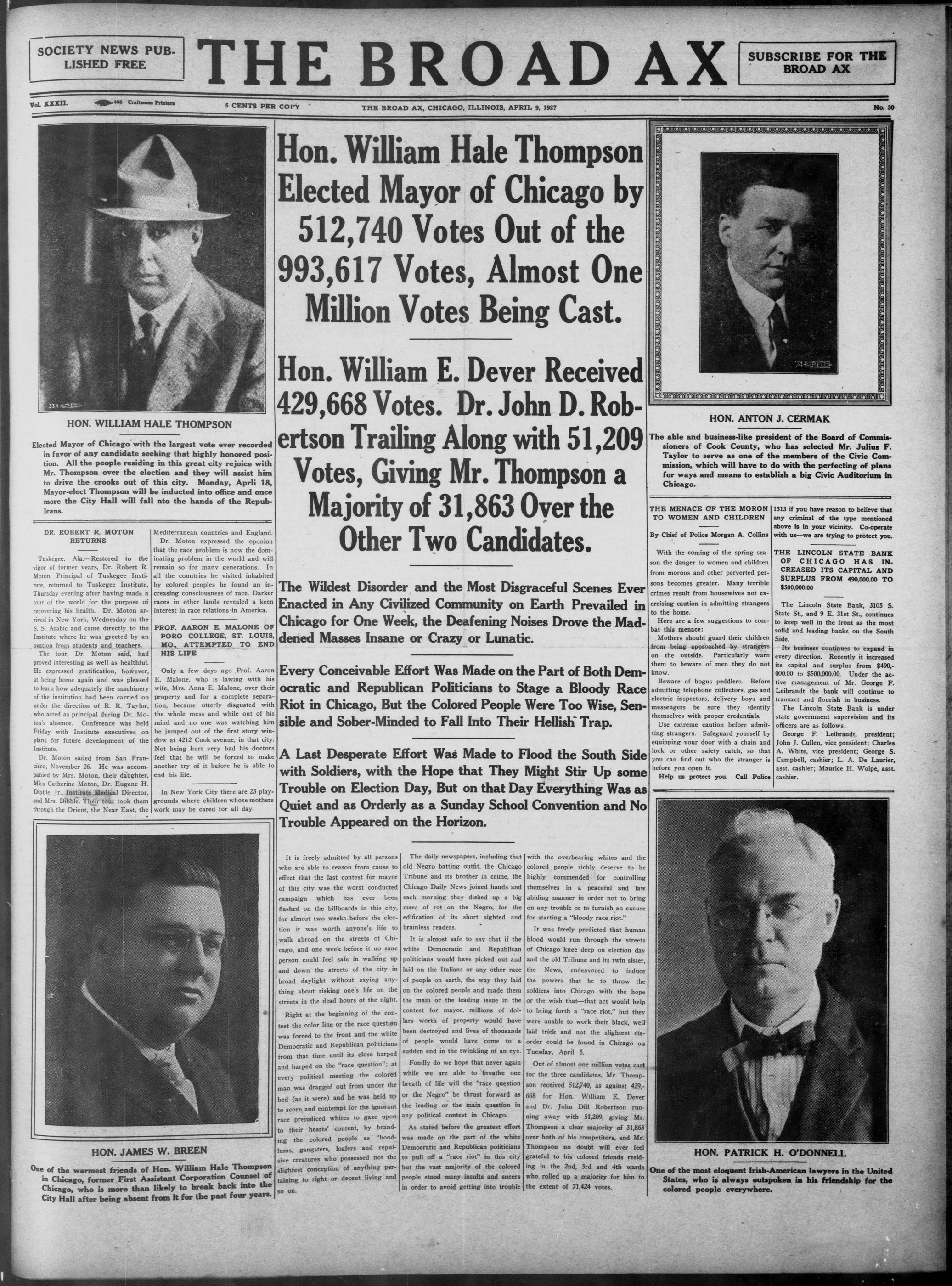
Elected Mayor of Chicago with the largest vote ever recorded in favor of any candidate seeking that highly honored position. All the people residing in this great city rejoice with Mr. Thompson over the election and they will assist him to drive the crooks out of this city. Monday, April 18, Mayor-elect Thompson will be inducted into office and once more the City Hall will fall into the hands of the Republicans.
DR. ROBERT R. MOTON RETURNS
Tuskegee. Ala.—Restored to the vigor of former years, Dr. Robert R. Moton, Principal of Tuskegee Institute, returned to Tuskegee Institute, Thursday evening after having made a tour of the world for the purpose of recovering his health. Dr. Moton arrived in New York, Wednesday on the S. S. Arabic and came directly to the Institute where he was greeted by an ovation from students and teachers.
Mediterranean countries and England. Dr. Moton expressed the opinion that the race problem is now the dominating problem in the world and will remain so for many generations. In all the countries he visited inhabited by colored peoples he found an increasing consciousness of race. Darker races in other lands revealed a keen interest in race relations in America.
PROF. AARON E. MALONE OF PORO COLLEGE, ST. LOUIS MO. ATTEMPTED TO END
The tour, Dr. Moton said, had proved interesting as well as healthful. He expressed gratification, however, at being home again and was pleased to learn how adequately the machinery of the institution had been carried on under the direction of R. R. Taylor, who acted as principal during Dr. Moton's absence. Conference was held Friday with Institute executives on plans for future development of the Institute.
Dr. Moton sailed from San Francisco, November 26. He was accompanied by Mrs. Moton, their daughter, Miss Catherine Moton, Dr. Eugene H. Dibble, Jr., Institute Medical Director, and Mrs. Dibble. Their tour took them through the Orient, the Near East, the
```markdown
```
[Image of a man with a dark hair, wearing a suit and a tie].
[Portrait of a man in a suit and tie, facing slightly to the right. The background is plain black. No text or additional details are present.]
HON. JAMES W. BREEN
One of the warmest friends of Hon. William in Chicago, former First Assistant Corporate Chicago, who is more than likely to bree City Hall after being absent from it for the
most friends of Hon. William
former First Assistant Corpora
o is more than likely to bres
er being absent from it for the
One of the warmest friends of Hon. William Hale Thompson in Chicago, former First Assistant Corporation Counsel of Chicago, who is more than likely to break back into the City Hall after being absent from it for the past four years.
ALE THOMPSON
in the largest vote ever recorded seeking that highly honored posi-
g in this great city rejoice with action and they will assist him in this city. Monday, Aprli 18,
be inducted into office and once into the hands of the Repub-
Mediterranean countries and England. Dr. Moton expressed the oposition that the race problem is now the dominating problem in the world and will remain so for many generations. In all the countries he visited inhabited by colored peoples he found an increasing consciousness of race. Darker races in other lands revealed a keen interest in race relations in America.
PROF. AARON E. MALONE OF PORO COLLEGE, ST. LOUIS, MO., ATTEMPTED TO END HIS LIFE
Only a few days ago Prof. Aaron E. Malone, who is lawing with his wife, Mrs. Anna E. Malone, over their property and for a complete separation, became utterly disgusted with the whole mess and while out of his mind and no one was watching him he jumped out of the first story window at 4212 Cook avenue, in that city. Not being hurt very bad his doctors feel that he will be forced to make another try of it before he is able to end his life.
In New York City there are 23 playgrounds where children whose mothers work may be cared for all day.
[Name]
Hon. William Hale Thompson assistant Corporation Counsel of likely to break back into the from it for the past four years.
THE BROAD AX
5 CENTS PER COPY
ever recorded
monored posi-
rejoice with
will assist him
day, Aprli 18,
judice and once
of the Repub-
Tro
t four years.
Hon. William Hale Thompson Elected Mayor of Chicago by 512,740 Votes Out of the 993,617 Votes, Almost One Million Votes Being Cast.
Hon. William E. Dever Received 429,668 Votes. Dr. John D. Robertson Trailing Along with 51,209 Votes, Giving Mr. Thompson a Majority of 31,863 Over the Other Two Candidates.
The Wildest Disorder and the Most Disgraceful Scenes Ever Enacted in Any Civilized Community on Earth Prevailed in Chicago for One Week, the Deafening Noises Drove the Maddened Masses Insane or Crazy or Lunatic.
Every Conceivable Effort Was Made on the Part of Both Democratic and Republican Politicians to Stage a Bloody Race Riot in Chicago, But the Colored People Were Too Wise, Sensible and Sober-Minded to Fall Into Their Hellish Trap.
A Last Desperate Effort Was Made to Flood the South Side with Soldiers, with the Hope that They Might Stir Up some Trouble on Election Day, But on that Day Everything Was as Quiet and as Orderly as a Sunday School Convention and No Trouble Appeared on the Horizon.
It is freely admitted by all persons who are able to reason from cause to effect that the last contest for mayor of this city was the worst conducted campaign which has ever been flashed on the billboards in this city, for almost two weeks before the election it was worth anyone's life to walk abroad on the streets of Chicago, and one week before it no sane person could feel safe in walking up and down the streets of the city in broad daylight without saying anything about risking one's life on the streets in the dead hours of the night.
Right at the beginning of the contest the color line or the race question was forced to the front and the white Democratic and Republican politicians from that time until its close harped and harped on the "race question"; at every political meeting the colored man was dragged out from under the bed (as it were) and he was beld up to scorn and contempt for the ignorant race prejudiced whites to gaze upon to their hearts' content, by branding the colored people as "hoodlums, gangsters, loafers and repulsive creatures who possessed not the slightest conception of anything pertaining to right or decent living and so on.
THE BROAD AX, CHICAGO, ILLINOIS, APRIL 9, 1927
The daily newspapers, including that old Negro batting outfit, the Chicago Tribune and its brother in crime, the Chicago Daily News joined hands and each morning they dished up a big mess of rot on the Negro, for the edification of its short sighted and brainless readers.
It is almost safe to say that if the white Democratic and Republican politicians would have picked out and laid on the Italians or any other race of people on earth, the way they laid on the colored people and made them the main or the leading issue in the contest for mayor, millions of dollars worth of property would have been destroyed and lives of thousands of people would have come to a sudden end in the twinkling of an eye.
Fondly do we hope that never again while we are able to breathe one breath of life will the "race question or the Negro" be thrust forward as the leading or the main question in any political contest in Chicago.
As stated before the greatest effort was made on the part of the white Democratic and Republican politicians to pull off a "race riot" in this city but the vast majority of the colored people stood many insults and sneers in order to avoid getting into trouble
with the overbearing whites and the colored people richly deserve to be highly commended for controlling themselves in a peaceful and law abiding manner in order not to bring on any trouble or to furnish an excuse for starting a "bloody race riot."
It was freely predicted that human blood would run through the streets of Chicago knee deep on election day and the old Tribune and its twin sister, the News, endeavored to induce the powers that be to throw the soldiers into Chicago with the hope or the wish that—that act would help to bring forth a "race riot," but they were unable to work their black, well laid trick and not the slightest disorder could be found in Chicago on Tuesday, April 5.
Out of almost one million votes cast for the three candidates, Mr. Thompson received 512,740, as against 429,668 for Hon. William E. Dever and Dr. John Dill Robertson running away with 51,209, giving Mr. Thompson a clear majority of 31,863 over both of his competitors, and Mr. Thompson no doubt will ever feel grateful to his colored friends residing in the 2nd, 3rd and 4th wards who rolled up a majority for him to the extent of 71,424 votes.
SUBSCRIBE FOR THE
BROAD AX
No. 30
74
HON. ANTON J. CERMAK
The able and business-like pressioners of Cook County, w Taylor to serve as one of the mission, which will have to for ways and means to esta Chicago.
and business-like president of the Board of Cook County, who has selected Mr. to serve as one of the members of the which will have to do with the perfectives and means to establish a big Civic Au.
ke president of the Board of Commis- tity, who has selected Mr. Julius F. one of the members of the Civic Com- save to do with the perfecting of plans to establish a big Civic Auditorium in
The able and business-like president of the Board of Commissioners of Cook County, who has selected Mr. Julius F. Taylor to serve as one of the members of the Civic Commission, which will have to do with the perfecting of plans for ways and means to establish a big Civic Auditorium in Chicago.
With the coming of the spring season the danger to women and children from morons and other perverted persons becomes greater. Many terrible crimes result from housewives not exercising caution in admitting strangers to the home.
Here are a few suggestions to combat this menace:
Mothers should guard their children from being approached by strangers on the outside. Particularly warn them to beware of men they do not know.
Beware of bogus peddlers. Before admitting telephone collectors, gas and electric inspectors, delivery boys and messengers be sure they identify themselves with proper credentials.
Use extreme caution before admitting strangers. Safeguard yourself by guarding your door with a chain and lock or other safety catch, so that you can find out who the stranger is before you open it.
Help us protect you. Call Police
THE NEW YORK TIMES
[Name]
THE MAYOR OF BROOKLYN
[Name]
HON. PATRICK H. O'DONNELL
One of the most eloquent Irish-American lawyers in States, who is always outspoken in his friend colored people everywhere.
most eloquent Irish-American lawyers in who is always outspoken in his friend people everywhere.
Irish-American lawyers in the United States outspoken in his friendship for the world.
One of the most eloquent Irish-American lawyers in the United States, who is always outspoken in his friendship for the colored people everywhere.
One of the most eloquent Irish-American lawyers in the United States, who is always outspoken in his friendship for the colored people everywhere.
1313 if you have reason to believe that any criminal of the type mentioned above is in your vicinity. Co-operate with us—we are trying to protect you.
THE LINCOLN STATE BANK OF CHICAGO HAS INCREASED ITS CAPITAL AND SURPLUS FROM 490,000.00 TO $500,000.00
The Lincoln State Bank, 3105 S. State St., and 9 E. 31st St., continues to keep well in the front as the most solid and leading banks on the South Side.
Its business continues to expand in every direction. Recently it increased its capital and surplus from $490,000.00 to $500,000.00. Under the active management of Mr. George F. Leibrandt the bank will continue to transact and flourish in business.
The Lincoln State Bank is under state government supervision and its officers are as follows:
George F. Leibrandt, president; John J. Cullen, vice president; Charles A. White, vice president; George S. Campbell, cashier; L. A. De Laurier, asst. cashier; Maurice H. Wolpe, asst. cashier.
---
```markdown
```
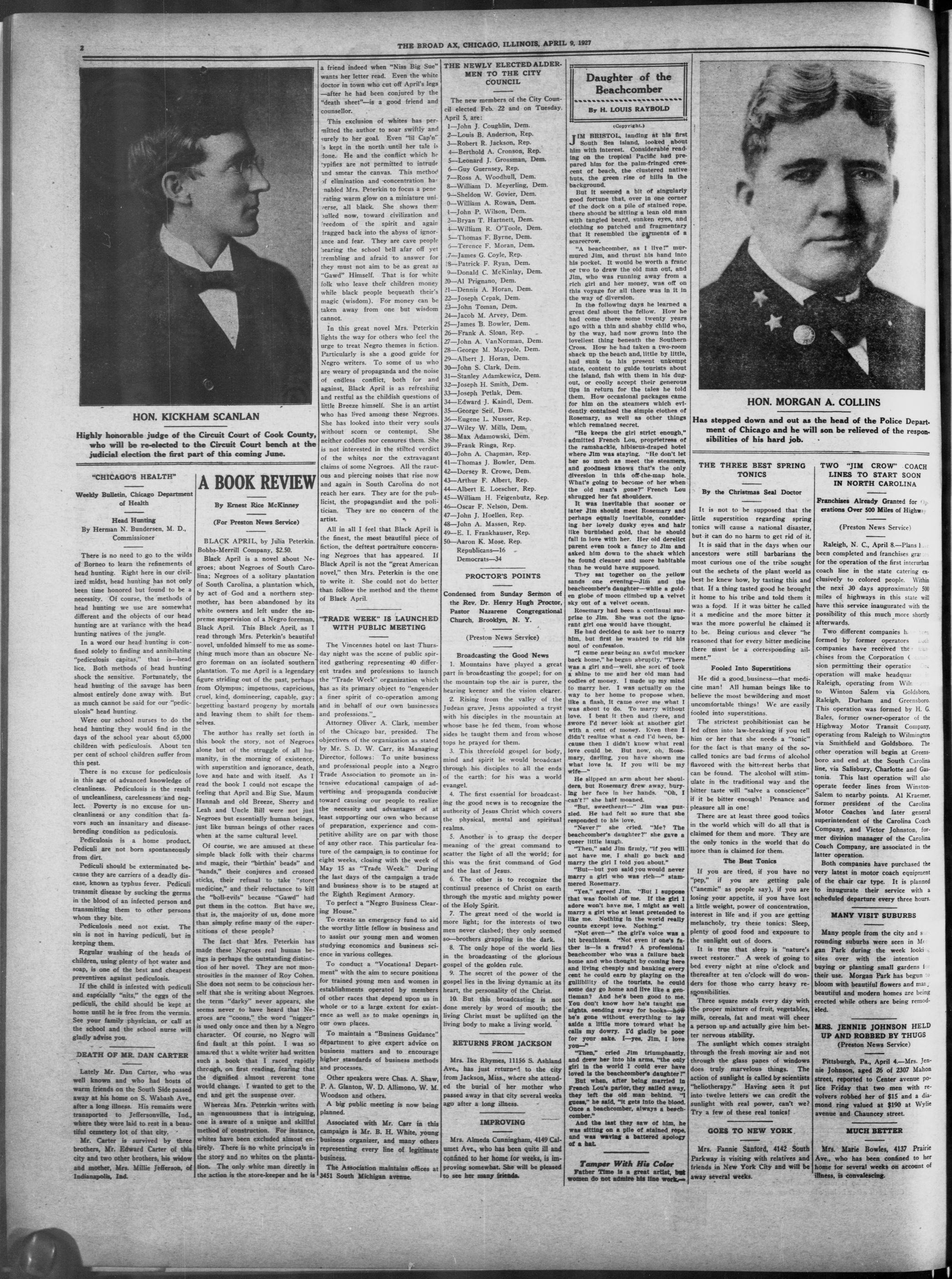
HON. KICKHAM SCANLAN Highly honorable judge of the Circuit Court of Cook County, who will be re-elected to the Circuit Court bench at the judicial election the first part of this coming June.
Weekly Bulletin, Chicago Department of Health
Head Hunting
By Herman N. Bundersen, M. D.,
Commissioner
There is no need to go to the wilds of Borneo to learn the refinements of head hunting. Right here in our civilized midst, head hunting has not only been time honored but found to be a necessity. Of course, the methods of head hunting we use are somewhat different and the objects of our head hunting are at variance with the head hunting natives of the jungle.
In a word our head hunting is confined solely to finding and annihilating "pediculosis capitas," that is—head lice. Both methods of head hunting shock the sensitive. Fortunately, the head hunting of the savage has been almost entirely done away with. But as much cannot be said for our "pediculosis" head hunting.
Were our school nurses to do the head hunting they would find in the days of the school year about 65,000 children with pediculosis. About ten per cent of school children suffer from this pest.
There is no excuse for pediculosis in this age of advanced knowledge of cleanliness. Pediculosis is the result of uncleanliness, carelessness and neglect. Poverty is no excuse for uncleanliness or any condition that favors such an insanitary and disease-breeding condition as pediculosis. Pediculosis is a home product. Pediculi are not born spontaneously from dirt. Pediculi should be exterminated because they are carriers of a deadly disease, known as typhus fever. Pediculi transmit disease by sucking the germs in the blood of an infected person and transmitting them to other persons whom they bite. Pediculosis need not exist. The sin is not in having pediculi, but in keeping them.
Regular washing of the heads of children, using plenty of hot water and soap, is one of the best and cheapest preventives against pediculosis. If the child is infested with pediculi and especially "nits," the eggs of the pediculi, the child should be kept at home until he is free from the vermin. See your family physician, or call at the school and the school nurse will gladly advise you.
DEATH OF MR. DAN CARTER
Lately Mr. Dan Carter, who was well known and who had hosts of warm friends on the South Side passed away at his home on S. Wabash Ave., after a long illness. His remains were transported to Jeffersonville, Ind., where they were laid to rest in a beautiful cemetery lot of that city.
Mr. Carter is survived by three brothers, Mr. Edward Carter of this city and two other brothers, his widow and mother, Mrs. Millie Jefferson, of Indianapolis, Ind.
the Circuit Court of Cook County, the Circuit Court bench at the art of this coming June.
A BOOK REVIEW
By Ernest Rice McKinney
(For Preston News Service)
BLACK APRIL, by Julia Peterkin
Bobbs-Merrill Company. $2.50.
Black April is a novel about Negroes; about Negroes of South Carolina; Negroes of a solitary plantation of South Carolina, a plantation which, by act of God and a northern stepmother, has been abandoned by its white owners and left under the supreme supervision of a Negro foreman, Black April. This Black April, as I read through Mrs. Peterkin's beautiful novel, unfolded himself to me as something much more than an obscure Negro foreman on an isolated southern plantation. To me April is a legendary figure striding out of the past, perhaps from Olympus; impetuous, capricious, cruel, kind, domineering, capable, gay; begetting bastard progeny by mortals and leaving them to shift for themselves.
The author has really set forth in this book the story, not of Negroes alone but of the struggle of all humanity, in the morning of existence, with superstition and ignorance, death, love and hate and with itself. As I read the book I could not escape the feeling that April and Big Sue, Maum Hannah and old Breeze, Sherry and Leah and Uncle Bill were not just Negroes but essentially human beings, just like human beings of other races when at the same cultural level.
Of course, we are amused at these simple black folk with their charms and magic, their "birthin' beads" and "hands," their conjures and crossed sticks, their refusal to take "store medicine," and their reluctance to kill the "boll-evils" because "Gawd" had put them in the cotton. But have we, that is, the majority of us, done more than simply refine many of the superstitions of these people?
The fact that Mrs. Peterkin has made these Negroes real human beings is perhaps the outstanding distinction of her novel. They are not monstrosities in the manner of Roy Cohen. She does not seem to be conscious herself that she is writing about Negroes. the term "darky" never appears, she seems never to have heard that Negroes are "coons," the word "nigger" is used only once and then by a Negro character. Of course, no Negro will find fault at this point. I was so amazed that a white writer had written such a book that I raced rapidly through, on first reading, fearing that the dignified almost reverent tone would change. I wanted to get to the end and get the suspense over.
Whereas Mrs. Peterkin writes with an ingenuousness that is intriguing, one is aware of a unique and skillful method of construction. For instance, whites have been excluded almost entirely. There is no white principals in the story and no whites on the plantation. The only white man directly in the action is the store-keeper and he is
THE BROAD AX, CHICAGO, ILLINOIS, APRIL 9, 1927
a friend indeed when "Niss Big Sue" wants her letter read. Even the white doctor in town who cut off April's legs—after he had been conjured by the "death sheet"—is a good friend and counsellor.
This exclusion of whites has permitted the author to soar swiftly and surely to her goal. Even "Iil Cap'n" is kept in the north until her tale is done. He and the conflict which he typifies are not permitted to intrude and smear the canvas. This method of elimination and concentration has enabled Mrs. Peterkin to focus a penetrating warm glow on a miniature universe, all black. She shows them pulled now, toward civilization and freedom of the spirit and again fragged back into the abyss of ignorance and fear. They are cave people hearing the school bell afar off yet trembling and afraid to answer for they must not aim to be as great as "Gawd" Himself. That is for white folk who leave their children money while black people bequeath their magic (wisdom). For money can be taken away from one but wisdom cannot.
In this great novel Mrs. Peterkin lights the way for others who feel the urge to treat Negro themes in fiction. Particularly is she a good guide for Negro writers. To some of us who are weary of propaganda and the noise of endless conflict, both for and against, Black April is as refreshing and restful as the childish questions of little Breeze himself. She is an artist who has lived among these Negroes. She has looked into their very souls without scorn or contempt. She neither coddles nor censures them. She is not interested in the stilted verdict of the whites nor the extravagant claims of some Negroes. All the raucous and piercing noises that rise now and again in South Carolina do not reach her ears. They are for the publicist, the propagandist and the politician. They are no concern of the artist.
All in all I feel that Black April is the finest, the most beautiful piece of fiction, the defestet portraiture concerning Negroes that has appeared. If Black April is not the "great American novel," then Mrs. Peterkin is the one to write it. She could not do better than follow the method and the theme of Black April.
"TRADE WEEK" IS LAUNCHED WITH PUBLIC MEETING
The Vincennes hotel on last Thursday night was the scene of public spirited gathering representing 40 different trades and professions to launch the "Trade Week" organization which has as its primary object to "engender a finer spirit of co-operation among and in behalf of our own businesses and professions."
Attorney Oliver A. Clark, member of the Chicago bar, presided. The objectives of the organization as stated by Mr. S. D. W. Carr, its Managing Director, follows: To unite business and professional people into a Negro Trade Association to promote an intensive educational campaign of advertising and propaganda conducive toward causing our people to realize the necessity and advantages of at least supporting our own who because of preparation, experience and competitive ability are on par with those of any other race. This particular feature of the campaign is to continue for eight weeks, closing with the week of May 15 as "Trade Week." During the last days of the campaign a trade and business show is to be staged at the Eighth Regiment Armory.
To perfect a "Negro Business Clearing House."
To create an emergency fund to aid the worthy little fellow in business and to assist our young men and women studying economics and business science in various colleges.
To conduct a "Vocational Department" with the aim to secure positions for trained young men and women in establishments operated by members of other races that depend upon us in whole or to a large extent for existence as well as to make openings in our own places.
To maintain a "Business Guidance" department to give expert advice on business matters and to encourage higher standards of business methods and processes.
Other speakers were Chas. A. Shaw
P. A. Glanton, W. D. Allimono, W. M.
Woodson and others.
Associated with Mr. Carr in this campaign is Mr. B. H. White, young business organizer, and many others representing every line of legitimate business. The Association maintains offices at 3451 South Michigan avenue.
The new members of the City Council elected Feb. 22 and on Tuesday April 5. are:
1—John J. Coughlin, Dem.
2—Louis B. Anderson, Rep.
3—Robert R. Jackson, Rep.
4—Berthold A. Cronson, Rep.
5—Leonard J. Grossman, Dem.
6—Guy Guernsey, Rep.
7—Ross A. Woodhull, Dem.
8—William D. Meyerling, Dem.
9—Sheldon W. Govier, Dem.
10—William A. Rowan, Dem.
11—John P. Wilson, Dem.
12—Bryan T. Hartnett, Dem.
13—William R. O'Toole, Dem.
14—Thomas F. Byrne, Dem.
15—Terence F. Moran, Dem.
16—James G. Coyle, Rep.
17—Patrick F. Ryan, Dem.
18—Donald C. McKinlay, Dem.
20—Al Prignano, Dem.
21—Dennis A. Horan, Dem.
22—Joseph Cepak, Dem.
23—John Toman, Dem.
24—Jacob M. Arvey, Dem.
25—James B. Bowler, Dem.
26—Frank A. Sloan, Rep.
27—John A. VanNorman, Dem.
28—George M. Maypole, Dem.
29—Albert J. Horan, Dem.
30—John S. Clark, Dem.
31—Stanley Adamkewicz, Dem.
32—Joseph H. Smith, Dem.
33—Joseph Petlak, Dem.
34—Edward J. Kaindl, Dem.
35—George Seif, Dem.
36—Eugene L. Nusser, Rep.
37-Wiley W. Mills, Dem.
38—Max Adamowski, Dem.
39-Frank Ringa, Rep.
40-John A. Chapman, Rep.
41-Thomas J. Bowler, Dem.
42-Dorsey R. Crowe, Dem.
43-Arthur F. Albert, Rep.
44-Albert E. Loescher, Rep.
45-William H. Feigenbutz, Rep.
46-Oscar F. Nelson, Dem.
47-John H. Hoellen, Rep.
48-John A. Massen, Rep.
49-E. I. Frankhauser, Rep.
50-Aaron K. Mose, Rep.
PROCTOR'S POINTS
Condensed from Sunday Sermon of the Rev. Dr. Henry Hugh Proctor, Pastor Nazarene Congregational Church, Brooklyn, N. Y.
Broadcasting the Good News
1. Mountains have played a great part in broadcasting the gospel; for on the mountain top the air is purer, the hearing keener and the vision clearer.
2. Rising from the valley of the Judean grave, Jesus appointed a tryst with his disciples in the mountain at whose base he fed them, from whose sides he taught them and from whose tops he prayed for them.
3. This threefold gospel for body, mind and spirit he would broadcast through his disciples to all the ends of the earth; for his was a world evangel.
4. The first essential for broadcasting the good news is to recognize the authority of Jesus Christ which covers the physical, mental and spiritual realms.
5. Another is to grasp the deeper meaning of the great command to scatter the light of all the world; for this was the first command of God and the last of Jesus.
6. The other is to recognize the continual presence of Christ on earth through the mystic and mighty power of the Holy Spirit.
7. The great need of the world is more light; for the interests of two men never clashed; they only seemed so-brothers grappling in the dark.
8. The only hope of the world lies in the broadcasting of the glorious gospel of the golden rule.
9. The secret of the power of the gospel lies in the living dynamic at its heart, the personality of the Christ.
10. But this broadcasting is not done merely by word of mouth; the living Christ must be uplifted on the living body to make a living world.
RETURNS FROM JACKSON
Mrs. Ike Rhymes, 11156 S. Ashland Ave., has just returned to the city from Jackson, Miss, where she attended the burial of her mother who passed away in that city several weeks ago after a long illness.
IMPROVING
Mrs. Almeda Cunningham, 4149 Calumet Ave., who has been quite ill and confined to her home for weeks, is improving somewhat. She will be pleased to see her many friends.
(Copyright.)
JIM BRISTOL, landing at his first South Sea island, looked about him with interest. Considerable reading on the tropical Pacific had prepared him for the palm-fringed crescent of beach, the clustered native huts, the green rise of hills in the background.
But it seemed a bit of singularly good fortune that, over in one corner of the dock on a pile of stained rope, there should be sitting a lean old man with tangled beard, sunken eyes, and clothing so patched and fragmentary that it resembled the garments of a scarecrow.
"A beachcomber, as I live!" murmured Jim, and thrust his hand into his pocket. It would be worth a franc or two to draw the old man out, and Jim, who was running away from a rich girl and her money, was off on this voyage for all there was in it in the way of diversion.
In the following days he learned a great deal about the fellow. How he had come there some twenty years ago with a thin and shabby child who, by the way, had now grown into the loveliest thing beneath the Southern Cross. How he had taken a two-room shack up the beach and, little by little, had sunk to his present unkempt state, content to guide tourists about the island, fish with them in his dug-out, or coolly accept their generous tips in return for the tales he told them. How occasional packages came for him on the steamers which evidently contained the simple clothes of Rosemary, as well as other things which remained secret.
"He keeps the girl strict enough," admitted French Lou, proprietress of the ramshackle, hibiscus-draped hotel where Jim was staying. "He don't let her so much as meet the steamers, and goodness knows that's the only diversion in this off-the-map hole. What's going to become of her when the old man's gone?" French Lou shrugged her fat shoulders.
It was inevitable that sooner or later Jim should meet Rosemary and perhaps equally inevitable, considering her lovely dusky eyes and hair like burnished gold, that he should fall in love with her. Her old derelict parent even took a fancy to Jim and asked him down to the shack which he found cleaner and more habitable than he would have supposed.
They sat together on the yellow sands one evening—Jim and the beachcomber's daughter—while a golden globe of moon climbed up a velvet sky out of a velvet ocean.
Rosemary had been a continual surprise to Jim. She was not the ignorant girl one would have thought.
He had decided to ask her to marry him, but first he wanted to rid his soul of confession.
"I came near being an awful mucker back home," he began abruptly. "There was a girl and—well, she sort of took a shine to me and her old man had oodles of money. I made up my mind to marry her. I was actually on the way to her home to propose when, like a flash, it came over me what I was about to do. To marry without love. I beat it then and there, and swore I'd never look at another girl with a cent of money. Even then I didn't realize what a cad I'd been, because then I didn't know what real love could be. But now, oh, Rosemary, darling, you have shown me what love is. If you will be my wife—"
He slipped an arm about her shoulders, but Rosemary drew away, burying her face in her hands. "Oh, I can't!" she half moaned.
"But, sweetheart—" Jim was puzzled. He had felt so sure that she responded to his love.
"Never!" she cried. "Me? The beachcomber's daughter?" she gave a queer little laugh.
"Then," said Jim firmly, "if you will not have me. I shall go back and marry the girl I told you about."
"But—but you said you would never marry a girl who was rich"—stammered Rosemary.
"Yes," agreed Jim. "But I suppose that was foolish of me. If the girl I adore won't have me, I might as well marry a girl who at least pretended to like me. Nothing in the world really counts except love. Nothing."
"Not even—" the girl's voice was a bit breathless. "Not even if one's father is—is a fraud? A professional beachcomber who was a failure back home and who thought by coming here and living cheaply and banking every cent he could earn by playing on the gullibility of the tourists, he could some day go home and live like a gentleman? And he's been good to me. You don't know how he's taught me nights, sending away for books—how he's gone without everything to lay aside a little more toward what he calls my dowry. I'd gladly be poor for your sake. I—yes, Jim, I love you—"
"Then," cried Jim triumphantly, and drew her into his arms, "the only girl in the world I could ever have loved is the beachcomber's daughter!" But when, after being married in French Lou's parlor, they sailed away, they left the old man behind. "I guess," he said, "it gets into the blood. Once a beachcomber, always a beschcomber." And the last they saw of him, he was sitting on a pile of stained rope, and was waving a battered apology of a hat.
Tamper With His Color
Father Time is a great artist, but women do not admire his line work.
Sergeant
Has stepped down and out as the head of the ment of Chicago and he will son be relieved sibilities of his hard job.
Has stepped down and out as the head of the Police Department of Chicago and he will son be relieved of the responsibilities of his hard job.
THE THREE BEST SPRING
TONICS
By the Christmas Seal Doctor
It is not to be supposed that the little superstition regarding spring tonics will cause a national disaster, but it can do no harm to get rid of it.
It is said that in the days when our ancestors were still barbarians the most curious one of the tribe sought out the sechets of the plant world as best he knew how, by tasting this and that. If a thing tasted good he brought it home to his tribe and told them it was a food. If it was bitter he called it a medicine and the more bitter it was the more powerful he claimed it to be. Being curious and clever "he reasoned that for every bitter medicine there must be a corresponding ailment."
Fooled Into Superstitions
He did a good_business—that medicine man! All human beings like to believe the most bewildering and most uncomfortable things! We are easily fooled into superstitions.
The strictest prohibitionist can be led often into law-breaking if you tell him or her that she needs a "tonic" for the fact is that many of the so-called tonics are bad forms of alcohol flavored with the bitterest herbs that can be found. The alcohol will stimulate in the traditional way and the bitter taste will "salve a conscience" if it be bitter enough! Penance and pleasure all in one!
There are at least three good tonics in the world which will do all that is claimed for them and more. They are the only tonics in the world that do more than is claimed for them.
The Best Tonics
If you are tired, if you have no "pep," if you are getting pale ("anemic" as people say), if you are losing your appetite, if you have lost a little weight, power of concentration, interest in life and if you are getting melancholy, try these tonics: Sleep, plenty of good food and exposure to the sunlight out of doors.
It is true that sleep is "nature's sweet restorer." A week of going to bed every night at nine o'clock and thereafter at ten o'clock will do wonders for those who carry heavy responsibilities.
Three square meals every day with the proper mixture of fruit, vegetables, milk, cereals, fat and meat will cheer a person up and actually give him better nervous stability.
The sunlight which comes straight through the fresh moving air and not through the glass panes of windows does truly marvelous things. The action of sunlight is called by scientists "heliotherapy." Having seen it put into twelve letters we can credit the sunlight with real power, can't we? Try a few of these real tonics!
GOES TO NEW YORK
Mrs. Fannie Sanford, 4142 South Parkway is visiting with relatives and friends in New York City and will be away several weeks.
the head of the Police Depart-
ll son be relieved of the respon-
TWO "JIM CROW" COACH
LINES TO START SOON
IN NORTH CAROLINA
Franchises Already Granted for
erations Over 500 Miles of Highw
(Preston News Service)
Raleigh, N. C., April 8.—Plans I have been completed and franchises granted for the operation of the first interurban coach line in the state catering exclusively to colored people. Within the next 30 days approximately 500 miles of highways in this state will have this service inaugurated with the possibility of this much more shortly afterwards.
Two different companies have been formed by former operators. Both companies have received the chises from the Corporation Commission permitting their operation. One operation will make headquarter Raleigh, operating from Wilmington to Winton Salem via Goldsboro, Raleigh, Durham and Greensboro. This operation was formed by H. G. Bales, former owner-operator of the Highway Motor Transit Company, operating from Raleigh to Wilmington via Smithfield and Goldsboro. The other operation will begin at Greensboro and end at the South Carolina line, via Salisbury, Charlotte and Gastonia. This last operation will also operate feeder lines from Winston-Salem to nearby points. Al Kraemer, former president of the Carolina Motor Coaches and later general superintendent of the Carolina Coach, and Victor Johnston, former division manager of the Carolina Coach Company, are associated in the latter operation.
Both companies have purchased the very latest in motor coach equipment of the chair car type. It is planned to inaugurate their service with a scheduled departure every three hours.
MANY VISIT SUBURBS
Many people from the city and surrounding suburbs were seen in Morgan Park during the week looking sites over with the intention of buying or planting small gardens for their use. Morgan Park has begun to bloom with beautiful flowers and many beautiful and modern homes are being erected while others are being remodeled.
MRS. JENNIE JOHNSON HELD UP AND ROBBED BY THUGS (Preston News Service)
Pittsburgh, Pa., April 4.—Mrs. Jennie Johnson, aged 26 of 2307 Mahon street, reported to Center avenue police Friday that two men with revolvers robbed her of $15 and a diamond ring valued at $190 at Wylie avenue and Chaucey street.
MUCH BETTER
Mrs. Marie Bowles, 4137 Prairie Ave., who has been confined to her home for several weeks on account of illness, is convalescing.
COLORFUL NEWS MOVIES BY THE CAMERAMAN
1. Darrow and the Church
2. "The Negro Dance Under European Eyes"
3. Retarded Advancement in N. J.
4. Colorgrams
Darrow and the Church
Following the ardently-delivered message of Hon. Clarence Darrow to an over-packed audience in Washington, recently, at which time the attorney-abolitionist oratorically blasted to dust the pet idea of Nordic "supremacy" and resurrected from the ashes the absolute equality of all men, several prominent members of the cloth and their friends have taken Mr. Darrow solely to task for his alleged effront to the Christian Church. The Protestants say that no matter what Mr. Darrow has averred upon the open question of equality, it is all as sounding brass and tinkling cymbals, because of the inferences made by the speaker that the Negro is paying too much attention to religion and too little to plain, everyday, practical life. Two or three eminent clergymen have entirely discounted the orator's fearless portrayal of good, and see only the "evil" that in him lies.
Far be it from us to attempt to detract from the virtues of the House of Worship; nor would we dare stimulate our hearts to turn back upon the Good Book of the Ages. Yet, we are frank to say that when a man, in terms other than those of the Church, expresses a creed of Christian equality such as Clarence Darrow expressed in Washington, it is high time for the Christian Church, both white and colored, to replace some of their own founda-
with the foundation of Christian life described by Clarence Darrow. Nerores are a religious people—so white folks. It is good that they and even with some slight defects are obvious, it is good that each lives within some kind of a sarme of Christian brotherhood, even though there's many a broken chain in the tie that binds. Religion, however, and particularly that of our white brethren, must make strides forward before it can lay claim to the kind of freedom which the Good Book so beautifully describes.
To our mind, Charence Darrow, with all his faults, is preaching some of that gossip which should be paramount in the Charen, but which the Church has long since lain down. (Perhaps it never gicked up). The Fatherhood of God, and the Brotherhood of Man are being exemplified today in a way quite foreign to our idea of what should characterize both.
We earnestly feel that the clergy, both white and colored, could take unto its bosom not a little of Mr. Darrow's philosophy, without blemishing their Christian armor. We do not think that it is that Darrow loves the Church less, but, rather, that he loves his brother more. Greater love hath no man than that he lay down his life for his friend! This is what Mr. Darrow is doing. How about the Church?
An article by Andre Levinson, appearing under this heading in "The Theatre Arts" magazine for April, 1927, goes into the very ethics of Negro jazz dancing. Since the French writer, Andre Colurony, has devoted a volume of his collection, "Modern Music to Jazz," jazz dancing may now be admitted into the galaxy of fine arts, although but recently it was an object of test and ridicule, to both the public and the press. In the language today it has arrived.
This is proven by the furor that has been created by the colored artists of the "Virginie Negre" at the Champ Elysees, Paris, where a vast audience greets these colored performers nightly; for Josephine Baker and Florence Mills have taken Paris by storm. Of Josephine Baker, M. Levinson says: "It is not a grotesque Negro dancing girl who stands before the audience, but a black Venus." It is she with her Simian suppleness, who is responsible for the Charleston craze in Paris today. She is "an idol that enslaves and incites mankind."
The writer draws a sharp contrast between the Josephine Baker and the Florence Mills type of dancing, the latter being dainty and free from sensuality. He asserts that it is a long road from the valley of the Niger to the white lights of Broadway, and who will deny this? In the Niger Valley these dances were sacred ceremonials, but in Paris, New York and Chicago, they have become a mere diversise-
ment for white idlers of these great world cities. The Negro, himself, has progressed since leaving the jungles of his fatherland, while his Nordic admirers have evidently retrograded and become somewhat demoralized in their taste for pleasure and enjoyment.
It is, indeed, gratifying to know that this fair and open-minded critic is able to draw the line of distinction between different types of artists of our group. He says: "the mad arabesques of the incomparable Josephine can give us an almost shocking insight into our own more sombre depths, but Florence Mills, for instance, is developing toward an almost precious elegance." We make no proud boasts of our racial kinship to Josephine Baker, with her "demoralizing" appeal. "Agenius," M. Levinson says, "who is able at one bound to join her savage forefathers and with another to go back to our common animal ancestors."
Retarded Advancement in N. I.
The Metropolitan press reports that a delegation of Negroes recently visited Governor Moore, of New Jersey, and made vigorous protest against the Toms River public school segregation, which is now running the gamut of New Jersey protagonists and antagonists. The delegation stated to the Governor, with emphasis: "Colored people can only contemplate with the greatest apprehension any tendency to transfer to northern states the repressive policy prevalent in the south."
Had the zealous delegation paused then and there, its work would have been well done. It made the fatal mistake, however, and an unconscious one, we hope—of asking that a Negro be appointed to the staff of the Commissioner of Education, upon the basis of COLOR ALONE.
What they should have done would have been to pick out a well-qualified man and advocated his appointment, not because of the fact that he was a Negro, but because he was the man whom the parents wanted to represent them in the affairs of public education. If, incidentally, the candidate happened to be a Negro, such a status was quite irrelevant, either when weighed for or against his candidacy.
In other words, the delegation evidently went into the Governor's offices, fighting Jim Crowism with one hand and protecting it with the other. They were there because an ill-spirited school official wanted a separate Negro school; and while there they argued for a SEPARATE NEGRO OFFICIAL.
It is no wonder the Governor said, in effect, that the Chinese, the Germans, the Italians, and the Syrians, etc., all wanted a racial representative in school affairs; but that he preferred to consider all the many races at go to make up the population as AMERICANS and to name the members not as representatives of any one class, BUT OF ALL.
So say we. The day of racial representations and classes in America ought to be over. And we ought to help in shaping its demise. When the white folks, by sheer force, designate us as a "special" group, many times we can't do much to prevent it; but we can restrain ourselves from seeking to create "specialties" where public funds, public welfare, and democratic government are concerned.
Colorgrams
Says the Charlotte Observer, (white):
"There is no more bigotry and intolerance in the south than there is in other American states." Another journalistic ostrich with its head in the sand.
Friends of Charles T. Magill, of New York, one of the Race's foremost newspaper journalists of the modern school, are rejoicing to see his pen resurrected upon the pages of the New York Amsterdam News, the fastest-growing weekly of the Race.
"The pureblooded Negro in the Bahamas, as elsewhere, is a much more attractive personality than his half-caste brother," says a member of the British Colonial Service.
Adolph Gereau, statesman, of St. Thomas, Virgin Islands, writes: "It is my sincere hope that now the people of these islands have been made citizens of the United States they will be given consideration and opportunities to help themselves, economically and commercially, by the people of the United States."
THE BROAD AX, CHICAGO, ILLINOIS, APRIL 9, 1927
The Loud Mouthed Politicians, Both White and Colored, Democrats and Republicans, Seem to Be Fully Determined to Keep the Race Issue or Question Well to the Front in the Closing Hours of the Mayoralty Contest.
It Would Be Playing Short or Poor Judgement and Shallow Wisdom on the Part of Any One to Urge or Encourage One Hundred and Fifty to Two Hundred Thousand Colored People from the Various Sections of the Southern States to Fall Down in Chicago at One Full Sweep.
It Would Be a Tremendous Task to Absorb That Number of People of Any Race Into the Body Politic in Such a Short Length of Time Without Preventing a Large Percent of Them from Turning Out to Be Undesirable Citizens.
The Industrial Conditions Owing to the Past and Present Stagnation in Business Is Not So Very Rosy at this Time and the Housing Conditions Would Be Totally Insufficient to Provide Immediate Homes for Such a Vast Multitude.
At all of the elections held in this city, important or unimportant, the leaders of both sides of the political game always strive some way or other, to stir the white and the colored people up over the race question. The so-called colored leaders are past masters in that same art and really they outdo the white political leaders in that respect.
It always happens that just as soon as the elections get under good headway, some one will start up the hew and cry "that the whites are going to run all the colored people out of town or that the colored people are planning on driving all the whites into Lake Michigan." The white daily newspapers start their race prejudice mud batteries to working overtime and they frighten the people into feeling or believing that there might be some truth in the wild statements appearing in the newspapers pertaining to the unfriendly relations existing between the white and colored people in this city.
Some of the cold and selfish white politicians contend "that it would be just the thing if a race riot would break out in this city just before the election for that would be the means of lining up all the whites on one side of the political fence and all the colored voters on the other side of the same fence, and in that case a white person could be elected mayor of Chicago without the aid of the colored voters. With such black and murderous
"America's Negro problem would be solved in twenty-five years if, scattered throughout the country, there were fifty such schools as the Cardinal Gibbs Institute, in St Mary's County, Maryland, where Negro youths are taught to be both intellectual and industrious," says Senator David L. Walsh of Massachusetts.
CLARENCE DARROW, THE
"BROTHER"
(Preston News Service)
It is indeed very strange that members of our group should have any feelings but those of gratitude for Clarence Darrow, the noted criminal lawyer, and champion of the oppressed. But this seems to be the case from the many criticisms we read concerning his religious beliefs. Of what concern is it to us whether he be ag-
schemes flying through the air working on the nerves of the people who are wrought up to a high pitch of excitement and many of them already being heavily armed, we are indeed fearful for the safety of the lives of the people between now and the night of the election.
In order to further stir up the bitter race feeling in this city, it has been stated many times in public for the purpose of influencing the colored voters "that in the near future one hundred and fifty to two hundred thousand colored people would be dumped in one pile in Chicago right from the rural districts of the southern states. Such reports have struck terror in the hearts of many of the citizens of Chicago, for to say the least, it would be a great set back to the vast majority of the colored people who have been residing in this city for many years and are law abiding through and through to the back bone.
It is a well known fact that if one or two hundred thousand colored people would suddenly appear in this city the housing conditions are so limited that thousands of them would find themselves without homes or places to sleep, for it will be recalled that prior to and just after the war for a worldwide democracy that vast armies of colored people invaded this city, and many of them after being forced to live in unsanitary quarters—five to ten persons residing in one or two cold rooms—enduring many hardships which never confronted them in the southland. Many of them sadly re-
nostic, Jew, Mohammed or Christian, if he extends a helping hand to those in need of assistance. The days of religious intolerance are long past and the privilege of believing or not believing is a personal liberty. Mr. Darrow does not say he does not believe, he simply doubts, and the poet says, "There is more faith in honest doubt than is contained in half your creeds."
The thing that should be of greatest concern to our group is, what the man does for us and not what the man believes. That he has championed our cause, at the risk of his popularity and almost his life, is of greatest moment. The friendship of one such man is worth the hatred of a dozen so-called Christians, who know not the Fatherhood of God nor the Brotherhood of man, and do not believe in fair play. Let us ask ourselves this one question. What can any man possibly gain by befriending the Negro? We have
turned to their southern homes, and many of them not being accustomed to the ways of large cities naturally fell into the hands of the law and their short comings made it hard on the good and the bad colored people alike. It is really a serious thing for the white Republican speakers to attempt to make the white and colored people believe that the colored people will rush into this city by wholesale.
The colored leaders of the race in this city should sanely advise the colored people that it will or would be much better for them to come to this city in smaller numbers, with no brass bands to herald their coming and that would enable them to secure something to do much more easily. The colored people and their white leaders should not herald it to the world that there are almost three hundred thousand colored people in this city and with the one hundred and fifty-two thousand who are getting ready to come there will soon be five hundred thousand colored people residing in Chicago.
This is one of the wildest wild cat statements that has ever been dished up; at no time in this city has there been such a large number of colored people; at no time has there been over one hundred and seventy-five thousand colored people in this city and a thousand years from now the whites no doubt will still out number colored people in Chicago.
In the mean time whites and the colored must work hard to make Chicago in every way the best, the greatest and the most beautiful city on earth.
nothing to give him. He has all to lose and absolutely nothing to gain, so it must be only sincere compassion or a keen sense of justice that prompts him to plead our cause.
A recent Nordic speaker, referring to Mr. Darrow, said: "Darrow talks like a monkey, acts like a monkey and will die like a monkey." If this be true, oh, for more Nordic monkeys with the courage to stand up and defend publicly those who are despised and rejected of men.
ELEVEN-YEAR-OLD BOY
KILLED BY FAST TRAIN
Brownsville, Pa., April 7.—James Connor, 11 years old, Friday evening late, was struck by a fast train on the Monongahela railroad at Mt. Sterling. The boy had been playing near the railroad and had attempted to cross the track ahead of the train.
Wide, Fitted Belt, Straight Skirt Are in Fashion
Midseason collections of fashions just now being shown in Paris confirm, in one way at least, the assertion repeatedly made by the French designers, that styles develop logically from what has gone before and that they themselves are powerless to change that trend. The already familiar waist, bloused behind, notes a Paris fashion correspondent in the New York Times, proves the truth of this contention by becoming the waist bloused all around, the most significant note, perhaps, of the new exhibitions.
To avoid an effect of heaviness with this bloused waist, the skirts of the new gowns have become much less elaborate and straighter in line than they have been for some time. They are quite often entirely plain, wrapped about the figure with an overlapping flap at the side, either front or back, much as the remembered sheath skirt was. Where elaboration is required, the skirt is shown in straight tiers, a circular fullness inserted at either side of the front, or else it is made with a tight underskirt with the fuller overskirt split into four or more panels. Between this waist, bloused all around, and the straight-line skirt, is generally a belt about four inches in width, half above and half crossing the hip. It is fitted smoothly at all times and often set into the gown itself, affording a most pleasing effect.
The long-fitted sleeve extending over the hand in a pointed or curved outline is chosen most frequently to accompany this new silhouette, though the choice is not limited to the one style. Perhaps the type second in favor is the bell sleeve with a little puffed undersleeve of lace or contrasting material.
For afternoon gowns soft satin in both black and colors, its sheen not too high, is taking the place in the spotlight lately held by crepe de chine. Anna shows a charming black and white study in a supple black satin that incorporates many of the new ideas sponsored for the midseason. The waist of this gown is, of course, bloused moderately all around, but the skirt, while preserving its close straight outline, is given elegance by a flat cut-out founce that begins as a narrow panel on the left hip attached under a double row of small white buttons, swings around the front of the skirt as an applied eight-inch border and comes up the right side where it forms a short but bountiful side drapery. Black and white striped ribbon, two inches in width, faces the straight collar that can be worn wrapped about the neck, made with the aid of the double row of white buttons. There is a chic cuff about the long-fitted sleeves; and attention is further drawn to the wide-swathed belt. The front of the waist along each side of the collar opening has its double row of glistening white buttons also.
Plaids are a notable feature of these new collections, used both as trimming and as whole garments. Drecol lines a smart coat of navy blue crepella, bound with black braid, with a plaid silk softer than taffeta in tones of green, yellow and red. The collar of this coat, faced in the plaid, is cut like the collar of a motor coat and could be worn fastened smugly about the neck with a buttoned flap to hold it in place. The fronts of the coat are faced with plaid and turned back to form full length lapels. With this it worn a dress of navy crepella, piped in red, with collar and cuffs of the plaid.
Shoes, Hat and Bag to Match, Latest Sensation
```markdown
```
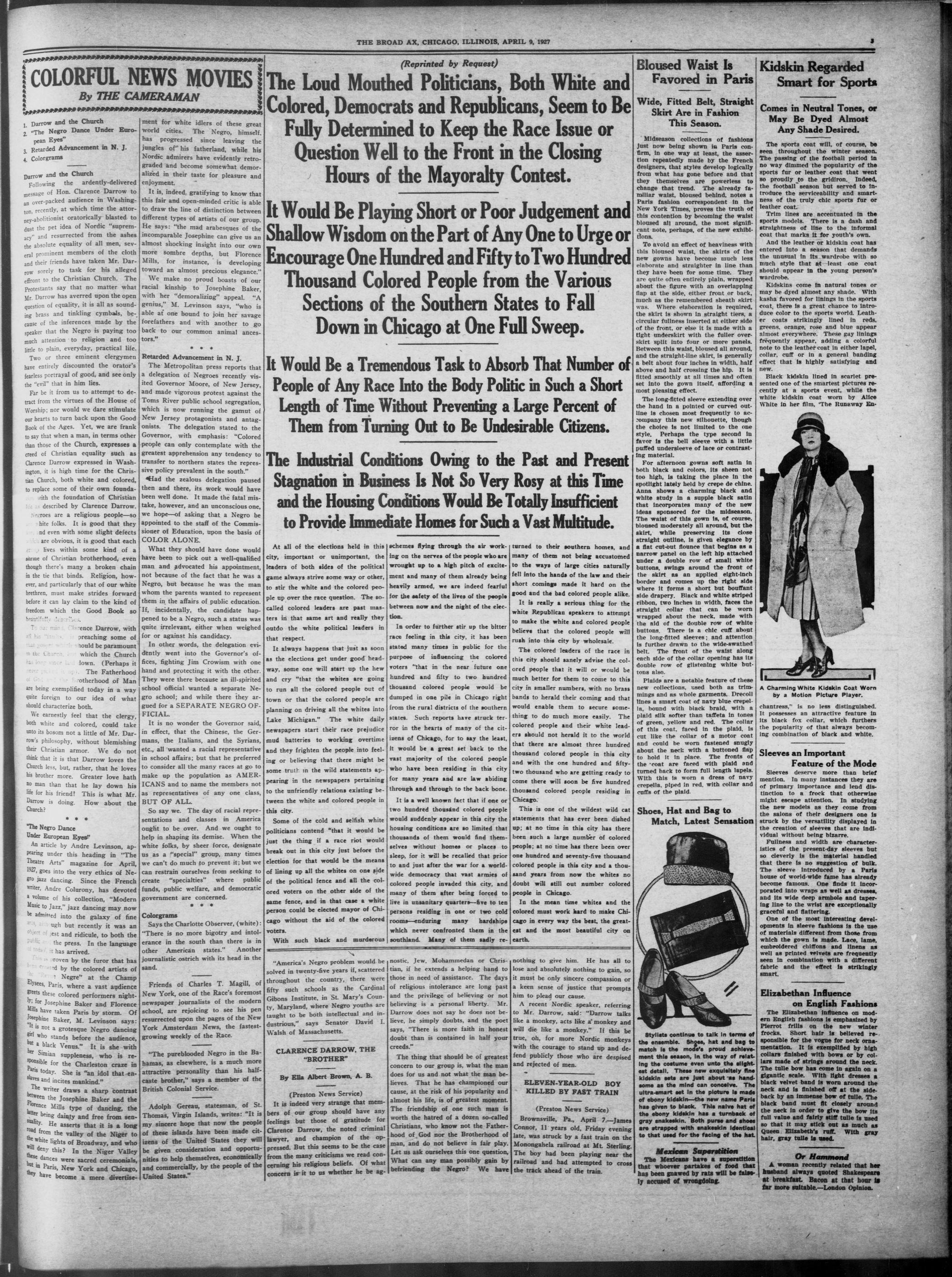
Stylists continue to talk in terms of the ensemble. Shoes, hat and bag to match is the mode's proud achievement this season, in the way of relating the costume even unto the slightest detail. These new exquisitely fine kidskin sets are just about as hand-some as the mind can conceive. The ultra-smart set in the picture is made of ebony kidskin—the new name Paris has given to black. This naive hat of the ebony kidskin has a turnback of gray snakeskin. Both purse and shoes are strapped with snakeskin identical to that used for the facing of the hat.
Mexican Superstition
The Mexicans have a superstition that whoever partakes of food that has been gnawed by rats will be falsely accused of wrongdoing.
3
Comes in Neutral Tones, or May Be Dyed Almost Any Shade Desired.
The sports coat will, of course, be seen throughout the winter season. The passing of the football period in no way dimmed the popularity of the sports fur or leather coat that went so proudly to the gridiron. Indeed, the football season but served to introduce the serviceability and smartness of the truly chic sports fur or leather coat.
Trim lines are accentuated in the sports models. There is a dash and straightness of line to the informal coat that marks it for youth's own.
And the leather or kidskin coat has entered into a season that demands the unusual in its wardrobe with so much style that at-least one coat should appear in the young person's wardrobe.
Kidskins come in natural tones or may be dyed almost any shade. With kasha favored for linings in the sports coat, there is a great chance to introduce color to the sports world. Leather coats strikingly lined in reds, greens, orange, rose and blue appear almost everywhere. These gay linings frequently appear, adding a colorful note to the leather coat in either lapel, collar, cuff or in a general banding effect that is highly satisfying and new.
Black kidskin lined in scarlet presented one of the smartest pictures recently at a sports event, while the white kidskin coat worn by Alice White in her film, 'The Runway En-
THE FASHION WEEKLY
A Charming White kidekin Coat Worn by a Motion Picture Player, chantress," is no less distinguished. It possesses an attractive feature in its black fox collar, which furthersthe popularity of that always becoming combination of black and white.
Sleeves an Important
Feature of the MUSE
Sleeves deserve more than brief mention. In many instances they are of primary importance and lend distinction to a frock that otherwise might escape attention. In studying the new models as they come from the salons of their designers one is struck by the versatility displayed in the creation of sleeves that are individual without being bizarre.
Fullness and width are characteristics of the present-day sleeves but so cleverly is the material handled that there is no suggestion of bulk. The sleeve introduced by a Paris house of world-wide fame has already become famous. One finds it incorporated into wraps as well as dresses, and its wide deep armhole and tapering line to the wrist are exceptionally graceful and flattering.
One of the most interesting developments in sleeve fashions is the use of materials different from those from which the gown is made. Lace, lame, embroidered chiffons and linens as well as printed velvets are frequently seen in combination with a different fabric and the effect is strikingly smart.
Elizabethan Influence
The Elizabethan influence on modern English fashions is emphasized by Pterror frills on the new winter frocks. Short hair is believed responsible for the vogue for neck ornamentation. It is exemplified by high collars finished with bows or by collars made of strings around the neck. The tulle bow has come in again on a gigantic scale. With light dresses a black velvet band is worn around the neck and is finished off at the sideback by an immense bow of tulle. The black band must fit closely around the neck in order to give the bow its full value and fairly stiff tulle is used so that it may stick out as much as Queen Elizabeth's ruff. With gray hair, gray tulle is used.
Or Hammond
A woman recently related that her husband always quoted Shakespeare at breakfast. Bacon at that hour is far more suitable—London Obionn.
CUNNINGHAM FUNERAL CARS Are distinguished by their Style and Elegance but foremost by the protection to passengers guaranteed by proper Insurance.
Use our cars and be assured of protection. The above policy is back of our up to date Cars. If any one is killed or injured in your funeral we will look after all suits and pay damages AMBULANCE SERVICE AT ALL HOURS
THE BROAD AX
Published Every Saturday
In this city since July 15th, 1899 without missing one single issue. Republicans; Democrats; Catholics, Protestants, Single Taxers, Priests, indisols or anyone else can have their say as long as their language is proper and responsibility is fixed. The Broad Ax is a newspaper whose platform is broad enough for all, ever claiming the editorial right to speak its own mind. It is neither Democratic nor Republican. It is strictly or absolutely independent in politics Local communications will receive attention. Write only on one side of the paper. Subscriptions must be paid in advance.
One Year .....$2.00
Six Months .....$1.00
Advertising rates made known on application.
Address all communications to
THE BROAD AX
o206 S. Elizabeth St., Chicago.
Phone: Wentworth 2597
JULIUS F. TAYLOR
Editor and Publisher
Entered as Second-Class Matter, aug
19, 1902, at the Post office at Chicago
Ill. Under Act of March 8, 1879.
The first Negro to hold a federal of
fice was Ebenezer Don Carlos Bassett
who was appointed minister residen
consul general of the United States to
Haiti by President U. S. Grant in
1869.
Phone: Office Main 4183) Residence
4751 Champlain Avenue
Phone Kenwood 6011
ATTORNEY AND COUNSELOR
AT LAW
Suite 708—184 W. Washington St.
CHICAGO
A. D. GASH
ATTORNEY AT LAW
Suite 813, Ashland Block
155 N. Clark Street
CHICAGO, ILL.
ANNUAL SESSION COMMITTEE BUSY
The annual session committee of A. U. K. & D. of A. is preparing for the coming of the grand council session at Toledo, Ohio. Already Mrs. Eliza Jackson, state grand queen, has had several important meetings of this committee.
STATEMENT OF THE OWNERSHIP MANAGEMENT, CIRCULATION, ETC. REQUIRED BY THE ACT OF CONGRESS OF AUGUST 24, 1912.
at Chicago, Illinois, for April 1, 1927. State of Illinois, Concord, Mass. State University Public in and for the State and county aforesaid, personally appeared Julius F. Taylor, who, having been duly swnr according to law, deposed the aforesaid publication. The Broad AX, and that the following is, to the best of his knowledge and belief, a true statement of the ownership, management (and the ownership, management) of the aforesaid publication for the date shown in the above caption, required by the Act of August 1, 1927, emerged from Public Postal Law Regulations, printed the reverse of this form, to wit:
1. That the names and addresses of the publisher, editor, managing editor, and business managers are:
Publisher-Julius F. F. Taylor, 6202 S. Elizabeth St. Chicago, Ill.
Editor-Julius F. F. Taylor, 6202 S. Elizabeth St. Chicago, Illinois.
Elizabeth St. Chicago, Illinois.
Manager, St. Elizabeth St. Chicago, Taylor.
Elizabeth St. Chicago, Illinois.
Business Manager—Julius F. Taylor.
6202 S. Elizabeth St. Chicago, Illinois.
2. That the owner is: (If owned by a
must be stated and also immediately
thereunder the names and addresses of
stockholders owning or holding one
stock. If not owned by a corporation,
the names and addresses of the
individual owners must be given. If owned
by a corporation, its name and address,
as well as those of each individual
member, must be given.
6202 S. Elizabeth
Julius F. Taylor, 6202 S. Elizabeth St. Chicago, Illinois.
5. That the average number of copies of each issue of this publication sold to distributed to the mails or otherwise, to paid subscribers, the six months preceding the date shown above is — (This information is required from daily publications only.)
JULIUS F. TAYLOR.
Publisher.
Sworn to and subscribed before me this 7th day of April, 1927.
(SEAL)
Antoine Landez.
Notary Public.
(My commission expires Apr. 26, 1930)
THE BROAD AX, CHICAGO, ILLINOIS, APRIL 9, 1927
THE FASHION WEEKLY
Marian Nixon, motion picture actress, is intrigued by this adorable model—an advance spring fashion. The dress is made of blue corded silk with collar, yoke, puffs and bottom of the skirt of perlwinkle blue crepe de chine embroidered in colors. The yoke, Miss Nixon prophesies, will become more and more popular during coming seasons.
Popular Dolman Now Is
Shown in Many Styles
In the matter of the line the word, dolman, is used to cover several styles of wraps. In general outline it has the width and length and large dolman sleeve which ends in a tapering line to cuff size at the hand or is gathered into a cuff band, usually of fur. The laptest model is an adaptation of the old-style dolman, which is merely a basis of its architecture, and now is cut to emphasize width above the hip and a snug or wrap-around treatment below. The upper part blouses over the interesting line, which is either an inconspicuous cord or a girdle of embroidery or passementerie forming a high light in the design.
Proverb Corrected
The old proverb about having too many irons in the fire is an abominable old lie. Have all in, shovel, tongs and poker.—Adam Clarke.
Long Terms of Office
The longest term of office of any government official is that of the comptroller general and the assistant comptroller general, who each hold office for fifteen years, according to an answered question in Liberty.
Couldn't Stop Her
Ad. in exchange="Lost, gentleman's gold watch; $25 reward and no questions asked—unless my wife answers the door."-Boston Transcript.
Small Accessories Are
Important Part of Dress
Just as important in the correct attire for the street are the small accessories which go far to make or rule the ensemble effect. Gloves must be chosen with care to complete the costume. The plain glove always is smart and never more so than this year, when one also is offered the choice of the equally smart glove with decorative cuff. The boutonnière plays an important part in every part of the wardrobe from the raggedy carnations of flannel on the sport dress, the crystal flowers for the tailored suit, the chiffon flower for the formal gown or the startlingly gorgeous blossom that brightens the somber winter coat. Bags, too, must be considered among the essentials of the costume. Here again there is a wide latitude from which to choose. The pouch bag, somewhat reduced in size so that it trucks easily under the arm, or the flat envelope, liked because it holds so much and is carried so easily, register with equal favor among the smartly dressed women.
Belts, Wide and Narrow in Fashion Limelic
in Fashion Limelight
The belted ear is certainly a rarer phenomenon than the belted耳. Yes, for belts, both wide and narrow, are a feature of every type of garment and they are especially active in the province of the jumper.
Jumper tallieurs, worn so constantly by fashionable women all last winter and throughout the spring, are apparently scheduled for a winter run. They occur most frequently in the novelty woolens stressing beige and brown, but they are exceedingly good, also, in navy reps or twill. Whatever their medium, we encounter them most frequently with a surplice closing and with either a narrow or an extremely broad belt effecting the desired blouse.
A slight spring below the belt is almost invariably present in these present-day jumpers, and this flare makes more complete a resemblance to the good old-fashioned Russian blouse which we usd to go in for some years ago
Res. 5400 Washington Blvd.
Branch Office: 606 Racine
MILES J.
ATTORNEY
SUITE 318-320
CLARK AND WA
Telephone CENTRAL 1239
WEST ENGLAND
AND SAVI
Cor. 63rd Street and
JOHN BAIN, President
Vice-President; EDWA
President and Cashier;
Assistant Cashier and T
WEST ENGLEWOOD TRUST AND SAVINGS BANK
Cor. 63rd Street and Marshfield Avenue
JOHN BAIN, President; MICHAEL MAISEL, Vice-President; EDWARD C. BARRY, VicePresident and Cashier; W. MERLE FISHER, Assistant Cashier and Trust Officer.
TELEPHONE REPUBLIC 5000
TELEPHONE DOUGLAS 1
GEORGE F. HARDING
REAL ESTATE
Up-to-Date or Modern Houses, Ap
Up-to-Date or Modern Houses, Apartments and Stores to Rent
3101 COTTAGE GROVE AVE.
Corner 31st Street, Chicago
JAMES BAILEY PARDONED BY GOVERNOR DONAHEY (Preston News Service)
Columbus, O., April 7. James Bailey, serving one to twenty years in the Ohio penitentiary for forgery, was released Wednesday upon recommendation of Dr. W. B. Merrill, chief penitentiary physician, who pronounced the prisoner a victim of tuberculosis. He was received from Scioto county on November 19, 1926.
MRS. JACKSON LEAVES HOSPITAL
Mrs. Eliza Jackson, 4126 Calumet Ave., who has been confined to The Dailey Hospital and Sanitarum, 37th Place and Michigan Ave., for several weeks, is much improved and has been removed to her home.
The summer session of the Bishops' Council of the A. M. E. Church will be held in Bethel A. M. E. Church, in Pittsburgh, Pa., June 23 to 27, 1927. Rev. J. C. Anderson is pastor of Bethel Church.
It is claimed that 370 deaths out of every 100,000 among women are caused by the craze for a "boyish figure."
Calhoun's Record Stands
On December 27, 1832, John C. Calhoun, vice president of the United States under the first administration of President Jackson, resigned. This was the only resignation of the office throughout the history of this country.
Fortune in Short Order
The popular song, "Rock Me to Sleep," which brought its composer a fortune, was the result of but ten minutes' work.
Phone Main 2017
A. L. WILLIAMS
ATTORNEY AND
COUNSELOR AT LAW
Suite 706 Firmenich Building
184 W. Washington St.
CHICAGO
Residence 3646 Michigan Ave.
Phone Douglas 9133
Res. Phone: Mansfield 5436
Ave., Phone Monroe 2714
DEVINE
Y-AT-LAW
REAPER BLOCK
WASHINGTON STS.
WOOD TRUST
INGS BANK
Marshfield Avenue
; MICHAEL MAISEL,
RD C. BARRY, Vice-
W. MERLE FISHER,
trust Officer.
DOUGLAS 1
HARDING, JR.
ESTATE
Houses, Apartments
CHICAGO
THE COMMONWEALTH EDISON COMPANY
72 WEST ADAMS STREET
Phone: Randolph 1280
COLN STATE BAY
OF CHICAGO
Super State Government Superv
31st and South State Streets
Under State Government Supervision
31st and South State Streets
Capital and Surplus
From $490,000.00 to $500,000.00
State Street's Largest
Mortgage Gold B
proved Safe Investments yield
interest. $100 Bonds sold on e
payment plan
our Mr. Avery of the Bond Depa
DANS MADE ON REAL ESTATE
South State Street's Largest Bank
Approved Safe Investments yield 7% interest. $100 Bonds sold on easy payment plan See our Mr. Avery of the Bond Department
Savings Department open from 9 A.M. to 8 P.M. Saturdays
DEPOSIT BOXES for less than protect your Valuable Papers, Jew
SAFETY DEPOSIT BOXES for less than one cent a day. Protect your Valuable Papers, Jewelry, etc.
ONE WEEK'S SUPPLY
BRONZE BEAUTY Face Powder is made by a new French process, and is not affected by perspiration. Used satisfactorily on dry or oily skin. Makes the complexion soft and velvety—and stays on until removed. Three tints which blend with any complexion: High Brown, Bronze Glow and Flesh. Fill out and mail the coupon below and we will send you a whole week's supply free.
Please enter my name as a subscriber to THE BROAD AX. I inclose herewith Two Dollars, the annual subscriptions to same, or One Dollar for six months.