Chicago Defender
Saturday, February 5, 1910
Chicago, Illinois
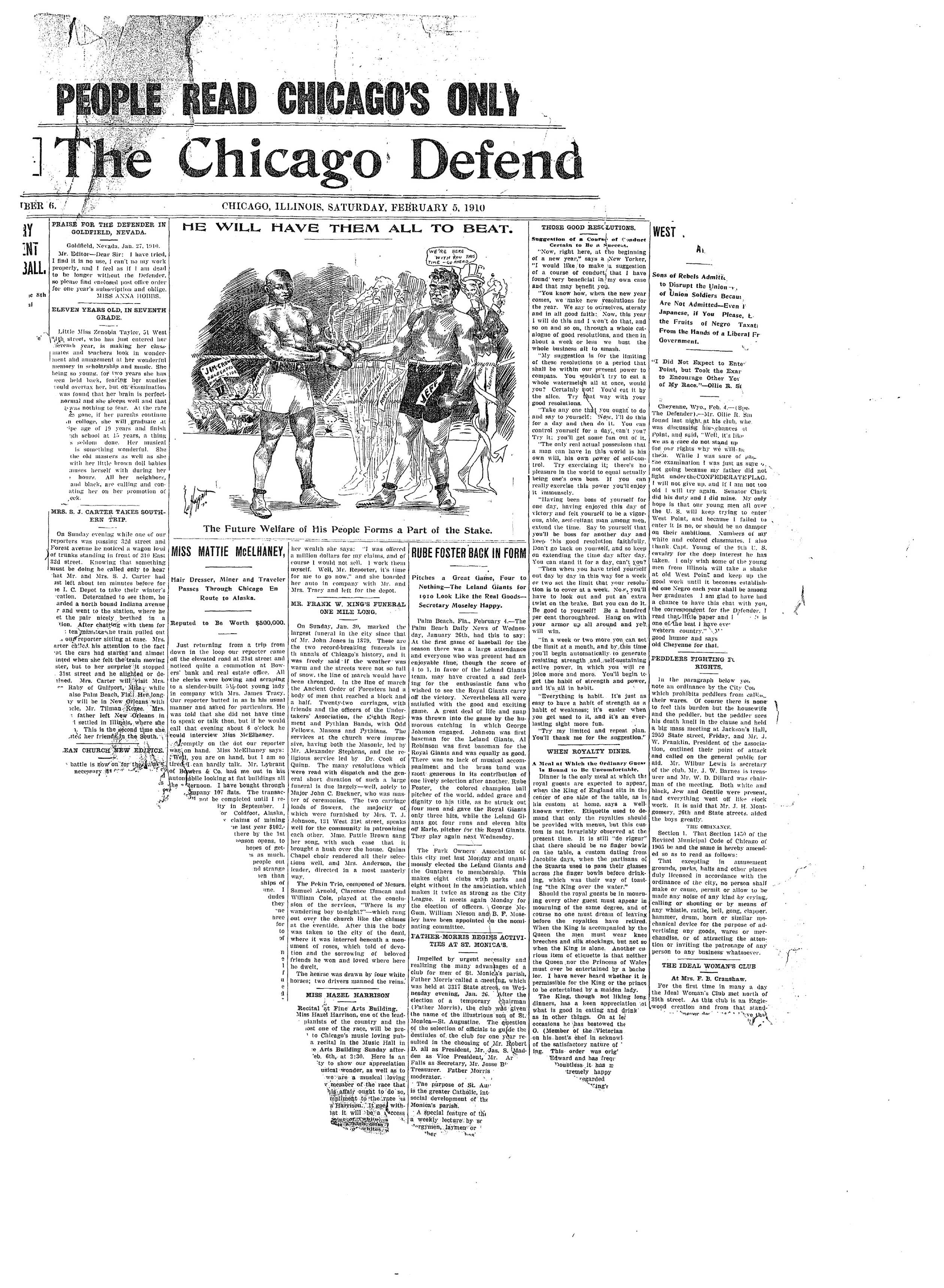
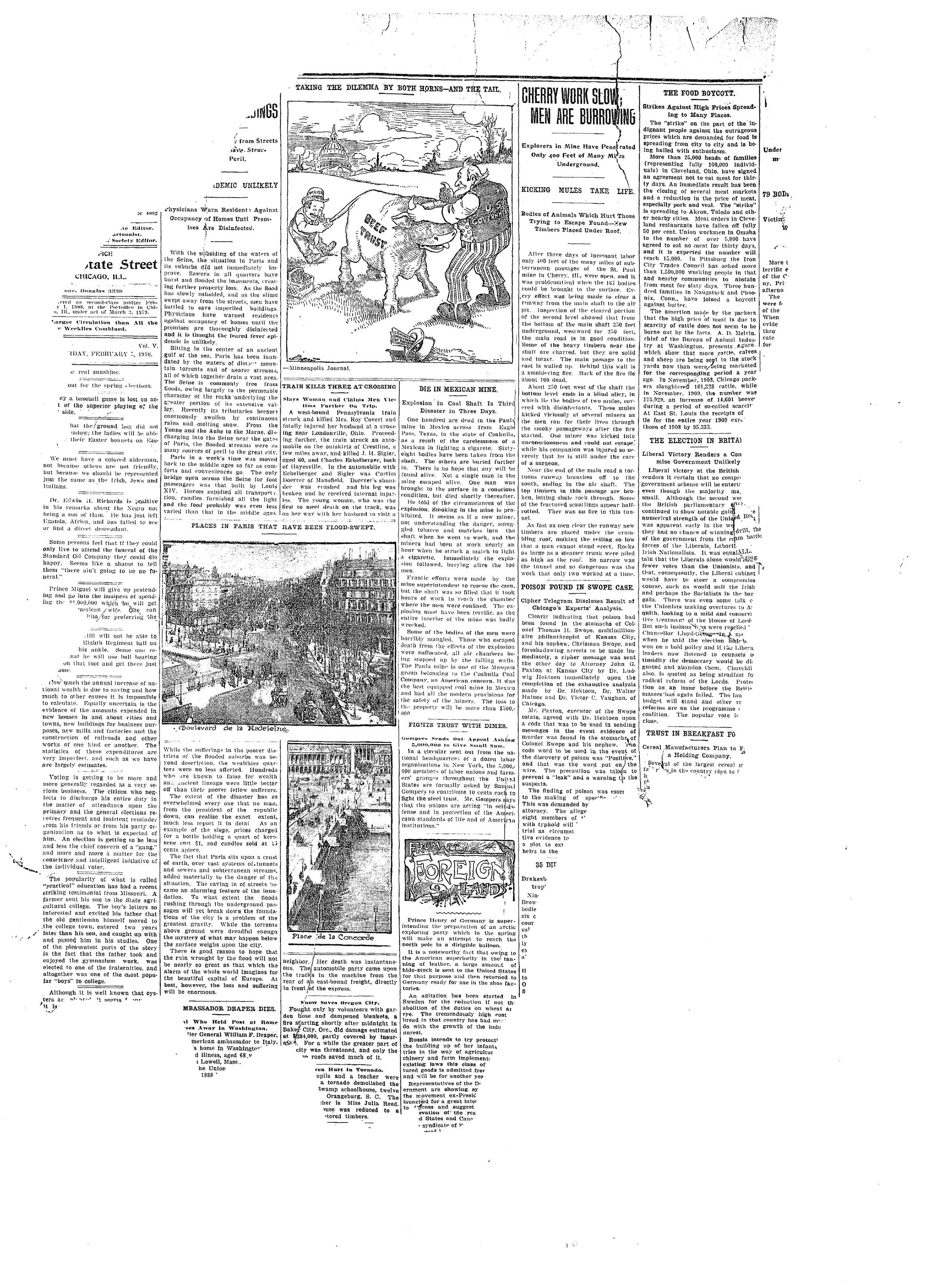
Page text (machine-generated)
PRAISE FOR THE DEFENDER IN GOLDFIELD, NEVADA.
Goldfield, Nevada, Jan. 27, 1910.
Mr. Editor—Dear Sir: I have tried, I find it is no use, I can't no my work properly, and I feel as if I am dead to be longer without the Defender, so please find enclosed post office order for one year's subscription and oblige.
MISS ANNA HOBBS.
ELEVEN YEARS OLD, IN SEVENTH GRADE.
Little Miss Zenobia Taylor, 51 West
pigh street, who has just entered her
fifth year, is making her classmates and teachers look in wonderment and amazement at her wonderful memory in scholarship and music. She being so young, for two years she has seen held back, fearing her studies would overtax her, but on examination was found that her brain is perfect-normal and she sleeps well and that was nothing to fear. At the rate gone, if her parents continue in college, she will graduate at the age of 19 years and finish high school at 15 years, a thing seldom done. Her musical is something wonderful. She the old masters as well as she with her little brown doll babies auses herself with during her hours. All her neighbors, and black, are calling and conating her on her promotion of eek.
MRS. S. J. CARTER TAKES SOUTH-ERN TRIP.
On Sunday evening while one of our reporters was passing 32d street and Forest avenue he noticed a wagon load of trunks standing in front of 310 East 32d street. Knowing that something must be doing he called only to hear that Mr. and Mrs. S. J. Carter had left about ten minutes before for the I. C. Depot to take their winter's location. Determined to see them, hearded a north bound Indiana avenue and went to the station, where he met the pair nicely berthed in a station. After chatting with them for ten minutes he train pulled out our reporter sitting at ease. Mrs. arter chilled his attention to the fact that the cars had started and almost intended when she felt the train moving ster, but to her surprise it stopped 31st street and he alighted or detined. Mrs. Carter will visit Mrs. Raby of Gulfport, Miss, while also Palm Beach, Fla. Her long stay will be in New Orleans with niece, Mr. Tilman Kezee. Mrs. father left New Orleans in settled in Illinois, where she. This is the second time she met her friends in the South.
Chicago Defend
WE'RE HERE
WITH YOU THIS
TIME - GO AHEAD
JIM CROW
DELEGATES
WING SIDE
THERE PAYMENT
PRICE HAIRS
PARDONICE
JEFF
PUBLIC
SECRETARY
The Future Welfare of His People Forms a Part of the Stake.
MISS MATTIE McELHANEY,
Hair Dresser, Miner and Traveler Passes Through Chicago En Route to Alaska.
Reputed to Be Worth $500,000.
Just returning from a trip from down in the loop our reporter came off the elevated road at 21st street and noticed quite a commotion at Bowers' bank and real estate office. All the clerks were bowing and scraping to a slender-built 5½-foot young lady in company with Mrs. James Tracy. Our reporter butted in as is his usual manner and asked for particulars. He was told that she did not have time to speak or talk then, but if he would call that evening about 6 o'clock he
her wealth she says: "I was offered a million dollars for my claims, and of course I would not sell. I work them myself. Well, Mr. Reporter, it's time for me to go now," and she boarded her auto in company with Mr. and Mrs. Tracy and left for the depot.
MR. FRANK W. KING'S FUNERAL ONE MILE LONG.
On Sunday, Jan. 30, marked the largest funeral in the city since that of Mr. John Jones in 1879. These are the two record-breaking funerals in annals of Chicago's history, and it was freely said if the weather was warm and the streets were not so full of snow, the line of march would have been thronged. In the line of march the Ancient Order of Foresters had a body of men that reached a block and a half. Twenty-two carriages, with friends and the officers of the Undertakers' Association, the Eighth Regiment and Pythian Bands, with Odd Fellows. Masons and Pythians. The services at the church were impressive, having both the Masonic, led by Mr. Alexander Stephens, and the religious service led by Dr. Cook of Quinn. The many resolutions which were read with dispatch and the general short duration of such a large funeral is due largely—well, solely to Major John C. Buckner, who was master of ceremonies. The two carriage loads of flowers, the majority of which were furnished by Mrs. T. J. Johnson, 131 West 31st street, speaks well for the community in patronizing each other. Mme. Pattie Brown sang her song, with such ease that it brought a hush over the house. Quinn Chapel choir rendered all their selections well, and Mrs. Anderson, the leader, directed in a most masterly way.
The Pekin Trio, composed of Messrs, Samuel Arnold, Clarence Duncan and William Cole, played at the conclusion of the services, "Where is my wandering boy to-night?"—which rang out over the church like the chimes at the eventide. After this the body was taken to the city of the dead, where it was interred beneath a monument of roses, which told of devotion and the sorrowing of beloved friends he won and loved where here he dwelt.
The hearse was drawn by four white horses; two drivers manned the reins.
MISS HAZEL HARRISON
Recital at Fine Arts Building. Miss Hazel Harrison, one of the lead pianists of the country and the most one of the race, will be pre- to Chicago's music loving pub- a recital in the Music Hall in the Arts Building Sunday after- eb. 6th, at 3:30. Here is an- tity to show our appreciation musical wonder, as well as to we are a musical loving v member of the race that his affair ought to do so, impliment to the race as s Harrison. It goes with- at it will be a success
RUBE FOSTER BACK IN FORM
Pitches a Great Game, Four to Nothing—The Leland Giants for 1910 Look Like the Real Goods Secretary Moseley Happy.
Palm Beach, Fla., February 4.—The Palm Beach Daily News of Wednesday, January 26th, had this to say: At the first game of baseball for the season there was a large attendance and everyone who was present had an enjoyable time, though the score of 4 to 1, in favor of the Leland Giants team, may have created a sad feeling for the enthusiastic fans who wished to see the Royal Giants carry off the victory. Nevertheless all were satisfied with the good and exciting game. A great deal of life and snap was thrown into the game by the humorous catching in which George Johnson engaged. Johnson was first baseman for the Leland Giants. Al Robinson was first baseman for the Royal Giants and was equally as good. There was no lack of musical accompaniment and the brass band was most generous in its contribution of one lively selection after another. Rube Foster, the colored champion ball pitcher of the world, added grace and dignity to his title, as he struck out four men and gave the Royal Giants only three hits, while the Leland Giants got four runs and eleven hits off Earle, pitcher for the Royal Giants. They play again next Wednesday.
The Park Owners' Association of this city met last Monday and unanimously elected the Lefland Giants and the Gunthers to membership. This makes eight clubs with parks and eight without in the association, which makes it twice as strong as the City League. It meets again Monday for the election of officers. George McGum, William Nieson and B. F. Moseley have been appointed on the nominating committee.
FATHER-MORRIS BEGINS ACTIVI
TIES AT ST. MONICA'S.
Impelled by urgent necessity and realizing the many advantages of a club for men of St. Monica's parish, Father Morris called a meeting, which was held at 3317 State street, on Wednesday evening, Jan. 26. After the election of a temporary chairman (Father Morris), the club was given the name of the illustrious son of St. Monica—St. Augustine. The question of the selection of officials to guide the destinies of the club for one year resulted in the choosing of Mr. Robert D. all as President, Mr. Jas. S. Madden as Vice President, Mr. Ar Falls as Secretary, Mr. Jesse B' Treasurer. Father Morris moderator.
THOSE GOOD RESOLUTIONS.
Suggestion of a Course of Conduct Certainly to Be a Success
Certain to Be a Success.
"Now, right here, at the beginning of a new year," says a New Yorker, "I would like to make a suggestion of a course of conduct, that I have found very beneficial in my own case and that may benefit you.
"You know how, when the new year comes, we make new resolutions for the year. We say to ourselves, sternly and in all good faith: Now, this year I will do this and I won't do that, and so on and so on, through a whole catalogue of good resolutions, and then in about a week or less we bust the whole business all to smash.
"My suggestion is for the limiting of these resolutions to a period that shall be within our present power to compass. You wouldn't try to eat a whole watermelon all at once, would you? Certainly not! You'd eat it by the slice. Try that way with your good resolutions.
"Take any one that you ought to do and say to yourself: Now, I'll do this for a day and then do it. You can control yourself for a day, can't you? Try it; you'll get some fun out of it.
"The only real actual possession that a man can have in this world is his own will, his own power of self-control. Try exercising it; there's no pleasure in the world to equal actually being one's own boss. If you can really exercise this power you'll enjoy it immensely.
"Having been boss of yourself for one day, having enjoyed this day of victory and felt yourself to be a vigorous, able, self-reliant man among men, extend the time. Say to yourself that you'll be boss for another day and keep this good resolution faithfully. Don't go back on yourself, and so keep on extending the time day after day. You can stand it for a day, can't you?
"Then when you have tried yourself out day by day in this way for a week or two set the limit that your resolution is to cover at a week. Now, you'll have to look out and put an extra twist on the brake. But you can do it. Be good to yourself. Be a hundred per cent thoroughbred. Hang on with your armor up all around and you will win."
"In a week or two more you can set the limit at a month, and by this time you'll begin automatically to generate resisting strength and self-sustaining active power, in which you will re joice more and more. You'll begin to get the habit of strength and power, and it's all in habit.
"Everything is habit. It's just as easy to have a habit of strength as a habit of weakness; it's easier when you get used to it, and it's an everlasting sight more fun.
"Try my limited and repeat plan. You'll thank me for the suggestion."
WHEN ROYALTY DINES.
A Meal at Which the Ordinary Guest Is Bound to Be Uncomfortable.
Dinner is the only meal at which the royal guests are expected to appear, when the King of England sits in the center of one side of the table, as is his custom at home, says a well-known writer. Etiquette used to demand that only the royalties should be provided with menus, but this custom is not invariably observed at the present time. It is still "de rigueur" that there should be no finger bowls on the table, a custom dating from Jacobite days, when the partisans of the Stuarts used to pass their glasses across the finger bowls before drinking, which was their way of toasting "the King over the water."
Should the royal guests be in mourning every other guest must appear in mourning of the same degree, and of course no one must dream of leaving before the royalties have retired. When the King is accompanied by the Queen the men must wear knee breeches and silk stockings, but not so when the King is alone. Another curious item of etiquette is that neither the Queen nor the Princess of Wales must ever be entertained by a bachelor. I have never heard whether it is permissible for the King or the princess to be entertained by a maiden lady.
The King, though not liking long dinners, has a keen appreciation of what is good in eating and drink as in other things. On at lef occasions he has bestowed the O. (Member of the Victorian on his host's chef in acknowled of the satisfactory nature of ing. This order was origi
Sons of Rebels Admitte to Disrupt the Union of Union Soldiers Because Are Not Admitted—Even If Japanese, if You Please, L the Fruits of Negro Taxation From the Hands of a Liberal Fr Government.
"I Did Not Expect to Enter Point, but Took the Exar to Encourage Other You of My Race."—Ollie R. Si
Cheyenne, Wyo., Feb. 4.—(Spe. The Defender).—Mr. Ollie R. Sm found last night, at his club, whe was discussing his chances at Point, and said, "Well, it's like we as a race do not stand up for our rights why we will not them. While I was sure of passe examination I was just as sure not going because my father did not fight under the CONFEDERATE FLAG. I will not give up, and if I am not too old I will try again. Senator Clark did his duty and I did mine. My only hope is that our young men all over the U. S. will keep trying to enter West Point, and because I failed to enter it is no, or should be no damper on their ambitions. Numbers of my white and colored classmates. I also thank Capt. Young of the 9th U. S. cavalry for the deep interest he has taken. I only wish some of the young men from Illinois will take a shake at old West Point and keep up the good work until it becomes established one Negro each year shall be among her graduates. I am glad to have had a chance to have this chat with you, the correspondent for the Defender. I read that little paper and I is one of the best I have ever western country." My good humor and says old Cheyenne for that.
PEDDLERS FIGHTING FOR RIGHTS.
In the paragraph below you note an ordinance by the City Council which prohibits peddlers from calling their wares. Of course there is none to feel this burden but the housewife and the peddler, but the peddler sees his death knell in the clause and held a big mass meeting at Jackson's Hall, 2959 State street, Friday, and Mr. J. W. Franklin, President of the association, outlined their point of attack and called on the general public for aid. Mr. Wilbur Lewis is secretary of the club. Mr. J. W. Barnes is treasurer and Mr. W. D. Dillard was chairman of the meeting. Both white and black, Jew and Gentile were present, and everything went off like clock work. It is said that Mr. J. H. Montgomery, 26th and State streets, aided the boys greatly.
THE ORDINANCE.
Section 1. That Section 1450 of the Revised Municipal Code of Chicago of 1905 be and the same is hereby amended so as to read as follows:
That excepting in amusement grounds, parks, halts and other places duly licensed in accordance with the ordinance of the city, no person shall make or cause, permit or allow to be made any noise of any kind by crying, calling or shouting or by means of any whistle, rattle, bell, gong, clapper, hammer, drum, horn or similar mechanical device for the purpose of advertising any goods, wares or merchandise, or of attracting the attention or inviting the patronage of any person to any business whatsoever.
THE IDEAL WOMAN'S CLUB
At Mrs. F. B. Cranshaw.
For the first time in many a day the Ideal Woman's Club met north of 39th street. As this club is an Englewood creation and from that stand-
certed as second-class matter February 1, 1808, at the Postoffice in Chicago, Ill., under act of March 3, 1879.
Larger Circulation than All the Weeklies Combined.
RDAY, FEBRUARY 5, 1910.
out for the spring elections.
by a baseball game is lost on ac-
t of the superior playing of the
side.
hat the ground hog did not
wadow; the ladies will be able
their Easter bonnets on Ease
---
We must have a colored alderman not because others are not friendly but because we should be represented just the same as the trish, Jews and Italians.
---
Dr. Elwin H. Richards is positive in his remarks about the Negro not being a son of Ham. He has just left Uganda, Africa, and has failed to see or find a direct descendant.
Some persons feel that if they could only live to attend the funeral of the Standard Oil Company they could die happy. Seems like a shame to tell them "there ain't going to be no funeral."
Prince Miguel will give up pretending and go into the business of spending the $1,000,000 which he will get american wife. One can him for preferring the
Hill will not be able to Eighth Regiment ball on his ankle. Some one re- hat he will use ball bearing on that foot and get there just one
---
How much the annual increase of national wealth is due to saving and how much to other causes it is impossible to calculate. Equally uncertain is the evidence of the amounts expended in new houses in and about cities and towns, new buildings for business purposes, new mills and factories and the construction of railroads and other works of one kind or another. The statistics of these expenditures are very imperfect, and such as we have are largely estimates.
Voting is getting to be more and more generally regarded as a very serious business. The citizen who neglects to discharge his entire duty in the matter of attendance upon the primary and the general elections receives frequent and insistent reminder from his friends or from his party organization as to what is expected of him. An election is getting to be less and less the chief concern of a "gang," and more and more a matter for the conscience and intelligent initiative of the individual voter.
---
The popularity of what is called "practical" education has had a recent striking testimonial from Missouri. A farmer sent his son to the State agricultural college. The boy's letters so interested and excited his father that the old gentleman himself moved to the college town, entered two years later than his son, and caught up with and passed him in his studies. One of the pleasantest parts of the story is the fact that the father took and enjoyed the gymnasium work, was elected to one of the fraternities, and altogether was one of the most popular "boys" in college.
Although it is well known that oysters are planted it seems it is
PLACES IN PARIS THAT HAVE BEEN FLOOD-SWEPT.
Toulouse, de la Madalene
from Streets
save. Struc
Peril.
DEMIC UNLIKELY
Physicians Warn Residents Against Occupancy of Homes Until Premises Are Disinfected.
With the subsiding of the waters of the Seine, the situation in Paris and its suburbs did not immediately improve. Sawers in all quarters have burst and flooded the basements, creating further property loss. As the flood has slowly subsided, and as the slime swept away from the streets, men have battled to save imperiled buildings. Physicians have warned residents against occupancy of homes until the premises are thoroughly disinfected and it is thought the feared fever epidemic is unlikely.
Sitting in the center of an ancient gulf of the sea, Paris has been inundated by the waters of distant mountain torrents and of nearer streams, all of which together drain a vast area. The Seine is commonly free from floods, owing largely to the permeable character of the rocks underlying the greater portion of its extensive valley. Recently its tributaries became enormously swollen by continuous rains and melting snow. From the Yonne and the Aube to the Marne, discharging into the Seine near the gates of Paris, the flooded streams were so many sources of peril to the great city
Paris in a week's time was moved back to the middle ages so far as comforts and conveniences go. The only bridge open across the Seine for foot passengers was that built by Louis XIV. Horses supplied all transportation, candles furnished all the light and the food probably was even less varied than that in the middle ages.
PLACES IN PARIS THAT
Doulevard de la Madeleir
While the sufferings in the poorer districts of the flooded suburbs was beyond description, the wealthier quarters were no less affected. Hundreds who are known to fame for wealth and ancient lineage were little better off than their poorer fellow sufferers. The extent of the disaster has so overwhelmed every one that no man, from the president of the republic down, can realize the exact extent, much less report it in detai. As an example of the siege, prices charged for a bottle holding a quart of kerosene cost $1, and candles sold at 15 cents apiece.
The fact that Paris sits upon a crust of earth, over vast systems of tunnels and sewers and subterranean streams, added materially to the danger of the situation. The caving in of streets became an alarming feature of the inundation. To what extent the floods rushing through the underground passages will yet break down the foundations of the city is a problem of the greatest gravity. While the torrents above ground were dreadful enough the mystery of what may happen below the surface weighs upon the city. There is good reason to hope that the rain wrought by the flood will not be nearly so great as that which the alarm of the whole world imagines for the beautiful capital of Europe. At best, however, the loss and suffering will be enormous.
MBASSADOR DRAPER DIES
d Who Held Post at Rome
ses Away in Washington.
ier General William F. Draper,
american ambassador to Italy,
's home in Washington
d illness, aged 68 v
i Lowell, Mass..
he Union
1888
```markdown
```
BEEF TRUST
U.S. GOVERNMENT
Minneapolis Journal.
TRAIN KILLS THREE AT CROSSING
Slays Woman and Citizens Men Victim
Hurt, Earlies on Truck
A west-bound Pennsylvania train struck and killed Mrs. Roy Covert and fatally injured her husband at a crossing near Londonville, Ohio. Proceeding further, the train struck an automobile on the outskirts of Crestline, a few miles away, and killed J. H. Sigler, aged 60, and Charles Echellberger, both of Hayville. In the automobile with Echellberger and Sigler was Curtiss Doerver of Mansfield. Doerver's shoulder was crushed and his leg was broken and he received internal injuries. The young woman, who was the first to meet death on the track, was on her way with her husband to visit a
HAVE BEEN FLOOD-SWEPT.
Place de la Concorde
neighbor. Her death was instantaneous. The automobile party came upon the tracks in the machine from the rear of an east-bound freight, directly in front of the express.
Snow Saxon Oregon City.
Fought only by volunteers with garden hose and dampened blankets, a fire starting shortly after midnight in Baker City. Ore., did damage estimated at $284,000, partly covered by insurance. For a while the greater part of city was threatened, and only the roofs saved much of it.
ren Hurt in Tornado.
pupils and a teacher were a tornado demolished the Swamp schoolhouse, twelve Orangeburg, S. C. The other is Miss Julia Reed. House was reduced to a lettered timbers.
---
DIE IN MEXICAN MINE.
Explosion in Coal Shaft is Third Disaster in Three Days.
One hundred are dead in the Pauli mine in Mexico across from Eagle Pass, Texas, in the state of Coahuila, as a result of the carelessness of a Mexican in lighting a cigarette. Sixty-eight bodies have been taken from the shaft. The others are buried further in. There is no hope that any will be found alive. Not a single man in the mine escaped alive. One man was brought to the surface in a conscious condition, but died shortly thereafter.
He told of the circumstances of the explosion. Smoking in the mine is prohibited. It seems as if a new miner, not understanding the danger, smuggled tobacco and matches into the shaft when he went to work, and the miners had been at work nearly an hour when he struck a match to light a cigarette. Immediately the explosion followed, burying alive the 100 men. Frantic efforts were made by the mine superintendent to rescue the men, but the shaft was so filled that it took hours of work to reach the chamber where the men were confined. The explosion must have been terrific, as the entire interior of the mine was badly wrecked.
Some of the bodies of the men were horribly mangled. Those who escaped death from the effects of the explosion were suffocated, all air chambers being stopped up by the falling walls. The Paula mine is one of the Musquiz group belonging to the Coahilla Coal Company, an American concern. It was the best equipped coal mine in Mexico and had all the modern provisions for the safety of the miners. The loss to the property will be more than $500,000.
FIGHTS TRUST WITH DIMES
Gompers Sends Out Appeal Asking
5,000,000 to Give Small Sums.
In a circular sent out from the national headquarters of a dozen labor organizations in New York, the 5,000,000 members of labor unions and farmers' granges throughout the United States are formally asked by Samuel Compers to contribute 10 cents each to fight the steel trust. Mr. Gompers says that the unions are acting "in self-defense and in protection of the American standards of life and of American institutions."
FROM THE
FOREIGN
LANDS
---
Prince Henry of Germany is superintending the preparation of an arctic exploring party which in the spring will make an attempt to reach the north pole in a dirigible balloon.
It is a noteworthy fact that owing to the American superiority in the tanning of leather, a large amount of hide-stock is sent to the United States for that purpose and then returned to Germany ready for use in the shoe factories.
An agitation has been started in Sweden for the reduction if not the abolition of the duties on wheat arrye. The tremendously high cost bread in that country has had my do with the growth of the indus unrest.
Russia intends to try protect the building up of her infant tries in the way of agricultur chinery and farm implement existing laws this class of tured goods is admitted free and will be for another yes Representatives of the Department are showing by the movement ex-Presidium launched for a great inter to discuss and suggest evation of the res United States and Canada syndicate of F
Bodies of Animals Which Hurt Those Trying to Escape Found—New Timbers Placed Under Roof
---
After three days of incessant labor only 400 feet of the many miles of subterranean passages of the St. Paul mine in Cherry, Ill., were open, and it was problematical when the 167 bodies could be brought to the surface. Every effort was being made to clear a runway from the main shaft to the air pit. Inspection of the cleared portion of the second level showed that from the bottom of the main shaft 350 feet underground, westward for 250 feet, the main road is in good condition. Some of the heavy timbers near the shaft are charred, but they are solid and intact. The main passage to the east is walled up. Behind this wall is a smoldering fire. Back of the fire lie about 100 dead.
About 250 feet west of the shaft the bottom level ends in a blind alley, in which lie the bodies of two mules, covered with disinfectants. These mules kicked viciously at several miners as the men ran for their lives through the smoky passageways after the fire started. One miner was kicked into unconsciousness and could not escape, while his companion was injured so severely that he is still under the care of a surgeon. Near the end of the main road a tortuous runway branches off to the south, ending in the air shaft. The top timbers in this passage are broken, letting shake rock through. Some of the fractured scantlings appear half-rotted. Ther was no fire in this tunnel.
As fast as men clear the runway new timbers are placed under the crumbling roof, making the ceiling so low that a man cannot stand erect. Rocks as large as a steamer trunk were piled as high as the roof. So narrow was the tunnel and so dangerous was the work that only two worked at a time.
POISON FOUND IN SWOPE CASE.
Cipher Telegram Discloses Result of Chicago's Experts' Analysis. Clearly indicating that poison had been found in the stomachs of Colonel Thomas H. Swope, multimillionaire philanthropist of Kansas City, and his nephew, Chrisman Swope, and foreshadowing arrests to be made immediately, a cipher message was sent the other day to Attorney John G. Paxton at Kansas City by Dr. Ludwig Hektoen immediately upon the completion of the exhaustive analysis made by Dr. Hektoen, Dr. Walter Haines and Dr. Victor C. Vaughan, of Chicago.
Mr. Paston, executor of the Swope estate, agreed with Dr. Hektoen upon a code that was to be used in sending messages in the event evidence of murder was found in the stomachs of Colonel Swope and his nephew. The code word to be used in the event of the discovery of poison was "Positive," and that was the word put on the wire. The precaution was taken to prevent a "leak" and a warning to the suspects.
The finding of poison was esser to the making of specific This was demanded by attorney. The allege eight members of with typhoid will trial as circumstive evidence to a plot to ext heirs to the
35 D17
Drakesb
trop'
Nin
Drow
bodie
six c
cour
sul
th
ly
ex
a'
tl
to
O
fl
THE FOOD BOYCOTT.
Strikes Against High Prices Spreading to Many Places.
The "strike" on the part of the indignant people against the outrageous prices which are demanded for food is spreading from city to city and is being hailed with enthusiasm.
More than 25,000 heads of families (representing fully 100,000 individuals) in Cleveland, Ohio, have signed an agreement not to eat meat for thirty days. An immediate result has been the closing of several meat markets and a reduction in the price of meat, especially pork and veal. The "strike" is spreading to Akron, Toledo and other nearby cities. Meat orders in Cleveland restaurants have fallen off fully 50 per cent. Union workmen in Omaha to the number of over 5,000 have agreed to eat no meat for thirty days, and it is expected the number will reach 15,000. In Pittsburgh the Iron City Trades Council has asked more than 1,500,000 working people in that and nearby communities to abstain from meat for thirty days. Three hundred families in Naugatuck and Phoenix, Conn., have joined a boycott against butter.
More t
terrific e
of the C
ny. Pri
afterno
The
were f
of the
When
evide
thro
cate
for
The assertion made by the packers that the high price of meat is due to scarcity of cattle does not seem to be borne out by the facts. A. D. Melvin, chief of the Bureau of Animal Industry at Washington, presents figures which show that more cattle, calves and sheep are being sent to the stock yards now than were being marketed for the corresponding period a year ago. In November, 1908, Chicago packers slaughtered 161,328 cattle, while in November, 1909, the number was 175,929, an increase of 14,601 beeeve during a period of so-called scarcity At East St. Louis the receipts of tle for the entire year 1909 exce those of 1908 by 95,333.
THE ELECTION IN BRITAL
Liberal Victory Renders a Con
mise Government Unlikely
Liberal victory at the British renders it certain that no compro-
gement scheme will be entertained even though the majority ma-
small. Although the second wee the British parliamentary office continued to show notable gains the numerical strength of the Unionist Brot was apparent early in the week they had no chance of winning drill, the of the government from the coam battle forces of the Liberals, Laborist, Irish Nationalists. It was equal. ILLain that the Liberals alone would taking fewer votes than the Unionists, and that, consequently, the Liberal cabinet would have to steer a compromise course, such as would suit the Irish and perhaps the Socialists in the bar gain. There was even some talk of the Unionists making overtures to A. Quith, looking to a mild and conservative treatment of the House of Lord-But such insinuations were repelled Chancellor Lloyd-George in a speech when he said the election had been on a bold policy and if the Libera leaders now listened to counsels o timidity the democracy would be disgusted and abandon them. Churchill also is quoted as being steadfast for radical reform of the Lords. Protection as an issue before the British masses has again failed. The land budget will stand and other reforms are on the programme coalition. The popular vote is close.
TRUST IN BREAKFAST FO
Cereal Manufacturers Plan to E a Holding Company. Several of the largest cereal m in the country plan to f h