Chicago Defender
Saturday, April 2, 1910
Chicago, Illinois
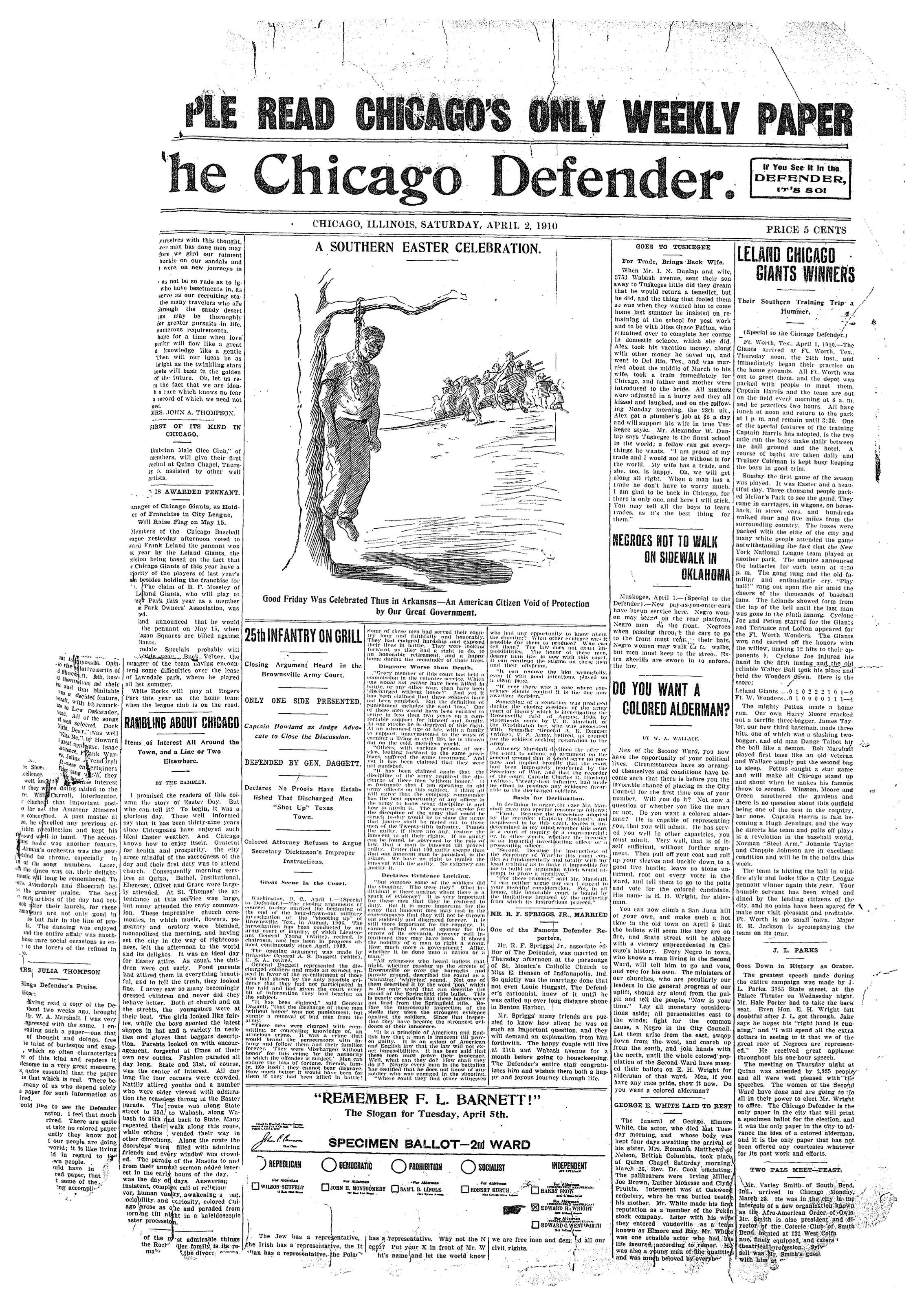
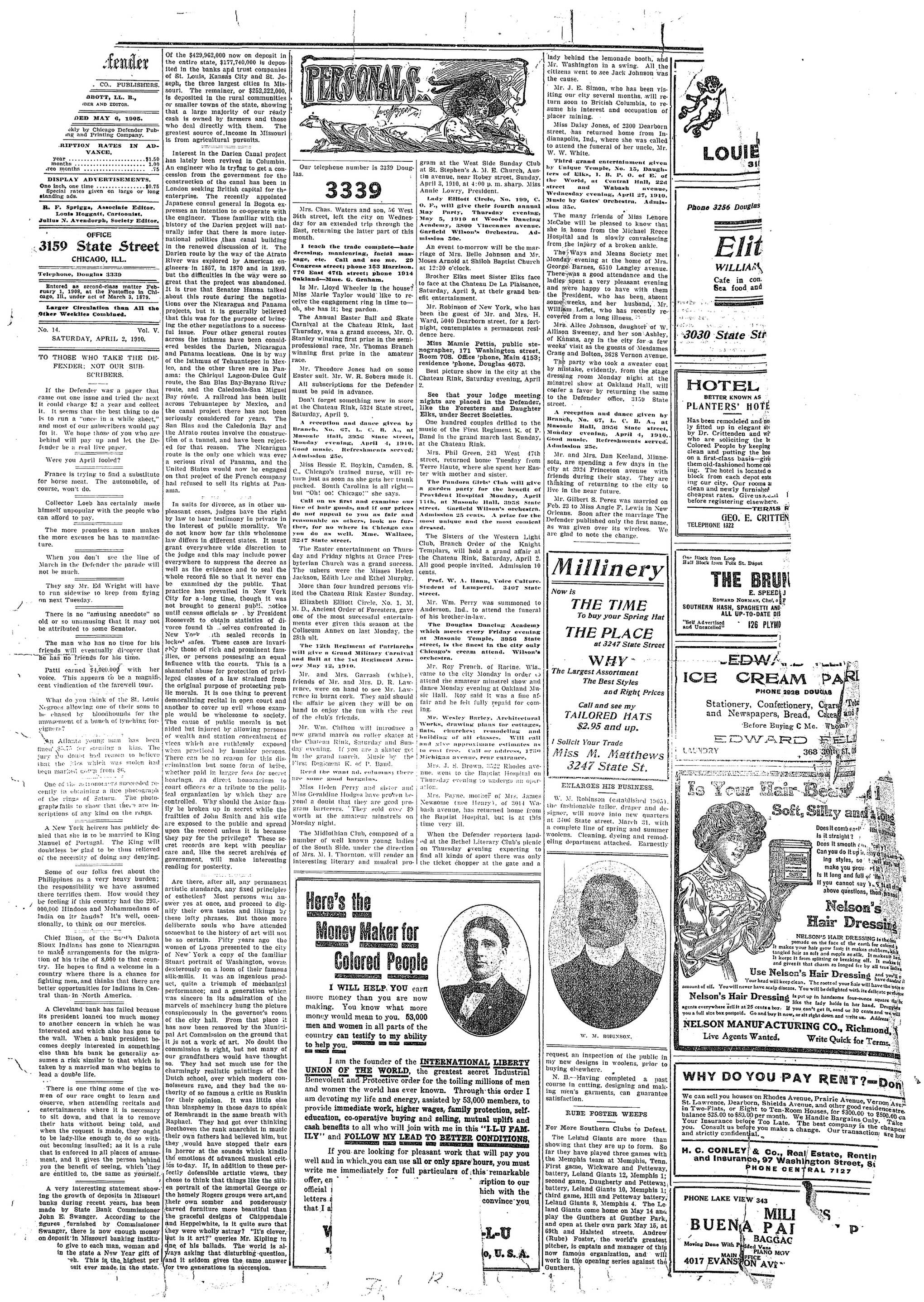
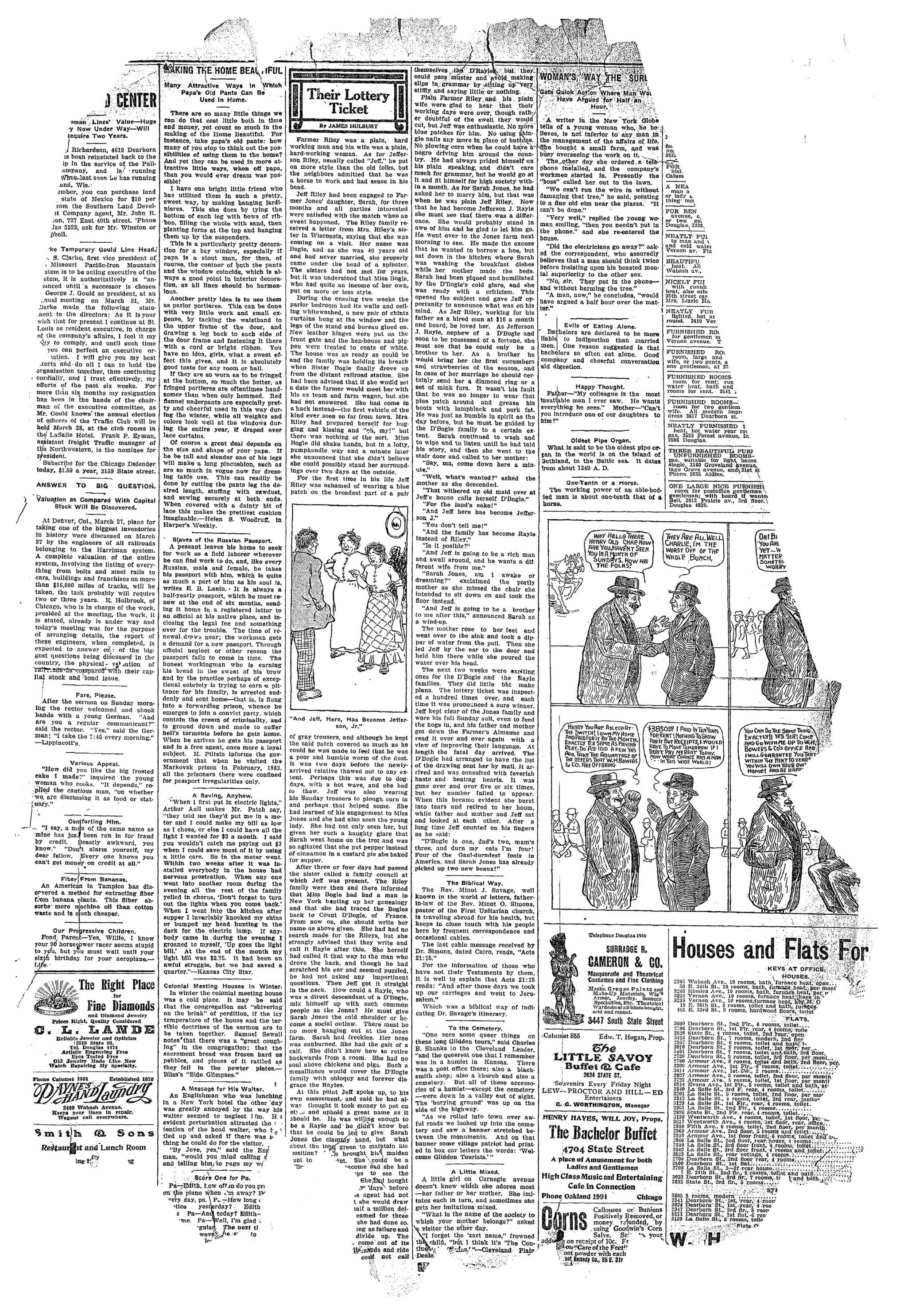
Page text (machine-generated)
that is impossible. Opin-
to the relative merits of
d Shoeemft. Bath, how-
themselves and their
irs and that imimitable
was a decided feature,
beltraft, with his remark-
to Lew Dockstader,
pond. All of the songs
it well selected. Dock
Night, Dear," was well
"Kiss Me," by Howard
I great applause. Isaac
Awrence, Frank War-
es, Julius Vendphil
it were entertainers
They saw me.
be expected any previous eithin recollection and kept his Brown well in hand. The accounting made was another feature. Arman's orchestra was the power behind the throne, especially in the of the song numbers. Later, on the dance was on, their delightful music will long be remembered. Towers. Avendorth and Shoecraft be the greater praise. The best core artists of the day had betooks after their hauels, for these amateurs are not only good inss but fair in the line of prols. The dancing was enjoyed and the entire affair was another rare social occasions so enu to the lovers of the refined inss.
IRS: JULIA THOMPSON
Sings Defender's Praise.
liter:
Riving read a copy of the Debout two weeks ago, brought Mr. W. A. Marshall. I was very impressed with the same. I eneading such a paper—one that of thought and doings, free the taint of burlesque and exaggeration, which so often characterizes of this kind and repders it lesome in a very great measure, is quite essential that the paper is that which is real. There be many of us who depend solely on paper for such information asired.
would like to see the Defender inston. I feel that much rived. There are quite it take no colored paper ently they know not if our people are doing world; it is like living id in regard to the own people. could have in red paper, that it some of the ing accompli-
he Chicago Defender.
pursures with this thought, ever man has done men may fore we gird our raiment buckle on our sandals and it were, on new journeys in us not be so rude as to ig- who have besetments in, as serve as our recruiting staithe many travelers who are through the sandy desert igs may be thoroughly for greater pursuits in life, numerous requirements. hope for a time when love' perity will flow like a great d knowledge like a gentle Then will our ideas be as bright as the twinkling stars souls will bask in the golden of the future. Oh, let us re'm the fact that we are idenh a race which knows no fear a record of which we need not need.
MRS. JOHN A. THOMPSON.
FIRST OF ITS KIND IN
CHICAGO.
Umbrian Male Glee Club," of
members, will give their first
recital at Quinn Chapel, Thursday
5, assisted by other well
artists.
Members of the Chicago Baseball league yesterday afternoon voted to ward Frank Leland the pennant won at year by the Leland Giants, thecision being based on the fact that Chicago Giants of this year have a majority of the players of last year'sun besides holding the franchise for
the claim of B. F. Moseley of Lland Giants, who will play at Park this year as a member of Park Owners' Association, was ted. land announced that he would the pennant on May 15, when Logan Squares are billed against Giants. rudale Specials probably will Ville year. Buck Veluer. the manager of the team having encountered some difficulties over the lease of Lawndale park, where he played all last summer. White Rocks will play at Rogers Park this year as the home team when the league club is on the road.
RAMBLING ABOUT CHICAGO
Items of Interest All Around the Town, and a Line or Two
BY THE EASIBLER.
I promised the readers of this column the story of Easter Day. But who can tell it? To begin, it was a glorious day. Those well informed say that it has been thirty-nine years since Chicagoans have enjoyed such ideal Easter weather. And Chicago knows how to enjoy itself. Grateful for health and prosperity, the city arose mindful of the sacredness of the day and their first duty was to attend church. Consequently morning services at Quinn, Bethel, Institutional, Ebenezer, Olivet and Grace were largely attended. At St. Thomas' the attendance at this service was large, but many attended the early communion. These impressive church ceremonies, in which music, flowers, pageantry and oratory were blended, monopolized the morning, and having set the city in the way of righteousness, left the afternoon to the world and its delights. It was an ideal day for Easter attire. As usual, the children were out early. Fond parents had attired them in everything beautiful, and to tell the truth, they looked fine. I never saw so many becomingly dressed children and never did they behave better. Both at church and on the streets, the youngsters were at their best. The girls looked like fairies, while the boys sported the latest shapes in hat and a variety in neckties and gloves that beggars description. Parents looked on with encouragement, forgetful at times of their own new outfits. Fashion paraded all day long. State and 31st, of course, was the center of interest. All day long the four corners were crowded. Nattily attired youths and a number who were older viewed with admiration the ceaseless throng in the Easter parade. The route was along State street to 33d, to Wabash, along Wabash to 35th and back to State. Many repeated their walk along this route, while others wended their way in other directions. Along the route the doorsteps were filled with admiring friends and every window was crowded. The parade of the Masons to and from their annual sermon added interest in the early hours of the day. was the day of days. Answering insistent, complex call of religious vor, human vanity, awakening a sage, sociability and curiosity, colored Chicago arose as one and paraded from morning till night in a kaleldoscopicaster procession.
CHICAGO, ILLINOIS, SATURDAY, APRIL 2, 1910
A SOUTHERN EASTER CELEBRATION.
Good Friday Was Celebrated Thus in Arkansas-An American Citizen Void of Protection by Our Great Government.
"REMEMBER F. L. BARNETT!"
The Slogan for Tuesday, April 5th.
SPECIMEN BALLOT—2nd WARD
REPUBLICAN
For Alderman
WILSON SHUFELT
134 East 2nd Street
DEMOCRATIC
For Alderman
JOHN H. MONTGOMERY
177 East 2nd Street
PROHIBITION
For Alderman
SAML B. LINGLE
1144 East Avenue
SOCIALIST
For Alderman
ROBERT KURTH
1923 Central Grove Avenue
INDEPENDENT
For Alderman
HARRY SHOW
200 East 2nd Street
EDWARD H. WRIGHT
200 East 2nd Street
EDWARD C. WENTWORTH
200 East 2nd Street
The Jew has a representative, the Irish has a representative, the Italians has a representative, the Poles have a representative. Why not the NEGRO? Put your X in front of Mr. Wht's name and let the world know we are free men and demand all our civil rights.
Great Scene in the Court.
Washington, D. C., April 1.—(Special to the Times)—The closing arguments of counsel for the death of the long-drawn-out military investigation of the "shooting up" of Brownville, Tex., in August, 1906. The investigation has been conducted by an army court of inquiry of which Lieutenant General Young (white), retired, is chairman, and has been in progress almost continuously since April, 1900.
The opening argument was made by Bridgerton A. S. Daggett (white), C. S. A., retired.
General Daggett represented the discharged soldiers and made an earnest appeal in favor of the re-enlistment of those who had been held in only possible evidence that they had not been the raid and had given the court every bit of information they had bearing on the subject.
"It has been eliminated," said General Daggett, "that the discharge of these men without honor was not punishment, but simply a removal of bad men from the army."
"These men were charged with committing, or concealing knowledge of, an atrocious crime. It was a crime that would brand the perpetrators with impunity and then their families forever. They were not given honor for this crime 'by the authority to which the offender is subject.' Men can endure the loss of fortune, friends, family, and cannot bear disgrace. How much better it can be if they if they had been killed in battle."
Some of these men had served their country long and faithfully and honorably. They had endured hardship and exposed their lives in battle. They were looking for a right to do so, an honorable retirement, and to home during the remainder of their lives.
Disgrace Worse than Death.
"Every member of this court has held a commission in the volunteer service. Which one would not rather have been killed in the air, or any other way, than have been disliked by the people. This has been claimed that these soldiers have not been punished. But the definition of punishment includes the word 'loss.' One of these would have been entitled to retaliation in less severe ways, for a fortable support for himself and family. At one stroke he is deprived of this right. An advanced age of life, with a family of four, would have been ways of earning a living in civil life he is thrown out on the cold, merciless world."
"Others, with various periods of service, looking forward to the same privileges offered the same treatment." And yet it has been claimed that they were not punished.
"It has been claimed again that the discipline of the army required the discharge of these men "without honor." It must be speaking to old army officers of this sub-unit, and will agree that the company commander has the best opportunity of any officer in the army to know what discipline is and what it is, the greatest stroke for the discipline of the army, the strictest to-day would be to show the army that justice shall be moted out to these men of the Twenty-fifth Infantry. Punish those who are any, restore the innocent to all their rights, can be found, he governed by the rule of law, that a man is innocent till proved guilty. Better that 100 guilty escape than that one innocent man be punished, is the innocent with have no right to punish the innocent with the guilty. No exigency can justify it.
Declares Evidence Lacking.
"But suppose some of the soldiers did the shooting. Who were they? What individual is there against whom there is a spark of evidence? It is very important for those men that they be restored to duty is not the army that innocent men may test in the consciousness that they will not be thrown out suddenly and disgraced forever. It is still more important for the country. It cannot afford to stand sponsor for the enemy, but it is the army that intentioned they may have been. It shows the nobility of a man to right a wrong. How much more a government! Allice, whether he be done unto a nation or a man.
"All witnesses who heard bullets that night, whether passing up the streets of Brownsville or over the barracks and parade ground, described the sound as a whizzing, 'whirring' sound. Not one of the soldiers who can describe the sound is the only word that can describe the sound of the Springfield rifle bullet. This is nearly conclusive that these bullets were not fired from the Springfield rifle. Before the microscopic inspection of the soldiers, they can be against the soldiers. Since that inspection they have become the strongest evidence of their innocence.
"It is a principle of American and English law that a man is innocent till proven guilty. It is an axiom of American law that the law acts impossibilities. It has been said that these men must prove their innocence. Well, what can they do? How shall they do? Nearly every man in the battalion has testified that he does not know of any wrongdoing. Where could they find other witnesses."
MBER F. L. BAR
Slogan for Tuesday, April
IMEN BALLOT-2nd
who had any opportunity to know about the shooting? What other evidence was it possible for them to produce? Who can be held responsible for the exact possibilities. The honor of the dearer than life is now with this court. It can continue the stigma on these men and their offspring.
"It can remove the blot wrongly, even if it good intentions, placed on a clean page.
"If ever there was a case where conscience should control it is the one now awaiting decision."
Something of a sensation was produced during the closing sessions of the army court, which is investigating the Brownsville rail station statements made by U. B. Marshall, of the Washington bar, who was associated with brigadier general A. R. Daggatt w. O. C. S. Army, retired, as counsel for the soldiers seeking restoration to the army.
Attorney Marshall declined the offer of the court to submit an argument on the facts of the shooting, serve no purpose and implied broadly that he had been improperly instructed by the Secretary of War, and that the recorder of the court, Captain Charles H. Howard and the judge, Captain James H. made no effort to produce any evidence favorable to the charged soldiers.
Basis for Declination.
In declining to argue, the case Mr. Marshall gave two specific reasons as follows: First. Because the procedure adopted by the court is not required and nonobstructed in by this court, leaves it determined in my mind whether this court is a court of inquiry or a court-martial. In other words, whether the record is in other words, whether the investigating office or a prosecuting office.
"For these reasons," said Mr. Marshall,
"I can neither argue nor can I appeal to your merciful consideration. For, in all honor, this honorable court is bound by the limitations imposed by the authority from which its instructions proceed."
MR. R. F. SPRIGGS, JR., MARRIED
One of the Famous Defender Reporters
Mr. R. F. Spriggs Jr., associate editor of The Defender, was married on Thursday afternoon at the parsonage of St. Monica's Catholic Church to Miss E. Hensen of Indianapolis, Ind. So quietly was the marriage done that not even Louie Huggatt. The Defender's cartoonist, knew of it until he was called up over long distance phone in Benton Harbor.
Mr. Spriggs' many friends are puzzled to know how silent he was on such an important question, and they will demand an explanation from him forthwith. The happy couple will live at 37th and Wabash avenue for a month before going to housekeeping. The Defender's entire staff congratulates him and wishes them both a happy and joyous journey through life.
GOES TO TUSKEGEE
For Trade, Brings Back Wife.
When Mr. I. N. Dunlap and wife, 2753 Wabash avenue, sent their son away to Tuskegee little did they dream that he would return a benedict, but he did, and the thing that fooled them so was when they wanted him to come home last summer he insisted on remaining at the school for post work and to be with Miss Grace Patton, who remained over to complete her course in domestic science, which she did. Alex took his vacation money, along with other money he saved up, and went to Del Rio, Tex., and was married about the middle of March to his wife, took a train immediately for Chicago, and father and mother were introduced to the bride. All matters were adjusted in a hurry and they all kissed and laughed, and on the following Monday morning, the 28th ult., Alex got a plummer's job at $5 a day and will support his wife in true Tuskegee style. Mr. Alexander W. Dunlap says Tuskegee is the finest school in the world; a fellow can get everything he wants. "I am proud of my trade and I would not be without it for the world. My wife has a trade, and she, too, is happy. Oh, we will get along all right. When a man has a trade he don't have to worry much. I am glad to be back in Chicago, for there is only one, and here I will stick. You may tell all the boys to learn trades, as it's the best thing for them."
NEGROES NOT TO WALK ON SIDEWALK IN OKLAHOMA
Muskogee, April 1—(Special to the Defender).—New pay-as-yon-enter cars have begun service here. Negro women may stand on the rear platform, Negro men du the front. Negroes when passing through the cars to go to the front must refire; their hats, Negro women may walk cu tn, walks, but men must keep to the street. Extra sheriffs are sworn in to enforce the law.
DO YOU WANT A COLORED ALDERMAN?
Men of the Second Ward, you now have the opportunity of your political lives. Circumstances have so arranged themselves and conditions have become such that there is before you the favorable chance of placing in the City Council for the first time one of your number. Will you do it? Not now a question of whether you like the man or not. Do you want a colored alderman? He is capable of representing you, that you will admit. He has served you well in other capacities, you must admit. Very well, that is of itself sufficient, without further argument. Then pull off your coat and roll up your sleeves and buckle down to a good live hustle; leave no stone unturned, root out every voter in the ward, and tell them to go to the polls and vote for the colored candidate. His name is E. H. Wright, for alderman.
You can now climb a San Juan hill of your own, and make such a hot time in the old town on April 5 that the ballots will seem like they are on fire, and State street will be ablaze with a victory unprecedented in Chicago's history. Every Negro in town, who knows a man living in the Second Ward, will tell him to go and vote, and vote for his own. The ministers of our churches, who are peculiarly our leaders in the general progress of our uplift, should cry aloud from the pulpit and tell the people, "Now is your time." Lay all monetary considerations aside; all personalities cast to the winds; fight for the common cause, a Negro in the City Council. Let them arise from the east, swop down from the west, and march up from the south, and join hands with the north, until the whole colored population of the Second Ward have massed their ballots on E. H. Wright for alderman of that ward. Men, if you have any race pride, show it now. Do you want a colored alderman?
GEORGE E. WHITE LAID TO REST
The funeral of George, Elmore White, the actor, who died last Tuesday morning, and whose body was kept four days awaiting the arrival of his sister, Mrs. Romanfa Matthews of Nelson, British Columbia, took place at Quinn Chapel Saturday morning, March 26. Rev. Dr. Cook officiating. The pallbearers were Irving Miller, Joe Brown, Luther Monesse and Clyde Pruitt. Interment was at Oakwood cemetery, whore he was buried beside his mother. Mr. White made his first reputation as a member of the Pekin stock company. Later with his wife they entered vaudeville as a team known as Elmore and Ray. Mr. White was one sensible actor who had his life insured, according to rumor. He was also a young man of fine qualities and was much beloved by everyone.
If You See It in the DEFENDER, it's so!
PRICE 5 CENTS
LELAND CHICAGO
GIANTS WINNERS
Ft. Worth, Tex., April 1, 1919.—The Giants arrived at Ft. Worth, Tex., Thursday noon, the 24th inst., and immediately began their practice on the home grounds. All Ft. Worth was out to greet them, and the depot was packed with people to meet them. Captain Harris and the team are out on the field every morning at 8 a. m. and he practices two hours. All have lunch at noon and return to the park at 1 p. m. and remain until 3:30. One of the special features of the training Captain Harris has adopted, is the two mile run the boys make daily between the ball ground and the hotel. A course of baths are taken daily and Trainer Colleman is kept busy keeping the boys in good trim.
Sunday the first game of the season was played. It was Easter and a beautiful day. Three thousand people packed McGar's Park to see the game. They came in carriages, in wagons, on horseback in street cars, and hundreds walked four and five miles from the surrounding country. The boxes were packed with the elite of the city and many white people attended the game notwithstanding the fact that the New York National League team played at another park. The umpire announced the batteries for each team at 3:30 p.m. The gong rang and the old familiar and enthusiastic cry. "Play ball!" rang out upon the air amid the cheers of the thousands of baseball fans. The Lelands showed form from the tap of the bell until the last man was gone in the ninth inning. Cyclone Joe and Pettus starred for the Giants and Terrance and Lofton appeared for the Ft. Worth Wonders. The Giants won and carried off the honors with the willow, making 12 hits to their opponents 9. Cyclone Joe injured his hand in the fifth inning and the old reliable Walter Ball took his place and held the Wonders down. Here is the score:
Leland Giants ... 0 1 0 2 2 2 1 0 1 - 9
Ft. W. Wonders... 0 1 0 0 0 0 1 1 1 - 4
The mighty Pettus made a home run. Our own Harry Moore cracked out a terrific three-bagger. James Taylor, our new third baseman, made three hits, one of which was a slashing two-bagger, and old man Dange Talbot hit the ball like a demon. Bob Marshall played first base like an old veteran and Wallace simply put the second bag to sleep. Pettus caught a star game and will make all Chicago stand up and shout when he makes his famous throw to second. Winston, Moore and Green smothered the gardens and there is no question about this outfield being one of the best in the country, bar none. Captain Harris is fast becoming a Hugh Jennings, and the way he directs his team and pulls off plays is a revelation in the baseball world. Norman "Steel Arm," Johnnie Taylor and Chappie Johnson are in excellent condition and will be in the polfts this week.
The team is hitting the ball in wildfire style and looks like a City League pennant winner again this year. Your humble servant has been wined and dined by the leading citizens of the city, and no pains have been spared to make our visit pleasant and profitable. Ft. Worth is no small town. Major R. R. Jackson is accompanying the team on its tour.
J. L. PARKS
The greatest speech made during the entire campaign was made by J. L. Parks, 3155 State street, at the Palace Theater on Wednesday night. Mr. Hale Porter had to take the back seat. Even Hon. E. H. Wright felt doubtful after J. L. got through. Jake says he hopes his "right hand is cunning," and "I will spend all the extra dollars in seeing to it that we of the great race of Negroes are represented." He received great applause throughout his one-hour speech.
The meeting on Thursday night at Quinn was attended by 2,885 people and all were well pleased with the speeches. The women of the Second Ward have done and are going to do all in their power to elect Mr. Wright to office. The Chicago Defender is the only paper in the city that will print a specimen ballot for the election, and it was the only paper in the city to advance the idea of a colored alderman, and it is the only paper that has not been offered any courtesies whatever for its past work and efforts.
TWO PALS MEET-FEAST.
Mr. Varley Smith of South Bend, Ind., arrived in Chicago Monday, March 28. He was in the city in the interests of a new organization known as the Afro-American Order of Owls. Mr. Smith is also president and director of the Coterie Club of South Bend, located at 121 West Colfman, finely equipped, and caters theatrical profession. Syllsell was Mr. Smith's guest with him at
year $1.50
months 1.00
tree months .75
DISPLAY ADVERTISEMENTS.
One inch, one time $0.75
Special rates given on large or long
standing ads.
R. F. Spriggs, Associate Editor.
Louis Hoggatt, Curioist.
Julius N. Avendorph, Society Editor.
OFFICE
3159 State Street
CHICAGO, ILL.
Telephone, Douglas 3339
Entered as second-class matter February 1, 1908, at the Postoffice in Chicago, Ill., under act of March 3, 1879.
Larger Circulation than All the Other Weeklies Combined.
No. 14. Vol. V.
SATURDAY, APRIL 2, 1910.
TO THOSE WHO TAKE THE DEFENDER; NOT OUR SUBSCRIBERS.
If the Defender was a paper that came out one issue and tried the next it could charge $2 a year and collect it. It seems that the best thing to do is to run a "once in a while sheet," and most of our subscribers would pay for it. We hope those of you who are behind will pay up and let the Defender be a real live paper.
Were you April fooled?
France is trying to find a substitute for horse meat. The automobile, of course, won't do.
Collector Loeb has certainly made himself unpopular with the people who can afford to pay.
The more promises a man makes the more excuses he has to manufacture.
When you don't see the line of March in the Defender the parade will not be much.
They say Mr. Ed Wright will have to run sidewise to keep from flying on next Tuesday.
There is no "amusing anecdote" so old or so unamusing that it may not be attributed to some Senator.
The man who has no time for his friends will eventually discover that he has no friends for his time.
Patti earned $4,000,000 with her voice. This appears to be a magnificent vindication of the farewell tour.
What do you think of the St. Louis Negroes allowing one of their sons to be chased by bloodhounds for the amusement of a bunch of tyrning foreigners?
An Atlanta young man has been fined $5.75 for stealing a kiss. The jury do not doubt had reason to believe that the kiss which was stolen had been marked from $6.
One of the astronauts succeeded recently in obtaining a fine photograph of the rings of Saturn. The photograph fails to show that there are inscriptions of any kind on the rings.
A New York heiress has publicly denied that she is to be married to King Manuel of Portugal. The King will doubtless be glad to be thus relieved of the necessity of doing any denying.
Some of our folks fret about the Philippines as a very heavy burden; the responsibility we have assumed there terrifies them. How would they be feeling if this country had the 293,000,000 Hindos and Mohammedans of India on its hands? It's well, occasionally, to think on our mercies.
Chief Bison, of the South Dakota Sioux Indians has gone to Nicaragua to make arrangements for the migration of his tribe of 8,000 to that country. He hopes to find a welcome in a country where there is a chance for fighting men, and thinks that there are better opportunities for Indians in Central than in North America.
A Cleveland bank has failed because its president loaned too much money to another concern in which he was interested and which also has gone to the wall. When a bank president becomes deeply interested in something else than his bank he generally assumes a risk similar to that which is taken by a married man who begins to lead a double life.
There is one thing some of the women of our race ought to learn and observe, when attending recitals and entertainments where it is necessary to sit down, and that is to remove their hats without being told, and when the request is made, they ought to be lady-like enough to do without becoming insulted; as it is a rule that is enforced in all places of amusement, and it gives the person behind you the benefit of seeing, which they are entitled to, the same as yourself.
A very interesting statement showing the growth of deposits in Missouri banks during recent years, has been made by State Bank Commissioner John E. Swanger. According to the figures furnished by Commissioner Swanger, there is now enough money on deposit in Missouri banking institu- to give to each man, woman and in the state a New Year gift of yeh. This is the highest per osit ever made, in the state.
Of the $429,962,000 now on deposit in the entire state, $177,740,000 is deposited in the banks and trust companies of St. Louis, Kansas City and St. Joseph, the three largest cities in Missouri. The remainer, or $252,222,000, is deposited in the rural communities or smaller towns of the state, showing that a large majority of our ready cash is owned by farmers and those who deal directly with them. The greatest source of income in Missouri is from agricultural pursuits.
Interest in the Darien Canal project has lately been revived in Columbia. An engineer who is trying to get a concession from the government for the construction of the canal has been in London seeking British capital for the enterprise. The recently appointed Japanese consul general in Bogota expresses an intention to co-operate with the engineer. Those familiar with the history of the Darien project will naturally infer that there is more international politics than canal building in the renewed discussion of it. The Darien route by the way of the Atrato River was explored by American engineers in 1857, in 1870 and in 1899, but the difficulties in the way were so great that the project was abandoned. It is true that Senator Hanna talked about this route during the negotiations over the Nicaragua and Panama projects, but it is generally believed that this was for the purpose of bringing the other negotiations to a successful issue. Four other general routes besides the Darien, Nicaragua and Panama locations. One is by way of the isthmus of Tehuantepec in Mexico, and the other three are in Panama: the Chiriqui Lagoon-Dulce Gulf route, the San Blas Bay-Bayano River route, and the Caledonia-San Miguel Bay route. A railroad has been built across Tehuantepec by Mexico, and the canal project there has not been seriously considered for years. The San Blas and the Caledonia Bay and the Atrato routes involve the construction of a tunnel, and have been rejected for that reason. The Nicaragua route is the only one which was ever a serious rival of Panama, and the United States would now be engaged on that project of the French company had refused to sell its rights at Panama.
In suits for divorce, as in other unpleasant cases, judges have the right by law to hear testimony in private in the interest of public morality. We do not know how far this wholesome law differs in different states. It must grant everywhere wide discretion to the judge and this may include power everywhere to suppress the decree as well as the evidence and to seal the whole record file so that it never can be examined by the public. That practice has prevailed in New York City for a long time, though it was not brought to general public notice until census officials see by President Roosevelt to obtain statistics of divorce found there selves confronted in New York with sealed records in locked safes. These cases are invariably those of rich and prominent families, or persons possessing an equal influence with the courts. This is a shameful abuse for protection of privileged classes of a law strained from the original purpose of protecting public morals. It is one thing to prevent demoralizing recital in open court and another to cover up evil whose example would be wholesome to society. The cause of public morals is not aided but injured by allowing persons of wealth and station concealment of vices which are ruthlessly exposed when practiced by humbler persons. There can be no reason for this discrimination but some form of bribe, whether paid in larger fees for secret hearings, as direct honorarium to court officers or a tribute to the political organization by which they are controlled. Why should the Aster family be broken up in secret while the frailties of John Smith and his wife are exposed to the public and spread upon the record unless it is because they pay for the privilege? These secret records are kept with peculiar care and, like the secret archives of government, will make interesting reading for posterity.
Are there, after all, any permanent artistic standards, any fixed principles of esthetics? Most persons will answer yes at once, and proceed to dignify their own tastes and likings by these lofty phrases. But those more deliberate souls who have attended somewhat to the history of art will not be so certain. Fifty years ago the women of Lyons presented to the city of New York a copy of the familiar Stuart portrait of Washington, woven dexterously on a loom of their famous silk-mills. It was an ingenious product, quite a triumph of mechanical performance; and a generation which was sincere in its admiration of the marvels of machinery hung the picture conspicuously in the governor's room of the city hall. From that place it has now been removed by the Municipal Art Commission on the ground that it is not a work of art. No doubt the commission is right, but not many of our grandfathers would have thought so. They had not much use for the charmingly realistic paintings of the Dart school, over which modern connoisseurs rave, and they had the authority of so famous a critic as Ruskin for their opinion. It was little else than blasphemy in those days to speak of Rembrandt in the same breath with Raphael. They had got over thinking Beethoven the rank anarchist in music their own fathers had believed him, but they would have stopped their ears in horror at the sounds which kindle the emotions of advanced musical critics to day. If, in addition to these perfectly defensible artistic views, they chose to think that things like the silken portrait of the immortal George or the homely Rogers groups were art, and their own somber and ponderously carved furniture more beautiful than the graceful designs of Chippendale and Heppelwhite, is it quite sure that they were wholly astray? "It's clever, but is it art?" queries Mr. Kipling in one of his ballads. The world is always asking that disturbing question, and it seldom gives the same answer for two generations in succession.
PERSONALS.
I am the founder of the INTERNATIONAL LIBERTY UNION OF THE WORLD, the greatest secret Industrial Benevolent and Protective order for the toiling millions of men and women the world has ever known. Through this order I am devoting my life and energy, assisted by 53,000 members, to provide immediate work, higher wages, family protection, self-education, co-operative buying and selling, mutual uplift and cash benefits to all who will join with me in this "I-L-U FAMILY" and FOLLOW MY LEAD TO BETTER CONDITIONS.
If you are looking for pleasant work that will pay you well and in which you can use all or only spare hours, you must write me immediately for full particulars of this remarkable offer, en
Our telephone number is 3339 Doug las.
3339
Mrs. Chas. Waters and son, 36 West 36th street, left the city on Wednesday for an extended trip through the East, returning the latter part of this month.
I teach the trade complete—hair dressing, manicuring, facial massage, etc. Call and see me. 20 Congress street; phone 163 Harrison, 77G East 47th street; phone 1014 Onkland—Mme. G. Gruham.
Is Mr. Lloyd Wheeler in the house? Miss Marie Taylor would like to receive the engagement ring in time to—oh, she has it; beg pardon.
The Annual Easter Ball and Skate Carnival at the Chateau Rink, last Thursday, was a grand success, Mr. O. Stanley winning first prize in the semi-professional race. Mr. Thomas Branch winning first prize in the amateur race.
Mr. Theodore Jones had on some Easter suit. Mr. W. R. Sobers made it.
All subscriptions for the Defender must be paid in advance.
Don't forget something new in store at the Chateau Rink, 5324 State street, Saturday, April 9.
A reception and dance given by Branch, No. 67, L. C. B. A., at Musselhall Hall, 3056 State street, Monday evening, April 4, 1910.
Good music. Refreshments served: Admission 25c.
Miss Bessie E. Boykin, Camden, S. C., Chicago's trained nurse, will return just as soon as she gets her trunk packed. South Carolina is all right—but "Oh oo! Chicago!" she says.
Call on us first and examine our line of hair goods, and if our prices do not appeal to you as fair and reasonable as others, look no further, for no where in Chicago can you do as well. Mme. Wallace, 3217 State street.
The Easter entertainment on Thursday and Friday nights at Grace Presbyterian Church was a grand success. The ushers were the Misses Helen Jackson, Edith Lee and Ethel Murphy. More than four hundred persons visited the Chateau Rink Easter Sunday.
Elizabeth Elliott Circle, No. 1, M. M. D., Ancient Order of Foresters, gave one of the most successful entertainments ever given this season at the Coliseum Annex on last Monday, the 28th ult.
The 12th Regiment of Patriarchs will give a Grand Military Carnival and Ball at the 1st Regiment Armory May 12, 1910.
Mr. and Mrs. Garrash (white), friends of Mr. and Mrs. D. R. Lawrence, were on hand to see Mr. Lawrence in burnt cork. They said should the affair be given they will be on hand to enjoy the fun with the rest of the club's friends.
Mr. Wm. Chilton will introduce a new grand march on roller skates at the Chateau Rink, Saturday and Sunday evening. If you are a skater get in the grand march. Music by the First Regiment K. of P. Band.
Read the wint end, columns; there are some good bargains.
Miss Helen Perry and sister and Miss Geraldine Hodges have proven beyond a doubt that they are good program barterers. They sold over $9 worth at the amateur minstrels on Monday night.
The Midlothian Club, composed of a number of well known young ladies of the South Side, under the direction of Mrs. M. I. Thornton, will render an interesting literary and musical pro
Here's the Money Maker for Colored People
I WILL HELP YOU earn more money than you are now making. You know what more money would mean to you. 53,000 men and women in all parts of the country can testify to my ability to help you.
gram at the West Side Sunday Club at St. Stephen's A. M. E. Church, Austin avenue, near Robey street, Sunday, April 3, 1010, at 4:00 p. m. sharp. Miss Annie Lowry, President.
Lady Elliott Circle, No. 199, C. O. F., will give their fourth annual May Party, Thursday evening, May 5, 1910 at Wood's Dancing Academy, 3800 Vincennes avenue, Garfield Wilson's Orchestra. Admission 50c.
An event to-morrow will be the marriage of Mrs. Belle Johnson and Mr. Moses Arnold at Shiloh Baptist Church at 12:30 o'clock.
Brother Elks meet Sister Elks face to face at the Chateau De La Plaisance, Saturday, April 9, at their grand benefit entertainment.
Mr. Robinson of New York, who has been the guest of Mr. and Mrs. H. Ward, 5040 Dearborn street, for a fortnight, contemplates a permanent residence here.
Miss Mamie Pettis, public stenographer, 171 Washington street, Room 708. Office 'phone, Main 4153; residence 'phone, Douglas 4673.
Best picture show in the city at the Chateau Rink, Saturday evening, April 2.
See that your lodge meeting nights are placed in the Defender, like the Foresters and Daughter Elks, under Secret Societies.
One hundred couples drilled to the music of the First Regiment K. of P. Band in the grand march last Sunday, at the Chateau Rink.
Mrs. Phil Green, 243 West 47th street, returned home Tuesday from Terre Haute, where she spent her Easter with mother and sister.
The Pandora Girls' Club will give a garden party for the benefit of Provident Hospital Monday, April 11th, at Mussonie Hall, 3958 State street, Garfield Wilson's orchestra, Admission 25 cents. A prize for the most unique and the most comical dressed.
The Sisters of the Western Light Club, Branch Order of the Knight Templars, will hold a grand affair at the Chateau Rink, Saturday, April 2. All good people invited. Admission 10 cents.
Prof. W. A. Hann, Voice Culture. Student of Lumperti, 3407 State street.
Mr. Wm. Perry was summoned to Anderson, Ind., to attend the funeral of his brother-in-law.
The Douglas Dancing Academy which meets every Friday evening at Masonite Temple, 3056 State street, is the finest in the city only Chicago's cream attend. Wilson's orchestra.
Mr. Roy French, of Racine. Wis. came to the city Monday in order to attend the amateur minstrel show and dance Monday evening at Oakland Music Hall. Roy said it was a fine affair and he felt fully repaid for coming.
Mr. Wesley Barley, Architectural Works, drawing plans for cottages, flats, churchest; remodeling and building of all classes. Will call and give approximate estimates as to cost free. Call or address, 1770 Michigan avenue, rear entrance.
Mrs. J. S. Brown. 5522 Rhodes avenue, went to the Baptist Hospital on Thursday evening to undergo an operation.
Mrs. Payne, mother of Mrs. James Newsome (nee Henry), of 2014 Wabash avenue, has returned home from the Baptist Hospital, but is at this time very ill. When the Defender reporters landed at the Bethel Literary Club's picnic on Thursday evening expecting to find all kinds of sport there was only the ticket chopper at the gate and a
PETER H. BURKE
lady behind the lemonade booth, and Mr. Washington in a swing. All the citizens went to see Jack Johnson was the cause.
Mr. J. E. Simon, who has been visiting our city several months, will return soon to British Columbia, to resume his interest and occupation of placer mining.
Miss Daisy Jones, of 2300 Dearborn street, has returned home from Indianapolis, Ind., where she was called to attend the funeral of her uncle, Mr. W. W. White.
Third grand entertainment given by Unique Temple, No. 15, Daughters of Elks, I. B. P. O. of E. of the World, at Central Hall, 22d street and Wabush avenue, Wednesday evening, April 27, 1910, Musie by Gates' Orchestra, Admission 35c.
The many friends of Miss Lenore McCabe will be pleased to know that she is home from the Michael Reece Hospital and is slowly convalescing from the injury of a broken ankle.
The Ways and Means Society met Monday evening at the home of Mrs. George Barnes, 6510 Langley avenue. There was a good attendance and the ladies spent a very pleasant evening and were happy to have with them the President, who has been absent some weeks, and her husband, Mr. William Lelet, who has recently recovered from a long illness.
Mrs. Alice Johnson, daughter of W. Allison Sweeney, and her son Ashley, of Kansas, are in the city for a few weeks' visit as the guests of Mismesdames Crane and Bolton, 3628 Vernon avenue.
The party who took a sweater coat by mistake, evidently, from the stage dressing room Monday night at the minstrel show at Oakland Hall, will confer a favor by returning the same to the Defender office, 2159 State street.
A reception and dance given by Branch, No. 67, L. C. B. A., at Mussonie Hall, 3956 State street, Monday evening, April 4, 1910, Good music. Refreshments served. Admission 25c.
Mr. and Mrs. Dan Keeland, Minnesota, are spending a few days in the city at 2924 Princeton avenue with friends during their stay. They are thinking of returning to the city to live in the near future.
Mr. Gilbert S. Perez was married on Feb. 23 to Miss Angle F. Lewis in New Orleans. Soon after the marriage The Defender published only the first name, as was given over its wireless. We are glad to note the change.
Millinery
Now is
THE TIME
To buy your Spring Hat
THE PLACE
at 3247 State Street
WHY
The Largest Assortment
The Best Styles
and Right Prices
Call and see my
TAILORED HATS
$2.95 and up.
I Solicit Your Trade
Miss M. Matthews
3247 State St.
ENLARGES HIS BUSINESS.
W. M. Robinson (established 1905),
the fashionable tailor, draper and
designer, will move into new quarters
at 3400 State street. March 31, with
a complete line of spring and summer
woolens. Cleaning, dyeing and remodeling department attached. Earnestly
W. M. ROBINSON.
request an inspection of the public in my new designs in woolens, prior to buying elsewhere.
N. B.-Having completed a past course in cutting, designing and making men's garments, can guarantee satisfaction.
RUBE FOSTER WEEPS
For More Southern Clubs to Defeat.
The Leland Giants are more than showing that they are up to form. So far they have played three games with the Memphis team at Memphis, Tenn.
First game, Wickware and Pettway, battery, Leland Giants 12, Memphis 1; second game, Daugherty and Pettway battery, Leland Giants 10, Memphis 1; third game, Hill and Pettway battery, Leland Giants 8, Memphis 4. The Leland Giants come home on May 14 and play the Gunthers at Gunther Park, and open at their own park May 15, at 69th and Halsted streets. Andrew (Rube) Foster, the world's greatest pitcher, is captain and manager of this now famous organization, and will work in the opening series against the Gunthers.
LOUIE
31
We can sell you houses on Rhodes Avenue, Prairie Avenue, Vernon Avenue St. Lawrence, Dearborn, Shields Avenue, and other good residence streets. In Two-Flats, or Eight to Ten-Room Houses, for $300.00 to $500.00 ca balance $25.00 to $50.00 per month. We Handle Bargains Only. Take Your Insurance before Too Late. The best company is the cheapest you. Consult us before you make a change. Our transaction are hor and strictly confidential.
H. C. CONLEY & Co., Real Estate, Rentin and Insurance, 97 Washington Street, St PHONE CENTRAL 7127
PHONE LAKE VIEW 343
MILI
BUENA PAI
BAGGAC
Moving Done With Padded Vans
PIANO MOV
MAIN PERVICE
4017 EVANSTON AVENUE
CENTER
human Lines' Value—Huge
y Now Under Way—Will
require Two Years.
Richardson, 4619 Dearborn
is been reinsted back to the
hip in the service of the Pull-
company, and is running
when last seen he has running
and, Wis.
ember, you can purchase land
state of Mexico for $10 per
from the Southern Land Devel-
lut Company agent, Mr. John R.
son, 737 East 40th street. 'Phone
has 5222, ask for Mr. Winston or
opbell.
Like Temporary Gould Line Head,
S. Clarke, first vice president of
Missouri Pacific-Iron Mountain
stem is to be acting executive of the
stem, it is authoritatively is "announced until a successor is chosen
George J. Gould as president, at an annual meeting on March 31, Mr.
Clarke made the following statement to the directors; As it is your wish that for present I continue at St. Louis as resident executive, in charge of the company's affairs, I feel it my duty to comply, and until such time
you can perfect an executive invitation. I will give you my best sorts and do all I can to hold the organization together, thus continuing cordially, and I trust effectively, my efforts of the past six weeks. For more than six months my resignation has been in the hands of the chairman of the executive committee, as Mr. Gould knows the annual election of officers of the Traffic Club will be held March 28, at the club rooms in the LaSalle Hotel. Frank P. Eyman, assistant freight Traffic manager of the Northwestern, is the nominee for president. Subscribe for the Chicago Defender today, $1.50 a year, 3159 State street.
Valuation as Compared With Capital Stock Will Be Discovered.
At Denver, Col., March 27, plans for taking one of the biggest inventories in history were discussed on March 27 by the engineers of all railroads belonging to the Harriman system. A complete valuation of the entire system, involving the listing of everything from boils and steel rails to cars, buildings and franchises on more than $16,000 miles of tracks, will be taken, the task probably will require two or three years. E. Holbrook, of Chicago, who is in charge of the work, presided at the meeting, the work, it is stated, already is under way and today's meeting was for the purpose of arranging details, the report of these engineers, when completed, is expected to answer or: of the biggest questions being discussed in the country, the physical-valuation of rail, as is compared with their capital stock and bond issue.
Fare. Please.
After the sermon on Sunday morning the rector welcomed and shook hands with a young German. "And are you a regular communicant?" sald the rector. "Yes," sald the German; "I take the 7:45 every morning." -Lippincott's.
Various Anneal
"How did you like the big frosted cake I made?" inquired the young woman who cooks. "It depends," replied the cautious man, "on whether we are discussing it as food or statuary."
Cordforting HIm.
"I say, a man of the same name as mine has just been run in for fraud by credit. Beastly awkward, you know." "Don't alarm yourself, my dear fellow. Every one knows you can't get money on credit at all."
Fiber From Bananas
An American in Tampico has discovered a method for extracting fiber from banana plants. This fiber absorbs more machine oil than cotton waste and is much cheaper.
Our Progressive Children.
Fond, Parent—Yes, Willie, I know
your 90 horsepower racer seems stupid
to you, but you must wait until your
sixth birthday for your aeroplane.
Life.
The Right Place
for
Fine Diamonds
and Diamond Jewelry
Prices Right, Quality Considered
C. L. LANDE
Reliable Jeweler and Optician
13518 State St.
Tol. Douglas 4474
Artistic Engraving Free
Eyes Tasteful Free
Old Jewelry Made Like New
Watch Repairing My Specialty.
Phone Calumet 8301 Established 1876
PAYNE'S
HAND LAUNDRY
2409 Wahnsah Avenue
Rescue in Linen repair.
Wagons call everywhere.
Smith & Sons
Restaurant and Lunch Room
line H 1 1g
MAKING THE HOME BEAUTIFUL
Many Attractive Ways in Which Papa's Old Pants Can Be Used in Home.
There are so many little things we can do that cost little both in time and money, yet count so much in the making of the Home Beautiful. For instance, take papa's old pants: how many of you stop to think out the possibilities of using them in the home? And yet they can be used in more attractive little ways, when off papa, than you would ever dream was possible!
I have one bright little friend who has utilized them in such a pretty, sweet way, by making hanging jardinieres. This she does by tying the bottom of each leg with bows of ribbon, filling the whole with sand, then planting forms at the top and hanging them up by the suspenders.
This is a particularly pretty decoration for a bay window, especially if papa is a stout man, for then, of course, the contour of both the pants and the window coincide, which is always a good point in interior decoration, as all lines should be harmonious.
Another pretty idea is to use them as parlor porteries. This can be done with very little work and small expense, by tacking the walstub to the upper frame of the door, and drawing a leg back to each side of the door frame and fastening it there with a cord or bright ribbon. You have no idea, girls, what a sweet effect this gives, and it is absolutely good taste for any room or hall.
If they are so worn as to be fringed at the bottom, so much the better, as fringed portieres are oftentimes handsomer than when only hemmed. Red flannel underpants are especially pretty and cheerful used in this way during the winter, while all weights and colors look well at the windows during the entire year, if draped over lace curtains.
Of course a great deal depends on the size and shape of your papa. If he be tall and slender one of his legs will make a long pincushion, such as are so much in vogue now for dressing table use. This can readily be done by cutting the pants leg the desired length, stuffing with sawdust, and sewing securely at both ends.
When covered with a dainty bit of lace this makes the prettiest cushion imaginable—Helen S. Woodruff, in Harper's Weekly.
Slaves of the Russian Passport
Glaves of the Russian Passport.
A peasant leaves his home to seek for work as a field laborer wherever he can find work to do, and, like every Russian, male and female, he takes his passport with him, which is quite as much a part of him as his soul is, writes E. B. Lanin. It is always a half-yearly passport, which he must renew at the end of six months, sending it home in a registered letter to an official at his native place, and including the legal fee and something over for the trouble. The time of renewal draws near; the workman gets a demand for a new passport. Through official neglect or other reason the passport falls to come in time. The honest workingman who is earning his bread in the sweat of his brow and by the practice perhaps of exceptional sobriety is trying to earn a pittance for his family, is arrested suddenly and sent home—that is, is flung into a forwarding prison, whence he emerges to join a convict party, which contain the cream of criminality, and is ground down and made to suffer hell's torments before he gets home. When he arrives he gets his passport and is a free agent, once more a loyal subject. M. Pittsun informs the government that when he visited the Markovsk prison in February, 1883, all the prisoners there were confined for passport irregularities only.
A Saving. Anyhow.
"When I first put in electric lights," Arthur Aull makes him. Patch say, "they told me they'd put me in a meter and I could make my bill as low as I chose, or else I could have all the light I wanted for $3 a month. I said you wouldn't catch me paying out $3 when I could save most of it by using a little care. So in the meter went. Within two weeks after it was installed everybody in the house had nervous prostration. When any one went into another room during the evening all the rest of the family yelled in chorus, 'Don't forget to turn out the lights when you come back.' When I went into the kitchen after supper I invariably knocked my shins or bumped my head hunting in the dark for the electric lamp. If anybody came in during the evening I groomed to myself, 'Up goes the light bill.' At the end of the month my light bill was $2.75. It had been an awful struggle, but we had saved a quarter."—Kansas City Star.
Colonial Meeting Houses In Winter
A Message for Hla Walter
An Englishman who was lunching in a New York hotel the other day was greatly annoyed by the way his walter seemed to neglect him. He a evident perturbation attracted theention of the head waiter, who tled up and asked if there was thing he could do for the visitor. "By Jove, yes," said the Emp man, "would you mind calling and telling him to page my w
Score One for Pa.
Pa—Edith, low off on do you pr on the piano when I'm away? D very day, pa. Pa.—How long tice yesterday? Edith s Pa—And today? Edith- me. Pa—Well, I'm glad gular. The next ti weve he to lo
Their Lottery Ticket
BY JAMES HULBURT
Farmer Riley was a plain, hard working man and his wife was a plain, hard-working woman. As for Jefferson Riley, usually called "Jeff," he put on more style than the old folks, but the neighbors admitted that he was a horse to work and had sense in his head.
Jeff Riley had been engaged to Farmer Jones' daughter, Sarah, for three months and all parties interested were satisfied with the match when an event happened. The Riley family received a letter from Mrs. Riley's sister in Wisconsin, saying that she was coming on a visit. Her name was Bogle, and as she was 40 years old and had never married, she properly came under the head of a spinster. The sisters had not met for years, but it was understood that Miss Bogle, who had quite an income of her own, put on more or less style.
During the ensuing two weeks the parlor bedroom had its walls and colling whitewashed, a new pair of chintz curtains hung at the window and the legs of the stand and bureau glued on. New leather hinges were put on the front gate and the hen-house and pigpen were treated to coats of white. The house was as ready as could be and the family was holding its breath when Sister Dogle finally drove up from the distant railroad station. She had been advised that if she would set a date the farmer would meet her with his ox team and farm wagon, but she had not answered. She had come in a hack instead—the first vehicle of the kind ever seen so far from town. Mrs. Riley had prepared herself for hugging and kissing and "ch, my!" but there was nothing of the sort. Miss Bogle did shake hands, but in a lofty, pumphandle way and a minute later she announced that she didn't believe she could possibly stand her surroundings over two days at the outside.
For the first time in his life Jeff Riley was ashamed of wearing a blue patch on the broadest part of a pair
A man and two women are standing in a room. The man is wearing a plaid shirt and pants, while the two women are wearing dresses with buttons. The man is holding a small object in his hand.
"And Jeff, Here, Has Become Jefferson, Jr."
of gray trousers, and although he kept the said patch covered as much as he could he was made to feel that he was a poor and humble worm of the dust. It was two days before the newlyarrived relative thawed out to any extent. Perhaps this was due to dogdays, with a hot wave, and she had to thaw. Jeff was also wearing his Sunday trousers to plough corn in and perhaps that helped some. She had learned of his engagement to Miss Jones and she had also seen the young lady. She had not only seen her, but given her such a haughty glare that Sarah went home on the trot and was so agitated that she put pepper instead of cinnamon in a custard pie she baked for supper.
After three or four days had passed the sister called a family council at which Jeff was present. The Riley family were then and there informed that Miss Bogle had had a man in New York hunting up her genealogy and that she had traced the Bogles back to Count D'Bogle, of France. From now on, she should write her name as above given. She had had no search made for the Rileys, but she strongly advised that they write and call it Rayle after this. She herself had called it that way to the man who drove the hack, and though he had scratched his ear and seemed puzzled, he had not asked any impertinent questions. Then Jeff got it straight in the neck. How could a Rayle, who was a direct descendant of a D'Bogle, mix himself up with such common people as the Jones? He must give Sarah Jones the cold shoulder or become a social outlaw. There must be no more hanging out at the Jones farm. Sarah had freckles. Her nose was sunburned. She had the gait of a calf. She didn't know how to retire backwards from a room. She had no soul above chickens and plugs. Such a mesalliance would cover the D'Bogle family with obloquy and forever disgrace the Rayles.
At this point Jeff spoke up, to his own amazement, and said he hnd always thought it took money to put on stile and uphold a great name as it should be. He was willing enough to be a Rayle and he didn't know but that he could be led to give Sarah Jones the clammy hand, but what about the long green to maintain his position? Is brought his maiden unt to int. She could be a
nt. She could be a income and she had up to see the She had bought days before the agent had not t she would draw half a million dol- enemed for three she had done so. ing as failure and divide up. The come out of its thir- mands and ride could not call
themselves the D'Rayles, but, they could pass muster and avoid making slips in grammar by sitting up very stiffly and saving little or nothing.
Plain Farmer Riley and, his plain wife were glad to hear that their working days were over, though rather doubtful of the swell they would cut, but Jeff was enthusiastic. No more blue patches for him. No using shingle nails any more in place of buttons. No plowing corn when he could have a negro driving him around the country. He had always prided himself on his plain speaking, and didn't care much for grammar, but he would go at it and fit himself for high society within a month. As for Sarah Jones, he had asked her to marry him, but that was when he was plain Jeff Riley. Now that he had become Jefferson J. Rayle she must see that there was a difference. She would probably stand in awe of him and be glad to let him go. He went over to the Jones farm next morning to see. He made the excuse that he wanted to borrow a hoe, but sat down in the kitchen where Sarah was washing the breakfast dishes while her mother made the beds. Sarah had been plumed and humiliated by the D'Bogle's cold glare, and she was ready with a criticism. This opened the subject and gave Jeff opportunity to announce what was on his mind. As Jeff Riley, working for his father as a hired man at $16 a month and board, he loved her. As Jefferson J. Rayle, nephew of a a D'Bogle and soon to be possessed of a fortune, she must see that he could only be a brother to her. As a brother he would bring her the first cucumbers and strawberries of the season, and in case of her marriage he should certainly send her a diamond ring or a set of mink furs. It wasn't his fault that he was no longer to wear that plue patch around and grease his boots with lamphack and pork fat. He was just as humble in spirit as the day before, but he must be guided by the D'Bogle family to a certain extent. Sarah continued to wash and to wipe and to listen until he had told his story, and then she went to the stair door and called to her mother: "Say, ma, come down here a minute."
"Well, what's wanted?" asked the mother as she descended.
"That withered up old maid over at Jeff's house calls herself D'Bogle."
"For the land's sake!"
"And Jeff here has become Jefferson J."
"You don't tell me!" "And the family has become Rayle instead of Riley."
"Is it possible?"
"And Jeff is going to be a rich man and swell around, and he wants a different wife from me."
"Sarah Jones, am I awake or dreaming?" exclaimed the portly mother as she missed the chair she intended to sit down on and took the floor instead.
"And Jeff is going to be a brother to me after this," announced Sarah as a wind-up.
The mother rose to her feet and went over to the sink and took a dipper of water from the pail. Then she led Jeff by the ear to the door and held him there while she poured the water over his head.
The next two weeks were exciting ones for the D'Bogle and the Rayle families. They did little but make plans. The lottery ticket was inspected a hundred times over, and each time it was pronounced a sure winner. Jeff kept clear of the Jones family and wore his full Sunday suit, even to feed the hogs in, and his father and mother down the Farmer's Almanac and read it over and over again with a view of improving their language. At length the fatal day arrived. The D'Bogle had arranged to have the list of the drawing sent her by mail. It arrived and was consulted with feverish haste and beating hearts. It was gone over and over five or six times, but her number failed to appear. When this became evident she burst into tears and retired to her hoom, while father and mother and Jeff sat and looked at each other. After a long time Jeff counted on his fingers as he said:
"D'Bogle is one, dad's two, mam's three, and durn my cats I'm four! Four of the Gaul-durdest fools in America, and Sarah Jones has already picked up two new beaul!"
The Biblical Way.
The Rev. Minot J. Savage, well known in the world of letters, father-in-law of the Rev. Minot O. Simons, pastor of the First Unitarian church, is travelling abroad for his health, but keeps in close touch with his people here by frequent correspondence and occasional cables.
The last cable message received by Dr. Simons, dated Cairo, reads, "Acts 21:15."
For the information of those who have not their Testaments by them, it is well to explain that Acts 21:15 reads: "And after those days we took up our carriages and went to Jerusalem."
Which was a biblical way of indicating Dr. Savage's itinerary.
To the Cemetery
"One sees some queer things on these long Glidden tours," said Charles B. Shanks to the Cleveland Leader, "and the queerest one that I remember was in a hamlet in Kansas. There was a post office there; also a blacksmith shop; also a church and also a cemetery. But all of these accessories of a hamlet—except the cemetery—were down in a valley out of sight. The 'burying ground' was up on the side of the highway.
"As we rolled into town over awful roads we looked up into the cemetery and saw a banner stretched between the monuments. And on that banner some village patriot had printed in box car letters the words: 'Welcome Glidden Tourists.'"
A Little Mixed.
A little girl on Carnegie avenue doesn't know which she adores most—her father or her mother. She imitates each in turn, and sometimes she gets her imitations mixed.
"What is the name of the society to which your mother belongs?" asked a visitor the other day.
"I forget the 'bact name,' frowned the child, "but I think it's 'The Connexion,' "His," "Cleveland Plain Park."
WHY HELLO THERE HENRY OLD CHARP HOW ARE YOU, HAVEN'T SEEN YOU IN A MONTH OF SUNDAYS, HOW ARE THE FOLKS?
THEY ARE ALL WELL CHARLIE, I'M THE WORST OFF OF THE WHOLE BUNCH,
OH! BIG YOU ARE YET—W MATTER SOMETHIN' WORKY
HENRY YOU ARE ASLEEP AT THE SWITCH! I OWN MY HOME AND PAID FOR IT BY THE MONTH. EXACTLY THE SAME AS PAYING RENT. DO AS I DID A Few Yrs Ago, TAKE THE ADVANTAGE OF THE OFFERERS THAT W.H. BOWERS & CO. ARE OFFERING.
$38500 I PAID IN TEN YEARS FOR RENT! NOTHING TO SHOW FOR IT BUT RECEIPTS, I WOULD HAVE TO MOVE TOMORROW IF I DON'T PAY MY RENT TODAY. NOW WHAT CHANCE HAS ANY IN THIS WIDE WORLD!
YOU CAN DO THE SAME THING EXACTLY!! YES, SIR! COMR AND GO WITH ME UP TO W.H. BOWERS & CO. OFFICE AND I WILL GUARANTEE YOU THAT WITHIN THE NEXT 10 YEARS YOU WILL OWN YOUR OWN HOME! AND BE HAPPY!
WOMAN'S WAY THE SURL
Gets Quick Action Where Man Wol
Have Argued for Half an
Hour.
A writer in the New York Globe
tells of a young woman who, he believes, is not inferior to any man in the management of the affairs of life. She bought a small farm, and was busy overseeing the work on it.
The other day she ordered a telephone installed, and the company's workmen started in. Presently the "boss" called her out to the lawn.
"We can't run the wire in without damaging that tree," he said, pointing to a fine old elm near the plaza. "It can't be done."
"Very well," replied the young woman smiling, "then you needn't put in the phone." and she re-entered the house.
"Did the electricians go away?" asked the correspondent, who assuredly believes that a man should think twice before insisting upon his boasted mental superiority to the other sex.
"No, sir. They put in the phone—and without harming the tree."
"A man, now," he concludes, "would have argued a half hour over the matter."
Bachelors are declared to be more liable to indigestion than married men. One reason suggested is that bachelors so often eat alone. Good company and cheerful conversation aid digestion.
Happy Thought
Father—"My colleague is the most usable man I ever saw. He wants everything he sees." Mother—"Can't you introduce one of our daughters to him?"
Oldest Pine Organ.
What is said to be the oldest pipe organ in the world is on the island of Bothland, in the Baltic sea. It dates from about 1240 A. D.
One-Tenth or a Horse.
The working power of an able-bodied man is about one-tenth that of a horse.
WHY HELLO THERE HENRY OLD CHAP HOW ARE YOU, HAVENT SEEN YOU IN A MONTH OF SUNDAYS. HOW ARE THE FOLKS?
HENRY YOU ARE ASLEEP AT THE SWITCH! LOWN MY HOME AND PAID FOR IT BY THE MONTH. EXACTLY THE SAME AS PAYING RENT DO. AS LORD A FEW YRS AGO. TAKE THE ADVANCE OF THE OFFER THAT WH BOWERS & CO. ARE OFFERING.
385 FOR FORM HAVE DOWN NOW.
Masks, Grease Paints and Make-Up Materials, Wife's Armor, Jewelry, Sconce, Specialties, Axe, Theatrical Wardrobe all kinds bought sold and rented.
3447 South State Street
Calumet 855 Edw. T. Hogan, Prop
The LITTLE SAVOY Buffet @ Cafe
2634 STATE ST.
Souvenirs Every Friday Night
LEW—PROCTOR AND HILL—ED
Entertainer
C. G. WORTHINGTON, Manager
HENRY HAYES, WILL JOY, Props.
The Bachelor Buffet
4704 State Street
A place of Amusement for both Ladies and Gentlemen
High Class Music and Entertaining Cafe in Connection
Phone Oakland 1991 Chicago
Corns Callouses or Bunions Positively Removed, or money refunded, by using Goodwin's Corn Salve. See your add on receipt of 10c. From Care of the Feet' oot powder with each not Remedy Co., 55 E. 31r
NEATLY FURNISHED I
heat, hot water year ro
gas, 3552 Forest avenue, 2r.
2688 Douglas.
THREE BEAUTIFUL FURN
UNFURNISHED ROOMS-
gas, suitable for light house,
table, Grass and avenue,
tage Grove avenue, and 31st
Phone 2635 Aldine.
ONE LARGE FURNISHI
room for postoffice gentleman,
guest with board I want
Bell, 2812 Prairie av., 3rd floor.
Douglas 4828.