Chicago Defender
Saturday, April 13, 1912
Chicago, Illinois

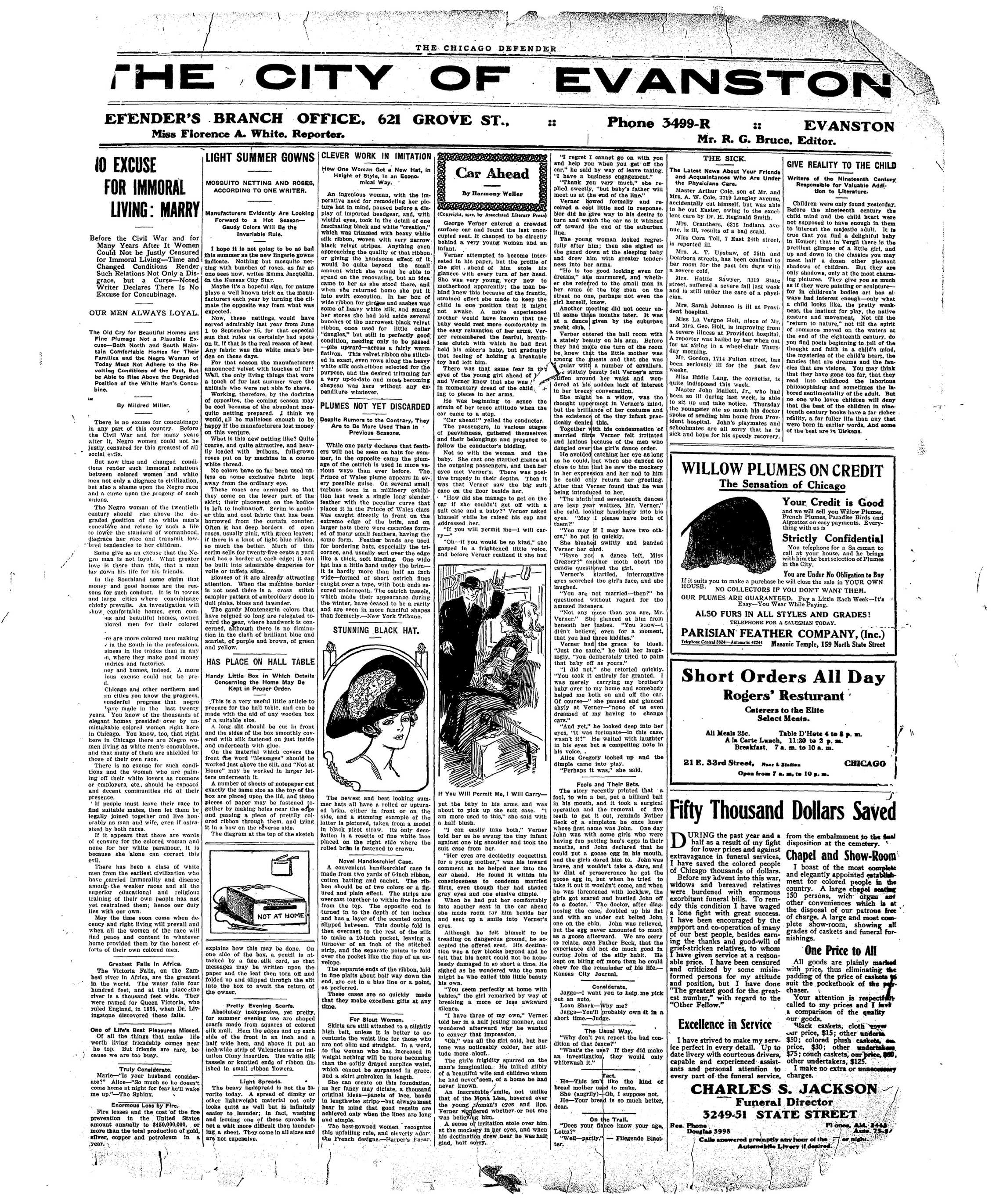
Page text (machine-generated)
Jackson won in a walk, and thanks the Defender for its untiring effort in putting his candidacy before the people. Hon. Chas. Krutckoff, for board of assessors; Hon. Andrew Russel, state treasurer; Hon. Lawrence Y. Sherman, for U. S. Senator; and Hon. James A. Rose for Secretary of State, and THEY ALL CAME BACK.
---
DEFEND
Jackson won in a w
people. Hon. Cha
Y. Sherman, for U.
DR. GEORGE C. HALL IN ST
LOUIS.
St. Louis, April 12.—(Special to the Chicago Defender.)—Dr. George C. Hall of Chicago, who was in the city this week, is receiving great credit for several difficult operations that he performed.
Dr. Hall was here at the request of Dr. C. H. Phillips, Jr., who had several difficult cases for operations.
The doctors of East St. Louis, headed by Dr. L. B. Blutt, invited Dr. Hall to hold a surgical clinic at St. Mary's hospital, the largest Catholic institution of East St. Louis. After the clinic a luncheon was served at the spacious residence of Dr. Blutt, at which twenty doctors were in attendance.
A large reception was given Saturday night by Mrs. Hayden Campbell, who was recently operated on at Provident hospital by Dr. Hall. This affair was largely attended by the school principals, teachers and professional men of East St. Louis, all of whom were delighted to do our doctor honor. Dr. Hall promised to return soon.
AMATEUR MINSTRELS MAKE HIT
There were sounds of revelry by night and there had gathered Chicago's elite; and the bright lights shone over beautifully gowned women and brave men. The orchestra of Prof. Bowman waited the melodious strains from the "Ameer," and the Amateur Minstrel Club, in brilliant array, presented their annual melange, music, dance and laughter to the audience, a crush, an immense throng, magnificent bouquet of humanity. "Standing room only" was hung out long before the first number. And when the curtain lifted showing the popular favorites with hones .d tambourines and lamp black faces, the call boy was still giving checks to the chaufeurs who lined up before Oakland Music Hall with limousines and electric cars to discharge their guests.
Easter Monday brought many social functions throughout the city, but society, for charity's sake, held sway at the Amateur Minstrel Club.
It was an assemblage of people, gowns, diamonds and flowers which bore fitting testimony to the efforts of the young men who annually give their time and means for the benefit of the Old Folks' club.
Mr. Frank Waring was interlocutor and nonpareil. Messrs. Sheoarch, Cornwell, Horsley, Childress and Lawrence upon the tambo and bones, ably supported by the entire club. The audience was kept in an uproar of mirth and laughter until the curtain fell, when the floor was cleared of chairs and tarpaulins and the invitation to the dance was inaugurated. It was an affair long to be remembered and the Home will be the richer by several hundred dollars. The club is to be congratulated on this splendid effort.
Fisk University Club Will Meet at Douglass Center.
All friends of Fisk University, all graduates and undergraduates here in the city are urged to attend the meeting of the Fisk Emergency club, Sunday, April 14, at Douglass Center, 3032 Wabash avenue. It is planned and hoped that an organized effort on the part of all interested will result in large financial returns and will greatly assist in raise the $240,000 which the uni- ler will receive by order to secure the $60,000 voted it by the General Education Board. Remember the date of the meeting: Sunday, April 14, 6 p. m., at Douglass Center.
Mr. James Saxon, 21 East 28th street, 86 years old, who died Wednesday, will be buried from Jackson's undertaking establishment (Daniel Jackson) Saturday. Mr. Saxon was only ill about nine days, having come to Chicago from Atlanta, Ga., in November. He is survived by two sons and two daughters, Joseph and Ella and Lucinda and James.
Mr. Joseph Saxon came from New York to attend the funeral. Burial at Mt. Glenwood.
TRUE REFORMERS' OFFICIAL DEAD.
Richmond, Va., April 12.-Mr. J. Frank Douglass, Grand Worthy Secretary of the United Order of True Reformers, died here on April 10. Mr. Floyd Ross, Grand Worthy Master, has notified the lodges throughout the United States of the sad news. Mr. Douglas was sick only fifteen days with Bright's disease. Funeral will be held tomorrow. Body will be taken to Roanoke, Va., today.
---
e Home Edition
INTEREST IN ECONOMIC QUESTIONS PLEASE
Race Evinces Interest in the So-called Initiative, Referendum and Recall of Decision So Widely Discussed—Senators, Congressmen and Other High Officials at the Nation's Capital Deluged by Letters for Information from All Sections of the Country —Correspondent Discusses Colonel Roosevelt and the Recall of Judges and Decisions.
PRES. TAFT ADDRESSES HOWARD ALUMNI
Monican Club Gives Elaborate Assembly—Largest Auditorium Too Small for Numbers on Pleasure Bent—Beautiful Women, Exquisitely Gowned, Charm in Mazy Waltz—Banner Social Event—No Further Doubt That Washington Possesses Some of the Most Beautiful Misses and the Handsome Matrons.
Washington, D. C., April 12—The often repeated statement, by prominent colored men as well as by prominent white men, that the Negro should evince more interest in and concern for the many economic questions that are up for discussion and solution, instead of sticking so close to the race problem, appears to be harkened to if the hundreds of letters pouring into prominent men of Washington from colored men in every section of the country can be accepted as an interestaid concern. These letters bear on the so-called Initiative, Referendum and Recall of Decisions now widely discussed and agitated from coast to coast. It appears that the Negroes of the country, and especially those in the South and close to northern states, have suddenly awakened to the fact that in the proposed Initiative and Referendum and Recall of Decisions, the latter is enunciated by Colonel Roosevelt, contains a "sleeper" that may possibly as completely nullify the Fourteenth and Fifteenth Amendments to the Constitution as any repeal of them by Congress. President Taft is unalterably opposed to either the recall of judges or the recall of decisions, while Colonel Roosevelt advocates the recall of judges and decisions. Your correspondent has had an opportunity to read many of these letters from Negroes, many of which come from the ablest of our colored lawyers throughout the country, and bolled down, compared and revised the hundreds of letters received carry the following:
"There is not a single question under discussion today the finality of which does not affect, in some measure, the colored people. A small question bearing harmless aspects may embody large issues—the adoption of which may mean weal or wee for the Negro. The referendum is a high-sounding word, and because of this fact many people of the Negro race may be deceived into the belief that they are beyond its reach. The Negro sometimes feels that he does not always get the same justice from courts and juries that is meted out to others. But this fact should not argue against the stability of our institutions, which are the product of laws that are permanent and organic. If the Negro does not always get what is due him in the courts when the issue is a denial of his civil rights, it is not because of the non-existence of the statute in his favor. Regardless of these inquiries the law remains fixed in the statutes and his psychological moment may eventually come when he and his rights will be on a par with any other man's rights, and justice will be awarded him. But how different will be the result if the theory of Colonel Roosevelt for the recall of decisions should be adopted. Suppose in any community a question of denial to the Negro of certain rights was proposed under the Colonel's recall of decisions, what would happen? A majority of the people being white, and more or less infected with race prejudice, would vote these rights away from him, and all the Negro votes in the country would not be able to stem the tide. Under the Australian ballot system of voting, where secrecy is jealously observed and preserved, this could be done by white men, regardless of party affiliations, who publicly profess friendship for the Negro.
Or, suppose a southern state should
(Continued on Page 6.)
The Chicago Defender.
Performs Several Difficult Operations and Is Entertained by Fellow- Physicians and Friends.
MR. JAMES SAXON DEAD.
CHICAGO, IL., SATURDAY, APRIL 13, 1912.
MRS. JESSE BINGA TENDERS HUSBAND BIRTHDAY STAG
A Small Number of the Intimate Friends of Our Shrewd Banker, Mr. Jesse Binga, Make Merry Wednesday Evening in Honor of His Birthday—Event Planned By His Wife and Mr. Vance Anderson—Was a Complete Surprise—Lured Away in Early Evening to Home of Sister-in-Law — Although Informal, the Affair Was Most Pleasant.
MR. BINGA SINGS SOLO
EDITOR TAYLOR BILLIARD EXPERT
The Magnificent Home of the Bingas Was Again Thrown Open to Friends—"The Boys" Sang "We Won't Go Home Until Morning" But There Was Still a Star or Two When the Last One Turned the Corner—The Wants of the Inner Man Supplied by a Well Known Caterer—Some Played Whist.
Mr. Jesse Binga, our eminent banker and a recent addition to the newly weds, was outgeneraled by his charming wife last Wednesday night and it was not a case of high finance. The banker was lured away to the home of his sister-in-law, Mrs. Ray, while Mrs. Binga and Mr. Vance Anderson arranged a "stag" in honor of the forty-seventh anniversary of his birth.
It is said that Mr. Binga is always alert and a hard person to surprise but he now declares that his wife and his friend Anderson are topnotchers when it comes down to planning a surprise party.
After returning to his home and the expected gentleman on business awaiting him turned out to be a number of his friends, the happy gentleman became the life of the evening, singing and vicing with his many friends in playing whist and billiards. Editor Julius F. Taylor of the Broadaxe proved to be the billiard expert of the evening.
Toothsome refreshments were served and the following gentlemen wished the hostess and the surprised host a continued health and happiness and an early bid to call again. The gentlemen present were as follows: Attorney S. Lang Williams, Dr. Asa Barnes, Mr. Vance Anderson, Mr. E. R. Mead, Dr. H. W. Games, Mr. Warren King, Mr. Robert L. Hall, Mr. E. A. Smith, Mr. W. A. Falls, Mr. Charles Washington, Mr. P. T. Tinsley, Dr. N. G. Dalley, Mr. Frank Warling, Editor R. S. Abbott, Editor Julius Taylor, Mr. W. H. Washington and Mr. George Jackson. Mr. William H. Turner, the butter, rendered efficient service throughout the evening.
LAKE SHORE NEWS.
By Mrs. Mattye E. Anderson.
Miss Anna Carter entertained the Jolly Twenty club at whist Thursday evening. Music was furnished by Miss Leonora Curtis. Members present were: Mrs. Lelice Lewis, Mrs. Lucille Roberts, Mrs. Beatrice Bell, Mrs. Bessie Carter, Mrs. Gertrude Chandler, Mrs. W. P. Harrison, Mrs. Matsy Anderson, Miss Leonora Curtis, Miss Anna Carter. The guests were: Mrs. Guy. Mr. Wm. Shephard, Mr. Richard Lewis, Mr. Robert Bell, Mr. Stewart, Dr. C. G. Roberts, Miss Carter, assisted by her sister, served dainty refreshments. A cunning little white rabbit was daintily placed upon the plates as a souvenir. All enjoyed a delightful evening with Miss Carter, who is very entertaining. Mrs. Ruth Bright of Davenport, Iowa, is visiting Mrs. S. C. Cooper, 212 Shiller street.
The Wayman Junior Industrial club met Wednesday afternoon at the home of Mrs. S. C. Cooper. The industrial club is progressing wonderfully in all its lines of work. The club has taken up Literary work. Mrs. Cooper's real object is to get the children interested in those of our race who have made a name for themselves. The lives of Booker T. Washington, Paul L. Dunbar and Phillis Wheatley are being studied with enthusiasm. Mr. Davis and Mrs. Matty Anderson, assisting in the literary work. Economic history is also being studied. The Industrial club is a federal lab.
THE MORRISES IN JAPAN.
(Special to Chicago Defender.)
Nogaga, Japan, March 18—Mr. and Mrs. Edward H. Morris of Chicago are registered at the Nikko hotel. It will probably be several months before they return to the States.
THROUGH CUBA WITH MADAME HACKLEY.
Moro Castle—Obespo Street (Bishop Street)—Milkmen on Horseback and Other Interesting Points Told in the Madame's Charming Manner.
(Special to the Chicago Defender.) Havana, Cuba, April 12—After three hours we are back in Havana, ready for luncheon and happy in the memoirs of a delightful sight-seeing trip.
The guide pointed out the varieties of fertile soil, and said that land was very cheap. We were shown many trees—Guana trees, bread-fruit trees and the ciba, the sacred tree of Cuba under which Columbus held Mass. At night the tourist listens to the band at the Maleson (sea wall). He looks at the wonderful tropical heavens and sees stars that he never saw before. Then he gets an ice, and is ready for his cool bedroom. His elaborate bed is without a mattress. Only two comforts cover the closet, woven springs. The cellings are very lofty, and the walls and paint are white, with white tile floors, making a restful sleeping apartment.
There is a trip to Moro Castle for $1.50, and there are other trips to suburbs. If one has made friends with other tourists he "chips in" for a long auto ride. Some "chip in" as high as $10 each, but I was lucky enough to spend only five dollars, and again saw the city and other points in the country surrounding Havana.
There are street car rides to the beautiful, fashionable suburb of Vedado and Marianno, past beautiful one and two-story mansions with their tropical gardens. There are street-car rides to other points for five cents in American money, or seven cents in Cuban money. One does not risk his bones in the awning-covered wagons patronized by the Cubans.
One takes walks up the beautiful, broad avenues, and through the queer, narrow streets. He looks at the monuments in the pretty little parks, halls remnants of the old city walls, and visits the public library and other public buildings, including the markets.
Then he visits other hotels, and spends the balance of his time in shopping.
Obespo street (Bishop street) is one of the narrowest and most fashionable shopping thoroughfares, and O'Reilly street, about as narrow, ranks second in popularity. As in Paris, shops are not called by the owners' name, but by some forceful name. All the stores are wide open from wall to wall.
The sights in the streets are interesting. Milk men on horse back, or on mules, carry the cans in paniers. Each Chinese truck gardener carries a pole across his shoulders, from the ends of which hang great baskets of vegetables. Fruit venders, peddlers of lottery tickets, and other venders are all busy. It is worth while simply to sit in a cafe and look out at the panorama.
One can read the Havana Post, which is printed in English, or he can purchase American papers at news-stands. Both American and Cuban money are used.
On funeral days one views many funerals. They are elaborate affairs, with a black angel surmounted by a gilded angel. The driver is gorgulous in a red livery. Behind comes the funeral party in victoria, with stylish-looking coach-men (of all colors). Women never attend funerals in Cuba. If rent is not paid on cemeteries the bones are thrown into a bone pile.
One gets tired of tobacco smoke. Everybody smokes, even women, while working. There is very little expectorating.
At twilight, and after dark, the tourist walks around and looks in the open windows. The Cuban home life is open-air life. They only close up doors and windows when it is cold. Screens are sometimes used at windows.
They say that lovers court at the windows, but that they go into the houses, also. There is always a third party present. In the parlors the men and women sit facing each other. To every house there is the paved interior court, open to the sky, and opens filled with shrubbery. They look very inviting. The green of the pal- is against the white marble gives a cool effect.
There is no exclusive residence district in Havana. A millionaire's pal- is liable to be on any street, wide or narrow.
No tourists eat? Many are delighted with the highly seasoned Cuban dishes. I did not fancy chicken and rice smothered in sat- from after first eating. I devoured pineapples and I liked milk poured over a dried combination of the white of an egg and sugar pineapple juice in water is a favorite drink. All the vanilla ice cream looked like frozen custard.
One sees many laughable sights. Cloth slippers without heels are very (Continued on Page 8.)
WOMEN FIGHT
FOR RIGHT
Find No Colored Men Employed in the Erection of a Flat Building at 37th and Dearborn Streets and Start Investigation Led by Mrs. Rosa Richardson, 3640 Dearborn Street—Owner is Discovered to be Mr. Sam Keller, Who Rectifies the Oversight by Hiring One Lone Man.
NEIGHBORHOOD IS UP
IN ARMS
Women Threaten to Boycott Store, but The Chicago Defender, After an Investigation, Lauds the Effort that Secured a Position for this One Man — If One Lone Woman Can Accomplish This, What Could a Concentrated Effort Do?
Mr. Sam Keller, grocer, at 37th and Dearborn streets, an owner of the building, decided to build a new flat building, but overlooked the employment of any colored people.
But the ever-watchful race women in the neighborhood noted the oversight and made a vigorous protest. Mainly through the efforts of Mrs. Rose Richardson, 3640 Dearborn street, and Mr. Keller did decide to hire one man.
A canvass of the neighborhood showed a determined effort to boycott Mr. Keller's establishment, because two-thirds of his customers reside in the immediate neighborhood and are colored people.
Mrs. Richardson's splendid work in securing a position for one man is an object lesson to our clubs and organizations, who, if they would but stick together, could secure many places for the deserving of the race.
It is said that the corner building is worth $20,000 and the new flats were being erected at a cost of $7,000. These figures were gathered Incidentally by a Defender reporter while investigating the matter and are quoted as a reminder to mechanics that those who support grocers and other merchants certainly deserve some consideration.
LA GRANGE SOCIETY.
La Grange, April, 11.-Mrs. George Greene of 640 North Kensington avenue, niece, Miss Florence Newton of Medina, N. Y., arrived last Wednesday day evening for a short visit. Mrs. Raymond Brook spent Sunday in Chicago.
Mr. and Mrs. George Greene and Miss Florence Newton were in Chicago for Easter services.
Mrs. M. J. Drew left last Saturday for her vacation, visiting friends in Burlington, Iowa. She spoke at the Easter services in Galesburg, Ill., last Sunday.
The A. M. E. Sunday school opened at the church last Sunday with a nice attendance. It was formerly held at Hinsdale on Sunday afternoon.
The A. M. E. Sunday school had a special Easter program at the church last Sunday night. It was well rendered under the management of Mrs. Rev. Colb and Supt. John Hammond of Hinsdale and was well attended.
The ladies of the A. M. E. Church gave a mask social last Thursday evening under the management of Mrs. Will Roberts.
Miss Ollie Stunip was shopping in Chicago last Thursday.
Mrs. John Boswell is able to be out again after an illness of a few weeks.
Mr. Harry Hammond is in charge of the New-Western Springs Social club.
The Progressive Sewing club met at Mrs. Rev. Colb's last Saturday afternoon and were highly entertained, an elaborate dinner being served. The members present were Mrs. Joseph Kocho, Mrs. William Dennis, Mrs. Will Green, Mrs. Jennie Carter Thompson. The next meeting will be held at Mrs. Jos. Kocho's, East Franklin street.
Mrs. Henry Ergan entertained Mrs. George Greene and Miss Florence Newton last Monday afternoon.
Mr. and Mrs. Morris Robbins of Hinsdale were in Chicago last Thursday evening attending a play given at one of the South Side churches.
Mr. Lewis Currie of Hinsdale is moving to La Grange this week.
Miss Hank Handy has returned from visiting his relatives in Cincinnati, Ohio.
MR. JESSE STUBBS TO GET SOUTHERN BRIDE.
Mr. Jesse Stubbs, 3317 Forest avenue, a popular post office employee for the past twelve years, and Miss Hattie Dixon of Wicksburg, Miss, will be married in that city Wednesday, April 24. A reception for the friends will be held in Chicago Monday evening, April 29.
ABDUL BAHA ABBAS COMING.
Famous Leader of the Bahai Movement En Route to America—Plans Tour of the Country—Movement Attracts Attention.
By Lewis G. Gregory.
Washington, D. C., April 12.—It is now settled that Abdul Hah Abaas, the leader of the Bahai movement, is en route for America and will arrive in New York about April 10. He plans a tour of the country and will visit many of the large cities, Chicago among them. In view of the visit of one who, although not extensively known in the western world, is without doubt the most illustrious man on earth, it is to be hoped that the colored race, in connection with people of the other race, will avail themselves of the privilege of availing him.
But what, may be asked, is the Bahai movement, and who is Abdul Baha Abbas? The answer to these questions seems to have a special significance to the oppressed, despised, and rejected of all races and nations. For while the colored people today, as naturally they would be, are in a ferment of unrest and discontent because of the manifest injustice and prejudice that are uniformly directed against them in America, here is a movement that has in it millions of people, representing many races and all the great religions, and now actively advocated in all parts of the world, and able to unite its followers under the banner of universal tolerance and love. In Oriental countries the Bahai movement has united Jews, Christians, Mohammedans, Hindus, Zoroastrians, Buddhists, etc., representing many races. In Europe it has united various branches of Christianity. In America, where it was introduced only about nineteen years ago, its assembly reaches from Maine to California, and it now gives forth more promise of being the real solution of the race problem than anything ever seen or heard of before.
Adul Baha Abbas is the recognized leader of this movement, and from his friends "receives an homage that kings might sigh for in vain." He values deeds above words and works in and out of season for the freedom of men from superstition and hatred. Taking their cue from their leader, his friends are engaged in much useful work. They look to results while some reformers talk. May it not then be suggested that one who has done so much for the peace and progress of the human race is entitled to respect and attention? Would it not be profitable for the American people in general, and the colored people in particular, to study the man and the means that have made him so successful?
Adul Baha, the Servant of God, as he is known by his followers, visited England last fall. It was his first visit to the western world. Perhaps no man ever appealed more to the universal heart of humanity. This was shown by the number and variety of people who sought interviews with this illustrious Oriental. His interviewers consisted in part of the clergy, members of various religious and sociological cults, Masons, international peace promoters, sufragates, statesmen and reformers of various kinds. He met these people all upon their own plane and had golden words of hope and kindness for each.
The maintenance of his liberal and progressive views have cost Abdul Baha much suffering. More than fifty years of his life were spent in a Turkish or Persian prison. But it is a remarkable tribute to his powers of leadership that during the most intense persecutions of his father, Baha'o'allah, and himself, the cause they advocated has steadily grown. The friends of this movement invite the public to investigate its power. One of the cardinal precepts of the Baha'i movement is a saying of Baha'iullah: "Verily the words which have descended from the heaven of the will of God are the source of unity and harmony in the world. Close your eyes to racial differences and welcome all with the light of oneness. This handful of dust, the world, is one home. Let it be in unity. Fornake pride; it is a cause of discord. Follow that which tends to harmony." About fifty invitations have already been extended Abdul Baha to address gatherings in the cities he will visit. It is to be hoped that people of all races and classes will embrace the opportunity to see and hear him.
MRS. H. P. LEE AGAIN GRAND-
MOTHER.
Buffalo, N. Y., April 12—Inquiry at the Edward D. Wimp residence regarding the illness of Mrs. E. D. Wimp brought forth the statement that the stork had again called, and his bundle was a bouncing 8-pound boy. Mrs. Henrietta/Lee is in attendance upon her daughter and declares he is the "finest ever" and his name is Benote Hillard, after his uncle.
If you see it in The Defender it is so
enominated in a
active Edward D.
wn Major R. R.
dacy before the
Hon. Lawrence
CAME BACK.
RACE TO PROFIT BY ANNUAL CONFERENCE
Fourth Annual Conference of the National Association for the Advancement of Colored People to Be Held in Chicago April 28, 29, 30, Inclusive, Creates Widespread Interest—Former Meetings, Two in New York, One in Boston, Productive of Great Good in Arousing the Latent Conscious of the White People.
ASSOCIATION HAS
ATTRACTED MANY
NOTABLE FRIENDS
Local Committee on Program Issues
List of Speakers—Hope to Create
as Profound an Impression in Chicago
as Was Made in the East—
Many Brilliant Speakers—First Meeting in the New Sinal Temple—
Other Meetings in Handel Hall—
Miss Jane Addams Will Entertain Association at Hull House.
(By William L. Chenery, Press Representative.)
New York, April 11.—Methods by which race prejudice may be eliminated and by which justice and friendly relations between the white and Negro races may be increased, will be discussed by prominent representatives of both races at the fourth annual convention of the National Association for the Advancement of Colored People, which will be held in Chicago April 22 to 30.
Previous conferences have been held in New York and Boston. This is the first time one has been called for the middle west, and the leaders in the movement count upon a great increased attendance.
The local committee which is making arrangements for the convention consists of Miss Jane Addams, honorary chairman; Julius Rosenwald, F. L. Barnett, Mrs. Ida Wells Barnett, Miss B. P. Breckenridge, Charles T. Hallman, Judge Edward O. Brown, Louis F. Post, Willoughby Walling, Mrs. Cella Parker Wooley, Jenkins Lloyd Jones, Dr. C. E. Bentley, Sherman C. Kingsley, chairman, and T. W. Allison, secretary and treasurer.
The first meeting of the convention will be held Sunday evening, April 28 at the new Sinai Temple. Miss Jane Addams will preside and Dr. Emil C. Hirsch, Mr. Oswald Garri, Villard of New York and Prof. Wil, a pleckens of Talladge, Ala., will speak.
The meetings on Monday and Tuesday will be held in Handel Hall. Monday afternoon Sherman C. Kingsley will preside. Addresses will be made by Prof. W. E. B. DuBois, the noted scholar, author and lecturer, and by Judge E. O. Brown of the Appellate Court. At the evening session Bishop B. T. Lee of Ohio will preside and will speak on "The Rule of the Strong." Miss Julia Lathrop of Hull House will open the discussion following Bishop Lee's speech, I. M. binow of New York, Charles Edw. Russell, magazine writer, and P Kelly Miller of Washington will among the speakers.
Tuesday morning Oswald G. Villard, editor of the New York Evening Post and chairman of the National Executive Committee of the association, will preside. Reports will be received from the various delegates representing different sections of the country. A reception will be given the convention at Hull House Tuesday afternoon. Mrs. Emmons Blaine will preside at the final meeting, which will be devoted to a discussion of "The Negro in the City." Among those on the program are Mrs.ella Fliggy Young, superintendent of schools; Mrs. Ida Wells Barnett, John H. Walker, president of the United Mine Workers of Illinois, and Rev. Jenk Lloyd Jones.
Among the topics which are up for discussion at the conference are: "The Negro's Progress During the Year," "Help for the Negro from Silent South," "The Year's Recruit Lynching and Other Manifesto Mob Law," "Problems of Urbas "Segregation of the Negro," "Chisement," "The Kansas City D, mite Outrage," "The Psychology Race Prejudice," "Denial of Negro's Civil Rights in the North."
The purpose of the association, according to the call sent out by Chairman Villard, is "to uplift the colored men and women of this country by securing to them the full enjoyment of their rights as citizens, justice in all the courts, and equality of opportunity everywhere. The association favors and it alms to aid, every kj
of the United States and its amendments, in the spirit of Abraham Lincoln.
"The association upholds the doctrine of 'all men up and no man down.' It abhors Negro crime, but still more the conditions which breed crime, and most of all the crimes committed by mobs in the mockery of the law, or by individuals in the name of the law.
---
"It believes that the scientific truths of the Negro problem must be available before the country can see its way wholly clear to right existing wrongs. It has no other belief than the best way to uplift the colored man is the best way to aid the white man to peace and social content; it has no other desire than to exact justice, and no other motive than humanity."
That existing conditions demand the efforts of such an association, the call asserts is obvious from lynching records alone. It says:
"During the lynchings in the United States during 1911 were many and terrible. The number recorded is 71, 8 white and 63 colored; but unquestionably not all are reported. Many entirely innocent persons are among the victims. Thus in the lynching at Lake City, Florida, six Negroes were strung up as targets to be riddled with bullets in revenge for the killing of one white man. In Oklahoma, Georgia and Kentucky innocent men have died deaths of torture at the hands of the mobs. Women, too, have been among the victims. As the terrible happenings have occurred the association has written to the governors of the various states, demanding the punishment of the criminals, and it has instigated protests from individuals in nearly every state in the union. The executives sent sentenced replies but the end of the year 1911 saw no lyncher punished.
575-6
"Postal cards printed in Germany which reproduce in horrible details lynchings in the south are circulating in the United States. They are for sale in southern towns and are sent about as one sends a souvenir of a cathedral or a landscape. One shows a group of seventy white men and boys standing in a semicircle. The dead body of a Negro is in the center of the picture. Another shows a Negro string to a pine in a lonely pine wood. These pictures show the small regard in which America holds a Negro's life.
On the Sunday morning preceding the assembling of the convention special services will be held in many of the churches of the city in the interest of the association. All of the Chicago ministers will be asked to explain the work of the convention.
North Side News
By E. GORDON
Mrs. A. A. Kelly of 1120 Gault court gave a luncheon in honor of Mrs. Dubois of Atlanta, Ga., Good Friday afternoon. Those present were the Mesdames, Sadie Weaver, Marie Thompson, Winette Harrison, Gertrude Heywood. Hot cross buns were the main feature of the luncheon. The service at Herman Baptist church was a great success. Song service in the evening, led by Miss Lenore Curtis. Decorations were beautiful.
A very large crowd attended the North Shore Men's Club at the residence of W. S. Daniel Monday, April 8. They played whistle until 12 o'clock, which were more than seven tables, and then refreshments were served. Mr. Joe Thompson made some very delicious punch. Many of the members of the Jolly 20 Club were present. Among those were Mrs. and Mr. Anderson, who won the prize for the whistle in the evening. Mrs. Anderson made a short address about the coming future of the Jolly 20 Club; also Katherine Askin of 5236 Dearborn street. Mr. and Mrs. W. P.
Dearborn street, Mr. and Mrs. W. R. Harrison of 1726 Nielson street, Mr. and Mrs. Snowden of Rogers Park, Mr. and Mrs. Chandler of Oak street, Dr. and Mrs. C. G. Roberts of Wells street, Mr. Shepard, Mr. Joe Brown, Mrs. Tenora Curtis, Mrs. Harris, Mr. Feathen, Miss aethow of Lake Forest, Mr. E. Gordon of Evanston ave. Lella Lewis, Mr. Waters, Miss Lee from Indiana. Monette Harrison joined Her Baptist church Easter Sunday, has been a member of Wayman for many years. You will attend the baby contest man chapel. These are the sons of the mothers of the babies no will enter the contest: Mrs. Andrew Thomas, Mrs. Mannie Harris, Mrs. E. Gordon, Mrs. Pritchard, Mrs. Mary Bayward, Mrs. L. Lewis. They are expecting a large crowd because there are more than 2,000 tickets out. The date set for the concert at Herman Baptist given by the N. S. M. C. has been changed to April 29th.
Soap Bubbles.
The ancient Britons invented soap. The Romans, two thousand years ago, carried the invention back to Italy. They manufactured soap in Savona, whence the French word for it—savon. There are natural soaps—the soap root of Spain, the soapberry of Chili and the bark of the Peruvian soap. Quartetaro, in Mexico, soap takes ice of copper collage. Titjra the Fuegans eat soap, ug the fat therein really nourish. They say they like the taste. Soap is made from garbage in the newest inocerating plants.
"What sort of a man is he?" asked a Kansas City man concerning a citizen who is regarded as a mollycoddle. "Tell you the kind of a fellow he is," replied the other. "If he wants to statement real emphatic he amingly."
Just Wonderful Temple, times the temple of the god at Karnak, is spoken of as tawdry architectural work designed by the hands of man, indicates the old Egyptians advanced in villization.
AT THE Y. M. C. A.
HEADQUARTERS
The Latest News of the Work in This City—Items of Interest—Speakers.
Complete plans have been perfected under the direction of International Secretary J. E. Moorland for a collecting campaign of pledges to the building fund. A neat booklet has been prepared, distributed freely, fully illustrating the plans of the new building for the South Side. The structure will be fireproof throughout, five stories high, covering the lot at the corner of 38th street and Wabash avenue, 70x154 feet. It will be the most imposing as well as the most complete building of the kind ever erected anywhere in the world for our men and boys.
Chicago is the most unique association center in the world. The Central Association is the strongest anywhere in the world. The greatest living secretary, L. Wilbur Messer, is at the head of all the work, assisted by one hundred or more efficient workers. The greatest friend any single department of work has ever had is Julius Rosenwald, who lives here. He offers $25,000.00 not only to Chicago, but every city in the United States which will raise $75,000.00 more for a building for colored men. Chicago was the first city to meet Mr. Rosenwald's conditions with a subscription of $67,000.00 by colored people. This was heralded all over the country and Chicago was given a new place on the map. Nothing ever put such courage in a group of people as this effort did. Many people have paid their pledges in full, many in part and many have neglected the obligation altogether.
The South Side Department must be the best of its kind in the world. Just as Chicago is great in all her enterprises and as she is able to boast of the greatest association, so must this department keep in the front rank. What does this require? First, the building must be started May 1. Second, to do this every subscriber must pay his pledge in full next week. The pledges are all past due. Plans have been made on the basis of these pledges. A new kind of confidence has been reposed in colored people by leading men of this city. We must not abuse that confidence. We must make good. We have the honor of a race in our hands. Shall it be allowed to suffer here in Chicago? What will the answer be? Every great achievement costs great sacrifice, but the victory is worth the effort.
A number of men have volunteered to see the subscribers in person. Be ready when they call. Each collector will wear an official button. When you pay he will give you a button with "I Paid" marked on it. He will give you a numbered receipt and a regular receipt will be mailed from the office. He will have a card of authority, it will be easy for many to pay in this way. Many are planning to pay. Some are already coming to the office. The campaign begins in earnest Monday, April 15 and closes April 19. Get ready to do your part. Chicago never failed in anything she has attempted in the past. She must not fail in this! She will not fail! We rest our case with our loyal people who live in the Chicago spirit.
Mr. Frank R. Stark, captain of team No. 1 paid $50.00 balance on his $100.00 subscription last Tuesday night. There was music at the cash register. Every man is invited to attend the Sunday meeting at Odd Fellows' hall, 3335 South State street, Sunday, April 14, at 4:00 p. m. Good singing, good speaking, good fellowship! It is hoped that all the pastors will urge the people to make good their pledges this coming week. A pull altogether and it is done!
REMEMBER THE LOVED ONES
Pathetic Religious Ceremony That Is Observed by People of the Isle of Ushant.
In the Island of Ushant—the "fale of Fear"—there exists a custom probably unknown in any other part of Christendom. When a native dies abroad or is lost at sea, his relatives have a small wax cross made, some seven inches long. This is solemnly taken to the church and presented to the priest, who deposits it in a box, shaped like a cinerary urn, that hangs on the south side of the altar of St. Joseph. This is called the "Pro Ella" cross, and is supposed to stand for the spirit of the dead. These memorial symbols are allowed to accumulate in the box till the next church mission comes round. As these revival services are held only once in every four or five years, the number of crosses may be very considerable. A day is then set apart for their solemn interment. It is the great day, the climax of the mission. The church is draped in black and crowded with a mourning congregation, many of whom break out into loud walling. The crosses are brought from their urn in solemn procession, a requiem mass is said over them, and then they are carried to the churchyard, the iron door of the tomb is unlocked, and they are intered with full honors. Throughout the year hardly a day passes but some pious soul comes to sprinkle the tomb with holy water and say a prayer before it for the dead—Wide World Magazine.
Wonders Within Ourselves.
We carry with us the wonders we seek without us; there is all Africa and her prodigies in us; we are that bold and adventurous piece of nature, which he that studies wisely learns in a compendium what others labor at in a divided piece and endless volume. —Sir Thomas Browne.
HannInese Transmitted
Happiness, at least, is not solitary; it joys to communicate; it loves others, for it depends on them for its existence . . . the very name and appearance of a happy man breathes of good nature, and help the rest of us to live—Stevenson.
INTERNATIONAL CONFER
ENCE ON THE NEGRO AT
TUSKEGEE.
African Potentates Along With Those of the South American Republic, Will Join Hands for the Good of Common Humanity—No Colon Line —Southerners Even Will Accept Social Equality Publicly.
Tuskegee, Ala., April 12.—Twenty-one foreign countries, or colonies of foreign countries, and thirty-six different missionary societies, representing sixteen different religious denominations, will be represented officially, or unofficially, at the International Conference on the Negro, which meets at Tuskegee Institute, Tuskegee, Ala., April 17, 18 and 19.
The local governments of Jamaica and Barbados, British West Indies, have each selected three official representatives to attend the conference for the purpose of studying the work of the Tuskegee Institute, and to follow the deliberations of the conference. Porto Rico, Bermuda, Nicaragua, British Guiana and possibly Venezuela, will also be represented.
Missionary organizations from Sweden, Germany and England have announced their intention of sending delegates. The little .egro Republic of Liberia will be represented by Consult General to the United States, Ernest Lyon, Vice President S. G. Harmon, former Secretary of State F. E. R. Johnson, and a number of other persons, representing schools, and other missionary enterprises in that country. Mr. Maurice S. Evans of London, England, will represent the British African Society at the conference; Mr. R. F. Hunter, head of the Fourhay Bay College of Sierra Leone, will be present in the interest of that colony.
Among those who have announced their determination to be present are a number of noted Africans, among others Mr. Casely Hayford, a native barrister-at-law, of Sekundi, Gold Coast, Africa, author of a very interesting book, "Ethiopia, Unbound," which is perhaps one of the first books ever written by a native African for the purpose of expressing the hopes and aspirations of an African nationality.
In addition to the native Africans, the missionaries and representatives of some of the West Indian colonies, several distinguished sociologists have promised to be present; among others Prof. W. L. Thomas of the University of Chicago, author of "Sex and Society."
All of the important religious organizations among *egroes* will be represented at the coming International Conference on the Negro to be held at Tuskegee Institute next week. All of the bishops of the C. M. E. church are planning to attend, as well as several of the general officers.
Bishop L. B. Scott is coming from Monrovia, Liberia, and Bishop Alexander Walters, who visited West Africa last year, is planning to be present and to make a special report covering the mission work of his church.
The Venezuelan government has designated Dr. Esteban Gil Gorges, secretary of the Venezuelan legation at Washington, as its delegate. The attendance now promises to be between two and three hundred.
ABIDING PLACE OF MICROBES
Eliminate the Vacant Seat and the Church Will Bloom Into Splendid Health.
There are microbes that are menacing the church with dire defeats; they're bacilli that produce the plague entitled Vacant Seats. There's an influence arising from these weary, dreary pews, that's as pestilential as the breath of rank, malarial dews. If diagnosis we would make of churches void of heat, we'd find the mercury he'd dropped down in the vacant seat. The doctors ought to busy get, the church's health to save, because this situation is becoming very grave. Napoleon wished once, 'tis said, to break a conquered bell; his soldiers swung their hammers free, and pounded hard and well; but firm, unmjured, strong, it stood, resisting every stroke, until they hit from the inside, and then, it quickly broke. Thus what the church needs most to fear, is not the outside skin, but spineless, lackadiscal insanity within. And that which blocks and trips the church, and rolls her down the stair, is the nominal adherent who, however, isn't there. If we could but eliminate this stunting empty seat, the church would soar in glorious flight, amazingly complete. There is a remedy that works at any time and place; it's every one, at every time, and always, in his place. If you would give this formula a keen, conclusive search, just try it well, next Sunday, at the Presbyterian church, or any place of worship where you feel you'd like to be, and the medicine and healing you'll find tally to a T.—The Continent.
New York's Greatest Borough
Manhattan, one of the five boroughs comprising greater New York and its most important borough, is approximately fifteen miles in length, from the Battery to the city line, and about five miles at its greatest width. Its frontage on the water, together with the shipping facilities of the entire city, is 444 miles, or equal to the distance between the city and Buffalo on Lake Erie.
Worse Than English Sparrow. Rabbitts were originally introduced into Australia by a squatter, near Melbourne, who thought that the sight of them would remind him of home. They did, but they cost him $250,000 before they were done with him, and that little reminiscence is costing the colonies $3,500,000 per annum. A pair of rabbits in five years are capable of producing a progeny of 20,000,000, and in Australia they seem to have acted up to their capacity.
Beautiful Recollections
"Did they make you recite 'Little Dropa of Water' when you were a child?" "Yes," replied Colonel Stillwell. "And it didn't stop there. When I grew up they tried to insist on my adopting them as a beverage."
THE CHICAGO DEFENDER
BOY HURLS AN AX AT HOLD-UP MEN
New York Lad, Facing Revolvers, Drives Off Robbers in His Employer's Store.
OWNER FIRST BEATEN
Joseph Healy Then Batters One Intruder and Forces Both to Hurried Flight — Pursues Men Into Street, But They Escape.
New York.—After seeing his employer, William Davis, a grocer at No. 134 East Fifty-third street, beaten unconscious the other night by two hold-up men intent upon robbery, Joseph Healy, 13 years old, battled with the intruders, blackened the eyes of one of the men, and put them to flight with an ax when they threatened him with revolvers.
The boy was badly injured, but was able to give chase through the streets, shouting an alarm, while the retreating robbers brandished their weapons and cursed him as they fled.
Davis had just counted the cash he took in during the day and put the currency in an inside pocket.
The two robbers evidently had watched him from the street. They entered just as he started to close the cash drawer and inquired the price of a jar of jam. Davis turned toward a shelf, when one of the man struck him a heavy blow on the back of the head with a club. Davis fell to the floor unconscious.
One of the men reached over the counted and took between six and seven dollars in small change from the open drawer. To reach the fallen man the second intruder ran to the rear of the store to get behind the counter.
Back of a partition he encountered Healy, who with remarkable coolness decided upon a plan of action.
Without a moment's hesitation the boy, who is strong and large for his
A man is being beaten with a hammer. Another man is standing behind him, holding a tablet. A third man is kneeling in front of them, holding a knife.
Armed With an Ax Lad Starts Toward the Men.
age, set upon the robber. The man being the stronger of the two, flung him aside.
The boy then struck him a heavy blow in the face, which not only staggered the blow, but took him by surprise.
Blow after blow the boy delivered in rapid succession and the bewildered thief was soon defending himself instead of leading in the attack.
When the boy had him practically whipped, the second man, who had sounded over the counter, rushed to his companion's aid. He sprang at Ideally and tried to catch his arms, but the boy was too quick for him.
The robber then struck at the boy with his club, but the blow was a glancing one, and failed to land.
With stained face and blackened eye, the first man pulled his revolver and started for the boy.
"Don't shoot yet," shouted his companion. "Let me get him with this."
He swung a vicious blow in the direction of the lad's head. The boy fell on his hands and knees in avoiding the blow, but was up again in an instant, in the corner, he found an ax. Armed with this he started toward the two men.
Both aimed their revolvers and held the boy at bay, but with careful aim he let the ax fly at the head of the robber nearest him.
He missed the man, but the ax crashed through the front window of the store, making a fearful racket. Evidently fearing they would be trapped in the store the robbers fled.
The boy pursued the fugitives into third avenue. They waved their revolvers at him in a threatening man and shouted they would kill him if he did not stop. Then they dashed up the stairs of an elevated station, boarded a train and escaped.
When Davis was revived he and the boy gave the police a good description of the men. In the house at the time were N. D. Bates, Mr. and Mrs. A. I. Bates, Louis D. Bates, Mr. and Mrs. William Tucker of Gano, O., and the Filipino lad. The walls were blown out by the force of the explosion, and many pieces of furniture in the rooms they occupied were shattered.
Books Disbased?
Pittsburgh, Pa.—Wilkinsburg women threaten to have the branch of the Carnegie library in that town closed because they say the books are disease germ carriers.
Lady Pamela's Dishonorable Deed
(Copyright, 1911, by Associated Literary Press.)
(Copyright, 1911, by Associated Literary Press).
I was staying with Lady Pamela at her lovely house in town.
Lady Pamela and I had been at school together and later had spent two years "finishing" in France and Germany.
Then we had come home; and the next time I heard from her she was engaged to Lord Gerald Lumley. Six months later they were married, and, after seemingly endless globe-trotting, had settled down at Lumley Court in Kent.
That was fifteen years ago, and since then Lady Pamela has never missed having me with her for a month or so during the London season.
"Let us have a quiet evening together, Helen." she had said one afternoon. And I had heartily agreed, for the bustle and fatigue of dinner parties, theaters and balls during the last three weeks had thoroughly tired me. I drifted into Lady Pamela's boudoir and found her gazing with thoughtful eyes at a little silver casket she held in her hand. Slowly she opened the delicate silver box and took from it a visiting card. Then she put it back and closed the box with a thyme snap. "Pamela!" I said. "You look quite serious. There must be some tragic tale connected with that card." Lady Pamela started. Then she smiled.
"There is a story, Helen, but it is hardly tragic—at least to the person most concerned. It happened eight years ago. Gerald and I were staying in this very house, and I was giving a dance—one of the biggest of the season.
"I had staying with me at the time a very beautiful girl. Her name was Cynthia Carruthers. It was her first season and London had gone wild over her. On the night of the ball Cynthia came to me. I knew she was in trouble or difficulty, but had not asked her anything, knowing that it would all come out sooner or later. And it did that evening.
"It appeared there were two men—only two—whom she really cared for. Both were to be at the ball and both, she expected, would propose to her.
"The poor girl was nearly distracted. She could not decide which to accept and came to me as helpless as a baby.
"The two men were Major Bewsher and Lieutenant Carstairs. Both were handsome. Carstairs was young, and poor as a rat. Bewsher had money. Of him I had my suspicions. Monte Carlo—drink—cards. Nothing serious, of course, but there all the same.
"I liked the boy Carstairs, but knew little about him.
"Well, Cynthia, I remember saying, 'you must take Major Bewser and give up Carstairs.' 'Oh! no, no, no,' she had cried, and when I said 'Very well, then take Carstairs, you silly girl,' she burst into sobs and said she could not give up Bewser, and so on.
"In fact the girl simply did not know her own mind, and begged me to decide for her.
"Very well, I said, 'I will do so—or rather I shall help you to decide for yourself. But you must promise to ablade by whatever decision we come to.'
"She promised.
"You see this box, I explained, 'and you see these two cards. On them I have written the names of your two admirers. You will draw one from the box and you must accept the man whose name you draw.'
"She turned very pale; then with an effort she reached for the box and with trembling fingers drew out one of the cards.
"Well," I said, 'and who is the lucky man?' And she whispered 'Carstairs.'
"That evening Carstairs proposed. Cynthia accepted and they were married shortly afterward. Then his regiment was ordered out to India and she went with him. Five years later, when Carstairs had come into money and a title, and Bewser had, well—shot himself in the Casino Gardens, I met Cynthia.
"From a beautiful girl she had grown into a beautiful woman. She had two darling boys and was as happy as a woman can be. I invited her down to Lumley Court.
"One evening she showed me a visiting card. It was one of my own, and on it was written the name 'Carstairs.' It was the card she had drawn on the evening, of the ball. She told me she treasured it as her most priceless possession, and—and this, Helen, is the other."
"I see," I said, "the other, on which you had written the name of Major Bewsher." "No," said· Lady Pamela quietly, "on which I had also written the name of Lieutenant Carstairs."
Altruism
An ardent advocate during the recent campaign said: "A point upon which a great deal of weight has been placed is that women do not want the suffrage, and that it would be cruel to impose it upon them. The cry about cruelty to women reminds me of a dialogue that passed between Johnnie and his mother; 'Johnnie, your little sister has been hauling you on her sled for half an hour. Why don't you get off and haul her?' 'Mamma,' said little Johnnie, 'I am afraid she will take cold.'"—San Francisco Argonaut.
Tit for Tat
"You'll have to send for another doctor," said the one who had been called, after a glance at the patient. "Ah I so lll as that?" gasped the sufferer. "I don't know just how ill you are," replied the man of medicine, "but I know you're the lawyer who cross-examined me when I appeared as an expert witness. My conscience won't ret me kill you and I'll be hanged if I want to cure you."
Great Summer Excursion to the Coast and the Northwest
Here is the trip of your life. A chance to spend your vacation among the
See for yourself what's in nature. So join WHITE'S personally conducted Excursion From July 14,-12 Chicago, Illinois to the Pacific Coast. Stops will be made going as follows:
Three days at St. Paul, Minn. to attend the NATIONAL NEGRO EDUCATIONAL CONGRESS which convenes July 15, 1912 And in the Canadian National Park, the Great Glaciers of the Selkirk Mountains. Traveling in the mountains will be done by daylight. A day sail down the Puget Sound (Vancouver-Seattle) on one of the Canadian Pacific Coast Steamers, surpassed by none. Spending one day each at Seattle and Tacoma, Wash., and Porland, Ore. Over the great Mountain Shasti, route to San Francisco, California where a stop of 60 hours will be made. Return via Denver and Rio Grande Ry, passing through the Canyon of the Grand River, Eagle River Canyon, over the Tennessee Pass and through the Royal Gorge. Stops will be made also at Salt Lake City, Denver, Colorado Springs, Kansas City and St. Louis. For rates and particulars, write
C. T. WHITE
AVOID THE MAN THAT SNEERS
Whole Existence Spoiled for Unfortunate Wife Tied to Such an Individual.
How would you like to be tied for life to a snake whose fangs slowly poisoned your blood, though it is not avowedly dangerous?
Silly question, say you?
Cleopatra with her asp—which they say is only a myth these days—is no surrection of extinction than is the whosoome woman who marries a man who sneers.
So often this sneer is hidden under polished exterior. The girl does not at first realize the sting. She calls her lover critical or particular, or perhaps thinks his cynicism a sign of breeding or great intellectuality.
She begins by heading that sneer, first in trifles such as behavior or dress; later it gets in its deadly potion on ideals and principles.
It takes a brave woman and an exceptionally strong-minded one to stand out against the cynicism of the man she loves. Unconsciously she is influenced. Before she realizes the deadly influence her whole view of life is changed. A girl of sweet nature but not too much brilliance, married to a sneerer, becomes nothing more than a faint record of his warped vision. She may start out trusting, unsuspicuous, loving, but life with the sneerer leads her to wonder if there is such a thing as honor and truth and goodness in this bad world.—Exchange.
Owe Greatness to Mothers
Great men have usually been the sons of great mothers—that is, women of cultivated minds; not meaning by that highly educated, but of purposeful minds, noble-hearted women, thoughtful women. Men are usually the sons of their mothers, rather than of their fathers.—Burdette.
Vallant Soldier.
Penam—Col. Bloodyman's old war traits still cling to him.
Nicks—How so?
Penam—I dined with him last night and he gave the waiter no quarter.
Not of Value.
When people ask for bread and are given a stone it is never a precious stone.—Desert News.
Procrastination WAKE UP! WAKE UP! WAKE UP
WAKE UP! WAKE UP! WAKE UP!
WAKE UP! Don't allow yourself or those dependent on you to suffer in the time of need for the sake of a few paltry dollars. It requires very little to carry a splendid life insurance policy in the
CHAS. A. GRIFFIN, Agent, 3022 Wabash Ave., CHICAGO, ILL.
This old and reliable company invites you to form a part of its membership.
Equal rates and protection to all.
Silly question, say you?
Res. Phones:
Doug. 2858 Office: Oak 3128
Auto 72-607
DR. G. WILLIAM MILLER,
Physician and Surgeon
Office, 4709 State Street
Houra: 9-11 A. M.; 1-3 and 5-8 P. M.
Residence, 3552 Forest Ave.
DR. A. BAILEY WILLIAMS,
PHYSICIAN AND SURGEON,
Hours: 11:30 a. m. to 1 p. m.; 8:30 p. m. to
8 p. m.; 7 p. m. to 8:30 p. m., and by
Appointment. Provident Hospital Daily,
8:11 p. m.
8:300 State Street, Chicago, N.
Phone Calumet 293.
The Spireella Boning
makes the Spireella
Corset brief,
comfortable, durable, guaranteed entertaining.
An expert Corsetier, trained by us, will serve you at
your home. Mrs. LOLA M. NORTON
3804 Wabash Ave. Corstielette Phone A123 100
See Spireella advertisements in leading magazines
Dr. Theo. R. Mozee
DENTIST
Office Hours, from 9 a.m. to 5 p. m.; from 7 p.
m. to 9 p. m. Sunday by appointment.
Phones: Oakland 4662. Auto, 73-038.
4715 South State St., CHICAGO, ILL.
PHONE ALDINE 3458
IDA M, DEMPCY
Stenographer
and Typist
3716 Dearborn St. Chicago, N.
The New Bedford Hotel
2 Blocks South Michigan Central Depot.
Neally Furnished Rooms
By the Day or Week
116 WEST WATER STREET
J. N. BEDFORD
Telephone 1872R Rue Kalamazoo, Mich.
Smith @ Sons
Restaurant and Lunch Room
Extra Fine Home Cooking
Private Dining Room
$286 State Street Chicago
is the thief of time
VANCOUVER. B. C.
The Defender
Issued Weekly by Chicago Defender Publishing and Printing Company.
Pounded May 6, 1905.
SUBSCRIPTION RATES IN ADVANCE.
One Year ..... $1.50
Eight Months ..... $1.00
Three Months ..... $0.75
DISPLAY ADVERTISement.
One inch, one time ..... $1.50
Special rates given on large or long standing ads.
Jutus N. Avenardh, Society Editor.
Fen. Holly, Cartoonist.
OFFICE.
3159 State Street
CHICAGO, IL.
Telephone Douglas 3339.
Excerpted as second class matter, February 31, 1905 in Chicago, Ill., under set of March 3, 1879.
Larger circulation than all the other weeklies combined.
RATES OF ADVERTISING.
Births, Retrothals, Marriages and
Compilatory and Obituary Rese-
sultions, each ..... $1.50
Wife, each ..... 5.00
Reading Notices, per line ..... 25
Rates for Display Advertisements fur-
ther than 100 feet.
Change of Address—Please give both the old and new address; and in writing to the paper always be careful to give the name and Postoffice, as well as sign name.
SATURDAY, APRIL 15, 1912
COURT GENERAL ROBERT HILLIOTT
No. 7395, Ancient Order of Foresters,
was born in Daydale on August
day night in each month to Odd
Fellow's Hall, 333 St. State street.
Lodge Office.
Chief Ranger, Babb, 6345 Dearborn
street, phone 5010 Fitzgerald
F. Fin, Beyf, F. W. Taylor, 6223 Dearborn
street, phone 5010 Crittenden,
Treasurer, Frank L. Crittenden, 6145
Dearborn street, phone 3219 Calumet.
He was fair, he was broad, he was
clean.
Fly time will soon be here.
The best time to swat the fly is before he is born.
Roosevelt wasn't exactly "snowed under," as predicted.
We made a pretty good showing after all.
Many a landlord had to wait for his rent on account of an Easter front.
Notice that languid, don't care feeling coming over you? It's spring.
Mr. Beauregard F. Moseley, even though he lost, made everybody sit up and take notice.
Don't delay overhauling and painting the screens for your doors and windows.
There are 5,000 persons living in one block in New York City. They must have double-deck beds.
Of course it isn't nice to say we told you so, but coming right down to cold facts the Defender did tell you so, didn't it?
Now that the sun has been out for two or three days in succession, you might venture as far as the corner with your straw hat on.
As the fly breeds mainly in stable flith and garbage, all accumulations of manure and garbage should be removed.
When it is remembered that the fly is so unspeakably nasty in its habits that you can't talk about it without "turning" people's stomachs, it should be enough to brand it as a most dangerous little pest to have around.
The life history of the fly covers a period of about twelve days. By this it is meant that on the eleventh day after the eggs are laid the various stages of development have been completed and the full fledged fly is abroad in the land and ready for business.
If all garbage pails and receptacles were kept carefully covered and all manure boxes were carefully screened so that the files could not get at them, they would soon disappear. In other words, if we destroy all breeding places, there will be no files.
And yet there is a way in which the fly renders us a service. It is this: The presence of flies in a community means that there is nearby fifth—most generally stable manure—that should be removed. So take warning from the fly and go hunting for his breeding places. Destroy and remove these and the flies will disappear.
Here is a mixture that will kill flies: To a pint of milk and water of equal parts, add two tablespoonfuls of formaldehyde. Place in shallow plates, with a square of bread in the center of each plate. The bread furnishes places for the flies to alight and, as it also absorbs the mixture, the flies will feed on it more readily than from the gas of the plates. It is a good plan place plates containing the poison outside the kitchen door where flies usually swarm to get in. The seem to like it and it kills them.
We have learned to expect anything from Virginia. The legislature has lately passed a bill giving any city or town in the state the right to segre-Negroes. One satisfaction, the es will not lose anything by parated from such trash any-
get excited and break all the windows in the "U."
Safety and dividends are cause and effect in the railroad business. It has required years, filled with disaster and human suffering and shattered rolling stock to impress upon the minds of the directors truth. Think of it, of the 255,841 tractionmen employed on the railroads of the United States in 1911, one out of every 194 was killed, and one out of every eight was injured. It seems about time to inaugurate a "safety first and speed afterward" movement.
Young men enter the navy for a variety of reasons: To have steady work; to see the world; to learn a trade; to save money; to take part in navy athletics; to get the benefits of navy training and to be assured of four years of wholesome living amid healthful surroundings, free from labor disturbances. One would think with these advantages the government would be flooded with applicants. Not so; they are constantly advertising for men. Something is radically wrong. Are boys becoming less patriotic, or other pursuits more fluttering?
There is such a thing as being too sure of a thing. One of our State street theatres that gave employment in every department to our people, is gradually putting their own into the positions. The patronage is almost exclusively colored, and while they naturally get the iron's share we are at least entitled to the crumbs. We trust the management will remedy this at once.
A Denver, Colo., physician of good reputation has been so intimidated by threats as to give up building the new house he had started once upon a time in a southern city. These lords of creation interfered in the same manner with another gentleman. We are told the house cost not only several thousand dollars, but the lives of two colored men and about a dozen whites. Will some people ever learn that we are here to stay?
Especially beautiful was the services in the churches Easter. The choirs were augmented, while flowers made the auditoriums veritable gardens. The day was ideal, a trifle cool, but not enough to keep the young people with their new frocks at home. In marked contrast to previous years, the costumes in the main, though rich, were not loud or gandy. We are living in a city of culture and refinement, and it is refreshing to see our people keeping abreast of the times.
Chicago is known to be one of the best convention towns in the country. Here we have accommodations for the rich and poor. Hundreds of places of interest for the sightseers, a cool lake-swet breeze in the summer and a cordial greeting from the residents, "Here let no man be stranger" is our motto.
The White Sox had a very auspicious opening. Thousands crowded into Comisky's beautiful park to root for the home team. Mr. Comisky is a prince and richly deserves all the success that can come to him. He has a world of loyal friends who stick to him whether his team is winning or losing. He is always ready and willing to aid any worthy charity and is in every sense of the word a man, and let us hope when the season closes the pennant will again wave over Comisky park.
---
And now comes a book from our own North Pole explorer. Matthew Henson has entered the literary field and gives us a very creditable account of his visit to the land of snow and ice. His new volume, entitled "A New World of Ice," will just left the press and will make a valuable addition to every library. Too little is known of what our own race is doing. In every field of endeavor we are represented and represented creditably. We are prone to hide our light under a bushel and to feel that what we do does not measure up with what others are doing. There is nothing more achievable like success. Let the world know about our achievements and you will command the admiration and respect of all.
The election has taught us one thing if nothing more. Nothing can be accomplished without organization. The candidates we had on the regular ticket went through to a man. We had many good, well-known men running independent, who met the common fate of all who buck the machine. Take the second ward, for instance, of 52 precincts. About 22 of them could be controlled by the colored vote, and how many are? Less than you can count on one hand. Organize, elect our own prescript committee. Then we will be a power; then we will be in a position to not only ask for positions, but to demand them. The re-election has proven that we are beginners in the importance of these things. Many men who wore badges of other "candidates" secretly voted for members of their party. While deceit is not to be commended in anyone, the old adage, "Blood thicker than water" holds good. Why shouldn't we have an alderman, judge or a senator, two or three in the legislature, and in short, representation everywhere? Organization will do it, and we must lay aside our petty jealousies and stand together as one man on every right proposition where our race is concerned.
Too Literal a Change
One night when Viola Allen was playing Partenza in "Ingoman," she once leaned pensively against a set piece and soliloquied sadly: "What sudden change has come upon the piece, and soliloquied the piece overturned with the actress, leaving only one sandaled foot projecting in sight of the amused spectators.
Exidences of Disposition
The love of moral beauty, and that retention of the spirit of youth which is implied by the indulgence of a poetical taste, are evidences of good character, and agree well for the; largeness of his mind in other respects.-Icelish Hunt.
MIRACLE OF SLUMBER
BEST OF ALL MEDICINES. AS WELL AS CHEAPEST.
American Nervousness, So Prevalent a Complaint, is Charged to the Habit of Doing Without Sufficient Natural Rest.
The railroad man who had been 36 hours without sleep was good natured about it, though it was evident that he was verging on a nervous condition that might well render him incompetent. There is an occasional person who can dispense with sleep in an atonishing manner, the New York Mail observes. Yet it is not certain that such persons really do escape the penalty. It has been asserted that Napoleon's later failures of judgment were the result of an unnerving that followed his earlier "four hours enough" sleep, which he boasted and practiced.
Being said by medical observers that the "American nervousness" is not a little attributable to the social day demand, the hours after business, directly cut down from the sleep segment of the 24 hour day. It is probably true that no other country is so exacting on the full business day. That we insist on. It must begin promptly and early. But the social demand is quite as imperative. Shall a man go out with his wife in the evening after she had been left alone all day?
She is quite ready. She took a nap after lunch, at the very hour he was busiest downtown. The church is run by the evening meetings. So is politics. And it may be said that we spend our money mostly in the evening, except what the women spend in the shops. Can a man take time for sleep when he is spending his money? More than when he is earning it. The result is that there is always a lack of sleep. There is no medicine like sleep. There is such a miracle wrought by sleep, changing our fears into hopes, our despondency into courage, our thievedenines into clear vision, that it is shameful to put sleep aside. The wine of longest vintage cannot illuminate the soul like a full night's sleep, and the wine is so costly and the sleep so cheap. The high cost of living has touched about everything, but it has not raised the price of sleep. We have all made so many blunders by decisions when the windows of the mind were darkened by fatigue that we should learn the lesson. It is sleep that wipes away the mists. Teach the children the value of sleep. Insist on "early to bed." Get back to urinary habits. There is certainly made plants. There is going on evenings for the children is very largely the cause of the "social unrest" of which we complain—too little sleep twenty years ago and since.
Blame "Bunty" for This One.
Blame "dunny" for This One.
Ever since "Bunny" came to town in
pile of strings Scotch stories have
haven't been told about the New York correspondent of the Chicago Times Star. This is told by
John Dummsore, who has a Highland
ancestry as well as a Highland name,
"It was a hot Sunday afternoon in Edinroh," said Dummsore. "The kirk was full of men and women as the preacher thundered. But by and by they
all dropped off to sleep except one
simple-minded boy seated in the organ loft.
"A stiff necked and pervialize generation," shouted the minister. "Yeer feet he t'nen hold on the road that leads down to hell. Yeer eyes are blinded and yeer ears are deaf, and yeer eyes can even torment the Evil One, who is not one of all in this house of worship that is not a nakeen, exceptin' for the bit dead in the organ lift.
"Ye're right, paison," said that in individual in reply, "and I'd be asleep myself if I were not daft."
Utilizing the Castle
One of the young men attached to the American embassy at Lofoub brought back with him a story that has to do with a feature of the Dufferin estate, near Belfast—a historic ruin in the shape of a castle that had been a stronghold of the O'Nells. Lord Dufferin visited it with his steward, one Mulligan, "that he drew a line with his wand, took round it, at the same time instructing the steward to build a protecting wall on that line. Then Dufferin went to the continent feeling quite secure as to the preservation of the historic feature. Upon his return to treasure he visited the estate. The castle was gone. He rubbed his eyes and looked again. Then he sent his man, "Where's the castle?" he asked.
"The castle, me lord? Sure, I pulled it down to build the wall with."
Where Memory Falls.
"I understand that you have a good memory"
"I have. I pride myself on that."
"Can you remember names and faces"
"Distinctly. If ever I am introduced to a man I can recall his name and the circumstances of our meeting years afterward."
"Can you remember dates?"
"Yes, fairly well."
"Telephone numbers, and the size of the gloves you wear?"
"I have no difficulty with such details."
"You must be a wonder. But now tell me can you always remember to turn off the electric light in the cellar when you fix the furnace for the night?"
"No! he shouted. 'I can't. I am only human.'"
New York's Greatest Borough.
Manhattan, one of the five boroughs comprising greater New York and its most important borough, is approximately fifteen miles in length, from the Battery to the city line, and about five miles at its greatest width. Its frontage on the water, together with the shipping facilities of the entire city, is 444 miles, or equal to the distance between the city and Buffalo on Lake Erie.
N CHICAGO AND ITS SUBURBS
Our Local Department—Personal Mention—Religious—Social and other short paragraphs—Read it over carefully, somewhere you will find a line or two about yourself or your friends.
THE CHICAGO DEFENDER
The Department president of the Women's Relief Corps, on Tuesday afternoon last, tendered, a reception at their hall in Masonic Temple to the members of the various Relief Corps in the city. Mrs. A. M. Harvey, Mrs. E. Douglass and other members of Brown Corps were present and assisted in the reception.
Mr. and Mrs. B. W. Davis have left the city.
Don't fail to hear the Federal Glee Club of 20 voices at Oakland Music Hall, Monday night, May 6, from 8 until 1.
The W. A. Wallek Bakery Co. make the "Kentucky Rolle" and "Wallace Rolle."
The greatest musical organization among United States government employees will sing grand opera, ballads, plantation, Spanish and Mexican music at Oakland Music Hall, May 6.
Mr. Harrison Emanuel, violinist will appear with the Federal Glee Club, May 6. Wilson's Orchestra will furnish the concluding diversion.
Fifty cents. James Allyn Mundy, musical director and manager.
The way to get good bread, ask for the "Kentucky Loaf."
Mrs. B. F. Shelton, 3006 Wabash avenue, left the city April 5, for a three months' visit. She first went to St. Louis, where she spent Easter with relatives; then to Mexico and southern California.
Mrs. Mary Church Terrell will be the guest of Mrs. T. G. Macon, 506 W. 50th street, while in the city.
Miss Hattie Harris was called to Cairo, Il., Tuesday, to attend her mother, who was washed out by the flood there.
Do you want good plain Rolls? Ask for Wallace's.
We would thank our friends to always share their street and number, in order that Miss or Mister Soand-So with the same name will not be mistaken for you.
Don't tell to attend the Grace Base Ball Boys' dance at Masonic hall, Monday, April 25, Admission, 25c.
Mr. Fon Holly, the Defender cartoonist, and wife are visiting friends and relatives in San Diego, Cal.
The One O'Clock Klub gave its first Easter dance at Masonic hall, Wednesday night, which was a delightful affair and largely attended.
A free ticket to the Chicago Amateur Minstrel Easter Monday night at the Oakland hall will be given for the correct answer.
Lara Walker Davis, of the theatrical department, Davis & Walker, speaks in great praise of the profession and told with pride of the purchase of a beautiful residence at 3716 Forest avenue.
Prof. Garfield Wilson has promised the Grace Base Ball Boys he will introduce their new dance called the "Leap Year Schottische," at their dance at Masonic hall, Monday evening, April 29.
For that down-hearted feeling—go to the Old Folke Home Benefit given by Minstrel club, Oakland hall, April 8.
Mrs. D. P. French, 3253 Calumet avenue, is visiting friends at her old home, St. Paul, Minn.
Miss Cornelie Collins, of Wankesha, is one of our Easter visitors. Miss Collins has not only the distinction of being the only graduate from the high school, but is also the only pupil of color except one in that town.
The University Society has issued invitations for an authors' reception Monday evening, April 15.
That day, two columns are for you. They are free. On a postcard or in a letter and help to make ninth on Saturday morning for us all.
Monday, Bandmaster W. E. Berry received the congratulations of his many friends, it being his birthday. He said it would be a good story for the Guess Who column as to the number of years. The sixth annual May party and dance Lady Elliott Circle C. O. F. No. 199, on Thursday evening, May 8, at Masonic hall, 3956 State street, Tickets, 35c, Bacchus's orchestra.
A. P. Henderson, of Danville, Ill., was the guest of Mr. Quinn during his stay in the city.
Send in personales of your friends. It is free. Drop it on a post-card. Cocktail to spend a penny on your friends?
Mr. Frederick L. McGhee, of Paul, Minn., spent Sunday in the city as the guest of Dr. and Mrs. C. E. Bentley.
Mr. Rufus Estes entertained a few friends on Monday evening, April 1, at a dinner in commemoration of his fifty-fifth birthday. Those present were: Mr. and Mrs. A. N. Simpson, Joe Morris and his sister Miss Morris, who is visiting him from Texas, and Julius N. Aventorph.
Secure a home of your own. Bartlett has the right idea. See display "Ad."
Mr. Henry Sullivan, 3601 Dearborn street, dropped dead while at a barber shop at 22nd and Dearborn streets. Tuesday morning. The Defender extends sympathy to his sister, Mrs. Powell. 567 E. 35th street.
Let you forget, we say it yet, get the Bartlett idea on page 5.
Mr. Walter Quinn, of Danville, Ill., spent several days in the city visiting with friends. Walter formerly lived in Chicago.
The subscribers to the Chicago Defender are invited to send us interesting news matter each week. The Defender is published in your interest and we want our readers to always find something of interest to them in our news. Mr. Noble Thompson, formerly of Chicago and widely known on the West Side, was buried in St. Paul, Sunday. He leaves a brother, Clarence and sister, Grace.
The announced ball of the Philanx Club will take place at Oakland Music Hall, 40th and Cottage Grove Ave., Tuesday evening, April 16, 1912. Wilson's orchestra, between Douglas Center and Quinn Chapel will be held on tomorrow night at Quinn, 24th
Monday Eve, April 29th, 1912
Garfield Wilson's Orchestra Admission 25c
street and Awsage avenue, with Rev. Cook as chairman. Dr. Jenkin Lloyd Jones, Lincoln Center, who has just returned from the South, will give a graphic picture of what he saw and how the colored people are treated and how they treat themselves.
Mr. Wm. Wibell, 3812 Prairie avenue, was a caller at the Defender office this week. Mr. Bell is in from a long run out West and says he feels as fine as he looks.
Mrs. H. P. Lee, 3159 State street, who is in Buffalo with her daughter, Mrs. Ed. Whipple hopes to return to the city in the next week.
Mrs. Paul Eggleston, 3024 Vernon avenue, and daughter Jewett, who were six weeks in the South, where they went to the bedside of her father and the children's grandfather. Mrs. Eggleson says she was glad to be back in Chicago, but may have to return at any minute.
A Man's Affection for Woman
In a recent case in which the question of affection was an important issue, the judge spoke wisely as a philosopher. It was a bit of gold in the dross of the court life of a great wicked city. "A man's affection for a woman," said the modern Solomon, "its shown by his willingness to take trouble in her behalf, to do little services to her, to be a friend to which a man not in love would deem tiresome, troublesome and disquieting."
---
Church Information Wanted
Why are there so many churches in New York without a sign to know their denomination or who preaches, or any sign of anything except the abode of the sexton and undertaker? Nobody is anxious for the undertaker, and everybody, as a rule, scolds the sexton. Give denomination of the church, and name and date pastor. From a Letter to the Editor of the New York Press.
From Our Exchanges
Dr. George C. Hall to Lecture.
Dr. George Cleveland Hall, chief surgeon of Provident Hospital, Chicago, who was recently elected to membership in the American Medical Association, arrived in St. Louis yesterday morning. He is the guest of Dr Charles R. Phillips, of 4247 Fulton City Medical Society, which is composed of the Negro physicians, surgeons, dentists and pharmacists of St. Louis. Dr Hall will deliver an address on "Modern Surgery" before the society tonight. Dr Hall is one of the leading Negro surgeons in the United States.-St. Louis Globe-Democrat.
An Editor's Predicament
George St. Julian White, editor of the Georgia Broad-axe, who was charged with criminal libel in reproducing in the columns of his journal an editorial from the Chicago, Ill. Defender, criticizing the action of a jury and the authorities in condemning to death a colored man, who had killed a white man for assaulting his wife, was convicted.
Editor White was at first incarcerated in jail at Augusta, Ga., and then released on a ball of $700.00. When his case was called he pleaded guilty to agreement and was sentenced to twelve months in the chain gang and to pay a fine of $400.00. punishment for the Chicago, Ill. Defender had been on trial, a sentence of death or life imprisonment would have been accorded him. These rigorous punishments for trivial offenses will yet prove the South's undoing. It was only a few years ago that Editor Wm. J. White who had spent a life-time in Augusta, was forced to seek safety in flight, and the intercession of influential white friends enabled him to return to the scene of his life's work. It was proven, we believe, that the objectionable article in the Georgia Baptist was inserted by some of his employees and he was in nowise responsible for its publication.
We regret to note these happenings for the better of white citizen rights or less involved and the white people had "cooling time." It seems to have that if Editor White intended to plead guilty, it would have been better for him to have left that locality while under ball of $700.00.
His advisors did not seem to have the best judgment. He threw himself upon the mercy of the white men there and got no mercy. We have always felt that we preferred to be a dead patriot than a live convict.
Men of Editor White's calibre should either die fighting or leave the neighbor book and go to some place where they can be beheaded so to do. From this distance, the verdict seems to us to be rigorous and the punishment all out of proportion to the offense committed. Still, family ties and friendly counsel may have been responsible for Editor White's choice.
He is a martyr to the cause of freedom of speech, where the murder of a man is not a crime, and where libels of white men are regarded as capital offences, the oily pity of it—Righnond Planet.
Can You See The Point?
OUR WOMEN
By SABINE
The Ladies' Art and Culture Club held its regular meeting Thursday, April 11, 1912, at 3329 State street—Mrs. Richard Berry, hostess. We were favored with a solo by Mrs. Aurelia Young. Next meeting will be at Mrs. Frank White's, 4057 Dearborn street. Mrs. C. Levere, newspaper.
The Hyde Park Woman's Club met at the residence of Mrs. Samuel Tanner, 3427 Vernon avenue. Reports were received from the committees. A very enjoyable evening was spent. The next meeting will be held at the home of Miss Ila Duncan, 5525 Ingleside avenue, on Wednesday, April 17, 1912.
Phyllis Wheatley Club. The regular meeting of the club Wednesday, April 17; all members are expected to be present and make their final reports.
The bazaar was well attended. Top
In a symposium, "How a Woman May Best Help Her Husband," in the Christian Recorder, April 4, Mrs. Fannie J. Coppin says the following: If a woman administers the affairs of her household with discretion and economy, I think it will go far toward helping a man in his business, whatsoever work may be.
The will must not be slothful or indifferent to deeply concerner her husband as his life is.
His home should be a haven of rest and inspiration. If he enters it tired and discouraged by the trials and cares he has met, he should be able to go out from that home full of renewed energy and courage.
It does not pay to strain ostentatious display in living. What we should seek to get is the smiles of God, and not the applause of man.
High ideals of life and its duties is the one worthy aspiration, and it is helpful to a man when he can see the same demonstrated in his own family.
Establishing the purity of her own life as the immediate jewel of her soul, the life becomes not only the house-keeper, but the home-keeper of her beloved man, and under such circumstances, he can sincerely say: "The dearest spot on earth to me is home, sweet home."
The more comprehensive education of women has prepared them to be
THE EDITOR'S MAIL
THE EDITOR'S MAIL
What is the Destiny of the Negro? "Necessity is the mother of all inventions." "It is necessary to eat in order to live." "The laborer is worthy of his hire." The Negro's chances for making a living by hiring his labor to capital is gradually decreasing every day and the cost of living is gradually increasing every day. A few years ago the Negro was considered the best for the following places: Hotels, restaurants, clubs, club rooms, barber shops, salons, private residences and all small business enterprises.
But what can he do today?
Searcely nothing but railroad work. And in some places the railroads are working the Japanese to his place there. Now, please tell me what do you expect him to do? He is an American citizen. He has fought in all of the wars of his country with creditable honors. The man's burdens he has helped to bear. He has fully demonstrated his loyalty to the country. With all of the honors he heaped upon his shoulders, what gave him the consideration actually due him to make a living for his loved ones? All foreignborn subjects are treated better in our country than the American born Negro. He is snubbed in the dining car on the railroads, hotels, saloons, restaurants and all places of amusements, and still he keeps his head high. He also maintains a neat appearance by continuously striving against almost insurmountable obstacles. But the Negro is facing a conclusion that cannot be met successfully with kind sympathy and hearty coercion. Increased cost of living and the gradual decrease of his income from his labor. Various conditions causes me to make this appeal.
First, the different societies that are being organized in several states, known as the "Anti-Tipping Societies." They are demanding their representatives to enact laws to prevent the traveling public from tipping the employees of hotels, barber shops, dining cars, and many other places where the employees usually are tipped for services rendered. I, for one, favor that law. I would like also to see an amendment to that law forcing all parties concerned to pay their employees a reasonable salary in keeping with the unreasonable increase of the commodities of life. Without the amendment please give us less legislation against tips. Railroad porters, dining car waiters, and buffet porters all over this country receive a small stipend from the various companies of an average of $25 per month, with the expectation that the public will supply the deficit. If the public was prohibited by law, don't you think it is fair that the same law that prevents should force?
The cost of living has increased during the past 15 years at least 75 per cent. The following employees have enjoyed an increased salary during that time: coal miners, shop men, bramemen, flaggen, conductors, brakemen, flaggen, engine drivers, firemen and various other classes have been benefited. The salary of the train operators and dining car waiters are the same with tips from the public less. When we go to buy food for our loved ones we epay the same price that these
Young and Old—Light and Serious Verse and Prose—History—Personal—In a Word Their Every Interest.
much praise cannot be given these earnest women who assisted Mrs. Jennifer. This union bazaar will always be remembered as a very pleasant time by all who attended.
The Busy Bee will soon be seen flying around, so get ready for some earnest work. Mrs. Martha Walton is that bee. The ant is under the hill yet, but will soon be heard from.
The Calendar Club had a splendid program. Master V. D. Mills was the speaker of the evening. The musical numbers, both vocal and instrumental, were fine.
The Gaudeaumus Charity Club.
Met on April 9 at the home of Mrs. Frank McBride, 246 East 25th street, and will meet on April 16 at the home of Mrs. E. August, 28 East 37th street. The amount clear of expenses from the drama given on March 7, 1912, was $34.11.
of more service in pushing on their husbands and children to better work. It is not only to prepare and cook a dinner well that a wife can push her husband on to success, but the value of her helpful service is greatly augmented when she can typewrite an article for him, and also to see it that the children not only attend school regularly, but use their evening faiths and otherwise improving their lessons and otherwise improving their minds. For either the children must make a less valuable use of their time, spending them too often away from home will not be likely to contribute to the husband's success in his work, whatever that work may be. Lazy girls or riffing boys, insensible of their great opportunities, will not help their father to have the peace of mind and freedom from axious care so necessary to a successful career.
A choice of very simple means of living is an important item in home life. Never be ashamed to say, "I cannot afford this or that kind of clothing;" or this or that manner of living. An extravagant household is one of the great means of hindering success in life. The highest reverence the God of heaven fearing nothing but dishonor, so may help man help her husband to develop into a glorious manhood, acceptable to God and men.
have to pay who have been blessed with a raise in salary. The Pulman porter was one of the fortunate to the extent of an increase of $2.50 per month about a year ago, making the average porter's salary $27.50 instead of $25 per month. With that suspense increase he could not support a family is the public did not make up the deficit. As I stated before in these pages we are American citizens, law abiding citizens. We do not throw the country in a disturbed condition by striking; we do not dynaform because you refuse to give us work in because any other way we do cause we hurt this country is constantly thrown in. We take what you give us contentedly and go crudging along life's weary paths hoping for the best.
In writing on this subject I have only one desire, and that is calling the attention of the kind hearted white men and the better class of Negroes to the condition we are facing today. If the railroads would dispense with the Negro's services as the hotels, cafes, barber shops, club rooms, restaurants, or other large or small business enterprises have done, he would soon fill a pauper's grave. And on the plain, white board that would be erected at the head of this grave by some kind surviving friend would be this inscription: "Died of Starvation." Take the different street car companies of this country. With two exceptions they pay dividends by the Negro's support. But the only capability you'll own is employed by them will be a janitor in their office building. And that is the same thing applies to the various department stores throughout the country, and all other large or small business except the railroad companies.
We send our children to school and give them an education to the best of our ability. When they finish, some graduate with high honors. Now the question confronts us—What will my or girl do to make a living? They have many different places without success. The only salvation, absolutely the last hope, the boy goes to the railroad and the girl to the wash-tub.
Now, my kind friends, we are human the same as you; we see things daily all around us; they hurt to the depths of our hearts, but it seems that the powers that be have decreed that the Negro be doomed to the death of starvation. I voice the sentiment of the better class of my race when I say to the Caucasian race that we do not desire social equalization with you say more than you do with us. We simply ask an equal chance with you and the foreign races to make an honest living for our families.
In conclusion I wish to thank the various railroad companies for their kindness to the Negro, and I speak for several thousands when I say we will always laud them as our friends. We have no malice against any one. We love you as our neighbor. We will try to convince you as time rolls by that the golden rule is our guide, doing good for evil.
As you read these lines may God soften your hearts and bring tears to your eyes for this suppressed race—the Negro.
J. T. MERRIWEATHER.
3740 Forest avenue.
F. Iris Pipes of One Family.
Fir trees differ from pines, only in the fact that the leaves grow slangy and the scales of the cones are smooth round and thin.
MUSICAL AND DRAMATIC "ALL PASSES, ART ALONE ENDURES"
The Past Week at the Chicago Theatres—Notes of the Profession
All Around the World—By Minnie Adams,
```markdown
```
THE GRAND.
The bill beginning Thursday, April 4, contained Phil La Toska, the Talkative Juggler, and he is a crackerjack as funny as he is clever at his chosen profession.
The Skattelles have a most unique act in which they sing well and do some very difficult dancing on roller skates, which latter gave them many deserved plaudits.
The Village Choir was formed of a mixed quartet, whose voices blend well, especially in the old but sweet song, "Annie Laurie." Their work should please any audience.
Hilton & Lewis, in their Scotch comedy as well as in their other funnymen, got all that was coming to them in the way of approval from the audience. Their act scores heavily.
Al. James & Company, in the playlet, "The Strike," were good; especially so was Mr. James in the character of an old sea-captain. His work was most naturally immersonated.
The photo-play of "East Lynce" was one of the best pictures seen at the Grand in some time; and the depiction of a train disaster was grusome, but wonderful. The week beginning Monday, April 8, is so filled with good acts it is hard to, as an old man said, "tell the tother from the which." Rose Fox and her boys, and she might have substituted trio for the word boys, for when one sees the full-grown men who work with this accomplished woman the word boys leaves a bad taste in one's mouth. However, they carry one of the best acts in the business. Their opening number is worked out in Zulu costumes with a jungle setting which is most beautiful. It is a delight to see our people once in a while lose sight of Indians, Mexicans and Spaniards, but the losing sight of same is so rare that one is completely bewildered when they realize that something else is before their eyes instead of the inevitable Indian. The work of this act is great and deserves every commendation.
Ryan & Cohan, two girls, do some fair singing and go good with their listeners.
Dorothy Lyon & Company, in the farce, "A Modern Ananias," were fine. Charles Colby is one of the best ventriloquists In the business. His dummies seem alive, so well does Mr. Colby manipulate his ventriloquistic powers. A new act, called "Southland," a musical comedietta from the pen of the well-known writer Sindey Perrin, closes this exceptional bill. The sketch contains many favorites, among whom are Charles Glipin, Buelah White, Fannie Wise, Warfield, Campbell and others. It is an A1 plot with good music that is handled poorly by the chorus. It is a pity that managers have not opened their eyes to the fact that colored acts are compelled to use inferior talent because of small salaries, and we are expected to do more at smaller pay than any other race on the globe. Now, back to the act, and please pardon the above digression. The leading characters do excellent work, though their parts, as is necessary, are small. The act should, to be effective, close with the chorus of "The Southland," but for some unknown reason, a lot of superfluous dancing is the close, which detracts instead of adding. All told, it is worth seeing, as it brings together several old-time favorites.
THE MONOGRAM.
Any number of good acts are on this week. Minor & Minor, which will get the soft spot just as soon as the lady of the act gets away from herself. She is nice looking, but not up to easy, graceful stage deportment. But one can see she is a willing student and will make good with a little teaching and association. Mr. Minor is too well-known and liked by the public to need recommend than his past record.
Leona Marshall, as pretty, clever, kindlysome as before, is looking and rroosing "Oh, You Beautiful like and siring everyone. Doll," and captivating Bigs are Bill McCarver and Leon Lige with us again. Mr. Diggs is holding a nice place in the public heart with his singing and Mr. McCarver is just as near to the people with his funny antics.
The Cubanola Trio, consisting of Laura Bailey, Mina Humphrey and Gertrude Delaney, are an exception among the musical acts for women. Their dancing, singing and stage presence is far beyond the average. Gertrude Delaney, the male impersonator, is one of the best of the young set and the equal of many much older male attire artists. The act is dandy and deserves every round of applause it receives and much more.
PARTICULAR POINTS ABOUT STAGEDOM.
George R. Garner, Junior, will on Monday evening, April 22, give one of his delightful song recitals, assisted by some of Chicago's best talent.
DEFENDER GAL 4 A
The musical and dramatic column is in receipt of a letter from a person or persons unknown, in which two vital questions in the musical world are asked. It is the policy of this column, as well as of the entire paper, to answer courteously and as explicit as possible all questions. But anonymous letters are at no time considered. The editor of The Defender insists on having the full name and residence of each correspondent, but will be governed by the said correspondent's pleasure whether his or her name be affixed to letter printed in this paper. It will give the musical and dramatic column extreme pleasure to answer all queries if the interrogator will abide the rules herein stated. The questions in said letter are worthy sideration and no thought could be ashamed to put such admirable
stuff in a sweet lyric voice which brings down the house every time. And Peat he keeps a roaring house whenever he is before the footlights, singing his funny songs, doing his rag dancing and talking his clever bunch. Miller & Lyles are at Poll's Theater, Bridgeport, Conn.
The Kratons are at the Empire Theater, Edinborough, Scotland, with Liverpool to follow.
Abble Mitchell is soon to appear in vaudeville in a single turn.
The Smart Set Composition is in Wilmington, Del., for the seek, with the Howard Theater, Washington, D.C., to follow, where the company plays a two weeks' engagement.
The Six Musical Spillers are at the Monticello Theater, Jersey City.
Stewart & Marshall are at Poll's Theater, Hartford, Conn.
"MY FRIEND FROM DIXIE."
At Alhambra Theater Sunday Matinee, April 14, for Eight Days, With Matinee Daily.
Many excellent musical numbers are introduced in "My Friend from Dixie," among them being "The Warmest Baby in Town," sung by Will Brown, the colored Beau Brummel, and the entire company of forty colored stars. A few other hits of the twenty-two musical numbers are "A Real Coon Rag," "Come Out New Moon" and "Have a Good Time While I Can't." This company will play at reduced prices for their engagement at the Alhambra theater. Prices: Evenings, 15 to 75 cents; matinees, 25 cents.
8TH REGIMENT DANCE.
Tuesday, April 16, the first dance of the season will take place under the auspices of the Ladies' Ancillary, 8th Ill., N. G., at Masonic Hall. The famous 8th Regiment band will discourse the music. Tickets of admission, 35c. Mrs. Col. John R. Marshall is chairman of the committee on arrangements, and Mrs. Maj. R. R. Jackson, seey. Come out and enjoy an evening with the boys of the 8th and their friends.
GIVE THEM WHAT THEY WANT.
You read most every week that so and so the theatrical company has gone to the storage house for lack of patronage. There is always a reason; the public now-a-days refuses to pay their money to see worn-out dramas or second-hand musical shows. Peo-
J. Lenbrie Hill, a real funny funny man.
people are willing to pay if given what they want, and the success of the new colored musical comedy hit, "My Friend From Dixie," has proven that This company, headed by J. Leubrie Hill and forty other colored stars, will be seen at the Alhambra theater for eight days commencing Sunday matinee, April 14. Prices: Evenings, 15 to 75 cents; matinees, 25 cents.
Music and Masculinity.
music is an art halls little standing in Japan, according to letter in the current issue of the Traveler's Gazette. It is left almost en "lirely to women, who cultivate it to the extent of playing on a guitarlike instrument called the samisen. "In the not very remote past," says the writer, "no gentleman could reconcile the practice of music with masculine dignity, and" this state of affairs is changing but slowly."
Damages for Spoiled Beauty.
A curious judgment was given in a German court the other day. A little girl of three who was placed in a nursing institution had been bitten by the yard dog, the bite leaving a scar on the cheek. The little one's guardian put in a claim, not in respect of the pain caused, but because the scar had lessened her chances of securing a husband when she became old enough to marry. The court upheld the guardian's claim, and placed the damages at $600.
Detecting Shortcomings
Do you wish to find out a person's weak points? Note the fallings he has the quickest eye for in others. They may not be the very fallings he is himself conscious of, but they will be their next-door neighbors. No man keeps such a jealous lookout as a rival. J. C. and A. W. Hare.
Was "Boiling Within."
"Sir," said old Sir William Earle to a man who had offended him, "you don't know the strength of the expressions I am not using."—From "In Lighter Vein," by John de Morgan.
Gossip and Safety.
"The person who brings you a choice piece of gossip," says a philosopher, "will take one away if there is half a chance. Sit pretty tight when the gossip peddler is around."—Quinney Herald
Eastern Scientist Has Demonstrated the Fact in A Thorough Series of Experiments.
"One of the most remarkable actions of light has recently come to our attention," says the editor of the Journal of Surgery. "In an address before the Boston Physio-Therapeutic society Dr. E. C. Titus has demonstrated that blue light possessed remarkable anesthetic power.
"In his experiments he used a series of slender glass rods about one-eighth of an inch in thickness, placed side by side and tied together so as to form a kind of flexible mat which will adapt itself to various parts of the body. The glass must be of cobalt blue and transmit no red rays this being a very important point. The rods are to be placed upon the area to be anesthetized, and some form of white light, preferably a tungsten lamp, brought as closely as possible without causing discomfort.
"Strange to relate, in twenty minutes the part becomes insensitive, so that superficial and even deep incisions or punctures are no longer felt. This anesthesia lasts for one-half hour or more, and has occurred so constantly that there is no reason to believe that it is the result of suggestion or accident. Minor surgical operations have been performed under this method and without the least pain or discomfort, and there seems to be enough in it to merit attention.
"More than thirty years ago there prevailed what was afterwards termed the blue glass craze. All sorts of alliments were thought to be amenable to the action of blue light, and the newspapers were filled with glowing accounts of cures." Enthusiasm ran riot for a time and then the matter dropped out of sight.
"Some time later there was a revival of interest in phototherapy when Finsen demonstrated the curative properties of the ultra-violet ray in various affections, especially lupus. Since then the physiological action of light has been carefully investigated and although much remains to be learned, there can be no doubt that we are nearer to an appreciation of its possibilities in the treatment of disease."
Our Life's Story.
Very often the success which attended our early efforts turns its back upon us in later years, and while for a time we may try to continue in detail the story of our alternate hopes and fears, our victories and our defeats, we soon realize that the record is a sorry one, and we feel ashamed to continue its recounted. We forget the early promises we made to be sincere in the matter of making up our record, and because the story is not one of unallowed success and prosperity we grow disloyal to our better selves and believe that by making no further entries in our diaries we bring them to a close. Just as we recall to memory in later years, however, the small volumes of our early youth, with their interrupted stories, we are prone also to look deeply into the record we have written in the real diary of life. It was Barrie who said that "the life of every man is a diary in which he means to write one story and writes another, and his humblest hour is when he compares the volume as it is with what he vowed to make it."
We cannot release ourselves from the obligation of writing the diary of our lives. We make the records whether we are willing or not, and for each hour and day of the year of life given to us here on earth there is a faithful entry made. — Charleston News and Courier.
British Island Reclaimed by Dutch.
Canvey Island, which is again coming into prominence in connection with the proposal to establish a great wharf there, is one of the pieces of England which were reclaimed for us by the Dutch. At one period the island and was covered with water at high tide, but early in the seventeenth century Cornellus Vermyden, the famous Dutch engineer, who was afterward knighted by Charles I, reclaimed several thousand acres by the construction of a system of seawalls. The wa.s are still there, but where are the Dutchmen who made them? Cornellus Vermyden brought over workers from Holland and many are known to have stayed here, but now their names have disappeared entirely, from Canvey at least.—Westminster Gazette.
What It Wouldn't Cure.
On returning to his office from a round of calls a New York physician found waiting for him the servant of a patient. She was the bearer of a bottle and a note to the effect that the remedy contained in the bottle had been recommended by a woman, and the query, "Do you think I might try it for, by cold?" In reply, the doctor wrote: "I have not examined what you sent to me and can offer no suggestion, nor do I know what alled your friend when it 'cured' her. But I do know that if hers was an attack of virulent pertinence she is still uncurled.
The Aftermath.
The great ball had been given; and Mrs. Noovo was running over the pill with her husband. When it was found that they totaled $10,000 Noovo wined.
"By ginger, Marla!" he ejaculated, "ten thousand dollars is a pile money."
"We have to do it, Sillas, to get into society," replied Mrs. Noove.
"Well," said the old man, scratching his head, "judgin' from results it don't seem to me that we're gettin' into society quite so much as society's gettin' into us."—Harper's Weekly.
Here Is a Real Wit.
The town council held a big banquet. One of the councillors came arrayed in a tartan waistcoat. He was subjected to a great number of curious looks. At length one of his brother councillors, unable to restrain his curiosity, remarked:
"I say, what possessed you to come in a tartan waistcoat?" "Well," came the witty answer, "I'm not like some of you. Always when I dine I like to keep a check over my stomach."
THE CHICAGO DEFENDER
METIC FIND WONDERS OF NATURE
Magnifying Glass Powerful Almost Beyond Belief is the Invention of English Scientist.
Just imagine seeing things through a magnifying glass millions of times more powerful, than the most powerful microscope on earth today. Imagine
seeing things through a magnifying glass millions and millions of times more powerful, than the most powerful microscope on earth today. Imagine what a tiny drop of water would look like magnified until it appeared as big as the earth itself. Up until a very short time ago the spectroscope was the finest instrument of analysis available for chemical and scientific research. If, after vainly trying-all other tests, the scientist wished to know of what some mixed substance was made he burned it and converted it into gas and directed a ray of the gas against a prism of glass. This prism broke the light up into a band of colors streaked with dark lines. By examining the lines and the colors the scientist was able to tell of what the burnt substance was composed.
And now an instrument which is declared to be one "million million times more exact than the spectroscope is being tested at the Cavendish laboratory, Cambridge university, by Sir J. J. Thomson, whose recent researches have given promise of entirely revolutionizing the fundamental science of the structure of matter. With his new magnifying apparatus, a combination of spectroscope and photographing camera, Sir J. J. Thomson is said to have been able to detect chemical combinations which exist only in that part of a second which compares to a second as a second compares to a year.
BEAR VICTIM OF PNEUMONIA
Story Seems at First to Be Fiction, but the Facts Are Well Authenticated.
There seems to be something inconsistent about the idea of a Polar bear contracting a bad cold in mid-winter, but that is exactly what happened a few
There seems to be something inconsistent about the idea of a Polar bear contracting a bad cold in mid-winter, but that is exactly what happened a few weeks ago. Moreover, the bear's cold grew worse instead of better; pneumonia set in and the animal died. This was in the famous zoological gardens at London. After the bear's death a post-mortem examination showed that pneumonia was the cause of it.
At first sight it would appear unnatural that natives of the Polar regions should succumb to the cold of warmer countries. In the Arctic colds and pneumonia are extremely rare. The poor bear in captivity was sadly handcapped, however, and the comparatively warm winter to be spent in a nice comfortable den in the zoo contained more dangers of colds for him than life would have found splashing about in fey water and sleeping on icebergs and in snow drifts in the Arctic regions. When winter approaches Polar bears in their native haunts choose some sheltered spot, make a burrow in the snow and pass into a state of hibernation. In captivity the bears do not hibernate, but remain as active as in summer, coming out to feed and moving about even if shut in their dens.
BLIND MASSEURS THE BEST
Delicacy of Their Sense of Touch Makes Them of Great Value In This Branch of Healing.
An organization of blind masseurs has opened in Paris for treatment by massage. The Lancet calls attention to the fact that this work for the
An organization of blind masseurs has opened in Paris for treatment by massage. The Lancet calls attention to the fact that this work for the blind opens a profitable means of livelihood for a class of persons to whom professional openings have hitherto been very limited.
In consequence of the extreme delicacy of their sense of touch, the Lancet points out, the blind succeed in an exceptional manner in this occupation.
Many mineral-water resorts, such as Vichy, Uriage, Plomblieres, Neris, Chatel-Guyon, Bourbonne and Bourbon l'Archambault, possess experienced blind masseurs, both male and female.
In Japan massage is in point of fact a monopoly for the blind, so well known that the same word designates both masseur and blind.
As the experiments at French watering places have proved favorable for them, under French government patronage a special course of massage for the blind has been instituted, which is in charge of a blind medical man, Dr. Fabre.
---
of the carapace, or shell covering the crustacean's head and thorax. In about a minute the lobster succumbs, and remains without movement in this position for a variable period. In order to see whether the reversed position, as driving the blood to the head, was essential, a lobster was treated in the horizontal attitude, and so successfully that it remained without movement for three hours. A Norway lobster subjected to a similar treatment was quiescent for fifty minutes. A lobster can be put to sleep on its back.
It is evident that other crustaceans are amenable to the same treatment at the hands of the mesmerist. To quote some more: "The crab goes to sleep usually in the tucked-up condition, and may be left in the natural position or on its back. They all recover when disturbed; but the recovery of the lobster appears to be quicker if the under surface of the cephalothorax is disturbed."
A complete knowledge of her environments would make many a woman unhappy for life.
WILBERFORCE UNIVERSITY CHAMPION BASKET BALL TEAM-PENNANT WINNERS OF 1912.
11-12
1. Left to Right—Bessie V. Morris (in charge Girls' Athletics), Hazel Thompson, Lucille Ford, T. C. Carter (coach), Alma Havis (captain), Bernice Rice.
1. Left to Right—Bessie V. Morris (in charge Girls' Athletics), Hazel Thompson, Lucille Ford, T. C. Carter (coach), Alma Havis (captain), Bernice Rice.
2. Fannie Davis, Elizabeth Adams, Martha Denmark, Bessie Cöward (manager).
2. Fannie Davis, Elizabeth Adams, Martha Denmark, Bessie Coward (manager).
One of the Big Song Hits, "Meet Me When the Sun Goes Down."
With BROWN & SHELTON AND AMERICA'S BEST SINGING AND DANCING CHORUS
THE HOTEL
BRANCH 67,
OF THE L. C. B. A.
—Will Give Their—
ANNUAL EASTER DANCE
Monday Eve., April 22nd
—AT—
UNION MASONIC HALL
3656 State Street
Music by Garfield Wilson's Orchestra
MRS. FRANK KING, Chairman
Admission 25c Children 15c
Unsatisfying Comfort.
Struggling Author—"This world w not recognize all I have done un after my death." Friend (consoling —"Well, I wouldn't worry. You'll beyond injury then." -Satire.
SCENE "MY FRIEND FROM DIXIE."
Matinees 25c
The Overton-Hygienic Mfg. Co.
PRESENTS TO CHICAGO
High Brown De Luxe Face Powder
Used especially for you - 50c
RO-1
The face bleach that will bleach 25c
ADA POMADE
The perfect hair dressing - 25c
PU-1R
To destroy perspiration odors 25c
For sale at all first-class drug stores Agent
WE MANUFACTURE ALL OUR GOODS
Phone Normal 6114
5752-34 STATE ST. CHICAGO, ILLINOIS
Never Straight.
The coconut palm has one peculiarity. It never stands upright. There is a Malay maxim to the effect that "He who hath seen a straight coconut palm will surely live forever."
Weekly Letter from This Thriving
Section of the City—All the
News.
Mr. and Mrs. Carr will be pleased
to meet their many friends in their
new residence, 6011 Ada street.
Mrs. Payne, who has been confined
to the hospital, departed this Life Monday.
Mrs. Selmons, of 6156 Ada stre
who has been on the sick list is ab
to be up around the house.
Mrs. Elliott, of 6500 Aberden stre
presented her husband with fine
this week. Mother and daughter are
doing nicely.
The Easter services were largely
attended at Shiloh Baptist church. In
the morning Rev. Harris preached.
The Sunday school rendered a fine
program in the afternoon and gave
each and every one an egg. In the
evening was the cantata and a solo, "I
Know That My Redemmer Liveth,
by Mrs. Sears.
Mr. Melton, of 6121 Ada street, is conned to his bed again.
Erma Smith, daughter of Mr. and Mrs. Smith of 6221 Loonis street, departed this life Monday, after several months' illness.
Mr. Charlie Alexander, of 6121 Ac street, is still very sick at his home.
Mr. B. J. Shreadan, of 1342 West G. street, is very sick at his home, hav- met with an accident.
Existence an Alm.
Life is a mission. Every other definition of life is false, and leads all who accept it astray. Religion, science, philosophy, though still at variance on many points, all agree in that every existence is an aim.—Mr zini.
THE CITY OF EVANSTON
10 EXCUSE FOR IMMORAL LIVING: MARRY
Before the Civil War and for Many Years After It Women Could Not be Justly Censured for Immoral Living—Time and Changed Conditions Render Such Relations Not Only a Disgrace, but a Curse—Noted Writer Declares There Is No Excuse for Concubinage.
OUR MEN ALWAYS LOYAL.
The Old Cry for Beautiful Homes and Fine Plumage Not a Plausible Excuse—Both North and South Maintain Comfortable Homes for Their Families and the Negro Woman of Today Must Not Adhere to the Revolting Conditions of the Past, But be Able to Rise Above the Degraded Position of the White Man's Concubine.
By Mildred Miller.
There is no excuse for concubinage in any part of this country. Before the Civil War and for many years after it, Negro women could not be justly censured for this greatest of all social evils. But now time and changed conditions render such immoral relations between colored women and white men not only a disgrace to civilization, but also a shame upon the Negro race and a curse upon the progeny of such unions.
The Negro woman of the twentieth century should rise above the degraded position of the white man's concubine and refuse by such a life to lower the standard of womanhood, disgrace her race and transmit low-bred tendencies to her children.
Some give as an excuse that the Negro man is not loyal. What greater love is there than this, that a man lay down his life for his friends.
In the Southland some claim that money and good homes are the reasons for such conduct. It is in towns and large cities where concubination chiefly prevails. An investigation will show comfortable homes, even common and beautiful homes, owned colored men for their colored.
There are more colored men making in the South in the professions, sinness in the trades than in any in, where they make good money and factories.ney and homes, indeed. A more lous excuse could not be pred.
Chicago and other northern andern cities you know the progress, wonderful progress that negro
have made in the last twenty years. You know of the thousands of elegant homes presided over by unmistakable colored women right here in Chicago. You know, too, that right here in Chicago there are Negro women living as white men's concubines, and that many of them are shielded by those of their own race.
There is no excuse for such conditions and the women who are palming off their white lovers as roomers or employers, etc., should he exposed and decent communities rid of their presence.
'If people must leave their race to find suitable mates, then let them be legally joined together and live honorably as man and wife, even if ostrasized by both races.
If it appears that there are words of censure for the colored woman and none for her white paramour, it is because she 'alone can correct this evil.
There has been a class of white men from the earliest civilization who have carried immorality and disease among the weaker races and all the superior educational and religious training of their own people has not yet restrained them; hence our duty lies with our own.
May the time soon come when decency and right living will prevail and when all the women of the race will find peace and content in whatever home provided them by the honest efforts of their own colored men.
Greatest Falls In Africa
The Victoria Falls, on the Zambesi river in Africa, are the greatest in the world. The water falls four hundred feet, and at this place the river is a thousand feet wide. They were named for Queen Victoria, who ruled England, in 1855, when Dr. Livingstone discovered these falls.
One of Life's Best Pleasures Missed. Of all the things that make life worth living friendship comes near he top. But friends are rare, because we are too busy.
Truly Considerate
Marie-"Is your husband considerate?" Alice-"So much so he doesn't come home at night for fear he'll wake me up."-The Sphinx.
Enormous Loss by Fire.
Fire losses and the cost of the fire prevention in the United States amount annually to $450,000,000, or more than the total production of gold, silver, copper and petroleum in a year.
LIGHT SUMMER GOWNS
MOSQUITO NETTING AND ROSES,
ACCORDING TO ONE WRITER.
Manufacturers Evidently Are Looking Forward to a Hot Season—Gaudy Colors Will Be the Invariable Rule.
I hope it is not going to be as bad this summer as the new lingerie gowns indicate. Nothing but mosquito netting with bunches of roses, as far as one sees now, writes Emma Jacquellin, in the Kansas City Star.
Maybe it's a hopeful sign, for nature plays a well known trick on the manufacturers each year by turning the climate the opposite way from what was expected.
Now, these nettings, would have served admirably last year from June 1 to September 15, for that especial sun that rules us certainly had spots on it, if that is the real reason of heat. Any fabric was the white man's burden on those days.
For that season the manufacturers announced velvet with touches of fur! Well, the only living things that wore a touch of fur last summer were the animals who were not able to shave. Working, therefore, by the doctrine of opposites, the coming season may be cool because of the abundant mosquito netting prepared. I think we would, all be malicious enough to be happy if the manufacturers lost money on this venture. What is this new netting like? Quite coarse, and quite attractive, and heavily loaded with bulbous, full-grown roses put on by machine in a coarse white thread. No colors have so far been used unless on some exclusive fabric kept away from the ordinary eve.
These roses are arranged so that they come on the lower part of the skirt; their placement on the bodice is left to inclination. Scrim is another thin and cool fabric that has been borrowed from the curtain counter. Often it has deep borders of open roses, usually pink, with green leaves; if there is a knot of light blue ribbon, so much the better. Much of this scrim sells for twenty-five cents a yard and has a border at each edge; it can be built into admirable draperies for volle or taffeta sills. Blouses of it are already attracting attention. When the mchine border is not used there is a cross stitch sampler pattern of embroidery done in dull pinks, blues and lavender. The gaudy Montenegrin colors that have reigned so long are relegated toward the gear, where workhand is concerned, although there is no dimination in the clash of brilliant blue and scarlet, of purple and brown, of green and yellow.
HAS PLACE ON HALL TABLE
Handy Little Box in Which Details Concerning the Home May Be Kept in Proper Order.
This is a very useful little article to prepare for the hall table, and can be made with the aid of any wooden box of a suitable size.
A long silt should be cut in front and the sides of the box smoothly covered with silk fastened on just inside and underneath with glue.
On the material which covers the front the word "Messages" should be worked just above the silt, and "Not at Home" may be worked in larger letters underneath it.
A number of sheets of notepaper cut exactly the same size as the top of the box are placed upon the lid, and these pieces of paper may be fastened together by making holes near the edge and passing a piece of prettily colored ribbon through them, and tying it in a bow on the reverse side.
The diagram at the top of the sketch
explains how this may be done. On one side of the box, a penell is attached by a fine silk cord, so that messages may be written upon the paper and the leaf then torn off and folded up and slipped through the slit into the box to await the return of the owner.
Pretty Evening Scarfe
Absolutely inexpensive, yet pretty, for summer evening use are shaped scarfs made from squares of colored silk mull. Hem the edges and up each side of the front in an inch and a half wide hem, and above it put an inch-wide strip of Valenciennes or imitation Cluny insertion. Use white silk tassels or knotted ends of ribbon finished in small ribbon flowers.
Light Spreads.
The heavy bedspread is not the favorite today. A spread of dimity or other lightweight material not only looks quite as well but is infinitely easier to launder; in fact, washing and froning one of these spreads is not a whit more difficult than laundering a sheet. They come in all sizes and are not expensive.
CLEVER WORK IN IMITATION
How One Woman Got a New Hat, in Height of Style, in an Economic Way.
An ingenious woman, with the imperative need for remodeling her picture hat in mind, paused before a display of imported headgear, and, with wistful eyes, took in the detail of one fascinating black and white "creation," which was trimmed with heavy white silk ribbon, woven with very narrow black velvet stripes. Anything even approaching the quality of that ribbon or giving the handsome effect of it would be quite beyond the small amount which she would be able to grend on the renovating, but an idea came to her as she stood there, and when she returned home she put it into swift execution. In her box of wide ribbon for girdles and sashes was some of heavy white silk, and among her stores she had laid aside several bunches of the narrowest black velvet ribbon, once used for little collar "dangles," but still in perfectly good condition, needing only to be passed—pile upward—across a fairly warm flatiron. This velvet ribbon she stitched in exact, even rows along the heavy white silk sash-ribbon selected for the purpose, and the desired trimming for a very up-to-date and most becoming chapeau was hers without any expenditure whatever.
PLUMES NOT YET DISCARDED
Despite Rumors to the Contrary, They Are to Be More Used Than In Previous Seasons.
While one party declares that feathers will not be seen on hats for summer, in the opposite camp the plumage of the ostrich is used in more various ways than ever before. The Prince of Wales plume appears in every possible guise. On several small turbans seen in a millinery exhibition last week a single long slender feather with the peculiar curve that places it in the Prince of Wales class was caught directly in front on the extreme edge of the brim, and on larger hats there were cocarces formed of many small feathers, having the same form. Feather bands are used for bordering hats, especially the tricornes, and usually curl over the edge like a thick, soft binding. One wide hat has a little hand under the brim—it is hardly more than half an inch wide—formed of short ostrich flues caught over a tape, with both ends secured underneath. The ostrich tassels, which made their appearance during the winter, have ceased to be a rarity and are seen in more fanciful shapes than formerly—New York Tribune.
STUNNING BLACK HAT.
```markdown
```
The newest and best looking summer hats all have a rolled or upturned brim, either in front or on the side, and a stunning example of the latter is pictured, taken from a model in black plot straw. Its only decoration is a rosette of fine white lace placed on the right side where the rolled brim is fastened to crown.
Novel Handkerchief Case
A convenient handkerchief case is made from two yards of 6-inch ribbon, cotton batting and sachet. The ribbon should be of two colors or a figured and plain effect. The strips are overcast together to within five inches from the top. The opposite end is turned in to the depth of ten inches and has a layer of the scented cotton slipped between. This double fold is then overcast to the rest of the silk to make a 10-inch pocket, leaving a turnover of an inch of the stitched strip, and the separate points to fold over the pocket like the flap of an envelope. The separate ends of the ribbon, laid in fine plaits about half way down the end, are cut in a bias line or a point, as preferred. These cases are so quickly made that they make excellent gifts at any time.
For Stout Women.
Skirts are still attached to a slightly high belt, unless it is better to accentuate the waist line for those who are not slim and straight. In a word, to the woman who has increased in weight nothing will be more becoming than the softly draped surplice waist, which cannot be surpassed in grace, and a skirt umbroken in length.
She can create on this foundation, as her fancy may dictate, a thousand original ideas—panels of lace, bands in lengthwise strips—but always must bear in mind that good results are achieved only when the lines are long and simple.
The best-gowned women recognize this unfalling rule, and cleverly adorn the French design—Harper's Fazer.
THE CHICAGO DEFENDER
OF
GROVE ST.,
Car Ahead
By Harmony Weller
(Copyright, 1912, by Associated Literary Press)
George Verner entered a crowded surface car and found the last unoccupied seat. It chanced to be directly behind a very young woman and an infant. Verner attempted to become interested in his paper, but the profile of the girl ahead of him stole his glances with every turn of her head. She was very young, very new to motherhood apparently; the man behind knew this because of the frantic, strained effort she made to keep the child in one position that it might not awake. A more experienced mother would have known that the baby would rest more comfortably in the easy relaxation of her arms. Verner remembered the fearful, breathless clutch with which he had first held his sister's baby, but gradually that feeling of holding a breakable toy had left him.
There was that same fear in the eyes of the young girl ahead of her and Verner knew that she was in momentary dread of the child, going to pieces in her arms.
He was beginning to sense the strain of her tense attitude when the car came to a stop.
"Car ahead!" yelled the conductor.
The passengers, in various stages of peevishness, gathered themselves and their belongings and prepared to follow the conductor's blinding.
Not so with the woman and the baby. She cast one startled glance at the outgoing passengers, and then her eyes met Verner's. There was positive tragedy in their depths. Then it was that Verner saw the big suit case on the floor beside her.
"How did she manage to get on the car if she couldn't get off with a suit case and a baby?" Verner asked himself while he raised his cap and addressed her.
"If you will permit me—I will carry—"
"Oh-if you would be so kind," she gasped in a frightened little voice, and before Verner realized it she had
A man in a suit raises his hand to the woman's head, who is seated on a bench. The man's suit is dark, and the woman's head is covered with a mask. The bench is made of wood and has a metal frame. The woman's hair is styled in a high bun, and she is wearing a large hat. The man's hand is raised above her head, and he appears to be in a defensive posture.
If You Will Permit Me, I Will Carry—put the baby in his arms and was about to pick up the suit case. "I am more used to this," she said with a half blush.
"I can easily take both," Verner told her as he swung the tiny infant against one big shoulder and took the suit case from her.
"Her eyes are decidedly coquettish for a young mother," was his inward comment as he helped her into the car ahead. He found it within his consciousness to condemn married firts, even though they had shaded gray eyes and one elusive dimple. When he had put her comfortably into another seat in the car ahead she made room for him beside her and sent up a smile into Verner's eyes.
Although he felt himself to be treading on dangerous ground, he accepted the offered seat. His destination was a few blocks beyond and he felt that his heart could not be hopelessly damaged in so short a time. He sighed as he wondered who the man might be who called this little beauty his own.
"You seem perfectly at home with babies," the girl remarked by way of breaking a more or less awkward silence.
"I have three of my own," Verner told her in a half festing manner, and wondered afterward why he wanted to convey that impression.
"Oh," was all the girl said, but her tone was noticeably colder, her attitude more aloof.
The girl's frigidity spurred on the man's imagination. He talked gibly of a beautiful wife and children whom he had never seen, of a home he had never known.
An inscrutable smile, not unlike that of the Mona Lisa, hovered over the young woman's eyes and lips. Verner wondered whether or not she was believing him.
A sense of irritation stole over him at the mockery in her eyes, and when his destination drew near he was half glad, half sorry.
```markdown
```
"I regret I cannot go on with you and help you when you get off the car," he said by way of leave taking. "I have a business engagement."
"Thank you very much," she replied sweetly, "but baby's father will meet us at the end of the line."
Nervous bowed formally and received a cool little nod in response. Nor did he give way to his desire to turn and watch the car as it whizzed off toward the end of the suburban line.
The young woman looked regretfully after him; then she sighed as she gazed down at the sleeping baby and drew him with greater tenderness into her arms.
"He is too good looking even for dreams," she murmured, and whether she referred to the small man in her arms or the big man on the street no one, perhaps not even the girl herself, knew.
Another meeting did not occur until some three months later. It was at a dance given by the suburban yacht club.
Verner entered the ball room with a stately beauty on his arm. Before they had made one turn of the room he knew that the little mother was among the guests and that she was popular with a number of cavaliers. He stately beauty felt Verner's arms stiffen around her waist and wondered at his sudden lack of interest in her breezy conversation. She might be a widow, was the thought uppermost in Verner's mind, but the brilliance of her costume and the existence of the thy infant practically denied this. Together with his condemnation of married firls Verner felt irritated and jealous because of the men who dangled over the girl's dance order. He avoided catching her eye as long as he could, but when she danced so close to him that he saw the mockery in her expression and her nod to him he could only return her greeting. After that Verner found that he was being introduced to her.
"The ninth and seventeenth dances are leap year waltzes, Mr. Verner," she said, looking laughingly into his eyes. "May I please have both of them?" "You may if I may have two others," he put in quickly.
She blushed swiftly and handed Verner her card.
"Have you a dance left, Miss Gregory?" another moth about the candle questioned the girl.
Verner's startled, interrogative eyes searched the girl's face, and she laughed.
"You are not married—then?" he questioned without regard for the amused listeners.
"Not any more than you are, Mr. Verner." She glanced at him from beneath her hasles. "You know—I didn't believe, even for a moment, that you had three kiddles."
Verner had the grace to blush. "Just the same," he told her laughingly, "you deliberately tried to palm that baby off as yours."
"I did not," she retorted quickly,
"You took it entirely for granted. I
was merely carrying my brother's
baby over to my home and somebody
helped me both on and off the car.
Of course—" she paused and glanced
shyly at Verner—"none of us even
dreamed of having to change cars."
"And yet," he looked deep into her
eyes, "it was fortunate—in this case,
wasn't it?" He waited with laughter
in his eyes but a compelling note in
his voice.
Alice Gregory looked up and the
dimple came into play.
Fools and Their Bets
Pools and Their Beds.
The story recently printed that a fool, to win a bet, put a billiard ball in his mouth, and it took a surgical operation and the removal of five teeth to get it out, reminds Father Beck of a simpleton he once knew whose first name was John. One day John was with some girls who were having fun putting his eggs in their mouths, and John declared that he could put a goose egg in his mouth, and the girls dared him to. John was brave, and wouldn't take a dare, and by dint of perseverance he got the goose egg in, but when he tried to take it out it wouldn't come, and when he was threatened with lockjaw, the girls got scared and hustled John off to a doctor. The doctor, after diagnosing the case, doubled up his fist and with an under cut belted John one on the chin. John was relieved, but the egg never amounted to much as a goose afterward. We are sorry to relate, says Father Beck, that the experience did not do much good in curing John of the silly habit. He kept on biting off more than he could chew for the remainder of his life.—Kansas City Journal.
WILLOW PLUMES ON CREDIT The Sensation of Chicago
All Meals 25c. Table D'Hote 4 to 8 p. m.
A la Carte Lunch, 11:30 to 2 p. m.
Breakfast, 7 a. m. to 10 a. m.
Fifty Thousand Dollars Saved
THE SICK.
The Latest News About Your Friends and Acquaintances Who Are Under the Physicians Care.
Master Arthur Cole, son of Mr. and Mrs. A. W. Cole, 3719 Langley avenue, accidentally cut himself, but was able to be out Easter, owing to the excellent care by Dr. H. Reginald Smith.
Mrs. Crantherns, 6315 Indiana avenue, is ill, results of a bad scald.
Miss Cora Toll, 7 East 24th street, is reported ill.
Mrs. A. T. Upshaw, of 35th and Dearborn streets, has been confined to her room for the past ten days with a severe cold.
Mrs. Hattie Sawyer, 3319 State street, suffered a severe fall last week and is still under the care of a physician.
Mrs. Sarah Johnson is ill at Provident hospital.
Miss La Vergne Holt, niece of Mr. and Mrs. Geo. Holt, is improving from a severe illness at Provident hospital.
A reporter was hailed by her when out for an airing in a wheel-chair Thursday morning.
Mr. Gordon, 1714 Fulton street, has been seriously ill for the past few weeks.
Miss Eddie Lang, the cornetist, is quite indisposed this week.
Master John Mallett, Jr., who had been so ill during last week, is able to sit up and take notice. Thursday the youngster ate so much his doctor spoke of sending him home from Provident hospital. John's playmates and schoolmates are all sorry that he is sick and hope for his speedy recovery.
WILLOW PLUM
The Sensatio
```markdown
```
If it suits you to make a purchase here
HOUSE. NO COLLECTORS IF
OUR PLUMES ARE GUARANTEED
Easy-You Wear
ALSO FURS IN ALL S
TELEPHONE FOR A
PARISIAN FEATHE
Telephone Central 3824—Automatic 42244
Short Order
Rogers' L
Caterers
Select
All Meals 25c.
A la Carte Lunch,
Breakfast. 7 1/2
21 E. 33rd Street, Near L.
Open from 7 a.m.
Fifty Thousand
DURING the past year and a half as a result of my fight for lower prices and against extravagance in funeral services, I have saved the colored people of Chicago thousands of dollars
Before my advent into this war, widows and bereaved relatives were burdened with enormous exorbitant funeral bills. To remedy this condition I have waged a lone fight with great success. I have been encouraged by the support and co-operation of many of our best people, besides earning the thanks and good-will of grief-strecken relatives, to whom I have given service at a reasonable price. I have been censured and criticized by some misinformed persons for my attitude and position, but I have done "The greatest good for the greatest number," with regard to the "Other Fellow."
Excellence in Service
I have strived to make my service perfect in every detail. Up to date livery with courteous drivers, capable and experienced assistants and personal attention to every part of the funeral service.
CHARLES S
Funeral
3249-51 STA
Res. Phone
Douglas 5998
Calls answered promptly
Automobile L
GIVE REALITY TO THE CHILD
Writers of the Nineteenth Century Responsible for Valuable Addition to Literature.
Children were only found yesterday. Before the nineteenth century the child mind and the child heart were not supposed to have enough in them to interest the maleficent adult. It is true that you find a delightful baby in Homer; that in Vergil there is the prettiest glimpse of a little girl, and up and down in the classics you may meet half a dozen other pleasant shadows of children. But they are only shadows, only at the most charming pictures. They give you as much as if they were painting or sculpture—for in children's bodies art has always had interest enough—only what a child looks like, the pretty weakness, the instinct for play, the native gesture and movement. Not till the "return to nature," not till the spirit of romance moved on the waters at the end of the eighteenth century, do you find poets beginning to tell of the thought and faith in a child's mind, the mysteries of the child's heart, the fancies that are dreams and the fancies that are visions. You may think that they have gone too far, that they read into childhood the laborious philosophizing and sometimes the labored sentimentality of the adult. But no one who loves children will deny that the best of the children in nineteenth century books have a far richer reality, a far fuller life than any that were born in earlier words. And some of the best are in Dickens.
MES ON CREDIT
on of Chicago
Your. Credit is Good
and we will sell you Willow Plumes,
French Plumes, Paradise Birds and
Aigrettes on easy payments. Every-
thing with us is
Strictly Confidential
You telephone for a Sa esman to
call at your house, and he brings
with him the best selection of Plumes
in the City.
You are Under No Obligation to Buy
we will close the sale in YOUR OWN
YOU DON'T WANT THEM.
SPEED. Pay a Little Each Week—It's
ear While Paying.
STYLES AND GRADES!
SALESMAN TODAY.
ER COMPANY, (Inc.)
Sonic Temple, 159 North State Street
ers All Day
Resturant
to the Elite
Meats.
Table D'Hote 4 to 8 p. m.
11:30 to 2 p. m.
a. m. to 10 a. m.
Station
CHICAGO
a. m. to 10 p. m.
1 Dollars Saved
from the embalment to the final disposition at the cemetery.
I boast of the most complete and elegantly appointed establishment for colored people in the country. A large chapel seating 150 persons, with organ and other conveniences which is at the disposal of our patrons free of charge. A large and most complete show-room, showing all grades of caskets and funeral furnishings.
One Price to All
All goods are plainly marked with price, thus eliminating the padding of the price of caskets to suit the pocketbook of the purchaser.
Your attention is respectfully called to my prices and I invite a comparison of the quality our goods.
Black caskets, cloth cover our price, $15; other understairs $50; colored plush caskets, our price, $30; other undertakers $75; couch caskets, our price, $50, other undertakers, $125.
I make no extra or unnecessary charges.
S. JACKSON
Director
TE STREET
Fl once, Ald. 2443
Auto. 75-8/
any hour of the
or night.
Delivery if desired.