Chicago Defender
Saturday, June 28, 1913
Chicago, Illinois

Page text (machine-generated)
VOLUME VIII. NUMBER 26.
Aftermath of the Dedication—
Writer Compares Amounts
Contributed and Terms it a
Shameful, Discreditable Show-
ing.
DEFENDER'S SPLENDID
EDITORIAL.
Association is the Opportunity of a
Lifetime—Plain Duty of the Race to
Make This Branch the Foremost in
the World.
By D. W. Johnson.
In the erection of the Y. M. C. A. building the opportunity of a lifetime has come to the young men of Chicago.
Last Sunday the dedicatory exercises were held in the gymnasium hall. There was an overflow meeting and thousands of people lined the streets. The services were impressive. Thousands of display lovers followed the line of march headed by the gallant Eighth Infantry, L. N. G. Every secret organization in the city of any importance turned out. It was indeed a magnificent exhibition, a fit recognition of that grand and auspicious occasion.
In an editorial the editor of The Chicago Defender spoke the sentiment of the race and paid a laudatory tribute to the noble, philanthropic men and women whose generous hearts and open purses made this splendid opportunity a reality. So worthy is this tribute I deem it proper to quote it here, so that many who may have overlooked it will have another opportunity to read it:
"Sunday should be a proud day for every citizen in Chicago and particularly the Negro. The opening of the Wabash Avenue Department of the Y. M. C. A. is an epoch in the history of this city. It marks the beginning of an advanced step in a group of its inhabitants whose moral, physical and social opportunities have been largely neglected, by no fault of their own, but controlled largely by prejudice and environment. Too much praise cannot be given the big souled men and women whose visions were broad enough and whose sympathies were great enough to make this splendid building a reality. And while we are rejoicing, we should as a race remember that "to whom much is given, much shall be required." It is the plain duty of every well wiser of his race to see to it that by this time next year the Y. M. C. A. on Wabash avenue will have been so well supported that they can say truthfully, we have accepted your help and we herewish present with usury a greatly increased moral, physical and religious development."
This beautiful building represents an outlay of $195,000. Of this amount $25,000 was contributed by the most "noble Roman of them all." Mr. Julius Rosenwald; $25,000 by Mr. N. W. Harris; $25,000 by Mr. Cyrus H. McCormick; Mrs. Edward F. Swift; $5,000; $20,000 of the $67,000 subscribed by the Negroes of Chicago, which was a shameful, discreditable showing; $85,000 was contributed by the central organization of the Y. M. C. A., making a total of $195,000. The gymnasium hall is commodious, the lecture room is adequate and serviceable and there is lodging accommodation for 200 young men. The rooms are nice, clean, light and ally. The hygienic accommodations are all modern. The reception hall is beautiful, grand and imposing, set off with an array of large green palms. The floor is neatly covered with beautiful, expensive rugs. There is a good restaurant attached for the accommodation of the members of the association.
MUSICIAN RETURNS
FROM CANADA
Mr. James Edward Smith, 5169 Grove avenue, the popular young musician of Chicago, president of the local musicians' union No. 208, recently attended the American Federation of Musicians, representing his local at Toronto, Canada.
Mr. Smith evidently did his work well. In the last issue of the International Musician it is said of him and Mr. Parker: "Delegates James Ed. Smith and Charles A. Parker of No. 208, Chicago, Ill., and No. 589, of Columbus, O., respectively, were popular with their fellow delegates and made a most favorable impression."
JUNIOR MARATHON RACE IN
VOGUE.
St. Louis, Mo. June 27.—The Junior
Marathon Race, under the auspices of
the Dionysius Club, in this city, July
12, 1913, promises to be the most
classic event ever pulled off here.
The entry list will consist of athletes of
St. Louis and surrounding towns.
Fourteen valuable prizes are, offered,
and the competition is divided into
four classes. The official list is made
up of leading business and professional men.—H. T. Weadows, Mgr. of
The St. Louis Argus.
Steady Employment.
A thief can always find something
to do.—Waldo Baston.
The Chicago Defender.
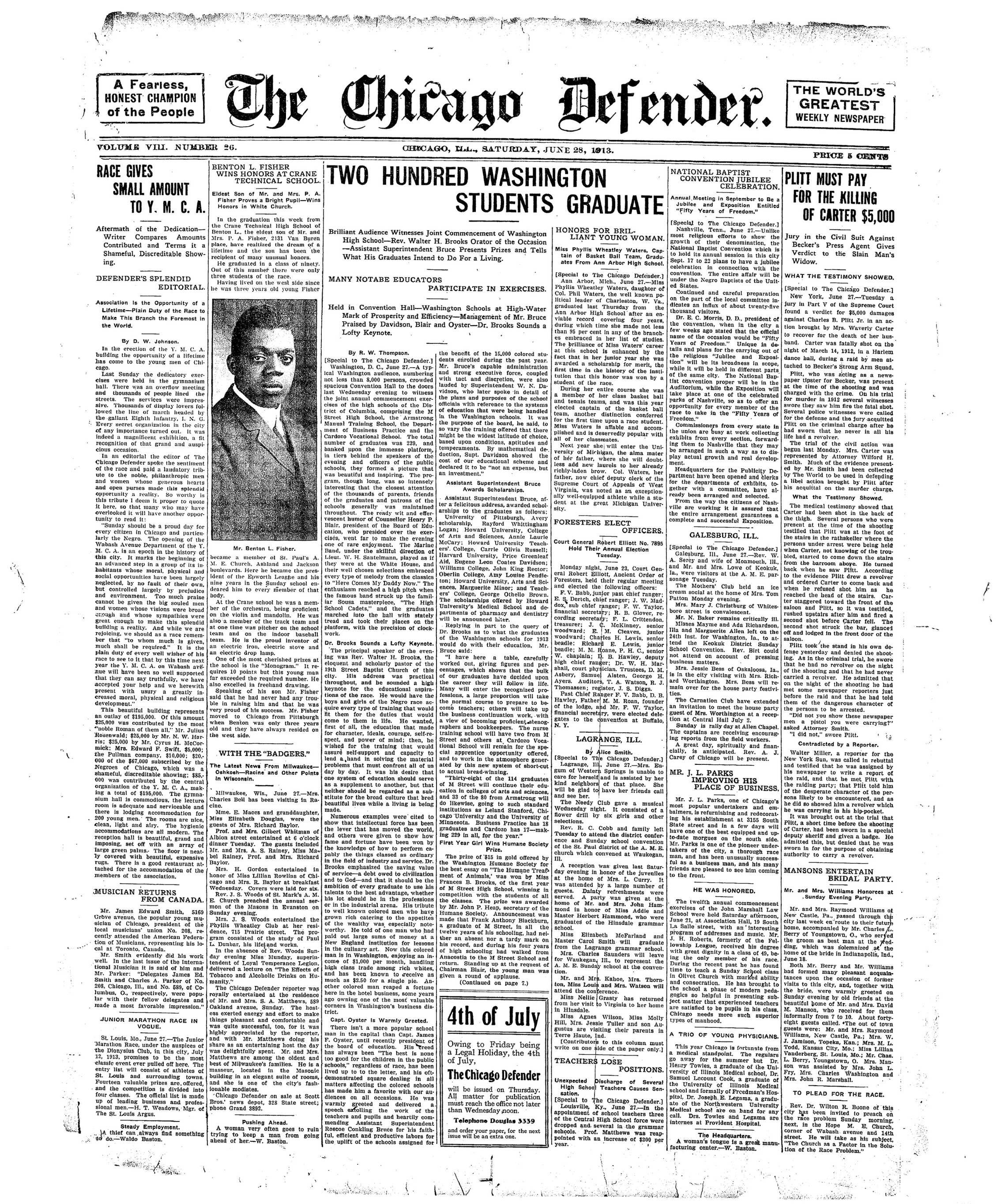
BENTON L. FISHER
WINS HONORS AT CRANE
TECHNICAL SCHOOL
Eldest Son of Mr. and Mrs. P. A. Fisher Proves a Bright Pupil—Wins Honors in White Church.
In the graduation this week from the Crane Technical High School of Benton L., the eldest son of Mr. and Mrs. P. A. Fisher, 2131 Van Buren place, have realized the dream of a lifetime and the son has been the recipient of many unusual honors.
He graduated in a class of ninety. Out of this number there were only three students of the race.
Having lived on the west side since he was three years old young Fisher
THE WORLD'S FIRST BLACK MAN
Mr. Benton L. Fisher.
became a member of St. Paul's A. M. E. Church, Ashland and Jackson boulevards. Here he became the president of the Epworth Leagte and his nine years in the Sunday school endeared him to every member of that body.
At the Crane school he was a member of the orchestra, being proficient on the violin and mandolin. He was also a member of the track team and at one time was pitcher on the school team and on the indoor baseball team. He is the proud inventor of an electric iron, electric stove and an electric drop lamp.
One of the most cherished prizes at the school is the "Monogram." It requires 10 points but this young man far exceeded the required number. He also excelled in freehand drawing.
Speaking of his son Mr. Fisher said that he had never had any trouble in raising him and that he was very proud of his success. Mr. Fisher moved to Chicago from Pittsburgh when Benton was only three years old and they have always resided on the west side.
WITH THE "BADGERS."
The Latest News From Milwaukee—Oshkosh—Racine and Other Points in Wisconsin.
Milwaukee, Wis., June 27.—Mrs. Charles Bell has been visiting in Racine.
Mme. E. Maces and granddaughter, Miss Elizabeth Douglas, were the guests of Mrs. Richard Baylor.
Prof. and Mrs. Gilbert Whitman of Albion street entertained at 6 o'clock dinner Tuesday. The guests included Mr. and Mrs. A. S. Rainey, Miss Mabel Rainey, Prof. and Mrs. Richard Baylor.
Mrs. H. Gordon entertained in honor of Miss Lillian Rowls of Chicago and Mrs. R. Baylor at breakfast Wednesday. Covers were laid for sx. Rev. J. S. Woods of St. Mark's A. M. E. Church preached the annual sermon of the Masons in Evanston on Sunday evening.
Mrs. J. S. Woods entertained the Phyllis Wheatley Club at her residence, 715 Prairie street. The program consisted of the study of Paul L. Dunbar, his lifej and works.
In the absence of Rev. Woods Sunday evening Miss Munday, superintendent of Loyal Temperance Legion, delivered a lecture on "The Effects of Tobacco and Alcoholic Drinks on Humanity."
The Chicago Defender reporter was royally entertained at the residence of Mr. and Mrs. S. A. Matthews, 559 Oakland avenue, Sunday. The hostess exerted energy and effort to make things pleasant and comfortable and was quite successful, too, for it was highly appreciated by the reporter, and with Mr. Matthews doing his share as an entertaining host the day was delightfully spent. Mr. and Mrs. Matthews are among the oldest and best of Milwaukee's families. He is a masseur, located in the Masonic building in an elegant suite of rooms, and she is one of the city's fashionable modistes.
'Chicago Defender on sale at Scott Bros.' news depot, 328 State street; phone Grand 3892.
Pushing Ahead.
A woman very often goes to ruin trying to keep a man from going ahead of her.-W. Baston.
CHICAGO, KLL., SATURDAY, JUNE 28, 1913.
TWO HUNDRED WASHINGTON STUDENTS GRADUATE
Brilliant Audience Witnesses Joint Commencement of Washington High School—Rev. Walter H. Brooks Orator of the Occasion —Assistant Superintendent Bruce Presents Prizes and Tells What His Graduates Intend to Do For a Living.
Held in Convention Hall—Washington Schools at High-Water Mark of Prosperity and Efficiency—Management of Mr. Bruce Praised by Davidson, Blair and Oyster—Dr. Brooks Sounds a Lofty Keynote.
MANY NOTABE EDUCATORS
By R. W. Thompson.
[Special to The Chicago Defender.]
Washington, D. C., June 27.—A typical Washington audience, numbering not less than 8,000 persons, crowded spacious Convention Hall to the doors last Wednesday evening to witness the joint annual commencement exercises of the high schools of the District of Columbia, comprising the M Street High School, the Armstrong Manual Training School, the Department of Business Practice and the Cardozo Vocational School. The total number of graduates was 229, and banked upon the immense platform, in tiers behind the speakers of the evenings and officers of the public schools, they formed a picture that was beautiful and inspiring. The program, though long, was so intensely interesting that the closest attention of the thousands of parents, friends of the graduates and patrons of the schools generally was maintained throughout. The ready wit and effervescent humor of Counselor Henry P. Blair, president of the Board of Education, who presided over the exercises, went far to make the evening one of rare enjoyment. The Marine Band, under the skillful direction of Lieut. W. H. Santelmann, played as if they were at the White House, and their well chosen selections embraced every type of melody from the classics to "Here Comes My Daddy Now." The enthusiasm reached a high pitch when the famous band struck up the familiar Sousa masterpiece, "The High School Cadets," and the graduates marched into the hall with stately tread and took their places on the platform, with the precision of clockwork.
Dr. Brooks Sounds a Lofty Keynote.
The principal speaker of the evening was Rev. Walter H. Brooks, the eloquent and scholarly pastor of the 19th Street Baptist Church of this city. His address was practical throughout, and he sounded a high keynote for the educational aspirations of the race. He would have the boys and girls of the Negro race acquire every type of training that would fit them for the duties that would come to them in life. He wanted, first of all, the education that made for character, ideals, courage, self-respect, and power of mind; then, he wished for the training that would assure self-support and capacity to lend a hand in solving the material problems that must confront all of us day by day. It was his desire that one system of education should serve as a supplement to another, but that neither should be regarded as a substitute for the broad culture that bred beautiful lives while a living is being made.
Numerous examples were cited to show that intellectual force has been the lever that has moved the world, and others were given to show how fame and fortune have been won by the knowledge of how to perform capably the things classed as ordinary in the field of industry and service. Dr. Brooks emphasized the saving value of service—a debt owed to civilization and to God—and that it should be the ambition of every graduate to use his talents to the best advantage, whether his lot should be in the professions or in the industrial arena. His tribute to well known colored men who have grown rich catering to the appetites of the wealthy was especially noteworthy. He told of one man who had paid out large sums of money at a New England institution for lessons in the culinary art. Now this colored man is in Washington, enjoying an income of $1,000 per month, handling high class trade among white whites, and has been known to receive as much as $2.50 for a single pie. Another colored man reaped a fortune here in the hotel business, some years ago owning one of the most valuable corners in Washington's business district.
Capt. Oyster Is Warmly Greeted.
There isn't a more popular school man in the capital than Capt. James F. Oyster, until recently president of the board of education. His breed has always been "The best is none too good for the children in the public schools," regardless of race, has been lived up to to the letter, and his oft-demonstrated square dealing in all matters affecting the colored schools has made him a favorite with our audiences on all occasions. He was warmly greeted and delivered a speech exfoliating the work of the teachers and pupils and heartily commending Assistant Superintendent Roscoe Conkling Bruce for his faithful, efficient and productive laborers for the uplift of the schools assigned for
the benefit of the 16,000 colored students enrolled during the past year. Mr. Bruce's capable administration and strong executive force, coupled with tact and discretion, were also lauded by Superintendent W. N. Davidson, who later spoke in detail of the plans and purposes of the school officials with reference to the systems of education that were being handled in the Washington schools. It was the purpose of the board, he said, to so vary the training offered that there might be the widest latitude of choice, based upon conditions, aptitudes and temperaments. By mathematical deduction, Supt. Davidson showed the cost of our educational scheme and declared it to be "not an expense, but an investment."
Assistant SuperIntendent Bruce Awards Scholarships.
Assistant Superintendent Bruce, after a felicitous address, awarded scholarships to the graduates as follows: University of Pittsburgh, Avery scholarship, Rayford Whittingham Logan; Howard University, College of Arts and Sciences, Annie Laurie McCary; Howard University Teachers' College, Carrie Olivia Russell; Harvard University, Price Greenleaf Aid, Eugene Leon Coates Davidson; Williams College, John King Rector; Oberlin College, Amy Louise Pendleton; Howard University, Arts and Sciences, Marguerite Minor; and Teachers' College, George Othello Brown. The scholarships offered by Howard University's Medical School and departments of pharmacy and dentistry will be announced later.
Replying in part to the query of Dr. Brooks as to what the graduates of the Washington schools for 1913 would do with their education, Mr. Bruce said:
"I have here a table, carefully worked out, giving figures and percentages, which shows that the bulk of our graduates have decided upon the career they will follow in life. Many will enter the recognized professions, a large proportion will take the normal course to prepare to become teachers; others will take up the business continuation work, with a view of becoming proficient, astonishers and bookkeepers. The nurse training school will have two from M Street and others at, Cardozo Vocational School will remain for the special apprentice opportunity offered, and to work in the atmosphere generated by this new system of short-cut to actual bread-winning.
"Thirty-eight of the 114 graduates of M Street will continue their education in colleges of arts and sciences, and 33 of the 80 from Armstrong will do likewise, going to such standard institutions as Leland Stanford, Chicago University and the University of Minnesota. Business Practice has 18 graduates and Cardozo has 17—making 229 in all, for the year."
First Year Girl Wins Humane Society Prize.
The prize of $15 in gold offered by the Washington Humane Society for the best essay on "The Humane Treatment of Animals," was won by Miss Frances B. Brooks, of the first year of M Street High School, winning in competition with the students of all the classes. The prize was awarded by Mr. John P. Heap, secretary of the Humane Society. Announcement was made that Frank Anthony Blackburn, a graduate of M Street, in all the twelve years of his schooling, had neither an absent nor a tardy mark on his record, and during his four years of high schooling had walked from Anacostia to the M Street School and return. Standing up at the request of Chairman Blair, the young man was given a round of applause.
(Continued on page 7.)
4th of July
Owing to Friday being a Legal Holiday, the 4th of July,
The Chicago Defender
will be issued on Thursday.
All matter for publication
must reach the office not later
than Wednesday noon.
Telephone Douglas 3339
and order your paper, for the next
issue will be an extra one.
HONORS FOR BRILLIANT YOUNG WOMAN
Miss Phyllis Wheatley Waters, Captain of Basket Ball Team, Graduates From Ann Arbor High School.
[Special to The Chicago Defender.]
Ann Arbor, Mlch., June 27.—Miss Phyllis Wheatley Waters, daughter of Col. Phil Waters, the well known political leader of Charleston, W. Va., graduated last Thursday from the Ann Arbor High School after an enviable record covering four years, during which time she made not less than 95 per cent in any of the branches embraced in her list of studies. The brilliance of Miss Waters' career at this school is enhanced by the fact that in her junior year she was awarded a scholarship for merit, the first time in the history of the institution that this honor was won by a student of the race.
During her entire course she was a member of her class basket ball and tennis teams, and was this year elected captain of the basket ball team, another distinction conferred for the first time upon a race student. Miss Waters is affable and accomplished and is deservedly popular with all of her classmates.
Next year she will enter the University of Michigan, the alma mater of her father, where she will doubtless add new laurels to her already richly-laden brow. Col. Waters, her father, now chief deputy clerk of the Supreme Court of Appeals of West Virginia, was noted as an exceptionally well-equipped athlete while a student at the great Michigan University.
FORESTERS ELECT
Court General Robert Elliott No. 7895 Hold Their Annual Election Tuesday.
Monday night, June 23, Court General Robert Elliott, Ancient Order of Foresters, held their regular meetings and elected the following officers: F. V. Babb, junior past chief ranger; E. S. Dertch, chief ranger; J. W. Madox, sub chief ranger; F. W. Taylor, financial secretary; R. B. Glover, recording secretary; F. L. Crittendon, treasurer; J. C. McKinney, senior woodward; E. M. Cleaves, junior woodward; Charles H. Lewis, senior beadle; Richard E. Lewis, junior beadle; M. M. Roane, H. C. senior w. chaplain; D. B. Hawley, deputy high chief ranger; Dr. W. H. Marshall, court physician. Trustees, D. M. Asberry, Samuel Alsten, George H. Ayers. Auditors, T. A. Watson, R. J. Thomasen; register, J. S. Diggs.
Past Chief Ranger F. V. Babb, D. B Hawley, Father M. M. Roan, founder of the lodge, and Mr. F. W. Taylor, financial secretary, were elected delegates to the convention at Buffalo, N. Y.
By Alice Smith.
[Special to The Chicago Defender.]
Lagrange, Ill. June 27.—Mrs. Eugam of Western Springs is unable to care for herself and is assisted by her kind neighbors of that place. She will be glad to have her friends call and see her.
The Needy Club gave a musical Wednesday night. It consisted of a flower drill by six girls and other selections.
Rev. R. C. Cobb and family left Tuesday to attend the district conference and Sunday school convention of the St. Paul district of the A. M. E. church which convened at Waukegan, Ill.
A reception was given last Saturday evening in honor of the juveniles at the home of Mrs. L. Curry. It was attended by a large number of guests. Dainty refreshments were served. A party was given at the home of Mr. and Mrs. John Hammond in honor of Miss Addie and Master Herbert Hammond, who were graduates of the Hinsdale grammar school.
Miss Elizabeth McFarland and Master Carol Smith will graduate from the Lagrange grammar school.
Mrs. Charles Saunders will leave for Waukegan, Ill., to represent the A. M. E. Sunday school at the convention.
Mr. and Mrs. Kahoe, Mrs. Thornton, Miss Louis and Mrs. Watson will attend the conference.
Miss Nellie Grasty has returned from her visit to Virginia to her home in Hinsdale.
Miss Agnes Wilson, Miss Molly Hill, Mrs. Jessie Tuller and son Augustus are visiting their parents in Terre Haute, Ind.
[Contributors to this column must write on one side of the paper only.]
TEACHERS LOSE
Unexpected Discharge of Several High School Teachers Causes Sensation.
[Special to The Chicago Defender.]
Louisville, Ky., June 27.—In the appointment of school teachers three of the Central High School force were dropped and several in the grammar schools. Prof. Matthews was reappointed with an increase of $200 per year.
NATIONAL BAPIST
CONVENTION JUBILEE
CELEBRATION.
Annual Meeting in September to Be a
Jubilee and Exposition Entitled
"Fifty Years of Freedom."
[Special to The Chicago Defender.]
Nashville, Tenn., June 27.—Unlike
most religious efforts to show the
growth of their denomination, the
National Baptist Convention which is
to hold its annual session in this city
Sept. 17 to 22 plans to have a jubilee
celebration in connection with the
convention. The entire affair will be
under the Negro Baptists of the United
States.
Continued and careful preparation
on the part of the local committee
indicates an influx of about twenty-five
thousand visitors.
Dr. E. C. Morris, D. D., president of
the convention, when in the city a
few weeks ago stated that the official
name of the occasion would be "Fifty
Years of Freedom." Unique in details
and plans for the carrying out of
the religious "Jubilee and Exposition"
will be its broadness in scope,
while it will be held in different parts
of the same city. The National Baptist
convention proper will be in the
Auditorium, while the Exposition will
take place at one of the celebrated
parks of Nashville, so as to offer an
opportunity for every member of the
race to take in the "Fifty Years of
Freedom."
Commissioners from every state in the union are busy at work collecting exhibits from every section, forwarding them to Nashville that they may be arranged in such a way as to display actual growth and real development.
From the way the citizens of Nashville are working it is assured that the entire arrangement guarantees a complete and successful Exposition.
GALESBURG, ILL
[Special to The Chicago Defender. J谷尔斯, Ill., June 27—Rev. W. A. Serry and wife of Monmouth, Ill., and Mr. and Mrs. Lowe of Keokuk, Ia., were visitors at the A. M. E. parsonage Tuesday. The Mothers' Club held an ice cream social at the home of Mrs. Tom Patton Monday evening. Mrs. Mary J. Christburg of Whitesboro street is convalescent. Mr. N. Baker remains critically ill. Misses Mayne and Ada Richardson, Illa and Marguerite Allen left on the 24th inst. for Washington, Ia., to attend the Keokuk District Sunday School Convention. Rev. Birt could not attend on account of pressing business matters. Mrs. Jessie Bess of Oskaljoosa, Ia., is in the city visiting with Mrs. Richard Worthington. Mrs. Bess will remain over for the house party festivities. The Carnation Club have extended an invitation to meet the house party guest of Mrs. Worthington at a reception at Central Hall July 2.
A great day, spiritually and financially, is anticipated. Rev. A. J. Carey of Chicago will be present.
MR. J. L. PARKS
IMPROVING HIS
PLACE OF BUSINESS
Mr. J. L. Parks, one of Chicago's most popular undertakers and embalmers, is refurnishing and redecorating his establishment at 3155 South State street and in a few days will have one of the best equipped and up-to-date morgues on the south side. Mr. Parks is one of the pioneer undertakers of the city, a thorough race man, and has been unusually successful as a business man, and his many friends are pleased to see him coming to the front.
HE WAS HONORED.
The twelfth annual commencement exercises of the John Marshall Law School were held Saturday afternoon, June 21, at Association Hall, 19 South La Salle street, with an interesting program of addresses and music, Mr. J. H. Roberts, formerly of the Fellowship League, received his degree with great dignity in a class of 49, being the only member of his race. During the recent past he has found time to teach a Sunday School class in Olivet Church with marked ability and consecration. He has brought to the school a phase of modern pedagogics so helpful in presenting subject matter that experienced teachers are satisfied to be pupils in his class. Chicago needs more such superior types of manhood.
A TRIO OF YOUNG PHYSICIANS
This year Chicago is fortunate from a medical standpoint. The regulars go away for the summer but Dr. Henry Towles, a graduate of the University of Illinois Medical school, Dr. Samuel Lecount Cook, a graduate of the University of Illinois Medical school and formally of Freedman's Hospital, Dr. Joseph E. Legura, a graduate of the Northwestern University Medical school are on hand for any call. Drs. Towles and Legura are internes at Provident Hospital.
The Headquarters.
A woman's tongue is a great matu facturing center—W. Baston.
THE WORLD'S GREATEST WEEKLY NEWSPAPER
PRICE 5 CENTS
PLITT MUST PAY FOR THE KILLING OF CARTER $5,000
PLITT MUST PAY FOR THE KILLING OF CARTER $5,000
Jury in the Civil Suit Against Becker's Press Agent Gives Verdict to the Slain Man's Widow.
WHAT THE TESTIMONY SHOWED.
[Special to The Chicago Defender.]
New York, June 27—Tuesday a jury in Part V of the Supreme Court found a verdict for $5,000 damages against Charles B. Piltt Jr. in an action brought by Mys. Waverly Carter to recover for the death of her husband. Carter was fatally shot on the night of March 14, 1912, in a Harlem dance hall, during a raid by men attached to Becker's Strong Arm Squad. Piltt, who was acting as a newspaper tipster for Becker, was present at the time of the shooting and was charged with the crime. On his trial for murder in 1912 several witnesses sore they saw him fire the fatal shot. Several police witnesses were called for the defense and the jury acquitted Piltt on the criminal charge after he had sworn that he never in all his life had a revolver.
```markdown
```
The trial of the civil action was begun last Monday. Mrs. Carter was represented by Attorney Wilford H. Smith. Much of the evidence presented by Mr. Smith had been collected by The World to be used in defending a libel action brought by Pitt after his acquittal on the murder charge.
What the Testimony Showed.
The medical testimony showed that Carter had been shot in the back of the thigh. Several persons who were present at the time of the shooting testified that Plitt was at the foot of the stairs in the rathskeller where the persons under arrest were being held when Carter, not knowing of the troubled, started to come down the stairs from the barroom above. He turned back when he saw Plitt. According to the evidence Plitt drew a revolver and ordered Carter to come back and when he refused shot him as he reached the head of the stairs. Carter staggered toward the front of the saloon and Plitt, so it was testified, rushed upstairs after him and fired a second shot before Carter fell. The second shot struck the bar, glanced off and lodged in the front door of the saloon.
Plitt took 'the stand in his own defense yesterday and denied the shooting. As in the criminal trial, he swore that he had no revolver on the night of the shooting and that he had never carried a revolver. He admitted that on the night of the shooting he had met some newspaper reporters just before the raid and that he had told them of the dangerous character of the persons to be arrested.
"Did not you show these newspaper men a pistol you were carrying?" asked Attorney Smith.
Contradicted by a Benorter.
Walter Miller, a reporter for the New York Sun, was called in rebuttal and testified that he was assigned by his newspaper to write a report of the raid, and that he met Plitt with the raiding party; that Plitt told him of the desperate character of the persons likely to be encountered, and as he did so showed him a revolver which he was carrying in his hip-pocket. It was brought out at the trial that Plitt, a short time before the shooting of Carter, had been sworn in a special deputy sheriff and given a badge. He admitted this, but denied that he was sworn in for the purpose of obtaining authority to carry a revolver.
MANSONS ENTERTAIN
BRIDAL PARTY.
Mr. and Mrs. Williams Honorees at Sunday Evening Party.
Mr. and Mrs. Raymond Williams of New Castle, Pa., passed through the city last week en route to their future home, accompanied by Mr. Charles L. Berry of Youngstown, O., who served the groom as best man at the wedding, which was solemnized at the home of the bride in Indianapolis, Ind., June 18.
Both Mr. Berry and Mr. Williams had formed many pleasant acquaintances upon the occasion of former visits to this city, and, together with the bride, were warmly greeted on Sunday evening by old friends at the beautiful home of Mr. and Mrs. David M. Manson, who received for them informally from 7 to 10. About forty-eight guests called. "The out of town guests were: Mr. and Mrs. Raymond Williams, New Castle, Pa.; Mrs. W. J. Jamison, Topeka, Kan.; Mrs. M. L. Todd, Kansas City, Mo.; Miss Lillian Vanderberg, St. Louis, Mo.; Mr. Chas. L. Berry, Youngstown, O. Mrs. Manson was assisted by Mrs. John L. Fry, Mrs. Charles Washington and Mrs. John R. Marshall.
TO PLEAD FOR THE RACE.
Rev. Dr. Wilton R. Boone of this city has been invited to proach on the race problem Sunday morning, next, in the Hope M. E. Church, corner of Wabash avenue and 14th street. He will take as his subject, "The Church as a Factor in the Solution of the Race Problem."
Mr. Locke of Washington, D. C., will spend several weeks in our city.
Mr. Logan Thomas, who has been attending Flask University for several years, is home for the summer vacation. Logan says Chicago always did look good to him.
Miss Mabel Smith, stenographer of the Indianapolis Freeman, has returned to Indianapolis, Ind., after spending a week with her parents at 3850 Dearborn street.
When in doubt or trouble, telephone to The Chicago Defender. Douglas 3339.
Mr. S. H. Dudley, formerly comedian of the "Smart Set," is in the city. Mr. Dudley and Mr. M. Kline have organized a Consolidated Vaudeville Association, with headquarters at 3123 State street. They hope to book acts for the entire Dudley circuit, which is rapidly growing.
The young son of Mrs. Lula Jackson, 3528 Wabash avenue, is expected home soon. He has been off to school for the past year.
Mr. Eubanks, the well known hotel man, came back to the city the first of the week, having been at Springfield, O., during the winter. He now has charge of the biggest boat running between here and Petoskey.
B. F. Mosely Jr. was one of the graduates of Englewood High School the week. Young Mosely made quite a record as an athlete this year.
Mr. William Adams and Howard F. Cattin will go to west Michigan July 4 and remain until the morning of July 7. Mr. Adams expects to occupy a cottage at the resort this season.
Mr. George W. Ellis has been appointed Director of Exhibit of the Fifthth Anniversary of Negro Emancipation in New York. Mr. Ellis has a collection of ethnological specimens representing every phase of Negro life in Africa. The appointment was made by Dr. W. E. D. Du'Bois, member of the commission which will have charge of the celebration in that state.
Mrs. Mary Lawson, mother of Miss Lucretia Lawson, the actress, is in the city, stopping with her daughter at 27 East 28th street. Mrs. Lawson hails from Indianapolis, Ind.
It was found necessary on last Monday for Joseph Sheechar to undergo an X-ray examination in order to determine whether or not it was safe to allow him out without a guard. We have the information, we are glad to say, from the expert that he is rational and his friends are safe in his society; but they are taking a chance of being talked to death on the subject of the boy, as it will take some time for him to realize there are others. Mrs. Joseph Sheechar and son returned home Sunday night from the hospital. Both mother and babe are doing fine.
The last year straw hats are conspicuous this season by their absence among the smart set of young men. The changes of some styles are expensive, but we must have them.
There is unfortunately a tendency on the part of the young single men and women in Chicago to ignore memorials and meetings pertaining to the race where their presence would lend much to the occasion and on the other hand show or exhibit pride in our great men, living or dead.
Mrs. Hattie Curtis Hall and son John of Boston, Mass., are in the city for an indefinite stay as the guest of her mother at 6618 Vernon avenue.
Miss Eleanora Curtis, one of Washington's popular school teachers, is in the city as the guest of her mother, 6618 Vernon avenue. Miss Curtis is, of course, one of Chicago's popular young women also.
Miss Georgie Penny, teacher in the public schools of Wichita, Kas., has returned to the city to complete her normal course at the University of Chicago summer school.
The Fleur de Lis Whist Club met at the home of Mrs. Theresa Brooks, 3344 Forest avenue, on last Friday afternoon. After a delicious course luncheon cards was the feature for two hours, Mrs. Kathreen Harmer scoring the highest number of points.
Hotel Washington arrivals: Mr. and Mrs. Blankinshire, Indianapolis, Ind.; Mrs. Jennie Giles, New York City; Mr. Pettigrew and wife, Cedar Rapids, Ia.; Mr. J. Moreland, Washington, D. C.; Mr. Yancy and wife, Philadelphia, Pa.; Mr. F. Turner and wife, Galesburg, Ill.; Mr. H. Black, Buffalo, N. Y.; W. H. Jones and wife, Milwaukee, Wis.; S. Jackson, Kansas City, Mo.
Mr. Harrison Emanuel was at Waukegan, Mich., this week to play at the Conservatory of Music commencement.
```markdown
```
Miss Etta B. Franklin, niece of Mr. Leach, is at French Lick Springs, Ind., stopping with Mrs. Brown. She will be gone several days.
Miss Elizabeth Clark writes friends that she is being beautifully entertained at Wilberforce and Columbus, Ohio.
Dr. S. E. Redman, Jackson, Miss., is in the city on a vacation. He expects to be here until the middle of July.
Miss Alice Davis of Columbus, Ohio, returned to her home after spending several pleasant days in the "Windy City." She expects to return to Chicago July 17 to be present at the "homecoming" of Prof. N. Clark Smith.
Mrs. Harry Howard and daughter of St. Paul, Minn., the house guests of Mrs. Robert Taylor, 6510 St. Lawrence avenue, spent a few days in Evanston the guests of Mrs. Charles Jackson. They returned to the home of Mrs. Taylor on Thursday and will probably leave for home Sunday evening.
Mrs. Clara B. Carter left the city this week for her home at Evanville, Ind., after enjoying a very pleasant visit with her daughter, Mrs. V. Pumphrey of East 3d street.
The family of Mr. Antoine Cassino arrived in the city last Thursday from New Orleans, La. They are residing at 3241 Vernon avenue.
Mrs. Harris and daughter, Miss Edna Curd, formerly of Evanston, are located at 3218 Vernon avenue.
Miss Etta B. Franklin, niece of Mr. and Mrs. R. M. Leach, is spending a month in French Lick Springs, Ind., enjoying the water, the baths and horseback riding for her health, which has greatly improved her.
Dr. Marie A. Fellows has removed her office from 2723 South State street to 10 West 47th street, corner State street.—Ad.
Mrs. Minnie Lewis and Mrs. Annie Pickings are visiting their sister and mother in Toledo, Ohio.
The Unity Club gave a lemon social at the home of Mrs. Emma Craighad on the 19th, which was a great success, they having realized $23.26. Solos were played by Miss Marie Jefferson, Mrs. Sol Morrison; and readings by Mrs. L. B. Spencer and Mrs. H. M. Jefferies.
GRADUATING EXERCISES
AT COPERNICUS.
Copenicus School, Throop and 60th st., held its graduation exercises Thursday evening, June 26. A splendid program was rendered in music and drama. Seventy-five pupils graduated from the eighth grade. Out of that number were four colored boys and eight girls of the race.
Copenicus is noted as being one of the best grade schools in the city. Its discipline is good, it has a high class of teachers, and is therefore more liberal in its general views.
Colored girls and boys led in arches, drills and dances. Miss Helen Hunter, a colored girl—one of the graduates—played the entire graduation music, and her execution was grand. These pupils are all bright and promising. Their ages range from 13 to 16. Among the boys and girls who graduated were Mr. Albert D. Webb, 6040 May St., and Miss Ethel Male Brumfield, 6209 Loomis blvd., and Miss F. H. P. Bass and Miss Bertha L. Jones.
The Principal, Mrs. Cavenaugh, adressed the class, her subject being "What Are Boys and Girls to Do at the Age of Sixteen?"
MISS BERNICE KENNEDY ENTER
TAINS IN HONOR OF MISS
MITCHELL.
The Cotillion Whist given by Miss Bernice Kennedy of 5413 Calumet avenue, in honor of the engagement of Miss Ada Lou Mitchell, on Friday evening, June 20th, was voted a great success by the forty young people present. The affair was quite unique and the favors provoked much amusement and laughter. The three parlers were decorated with a profusion of roses and peonies. Miss Ethel Thomas charmed the company with several songs and Mr. Monie Johnson surprised all present with two recitations in eastern dilac. The prospective bride and groom were toasted for their future happiness. Dr. Moze served as toastmaster. The out-of-town guests were: Misses Gertrude Howard, of St. Paul. Minn.; Rebecca McClure, Evansville, Ind.; Lucy Wright, South Bend, Ind.; Prof. F. L. D. Parker, St. Paul, Minn.; Prof. E. M. Pollard, Washington, D. C.; Prof. Mordecia Johnson, A. B. C., Atlanta, Ga., and Mr. Locke, Washington, D. C.
MASTER STEWART'S BIRTHDAY
PARTY.
The residence of Mrs. Bolle Newby,
3522 South Wabash avenue, was the scene of a merry gathering of about twenty-five couples of the younger set Saturday evening, June 21st, the occasion being the anniversary of the fifteenth birthday of Lawrence Edward Stewart, given by his mother, Mrs. James Smart, of Calgary, Alberta, Northwest Territory. The young people enjoyed themselves with dancing and various parlor games. An elaborate collation was served. The young people enjoyed themselves and departed wishing many returns to Master Stewart. Among the many birthday greetings was a piano from the mother.
PAUL LAWRENCE DUNBAR'S MEMORY WILL BE HONORED SUNDAY AFTERNOON AT INSTITUTIONAL CHURCH
The annual Paul Lawrence Dunbar memorial will be held Sunday afternoon, June 29th, at the Institutional Church, at 4 o'clock, Prof. Mordecal W. Johnson, of the Atlanta Baptist College of Atlanta, Ga., will deliver the address. Mrs. Marle Burton Hyram and Mr. Harrison Emanuel will render solos. Miss Ada Lou Mitchell will be at the piano. The public is cordially invited. Julius N. Avendorh, manager.
BUSINESS MEN, ATTENTION!
All members of the Colored Business Men's Association should take advantage of the special advertising rates of the Chicago Defender from July 5th to the first of the year. If you are interested call up Douglas 3339 and we will gladly explain.
Mrs. W. H. Montgomery, 3412 State street, gave a dinner and theater party in honor of Mrs. David Crosthwait, Kansas City, Mo. Guests for entertaining were Mrs. Peyton Taylor-Mrs.
ENGLEWOOD
General, Social and Religious News.
BY MRS. JENNIE JORDAN.
Miss Martha Marie Wilson of 6212 Throop street entertained seven of her girl friends on Sunday in honor of her fourteenth birthday.
Mrs. William Bell of 5922 Aberdeen street gave a dinner June 18 in honor of her ninth anniversary. Covers were laid for twenty. Music was the feature of the evening.
Mrs. Carrie Pryer of 1348 West 61st street gave a dinner June 22 in honor of Mr. and Mrs. Thomas Adams.
Mrs. B. B. Everage of 1344 West 61st street is improving.
Miss Georgia Lewis of 1349 West 61st street is still on the sick list.
was "Young Peoples Day," and was a flow of music, song and the occasion was a surp well as a delight to those who ed as the children who parranged from 8 to 15 years. The services were opened chorus by the young people Miss Marie Jefferson at the Invocation by Mr. James field.
Reading, "At the Phone," Hein Winborne was deliverer own brilliant and fascinating soli Miss Lula Holmes rendered a ful piano solo, "The Moon Rose." Her rendition would been creditable to a prot player.
Mrs. Nellie Stafford of 6216 Aberdeen street is much better and is able to walk out.
Mrs. Maud Ivie of 6237 Ada street is still very sick.
Mrs. Carter, mother of Mr. Carter, 1343 West 61st street, is very sick.
Mrs. Conly of 6202 Aberdeen street is on the mend and able to sit up.
The Ideal Woman's Club met at the home of Mrs. Moore, 6237 Ada street.
The next meeting will be July 11 at the home of Mrs. Richardson, 5512 Laffayette avenue. It will be Dunbaird day.
Among the graduates of Englewood High School are many we need to be proud of. Among them fire Misses Helen Hughes, E. Hill, Myrle Morgan, Esther Henderson, Frances Overton, Bessie Lowery, and Madeline Thomas, Messrs. James Brumfield, Fritz Mosely, Eugene Langston, Geral Bunn and Theodore Thomas.
From the Nicholas Copernicus School are Misses Helen Hunter, Ethel Brumfield, Bertha Jones, Florence Williams, Helen Smith, Mattie Bramlett and Fredericka Bask; Messrs. George Jordan, F. Tracy Smith, Albert Webb, Lee Parker and Herbert Goodwick.
The Lucy Flowers Industrial School graduated Bertha May Bramlett.
The Englewood Lyceum rendered its special monthly program at Hope Presbyterian church last Sunday. It Nelson Michem, Mrs. Walter Rhodes, Mrs. Blanch Bannister. After theater Mr. Montgomery entertained the ladies by throwing the Pennsylvania and New York state P. O. scheme the way they do at central, and treated all to cream and cake. Mrs. Crostwait left Thursday evening for her home.
SICK LIST
Miss Amelia F. Adams, 4004 Dearborn birth, is quite ill with rheumatism.
Miss Lisslie Toney, who resides on 5th avenue near 46th place, was operated on at the County hospital several weeks ago. She is recovering rapidly and will be able to leave the hospital in a few days.
Miss Kittie Scott, proprietor of the "O. K." restaurant, has been ill for several days but is now much improved.
Mr. Smith, proprietor of the Ten Dark Knights, was sunstruck at 31st and State Streets early this week. He was assisted home by a Chicago Defender reporter.
Mr. H. David Murray, the real estate broker, is reported very ill.
RAILROAD MEN AS HOSTS.
The Railroad Men's Benevolent and Industrial Association gave their initial entertainment at Masonic Hall, Monday evening last.
About 200 persons enjoyed their hospitality. Mayor R. R. Jackson made an excellent address while Mrs. Martha Brodus Anderson and Mr. Charles Reese rendered solos. Dancing was also enjoyed to the sweet strains of Prof. Dorsey's orchestra. The grand march was led by First Vice President R. Delaney and his wife.
EVANS-BASSETT
Miss Gertrude A. Evans, for many years a teacher in the Eastern public school at Louisville, Ky., and Colonel A. Z. Bassett, of a Kentucky K. of P. regiment at Louisville, Ky., were married June 18. They will be at home to their friends after June 21 at 2238 West Walnut street, Louisville, Ky. Their many Chicago friends wish them a happy as well as prosperous married life.
This week Col. R. Ruffin leased one of his North Dakota mines to a company for briqueting purposes. The deal was made through Mr. C. F. Taylor, a local banker and financier. He spent two years at $360 per day, with aides at work progresses. Mr. Ruffin assumed control of the other mines recently.
REMOVAL NOTICE.
Dr. A. C. Dickerson is now occupying his new offices at 3601 State street. His office hours are the same and his telephone is Douglas 5150.
HAVE A LAUGH WITH ME.
By Waldo Baston.
Father (to sultor)—Do you think you could earn my daughter a living?
Sultor—My God! Is she that poor?
Did you spend much money educating your son?
No; but I spent a fortune to get him through college.
Hubby—Dearie, you spend too much money for clothes.
Wife-I know I do, but didn't you tell me to spend it closely?
THE CHICAGO DEFENDER
was "Young Peoples Day," and there was a flow of music, song and oratory. The occasion was a surprise as well as a delight to those who attended as the children who participated ranged from 8 to 15 years of age. The services were opened with a chorus by the young people, with Miss Marie Jefferson at the plano. Invocation by Mr. James Brumfield. Reading, "At the Phone," by Miss Heien Winburne was delivered in her own brilliant and fascinating style.
Miss Lula Holmes rendered a beautiful piano solo, "The Moon and a Rose." Her rendition would have been creditable to a professional player.
"Tommy's Prayer," rendered by Miss Mabel Hill was a pathetic insight to the life of the poor, dwelling in the neglected hovels called homes. The blending of voices in a duet, by Miss Ethel Male Blumfield and Miss Lillian Holmes was superb.
"How Mackemakes Killed the Great Beai of the Mountai" was rendered in excellent style by Master Philip Arnett, age 8. His voice is as clear as a clarion and he is well trained. A vocal solo, "Sunday Morning at 9 O'Clock," was rendered by Miss Valleaux Winburn, the young prima donna of Englewood. Her voice is as musical as chiming bells.
Master Deaver Jefferson was the principal speaker of the day. He delighted the audience with that grand, noble and inspiring oration, "A Story of a Negro."
Miss Thelma Washington rendered a beautiful solo, "Emanuel" accompanied by her father, Mr. William Washington, with a violin and Mr. E. O. Marshall at the piano.
Brief addresses were made after the program by the following gentlemen: Mr. J. Hockley Smiley, managing editor of the Chicago Defender, Mr. Henry D. Smith, president of St. Marks Christian Endeavor and expresident of the St. Marks Lyceum, Mr. John W. Harris, one of Englewood young brilliant literary lights and Mr. Samuel E. Briscoe, formerly a resident of Englewood.
The regular meeting of the Englewood Lyceum will be suspended Friday evening, July 4, on account of the church barbecue and entertainment.
MAYWOOD, ILL.
[Special to The Chicago Defender.]
Maywood, Ill., June 27.—The year's work of Rev. James Sanders, pastor of the Second Baptist Church of Maywood, has been remarkable. It has been crowned with great success. During his pastorship the church has entirely paid for the land. In August they proceeded with the new building, raising $903.87, out of which $720.15 was paid during the year on the building, leaving a balance of $550 to their credit. There was at that time in the treasury $49.14, making a balance total of $599.14 at the end of his year's work, which was the second Sunday in June.
During the past week $537 was paid to the contractors, making a total paid to contractors of $987. There will be a consecration of the new building the second Sunday in July. The pastor took the leadership in all th-she works, ably assisted by Deacon George Harrison, through whom the church received a donation of $650.
The Ladies' Baptist Union of Chicago held their monthly session with the ladies of the Second Baptist Church of Maywood last Monday, June 23. Among the guests were representatives of Quinn Chapel, St Stephen's and Canaan's Chapel. Among the special guests of the day were Dr. S. T. M. Francis, D. D., pastor of Providence Baptist Church, and Dr. T. H. Johnson, D. D., pastor of Bethlehem Baptist Church. Dr. Francis delivered an able discourse in which he commended and encouraged the women in their noble work.
There was a large attendance and a financial as well as a spiritual success. We want to commend the ladies of the Second Baptist Church. They are the best cooks and best entertainers in any of the suburbs around and about Chicago. They cleared more than $12.
The Young Men's Club, connected with this church and under the leadership of Mr. M. Dreyden, have started their campaign to raise $300 to support the church.
The Helping Hand Club, composed of ladies, under the leadership of Mrs. Nanna Stewart, have also started a series of entertainment and concerts, the proceeds of which will go to the children. There will be a grand dinner and entertainment given Saturday evening, July 5, at Meyer's hall. Fifth avenue near Lake street. Canaan's Chapel needs $50 at once.
THE STORK LIMITED.
The Stork Special made a stop at Station "J" 2527 Wabash avenue, Friday, June 20, and delivered a fine baby boy to Mr. and Mrs. Guy Josephs. Mrs. Josephs was formerly Miss Madeline Cole, sister of Miss Lucinda Cole. The proud father and auntie have been crowding the mails with announcements of the new arrival. The house has been continuously crowded with friends to see "the most remarkable baby in the world."
The Really Poor
How many referred to by the unthinking world is eminently successful, are really oor—poor in home and poor in friends, poor in reputation, poor in the power of enjoying life—poor and subjects for utty.
Some of the married women who promised to obey would rather lose their husbands than keep their promise.—Waldo Bastod.
Tel. Harrison 5183
Real Estate and Probate Law a Specialty.
GEO. W. BLACKWELL
Attorney and
Counsellor at Law
Suite 622 Omaha Bldg.,
135 W. Van Buren Street,
CHICAGO
U. D. DAVIDSON & CO.
Direct Importers and Manufacturers of Human
Hazard and Law Services
```markdown
```
Let us interest you in
our business. You are a business
person we need a
matter the we need in
your town to sell our
goods we $2 good,
we send us $2 large,
we send you this large
goods, which consists
1 Switch. 1 Transformer
tightly around the head,
1 large, beautiful set
of Front Bangs, 1 set
of beautiful Curls,
[Painting of a woman in a robe, holding a book, with a thoughtful expression.]
MISS JUANITA TOLIVER.
PORO Hair Grower
50c a Box, 100 extra out of city
Treatment $1.00
$420 Dearman St. Chicago
HAY'S HAIR
Pomade
Does All and More it Promises to Do
HAY'S HAIR POMADE
straightens coarse, kinky hair and
makes it glossy and luxuriant.
You can dress your hair in
any position and keep it so, if
you use HAY'S HAIR POMADE
REGULARLY.
Any one with kinky, coarse
hair that is stubborn, will al-
ways get satisfactory results
from HAY'S HAIR POMADE
even if all others have failed.
— Highly Perfumed —
Present this adv. with 25 cents,
and get a large jar; and free sample
of HARFINA SOAP, at
CROWN PHARMACY
THE
BEST
BEEF
SHEETS
Stist and State Sts.
Shire Phlo. Spec.
Co. Manufacturer
Newark, N.J. U. S.A.
N.J. U. S.A.
Dr. W. H. Britt,
Post Graduate in Optics
and diacses of the eyes. Glasses made to
order include all defects of vision. Eye
glasses fitted to any note. Eyewitness at
your residence if preferred. 4 Difficult
cases my speciality.
Main Office: 4901 S. State St.
Branch: 5228 S. State St.
OFFICE HOURS: PHONE:
8 to 11 a.m.; 3 to 9 p.m.
Res. Phone Douglas 816 Phone Douglas 0550-2586
Dr. G. Wm. Miller
Physician and Surgeon
Diseases of the Skin a Specialty
3457 S. State St, N. E. Cor. 35th, Chicago
Office Hours: 9 to 12 M. 2 to 4 P. M. 7 to 9 P. M.
Douglas 9458
Ida M. Dempcy
Stenographer and Typist
Instruction at Reasonable
Rates
3716 Dearborn St., Chicago, Ill.
Hotel Pullman
3639. 3641. 3643 S. State St.
Finest and largest colored hotel in America. First-class accommod
for married and single people. Everything new and up-to-date.
Rooms, by day, 50c, 75c and $1.00;
By Week, $2.00 and up.
$65 Try Our Complete Funeral $65
Including Embalming, Casket, Outside Box, Grave, Robe, Two Carriages and Hearse. Our embalming process must be causing the features to appear lifelike by removing all dislaboration.
```markdown
```
This beautiful couch for the
BESIDES - WE G
WAGON FUNE
And children's funerals for $12 and up. Office
response to telephone calls from any part of the
other suburban towns.
TELEPHONES: Office, Douglas 3218
J. L. PARKS, Undertaker @ Em
Phone D
Breakfast 6 to 9 a.m.
TABLE BOARDING
Home Cooke
Mrs. S. Mc
Luncheons Put up for P
3533 Vernon Avenue
EDWARD
ICE CREAM
PHONE DO
Milk, Cream, Stationery, Co
Newspapers, Bread, Cakes a
We give Fish and Weber Sta
and Sodas. A First-Class L
EDWARD FELIX ::
Mrs. Edw. Felix's
Stands open for all kinda
ment, Hair Goods to order
hands and nails. A comp
Tel. Douglas 2928
beautiful couch for $45.00 trimmed com-
partment. WE COME A COMPLETE
WAGON FUNERAL FOR $35.50.
for $12 and up. Office open day and night to the
talls from any part of the city, South Chicago, Mor-
land. Indentaker @ Embalmer, 3155 S. S.
Phone Douglas 4391
breakfast 6 to 9 a.m. Dinner 4 to 7 p.m.
LE BOARDING BY DAY OR WEEK
Home Cooking Our Motto
S. S. Moran, P.
Beons Put up for Picnics and Fishing
Avenue
EDWARD FELIX
CREAM PAN
PHONE DOUGLAS 2928
Steam, Stationery, Confectionery, Tobacco
Papers, Bread, Cakes and Pies. Before buy-
ing Fish and Weber Stamps with Groceries, Jams,
Jams. A First-Class Laundry Agency in Co-
mmercial Felix :: :: 52 W.
w. Felix's Hairdressing
open for all kinds of Hairdressing, Scar-
air Goods to order. Special care tak-
ing and nails. A complete line of toilet-
ing 2928
General Mail Ordn. Business
to all parts of the country. 52
Breakfast 6 to 9 a.m. Dinner 4 to 7 p.m.
TABLE BOARDING BY DAY OR WEEK
Home Cooking Our Motto
Milk, Cream, Stationery, Confectionery, Tobacco, Gigars, Newspapers, Bread, Cakes and Pies. Before buying Me. We give Fish and Weber Stamps with Groceries, Ice Cream and Sodas. A First-Class Laundry Agency in Connection,
Mrs. Edw. Felix's Hairdressing Parlor
Stands open for all kinds of Hairdressing, Scalp Treatment, Hair Goods to order. Special care taken of the hands and nails. A complete line of toilet articles.
Tel. Douglas 2928 Commerce Office Business 52 W.30th St.
A.
Mme. NEWELL, Hair Culturist
MADAM NEWELL
The Original Hair Grower
Positively Guarantees to
Grow Your Hair with her
JICKEY PROCESS
if you follow her directions.
Sale on hair goods every
Monday, Wednesday and
Saturday. Work guaranteed.
Entire Course of Beauty
Culture taught.
Call or write—
Mme. Newell's Beauty College
2nd Floor
2948 State Street - Chicago, Ill.
Agents Wanted Everywhere
Ever "hunt a needle in a haystack?"
You are hunting a needle in a haystack with that "room for rent," "boy wanted" or other placard in your window. The want ads make a thorough canvass of this town between suns for your wants.
---
A man never effort until his M Baston.
We carry a line of Oak, Mahogany and all other kinds of hardwood caskets, all polish finish and silk lining. We carry a line of Octagen caskets covered with black crepe and
55.00 trimmed complete.
EVE A COMPLETE
MAL FOR $35.50.
Open day and night to the public and immediate
city, South Chicago, Morgan Park, Evanston and
Auto. 71702; Residence, Douglas 7369.
Palmer, 3155 S. State St., Chicago
Douglas 4391
Dinner 4 to 7 p. m.
BY DAY OR WEEK
Gig Our Motto
Oran, Prop.
Nics and Fishing Parties.
CHICAGO
D FELIX
M PARLOR
BIGLAS 2928
fectionery, Tobacco, Cigars,
and Pies. Before buying & Me.
Applies with Groceries, Ice Groom
laundry Agency in Connection.
52 W. 30th ST.
Hairdressing Parlor
Hairdressing, Scalp Treat-
Special care taken of the
ete line of toilet articles.
All Orde. Business
of the country.
52 W. 30th St.
Phone Oakland 2400
Madeline R. McFarland
FINE MILLINERY
Feathers Cleaned, Dyed and
Curled
HATS BLOCKED
4746 State St. - CHICAGO
One Man
out of millions discovered America How Many People wik. discover the advantage of trading with YOU if you don't advertise
are the best medium for reaching the people here about. TRY THEM ONCE
Nothing timid about a want ad.
They "rush in where angels fear to tread"—where you would be refused admission perhaps.
No waiting your turn in the ante-room, young man, if your "situation wanted" ad rings true.
Holding Back.
A man never puts forth his best effort until his worst one falls. W. Baston.
broadhead — of the
atest design and patent.
Also all the lead-
ing materials in enclosed
plush for
GUESS WHO?
Copyright applied for
The 33rd and Vernon avenue dude, R. H., who says the 40th and Evans avenue doll, D. H., certainly has won his heart? The young girl who is always seen with a certain gent? Was at the Pompeii, the Elmwood and Bill Lewis' Saturday night. Things are looking pretty bad, E. H. Wonder what mother would say? A. W. and M. B. W. are, who think they hold 'em? Poor girls, get wise.
The doll, E. L., is, who C. L. says always was and always shall be his best?
The doll, G. J., is, who sure holds him yet with W. D. because he told A. D. and R. H., so? Keep it up, kid.
The doll is who is so discouraged with life because she can't get any of the "du light boys" to ask her for her company that she is going to do like A. H.—try to commit sideways? Oh, you? Life is very cruel for one so young (old).
The pink is who is simply wild about her E. N.,? Is that so, H. H.?
The doll is who certainly held him Sunday with her Balkan blouse at Sunday school? E. P. is she.
The doll is who says she is through with A. D., R. R., and all of that bunch, because she knows she has no chance?
CANNOT LIVE WITHOUT
THE DEFENDER.
We Just Must Have It, Mr. Editor.
Hampton Institute,
Hampton, Va., June 24, 1913.
Dear Mr. Abbott:—
The Chicago Defender gives me so much information on race questions that if it is not giving you too much trouble I would like the paper sent to me while I am on my vacation.
My address after July 1 will be Pocong Lake Preserve, Pocong Pa.
EIGHTH REGIMENT SERGEANT IN
UNDERSHIRT ON STREET.
If there ever was a man on God's green earth who ought to be reduced to ranks it is a certain sergeant of the 8th, who was seen on Thursday on the streets of Chicago in his undershirt. If it were a red one or a blue one, or a pink one we could have stood for it. but "he" says it was white. We have always had a high opinion of the sergeant, but such acts as these will make us put him in the class of those State street window hand-outs, who are continually laying out the windows from morn till night. Some of these people have even given their dogs, cats, and even the parrot the habit. Sergeant, a hint to the wise is for no argument.
Mr. George W. Rogers, 21 E. 33d st., brother of the restauranter, died Thursday afternoon at 5 o'clock, after a long and severe illness. The two brothers were devoted to each other, Mr. L. Rogers never missing a day from going to the hospital to see his brother. The restauranter was overcome from the shock when a reporter for the Defender happened to drop in as he was receiving the news of the death over the phone. He had just gotten back from seeing him and was making arrangements to move him to his nephew's home. Funeral Sunday, at 12 o'clock, from Jaderou's Undertaking Rooms. Interred to Mt. Glenwood.
MISS KENNEDY IN CITY.
Miss Ora Harris Kennedy, Henderson, Ky., one of the "Kykie's" swellest belles, one of the charming Mrs. L. Sugga, 3748 Wabash ave., is in the city for the summer.
I am inclined to believe that for a woman love is the supreme authority—that which judges the rest and decides what is good or evil. For a man, love is subordinate to right. It is a great passion, but it is not the source of order, the synonym of reason, the criterion of excellence. It would seem, then, that a woman placed her ideal in the perfection of love and a man in the perfection of justice—Henri Frederic Amlieu.
The Southern Missionary Training school of Louisville, Ky., among its myriads of activities, offers music lessons for five cents to each little ones with budding talent and no money. The one dissatisfied student who failed to appear for a second lesson explained that she "never got no nickel's worth at the first."
good Excuse, recently gave as an ex- t choir practice that with a dying friend, 'on proved that it he was "just dying
OU?
ouraged he usly but a
dentist'a.
AR
Were I would be do Baston
Were it not for idleness, many would be out of employment.—Waldo Baston.
The dudes with the buttonhole bou-
quet english turtles are who looked
good to the third dude. They were on
Saturday? R. H. and F. C. H., you
were best in short pants. A tip from
the nibble.
---
The popular society doll is who wore a dress at L. E. S.'s dance? D. H. is correct.
The doll, M. B. W., says that the Guessie doll was a dress at L. E. S.'s dance; D. H. was certainly a mistake, because she had three or four since last she had him.
The doll is who says that the cruel dress was a dress at L. E. S.'s dance. We all agree with you, M. B. W.
The E. 34th street doll, A. E., who holds the dress was a dress at L. E. S.'s Luxe剧场. R. H. says she is the human vampire.
The doll, M. P., who was attired in such an elaborate evening gown at L. E. S.'s last day last? She looked like a wig figure.
These dukes who are looked upon on the
beach, you, I, you are the short pants do-right
bear.
Deaths of the Week
(From the daily record of the Board of Health.)
Burton, Bilas, 57–357 Wentworth av., June 13.
Burna, Robert, 38–1633 Carroll av., June 13.
Barquette, Oscar, 55–3755 Wabash av., June 13.
Cash, William, 6–2966 La Salle st., June 14.
Cato, Walter, 32–3649 Prairie av., June 14.
Dorsey, Louis, 97–3638 Wabash av., June 19.
Floyd, Annie L., 52–4713 Dearborn st., Gray, Jennie, 50–3743 Prairie av., June 19.
Jones, Eliza, 67–5222 Lake av., June 16.
Joseph, Clara B., 47–3634 Rhodes st., June 18.
Jonelson, Eliza, 62–3631 Vernon av., June 17.
Johnson, Henry, 70–1929 Slate av., June 17.
Jonas, Joseph F., 39–2417 Wabash av., June 20.
Thomas, Julia, 46–18 W. 19th st., June 21.
THE ROSEBUDS IN SESSION
Rosebud Nurseries of the Western Grand Division of the Grand Fountain in Session—Many Delegates Here—Chicago Delegates Arrived Wednesday Morning at 7:30 over the Illinois Central Diamond Special, Accompanied by State Deputy M. T. Bailey.
East St. Louis, June 27—Having been located, and having had breakfast, the delegates convened at the Fraternal Hall, where they met the delegates from other states and the grand officers from Richmond, Va. The meeting was opened at 10:30 by Mrs. Loula Young, the president, from Chicago. The morning session was taken up with the opening address of the president, and an address by the General Superintendent, Hon. Floyd Ross, from Richmond, Va., and other local talent. At night, addresses will be delivered by the mayor, Hon. John Chamberlain of East St. Louis; Hon. Chamberlain of Ross, of Richmond, Va.; Chief M. J. K. Caird; Miss Emma Erown of East St. Louis; and also Mrs. Victoria Clay Haley of St. Louis, as well as M. T. Bailey of Chicago and Dr. J. C. Caldwell of Nashville. Tenp
The meeting will be in session the remainder of the week, and many of the delegates will remain over to take part in the memorial exercises on Sunday, at St. Paul A. M. E. Chapel in St. Louis, G. W. M. Floyd Ross and others will leave for Pittsburgh, Pa., Saturday.
THE PROGRESSIVE MISS BELL.
Miss Pearle M. Bell, 3245 Forest ave., entertained a number of friends Monday evening at Progressive Whist, complimentary to Miss H. L. Ingram at Atchison, Kans.
Bwallow It Quick
Impatient people water their miseries and hoe up their comforts; sorrows are visitors that come without invitation, but complaining minds send a wagon to bring their troubles in. Many people are born crying, live complaining, and die disappointed; they chew the bitter pill which they would not even know to be bitter if they had the sense to swallow it whole in a cup of patience and water.—Charles H. Spurgeon.
19 ignorance and passion are the of popular morality, it must be sed that moral indifference is lady of the cultivated classes. dern separation of enlighten virtue, of thought and con the intellectual aristocracy test and vulgar crowd, is danger that can threaten 1 Frederic Amlel.
> to be lovers
bands. And for
ce had a lover,
has once had a
doable to do
ouraged he usly but a
Very sincerely yours,
WM, ANTHONY AERY.
MR. H. ROGERS DEAD.
MIRS KENNEDY IN CITY
Love.
She Wouldn't Buy the Price
Good New Open Form
Good May Come From Change.
When we go away from home we leave behind old enemies as well as old friends. When we are free from the sinister expectations of schoolmates we may amend old errors on a new stage with success. Then, too, a new home brings into play areas of the mind otherwise unfruitful because untilled.
Humorists Always Geniuses.
Men of humor are always in some degree men of genius; wits are truly so, although a man of genius may, amongst other gifts, possess wit, as Shakespeare—Coleridge.
Two of a Kind.
Some people look almost as pleasant when they are going to the photographer's as when they are going to the dentist's.
ARE YOU WORKING?
THE CHICAGO DEFENDER
LAST TIME FOR THE SKEPTIC
Never Again Will He Attempt to Evade the Sermon by Slipping Out of Church.
"On general principles I flout all my wife's prophetic utterances and threadbare maxima" said the skeptic.
"Her plious opinion that any person who deliberately evades listening to a sermon is bound to pay for it excited me \nunholly glee.
"I did not believe her then. I do now. Last Sunday's experience converted me.
"I attended afternoon service in a church noted for its music. Having been studiously engaged before meeting, and having no time to spare from reading afterward, I took a book to church. During the slinging of the hymn immediately preceding the sermon I slipped out. Several hundred other persons who shared my aversion to sermons also slipped out.
"The church authorities had prepared for the exodus. All the side aisles were roped off, and two vergers stood at the end of the center aisle dangling silk contribution bags under our eyes. Compunction at having left the preacher in the lurch impelled me to drop more money into the bag than I could well afford. Other deserts, to judge by their expression, also exceeded their means.
In the vestibule I discovered that I had left my book. It was an expensive book that I could not afford to lose through a fellow-churchgoer's appreciation of good literature. I went back and ambled up the aisle to identify my paw and book. Owing to the shifting of the congregation I could not get within three paws of them, so I sat down, keeping a vigilant eye on the book
"Well, at the end of the serman they took up another collection from the faithful who had not attempted to subn the preacher, so they caught me again. I had tried to escape a sermon, and certainly I had to pay for it. "Funny how these women do hit the truth once in a while."
BEYOND ITS MOTHER'S CARE
Chicken, "Adapted" by Pigeon, Grew Indifferent to Diminutive Guardian's Minislations.
A Pennsylvania pigeon-raiser also raises a few game chickens every year. Some of the birds persist in laying their eggs on a high shelf where the pigeons roost. Early last spring one of these eggs rolled into a pigeon's nest and when it hailed out its chicken the pigeon promptly adopted it. It fed the young chicken, hovered it at night, and the youngster grew rapidly. It grew to be about four times as large as its foster-mother, but the pigeon stuck to its adopted bird and did her best to take care of it.
It was a very comical sight to see the fussy solicitude exhibited by the pigeon for the welfare of the chicken, which, in time, grew quite indifferent to its diminutive guardian's ministrations.
---
Time Has Proved Truth of Claim.
After seventy years Rear Admiral Charles Wilkes has been further vindicated in the claim which he made that he had discovered an antarctic continent. No less authority than Sir Ernest Shackleton now may declare that Wilkes was right in the reports of his expedition of 1833 and 1842. The Mawson expedition further substantiates Shackleton's own discoveries. Leaving Sydney in December, 1839, Wilkes discovered what he thought to be an antarctic continent, and sailed along lefields for several weeks. Although his court martial resulted in his acquittal upon the charge of having fabricated this discovery and in his being reprimanded only for the illegal punishment of men in his squadron, the discovery was long doubted.
"Toothache" Signal in Chile
Drink is the curse of Chile. "For some time after our arrival," writes Mrs. Hugh Fraser in "Further Reminiscences," "Hugh and I used to be puzzled at the prevalence of toothache in the town (Sanitago). Every day one would see men in the streets, frock coated and tophatted, their faces almost hidden by a handkerchief tied around their jaws—not one or two or occasionally, but half a dozen at a time, and on every day of the week. Later we found out that it was a signal and meant: "I was drinking last night. Do not speak to me."
Experience.
"My dear boy," sald Empeck, who happened to be in a confidential mood, "you will never know what real happiness is until you get married."
"It's a fact," rejoined Empeck, "but then it will be too late for you to appreciate it."
Warm Day.
The young father was rejoicing visibly over the advent of his first son. Early in the morning he was proudly in evidence at the front gate when the leeman appeared. "What five pounds?" inquired the leeman. "No," said the excited parent, "eight and three-quarters."
As Awful Thought
Grouch No. 1.—What women can
see, a tenor beats me.
Grouch No. 2—But that isn't the worst of it. Pretty soon with the new Edison invention, we'll have moving pictures that sing tenor—Puck.
Poison.
"Those two women hate each other and yet they kiss whenever they meet." "Yes, they have both heard that there are genegerous germs in kisses."
As he fled along the bleak highway the one awful thought that possessed him was the utter hopelessness of the situation into which he had been so abruptly plunged.
He had not meant to kill him. Ah, no! such a thought had never found lodgment in his brain for an instant. Why should he harm the father of the woman he loved?
He had gone more to plead his cause with the old man. Words had passed between them, and the old man, in senile rage, had attacked him. Even then he had not meant to show resistance. His sole thought was to quiet the old man. But as he had struggled with him with that end in view they had slipped on the polished surface of the caken floor of the library, and in falling the old man's head had struck against the iron-bound corner of a massive ancient chest, and he had lain still.
Presently, in the deep gloom of his inner being a spark of hope光耀ed. What if the old man were not really dead? True, he had thought to make sure, but he should not have given up so soon. At any rate, he should have faced the situation mantually; should have aroused old Sarah, the sole domestic of the old widower's big house; and Clarice—no! he never could have told Clarice.
He began to retrace his steps feverishly. What a distance he had traveled in his insane flight! Suppose that he found the household aroused upon his return?
As at length he neared the house, he perceived that the lower windows were lighted up.
But surely that fitful, flaring light was no ordinary illumination? He suddenly recalled that in his struggle with the old man the burning logs of the great open fire in the library had been scattered. He had afterward thrown them back, but some stray coals must have remained behind and now on fire!
He rushed forward; but he might as well have hurled himself against a rock as against that massive front door; and as for the lower windows, they were heavily crossed with iron bars.
And Clarice? Clarice was no doubt sleeping calmly enough upstairs. He knew her window.
He dashed madly in the direction of the barn, where he remembered to have seen a ladder only the other day. Prescently he returned, dragging its weight after him, and raised it to the upper window.
He broke the glass with his bare hands, unmindful of the wounds it caused him, and, raising the sash, entered the apartment.
"Clarice!" he called. "The house is afire; come quickly."
He ran to the head of the stairs. The lower portion of the house was all afame.
He gathered her yielding body in his arms and hurried to the window.
"But where is father? Oh, you must save him!" she gasped.
"I will, darling," he said, shuddering involuntarily. He gazed below. Neighbors, attracted by the glare, had commenced to assemble. One man was already halt-way up the ladder. He passed her falting form to the man on the ladder and rushed back to arouse old Sarah and direct her to the means of escape. Then he began to make his way to the fire below. It was then that the great temptation came to him. Why should he risk his life for a dead man? Already he had done all that could reasonably be required of him, and the fire would soon obliterate the traces of that dread mishap.
But, not he could not live with that stain upon his soul. He could not bear the plaudits of the crowd, nor her proud words of praise for his heroism, with the knowledge of the true state of affairs gawning at his heart. He fought his way to the library and dragged out the singed body of his late adversary. Through the hall, and to the doorway he struggled with his burden, but the smoke and flames overcame him, and he sank down just within the portal.
Meanwhile, from the outside they were battering down the door with axes, and presently they rushed in, regardless of the flames that belched forth, and carried out the blackened bodices.
One grave contained them; and, kneeling by the marble shaft that marks its site, you may often see a sad faced, black-garbed woman. Besides names and dates, the shaft bears this inscription:
"Greater love hath no man than this, that a man lay down his life for his friend."
(Copyright, by Daily Story Pub. Ca.)
Dle Wacht am Rhein
The imperial German library, which possesses the original text of the national anthem, "Die Wacht am Rhein," signed by the author, Max Schlesenburg, has been further enriched by the gift of the original music from a person whose name the librarian can divulge. The report states that the "music is written on a quarto sheet of music paper" and bears the signature, "Composed on March 10, 1854, by Karl Wilhelm at Knefeld." The sheet appears to have been dedicated to the composer's friend, Wilhelm Greef. A copy of the music, also signed by the composer, slightly changed, is preserved at the German Museum at Nurnburg.
Merchants Act as Bankers
In case of poor catches the merchants of Newfoundland frequently "carry" the fishermen over, not only one but several seasons.
All Need Forglveness
He that cannot forgive others breaks the bridge over which he must himself pass; for every man has need to be forgiven—Lord Herbert.
Their Object.
"Why do people have their hands read, anyhow?" "To get a palmy future."
FURNISHED ROOMS FOR RENT.
3575 RHODES AV.—Apt. J.—To rent, large front room, newly decorated, steam heat, hot and cold water. Telephone. Two gentlemen, or an ideal home for married couple. Phone Douglas 5085-28-5511.
5112 WABASH AV., 2D FLAT.—Large furnished rooms, with modern conventions and kitchen privileges.
28-5324 CALUMET AV.—Neatly furnished rooms, all modern conveniences. Telephone service. Near car line. Doug. 5834-28-5249.
2409 DEARBORN ST.—Nice light, large and airy room; gas, hot and cold running water. Convenient to car line. 28-5369 WABASH AV.—Nicely furnished rooms; bath, gas, telephone service and all other modern conveniences. Near car line. Kitchen privileges. Phone Dow28-56313.
6529 VINCENNES AV.—Two well furnished rooms at reasonable prices; all modern conveniences. Please call after 5 p. m. Mrs. Addie Braggs. Phone Westworth 9625.
4743 EVANS AV., 3D FLAT.—Nicely furnished, large, light and airy rooms for gentlemen. Near Cottage Grove and 47th street car line.
3530 RHODES AV. 2D FLAT.—Nearly furnished light and airy rooms, bath, gas, telephone service, steam heat and all other modern improvements. Convenient to car line.
3285 FOREST AV. 2D FLAT.—Nearly furnished large room in a private family of two. Suitable for man and wife. Kitchen privileges and steam heat; $12 per month. Call not later than 7:30 p.m.
3285 FURNISHING A. V.—Nearly furnished large front room with alcove and two small ones, suitable for man and wife or two gentlemen; half block from car line. Doug. 8592.
3285 FOREST AV. 2D FLAT.—Nearly furnished large, light and airy rooms, especially suited for summer use, with bath, gas, hot and cold water, for particular people. In a quiet neighborhood.
3347 FOREST AV. 2D FLAT.—Nearly furnished large, light and airy rooms, especially suited for summer use, with bath, gas, hot and cold water, for particular people.
3384 VERNON AV.—Married couple employed to share flat, or 2 gentlemen. Near L at Grand Blvd. Sta. Call at 6 p.m., 1st flat.
3217 INDIANA AV.—Up to date room; steam heat, hot water; newly furnished. No other roomers. Douglas 8766.
3209 PRAIRIE AV.—Nearly furnished small rooms containing stationary stands and wardrobes; reasonable. Phone 2492 Doug.
3424 VERNON AV. - Large room, furnished or unfurnished, for man and woman. Kitchen privileges. Near 35th st. car line. Douglas 2093. Auto. 77307.
21-23
4118 STATE ST. - Flat D. Rooms, comfortably furnished, with improvements at car line. Gentlemen preferred. Mrs. S. W. Brown. Phone Kenwood 2699. 21-23
3400 WABASH AV. - 3d floor. Newly furnished rooms, light; also modern conveniences. A large is a large from also 2 side ones.
21-28
3424 VERNON AV. - 2d flat. Large, light, alary front and side rooms for rent; steam heat and all modern conveniences for nice people.
21-28-5-12
3234 VERNON AV. - Nically furnished alary front and side rooms service and all other necessary conveniences. Men preferred. Convenient to car line. Doug. 6193. Aut. 77538.
21-28
4633 EVANS AV.-3d apt. Nicely furnished rooms, bright and cool. In strictly modern steam-heated apartment, Phone Kenwood 4272. 21-28
4440 LANGLEY AV—Nicely furnished rooms, light and airy. Conveniences all modern. Near car line. Man and wife preferred. Kenwood 4379. 21-28
5830 WABASH AV.—First flat. Nearly furnished rooms. Hot and cold running water. Bath, gas, telephone service and all other necessary modern improvements. Convenient to car lines. Phone Englewood 10427. 28-5.
3626 CALUMET AV.—Two nicely furnished front rooms; light and airy; all modern conveniences; near 35th street car. Phone Douglas 3334. 21-28
3424 VERNON AV.—Large room, fur-wished or unfurnished, for man and wife; running water; modern conveniences; kitchen privileges; near 35th street car line. Phone Douglas 2032. Auto. 77-307. 21-28
5255 WABASH AV.—1st flat north. Furnished or unfurnished rooms for light housekeeping. All modern improvements, including steam heat. Call evenings or Sundays. Phone Drexel 6037. Mrs. C. L. Upton. 21-28
3726 CALUMET AV.—Neatly furnished room, modern conveniences; rooms well lit; in quiet neighborhood. Railroad, postoffice or single men. 3795 Douglas. 21-28
3343 CALUMET AV.—Neatly furnished, large front rooms, bath, gas, telephone service. Phone Douglas 3118 -21-28
PHONE DOUGLAS 4014. FIRST BASEMENT room, neatly furnished; $6 per mo. 14-21
3818 LANGLEY AVE. FURNISHED OR unfurnished rooms for man and wife or two gentlemen. Near car line. Phone Douglas 3892. 14-21
5134 WABASH AVE. 2D FLAT. NEATLY furnished rooms, with bath, gas, hairdryer and other amenities. Convenient to car line. Rent reasonable. 14-21-35
419 E. 33D ST.—Two, three, or four rooms, desirably for light comfortably heated. Bath, gas, use of all and all other modern accommodations. Convenient to telephone Phone Doug. $385. 7-14-23-28
4528 ST. LAWRENCE AV.—Nicely furnished rooms, with all modern conveniences. Phone Kenwood 42227 11-9-12-11-9-13
FLATS TO RENT.
5327 WABASH AV. — Very desirable apartments, recently opened. Electric lights and all modern improvements. Phone Drexel 806 (or your own agent). 25-5
3819 GALUMET AV — 3-room flat, steam heat and telephone. References required. 21-28
3849 STATE, ST — 2D FLOOR, 5-ROOM FLAT; STEAM HEAT, GAS RANGE, REFRIGERATOR, SHADES, SCREENS, FIRST CLASS JANITOR SERVICE; HIGH GRADE BUILDING WELL TAKEN CARE OF; FIVE FAMILIES IN BUILDING, ALL SELECTED. MODERATE RENT FOR DESIABLE TENANTS. DANIEL HARDIN, OWNER. 3139 INDIANA AVENUE. TELEPHONE DOUGLAS 553.
BUSINESS/CHANCES.
FOR SALE--Fine black walnut bookcase
with 24-inch black walnut
nut sideboard, $19. Rug, beda
attresses, a carpet and other household fur-
ries, a rug, and a chair. You can
be sold in 4 days. Am leaving the city
and must sell at once. Come and see
at 3605 Prairie av. Mrs. Somers.
FOR SALE--A bargain-4-room house
with 24-inch black walnut
mentals. Good location, near corner.
Price, $1700. Seventeen hundred dollars.
Inquire Flag Shanty. South av. crossing.
FOR SALE—4-room cottage at 6127 Ada St.,
easy terms. Call The Balley
Realty Co., Main 4153 or Auto. 31-7-16.
31-7-14-21-28
Get Your Hands On A House On Your Own Terms
Any of these $500. Balance like rent
PRAIRIE AVE., near 35th St. Lot 25x125, a detached 12-room brick house; 2 baths; open plumbing; hardwood floors; furnace heat; in good repair; rental $600. Price.....$6,000.
FOREST AVE., near 33rd St. 10-room stone front house; furnace heat; could be remodeled into a 3-flat at small expense; now rented for $510. Price.....$4,500.
CALUMET AVE., near 35th St. An elegant 3-story stone front house; 10 rooms; open plumbing; furnace heat; all in fine repair; rental $480. Price.....$4,400.
CALUMET AVE., near 35th St. Large 10-room brick and stone house; open plumbing; furnace heat; hardwood finish; in good repair; rental $480. Price.....$4,500.
GROVELAND AVE., near 31st St. 10-room stone front residence; open plumbing; furnace heat; all in first class repair; rental $420. Price.....$4,500.
DEARBORN ST., near 35th St. 2-story stone front; 2 flats of 6 and 7 rooms; bath; gas; stove heat; rental $552. Lot 25x110. Price.....$4,500.
EVANS AVE., near 45th St. Lot 25x170, improved with a good 8-room frame house; open plumbing; furnace heat; frame barn; rental $252. Price.....$3,250.
PRAIRIE AVE., near 35th St. Double frame house; 7 rooms each; open plumbing; bath and gas; rents $45. Price $3,000.
DEARBORN ST., near 31st St. 2-flat frame; 5 rooms each; bath; gas; frame barn; lot 25x110; rental $360. Price $2,700.
DEARBORN ST., near 29th St. Lot 25x110; improved with an 8-room frame cottage; rental $216. Price.....$2,250.
The Guaranteed Feather Company
PORO HAIR GROWER
PORO HAIR GROWER
GUARANTEED
TRADE MARK
PETER
PHONE DREXEL 9146
Ladies & Gents L
A. APLI
Cleaning,
Pressing, Dyeing, Hats Cleana
Repairing
4730 STAT
Aerial Analysis.
If the late Wilbur Wright ever had a romance he managed to keep the secret, and no one seemed to know. However, he was not without views on the subject. Once a reporter asked him why he had never married. It's the easiest thing in the world to drive an airplane." he answered, "and it's just as easy to get married." Then he added: "Women and airplanes are so much alike that you can't analyze either until you get them going."
Crossing Africa In Motorboat
Crossing Africa in Motorboat
Lieutenant Gratz of the German army has succeeded in crossing Africa in a motorboat. The most important geographical result of the enterprise appears to be the discovery that there is a continuous waterway from the source of the Zambezi, in northern Rhodesia, to the River Kongo, which is thus proved to be the longest river in Africa. In 1909 the same official crossed Africa in a motorcar.
Wanted—A Life Berth
An advertisement taken from a morning paper shows to what a pass a genius may come in a great city: "Wanted—A collaborator, by a young playwright. The play is already written; collaborator to furnish board and bed until play is produced."—Argonaut.
Take Care of Your Fluids
Prof. Armand Gautier tells the French Academy of Sciences that when the element fluorine begins to disappear from the body old age comes on. It is this that causes the falling of the hair and the loss of the teeth.
About Women.
"The difficult thing to understand about women is, that there's nothing to understand. Once master this fact, and you've got the key to one of the most provoking mysteries of life."—William Hewlett.
Source of Tenderness
Tenderness has no deeper source than the heart of a woman, devotion no purer shrine, sacrifice no more saintlike abnegation.—Germain Francois Follain De Saint-Folix.
APPLICATION FOR PARDON
APPLICATION FOR PARDON.
Notice is hereby given at July
term of the Board of Pardons an appl-
cation for pardon will be made for Bud
Hoggina committed for murder at the
February term, 1903, of the Criminal
Court of Cook County, at Chicago, Ill,
to her imprisonment in the Illinois penitentiary at Joliet, Ill. Lizzie Robinson.
(Sister) Petitlooper.
French Plumes And All
Classes of Fancy Feathers
Guaranteed Willow Plumes Our Specialty
Washable-They Do Not Lose Fibre
MME. LAMBERT. Prop.
3149 Indiana Avenue CHICAGO
Phone Douglas 7920
AIR GROWER
MME. Leora Smith treatment of the scalp
with the wonderful Poro Hair Grower
will absolutely grow your hair and keep the
scalp clean and healthy. Thousands know
of its value. This treatment destroys the
germs that cause falling hair and baldness.
With a thorough course of treatment I
guarantee satisfaction. Both women and
man treated will also do Manicuring, Hair
Dressing, Bleaching and Dyeing. I also teach
what I do. Poro Hair System is $35.00 alone.
Diploma issued on completion of course.
$1.00 for Treatment, 50c for Box of Poro
Telephone Automatic 74-614 Phone Dresel 4670
5209 Wabash Avenue, Chicago, Ill.
AUTO 73-909
Uts Furnishing Store
A. APLIN, Prop.
Cleaned & Blocked
Laundry Office,
News Stand,
Shining Parlor
STATE STREET
OAKLAND {5101
264
5100
ver had
keep the
know.
views
reporter
mar
Chicago Carpet
Cleaning Co.
House Cleaning—Attic to Base-
ment. Home of Vacuum
Cleaning.
Alex. T. Stewart, Mgr.,
20 YRS. EXPERIENCE
1236 E. 47th St., CHICAGO
Look for the Defender wherever newspapers are sold :: :: ::
The readers of the Chicago Defender are requested to ask for the paper at the various news stands throughout the city.
The Chicago Defender is to be on sale everywhere. If you ride on the "L" road ask for it at the news stand. If you can not secure it from your newsdealer call up the Circulation Department 3139 S. State Street Tol. Douglas 3539
Dr. Theo. R. Mozee DENTIST
Office Hours, from 9 a.m. to 5 p.m; from 7 p.
m, to 9 p.m. Sunday by appointment.
Phones: Oakland 4622. Adea 73-089.
4715 South State St., CHICAGO, IL.
Phone Franklin 2727
Res. 508 East 36th Street
Tel. Douglas 4397
J. GRAY LUCAS
ATTORNEY AT LAW
Oxford]Building, Suite 506
118 North La Salle St., Chicago
3159 State Street
CHICAGO, ILL.
TELEPHONE DOUGLAS 3339.
Entered as second-class matter, February
1, 1906, at the Postoffice in C-Clago,
Ill., under act of March 2, '89.
RATES OF ADVERTISING.
Births betrothals, marriages and
deaths. $1.50
Complimentary and obituary resolutions.
each. $0.00
DISPLAY ADVERTISEMENTS.
One inch, one time. $1.50
Special rates given on large or long-
standing ads.
Brief page advertisements, per inch 3.00
Want ads, each. $0.50
Reading notices, per line. $0.25
Reading for display advertisements furni-
nished on application.
Change of address. Please give both
the old and new address and in writing
to the paper always be careful to give
both the state and postoffice, as well as
name.
IF YOU SEE IT IN THE DEFENDER,
IT IS 80.
COURT GENERAL ROBERT ELIOTT.
No. 3255. Ancient Order of Forerers,
meets every second and fourth Monday
night in each month at Odd Fellows
Hall, 3837 State street.
Officer Gwenners.
Chief Ranger, F. V. Babb, 5346 Dearborn street; phone Dexel 5010.
Financial Secretary, F. W. Taylor, 5622 Dearborn street; phone Crittenden.
Treasurer, Frank L. Crittenden, 2414 Dearborn street; phone Calumet 3219.
CHURCH DIRECTORY
SATURDAY, JUNE 28, 1913.
THEIR FIRST QUARREL.
She called him a horrid, mean, nasty, old thing,
And threatened to go home to Ma.
When she handed back her big solitaire ring
He audibly murmured "Ha, ha."
She sobbed, "You'd be glad, I suppose, if I died."
Then she nestled her head on his breast.
He kissed her, she cried, he lied and she sighed—
The rest can be easily guessed.
Patronize only the tradespeople who give our young men and women employment.
Two deaf and dumb people were married last week in one of our churches. We understand it was rather a quiet affair.
The woman who robbed the 47th street store evidently thought equal suffrage gave her permission as well as the men to purloin other people's chattels.
Oklahoma keeps up its reputation for lynchings. The past week two more unfortunate "suspect" fell victim to these bloodthirsty, inhuman curses and a woman led the mob.
We would suggest that our friends, during the hot weather especially, would refrain from trying to "solve the question" and give their overheated brain—and incidentally us—a rest.
It is strange how these Democrats in power can sleep on the Negro appointment proposition, with so much light in their eyes. We did not put them there for life, other elections are coming.
Perhaps it might be just as well for some of the disreputable characters who drift into Chicago to learn that freedom doesn't mean that you can insult people or ignore the laws. It is this floating worthless class that make it so hard on the respectable element and cause avenues of employment to be closed that were once open to us.
BARBARIC OKLAHOMA.
This from the Anadarko, Okla., paper: "At 1 o'clock this morning a mob of three hundred men, headed by a WOMAN who carried a rope, took a young Negro who was jailed on a charge of murdering a white woman, hanged him to a tree and riddled his body with bullets." Led by a woman! The very name woman carries with it gentleness and kindness, and yet this bloodthirsty gang of hoodlums
---
dragged the name in the mire; dragged this woman as they have dragged their own souls to the lowest depths. Oklahoma residents are not far removed from the barbarians in the dark ages and we must either bear with them or take drastic measures to show them the error of their ways and some of these days they will pay an awful penalty for their misdeeds.
It isn't the Negro alone that is going to make the white man of this country sit up and take notice; it is the foreign element who are coming at the rate of a million a year who suffer economic discriminations as we do, and social ones almost as great. Having centuries of freedom behind them, gaining education and wealth they will have two of the most potent weapons to fight arrogant Americana.
Now that the Legislature of Illinois has passed a bill giving $25,000 for the celebration of the emancipation of the American Negro, let us hope that Gov. Dunne will appoint men and women at the head of the departments who will do work that will reflect credit to the race. We want only qualified, honorable and intelligent people that when the exposition is over a great howl will not go up about a few getting jobs and the exposition being a failure.
Bethel Church, under the leadership of Dr. D. P. Roberts is doing a thriving work. Dr. Roberts is gathering around him an immense audience. The congregation has become so large that it is necessary every Sunday, within the past few months to hold an overflow meeting. The Sunday school under the superintendency of Mr. R. E. Moore and Mr. Clarence E. Corbin is a bee hive. They are busy workers, and a more perfect decline could not be desired. The attendance last Sunday was 386.
That the citizens of Chicago made a good choice in Representative Jackson is becoming more evident every day. As Montgomery Ward was known as "the watch dog of the lake front," so Representative Jackson will be known as the watch dog of our civil rights. That the first bill that he advocated and made his maiden speech for passed, shows forcefulness and the esteem in which he is held. We predict many good things in the future as a result of Representative Jackson's efforts.
The pleasure resorts just outside of Baltimore are in a fair way of being closed, unless the street railway company shall provide transportation separate for the whites, they claiming that the Negroes who visit these resorts are vulgar and disorderly. In all fairness we must admit that Baltimore has more than its share of the rowdy and ignorant class of the race, who are as objectionable to their own as they are to the white race. It does seem too bad that the better element should have to suffer for what these blots on society do.
THE WASHINGTON STREET CAR BILL.
A bill to separate white and colored passengers on the street cars of Washington was introduced in the house. For fear that some of our readers might think we meant the state of Washington, we will say no, we mean the nation's capital, the city above all others where the least prejudice should be shown, governed as it is by representatives from all parts of the country. That the bill will not become a law we feel sure, but it only goes to show how daring our enemies are becoming now the Democrats have the reins. Four years may seem a long time, but it rolls around many times ere we are aware, and we say to the Democrats as James Whitcomb Riley, the Hoosier poet, says to the children: "The goblins 'll git you if you don't watch out."
PAUL LAWRENCE DUNBAR COM
MEMORATED.
The worth and work of Paul Lawrence Dunbar will be commemorated on tomorrow afternoon at Institutional Church. The Defender takes pride in speaking of the occasion and urging the citizens of this city to crowd the church. The time has come when it should be a pleasure and an honor to reverse the illustrious men and women of the race. The name of Dunbar is a household word and his memory should always be sweet to us. It is fit and proper that a day should be set apart when his writings, which are held in high esteem by all English-speaking people, should be honored in song and oratory. Upon this occasion Mordical Johnson of the Atlanta Baptist College, will deliver the principal address. Mr. Harrison, Emanuel and Madame Marie Burton-Hyram will render musical selections, accompanied by Miss Ada Lou Mitchell.
A NORTHERN-SOUTHERN CITY.
In no other city in the South does such friendliness exist between the races as it does in Savannah, Ga. Here in the very heart of the South race prejudices and discrimination is reduced to a minimum and the colored man can be found in every field of endeavor, in the factories, on the wharves, on steamships, railroad yards, business houses and private homes. Strikes and labor disturbances are unknown and whenever the whistle blows they are ready for duty. The men and women who constitute this band of workers are a wonderful asset to the city. The men of the race who are in the professional or business field are well supported. When the state passed the "Jim Crow" car law, the people of Savannah were reluctant to adopt it in their city and would not have done so were they not compelled by law. While there are no city offices held by members of the race, they are permitted to exercise their right of suffrage at the ballot. The Savannah Press in its twenty-first anniversary edition, devoted several pages to show the progress the race was making in that city. It would be well for other cities in the South to pattern after Savannah. They would find it would be of mutual benefit to the races.
"HOME COMING" OF PROF. N. C.
SMITH.
The news that Prof. N. Clark Smith and his military band of 100 trained men will be in Chicago, July 17, at the Seventh Regiment Armory, has met with the approval of every loyal Chicagoan. Prof. Smith has been at Tuskegee Institute, Ala., for a number of years and has succeeded in organizing one of the finest concert bands in the country. The band has become so proficient as musicians of the highest type and class that it is now traveling in all parts of the country in a special car under Tuskegee discipline. The daily papers of the South and West report that the band is the best heard in that section. They are coming to Chicago for a Mid-Summer Musical Festival and dance and preparations are now being made to make it the most enjoyable social function ever held in this city. A Reception Committee and patrons to the number of 1,000 will be selected to take part in the monster function. Dr. George Cleveland Hall is chairman of the committee of management, Col. John R. Marshall chairman of the reception committee, Mr. Cary B. Lewis publicity and promotion, Mrs. Charles Washington ladies' committee, and Misses Essie Arnold, Ethel Mitchell, Bertha Moseley and Geraldine Hodges of the young ladies' committee. Visitors coming to Chicago this summer would do well to plan their visit for the week of July 17, to be present at this affair. Announcements in full will be out next week. Pass the word around to your neighbor.
THE CHICAGO PRESS.
For the past five years the Negroes of Chicago have complained most bitterly of the attitude of the daily newspapers relative to the race. Now and then articles have appeared in the various papers indicating a change in their policy. The Inter-Ocean has always been friendly disposed toward the Negro. The Denfender takes special pleasure in calling attention to the editorial of June 19th concerning the dedication of the new Y. M. C. A. building. It said in part, "This really marks an epoch in the Negro life in Chicago, it is the largest building of its kind in the world and was rendered possible through the earnest efforts of Dr. George C. Hall, L. W. B Murser and Dr. J. E. Moorland; the inspiration and munificence of Julius Rosenwald, Norman W. Harris, Cyrus H. McCormick and other public spirited Chicagoans, as well as the colored folk of Chicago themselves, it is as complete in appointments and equipment as any other association building in the city, and is an imperishable monument to the fact that white men of influence, position and wealth are sincerely desirous of the advancement of the Negro. There is little doubt that the black race will justify the confidence which noble white men repose in it." What lessons are we to take, what encouragement are we to glean from such articles? First the recognition of the press of the efforts we are making among ourselves for our social uplift; second, the appeal to the intelligent element for the support of such altruistic service as that rendered by Dr. Hall and others in maintaining the confidence that the erection of such a magnificent structure indicates, and lastly since we have been praying for the wider opportunities for our young men, now that they have been given into our hands it is up to us to show to the world that we are worthy of still greater trusts.
EDITOR'S MAIL
OAKWOOD CEMETERY PUZZLE.
Editor Defender—Last Monday afternoon I received a circular from the Oakwood Cemetery Association telling of the advantages of their cemetery for the last resting place of our loved one. I am quite sure they thought I was a Swedish man instead of a Negro. The circular went on to state that the chapel and crematories are for the exclusive use of the white race. If they are so color blind as that why is it that they will sell a Negro a lot there? Yet we were told that they could not do such a thing because the Civil Rights Bill had been amended to include cemeteries also. Respectfully, C. P. Johnson, 4134 S. Halsted street.
WHO CAN ANSWER?
Mr. Abbott:—
I am an advertiser in the Chicago
Defender and another newspaper in
Chicago, but I was very much sur-
surprised this week when a publisher of
an out-of-town newspaper came into
my office to solicit an ad for his paper
and boasted of the amount of business
that he had done in that line in a
short visit here.
I wondered what was the matter
with our local newspapers.
This man was out of the limit. He declared that he was the "whole thing in his office," but I could not see it that way, so I write to you for information.
Rumor Unconfirmed
We once heard of a man who kept
his mouth shut and lived to regret it—
but we have never been able to secure
the proof of the assertion.
On, Sugar.
Gradually, but surely, the world is
being Americanized. A Paris restaur-
ant advertises: "Kakes de buckwheat
de Americaine."
Among Women.
When a body meets a body in a finer dress, makes a body feel so shoddy, as we must confess.
HE CHICAGO DEPENDER
Keep Healthy
By Dr. A. Wilberforce Williams
A Weekly Talk on Preventative Measures, First Aid Remedies, Hygienics, Sanitation. No Cases will be Diagnosed and No Prescriptions will be Given in This Column.
A Weekly Talk on Preventative Measures, First Aid Remedies, Hygienics, Sanitation. No Cases will be Diagnosed and No Prescriptions will be Given in This Column.
Dirty Greek Restaurants.
Some few days ago I was making some observations and passed three Greek restaurants on State street. I saw the meat piled in the windows as you would pile old junk, with no cover, exposed to flies and dirt; in fact, the meat was literally covered with flies, and some of the flies were green, and some of them had apparently just returned from the stable in the rear and were walking over the meat there in the window, while some ten or fifteen gentlemen of color were eating at the counter and two or three ladies of color were at the table. Several steaks were ordered. The chief Greek cook seemed to have a cold, as I saw him blow his nose, take his forefinger and back of hand to wipe his nose, make a sling toward the floor and, without taking time to wash his hands, went to the window and reached over the pile of meat, brushed off the flies and picked up, with his dirty hands, the meat, which he threw into the skillet, cooked and dished up to the elegant and fastidious gentlemen and ladies of color who were waiting to be served. According to my eyesight, several pieces of this meat cooked and dished up were as green looking as the green flies that were covering the meat.
Bathing the New-Born Baby.
QUESTION—Mrs. H. E. L. writes:
"I have a yong baby and the granny nurse said that the baby should be washed and dressed as soon as the navel string is cut and tied; that she had had thirteen children and knows full well what to do. The trained nurse from Provident Hospital said that the baby should be well oiled with olive oil—dressed and oiled each day until the navel comes off and is dry before the baby is given a full bath. Now, whose advice is right—my experienced granny nurse who is the mother of thirteen, or this trained nurse? Why should my baby be allowed to go from five to seven days waiting for the navel to come off before it is bathed?"
REPLY.—The new trained nurse is right in saying that the baby should be well oiled and not given a bath until cord comes off and is dry, for the following reasons: It is not wise to put soap and water on the tender skin of a new-born baby. Second, by bathing baby before cord comes off and dries there is danger of infection or blood poison getting into the system through the freshly cut surface of the wrist. Bringing baby is a protection of skin and dishes some nourishment until milk is prepared conditions were different to what they are now when your granny nurse had her thirteen children.
Mrs. J. I. C. writes: "I expect to be confined in July. My husband wants me to have a doctor because I had a midwife with my first child and she had trouble with my case and had to call in Dr. X., and my husband had to pay Dr. X. But I like the midwife because she is cheaper and will take care of the baby. What would you advise me to do?" REPLY.—I would advise you to follow your husband's advice, and, secondly, would say that you and your husband might compromise; have the doctor for delivery and the midwife to do the after-care after the first or second day and to look after the baby. Should I consult my own feelings in the matter and looking to the good of those to be confined as a general proposition, I would advise you to engage and retain a clean, educated, skillful physician.
Press Service, Department of Health.
In all of our tropical dependencies the Government is waging a war of extermination against rats because of the well established fact that they are carriers of the bubonic plague. It is interesting to note that the method of fighting the rat is mainly that of destroying the places where it harbors and breeds. And this is done by the use of concrete, which is known as rat proofing material. Then Uncle Sam regulates the construction of buildings by prohibiting the erection of "any house or building, storehouse, store, warehouse or other structure except the floor of the lower story be made of concrete, when such floors are not of sufficient height from the ground to permit free access; or a wooden floor may be placed immediately on top of the concrete, providing no spaces are left that may serve as a refuge for rats; no wood or other inferior material can be used under the flooring."
Government regulations also require that in buildings of all kinds where the floors are laid close to the ground they shall be of concrete, that the foundation walls shall be of the same material or solid stone, extending at least two feet below the surface and including one foot above the level of the floor.
Uncle Sam also demands that people who want to keep barnyard fowls shall provide rat-proof hen houses; that all stables shall have concrete floors and foundations with good drainage; that manure must be kept in a concrete vault, or well provided with tight-fitting sectional coverings, and that all grain used as food for live stock be kept in rat-proof bins.
The foregoing are all of the regu-
---
J. B.
Doctor or Mldwife?
RELATING TO RATS.
.
lations which the Government is enforcing in the Philippines in its efforts to stamp out that dread disease, the bubonic plague. It is easy to see that they are certain to be effective agencies in finally exterminating rats and in controlling the spread of a plague that, if left unchecked, kills thousands of human beings every year. There can be no question, either, that the most effective way to rid a community of rats is by destroying and removing the places where they can harbor and breed.
The Department of Health has already called attention to what may be well termed the rat plague in Chicago, which is costing millions of dollars in damage to business interests every year. Attention has been called also to the importance of rat-proof construction in many kinds of buildings, especially barns, stables, warehouses, grain elevators and the docks along our miles of river frontage. The Government authorities in their fight against rats begin with either demolishing or making existing buildings rat-proof, the next step being the rigid enforcement of such regulations as will make all new buildings proof against rats. Rats must have places to harbor, breed and multiply. Destroy or do away with these and the rats will disappear.
Why let the flies kill our babies? Much better to kill the flies. Still better to abolish the places where they breed, which include manure, garbage and other decaying animal and vegetable fifth of every kind.
Cities Are Translents.
What cities, as great as this, have once triumphed in existence, had their victories as great, joy as just and as unbounded, and, with short sighted presumption, promised themselves immortality? Posterity can hardly trace the situation of some; the sorrowful traveler wanderers over the awful ruins of others; and, as he beholds, he learns wisdom and feels the transience of every sublurry possession.—Oliver Goldsmith.
Electrical Resistance of T
Electric resistance of trees.
The electric resistance of trees is quite great, a quality which protects them to a considerable degree from lightning stroke. This resistance varies greatly with the character of the tissues and also with the temperature. This fact results in an annual and daily period in resistance. The cambium layer shows the least electrical resistance, followed by the phloem and sapwood.
Buskin's Craad of Work
The man or we man who does work worth doing is the man or woman who lives, breathes and sleeps that work; with whom it is ever present in his or her soul; whose ambition is to do it well and feel rewarded by the thought of having done it well. That man, that woman, puts the "white country under an obligation"—John Buakid.
Two Long Words.
The longest word in the French language is said to be "anticonstitution-neillement," and the longest word in the English language, "antitransubstantionalism." The old saying, "Brevity is the soul of wtf," still holds good, however, particularly with poor spellers.
To Kill Odor of Onion.
To kill the odor of onions on the breath eat lemon afterward or drink strong lemonade. Many persons who never eat onions in any other form cannot very well avoid them in some salads which would taste exceedingly flat without this vegetable.
Dreams Some True
A magician of old waved a wand that he might banish disease, a physician peers through a microscope to detect the bacillus of that disease and plan its defeat. The belief in miracles was premature, that is all; it was based on dreams now coming true.
There a Limit.
Every man boasts of his self-control, though there never was a man who had so much he could hold a lead pencil in his hand without marking with
After having been practically abandoned, the scheme of treating tuberculosis by compression of the lungs, with nitrogen gas has been revived.
Highest Mountain in Islands.
The highest mountain in the Philippines, according to the United States geological survey, is Mount Apo, on the island of Mindanao, which slightly exceeds 10,300 feet.
May Need It in a Hurry.
Wall street continues to ship gold to Europe. Has President Wilson the plans and specifications of his Haman gibbet?
God's Own Church
Learn this summer to worship God in the big church with the blue dome and the green carpet.
Daily Thought.
Let the honor of thy friend be as dear unto thee as thy own.—The Tal-mud.
IN CHICAGO AND ITS SUBURB
Our Local Department—Personal Mention—Religious—Society and other short paragraphs—Read it over carefully, somewhere you will find a line or two about yourself or your friends.
All advertisements for furnished rooms or flats must be paid for in advance. We have no collectors for this kind of work:
Miss Rosa Barbee, a teacher from Kansas City, is stopping with Mr. and Mrs. John W. Lee, 5248 Dearborn street.
Miss Zithrey Dulcey of Grand Rapids, Mich., arrived in the city Tuesday afternoon, to be the guest of Miss Frances A. Terry, 420 West 56th street.
Mr. J. C. Davis, a very enterprise man of the race, visited The Dept office this week and paid for a y subscription. He is in the emply the railroad company and is run between Chicago and Louisville.
Mrs. M. L. Smith of 2970 Avenue left Cumberland City Ju for Clarksville, Tenn., to spend or ten days with Mrs. Mary C. V. Mrs. Smith and Mrs. Vance will turn to Chicago about the first July.
Mr. E. Bartholomew of Pittsburgh passed through the city Monday morning and was the guest of his cousins, the Misses Shaw. He was royally entertained during the few hours he was in Chicago and left with the best wishes of all of his friends for success in the trip to the Bermuda Islands that he will make in August.
Please address personalists and all other news for the paper to The Chicago Defender and not to any individual on the staff.
Dr. Booker T. Washington in a recent address at the dedication of the Y. M. C. A. said that "the colored people of Chicago now own $5,000,000 worth of property." Are you one of the property owners or are you one of the rent payers? Be sure and read Frederick H. Bartlett & Co.'s advertisement on the last page.
Mrs. Priscilla Leggons of Highland Park, Ill.; Mr. S. L. Burt, Mrs. Nora Rouse, Mrs. Mary De Pugh and Mrs. Bell Graves of Evanston, Ill., attended the Bulgarian Princess given by the Chicago Union Charity Club, June 20.
Mrs. C. W. Black of Kansas City, Mo., is the guest of her sister, Mrs. Harry Dixon, 5239 Wabash avenue.
Send in personals of your friends. It is free. Drop it on a post-card. Can't you afford to spend a penny on your friends?
The Misses Shaw and Miss E. L. Davidson of St. Louis were given an automobile ride on Monday evening by the Misses Jones, Addison and Turned. They stopped at the Mission Tea Room on the Lake Shore Drive, where they were served a very good dinner.
Miss Edna Cook, daughter of Dr. and Mrs. W. W. D. Cook, arrived in the city this week after a very successful term as teacher at Wilberforce University, Wilberforce, Ohio.
Mrs. Charles Martin of East 42d street entertained a few friends on Thursday evening with a delightful dinner and dance.
Mrs. M. E. Whiteman, a high school teacher of Memphis, is in the city attending the Chicago University. Mrs. Whiteman and her son Frederick, who is a northwestern student, are the guests of Mrs. Annie Carlemore and Mrs. Clarence Washington, 5159 Wabash avenue.
Miss Chlotilde Hudlin of St. Louis is in the city for a few weeks' visit. While here Miss Hudlin will be the guest of her aunt, Mrs. Julia Jackson, 3242 Prairie avenue, and her uncle, William H. Hudlin, 3250 Vernon avenue.
In the issue of the 14th, the announcement of the marriage of Miss Annalee Florence Williams was made, but the bride's first name was misspelled. The best man was Mr. J. E. Cotton. They are now living at 5234 State street.
Mrs. Harry Dixon and aunt, Mrs. C. V. Ewing, Sr., of 5239 Wabash avenue, entertained at a 5 clock dinner Rev. Bryant, superintendent of the Indiana District Lexington Conference; Mrs. C. W. Black, Kansas City, Mo. and Dr. A. P. Camphor, president of Central Alabama College, Birmingham, Al. Mrs. Dixon and Dr. Camphor's acquaintance started during their sojourn in Monrovia, Liberia, W. C. Africa.
Mr. George S. Fowler, son of Gen. Stuart D. Fowler, 5119 Grove avenue, is spending the summer in our city. Mr. Fowler is a student of Knoxville College, Knoxville, Tenn., and is president of the Y. M. C. A. connected with that institution.
Mrs. Frank B. Powell, 5257 Wabash avenue, has gone to her old home, Kansas City, Mo., to visit her sister and brother-in-law, Dr. and Mrs. H. M. Smith; to attend the wedding of her cousin, Dr. William Thompkins, to Miss Jessie Floyd Embry.
Mr. and Mrs. Daniel Meriwether of 3431 Rhodes avenue left the city June 23 to spend a week with his mother and father at Clarksville, Tenn.
Mr. J. C. Davis, a very enterpris man of the race, visited The Deter office this week and paid for a y subscription. He is in the employ the railroad company and is run between Chicago and Louisville.
---
Mrs. M. L. Smith of 2970 Armour avenue left Cumberland City June 23 for Clarksville, Tenn., to spend eight or ten days with Mrs. Mary C. Vance. Mrs. Smith and Mrs. Vance will return to Chicago about the first of July.
Subscribers and friends of the Chicago Defender will please bear in mind that no advertisements of any kind whatsoever will be inserted in our columns until they are paid for in advance. So please don't telephone.
Mr. Robert Delaney of 3632% Forest avenue surprised his wife by giving her a birthday party on her arrival from French Lick Springs and West Baden, Ind. Covers were laid for 22.
Mr. W. W. Tallay will be one of the principal speakers at a special meeting of the Women's Club at Behel Church tomorrow night.
Miss Lucy C. Wright of South Bend was in the city the guest of her cousin, Miss Bernice Kennedy, 5413 Calumet avenue. Miss Wright is expected to return July 17 to be in the grand march at the "home coming" of Prof. N. Clark Smith at the Seventh Regiment Armory, Tuskegee band playing.
Miss Beulah Midly entertained Saturday evening, June 14, in honor of Miss Minnie B. Calloway, who was married June 18 to Mr. P. W. Charr of Columbus, O. Music and daneih, were the principal features of the evening.
Miss Melissa A. Jones, a teacher in Atlantic City schools, formerly a resident of Chicago, is visiting Mrs. J. A. Brent, 3550 Prairie avenue.
Mr. George L. Knox, publisher of the Indianapolis Freeman, and dean of the profession in the Northwest, was in the city last week attending the exercises attendant upon the opening of the Y. M. C. A.
Mrs. W. J. Molette, 3345 Vernon avenue, left the city Tuesday evening to visit in Sioux Falls, South Dakota, and returned this morning.
Mrs. Sophia Cobb, wife of the late Solomon Cobb Sr., of Metropolis, Ill. is in the city at the residence of her daughter, Mme. Newell, 2948 State street, where she expects to make he home.
Mrs. J. E. Ledbetter of 5146 Desborn street has left the city to visit relatives in Decatur, Ill. Will retu about the first of September.
Mrs. William Green, 3751 Vincent avenue, gave a very enjoyable dint on Sunday in honor of Mrs. Ju Fitzgerald and Mrs. Susie Allen. M. W. W. Talley was also present.
The Misses Shaw, Davidson at Morgan are playing tennis each morning at 5. Their team is hard to beat. Only professionals can play with them, said Dr. Tapp and Lawyer Jamerson of Kansas.
Mrs. Margaret Hancock entertains on Wednesday afternoon last in honor of the Byrons.
Mr. W. H. Fouse, superintendent schools in Lexington, Ky., is attending Chicago University. He is a former graduate of Oberlin University, Westerville, O.
Master Arthur F. Garner, son of Mr. and Mrs. George R. Garner, graduated with high honors from the James R. Doolittle School. Master Arthur will enter the University High School in September.
Mr. George R. Garner Jr. and his sister, Miss Marlon E. Garner, will leave the city sometime next week for their chauataqua season.
The University Society entertained with an impromptu reception on last Thursday evening in honor of Mr. Roberts, who graduated from the John Marshall Law School on last Saturday. The occasion was one not soon to be forgotten, as Miss Bettiel Forston, the president, spared pains in making the affair up to the standard.
James G. Marshall and Co Pride were quietly wedded by Braddon, Sunday, June 22, m., at the home of Miss Prents. Mr. and Mrs. Harry 451 East 32d street. Mr. Marshall will be at his friends at 3608 Vernon
Mr. and Mrs. Eugen Miss Frazier entertain their friends at their State street, last ever ent reported a delight ing was the feature
Prof. F. L. D
Minn., is in the
stay.
Mr. David F
city Monday
lis., Ind., whi
visiting his
will return
urday eveni
MUSICAL AND DRAMATIC "All Passes, Art Alone Endures"
JOTTINGS THEATRICAL OTHERWISE.
There are two very important reasons why we should patronize the Grand Theater, the first because they give steady employment to about twenty members of the race, to say nothing of the hundreds of them in the theatrical field who have been given good bookings here; the second, because the bills presented are always of a high order and well worth double the price of admission. The management deserve great credit for the manner in which this playhouse is conducted. On this week's bill were Libonatil, a rather eccentric but clever zylophone player; Bert Delno Trio, who gave one or two novelty bar stunts, a little comedy and a bunch of old but good things; Isabelle Miller and company, a neat little sketch with a moral entitled "The Other Border," in which the fact was driven home clothes don't make the man, or woman either for that matter; it was a homely story well told. Davis and Walker sang a little, danced more and tumbled around still more, all under the heading "First Lesson in Dancing." Everybody's favorite, Lottie Grady, as might be expected, was the hit of the bill. She appeared in a late Parisian gown which fitted her as though she were moulded in it, put over two or three new songs of Rossiter's, gave as an encore a clever imitation of Birt Williams playing poker, closing with "Nobody." Miss Grady has had a flattering offer to go abroad, which she is considering. We trust she will not leave us until she appears again in a new act that is being written for her by Alfred Anderson.
The Washington.
There's a reason why the Washington is crowded nightly, even during this hot spell. The theater is roomy clean and well ventilated; the pictures are entertaining, and the music the best in any similar house on the street. Mr. Creighton Thompson, the famous tenor, who is appearing there for a few weeks, has an enviable reputation in the musical world. His voice is sweet yet powerful, and he has the happy faculty of carrying his audience with him. He must be heard to be appreciated.
The Lux.
Just around the corner from Michigan avenue on 35th street is Mr. Zurawski's Lux Theater, and a pretier or more commodious playhouse would be hard to find in all Chicago. Oh, dear, no, the hot weather doesn't bother you at all in there. The ventilating system and cooling process is perfect, and when you come into this oasis off from the hot street, see four or five excellent first-run pictures, be entertained by two or more vaudilley artists, your mind is made up that hereafter the Lux for you.
---
Mr. A. L. King, the Buckeye Wonder, and Mr. E. J. C. Towdies played to a crowded house each night while in Dayton, Ohio.
Mr. Walter Desota was highly entertained by Mr. A. L. King while playing his home town. Mr. Desota is a tenor singer. He recently was a member of the Kibbils and Martin V. T. C. Co. He was accompanied by Miss Myrtle Baker, and through the generosity of Mr. King they were able to take in the entire district of the flood by the use of a taxi.
THE PASSING SHOW
Washington, D. C., June 27—Those "Ginger Girls," Lottie Gee and Eiffel King, are special attractions at the Lafayette Theater, New York City, this week. They will be here soon.
S. H. Dudley is expected in the city this week.
Lew Henry is pulling big crowds at the Dudley on U street. He is "some manager."
The Blue Mouse is "dark." Fine chance for the right manager.
The bill at the Howard this week includes Bougia and Livingston, sketch artists; the Fall Twin Sisters, trapeze performers; Connolly, the barrel jumper, and the Barbier Trio, in a playlet, "The Wolf."
Johnny Miller is at the Hippodrome in Richmond.
Leona Marshall is in Chicago, working with Evon Robinson and a Miss White, putting over a classy act.
Miss Gertrude Ryan is visiting her parents. She will return to Newport News this week, where she is assisting at Dudley's Theater.
The world famous Griffin Sisters come in July.
Beverly and Adams are doing well with their alrdome at 4½ and G streets southwest.
The Foraker has been reopened by Charles Green.
Miss Inez Clough made a big hit here recently. She is a beauty and can sing.
"Chicken Reel" Beaman is one of the race's best monologists—too good, in fact, to find it necessary to cast aspersions upon a leading Negro in order to get a "laugh." There are some racial interests too sacred for laughter or joking. Otherwise Beaman is all right. He should cut out the "crossing the Delaware" gag.
Miss Leonce Lazzo scored heavily last week at the Howard on her charming personality and elegant wardrobe. Her first song, "Sometime," shows her off well, but the other two were fit subjects for the "can," having in them neither music nor wit. If Miss Lazzo is able to "stop the show" nightly with these poor selections it is a question what she would do if she had songs that would allow her to do real justice to herself.
Maggie Davis led the Porto Rico Girls in such an artistic manner that many thought she was Aida Overton Walker herself.
Many a girl hates her beau but she hates worst to be alone—W. Baston.
HANNIBALISM UP TO DATE
By Jack Navigator.
"Lives of great men all remind us
We can make our lives sublime,
And departing leave behind us
Footprints on the sands of time."
—Longfellow.
After the battle of Cannae, in which Hannibal, the greatest of all African generals, achieved a signal and decisive victory over the Romans, he was being congratulated by his officers, and one Maharbal, a general of cavalry, exhorted him to march without delay against Rome, promising to eat supper in the capital in five days; Hannibal replied that an attempt of such magnitude required mature deliberation. "Maharbal replied, "You know, Hannibal, how to conquer, but you know not how to improve your victories."
Persistence is the keynote. Such may be said of many of his African ancestors, with few exceptions. Take Fred Douglass. He knew how to conquer but did not improve his victory; his great victory fell flat by his attempt at social equality; it fell by inter-marriage into the Anglo-Saxon race. We as a people of the same race to which he belongs do not censure him or any other man. We cannot, and if we have brains will not, try to choose a mate for any one but ourselves. Mrs. Douglass was a woman of merit, a very estimable companion to Mr. Douglass and a great help to him materially; but public sentiment was against him from both the black and white people. His career was one of credit to his race, yet it had its deficiencies, and we should profit by his experiences. It should have a tendency to restrain any of the race not repeat the performance, as it has a very discouraging effect on our posterity.
John A. Johnson knew how to conquer, but did not improve his victory. He like Hannibal, delay saved the Roman empire (B. C. 216), sought for the unattainable: social equality. He was not satisfied with the past experience of others who went outside of his race, but in the transaction caused another one of the Anglo-Saxon race, who was of the same type as his present life companion, to entangle him into the meshes of the federal law. "Hell hath no fury like a woman scorned," be she black or white. He may have had a square deal or he may not have got all the courtesies of the law because he was not a white man and because public sentiment was against him. He was only repeating a vice that the white man for ages has been practicing on a scale not near as legitimate as Jack Johnson's was. You can't really blame him. The Anglo-Saxon was responsible for his sin, if it be a sin. To curb this evil he should set a better example for him to pattern after. Will profits by his experience? Some months after the battle of Cannae, Hannibal fell into a greater fault. He selected Capua, a rich, powerful and licentious city, for his winter quarters. This choice proved highly fatal to his seasoned troops. These hardy warriors, who had undergone the severest hardships and successfully confronted the greatest perils of war, permitted themselves to be conquered by the attractions of an indolent and sehsual life. After their sojourn in Capua they seemed no longer the same men. They lost their military ardor as well as their love of discipline, their recollections of past glory as well as all hope and desire for future success, and from that epoch the fortunes of Hannibal were on the decline.
We have numbers of modern Hannibals who come from the South, East and West every year, the majority from the South, on excursions, where the environments are intolerable, and who come North to better their conditions, who were industrious, thrifty and frugal, but soon fall like Hannibal's soldiers. When they first arrive they vigorously attack the vortex of opposition that confronts him in the great metropolis of the West, and for a time stems the tide. But State street, the great white and black way, soon engulfs him and lures him to a life and indulence and pleasure. This combination causes him to work occasionally, steal now and then and practice confidence games of all descriptions on both white and black alike. Slowly but surely he eventually falls into the hands of the law, goes to trial, is found guilty, taken to the identification bureau, and from then on he is a marked man. Like Hannibal, his fortunes are on the decline. He soon falls heir to all the disastrous habits that go to make the downward path easy. Gradually he falls until the 10 cent lodging house, the can-beer route and a dime's worth of whisky of the sky-rocket variety are his only aspirations.
Others, usually of the more intelligent class, fall for the demi-monde and glean a livelihood from the filgtten gains of a prostitute. Still other degenerate fall for hop, sniffers of cocaine, blowers of bernaise, and the most terrible of all the evils, the hyperdermic syringe filled with the poisonous morphine. They drink the dregs until they are physical wrecks and finally land in pauper's gave, or in a cold storage pickling vat, where he is designated as a "cadavar" and the present generation can dissect him for the benefit of a succeeding posterity.
Pleasant outlook, ain't it? But is is the truth.
Still another class makes us of his meager earnings to entertain his supposed friends, indulging in extravagant ideas and luxuries which are far beyond his means. He must resort to some other method to acquire the "wherewith" to participate in the alluring sports which he thinks are necessary for his existence: the bright lights, sweet, seductive music, handsome, well dressed women who frequent the cabaret. Wine, women and song is a sport for men of means with
bank accounts, not for a $9 or $12 a week porter, waiter or elevator boy. Because, if he keeps up this line of pleasure and entertainment, he is bound to neglect himself. His health, the first consideration, will suffer; the inner man will have to forego some of the healthy stimulants it needs (those Greek restaurants and the pig-wrist emporium will not suffice). He will resort to dishonest methods to replenish his exhausted exchequer; he steals from his employer or friend, is apprehended, and loses his position; some other nationality fills it, as his employer has lost confidence in colored men, and the next colored man or boy can't make good as he has no chance to demonstrate his ability.
If the job don't pay quit it like a business man and let another man of the same nationality as yourself fill the vacancy. Let us be benefited by Hannibal's deficiencies. If we conquer, let us follow up the victory by trying to increase our efficiency for better service to our employers and we will attain a better position in the status of the business men's estimation. It will assist your fellow men and stimulate him into action, not allow him or yourself to retrogade into a lassitude and state of coma. Don't be like Hannibal's soldiers. Don't lose your ardor for employment, as well as your manners and early training, your recollections of past positions properly filled, as well as hope or desire for future success. If you do, the epoch of the modern Hannibal is on the decline. Persistence is the keynote. Herbert Kauffman, one of the greatest writers of the century, says:
"Nature's family name is persistence. In the face of every discouragement she continues in her purposeful, unfinishing course. What your once accomplish you can repeat. Most men who fall down and stay down are kept there by cowardice. If you start for the basement you can't reach the roof."
Let us start for the roof, if we have to take the fire escape, as the up-to-date fire escape touches the ground and there is a chance to start from terra firma.
"THE MODEL YOUNG WOMAN." Defined by the Pastor of Hope Presbyterian Church.
A large congregation heard Rev. C. Lee Jefferson in the fourth of a series of sociological sermons on Sunday evening in Hope Presbyterian Church. His subject was, "The Ideal Young Woman."
He said: "Allowing that ideals are movable quantities in the realm of thought, so that things which passed current as "models" in one age and often discarded in another, nevertheless, we maintain that there are certain primary principles and cardinal virtues which never become obsolete. And first among these requisite to a model young lady I would name "Chastity." While in an age of display, fancy and self-indulgence, some may set highest value upon education, wealth, physical beauty and notoriously. Yet there is nothing that can supply the lack of "Chastity" in a young lady. I fear that even the young ladies often under-estimate the value of purity of life and sacrifice it for physical beauty, wealth or popularity. But let Solomon tell you, "Favor is deceitful, beauty is vain." "A good name is rather to be desired that great riches," "Who can find a virtuous woman, for her price is far above rubies?" Her chastity is the one incalculable asset; the one badge of distinction which raises her above all other earthly creatures. It is the ermine garb that fity robes her the queen of the earth. Physical beauty can not atone for the loss of this virtue in woman; for, saith the wise man, "As a jewel in a swine's snout, so is a beautiful woman without discretion." "Handsome is that handsome does." We love her for what she is: Young men for what they promise to be."—Whitier.
Therefore, her purity is her summum bonum, even dearer than life. Re-ember, "If lovely woman stoops to jolly and finds too late that men betray; the only art her guilt to cover and hide her shame from every eye—is to die" "The king's daughter is all glorious within."-David.
Again, the ideal young lady holds no secrets which she would be ashamed to give to her mother. She takes her mother into her closest confidence, comes to her for sympathy and advice in her most serious perplexities and anxieties of life. She does not turn to "outsiders" for advice bearing on her family affairs, places no one's opinion above her parents, and remembers that her own parents have the purest and highest disinterested love for her welfare. Therefore she is ever grateful to them for both what they are and for what they have done for her ere she could do for herself. She "honors her father and mother."
Further, the ideal young lady has a purpose in life and bends every worthy effort to accomplish that end. She does not choose a life of idleness. She is not afraid to soil her hands in the performance of household duties, but prepares herself to be a good housekeeper, whatever may be her circumstances in after life. She values good breeding more than a good time; esteems a fine character better than fine clothes, does not decorate herself with loud colors and cheap jewelry. She is not boisterous in her words and forward in her behavior, but ever guided by the time-honored rules of politeness. She is modest and reserved, both in her clothes and in her conduct at home and abroad. She is studious, improves her time by reading good literature, possesses a well-stored mind and converses intelligently upon profitable subjects. She does not waste her time dreaming over ten-cent novels, nor her energy by indulging in coarse "slang" and silly twaddle, and repeating the latest scandal. But "her words fitly spoken are like apples of gold in pictures of silver."
Above all, the ideal lady is a pious Christian. She loves the Lord and trusts Him as her savior; takes his will as her rule of action, accepts his life as her model; his character as her ideal in charity, service and all the Christian virtues which blend like the colors of the rainbow into the pure white rays of the sun of righteousness.
THE CHICAGO DEFENDER
HE IS NOT ALWAYS MODEST
So-Called Self-Made Man Sometimes Overestimates Himself, Asserts Minister.
Rev. Harry Emerson Fosdick voiced the pentup conviction of many thoughtful men when he said 'to his Yale audience that the self-made man is not the greatest creation in the world. There are many truly self-made men whom we honor, and who carry their honors with becoming modesty. Such men recognize the fact that, though they get the credit for their own success, they owe it much to their conceit that everybody wishes they had wholly let out the contract to somebody else. These are usually the ones who in fact owe most and credit least to others for their success.
In the analysis we find that Mr. Forsdick's conclusion is correct. There is no such thing as a self-made man. There are some men who owe success much to circumstances and very little to their own endeavor. There are on the other hand men "who have won their place by adding self-sacrifice and hard work to circumstances less favorable than those on which the others rose. In men of both sorts modesty is becoming.
"It is not infrequent that the small man achieves what is commonly accepted as success. He is the one who prates about his self-making, who is particularly obnoxious and deserves this rebuke. There are not so many of him, but the few go a long way to make a noise like a multitude. He is cocksure that, since he deems he has achieved what he set out to achieve, his opinion on matters and things is the final authority.
By sheer force of that pertinacity and will force by which he has arrived—as he thinks—he will often face down in argument the man who has a better reason. He assumes to be a correct type of self-made man. He may, indeed, do much good, and stand as an example of what effectively applied will power can do, but he needs to be reckoned for what he is worth. And what he is really worth is much less than is commonly supposed.
Plant Immigrants Help Feed Us.
Plant Immigrants Help Feed Us.
After experiments covering nineteen years the Smyrna fig was introduced in California, where it now is being successfully grown. More than one-half of the rice now grown in Louisiana and Texas is the Klushu rice of Japan, imported here in 1899. The Corsican citron, a supervariety, has also been naturalized in California;udo, a Japanese salad plant of great value, is now being grown here; experiments are making by the bureau of plant industry with the date palm in arid regions of the west; the carob tree, or St. John's bread, from the Mediterranean region, is flourishing near Los Angeles; Egyptian cotton, introduced in the Colorado river valley, may make that territory the American Egypt; the development of alfalfa in the west is well known; the malia horseradish from Bohemia is being grown in New Jersey; the mangosteen, a delicious tropical fruit, is now in Porto Rico, as well as in the Panama canal zone, through the efforts of the bureau.
Truthful Advertising
Charles L. Sinnixon, a London advertising expert, was praising in New York the change that has come over the advertisement. "In advertising, as in other things," he said, "it has been found that honesty pays, and today throughout the world the successful advertiser is modest and conservative in his statements. Advertising is no longer mistrusted. Things are no longer as they were in Phatt's day. You know Phatt, our 400-pound bookkeeper? said one man in the street to another. 'Yes, what of him?' 'Well, he saw an ad in the paper—"Fat folks reduced, five dollars"—and he answered it.' 'Did he get any reply?' 'Oh, yes; it was just as advertised.' 'That's good. And how much was he reduced?' 'Why, just as the advertisement said—five dollars.'"
An Exception.
John Dicks Howe, a writer residing in California, once took exception to the assertion of a gentleman who casually remarked that "all great men had commenced at the bottom of the ladder and worked thier way up to success." When asked to cite a case in contrast, he replied, "Why, there is a man in Omaha who started his life's work practically a poor man, but by close application to business has not only gained a national reputation and amassed a fortune, yet, contrary to the usual custom, he commenced at the top and worked downward." "What is his business?" inquired the stranger. "A well digger," replied Mr. Howe.
Cubists Then and Now
Job E. Hedges, when auctioning off in New York the "misapplied art" pictures that caricatured the futurists and cubists, told a cubist story.
"When I was a boy," he said, "if a youngster's parents saw him drawing parallelephedons and hexagons and triangles, they would exclaim:
"Aha, we'll make a mathematician of him!
"But nowadays, when a lad's parents find him making tetrahedrons and polygons, they say:
"Our son will win immortal fame as an artist!"
Built That Wax.
Rankin--Every time I get up to try to make a speech I can feel my knees knocking together.
Fyle--Naturally. If your legs bent outward, as mine do, instead of inward, you wouldn't have any of that trouble.
"I ordered pork and beans, didn't
1?"
"Certainly, boss."
"Well, where's the pork?"
"Why, boss, you know the pork
part is only a polite fiction."
Perhaps.
Reed: "Ever been hauled in with your car?"
Greene: "By a rope or a con, do you mean?"
THERE'S A TIME LIMIT
EVERY HOUR REDUCES OUR
CHANCES OF MAKING GOOD.
It Is Like a Game, and Every Minute Lowers Our Opportunity of Rolling Up a High Score Before the Bell Rings.
In the game of making good there's a time limit, the Business Philosopher asserts.
When we were seventeen the future to us was a world unexplored, with time unlimited.
But at thirty-seven to forty-seven our perspective has changed.
We look into the future through wiser eyes and are startled—time has acquired boundary lines.
We look back at opportunities lost—at things done which we ought not to have done—at things left undone which we ought to have done—at long hours and well meant labor which proved profitless.
And it shows in our score.
We stand at the crest of the hill—the game is half over—to win we must capitalize the future with experience gathered from the past.
But we cannot afford to put off till tomorrow.
We cannot afford to miss even one opportunity.
There is a limit—a time limit—and every day, every hour, every minute is reducing just that much our chance of rolling up a good score in the game of making good.
We can't afford to go through the year not knowing whether we are winning, playing even or going behind.
A year is 365 precious days—8,760 hours—the best days and hours of our life—and we can't coax them back.
If we are losing we want to know today, so that tomorrow we can "change the trump."
And next week we want to know how much we profited by the change.
If we investigate we find that a large percentage of all failures are due, not to lack of ambition, ability or hard luck, but rather to each man's ignorance of the actual condition of his own particular business.
Further investigation convinces us that the great majority of small retailers are capable, hard working business men, working in the dark, waiting for the end of the year to find out if their score has gone up or down in the game of making good.
But we find that the man who is making a "billing"—the man with the best score—is the man who labors less and thinks more, the man who systematizes, who installs a proper accounting system, the man who knows which clerk deserves a raise and which should be fired, who knows which lines should be discontinued and which pushed.
He is the man who knows this week what he made last week.
He is managing.
We have the same opportunity.
What he is doing we can do; we have the same ambition, ability and energy.
But we must be up and doing; we've reached the crest of the hill, and—
In the game of making good.
There's a time limit.
Bishop Turned the Tables
Bishop Turned the Tables.
One day a bishop chanced into the shop of a druggist who was very fond of a joke—on somebody else. The druggist, wishing to have a joke at the bishop's expense, asked: "Bishop, can you tell me the difference between an ass and a bishop?" The bishop could not. "Well," said the druggist, smiling all over, "an ass carries its cross (burden) upon its back, but a bishop carries his cross (of gold) on his breast." "Very good," replied the bishop, and then continued: "Now, then, my friend, can you tell the difference between an ass and a druggist?" After some hesitation the druggist answered: "No, sir, I can't." "Neither can I," retorted the bishop as he walked out.
Dog Meat Growing Popular
The increasing popularity of dog meat as a table delicacy among the poor of Berlin is no better shown than by the recent decision to erect an abattoir for dogs. This decision was taken after the city officials had received reports on the consumption of dog meat in the capital which showed that such an abattoir was necessary. The proprietors of the other abattoirs were consulted and they decided not to oppose the project. It is now proposed, to establish shops in different parts of the city where dog meat will be sold.
Poor Place to Graze.
Apropos of the ravages that time has made in the faces and forms of the veterans of the Civil war, Walter S. Morton, president general of the Union society, said at a dinner in New York: "A veteran, talking to his great-grandson, a little lad of eight or nine years, remarked: 'Nearly a generation and a half ago my head was grazed by a bullet at the battle of Chickamauga. The little boy looked at the old man's head thoughtfully and said: 'There isn't much grazing there now, is there, sir?'
Marvelous.
"My new phonograph is an almost perfect instrument. I wish you would come over and hear it some evening. I had Jinx make a record for it the other day, a funny story, you'll be surprised."
"I would recognize Jink's voice, would I?"
"Would you? It is so natural you can smell his breath."
"Puffs went out of style and left her with about $50 worth of lovely hair on hand."
"Why did you get rid of your parrot? The poor bird meant nothing by its profanity." "I could stand its profanity, but it was learning to yodel."
City of Evanston
[Contributors to this column are requested to write on one side of the paper only.]—Ed.]
BY J. E. PRIESTLY.
Evanson, Ill., June 27.—The Emerson Y. M. C. A. meeting was well attended. Dr. A. D. Butler made a good talk. The quartet was on hand and made good music.
Sunday, June 29, the meeting will be held at the A. M. E. Church at 4 o'clock. Major R. R. Jackson of Chicago will be the speaker for that hour. We also will have very good singing by the quartet, Messrs. W. E. Gossett, J. A. Spencer, H. Beird and J. W. Smith.
Last Sunday morning Mr. and Mrs. E. H. Ballinger entertained at their home, 1521 Elmwood avenue, Col. Biggs, John R. Auter, grand secretary, beneficiary board and officers of J. Early Lash Company No. 19, setting an elaborate breakfast luncheon which was served by Mrs. E. H. in her own imitative style.
After luncheon E. H. Ballinger, G. D. C., and Capt. Jerry Reed took the colonel for a drive over the principal streets and by the show places of Evanston. Good luck to you, colonel, and much prosperity. Some of our boys are making good. It isn't easy to work your way through school, but some do it. Spencer Saunders has just graduated from Evanston High School. Howard Bell is home on vacation from Madison, Wis., where he attended the University of Wisconsin. Elliott Green is here from Tuskegee College, where he has been attending school and taking vocational course in plumbing, etc. We hope all will finish with honors and find fitting places in the world of activities. Mrs. James Taylor and Miss Martha Palmer of La Grange, Ill., have returned home after spending a few days with Mr. and Mrs. Davenport at their new home, Rest's Retreat, West Evanston.
Mr. J. E. Priestly, Evanston manager of The Chicago Defender, was elected vice chancellor of R. B. Elliott Lodge No. 36, K. of P., Wednesday night. Mr. Priestly is one of Evanston's most progressive business men and is making good as county investigator.
Mrs. I. L. Taylor, 3510 St. Lawrence avenue, Chicago, has been entertaining Mrs. H. Howard and her daughter, Miss G. Howard, of St. Paul, Minn.
Mr. John A. Guy, 1038 Sherman avenue, butler to the president of the Chicago & Northwestern railway, has gone for a vacation in the east, taking in Boston, Washington and his old home, New York City.
Miss Willie Taylor, 1724 Sherman avenue, gave a small hop for her guest, Miss G. Howard of St. Paul, Minn, Monday night.
Mrs. Charles Jackson, 1045 Judson avenue, entertained eighteen guests last Tuesday in honor of Mrs. H. Howard and Miss G. Howard of St. Paul, Minn.
Miss Willie Taylor, 1724 Sherman avenue, gave a dinner Sunday in honor of Mrs. H. Howard, her daughter, Miss G. Howard of St. Paul, Minn., and Mr. W. S. Lovett of Tuskegee, Ala. Covers were laid for six. New Hope C. M. E. Church.
Services Sunday, 11 a. m., 8 p. m.; Sunday school, 9:30 a. m.; class meetings, Thursday nights, 8 p. m.
Our Sunday school is steadily growing as a result of the change to 9:30 a. m. The attendance last Sunday showed an increase over the Sunday previous, the day of the change. The school was addressed by Rev. J. A. Winters, presiding elder of the St. Louis district, whose talk was practical and fitting.
Promptly at 11 a. m. services began, the day being quarterly meeting day. The pastor introduced Rev. J. A. Winters, D. D., the presiding elder, who preached one of his usual helpful sermons.
At the afternoon service a packed house awaited the arrival of Rev. T. L. Scott of Chicago, who was scheduled to preach the sacramental sermon. The failure of the divine to put in his appearance moved the presiding elder to substitute Rev. Wm. Z. Bell, the "youthful" pastor, who insistating responded, using for his text I Cor. 10th chapter, 16th verse; "The cup of blessing, which we bless, is it not a communion of the blood of Christ? The bread which we break, is it not a communion of the body of Christ? For thirty minutes the scholarly minister hold his audience spellbound while he masterfully explored the recesses of scriptural meaning, displaying logic and spiritual fervor. At the evening service the presiding elder again filled the pulpit and made it a perfect day for rejoicings by one of his seemingly ever-strengthening sermons.
We are indebted for large attendance all day to members of St. Paul C. M. E. Church, Chicago; Bthel A. M. E. Church, Chicago, and Ebenenez A. M. E. Church, Mt. Zion Baptist Church and Second Baptist church of Evanton, all of which have our thanks as well as our prayers.
GLENCOE, ILL.
Miss Ethel Baker, youngest daughter of Mr. Samuel H. Baker, graduated from the New Trier High School, making a creditable record in domestic training and science. You may hear later of useful service rendered by this young woman.
Mrs. George Gray had an operation performed at St. Francis Hospital, Evanston, Tuesday morning, June 17. It is hoped she may improve.
Mrs. Margarette Guthrie is still improving from the effects of a four week's illness. She is rather weak.
The Live Wire Club of the A. M. E. Church gave a banquet on the 13th of this month. This was one of the grandest affairs given for some time. Distinguished guests from the city were present, also Highland Park and Glencoe. Everybody enjoyed themselves. Mrs. Fredirichs, president; Mrs. Margarette Jackson, vice-president; Mrs. Gertrude Wood, secretary.
Members and friends of the A. M. E. Church please, attend the Sunday morning service each Sabbath day. You miss a treat by not attending. Rev. L. H. Ferriebue, pastor. Don't forget the entertainment by Ladies' Guild of A. M. E. Church on June 28. Admission, 25 cents. A grand rally by trustees and stewards of A. M. E. Church June 27. Our purpose is to raise $500. Will you help us? W. F. Wilson, secretary; Rev. J. H. Ferriebue, pastor. The little daughter of Mr. Lawrence B. Miller was suddenly taken ill Sunday morning with a high fever. She is improving. Mrs. Madeline Perkins, formerly Madeline Wilson of Chicago, has returned home. She was called very suddenly to Omaha, Neb., to attend the illness of her mother. She leaves her much improved. Mrs. Elmer Baker has removed to Chicago to live. We wish her success. She was quite ill this spring.
The quartely meeting at the A. M. E. Church was well attended. The good people from Evanston came out strong and we had a crowded house. Mrs. James Bailey has been very sick for the past two weeks. We hope for a speedy recovery. Mrs. Margerote Guthrie has been very sick for the past three weeks. We hope for her speedy recovery. Mrs. Elmer Baker is also on the sick list. The Glencoe A. M. E. Church is improving and doing nicely under the leadership of Rev. J. H. Ferribe, pastor. The Baptist Church has removed from its former location to Jefferson avenue near Vernon avenue. They expect to build in the near future. Everybody is welcome to attend its services every Sunday morning and evening. Mrs. Rebecca Hattan has returned to her home on Adams and Greenwood avenues after spending the winter in Chicago.
Mr. Samuel W. Pierson has the agency for The Defender In Glencoe, You will find him at the railroad crossing, South avenue.
Eve
The woman in us still prosecutes a deceit like that begun in the garden; our understandings are wedded to an Evil God, rather than their miseries.—Joseph Ginnyb
Above All Price.
Gold and silver may supply us with the necessities of life, with food and drink, clothes and houses; but they can not give the joy of a kind look. Lord Avebury.
No Cause to Worry
"Theosophilus," said Mrs. Gossip, "just think: One-half the world doesn't know how the other half lives!" "Never mind, dear," replied her long-suffering husband, "that isn't your fault."
Right in a Sense
The woman who boasts that she has the best of husbands is not wholly to be believed although she may have the best of one.
Where the Rhine Jo Busy
The traffic on the Rhine between Strasburg and the Holland frontier amounts to the enormous total of forty million tons annually.
Defined.
"Say, pop," inquired little Tommy "what is the lull before the storm? "The honeymoon, my son," replied he father.
Strange.
"Do you think there is anything unlucky about the number thirteen?" "I know there is. I paid that for a suit of clothes once, and they did not wear well at all."
Evidently John Wasn't Foxy. John Fox never named any of his heroines Fritzi; and now he probably knows the reason why—St. Louis Times.
Daily Thought
True dignity comes only of humility. Pride is the ruin of dignity, for it is a worshiping of self, and that involves a continuous slinking.—George MacDonald.
Make the Milk Jug Sweet.
To sweeten a milk jug, scald it with boiling water, then fill with cold water and add a teaspoonful of salt and leave it for five minutes before emptying it.
Call not that man wretched, who,
whatever lills he suffere, has a child to
love.—Southey
A wise wife soon learns to manage her husband, while a wise husband never tries to manage his wife.
Man in the Case, Probably.
Alice—"I think Kitty's new hat is simply a fright." Marie—"Isn't it. I helped her to select it."—Boston Transcript.
Says the Old Grouch.
It's the people who have no children who like to write poems about 'em.
All Nations Are Mockers.
Every nation mocks at other nations, and all are right.—Schopenhauer.
Good Plan.
It is good to lengthen to the last a sunny word.—Lowell.
All That Happened.
"'Lo, Jim! Fishin'?" "Naw! Drownin' worms."—Harper's Weekly.
The best beauty dope on earth is good health.
Nems of the Churches
ST. MARY'S A. M. E. CHURCH.
Services, 10:45 a. m., 3 p. m., 7:45 p. m.; Sunday school, 1:45 p. m.; Christian Endeavor, 6:45 p. m. The deaconess sermon was preached last Sunday by Rev. Wilson. Quite a number were present. Mrs. Bell Hall of Quinn Chapel presided and introduced the speaker with some appropriate remarks.
The stewardess sermon will be preached in the afternoon at 3 o'clock. The stewardesses of our churches are invited. Mrs. Woodward, president of the Stewardess Union, will preside. Mr. W. A. La Monte will address the Christian Endeavor at 6:45 p. m. June 30-July 1, carnival and baby contest.
July 4, old-fashioned barbecue.
FREDERICK DOUGLASS CENTER.
Sunday afternoon, June 29, at 4 p.m. Mr. George Jackson, dealer in real estate, who was to have given address two weeks ago, will speak. Music in charge of Miss Pauline Lee. Lest Sunday Mrs. T. G. Maxwell brought many useful lessons from the work derived from "The World in Chicago." We were gratified to know the work is not to stop but be perpetuated throughout many avenues of usefulness in the future. Mrs. Maxwell was in charge of the Negro section at the Colleum and rightly deserves the cooperation of all well wishers of uplift work.
ST. JOHN A. M. E. CHURCH.
Sunday morning services, 10:45 a.m. Sunday school, 1:15 p.m. Intermediate Christian Endeavor prayer meeting, 6 p.m. Senior Christian Endeavor prayer meeting, 7 p.m.; evening service, 8 p.m. Where the spirit and praises of God abound, there are always faithful and earnest Christians to be found. Also, the unsaved will linger around to enjoy that for which the soul of the Christian thirstest. The pastor and members of St. John rejoice in this fact, for they (seel quite certain that if the inspiring services as held in the past are continued throughout this conference year and improved upon, as they intend doing, that great things will be accomplished, both financially and spiritually. Dr. Wilson is well aware that a church, full of God's spirit, has no trouble in paying off honest debts. And he is laboring patiently and prayerfully that this high plane of Christianity might be reached in St. John and manifest itself in each member, so that things in general will be influenced by it.
Another rally is now in progress, and it is to hoped that by the first Sunday in August four or five hundred dollars shall be collected.
The annual convention of the Allen Christian Endeavor League of the Chicago district will be held at St. Mary's Church, 52d and Dearborn streets, July 22 and 23, inclusive.
MT. MORIAH BAPTIST CHURCH.
Last week was a very busy one for our pastor, Rev. T. L. Polk. Monday evening he was elected moderator of the council which was sent to Mt. Carmel Church to examine two deacons. Wednesday night he was called on to assist in the ordination. Thursday night he lectured to the Calendar Club.
Our rally is the first Sunday in September, by which we hope to raise $500.
On Friday night the council was sent to Mt. Morlah Church to examine two deacons, in the person of Bros. John and Love. They were ordained Monday night. June 23.
The reception given by the members of the church Tuesday night, June 24, in honor of the pastor, who left the city Wednesday, June 25, on his vacation trip to Birmingham, Ala., was a success. The pastor received many handsome presents. Among them was a donation of $75 from the church. Rev. Russell, assistant pastor of Providence Baptist Church, was left in charge. The Sunday school picnic was postponed last Saturday on account of the rain. It will be announced Sunday.
ST. MARK M. E. CHURCH.
Last Sunday was quarterly meeting at our church. The district superintendent, Dr. G. R. Bryant, preached a wonderful sermon in the morning; subject, "Christian Soldiers." At the close of the sermon many anxious souls came forward for prayer. Two were happily saved. There were twelve additions during the day. Dr. D. P. Roberts of Bethel Church preached the communion sermon at 3 p. m. It was a most profound and thorough treatment of a great gospel truth; subject, "God with Us." The evening congregation was addressed by Dr. A. P. Camphor of Birmingham, Ala. His sermon was soul inspiring and helpful. Large and appreciative congregations attended all the services.
The Woman's Home Missionary Society convention convened Wednesday morning. Mrs. Mattle Sislele of Indianapolis, the president, delivered her annual address. Today they are to take a trip by automobile to Mercy Home. Their annual sermon will be preached by the pastor tomorrow morning. The convention will adjourn at the evening services. Mrs. Sislele will lead the Epworth League at 7 o'clock.
- ST. LUKE M. E. CHURCH.
Evangelist Starks preached a very interesting and inspiring sermon Sunday morning. The pastor preached in the evening. The subject of the text was "Pattence." Dr. Bryant, the district superintendent, held his first quarterly conference on the 17th and was very much pleased with the successful work ending the first quarter, especially the report on the increasing membership. The Sunday school is rapidly increasing; the teachers are well prepared on the lesson and the scholars
are being interested. The superintendent, Mr. T. A. Smith, is to be congratulated for bringing such a large number of children to Sunday school. You are cordially invited to worship with us at all services. Services will be held at the usual hour on Sunday.
BETHEL A. M. E: CHURCH.
Extraordinary services were held at Bethel last Sunday. The large attendance in the morning made it necessary for another overflow meeting. At the regular service Rev. Timmons of South Carolina preached from a text found in 1st Corinthians 12:13. His remarks dealt extensively in theological and historical facts, which were presented in a masterful style. Mr. Madikane I. Cebe, a native of Zululand, Africa, also gave a splendid illustrative talk on Africa which was interesting and educational. His appeal for aid was heartily met with by the congregation. The doors of the church were opened by Dr. Ransom, who also visited the Sunday school. Missionary tours was the subject at the Allen Christian Endeavor League, and aside from the comments by the members a brief talk was given by Rev. Timmons of South Carolina. The interest of the young people in these meetings seems to be on the increase, which is indeed encouraging to the officers.
Sunday night the Christian Endeavor Society had charge of the service and presented an interesting program. The Christian Endeavor choir sang at this service and were at their best, their singing inspiring the hearts of many with a spiritual feeling. Rev. Gregg of Missouri gave a brief talk on the Young People's Society which was very encouraging. This Sunday evening there will be special services by the Anna Walker Conscious Club.
LINCOLN MEMORIAL CONGREGA
TIONAL.
A Beautiful Sermon—A Solace to Those Who Are Strugging Beneath the Heat of the Day—Drink and Food for Those Who Thirst and Are Hungered, and a Vision of Blue Sky and the Peacefulness of Rest to the Heart Bowed Down—And the Lids Grow Heavy Through Continuous Straining for a Light That Would Not Come—Morning Services, Text, II Kings 6:16: "And he answered, Fear not; for they that are with us are more than they that are with them." "This fact," said Shepherd Lawrence in his opening paragraph of a sermon not to be forgotten, "is not always evident, and it becomes a reality only to those who are patient, tactful, prayerful and vigilant.
Rev. Eugene Lawrence.
"Let us not mistake the meaning of the word patience for that of weakness. Some individuals and races submit to indignities, insults and injustice because they are too stupid to appreciate their significance; others for policy sake. There are still others who, though they haven't the spirit of retaliation, have the courage to resent, to show their disapproval of any suggestion or move that tends to deprive them or others of that which is right and just.
"We no longer accept as true the old adage 'Might makes right,' but to quite a large extent it is still the practice of human society. From the humblest lay member of the Christian church up to missionaries, ministers, bishops, pope, the avowed intentions, as seen from daily practice, are 'Me first, mine next, and you last.' In order to discern the forces that are in line with us we must exercise patience. And this is what tries our faith. But, we ask the question, will it pay to wait, to be patient? If it means what some seem to make it, do not be disturbed; work if a job turns up, but you need not seek it; strike wrong a blow, if the opportunity comes, but you need not try to make it; then I say most emphatically patience is no virtue. But if, on the other hand, we make the word patience to mean forbearance, continence, persistency, and endurance—if it means to keep faith and work—then let us be patient and wait on the salvation of God.
"The men who have waited most patiently are those who have worked hardest and most persistently. Nevertheless, to our mortal limitations, to wait is sometimes an awful task. Unfilled hopes drive strong men insane, suspense breaks the pride of kings and princes and changes love into hate.
"After the prophet and his attendant had been surrounded on the mountain by a hostile army, the young man's hope began to fall him; he had waited long, half believing, half doubting the fact of deliverance. Finally, as the day began to dawn, the prophet commanded his servant to review the situation, and as he spied out in different directions he saw that they were completely trapped; his heart failed him and he returned terrified.
"All of us have, at one time or another, been held in suspense, eager to see the end and at the same time uncertain as to what it would be, our fears increasing as it approached. It may have been a light affair, not involving anything serious, yet you can remember how unpleasant it was, how rapidly your heart beat, how your very hair stood on end; maybe it was a love affair and you feared lest it
might end disastrously; a business transaction upon the success of which the labor and sacrifice of years depended. Or perhaps it was a yet more serious matter, one in which life, character and destiny were involved. The patient waiting, though not in silence and inactivity, to see how your boy or girl would turn out, upon whom you were lavishing all of your love and affections, making of your life a continual sacrifice that they, your darlings, might be blessed and become a blessing. Yea, more, every friendship formed that in the slightest degree becomes intimate, becomes such a source of care and consideration that at times the interest awakened is half anxiety and half a joy and a comfort. How much more, then, does the son or daughter who is the pride of the parents' life and the joy of their heart the years of adolescence and young manhood or womanhood keep the chords of affection at their highest tension? They keep the mind and heart of the parents in a perpetual state of uncertain expectancy. And how happy they are and what a sigh of relief they breathe when the test of years have fitted and stationed the young man in his life's work, or their daughter who, having become a polished woman, had also maintained her integrity, preserved both the character and good name of her family as a noble Christian woman. Life produces no sight to equal this, no picture so lovely. The sigh of relief coming in time to brighten and sweeten the lives of the old parents as the twilight of life deepens and the vision of God's glory is revealed. They feel with the prophet, surely, 'They that are with us are more than they that are with them.'
"But the large hearted Christian man or woman carries a bigger and a heavier burden than that of his or her immediate family, in obedience to the divine call. The welfare of the human race has become their burden. Everything that tends to defeat justice, retard the progress of races, becomes an occasion of alarm and suggests to the conscientious man the necessity of unity, council and cooperation, and we prayerfully ask each other the question, 'What and how shall we do?' And then, remembering that faith and prayer are strong factors in the solution of human problems, we plead the cause of the weak, the helpless, the unfortunate and the distressed. But—and note well this truth—our pleading is made effective only in proportion as our lives are made a living sacrifice. Faith and prayer become effective only when they are made concrete.
"The men and women who hang on, follow up an effort when it has been once begun, are the only individuals who win out, who make good. Labor is often taxing and painful, but its rewards cause us to forget the pain and sorrow. It is a big undertaking for the average man to resolve to buy a home; it seems, at times, that everything works against his success—sickness, doctor bills, loss of jobs, and 'every imaginable disadvantage. But, courage, persistence, and the goal is won. Then everything and everybody seems to be in line and in sympathy with him, and the doubts that once dismayed him are ridiculed and forgotten.
"Many things and conditions often militate against the efforts and desires of conscientious and courageous young men and women in their efforts to obtain an education, but those who keep up courage and cling to their purpose win out.
"So with the man or woman who sets himself or herself to follow the teachings and leadership of Christ. Many obstacles will encumber the way, many things arise to try their faith and courage. Often, when hope flees and the world seems cold and dark, the questions, 'Is it worth whille? Will it pay to keep up this kind of a fight? Will it not be far more satisfactory to take the line of least resistance, surrender to the opposing forces and influences? will filter through their lips. And how many have said, like the young man, 'Alas, master, how shall we do? Will it not be better for us to surrender? The hosts that are against us are so great that it seems foolish to attempt to resist.' Many a young man and woman of good training, struggling in life's throng for a remembrance and a name, have lost courage at the eleventh hour and struck their colors, sometimes but a minute or an hour too soon.
"Saddest of tragedies, these human derelicts, these promising young men and women lost to the highest and best that life offers, not because they were naturally vileous or sought the low and destructive, but because they lacked the courage to stand against, to turn their backs upon the first bewildering, seductive persuasions to evil in the sweet but poisonous atmosphere of social environment.
"Ah, my brethren, ah, my sisters, ah, my children, pray that we shall not forget that right is stronger than wrong, truth mightier than error, and love more ennobling than hatred, for God is love."
The services were all very interesting in Hope Church on Sunday. The Lord's supper and baptism were administered to a large following at the morning service.
The following named were received into church membership: Mr. and Mrs. J. B. Levitt, Mrs. Francis Curtis and Mrs. Avey Harod.
The rite of baptism was given to Harry Morgan, Lillian Webb; Elmer, Marietta and Franklin Mae Curtis, and Adaline Price.
The Sabbath school was addressed by Rev. Edward Brumfield of Bowling Green, Ky., who is visiting his sons, Mr. J. G. and J. M. Brumfield.
Hypocrisy.
Hypocrisy is the homage which vice pays to virtue.—La Rochefoucauld.
One Kind of Dyspepsia.
You will notice that the man who would rather fight than eat always dyspepsia when he gets into a jam.
When you do your work well, people notice it. When you don't, they notice it closer—Waldo Baston.
THE CHICAGO DEFENDER
SOCIETIES AND CLUBS.
THE PEERLESS CLUB.
The Peerless Club held its regular meeting Thursday evening, June 19, at the studio of Mr. Charles E. Worthington, 4711 State street. The chairman of the committee for the July 4 outing at Rasche's Grove reported that the final arrangements were completed. The rest of the evening was devoted to the addressing of announcements, and it is hoped that a large crowd will be out to spend an enjoyable and sane Fourth.
SAMARITAN CLUB
The Samaritan Club met Thursday evening, June 19, at the home of Mrs. Effie Oglebsy, 3840 Vincentnes avenue. On July 3 the club will meet at the home of Mrs. Jessie Warren, 4901 Dearborn street. Gazella Williams, secretary.
THE YOUNG MATRONS' CLUB.
The Young Matrons' Charity Club met at the home of Mrs. A. Hunter, 808 East 41st street, Thursday afternoon. Much credit is due to the chairman of the program committee, Mrs. Ethel Cleaves, for the splendid program that was rendered. Piano solos by Mrs. Mabel Curtis and Miss Edith Shaeffer were well received.
The sweet voice of Mrs. May Smith of Cheyenne, Wyo., charmed all who were present. The critic, Mrs. Almeta Tansil, her wit her report, as usual, after which Mrs. Elizabeth L. Davis, national organizer, who was present, told of her experiences and gave a beautiful talk on her past trip through Oklahoma.
The hostess then served a delicious luncheon, which helped to make the meeting an enjoyable one. Luella Johnson, journalist.
HYDE PARK NEIGHBORHOOD
SETTLEMENT.
The first anniversary of the Hyde Park Neighborhood Settlement, 5623 Jefferson avenue, will be celebrated on July 4 in the form of an all-day lawn fete. Program in the evening promptly at 8 o'clock. Mrs. Cella Parker Wooley will be the speaker of the evening. Music will be furnished by Prof. Eligar. There will be an old-fashioned barbecue and refreshments. If you wish to celebrate the Fourth in a same way come to this lawn fete and hear what one young woman of the race has done for the community in which she lives. The lawn is situated at 5619 Jefferson avenue. No admission fee is charged. Crowd the lawn and enjoy the day in a profitable way.
Take the Cottage Grove and 55th street car and get off at 56th street. If you wish to help stop the young people from crowding State street come here and learn how to do it.
The sewing classes that meet every Tuesday evening from 8 to 10 o'clock and every Thursday' afternoon from 3 to 5 are growing in interest. Miss Lillian Chapman of the Douglass Center will have complete charge of the preparatory class in sewing that fits a girl to take up fashionable dress-making. Mrs. Jones is enthusiastic over the progress of the dressmaking class, yet she hopes to see the day when our young women and girls learn to grasp every opportunity to learn something beneficial. For particulars address Miss Clotee E. Scott, 5623 Jefferson avenue.
CHICAGO UNION CHARITY CLUB
The Chicago Union Charity Club met Thursday, June 19, at the home of Mrs. Highs, 5227 Grove avenue. Four visitors were present, Mrs. J. Epps, 3648 Forest avenue; Mrs. Emma Abbey of Memphis, Teun; Mrs. Lizz Witches of Minneapolis, Minn.; Miss Eva Murrell of Nashville, Tenn. All gave words of encouragement to the club. Mrs. Witers and Mrs. Epps became members. The club was beautifully served by the hostess. Next meeting will be at Mrs. Brown's, 4538 State street. Visitors always welcome. Mrs. E. Chandler, president; Mrs. C. W. Powell, corresponding secretary.
the rendition of "The Bulgarian Princess" by the club, June 20, at the home of Mrs. Minnie Claybron's, 3827 Wabash avenue, was quite a success and was largely attended in spite of the hot weather. Mrs. Emma Chandler, the princess, was beautifully attired in a Bulgarian robe of oriental pattern. The club members each wore a sash of oriental design. The beginning of the program was a march led by the princess, all singing "Onward, Christian Soldier," after which the princes gave words of welcome to the guests. The program was turned over to Marlon and George Garner and Madam Marle Peck Merrill, who indeed rendered an excellent entertainment.
THE TUSKEGEE CLUB
Miss S. L. Frazier, a Chicagoan and a recent graduate of Tuskegee, after an eight months' residence in the town of Thomasville, Ark., reports that she has acquired two horses, seventeen hogs, seventy-five chickens, one lot 25x50 and one lot 200x50, upon which is located a grocery and butcher shop, all owned and controlled by her.
Mr. Charles C. Dawson of the Art Institute, a student in one of the illustration classes, had three of his drawings selected for the annual exhibition of students' work which is going on now in the galleries of the Art Institute.
Mr. Dawson enjoyed the novel pleasure recently of being entertained, along with some other members of his class, at an informal picnic, followed by a real Bohemian dinner by his instructor and family at their home and studio. The Birches Studios, in Park Ridge, Ill.
THE GAUDEAMUS CHARITY CLUB.
The embroidery class of the
Gaudeamus Charity Club will meet on
June 30th at the duck pond at Washington Park, if the weather is warm,
if not the meeting will be at the home of Mrs. E. I. August, 28 E. 37th place.
Miss Jones hostess.
SOLDIERS PERSPIRE AFTER
FIGHT IN ZERO WEATHER.
Captain of Confederate Cavalry Tells of Experience He Had in the Shenandoah Valley During the Civil War.
The expression, "the heat of battle," often used by poets and historians, is usually taken in a figurative sense and supposed to refer not to actual temperature of the combatants, but to the intense emotional excitement under which they labor, says the Youth's Companion. But a veteran of the Civil war, who ought to know, declares that the heat of battle is an actual bodily heat. "It is no mere figure of speech," says Capt. Samuel Chapman, who was a trooper in the battalion of Col. John S. Mosby, the famous Confederate cavalry commander. "On the contrary, in a hot fight the soldiers are often almost overpowered by the sense of oppressive warmth, even in the coldest weather.
"I remember that the second week in January, 1864, was one of the coldest ever known in northern Virginia. A deep snow preceded the cold spell. At that time the Federal troops were in possession of Harper's Ferry, at the foot of the Shenandoah valley. They had pushed their outposts out upon the hills known as Loudon Heights, and Colonel Mosby determined to attack and drive in these outposts. "We met at Uppeyville, 35 miles south of Loudon Heights, about 3 o'clock one bitterly cold afternoon. There were about 200 of us, all warmly clothed in heavy underwear, thick flannel shirts, heavy service trousers, thick boots and atout leggings. "When we took up the line of march over the crusty snow the mercury was near zero, a temperature almost unprecedented in that country, and a cold north wind blew in our faces.
"We sat a moment, literally frozen, waiting for the word. Then came the order, 'Charge!' and with a wild yell we crept down upon the sleeping enemy's camp. Of course, it was an uneven fight. Even the best of soldiers cannot fight unless in formation, and these poor fellows, roused suddenly from dreams by the crack of the revolver and the yells of our men, could make only slight resistance, and either surrendered or sought safety in flight.
"As the firing ceased I found myself sitting with my leg fung over the horn of my saddle and the hot blood pulsing through my toes. My overcoat was thrown open, my jacket flung wide, my fannel shirt and undershrift unbuttoned and my bar breast, weet with sweat, was cooling in the ley blast. I was even fanning my dripping face with my broad-brimmed sushi hat! Round me others were doing the same.
"And, by actual time, it had been less than three minutes since Colonel Mosby had given the order 'Charge! to his frozen battalion.'"
How He Saved Them
Reference being made at a recent banquet to the wonderful inventions of children to escape paternal punishment, Governor Marshall was reminded of little Jimmy and his new skates. The skates, the governor said, were given Jimmy at Christmas, but on account of the unsafe condition of the ice he was told not to attempt to try them. The pressure, however, soon became too great for the youngster, and hiding the skates in his coat one morning, he hustled for the pond. A half-hour later he returned dripping wet. "Where in the world have you been?" exclaimed mother on catching sight of her saturated child. "Didn't I tell you not to try those skates until the ice was safe?" "Don't whip me, mamma," exclaimed Jimmy. "I just saved three men and three women from drowning!" "You don't mean it!" was the wonderful response of mother. "Yes," returned the youngster, "they were just about to go on the ice when I broke through."
Extravagance.
The circus, declares the Yorkshire Post, had come to its annual visit to a little country town, and the children for miles around were wildly excited. The young son of a notoriously close-fisted farmer rushed up to his father and clamored to be allowed to go. "Oh, dad," he exclaimed, "gimme threepence to go and see the circus!" "What?" gasped the farmer. "Thrilling? Why, only last month I let you go up to Farmer Higgs" field to see the eclipse of the moon! My boy, do you want your life to be one perpetual round of pleasure?"
Told of Modern Inventions
The taximeter was in use about a hundred years ago, and was sold in various qualities in Leadenhall street, London, while not only the modern telegraph was foreseen as long ago as 1633, when Henry Van Etten suggested, in a little book called "Mathematical Recreations," that a person in London might communicate with one in Prague, Germany, by the help of "Magnes" (presumably magnetism).
Famous Beauty Chorus
"What's drawing the crowd?" asked the visitor across the Styx. "Oh, I see. Musical comedy billed, with Mozart leading the orchestra. That is quite an attraction."
"It's the sextet that draws 'em,' interposed a bystander. "Think of it! Helen of Troy, Sappho, Cleopatra, Pompadour, Durbarry and Nell Gwynn, all on one stage."
Not Legible.
"I wonder who wrote me this letter."
"There's a name signed at the bottom of it, isn't\therefore"
"Yes; and that's what set me to wondering."
Quite Ignorant.
"I don't suppose you know who built the Chinese wall?"
"No. And, futhermore, I don't even know whether or not there is a liver pill advertisement on it."
La Bastide's Up-to-Date Drug Store 3702 South State Street Phones, Douglas 617 and 616, Automatic 71-874 ASK FOR PREMIUM TICKETS, THEY ARE VALUABLE
THOS, McCAIN MORT SHOECRAFT JOE SHOECRAFT, Mgr.
The Pompeii
Buffet and Cafe
20-22 East 31st Street
CHICAGO
BEST EATS
MUSIC
SONG
Decorum Perfect Service Everything
Phones {Douglas 532
Auto. 71-313}
CALDWELL & RICH
3600 Dearborn Street
Fancy Groceries and Meats
Orders Promptly Delivered All Kinds of Vegetables in Season
Phone Douglas 4564 Auto. 71-561
GRAVES
LADIES' AND GENTLEMEN'S
HATS
BLOCKED, CLEANED AND RETRIMMED. FEATHERS CLEANED,
CURLED AND DYED.
3431 SOUTH STATE STREET
First-class Work CHICAGO
J. E. WEBB, Prop. Normal 1563
South Side Auto Livery
Limousines, Touring and Taxi
Automobiles for Hire
6040 May Street :: :: Chicago
Immediate Service All Hours
"O-K" Restaurant For First Class Meals and Short Orders Coffee and Hot Biscuits a Breakfast Special 3033 SO. DEARBORN STREET Meals from 15 Cents and up
BUY THE CHICAGO DEFENDER AT ALL "L" STATIONS.
MICKELS CENTS
This Registering Home Bank FREE to our Savings Depositors; will start with a $100 deposit. Savings Account is the first step to wealth. Open one with us.
Commercial Banking Savings and Checking Accounts Foreign Exchange Safety Deposit Vaults Mortgages and Bonds
3% Interest on Savings Deposits Your Patronage, Solicited
Depository and Correspondent, Continental & Commercial National Bank of Chicago, Ill.
THE WORLD OF SPORTS
Saturday.
Grace vs. Quinn at Washington Park, 3 p. m.
Sunday.
Defenders vs. Dearborn Stars at Washington Park, 10:30 a.m.
The Defenders would like to play Grace Sunday school in a benefit game for Provident Hospital or any other institution of color during July or August.
Defenders, 11; Doctors, 10.
The Defenders made it six straight by beating the Doctors and Dentists at Washington Park Sunday morning. They came near losing the game, for the medical men made a strong
made it six straight by beating the Doctors and Dentists at Washington Park Sunday morning. They came near losing the game, for the medical men made a strong bid in the ninth, aided by a bone-headed play by Reeder. Young retired in the ninth with two gone and Reeder played the initial sack in his place. Reeder failed to play on a ground ball and two runs crossed the plate, his misplay paving the way for one more.
First-Plummer got Carey's fly in left, Grandpre safe on Trapp's error. Grandpre stole second, then third. Young tripled to right, scoring Grandpre. Winstead grounded out. Radcliff singled but was caught stealing second. Two runs, two hits.
Dailey out, Carey to Young. Ellis fanned. Williamson fanned. No runs, no hits.
Second—Wilson out, short to first. Whorton singled through Halafrec. Whorton stole second but was caught napping. Hight walked. Rogers fanned. No runs, one hit.
Halfacre singled and stole second. Harding's single scored Halafrec. Trapp flied out to short and Harding was doubled, Radcliff to Whorton. Cheek walked but Young caught him with the hidden ball trick. One run, two hits.
Third—Carey safe on Halafrec's error. Carey stole second. Grandre grounded out and Carey scored when Harding threw wild to Trapp. Young's fast footwork beat out a perfect bunt. Young went to third when Halafrec threw wild to catch him stealing second. Mozee got Winstead's high foul. Young scored on a passed ball. Radcliff walked but was out stealing second. Mozee to Cheek. Two runs, one hit.
Rogers got Plummer's fly. Bobby fanned. Moze singled. Ellis singled. Williams fanned. No runs, two hits.
Fourth—Wilson fanned. Whorton singled to right. Bobby got Hight's foul. Rogers fanned. No runs, one hit. Halfacre singled and stole second. Harding safe on Whorton's error. Trapp hit by pitched ball. Halfacre out, Carey to Winstend to Wilson to Winstend. Cheek fanned. Plummer out, Radcliff to Young. No runs, one hit.
Fifth—Carey singled. Grandpre fanned. Young fanned. Winstend singled, scoring Carey. Radcliff fanned. One run, two hits.
Bobby flied out to Hight. Moze fanned. Ellis singled but Carey was underneath Williams's high fly. No runs, one hit.
Sixth—Wilson grounded out. Whorton fanned. Hight out, Thomas to Harding. No runs, no hits.
L. Plummer tripped. Harding singled, scoring Plummer. Trapp's single scored Harding. Young got Cheek's foul. Plummer walked. Bobby hit by pitched ball. Bases full. Thomas flied out in deep short to Radcliff. Ellis fouled out to Wilson. Two runs, three hits.
Seventh—Rogers singled. Carey walked. Grandpre tripped, scoring Carey and Rogers. Young out, Cheek to Harding. Grandpre scoring. Winstead fanned. Radcliff singled. Wilson hit to Thomas, who touched Radcliff for third out. Three runs, three hits.
Williamson singled through short. Plummer forced Williamson at second. Plummer out stealing, Wilson to Radcliff. Harding singled. Trapp safe when Young let his grounder get away from him. Cheek's double scored Harding. Whorton got Plummer's fly back of second. One run, three hits. Eighth — Whorton singled. Hight fanned, Whorton taking second. Rogers fanned, Whorton taking third. Whorton out trying to steal home. No runs, one hit.
Grandpre playing third and Primus in right. Bobby walked, stole second and third. Thomas was safe on Grandpre's error. Grandpre made a nice catch of Ellis' fly. Richards hit to Carey, who got Bobby at the plate, Carey to Wilson. Richards stole second. Williamson doubled, scoring Thomas and Richards. Plummer singled. Williamson was trapped between third and home, Grandpre to Wilson. Two runs, two hits.
Ninth—Carey walked. Grand pre
walked. Young fanned. Primus singe-
d, filling the bases. Radliffe
fanned. Two gone and the bases full.
Wilson doubled to right, scoring
Carey and Grandpre. Whorton bunted,
the catcher throwing to third to catch
Wilson, but all hands were safe. Wil-
son scored on a wild throw. Hight
fanned: Three runs, two hits.
Harding tripped and scored on a
passed ball. Check out, Carey to
Young. Plummer walked. Richards
singled. Bobby hit to Grandpre, for-
ing Plummer at third. Two out and
four runs behind. Young made a mi-
stake by retiring in favor of Reeder at
first. Reeder failed to play on Thomas
slow ground, letting it roll to the
outfield, scoring Richards and Bobby.
Ellis safe on Carey's fumble, Thomas
scoring. The misery was ended when
Carey struck out Williams. Four
runs, three hits.
The score:
R.
Defenders... 2 0 2 0 1 0 3 0 3 1—
Doctors... 0 1 0 0 0 2 1 4 1—
BY FRANK A. C. YOUNG.
Batteries--Carey and Wilson; Half
acre and Mozee.
A. B. C.'S SIGN INDIAN SLUGGER
B. J. D. Howard.
Indianapolis, Ind., June 27.—Rain spoiled what promised to have been one of the best games of the season for the management of Northwestern Park last Sunday. Green's Nebraska Indians were to have been the attraction and much interest had been created among the fans. The two teams will be brought together later in the season.
As a result of some sort of misunderstanding with his manager Dupree, one of the hard-hitting outfielders of the Indians, jumped his team and signed up with Manager Bowser for the rest of the season. It is hoped by the fans that the acquisition of the red man will strengthen the team's hitting, a thing they stand most sadly in need of at this time, as the team has been laboring on a general batting slump for the past five weeks, and as a result they have made every change and shift in their line-up in the nope of offsetting the jinx which seeks to be married to them so far as the team's hitting is concerned. For one day the hearts of the local fans were in a flutter of joyous anticipation, as the rumor was started that "Puggy" Hutchinson, the great shortstop of the Chicago American Giants, who was here on a visit to his parents, had decided to stay home and play with the local team. They were doomed to disappointment, however, for Hutchinson, at the conclusion of his visit, hiked back to the windy town ad rejoined his team.
The Fortville team will hook up with the A. B. C. Sunday. The Cuban Stars will appear at Northwestern Park next Monday and Tuesday. This team, it is said, has met with defeat but six times during the entire summer.
Around the Edges
There is a low-eb spirit with the men all the time, seemingly, and this makes itself very apparent when the team is being gaffed.
The one department worse than any other is the outer gardens. The pitchers are showing bad and do not seem to be able to go the route.
In 1910 when the A. B. C. team was at the head of the list a crowd of 1,700 to 2,500 was common. But that was when they were winning games. Does it pay to have a winning team? Use your own judgment.
Dear "Mr. George": If the Indian doesn't make good, dig into the ranks of the Cubans. All is fair in love and baseball.
· NOTES.
Grace and Quinn will play Saturday. Both teams had to postpone their games Saturday on account of bad weather.
The Pompei Cafe has arranged a ball nine and would like to play the Defenders. Manager Young has the game under consideration.
The American Giants punished Cy Young again, beating East Chicago 5 to 1. Gatewood had them at his mercy all the way. Pete Hill got to the star twirler for three swats. "Pugh" Hutchinson graced the bench, having gone home to visit his parents in Indianapolis, returning Sunday morning. Barber played a stellar game in his place, making a sensational catch.
The crowd was larger than ever. Mr. Schorling said he was told that it was foolish to build those boxes when he was remodeling the park, yet Sunday over 200 were refused box seats. Flag raising day tomorrow. The West Baden Sprudels will be here for that day. The K. of P. band will parade and play.
The Giants left for Detroit, Buffalo and Canada Tuesday.
The Cuban Stars will return July 4 and 6 with Mendez, and other Cuban pitchers will strengthen them.
AN EFFICIENCY TEST.
By Fernando S. Barnes.
An efficiency test in athletics was held in the playgrounds of the Marx Beuter School, 33d street and Wentworth avenue, last week. There were twenty-one entries and all put up a stiff fight for honors. The events consisted of the following: 100 yard dash, broad jump, 60 yard hurdles, high jump and pole climb. The participants of the race carried away all the important honors, taking first place in each event. Each was awarded the playground button, which is the honor medal.
A Refrigerator Substitute.
Anyone who cannot afford a refrigerator will find this a good substitute: If you have a good cellar, procure a box, the larger the better; knock the bottom out, then dig a hole in the cellar just large enough for the box and fit in. About twice a week clean it out, strew borax around, and you will find everything nice and cool—Women's Home Companion.
Absent-Minded
"Smalley is an absent-minded fellow," said Blikes. "When he was engaged to Mrs. S, he asked her to go to the opera with him one night and bought only one ticket. He explained it to her by saying that he was so used to occupying a single chair with her that he didn't think."
Aid That Is Wanted
To render aid to the worthless is sheer waste. Rain does not freshen the Dead sea, but only enables it to dissolve more salt.
Doubly Lost
A man generally loses a great deal of time thinking about the time he has lost—Waldo Baston.
SPORTING NEWS-FROM THE COLLEGES —EXPERT COMMENT
SHARPS AND FLATS
SHARPS AND FLATS
The Defender's Philosopher
Touches Lightly Some Notes
in the Major and Minor Key.
THE DEFENDER OFFERS
A NEW FEATURE.
Mme, Anita Patti Brown, the race's
foremost coloratura soprano, is being
urged to undertake another southern
tour. She is immensely popular
throughout "Dixie" and is always a
drawing card among the music loving
people of that progressive section.
Tuskegee Institute graduated a banner
class last month in the presence
of 7,000 persons.
The little jealous clique that is trying
to cast aspersions on the administration of President Stephen Morrell Newman at Howard University is powerless to harm this great and good man or this marvelous institution for higher education of the race.
Let it not be overlooked that the National Negro Press Association will hold its banner convention August 18 and 19 at Philadelphia, two days before the assembling of the National Negro Business League, of which it is an affiliated organization. Our papers will give the widest publicity to this interesting event, and every editor, publisher and correspondent should prepare to be present. They should plan to reach Philadelphia by Sunday night, so as to be on hand early Monday and get a good start for the two days' session.
Fisk University had 138 graduates this year, including a large class from Meharry Medical College. The commencement address was delivered by Dr. Booker T. Washington and the baccalaureate sermon was preached by Bishop Charles Henry Phillips. Both are men of national repute and their deliverances established a highwater mark of wise counsel for young people about to take their places in the battle of life.
Rev. B. G. Shaw, pastor of the Washington Metropolitan A. M. E. Zion Church at St. Louis, Mo., has taken a foremost place in the ranks of the great financiers of the country. At a recent rally, in a single effort, he raised the phenomenal sum of $9,084.02. At this rate he will overtow every pastor in the Zion connection and will make his "calling and election" as financial secretary, for which exalted position he ran last year at the general conference at Charlotte, N. C. At present he leads all candidates in the field for the succession to Dr. J. S. Jackson, now serving his second term as financial secretary, and who will be placed on the Bench of Bishops in 1916. Dr. Shaw is a young man, but has the vim, character and sagacity of a veteran, and will be given his just reward by the next general conference of Zion, which will probably be held in Louisville, Ky. Dr. Shaw's "old stamping grounds," and where he won many friends by his faithful and efficient labors some years ago. "Financial Secretary Shaw" should be one of the outcomes of the Louisville conference in 1916.
The annual Rosebud Convention of the Western Division of the Grand Fountain, United Order of True Reformers, attracted a distinguished assembly of our women at East St. Louis this week. Grand Master Floyd Ross was on hand and delivered one of the happiest addresses of his career. Somebody wants to run Mr. Ross for a federal office, but that worthy gentleman says, "The rehabilitation of the True Reformers is my life work, and I cannot leave it for anything else. Success in this work will be glory enough for me." Bully for Ross! He is indeed a noble successor to the sainted William W. Browne and Walter F. Griffin.
Unless all signs fall the Bench of Bishops of the A. M. E. Church will be adorned in 1916 by Dr. I. N. Ross, the eloquent and scholarly pastor of the Metropolitan A. M. E. Church at Washington, D. C. The honor that should have been his in 1912 will not be withdrawn longer than 1916.
There is an undercurrent of sentiment that a new editor for the A. M. E. Church Review will be elected in 1916. There is a unanimous call for that master of erudition and literary giant, Dr. C. V. Roman, of Nashville, Tenn., who was the logical choice of the conference at Kansas City last year.
The Japanese are objecting strenuously to the theory that the world belongs to the white race.
Vice is caused both by the presence and the absence of money. How can the disease be effectually eradicated? That is the question that is worrying the psychologists and social reformers of the day.
The truly "ideal husband" has been found in Grand Junction, Colo. This rara avis thinks of his wife twice an hour when at work, spends five out of the seven evenings each week in her company, and carries her picture in his watch case. He kisses her when he leaves for his office in the morning and at noon and again when he returns from work. A fortune awaits that wonderful wife if she can present the girls of the nation with the recipe for making husbands of this model type.
The centenary of the birth of Henry Ward Beecher, the most noted preacher of his day, was duly celebrated last Saturday at the Beecher family home in Litchfield, Conn. Rev. Newell Dwight Hills, Dr. Beecher's successor as pastor of Plymouth Church, Brooklyn, was the orator of the occasion. Beecher was an abolitionist, like his famous sister, Harriet Beecher Stowe, and was a humanitarian of the broadest character. There are few Bee
THE CHICAGO DEFENDER
chers in these parlous times. His memory should be kept green in the hearts of the Negroes of this land.
hearts of the Negroes of this land.
The Tuskegee Institute Band, Orchestra and Glee Club is making a whirlwind tour of the western circuit under the leadership of Prof. N. Clark Smith. They are being greeted with enthusiasm everywhere they appear. The east wishes to be favored by a visit from these accomplished artists. The erection of a fine two-story office building at Birmingham, Ala., by Lawyer H. V. Cashin marks a new era in the professional life of the colored people of the South. The structure is of cement block. The lower floor will be fitted up for stores and the second floor will be occupied by Mr. Cashin for a law office. He is said to be the only colored lawyer in the South to own his own office building. He has a law library said to be worth $3,000. Mr. Cashin's son, a graduate of Howard University, is practicing medicine successfully at Decatur, Ala. Some time ago the Summer Civil Rights law was held. by the United States Supreme Court as being inapplicable to the States. The decision in the Mary Butts case now holds to be inapplicable to federal soil or the high seas under the jurisdiction of the United States, and hence is eliminated from the statutes of the nation. The Negro must now turn to the states for redress, if denied equal accommodations in public places or by common carriers.
Hon. J. Frank Wheaton, New York's brilliant attorney, is to deliver the oration at Hagerstown, Md., on the occasion of the celebration of the 75th anniversary of the founding of the A. M. E. church at that place. The Wheaton family has lived there for many years.
"The Frogs" will have their own club home in New York City after the first of July. The building, a beautiful one, is located at 111 West 182d street, in the heart of the Harlem district. Some of New York's best known and most influential men are "Frogs."
Illinois is another of the big commonwealths of the country to organize a State Negro Business League. It is headed by J. Edward Thompson of Springfield as president and A. H. Kenniebrew of Jacksonville is secretary. A special car will be chartered to carry the delegates of the league to the meeting of the National Negro Business League in Philadelphia in August.
The citizens of New York will hold their semi-centennial emancipation celebration the last ten days of October of this year. The state legislature appropriated $5,000 in aid of the project, and R. N. Wood, a well known leader, is in charge of the details to be worked out by the commission. Lynchers and bichloride of mercury are running an even race as a destroyer of life these days. When a man cannot be loyal to the organization of which he is a member or an officer it is up to him to hand in his resignation and not to remain as a disturbing element among those who have the work in hand. Mischief makers are not wanted in the church, fraternity or association of any kind that means real business.
Dr. Booker T. Washington in the current issue of the Atlantic Monthly says the last word on the relations of the Negro and the labor unions. The Negro believes as ardently in the power of organization for mutual benefit as the whitest man, but he is shut out of the unions on account of his color, and hence must antagonize them in order to make a living. The Negro is a strike-breaker by circumstance. If, as the doctor encouragingly says, some of the unions are giving evidence of seeing the advantage of allying the black laborer under the banners, they are taking the course that will make labor eventually the master of the industrial situation. The black man is against the labor organizations solely because these organizations are against him. It will pay every man in the country to read carefully Dr. Washington's illuminating article in the June Atlantic Monthly. The clearness of vision and dispassionate analysis that characterize the production will be as valuable to the white man as to the black man. Southern colored business men will hearken to "The Call of the North" in August and attend en masse the fourteenth annual session of the National Negro Business League at Philadelphia. From present indications it will be "the best yet."
Chief McQuaid of the Pittsburgh police force says "let lovers kiss and spoon in the city parks." Let them! "For the love of Mike," how are you going to prevent them?
The Higher Equity.
Bismark used to delight in telling the story of how, when foraging for food with two companions in an almost deserted village, he came upon a man from whom he procured five eggs. Unable to divide five among three, he began by swallowing two; then, calling his companions, shared the three remaining eggs with them—a truly Bismarkian idea of an equable division.
Uses of Corn.
The most remarkable thing about corn is the new products that have been derived from it, the many new uses which science and American genius have created for it. Corn now enters into 150 different products, the most familiar being syrup sugar, breakfast foods, shortenings, salad oils and dessert—Leslie's Weekly.
Earthly Centrifugal Force
Earth's Centrifugal Force. If the earth were to revolve 17 times faster than it does bodies at the equator would lose their weight and remain stationary in the air without support.
It Took Time.
"Your slater's a long time about making her appearance," suggested the caller. "Well," said the little brother, "she'd be a sight if she came down without making it."
They Go Together.
Just as soon as some men get money in their pockets they get idleness in their bones.—Waldo Baston.
DOVE-PIE AND HONEY
By ROB M'CHEYNE.
"But I tell you one thing, young man; you'll find dove-pie and mesquite honey a mighty monotonous diet after the honeymoon."
They were the words with which old Henry P. had closed the interview that had resulted in his giving his daughter to the handsome young westerner who had won her love. That was more than a year ago; now the big, brown-faced ranchman sat in the door of his little shack, watching a duststorm drift over the face of the setting sun, and thinking of what the hard-headed old financier had said back there in his luxurious home in various New York.
A slim figure in a blue dress came slowly up the lane of umbrella trees. It was Jim's wife. There was a tired stoop to her shoulders that was all too plain in spite of the poise of her chin. She had old Henry P.'s chin.
"Supper'll be ready in a minute, Jim," she said.
"What you goin' to have?"
"I found some partridge eggs," she said, holding out the blue sun-bonnet; "I'm going to make an omelet. Then, there's dove-pie and mesquite honey." Jim burst out laughing.
"Why, Jim," cried the little woman, terribly hurt, "I thought you liked partridge eggs."
"Come here, little girl;" He held out two great brown arms and she plumped into them regardless of eggs and independence allike.
"What was it, Jim?" she asked, when he had kissed away the tear.
"Oh, nothing, little linen; it was the—the dove-pie and the mesquite honey."
"But we haven't had them for ever so long. I thought you'd—" She had to bite hard on her lower lip to keep her chin steady.
"How would my Saille O like to see little old New York?"
"O. Jim, Jim, you dear old thing!"
Her arms were about his neck.
"Really? Don't tell me it isn't so. When?"
"Tomorrow."
"How perfectly de— Not tomorrow? What'll I—?"
"Wear what you've got till you get to Chicago, and then get something fit to steal into Broadway in, after dark. You couldn't get anything here but a string of beads and a Navajo ring, if you're to wait a year. Tomorrow you're off at daybreak."
"But you're coming too?"
"Why, little gray goose, I couldn't get away on a bet. Come, let's have our dove-ple and honey," and he swung her in at the open door.
They were rather silent as they drove into the little railroad town the next evening. There were plenty of things to be thought of.
The big fellow stood on the platform and watched the train pull out, and the little figure in the gray gown and turban left its impress on his heart rather than his mind. After all, there's a feeling of freedom comes with this sort of thing. Jim walked up the street with a light step. There was a hum of congeniality about the open doors of the gallows, billard balls clicked in secret merriment behind curtained windows, while from the subterranean depths of some basement near by came the long roll and cataclasmic clash of the bowling alley. The ranchman was transported, mentally, to the days before he met her, and his feet turned without hestancy into the "Gold Dollar."
"Hul-lo, Jim!" He was greeted on all sides. No one dared ask him to have a drink, and he stood talking with the proprietor. A game of faro was on at one side of the room; the roulette wheel was thronged with players; Mexicans, Indians and white men mingled amid a perfect babel, above which rose the song of a rather corpulent half-breed girl and the string tones of an outworn plano.
"Hullo, Jeem!" said the singer, making her way toward him. "You no spin em any more, no? You use play—you use spen' lot o' d maone! Hein! You 'membah dese?' She held up a finger, displaying a flashy ring. "Nita," said Jim, slowly. "I'll buy that ring."
"You geeet eet to me; I no sell." Appealing to an instinct that he knew to be strong in her, he stepped to the roulette table, where he placed a coin on one of the large numbers, and continued to play until he had won. Then he turned to Nita:
"Take it; give me the ring." She slowly drew it off and laid it in his hand. As he rode home under the stars, Jim took the bit of jewelry from his pocket and threw it off into the sage brush.
The next morning things at La Ranch Bonita had a desolate air. "She's about to Albuquerque now," said Jim,1 and he drew a solitary chair to the table. A step sounded on the threshold.
"I'm back!" said a cheery voice.
"You?"
"Jim, I just couldn't do it, and when the conductor told me I could redeem my ticket, I turned around."
"Now, look here, young lady——"
"No, Jim, it wasn't on account of you. You know how tired I was of everything when I left New York? Well, I haven't been away long enough yet. I thought I was home-sick, but when the waiter brought in my dinner, and I saw all those horrid silver covers over the fish and things—well, Jim, it just reminded me of the restaurants on Broadway. Honestly, it was all I could do to keep from throwing them out of the window, and I just couldn't wait to get back here to breakfast. What you goin' to have, honey?"
"That's it," said Jim; "that and dove ple."
(Copyright by Daily Story Pub. Co.)
Have Your Credentials Ready.
Well doing is determined, not so much by what we do as by what we do it with. An artist can show with a piece of charcoal that he is one.
The Kind Needed.
"I want somebody to scour the subject." "Then why not employ a scrub writer?"
START TODAY
Never has a better opportunity been offered to you to begin your effort to own a home in Chicago.
ONLY A SMALL CASH PAYMENT REQUIRED BALANCE LIKE RENT—TITLE GUARANTEED
Don't delay in seeing these Newly Decorated Bargains. You can rent out one floor and live on the other. This has a business future and is an excellent opportunity for you to start into business for yourself. Go over to 319 E. 37th St. today between 2 and 5 p. m., and talk over proposition with our Mr. Thomas
FRED'K H. BARTLETT & CO., (Owners)
Chicago's Largest Real Estate Operator
Randolph 3751 59-69 West Washington Street
Mme. C. J. Walker's Wonderful Hair Grower
MME. E. M. TRUMAN treatment of the scalp with the wonderful
ful C. J. Walker Hair Grower will absolutely grow your hair
and keep the scalp clean and healthy. Thousands know of its
value. This treatment destroys the germs that cause falling hair
and baldness. With a thorough course of treatment I guarantee
satisfaction. Both women and men treated.
$1.00 for Treatment, 50c for Box
Mme. E. M. TRUMAN, SCALP SPECIALIST
2932 State St. Chicago, Ill.
HALL'S LAUNDRY
3618 State Street
(Formerly 11 W. 29th St.)
Cigars, Tobacco, Cigarettes, Periodicals,
Candies and Notions
All Daily and Weekly Newspapers
ALL SORTS OF STATIONERY, TOO
T. B. HALL, The Old Reliable
$1.50
Per Year
$1.00
Six Months
Subscription Blank
Canada
or
Foreign
$2.50
Publisher The Chicago Defender
3159 State St., Chicago, Ill.
Please send me THE CHICAGO DEFENDER
A Fearless
Honest
Champion of
The People
for.....
and for which I enclose $.....
Name.....
Street.....State.....
The World's
Greatest
Weekly
Newspaper
Change of Program Monday and Thursday
FINEST THEATRE IN AMERICA
3110-12 State St., Chicago, Ill.
Performers Send in Your Open Time
Chinese and American Restaurant in Connection High Class Ensemble
HARRY J. KELLY, Proprietors
H. DAVID MURRAY & CO.
REAL ESTATE
MORTGAGE BROKERS
CHATTEL LOANS
SAFETY DEPOSIT VAULTS
RENTING
INSURANCE. IN ALL ITS BRANCHES
BANK FLOOR. S E COR. STATE & 31ST STS.
CHICAGO
All Meals 25c. Table D'Hote 4 to 8 p. m.
A la Carte Lunch, 11:30 to 2 p. m.
Breakfast, 7 a. m. to 10 a. m.
BUY THE CHICAGO DEFENDER AT ALL "L" STATIONS.
Phone Douglas 4482
```markdown
```
$1.00 for Treatment, 50c for Box
M. TRUMAN, SCALP SPECIALIST
St. - - Chicago, Ill.
L'S LAUNDRY
3618 State Street
(Formerly 11 W. 29th St.)
Cigarettes, Periodicals,
Candies and Notions
Daily and Weekly Newspapers
ALL SORTS OF STATIONERY, TOO
ALL, The Old Reliable
Subscription Blank
Canada or Foreign
$2.50
For The Chicago Defender
St., Chicago, Ill.
Please send me THE CHICAGO DEFENDER
for which I enclose $...
me...
et... State...
The World's
Greatest
Weekly
Newspaper
New Grand
Vaudeville and Moving Pictures
Of Program Monday and Thursday
BEST THEATRE IN AMERICA
State St., Chicago, Ill.
Performers Send in Your Open Time
Verdo Cafe and Buffet
(Cafe Newly Opened)
200-2 South State Street
Chicago, Ill.
In Restaurant In Connection.
HARRY J. KELLY, Proprietors
VID MURRAY & CO.
STATE BROKERS
CHATTEL LOANS
SAFETY DEPOSIT VAULTS
RENTING
INSURANCE IN ALL ITS BRANCHES
DOOR S E COR. STATE & 31ST STS.
CHICAGO
Orders All Day
Rogers' Resturant
Caterers to the Elite Select Meats.
s 25c. Table D'Hote 4 to 8 p. m.
La Carte Lunch, 11:30 to 2 p. m.
Breakfast, 7 a. m. to 10 a. m.
Street. Near L Station
Open from 7 a. m. to 10 p. m.
AGO DEFENDER AT ALL "L" STATIONS.
ve News of Live Newspaper Work ers—Nick Chiles Testifies for Government.
President R. W. Thompson, by virtue of authority conferred by the conflusion, has dismissed Webster L. Dorter from the office of assistant recording secretary and as a member of the executive committee of the National Negro Press Association. He is charged with "conduct prejudicial to the welfare of the association," publishing in his paper, the Egst Tennessee News, at Knoxville, editorials and other matter reflecting upon the administration, to which he should have been a loyal factor. The prompt and vigorous action of President Thompson in defending the interests of the organization is heartily endorsed by the officers who constitute his cabinet of advisers. This is the first instance of the kind the association has experienced since its formation. George W. Harris, editor of the Amsterdam News, New York City, has been named as Mr. Porter's successor as assistant recording secretary. The Tennessee vacancy on the executive committee has not yet been filled.
---
The program for the national convention of the Press Association at Philadelphia, August 18 and 19, is being mapped out. The officers are hopeful that all persons invited to take part will reply promptly to the invitations that are now going out.
Nick Chiles, the doughy editor of the Topeka Plain Dealer, was in Enid, Okla., a few days ago as a witness for the government in the United States district court, prosecuting a gang of alleged graffits for using the mails with intent to defraud.
The veteran associate editor of the New York Age will henceforth be known as plain "Thomas Fortune," the familiar first "T" being discarded by Mr. Fortune for reasons satisfactory to himself. Mr. Fortune will deliver one of the "keynote" speeches of the Press Association at Philadelphia on the 18th, taking for his subject "The Press and Public Opinion." It will be worth hearing.
The Jackson (Miss.) Daily News of recent date details the progress made by Lawrence C. Jones, a young colored man who has succeeded in building up in the rural districts of Mississippi an institution for the industrial and agricultural training of colored boys and girls, known as the Piney Woods Country Life School. The News describes Mr. Jones' work as "marvelous" and compares him with Booker T. Washington as a pioneer in constructive endeavor, and looks forward to a career for its neighbor scarcely less illusorious than that enjoyed by the wizard of Tuskegee. Mr. Jones is an experienced newspaper man and took an active part in the proceedings of the Press Association at Chicago last August. He is one of Mississippi's members of the executive committee.
Nevertheless and notwithstanding, it is the opinion of many sagacious newspaper men that a first-class race journal could be made a success in Washington if carried on by the right man. It is regarded as ridiculous for anybody to assume that 100,000 negroes of the nation's capital, earning millions of dollars annually, cannot or will not support more than one paper.
Franklin F. Johnson of the Baltimore Afro-American Ledger is one of the race's most alert and progressive news-gatherers, and his reports are in demand by the white dales of the Monumental City. Editor J. H. Murphy considers him an indispensable factor on the Afro-American Ledger. The local committee at Philadelphia expects to have the press convention addressed by Dr. Talcott Williams and John Wanamaker in August, as well as by Dr. Booker T. Washington, Bishops Walters, Tanner, Coppin, Caldwell, Blackwell, Clinton and other celebrities of national proportions.
The success of the Baptist Sunday school convention at Muskogee, Okla., was a big feather in the cap of Henry Allen Boyd, the association's energetic corresponding secretary. Mr. Boyd does not know how to spell "failure."
N. B. Dodson, chairman of the executive committee of the N. N. P. A., was unanimously re-elected president of the New England Baptist Sunday school Association at the annual convention of the organization in Washington last week. Mr. Dodson's address on the closing night of the convention was highly praised by all who heard it. While in Washington Mr. Dodson conferred at length with President Thompson, who extended the courtesies of his home during his stay.
An effort is being made by prominent members of the order to develop the Old Fellows' Journal into a general newspaper, as well as to give service as the official spokesman of the G. U. O. of O. F. The matter will probably be threshed out at the coming meeting of the sub-committee of management in Philadelphia.
P. B. Young, editor of the Norfolk Journal and Guide, together with Rev. Charles S. Morris, won the libel suit instituted against them by W. H. Thorogood of Norfolk.
W. Milton Lewis is doing some gift
work and work on the Indianap
olis Freeman.
SPARKS FROM THE RAIL
Winston's Spicy Gossip of Men and Events in the Railroad World.
LIONS OF THE RAILROAD WORLD.
Mr. Jesse Sneed, 4548 State street, is in Pullman service to the coast over the North-Western Railway Company lines.
Thomas McCree, 4731 Armour avenue, is in Pullman service to the coast over Chicago, Burlington & Quincy Railroad Company's lines.
Mr. B. A. Collie, 4118 State street, is in Pullman service on the Los Angeles Limited trains over the Chicago & North-Western Railroad Company's lines.
Mr. Charley Lewis is in the service of The Pere Marquette Railroad Com-
pany on a club cafe car to Grand Rapids, Mich.
All who owe the Chicago Defender kindly send in at once. We need the money.
Mrs. E. L. Booker, 3350 Wabash avenue, has just returned from the coast in Pullman service with a private car, and is now taking a vacation.
Hazelhurst Railroad Men's Club is taking in more railroad men as their members than any other club in Chicago. The club meets at the new North-Western cafe every Monday at 8:30 p. m., 4546 State street.
Messrs. L. H. Abell and G. H. Gludden are in the service of the Erie Railroad Company from New York City to Chicago.
Mr. Charley Montgomery, 4115 State street, is in Pullman service over the Chicago & North-Western Railway Company's lines to Los Angeles, Cal.
Mr. W. S. Harrison, 352 Jackson avenue, Jersey City, N. J., is in the service of the Pennsylvania Railroad Company on a buffet between New York City and Chicago.
Mr. John R. Winton, 4015 Cottage Grove avenue, entered on his new position as parlor car porter June 23 to Pentwater, Mich., from Chicago.
Mr. Samuel Smith, 5648 Lafayette avenue, is now holding the position as head chef and waiter at night at the Grand Central station. Sam is well liked by all the railroad men.
Messrs. Will Wise and T. M. Smiley are holding down trains Nos. 4 and 5 as train porters between Chicago and Delwine, Iowa.
You railroad men who have started into business should advertise in the Chicago Defender, the paper that reaches the people who buy, and that means money. We have so many places on State street that do not spend a dime to advertise their wares and are all the time complaining. It is good enough for them; and you railroad men who are spending your money so freely should ask your dealers if they advertise in the Defender. Get together and get business for your paper, the Chicago Defender, and you will soon have a daily Chicago Defender. Remember, railroad men, the Hazelhurst Club members are fighting hard for the Defender. J. R. Winston, corresponding secretary.
200 WASHINGTON
STUDENTS GRADUATE
(Continued from page 1.)
Dr. C. W. Childs, the new member of the board of education, who assumed his duties July 1, was introduced and declared that he would labor in co-operation with his associates on the board for the constant benefit of the schools and that "harmy, with progress," would be his watchword.
Presentation of Diplomas.
presentation of diplomas.
As the names of the graduates were read by the principals of their respective schools each walked to the front and was handed his diploma. Mr. E. C. Williams called the M Street and the diplomas were presented by Mr. R. R. Horner of the board of education; Mr. G. G. Wilkinson called the Armstrong Manual class and the precious skeepskins were presented by Mrs. Caroline W. Harris of the board of education; Mr. W. T. S. Jackson called the graduates of the Department of Business Practice and the diplomas were presented by Dr. G. H. Marshall of the board of education; the graduates of the Cardozo Vocational School were called by Mr. Arthur C. Newman and the diplomas were presented by Supt. W. M. Davidson. Each of the members of the board prefaced his service with pertinent bits of advice to the young people. Mr. Horner's "valedictory" was impressive. The invocation was given by Rev. D. F. Rivers, pastor of Berean Baptist Church, and the benediction was pronounced by Rev. F. I. A. Bennett, vicar of Calvary P. E. Church.
Seated on the stage, in addition to those already mentioned, were: Former Superintendent of Schools A. H. Stuart, Miss M. P. Shadd, supervising principal; Miss Kirkland, assistant principal of M High Street School; J. W. F. Smith, of the superintendent's office; J. Moria Saunders, secretary to the assistant superintendent; W. Calvin Chase, editor of the Washington Bee; R. W. Thompson, president of the National Negro Press Association; F. E. Parks, and Jay C. Clifford, assisting their principals.
THE DEFENDER IS NOT GIVEN AWAY FREE
There are a number of people who are receiving the Defender each week and have been for the past year, each Saturday promptly, and strange to say after many promises to pay for what they get, they have all failed to recognize their promises. Quite a number whose homes we have visited we have been unable to see, they being out or gone to the matinee with visiting friends. With all this we have been patient. A host of our out-of-town subscribers have even forgotten that there is a toll to the paper and go regularly to the postoffice to get it and find it there waiting for them; and to we you also serve notice that, if we do not hear from either out of town in the city as well as those out of town. Thursday, the 26th, you need not look. Defender at your number, for we are not away this paper. Mail your money and help us to keep the paper alive and give our young people employment.
**bought** Keep well thine tongue and keep thy friend — Chaucer.
Copper Consumption
Upper Consumption.
The United States is the chief consumer of copper.
Advantage Misplaced.
Generally the people who have good starts in the world are the very ones who are not good starters.—Waldo Baston.
WOMEN TRUST THEIR MEMORY
Minds Made Retentive by Carrying Purse and Weakened by Pockets, Says-a Shop Walker.
The shop walker held in his hand a woman's bag, which he was about to pass into safe keeping. It had just been picked up on the counter, and the question was whether its owner had proceeded to another department or whether she had left the shop.
That matter was soon settled. In a moment she was back, had smilingly identified her property and had gone, with these words: "I never really lose my bag, for if I leave it about I always know where I put it."
"Do you think that the fact that women and their pockets have been divorced for many a long year has strengthened the feminine memory?" the shop manager was asked, and he replied in the affirmative.
"Of course, we jog their recollection for them," he said. "In all those departments in which customers are likely to put their bags down, such as the costumes and millinery, and particularly the millinery, special attendants give them words of warning. Not that they are liable to forget them altogether, but because of the chance of light-fingered persons being about ready to piller when there is no one looking. But considering how women must rely upon their handbags for carrying everything portable, money, handkerchiefs, toilette adjuncts and the like, it is surprising how few detritus we discover. The manufacturers help them to remember. There are bags that dangle from the little finger and bags with hand straps, bags that hang round the neck, and here is a bag that is part of a shoe, a little pocket, in fact, that will hold a few sovereigns. But women, as a rule, prefer to trust their memories, and I am sure they are learning to do so, with perfect safety to their possessions."
Tells of First Steam Bus
Lady Dorothy Nevill, who remembered when sedan chairs were used, remembered sedan and melons in her "Reminiscence," the first steam bus, which ran for the first time just 80 years ago. The inventor was Walter Hancock, and the first appearance of the vehicle, a cumbersome affair named the Ern, created much excitement. It carried 14 passengers, and ran from Paddington to the Bank at a charge of 6 all the way. Its success led to the introduction of several other buses, but they were withdrawn in consequence of the turnpike lots of 1840. "I saw Sir Moses Monefoore go in a sedan chair to the prince of Wales' garden party at Marlborough house in 1878," writes a correspondent. "Sir Moses was then ninety-three. The party was on Saturday, so his Jewish principles prevented him from using his horses, but the men were not his servants. They were not forced to labor. So it was all right."
Ants Build Skvacrapers.
West African anthills are veritable giants, frequently standing 40 feet high, says the Wide World. These anthills are shaped something like a sugar loaf and are divided inside into hundreds of tiny rooms. They have, needless to say, myriads of inhabitants and these are all busily occupied in various ways, forming tunnels, making roads, gathering food and watching over the eggs and youngsters. The natives are afraid to touch these hills, except from a distance, with firearms. The ants often make their strongholds around trees, and they are built very solidly, with sides sometimes 20 inches thick. The inside is hollow, and at the top there is a sort of attic. The "royal cell", where the queen ant lives, is always found on the ground floor. This good lady is a prisoner, but is carefully fed by her busy subjects, the eggs she lays being immediately carried away and deposited in "rooms" set apart for the purpose.
Ole's Reply.
Ole had been discharged by the foreman of the section gang, and when he was handed his pay envelope asked for a pass to Chicago. The railroad official thought to humilate him and said: "Now, suppose, Ole, that you were working for a farmer and he fired you, don't you think you would have a great deal of nerve to ask the farmer to hitch up a team and take you to town after you have been discharged? "Well," said Ole, "perhaps; but if he had his team hitched up and was going to town anyway, I would think he was pretty mean if he didn't let me ride." Ole got the pass.
Boosters Shut Out
Church—Do roosters disturb you crowing in the early morning?
Flatbush—Not a bit. I've got a neighbor who cuts his grass early in the morning; and when that lawnmower is working, believe me, you couldn't hear a rooster with a megaphone."
A Loser in Love's Marathon.
"Miss Prinkle has broken off her engagement to Algie Blinks."
"What's the trouble?"
"She says she has found out that he is not the man she thought he was."
"Serves him right! I told him he ought to quit running about the streets in a gymn suit."
"Wombat has made the greatest chemical discovery of the age."
"Something to relieve pain or prolong life, no doubt?"
"Tush, no. It is the finest complexion preparation ever compounded by the hands of man."
She Didn't Understand
"I am in the seventh heaven of delight," excalled the bridegroom as they marched down the alsele.
"Why, Henry," pouted the bride, "I thought you told me you had only been married five times."
"Why isn't it?"
"Because so many people came in when I am busy and ask me fool-questions."
THE CHICAGO DEFENDER
THE DREADED ANGLER FISH
Monster of Deep Cause Fishermen
New York.-Great numbers of the dreaded angler fish have recently appeared in the North and East rivers and have been seen fouling in the mud flats around Staten Island. These giant fish, which weigh from 40 to 200 pounds, are much dreaded by the fishermen, for they open their capacious mouths almost as wide as their stomachs and gulp down great quantities of small fish. They also destroy the nets of the fishermen and render no equivalent service to the piscatoral world, as they are entirely useless commercially. In addition to the name angler the fish is entitled to be called goose fish, fishing frog and all-
Goosefish Caught With Ice Tongs.
mouth, the last referring to the curious structure which makes it appear that the entire interior of the creature is open like a bag when the mouth has been opened to the widest extent. The angler is a particularly ugly and ferocious inhabitant of salt waters. It cause by its name of fishing frog because the enormous size of its head, in proportion to its body, suggests the appearance of a frog. The angler has no scales, but is furnished with fringes about the jaws, which are brightly colored and with which K is supposed to lure other fish. The fish is found along the American coast from Nova Scotia to Barbados and is to be found also on the European shores. It is not as sensitive as most marine creatures about being out of water and can live a long time for a fish after it has been taken out of its native element.
Quite a commotion was created in the harbor of New York two seasons ago when Captain Andrew Anderson, of deck scow No. 6 of the Moran Towing company, captured a big angler with a boat hook and a pair of ice tongs. The fish, which was after the scraps of food which the skipper's wife had thrown overboard, made such a stir in the water that all on board the scow supposed that a man had fallen overboard.
SOLVES HIGH LIVING COST
Massachusetts Man Issues Statement Claiming He and Wife Live on Four Cents a Day.
Worcester, Mass.—The high cost of living problem has been somewhat solved by Marcus M. Wood, seventy-three years old, of the little town of Webster, who issued a statement claiming that he and his wife have lived on four cents a day for the last two months. A sample of the menu which is observed in the Wood home daily is:
Breakfast—Fried Indian meal pudding, butter, grape jelly, doughnuts and bread.
Dinner—Tomato soup, potatoes, buckwheat pudding, doughnuts, grape jelly, bread and butter, cracked wheat and milk.
Supper—Buckwheat cakes, gravy, butter, plum jelly, cracked wheat, milk.
According to Wood, the sum of $1,000 insures a person of a comfortable living throughout his or her life, figuring, of course, at the rate of four cents a day for edibles served on the table.
"The securing of a home ends the battle with the high cost of living. "He is easy," declares Mr. Wood, who raises all the vegetables used in his home.
MANY FRENCH ARE WEALTHY
Records Show 666 Millionaires, in
France, $200,000 in Our Money,
Died Last Year.
Paris.-Six hundred and sixty-six
millionaires, in francs, died in France
in 1912. Reduced to dollars and cents,
this put any man having $200,000
in the millionaire class. Nevertheless,
the total inheritances in the republic
for the year amounted to $71,000,000,
and 30 of these 666 men of wealth left
fortunes greater than $1,000,000.
The statistics show that in France
wealth is comparatively well distributed
among the population.
Three hundred and one of the 666
left fortunes ranging from $200,000 to
$400,000, and $9 from $400,000 to $1,
400,000. Of the very wealthy, three
men left fortunes greater than $1,000,
000.
KISSES MULE AND IS FINED
Texas Man Courts Brunette and Act
Costs Him $25—Promised
to Reform.
Fort Worth, Tex.-Because he kissed a mule, J. H. Kelley, a laborer, was fined $33 in the city police court.
He was arrested by Patrolman Stanley, who explained to the court that he found Kelley on the street fondly enressing a big brunette mule, kissing it on the nose, even when the animal refused to reclocate.
Kelley declared he was intoxicated, and pleaded for leniency, promising he never would kiss a mule again, but the judge sternly imposed the highest fine the law provides.
MEANINGS OF INCOMES TOLD
Courts Make a Clear Distinction Between Earnings and Capital When Estate is Involved.
What is income? If you bought a house ten years ago for $5,000 and sold it yesterday for $10,000, would the $5,000 profit count as income for 1913?
If you bought 1,000 shares of stock at $100 a share last September and sold it yesterday at $110, would the $10,000 profit be a part of your 1913 income?
No, in both instances. They should properly be classed as additions to capital, and capital is not in any sense income. One man might have a million dollars in a bank tax and still be not subject to an income tax, because his million wouldn't be earning a dollar.
Income implies time; capital does not. Income is something earned over a period of time, but the added value to the house was not in any sense earned. Nor was the increase in the price of 1,000 shares of stock earned.
If it were attempted to measure by an income yard stick the fluctuations in capital, no one would ever be able to tell exactly what his income was. Until you sell your house you do not know how much value has been added and the same is true of the stocks and bonds. You may guess, but there is no certainty.
Income is a definite and stated return upon labor and upon capital. The rent derived from a house is income. The added value to the house is capital. A man's salary is income, but his capacity to earn more salary is capital.
If you were to find a thousand dollars on the street, that would not figure as a part of your income for 1913. If you at once invested it so as to get 5 per cent, interest, the $50 it would bring you would be part of your income for the year. If your father gave you a house, that wouldn't figure in your income account, but as soon as the house began to yield rent for you that would be income. The gift of the house would be an addition to your capital. The courts make a clear distinction in the matter of income and capital. The trustee of an estate might invest $100,000 in securities and in a year be able to sell them for $110,000. If the trusteeship stipulated that he should distribute only income to the beneficiaries the court would not permit him to give them the $10,000 profit derived from the sale of the securities. That would be capital and not income. The $10,000 would have to be reinvested.
Man's Best Years
Dr. Olsen was a good deal past forty when he suggested that men do very little original or valuable work after that age, so that his judgment was not influenced by his personal interest. But Professor Munsterberg was over forty-nine when he gave fifty as about the high-water mark of a man's career, and Dr. Wiley, who is nearly sixty-nine, is confident that a man's best years are those following threecore—his best years for work. Asplants for judicial positions have discovered that President Wilson will not appoint any man over sixty-five to be a judge, or any man who will not agree to retire at seventy. But no man over sixty when appointed could retire at seventy with pay, and some of our presidents have refused to appoint judges who were much over sixty-five.
Rome.
How quiet she is! As still and serene as if she were the bride of the morning star, beattissima. Where all is immortal, her calm is the most immortal thing about her. Did she ever speak out? One wonders. Back in those proud, early days, when her children were pilling glory upon glory for her, when she was the mistress of the world, did she ever exult and sing? And then, when those same children turned against her, and when, without savage hordes fell upon her, did she lament? Perhaps, but one doubts it. The youth of Rome is as hard to imagine as the youth of the Campagna which girdles her, and which is her suer-self, her soul. Have they not together exist ed forever, and do they not know that all human accidents only serve to form character which shall at last be worthy of its destiny, and that exultation and lamentation are therefore aside from the mark? — Zephine Humphrey, in the Atlantic Monthly.
Man Offers to Sell Himself
A man in Willmantic, Conn., recently offered to sell himself to some woman. The only conditions he attaches are that he shall receive $5,000 a year and two weeks' vacation every three months. He will do anything his purchaser wishes him to. As for the woman he has no specifications as to looks, age, nationality or height, but she must be white. He has put his case in the hands of a real estate broker and the broker will try to find a buyer.
He Explains.
"I hear you passed my, wife on the street the other day and said she wasn't much for looks."
"I can explain, old man. You see, my wife was along, and she asked me if I didn't think your wife was a perfect beauty. As a married man yourself, you know, that was my cue to disagree."
The explanation was accepted.
Might Try It On
Patience—I see a Maine inventor has mounted a churn under a rocking chair in such a way that butter is made by an occupant of the chair quietly rocking.
Patrice—Begins to look as if the rocking-chair brigade at the summer resorts might become useful as well as gossipy.
A Foxy Scheme.
"I want to get some complexion powder for my wife, but I forget the name of the brand."
"Does it look like the kind on my cheeks?" asked the pretty salesgirl.
"It does," said the man. "And if I could taste it, I would be perfectly mure."
CEYLON GIRLS TEA PICKERS
Women Become Very Rapid and Expert in This Kind of Work—Wages Very Low.
London.—The accompanying illustration represents the type of tea pickers found on the big plantations of Ceylon. During the tea picking season on these plantations large numbers of Ceylonese, women and girls, are employed to gather the crop. They become very rapid and expert in this kind of work, while their wages are very low as compared to American standards, yet are amply sufficient to meet their wants. A loose cotton gown open at the shoulders and sides
Work for Small Wage.
to admit freedom of the arms and a large deep wicker basket slung at their left side is all the dress and equipment needed by the worker. Thus equipped she is ready for a long day's work. Like our Indians they have a love for barbaric display of jewelry, gaudy trinkets of brass and beads are worn even at their work.
WOULD SPEND IT ALL AGAIN
Blind and "Broke" Man Has No Regret for Squandering His $250,000 Fortune.
Kansas City.—Jack Rickart, after a life of riotous living during which he got rid of $250,000, is now at fifty-two blind, pennies, rheumatism and under jail sentence for selling beer without a license, but not repentant.
As he sat in the station, awaiting his parole, he was asked:
"If you had your life to live over again what would you do?" A smile broke over the wrinkled face.
"Let me tell you, boy, she would go the same old way," he said. "Prosperous times can't last always, and when the tide turns I'm willing to take mine with the rest.
"I started life out in California digging sewers. In those days everybody drank and gambled. I followed the rest. I was still young when I came to Kansas City. I started in the gambling and saloon business. Later I moved to the West Bottoms and opened 'The Freighter' in James street. Money came in like water. Life in those days was worth living; hundred-dollar bills were no more than so much dirt.
"Two friends and myself took a trip around the world. It took 18 months and about $25,000 apiece. It is better than a good square meal to me just to think of that trin."
COWS SHIPPED BY EXPRESS
$10,000 Load of Jerseys Travel by Electric Railroad to New England Owners.
Cooperburg, Pa.—One of the most notable shipments ever made by electric express was a $10,000 load of fancy Jerseys that was sent from the Linden Grove farm of T. S. Cooper to New England purchasers who had bought them at the sale on Memorial day. As the Philadelphia division of the Lehigh Valley Transit company passes through the farm, Mr. Cooper preferred sending the cattle by electric car rather than hauling them to the railroad. Within an hour after he called up Superintendent Edward C. Spring at his office in Lansdale, Mr. Spring had one of the 500 horsepower electric cars at Cooperburg.
BRAKEMAN IN A WILD RIDE
Clings to Roof of Runaway Freight Car for Twenty Miles and Escapes injury.
Medford, Ore.—Clilinging desperately to the roof of a runaway Southern Pacific freight car, Brakeman J. A. Fowler dashed through the Medford yards at a 75-mile-an-hour galt, pluckily swinging his lanceon to give what warming he could of his meteorite approach, the car traveled twenty miles over the rail line from shankel to Gold Hill without accident, and sliding several sharp curves, and finally stopping on a long ascent. The operator at Ashland gave warning of its coming, and a freight train was sidetracked barely in time to escape the car. Its first twelve miles were covered in eleven minutes.
$5,025 FOR FRANKLIN BOOK
American's "Dessertation on Liberty"
Brings Liberal Price at
London Sale.
London, England.—A copy of Benjamin Franklin's "A Dissertation on Liberty and Necessity, Pleasure and Pain," was purchased at the sale of the Huth library for £1,005 (5,025) by Henry Stevens, grandson of the man who once bought the book for half a crown and then tried unsuccessfully to sell it to the British museum for a guinea. The only other copy of the book is the property of the government at Washington.
Starting the bidding for sentimental reasons at half a crown, Mr. Stevens fought for possession of the book with Bernard Quarish of London.
MOSES A GERM KILLER
STAVED PLAGUE /THROUGH THE USE OF INCENSE.
Oils Used Were Powerful Antiseptics and This Explains What Has Often Been Considered
Moses knew the secret of killing the germs in the air. This is made clear by the account of the staying of the plague as recorded in the Book of Numbers. In the sixteenth chapter of that book is the story of the awful plague that attacked the Israelites, then in the wilderness and the story, too, of the method by which its ravages were stopped. In verses 46 to 49 of that chapter is the following:
46. And Moses said unto Aaron. "Take a censor and put fire therein from the altar, and put on incense, and go quickly unto the congregation and make an atonement for them; for there is wrath gone out from the Lord; the plague is begun."
47. And Aaron took as Moses commanded, and ran into the midst of the congregation; and, behold, the plague was begun among the people; and he put on incense and made an atonement for the people.
48. And he stood between the dead and the living, and the plague was stayed.
From the plain account of the text it appears that Aaron separated the men and women suffering from the plague from those not yet attacked, and then he plied the censer with incense and swung it between the hosts, so that not a germ in the air could pass over from the plague stricken to those not yet attacked by the disease.
It is probable from the character of the attack as recorded in the Bible that this plague was something like the plagues which have appeared in late years in Europe, and later in China, that hasty cholera which sebelied upon its victims and slays them within a day.
It is well known among the modern chemists that the essential oils were freely used in the making of incense with which the censors were filled. One of the most modern and approved methods of disinfecting a room is to burn a sulphur candle in it, the fumes of the sulphur destroying the germs in the walls and crevices. The ancient Egyptians had taught the method of disinfecting to Moses, and he hastened to instruct Aaron, probably suggesting to him precisely what drugs to put in the censors, so as to make the fumes absolute germicides.
This explains what has often been considered a miracle, but need be nothing more than the employment of scientific means for stopping the plague.
It is now believed that the burning of incense in many of the extremely ancient temples and other places of worship, like those of india, while made a part of the ceremony, was really instituted by the very wise priests of those ancient days, who understood the dangers of infection. Especially before such shrines and in such temples as it was customary for the ancients to make annual pilgrimages, so did the priests realize that the thousands and thousands of pilgrims had come from various provinces and from all sorts of conditions of living, and the burning of the incense was in reality a precaution quite necessary for the prescription of the health of the crowds.
Is Beer a Vegetable
A vicar advertised for a servant a short time ago, and a country girl, with a fat, red face, answered the advertisement.
After the vicar had asked a few personal questions he said:
"You know, we are all vegetarians here, and, of course, we should require you to be one. No meat, you know—simply vegetables."
She dropped her eyes, and for a time seemed deep in thought. "Well, what do you think?" asked the vicar, after a short time. "Well, sir," she replied, "it's like this. I don't mind so much about the meat; but before I take the place I should like to know if you—call beer a vegetable?" She was not engaged.
Would Aid Social Reform
Would Aid Social Reforms.
A sociologist of practical temper thinks that educational and social reform can be helped greatly by corn muffins. Those who like corn muffins will instantly agree that he is right—whatever form his suggestions may take. It seems that he knows of a school teacher who wrought wonders in the blue grass region of Kentucky by teaching school children how to be clean and their parents how to cook corn muffins. In other words, the inhabitants had to be raised to the corn muffin stage. Will it be so easy to make those who believe themselves above it conform to its Spartan simplicity and unfrenchished palatability?
No Brutality for Him
"Prize fighting is a deadly, dangerous game!"
"Seems so."
"I would rather see my son dead than to see him indulging in such a sport."
"Let's see, didn't your son get both legs broken and his spine dislocated last year?"
"That was at football. I hope you do not think I would permit him to engage in a prize fight!"
Can Anybody Be as Bright as That?
"That boy you sent to college is a mighty bright boy."
"Yes, but you ought to see his brother."
"Is he as bright as the boy that went to college?"
"Is he! He's as bright as the boy who went to college thinks he is."
"Why are you so anxious to go on the stage?"
"Why do you get a rich husband."
"What will be dull in the theatrical business for several months. Better go into the manicure business, girlie."