Chicago Defender
Friday, January 23, 1914
Chicago, Illinois




Page text (machine-generated)
A Fearless,
HONEST CHAMPION
of the People
VOLUME IX. NUMBER 4.
New York
REGIMENT LONG
SOUGHT WON
M. M. ROAN FORTY
YEARS A FU
r and Other!
Founder C
CLEARING SALE
AT
the 35th Street Bargain Store
3534 South State Street
All Winter Goods at Half Price
Don't Wait, Come and See Our New Store—Colored Clerks Are Employed.
```markdown
```
held at
Mrs. Es-
sivee, Jan.
t presided,
iness trans-
magnified
bt this year
r era" in the
hostess sur-
rall menu. The
at Mrs. Olive
, Jan. 29.—
at; Mrs. Es-
ERENCE ONG.
Lumen and La-
mining Room
Lumen and
-The Farmers' old here yearly, useful this year. Health of New body and ate in im with colored gentlemen, as were surprised to members of the up. Each state. W. M. Stewart. May Bryant, Alman. Ohio; Mrs. Illinois, Hon. Cary
'ELEBRATES
I gave a banquet
at Masonic Tem-
mid fifty sat down
memory of the
the guests were
several speeches
out, and one in
maker split more
need of. Hiram
st set a better
english. Suppose
I kick up about
lodge should
deep thinker.
AR DANCE
ol for Particular
e.
Williams, of the
academy, wishes to
ice public that
night, Jan. 28, at
Jasonic Temple,
will introduce
a of the season,
'altz,' featuring
FULFORD
RIED.
ord, 53. West 34th
married Thursday
the widow of the late
attache of the Reco
NT
and 8 room
decorated,
If taken
rurable and
per month.
6 rooms,
per month.
By H. M. EGBERT.
Rittenhouse looked up from his work impatiently as the sound of voices came to his ears. But even an author at work is not proof against the merry laughter of girls. Rittenhouse frowned, pursed his brows, and then laid down his pen and looked out of the window.
He had rented two rooms in a little, old-fashioned town for the summer months, so as to be at leisure to complete the book on which he was engaged, without the distractions of city life. But those girls in the third or fourth garden would play croquet—or was it basket ball?—and laugh over their game. He could not see anything of their garden because of the row of high elm trees that intercepted the elm view.
"They're Judge Sanford's daughter and niece," said Mrs. Briggs, his landlady. "You're sure to meet them before long. Everybody meets everybody here."
Rittenhouse was resolved that he would know nobody. He was fond enough of company, but there was the book clamoring for his undivided attention.
"A hit, May! A hit!" called one of the girls.
Rittenhouse turned back from the window and sat down. His heroine had to be got out of a difficulty into which her own folly had led her. It was a nice problem. He was puzzled: he frowned again and then took up his pen.
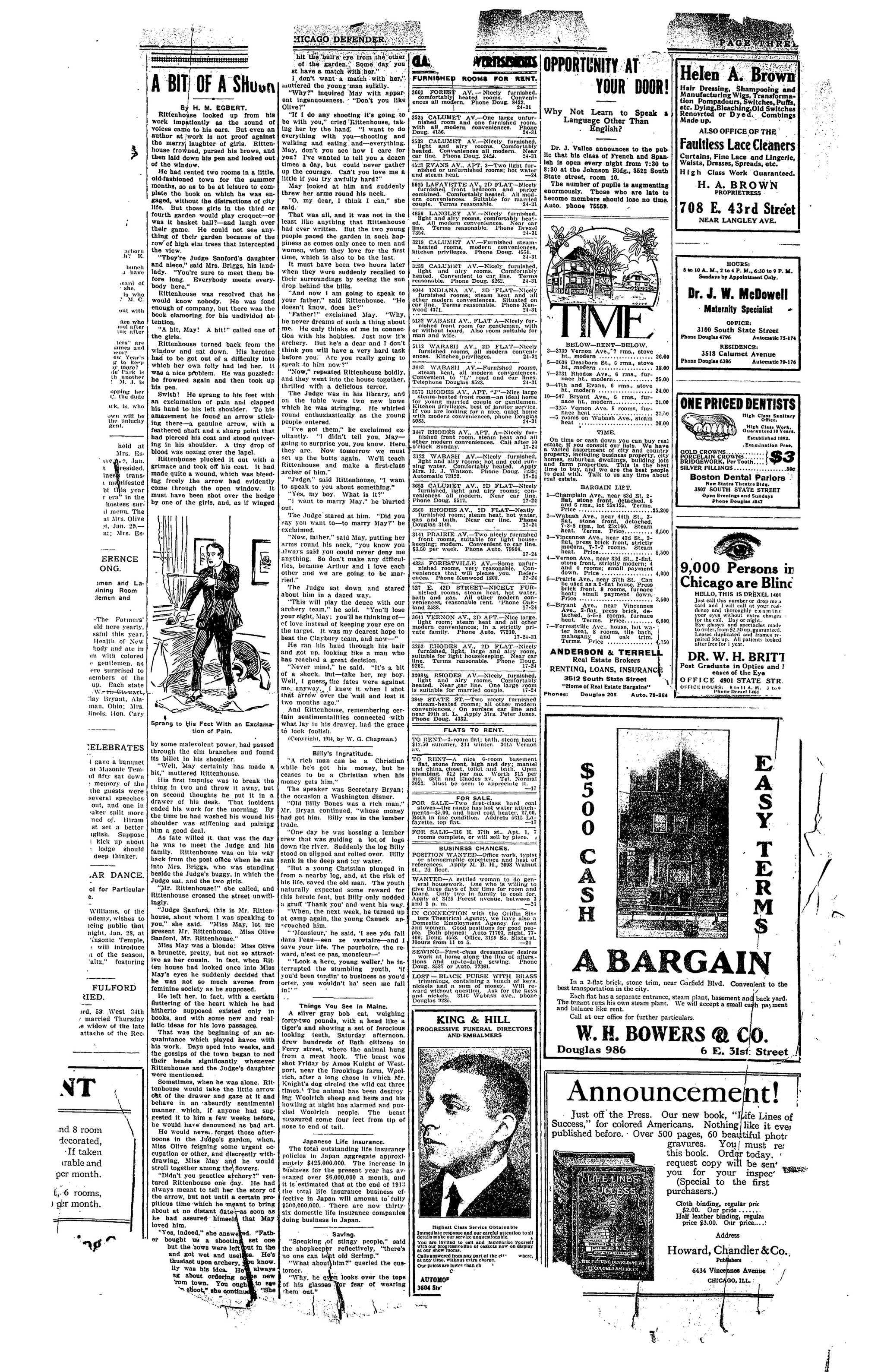
Swish! He sprang to his feet with an exclamation of pain and clapped his hand to his left shoulder. To his amazement he found an arrow sticking there—a genuine arrow, with a feathered shaft and a sharp point that had pierced his coat and stood quivering in his shoulder. A tiny drop of blood was oozing over the lapel. Rittenhouse plucked it out with a grimace and took off his coat. It had made quite a wound, which was bleeding freely the arrow had evidently come through the open window. It must have been shot over the hedge by one of the girls, and, as if winged
A man in a suit is standing in a room with a desk and a fan. He is pointing a stick at someone else.
Sprang to His Feet With an Exclamation of Pain.
by some malevolent power, had passed through the elm branches and found its billet in his shoulder.
"Well, May certainly has made a hit," muttered Rittenhouse.
His first impulse was to break the thing in two and throw it away, but on second thoughts he put it in a drawer of his desk. That incident ended his work for the morning. By the time he had washed his wound his shoulder was stiffening and palming him a good deal.
As fate willed it, that was the day he was to meet the Judge and his family. Rittenhouse was on his way back from the post office when he ran into Mrs. Briggs, who was standing beside the Judge's buggy, in which the Judge sat, and the two girls.
"Mr. Rittenhouse!" she called, and Rittenhouse crossed the street unwillingly.
"Judge Sanford, this is Mr. Rittenhouse, about whom I was speaking to you," she said. "Miss May, let me present Mr. Rittenhouse. Miss Olive Sanford, Mr. Rittenhouse."
Miss May was a blonde: Miss Olive a brunette, pretty, but not so attractive as her cousin. In fact, when Ritten house had looked once into Miss May's eyes he suddenly decided that he was not so much averse from feminine society as he supposed.
He left her, In fact, with a certain fluttering of the heart which he had hitherto supposed existed only in books, and with new and realistic ideas for his love passages.
That was the beginning of an acquaintance which played havoc with his work. Days sped into weeks, and the gossips of the town began to nod their heads significantly whenever Rittenhouse and the Judge's daughter were mentioned.
Sometimes, when he was alone. Rittenhouse would take the little arrow out of the drawer and gaze at it and behave in an absurdly sentimental manner, which, if anyone had suggested it to him a few weeks before, he would have denounced as bad art. He would never forget those afternoon in the Judge's garden, when, Miss Olive feigning some urgent occupation or other, and discreetly withdrawing, Miss May and he would stroll together among the flowers.
"Didn't you practice archery?" ventured Rittenhouse one day. He had always meant to tell her the story of the arrow, but not until a certain propitious time which he meant to bring about at no distant date—as soon as he had assured himself that May loved him.
"Yes, indeed," she answered. "Father bought us a shooting set one but the bows were left out in the and got wet and useless. He's thuslast upon archery, you know. lly was his idea. He always ng about ordering some new from town. You ought to see shoot," she continued. "She
FURNISHED ROOMS FOR RENT.
3601 FOREST AV.—Nicely furnished, comfortably heated rooms. Conveniences all modern. Phone Doug. 8422. 24-31
3535 CALUMET AV.—One large unfurnished room and one furnished room, with all modern conveniences. Phone Doug. 4156. 24-31
3533 CALUMET AV.—Nicely furnished, light and airy rooms. Comfortably heated. Conveniences all modern. Near car line. Phone Doug. 2424. 24-31
5233 EVANS AV. APT. 3—Two light furnished or unfurnished rooms; hot water and steam heat. —24
5615 LAFAYETTE AV. 2D FLAT—Nicely furnished front bedroom and all combined. Comfortably heated. All modern conveniences. Suitable for married couple. Terms reasonable. 24-31
4656 LANGLEY AV.—Nicely furnished, light and airy rooms, comfortably heated. All modern conveniences. Near car line. Terms reasonable. Phone Drexel 7354. 24-31
3219 CALUMET AV.—Furnished steam-heated rooms, modern conveniences, kitchen privileges. Phone Doug. 4551. 24-31
3238 CALUMET AV.—Nicely furnished, light and airy rooms. Comfortably heated. Convenient to car line. Terms reasonable. Phone Doug. 2826. 24-31
3122 WABASH AV--Nicely furnished,
light and airy rooms; hot and cold runn-
ing; comfortable heated.
Mrs. H. J. d. Phone Doug 7253.
Automatic 73122. 17-24
3653 CALUMET AV., 2D FLAT—Nicely furnished, light and airy rooms; conveniences all modern. Near car line. Phone Doug. 5517. 17-24
3655 RHODES AV., 2D FLAT—Nicely furnished room; steam heat, hot water, gas and bath. Near car line. Phone Douglas 3149. 17-24
3141 PRAIRIE AV.—Two nicely furnished front rooms, suitable for light housekeeping; modern. Convenient to car line. $3.50 per week. Phone Auto. 79804. 17-24
4335 FORESTVILLE AV.—Some unfurnished rooms, very reasonable. Conveniences that will please you. References. Phone Kenwood 1800. 17-24
527 E. 42D STREET—NICELY Furnished rooms, steam heat, hot water, bath and gas. All other modern conveniences, reasonable rent. Phone Oakland 2588. 17-24
3641 VERNON AV., 3D APT.—Nice large, light room; steam heat and all other modern conveniences; in a strictly private family. Phone Auto. 77210. 17-24
3253 RHODES AV., 2D FLAT—Nicely furnished, light, large and airy room, suitable for light housekeeping. Near car line. Terms reasonable. Phone 9261. 17-24
2008% RHODES AV.—Nicely furnished, light and airy rooms. Comfortably heated. Near car line. One large room is suitable for married couple. 17-24
3849 STATE ST.-Two nicely furnished steam-heated rooms; all other modern conveniences. On surface car line and door. In reply Mrs. Peter Jones. Phone Doug. 4332.
TO RENT—3-room flat; bath, steam heat;
$12.50 summer, $14 winter. 3415 Vernon
av.
TO RENT—A nice 6-room basement
flat, stone front, high and dry; mantel
and china closet, toilet and bath. Open
plumbing. $12 per mo. Worth $15 per
mo. 68th and 17thodes. Tel. Normal
3023. Must be seen to appreciate it.
FOR SALE.
FOR SALE—Two first-class hard coal
stoves—the range has hot water attach-
ments-$5.00, and hard coal heater.$7.00.
Both in fine condition. Address 5615 La-
fayette, top flat.
FOR SALE—316 E. 37th st., Apt. I, 7
rooms complete, or will sell by piece.
BUSINESS CHANCES.
POSITION WANTED—Office work, typist
or stenographic experience and best of
references. Apply M. B. H., 2008 Walnut
st., 2d floor.
WANTED—A settled woman to do general
housework. One who is willing to
give three days of her time for room and
board. Two in family to cook for.
Apply at 315 Forest avenue, between 3
and 5 p. m.
IN CONNECTION with the Griffin Sisters Theatrical Agency, we have also a Domestic Employment Agency for men and women. Good positions for good people. Both phones: Auto 71703, night, 77-400 Doug, DEN. Office, 3159 So. State at. Hours from 11 to 5.
SEWING—First-class dressmaker desires work at home along the line of alterations and up-to-date sewing. Phone 5587 or Auto. 77381.
LOST—BLACK PURSE WITH BRASS trimmings, containing a bunch of keys, nickels and a sum of money. Will respond with neat question. Ask for the keys and nickels. 3146 Wabush ave., phone Douglas 9255.
KING & HILL
PROGRESSIVE FUNERAL DIRECTORS
AND EMBALMERS
Highest Class Service Obtainable
Immediate response and our careful attention to all
details make our service questionable.
You are invited to call and familiarise yourself
at the time of caskets now on display
at our show rooms.
Calls answered from any part of the city,
at any time, without extra charge.
Our prices are lower than ch
HICAGO DEFENDER hit the bull's eye from the other of the garden. Some day you st have a match with her."
I don't want a match with her," muttered the young man sulkily. "Why?" inquired May with apparent ingenuousness. "Don't you like Olive?" "If I do any shooting it's going to be with you," cried Fittenhouse, taking her by the hand. "I want to do everything with you—shooting and walking and eating and—everything. May, don't you see how I care for you? I've wanted to tell you a dozen times a day, but could never gather up the courage. Can't you love me a little if you try awfully hard?" May looked at him and suddenly threw her arms round his neck. "O, my dear, I think I can," she said.
That was all, and it was not in the least like anything that Rittenhouse had ever written. But the two young people paced the garden in such happiness as comes only once to men and women, when they love for the first time, which is also to be the last.
It must have been two hours later when they were suddenly recalled to their surroundings by seeing the sun drop behind the hills.
"And now I am going to speak to your father," said Rittenhouse. "He doesn't know, does he?"
"Father!" exclaimed May. "Why, he never dreams of such a thing about me. He only thinks of me in connection with his hobbies. Just now it's archery. But he's a dear and I don't think you will have a very hard task before you. Are you really going to speak to him now?"
"Now," repeated Rittenhouse boldly, and they went into the house together, thrilled with a delicious terror.
The Judge was in his library, and on the table were two new bows which he was stringing. He whirled round enthusiastically as the young people entered.
"I've got them," he exclaimed exultantly. "I didn't tell you. May—going to surprise you, you know. Here they are. Now tomorrow we must set up the butts again. We'll teach Rittenhouse and make a first-class archer of him."
"Judge," said Rittenhouse, "I want to speak to you about something."
"Yes, my boy. What is it?"
"I want to marry May," he blurted out.
The Judge stared at him. "Did you say you want to—to marry May?" he exclaimed.
"Now, father," said May, putting her arms round his neck, "you know you always said you could never deny me anything. So don't make any difficulties, because Arthur and I love each other and we are going to be married."
The Judge sat down and stared about him in a dazed way.
"This will play the deuce with our archery team," he said. "You'll lose your sight, May; you'll be thinking of love instead of keeping your eye on the target. It was my dearest hope to beat the Claybury team, and now—"
He ran his hand through his hair and got up, looking like a man who has reached a great decision.
"Never mind," he said. "It's a bit of a shock, lut—take her, my boy. Well, I guess, the fates were against me, anyway. I knew it when I shot that arrow over the wall and lost it two months ago."
And Rittenhouse, remembering certain sentimentalities connected with what lay in his drawer, had the grace to look foolish.
(Copyright, 1914, by W. G. Chapman.)
Billy's Ingratitude.
"A rich man can be a Christian while he's got his money, but he ceases to be a Christian when his money gets him."
The speaker was Secretary Bryan; the occasion a Washington dinner.
"Old Billy Bones was a rich man," Mr. Bryan continued, "whose money had got him. Billy was in the lumber trade.
"One day he was bossing a lumber crew that was guiding a lot of logs down the river. Suddenly the log Billy stood on slipped and rolled over. Billy sank in the deep and icy water.
"But a young Christian plunged in from a nearby log, and, at the risk of his life, saved the old man. The youth naturally expected some reward for this heroic feat, but Billy only nodded a gruff 'Thank you' and went his way.
"When, the next week, he turned up at camp again, the young Canuck approached him.
"Monsleur, he said, 'I see you fall dans Peau—een ce vawtaire—and I save your life. The pourboire, the reward, n'est ce pas, monsleur—"
"Look a here, young weller, he interrupted the stumbling youth, 'if you'd been tendin' to business as you'd orter, you wouldn't ha' seen me fall in!'"
Things You See In Maine.
A silver gray bob cat, weighing forty-two pounds, with a head like a tiger's and showing a set of ferocious looking teeth, Saturday afternoon, drew hundreds of Bath citizens to Ferry street, where the animal hung from a meat hook. The beast was shot Friday by Amos Knight of Westport, near the Brookings farm, Woolrich, after a long chase in which Mr. Knight's dog circled the wild cat three times.' The animal has been destroying Woolrich sheep and hems and his bowling at night has alarmed and puzzled Woolrich people. The beast measured some four feet from tip of nose to end of tail.
Japanese Life Insurance.
The total outstanding life insurance policies in Japan aggregate approximately $425,000,000. The increase in business for the present year has averaged over $6,000,000 a month, and it is estimated that at the end of 1913 the total life insurance business effective in Japan will amount to fully $500,000,000. There are now thirty-six domestic life insurance companies doing business in Japan.
Saving.
"Speaking of stingy people," said the shopkeeper reflectively, "there's no one can beat old Scripmp."
"What about him?" queried the customer.
"Why, he even looks over the tope of his glasses for fear of wearing them out."
---
FLATS TO RENT.
BUSINESS CHANCES.
A. B.
FOR SALE.
AUTOMOP
3604 Ste*
OPPORTUNITY AT YOUR DOOR!
Why Not Learn to Speak a Language Other Than English?
Dr. J. Valles announces to the public that his class of French and Spanish is open every night from 7:30 to 8:30 at the Johnson Bldg., 3522 South State street, room 10.
The number of pupils is augmenting enormously. Those who are late to become members should lose no time. Auto. phone 75559.
40779
TME
BELOW—RENT—BELOW.
3—3739 Vernon Ave., 7 rms, stove
ht., modern 26.00
5—3636 Dearborn St., 6 rms, stove
ht., modern 18.00
7—3731 Rhodes Ave., 6 rms, furnace
ht., modern 25.00
9—471h and Earns, 6 rms, stove
ht., modern 24.00
10—547 Bryant Ave., 5 rms, furnace
ht., modern 21.00
—3255 Vernon Ave. 8 rooms, furnace
heat 37.50
—5 rooms on Wabash Ave., steam
heat 30.00
TIME.
On time or cash down you can buy real
estate, if you consult our lists. We have
a varied assortment of city and country
property, property, property,
homes, suburban dwellings, lots
and farm properties. This is the best
time to buy, and we are the best people
to deal with. Talk to us any time about
real estate.
1-Champlain Ave., near 63d St. 2-flat, stone front, detached, 5 and 6 rms., lot 25x125. Terms. Price ..... $5,200
2-Wabash Ave., near 44th St., 2-flat, press brick front, detached, 7-8-3 rms., lot 25x160. Steam heat. Terms. Price ..... 8,500
3-Vincennes Ave., near 43d St., 2-flat, press brick front, strictly modern, 7-7-7 rooms. Steam heat. Price ..... 8,500
4-Vernon Ave., near 32d St., 2-flat, stone front, strictly modern; 4 rooms; small payment down. Price ..... 4,000
5-Praline Ave., near 37th St. Can be used as a 2-flat house. Press brick front. 8 rooms, furnace heat; small payment down. Price ..... 3,500
6-Bryant Ave., near Vincennes Ave., 3-flat, press brick, detached, 8 rooms, furnace heat. Terms ..... 6,000
T—Forrestville Ave. house, hot water heat, 8 rooms, lit basin, mahogany and oak trim, Terms. Price. $4,750
ANDERSON & TERRELL
Real Estate Brokers
Phones: Douglas 205 Auto. 79-864
A BAR
In a 2-flat brick, stone trim, new best transportation in the city.
Each flat has a separate entrance.
The tenant runs his own steam plant.
and balance like rent.
Call at our office for further par
W. H. BOW
Douglas 986
Announ
Just off the Press. Our Success," for colored America published before. Over 500
In a 2-flat brick, stone trim, near Garfield Blvd. Convenient to the best transportation in the city. Each flat has a separate entrance, steam plant, basement and back yard. The tenant runs his own steam plant. We will accept a small cash payment and balance like rent. Call us at our office for further information.
Just off the Press. Our new book, "Life Lines of Success," for colored Americans. Nothing like it ever published before. Over 500 pages, 60 beautiful photo gravures. You must read this book. Order today. request copy will be sent you for your inspect (Special to the first purchasers.)
Cloth binding, regular price $2.00. Our price .....
Half leather binding, regular price $3.00. Our price....!
Address
Howard, Chandler & Co.
Publishers
6434 Vincennes Avenue
OCHICHEW
1
Faultless Lace Cleaners
Curtains, Fine Lace and Lingerie,
Waists, Dresses, Spreads, etc.
High Class Work Guaranteed.
H. A. BROWN
PROPRIETRESS
708 E. 43rd Street
NEAR LANGLEY AVE.
Dr. J. W. McDowell
Maternity Specialist
High Class Sanitary Office.
High Class Work.
Guaranteed 10 Years.
Established 1892.
Examination Free.
you can buy real
ur lists. We have
426. Terms..... $5,200
44th St. 3-
detached,
160. Steam
ice..... 8,500
r 43d St. 3-
front, strictly
ams. Steam..... 8,500
2d St. 2-flat
ly modern; 4
all payment..... 4,000
7th St. Can
house. Press..... 9,000 Persons in
Chicago are Blinc
THE HISTORY OF THE MUSEUM
BARGAIN
back, stone trim, near Garfield Blvd. Convenient to the
in the city.
Separate entrance, steam plant, basement and back yard.
Own steam plant. We will accept a small cash payment
ent.
ce for further particulars.
BOWERS @ CO.
86
6 E. 31st Street
nouncement!
The Press. Our new book, "Life Lines of
colored Americans. Nothing like it ever
reve. Over 500 pages, 60 beautiful photo
gravures. You must re
this book. Order today.
request copy will be sent
you for your inspect
(Special to the first
purchasers.)
Address
Howard, Chandler & Co.
Publishers
6434 Vincennes Avenue
CHICAGO, ILL.
BARGAIN LIST.
$500 CASH
Hair Dressing, Shampooing and Manufacturing Wigs, Transformation Pompadours, Switches, Puffs, etc. Dying, Bleaching, Old Switches Renovrted or Dyed. Combings Made up.
ALSO OFFICE OF THE
BOURNS:
8 to 10 A, M., 2 to 10 A, 6:30 to 9 P.
Sundays by Appointment Only.
OFFICE:
3100 South State Street
Phone Douglas 4796 Automatic 75-174
RESIDENCE:
3518 Calumet Avenue
Phone Douglas 6386 Automatic 79-176
ONE PRICED DENTISTS
0047111
Office.
High Class Work.
Guaranteed 10 Years.
Established 1892.
Examination Free.
GOLD CROWNS.
PORCELAIN CROWNS
BRIDGEWORK, Per Tooth.
SILVER FILLINGS.
50c
Boston Dental Parlors
New States Theatre Bldg.
3507 SOUTH STATE STREET
Open Evenings and Sundays
Phone Douglas 4047
```markdown
```
HELLO, THIS IS DREXEL 1461
Just call this number or drop me a card and I will call at your residence and thoroughly examine your eyes without extra changes for the call. Day or night. Eye glasses and spectacles made to order, from $2.50 up, guaranteed. Eye glasses and frames required $30 up. All patients looked after free for 1 year.
OFFICE 4901 STATE STR.
OFFICE HOURS: 8 to 11 A.M. 3 to 9
Phone Drexel 1461
EASY TERMS
Cloth binding, regular price
$2.00. Our price.....
Half leather binding, regular
price $3.00. Our price....
---
Entered as second-class matter, February 1, 1906, at the Postoffice in Chicago, Ill., under act of March 6, 1879.
RATES OF ADVERTISING.
Births, betrothal, marriages and deaths ..... $1.50
Complimentary and ebituary resolutions, each ..... 5.00
DISPLAY ADVERTISEMENTS.
One inch, one time ..... $1.50
Special rates given on large or longstanding ads.
Front page advertisements, per inch. 3.00
Want ads, each ..... 0.60
Reading notices, per line. ..... 0.55
Rates for display advertisements furnished on applications.
Wedding announcements, $1.60; wedding write-ups, $6 and up; card of thanks, $1.50 and up; in memoriam, $1.50; business announcements, $1.50 and up. Everything paid in advance.
Change of address.—Please give both the old and new address; and in writing to the paper always be careful to give both the state and postoffice, as well as name.
IF YOU SEE IT IN THE DEFENDER,
IT IS SO.
COURT GENERAL ROBERT ELLIOTT,
Me. 7395, Ancient Order of Foresters,
meets every second and fourth Monday
night in each month at Odd Fellows'
Rail, 3337 State street.
Lodge Officers.
Frank W. Tayler, Fin. Secy., 5621
Grove av. Phone Normal 7592.
Frank L. Crittenden, Treasurer. Resi-
dent 2414 Dearborn st. Phone Calumet
3219.
E. Stanley Dortch, Chief Ranger. Resi-
dence, 5613 Wabash av. Phone Went.
4665.
SATURDYA, JANUARY 24, 1914.
Our London Office
17 Green Street
Sharing Road
London, England, W. C.
BEING GOOD
This bein' good just isn't half what it's cracked up to be,
It makes you miss a bunch of fun as far as I can see.
Now Ma sez this little Pa sez that ain't good fer little boys,
An' when I ask th' kids outside they yell, "Ah, cut th' noise."
I'm tired of bein' called a girl an' I'm jest goin' to punch
The one that does cause I kin lick about two-thirds th' bunch.
An' anyway I ruther git a lickin' now an' then
Fer Uncle sez it takes sich things to make th' bestest men.
Look out next week for the "Rounder."
Don't forget that you have an appointment at church Sunday, February 1.
The boy who got a pair of skates for Christmas is about as bad off as a baldheaded man in flytime.
From now on expect to get the glad hand and an invitation to drink from most any strange man. The aldermanic election is nearing and the woods are full of candidates.
The South Side Turner Hall at 31st
d State streets, which was recently
polished by fire, though standing
at in the heart of the black belt
r opened its doors to our race.
a "Better Babies Contest" held
ly in Battle Creek, Mich., of
babies entered three were col-
d it is needless to say they
d high in the physical test.
case of give us a chance.
Follette has been making
speeches in Washington
policy of the present ad-
on in regard to segregation
on over a great many to
is said that there is a lot of snob- creeping into the government life Washington. What more is to be stated when a hungry lot of would- and themselves thrown suddenly timelight.
the shock to your nervous
system we are breaking the news to you very quietly. Ben Tillman is sick. If you must shed a tear don't shed it here; shed it in the woodshed. There, that's out of our system.
After all the "movie" craze isn't such a tax on your pocketbook as some other things that could be mentioned. If you go every night in the week (alone) it will only cost you 35 cents. Downtown theaters please take notice.
Cary B. Lewis, the international scribe, left last Monday on the 23d Century Accommodation to do Tuskegee and other prominent places in the South. It is needless to say they will be well done when he gets through with them.
Subscribers, advertisers, correspondents and all who have business with The Defender are requested to deal directly with our office, which is located at 3159 South State street, in this way alone can mistakes and misunderstandings be avoided and the best service be rendered to you.
An awful thing happened in the New Orlean Charity Hospital. A colored boy 11 years of age was placed in a ward with two white boys. When the superintendent's attention was called to it he was profuse in his apologies and ordered the boy removed immediately. This in a charity hospital, too. It will go mighty hard with some people when they die, but perhaps that is why there are places to go.
An eighteen year old boy in California has invented an apparatus for coupling ordinary vehicles behind automobiles, so flexible that sharp corners can be turned. We are glad to see our boys inventing things of any kind, but to the best of our recollection we have never seen an automobile pulling any other sort of vehicle save one of its own kind. The horse or mule, as the case may be, has always been on the job.
The Vice Commission attributes the downfall of young girls more to poor home conditions than to working conditions. Low wages do not enter seriously into the question. Wine rooms and lax city laws governing street walking by mere children, who in most cases are mentally deficient, are to blame. These girls do not need so much punishment as they need 'reformation. It is never too late to care for these unfortunates and our churches and societies should make every effort to redeem them. This again calls our attention forcibly to the urgent need of a Y. W. C. A. We have provided for our young men; is it not more essential to care for our young women?
WOODS CEMETERY ASSOCIATION.
In the majority of the Chicago people feel like Rev. Jenkin Lloyd Jones does regarding the policy of the Oakwoods Cemetery Association to exclude people of color from being buried or cremated in the holy grounds, from financial point of view it would be a burying ground for the stockholders' money and that is about all. It is hard to conceive of a set of supposedly intelligent northern men identifying themselves with an association whose evident purpose it is to sacrifice a principle for the almighty dollar. Not content with segregating the race during life they must even dictate where they shall be buried. There is such a thing as carrying a thing too far, and this is a flagrant case of it. Such tactics might appeal to a certain class of our population, but that class, we are glad to say, is extremely small and insignificant. Rev. Jenkin Lloyd Jones in no mild terms denounced their policy and it is safe to say he speaks for a majority of the citizens of this great metropolis.
EDUCATING THE WHITE SOUTH.
Rev. Dr. M. V. McDuffie, field secretary of Furman University, Greenville, S. C., doesn't seem to like it because 98 per cent of the Northern philanthropists who have been helping to support educational institutions in the South have been contributing toward the Negro schools and have been discriminating against the white children. Shades of the Immortal George Washington Jr., was there ever a complaint registered before like this? We should like to ask the Reverend why the people of the North found it necessary to send money to the South to educate the colored people. Was it because the South was pauperized and not able to care for their own? No; it was because the South did not believe in educating the Negro; in fact, they were not long on educating themselves. As far as dense ignorance as concerned the Negro had nothing on his white brother, for it is a known fact that the "cracker" element and their like are not far above savages in point of intelligence. But we are not selfish; if the white aristocracy of the South can stoop to begging for funds to help educate their own children, we are willing that our friends in the North donate to the cause; perhaps education may make them more human and more humane.
HARVARD STUDENT HONORED.
Alexander L. Jackson of Englewood, N. J., will be graduated from Harvard University next June with the honor of being class orator. Jackson has entered into all the athletic sports there and has made an enviable record. He won the Price-Greenleaf scholarship and won the varsity letter five times, and has always stood first or thereabouts in his classwork. It is gratifying to know that this brilliant young man intends to devote his life to the education of his race, believing that the uplift of the Negro, like that of any other race, must come through education, and be it further said to his credit that he worked his way through school. The self-made man or woman knows both the value of time and money, knows too what it means to fight one's way to the top. Is it to be wondered at that they be the best citizens? There are 1 of our young people who though perhaps not in the equally as well as this H
dent, and when we girl it is our duty assistance. The race depends upon them; we have added our mite, the burden falls on younger shoulders. Mr. Jackson richly deserves the honors that have come to him.
GERMANY'S INVITATION
An international exhibition for the book industry and the graphic arts, including photography, will be held at Lelpzig, the book industrial center of Germany, from May to October, 1914. The exhibition desires to bring about a friendly competition in these lines among all civilized nations. It is designed to demonstrate book industrial production in its profound influence on the general education of the people, and its connection with all branches of culture, and it is also intended to show what a prominent position the graphic arts and industries occupy in the life of nations. The directors of this exhibition have extended through the medium of our race papers, an invitation to the colored people of the United States to take part. It would be surprising to most people to know just how much members of the race have done in these arts. Here is an opportunity to show the world, but we fear the project will fall through for the simple reason that there is no representative on the ground to gather the material and the attempt to arouse interest by mail, especially coming from a foreign country, will no doubt prove fruitless. The time is so short for the great amount of work to be accomplished that we fear our part of the exhibit will have to go by default.
W. R. COWAN ALDERMANIC
CANDIDATE.
A movement is on foot by leading colored men of the Second ward to force the nomination of a colored man for alderman at the February primaries. Among those most prominently mentioned for the place is W. R. Cowan, the well known real estate man. Mr. Cowan would make more than an acceptable candidate, for he possesses qualifications that would make him a formidable candidate at the April election. He is a man of pleasing personality and what is known among politicians as a good mixer; added to this he is a man of good reputation and is not allied with the warring political factions of his party. The time is ripe for such a movement. The present Second ward under the recent apportionment contains nearly all the Negro voters of the old Second and Third wards. The Negro voting population of the ward as now constituted approximates 8,000. By an examination of the figures of recent aldermanic primaries the successful candidate rarely has received more than half of this number of votes. If a proper interest is taken in the candidacy of Mr. Cowan there will be no doubt of his nomination. The fight is worth making at any rate. There can be no question about our being entitled to at least one representative in the council from this section. Mr. Cowan would be a formidable candidate even as an independent for the reason that in a three or four cornered fight such as there is likely to be his chances would be even greater than a party candidate. It is high time that the Negro electors of this ward make up their minds to get behind some man of their race. As far back as 1902 Carter H. Harrison, the present mayor, urged the colored people to get behind some colored man with a view of putting him in the city's law making body. The chances for a successful effort along this line rests solely with the colored voters themselves. To this end, then, it becomes a matter of paramount interest that every Negro man and woman of voting age get on the registration books on February 3, for unless your name is registered on that date you cannot vote at the primaries of February 24. Let everyone therefore who has this matter at heart make it their business not only to register but to see that others do the same. The Defender suggests that a "Boosters' Club" be organized for the purpose of furthering Mr. Cowan's chance.
EDITOR'S MAIL.
Please find enclosed $1.20. I expect to send in a list of new subscribers soon. Very truly,
G. A. LEWIS.
Los Angeles, Cal., Jan. 23, 1914.
The Chicago Defender.
Gentlemen: Your letter was received and also receipts. Very much satisfied indeed with your way of doing business. I lost my last report card, but will send you the money just the same. Please send me more than one card if possible. I am going to put one or more agents to work in the near future.
Chicago, Ill., Jan. 21, 1914.
Editor Chicago Defender.
Dear Sir: I read your paper constantly, having access to the copy each week which comes to a colored fellow who works for the same firm I do. While I am a Southerner and believe as all Southerners do regarding social equality, yet I for one believe in fair play and justice for all, black, yellow or white.
I like your sentiments in many respects, and, above all, believe you are sincere and honest in your convictions. I am therefore writing you regarding a matter of interest to the black man alone.
Your people should have a protective association to raise money and defend ignorant and poor Negroes accused of crimes of which they are not guilty. I have in mind the case of this fellow Bond, who is held for the murder of the Leegson woman. Get me right, now: If he is guilty, no punishment is too bad for him; but if he is the victim of a frame-up, then he should be free. What I want to know, and all other good citizens should want to know, is who killed this Leegson woman—whether he is white or black, rich or poor; was some one hired to kill her, and, if so, who did the hiring? Was this copper-colored man or a Negro? Do any
man. It is just as easy to from a case on this ignorant poor dark it was to get finger prints from a tain Negro who was hanged, and a "three or four attempts" secure similar impressions from the window sill of a certain murdered man's home.
This fellow is ignorant and poor or he would have hired a lawyer and given himself up in a more intelligent manner than he did.
Your people should organize and hire a good colored lawyer, like Morris, Denison and others, to defend this fellow. If he is innocent, let him go free; but if guilty, let him get his deserts. When you take a move of this kind there are plenty of good white men who will help you. Until I write you again, I am, A. STURGISS.
BROWN MAN OF INDIA IN SULTED.
Chicago, Ill., Jan. 22, 1914. We note with much interest the peculiar attitude assumed by one Kaelas Chowdbury with reference to the protest sent to the Oakwoods Cemetery Association by Jenkins Lloyd Jones. Mr. Chowdbury takes exceptions to the classification of Tagore (the Hindo poet) along with Booker T. Washington and Frederick Douglass and recites the possible fact of the purity of the blood that characterizes the great race of which Tagore has the honor of being a member of, and I here venture the assertion that if Mr. Chowdbury was as free from prejudice and as pure at heart as he would have us believe, the great Hindo poet is of blood he would not seek to eliminate from an honorable consideration of such characters as Washington and Douglass.
Had the Brahmins of India been captured, enslaved and overpowered by the same immoral influences that were exercised by America over the race of people that Washington and Douglass are identified with it is very doubtful that Mr. Chowdbury would be around boasting of pure blood. We in this country know no pure blood only as it is made through Christ Jesus. In this great republic we recognize a man for his worth and we feel that Booker T. Washington and Frederick Douglass are worthy of being classed with the great of any race or nation.
Very respectfully,
OTIS GANO FLETCHER.
4544 St. Lawrence avenue.
THINGS EXISTING IN THE LARGE BUILDINGS
By Julius N. Avendorph.
Among the many clubs I have referred to in my previous articles that occupy spacious quarters in some of the large buildings in the loop district, there is none whose quarters are more spacious and luxurious than those occupied by the Cliffdwellers Club in the Orchestra Hall building; and it will no doubt be interesting to know that the success of this club is credited to its proficient steward, Mr. Frank C. Brown, who opened the club some five years ago.
During the first few months of the club's existence the luncheon was furnished and served by the Tip-Top Inn Cafe, through an arch which connected the two; but the club grew so fast in membership that it was necessary for Mr. Brown to install a kitchen, employ a chef, together with waiters in order to comply with the demand, which placed the entire responsibility on his shoulders. But through this responsibility it gave him an opportunity to prove his worth, and in so doing, when the last official record or report was published, a paragraph was devoted to Mr. Brown in which he was given credit for the success of the club. Mr. Brown employs twelve waiters and a chef. Luncheon and supper are served every day.
Mr. Brown is a married man and lives at 6508 St. Lawrence avenue. His son, Grayson D. Brown, is a student in the Chicago Laboratory School of Essaying.
Canada's Wealth in Coal
The province of Alberta, Canada, is believed to have 90,000,000,000 tons of coal available.
The Tears of Joy.
The tears of joy are salt, as well as the tears of sorrow. And in that sentence are many meanings.—Francis Thompson.
Tobacco Consumption
The estimated daily average consumption of cigars in the United States is 21,718,488, as 4 of cigarettes 28,786,190.
Tree of Life.
Living on the tree of life, and eating of the fruit thereof, was living in the essence of love, the inmost life and force of all existence.
Got the Owl. Anyway
While William E. Whiting of Ellsworth, Me., was on his way down street one evening he heard a peculiar commotion, and upon investigating it he found a dove in the clutches of an owl. He hurried to his home and secured his shotgun and upon returning, found that the dove had escaped, but the owl was still there and was shot.
An army chaplain came across a baggage column with a wagon stuck fast. "Men, I see you're in difficulties," he said. "Can I be of any assistance?" "Yes, sir," exclaimed one of the drivers, "by making yourself scarce! You see, we can't very well say to the horses what they'd understand while you're about."
How the Children Graded.
An experiment carried on recently with school children to determine how the foreign born compared with the native born shows how marked in effect the environment in this country has on immigrants. It was found that the children with the lowest standing in school were foreign born. The next lowest were those born of foreign-born parents; the next after them were of parents born in this country, and the highest were those whose grandparents or great-grandparents were born.
Ke
By Dr
A Weekly
Measures, I
Hygienics, it
will be Dia-
scriptions wi
Column.
History of Tuberculosis.
From where the first case of consumption originated we do not know. We know that history records it from the earliest times. We know that it has followed, multiplied and increased with civilization. We know that it is a house disease; in fact, it is largely a bedroom disease. We do know that nearly all human beings have been or are affected by it at some period or some stage of the voyage from the cradle to the grave. We do know that the more closely in touch human beings keep with Nature and Nature's God, the less are they affected with having consumption. We know that since Dr. Robert Koch, a noted German physician, discovered the germ of this diseases in 1882, called the bacillus tuberculosis, he proved beyond any shadow of doubt that the disease is produced by a germ and not by "cold"; that without this germ the disease cannot be produced. We do know that this disease is catching, and may be transmitted from animal to man, and from animal to animal, and from man to man. We know that tuberculosis was introduced into America among cattle, with the introduction of cattle into America. We know that milk from the tubercular cow will give your child or anyone using it tuberculosis, especially of the bowels, which often affects children; that meat from the tubercular hog, chicken or beef will give the consumer tuberculosis. We know that the disease is spread from one end of the continent to the other, and is everywhere now; but in large cities, in and near large centers of population, consumption is more prevalent than it is in the country or in more sparsely populated places.
Tuberculosis Sanitarium.
A little over five years ago a bill was introduced in the state legislature by Senator Glacken for the purpose of enabling Chicago and other cities to submit a proposition to he voters to raise funds by levying a tax not to exceed one mill on each dollar of assessed valuation; which was levied for that purpose. In 1911 $409,000 was available for starting the sanitarium from this small tax. The commissioners purchased a farm of 160 acres just inside of the city limits at the corner of North Crawford and Bryn Mawr avenues at a cost of $155,000 for the land alone. Completed this sanitarium will represent an investment of over two million dollars. The commissioners hope to have this sanitarium completed by fall, so as to receive patients. It will provide facilities for the free treatment, under the most modern and best possible conditions of six hundred patients in the early stages of consumption.
It is the moving ambition of Dr. Theodore Sachs, president of the Chicago Tuberculosis Institute, to make the Chicago Tuberculosis Sanitarium and the whole campaign against consumption, the greatest and the most successful ever waged in the world.
In this sanitarium there will be patients in every stage: incipient, moderate, advanced and far advanced, who will receive treatment and be given the best possible chance to be cured for the following reasons:
1. Plenty of outdoor life in specially arranged quarters with protection from unfavorable weather.
2. Scientifically regulated rest.
3. Suitable nutritious diet.
4. Absolute control by competent physicians of the entire conduct of the patient.
From year to year the people of Chicago will have an abundance of funds from this small tax assessment which amounts now to over $500,000 a year to put up a strong and winning fight against tuberculosis.
Dispensaries.
The Chicago Tuberculosis Institute as a means of ascertaining, instructing, and preventing the spread of consumption have established many tuberculosis dispensaries in various parts of the city, and two or three more will be added in a short time, in which 32 physicians and nurses, after undergoing civil service examination, are employed to examine and instruct the people how to take care of themselves, if they are so unfortunate as to have this disease; and to prevent the spread of this disease among other people. At these dispensaries patients are carefully examined, medicine furnished, given tuberculin and furnished with a thermometer, and taught how to take their temperature or fever. The nurses visit the homes of these patients, and instruct them how to sleep and take care of themselves, they are given napkins, and taught how to dispose of their sputum (spittle), which is the great source of infection. If it is necessary for the people to be sent to the tuberculosis hospital, the nurse in the dispensary will make arrangements and often accompany the unfortunate one to the tuberculosis hospital.
These dispensaries are located in the most congested districts of our city on the South Side. There is one at the Post Graduate Hospital, 2400 Dearborn street; one at the Stock Yards, 43d and Halsted streets; one at 28th street and Cottinge Grove avenue, and one at Provident Hospital 36th and Dearborn streets, which open every Monday and Thu from 2 to 5 p. where there are physicians in constendance, conven State
BC was
Norway
acted birth
State Board
thing it can
the births o
The govern
much intere
compliance
end as espe
baby whose
the new law,
a letter and,
on her moth
personal app
avalled herse
new law. B
not think en
their births r
not hear from
connection it
that Governor
zen of the stat
new law by hc
corded. Many
zens of the sh
example.
The importance
is becoming bett
time, and it will
every state in the
quate laws on
quiring that care
ord of both its l
keep. Surely if f
horses are worth
dren are deserv
eration.
When we know
in this country st
of foul, ill smelli
outdoor privy vau
dering how slowl
sanitary lines.
closet is an an
still with us in
and disease brec
stated that Balth
closets, St. Louis
phia as many as
the Chicago Depa
been fighting tha
with the result t
1,500 of these no
each year for sel
chief sanitary fil
there are still the
left, including a
that have se
There is, wav
ing sentimen or
let facilities in
it a better ars
of co-operation
ple to do their
communities or
agencies gene da
In spite of ha
been so much y
value of freem
many people.
specially if saitio
they continue
to ventilate; mish
tant fact tha
easily made bai
bad they mean
suffering.
It is a false coo
in money expen
betterment.
Time He
Time obliterates th
lons and confirms th
ture.—Cicero.
His Dying W
"I've been caught na
said the moth that the m
in his heavy ulster.
World's Wasted We
Experts have estimated
forests of the world were
ly operated they would
equivalent of from thirty
dred and twenty times th
sumption of wood annua
Valued Firewood.
Florida buttonwood, a tre
largely to the keys along
coast, is very highly pried
cooking on ship's gallens.
slowly with an even heat a
but little smoke or ash.
Condolence.
Ion was in
'd b.
ITUCKY MAN EDITS
OHIO JOURNAL
I. C. A. Issues First Number of
he Herald"—First Class Barber
artered
By Hardin Tolbert.
social to The Chicago Defender.】rankfort, Ky., January 23.—"The M. C. A. Herald," a journal published in the interest of that institution, made its initial appearance at Columbus, O., with the versatile scholar, Prof. John H. Jackson, editor-in-chief. Prof. Jackson was the first president of the Kentucky Normal and Industrial Institute, the first Negro delegate-at-large to the National Republican Convention, and the first Negro to write the history of education from the Greeks to the present day. Miss Lizzie Thomas of British Columbia was the guest of her aunt, Mrs. Marie Twyman. Mrs. Annie Welch gave an entertainment in honor of Mr. Jerry Hallchle of Chicago. A number of her friends were present. Miss A. I. Danual has been very ill but is able to be up. Mr. Robert Hall spent a few days in Louisville, the guest of Mr. Beaty.
A first class barber is wanted, married or single, one who is willing to stick to his job. Mr. James Clay, the first class tonsorial artist, deserves this man to be sober, and will give him a fine opportunity to make a nice living on the 60 per cent basis. Apply at once at 427 Washington street. Mrs. Annie Blackburn Lark, the daughter of Mr. and Mrs. Blackburn, of Normal Height, died after a few months' illness. Mr. and Mrs. Robert Redden of Switzer entertained Miss Nellie Johnson of Scott county at their beautiful country home. Mr. Redden, brother-in-law and neighbor had a lovely evening. Mrs. Eddie Lindsay visited her cousin, Miss Emma Calsley, in the country. Miss Lucile Fields, Miss Jennie Jackson and Mr. Ernest Gentry spent a pleasant day with Mr. and Mrs. Redden.
Mr. Russell Turner of New York, a former Frankfort man, has returned to the city. Mr. Turner was once head Waiter at the famous Capitol hotel, he is being highly entertained by his friends. Mr. B. T. Harvey of Huntington, W. Va., former head waiter at the Capitol hotel, is hustling in the insurance business.
DAYTON DC OR REPUDI
ATES RACE'S BUSINESS
MEN.
(Continued from page 1.)
Besides the boys there boys representing the Steele and Stivers high school, Y. M. C. A. Athletic and will work to promote the activities of the association along all lines. A program consisting of dramatic reading by Messrs. Shaw and Robinson, several musical numbers, remarks by Mr. Payne and Secretary Higgins.
Following others were elected: J. Robinson, president; Clifford vice president; Joseph Stewart, and Clarence Paulley, all news for this column at West Fifth street.
Chicago Defender for sale at West Fifth street.
Republicans to Meet.
The Colored Republican Club will hold a meeting January 26 at 26 South Western avenue. Several well known speakers will address the meeting.
Mrs. Pearl Price of 303 Dunbar avenue and who was burned from gasoline that was spilled on her clothes, died at the Miami Valley Hospital and was buried by H. P. Lorritt, the undertaker.
Murderer Beats Head of Mrs. N. Bailey to Pulp.
Mrs. Nellie Bailey, colored, aged about 27 years, was the victim of one of the most brutal murders of recent years shortly before midnight when her head was crushed almost to a pulp by a blunt instrument in a vacant lot within 150 feet of her home, 187 Hawthorne street. Wesley Jenkins, colored, age 32 years, was arrested within two hours after the murder, and police have woven about him a chain of circumstantial evidence so minute that it includes an exhibit of blood splotches on his hat and shoes that were muddy. Corroborating this is the statement of Harry Weith, colored, that he saw Jenkins running from the scene of the crime.
You are cordially invited to visit Mrs. F. B. Jones, 3409 South State street, who carries an extra fine line of choice cigars, tobacco, post cards, delicious candles, sheet music of the latest publications at 10 cents a copy, various notions. Shoe polish manufactured by a race man. All leading colored men's papers. One-day laundry.
HAY'S HAIR
Pomade
Does All and M
promises to Do
OMADE
by hair and
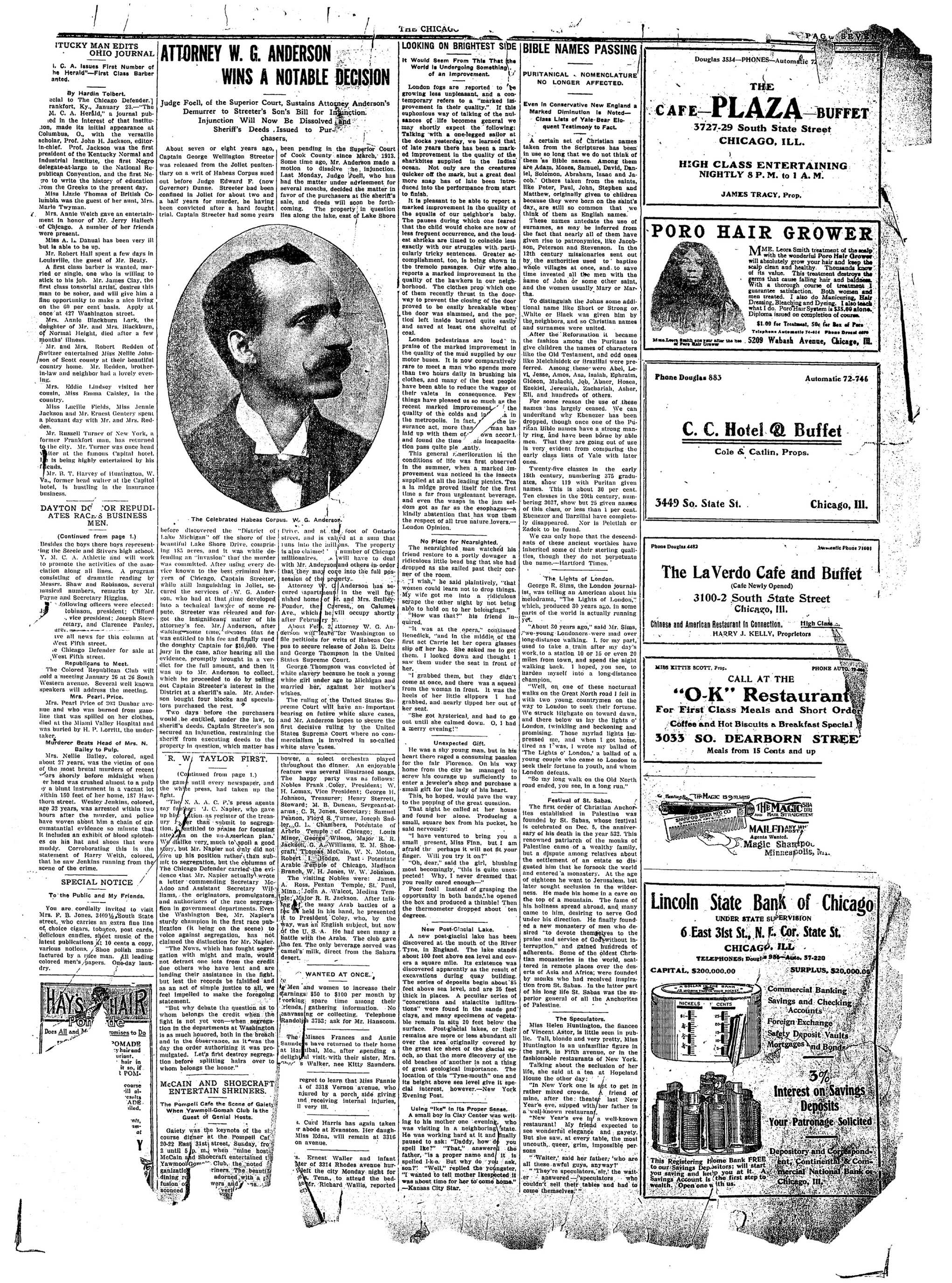
ATTORNEY W. G. ANDERSON WINS A NOTABLE
Judge Foell, of the Superior Court, Sustains Attorney Anderson's Demurrer to Streeter's Son's Bill for Injunction. Injunction Will Now Be Dissolved and Sheriff's Deeds Issued to Pur-
The Celebrated Habeas Corpus. W. G. Anderson.
chasers,
About seven or eight years ago,
Captain George Wellington Streeter was released from the Jullet pentent-
tary on a writ of Habeas Corpus sued
out before Judge Edward F. (now
Governor) Dunne. Streeter had been
confined in Jullet for about two and
a half years for murder, he having
been convicted after a hard fought
trial. Captain Streeter had some years
The Celebrated Habeas Corpus.
before discovered the "District of Lake Michigan" off the shore of the beautiful Lake Shore Drive, comprising 185 acres, and it was while defending an "invasion" that the murder was committed. After using every device known to the best criminal lawyers of Chicago, Captain Streeter, while still languishing in Joliet, secured the services of W. G. Anderson, who had at that time developed into a technical lawyer of some repute. Streeter was released and forgot the insignificant matter of his attorney's fee. Mr./Anderson, after watching some time, noticed that he was entitled to his fee and finally sued the donghty Captain for $10,000. The jury in the case, after hearing all the evidence, promptly brought in a verdict for the full amount, and then it was up to Mr. Anderson to collect, which he proceeded to do by selling out Captain Streeter's interest in the District at a sheriff's sale. Mr. Anderson bought four blocks and speculators purchased the rest.
Two days before the purchasers would be entitled, under the law, to sheriff's deeds, Captain Streeter's son secured an inunction, restraining the sheriff from executing deeds to the property in question, which matter has
the game until every newspaper, and the white press, had taken up the fight.
"The N. A. A. C. P.'s press agents say founding: J. C. Napier, who gave up his mission as register of the treasury fewer than submit to segregation, entitled to praise for focusing attention on the ma-American plan. We dislike very much to spoil a good story, but Mr. Napier not only did not give up his position rather, than submit to segregation, but the columns of The Chicago Defender carried the evidence that Mr. Napier actually wrote a letter commending Secretary McAdoo and Assistant Secretary Williams, the originators, promulgators, and authorizers of the race segregation in government departments. Even the Washington Bee, Mr. Napier's sturdy champion in the first race publication (it being on the scene) to voice against segregation, has not claimed the distinction for Mr. Napier.
"The News, which has fought segregation with might and main, would not detract one iota from the credit due others who have lent and are lending their assistance in the fight, but lest the records be falsified and as an act of simple justice to all, we feel impelled to make the foregoing statement.
"But why debate the question as to whom belongs the credit when the fight is not yet won—when segregation in the departments at Washington is as much honored, both in the breach and in the observance, as it was the day the order authorizing it was promulgated. Let's first destroy segregation before splitting hairs over to whom belongs the honor."
McCAIN AND SHOECRAFT ENTERTAIN SHRINERS.
The Pompell Cafe the Scene of Gaiety When Yawmnoil-Gomah Club is the Guest of Genial Hosts.
Gaiety was the keynote of the sho-course dinner at the Pompeil Caf-20-22 East 31st street, Sunday, fro-2 until 5 p.m. when "nine host McCain and Shoecraft entertained the YawmoolGome" Club, the noted organizat-ioners. The beauti-dining ro-od adorned with a re-fusion oceans and fruits and veri-
been pending in the Superior Court of Cook County since March, 1913. Some time ago, Mr. Anderson made a motion to dissolve the injunction. Last Monday, Judge Joell, who has had the matter under admission for several months, decided the matter in favor of the purchasers at the sheriff's sale, and deeds will soon be forthcoming. The property in question lies along the lake, east of Lake Shore
ous. W. G. Anderson.
Drive, and at the foot of Ontario street, and is valued at a sum that runs into the millions. The property is also claimed a number of Chicago millionaires. I will have to deal with Mr. Anderson and others in order that they may come into the full possession of the property.
Attorney W. G. Anderson has secured apartments in the well furnished home of Mr. and Mrs. Smiley-Ponder, the Coresser, on Calumet Ave., which he will occupy shortly after February 8.
About Feb. 2, attorney W. G. Anderson will leave Tor Washington to file petitions for writs of Habeas Corpus to secure release of John E. Deltz and George Thompson in the United States Supreme Court.
George Thompson was convicted of white slavery because he took a young white girl under age to Michigan and married her, against her mother's wishes.
The ruling of the United States Supreme Court will have an important bearing on future white slave cases, and Mr. Anderson hopes to secure the first decisive ruling by the United States Supreme Court where no commercialism is involved in so-called white slave cases.
bower, a select orchestra played throughout the dinner. An enjoyable feature was several illustrated songs. The happy party was as follows: Nobles Frank Coley, President; W. H. Lomax, Vice President; George H. Johnson, Treasurer; Henry Sterrett, Stewart; M. B. Duncan, Sergent-atarms; C. R. Jones, Secretary; Samuel Peason, Floyd S. Turner, Joseph Sadder, L. L. Chambers, Potentate of Arbrio Temple of Chicago; Louis Minor, George Wilson, Major R. R. Jackson, G. A. Williams, E. M. Shoercraft, Thomas McCain, W. N. Moton, Robert I. Hodge, Past Potentate Arabic Temple of Chicago, Madison Branch, W. H. Jones, W. W. Johnson.
The visiting Nobles were: James A. Ross, Fezan Temple, St. Paul, Minn.; John A. Walcott, Medina Temple; Major R. R. Jackson. After talking of the many Arab battles of a foe held in his hand, he presented it to President Cole, who, by the way, was an English subject, but now of the U. S. A. He had seen many a battle with the Arabs. The club gave the fez. The only beverage served was camel's milk, direct from the Sahara desert.
WANTED AT ONCE.
Men and women to increase their earnings; $50 to $100 per month by working; spare time among their friends, gathering information. No canvassing or collecting. Telephone Randolph 3755; ask for Mr. Hanscom.
The Misses Frances and Annie Saunders have returned to their home at Hammalbah, Mo., after spending a delightful visit with their sister, Mrs. Thy's Walker, nee Kilty Saunders.
regret to learn that Miss Fannie 1. of 3318 Vernon avenue, who injured by a porch side giving and receiving internal injuries, ill very ill.
s. Curd Harris has again taken r abode at Evanston. Her daughter Miss Edna, will remain at 3316 on avenue.
s. Ernest Waller and infant
mater of 3314 Rhodes avenue hur-
bleft the city Monday night for
mme. Tenn., to attend the bed-
de Mr. Richard Wallis, reported
LOOKING ON BRIGHTEST SIDE
It Would Seem From This That the
London fogs are reported to be growing less unpleasant, and a contemporary refers to a "marked improvement in their quality." If this euphonious way of talking of the nuisances of life becomes general we may shortly expect the following: Talking with a one-legged sailor at the docks yesterday, we learned that of late years there has been a marked improvement in the quality of the sharkbites supplied in the Indian Ocean. Not only are the creatures quicker off the mark, but a great deal more snap has of late been introduced into the performance from start to finish.
It is pleasant to be able to report a marked improvement in the quality of the squalls of our neighbor's baby. The pauses during which one feared that the child would choke are now of less frequent occurrence, and the loudest shrieks are timed to coincide less exactly with our struggles with particularly tricky sentences. Greater accomplishment, too, is being shown in the tremolo passages. Our wife also reports a marked improvement in the quality of the hawkers in our neighborhood. The clothes prop which one of them recently thrust in the doorway to prevent the closing of the door proved to be easily breakable when the door was slammed, and the portion left inside burned quite easily and saved at least one shovelful of coal.
London pedestrians are loud in praise of the marked improvement in the quality of the mud supplied by our motor buses. It is now comparatively rare to meet a man who spends more than two hours daily in brushing his clothes, and many of the best people have been able to reduce the wages of their valets in consequence. Few things have pleased us so much as the recent marked improvement in the quality of the colds and pains in the metropolis. In fact, the insurance act, more than the man has laid up with them of, own accord, and found the time in incapacitation pass quite pleantly.
This general enervioration in the conditions of life was first observed in the summer, when a marked improvement was not noticed in the insects supplied at all the leading plenices. Tea a la midge proved itself for the first time a far from unpleasant beverage, and even the wasps in the jam seldom got as far as the esophagus—a kindly abstention that has won them the respect of all true nature.lovers.—London Opinion.
No Place for Nearsighted
The nearighted man watched his friend restore to a porthly dowager a ridiculous little bead bag that she had dropped as she sailed past their corner of the room.
"I wish," he said plaintively, "that women could learn not to drop things. My wife got me into a ridiculous scrape the other night by not being able to hold on to her belongings."
"How was that?" his friend inquired.
"It was at the opera," continued Benedick, "and in the middle of the first act Carrie let her opera glasses slip on her lap. She asked me to get them. I looked down and thought I saw them under the seat in front of her.
"I grabbed them, but they didn't come at once, and there was a squeal from the woman in front. It was the heels of her little slippers I had grabbed, and nearly tipped her out of her seat.
"She got hysterical, and had to go out until she calmed down. O, I had a merry evening!"
Unexpected Gift.
He was a shy young man, but in his heart there raged a consuming passion for the fair Florence. On his way home from the city he managed to screw his courage up sufficiently to enter a jeweler's shop and purchase a small gift for the lady of his heart. This, he hoped, would have the way to the popping of the great question.
That night he called at her house and found her alone. Producing a small, square box from his pocket, he said nervously:
"I have ventured to bring you a small present, Miss Finn, but I am afraid the perhaps it will not fit your finger. Will you try it on?"
"Oh, dear," said the girl, blushing most becomingly, "this is quite unexpected! Why, I never dreamed that you really cared enough—"
Poor fool! Instead of grasping the opportunity in both hands, he opened the box and produced a thimble! Then the thermometer dropped about ten degrees.
New Post-Glacial Lake
A new post-glacial lake has been discovered at the mouth of the River Tyne, in England. The lake stands about 100 feet above sea level and covers a square mile. Its existence was discovered apparently as the result of excavations during quay building. The series of deposits begin about 85 feet above sea level, and are 25 feet thick in places. A peculiar series of "concretions and stalactite infiltrations" were found in the sands and clays, and many specimens of vegetable remain in situ 20 feet below the surface. Post-glacial lakes, or their remains are more or less abundant all over the area originally covered by the great ice sheet of the glacial epoch, so that the more discovery of the old beaches of another is not a thing of great geological importance. The location of this "Tyne-mouth" one and its height above sea level give it special interest, however—New York Evening Post.
Using "Ike" In Its Preacher Song
A small boy in Clay Center was writing to his mother one evening, who was visiting in a neighboring state. He was working hard at it and finally paused to ask: "Daddy, how do you spell I use?" "That," answered the father, "is a proper name and it is spelled I-k-e. But why do you ask, son?" "Well," replied the youngster, "I wanted to tell mother I kespecified it was about time for her to come home." —Kansas City Star.
PURITANICAL . NOMENCLATURE
NO LONGER AFFECTED.
Even In Conservative New England a Marked Diminution is Note—Class Lists of Yale-Bear Eloquent Testimony to Fact.
A certain set of Christian names taken from the Scriptures has been in use so long that we do not think of them as Bible names. Among them are Adam, Moses, Samuel, David, Daniel, Solomon, Abraham, Isaac and Jacob. Others taken from the saints, like Peter, Paul, John, Stephen and Matthew, originally given to children because they were born on the saint's day, are still so common that we think of them as English names.
These names antedate the use of surnames, as may be inferred from the fact that nearly all of them have given rise to patronymics, like Jacobson, Peterson and Stevenson. In the 12th century missionaries sent out by the authorities used to baptize whole villages at once, and to save time invested all the men with the name of John or some other saint, and the women usually Mary or Martha.
To distinguish the Johns some additional name like Short or Strong or White or Black was given him by the neighbors, and so Christian names and surnames were united.
After the Reformation it became the fashion among the Puritans to give children the names of characters like the Old Testament, and odd ones like Melchidiskid or Brazilian were preferred. Among these were Abel, Levi, Jesse, Amos, Asa, Isaiah, Ephram, Gideon, Malachi, Job, Abner, Hosea, Ezekiel, Jeremiah, Zachariah, Asher, Ell, and hundreds of others.
For some reason the use of these names has largely ceased. We can understand why Ebenezer has been dropped, though once one of the Puritan Bible names has a strong manly ring, and have been borne by able men. That they are going out of use is very evident from comparing the early class lists of Yale with later ones.
Twenty-five classes in the early 18th century, numbering 375 graduates, show 119 with Puritan given names. This is about 30 per cent. Ten classes in the 20th century, numbering 3037, show but 25 given names of this class, or less than 1 per cent. Ebenezer and Barzillah have completely disappeared. Nor is Pelelah or Zadok to be found.
We can only hope that the descendants of these ancient worthies have inherited some of their sterling qualities, though they do not perpetuate the name.—Hartford Times.
The Lights of London
George R. Sims, the London journalist, was telling an American about his melodrama, "The Lights of London," which, produced 30 years ago, in some parts of the world is actually running yet.
"About 30 years ago," said Mr. Sims, "we young Londoners—were mad over long-distance walking. I for my part, used to take a train after my day's work, to a station 10 or 15 or even 20 miles from town, and spend the night walking back. I hoped, you see, to harden myself into a long-distance champion.
"Well, on one of these nocturnal walks on the Great North road I fell in with two young, countrymen on the way to London to seek their fortune. We struck Highgate on toward dawn, and there below us lay the lights o' London, twinkling and beckoning and promising. Those myrlad lights impressed me, and when I got home, tread as I was, I wrote my ballad of 'The Lights o' London,' a ballad of a young couple who came to London to seek their fortune in youth, and whom London defeats.
"So my long walk on the Old North road ended, you see, in a long run."
Festival of St. Sabas
The first order of Christian Anchorites established in Palestine was founded by St. Sabas, whose festival is celebrated on Dec. 5, the anniversary of his death in the year 532. This renowned patriarch of the monks of Palestine came of a wealthy family, but a dispute among relatives about the settlement of an estate so disgusted him that he forsook the world and entered a monastery. At the age of eighteen he went to Jerusalem, but later sought seclusion in the wilderness. He made his home in a cave on the top of a mountain. The fame of his holiness spread abroad, and many came to him, desiring to serve God under his direction. He finally founded a new monastery of men who desired "to devote themselves to the praise and service of God without interruption," and gained hundreds of adherents. Some of the oldest Christian monasteries in the world, scattered in remote places over the deserts of Asia and Africa; were founded by monks who had received inspiration from St. Sabas. In the latter part of his long life St. Sabas was the superior general of all the Anchorites of Palestine.
The Speculators.
Miss Helen Huntington, the fancee of Vincent Astor, is little seen in public. Tall, blonde and very pretty, Miss Huntington is an unfamiliar figure in the park, in Fifth avenue, or in the fashionable restaurants of New York. Talking about the seclusion of her life, she said at a tea at Hopeland House the other day:
"In New York one is apt to get in rather mixed crowds. A friend of mine, after the theater last New Year's eve, supped with her father in a well-known restaurant.
"New Year's eve in a well-known restaurant! My friend expected to see wonderful elegance and gayety. But she saw, at every table, the most uncoach. queer, grim, impossible persons
"Waiter, said her father, 'who are all these awful guys, anyway?
"They're speculators, sir, the waiter answered — speculators who couldn't sell their tables and had to come themselves."
HIGH CLASS ENTERTAINING
NIGHTLY 8 P. M. to 1 A. M.
JAMES TRACY, Prop.
PORO HAIR GROWI
MME. Leora Smith treatment of hair with the wonderful Poro Hair will absolutely grow your hair and scalp clean and healthy. Thousand of its value. This treatment destroys germs that cause falling hair and d. With a thorough course of treatment guarantee satisfaction. Both women treated. I also do Manicurist Dressing, Bleaching and Dyeing. I am what I do. Poro Hair System is $35.6 Diploma issued on completion of course.
$1.00 for Treatment, 50c for Box of Telephone Automatic 74-614 Phone Dr.
5208 Webash Avenue, Chico
High Class
Chinese and American Restaurant In Connection.
HARRY J. KELLY, Propietors
Featuring the MAGIC IS WILLING
THE MAGIC SHA
DRI
AND HAIR STRAIGHTEN
SHAMPOO DRIER MED CO.
MAILED ANY WH
POSTA
Agents Wanted.
Magic Shampoo
Minneapolis, N.
Lincoln State Bank of Chicago
UNDER STATE SUPERVISION
6 East 31st St., N. E. Cor. State St.
CHICAGO, ILL
TELEPHONES: Douglas 986—Auto, 57-220
CAPITAL, $200,000.00
SURPLUS, $20,000.00
Commercial Banking
Savings and Checking
Accounts
Foreign Exchange
Safety Deposit Vaults
Mortgages and Bonds
3% Interest on Savings Deposits
Your Patronage Solicited
This Registering Home Bank FREE
to our Savings Depositors; will start
you saving and keep you at it. A
Savings Account is (the first step to
wealth). Open one with us.
Depository and Correspondent; Continental & Com-
mercial National Bank of Chicago, Ill.
```markdown
```
AFFAIRS IN MILWAUKEE.
Our Special Correspondent's Inter-
taking Week End Letter from This
Popular Wisconsin City.
[Special to The Chicago Defender.]
Milwaukee, Wis., January 23.—The
funeral of Mr. Charles Bland Sr. was
conducted by Rev. J. S. Woods at the
residence of his son, Mr. Joseph Bland,
431 8th street, Thursday. Quite a
large number of the old citizens were
in attendance.
The congregation of St. Mark's A. M. E. Church have their services at
320 4th street since the fire destroyed
the old church. They will move into
the new church June 1, 1914.
Great preparations are being made
at St. Mark's A. M. E. Church by Rev.
J. S. Woods and committee for the
"Go to Church Sunday" services Feb.
1. The program will include a platform
service for men at 3 p. m., at which
time questions of vital importance
will be discussed.
At Calvary Baptist Church, 414 Cherry street, the workers are just as eager and enthusiastic over the campaign. Regular services will be held in the morning but in the evening the choir will render a special musical program. The Allen C. E. of St. Mark's A. M. E. Church will be represented at the annual banquet of Milwaukee C. E. Union at the Y. M. C. A. Feb. 6. Mr. William A. Hinton Sr., international Y. M. C. A., secretary, of Washington, D. C., addressed the local association Sunday afternoon. Editor and Mrs. J. D. Cooke have issued cards announcing the visit of the stork. Mother and daughter are doing well. Mrs. Milligan entertained Tuesday evening at her residence, 726 Winnebago街, in honor of Mr. and Mrs. Frank Waters, Miss Fanny Stokes and Messrs. George Weaver and F. A. Alleye. Music was rendered by Waters. Weaver and Redmond.
If it is inconvenient to call for The Chicago Defender phone the agents—Grand 2392.
Mrs. Charles Bland Sr. has returned to her home in Berlin after burying her husband. Mrs. Bland will soon make Milwaukee her permanent home. A juvenile improvement club was organized by Miss Marle Burgette on Sunday last. Officers elected: Arthur Jones, president; Wilhelmina Burgette, vice president; Lawrence Brawford, corresponding secretary; Marle Smith, treasurer; Lillian Evans, recording secretary.
St. Mark's Sunday school on Sunday presented Mr. A. G. Burgette with a set of cuff links and pin for his kindness in securing such an abundance of good things for the little folks during the holiday season.
Mrs. Dah Truss is seriously ill and very little hope is entertained for her recovery.
Mrs. Eliza Williams, one of the very good club workers of the Woman's Improvement Club, has moved to Chicago.
The Women's Improvement Club met at 2:30 p.m. Jan. 15, at the residence of Mrs. Anna Owens, 628 Park street. Mrs. Carrie Horton, president, presided. Plans were laid for a mask entertainment at Liedtafel hall on Feb. 5 and the club anniversary on Feb. 26. A club circulating library was established and Mrs. J. S. Woods was elected librarian. As a holiday gift from the club a handsome linen clunk centerpiece was presented to the president with appropriate remarks by Miss Marie Burgette. A letter of appreciation in behalf of Milwaukee's colored women was ordered to be sent Mrs. Robert La Folette for her address in interest and defense of the race. A large attendance and interesting program tended to make this the best meeting since the holidays. Carrie Horton, president, Marie Burgette, corresponding secretary.
(Special to The Chicago Defender.) Glencoe, Ill., Jan. 23.—Mrs. Houser of St. Paul and Mrs. H. C. Faulkner were guests at dinner at the residence of Mrs. T., D. Jones.
Mr. John Allen is still ill. Mrs. Allen is kept busy answering inquiries of anxious friends.
Mrs. Norris Hunter is still confined. A backset, which we hope may not be serious, has kept her in bed longer than was expected.
Wedding bells rang quietly and unexpectedly last Wednesday when Miss Evelyn Menter and Mr. Sawyer of Michigan were married. They are in Michigan on a short trip.
Desirous of knowing more about the soil and how to take care of it, Mr. Percival Baker and Mr. Marion left Monday for Champaign, Ill., where they will take a course in agriculture. They both go on farms in the spring. Mrs. Ben Robinson is ill.
The millinery class under the direction of Mrs. Callaway of Chicago is desirous of having new members for the spring course. The rates are unusually cheap.
Live Forest, Ill. Jan. 20—The Clovis, Leaf Club was entertained by Dr. Red. Progressive whilst was the main feature of the evening. Winner of the first ladies' prize, Mrs. Eva Ellis; second, Genevieve Coleman; first gentleman's prize, James Russell; second, Robert Ellis. A most delightful luncheon, was served. Professor Harry Anderson, visited the club. Mrs. Reed has returned an or
Mrs. Reed has returned after an extensive tour around the world.
Miss Henrietta Holland will entertain
thursday, her birthday.
Mrs. Eva Elliott will entertain the
club next Tuesday.
KALAMAZOO, MICH.
(Special to the Chicago Defender.)
Kalamazoo, Mich., Jan. 23—Mr.
Frank Hopkins was the guest of Mr.
and Mrs. Burdett at their home, 208
---
PAGE EIGHT
NEWS FROM THE KEYSTONE STATE
The Very Latest Happenings in Harrisburg, Pittsburgh and Other Important Cities by Our Own Correspondents.
Race Progress in Detail.
Pittsburgh, Jan. 23.—The Loendi basketball team has engaged the St. Peter Lyeum Hall on Forbes street for its big game with the Howard University on February 6. Robert Ford, well-known baseball player, has been engaged by E. K. Thrum as porter. He is still swinging the stick for a living. Henry Jacob Fowler, one of the best known men in the city, died at his late residence, 2210 Wylle avenue$^1$ on Monday, January 19, at 1:15 p. m. He was known by all the leading hotel-keepers of the city. He formerly worked at the Monongahela Hotel as head waiter.
A big billiard match took place at Thurm's Emporium on Tuesday evening. The Wylie avenue team defeated the East Enders by the score of 200 to 170. No doubt the Wylie avenue team will challenge the Chicago boys in the near future. The next game will be at W. H. Patterson's billiard parlors, Kenwood street, East End, on next Tuesday evening. E. K. Thum played the best game of his career when he played against the East Enders Tuesday.
William Speights, the superb Boston tenor, will invade our city Thursday evening. He will sing at Trinity A. M. E. Church.
The race will have a new theater on Fulton street in a few months. It will be managed and owned by Martin Burke.
E. K. Thum's great cutlery device and card holder for cigar stores is selling fast. Get in touch with E. K. if you are in the cigar business.
Harry Black, a young man, is very sick at present. He claims he has a mother living in Chicago. Please get in touch with your boy, madame. The Pittsburgh Collegians are out to get, the best players around this section. Armstrong, formerly of Leland Giants, has been engaged to captain the team. Pangburn and Armstrong's big brother will do the pitching. Watch the Collegians this season. Judge Weinstein at No. 2 police station, who Armstrong selected, is giving a good account of himself. If you are not willing to work he will get work for you by giving you thirty or more days for a nice vacation. A. Spangler, who runs from Chicago to Pittsburgh on Nos. 9 and 10 on the B. & O., is very sick at present, but hopes he will be on his old job in a week, with, who ran between Chi-
who ran between Cheng-
urga some time ago,
at the P. & I. E. rail-
when he was in Chicago
at the Keystone Hotel,
and Dalley, who are ap-
the Star Theater this week,
only packing the house every
it is pleasant to see them perm.
Thomas Melton, the musical
imp, is very good, and Smith and
ils are very clever indeed.
BRAIDWOOD ITEMS
idwood, Ill., Jan. 22.—Mrs. Joo
ip gave an elaborate dinner Sun
January 18, in honor of her hus-
a birthday. The table was hea-
decorated and laden with the
cles of the season. Mr. Jesup
gily happy to have his
new friends from Joliet
rrls, who has been
or her health, has
picture of health.
RS
N PRESTIGE
chief M. T. Bailey
up of Order and
fidence.
ed a confer-
true Reformers
like Forest, Evans-
The Grand Fountain, U. O. T., R. H. also received an Invitation from Mr. Frank Johnson, one of the strong advocates of the Grand Fountain of Los Angeles, Cal., asking him to make a trip to California in the youngest of the organization. Mr. Johnson states that he, together with many other True-Reformers who have settled in California from Cleveland, Chicago, Youngstown and Cincinnati, O., are putting forth strenuous efforts to have the organization regain its former standing on the rank of the golden gates of California. He also receives encouraging news from headquarters through the grand worthy master, Mr. Floyd Ross, telling of the success of the Grand Fountain and asking that every effort be put forth throughout the western grand division in order to make it what it ought to be—that is, a competitor for the northern and southern grand divisions. Mr. Ross states that he will be through the $11th of an early date and will make that the $12th campaign of the progress in the western grand division is making in the future. This will be done for two reasons. First, for the benefit of the people in the locality, and second, to see whether the membership will justify the meeting of the Grand Fountain in 1915. The True Reformers of Illinois are losing no time in advocating and contending for the meeting in 1915 of the thirty-fifth annual session of the Grand Fountain. There will be another conference of True Reformers at the Chicago office during the next week at which time many representatives are expected to be present.
Only Real Proof.
The conduct of our lives is the only proof of the sincerity in our hearts.—
George Elliot.
ALONG THE NORTH SHORE
GLENCOE, ILL.
LAKE FOREST, ILL.
East Main street, Thursday and Friday.
Mr. and Mrs. Burchell of Kalamazoo will visit friends in Bay City, Mich., the last of this week.
Mr. William Green of Battle Creek, Mich., is visiting his sister-in-law, Mrs. A. B. Green of 1529 North Edward street.
Mrs. Adaline Bowlin is ill at her home on Harrison street.
Mr. E, W, Cousin, 526 East North street is still very ill at his house.
Mrs. McCully of Myrtle street is still on the sick list.
Mr. Clark Evans, head waiter of the Burdick House, is able to be out again.
Mrs. Taylor Burnett is ill at her home.
The Williams Jubilee Singers visited Kalamazoo January 15, and it is generally believed the city enjoyed the finest treat it has ever had.
Mrs. Brown of the Park Club has been ill.
The Slipper Whist Club met at 208 Kalamazoo avenue Monday evening. James Clark, chairman.
The A. M. E. Sewing Circle will meet with Mrs. Blackwell at 114 Third street.
The Bon Ton Cafe closed Sunday evening.
JACKSONVILLE SOCIETY.
By Nellie Early.
Jacksonville, Jan. 23. —The penny entertainment given January 13 at Mt. Emery Baptist Church by Mrs. Charles Reed was well attended and quite a success. Great credit is due to the following committee for the success of the entertainment: Mrs. Charles Reed, Mrs. M. Bryant, Mrs. H. Harold, Mrs. B. Mitcherson, Mrs. Rev. Russell, Mrs. David Duncan, Mrs. N. Strange, Mr. C. Reed was collector of tickets and Mr. S. Faucett was ticket collector. Mr. H. Harold was table waiter.
Miss Walt, the evangelist who has been holding revival meetings which have been of much good to all, left January 19 for Kansas for two weeks' labor for Christ. Among the sermons which were very ably preached were "Thou Art Safe on the Ark"; "Prepare to Meet Our God"; "Weights." Genesis i:1. Several converts were added to each church. She was royally treated by all denominations of churches.
Mrs. James Smith of Mexico, Mo., visited her sister, Mrs. Edward Ramey of South West street.
Mrs. Guy Washington of Decatur, Ill., was in our city on business recently.
Excellent order was maintained during the revival meetings at the A. M. E. Church.
Clara Davis rendered an excellent piano solo and Fred Moore a violin solo at Mt. Emery Baptist Church January 18.
Among the sick are Miss Josephine House, Mrs. Cecelia Allen, Mrs. Alcenda Bryant, Mrs. Burl, Mrs. L. Bundy, Mrs. Albert Fountain, Mrs. Rev. Miller, Mr. A. J. Jones, Cassie Bassette, Mrs. Alice Early. All are improving.
Mr. Thomas McWorter of Pittsfield, Ill., was a guest in our city January 19.
Mr. Fred Edwards of Carrollton, Ill., was a guest in our city January 19 and 20.
Two very pleasant surprises were given by several ladies and gentlemen at the A. M. E. Church parsonage in honor of Miss Wait, the evangelist, recently. Miss Wait was presented with a beautiful cup and an umbrella with her initial engraved, and also a pin. All presents were highly appreciated. Mrs. Violet Brown also gave her a very handsome cup and saucer.
Miss Margaret DeWitt and Mr. Macon Saunders were St. Louis visitors January 11.
Mr. T. H. Baker, who is working in Lincoln, Ill., was a visitor in our city January 18.
Miss Wait, our evangelist, expects to be in Peoria, Ill., in March to hold meetings there, and then in Missouri the latter part of April, and to spend three months in the South; then out of the United States.
Drill at Second Baptist Church.
Drill at Second Baptist Church.
The school girls' drill given January 13 by Mrs. Laura Lafayette at the Second Baptist Church was well attended and quite successful. The drillers are as follows: Mesdames M. Spencer, W. Triplett, Lida Moore, C. M. Sharpe, Rollins, W. Blue, D. Harris, S. McDaniel; Misses Grace Roberts, Bessie Johnson, and Mrs. L. Lafayette and Mrs. Sallie Williams, it being composed of fourteen women. Earl Franklin rendered an excellent vocal solo entitled "What's the Use?" Also an excellent violin solo. Carl King's orchestra furnished excellent music with Miss Margaret DeWitt as pianist.
Rev. Merrill of Quincy, ill., was in our city January 13.
Remember the services of the Civic League at 3:30 o'clock at Mt. Emery Baptist Church and in the evening at Bethel A. M. E. Church.
OSWEGO, KAN.
(Special to the Chicago Defender).
Oswogo, Kan., Jan. 23. The revival that is being held at the Second Baptist Church is doing much good, as several conversions have already been realized. The meeting is conducted by Rev. J. A. Duncan, assisted by Rev. C. G. Tutt.
The M. E. Church is completed and will soon be ready for service.
Mrs. Luh Merriwweather, who has been visiting her aunt, Mrs. N. Irvine, for several weeks, returned to her home in Chicago Saturday.
Rev. J. H. Van Lue, the Baptist state missionary of Kansas, was in our city last week and lectured at the church.
—Rebecca Franklin.
. The Gain by Lying.
Aristotle; being asked what gain was got by lying, replied: "The never being believed when one tells the truth." -Dogenes Laertius.
Winston's Spicy Gossip of Men and Events in the Railroad World.
By John R. Winton.
Let each and every train porter become a member of the Brotherhood of Railroad Train Porters of America. Mr. William Mitchell, 605 Center street, Versalles, Pa., who is employed by the Baltimore & Ohio railroad company at Pittsburgh, Pa., as night station baggage man, subscribed to the Chicago Defender through the influence of Mr. George Harrington, the chief night and day usher at the B. & O. railroad company's station. Mr. Thomas Queen of Baltimore, Md., is holding the position of train porter between the above city and Pittsburgh, Pa. Brother L. H. Gibbs, 929 Myrtle avenue, Baltimore, Md., is still "hitting the ball" for the B. & O. railroad company between the above named city and Pittsburgh, Pa. Mr. William J. Bayless, 1207 Wylie avenue, Pittsburgh, Pa., one of the boys. That is, he is an old ex-railroader, but now manager of the Bayless Chop House on Wylie avenue.
Mr. Charles A. Wallace, 6226 Green street, who is in the service of the Grand Trunk railroad company, extended an invitation to the railroad news reporter to join him and Mrs. C. A. Wallace at dinner January 20. Brother C. B. Butler is still giving service to the patrons on the Chicago Great. Western railway between Chicago and Minneapolis, Miln., so everything is O. K. Brother P. D. Campbell, 4546 State street, has closed the New Northwestern Cafe, but his buffet is still running full blast. Mr. Grant Ray of the C. & A. railroad company is running to the city of St. Louis, Mo. Brother Ray no doubt is talking B. of R. T. P. to the Alton train porters. Mr. Ray was the man who got the raise for the Santa Pe railroad train porters when J. E. Hurley was general superintendent. Mr. C. N. Smythe of Chicago is in the service of the B. & O. railroad company as train porter on Trains 7 and 8 to Pittsburgh, Pa.
Mr. John R. Winston, 4015 Cottage Grove avenue, was in Pittsburgh, Pa., two days last week on business for the B. & O. railroad company and the Chicago Defender, the only paper in Chicago of the race that has a traveling reporter. Mr. L. J. Bodkin, 1400 Wylie avenue, Pittsburgh, Pa., is a live wire news reporter for the Chicago Defender. Mr. Bodkin is also manager for E. K. Thumm and, to set your heart at ease, he employees colored as well as white, and when you are in his place he treats you right. Brother Thomas H. Harrison, 1310 Wylie avenue, Pittsburgh, Pa., is another live wire agent for the Chicago Defender. Bodkin and Harrison are running neck and neck on sales of the Chicago Defender, and both places are doing nice up-to-date business in the railroad belt.
Mr. Phillip A. Hart, 1211 Wylie avenue, Pittsburgh, Pa., is the mixologist at the New Wylie, which is owned by Mr. Max Pearlman and managed by Oliver Brown. Mr. P. A. Hart is also an ex-railroad man of the East. Mr. George Harrington, the chief usher at the B. & O. railroad company's station at Pittsburgh, Pa., is rushing up business for the Chicago Defender among the station force and others out in the East End. He is also a good live wire agent. Mr. Howard G. Kelley, vice-president of the Grand Trunk railway system, Montreal, says that Mr. U. E. Gillen, general superintendent of western lines, at Chicago, Ill., will be pleased to give their porters' complaints such investigation as the facts warrant. This is inside information for the B. of B. T. P. of A.
Speaking of "red-caps," the Illinois Central railroad company has about a fine a set of men as anyone would wish to see at their central station, Twelfth and Park Row. John W. Hightower, John Bell, Eminet Jordon and the rest of them are all gentlemen.
Mrs. C. A. Wallace, 6226 Green street, the wife of Mr. Charles A. Wallace, who is in the service of the Grand Trunk railroad company to Port Huron, Mich., received a telegram announcing the death of her father in Pasadena, Calif. Mrs. Wallace had just returned from an extensive visit with her father, who had an orange grove out there. He leaves three sons and three daughters to mourn his loss.
Messrs. F. M. Goode, Bud Jennings and Roy Rickman are giving service to the travelling public on the Monon railway between Cineinnati, Ohio, and Chicago on cafe carer cars.
Your attention is called to the fact, men, that when you are in Pittsburgh, Pa., and in need of a good comfortable night's rest, with clean bed, hot and cold water, bath, stop at Lizzie Johnson's, 1219 Wylie avenue. Her husband is a railroader. Brother Albert Price, 3400 Wabash avenue, is still serving the patrons on the B. & O. railroad to Garrett, Ind, as a waiter. Brother Price knows how to give service when on a diner. Brother Robert Boxdale and his assistant, Mr. Phillips, are running to New Castle Jct., Pa., from Chicago, in the service of the B. & O. railroad company as chefs. Mr. Boxdale is reported as being in the service twenty years. Mr. John Hughes of Boston passed through Chicago this week, en route to his home from a visit in California. The Railroad Men's Benevolent Association meets at 3717 Street street the first and third Saturday nights of each month.
PROMINENT REAL ESTATE OPERATOR
will pay well for information. Increase, your earnings by aiding in sales. Work spare time and make money. I will show you how. Telephone Randolph 3753; ask for Mr. Hanscom.
LAUNDRYMAN UNDULY EXCITED
OVER MISHAP.
Fears That Loss of Ambassadorial
Shirt Might Prove His Ruin
Turned Out to Be Quite
Unnecessary.
What happens when an ambassador
gets superheated under the collar has
become known on more than one occasion
but it remained for the last few
days to develop what happens when
an ambassador loses his shirt.
There are countries where ambassadors don't wear shirts—at least as shirts are understood here. Indeed, there have been envoys at Washington who affected flowing robes, but that was before the day when a million pairs of scissors got busy on some 200,000,000 Chinese queues. Shirts are as necessary a part of an ambassadorial wardrobe as of that of the plainest native. Almost every Indian wears a shirt nowadays until he joins a circus or comes to New York, when he must appear in the traditional blanket of his forefathers. And all the excellencies that are accredited to this country affect this garment.
So it is with that particular excellency who has fately been paying a visit to New York, a habit that during the present administration has gained such vogue among the diplomatic corps. Among other things, the ambassador sent to the hotel laundry a shirt. It was one of several shirts, and, according to the best information obtainable, it was a white shirt.
When the "wash" came back the shirt was not in it, or of it. It was missing. The ambassador made a complaint. An attempt was made to trace the garment, but a frantic search revealed nothing that looked like it, except shirts that were established as belonging to other persons. The chambermaid, the valet, the porter, and the employees of the laundry were closely questioned, but none remembered having seen the article. It was with deepest regret that the management reported to the ambassador the result of the inquiry. His excellency was wroth. He said he must have damages; the shirt should not have got lost. It was pure carelessness, and the hotel must reimburse him.
Wild notions as to the value of a shirt that was good enough to be used by an ambassador fitted through the mind of the manager. He knew that shirts cost a lot more in the United States, as a rule than in Europe, if they are made to order, or if they happen to be of a superior material. He knew of bote clerks who wore shirts that cost as much as $15 apiece, and who would not of putting on a cheaper garment! What would be the price of shirt worn by an ambassador?
As he pondered the ambassador spoke.
"That was a good shirt," he said, "and it was new. It would be only right that I should be paid its full value."
"And what, may I ask," ventured the manager timidly, "is the value your excellency puts upon the garment?"
"It cost me," said the ambassador, "$1.8."
The shirt was promptly paid for.— New York Times.
True to Yankee Traditions
A long-felt want has been supplied by an enterprising New Jersey farmer who owns some land of doubtful value within easy reach of New York city. The pioneer in a new life of endeavor had noticed that city hunters were greatly handicapped in their efforts by having to tramp over a much greater area than they should to accomplish a very little shooting. Plainly the situation demanded the services of an efficiency engineer. So he assumed the job. He wire-fenced about fifteen acres of his most worthless brush land; stocked it with a modest assortment of Belgian hares and permitted the idea and ground to lie follow for three years. Then he allowed it to become known that he would permit "shooting over" his covers by city sportsmen on the basis of a payment of 50 cents for every "rabbit" shot. Gothamite hunters jumped at the opportunity, and the original genius is now busy booking dates and collecting half-dollars. And still there are those who maintain that the day of opportunity for the man of modest means has passed.
Autographs on a Rubbish Heap. The discovery of some valuable autograph letters is reported. Alghero (Sardinia). A quantity of rubbish had been recently discharged on a heap in a field, when an army lieutenant who chanced to be passing by caught sight of what appeared to be Garibaldi's signature on a letter. He proceeded to examine a number of letters among the rubbish, and found that they were all genuine autograph letters written by Garibaldi, Cavour, Mazzini, King Carlo Alberto, King Victor Emmanuel and others, beirat mainly on the history of the period 1820 to 1860, and subsequent expen examination is reported to have established the fact that the documents are of real historical value apart from their obvious interest as autographs. It is stated that the letters belonged to the family of Piccellini, a house quite recently extinct, which played an important part during the wars of Italian independence.
Says Appendix Has a Use.
That the vermiform appendix has a real use, secreting a fluid that stimulates the rhythmic contractions of the intestines, is the theory which Doctor Perrier expounded recently before the French Academy of Sciences. He cited experiments made by Doctor Robinson, who collected the mucous secretions from a large number of excised appendices and prepared a serum which he injected into animals. This was followed by a marked stimulation of the contractile movements of their appendices, which suggests that the appendix should not be removed unless it becomes so diluted as to make removal imperative.
Free Rent for Old Ag
How much money have you paid out in rent? What have you to show it? Are you going to let "Old Age" catch you without a home to call you own? These are serious questions for you to think over. If you are wise you will come over to 3223 Calumet Ave. from 2 to 4 P. M. and let us tell you how to make your Rent Money buy you a home.
We want you to take your choice of the Newly Decorated two apartment house now being placed on special sale, located on Calumet Ave., Forest Ave., Langley Ave., Holmes Ave. and Groveland Ave. Don't let your lease stand in the way and don't wait until Spring and pay more money for a place. Come Out Today and inspect them. Ask for our Mr. Thomas.
Buy from "Bartlett's" and do business direct with the owner and save commission charges. We have thousands of satisfied customers that bought from us and saved money. Titles Are Guaranteed on all our properties.
Beautiful Mount Glenwood Cemetery
TRAINS DAILY: 2:15 Dearborn St. Polk St. Station; 2:25 at 47th and Wallace Sts.
2:30, 63rd and Wallace Sts. (Englewood.) Call our office and arrange for transportation.
Mount Glenwood Cemetery Association,
3125 South State Street
Douglas 5574
Auto. 71-866
Straightens the Most Rigid and Stubborn Hair, Makes it Pliable, and Yielding to the Softest Brush
PRICE $1.00 Phone, Automatic 72010
Manufactured by CAPEELLINE RADD
W. M. O'NEALL, T.
5104 So. State St.
Dress Making and L
IN THE LATE
E. A. STEWART, 5
CHICAGO HEIGHTS.
Mr. and Mrs. Willis were out at our evening services. Mrs. Willis has been suffering from throat trouble for the last week or two.
We have mentioned through the Defender that the people were becoming aroused in the Heights, and we can say that by and through the Defender these young men and women are beginning to show that they have talent among them, and they are putting it to work, foo; and we are very thankful for having come in contact with the Defender, for it has helped our people out here.
Mr. and Mrs. William Brown of Hanover street were, visited by their two daughters from Dayton, Ohio, last week, and they were greeted by their friends.
Rev. Jas. Wood was met by one of the members of the Political, Social and Educational Club, asking some advice, and he found that the principles upon which this is based are very good, and much should come out of it that would add to the moral and social uplift of its members and to the community.
Please remember that February 1 is "Go-to-Church Day." We heed that every young man who has his himself off from church will attend on that day. God help to save young man and women from the downward road.
People and Events—All the News of the City in Short Paragraphs.
[Special to The Chicago Defender.]
Gary, Ind., January 23.—One of the most interesting meetings ever held by the Men's Institutional League was held last Sunday afternoon when Attorney Joseph Rapier, our popular and learned lawyer, spoke on "The Emperor'sipation" to a large and appreciative audience. The address of Mr. Rapier was able and forceful and full of practical points for everybody.
Mrs. Elizabeth E. Lyle and her father, Mr. Samuel Ecton, left last Thursday evening for Greensburg, Ind., to be at the bedside of an aged aunt, Mrs. Elizabeth Riley, who is seriously ill.
Mr. A. A. Rodman, who formerly lived in Gary and one of the best known colored men who ever lived in Gary, has returned to the city to make this his home. Mr. Rodman has been ill and will go to Hot Springs for a few weeks in the near future to regain his health.
The members of the "Blue Ribbon Club" met at the home of Mrs. Burrell, Fourth and Harrison streets, Tuesday afternoon to transact business. The club started the new year on a new basis and shall afterhere be known as the "Sapphire Social Club." The club will not be purely social but will do quite a deal of charity work. The club adjourned to meet Friday, January 16, from 2 to 4 p.m. at the home of Mrs. Samuel Morgan, 24th and Jefferson streets. J. E. McCourty, president; Ow
le, secretary
Miss in Lee, el
daughter of
Capelline Raddrizzator is saponous and gives the hair and scalp a thorough shampooing.
"Capelline" straightens the hair and gives a heavy or curly as desired, with only one oil option.
"Capelline" is unlike any other preparation on the market because it straightens the hair and gives a shiny effect. It electrifies the hair and scalp, and causes a rapid growth. If it's wonderful because it gives the hair a shiny appearance, but turning back to its original condition.
Mr. John Lee, the baker, cam from Michigan City to make hose and her ladder and size 2228 Broadway.
Mrs. Amanda Simpson and Gunn spent Thursday in Hobart, the guests of Mrs. Mary Pawell.
Baptism services will be held at t. First Baptist Church Sunday morning. There is quite a large number to be baptized. The church has its own pool and this will be used for the services. Mr. John Phillips will be the speaker at the men's league tomorrow afternoon. A good program will be rendered.
ELEVATOR CONDUCTORS
FORM ASSOCIATION
Organize to Promote Efficiency—Meet at Y. M. C. A. and Elect Officers.
The elevator conductors, composed of about eighty members of those met recently at the Y. M. C., perfect an organization. This organization is to be known as the Elevator Conductors' Association of Chical. Its object will be to promote a fraternal feeling among its members applying for admission; also to open up more positions to its members in the large buildings in the city and to furnish more efficient men and thereby establish a better feeling between employer and employee. The officers of this organization are: E. F. Berry, president; Charles Settles, vice president; J. Logan Norris, secretary, and L. H. Welch, treasurer. Their meetings are held twice a month at the Wabash Avenue branch of the Y. M. C. A.
An Extraordinary Tragedy.
An extraordinary tragedy, a supposition is reported from Burdur, where a man named Vahamidan murdered his wife with her own consent in the course of a secret ceremonial. Vahamidan had for some time been learning the principles of Tauric worship from the monk. To complete his studies he needed a dead body, and on his assurance that he would restore her to life, when he had finished his worship, the wife consented to be killed. The man is now in the hands of the police.
Make it good nor evil.
Life is 'a
Life in 'a
evil. It is 't
as you make
a day, you 'l
equal and
There 's shade.
T. these ver
dispositional
ancestor
entertain