The Gazette
Saturday, January 21, 1905
Cleveland, Ohio
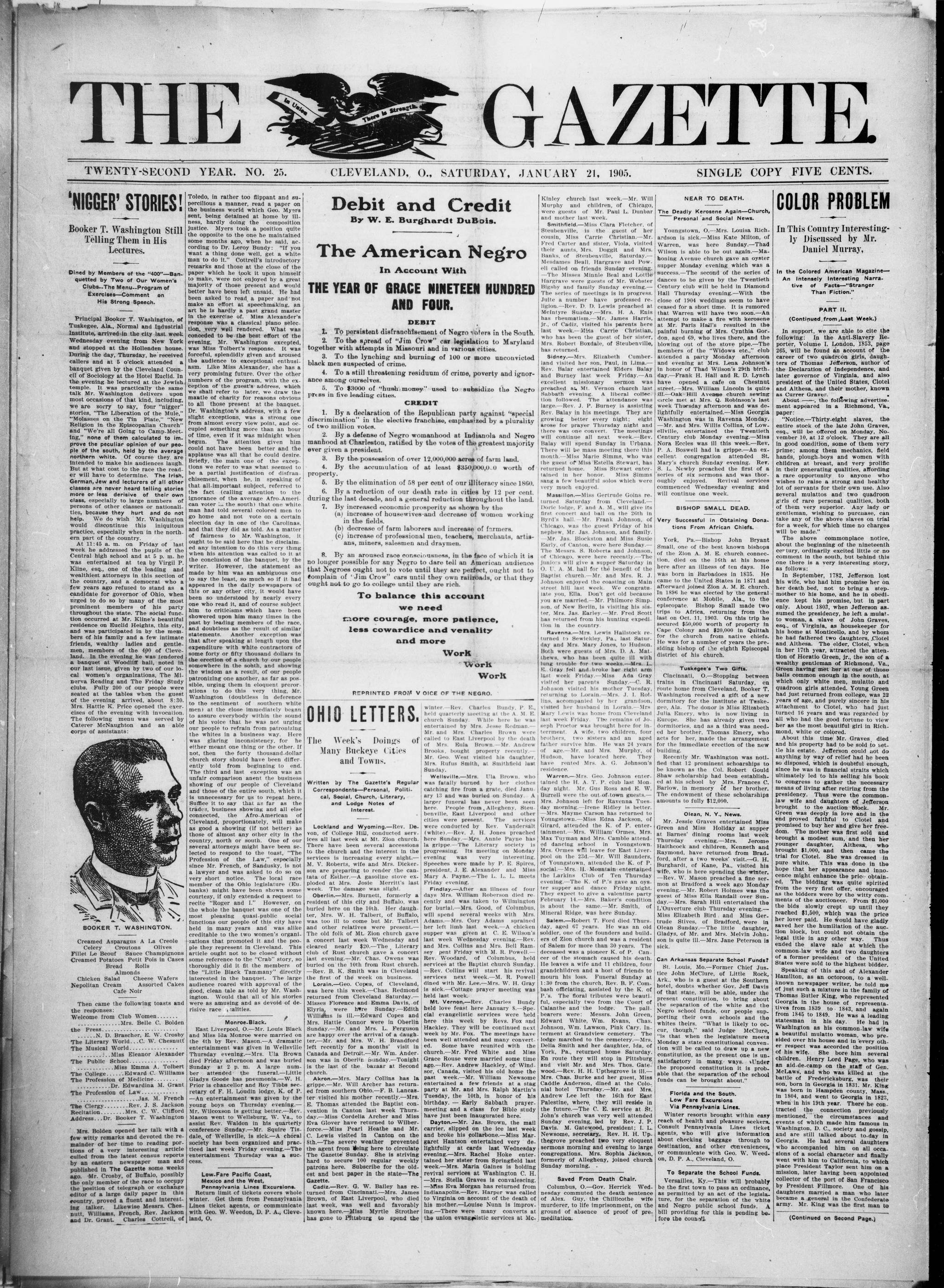
Page text (machine-generated)
THE
TWENTY-SECOND YEAR. NO. 25.
'NIGGER' STORIES!
Booker T. Washington Still Telling Them in His Lectures.
Dined by Members of the "400"—Banquet by Two of Our Women's Clubs--The Menu--Program of Exercises—Comment on His Strong Speech.
Principal Booker T. Washington, of Tuskegee, Ala., Normal and Industrial Institute, arrived in the city last week Wednesday evening from New York and stopped at the Hollenden house. During the day, Thursday, he received callers and at 5 o'clock attended a banquet given by the Cleveland Council of Sociology at the Hotel Euclid. In the evening he lectured at the Jewish temple. It was practically the same talk Mr. Washington delivers upon most occasions of that kind, including, we are sorry to say, four "nigger" stories, "The Liberation of the Mule," "Molasses on the Tin Plate," "New Religion in the Episcopalian Church" and "We're all Going to Camp-Meeting," none of them calculated to improve the peculiar opinion of our people of the south, held by the average northern white. Of course they are intelligent, make his audiences laugh. But at what cost is the race the reader will have to race the tester. German, Jew and lecturers of all other classes are never heard telling stories more or less derisive of their own class, especially to large numbers of persons of other classes or nationalities, because they hurt and do not help. We do wish Mr. Washington would discontinue this iniquitous practice, especially when in the northern part of the country.
At 11:45 a. m. on Friday of last week he addressed the pupils of the Central high school and at 5 p. m. he was entertained at tea by Virgil P Kline, esq. one of the leading and wealthiest attorneys in this section of the country, and a democrat who a few years ago refused to stand as a candidate for governor of Ohio, when urged to do so by many of the most prominent members of his party throughout the state. The social function occurred at Mr. Kline's beautiful residence on Euclid Heights, this city, and was participated in by the members of his family and a few intimate friends, wealthy landers and gentlemen, in the town of Ajo Land. In the evening he was tendered a banquet at Wooddifl hall, noted in our last issue, given by two of our local women's organizations, The Mimera Reading and The Friday Study clubs. Fully 200 of our people were seated at the tables when the guest of the evening arrived, about 8:30 Hattie K. Price opened the exercises of the evening with invocation. The following menu was served by Caterer McNaughton and an able corps of assistants:
A.
BOOKER T. WASHINGTON.
Creamed Asparagus A La Creole
Celery Crontons Olives
Fillet Le Beouf Sauce Champignons
Creamed Potatoes Petit Pois in Cases
Bread Rolls
Almonds
Chicken Salad Cheese Wafers
Nepolitan Cream Assorted Cakes
Cafe Noir
Then came the following toasts and the responses:
Welcome from Club Women.....
Mrs. Belle C. Bolden
the Press.....
N. D. Brascher, E. W. Crosby
The Literary World...C. W. Chesnut
The Musical World.....
Miss Eleanor Alexander
The Public School.....
Miss Emma A. Tolbert
The College....Edward C. Williams
The Profession of Medicine....Dr. Edwardina M. Grant
The Profession of Law....Jas. M. French
The Clergy...Rev J. S. Jackson
Recitation...Mrs. C. W. Clifford
Address...Dr. Booker T. Washington
Mrs. Bolden opened her talk with a few witty remarks and devoted the remainder of her time to reading portions of a very interesting article culled from the latest census reports by an eastern newspaper man and published in The Gazette some weeks ago. Mr. Crosby, of Buffalo, possibly the only member of the race to occupy the position of telegraph or exchange editor of a large daily paper in this country, proved a fluent and interesting talker. Likewise Messrs. Chesnut, Williams, French, Rev. Jackson and Dr. Grant. Charles Cottrell, of
Monroe.Black.
East Liverpool, O.—Mr. Louis Black and Miss Ida Monroe were married on the 4th by Rev. Mason.—A dramatic entertainment was given in Wellsville Thursday evening—Mrs. Ula Brown died Friday afternoon and was buried Sunday at 2 p. m. A large number attended the funeral—Little Gladys Goode has pneumonia.—W. H. Prior is chancellor and Roy Tibbs secretary of F. H. Loudin lodge, K. of P.—An entertainment was given by the young boys on Thursday evening.—Mr Wilcoxson is getting better.—Rev Mason went to Wellsburg, W. V. to assist Rev. Walden in his quarterly conference Sunday.—Mr. Squire Tisdale, of Wellsville, is sick.—A choral society has been organized and practiced last week Friday evening.—The entertainment Thursday was a success.
Low-Fare Pacific Coast, Mexico and the West.
Pennsylvania Lines Excursions.
Return limit of tickets covers whole winter. Get them from Pennsylvania Lines tickets agents, or communicate with Geo. W. Weedon, D. P. A., Cleveland, O.
CLEVELAND, O., SATURDAY, JANUARY 21, 1905.
Debit and Credit
By W. E. Burghardt DuBois.
1. To persistent disfranchisement of Negro voters in the South.
2. To the spread of "Jim Crow" car legislation to Maryland together with attempts in Missouri and in various cities.
3. To the lynching and burning of 100 or more unconvicted black men suspected of crime.
4. To a still threatening residuum of crime, poverty and ignorance among ourselves.
5. To $3000 of "hush money" used to subsidize the Negro press in five leading cities.
CREDIT
1. By a declaration of the Republican party against "special discrimination" in the elective franchise, emphasized by a plurality of two million votes.
2. By a defense of Negro womanhood at Indianola and Negro manhood at Charleston, ratified by the votes of the greatest majority ever given a president.
3. By the possession of over 12,000,000 acres of farm land.
4. By the accumulation of at least $350,000,0.0 worth of property.
5. By the elimination of 58 per cent of our illiteracy since 1860.
6. By a reduction of our death rate in cities by 12 per cent. during the last decade, and a general reduction throughout the land.
7. By increased economic prosperity as shown by the
(a) increase of housewives and decrease of women working in the fields.
(b) decrease of farm laborers and increase of farmers.
(c) increase of professional men, teachers, merchants, artisans, miners, salesmen and draymen.
8. By an aroused race consciousness, in the face of which it is no longer possible for any Negro to dare tell an American audience that Negroes ought not to vote until they are perfect, ought not to complain of "Jim Crow" cars until they own railroads, or that they ought not to go to college until they are rich.
To balance this account we need more courage, more patience, less cowardice and venality and more
Work
Work
Work
REPRINTED FROM VOICE OF THE NEGRO.
OHIO LETTERS.
The Week's Doings of Many Buckeye Cities and Towns.
Written by The Gazette's Regular Correspondents—Personal, Political, Social, Church, Literary, and Lodge Notes of Lovers.
winter—Rev. Charles Bundy, P. E. held quarterly meeting at the A. M. B. church Sunday. While here he was entertained by Mrs. Jesse Redman. Mr. and Mrs. Charles Brown were called to East Liverpool by the death of Mrs. Eula Brown. Mr. Andre Brooks, bought property recently. Mr. Geo. West visited his daughter Mrs. Rufus Smith, at Smithfield last Sunday.
Wellsville.—Mrs. Ula Brown, who was fatally burned by her clothe catching fire from a grate, died January 13 and was buried on Sunday. A larger funeral has never been seen here. People from Allegheny, Steu
Lockland and Wyoming—Rev. Devon, of College Hill, conducted services all last week at Mt. Zion church. There have been several accessions to the church and the interest in the services is increasing every night.—M. V. Roberts, wife and Mrs. Dickerson are preparing to render the cantata of Esther.—A gasoline stove exploded at Mrs. Josie Merritt's last week. The damage was slight. Oberlin. Mrs. Burnett, formerly a resident of this city and Buffalo, was buried here on the 10th. Her daughter, Mrs. W. H. Talbert, of Buffalo, was too ill to come but Mr. Talbert and other relatives were present.—The old folk of Mt. Zion church gave a concert last week Wednesday and cleared nearly $20.—The Literary club of Rust church gave a concert last evening—Mr. Chas. Owens was buried on the 10th from Rust church.—Rev. B. K. Smith was in Cleveland the first of the week on business. Lorain.—Geo. Copes, of Cleveland, was here this week.—Chas. Redmond returned from Cleveland Saturday.—Misses Florence and Emma Davis, of Elyria, were here Sunday.—Edith Williams is ill.—Edward Copes and Mrs. Hattie Connor were in Oberlin Sunday.—Mr. and Mrs. L. Ferguson are happy over the arrival of a daughter.—Mr. and Mrs. W. H. Brandon left recently for a months' visit in Canada and Detroit.—Mr. Wm. Anderson was in Oberlin Sunday.—Tonight is the last of the bazaar at Second church.
Akron.-Mrs. Mary Collins has la gripe.-Mr. Will Archer has returned from southern Ohio.-F. B. Lancaster visited his mother recently.-Mrs. E. Thomas attended the Baptist convention in Canton last week Thursday.-Miss Cordella Archer and Miss Eva Glover have returned to Wilberforce.-Miss Pearl Heathe and Mr. C. Lewis visited in Canton on the 8th.-The severe weather prevented the agent from being here to circulate The Gazette Sunday. She is striving hard to secure 100 regular weekly patrons here. Subscript for the oldest and best paper in the state—The Gazette.
Cadiz.-Rev. G. W. Bailey has returned from Cincinnati.-Mrs. James Brown, of East Liverpool, who died last week, was well and favorably known here.-Miss Myrtle Strother has gone to Pittsburg to spend the
---
winter.—Rev. Charles Bundy, P. E. held quarterly meeting at the A. M. E. church Sunday. While here he was entertained by Mrs. Jesse Redman.—Mr. and Mrs. Charles Brown were called to East Liverpool by the death of Mrs. Eula Brown.—Mr. Andrew Brooks, bought property recently.—Mr. Geo. West visited his daughter, Mrs. Rufus Smith, at Smithfield last Sunday.
Wellsville.—Mrs. Ula Brown, who was fatally burned by her clothes catching fire from a grate, died January 13 and was buried on Sunday. A larger funeral has never been seen here. People from Allegheny, Steubenville, East Liverpool and other cities were present. The services were conducted by Rev. H. Wendtalsdorf.—Rev. H. Jones presided here Sunday.—Annie Payne has la gripe.—The Literary society is progressing. Its meeting on Monday evening was very interesting. Speeches were made by P. E. Spiros, president, J. E. Alexander and Miss Mary A. Payne.—The L. L. L. meets Friday evening.
Finday.—After an illness of four days Mrs. William Roberson died recently and was taken to Wilmington for burial.—Mrs. Good, of Columbus, will spend several weeks with Mrs. Adams.—Mrs. Cory Adams sprained her left limb last week.—A chicken supper was given at C. E. Wilson's last week Wednesday evening.—Rev. and Mrs. Collins and Mrs. Bell Ramsey sent pent Friday with M. R. Powell.—Rev. Woodard, of Columbus, held services at the Baptist church Sunday.—Rev. Collins will start his revival services next week.—M. R. Powell dined with Mr. Lee.—Mrs. W. H. Gray is sick.—Cottage prayer meeting was held last week.
Mt. Vernon.—Rev. Charles Buny held love feast here January 8.—Special evangelistic service was held by Revs. Fox and Hackley. They will be next week by Mr. Fox. The meetings been well attended and many converted. Some have reunited with the church. Mr. Fred White and Miss Grace Rouse were married some time ago.—Rev. Andrew Hackley, of Windon, Canada, visited his old home the past week.—Mr. William Newsome entertained a few friends at a stag party at Mr. and Mrs. Ralph Martin's Tuesday, the 10th, in honor of his birthday.—Early Sabbath prayer meeting and a class for Bible study have just been inaugurated here.
Dayton.—Mr. Jas. Brown, the mall carrier, slipped on the ice last week and broke his collarbone.—Miss Margaret Hanson entertained very delightfully at cards last Wednesday evening.—Mrs. Rachel Hoke entertained her sister from Springfield last week.—Mrs. Maria Galnes is holding revival services at Washington C. H.—Mrs. Stella Graves is convalescing.—Miss Eva Morgan has returned from Indianapolis.—Rev. Harper was called to Virginia on account of the death of his mother.—Louise Nunn is improving.—There were many converts at the union evangelical services at Mc
CREDIT
Kinley church last week.—Mr. Will Murphy and children, of Chicago, were guests of Mr. Paul L. Dunbar and mother last week.
**Smithfield**—Miss Clara Fletcher, of Steubenville, is the guest of her cousin, Miss Carrie Christian.—Mr. Fred Carter and sister, Viola, visited their aunts, Mrs. Doggit and Mrs. Banks, of Steubenville. Saturday.—Mesdames Beall, Hargrave and Powell called on friends Sunday evening.—The Misses Minnie Beal and Lottie Hargrave were guests of Mr. Webster Bigsy and family Sunday evening.—The series of meetings is in progress. Julie a number have professed re-formation. Rev. D. Lewis preached at Metbury Sunday.—Mrs. A. A. Abi has rheumatism.—Mr. James Harris, Jr. of Cadiz, visited his parents here last week.—Miss Carrie Christian, who has been the guest of her sister, Mrs. Robert Boxdale, of Steubenville, has returned.
Sidney.—Mrs. Elizabeth Cumberland visited her son, Paul, in Lima.—Rev. Balar entertained Elders Balay and Burney last week Friday.—An excellent missionary sermon was preached at M. Vernon church last Sabbath evening. A liberal collection followed. The attendance was large.—Rev. J. P. Burney is assisting Balay in his meetings. They are growing better every night; eight arose for prayer Thursday night and there was one convert. The meetings will begin on Friday. Balay will spend Sunday in Urbana. There will be mass meeting there this month.—Miss Marie Simms, who was the guest of Miss Estella Stewart, has returned home. Miss Stewart entertained in her honor. Miss Simms sang a beautiful solos which were very much enjoyed.
Massillon.—Miss Gertrude Goins returned Saturday from Cleveland.—Dorie lodge, F. and A. M. will give its first concert and ball on the 26th in Byrd's hall.—Mr. Frank Johnson, of Chicago, was the guest Friday of his nephew, Mr. Jas Johnson, and family.—Mr. Jas, Blockston and Miss Susie Early, of Canton, were here Sunday.—The Messrs. S. Roberts and Johnson, of Chicago, were here recently.—The juniors will give a supper Saturday in O. U. A. M. hall for the benefit of the Baptist church.—Mr. and Mrs. R. J. Johnson enjoyed the coating on Main Street.—We each paid you Ella. Don't get old because you are married.—Mr. Philmore Simpson, of New Berlin, is visiting his sister, Mrs. Jas Earley.—Mr. Fred Scott has returned from his hunting expedition in the country.
Ravenna—Mrs. Lewis Hallstock returned to Sewickley, pa., last Saturday and Mrs. Mary Jones, to Hudson Both were guests of Mrs. D. A. Matthews, who has been quite ill with tung trouble for two weeks.—Mrs. L. E. Gray fell and broke her right arm last week Friday.—Miss Ada Gray visited her parents Sunday.—C. R. Johnson visited his mother Tuesday returning to Lorain.—Mrs. J. I. Rolins, accompanied by her grandson visited her husband in Lorain.—Mrs Mary Lewis was home from Cleveland last week Friday. The remains of Joel Proctor was found for interment. A wife two children, four brothers, two sisters and an aged father survive him. He was 24 years of age.—Mr. and Mrs. Murphy of Hudson, have located here. They have rented Mrs. A. G. Johnson's residence.
Warren.—Mrs. Geo. Johnson entertained the H. A. T. p. Club last Monday night. Mr. Gus Ross and E. W. Burrell were the out-of.town guests.—Mrs. Johnson left for Ravenna Tuesday morning.—Irene Ridley is better.—Mrs. Mayne Carson has returned to Youngstown.—Miss Edna Jackson, of Girard, attended the P. of P. entertainment.—Mrs. William Ormes, Mrs. Max Tuyman and Mrs. Camble attended dancing school in Youngstown Mrs. Ormes wll leave for East Liverpool on the 25d.—Mr. Will Saunders, of Youngstown.—Mended the K, of P. Max Tuyman.—Mended the Larkins Club of Ten Tuesday evening.—The K. of P. gave an anxiet supper and dance Friday night. They expect to give a valentine party February 14.—Mrs. Baker's condition is about the same.—Mr. Smith, of Mineral Ridge, was here Sunday.
Salem.—Robert T. Ford died Thursday, aged 67 years. He was an old soldier, one of the founders and builders of Zion church and was a resident of Salem for more than 30 years. The deceased was a pioneer K. of P. Cancer of the stomach caused his death. He leaves a wife and 11 children, four grandchildren and a host of friends to mourn his loss. Funeral Sunday at 1:30 from the church, Rev. B. F. Combash officiating, assisted by the K. of P.'s. The floral tributes were beautiful, especially two from the Court of Calanthe and the lodge. The pallbearers were: Messrs. John Green, Edward White, Wm. Evans, Chas Johnson, Wm. Lawson, Pink Cary. Interment at Grandview cemetery. The lodge marched to the cemetery. Mrs. Delia Smith and her daughter, Ida, of York, Pa., returned home Saturday. En route they will stop in Pittsburg and visit Mr. and Mrs. Thos. Gatewood.—Rev. H. U. Uphegrove is ill.—Mrs. Chas. Burke and her guest, Miss Caddie Anderson, dined at the Colonial hotel Thursday.—Mr. and Mrs. Andrew Lee left the 16th for East Palestine, where, they will reside in the future.—The C. E. service at St John's church was very well attended Sunday evening, led by Rev. J. P Davis. M. Gatewood, president. I. L Newsome, secretary. Rev. H. H. Uphegrove preached two very eloquent sermons morning and evening to large congregations. Mrs. Sophia Jackson formerly of Allegheny, joined church Sunday morning.
Saved From Death Chair.
Columbus, O.-Gov. Herrick. Wednesday commuted the death sentence of Alex. Guy, the Chillicothe wife murderer, to life imprisonment, on the ground of absence of proof of premeditation.
NEAR TO DEATH.
The Deadly Kerosene Again-Church,
Personal and Social News.
Youngstown, O.—Mrs. Louisa Richardson is sick.—Miss Kate Milton, of Warren, was here. Sunday.—Thad Wilson is able to be out again.—Maboning Avenue church gave an oyster supper Monday evening which was a success.—The second of the series of dances to be given by the Twentieth Century club will be held in Diamond Hall Thursday evening.—With the close of 1904 weddings seem to have ceased for a short time. It is rumored that Warren will have two soon.—An attempt to make a fire with kerosene at Mr. Paris Hall's resulted in the painful burning of Mrs. Cynthia Gordon, aged 69, who lives there, and the blowing out of the stove pipe.—The members of the "Widows etc." club attended a party Monday afternoon and evening at Mrs. Lena Johnson's in honor of Thad Wilson's 29th birthday.—Frank H. Hall and R. D. Lynch have opened a cafe on Chestnut street.—Mrs. William Lincoln is quite ill.—Oak Hill Avenue church sewing circle met at Mrs. Q. Robinson's last week Thursday afternoon and was deeply entertained by Mrs. Georgia Washburn in Ravennia Monroe.—Mr. and Mrs. Willis Collins, of Lowellville, entertained the Twentieth Century club Monday evening.—Miss Nora Eccles was ill this week.—Rev. P. A. Boswell had la gripe.—An excellent congregation attended St. Mary's church Sunday evening. Rev. S. L. Newby preached the first of a series of six sermons and was thoroughly enjoyed. Revival services commenced Wednesday evening and will continue one week.
BISHOP SMALL DEAD.
Very Successful in Obtaining Donations From African Chiefs.
York, Pa—Bishop John Bryant Small, one of the best known bishops of the Zion A. M. E. church connection, died on the 16th at his home here after an illness of ten days. He was born in Barbados in 1835. He came to the United States in 1871 and afterward joined Zion A. M. E. church. In 1896 he was elected by the general conference at Mobile, Ala., to the episcopate. Bishop Small made two trips to Africa, returning from the last on Oct. 11, 1903. On this trip he secured $50,000 worth of property in Colony Cape and $20,000 in Quittah for the church from native chiefs. He was for a number of years the presiding bishop of the eighth Episcopal district of his church.
Tuskegee's Two Gifts
Cincinnati O—Stopping between trains in Cincinnati Saturday, on route home from Cleveland, Booker T. Washington received a gift of a new dormitory for the institute at Tuskegee, Ala. The donor is Miss Elizabeth Julia Emery, who is now living in Europe. She has already given two dormitories, and as a third was needed her brother, Thomas Emery, who acts for her, made the arrangement for the immediate erection of the new building. Recently Mr. Washington was notified that 12 prominent scholarships to be awarded to him, Gould Gould Shaw scholarship had been established at his school by Mrs. Frances C. Barlow, in memory of her brother. The endowment of these scholarships amounts to fully $12,000.
Olean, N. Y., News.
Mr. Jessie Graves entertained Miss Green and Miss Holiday at supper at Barnes' dining rooms last week Thursday evening.—Mrs. Jerome Haitcock and children, Kenneth and Raymond, have returned from Bradford, after a two weeks' visit.—G. H. Burghardt, of Kane, Pa., visited his wife, who is here spending the winter,—Rev. W. Mason preached a fine sermon at Bradford a week ago Monday evening.—Mr. Robert Holmes was the guest of Miss Elia Randall over Sun Valley, Mrs. Sarah Hill once visited L'Ouverture club Thursday evening.—Miss Elizabeth Bird and Miss Gertrude Stives, of Bradford, were in Olean Sunday.—The little daughter, Gladys, of Mr. and Mrs. Melvin Johnson is quite ill.—Mrs. Jane Peterson is sick.
Can Arkansas Separate School Funds?
Can Arkansas Separate School Funds?
St. Louis, Mo.-Former Chief Justice John McClure, of Little Rock, Ark., who is a guest at the Southern hotel, doubts whether Gov. Jeff Davis of that state, will be able, under the present constitution, to bring about the separation of the white and the Negro school funds, our people supporting their own schools and the whites theirs. "What is likely to occur, though," said Judge McClure, "is that when the legislature meets Monday a state constitutional convention will be called to draw up a new constitution, as the present one is unsatisfactory in many ways. Under the proposed constitution it is probable that the separation of the school funds can be brought about."
Florida and the South.
Low Fare Excursions
Va. Pennsylvania Lines.
Winter resorts brought within easy reach of health and pleasure seekers. Consult Pennsylvania Lines ticket agents, who will give information about checking baggage through to destination, and other conveniences, or communicate with Geo. W. Weedon, D. P. A., Cleveland, O.
To Separate the School Funds.
Versailles, Ky.-This will probably be the first town to pass an ordinance, as permitted by an act of the legislature, for the separation of the white public school funds. A bill providing for this is pending before the council.
COLOR PROBLEM
In This Country Interestingly Discussed by Mr. Daniel Murray,
In the Colored American Magazine—An Intensely Interesting Narrative of Facts—"Stranger Than Fiction."
(Continued from Last Week.)
In support, we are able to cite the following: In the Anti-Slavery Reporter, Volume I. London, 1853, page 265, will be found an account of the career of two quadron girls, daughters of Thomas Jefferson, author of the Declaration of Independence, and later governor of Virginia, and also president of the United States, Clotel and Althesa, and their mother, known as Currer Graves.
About.... the following advertisement appeared in a Richmond, Va., paper:
"Notice.—Thirty-eight slaves, the entire stock of the late John Graves, esq., will be offered on Monday, November 10, at 12 o'clock. They are all in good condition, some of them very prime; among them mechanics, field hands, plough-boys and women with children at breast, and very prolific in their generating qualities, affording a rare opportunity to anyone who wishes to raise a strong and healthy lot of servants for their own use. Also several mulatatos and two quadron girls of rare personal qualities, both of them very superior. Any lady or gentleman, wishing to purchase, can take any of the above slaves on trial for a book, for which time no charges will be made."
The above commonplace notice, about the beginning of the nineteenth century, ordinarily excited little or no comment in the south, but behind this one there is a very interesting story, as follows:
In September, 1782, Jefferson lost his wife, who had him promise on her death bed, not to bring a stepmother to his home, and he in obedience kept his promise, but in part only. About 1803, when Jefferson assumed the presidency, he left a mutato woman, a slave of John Graves, esq., of Virginia, as housekeeper for his home at Monticello, and by whom he had fathered two daughters, Clotel and Althea. The elder, Clotel, when in her 17th year, attracted the attention of Horatio Green, Jr., the son of a wealthy gentleman of Richmond, Va., Green having met her at one of those balls common enough in the south, at which only white men, mulatto and quadroon girls attended. Young Green had just returned from college, was 22 years of age, and purely sincere in his attachment to Clotel, who had just turned 16 years and was regarded by all who had the good fortune to view her as the most beautiful girl in Richmond, white or colored.
About this time Mr. Graves, died and his property had to be sold to set his estate. Jefferson could not do anything by way of relief had he been so disposed, which is doubtful enough, since he was in financial straits which ultimately led to his selling his book to congress to gather the necessary means of living after retiring from the presidency. Thus were the common-law wife and daughters of Jefferson brought to the auction block. Mr. Green was deeply in love and in the end proved faithful to Clotel and promised to buy her and give her freedom. The mother was first sold and brought a modest sum, and then her younger daughter, Althea, who brought $1,000, and then came the trial for Clotel. She was dressed in pure white. This was done in the manner her appearance and innocence might influence the price obtained. The bidding was quite spirited from the very first offer, encouraged as the bidders were by the many comments of the auctioneer. The bids slowly crept up until they reached $1,500, which was the price her lover paid. He would have gladly saved her the humiliation of the auction block, but could not obtain the title in any other way. Thus ended the slave sale at which the common-law wife and two daughters of a former president of the United States were sold to the highest bidder.
Speaking of this and of Alexander Hamilton, as an octoonor, to a well-known newspaper writer, he told me of just such a mixture in the family of Thomas Butler King, who represented Georgia in the house of representatives from 1839 to 1843, and again from 1845 to 1849. He was a leading statesman in his day. He had in Washington as his common law wife a beautiful mulatto woman, who presided over his house and in every other respect was accorded the position of his wife. She bore him several children. Henry Lord Page, who was an aid-d-camp on the staff of Gen. McLaws, and who was killed at the battle of Fredericksburg, was their son, born in Georgia in 1831. Mr. King was born in Hampden county, Mass., in 1804, and went to Georgia in 1823, when in his 19th year. There he contracted the connection previously mentioned," the circumstances and events of which made him famous in Washington, D. C., society and gossip, and are still talked about to-day in Georgia. He had several daughters who accompanied him on all occasions of a social character and finally went with him to California, to which place President Taylor sent him on a mission, later having been appointed collector of the port of San Francisco by President Fillmore. One of his daughters married a man who later became a general in the Confederate army. Mr. King was the first man to
(Continued on Second Page.)
2
THE GAZETTE.
SUBSCRIPTION RATES.
(IN ADVANCE.)
One Year. $1.50
Six Months. 1 0.
Three Months. 50
Subscribers are requested to remit by post-
sence money order or registered letter
Entered at the postoffice in Cleveland, Ohio
as second-class matter.
All communications should be addressed:
HARRY C. SMITH.
Member Ohio Legislature, 1894 to 1898.
1898 to 1898.
1900 to 1902.
THE GAZETTE is the oldest, and has the largest bona fide circulation, double that of any newpaper in the interest of Afro-Americans, published in the state of Ohio, and comparison with any will immediately establish its rank as one of the NEWSIEST AND BEST in the country.
ELLIS THE MARVEL OF
HIS TIME.
Certainly one of the most remarkable characters among our race of today is Mr. W. H. Ellis, known as the princely explorer, banker and broker, Wall street, New York City. Mr. Ellis has had a most marvelous career and is still adding laurels to a record that is at once captivating. He won his spurs in the golden city of the west and going to New York he became a prominent figure in Wall street dealings. Nerved with an undying aspiration to realize the yearning hopes of his brightest fancy, he became a party with a Mr. Loomis to bear papers from this government to King Menelik, of Abyssinia. While on their way to Africa, Mr. Loomis disappeared from the ship, and the whole affair has been clouded in mystery. But Mr. Ellis continued his journey, was cordially received by the king and has been engaged in bringing about diplomatic relations between Ethiopia and the United States. Mr. Ellis is a man of wealth and wonderful ability, both as a diplomat and a statesman. Mr. Loomis was lost from the ship, but he could not afford to relinquish his task. He partially accomplished all, was honored by the crowned head of the Ethiopian empire, and for this he was traduced and maligned by the southern press as the slayer of his friend Loomis. But Mr. Ellis has proven himself the real champion and hero of a great cause. By means of his wealth he has explored a large part of Ethiopia and has evolved truths hitherto unknown to modern times. With his hundreds of camels and hundreds of natives following in his lead, he has rendered a service to the King of Abyssinia that will yet bring that country in a trade way in close touch with the United States. That malignant spirit, ever ready to strike its victim, now recolls upon itself, while this Negro explorer moves triumphantly on to the goal of his ambitions.
A DRUNKEN MAN SPEAKS.
Gov. Jeff Davis in his inaugural address to the legislature of Arkansas betrayed the most inordinate and man-hating feeling against Afro-Americans of any white man in America. But the truth must be told. Not long since, this man Davis was expelled from his own church for notorious drunkenness. He was afterward tried for malfaessance in office and merely did escape impeachment. But his supreme offense against humanity and good government is his reckless habit of disgraceful drinking. He is a toper of the first water and it is remarkably strange that the people of Arkansas do tolerate a man of this stripe. But Davis, though recognized as a hopeless toper, is up to many tricks and knows what strings to pull. While at college he was indolent, vicious and fractious and was given much to drink in consequence of which, he frequently missed his classes and never passed a creditable examination. All of these bad traits follow the Jeff Davis of today. No drunkard is a safe man upon whom to depend, for a drunkard is never of the same mind, and when hard gone under the influence of the intoxicant he indulges the worst propensity of his depraved nature. Davis hates the poor Negro and to carry a point with his white "pals," he beats him and his white things he upstares the worst and meanest things of all creation. The inferior animals may enjoy freedom but the Negro, he holds, is designed only to be the slave of a master. No matter how cultured, how moral and exalted, or how manual in endowments by nature, yet he is ordained of God to be the servant of some half demented, drunken, scalawag of another race. Is not sack jargon enough to bring the blush of shame to the cheek of any Christian white gentleman who feels himself to be a man? But poor Jeff Davis, now on his last legs; offers himself as the advocate of the measure to divide the school funds of Arkansas. But Davis is seriously and helplessly drunk. He is hardly ever sober. Will the legislature of Arkansas assume the responsibility of such an unjust act? Colored people are largely taxed in support of the state government and it would be base robbery to prorate the small school revenue for the education of the people's children. Every well person is a contribution of good to the state. But Davis demeans and holds them up as
he veriest vagabonds of the earth. He is opposed to Negro education and to defeat this object he asks the legislature to withhold from the general fund all educational means, except what may be devised under scheming manipulation as deserved. Let Jeff Davis play governor, but it were better for him had he improved his time to advantage while in school.
CONGRESS MUST ACT.
Correspondents Wanted
The old reliable Gazette destres an active agent and correspondent in every city and town in Ohio and neighboring states having a number of Afro-American residents.
We are especially desirous of hearing from persons in the following cities: Zanesville, Springfield, Troy Pla, Dayton, Washington C.H., Canton, Bellaire, Gallipolis, Cambridge, Lima, Toledo, Portsmouth, Circleville, Delaware, Hamilton, Sandusky and other places where we have none.
Write to the editor of The Gazette Blackstone building, Cleveland, O. and terms will be seen promptly. Our readers can be greatly by send a address of any good person or persons in any of the cities named above or others, to whom we can write relative to the matter.
California, Mexico, Pacific Coast Ex-
Carolina V. Pennyneville University
Rich fields for investors in west and
southwest. Get details about fares
from Pennsylvania Lines ticket
agents, or write Geo. W. Weedon, D.
P. A. Cleveland, O.
THE GAZETTE, CLEVELAND, O., SATURDAY, JANUARY 21, 1905.
COLOR PROBLEM
(Continued from First Page.)
propose the Pacific railroad in congress, which he did so persistently that it came to be known as "King's Folly." His three daughters married white men, and thus the admixture has been carried into circles beyond compaction. All of them ultimately died in 1864, and one of the Confederate commissioners to Europe during the civil war. He died in 1864.
(To be continued.)
HANNAH ELIAS ON THE STAND.
Says Platt's First Gift Was $500—He Gave Her in All Nearly a Million Dollars.
New York City—Hannah Elias went on the stand Wednesday afternoon as the chief witness in her defense against the claims of her aged admirer, John R. Platt, (white). There was a great flurry when the woman began to tell her story of coming into possession of vast sums. Mrs. Elias was nervous. She pulled up her vell, and answering the first question her voice was almost inaudible. She said:
"I came to New York 18 years ago." "How soon after that did you meet Mr. Platt?"
"In 1893, at 14th street and Sixth avenue, and again at a French woman's house."
"What did he say?"
"He told me I was a nice girl, and gave me $500 to buy clothes. He then established me in the Miller house, in 35th street and paid $30 a week for me."
"You were not engaged as a cook there?"
"No sir."
"Did he tell you he had a wife?"
"Yes, and two daughters, one of whom was in Nebraska."
"Did he make you any presents?"
"Oh, yes, $100, $500 and $1,000 at a time. When I moved to 43d street Mr. Platt paid all the expenses. I kept a girl. Mr. Platt called me Irene, because he said I reminded him of a colored girl he had met in Florida."
"Did he costainte to give you money?"
"Yes, every month. As high as $2,000 at a time."
"Was there ever any interruption in your relations?"
"No, when he went south every winter he arranged to put an advertisement in the paper on his return, in case I moved during his absence, and I would answer: 'Paper Dime Savings Bank, 8:30 p. m.' He would meet me there."
Asked if Mr. Platt ever referred to his family relations, she said that he freely did. He informed her when his wife died, and six months after Mrs. Platt's death he presented witness with Mrs. Platt's gold watch, pocketbook and other personal property belonging to the deceased.
Before Mrs. Platt's death, witness said, Platt gave her money in sums ranging from $500 to $1,000. After wife's death the sums increased from $5,000 to $10,000.
In regard to his calls upon her, witness said that they always kissed upon meeting and again on his departure. Witness denied that she ever advertised as a massage artist, but admitted that she frequently rubbed Mr. Platt with alcohol when he was not feeling well.
News of the Week of Beaver Valley
Rochester, Pa.—Mr. and Mrs. Chas. Robinson, of Beaver Falls, have returned from Altoona.—Mr. John Evans, of Beaver, who was threatened with fever, is much improved—Mr. and Mrs. T. H. Wright, of Lisbon, have been visiting the latter's father and mother, Mr. and Mrs. J. M. Webster, of New Brighton, with their daughter Frances.—The dance given by the Beaver Valley Social club January 9 at Reno's hall, Rochester, was a success.—Mr. R. Gibbons, of Beaver Falls, is critically ill with a complication of diseases.—Miss Nancy Evans, of W. Bridgewater, is convalescing.—Revival services at St. John's church, W. Bridgewater, are proving successful.—Mrs. Mary Wheeler and Miss Margaret Webster, of Rochester, visited in Pittsburg over Sunday.—Mrs. A. W. Tanner, of Rochester, is ill.—The Blue Ribbon Literary society of the A. M. E. church, W. Bridgewater, did not hold a meeting last week on account of revival services.—Miss Myrtle Wagoner entertained Wednesday evening and Miss Laura Johnson on Friday evening.
Notice to Correspondents.
Correspondents must mail all letters for publication on MONDAY of each week, and always place their names and that of their city and towns on the outside of the wrapper about returned copies. Unless this is done proper credit cannot be given you. Advertisements, lists of names, wedding presents, etc., obituary notices, speeches, resolutions, poetry and memoirs may be paid for at the rate of ten cents a line, six words to a line. Our rates for display advertisements will be sent on application.
Dick's Prophecies
Columbus, O., Jan. 17.—Senator Dick, here Monday in conference with republican state leaders, said: "Gov. Herrick will be renominated by acclamation. There will be no revision of the tariff schedules at this session of congress. Some legislation against robates to shippers is probable. Elmer Dover will not go in the state to rob a person who has taken care of by the president. The state convention will likely be held in June.
HOME-SEEKERS' EXCURSIONS
West, Northwest and Southwest via Pennsylvania Lines.
Excursion tickets will be sold via Pennsylvania Lines to points west, northwest and southwest, account Home-Seekers' Excursions, during January, February, March and April. For full particulars regarding fares, routes, etc., write or call on Geo. Weedon, D. P. A., Cleveland, O.
Good Time to go South. Lowest
Eases Now Via Pennsylvania Lines.
Fares Now Via Pennsylvania Lines.
Winter tourist excursions via any route from Cincinnati or from Louis. ville to Florida and all resorts of the south. Get details from Pennsylvania lines ticket agents, or communicate with Geo. W. Weedon, D. P. A., Cleveland, O.
SOPHIE MEADOWS sat in the little parlor at the back of her mother's shop and gazed dismally out into the garden where the last brown leaves were falling from the limes to the soggy footpath below. The scene was not altogether an unsympathetic one for Sophie, since she was sad at heart that dull, milt afternoon. Indeed, there were signs that she had been crying; and when Sophie cried, her nose very red indeed, and a woman will not incur a risk of that sort without the most acute provocation. In the spring it had all been so different. David Trotter, who managed the village flour mill for his father, and who was besides a most eligible young man in every way, had asked Sophie to be his wife, and the earth seemed so fair to her then. The song of the skylark had a new meaning for her at that time, and the swallow's nest that was building in the eaves over her window developed, from a great nulsure, into a pleasing and blessed allegory. Summer had been spring intensified; and the brightness of life had seemed quite dazzling. And now everything was cheerless and damp, the sun was cold, and the fire of true and only love had spluttered out and left Sophie with a bruised heart and a red nose.
Everybody knew it was David's—that is, Mr. Trotter's—fault; or, at least, everybody to whom Sophie had mentioned the matter. Sophie's mother had perhaps not quite grasped the full meaning of the awful crisis in her daughter's bright young life. The good soul had even spoken lightly of it, affecting to treat it as a mere lover's quarrel, and that at a time when Sophie had been seriously considering whether she ought to go into a nunnery or just pine away and die 'in the back parlor at home. Sophie knew for a fact that David—or, rather, Mr. Trotter—had been seen flirting with Faith Duker, the creature who set her cap at everybody. The thing had been seen in the village; and after a likely bit of scandal had gone the round of a village like Dunstead, its own mother would not have recognized it at the finish. David had gone so far to as meet the creature a second time by appointment, and that, of course, caped his互挚. Everybody knows that no self-respecting girl can put up with goings-on like that. It would not have mattered so much if he had admitted his error, and had endeavored to earn forgiveness by a fitting display of contrition. But David had had the effrontery to deny the charge, and had actually punched young Harper about dreadfully for just casually mentioning the matter to a circle of friends at the Blue Anchor. Which just show you the true character of people like David—should say, Mr. Trotter. And yesterday Sophie had taken her pen in hand, and after laboriously studying the dictionary so as to be sure that she had got the long words right, had intimated to Mr. Trotter in cold and dignified terms that all was now over between them, and he would receive per bearer the presents he had made her, and hence forth they were strangers for evermore. Amen.
On other days Sophie would have been helping her mother in the shop; but to-day she could do nothing but sit and watch the leaves fall. As it grew dusk she got up and lit the lamp. There was her knitting on the table. The woolly squares hanging from the needles were the foundations of a pair of socks that had been intended for—him. Now, of course, they would go to the heaven via the parish church and the missionary society. No doubt the heathen would be more appreciative, though perhaps woollen socks in the tropics might be a little trying to the untutored savage mind. And then—"Sophie!"
It was the voice of Mrs. Meadows, calling from the shop. And a moment later the good soul put her head into the parlor, and added: "Sophie! It's David. He's come to see you."
Sophie started to her feet. This was the last straw. David—that is to say, Mr. Trotter—had been given to understand that his presence was no longer agreeable to her and in spite of that he had had the effrontery to call upon her once more.
"Tell him I don't want to see him, mother," she said. "After what's appened I don't want to speak to him again."
Mrs. Meadows turned back to her shop; but before she could repeat the portentous message, David was already at the parlor door. Mrs. Meadows smiled significantly and preceded him into the room. She was about to retire again, discreetly, when Sophie stopped her impatient.
"Don't go, mother," she said, with the imperiousness of the spout child that she was.
David was a big, rosy-cheeked fellow with plenty of confidence. The last was made evident by the deliberate way in which he put his hat on a chair, and then lifted a couple of brown paper parcels on the table. With a quiet "good evening" addressed to Sophie, he proceeded to deliberately untie the string of one of the parcels. The knot was a little hard, and as no one spoke, the embarrassing silence was becoming intolerable. Finally, David looked up.
"You sent back the few little presents I 'ad gave you," he said, gazing directly in front of him and addressing the opposite wall straight in the eye, "an so, o course, I'm bringin' back those what you gave me."
"You could ha' sent 'em bach," snapped Sophie. "There wasn't no need for to bring 'em yourself."
"Well, you see," said David, addressing the wall with the assistance of his index finger, with which he beat time to his measured words, "a man ain't some'ow so careful as what a woman is. Leastways, I s'pose that's what it is. Now, the things you sent back to me, they was all spiked and span, just like new, and—"
"Do for Falth Duker, 'praps,' commented Sophile, rather bitter. David affected not to be conscious of the interruption.
"These 'ere slippers, for instance,' he said, 'which you worked for me. I 'adn't ad 'em long before my little fox terrier got at one of 'em, and be-
fore I could get it away from 'im, he eaten one of the pink roses and a couple of the forget-me-nots."
Mrs. Meadows was surprised into a ridiculous guffaw. Then, conscious apparently of the impropriety of her conduct, she evaded her daughter's eye and became absorbed in contemplation of the ceiling. David could hardly help echoing this little outburst of encouragement with a grin of his own; and Sophie set her teeth together and felt that was fighting the whole world single-handed and alone.
"Then," continued David, "there's these 'ere braces.'
Sophie turned her head away sharply. It was doubtful whether, in her altered relationship with Mr. Trotter, braces were things that could be discussed with propriety. The articles in question were luridly embroidered in red and blue upon a green background, and in anything like sustained silence they might have been relied upon to speak for themselves. It was evident, however, from their present condition that they had been more decorative than useful; and David's attempt to strengthen the weaker parts by the addition of a piece of stout string had done nothing to enhance their artistic beauties.
David, remarking Sophie's attitude out of the corner of his eye, placed the poor mangled remains of the braces reverently on the table, and gazed at them with a sigh, as if he regarded them as still beautiful, even in death. Then he produced a pair of woolen socks from his parcel.
"These ere," he said, "o course they've bin in wear a good deal and—" I didn't give 'em to you for to keep under a glass case," protested Sophie, her bitter feelings softened a little by the fact that he had been glad to make use of her present. "No; quite so," said David, turning and addressing her for the first time. "Only, you see, when you've got to give things back again—" I don't want them back," said Sophie, "Well, there don't seem to be no choice about it, as far as I can see," replied David. "And as I couldn't give 'em back with 'oles in 'em, and I didn't like to let, no one else touch 'em now, I tried to mend 'em in a bit myself. You'll see—"
Mrs. Meadows guffawed again. And finding her mirth not so easy to check on this occasion, she flied precipitately into the shop, and left the young people alone. Sophie frowned at the interruption, but the next moment she found herself half smiling at David's dilemma. This big, rough fellow's confession of his helplessness was not displeasing to her. It showed her at least that there were times when she would be missed, and the reflection softened her a little. David passed the socks along, and indicated with his finger the spot where his handwork was to be seen. A huge, lumpy blotch of red wool that had been laboriously grafted on to a gray background, it did not need to be pointed out. It caught the eye at once, and absolutely riveted the attention. Sophie felt the corners of her mouth breaking down, and, finally, unable to resist the indulgence of the absurd incongruity, she burst into a peal of derisive laughter.
"I never was much of a 'and with a needle,' David explained, smiling. Then, as if realizing that Sophie's mirth was a distinct sign of encouragement," he leaned across the tabile and said, in a tone of gentle protest: "See what a mess I should make o' things if you give me up."
Sophie stopped laughing and looked at him sternly.
"There is—Faith Duker," she said.
"Not for me, there ain't," he said, scornfully.
"An' I can't make out what you keep on about the gal for. I don't suppose I've spoke a dozen words to 'er. Father give 'er people a job mendin' the sacks at the mill, but the work's done now, and—"
"But Mrs. Green said that Bobby Harmer told 'er—"
"Yes, I know. An' you give my compliments to Bobby 'Arper, an' ask 'im what e's got is' left eye shut up for. As for old mother Green, scandalmonger'in' is 'er business when she's got no drinkin' to do. You don't want to go listenin' to a parcel of old gossips like that. S'pose you let me keep the things you gave me. Come, now, that's a bargain. And the things I gave you-"
"I-I returned them," faltered Sophie, as her right hand mechanically sought the finger of her left hand that only yesterday had been decorated with a gold ring set with two pearls and a garnet.
David turned to the second parcel on the table.
"I brought 'em back on the offchance," he said. "Shall I undo the string?"
By way of reply, Sophie took her scissors from the mantelpiece behind her, and reaching across the table, cut the string in several places. Then she looked up at David's face and laughed.
And Mrs. Meadows, coming into the parlor abruptly to see if David was still there, remarked that she was very sorry to have 'interrupted, but hadn't', of course, had the least idea that everything was going so well—London Black and White.
BEST BIRD OF ALL
Let them talk about the robin or the mournin' the blackbird, while whites on the bill
If you're only out for beauty, it is probably your duty to descant upon the bows. Or if it's wisdom what you're after, then the owl upon the rafter quite the true and proper caper's said to be. But it's usefulness I'm praisin' and my diary is full of it, and trust feathered friend of men, and And so here's to that great blissin', may her shadow never lessen, just the bows never hagen bed. —Louisville Courier-Journal.
Chess by 'Phone Latest.
Playing chess by telephone is a new novelty which has been inaugurated by two clubs, one of Des Moines and the other of Grundy Center, Ia. A direct line will be given the two clubs with 'phones and megaphone attachments running into each clubroom when the play commences. There will be eight players on a side. Games have been played by telegraph, but this requires some time. It is expected by the use of the telephone to play a complete game at a sitting of an evening.
THE BLUFF FAILED.
THE BLUFF FAILED.
MR. WYNNNE TELLS OF POSTMEN WHO PLAYED POLITICS.
TRIED TO SCARE CORTELYOU
Chiefs of the Associations of Letter Carriers Schemed to Extort Pledges for Legislation in Their Favor from Candidates for Congress.
Washington, Jan. 17.—Postmaster General Wynne yesterday transmitted to the house "a statement of facts" relative to the dismissal of James C. Keller, president of the City Letter Carriers' association, and Frank Cunningham, Warren Tumber and H. W. Aldrich, officers of the Rural Carriers' association. The information is in response to a resolution introduced by Representative Hearst and agreed to by the house.
The response says Mr. Keller was dismissed for being absent from his post of duty without leave. In his showing before the department Mr. Keller states that he received oral leave from the late Postmaster General Payne to be absent from duty for a year. When the department ordered his return to duty he filed a letter saying it was impossible for him to do so at present. His dismissal followed.
The campaign of the rural carriers for an increase of pay is set forth in the communication in a number of circular letters credited to the three named carriers, and all based on an expedition made by Carrier Cunningham to New York, where he intercepted Chairman Cortelyou, of the republican national committee, and man Taggart, of the democratic national committee, and Representative Overstreet, secretary of the republican congressional campaign bureau.
The plan was outlined at a dinner in St. Louis, and Cunningham instructed to "make the best bargain possible" with "the politicians."
MINERS IN CONVENTION.
President Mitchell Says There Has Been No Increase in Membership the Past Year.
Indianapolis, Jan. 17.—The sixteenth annual national convention of the United Mine Workers of America was opened Monday by President Mitchell in Tomlinson hall. Nearly 600 delegates were in their seats, representing every one of the 25 districts. The largest delegations were from the central districts. The Ohio district delegation was headed by President Haskins, and the western district delegation was headed by President Patrick Dolan. The three anthracite districts sent 130 delegates.
In his annual address to the convention John Mitchell shows how there has been no increase in membership in the organization for the first time in ten years; declares that the anthracite section of the organization is on the verge of disruption; for the first time in any of his public utterances, flays public officials from federal judges in the east to Gov. Peabody in the west, and asks for a lobby to get legislation through congress. He accuses local unions of disloyalty to the national organization by keeping back funds, and sounds a general note of alarm to the organization, which he says is approaching a crisis in its affairs, as in another year the anthracite strike award ends and the bituminous contract expires also.
THEY CONCEDE DEFEAT.
District Attorney Jerome Wins His
Battle Against Gotham's Gamblers
New York, Jan. 17.—Following the surrender to District Attorney Jerome yesterday of the gambling outfit belonging to Frank Farrell, "Dave" Johnson and Frank MacDougal, it was declared by counsel for the gamblers that Jerome had closed every gambling house in this city and that they will remain closed. The instrument which made such effectual action possible was disclosed by Lawyer Daniel O'Reilly, representing the gamblers, by calling the request of Jerome when he was trying to induce Jesse Lewisohn to testify against Richard Canfield. That law automatically releases from punishment any gambler who gives evidence against himself to the district attorney, but compels him to give such evidence.
A. Partial Report Filed
Jefferson City, Mo. Jan. 17—Joseph Niedringhaus, republican caucus nominee for United States senator and republican state chairman, "did not file a complete statement of receipts of his committee" in the recent campaign as required by law, but "no direct evidence has been offered to show that contributions to the republican state campaign fund by St. Louis voters was for the purpose of influencing legislation," according to a partial report of the senate investigating committee last night. The committee says it is not ready to report on federal patronage and its influence in the senatorial contest, and it asks for more time to investigate.
Fighting in Samar
Manila, Jan. 17.—The following dispatch comes from Brig. G. Carter, at Tacolban: "Lieut. Avery, one Philippine scout and two native employees were wounded in action at Dolores river, January 10. Private Austin was wounded and nine constabulary were killed in action near Maslog, Samar, January 8." Three Miners Killed, 20 Entombed. Decatur, Ill., Jan. 17.—Three miners are dead and 20 others are entombed in a 600-foot shaft of the Decatur Coal Co., cut off from rescue by dense smoke produced by a fire Monday.
Depew is Nominated for Senator. Albany, N. Y., Jan. 17.—Chauncey M. Depew, of New York, and Smith M. Weed, of Clinton, were yesterday nominated for the office of United States senator at joint caucuses held respectively by the republican and democratic members of the legislature.
There Will be No Strike
Philadelphia, Jan. 17.—Unofficial returns from the vote cast by the members of the Brotherhood of Railway Trainmen employed by the Pennsylvania Railroad Co. indicate that there will be no strike.
THE BIG STRIKE IS ENDED
The Textile War at Fall River, Mass,
is Settled Through Gov. Douglas' Efforts.
Boston, Jan. 19.—The strike of the
cotton mill operatives at Fall River,
which affected about 25,000 persons
and has been in progress for six
months, to the great hardship and
suffering of Fall River people, was
settled yesterday through the media-
ion of Gov. William L. Douglas.
Under the terms of an agreement accepted by both manufacturers and operatives at a conference held at the state house, the strikers will return to work at once under the $12\%$ per cent reduction, against which they struck last July, and with no discrimination because of the strike. No rate of wages was established, but it was agreed that Gov. Douglas shall investigate the matter of margins between the cost of cotton to the mill owners and the selling price of the cloth and submit his conclusions as to an average margin upon which the manufacturers are to pay a dividend of 5 percent. on wages earned from the present time to April 1.
Both sides regard the outcome as a victory.
Fall River, Mass., Jan. 19—The news of the settlement of the long pending mill strike was received in this city with great enthusiasm.
The mills affected by the strike have a combined capital of $25,000,000 and have 2,300,000 spindles. During the months the 71 mills were shut down the operatives lost $150,000 weekly and the corporations about $23,000. The aggregate direct losses to all interests is estimated at fully $5,000,000. The indirect losses were also considerable.
A Startling Record of Accidents.
Washington, Jan. 19.—The interstate commerce commission has issued a report on railroad accidents in the United States during July. August 1944, 104th anniversary, 228 passengers and 153 employees killed, and 2,154 passengers and 1,583 employees injured in train accidents. Other accidents to passengers and employees, not the result of collisions or derailments, bring the aggregate casualties for the quarter up to 1,032 killed and 13,207 injured. There were 1,439 collisions and 1,321 derailments, the damage to cars, engines and roadway being $2,439,073.
A Baker Stabbed Two People.
New York, Jan. 19.—The custom of an Italian baker to leave his delivery basket in the dark hallway of an East Side tenement while he delivered his wares through the house, resulted in a quarrel yesterday in which Pasquale Toriello, aged 45, was killed and his niece, Mrs. Maria Toriello, aged 30 years, fatally wounded. Both victims were stabbed. Mrs. Toriello was killed by a Salvadorian rari, as the man who killed her ankle and caused her own injuries. He was captured after a short chase by the police.
A Sequel to the Slocum Disaster.
New York, Jan. 19.—Charged with fraud, misconduct and violation of law in connection with the inspection of the excursion steamer General Slocum, which was burned in East river last June with a loss of more than a thousand lives, John W. Fleming and Henry Lundberg, formerly attached to the local office of United States inspectors of steamboats, were placed on trial Wednesday before Judge Thomas in the United States circuit court.
The Carnegie Hero Fund Commission. Pittsburgh, Jan. 19.—The annual meeting of the Carnegie hero fund commission was held here yesterday. George A. Campsley, of the Pittsburgh Times, was appointed special agent of the commission to investigate cases reported to it, his appointment taking effect on February 1. The commission is making gratifying progress, but its plans have not progressed far enough yet to enable it to make awards in individual cases.
Was Caught in Cincinnati.
Pittsburgh, Jan. 19.—Richard E. Grieve, chief bookkeeper for the Washab railroad in this city, disappeared in September last and was charged by the company with the embezzlement of his wages. Washab offered for his arrest and last night he was brought from Cincinnati and lodged in jail.
Editor Otis Is Fined $500.
Los Angeles, Cal., Jan. 19—Harrison Gray Otis and his son-in-law, Harry Chandler, publishers of the Los Angeles Times, were yesterday fined $500 each by Judge Wilber in the superior court for publishing articles alleged to reflect on the action and motives of a recent county judge.
A. Murder and Suicide
Buffalo, N. Y., Jan. 13—Mary Kiff, a good-looking girl of 19 years, was shot and killed yesterday by an Italian in a room in a hotel in Pearl street. He was killed himself. The girl was the daughter of Daniel Kiff, a laborer, of Lockport.
Advanced the Price of Belting.
New York, Jan. 19.—At a special meeting last night of the Leather Belting Manufacturers' association it was resolved to at once advance the price of belting 15 per cent.
Will Get Life Sentences for Arson.
Carroll, la., Jan. 19.—C. W. Harvey and wife, 23 years of age, were yesterday convicted of arson. They set fire to a hotel shortly after their marriage a year ago to secure the insurance. W. E. and A. W. Hobbs, brothers, were burned to death in the fire. The penalty for the crime is life imprisonment.
Depew Is Re-elected.
Albany, N. Y., Jan. 19—The re-election of United States Senator Chuncey M. Depen was confirmed in the two houses met in joint session.
All for Burrows.
Lansing, Mich., Jan. 19.—The two houses of the Michigan legislature met in joint session yesterday and formally re-elected United States Senator J. C. Burrows. There is not a candidate in either branch of the legislature.
Floods Caused Loss of Life
El Paso, Tex., Jan. 19.—Information comes from Clifton, Ala., that five bodies have been recovered since the flood last week and others are still enailments. The first news was brought by travelers who rowed 40 miles to the railroad.
NOTICE TO SUBSIDIERS.- Subscribers not receiving THE GAZETTE regularly should notify us here. We desire every copy delivered promptly.
We advise our patrons to carefully examine THE GAZETTE's advertisements before making purchases. Business men who advertise in this paper should have the patronage of Afr-Aero-Management. That is why their advertisies is assurance that they want it.
Local reading notices (advertisements) ten centa a line (six words in a line).
Cleveland, Saturday, Jan. 21, 1905.
Purchase "The Gazette" at PURMAN'S News Store, Cuyanoga Building, Open Sunday.
GOODMAN'S News Depot, No. 586 Central avenue, Sterling Avenue. Open Sunday.
GOODMAN'S STORE, No. 580 Central Ave. near Sterling Avenue. Open Sunday.
F. VALENTINE'S Barber Shop, No. 360 Central Ave., between Perry and Harnson St. ADAMS & HAWKINS' Barber Shop, No. 452 Erie St.
N. HEXTER's News Depot, City Hall Building, Wood and Superior streets. Open Sunday.
S. H. MOODY's News Store, No. 367 Superior street, second door west of Bond street. Open Sundays also.
WANTED—An active county agent, a respectable man or woman, to sell a practical machine retailing for $2.50 and needed in every home. With honest work you can make more than the average salary and be independent. We will treat you perfectly right. Send 6 cents in stamps for sample of work and full particulars. THE NATIONAL SPECIALTY CO., Nyack, N. Y.
Buy Crown of Glory Hair Pomade at Stern's drug store, corner Central avenue and Greenwood street.
Mrs. Mary Lewis, of Bolton avenue, visited her parents in Ravenna last week.
Mrs. Lewis Buchanan, who has been critically ill at her home on Willson place, is better.
Mrs. F. W. Corbin, who has been confined to her bed with lumbago and rheumatism, is convalescent.
Read carefully and thoughtfully Prof. Du Bois' Debit and Credit on page one of The Gazette today.
W. W. Edmondson, formerly of this city, now of New Berlin, O., was in the city last week Friday and Saturday.
Read carefully our account of the Booker Washington banquet on page one of The Gazette today and get the truth.
The People's Band and Orchestra, of Columbus, will give a concert and ball at the Gray's armory on Easter Monday evening.
Mrs. Maria Hankins, of Hackman street, through a breech of trust in one of our people, it is said, has almost lost her home.
Miss Gertrude Goins, of Massillon, the guest of Mr. and Mrs. Wm. Scott, of Central avenue, for two weeks, returned home the last of last week.
Mr. and Mrs. Shields' baby, of 19 Bank street, died on the 16th and was buried in Woodland cemetery. King and Gee had charge of the funeral.
Officer Charlie Smith lost a pocket book containing $25, and the editor of The Gazette, a fine new pair of gloves, at Woodliff hall last week Friday evening, but both were recovered.
Mr. and Mrs. Garland Jackson, of 12 Lennox street, entertained the editor of The Gazette at an elaborate dinner Sunday. As host and hostess Mr. and Mrs. Jackson have no superiors.
The following marriages took place last week: Arthur Ford to Miss Juanita Strother, and Balley Kingsbury to Miss Fredericka Davis. The ceremonies were performed by Rev. J. M. Glimore.
Luke Gay, 46 years old, and Joseph Wilkes, about 40, employed as firemen in the Vulcan building, on St. Clair street, were killed Saturday morning in a boiler explosion in the boiler room of that building.
Prof. J. H. N. Waring, principal of the Baltimore, Md., high school, was in the city the first half of the week, the guest of Charles W. Chesnutt, esq. He dined with the editor of The Gazette on Wednesday.
Mr. William H. Talbert, of Buffalo, was in the city last week Thursday and Friday, the guest of Mr. and Mrs. Arthur T. Abbott, of Logan avenue. They attended the Booker Washington lecture at the Jewish temple.
The Misses Randolph and Grey entertained twenty members of the Ivanhoe Social Whist club with an informal 11 course dinner, Jan. 13th, at Mrs. Lena Harris', 155 Quinby avenue. The guests were in full dress; the decorations were pink carnations and music was rendered during the dinner which lasted from 8 p. m. to 11:30 p. m.
The Slayton Jubilee singers sang in the city past week. They are Chichester Williams, second tenor and business manager; O. W. Sanders, accompanist and musical director; N. T. Washington, first tenor and stage manager; A. L. Tutt, second bass and characterist; Wm. DeAcklein, basso; Miss E. P. Helms, primma donna; Mrs. Laura DeAckleen, mezzo soprano; Mrs. Cecil Washington, lady baritone.
The Ladies' Aid society, of St. John's church, held its regular monthly social at Mrs. J. M. Glmere's, 16 Laurel street, last evening. The Young Ladies' Calendar club will hold a "sock" social at Frank Lee's, 70 Webster street, on the 27th. The after services being held each Sunday evening at the church are proving successful. Last Sabbath there was one conversion. Wm. Cozad, 22, after his arrest for disorderly conduct in the office of Police Prosecutor Levine in the central station. Wednesday evening tempted him his cell. He made a noose of his shirt, one end of which attached to a crossbar. Then he jumped off a bench. Turnkey Carroll cut him down. He was then taken to the county jail, where he now occupies a padded cell. After being cut down, he raved like a maniac, beating his head against the iron sides of his cell and yelling.
Rev. E. H. Doan recently had an opportunity to take up other work in this city, but at the request of his bishop has decided to still give his whole time to St. Andrew's. Next May he will have served the mission five years. During that time he has been able to secure for the people a cosy, comfortable church on Central avenue, and the work is being carried on with firmness for what is right and with love for the best interests of the race. Interesting and instructive mission services are being conducted, Rev. Doan taking charge of the opening service Monday
THE GAZETTE, CLEVELAND, O., SATURDAY, JANUARY 21, 1905.
evening; Rev. E. M. Worthington, Tuesday; Rev. Lacey, Wednesday; Rev. C. S. Goodman, Thursday, and Rev. Hunter Davidson, Friday evening. This evening Rev. Lacey will hold a special meeting for communicants. On Sunday at 3 p. m., Rev. Jones will conduct the closing service.
Last Sunday Mr. and Mrs. Jefferson Stewart entertained at dinner 'Mr. and Mrs. Joseph R. Simmons, of North Olmstead, and Mr. Martin Johnson. The menu included: anchovy on toast, consomme en tasse, salted almonds, olives and Geckin's pickles, sherry, terrapin, ala Maryland, hominy cakes and celery salad, roast Philadelphia capon, giblet sauce, mashed potatoes, French peas and Harriott verts, champagne (white seal), Waldorf salad and cheese wafers, Neapolitan ice cream, assorted cakes, coffee, brandy.
The jury in the Sisco-Clark case, mentioned in our last issue, disagreed and the case will have to be tried again. We are satisfied that prejudice alone prevented the jury's reaching a verdict in the former's favor. There is no doubt, however, of Sisco's winning in the end because he has an excellent case aga.nst the restaurant keeper for discrimination on account of race or color, and because our civil Rights law is all right. The Ohio Supreme Court has number a number of times in decisions in recent years. Lewie Johnson won his case against the Humphrey Co. under it.
This is the third week of revival services at Cory chapel. They have been very successful, 43 conversions being the result. It will continue as long as there is interest manifested. Rev. Dickerson is a faithful and energetic worker and an able expounder of the gospel. The S. S. is progressing, financially and spiritually. It raised last year $100, paid off an old business amounting to $28, and other expenses amounting to $24, and had left in the treasury, Jan. 17, $2.25. There have been 20 new converts in the school in two weeks. F. W. Corbin has been re-elected superintendent for another year.
The January number of the Colored American Magazine, New York City, opens up with "The Way of the World," a review and chronicle of events of the past month, together with editorial comment. The special articles are numerous and are written by Roscoe Conkling Bruce, "Does Tuskegee Educate?" Hon. John E. Bush, receiver of public monies at Little Rock, Ark. "Afro-Americans of Little Rock;" W. W. V. Tunnell, the ablest of Episcopal ministers, writes a strong character sketch of Coleridge-Taylor; two stories of fiction are in this number, one being Gertrude Brown's "Scrambled Eggs." James D. Corrothers contributes a poem on "The Years That are to Come, and the Armament Johnson, the Cup of Knowledge." The Cup of Knowledge as usual, ally prepared. "The Beginning of the End" is an expression of convincing argument on the white cap question. The Colored American Magazine $1 a year, 10 cents the copy, News stands, or direct from the publishers, 181 Pearl street, corner Cedar street, New York City.
A Meeting of Mayors.
Columbus, O., Jan. 18.—Mayors from 25 towns that are not provided with police judges met here Tuesday and named an executive committee to prepare for a general state meeting of mayors in the near future. The discussion developed that there were 11 mayors in the town and that 61 mayors were compelled to scrive as police judge without remuneration therefor.
Alleged Robber Escaped.
Bryan, O., Jan. 17.—B. & O. Detective Sherman reports the arrest of a tramp near Garrett, Ind., suspected of being one of the robbers of the Fulton county treasurer's office. On the way to the jail the prisoner drew from his pockets a revolver and tapping the handle of the gun, the times gained his freedom. The marshal was left unconscious. A posse failed to overtake the fugitive.
Track Walker was Killed.
Cleveland, Jan. 17.—The body of John Stone, a Lake Shore track walker, was found by the tracks at Nottingham Monday. The find was made by another track walker. About every bone in Stone's body was broken. He had been hurled 50 feet into the ditch along the tracks. It is supposed he was hit by a passenger train.
A Narrow Escape.
Findlay, O., Jan. 18.—While loading nitro-glycerine yesterday at the Bradford factory, a workman dropped a can containing five gallons. There was no explosion. The fluid ran over the ground. Six lives were in danger.
For Rent, Cheap, Suites of 4 Rooms.
Modern and in A-1 Condition.
Nos. 11 and 15 Pine Street,
Apply at No. 10371/ First Ave.
Phone, Cty. 6880.
```markdown
```
$1000
Given
To You
If you produce a more
harmless or better hair
tonic than
Closline East Indian Hair Tonic
Stops dandruff, stops falling hair, turns
gray hair dark, grows hair on bald spots
if any hair falls on other hair to grow
long, soft and silken. Small box 250,
large box 500, 3 for $1. We pay for maili
g it to you.
Bruno's Hair Restorative
The wonder of the age. Restores gray
hair to its natural color; also stops hair
falling out and makes it longer. Large
box 250 for $17. No guarantee
needed to do the work or your money
back. We pay for expressing it to you.
Dr. Williamson's National Herbs
1 qt. 50c, 3 qts. $1. We pay for mailing.
In capsule and tablet form 25c, 50c and
$1 box. The greatest and cheapest
blood box, blood bag, bladder,
bladder, stomach and skin regulator.
Infallable as cure for rheumatism, kid-
pation, nervousness, dyspepsia, eczema,
catarrh, pimpses, eruptions, blood poison
and what is termed lost man or
womanhood, takes care of it is required. It works while
you sleep. Your money back if it fails to
cure or benefit even the worst case.
It could needed then is in the house.
235 Washington St. St. Boston, Mass.
Agents Wanted. Send Stampers for Reply
OUR "QUEEN OF SONG"
Madam Marie Selika
CAN BE ENGAGED FOR
CONCERTS,
Recitals, &c.
By Addressing Her at
No. 506 South 11th Street,
Philadelphia, Pa.
BUCHANAN'S
Cafe and Restaurant.
DINNER FROM 11 A. M. to 2:30 P. M.
A Specialty Made of Short Orders and Home
Boiled Dinners. Meals at all Hours.
REGULAR DINNERS, 25 CENTS.
31 Chestnut St.
J. A. ROGERS,
FUNERAL DIRECTOR
AND
EMBALMER,
474 Central Ave.
State License, No. A 304.
Central 3899. Cleveland, O.
CARRIAGES FOR ALL PURPOSES.
Soft Straight Hair
is what you want
Crown of Glory
Hair Pomade
Will produce it for you
Makes the Hair Easy to Do Up
Large Bottles 50 Coats
Trial Treatments 10 Coats
Quite Different to Any Other
THE OSBORNE CO.,
Bar 21 CLEVELAND, D.
---
Will be pleased to have his friends and customers call on him when is need of
Testing and fitting difficulties are a specialty. Watches and Jewelry neatly repaired on new notice by skillful workmen. Old Jewelry made to look equal to new. All goods and work guaranteed. All kinds of first-class Engraving promptly executed. I kindly solicit your patron's enquiries by mail promptly attended to.
Reduced Prices for
AFTER THE HOLIDAYS.
Suits, Overcoats, Pants
and Fancy Vests.
The Best Work.
Up-to-Date and Perfect Satisfaction
ALL Kinds of Repairing. Come In and See Me.
Joe Soskin, 522 Prospect St.,
Cleveland, O. Phone Cent. 3512 L.
Cleveland & Sandusky Brewing Co.
Ernst Mueller, President. John M. Leicht Second Vice-Pres. Jacob Kuebler, First President, Secr. Sec. and Treas. Simon Finkel, Gen. Mgr.
The Gehring Brewing Co.,
The Cleveland Brewing Co.,
The Phoenix Brewing Co.,
The Bohemian Brewing Co.,
The Columbia Brewing Co.,
The Bacher Brewing Co.,
The Star Brewing Co.,
The Union Brewing Co.,
The Barrett Brewing Co.,
The Kuebler-Stang Brewing Co.
The Schlather Brewing Co.
BEFORE
TO THE
Colored
People
OF THE WORLD
POSITIVELY straightens, lengthens and beautifuls the most obstinate, troublesome, refractory, curly, nappy hair. It never fails to straighten and can be absolutely relied upon to produce an abundant and luxurious growth of soft, fine, plant, alky, long, flowing hair. Every person who uses OZONO is certain to have BEATIFUL WAVY THICK BLACK GLOSSY HAIR, so plant and abundant that it can be easily dressed in any prevailing style. It causes the hair to grow quickly on thin temples and all bald spots. Ozono is a positive cure for dandruff, scurrf, itch, tetter and all diseases of the scalp. It turns gray, faded and discolored hair to a jet, GLOSSY BLACK. It cannot fall to lengthen, STRAIGHTEN and beautify the hair. Ozono is positively guaranteed to give perfect satisfaction to all who use it. It cannot fall. Thousands of delighted customers scattered all over the world unite in saying that Ozono is true to all that I changed for it. Ozono is king of all hair.
CLEVELAND, O.
places for
HOLIDAYS.
2 Pants
Fancy Vests.
2 Work.
Direct Satisfaction
Come In and See Me.
2 Prospect St.,
Land, O. Phone Cent. 3512 L.
Sandusky
Co.
Leicht, Second Vice-Pres.
Man C. Bachr, Sec. and Tress.
Mgr.
Trust Building
ND, O.
MAIN 1269.
Special — Complete
LIVE DOLLARS. ONLY $100
ITY OUTFIT
Ozono"
SCENTER KIND OF HAIR TONIC
D HAIR-GROWER IN EXISTENCE
SS-RELIABLE-SUPREME
READ! READ!
AFTER
complete the treatment. No hot irons are used. No bulely perfects the hair, making it as Nature itful. Osmo prevents falling, breaking and vertisement and mall same to us with
VERTISEMENT and mall same to us with
except of same we will send to you (no matter large boxes of Osmo, worth 500 each, or $2.90, large package of Osmol (genuine egg shanged the greatest shampoo ever formulated of Purity Scalp Soap, worth 500. This soap is
terated and is made especially for use on the finest scalp soap in existence. In addition will send to you our COMPLETE SEIN-REALTION-one large jar of Instantoma Massage Cream, the BARKEST SEIN immediately upon application and a few moments and then rubbed off. It is not a very long-term process, removing the dark a few minutes. Used according to directions, shades. Furthermore, we will also include a cures all skin diseases, removes wrinkles. It makes the old look young and the young. It includes a package (one pint) of Anti-Odor,�um body, such as feet, arm-pits, etc. Also is a certain cure for all womb troubles.
The Osmol (packages in all), actually worth great offer made to introduce HONEST GOODS.
We are also available at any postoffice or express office. Write
CLAIRVOYANT.
MRS. MARTH, the world-renowned and highly celebrated business and test. No imposition. Can be consulted on all affairs of business. Love and Marriage are absentee, deceased and living friends. Removes all trouble and estrangements, unless the 1,000 challenge to any medium who can exceed her in her starring revelations of the past, prescience, and affairs of Life. Love, Courtship, Marriage, Friends etc. with description of future events, missing friends, enemies etc. Her advice upon sickness, change in business, and speculation is valuable and reliable. She reads your destiny—good or bad; she withholds nothing seventh daughter, tells your entire life—past present and future—in a DEAD HASTA has met. She tells whether your present sweetness will be true to you and if he will she will tell you when you will have, quaintness. Clarvoyance ALL YOUR FUTURE will be written in an honest, clean husband and children; young ladies should the husbands should know the success of their intended husband. Do not keep company, marry or go into business until you know all; all religious scruples prevent your consultations.
Manage me is the only ne ne in the world who wants to be married to a husband, with age and date of marriage, and tell whether the one you love is true or false. Reader, do you ever notice that some people tell you they are married to someone what they do they seem to prosper, while others, yourself may-be, have such a hard time. You may be married to someone they try at the end of the year they are no better off than when they started. This is because they have no control in all the circumstances, you have no probabilities, have been to one of the genuine Mediums and obtained advice. You have had luck, things go wrong with you, then you should consult Mrs Marth. She will tell you what happened and evil influences and evil influences. She has spent years helping distressed persons and has brought thousands to success. For advice by letter $1.00.
BLACK SKIN REMOVER.
REGISTERED
PATENT OFFICE
U.S.
BEFORE AFTER
both in a box for $1, or three boxes for $2. Guaran-
tin is what we say and to be the "best in the world."
One box is all that is required ifused as
directed. A WONDERFUL FACE BLEACH.
A PEACH-Like complexion obtained ifused as
person four or five inches of black or brown
person perfectly white. In forty-eight-shoulder shade
in skin in spots but bleaches out white. No
making beautiful, without continual use. Will
bumps or black heads, making the skin very soo
and smooth. Small pox pits, tan. liver spots re-
gularly. Color of the skin. The color you wish, using the preparation.
THE HAIR STRAIGHTENER
that goes in every one dollar box is enough to make anyone's half grow long and straight, and it makes him far more flexible than makes the soft and easy to comb. Many of our customers say one of our dollar boxes is worth ten dollar boxes. ALL known in a one dollar a person. Any person sending us one dollar in a letter or postcard, registered through the mail registered letter, we will send through the mail postage pad; or if you want it sent C. O. D., in any case it tells to do what we claim, we will return the money or send a box free of contents except receive. CRANE AND CO. 11 West Jackson Street, Richmond, Va.
TRAVELERS' REGISTER
Trains on all roads run on Standard Time.
NICKEL RATE
New York, Chicago & Louis RR.
TICKET OFFICES: 28 Public Sq., 534 Pearl
St. and Stations.
Eastbound. Daily 2 4 6
Pearl St. Station: 8 15pm 1 50am 7 55am
Broadway Station: 8 30pm 2 05am 8 30am
Euclid Ave. Station: 8 47pm 2 18am 8 36am
Westbound. Daily 1 3 5
Euclid Ave. Station: 6 01am 11 05am 7 21pm
Broadway Station: 6 24am 11 30am 7 09pm
Pearl St. Station: 6 24am 11 30am 7 09pm
Cleveland Union Station.
Pennsylvania Lines
Foot of Bank Street.
TICKET OFFICES at Union Station, Euclid Av. and
New City Ticket Office, No. 1 Euclid Av. Cor. Public Sq.
THROUGH TRAINS RUN AS FOLLOWS BY CENTRAL TIME
TIME IS 10 AM.
From Cleveland to Leave. Arrive.
Pittsburg & Bellaire.....+7 00 am
Salem & Pittsburg.....+8 00 am
Salem & Pittsburg.....+5 00 pm
Philadelphia & New York.....+5 00 pm
Baltimore & Washington.....+5 00 pm
Pittsburg, Bellaire & East.....+1 40 pm
Baltimore & Washington.....+1 40 pm
Alliance Accommodation.....+5 00 pm
Pitts, Ph.D. & New York.....+11 30 pm
Baltimore & Washington.....+11 30 pm
Akron, Columbus & Cin.....+8 10 am
Indianapolis & St. Louis.....+8 10 am
Millersburg & Columbus.....+12 05 pm
Col. Cin., Ind. & St. Louis.....+8 00 pm
*1 20 am
"THE ST. LOUIS LIMITED"
Leaves - GLYCELAND 5:00 P. M. (Daily).
Arrives - ST-LOUIS 3:00 A. M. next morning.
Arrives - ST-LOUIS 3:00 A. M. next morning.
Arrives - KANSAS CITY 5:15 next afternoon.
Arrives - Wine Vestibule Cars to Indianapolis
and Buret shopping Cars to Indianapolis
and Buret shopping Cars to the fastest and Buss
trains in the country.
5 Fast Trains to Columbus, 4 to Cincinnati, with Sleeping and Dining Cars.
Local sleeper to Columbus and Cincinnati on train to Cleveland, leaving for every night.
Trains from and to Cleveland. Leave.
*Col.*, Clin. Ind. & St. Louis 1'03:35 a.m. 1:40 a.m.
*Gallion* & Intermediate 10:00 a.m. 1:40 a.m.
*Col.*, Clin. Ind. & St. Louis 1'03:35 a.m. 2:00 a.m.
*Col.*, SpringFd. Day, Clin. 12:35 a.m. 2:00 a.m.
*Indianapolis* & St. Louis 1:15 a.m. 2:30 a.m.
*Exp.*, Cen. Ld., Clin. Col. 7:35 a.m. 7:40 a.m
*Gallion*, Cen. Ld., Clin. Col. 7:35 a.m. 7:40 a.m
*Gallion* to Cleveland. 4:00 a.m. 9:30 a.m.
*Col.*, Spring, Day, Clin. 9:30 a.m. 6:45 a.m.
*Exposition Flyer* 7:25 a.m. and 1:55 p.m. Limit-
rated limit and stop at South Main Street.
Get Tickets at Big Four Office. 116 EUCLID
AVE. Phone Main 918
3
CHICKASAW GOVERNMENT.
Separated Into Three Divisions, the Legislature, Executive and Judicial.
The Chickasaw government is almost an exact replica of the administration of affairs in the state of Mississippi, the former home of the tribe. The Chickasaw, says the Kansas City Journal, proudly assert that their laws are the most perfect found among Indians. Their lawmaking body is called the Chickasaw legislature, and its organization is an exact pattern of the average state legislature. There is the house of representatives and the senate, with a speaker of the former and president of the latter. Martin Van B. Cheadle, a veteran leader in the nation, is president of the senate. The head of the nation is Gov. Johnson, a most able man, who before the intervention of the United States would have possessed all of the powers of a governor of a state.
The Chickasaw government is separated into three divisions, the legislative, executive and judicial. The nation is divided into counties and each has its county seat, Tishomingo being the county seat of Tishomingo county. There are four judicial districts, and county, probate and supreme courts. These courts have been shorn of most of their power by the United States, but are still in existence. Each county had its sheriff and a jail, where prisoners were kept. Executions were made by hanging on gallows, modeled after those used in the states. Murder and larceny, after a third offense, was punishable by death.
Martin V. B. Cheadle, president of the senate, says there are two political parties in the Chickasaw nation, the progressives and the nationals. The progressives oppose the policy of the government in allotting lands and are loth to give up their government. The national party, of which Mr. Cheadle is leader, believes that the nation should assist the United States government in every way in settling tribal affairs in line with its present policy. It favors the sale of all tribal property, including surplus lands, to the government, and the division of the proceeds among the Indian citizens. When asked if most of the members of the national party do not favor the policy of the republican party, Mr. Cheadle said: "We will not desert the ship that has carried us safely over, and I believe that most of the nationals will be republicans." Mr. Cheadle says that the national party represents the majority element in the Chickasaw nation.
TRAINED JAP SWORDSMEN.
Revival of the Samurai Tradition in the War with Russian
Japan has taken a leaf from its own romantic past in sending "specially trained bodies of swordmen," led by Samurai chieftains, into the Russian forts at Port Arthur, says the New York Mail. Of old the soldier's duty was entirely committed in Japan, as once in India, to a warrior caste, and its generals led their men to the fight sword in hand. Now the general stays back in a safe place, directing affairs from a kind of office where telegraph instruments and typewriters click and telephone bells ring. But the siege of Port Arthur has given an opportunity to revive something of the Samurai tradition in conjunction with other measures which are as modern as telephones and typewriters.
Machinery and the latest things in civil engineering have enabled the Japanese to dig their way in close to the Port Arthur works. Now for a rush! The Russians are few and weakened. Bayonets coming over the parapets must be a serious matter. But for encounters so close that firearms cannot be used—so close that the revolver becomes a better weapon used as a club than as a firearm—a stout and sharp sword may be more serviceable than a bayonet at the end of a rifle. The bayonet is after all only a sword clumsily placed at the end of a musket. It has always been more or less an awkward implement. The English lost the battle of Killiecrankle because the Scotch rushed on their men with their claymores before the Englishmen could get their bayonets fixed. Here at Port Arthur the Japanese are seeking the advantage which the claymore gave the Scotch; but they will not catch the Russians with unfixed bayonets, for the reason that the Russians' bayonets are permanently joined to their rifles.
Russian troops are thoroughly trained in the use of the bayonet, but it is easy to see that a rank of advancing Japanese swordmen, fresh and eager for the fray, crowding them so closely that the Russians' long rifle-pikes were of no avail, would put the defenders of Port Arthur at a disadvantage. Presumably, these swordmen also carry revolvers. If these weapons are artificly up-to-date, the fighting now at Port Arthur may be a mingling of ancient and modern methods of the most picturesque and significant sort.
Dangerous Fare.
For all those who fear appendicitis and are willing to do anything which will keep them immune from disease, Sir Frederick Treves has prepared a list of eatables which cannot be taken with safety. Foremost on the list is preserved ginger, that deadliest of sweetmeats, but pineapple, either fresh or preserved, is equally dangerous. Oranges, figs and raspberries should never be indulged in. To limit still further our diet, there are a number of things which may not be eaten by those who fear typhoid fever. The oyster has led to suspicion of all other shellfish, not only lobsters and crabs, but even shrimps and prawns. Smelts and white-bait are now regarded with awe rather than admiration on a menu. —Indianapolis News.
What the Hand Symbolizes.
Look where we will, we find the hand in time and history, working, building, inventing, bringing civilization out of barbarism. The hand symbolizes power and the excellence of work. The mechanic's hand, that minister of elemental forces, the hand that hews, saws, cuts, builds, is useful in the world equally with the delicate hand that paints a wild flower or molds a Grecian urn, or the hand of a statesman that writes a law. The eye cannot say to the hand: "I have no need of thee." Blessed be the hand! Thrice blessed be the hands that work!—Hlen Keller, in Century.
HARD WORK MAKES STIFF JOINTS
RUB WITH MEXICAN
MUSTANG LINIMENT
GOOD FOR ANY ACHE OR INJURY TO MAN OR BEAST
THAT IS CURABLE BY A LINIMENT
RUB IT IN HARD
1
The Feeble Lad.
Intelligent Mother—John, I wish you'd quit sending that boy around on all sorts of trips. He's a bit a well lately and hardly able to handle both practice meets of his athletic club—Baltimore American.
The Baltimore ellegerman who inquires: "What labors under a misapprehension. The longevity and the precocity enjoyed by the present generation leave us neither old men or children—Washington Star.
The U. S. Dept. of Agriculture gives to Salzer's Oate its heartiest en-
gagement. Salzer's National Oate yielded in 1950 from 150 acre in 30 different States, and you, Mr. Farmer, can beat this in 1905, if you will.
Speltz or Emmer, above illustrated, gives 80 bushels grain and four tons hay besides per acre. It's wonderful. Salzer's seeds are pedigree seeds, bred up through careful selection to big yields. Per Acre.
Salzer's Beardless Barley yielded 121 bu. Salzer's Home Builder Corn. 300 bu. Salzer's Home Builder Corn. 300 bu. Salzer's Victoria Rape. 600 bu. Salzer's Teosinte Fodder. 1600 bu. Salzer's Billion Dollar Grass. 50,000 bu. Salzer's Pedigree Potatoes. 1,000 bu. You can have them, Mr. Farmer, in 1905.
SEND 10C IN STAMPS
and this notice to the John A. Salzer Seed Co., La Crosse, Wis., and you will get their big catalog and lots of farm seed samples free. [K. L.]
A Brooklyn woman complains that her husband hasn't spoken to her in nine months—and he's a barber. The lady is unquestionably right in concluding that the man is crazy—Buffalo Express.
LASTING RELIEF.
J. W. Walls, Super-intendent of Streets of Lebanon, Ky., says:
was broken, owing to irregular action of the kidneys. I was suffering intensely from severe pains in the small of my back and through the kidneys and annoyed by painful passages of abnormal secretions. No amount of doctoring relieved this condition. I began taking Doan's kidney Fills and I experienced quick and lasting relief. Doan's Kidney Fills will prove a blessing to all sufferers from kidney disorders who will give them a fair trial."
Foster-Milburn Co., Buffalo, N. Y., proprietors. For sale by all druggists, price 50 cents per box.
ALWAYS
CALL FOR A CIGAR
BY ITS NAME
"CREMO"
MEANS MORE THAN
ANY OTHER NAME
BROWN BANDS GOOD FOR PRESENTS
"Largest Seller in the World."
AN ENTIRE
MEDICINE
CHEST
SLOAN'S
LINIMENT
QUICKLY
RELIEVES
PAINS AND
ACHES
Kills Germs
FOR MAN OR BEAST
DR EARL S. SLOAN, 615 ALBANIA ST. BOSTON MASS
UNITED STATES
FARMS
WESTERN
CANADA
FREE
IMPORTING
CANADIAN WHEAT
IS NOW A FACT.
GIVE A FREE HOMESTEAD IN WESTERN CANADA, or buy some of the best wheat landlands on the continent, and become a producer
The average yield of wheat this year will be about twenty bushels to the square foot. Good schools, and churches, excellent marketing facilities.
Apply for information to SUPERINTENDENT OF INSTITUTIONS H. M. WILLiams, Law Building, Toledo, O Authorized Canadian Government Agent.
Please say where you saw this advertisement.
PILES ANAKESIS gives inief and POSITIVE relief for free sample address on one building, New York.
HARD WORK M
RUB WITH M
MUSTANG
GOOD FOR ANY ACHE OR I
THAT IS CURABL
THE GAZETTE, CLEVELAND, O., SATURDAY, JANUARY 21, 1905.
ment, and slips on delightfully easy. At present it is used almost exclusively for evening occasions, but, if one dare be so bold as to prophesy as to what will and what will not be worn, it is a thing that may are long be a common sight on the streets.
For evening wear, and for long purses, there is a wide variety among these long capes. We shall speak of a few models of exceptional style and unusual beauty. One cape, a little shorter than the regulation dolman length, was made of white silk and emerald green velvet. It was cut with wavy edges, and between two edges of silk a velvet band was placed. The round collar was trimmed in a similar way. Fine cloth capes are very well liked, one of burn-onion cloth was trimmed with a tippet of black fur and lined with white; a pale blue cloth had chinchilla for its effective decoration. Velvet is used, but looks elderly; and there are all sorts of airy, fair things much bespangled and furbeloved. The preference, however, is given to very full patterns rather modestly trimmed. The three-quarter dolman looks best with trailing skirt, or one at least fairly long.
Speaking of long skirts, reminds one of that old friend of teagown favor, the watee train, is appearing again; just another of the "revelled."
Call it wrapper, teagown, negligee, klimona, what you will, the woman is the exception that does not want one such garment. Even if she have not the habit of lounging, there come moments when complete relaxation is needed in the day time, and then my lady certainly will wish she had a robe that she could with impunity take to the couch with Whether or not the athletic girl has driven to the wall for awhile the asthetic and lazy home gown, we do not feel equal to saving; but can affirm that the
A winter petticoat that has much to recommend it may not be obtainable out of the city, but it, too, is sure to grow in popularity. It is close-fitting jersey top, with an adjustable flounce, either of silk or some stronger material. The smoothness of the upper part makes it especially desirable. Many good dressmakers prefer silk flounces to all-silk petticoats, for it is such a lottery, the getting of silk that will wear. But the shop keepers say 100 silk petticoats are bought to-day where ten were formerly. Whatever be the cloth selected, be sure to get enough to allow of great fullness around the bottom, for modes of the present demand plenty of frou-frou about the ankles.
In England they are ahead of us in the matter of petticoats, selling skirts with one or more detachable bounces; allowing the same foundation to do duty for the street dress and also for the longer skirt to be worn afternoon or evening. These flouces button securely, but the fastening is invisible and detracts nothing from the garment.
For white petticoats, efforts are made each year to apply beading, insertion and lace in some novel way; but when of fine matric, with the flouncing voluminous and the top of the skirt smoothly fitted, one need not worry about novelty.
Returning to the silk petticoat, a foundation of stout mohair or of good sateen may be made gay with a plaid silk flounce of serviceable surah. And this petticoat is very pretty for wear with the walking-skirt of the day, which particularly needs that the garment immediately below be neat and pretty—gales and the movement of the quick walker
TICKLESOME TALES
Said a man who had been detected cheating at cards: "They threaten to kick me downstairs. What am I to do?" The friend appealed to offered this timely counsel: "Play on the ground floor."
This was the felicitous compliment of the mayor of Coventry to Queen Elizabeth after the rout of the armada: "I always thought, your majesty, that the Spaniard, when he attacked you, got the wrong sow by the ear!"
Horace Walpole once told this story of Lady Ailesbury: On her return to London from abroad her ladyship found that the duchess of Devonshire had still the highest feathers. Upon this she tried to get one higher, without success, till she luckily thought of sending to an undertaker. He sent word that his hearts were all out, but they were expected in a few days and then he hoped to accommodate her lady-ship.
A juryman who appeared before Sir James Hannen in a London courtroom recently was in deep mourning and claimed exemption from service on the ground that he was interested in a funeral that day at which he desired to be present. "Oh, certainly," said the courteous judge, and the man went sad-facedly away. "Do you know the man you have exempted?" asked the clerk. "No," said Sir James. "He is an undertaker," was the reply.
Queen Victoria was greatly moved on the occasion of the distribution of medals at the close of the Crimean war, but her grief was not apparent to those less sympathetic. "Was the queen touched?" a lady asked Lord Pamure. "Bless my soul, no," was the reply; "she had a brass railing before her and no one could touch her!" "I mean was she moved?" the lady continued, and was answered: "Moved? She had no occasion to move."
TARTARIC TRUTHS.
The limit of many a man's charity is the dispensing of free advice. If love is intoxicating, is it any wonder that marriage produces jimjams in many cases? Unless you have a good reason for doing a thing, you have an excellent excuse for not doing it. The man who can ill afford to travel generally enjoys more than the man who can well afford it. It is a pretty hard task for some widows to keep up a sorrowful appearance long enough to collect the life insurance.
ALL CROPS GOOD IN WEST-
ERN CANADA.
"Potatoes the Finest I Ever Saw."
Owing to the great amount of interest that is being taken in Western Canada, it is well to be informed of some of the facts that are bringing about the great emigration from portions of the United States.
The Canadian Government have authorized agents at different points, and the facts related in the following may be applied to. At the same time they will be able to you rates, and give you certificates entitling you to low rates on the different lines of railway. The following letter copied from the North Bend (Neb.) Eagle, is an unsolicited testimonial, and the experience of Mr. Austen is that of hundreds of other Americans, who have made Canada their home during the past seven or eight years:
"I presume some may be interested to know now we have progressed this year in the Canadian North-West. We have no complaint to offer. We have had a good year, crops were good and we have had a delightful season. I threshed from my place 8,650 bushels of grain. My oats made 65 bushels per acre and weighed 42½ pounds per bushel. My wheat made 31½ bushels per acre and is No. 1 quality. My barley made about 30 bushels of good quality. My crop is a fair average of the crops in the Edmonton district.
"All crops were good here this season. Potatoes the finest I ever saw, and all vegetables adapted to the climate. We have had a very fine fall but no exception to the rule as the fall season is, I think, the most pleasant of the year. We have had no snow yet (Nov. 9), and have been plowing and working the land preparing for an early seeding next spring. Last night the mercury dropped lower than any previous night this fall and this morning there is a crust of frost on the fields sufficient to prevent field work. No doubt many would imagine that Alberta had put on her winter overcoat before this and that the people were wrapped in furs, but it is only a question of time when this country will not be looked upon as an iceberg, but a country fit for the best of mankind to live in.
"We are now assured of a transcontinental railway, which is to be built to the Pacific during the next five years. The Canadian Northern road is graded to within seventy-five miles of Edmonton. It comes from Winnipeg, and will reach us next summer, so with one railroad already at hand, the second to reach us in less than a year, and the third to penetrate our city and open up this country to the west across the Rockies to the coast within five years, we surely have reason to believe that the country is progressing.
"Very respectfully,
"L. J. Austen."
The Dolman Again Revived
A
Underwear Claims Attention
USHING the bigness of sleeves up higher and higher, making the bigness more and more pronounced, has brought into use the dolman of days gone by. And we welcome it. It is a graceful, womanish gar
P
AKE your underwear now for next summer; the winter days are long, and often drear, and fruitful hours can be spent that next spring and summer will allow of loitering out in the sunshine.
MAKE your underwear now for next summer; the winter days are long, and often drear, and fruitful hours can be spent that next spring and summer will allow of loitering out in the sunshine. A petticoat introduced last year, and worn considerably during the winter, was of coarse linen. This is serviceable and admits of enough fullness to hold the foundation-lacking dust artist out properly. It comes in white and colors, and is a material that is bound to grow in favor.
LITTLE LAUGHS
Teacher—Can you tell me the difference between "like" and "love?" Small Boy—Yes, ma'am. I like my papa and mamma, but I love ple.
Dorothy—My baby brother is going to be a great ladies' man.
Sunday School Teacher-What! It is possible you have never heard it on Chip.
sweeping, loose teagown is with us in full state this winter.
For those that do not like to appear even about the house in a loose dress, the serviceable elderdown wrapper will do well enough—one need not waste on solitude the elaborate teagown. These elderdowns are warm and soft and, coming in so many shade, are attractive for bedroom use. This season we find these robes ornamented a trifle, having separate lace gimps, having trimming as well as binding of slik braid, having pagoda sleeves, fanciful girdles.
Other serviceable lounging robes are of cashmere, albatros, and French flannel. If the latter, they are made decidedly plain, but care should be taken to have a graceful cut. More fancifully constructed are the thinner wools, and the shops show albatros models that are exquisitely pretty—and very generally becoming. For these as well as for the silk ones, the approved style is the accordion plaited, giving long straight lines and yet the voluminous suggestive of luxury. They are lace trimmed and beribboned, according to the taste of the wearer; good taste, and, as it happens, style, requires that the lace be real. One need have only a small quantity on to give the filmy touch desired, but that small quantity should be good.
One sees at the stores a store of cheap magnificence in the ready-to-wear house gowns, and for that reason it is advisable to have the garments made. The cost need not be any more; and one will be able to employ fine, endurable material, and also have opportunity to give an individual air to the costume. But take care not to be too individual, for that way lies failure often; a striver after the picturesque not infrequently attaining eccentricity rather than beauty, and not arriving at style at all. Be sure to select a good pattern before sacrificing cloth. And, by the way, an ideal cloth for the house gown is challis; it allows of much shirring and fussing, is very pretty, and will wash like a handkerchief. One of the prettiest teagowns shown at a certain exclusive shop was a white challis.
disclosing quite plainly the petticoat of the wearer. Experience has taught that ruffling or shirred flouncees wear better than pleating. The flounce is best finished finish taffeta lasts longest. Shot-silvies with plaids in popularity, and the
DAINTY UNDERWEAR.
plain colors are also favored. An endless variety.
Now that ruffles of self-material are worn on gowns, probably the fashion will spread also to underclothes. We have seen some nice underwear whose only trimming was ruffles of a little finer material than the garment, something fine enough to allow of small tucks and dainty gathers.
ELLEN OSMONDE.
It Would Do as Well as Any.
"Why in the world did you ever call your little boy Luiq?"
Oh, we were busy, and as long as he'd have a nickname anyway we thought it wouldn't matter much."—Chicago Record-Herald.
Little Elisie—Of course I haven't My mamma says it is bad manners to pry into other people's family affairs
"Now, Johnny," said the teacher,
"I if gave you three oranges and your mother gave you four and your aunt gave you five, how many oranges would you have?"
"I guess I'd have enough," answered small Johnny.
When one man lines up in front of the bar and says to another: "What's yours?" his satanic majesty also smiles.
Jewel of a Cook Uses Reward for Industry in Making Her Escape.
A young broker's wife had at last procured a cook with skill in her line and suburban staying powers. But the spell was over when she went to the shore for a few weeks relates the New York Sun. "Selma," he said one day to the Norwegian jewel, "if you have a couple of friends and a child will do the street for you to day." So the trusting servant turned over to the young broker $150 of her year's saving. That was enough for the street through the side gate. He passed the kitchen door he saw the prize cook preparing dinner. Selma! he called. "Look here. It'll all come for me." He held up a roll of bills, "All for me." she gasped. "How much in it?" "Five hundred and forty dollars," said the broker. "No more. I go back to Norway to night." And grabbing the money she darted upstairs. The broker ate his dinner that night at a suburban restaurant, and now the couple have a city apart-
Long-Felt Want.
"Now, some patent medicine man ought to get up a *Regulator for Chills and Fever*. "What do you mean? An anque cure?" "Well, no; I mean a regulator that'll make the chills come on warm days and ever on cold days."-Cleveland Leader
Shown by Numerous Cures Made by Dodd's Kidney Pills—They Cure the Kidneys and the Rheumatism Cures Itself—Remarkable Case of Maggie E. Deckert.
Eagle River, Wis., Jan. 16th.—(Special)—That rheumatism is caused by disordered kidneys is proved by the cures Dodd's Kidney Pills are making in every state in the Union. They cure the Kidneys and the Rheumatism cures itself. A cure that has caused deep interest in this neighborhood is that of Maggie E. Deckert.
“I had kidney trouble and rheumatism, and was so lame I could not walk. I could not sleep, for I ached all over. I was in a terrible state and firmly believe that if I had not used Dodd's Kidney Pills I would be dead. I took nine boxes of them and they have done me more good than all the other medicines I ever took. Now my aches are all gone, I can eat and sleep and I am feeling good. I want all the world to know that Dodd's Kidney Pills cured me.”
Just in Time.
"Gracie! I can't find the right shopper. "Oh, my! I am nearly dead."
"Underaking department in the base,
maam, suggested the prompt and
asked to be ready."
FIFTEEN YEARS OF TORTURE.
Iching and Painful Sore Covered
Head and Neck in Infection and
Injury by Cutaneous
"For fifteen years my scalp and forehead was one mass of scabs, and my body was covered with sorea. Words cannot express how I suffered from the itching of my scalp and forehead, my treatments, but could get no help, and had given up hope when a friend told me to get Cuticura. After bathing with Cuticura Soap and applying Cicutura Ointment for the head and my head was clear as ever, and to my surprise and joy, one cake of soap and one box of ointment a complete cure in one week. (Signed) H. B. Franklin, 717 Washington St., Allegheny, Pa.
There is a story that gold has been discovered in Ireland. It is startling to think of how many citizens of the United States and New York policemen have run away from a good thing—Cincinnati Enquirer.
Are You Going to Florida or New Orleans?
Tickets on sale via Queen & Crescent Route and Southern Railway to Florida, New Orleans and other points south at reduced rates, good returning May Bist, 1905.
Also variable ticket routes go good into Alabama via Atlanta, and returning via Ashville. For rates and other information address:
W. A. Beckler, N. P. A., 113 Adams Street, Chicago, Ill.
D. P. Brown. N. E. P. A., 11 Fort Street, W., Detroit, Mich.
W. W. Dunnavant, T. P. A., Warren, Ohio, W. C. Rinearson, G. P. A., Cincinnati, Ohio.
That man who is wasting his time in inventing thornless cacti and fadeless flowers ought to do something practical, and invent a headacheless Welsh rarebit.
—Washington Post.
To Cure a Cold in One Day
Take Laxative Bromo Quinine Tablets. All drugstores refund the money if it fails to cure. E. W. Grove's signature is on each box. 22c.
After a man once loses his reputation it is pretty hard for him ever to lose it again. —Judge.
900 DROPS
CASTORIA
Avgetable Preparation for Assimilating the Food and Regulating the Stomachs and Bowels of
INFANTS - CHILDREN
Promotes Digestion, Cheerfulness and Rest. Contains neither Opium, Morphine or Mineral. NOT NARCOTIC.
Repair of Old Dr. SANUZUL PITCHER
Pumpkin Seed -
Almond Bread -
Almond Salt -
Amino Acid -
Parsley Seed -
Parsley Salt -
Wine Seed -
Cupboard Salt -
Champagne Parm.
Aperfect Remedy for Constipation, Sour Stomach, Diarrhoea Worms, Convulsions, Feverish LOSS OF SLEEP
THE DISCOVERER
Of Lydia E. Pinkham's Vegetable Compound, the Great Woman's Remedy for Woman's IliS.
Yours for Health
Lydia E. Pinkham
No other female medicine in the world has received such widespread and unqualified endorsement.
No other medicine has such a record of cures of female troubles or such hosts of grateful friends as has
Lydia E. Pinkham's Vegetable Compound.
It will entirely cure the worst forms of Female Complaints, all Overlan Troubles, Inflammation and Ulceration. Falling and Displacement of the Womb, and consequent Spinal Weakness, and is peculiarly adapted to the Change of Life.
It has cured more cases of Backache and Leucorrhea than any other remedy the world has ever known. It is almost infallible in such cases. It dissolves and expels tumors from the Uterus in an early stage of development.
Fregular, Suppressed or Painful Menstruation, Weakness of the Stomach, Indigestion, Blowing, Flooding, Nervous Prostration, Headache, General Debility quickly yield to it. Womb troubles, causing pain, weight and backache, instantly relieved and permanently cured by its use. Under all circumstances it invincates female systems, and is as harmless as water.
It quickly removes that Bearing down Feeling, Extreme lassitude, “don’t care” and “want-to-be-left-alone” feeling, excitability, irritability, nervousness. Dizziness, Faintness, sleeplessness, flatulence, melancholy or the “blues” and headache. These are sure indications of Female Weakness, or some derangement of the Uterus, which this medicine always cures. Kidney Complaints and Backache, of either sex, the Vegetable Compound always cures.
It is a very simple system, and is as harmless as water. Sold by drugstores everywhere. Refuse all substitutes.
Scientific Discovery
After reading about those cracks in the evening luminary we naturally reflect that the man in the moon must be the lone insure man—Kansas City Journal.
The 1905 Calendar of N. W. Ayer & Son, of Philadelphia, is 14x28 inches and designed for office or library. The color scheme is gray and white and is very harmonious. These Calendars have enjoyed a steady sale for years at twenty-five cents each; for this sum, which barely covers cost and pageage, a copy may be had as long as the edition lasts.
In England a man cannot marry his deceased wife's sister, but in this country he may marry his divorced brother's wife. N. Y. World.
A Guaranteed Cure for Piles. Iching, Blind, Bleeding or Protruding Piles. Your drugist will refund money if Fazo OUNMENT fails to cure in 6 to 14 days. 50c.
Pity the boy who, at his birth, is sentenced to idleness for life.—Chicago Record-Herald.
Piso's Cure cannot be too highly spoken of as a cough cure.—J. W. O'Brien, 322 third Ave., N, Minnesota, Minn., Jan. 6, 1900.
The first successful flour mill was erected in London in 1764.
Cures all Coughs
Q Doesn't it stand to reason that as Shiloh's Consumption Cure, the Lung Tonic, has cured consumption, it will naturally cure that cough of yours? Your money back, if it doesn't.
Try it to-day.
25c., 50c. and $1.00 CASTORIA
10,000 Plants for 16c.
More gardens and farms are planted to
provide food for America. Travels reason for this.
We own over 1,000 acres for our use.
In order to induce you to try these
seeds, make the purchase unprecedented
offer.
Gardeners Postpaid
1000 Kry, Redium and Late Cabbages,
2000 Kry, Redium and Late Cabbages,
2000 Mining Colony,
2000 Nitty Nut Lilies,
1000 Nitty Nut Lilies,
1000 Hare Luscious Hedera,
1000 Hare Luscious Hedera.
Above all packages contain suffi-
cient bushels of beetles, insulating
bushels of beetles, all for our
market, telling all about flowers,
rooting bushels and seedlings for
16 in stamps and this notice.
JOHN A. SALZER SEED CO.
KL
La Crosse, Wis.
GELERY
KING
NATURE'S SOURCE
Try
it
When you are bullous and have headache, backache and bad taste in the mouth, send to your drug-gist for the best cure for billiousness—Celery King, the tonfo-laxative. It only costs 25 cents to get well.
RE-NEW-U
The Food That Has Worked Wonders for the Slack. Old fashioned herb remedies made in dainty, delicious food wafers.
RE-NEW-U is prepared in accordance with the Food and Drug Administration's证书。The inventor of the HOME HEALTH CLUB and formerly Professor of Dietetics and Hygiene in the College of Medicine and Surgery in Chicago.
RE-NEW-U WILL CURE Dyspeptia, Indigestion, Gastric Inflammation, Gas in the Stomach, Constipation, all forms of liver complaint and many kidney troubles, Female Weakness, Cataracts, Fever, Stomach and Bowels, Washing, Dizziness and Heartache.
RE-NEW-U will do what drugs, tonics, etc., be the best.
RE-NEW-U never can. See the list of unsolicited testimonials from people restored to health by this herb-moderated food.
RE-NEW-FRED CIRCULARS AND FULL PARTICULARS.
DR. REDD FOR FREE CIRCULARS AND FULL PARTICULARS.
BUSINESS CHANCES
in the Southwest are worth looking into. A comparatively new country, with a fertile soil and a wonderful product of plants and trees. Wet, oak coal, etc., a territory capable of sustaining a population many times that of the present, means opportunity if it means anything. We give you some of the facts and figures in our pamphlet, "Business Chances." Isn't it worth your while to invest in it for a copy of the pamphlet. Read it and enjoy it. We will gladly send you a pamphlet, any additional information you may want on request. Address
M. K. & T. RY
Box 0-911. ST. LOUIS, MO.
$1.00 A YEAR
VIEW on the CHICAGO MILITARY REVIEW, a Delightful Daily Newspaper for the American Home. All important women and children. Prints nothing which parents cannot read to their children. Censors coins for 90 days. All subscriptions stopped when time expires. For 2 months, stamps or silver. Admit THE HOME FINDER, Metropolitan Bigg. Chicago, Ill.
PATENTS 45-page book with big great references. PITZER LLD & CO. Box K. Washington, D.C.
LIVE STOCK AND ELECTROTYPES
In great variety for sale at the lowest prices by A. N. KELLLOGG NEWSPAPER CO. T.W. Adams B. Chicago.
A. N. K.-C 2067
PISO'S CURE FOR CURSES WHERE ALL ELSE FAIL.
Best for all types of curses. Use in drugs by consumption.