The Gazette
Saturday, September 9, 1911
Cleveland, Ohio
Page text (machine-generated)
Styles in Coiffures
FIG.1
FIG.3
FIG.2
IN UNION
THERE EST STRENGTH
TWENTY-NINTH
Styles in
FIG.3
FIG.2
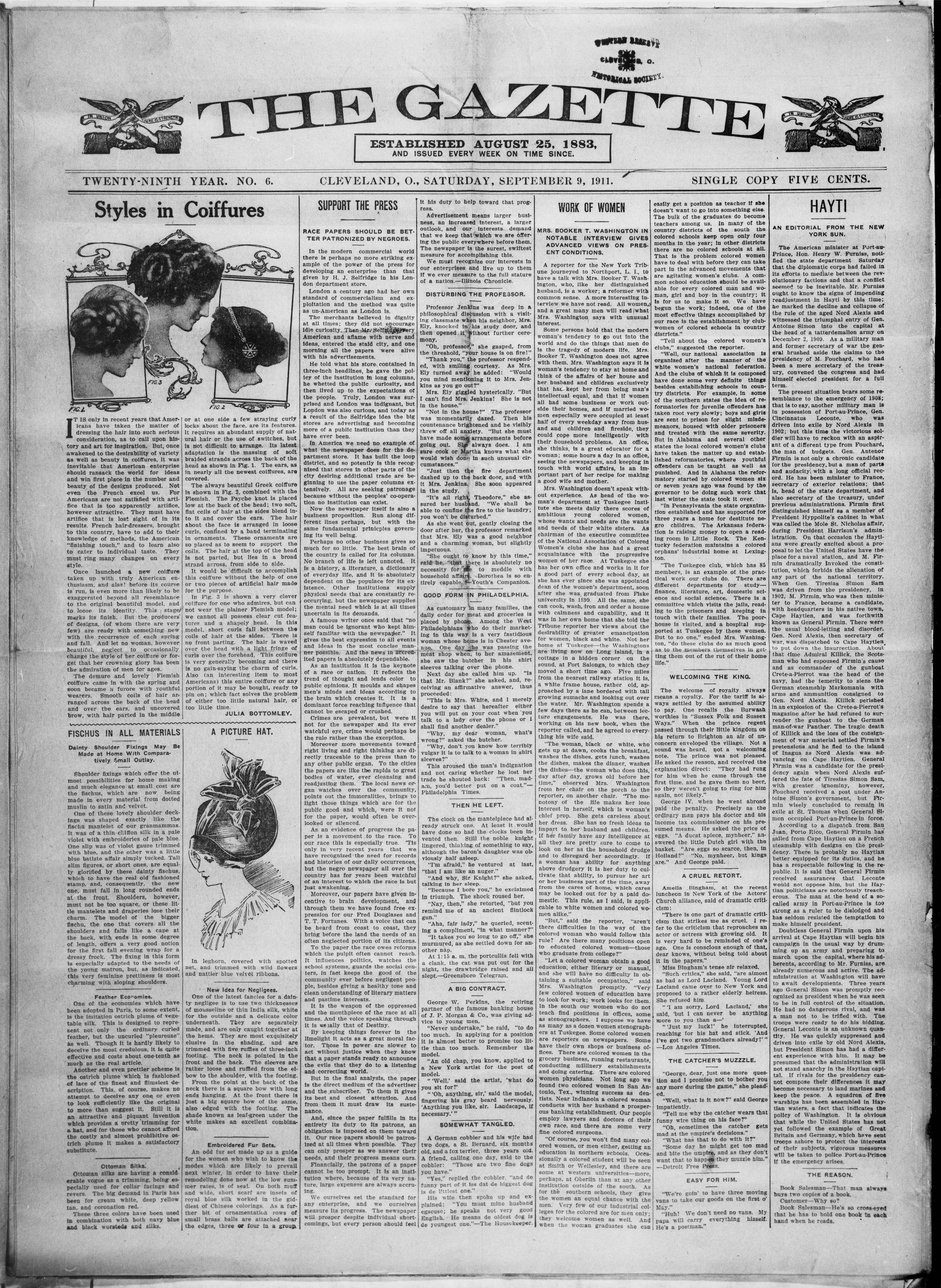
IT IS only in recent years that Americans have taken the matter of dressing the hair into such serious consideration, as to call upon history and art for inspiration. But, once awakened to the desirability of variety as well as beauty in coiffures, it was inevitable that American enterprise should ransack the world for ideas and win first place in the number and beauty of the designs produced. Not even the French excel us. For Americans are not satisfied with artifice that is too apparently artifice, however attractive. They must have artifice that is lost sight of in its results. French hair-dressers, brought to this country, have to add to their knowledge of methods, the American "finishing touch," and to learn also to cater to individual taste. They must ring many changes on every style.
Once launched a new colfurie taken up with truly American enthusiasm, and alas! before its course is run, is even more than likely to be exaggerated beyond all resemblance to the original beautiful model, and to loose its identity. This stage marks its finish. But the producers of designs, (of whom there are very few) are ready with something new with the recurrence of each spring and fall. And let no woman, however beautiful, neglect to occasionally change the style of her colfurie or forget that her crowning glory has been the admiration of men for ages.
The demure and lovely Flemish colfurie came in with the spring and soon became a furore with youthful wearers. Smooth coils of hair arranged across the back of the head and over the ears, and uncovered brow, with hair parted in the middle
Dainty Shoulder Fixings May Be Made at Home With Comparatively Small Outlay.
Shoulder fixings which offer the utmost possibilities for home making and much elegance at small cost are the fischus, which are now being made in every material from dotted muslin to satin and velvet.
One of these lovely shoulder deckings was shaped exactly like the fischu mantelet of our granammas. It was of a thin chiffon silk in a pale violet with embroideries of pale blue. One slip was of violet gauze trimmed with blue, and the other was a little blue batiste affair simply tucked. Tall slim figures, or short ones, are equally glorified by these dainty fischus, which to have the real old fashioned stamp, and, consequently, the new one, must fall in long rounded ends at the front. Shoulders, however, must not be too square, or these little mantelets and draperies lose their charm. The model of the bigger fischu, the one that covers all the shoulders and falls like a cape at the back, with ends in some degree of length, offers a very good notion for the first fall evening wrap for a dressy frock. The fixing in this form is especially adapted to the needs of the young matron, but, as indicated, this very feminine prettiness is most charming with sloping shoulders.
Feather Economies
One of the economies which have been adopted in Paris, to some extent, is the imitation ostrich plume of vegetable silk. This is designed to represent not only the ordinary curled feather, but the uncurled "pleureus" as well. Though it is hardly likely to deceive the most credulous, it is quite effective and costs about one-tenth as much as the real article.
Another and even prettier scheme is the ostrich plume which is fashioned of lace of the finest and filmslest description. This, of course, makes no attempt to deceive any one or even to look sufficiently like the original to more than suggest it. Still it is an attractive and pliant invention which provides a pretty trimming for a hat, and for those who cannot afford the costly and almost prohibitive ostrich plume it makes a satisfactory substitute.
Ottoman Silks.
Ottoman silks are having a consid- erable vogue as a trimming, being especially used for collar facings and revers. The big demand in Paris has been for cream white, deep yellow tan, and coronation red. These three colors have been used in combination with both navy blue and black worsteds and silks.
THE GAZETTE
or at one side a few straying curly looks about the face, are its features. It requires an abundant supply of natural hair or the use of switches, but is not difficult to arrange. Its latest adaptation is the massing of soft, braided strands across the back of the head as shown in Fig. 1. The ears, as in nearly all the new collures, are covered.
The always beautiful Greek coiffure is shown in Fig. 2, combined with the Flemish. The Psyche knot is placed low at the back of the head; two soft, flat collars of hair at the sides blend into it and cover the ears. The hair about the face is arranged in loose curls, confined by a band terminating in ornaments. These ornaments are so placed as to seem to support the coils. The hair at the top of the head is not parted, but lies in a broad strand across, from side to side.
It would be difficult to accomplish this coiffure without the help of one or two pieces of artificial hair made for the purpose.
In Fig. 3 is shown a very clever coifure for one who admires, but can not wear the plainer Flemish model; we cannot all possess clear cut features and a shapely head. In this model, short curls fall between the coils of hair at the sides. There is no front parting. The hair is waved over the head with a light fringe of curls over the forehead. This coifure is very generally becoming and there is no gain-saying the charm of curls. Also (an interesting item to most Americans) this entire coifure or any portion of it may be bought, ready to plon on; which fact solves the problem of either too little natural hair, or too little time.
JULIA BOTTOMLEY.
A PICTURE HAT.
In leghorn, covered with spotted net, and trimmed with wild flowers and nattier blue velvet ribbons.
In leghorn, covered with spotted net, and trimmed with wild flowers and nattier blue velvet ribbons.
New Idea for Negligees.
One of the latest fancies for a dainty negligee is to use two thicknesses of mousseline or thin India silk, white for the outside and a delicate color underneath. They are separately made, and are only caught together at the hems. They are most exquisitely elusive in the shading, and are trimmed with five ruffles of three-inch footing. The neck is pointed in the front and the back. The sleeves are rather loose and ruffled from the elbow to the shoulder, with the footing. From the point at the back of the neck there is a square bow with long ends hanging. At the front there is just a big square bow of the same, also edged with the footing. The shade known as leaf-green under the white makes an excellent combination.
Embroidered Fur Sets
An odd fur set made up as a guide for the women who wish to know the modes which are likely to prevail next winter, in order to have their remodeling done now at the low summer rates, is of seal. On both muff and wide, short scarf are insets of royal blue silk worked in the giddest of Chinese colorings. As a further bit of ornamentation rows of small brass balls are attached near the edges, three or four in a group
ESTABLISHED AUGUST 25, 1883 AND ISSUED EVERY WEEK ON TIME SINCE.
CLEVELAND, O., SATURDAY, SEPTEMBER 9, 1911.
SUPPORT THE PRESS
RACE PAPERS SHOULD BE BET
TER PATRONIZED BY NEGROES.
In the modern commercial world there is perhaps no more striking example of the power of the press for developing an enterprise than that given by H. J. Selfridge in his London department store.
London a century ago had her own standard of commercialism and exploitation and the method was quite as un-American as London is.
The merchants believed in dignity at all times; they did not encourage idle curiosity. Then Mr. Selfridge, American and afame with nerve and ideas, entered the stalid city, and one morning all the papers were alive with his advertisements.
He told what his store contained in three-inch headlines, he gave the policy of the institution in long columns, he whetted the public curiosity, and then lived up to the expectations of the people. Truly, London was surprised and London was indignant, but London was also curious, and today as a result of the Selfridge idea the big stores are advertising and becoming more of a public institution than they have ever been.
In America we need no example of what the newspaper does for the department store. It has built the loop district, and so potentially is this recognized that stores in other parts of the city desiring additional trade are beginning to use the paper columns extensively. All are seeking patronage because without the peoples' co-operation no institution can exist.
Now the newspaper itself is also a business proposition. Run along different lines perhaps, but with the same fundamental principles governing its well being.
Perhaps no other business gives so much for so little. The best brain of the country is called for its columns. No branch of life is left unnoted. It is a history, a literature, a dictionary of everyday life, and it is absolutely dependent on the populace for its existence. Other institutions supply physical needs that are constantly reoccurring, but the newspaper supplies the mental need which is at all times uncertain in its demands.
A famous writer once said that "no man could be ignorant who kept himself familiar with the newspaper." It gives the best expression to all events and ideas in the most concise manner possible. And the news in accredited papers is absolutely dependable.
As an institution it is the keynote of a race or nation. It reflects the trend of thought and lends color to public opinions. It moulds and shapes men's minds and ideas according to the brain which creates it. It is a dominant force reaching influence that cannot be escaped or crushed.
Crimes are prevalent, but were it not for the newspaper and its ever watchful eye, crime would perhaps be the rule rather than the exception.
Moreover more movements toward right living and right thinking are directly traceable to the press than to any other public organ. To the cities the papers are like the rapids to great bodies of water, ever cleansing and readjustting them. The local news organ watches over the community, points out the immoralities, brings to light those things which are for the public good and which, were it not for the paper, would often be overlooked or silenced.
As an evidence of progress the paper is a movement to the race. To our race this is especially true. 'This only in very recent years that we have recognized the need for records and histories of our daily occurrences, but the negro newspaper all over the country has for years been watchful of an interest to which the race is but just awakening.
Moreover, our papers have given incentive to brain development, and through them we have found free expression for our Fred Douglases and T. T. Fortunes. With a voice that can be heard from coast to coast, they bring before the land the needs of an often neglected portion of its citizens.
To the paper the race owes reforms which the pupit often cannot reach. It influences politics, watches the school systems, guards the social centers, in fact keeps the good of the community ever before negligent people, besides giving a healthy tone and clean understanding of literary matters and pastime interests.
It is the weapon of the oppressed and the mouthpiece of the race at all times. And the voice speaking through it is usually that of Destiny.
By keeping things forever in the limelight it acts as a great moral factor. Those in power are slower to act without justice when they know that a paper stands ready to announce the evils that they do to a listening and correcting world.
But in the final analysis, the paper is the direct medium of the advertiser and the subscriber. To them it gives its best and closest attention. And from them it must draw its sustenance.
And, since the paper fulfills in its entirety its duty to its patrons, an obligation is imposed on them toward it. Our race papers should be patronized at all times when possible. They can only prosper as we answer their needs, and their progress means ours. Financially, the patrons of a paper cannot be too prompt. It is an institution where, because of its very nature, large expenses are always accruing.
We ourselves set the standard for any enterprise, and we ourselves measure its progress. The newspaper will prosper despite individual shortcomings, but every person should feel
it his duty to help toward that progress.
Advertisement means larger business, an increased interest, a larger outlook, and our interests demand that we keep that which we are offering the public everywhere before them. The newspaper is the surest, swiftest measure for accomplishing this.
We must recognize our interests in our enterprises and live up to them if we ever measure to the full stature of a nation—Illinois Chronicle.
DISTURBING THE PROFESSOR.
Professor Jenkins was deep in a philosophical discussion with a visiting classmate when his neighbor, Mrs. Ely, knocked in his study door, and then opened it without further ceremony.
"Oh, professor," she gasped, from the threshold, "your house on fire!" "Thank you," the professor responded, with smiling courtesy. As Mrs. Ely turned away he added: "Would you mind mentioning it to Mrs. Jenkins as you go out?" Mrs. Ely giggled hysterically. "But I can't find Mrs. Jenkins! She is not in the house."
"Not in the house?" The professor was momentarily dazed. Then his countenance brightened and he visibly threw off all anxiety. "But she must have made some arrangements before going out. She always does. I am sure cook or Martha knows what she would wish done in such unusual circumstances."
"Just then the fire department dashed up to the back door, and with it Mrs. Jenkins. She soon appeared in the study.
"It's all right, Theodore," she assured her husband. "We shall be able to confine the fire to the laundry; you won't be disturbed."
As she went out, gently closing the door after her, the professor remarked that Mrs. Ely was a good neighbor and a charming woman, but slightly impetuous.
"She ought to know by this time," said he, "that there is absolutely no necessity for me to meddle with household affairs. Dorothea is so entirely capable, 'Youth's Companion.
GOOD FORM IN PHILADELPHIA.
As customary in many families, the daily order for meat and groceries is placed by phone. Among the West Philadelphiaians who do their marketing in this way is a very fastidious woman whose home is in Chester avenue. One day she was passing the meat shop when, to her amazement, she saw the butcher in his shirt sleeves talking over the phone.
Next day she called him up. "Is that Mr. Blank?" she asked, and, receiving an affirmative answer, thus proceeded:
"This is Mrs. White, and I merely desire to say that hereafter either you will put on your coat when you talk to a lady over the phone or I shall find another dealer."
"Why, my dear woman, what's wrong?" asked the butcher.
"Why, don't you know how terribly vulgar it is to talk to a woman in shirt sleeves."
This aroused the man's indignation and not caring whether he lost her trade he shouted back: "Then, madam, you'd better put on a coat."—Philadelphia Times.
THEN HE LEFT.
The clock on the mantelpiece had al-
ready struck one. At least it would
have done so had the clocks been in-
vented then. Still the noble knight
lingered, thinking of something to say,
although the baron's daughter was ob-
viously half asleep.
"I'm afraid," he ventured at last,
"that I am like an auger."
"And why, Sir Knight?" she asked, talking in her sleep.
talking in her sleep.
"Because I bore you," he exclaimed in triumph. The shock roused her.
"Nay, then," she retorted, "but you remind me of an ancient flintlock gun."
"In a fair lady," he queried, scenting a compliment, "in what manner?"
"It takes you so long to go off," she murmured, as she settled down for another nap.
At 1:15 a.m. m. the portcullis fell with a clank, the cat was put out for the night, the drawbridge raised and all slept. "Greensboro Telegram.
A BIG CONTRACT.
George W. Perkins, the retiring partner of the famous banking house of J. P. Morgan & Co., was giving advice to young men.
"Never undertake," he said, "to do too much. In applying for a position it is almost better to promise too little than too much. Remember the model.
"An old chap, you know, applied to a New York artist for the post of model.
"Well,' said the artist, 'what do you sit for?"
"Oh, anything, sir,' said the model, fingering his gray beard nervously. 'Anything you like, sir. Landscape, if necessary.'
SOMEWHAT TANGLED.
A German cobbler and his wife had two dogs, a St. Bernard, six months old, and a fox terrier, three years old. A friend, calling one day, said to the cobbler: "Those are two fine dogs you have."
"Yes," replied the cobbler, "and de funny part of it tss dat de biggest dog is de littlest one."
His wife then spoke up and explained: "You must mine husband egressc; he speaks not very good English. He means de oldest dog is de youngest one."—The Houskeeper.
WORK OF WOMEN
MRS. BOOKER T. WASHINGTON IN NOTABLE INTERVIEW GIVES ADVANCED VIEWS ON PRESENT CONDITIONS.
A reporter for the New York Tribune journeyed to Northport, L. I., to have a talk with Mrs. Booker T. Washington, who, like her distinguished husband, is a worker; a reformer with common sense. A more interesting interview we have not read. All women, and a great many men will read what Mrs. Washington says with unusual interest.
Some persons hold that the modern woman's tendency to go out into the world and do the things that men do is the tragedy of modern life. Mrs. Booker T. Washington does not agree with them, Mrs. Washington says it is woman's tendency to stay at home and think of the affairs of her house and her husband and children exclusively that has kept her from being man's intellectual equal, and that if women all had some business or work outside their homes, and if married women especially were occupied at least half of every weekday away from husband and children and fireside, they could cope more intelligently with their household problems. An office, she thinks, is a great educator for a woman; some hours a day in an office, seeing the newspapers, and keeping in touch with world affairs, is an important part of her recipe for making a good wife and mother.
Mrs. Washington doesn't speak without the woman's department at Tuskegee Institute she meets daily there scores of ambitious young colored women, whose wants and needs are the wants and needs of their white sisters. As chairman of the executive committee of the National Association of Colored Women's clubs she has had a great acquaintance with the progressive women of her race. At Tuskegee she has her own office and works in it for a good part of every school day, as she has ever since she was appointed dean of the women's department, soon after she was graduated from Fiske university in 1899. All the same, she can cook, wash, iron and order a house with calmness and capability, and it was in her own home that she told the Tribune reporter her views about the desirability of greater emancipation for women, black and white. Not her home at Tuskegee—the Washings are living now on Long Island, in a cottage in a hidden corner on the sound, at Fort Salonga, to which they moved a short time ago. Five miles from the nearest railway station it is, a white frame house, rather old, approached by a lane bordered with tall growing sumachs and looking out over the water. Mr. Washington spends a few days there as he can, between lecture engagements. He was there, working on his new book, when the reporter called, and he agreed to everything his wife said.
"The woman, black or white, who gets up at dawn, cooks the breakfast, washes the dishes, gets lunch, washes the dishes, makes the dinner, washes the dishes—the woman who does this, day after day, grows old before her time," observed Mrs. Washington from her chair on the porch to the reporter, on another chair. "The monotony of the life makes her lose interest in herself, which is woman's chief prop. She gets careless about her dress. She has no fresh ideas to impart to her husband and children. If her family have any intelligence at all they are pretty sure to come to look on her as the household drudge and to disregard her accordingly. If a woman has ability for anything above drudgery it is her duty to cultivate that ability, to pursue her art or her business part of the time, away from the cares of home, which cares may be looked out for by a paid domestic. This rule, as I said, is applicable to white women and colored women alike."
"But," said the reporter, "aren't there difficulties in the way of the colored woman who would follow this rule? Are there many positions open to educated colored women—those who graduate from college?"
"Let a colored woman obtain a good education, either literary or manual, and she will have no difficulty in obtaining a suitable occupation," said Mrs. Washington promptly. "Very few colored women of education have to look for work; work looks for them. In the south our women who do not teach find positions in offices, some as stenographers. I suppose we have as many as a dozen women stenographers are reporters on newspapers. Some have their own shops or business offices. There are colored women in the grocery business, running restaurants, conducting millinery establishments and doing catering. There are colored women physicians. Not long ago we found two colored women in San Antonio, Tex., winning success as dentists. Near Indiana a colored woman conducts with her husband a prosperous banking establishment. Our people employ lawyers and doctors of their own race, and there are some very fine colored surgeons.
"Of course, you won't find many colored women, or men either, getting an education in northern schools. Occasionally a colored student will be seen at Smith or Wellesley, and there are some at western universities—more, perhaps, at Oberlin than at any other institution outside of the south. As for the southern schools, they give the women an equal chance with the men. Very few of our industrial colleges for the colored are for men only; they welcome women as well. And when the woman graduates she can
SINGLE COPY FIVE CENTS.
easily get a position as teacher if she doesn't want to go into something else. The bulk of the graduates do become teachers among us. In many of the country districts of the south the colored schools keep open only four months in the year; in other districts there are no colored schools at all. That is the problem colored women have to deal with before they can take part in the advanced movements that are agitating women's clubs. A common school education should be available for every colored man and woman, girl and boy in the country; it is for us to make it so. We have begun the work; indeed, one of the most effective things accomplished by our race is the establishment by club-women of colored schools in country districts."
"Tell about the colored women's clubs," suggested the reporter.
"Well, our national association is organized after the manner of the white women's national federation. And the clubs of which it is composed have done some very definite things besides establishing schools in country districts. For example, in some of the southern states the idea of reformatories for juvenile offenders has taken root very slowly; boys and girls are sent to prison for slight misdemeans, housed with older prisoners and treated with the same severity. But in Alabama and several other states the local colored women's clubs have taken the matter up and established reformatories, where youthful offenders can be taught as well as punished. And in Alabama the reformatory started by colored women six or seven years ago was found by the governor to be doing such work that last winter the state took it over. "In Pennsylvania the state organization established and has supported for three years a home for destitute negro children. The Arkansas federation is raising money to open a reading room in Little Rock. The Kentucky federation maintains a colored orphans' industrial home at Lexington.
"The Tuskegee club, which has 55 members, is an example of the practical work our clubs do. There are different departments for study—finance, literature, art, domestic science and social science. There is a committee which visits the jails, reading to the prisoners and keeping in touch with their families. The porchouse is visited, and a hospital supported at Tuskegee by these women. But to no one," ended Mrs. Washington, "do these clubs do as much good as to the members themselves in getting them out of the rut of their home life."
WELCOMING THE KING.
The welcome of royalty always means a royalty. For the tariff is always settled by the assumed ability to pay. One recalls the Burwash worthies in "Sussex Folk and Sussex Ways." When the prince regent passed through their little kingdom on his return to Brighton an air of unconcern enveloped the village. Not a sound was heard, not a welcoming note. The prince was not pleased. He asked the reason, and received the explanation direct: "They had rung for him when he came through the first time, and he gave them no beer, so they weren't going to ring for him again, not likely."
George IV. when he went abroad paid the penalty. Precisely as the ordinary man pays his doctor and his income tax commissioner on his presumed means. He asked the price of eggs. "A dacut apiece, myneer," answered the little Dutch girl with the basket. "Are eggs so scarce, then, in Holland?" "No, myneer, but kings are." And George paid.
A CRUEL RETORT.
Amella Bingham, at the recent luncheon in New York of the Actors' Church alliance, said of dramatic criticism:
"There is one part of dramatic criticism that strikes me as cruel. I refer to the criticism that reproaches an actor or actress with growing old. It is very hard to be reminded of one's age. One is conscious enough of that, dear knows, without being told about it in the papers."
Miss Bingham's tense air relaxed.
"Such critics," she said, "are almost as bad as Lord Lacland. Young Lord Lacland came over to New York and proposed to a rather elderly heifress. She refused him.
"I am sorry, Lord Lacland," she said, "but I can never be anything more to you than a"
"Just my luck!' he interrupted, reaching for his hat and stick. 'And I've got two grandmothers already!'"—Los Angeles Times.
THE CATCHER'S MUZZZLE.
"George, dear, just one more question and I promise not to bother you any more during the game," she pleaded.
"Well, what is it now?" said George impatiently.
"Tell me why the catcher wears that funny wire thing on his face?"
"Oh, sometimes the catcher gets mad at the umpire's decisions."
"What has that to do with it?"
"Some day he might get too mad and bite the umpire, and as they don't want that to happen they muzzle him."
—Detroit Free Press.
EASY FOR HIM.
"We're goin' to have three moving vans to take our goods on the first o' May."
"Huh! We don't need no vans. My papa will carry everything hisself. He's a postman."
IN UNION
HOPE ELECTRICITY
HAYTI
AN EDITORIAL FROM THE NEW YORK SUN.
The American minister at Port-au-Prince, Hon. Henry W. Furniss, notified the state department Saturday that the diplomatic corps had failed in its efforts to mediate between the revolutionary factions and that a conflict seemed to be inevitable. Mr. Furniss ought to know the signs of impending readjustment in Hayti by this time; he marked the decline and collapse of the rule of the aged Nord Alexis and witnessed the triumphal entry of Gen. Antoine Simon into the capital at the head of a tattered demalion army on December 2, 1909. As a military man and former secretary of war the general brushed aside the claims to the presidency of M. Fouchard, who had been a mere secretary of the treasury, convened the congress and had himself elected president for a full term.
The present situation bears some resemblance to the emergency of 1908; that is to say, another military man is in possession of Port-au-Prince, Gen. Cinnatius Leconte, who was driven into exile by Nord Alexis in 1902; but this time the victorious soldier will have to reckon with an aspirant of a different type from Fouchard, the man of budgets. Gen. Antenor Firmin is not only a chronic candidate for the presidency, but a man of parts and audacity, with a long official record. He has been minister to France, secretary of exterior relations; that is, head of the state department, and also secretary of the treasury, under previous administrations. Firmin first distinguished himself as a member of President Hypoliteil's cabinet in what was called the Mole St. Nicholas affair, during President Harrison's administration. On that occasion the Haytians were greatly excited about a proposal to let the United States have the place for a naval station, and M. Firmin dramatically Invoked the constitution, which forbids the alienation of any part of the national territory. When Gen. Tiresias Simon Sam was driven from the presidency, in 1902, M. Firmin, who was then minister to France, became a candidate, with headquarters in his native town, Cape Haytien, and was forthwith known as General Firmin. There were the usual blood-letting and disorder, Gen. Nord Alexis, then secretary of war, was dispatched to Cape Haytien to put down the insurrection. About that time Admiral Killick, the Scotman who had espoused Firmin's cause and as commander of the gunboat Crete-Apierrot was the head of the navy, had the temerity to siege the German steamship Markomania with arms and ammunition consigned to Gen. Nord Alexis. Killick perished in an explosion of the Crete-a-Pierrot's magazine after he had refused to surrender the gunboat to the German man-of-war Panther. The tragic death of Killick and the loss of the consignment of war material settled Firmin's pretensions and he fled to the island of Inagua as Nord Alexis was advancing on Cape Haytien. General Firmin was a candidate for the presidency again when Nord Alexis suffered the fate of Tiresias Simon Sam, with greater ignominy, however, Fouchard received a post under Antoine Simon's government, but Firmin wisely concluded to remain in exile at St. Thomas when General Simon occupied Port-au-Prince in force.
According to a dispatch from San Juan, Porto Rico, General Firmin has salted from Cape Haytien on a French steamship with designs on the presidency. There is probably no Haytian better equipped for its duties, and he has a respectable following in the re public. It is said that General Firmin received assurances that Leconte would not oppose him, but the Haytian politicians are notoriously treacherous. The man at the head of a so-called army in Port-au-Prince is too strong as a ruler to be dislodged and has seldom resisted the temptation to make himself president.
Doubtless General Firmin upon his arrival at Cape Haytan will begin his campaign in the usual way by drumming up an army and preparing to march upon the capital, where his adherents, according to Mr. Furniss, are already numerous and active. The administration at Washington will have to await developments. Three years ago General Simon was promptly recognized as president when he was seen to be in full control of the situation. He had no dangerous rival, and was a man not to be trifled with. The troops were ready to do his bidding. General Leconte is an unknown quantity. He was quickly suppressed and driven into exile by old Nord Alexis, but President Simon has had a different experience with him. It may be presumed that the administration will not stand anarchy in the Haytan capital. If rivals for the presidency cannot compose their differences it may become necessary to land marines and keep the peace. A squadron of five warships has been assembled in Haytan waters, a fact that indicates the policy of Washington. It is obvious that while the United States has not yet followed the example of Great Britain and Germany, which have sent troops ashore to protect the interests of their subjects, vigorous measures will be taken to police Port-au-Prince if the emergency arises.
THE REASON.
Book Salesman—That man always buys two copies of a book.
Customer—Why so?
Book Salesman—He's so cross-eyed that he has to hold one book in each hand when he reads.
THE GAZETTE
PUBLISHED EVERY SATURDAY
One Year. $1.50
Six Months. 1.00
Three Months. .50
Subscribers are requested to remit by postoffice money order or registered letter.
Entered at the postoffice in Cleveland Ohio, as second-class matter
Address all communications to HARRY C. SMITH
Editor and proprietor,
THE GAZETTE,
Blackstone Building, Cleveland, O.
Member Ohio Legislature: 1894
to 1896; 1896 to 1898; 1900 to 1902
THE GAZETTE is the oldest, and has the largest bona fide circulation, double that of any newspaper in the interest of Afe-Ameriane, published in the state of Ohio, and comparison with any will immediately establish its rank as one of the NEWSIEST AND BEST in the country.
Those five Negroes, near Caddo, Oklahoma, have shown, and unmistakably too, how to put an end to lynchmurder in the South. More power to their kind. A few more "strike-backs" like that will do much, very much in deed, to solve the lynch-problem.
At the recent K. P. national meet in Indianapolis, 8,000 members of the U. R. were encamped. The Mayor of that city, a K. P. (white), said publicly that our K. P. were, individually and collectively, more orderly both in and out of camp while in that city, than the white K. P. were at their last national meet. This is very encouraging.
In a recent address in N. Y. City, Rev. Reverdy C. Ransom, formerly of Cleveland, O., severely censured President Taft for his letter read at the commencement exercises of Flak University, Nashville, Tenn., in which he said the Negro must be differently educated, and must occupy an inferior place in the nation. "The Negro must be independent in politics," said Dr. Ransome, "and refuse to line up with any party that does not measure out a square deal." Dr. Ransome hit at Hon. Wm. H. Lewis, Assistant U. S. Attorney General, and said, "Negroes in such positions dare not speak out in the manly defense of the race." And Rev. Ransome is right, too.
As terrible as were the crimes alleged to have been committed by the Negroes lynched (burned) in Pennsylvania and Oklahoma, recently, even worse were the acts of the lynch-murders who so brutally "snuffed out" their victims' lives. Absolutely nothing excuses their barbaric action, and the reputation of the two states named has suffered untold material injury. Some of the Pennsylvania mobocrats have been apprehended and will undoubtedly be properly punished like some of those who participated in the Etherington (white) lynching at Newark, this state, last year. We wish that as much (though little) could be said of the new state of Oklahoma. Mob violence and lynching is a true indication of the boasted "high state of civilization" in many southern states of this union.
UNIVERSAL RACES CONGRESS.
The most important world movement, this year, was the University Races Congress, held at the University of London building (England) from July 26-29. At least thirty presidents of Courts, twelve British Governors, eight British premiers, forty colonial bishops, 130 professors of international law, leading anthropologists and sociologists, and other distinguished personages, participated in its proceedings. Lord Weardale presided and made the welcome address in English and French. In concluding, he said they hoped the Congress would be the beginning of a more human contrast between the races, which might establish the eternal principle of justice between man and man. Letters of regret were read from Mr. Andrew Carnegie and many others.
Mr. G. Spiller said that "many races were at the present time treated or maltreated as inferior races; that the differences between races were mere differences of physical characteristics. The common standard provided by university diplomas showed even the majority of those races regarded as inferior was represented successfully in the universities of Europe and America. 'Backward' does not necessarily mean 'inferior'; singular to state the writers—coming literally from all parts of the circumference of the globe—manifested a remarkable agreement on almost every vital problem with which the Congress was concerned."
Whatever is to happen to the backward races in the future, it is wholly to the good that their case should be handled with sympathy. Politicians who have risen above the temper of ignorant prejudice in regard to races differing in color from their own, may be expected in the future to rise above the common prejudice against races of different color than their own.
Professors Du Bois and Scarborough made excellent addresses to the Congress which are attracting world-wide attention and favorable comment. Good!
OUR TWENTY-NINTH YEAR!
With the issue of August 5, 1911,
"the old reliable" Gazette entered
upon its twenty-ninth year. It was in
August, 1883, that this race journal
was launched by Messrs. John F.
Lightfoot, John A. Holmes, J. Harvey
Jackson and Harry C. Sulth. The first trio remained with the enterprise
for short terms varying from one to
three years, Mr. Holmes being the
last to dispose of his stock in The
Gazette Publishing Company to the
present owner. During all these years
the management and editing of The
Gazette has been done by its present
owner and editor, and not one issue
has failed to appear on time during
its long and useful life. It's first good
work for our people of Ohio was its successful fight against the remnants of Ohio's "Black Laws," then on the state's statutes. Next, with the efforts of its editor, then a member of the lower branch of the State Assembly, and its own influence on the people throughout the state, the Civil Rights' Law and the Anti-Lynching or Mob Violence law were enacted, which placed Ohio in the front rank of the law and order states of the Union. The main work and object of The Gazette has been to always defend the Afro-American from race proscription along business and civic lines and to encourage him all it could. Personal interests have always been subordinated to those of the people. Its call to the Afro-American continually, has been to be a man and to accept nothing but what is due to one. It has advocated no conciliatory nor half-way treatment, but has demanded and always will demand for the race and to encourage member of the race, all that is due American citizens. And we doubt sincerely that any one can deny this fact or can bring forth from the almost thirty years archives of The Gazette's file a single issue from which a word or letter of even a shadow of surrender, can be culled. It is this oneness of purpose that has held for this paper through all of these years, that reliable circulation to hold, from New York to California, and from the Great Lakes to the Gulf of Mexico. Financial gain and the emoluments of office have never affected its efforts for the race and the race's rights. Its firm adherence to principle is its best recommendation for the support of every member of the race to whose notice this paper is brought. Therefore, dear reader, begin with this issue to help extend its influence, not only by passing on your copy of the paper, but by urging those to whom you give your Gazette, to subscribe for it at once. Also see that The Gazette has a live agent and correspondent in your community. This will be material assistance that we will be grateful for, and that will go far toward increasing greatly this paper's field of usefulness and assisting it to further improve itself. We want to again thank the many patrons and friends who have helped The Gazette in past years, and to assure them that their efforts are thoroughly appreciated and have had much, very much indeed, to do with its long and successful career.
SPLENDID MEETING
Grand Convocation of O. E. S. Adop-
tive Rite Masonry.
Cadiz, O. — The 25th annual convolution of the Grand Chapter, O. E. S., for the State of Ohio and its jurisdiction, was held Aug. 23, 24 and 25 in the county court room in this city. The subordinate chapters, representatives and visitors numbered about 50 persons. The convolution was one of the most satisfactory in the history of the order. Because of the sterling merits of the O. E. S., as reflected in the personal character of the representative members of the Grand Chapter, it served a diverse community, irrespective of race variety, declares the coming and sojourn of the noble order to have been a "red-letter" period in the moral and social events of Cadiz. The officers for the ensuing year are: Grand Royal Patron, S. B. Sanders, Columbus; Grand Royal Matron, Mrs. Edna J. Walker, Cadiz; Grand Associate Patron, I. L. Strother, Cadiz; Grand Royal Matron, Mrs. Edith M. Richardson, Dayton; Grand Treasurer, Mrs. Eliza Clay, Spring field; Grand Secretary, Mrs. Eliza Fila, Emma Allen, Massillon; Grand Associate Conductress, Mrs. Cora Curl, Yellow Springs. Appointive officers: Grand Adah, Mrs. Mary Parker, Portsmouth; Grand Ruth, Mrs. Olivia Greer, Cincinnati; Grand Esther, Miss Mattle Williams, Columbus; Grand Martha, Mrs. Emily Lewis, Cleveland; Grand Electa, Mrs. Ophelia Heiden, Mrs. Dela Lewis, Nelsonville; Grand Lecturer, Mrs. Florence Scott, Xenia; Grand Chancellor, Mrs. E. Culpher, Mechanicsburg; Grand Organist, Miss Laura White, Cadiz; Grand Sentinel, Wellington Brown, Cincinnati; Grand Custodian, Mrs. Zola McCullough, Steubenville; Grand Marshal, Mrs. Ella La May, Cincinnati.
On Foreign Correspondence: Miss Ida Williams, Columbia; Miss Hassan Hudson, Yellow Springs, and Miss Minnie Stewart, Toledo.
Revision of the Constitution and By-Laws of H. S. Sacks, Columbus; Mrs. Ella Criss, Xenia; Mrs. Kittie Hubert, Portsmouth.
*On History of the Organization of the O. E. S.; Mrs. M. D. Hillard, Xenia; Mrs. Bettie Redman, Columbus; Mrs. Edith F. Richardson, Field; Mrs. Edith M. Richardson, Dayton, and John H. Wilborn, Springfield.
Cincinnati was selected as the site of the convocation for 1912. The deliberations of the Grand Chapter, from beginning to end, were characterized by peace, harmony and the spirit of progress. Among the speeches given were two that were given Tuesday evening by Myristic Lodge, No. 20, F. and A. M., at which his honor, Mayor C. S. Cessna, was one of the speakers: Wednesday evening, sermon by Rev. H. r. Fox, theme, "Queen Esther's Heroism." Thursday evening, a fine rendition of the cantata, "Lost," by Frank F. Friday, the series closed with an excellent musical and literary recital.
(Rev.) H. F. FOX, Official Reporter
CONGRATULATIONS!
Louisville, Ky. Aug. 27, 1911.
Editor Gazette: Congratulations for
the Gazette on its 29th anniversary
and for you Mr. Smith, the champion
of the race who has never failed
to fight for the advancement of our
people. Congratulations will be in order
for the benefit of your community if
they can and will elect you as a delegate to the State Constitutional Convention. YOU ARE THE MAN FOR
THE PLACE! "Honor to whom honor
is due."
When your Gazettes are not delivered on Friday mornings, call at your Central Postoffice General Delivery Window for them in the afternoon of the same day. —Editor.
THE GAZETTE, CLEVELAND, O., SATURDAY, SEPTEMBER 9, 1911
```markdown
```
DOINGS OF THE RACE
The Taft boomers are at it again. Hear one: "He is the sanest president since Abe Lincoln!" Shades of Teddy Roosevelt! Such sacrilege.—Dallas (Tex.) Express. Chas. (Baker of Detroit, has invented (after 23 years' experimenting) a friction machine that produces sufficient heat to supplant wood and coal stoves in homes.
T. McCants Stewart, Esq., formerly a resident of N. Y. City, and Hawaiian, has been appointed justice of the Supreme Court of the Republic of L.A.beria, Africa.
Howard University, Washington, D. C., is to have its largest enrollment of pupils, this fall.
Major John R. Lynch, a paymaster in the U. S. army, was recently married to Miss Cora E. Williams of Chicago. They will live in San Francisco, Cal.
Our government has expressed its willingness to receive Gen. Solon Menos as Haytian minister at Washington, D. C., to succeed Hon. H. Pauleus Sannon, the present representative from that country.
WILL STOP LYNCH-MURDER!
Durant, Okla—In a battle between five Negroes and five masked white brutes at the home of a Negro named Daniels, about a mile south of Caddo, Okla., last Saturday night, Horace Gribble, a white farmer, was shot through the heart and instantly killed. The whites threw a stick of dynamite at the hut and then commenced firing. Feeling was high at Caddo and all of Daniels' family was in the day. Officers grabbed Gribble's body lying in the road about 50 yards from the home. His face was masked and his right hand clutched a revolver. Three of the chambers contained empty cartridges. A rifle ball had penetrated his breast. Near the home the officers were a stick of dynamite with the fuse partly burned. Until the fuse was fully burned, they knew they had killed Gribble. They were arrested and brought to Durant by Sheriff Hamilton Sunday afternoon. They were spirited out of the county to prevent a lynching by a mob which soon collected at Caddo, and it is thought were taken to McAllister. Negroes have sacrificed their crops and property in their haste to aggregating $2,500 were reported at Caddo Monday. Sunday, three cars at Caddo were filled by Negroes who were hurrying to leave the county.
FROM GERMANY.
President Scarborough of Wilberforce University
"the Gazette"
Interestingly
Mainzden, Aug. 12, 1911.
My dear Editor Smith: Accept greetings from an old friend across the seas, and who is now in Germany. I have had a delightful time over here. I have not seen in any instance any evidence of prejudice. Mrs. Scarborough and I have been well treated in all the hotels where we travel and they are many, both in Germany and France. Whenever there has been anything that looked like prejudice it has come from the "cursed" American tourists, and I may add that he is ubiquitous over here. The burning of the Negro in Penna and they are the malicious shooting of the Negro in South Africa. On my return in September I shall have much to write The Gazette, and talk about. As you know I attended the meetings of the Races Congress and I had something to say, too. See N. Y. Evening Post for Aug. 4th. I am returning to London now, viva! I have already seen many days in Paris at the Grand Hotel. With esteem and best wishes, I am
Cordially yours,
W. S. SCARBOROUGH,
K. P. NATIONAL OFFICERS.
The Great Meeting Drew Over 30,000 Knights and Other Visitors.
Indianapolis, Ind. — The recent K. P. national meet, held here, elected the following officers, for the ensuing year: Supreme Chancellor, S. W. Greene, New Orleans, La.; Supreme Vice Chancellor, L. J. Lones, Cincinnati, O.; Supreme Keeper of Exchequer, H. J. Young, Pine Bluff, Ark.; Supreme Keeper of Records and Seals, C. K. Robinson, St. Louis; Supreme Keeper of the Navy, Washington; Supreme Outer Guard, Dennis T. Florida; Supreme Inner Guard, G. A. Watty, Missouri; Supreme Master at Arms, D. F. Miller, Kentucky; Supreme Prelate, The Rev. A. H. Newton, New Jersey; Supreme Lecturer, L. M. Mitchell, Texas; Supreme Major General of Uniform Rank, R. J. Jackson, Chicago. Pythian Temple and Santarium Committee. V. H. Hazelton, Virginia; V. E. Wood, Kentucky; John M. Harris, Mississippi; C. M. Wade, Arkansas; George N. Stoney, Georgia; W. I. Reed, Indiana, and A. W. Lloyd, Missouri.
Reconciled to Colored Wife
St. Louis, Mo.—John Collins, son of an old family, and Cora Clamorago Collins, his beautiful wife, whom he renounced two months ago when it was announced that she had Colored hair. Collins, who is the son of which Owen L. Collins, the father of John Collins, brought as "his next friend" to annul his son's marriage, is to be dismissed and the conflict, which has almost wrecked the two homes in his family, is manageable suburb, is ended. This announcement was made by Collins' attorney.
Don't throw away your copy of The Gazette when you have done with it, but give it to some appreciative person whom you feel would be likely to subscribe or take it regularly, if they had a copy to look over and read carefully. Oblige the
FRESH OHIO NEWS
OUR OWN WRITERS
WHAT OUR PEOPLE ARE DOING IN MANY CITIES AND TOWNS OF THE STATE.
INTERESTING PERSONALNOTES
Social Functions—Church and Lodge Items—Marriages and Deathe—Literary, Musical and Other Notes of Interest.
Zanesville, Mrs. Ben. Caliman, who visited her daughter, Miss Alma Blake in Cleveland, has returned. Mr. and Mrs. Geo. W. Carroll of Cleveland, are guests of Mr. and Mrs. Robert Manley, Miss Perry of Paris, Ky., was Mrs. James McNably, guest recently. The Gazette desires an agenda and correspondent here. Write to the editor, at once.
Athens.—Miss Lillian Bowen of Ky., is the guest of Mrs. Will Fields.—Florence Cousins and Stella Lee have gone to W. Va., to take charge of their schools.—Mrs. Jennie Davis is visiting her parents in Saindaw, Mich.—Edward R. Richardson, a graduate of Ohio University, has accepted a position as teacher of manual training in the Parkersburg, W. Va. . Colored schools.—Mr. and Mrs. Will Stevens daughters, Mrs. Elmer Sheeney and Mrs. Herman Stevens of Pittsburgh are visiting them.—Mr. and Mrs. W. Beasley of Huntsville, Ala., are visiti ng Mrs. Elmer Carr.—Read the Guzette and keep up to date. Who will act as agent and correspondent, here? Write the editor.
Mt. Pleasant—Miss Elenora Proctor went to Steubenville, to work—Mr. and Mrs. Ralph Olmstead of Pittsburgh, are home for two weeks—A large crowd attended the meeting, Sunday. The Redmen's picnic at the Old Folk's home, labor day, was well attended. Mrs. Davis and daughter are away visiting. A large party was given at Mr. Alfred Wren's. Mr. Frank Skinner was in Wheeling, Friday. Mr. and Mrs. Charles Powell was in Steubenville. Mr. Goe Powell has gone to Elyria. Miss Margaret Skinner is in town working. Miss Edith Jackson spent Saturday and Sunday in Steubenville with her sister, Helen. Miss Margaret Champ was in Pittsburg, last week.
Washington C. H.—Mrs. Ellis Scott and daughter, Nettie, of Greenville, Pa., were guests of Mr. and Mrs. Jefferson Scott and family from Aug. 26 to 30.—Mrs. Jerry Powell was called to Columbus recently, by her aunt, Mrs. Eliza Quann's illness.—C. E. Vivens was in Middleton, Aug. 27.—Mr. and Harry Wilkinson were guests of Mr. and Mrs. Taso Petelli and Mrs. Augusta, Aug. 27. who has been ill is greatly improved.—Mr. Clifford Harris and Mr. Dudley Cole, sr. spent Aug. 31 in Columbus.—Rev. A. J. Cromwell is sick.—Mrs. Henry Woods was the guest of Mr. and Mrs. James Davis, of Springfield, Aug. 27.—Mr. Harvey Young, of Chicago, is visiting his mother.—Mr. and Mrs. Wilson Burch and niece, Estella Daniels, of Dayton, spent Aug. 27, with Mrs Polly Jones.—Miss Janet Buck of Chillicothe, with William Bayes of Chillicothe, and Mr. Ralph Hamilton of Jamestown, were guests of the Jones family, Aug. 27.—Mr. Raymond Ross left for Denver, Colo., for his health, Aug. 27.
Cadiz.—Dr. J. H. Jones held the last quarterly meeting, of this conference year at the A. M. E. church, Sunday. Collection, $31.55. The pastor, Rev. H. F. Fox made an excellent address on "Lights and Shadows of American Civilization," before 2,000 people at U. B. convention.—Mrs. Chas. Robinson and B. Connell, both of the Massillon.—Mr. Ray West of Georgetown, visited Mr. L. West, Sunday.—Miss Gracie Wallace has returned from Cleveland.—Miss Lizzie Jones has returned to Chicago.—Miss Cora Doubt, sisters, and Miss Catherine Thompson visited Mrs. John Olmstead, Sunday.—(The editor of The Gazette desires to hear from Francis Tyler and Bernice Doubt, at once. Editor.)—Rev. White was at Stillwater, Sunday.—Mrs. Mary Thompson and Mrs. Henry White went to Steuben and B. Connell, both of the others went on Sunday.—(The local correspondent must write on one side of the paper only. Editor.)
Correspondents must mall all letters for publication at their main postoffice sufficiently early on Monday (or Sunday) of each week to have them reach The Gazette office on Tuesday morning, and always write, also, their names and that of their city or town on the outside of the proper notice board. Unless this latter is done, proper credit cannot be given you. Lists of names, wedding presents, etc., obituary notices, speeches, resolutions, poetry, inquiries for relatives and advertisements of all kinds, including items announcing entertainments to be held in the near future, must be paid for in advance at the rate of top cents a week. For advertisements for display advertisements will be sent on application. Send postal note and not stamps during warm weather.
Toledo.—A concert was given on the 28th ult. by the band of the W. Va. O. and I. Institute of Huntington, at Friendship church—Mr. and Mrs. J. A Fields have returned from Xenia, Cleveland, and Monroe, Mich. War-Mar. College, and the picnic place, Morning evening, on the Sir. "New York" was a success.—Mrs. S. R. Ross and family have returned from a visit in several southern Ohio cities.—Rev. Geo. Bundy of Detroit, delivered an able address at Warren church, last Friday evening, on "Social Evil's." Mr. Jos. Blackwell visited his old home. Mrs. W. C. Bunny has returned from Collinwood. She visited her sister, Mrs. Etta Conwell. Mr. Sherman Walton has returned from a visit with his brother in Buffalo.—Mrs. Wallace Smith and Mrs. Queene Hackley of Detroit, and Mrs. A. Bell of Windson, Ont., were here last week. See your order. Use paper and advertise. The Gazette, and keep up to date in the matter of race news.
Cincinnati—Mrs. G. W. Hays, sr. is visiting in Piqua. Her aunt, Mrs. Gee, is here visiting—Mrs. Patience Buckner of Detroit, is visiting Mrs. Emma Mayberry of Loveland—Mrs. Chas. Davis has returned from Indianapolis—Mr. and Mrs. Oliver of Texas, have returned home to their school work. Brooklyn—Mr. and Mrs. Jamison has returned from Chicago and Indianapolis—Mrs. Alex. Williams entertained in honor of Miss T. N. Jamison and Mrs. Eliza Bramlette, in honor of Mrs. Zelia W. harris, both of St. Louis—Mrs. Harris
and daughter have returned home—
Mrs. Mattie Quarles and Miss Sadie
Rankin are visiting Mrs. Mattie Anderson
of Dayton. Mrs. Jane Tolliver is
visiting a niece in Mt. Vernon. Mrs.
Chas. Davis has returned from Chicago—Miss Mary Hicks of —, is visiting Miss Jennie Porter. Miss Anna Hardy is visiting in Steubenville.
East Liverpool—Miss Edna McBride
visited in Lisbon recently. W. Mount,
W. Va.—Wm. P. Ormes returned Aug. 26 from Indianapolis with the First Brigade band of Pittsburgh. Thomas Munroe was in Wheeling recently.—Rev. Wm. Scott of Jackson,
Miss, was the guest of Mr. and Mrs.
Daniel Southall, his wife's parents, last week.
Akron—Miss Cordella Archer,
Esther Jones and Mr. Carl Black were in Cleveland, recently.—R. H. Jones attended the K. P. national meet at
indianapolis. Mames Woodward and Gates of Cleveland, were here recently.—Ernest Neale is com-
passed.—Second Baptist church rally
Oct. 15.—Read The Gazette and keep up to date.
Coschoton—Harry Wallace of Cadiz, has located here—Harry Rossin has returned from Columbus. He was our local church's delegate to the Baptist convention. Mrs. Etta was visiting her children—Mrs. Etta Page of Chicago, was Mrs. L. S. Yager's guest—Miss Minnie Liggens has located in Columbus, at her aunt's—Mesdames Jackson and McHale of Springfield, were Mrs. C. L. Etta Norman, was Mrs. Frank Norman had as her guest, Miss Frances Murphy of Newark.
Delaware.—Rain put a "damper" on the Day family reunion last Friday week. Nevertheless, those who came from Cleveland, Columbus, Hillsboro, Dayton, Marion and Springfield, had a good time.—Miss Ethel Wilson has turned from her job as a teacher to Mr. Kelsey of Indiana, have returned to locate Mr. and Mrs. Henry Barkley, who have been visiting her mother and brother here, have returned home.—Miss Lizzie Wilson has returned from Columbus: Mr. and Mrs. Lon Day and Adah Colwell autoed to S. Charleston, recently.—Who will act as local representative to Mrs. Wiley, editor in Cleveland, at once for credentials, etc.
Newark—Mrs. Pearl Dunn and little daughter, Gladys, have returned from Detroit. Mr. and Mrs. Dan Guy, Mesdames C. Dorssey, Ray Simpson, Merle Merchant, Wm. Cunningham and Miss Dora Guy returned Monday from ten days' camping near Wooster. Mr. and Mrs. Lansing Stuart was in Newark on August 19. Wm. and Baker Cunningham spent last week at the Medina fair. Miss Mabel Norman has returned from Lancaster. Mrs. Helen Hackett Thomas was married to a Mr. Castleman of Terre Haute, Ind., recently. They will live here. Miss Lightfoot of Wheeling was tendered a reception, with her cousin, Miss Alma Norman. The people enjoyed a delightful evening.
Steubenville.—Rev. Burton and daughter, Mabel, returned Saturday from Springfield.—Miss Minnie Beall of Smithfield, was the guest of Mrs. Thomas Christian while attending the Teachers' Institute.—Miss Ida Lee has returned from Pittsburgh.—Mrs. Wm. Weedan and daughter of Columbus, were here recently.—Mr. and Mrs. Thomas Christian enlisted, and Mrs. Mrs. Wright, the dinner, recently.—William Lyons of Columbus, was here last week.—Miss Katherine Hawkins of Lorain, was the guest of Miss Ruth Merriman last week.—Eli Guyder, who was painfully hurt at the new depot, is convalescing.—Mr. and Mrs. Harry Williams of Youngstown, Mrs. Martha Jones of Cadiz, Mrs. Maud Beightly of Butler, are guests of Mr. and Mrs. Eli Guyder and family. Mrs. John Allen and Miss Daisy Polk of Massillon, and Mrs. Lincoln is enclosing the guests of Mrs Geo Winn.—Miss Jesse Braxton and Thos. W. Christian were quietly married by Rev. Butler at the A.M. E. parsonage in the presence of a few close friends.—John Venable has returned from Canada.—Miss Fisher of Frederick, Md., is visiting her nephew, Rev. D. W. Butler.—Mrs. Culpher is visiting her son, Wyle. Mrs. Rebecca Walker of Winn. is visiting Mrs. Jane White of Winn. Mrs. Johnson is spending their vacation in Pittsburgh.—John Cosley has returned from Indianapolis and Kentucky.
Youngstown—Co. D, U. R., will meet in regular session, Thursday evening next, in Forest hall. All members are requested to be present.—The W. & W. club's corn-roast at Mr. and Mrs. Thad. Wilson's, Monday afternoon and evening, was an exceptionally enjoyable affair, Music and games.—Mr. W. club's music on Friday evening, Mr. and Mrs. R. N. Wickley, Jr., of Jamestown, N. Y., will be the "stars" of the occasion. He is an excellent violinist, and she a pianist of ability.—Mrs. Chas. A. Jackson attended the Simmons reunion at Barnesville, last week, and is visiting relatives in M. Vernon, this week.—Mr. and Mrs. Chas. Allen's infant, Mable, died last Thursday and was buried from Understaker Montgomery's funeral. Mr. Mrs. of Akron, were of Mr. and Mrs. W. R. Greene, last week.—Mrs. Alice Coleman died, last Friday, and was buried Sunday from the home.—All persons indebted for copies of The Gazette will please settle promptly, this week.
CORRESPONDENTS WANTED.
The old reliable Gazette desires an active agent and correspondent in every city and town in Ohio and neighboring states having a number of Afro-American residents. Only a little time on Fridays or Saturdays is required.
We are desirous of hearing from person in the following named cities: Zaneville, Newark, Columbus, Dayton, Chillicothe, Toledo, Troy, Akron, Springfield, Plaqu, Columbus, Cambridge, Steubenville, Bellaire, St. Clairsville, Wilmington, Portmouth, Dayton, Canton, Oxford, Sabina, Gallipolis, Oberlin, Sandusky, Delaware, M. Vernon, East Liverpool, Wellsville, Hamilton, Middleport, Belfontein, Lima, O., and other places where we have none.
Write to the editor of the Gazette Business building, Cleveland, O, and terms will be sent promptly. Our readers will oblige us greatly by sending at once the addresses of persons in the cities named above, or others, to whom we can write relative to the matter.
No. 24 Southern Buggy
Highest Grade
A Value Unimpaired, Sold in $p.o.
Pricing Margin ..... $p.o.
Only
$65.00
No. 24 S
Hi-
A Value for
Predi Marg
Largest Negro Carriage concern in
HOWARD UNIVERSITY
WASHINGTON, D. C.
WILBUR P. THIRKIELD, LL. D., N.
Located in Capital of the Nation. Campus of advantages unsurpassed. Modern scientific and P. Carnegie Library. New Science Hall. Faculty students from 37 states and 10 other countries. Self-support. No young man or woman of energy prized of its advantages.
Located in Capital of the Nation. Campus of over twenty acres. Advantages unsurpassed. Modern scientific and general equipment. New Carnegie Library. New Science Hall. Faculty of over one hundred; 1,382 students from 37 states and 10 other countries. Unusual opportunities for self-support. No young man or woman of energy or capacity need be deprived of its advantages.
THE COLLEGE OF ARTS AND SCIENCES.
Devoted to liberal studies. Courses in English, Mathematics, Latin, Greek, French, German, Physics, Chemistry, Biology, History, Philosophy, and the humanities, and the best approved colleges. Sixteen professors, Kelly Miller, A. M., Dean.
Devoted to liberal studies. Cours
Greek, French, German, Physics, Che
and the Social Sciences, such as are
Sixteen professors. Kelly Miller, A.
THE TEACHER
Special opportunities for teachers
ogy, Pedagogy, Education etc., with de
leading to Ph. B. degree. High grade
Manual Arts, and Domestic Sciences.
B. Moore, A. M., Ph. D, Dean.
THE AC.
Faculty of 13. Three courses of
paratory school. George J. Cumming
THE COMMERCI
Courses in Bookkeeping, Stenogre
ics, etc. Business and English high se
Cook, A. M., Dean.
SCHOOL OF MANUAL ARTS
Furnishes thorough courses. Si
in Mechanical and Civil Engineering,
PROFESSOR
The School
Interdenominational. Five profes
Advantages of connection with a great
penses. Isaac Clark, D. D, Dean.
THE SCHOOL
Special opportunities for teachers. Regular college courses in Psychology, Pedagogy, Education etc., with degree of A. B.; Pedagogical courses to Ph. B. degree. High grade courses in Normal Training, Music, Manuage or Art, Sciences. Graduates helped to position<sup>a</sup>. Lewis B. Moore, A. M., Ph. D., Dean
THE ACADEMY.
Faculty of 13. Three courses of four years each. High grade preparatory school. George J. Cummings, A. M., Dean.
THE COMMERCIAL COLLEGE.
Courses in Bookkeeping, Stenography, Commercial Law, History, Civics, etc. Business and English high school education combined. George W. Cook, A. M., Dean.
SCHOOL OF MANUAL ARTS AND APPLIED SCIENCES.
Furnishes thorough courses. Six instructors. Offers four-year courses in Mechanical and Civil Engineering,and Architecture.
PROFESSIONAL SCHOOLS.
The School of Theology.
Interdenominational. Five professors. Broad and thorough courses. Advantages of connection with a great university. Students' Aid. Low expenses. Isaac Clark, D. D., Dean.
THE SCHOOL OF MEDICINE.
Medical, Dental and Pharmaceutical Colleges.
Forty-nine professors. Modern laboratories and equipment. Connected with new Freedmen's Hospital, costing half million dollars. Clinical faction surpassed in America. Post-graduate School and Polyclinic. Ed. ward A. Balaban, mean 5,th and 5th and W. St. N. W. Mc.Cheil M., D. Secretary, 0 R. St. N. W.
Forty-nine professors. Modern la-
cation with new Freedmen's Hospital, cost
cities not surpassed in America. Po wi-
dition A. Balloch, M. D., Dean, 5th an-
Secretary, 901 R St. N. W. The Scho-
f Faculty of eight. Courses of thr
of theory and practice of law. Occo
house. Benjamin F. Leighton, LL. B
For catalog and special informa
Faculty of eight. Courses of three years, giving a thorough knowledge of theory and practice of law. Occupies own building opposite court house. Benjamin F. Leighton, LL. B., Dean, 420 5th St. N. W. For catalog and special information, address Dean of Department
FROM ITALY AND EGYPT.
Bishop M. F. A. Easton Writes "The Gazette and Writing Communication"
Bishop M. F. A. Easton.
P. S.—I sail from Brindisi for Jerusalem via Alexandria and Jaffa, Monday.
Editor Gazette, Dear Friend:—Arived here yesterday 3 p. m., on my second world tour. Will write you in full from Jerusalem. Shall apply to the Egyptian government on my return from Jerusalem and the far east for permission to conduct scientific researches in the Soudan while doing missionary work. Everything favorable so far. Answer.
Bishop M. F. A. Easton,
Gen. Delivery, Cairo, Egypt.
WONDERFUL RESULTS
ON SHORT NOTICE
I have used your Pomade. Its the best thing I ever used for making curly hair lie smooth. I have not finished my first bottle, but can see wonderful results, writes Mrs. Louise E. Hayes of Pineville, S. C.
Try Ford's Hair Pomade for harsh stubborn and unruly hair and Ford's Royal White Skin Lotion for the complexion. Ask your druggist for them. Be sure and get the genuine (Ford's) manufactured by the Ozonized Ox Marrow Company, Chicago, Ill.
Phone Bell, North 1075-X
Cuy. Cent.
THOS. P. Mc PHILLIPS
Plumbing and
Sewer Building
All Work Given Prompt Attention
2079 E. 30th St. Cleveland, O.
MISS L.E. WARREN'S HAIR GROWER
MISS L.E. WARREN'S HAIR GROWER
Miss Warren is one of the FIRST and BEST in her business in Cleveland, and Positively Can Grow Hair
*****
Kurtis S. Justice
1918 Colton Avenue,
Fine Custom Tailoring, Dyeing,
Dyeing, Repairing and Pressing.
All work guaranteed.
This Ad Good For ONE TREATMENT FREE
Of any of the following diseases.
Rheumatism, Indigestion, Constipation,
Kidney, Liver, Heart, Asthma, Prostatitis,
Lung, Locomotor Ataxia, Catarr,
Neuralgia, Female Trouble, Bronchitis,
Pleurisy, Piles, Insomnia, Obesity, etc.
NO CUTTING OR PAIN. CURE
GUARANTEED.
DR.F. D. WEBSTER, M.T.
Phone North 1082 J.
No. 3903 Central Ave., Cleveland, O.
FORD'S
HAIR POMADE.
MAKES HARSH, RUNNY OR CURRY HAIR
GLOSSY, SOFTER AND MORE PLIABLE.
EASY TO COMB AND PUT UP IN ANY STYLE
TRY FORD'S RIGHT WHITE
SKIN LOTION FOR THE COMPLEXION,
MAKES THE SKIN WHITER IMMEDIATELY
UPON APPLICATION. WILL NOT IRRITATE
THE MOST DELICATE SKIN. UNEXCELLED
FOR ECZEMA, SALT RHEUM, PIMPLES,
ROUGH SKIN AND FRECKLES. . . .
SOLD BY DRUGGISTS. IF YOUR DRUGGIST CANNOT
USE THE WELL SEND TO YOU, INSTEAD OF
THE FOLLOWING PRICES, SMALL SIZED BOTTLE,25 LARGE SIZED BOTTLE.
SO THE OZNED OX MARROW CO,
232 LAKE ST. DEPT. 297
CHICAGO,ILL
AGENTS WANTED.
North 389-X
W. E WHITE, Prop.
American and European
Service.
Makes a Specialty of Serving Private Parties and Banquets.
2845 Central Ave.
CLEVELAND, OHIO.
Dunn & Moran
TONSORIAL PARLORS
"Four Barbers"
3014 Central Ave.
CLEVELAND.
Local News
PURCHASE
THE
"GAZETTE" AT
J. S. HALL'S, 3121 Central Ave.
L. SCHWARTZ'S, 2921 Central Ave. Open Sunday.
O. C. SCHROEDER'S, Cuyahoga Bldg. Open Sunday.
ELMER F. BOYD'S, 2604 Central Ave.
F. VALENTINE'S, 2130 Central Ave.
NOTICE TO SUBSCRIBERS:—Subscribers not receiving The Gazette regularly should notify us at once. We desire every copy delivered promptly. We advise our patrons to carefully examine The Gazette's advertisements before making purchases. Business men who advertise in this paper should have the patronage of Afro-Americans. The fact that they advertise is assurance that they want it. Local reading notices (advertisements) ten cents a line (six words in a line.)
FOR RENT—Three rooms and bath. 1686 E. 81st St.
FOR RENT—Nicely furnished room, gentlemen preferred. G. Coachman, 2263 E. 27th Place.
WANTED—A girl to assist with children and general housework. Don 24321, 10502 Arthur Ave.
NOTARY PUBLIC—For such services call at The Gazette office, No 3 Blackstone Building, No. 1422 W. 3d Street, near Superior avenue.
Dr. W. C. Wren of Columbus, O was in the city last Tuesday. Noble and Ruth Slisle visited their cousin, Dr. Hawkins of Xenia. Morris Cowdery of E. 69th St., left Wednesday to visit in Adrian, Mich Miss Willa Scott of 2315 E. 71st St. left Tuesday to visit relatives in Roaoke, Va. P. Lancaster, Harry Jones, We come to T. and Dr. Blue A. S. Scott to Oberlin last Wednesday evening to assist in initiating a class of Elks.
Wanted—A first-class, sober, industrious carriage-smith—one who knows the trade thoroughly; a married man who would be interested in acquiring a home, preferred. A life-time job for a good and capable man. Address, The Gazette, Blackstone Bldg, Cleveland, O.
FOR SALE.—Brand new, Imperial Encyclopedia and Dictionary, 40 volumes, finely illustrated, handy to handle. Unexcelled for reference purposes. A library in itself—one that will last a life-time. Contains every thing you may wish to know. Call or address, The Gazette, Blackstone Building, 1422 W. 3d St., Cleveland, O. near Superior Av. This is an opportunity of a life-time for those who love good books.
Mr. Johnson of Frank Ave., is very ill.
Mrs. Laura Ford is visiting relatives in Oberlin.
Miss Elenora Alexander of E. 37th St. has returned. Wm. and Henry Fountain have returned from Detroit. Mrs. C. Sweet of E. 37th St., is visiting in Painesville.
Mr, and Mrs. I. E. Oliver of E. 320 St., are visiting Ca.
Mrs. Jennie Dyer of Central Ave.
has returned from Detroit.
Mrs. Edward Gales of E. 31st St. is visiting in New Berlin.
Miss Ella Thomas of E. 28th St., is visiting her mother on the 6th of June. 63d St.
Mr. and Mrs. N. Ellis of E. 30th St. have returned from Amherstsburg, Ca. Misses Ella Dixon and Marie Hill are visiting Mrs. Wilson of Detroit. Henry "Aristides" Taylor returned from a several weeks' visit in Toledo. Mrs. Rosa Johnson has returned from an extensive trip through southern Ohio. Miss Eunice Taylor of Xenia, is visiting her brother, Homer Taylor of Detroit. Miss Daisy Proctor and L. E. Green of Ravenna, visited this city, Ann Arbor and Detroit. Miss Emma Harding of Shaker Heights, returned, Saurday, from Windson, Ca. Mrs. James Taylor and family of E. 37th St. have returned from Chautauqua Lake, N. Y. Miss Mae Bushon of E. 36th St., has returned after a three months' stay at Maumee Bay. Mr. Neptune French, formerly a resident of this city, died in Pittsburgh Sunday morning. Master Homer Holland of E. 37th St. is visiting an aunt, Miss F. Johnson of Fremont.
Miss Della Pierson of Cincinnati, is the guest of Mr. and Mrs. J. R. Pierson of E. 43d St. The infant son of Mr. and Mrs. Hightower of E. 25th Place, was buried the first of the week.
Miss Ione Langston of Detroit, is visiting her grandfather, Mr. John Stanley of E. 20th St.
Mrs. Robert Gregory of E. 46th St., has as their guest, Mr. and Mrs. Leo Carey of New Vienna.
Fred Smith of E. 40th St., and Cyril Dandridge of E. 36th St., spent "labor day" in Detroit and Windsor.
Mrs. Manson and daughter, Miss Lucy, of E. 34th St., have returned from Buffalo and Niagara Falls.
Mrs. Hattie Carroll entertained, last Thursday afternoon, in honor of Miss Day and Miss Roy of Pittsburg.
Mrs. Andrew Edwards entertained last Monday evening, in honor of her guest, Miss Hail of Baltimore, Md.
Mrs. Julia Moore of Wellington, who has been visiting her sister, Mrs. Dan. Parker of E. 35th St., is visiting in Detroit.
Mrs. Lena Seelig of Columbus, who has been visiting her brother, Mr. Jos. Seelig of E. 71st St., returned home, Tuesday.
Mrs. Sarah Jones of the Old Folk's Home is slowly convalescing. She was injured as the result of accident, several weeks ago.
Mrs. R. Lysipscumb and little daughter, Dorothy, of Pine Ave., have returned with a party of friends from Detroit, Port Huron, Sarnia, Ca, and St. Clair, N.J.
Mrs. T. E. Brannum of 2256 E. 40th St., returned recently from a month's visit at her old home in Charleston, W. Va., and with a sister near Charlotte, Va.
Clarence ("Sonny") Brown, jr., has succeeded "Gussie" Eubanks who is ill, as (second) Heutenan in the local company of the 9th Bat, O. N. G. Master Wendell Morris of E. 66th St., local circulator of The Gazette, had as his guest the first of the week, a young friend, Mr. Brown of Detroit.
Dr. W. C. Wren of Columbus, O., was in the city last Tuesday. Noble and Ruth Sissle visited their cousin, Dr. Hawkins of Xenia.
Morris Cowdery of E. 69th St., left Wednesday to visit in Adrian, Mich.
Miss Willa Scott of 2315 E. 71st St., left Tuesday to visit relatives in Roanoke, Va.
C. P. Lancaster, Harry Jones, welcome T. Blue and Dr. A. S. Scott went to Oberlin last Wednesday evening to assist in initiating a class of Elks.
I. E. Oliver of the Cowell & Hubbard Co., M. Shawen of E. 32d St., were quietly bereaved last week Thursday evening by Rev. G. V. Clark.
Mrs. Sanford Black wishes to thank her relatives and many friends for kindness and sympathy shown her during her recent bereavement in the loss of her husband.
Mr. Anthony Briggs of Paducah, Ky., a brother-in-law of Rev. W. G. Webster, accompanied by the latter paid The Gazette sanctum sanctorum a pleasant visit last week Friday.
Company D, Ninth Infantry, O. N. G. Webster, Reporter Sunday morning, for 10 days' practice in the field, Lieutenant Greene, 24th U. S. infantry, has been detailed by the war department as instructor.
Geo. W. Johnson who returned from Canton and Massillon, last week Friday, announced Tuesday evening's mass meeting at Antioch church, at the church on/Sunday evening, in a few well-chosen words. Mrs. B. Frazier delightfully entertained twenty-one guests at a 6 o'clock dinner, Thursday, in honor of Miss Hall of Baltimore, Miss Fleming of Sardis, Miss. Miss Frazier of Little Rock, Ark., and Miss Davis of Buffalo. Mrs. J. M. Gillmere and sister, Miss B. Frazier, returned Nashville. Mrs. returned last week from a ten days' trip to Toronto and Niagara Falls. They paid The Gazette an exceptionally pleasant visit last week Thursday afternoon.
Send your local items to The Gazette on Monday or Tuesday of each week. This paper is published for ALL of our people and "plays no favorites." Everybody is treated the fair and right. Tale The Gazette and tell your friends to do so also.
Mrs. Robert Baxter and daughter-in-law, Mrs. Florence Baxter, of Erie, Pa., were guests, Sunday, of Miss Laura Lee of E. 99th St., and Mrs. Benj. Shook of E. 74th St. Miss Ruth Baxter, guest of Miss Willa Shook, returned to Erie, Sunday night. Mrs. Shook's annual clambake dance will be held at Luna Park on Monday evening, September 25, 1911. The splendid success of this organization's affairs in the past, is positive assurance of an enjoyable one on the 25th equivalent to a "banquet and ball." Don't fail to arrange to attend.
A "Grand Social Assembly" was held Monday evening, at Mr. and Mrs. J. E. Reed's, E. 36th St., for the benefit of St. Michael's Church. Mitchell Harry A. Williams and H. E. Thompson sang very acceptably and there were other interesting numbers on the program.
Mr. Andrew Braggs, years ago a well known resident of Cleveland, now a prosperous business man of North Yakima, Wash., who has been in Cleveland and his vicinity "isitititit" for the month six weeks, left the first of the week for home, delighted with his trip east.
The editor of The Gazette entertained at dinner, Monday noon, at Mrs. Anita Lee's restaurant, 3663 Central Ave, Messrs. Andrew McSpadden and James R. Snyder. Both agreed that the informal "labor day" chicken dinner, was a "hummer" largely because of the country and Mrs. Lee as chef is artistic in the extreme.
Private Wm. Preston, 10th Cav. U. S. Army, was in the city last week. Accompanied by S. E. Woods, he also paid The Gazette a very interesting visit last week Friday. He has resumed his work at Ft. Echin Allen Vermont. It will leave in a few months for another two years' stay in the Philippines.
Walter Jackson, arrested on suspicion by Lieut. Walker, had in his pocket when searched by police, a diagram of a flat in the immediate vicinity of where patrolman Walter Chapman was assassinated. He had a hearing in police court Saturday morning on the suspicious person charge against Chapman, a warden boy associate of Jackson.
Mrs. Mary Simmons better known as "Aunt Stiff" Simmons of 2188 E. 31st (Newton) St., mother of Mr. Buckner Simmons, deceased, one of our oldest, best known and most highly respected residents, died Monday night of old age and a complication of ailments. Mrs. Simmons was a North Carolinian by birth but came to Cleveland about 1860. Funeral Thursday afternoon in Woodland Cemetery, a study officiating, assisted by Rev. G. V. Clark. She was one of the church's oldest members. E. F. Boyd, funeral director. Interment in Woodland Cemetery.
Tom Fleming, Councilman-at-large, was renominated although he ran 2,793 votes behind the leading successful candidate for Councilman-at-large, both being on the "slate." Chas J. Crawford was nominated for constable, receiving 6,923 votes, the largest number given any of the six successful candidates. He was nominated Martin, Woods, Lawson and Sutton, our other candidates, made good showings even though they were not on the "slate."
Mr. Wright Brantley of Charlotte, N. C., visited his son, W. L. Brantley, recently.
Miss Daisy Peterson of Pittsburg, N. S., was the guest of Mrs. Mildred Sellers, last week.
Miss Martha Day and Miss Emma Roy of Pittsburg visited Mrs. Hattie Carroll, 10513 Arthur Ave.
Miss Mabel Earley has returned from a visit with her sister, Mrs. Le Roy Tucker of Browns, Ia.
Miss Julia Clifford has returned home after spending a few weeks with her sister, Mrs. Robt. Vactor.
Miss Thelma Laws of Springfield visited her sister, Miss Bessie Laws, 1013 Hartley Rd., Collinwood.
Mt. Zion S. S. will have "an evening with hymn writers," Sunday evening.
Special music and papers
Miss Ams Bakes of Braddock Pa., who visited her sister, Mrs. Norine Neville of 2164 E. 43d St., has returned home.
Wilberforce University
Wilberforce, Ohio.
Opens Third Tuesday in September.
Located in Greene county, three and one-quarter miles from Healthful surroundings. Faculty of 32 m.penses low. Classical and Scientific, Theological, Preparatory itary, Normal and Business Departments. TEN INDUSTRIES OPPORTUNITIES for High School Graduates enter or Professional Courses. Ohio students desiring to enter Necess or Industrial Department can obtain certificate from St or Representative entitling them to FREE TUITION, ROOM INCIDENTALS.
Matriculation Entrance Examinations, September 18 and 19. Sc Tuesday, September 19, 1911.
Catalogue and special information furnished. Address
Mrs. Jessie Ford and little daughter, Bertha, have returned to Salem. They visited her sister, Mrs. John Smith, 3024 Cedar Ave. Mrs. Emma Brewer and Mrs. May Thelma Brewer and Mrs. St. have returned from Cincinnati, where they visited their father, J. R. Jackson. Mrs. E. F. Montgomery and son, Quinn, spent a week in Columbus, guests of Mrs. Ira A. Collins and Mrs. Samuel Parker, former Clevelanders. Frederic Seelig of E. 71st St., who returned from a season up the lakes, two weeks ago, will leave Monday to resume studies at Perdure University. Laffitte, Indiana. The members of Shiloh Baptist church recently presented their pastor, Rev. Edward H. Smith, with a gold ring and a purse of $50 in recognition of his services in their recent rally. James M., son of Mr. and Mrs. Lee Burrell of New Richmond, and Mrs. Ethel M. Shoret of 215 St. were invited to attend. And Mrs. McRoss's, by Rev. G. V. Clark.
Mrs. Walter Griffin left last week for home, after spending three weeks with her mother, Mrs. Robt. Vactor of 235 Howe Ave., who has been very ill with rheumatism.
Hattie B. Caterton of Allegheny, Pa., and Henry F. Allen of Urbana, were guests of Mr. and Mrs. J. W. Wills, 2323 Centraal Ave., Mr. Allen is a patient of the Mr. and Mrs. Wills, Mrs. Ida Ambore, 110 Bolivar Rd. had as her guests her sister, Mrs. Henderson, and Mr. and Mrs. Thos. Redman and son of Wheeling, Mrs. Ambrose took the party to Buffalo, Canada and Detroit.
Miss Daisy Underwood entertained at a musical last Tuesday afternoon. The out-of-town guests were Miss Guy and Miss Leach of Zanesville, Miss An Duzee of York and Miss Pazzer of Winchester.
Mrs. Lucy Simmons and Miss Delta Williams entertained 25 friends at a dinner at Euclid Beach recently. The honor guest was Miss Rose/Turner of New Orleans. Other visitors were Mrs. Gertrude Newman of McKeepsport, Pa.
Many and varied were the comments, all week, on Hon. John P. Green's wall-interview in Tuesday morning's Leader. As a woeful exhibition of a lack of pride, etc., it certainly takes first rank. And still it had its amusing features, especially the one inviting sympathy.
Mr. and Mrs. John H. Earle entertained recent visits at a six-course dinner in honor of Miss Carrie Butler of Xenia and Mrs Ella Earley-Hart of Steelton, Pa. Miss Butler has returned home after spending a pleasant vacation with her sister, Mrs. Arthur Morton, who accompanied her for a week's visit.
A representative audience greeted Miss Elizabeth Carter, president of the National Federation of Women's Clubs at Mount Zion church, last week Tuesday evening. Although the audience was fretted somewhat by the tardy opening of the evening's entertainment, the treat afforded fully restored them to good humor. Organ solis by Miss Cora Fields and Master George Dunne, both of the College of the University of Jones and a soprano solo by Miss Georgia Fields, well rendered, were followed by prayer by Mrs. Rosa Johnson, president of the N. O. C. B. of the M. M. S. M. Mrs. L. J. Price, president of the Minerva Club, then introduced Miss Carter, who has been delivering addresses in the interest of women and their work from the Great Lakes to California since she started home. More recently, she attended after the schools of that city closed and she was relieved of her duties as teacher. Miss Carter gave a bright, interesting history of the Colored women's work throughout the country; and especially full of interest was her account of the struggles of the women of her home to found a home for old folk there. The result is an old folks home worth $10,000 and an office worth $50,000. The women's work is not confined to acquiring property, but extends to keeping that property in perfect condition. Suggestions are given to keep in clean and sanitary condition both front and rear premises. Special stress was laid upon the responsibility of our women for the welfare of our girls, who leave the rural districts for the large cities. Had the women of our country not care of women's work by the specific cases she presented, that of our girls alone would have done so; for "a nation rises no higher than its women." After the address, which seemed even short at one hour and a half, the large audience was invited to greet Miss Carter at the rostrum. Mrs. Price invited all who desired, to call at her residence from 2 to 5 a Wednesday morning at the national president, informally, and confer about general and particular work. The lecture bristled with truths, advice and clean humor; and it stamped Miss Carter as one of our foremost women on the public platform.
THAT STATE CONSTITUTION
CONVENTION DELEGATE-SHIP.
A representative assembly of our citizens convened in Clayton Hall last Saturday evening, and organized the Citizens' Association of Civic Interests, primarily for the purpose of securing the nomination of Hon. Harry C. Smith as a delegate to the State constitutional convention, providing he consents to become a candidate. There were about fifty persons from all the sections of the city present, including some of our leading citizens. S. E. Woods was a State Senator, the meeting was most enthusiastic, and not a discordant note was struck. Several gentlemen spoke of what the editor of The Gazette had done for the race while serving three terms (six years) in the Ohio Legislature and with his paper for nearly thirty years, and the courteous stand he has always taken and maintained in the interests of the race. It was finally decided to ask Mr.
Opens Third Tuesday in September.
Located in Greene county, three and one-quarter miles from Xenia, O. Healthful surroundings. Refined community. Faculty of 32 members. Expenses low. Classical and Scientific, Theological, Preparatory, Music, Military, Normal and Business Departments. TEN INDUSTRIES TAUGHT. GREAT OPPORTUNITIES for High School Graduates entering College or Professional Courses. Ohio students desiring to enter Normal, Business or Industrial Department can obtain certificate from State Senator or Representative entitling them to FREE TUITION, ROOM RENT AND INCIDENTALS.
Matriculation Entrance Examinations, September 18 and 19. School Opens Tuesday, September 19, 1911.
Catalogue and special information furnished. Address
W. A. JOINER, SUPT., C. N. & I. DEPARTMENT.
THE ORIOLE THEATRE
3223 Central Ave
High Class Vaudeville
And DANCING ACAD
To rent for Meetings
Banquets, &c.
O, L
The 42nd Annual F
A. & M. A.
LEXINGTON, KY., SEPTEM
1911, on the beautiful ground
LARGER and BETTER PRE
and first class music. A good
Roailrad Rates on all roads i
High Class Vaudeville and Moving Pictures
To rent for Meetings, Private Parties, Balls Banquets, &c.
The 42nd Annual Fair of the Colored A. & M. Association,
1911, on the beautiful grounls of the Trotting Association. LARGER and BETTER PREMIUMS, more free Attractions and first class music. A good time for everybody. Reduced Roailral Rates on all roads into Lexington.
Smith to take out nomination papers, and a committee of three, consisting of Messrs. James R. Snyder, Benj Douglass and Chas. S. Sutton, Esq., were appointed to accompany Mr. Smith to the Board of Elections and secure nomination papers, if he consented to stand as a candidate in deference to the general desire of our people of this community. Other meeting areas are held from the time of the next church meetings, at different churches and halls. Meetings have been held in the last three or four weeks at St. John's A. M. E. church, Shiloh Baptist church, Cory M. E. church and Clayton Hall (in the order named), nearly 500 persons assembling at Cory church, last week, Tuesday evening. On next Tuesday evening, a mass meeting to which all friends of the movement, both male and female, are expected to be held at Antioch Baptist church, Central Ave., opposite E. 24th street. There will be music and speaking. The editor of The Gazette will be present and give his decision as to the matter of standing as a candidate in response to the general request of our people of this community. The meeting will be opened promptly at 8 P. M.
The New Center Bath and Pool Room
HOT AND COLD BATHS, 15 CENTS
Barber Shop in Connection.
Gentlemen's Social Club meets every Monday, Thursday and Saturday evenings. Free lunch and drink at every meeting of the club.
3038 Central Ave.,
Cleveland, O.
T. J. Wilson, Pres.
W. S. SCARBOROUGH, PRES.
UPT., C. N. & I. DEPARTMENT.
OLE THEATRE
Central Ave
Seville and Moving Pictures
ACADEMY, 3221 Central
Avenue.
Settings, Private Parties, Balls
O. L. HARRIS, Manager.
Ral Fair of the Colored
M. Association,
SEPTEMBER 12,13,14 15 & 16
al grounds of the Trotting Association.
R PREMIUMS, more free Attractions
A good time for everybody. Reduced
broads into Lexington.
A. L, Harden, Sec'y
THE "HERALD LUNCH"
George A. C. Hicks, Prop'r.
Ice Cream,
Soda, and Short Orders.
Neat, Clean and Quick Service.
OPEN ALL NIGHT!
3124 Central Ave., Cleveland, Ohio.
JOHN T. TUCK & CO.
Dealers in
Wall Paper and
Paints.
Decorators, Paper Hang-
ers and House
Painters.
3325 Central Av.
Phone, North 1153 and Cent. 6661-R.
THE OWL DRUG STORE
Cor. East 38th St. Central Ave.
For the best in DRUGS, SUNDRIES
CIGARS and CANDIES
AT CUT PRICES
We fill PRESCRIPTIONS from all Physicians. Telephone Booths. Courteous treatment and prompt Service. Give us a trial.
THE OWL DRUG STORE
Central Ave. & E. 38th St.
Bell, Doan 1398-J, Residence
East 791-L, Office
Dr, Walter S. Biggs.
Dentist.
(A member of the race.)
4715 Central Ave., Cleveland, O.
Hours: 8 to 12 a. m., 1 to 5 p.m.
Sundays and Evenings by
Appointment
in two farms; and $10 to pass money in this, is an in-ner con- proposi- mote it, other in- turner & Ave. LAMB
The best hat for the Least Money.
2122 E. 4th Sheriff St.
South of Prospect Ave.
CLEVELAND, OHIO.
CHURCHES, SOCIETIES, CLUBS, ETC. Private Parlors for Ladies and Escorts.
Confection co and
2921 Cen
The Magic is two TIMES LARGER
STEEL HEATING R
ALUMINUM CONS
LADIES LOOK
The Magic will not burn or injure
bar which irons the hair, is also
The Aluminum Conduit used
the comb goes back into place.
The Magic Heater is also su
handbag.
Fill with alcohol
and lightness
Magic Shampoo Drier $1.00.
for literature today.
Magic Shampoo Drier
Confectionaries, Cigars, Tobacco and School Supplies. 2921 Central Ave.
THE MAGIC IS TWO TIMES LARGER THAN PICTURE. IT IS 9 IN LONG STEEL HEATING MAR.
THE MAGIC SHAMPOO DRIER AND HAIR-STRAIGHTENER.
MAILED ANYWHERE IN U.S. $100 SEND MONEY BY POST OFFICE MONEY ORDER.
LADIES LOOK!
Every lady can have a beautiful and luxurious head of hair if she uses a Magic Shampoo on hair. Magic dries the hair, removing the dandruff and is well straighten the curliest head of hair.
The Magic will not burn or injure the hair, because the comb is never heated. The steel heating pad that holds the hair is drawn into the frame of the alcohol or gas heater. The Aluminum Comb is easily detached from the heatbar, bar, then, after the bar is heated the comb goes back into place and is held by a turn of the handle.
The Magic Heater is also suitable for curing irons, has a cover and can be carried in a handbag.
Fill with alcohol and with alcohol.
Magic Shampoo Drier $1.00. Magic Alcohol Heater $0.50. Liberal terms to agents. Write for literature today.
Magic Shampoo Drier Co.
Minneapolis, Minnesota.
MRS. A. M. POPE.
4 years ago my hair was only a finger-length, and my temples were bald half way up my head.
MRS. L. L. ROBERTS.
4 years ago my hair just covered my shoulders.
first began our wonderful work of growing lengths, and all conditions of hair, even to places of the head, many persons scorned the possibility. The proof of the value of our work is and largely by persons whose own hair we further fact that they have very frequently to sell their goods (saying that "theirs is the referred to "PORO." We advise you to use (the oldest and best of its kind). See that the box, not genuine with out it. Prepared only ware of Imitati
When we first began qualities, all lengths, all hair on bald places of a thing was possible; b achieving success. The ing imitated and large grown and the further when trying to sell the as good") or referred to Hair Grower, (the olds is on every box, not POPE.
Bewar
Cal
MRS. A. M. POP
When we first began our wonderful work of growing all kinds, all qualities, all lengths, and all conditions of hair, even to the growing of hair on bald places of the head, many persons scorned the idea that a thing was possible; but we have grown the hair for hundreds, greatly achieving success. The proof of value of our work, that we are being inflicted and largely by persons whose own hair, we have actually grown and the further fact that they have very frequently mentioned us when trying to sell their goods (saying that "theirs is the same" or "just as good") or referred to "PORO." We advise you to use only "PORO Hair Grower, (the oldest and best of its kind)." See that the name "PORO is on every box, not genuine without it. Prepared only by MRS. A M POPE.
MRS. A. M. POPE-TURNBO 3100 PINE STREET
ST. LOUIS, MO.
BELL PHONE BOMONT 3109
Pure Beer
Beer Bottled at the Br
Order a Case of
Gold Bone
Bottled Beer
THE CLEVELAND & SANDU
BREWING COMPANY
Ordered at the Home. Both P
or's New Shampoo
In Hair Straightener!
The Best in the World
Pure Beer Bottled at the Brewery
Order a Case of
Gold Bond
Bottled Beer
THE CLEVELAND & SANDUSKY
BREWING COMPANY
Delivered at the Home. Both Phones.
SPECIAL ALCOHOL HEATER is the bandiest and most of
comb, and can be closed up so that you can put it in your ha-
ther, but introduces a important growth of the heat. Poor
R MY FREE CATALOGUE Illustrating the Largest and most
this country for colored people, such as Bange, Wige, Prun-
ins, MY COMB, Brushes, etc.
T. W. TAYLOR, How-
When writing please mention this paper.
TAYLOR'S SPECIAL ALCOHOL HEATER is the bandiest and most convenient method of heating the Comb, and can be closed up so that you can put it in your hand-bag. Price $30 for heating the Comb, and can be closed up for your best results. Create the best equipment of the Comb Straightener, but promotes a luxurious growth of the hair. Price $25.
SEND FOR MY FREE CATALOGUE illustrating the Largest and Most Complete Line of Comb's country lines, such as Bangs, Wigs, Puffs, Switches, Pompadours, Sair Fins, Combs, Brushes, etc.
Agents Wanted.
T. W. TAYLOR, Howell, Mich.
When writing please mention this paper.
M. B.
and 4 years ago my hair just TRADE MARK bald covered my shoulder. Registered ad.
began our wonderful work of growing all kinds, all has, and all conditions of hair, even to the growing of s of the head, many persons scorned the idea that such able; but we have grown the hair for hundreds, the proof of the value of our work is that we are barely by persons whose own hair we have actually all their goods (saying that "theirs is the same" or "just to PORO." We advise you to use only "PORO" oldest and best of its kind.) See that the name "PORO" not genuine without it. Prepared only by MRS. A. M. are of Imitations
Call, or Address Mail to
ed at the Brewery
A Case of
Bond
Beer
D & SANDUSKY
COMPANY
ome. Both Phones.
Shampoo Dryer
lightener!
in the World!
Of LaCreole Hair Pomade, will bring the most
stroke and cause a rapid growth of the Lair.
ay and get the Comb by return mail.
Large, Heavy, Strong and Durable. Made of steel, it is strong and durable. In one solid piece, highly polished and fully nickel plated; steel bolt which goes through the large wood. It is strong and durable. In metal looses or comes off. Remember it’s all in one piece. It will last a lifetime. Will last a lifetime.
Price of Hair Straightener and Alcohol Hair complete $1.50.
ER is the handiest and most convenient method that you can put it in your hand-hag. Price 50c made. It not only meets every requirements of the growth of the hair. Price 25c, illustrating the Largest and Most Complete Lines. TAYLOR, Howell, Mich. mention this paper.
We Grew Our Hair
New Let Us Grow
Yours With
'PORO'
TRADE MARK
Registered
TRUE REFORMERS GET IN TROUBLE
Officer of Order Charged with Wrecking Bank.
ALL BUT ONE GAVE BAIL IN SUM
OF $3,000 EACH—HE GAVE
LEG BAIL.
Richmond, Va.—The grand jury
indicted "the big five" general officers of
the Grand Fountain of the Order of
True Reformers, the negro fraternal
order, for alleged complicity in the
looting and wrecking of the True
Reformers' bank.
The officers indicted are W. L. Taylor, grand master; Edward L. Ellis, Jr. vice-grand master; W. P. Burrell, grand secretary; J. C. Robertson, general attorney, and Reuben T. Hill, cashier of the True Reformers bank, who is now a fugitive under indictment for grand larceny of indefinite sums. The grand jury estimates the amount of shortage at $290,000. The membership of the Order of True Reformers is spread over 28 states.
All of the indicted men, except Hill, the fugitive from justice, were bailed in the sum of $3,000 each for their appearance for trial.
THEY SAT IN SHADY SEATS.
All the shady seats in Union square were taken, says the New York World. There were plenty of vacant ones in the sun, but it was a scorching hot day. A young man and girl strolled into the park from Broadway and, finding no place to rest, obtained by strategem what they could not get by fair means.
Standing near enough to the sitters to be heard, the young man remarked: "It's pretty nearly time he passed over."
"Who?" innocently asked the girl, not seeing what he was getting at.
"Why, Wilbur Wright. He's going to circle the Metropolitan tower today. Starts from Garden City. It's five minutes to one now; let's go see him. He's to be there at one."
The report that one of the Wrights was to do an open-air stunt spread rapidly, and as the Metropolitan tower could not be seen from the choice spot in which the lady had elected to sit, more than half of those occupying the benches started off.
Two of the coolest, shadiest seats were then selected by the youth, and he and his companion sat down.
HIS REASON.
A well known temperance lecturer often makes use of the following illustration:
"I can perhaps sympathize," he says, "with the real connoisseur of wines, with him who sips slowly, with proper enjoyment of the bouquet and the flavor, a small glass of vintage Bordeaux, champagne or Bourgogne. But after all, few men drink like that.
"Most men drink like the Chinaman who explained, as he bought a quart of ferry, execrable, cheap whisky:
"Me nc drinkee for drinkee; me drinkee for drunkee."—Detroit Free Press.
NOT OF THAT PROFESSION.
George L. Shronk, one of Atlantic City's champion lifeguards, was discussing his profession.
"Funny things happen to us guards sometimes," said Mr. Shronk. "A funny thing happened to my friend Tim last week.
"A society belle from Spruce street went in the water wearing one of those fashionable wigs. A big wave went over her, and when she came up the wig was floating out to sea. She turned and ran to Tim.
"Oh, save my hair!' she yelled. 'Save my hair!'
"Pardon me, lady,' says Tim. 'I'm a life-saver, not a hair restorer.'"
DIFFERENCE OF OPINION.
The professor of law was quizzing his class. Singling out a somnolent student in the rear of the room, he addressed a question to him. Confused, the student rose, and bent his ear to catch the stage whispers of his friends seated about him.
"Well, you ought to be able to answer," snapped the professor, "with all the aid you are receiving back there!"
"Professor," came the quick reply, "I could, but there's a difference of opinion back there."—"Everybody's."
OH, THE CHUMP
They were sitting in the park in the dusk of the evening.
"I'm so chilly, Algernon," she murmured. "Won't you please put something around me?"
"Certainly, dear," he repiled. "What would you like to have me put around you?"
"Oh, anything—"
So he went and borrowed a shawl and put it around her. Wasn't he the original bonehead?
A COLD DAY.
Mrs. De Silke—I wish to give a memorial of some kind to the church, in memory of a relative. What would you suggest?
Struggling Pastor—A—er—an appropriately decorated—new church furnace, madam, and a—a few tons of coal.
UNSATISFYING.
"There is nothing more unsatisfactory than a boarding house beefsteak," growled the chronic grumbler.
"Oh, I don't know," rejoined the impressionable young man. "Did you ever get a kiss from a pretty girl over the telephone?"
PALMY DAYS ABROAD
Extract from tourist's diary:
I was received everywhere with out-
street flowers.
MONEY RAISED FOR MISSIONS
$3,286.58 COLLECTED AT CLOSE OF MISSIONARY CONGRESS OF FIFTH EPISCOPAL DISTRICT C. M. E. CHURCH—BIHOP PHILLIPS PRESIDES — GOVERNOR WILSON PRESIDES.
Louisville, Ky.—At the close of the missionary congress of the Fifth Episcopal district of the C. M. E. church, which was held in the Chestnut C. M. E. church here, presided over by Bishop C. H. Phillips of Nashville, Tenn., announcement was made that $3,286.58 had ben raised for the cause of missions.
One of the principal speakers during the convention was Gov. A. E. Willson. Bishop G. W. Stewart of Alabama, one of the new bishops of the C. M. E. church, preached to a large audience Sunday morning. Other speakers during the congress were Dr. J. H. Young and Doctor Seigler, both of the M. E. Church South; Drs. I. G. Jordon, C. H. Parrish, Miss Nannie E. Burroughs, Drs. J. C. Anderson, E. G. Harris and others.
Leading churchmen of all denominations here, who are recognized authorities on such matters, say that the missionary spirit among the membership of the C. M. E. church has been greatly cultivated and developed as well as its social and intellectual improvement encouraged.
Rev. T. H. Copeland, presiding elder of the Louisville district, raised more money than any other presiding elder in the Fifth Episcopal district, and was crowned by Bishop Phillips the "money king" of the district.
Rev. J. H. Britt, presiding elder of the Hopkinsville district, was awarded the souvenir for having brought the largest delegation to the congress, and Rev. J. L. Thompson, Indianapolis, was among the pastors led the ministers of their respective presiding elder districts.
HAYTIANS ARBIVE WITH GOLD
SON OF DEPOSED PRESIDENT
AND COMPANIONS ARRIVE IN
NEW YORK WITH VALISES
FILLED WITH GOLD—GENERAL
LECONTE PROCLAIMED PRESIDENT.
New York—Gen. Antonio Simon,
son of the deposed president of Hayt;
Gen. Antone Pierre-Paul, who was
private secretary to the ex-president,
and Gens. Ferdinand Petion and Emile
Presson arrived in New York from
Hamburg, American
steamship Allemania. They carried
vases filled with gold coin said to be
worth $60,000. The Haytians are on
their way to France.
Young Simon did not appear to be
much concerned upon being informed
that General Leconte had been pro-
claimed president of Hayt, and
refused to speak on the subject. After
the Allemania docked Simon and his
friends carried the gold away in grips
and made for a safe deposit vault.
WHAT THEY GET.
These kids I teach aren't a bit slow," observed a school teacher the other day. "In fact, I'm afraid they read the papers. The other day I proposed the following problem to my arithmetic class:
"A rich man dies and leaves $1,000,000. One-fifth is to go to his wife, one-fifth to his son, one-seventh to his daughter, one-eighth to his brother and the rest to foreign missions. What does each get?
"A lawyer," said the littlest boy in the class promptly."—Case and Comment.
BIG DOGS IN DEMAND.
Country Cousin—Little dogs have gone out of fashion, haven't they? Mrs. De Style—No, indeed. They are more popular than ever. "But I notice that you are all getting big dogs." "Yes, we have to have big dogs to keep people from stealing the little dogs."
ORDERS TO MARY.
A college, professor noted for strict discipline entered the classroom one day and noticed a girl student sitting with her feet in the aisle and chewing gum.
"Mary," exclaimed the indignant professor, "take that gum out of your mouth and put your feet in."—Everybody's Magazine.
NOT ENOUGH TO HURT
First Boarder—I wonder what makes this strawberry shortcake so heavy?
Second Boarder—Don't know, but it isn't the weight of the strawberries on top, anyhow.
DANTE NEVER SAW IT.
Jinks—I don't believe Dante's description of the Inferno is correct.
Winks—Why not?
Jinks—Not one of the shades said so any other shade: "Is it hot enough for you?"
AT THE SEASIDE.
Heroic Girl—What has become of that handsome man who cheered so loudly when I rescued the little boy from drowning?
Friend—He is over there on the veranda, proposing to the girl who screamed and fainted.
A SUMMER ROMANCE.
First Summer Girl—Too bad, dear.
So all is over between you and Mr.
Nicefello?
Second Summer Girl (weeping)—
Yes, he—he hadn't any mo—more
ice cream money, boo hoo, hoo!
RUN OF THE HAREM SKIRT.
The harem skirt did not have much of a run.—The News and Chronicle. No, entirely too short—only from waist to ankles, or thereabouts.
THE GAZETTE, CLEVELAND, O., SATURDAY, SEPTEMBER 9, 1911
Bear ye one another's burdens.—Galatians, 6:2.
"Man is born to trouble as the sparks fly upward." These troubles may largely be imaginary, of our own making, greater in anticipation than in realization, but they are very real the man called upon to bear them. Sin with its consequent shame and remorse, sickness with its resultant pain and bereavement, over its accompanying anxiety and want, all verify the statement that in this world we do and shall have tribulation.
If this is so, why then does St. Paul say to men and women, crushed by sorrow, staggering beneath burdens, beset by trials and tribulations, "bear ye one another's burdens"? If the back is not broad enough for its own burden, the shoulders strong enough for their own cross, wily command the humanly impossible? Because St. Paul says "it is the law of Christ." And it is not a law of precept, but of example—not a mere theory, but a life lived. Not as the law given on Sinai, which was never kept, but an example given in the quietness and self-sacrifice of his daily life. His ministry of three years, the sorrows he bore, the sickness he carried, the nights spent in prayer, all entitle him to enjoin upon his followers the duty of bearing, as he did, the burdens of others. St. Peter says that he left men this example that they should walk "in his steps." The discipline, inspired by that life, should strive to be "as his Master."
Nor does his example allow men to limit, as would be easier, this burden-bearing to assisting our own, to ministering to those we love. He came, it is true, to "his own." He was sent to the "lost sheep of the house of Israel," but the Syro-Phoenician woman, the Samaritan who was a leaper, the Gadarene demoniac and others who were not of "that fold" had their burdens borne, their sicknesses carried. Whoseover has a burden and needs assistance in carrying it is a brother to the man who has the strength, the means, to assist. Parents, children, friends, can plead these earthly ties and ask for "love's sweet sake," but the poor, the destitute, the stranger, can only ask "for Christ's sake." We must provide for our own, care for those of the same household of faith—to neglect doing so would mark us as "worse than infidels"—but to neglect any of Christ's little ones, or the sin-sick and sorrow-worn, proves that we have not partaken of his spirit, have failed to catch the significance of that life. The poor we have always with us. Those who are carrying burdens are ever in our midst. The opportunity for bearing the burdens of others is only limited by man's willingness. The helping hand, the kindly greeting, the word of sympathy, the note of warning, are all needed, and those who withhold them scarcely know the measure of they might have done, white those who freely give can never fully realize the help, peace and joy they bring into lives which but for this attempt at burden-bearing might become
NO TIME TO CHOP WOOD.
A traveling salesman in a southern town came to a small pond. An old negro was lolling contentedly in the sun, with fishing rod in hand. The salesman paused and watched the fishing. After watching for half an hour without seeing the least sign of a bite, he asked how the fish were bliting. The fisher looked surprised. "Why, boss." he exclaimed, "dere ain't no fish in dlsere pond. Dere never was a fish in it." "Well, what do you fish for?" the salesman wanted to know. "So's my old woman can see dat I ain't got no time to chop wood for de fire." the negro answered.—Newark Star.
INTELLIGENCE NEEDED
James Hamilton Lewis, attorney-at-law and demonstrator of pink whiskers as successful facial adornments, became annoyed by the continual questioning of a newspaper reporter who wanted to find out something new about a case in which Lewis was interested.
"Why," exclaimed Lewis, curtly, "you evidently know more about this case than I do! You apparently have more sense than I have."
"I have to," responded the reporter, "in order to hold my job."
This amused Lewis so much that he gave the newspaper man all the information he wanted.—Popular Magazine.
THE KIND OLD MAN
George Bancroft, the historian, used to relate with gusto a joke that he caught while trotting to school along a Massachusetts country road. It was about old Levi Lincoln, says Percy H. Epler in "Master Minds at the Commonwealth's Heart."
"The old gentleman was nearly blind. A flock of geese was being driven gobbling up Lincoln street. Leaning far out of the carriage the fine old aristocrat, thinking they were children, threw out a handful of pennies, graciously exclaiming:
"God bless you, my children!"—Youth's Companion.
HIS DOUBLE LOSS.
The dinner was over, and the last man to leave the cloakroom saw Pat, the custodian of the coats, looking very miserable.
"Well, Pat," he said, "what's the matter? Haven't they paid you very well for looking after the things?"
"Sure, so," replied the dejected one. "It isn't that they haven't paid me, but, begorra, they've taken the shilling 1 put in the plate as a decoy!"
crushed and hardened. Brighter would this world be, happier would countless lives be, if each one of us would only resolve to walk daily "in his steps" and bear one another's burdens.
Summer, with its heated terms, its sickness and weariness, gives us numberless ways of brightening the lives of the poor, the sick and helpless.
The Fresh Air society, the Christ Society, the Federated Charities with its appeal for pure milk for the young, for ice and diet for the sick, afford opportunity to minister to Christ's sick and little ones—to bear the burdens of others in a way that should appeal most strongly. Thousands of Baltimoreans are today enjoying the ocean's breezes, or bracing mountain air, partaking of a wholesome and nourishing food—how many of them when planning for their own enjoyment have given a thought to the poor and suffering who cannot leave the heated city? Bear ye one another's burdens. We are all God's children, and it may be that having blessed us with a fair share of this world's goods he looks to us to use them in bearing the burdens of others less fortunate.
But in this burden-bearing we observe the workings of the law of compensation. In sharing the sorrows of others our own are lightened. In bearing the burdens of others we find strength to carry our own. Death invades the home. The only child is taken. The strong heart of the father is well-nigh crushed. The mother's grief is no less keen, her heart is also pierced. But her ready instinct tells her she must bear her own burden and help her husband bear his. She tries to be brave and appear resigned. Her end is gained. Her bravery and courage strengthen that other heart. In bearing his burden she has found strength to bear her own. The little child is taken and the home is desolate. The cot in the children's hospital is endowed, the love and affection is poured out upon some motherless child, the sick and helpless little ones are cared for and their lives made brighter for the sake of the one who has been taken—do not all these leave a blessing behind? Man is so constituted that in ministering to others he finds the comfort, the sympathy, the strength given, returning into his own bosom—good measure, pressed down, shaken together and running over.
The lamp which has no oil in it can give forth no light. The man who has no strength can bear no burden. Unless a man has found strength in God he cannot help others. Into every life there comes a time when we would give all we possess to be able to say the right thing, to impart the needed advice or sympathy. The father knows not when his son will come to him for strength and comfort—it may be to save him from ruin and disgrace. The daughter turns to the mother for help and advice, for strength in some crisis in life. What can that father or mother do if they have never turned to the Father above? Can the man who has never returned to the Father lead another to him? We can only comfort others with that comfort wherewith we ourselves have been comforted. This, then, is the secret of those self-sacrificing lives which bring peace and comfort into so many homes; they have cast all their cares upon him, and in that strength and "in his name" are able to bear the burdens of others.
A new story of the late Senator Thomas Platt was told at the capitol one afternoon.
One day after the senator's legs became partially paralyzed and almost useless he was creeping through the Marble room, leaning heavily on the arm of an assistant.
A young native was showing the sights to a party of visiting friends. Spying Mr. Platt he excitedly announced:
"That is Senator Platt of New York. He is dying from his legs up."
Mr. Platt overheard the remark. Turning angrily he said:
"Young man, you seem to be dying from the head down."—Washington Correspondence New York World.
LONG-DISTANCE COURTSHIP
A lady was one day approached by her Scotch maid with the information that she was about to leave. "What is the cause of this sudden decision, Mary?" "I think I'll be a-marryin." "Indeed, and whom, may I ask?" "The mon that sits across in the kirk o' Sundays." "But what is his name?" "I dinana kin."
"What! You're surely not engaged to a man whose name you do not know?"
"Not engaged, my lady, but he's been lang lookin' at me an I think he'll soon be speakin'"—Housekeeper.
LOST TIME.
The late Syrianus Miller, civil engineer, who was engaged in railroad enterprise in Central America, was seeking local support for a road and attempted to give the matter point. He asked a native;
"How long does it take you to carry your goods to market by muleback?"
"Three days," was the reply.
"There's the point," said Miller.
"With our road in operation you could take your goods to market and be back home in one day."
"Very good, senor," answered the native.
"But what would we do with the other two days?"
R-R-R-REVENGE.
The druggist danced and chortled till the bottles danced on the shelves. "What's up?" asked the soda clerk.
"Yes, but what—"
"Well, the plumber who fixed them has just come in to have a prescription filled."
The Sunday
School Lesson
SUNDAY SCHOOL LESSON FOR
SEPTEMBER 10, 1911.
DANIEL AND HIS COMPANIONS.
(Temperance Lesson.)
Golden Text.—"It is good neither to eat flesh, nor to drink wine, nor anything whereby thy brother stumbleth."
—Rom. 14:21.
Daniel 1:8:20. Commit vs. 8.9. Time.—606 B. C. Place.-Babyton. Exposition.—I. Daniel's Noble Purpose. 8:13. This is the first of four lessons in one of the most remarkable and instructive books in the Bible. Daniel. It has been well said that "no man is a thorough Bible student who is ignorant of Daniel, or whose study of it has been shallow." "Daniel purposed in his heart that he would not defile himself," this is the key to Daniel's life and the secret of his power and success. Daniel had a sound heart and so his whole life was sound (Prov. 4:23). The real purpose of a man's heart tells what the man is. It is this that God looks at (2 Cor. 9:7; 8:12; Luke 16:15). There can be no steadiness of life and action without steadfastness or purpose (Acts 11:23). Daniel's purpose was fixed and unalterable. Carrying it into involved great daily sacrifice and great peril, but there Daniel stood, and God, of course, stood by him. Daniel's purpose was a good one in itself, "not to defile himself." The king's meat and wine were very agreeable to the palate, much more agreeable than pulse, but they had been offered as a sacrifice and bibendum to false gods and Daniel would keep himself free from all false compromise with evil-worship (Dt. 12:28; Ps. 106:28; 141:4; Dt. 12:28; Ps. 106:28). He would be absolutely the clean mishapable business. What a question Daniel gives us in this day of easy-going worldly conformity. He was in Babylon, but he would not do as the Babylonians did. He lost nothing by his unwavering fidelity to God. No one ever loses anything such by such fidelity (Ps. 8411). But Daniel was not arrogant and self-assertive in his fidelity, there was no parade of his conscientiousness. He was very modest and courteous in taking his stand. Most men who are unbending in their loyalty to God and his word spoil it all by their pharisaical parade of their fidelity to conscience. How seldom it is that a spotless puritanism and sweet reasonableness go hand in hand. But they did in Daniel. If we are careful to please God we may safely leave in his hands the matter of our pleasing men (v. 9. R. V. Prov. 16:7). This great truth is illustrated here in Daniel. It was illustrated in Joseph (Gen. 39:21; Acts 7:10), Ezra (Ezra 7:27), Nehemiah (Neh.
THE PROFESSOR.
When Prof. Charles Zueblin of Harvard was last in Kansas City he immediately sought out L. H. Fliery, assistant manager of the Coates house, who was his boyhood friend. They had played on the same college baseball team and were chums at school. One afternoon Mr. Fliery and Professor Zueblin went to Evanston to play golf. The professor is almost an expert at the game. He was constantly addressed as "Professor." Finally Mr. Fliery's caddie whispered to him: "Is he a professor of golf?" "Oh, no, my boy," Mr. Fliery answered, "he's a professor in a university." The caddie studied a moment, and then said, with a decided show of disappointment: "Shucks, is that all?"—Kansas City Star.
FARMERS IN THE SENATE.
Leslie's Weekly has made a classification of United States senators according to professions, as follows: Lawyers, 61; bankers, 5; business, 8; farmers, 4; journalists, 3; mining, 2; manufacturers, 2; author, 1; doctor, 1; occupation not given, 4. In commenting on these figures the Augusta Chronicle says: "Those who have aspirations in the direction of the United State senate had better study law if they ever expect to get there." By the way, is it possible that there are only four farmers in the senate? If so, South Carolina furnishes half the number, Tillman and Smith both being farmers—Lancaster News.
SHOULD WORK BOTH WAYS.
Betty may not be very worldly wise, but she is practical. She knows enough to take a common sense view of things sentimental as well as material. So when she listened to the proposal of the young man she is fond of she couldn't help saying what she did. "If you reject me, Betty," he urged in a final appeal, "I shall never, never love another. It will be the end." "And if I accept you," she asked, "does the same thing hold good?"—Philadelphia Times.
SHE BROKE A BRICK.
Marton, who had been taught to report her misdeeds promptly, came to her mother one day, sobbing penitently: "Mother—I—broke a brick in the fireplace." "Well, that isn't very hard to remedy. But how on earth did you do it, child?" "I pounded it with father's watch."—Pittsburgh Press.
DEATH PREFERRED.
A. Stirling Calder, the Philadelphia sculptor, was reminded at the Franklin club, apropos of the Fourth of July and Liberty, of a story about the great Bartholdi statue in New York bay.
"An eminent English critic," he said, "sailing into New York bay for the first time saw Bartholdi's colossal work and said:
"Is that Liberty?
"Yes, a friend replied.
"Then, said the critic, 'give me death.'"—New York Tribune.
1:11; 2:4), and it is being illustrated every day. "If we are in God's line, God will bring things into line with us." All we need see to is that we please God. "Prove thy servants, I besech thee, ten days." His suggestion is born of faith. He knew God would not leave one of his children to suffer because of his loyalty to him. Daniel had enough confidence in his religion to have it put to a practical test. His wisdom was indeed the wisdom that cometh from above (Jas. 3:17).
II. How Jehovah Rewarded the Fidelity of Daniel and His Friends, 14:20. Daniel's faith was not disappointed.
"At the end of the ten days their countenance appeared falter and fatter in flesh than all the children which did eat the portion of the king's meat" (v. 15). Some would see in this an argument for a vegetable diet. What strange vision some have. It is an argument for obeying God and seeking to please him in everything (cf. Ex. 23:25. Deu. 2:18:14. Ps. 37:16). "God gave them knowledge and skill in all learning and wisdom." True wisdom is God's gift (ch. 2:20:23. I K. 3:12. 28: 4:29:31. I Ch. 1:10:12. Job 32:8. Prov. 2.6. This is true wisdom in all its forms, but it is preeminently true of the wisdom that is of perennial worth. The conditions upon which God bestows wisdom, are, first, as illustrated by unwary obedience to his will (cf. John 14:15. 16, 26. R.V); second, prayer (Jas. 1:5:7. Col. 3:1). third, the study of the study (Ps. 119:98-100, 130). It is through his spirit that wisdom is given (Luke 21:15; Acts 6:10). Daniel had wisdom given to him in an especial direction, "in all visions and dreams." This was because Daniel had an especial direction to perform in the purposes of God and an especial place to fill in the plan of God. It illustrates the principle that holds in the church today, that while there is one spirit there are diversities of gifts, ministrations, workings and manifestations and that the one and the selfsame spirit divideth one and each one severally even as he will (see I. Cor. 12:41.11. R.V.). There is wisdom through the spirit for every child of God, but whether there shall be "understanding in all visions and dreams" depends entirely upon the sovereign will of the Holy Spirit and the work to which God in his wisdom and grace calls us. "Therefore stood they before the king." Their loyalty to God had paid. Where did those Israelites who had compromised and eaten the king's defiled meat and drank his defiled wine stand? It seemed three years back as if Daniel and his friends had sacrificed everything by their stern conscientiousness, but in reality they had gained everything. It always comes out of that way in the long run. But those who are loyal today will stand some day before a greater king than Nebuchadnezzar. Earth-born wisdom will never bear comparison with God-given wisdom. Would that we might never forget that. There is one more thing that must be noted, "Daniel continued." He had good staying qualities. What was the secret of it?
Henry Miller was chuckling as merly as though the weather really gave one the chance to be happy. "The house where I spent the week end," he said, "is inhabited by the most riotous baby. Saturday afternoon he had a heated argument with his mother and—well, mother got very much the best of it. When daddy came home he found his small son sitting in the nursery with very red eyes. "Why, my poor little man, he inquired, 'what is the matter?' "Nuffing, sniffed the small boy. "But something must be wrong, persisted daddy. 'Do tell me.' "Oh, well, if you want to know, said the little boy, I have just been having an awful row with your wife." -Young's Magazine
WET AND WIT.
What a climate! The tourist groaned savagely as he hurried through mud and mire to the station. Rain, rain, rain—from morn till afternoon, and afternoon till night! There was no avoiding it.
At the station he had a hasty bite and then entered the train. It soon filled with well-clothed individuals and sodden umbrellas. He couldn't even stretch.
But he managed to doze, and when he awoke the train was standing in a station. Eagerly he thrust his head out of the window.
"Is it still raining, porter?" he asked. The official addressed put his hand out to catch the falling drops.
"No, it ain't, sir," he answered. "It's just raining water."
ALPHA AND OMEGA
"Good earning power on the husband's part and good saving power in the wife—this goes a long way to ward making the home happy." The speaker, Senator Heyburn of Idaho, smiled and added—the occasion was a silver wedding in Wallace; the husband should make the money first, and then the wife should make it last."—Washington Star.
FOOLISH FLETCHERIZER.
The teacher was giving a lesson in natural history.
"And now, children," she said, "what animal do you think shows the least amount of intelligence? Johnnie Jones, you may answer."
"Please, ma'm, the cow."
"And why the cow?"
"Because, ma'm, it eats first and Fletcherizes afterward."—Judge.
MANNERS ABROAD
Sixty Georgia editors visiting in New York attended church in a body the other day. Isn't it funny, when folks hit Broadway they Co the things they never do at home?—Washington Post.
A MOTTO FOR YOUR WALL.
In idleness many discouragements lurk;
The very best way to kill time is to work.
LADIES' SEVEN GORE SKIRT
All the tailor-made styles of skirt are at present trimmed with panels or pleats inserted in some uncommon manner. In the illustration we show a model which has the pleats at each side, a strap covering the reversed box pleat. The front gore and the side back gores are extended to form these straps and the back is in two full length pleats. This style is good for linen, pongee, panama, etc.
The pattern (5114) is cut in sizes 22 to 32 inches waist measure. Medium size requires 6½ yards of 26-inch material.
To procure this pattern send 10 cents
to the following address:
Write name and address plainly, and be
sure to include the city, state, and zip code.
VERY LADYLIKE.
5094
We show a waist which will meet the approval of any woman who likes to have her clothing just as neat and smart as possible. To begin with there is the customary yoke. It is square in cut, somewhat deeper in the front than in the back. Around it the rest of the waist is flat the edge outlined by a braided design. At the shoulders are deep tucks which continue to the waist. In the front there is a little fullness which is held in at the belt, but in the back there is none. The cut of this waist is original in as much as the peasant sleeve is cut in one with the side pieces of the waist. The seam which joins them to the front and back being concealed beneath the tucks. A long tight fitting sleeve to match the yoke in material extends from the cap to the wrist. A waist of this character is suitable for silk of any kind.
The pattern (5094) is cut in sizes 32 to 42 inches bust measure. Medium size will require 1½ yards of 36 inch material or 1½ yards of 44 inch and 3 yards of 18 inch all-over.
To procure this pattern send 10 cents to the Department of the State Write name and address plainly, and be sure to give size and number of pattern.
NO. 5094 SIZE
NAME
TOWN
STREET AND NO.
STATE
Billiards and Golf.
They were all surprised to see one of New York's best golfers playing billiards by the hour at his club, although the weather was ideal for golf and the amateur was matched in a hard contest for the next day.
"Why aren't you practicing for your golf match tomorrow?" a friend asked.
"I am," the amateur replied. "I played 18 holes yesterday and found that my eyes were a little off for dazzle, and my muscles were responsive for soft approaching and putting. There's nothing like billiards to put accuracy into the eye and make the arm muscles sensitive to cails for light effort. I calculate that this afternoon's billard play will cut my approaching and putting 10 to 15 strokes tomorrow."
Climbing Mount Ararat
Ararat is not a mountain that is climbed every day, or even every year. Seventeen ascents have been recorded, and there is no reason to suppose that any have escaped notice. When the Right Hon. James Bryce, unaccompanied, made his remarkable ascent in 1878, of which he has written in an entertaining book, he was told by everyone he met in the vicinity of the mountain that the top had never been reached, and what was more, that it never could be. Jinns and friends and giants had prevented the rascally Kurds from even attempting to seal the terrible mountain.
The Perfect Man.
A perfect man is the one who admits his every fault and not the man who insists he has none.