The Gazette
Saturday, January 27, 1912
Cleveland, Ohio
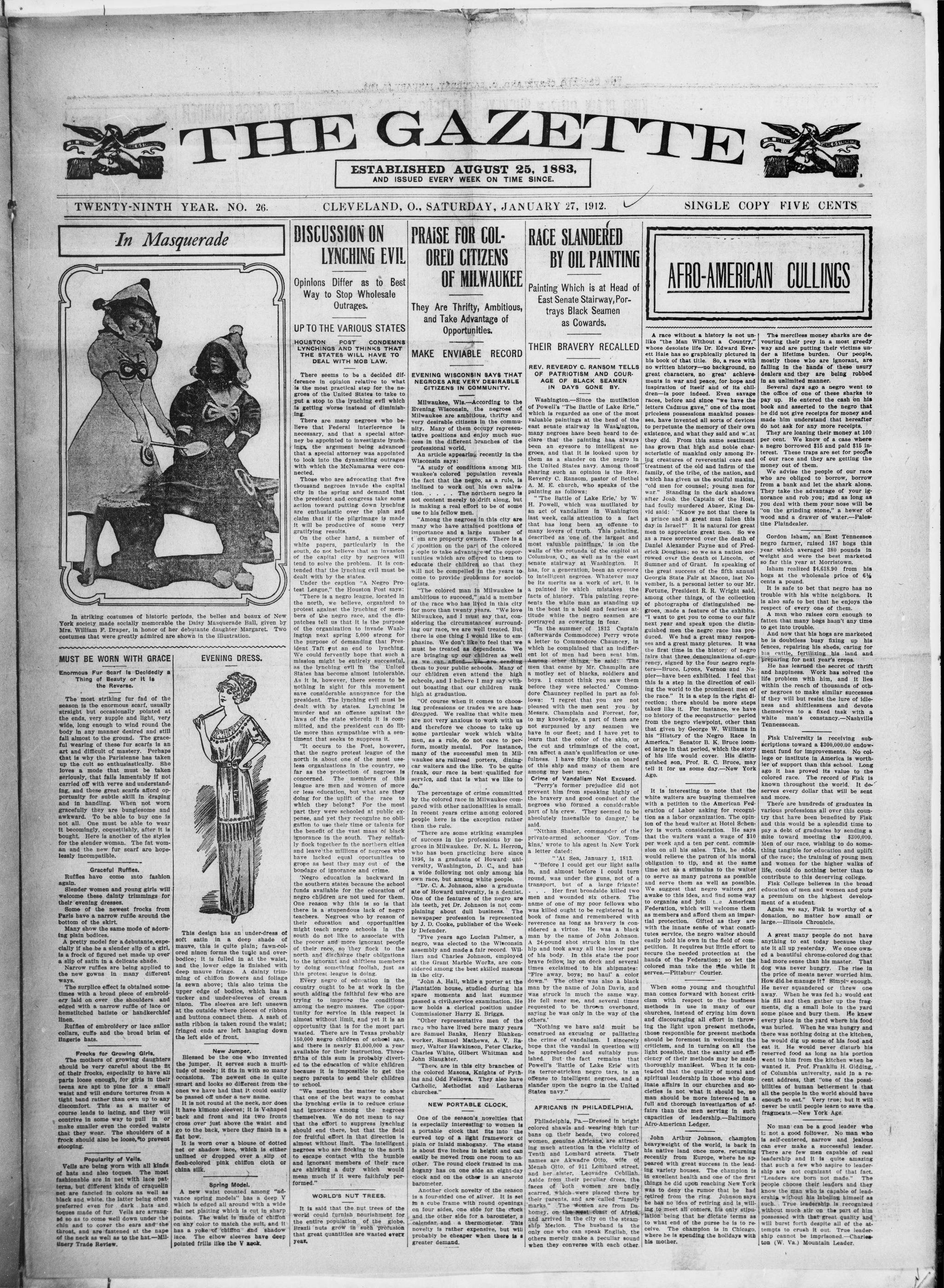
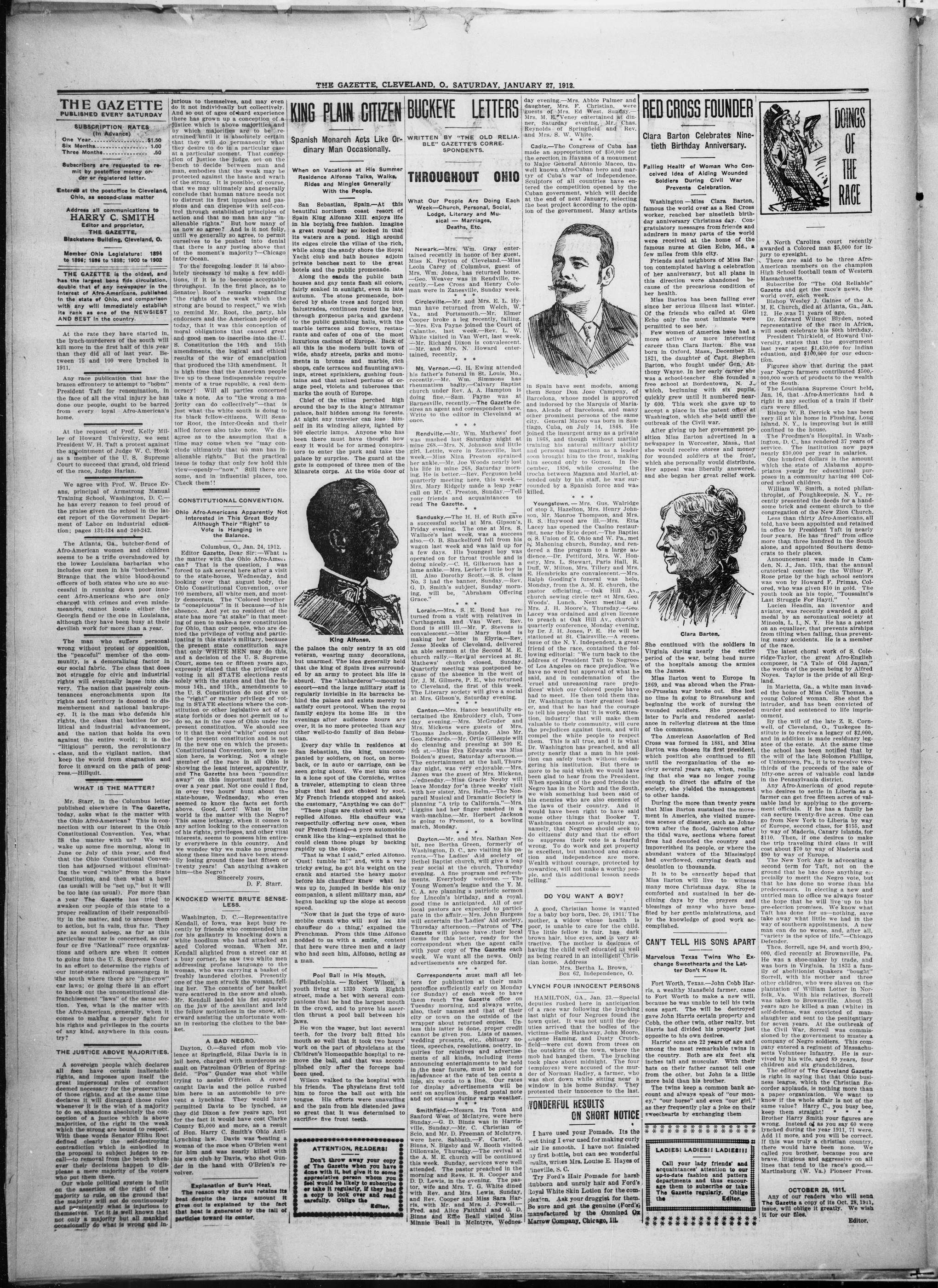
Page text (machine-generated)
TWENTY-NINTH YEAR. NO. 26.
A
In striking costumes of historic periods, the belles and beaux of New York society made socially memorable the Daisy Masquerade Ball, given by Mrs. William F. Draper, in honor of her debutante daughter Margaret. Two costumes that were greatly admired are shown in the illustration.
In striking costumes of historic periods, the belles and beaux of New York society made socially memorable the Daisy Masquerade Ball, given by Mrs. William F. Draper, in honor of her debutante daughter Margaret. Two costumes that were greatly admired are shown in the illustration.
THE EAGLE
HANDS
In striking costumes of historic York society made socially memorable Mrs. William F. Draper, in honor of his costumes that were greatly admired and
MUST BE WORN WITH GRACE
Enormous Fur Scarf is Decidedly a Thing of Beauty or it is the Reverse.
The most striking fur fad of the season is the enormous scarf, usually straight but occasionally pointed at the ends, very supple and light, very wide, long enough to wind round the body in any manner desired and still fall almost to the ground. The graceful wearing of these fur scarfs is an art and difficult of mastery. Perhaps that is why the Parisienne has taken up the cult so enthusiastically. She loves a mode that must be taken seriously, that falls lamentably if not carried off with verve and understanding, and these great scarfs afford opportunity for subtle skill in draping and in handling. When not worn gracefully they are bunglesome and awkward. To be able to buy one is not all. One must be able to wear it becoming, coquettish, after it is bought. Here is another of the styles for the slender woman. The fat woman and the new fur scarf are hopelessly incompatible.
Graceful Ruffles.
Ruffles have come into fashion again.
Slender women and young girls will welcome these dainty trimmings for their evening dresses.
Some of the newest frocks from Paris have a narrow ruffle around the bottom of the skirt.
Many show the same mode of adorning plain bodices.
A pretty model for a debutante, especially if she be a slender slip of a girl, is a frock of figured net made up over a slip of satin in a delicate shade.
Narrow ruffles are being applied to the new gowns in many different ways.
The surplice effect is obtained sometimes with a broad piece of embroidery laid on over the shoulders and edged with a narrow ruffle of lace or hemsitched batiste and handkerchief linen.
Ruffles of embroidery or lace sailor collars, cuffs and the broad brim of lingerie hats.
Frocks for Growing Girls.
The mothers of growing daughters should be very careful about the fit of their frocks, especially to have all parts loose enough, for girls in their teens are apt to pine for a small waist and will endure tortures from a tight band rather than own up to any discomfort. This as a matter of course leads to lacing, and they will contrive in some way to pull in or make smaller even the corded waists that they wear. The shoulders of a frock should also be loose, to prevent stooping.
Popularity of Vells
Popularity or Vells.
Vells are being worn with all kinds of hats and also toques. The most fashionable are in net with lace patterns, but different kinds of craquelin net are fancied in colors as well as black and white, the latter being often preferred even for dark hats and toques made of fur. Vells are arranged so as to come well down under the chin and to cover the ears and the throat, and are fastened at the nape of the neck as well as to the hat.—Military Trade Review.
THE GAZETTE
EVENING DRESS.
This design has an under-dress of soft satin in a deep shade of mauve, this is quite plain; fawn-colored ninon forms the tunic and over bodice; it is fulled in at the waist, and the lower edge is finished with deep mauve fringe. A dainty trimming of chiffon flowers and foliage is sewn above; this also trims the upper edge of bodice, which has a tucker and under-sleeves of cream ninon. The sleeves are left unwear at the outside where pieces of ribbon and buttons connect them. A sash of satin ribbon is taken round the waist; fringed ends are left hanging down the left side of front.
New Jumper.
Blessed be the one who invented the jumper. It serves such a multitude of needs; it its in with so many occasions. The newest one is quite smart and looks so different from the ones we have had that it could easily be passed off under a new name.
It is not round at the neck, nor does it have kimono sleeves; it is V-shaped back and front and its two fronts cross over just above the waist and go to the back, where they finish in a flat bow.
It is worn over a blouse of dotted net or shadow lace, which is either unlined or dropped over a slip of f色彩ored pink chiffon cloth or china silk.
Spring Model.
A new waist counted among "advance spring models" has a deep V which is edged all around with a wide flat net plaiting which is cut in sharp points. The waist is made of chiffon on any color to match the suit, and it has a yoke of chiffon and shadow lace. The elbow sleeves have deep pointed frills like the V neck.
```markdown
```
ESTABLISHED AUGUST 25, 1883 AND ISSUED EVERY WEEK ON TIME SINCE.
DISCUSSION ON LYNCHING EVIL
Opinlons Differ as to Best Way to Stop Wholesale Outrages.
UP TO THE VARIOUS STATES
HOUSTON POST CONDEMNS LYNCHINGS AND THINKS THAT THE STATES WILL HAVE TO DEAL WITH MOB LAW.
There seems to be a decided difference in opinion relative to what is the most practical step for the negroes of the United States to take to put a stop to the lynching evil which is getting worse instead of diminishing.
There are many negroes who believe that Federal interference is necessary, and that a special attorney be appointed to investigate lynchings, the argument being advanced that a special attorney was appointed to look into the dynamiting outrages with which the McNamaraes were connected.
Those who are advocating that five thousand negroes invade the capital city in the spring and demand that the president and congress take some action toward putting down lynchings are enthusiastic over the plan and claim that if the pilgrimage is made it will be productive of some very gratifying results.
On the other hand, a number of white papers, particularly in the south, do not believe that an invasion of the capital city by regroups will tend to solve the problem. It is contended that the lynching evil must be dealt with by the states.
Under the caption "A Negro Protest League," the Houston Post says: "There is a negro league, located in the north, we believe, organized to protest against the lynching of members of the negro race, and the dispatches tell us that it is the purpose of the organization to invade Washington next spring 5,000 strong for the purpose of demanding that President Taft put an end to lynching. We could fervently hope that such a mission might be entirely successful, as the lynching evil in the United States has become almost intolerable. As it is, however, there seems to be nothing in sight for this movement save considerable annoyance for the president. The lynching evil must be dealt with by states. Lynching is murder and an offense against the laws of the state wherein it is committed, and the president can do little more than sympathize with a sentiment that seeks to suppress it.
"It occurs to the Post, however, that the negro protest league of the north is about one of the most useless organizations in the country, so far as the protection of negroes is concerned. The members of this league are men and women of more or less education, but what are they doing for the uplift of the race to which they belong? For the most part they were schooled at public expense, and yet they recognize no obligation to use their time or talents for the benefit of the vast mass of black ignorance in the south. They selfishly flock together in the northern cities and leave the millions of negroes who have lacked equal opportunities to grope as best they may out of the bondage of ignorance and crime.
"Negro education is backward in the southern states because the school funds available for the education of negro children are not used for them. One reason why this is so is that there is a stupendous lack of negro teachers. Negroes by reason of their education and opportunities might teach negro schools in the south do not like to associate with the poorer and more ignorant people of their race, so they flock to the north and discharge their obligations to the ignorant and shiftless members by doing something foolish, just as this protest league is doing.
Every negro of education in the country ought to be at work in the south alding the faithful few who are trying to improve the conditions among the negro masses. The opportunity for service in this respect is almost without limit, and yet it is an opportunity that is for the most part wasted. There are in Texas probably 150,000 negro children of school age, and there is nearly $1,000,000 a year available for their instruction. Three-fifths of this sum is probably diverted to the education of white children because it is impossible to get the negro parents to send their children to school.
"We mention the matter to show that one of the best ways to combat the lynching evils is to reduce crime and ignorance among the negroes themselves. We do not mean to say that the effort to suppress lynching should end there, but that the field for fruitful effort in that direction is almost without limit. The intelligent negroes who are flocking to the north to escape contact with the humble and ignorant members of their race are shirking a duty which would mean much if it were faithfully performed."
WORLD'S NUT TREES.
It is said that the nut trees of the world could furnish nourishment for the entire population of the globe. Brazil nuts grow in such profusion that great quantities are wasted every year.
PRAISE FOR COL- ORED CITIZENS OF MILWAUKEE
They Are Thrifty, Ambitious and Take Advantage of Opportunities.
EVENING WISCONSIN SAYS THAT NEGROES ARE VERY DESIRABLE CITIZENS IN COMMUNITY.
Milwaukee, Wis.—According to the Evening Wisconsin, the negroes of Milwaukee are ambitious, thrifty and very desirable citizens in the community. Many of them occupy representative positions and enjoy much success in the different branches of the professional world.
An article appearing recently in the Wisconsin says:
"A study of conditions among Milwaukee's colored population reveals the fact that the negro, as a rule, is inclined to work out his own salvation. . . . The northern negro is not content merely to drift along, but is making a real effort to be of some use to his fellow men.
"Among the negroes in this city are many who have attained positions of importance and a large number of them are property owners. There is a disposition on the part of the colored people to take advantage of the opportunities which are offered to them to educate their children so that they will not be compelled in the years to come to provide problems for sociologists.
The colored man in Milwaukee is ambitious to succeed," said a member of the race who has lived in this city for more than twenty years. "We love Milwaukee, and I must say that, considering the circumstances surrounding our race, we are well treated. But there is one thing I would like to emphasize. We don't like to feel that we must be treated as dependents. We are bringing up our children as well as we can afford. We are sending them to your public schools. Many of our children even attend the high schools, and I believe I may say without boasting that our children rank high at graduation.
"Of course when it comes to choosing professions or trades we are handicapped. We realize that white men are not very anxious to work with us and therefore we choose to take up some particular work which white men, as a rule, do not care to perform, mostly menial. For instance, many of the successful men in Milwaukee are railroad porters, dining-car waiters and the like. To be quite frank, our race is best qualified for service, and that is what we like to do."
The percentage of crime committed by the colored race in Milwaukee compared with other nationalities is small. In recent years crime among colored people here is the exception rather than the rule.
"There are some striking examples of success in the professions by negroes in Milwaukee. Dr. N. L. Herron, who has been practicing here since 1896, is a graduate of Howard university, Washington, D. C., and has a wide following not only among his own race, but among white people.
"Dr. C. A. Johnson, also a graduate of Howard university, is a dentist. One of the features of the negro are his teeth, yet Dr. Johnson is not complaining about dull business. The newspaper profession is represented by J. D. Cooke, publisher of the Weekly Defender.
"Five years ago Lucian Palmer, a negro, was elected to the Wisconsin assembly and made a fair record. William and Charles Johnson, employed at the Grant Marble Works, are considered among the best skilled masons in the city.
"John A. Hall, while a porter at the Plantation house, studied during his spare moments and last summer passed a civil service examination. He now holds a clerical position under Commissioner Harry E. Briggs.
"Other representative men of the race who have lived here many years are Samuel Banks, Henry Blankenworker, Samuel Mathews, A. V. Ramey, Walter Hawkinson, Peter Clarke, Charles White, Gilbert Whitman and John Slaughter.
"There are in city branches of the colored Masons, Knights of Pythias and Odd Fellows. They also have Catholic, Methodist and Lutheran churches."
NEW PORTABLE CLOCK
One of the season's novelties that is especially interesting to women is a portable clock that fits into the curved top of a light framework of plain or inlaid mahogany. The stand is about five inches in height and can easily be moved from one room to another. The round clock framed in mahogany has on one side an eight-day clock and on the other is an aneroid barometer.
Another clock novelty of the season is a four-sided one of silver. It is set in a cube frame with round openings on four sides, one side for the clock and the other side for a barometer, a calendar, and a thermometer. This novelty is rather expensive, but will probably be cheaper when there is a greater demand.
Painting Which is at Head of East Senate Stairway, Portrays Black Seamen as Cowards.
THEIR BRAVERY RECALLED
REV. REVERDY C. RANSOM TELLS OF PATRIOTISM AND COURAGE OF BLACK SEAMEN IN DAYS GONE BY.
Washington.—Since the mutilation of Powell's "The Battle of Lake Erie," which is regarded as one of the most valuable paintings at the head of the east senate stairway in Washington, many negroes have been heard to declare that the painting has always been an eyesore to intelligent negroes, and that it is looked upon by them as a slander on the negro in the United States navy. Among those sharing such an opinion is the Rev. Reverdy C. Ransom, pastor of Bethel A. M. E. church, who speaks of the painting as follows:
"The Battle of Lake Erie," by W. H. Powell, which was mutilated by an act of vandalism in Washington last week, calls attention to a fact that has long been an offense to many lovers of truth. This painting, described as one of the largest and most valuable paintings, is on the walls of the rotunda of the capitol at Columbus, O., as well as in the east senate stairway at Washington. It has, for a generation, been an eyesore to intelligent negroes. Whatever may be its merits as a work of art, it is a painted life which mistakes the facts of history. This painting represents the white man as standing up in the boat in a bold and fearless attitude while the negro seamen are portrayed as cowering in fear.
'In the summer of 1813 Captain (afterwards Commodore) Perry wrote a letter to Commodore Chauncey, in which he complained that an indifferent lot of men had been sent him. Among other things, he said: 'The men that came by Mr. Champlin are a motley set of blacks, soldiers and boys. I cannot think you saw them before they were selected.' Commodore Chauncey replied in part as follows: 'I regret that you are not pleased with the men sent you by Messrs. Champlain and Forrest, for, to my knowledge, a part of them are not surpassed by any seamen we have in our fleet; and I have yet to learn that the color of the skin, the cut and trimmings of the coat, can affect a man's qualification or usefulness. I have fifty blacks on board of this ship and many of them are among my best men.'
Crime of Vandalism Not Excused.
"Perry's former prejudice did not prevent him from speaking highly of the bravery and good conduct of the negroes who formed a considerable part of his crew. 'They seemed to be absolutely insensible to danger,' he said.
"Nthan Shaler, commander of the private-armed schooner 'Gov. Tomkins,' wrote to his agent in New York a letter dated:
"At Sea, January 1, 1813.
"Before I could our light sail in, and almost before I could turn round, was under the guns, not of a transport, but of a large frigate.
"Her first broadside killed two men and wounded six others. The name of one of my poor fellows who was killed ought to be registered in a book of fame and remembered with reverence as long as bravery is considered a virtue. He was a black man by the name of John Johnson. A 24-pound shot struck him in the hip and took away all the lower part of his body. In this state the poor brave fellow, lay on deck and several times exclaimed to his shipmates: "Fire away, boys; no haul' a color down." The other was also a black man by the name of John Davis, and was struck in much the same way. He fell near me, and several times requested to be thrown overboard, saying he was only in the way of the others."
"Nothing we have said must be construed as excusing or pallating the crime of vandalism. I sincerely hope that the vandal in question will be apprehended and suitably punished. But the fact remains that Powell's 'Battle of Lake Erie' with its terror-stricken negro tars, is an offense to intelligent negroes, and a slander upon the negro in the United States navy."
AFRICANS IN PHILADELPHIA.
Philadelphia, Pa.—Dressed in bright colored shawls and wearing high turbans on their heads, two colored women, genuine Africans, are attracting much attention in the vicinity of Tenth and Lombard streets. Their names are Akwadre Otto, wife of Mensh Otto, of 911 Lombard street, and her sister, Leovadre Cebillah. Aside from their peculiar dress, the faces of both women are badly scarred, which were placed there by their parents, and are called "family marks." The women are from Dahomey, on the west coast of Africa, and arrived in the city on the steamship Merion. The husband is the only one who can speak English, the others merely make a peculiar sound when they converse with each other.
AFRO-AMERICAN CULLINGS
A race without a history is not unliterate "the Man Without a Country", whose desolate life Dr. Edward Everett Hale has so graphically pictured in his book of that title. So, a race with no written history—no background, no great characters, no great achievements in war and peace, for hope and inspiration of itself and of its children—is poor indeed. Even savage races, before and since "we have the letters Cadmus gave," one of the most priceless possessions mankind possesses, have invented all sorts of devices to perpetuate the memory of their own existence, and what they said and w. at they did. From this same sentiment has grown that high and noble characteristic of mankind only among living creatures of reverential care and treatment of the old and infirm of the family, of the tribe, of the nation, and which has given us the soulful maxim, "old men for counsel; young men for war." Standing in the dark shadows after Joab, the Captain of the Host, had finally murdered Abner, King David said: "Know ye that there is this day in Israel?" it is natural for great men to appreciate great men. So we as a race sorrowed over the death of Daniel Alexander Payne and of Frederick Douglass; so we as a nation sorrowed due to the death of Sumner and of Grant. In speaking of the success of the fifth annual Georgia State Fair at Macon, last November, in a personal talk to Mr. Fortune, President R. R. Wright said, among other things, of the collection of photographs of distinguished negroes, made a feature of the exhibits. "I want to get you to come to our fair next year and speak upon the distinguished men the negro race has produced. We had a great many responses and a great many pictures. It was the first time in the history of negro rains that three denominations of currency, signed by the four negro registers—Bruce, Lyons, Vernon and Napier—have been exhibited. I feel that this is a step in the direction of calling the world to the prominent men of the race." It is a step in the right direction; there should be more steps taken like it. For instance, we have no history of the reconstruction period from the negro viewpoint, other than that given by George W. Williams in his "History of the Negro Race in America." Senator B. K. Bruce loomed large in that period, which the story of his life would cover. His distinguished son, Prof. R. C. Bruce, may tell it for us some day—New York Age.
It is interesting to note that the white waiters are busying themselves with a petition to the American Federation of Labor asking for recognition as a labor organization. The opinion of the head waiter at Hotel Schenley is worth consideration. He says that the waiters want a wage of $10 per week and a ten per cent. commission on all his sales. This, he adds, would relieve the patron of his moral obligation to tip, and at the same time act as a stimulus to the waiter to serve as many patrons as possible and serve them as well as possible. We suggest that negro waiters get awake to this idea, and find some way to organize and join the American Federation, which will welcome them as members and afford them an impartial protection. Gifted as they are with the innate sense of what constitutes service, the negro waiter should easily hold his own in the field of competition. It requires but little effort to secure the needed protection at the hands of the Federation; so let the colored man take the side while it serves—Pittsburgh Courier.
When some young and thoughtful man comes forward with honest criticism with respect to the business methods in use in many of our churches, instead of crying him down and discouraging all effort in throwing the light upon present methods, those responsible for present methods should be foremost in welcoming the criticism, and in turning on all the light possible, that the sanity and efficiency of their methods may be made thoroughly manifest. When it is contended that the quality of moral and spiritual leadership in those who dominate affairs in our churches and societies is not what it should be, no man should be more interested in a full and thorough investigation of affairs than the men serving in such capacities of leadership.—Baltimore Afro-American Ledger.
John Arthur Johnson, champion heavyweight of the world, is back in his native land once more, returning recently from Europe, where he appeared with great success in the leading variety houses. The champion is in excellent health and one of the first things he did upon reaching New York was to deny the rumor that he had retired from the ring. Johnson says he has no idea of retiring and is willing to meet all comers, his only stipulation being that he dictate terms as to what end of the purse he is to receive. The champion is in Chicago where he is spending the holidays with his mother.
The merciless money sharks are devouring their prey in a most greedy way and are putting their victims under a lifetime burden. Our people, mostly those who are ignorant, are falling in the hands of these usury dealers and they are being robbed in an unlimited manner.
Several days ago a negro went to the office of one of these sharks to pay up. He entered the cash on his book and asserted to the negro that he did not give receipts for money and made him understand that hereafter do not ask for any more receipts.
They are loaning their money at 100 per cent. We know of a case where a negro borrowed $15 and paid $15 interest. These traps are set for people of our race and they are getting the money out of them.
We advise the people of our race who are obliged to borrow, borrow from a bank and let the shark alone. They take the advantage of your ignorance and rob you; and as long as you deal with them your nose will be "on the grinding stone," a hewer of wood and a drawer of water.-Palestine Plainidealer.
Gordon Isham, an East Tennessee negro farmer, raised 187 hogs this year which averaged 380 pounds in weight and were the best marketed so far this year at Morristown.
Isham realized $4,618.90 from his hogs at the wholesale price of 6½ cents a pound.
It is safe to bet that negro has no trouble with his white neighbors. It is also safe to bet that he enjoys the respect of every one of them.
A man who raises corn to fatten that many hogs hasn't any time to get into trouble.
And now that his hogs are marketed he is doubtless busy fixing up his fences, repairing his sheds, caring for his cattle, fertilizing his land and preparing for next year's crops.
He has learned the secret of thrift and happiness. Work has solved the life problem with him, and it lies within the reach of thousands of other negroes to make similar successes if they will but resist the lure of idleness and shiftness and devote themselves to a fixed task with a white man's constancy.—Nashville Tennessee.
Fisk University is receiving subscriptions toward a $300,000.00 endowment fund for improvements. No college or institute in America is worthier of support than this school. Long ago it has proved its value to the colored race. The record of Fisk is known throughout the world. It deserves every dollar that will be sent and more.
There are hundreds of graduates in various professions all over this country that have been benefited by Fisk and this would be a splendid time to pay a debt of graduates by sending a mite toward meeting the $300,000. Men of our race, wishing to do something tangible for education and uplift of the race; the training of young men and women for the higher walks of life, could do nothing better than to contribute to this deserving college. Fisk College believes in the broad education of men and women and puts a premium on the highest development of a student. Again we say, Fisk is worthy of a donation, no matter how small or large.—Illinois Chronicle.
A great many people do not have anything to eat today because they ate it all up yesterday. We once owned a beautiful chrome-colored dog that had more sense than his master. That dog was never hungry. The rise in the price of meats never worried him. How did he manage it? Simply enough. He never squandered or threw one away. When he was fed he would eat his fill and then gather up the fragments, dig a small hole in the yard some place and bury them. He knew every place in the yard where his food was buried. When he was hungry and there was nothing doing at the kitchen, he would dig up some of his food and eat it. He would never disturb his reserved food as long as his portion went to him from the kitchen when he wanted it. Prof. Franklin H. Giding, of Columbia university, said in a recent address, that "one of the possibilities of human betterment is that all the people in the world should have enough to eat." Very true; but it will never be until people learn to save the fragments.—New York Age.
No man can be a good leader who is not a good follower. No man who is self-centered, narrow and jealous can ever make a successful leader. There are few men capable of real leadership and it is quite amazing that such a few who aspire to leadership are not cognizant of that fact. "Leaders are born not made." The people choose their leaders and they know the man who is capable of leadership without his labeling himself as such. True leadership is recognized without much stir on the part of him possessed with that great quality and will burst forth despite all of the attempts to crush it out. True leadership can be imprisoned—Charleston (W. Va.) Mountain Leader.
THE GAZETTE
PUBLISHED EVERY SATURDAY
SUBSCRIPTION RATES
(In Advance)
One Year.....$1.50
Six Months.....1.00
Three Months......50
Subscribers are requested to remit by postoffice money order or registered letter.
Entrees at the postoffice in Cleveland
Ohio, as second-class matter
Address all communications to
HARRY C. SMITH
Editor and proprietor,
THE GAZETTE,
Blackstone Building, Cleveland, O.
Member Ohio Legislature: 1894
to 1896; 1896 to 1898; 1900 to 1902
THE GAZETTE is the oldest, and has the largest bona fide circulation, double that of any newspaper in the Interest of Afro-American, published in the state of Ohio, and comparison with any will immediately establish its rank as one of the NEWSIEST AND BEST in the country.
At the rate they have started in, the lynch-murderers of the south will kill more in the first half of this year than they did all of last year. Between 75 and 100 were lynched in 1911.
Any race publication that has the brazen efferritory to attempt to "bobm" President Taft for renomination, in the face of all the vital injury he has done our people, ought to be barred from every loyal Afro-American's home.
At the request of Prof. Kelly Miller of Howard University, we sent President W. H. Taft a protest against the appointment of Judge W. C. Hook as a member of the U. S. Supreme Court to succeed that grand, old friend of the race, Judge Harlan.
We agree with Prof. W. Bruce Evans, principal of Armstrong Manual Training School, Washington, D. C. he has every reason to feel proud of the praise given the school in the latest report of the Government Department of Labor on industrial education; pages 131-134 and 240-242.
The Atlanta, Ga., butcher-friend of Afro-American women and children seems to be a trifle overshadowed by the lower Louisiana barbarian who includes our men in his "butcheries." Strange that the white blood-hound officers of both states who are so successful in running down poor innocent Afro-Americans who are only charged with crimes and even misdeanors, cannot locate either the Georgia flounder or the one in Louisiana, although they have been busy at their devilish work for more than a year.
The man who suffers personal wrong without protest or opposition, the "peaceful" member of the community, is a demoralizing factor in our social fabric. The class that does not struggle for civic and industrial rights will eventually lapse into slavery. The nation that passively counterens encroachments upon its rights and territory is doomed to dismemberment and national bankruptcy. It is the man who defends his rights, the class that battles for political and industrial advancement, and the nation that holds its own against the entire world; it is the "litigious" person, the revolutionary class, and the vigilant nation, that keep the world from stagnation and force it onward on the path of progress.—Hillquit.
WHAT IS THE MATTER?
Mr. Starr, in the Columbus letter published elsewhere in The Gazette today, asks what is the matter with the Ohio Afro-American? This in connection with our interest in the Ohio Constitutional Convention. Yes, what is the matter with us? We will wake up mere fine morning, along in June or July of this year, and find that the Ohio Constitutional Convention has adjourned without eliminating the word "white" from the State Constitution, and then what a howl (as usual) will be "set up," but it will be too late (as usual). For more than a year The Gazette has tried to awaken our people of this state to a proper realization of their responsibility in the matter, and to arouse them to action, but in vain, thus far. They are as sound asleep, as far as this particular matter is concerned, as our four or five "National" race organizations and others are when it comes to going into the U. S. Supreme Court in an effort to determine the rights of our inter-state railroad passengers in the south where there are "jim-crow" car laws; or going there in an effort to knock out the unconstitutional disfranchisement "laws" of the same section. Yes, what is the matter with the Afro-American, generally, when it comes to making a proper fight for his rights and privileges in the courts of any kind, anywhere in this country?
THE JUSTICE ABOVE MAJORITIES
A sovereign people which declares all men have certain inalienable rights, and imposes upon itself the great impersonal rules of conduct deemed necessary for the preservation of those rights, and at the same time declares it will disregard those rules of the right in the hands of a majority to do so, abandonds absolutely the conception of a justice which is above majorities, of the right in the weak which the strong are bound to respect. With these words Senator Elilhu Root defined clearly the self-destroying contradiction which is embodied in the proposition of removal from the benign whenever their decisions happen to displease a mere majority of the voters who put them there.
Our whole political system is built on the assertion of the right of the majority to rule, on the ground that the majority will not do continuously and persistently it is injurious to themselves. Yet it is well known that not only a majority but all mankind occasionally do what is wrong and in-
jurious to themselves, and may even do it not individually but collectively. And so out of ages of hard experience there has grown up a conception of a justice which is above majorities, and by which majorities are to be restrained until it is absolutely certain that they will do permanently what they desire to do in a particular case, and that they will be protected against the violation of justice the judge, set on the bench to decide between man and man, embodies that the weak may be protected against the haste and wrath of the strong. It is possible, of course, that we may ultimately and generally conclude that human nature needs not to distrust its first impulses and passions and can dispense with self-control through established principles of action and that no man has any "infallenable rights." But how many of us are so jealous? And if it fails to hold, we generally so agree, to permit ourselves to be pushed into denial that there is any justice above that of the moment's majority?—Chicago Inter Ocean.
To the foregoing leader it is absolutely necessary to make a few additions, if it is to become acceptable throughout. In the first place, as to Senator Root's remarks regarding "the rights of the weak which the strong are bound to respect," we wish to remind Mr. Root, the party, his endorsers and the American people of today, that it was this conception of moral obligations that caused great and good men to inscribe into the U.S. Constitution the 14th and 15th amendments, the logical and ethical results of the war of emancipation that produced the 13th amendment. It is high time that the American people live up to these indispensable requirements of a true republic, a real democracy! Will all parties concerned take a note. As to "the wrong a majority can do collectively"—that is just what the white south is doing to its black fellow-citizens, Will Senator Root, the inter-Ocean and their allied forces also take note. We disagree as to the assumption that a time may come when we "may conclude ultimately that no man has inalienable rights." But the practical issue is today that only few hold this view—openly—"now." Still there are some, and in influential places, too, Check them!!
CONSTITUTIONAL CONVENTION.
Ohio Afro-Americans Apparently Not
Interested in This Great Body
Although Their "Right" to
Vote is Hanging in
the Balance.
Columbus, O., Jan. 24, 1912.
Editor Gazette, Dear Sir:—What is the matter with the Ohio Afro-American? That is the question. I was forced to ask several here after a visit to the state-house, Wednesday, and looking over that august body, the Ohio Constitutional Convention, over 100 members, all white men, and most Democrats, demonstrate "inimical" in it because—of his absence. And yet no resident of the state has more "at stake" in that meeting of men to make a new constitution for Ohio, than our people, who are denied the privilege of voting and participating in this state's military, because the present state constitution says that only WHITE MEN may do this, and do not be men or fifteen years old, expressly stated that the privilege of voting in all STATE elections rests solely with the states and that the famous 14th, and 15th, amendments to the U. S. Constitution do not give us the "right" or rather privilege of voting in STATE elections where the constitution or other legislative act of a state forbids or does not permit us to do so, a state forbids or does not give us the present constitution. We would see to that the word "white" comes out of the present constitution and is not in the new one on which the present Constitutional Convention, now in session here, is working. Not a single member of the race in all Ohio is showing the least interest, apparently, and The Gazette has been "pounding away" on this important matter for over a year past. Not one could I find, and I would not. The state house, Wednesday, who even seemed to know the facts set forth above. Good, Lord! What in the world is the matter with the Negro? This same lethargy, when it comes to action looking to the conservation of his rights, privileges, and other vital interests, seems to possess him entirely everywhere in this country. And we would not allow these lines and have been steadily losing ground these last fifteen or twenty years! Can anything awaken him—the Negro?
Sincerely yours,
D. F. Starr.
KNOCKED WHITE BRUTE SENSE
LESS.
Washington, D. C.—Representative Kendall, of Iowa, was kept busy recently by friends who commended him for his gallantry in knocking down a white hoodlum who had attacked an aged Colored woman. When Mr. Kendall alighted from a street car at the entrance of the two men addressing profane language to the woman, who was carrying a basket of freshly laundered clothes. Presently one of the men struck the woman, felling her. The contents of her basket were scattered in the snow and shush. Mr. Kendall landed his fast squarely on the jaw of the woman in the snow, afterward assisting the unfortunate woman in restoring the clothes to the basket.
A BAD NEGRO.
Dayton, O—Saved from mob violence at Springfield, Silas Davis is in jail here, charged with murderous assault on Patrolman O'Brien of Springfield. "Pos" Gunder was shot while trying to assist O'Brien. A crowd caught Davis and the police rushed him here in an automobile to prevent a lynching. They would have permitted Davis to be lynched, as they did Dixon a few years ago, but for the fact it would have cost Clarke County $5,000 and more, as a result of Hon. Harry C. Smith's Ohio Anti-Lynching law. Davis was beating a woman of the race when O'Brien went for him and was nearly killed with his own club by Davis, who shot Gunder in the hand with O'Brien's revolver.
Explanation of Sun's Heat
Explanation of Sun's Heat. The reason why the sun retains its heat despite the large amount it gives out is explained by the fact that heat is generated by the tail of particles toward its center.
THE GAZETTE, CLEVELAND, O., SATURDAY, JANUARY 27, 1912.
KING PLAIN CITIZEN
Spanish Monarch Acts Like Ordinary Man Occasionally.
When on Vacations at His Summer Residence Alfonso Talks, Walks, Rides and Mingles Generally With the People.
San Sebastian, Spain.—At this beautiful northern coast resort of Spain King Alfonso XIII enjoys life in his boyish free fashion. Imagine a great round bay so locked in that its waters are a pond. High around its edges circle the villas of the rich, while along the sandy shore the Royal Yacht club and bath houses adjoin private beaches next to the great hotels and the public promenade.
Along the sands the public bath houses and gay tents flash all colors, fairly soaked in sunlight, even in late autumn. The stone promenade, bordered by shade trees and forged iron balustrades, continues round the bay, through gorgeous parks and gardens to the public gambling halls, with the marble terraces and flowers, restaurants and cafes of one of the most luxurious casinos of Europe. Back of all this is the modern built town of wide, shady streets, parks and monuments in bronze and marble, rich shops, cafe terraces and flaunting awnings, street sprinklers, gushing fountains and that mixed perfume of orange peel, violets and tuberoses that marks the south of Europe.
Chief of the villas perched high around the bay is the king's Miramar palace, half hidden among its forests. At night any traveler can lose himself in its winding alleys, lighted by 900 electric lamps. Anyone who has been there must have thought how easy it would be for armed conspirators to enter the park and take the palace by surprise. The guard at the gate is composed of three men of the Minarets corps. At the wide door of
King Alfonso.
the palace the only sentry is an old veteran, wearing many decorations, but unarmed. The idea generally held that the king of Spain lives surrounded by an army to protect his life is absurd. The "Alabareros"-mounted escort—and the large military staff is regularly invisible in its barracks behind the palace and exists merely to satisfy court protocol. When the royal family enjoys its home life in the evenings after audience hours are over, it is no more protected than any other well-to-do family of San Sebastian.
Every day while in residence at San Sebastian, the king, uncompanied by soldiers, on foot, on horseback, or in auto or carriage, can be seen going about. We met him once in a lone spot of the Corniche, writes a traveler, attempting to clean three plugs that had got choked by soot. My French friends stopped and asked the customary, "Anything we can do?"
"These plugs are choked with soot," replied Alfonso. His chauffeur was respectfully offering new ones, when our French friend—a pure automobile crank like the king—explained that he could clean those plugs by backing rapidly up the slope.
"That is what I said," cried Alfonso. "Oust! tumble in!" and, with a very tricky swing, he got his weight on the crank and started the heavy motor before his chauffeur knew what he was up to, jumped in beside his only companion, a silent military man, and began backing up the slope at second speed.
"Now that is just the type of automobile crank who will not let his chauffeur do a thing," expained the Frenchman. From this time Alfonso nodded to us with a smile, content that here were three men and a lady who had seen him, Alfonso, acting as a man.
Pool Ball In His Mouth
Philadelphia. — Robert Wilson, a youth living at 1330 North Eighth street, made a bet with several companions that he had the largest mouth in the crowd, and to prove his asser-
thrust a pool ball between his jaws.
He won the wager, but lost several teeth, for the ivory ball fitted his mouth so well that it took two hours' work on the part of physicians at the Children's Homeopathic hospital to remove the ball, and that was accom-
plished only after the forceps had been used.
Wilson walked to the hospital with his friends. The physicians first told him to force the ball out with his tongue. His efforts were unavailing and the pain from his distended jaws so great that it was determined to sacrifice five front teeth.
ATTENTION, READERS!
Don't throw away your copy of The Gazette when you have done with it, but give it to some appreciative person whom you feel would be likely to subscribe or take it regularly, if they had a copy to look over and read carefully. Oblige the
BUGKEYE LETTERS
WRITTEN BY "THE OLD RELIABLE"
BLE" CORREL
SPECIAL EDITION
What Our People Are Doing Each Week—Church, Personal, Social, Lodge, Literary and Musical—Mariages, Deaths
Newark.—Mrs. Wm. Gray entertained recently in honor of her guest, Miss K. Peyton of Cleveland.—Miss Leola Carey of Columbus, guest of Mrs. Wm. Jones, has returned home.—Geo. Weaver was in Rendille, recently—Lee Cross and Henry Coleman were in Zanville, Sunday week.
Circleville.—Mr. and Mrs. E. L. Hyman have returned from Welch, W. Va., and Portsmouth—Mr. Elmer Cooper broke a leg recently, falling.—Mrs. Eva Payne joined the Court of Calcutta.—week—Rev. L. W. White visited in Van Wert, last week.—Mr. Richard Dixon is convalescent.—Mr. and Mrs. N. Howard entertained recently.
---
Mt. Vernon—G. H. Ewing attended his father's funeral in St. Louis, Mo, recently—Mr. Wm. Simmons has rheumatism badly—Calvary Baptist church under Rev. A. A. Hampton is doing fine—Sam. Payno was at Barnesville, recently—The Gazette describes an agent and correspondent here, Write to the editor in Cleveland at once.
***
Rendville.—Mr. Wm. Mathews' foot was mashed last Saturday night at mine 268.—Mr. N. Johnson and little girl, Lelle, were in Zanesville, last week.—Miss Nina Preston sprained her ankle.—Mr. Joe Woods nearly lost his life in mine 268. Saturday morning, he is battled.—Roy Perpason had quarterly meeting here, this week.—Mrs. Ridgely made a leap year call on Mr. C. Preston, Sunday.—Tell your friends and acquaintances to read The Gazette.
**Sandusky.**—The H. of Ruth gave a successful social at Mrs. Glipson's Friday evening. The one at Mrs. S. Vallejo, Mrs. R. Kovacs, Mrs. B. Shuckelford fell from his last week and was laid up for a few days. His youngest boy was operated on for trouble trouble and is doing nicely. C. H. Gilkerson has a lame ankle.—Mrs. Lerler's little boy is ill. Also Dorothy Scott.—S. S. class No. 3 had the banner. S. S. class D. Smith's subject. Sunday morning, will be, "Abraham Offering Grace."
---
Lorain—Mrs. S. E. Bond has returned from a visit with relatives in Carthagenia and Van Wert. Rev. Bond is still ill—Mr. F. Stevens is convalescent—Miss Mary Bond is making her home in Elyria, Rev. Jesse Meeks of Cleveland, delivered an able sermon at the Second M. E. church rally—Revival services at St. Mathews' church closed, Sunday. Quarterly meeting was postponed because of the absence in the west of Dr. J. M. Gilmere, P. E., who returned to Cleveland, the first of this week. The Literary society will give a social at Mrs. Gibson's, Saturday evening.
Canton.—Mrs. Hance beautifully entertained the Embroidery club, Tuesday evening.—Mrs. McGruder and Mrs. Mickens were guests of Mrs. Thomas Jackson, Sunday. Also Mr. Geo. Edwards.—Mr. Ortie Gillespie will do cleaning and pressing at 300 E. 8th st.—Miss Eva Edwards was Miss Bolden's guest, Saturday afternoon. The entertainment at the hall, Thursday night, was very enjoyable.—Mrs. James was the guest of Mrs. Mickens, Wednesday.—Miss Grace the teacher, leave Monday, the three weeks' visit, Mrs. Helm. The Nonpareil Musical and Dramatic Society is planning "A trip to California."—Mrs. Liggins had her finger mashed in a wash-machine.—Mr. Herbert Jackson is going to Fremont, to a bowling match, Monday.
Dayton—Mr. and Mrs. Nathan Nesbitt, beee Berthe Green, formerly of Washington, D. C., are visiting his parents.—The Ladies' Aid society of Bethel Baptist church, will give a leap year social at the church, Thursday evening.—The Ladies' Aid society. Everybody welcome.—The Young Women's league and the Y. M. C. A. are planning a patriotic sermon for Lincoln's birthday, and a royal, good time is anticipated. All of our local pastors are expected to participate in the affair—Mrs. John Burgess will entertain the Ladies' Aid society, and Mrs. John Burgess will please have their local items for this letter, ready for the correspondent when the agent calls with your copy of The Gazette each week. We want all the news. Only advertisements are charged for.
Correspondents must mail all letters for publication at their main postoffice sufficiently early on Monday (or Sunday) of each week to have them reach The Gazette office on Tuesday morning, and always write, also, their names and that of the person of the wrap about returned copies. Unless this latter is done, proper credit cannot be given you. Lists of names, wedding presents, etc., obituary notices, speeches, resolutions, poetry, inquiries for relatives and advertisements of all kinds, including items announcing the death of the future, must be paid for in advance at the rate of ten cents a line, six words to a line. Our rates for display advertisements will be sent on application. Send postal note and not stamps during warm weather.
Smithfield—Messrs. Ira Tona and Sanford West of McIntyre, were here Sunday.—G. D. Binns was in Harriville, Sunday.—M. C. Christian of Scio, and Mr. D. Freeman of McIntyre, were here. Sabbath.—F. Carter, G. Isaac, and Boby Boyd Dillahville. Thursay.—The revival at the A. M. E. church will be continued this week. Sunday, services were well attended. The pastor preached in the morning and Revs. R. R. Cooper and D. D. Lewis, in the evening. The pastor, wife and Mrs. T. G. white dined with Rev. and Mrs. Lewis, Sunday, and Rev. Cooper and Mrs. J. Powell, Fred, and Mrs. Faithful and G. D. Binns and Effie Beall visited Miss Minnie Beall in McIntyre, Wednes
day evening.—Mrs. Abbie Palmer and daughter, Mrs. F. Christian, were guests of Mrs. Ed West. Sunday.—Mrs. M. E. Veney entertained at dinner, Saturday evening, Mr. Chas. Reynolds of Springfield and Rev. and Mrs. S. W. White.
Cadiz.—The Congress of Cuba has made an appropriation of $50,000 for the erection in Hayana of a monument to Major General Antonio Maceo, the well known Afro-Cuban hero and martyr of Cuba's war of independence, who entered the competition opened by the Cuban government, which will decide at the end of next January, selecting the best project according to the opinion of the government. Many artists
A.
in Spain have sent models, among them Senor Don Jose Campeny, of Barcelona, whose model is approved and indorsed by the Marquis of Marianao, Alcade of Barcelona, and many other prominent persons of the same city. General Maceo was born in Santiago, Cuba, on July 14, 1848. He joined the insurgent army as a private in 1868, and though without martial training his military ability and personal magnetism as a leader, he took him to the front, making him second only to Gomez. In December, 1896, while crossing the trochae between Magana and Mariel, attended only by his staff, he was surrounded by a Spanish force and was killed.
DO YOU WANT A BOY?
A good, Christian home is wanted for a baby boy born, Dec. 20, 1911. The mother, a widow whose health is poor, is unable to care for the child. The little fellow is fair, has dark brown hair, blue eyes, and is very attractive. The mother is desirous of having the child well educated as well as being reared in an intelligent Christian home. Address Mrs. Bertha L. Brown, Box 62, Independence, O.
LYNCH FOUR INNOCENT PERSONS
HAMILTON, GA., Jan. 23.—Special deputies rushed here in anticipation of a race war following the lynching last night of four Negroes found the town quiet. It was not until the deputies arrived that the bodies of the victims—Belle Hathaway, John Moore, Lene Gaming, and Dusty Crutchfield—were cut down from trees on the lawn. A mob had hanged them. The lynching took place about midnight. The four (employees) were accused of the murder of Norman Hadley, a farmer, who was shot down while sitting near a window in his home Sunday. They protested their innocence to the last.
I have used your Pomade. Its the best thing I ever used for making curly hair lie smooth. I have not finished my first bottle, but can see wonderful results, writes Mrs. Louise E. Hayes of Cineville, S.C.
Try Ford's Hair Pomade for harsh stubborn and unruly hair and Ford's Royal White Skin Lotion for the complexion. Ask your druggist for them. Be sure and get the genuine (Ford's) manufactured by the Ozonized Qx Marrow Company, Chicago, IL.
RED CROSS FOUNDER
RED CROSS FOUNDER
Clara Barton Celebrates Nineteieth Birthday Anniversary.
Falling Health of Woman Who Conceived idea of Aiding Wounded Soldiers During Civil War Prevents Celebration.
Washington—Miss Clara Barton, famous the world over as a Red Cross worker, reached her nineteenth birthday anniversary Christmas day. Congratulatory messages from friends and admirers in many parts of the world were received at the home of the famous nurse at Glen Echo, Md., a few miles from this city.
Friends and neighbors of Miss Barton contemplated having a celebration of her anniversary, but all plans in this direction were abandoned because of the precarious condition of her health.
Miss Barton has been falling ever since her serious illness last winter. Of the friends who called at Glen Echo only the most intimate were permitted to see her.
Few women of America have had a more active or more interesting career than Clara Barton. She was born in Oxford, Mass., December 25, 1821, the daughter of Capt. Stephen Barton, who fought under Gen. Anthony Wayne. In her early career she was a school-teacher. She founded a free school at Bordentown, N. J., which, beginning with six pupils, quickly grew until it numbered nearly 600. This work she gave up to accept a place in the patent office at Washington, which she held until the outbreak of the Civil war.
After giving up her government position Miss Barton advertised in a newspaper in Worcester, Mass., that she would receive stores and money for wounded soldiers at the front which she personally would distribute. Her appeal was liberally answered, and she began her great relief work
Clara Barten.
She continued with the soldiers in Virginia during nearly the entire period of the war, being head nurse of the hospitals among the armies on the James.
Miss Barton went to Europe in 1869, and was abroad when the Franco-Prussian war broke out. She lost no time in going to Strasburg and beginning the work of nursing the wounded soldiers. She proceeded later to Paris and rendered assistance in relieving distress at the time of the commune.
The American Association of Red Cross was formed in 1881, and Miss Barton was chosen its first president, which position she continued to fill until the reorganization of the society several years ago, when, realizing that she was no longer young enough to direct the affairs of the society, she yielded the management to other hands.
During the more than twenty years that Miss Barton sustained the movement in America, she visited numerous scenes of disaster, such as Johnstown after the flood, Galveston after the tidal wave, sections where forest fires had denuded the country and impoverished its people, or where the abundant waters of the Mississippi had overflowed, carrying death and desolation to thousands.
It is to be earnestly hoped that Miss Barton will live to witness many more Christmas days. She is comforted and sustained in her declining days by the prayers and blessings of many who have benefited by her gentle ministrations, and by the knowledge of good work accomplished.
CAN'T TELL HIS SONS APART
Marvelous Texas Twins Who Exchange Sweethearts and the Latter Don't Know It.
Fort Worth, Texas.—John Cobb Harris, a wealthy Mansfield farmer, came to Fort Worth to make a new will, because he was unable to tell his twin sons apart. The will he destroyed gave John Harris certain property and Cobb, the other twin, other reality, but Harris had divided his property just opposite to his own desires.
Harris' sons are 22 years of age and among the most remarkable twins in the country. Both are six feet six inches tall and muscular. With their hats on their father cannot tell one from the other, but John is a little more bald than his brother.
The twins keep a common bank account and always speak of "our money," "our horse" and even "our girl," as they frequently play a joke on their sweethearts by exchanging them
---
Call your lady friends' and acquaintances' attention to our up-to-date fashion and pattern departments and thus encourage them to subscribe or take The Gazette regularly. Oblige the Editor.
DOINGS
OF
THE
RAGE
A North Carolina court recently awarded a Colored man $5,000 for injury to eyesight. There are said to be three Afro-American members on the champion High School football team of Western Massachusetts. Subscribe for "The Old Reliable" Gazette that covers the race's news, the over, over, each week. Bishop Wesley J. Gaines of the A. M. E. Church, died at Atlanta, Ga., Jan. 12. He was 71 years of age. Dr. Edward Wilmot Blyden, noted representative of the race in Africa, will soon celebrate his 60th birthday. President Thirkield, of Howard University, states that the government liaison, $1,430,000 for Indian education, and $100,000 for our education.
Figures show that during the past year Negro farmers contributed $500,000,000 worth of products to the wealth of the South.
The Louisiana Supreme Court held Judge of the Afro-Americans had a right in any section of a train if their cars were filled.
Bishop W. B. Derrick who has been very ill at his home in Flushing, Long Island, N. Y., is improving but is still confined to the house. The Freedman's Hospital in Washington, D.C., honored 37 years of service. The institution now pays nearly $30,000 per year in salaries. One hundred dollars is the amount which the state of Alabama appropriates yearly for educational purposes in a community having 400 Colored school children. He has a noted philanthropist, of Poughkeepsie, N. Y., recently presented the deeds for a handsome brick and cement church to the congregation of the New Zion Church. Less than thirty Afro-Americans, all told, have been appointed and retained in office by President Taft in nearly every year since he more than three hundred in the South alone, and appointed Southern democrats to their places.
Announcement was made in Camden, N. J., Jan. 13th, that the annual cratorial contest for the Wilbur F. Rose prize by the high school seniors was won by Howard F. Primas, Colored, who was given $10 in gold. The youth took as his topic, "Toussaint's Last Struggle For Hayt!". The inventor and aviator, was recently awarded a gold medal by an aeronautical society at Mineola, L. I., N. Y. He has a patent on an equalizer, that prevents airships from tilting when falling, thus preventing many accidents. He is a member of the race.
The latest choral work of S. Coleridge-Taylor, the great Afro-English composer, is "A Tale of Old Japan," the words of the poem being by Alfred Noyes. Taylor is the pride of all England.
In Marietta, Ga., a white man invaded the home of Miss Cella Thomas, a young Colored woman. She shot the intruder, and has been convicted of murder and sentenced to life imprisonment.
By the will of the late Z. R. Cornwell, of Cleveland, O. Tuskegee Institute is to receive a legacy of $2,000, and in addition is made residuary legatee of the estate. At the same time the school has been notified that by the will of the late Solomon Phillips, of Uniontown, Pa., it is to receive two, fifty-one acres of the sale of thirty-one acres of valuable coal lands in the Pennsylvania district. Any Afro-American good repute who desires to settle in Liberia as a farmer can get free fifteen acres of valuable land by applying to the government officials. If he has a family he can secure twenty-five acres. One can go from New York to Liberia by way of Europe, second class, for $155, and by way of Madera, Canary Islands, for $110. Then, one desires to make fifty-five acres of class it will cost about $70 by way of Madera and $90 by way of Europe.
The New York Age is advocating a second term for Taft, not on the ground that he has done anything especially to merit the Negro vote, but that he has done no worse than his predecessors. In electing a new and untried man to office we always foster the hope that he will live up to his pre-election promises. We know what Taft has done for us—nothing, save take anyay what little we had in the past. We want the investments, the new man can do no worse, and after all, “variety is the spice of life.”—Chicago Defender.
Thos. Sorrell, age 94, and worth $90,000, died recently at Brownsville, Pa. He was a shoe-maker by trade, and was born in Virginia. In 1833 a family of abolitionist Quakers "bought" Sorrell, with his mother and three other children, who were slaves on the plantation of William Lotter in Norfolk, Va. With his relatives, Sorrell was taken to Brownsville. About 25 years ago he killed a man (white) in self-defense, was convicted of manslaughter and sent to the penitentiary for seven years. At the outbreak of the Civil War, Sorrell was commissioned by the government to company of Negro soldiers. This company entered a regiment of Massachusetts Volunteer Infantry. He is survived by his wife, aged 89 years, four children and six grandchildren.
The editor of The Cleveland Gazette is right in saying that Ohio business league, which the Christian Recorder applauds, is nothing more than a paper organization. We want to know if the whole affair is not of the same value? Harry C., you busy bee, keep them straight! * * * * * Brother Harry Smith your figures are wrong. Instead of as you say 60 were added during the year, there. Add 11 more, and you will be correct. If this was truly a christian country, there would have been none. We called you brother, because you are brave, litigious and aggressive on all lines that tend to the race's good.—Martinsburg (W. Va.) Pioneer Press.
OCTOBER 28, 1911.
Any of our readers who will send The Gazette a copy of its Oct. 28, 1911, issue, will oblige it greatly. We wish it for our files.
PURELY PERSONAL
PURCHASE THE "GAZETTE" AT
J. S. HALL'S, 3121 Central Ave.
L. SCHWARTZ'S, 2921 Central Ave. Open Sunday.
O. C. SCHROEDER'S, Cuyahoga Bldg. Open Sunday.
ELMER F. BOYD'S, 2604 Central Ave.
F. VALENTINE'S, 2130 Central Ave.
SAM COHEN'S, 2928 Central Ave. Open Sunday.
JOHNSON'S, 3350 Central Ave.
MRS. M. S. BEDFORD'S, 3410 Central Ave.
NOTICE TO SUBSCRIBERS:—Subscribers not receiving The Gazette regularly should notify us at once. We desire every copy delivered promptly. We advise our patrons to carefully examine The Gazette's advertisements before making purchases. Business men who advertise in this paper should have the patronage of Afro-Americans. The fact that they advertise is assurance that they want it. Local reading notices (advertisements) ten cents a line (six words in a line.)
FOR RENT —Houses. If you have places to rent or if you want to rent —notify The Gazette.
FOR RENT —Nicely furnished room, all conveniences, at 2334 E. 87th. St. Bell Phone, Doan 2045 R.
NOTARY PUBLIC —For such services call at The Gazette office, No 3 Blackstone Building, No. 1422 W. 3d street, near Superior avenue.
For select dancing, attend Friday evening's private parties at Ideal hall D. C. Fisher, son and daughter, Arthur and Miss Ruth, were in the city Monday, from Lorah.
A grand mid-winter picnic and car nival, Jan. 22—23 at Forest Street Rink. Everybody is going. Are you Mr. John Ashby and Miss Ethel M Anderson were married, Jan. 22, at St John's parsonage, Dr. Chas. Bundy
FOR SALE.—Brand new, imperial Encyclopedia and Dictionary, 40 volumes, finely illustrated, handy to handle. Unexcelled for reference purposes. A library in itself—one that will last a life-time. Contains everything you may wish to know. Call or address, The Gazette, Blackstone Building, 1422 W. 3d St., Cleveland, O. near Superior Av. This is an opportunity of a life-time for those who love books.
WANTED AGENTS—A Good chance to make from $15.00 to $50.00 a week. Good opportunity for men of all ages. We want reliable agents to take orders for our "high quality nursery stock." Commission paid weekly. Permanent year-round position. Complete course in salesmanship with free outfit. Experience unnecessary. All goods sold under positive ironclad guarantee to be as represented. Write quick. Pennsylvania Nursery Co., Girard, Erie Co., Pa.
Mrs. Chas. Hansbury of Painesville, is visiting her sister, Mrs. Ralph Jackson who is ill at 2218 E. 46th. St. Rumor has it that a teacher in Brownell school whipped severely Mr. Hatcher's young son, last week.
Miss Mattie Sands, a former resident of this city, is now Mrs. Mattie S. Carter of N. Y. City. Congratulations! Mr. and Mrs. Chas. A. Allen of 2218 E. 46th. St., have returned from a delightful holiday trip to Hagerstown and Baltimore, Md., and Washington, D. C.
Rev. and Mrs. F. G. Snelson of St. James church, have issued invitations to their twenty-fifth marriage anniversary celebration, Feb. 15, from 8 to 12 p.m., at their residence, 10612 Arthur Av.
The second indoor picnic, Tuesday and Wednesday evenings, at Forest St. rink, were well attended, considering the inclement weather. Band and organ music, races of various kinds, for the old and young, and other attractions, entertained the people.
Send your local items to The Gazette on Monday or Tuesday of each week. This paper is published for ALL of our people and "plays no favorites." Everybody is treated the same—fair and right. Take The Gazette and tell your friends to do so and the editor of The Gazette acknowledges the receipt of a very pretty souvenir post-card with "greetings and best wishes" from Madam E. Azalia Hackley, who was at Galveston, Texas, Jan. 18. She is making a concert tour in the south, and a soprano solist of exceptional ability. Bishop M. P. A. Easton who left last summer is on a tour of the Holy Lament, who sent The Gazette several very interesting letters from Cairo, Egypt, Africa, and other points of the "Old Country" while en route there, has returned to the city. He has been ill ever since his return. Dr. J. M. Gilmere, P. E., returned Monday from an extended trip to Chicago, Indianapolis, St. Louis and Kansas. He will attend a conference business. He will in all probability meet the Bishops' Council at Baltimore, Md. in February.
Drs. Bunday and Bailey called, Tuesday, and requested The Gazette to announce that they are not members of Mayor Baker's Afro-American Referee Committee. They say that no such committee exists. The Gazette was told differently by John, who was working some weeks ago. Miss Marie McAbee of 2318 E. 46th, St. entertained, Tuesday evening, at a card party. Those present were: Dr. and Mrs. J. Washington, Mr. and Mrs. C. A. Allen, the Misses Clara and Ella Dyson, Hazel Mountain, Blanche Wilkins, Gladys Gibson, Messrs. Chas. E. Green, M. Wilkins, and E. L. Butler of Elmira, N. Y.
Humor has it that Mrs. Harry T. Burleigh of I. N. Y. City, who read at Halnorth's hall, last week, Monday evening, to a very small audience, had a most harrowing experience, while here, she left Saturday for Erie to visit relatives of her husband. Last Friday night she spent at Mr. and Mrs. Edward Daw's, and the evening previous, at Mr. and Mrs. Chas. W. Chestnut's residence.
The joint conference at St. John's church, Monday evening, was not well attended, doubtless as a result of another miserable evening and counter attractions. The work, however, is progressing and Citizens High League committees are at work. Something must and should be done to conserve our real interests in the Ohio Constitutional Convention, now in session, Columbus.
When most, if not all, of the other Auto Companies were refusing to accommodate Afro-American passengers, the Acme Auto Co., of 2340 E. 9th St., whose advertisement can be found elsewhere in The Gazette, and which has always been broad and inclusive its treatment of all classes of people who desired to rent their machines, was doing the right thing in our case as well as all others. That is why should prefer the Acme Auto Co., now whenever we have need of such service. 'Phones: North, 1231 and Central, 4161.
For select dancing, attend Friday evening's private parties at ideal hall. D. C. Fisher, son and daughter, Arthur and Miss Rush, were in the city, Monday, from Lorah. A grand mid-winter picnic and carnival, Jan. 22—23 at Forest Street Rink. Everybody is going. Are you? Mr. John Ashby and Miss Ethel M. Anderson were married, Jan. 22, at St John's parsonage, Dr. Chas. Bundy officiating. Cynahoga Lodge, Elks, has decided to buy the block at 4145 Central Av. for between eight and nine thousand dollars. Zambara, a Cuban-Negro born and reared in Germany, fought a ten round bout with one "Hogan", a Jew, in another Tuesday evening. There were other bouts. Quite a crowd was in attendance. Mrs. Jas. Huston has returned from Oberlin where she has been for two weeks on account of the illness and death of her father, Mr. Phillip Hudnell. She has the sympathy of a host of friends.
Mrs. Eva Hall whose death, Jan. 13, was noted in the *Gazette* last week, was born in Westfield, N. Y., Jan. 15, 1863 and, therefore, was 49 years of age. She was a resident of Cleveland for a number of years, and leaves a memorial to her. She is a friend to moun her loss. Mrs. Hall was a member of Cory M. E. church. Quarterly meeting, Sunday, at Lane Memorial church. Dr. Sylvester burt of the M. E. church, will preach at 11 a.m., Dr. H. C. Balley at 3 p.m., and m. S. C. Baldwin at 4 p.m. The public is cordially invited to all the services. Mrs. C. E. Webster, wife of the pastor, who has been ill all of the year, thus far, is slowly improving. At Mt. Haven church, 3725 Cedar Av., Sunday at 10.45 a.m., the pastor, Rev. J. L. Burr, will preach on "Dying School"; at 6 p.m., B. Y. P. U., and at 7.45 p. m., his subject will be "Godliness and Contentment".
A FACT: The People's Drug Co., recently sold their store. "333' Central Ave., and it is now under new management: Jas. H. Jackson, business manager; Dr. F. H. Weaver, managing Pharmacist. Dr. Weaver came here last October from the East Liberty Pharmacy, Pittsburg, Pa. He is a graduate of Howard University and has passed the examinations of the Boards of medicine and also of pharmacy and also. By efficiency and good business department, he has made many friends in Cleveland. The present management intends improving the business in every way possible. See advertisement in this paper.
Anna Ellis Dexter, a soprano new to most Cleveland's lander will be the solos. Sunday afternoon at the fourth symphony concert at the People's Symphony Orchestra at Grays Armory. Miss Orchestra will be presenting brilliant and warmth, and the music committee made an exceptionally fine selection in deciding to have her as solist. She will sing Mendelssohn's "Infelice" and those who know the composition will be accorded a pleasure exceeding their expectations. Emil Ring and the orchestra will give her excellent support not only because of her talent but also because of Conductor Ring is a Mendelssohn enthusiast. This means that he has given special attention to the accompaniment because of his great love for the composer's works. The instrumental number which should receive consideration is the *Adagio* movement of the piano concerto by Bruckner's compositions are receiving much consideration from music students and doubtless in another five years his compositions will play a prominent part on many programs. Tickets are on sale at Burrows Bros. store every Saturday. The largest concert in the day's grand concert and were simply delighted with all they heard. Miss Katherine Pike, the piano soloist, is an artist, pure and simple.
IN MEMORIAM,
GEORGE McCULLOUGH
In loving remembrance of our dear husband and father who departed this life, January 22, 1910. Our loved one left the vale of time where sin and sorrow dwelt, and reached that blest and happy clime where pain is never felt. His loving wife and son, Mattie and George McCullough.
London's Many Bridges
In the city of London there are 1 railway bridges, three bridges across roads and 62 across public ways ooeting private premises
THANK YOU, PROFESSOR!
Wilbur P. Thirkield Geo. Wm. Cook President. Secretary
Hon. H. C. Smith, Editor, The Gazette
Dear Harry: I want to congratulate you upon the fine showing The Gazette has made for the last twenty-eight years. I know that it represents an ability and energy on your part to accomplish a result, since the obstacles are so great in the way of any enterprise followed by our people and especially that in the newspaper line.
Yours very truly,
Geo. Wm. Cook.
HE GAZETTE. CLEVELAND. O. SATURDAY. JANUARY 27, 1912.
SLAYER'S VICTIMS NUMBER 26.
Family of Five is the Fifth Group
Mutilated With An Ax By a Fiend
—Terrible Atrocities.
NEW ORLEANS, LA., Jan. 24.—Southwest Louisiana is stirred by a series of the most atrocious murders in the history of the state, and two horrible discoveries in two days has stirred our people as nothing has done since the civil war. With the murders discovered today twenty-four lives have been sacrificed. The murderer always uses an ax, and his victim always uses a knife. Another victim each of the five cases that have come to the surface. Until today the murders had been confined to the towns of Crowley and Lafayette, but today when the bodies of Felix Broussard, his wife and three children were found horribly mutilated in their home in Charles, a new field for the activity of the butcher developed. The first murder occurred in Crowley, a village that was four was found chopped to pieces with an ax. Then the Andrus family of five was found chopped up in their home in Lafayette, and a few months later the Randall family of six was found horribly butchered in Lafayette. Saturday a family of four was found butchered in Crowley, and this morning the Broussard family of five was found horribly butchered in Crowley, where were children as well as grown persons, all being murdered in their beds with an ax. Another family murder at Raine is also attributed to the same fiends.
CORRESPONDENTS WANTED.
The old reliable Gazette desires an active agent and correspondent in every city and town in Ohio and neighboring states having a number of Afro-American residents. Only a minute on Fridays or Saturdays is required.
We are especially desirous of hearing from persons in the following named cities: Zanesville, Newark Lancaster, Lebanon, Chillicothe, Toledo, Troy, Akron, Springfield, Plaquia, Columbus, Cambridge, Steubenville, Bellaine, St. Clairsville, Wilmington, Portsmouth, Washington, C. H., Oxford, Middletown, Delaware, Delaware, Mt. Vernon, East Liverpool, Wellsville, Hamilton, Middleport, Bellefontaine, Lima, O., and other places where we have none.
Write to the editor of The Gazette, Blackstone building, Cleveland, O., and terms will be sent promptly. Our readers will oblige us greatly by sending us copies of persons in the cities named above, others to whom we can write relative to the matter.
THE PEOPLE'S DRUG STORE
New Regime New Management
Watch Us Grow
Everything Fresh and Improved
CUT RATES
Drugs, Sundries, Toilet Articles,
Candies, Cigars.
THE LEADING COLORED
NEWSPAPERS.
Jas. H. Jackson, Business Manager.
Dr. Frank Weaver, Mug, Pharmacist.
Prescriptions Carefully Compounded.
Bell North 1153; Cent. 8832.
McCall's Magazine and McCall Patterns
For Women
Have More Friends than any other magazine or patterns. McCall's is the reliable Fashion Guide monthly in one million one hundred thousand homes. Besides showing all the latest design of McCall Patterns, each issue is brilliant of sparkling short stories and helpful information for women.
Save Money and Keep in Style by subscribing for McCall's magazine at once. Only coily too thick, and any one of the celebrated McCall Patterns free.
McCall Pattern Lead all others in style. firm, simplicity, economy and number sold. More coily than any other magazine. All combined. None higher than 15 cents. Buy from your dealer, or by mail from McCALL'S MAGAZINE
236-246 W. 37th St, New York City
Northeast-Single Copy, Premium Catalogue and Pattern Catalogue free, on request
BROWN DRUG CO.
"The Mutual Store",
2742 Central Ave. cor. E. 28th St.
Specials from Jan. 15 to 31st.
20 Mule Team Borax, lb... 7½c
Epsom Salts, lb... 10c
Sulphur, lb... 10c
$1 Hot Water Bottles, guaranteed 69c
$1.25 Fountain Syringe, 2 qt. 69c
Soda Phosphate, 40c size... 29c
All Soda Phosphate, 19c
All 50c Perfumes... 39c
We cut on everything. Eagle
stamps with all purchases.
Bring your prescriptions to us. We
can save you 20 to 50 per cent. And
in addition you have the satisfaction
of having your prescriptions.
We always give you just what your
Doctor orders. No substitution at this
store.
Rufus S. Justice
4316 Central Ave. Phone E. 2342-R.
Highest Grade of Tailoring for Men and Young Men. Ladies' Suits, Coats and Skirts Made to Order.
CLEANING, DYEING & REPAIRING.
Goods called for and delivered to all parts of the city.
Travis & Strawder
'Central Transfer Co.'
CAREFUL MOVERS OF FURNI
TURE and PIANOS
Moving Vans
Piano Hoisting a Specialty
Light and Heavy Expressing.
Orders Promptly Attended to.
Prices Reasonable.
Office and Residence:
2903 Central Ave., Cleveland, Ohio.
Cuy. Cen. 8182R.
TELEPHONES:
Bell, Eddy 1100L.
Cuy., Central 1745R.
---
ACME AUTO CO,
Auto Livery. All People Treated Right.
2340 East Ninth Street. 'Phones North 1231 and Central 4161.
THE ORIOLE THEATRE
High Class Vaudeville and Moving Pictures 3221 Central Avenue. And DANCING ACADEMY, To rent for Meetings, Private Parties, Balls Banquets, &c. O. L. HAR RIS. Manager.
Decorators, Paper Hangers and House Painters.
3325 Central Av.
'Phone, North 1153 and Cent. 6681-R.
* * * * * * * * * * * * * * *
THE MANHATTAN
The Best Place on central Ave.,
to get a Good Lunch
and Quick Service
J. W. CRAWFORD, PRO'R.,
3133 CENTRAL AVE.
Open Evenings for the Accommodation
of the Theater Trade.
Bell Main 3345. Cuy. Cent. 7597 L
Globe Printing Co.,
PRINTERS AND STATIONERS.
1397 East Ninth Street
MISS L.E. WARREN'S HAIR GROWER
Miss Warren is one of the FIRST and BEST in her business in Cleveland, and
Positively Can Grow Hair
With Each Treatment. She gives a sample box of Hair Grower.
3927 Central Ave,
CLEVELAND, OHIO.
IF YOU SUBSCRIBE AT ONCE
YOU CAN STILL GET THE
52 WEEKLY ISSUES OF
THE YOUTH'S
COMPANION
for the coming year for only $1.75.
Thousands of our subscribers whose
subscriptions run over the first of
January into the early weeks of the
new year have written us to ask if we
will not accept subscriptions at the
old rate of $1.75 for a little while
beyond the time announced for the
advance in price to $2.00.
A
A Last Chance
In fairness to these old friends and to new subscribers who were unable to remit before the close of 1911 we have extended the time for taking subscriptions at $1.75 to
March 30
The new rate of $2.00 will be put into effect promptly on April 1. No subscription at $1.75 will be accepted after that date. Subscribe now—to-day—so as not to lose any of the good things in the Volume for 1912.
THE YOUTH'S COMPANION
144 Berkeley Street, Boston, Mass.
New Subscriptions Received at this Office.
Phone Bell, North 1075-X
Cuy. Cent.
THOS. P. Mc PHILLIPS
Plumbing and
Sewer Building
All W. rk iven Prompt Attention
2079 E. 30th St. Cleveland, O.
THE "HERALD LUNCH"
George A. C. Hicks, Prop'r.
Ice Cream,
Soda, and Short Orders.
Neat, Clean and Quick
Service.
OPEN ALL NIGHT!
3124 Central Ave., Cleveland, Ohio.
Call at
G. G. REED'S
Dry Goods and
Gents' Furnishings,
A Complete Line.
A Complete Line.
Cuy, Central 6661 L
3222 Central Ave., Cleveland, O.
************************************************************
Bell, Doan 1398-J, Residence
East 791-L, Office
Dr. Walter S. Biggs,
Dentist.
(A member of the race.)
4715 Central Ave., Cleveland, O.
Hours: 8 to 12 a.m., 1 to 5 p.m.
Sundays and Evenings by
Appointment
BUSINESS
EXCHANGE
AND COLLECTING AGENCY,
2828 Central Ave.
S. E. WOODS, Mgr,
Business, Legal and Private Information Given.
The Poor Man's Insurance—Sick, Accident and Life Insurance Combined. The Best! Small Monthly Payments.
Legal and Business advertisements solicited for The Gazette.
LITTLE GEM
LUNCH ROOM
A FINE QUICK LUNCH FOR LADIES
AND GENTLEMEN
AND GENTLEMEN
at -
2432 Central Ave.
HOME COOKING.
FIRST-CLASS SERVICE.
Charles R. Ellis.
Proprietor.
FORD'S
HAIR POMADE
MAKES BRASS, KINNY OR CURLY HAIR
GROSSY, SOFTFEET AND MORE PLAID,
EASTERN COME IN DOT WITH THE
THE LENGTH WILL PERMIT UNCLEEDED
FOR PREVENTING HAIR FROM FALLING OUT, DANBOFF AND FOOKING
OF SCALE BEWARE OF IMITATIONS, GET THE GENIUS, PUT UP IN
25+ AND 50+ BOTTLES WITH CHARLES FORD'S NAME ON
EVERY PACKAGE
TRY FORD'S ROYAL WHITE
SKIN LOTION FOR THE COMPLEXION.
MAKES THE SKIN WHITER IMmediately
UPON APPLICATION. WILL NOT IRRITATE
THE MOST DELICATE SKIN. UNEXKELLED
FOR ECZEMA, SALT RHEUM, PIMPLES,
ROUGH SKIN AND FRECKLES.
SOLD BY DRUGGISTS. IF YOUR DRUGGIST CANNOT
SUPPLY YOU, WE WILL SEND IT TO YOU DIRECT
AT THE FOLLOWING PRICES. SMALL SIZED BOTTLE 25% LARGE SIZED BOTTLE
50% THE OZONIZED OX MARROW CO.
232 LAKE ST. DEPT. 267
CHICAGO,ILL
AGENTS WANTED
Again We Say
Subscribe
for THIS
PAPER.
Confectionaries, Cigars, Tobacco and School Supplies. 2921 Central Ave.
THE MAGIC IS TWO TIMES LARGER THAN PICTURE-IT IS 9 IN LONG
WE ARE NOT MISSING IT.
THE MAGIC SHAMPOO DRIER
AND HAIR-STRAIGHTENER.
MAILED ANYWHERE IN U.S. $100
SEND MONEY BY POST OFFICE HONEY ORDER.
LADIES LOOK!
Every lady can have a beautiful and lusturant head o
hair. If she uses it, after a shampoo or bain,
Magic dries the hair, removing the deaddruffs and it will
straighten the curled head o hair.
The Magic will burn or injure the hair, because the comb is never heated. The steel heating bar will burn the hair, makes it put into the frame of the alcohol on gas heater.
The Aluminum Comb is easily detached from the heating bar, then, after the bar is heated the comb goes back into place and is held by a turn of the handle.
The Magic Heater is also suitable for curing irons, has a cover and can be carried in a handbag.
Fill with alcohol and lightness.
Magic Shampoo Drier $1.00. Magic Alcohol Heater $0.50. Liberal terms to agents. Write for literature today.
Magic Shampoo Drier Co.
Minneapolis, Minnesota.
MRS. A. M. POPE.
4 years ago my hair was only a finger-length, and my temples were bald half way up my head.
MRS. L. L. ROBERTS.
4 years ago my hair just covered my shoulders.
When we first began our wonderful work of growing all kinds, all qualities, all lengths, and all conditions of hair, even to the growing of hair on bald places of the head, many persons scorned the idea that such a thing was possible; but we have grown the hair for hundreds, rarely achieving success. The proof of the value of our work is that we are faced and largely by persons whose own hair we have actually grown and the further fact that they have very frequently mentioned as when trying to sell their goods (saying that "theirs is the same" or "just as good") or referred to "PORO." We advise you to use only "PORO" Hair Grower, (the oldest and best of its kind.) See that the name "PORO" is on every box, not genuine with out it. Prepared only by MRS. A. M. POPE.
Beware of Imitations
MRS. A. M. POPE-TURNBO 3100 PINE STREET ST. LOUIS, MO.
BELL PHONE BOMONT 3109
Beer Bottled at the Brew
Order a Case of
Gold Bone
Bottled Beer
CLEVELAND & SANDU
BREWING COMPANY
operated at the Home. Both P
or's New Shampoo B
in Hair Straightener!
Best in the World
operably heated, and the use of LaCreole Hair Pomade, will
straight and silky at every stroke and cause a rapid growth
put it off but send $1.00 today and get the comb by return
Pure Beer Bottled at the Brewery
Order a Case of
Gold Bond
Bottled Beer
THE CLEVELAND & SANDUSKY
BREWING COMPANY
Delivered at the Home. Both Phones.
The Best in the World!
This Comb, properly heated, and the use of LaCroie Hair Pomade, will bring the most
crimy hair straight and silky at every stroke and cause a rapid growth of the hair.
Don't put it off but send $1.00 today and get the comb by return mail.
SPECIAL ALCOHOL HEATER is the handiest and most com-
bine, and can be closed up so that you can put it in your hand.
uses it use LaCreature Hair Pomade. It not only meets every
enumer, but promotes a luxurious growth of the hair. Price
MY FREE CATALOGUE! Illustrating the Largest and Most
this country for colored people, such as Bange, Wuff, Puff,
Combs, Brushes, etc.
T. W. TAYLOR, Howe
When writing please mention this paper
TAYLOR'S SPECIAL ALCOHOL HEATER is the handiest and most convenient method of heating Comb, and can be close up that you can put in your bag-band. Price $26. The Comb Straightener, but promotes a lurious growth of the half. Price $26. SEND FOR MY FREE CATALOGUE! Illustrating the Largest and Most Complete Line of Half Goods in this country for colored people, such as Bangs, Wigs, Puffa, Switches, Pompadour, Straw, Plum, Combe, Brushes, etc.
Agents Wanted.
T. W. TAYLOR, Howell, Mich.
When writing please mention this paper
M. B.
Bell North 1005 L. Cuy. Cen. 8182 W.
LEONARD G. SCHWARTZ.
CHURCHES, SOCIETIES, CLUBS, ETC. Private Parlors for Ladies and Escorts.
and 4 years ago my hair just
bald, covered my shoulders.
ad
began our wonderful work of growing all kinds, all
as, and all conditions of hair, even to the growing of
of the head, many persons scorned the idea that such
able; but we have grown the hair for hundreds, rapidly
The proof of the value of our work is that the are be-
argely by persons whose own hair, we have actually
the fact that they have very frequently mentioned us
their goods (saying that "theirs is the same" or "just
ed to "PORO." We advise you to use only "PORO"
oldest and best of its kind.) See that the name "PORO"
not genuine without it. Prepared only by MRS. A. M.
are of Imitations
Call, or Address Mail to
called at the Brewery
a Case of
Bond
ed Beer
D & SANDUSKY
COMPANY
ome. Both Phones.
Shampoo Dryer
lightener!
in the World!
of LaCreole Hair Pomade, will bring the most
stroke and cause a rapid growth of the hair.
ay and get the comb by return mail.
Larze, Heavy Strong and Durable. Made of
one in one solid piece; highly polished and fully
nickle plated; steel bolt which goes through
the one end of an oak strap; and of one
end of an oubt to prevent the handle from
gloose or coming off. Remember it all in
one piece. The oubt will last a lifetime.
will last a lifetime.
Price of Hair Straightener and Alcohol Heater complete $1.50.
ER is the handiest and most convenient method that you can put it in your hand-bag. Price 50c mug. It not only meets every requirements of and growth of the Hair. Price 25c. Illustrating the Largest and Most Complete Line tie, such as Bangs, Wigs, Puffs, Switches, Pom.
TAYLOR, Howell, Mich. mention this paper
We Grew Our Hair Now Let Us Grow Yours With 'PORO'
TRAINING NEEDED BY THOSE WHO LIVE IN RURAL DISTRICTS, AND THE PREPARATION WHICH SHOULD BE RECEIVED BY THOSE WHO ARE TO WORK AMONG RURAL PEOPLES.
W. C. Strickland A. B., in Southern Life Magazine.
It has been said that "education in a general sense is the development of the entire man. In a narrower sense it is the unfolding of the powers of the mind through special processes of training. No one application of the term has now, or ever has had, a common acceptance. Proper education develops in both soul and body all the perfections of which they are capable."
All the processes known, or ever will be known, for realizing in individuals their highest ideals, are found in a proper education. Emerson says: "Every child is a thought of God's. The business of education is to condition that thought for fullest, freest utterance."
It is not said above that any particular man, or race, is destined to have the proper education, neither is it said that it is for those living in cities, or certain parts of the country.
There is just as great a demand for the development of both soul and body in the country as in the city, if we agree with Emerson. It is a fact which cannot be denied that the largest percent of our population live in the country, and will live there for many generations to come. The coming of the telephone and the rural free delivery of mall, together with improved roads in many sections and with the building of interurban railroads from many of the largest cities to the neighboring towns from 20 to 50 miles distant, the country has become the recipient of many, if not all, of the advantages of the city.
As it is in the city, so it is in the country, the most of the people are ignorant, and are to a greater or less extent superstitious. There are certain omens of evil in which country people believe. They are frequently disturbed by the flight of birds—the noises of certain ones at night—the combinations of certain figures like "thirteen," the beginning of new work on Friday, leaving home on Friday, and many other foolish things, which make them unnecessarily miserable. Many of them actually train their children to be vindictive, and to resent viciously any slight affront, real or imaginary. They are contentious over very small matters. Serious disagreements and sometimes fights result over an indebtedness of a few cents. Many of them have not the proper love for their neighbors and children. They will not send them to school because they think the children will soon get above them, so to speak. They will not pay for their schooling, especially in the country, for, even though many of them are just outside of the papar ring, and some are in it, yet they believe they pay taxes enough to educate their children.
This condition is really serious, and can be found in many localities. I do not believe these people really mean to do things which will be of lasting injury to their children, neither do I believe they mean to make themselves unhappy over little affairs which amount to nothing, but the fact is, they really don't know what they do. The assertion has been made that, as a rule ignorant people do not mean to do things which are injurious to others, and of course no sane person wants to do things which will be injurious to himself and children. The removing of the cobwebs and the stronger bands of ignorance and persistence from the minds of these people is a serious task, but it should and can be done.
This is the problem over which the teachers of the race have to pray much. There must be a oneness of purpose on the part of those who teach. They must teach not for the money alone, but teach because of what they are, as examples, themselves; second, because of the shaping of character and the molding of sentiment. What ever may be their system of education, it should be well known that no system of education is complete until it concerns itself for the entire body and all parts of human life—a character, high erect, broad-shouldered, symmetrical, swift; not the mind alone, but the man.
The better prepared and the more intelligent country people become, the better will the city people be, for cities are made up largely from country people. That being true there is no reason why there should not be as good a system of education in the country as in the city. I agree with Mrs. H. S. Proctor and P. J. Bryant of Atlanta, Ga., who said in a publication not long since, that "our people must have a place of recreation and amusement." Human nature demands it, and whether in the city or country, these places are going to be, and especially so with the young. Then, again, the young folks in the rural districts like to have entertainments. In order to have these helpful entertainments, such as a reading or literary club, a debating society, a young men's club, a mothers' meeting, a fathers' meeting, a parents' meeting, there must be good school buildings and halls where these things can be given from time to time, which will be a source of great pleasure and benefit both to children and to grown people.
Quintillian says: "Although one man may possess more capacity than another, yet none can be found who cannot be improved by cultivation." The farmer and his wife like to be entertained, and in fact, they have more
The many curiously shaped baskets and trays made of the smoked bamboo are not only attractive in themselves, but have greater possibilities of usefulness than are at first evident. The low trays with handles make fassingink sandwich or cookie trays, for house or porch use. One of the low, squaty baskets, fitted with a lamp and burner, is an addition to the living room table. The lamp-shade woven of the smoked bamboo and lined
time for such than have the successful business and professional men in the cities. The one thing needful is to get their attention. When once you get them to think seriously of life and "life's deeper meanings," then they will endeavor to get the most out of life—that is, most of which is really helpful and elevating; for, after all, that is the one thing desired.
There is a cry going up from the people of the country for well prepared men and women who are full of sympathy and love, for "sympathy is a kind of sunshine in which everything will grow but sin. "What sculpture is to the block of marble, education is to the soul." The sculptor here represents the true teacher. "You want to rear men fit and ready for all spots and crises, prompt and busy in affairs, gentle among little children, self-reliant in danger, genial in company, sharp in a jury box, tenacious at a town meeting, uneducable in a crowd, tender at a sick-bed, not likely to jump into the first boat at a shipwreck, affectionate and respectable at home, obliging in a traveling party, shewd and just all the time, reverent and punctual at the church, brave in action, patient in suffering, believing and cheerful everywhere, and under all circumstances, servant in spirit, serving the Lord." This is the manhood that our age and country and race are asking of its parents and educators.
Then, to make such men, we must agree with Ruskin who said: "Education does not mean teaching people to know what they do not know. It means teaching them to behave as they do not behave. It is not teaching the young the shapes of letters and the tricks of numbers, and then leaving them to turn their arithmetic into roguery and their literature into lust. It is, on the contrary, training them into the perfect exercise and kingly continence of their bodies and souls. It is a painful, continual, difficult work, to be done by kindness, by watching, by warning, by precept, by praise—but, above all—by example."
That is true, for we teach what we are. Knowing that God made the people of the country and city, let us give them the best at all times.
IN THE SEWING ROOM
It must be admitted that our grand-mothers knew more about sewing than their granddaughters do. They sat erect in straight-backed chairs, and stood erect when their work was done, and prided themselves on erect carriage. Not so in these days.
It is not conducive to good health to sit in a rocking chair while sewing, if the material has to be kept on one's lap. A rocking chair throws the body out of balance by pitching it backward at an unnatural angle. In it the muscles of the front of the body—the muscles of the chest and diaphragm—are contracted, the chest is made hollow, the ribs are pulled down and the back is rounded.
A chair with a straight back should be used, and the body should be held in the same erect position that the cutting table requires—chin and abdomen in, back straight, chest out. Of course, it is necessary when sewing on the lap to bend forward, but the bending should not be rounded. Sewing at the machine properly conducted is an admirable exercise. Be sure to sit erect, bending only at the hips, and you will find the rapid pedaling will be beneficial as a healthful exercise.
Correct sewing is really governed by a few simple rules, which, if followed out, make the plying of the needle and thread an exercise which deepens the chest, improves the carriage, strengthens the back and shoulders, clears the complexion and brightens the eyes.
In the first place, the sewing room should be well ventilated. The air in it should be as fresh and pure as the air out of doors. Three operations go on in the sewing room, viz., cutting the seamstress standing at the table; stitching, seated at a machine; sewing, with the material in the lap. In cutting the manner in which the seamstress bends over the table is everything.
The following exercise taken two or three times a day is a wonderful help toward correct bending at the work table; that is, bending without constricting the chest or abdomen. Stand perfectly erect with the heels together, the chin and abdomen in, the chest out, the back straight. Slowly filling the lungs with air, raise the arms, held stiff, from the sides outward, until the hands meet over the head, and at the time the hands meet, the lungs should be filled to their fullest extent with air. Slowly exhaling the air, lower the arms to the sides again.
HELPFUL HINTS.
An apron made of white oilcloth saves the housewife's dress from soiling and dampness and needs no laundering. One woman has one made from one yard of lightweight oilcloth and bound with a blue tape. It is bound in color, as the tape is white would soil. It is neat and tidy looking, and when working around a gas or other range it reduces the likelihood of the weaver catching fire when leaning over to lift cooking utensils. When washing it is indispensable. If it gets splashed or soiled you have only to wipe it off with a damp cloth. Crocheted buttons and stenciled buttons make very acceptable presents for any girl, as both are used so much for dress decorations. Embroidered buttons also make very nice gifts, and a dozen of either crocheted, stenciled or embroidered buttons arranged neatly on a piece of white cardboard would certainly delight the heart of the receiver.
with a color is just the touch needed to complete a lamp of this sort.
Many of the baskets are provided with loops or handles for hanging up. Insert a glass or metal lining, if the basket is not already provided with one, and a hanging vase as artistic as one could wish is the result. Larger baskets, similarly lined, make practical jardinieres for potted plants or cut flowers.
There are, of course, wood baskets, serving trays and scrap baskets in great abundance.
THE GAZETTE, CLEVELAND, O. SATURDAY, JANUARY 27, 1912.
GEORGIA LEADS WITH THE MOST LYNCHINGS
Sixty Persons Put to Death In United States.
RECORD FOR YEAR SHOWS A SLIGHT IMPROVEMENT OVER THAT OF PREVIOUS YEARS.
Chicago, Ill.—The lynching record for 1911 shows a distinct though slight improvement over the records of previous years. The number of persons lynched since January 1—sixty—is slightly less than that of any other recent year. All but two of the sixty persons lynched were negroes. Of the fifty-eight negroes one was a woman. The crimes charged against these victims range all the way from insult to criminal assault and murder. Georgia leads with the most lynchings teenagers occurred in thirteen states. All of these were southern or border states excepting Pennsylvania, which furnished the only instance of the year where the victim was burned at the stake.
Contrary to the record of previous years the majority of the victims were not accused of crimes against women. The victims accused of attacks on women numbered eighteen, while thirty-one were accused of murder. Two negroes were lynched for insulting white women, four for attempted murder, one for threatening murder, one for highway robbery, and one for persistent stealing. Two were charged with plain assault and one was being held in jail as a suspicious character.
In several instances race riotes were reported in which both whites and blacks were killed. These are not included in the record of the year.
GOVERNOR RUSHES
TO AID CONVICTS
DONAGHEY THREATENS WHOLESALE PARDONS BECAUSE OF ALLEGED BRUTALITY.
Little Rock, Ark.—Scores of men in convict camps in Arkansas will be liberated if Governor Donaghey carries out the threat he made to free them if contractors do not use methods more humane in handling them.
"I give notice to the contractors," the governor indignantly declared, "that I will depopulate every convict camp in the state if this cruelty is not stopped. I will turn the prisoners out as fast as they are brought in unless conditions are changed," he exclaimed.
The situation was brought to the attention of the executive through the pitiful story of a negro, who told Mr. Donaghey he had been beaten with a strap, and who bore deep scars on his back.
The governor said the black man's story was but one of many which had come to him recently, and he asserted his information led him to believe inhuman methods were used by a majority of the contractors to whom the convicts are leased.
No estimate of the number who will be affected if Governor Donaghey carries out his threat could be obtained, but they will run into the hundreds.
NEGRO OFFICER TO LIBERIA
CHARLES YOUNG IS A CAPTAIN
AN UNITED STATES ARMY
NEW ASSIGNMENT.
Cheyenne, Wyo. — Capt. Charles
Young, Ninth cavalry, stationed at
Fort D. A. Russell, the only negro line
officer in the United States army, will
report to Washington immediately for
assignment to special duty in Liberia.
Captain Young is a graduate of
West Point and is the author of a
book on political economy.
ALFALEA DOES NOT ENRICH SOIL
At the American Dairy Institute, recently held in connection with the National Dairy show in Chicago, Dr. Hopkins of the Illinois station made a statement that will probably prove surprising to many Kansans. The doctor stated that it is a mistaken idea that alfalfa enriches the soil. "Large yields require a great amount of fertility and will impoverish the soil very rapidly unless fed to live stock and returned to the soil. The idea that alfalfa enriches the soil probably comes from the fact that in many instances the soils have been growing large crops for many years and the crops following alfalfa do better than those following non-leguminous crops. This is due to the fact that alfalfa extends its roots many feet into the ground, utilizing the fertility not reached by the roots of other plants, and putting the soil in good physical condition." What do our old-time alfalfa growers say to that? There has long been a question about whether alfalfa would enrich the soil or whether it is merely a stimulant, and no one, even in the experiment stations of the west, seemed able or willing to answer. This statement of Dr. Hopkins puts a new face on the matter and may lead to a new line of investigation.—Kansas Farmer.
TO REBUILD MESSINA.
Poor old Messina lying in her ruins.
An English syndicate proposes to rebuild the pliers, ferry slips, breakwaters, barracks, court buildings, jail, postoffice, city hall, sewers, etc.
London bankers will lend the Italian government $115,000,000 at 3 per cent to carry on the public works.—New York Press.
The woman who makes her own bed has no cause to grumble if it proves limpy.
NEGRO STATE FAIR
COST ABOUT $11,000
ACCORDING TO REPORT OF PRESIDENT R. R. WRIGHT OF THE GEORGIA COLORED FAIR ASSOCIATION.
Macon, Ga.—President Wright has just figured out the expense in holding the Colored State Fair at Macon Nov. 18. It amounts to $10,880.27. Of this $2,891.06 was given for premiums for agricultural and industrial exhibits. The agricultural exhibits came from about twenty counties and the industrial exhibits from about forty counties. There were exhibits of one kind or another from three counties. The area from which the exhibits came has increased from year to year.
The colored people both in agricultural and industrial lines are gradually being awakened to the importance of improving their agricultural and industrial output. In order to interest them the association spent for labor $3,448.14 in the employment of about ninety persons throughout the state and at the fair. The employees spent two or three months traveling by railway or private conveyance in order that they might arouse and instruct the people along the lines which the fair association is striving to emphasize. In addition to this the fair put out in advertising paper $715.46 and in newspaper advertising $501.21.
The expense for free attractions, decorations, water, taxes and rent, etc. was $2,424.40. The association has up to date been able to meet all of its expenses and pay all of its debts. It has not sought to be a money making affair, but merely an educational enterprise. It brought to the fair association this year some of the ablest colored men and white men in the country such as Dr. John E. White, Judge George Hilyer of Atlanta, Dr. James H. Dillard of New Orleans, Dr. J. D. Hammond of Augusta, United States Register of the Treasurer J. C. Napier and former Register W. T. Vernon. All of these men and others made addresses. In addition to this, there was brought a large and interesting government exhibit representing the most interesting exhibit shown at fairs and expositions by the government. This was the first time in the history of colored fairs that such an exhibit has been sent by the general government and the securing of the exhibit was regarded as a tribute to the reputation of the fair association.
Among the interesting features of the fair was the fact that the Central railroad, through Vice President Winburn and J. F. Jackson, agricultural agent, offered premiums for the best corn exhibits by colored boys in the counties along the Central lines. There were two premiums this year. The $100 premium was won by J. L. Reddick of Bibb county, who raised 112 bushels to the acre, and the boys' prize, a $60 scholarship in the Georgia State Industrial College, was won by Lawrence James of Houston county. Since then clubs have been organized in Putnam, Lee, Polk, Laurens, Taylor, Washington, Upson, Merwether, Jefferson, Early, Bulloch, Morgan, Bibb, Effingham, Wilkinson, Henry, Screven, Chatham, Randolph, Richmond, Sumter, Ennauel, Dougherty, Terrace, and Burke counties. These will take part in the exhibits at the colored state fair next year.
Perhaps among the most interesting agricultural exhibits were those made by M. L. Yopp and E. D. Ashley, who won the premiums offered by the Macon, Dublin and Savannah railway through J. T. Wright, vice president and general manager. The first prize of $75 was won by Moses L. Yopp of Dublin and the second was won by E. D. Ashley of Bullards. Yopp's exhibit from Laurens was unique. His cotton attracted the attention of everyone who visited the fair.
President Wright and his associates in the Colored State Fair are greatly gratified with the aid that has been given them by the Central and Macon. Dublin and Savannah railways. He claims to have been inspired in this by J. F. Jackson, agricultural agent of the Central railroad, who is taking great interest in the corn clubs in the state. The next fair will likely be held in Macon about the same time next November.
HOWARD IS PRESIDENT OF LIBERIAN REPUBLIC
HE SUCCEEDS ANOTHER NEGRO NAMED BARCLAY IN OFFICE.
Monrovia, Liberia.—Daniel Howard was inaugurated as president of the republic of Liberia, succeeding another negro named Barclay, who for eight years had occupied the office. A procession headed by the members of the legislature, led by the speaker of the senate and the house of representatives, escorted Howard to the chamber of representatives. Here the new president, after taking the oath, read his inaugural address, in which he set forth his ideas on reform and advanced several schemes for the development of the country.
He made special reference to the present political situation of Liberia and its relations to the great powers and said that the uncertainty of the past had given way to the positive assurance that Liberia's integrity would remain intact.
FISHHAWKS MAKE PLAY
Turks around the Bosporus amuse themselves by playing pitch and catch with the hungry fishhawks. They throw high in the afr a lump of raw meat, and the hawks pounce upon the meat before it strikes the ground, and make away with it to the little ones.
NEW BREW OF TEA.
An excellent tea can be brewed from the common species of fern, called the "maiden hair."
Of Interest to Our Women
The starvation remedy for sickness is becoming more popular every day, and justly so. At least one-half the illness of the world is the direct result of food follies—too much food, too rich food, improper food, irregular meals and kindred abuses of the digestive organs.
In sickness it is well to know that a patient as a rule loses the power to digest meat first. Next comes bread, both regarded as indispensable items of the everyday meal.
Patients to whom solid foods are forbidden are generally permitted to have broths of all kinds, soups made from meat or fish, stock flavored with vegetables, corn flour, arrowroot, omeal gruels, eggs, jellies, custards and milk.
Despite the fact that milk is regarded as a perfect food, many patients find it impossible to take it without harmful results. Often the effect is changed by the introduction of water or soda water as diluting agent. Ten grains of bicarbonate of soda and ten grains of soda dissolved in a pint of half milk and half water can be taken with safety by those who cannot digest milk in any other form. When the stomach absolutely rebels at milk in any form doctors sometimes prescribe condensed milk.
Beaten eggs may be taken in hot milk, hot water, water and milk together or weak tea. The drinks are sometimes slightly sweetened. When stimulation as well as nourishment is desired, beat up an egg, add to it a tablespoonful of brandy or whisky, one teaspoonful of lemon juice, sugar to taste and a glassful of soda water.
To give solidity to broths, except in case of fevers, they may be thickened with ground rice, arrowroot or corn flour.
The last meal at night should be of a soothing and digestible character above all others. Hot milk or a mild gruel is better than a meat broth for the reason that the broth is stimulating and liable to cause insomnia.
EMBROIDERED TEXTS REVIVED.
Everything old is being revived in these days and now it is the turn of cardboard texts and worsted worked mottos to descend from the garret. Some may throw up their hands in horror at the idea, but these things, when hung low in the right place, with, perhaps, a new frame, instead of being skyed over a high window or doorway, as they always were in the old days, look entirely different. A "God bless our home" motto seems unpromising material, but one stitch, done in a rich blue and green zephyr cross-stitch on a yellowish canvas, was recently put into a mahogany frame and hung over the spacious library table with conspicuously good effect. An old "Home, Sweet Home" motto, done in soft, faded red yarns, has been taken from its narrow, cross-cornered frame and put between two strips of red velour, making an interesting cushion for a roomy, red davernport. The only ornament in a pretty city dining room is a "Give us this day our daily bread," brought from the old country home and hung over the low mantel. The colors had lost their brightness, but a new mahogany frame did wonders, and the young mistress of the house is more than proud of her quaint treasure.
FLOWER SUGGESTIONS
The brown-stained art craft straw basket with the high handle and sides sloping down would make an artistic centerpiece, using to fill it, oak leaves in their beautiful autumn tints, combined with the rip red ears of corn in their husks and some persimmons. Arrange these with the reddish-bronze single chrysanthemum and the tiny yellow baby pompon chrysanthemum. On the handle of the basket could be used a deep yellow satin ribbon bow.
This arrangement must be careless and light, and as if overflowing and tumbling out, otherwise the effect would be heavy and stiff.
Four small flower vases can be used in connection with this center piece. Place the vases at right angles from the basket and fill with just a few hardy pompon chrysanthemums and hardy wood ferns. Another good effect can be obtained by using a good shaped pumpkin for the center piece in place of the basket, scooping out the center of it and filling 't with the yellow bronze single chrysanthemums and the autumn leaves.
OF INTEREST TO WOMEN.
This is the season of the year when we are plunged into a very debauch of clothes, for the advent of winter brings forth a diversity of new things modistic.
Of course, the foundation of all good dressing lies in the corset, and the woman who wishes to be well dressed takes the precaution of buying good stays. Fashions in this line change almost as often as fashion and to have a fashionable figure one must have a newly fashioned corset.
Just at present La Mode adheres more firmly than ever to a perfectly straight appearance below the waist
JELLIED FRUIT.
Soak two-thirds of a box of gelatine in one-half cup of cold water, let stand until dissolved, pour one-half teacup of hot water over the dissolved gelatine. Take the juice of two lemons, two oranges and one and one-half cups of sugar, separate one orange into small segments, removing the seeds. Lay bananas, cut in small pieces, and Malaga grapes with oranges in the bottom of the mould. Strain the liquid over these and set aside to cool.
TIMELY TIP.
Here is a trifling hint that may be of service. For winter wear, in addition to usual chiffon or net lining now employed with these transparent blouses, an extra and separate slip of chiffon is wonderfully helpful. When the sleeves are to the wrist, the sleeve of the slip is carried to that point and looks dainty in the extreme if finished with a narrow edging of fine lace and a threading of narrow ribbon. While affording an incredible amount of extra warmth, this slight slip does not by any means entirely obliterate the now almost inevitable cache corset, also decked with ribbons. White felt hats and white feathers are to be remarked on every side. It is impossible to recall any winter with such a crave for white hats. But this is only a winter phase, apart from the inevitable kills. At the same time, where the quite young girl is concerned, we may expect to see the hat survive the winter, accompanied by white fox or ermine sets, a choice altogether taboo to women who have lost the first freshness of youth and complexion.
FANCY FEATHERS AND PLUMES
Never has such a wide variety of fancy feathers been used. They include bands of feathers, breasts, wings, sigrettes, pompons and all feather hats. There are many novelties, such as a big flat bow with several tiers of wings ranged above it, each wing varying in color, until the whole is one beautiful color scheme. Great wide red feather bands, which cover about half the hat, are being worn. Some are in two tones, red and black.
One of the most beautiful plumes of the season is a soft gray on the upper surface with the under fronds of a bright scarlet. Gray and blue and black and white are used together in this manner. Some of the white feathers have touches of black in irregular fashion.
To clean a willow plume place it in a long pan and partly cover it with gasoline. Do not attempt to shake the feather in the liquid, but place the pan on a roll and gently rock it back and forth, driving the gasoline from one end of the pan to the other. Lift the heavy feather gently and place it on a sheet to dry. When dry shake it in the sun. When certain that there is no gasoline about it, shake slowly near a fire to fluff the tiny fronds. As most all willow plumes are handmade, they must be carefully handled.
HANDY RULE FOR
\ GRAHAM GEMS
Sometimes the milkman does not put 'in an appearance at the usual time; therefore recipes for muffins and other breakfast breads which call for water instead of milk are useful. For graham muffins that do not call for milk, have ready two cupfuls of graham flour, one cupful of wheat flour, two of warm water, a tablespoonful of butter and two of molasses, a teaspoonful of soda and two of cream of tartar. Mix together in the usual way by sitting the two kinds of flour together with the soda and the cream of tartar and then adding the butter, the water and the molasses. It is well to add a little salt. Bake in hot gem pans in a quick oven. Graham meal will not take the place of graham flour.
SUGAR RACKS NOW
Some of the autumn brides have been receiving little silver wedding presents, the use of which it was hard to determine. These small silver racks are seven or eight inches long and a tail handle curves up over the middle, the rack standing on thy carved legs. These racks are intended for the oblong slabs of sugar which are now preferred to the old-fashioned lumps. About 20 bits of sugar will fit on a rack and one may lift one on daintily without touching any of the rest.
HOUSEHOLD HINTS
A tasty accompaniment to sparerith is a combination of grated horseradish and tart apple; use about twice as much apple as the horseradish and moisten with pure vinegar. A little sugar may be used for sweetening.
Paint your tin wash basins on the inside with a good white enamel paint if you would prolong their usefulness.
Wipe all dust from your windows and rub them with a cloth dipped in vinegar if you like a high polish on the glass.
The stalks may be quickly removed from currants by well flouring the hands and rubbing the currants as hard as possible between them. This takes much less time than picking them separately and is quite as effective.
For coloring soups, sauces and puddings, recipes often call for caramel coloring. To make this, put the cup of granulated sugar in an iron saucepan, stir it over the fire until it melts and begins to smoke; as soon as it begins to smoke and boil, add one cupful of boiling water; let boil a minute, turn into a bottle and cork tightly.
When laundering lace curtains a little the gum arabic, dissolved and strained, is sometimes added to the starch water—an ounce of gum arabic to every gallon.
LADY'S WAIST.
Here is a design that offers several suggestions for development. The waist may be made as pictured, with revers, pretty rolling and three-quarter sleeves finished with a band cuff, or it may be made into a simple kimono waist without the revers. A third idea is to make the waist with long sleeves having deep cuffs, and high neck. Various materials may be used, depending upon the style in which the waist is developed.
The pattern (5663) is cut in sizes from 32 to 44 inch bust measure. To make the waist in the medium size will require 2½ yards of 36 inch material.
To procure this pattern send 10 cents to "Pattern Department." of this paper. Write name and address plainly, and be sure to give size and number of pattern.
NO.5563. SIZE.....
NAME.....
TOWN.....
STREET AND NO.....
STATE....
The Norfolk suit is always smart for boys, and the model illustrated is strictly up to date in every detail. The collar and revers are small, the closing almost in the center of the suit. The trousers are of knickerbocker style, and a belt completes the suit. Tweed, heather mixtures and all tailor suitings are used for boys outfits. The pattern (5622) is cut in sizes 6, 8, 10 and 12 years. Medium size requires 2½ yards of 50 inch material.
To procure the pattern send 10 cents
to "Pattern Department." of this paper.
Write name and address plainly, and be
sure to give size and number of pattern.
NO. 5622. SIZE.....
NAME.....
TOWN.....
STREET AND NO.....
STATE....
Curate's Dilemma.
Two curates, one a rather good-natured fellow, the other the opposite, lived together. The good-natured one went out for a walk and met a poor man, who asked him for assistance. The curate said he was only poor himself, but if he had a coin in his pocket the man should have it. Lo and behold, when he pulled his hand out of his pocket he showed a half dollar, which he did not know about, and gave it to the man, thinking he had done an act of kindness. When he got back to his lodgings he told his fellow-curate of the experience. His fellow-curate heard the story out, and when he had finished replied: "You need not be surprised at all; you have got my trousers on!"
Business Proposition.
"See here, Mr. Sands," said Mrs. Tompkins to the grocer, "what do you mean by giving me only nine-tenths of a pound of Swiss cheese when I am paying for a pound?"
"In selling Swiss cheese, my dear madame," said the grocer with dignity, "business caution prompts me to allow myself 10 per cent for the holes, which, as you must be aware, make no impression on the most delicately adjusted scales."—Harper's Weekly.
Chinese Chorus Girls
In some Chinese theaters the stage manager has an economical custom of employing dummy figures cut out of cardboard and the like, to swell the ranks of the chorus without at the same time swelling the salary list. Obviously, such a device would never do in this country, for a cardboard chorus girl would hardly satisfy the matrimonial requirements of our gilded youth. In China it is most unusual for women to appear on the stage, and the feminine roles are taken by boys.