The Gazette
Saturday, March 2, 1912
Cleveland, Ohio
Page text (machine-generated)
IN VALON THERE IS STREET
TWENTY-NINTH YE
TWENTY-NINTH YEAR. NO. 31.
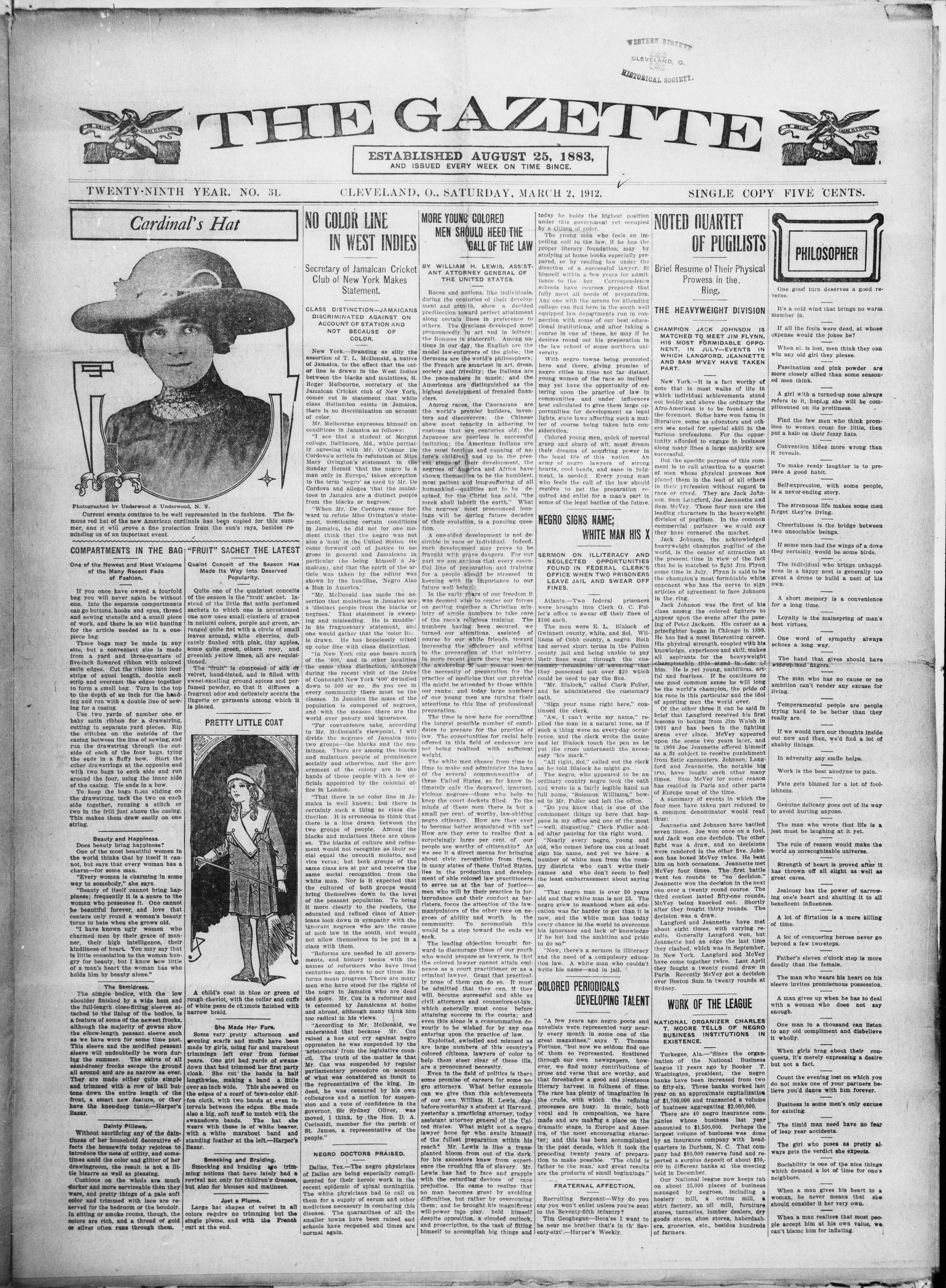
Cardinal's Hat
1
Photographed by Underwood & Underwood, N. Y.
Current events continue to be well represent mous red hat of the new American cardinals ha mer, and it wii prove a fine protection from minding us of an important event.
COMPARTMENTS IN THE BAG "FRUIT"
Current events continue to be well represented in the fashions. The famous red hat of the new American cardinals has been copied for this summer, and it will prove a fine protection from the sun's rays, besides reminding us of an important event.
COMPARTMENTS IN THE BAG | "FRUIT" SACHET THE LATEST
One of the Newest and Most Welcome of the Many Recent Fads of Fashion.
If you once have owned a fourfold bag you will never again be without one. Into the separate compartments can go buttons, hooks and eyes, thread and sewing utensils and a small piece of work, and there is no wild hunting for the article needed as in a one-piece bag.
These bags may be made in any size, but a convenient size is made from a yard and three-quarters of five-inch flowered ribbon with colored satin edges. Cut the ribbon into four strips of equal length, double each strip and overcast the edges together to form a small bag. Turn in the top to the depth of an inch for the heading and run with a double line of sewing for a casing.
Use two yards of number one or baby satin ribbon for a drawstring, cutting in separate yard pieces. Rip the stitches on the outside of the casing between the line of sewing, and run the drawstring through the outside of each of the four bags, tying the ends in a fluffy bow. Start the other drawstrings at the opposite end with two bags to each side and run around the four, using the inner side of the casing. Tie ends in a bow.
To keep the bags from sliding on the drawstring, tack the two on each side together, running a stitch or two in the frill just above the casing.
This makes them draw easily on one string.
One of the most beautiful women in the world thinks that by itself it cannot, but says that every woman has a charm—for some man.
"Every woman is charming in some way to somebody," she says.
"Beauty of itself cannot bring happiness; frequently it is a snare to the woman who possesses it. One cannot be beautiful forever, and love that centers only round a woman's beauty turns to hate when she grows old.
"I have known ugly women who charmed men by their grace of manner, their high intelligence, their kindness of heart. You may say that is little consolation to the woman hungry for beauty, but I know how little of a man's heart the woman has who holds him by beauty alone."
The Semidress.
The simple bodice, with the low shoulder finished by a wide hem and the full-length close-fitting sleeves attached to the lining of the bodice, is a feature of some of the newest frocks, although the majority of gowns show the elbow-length peasant sleeve such as we have worn for some time past. This sleeve and the modified peasant sleeve will undoubtedly be worn during the summer. The skirts of all semi-dress frocks escape the ground all around and are as narrow as ever. They are made either quite simple and trimmed with a row of ball buttons down the entire length of the front, a smart new feature, or they have the knee-deep tunic—Harper's Bazar.
Without sacrificing any of the daintiness of her household decorative effects the housewife today rejoices to introduce the note of utility, and sometimes amid the color and glitter of her drawingroom, the result is not a little bizarre as well as pleasing.
Cushions on the whole are much darker and more serviceable than they were, and pretty things of a pale soft color and trimmed with glaze are reserved for the bedroom or the boudolr. In sitting or smoke rooms, though, the colors are rich, and a thread of gold or silver often runs through them.
with a standing Bazar.
Sr.
Smooch ming no revival n but also.
Large colors no single pl curl at t
The Semidress.
Dainty Pillows.
THE GAZETTE
od, N. Y. represented in the fashions. The fa-
nalis has been copied for this sum-
on from the sun's rays, besides re-
“FRUIT” SACHET THE LATEST
Qualint Conceit of the Season Has Made Its Way Into Deserved Popularity.
Quite one of the quintest concents of the season is the "fruit" sachet. Instead of the little flat satin perfumed sachets to which one is accustomed one now uses small clusters of grapes in natural colors, purple and green, arranged quite flat with a circle of small leaves around, white cherries, delicately flushed with pink, tiny apples, some quite green, others rosy, and greenish yellow limes, all are requisitioned.
The "fruit" is composed of silk of velvet, hand-tinted, and is filled with sweet-smelling ground spices and perfumed powder, so that it diffuses a fragrant odor and delicately scents the lingerie or garments among which it is placed.
PRETTY LITTLE COAT
J
A child's coat in blue or green of rough cheviot, with the collar and cuffs of white peau de chinois finished with narrow braid.
She Made Her Furs
Some very pretty afternoon and evening scarfs and muffs have been made by girls, using fur and marabar trimmingles left over from former years. One girl had yards of swandown that had trimmed her first party cloak. She cut the bands in half lengthwise, making a band a little over an inch wide. This she sewed on the edges of a scarf of tawn-coll-fon cloth, with two bands at even intervals between the edges. She made also a big, soft muff to match with the swandown bands. The hat she wears with these is of white beaver, with a white marabout band and standing feather at the left.—Harper's Bazar.
Smocking and Braiding.
Smocking and braiding are trimming notions that have lately had a revival not only for children's dresses, but also for blouses and matinees.
Just a Plume.
Large hat shapes of velvet in all colors require no trimming but the single plume, and with the French curl at the end.
ESTABLISHED AUGUST 25, 1883 AND ISSUED EVERY WEEK ON TIME SINCE.
CLEVELAND, O., SATURDAY, MARCH 2, 1912.
COLOR LINE IN WEST INDIES
Secretary of Jamaican Cricket Club of New York Makes Statement.
CLASS DISTINCTION—JAMAICANS DISCRIMINATED AGAINST ACCOUNT OF STATION AND NOT BECAUSE OF COLOR.
New York.—Branding as silly the assertion of T. L. McDonald, a native of Jamaica, to the effect that the color line is drawn in the West Indies between the blacks and mulattoes, K. Roger Melbourne, secretary of the Jamaican Cricket club of New York, comes out in statement that while class distinction exists in Jamaica, there is no discrimination on account of color.
Mr. Melbourne expresses himself on conditions in Jamaica as follows:
conditions in Jamaica as follows:
"I see that a student of Morgan college, Baltimore, Md., while partially agreeing with Mr. O'Connor De Cordova's article in refutation of Miss Mary Ovington's statement in the Sunday Herald 'that the negro is a man only in Europe,' takes exception to the term 'negro' as used by Mr. De Cordova and alleges that the malattes in Jamaica are a distinct people from the blacks or negroes.
"When Mr. De Cordova came forward to refute Miss Ovington's statement, mentioning certain conditions in Jamaica, he did not for one moment think that the negro was not also a 'man' in the United States. He came forward out of justice to negroes in general and Jamaicans in particular (he being himself a Jamaican), and that the spirit of the article was taken by the editor was shown by the headline, 'Negro also a Man in America.'
"Mr. McDonald has made the assertion that malattes in Jamaica are a 'distinct people from the blacks or negroes.' That statement is sweeping and misleading. He is muddled in his fragmentary statement, and one would gather that the 'color line' is drawn. He has hopelessly mixed up color line with class distinction.
"In New York city one hears much of the '400', and in other localities the same class distinction, although during the recent visit of the Duke of Connaught New York '400' dwindled down to 300 or so. So you see in every community there must be the classes. In Jamaica the mass of the population is composed of negroes, and with the masses there are the world over penury and ignorance.
"For convenience sake, according to Mr. McDonald's viewpoint, I will divide the negroes of Jamaica into two groups—the blacks and the mulattoes. There are among the blacks and mulattoes people of prominence socially and otherwise, and the government of the colony are in the hands of these people with a few officials appointed by the colonial office in London.
"That there is no color line in Jamaica is well known; but there is certainly such a thing as class distinction. It is erroneous to think that there is a line drawn between the two groups of people. Among the blacks and mulattoes there are classes. The blacks of culture and refinement would not recognize as their social equal the uncouth mulatto, and vice versa; but both groups of the same class are at par and receive the same social recognition from the white man. Nor is it expected that the cultured of both groups would bring themselves down to the level of the peasant population. To bring it more clearly to the readers, the educated and refined class of Americans look down in sympathy with the ignorant negroes who are the cause of mob law in the south, and would not allow themselves to be put in a class with them.
"Reforms are needed in all governments, and history teems with the names of reformers who have lived centuries ago, down to our times. Reforms mean progress. There are many men who have stood for the rights of the negro in Jamaica who are dead and gone. Mr. Cox is a reformer and is esteemed by Jamaicans at home and abroad, although many think him too radical in his views.
"According to Mr. McDonald, we understand that because Mr. Cox raised a hue and cry against negro oppression he was suspended by the 'aristocrats' from the legislative council. The truth of the matter is that Mr. Cox was suspended by regular parliamentary procedure on account of what was considered an insult to the representative of the king. Indeed, he was censured by his own colleagues and a motion for suspension and a vote of confidence in the governor, Sir Sydney Oliver, was moved, I think, by the Hon. D. A. Corinaldi, member for the parish of St. James, a representative of the people."
NEGRO DOCTORS PRAISED.
Dallas, Tex.—The negro physicians of Dallas are being especially complimented for their heroic work in the recent epidemic of spinal meningitis. The white physicians had to call on them for a supply of serum and other medicines necessary in combating this disease. The quarantines of all the smaller towns have been raised and schools have reopened and times are normal again.
MORE YOUNG COLORED MEN SHOULD HEED THE CALL OF THE LAW
BY WILLIAM H. LEWIS, ASSISTANT ATTORNEY GENERAL OF THE UNITED STATES.
Races and nations, like individuals, during the centuries of their development and growth, show a decided predilection toward perfect attainment along certain lines in preference to others. The Grecians developed most pronouncedly in art and in letters; the Romans in statecraft. Among nations in our day, the English are the model law-enforcers of the globe; the Germans are the world's philosophers; the French are smartest in art, dress, society and frivolity; the Italians are the pace-makers in music; and the Americans are distinguished as the highest development of frenzied financiers.
Among races, the Caucasians are the world's premier builders, inventors and discoverers; the Chinese show most tenacity in adhering to customs that are centuries old; the Japanese are peerless in successful imitation; the American Indians are the most fearless and cunning of nature's children; and up to the present stage of their development, the negroes of America and Africa have shown themselves to be the humbleest, most patient and long-suffering of all humankind—qualities not to be depicted, for the Christ has said, "the meek shall inherit the earth." What the negroes' most pronounced leanings will be during future decades of their evolution, is a puzzling question.
A one-sided development is not desirable in race or individual. Indeed, such development may prove to be fraught with grave dangers. For our part we are anxious that every essential line of preparation and training for a people should be stressed in keeping with its importance to our future well being.
In the early years of our freedom it was deemed wise to center our forces on getting together a Christian ministry of ample numbers to take care of the race's religious training. The numbers having been secured, we turned our attentions, assisted of course by our white friends, toward increasing the efficiency and adding to the preparation of that ministry. In more recent years there was begun the awakening of our young men to the necessity of preparation for the practice of medicine that our physical ills might be attended by those within our ranks; and today large numbers of our young men are turning their attentions to this line of professional preparation.
The time is now here for corralling the largest possible number of candidates to prepare for the practice of law. The opportunities for racial help offered in this field of endeavor are not being realized with sufficient weight.
The white men chosen from time to time to make and administer the laws of the several commonwealths of these United States, so far know intimately only the deprived, ignorant vicious negroes—those who help to keep the court dockets filled. To the minds of these men there is but a small per cent. of worthy, law-abiding negro citizenry. How are they ever to become better acquainted with us? How are they ever to realize that a surprisingly large per cent. of our people are worthy of citizenship? As we see it a direct means for bringing about civic recognition from them, in many states of these United States, lies in the production and development of able colored law practitioners to serve us at the bar of justice—men who will by their practice in jurisprudence and their conduct as barristers, focus the attention of the law-manulators of the other race on negroes of ability and worth in the community. To accomplish this would be a step toward the ends we seek.
The leading objection brought forward to discourage those of our youth who would prepare as lawyers, is that the colored lawyer cannot attain eminence as a court practitioner or as a criminal lawyer. Grant that practically none of them can do so. It must be admitted that they can, if they will, become successful and able as civil attorneys and counselors-at-law, which generally must come before attaining success in the courts; and even this alone is a consummation devoutly to be wished for by any one entering upon the practice of law.
Exploited, swindled and misused as are large numbers of this country's colored citizens, lawyers of color to help them steer clear of these ills, are a pronounced necessity.
Even in the field of politics is there some promise of careers for some negro attorneys. What better example can we give than this achievements of our own William H. Lewis, day before-yesterday a student at Harvard, yesterday a practicing attorney, today assistant attorney general of the United States. What might not a negro lawyer hope for who avails himself of the fullest preparation within his reach? Mr. Lewis is like a transplanted bloom from out of the dark; for his ancestors knew from experience the crushing ills of slavery. Mr. Lewis has had to face and grapple with the retarding devices of race prejudice. He came to realize that no man becomes great by avoiding difficulties, but rather by overcoming them; and he brought his magnificent will-power into play, held himself despite opposition, a clouded outlook, and proscription, to the task of fitting himself to accomplish big things and
WESTERN RESERVE
CLEVELAND, O.
HISTORICAL SOCIETY.
today he holds the highest position under this government yet occupied by a citizen of color.
The young man who feels an impelling call to the law, if he has the proper literary foundation, may by studying at home books especially prepared, or by reading law under the direction of a successful lawyer, fit himself within a few years for admittance to the bar. Correspondence schools have courses prepared that fully meet all needs of preparation. Any one with the means for attending college can find here in the south well equipped law departments run in connection with some of our best educational institutions, and after taking a course in one of these, he may if he desires round out his preparation in the law school of some northern university.
With negro towns being promoted here and there, giving promise of negro cities in time not far distant, young women of the race so inclined may yet have the opportunity of entering upon the practice of law in communities and under influences best calculated to give them large opportunities for development as legal lights, state laws affecting such a matter of course being taken into consideration.
Colored young men, of quick of mental grasp and sharp of wilt, must dream their dreams of acquiring power in the legal life of this nation. An army of negro lawyers of strong hearts, cool heads, and sane in judgment, is needed. Every young man who feels the call of the law should resolve to get the preparation required and enlist for a man's part in some of the legal battles of the future.
NEGRO SIGNS NAME;
WHITE MAN HIS X
SERMON ON ILLITERACY AND NEGLECTED OPPORTUNITIES FOUND IN FEDERAL CLERK'S OFFICE WHEN TWO PRISONERS LEAVE JAIL AND SWEAR OFF FINES.
Atlanta—Two federal prisoners were brought into Clerk O. C. Fuller's office to swear off their fines of $100 each.
The men were E. L. Blalock of Gwinnett county, white, and Sol. Williams of Cobb county, a negro. Both had served short terms in the Fulton county jail and being unable to pay their fines went through the customary formalities of swearing that they possessed not over $20 which could be used to pay the fine.
"Mr. Blalock," called Clerk Fuller, and he administered the customary oath.
"Sign your name right here," continued the clerk.
"Aw, I can't write my name," replied the man in a natural tone, as if such a thing were an every-day occurrence, and the clerk wrote the name and let Blalock touch the pen as he put the cross underneath the necessary "his mark."
"All right, Sol," called out the clerk as he told Blalock he might go.
The negro, who appeared to be an ordinary country negro took the oath and wrote in a fairly legible hand as full name, "Solomon Williams," bowed to Mr. Fuller and left the office.
"Do you know that is one of the commonest things up here that happens in my office and one of the most—well, disgusting," Clerk Fuller added after pausing for the right word.
"Nearly every negro, young and old, who comes before me can at least sign his name, and yet we have a number of white men from the country districts who can't write their names and who don't seem to feel the least embarrassment about saying so.
"That negro man is over 50 years old and that white man is not 25. The negro grew to manhood when an education was far harder to get than it is now, and the white man has today every chance in the world to overcome his ignorance and lack of knowledge if he but had the ambition and pride to do so."
"Now, there's a sermon in illiteracy and the need of a compulsory education law. A white man who couldn't write his name—and in jail.
COLORED PERIODICALS
DEVELOPING TALENT
"A few years ago negro poets and novelists were represented very nearly every month in some one of the great magazines," says T. Thomas Fortune, "but now we seldom find one of them so represented. Scattered through our own newspapers, however, we find many contributions of prose and verse that are worthy, and that foreshadow a good and plenteous literary harvest in fullness of time. The race has plenty of imagination in the crude, with which the refining processes are busy. In music, both vocal and in composition, we have made and are making a place on the dramatic stage, in Europe and America, of the most encouraging character; and this has been accomplished in the past decade, which it took the preceding twenty years of preparation to make possible. "The child is father to the man," and great results are the products of small beginnings."
FRATERNAL AFFECTION.
Recruiting Sergeant—Why do you say you won't enlist unless you're sent to the Seventy-fifth infantry?
Tim Geoghegan—Beca'se I want to be near my brother that's in th' Seventy-sixt.'—Harper's work
TE SINGLE COP
NOTED QUARTET OF PUGILISTS
Brief Resume of Their Physical Prowess in the Ring.
THE HEAVYWEIGHT DIVISION
CHAMPION JACK JOHNSON IS MATCHED TO MEET JIM FLYNN, HIS MOST FORMIDABLE OPPONENT, IN JULY-EVENTS IN WHICH LANGFORD, JEANNETTE AND SAM MVEY HAVE TAKEN PART.
New York.-It is a fact worthy of note that in most walks of life in which individual achievements stand out boldly and above the ordinary the Afro-American is to be found among the foremost. Some have won fame in literature, some as educators and others are noted for special skill in the various professions. For the opportunity afforded to engage in business along many lines a large majority are successful.
But the specific purpose of this comment is to call attention to a quartet of men whose physical prowess has placed them in the lead of all others in their profession without regard to race or creed. They are Jack Johnson, Sam Langford, Joe Jeannette and Sam McVey. These four men are the leading characters in the heavyweight division of pugilism. In the common commercial parlance we would say they have cornered the market.
Jack Johnson, the acknowledged heavyweight champion pugilist of the world, is the center of attraction at the present time in view of the fact that he is matched to fight Jim Flynn some time in July. Flynn is said to be the champion's most formidable white opponent who has the nerve to sign articles of agreement to face Johnson in the ring.
Jack Johnson was the first of his class among the colored fighters to appear upon the scene after the passing of Peter Jackson. His career as a prizefighter began in Chicago in 1899. He has had a most interesting career. His physical strength, coupled with his knowledge, experience and skill, makes all aspirants for the heavyweight championship title stand in fear of him. He is yet young, ambitious, artful and fearless. If he continues to use good common sense he will long be the world's champion, the pride of his race in this particular and the idol of sporting men the world over.
Of the other three it can be said in brief that Langford received his first lessons in boxing from Jim Walsh in 1901 and has been in the fighting arena ever since. McVey appeared upon the scene two years later, and in 1904 Joe Jeannette offered himself as a fit subject to receive punishment from fist encounters. Johnson, Langford and Jeannette, the notable big trio, have fought each other many times. Sam McVey for some reason has resided in Paris and other parts of Europe most of the time.
A summary of events in which the four men have taken part reduced to a common denominator would read thus:
Jeannette and Johnson have battled seven times. Joe won once on a foul, and Jack won one decision. The other fight was a draw, and no decisions were rendered in the other five. Johnson has boxed McVey twice. He beat him on both occasions. Jeannette met McVey four times. The first battle went ten rounds to "no decision". Jeannette won the decision in the next one over a twenty round course. The third contest lasted fifty-one rounds, McVey being knocked out. Shortly after they fought thirty rounds. The decision was a draw.
Langford and Jeannette have met about eight times, with varying results. Generally Langford won, but Jeannette had an edge the last time they clashed, which was in September, in New York. Langford and McVey have come together twice. Last April they fought a twenty round draw in Paris. Recently McVey got a decision over Boston Sam in twenty rounds at Sydney.
WORK OF THE LEAGUE
NATIONAL ORGANIZER CHARLES T. MOORE TELLS OF NEGRO BUSINESS INSTITUTIONS IN EXISTENCE.
Turkegeen, Ala.—'Since the organization of the National Business league 12 years ago by Booker T. Washington, president, the negro banks have been increased from two to fifty-six. These banks worked last year on an approximate capitalization of $1,700,000 and transacted a volume of business aggregating $2,000,000.
There are 40 negro insurance companies whose business last year amounted to $1,500,000. Perhaps the largest volume of business was done by an insurance company with headquarters in Durham, N. C. That company had $80,000 reserve fund and reported a surplus deposit of about $30,000 in different banks at the meeting held in December.
Our National league now keeps tab on about 25,000 places of business managed by negroes, including a hosiery mill, a cotton mill, a shirt factory, an oil mill, furniture stores, tanneries, lumber dealers, dry goods stores, shoe stores, haberdashers, groceries, etc., besides hundreds of farmers.
SINGLE COPY FIVE CENTS.
Y FIVE CENTS.
PHILOSOPHER
One good turn deserves a good re-
verse.
It's a cold wind that brings no warm
member in.
If all the fools were dead, at whose
expense would the jokes be?
When al. is lost, men think they can
win any old girl they please.
Fascination and pink powder are more closely allied to some seasoned men think.
A girl with a turned-up nose always refers to it, hoping she will be complimented on its prettiness.
Find the few men who think promises to women count for little, then put a halo on their fuzzy hats.
Convention hides more wrong than it reveals.
To make ready laughter is to prepare a good habit.
Self-expression, with some people, is a never-ending story.
The strenuous life makes some men forget they're living.
Cheerfulness is the bridge between two unsociable beings.
If some men had the wings of a dove they certainly would be some birds.
The individual who brings unhappiness in a happy nest is generally too great a drone to build a nest of his own.
A short memory is a convenience for a long time.
Loyalty is the mainspring of man's best virtues.
One word of sympathy always echoes a long way.
The hand that gives should have wide-opened fingers.
The man who has no cause or no ambition can't render any excuse for living.
Temperamental people are people trying hard to be better than they really are.
If we would turn our thoughts inside out now and then, we'd find a lot of shabby linings.
In adversity any smile helps.
Work is the best anodyne to pain.
Fate gets blamed for a lot of foolishness.
Genuine delicacy goes out of its way to avoid hurting anyone.
The man who wrote that life is a jest must be laughing at it yet.
The rule of reason would make the world an unrecognizable universe.
Strength of heart is proved after it has thrown off all slight as well as great cares.
Jealousy has the power of narrowing one's heart and shutting it to all beneficent influences.
A lot of flirtation is a mere killing of time.
A lot of conquering heroes never go beyond a few two-steps.
Father's eleven o'clock step is more deadly than the female.
The man who wears his heart on his sleeve invites promiscuous possession.
A man gives up when he has to deal with a woman who does not say enough.
One man in a thousand can listen to any old compliment and disbelieve it wholly.
When girls brag about their conquests, it's merely expressing a desire but not a fact.
Count the evening lost on which you do not make one of your partners believe you'd dance with him forever.
Business is some men's only excuse for existing.
The timid man need have no fear of leap year accidents.
The girl who poses as pretty always gets the verdict she expects.
Sociability is one of the nice things which demand a lot of time for one's neighbors.
When a man gives his heart to a woman, he never means that she should consider it her very own.
When a man realizes that most people accept him at his own value, we can't blame him for inflating.
THE GAZETTE
PUBLISHED EVERY SATURDAY
One Year.....$1.50
Six Months.....1.00
Three Months.....5.0
Subscribers are requested to remit by postoffice money order or registered letter.
Entered at the postoffice in Cleveland Ohio, as second-class matter
Address all communications to HARRY C. SMITH
Editor and proprietor, THE GAZETTE,
Blackstone Building, Cleveland, O.
Member Ohio Legislature: 1894 to 1896; 1896 to 1898; 1900 to 1902
THE GAZETTE is the oldest, and has the largest bona fide circulation, double that of any newspaper in the interest of Afro-Americans, published in the state of Ohio, and comparison with any will immediately establish its rank as one of the NEWSIEST AND BEST in the country.
It is well to "remember Brownsville," these days. It will keep many too impressionable members of the race from "losing their heads."
With Roosevelt and Taft, Republican candidates on one side, and the democratic candidates on the other, the Afro-American is "between the devil and the deep blue sea" in national politics, this year, sure enough
Taft's "Ily-white" state organizations in the south are "firing" Afro-Americans out of the party, "by the wholesale." We will have very few delegates in the next Republican National Convention if he controls it. That much is already clear.
Prejudiced Army officers are making life a burden for Lieut. Bloom, the only Jewish officer in the U. S. Army, just as they did for Lieut. Flipper and several other Afro-American Army of flicers who followed him. SHAME!
Chicago and Philadelphia Afro-Americans would have "jim-crow" Y. M. C. A.'s. Now the prejudiced "whites" who urged them on, in those movements, are demanding that they have "jim-crow public" schools also and a hot_fight is on as a result. Columbus, O., Afro-Americans should take warning early, as the same prejudiced "white" element in that city has foisted a "jim-crow public" school building on them and is urging a "jim-crow" Y. M. C. A. with the help of a few "jim-crow" Negroes, Lord, have mercy! "jim-crow Y. M. C. A.'s and public schools go hand in hand." Beware!
The man who suffers personal wrong without protest or opposition, the "peaceful" member of the community, is a demoralizing factor in our social fabric. The class that does not struggle for civic and industrial rights will eventually lapse into slavery. The nation that passively countenances encroachments upon its rights and territory is doomed to dismemberment and national bankruptcy. It is the man who defends his rights, the class that battles for political and industrial advancement, and the nation that holds its own against the entire world; it is the "litigious" person, the revolutionary class, and the vigilant nation, that keep the world from stagnation and force it onward on the path of progress—Hillquit.
Ohio Afro-Americans continue "to sleep on their rights". See The Gazette's Columbus letter elsewhere in this paper. Absolutely nothing has been done by our people or anyone else to help Delegate Cunningham get his resolution, known as "Proposal N. 5", out of the Ohio Constitutional Convention committee to which it was consigned on Jan. 17, 1912—so he informed the editor of The Gazette on Wednesday of this week. SHAME! What is the matter with our people in this-state, these days, anyhow? Don't they want the "right" to vote and to enter the state's military after the new state constitution is made and accepted by the voters of Ohio? Don't they want Ohio citizenship? Really they are, apparently, "past understanding."
The American daily newspaper in Havana, Cuba, known as the Telegraph, ignoring the fact that one-third of the population of that island republic are Colored, has in its issue of Feb. 11, "12 a column and a quarter triple-leaded editorial in which it tries to array Afro-Americans against the Cubans in general because some misguided Cuban paper in Havana recently called for our exclusion from that country. An effort is being made to make the Cubans believe that a wholesale emigration of Afro-Americans to their country is soon to take place in an effort to help the Americans "gobble up" their little country. Naturally excitable and easily irritated along this particular line, it is very natural that at least one Cuban paper "would lose its head" and publish such unnecessary "stuff" as the demand for exclusion referred to. Afro-Americans, however, refuse to "bite" at the Telegraph's "bait" and thus be led into making a somewhat similar blinder to that of the Cuban paper, and also become the "tools" of designing Americans of wealth and power in the business world of both "bite" and Cuba, as said Cuban paper has unconsciously.
TO A COMPOSITE-AMERICAN
EDITOR.
The Macon (Ga.) Daily Telegraph did not take very kindly to our editorial of Feb. 10 in which we took occasion to tell it and its southern daily contemporaries a few pertinent things anent the people of that section. It undertook to "slidtrack" the question at issue by "scolding" The Gazette for publishing a certain class of advertisements similar to the Telegraph's "William Russell Beauty Secret" adver-
tirement and others. That our readers may know just what we did to say to the Telegraph's editor, we herewere republish The Gazette's editorial to which the southern editor falls, utterly, to make answer, but "side-steps": A Question of Rights, Not Across. Etc. What the Southern daily newspaper refuses to even consider is the fact that the Afro-American in that section does not get anything near like the treatment, as regards his rights and privileges, a man and citizen of this country is entitled to. This latter is true in the North but in no such agravating degree as in the South. It is not a question of how many acres the man and citizen he operates, or how many farm or other laborers he employs, or indeed, how often he has put the first bale of cotton on the market east or west of the Mississippi, but it is a simple question of treatment as a man and citizen; less lynching, etc. When these self-same Southern daily papers like the Charlotte (N. C.) Observer and Macon (Ga.) publicans, recognize the fact that he start in to work less little more of it the Afro-American in that section, they will not be so terribly "worked up," so often, as the result of righteous criticism of the South's worse than hellish treatment too often, of its Colored citizens, as they were recently because of the assistance of one Dr. Holmes of N. Y. Citizen, who helped the Southern Negro be better protected in his rights.—The Gazette, Feb. 10.12
We are pleased to note that the Telegraph is opposed to lynch-murder and sincerely trusts that it sneaks out against it in a much more direct way than it took to "reply" to our editorial. So intelligent a publication could afford to stop "hugging to its breast" the old, worn-out scarecrow, "Negro rule". That it "has always stood for the just and fair treatment of the individual black man" (and woman too, we hope) is encouraging, and we trust it will continue to do so. Surely we have no desire to say anything that will have a tendency, in the slightest, to lessen the Telegraph's helpful efforts in behalf of our people in either or both sections of the country. We all take great satisfaction and encouragement from the industrial and commercial advance of our people everywhere, particularly in the south. But that this success equals, or must in any way obscure the question of the Afro-American's civil or citizen rights and privileges in that or any other section, is not to be entertained for a moment, and it is the merest waste of time for the daily papers of the south to attempt to teach such an unAmerican and vitally injurious doctrine. Their idea that the intelligent, manly and loyal member of the race who contends for his rights and privileges as an American citizen, wants to be "white" is ridiculous because no man's skin-color is that of any other credit to him. Especially is this true when we remember that only a minority of the people of the world are "white". Furthermore, this race of ours is very "c cosmopolitan" when it comes to the matter of color, anyhow, having about all that the races of the earth possess. For this, we have much to remember the "chivalrous white south". Mr. Telegraph editor. Again, dear sir, the Afro-American has no more and no worse "indulible racial marks" than any other class of Americans, if indeed it has as many. Any he may possess, that are objectionable, can in a very large degree be attributed to his too close and questionable "association", when he was helpless before and after the war of the rebellion, with the "south's chivalry". Historians and scientists claim, not the Gazette (we are free to confess that we do not know; so accept their statement) that "all races of men were originally of a brownish-yellow color" and that "the changes in color were caused merely by climatic conditions". Surely the Telegraph's editor has not the temerity to question this long-accepted explanation? One thing our southern contemporary may rest assured of and that, is that the intelligent Afro-American, and he is increasing in number every hour, will never be satisfied with disfranchisement, "jim-crow" cars, etc., lynch-murder, or anything less than all the rights and privileges due an American citizen without reference to the mere accident of color. And he will never cease contending for them as long as life lasts, or they are freely granted, south and north. Any other course would not be manly, and certainly would not be American; and we are Americans "to the manor born."
CORRESPONDENTS WANTED.
The old reliable Gazette desires an active agent and correspondent in every city and town in Ohio and neighboring states having a number of Afro-American residents. Only a little time on Fridays or Saturdays is required.
We are especially desirous of hearing from persons in the following named cities: Zanesville, the ewark, Columbus, Chillicot, the ledo, Troy Canton, Springfield, Plaquia, Columbus, Cambridge, Steubenville, Bellaire, St. Clairsville, Wilmington, Portsmouth, Washington, C. H., Oxford, Sabina, Gallipolis, Oberlin, Urbana, Delaware, M. Vernon, East Liverpool, Wellsville, Hamilton, Middleport, Bellefontaine, Lima, O., and other places where we have none.
Write to the editor of the Gazette, Blackstone building, Cleveland, O., and term we be sent promptly. Our笔 will oblige us greatly by sending at once the addresses of persons in the cities named above, or others, to whom we can write relative to the matter.
Plea for the Sparrow.
Plea for the sparrow
Every little while some one starts an agitation against the sparrows, which are so plentiful in all our parks in the north during the wintertime claiming that they drive other birds their nests and that they litter up suburban plazas. But the sparrows, with the doves, bobolins finches, quail and blackbirds, are friends to the gardener at all seasons and times, because they eat weeds. And the sparrows, because of their pluckiness and numbers, lead all the others as weed destroyers. In the wintertime, sparrows exist almost entirely on weed seeds, as the ground is altogether too hard in the northern attitudes to permit them to secure any of the succulent worms with which they regale themselves in summertime. That means less weeds.—suburban Lite.
THE GAZETTE, CLEVELAND, O., SATURDAY, MARCH 2, 1912
PRESIDING ELDERS IN COUNCIL.
Officers Elected a Surprise to Some—Important Sessions—Banquet, etc.
CONSTITUTIONAL CONVENTION.
The August Ohio Body Still in Session—Nothing Done on the New
BUCKEY
Washington, Pa.—The Presiding Elders of the third episcopal district of the A. M. E. church, met in St. Paul's church, this city, last Wednesday. In the absence of Bishop W. B. Derrick of the Episcopal Diocese of R. D. Dr. W. Va., was elected to preside. Dr. Downs is a candidate for the chairmanship of the General Conference Episcopal Committee. Dr. J. M. Glmere, P. E., of a college, to the secretaryship of the Church Extension Department, was made secretary. The election of officers of the Council on the eve of the General Conference is regarded as a significant as some exponents of the church. P. E., to the chairmanship. All the presiding elders of the district, except Rev. C. S. Gee, who was ill, were present and much important business transacted in executive sessions. Resolutions, thanking the pastor and congregation of St. Paul's church for the appreciation of entertainment, were unanimously adopted. A banquet closed the meet.
Miss Diana Hackley Contralto
Chicago, Ill.—One of the best and most popular soloists at the Choral Study Club's recent concert at Grace Presbyterian church, was a local favorite and charter member of the oratory. He merely a resident of Springfield, O. The concert was an exceptionally fine one, too.
Wanted—Live Agents.
Men and women wanted to introduce high grade household specialties into every home. Quick sales, big free sales, free catalog. Address, The Household Supply Co., No. 56 N. Cemetery St., Athens, Ohio. 3t
The Next "Bon" Concert
While last Sunday afternoon's Cleveland Symphony Orchestra concert was grand, the one for next Sunday, 3 p.m., Gray's Armory, is to be even better. Do not miss it. Many of our best people attended last Sunday and more should be present next Sunday to hear the following splendid PROGRAM.
1. March—Militiae ..... Elgar
2. Overture — Midsummer Night's Dream ..... Mendelssohn
3. (a) He, Watching Over Israel.
(b) He, Be Afraid.
(Prom Elijah) ..... Mendelssohn
Harmonic Club and Orchestra.
1. Powell Jones, Director.
B. Ballet Music - All Baba. Cherubin
Waltz ..... Tschalkowsky
dagio Cantabile R. Strauss
Piano Minor Piano
Suite - From the South ..... Nicode
Resolutions Adopted
WHEREAS—The recent Wednesday evening Central Av., murder again calls the public's attention to the great need of better police protection and greater police activity in the Eleventh ward, especially along Central Av., and WHEREAS—Our Afro-American Law and Order Reform League and Clergy men of Cleveland, repeatedly petitioned mayor Hermann Bacon and Chief Fred Fred. Kokane year, for this better police protection and greater police activity in this section but in vain, therefore be it.
RESOLVED—That AfroAmericans of the Eleventh ward of Cleveland, assembled in mass meeting at Shiloh Baptist church, E. 30th. St., this day, Sunday, Feb. 18, 1912, respectfully petition Mayor Newton D. Baker to immediately order a "clean-up" of Centerville, the city of the indwelling and criminal element that has assembled in the last few years, enticed by the local "GOLDEN RULE" policy, coming principally from the large cities within a radius of 200 miles and even from Chicago and New York City; and to order better police protection and greater police activity for the 11th., ward, in order that it may no longer be the "camping-ground or harbor" of the city of Pittsburgh, Wheeling, Columbus, Chincinnati, Detroit, Chicago and New York City. Further be it
RESOLVED—That a committee of five of our leading citizens be appointed by the Chairman of this meeting, representing the 11th., ward of Cleveland, and particularly our Ministers' Association, Law & Order Reform League and Citizens' Rights League, to call upon Mayor Newton D. Baker, this week, present these resolutions and confer with him, with a view to secure police activity in said ward and thus help to materially rid this section of the city, of the indolent, vicious and criminal element that has disgraced it and the city entirely too frequently in recent years with murders, highway robberies, other crimes and misdemeanors.
RESOLVED—That a copy of these resolutions be sent not only to the Mayor and the Chief of Police, but also to the daily newspapers and our own weekly paper. The Gazette.
BOOKER'S GREAT SECRET
OF THE MIND
The secret of every human being is the power which they possess to influence and control others. It is important that you should know just what powers for good you possess, and the time that you are ignorant of this power may be considered lost time and opportunity, as "time and tide walt on no man." Learn all you can and understand that knowledge and will power is lower. Don't it worth trying for? Be frank, send for the secrets, you will find just what you need to cultivate a charming and pleasing personality. You have got to have some way of attracting people. Do not let the present doubt and darkness obscure the light that is waiting to shine on you, and will shine on you all the balance of your life if you take my advice. We take the Bible as our guide. Now we understand the universities of gifts, but the same spirit.
And there are differences of administrations, but the same Lord.
For to one is given by the spirit the word of wisdom; to another the word of wisdom; to another the word of wisdom.
To another faith by the same spirit; to another of gifts of healing by the same spirit.
But all these worketh that one and the selfsame spirit, dividing to every man severally as he will.
The same works which I possess lovers are brought together; broken-hearted wives are relieved of their jealous forebodings; the separated are united and many bad habits cured. My secrets teach you how to control others; how to speculate; how to control health, wealth and happiness. Just follow the instructions and success and power is yours to have and to hold.
Positively no attention paid to letters unless one dollar is enclosed.
Address all communications to E. Booker, 806 Wylie avenue, Pittsburgh.
The August Ohio Body Still in Ses-
sion—Nothing Done on the New
Fourth Constitutional Convention. Pro
To submit substitute for Article No. 5 of the Constitution—Relative to elective franchise.
Resolved by the constitutional convention of the state of Ohio, That a proposal shall be submitted to the state of Ohio by the constitution, substituting for Article 5 of the constitution the following:
Section 1. Every male citizen of the United States of the age of twenty-one years, who shall have been a resident of the state one year next preceding the election, and who shall, prescript or ward in which he resides, such time as may be provided by law, shall have the qualification of an elector and be entitled to vote at all elections. But no idiot or insane person shall be entitled to the privilege of voting.
Section 2. All elections shall be by ballot, and canvassed in such manner as may be provided by law.
Section 3. Electors during their attendance at elections, and in going to and returning therefrom shall be privileged from arrest in all cases, except in cases of intoxication and breach of the peace.
Section 4. The general assembly shall have power to exclude from the privilege of voting or of being eligible to office, any person convicted of bribery, perjury or other infamous crime. Section 5. No person in the military or any other United States shall be being stationed in any garrison or military or naval station within the state, be considered a resident of this state, and in time of war, no elector in the actual military service of the state or of the United States, in the army or navy by reason of his absence from his election district; and the legislature shall have power to provide the manner in which and the time and place at which he may be returned for the return and canvass of their votes in the election districts in which they respectively have a residence.
ATTENTION, READERS!
Don't throw away your copy of The Gazette when you have done with it, but give it to some appreciative person whom you feel would be likely to subscribe or take it regularly, if they had a copy to look over and read carefully. Oblige the
Again We Say Subscribe for THIS PAPER
BUGKEYE LETTERS
WRITTEN BY "THE OLD RELIABLE" GAZETTE'S CORRESPONDENTS.
THROUGHOUT OHIO
What Our People Are Doing Each Week—Church, Personal, Social, Lodge, Literary and Musical — Marriages, Deaths, Etc.
Sandusky.—Mr. and Mrs. Geo. and Roy Smith are ill.—Mrs. G. D. Smith went to Cleveland, Sunday.—Rev. D. Bass is having success with the revival at the A. M. E. church. —Mr. and Mrs. Bass is having success with the revival, Creek, Mich. They visited their daughter, Mrs. Lett, eight weeks. Hand news to the local agent. The Second Baptist B. Y. P. U. meeting, Sunday evening, was a success. Mr. and Mrs. J. Davis, Mrs. H. Richards, Mr. J. Shad, Mrs Mary Jones and Miss Sarah Johnson have good talks.
Rendville.—Mr. Robert McGinnis, a widower and pensioner, died Monday; aged 75. Five boys and two sisters survive him.—Miss Claudia Moore who has been in Cleveland some time, improving at the hospital in Columbus.—Dr. J. L. Johnson has been elected secretary of the Betterware Pottery Co. Zanesville.—Mr. D. Ginn of Pomeroy, visited relatives here, Sunday.—Rally, Sunday at the A. M. E. church; preaching by Rev. Carroll; preaching The Gazette from Walter G. Arnold.
---
Lorain—Little Lucille Tates is improving. Also Mrs. Robinson of S. Lexington St. Mrs. S. E. Dobson is convalescent. Typhoid fever—Mrs. Moore, Mrs. Brown, Mr. and Mrs. Simms of Elyria, attended the loveeast at St. Matthews' church, Sunday morning, Rev. J. M. Gilmere, P. E. delivered an able sermon in the evening, and administered sacrament. He held quarterly conference, Monday evening and a church meeting along nicely under the leadership of Rev. G. L, Hicks—Mr. H. Tates had a bad fall, last Monday. S. E. Bond was able to return to work. Monday—Mrs. Brown is ill.
Akron—Mr. Jas. Morrison is planning a visit with his daughter, Mrs. Anna McMillan of N. Y. City—Mr. John McElwain and Mrs. Julia Penn are ill—Rev. Jones will celebrate the 10th anniversary, Mar. 3—W. Ferrell, John McElwain, and Mrs. Julia Penn recently in the interest of the Ohio Industrial Home for Friendless and Poor Widows and Children, Cincinnati. Mr. David Dandridge, after a lengthy illness, is able to get about with the aid of crutches. Mrs. Ella Morrison and her brother have been relatives—Mrs. Rideout is convalescent; your friends to order The Gazette from the local agent, and give him your local news for this letter.
Correspondents must mail all letters for publication at their main postoffice sufficiently early on Monday (or Sunday) of each week to have them reach The Gazette office on Tuesday morning, and always write, also, their names and that of their city or town on the outside of the postoffice. If the letter less this latter is done, proper credit cannot be given you. Lists of names, wedding presents, etc., obituary notices, speeches, resolutions, poetry, inquiries for relatives and advertisements of all kinds, including items announcing entertainments to be held in advance at the rate of ten cents a line, six words to a line. Our rates for display advertisements will be sent on application. Send postal note and not stamps during warm weather.
Cadiz. — The Lincoln anniversary held at the M. E. church was a success. The speakers were B. S. Lee, Prof. W. H. Lucas and R. B. Beetham. — There were many out of town friends and relatives here attending the funeral of Cage Epps. — Mrs. Jenne Davis entertained at her birthday dinner on the 16th, Mr. and Mrs. Melvin Williams, Messrs. Dorell Donahue, Davis Carter and Carter Wynter Tyler here. — Mrs. W. A. Mason is sick. Helen Duling is convalescent. — Be sure to join the "True Blues." It means something to the community. — The H. H. Club gave a "shower" to the C. I. C's were entertained by R. F. Ballard, the 22nd, with Class No. 6 and Miss H. Lucas, as guests. A "George Wash-
Smithfield.—The A. M. E. S. S. was better attended Sunday than for a long time. Parents should take more interest in it. The stewardesses' Valentine social, the 22d, for the benefit of the trustees, was quite a success. The children were surprisingly surprised, Sunday evening, on returning from church to find that her children had prepared an elaborate dinner in honor of her 59th birthday. Mrs. Geo. West of Cadiz, is visiting the children. Charles, Center and Patrick Smith of Cadiz, the former's mother, Sunday.—Miss Mamie Harris of Cadiz, spent Sunday with her mother.—Miss Mattie West dined and spent Sunday 'afternoon with Miss Julia May Veney.—Mesdames E. Powell and A. Palmer are connexions at dinner. G. E. Beall entered at dinner. Sunday. Smith and children of Chestnut Ridge
—M. E. Smith of McIntyre, visited his sister, Mrs. E. Powell—Mrs. Jordan of Fernwood, was Mrs. N. Mitchell's guest, Saturday and Sunday.—Mr. A. Reed and G. Fouch of Steubenville, were here last week.—Miss M. Beall entertained Mr. F. Faithful, Sunday.—Misses Sarah, Alice and Mrs. J. Beall, were here to visit videotape, recently.—Mr. Jas Green of the nortin's Ferry, formerly of this place, is reported seriously ill. He has been sick for some time.
When your Gazettes are not delivered on Friday mornings, call at your Central Postoffice General Delivery Window for them in the afternoon of the same day. —Editor.
Youngstown.—Mr. and Mrs. V. Stewart's daughter, who arrived from Cleveland, Sunday, entertained playmates on her eighth birthday, Games and music. She received many beautiful presences. Those present: Bertha Monson, the daughter of Geraldine Myers, Lillian, Blanche and Robert Duncan, Virgil Howard, Calarce Stewart, Hannah Jones, Leo Patterson, "Buster" Richardson and Harry Rose.—Oscar E. Holmes and Mary E. Dewynw were married on the 22d at the bride's mother, Mrs. Miranda A. Allen's. Décorations were in pink and white carnations, and the bride wore a gown of grey silk, trimmed with cream lace. Revenues S. Monsoon, Mary Hood, handmade wore were worn, lunch served and a large number of beautiful and useful presents received. A reception followed on March 1. The wedding was an elaborate affair.—Oak Hill A.V. Sewing Circle's "Old Maid's" convention, March 5.—Miss Wilma Guyder is visiting relatives in Steubenville.—Miss Thelma Lucas is to attendville to Miss Laura Williams' infant son, is ill.—Mrs. F. H. Hood was on operation at the Youngtown City hospital two weeks ago, is convalescent.—Miss Lucy Freeman of this city and Charles C. Alexander of Unontown, Pa., were quietly married last Wednesday and will make their home here.—Mr. and Mrs. William Hicks entertained last Friday after the wedding. Lunch was served and many useful presents were received.—George Fountain, driving for the Youngstown Ice Company from the Witch Haze yards, was caught under an overturned load of coke on the Wahuna street hill, last Wednesday forooned and severely bruised about the body. He was removed to the City hospital and Geraldine Myers, William Hood, trained in honor of their fifth wedding anniversary, last Wednesday evening Music, the discussion of the topic of the day and lunch.
THE BUCHANAN PHARMACY
A Creditable Race Enterprise—Laps
ley of Michigan University to
"Come Back" This Year.
Detroit, Mich.—One of the race's
local enterprises we are most proud
of is the Buchanan Pharmacy, cor-
Buchanan and 23d St. Alexander L.
Buchanan, 23d St. Alexander L.
Dr. Turner will finish his studies
at the State University and open offi-
ces over the Drug store in the spring.
T. E. H.
This will be pleasing news to Mr. and Mrs. Turner's many friends not only in this state and in the east but also in Ohio where they formerly lived—at Ravenna. The latter will readily be remembered as Miss Leota F. Henkel, a graduate of theamous Fisk Jubilee Singers—Lapsley, the great spinner, at Michigan University, will, in spite of the "knocking" of the Daily Times News of Ann Arbor, and its prejudiced kind, make the team again this year, that a such heads" in and out of the daily news paper business in this country only:
From Farm Hand to Stateman
Joseph Taggart, who went to congress a few days ago from the second Kansas district, began life as a farm hand. By teaching in the little school houses which with their cyclone cellars dot the plains of Kansas he earned the money that paid for his legal education. He came to general notice throughout the west by solving three murder mysteries—Eyebake.
Didn't Get Evan the Brick
"Did that man hand you a gold trick?" "I should say not," answered the amateur financier; "the so me an interest in the gold brick on credit and took a mortgage on that treerer with everything else I owned. I then bought the brick on credit and took possession of the mortgage and took possession of the gold brick along with it."
BROWN DRUG CO.
"THE MUTUAL STORE."
2. 7242 Central Ave., cor. E. 28th St.
Cut this ad, out and present it at the Brown Drug Co. and receive free sample of
B. and M. HAIR DRESSING.
This dressing is especially recommended where t.e. hair is stubborn or curly, as it not only makes the hair soft, glossy and straight, but also easy to dress.
B. and M. Hair Dressing is highly perfumed, has a very beneficial effect on the scalp, and is a splendid hair-tonic.
BROWN DRUG CO.
Exclusive Sales Agents.
McCall's Magazine and McCall Patterns
For Women
Have More Friends than any other magazine or pattern. McCall's is the reliable Fashion Guide monthly in one million one hundred thousand homes. Besides showing all the latest designs of McCall Patterns, each issue is brimful of sparkling short stories and helpful information for women.
Save Money and Keep in Style by subcribing to McCall's magazine at once. Only costs a year, including any one of the celebrated McCall Patterns tree.
McCall Patterns Lead all others in style, for women. McCall's will tell McCall Patterns that any other two mink combined. None higher than 18 cents. Buy from your dealer, or by mail from
McCALL'S MAGAZINE
236-246 W. 37th St., New York City
New-Sample Copy, Premium Catalogs and Pattern Catalogs, One
DOINGS
OF
THE
RAGE
Mixed marriages are barred in the Samoan Islands' colonies governed by Germany.
This is to be a great year for politics and you will need The Gazette more than ever. Subscribe!
Will Marion Cook is the composer of "in Dahomey," "Abyssinla," "Bandama Land" and "The Casino Girl." Mr. Jesse Binga, the only Colored student in the school, recently to Miss Endora Johnson, said to be the wealthiest Colored girl in that city. A Mr. Bryant recently won a civil rights suit against a Boston, Mass., judge, Judgment $75. He also had the hattender arrested and fined $25. Good! Private Lucius Banks, cavalry detachment, has accepted a position as an athlete with the Hunttsle A. C. of England, for which purpose he sailed on the musical on the 13th inst. for a new field school. S. Coleridge-Taylor has been recently elected principal Professor of Musical Composition at the Guildhall School of Music, London. For five years he has been and still is, constructor of the Handel Society of London.
Physicians at the Pennsylvania hospital, Philadelphia, are amazed at the case of Louisa Miller, a young Negro of 609 Dew Lancey St, whose neck was broken in two places when she fell through a skylight, but who still lives.
The Crawford House of Boston, Mass. has discharged its Colored waiters. Head-waiter Walter Brooks and his 11 assistants, some of whom have been employed at the hotel for more than a decade, were paid off and notified that their services were no longer required.
Lilly Hill, of Washington Co., Tenn. who shot and painfully wounded a white man who had pursued her, was pardoned recently by Gov. Hooper. The woman was convicted at the October term of court and sentenced in 11 months and 29 days in jail, and fined $50. The fine was not remitted.
We extend to John Mitchell, Jr., editor Richmond Planet, our heartiest commissionation for his bravery and race love for its good, and to Harry C. Smith, for what he has almost worked his life out to accomplish for the god of those who are a bone of his bone and blood of his blood. Our readers have been charmed by their comprehensive, almost cyclopedic information which they have displayed for the race's manhood. — Martinsburg (W. Va.) Pioneer Press, R. J. Cliff, Esq., editor. Weak once said that the Americans had no national music except that emanating from Negro melodies, and that it was to the Negro that the Americans would have to look for creative work in that direction. Quite recently Puccini, on his return to Europe after producing "The Girl of the Golden West" in New York, although he never ever asserted that he averped that the only music the Americans possessed was the Negro melodies.
Candidates Roosevelt and Taft.
Bishop B. F. Lee: "I have nothing to say beyond that none of those mentioned has caught my fancy."
Bishop J. S. Flipper: "I will not succeed in being reprimanded. While I believe he is sinner in his belief, I cannot be persuaded that the exclusion of Colored men from the holding of federal offices in the South, and the appointment of Southern Democrats thereto, will build up a strong Republican party in the South."
Bishop B. T. Tanner: "Former Senator John F. Kennedy and Roosevelt, I think it is six of one and a half dozen of the other, with possibly Taft a little bit better."
WONDERFUL RESULTS
ON SHORT NOTICE
I have used your Pomade. Its the best thing I ever used for making curly hair lie smooth. I have not finished my first bottle, but can see wonderful results, writes Mrs. Louise E. Hayes of Pineville, S.C.
Try Ford's Hair Pomade for harsh stubborn and unruly hair and Ford's Royal White Skin Lotion for the complexion.
Ask your druggist for them. Be sure and get the genuine (Ford's) manufactured by the Ozonized Ox Marrow Company, Chicago, IL.
For Rheumatism, Stomach Diseases
Kidney, Liver, &; 50c a bottle.
FEMALE TONIC
CATARRH CURE!
COUGH & LUNG SYRUP!
GREAT ALKALI LINIMENT!
All 50c a bottle.
2334 E. 87th St.,
CLEVELAND, . . . OHIO
Rufus S. Justice
4316 Central Ave. Phone E. 2342-R.
Highest Grade of Tailoring for
Men and Young Men. Ladies'
Suits, Coats and Skirts Made to
Order.
CLEANING, DYEING & REPAIRING.
Goods called for and delivered to all
parts of the city.
PURELY PERSONAL
PURCHASE THE "GAZETTE" AT J. S. HALL'S, 3121 Central Ave. L. SCHWARTZ'S, 2921 Central Ave. Open Sunday. O. C. SCHROEDER'S, Guyahoga Bldg. Open Sunday. ELMER F. BOYD'S, 2604 Central Ave. F. VALENTINE'S, 2130 Central Ave. SAM COHEN'S, 2928 Central Ave. Open Sunday. JOHNSON'S, 3350 Central Ave. MRS. M. S. BEDFORD'S, 3410 Central Ave.
NOTICE TO SUBSCRIBERS:—Subscribers not receiving The Gazette regularly should notify us at once. We desire every copy delivered promptly. We advise our patrons to carefully examine The Gazette's advertisements before making purchases. Business men who advertise in this paper should have the patronage of Afro-Americans. The fact that they advertise is assurance that they want it. Local reading notices (advertisements) ten cents a line (six words in a line.)
FOR RENT—Houses—If you have places to rent or if you want to rent—notify The Gazette.
For Rent—Five rooms and bath. 2229 E. 97th St. Attic and cellar. Inquire at L. W. Porter's, 3703 Quebec Av.
Mr. Edward Chafin will return from South America in April. Fred. Smith returned from a visit with relatives in Smithfield. Mr. Chas, Turner, formerly of this city, now of Detroit, is here visiting For select dancing, attend Friday
FOR SALE—Ten room house, both gases, bath, good cellar, furnace, barn, Lot 33 Gazette, by 135 ft. Apply to The Gazette. This is a bargain.
NOTARY PUBLIC—For such services call at The Gazette office, No 3 Blackstone Building, No. 1422 W, 3rd street, near Superior avenue.
For Sale. — Elegant house, nine rooms, bath, full attic and full cellar, furnace, one-half way between Cedar and Quincy Aves. $1,000 down. C. F. Garland, 507 Columbia Bldg., cor. Prospect Ave. and E. Second St.
FOR SALE—Brand new, imperial Encyclopedia and Dictionary, 40 volumes, finely illustrated, handy to handle. Unexcelled for reference purposes. A library in itself—one that will last a life-time. Contains every thing you may wish to know. Call or visit The Gazette, Blackstone Building, 1422 W, 3d St., Cleveland, O, near Superior Av. This is an opportunity of a life-time for those who love good books.
Daniel Fairfax, jr., a bookkeeper at the City Hall, was "let out" Tuesday. He is about the last Afro-American in the city employ.
Mrs. Pink Owens of 2210 E. 43d St. is convalescing at the Glenville hospital. She expects to return home this week.
Mr. Robert Bass returned last week from the extended visit in southeastern Ohio and Virginia, where his mother resides.
The various VanDusen "ghost" stories that have been floating about up town for two weeks are "dreams" pure and simple.
Mr. Chas. Smith, secretary to the chief of police, returned, Monday, from a delightful visit of several days at his old home, Oberlin.
Dr. J. M. Glilmer, P. E., returned last Friday, from Washington, Pa., after written the council of presiding elders of which he is secretary.
A brother of W. F. Hansbary of the West Side, was buried last Friday from his home. Mr. Hansbary has the earnest sympathy of a host to friends.
There was no abuse of any one at the recent Shiloh Baptist church meeting and no invidious criticism of any one. The only one disposed Negroes have tried in vain to make one of the latter believe.
Rev. H. C. Bailey is to preach a special sermon, Sunday morning at Antioch Baptist church which every member of the Citizens Rights league particularly should hear. Pass the women in the church.
The Caterers Association's newly elected officers are: P. J. Parrer, pres.; C. Martin, E. R. Bell, W. Archer, W. R. Jackson, E. Daw, H. E. Davis, F. Thompson, board of directors. Last Sunday, the secretary, treasurer and other officers were elected by the board.
You are invited to attend Geo. H. Pendleton's Tuesday night dancing class, at Ideal Hall. 2404 Central Ave. Strict attention given to all beginners.
Music by Miss Moore's orchestra. Admission 25 cents. Dancing from 8:30 to 10:30. Dancing to Cleveland will be shown each night.
Send your local items to The Gazette on Monday or Tuesday of each week. This paper is published for ALL of our people and "plays no favorites." Everybody is treated the same—fair and right. Take The Gazette and tell your friends to do so also. Walter C. Kelly, a sport-editor of the Leader, claims that the referee in the Ellis-Motto fight, "starlight" Boyd, a cripple, was not competent and that Chas. Ellis (or Moore) was too delicate, etc. Deputy Coroner Droge that Ellis' death resulted from a hemorrhage in the right hemisphere of the brain, and not from a fracture of the skull. That Ellis was a physical condition be-
A number of ladies met at Mrs. Blanche Glimere's, 2281 E. 74th St., Feb. 21st, for the purpose of organizing a literary club. Much interest and enthusiasm were shown by the "The Dobois Literary club" and will in a few days complete its organization and elect its officers, etc. They hope for success, wish to accomplish much, and will keep the public informed as to its progress, through the columns of The Gazette. On March 10, Antioch Baptist church will begin a series of lectures, by K. H. C. Balley will be assisted by Rev. Robert Mitchell, d. D. O, of Bowling Green, Ky., an able preacher, a mature, successful pastor, an eminent spiritual leader and pulpit orator. He is moderator of the General Association of Baptists of Ky., and also an eminent civil officer of the National Baptist or organizations. His preaching is a great mourning awakening and spiritual uplift to any congregation. You must not fail to hear him.
Call your lady friends' and acquaintances' attention to our up-to-date fashion and pattern departments and thus encourage them to subscribe to the Gazette regularly. Oblige the Editor.
Mr. Edward Chafin will return from South America in April.
Fred. Smith returned from a visit with relatives in Smithfield. Mr. Chas, Turner, formerly of this city, now of Detroit, is here visiting. For select dancing, attend Friday evening's private parties at ideal hall. Mr. J. Pettiford will return from Los Angeles, Cal., in the spring, it is reported. Mrs. L. Johnson of Detroit, is visiting her sister, Mrs. J. Hueston of Ping Ave. Mrs. G. D. Smith of Sandusky, arrived in the city, Sunday, to visit her former home. Herman Foote Thompson is very ill at his mother, Mrs. Isaac E. Turner's, 3343 Scovill Ave. Mrs. G. D. McCoy, has malarial treaty, Mrs. A. McCoy, Mrs. Stepney and Mrs. Tucker are convalescent. Mr. Clinton Ross of Carnegie Ave. says he is not an officer or member of the recently re-organized Douglass club. Mr. G. Thomas of Detroit visited his son, Mr. R. Thomas of Central Ave., last Friday, and left for Chicago to visit another son.
Mrs. Charity Monroe, aged 88, was buried, Monday, from St. John's church, Dr. Chas. Bundy officiating, Interment in Woodland cemetery. The officers of the Caterers' Association, elected Sunday, are: W. R. Jackson, S. R. Bodley, R. B. Seed and tress, Chas. Martin is chairman of the board of directors. Antoch Baptist church was 26 and the Old Folks' Home, 65, in the Bailey Co. Charities Contest, Wednesday noon. $5,000 to be divided among a certain number of contestants. Henry Eubanks' preroration at the St. John's church "Attacks" club superset, namely: "Poor little me, the smiling block in the pathway of life" was very significant, all now agree.
The Lincoln club celebrated its third anniversary at Mrs. George Carroll's, E. 74th St., last Friday afternoon. The guests were entertained by a programme prepared by the committee, Mrs. Maud Whiting and Mrs. Carroll. This club is doing nice! Under the leadership of Mrs. Vicki Walker was the organizer and who has been elected a third time, its President. Her address to the club on its anniversary was enjoyed by all. A palatable menu was served, prepared by Mrs. Blanche Gilmere and Mrs. Arthur Abbott. The guests expressed themselves as having spent a delightful afternoon, Mrs. Carroll, as usual, proved to be a dearest Mrs. Postess. The club was joined with Mrs. Ross Whiting, this Friday afternoon.
The Metropolitan Whist Club will hold their first whist tournament at Ideal Hall, March 4, 1912. All whist players are invited to compete. First prize, ladies' watch; second prize, gentleman's watch. Both prizes may be seen in the Central Jewelry Company's window, 3739 Central Ave. The Play for the odd card. You only have four deals to each table. Each player will be given a number. Each couple has a chance to play the other. When you make the odd card call out your number and it will be placed on the blackboard so everyone can see it. There will be only ten moves. Dancing after the tournament until 2 a.m. Admission 35c a person. Ten cents extra to compete in whist tournaments. Ten cents present, we remain yours. Jas, Rawlins, H. Pendleton.
St. John's three months' rally which terminated, Sunday, realized $1600.80. The final report will be made Mar. 6. It is expected to increase the amount to $1800. Ice cream will be served that evening when a jubilee will be held. The clubs recently raised, clubs are as follows: No. 1, Mrs. M, Wise. $121.68; 2, Mrs. May Bushon. $266.37; 3, Mrs. May Jackson. $109.25; 4, Mrs. Effle Quinn. $143.08; 5, Mrs. Anderson. $129.52; 6, Mrs. Eliza Lemon. $279.20; 7, Mrs. Harry Lucas. $3.50; 8, Mr. John Wooden. $3.50; 9, Mr. Jas Rogers. $58.80; 10, Mrs. Elzn Bundy. $58.80; 11, Mrs. Elzn Bundy. $25.55; 12, Mrs. Mary Diehl. $72.50; Mr. Fountain brought in $41.65 on his own hook: F. J, Hicks. $50; W. R, Dyson. $21.50 and Geo. A. Myers subscribed $25. The pastor and the church wish to thank all its members and friends who so nobly helped in the rally, Mrs. Bundy's was the star club. Great credit is due her for her effort in organizing and also for her domestic organization of the clubs Organization is FORCE!
The Hiawatha club celebrated its 12th anniversary at Mrs. B. M. Shook's, E. 74th St., Feb. 20. This club, under the leadership of its various presidents, has steadily advanced each year and now is considered one of the best in the city. The ex-presidents are all to be congratulated and much praise given to Mrs. Eva Evans, who has introduced many new and beneficial features. She has the co-operation of all of the officers and members. The anniversary celebration was an unusually pleasing one. The programme, in charge of Mrs. Blanche Gilmore was pleasing and worthy of notice. Exceptionally good was the paper, Mr. Craig Cormier, for Graham Lincoln, Mrs. Price Valdeitied the audience with a selection by Dunbar, "The Party". As space will not permit each participant to be spoken of, we will sum it up by saying that each selection was good and well delivered. The guests of the club all expressed themselves as being delighted. Many thanks were extended to Mrs. Shook. The club, for supplying such a delightful entertainment.
HE GAZETTE, CLEVELAND, O. SATURDAY, MARCH 2, 1912.
Didn't Conform.
DON'T CONTROL.
"Well," said the grouchy old dad. "here is the money you've been coaxing me for, I ought not give you a cent but I'm doing it to get rid of you You are a spendthrift, sir—a spend thrift. But remember—a fool and his money are soon parted." "I don't see how you make that out guv-nor," an swered the youngster, pocketing the check "I've been tormenting you for this money for more than two weeks."
EYE. SHUFOR GLASSES GRACE THE FACE THE GRIP THAT HOLDS
P. A. HOERET.
Optical Specialist.
Eyes Examined Free. Satisfaction Guaranteed.
11 The Taylor Arcade.
DOBIN
PREMIUMS
The Home of Pure Tea and Coffee.
Cuv. Central 7181 L. Bell Main 1474 J
Representing DOBIN TEA CO., Japan.
JAPANESE TEA STORE.
23 Taylor Arcade.
Travis & Strawder
'Central Transfer Co.' CAREFUL MOVERS OF FURNI TURE and PIANOS
Light and Heavy Expressing.
Orders Promptly Attended to.
Prices Reasonable.
Office and Residence:
2903 Central Ave., Cleveland, Ohio.
Cuy. Cen. 8182R.
TELEPHONES:
Bell, Eddy 1100L.
Cuy., Central 1745R.
'Phone East 1421.
THE CENTRAL AVENUE HOME BAKERY.
4505 Central Av.,
Carries the Best Home-Baked Goods.
Phone your orders.
Wagon Delivery.
This is a race enterprise. Patronize us.
Geo. E. West Leroy M. McCurdy.
STOP! READ!
THE KING OF
HAIR STRAIGHTENERS
Straightens Kinky Hair with
First Application.
Prevents Hair from Falling Out.
Removes Dandruff.
Will Not Injure the Hair.
NO HOT IRONS.
NO PULLING.
NO ELECTRIC METALLIC COMBS.
PURELY VEGETABLE COMPOUND.
Guaranteed under the Food and
Drug Act, June 30, 1906, Serial Number
39,800. Full directions to use.
Price $1.00 per Box.
SOLE SELLING AGENTS
STRAIGHT HAIR PRESERVER.
A Hair Dresser.
Price 50c a Box.
Ask your druggist or Barber, or
consult
KINK NO MORE SUPPLY CO.
P. O. Box 3006, Fairhill Station,
Philadelphia, Pa.
Sample Outfit $1.00 Postpaid.
AGENTS WANTED.
THE PEOPLE'S DRUG STORE
3315 CENTRAL AVENUE.
New Regeime
New Management
Watch Us Grow
Everything Fresh and Improved
CUT RATES
Drugs, Sundries, Toilet Articles,
Candies, Cigars.
THE LEADING COLORED
NEWSPAPERS.
Jas. H. Jackson, Business Manager.
Dr. Frank Weaver, Mng. Pharmacist.
Prescriptions Carefully Compounded.
Bell North 1153; Cent. 8832.
BROWN DRUG CO.
"The Mutual Store," 2742 Central, Cor. E. 28th St.
25c and 35c Box Writing Paper,
best quality
Curtains, Solve.....39c
Brown's Liver Pills, best for bowls
and liver.....2 for 25c
Musterole, 25c size.....19c
Citrate of Magnesium, made right—
fresh daily.....20c
Scott's Emulsion, small 39c, large.....69c
All Cough and Cold Remedies, Emulsions and Tonics at Cut Prices.
VALUABLE.
This adv. and 15c entitles holder to
25c jar of Brown's Catarrh Jelly. It's great for Catarrh, Cold in the Head,
and is fully guaranteed.
We now carry full line of dog remedies, biscuits, food, etc. Call at the store and receive a fine book on the care and treatment of dogs.
Yes, we give Eagle Stamps.
ACME AUTO CO.
Auto Livery. All People Treated Right.
2340 East Ninth Street. 'Pphones North 1231 and Central 4161.
THE ORIOLE THEATRE
THE ORIOLE THEATRE
And DANCING ACADEMY, 3221 Central Avenue. To rent for Meetings, Private Parties, Balls Banquets, &c.
Dealers in
Wall Paper and
Paints.
Decorators, Paper Hang-
ers and House
Painters.
3325 Central Av.
'Phone, North 1153 and Cent. 6661-R.
THE MANHATTAN
The Best Place on Central Ave.,
to get a Good Lunch
J. W. CRAWFORD, PRO'R.,
3133 CENTRAL AVE.
Open Evenings for the Accommodation
of the Theater Trade.
Bell Main 3345. Cuy. Cent. 7597 L
Globe Printing Co.,
PRINTERS AND STATIONERS.
1397 East Ninth Street
MISS L.E. WARREN'S HAIR GROWER
Miss Warren is one of the FIRST and BEST in her business in Cleveland, and
Positively Can Grow Hair
Dealer in First-Class Hair Goods.
3927 Central Ave.
CLEVELAND, OHIO.
'Phone, East 2216X.
IF YOU SUBSCRIBE AT ONCE
YOU CAN STILL GET THE
52 WEEKLY ISSUES OF
THE YOUTH'S COMPANION
for the coming year for only $1.75.
Thousands of our subscribers whose subscriptions run over the first of January into the early weeks of the new year have written us to ask if we will not accept subscriptions at the old rate of $1.75 for a little while beyond the time announced for the advance in price to $2.00.
A Last Chance
In fairness to these old friends and new subscribers who were unable to remit before the close of 1911 we have the advice for taking subscriptions at $1.25.
March 30
The new rate of $2.00 will be put into effect promptly on April 1. No subscription at $1.75 will be accepted after that date. Subscribe now—to-day—so as not to lose any of the good things in the Volume for 1912.
THE YOUTH'S COMPANION
144 Berkeley Street, Boston, Mass.
New Subscriptions Received at this Office.
Phone Bell, North 1075-X Cuy. Cent.
THOS.P.Mc PHILLIPS Plumbing and Sewer Building
All Work-iven Prompt Attention
2079 E. 30th St. Cleveland, O.
Call at
G. G. REED'S
Dry Goods and Gents' Furnishings,
A Complete Line.
Cuy. Central 6661 L
3222 Central Ave., Cleveland, O.
Bell, Doan 1398-J, Residence East 791-L, Office
Dr. Walter S. Biggs, Dentist.
(A member of the race.)
4715 Central Ave., Cleveland, O.
Hours: 8 to 12 a.m., 1 to 5 p.m.
Sundays and Evenings by Appointment
LITTLE GEM
LUNCH ROOM
A FINE QUICK LUNCH FOR LADIES
AND GENTLEMEN
at—
2432 Central Ave.
HOME COOKING.
FIRST-CLASS SERVICE.
Charles R. Ellis.
Proprietor.
QUINADE.
(HAIR POMADE AND TONIC)
Quinade will beautify, improve and preserve the hair. Will remove Dandruff. Price: 25.00. Free sample sent on email.
SEEBY'S "QUINA COMB," a comb made of specially tempered metal so as to retain the proper degree of heat. Used in conjunction with Quinade will remove the curl and straighten the hair. Price, 50 cents.
SEEBY DRUG CO.
Quinade and Quinacombis are sold in Cleveland by Brown Drug Co., 2742 Central Ave., cor. 28th St.; The People's Drug Store, cor. Central Ave. and S. 33rd St.; Spenzer's Pharmacy, 2146 2150 Central Ave. S. E.; Zeidler's Drug Store, 2511 E. 9th St., cor. Scovill, and druggists in general.
THE CENTRAL BUSINESS EXCHANGE
Phone 1230,
2828 Central Av., S. E. Woods, Manager.
Real Estate Transferred, Claims Ad-
justed, Bills Collected, Bonds
Furnished, Houses to Rent,
Legal and Business Advertising.
Life, Fire, Health and Accident
Insurance.
We gladly furnish advice on busi-
ness matters. Call and get our terms.
S. E. WOODS.
North 1230.
Agent for The Cleveland Gazette.
FORD'S
HAIR POMADE
MAKES HARSH, KINNY OR CURLY HAIR
GLOSSY, SOFTER AND MORE PLAIBLE,
EASY TO COMB AND PET UP IN ANY STYLE
TRY FORD'S POWAL WHITE
SKIN LOTION FOR THE COMPLEXION,
MAKES THE SKIN WRITTER IMmediately
UPROVEN. APPLICATION WILL NOT INVITE
THE MOST DELICATE SKIN. UNEXCELLED
FOR ECZEMA, SALT RHEUM, PIMPLES,
ROUGH SKIN AND FRECKLES. . . .
SOLD BY DRUGGISTS. IF YOUR DRUGGIST CANNOT
SUPPLY YOU WE WILL SEND IT TO YOU DIRECT AT THE
FULLOWING WORKSHOP (SITTU TO 214-500-8000)
SKIN THE OZONIZED OX MARROW CO.
232 LAKE ST. DEPT. 207
AGENTS WANTED.
Confection
co and
2921 Ge
The Magic is two times larger.
STEEL HEATING E
ALUMINUM CORE
LADIES LOOK
The Magic will not burn or in-
ligate bar which irons the hair, is al-
so the comb goes back into piec
The Magic Heater is also s
handbag.
Fill with alcohol
and light here
Magic Shampoo Drier $1.00
for Literature today.
Magic Shampoo Drier
Confectionaries, Cigars, Tobacco and School Supplies. 2921 Central Ave.
The Magic will not burn or injure the hair, because of combs kept in the box. New indian hair will keep the hair is alone, not into the flame of shisha alcohol or gas heater. The Alumina Comb is easily detached from the heating bar, then, after the bar is heated the comb goes back into place and is held by a turn of the handle. The Magic Heater is also suitable for curling irons, has a cover and can be carried in a handbar.
Fill with alcohol and light alcohol.
Magic Shampoo Drier $1.00. Magic Alcohol Heater $5.00. Liberal terms to agents. Write for literature today.
Magic Shampoo Drier Co. Minneapolis, Minnesota.
MRS. A. M. POPE.
4 years ago my hair was only a finger-length, and my temples were bald half way up my head.
MRS. L. L. ROBERTS.
4 years ago my hair just covered my shoulders.
my head. I first began our wonderful work of growing lengths, and all conditions of hair, even to the places of the head, many persons scorned the possible; but we have grown the hair for humane. The proof of the value of our work is it and largely by persons whose own hair we the further fact that they have very frequently to sell their goods (saying that "theirs is the referred to "PORO." We advise you to use (the oldest and best of its kind.) See that the box, not genuine with out it. Prepared only
ware of Imitation
When we first bega
qualities, all lengths, a
hair on bald places of
a thing was possible; b
achieving success. The
ingilitated and largeg
grown and the further
when trying to sell the
as good") or referred to
Hair Grower. (the oides
is on every box, not
POPE.
Bewar
Cal
MRS. A. M. POP
When we first began our wonderful work of growing all kinds, all qualities, all lengths, and all conditions of hair, even to the growing of hair on bald places of the head, many persons scorned the idea that such a thing was possible; but we have grown the hair for hundreds, rapidly achieving success. The proof of the value of our work is that we are being imitated and largely by persons whose own hair we have actually grown and the further fact that they have very frequently mentioned us when trying to sell their goods (saying that "theirs is the same" or "just as good") or referred to "PORO." We advise you to use only "PORO" Hair Grower. (the oldest and best of its kind.) See that the name "PORO" is on every box, not genuine without it. Prepared only by MRS. A. M. POPE.
Beware of Imitations
Call, or Address Mail to
BELL PHONE BOMONT 3109
Pure Beer
Beer Bottled at the Brew
Order a Case of
Gold Bone
Bottled Beer
THE CLEVELAND & SANDU
BREWING COMPANY
served at the Home. Both P
lor's New Shampoo D
on Hair Straightener!
The Best in the World
opperly heated, and the use of LiCroole Hair Pomade will
straight and silky at every stroke and cause a rapid growth
it put it off but send $1.00 today and get the comb by return
Order a Case of Gold Bond
THE CLEVELAND & SANDUSKY BREWING COMPANY
The Best in the World!
This Comb, properly heated, and the use of la Creole Hair Pomade, will bring the most crimpy hair straight and silky at every stroke and cause a rapid growth of the hair.
Don't put it off but sell $1.00 today and get the comb by return mail.
SPECIAL ALCOHOL HEATER is both handiest and most co-
omb, and can be closed up so that you can put it in your hand.
results use LaCrete Hair Pomade. It not only meets every
要求, but also makes your hair look like the bair. Price
RW FREE CATALOGUE! Illustrating the Largest and Most
this country for colored people, such as Bengs, Wigs, Puffs,
Inns, Cams, Brushes, etc.
T. W. TAYLOR, Howe
When writing please mention this paper
TAYLOR'S SPECIAL ALCOHOL HEATER is tb handiest and most convenient method of heating a room. It is made of stainless steel and comes with a heat lamp. For best results use La Creme Hair Pomade. It not only meets every requirements of the Comb Straightener, but promotes a luxuria at growth of the hair. Price 25c. For Hair of Hair Goose in this country for colored hair, such as Bangs, Wigs, Puffs, Switches, Pomades, and more.
M.
4 years ago my hair just covered my shoulders. TRADE MARK Registered
our wonderful work of growing all kinds, all a all conditions of hair, even to the growing of the head, many persons scorned the idea that such we have grown the hair for hundreds, rapidly proof of the value of our work is that we are be by persons whose own hair we have actually act that they have very frequently mentioned us goods (saying that "theirs is the same" or "just PORO." We advise you to use only "PORO" and best of its kind.) See that the name "PORO" genuine with out it. Prepared only by MRS. A. M.
e of Imitations
led at the Brewery
a Case of
Bond
ed Beer
D & SANDUSKY
COMPANY
ome. Both Phones.
Shampoo Dryer
nightener!
in the World!
If LaCreole Hair Pomade, will bring the most
stroke and cause a rapid growth of the hair.
ay and get the Comb by return mail.
Large, Heavy Strong and Durable. Made of copper and stainless steel, it is made plain; highly polished and fully nickel plated; steel bolt which goes through the end of couch; and end of couch to present the handle from getting loose or coming off. Remember it's all in one piece. The couch will last a lifetime, will last a lifetime.
Price of Hair Straightener and Alcohol Heater complete $1.50.
ER is the handiest and most convenient method that yo can put it in your hand-bag. Price 50c made. it not only meets every requirements of a growth of the hair. Price 25c. illustrating the Largest and Most Complete Line, such as Wigs, Puffs, Switches, Pom.
TAYLOR, Howell, Mich.
mention this paper
We Grew Our Hair Now Lat Us Grow Yours With 'PORO'
WITHIN HIS HANDS
AN ORATION DELIVERED AT DAYTONA, FLORIDA, BY M. C. MAX WELL, D. D. OF WASHINGTON, D. C.
PART II.
The progress of the negro in the sciences, arts, literature and industries in forty-eight years is without parallel in the history of the world. But the battle is barely begun. The negro has no time to congratulate himself upon the accomplishments of the past; these are only preparatory; things academic and vast invite his attention. The race for existence is growing exciting between the races. The white man finds that he can no longer exist because he is white just as the negro finds he can no longer exist on the sympathy of those who pitted him and tolerated him because he has been a slave. The industrial, political, educational and civic atmosphere is economic; every man must tote his tote; the drones must go; only the fit shall survive. The more justice the negro demands, the more laws he must obey; the more he consumes, the more he must produce. He is called to pass through the pure fire of civics and economics, which knows no race, does not consider previous condition of servitude, but put all of earth's races on the square of merit by which they all alike, must rise or fall. This story of two soldiers discussing their denomination while reclining in camp, illustrates well the present relation of the negro to the civic, economic, political, industrial, religious and moral questions of the day; one soldier said he was a hard shell, he believed in predestination, or what is to be will be. The other soldier said he was a Missionary Baptist and believed in doing things. The next day they were called from their tents to fight. During the fight, the soldier who said "What would be, would be," ran. When they came again to their tents the Missionary said to the hard shell "Thought you believed in predestination, or what is going to be, will be?" asked the missionary. "You see it this way," explained the hard shell "You don't understand my religion. It was foreordained before the world be gan that this battle would be fought yesterday just as it was fought. It was also foreordained that I should run, and run like hell." So in the economic race for existence the negro must run his best, with all mind, all soul and all strength.
The business showing of the negro is commendable, he does a splendid retail business, he must now attempt wholesaling. He needs wholesale stores. Particularly does he need these in the grocery, drug and clothing lines. The thing that operates against the establishment and conduct of wholesale branches of negro business enterprises is individualism. The negro is individualistic. He knows nothing of co-operating or the pooling of wealth. He has no faith to invest in business associates. He does not possess the secret of forming a partnership in which several are equally concerned and all allowing the business to dominate the men, and all grow equally rich; instead, each unit of the partnership would desire to have the predominence of the units and so wrangle until the business would be crushed to death by a war for supremacy of each of the several of the partnership against the ree of the units. It follows then, that but a single thing stands between the negro and the conduct of great business enterprises. He has the money; he has the demand; he has the opportunity; has the same white friends who help him to make his retail stores a success willing to help him make his wholesale ventures a success. What then hinders him? I answer his individualism, his desire to monopolize, his inability to work with others of his race. He must then be taught that individualism is a detriment. The negro has shown his ability to make good in the professions. The world knows he can practice medicine, read law and master theology. But it is not enough for the negro physician simply to prescribe medicine; he owes something to the profession. He must contribute his share of articles to the current medical months; he must show that he is investigative; he must invent a medical instrument, get out a medical text book or a reference work on some line of medicine; he must publish a medical magazine. There is no reason why five thousand negro physicians should be in America without a great National Medical Magazine of their own make to honor their profession and win and inspire the confidence of their race.
The same is true of pedagogy. The negro teacher must invent a new method on one or more subjects, write a text book and contribute to pedagogic magazines his intellectual observations in and out of the school room. There is no good reason why thirty thousand negro teachers in America should be without a National Pedagogic Magazine of their own make in which their opinions, observations and discussions of things intellectual should be reflected and circulated among members of their race, particularly, and among other races generally. The same is true in law and theology, with the exception, that the negro has been more constructive and productive in theology than in law, medicine and pedagogy. The world also demands that the negro will add to the library of historical literature a concise, informative and complete history of his race of his own make. Several attempts have been made by members of the race to write what pursuits to be histories of the race
Horace Kephart, "the man behind the gun articles" in Outing, and the author of "Sporting Firearms," etc. tells the following story of his stay in a small hotel in North Carolina:
Mr. Kephart was seated in the writing room revising some notes, when a party of local lumberjacks, charged with pay-day good humor and the wine of the district, started to explore the hotel accompanied by the landlord.
but the poverty of material, the careless manner of compilation; the lack of funds to pay departmental specialists; racial bias and individualismism prevent them from supplying the demands for a history of the race that sets forth the rise and development of the race. I have examined a history of the race which makes no mention at all of R. R. Wright, Sr. This is partiality and the historian who omits mention of the distinguished Wright is making a bad history. We have examined another history of the race, which amounts to nothing more than a gazetteer of members of the historian's religious demonination. His heroes and heroines are all drawn from his (the historian's church). It is fearful to see a large photo of a woman who has read a paper before a district conference together with a long article setting forth her achievements? Taking up pages, in what purports to be a history of the negro while men who are race builders are passed up without mention because they were not members of the historian's church, political party, or had views on industrial or classical education different to those of the historian's. The historian who is blinded by demoninationalism cannot make an history for the race; the race is not a church.
Then, too, the race is called upon to strengthen its public utilities—I mean its churches, banks, lodges, industrial insurance companies and benevolent associations. The negro should make his church vital; negroid Christianity should amount to more than singing and praying. Each church should be a religious social settlement giving to the community in which it is erected the benefits of a constructive Christianity. In a word, the church must be constructive. The negro needs to deposit more of his money in banks owned by the race then it must be seen to that the officers and directors of these institutions are proficient, industrious, perspicacious and honest. He can strengthen his lodges by disbanding the fake secret lodges and putting time and money in those established orders which have history, tradition and specific ethics to sustain them, and from these, the thieves, grafters and robbers of widows and orphans should be driven.
Industrial insurance offers a splendid opening for the investment of negro capital. These should be placed on solid basis with honest and capable men at the head of them and dishonest agents should be quickly and suddenly removed. The benevolent associations of the race need to employ a modern business system and they will become agencies for the uplifting of the race. Let me here add, that institutionalism should be added to at least five hundred negro churches in the next five years. The work which yet remains to be done is vast. We cannot excuse a man; like England's famous queen, of blessed memory, we expect each member of the race to perform a duty. Though we are but a child race, we have reached that stage of development which requires that we must stand alone. It is folly to longer desire to be petted by the north or humored by the south. The negro is economically and industrially organized out of the north, not as the result of racial virus but as the result of a ceaseless tide if immigration which competes him from the economic and industrial equations there. Since then, it is not a prejudice but a condition which operates against the negro north—the north has done its full duty by the American negro.
Thanks to the brave sons of the north, the living and the dead, who have contributed so much in men, women and consecrated wealth to the redemption of my race. Then, let me remind you that we are living in a new south. The south is no longer in the grasp of demagogues. It is no longer brooding over the loss of its slaves. It no longer deals specifically in politics. It is no longer governed by prejudice but by reason. We have to deal with a new southern white man who is willing to meet the issues arising with wisdom, justice and moderation. Having lifted itself from the dust and ashes of reconstruction, the south has grown industrial and economic. The south is busy with the construction of railways; with the operation of steamboat lines, with its vast cotton crops, with its manufactories, with the development of its churches and schools. The south is one vast work shop—a cyclone of economics. It opens the door of industrialism to the negro; the courts of the south are growing more considerate of the rights of the negro; it gives him public education at great expense to the white man. It is helping to reduce negro criminality by dealing with youthful negro criminals through juvenile courts. The negro has nothing to fear and no loss to sustain by being identified with the south. His home is in the south; his opportunities are in the south and his best friends are in the south. Economics destroy caste; it eliminates favoritism; ignores race, sentimentalism and oppression; it demands justice, altruism, thrift and fitness in all who run in the arena of existence.
The Israelites found themselves on the banks of the Red Sea. They are bedded by mountains to the right and left of them. They are pursued by Pharaoh's army. The chase is exciting. Their pursuers are in sight. The situation is awful. The people chafe beneath the excitement of the
Explaining all the treasures in his "museum," including the chair in which Roosevelt sat, the landlord pointed out Mr. Kephart as the "greatest writer on outdoor sports." One of the lumberjacks immediately came forward with:
"Say, do you write about outdoor sports?"
Mr. Kephart admitted the fact, whereupon the "illuminated" one said: "Well, I'm an outdoor sport; what do you write me up?"
do you charge to write me up?
Taking his measure carefully, the
moment. Moses cried unto the Lord; but the Lord gave him to know that the salvation of the people was nearer than they knew—within the very hand of Moses. "Lift up thy rod and stretch out thine hand over the sea and divide it." Lo; 'his done; the sea divides. The problem is solved. Israel marches forward. Deliverance was hidden within a rod. The possibility of possessing Canaan, of building Judea, the opportunities to develop churchmen and statesmen, prophets, priests and kings, to develop a people who would live for all times to come in the songs, religion, philosophy and theology of the world, the possibility to enter fully into the possession promised their fathers Abraham, Isaac and Jacob all hidden in a rod.
Of Interest to Our World
BRIDES WHO DEFY ILL LUCK.
It is already the exception instead of the rule to be superstitious, yet there will always be some people who will prefer not to tempt the unkind fates by running counter to ancient saws, especially on their wedding day.
Brave must be the woman who goes
TO WASH SILK.
When the washing of silk is so easily done, bly nothing so practicable the silk waists. When wash silk waists sepa colors, putting the whi Soap jelly is easily valuable help. It shows
The present economic, industrial, political and civic surroundings of the negro are as unique, pressing and exacting as the conditions which confronted the Israelites on the banks of the sea. But the negro must be cheered; he must be honest to his God, patriotic to his country, loyal to his section, friendly towards his neighbors and patient under tribulation. His deliverance will come. The southern white man grows more friendly to him day by day—the religion of the southern white man is ruling instead of political prejudice, the strongest journalists of the south are calling loud and strong for justice and toleration for the negro, he has friends in the north and south. it is not left to the political demagogue to say what the negro must be, though he stands upon the banks of the sea of modern civics and is bewildered by the demands of citizenship for usefulness on larger scales; he is increasing in education and wealth; his educational environments are being bettered day by day by himself and with the unstinted aid of his white friends north and south, Learning, wealth, opportunities, improved morals, industrial fitness are all mighty rods within the negro's grasp and if he will but stretch forth his hand and apply his rods to the perplexing situation, he will make a place for himself in the galaxy of nations for the instruments which are necessary to make him a happy and successful nation, are, indeed, within his grasp; yea, "within his hands."
PRISONERS CONFIRMED
SEVENTEEN NEGROES AND ONE WHITE MAN JOIN EPISCOPAL CHURCH—ONE OF THE PRISONERS PLAYS ORGAN AT SERVICES.
Philadelphia, Pa.—Seventeen colored men and one white man were confirmed into the Episcopal church by Bishop Rhinelander, assisted by Rev. J. D. Harewood, now a missionary, well known as assistant rector of the Church of the Crucifixion, Bainbridge street above Eighth street, at the Eastern penitentiary. Rev. Harewood has been working among the men for a couple of years. A special room was prepared for the services. One of the prisoners played the organ. The services were simple and lasted an hour. Stanley Gilbert played the organ and Mrs. Ida Chestnut sang.
The bishop wore the simple robes of his office and followed the singing with prayer. When the time came for laying on of hands by the bishop the prisoners were divided into groups of six. Their responses were made in a clear voice. Bishop Rhinelander urged them to lead better lives and dwell upon the solemnity and importance of the confirmation rites. The prisoners were very much interested and attentive. The first communion will be given in a few weeks to those who were confirmed. At the end of the services each prisoner was presented with a copy of the "Earnest Communicant," a book containing prayers and advice. Nine of the men confirmed were baptized a short time ago by Rev. Harewood. The white man was prepared by Rev. T. W. Davidson, a white rector. Those confirmed consisted of a number of long and short term prisoners.
THE WORK SUFFERS FOR LACK
OF FUNDS AND A GENERAL
PREJUDICE THAT EXISTS
AGAINST IT.
"Industrial schools for negroes are almost invariably philanthropic enterprises, and their work is usually hampered by insufficient funds," says the United States commissioner of labor in his annual report on industrial education. "They have also had to face special difficulties owing to the fact that apprenticeships are practically never open to colored workers, and hence their students must receive all their preliminary training before leaving school. . . . As a further difficulty they have had to counteract the prejudice of their own race, who have been inclined to look upon clerical, commercial and professional callings as the only ones which could be considered by the ambitious. In spite of all these difficulties the negro schools have done good work. Several have won for themselves a national reputation, and are playing an important part in the adjustment of the race to the new condition in which emancipation has placed them." Each of the most prominent negro industrial schools is written up in the report. This noteworthy reference is made to the Armstrong Manual Training school, Washington, D. C.: "It is said that graduates from the trade courses of this school are able to hold their own in their respective trades as finished workmen."
writer reckoned he would have to charge about ten dollars a column, but "column measure" seemed to greatly puzzle the sport, who burst forth with: "What do you take me for—a plazzer or a Baptist's church?"
THE DUKE'S STORY.
"Daughter, has the duke told you the old, old story as yet?" "Yes, mother. He says he owes about two hundred thousand blunks."
Of Interest to Our Women
BRIDES WHO DEFY ILL LUCK.
It is already the exception instead of the rule to be superstitious, yet there will always be some people who will prefer not to tempt the unkind fates by running counter to ancient saws, especially on their wedding day.
Brave must be the woman who goes to be married in a black dress, remembering on her way to church, as she undoubtedly must, that, according to tradition, to be wedded in black is to court all kinds of the very worst of luck.
Nevertheless, in two recent cases a couple of well known brides wore black. There was no reason why they should do so. Both were wealthy, so that in their case they had not the excuse of the Scandinavian bride who buys a black trock from motives of economy.
No; these brides wore the handsomeest of materials, one silk, the other velvet. But they choose black in order, it is to be presumed, to register their supreme contempt for superstition, and because they were fully determined to prove it on the one occasion that is ordinarily kept as free as possible from elements that may provoke misfortune.
Friday brides there have been laterly, and brides whose gowns were embroidered with green threads, even though green means "deserted" in the language of wedding lore. The thirteenth of the month, which was also a Friday, was deliberately chosen by a bride-elect for her wedding day. Could defiance go farther?
The modern marriage is not the conventionally ordered affair that it used to be, but is by every ambitious and individualistic bride made an occasion for some sensational novelty of arrangement.
In the case of a girl whose wedding was a late autumn affair, instead of the honeymoon tour being made the subject of prolonged and delightful discussion between the bridegroom elect and herself the young man was commanded to keep the destination a dense secret, and when the happy pair left the house the bride herself had no idea to what place she was going, and her people were also quite in the dark.
These are institutions acceptable in every way to all and sundry, and delightfully individualistic rather than sensational, with the exception perhaps of the black marriage robe, which to sensitive and superstitions friends and relations must bring many a qualm and set them on the lookout for the coming of bad fortune to the newly wedded pair.
FOR THE BEDROOM.
A slab of clear glass, exactly the size of the bureau top and beveled at the edges, is often laid over the handsome lace or embroidered bureau cover, needlework and dainty color effect showing clearly through the glass, and the cover being protected from dust and soil. The most faithful maid cannot be trusted to dust a bureau. She will dustcloth or feather duster over the bottles, jars, photographs and toilet belongings rather than lift each one of them from its place in the process of dusting; and by and by the dainty bureau spread becomes so grimy that only a laundered that will scrub out its beauty will render it clean. The slab of glass may, of course be wiped clean and clear at any time without disturbing the spread beneath.
A careful housekeeper protects also her handsome silk down bedquilts by spreading them over the bed and covering them with a dotted swiss, ruffled bedspread. The colors and pattern of the silken quilt show through very daintily and the ruffled swiss counterpane gives a pretty finish to the bed. Squares of the swiss, also ruffled, are laid over the pillows.
HINTS
Too much care cannot be exercised in the selection of meats. The following will help the housekeeper in recognizing good beef: The meat of beef should be neither too red nor too tate, and the fat should be slightly tinged with yellow. Gristle between the fat and the lean shows that the animal was old. The best beef has little streaks of fat running through the lean.
It should be firm to the touch and adhere firmly to the bones it contains. It has very little odor, and that not disagreeable. It does not become moist on keeping, and when cooked does not shrink much. For roasting purposes tendonous parts should be avoided, as they become hard and horny when cooked, unless stewed or used for soup.
Apples and cranberries are very good cooked together in equal quantities. Let a quart of the mixture cook with about a cupful of water, or just enough to prevent burning. At the end of 20 minutes add two cupfuls of granulated sugar and let all cook for about forty minutes more. Turn into molds and serve cold. The apples seem to mellow the berries and the sauce is often preferred to one entirely of berries.
After drinking water has been boiled it has a flat and insipid taste. This may be entirely obviated by pouring the water rapidly from one pitcher to another, holding the pitcher from which it is poured some distance from the other. The process restores the natural taste.
When reading a magazine, if you find an article which you especially wish to save, put your initials on the cover to indicate that you would like to cut out something after everybody else is through and before the magazine is passed on to somebody outside the household.
TO WASH SILK WAIST3.
When the washing and ironing of silk is so easily done, there is probably nothing so practical and useful as the silk waists. When preparing to wash silk waists separate them into colors, putting the white ones alone. Soap jelly is easily prepared, and is a valuable help. It should not be kept for longer than a week, as it soon loses its strength.
Have ready three bowls of lukewarm water, and into two of them place some of the soap jelly. In the first bath plunge the waist, having the right side uppermost. Squeeze the soapy water gently through the fabric, keeping it well under the water, and paying special attention to the neck, wristbands and arm holes. When the waist is well washed in the first water, squeeze the water out of it. Never wring the garment. Turn it on the wrong side and repeat the process of washing it in the second bath of soapy water. Squeeze when well washed. Shake and rinse in clean, warm water to remove the soap. Then rinse in cold water, and, if possible, in running water. In order to make white silk a good color, rinse in blue water. Silk must be ironed while quite damp or it will have a rough, unfinished appearance. Use moderately hot iron and place a piece of muslin between it and the right side of the silk. It has been found that a hot iron yellow silk and gives a crimped, rough appearance. Iron the silk to give it a good gloss. Lace trimming on the waist should always be ironed on the wrong side, as lace is never supposed to have a gloss.
SKIRT.
One of the most attractive forms taken by the inevitable tunic, and one which lends itself admirably to a slim, glitish figure is the apron-shaped effect. A frock carried out in the palest rose charmeuse has the bodice draped with fine Chantilly lace, which falls down at the front and back, forming an apron-shaped tunic bordered with lace.
Three bands of pale rose satin trim the Kimono sleeves and front of the bodice, showing an intertwelling of lace. A band of soft black velvet ribbon laid in a tiny knot on one side, encircles the waist, while another is worn round the hips. Just below the edge of the apron are three very flat, broad tucks which take off from the plainness of the skirt and complete a delightful and dainty gown for the young girl.
Satin shoes and plain silk stockings in exactly the same shade of rose should be worn with it, or, as an alternative, very smart black ones.
Given a well cut undershirt or two in soft satin, it would be quite possible to arrange this little apron tunic so that it might be worn alternately over a different shade of frock by do with a sleeve. A tunic should always be made with an eye to its possible variation with other slips.
A NOVELTY IN DRESS.
From Paris comes the news that white satin is to be worn in the daytime for winter dresses. This new idea has already been carried out, one gown being in ivory charmeuse, with a crossed bodice and a belt of Dresden blue taffeta. Touches of the same colored taffetas could be seen under the yoke of fine lace, which was scooped out in Dutch style at the neck. The dress otherwise was quite plain save for a hem of skunk, and it was worn with a long coat of black plush hemmed with skunk and finished with a storm collar and large revers of the same fur. Pale mauve satin, another of the materials usually reserved for the evening, is being utilized for day gowns in combination with black chiffon and fur. Of course, such a gown is suitable only for afternoon wear, and then only when the wearer has a closed car at her service.
YEAST BUNS
Scald one pint of milk, add two tablespoonfuls of butter, and when lukewarm add half a yeast cake dissolved in a little warm water, two eggs well beaten, and sufficient flour to make a soft dough; knead lightly, stand aside over night or for several hours. When very light pinch off little bits, form into buns, stand them in a baking pan where they cannot touch each other, and when very light put them into a quick oven for fifteen minutes. After they have been in the oven for ten minutes, brush with a mixture of white of egg and sugar and milk beaten together. Put them back until they are of a golden brown color.
FRITTERS
Cook three tablespoonfuls butter in the same amount flour and half teaspoonful salt and paprika. Add a half cup each of cream and chicken broth or meat stock and bring to the boiling point, then stir in the well-beaten yolks of two eggs over hot water until the egg is set. Then stir in one cream or Camembert cheese. Turn on a buttered pan and when firm cut into flat round cakes. Dip in beaten eggs, then into bread crumbs and fry in deep fat. Serve with plain lettuce salad and bread and butter sand-wiches.
FRUIT DRESSING.
Take one dessertspoonful of any good cocoa, dissolve in a very little boiling water; then take five large tablespoonfuls of thick condensed milk or cream, and two spoonfuls of sugar. Mix all up well together. This makes a fine dressing for any kind of canned fruits that are tart, or for baked apples, apple sauce, etc. For canned peaches, pour the juice into separate dish, sweeten to taste, pour in the dressing. Mix well together, and serve over the peaches.
WIT AND HUMOR
NOT PROPERTY THUNDER.
Even the greatest actor-managers do not know all there is to be known about stagecraft, to judge from a curious story concerning Sir Herbert Beerbohm Tree, says the London Times.
It appears that at the rehearsal of a certain play at His Majesty's theater a wonderful climax had been reached, which was to be heightened by the effective use of the usual thunder and lightning. The stage carpenter was given the order. The words were spoken and instantly a noise which resembled a succession of pistol shots were heard off the wings.
"What on earth are you doing, man?" shouted Sir Herbert, rushing behind the scenes. "Do you call that thunder?" It isn't a bit like it."
"Awfully sorry, sir," responded the carpenter, "but the fact is, sir, I couldn't hear you because of the storm. That was real thunder, sir."
A JUDGE OF WINE
George C. Boldt, hotel man, was talking in New York about wines.
"The average American is now a good judge of wine," said Mr. Boldt. "He is no longer fooled by elaborate and imposing labels. He has learned to appreciate a wine's bouquet, flavor and body.
"I heard, the other day, a mild-looking chap in a restaurant, who said: "I understand they've been having wine riots in France, waiter."
"Yes, sir; I believe so, sir," the waiter answered.
"Well," said the mild-looking chap, "the wine you've served me here would be enough to start a riot anywhere."
WE'RE ALL GUILTLY
In a Fourth of July address Mayor Shank once said, apropos of George Washington and truthfulness:
"Few of us, alas, can lay claim to that absolute veracity which was Washington's boast! Thus the shoe pinches us all when the story of Jack Smith comes up.
"Little Jack Smith's Sunday school teacher, after a lesson on Ananias and Sapphira, said:
"Why is not everybody who tells a life struck dead?"
"Little Jack answered gravely:
"Because there wouldn't be anybody left."—Indianaapolis News.
KNOWLEDGE OF ART.
Robert Henri, the eminent New York painter, was talking about those millionaires who buy, merely to show off, doubtful "old masters" at fabulous prices.
"Their knowledge of art," Mr. Henri said, "is about equal to that of the sausage manufacturer who said to Whistler:
"What would you charge to do me in oil?
"Ten thousand," said Whistler promptly.
"But, suppose I furnish the oil?" said the millionaire."—Dallas News.
THE MEAN THING
Stella—Jack was on his bended knees to me last night.
Bella—Well, poor fellow, he can't help being bow-legged—New York Sun.
Scraps
The spoiled child hides the rod.
When a man does protest too much, anyone can tell it's leap year.
The modern girl doesn't mind shaking her switch out the window to dry—men are said to have no illusions.
Some girls nurse their complexions as they never will nurse their young ones in the sweet by and by.
It takes a strong-minded man to say he can't be coaxed, and then act it.
A man who enjoys a joke at his own expense never thinks not to try a joke on the other fellow.
The prettiest girl I know is losing her good looks trying to live up to the dearest dimple.
Happiness is the cold cream to beauty.
Some girls dance as though they want all the world to know their partner bores them.
When an artist marries a homely girl, all the world knows he believes in inspiration afar.
The only way to keep a secret is to take on another.
True love is kind when its kindness is neither wanted nor needed.
There are such things as practical dreams and working after them.
Poetry may move the will towards beauty, but the bank book will buy it.
Vanity utters many words in its defense; sincerity has but to give one look.
To hold up the mirror to an ape would simply be showing him his idea of what his master looks like.
A small truth now and then is best aired before it brings on sudden combustion.
A frivolous woman does a lot of settling when she's put in a three-room flat without help.
Practical Fashions
MISSEQ' AND SMALL WOMEN'S COAT.
5708
Here is a smart version of the popular slightly-fitted coat that is sure to meet with instant favor. The garment is cut along straight, perfect fitting lines, and has no ornamentation save that afforded by making the collar and cuffs of contrasting material. The coat can be used for separate wear or may form part of a complete suit. Any appropriate material can be used, satin, pongee or serge being especially good suggestions.
The pattern (5708) is cut in sizes from 14 to 18 years, and is suitable for misses and small women. To make the coat in the medium size will require $3\%$ yards of 44 inch material.
To procure this pattern send 10 cents to "Pattern Department." of this paper. Write name and address plainly, and be sure to include the city, state, and zip code.
LITTLE BOY'S SUIT.
4847
The shoulders of this suit are extended by Gibson tucks which run from hem to hem. The sleeves are gathered at the armhole and are finished at the wrist by small tucks, Knickerbockers are provided and they are made without a fly. Serge, linen and pique will make -p nicely. The pattern (4847) is cut in sizes 2, 4 and 6 years. Medium size requires 2½ yards of 36 inch material.
To procure this pattern send 10 cents to Purchase Department of this paper. Write name and address plainly, and ensure to give size and number of pattern.
NO. 4847. SIZE.....
NAME.....
TOWN.....
STREET AND NO.....
STATE....
Good. Clear Definition.
"Grover Cleveland gave a good definition of a hobby a few years ago to me," said Dr. Edward Steiner of Iowa college at the annual banquet of the Chicago Jewellers' association. "He said he was visiting an insane asylum once and saw a man riding about on a stick. 'Suppose you think that's a horse,' said the unfortunate to the president. 'Well, it isn't. It's a hobby.' 'You mean a hobby horse, don't you?' asked Mr. Cleveland. 'I should say not!' returned the other. 'You see, the difference is that although you can ride both you can get off a horse, but you can't get off the hobby.'"
Modern Politics
"Some years ago, when Mr. Roosevelt and I were boys together, he told me a story of his experience with a New York politician. This man was a Democrat who was working secretly for the election of a Republican. Mr. Roosevelt was surprised at this, but the politician explained: 'You are a young man, Mr. Roosevelt, but when you are as old as I am you will know that there is no politics in politics.' In other words, when it is a question of putting one's hand in the public's purse, the thin disguise of party and partisanship is laid off."—David Starr Jordan.
Tortoise Had a Cinch.
"You have read, of course, about the hare
And the tortoise—the tale is old—How they ran a race—it counts not where—
And the tortoise won, were told.
The hare was sure he had time to
pause
And to browse about and play,
So the tortoise won the race because
He just kept pegging away."
—Nixon Waterman.