The Gazette
Saturday, May 25, 1912
Cleveland, Ohio
Page text (machine-generated)
TWENTY-NINTH YEAR. NO. 43.
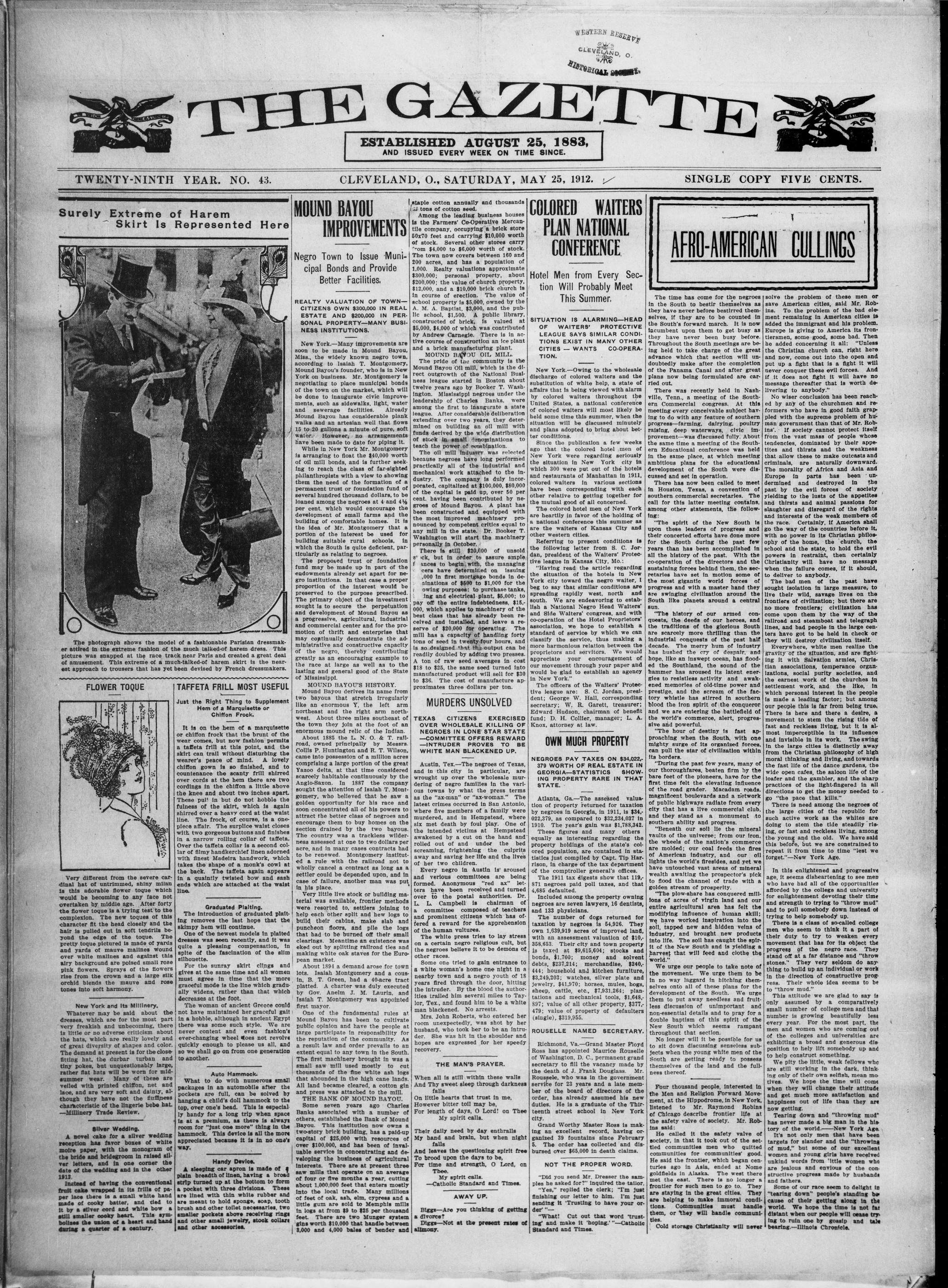
Surely Extreme of Harem Skirt Is Represented Here
THE FASHION OF THE TIME
The photograph shows the model of a fashionable Parisian dressmaker attired in the extreme fashion of the much talked-of harem dress. This picture was snapped at the race track near Paris and created a great deal of amusement. This extreme of a much-talked-of harem skirt is the nearest approach to trousers that has yet been devised by French dressmakers.
The photograph shows the model of a fashionable Parisian dressmaker attired in the extreme fashion of the much talked-of harem dress. This picture was snapped at the race track near Paris and created a great deal of amusement. This extreme of a much-talked-of harem skirt is the nearest approach to trousers that has yet been devised by French dressmakers.
THE EAGLE
HANDS
HANDS
Surely Extreme of Skirt Is
The photograph shows the model attired in the extreme fashion of the picture was snapped at the race trail of amusement. This extreme of a must approach to trousers that has yet
FLOWER TOQUE
Very different from the severe cardinal hat of untrimmed, shiny milan is this adorable flower toque which would be becoming to any face not overtaken by middle age. After forty the flower toque is a trying test to the complexion. The new toques of this character fit the head closely and the hair is pulled out in soft tendrils beyond the edge of the toque. The pretty toque pictured is made of yards and yards of mauve mailnines wound over white mailnines and against this alry background are poised small rose pink flowers. Sprays of the flowers rise from the crown and a large slit orchid blends the mauve and rose tones into soft harmony.
New York and Its Millinery
Whatever may be said about the dresses, which are for the most part very freakish and unbecoming, there is little or no adverse criticism about the hats, which are really lovely and of great diversity of shapes and color. The demand at present is for the close-fitting hat, the durbar turban and tiny pokes, but unquestionably large, rather flat hats will be worn for mid-summer wear. Many of these are veiled with printed chiffon, net and lace, and are very soft and dainty, although they have not the fuffiness characteristic of the lingerie babe hat.—Molinery Trade Review.
Silver Wedding.
A novel cake for a silver wedding reception has favor boxes of white moire paper, with the monogram of the bride and bridegroom in raised silver letters, and in one corner the date of the wedding and in the other 1912.
Instead of having the conventional fruit cake wrapped in its frills of paper lace there is a small white hand made of cooky batter, and tied to it by a silver cord and white bow a still smaller cooky heart. This symbolizes the union of a heart and hand during a quarter of a century.
Just the Right Thing to Supplement Hem of a Marquisette or Chiffon Frock.
It is on the hem of a marquette or chiffon frock that the brunt of the wear comes, but now fashion permits a taffeta frill at this point, and the skirt can trail without disturbing the wearer's peace of mind. A lovely chiffon gown is so finished, and to countenance the scanty frill shirred over cords at the hem there are two cordings in the chiffon a little above the knee and about two inches apart. These pull in but do not hobble thefulness of the skirt, which is again shirred over a heavy cord at the waist line. The frock, of course, is a one-piece affair. The surplice waist closes with two gorgeous buttons and finishes in a narrow rolling collar of taffeta. Over the taffeta collar is a second collar of filmy handkerchief lined adorned with finest Madeira handwork, which takes the shape of a monk's cowl at the back. The taffeta again appears in a quaintly twisted bow and sash ends which are attached at the waist line.
Graduated Plaiting.
The introduction of graduated plating removes the last hope that the skimmy hem will continue.
One of the newest models in plated dresses was seen recently, and it was quite a pleasing compensation, in spite of the fascination of the slim silhouette.
For the sunray skirt clings and gives at the same time and all women must agree in time that the more graceful mode is the line which gradually widens, rather than that which decreases at the foot.
The woman of ancient Greece could not have maintained her graceful gait in a hobble, although in ancient Egypt there was some such style. We are never content and even fashion's ever-changing wheel does not revolve quickly enough to please us all, and so we shall go on from one generation to another.
Auto Hammock
What to do with numerous small packages in an automobile after the pockets are full, can be solved by hanging a child's doll hammock to the top, over one's head. This is especially handy for a long trip when space is at a premium, as there is always room for "just one more" thing in the hammock. This device is all the more appreciated because it is in no one's way.
Handy Device.
A sleeping car apron is made of plain breadth of linen, having a broad strip turned up at the bottom to form a pocket with three divisions. These are lined with thin white rubber and are meant to hold sponge, soap, tooth brush and other toilet necessaries, two smaller pockets above receiving rings and other small jewelry, stool collars and other accessories.
ESTABLISHED AUGUST 25, 1883 AND ISSUED EVERY WEEK ON TIME SINCE.
MOUND BAYOU IMPROVEMENTS
Negro Town to Issue Municipal Bonds and Provide Better Facilities.
REALTY VALUATION OF TOWN—CITIZENS OWN $300,000 IN REAL ESTATE AND $200,000 IN PERSONAL PROPERTY—MANY BUSINESS INSTITUTIONS.
New York.—Many improvements are soon to be made in Mound Bayou, Miss., the widely known negro town, according to Isaiah T. Montgomery, Mound Bayou's founder, who is in New York on business. Mr. Montgomery is negotiating to place municipal bonds of the town on the market, which will be done to inaugurate civic improvements, such as sidewalks, light, water and sewerage facilities. Already Mound Bayou has considerable plank walks and an artesian well that flows 15 to 20 gallons a minute of pure, soft water. However, no arrangements have been made to date for plumbing it.
While in New York Mr. Montgomery is arranging to float the $40,000 worth of oil mill bonds, and is further seeking to reach the class of far-sighted philanthropists with a view to showing them the need of the formation of a permanent trust or foundation fund of several hundred thousand dollars, to be loaned among the negroes at 4 and $4\frac{1}{2}$ per cent, which would encourage the development of small farms and the building of comfortable homes. It is the idea of Mr. Montgomery that a portion of the interest be used for building suitable rural schools, in which the South is quite deficient, particularly as relating to negroes. The proposed trust or foundation fund may be made up in part of the endowments already set apart for negro institutions. In that case a proper proportion of the interest would be preserved to the purpose prescribed. The primary object of the investment sought is to secure the perpetuation and development of Mound Bayou as a progressive, agricultural, industrial and commercial center and for the promotion of thrift and enterprise that may continually demonstrate the administrative and constructive capacity of the negro, thereby contributing greatly as an encouraging example to the race at large as well as to the lasting and general good of the State of Mississippi.
MOUND BAYOUS HISTORY.
Mound Bayou derives its name from two bayous that stretch irregularly like an enormous Y, the left arm northeast and the right arm northwest. About three miles southeast of the town they join at the foot of an enormous mound relic of the Indian. About 1885 the L. N. O. & T. railroad, owned principally by Messrs. Collis P. Huntington and R. T. Wilson, came into possession of a million acres comprising a large portion of the great Yazoo delta, at that time considered scarcely habitable continuously by the Anglo-Saxon. In 1887 the company sought the attention of Isalah T. Montgomery, who believed that he saw a golden opportunity for his race and soon concentrated all of his powers to attract the better class of negroes and encourage them to buy homes on the section drained by the two bayous. The country was a trackless wilderness assessed at one to two dollars per acre, and in many cases contracts had to be renewed. Montgomery instituted a rule with the railroad not to wholly cancel a contract as long as a settler could be depended upon, and in case of failure, another man was put in his place.
Very little live stock or building material was available, frontier methods were resorted to, settlers joining to help each other split and hew logs to build their cabins, make slab and puncheon floors, and pile the logs that had to be burned off their small clearings. Meantime an existence was eked out by splitting railroad ties and making white oak staves for the European market.
About 1894 a demand arose for town lots, Isaiah Montgomery and a cousin, B. T. Green, had a 40-acre tract platted. A charter was duly executed by Gov. Annelm J. M. Laurin, and Isaiah T. Montgomery was appointed first mayor.
One of the fundamental rules at Mound Bayou has been to cultivate public opinion and have the people at large participate in responsibility for the reputation of the community. As a result law and order prevails to an extent equal to any town in the South. The first machinery brought in was a small saw mill used mostly to cut thousands of the fine white ash logs that abounded in the high cane lands. All land became cleared, a cotton gin and press was attached to the mill.
Some seven years ago Charles Banks associated with a number of others, established the Bank of Mound Bayou. This institution now owns a two-story brick building, has a paid-up capital of $25,000 with resources of over $100,000, and has been of invaluable service in concentrating and developing the business of agricultural interests. There are at present three saw mills that operate on an average of four or five months a year, cutting about 1,000,000 feet that enters mostly into the local trade. Many millions of feet of oak, ash, elm, cypress and a little gum are sold to Memphis mills in logs at from $9 to $25 per thousand feet. There are two Munger system gins worth $10,000 that handle between 3,000 and 4,000 bales of bender and
staple cotton annually and thousands
tons of cotton seed.
Among the leading business houses
is the Farmers' Co-Operative Mercan-
tile company, occupying a brick store
50x70 feet and carrying $10,000 worth
of stock. Several other stores carry
from $4,000 to $6,000 worth of stock.
The town now covers between 160 and
200 acres, and has a population of
1,000. Realty valuations approximate
$300,000; personal property, about
$200,000; the value of church property,
$12,000; and the a $10,000 brick church is
in course of erection. The value of
school property is $5,000, owned by
A. M. A. Baptist, $3,000, and the
public school, $1,500. A public library,
constructed of brick, is valued at
$5,000, $4,000 of which was contributed
by Andrew Carnegie. There is in active
course of construction an ice plant
and a brick manufacturing plant.
MOUND BAYOU OIL MILL.
The pride of the community is the
Mound Bayou Oil mill, which is the
direct outgrowth of the National Bus-
ness league started in Boston about
twelve years ago by Booker T. Wash-
ington. Mississippi negroes under the
leadership of Charles Banks, were
among the first to inaugurate a state
league. After considerable deliberation
extending over two years, they deter-
mined on building an oil mill with
funds derived by the wide distribution
of stock in small conglomerations to
teach the power of combination.
The oil mill industry was selected because negroes have long performed practically all of the industrial and mechanical work attached to the industry. The company is duly incorporated, capitalized at $100,000, $80,000 of the capital is paid up, over 50 per cent, having been contributed by negroes of Mound Bayou. A plant has been constructed and equipped with the most improved machinery pronounced by competent critics equal to any mill in the state. Dr. Booker T. Washington will start the machinery personally in October.
There is still $20,000 of unsold stock, but in order to assure ample finances to begin with, the managing cers have determined on issuing 1,000 in first mortgage bonds in denominations of $500 to $1,000 for the owing purposes; to purchase tanks, ing and electrical plant, $5,000; to pay off the entire indebtedness, $15,000, which applies to machinery of the best class that has already been received and installed, and leave a reserve of $20,000 for operating. The mill has a capacity of handling forty tons of seed in twenty-four hours, and is so designed that the output can be readily doubled by adding two presses. A ton of raw seed averages in cost $18 to $25, the same seed turned into manufactured product will sell for $30 to $36. The cost of manufacture approximates three dollars per ton.
MURDERS UNSOLVED
TEXAS CITIZENS EXERCISED OVER WHOLESALE KILLING OF NEGROES IN LONE STAR STATE —COMMITTEE OFFERS REWARD —INTRUDER PROVES TO BE WHITE MAN BLACKENED UP.
Austin, Tex.—The negroes of Texas, and in this city in particular, are wrought up over the wholesale murder of negro families in the vartious towns by what the press terms as the "ax-man" or "ax-woman." The latest crimes occurred in San Antonio, where five members of a family were murdered, and in Hempstead, where six met death by play. One of the intended victims at Hempstead awakened by a cut on the hand and rolled out of and under the bed screaming, frightening the culprits away and saving her life and the lives of her two children.
Every negro in Austin is aroused and verious committees are being formed. Anonymous "red ax" letters have been received and turned over to the postal authorities. Dr. L. L. Campbell is chairman of a committee composed of teachers and prominent citizens which has offered a reward for the apprehension of the human vultures.
The white press tries to lay stress on a certain negro religious cult, but the negroes believe it to be demons of other races.
Some one tried to gain entrance to a white woman's home one night in a nearby town and a negro youth of 18 years fired through the door, hitting the intruder. By the blood the authorites trailed him several miles to Taylor, Tex, and found him to be a white man blackened. No arrests. Mrs. John Roberts, who entered her room unexpectedly, was shot by her husband, who took her to be an intruder. She was hit in the shoulder and hopes are expressed for her speedy recovery.
THE MAN'S PRAYER.
When all is still within these walls
And Thy sweet sleep through darkness
Their daily need by day enthralls
My hand and brain, but when night
And leaves the questioning spirit free
To brood upon the days to be,
For time and strength, O Lord, on
AWAY UP.
Biggs—Are you thinking of getting a divorce?
Biggs—Not at the present rates of allmoy.
WESTERN RESERVE
CLEVELAND, O.
HISTORICAL SOCIETY.
25, 1883,
E SINCE.
MAY 25, 1912.
COLORED WAITERS PLAN NATIONAL CONFERENCE
Hotel Men from Every Section Will Probably Meet This Summer.
SITUATION IS ALARMING—HEAD OF WAITERS' PROTECTIVE LEAGUE SAYS SIMILAR CONDITIONS EXIST IN MANY OTHER CITIES — WANTS CO-OPERATION.
New York—Owing to the wholesale discharge of colored waiters and the substitution of white help, a state of affairs that is being viewed with alarm by colored waiters throughout the United States, a national conference of colored waiters will most likely be held some time this summer, when the situation will be discussed minutely and plans adopted to bring about better conditions.
Since the publication a few weeks ago that the colored hotel men of New York were regarding seriously the situation in New York city in which 300 were put out of the hotels and restaurants of Manhattan in 1911, colored waiters in various sections have been corresponding with each other relative to getting together for the mutual good of all concerned.
The colored hotel men of New York are heartily in favor of the holding of a national conference this summer as are the waiters of Kansas City and other western cities.
Referring to present conditions is the following letter from S. C. Jordan, president of the Walters' Protective league in Kansas City, Mo. "Having read the article regarding the situation of the hotels in New York city toward the negro waiter, I beg to say that similar conditions are spreading rapidly west, north and south. We are endeavoring to establish a National Negro Head Walters and Side Walters' congress, and with co-operation of the Hotel Proprietors' association, we hope to establish a standard of service by which we can classify the service, thus making a more harmonious relation between the proprietors and servitors. We would appreciate your encouragement of our movement through your paper and would be glad to establish an agency in New York."
The officers of the Walters' Protective league are: S. C. Jordan, president; George W. Hall, corresponding secretary; W. R. Garett, treasurer; Edward Hudson, chairman of benefit fund; D. H. Collier, manager; L. A. Knox, attorney at law.
OWN MUCH PROPERTY
NEGROES PAY TAXES ON $34,022,
379 WORTH OF REAL ESTATE IN
GEORGIA—STATISTICS SHOWING
PROPERTY RARE IN THAT STATE.
Atlanta, Ga.—The assessed valuation of property returned for taxation by negroes in Georgia, in 1911, is $34,022,379, as compared to $32,234,037 in 1910. The year's gain was $1,788,342. These figures and many others equally as interesting regarding the property holdings of the state's colored population, are contained in statistics just compiled by Capt. Tip Harrison, in charge of the tax department of the comptroller general's offices.
The 1911 tax digests show that 119,871 negroes paid poll taxes, and that 4,685 defaulted.
Included among the property owning negroes are seven lawyers, 16 dentists, and 133 physicians.
The number of dogs returned for taxation by negroes is $4,926. They own 1,639,919 acres of improved land, with an assessment valuation of $10,358,653. Their city and town property is taxed at $9,615,604; stocks and bonds, $1,700; money and solvent debts, $237,214; merchandise, $240,444; household and kitchen furniture, $3,249,203; watches, silver plate and jewelry, $41,970; horses, mules, hogs, sheep, cattle, etc., $7,931,264; plantations and mechanical tools, $1,648,897; value of all other property, $277,479; value of property of defaulters (single), $319,955.
ROUSELLE NAMED SECRETARY
Richmond, Va.—Grand Master Floyd Ross has appointed Maurice Rousseille of Washington, D.C., permanent grand secretary to fill the vacancy made by the death of J. Frank Douglass. Mr. Roussele, who was in the government service for 23 years and a late member of the board of directors of the order, has already assumed his new duties. He is a graduate of the Thirteenth street school in New York city.
Grand Worthy Master Ross is making an excellent record, having organized 39 fountains since February 5. The order has collected and disbursed over $65,000 in death claims.
NOT THE PROPER WORD.
"Did you send Mr. Dresser the samples he asked for?" inquired the tailor. "Yes," replied the clerk; "I'm just finishing our letter to him. I'm just sending it 'Trusting to have your order'"—
"What! Cut out that word 'trusting' and make it 'hoping.'"—Catholic Standard and Times.
AFRO-AMERICAN CULLINGS
The time has come for the negroes in the South to bestir themselves as they have never before bestirred themselves, if they are to be counted in the South's forward march. It is now facumbent upon them to get busy as they have never been busy before. Throughout the South meetings are being held to take charge of the great advance which that section will undoubtedly make after the completion of the Panama Canal and after great plans now being formulated are carried out.
solve the problem of these men or save American cities, said Mr. Robins. To the problem of the bad element remaining in American cities is added the immigrant and his problem. Europe is giving to America its frontiersmen, some good, some bad. Then he added concerning it all: "Unless the Christian church can, right here and now, come out into the open and put up a fight that is a fight it will never conquer these evil forces. And if it does not fight it will have no message thereafter that is worth de-
There was recently held in Nashville, Tenn., a meeting of the Southern Commercial congress. At this meeting every conceivable subject having to do with any feature of southern progress—farming, dairying, poultry raising, deep waterways, civic improvement—was discussed fully. About the same time a meeting of the Southern Educational conference was held in the same place, at which meeting ambitious plans for the educational development of the South were discussed and set in operation.
There has now been called to meet in Houston, Texas, a convention of southern commercial secretaries. The call for this latter meeting contains, among other statements, the following:
"The spirit of the New South is upon these leaders of progress and their concerted efforts have done more for the South during the past few years than has been accomplished in all the history of the past. With the co-operation of the directors and the sustaining forces behind them, the secretaries have set in motion some of the most gigantic world forces of progress and with a master hand they are swinging civilization around the South like planets around a central sun.
"The history of our armed conquests, the deeds of our heroes, and the traditions of the glorious South are scarcely more thrilling than the industrial conquests of the past half decade. The merry hum of industry has hushed the cry of despair, and hope, like an inswep ocean, has flooded the Southland, the sound of the hammer has aroused its latent energies to resistless activity and awakened memories of old-time power and prestige, and the scream of the factory whistle has stirred in southern blood the iron spirit of the conqueror and we are entering the battlefield of the world's commerce, alert, progressive and powerful.
"The hour of destiny is fast approaching when the South, with one mighty surge of its organized forces, can pull the star of civilization within its borders.
"During the past few years, many of our thoroughfares, beaten firm by the bare feet of the pioneers, have for the first time felt the elevating influence of the road grader. Macadam roads, magnificent boulevards and a network of public highways radiate from every city that has a live commercial club, and they stand as a monument to southern ability and progress.
"Beneath our soil lie the mineral vaults of the universe; from our iron, the wheels of the nation's commerce are molded; our coal feeds the fires of American industry, and our oil lights the world's firesides, and yet we have untouched vast areas of mineral wealth awaiting the prospector's pick to flood the channel of trade with a golden stream of prosperity.
"The plow-share has conquered millions of acres of virgin land and our entire agricultural area has felt the modifying influence of human skill; we have worked inspiration into the soil, tapped new and hidden veins of industry, and brought new products into life. The soil has caught the spirit of the New South and is yielding a harvest that will feed and clothe the world."
We urge our people to take note of the movement. We urge them to be in no way laggard in hitching themselves onto all of these plans for the development of the South. We urge them to put away needless and fruitless discussion of unimportant and non-essential details and to pray for a double baptism of this spirit of the New South which seems rampant throughout that section.
No longer will it be possible for us to sit down discussing senseless subjects when the young white men of the South are getting ready to possess themselves of the land and the fullness thereof.
Four thousand people, interested in the Men and Religion Forward Movement, at the Hippodrome, in New York, listened to Mr. Raymond Robins of Chicago describe frontier life at the safety valve of society. Mr. Robins said:
He called it the safety valve of society, in that it took out of the settled communities men who quitted communities for communities' good. He said the frontier, which began centuries ago in Asia, ended at Nome goldfields in Alaska. The west there met the east. There is no longer a frontier for such men to go to. They are staying in the great cities. They are helping to make immoral conditions. Communities must handle them, or they will handle communities.
Cold storage Christianity will never
solve the problem of these men or save American cities, said Mr. Robins. To the problem of the bad element remaining in American cities is added the immigrant and his problem. Europe is giving to America its frontiersmen, some good, some bad. Then he added concerning it all: "Unless the Christian church can, right here and now, come out into the open and put up a fight that is a fight it will never conquer these evil forces. And if it does not fight it will have no message thereafter that is worth delivering to anybody."
No wiser conclusion has been reached by any of the churchmen and reformers who have in good faith grappled with the supreme problem of human government than that of Mr. Robins'. If society cannot protect itself from the vast mass of people whose tendencies, dominated by their appetites and thirsts and the weakness that allow these to make outcasts and criminals, are naturally downward. The morality of Africa and Asia and Europe in parts has been undermined and destroyed in the past by the evil forces of society yielding to the lusts of the appetites and thirsts and animal passions for slaughter and disregard of the rights and interests of the weak members of the race. Certainly, if America shall go the way of the countries before it, with no power in its Christian philosophy of the home, the church, the school and the state, to hold the evil powers in restraint, then certainly Christianity will have no message when the failure comes, if it should, to deliver to anybody.
The bad men of the past have sought isolation in large measure, to live their wild, savage lives on the frontiers of civilization; but there are no more frontiers; civilization has come upon them by the way of the railroad and steamboat and telegraph lines, and bad people in the large centers have got to be held in check or they will destroy civilization itself. Everywhere, white men realize the gravity of the situation, and are fighting it with Salvation armies, Christian associations, temperance organizations, social purity societies, and the earnest work of the churches in settlement work, and the like, in which personal interest in the people is made a leading factor; but among our people this is far from being true. There is here and there a desire, a movement to stem the rising tide of fast and reckless living, but it is almost imperceptible in its influence and invisible in its work. The swing in the large cities is distinctly away from the Christian philosophy of high moral thinking and living, and towards the fast life of the dance gardens, the wide open cafes, the saloon life of the loafer and the gambler, and the sharp practices of the light-fingered in all directions to get the money needed to go "the pace that kills."
There is need among the negroes of the large cities of the republic for such active work as the whites are doing to stem the tide steadily rising, or fast and reckless living, among the young and the old. We have said this before, but we are constrained to repeat it from time to time "lest we forget."—New York Age.
In this enlightened and progressive age, it seems dishearten to see men who have had all of the opportunities afforded by the college and university for enlightenment devoting their time and strength to trying to "throw mud" and to pull somebody down instead of trying to help somebody up.
There is a class of so-called college men who seem to think it a part of their duty to try to weaken every movement that has for its object the progress of the negro race. They stand off at a far distance and "throw stones." They very seldom do anything to build up an individual or work in the direction of constructive progress. Their whole idea seems to be to "throw mud."
This attitude we are glad to say is only assumed by a comparatively small number of college men and that number is growing beautifully less every year. For the most part, the men and women who are coming out of the colleges and universities are exhibiting a broad and generous disposition to help lift somebody up and to help construct something.
We pity the little, weak fellows who are still working in the dark, thinking only of their own selfish, mean motives. We hope the time will come when they will change their attitude and get much more satisfaction and happiness out of life than they are now getting.
Tearing down and "throwing mud" has never made a big man in the history of the world.—New York Age. It's not only men that have been targets for slander and the "throwing of mud," but some of our excellent women and young girls have received unkind words from "little women who are jealous and envious of the constructive progress made by husbands and fathers.
Some of our race seem to delight in "tearing down" people's standing because of their getting along in the world. We hope the time is not far distant when our people will cease trying to ruin one by gossip and tale bearing.—Illinois Chronicle.
One Year.....$1.50
Six Months.....1.00
Three Months.....50
Subscribers are requested to re-
mit by postoffice money or-
der or registered letter.
Entered at the postoffice In Cleveland
Ohio, as second-class matter
Address all communications to
HARRY C. SMITH
Editor and proprietor,
THE GAZETTE,
Blackstone Building, Cleveland, O.
Member Ohio Legislature: 1894
to 1896; 1896 to 1898; 1900 to 1902
THE GAZETTE is the oldest, and has the largest bona fide circulation, double that of any newspaper in the Interest of Afro-Americans, published in the state of Ohio, and comparison with any will immediately establish its rank as one of the NEWSIEST AND BEST in the country.
THE ONLY ONE IN CLEVELAND
The Gazette is and has been, for many months, the only paper published in Cleveland and northern Ohio for the Colored people, all reports to the, the contrary notwithstanding. Do not be misled.
EDITOR HARRY C. SMITH UNANI
MOUSLY ENDORSED.
The Ministers' Alliance's regular weekly meeting Tuesday morning, May 14th, 1912, at Cory M. E. church, proved, possibly, its most interesting and most important, since its organization. Splendid work was done and our pastors took a high, important and telling stand for racial uplift in an important matter of great concern to our people of this community. They are entitled to unstinted praise from all for doing so, too. That the members of race in this community, be properly represented, on the local Republican ticket, this fall, by a capable candidate for the Legislature means much, very much to all of us, as well as to the ticket, and when the Alliance (14 members) after full and deliberate canvass of the situation, lasting for hours, voted UNANIMOUSLY to endorse the candidacy for the Legislature, this fall, of the editor of The Gazette, they had in view the services he has given our people for nearly thirty years, in The Gazette and on the rostrum; also, his services in the Legislature, and on the "stump" for the grand old Republican party, for many years. The following is self-explanatory:
Cleveland, Ohio, May 14, 1912. The Colored Ministers' Alliance of Cleveland took the following action at its regular session today: That the Hon. Harry C. Smith is hereby unanimously endorsed by this Alliance for the Republican nomination for the Ohio Legislature, and we hereby pledge ourselves to use all honorable means to secure his nomination and election.
We call upon the delegates to the County 'Convention to place Mr. Smith's name upon their regular ballot as the choice of the Colored Republican of Cleveland. Signed.
DR. F. G. SNELSON.
Notification Committee.
For the Ministers' Alliance of Cleveland, O.
The vote for second choice resulted as follows:
Henry T. Eubanks.....7
Harry E. Davis.....3
Wm. R. Green.....1
Not voting.....3
Total.....14
It will be noticed that Mr. Smith, in receiving on the first ballot the unanimous vote, 14 in all, received double the number given Mr. Eubanks; almost five times the number given Mr. Davis; and just fourteen times the number given Mr. Green.
No the above must be added the unanimous endorsement of the Citizens' Rights League (of Mr. Smith's candidacy), the largest and most active civic organization among our people of Cleveland. These two endorsements are backed up by the great mass of our people in this city. They furnish the local Republican party at least four thousand voters, and their wishes in the matter of this one nomination certainly should be granted. Then, too, a mass meeting at Silhou Baptist church, Sunday, afternoon, 19.19.12, about five hundred being in attendance, voted unanimously to thank the Ministers' Alliance for its unanimous endorsement of Mr. Smith's candidacy for a Republican nomination for the Legislature, this fall.
The editor of The Gazette would not want the nomination if he did not know that the great majority of our people of this community desire him to have it, just as they wished him to be elected, last fall, when they did all in their power to make him a member of the Ohio Constitutional Convention after nominating him against his will. Here and now he thanks our pastors and all of our good people of this community for this second expression of confidence, given him in practically the last six or seven months, for they are the greatest honors of his life and are so regarded by him. Our churches represent directly, in membership and attendants, more than 10,000 people, and indirectly, the great mass of Afro-Americans of this city, numbering nearly 20,000 and easily 4,000 if not 5,000 voters. The help of all 10,000 will be needed by our party in the great contest to be waged in this city and county, as well as in the state and nation, this fall.
THE AMENDE HONORABLE
South Carolina deserves the congratulations she is receiving from every section of the country for her action
in repudiating Cole Blease by declining to give him a renomination. The governor who advocated lynching and declared he would rather be a member of the mob than the man to send a military force to uphold the law has found that his views do not coincide with those of a majority of his fellow citizens. Blease is so utterly inconspicuous and unimportant as an individual that his views on any subject whatever will be of no interest once he has vacated the governor's chair. The speedy downfall of Blease seems to offer proof that the elevation of such a man to a position of eminence is often a casual slip rather than a display of deliberate lack of intelligence on the part of the voters. Of course there are Vardaman and a few others who persist in holding the limelight, but it is pleasing to believe that these are the exceptions. At any rate South Carolina has acted wisely and has made the amende honorable to the nation for having perpetrated Blease as governor.—Cleveland Plain Dealer.
By a vote of 237 to 39 the National House of Representatives has voted to concur in the Bristow amendment to the resolution for an amendment to the constitution providing direct election of U. S. senators. This settles all differences between the house and senate and the resolution will now go to the president for his signature. To become effective it must be ratified by the legislature of two-thirds of the states in the union.
Louisiana has three sets of delegates-at-large to the national Republican convention—one each for Taft and Roosevelt and the third for both (half for each).
PARSON. 62. PRIZE-RING HERO
He Preatches to Longshoremen and
Fight the Inspected
By the Mayor
New York—Robert S. Allen, the fighting parson, who has fought 3,000 ring battles in his long fistic career, and who at the age of 62 is still fighting and preaching the gospel to the longshoremen among whom he works as a laborer when not fighting or preaching, is going to get a license in the city. Day after day, along the river front. Other exhorters, both white and Negro, have appealed in vain to the mayor for permission to preach in the public streets, but in the case of Allen who is a human dynamo and very dark, the mayor is to make an exception. The latter believes that any man who can take his hands and head as well as Allen is on the level. Allen is a marvellous specimen of well preserved manhood. Tomorrow night he is again to enter the ring—for the fourth time this week—and he told the mayor that he had no doubt he would whip his man, although giving him eleven pounds the best of the day, that he would "fighting parson," who resides at 56 E. 122d. St., always knels in his "corner" and prays silently before "putting up his dukes."
ALLEN TO ENTERTAIN AT CORY
Cory M. E. Church has just completed arrangements with Benjamin W. P. Allen, a young leader and entertainer of considerable ability, for an evening's entertainment in the new church May 27. Allen, though a very young man, has had a wide experience in the field of entertainment and has met with glowing success wherever he has read. The Y. M. C. A. of Oberlin College, for whom Allen read, says of him: "On Tuesday evening, April the nith, the Young Men's Christian Association gave their annual entertainment, and one of the features of the bill was Mr. B. W. P. Allen with his readings. He represented those willinger in the memory of those who heard him, for all were delightfully pleased. His rendition is always done in a masterly fashion, and his selections are of the first class." Signed,
D. WINDSOR JONES.
General Secretary.
For Piano Lessons!
For Piano Lessons!
Mr. Joseph Wegmet will take charge of my music business. I wish to recommend him to all former students for good and thorough instruction on the piano. Call Mr. Wegmet on the Cuyahoga 'phone, Princeton 3015 W.
Wilbur King Married Again.
Columbus, O. A., marriage was so enamored in Washington, D. C., recently that has created much gossip in social circles here and there. Wilbur E King, assistant prosecuting attorney for this county, was the groom, and the bride, Miss Effie Nelson of Washington, D. C., is his third wife. Another cause for gossip is that Mr. King was but three months ago divorced from his second wife, who was formerly Miss Hattie Hall, member of one of the oldest and most highly respectable families here, and prior to her marriage to Mr. King, one of the most brilliant teachers in the public schools.
Finds Buried Treasure.
Kent, O.—Fifteen years ago Jonathan Ramsey, a former slave who fought through the war in a Kentucky regiment, told his son, Charles, if he would dig in the right place on their property here he would find something. Five years ago Ramsey died in the State Soldiers' home at Sandusky. Recently the son, now occupying the property alone, while spading in the garden uncovered a box containing ten $10 gold pieces and twenty $20 bills.
23 Indicted As Lynchers.
Fort Smith, Ark. — The grand jury, which has been investigating the lynching of Sanford Lewis, March 23 here, made its report returning indictments against twenty-three persons and scoring the city attorney alleged inefficient billing to disperse the lynched brook into the city jail led Lewis forth and hanged him to a trolley pole. The names of those indicted were not made public.
Another Lincoln Servant Dead.
Galesburg, IL.—Allison Dimery, servant of Abraham Lincoln at Springfield, when Lincoln was elected president, died in Galesburg recently of pneumonia. Dimery declined Lincoln's offer to accompany him to Washington as he had a sweetheart in Springfield whom he did not wish to leave. Dimery later served in the war and was a member of the local G. A. R.
THE GAZETTE, CLEVELAND, O. SATURDAY MAY 25, 1912
THE MAJOR HONORED.
Every Speaker Praised Him--Miss Mary Martinez Music--The Reconciliation, Ego
The mass meeting at Shiloh Baptist church, Sunday afternoon, under the auspices of The Citizens' Rights league, was an exceptional success. The large audience filled the church auditorium and extended into the Sunday-school room. The speaking and music were fine. The speakers were: Miss Mary W. Ovington of Brooklyn, N. Y. secretary of the National Association for the Advancement of Colored People and a leader in social and civic matters of Greater New York city; Rev. J. L. E. Burr, pastor of Mt. Haven Baptist church; Rev. J. E. Thompson, pastor of Mt. Zion Baptist church, East End; Hugh E. McBeth, editor of the Baltimore (Md.) Times; Rev. H. C. Bailey and the editor of The Gazette, president of the league, who also presided over the meeting. Drs. Burr and Thompson pleased the audience greatly with several telling stories, which seemed to make sense of the event at the east points of their addresses. Mrs. Blanche Gilmore, a member of the Co-Workers and president of the Du Bois Literary club, and Mr. Herbert L. Taylor presented the resolutions which were unanimously adopted after great praise was given those named in them by the various speakers. The music: a trio, "Tl Prago O Padre," a beautiful composition by Nicolao, was splendidly sung by the Misses Clara Dyson and Ruby A. Yates and the Misses Clara Dyson and Ruby A. Yates, with "Dimple" Ferguson; and a dramatic sacred soprano was admirably sung by Mrs. Kittie Skeene Mitchell, accompanied by her sister, Miss Skeene. The meeting was opened by Rev. E. H. Smith, pastor of Shiloh church, who called on Rev. Woolridge for prayer and introduced the presiding officer, the president of the league. Rev. Davis closed it with prayer. Dr. K. Nickens and Mr. Herbert L. Taylor had charge of the seating of the audience, and Dr. Daw, secretary, of the Mr. Clarence F. Hunnicutt, treasurer, of the league, was in charge of the collection, which was turned over to the church. The resolutions:
WHEREAS, the Ohio Constitution, adopted before the war of the rebellion, provides for suffrage for_ and the participation in the military of the state of, white male citizens only, and
WHEREAS, Major David Cunningham of Cadiz, Harrison county, Ohio, and the Woman Suffrage organization of the state have secured the adoption, by the Ohio Constitutional Convention, of "Proposals," to be submitted by voters of Ohio, this fall if adoption will eliminate the words "white" and "male" from the sections of the Ohio Constitution, referred to in the first paragraph of these resolutions, and
WHEREAS, our local newspaper and advocate, The Gazette, and its editor, the Hon. Harry C. Smith, has labored incessantly for nearly a year to awaken our people of Cleveland and the entire state and their white friends, to a proper appreciation of the opportunity presented in the Ohio Constitutional Convention to do just what has been done in its adoption of the Cunningham and Woman's Suffrage "Proposals," therefore he it
RESOLVED, that we, citizens—(for women of age are citizens, too, even if not voters as yet, but who, I hope will be after the special constitution election, this fall,)—we, citizens of Cleveland massachusetts, are baptized by Baptist church, Cleveland Ohio, this the 19th day of May, 1912 do extend our heartiest thanks and
Honorable David Cunningham.
sincerest appreciation—for all of our people of the state—to Major David Cunningham, sterling friend of the race and veteran of the war of the rebellion; the Woman's Suffrage party of Ohio; our paper, The Gazette, and its editor, the Hon. Harry C. Smith; and all persons of every racial-class of residents of Ohio who helped in any honorable way to accomplish the glorious results thus far achieved. Be it further
RESOLVED, that we admistour our people throughout Ohio that the work is not done; that it has just begun in earnest; that only eternal vigilance and constant and continued activity along proper lines, are the price of full and complete liberty; that the work to wipe from the state constitution the filth and germ that our consent us is but one-half done as a result of the adoption of these "Proposals"; and that from now until election day, this fall, we must work—particularly among our white friends—for votes for said "Proposals," particularly the Cunningham "Proposal," if we are to secure its ratification and all of our votes under non-discriminating state laws as well as federal laws. Finally, be it
RESOLVED, that the Citizens' Rights League, under whose auspices this meeting is being held, be authorized to send a copy of these resolutions to Major David Cunningham; one to our paper, The Gazette, and its editor; and another to the Du Bois University, where he is awarded to the state headquarters of the Woman's Suffrage party, through the local headquarters of that party.
RESOLVED. That we thank the Citizens' Rights league and its president for the good work they have accomplished in causing to be discontinued the insulting caricature in the J. H. Remick & Co. "Song Shop" window on Ontario St., at the corner of the Public Square, this city; for its efforts to secure the road cars bearing "jimcrow" signs barred out of the state again; for its and our Ministers' Alliance's efforts to secure the pardon of that innocent member of the race, Louis H. Peck,
who was "railroaded" to the penitentiar; about twelve years ago for a crime that he nor any one else had committed upon that little Akron white girl;
That our Ministers' Alliance be thanked for the unanimous vote it gave the candidacy of the Hon. Harry C. Smith, president of the Citizens' Rights League, for the Legislature, and that a copy of this resolution be forwarded to the heads of the local public party organization, with the special request that they call the attention of the County Republican convention on Saturday, to the desire of the great mass of our people of this city and county, in this matter, as indicated by our Ministers' Alliance unanimous endorsement of Mr. Smith.
IN TERROR AFTER 48 MURDERS.
Mysterious Slaughter in Texas and
Louisiana in the U.S. Exit—
15 of its weapons
Houston, Tex.—The grim shadow of an axman, unidentified, has fallen in the thresholds of Negro homes of Texas and Louisiana and fear has found dwelling in many hearts. Within ten months forty-eight Negroes have been slain. Of this number forty-three have been murdered by this strange monster within the last three months. Of this number only two have felt the blow of the ax which crushed their skulls have lived. Wild tales of a sect, whose creed was the sacrifice of human life, have gained circulation, and in several communities members have been arrested with little or no proof of their crimes, and last month the evidence of the crimes has been the confession of Clementine Barnabat, a half-blood, who swore she had killed seventeen victims with her own hand and that fellow-members of the sect were responsible for the other crimes. Clementine and others are held in Jail at Lafayette.
DOINGS
OF
THE
RACE
Out in Colorado, J. D. Harkless was
duly elected a delegate to the Democ
ratic National Convention at Balti
more.
Alton B. Parker, former Presidential candidate, argued before the U. S. Supreme Court in favor of allowing our order of Knights of Pythias to become incorporated in the state of Georgia. He was opposed by counsel representing white lodges. He hindered Charleston, W. Va. died recently. He was the publisher of The Advocate of that city. Leroy Butler, a Presbyterian minister who was instrumental in getting church people interested in buying stock in the Metropolitan Mercantile and Realty Company, was held for a N. Y. grand jury on the charge of grand arracceny and his firm fixed at $100,000. His brother, the Second District Magistrate's Court of Queens County at Flushing, L. I. Postal cards bearing foreign print which reproduce in horrible detail lynchings of the south are said to be circulating in this country. According to the description given, one card shows a group of seventy white men and boys standing in a semicircle with a large crowd of colored man in the center of the picture.
John H. Atkins, head of the defunct Metropolitan Mercantile and Realty Company, was sentenced to one year in jail and fined $500 on the charge of conspiracy to cheat and defraud by Judge Joseph L. Moore of the County Court of Brooklyn, N. Y., recently. Atkins was found guilty by a Jury April 22. "T. R." has carried the "war into Africa" and Ohio is to be taken if possible. This would be a good time to enlist the sympathy and secure the support of the Hon. Joseph Benson Foraker, that prince of politicians—that ablest of statesmen, whose clairvion voice in former times was the raking cry which called to the Buckeye Domain. One blast upon his bugle horn were worth a thousand!"-Dallas (Tex.) Express.
W. J. Edwards, principal of Snow Hill Institute, S.C. writes that in Wilcox County, Ala., (according to the report of the State Superintendent of Public Instruction for 1910) there are 10,758 Negro children of school age and 2,000 white children. The school expenditure in Wilcox County for 1910 was $33,952.45, of which $3,339.70 was spent on the 10,758 Negro children and $30,612.75 was spent on the 2,000 white children. The expenditure for Negro children was, therefore, less than 32 cents per capita; for white children, about $15.30 per capita. In the same report, surrounding and touching Wilcox County, there are, according to the same report, 64,285 Negro children of school age, for whom $47,719.24 was appropriated in 1910. In these same counties there are 21, 841 white children of school age, who receive $224,842.32.
Negro Parents Sell Daughters.
Lincoln, Neb.—Bishops of the Metropolitan Episcopal Church in conference recently devoted the short session largely to missionary work in foreign fields. "The great problem of missionary work among the black race of Africa is to find workers to reap the hardest vest," said Bishop Isaac H. Scott, people are born to the Gospel beheld to them. There are 100,000,000 Negroes at least on the continent, and the task of converting them is one of tremendous proportions." Bishop Scott is assigned to Liberia, the black republic. His episcopal residence is in Monrovia. One of the deplores the blackness of the Episcopal Bishop Scott, is the existence of slavery, and the practice, still wide in extent, of selling young girls by the poorer classes to the more wealthy.
Are You in Arrears
on your subscription? You know
WE NEED THE MONEY
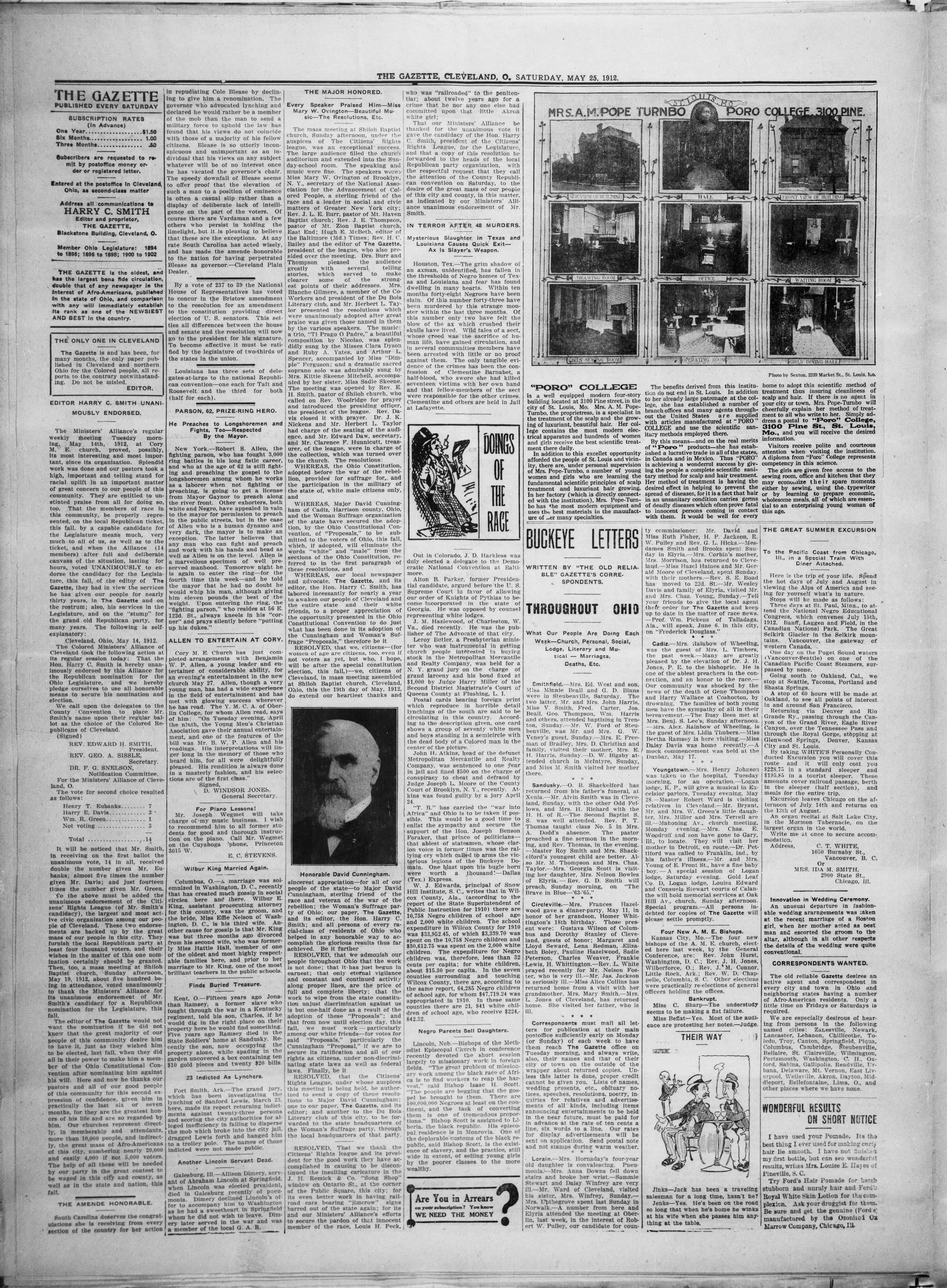
MRS. A. M. POPE TURNBO PORO COLLEGE, 3100 PINE.
SIDE VIEW OF BUILDING
HALL
FRONT VIEW OF BUILDING
DRAWING ROOM
OFFICE
WAITING ROOM
GIRLS SEWING ROOM
OPERATING ROOM
GIRLS DINING HALL
"PORO" COLLEGE
is a well equipped modern four-story building located at 3100 Pine Street, in the St. Louis, Mo. Mrs. A. M. Pope-Turbo, the proprietress, is a specialist in the treatment of the scalp and the growing of luxurant, beautiful hair. Her college contains the most modern electrical apparatus and hundreds of girls receive the best scientific treatment there daily.
In addition to this excellet opportunity afforded the people of St. Louis and vicinity, there are, under personal supervision women and girls who are learning the fundamental scientific principles of scalp treatment and luxuriant hair growing. In her factory (which is directly connected with the institution), Mrs. Pope-Turno has the most modern equipment and facilities to manufacture of her many specialties.
BUGKEYE LETTERS
WRITTEN BY "THE OLD RELIA BLE" GAZETTE'S CORRESPONDENTS.
THROUGHOUT OHIO
What Our People Are Doing Each Week—Church, Personal, Social, Lodge, Literary and Musical — Marriages, Deaths, Etc.
Smithfield.—Mrs. Ed. West and son, Miss Minnie Beall and G. D. Blimns in Steubenville, Saturday. The two lattes, Mr. and Mrs. John Harris, Miss V. Smith, Fred. Carter, Jos. Beall, Geo. Thompson, Wm. Harris and others, attended baptizing in Trenton, Sunday.—Mr. W. Ford of Steubenville, was Mr. and Mrs. G. W. Veney's guest, Sunday.—Mrs. E. Freeman of Bradley, Mrs. D. Christian and family, visited their mother, Mrs. E. H. Harris, Sunday.—W. Bigby at attended church in Mcutley, Sunday, and Miss M. Smith visited her mother there.
Sandusky. —O. B. Shackelford has returned from his father's funeral, at Xenia. —Mr. Alvin Smith was in Cleveland, Sunday, with the other Odd Fellows, and Mrs. H. Richard with the H. H. of R. The Second Baptist S. S. was well attended. Rev. P. T. Thomas taught class No. 5 in Mrs. A. Dodd's absence. The pastor preached a fine sermon in the morning, and Rev. Thomas, in the evening, and Rev. Thomas, the Nelson Shackelford's youngest child are better. Also Mr. M. Thompson and Mrs. Chas Taylor. —Mrs. Georgia Scott is visiting her daughter, Mrs. Nelson Bowles of Elyria. —Rev. G. D. Smith will preach, Sunday morning, on "The Brave in Blue"—63-65."
Circleville.—Mrs. Frances Hazel wood gave a dinner-party, May 11, in honor of her grandson, Homer Whittington's 18th birthday. Those present were: Gustava Wilson of Columbus and Dorothy Stanley of Cleveland, guests of honor; Margaret and Lloyd Seward, Lena Redman, Eliza beth Boley, Pauline Hazelwood, Sadie Peterson, Charles Weaver, Frank Lewis, H. Whittington.—Rev. L. White prayed recently for Mr. Nelson Foster, who is very ill.—Mr. Jas, Jackson is very ill.—Miss Alice Collins has returned home from a visit with grandmother, Mrs. Mary Smith.—Mrs. L. Jones of Cleveland, has returned home. She visited her father, who is ill.
Correspondents must mail all letters for publication at their main postoffice sufficiently early on Monday (or Sunday) of each week to have them reach The Gazette office on Tuesday morning, and always write, also, their names and that of their relatives, and their wrapper about returned copies. Unless this latter is done, proper credit cannot be given you. Lists of names, wedding presents, etc., obituary notices, speeches, resolutions, poetry, inquiries for relatives and advertisements of all kinds, including items announcing entertainments to be held in advance at the rate of ten cents a line, six words to a line. Our rates for display advertisements will be sent on application. Send postal note and not stamps during warm weather.
Lorain—Mrs. Hornaday's four-year old daughter is convalescing. Pneumonia—Mrs. Anna Downs fell down stairs and broke her wrist—Sammie Stewart and Daisy Winrey are very ill—Mrs. Ward of Cleveland, visited his sister, Mrs. Winrey, Sunday—Mrs. Upghebre spent last Sunday in Norwalk—A number from here and Elyria attended the meeting at Oberlin, last week, in the interest of Robert W. Pulley, our candidate for coun
The benefits derived from this institution do not end in St. Louis. In addition to her already large patronage at the college, she has established a number of branch offices and many agents throughout the United States are supplied with articles manufactured at "PORO" COLLEGE and use the scientific sanitary methods employed there. By this means—and on the real merits of "Poro" products—she has established a lucrative trade in all of the states, in Canada and in Mexico. Thus "PORO" is achieving a wonderful success by giving the people a complete scientific sanitary method for scalp and hair treatment. Her method of treatment is having the desired effect in helping to spread if fecal matter is a fact that hair is unsanitary condition carries germs of deadly diseases which often prove fatal to innocent persons coming in contact with them. It would be well for every
ty commissioner: Mr. David and Miss Ritch Fisher, H. P. Jackson, R. W. Pulley and Rev. G. L. Hicks.—Mes dames Smith and Brooks spent Sunday in Elyria.—Mrs. Corbis' mother, Mrs. Morrison, has returned to Cleveland.—Miss Hazel Haines and Mr. Gerald Moore of Cleveland, spent Sunday with their mothers.—Rev. S. E. Bond has moved to 22d. St.—Mr. Wesley Davis and family of Elyria, visited Mr. and Mrs. Chas. Young. Sunday—Tell your friends to give the local agent their order for The Gazette and keep up to date in the matter of race news—Prof. Wm. Pickens of Talladaga, Ala., will speak, June 6. in this city on "Frederick Douglass."
Cadiz—Mrs. Rainbow of Wheeling, was the guest of Mrs. L. Timbers, the past week—Many are greatly pleased by the elevation of Dr. J. H. Jones, P. E. to the bishopric. He is one of the ablest preachers in the connection, and an honor to the race, by the news of the death of Gene Thompson and Harry Wallace at Coshocton, by drowning. The families of both young men have the sympathy of all in their bereavement—The Busy Bees met at Mrs. Benj. S. Lee's, Sunday afternoon. Mrs. Alex Rainbow of Wheeling, is the guest of Mrs. L. Timbers. Bertha Ramsey is here visiting. Miss Daisy Davis was home recently. A mock commencement was held at the Dunbar, May 17.
Youngstown.—Mrs. Henry Johnson was taken to the hospital, Tuesday morning, for an operation.—Logan lodge, K. P., will give a musical in Excelsior parlor. Tuesday evening, May 28. Master Robert Ward is visiting relatives in Cleveland.—Mr. Bryant, Mr. and Mrs. W. Green's little daughter, Mr. and Mrs. Chrysall McCall are—Miltonning Av. church Hall on Monday evening.—Mrs. Chas. E. Woodruff and son have gone to Gary, Ill., to locate. They will visit her mother in Detroit, en route.—Dr. Petford was called to Franklin, Ind., by his father's illness.—Mr. and Mrs. Young of E. Front St, have a fine baby boy.—A special session of Logan lodge, Saturday evening. Gold Leaf Co. D. Logan lodge, Louis Edward Co. D. Logan lodge, Louis Edward Co. the will hold memorial services at Oak Hill Av. church, Sunday afternoon. Special program.—All persons indebted for copies of The Gazette will please settle promptly.
Four New A. M. E. Bishops.
Kansas City, Mo.—The four new bishops of the A. M. E. church, elected here last week, by the General Conference, are: Rev. John Hurst, Washington, D. C. Rev. J. H. Jones, Wilberforce, D. C. M. Connor, Lily Ree, Ark. Rev. W. D. Chapelle, Columbia, S. C. Other elections were practically re-elections of general officers holding the offices.
Bankrupt.
Miss C. Sharp—The understudy seems to be making a flat failure.
Miss Befat—Yes. Most of the audience are protesting her notes.—Judge
THEIR WAY
Jinks—Jack has been a traveling salesman for a long time, hasn't he? Jenks—Yes. He's been on the road so long that when he's home he winks at his wife when she passes him anything at the table.
Photo by Sexton, 2339 Market St. St. Louis, Mo.
home to adopt this scientific method of treatment thus insuring cleanliness of scalp and hair. If there is no agent in your city or town, Mrs. Pope-Turnbo will cheerfully explain her method of treatment to all who write to her. Simply address a call to "Foro" College 100 Pine St. St. Louis, Mo., and you will receive the desired information.
Visitors receive polite and courteous attention when visiting the institution. A diploma from "Foro" College represents competency in this science.
The girls are given free access to the sewing room, office and kitchen that they may economize their spare moments either by sewing, using the typewriter or by learning to prepare economic, wholesome meals, all of which are essential to an enterprising young woman of this age.
THE GREAT SUMMER EXCURSION
To the Pacific Coast from Chicago,
III., in New York. With
Dinger, Attaché.
Here is the trip of your life. Spend the hot days of July and August in viewing the Alps of America and seeing for yourself what's in nature. Stops will be made as follows: Three days at St. Paul, Minn., to attend the National Negro Educational Congress, which convenes July 15th, 1912. Banff, Lagen and Field, in the Canadian National Park. The Great Selkirk Glacier in the Selkirk mountains. Vancouver, the gateway of western Canada. One day on the Puget Sound waters (Vancouver-Seattle) on one of the Canadian Pacific Coast Steamers, surpassed by none. Going south to Oakland, Cal., we stop at Seattle, Tacona, Portland and Shasta Springs. A stop of 60 hours will be made at Oakland, to see all points of interest in and around San Francisco. Returning via Denver and Rio Grande Ry., passing through the Canyon of the Grand River, Eagle River of the Tennessee Pass and through the Royal Gorge, stopping at Glenwood Springs. Denver, Kansas City and St. Louis.
By taking WHITE'S Personally Conducted Excursion you will cover this route and it will only cost you $228.75 in a standard sleeper and $135.55 in a tourist sleeper. These counts cover bedding, berth in the sleeper (half section), and meals for the entire trip.
Excursion leaves Chicago on the afternoon of July 14th and returns on the 15th of August.
A hotel at Salt Lake City, in the Mormon Tabernacle, on the largest organ in the world.
Write me at once to secure accommodation.
Innovation in Wedding Ceremony.
An unusual departure in fashionable wedding arrangements was taken at the recent marriage of a Boston man and a New York man and escorted the groom to the altar, although in all other respects the details of the wedding were quite conventional.
CORRESPONDENTS WANTED.
The old reliable Gazette desires an active agent and correspondent in every city and town in Ohio and neighboring states having a number of Afro-American residents. Only a little time on Fridays or Saturdays is required. We are especially desirous of hearing from persons in the following named cities: Zanesville, Newark, Lancaster, Lebanon, Chillicothe, Toledo, Troy, Canton, Springfield, Piqua, Columbus, Cambridge, Steubenville, Bellaire, St. Clairsville, Wilmington, Portsmouth, Washington, C. H., Oxon Hill, Columbus, Batavia, bana, Delaware, Mt. Vernon, East Liverpool, Wakefield, Akwil, Dayton, Midport, Bellefontaine, Lima, O., and other places where we have none.
WONDERFUL RESULTS
ON SHORT NOTICE
WONDERFUL RESULTS
ON SHORT NOTICE
I have used your Pomade. Its the best thing I ever used for making curly hair lie smooth. I have not finished my first bottle, but can see wonderful results, writes Mrs. Louise E. Hayes of Pineville, S.C.
Try Ford's Hair Pomade for harsh stubborn and unruly hair and Ford's Royal White Skin Lotion for the complexion. Ask your druggist for them. Be sure and get the genuine (Ford's) manufactured by the Ozonilic Ox Marrow Company, Chicago, Il.
PURELY PERSONAL
PURCHASE
THE
"GAZETTE" AT
J. S. HALL'S, 3121 Central Ave.
L. SCHWARTZ'S, 2921 Central Ave. Open Sunday.
O. C. SCHROEDER'S, Cuyahoga Bldg. Open Sunday.
ELMER F. BOYD'S, 2604 Central Ave.
F. VALENTINE'S, 2130 Central Ave.
JOHNSON'S, 3350 Central Ave.
NOTICE TO SUBSCRIBERS: -Subscribers not receiving The Gazette regularly should notify us at once. We desire every copy delivered promptly. We advise our patrons to carefully examine The Gazette's advertisements before making purchases. Business men who advertise in this paper should have the patronage of Afro-Americans. The fact that they advertise is assurance that they want it.
Local reading notices (advertisements) ten cents a line (six words in a line.)
For Rent—Five room suite—bath, gas-stoves, etc. 2218 E. 46th St.
FOR RENT.—Houses—If you have places to rent or if you want to rent—notify The Gazette.
Wanted.—Barber—at Joe Smith's barber-shop, 1815 Central Ave. Good position. Apply or write at once.
NOTARY PUBLIC—For such services call at The Gazette office, No 3 Blackstone Building, No. 1422 W. 3d street, near Superior avenue.
FOR RENT—Furnished rooms with gas and bath. Special accommodations for theatrical people. Room and board. Mrs. I. B. Ambrose, 2285 E. 46th St., Cuy, Phone, Central 2917 L.
Judge J. A. Kohler of Akron, called on The Gazette, last week.
The lecture, "Self-Made Man," a Cory M. E. church, Tuesday evening by C. M. E. Lacy, was well attended and very interesting as well as beneficial.
Write to the editor of The Gazette Blackstone building, Cleveland, O. and terms will be sent promptly. On readers will oblige us greatly by sending at once the addresses of person in the cities named above, or others to whom we can write relative to the matter.
Frank S. Moss, 42, headwaiter in Cleveland hotels for many years, his died last week Thursday at his home 2230 E. 43d St., was buried at Yellow Springs. Funeral services were held at J. W. Willis & Sons funeral parlor 2233 Central Ave. S. E. His family (wife and daughter) have the sympathy of the community.
Send your local items to The Gazette on Monday or Tuesday of each week. This paper is published for the benefit of the community.
The Union club of St. Andrew will give an entertainment Decoration day evening.
The Old Folks' home benefit at the Oriole theater, last Thursday evening was a success.
Good Samaritans, No. 2, Mt. Olive, will give a conference, June 9, at their hall on Ontario St.
Mrs. Anna Fletcher of Central Ave., who has been ill, is better. Rev. B. W. Parker, very ill.
Mrs. Augusta Waring of Lorain, in the city, Wednesday afternoon, and paid the Gazette a pleasant call.
C. M. Gilbert will leave on the 28th for a visit with his mother in Owego and a trip to the mountains of N. Y. state.
Flora Douglass recently won a debate at Central High school against one of the faculty's choice. It was a hotly contested one, too.
Dr. Snelson preached the, Mr. Juilian Chambers' funeral sermon and Understaffed F. Boyd was in charge. See "Lodge Notes." Interment in E. Cleveland cemetery.
Mrs. Mattie E. Carl of Altona, Pa., was the guest of Mrs. Marshall Turner of 2316 E. 28th St. Mrs. Carl was formerly Mrs. Washington Rawls of this city—many years ago. Civil service examinations of appointees of the position of investigator in the outdoor relief department will be held May 30. Those now holding the position are temporary appointees.
The Gazette acknowledges the receipt of an invitation, from Tuskegee (Ala.) N. & I. Institute, to attend its thirty-first anniversary exercises, May 26-30, and wish it were possible for us to attend.
Mrs. L. E. Burr, pastor of Mt. Haven Baptist church, will preach Sunday morning on "Is God Limited in Means?" and in the evening on "Christian Integrity." S. S. and B. Y. P. U. at the usual hours.
Mrs. C. J. Sayles of 4812 Payne Ave. gave a most enjoyable tea, Tuesday evening, in honor of Mrs. Mattie E. Carl of Altona, Pa., M. Turner of Mrs. Mattie E. Carl of Altona, Pa., and T. Decreations in pink and white.
The Du Bois Literary club's suffrage play entertainment, at the Alpha theater, Monday evening was a grand success in every way. Over $55 were taken in. The ladies headed by Mesdames Blanche Gilmere and F. J. Kitzmiller deserve great credit for their contribution. Mrs. Emma Greene, of 2191 E. 39th St., clerk in the office of County Recorder Paul Schreiner, was awarded judgment for $50 against Thomas W. Fleming, former Republican councilman, by municipal Judge Dan B. Cull last week. Mrs. Fleming officiated at Fleming money at various times to further his political and personal interests.
It was not the Phillegas band that played for the meeting at Woodliff hall, last week, Monday evening, so Director Jackson informs us. The organization is soon to become the Elks' band, it is said. The lodge and band made quite an imposing appearance on the march to and from Antioch Baptist Sunday, where they presented their annual services, as announced in our last issue. The church was filled, and the services and music were excellent.
Rev. G. A. Sissle of Cory M. E. church, preached ably, Sunday evening, to the Good Samaritans. Palms and flowers beautified the church. The editor of The Gazette gave an eloquent practical talk to the Worlewade, on Monday evening. It was thoroughly enjoyed by a large audience. It is hoped to have him again soon. These meetings grow steadily in interest and attendance. The Helping Hand will serve receptions, Monday evening. Mr. Bord Allen of Oberlin, will give a recital at the center for the benefit of Mr. Rufus hussein's district. Mock conference. Wednesday and Thursday evenings. It is hoped that at least $500 will be raised by the "presiding elders" and their assistants. The S. S. and E. L. are planning to raise money to furnish 150 bills for the church and also hymn books. The young people are urged to attend vesper service at 6:30 p. m., in the lecture room.
When your Gazette are not delivered on Friday mornings, call at your Central Postoffice General Delivery Window for them in the afternoon of the same day. —Editor.
The lecture, "Self-Made Man," at Cory M. E. church, Tuesday evening, by C. L. Lacy, was well attended and very interesting as well as beneficial.
Write to the editor of The Gazette, Blackstone building, Cleveland, C. and terms will be sent promptly. Our readers will oblige us greatly by sending at once the addresses of persons in the cities named above, or others, to whom we can write relative to the matter.
Frank S. Moss, 42, headwaiter in Cleveland hotels for many years, who died last week Thursday at his home, 2230 E. 43d St., was buried at Yellow Springs. Funeral services were held William & Kelsey funeral parlors, 2233 Central Ave. S. E. His family (wife and daughter) have the sympathy of the community.
Send your local items to The Gazette on Monday or Tuesday of each week. This paper is published for all of our people and "plays no favorites." Everybody is treated the same—fair and right. Take The Gazette and tell your friends to do so also.
All members of the Ministers' Alliance and the Citizens' Rights League who can possibly arrange to do so, should attend the County Republican convention at Gray's armory, Saturday morning and afternoon in the interest of Hon. Harry C. Smith's candidacy. The president will have a moral influence and a good one, too. Everybody attend who can.
One of the most unique and effective ways of helping a church has been evolved by "Doc." Brown of the Brown Drug Co., cor. Central Ave, and E. 28th St., and he is entitled to full credit and praise for the same. It is this: On Wednesday, June 5, the ladies of St. Andrew's P. E. church will have full charge, all day and evening, of the soda fountain, and turn the church. This is a most generous act upon the part of the Brown Drug Co., and it is appreciated by not only the members and friends of St. Andrew's church but by our people of this community generally. Remember the day and the date and purchase your ice cream, sodas etc., that day at least at the Brown Drug Co. The ladies in immediate charge of the fountain, tuna, ice cream, sodas etc., the club of St. Andrew's: Mrs. Clarence Williams, pres.; Mrs. Julia Stanley, chairman; Mrs. Lella Nooks, treas.; Mrs. Suile Johnson, Mrs. Gaines, Mrs. T. W. H. St. John, Mrs. E. Daw, Mrs. Wallace Bolden. Others will assist.
The "Queen of May" contest, at St James A. M. E. church, closed last week Wednesday evening. "Queen," Mrs Josie Mahoney. The following in the order named were Imperial, Royal, Crown, Colonial and State Princesses, Peerceses, and Duchesses; Miss L. Cleage, B. Snelson, Mesdames Marie Hawkins, G. Berry, Mrs. M. Williams, Miss hampson, Mrs. Williams, B. J. W. Mesdames F. Ballard P. Moore, M. Wood and M. Foster. Others have yet to report amounts collected. Addresses were made by the pastor, the editor of The Gazette and Rev. J. E. Thompson. Mrs B. W. Paxton read an able paper, Sunday evening and was introduced by W. W. B. Snelson. The church sent a telegram of congratulation to Bishop Joshua H. Jones, at Kansas City, Mo. where the A. M. E. General Conference has been in session recently in his sermon in the morning. Dr. Snelson took issue with Dr. Boone and was declared that the "worst Negroes live in the cities," and said, among other things, that the property alone owned by our people in the cities and towns of the country shows conclusively what element lives in the city, &c.
Here is the trip of your life across the continent on White's personally conducted excursion train from Chicago on July 14, in a special train of Pullman standard and tourist sleepers; also carrying dinner, so there will be no occasion for anyone to go to any hotel or restaurant in the delightful trip of over 6,000 miles without change of cars, except a day spent on run down Puget Sound, Vancouver to Seattle, on one of the C. P. R. r. famous Pacific Coast steamers—surpassed by none, stopping three days at St. Paul, Minn., to attend the Negro National Educational Congress; also spending three days in Canadian Rockies, the heart of the Great Oakland and San Francisco, California. Stops will be also made at numerous places, such as Seattle, Tacoma, Portland, Salt Lake City, Denver, Kansas City and St. Louis, from 12 to 36 hours. Traveling in the mountains will be principally by day, so you will have ample chance to see all the beauties of nature. Don't let the guest opinion幸好, it is the first Occidental people have ever had the chance to cross in such grand style. I expect to limit the number to 135. For rates and particulars, write me, C. T. White, 1159 St. St., Chicago III, ill. Chicago Defender.
Call your lady friends' and acquaintances' attention to our up-to-date fashion and pattern departments and thus encourage them to enjoy our work. The Gazette regularly. Oblige the Editor.
LONG NOTES
By C. P. Lancaster.
The different branches of the Independent Order of Good Samaritans and D. S. heard their annual sermon at Shiloh Baptist church. The exercises were interesting and the attendance large.
FREE INFORMATION SERVICE. BEST NURSERY STOCK IN THE UNITED STATES.
Grown on the Shores of Lake Erie. Hard-wooded, Early-bearing, Long-lived. Complete line of Fruit and Ornamental Trees, Small Fruits, Shrubs, Energizes, Vines, etc. Propagated from Prize-winning Orchards—Fruit brings highest prices. Beware of softwooded, cheaply-propagated stock.
Write at once for full particulars, Pennsylvania Nursery Co., Girard, Pa.
FORD'S HAIR POMADE
Sir Knight Julius Chambers died Monday, and his funeral services were held at St. John's A. M. E. church, last Thursday afternoon, conducted by Edwin Cowles Lodge, No. 17, K. of P, and Forest City Co. B, U. R. K. P., of the deceased was a charter member.
The sixth anniversary services of Cuyahoga Lodge, No. 95, I. B. P. O. E of W., was a grand success. Antioch Baptist church was packed to the doors. The exercises were pleasing and instructive. Visitors were present from Youngstown, Akron and Pithecum.
Glenna Temple, No. 21, Daughters of Elks, will give a social at their lodge room, Clayton hall, May 28.
The Knights Templar club will have a house-social at 3849 Central Ave., May 30.
Surely Matter for Complaint
A lawyer noted for his ignorance, filed a petition in a divorce case in which he alleged that: "At divers and sundry times the defendant tried to poison the plaintiff without reasonable cause."
Complete Failure.
"I understand Dubley failed in business yesterday for the fourth or fifth time."
"Haven't you heard the later news? He shot himself this morning."
"Suicide?"
"An attempt, but he failed even at that."—Catholic Standard and Times.
Intangible Fortunes.
"You say you lost a fortune on Wall street?"
"Yes," replied the philosophic person. "But it's the same fortune my broker told me I had made the week previous, so I don't know that I ought to feel any different from what I did before."
A HOT ONE
HARDEST HARD WARE IN TOWN
STOVES THAT DRAW
MAILY MAILS CENTER
The Man—Say, don't you know that gas comes from that stove you sold me?
The Dealer—Well, you didn't expect electric lights, did you?
Amazing Ignorance.
"Dibble doesn't seem to know much about business matters."
"No?"
"When I told him to look me up in Bradstreet he asked me what number."
Appreciation.
District Visitor—I hope you appreciate the fact that your landlord has spent so much money to make this a model tenement. Don't you think it fine he has put a bathtub on every floor?
Tenant—Shure, mem. They come so handy to put the coal an' wood in.
Building for Archives.
In other countries, notably Great Britain and France, the national archives are most carefully kept. But we need not go aboard for inspiration as to the proper manner of handling documents. The thousands who daily frequent the numerous public libraries throughout the United States must realize the importance of having accurate and authentic information "on tap." All of them must at some time or other have studied the history of their country, which of necessity is based largely upon national documents. This demand, therefore for the construction of a national archive building is neither more nor less than a plea for the preservation of American history.
McCall's Magazine and McCall Patterns
For Women
Have More Friends than any other magazine or patterns. McCall's is the valuable Fashion Guide monthly in one million one hundred thousand homes. Besides showing all the latest designs of McCall Patterns, each issue is brimful of sparkling short stories and helpful information for women.
Save Money and Keep in Style by subscribing for McCall's Magazine at once. Costs only so cents a year, including any one of the celebrated McCall Patterns free.
McCall Patterns Lead all other in style. St. marylily and number sold. More dealers sell McCall Patterns than any other two makes combined. None Higher than 15 cents. Buy from your dealer, or by mail from
McCall's MAGAZINE
236-246 W. 37th St, New York City
Nerra-Sage Copy, Premium - absentee and Pattern Catalogs free, in request.
Again We Say
Subscribe for THIS PAPER.
FREE INFORMATION SERVICE.
BEST NURSERY STOCK IN THE
UNITED STATES.
Grown on the Shores of Lake Erie.
Hard-wooded, Early-bearing, Long-lived. Complete line of Fruit and Ornamental Trees, Small Fruits, Shrubs, Evergreens, Vines, etc. Propagated from Prizewinning Orcharded Fruit brings highest prices. Beware of soft-wooded, cheaply-propagated stock.
Write at once for full particulars.
Pennsylvania Nursery Co., Girard, Pa.
FORD'S
HAIR POMADE
MAKES HARSH, KINNY OR CURLY HAIR
GLOSSY, SOFTER AND MORE PLIABLE,
EASY TO COMB AND PUT UP IN ANY STYLE
MAKES HASHER, HUNKY OR CURRY HAND
MAKES HASHER, MORE MPLAINLE
EASY TO COME AND PUT UP IN ANY
THE LENGTH WILL MISS UNDERLY
PREVENTING HAIR FROM FALLING OUT, DON'T RIOT AND FITTING OF SCALE BEWARE OF INITIATING THE GETTING, PIT UP IN 25* AND 50* BOTTLES WITH CHARLES FORD'S NAME ON EVERY PACKAGE
THE ORD'S ROYAL WHITE SKIN OTION FOR THE COMBINATION MAKES THE SKIN WHITER IMMEDIATELY UPON APPLICATION. WILL NOT IRRITATE THE MOST DELICATE SKIN UNEXCELLED FOR ECZEMIA, SALT RHEUM, PIMPLES, ROUGH SKIN, AND BRECKLEY. WE CAN'T SUPPLY YOU. WE WILL SEND IT TO YOU DIRECT AT THE FOLLOWING PACKS, SALLLED BOTTLE 25* LARGE BOTTLE 50* THE OZONIZED OX MARROW CO. 323 LACE HOWL, SALLLED BOTTLE 25* CHICAGO, 50* AGENTS WANTED
MANDEL'S
HOME-MADE BAKERY
Cor. E. 37th St. and Central Ave.
Where you can get all kinds of
FRESH BREAD, FANCY
CAKES PIES & BUNS.
Birthday and Wedding
Cakes.
GIVE MANDEL A CALL.
B. CALI W. T. CALDWELL
CALI & CALDWELL
General Contracting
PAINTERS & PAINT SUPPLIES,
GLAZING, TINNERS & ROOFERS.
Plumbing Supply
BARBER, HAIRDRESSING AND
MANICURING SCHOOLS.
By our method everybody can learn the
trade in short time; expenses small, and
you can earn money while at school.
Send for information. A special invitation
extended to prospective, colored
students.
NOSSOKOFF, 1465 PENN AVENUE,
PITTSBURGH, PA.
Public Stenographer
MISS LUCAS
3710 Scovill Ave.
Office hours, 2:30 to 6:30 p. m.
Committee, Lodge and all meeting notices on postals or otherwise, as desired,
THE GENTRAL HOUSE
2507 Central Av., Cleveland, O.
O. B. MOSS, PROP'R.
New, Clean and Neat Rooms, Bath
&c. Terms Reasonable.
THE BEST MEALS
Breakfast from 7 a. m., to 10 a. m.
SPECIAL SUNDAY DINNER
From 12 noon, to 8 p. m.
Phone, Central 2433 W.
A Complete Line
DRY GOODS, LADIES' and GENTS'
FURNISHINGS.
J. LOMSKY
3816 and 3820 Central Ave.
Double Stamps on Tuesdays and
Fridays.
USE BROWN'S PURO HERBS and
take your own Blood-Purifier and Spring
Towel.
BROWN'S PURO HERBS
consist of the best possible mixture of fresh herbs, barks and roots, which when boiled with one quart of water makes one quart of the best Blood-Medicine, the most valuable pill-bottles in size and better than any patent medicine, regardless of price.
BROWN'S PURO NERBS
cleanses the system of all impurities, restores health and vigor, and drives away that tired, run-down feeling, due to imbalance in the system during the winter months. **PURO HERBS** sell at $36. With this advertisement and $5c we will give one box of PURO HERBS, and also 15c worth another box. **PURO HERBS** Catulip, Penneryoyal, Wormwood, Horehound, Boneset, Tuncy, Peppermint, Mullen, or Red Clover. *Nature's Own Bamboo*
BROWN DRUG CO.
Cut-rate Druggists, Exclusive Selling Agents,
2742 Central Ave., cor. E. 28th St.
Rufus S. Justice
Rufus S. Justice
4316 Central Ave. Phone E. 2342-R.
Highest Grade of Tailoring for Men and Young Men. Ladies' Suits, Coats and Skirts Made to Order.
CLEANING, DYEING & REPAIRING.
QUINADE.
(HAIR POMADE AND TONIC)
Quinade will beautify, improve and preserve hair. Will remove dandruff. Price includes. Free sample on application.
SEFBY'S "QUINACOMB."
SEEBY'S "QUINACOME," a comb made of specially tempered metal so as to retain the proper degree of shine. The comb is unpunched with Quinade will remove the curl from and straighten the hair. Price, 50 cents.
SEEBY DRUG CO.
NEW YORK.
Quinade and Quinacombs are sold in Cleveland by Brown Drug Co., 2742 Central Ave., cor. 28th'St. The People's Drug (Store, cor. Central Ave. and E. 33rd St.; Spenzer's Pharmacy, 2146 2150 Central Ave. S. E.; Zeidler's Drug Store, 2311 E. 9th St., cor. Scovill, and druggists in general.
EYE. SQUOFOR GLASSES
THE GOLD FLAST HOLDS
GRACE THE FACE
P. A. HOERET.
Optical Specialist.
Eyes Examined Free. Satisfaction Guaranteed.
11 The Taylor Arcade.
Bell, Dean 1388-J, Residence
East 791-L, Office
Dr. Walter S. Biggs,
Dentist.
(A member of the race.)
4710 Central Ave., Cleveland, O.
Hours: 8 to 12 a. m., 1 to 5 p. m.
Sundays and Evenings by
Appointment
The Central
Business Exchange
FINE HOMES—GOOD BARGAINS—
$22.50 UP. CHOICE LOTS.
TERMS TO SUIT.
Mortgage-loans, Collections, Bonds,
Insurance, Estimates given.
S. E. WOODS.
2828 Central Ave. Phone, North 1230.
Agent for The Gazette.
THE VERY BEST!
Dr. J. K. Nickens'
BLOOD SARSAPARILLA
For Rheumatism, Stomach Diseases
Kidney, Liver, &;; 50c a bottle.
Dr. Nickens'
FEMALE TONIC
CATARRH CURE!
COUGH & LUNG SYRUP!
GREAT ALKALI LINIMENT!
All 50c a bottle.
2334 E. 87th St.,
MRS. A: M. POPE-TURNBO
PROPRIETOR
"Poro" College 3100 Pine St. St. Louis, Mo. THE "PORO" SYSTEM of Scalp and Hair treatment is based on the latest scientific and sanitary methods, effecting a healthy scalp thus promoting a growth of beautiful hair.
The "Poro" preparations used in connection with the treatment are made and sold exclusively by myself, having the exclusive right to that name; and I, alone, know the secret of the composition. Our claim has always been that when the hair begins, to grow as the result of the use of "PORO," it will continue to do so if only the scalp and hair be kept clean. This sanitary method of treatment is also having the desired effect in helping to prevent the spread of diseases, for it is a fact that hair in an unsanitary condition carries the germs of disease. We have also advised persons coming in contact with them. For treatment, call on or address: MISS KATIE B. COLLIER, 4812 Payne Ave., Cleveland, Ohio.
Are You in Arrears
on your subscription? You know
WE NEED THE MONEY
CHURCHES, SOCIETIES, CLUBS, ETC. Private Parlors for Ladies and Escorts. Confectionaries, Cigars, Tobacco and School Supplies. 2921 Central Ave.
The Magic will not burn or injure the hair, because the combis are never heated. The steel handi-hands are easily easily deformed from the heating bar, then, after the comb is heated the comb goes back into place and is held by a turn of the handle. The Magic Hester is also suitable for curling hair. has a cover and can be carried in a hand.
Fill with alcohol and lightness
MAGIC CO.
FATENAL LABOR FOR
TOP
Magic Shampoo Drier $1.00. Magic Alcohol Heater $0.50. Liberal terms to agents. Write for literature today.
Magic Shampoo Drier Co., Minneapolis, Minnesota.
Pure Beer Bottled at the Brewery
Order a Case of
Gold Bond
Bottled Beer
THE CLEVELAND & SANDUSKY
BREWING COMPANY
Delivered at the Home. Both Phones.
Taylor's New Shampoo Dryer
and Hair Straightener!
The Best in the World!
This Comb, properly heated, and the use of LaCrete Hair Pomade, will bring the most
crimpy hair tight and silky every day and cause a rapid growth of the hair.
Don't put it on, be careful of days and nights, and don't mum it up.
TAVLOR'S SPECIAL ALCOHOL HEATER is the handiest and most convenient method of heating the Comb, and can be closed up so that you can put it in your hand-bag. Price 50c. For best results use LaCrete Hair Pomade. It not only meets every requirements of the Comb Straightener, but promotes a luxurious growth of the hair. Price 25c.
SEND FOR MY FREE CATALOGUE! Illustrating the Largest and Most Complete Lines of Comb Straightener, people, such as Bangs, Wigs, Pufts, Switches, Pompadours, Hair Flair, Comb, Brushes, etc.
M. B. B.
Confectionaries co and Scho
2921 Central
THE MAGIC IS TWO THREE LARGER THAN PICTURE. IT IS STEEL HEATING HAY.
LADIES LOOK!
Every in a bottle is a magic drier straighten the hair which burns the hair is done, put into the Aluminum Comb is easily detached from the comb goes back into place and is held in handbag.
The Magic will burn or injure the hair which burns the hair is done, put into the Aluminum Comb is easily detached from the comb goes back into place and is held in handbag.
The Magic Heater is also suitable for curly hair.
Magic Shampoo Drier $1.00. Magic Alcohol for literature today.
Magic Shampoo Drier Co.
Pure Beer Bottle
Order a Gold Bottle
THE CLEVELAND BREWING
Delivered at the Hoo
Taylor's New S and Hair Straight
The Best in
This Comb, properly heated, and the use of crimpy hair straight and silky at every attic. Don't put it off but send $1.00 today.
PRICE OF 00MB $1.
Here is the top.
TAYLOR'S SPECIAL ALCOHOL HEATING of heating the Comb, and can be closed up so that for best, results use Lacreate Hair Pom the Comb straightener, but promote a spiral pop by FREE CATALOGUE! 11 of Hair Goods in this country for colored pegpads, Hair Pins, Combs, Brushes, etc.
Agents Wanted.
T. W.
When writing please
Call at
G. G. REED'S
Dry Goods and
Gents' Furnishings,
A Complete Line.
Cuy, Central 6661 L
3222 Central Ave., Cleveland, O.
The Best Place
on Central Ave.,
to get a Good Lunch
and Quick Service
J. W. CRAWFORD, PRO'R.,
3133 CENTRAL AVE.
Open Evenings for the Accommodation
of the Theater Trade.
Bell Main 3345. Cuy. Cent. 7597 L
Globe Printing Co.,
PRINTERS AND STATIONERS.
1397 East Ninth Street
Large, Heavy Strong and Durable. Made of
metal, with a fine fibre. One fine solid piece; highly polished and fully
nickle plated; a steel bolt which goes through
the metal. One small piece of 'o' cord to 'o' cord to prevent the handle from getting
loose or coming off. Remember it' all in
one piece. Metal. Will last a lifetime.
Price of Hair Straightener and Alcohol Heater complete $1.50.
ER is the handiest and most convenient method that you can put in your hand-bag. Price 50c made. It not only meets every requirements of at growth of the hair. Price 25c.
instructing the Largest and Most Complete Line such as Bangs, Wigs, Puffs, Switches, Pom.
TAYLOR, Howell, Mich.
mention this paper
Travis & Strawder
'Central Transfer Co.'
CAREFUL MOVERS OF FURNE
TURE and PIANOS
Moving Vans
Piano Hoisting a Specialty
Light and Heavy Expressing.
Orders Promptly Attended to.
Prices Reasonable.
Office and Residence:
2903 Central Ave., Cleveland, Ohio.
Cuy. Cen. 8182R.
TELEPHONES:
Bell, Eddy 1100L.
Cuy, Central 1745R.
QUALITY
NOT
PREMIUMS
The Home of Pure Tea and Coffee.
Cuy, Central 7181 L. Bell Main 1474 J.
Representing DOBIN TEA CO., Japan.
JAPANESE TEA STORE.
23 Taylor Arcade.
URGES "MEMORIAL HOME"
FOR CARE OF EX-SLAVES
W. W. WATSON OF BISHOPVILLE
IN LETTER TO COLUMBIA (S.
C.) STATE SUGGESTS REFUGE
FOR THOSE WORN OUT IN
SERVICE AND PLEDGES $100
TOWARD A $100,000 INSTITUTION FOR THEIR CARE AND
COMFORT.
To the Editor of The State:
To the Editor of The State:
We have read with a great deal of interest the timely article in The State of our good negro friend, the Rev. Richard Carroll, suggesting a monument to the faithful slaves who protected the properties of their masters far away in the war between the sections, guarding the homes, the lives and the safety of the master's wives, their daughters and their little helpless children. Too much praise can not be given the faithfulness of these humble people to recognized duty. But while we approve of the worthy spirit which prompted Carrol to direct the attention of our people to the apparently neglected privilege or duty of proper acknowledgment of the great debt we as a southern people owe the one-time guardians of our homes, still we can not agree with his suggestion that the erection of a cold marble or granite monument the most fitting are the most humane method of expressing our lasting obligations.
Our suggestion as a substitute is that a refuge or home be speedily provided for the indigent, the poor, old, worn-out slaves, and that it be located centrally, in or near the city of Columbia, supported by endowment created by grateful warriors, their wives, daughters and the sons of veterans. That these worthy old subjects, both male and female, "uncle" and "auntie", be sought out throughout the confines of our borders and that they be impelled to permit themselves to be administered to in their old age and infirmities. We suggest that such an institution be governed by a board of directors or trustees competent and sympathy with the plan, and that a worthy matron and superintendent be elected to have charge of the home and that they be properly assisted by trained nurses and other help not provided by the beneficiaries of the home. What more fitting memorial could we sons and daughters erect to the memory of our distinguished ancestors than by bestowing blessings upon our "brother in black". I consider it one of the greatest privileges of my life to contribute $100 as a nucleus for a $100,000 hospital or home for the aged, the decrepit, the infirm, the indigent who gave their youth freely in our service.
SOME REASONS.
Let me enumerate a few reasons why a "memorial home should be founded for the slaves of our ancestors: Are there any more truthful stories related by the historian or the warrior in his reminiscences than the oftimes heroism of faithfulness displayed and devotion to his master by his slave valet, who bravely, or from fear and sense of duty, worked within range of bullets, watching his master's movements, often carrying him wounded from the battlefield, administering to his needs until the arrival of the surgeon, and then tenderly nursing him back to convalescence? Few races have ever been placed in the position of having to produce substance of warfare, protection for the homes, body guards for their masters, while their owners were on the battlefield, in effect fighting for their continued bonation. Would many people of other bloods have stood his crowning test of faithfulness? The history of the southerner, the slave-owner, though fighting for his rights of secession, nevertheless, meant continued bondage, continued servitude, continued legal subordination. Their faithfulness, though counter to their true southerners one of the bright recollections of that period of awful struggle. All honor then to "Uncle Jerry," "Aunt Mandy," "Mum Nana," "Uncle Alex," "Aunt Hannah," "Mum Martha," "Mum Julia," and thousands of others, black 'true, but no disrespect; thank God, for their humble and devoted service, faithful and constant, will ever abide in the hearts of the best southern people. Yet our gratitude has until not assumed form, although we have had nearly half a century to wake up to our obligations and responsibilities. A few more years and the opportunity will be forever buried. What is to be done must be done quickly. The angel voices are tenderly and softly calling "Old Black Joe" to join "the realm above." Will you, comrade, sons and daughters of the bravest people on earth, help to make "Uncle Joe" last days more comfortable; will you see that he does not want for bread or suffer for clothing, or endure pain for the lack of medical attention?
I pause to thank God for his messenger, the Rev. Richard Carroll, a worthy son of his race, who has inspired the expression of gratitude in our hearts for his neglected ancestors, our former slaves. The contemplation of his great work yet be done is quickening to the point of action.
NEEDS OF OLD NEGROES
We read in the secular and religious press of the appalling distress and suffering in the far east of perishing Chinamen, dying by hundreds and thousands; hundreds of our own countrymen fleeing for their lives often caught by the merciless mad rush of the "Father of Waters," yet let us not be blinded to the reality that often right at our back doors the ex-slave, the "old-time darkey," is perishing or
"Striking members of the Amalgamated Skirt Stitchers were holding a conference.
"Where is that tall, thin girl who joined the union last week?" inquired the walking delegate.
The secretary arose to reply:
"She handed in her resignation this morning."
"What was her reason?"
"She took offense when she was called on to act as a picket."—Judge.
suffering unnoticed in some obsacule alley, dilapidated, hut, forgotten, neglected, a burden to his own people, living by the alms of the few, yet faithful in memory and delighting in the reminiscences of the past, never forgetting to be polite and respectful, especially to his former "Mara Henry," "Miss Sally," "Young Miss" and "Young Boss." "Is Uncle Remus' a true story, papa?" your little boy has perhaps already asked you, dear reader. Tell him yes, thank God, it is a true, true story, for Joel Chandler Harris, that jovial, big-hearted and warm-hearted southerner, in that true-to-life character pictured the faithfulness, the sincerity, the trustworthiness of that class of people whom I, among many, love to honor and respect and hold in loving remembrance.
Yes, friends of the feeble, God did not exclude the old-time negro when he enjoined upon all Christians to visit the sick, the sorrowing, the infirm and the afflicted. Charity truly begins at home, yet should extend from pole to pole, from shore to shore, boundless as ends of the earth, blessing him who received, and great blessings to him who gives.
The Rev. Richard Carroll has touched a tender chord in the hearts of every true southerner, be he sire, son or grandson, daughter or granddaughter of the one-time negro slave owner. May you, Richard Carroll, live to hear the full notes and joyous music over good deeds accomplished.
The religion of Christ has less sentiment about the past and more activity for the present; fewer flowers for the dead, more food, more clothing, more necessities for the living. Don't wait till a man is dead to herald his virtues. Jesus came not to minister to the dead, but to the living. "Let the dead past bury its dead." The Christ religion is practical if anything. Is it fitting, is it merciful, is it true benevolence to erect a cold marble shaft or to build and fit a memorial home for the helpless? Monuments are good, monuments are fitting, but supplying the needs of the living is more appropriate and more imperative.
What more pitiful sight in the world is there to behold than an old, worn-out, dearest, ragged, feeble "uncle" or "auntie" unable to work, too proud to beg. We have sometimes wondered why a merciful God leaves them so long in misery and neglect—but we have it now—"man's extremity is God's opportunity." These are missions of mercy—opportunities priceless, for cultivation of acts of benevolence and mercy from among the more fortunate. Shall we "pass on the other side" or take the part of the good Samaritan? URGERS QUICK ACTION
URGES QUICK ACTION.
Let these be suggestions to be acted upon quickly by the Daughters of the King, Sons of Veterans, Daughters of the Confederacy, Widows of the War and all other Christians who want to help a needy and most appreciative class of fellow creatures.
Some heartless and depraved human beings who call themselves men are credited with the belief that the negro has no soul. I'd a thousand times rather take the chances of many a good old "black mammy" than any such white man, and I positively assert that if there are no such "black mammys" in heaven then I for one, don't want to go there.
In the thrilling accounts of the great deeds, heroic endurance, the matchless bravery of an unconquered people, where is the poet or the painter or the historian who has suitably portrayed the heroism and the faithfulness of the old ex-slaves of the south?
Within the next 90 days the writer of this appeal will be installed in Columbia as cashier of the new People's bank of Columbia and will be delighted to co-operate with the white and colored people through the state to formulate plans to raise funds to build a home memorial in or near the capital city to suitably provide for the "old black mammys" and "daddys," the ex-slaves of the south, and to this end I hereby subscribe and donate the nucleus of $100.
WHITFIELD W. WATSON,
Bishopville, S. C.
HER MEASURE
The young man was trying to select a jeewed belt for the young lady to whom he was engaged.
"What size do, do you wish?" asked the salesgirl.
The prospective bridegroom blushed and stammered: "Really, I don't know." Then a thought struck him. "Lend me your tape measure," he said.
The measure was handed to him and he laid it on the inside of his arm, from shoulder to wrist. "Twenty inches, please," he said, with decision—Spokane Spokesman Review.
HARD ON THE OTHER ONE.
One hot summer day a Kentucky bean stopped at a florist to order a box of flowers sent to his lady love. At the same time he also purchased a design for the funeral of a friend. On the card for the box he wrote: "Hoping these may help you bear the heat." The other card bore the one word, "Sympathy." "Very soon the girl telephoned: "Thank you so much for the flowers, but why did you write 'Sympathy' on the card?"—Louisville Post.
THE NEW CULT.
Slas—How we happen to select Hi Higgins ez fire chief?
Hank—Natural qualifications. Why, he kin break more windows in less time than any volunteer in this country.—Chicago News.
GRAPE GRAFTING.
April is a good month to graft grape vines. The grafting is usually done several inches below the surface of the ground. It may also be possible to do the grafting at the collar above the ground. The vine should be packed with earth nearly to the top of the sclon, no waxing being necessary.
Harmony is a garment that every wife likes lace-trimmed and chiffon-lined.
THE GAZETTE, CLEVELAND, O. SATURDAY, MAY 25, 1912
---
FEATURES OF CONFERENCE
SOCIAL, EDUCATIONAL AND SCIENTIFIC SUBJECTS DISCUSSED — DECLARATION OF FIRST INTERNATIONAL CONFERENCE ON THE NEGRO.
Tuskegee, Ala.—An interesting feature of the International conference on the negro, held at Tuskegee institute, April 17, 18 and 19, was the variety of interests, social, educational and scientific.
There were Africans, West Indians and Americans of all denominations and various shades of color. There were representatives of the very latest scientific views upon social and racial problems, and there was at least one man who spoke of himself as having been "discovered," a few years ago, by a missionary, though he is now conducting a little African Methodist church in British Gulana, South America.
The British West Indies were represented on the one hand by a fine type of the British Colonial office in the person of Hon. J. R. Williams, director of education for Jamaica, Kingston, Jamaica, and by a very humble and simple black man in the person of Washington Harper, shipwright, as he signed himself, from Barbados. Among the striking figures in the conference was a soft-spoken Spanish diplomat from Venezuela, Dr. Esteban Gli Borges; a fighting Irish Catholic priest in the person of Rev. Father D. J. Bustin of New York, and a host of stormy orators, like Bishop Henry M. Turner of Atlanta, the well-known apostle of "Back to Africa." "the lost cause of the negro race.
The value of bringing together all of these different characters, representing different types of view and different types of people, into one meeting, was recognized by every one who attended the conference, and was referred to in the declarations sent out at the close of the session, summing up the chief results of the meeting.
These declarations were as follows: DECLARATIONS OF CONFERENCE. Tuskegee, Ala., 1912.
1. The members of this conference, representing widely different parts of the world, and equally different interests and experiences and points of view with regard to the egro race and its problems, are profoundly convinced that this meeting which has brought them together for discussion and consultation is both timely and important, and that the movement here begun may be most beneficial and far-reaching in its effects and the opportunities for co-operation which it opens us.
2. The members of this conference feel also that this school at Tuskegee, which is a great experimental station in racial education and at the same time a center of negro life, has been well chosen as a place of meeting.
3. The conference has been strongly impressed with the great advantages that must result from the coming together of such various interests as here find representation, racial, industrial, educational and religious. The importance of meetings of this kind to the negro people in the United States, Africa and the West Indies is obvious; the interests of European governments having colonies in tropical regions directly concerned, and the questions here discussed are not without importance in their effect upon the native from Barbados. B. W. I.
4. As far as concerns education, no point has received more unanimous support than the need to widen the scope of education so that it may touch life at as many points as possible, although the application of this principle must differ with the different conditions of various localities.
5. Impressed with the value of the opportunities for discussion and observation that this meeting has afforded, the conference recommends that similar international meetings be held triennially; arrangements for the place of meeting and the preparation of a detailed program to be placed in the hands of a committee to be appointed at this conference. The conference also recommends that efforts be made to appoint local committees or representatives for the collection of information along lines to be suggested by this central committee.
J. R. Williams, director of education of Jamaica. W. I. Thomas, professor of sociology, University of Chicago. Maurice S. Evans, representative of the British African society, London, England. James Denton, principal of the Fourah Bay college, Sierra Leone, Africa. Isaiah B. Scott, bishop of the Methodist Episcopal church, Monrovia, Liberia. Washington Harper, representative from Barbadooes, B. W. I. Robert E. Paek, former secretary of the Congo Reform association in America.
VARIETY OF INTERESTS.
In general, the conference represented in its composition four different interests. In general, Africa was represented by persons interested directly or indirectly in mission work. The West Indies, and particularly Barbados, and Jamaica, where there has recently been some movements in favor of industrial education, seems to have been chiefly concerned with subjects which were distinguished from missionary effort.
There was a noticeable difference, however, in the character of the delegation from Jamaica and Barbados, and it was apparent that they had come to the conference with some what different alms and expectations.
FARMERS IN COMBINE.
The farmers all over the country are organizing for the purpose of securing better prices for their produc. The figures shown, in the city of New York alone for instance, that $60,000 was paid last year for potatoes, for which the farmer received only $5,500. Cabbages cost the city people $1,25,000, while the farmer received but $1,80,000. Milk cost the city consumer $49,000,000, and a little less than half that amount found its way
Jamaica was represented in three colors, so to speak. The Hon. J. R. Williams, director of education of Jamaica, was a white man; W. H. Plant, head master of the Titchfield school, Port Antonio, was a brown-skinned man, and S. C. Thompson, master of the Old Harbour Elementary school, Kingston, was plain black. This distinction is only worth noting, because in all the English colonies, the colored or malaito population is distinct from the negro, although as Mr. Plant, in his paper on "Conditions," stated, that there are no racial lines drawn in Jamaica as there are, for example, in South Africa. The Jamaica delegation was interested in the subject of education, not from the point of race view, but of method.
The representatives from Barbadoes were all negroes. There were A. Rawles Perkinson, teacher; Elliott Durant, journalist, and Washington Harper, shipwright. Although they came to the conference at the expense of the government of Barbadoes, and as its representatives, they came apparently as representatives of the colored people, rather than the government, and were concerned not merely with the education, but with the industrial development of the colored people.
Finally, among other interests represented at the conference was that of science. Prof. W. I. Thomas, professor of sociology at the University of Chicago, who is now engaged in studying the mental and the social organization of the peasants of Europe, with the expectation of making this study ultimately the basis for a comparison with the negroes in the southern states, was perhaps the only person present who came to the conference for the definite purpose of studying the colored people themselves.
THE SOIL'S WATER-HOLDING POWER.
Other things being equal, the finer the grains in a soil the greater is its water-holding power.
What appears to be grains of soil in mellow loams and clays are usually not grains, but crumbs—composites consisting of tens, hundreds and even thousands of individual or simple grains, held together partly by cementing materials in the soils and partly by water contained in the composites. Not only does this water help in developing this crumb-like condition, but a soil in this condition will hold naturally the largest possible amount of water for the use of crops, and at the same time will retain larger amounts of percolation and evaporation.
The organic matter in the soil, and especially the humus, acts as a sponge would act. Its relative capacity for holding water is considerably greater than that of the mineral matter, as you may have observed. Hence the importance of returning to 'our soils, especially to our loams, clays and sandy soils as much of the roughage of the farm as possible, and hence, also, the importance of following a careful rotation which shall result in part in an abundance of root material in the subsoil.
Good applications of barnyard manure increases the water-holding power of soils.
In a productive virgin soil will be found material mellowness, which still exists for a time after the soil is brought under cultivation. To this mellowness is due in no small degree the large crops which such a soil yields.
On the contrary, a soil that is continuously cropped and carelessly handled for some time will be lacking in the mellowness. Consequently it can no longer produce good yields, not only because it lacks mellowness, but also because in this condition it is unable to gather and retain the moisture needed for crop production.
PHYSICAL EFFECTS OF FERTILIZER
There is nothing in the theory that where fertilizer is intelligently used its use is made necessary in the growing of future crops, says the Michigan Farmer. Fertilizers should be used as supplementary to stable manure or other vegetable plant food to balance up the nutrient contents in the soil solution and better enable plants to make a maximum growth. If fertilizer is used to force the production of a greater number of crops in the rotation, and thus exhaust the humus in the soil and injure its mechanical condition, its future producing powers will be injured thereby; but it would be due to unwise management of the soil rather than the effect of the fertilizer used. Fertilizers can be used successfully to build up the fertility of the soil so that it will produce much better crops without it than it did before its use, provided that the mechanical condition of the soil at the same time is improved in its process of upbuilding by the addition of needed vegetable matter; and most of our soils need additional vegetable matter to be converted into humus more than any other one thing to improve their fertility and increase their crop producing power.
TURNING THE WEAPON
Eels are the luxury of the East End, and a fish shop stuck up proudly the notice:
"We sell eels to the king."
From the opposite side of the road the rival salesman watched his customers diverted to the shop that claimed to supply the royal table with eels. And then, after a week's reflection, he put up the rival notice, "God save the king!"—London Chronicle.
into the pockets of the dalrymen. For his onions the consumer in that city paid $8,212,000, while the farmer who grew them was paid only $821,000. The farmers are of the opinion that this disparity is entirely too great, and the result is that there are being formed organizations throughout the country near the large cities for the purpose of selling their produce direct and eliminating the middleman.
A slow smile is better than nothing at all to drink.
VICE IN CHICAGO
NOTED SOCIEOLOGIST SPEAKS TO LARGE CROWD AND TELLS NEGROES TO PROTECT THEIR GIRLS AND WOMEN- DISCRIMINATING LAWS IN WINDY CITY.
Chicago, Ill.-Dean Sumner, the noted sociologist and chairman of the Vice Commission of Chicago, addressed a mass meeting of negroes held under the auspices of the Western league, organized for the protection of colored women, at the Odd Fellows' hall.
Among other speakers was Mrs. Cella Parker Wooley, the staunch friend and social settlement worker among colored people.
Dean Sumner, after an introduction by Father Massey of the St. Thomas Episcopal church, immediately plunged into his subject: "How to save our colored girls." He stated that the subject of vice was not a race question, and he disliked very much to discuss it along those lines, but it is very evident that the moral conditions in Chicago and many others warrant immediate steps to eradicate vice and change the moral situation among the colored people. He gave in detail facts and figures showing the abominable conditions existing in Chicago from segregated vice.
According to police regulations there are districts set apart for the practice of prostitution, and it is generally located in colored neighborhoods. Consequently, those who will not submit to their families being surrounded by such intolerable conditions are forced to move into more desirable neighborhoods; and those who are unable to avail themselves of this opportunity—which seems to be their only alternative—are compelled to remain with their young girls and children of a tender age, completely immersed in an ocean of vice and corruption of the most degrading sort.
In one segregated vice district there are 1,475 colored children, and besides coming into unavoidable contact with the lowest and most degraded kind of prostitutes, thieves, robbers and murderers, they are permitted to frequent these resorts and run errands for the inmates. Such conditions are outrageous, intolerable and should not be permitted for a moment.
Upon these facts Dean Sumner laid great stress, stating that such conditions would not be tolerated by white people for an Instant. Moreover, there is a law upon the books of Illinois which prohibits white girls or women from working or acting in any capacity as a servant in a house of prostitution; while colored girls and women at any age beyond sixteen are permitted with the greatest of freedom to work as servants, he said.
"the Everleigh club alone employs fifty-two colored servants, many of them girls and women. Is this right? Shall this crowning shame of the age be allowed to continue? Go unrebuked, unchecked with a vigorous protest from our leading colored citizens to the public authorities, the mayor, city council and the state legislature? There is no doubt but that such a law in substance is just and equitable. But where is the justice and protection to human morals in such a law as this? It is manifestly unjust, discriminatory, class legislation and therefore unconstitutional. It should be amended or repealed.
"For the leaders of the race to supinely submit to the continuance of such a law, is an obvious resignation of their inherent rights and privileges of citizenship."
TO ORGANIZE LAY MEMBERS
Wilberforce.—During the session of the A. M. E. general conference, which will be held at Kansas City, President W. S. Scarborough of Wilberforce university will call together all the lay members and form a permanent organization to do the work of the church and discharge the duties of the mission to better advantage.
President Scarborough thinks that there are many perplexing problems aside from electing men to office that both laymen and clergy will have to wrestle with, that to do this work and do it well they shall have to consider long and wisely the needs of the connection and the best measures to be adopted whereby the interest of the church may be best conserved.
He says it is the duty of the laymen to express themselves in unmistakable tones in regard to the many measures coming before the general conference, and especially as to the men who will be elevated to the Episcopal bench, as well as to the men who will be chosen to fill other offices.
DIPLOMATIC COMPLIMENTS.
Francis I. Madero, president of Mexico, is a small man and somewhat sensitive on the subject. Not long ago Madero and his cabinet were photographed. Abraham Gonzales, secretary of state, is a very tall man and stout, and he was required to stand next to Madero when the picture was taken.
Madero lifted his eyes to the top of the head of the great Gonzales, observed the difference in stature and coughed slightly. Then he said: "I feel that my size will not show to advantage unless we are seated."
"Your Excellency," replied Don Abraham, "if you could only stand on your wisdom we should all be dwarfs."
"Well said," Madero returned, "provided you did not stand on your courtesy at the same time."—Saturday Evening Post.
HIS OFFENSE
"Exceeding the limit?" cried Dawson. "Why, judge, your roads around here are so rotten a man couldn't go faster than ten miles an hour without endangering his life."
"That's the pint," said the justice of the peace. "You was exceedin' the limit o' safety, and we find ye guilty of attempted suicide. Ten dollars, if you please."—Harper's Weekly.
Nobody loves a fat woman until she wears the right rig.
INFANTS' WEARING APPAREL.
There is little change in the style of the long first dresses from year to year. Made mostly of fine French lawn or nainsook, the long slips and hand-made dresses for the baby-inarms are fashioned with round or square yokes of embroidery or inserted lace applied to the main garment with entredeux. Sometimes box plaits are added on the shoulders, running downward with good effect, thy hand run tucks filling in the space between them on the middle front and back, below the yoke, with ribbon rosettes applied on the boxplaits for the occasions of ceremony. There is no limit to the fanciful embellishment of these first frocks, and the skirts may be fashioned with a deep hand-sitched hem, or hem-stitching, or they may be tucked, lace-inserted and ruffled.
Sweet little cashmere sacques are made to wear over these long dresses, in case of a change of temperature, and the present fashion is to embroider the little garment first, then line it with a duplicate sacque o' pink or blue China silk, having the same inside and scallop the two edges together.
White serge and plique coats will prove very popular during the coming season, together with white linen designs, with dainty handwork of both open and closed embroidery. Plique will be trimmed with heavy embroidery and designs that show heavy lace and embroidery together. Another trimming will be bands of venise lace, set in to be transparent, and there will be little lingerie hats and bonnets to match.
White China silk: is made into charming frocks for babies of eighteen months and over, with nothing but hand embroidery or a trimming of Irish or val lace, or the open macra embroidery. China silk also makes soft lining for a volle coat, dainty bonnet, little sacque lined with satine and kimonos lined with baby flannel.
There is the widest choice of styles concerning the tiny bit of material which makes the first close covering for the baby's head, for it may be of lace or embroidery, or shirred handkerchief lace, with a silk lining, or else of white cashmere, bengaline, embroidered crepe de chine or shirred liberty silk. A quilted cap lining may be used for cool days, and the same unwadded is soft and pleasant: for the little head that lies asleep so often in the open air. There is a preference for all-white first caps and the style of decoration is as various as their number. Many of them have the flat turnback portion around the face, on which the embroidery or other decoration is massed, admitting of ribbon rosettes over the ears if desired, while another favorite style has a high decoration above the brow.
One of the newest examples of this latter style is made of white crepe de chine embroidered in a pattern across the top and also in the small circle, with dainty white chiffon rosebuds, intermingled with loops of white baby ribbon and frilled valce above the face. Another style made of shredded white liberty silk, radiating outward from the center of the crown, is dainly finished around with box-plated footing, the loops of white baby ribbon above the face being very full and charming.
A dainty cap is made of horizontal strips of half-inch val insertion, all sewed together and gathered into a small circle covered with frillings of narrow val lacce to match. These same frillings ornament the turn-back piece that is flat and narrow on top, and broadens out over the ears to support full rosettes of white baby ribbon. Such a cap is lined with white China silk, but the additional lining of plink or blue China silk is not too heavy and may be used is desired. Silk caps have a circular back corded and a ruche in front. Face laces, venise or Irish, are combined with tiny ribbon flowers. The transparent bonnets of batiste embroidery have rosettes of satin ribbon and half wreaths of tiny flowers. Sun bonnets of plique and linen have scalloped edges buttonholed, and separate so as to lie flat for washing.
To replace the worn fur and angora caps of winter and bridge over the time until the baby can wear his pretty lace and embroidery caps with safety, are offered dainty affairs made of white bengaline or uncut velvet, or embroidered crepe de chine, finished with full shirrings of liberty or chiffon, and sometimes with narrow bands of white ostrich or marabon. Dainty rosettes of white, pink or blue ribbon are added, and sometimes tiny rosebuds of for-get-me-nets. These bonnets look well with the baby's first long coat of cashmere or bengaline or bedford coat, having the deep hand-embroidered cape to match, which is usually shortened when the period for short clothes arrives and in that way made to do double duty.
JAPANESE NEGLIGEES
GAIN POPULARITY
Especially attractive Japanese embroidered negleigees have the appearance of the familiar Japanese kimono being made of heavy satin and lined with thin silk. A lavender model lined with straw color showed the embroidery in harmonizing shades of purple and slightly deeper tones of yellow. Another model in pink was embroidered in soft shades of blue with a dash of rose, this shade being carried out
GIFTS FOR BABY.
A pretty baby book to keep a record of the little one's progress for the first three years. You might embroider a linen cover with the baby's name or appropriate flowers. Gold or silver safety-pins, a rattle, rubber doll, or animals, or a silver spoon marked with baby's initials. Your own work can take the form of knitted jackets, caps, bootees, or any other of the many various little garments designed for baby.
in the lining. The novel treatment of trimmings on these negligees is the noticeable feature. For instance, a very large collar was attached to a green negligee embroidered in pink and olive green shadings. This collar was made of heavy lace bands and plain chiffon exactly matching the satin. It extended well below the waist line in the back and front, and touched the line of the elbow. Another equally effective model had a double ruffe in two-tone chiffon arranged on each side of the fronts, falling softly in slightly draped effect around the throat. The sleeves were gathered up on the inside seam and caught at the back to give a draped effect, chiffon ruffes appearing on the inside of the sleeve, falling below the elbow.
A short negligee extending just below the waist line was made of satin, trimmed with Japanese embroidery and cut in cape effect, with points in the back and front and over each arm, edged with fringe. It was lined with Japanese silk to match the embroidery.
Many of the daintiest negligees are made entirely of lace. One made of allover val. lace in semi-fitted style has unbroken lines extending from the shoulder to the hem. Wide edging to match forms the fancy collar and front edges of the garment, the bottom finish showing narrow lace ruffles similar to those used on dainty summer dresses. A slip is to be worn with such a negligee.
IN THE KITCHEN AND PANTRY.
Luncheon is the time for dainties, especially the untried ones. When you have invited a few women in for this noonday repast, by all means choose some of the unusual recipes for the menu.
Clam Soun.
Cheese Patties, Creamed. Celery.
Lettuce Salad With Nut Balls.
Cocoanut Pudding. Tea.
Cheese Patties.—This makes a good luncheon dish when meat is not served. Cut out some rounds of bread about two inches in thickness and with a small cutter take out the middle, making a little turtleneck. Fry in fat both the case and the piece removed (which is to form the lid) until a golden brown, and drain on paper; or brush the cases with melted butter and brown in the oven. At serving time fill the cases with the following mixture: Boll half a cupful of water and two teaspoonfuls of butter together, and add to it four ounces of grated cheese, and season with a pinch of cayenne pepper. Stand the saucepan in boiling water and stir in the beaten yolk of an egg and half a cupful of fine bread crumbs. Reheat and fill the bread cases and serve hot.
Lettuce Salad With Nut Balls.—Take a cream cheese and work smooth with a fork, adding gradually just enough thick, sweet cream to make a stuff paste. Divide into three or more portions. Color one portion green with parsley and chives pounded to a paste; another red, with pounded sweet red pepper or spiced beets chopped fine; a third yellow, with the crushed yolk of a hard baked egg; a fourth brown, with pounded pecan nuts. Mold in tiny balls and put one or more of each color in nests made with lettuce leaves.
THE LACE YOKE
Every girl knows the trials of keeping her transparent collar and yoke clean when she wears a dark coat collar or furs.
Some girls keep a soft, rather large white handkerchief in the coat pocket and slip it around the neck before putting on the coat. This is more practical than sightly, and several pretty varieties in mufflers have been introduced.
One of these is made from a yard and a quarter of flowered ribbon—preferably dark in tone, or that, too, will soil—lined with white satin ribbon. The ends can be turned up and hemed or are stylishly finished with a silk fringe.
This muffler is too heavy for spring wear, so a new one is shown made of cream colored net of a heavy mesh. Cut a srip seven inches wide and a yard long, finish the edges in a narrow hem, and put white silk fringe across the ends.
Sometimes the ends are finished in a point with a gold or silver tassel sewed to it. As the mufflers must wash often, if the metal tassels are used sew a tiny ring to each point, cover it with buttonhole stitch in white mercerized cotton, and tie the tassel or pendant through this ring instead of sewing each time.
KITCHENETTES
If by any chance you have to use a nice clean saucepan over a smoky fire smear it over on the outside with just a little grease before putting it on. This prevents smoke from hurting it, and if you will wash it afterward in some good suds it will be as bright as ever.
One of the best ways to make a little meat go a long way is to make it into a pie and add potatoes or any other leftover vegetables, a hard boiled egg or two cut into slices and a couple of tomatoes. Serve some nice gravy with it.
A hand-painted china powder box or mug would be delightful if you are able to paint. A little carrying hammock of macrame work makes a novel and acceptable little gift.
Clever needlewomen have endless possibilities before them, ranging from little silk kimonos, embroidered flannel petticoats, hand-worked blubs, to daintily worked cot or perambulator covers.
A cheerful air wards off other people's troubles.