The Gazette
Saturday, June 15, 1912
Cleveland, Ohio
Page text (machine-generated)
TWENTY-NINTH YEAR. NO. 47.
II
THE UNION
THE ESTABLISHMENT
TWENTY-NINTH
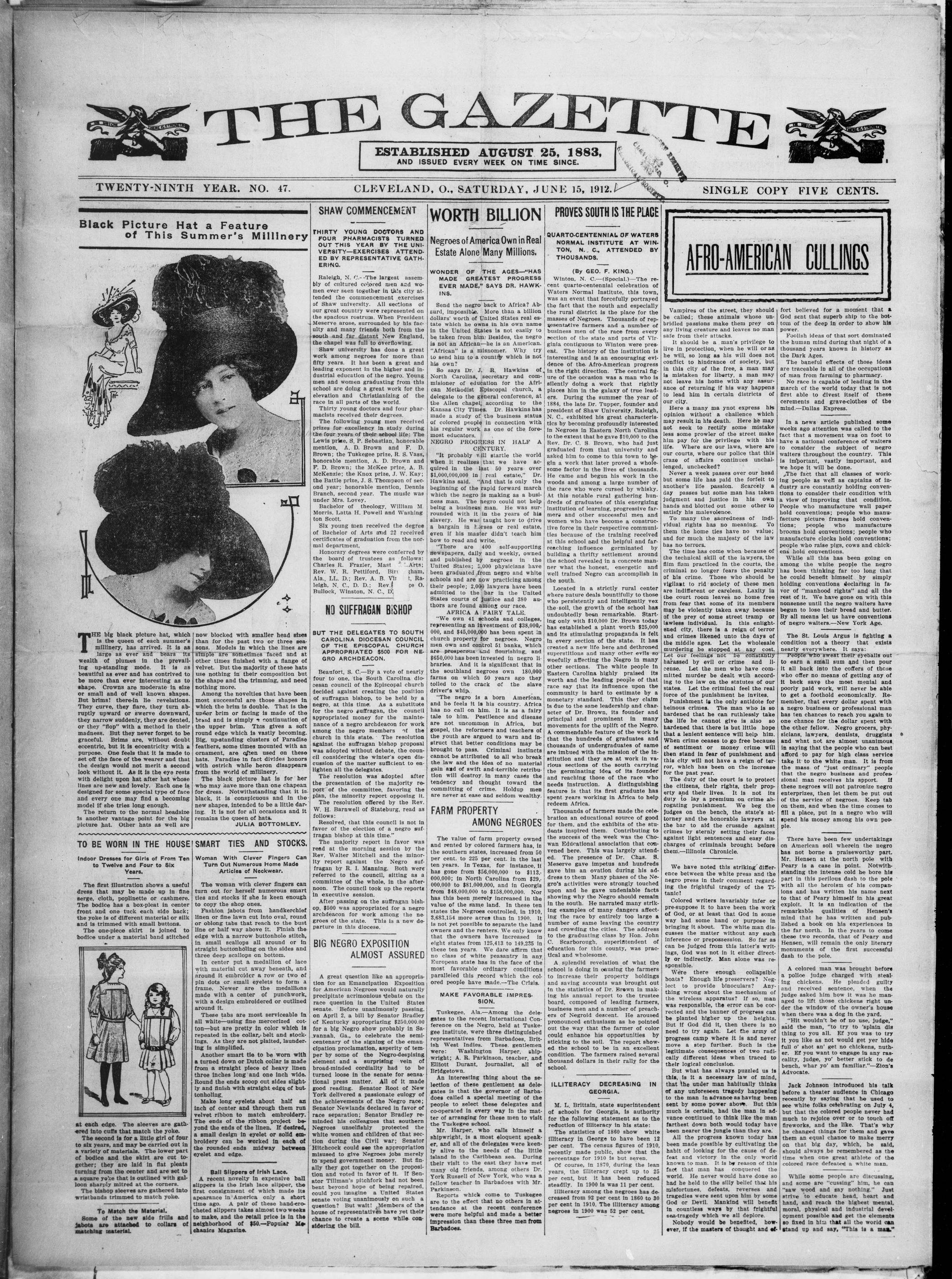
Black Picture Hat
of This S
THE big black picture hat, which
is the queen of each summer's
mininery, has arrived. It is as large as ever and bears its wealth of plumes in the prevailing up-standing mode. It is as beautiful as ever and has contrived to be more than ever interesting as to shape. Crowns are moderate in size or small and of well known shapes. But brims! there in lie revelations. They curve, they flare, they turn abruptly upward or swerve downward, they narrow suddenly, they are dented, or they "flow" with a method in their madness. But they never forget to be graceful. Brims are, without doubt eccentric, but it is eccentricity with a purpose. One feels that it is made to set off the face of the wearer and that the design would not merit a second look without it. As it is the eye rests with delight upon hat after hat whose lines are new and lovely. Each one is designed for some special type of face and every one may find a becoming model if she tries long enough.
The return to the normal headsize is another vantage point for the big picture hat. Other hats as well are
Indoor Dresses for Girls of From Ten to Twelve and Four to Six Years.
The first illustration shows a useful dress that may be made up in fine serge, cloth, poplinette or cashmere. The bodice has a box-pleat in center front and one tuck each side back; the yoke is of different material or silk and is trimmed with small buttons. The one-piece skirt is joined to bodice under a material band stitched
at each edge. The sleeves are gathered into cuffs that match the yoke. The second is for a little girl of four to six years, and may be carried out in a variety of materials. The lower part of bodice and the skirt are cut together; they are laid in flat pleats turning from the center and are set to a square yoke that is outlined with galloon sharply mitred at the corners.
The bishop sleeves are gathered into wristbands trimmed to match yoke.
To Match the Material.
Some of the new side frills and jabots are attached to collars of matching material.
THE GAZETTE
now blocked with smaller head sizes than for the past two or three seasons. Models in which the lines are simple are sometimes faced and at other times finished with a flange of velvet. But the majority of these hats use nothing in their composition but the shape and the trimming, and need nothing more.
Among the novelties that have been most successful are those shapes in which the brim is double. That is the under brim or facing is made of the brad and is simply a continuation of the upper brim. This gives a soft round edge which is vastly becoming. Big, up-standing clusters of Paradise feathers, some times mounted with an ornament, are often used on these hats. Paradise in fact divides honors with ostrich while heron disappears from the world of millinery.
The black picture hat is for her who may have more than one chapean for dress. Notwithstanding that it is black, it is conspicuous and in the new shapes, intended to be a little daring. It is not for all occasions and it remains the queen of hats.
JULIA BOTTOMLEY.
Woman With Clever Fingers Can Turn Out Numerous Home Made Articles of Neckwear.
The woman with clever fingers can turn out for herself numerous smart ties and stocks if she is keen enough to copy the shop ones.
Fashion jabots from handkerchief linen or fine lawn cut into oval, round or oblong tabs that reach to the bust line or half way above it. Finish the edge with a narrow buttonhole hole, in small scallops all around or in straight buttonholding on the sides and three deep scallops on bottom.
In center put a medallion of lace with material cut away beneath, and around it embroider a row or two of pin dots or small eyelets to form a frame. Newer are the medallions made with a center of punchwork, with a design embroidered or outlined around it.
These tabs are most serviceable in all white—using fine mercurized cotton—but are pretty in color which is repeated in the collar, belt and stockings. As they are not plaited, laundering is simplified.
Another smart tie to be worn with a turned down or Dutch collar is made from a straight piece of heavy linen three inches long and one inch wide. Round the ends scoop out sides slightly and finish with straight edge of buttonhoning.
Make long eyelens about half an inch of center and through them run velvet ribbon to match embroidery. The ends of the ribbon project beyond the ends of the linen. If desired, a small design in eyelen or solid embroidery can be worked in each of the rounded ends midway between eyelen and edge.
Ball Slippers of Irish Lace
A recent novelty in expensive ball slippers is the Irish lace slipper, the first consignment of which made its appearance in America only a short time ago. A pair of these hand-errocheted slippers takes almost two weeks to make, and the retail price is in the neighborhood of $50.—Popular Mechanics Magazine.
ESTABLISHED AUGUST 25, 1883 AND ISSUED EVERY WEEK ON TIME SINCE.
SHAW COMMENCEMENT
THIRTY YOUNG DOCTORS AND FOUR PHARMACISTS TURNED OUT THIS YEAR BY THE UNIVERSITY—EXERCISES ATTENDED BY REPRESENTATIVE GATHERING.
Raleigh, N. C.—The largest assembly of cultured colored men and women ever seen together in this city attended the commencement exercises of Shaw university. All sections of our great country were represented on the spacious rostrum. When President Meserve arose, surrounded by his faculty and many friends both from the south and far distant New England, the chapel was full to overflowing.
Shaw university has done a great work among negroes for more than fifty years. It has been a great and leading exponent in the higher and industrial education of the negro. Young men and women graduating from this school are doing a great work for the elevation and Christianizing of the race in all parts of the world.
Thirty young doctors and four pharmacists received their degrees.
The following young men received prizes for excellence in study during the four years of their school life: The Lewis prize, S. P. Sebastian, honorable mention, A. D. Brown and F. D. Brown; the Tuskegee prize, R. S. Vass, honorable mention, A. D. Brown and F. D. Brown; the McKee prize, A. B. McKenzie; the Knox prize, J. W. Kay; the Battle prize, J. S. Thompson of second year; honorable mention, Dennis Branch, second year. The music was under Mrs. Lovey. Bachelor of theology, William M. Morris, Latta H. Powell and Washing ton Scott. Six young men received the degree of Bachelor of Arts and 22 received certificates of graduation from the normal department. Honorary degrees were conferred by the board of trustees as follows: Charles R. Frazier, Mast Arts; Rev. W. R. Pettiford, Birchham, Ala., LL. D.; Rev. A. B. Vail, T. Raleigh, N. C., D. N.; Rev. George O. Bullock, Winston, C. D.
NO SUFFRAGAN BISHOP
BUT THE DELEGATES TO SOUTH CAROLINA DIOCESAN COUNCIL OF THE EPISCOPAL CHURCH APPROPRIATED $500 FOR NEGRO ARCHDEACON.
Beaufort, S. C.-By a vote of nearly four to one, the South Carolina doeasan council of the Episcopal church decided against creating the position of suffragan bishop, to be held by a negro, at this time. As a substitute for the negro suffragan, the council appropriated money for the maintenance of a negro archdeacon for work among the negro members of the church in this state. The resolution against the suffragan bishop proposal was adopted without debate, the council considering the winter's open discussion of the matter sufficient to enlighten all the delegates.
The resolution was adopted after the presentation of the majority report of the committee, favoring the plan, the minority report opposing it. The resolution offered by the Rev. W. H. Barnwell of Stateburg, read as follows:
Resolved, that this council is not in favor of the election of a negro suffragan bishop at this time."
The majority report in favor was read at the morning session by the Rev. Walter Mitchell and the minority report against the Negro suffragan by R. I. Manning. Both were referred to the council, sitting as a committee of the whole, in the afternoon. The council took up the reports in executive session.
After passing on the suffragan bishop, $200 was appropriated for a negro archdeacon for work among the nee-
persons. This is a new departure in this diocese.
BIG NEGRO EXPOSITION
ALMOST ASSURED
A great question like an appropriation for an Emancipation Exposition for American Negroes would naturally precipitate acrimonious debate on the race question in the United States senate. Before unanimously passing on April 2, a bill by Senator Bradley of Kentucky appropriating $250,000.00 for a big Negro show probably in Savannah. Ga., to celebrate the semicentennial of the signing of the emancipation proclamation, asperity of temper by some of the Negro-despising element and a surprising vein of broad-minded cordiality had to be turned loose in the senate for sensational press matter. All of it made good reading. Senator Root of New York delivered a passionate eulogy of the achievements of the Negro race; Senator Newlands declared in favor of race separation; Senator Bradley reminded his colleagues that southern Negroes unselfishly protected the white women and children of that section during the Civil war; Senator Hitchcock could see the appropriation misused to give Negroes jobs merely to spend government money. But finally they got together on the proposition and voted in favor of it. If Senator Tillman's pitchfork had not been bent beyond hope of being repaired, could you imagine a United States senate voting unanimously on such a question? But wait! Members of the house of representatives have yet their chance to create a scene while considering the bill.
WORTH BILLION
Negroes of America Own in Real Estate Alone Many Millions.
WONDER OF THE AGES—"HAS MADE GREATEST PROGRESS EVER MADE," SAYS DR. HAWKINS.
Send the negro back to Africa? Absurd, impossible. More than a billion dollars' worth of United States real estate which he owns in his own name in the United States is not easily to be taken from him. Besides, the negro is not an African—he is an American. "African" is a misnomer. Why try to send him to a country which is not his own?
So says Dr. J. R. Hawkins of North Carolina, secretary and commissioner of education for the African Methodist Episcopal church, a delegate to the general conference, at the Allen chapel, according to the Kansas City Times. Dr. Hawkins has made a study of the business status of colored people in connection with his regular work as one of the foremost educators.
NEGRO PROGRESS IN HALF A CENTURY.
"It probably will startle the world when it realizes that we have acquired in the last 50 years over $1,000,000,000 in real estate," Dr. Hawkins said. "And that is only the beginning of the rapid forward march which the negro is making as a business man. The negro could not help being a business man. He was surrounded with it in the years of his slavery. He was taught how to drive a bargain in horses or real estate, even if his master didn't teach him how to read and write.
"There are 400 self-supporting newspapers, daily and weekly, owned and published by negroes in the United States; 3,000 physicians have been graduated from negro and white schools and are now practicing among their people; 2,000 lawyers have been admitted to the bar in the United States courts of justice and 380 authors are found among our race.
AFRICA A FAIRY TALE.
"We own 41 schools and colleges, representing an investment of $38,000,000, and $45,000,000 has been spent in church property for negroes. Negro men own and control 51 banks, which are prosperous and flourishing, and $650,000 has been invested in negro libraries. And it is significant that in the southland negroes own 180,000 farms on which 50 years ago they trolled to the crack of the slave driver's whip.
"The negro is a born American, and he feels it is his country. Africa has no call on him. It is as a fairy tale to him. Pestilence and disease are not uncommon in Africa, but gospel, the reformers and teachers of the youth are argued to warn and instruct that better conditions may be brought to pass. Criminal instincts cannot be attributed to all who break the law and the idea of no material gain and of swift and terrible retribution will destroy in many cases the tendency and thought toward the committing of crime. Holdup men are never at ease and seldom wealthy.
FARM PROPERTY
AMONG NEGROES
The value of farm property owned and rented by colored farmers has, in the southern states, increased from 50 per cent. to 225 per cent. in the last ten years. In Texas, for instance, it has gone from $56,000,000 to $113,000,000; in North Carolina from $29,000,000 to $81,000,000, and in Georgia from $48,000,000 to $158,000,000. Nor has this been merely increased in the value of the same land. In these ten states the Negroes controlled, in 1910, 3,683,154 more acres than in 1900. It is not yet possible to separate the land owners and the renters. We only know that the owners have increased in eight states from 125,413 to 149,235 in these ten years. We dare affirm that no class of white peasantry in any European state has in the face of the most favorable ordinary conditions paralleled this record which the colored people have made...The Crisis.
MAKE FAVORABLE IMPRESSION.
Tuskegee, Ala.—Among the delegates to the recent International Conference on the Negro, held at Tuskegee institute, were three distinguished representatives from Barbadoes, British West Indies. These gentlemen were: Washington Harper, shipwright; A. R. Parkinson, teacher, and Elliott Durant, journalist, all of Bridgetown.
An interesting thing about the selection of these gentlemen as delegates is that the governor of Barbadoes called a special meeting of the people to select these delegates and co-operated in every way in the matter of arranging for these men to visit the Tuskegee school.
Mr. Harper, who calls himself a shipwright, is a most eloquent speaker, and all of the delegates were keenly alive to the needs of the little island in the Caribbean sea. During their visit to the east they have met many old friends, among others Dr. York Russell of New York, who was a fellow teacher in Barbadoes with Mr. Parkinson.
Reports which come to Tuskegee are to the effect that no others in attendance at the recent conference were more helpful and made a better impression than these three men from Barbadoes.
PROVES SOUTH IS THE PLACE
QUARTO-CENTENNIAL OF WATERS
NORMAL INSTITUTE AT WIN
TON, N. C., ATTENDED BY
THOUSANDS.
Winton, N. C.—(Special.)—The recent quarto-centennial celebration of Waters Normal Institute, this town, was an event that forcefully portrayed the fact that the south and especially the rural district is the place for the masses of Negroes. Thousands of representative farmers and a number of business men of the race from every section of the state and parts of Virginia contiguous to Winton were present. The history of the institution is interesting and is an encouraging evidence of the Afro-American progress in the right direction. The central figure of the occasion was a man who is silently doing a work that rightly places him in the galaxy of true leaders. During the summer the year of 1884, the late Dr. Tupper, founder and president of Shaw University, Raleigh, N. C., exhibited his great characteristics by becoming profoundly interested in Negroes in Eastern North Carolina to the extent that he gave $10,000 to the Rev. Dr. C. S. Brown, who had just graduated from that university and asked him to come to this town to begin a work that later proved a wholesome factor in the lives of thousands. He and began his work in the woods and among a large number of the race who were cursed by whisky. At this notable rural gathering hundreds of graduates of this energizing institution of learning, progressive farmers and other successful men and women who have become a constructive force in their respective communities because of the training received at this school and the helpful and far-reaching influence germinated by building a thrifty settlement around the school revealed in a concrete manner what the honest, energetic and well trained Negro can accomplish in the south.
Located in a strictly rural center where nature deals bountiful to those who persistently and intelligently vex the soil, the growth of the school has undoubtedly been remarkable. Starting only with $10,000 Dr. Brown today has established a plant worth $25,000 and its stimulating propaganda is felt in every section of the state. It has created a new life here and dethroned superstitions and many other evils so woefully affecting the Negro in many other sections. The white people in Eastern Carolina highly praised its worth and the leading people of that race say that its influence upon the community is hard to estimate by a monetary standard. This they claim is due to the sane leadership and character of Dr. Brown, its founder and principal and prominent in many movements for the uplift of the Negro. A commendable feature of the work is that the hundreds of graduates and thousands of undergraduates of same are imbued with the mission of the institution and they are at work in various sections of the south carrying the germinating idea of its founder and reaching those of the race who needs instruction. A distinguishing feature is that its first graduate has spent years working in Africa to help redeem Africa.
Thousands of farmers made the celebration an educational source of good for them, and the exhibits of the students inspired them. Contributing to the success of the week was the Chowan Educational association that convened here. This was largely attended. The presence of Dr. Chas. S. Meserve gave impetus and hundreds gave him an ovation during his address to them. Many phases of the Negro's activities were strongly touched upon and he gave undeniable facts showing why the Negro should remain in the south. He narrated many striking examples of many dangers affecting the race by entirely too large a number of same leaving the country and crowding the cities. The address to the graduating class by Hon. John C. Scarborough, superintendent of education for this county, was practical and wholesome.
A splendid revelation of what the school is doing in causing the farmers to increase their property holdings and saving accounts was brought out in the statistics of Dr. Brown in making his annual report to the trustee board, composed of leading farmers, business men and a number of preachers of Negroid descent. He aroused pronounced enthusiasm as he pointed out the way that the farmer of color could enhance his opportunities by sticking to the soil. The report showed the school to be in an excellent condition. The farmers raised several thousand dollars in their rally for the school.
ILLITERACY DECREASING IN GEORGIA.
M. L. Brittain, state superintendent of schools for Georgia, is authority for the following statement as to the reduction of illiteracy in his state:
The statistics of 1880 show white illiteracy in George to have been 12 per cent. The census figures of 1910, recently made public, show that the percentage for 1910 is but seven.
Of course, in 1870, during the lean years, the illiteracy crept up to 25 per cent, but it has been reduced steadily. In 1900 is was 11 per cent.
Illiteracy among the negroes has decreased from 92 per cent in 1860 to 30 per cent in 1910. The illiteracy among negroes in 1900 was 52 per cent.
SINGLE COPY FIVE CENTS.
AFRO-AMERICAN CULLINGS
Vampires of the street, they should be called; these animals whose unbridled passions make them prey on any living creature and leaves no man safe from their attacks.
It should be a man's privilege to live in protection, when he will or as he will, so long as his will does not conflict to hindrance of society, but in this city of the free, a man may be mistaken for liberty, a man may not leave his home with any assurance of returning if his way happens to lead him in certain districts of our city.
Here a many ma ynot express his opinion without a challenge which may result in his death. Here he may not seek to rectify some mistake less some prowler of the street make him pay for the privilege with his life. Where are our laws, where are our courts, where our police that this craze of affairs continues unchallenged, unchecked?
Never a week passes over our head but some life has paid the forfeit to another's life passion. Scarcely a day passes but some man has taken judgment and justice in his own hands and blotted out some other to satisfy his malevolence.
To many the sacredness of individual rights has no meaning. To them the home ties have no value; and for much the majesty of the law has no terror.
The time has come when because of the technical skill of the lawyers, the film flam practiced in the courts, the criminal no longer fears the penalty of his crime. Those who should be vigilant to rid society of these men are indifferent or careless. Laxity in the court room leaves no home free from fear that some of its members may be violently taken away because of the prey of some street tramp or lawless individual. In this enlightened city, there is a reign of terror and crimes likened unto the days of the middle ages. Let the wholesale murdering be stopped at any cost. Let our feelings not be constantly harassed by evil or crime and license. Let the men who have committed murder be dealt with according to the law on the statutes of our states. Let the criminal feel the real force of the punishment he invites.
Punishment is the only antidote for heinous crimes. The man who is so hardened that he can ruthlessly take the life he cannot give is also so hardened that there is but little hope that a lentient sentence will help him. When crime ceases to go free because of sentiment or money crime will then stand in fear of punishment and this city will not have a reign of terror, which has been on the increase for the past year.
The duty of the court is to protect the citizens, their rights, their property and their lives. It is not its duty to lay a premium on crime abrogating punishment. We beg the judges on the bench, the state's attorney and the honorable lawyers at the bar to aid the crusade against crimes by sternly setting their faces against light sentences and easy discharges of criminals brought before them.—Illinois Chronicle.
We have noted this striking difference between the white press and the negro press in their comment regarding the frightful tragedy of the Titanic!
Colored writers invariably infer or pre-suppose it to have been the work of God, or at least that God in some way had some hand or purpose in bringing it about. The white man discuses the matter without any such inference or prepossession. So far as can be judged from this latter's writings, God was not in it either directly or indirectly. Man alone was responsible.
were there enough collapsible boats? Enough life preservers? Neglect to provide binoculars? Anything wrong about the mechanism of the wireless apparatus? If so, man was responsible, the error can be corrected and the banner of progress can be planted higher up the heights. But if God did it, then there is no need to try again. Let the army of progress camp where it is and never move a step further. Such is the legitimate consequences of two radically different ideas when traced to their logical conclusion.
But what has always puzzled us is this, is it a necessary law of mind, that the under man habitually thinks of any unforeseen tragedy happening to the man in advance as having been sent by some power above. But this much is certain, had the man in advance continued to think like the man farthest down both would today have been nearer the jungle than they are.
All the progress known today has been made possible by cultivating the habit of looking for the cause of defeat and victory in the only world known to man. It is by reason of this fact that man has conquered the world. He never would have done so had he held to the silly belief that his misfortunes, defeats, reverses and tragedies were sent upon him by some God or Devil. Mankind will benefit in countless ways by that frightful sea-tragedy which we all deplore. Nobody would be benefited, however, if the masters of thought and of
fort believed for a moment that a God sent that superb ship to the bottom of the deep in order to show his power.
Foolish ideas of that sort dominated the human mind during that night of a thousand years known in history as the Dark Ages.
The benefit effects of those ideas are traceable in all of the occupations of man from farming to pharmacy.
No race is capable of leading in the march of the world today that is not first able to divest itself of these ceremonies and grave-clothes of the mind.—Dallas Express.
In a news article published some weeks ago attention was called to the fact that a movement was on foot to have a national conference of waiters to consider the subject of negro waiters throughout the country. This is important, vastly important, and we hope it will be done.
The fact that all classes of working people as well as captains of industry are constantly holding conventions to consider their condition with a view of improving that condition. People who manufacture wall paper hold conventions; people who manufacture picture frames hold conventions; people who manufacture brooms hold conventions; people who manufacture clocks hold conventions; people who raise pigs, cows and chickens hold conventions.
While all this has been going on among the white people the negro has been thinking far too long that he could benefit himself, by simply holding conventions declaring in favor of "manhood rights" and all the rest of it. We have gone on with this nonsense until the negro waiters have begun to lose their bread and butter. By all means let us have conventions of negro waiters.—New York Age.
The St. Louis Argus is fighting a condition not a theory that exists nearly everywhere. It says:
People who sweat their eyeballs out to earn a small sum and then pour it all back into the coffers of those who offer no means of getting any of it back save the most mental and poorly paid work, will never be able to get a foothold economically. Remember, that every dollar spent with a negro business or professional man has ten chances to reach you again to one chance for the dollar spent with the other fellow. Negro grocers, physicians, lawyers, dentists, druggists and what not are almost unanimous in saying that the people who can best afford to pay for high class service take it to the white man. It is from the mass of "just ordinary" people that the negro business and professional man receives his support. If these negroes will not patronize negro enterprises, then let them be put out of the service of negroes. Keep tab on them, and when the time comes to fill a place, put in a negro who will spend his money among his own people.
There have been few undertakings on American soil wherein the negro has not borne a praiseworthy part. Mr. Hensen at the north pole with Peary is a case in point. Notwithstanding the intense cold he bore his part in this perilous dash to the pole with all the heroism of his companions and has written his name next to that of Peary himself in his great exploit. It is an indication of the remarkable qualities of Hensen's mind that he has written and published a book on his experiences in the far north. In the years to come these two records, that of Peary and Hensen, will remain the only literary monuments of the first successful dash to the pole.
A colored man was brought before a police judge charged with stealing chickens. He pleaded guilty and received sentence, when the judge asked him how it was he managed to lift those chickens right under the window of the owner's house when there was a dog in the yard.
"Hit wouldn't be of no use, judge," said the man, "to try to 'splain dis thing to you all. If you were to try it you like as not would get yer hide full o' shot an' get no chickens, nuther. If you want to engage in any rassality, judge, yo' better stick to de bench, whar yo' am familiar."—Zion's Advocate.
Jack Johnson introduced his talk before a theater audience in Chicago recently by saying that he used to see white folks celebrating on July 4, but that the colored people never had much to rejoice over or to touch off fireworks, and the like. That's why he changed things for them and gave them an equal chance to make merry on that big day, which, he said, should always be remembered as the time when one great athlete of the colored race defeated a white man.
While some people are discussing, and some are "cussing" him, he can "saw wood and say nothing." Just strive to educate head, heart and hand, and reach the highest mental, moral, physical and industrial development possible and get the elements so fixed in him that all the world can stand up and say, "This is a man."
One Year.....$1.50
Six Months.....1.00
Three Months......50
Subscribers are requested to rem-
mit by postoffice money or-
der or registered letter.
Entered at the postoffice in Cleveland
Ohio, as second-class matter
Address all communications to
HARRY C. SMITH
Editor and proprietor,
THE GAZETTE,
Blackstone Building, Cleveland, O.
Member Ohio Legislature: 1894
to 1896; 1896 to 1898; 1900 to 1902
THE GAZETTE is the oldest, and has the largest bona fide circulation, double that of any newspaper in the interest of Afro-Americans, published in the state of Ohio, and comparison with any will immediately establish its rank as one of the NEWSIEST AND BEST in the country.
ly member of the race, not an office-holder or an office-seeker, can enthuse over the candidacy of either Roosevelt velt or Taft, is more than we can explain.
As we go to press, the indications (from Chicago) are that neither Taft nor Roosevelt will be the Republican nominee for president, this year. This is what we have hoped and prayed for all along. It will, too, be the salvation of the Republican party at the polls in November. The outlook for the nomination of Associate Justice Hughes of the U. S. Supreme Court, a New Yorker, grows brighter daily. If he is not the nominee then let it be our good and great friend, Senator Joseph Benson Foraker.
W. A. McAlpin, a railway mail clerk, on his first run from here to Union, Miss, returned to Laurel, Miss, showing welts, bruises and cuts which he said he received at the hands of a crowd of white brutes at Union. He said he was called out of an eating house and at the point of a revolver marched down the railroad track. He was forced to remove his clothing, and the scoundrels with whips gave him a severe beating, telling him they "wanted no Negroes on his job." He was sent to Laurel to relieve O. L. Parker, a white clerk. No governmental action has been taken, to punish the brutes. Hurrah, for Taft?
Miss Isabel Vanderwall, of East Orange, N. J., graduated recently from the Women's Medical College of Central Park West and 101st street, New York City, with highest honors. She is the only Colored student attending or having attended this college. Miss Vanderwall will be remembered as the recent honor graduate of the Orange High School and whose determination in attending her class dance and reception created considerable commotion and a newspaper sensation. Good! for Miss Vanderwall. May her kind increase! The race needs them greatly these days.
How any intelligent, loyal and man-
A GREAT SUMMER EXCURSION.
We desire to call the attention of our good people of means, especially our business and professional men and women, school-teachers and others who are accustomed to take annual vacations, to Mr. C. T. White's advertisements elsewhere in The Gazette. An old and experienced railroad man in Canada and the United States, a man of intelligence and means, splendid standing with his own people and the business world in both countries genial, accommodating and a gentle man, Mr. White is an ideal person to conduct just such a great excursion treat as he advertises. This is an opportunity that has never before been presented to our people, and The Gazette is anxious that they grasp it as much for the future as this particular much for the future as for this particular instance. Mr. White should be encouraged in order that such opportunities may be multiplied. He has at his back the great Canadian Pacific Railroad, and those who take advantage of this great summer excursion can depend upon the best accommodations ones—sleepers, diners, and the largest improved service and cars on the best trains in either country. Write him for full particulars and ask any question in relation to the excursion that occurs to you, and he will give prompt and satisfactory replies and assurances, and whatever else you may request. As the time is short, do not delay but write him at once.
A NEW BOOK.
Sherman, French & Co., publishers
6 Beacon St, Boston, Mass., announce
the sale of a unique publication of sur-
passing interest to our people. It is
the autobiography of "an ex-Colored
man," the child of a slave and her
owner. Being of such complexion that
he passes readily as white, as such he
makes a name and place for himself
in the world, socially and financially,
and providing a white world of re-
finement and wealth, to whom alone
he disclosed the secret of his birth. In
his antibiography the burdensome secre-
t of years is revealed and, incid-
entially, a half ironical joke is played
on society.
Will Banquet.
The Ministerial Alliance and friends will banquet at Mt. Haven Baptist Church, Tuesday evening. The Program.
From 8 to 8.30 p. m., informal gathering.
8.30 p. m., song by congregation.
Bible reading by Rev. J. E. Davis.
Song by congregation.
Prayer by Rev. G. W. Clark.
Song by congregation.
Banquet open, gather around table.
Pals Speecher
Talentors
"Our Ministers." Rev. F. G. Snelson. Civic righteousness. Rev. H. C. Bailey. Rev. B. W. Paxton. "Good government, how to obtain it." Hon. Harry C. Smith. Response by President of the M. A. Rev. E. H. Smith. Pres., Rev. Geo A. Sissle. Sec.
WRITTEN BY "THE OLD RELIABLE" GAZETTE'S CORRESPONDENTS.
THROUGHOUT OHIO
What Our People Are Doing Each Week—Church, Personal, Social, Lodge, Literary and Mu
Sandusky. "The silver offering for the sick, at J. S. Davis', netted $25." Children's day exercises at Second Baptist church, were excellent. Miss Carrett trained the little ones. Mr. Simmons worked with who with his wife and Miss Mary Russell sent Sunday in Cleveland.—Mrs. Emma Clark who had 17 teeth extracted, is better. Also N. F. Williams and Mr. Shadd.—Mass meeting for missionary work at Second Baptist church, June 18, p. 118. Hackey, new P. E., was welcomed at the A. M. E. church, Sunday, by a large congregation.
---
Cadiz. The B. B's met at Mr. Jas, Smith's. Dr. and Mrs. Dean Mason are visiting in Springfield. Mr. M. Washington of Smithfield, were here last Monday. Drs. Jesse E. Smith and Dean Mason are home for their vacation—from Howard University. Rev. A. W. Rainbow of Wheeling, was in town Sunday and was accompanied home by his wife and Mrs. Rosa Morgan who have been visiting relatives here. Miss Florence Smith entered at diner, Sunday, Miss B. M. Box-Tree P. C. entertained an entertained last Friday night by Design Drums. They report an enjoyable evening. Mrs. Lizzie Mars of Baltimore, Md., is visiting her father, Mr. Alex West and other relatives here. The Gleaner girls spent last Saturday afternoon at the home of Pauline Ballard.
Lorain—Mr. Arthur Smith, Miss Blanch Lille, Mr. and Mrs. F. B. Smith and daughter, Helen, Messrs Willard and Irvin Thompson, Mr. and Mrs. Wesley Davis and daughter, Emma, Miss Bettie Jackson, Mr. and Mrs. P. Hill and two children, of Elyria, were here Sunday—Mrs. Bessie Burrell of Cleveland, visited her parents, Mr. and Mrs. Wm. Brantford—Mr. Fried Owens who was called here by his father's illness, has returned to Dayton. Miss Anna Owens came also—Miss Bertha Carman of Norwalk, was here, Sunday—Children's day was appropriately observed at St. Matthew's church, Sunday. Eight children were here, Mrs. H. McKeen's stewardal funeral was held from Wickens' chapel, Sunday afternoon. Interment in Elmwood cemetery. Rev. G. L. Hicks officiated. A number of relatives from Elyria and Oberlin were in attendance. The services were largely attended. Revs. Holland and McDuffie assisted Rev. Hicks. The latter was in Cleveland, Tuesday.
Smithfield. —J. M. Green, formerly an old resident of this place, died in Martins Ferry, recently. He had lived there for 30 years and was buried from the A. M. E. church, Sunday afternoon. The local Post, G. A. R., of which Mr. Green was a member, attended the funeral. Rev. W. M. Randall, pastor of the church, officiated, assisted by Ross. Jackson and Hogans, assisted by Ransom. He highly respected, and leaves a wife, brother, two adopted children, a host of relatives and friends to mourn his demise. Those who attended the funeral from here, were: G. W. Veney, L. McFee, S. Freeman, F. Carter, and Mrs. W. H. Heney, Miss Julia Veney, Mrs. L. Davis and Mrs. C. Fitzgerald. A number also attended childrens day exercises in McIntyre. Mrs. L. Davis and Mrs. C. Fitzgerald, who visited relative, the last week, went to Steubenville, Saturday, accompanied by Mrs. Agnes Smith who spent the winter with Mr. and Mrs. W. H. Veney. —Mrs. M. Mitchell returned from Hopedale, Saturday, She was called by her daughter, Mrs. F. Christian's illness. —Mrs. Mary C. Harris visited in Hopedale, last Monday. —Mrs. W. H. Veney and daughter, Julia, visited in Steubenville and attended exercises, Sunday evening, conducted by Mrs. S. W. White, were very good and largely attended. —Mr. and Mrs. Geo. Veney were in Dillonville, Saturday.
---
Youngstown—Covenant lodge, No 57. F. & A. M., will have St. Johns day exercises at St. Marys A. M. E Zion church, June 23. Rev. Wilson will preach the sermon. All other societies will act as an escort headed by Mahoning band—Mrs. Nancy Finney was in Cleveland, Sunday. Mrs. Cora Jacobs spent the week in Steubenville with Mrs. Al. Johnson—Louisa Edwards court, No. 30, Calanthe, will elect officers, June 19. All members should be present—E. S. Moore is convalescent. He and Mrs. Joe Whitney were married in Oak Hill Av. A. M. e Church, last Wednesday, by the pastor. The wedding was an elaborate fajita dinner. Leo C. LeDoward a triangle about the party of which a flashlight picture was taken, special music, the church being nicely decorated, and a banquet being served in the lecture room of the church. Miss Luca was maid of honor, Mr. Harvey, best man; Misses Grace Lacey and W. McGruder, bridesmaids; Mr. Douglas, assistant to best man; Gladys Smith and Flora Duff, flowers-girls; Mrs. Robert Williams of Butte, Mont., is visiting her cousin, Mrs. G. M. Fagan. Miss Virginia Martin who has been attending school at Downington, Pa., has returned for the summer—Consula Stewart court of Calantle. No 53, held an important meeting, last Monday evening—Eureka club's best dance party for m. J. Moore, on the 18th. B. C. T. Shaffer on has succeeded Bishop W. B. Derrick, in this third Episcopal district of the A. M. E. church, will be at Oak Hill Av., church, June 23, with Dr. J. M. Gilmere, P. E., of Cleveland. Grand rally, that day. On the 24th, a reception will be tendered them in the church by Rev. Jesse H. Smith, the pastor, his congregation and friends. The new bishop is a fine man, a gentleman, and a scholar.
The Gazette desires to ask its readers to remember, especially, its advertisers. Patronize them; they want your trade and will treat you fair. You are more than those who do not ask for your patronage in these columns.
THE GAZETTE, CLEVELAND, O. SATURDAY, JUNE 15. 1912
COLORED STUDIERS
MIDNIGHT ASSASSINS
THE SQUARE DEAL
DOOP OF HOPE
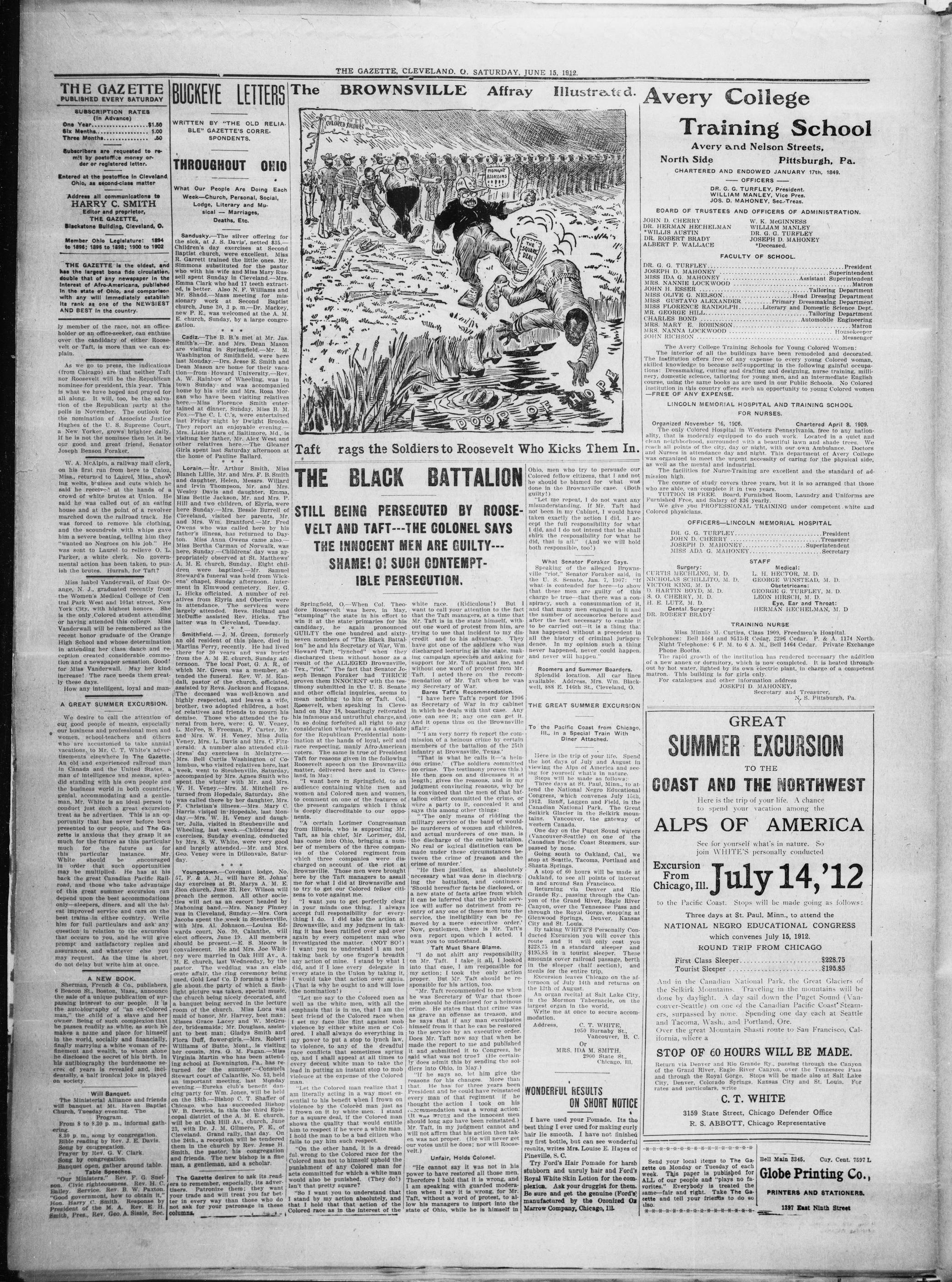
Taft rags the Soldiers to Roosevelt Who Kicks Them In.
THE BLACK BATTALION
STILL BEING PERSECUTED BY ROOSEVELT AND TAFT---THE COLONEL SAYS THE INNOCENT MEN ARE GUILTY--- SHAME! O! SUCH CDNTEMPTIBLE PERSECUTION.
Springfield, O.—When Col. Theodore Roosevelt was here, in May, "stumping" the state in his effort to win it at the state primaries for his candidacy, he again pronounced GUILTY the one hundred and sixty-seven members of "The Black Battalion" he and his Secretary of War, Wm. Howard Taft, "lynched" when they discharged them without honor as a result of the Brownsville fire. The fact that Joseph Benson Forner had THRICE proven them INNOCENT with the testimony submitted in the U. S. Senate and other official inquiries, seems to mean nothing to him or Taft. Col. Roosevelt, when speaking in Cleveland on May 18, boastingly reiterated his infamous and untruthful charge, and in so doing forfeited all right to any consideration whatever, as a candidate for the Republican Presidential nomination at the hands of loyal, self and race respecting, manly Afro-American voters. The same is true of President Thomas J. Kennedy given in the following Roosevelt speech the Browness matter, delivered here and in Cleveland, in May:
"I want here in Springfield, to an audience containing white men and women and Colored men and women, to comment on one of the features of the present campaign which I think is deeply discredible to our opponents."
"A certain Lorimer Congressman from Illinois, who is supporting Mr. Taft, as his chief, Mr. Lorimer, did, has come into Ohio, bringing a number of members of the three companies of the Colored regiment from which three companies were discharged on account of the riot at Brownsville. Those men were brought here by the Taft managers to assail the Colored townsville and to try to get our Colored fellow citizens to vote against me.
"I want you to get perfectly clean in your minds one thing. I always accept full responsibility for everything I do. I did take the action at Brownville, and my judgment in taking it has been ratified over and over again by every competent man who investigated the matter. (NOT SO!) I want you to understand I am not taking back by one finger's breadth any action of mine. I stand by what I did, and if I lose every delegate in every state in the Union by taking it, I would take that action over again. (That is why he ought to and will lose the nomination!)
"Let me say to the Colored men as well as the white men, with all the emphasis that is in me, that I am the best friend of the Colored race when I set my face like flint against mob violence by either white men or Colored. I shall always do everything in my power to put a stop to lynch law, to violence, to any of the dreadful race conflicts. I shall sometimes put a lead appeal at all times to every decent white man to take the lead in putting an instant stop to mob violence at the expense of the Colored man.
"Let the Colored man realize that I am literally acting in a way most essential to his benefit when I frown on violence by the Colored man just as I frown on it by white men. I stand for a square deal, if the Colored man shows the quality that would entitle him to respect if he were a white man. I hold the man in a citizen who fails him in such respect.
"On the other hand, it is a dreadful, wrong to the Colored race for the Colored man not to himself uphold the punishment of any Colored man for acts committed for which a white man would also be punished. (They do!) isn't that pretty square?
"So I want you to understand that I stand by my action absolutely, and that I hold that that action of the Colored race as in the interest of the
white race. (Ridiculous!) But I want to call your attention to the fact that the Taft managers, at a time that Mr. Taft is in the state himself, without one word of protest from him, are trying to use that incident to my discredit and to his advantage. They have got one of the soldiers who was discharged lecturing in the state, making campaign rallies and asking for Mr. Taft against me, and without one word of protest from Mr. Taft. I acted on the recommendation of Mr. Taft when he was my Secretary of War.
Bares Taft's Recommendation.
"I have here Taft's report for 1906 as Secretary of War in my cabinet in which he deals with that case. Any one can see it; any one can get it. And it opens thus on the Brownsville affair."
"I am very sorry to report the commission of a heinous crime by certain members of the battalion of the 25th infantry at Brownsville, Texas."
"That is what he calls it—a heinous crime." (The soldiers committed no crime. The testimony proves this. He then goes on and discusses it at length; gives the reasons, and in my judgment convincing reasons, why he is convinced that the men of that batallion either committed the crime, or were a party to it, concealed it and says this among other things. "The only means of hiding the military service is the band of would be murderers of women and children, and actual murderers of one man, is the discharge of the entire battalion. No real or logical distinction can be made under these circumstances between the crime of treason and the crime of murder."
"He then justifies, as absolutely necessary what was done in discharging the battalion, and continues: 'Should hereafter facts be disclosed, or a new state of facts arise from which it can be inferred that the public service will suffer no detriment from reentry of any one of these men into the service, the ineligibility can be removed by a mere executive order now, when the is Mr. Taft's own report upon which I acted. I want you to understand
Taft Must Share Blame.
"I do not shift any responsibility on Mr. Taft. I take it all, I looked into that case, I am responsible for my action; I took the only action proper. But Mr. Taft should be responsible for his action, too.
"Mr. Taft recommended me when he was Secretary of the Army that those men he was assigned to serve for a heinous crime. He states that that crime was as grave an offense as treason, and he says that if any man exculpates himself from it that he can be restored to the service by an executive order. Does Mr. Taft now say that when he made the report to me and published it and submitted it to Congress, he said what was written (he certain did not) by this sending the soldiers into Ohio, in May.)
"If he says so, let him give the reasons for his changes. More than that. He has for three years been President and he could have reinstated every man of that regiment to a book on his recommendation was a wrong action; (It was wrong and the innocent man should long ago have been reinstated.) Mr. Taft, in my judgment cannot and will not affirm that his action then was not proper. (He will never get耐严 until he does; nor will Roosevelt.)
Unfair. Holds Colonel.
"He cannot say it was not in his power to have restored all those men. Therefore I hold that it is wrong, and I am speaking with guarded moderation when I say it is wrong, for Mr. Taft, without a word of protest, to allow his managers to import into the state of Ohio, while he is himself in
Ohio, men who try to persuade our Colored fellow citizens, that I and not he should be blamed for what was done in the Brownsville case. (Both guilty!)
"Let me repeat, I do not want any misunderstanding. If Mr. Taft had not been in my Cabinet, I would have taken exactly the action I did. I accept the full responsibility for what I did, and I do not intend that he shall shirk the responsibility for what he did, that is all." (And we will hold both responsible, too!)
What Senator Foraker Says.
Speaking of the alleged Brownsville "riot," Senator Foraker said, in the U. S. Senate, Jan. 7, 1907: "If what is contended for here—to show that the charge is true—that there was a conspiracy, such a consummation of it, and that many men engaged in it and the number of accessories before and after the fact necessary to enable it to be carried out—it is a thing that has happened without a precedent in all the history of criminal jurisprudence, such a thing never happened, never could happen, and never will happen."
Roomers and Summer Boarders.
Splendid location. All car lines available. Address, Mrs. Wm. Blackwell, 888 E. 146th St. Cleveland, O.
To the Pacific Coast from Chicago, Ill., in a Special Train With Diner Attached.
Here is the trip of your life. Spend the hot days of July and August in viewing the Pacific America and seeing for yourself what's in nature. Stops will be made as follows:
Three days at St. Paul, Minn., to attend the National Negro Educational Congress, which convenes July 15th, 1912. Banff, Laggen and Field, in the Canadian National Park. The Great Selkirk Glacier in the Selkirk mountains. Vancouver, the gateway of western Canada.
One day on the Puget Sound waters (Vancouver-Seattle) on one of the Canadian Pacific Coast Steamers, surpassed by none.
Going south to Oakland, Cal., we stop at Seattle, Tacoma, Portland and Shasta Springs.
A stop of 60 hours will be made at Oakland, to see all points of interest in and around San Francisco.
Returning via Denver and Rio Grande Ry., passing through the Canyon of the Grand River, Eagle River Canyon, over the Tennessee Pass and through the Royal Gorge, stopping at Glenwood Springs, Denver, Kansas City and St. Louis.
By taking WHITE'S Personally Conducted Excursion you will cover this route and it will only cost you $228.75 in a standard sleeper and $153.85 in a tourist sleeper. These amounts cover railroad passage, berth in the sleeper (half section), and meals for the entire trip.
Excursion leaves Chicago on the afternoon of July 14th and returns on the 13th of August.
In the Mormon Tabernacle, on the largest organ in the world.
Write me at once to secure accom-
Write me at once to secure accommodation.
Address, C. T. WHITE,
1050 Burnaby St.
Vancouver, B. C.
Or
MRS. IDA M. SMITH,
2900 State St.
Chicago, Ill.
WONDERFUL RESULTS
ON SHORT NOTICE
I have used your Pomade. Its the best thing I ever used for making curly hair lie smooth. I have not finished my first bottle, but can see wonderful results, writes Mrs. Louise E. Hayes of Pineville, S. C.
Try Ford's Hair Pomade for harsh stubborn and unruly hair and Ford's Royal White Skin Lotion for the complexion. Ask your druggist for them. Be sure and get the genuine (Ford's) manufactured by the Ozonized On Marrow Company, Chicago, IL.
DR. G. G. TURFLEY. President.
JOS. D. MAHONEY. Special Trees.
JOHN D. CHERRY
DR. HERMAN HECHELMAN
WYNDHAM
DR. ROBERT BRADY
DR. ROBERT P. WALDACE
FACULTY OF SCHOOL.
DR. G. G. TURFLEY.....
JOSEPH D. MAHONEY
MISS IDA G. MAHONEY
MRS. NANNIE LOCKWOOD
JOHN H. ESSER
MISS OLIVE G. NELSON
MISS GUSTAVO ALEXANDER
MISS FLORENCE RANDOLPH.
MR. GEORGE HILL
CHARLES BOND
MRS. MARY E. ROBINSON
MRS. NANNA LOCKWOOD
JOHN RICHSON
The Avery College Training S
The interior of all the buildings
The institution offers free of any ex-
skilled knowledge to become self-su-
tions: Dressmaking, cutting and draft-
ery; domestic science, tailoring for y
course, using the same books as are a
institution in this country as such
—FREE OF ANY EXPENSE.
LINCOLN MEMORIAL HOSP
FOR
ERFLEY ..... President
MAHONEY ..... Superintendent
MAHONEY ..... Superintendent
BE LOCKWOOD ..... Matron
SER ..... Tailoring Department
G. NELSON ..... Head Dressing Department
AVO ALEXANDER ..... Primary Dressmaking Department
ENCE RANDOLPH ..... Literary and Domestic Science Dept.
E HILL ..... Tailoring Department
OND ..... Automobile Engineering
E. ROBINSON ..... Matron
A LOCKWOOD ..... Housekeeper
SON ..... Messenger
Every College Training Schools for Young Colored Women:
prior of all the buildings have been remodeled and decorated.
on offers free of any expense to every young Colored woman,
edge to become selfsupporting in the following gainful occupancy
making, cutting and drafting and designing, nurse training, mill-
science, tailoring for young men, and an intermediate English
the same books as are used in our Public Schools. No Colored
this country offers such an opportunity to young Colored women
ANY EXPENSE.
OLN MEMORIAL HOSPITAL AND TRAINING SCHOOL
FOR NURSES.
DR. G. G. TURFLEY.....President
JOSEPH G. MAHONEY.....Superintendent
MISS IDA G. MAHONEY.....Assistant Superintendent
MRS. NANNIE LOCKWOOD
JOHN H. ESSER.....Matron
MISS OLIVG G. NELSON.....Tailoring Department
MISS OLIVG G. NELSON.....Head Dressing Department
MISS GUSTAVO ALEXANDER.....Primary Dressmaking Department
MISS FLORENCE RANDOLPH.....Literary and Domestic Science Dept.
MR. GEORGE HILL.....Tailoring Department
CHARLES BOND.....Automobile Engineering
MRS. MARY E. ROBINSON.....Matron
MRS. NANNA LOCKWOOD.....Housekeeper
JOHN RICHSON.....Messenger
The Avery College Training Schools for Young Colored Women:
The interior of all the buildings have been remodeled and decorated.
The institution offers free of any expense to every young Colored woman,
skilled knowledge to become self-supporting in the following gainful occupations:
Dressmaking, cutting and drafting and designing, nurse training, millinery, domestic science, tailoring for young men, and an intermediate English course using same books as are used in our Public Schools. No Colored institution in the country offers such an opportunity to young Colored women
-FREE OF ANY EXPENSE
Organized November 16. 1906.
The only Colored Hospital in Western Pennsylvania, free to any nationality, that is modernly equipped to do such work. Located in a quiet and clean neighborhood, surrounded with a beautiful lawn and shade trees. We reach all points of the city, day or night, with our own Ambulance. Doctors are organized in an ambulance day and night. This department of Avery College was organized to meet the necessity of caring for the physical side, as well as the mental and industrial.
The only Colored Hospital in Waltham, that is modernly equipped to clean neighborhood, surrounded with reach all points of the city, day or n and Nurses in attendance day and night as well as the medical and industrial facilities for Nurse-Training mission high.
The course of study covers three who are able, can complete it in two TUITION IS FREE. Board, Furnished Free, and Salary of $36 y We give you PROFESSIONAL colored physicians.
Colored Hospital in Western Pennsylvania, free to any nation, is modernly equipped to do such work. Located in a quiet and wooded, surrounded with a beautiful lawn and shade trees. We rent the city, day or night, with our own Ambulance. Doctors attend attendance day and night. This department of Avery College is used to meet the urgent necessity of caring for the physical side of the mental and industrial utilities for Nurse-Training are excellent and the standard of advenience of study covers three years, but it is so arranged that those who can complete it in two years. NIS FREE. Board, Furnished Room, Laundry and Uniforms are free, and Salary of $36 yearly. You PROFESSIONAL TRAINING under competent white and blackicians.
The facilities for Nurse-Training are excellent and the standard of admission high. The course of study covers three years, but it is so arranged that those who are able, can complete it in two years.
years.
TUITION IS FREE. Board. Furnished Room, Laundry and Uniforms are
Furnished Free, and Salary of $36 per week.
We give you PROFESSIONAL TRAINING under competent white and
Colored physicians.
OFFICERS—LINCOLN MEMORIAL HOSPITAL
DR. G. G. TURPLEY.....
JOHN D. CHERRY.....
JOSEPH D. MAHONEY.....
MISS ADA G. MAHONEY....
G. G. TURFLEY.....President
N D. CHERRY.....Treasurer
EPH D. MAHONEY.....Superintendent
S ADA G. MAHONEY.....Secretary
STAFF
DR. G. G. TURFLEY.....President
JOHN D. CHERRY.....Treasurer
JOSEPH D. MAHONEY.....Superintendent
MISS ADA G. MAHONEY.....Secretary
STAFF
Surgery:
CURTIS MECHLING, M. D.
NICHOLAS SCHILLITO, M. D.
VICTOR KOY, M. D.
D. HARTIN BOVD, M. D.
S. O. CHERRY, M. D.
H. E. LUTZ, M. D
Medical:
L. H. HECTOR, M. D.
GEORGE WINSTEAD, M. D.
Obstetricians:
GEORGE G. TURFLEY, M. D.
LEON HIRSCH, M. D.
Eye, Ear and Throat:
HERMAN HECHELMAN, M. D
Dental Surgery:
DR. ROERT BRADY
TRAINI
Miss Minnie M. Curtiss, CL
Telephones: Bell 1464 and 9513-R C
Night Telephone: 6 P. M. to 6 A
Phone Booths.
The rapid growth of the institu-
tion of a new annex or dormitory, which
out by hot water, lighted by its own
matron. This building is for girls o
For catalogues and other inform
JOSEPH D.
GRE
SUMMER
TO
COAST AND T
TRAINING NURSE
as Minnie M. Curtis, Class 1909, Freedmen's Hospital.
Bell 1464 and 9513-R Cedar, 2296 Cedar, P. & A. 1174 North
telephone: 6 P. M. to 6 A. M., Bell 1464 Cedar. Private Exchange
booths.
Id growth of the institution has rendered necessary the addition
nexx or dormitory, which is now completed. It is heated through
water, lighted by its own electric plant, in charge of a competen
is building is for girls only.
dialogues and other information address
JOSEPH D. MAHONBY.
Miss Minnie M. Curtis, Class 1909, Freedmen's Hospital. Telephones: Bell 1464 and 5513-R Cedar, 2295 Cedar. P. & A. 1174 North. Night Telephone: 6 P. M. to 6 A. M. Bell 1464 Cedar. Private Exchange Phone Booths. The rapid growth of the institution has rendered necessary the addition of a new annex or dormitory, which is now completed. It is heated throughout by hot water, lighted by its own electric plant, in charge of a competent matron. This building is for girls only.
GREAT
SUMMER EXCURSION
TO THE
ST AND THE NORTHWEST
Here is the trip of your life. A chance
to spend your vacation among the
See for yourself what's in nature. So join WHITE'S personally conducted
Excursion From Chicago, Ill. July
to the Pacific Coast. Stops
Three days at St. Pa.
NATIONAL NEGRO ERA
which conven
ROUND TRIP
First Class Sleeper.....
Tourist Sleeper .....
And in the Canadian Nation the Selkirk Mountains. Traced done by daylight. A day said conver-Seattle) on one of the ers, surpassed by none. Spe and Tacoma, Wash., and Por Over the great Mountain Sha ifernia, where a
STOP OF 60 HOURS
Return via Denver and Rio Grande of the Grand River, Eagle River and through the Royal Gorge. St City, Denver, Colorado Springs, rates and particulars, write
July 14,'12
Pacific Coast. Stops will be made going as follows:
Three days at St. Paul, Minn., to attend the
NATIONAL NEGRO EDUCATIONAL CONGRESS
which convenes July 15, 1912.
ROUND TRIP FROM CHICAGO
First Class Sleeper.....$228.75
Tourist Sleeper.....$195.85
in the Canadian National Park, the Great Glaciers of
Girk Mountains. Traveling in the mountains will be
daylight. A day sail down the Puget Sound (Van-
Seattle) on one of the Canadian Pacific Coast' Steam-
passed by none. Spending one day each at Seattle
oma, Wash., and Portland, Ore.
in the great Mountain Shasti route to San Francisco, Cal-
where a
TOP OF 60 HOURS WILL BE MADE.
a Denver and Rio Grande Ry., passing through the Canyon
and River, Eagle River Canyon, over the Tennessee Pass
through the Royal Gorge. Stops will be made also at Salt Lake
iver, Colorado Springs, Kansas City and St. Louis. For
particulars, write
Excursion From Chicago, Ill. July 14,'12
First Class Sleeper.....$228.75
Tourist Sleeper.....$195.85
And in the Canadian National Park, the Great Glaciers of the Selkirk Mountains. Traveling in the mountains will be done by daylight. A day sail down the Puget Sound (Vancouver-Seattle) on one of the Canadian Pacific Coast' Steamers, surpassed by none. Spending one day each at Seattle and Tacoma, Wash., and Portland, Ore.
Over the great Mountain Shasti route to San Francisco, California, where a
STOP OF 60 HOURS WILL BE MADE.
Return via Denver and Rio Grande Ry, passing through the Canyon of the Grand River, Eagle River Canyon, over the Tennessee Pass and through the Royal Gorge. Stops will be made also at Salt Lake and then near Springs, Kansas City and St. Louis. For cites and particulars, write
C. T. WHITE
3159 State Street, CH
R. S. ABBOTT, CH
3159 State Street, Chicago Defender Office
R. S. ABBOTT, Chicago Representative
3159 State Street, Chicago Defender Office R. S. ABBOTT, Chicago Representative
Send your local items to The Gazette on Monday or Tuesday of each week. This paper is published for ALL of our people and "plays no favorites." Everybody is treated the same—fair and right. Take The Gazette and tell your friends to do so also.
---
W. K. McGINNESS
W. WILLIAM MANLEY
W. CURFLEY
JOSEPH D. MAHONEY
*Deceased*
Chartered April 8, 1909.
Medical:
L. H. HECTOR, M. D.
GEORGE WINSTEAD, M. D.
Obstetricians:
GEORGE G. TURFLEY, M. D.
LEON HIRSCH, M. D.
Eye, Ear and Throat:
HERMAN HECHELMAN, M. D
Secretary and Treasurer,
N. S. Pittsburgh, Pa.
Bell Main 3345. Cuy. Cent. 7597 L
Globe Printing Co.,
PRINTERS AND STATIONERS.
1397 East Ninth Street
PURELY PERSONAL
PURCHASE THE "GAZETTE" AT NOTICE TO SUBSCRIBERS:—Subscribers not receiving The Gazette regularly should notify us at once. We desire every copy delivered promptly. We advise our patrons to carefully examine The Gazette's advertisements before making purchases. Business men who advertise in this paper should have the patronage of Afro-Americans. The fact that they advertise is assurance that they want it. Local reading notices (advertisements) ten cents a line (six words in a line.)
PURCHASE
THE
"GAZETTE" AT
THE ONLY ONE IN CLEVELAND
The Gazette is and has been, for many months, the only paper published in Cleveland and northern Ohio for the Colored people, all reports to the contrary notwithstanding. Do not be misled.
EDITOR.
FOR RENT.—Houses—If you have places to rent or if you want to rent—notify The Gazette.
For Sale. lot, and will build a cottage or bungalow—all for $300 down. S. E. Woods, 2828 Central ave.
For Sale. S. E. Woods of 2828 Central Av., has several good homes. Prices ranging from $1,700 to $3,500, on easy terms.
Wanted—Partner—with $200; in the best restaurant on Central Ave. Gentleman or lady, S. G. Adkins, 2613 Central Ave.
NOTARY PUBLIC—For such services call at The Gazette office. No. 3 Blackstone Building, No. 1422 W. 3d street, near Superior avenue.
For Rent. A nicely furnished front room with bath and all conveniences for two men, or man and wife—at 2346 E. 33d St. 'Phone, Central 7955 K.
FOR RENT —Furnished rooms with gas and bath. Special accommodations for the theatrical people. Room and board. Mrs. I. B. Ambrose, 2228 Scovill Ave. Cuy. Phone, Central 2917 L.
Rev. G. L. Hicks of Lorain called on the Gazette Tuesday. S. Fox is Antich's representative at the S. C. Congress, in session, at Taukegue, Ala.
Rev. J. W. Hill will preach, Sunday at Mt. Haven church, in the absence of the pastor.
Miss Eather Irving arrived last week from Washington, D. C., to visit her sister, Mrs. Lottie Gordon of Gibson Av. S. E. She called on The Gazette.
Mr. W. Carroll of Chicago, arrived Sue with wife, who remained to visit Mr. Geo Carroll her husband's birth. He will return to visit before returning with Mrs. Carroll.
The Women's Auxiliary to the Juvenile Court and Humane Society promoted a lecture at Cory chapel, Thursday evening, in which a Miss Latimer of N. Y., a Mrs. Hamilton of Pittsburgh and others, were to be the principals. Prof. Geo. W. Cook, secretary and treasurer of Howard University, and head of its Normal Department, arrived in the city Wednesday night, to attend the National Conference of Charities and Corrections. The Professor is stopping at the Central House. Miss Mary W. Ovington, Prof. Du Bois, Mr. Chas, Chesnutt and others, will speak in Engineers' hall, cor of Ontario St., and St. Charles Av., on Monday to tell your friends to do so also. ADMISSION FREE. Be there at 2 P. M. sharp. Do not forget this pass along the word. THIS WILL BE A TREAT!
Children's day at St. James A. M. E. church was fittingly observed. An excellent sermon, by the pastor, in the morning, and addresses and songs by the children, and Messrs. Farmer, Brooks, Ramey and Mrs W. B. Sheehan in the evening. Three persons were asked to grand meeting in the interest of a new church-building will be held the last of this month. The Ministers' Alliance and a number of other speakers of both classes, will be in attendance. Mrs. Lu Nichols Fernandez, who left a月 ago for Chicago and who was announced to be a Mr. Burke, announced m of that city, died suddenly early last week of heart failure, and was buried here. Saturday, in Lake View cemetery, from its chapel, Rev. B. W. Paxton preached the funeral sermon. It is said. Mrs. Fernandez remembered her. She was an old resident of this city, and leaves three brothers and a sister to mourn her demise.
Mr. Herman Thompson, son of Mrs. I. E. Turner, and a brother of Harry E. Thompson, died last week and was buried, Tuesday afternoon, from St. James church. Rev. Paxton officiating, assisted by Rev. Clark and the pastor. the choir sang. Underfaker E. F. Boyd was in charge. Interment in E. Cleveland cemetery. The Spanish-American war veterans were represented at the funeral. The relatives have the sympathy of a host of friends.
Rev. Cory preached the morning sermon at Cory M. E. church, Sunday. The children's exercises were fine. Two more conversations as a result of street meetings and four joined the church. Rev. G. A. Sissle's daughter and husband, Mr. and Mrs. Lewis of Indianapolis, have located the Mrs. Hattie Scott of the church of the S. class, was one of the graduates from the Old St. church, this week. Quite a number from Cory visited the M. E. church at Lorain, Rev. McDuffie, is holding a revival. Rev. Sissle baptized at Bulah Park at a. Monday. The W. H. M. S. will meet at Mrs. Fannie Blackburn's, E. 25th St. Thursday afternoon. The Epworth League will spend Monday evening discussing St. John. All invited. The Willing Workers will serve refreshments. The "Silent Workers" 79 strong, won both banners, Sunday Epworth League vesper service, every Sunday at 6 P. M. All welcome.
Rev. J. L. E. Burr is in Columbus, the Interdenominational S. S. convention, and Rev. H. C. Balley at Xenia.
Mrs. G. D. Fosnaught and C. P. Lancaster attended the Alliance High-school commencement to witness the graduation of her son and daughter, on the 11th of May. Fosnaught was asked to her former husband, the illness of her father, Mr. Luther Hughes, a civil-war veteran.
Sunday evening at Mt. Zion Congregational church, Miss Mary W. Ovington of Brooklyn, N. Y., secretary of the N. A. A. C. P., will speak, under the auspices of the Du Buis Literary club. This, in connection with the recital of the church choir, will furnish a program, none should miss. A speeches given to all club women, is extended.
Bishop C. T. Shaffer of Chicago, recently appointed to this, the third Episcopal district of the A. M. E. church, succeeding Bishop W. B. Derrick, will officiate at a grand rally at the A. M. E. church in Youngstown, June 23. Dr. J. M. Gilmere, P. E. will assist him, a splendid reception will be given them there, Monday evening, June 24, by the pastor, Rev Jesse H. Smith, and the members and friends of Oak Hill Av., A. M. E. church.
George Alexander was taken from his home, 729 Theresa-cat. Tuesday afternoon, with his throat cut. His wife, Lucy, is under arrest. Sounds of a quarrel came from the Alexandra home, and Lucy Hunt, who occupied half the house, to the Alexandra's. She found Alexander on the floor, his throat slashed, and his wife holding a bloody razor. Hogan's ambulance took the man to Lakeside hospital, where he is expected to die.
Cleveland Press.
The Ministers' Alliance adjourned, Tuesday, for the summer, and to meet the second Tuesday of each month, beginning in the autumn. The new officers are B. W. B. Paxton, pres; Rev. F. G. Snelson, vice; Rev. J. L. Lurr, sec; Rev. G. V. Clark, treas. The low, vile epithets and oaths of the officers in the recent County convention, by a prominent local Negro, caused considerable discussion. Rev. H. C. Bailey who was delegated a week ago to take the matter and discuss it before the Alliance, Tuesday morning, had been called out of the city, but will no doubt return in time to do so. Tuesday evening when the Alliance's annual banquet is to be held at Mt. Haven Baptist church. A special invitation to this so-called meeting of the Citizens' Rights league, and the Co-Workers. In addition to Drs. Bailey and Snelson, Rev. B. W. Paxton and others will speak.
Here is the trip of your life across the continent on White's personally conducted excursion trail from Chicago on July 14, in a special train of Pullman standard and tourist sleeper; also carrying dinner, so you be no occasion for it, to go to the museum where they might be refused. A delightful trip of over 6,000 miles without change of cars, except a day spent on run down Puget Sound, Vancouver to Seattle, on one of the C. P. R. famous Pacific Coast steamers—surpassed by none stopping three days in the United National Educational Congress; also spending three days in Canadian Rockie, the Alps of
PETER J. HARRIS
America, 60 hours stopped at Oakland and San Francisco, California. Stops will be also made at numereous places, such as Seattle, Tacoma, Portland, Salt Lake City, Denver, Kansas City and St. Louis, from 12 to 36 hours. Traveling in the mountains will be principally by day, so you will have ample chance to see all the beauties of nature. Don't let this golden opportunity slip, as it is the first time Colored people have ever in such an unusual style I expect to limit the number to 135. For rates and particulars, write me C. T. White, 3159 State St., Chicago III, care Chicago Defender.
Mrs. L. A. Cunningham of E. 43d St., left Monday for Buffalo, to attend her son-in-law, W. Alikern's funeral, Tuesday.
Mt. Haven church has sold its property on E. 33d St., and Gethseminie Baptist church is looking for new quarters on E. 43d St., as a result. A concert will be given at Mt. Zion church, Wednesday, June 19, to raise money to help place Mrs. Martha Gregory in the Old Folks' Home.
The Gazette is indicted to Francis J. Poston of the State School Commissioner's office, Columbus, for a copy of his chief's 58th annual report.
S. E. Woods, Tom W. Fleming and John Clifford have been appointed assistant sergeant-at-arms of the National Republican Convention, June 18 to 22 inclusive.
Mrs. Dr. Byrd of Myersdale, Pa., who was in the city, some weeks studying, returned home recently. She made up the Central House, and made up of warm friends while in this city.
DOINGS OF THE RACE.
Howard University had 151 graduates, this year.
At Tuskegee Normal and Industrial Institute's commencement in May, 184 diplomas and certificates were issued Allen & Wickliffe of Chattanooga, Tenn., have our largest drug store. They operate on a capital of $20,000.
Two of our young men born in Texas but reared in California, have invented an electric device for controlling traffic in covert areas. The invention looks like a four-sided seaphore. It is electrically operated and obviates the necessity of the crossing policeman standing in the middle of the street. Instead, he may stand on any one of the corners and by pressing a button, sound a signal and change the signs. The inventors are C. R. Bailley and W. O. Warren.
G. W. Franklin of Chattanooga, Tenn., president of our National Furniture Directors' Association, has an ample library necessary in his line. He hears numbers in
The soda-water benefit given St. Andrews' church by the Brown Drug Co., W. W. Brown, manager, last Wednesday, was a great success. The Silver Leaf club, under the direction of the club's president, fountain, the entire day and evening, in a manner most pleasing and satisfactory to all. They served over 600 people. This, together with the large number of tickets sold, netted them a total of $100,000, but the entire community appreciate Mr. Brown's hospitality and generosity.
The National Conference of Charities and Corrections convened in Engineers' hall, this city, June 12, for one week. The Gazette urgently requests the presence of our people, especially on Monday afternoon, June 17. The subject to be discussed at that session will be, "The Negro's Status in the United States; speak of the Negro in Kelley, Judge Julian W. Mack, President Thwing, Chas. W. Chestnut, Esq., Miss Mary W. Oxtington and others. Every race organization in the city ought to work ardently to have a good representation at the meeting. Mayor Newton D. Baker appointed the editor of The Gazette, Rev. H. C. Bailey and others, delegates on behalf of this city, to this N. C. of C. and C. Our ministers also ought to work with our congregations in Monday's session. We hope to see Engineers' hall well filled with our people as well as others, Monday afternoon at 2 P. M.
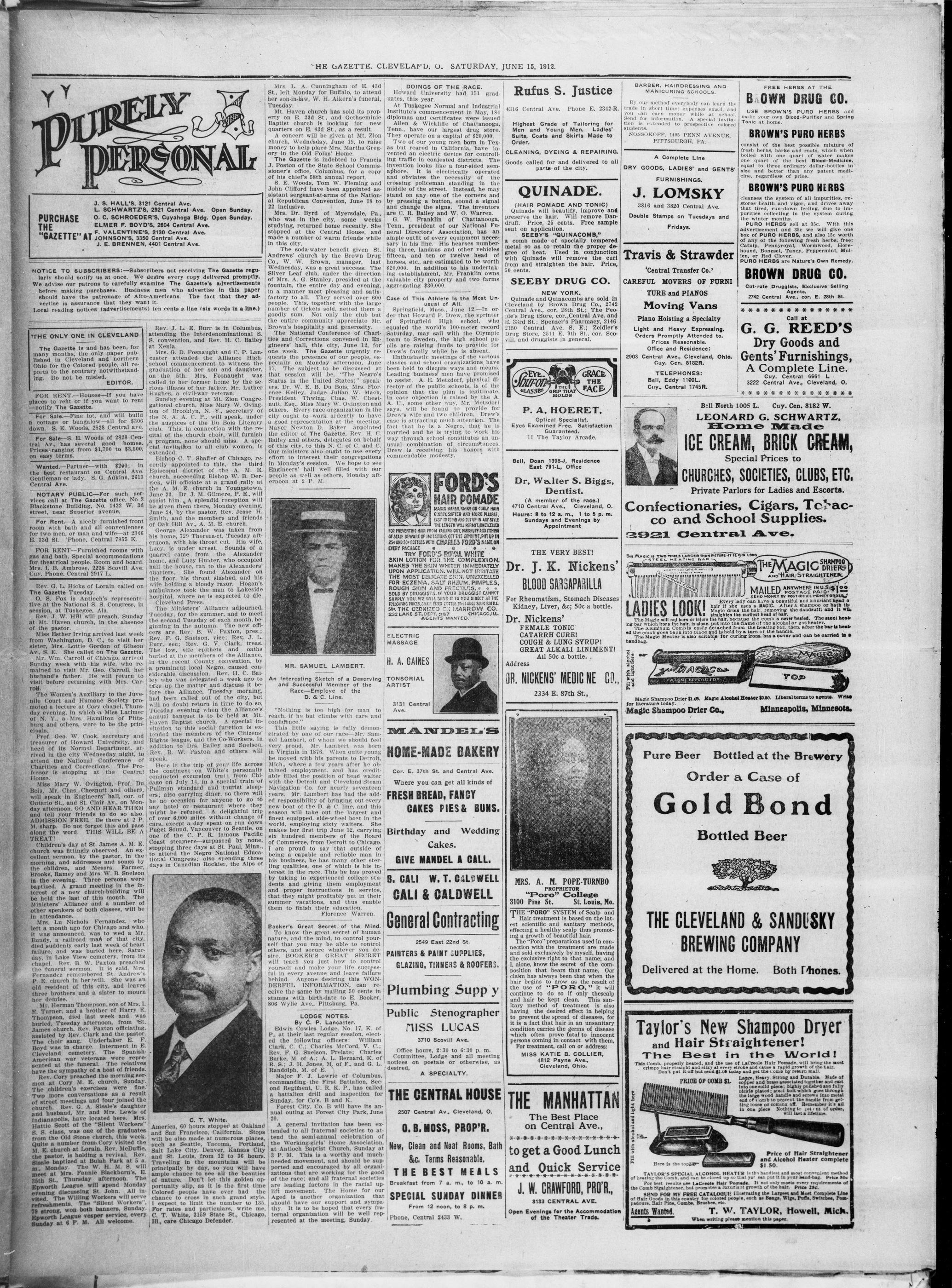
MR. SAMUEL LAMBERT.
An Interesting Sketch of a Deserving and Successful Member of the Race—Employee of the D. & C. Line.
"Nothing is too high for man to reach, if he but climbs with care and confidence."
This little saying is fully demonstrated by one of our race—Mr. Samuel Lambert, of whom we should feel very proud. Mr. Lambert was born in Virginia in 1876. When quite young he moved with his parents to Detroit, Mich., where a few years after he obtained employment, and has credibly filled the position of head waiter with the Detroit and Cleveland Steam Navigation Co. for nearly seventeen years. Mr. Lambert has had the added responsibility of bringing out every bont of the D. & C. line, and this season will take out the largest and finest equipped. side-wheel boot in the world, employing sixty waiters. She makes her first trip June 12, carrying six hundred members of the Board of Trustees of the University I am proud to say that outside being a capable and reliable man in his business, he has many other sterling qualities, one of which is his interest in the race. This he has proved by taking in experienced college students and giving them employment and proper instructions in service, that they might profitably put in their summer vacations, and thus enable them to finish their education.
Florence Warren.
Booker's Great Secret of the Mind.
To know the great secret of human nature, and the mind, to control yourself, yourself, and secure whatever you desire, BOOKER'S GREAT SECRET will teach you just how to control yourself and make your life successful in every avenue and leave failure. Anyone desiring this WOORFUL WORKING MEMBER RECEIVE the same by mailing 50 cents in stamps with birth-date to E. Booker, 806 Wylie Ave., Pittsburgh, Pa.
LODGE NOTES.
Edwin Cowles Lodge, No. 17, K. of P., at their last regular session, elected the following officers: William Clark, C. C.; Charles McCord, V. C.; Rev F. G. Snelson, Prelate; Charles Burke, M. of A.; A. L. Bernard, K. of R. S.; J. H. Jones, M. of F., and G. L. Randolph, M. of E.
Major F. J. Lowrie of Columbus, commanding the First Battalion, Second Regiment, U. R. K. P., has called a battalion drill and inspection for Sunday, for Co's B. and K.
Forest City, Co. B will have its annual outing at Forest City Park, June 20.
A general invitation has been extended to all fraternal societies to attend the semi-annual celebration of the Working-girls' Home Association, at Antioch Baptist Church, Sunday at 3 P. M. This is a worthy and much-needed movement, and should be supported and encouraged by all organizations that are working for the good of the race; and all fraternal societies are leading fear. "The Home for our Aged is another organization that should have our support and sympathy. It is to be hoped that every fraternal organization will be well represented at the meeting, Sunday.
DOINGS OF THE RACE.
Howard University had 151 graduates, this year.
At Tuskegee Normal and Industrial Institute's commencement in May, 184 diplomas and certificates were issued
Allen & Wickliffe of Chattanooga, Tom. Have a large store.
They operate on a capital of $500.
Two of our young men born in Texas but reared in California, have invented an electric device for controlling traffic in conested districts. The invention looks like a four-sided semaphore. It is electrically operated and obviates the necessity of the crossing policeman standing in the middle of the street. Instead he may be on the street or on the cornfield by pressing a button, sound a signal and change the signs. The inventors are C. R. Bailey and W. O. Warren.
G. W. Franklin of Chattanooga, Tennessee, president of our National Funeral Directors' Association, has an ample outfit of every equipment necessary in his line. His hearses numbering three, landaus and other vehicles fifteen, and ten or twelve head of horses, etc., are estimated to be worth $20,000. In addition to his undertaking establishment, Mr. Franklin owns valuable city property and two farms aggregating $30,000.
Case of This Athlete Is the Most Unusual of All.
Springfield Mass. June 12.—In order that Howard Drew, the spinner of Springfield High School, who equaled the world's 100-meter record Saturday, may sail with the Olympic team to Sweden, the high school pupils are raising funds to provide for Drew's family while he is absent.
Enthusiastic meetings of the various classes and school organizations have been held to discuss ways and means. Leading business men have promised to assist. A. E. Metzdorf, physical director of the public school system, is the legitimate in case objection is raised by the A. A. U. some other way, Mr. Metzdorf says, will be found to provide for Drew's wife and two children. Drew's case is attracting much attention. The fact that he is a Negro, that he is married and he is trying to work his usual employment, has the usual combination of circumstances. Drew is receiving his honors with commendable modesty.
FORD'S
HAIR POMADE
MAKES HARSH, KINNY OR CURLY HAIR
GLOSSY, SOFTER AND MORE PLAIN.
USE THE LENGTH WILL WORK BETWEEN
FOR PREVENTING HAIR FROM FALLING OUT, MURBURB AND IGHTING
OF SCALE BEWARE OF INITIATIONS GET THE GENIUM, PIT UP IN
25 AND 50 BOTTLES WITH CHARLES FORD'S NAME ON
EVERY PACKAGE
TRY FORD'S PURE WHITE
SKIN ON OTHERS, MAKE THE SKIN WINTER IMMEDIATELY
UPON APPLICATION. WILL NOT INHITATE
THE MOST DELICATE SKIN. UNEXCEELED
FOR ECZEMA, SALT RHEUM, PIMPLES,
ROUGH SKIN AND FREQUENCES.
SUPPLY YOU WE WILL SEND IT TO YOU DIRECT AT
THE FOLLOWING PRICES. SMALL FOOTLUG SEAL 520 BOTTLE
50% THE OZONED BY HARROW CO.
232 LAKE SHORE, CHICAGO, IL
AGENTS WANTED
A. H.
ELECTRIC
MASSAGE
TONSORIAL
ARTIST
3131 Central
Ave
MANDEL'S
HOME-MADE BAKERY
Cor. E. 37th St. and Central Ave.
Where you can get all kinds of
FRESH BREAD, FANCY
CAKES PIES & BUNS.
Birthday and Wedding
Cakes.
GIVE MANDEL A CALL.
B. CALI W. T. CALDWELL
CALI & CALDWELL
General Contracting
2549 East 22nd St.
PAINTERS & PAINT SUPPLIES,
GLAZING, TINNERS & ROOFERS.
Plumbing Supp y
Public Stenographer
Office hours, 2:30 to 6:30 p. m.
Committee, Lodge and all meeting notices on postals or otherwise, as desired,
A SPECIALTY
THE CENTRAL HOUSE
2507 Central Av., Cleveland, O.
O. B. MOSS, PROP'R.
New, Clean and Neat Rooms, Bath
&c. Terms Reasonable.
THE BEST MEALS
Breakfast from 7 a. m., to 10 a. m.
SPECIAL SUNDAY DINNER
From 12 noon, to 8 p. m.
Phone, Central 2433 W.
Rufus S. Justice
4316 Central Ave. Phone E. 2342-R
Highest Grade of Tailoring for
Men and Young Men. Ladies'
Suits, Coats and Skirts Made to
Order.
CLEANING, DYEING & REPAIRING.
Goods called for and delivered to all
parts of the city.
QUINADE.
(HAIR POMADE AND TONIC)
Quinade will beautify, improve and preserve the hair. Will remove Dandruff. Will apply. Free sample sent on application.
SEEBY'S "QUINACOMB," a comb made of specially tempered metal so as to retain the proper degree of heat. Used in conjunction with Quinade will remove the curl from and straighten the hair. Price,
SEEBY DRUG CO.
NEW YORK.
Quinade and Quinacombs are sold in Cleveland by Brown Drug Co., 2742 Central Ave., cor. 28th St.; The People's Drug Store, cor., Central Ave. and E. 33rd St.; Spenzer's Pharmacy, 2146 2150 Central Ave. S. E.; Zeidler's Drug Store, 2311 E. 9th St., cor. Scott, and druggists in general.
P. A. HOERET,
Optical Specialist.
Eyes Examined Free. Satisfaction Guaranteed.
11 The Taylor Arcade.
Bell, Doan 1398-J, Residence East 791-L, Office
(A member of the race.)
4710 Central Ave., Cleveland, O.
Hours: 8 to 12 a. m., 1 to 5 p. m.
Sundays and Evenings by Appointment
THE VERY BEST!
Dr. J. K. Nickens'
BLOOD SARSAPARILLA
For Rheumatism, Stomach Diseases
Kidney, Liver, &c; 50c a bottle.
Dr. Nickens'
FEMALE TONIC
CATARRH CURE!
COUGH & LUNG SYRUP!
GREAT ALKALI LINIMENT!
All 50c a bottle.
Address
DR. NICKENS' MEDIC NE CO.
2334 E. 87th St.,
[Image of a man with a serious expression, wearing a dark shirt and pants.]
"Poro" College
3100 Pine St. St. Louis, Mo.
THE "PORO" SYSTEM of Scalp, and
THE "PORO" SYSTEM of Scalp and Hair treatment is based on the latest scientific and sanitary methods, effecting a healthy scalp thus promoting a growth of beautiful hair. The "PORO" treatment is in connection with the treatment are made and sold exclusively by myself, having the exclusive right to that name; and I, alone, know the secret of the composition that bears that name. Our claim has always been that when the hair begins to grow as the result of treatment, it will continue to do so if only the scalp and hair be kept clean. This sanitary method of treatment is also having the desired effect in helping to prevent the spread of diseases, for it is a fact that hair in an unsanitary condition carries the germs of disease which often prove fatal to innocent persons. In them, they. For treatment, call on or address:
MISS KATIE B. COLLIER,
4812 Payne Ave.
Cleveland, Ohio.
THE MANHATTAN
The Best Place
on Central Ave.,
to get a Good Lunch
and Quick Service
J. W. CRAWFORD, PRO'R.,
3133 CENTRAL AVE.
Open Evenings for the Accommodation
of the Theater Trade.
CHURCHES, SOCIETIES, CLUBS, ETC. Private Parlors for Ladies and Escorts. Confectionaries, Cigars, Tobacco and School Supplies. 2921 Central Ave.
LADIES LOOK!
Every lady can have a beautiful and luxurious head o
bake. It is easy to make a MAGIC. After dumbbell and bake it
Magic dresses her hair, removing the dumbbell and it is wi
straighten the curliest head of hair.
The Magic will bind or injure it when heated. The magic heater baser heated. The guei heat-
ing device which puts the hair is alone, put into the flame of the alcohol or gas heater.
The Aluminum Combs is easily detached from the heating bar, then, after the bar is hea-
ted the comb goes back into place and is held by a turn of the handle.
The Magic Heater is also suitable for curling irons, has a cover and can be carried in a handbag.
Fill with alcohol and light here
Magic Shampoo Drier $1.00. Magic Alcohol Heater $0.50. Liberal terms to agents. Write
for literature today.
Magic Shampoo Drier Co.
Minneapolis, Minnesota.
Pure Beer Bottled at the Brewery
Order a Case of
Gold Bond
Bottled Beer
THE CLEVELAND & SANDUSKY
BREWING COMPANY
Delivered at the Home. Both Phones.
TAYLOR'S SPECIAL ALCOHOL HEATER is the handiest and most convenient method of heating the Comb, and can be closed up so that you can put it in your hand-bag. Price 50c. For best results use La Cretee Hair Pomade. It not only meets every requirements of the Comb Stainlighter, but promotes a luxurious growth of the hair. Price 25c.
SEND FOR MY FREE CATALOGUE illustrating the Largest and Most Complete Line of Hair. Country-colored people, such as Bangs, Wigs, Puffs, Switches, Pomodors, Hair Styles, Pile Caps, and More.
BARBER, HAIRDRESSING AND
MANICURING SCHOOLS.
By our method everybody can learn the
trade in short time; expenses small, and
you can earn money while at school.
Send for information. A special invitation
is extended to prospective colored
students.
NOSSOKOFF, 1403 PENN AVENUE,
PITTSBURGH, PA.
A Complete Line
DRY GOODS, LADIES' and GENTS'
FURNISHINGS.
J. LOMSKY
3816 and 3820 Central Ave.
Double Stamps on Tuesdays and
Fridays.
Travis & Strawder
'Central Transfer Co.' CAREFUL MOVERS OF FURNI TURE and PIANOS
Light and Heavy Expressing.
Orders Promptly Attended to.
Prices Reasonable.
Office and Residence:
2003 Central Ave., Cleveland, Ohio.
Cuy. Gen. 8182R.
TELEPHONES:
Bell, Eddy 1100L.
Cuy., Central 1745R.
Bell North
LEONA
HOUSE
ICE CREAM
SP
CHURCHES
Confectionaries co and Scho 2921 Centra
B OWN DRUG CO.
USE BROWN'S PURO HERBS and
Nursery Blood-Purifier and Spring
Tent at home.
BROWN'S PURO HERBS
consist of the best possible mixture of fresh herbs, barks and roots, which when boiled with one quart of water makes one quart of the best Blood-Medicine, a rich and valuable dollar-bottles in size and better than any patent medicine, regardless of price.
BROWN'S PURO HERBS
cleanses the system of all impurities, restores health and vigor, and drives away that tired, run-down feeling, due to imminent stress in the system during the winter months. PURO HERBS sell at 35c. With this advertisement and 35c we will give one box of PURO HERBS, and also 15c worth Catnip, Pennyroyal, Wormwood, Horehound, Boneset, Tancy, Peppermint, Mullen, or Red Clover.
BROWN DRUG CO.
Cut-rate Drugglugs, Exclusive Selling
Agents,
2742 Central Ave., cor. E. 28th St.
Call at
G. G. REED'S
Dry Goods and
Gents' Furnishings,
A Complete Line.
Cuy. Central 6661 L
3222 Central Ave., Cleveland, O.
BORD G. SCHWARTZ,
home Made
BRICK CREAM,
special Prices to
SOCIETIES, CLUBS, ETC.
colors for Ladies and Escorts.
Cigars, Tobac-
pool Supplies.
Al Ave.
THE MAGIC SHAMPOO DRIER
AND HAIR-STRAIGHTENER
MAILED ANYWHERE IN US.
SEND MONEY BY POSTAGE PAID.
You can have a beautiful and luxurious head o
use a handle, after a Shampoo or both th
the hair, removing the dandruff, and it will
the incomparable water heated. The steel heat
flame of the alcohol or gas heater.
from the heating bar, then, after the bar is hea-
ting from, has a cover and can be carried in a
MAGIC
TOP
Led at the Brewery
a Case of
Bond
ed Beer
D & SANDUSKY
COMPANY
home. Both Phones.
Shampoo Dryer
rightener!
in the World!
Of Lactreic Hair Pomade, will bring the most
rush and care of growths of the hair.
and get the comb by return mail.
Large, Heavy, Strong and Durable. Made of
copper and brass associated together and cast
into one solid piece; highly polished and fully
placed, neat which goes through
the large wood handle and screws into metal
end of a comb to prevent the handle from get-
ing loose or coming off. Remember it all
in one place. Nothing to set out of order,
will last a lifetime.
Price of Hair Straightener and Alcohol Heater complete $1.50.
ER is the handiest and most convenient method that you can put it in your hand-bag. Price 50c made. It not only meets every requirements of its growth of the hair. Price 25c. Illustrating the Largest and Most Complete Line tie, such as Benga, Wiga, Puffa, Switches, Pom.
TAYLOR, Howell, Mich. mention this paper.
Current Literature summarizes the tremendous progress the southern states have made and are making since the emancipation and certain conclusions as to southern labor that are of the greatest interest to the readers as embodying a retrospect based upon facts and figures that admits of no controversy and a perspective that is always problematical and that seldom justifies in results the forecasts of those who make them. "The best laid plans of men and mice aft gang aglee."
Mr. G. Grosvenor Dawe, managing director of the Southern Commercial congress, for example, glories in the fact that the south has 969,000 square miles of land and water; 300,000,000 acres of cultivatable land, half of which has not felt the touch of the plow, with vast mineral wealth and comparable climatic conditions "transforming the vital fluid of rain through the chemistry of plant life into girls that make glad the heart of man." Nature has done her part to make the south a veritable "garden of the Lord." If "only man is vile" there, we ask, whose is the fault?
On the other hand, Mr. Philip K. Keller, in Uncle Remus' Home Magazine, takes no stock in Dr. Washington's hopeful outlook, in the North American Review, of the negro's future in the south, as indicated in 1910, by his ownership of 900,000 farms. While Mr. Kellar shows that the south produces annually $6,010,000 worth of agricultural, forest and mineral products, with $21,500,000 invested in manufactures, he is of the opinion that negro labor is still a necessity in southern fields, but it is not such a necessity as it was in the years following the close of the war; and the last 10 or 20 years show that white men not only can work in the southern fields, but that they do better work and get larger yields than under the old systems of slave and negro contract labor." But negro farm owners, by the same token, are getting better results under newer systems of cultivation, and negro laborers are receiving a wage as independent workmen, with right to save their earnings and buy land, that was not true of the slave conditions.
"The lazy man's country is where the lazy man is. The lazy man is disappearing rapidly from the south, and with him is going the idea that the south is a lazy land," says Mr. Kellar. Negroes who are disposed to be lazy to work half time, to work half their land, and to spend most they make from year to year on their backs and stomachs, therefore, take warning from Mr. Kellar's view of the lazy man and lazy country business. The white south is wideawake; the black south cannot afford to sleep on its opportunities.
The mines and factories of the south are full of workmen from Europe who save their money and buy land in small parcels. They are agriculturists by education and preference, and as soon as they make enough in mine and factory work to purchase and stock farms they abandon mine and factory work to others of their countrymen, of whom there is always an unfalling supply. The southern negroes should study the labor and saving ways of the foreigners among them, and profit by it.
The south is no longer a lazy man's country. Its agricultural, forest and mineral lands will go finally to those who are not lazy men. The Age desires to impress these facts upon the minds of its southern readers now, in the accepted time, when land is cheap, wages reasonable and right to save money and buy is as much their privilege as of the white man.
PLANTS MUST BE PROPERLY FED
In the matter of plant food it stands to reason that each species would have its own characteristic way of attacking soil ingredients, even though the supply required to produce a crop may be almost the same with a number of species. But their method or habit of taking this food may be so different as to make it urgently necessary to rotate in order to prevent robbing. Each plant must have food adapted to itself, just the same as animals, and it is not difficult to imagine a case where soil is reasonably rich in plant food and yet a certain crop will not thrive on it to that extent that they will produce profitable returns.
The diversification of crops for the purpose of distributing labor throughout the year needs little if any comment. However, it is doubtful if the full benefits of scientific diversification are attained in every instance. We have known men who would put in a large acreage of one variety of oats or one variety of wheat, whereas labor could be used much more advantageously if more than one variety were used, so the harvest time could be extended over a longer period. One reason why winter wheat is increasing in popularity is because it ripens early, thereby enabling the farmer with a given amount of help to harvest a larger crop during the year than would be the case if only spring grains were seeded.
ENCLOSE THE PONDS.
Farmers should have one pond devoted entirely to the use of domestic ducks and geese and running swine to which they can have free and constant access. All other ponds should be inclosed from stock and poultry.
COLLARS MADE OF FLOUNCING.
Very attractive colors for wear with linen and fingerie frocks may be made of wide embroidery flouncing, the embroidery being mitred into sharp point at the back so that the collar reaches to the waistline where it should be pinned fast, to give trim, meat lines. At the front, the collar may be pointed, or cut in square ends and at the V-shaped neck opening should be placed the flat bow of dark velvet or ribbon now so fashionable.
A YOUNG NEGRO ARTIST
Last spring a colored boy, with portfolio under his arm, walked up an odd little street in New York and knocked at the door of Mr. George de Forest Brush, the famous artist. He was eighteen years old, and since that is not an age of wide worldly experience, and he knew Mr. Bush only through his work, it took some courage to make the brief journey from the corner to the studio door. Perhaps he would never have ventured if he had not been somewhat desperate. He meant to put squarely to Mr. Brush the great question that would settle his life for him: "Do you think I can ever become an artist?" If Mr. Brush said yes, then he would not change his fate with anybody in the world. If he said no, it was good-by to dreams and a return to such occupations as are open to young colored men with a good high-school education.
Richard Brown was his name and he came from Parkersburg, W. Va. He had been born in Indiana, but all his life had been spent among the hills of West Virginia. He had come to know and love those hills as few know and love them. To get away *cd* from everybody and paint them had been his chief pleasure in life. He cared to paint nothing but landscape.
Mis parents had been ambitions for him and sent him to the West Virginia institute, and there in the manual-training department he was taught house painting. He did well in his studies and well in his house painting, but it was in his work in water colors that he won most applause. Every body assured him he was remarkable. Fortunately for Richard Brown, he en had put his head on his shoulders in a very square and legal fashion. He was convinced that New York where great artists lived and great landscape paintings were collected would settle his difficulties one way or the other. Counting his money, he found he could pay his fare to New York and have two dollars left over. Hardly stopping to consider what might happen to him when that small capital was gone, he took the train
The cost of living in New York would be more than in Parkersburg that he knew, but he was rather bewildered to find that to hire a room would alone require all his money. He had not, indeed, considered the matter very carefully, but this was a shock. He had the choice of a bed to sleep in and no food, or of food and nc bed, naturally he bought something to eat.
The first night he spent in the trains of the elevated railroad. One can ride a long way for five cents and he rode the longest way three times, carrying his little bag of clothing and his precious portfolio. At the end of each journey the guard would yell 'Hi, you there!' Wake up! All out!' and the exhausted boy would struggle up from his cramped corner.
The next ten days are a good deal of blank to him. He remembers that he ate buns and apples, as providing more food for a starving boy at a cost of five cents than anything else. He made a few pennies in one way or another, but he lived for the most part on his two dollars. Finally he got work house painting. He spent every evening in the Metropolitan museum. The pictures he found there stirred him as nothing else had ever done. Before the landscapes of the French school, Rousseau and Corot especially, he fairly worshipped. Any self-conceit he may have had fell away completely before them. He knew he was only at a beginning with a long weary road to travel.
So this was the history of Richard Brown who was knocking at the Brush's studio door, that theracle might speak and determine his future course.
Mr. Brush, fortunately, is by no means so haughty a personage as an art dealer's clerk, for he is much too busy to think about his fame in the world. So he invited his caller to come in and said he would be glad to look at his studies. Richard Brown took them out and held them up for inspection.
All his little sketches he showed Mr. Brush. That gentleman looked at them with interest and asked a few questions. Finally Richard Brown came to the fatal point and asked if Mr. Brush thought he could ever be an artist. To which the great man made prompt reply: "Why, my boy," he said heartily, "you are one now!"
Thus Richard Brown was able to make his great decision. There was an end to anxiety; an end to the period of house painting, buns and apples, for Mr. Brush dld more than give advice. He made the boy his pupil and in the goodness of his kind heart took him to his summer place in New Hamshire, that the boy might lose no time. Here all last summer he painted the New England landscapes with the same insight he had in West Virginia, with his master near by to help and criticize. He progressed so rapidly that at the end of the summer a dealer offered to take some of his work and exhibit it in his rooms on Fifth avenue. Orders, too, had come in here and there, so that even financial success seems to have arrived. The boy's friends had looked forward to four or five years of study for him, and it was a little disconcerting to find him so soon on the road to independence. Richard Brown has, however, no disposition to overestimate his early success. The same clear flame that saved him before saves him still. He only rejoices that he is able to be independent and that he sees, not very far off, the possibility of helping others.
STILL ORDERING
It was 1 a. m. when the rakih geni
teman appeared on the curb, some
what the worse for wear. "Cab, here
cab," he called.
"Yes, sir; yes, sir," answered
the anxious cabby, as he stepped forward
"Yes, sir; what street, sir?"
"Well," replied the rakih gentle
man, meditatively, as he balanced
himself against the lamppost,
"wh-what sthreets 'av you?'—House
keeper.
It was not long after the desperate pilgrimage to the studio of Mr. Brush that the young artist came in contact with the National Association for the Advancement of Colored People, and the members of the society were among his earliest friends and admirers in New York. It is, therefore, the privilege of the Crisis to give the first public reproduction of the work of which, the critics say, so much may be heard later—for, fortunately, one may write of Richard Brown frankly, since he has that heaven-sent gift—ability to see his own shortcomings.—The Crisis.
NEGRO LEADERS MUST BE TRAINED FOR THE NEGRO PEOPLE
To our knowledge, Dr. Newell Dwight Hills, pastor of Plymouth church, Brooklyn, N. Y., has never engaged in any work—religious, educational, or other kind—bringing him in prolonged, intimate contact with the masses of our black Americans, yet he can clearly see at his distance that the negroes of this country need negro leadership, of the right sort of course.
Above the beauty cult is rays to cheer
LITTLE JOURNEYS INTO
FASHION LAND
Long before the present furor for taffeta hats became apparent the motor bonnet was made of that eminently sensible material—eminently sensible because taffeta is easily cleaned, the dust does not cling or sink into it and light brushing will remove every trace of it after a drive.
There is a strong family resemblance between the gauged motor bonnet made for women and the dainty pieces of headgear dedicated to children's outdoor wear in general, and before the milliners had discovered the advantages of taffetas for the motorist the motorists had in many cases sought the department in which children's bonnets were sold and had secured for themselves headgear originally intended for very youthfulDamels.
Nowadays the taffetts motor bonnet is an established fashion and can be obtained in models of every description. One seen a short time ago is a closely fitting and very becoming design, with a gnome crown and a tiara brim, decorated with an edging of ornamental gimp, while at the left side there is a cocarde of ribbon. There is nothing that dust will damage, and even in a rainy day by the aid of a waterproof vell the bonnet will be an excellent resource.
Among the new vells are shot chiffon and those of a self-collar pretty edged with silk fringe. The scarf shape is the one that satisfies a great number of women because it can be draped in just the manner that is preferred, whereas the vell that radiates from a center button offers less scope for different schemes of arrangement.
Women who are going to make trips in open cars must be prepared for cold, rain and warmth, but most emphatically for cold and rain, for even beneath a warm sun rushing through the air is not a heating experience.
Some very practical motor vells made of oiled silk are available, and the same material is being used for coats. It can be obtained in such bright colors as purple, green or canary yellow and is delightfully gay in appearance. Children's coats are made of it, as well as those for grown-up folks.
SALT ON ASPARAGUS.
The fallacy that salt is essential to the healthy growth of asparagus has long been understood as existing by those who understand the wants of the asparagus plant's roots. For years there was an impression that asparagus beds should be salted with due regularity, as it was said that the plant in its native state was indigenous to salty swamps, and that when grown in other soils this salt should be artificially supplied. This has been found to be not necessary, and now, when an experienced asparagus grower is seen to salt his beds in the spring or throughout the summer, it is for an entirely different purpose than to stimulate the growth of the plants. He does it to keep the weeds down, as salt kills weeds and does not injure asparagus.
It has been claimed that there is no real fertility in salt and its use as a fertilizer is a waste of material, time and energy. Another fallacy believed by some is that a layer of salt, spread over the asparagus bed in dry weather, will bring the presence of moisture to the ground. It does bring the presence of moisture to one's attention, but there is a crust formed that tends to the loss of the very moisture which it is attempted to conserve. Instead of wasting salt on asparagus, use chemical fertilizers that are known to be food for the plant's roots and waste no time or money on salt.
WHITEWASH ON THE FARM
Whitewashing the henhouses, coops brooders and fences should be done about twice a year in the summer season. Whitewash is recognized as a protector against vermin and also lends a neat and clean appearance to the farm when abundantly used. It is quickly put on with a brush or broom and lasts a long time, even during an exceptionally wet season. If applied with a sprayer, the whitewash should first be strained to prevent clogging, which nearly invariably occurs. However, if the whitewash is strained through two thicknesses of cheesecloth and a good sprayer is used there is not much trouble.
The following recipe for whitewash can be used to advantage: Shake in boiling water one-half bushel of lime, keeping it just fairly covered with water during the process. Strain it to remove the sediment that will fall to the bottom and add to it a peck of salt that has been dissolved in warm water, three pounds of ground rice, boiled in water to attain paste, one half pound of powdered Spanish whiting and one pound of clear glue, dissolved in warm water. Mix thoroughly the different ingredients and let the mixture stand for several days. It should be hot when applied. This is a preparation that will last a long time and will stand well and will not wash off so readily as whitewash made from ordinary lime and water.
"Sisters and brethren," exhorted Uncle Abraham, a recent promotion from the plow to the pulpit, "on de one side er dì here meet" house is a road leading to destruction; on de udder is a road gwine to dammaction. Which you gwine pursoo? Dar is de internal question: Which is your gwino pursoo?"
"Law, Br'er Aberman," spoke Sister Eliza from the back pew. "I speck I'm er gwine home throo de wood!"
NEGRO LEADERS MJST BE
TRAINED FOR THE NEGROPECPLE
To our knowledge, Dr. Newell Dwight Hills, pastor of Plymouth church, Brooklyn, N. Y., has never engaged in any work—religious, educational, or other kind—bringing him in prolonged, intimate contact with the masses of our black Americans, yet he can clearly see at his distance that the negroes of this country need negro leadership, of the right sort, of course. He asserts that "what a white man can never do, the colored man will easily accomplish for his people."
Negro leaders, in daily contact with their people, are perennial sources of inspiration to them. With them as living examples, the young people feel that there are heights of recognized ability and greatness to which they may aspire. Failure to place, wherever possible, a qualified black man at the head of certain affairs relating to our people, is nothing more nor less than choking off the inclination of the young to become fitted for the highest places that have been opened up in their race life. To take down any eminent negro from a position of responsibility and honor and not seek out and place therein another negro amply qualified to assume the office is a heartless blow and a crushing discouragement to the aspiring young men of the race.
It must not, on this account, be as summed that we do not desire the help and co-operation of our Caucasian well-wishers along all lines calculated to promote racial development. We have shown in the past that we are grateful for us such unselfish interest. But as we gather strength, we want to walk alone. As we become of age in our race life, we want the consideration given us that is accorded every sane and otherwise competent male citizen by the civil laws on reaching his majority by a man's right to command his own affairs and be of the largest possible service to his fellow beings without a premature verdict being passed as to whether or not he can succeed. We are willing to take the chances on going up or down when accorded these inalienable rights.
Dr. Hillis's frank statement of a compelling truth prompts a hearty Amen in the hearts of the proud, devoted race constructionists among the black people. Its force and recognition should be fearlessly urged by every negro worthy the sacred trust of race leadership.-Southern Life Magazine
THE RUNAWAY.
The rector was sitting in his study hard at work on the following Sunday's sermon when a visitor was announced.
She was a hard, muscular looking woman, and when the minister set a chair for her she opened fire somewhat brusquely:
"You are Mr. Jenkins, aln't you?" "I am," replied the good man.
"Well, maybe you'll remember o'marryin' a couple o' strangers at your church a month ago?" "What were the names?" asked the clergyman.
"Peter Simpson and Eliza Brown," replied the woman, "and I'm Eliza." "Are you, indeed?" said the minister. "I thought I remembered seeing your face before, but—"
"Yes," interrupted the visitor. "I'm her, all right, an" I thought how I ought to drop in and tell you that Peter escaped."
EQUALS OLD WOMAN IN SHOE.
It falls to the lot of but few people in these days of much agitation about race suicide to have so many near relatives that they can not be counted. Such a person, however, is Mrs. Rhoda J. Swift of Cedarville, who somewhat like the old woman who lived in a shoe, had so many relatives she doesn't know what to do.
She took a pencil and paper and tried to figure out her relationships. She got up to 270 and then found she had forgotten some. Again she went to the task, and this time figured up about 280, but was not satisfied that she had them all. Another revision brings the figures up to 286. Mrs. Swift still believes that she has a few more.
According to her figures, Mrs. Swift is aunt to 133, great-aunt to 79, great-aunt to 52, grandmother to 6, sister to 4, mother to three and sister-in-law to 2.
THE SCHOOL OF EXPERIENCE.
Every young negro should be subjected to some hardships, strikingly states an exchange in offering advice to colored fathers and mothers. Parents should not make the beds too easy on which their children lie. Hardship is the native soil of manhood and self-ralliance. The man that cannot abide the storm without flinching or qualing, strips himself in the sunshine and lies down by the wayside to be overlooked or forgotten. If he cannot brace himself to the struggle when the winds of adversity blow against him, he must be in when they have spent their fury upon him, and fall asleep in the stillness that follows.
SOME OHIO WOMEN TAXPAYERS
The records show that in Columbus
O., 12 women pay taxes on nearly
$3,000,000 worth of property; in To
ledo women in 12 wards pay aoxes on
$12,000,000, and in one county 30,000
women pay taxes on real estate.
STABLE VETERINARY CHEST.
Every farmer should provide a small chest in his barn where he can keep on hand for ready use the common remedies, such as liniments and salves, for his stock. Such a medicine chest will save much time and possibly a trip to town in case of an emergency.
Scarcism is the cheapest weapon we may use against anyone we dislike; to refrain from using it is the costliest.
Of Interest to Our Women
THE FIRST MOVEMENT IN HAND MASSAGE.
Above the horizon of hope a new beauty cult is sending its first warm rays to cheer eager seekers on their long and often wearisome way. Already the great army of those who wage constant war against the inroads of time and tide have taken fresh heart to continue their search for the Fountain of Youth.
Their hope lies in the Cult of Beautiful Hands.
them and fry brown in two tables, spoonfuls of butter or drippings. Pare fine, medium-sized tomatoes and cut into small pieces. When the sweet breads are brown remove them and cook the tomatoes in the butter in which the sweetbreads were fried. Season to taste with salt, pepper and cloves. When the tomatoes have cooked smooth stir in a teaspoonful of butter rolled in flour, drop the sweetbreads into the tomato, boil up once and serve.
The inspiration and creator of this cult, founded upon the scientific principle of massage, desires it to become a part of the daily beauty bath of every well groomed woman. He expects it to become universal wherever massage is an integral part of beauty treatment. That his belief is well founded has been demonstrated by the success with which hand massage has been attended, and the obvious necessity for keeping the hands as beautiful as the face.
Yet how many women overlook this all important chapter in the preservation of youth!
Beauty specialists use the hands as an index to age. Those who have made a study of hands can tell within three years the age of any woman, no matter how carefully her face, neck and hair have been preserved. This is because those seekers after beauty have bathed in the Fountain of Youth—which is only another name for careful grooming—and have forgotten to take their hands along with them. Hand massage is a quick and certain way to remedy the delay, to give the hands the fresh, plump, moist, supple appearance of youth by improving both the health and the texture of the skin.
Hand massage requires a jar of a reliable massage cream (not disappearing); certain scientific movements designed to fill out hollows, reduce enlarged joints and otherwise improve the contour of the hand; a bottle of a good astringent to remove the cream without destroying its effects, and a soft linen cloth.
Probably the most devoted follower of the new cult will be the woman whose hands have lost their plumpness. Her skin is a bit drawn and her knuckles are beginning to be unpleasantly prominent. In such hands the veins and cords are likely to raise themselves visibly, further accentuating the dry, sallow surface of the skin.
Treatment in this case consists of a generous application of massage cream and a series of movements calculated to manipulate the muscles of the hands so that they may be fully developed, firm and strong. At the same time the skin absorbs through its pores, opened to receive the cream, enough nourishment to supply any wasted portions beneath which in turn communicates this food to the muscles and all parts of the hand. Manipulation brings the blood to the surface of the hand to take up this lubricant and distribute it to every station where it is needed and to burn up waste tissues. Quickened circulation means the restoration of color and moisture to the hands, and this in turn means the youthful appearance so dear to every woman.
Naturally all irritation and roughness disappears after such vigorous treatment. The hollow places are given special attention, one of the best movements for filling out being a rotary motion with the tips of the fingers and a deep pressure or kneading of muscles. Do not allow the skin to become dry, or irritation and smarting will result. As soon as the cream is taken up, apply more, continuing the treatment for some time. It is better to use a half dozen rotations or pressures in one place, then proceed to another hollow, and then return to the original place. This order does not subject any part of the hand to severe treatment.
Be careful that the entire hand is manipulated, the joints worked and the fingers moved vigorously, as an even distribution of nourishment is necessary.
When every part of the hand has been covered remove any remaining portions of the cream by applying a good astringent. Dip a small sponge in the astringent and stroke it gently over the hands.
Gratifying results will be obtained by a single massage treatment. Twice a week is the least number of treatments possible to obtain good results. Those with very thin or "scrawny" hands should begin with three treatments a week, and as the hollows begin to fill gradually reduce the number. Two months should work wonders even with the most difficult case restoring the contour of the hands and causing them to assume the rosy flush of health and youth.
SWEETBREADS WITH TOMATOES
Take a pound of sweetbreads, remove all the tough parts and soak in cold water over night, in a cool place. In the morning wash them, cover with cold water and place over the fire. As soon as the water bolls pour it off. Add a teaspoonful of salt before taking from the fire. Drain from the hot water, plunge into cold water and then drain. If the sections have a pink tinge when pulled apart and the thin membrane removed, they are not cooked enough, so boll a few minutes longer. Never allow them to boll hard and fast; just barely simmer. Slice
FOR LITTLE FOLKS.
Children's millinery is really bewitching. For every day wear there are some "bunty" shapes, with rather big crowns of coarse straw, the crown carrying the regulation band of ribbon or black ribbon velvet, and numbers of close fitting basin styles in drawn taffeta or pizable pedal, some being completely round and others showing an inclination to stand out a scintillation at either side.
Especially pleasing is a pliable
them and fry brown in two tablespoonfuls of butter or drippings. Pare fine, medium-sized tomatoes and cut into small pieces. When the sweetbreads are brown remove them and cook the tomatoes in the butter in which the sweetbreads were fried. Season to taste with salt, pepper and cloves. When the tomatoes have cooked smooth stir in a teaspoonful of butter rolled in flour, drop the sweetbreads into the tomato, boil up once and serve.
MAINLY ABOUT WOMEN
The woman's suffrage parade in New York was 28,000 strong, but not a window was broken.—Birmingham Age-Herald.
A woman always wants her husband to be at home except when she has a bunch of women in the house.—Greenville News.
The trouble thus far about the campaign for woman suffrage is that there has been too little suff and to much rage.—Columbia State.
An exchange says that a girl's kisses are like pickles in a bottle—the first is hard to get, but the rest come easy.—Greenville Piedmont.
Dewdabs (masculine kisses) and other slang phrases have been banned under penalties at Wellesley. Surely this is unwarranted limitation upon expressive speech.—Baltimore Ameri can.
Mother love is enduring. Mrs. Sarah Jones of Cleveland, O, left one-fifth of her estate, $1,000, to a son if he is alive and should return. He has been absent two years.—Spartonburg Journal.
A Memphis woman went to the bank, drew $1,500, thrust it into her stocking—and lost it out of a hole that she had forgotten to darn. Moral: Always darn four stockings before you go to the bank—Tampa Times.
A New York physician says that man is to blame for woman's short comings. We'd believe this if we hadn't heard on our way to work Mrs. Smith gossiping about Mrs. Jones to Brown—Brockton Times.
A New York woman walked into court and hit a magistrate with an umbrella for sending her son to the workhouse. Compared to some forms of resenting expression, the recall is mild and conservative—Gainsville Sun.
BAKED HAM
Wash well and soak all night. In the morning trim away with a sharp knife the rusty under side and eggs, paring the fat carefully. Wipe dry and cover the under side with a thick paste of hot water and flour. Lay it upside down in the dripping pan with enough warm water and vinegar to keep it from burning—say enough to stand an inch deep all around the ham. There should be a tablespoonful of vinegar to each quart of warm water. Fit a cover closely over the pan to keep in the steam and bake twenty-five minutes to the pound. Baste several times to keep the crust from scaling off. When the ham is done, take off the crust and peel away the skin. Have ready the beaten yolk of an egg and plenty of fine crumbs. Wash the hot ham with the yolk and strew thickly with crumbs. The oozing fat will be absorbed by the crumbs and season them well. Set aside until cold, then stick cloves in the top, put a frill of fringed paper about the knuckle, and garnish with red beets and parsley.
DANGER IN WATERCRESS.
The tempting bunches of fresh green watercress that are now found in market are never more welcome than at this season, but great care should be taken to wash them thoroughly; the brook whence they came may have been infested with typhoid germs, says a writer. Experts tell us that much typhoid fever comes from vegetables that have been improperly fertilized or from plants watered by polluted streams. Wherever possible vegetables should be boiled, but in the case of lettuce or watercress this is usually impossible. The only thing one can do if one does not want to give up eating them is to wash them thoroughly in several waters. One can even make the first water a soapy one without leaving any disagreeable taste.
CREAM SAUCE.
Place a piece of butter the size of an egg into a saucepan with a dessert spoon of fine flour, beat them smoothly together with a wooden spoon. When the butter is melted add gradually one-half pint of cream or new milk and a little salt, pepper, pounded mace. Let the sauce simmer over a gentle fire and stir it constantly. If too thick thin by the addition of a small quantity of milk or cream. The juice of a lemon may be added if liked. Time, a quarter of an hour. Sufficient for a little more than half a pint.
straw with a narrow brim and high, squarish crown—in fact a veritable Paddy shape. Worn at a saucy angle and by the right child, with laughing, pluant face, this Paddy is an assured success. Nor is the sugar loaf crown at all conspicuous by its absence, allied for the most part to a pliable brim that can be rolled or caught up at any angle most becoming to the small wearer.
What people call rest is merely monotony.
LADY'S DRESS.
5757
The simplicity of this model is its appealing feature, and the front closing another convenient point that no woman will overlook. It is cut with the body and upper part of the sleeves in one, which renders the making easy. Corn-colored linen with embroidery collar and cuffs would make up charmingly, though foulard, pouge or the inexpensive wash materials can be utilized to excellent, advantage.
The pattern (5757) is cut in sizes 12 to 42 inches bust measure. To make the frock in the medium size will require 4% yards of 36 inch material and % of a yard of 15 inch allover for collar and cuffs.
To procure this pattern, send 10 cents to "Pattern Department" of this paper. Write name and address paper, and be sure to give
GIRL'S DRESS.
5749
A feature of this little frock is that the yoke and sleeves are cut in one, which gives a pretty and novel touch to the garment. The attached skirt is box-plaited and the dress closes at the back. Either soft woolen material or wash fabric can be used. The pattern (No. 5749) is cut in sizes 5 to 12 years. Medium size requires 2½ yards of 36-inch material and 6 yards of braid.
To procure this pattern, send 10 cents to "Pattern Department" of this paper. Write name and address plainly, and be sure to give size, and number of pattern.
NO 5749. SIZE.
NAME.
TOWN.
STREET AND NO.
STATE.
"Do you know a man by the name of Legion?" inquired Dumley of a friend
"Legion? No. I never heard of him."
"Jenkins told me last night that I had been called the biggest fool jack-ass on earth, and when I demanded the man's name he said it was legion. I'm looking for him!"—Puck.
Newspaper's Great Influence.
The newspaper has greater influence in the home than any other printed thing, and your neighbor's conversation is largely made up of what he or she has read in the day's paper. What reaches them for the first time in today's issue in a week or a day later has become their belief and knowledge.
Br'er Fox Again.
"A fox which was hard pressed by the Essex Union Hounds entered a house in High street, Billericay, and upstairs set up in a bedroom. When found," says Punch, "be pretended to be a wolf rehearsing 'Red Kidging Hood' for a cinematograph show, but his tale was cut short."
"I don't know what to do with myself."
"Well, when a man can't think of anything else to do he can always take a Turkish bath."