The Gazette
Saturday, December 28, 1912
Cleveland, Ohio
Page text (machine-generated)
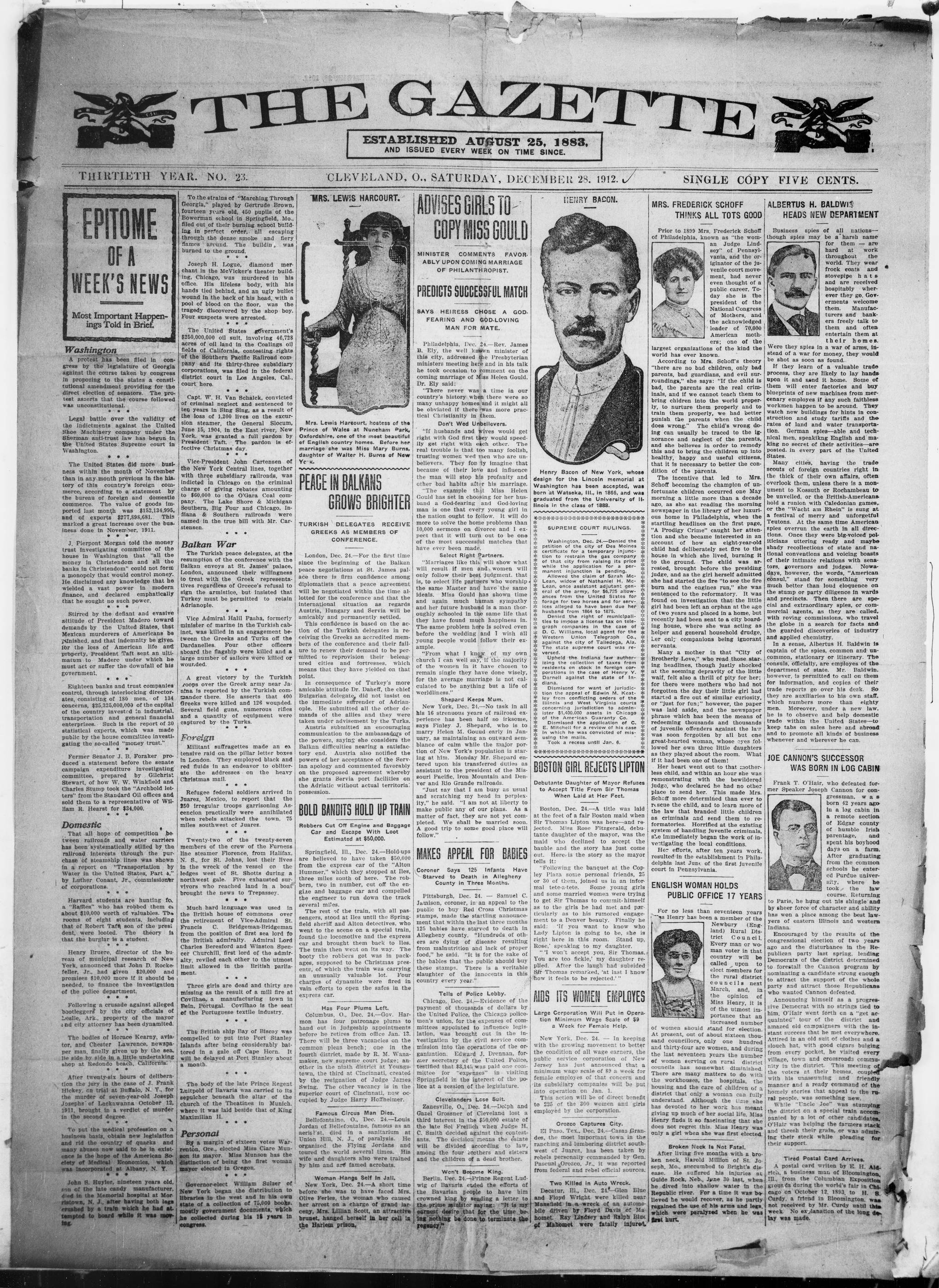
THE GAZETTE
THIRTIETH YEAR. NO. 23.
MORTALITY
EPITOME
OF A
WEEK'S NEWS
Most Important Happenings Told in Brief.
Washington
A protest has been filed in congress by the legislature of Georgia against the course taken by congress in proposing to the states a constitutional amendment providing for the direct election of senators. The protest asserts that the course followed was unconstitutional.
Legal battle over the validity of the indictments against the United Shoe Machinery company under the Sherman anti-trust law has begun in the United States Supreme court in Washington.
The United States did more business within the month of November than in any month previous in the history of this country's foreign commerce, according to a statement by the bureau of foreign and domestic commerce. The value of goods imported last month was $153,134,995, and of exports $277,898,691. This marked a great increase over the business done in November, 1911.
J. Pierpont Morgan told the money trust investigating committee of the house in Washington that "all the money in Christendom and all the banks in Christendom" could not form a monopoly that would control money. He disclaimed any knowledge that he wielded a vast power in modern finance, and declared emphatically that he sought no such power.
Stirred by the defiant and evasive attitude of President Madero toward demands by the United States, that Mexican murderers of Americans be punished, and that indemnity be given for the loss of American life and property, President Taft sent an ultimatum to Madero under which he must act or suffer the downfall of his government.
...
Eighteen banks and trust companies control, through interlocking directorates, consisting of 180 men, of 134 concerns, $25,325,000,009 of the capital of the country invested in industrial, transportation and general financial enterprises. Such is the report of 30 statistical experts, which was made public by the house committee investigating the so-called "money trust." Former Senator J. B. Foraker produced a statement before the senate campaign expenditure investigating committee, prepared by Glychrist Stewart, of how W. W. Winkfield and Charles Stump took the "Archbold letters" from the Standard Oil offices and sold them to a representative of William R. Hearst for $34,000.
Domestic
That all hope of competition between railroads and water carriers has been systematically stifled by the railroad interests through the purchase of steamship lines was shown in a report on "Transportation by Water in the United States, Part 4," by Luther Conant, Jr., commissioner of corporations.
Harvard students are hunting for a "Raffles" who has robbed them on about $10,000 worth of valuables. The rooms of eight students, including that of Robert Taff, son of the president, were looted. The theory is that the burglar is a student.
Henry Bruere, director of the bureau of municipal research of New York, announced that John D. Rockefeller, Jr., had given $20,000 and promises $10,000 more if it should be needed, to finance the investigation of the police department.
Following a crusade against alleged bootleggers by the city officials of Leaile, Ark. property of the mayor and city attorney has been dynamited.
The bodies of Horace Kearny, aviator, and Chester Lawrence, newspaper man, finally given up by the sea, lie side by side in a little undertaking shop at Redondo beach, California.
After twenty-six hours of deliberation the jury in the case of J. Frank Hickey, on trial at Buffalo, N. Y., for the murder of seven-year-old Joseph Josephs of Lackawanna October 12, 1811, brought in a verdict of murder in the second degree.
To put the medical profession on a business basis, obtain new legislation and rid the country of quacks and many abuses now said to be in existence is the hope of the American Society of Medical Economics, which was incorporated at Albany, N. Y.
John S. Huyler, nineteen years old, son of the late candy manufacturer, died in the Memorial hospital at Morristown, N. J., after having both legs crushed by a train which he had attempted to board while it was mov-
To the strains of "Marching Through Georgia," played by Gertrude Brown, fourteen years old, 450 pupils of the Bowerman school in Springfield, Mo. filed out of their burning school building in perfect order, all escaping through the dense smoke and fiery flames around. The buildin, was burned to the ground.
Joseph H. Logue, diamond merchant in the McVicker's theater building, Chicago, was murdered in his office. His lifeless body, with his hands tied behind, and an ugly bullet wound in the back of his head, with a pool of blood on the floor, was the tragedy discovered by the shop boy. Four suspects were arrested.
The United States government's $250,000,000 oil suit, involving 46,728 acres of oil land in the Coalings oil fields of California, contesting rights of the Southern Pacific Railroad company and its thirty-three subsidiary corporations, was filed in the federal district court in Los Angeles, Cal. court here.
Capt. W. H. Van Schaick, convicted of criminal neglect and sentenced to ten years in Sing Sing, as a result of the loss of 1,200 lives on the excursion steamer, the General Slocum, June 15, 1904, in the East river, New York, was granted a full pardon by President Taft. The pardon is effective Christmas day.
Vice-President John Cartensen of the New York Central lines, together with three subsidiary railroads, was indicted in Chicago on the criminal charge of giving rebates amounting to $60,000 to the O'Gara Coal company. The Lake Shore & Michigan Southern, Big Four and Chicago, Indiana & Southern railroads were named in the true bill with Mr. Carstensen.
Balkan War
The Turkish peace delegates, at the resumption of the conference with the Balkan envoys at St. James' palace, London, announced their willingness to treat with the Greek representatives regardless of Greece's refusal to sign the armistice, but insisted that Turkey must be permitted to retain Adrianople.
Vice Admiral Hall Pasha, formerly minister of marine in the Turkish cabinet, was killed in an engagement between the Greeks and Turks off the Dardanelles. Four other officers aboard the flagship were killed and a large number of sailors were killed or wounded.
A great victory by the Turkish troops over the Greek army near Jainna is reported by the Turkish commander there. He asserts that 400 Greeks were killed and 126 wounded. Several field guns, numerous rifles and a quantity of equipment were captured by the Turks.
Foreign
Militant suffragettes made an extensive raid on the pillar letter boxes in London. They employed black and red fluids in an endeavor to obliterate the addresses on the heavy Christmas mail.
Refugee federal soldiers arrived in Juarez, Mexico, to report that the 250 irregular troops garrisoning Ascension practically were annihilated when rebels attacked the town. 75 miles southwest of Juarez.
Twenty-two of the twenty-seven members of the crew of the Furness line steamer Florence, from Hallifax, N. S., for St. Johns, lost their lives in the wreck of the vessel on the ledges west of St. Shotts during a northwest gale. Five exhausted survivors who reached land in a boat brought the news to Trepasse.
---
Much hard language was used in the British house of commons over the retirement of Vice-Admiral St. Francis C. Bridgeman-Bridgeman from the position of first sea lord for the British admiralty. Admiral Lord Charles Beresford and Winston Spencer Churchill, first lord of the admiralty, reviled each other to the utmost limit allowed in the British parliament.
Three girls are dead and thirty are missing as the result of a mill fire at Covilhao, a manufacturing town in Bein, Portugal. Covilhao is the seat of the Portuguese textile industry.
---
The British ship Bay of Biscay was compelled to put into Port Stanley Islands after being considerably battered in a gale off Cape Horn. It will be delayed at Port Stanley about a month.
The body of the late Prince Regent Zuitold of Bavaria was carried to its sepulcher beneath the altar of the church of the Theatines in Munich, where it was laid beside that of King Maximilian II.
Personai
By a margin of sixteen votes Warrenton, Ore. elected Miss Clare Munson its mayor. Miss Munson has the distinction of being the first woman mayor elected in Oregon.
Governor-elect William Sulzer of New York began the distribution to libraries in the west and in his own state of a collection of 75,000 books, mostly government documents, which he collected during his 18 years in congress.
MRS. LEWIS HARCOURT.
Mrs. Lewis Harecourt, hostess of the Prince of Wales at Nuneham Park, Oxfordshire, one of the most beautiful of English country homes. Before her marriage she was Miss Mary Burns, daughter of Walter H. Burns of New York.
TURKISH DELEGATES RECEIVE
GREEKS AS MEMBERS OF
CONFERENCE.
London, Dec. 24.—For the first time since the beginning of the Balkan peace negotiations at St. James palace there is firm confidence among diplomists that a peace agreement will be negotiated within the time allotted for the conference and that the international situation as regards Austria, Hungary and Servia will be amicably and permanently settled.
This confidence is based on the action of the Turkish delegates in receiving the Greeks as accredited members of the conference and their failure to renew their demand to be permitted to reprovision their beleaguered cities and fortresses, which means that they have yielded on that point.
In consequence of Turkey's more amicable attitude Dr. Danef, the chief Bulgarian delegate, did not insist on the immediate surrender of Adrianople. He submitted all the other demands of the allies and they were taken under advisement by the Turks.
Austria submitted an encouraging communication to the ambassadors of the powers, saying she considers the Balkan difficulties nearing a satisfactory end. Austria also notified the powers of her acceptance of the Servian apology and commented favorably on the proposed agreement whereby she grants Servia port facilities on the Adriatic without actual territorial possession.
BOLD BANDITS HOLD UP TRAIN
BOLD BANDITS HOLD UP TRAIN
Robbies Cut Off Engine and Baggage Car and Escape With Loot Estimated at $50,000.
Springfield, Ill., Dec. 24.—Hold-ups are believed to have taken $50,000 from the express car of the "Alton Hummer," which they stopped at Iles, three miles south of here. The robbers, two in number, cut off the engine and baggage car and compelled the engineer to run down the track several miles.
The rest of the train, with all passengers, stood at Iles until the Springfield sheriff and Alton detectives, who went to the scene on a special train, found the locomotive and the express car and brought them back to Iles. The train then went on its way. The booty the robbers got was in packages, supposed to be Christmas presents, of which the train was carrying an unusually valuable lot. Four charges of dynamite were fired in vain efforts to open the safes in the express car.
Has Four Plums Left
Columbus, O., Dec. 24—Gov. Harmon has four patronage plums to hand out in judgement appointments before he retires from office Jan. 13. There will be three vacancies on the common pleas bench; one in the fourth district, made by R. M. Wanamaker, new supreme court judge; another in the ninth district at Youngtown, the third at Cincinnati, created by the resignation of Judge James Swing. The other vacancy is in the superior court of Cincinnati, now occupied by Judge Harry Hoffheimer.
Famous Circus Man Dies
Bellefontaine, O., Dec. 24—Louis Jordan of Bellefontaine, famous as an aekl'st, died in a sanitarium at Union Hill, N. J., of paralysis. He organized the Flying Jordans and toured the world several times. His wife and daughters also were trained by him and are famed acrobats.
Woman Hangs Self In Jail.
New York, Dec. 24.—A short time before she was to have faced Mrs. Olive Perles, the woman who caused her arrest on a charge of grand larceny, Mrs. Lillian Scott, an attractive brunet, hanged herself in her cell in the Harlem prison.
ADVISES GIRLS TO COPY MISS GOULD
ADVISES GIRLS TO COPY MISS GOULD
MINISTER COMMENTS FAVOR
ABLY UPON COMING MARRIAGE
OF PHILANTHROPIST.
PREDICTS SUCCESSFUL MATCH
BAYS HEIRESS CHOSE A GOD-
FEARING AND GOD-LOVING
MAN FOR MATE.
Philadelphia, Dec. 24.—Rev. James
B. Ely, the well known minister of
this city, addressed the Presbyterian
ministers meeting here and in his talk
he took occasion to comment on the
coming marriage of Miss Helen Gould.
Dr. Ely said:
"There never was a time in our
country's history when there were so
many unhappy homes and it might all
be obviated if there was more practical
Christianity in them.
Don't Wed Unbelievers.
"If husbands and wives would get right with God first they would speedily get right with each other. The real trouble is that too many foolish, trusting women wed men who are unbelievers. They fon ly imagine that because of their love and influence the man will stop his profanity and other bad habits after his marriage.
"The example that Miss Helen Gould has set in choosing for her husband a God-fearing and God-loving man is one that every young girl in the nation ought to follow. It will do more to solve the home problems than 10,000 sermons on divorce and I expect that it will turn out to be one of the most successful matches that have ever been made.
Select Right Partners.
"Marriages like this will show what will result if men and women will only follow their best judgment, that is, to select life partners who worship the same Master and have the same ideals. Miss Gould has shown time and again much human sympathy and her future husband is a man thoroughly schooled in the same life that they have found much happiness in. The same problem here is solved even before the wedding and I wish all young people would follow their example.
"From what I know of my own church I can well say, if the majority of the women in it have chosen to remain single they have done wisely, for the average marriage is not calculated to be anything but a life of worldiness."
Shepard Keeps Mum.
New York, Dec. 24.—No task in all his 16 strenuous years of railroad experience has been half so irksome, says Finley J. Shepard, who is to marry Helen M. Gould early in January, as maintaining an outward semblance of calm while the major portion of New York's population is staring at him. Monday Mr. Shepard entered upon his transferred duties as assistant to the president of the Missouri Pacific, Iron Mountain and Denver and Rio Grande railroads.
"Just say that I am busy as usual and scratching my head in perplexity," he said. "I am not at liberty to make public any of our plans. As a matter of fact, they are not yet completed. We shall be married soon. A good trip to some good place will follow."
MAKES APPEAL FOR BABIES
Coroner Says 125 Infants Have Starved to Death in Allegheny County in Three Months.
Pittsburgh, Dec. 24. — Samuel C. Jamison, coroner, in an appeal to the public to buy Red Cross Christmas stamps, made the startling announcement that within the last three months 125 babies have starved to death in Allegheny county. "Hundreds of others are dying of disease resulting from malnutrition and lack of proper food," he said. "It is for the sake of the babies that the public should buy these stamps. There is a veritable slaughter of the innocents in this country every year."
Tells of Police Lobby
Chicago, Dec. 24 - Evidence of the payment of thousands of dollars by the United Police, the Chicago policemen's union, for the expenses of committees appointed to influence legislation, was brought out in the investigation by the civil service commission into the operations of the organization. Edward J. Drennan, former secretary of the United Police, testified that $3,144 was paid one committee for "expenses" in visiting Springfield in the interest of the police at a session of the legislature.
Clevelanders Lose Suit.
Zanesville, O., Dec. 24—Dolph and Gazel Grosner of Cleveland lost a third interest in the $50,000 estate of the late Sol Frellich when Judge H. C. Smith decided against the contestants. The decision means the estate will be divided according to law, among the four brothers and sisters and the children of a dead brother.
Won't Become King.
Berlin, Dec. 24—Prince Regent Ludwig of Bavaria ceded the efforts of the Bavarian people to have him crowned king by sending a letter to the prime minister saying, "It is my earnest desire that for the time being nothing be done to terminate the
HENRY BACON.
HENRY BADOW.
Henry Bacon of New York, whose design for the Lincoln memorial at Washington has been accepted, was born at Wateska, Ill., in 1866, and was graduated from the University of Illinois in the class of 1888.
SUPREME COURT RULINGS.
Washington, Dec. 24.—Denied the petition of the city of Des Moines certificate for a temporary injunction against a law state on telltale of that city from raising its price while the application for a permanent injunction is pending. The attorney general of the city, for Sirat McLean, widow of Nathan H. McLean, once assistant adjutant general of the army, for $6,725 allowances from the United States for the services alleged to have been due her husband from 1864 to 1875.
Denied the right of municipal petition of the city of Talledega, Ala. The state supreme court was revered. Uphold the Indiana law authorizing the collection of taxes from residents on stock of foreign commerce in the state of New York. Darnell against the state of Indiana.
Dismissed for want of jurisdiction the appeal of Edwin M. Keatley from conflicting orders of the Illinois and West Virginia courts concerning jurisdiction to administer the American Guaranty Co.
Dismissed the application of C. E. Mitchell for a review of his case, which was convicted of misusing the mail.
Took an order until Jan. 6.
BOSTON GIRL REJECTS LIPTON
Debutante daughter of Mayor Refuses to Accept Title from Sir Thomas When Lail at Her Feet.
Boston, Dec. 24.—A title was laid at the feet of a fair Boston maid when Sir Thomas Lipton was here—and rejected. Miss Rose Fitzgerald, debutante daughter of the mayor, was the maid who declined to accept the baule and the story has just come out. Here is the story as the mayor tells it:
"Following the banquet at the Copley Plaza some personal friends, 25 or 30 of them, joined us in an informal tete-a-tete. Some young girls and some married women were trying to get Sir Thomas to commit himself as to the girls he had met and particularly as to his rumored engagement to a Denver beauty. Finally he said: 'If you want to know who Lady Lipton is going to be, she is right here in this room. Stand up, Rose,' speaking to my daughter.
"I won't accept you, Sir Thomas. You are too fickle,' my daughter replied. After the laugh had subsided Sir Thomas remarked, 'at last I know how it feels to be rejected.'"
AIDS ITS WOMEN EMPLOYES
Large Corporation Will Put in Operation Minimum Wage Scale of $9 a Week for Female Help.
New York, Dec. 24. — In keeping with the growing movement to better the condition of all wage earners, the public service corporation of New Jersey has just announced that a minimum wage scale of $9 a week for female employees of that concern and its subsidiary companies will be put into operation on Jan. 1.
This action will be of direct benefit to 225 of the 300 women and girls employed by the corporation.
Orozco Captures City
El Paso, Tex., Dec. 24.—Casas Grandes, the most important town in the ranching and timber district southwest of Juarez, has been taken by rebels personally commanded by Gen. Pascual Grozco, Jr., it was reported from federal and rebel official sources.
Two Killed in Auto Wreck.
Two Killed in Auto Wreck.
Decatur, Ill., Dec. 21<sup>4</sup>-Glen Blue
and Floyd Wright were killed near
Manellein in a wreck of an automobile
driven by Floyd Davis of Mahomet.
Ray Lindsey and Alphin Blue
of Mahomet were fatally injured.
MRS. FREDERICK SCHOFF
THINKS ALL TOTS GOOD
Prior to 1899 Mrs. Frederick Schof
of Philadelphia, known as "the wom-
an Judge Lindsey" of Pennsylvania, and the originator of the juvenile court movement, had never even thought of a public career. Today she is the president of the National Congress of Mothers, and the acknowledged leader of 70,000 American mothers; one of the
an Judge Lindsey" of Pennsylvania, and the originator of the juvenile court movement, had never even thought of a public career. Today she is the president of the National Congress of Mothers, and the acknowledged leader of 70,000 American mothers; one of the largest organizations of the kind the world has ever known.
According to Mrs. Schoff's theory "there are no bad children, only bad parents, bad guardians, and evil surroundings," she says: "If the child is bad, the parents are the real criminals, and if we cannot teach them to bring children into the world properly, to nurture them properly and to train them properly, we had better punish the parents when the child does wrong." The child's wrong doing can usually be traced to the ignorance and neglect of the parents, and she believes in order to remedy this and to bring the children up into healthy, happy and useful citizens, that it is necessary to better the condition of the parents.
The incentive that led to Mrs. Schofb becoming the champion of unfortunate children occurred one May morning a little more than a decade ago, as she sat reading the morning newspaper in the library of her luxurious home in Philadelphia, when the startling headlines on the first page, "A Prodigy Crime" caught her attention and she became interested in an account of how an eight-year-old child had deliberately set fire to the house in which she lived, burning it to the ground. The child was arrested, brought before the presiding judge, and as the girl herself admitted she had started the fire "to see the fire burn and the engines run," she was sentenced to the reformatory. It was found on investigation that the little girl had been left an orphan at the age of two years and placed in a home, but recently had been sent to a city boarding house, where she was acting as helper and general household drudge. Her only companions being ignorant servants.
Many a mother in that "City of Brotherly Love," read those starring headlines, though justly shocked at the seeming depravity of the little wolf, felt also a thrill of pity for her; for there were mothers who had not forgotten the day their little girl had started a fire out of similar curiosity, or "just for fun;" however, the paper was laid aside, and the newspaper phrase which has been the means of redeeming thousands and thousands of juvenile offenders against the law was soon forgotten by all but one great-hearted woman, whose eyes followed her own three little daughters as they played about the room. What if it had been one of them!
Her heart went out to that mother-children child, and within an hour she was removed from her beakered judge, who declared he had no place to send her. This made Mrs. Schofl more determined than ever to rescue the child, and to learn more of the law that branded little children as criminals and send them to reformatories. Horrified at the existing system of handling juvenile criminals, she immediately began the work of investigating the local conditions.
Her efforts, after ten years work, resulted in the establishment in Philadelphia last June of the first juvenile court in Pennsylvania.
ENGLISH WOMAN HOLDS
PUBLIC OFFICE 17 YEARS
For no less than seventeen years Henry has been a member of the
if seventeen years
a member of the
Newbury (England)
Rural District
Council
Every man or woman
voter in that country
will be
called upon
to elect members
for the rural district
council's next
March, and,
in the opinion
of Miss Henry, it is
of the utmost importance that an
increased number
Newbury (England) Rural District Council. Every man or woman voter in that country will be called upon to elect members for the rural district councils next March, and, in the opinion of Miss Henry, it is of the utmost importance that an increased number of women should stand for election. At present, of about sixteen thousand councillors, only one hundred and thirty-four are women, and during the last seventeen years the number of women serving on rural district councils has somewhat diminished. There are many matters to do with the workhouses, the hospitals, the housing and the care of children of a district that only a woman can fully understand. Although the time she has devoted to her work has meant giving up much of her social life, Miss Henry finds it so fascinating that she does not regret this. Miss Henry was only a girl when she was first elected.
Broken Neck Is Not Fatal.
After living five months with a broken neck, Harold Million of St. Joseph, Mo., succumbed to Bright's disease. He suffered his injuries at Gulde Rock, Neb. Jpne 30 last when he dived into shallow water in the Republic river. For a time it was boiled he would recover, as he partly regained the use of his arms and legs, which were paralyzed when he was first hurt.
ALBERTUS H. BALDWI
HEADS NEW DEPARTMENT
of all nations—be a harsh name for them — are hard at work throughout the world. They wear frock coats and stovepipe hats and are received hospitably wherever they go. Governments welcome them. Manufacturers and bankers freely talk to them and often entertain them at their homes.
for them — are hard at work throughout the world. They wear frock coats and stovepipe hats and are received hospitably wherever they go. Governments welcome them. Manufacturers and bankers freely talk to them and often entertain them at their homes.
Were they spies in a war of arms, instead of a war for money, they would be shot as soon as found.
If they learn of a valuable trade process, they are likely to lay hands upon it and send it home. Some of them will enter factories and buy blueprints of new machines from mercenary employees if any such faithless workmen happen to be around. They watch new buildings for hints in construction and study tariffs and the rates of land and water transportation. German spies — able and technical men, speaking English and making no secret of their activities — are posted, in every part of the United States.
Many cities, having the trade scouts of foreign countries right in the thick of their own affairs, often overlook them, unless there is a monument to Kossuth or Rochambeau to be unveiled, or the British-Americans hold a runion with Caledonian games, or the "Wacht am Rhein" is sung at a festival of merry and unforgettul Teutons. At the same time American spies overrun the earth in all directions. Once they were big-voiced politicians uttering ready and maybe shady recollections of state and national conventions and voicing boasts of their intimate relations with senators, governors and judges. Nowadays, however, the words, "American consul," stand for something very much better than loud eloquence on the stump or party diligence in wards and precincts. Then there are special and extraordinary spies, or commercial agents, as they are called, with roving commissions, who travel the globe in a search for facts and the guarded discoveries of industry and applied chemistry.
In a sense, Albertus H. Baldwin is captain of the spies, common and uncommon, stationary or itinerary. The consuls, officially, are employees of the department of state. Mr. Baldwin, however, is permitted to call on them for information, and copies of their trade reports go over his desk. So they are auxiliaries to his own staff, which numbers more than eighty men. Moreover, under a new law, he is to observe and help domestic trade within the United States—to keep tabs on sales here and abroad and to promote all kinds of business whenever and wherever he can.
JOE CANNON'S SUCCESSOR
WAS BORN IN LOG CABIN
Frank T. O'Hair, who defeated former Speaker Joseph Cannon for con-
gressman, w a born 42 years ago in a log cabin in a remote section of Edgar county of humble Irish parentage, and spent his boyhood days on a farm. After graduating from the common schools he entered Purdue university, where he took the law course. Returning
gressian. w a's born 42 years ago in a log cabin in a remote section of Edgar county of humble Irish parentage, and spent his boyhood days on a farm. After graduating from the common schools he entered Purdue university, where he took the law course. Returning to Paris, he hung out his shingle and by sheer force of character and ability has won a place among the best lawyers of eastern Illinois and western Indiana. Encouraged by the results of the congressional election of two years ago and the disturbance in the Republican party last spring, leading Democrats of the district determined to forestall the Cannon program by nominating a candidate strong enough to attract the support of the whole party and attract those Republicans who wanted Cannon defeated.
Announcing himself as a progressive Democrat with no strings tied to him, O'Hair went forth on a "get acquainted" tour of the district and amazed old campaigners with the instant success that he met everywhere. Attired in an old suit of clothes and a slouch hat, with good cigars bulging from every pocket, he visited every village, town and crossroads community in the district. This meeting of the voters at their homes, coupled with his unassuming and friendly manner and a ready command of the homely stories that appeal to the rural people, was something new. While "Uncle Joe" was stumping the district on a special train accompanied by a lot of other candidates, O'Hair was helping the farmers stack and thresh their grain, or was admiring their stock while pleading for their support.
Tired Postal Card Arrives
Tired Postal Card Arrives.
A postal card written by E. H. Aldrich, a business man of Bloomington, Ill., from the Columbian Exposition grounds during the world's fair in Chicago on October 12, 1893, to H. S. Curdy, a friend in Bloomington, was not received by Mr. Curdy until this week. No explanation of the long delay was made.
One Year.....$1.50
Six Months.....1.00
Three Months.....30
Subscribers are requested to re-
mit by postoffice money or-
der or registered letter.
Entered at the postoffice in Cleveland
Ohio, as second-class matter
Address all communications to
HARRY C. SMITH
Editor and proprietor,
THE GAZETTE,
Blackstone Building, Cleveland, O.
Member Ohio Legislature: 1894
to 1896; 1896 to 1898; 1900 to 1908
THE GAZETTE is the oldest, and has the largest bona fide circulation, double that of any newspaper in the interest of Afro-Americans, published in the state of Ohio, and compared with any will immediately establish its rank as one of the NEWSIEST AND BEST in the country.
TWO APPEALS TO CRIME
The Jack Johnson case seems to have upset a large number of people in Chicago, including its "intellectual lights" — ministers, lawyers, editors and, of course, the politicians—to such an extent that when one wishes to ascertain the motives for some of the demands of change, one is at a loss to know whether they are more assinity or downnight badness, more folly or deprivacy. Johnson's conduct is no doubt open to serious censure in several respects, but he is no worse than hundreds of other infractors of "law, custom, morals," etc., and, if he were not the Negro who downed the white pugilist, much of the outcry against him would have been very voiced. The prize for deprivacy downright must at present be awarded to Mrs. Patrick Weathers of Guthrie, Okla, who has sent the following "gem" to the "Bull Moose" organ, the Chicago Tribune, which did not consider it improper to insert it in the columns of a paper "that is read the world over." There are people in the world who consider the publication of such an appeal to crime (murder) a legal offense as well as a moral one and the Tribune may as well know that its acceptance of such rank material is not even "to the taste" of its own sander readers. We copy it verbatim et literatim:
Different in Oklahoma.
Guthrie, Okla., Dec. 4. — Editor
Chicago Tribune—Why does not your
splendid paper, that is read the world
over, have the Illinois legislature
enact laws to prevent such disgraceful
happenings as the late marriage of
Jack Johnson? Down in this part of
the country he would never have lived
to marry the second white girl.
Mrs. Patrick Weathers
It needs no further comment than that Mrs. Patrick Weathers is Irish (a race that has been in the same fix as regards marriage; since there was a time when no Englishman could legally marry an Irish girl or widow) She is also most probably Catholic (Christian), and that church has only lately in South Africa declared that "while it did not encourage intermariage of whites and blacks, it would insist that where sexual intercourse was had or contemplated, the parties should be obliged to marry," etc. The same course was pursued by the Centrum party (Catholic) in the German Diet, and the socialists, who combining on that issue, defeated the colonial minority on that point. That a woman can appeal, insidiously, but indeed appeal to murder is HORRIBLE in itself, but that a paper edited by men who claim to be good citizens of the American Republic, which must be of necessity a government based on law and order, on justice and equality to all its inhabitants, does so, is even more horrible. The tendency of such publication lies openly before all who are not blind.
The state of Lovejoy, Lincoln and ingress is to be forced by prejudice hiding under the mask of "science ethics, morality," eye! benevolence to both races, into line with the progressive (?) states that already possess laws prohibiting intermarriage on whites and blacks. A Mr. H. H. Hess has published a list of such states which, with the exception of Indiana Colorado, Nebraska, California and Idaho, comprises only southern on southwestern states; and Alabama Florida, Mississippi, N. Carolina, S. Carolina, Tennessee, whose constitutions prohibit it. In the other so-called "progressive" states it "is prohibited by statute;" Arizona, Idaho Indiana, Delaware, Colorado, Georgia Kentucky, Maryland, Mississippi, Missouri, Louisiana, Nebraska, Nevada, Oklahoma, Oregon, Virginia, Texas, Utah and West Virginia. Even the Chicago Abendpost (German), whose owner held different views when he was editor of a German paper in St. Louis, has wavered and seems, too inclined to the view that "love" no longer "laughs at locksmiths." Still it maintains that social ostracism of man "would be more effective in practice than laws," which indeed, after all, do not prevent "illegitimate" misregulation. When Senator Gaskin's bill comes up in the next legislature of Illinois, we shall have something more to say anent the matter; but why Senator Gaskin should wish to have a law enacted on the matter at all, is a little curious since (the quote from the Negro journal) "there are some foolish white people who will marry Negroes and come foolish Negroes who will marry whites, but they are few!" They are few! And the powerful machinery of Abraham Lincoln's state is to be used against those "few"; the Lincoln who disclaimed in his debate with Douglas "that he never advocated marriages between whites and blacks," a point raised by Representative Roddenberry of Georgia, in his recent contemptible attack on the race, in congress. We wish to remind all of the Roddenberry
"stripe" that Lincoln was not at all agitated when he nominated and saw confirmed to the U. S. Marshalship of the District of Columbia, one Frederick Douglas, who later married a white woman and who, at Lincoln's request, was invited to the ingagual ball in 1865 at the White House, 'though the committee in charge of the affair had not invited members of his race.
FORAKER VINDICATED.
Senator J. B. Foraker waited long and patiently for vindication and has finally had his patience rewarded. William Randolph Hearst's malicious "Standard Oil" attacks of several years ago, in his New York, Chicago, St. Louis and San Francisco newspapers, have at last been fully disproved, and that individual placed in anything but an enviable light before the entire country. When the Senator, through the U. S. Senate's investigating committee, forced Hearst, last week, to disclose and read a letter explaining matters as they really were and are at last understood to be, Hearst showed the entire country, to the fullest, the extent of the maliciousness of his contemptible attacks upon the Senator. No one who really knew Judge Foraker ever believed him guilty of any wrong-doing; but there were millions of people in this country who did not KNOW him as we and thousands of others do. Therefore the great pleasure and satisfaction of this belated vindication. There ought to be some way to punish any man who is guilty of withholding information establishing the innocence of a person, especially a public official, being attacked as Hearst attacked the Senator.
"DEAR OLD GEORGIA"!
Thousands of Our People Being Driver
Out of Our People Part of
That, State.
Atlanta, Ga.—A movement to drive Negroes out of North Georgia counties, which began immediately after the recent riots in Cumming, has become so widespread that leading white citizens of the counties affected have appealed to Gov. Brown to use his state troops to restore order. Hundreds have been driven away, leaving their crops ungathered. All over the section notices are being posted at night warning Negroes they must leave or be killed. Similar notices are being posted on the premises of the white employers, notifying them that if they do not assist in getting rid of Negroes they will also be made to wives and daughters of prominent planters are forced to cook and wash and do other manual labor. Gov. Brown will urge the authorities in the counties affected to check the lawlessness, and if they fall will consider the question of using the state troops.
CORRESPONDENTS WANTED.
The old reliable Gazette desires an active agent and correspondent in every city and town in Ohio and neighboring states having a number of Afro-American residents. Only a little time on Fridays or Saturdays is required.
We are especially desirous of hearing from persons in the following named cities: Zanesville, Newark, Lancaster, Lebanon, Chillicothe, Toledo, Troy, Canton, Springfield, Piqu, Columbus, Cambridge, Steubenville, Bellaire, St. Clairville, Wilmington, Portsmouth, Washington, C. H., Oxford, Sabina, Gallipolis, Rendville, Urbana, Delaware, Mt. Vernon, East Liverpool, Wellsville, Akrof, Dayton, Middeport, Bellefontaine, Lima, O., and other places where we have none.
Write to the editor of The Gazette, Blackstone building, Cleveland, O., and terms will be sent promptly. Our readers will oblige us greatly by sending at once the addresses of persons in the cities named above, or others, to whom we can write relative to the matter.
JACK JOHNSON AGAIN INDICTED.
Chicago, Ill.—Three additional indictments under the federal white slave act were returned against Jack Johnson by the federal grand jury here Dec. 17. The charges are similar to those contained in the previous indictments and concern the alleged transportation of Belle Schreiber (white), between Chicago, Pittsburg and Milwaukee.
Real Trouble.
The world is full of geniuses who, unfortunately, aren't willing to take the trouble to prove it—Detroit Free Press.
Turquoise a Horsey Stone.
The turquoise is the especial protection of horsemen and averts accidents in general.
Meet the good there is in others with the best there is in yourself.
A coxcomb once said to a barber's boy, "Did you ever have a monkey?" "Why, no, sir," replied the boy, "never; but if you will please to sit down, I will try."
Enormous Flocks of Sheep.
Recent official figures placed the number of sheep in Australia and New Zealand in excess of 117,000,000, the greatest number in 18 years.
In Their Flats.
"Ive a kitchenette in my flat. What's the feature of yours, Jones?" "A cellarette. And of yours, Smith?" "Ive a suffragette in mine."
Houses and lots in Oberlin, Ohio,
and in a most desirable locality; surroundings excellent; cheap and
on easy terms. Address or see D. C.
Fisher, 554 Broadway, Lorain, Ohio.
Phone, residence 555; office, $85.
WOULD LOVE COLORED GIRL.
Ashburn, Ga.—In a battle, Dec. 7, at King's Mills, a lumber camp near here, following the horsewhipping of C. R. Christmas because of his infatuation for a Negro girl. John Christmas was killed and his brother, James Christmas, and J. D. Ward were probably fatally wounded. Several others are reported to have been wounded.
THE GAZETTE, CLEVELAND, O. SATURDAY, DECEMBER 28, 1912.
WRITTEN BY "THE OLD RELIA-
BLE" GAZETTE'S CORRE-
SPONDENTS.
What Our People Are Doing Each Week-Church, Personal, Social, Lodge, Literary and Musical - Marriages.
All correspondents must mail their local news-letters for our next issue, this coming Saturday or Sunday, at the very latest, and at their central Post Office and not in a letter-box, if they wish them to appear in our issue of January 4, 1913. This is made necessary as a result of New Year's holiday, coming in the middle of the week—on Wednesday. All correspondents will please remember this, as there will be no exceptions to the rule outlined in the foregoing—EDITOR.
Lebanon—Ed Davis was left by will of the late Mr. Joe Boyles (white), $1,000 for his faithfulness to his employer during the latter's illness. He was made thankful for Thanksgiving and was given a year and keep up-to-date, in the matter of race news. Send your subscription, at once, to the editor in Cleve land.
Sandusky.—There will be many visitors in the city during the holidays. Our churches and S. S. celebrated Xmas in royal style. Rev. Geo. D. Smith of Decatur St. Baptist church, preached of a fern sermon, Sunday evening on Xmas grazing. Mwasew Rev. J.C. Mwasew the M. Mwasew His wife and baby are doing nicely—a wedding soon. Particulars next week.
Youngetown.—The things that Pugilist Manager Billy Nolan did to Joe Gans at Goldfield on the weight question earned Billy the sobriquet Shylock in many quarters. Forced down to a ringside weight that sapped his vitality, looking more like an Indian famine sufferer than an athlete, the "old master" left the Goldfield ring broken in body and spirit. He never fully recovered from that 42-round or 48-round game on September sun. Gans made two more attempts against the Durable Dane. In each case he was beaten, not by Nelson, but by the dread disease which he contracted as the result of the terrible weight reduction which he was forced to undergo at Goldfield.
Zanesville—Mrs. Elizabeth Gant, age 82, possibly the oldest member of St. Paul's A. M. E. church, was given a splendid reception, the 13th, her birthday, by the members. Ethel M. Wilson and William H. Tate were married in the parsonage, last Tuesday evening. Both are locally well-known and popular. Mrs. Rosa Johnson of Cleveland, addressed the W. M. M. S. recently—Mrs. Holland is in a Betsie hospital. Mrs. Ethel—Mr. Nelson Male and Miss Lucy Norris were married on the 13th—Nelson T. Gant of Columbus, was here last week.—Miss Alma Blake who was recently committed to Bethesda hospital, is improving—Mr. and Mrs. Leonard Cook have a fine baby girl.
Smithfield.—Rev. D. D. Lewis, Mrs. C. West and others are convalescing.—Mesdames Ruhus Smith, W. Adkins Rev. R. R. Cooper, S. West and others are convalescing.—Mesdames Ruhus ful, sister, Alice, and Mr. A. West at tended services here, Sunday evening.—Miss Susie Leekins of Steubenville, has returned to spend the winter with her parents.—Mr. Reginald Hargrave is reported quite ill.—Mrs. Geev. Veney who was in Steubenville, last week.—Mr. Reginald Hargrave her husband's estate.—Mr. Fred, Carter is the mail-carrier from Wabash station to Bradley, in the absence of Mr. W. Munts.—Miss Anna Cabel and Mr. Archie Hargrave of Bryn Mawr, Pa., are visiting his parents.—Miss E. Carter's recovery is despatched to Mr. Munts.—Mrs. D. Christian visited her mother, Sunday.
Painerville.—Mrs. Chas. Eledge, son Frank and Miss Lucy Martin are spending the holidays in Cleveland.—Miss Mary Bethel is better. Mr. Will Geddy received a telegram, Friday, announcing his brother, Charles' death in Chicago, where the latter went, three weeks ago. Many friends mourn his death. Phoenix is improving. Gordon is Islander, force University, spending the holidays with his parents. Mr. and Mrs. Hall Bethel who spent the season on the lakes, have returned for the winter.—Miss Carrie Evans of Oberlin College, is spending the holidays with Miss Mary Bethel, and Rev. H. H. Somers of Oberlin College, with Mr. and Mrs. John Smith.—Mr. Will Smith of Oberlin College, with Mr. and Mrs. Tennessee—Mrs. C. A. Wooten was shopping in Cleveland, Monday afternoon.—A. P. Jones was in Cleveland, Sunday.—The Ladies' Social club held a very successful Xmas baxaa and supper at Mrs. Geo, Bethel's, the 18th.
Candor and Manners
Pitt was once canvassing for himself, when he came to a blacksmith's shop. "Sir," said he to the blacksmith. "will you favor me with your vote?" "Mr. Pitt," said the son of Vulcan, "I admire your head, but hang your heart." "Mr. Blacksmith," said Pitt, "I admire your cander, but hang your manners."
Led Astray
Judge (sternly)—"To what do you attribute your downfall?" Culprit—"The first drink I ever took was one you bought me when you were trying to get my vote."—Puck.
THE TUSKEGEE CONFERENCE.
My dear Mr. Smith: I very much hope it will be possible for yourself or some representative of The Gazette to be present at the forthcoming meeting of the Tuskegee Negro Conference to be held January 23rd, 1913, herewith, a circular which gives full information. I am of the opinion that you will find the meetings both helpful and profitable. The school as usual, will be pleased to have you accept its hospitality during your stay here. Nours very truly. BOOKER T. WASHINGTON, Principal.
BLEASE'S MOB RULE DEFENSE
CALLED CHEAP, FALSE
BOAST.
Knoxville, Tenn.—Rev George R. Stuart, D. D., the evangelist for years associated with the late Sam P. Jones,
in a sermon there Dec. 8 denounced the Blease episode at the Governor's Convention at Richmond. In a bitter exorcision of Gov. Cole Blease, Dr. Stuart said:
"I regard the speech of Gov. Blease as a most pitiful and ignorant display of incapacity and unworthiness for the office of governor of a great state, when by his speech he encouraged mob law and cried with triumph. To hell with the Constitution!" No wonder the Virginia women left the state, fearing the mere and false boast of loyalty and honor to Southern womanhood. He transferred power from the cool justice of a court to the hot whims of an excited mob. He committed a ludicrous travesty on both civil and ethical law by his encouragement of anarchy to correct one criminal by producing a hundred others. He boasted of a vicious use of executive authority in encouraging the South Carolina and Alabama authorities to crime by his inconsistent attempt to secure order by mobism, mercy by cruelty, civilization by barbarism, justice by injustice and the elevation of an inefrior race by the prostitution of a superior race. The hope of our civilization is an increasing regard for law and order and the consignment of such men as the Governor of South Carolina, or absurd. No world man build a high school about the purity of Southern women than I or favor more speedy or severer punishment of the criminal, but let the great arm of the law execute our will and not a howling mob of anarchists.
BLEASE, OF SOUTH CAROLINA
The indecent outburst of Gov. Blease, of South Carolina, at the Governors' Conference at Richmond, is the culmination of the vicious, insensitive language which characterized the last Presidential campaign. It shows how rapidly we are tending toward the most dangerous condition, when wicked, malignant and anarchistic talk becomes the rule of the day.
South Carolina has fallen far from her high estate when her Chief Executive can make such an exhibition of himself. There is absolutely no excuse nor defense for it. The virtue of the white women of the country is in a poor way when such ruffans as Blease constitute themselves its guardian, and when he proposes to defy the law and orderly government to carry out his special ideas. What can this Government of law and order, which cost a million men's lives, be coming to "when a Governor of "an independent state" proposes to defend him on show; "To hell with the Constitution?" Certainly thinking men will attend address themselves to this alarming degradation of public sentiment, and consider what must be done to restore public opinion to that healthy condition which will not tolerate such anarchistic sentiments in anyone, particularly 4-in a man in prominent public place. Gov. Blease's rodontomate about being a fighter reveals that he is a man who has no real fighter was ever such a swanker. He minds one of that other blackguard Senator Jeff Davis, of Arkansas, who rampaged all over the State talking about his fighting spirit, but when some man, pointed a revolver at him he ran away like a scared cur, and sought refuge in the nearest house—Washington (D. C.) National Tribune.
Making Balance Even.
A chitmey sweep's boy went into a baker's shop for a twopenny loaf, and conceiving it to be small remarked to the baker tl it he did not believe it was weight. "Never mind that," said tl man of dough. "You will have the less to carry." "True," replied the lad, and throwing three halfpence on the counter left the shop. The baker called after him that he had not left enough money. "Never mind that," said young sooty, "you will have the less to count."
"THE FOOLEST FOOL ON EARTH."
Left the Father of Her Two Children
Because she was Negro,
he but returned.
A man said the other day, "When a woman wants to be a fool she can be the foolest fool on earth," and that appears to be the case with Mrs Anna Wilson, a New Jersey girl who married one Upton Wilson, who is said to be a mulatto. She married him in New Jersey, and when it was suggested that he was pretty dark for a white man he told her that he was part Indian. They came to Washington to live. A short time ago she declared that he was cruel to her and that she could not endure him because of his Negro relatives, who insisted that he should be to Washington, and through whom she first learned that Wilson was a Negro. The case was carried into the Juvenile Court and the judge directed that Wilson give his wife $10 to pay her fare to Boston, where she declared she was going and intended to stay, and directed him to send her a weekly allowance for the support of her two children. At that time Mrs. Wilson appeared in court heavily veiled, and declared that she had attempted to leave her husband several times after learning he was a mulatto, but he had threatened her life. After getting away from her, she returned back to him and has written the judge that she wants to live with her husband again, and, in fact, is living with him. So all the agony endured by her at the time the courts made the thing a matter of record in the newspapers, all the tears wept and the harsh words uttered are as naught. The next time Mrs. Wilson tries to stir things up she will not find it so easy to do so—The National Tribune, Washington, D. C. Dec. 12, 1912.
Could Folly Go Further?
A very small dog created a great stir in the streets of Paris a few days ago. A bijou pet dog was seen in the Champs Elysees with a lady. It was wearing indiarubber boots laced high up the leg, ear protectors, goggles to shield his eyes from cold or mud, and a raglan overcoat lined with thick flannel and provided with a pocket from which projected a tiny handkerchief with a monogram.
Few Weather Facts.
California has the least number of thunder storms, and Alabama and Florida have the greatest number. Florida has the most even tempera ture
IRON NECK-BANDS!
Blease's "To Hell with the U. S. Constitution" Causes Comrade McSpadden to Write Interestingly—Of Special Interest to Our Young Folk.
The Cleveland Leader, under the date of Dec. 6, 1912, said:
"Negroes, like other people, act upon motives. Why should they do anything for us, if we do nothing for them? If they stake their lives for us, they must be prompted by the strong motive, even the promise of freedom, and the promise being made, must be kent."
Just how far those in authority have regarded that promise we refer the reader to the disfranchisement of our brother in many southern states; their being kicked out of nearly all public offices and national conventions of the regular army with a honor "of the military of duty to the race." The "Great Liberator" furthermore said that he hoped when peace came, it would come to stay and so come as to be worth the keeping in all future time. It will then have been proved that among freemen there can be no successful appeal to the balloons; they appeal are sure to lose their case and pay the cost. And then there will be some black men (Sergt. Mingo Sanders for one) who can remember that with silent tongue and clenched teeth, steady eye, and well-poised bayonet, they appeal are sure to lose their great consummation, while they feared there would be white persons like Vardaman, Dixon, Tillman, "Bull Moose" and Gov. Blease, unable to forget, who with malignant heart and deceitful speech, have striven to hinder. Forty-nine years—it will soon be fifty years—since Lincoln wrote those horis and every word has come true. Then, with the Knights of the Golden Circle, "Lilly Whites" or "Night-riders."
I cannot refrain from giving account of some "brave and humane" acts by Messrs. Tillman, Dixon, Vardaman and Blease's "illustrous" ancestors: FIFTY DOLLARS REWARD: Run away from the subscriber, a Negro fellow, named Dick. About 21 or 22 years of age, Dark mulatto. Has many scars on his back from being whipped.
JAMES NOE
Advertisement in the Sentinel and Advertiser, Vicksburg, Miss. Oct. 10, 1837.
TEN DOLLARS REWARD: Run away on the 9th of Oct., 1837. Caroline, age about 38 years. Had a collar of iron on her neck with one prong turned down.
THOMAS CUGGY.
Address Callatin Street, between Hospital and Burracks.
From the New Orleans Bee, Oct. 28, 1837.
TWENTY-FIVE DOLLARS REWARD: For a black woman, Betsy, who ran away from my house in Fannoug, McDonough, about the 12th inst., when she had on her neck an iron collar. Age about 20 years.
Charles KERNISS.
New Orleans paper, March 1837.
Committed to jail of Pike Co., a man about 20 or 22 years of age, who calls his name, John. The said Negro has a clog of iron on his right foot, which will weigh about 4 or 5 pounds.
B. W. HODGES, jailor,
Montgomery (Ala.) Advertiser, Sept.
29, 1837.
$100 REWARD: Ran away from
the subscriber, six weeks ago, Negro,
scar over one eye. Also one on his
leg from the bite of a blood-bound,
and a burn on his body from a piece
of hot iron, in the shape of the letter
T.
JOHN DELEHANTY.
New Orleans Bee, Bef. 8th, 1837.
LOOK AND LIVE
Remedies have cured thousands, and will cure you. DR. NICKENS BLOOD SARSAPARILLA cures Kidney, Liver, and stomach Diseases, and all the disorders of the blood. Price 50 Cents.
DR. NICKENS FEMALE TONIC; the great remedy for mental Depression, and geness. Price 50 Cents.
DR. NICKENS KING OF PAIN for all man Price 50 Cents.
DR. NICKENS CATARRH CURE for Old cers, Cuts. Price 50 Cents.
DR. NICKENS COUGH AND LUNG SYRRE Colds and all Throat and Lung Disease.
DR. NICKENS GREAT ALKALI LINIMEN Neuralgia, Sore Muscles, Sprains a kinds. Price 50 Cents a Bottle.
DR. NICKENS FEMALE TONIC; the great nerve aud Heart remedy for mental Depression, and general female weakness. Price 50 Cents.
DR. NICKENS KING OF PAIN for all manner of pains. Price 50 Cents.
DR. NICKENS CATARRH CURE for Old Sores, Chronic Ulcers, Cuts. Price 50 Cents.
DR. NICKENS COUGH AND LUNG SYRUP, for Coughs and Colds and all Throat and Lung Diseases. Price 50 Cents.
DR. NICKENS GREAT ALKALI LINIMENT, cures Headache, Neuralgia, Sore Muscles, Sprains and Swellings of all kinds. Price 50 Cents a Bottle.
Manufactured by
DR. NICKENS MEDICAL
2334 E. 87th St. Cleveland
HERE IS AGENUINE
McCall's Magazine--on
The Gazette -- on
Any 15-cent McCall
All For Only
McCall's Magazine is the Leading
Fashion Journal in America. Don't Miss
DR. NICKENS MEDICINE CO.
2334 E. 87th St. Cleveland, O.
HEREISAGENUINE BARGAIN
McCall's Magazine--one year The Gazette -- one year Any15-cent McCall Pattern All For Only $2.00
McCall's Magazine is the Leading Fashion Journal in America.
In the matter of dress, McCall's is indispensable to every woman. There are over 50 of the newest designs of celebrated McCall Patterns in each issue.
Each month McCall's, brimful of latest fashions, fancy work, interesting short stories, and scores of labor-saving and money ideas for women, are welcome visitors to 1,100,000 wide-awake American homes.
McCall's is a large, artistic, hand-crafted magazine monthly periodical that is adding to women's happiness and efficiency everywhere.
Don't Miss this Extraordinary Offre
We take pleasure in offering our friends this exceptional opportunity.
By special advertising arrangement with the publishers of McCall's we are able to offer you this well-known popular Home and Fashion Journal together with our own paper for only a little more than the regular price of our paper alone.
The above extraordinary offer may be accepted by all persons who subseriate and extend their time ahead on either of the time mentioned. The only requisite is that you pay in advance.
The publishers of McCall's are planning to spend thousands of dollars extra in 1913 in order to keep McCall's head and shoulders above all similar publications. Every issue will be full of delightful surprises.
If you wish to save money, keep in style, get all the race news every week, be happy and up-to-date, subscribe now for The Gazette and McCall's.
The Gazette, Blacksburg, Cleveland, O
The Gazette, Blackstone Bldg., Cleveland, Ohio
Mme.L.C. Parrish HAIR CULTURING, MANICURING AND SCALP TREATMENT
Largest Manufacturer of Hair Preparations in Boston.
Largest Importer of Pure Human Hair.
Trained in the best schools. Many years' experience.
Honest dealing with the public.
For Growing Hair on Bald Heads and Bare Temples, use Parrish's Never Fail Hair Food, per jar, bottle, or cup, 25c and 50c.
For Stimulating the Growth of Hair, use Parrish's Wonderful Hair Touches, bottle, 25c and 50c.
For Cleaning the Hair and Scalp, use Parrish's Head Wash, per jar, 25c.
For Cleansing and Softening the Skin, use Parrish's Velvet Liquid Powder, per jar, bottle, 25c and 50c.
For Developing and Beautifying the Skin, use Parrish's Orange Flower Skin Food, per jar, 25c.
BEN BAIRD
THE SIGNIST
SIGNS AND SHOW CARDS
OF ALL KINDS.
We manufacture all other kinds of Toilet Articles- Hand-Made, Natural-looking Wigs, Switches, Braids, Puffs, etc. Free Catalogue. Parrish's Never Fall Hair Food is absolutely one of the best hair preparations on the market. It stops the hair from Splitting and it will make your Hair Grow. It is praised by people in all the country of the state.
On the Spot.
A girl on a footstool often has an advantage over a girl on a pedestal.— The Tatler.
---
A. B.
In the matter of dress, McCall's is indispensable to every woman. There are over 50 of the newest designs of celebrated McCall Patterns in each issue.
Each month McCall's, brimful of latest fashions, fancy work, interesting short stories, and scores of laborious and amusing designs for women are welcome visitors to 1,100,000 wide-awake American homes.
McCall's is a large, artistic, handsomely illustrated 100-page monthly periodical that is adding to women's happiness and efficiency everywhere.
The publishers of McCall's are planning to spend thousands of dollars extra in 1993 in order to keep McCall's head and shoulders above all similar publications. Every issue will be full of delightful surprises.
If you wish to save money, keep in style, get all the race news every week, be happy and up-to-date, subscribe now for The Gazette and Meclib
$50 REWARD: Ran away from Murray, near plant Baton Rouge about two months ago, the Negro, Manuel, 30 years old; scar on the forehead, and much marked from whippings and irons.
New Orleans Bee, May 27, 1837.
These show the bad conditions; but think of it, dear reader, seventy-nine years later, a nation boasts of being "the grandest government" in the world, permitting men, women and children to be mobbed, lynched, burned-at-the-stake, and otherwise mistreated. For the sighing of the poor and the oppression of the needy, God hath risen! The world will see it as God has always seen it, and it has that at length make inquisition for blood and vengeance kindles over the habitations of the city, with a destruction more terrible that of Sodom and Gomorrah. His righteous dealing will be justified of man and his name glorified among the nations, and there will be a voice of rejoicing in earth and in heaven.
1940 E. 97th St.
Cleveland, Ohio
Finance
Marks—"I have some money, but I don't know whether to buy a home or an automobile." Parks—"Take my advice; buy a home and mortgage it to get the machine. Then you'll have both."—Boston Transcript.
Things Worth While.
The things that are really worth while are not the goals of a struggle for existence, but those which can be partaken of by every one and not be exhausted.—Dr. John Grier Hibben.
2352 E. 34th St., Cleveland, Ohio.
When your Gazette are not delivered on Friday mornings, call at your Central Postoffice General Delivery Window for them in the afternoon of the same day. —Editor.
***
Remember, if you accept our big McCall bargain—the best we have ever made—you may select free of charge any one of the celebrated 15c McCall Patterns from your first copy of McCall's by sending a post card request to The McCall Company.
Call at this office or send your order by mail. Subscribe today.
W. H.
Theodore B. Green,
ATTORNEY AT LAW.
508-510 Superior Building.
Office, Main 3076.
Residence, Eddy 2086-R.
CLEVELAND, O.
G. G. REED'S
Dry Goods and
Gents' Furnishings,
A Complete Line.
DOUBLE STAMPS
TUESDAYS AND FRIDAYS.
Cuy. Central 6661 L.
3222 Central Ave., Cleveland, O.
THE MANHATTAN
The Best Place on Central Ave..
to get a Good Lunch and Quick Service
J. W. CRAWFORD, PRO'R.,
2133 CENTRAL AVE.
Open Evenings for the Accommodation of the Theater Trade.
B. & M. HAIR DRESSING AND TONIC
HAS PROVEN SUCH A BIG SUCCESS THAT THE
Has purchased the full control, and will start PLACING AGENTS all over the OUT-OF-TOWN AGENTS WANTED.
Write for full particulars to the
2742 Central Ave. CLEVELAND, OHIO
Travis & Strawder
'Central Transfer Co.'
CAREFUL MOVERS OF FURNI
TURE and PIANOS
Moving Vans
Piano Hoisting a Specialty
Light and Heavy Expressing.
Orders Promptly Attended to.
Prices Reasonable.
Office and Residence:
2903 Central Ave., Cleveland, Ohio.
Cuy, Cen. 8182R.
TELEPHONES:
Bell, Eddy 1100L.
Cuy, Central 1745R.
Dry Goods and Notions
Ladies' Dresses, Ladies' Underwear, Aprons and Children's Clothes made to order. Fancy Waists.
Give us your Christmas Orders now.
Phone (House No.), Doan 1082J.
A.
THE "PORO" SYSTEM of Scalp and Hair treatment is based on the latest scientific and sanitary methods, effecting a healthy scalp thus promoting a growth of beautiful hair.
The "Poro" preparations used in connection with the treatment are made and sold exclusively by myself, having the exclusive right to that name; and I, alone, know the secret of the composition that bears that name. Our claim has always been that when the hair begins to fall, the "PORO," it will continue to do so if only the scalp and hair be kept clean. This sanitary method of treatment is also having the desired effect in helping to prevent the spread of disease, for it is a fact that hair in an uns sanitary condition carries the germs of disease which often prove fatal to innocent persons coming in contact with them. For treatment, call on or address:
MISS KATIE B. COLLIER,
4812 Payne Ave.,
Cleveland, Ohio.
PURELY PERSONAL
PURCHASE
THE
"GAZETTE" AT
J. S. HALL'S, 3121 Central Ave.
L. SCHWARTZ'S, 2921 Central Ave. Open Sunday.
O. C. SCHROEDER'S, Cuyahoga Bldg. Open Sunday.
ELMER F. BOYD'S, 2604 Central Ave.
F. VALENTINE'S, 2130 Central Ave.
SAM. FERTMAN'S, 3608 Central Ave.
J. E. BRANHAM'S, 4401 Central Ave.
MILLER'S, 2249 E. 105th St.
SPURLOCK'S, 2737 Central Ave.
PUSHAW, Superior Arcade.
SAM COHEN, 2928 Central Ave.
NOTICE TO SUBSCRIBERS:--Subscribers not receiving The Gazette regularly should notify us at once. We desire every copy delivered promptly. We advise our patrons to carefully examine The Gazette's advertisements before making purchases. Business men who advertise in this paper should have the patronage of Afro-Americans. The fact that they advertise is assurance that they want it. Local reading notices (advertisements) ten cents a line (six words in a line.)
For Rent.—Rooms, all modern improvements. 2322 E. 90th St.
For Rent.—Large furnished room, furnace heat, Bath, hot and cold water. Bell 'phone, East 1690 M. 2249 E. 49th St. 4t.
FOR RENT.—Houses. If you have places to rent or if you want to rent—notify The Gazette.
NOTARY PUBLIC.—For such services call at The Gazette office, No 3 Blackstone Building, No. 1422 W. 3d street, near Superior avenue.
For Rent.—Five rooms, upstairs, bath, gas, etc. $15 per month, at 2506 Central Ave. 'Phone East 3600 M or North 1172 R.
All local news for our next issue must be in The Gazette office by Tues day noon, next at the latest.
Mr. W. Tilton, one of our best in formed business men, will deliver a business lecture at Clayton hall, 2823 Central Ave. Jan. 9.
The Gazette acknowledges the receipt of a very cordial New Year's greeting from Dr. E. E. Underwood of Frankfort, Ky., a former member of The Gazette staff.
Mrs. Carrie Moore, Random road E. C., entertained at a seven course dinner Sunday, Rev. J. L. E. Burr Mossrs, Dupree, Pugh and Smith, Mrs. Edward Pugh, Mrs. Ina S. Perkins and Miss Lovesta Strange. Little
For Rent—Furnished front room,
every convenience, for married
couple, 2165 E. 22nd St.
Mrs. Florence Corom of Windsor,
Ca., obtained a divorce, Monday,
in this city, from William Corom.
* * * *
Rev. and Mrs. Henry D. Wiggins of
10813 Colonial Court, returned, last
week, from a two-months' visit on their
100-acre farm at Seneca, S. C.
* * * *
The Du Bois Literary club met at
Mrs. Horace Biggs, Wednesday afternoon,
and will meet at Mrs. T. W.
St. John's, E. 171 St. next Thursday.
Rev. and Mrs. P. W. Woolrich of
E. 35th St., returned last week from a
visit of a week with relatives and
friends in Wadsworth and Akron. His
charge, Gethsemienie Baptist Church,
worships in Chayton hall, Central Ave.
The editor of The Gazette will be
the principal speaker at the emancipation celebration of northwestern Ohio, to be held in Toledo, New Year's evening.
Do not fail to read The Gazette's advertisements. All who advertise in this paper, want your trade and will treat you better in every way than those who do not advertise in The Gazette.
At Mt. Haven Baptist church, Sunday at 10:45 a.m. the pastor will preach on "The Christian's Resourceful hill"; at 7:45 p. m., on "When We Meet Our Eurocyclodon." S. S. at 12:30 noon and B. Y. P. U., at 6:20 p. m.
Dr. W. D. Crum's Widow Thanks!
Editor Gazette, Dear Sir: - I appreciate your kindness and expressions of sympathy on the occasion of my recent bereavement. Sincerely yours,
Ellen A. Crum
Charleston, S. C., December 17, 1912
---
If you wish The Gazette delivered to you, every week, by our carrier, send word, or a postal card with your address, to Cyril Dandridge, 4710 Central Ave. Local items for publication can be handed to him also. Only subscribers' papers are sent through the mail.
The annual meeting of The People's Drug Co., will be held, Thursday, Jan. 2, 1913 at 8 p. m., at 2828 Central Av. All stockholders will please take notice. W. T. Blue, pres; T. W. Fleming, sec.—Adv. 2t.
A big iron foundry in the suburbs of Chicago, want 200 Afro-Americans. Laborers are paid $1.70 a day to start with. Write to the Employment Bureau, 2830 St., Chicago, Ill., if you want work.
A special program commemorating the fifteenth anniversary of enunciation will be rendered at Lane Memorial C. M. E. church, Wednesday evening. You are invited to be present. The principle address will be delivered by Theo B. Green, E. F. Fax, and the orchestra will entertain with a concert at the church this Friday evening.
Prof. Fred D. Jackson, formerly of Boston, Mass., and Mr. John Fairax, Jr., promise some unique surprises in their dances at Idean (Woodfair) hall, 2404 Central Ave., Wednesday evening. These "New-Year dances," they assure all lovers of the best music and the best in the terpsichore art, shall be the most enjoyable of the year. Do not miss them!—Adv.
While Cory M. E. church and S. S. were more than anxiously awaiting him, "Noomyd" Brasher and wife, former Helen O. Bouldon, dropped into the city, Sunday, from Columbus, to spend the day, and attended St. John's A. M. E. Sunday School. Each made a short talk in which references to the other were most noticeable. "Noomyd" was, at one time, superintendent of Cory S. S. Wonder why he "sidestepped" it?
A wonderful moving picture production is the great semi-western three-relie play, "BLACK SHEEPS WOOL," to be given Sunday afternoon and ning an evening at the theater. Central Ave. and E. 33d St. Diving horses, daring and dare-devil horsemanship are some of its most thrilling and distinctive features. Do not miss what will prove to be one of the Alpha's most interesting and pleasing shows of the season. See advertisement elsewhere in this paper.
Advertise
THE GAZETTE, CLEVELAND, O. SATURDAY, DECEMBER 28, 1912.
All local news for our next issue must be in The Gazette office by Tuesday noon, next, at the latest.
Mr. W. Tilton, one of our best informed business men, will deliver a business lecture at Clayton hall, 2828 Central Ave., Jan. 9.
The Gazette acknowledges the receipt of a very cordial New Year's greeting from Dr. E. E. Underwood of Frankfort, Ky., a former member of The Gazette staff.
Mrs. Carrie Moore, Random road, E. C. entertained at a seven course dinner, Sunday, Rev. J. J. E. Burr, Mossrs, Duncan, Pugh and Smith, Mrs. Edward Pugh, Mrs. Ina S. Perkla and Miss Lovesta Strange. Little Miss Mary Moore assisted her mother in entertaining.
Our City Federation of Women's Clubs will "keep open house." New Year's day, at their Social Settlement house, 2506 Central Ave., from 2 to 8 p.m. All are invited—both men and women. The doll will be presented at 5 p.m. to the person holding the "lucky number." All persons, selling tickets, must be ready to report that day as the doll will not be awarded until every report is in.
The editor of The Gazette acknowledges the receipt of an invitation to attend Mr. and Mrs. G. K. Lilly's twentieth marriage anniversary celebration, at their home, 2688 P. 10th Street, next Wednesday, evening. Congratulations and best wishes, in every way, for many more anniversary celebrations, dear friends. Were it not that the editor of The Gazette is to speak in Toledo, that evening, he would be present at Mr. and Mrs. Lilly's anniversary celebration.
Our leading people in this community should beware—a "jim crow" Y. M. C. A. stranger has drifted into the city from "New York" or elsewhere and is quietly at work. Our people should remember the recent experiences of our people in Chicago, Dayton and other cities where "jim crow" Y. M. C. A. as quickly resisted in "jim crow" Y. M. C. A. tools and any other color lines that were not in existence in those communities before the establishment of the "jim crow" Y. M. C. A. This latter is invariably urged, that it may furnish jobs to "jim crow" Negroes, who would forstall any iniquity upon the race in order that they might secure an easy living "Tie a tin can to the coat-tail of the crow" Y. M. C. A. and Jim John "Noonday" Brasher in innocuous desuetude, which may mean Columbus, or any other old place in central or southern Ohio.
THE KITCHEN
CABINET
IS easy enough to be pleas-ant
When life flows along like a song;
But the one worth while is the one with
a smile
When everything goes dead wrong.
—E. W. Wilcox.
NUTS IN FOOD COMBINATIONS.
Nuts contain so much nutrition that
they should be used more generally
as a food. Those who object to the
use of meat may find a good substi-ute in nuts.
Savery Nut Loaf.—Any nut loaf mixture may be served in the form of croquettes with peas or a tomato sauce, making a satisfying luncheon dish. Take a cup of chopped nut meats, walnut or hickory, add four cupfuls of breadcrumbs, a chopped hard cooked egg, a well beaten egg, a half teaspoonful of pulverized sage, a medium sized onion, grated, and sufficient milk or water to molten the mixture. Mix all together and roll in the form of a loaf, bake in a small bread pan well buttered. Bake about half an hour.
Almond Cookies.—Mix a pound of ground, blanched almonds with a pound of sugar, add a tablespoonful of powdered cinnamon, a tablespoonful of powdered cloves, five cents worth of anise seed, and the yolks of four eggs well beaten, flour to make a stiff dough, adding the well beaten whites of the eggs before the flour. Roll out and cut with fancy cutters. Bake in a moderate oven.
Peanuts With Rice—Cook a cupful of rice until tender; while hot stir in a cup of peanut butter, stirring until well mixed. Then add a half cup of milk, a cup of cracker crumbs, leaving out enough to spread the loaf, and two well beaten eggs. Make into a loaf, roll in crumbs and bake in a moderate oven.
Nut Mince Pie—Take a cup of nut meats and two cups of apples, cut fine, a half cup of vinegar, a half cup of water or other fruit juice, a half cup of sugar, a cup of raisins, a salt of salt and half a teaspoonful each of cinnamon, cloves and powdered orange peel. This is sufficient for two pies. Bake with two crusts.
Delightful Dancing New Years' Eve, Afternoon and Evening.
ORKINS' HALL,
3623 CENTRAL AVE.
"Billy" Williams of Chicago, an old Cleveland boy, a son of "Shoemaker" Williams, a well-known resident many years ago, is again "on the road," running between this city and Chicago. Accompanied by Mrs. Eva Sehon Dennie, he paid The Gazette "sanctum" a pleasant call, Monday. While not as large as he used to be, "Billy" is in excellent health. *
The swell dances of the holiday season will be given next Tuesday evening, Wednesday afternoon and evening at Orkins' hall, 3623 Central Ave. These "three New Year's dances" will eclipse any of the year, says Manager G. W. Turpin. Don't miss them, if you enjoy the newest, latest and dances and fine music. See advertisement elsewhere in this paper.—Adv.
Better Kind.
There is this in favor of the thoroughbred dog: Its owner is more likely to keep it shut up.—New York Mall.
A White Friend Speaks Out Frankly and Encouragingly—"One Hundred Cents."
Madison, N. J., Nov. 25, 1912.
Hon. Harry C. Smith, Editor Gazzette, Dear Sir—Have been intending for a long time to throw several "boquets" your way:
1st. Because your paper ACTUALLY ARRIVES REGULARLY ON TIME!!! In a 27 years' experience with Negro newspapers and periodic als, I find your record UNPARALLED! And as an evidence of the honesty and sincerity of this compiment, I enclose "one hundred cents" ($1) to be added to my subscription from date.
2nd. Because your paper is sound on race issues and is both educational and enlightening on every topic handled. I enclose copies (during the campaign just closed) to friends in Delaware, Pennsylvania, Washington, D. C., and Maryland, and I think it helped them to "stand by" and "stick to" the Republican party.
3rd. Because your paper is aggressive and progressive in race principles—you call a spade "a spade," and do not refer to it as "an agricultural implement whose utility is undeniably constructive and destructive." You are fearless and courageous in denouncing the wrong—be it committed by friend or foe; you are equally outspoken in defense of the right, where strict justice has been omitted. I admire the brevity and clarity of your editors and have used them to settle political disputes more than once.
I only wish I was in a position to resolve my GOOD WILL into a more substantial and permanent form. However, allow me to wish you health, happiness and great success as a Thanksgiving day present, with the other compliments of the holiday season.
Yours, etc.
(Rev.) Geo. Wilson Brent.
EYE-
SHOPFOLL
GLASSES
GRACE
THE
GRIP THAT
HOLD'S
P. A. HOERET.
Optical Specialist.
Eyes Examined Free. Satisfaction
Guaranteed.
11 The Taylor Arcade.
Alpha Theater
Central Ave. and E. 33d St.
Black Sbeep's Wool
A Startling Semi-Western Three-Reel
Feature Production
Daring and Dare-Devil Horsemanship
—DIVING HORSES—
A THRILL IN EVERY INCH
This Feature Will Be Shown At
ALPHA THEATER
3206 Central Ave., Sunday, Dec. 29, '12
RESTAURANT & LUNCH ROOM
OPEN UNTIL MIDNIGHT.
Quick Service. Home
Cooking. The Best Meals.
MRS, L. ARMSTRONG.
2432 CENTRAL AVE.
M. GOLDMAN,
Better Kind.
AN APPRECIATION
Doors Open at 2 P. M.
CLERKS FLED INTO VAULT
Breaking Trolley Sounded Like Earthquake in Atlantic City and Workers Are Panic Striken.
Atlantic City, N. J.—Half a dozen clerks were standing near the big vault in the Chelsea National bank in this city, discussing the earthquake. Their backs were turned toward the street. Suddenly there came a blinding flash, as though from a huge ball of fire, followed by a rumbling noise. The clerks, terror-striken, and without waiting to investigate, took it for granted that, another earthquake had visited the city, and they considered the safest place was the big vault. Into this they jumped, and, pulling the door shut, awaited developments. They waited for a long while, but seemingly nothing happened. Then they tried to open the vault door, but could not. It was some time later when the cashier, missing the clerks and noticing that the vault door was closed, opened it, and found the young fellows nearly smothered.
A big campaign banner, water soaked from the rain, had fallen across the trolley feed wire, breaking the wire and causing the flash and explosion which the clerks noticed. The breaking of the feed wire tied up trolley traffic on the lines for nearly two hours.
BABY IS BLOWN OFF SHIP
Gocart Floats on Ocean but Child Falls Out and Is Drowned Before Aid Reaches Her
Melbourne—A dispatch to a local paper from Hobart says that a baby daughter of Mrs. Henne Larnock was carried overboard from the deck of the steamer Adelside and lost. The mother was wheeling the child in its carriage along the deck when some women passengers addressing her caused her to leave the handle for a moment, and during her brief absence a gust of wind filled the top of the cart and the light vehicle was whipped over the rail.
For some hundred of feet it was carried like an airship and then it somersaulted into the sea. A boat's crew was immediately lowered and the carriage was easily picked up, but the little one could not be found and after several hours spent in the vicinity the crazed mother, who had to be locked in her cabin, was compelled to proceed without her baby.
It is said that had the little one been strapped into her cart she would very likely have been saved, for the wooden carriage would have kept her afloat until the ship's boat would have reached her.
ROW OVER PASTOR'S VOTE
Popularity Contest Brings Charge of Padded Returns at Woodbury, N. J.
Woodbury, N. J.—Among the congregation of the three colored churches in this city there has been for some time a good deal of controversy as which had the most popular pastor. Finally it was decided to put the matter to a test vote, each voter contributing five cents for the work of the three churches. The contest ended, as was the exciting count concluded trouble was prepitched which may go somewhat further.
According to the count Rev. Mr. Groves had 1,140 votes; Rev. Mr. Harris, 640, and Rev. Mr. Hersey, 227. Pastor Harris at once accused Pastor Groves, the high man, of padding the returns by buying $25 worth of votes with his own money at the last minute. Pastor Groves sniffed and said he had the votes all the time and withheld them to the last merely to see how far his opponents would go. Pastor Harris now claims that he has 1,400 votes, and a recount may be asked.
The Chicago policeman who took a bribe of fifty cents is actually, as his wrathful superior declared, a disgrace to the force. Any man who could make such pitiful result of such brilliant opportunities has too little intelligence to remain in a responsible official position.
Mona Lissa, the picture that so mysteriously vanished from Paris, is now reported to be in Russia. Given a little more time and patience, the lady of the inscrutable smile will be found finally to have circumnavigated the globe.
A Cincinnati woman claims to have married a man without a fault. She may yet get up barefooted some night and discover that he throws his wooden laundry studs on the floor.
A philosopher says that women who gossip soon grow homely. He must have been talking about those who are gossiped about.
It ocean liners keep up the habit of crippling warships it might be well to enlist them in the navies.
A German says electricity will cure insomnia. If applied suddenly it will also cure ennul.
Science can never make kissing unpopular.
They Generally Succeed.
People who expect to have their feelings hurt are seldom disappointed.
Formerly of Boston, Mass., solicits your attention and patronage to his
an ex remey dignified institution of graceful dancin
In regular session every
Wednesday Night, 8 to 2 o'clock
Thursday Afternoon, 2:30 to 6:30
THE MAGIC IN TWO TIMES LARGER THAN PICTURE. IT IS 9 IN LONG STEEL HEATING BAG.
SHAVING GUIDE M10
PURCHASE HERE
THE MAGIC SHAMPOO DRIER AND HAIR-STRAIGHTENER.
MAILED ANYWHERE IN U.S. POSTAGE PAID.
SEND MONEY TO THE MAGIC DRIER, HAIR-STRAIGHTENER.
EVERY ladies have a beautiful and lustrous head of hair if she uses a MAGIC. After a shampoo or bath the Magic dries the hair, removing the dandruff and is will. The Aluminum Compass is still detached from the heating bar, then, after the bar is heated the comb goes back into place and is held by a turn of the handle.
The Magic will not burn or injure the hair, because the comb is never heated. The steel heating bar which iron the hair, is alone, put into the flame of the alcohol or gasoline. The comb goes back into place and is held by a turn of the handle.
The Magic Heater is also suitable for curing irons, has a cover and can be carried in a handbag.
Fill with alcohol and lighten
HALF THOUSAND ALL WOOL FABRICS
The Best in the World!
This Comb, properly heated, and the use of LaCreole Hair Pomade, will bring the most
crimpy hair straight and elkly at every stroke and cause a rapid growth of the air.
Don't put it off but send it 0.01 today and get the comb by return mail.
PRICE OF COMB $1.
Large, Heavy Strong and Durable. Made of copper and brass assorted topper and cast into one solid piece. Heavy and hard to cut into a pallet. Steel bolt which goes through the large wood handles and screws into metal end of 4 amp to prevent the handle from rust. Hose or coupon of 20. Remember for one piece. Nothing to set off a offer will last a lifetime.
Here is the topper
Price of Hair Straightener and Alcohol Heater complete $1.50.
TAYLOR'S SPECIAL ALCOHOL HEATER is the handiest and most convenient method of hair styling and must be used up so that you can plait it your band-bag. Price 50c. For best results use LaCreole Hair Pomade. It not only meets every requirements of the Comb Straightener, but promotes a luxurious growth of the hair. Price 25c.
Pure Beer Bottled at the Brewery
Order a Case of
Gold Bond
Bottled Beer
THE CLEVELAND & SANDUSKY
BREWING COMPANY
Delivered at the Home. Both Phones.
LADIES! LADIES! LADIES!!
Call your lady friends' and acquaintances' attention to our up-to-date fashion and pattern departments and thus encourage them to subscribe or take The Gazette regularly. Oblige the Editor.
A Complete Line
DRY GOODS, LADIES' and GENTS'
FURNISHINGS.
J. LOMSKY
3816 and 3820 Central Ave.
Double Stamps on Tuesdays and Fridays.
Representing a Million Dollar Stock of Woolens for
Fall and W nter.
THE SURPRISES IN STORE FOR YOU ARE MANY.
If you are a lover of the Finest Made-to-Measure High Grade Tailored Garments,
Come and see the new fabrics, the new color tone, the new fashions and let me show you 39 special Justice features in making. Be your requirements an Overcoat, Suit or just a pair of Trousers, give us a trial. I also have a repair and cleaning department; altering and putting old clothes in order is my Specialty. Yes, I am a Colored man, a member of the race Come and see me.
RUFUS S. JUSTICE,
TAILOR.
4316 Central Avenue, near the Elks' Building.
944
FOR ETHEL'S LOVE
By LOUISE PARKS. BELL.
Bailey banged the door behind him viciously, and slung his hat into the farthest corner of the room. Up and down the narrow floor he paced nervously, his mind going over and over the irritating events of the evening.
It was a sultry night in mid-August, and when he had lounged down to the saloon on the corner he had been in no pleasant frame of mind. It had been a long day, and the whole heat of the town had seemed concentrated in the tiny-dry goods store. All the most tiresome and exacting customers in the county had come in, it seemed to Bailey; a never ending stream of fretful women, worn out by the beating rays of the sun.
Supper had not been an enjoyable meal; Mrs. Wilson's baby had cried all the time, the files had buzzed more persistently than ever, and never had food looked more uninviting. A dense pallet of suffocating heat hung over the town as Bailey drifted to the bar.
He was not a drinking man ordinarily, but Ethel was out of town, and he felt a restless craving for companionship. Of course he drank too much; at the time it seemed to be the only way of cooling off. It failed of its effect, however, and before he knew it he and Calvert were engaged in a bitter quarrel. The original cause was trifling, but it was soon lost sight of, and the long-smoldering enmity between the two suitors for the same girl broke forth unrestrained. Calvert's final taunt was fresh in his ears as he paced the floor, that suttle assurance of success and peer at his pretensions. Bailey clenched his fists again. Impotent hatred raged within him, and his thoughts were black.
Presently he calmed down a little, and the close atmosphere began to oppress him. He undressed languidly, flinging his clothes here and there, and breathing heavily. He went out in the hall when he had donned his pajamas and brought in a pitcher of water, which he put down on the table beside his bed. He poured some out in a glass and took a clap, grimacing at its tepid taste. Setting it down, he lay down on the bed and tried to sleep.
The heat-laden air pressed down on him, he turned restlessly from one side to the other, vainly seeking comfort. After an interminable time he fell asleep, an uneasy, broken slumber that was worse than wakefulness. At last he gave up the attempt to rest, and got up to see if it was cooler by the window. He stood there for a few seconds, breathing the same suffocating air. Not a leaf stirred anywhere, the very moon loomed red and not low in the sky.
Footsteps sounded down the deserted street. Bailey leaned out to see who the nocturnal wanderer could be. With a start he recognized Calvert. Calvert swinging along jauntily, and whistling the wedding march confidently.
That was the final straw. All the pent-up passions of the evening rushed to the surface, and almost invotuntarily Bailey opened his door and stealthily crept down the stairs. The front door stood ajar, only the screen was hooked. Hurriedly he unfastened that, and hastened up the street after the unconscious Calvert.
As he went his mind was busy. Calvert lived on the other side of the river, and would have to cross. the rickety old bridge that spanned it. if he went fast he could overtake him there, and it would look like an accident.
Bailey quickened his pace until he was almost running. His victim never turned his head, but went on whistling to his doom.
At the bridge Bailey was but a step or two behind. In the middle of the bridge he made up that distance, and dealt Calvert a crashing blow below the ear. He dropped like a log. Bailey looked all around cautiously. The moon had gone behind a cloud and the placid little village lay on the river bank undisturbed. Not a sound broke the silence, not a murmur at tested that his crime had been witnessed. He had to force himself to touch that limp figure lying there so still, but the fear that the moon might come out made him hurry. He gathered it up gingerly, and with a mighty effort flung it over the rolling. With a splash the body disappeared, and as it sank the moon came out three times brighter than before. Bailey leaned on the rail and watched the ripples, slick at heart.
He knew Calvert could not swim, and even if he recovered from his swoon at once he could not make his way to the shore. Yet somehow that knowledge did not cheer Bailey. His shuddered as he stared at the ripples, slowly dying away.
His thoughts drifted into a new channel. How would Ethel take the news, he wondered. A sudden pang amote his heart. He had pretended to love her—and yet, if she had cared for Calvert he had destroyed her future happiness. And if Calvert's words had not been true he had ruined his own chances. He could not go to her with his hands stained crimson with human blood.
Realization of what he had done swept over him like a flood. Suppose Calvert had lied—and it was possible—why had he not questioned Ethel, instead of letting his passions rule him? His love seemed a selfish and unholy thing. He clung to the railing, half determined to end it all, to sink to rest beside his victim.
Somewhere within him a nobler feeling stirred. Since he had done this thing he were a coward to shirk the consequences, he must bear his punishment. He would go and give himself up to the law.
His decision made he cast one parting glance at the river beneath him, lying calm and motionless in the clear moonlight. With steady steps he pursued his way to the home of the town marshal, in whose portly person was embodied the majesty of the village law.
He rang the bell with a determined
hand, and as its deep tones died away a fluttering night-shirt appeared in the door.
"Well, what is it?" boomed out the massive figure adding in a lower rumble, "It's a good thing it's so hot I can't sleep, with people coming this time of night."
Bailey felt a sense of something strange creeping over him. He had to make a mighty effort to recall his purpose in coming hither. But after a moment his memory and resolution returned, and he spoke clearly and firmly.
"I have come," he announced, "to give myself up for the murder of Roy Calvert."
"Well, I'll be dinged!" ejaculated the marshal. "Well, I'll be dinged!" He sat weakly down on the door-step.
"It's Tom Bailey, as I live," he murmured huskily. Then he turned his head and called, "Wes, you and Roy come down here right away."
Bailey brushed aside these interruptions.
"I'm ready to go to jail," he declared.
The marshal rose and surveyed him from head to toe.
"Heat, I guess," he remarked, slowly shaking his head. "Light the lamp in there," he directed to some one in the hall.
The light fared up brightly. Bailey gasped. Standing beside the table, arrayed in brilliant pajamas, was Wesley Stevens, the marshal's son—and behind him was Roy Calvert!
He knew it could not be true, and strove to tear his fascinated gaze from the hallucination.
The elder Stevens spoke.
"It's lucky you stayed here with Wes tonight, Roy." he rumbled, "or I'd have been locking Tom up. He says he's murdered you."
The specter broke into strangely human laughter.
"It must be the heat," it declared in earthly tones, "or else—Tom, what are you carrying in your left hand?" For the first time Bailey realized that he held something. He looked down. In his left hand he was carrying a glass of water, full to the brim. "Wh—what!" he gasped.
"You've been dreaming, old fellow!" cried Calvert, coming forward and clapping Bailey on the shoulder with a force that dispelled all doubts as to his reality, "and you walked down here in your sleep, carrying that water. Don't you remember, Wes, how he used to walk in his sleep when we were kids, and carry anything that was by his bed along with him?" Wes corroborated this with an emphatic nod.
"I was teasing you down at Moore's tonight," continued Calvert, "and I guess I went a little too far. This heat has made us all bughcuse. So that and the heat made you dream you killed me."
"Yes, the heat," echoed Bailey, not quite recovered from the shock of his awakening.
"Well, go on home and get some sleep now," said the marshal. "You can sleep now—see, it's beginning to rain. This hot spell's over."
Office That Nobody Wanted
Viscaut Haldane, the lord chancellor, has just told how he came to be appointed British minister of war, an office he held till recently. When the late Sir Henry Campbell-Bannerman was forming his ministry nearly seven years ago he suggested one or two offices to Lord Haldane.
"I replied," Lord Haldane continued: ""There is another office I should like. I do not know much about it, but it is full of most fascinating problems."
"Sir Henry asked: 'What is that?' I answered: 'The war office. Is it好么?' "Sir Henry exclaimed: 'Full? No one will touch it with a pole.' "I went to the war office, and really had a very easy time there. I found a number of young generals, with minds full of our shortcomings because they had come fresh from South Africa with its evidence of unpreparedness. We all sat down to think together, and was how the imperial general staff grew up."
London's Water Supply
The eighth annual report of the metropolitan water board states that the total amount of water supplied by that body during the year ended March 31, 1911, was 82,170,000 gallons, representing a weight of 366,800,000 tons and a daily average of 225,000,000 gallons. The total volume of water abstracted from the Thames was 49,922,000,000 gallons, the remainder being obtained from the Lea and from gravel beds, natural springs and wells. The supply from the last named source amounted to 14,484,000,000 gallons. The rainfall in which most water was supplied was tame, the difference between the daily age of the month and that for Jaragua being 35,000,000 gallons, or five gallons per head of the estimated population of the board's area, which is 7,099,871. The average daily supply per head throughout the year was 31.57 gallons, a decrease from 321.98 gallons in 1909-10—London Globe.
Every One Knew it.
The newly married pair had escaped from their demonstrative friends and were on the way to the depot when the carriage stopped. The bridegroom looked out of the window impatient.
"What's the matter, driver?" he called.
"The horse has thrown a shoe sir," was the reply.
"Great Scott!" gronned the bridegroom; "even the horse knows we're just married."—Ladies' Home Journal.
Tractable.
"How did you break that boy of his practice of breaking windows?" "Easily. I told him nobody did such things except little girls who were learning to be millant suffragettes."
Stopped Barking.
Bacon—Did you hear my dog was dead?
Egbert—No, I hadn't heard any thing from him for two days, so I supposed that he was dead."
First One.
He—And are you quite sure, dear, my arm is the very first to go about waist?
She—Oh, yes. George; I never wors this waist before in my life!
THE GAZETTE, CLEVELAND, O. SATURDAY, DECEMBER 28, 1912
CAP and BELLS
COULDN'T MIX IN RELIGION
Advertising Man Who Wanted Picture Portraying Marathon Afraid to Trifle With Mercury.
"I want," explained the advertising man. "I want a picture that has the idea of speed to it—real speed. I want it to go at a regular Marathon. But it's going to be new."
"Yes, I see, and picked up a pen call. 'How about Mercury? Something like this."
He sketched rapidly the figure of the messenger of Olympus, winged sandals, winged cap, symbolic staff and all. The advertising man locked it over approvingly.
"Seems all right," he commended. "But what does it mean? Who's Mercury?
"Oh, Mercury? He was the speediest thing that ever lived," the artist declared. "Mercury was the god of speed, you know."
But the advertising manager gave one long, regretful look at the sketch and shook his head.
"Too bad," he murmured sadly.
"Too bad. I like its looks, but it won't do. It won't do, young man.
We can't get mixed up with anyone's religion like that."
No Expert.
A gang of Italians were employed on a railway contract removing earth with wheelbarrows. While proceeding with his work one of the men noticed that the wheel of his barrow was squealing terribly, and to put a stop to the noise he turned the barrow over, and was in the act of greasing it when the boss noticed him and shouted out:
"Hallo, Pietro! Hallo, sr! What the dickens are you doing?"
the chickens are you doing
"I'm greasing my barrow, slr."
"I'm greasing my barrow, sir."
"Who told you to do that?"
"No one, sir. I took it upon myself."
"Well, don't let me catch you at it again. Every man here must stick to his own job. What do you know about machinery?"—Tit-Bits.
"Shimmerpate is in an awful predicament."
"What's the trouble?"
"He lost an election bet and has to eat his own hat."
"I've heard of that before."
"Yes, but Shimmerpate has been wearing one of those fuzzy caterpillar lids."—Judge.
ANYTHING ELSE?
She—T'll be yours on one condition.
He—And what is that one condition?
She—That you give up smoking,
drinking, gambling, swearing, dancing
and flirting and—and—
Trod the Path Before
Miller—Just as Millet and the widow started up the alice to the altar, every light in the church went out.
Mumford—What did the couple do then?
Miller—Kept on going. The widow knew the way.—Judge.
A. Big Contract
"How did this fight start?" asked the police judge.
"In an argument as to whether Bacon wrote Shakespeare's plays."
"I see. Well, I'll settle that question first, and then we can find out who was in the wrong. Swear the witnesses, Mr. Clark."
He and His Present
"How did you feel at that fashionable wedding?"
"About as conspicuous as my pickle dish looked among the jeweled bronzes and ropes of pearls."
Smart Woman
Mrs. Gotham (wife of a clubman)—Why do you live in such an isolated neighborhood?
Mrs. Suburb—I live here because my husband is afraid to leave me alone evenings.
These Boys.
Howard—Hasn't Bachelor waited rather long before choosing a wife? he has asked you, no! He's only had a marrying income since he was sixty—Life.
Domestic Peace Assures
Wife—And so you got your life insured for my benefit? That's lovely.
Husband—Yes, my dear; but just remember, if you drive me to suicide you won't get a cand.
WOULD NOTIFY HIS FRIENDS
If Married to Hatchet-Faced Woman Who Did All Talking, Man Would Let Fact Be Known.
"Who is that hatchet-faced woman over there who seems to think it is necessary for her to do all the talking?"
"Don't you know her?"
"No. I never saw her before. If she's married I'm sorry for the poor devil who is her husband. I can't imagine anything more terrible than being tied up to a woman like that for life, heavens, hear her go it! Her voice is like a rasp. I should think her throat would be all worn out. Do you know what I'd do if I were married to such a woman?"
"No. For heaven's sake tell me." "Oh. I beg your pardon, old man. I didn't mean any offense. I—I apologize."
"That's all right. You gave me to understand a moment ago that there was something you would do if you were married to such a woman. What is it?"
"I'd hasten to let my friends know it when I took her out anywhere so they wouldn't be in any danger of making the kind of a break I've just made."
Too Much Gliphering.
Congressman Lamb of Virginia has an old "befo' dew wah" dary working on his place, whom he pays $1 a day. The old man is not very fond of work and loses a day often because of his alleged infirmities.
The other day the congressman told him he was going to raise his wages from $6 a week to $7. The old darky emphatically refused the raise, and when his boss asked him why, he answered:
"It'slakdis.MisterJohn.WhenIlosesa dayfromworknow,Ikinclountmahmoney;butifyougibm乞araisean'Ilosesa day,Idonwon'knowhowmuchIsegotcomin'tuhme."— Judge.
Louis W.
Dixon—Oh! yes. You see, I plant 'em in folded beds.
Hanging Prophets
"A little girl at our morning service yesterday," said Rev James E. Craig, "knelt beside her mother while the commandments were being read. When the rector said, 'On these two commandments hang all the law and the prophets,' the little girl whispered:
"Mamma, how many——"
"Sh! hissed my mamma.
"But, mamma, how many prophets are there?"
"I wish, Iahiah, Jeremiah, Bahbaku, Jonah Haggal, Malachi, Zephalan, dearie. I can't think of all of them without looking them up, but I fancy there must have been about twenty."
"Twenty? And they hanged 'em all on two commandments?"
An Appetizer
"Can't you get any work?" asked a woman of a tramp who had applied at the back door for food.
"Yes, ma'am," he replied. "I was offered a steady job by the man who lives down the road in that big white house."
"That's Mr. Outseed. What was the work?"
"He wanted me to get up at four in the morning, milk seventeen cows, feed, water and rub down four horses, clean the stables and then chop wood until it was time to begin the day's work."
"What did he want to pay you?"
"I dunno, ma'am. I didn't stop to ask."
Business Instinct.
"Columbus," said the boy who is studying history, "discovered America."
"Yes," replied his father, who is in finance; "he discovered it. But it took a number of people like myself to put the proposition on a paying basis."
In 1940.
"Say, my boy, you're 25 now. It's a time you settled down and got married."
"Oh, I'm not ready to get married yet, dad."
"Not ready? Why, young man, I want you to know that when I was your age I had been married twice."
Circuslike.
She—It was really the most elaborate and showy wedding I ever attended.
He—A ring ceremony with a three ring accompaniment, so to speak.
Time for Another Change
"I am. Nothing seems to have been done during the past month or more to make women's clothes more hideous than they were before."
Fair for Both.
Kind-Hearted Stranger—See here,
my friend, take my advice and let
those dice alone. They're loaded.
Intoxicated Gambler—Certainly they
are! 'So'm i. Fair for one as 'tis
for the other—Puck.
Adent at the Art
"She carries her age the same way
she carries her money."
"How is that?"
"Carefully concealed.
Latest Fads of Fashion of the Gay Capital.
Tight-Fitting Gowns Hold Their Places
In Popular Esteem—Distinctive
Boleros Are a Feature of
the Present Season.
PARIS. France—Two yards is the
the precise measurement about
the hem of the latest tailored
skirts. These, however, continue tight-fitting about the hips and widen gradually from the knees downward. Made of the ever-fashionable serge, they are much affected by Parisiennes and are worn by them with Louis XIII, velvet jackets, which cling closely at the high waistline, have a smoothly-fitted basque and incongruous, if pracical, tubular long sleeves. In the so-called English tones—sad, dull grays, greens and browns—they are considerably worn, but they look smarter and decidedly more cheerful in Russian blue, bronze green and the three brick. All of these shade are popular in a strong rival of serge, a thick, spongy worsted fabric known as "spongine de laime." These two materials unquestionably have the lead in woolens and have left double faced fabrics and ratines in the background. Side by side, at Longechamps, with these two yard-wide tailored skirts in worsted, were seen skirts so narrow below the knees that had they not been slit at front or back their wearers could not possibly have walked, although they might have bobbled ungracefully. Several of these jupons created a real sensation, notably one belonging to a costume in Nattier blue velveteteen and which included a typical Russian blouse of knee length and of exceedingly buggy effect about the waistline, where it was held in with a soft silk sash that was loosely knotted at the left of the back. Nattier rat, the new pelt, having very close and short hair, resembling the finely striped velvets, bordered the fronts and sleeves of this warmth-promising
1
and thoroughly comfortable looking outer garment, and finishing its neck was a broad and square fur collar which, when up-turned, must reach above the ear-tips. The wearer of this costume looked as though she had casually dropped in to view the races while en route to the czar's domions, instead of intending to return within the hour to a hotel in the fashionable quarter of Paris.
Trained Skirts Again.
Trained skirts, long relegated to the background for outdoor service, have again appeared and been promptly adopted by those women who realize their becomingness and grace. On the same that Russian rastically made it sartorial debut at Long-chanips, two bell Americaines appeared there in exceptionally smart costumes having long-trained skirts. One of these costumes consisted of a black velvet skirts, draped from both sides and caught high at the back, from whence the folds fell in a long and slender train; a high-waisted Watteau-backed white broadcloth jacket with a black plush shawl collar that turned broadly over, and a white ostrich plume trimmed black velvet chapeau.
The other costume was entirely of "white wine vinegar" silk serge. It had a pannier-draped skirt, slit at the left side from hem to knee and at the back broadening into an immensely long, squared-off train. The Louis XIII jacket fastened with a single large button of gold set with genuine jewels, had small and pointed revers, rose-embroidery, and the neck was finished with a deep and very full trill of white princess lace. A black velvet hat, one of the largest of this autumn's shapes (and that means much), carried a yard-long white chictrish feather, fluff-topped at both ends, and the black and yellow-white ensemble of this lady's attire was carried out in a stole and large muff of ermine.
Distinctive Beleros
Oddly at variance with the Russian Mouses, the Louis XIII jackets and the Wattemann-backed coats, are the eldest weaved belos belonging to win-
Smart Raincoats Prominent
According to the Dry Goods Economist, smart raincoats are being shown this season for women who face all kinds of weather. These are made of waterproof cloths, on strictly mannish lines. One of the New York retailers is showing a coat made of oil silk of the fire-resistant quality. It 's on the order of a "bill-carmann's slicker", but is so fine and soft that the garment is not clumsy or cold. It has the effect of merely veiling the coat which it covers. Because of its lightness,
ter costumes of velvet or heavy, worsted and expected to keep the upper portion of the body warm. These apologies for jackets have necks deeply Vd at the back as well at at the front where they fasten with a single huge self-covered bottom and from there curve toward the underarm seams. This cut-out process exposes a marvelously elaborate blower as well as a high girdle of richly embroidered Oriental silk, and the gold tinsel threads with which this for the sleeves, yokes and tablers of fabric is embellished are repeated in the deep rings which finish the single sash end. Genuine gold metal is employed for the four oblong buckles through which the girdle is run and which hold it flatly against the waist, bringing its top to the edges of the bolero at back and sides. These very elaborate girdles and sham, blower-walstcoats are chic on the costumes of dark velvet and breadcloth. They are not always of the Oriental embroidery. Some of them are of broached silk or satin and often they are developed in toile de jouy printed taffets. These silks look especially well with black and if a bolero does not chance to become the figure, the belt and sash without the waistcoat may be worn with a skirted jacket which, however, should have an attachable shawl collar of the printed taffeta.
Use of English Crepe.
English crope is an important element in mourning costumes. It is seen as a flat flouncing or as a bordering for the long coats and pelerines which are as much worn on the street as are the regulation skirt and jacket costumes by persons in mournings, and for the sleeves, yokes and tabliers of house gowns. An exceedingly smart mourning costume seen in an exclusive little ladder' luncheon room, was made up of a plaited skirt of etamine and a bodge of satin-backed crepe. But its notable feature with a broad fish of etamine bordered with a crepe ruching, which crossed the bust, formed a bolero under the arms and was held in place at the back by crepe-covered rings. This costume was worn by a young English girl who certainly had not seen more than twenty winters, but whose hair was snow-white. The whitening was produced by powder instead of by grief. Powdered tresses above youthful faces invariably are striking and they have transformed many a merely nice-looking, fresh-complexioned girl into a raving beauty since last summer when—off the stage—a famous French actress revived the eighteenth century fad.
Fashionable Tea Gift
The tea coat pictured, which is the feature of the moment in fashions, is made of black tulle crossed with strands of German Rhinestones. It is worn over a white satin gown.
Suggestions for the Hostess
Dutch affairs seem always in favor for informal gatherings. The decorations should be confined to the Holland colors of blue and red, with Dutch flags and quantities of tulips (at this season those of crope paper may be used). Quaint Delft designs also come in the crepe papers and the favor counter will show wooden shoes in all sizes, windmills, etc. At the end of a yard of red and blue ribbon tie a tiny wooden shoe and on the ribbon pretzels may be strung for games won if the hostess wishes her guests to play cards. Use large wooden shoes for bombons and salted nuts. Four full-sized shoes, arranged heel to heel, make a suitable centerpiece. Steins, pipes, Delft plates or tiles make appropriate prizes. At this affair Delft blue paper napkins are permissible.
Soft Crowned Hats.
Everywhere in Paris the principal features of the hats for this season is the soft crown. For forming these crowned hats a thick cotton tulle without any stiffening is used. From all that can be gathered, the real aigrette diminishes in favor. All sorts of little feathers, particularly those of pigeons and chickens, are much used, the natural chickens' feathers varying from light yellow to brick red, and the favorite way of arranging them is in a band almost covering the brim of the hat and sticking up in all direction, five of the largest feathers being placed upright at the back of the hat. These, with the very short breast feathers, tinted in the required shades, give the effect of flowers. Quilts have come into use again and will form one of the simplest and most popular varieties of trimming.
Mole Gray for Afternoons
An afternoon gown in mole gray silk has a coat in chiffon of the same shade, patterned in darn-stitch in gray and gold, and outlined with a narrow band of molleskin, with which the materials used in the gown exactly tone. The "coat" is always "cutaway" from the waist downward, so that from the front the pannier effect is obtained, especially if the veiling material be pulled into its border. A panel of the silk, in the gown referred to, falls from the waist at the back, covering the chiffon, and this is a feature of most of the dresses draped in the above manner.
Rug Fasteners.
At best, rugs will slip on the highly polished floor. This may be prevented to a degree by sewing to each corner of the rug a triangular piece of rubber or heavy leather. There are patent rug fasteners, too. They are an adaptation of the well-known glove clasp. Indeed, a glove clasp will answer the purpose admirably. One half of the clasp is sewed to the rug while the other half is sewed to a piece of kid or cloth and tacked to the floor at just the right spot.
can be worn over other garments and is especially adapted for golfing, tramping and motoring in bad weather. The most desirable colors are deep sea green, amber brown, damson and a rich wine shade.
The Tempter
"Hello, Jimson, I hear your wife is away."
"Yes, and I'm going home to feed the cat."
"Shucks! Come with me and 'feed the kitty.'"
LADY'S DRESS.
5932
What could be smarter for general wear than this stylish frock carried out in bronze green serge—the newest shade of the season—with the cuffs of bright emerald satin and the buttons of emerald glass. The dress is very easy to make. It has the fashionable shoulder tucks and closes at the front. The skirt is a three piece model with the popular Empire waist line. The collar and yoke is of all over.
The pattern (5932) is cut in sizes 32 to 42 inches bust measure. Medium size will require 5% yards of 36 inch material % of a yard of 32 inch all-over and % of a yard of 24 inch satin.
To procure this pattern send 10 cents to "Pattern Department, of this paper, to give size and number of pattern.
NO. 5932. SIZE.....
NAME.....
TOWN.....
STREET AND NO.....
STATE.....
GIRL'S LIBERTY DRESS.
.5933
Here is something new and at the same time so charming that every mother will want a dress like it for her small daughter. It is a liberty frock, a very simple model to carry out. The skirt is cut in five gores, and the gulpe is separate. Serge, cashmere, mohair, or silk may be used with the gulpe or all-over.
The pattern (5933) is cut in sizes 6 to 12 years. Medium size will require 2½ yards of 36 inch material for dress and 4% of a yard of 36 inch fabric and 1½ yards of 22 inch all-over for gulpe.
To procure this pattern send 10 cents to "Pattern Department," of this paper. Write name and address plainly, and be sure to give size and number of pattern.
NO. 5933. SIZE.....
NAME.....
TOWN.....
STREET AND NO.....
STATE....
Good Never Die.
There is nothing, no nothing, innocent or good that dies and is forgotten. An infant—a prattling child dying in its cradle—will live again in better thoughts of those who loved it, and play its part through them, in the redeeming actions of the world, though its body be burnt to ashes and drowned in the deepest sea.—Charles Dickens.
Her Opportunity
"I'd like to open a singing school," said the young lady with the squeaky voice, as she stepped from the train at Brecon. "Do you think there is a large field in this community?" "Yessum," drawn the rude farmer on the platform, "that be a field 40 acres wide back o' the brickkilns, 'nothin' you could disturb but rabbits and worms."
The Middleman.
"The middleman is the one who makes all the confusion in this question of supply and demand," said the off-hand economist.
"Yes," replied the man with the double chin. "But what are you going to do about it? You can't possibly ignore the winter and do business directly with the cook."