The Gazette
Saturday, January 3, 1914
Cleveland, Ohio
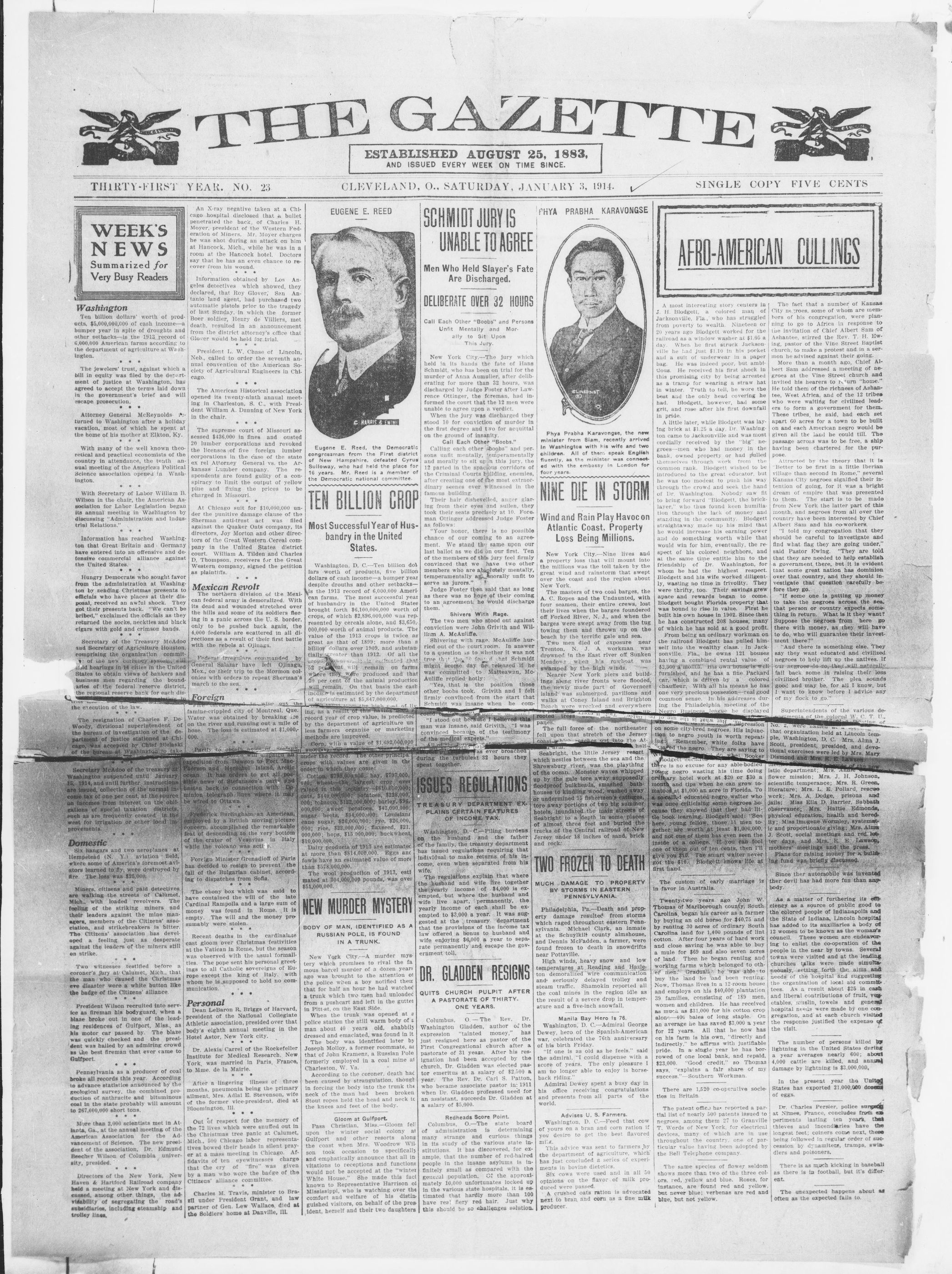
Page text (machine-generated)
TH1RTY-FIRST YEAR. NO. 23
SACRED HEAVEN
WEEK'S NEWS Summarized for Very Busy Readers
Washington
Ten billion dollars' worth of products, $5,000,000,000 of cash income—a bumper year in spite of droughts and other setbacks—is the 1913 record of 6,000,000 American farms according to the department of agriculture at Washington.
The jewelers' trust, against which a bill in equity was filed by the department of justice at Washington, has agreed to accept the terms laid down in the government's brief and will escape prosecution.
Attorney General McReynolds returned to Washington after a holiday vacation, most of which he spent at the home of his mother at Elkton, Ky.
With many of the well known theoretical and practical economists of the country in attendance, the tenth annual meeting of the American Political Science association opened in Washington.
With Secretary of Labor William B Wilson in the chair, the American Association for Labor Legislation began its annual meeting in Washington by discussing "Administration and Industrial Relations."
Information has reached Washington that Great Britain and Germany have entered into an offensive and defensive commercial alliance against the United States.
Hungary Democraters who sought favor from the administration at Washington by sending Christmas presents to officials who have places at their disposal, received an awful shock. They got their presents back. "We can't be bribed," exclaimed the officials as they returned the socks, neckties and black cigars with gold and crimson bands.
Secretary of the Treasury McAdoc and Secretary of Agriculture Houston, comprising the organization committees of the new currency system, will hold hearings in 14 cities in the United States to obtain views of bankers and business men regarding the boundaries of the federal reserve district, the regional reserve bank for each dis
The resignation of Charles F. DeWoody, divisional superintendent of the bureau of investigation of the department of justice stationed at Chicago, was accepted by Chief Hlebaski of the bureau at Washington to take
Secretary McAdoo of the treasury of Washington suspended until January 15, 1914, and until further instructions are issued, collection of the normal income tax of one per cent at the source on income from interest on the obligations of special taxation districts, such as are frequently created in the west for irrigation or other local improvements.
Domestic
Six hangers and two aeroplanes at Hempstead (N. Y.) aviation field, where some of America's foremost aviators learned to fly, were destroyed by fire. The loss was $25,000.
Miners, citizens and paid detectives are walking the streets of Calumet, Mich., with loaded revolvers. The feeling of the striking miners and their leaders against the mine managers, members of the Citizen's association, and strikebreakers is bitter. The Citizen's association has developed a feeling just as desperate against the leaders of the miners still on strike.
Two witnesses testified before a coroner's jury at Calumet, Mich., that the man who caused the Christmas eve disaster wore a white button like the badge of the Citizens' alliance.
President Wilson recruited into service as fireman his bodyguard, when a blaze broke out in one of the leading residences of Gulport, Miss., as his motor car passed by. The blaze was quickly checked and the president was hailed by an admiring crowd as the best fireman that ever came to Gulport.
Pennsylvania as a producer of coal broke all records this year. According to advance statistics announced by the geological survey, the combined production of anthracite and bituminous coal in the state probably will amount to 267,000,000 short tons.
More than 2,000 scientists met in Atlanta, Ga., at the annual meeting of the American Association for the Advancement of Science. The new president of the association, Dr. Edmund Beecher Wilson of Columbia university, presided.
Directors of the New York, New Haven & Hartford Railroad company held a meeting at New York and discussed, among other things, the advisability of segregating the road's subsidiaries, including steamship and trolley lines.
THE GAZETTE
An X-ray negative taken at a Chicago hospital disclosed that a bullet penetrated the back of Charles H. Moyer, president of the Western Federation of Miners, Mr. Moyer charges he was shot during an attack on him at Hancock, Mich., while he was in a room at the Hancock hotel. Doctors say that he has an even chance to recover from his wound.
Information obtained by Los Angeles detectives which showed, they declared, that Roy Glover, San Antonio land agent, had purchased two automatic pistols prior to the tragedy of last Sunday, in which the former Boer soldier, Henry de Villiers, met death, resulted in an announcement from the district attorney's office that Glover would be held for trial.
President L. W. Chase of Lincoln, Neb., called to order the seventh annual convention of the American Society of Agricultural Engineers in Chicago.
The American Historical association opened its twenty-ninth annual meeting in Charleston, S. C., with President William A. Dunning of New York in the chair.
The supreme court of Missouri assessed $346,000 in fines and ousted 20 lumber corporations and revoked the licenses of five foreign lumber corporations in the case of the state ex rel Attorney General vs. the Arkansas Lumber company. The respondents are found guilty of a conspiracy to limit the output of yellow pine and fixing the prices to be charged in Missouri.
At Chicago suit for $10,000,000 under the punitive damage clause of the Sherman anti-trust act was filed against the Quaker Oats company, its directors, Joy Morton and other directors of the Great Western Cereal company in the United States district court. William A. Tilden and Charles D. Thompson, receivers for the Great Western company, signed the petition as plaintiffs.
Mexican Revolt
The northern division of the Mexican federal army is demoralized. With its dead and wounded stretched over the hills and some of its soldiers fleeing in a panic across the U. S. border, only to be pushed back again, the 4,000 federalers are scattered in all directions as a result of their first battle with the rebels at Ojima.
Federal irregulars commanded by General Salazar have left Ojima, Mex., on their trip to the Mormon colonies with orders to repeat Sherman's march to the sea.
The chartered to wine out the famine-crippled city of Montreal, Que. Water was obtained by breaking ice on the river and running out a mile of hose. The loss is estimated at $1,000,000.
Partly to obtain news of Stirling, a response will impatient all expedition from Dawson to Mac Fhearson and Hershel Island, Arctic Ocean. It has orders to get all possible news of Stirsson's party and hasten back to connection with Dominion telegraph lines where it may be wired to Ottawa.
Frederick Burlingham, an American, employed by a British moving picture concern, accomplished the remarkable feat of descending to the very bottom of the crater of Vesuvius in Italy while the volcano was act e.
Foreign Minister Grenadioff of Paris has decided to resign to prevent the fall of the Bulgarian cabinet, according to dispatches from Sofia.
The ebony box which was said to have contained the will of the late Cardinal Rampolla and a large sum of money was found in Rome. It is empty. The will and the money presumably were stolen.
Recent deaths in the cardinalate cast gloom over Christmas festivities at the Vatican in Rome, but the season was observed with the usual formalities. The pope sent his personal greetings to all Catholic sovereigns of Europe except the king of Italy, with whom he is supposed to hold no communication.
Dean LeBaron R. Briggs of Harvard, president of the National Collegiate Athletic association, presided over that body's eighth annual meeting in the Hotel Astor, New York city.
Dr. Alexis Carrel of the Rockefeller Institute for Medical Research, New York, was married in Paris, France, to Mme. de la Mairie.
After a lingering illness of three months, pneumonia being the primary aliment, Mrs. Adal E. Stevenson, wife of the former vice-president, died at Bloomington, Ill.
Out of respect for the memory of the 72 lives which were snuffed out in the Christmas tree panic at Calumet, Mich. 500 Chicago labor representatives bowed their heads in silent prayer at a mass meeting in Chicago. Affidavits of ten eyewitnesses charge that the cry of "fire" was given by a man who wore the badge of the Citizens' alliance committee.
Charles M. Travis, minister to Brazil under President Grant, and law partner of Gen. Lew Wallace, died at the Soldiers' home at Danville, IL.
ESTABLISHED AUGUST 25, 1883,
AND ISSUED EVERY WEEK ON TIME SINCE.
CLEVELAND, O., SATURDAY, JANUARY 3, 1914.
EUGENE E. REED
Eugene E. Reed, the Democratic congressman from the First district of New Hampshire, defeated Cyrus Suiloway, who had held the place for 16 years. Mr. Reed is a member of the Democratic national committee.
TEN BILLION GROP
Most Successful Year of Husbandry in the United
Most Successful Year of Husbandry in the United
States.
Washington, D. C.—Ten billion dollars worth of products, five billion dollars of cash income—a bumper year despite droughts and other setbacks—is the 1913 record of 6,000,000 American farms. The most successful year of husbandry in the United States brought forth $6,100,000,000 worth of crops, of which $2,896,000,000 was represented by cereals alone, and $3,650,000,000 worth of animal products. The value of the 1913 crops is twice as great as that of 1899; more than a billion dollars over 1909, and substantially greater than 1912. Of all the crops grown, it is estimated that 52 percent will remain on farms where they were produced and that 20 per cent of the animal production will remain. On that basis the cash income is estimated by the department of agriculture at $5,847,000,000.
ing, as a result of this having been a record year of crop value, is predicted by the department of agriculture unless farmers organize or marketing methods are improved.
Cotton, $78,000,000, hay, rye, 57,000,
000; wheat, the largest, hay, 51,000,000,
raised in the U.S., $110,000,000;
cars, $140,000,000; potatoes, $28,000,
000; potatoes, $122,000,000; barley, $36,
000,000; sweet potatoes, $43,000,000;
sugar, beets, $34,000,000; Louisiana
cane sugar, $26,000,000; rye, $26,000,
000; rice, $22,000,000; flaxseed, $21,
000,000; hops, $15,000,000; buckwheat
$10,000,000;
Dairy products of 1913 are estimator at more than $814,000,000. Eggs and fowls have an estimated value of more than $578,000,000. The wool production of 1913, esti mated at 304,000,000 pounds, was over $51,000,000.
BODY OF MAN, IDENTIFIED AS A
New York City.—A murder mystery which promises to rival the famous barrel murder of a dozen years ago was brought to the attention of the police when a boy notified them that for half an hour he had watched a trunk which two men had unloaded from a pushcart and left in the gutter in Pitt-sat, on the East Side. When the trunk was opened at a police station the still warm body of a man about 40 years old, shabbily dressed and emaciated, was found in it. The body was identified later by Joseph Molloy, a former roommate, that of John Kramarz, a Russian Pole formerly employed in a coal mine at Charleston, W. Va. According to the coroner, death had been caused by strangulation, though in forcing the body into the trunk the neck of the man had been broken Stout ropes held the head and neck to the knees and feet of the body.
Gloom at Gulfport
Pass Christian, Miss.-Gloom fell upon the winter social colony at Gulfport and other resorts along the coast when Mrs. Woodrow Wilson took occasion to specifically and emphatically announce that all invitations to receptions and functions would not be accepted at the "winter White House." She made this fact known to Representative Harrison of Mississippi, who is watching over the comfort and welfare of his distinguished visitors, on behalf of the pressident, herself and their two daughters
SCHMIDT JURY IS UNABLE TO AGREE
DELIBERATE OVER 32 HOURS
Call Each Other "Boobs" and Persons Unfit Mentally and Morally to Sit Upon This Jury.
New York City—The jury which held in its hands the fate of Hans Schmidt, who has been on trial for the murder of Anna Aumuller, after deliberating for more than 32 hours, was discharged by Judge Foster after Lawrence Ottinger, the foreman, had informed the court that the 12 men were unable to agree upon a verdict.
When the jury was discharged they stood 10 for conviction of murder in the first degree and two for acquittal on the ground of insanity.
Call Each Other "Boobs."
Calling each other "Boobs" and persons unfit mentally, temperamentally and morally to sit upon this jury, the 12 parted in the spacious corridors of the Criminal Courts building, enemies, after creating one of the most extraordinary scenes ever witnessed in the famous building.
Their hair dishevelled, anger glaring from their eyes and sullen, they took their seats precisely at 10. Foreman Ottinger addressed Judge Foster as follows:
"Your honor, there is no possible chance of our coming to an agreement. We stand the same upon our last ballot as we did on our first. Ten of the members of this jury feel firmly convinced that we have two other members who are absolutely mentally, temperamentally arrogant, enormously unfit to serve as jurors."
Judge Foster then said that as long as there was no hope of their coming to an agreement, he would discharge them.
Shivers With Rage.
The two men who stood out against conviction were John Grivith and William A. McAuliffe. Shivering with rage, McAuliffe hurried out of the court room. In answer to a question as to whether it was not true that the 10 forfeited that Schmidt might come day be released if he was committed to Matteawan, McAuliffe replied hotly: "Yes, that is the position other boobs took. Grivith and I felt firmly convinced from the start that Schmidt was insane when he could be heard." "I stood out because I believed this man was insane, said Grivith. "I was convinced because of the testimony of the medical expert." On the same day he was never broached during the turbulent 32 hours they spent together.
ISSUES REGULATIONS
TREASURY DEPARTMENT EXPLAINS CERTAIN FEATURES OF INCOME TAX.
Washington, D. C—Pilling burdens on the husband and the father of the family, the treasury department has issued regulations requiring that individual to make returns of his income, even when separated from his wife.
The regulations explain that where the husband and wife live together the nearly income of $4,000 is exempted, but where the husband and wife live apart, permanently, the nearly income of each shall be exempted to $3,000 a year. It was suggested at the treasury department that the provisions of the income tax law offered a bonus to husband and wife enjoying $6,000 a year to separate permanently and escape the government toll.
DR. GLADDEN RESIGNS
DR. GLADDEN RESIGNS
Columbus, O — The Rev. Dr. Washington Gladden, author of the expression "tainted money," has just resigned here as pastor of the First Congregational church after a pastorate of 31 years. After his resignation had been accepted by the church, Dr. Gladden was elected pastor emeritus at a salary of $2,500 a year. The Rev. Dr. Carl S. Patton, who became associate pastor in 1911 when Dr. Gladden professed need for an assistant, succeeds Dr. Gladden at a salary of $5,000.
Redheads Score Point.
Columbus, O.-The state board of administration is determining many strange and curious things in its study of the various state institutions. It has discovered, for example, that the number of red-haired people in the insane asylums is infinitely small as compared with the general population. Of the approximately 10,000 unfortunate locked up in the various state hospitals, it is estimated that hardly more than 100 have real fiery red hair. Just why this should be so challenges solution.
Phya Prabha Karavongse, the new minister from Siam, recently arrived in Washington with his wife and two children. All of them speak English fluently, as the minister was connected with the embassy in London for four years.
Wind and Rain Play Havoc on Atlantic Coast. Property Loss Being Millions.
Wind and Rain Play Havoc on Atlantic Coast. Property Loss Being Millions.
New York City—Nine lives and a property loss that will mount into the millions was the toll taken by the great wind and rainstorm that swept over the coast and the region about New York.
The masters of two coal barges, the A. C. Ropes and the Undaunted, with four seamen, their entire crews, lost their lives when the barges foundered off Forked River, N. J., and when the barges were swept away from the tug towing and thrown up on the beach by the terrific gale and sea.
Two men died of exposure near Trenton, N. J. A workman was drowned in the East river off Sunken Meadows when his rowboat was swamped by the high winds.
Nearer New York piers and buildings along river fronts were flooded, the newly made part of Governors island was submerged, pavilions and walks at Coney Island and Brighton Beach were wrecked and everywhere
The full force of the northeaster fell upon that stretch of the Jersey coast which reaches out into the Atlantic. Seabright, the little Jersey resort which nestles between the sea and the Shrewsbury river, was the plaything of the ocean. Monster waves whipped up by the gale tore away supposedly floodproof bulkheads, smashed bath-houses to kindling wood, washed away or undermined 15 fishermen's cottages, tore away portions of two big summer hotels, inundated the main streets of Seabright to a depth in some places of almost three feet and buried the tracks of the Central railroad of New Jersey under 18 inches of sand, brick and rock.
TWO FROZEN TO DEATH
MUCH DAMAGE TO PROPERTY BY STORMS IN EASTERN PENNSYLVANIA.
Philadelphia, Pa.—Death and property damage resulted from storms which raged throughout eastern Pennsylvania. Michael Clark, an inmate at the Schuylkill county almshouse, and Dennis McFadden, a farmer, were found frozen to death in snowdrifts near Pottville.
High winds, heavy snow and low temperatures at Reading and Hazleton demoralized wire communication and seriously delayed trolley and steam traffic. Shamokin reported all the coal mines in the region idle as the result of a severe drop in temperature and a five-inch snowfall.
Manila Bay Hero Is 76
Washington, D. C.-Admiral George Dewey, hero of the Spanish-American war, celebrated the 76th anniversary of his birth Friday.
"If one is as old as he feels," said the admiral. "I could dispense with a score of years. The only pleasure I am no longer able to enjoy is horse-back riding."
Admiral Dewey spent a busy day in his office receiving congratulations and presents from all parts of the world.
Advises U. S. Farmers.
Washington, D. C.—Feed that cow of yours on a bran and corn ration if you desire to get the best flavored milk. This advice was sent to farmers by the department of agriculture, which has just concluded a series of experiments in bovine dietetics. Six cows were used and in all 50 options on the flavor of milk produced were passed. A crushed oats ration is advocated next to bran and corn as a fine milk producer.
AFRO-AMERICAN CULLINGS
A most interesting story centers in J. H. Bldgett, a colored man of Jacksonville, Fla., who has struggled from poverty to wealth. Nineteen or 20 years ago Bldgett worked for the railroad as a window washer at $1.05 a day. When he first struck Jacksonville he had just $1.10 in his pocket and a suit of underwear in a paper bag. He was indeed poor, but ambitious. He received his first shock in this promising city by being arrested as a tramp for wearing a straw hat in winter. Truth to tell, he wore the best and the only head covering he had. Bldgett, however, had some grit, and rose after his first downfall in pride.
A little later, while Blodgett was laying brick at 1:25 a day. Dr. Washington came to Jacksonville and was most cordially received by the "big" negroes—men who had money in the bank, owned property or had fulfilled themselves through work from the common rank. Blodgett wished to be introduced to the great educator, but he was too modest to push his way through the crowd and seek the hand of Dr. Washington. Nobody saw fit to bring forward "Blodgett, the brick layer," who thus found keen humiliation through the lack of money and standing in the community. Blodgett straightaway made up his mind that he would increase his earning power and do something worth while that would win for him, eventually, the respect of his colored neighbors, and at the same time entitle him to the friendship of Dr. Washington, for whom he had the highest respect. Blodgett and his wife worked diligently, wasting no time in frivolity. They were thrifty, too. Their savings grew apace and rewards began to come Blodgett bound Florida property that was bound to rise in value. First he built his own house in 1902. Since then he has constructed 208 houses, many of which he has sold at a good profit
From being an ordinary workman on the road Bloedget has pulled himself into the wealthy class. In Jacksonville, Fla. he owns 121 houses having a combined rental value of $2,300 a month. His own house is well furnished, and he has a fine Packard car, which is driven by a colored driver. He is also one very precious possession—real good common sense. In his addresses during the Philadelphia meeting of the Norwegian league he displayed
there is no excuse for any able-bodied young negro wasting his time doing ordinary hotel work at $20 or $30 a month and tips when he can grow to tomatoes at $1,000 an acre in Florida. To a so-called educated negro waiter who was once criticulating some negroes because they showed that they had little book learning, Blodgett said: "See here, young fellow, those 11 men together are worth at least $1,000,000, and not one of them has even seen the inside of a college. If you can fool one of them out of ten cents, then I'll give you $10. The smart waiter never got the $10. Blodgett knows life at first hand.
The custom of early marriage is in favor in Australia.
Twenty-two years ago John W. Thomas of Marlborough county, South Carolina, began his career as a farmer by buying an old horse for $40.75 and by renting 30 acres of ordinary South Carolina land for 1,400 pounds of lint cotton. After four years of hard work and close saving he was able to buy a mule for $69 and also seven acres of land. Then he began renting and working farms which belonged to other men. Graduated he was able to buy the land he had been renting. Now, Thomas lives in a 12 room house and employs on his $40,000 plantation 39 families, consisting of 189 men, women and children. He has received as much as $31,000 for his cotton crop alone—400 bales of long staple. On an average he has saved $3,000 a year for 22 years. All that he now has on his farm is his own, "directly and indirectly," he affirms with justifiable pride. In a single year he has borrowed of one local bank, and repaid, $23,000. "Good credit," so Thomas says, "explains a fair share of my success."—Southern Workman.
There are 1,520 co-operative societies in Britain.
The patent office has reported a partial list of nearly 500 patents issued to negroes, among them 27 to Granville T. Words of New York, for electrical devices, many of which are in use throughout the country, one of particular value having been adopted by the Bell Telephone company.
The same species of flower seldom shows more than two of the three colors, red, yellow and blue. Roses, for instance, are found red and yellow, but never blue; verbenas are red and blue, but not yellow.
PY FIVE CENTS
AN CULLINGS
The fact that a number of Kansas City nooses, some of whom are members of his congregation, were planning to go to Africa in response to the invitation of Chief Albert Sam of Ashantee, stirred the Rev. T. H. Ewing, pastor of the Vine Street Baptist church, to make a protest and in a serenade he advised against their going.
More than a month ago, Chief Albert Sam addressed a meeting of negroes at the Vine Street church and invited his hearers to return "home." He told them of the richness of Ashantee, West Africa, and of the 12 tribes who were waiting for civilized leaders to form a government for them. These tribes, he said, had each set apart 60 acres for a town to be built on and each American negro would be given all the land he could till. The passage across was to be free, a ship having been chartered for the purpose.
Attracted by the theory that it is "Better to be first in a little Iberian village than second in Rome," several Kansas City negroes signified their intention of going, for it was a bright dream of empire that was presented to them. The start is to be made from New York the latter part of this month, and negroes from all over the country have been interested by Chief Albert Sam and his co-workers.
"I told my congregation that they should be careful to investigate and find what flag they are going under," said Pastor Ewing. "They are told that they are needed to help establish a government there, but it is evident that some great nation has dominion over that country, and they should investigate that question carefully before they go.
"If some one is putting up money to take the negroes across the sea, that person or country expects something in return. What is it they want? Suppose the negroes from here go there with money, as they will have to do, who will guarantee their investment there?" "And there is something else. They say they want educated and civilized negroes to help lift up the natives. If our negroes do so, they will naturally fall back some in raising their less civilized brother. The plea sounds good and may be, for all I know, but I want to know before I advise any of my flock to go."
were named to a new that organization held at Lincoln temple, Washington, D. C. Mrs. Alma J. Scott, president, presided, and devotional exercises were led by Mrs. Mary Dismond and Mrs. R. E. Lawson in the new static department; Mrs. Thurlow flower mission; Mrs. J. H. Johnson, scientific temperance; Mrs. R. Green, literature; Mrs. L. E. Pollard rescue work; Mrs. A. Dodge, prisons and jails; Miss Ella D. Barrier, Subbath observance; Mrs. Hattie Edmonds, physical education, health and heredity; Miss Imogene Wormley systematic and proportionate giving; Mrs. Alma J. Scott, social meetings and red letter days, and Mrs. R. E. Lawson, mothers meetings and the press. Plans for raising money for a building fund was briefly discussed.
Since ther automobile was invented ther devil has had more fun than anybody.
As a matter of furthering its efficiency as a source of public good to the colored people of Indianapolis and the State of Indiana, Lincoln hospital has added to its auxiliary a body of 12 women to be known as the woman's council. These women are endeavoring to enlist the co-operation of the people in the near by towns. Several towns were visited and at the leading churches talks were made simultaneously, setting forth the aims and needs of the hospital and suggesting the organization of local aid committees. As a result about $25 in cash and liberal contributions of fruit, vegetables, muslin, towels and general hospital needs were made by one congregation, and at each church visited the response justified the expense of the visit.
The number of persons killed by lightning in the United States during a year averages nearly 600; about 4,000 cattle are killed, and annual damage by lightning is $3,000,000.
In the present year the United States has exported 21,000,000 dozen of eggs.
Dr. Charles Persler, police surgeon at Nimes, France, concludes from ex periments lasting ten years, that thieves and incendaries have the longest feet; cochars come next, these being followed in regular order of succession by dynamiters, tramps, swimmers and poisoners.
There is as much kicking in baseball as there is in football, but it's different.
The unexpected happens about as often as the expected falls to.
PUBLISHED EVERY SATURDAY
One Year.....$1.50.
Six Months.....1.00
Three Months.....50
Subscribers are requested to remit by postoffice money order or registered letter
Entered at the postoffice in Cleveland Ohio, as second-class matter.
Address all communications to
Blackstone Building, Cleveland, O.
Member Ohio Legislature: 1894
to 1896; 1896 to 1898; 1900 to 1902
THE GAZETTE is the oldest, and has the largest bona fide circulation, double the number of newspaper in the interest of Afro-Americans, published in the state of Ohio, and comparison with any will immediately establish its rank as one of the NEWSIEST AND BEST in the country.
SATURDAY, JANUARY 3, 1914.
Happy New Year!
Time is the great healer of political wounds.
Well, Republican prosperity lasted till Christmas, anyway.
Were all the Democratic campaign promises made in bad faith?
Good health aside, there is no anxiety so great as that for good business.
The facts gathered by the monetary commission made possible the excellent new banking law.
The Democrats have destroyed civil service in each of the three departments they have legislated for.
Save your money. You will need it greatly before the end of this year. Many are already without employment.
The active opposition to the getting together of Progressives and Republicans comes from the Democratic news-bureau.
With the new tariff and currency laws in force, surely the advance in wages promised by the Democrats will now be realized.
John Mitchell, Jr., editor of the Richmond (Va.) Planet has our heartfelt sympathy in the loss of his mother—"his truest and best friend."
"The Coronation Club," a Jewish organization, will give the play, "The Nigger" at the Metropolitan Theater, an aim, so one shall bring taking the leading role. It would be just as consistent from a racial, prejudice standpoint for one of our organizations to give at one of the local theatres a play, called "The Sheeny." I do not believe, however, that there is an organization among our people of this community that would be guilty of such an insulting act to the Jewish or any other class of people in this community. What do you think about it, Editor Weidenthal, of The Jewish Independent?
Our people are justly indignant at the policy of "segregation" adopted by the departments at Washington toward members of the race who by civil service tests hold office and honorably and faithfully perform their duties. Under this Democratic national administration all chance of an Afro-American holding official position in any Southern state has been absolutely crushed, and now under Wilson's patented "new freedom" there is a systematic policy of humiliating decent men and women of the race so as to compel them to resign to make room for white Democrats from the South.
THE "CROSS OF GOLD" A PLUM TREE.
Speaking of Col. W. J. Bryan the Cincinnati Times Star says:
"The man who made the country ring with protestations, of political virtue during three very loud presidential campaigns has, upon accession to office, become an arrest spoilsman. The old Bryan—commoner and prophet—is no more. "The cross of gold" has assumed the more practical form of the plum tree."
CALLING A MOB'S BLUFF.
A lyncher is a bully. Therefore, he is a coward. The only reason he succeeds so often in his deadly work is that no one with nerve stands up to call his bluff. There is a whole sermon on mob psychology in recent news dispatches from Cheatertown, Md., where a crowd of armed and angry men stormed a jail to lynch a Negro murderer the other night. A determined sheriff, backed by a dozen determined deputies, repelled the mob after it had broken down the doors and entered the jail. No mob likes the smell of gunpowder. The best time for county or community to prepare against mob violence is at election time before the occasion arises. Choose a sheriff with backbone and determination, who knows no fear and is not afraid to shoot in emergency, and there will be no jail deliveries of the violent sort.
```markdown
```
Such a sheriff will surround himself with deputies of equal nerve, and a dozen such, upheld by the law, are a match for any mob that ever gathered to storm a prison and murder a suspect.
At Chestertown on the eastern shore of Maryland a Negro killed a white man. The customary mob of "best" citizens gathered to relieve the sheriff of his prisoner. It battered down the outer doors. Inside it met a dozen or fifteen deputies, commanded by the sheriff, who politely invited the lynchers to desist. Two rounds of shot from the deputies' revolvers, fired where they would make a noise but injure no one, indicated to the mob's quick intelligence that its leaders had made a serious miscalculation.
The mob retired, threatening but cowed. A mob likes to be at the butt end of a gun when it spits fire.
Reserve two niches in the hall of fame—one for Sheriff Brown of Kent county and the other for Deputy McKee—Cleveland Plain Dealer (daily.)
THE "ECONOMICAL" DEMOCRATIC ADMINISTRATION.
The Democratic National platform of 1912 denounced "the profligate waste of the money wring from the people by oppressive taxation through the lavish appropriations of recent Republican congresses" and demanded "a return to that simplicity and economy which befits a Democratic government."
How the Democratic Party has kept its platform promises is shown by the following figures:
Appropriations under Taft (last year).....1,074,505,870
Democratic excess...$ 34,175,907
The Executive Department under Wilson calls for an increase of $55,318; and the State Department under that exemplar of Democratic simplicity and economy, Secretary Bryan, asks for an increase of $404,780.
WHAT MR. SCHWAB SAID.
There is wide-spread interest in the recent declaration of Mr. Chas, M. Schwab, President of the Bothelem (Pa.) Steel Works, that as the effect of the new tariff "the country faces the most serious depression it has ever known." This declaration was made in an interview on the very day that Mr. Andrew Carnegie was expressing his satisfaction with the new tariff. Mr. Schwab said: "This country faces the most serious depression it has ever known—a condition effected by the new tariff. Under the new tariff cost of transportation of steel, for instance, is affective between the rate between Bothelem, Pa, and New York is as great as that between Rotterdam and New York.
"It was true, when Andrew Carnegie said it, that the cost of steel production in this country was so much cheaper here that we could compete with the world and win, but conditions were so bad that we held in this country have run out and are in operation abroad. Methods of production have so advanced in other countries that the cost of making steel has become just about standardized all over the world. And with cheaper transportation under the other countries we can more than successfully compete with us in many lines.
ing man has no job and can earn no money with which to buy the neces sties?"
Commenting thereon, the American Economist remarks:
As the head of one of the concern, outside of the Buez, operation and as a practical steel maker, it is safe to prefer the judgment of Schwab over the judgment of Carnegie regarding the injurious consequences of the Free-Trade tariff. Mr. Schwab is at the cannon's mouth of competition with the lower wage rates and the cheaper transportation enjoyed by foreign producers. Carnegie is on 'Easy Street' with his assured income of $15,000,000 a year. It makes a difference."
THE CURRY-ARNOLD CASES.
The Former Wins the Criminal Case and Secures a New Trial in
Judge F. E. Stevens of the Common Pleas bench of this county on Wednesday, Dec. 24, 13, granted a new trial in the case of, Mrs. Arnold vs. Cora Curry, the wife of Robert Curry. In this case the jury had rendered a verdict against Arnold which Judge Stevens on a motion for new trial set aside is wrong.
Our readers will remember that some time last year in a squabble occurring between Mrs. Arnold and Mrs. Curry, Mrs. Arnold shot Mrs. Curry and claimed that thereafter in a struggle for the possession of the revolver, Mrs. Curry wrenched the revolver from her and deliberately shot her. Mrs. Curry claimed that after being shot, Mrs. Arnold, Mrs. Arnold still pointing the weapon at her, she, Mrs. Curry, fearing that she would shoot her again, grappled with Mrs. Arnold and struggled with her to disarm her, and while still struggling to get possession of the revolver, and while said revolver remained in the hands of Mrs. Arnold, the revolver was accidentally discharged and Mrs. Arnold injured. Both parties were arrested, tried in the Police Court, and the decision granted for shooting each other and both bound over to the Common Pleas Court. In the Commons, Pleas Court both agreed to the shooting each other. Mrs. Curry was first tried by Judge Vickery and a jury, and the jury brought in a verdict of not guilty for Mrs. Curry.
Mrs. Arnold not being content with this action of the Criminal jury, brought a civil action for damages against Mrs. Curry which was tried before Judge Stevens, and it is in this case that Judge Stevens granted a motion for a new trial in favor of Mrs. Curry-Adv.
Our advertisers want your trade. Those who do not ask for it in The Gazette certainly care little, if at all, for it. Therefore, we urge our readers and all of our friends to patronize those who ask for your trade in this paper.
THE GAZETTE, CLEVELAND, O., SATURDAY, JANUARY 3, 1914.
WRITTEN BY "THE OLD RELIA-
BLE" GAZETTE'S CORRE.
SPONXENTS.
THROUGHOUT OHIO
What Our People Are Doing Each Week—Church, Personal, Social, Lodge, Literary and Musical — Marriages,
CADIZ—I. L. Strother entertained the B. B., Sunday week—the "Winter Fair" at the A. M. E. church, recently, was a success. —Mr. and Mrs. B. S. Lee visited Mrs. Susan E. Lee of Pittsburgh. —M. F. Walker is serious. —Mr. and Mrs. B. S. Alice spent Xmas with her parents. —Gretchen West of Pittsburgh, is at Mr. and Mrs. Thos. Mason's. —Mrs. Alice Howard and Mrs. Mabel Christian were called to Poland by the former's sister's illness. —Bertha Carter entertained the W. G.'s Saturday. —"Santa's" sister's illness. —Mr. and Mrs. A. M. E. Church, Christmas was a success. On the following night, "Dispelling of Big Jim", given by the trustees, was a "side-splitter" from start to finish. —Among the large numb ber of people here for Christmas were: —Mr. brother of Irwin, Pa. Mr. and Mrs. Irwin, Pa. Mrs. Mary Burke of Newark; Mr. and Mrs. Ambrose Kent, Steubenville; Bert Brown and Miss Mary Jones Wellsville; Mrs. S. and Mrs. Freed Ramsey and families of Hopedale: Dr. J. Elsworth Smith, Ausn'r Wallace and Dwight Mason, Miss Reba West and Mrs. Reba West, Miss Reba Wallace spent Xmas in Pittsburgh.
OBERLIN—Mr. Wm. Weddily will visit his wife, and mother and father, Mr. and Mrs. Mantch Tabron, here, the last of the week—Local athletes went to Wellington, to play the high school, and the Year's evening—Mrs. Chambers and school students. She had suffered for years. She leaves a daughter, Cynthia Cooper, a son William, and a grandchild, Myrel Gary was well-liked—Miss Carrie Phillips is visiting Mr. Jno. Jackson, in Cleveland—Miss Estella Huston and Joe Blue of Cleveland, are here visiting—Mrs. Marla Chambers and Mrs. John Fitzgerald of Elyria—Pauline Root of Elyria, here, Sunday—Mrs. Carrie Thomas and Mrs. Clarke are very ill. A banquet at Mrs. Lewis', E. Lorain St. Saturday—A silver wedding at Mrs. Stevens', Xmas evening. Many useful presents—Miss Theresa Smith has been given to Mrs. John Pettenford of S. Park St. entertained 12 at a fine Xmas dinner. It was an exceptional social success.
SANDUSKY—Mrs. N. Boling has returned from a visit in Greencastle, Ind.—Mrs. Geo. Thomas is convalescing.—Miss Emma Garrett, and Miss Otes of Indianapolis, are visiting her sister, Mrs. J. R. Davis. The Xmas cantata at the Second Baptist church, was finely rendered. J. R. Davis and all the participants deserve Smith and sister, Mrs. Anna Crouch were dined, Xmas, by Mr. and Mrs. C. L. Miller—the children and the S. Xmas exercises at the A. M. E. church, were fine and all enjoyed them very much indeed. Rev. Stevens preached ably, Sunday evening. Rev. Smith says that that enjoyed this Xmas more than any other. All of his children sent him presents, and his church gave him an unusual donation in gold. Great day, Sunday, at church. Everyone is invited—We want to make it 919 the Gazette's to take it and get the news of the race. It is our best paper and we should be proud of 'The Old Re-
she was not forgotten, Xmas.
LORAIN—Mrs. Fannie Brown
spent Xmas in Cleveland. Little
Buline Brown is spending her vacation.
ledo, are visiting Mrs. Sarah Bon—H. Cromwell, G. E. of Fletcher, Can., is visiting his daughter, Miss Milt, Poet, sr —Mrs. Luella Williams of Reading, Mrs. Linda Williams of Wellington, Mrs. G. L. Hicks and Mrs. Worthington also have relatives visiting them. —Xmas exercises in all the churches, and the S. S.' remembered many little children who were not remembered by "Santa" at home. —Mr. and Mrs. C. L. Winfrey and son, spent the 21st in Cleveland, C. W. Kelly of visiting them, spent the 22nd in trained Mr. William C. Williams of Pauling, and Mr. and Mrs. Alva Williams, at ages 0 s' ockel dinner, the 27th. —Mrs. Beulah Miller has returned from Chicago. —The S. B. church, B. Y. P. ull, will meet, Jan. 8, at Mrs. S. Frances', stop 48. Lunch, Mrs. S. Frances', spent Sunday, with Mrs. I. Jain. can go again your order for "The Old Reliable" and start the new year right.
YOUNGSTOWN—Policeman Thos Lonesome is convalescing—Edward Price, who died at the City hospital recently, was a member of Buckeye lodge, which had charge of the funeral services at the Third Baptist church, Rev. Harper officiating. He was the largest of a club here for three years. —Mr. James Fields, Mr. John Anderson and Mrs. Sarah Saunders are convalescent. —Consuela Stewart | court gave an enjoyable birthday surprise on Mrs. Elsie Williams, recently. She received a number of beautiful presents. Archie McGee, a new director in Federal St. Mrs. Charles Davis is visiting relatives in Bellaire. —Long Larry McLean, the Giants' erratic catcher, wasn't telling friends Monday that he could jack Johnson. Instead he was nursing a bruised face, the result of a clash with Cey Semmour in a fight that he could jack Johnson has been McLean's boast for years. The Harlem battle happened after McLean had knocked down his theatrical manager, who protested that Larry didn't give him his share of money received from a week's engagement. Seymour took the manager's part and Larry was glad to leave when friends prized him on his behalf. "A part of his, henceforth — Order our best paper for the new year." —The Old Reliable" Gazette.
SMITHFIELD—Rev. and Mrs. J. D. Singleton were highly entertained by Mr. and Mrs. H. Harris, Xmas—The entertainment, Xmas eve, was largely attended and a success, Mr. Shiller spent Xmas week with her mother, Mrs. M. Mitchell. Mr. Joe Shiller was here Sunday.—Mrs. Singleton, Mrs. H. Harris and others were in Steubenville last week. Mr. M. Washington and Mrs. Shiller spent Xmas holiday here with her parent—Mr.
and Mrs. Ben Palmer's Xmas gift was a large boy-baby. Mr. Ernest Freeman is convalescent. Rheumatism. - Mrs. G. E. Beall is visiting her son, Delbert, in Dayton. L. Hargraves and EI Powell are visiting relatives in Pittsburgh. Mr. John Christian was in Massillon recently. - Mr. and Mrs. Finley Davis spent Xmas with her parents, Mr. and Mrs. W. H. Veney.
Correspondents must mail all letters for publication at their main postoffice sufficiently early on Monday (or Sunday) of each week to have them reach The Gazette office on Tuesday morning, and always write also, their names and that of their own, on the outside of the wrapper about their prologue. Unless this latter is done, prologue cannot be given you. Lists of names, wedding presents, etc., obituary notices, speeches, resolutions, poetry, inquiries for relatives and advertisements of all kinds, including items announcing entertainments to be held in the near future, must be paid for in the near future. Ten cents a line, six words to a line, for display advertisements will be sent on application. Send postal note and not stamps during warm weather.
MALE STENOGAPHERS AND
TYPEWRITERS IN DEMAND
The United States Civil Service Commission announces that while it has no difficulty in securing sufficient female stenographers and typewriters to meet the needs of the departments at Washington, D. C., the supply of male eligibles has not been equal to the supply of young men who are at least 18 years old, willing to accept the usual entrance salaries, which are $440 and $500 a year, have excellent opportunities for appointment. While the entrance salaries are low, advancement is reasonably rapid to those meriting it. The examinations, which any competent stenographer should be able to pass, are in the year, except December, at the principal cities of the United States.
Full information in regard to the examination may be secured by addressing the United States Civil Service Commission, Washington, D. C., or the District Secretary, Post Office, Boston, Mass, Philadelphia, Pa., Atlanta, Ga, Cincinnati, Ohio, Chicago, S. St. Paul, Minn., Seattle Washington, New York, N. Y., New Orleans, St. Louis or Old Customehouse, St. Louis Mo.
Examinations for fourth-class postmasters will soon be held in Ohio in compliance with the order of the President—fourth-class post offices where the annual compensation is as much as $180 and where the present incumbent was not appointed in accordance with the civil-service regulations.
TO DENOUNCE SEGREGATION.
Speakers at a National Meet Prepare
Address on That Subject
Addresses on That Subject.
Will be general subject before the National Association for the advancement of Colored People at its annual meeting here, Jan. 5. Many addresses will deal with the recent investigation of such damnable discrimination against our employees in the government departments in Washington. Mrs. Robert M. La Lofte, wife of the senator from Wisconsin, will speak on this subject. Segregation on Southern farms, a new development, will be discussed by Dr. W. E. B. Dudols.
Persons from all parts of the country are expected to attend the meeting.
Gives Birth to Seven Girls.
Muriel, Spain. A washerwoman living in the poorer districts of Madrid gave birth to six girls, all alive, Dec. 28-13. Three of them died in a short time, but all were clared most extraordinary by physicians, and the whole neighborhood has visited the house. She 'out shines' the Queen who has averaged a baby a year, almost. It is said that
ONE WHO DESERVES TRIBUTE
Stenographer, Hammering Out Dictated Paragraphs, Times Her Efficiency to Cur Limitations.
Who else knows us half so well? She has heard all that we have said and then made notes of it. She has read our incoming letters. She knows who pleads with us for help and what we do about it. Do we write frankly or evasively, she follows the straight hewed line or the curve of our deviousness. Are we courteous only to the powerful, or is our treatment even to all who come seeking? The woman at our elbow, hammering out our paragraphs, is a clear eyed witness. Over the telephone voices drift in from the world, and the tone of each is caught and judged before our presence is acknowledged. She knows whether our friends are worthy. Is the home happy? She knows it. She notes all our tricks of person. Our good temper our clean speech, fly further than we guess. She is familiar with the stale phrases we scatter over the thousand routine letters, and is gladdened when we light up the languid page with an unspoiled turn. She is aware when we have tumbled out from a laden desk to a world's series ball game. She, too, would enjoy a great player's versatility, but she wades through our brittles till twilight. She could keep our tardy correspondence up to the minute, but she has to time her efficiency to our limitations. Never outpacing us, she is as loyal in the background as our shadow. — Collier's Weekly.
Husband Boosts Allmony
The case of a man going into the supreme court and consenting to have a separation agreement with his wife set aside so he will be compelled to pay her more alimony occurs so seldom that when Justice Glegerich at New York set aside the separation agreement between Samuel Pelz, a cotton goods merchant at 160 Canal street, and his wife, Mrs. Rose Pelz, it aroused some interest.
Mr. and Mrs. Pelz were separated in 1908 under an agreement by which Pelz paid his wife $5,000 in lieu of all further alimony. Mrs. Pelz recently sued for divorce, naming Fannie LeFkowitz as correspondent. Pelz thought his wife was entitled to more alimony in view of her divorce case and consented to an order by Justice Glegerich directing him to pay $1,000 alimony and $100 counsel fees.
DOINCS
OF
THE
RACE
The Gazette is indebted to Secretary of State, Chas. H. Graves, for a neatly bound copy of "Ohio Labor Statistics for 1912."
The license granted E. Orange, N. J., theatre contains a clause which stipulates that there is to be no discrimination on account of race, color, etc. If this is violated, the license is reblocked. Something Cleveland needs. James is both a managing editor of the N. Y. Amsterdam News, was in the city, last week. Brocklyn, a little town in Illinois, just above E. St. Louis, has an Afro-American mayor. Assistant Postmaster Mischeaux, of Florence, S. C., has been "fired" by the Wilson administration over the business men of that city, and after many years faithful service, because he is an Afro-American. Joseph Ricks, a member of the race, was elected borough auditor, on the Republican ticket at the November election. Joseph Jasper, aged 68, has a fob which was a diamond necklace, once the property of Aaron Burr, who gave it to Jasper's grandfather.
The Chicago Defender is "in bad" again. It announced the death of Roscoe C. Simmons, prematurely. Editor R. R. Wright, Jr., of the A. M. E. Christian Recorder, and manager J. I. Dunn, of the A. M. E. dismissed from office several weeks ago by the Publication board of the Church, have been reinstated.
In a Pinch.
A cadet officer in the Pennsylvania Military college was reported by a faculty officer for "language," rather a severe mark in that austere institution. At the time appointed for the hearing of "explanations" of marks, the offending cadet presented himself before the commandant.
"Well, sir, how did it happen that you were guilty of using improper language while on duty?" the colonel inquired.
"Why, sir, as officer of the day I was inspecting the guard. In handling one of the rifles the lock snapped shut on my finger, and it just naturally pinched 'heir' out of me."
Not only was the mark "taken off," but the colonel gleefully reported to the entire corps the cadet officer's witty explanation of his offenses.—Lippincott's.
Baker's Dozen.
The custom on the part of bakers allowing 13 to the dozen dates back to medieval times, when bakers were carefully watched. The trade was surrounded by many laws, and the most severe penalties were imposed for any shortage in weight. In order to avoid the possibility of falling below the standard measure it be required customary for bakers to allow an extra loaf with every dozen.
"If I were inclined to brag, it would not be about anything that I had done." "No? " I could brag very loudly, too, if it were my disposition, so I would not be about things I am going to do some day." "Then what would it be about?" or one thing I would have been doing some time on the face but I hadn't.
that I have never worn a velvet neck
Teach Child What to Read.
Ask the pupils frequently what book they have recently read; who was the author; why they liked the book, and what they remember of it. One of the chief services the school renders is to teach the child what to read, why he reads it, how to read it, and how to remember what he reads.—School Journal.
In Foggy Old London
Visitors to London in old days wore in the habit of making fun of the fog just as the visitors of today. Condomara, Spanish ambassador in Queen Elizabeth's time, said to a friend who was returning to Spain: "My compliments to the sun, whom I have not seen since I came to England."
Business Head
Old Bullion (on his deathbed)—"All my property is willing to you; but I am afraid my children by my first wife will make a contest, and then the lawyers will get it." Young Wife—"Don't worry, my love; I can easily fix that. I will marry one of the lawyers."—New York Weekly.
Sense of Smell.
Like the senses of sight and hearing the sense of smell quickly tires. Hence it is only before fatigue sets in that a doctor can diagnose different alliments by the sense of smell alone. If he is a smoker or a drinker it is useless to depend upon the nose.
No Extra Charge.
Lady of the House—"Half the things you wash are torn to pieces." Washer-woman—"Yes, mum; but when a thing is torn in two or more pieces, mum, I only charge for them as one piece, mum!"—New York Mail.
When Roasting Meat
When meat is being roasted, and there is danger of its becoming too brown, place a basin of water in the oven. The steam will prevent scorching, and the meat will cook better.
Surplus of Stock.
"What do you think of this bride having 8,000 guests at her wedding?" "I wouldn't invite so many. I wouldn't care to get 3,000 or 4,000 pickle forks." - Courier Journal.
Heating Bottle
THE MAGIC IS IN LONG
SHAMPOO DRIER MED CO
THE MAGIC SHAMPOO DRIER
AND HAIR STRAIGHTENER
MAILFD ANY WHERE IN U.S.$100
POSTAGE PAID
Agents Wanted. Write for Literature.
Magic Shampoo Drier Co.
Minneapolis, Minn.
A. W. WILLIAMSON, Prop., 4207 Central Ave., 'Phoue East 2196J
LOOK AND LIVE
Neuralgia, Sore Muscles, Sprains and Swellings of all kinds. Price 50 Cents a Bottle. Orders by mail given Special and prompt Attention.
Taylor's New Shampoo Dryer
PRICE OF COMB $1.
Larze, Heavy, Strong and Durable. Made of copper and brass associated torches and can hold one solid piece; highly polished and so fully plated placed, a steel body holds growth of the large wood handles and scroves into an end of the comb to prevent the handle from flexing loops or coming off. Remember to all in one piece. Nothing to set in or corner, will list a lifetime.
Fill with alcohol and light Beer
Price of Hair Straightener and Alcohol Heater complete $1.50.
Here is the top part:
TAYLOR'S SPECIAL ALCOHOL HEATER is the handheld and most convenient method of heating the Comb, and can be closed up so that you can put it in your hand-tag. Price 25c. For best results use LaCrete Hair Pomade. It not only meets every requirements of the Comb Straightener, but promotes a luxurious at growth of the hair. Price 25c.
SEND FOR MY FREE CATALOG! Illustrating the Largest and Most Complete Line of Hair Goods in this country for colored people, such as Ban, Wig, Puff, Puffs, Pomade, Hair Pins, Combs, Brushes, etc.
Pure Beer Bottled at the Brewery
Order a Case of
Gold Bond
Bottled Beer
THE CLEVELAND & SANDUSKY
BREWING COMPANY
Delivered at the Home. Both Phones.
Will Sell Outright Shop or County Rights
This trollley wheel is so constructed as to keep the wheel from jumping from the wire; opens and shuts automatically, and can be switched at the pleasure of the motorman. Address.
802 E. 34th St., Lorain, O.
Heating Barber TR-MAGIC 19 9 IN LONG
SHAMPOO DRIER MED DO
NOTICE
WE
ONE THOUSAND
Values $3 to
$6, Selling at 90 CENT
A. W. WILLIAMSON, Prop., 42
LOOK A
Dr. J.
Remi
DR. NICKENS
cures K
Disease
the bloo
DR. NICKENS FEMALE TO
remedy for mental Depres
ness. Price 50 Cents.
DR. NICKENS KING OF PA
Price 50 Cents.
DR. NICKENS CATARRH CU
The Agricultural & Mechanical College for the Colored Race
Maintained by the Governments of North Carolina and of the United States. Open all the Year Round. For Males Only. Fall Term Begins September 1st, 1913. Strong Faculty. Excellent Facilities. Successful Graduates. Board, Lodging and Tuition $7.00 per month. For catalogue write, today, to James B. Dudley, President A. & M. College, Greensboro, N. C.
Fine Millinery!
Blocking and
Remodeling
Feathers Dyed
and Curled
Anna Walker
3882 Central Avenue
he
hein Pee Te
ee er as
Ae re
aie
“PORO COLT Yi
ngstagametars™ [ea
een a
hemes We
Petey a
Saag
Moe yee /
Re
ead
fe eesswene cal au ox sarees
MareArie e coutien
Sig tore ae
Se
A dotignttully Perfumed. Haire
ce oe eke ek oubora,
Bony tae ooh wart od glo
ope oats ee seal aivasing tr the
We hocial eandehat talnerewer:
Ik works directly on the scalp, and
Fete of the bain selleving daadruf
ind lothor diaseate ‘ot the. scallrakin,
ee ceca fo erat ve nas
bad laxerious,
B. & Mf. HAIR DRESSING
ts becoming more popular every day,
fd fe sold strict’ on a quaraatec,
BROWN DUG CO.
Brown and Beitors, Pres’s,
Trae Certral Ave.
_Sening ‘Agente
The New
Keystone
Pe d ' T
SSTAURANT.
‘2408 Central Ave.
‘he Best Meals
@enick Service.
Cigars & fobacco
Open Day
and Night.
___fhas, MePhareea. Proe'r,
SEELAAP EASE IAASO TESTO OTT T
G. G. REED’S
vv.
Ladies’ and Gent’s
Furnishings
‘A Complete Line of
LADIES’ READY-MADE APPAREL.
Double Stamps on Tuesday.
Cuy. Central 8661-L.
3222 Central Ave, Cleveland.
theteteeeteeteeeteeet ttt
X Complete Line
DRY GOODS, LADIES' AND GENTS’
FURNISHINGS
3816 and 420 Central Ave
Double Stamps on Tuesdays and
Fevanye.
ETE RETR E
Good Bargains
In Realestate!
LARGE MORTGAGE LOANS!
RENTALS--COLLECTIONS.
CLAIMS ADJUSTED.
Ss. E. WOODS,
Rccainicave
‘Pons, North 996
lg tinew ene
tren aaiaaae
Ohio Dry-Cleaning
and Dyeing Co.
Eeinbitaned ix 3911.
Cleaners of all kinds of Ladies and
Bs ctauers garments
Also Expert Cleaning ‘and Blocking of
ath Visas 20 Hale
‘We Gall for and Deliver!
‘3B°° Central Av.
Cuy. Phone, Central 2201-L.
Where to Purchase The Gazette
M. H. DIXON’S, *SAM- COHEN,
Soe Comeau ave. ei
Js nauce terunocn's
Bia eats ass. pete ie
sivechwaneea, 5 :
eens SAM EERTMAN'S, |
#0:G SRORBERS : ,
, inex ovo,
Cuyahoga Bldg. ‘2604 Central Ave.
Evans :
2130 Central Ave, +S. A. LenS ta
J. E. BRANHAN'S, Seal i etene DYES
et on. Polcnere Siok,
rostaw, Oar hoe
ARE Sih eed
“bn WEAVER’ Pe teh ae,
3315 Central Ave. cor, Arthur Ave.
SOPEN BUNBAYa.
NOTICE TO SUBSCRIBERS
Behpecioece vot cuca vn rhe astesreduladi. unla ust
us at once. We desire every copy delivered promptly.
Rieec tad eae wiver Camel cece rie pears atten
aera rere alaioe vautiee eoainae wn te oatenac ts
Gia pages suacts tate tis batts Se At caurtaeae the ac
APU earn ine mane
ene Gee iene ey cause «ine le
words in a line).
99909 09S660000606000066600000626006006 = = = 5 1O0OOOCOOO
Sortal anv Personal }
se a one emer
Bo J) Mary ast Ja. oxi the gible ie
SED FOR | torte ven’ vourgarn by Gon
ees. ap Ape ® (204, is name with others ts unde
TESS, J x consideration. He was sentenced In
EU ASME EAA | 800 tor te for murder, ne Gove iar
GG SIGE BS | mon commuted his sentence to rsteen
2. BRE AISVDY | sears. “te has been employed as
ei ZX | waiter at the penitentiary and is_on
on Ae” | duty’ in the warden's quarters, ‘The
MNT —sneen wl eine | Het ote onan, ee, 0
you have them to rent or it you fast (qm. Ne
nt to rent, advertise in The Gazette. | re cee
2 ee | Miss Ellen ‘Thomas wishes to ar
OTARY PUBLIC—For such serv. | nounce that the formal opening of her
peall ot The Gareite often: No. | baitdressing purlor, Tueatay eventhn
estone. bufidings or add W.| Des. 20, ae Haw 4 perfect access
fal Sheet, near’ Superior Ave. [one of the Wrantest. ever’ Held to
Bari lees Gigveland by one of the race. She r
selved 186) (guecte, and ‘bad the
Westies ast tosm 30 tad ane could
Mot have cared (or al: wae would inve
Aulenied tho opeaing. ite winhen {0
thank thove who auslated ‘her and
a Al wes wersipetoans (ne open
TEP NGAP REND. pie oi ene were bee
| The “Talbert” recital at Cory M. E.
St aaa ae ent ee
ut itary me Thompson ie lad
erica otoueee oct ee
Beer spies
rewtam sumr "ie fue ea
oseane ne berg ie etre nae
The other participants did well, also.
ab Semeiltes nectar aesaame
ee ne wane
pete ee tenis oleate
Sole rr mad
Refreshments were served, after the
ecole Tima trac Gouna
pce aoe ous ean Wee
ee ae a ee EE eee
i ey Pee Ae see
very much indeed, and find great com-
fort in the columns of The Gazette,
Be ne caren aaa opiate?
friends at home. What I have seen of
‘Chicago, I like very much, I have
visited all of our churches and 8. 8.,
but they do not compete with ours in
east Aas Saati beer fe
been here.” - ne
ka prrjen eatin of son Cais
wae ie PPerehiigs and eighty evests
at the Perry Hotel, Woodland Ave.,
‘and B, 22d St,, owed their escape last
Saturday morning from 2 fire which
stores and family suites. Caldwel
was sleeping in the rear of the build
ing and when the flames started he
aroused the occupants. Several wom
en and children were carried out un
conscious. One hundred and fifty per
sons led clad only in their nigh
clothing. Caldwell 1s entitled to rec
‘ognition by the Carnegie Hero Func
eommission, Washington, D. C.
‘Those persons who are too “cheap”
to purchase a copy of The Gazette
but have the “nerve snd gall” tc
“sponge” on others and worse, stil
go to certain agencies and stand o1
sit down like a loafer while they stea
the news it contains after “borrowing
Ja copy of The Gazette” from the
Tews: agent, are contemptible. We
warn said agents that unless they
stop 16 “spongers” at once, no coples
Of tL \ paper will be sent them to sell
Pers: too poor to purchase cop;
of tis paper can get it free at ani
time at The Gazette office. We wil
even mail jt to their homes gratis
weekly, by the month, or year. ‘There
are one or two ministers as well a
Taymen and laywomen who are guilty
SHAME!
Underneath+ an excellent portrait
on its first page. the Cincinnati Pyth
fan Monitor of this month, has the fo!
lowing, relative to a well-known anc
longtime resident of this city: | “Th
above is a likeness of Col. Walter L
F. Milligan, a wheethorse in Ohic
Pythianism: Col. Milligan is neve
asleep while any one else is activ
in Pythian matters. Possessed 0
ability far above the average, hi:
analytic mind never fails him in work
ing out the intricacies in any proposi
tion, He is one of the new Suprems
Representatives from Ohio who wil
let’ the Pythian world know from
whence he came and what he came t
do, He hails from Cleveland, wheri
he has the respect of the best citizen:
because of his worth.”
‘Happy New Year!
sQeFOR A>
CN ae Bak
5 ee RR AS
er raUh eee”
e- Bet ISTE
.* Ae
FOR RENT.—Houses and Rooms—
it you have them to rent. oF it you
want to rent, advertise in The Gazette,
It brings results.
“NOTARY PUBLIC For such serv
ices cali at The Gazette ofice, No.
Blackstone building, No. 1424. W
Third Street, near Superior Ave.
Clevel LG
Wm. T, Caldwell left, Monday, for
Columbus, called by his father’s death,
Mrs, Rebecca J. Minor of 3118
Cedar Ave, royally entertained 26,
Christmas.
Mrs. E. M. Thrower of Wanchester,
New Mexico, is visiting her niece,
Mrs, Emma Cater, 2235 1. 43d St
‘Mrs, Malinda Ferguson of New
Castle, Ind, is visiting her daughter,
Mrs. Ben Steen, 2384 8. 30th St.
Mr, Edward Dupree, age 74, died,
Dee. 23d at 10059 Hulda Ave, He
came from Séneca, 8. C,, 12 years ago.
‘Miss Beatrice Mason of Wilberforce;
spent the Xmas holidays with her
cousin, Miss Mary Arnett of F. 96 St.
Mrs, H. Mukes of E. 31st St., served
‘& delightful Christmas luncheon in
honor of her cousin, Miss McClore of
sasiaaeld- 1.
Sam{A. Dobbins, secretary of the
). onntm{A; Bail Association of Pitts
burg, $ in the city, last week, and
calleat The Gazette, _
Bin! Dillard of Youngstown, vis
iy ited of Noumenon 2
‘Mrs. Mabel Holmes Jackson and
son, Wesley, of Hudson Ave.. EB. E,
have returned from a delightful boli
day visit In the Rast, which included
New York and other ‘cities.
Do no fail to tell you friends wh
intend visiting in the city, to stop al
the Central House, 0. B. Moss, pro
prietor, 2507 Central Ave. See ad
Yertisement elsewhere in this paper
Adv.
Mr. Archie King of | Cincinnati
brother of Mrs. Cora Brock, well
Jenown in this city where he invariabl
spent much of-his summer vacation
being a schoolteacher for many years
died last week.
Send or bring locals and all busi
ness matters (0 The Gazette's new
offices, Suite 2, Blackstone Bids. I
you wish to see the editor call ther
and not at his home. Please remem
der and tell this to all making ingufry
of bim or The Gazette.
At Mt. Haven Baptist church, Sun
day, Rev. JL. E. Burr, pastor, wil
prefch at 10:45 a, m. on “The Gra
tious Promises of God to. the
Church”; at 7:45 p.m. on “Lost Op
portunities"; at 12:80, noon, 8. S,, anc
at 6 p.m, B. ¥. PU.
‘The Gazette desires to call its read
ers’ attention to Mr. Andrew Hatch
ett’s advertisemont, elsewhere in this
paper, and also to the fact that he is
@ member of the race. Mr. Hatchet
has had ten years’ practical experi
ence as an electrician and plumber
Patronize him —Adv.
If you were too black to be admittei
to Luna Park roller rink all summer
except “fimcrow” days—Aug. 4 anc
18—we Would be too black to bé
“used” on Monday and Tuesday even
ings now that the park is closed, ever
if. “COLORED PATRONS” are’ exve
cially solicited on these evenings
‘The editor of The Gazette acknow!
edges the receipt of an invitation 4
Attend the Now Years’ reception (t
‘Mayor and Mra, N. D. Baker) of the
Phyllis Wheatley Association, at ths
Home, 2265 B. 40th St. Jan. 6-14, at |
p.m. Mrs. Levi T. Schofield, pres
Biiss J.-E, Hunter, sec, and J. R
Wyllie of the Cleveland Trust Co.
‘tress. 7
Wm, McNaughton entertained th
Du Bois Literary club and thetr bus
bands, Christmas eve, at which tim
the club had its annual Christma:
tree. Many beautiful and useful pres
ents were exchanged and a very en
Joyuble time was had. The club ex
tends many thanks to. Mr. McNeugh
fon. It met at Mrs. Horace Biggs’
‘Wednesday afternoon.
THE GAZETTE, CLEVELAND, 0., SATURDAY, JANUARY 3, 1914.
POLITICAL: SUICIDE FOR 1916.
When the Renub‘fcat National Com
mittee met in Washington, D. C., last
week, and decided to submit to the
Republicans of the various states of
the union, for endorsement, a propo-
sitfon to cut down the representation
of Southern states in the next nation-
al Republican convention, from 245
to 163 (33% to 16%), it started a
movement which, if adopted, will sure-
ly bring about the defeat of the next
Republican candidate for the presi-
dency. These states would lose 32
delegates, one-third of the number
they had in the last national conven-
tion. It is the “olive branch” to be
proferred the Progressive Republi.
cans of the country, in the widespread
effort to recall that bolting element
of the party, Is thelr support worth
it? When the New York Republicans
In state convention, some months ago,
endorsed such a plan, the (wo lead
ing daily papers of New York city,
the ‘Tribune (Rep.) and the World
(Dem.), commented on the same as
follows: The Tribune rejoiced in this
“triumph of the progressive wing of
the Republican party,” and declared
‘that “the movement will nct stop with
the adoption of that resolution.” It
did not.” The Tsibune added:
“by giving its unqualified adher-
ence at this juncture to the program
of reforms’ in national management
New York has gone far toward insur-
Ing’ the adoption of a new system of
representation based on the Repub-
lican vote cast, It has put itself on
the side of popular party rule, So far
as the details. of the new: plan are
concerned, they may be safely left to
the special national convention.”
But the World could see only reac-
tion in the move which the Republi
cans are hailing a8 progressive, and
said:
“When the Republicans of New
York in Sate convention approved the
plan to revise the basis of representa.
tion in ‘national’ conventions’. they
abandoned the Negro at the South.
They call it progress. In fact, it is
reactton
“New York Republicans’ offered no
objection to full Southern representa:
tion in” thelr. national conventions
when slaves lately freed were In the
ascendeney. ‘They wera not opposed
to big delegations trom the South
when the * * © carpetbaggers were
Ja control of that section. They ‘ura
Uipon the Negro: they invalidate the
Fourteenth and Pifterath — Amend:
ments: they cust, the Negro south of
Maxon and Dixon's line adrift at this
time beeause it Is tie enlest way to
defeat the Northern bosses of thelr
own party
"rhe decision of New York Repub:
Heans to. resttet fepresentation in
thelr’ national conventions. to votes
actually caat aniounts {o approval of
the nullification’ of the. Southern
Statns of two of the war amendments
‘The dinfranch'eed. Nexto of the South
ts to have bo voice even in the grand
counell of the party whieh bosats that
Mt conferred upon. him freedom and
the ballot
“What Will the Negroes who in nor
mal times give the Republicans ‘thelr
alorittes ‘in various important North
er States say to this proposition?”
The present system of representa
tion In National Republlean. conven
Hons ives exch state (wo delegates
for each senator and two for each
congressional district, no matter
whether the senators and congress:
mea are all Democrats or Ropubli-
cans; no matter whether the state
ever cast an electoral vote for a Ke
publican candidate for president—it
gets representation on the same basis
as a sate that never allege go Re
publican. This was the inBéitice com-
pigined of against the old titae Repub-
liéan organization, the one for whose
correction it was supposed the na-
tional committee had been called to-
gether at Washington, last week. Na-
tional Committeeman MacGregor of
Texas contended chat the retuction
in Southern votes determined upon
was "a slap at every Republican in
the South and would destroy every
incentive to build up the Republican
party.” In the closing hour of the
session, National Committesman Hen-
ry L. Johnson of Georgia, the only Af-
ro-American participating, made a plea
for members of the race. He said
he had waited in vain for some of
the representatives of the Reeoubliey
party to recognize “that the black
mn erred in the, oie ee
Sees completing the virtual null
fieation of the fifteenth amendment
and the distranchisement of southern
Aro-american tar arm, Yon
that in shutting off it ehanee
suffrage for the Afrod bea
voters, for example, in Ohio, and the
20,000 in New Jersey,” said Mr. Jobn-
son, “Py your action you may bring
some people back to the Republican
fold, but you will drive thousands of
mate result of this new movement or
plan of the committee, if it'is adopted
=-tt will surely bring defeat in 1916.
Its action, however, must be indorsed
by states entitled to cast a majority
of votes in the electoral college be
fore it becomes party law. ‘That such
action shall be defeated, it behooves
our people to see to it that they are
well represented in every state con:
vention or state corimittee that is
convened for the purpose. of ratify:
Ing or disapproving it. The success
of the party in 1916 is dependent upon
the defeat of this latest “plah,” anc
it is for the Afro-Americans of the
South, partieularly—the Republicans
of that section of the country and
those most affected and most con
cerned—to lead in the effort to not
only save the party, but to defeat
this effort of the National Republican
committee to have the Republican
party almost directly endorse Demo-
cratic disfranchisement in that sec
tion of the country. They cam de
pend upon the sympathy, thoral and
all other support of their loyal broth
ers here in the North.
pas <dnts da ae mee
“We received this week,” says the
Garden City Telegram, “a pamphlet
explaining in detail ‘How to feed the
baby.’ As it happens we're a single
man and have no baby, but if we had
{t's dollars to doughnuts some one else
‘would do the feeding.”
Depressing Influence.
“ga you don't lke that professional
optim‘st?” “Not much,” replied Mr.
Groweher; “there are times when I
might forget my troubles if he were
‘not constantly advising me to make a
‘terrible effort to cheer up.”—Wash-
ington Star.
———
“Muscle Maladies.”
Muscle maladies must be the names
henceforth of all of these miscalted
“nervous” inflammations, and with
this discovery of the cause comes at
ones a simple way to bring about a
cure, Most cases of weak nerves or
“peurasthenia” mean overfed, flabby,
weak and neglected musgles. The
thing to do is to rejuvenate those mus
cular tissues.
FIGHTING FOR LIFE AND LIBERTY
We want to ciil our readers’ atten
tion, particularly, to Robert Harris
| sites, elsewhere in this. paper head
ed, “FIGHTING FOR LIFE." It de
ails one of the most heart-rerding
experiences that has come to The Ga
zettels attention from any of our race
“n any part of this country, in all
‘of the more than thirty years we have
‘spent in’ the newspaper publishing
‘business. A man’s home fs his
“castle”; his parents and his. family,
the greatest responsibility he has in
lite, and next to his God should be
held nearest and dearest, The man
among us who would tail to protect
‘his axed parents and bis family to
che extent of bis life, 1s unworthy
‘of the respect that true manhood
tnd wemanhood always demand, and,
deed, would be no man at all. Rob-
orl Harris endeavored, to the limit of
‘is ability, to protect his aged pa-
sents in his humble “castle"—his
vome, For this, his life is in immi-
eat Jeopardy, and the Mberty of his
aged father, for the rest of his nat-
vural life, shnllarly placed. ‘The ques-
‘tion is, are there enough God-fearing,
loyal and selfresnecting members of
‘the race, in this country, to furnish
‘ule aged mother with, the money ab
solutely necessary to make the prop
er effort to secure Robert Harris and
‘his aged father the just'ce which in
{their caso means life and liberty, re
“spectively, at least, which Is their's in
the sight of God and of decent law
Wo appeal to our readers, as never
before, to come to his financial aid
and, of course, that of his/aged fa
Gier, too. Send them money, if omy
a dollar bil, and do it quickly; let
every one help, ay thelr means. will
perm!t, but let us do so. promptly.
Here is a splendid epportunity for an
exhibition of race loyalty sttch as ncne
fus can afford to fail to grasp,
FATHER AND SON, BECAUSE THE
LATTER TRIED TO PROTECT
HIS AGED PARENTS—LET US
ALL HELP FINANCIALLY.
Colorado ‘tata: Paateantlase
Pee nets Ate Laat
Hon, Harry C. Smith, Dear Sirt—1
aun enclosing herewith & copy ot 8 de
cision handed down by: the: Supreme
hich "was hastily” tried fa Distiet
Court ot ‘Otero County at La Junta,
Colorado, Indniy, 111, where T wan fn
tantly convicted and’ sentenced to
death ‘and my aged father, a tan of
Snvscconiilee and sentenced trom 8
{0 Go years at Nard labor in state pen:
Ktontiary. "Twas sentenced to: death
for protecting “my aed father and)
mother, in their own home, and my
lite at the cost of the tives of the two
brutal, inhuman, prejudiced, Negro-
hating, Tawlesspelieemen who. were
Aseaulting my mother and father, and
Seeking to murder me
But after being denied a new trial
by the judge trying my case, my at-
torney, Ex-Judge Lyman I. Henry of
Porbin, Coloy aasinted” by. W. By
‘Tewneend. atiormey-atiaw of Denver,
(olor iled"at great expense By" good
7. bath ragga and members of
nny Ivteey the RT. Coles lodge, No,
“A FP and A, M., Kansas City, Mo.,
| my father’s, Prudent lodge, No.
8 A. P and A. M.. Kansas City, Kan.,
1 succeeded in getting our case to the
Supreme Court, which readily re-
versed the judgment of the lower
Noy, dear sr. the fe
cor ced as the prejudiced class in
that community aro determined that
the sentence imps on my father
and myself ort, anid Sate,
will use every owe, ig.i. thelr power
EME UNC 8 Mp DERE TO YOU LUE muse:
ial aid, if you can assist me in any
way through the columns of your
paper, or otherwise, to meet. the
financial demands involved, it will be
greatly appreciated. My reason for
Sending you a copy of the Supreme
Court's decision and comments, 18 for
‘you to see clearly it was not an act
trying or attempting to defy the. law
‘in any way, but one of protecting my
parents and my life. Tagain beg to
State that Tam a worthy member of
R. 'T. Coles lodge, No. 86, Kansas
City, Mo, and my father, Jogent Har
is, of Prudént lodge, No. 6, Kansas
City. Kan,, being a 32 dezree man and s
28 degree’ gentleman. So 1 appeal to
you most earnestly, that you may do
for us what you ean. You may refer
to your respective lodges as to our
‘standing. Should you feel disposed to
Ald us, forward same to my mother,
Mrs. Clara Harris, No, 1319 River St,
Canon City, Colo, as she is striving tc
gain us justice ‘and every one looks
to her to be pald for any expense tn
curred in helping father and me,
Please acknowledge receipt to me
Moping for your assistance, 1 am,
Yours respectfully and traternally in
AUF and A.M,
Robert. Harris,
No. 8180, Colorado State prison,
Canon City, Colorado,
“TELL IT, BROTHER"!
When you hear a Negro say: “I
don't take that Negro paper,” you will
find that nine times out of ten he is
in debt to the paper, or the paper pub-
Vished some truth about him that he
a'd not Vke. If the editor of a Negro
paper will whimper and cringe to this
class of hyprerites. and help them d>
celve the public by covering over their
wrong acts. all is well; if not, he is in
bad with their way of thinking Tut
the public. too, has a right that must
be respected. If the paper expects
moral supnort, it is a duty that must
be naid public opinion, and it cannot
be based on falsehood. The Negro
is the Negro’s greatest. enemy in
covering up his defects, and until he
learns that character is the greatest
asset that man has he will continue to
travel like dumb cattle in the trail of
low citizenship, ‘True manhood and
womanhood whose lite is based on the
firm foundation of character, need
have no fear for what the press or the
world may say. If they are in the
right, they will receive the approba.
tion ‘of public sentiment;if they are
sailing under false colore they must
reap what they sow. No man who hae
the least snark of manhood would
oublish a deliberate He: if he should
be so low and unscrupulous the laws
will safeguard the reputation of every
‘ne. But if the reputation has the
lamnable daw of deception in it then
chere is no redress, We believe that
he better class of Negro. citizens
‘vent the trath. hurt whom ft may—
Jeattle Searchlight.
The Most Complete Colored Theatre in America
Showing only :
The Best and Highest Priced
Colored Vaudeville Traveling
Our acts are booked direct from New York, Chicago, and Phila
acipntas ereough ane
Dudiey,.Owsley and Kline Circuit
Seater si
The Best in Motion Pictures
A Place for Ladies, Children and Gentlemen
‘Gilbert B. Jehnson. Flerence Ferguson, Jas. A. Hicks,
Soe Mee wise pier, oem
i ‘fg aes oe To —~Sa |
ey WOM ep
, 2 3) [ESE ESeN Ts « 2
\p Ae 2
><. ciey\ <e
pines A NASOA i
| Pp I dal
BY ae NACO
i & real é : )
Ben AS SRS ar EO eon
| Rh i as eee? 1” Sg
Seer Naren nin ;
Electrician and Plumber| ——————
ae a's experieace:) ry A
tot made Bote a eles HE WANHATTAA
and ‘Etectrio Finturen, ated reason: The Best Place
be on Centra! ve.,
Andrew Hatcheit | ..+10++2+10rees
PNG Srlccee Soee o cata Good Lunch
|
Bette: Than Ever
Theories bende Col oe
pene ae arte a wie
Pe Stes ta ween Te.
OLA CREAM han taught the most
SRNR ColaveH antes seal aes
Belned thay tine iar vecht sal
foutiass aa Calauis opened
Sear ee alana core
Qioeaui soa vant geoetttunts pate
given to the Colored people, in
Enews Rennes Se
cream which is unsurpassed in its
‘ability to lighten up the complexion
and free it from blotches, sores,
pimples, blackheads, spots, wrin-
Mien ots, CREOLA CREAM tn nso
Ries cus Or ainpeea tn toe
ee eee
Roteu cheulceliah taney ope
teen made! tn SGREGER” wines
pated ee:
Sen's suaisntand cheeses
tint deine hates to she ses
pew eae ae
iT UPA Rprs
OLA Send a
fiving name of paper in watch you
oo oo
Box 810, Warren, Pa.
Right!
Get up right In the morning. Go to
bed right at night. Start with Joy in
‘your heart, hope in the future, kind.
‘ness in your purpose.
If tt is. a dark day, never mind; you
will lighten it up. If it is a bright day
you will add to the brightness. Give
a word of cheer, a kindly greeting and
a warm handshake to your friends,
It you have enemies, look up, pase
them by, forget and try to forgive.
If all of us would only think how
much of human happiness is made by
ourselves, there would be less of hu
man misery.
If all of us would bear in mind that
happiness is from within and not from
without, there would be a wellspring
of Joy in every heart and the sun
would shine forever.
Try it!—Leslie’s Weekly.
Really Baby's Fault.
The young mother had left the stx-
months-old baby only a few minutes,
but upon going back to it discovered
quite a large iump over one eye. Dis-
covering three-yearold Henry in the
vicinity, she surmised the cause and
questioned him.
“Henry, did you hurt the baby’s
eye?” ;
ae
“Now, I know better than that, I
you do not tell me how you hurt thr
baby's eye I shall spank you.”
“Well,” said Henry, “I did throw
Block at him, but I told him to look
the other way.”
‘sie citi
It was during the rush hours an¢
the car was crowded ¢o its fall capaci
ty and then some.
A rather gaudlly dressed young maz
was standing next to a German, eact
holding on to the overhanging strap
‘The car gave a sudden lurch, which re
sulted in the young man’s stepping ot
the German's toes, This trritated th
German, who addressed the other an
erily.
“Mine friendt,” he said, “I. knov
mine feet ves meant to be'vaiked on
‘bat dot brivilege belongs to me."—Lig
pincott's.
r
rE A
HE MANHATTAN
The Best Place
on Central Ave.,
ee
o get a Good Lunch
and Quick Service
eee
J. W, CRAWFORD, PaO'R,
3133 CENTRAL AVE,
seen Uvenings fer the Racprenisleaine
the Thamar Tees
THE PEOPLES’ ORUG STORE
F. H. WEAVER, PHAR. D., Prep.
Cor. Central Ave. and E. 33d Se.
Agent tor
“HIGH BROWN FACE POWDER?
WE GIVE TRADING STAMPS.
MONEY ORDERS, NEWSPAPER
‘ADS, TELEGRAMS.
PRESCRIPTIONS A SPECIALITY.
y Open late at Night.
| 2507 Central Ave.
CLEVELAND, OMI0.
0. B. MOSS, PROP.
|New, clean and neat rooms. .Bath @e,
‘Terms Reasonable. s
Breakfast from 7 a. m. to 10a. m.
SPECIAL SUNDAY DINNER,
| from 12 noon to 8 p.m.
HOME COOKING.
‘Phone, Central, #33 W.
FOR SALE!
small farms, in an aristocratic viein
ity. This is a
Splendid Opportunity
to secure some of the best farins in
the state—all within thirty miles of
Clevetand
‘Address, JOSEPH LANE, P. 0. Box
es, Willoughby, 0.
J. W. WLS & CO.
j ‘The Leading
‘ Funeral Directors |
FS Chanel tg canal
emeescsingaecese |
, 2 |
g
“2529 Central Avene |
4 North 474 Contral 7562-4. |
Cae rei ahaa tii hacen
‘The Alvin Tea Co,
; sd65 CENTRAL AV.
| Best Teas and Coffees |
in the City :
t Spices, Extracts, Baking Powder
7 and Laundry Supplies.
{Orders Taken and Delivered.
‘ W.A. HENDERSON
} and S. A. TONEY
4 Proprietors, ,
:
FINDS GREAT HAPPINESS IN "KEEPING HOUSE"
ACCOMPLISHED WIFE OF NEW YORK'S MAYOR
JOHN J. ESCH IS LAUREATE OF THE HOUSE
IT ALL DEPENDS UPON THE POINT QF VIEW
---
Suffragett, economist, socialist, feminist—any of these? No. not
these? No; yet
Mrs. Atlee Pomerene,
wife of the Democratic senator from 'Ohio is decidedly up-to-date and alert
This seems a paradoxical state, for it is generally accepted that up-to-dateness is an advocacy of least one of these modern movements.
Mrs. Pomerene says emphatically that it isn't because she describes the assertiveness of modern women that she
M.
takes no part in their attempts to solve some of the problems of the day. She believes decidedly that a woman may spend much of her time rubbing up against the great world of men and events and yet remain all that is attractive and admirable in womankind. But as for herself—well, "somehow," says this pretty, blue-eyed lady with a contented smile, "the rule of wife seems to occupy me to the exclusion of any other. I have no hobby except my home and I like to cook and keep house better than anything else."
一
It is a cheery place—the Pomerene apartment in Washington—with its fine old pieces of mahogany, its rugs and cushions and great bowls of yellow flowers and foliage. The feminine touch is everywhere present and one knows, instinctively, that the woman who presides over this abode could make a home even under the bleakest and most forbidding of conditions. She sat in in her drawing room the other day submitting to an "interview" and, as is her charming way, that somewhat chilling undertaking was speedily turned into a visit, much to the reporter's delight.
A woman of domestic tastes, artistic in temperament and holding blood
and nursing stood from the strife of the feminist movement is Mrs. John Purry Mitchell wife of the recently elected mayor of the greatest city in the new world. Mrs. Mitchell is essentially a lover of home life. Tall, graceful, dignified and serene, she presides over her home at Riverside drive and Ninety-eighth street. New York, and provides that atmosphere of seafront.
the strife of the feminist movement is Mrs. John Purroy. Mitchel wife of the recently elected mayor of the greatest city in the new world. Mrs. Mitchel is essentially a lover of home life. Tall, graceful, dignified and serene, she presides over her home at Riverside drive and Ninety-eighth street. New York, and provides that atmosphere of restfulness and peace which a busy man of affairs longs for and which not many of them ever find.
Her prevailing characteristic is serenity. It is impossible to think of Mrs. Mitchel as ruffled. It is impossible to think of her as complaining. Low voiced.
PETER H.
vices he has fathered in his political life. But Mr. Esch does not devote his entire time to such serious matters. On the contrary, he has been known to mount Pegasus. Some months ago he went on a trip down in southern waters and en route home sight- ed, 90 miles off the coast of Cuba, a small, rock isle which is right in the way of ships sailing through the Windward Passage. The name of the island is Navassa.
"It all depends upon the point of view," said Senator Dillingham, of Vermont. "These political discussions around here, which convince no one except the persons talking, remind me of a farmer from my own state.
M. B.
"I had been traveling all day in a buggy with a friend. First we would strike a grade that would take us up-up-up for five miles and then down down down for five miles. At the top of the enormous climb we saw the farmer in a fence corner. My friend asked him in jocular vein if there were any mountains around here."
Thanks to the assiduous study and persistent experiment of medical enthusiasts, surgical science has reached a level where none dare dogmatize upon its limits. It has, next to the laboratory, made a new ere exalting medical lore and research among the mightiest excellencies of a marvelous age. Sufferers whose desperate plight was once judged hopeless have the greatest reason to rejoice over the victories of surgical research and experiment
"The things that I am able to do are all directly or indirectly of a domestic nature," she contessed in the course of the conversation. "When I was a child I was weak and delicate, so my education was received at home, part of the time from a tutor. There were months when I did no studying at all. In this way, it seems to me always, the foundation of my training was not very solid. I never feel that I know a great deal about any one subject. My fund of information is general in character, never specialized. I have the greatest respect for the person who knows his subject from every standpoint. "I think," she smiled, "that people are the most interesting part of life. One of the reasons that Washington is considered such an attractive residential city is the opportunity it affords for meeting people of varied sorts in such widely different walks of life."
Senator and Mrs. Pomerene have been married 21 years. It is only since their marriage that Mr. Pomerene had held public office, with the exception of municipal positions in connection with his law practice in Canton. He was lieutenant governor of Ohio before he came to the senate. In the past the wife of a statesman could help his material advancement by keeping his house in order and making his friends—political or otherwise—comfortable. Nowadays another channel is open to her. She may even make stump speeches for him, either actually or through the indirect method of talking state and national politics along with her woman's suffrage. But not Mrs. Pomerene. She is of the old-fashioned school, and she believes—so does her husband, for that matter—that her way is effective.
"Active participation in the affairs of a statesman-husband is not my idea of the way a wife can help him most successfully," she said emphatically. "better to fulfill his life so complete from beginning that his business will be his only care."
In action she is essentially an artist in living. Yet she is a deep student of social affairs. She reads incessantly and there hasn't been a single phase of the political revolution in which her husband was involved in which she was not thoroughly informed. She was consequently able to consult with him and to adduce her deep depression intuitively going to the heart of things. And John Purroy Mitchel generally takes her advice.
Mrs. Mitchel is twenty-four and was married at twenty. Her husband has been so busy that the happy couple, who by the way first met at a dance, have not had time until the present to take their honeymoon and they are now at Panama on the first real vacation they have had together. On several occasions, however Mrs. Mitchel accompanied her husband on short hunting trips, for Mr. Mitchel likes the wilds and Mrs. Mitchel is as fond of outdoors as the newly-elected mayor. Mrs. Mitchel is somewhat of an athlete, besides, and to this diversion she owes much of the erectness and gracefulness of her figure.
ATE OF THE HOUSE
What subterranean power, now at rest beneath the Caribbean's storm-ramp breast,
breathes in its power.
As the head of one of the Golden Olden Navasas, now in Navasas, can be seen in the tragedies of the war, the rocks. The prayers of those in stress and pain Who thought to shun thee, but in vain? Navasas.
Inhospitable, thou art, and to be feared As much as those embattled rocks that reared Their rugged fronts at far-off Rancador Or at Manila's sentry at Corregidor- Navasas.
Soon may the reign of terror end
To gladden the weary, storm-tossed sailor's sight
On ships that pass by in the night—Naassa.
The bill for the lighthouse on Naassa isle passed the house, carrying a good appropriation for this work. And now when the beams glint out across the billowy deep from this storm-bound isle the mariner will have to bless John J. Esch.
"The old farmer spat a mouthful of tobacco juice before he answered:
"Waal. I don't know if there air any mountains about here, but they're some all-fired big hollows."
Just Outside.
Two darky men of Baltimore met on the street the other day and the following conversation ensued:
"Why, Mrs. Botts, I ain't seen you for I don't know how long. De last time I calls at your house dere's a sign on it 'For Rent.' Has you all moved?" "Yes, Mrs. Brown, we's moved. My old man got tired livin' in all de noise an' bustle of de city, an' so we go away out in the sububs"
"What direction does you go?" "We goes northwest." "And jest where is you located?" "We is located in a new neighborhood, Mrs. Brown. It's kinder hard to describe it exactly; but if I had a map of de city here I could show you. We lives just about half an inch outside de city limits."
Why Spain Lags Behind.
and
nown
towns in the interior of Spain no one
knows how to read or write. There
are in Spain 30,000 rural villages with
out schools of any kind and many
thousands which can be reached only
by a bridge path, there being no high
roads or railway communication or
any kind. Attendance at board school
is voluntary, not obligatory. Six
six per cent. of the children in Spair
are illiterate, and this is especially
noticeable in the capital.
THE GAZETTE, CLEVELAND, O., SATURDAY, JANUARY 3, 1914
SPORTS
BILLIARDS
George Gray of Australia and H. W. Stevenson, the English champion at the English style of billiards, will play the most important billiard contest arranged for many years at the Holborn hall. London, beginning Monday. April 20, 1914. They have signed articles to play a game of 18,000 up level, with ivory balls, for $1250 a side.
HORSE RACING
The Germans picked up a good stallion when they bought Barongale.
Earl Pitman is going to take a whirl at the pacer Drulen, fast but useless so far.
The 1913 paces that have covered a mile in 2:10 are expected to number ninety.
Maymack, 2:08¼, had a busy year in the far west, gathering in 16 first moneys.
The Todds are strongest in the male line, as ten of his 2:10 trotters are stallions.
Our Colonel, 2:04¼, started 18 times during the year and won 15 of his races.
Pleasanton is getting into line by announcing two $20,000 purses for the fall of 1915.
Virginia will shortly be the home of three turf champlons—Uhlan, Lou Dillon and The Harvester.
Donie Bush, Detroit's shortfielder, is said to be angling with the Feds.
Memphis has sold Doc Newton, veteran southpaw heaver, to Galveston.
Kelo university of Tokio, Japan, will send a baseball team to this country next year.
Freddie Smith of the Boston Braves made only seven errors at third base last season.
Business men of Houston, Tex., want the Highlanders to play the Giants at Houston next spring.
Outfielder Burns of the Giants is responsible for one-seventh of the Giants' strikeouts. Burns fanned 74 times.
Bobby Bescher has sent a letter to a friend in Washington that he would once more like to play under Griffith.
Captain Blossom of the Yale base
to date--Mrs. G. D. Smith say
he was not forgotten on Xugao man.
LOBAR being the onguest man.
Kansas City of the American association has sold Catcher Paul Krichell to the Buffalo club of the International league.
The pitching averages of the National league, showing Matty at the top reveal the reason why he excels at checkers.
MISCELLANEOUS
Basketball may be more popular this year among the colleges.
Budapest boosts of the largest and richest skating club in the world, with a membership of eighteen thousand.
As a sort of curtain raiser to the 1916 German Olympiad, there will be a whole year of sport during 1915 at Duxford on-the-Rhine.
A challenge for an intercity auto touring contest has been received in New York from motor clubs in Chicago and probably will be accepted.
Ten Eyck, rowing coach of the University of Syracuse, has renewed his contract for a term of five years. He gets a substantial increase in salary from Syracuse.
The St. Catherines (Canada) Athletic Lacrosse club has received an invitation to play an exhibition game with the Cornell university team on April 11, 1914. The Athletics will likely accept.
Bernie Wefers is one of the most popular coaches in New York. He has a host of admirers because of his excellent work with the athletes of the New York Athletic club and Columbia university.
The Britannia Rowing club of Ottawa, Canada, has presented the members of its winning junior four-oared crew at the Canadian regatta at St. Catharines last August, with solid gold lockets.
. . .
The Toronto Swimming club will not only have a ladies' branch next summer at their Hanian point clubhouse, but efforts are being made to have a weekly reservation made for the fair swimmers at Harrison baths there.
C. Weyman, a Melbourne long-distance runner, finished second for the seventh successive year in the cross-country championship of New South Wales, and he is credited with second place in something like fifteen championships.
GOLF
Miss Gladys Ravenscroft, champion of England last year, was one of the half dozen English women who invaded the United States this year for women's open golf championship of this country, and she succeeded in winning it by defeating Miss Marion Hollins.
WRESTLING
"Farmer" Bill Dryden defeated Bob Edelmeyer in straight falls in a mast encounter at Portsmouth, N. H.
Fred Beell defeated Ted Peter of St. Paul at Duluth in two falls out of three. Beell won the first fall in 41:48, but Peter retaliated and took the second in 8:00 with a sensational flying fall. The Wisconsin man dumped Peter for the deciding fall in 7:30.
Golf is a favorite sport of Andrew Carnegie.
It is said that Vardon and Ray, the British golfers, cleared $11,500 on their recent tour of this country.
Rumor has it that Harry Vardon, five times winner of the British open championship, will retire as a professional this year.
Three clubs have made bids for the western amateur golf championship and the Olympic competition, while Interlachen Country club of Minneapolis is the only candidate for the open championship.
Garlow was the star kicker of the Carlisle Indians. He managed to kick 20 goals from touchdown.
James V. Murfeit of Chatham, N. Y.
The Northern Rugby Football union of England will send a professional team to New South Wales for a tour. It will sail for Sydney next April.
Guyon of the Carlisle eleven led his team in scoring points. He scored 17 touchdowns and kicked 7 goals from touchdown for a total of 109 points.
The capacity of the New Haven football stands this year is about 34,000. This year Yale's new steel stadium is expected to accommodate 60,000 persons.
Coach Yost of Michigan declares that his eleven would give Harvard a good battle. However, Yost thinks that the two teams are pretty evenly matched.
McFarland has retired almost as often as Gotch, but probably never will quit as a champion.
Billy Whelan, a St. Paul featherweight, is said to be one of the new stars developed in the west.
Battling Levinsky of Philadelphia and Jim Flynn of Pueblo, Colo., fought a hard ten rounds to a draw at New York.
Gus Christie of Milwaukee outpointed Buck Crouse of Pittsburgh in twelve rounds of dull fighting at Youngstown.
Packey McFarland decisively outpointed Jack Britton in the tamest and most lady-like bout held in Milwaukee in some time.
Fred Glimore, a welterweight, had an easy time winning over Frank Bauer, a heavyweight at St. Charles, although no official decision was given.
Bob McAllister of San Francisco made good in New York by defeating "Young" Mike Donovan in ten rounds at the Fairmount A. C.
Bob McAllister, the California middleweight, made his first appearance in the east at New York in a ten-round bout with Young Mike Donovan, and cleverly outpointed his man throughout.
Kid Thomas easily defeated Joe Beaudreau in their twelve-round bout at Lawrence, Mass.
---
ARISTOCRATS SET THE PARIS MODES
Ideas and Wilms of the "Granda Dame" Copied by Lesser Lights of Fashion.
QUAINT TOQUE MADE POPULAR
Really Pretty Millinery Worn by Prin-
cess Sure to Become the Rage—
Magnificent Sables Worn by
Royalty—Vogue for Tas-
sela of Original Design.
PARIS—I am sending this week a
portrait study of one of the lead-
ers of Parisian society, the Princess
Guy de Fauconnier-Luciege. A
man of the world, who is also an em-
peror, recently said in public that the
veritable grande dame was dying out;
that in a short time she would be ra-
ras the egg of the great auk. This is
a saying which contains more than a
grain of truth, though the statement
was made in semi-lest.
In the present age of hurry and bustie the genuine grand dame seems a little out of date, writes Claudie Chery in the New York Sun. She does not happily, know how to adapt herself to changed circumstances: she does not even strive to appreciate things and people that come under the title of "dernier cri." For her, hospitality is a word full of meaning. She still finds time to cultivate friends and to entertain them in a heart whole, Old World way. She is in fact a pleasing contrast to extreme modernism. To this type the Princess Guy de Faucigny-Lucinge belongs. There are several Princesses de Faucigny-Lucinge, but of these per
Portrait study of Princess Guy do Fauciigny-Lucinge. Pretty toque of ermine bordered with skunk and trimmed with high mounts.
haps Princess Guy is the most conspicuous socially. She is tall and slender, with magnificent chestnut
carnation. An excellent musician, she is also a graceful dancer and an expert fencer. Perhaps best of all, she is a devoted mother and a model chatelaine.
Sets Paris Fashions.
Princess Guy is one of the Parisian
union professional a tour. ill.
hed his reed 17 from stems.
hed his foot in stems.
and her favorite dressmaker consult each other freely, with the result that she is always perfectly and suitably dressed. Paris owes her some of the recent picture revivals, for Princess Guy is an ardent admirer of Gainsborough and Reynolds. She has been heard to say that it would be very difficult to find even in Paris a dress artist who could arrange a fichu in the perfect style which seemed natural to Gainsborough, or to his paint brushes.
In my portrait study I have depicted a quaint little toque worn by Princess Guy de Fauciency-Lucinge at an afternoon concert recently given at the Theatre Astruc. The crown was composed of ermine and the border or skunk, while two curved mounts stood erect in front. With this toque a clinging gown of white velvet was worn. The design was very simple but the lace on the blouse was rare old Valenciennes, and there was ceinture of filgree silver inset with barouge nears and antique paste.
At the same concert the Grand Duchess Vladimir of Russia wore a super mantle of black fox lined with ivory white satin and cinnamon, and a draped gown composed of black mirror velvet. The grand duchess is a great admirer of artistic jewelry. She has just given a large order to a well known Parisian firm for dress ornaments, consisting of buttons, buckles and jeweled clasps. One set in particular will possess poetic charm. It comprises six large coat buttons, a belt buckle and an umbrella handle, all made of dull green jade and rimmed in silver.
Magnificent Ermine.
Some of the manties recently worn at Auteuil were as charming as they were becoming. Ermine is again occupying a prominent place in the world of dress and a famous Parisian beauty made a sensation at the big race meeting by wearing a draped wrap, which really formed a whole costume, composed entirely of ermine and black bretschwanz. The strong contrast was startling and the two
The equinoctal or line storm is popularly supposed to happen when the sun crosses the line in March and September, and is particularly expected about September 21. A careful tabulation of the weather conditions of a century makes it clear that the weather is likely to be clear at that exact period. The idea would probably give birth to by some great storm which happened to fall at the time of year when day and night are of about equal length.
supple materials formed an ideal winter costume. The form of the wrap was that known in Paris as vague. That is to say the garment was fashioned in long straight lines and then cleverly draped on the figure. The wide sleeves, put in at the shoulders in raglan style, were made of brettschwanz and the remainder of the mantle was of ermine. The fronts were draped across the lower limbs and then sharply drawn up at the sides, forming in this way the fashionable silhouette which makes the female form divine seem quite bulky over the hips and amazingly slender at the feet. It is a curious line but an effective one, and the Parisiennes understand its mysteries to perfection.
No portion of the dress was visible under this splendid wrap, but stockings of black silk inset with black Chantilly lace were worn and black suede shoes which boasted large paste buckles. As an effective finishing touch to a delightful costume there was a tour de cou of skunk which had a white camellia where it fastened in front, and the large, very that muff matched the tie.
Sables Worn by Royalty.
At the same race meeting the Grand Duchess Vladimir wore a set of black sables which filled every women with fierce envy. There was an immense stole, shaped like a cape at the back, and a large muff which was so broad that it reached right across the figure and completely hid the arms. This superb set accompanied a simple tailored suit composed of black charmeuse and the only ornament worn was a string of perfectly matched pearls. The sables owned by the grand duchess are said to be finer than any in the possession of the Russian empress herself.
The Grand Duchess Vladimir is no longer a young woman, but she retains her stately manner of walking and her extreme charm of manner. She is one of the most imperious of all the European royalties and also one of the best dressed. She and her daughter-in-law, the Grand Duchess Cyril, may be said to set the fashions in St. Peterburg. The Grand Duchess Cyril comes of a family of notable dressers. Her sister, the crown princess of Rumania, is an elegant in the strict Parisian sense of the word and Princess Beatrice, who married a near relation of the king of Spain, is an acknowledged abler of fashion in the Spanish court.
It is curious and interesting to study the influence of dress upon various royal circles. All the Saxe-Coburg princesses were by nature princesses de chic. On the contrary their cousins, the daughters of Queen Alexandra, were all and at all times exaggeratedly English in their tastes. And when I say "English" I mean the average English taste, which regards Paris fashions with eyes of distrust.
Mysteries of Dress.
It is absolutely true that in London there are women, and many of them who dress as perfectly as the most eclectic Parisienne, but the average London woman is another thing. And Queen Alexandra's daughters carried "quiet and ladylike" dressing to an extreme point, while the queen herself always looked intensely chic, though never remarkable. These are the little mysteries of dress. The great are is understood by the few and abused by the many. It is of im-
Of all the pretty young actresses, all ro
the Parisian stage Mile. Renouard is
perhaps the daintiest; she is rare
very clever and is likely to make
name in her chosen profession,
in dress is so perfect th
consult
it that
uitably
of the
incess
insbord-
been
ery dif-
t
Tassels or Original Design.
I think I alluded to the new tassels in a recent article, but these beautiful accessories are now taking such a prominent place in the world of dress that I must say a few words more about them. These tassels are often very large; they are always original in design and color. The wooden beads which are largely used in their composition are made in various shades and colors. Some are long and thin, others are round as marbles. And between the wooden beads we find little glistening strings of paste or of seed pearls, while fringes of heavy, knotted silk fall like rain on all sides of the tassel.
Surely Nothing More to Say.
The talk was about a member of congress who has taken an active part in furthering the proposed currency legislation. "Has he any special knowledge of the currency?" asked the western man. The Boston man looked at him with the indignation with which perhaps his ancestor of the same name received the information that the British parliament had passed the stamp act. "Has he any special knowledge of it?" he repeated with a rising indirection that made the questioner wish he were back in Kansas City minding his own business. "Why, shr. he is a Harvard man!"
Jocular Mr. Stuff.
Mrs. Stubbs-Dear me! I think it's a shame. I wonder why the railroad company insists upon my pet bulldog riding in the baggage car" Appropriate place for him. Maria. You know bulldogs carry grips.
When the prince of Wales—later King Edward—visited India he took part in a tiger hunt, mounted on an elephant, with his gillie, Peter Robertson, behind him in the howdah. Suddenly a swarm of bees descended on them and stung both prince and elephant. Poor Peter, in his agony, regardless of all ranks: "Whit's the use o' stayin' here to be stinged to death by these beasts, at for the sake o' a dirty tager? Let's away and be cot o' it."
WIT and HUMOR
A
What Befell a Committee Man for Having Ungrateful Educated Daughter.
"If they're one thing I can't abide, it's them naggin' women," wound up the village oracle, after having disposed of the woman suffrage question while the evening mail was distributed.
"You all know my eldest daughter, Pauline, is a reg'lar high speed talker since she got her high school edification complete over to the city. She's got an idea she knows everything a woman ought to know, and then some, and don't hesitate to give it out that away.
"Why, this very afternoon she got on one o' them naggin' streaks and had the gall to tell me right to my face that my English isn't no good! And me a committee man and hiring' of teachers in this very school deerstrel for more'n 20 years! I been about sick ever sense."—New York Sun.
Literal
Mr. Ives has a mind that delights in facts. One evening he laid down the paper, was silent for a moment, and then, "That's odd."
"What's odd?" asked Mrs. Ives.
"Why, here is a man who says that it would take 12,000,000 years to pump the sea dry at the rate of a thousand gallons a second."
Mrs. Ives sat thinking the matter over. Finally she said:
"Why, Henry, where would they put all the water?"—Lippincott's Magazine.
Well Timed.
Pastor Ryder was a very proxyspeaker, and one Sunday morning,when the services were over and thecongregation was dispersing, DeaconBosworth, who was a great admirer ofthe pastor, met a friend at thedoor and said:
"A fine sermon this morning. Sowell timed, too."
"Yes," replied the other man, "itwas certainly well timed. Nearly halfthe congregation had their watchesout."
His Don.
"When Billinger bought hishouse it was with the expressustanding that he should have a roomall of his own—a den or study."
"Yes, I know what you mean. 'it'he get it?"
"He got it and his wife will be sitting
table, two dresses, dummies, three
sewing chairs and a full-length mir-
ror."
Students and Riots.
"You say that demonstration was a
world!
to get up
then in order
to impress certain political ideas.
It is by being paid for rioting that our
students secure enough to enable
as them to pursue their studies."
"What is society, pa?"
"Society, my son, is something that requires as much money to get into as it does brains to keep out of."
"Your balustrades are beautifully polished."
"Fine, aren't they?"
"Must be a good deal of work for the servants."
"Not at all. The children keep them that way, sliding downstairs."
No Wonder.
"You are always talking about the high cost of living."
"Well, that's about all I hear at home."
"From your wife?"
"No, from my wife's father. We are living with him, you know."
Taking Chances.
"He has a motor car on the land, a motor boat on the water and an aeroplane in the air."
"What do you suppose embittered him so?"
"What do you mean?"
"He doesn't seem to want to live."
"Why is our guest wandering on the lawn?"
"He's an odd chap. Wants to listen to the nightingale, and zero-1 have some lovely new ragtime records for the graphophone"