The Gazette
Saturday, April 25, 1914
Cleveland, Ohio
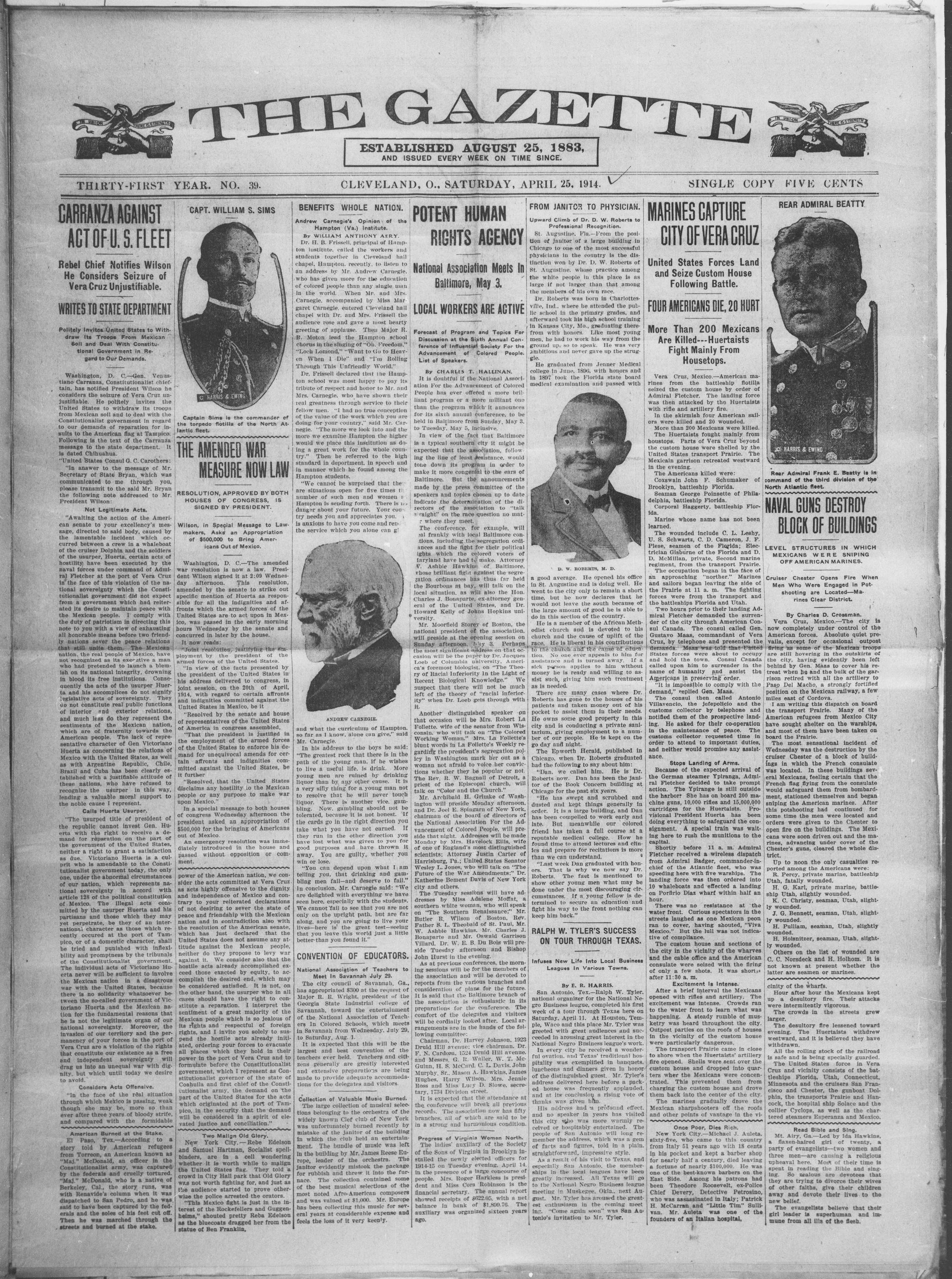
Page text (machine-generated)
THIRTY-FIRST YEAR. NO. 39.
IN ORIGIN
THRONES HEREBY ADORED
CARRANZA AGAINST ACT OF U.S. FLEET
Rebel Chief Notifies Wilson He Considers Seizure of Vera Cruz Unjustifiable.
WRITES TO STATE DEPARTMENT
Politely Invites United States to Withdraw its Troops From Mexican Soll and Deal With Constitutional Government in Regard to Our Demands.
Washington, D. C—Gen. Venustiano Carranza, Constitutionist chieftain, has notified President Wilson he considers the seizure of Vera Cruz unjustifiable. He politely invites the United States to withdraw its troops from Mexican soil and to deal with the Constitutional government in regard to our demands of reparation for insults to the American flag at Tampico. Following is the text of the Carranza message to the state department. It is dated Chihuahua.
"United States Consul G. C. Carothers:
"In answer to the message of Mr.
Secretary of State Bryan, which was
communicated to me through you,
please transmit to the said Mr. Bryan
the following note addressed to Mr.
President Wilson:
Not Legitimate Acts.
Not Legitimate Acts.
"Awaiting the action of the American senate to your excellency's message, directed to said body, caused by the lamentable incident which occurred between a crew in a whaleboat of the cruiser Dolphin and the soldiers of the usurper, Huerta, certain acts of hostility have been executed by the naval forces under command of Admiral Fletcher at the port of Vera Cruz in the face of this violation of the national sovereignty which the Constitutionist government did not expect from a government which had reiterated its desire to maintain peace with the Mexican people. I comply with the duty of patriotism in directing this note to you with a view of exhausting all honorable means before two friendly nations sever the peace relations that still unite them. The Mexican nation, the real people of Mexico, have not recognized as its executive a man who had pretended to launch a blemish on its national integrity, drowning in blood its free institutions. Consequently the acts of the usurper Huerta and his accomplices do not signify legislative acts of sovereignty. They do not constitute real public functions of interior and exterior relations, and much less do they represent the sentiments of the Mexican nation, which are of fraternity towards the American people. The lack of representative character of Gen Victoriano Huerta as concerning the relations of Mexico with the United States, as well with Argentine Republic, Chile, Brazil and Cuba has been clearly established with a justifiable attitude of these nations, who have refused to recognize the usurper in this way, lending a valuable moral support to the noble cause I represent.
"The usurpied title of president of the republic cannot invest Gen. Huerta with the right to receive a demand for reparation on the part of the government of the United States, neither a right to grant a satisfaction as due. Victoriano Huerta is a culprit who is amenable to the Constitutionalist government today, the only one, under the abnormal circumstances of our nation, which represents national sovereignty in accord with article 128 of the constitutional constitution of Mexico. The illegal acts committed by the usurper Huerta and his partisans and those which they may yet perpetrate, be they of an international character as those which recently occurred at the port of Tampico, or of a domestic character, shall be tried and punished with inflexibility and promptness by the tribunals of the Constitutionalist government. The individual acts of Victoriano Huerta never will be sufficient to involve the Mexican nation in a disastrous war with the United States, because there is no solidarity whatsoever between the so-called government of Victoriano Huerta and the Mexican nation for the fundamental reasons that he is not the legitimate organ of our national sovereignty. Moreover, the invasion of our territory and the permanency of your forces in the port of Vera Cruz are a violation of the rights that constitute our existence as a free and independent sovereignty will drag us into an unequal war with dignity, but which until today we desire to avoid.
Consider Acts Offensive.
Consider's Acts Offensive.
"In the face of the real situation through which Mexico is passing, weak though she may be, more so than ever after three years of bloody strife, and compared with the formidable.
American Burned at the Stake.
El Paso, Tex.-According to a story told by American refugees from Torreon, an American known as "Maj. McDonald, an officer in the constitutionalist army, was captured by the federalis and cruelly tortured. "Maj. McDonald, who is a native of Berkeley, Cal., the story runs, was with Renavide's column when it was dispatched to San Pedro, and he was said to have been captured by the federalis and the soles of his feet cut off. Then he was marched through the streets and burned at the stake.
THE GAZETTE
CAPITAL WILLIAM G. SIMS
C HARRIS & EWING
Captain Sims is the commander of the torpedo flotilla of the North Atlantic fleet.
THE AMENDED WAR
MEASURE NOW LAW
RESOLUTION, APPROVED BY BOTH HOUSES OF CONGRESS, IS SIGNED BY PRESIDENT.
Wilson, in Special Message to Law-makers, Asks an Appropriation of $500,000 to Bring Americans Out of Mexico.
Washington, D. C.—The amended war resolution is now a law. President Wilson signed it at 2:09 Wednesday afternoon. This resolution, amended by the senate to strike out specific mention of Huerta as responsible for all the indignities and affronts which the armed forces of the United States are to act upon in Mexico, was passed in the early morning hours Wednesday by the senate and concurred in later by the house.
It now reads:
"Joint resolution, justifying the employment by the president of the armed forces of the United States.
"In view of the facts presented by the president of the United States in his address delivered to congress, in joint session, on the 20th of April, 1914, with regard to certain affronts and indignities committed against the United States in Mexico, be it
"Resolved by the senate and house of representatives of the United States of America in congress assembled.
"That the president is justified in the employment of the armed forces of the United States to enforce his demand for unequivocal amends for certain affronts and indignities committed against the United States, be it further
"Resolved, that the United States disclaims any hostility to the Mexican people or any purpose to make war upon Mexico."
In a special message to both houses of congress Wednesday afternoon the president asked an appropriation of $500,000 for the bringing of Americans out of Mexico.
An emergency resolution was immediately introduced in the house and passed without opposition or comment.
power of the American nation, we consider the acts committed at Vera Cruz as acts highly offensive to the dignity and independence of Mexico and contrary to your reiterated declarations of not desiring to sever the state of peace and friendship with the Mexican nation and in contradiction also with the resolution of the American senate, which has just declared that the United States does not assume any attitude against the Mexican people, neither do they propose to levy war against it. We consider also that the hostile acts already accomplished exceed those exactly by equity, to accomplish the desired end, which may be considered satisfied. It is not, on the other hand, the usurper who in all cases should have the right to constitute a reparation. I interpret the sentiment of a great majority of the Mexican people which is so jealous of its rights and respectful of foreign rights, and I invite you solely to suspend the hostile acts already initiated, ordering your forces to evacuate all places which they hold in their power in the port of Vera Cruz and to formulate before the Constitutionalist government, which I represent as Constitutionalist governor of the state of Conchula and first chief of the Constitutionalist army, the demand on the part of the United States for the acts which originated at the port of Tampico, in the security that the demand will be considered in a spirit of elevated justice and conciliation.
Two Mallan Old Glory
New York City.—Rebe Edelson and Samuel Hariman, Socialist spellbinders, are in a cell wondering whether it is worth while to malign the police, or to encourage the crowd in City Hall park that Old Glory was not worth fighting for, and just as the audience started to prove otherwise the police arrested the orators.
"This Mexico fight is just in the interest of the Rockefellers and Guggenheim," shouted pretty Reba Edelson as the bluecoats dragged her from the statue of Ben Franklin.
ESTABLISHED AUGUST 25, 1883 AND ISSUED EVERY WEEK ON TIME SINCE.
CLEVELAND, O., SATURDAY, APRIL 25, 1914.
BENEFITS WHOLE NATION.
Andrew Carnegie's Opinion of the Hampton (Va.) institute. By WILLIAM ANTHONY AERY. Dr. H. B. Frissell, principal of Hampton institute, called the workers and students together in Cleveland hall chapel, Hampton, recently, to listen to an address by Mr. Andrew Carnegie, who has given more for the education of colored people than any single man in the world. When Mr. and Mrs. Carnegie, accompanied by Miss Margaret Carnegie, entered Cleveland hall chapel with Dr. and Mrs. Frissell the audience rose and gave a most hearty greeting of applause. Then Major R. R. Motton lead the Hampton school chorus in the singing of "Ob. Freedom," "Loch Lomond," "Want to Go to Heaven When I Die" and "I'm Rolling Through This Unfriendly World." Dr. Frissell declared that the Hampton school was most happy to pay its tribute of respect and honor to Mr. and Mrs. Carnegie, who have shown their real greatness through service to their fellow men. "I had no true conception of the value of the work which you are doing for your country," said Mr. Carnegie. "The more we look into and the more we examine Hampton the higher would we place this institution as doing a great work for the whole country." Then he referred to the high standard in deportment, in speech and in manner which he found among the Hampton students.
"We cannot be surprised that there are situations open for five times the number of such men and women at Hampton is sending forth. There is no danger about your future. Your country needs you and appreciates you. It is anxious to have you come and repent the service which you alone can give.
ANDREW CARNEGIE.
and what the curriculum of Hampton, so far as I know, alone can give," said Mr. Carnegie.
In his address to the boys he said: "The greatest rock that there is in the path of the young man. If he wishes to live a useful life, is drink. More young men are ruined by drinking liquor than by any other cause. It is a very silly thing for a young man not to resolve that he will never touch liquor. There is another vice, gambling. Now, gambling should not be tolerated, because it is not honest. If the cards go in the right direction you take what you have not earned. If they run in the other direction you have lost what was given to you for good purposes and have thrown it away. You are guilty, whether you win or lose.
"You can depend upon what I am telling you, that drinking and gambling men fall—and deserve to fail" in conclusion. Car. Marnacle said: "We are delighted with everything we have seen here, especially with the students. We cannot fail to see that you are not only on the upright path, but are far along, and you are going to live your lives—here is the great test—seeing that you leave this world just a little better than you found it."
CONVENTION OF EDUCATORS.
National Association of Teachers to Meet In Savannah July 29.
The city council of Savannah, Ga., has appropriated $300 at the request of Major R. R. Wright, president of the Georgia State Industrial college of Savannah, toward the entertainment of the National Association of Teachers In Colored Schools, which meets in Savannah from Wednesday, July 29, to Saturday, Aug. 1.
It is expected that this will be the largest and best convention of the teachers ever held. Teachers and citizens generally are greatly interested and extensive preparations are being made to provide adequate accommodations for the delegates and visitors.
Collection of Valuable Music Burned.
The large collection of musical selections belonging to the orchestra of the widely known Clof club of New York was unfortunately burned recently by mistake of the janitor of the building in which the club held an entertainment. The bundle of music was left in the building by Mr. James Reese Europe, leader of the orchestra. The janitor evidently mistook the package for rubbish and threw it into the furnace. The collection contained some of the best musical selections of the most noted Afro-American composers and was valued at $1,000. Mr. Europe has been collecting this music for several years at considerable expense and feels the loss of it very keenly.
LOCAL WORKERS ARE ACTIVE
Forecast of Program and Topics For Discussion at the Sixth Annual Conference of Influential Society For the Advancement of Colored People. List of Speakers.
By CHARLES T. HALLINAN.
It is doubtful if the National Association For the Advancement of Colored People has ever offered a more brilliant program or a more militant one than the program which it announces for its sixth annual conference, to be held in Baltimore from Sunday, May 3, to Tuesday, May 5, inclusive.
In view of the fact that Baltimore is a typical southern city it might be expected that the association, following the line of least resistance, would tone down its program in order to make it more congenial to the ears of Baltimore. But the announcements made by the press committee of the speakers and topics chosen up to date indicate the determination of the directors of the association to "talk a 'night' on the race question no matter where they meet.
the conference, for example, will frankly with local Baltimore conti-
nances, including the segregation ordi-
nances and the fight for their political
laws which the colored voters of
Jarvey have had to make. Attorney
V. Ashleigh Hawkins of Baltimore,
these brilliant fight against the seg-
regation ordinances has thus far held
the Bourbons at bay, will talk on the
local situation, as will also the Hon.
Charles J. Bonaparte, ex-attorney
general of the United States, and Dr.
Howard Kelly of Johns Hopkins uni-
versity. Mr. Moorfield Storey of Boston,
the national president of the association,
will preside at the opening session on
Sunday afternoon. May 3. Perhaps
the most significant address on that
occasion will be the paper by Dr. Jacques
Loeb of Columbia university, America's foremost biologist, on "The Theo-
ry of Racial Inferiority in the Light of
Recent Biological Knowledge." We
suspect that there will not be much
left of the theory of "racial inferiority"
when Dr. Loeb gets through with it.
Another distinguished speaker on
that occasion will be Mrs. Robert La-
Follette, wife of the senator from Wis-
consin, who will talk on "The Colored
Working Woman." Mrs. La Follette's
blunt words in La Follette's Weekly
regarding the president's segregation
policy in Washington mark her out as a
woman not afraid to voice her convictions whether they be popular or not. The Rev. R. W. Bagnall of Detroit, a priest of the Episcopal church, will talk on "Color and the Church."
Mr. Archibald H. Grimke of Washington will preside Monday afternoon, and Dr. Joel E. Spingarn of New York, chairman of the board of directors of the National Association For the Advancement of Colored People, will preside that night. Addresses will be made Monday by Mrs. Havelock Ellis, wife of one of England's most distinguished scientists; Attorney Justin Carter of Harrisburg, Pa.; United States Senator Wesley L. Jones, who will talk on "The Future of the War Amendments"; Dr. Katherine Bement Davis of New York city and others.
The Tuesday sessions will have addresses by Miss Adalene Moffat, a southern white woman, who will speak on "The Southern Renaissance"; Mr. Butler R. Wilson of Boston, Rev. Father S. L. Theobald of St. Paul, Mr. W. Ashleie Hawkins, Mr. Charles J. Bonaparte and Mr. Oswald Garrison Villard. Dr. W. E. B. Du Bois will preside Tuesday afternoon and Bishop John Hurst in the evening.
As at previous conferences, the morning sessions will be for the members of the association and will be devoted to reports from the various branches and consideration of plans for the future.
It is said that the Baltimore branch of the association is enthusiastic in its preparations for the conference. The comfort of the delegates and visitors will be cordially looked after. Local arrangements are in the hands of the following committee:
Chairman, Dr. Harvey Johnson, 1923 Druld Hill avenue; vice chairman, Dr. F. N. Cardona, 1524 Druld Hill avenue, and Messrs. G. R. Waller, W. T. McGulhn, H. S. McCard, C. L. Davis, John Murphy, S. Mason A. Hawkins, James Hughes, Harry Wilson, Mrs. Jennie Ross and Miss Lucy D. Slowe, secretary, 1734 Division street.
It is expected that the attendance at the conference will break all previous records. The association now has fifty branches, all of which are said to be in a strong and harmonious condition.
Progress of Virginia Women North.
The ladies' auxiliary of the Society of the Sons of Virginia in Brooklyn installed the newly elected officers for 1914-15 on Tuesday evening. April 14 in presence of a large concourse of people. Mrs. Roger Harkless is president and Miss Cora Robinson is the financial secretary. The annual report showed receipts of $022.05, with a net balance in bank of $1,890.76. The auxiliary was organized sixteen years ago.
Upward Climb of Dr. D. W. Roberts to
Profession. Recognition
Professional Recognition.
St. Augustine, Fla.—From the position of janitor of a large building in Chicago to one of the most successful physicians in the country is the distinction won by Dr. D. W. Roberts of St. Augustine, whose practice among the white people in this place is as large if not larger than that among the members of his own race.
Dr. Roberts was born in Charlottesville, Ind., where he attended the public school in the primary grades, and afterward took his high school training in Kansas City, Mo., graduating there with honors. Like most young men, he had to work his way from the ground up, so to speak. He was very ambitions and never gave up the struggle.
He graduated from Jenner Medical college in June, 1806, with honors and in 1897 took the Florida state board medical examination and passed with
D. W. ROBERTS, M. D.
a good average. He opened his office in St. Augustine and is doing well. He went to the city only to remain a short time, but he now declares that he would not leave the south because of the large amount of good he is able to do in this section of the country.
He is a member of the African Methodist church and is devoted to his church and the cause of uplift of the race. He is liberal in his contributions to the church and the cause of education. No one ever appeals to him for assistance and is turned away. If a sick person applies to him without money he is ready and willing to assist such, giving him such treatment as is needed.
There are many cases where Dr. Roberts has gone to the homes of his patients and taken money out of his pocket to assist them in their needs. He owns some good property in this city and is conducting a private sanitarium, giving employment to a number of our people. He is kept on the go day and night.
The Enworth Herald, published in Chicago, when Dr. Roberts graduated had the following to say about him:
"Dan, we called him. He is Dr. Roberts now. Dan has been the jantor of the Book Concern building at Chicago for the past six years.
"He has swept and scrubbed and dusted and kept things generally in order. It is a large building, and Dan has been compelled to work early and late. But meanwhile our colored friend has taken a full course at a reputable medical college. How he found time to attend lectures and clinics and prepare for recitations is more than we can understand.
"Last week Dan graduated with honors. That is why we now say Dr. Roberts. The fact is mentioned to show other young men what may be done under the most discouraging circumstances. That is why he isurnamed to secure an education and fight his way to the front nothing can keep him back."
RALPH W. TYLER'S SUCCESS ON TOUR THROUGH TEXAS.
Infuses New Life Into Local Business Leagues In Various Towns.
By E. R. HARRI5.
San Antonio, Tex.—Ralph W. Tyler, national organizer for the National Negro Business league, completed his first week of a tour through Texas here on Saturday, April 11. At Houston, Temple, Waco and this place Mr. Tyler was greeted with great audiences and succeeded in arousing great interest in the National Negro Business league's work. In every city he received a wonderful ovation, and Texas' traditional hospitality was exemplified in banquets, luncheons and dinners in honor of the distinguished guest. Mr. Tyler's address delivered here before a packed house was frequently applauded, and at its conclusion a rising vote of thanks was given him.
His address and a profound effect, and no speaker in years has visited this city who was more warmly received or hospitably entertained. The people of San Antonio will long remember the address, which was a gem of facts and figures, told in a plain, straightforward, impressive style.
As a result of his visit to Texas, and especially San Antonio, the membership in the local leagues have been greatly increased. All Texas will go to the National Negro Business league meeting in Muskegon, Okla., next August. Mr. Tyler has aroused the greatest enthusiasm in the coming meet ing. "Come again soon" was San Antonio's invitation to Mr. Tyler.
SINGLE COPY FIVE CENTS
MARINES CAPTURE CITY OF VERA CRUZ
United States Forces Land and Seize Custom House Following Battle.
More Than 200 Mexicans Are Killed---Huertaists Fight Mainly From Housetops.
Vera Cruz, Mexico.—American marines from the battleship flotilla seized the custom house by order of Admiral Fletcher. The landing force was then attacked by the Huertaists with rifle and artillery fire.
In the skirmish four American sailors were killed and 20 wounded.
More than 200 Mexicans were killed. The Huertaists fought mainly from houstops. Parts of Vera Cruz beyond the custom house were shelled by the United States transport Prairie. The Mexican garrison retreated westward in the evening.
The Americans killed were:
Coxswain John F. Schumaker of Brooklyn, battleship Florida.
Seaman George Poinsette of Phila-
delphia, battlefield Florida.
Corporal Haggerty, battleship Florida.
Marine whose name has not been learned.
The wounded include C. L. Leshy, U. S. Schwartz, C. D. Cameron, J. F. Plese, seamen of the Flirqida; Electrician Giburne of the Florida and D. D. McMillan, private. Second marine regiment, from the transport Prairie.
The occupation began in the face of an approaching "norther." Marines and sailors began leaving the side of the Prairie at 11 a.m. The fighting forces were from the transport and the battleships Florida and Utah.
Two hours prior to their landing Admiral Fletcher demanded the surrender of the city through American Consul Canada. The consul called Gen. Gustavo Maas, commandant of Vera Cruz, by telephone and presented the demand. Maas was told that United States forces were about to occupy and hold the town. Consul Canada called upon him to surrender in the name of humanity and assist the Americans in preserving order.
"It is impossible to comply with the demand," replied Gen. Maas.
The consul then called Antonio Villavencio, the fejepolicio and the customs collector by telephone and notified them of the prospective landing. He asked for their co-operation in the maintenance of peace. The customs collector requested time in order to attend to important duties, and neither would promise any assistance.
Stops Landing of Arms.
Because of the expected arrival of the German steamer Ypranga, Admiral Fletcher decided to take prompt action. The Ypranga is still outside the harbor. She has on board 200 machine guns, 10,000 rifles and 15,000,000 cartridges for the Huertaists. Provisional President Huerta has been doing everything to safeguard the consignment. A special train was waiting here to rush the munitions to the capital.
Shortly before 11 a. m. Admiral Fletcher received a wireless dispatch from Admiral Badger, commander-in-chief of the Atlantic fleet, who was speeding here with five warships. The landing force was then ordered into 10 whaleboats and effected a landing on Porfrio Díaz wharf within half an hour.
There was no resistance at the water front. Curious spectators in the streets laughed as one Mexican peon ran to cover, having shouted, "Viva Mexico." But the lull was not indicative of compliance.
The custom house and sections of the city in the vicinity of the wharves and the cable office and the American consulate were seized with the firing of only a few shots. It was short after 11:30 a. m.
Excitement Is Intense.
After a brief interval the Mexicans opened with rifles and artillery. The excitement was intense. Crowds ran to the water front to learn what was happening. A steady rumble of muskety was heard throughout the city. Outpost parties on the roofs of houses in the vicinity of the custom house were particularly dangerous.
The transport Prairie came in close to shore when the Huertaists' artillery fire opened. Shells were sent over the custom house and dropped into quarters where the Mexicans were concentrated. This prevented them from charging the custom house and drove them back into the center of the city.
The marines gradually drove the Mexican sharpshooters off the roofs and other points of vantage in the vi.
Once Poor, Dies Rich.
New York City—Michael J. Aleta, sixty-five, who came to this country from Italy 51 years ago with 18 cents in his pocket and kept a barber shop for nearly half a century, died leaving a fortune of nearly $100,000. He was one of the best-known barbers on the East Side. Among his patrons had been Theodore Roosevelt, ex-Police Chief Devery, Detective Petrosino, who was assassinated in Italy; Patrick H. McCarran and "Little Tim" Sullivan. Mr. Aleta was one of the founders of an Italian hospital,
IN UNION
THERE GESTRONGTH
HARRIS & EWING
Rear Admiral Frank E. Beauty is in command of the third division of the North Atlantic fleet.
NAVAL GUNS DESTROY BLOCK OF BUILDINGS
LEVEL STRUCTURES IN WHICH MEXICANS WERE SNIPING OFF AMERICAN MARINES.
Cruiser Chester Opens Fire When Men Who Were Engaged in Pot-shooting are Located—Marines Clear District.
By Charles D. Crossman.
Vera Cruz, Mexico—The city is now completely under control of the American forces. Absolute quiet pre-visals, except for occasional outpost firing us some of the Mexican troops are still hovering in the outskirts of the city, having evidently been left behind by Gen. Maas to cover his retreat when he and the bulk of the garrison retired with all the artillery to Pago Del Macho, a strongly fortified position on the Mexican railway, a few miles east of Cordova.
I am writing this dispatch on board the transport Prairie. Many of the American refugees from Mexico City have sought shelter on the warships, and most of them have been taken on board the Prairie.
The most sensational incident of Wednesday was the destruction by the cruiser Chester of a block of buildings in which the French consulate was located. In these buildings several Mexicans, feeling certain that the French flag flying from the consulate would safeguard them from bombardment, stationed themselves and began sniping the American marines. After this potshotting had continued for some time the men were located and orders were given to the Chester to open fire on the buildings. The Mexicans were soon driven out and the marines, advancing under cover of the Chester's guns, cleared the whole district.
Up to noon the only casualties reported among the Americans were: R. Percy, private marine, battleship Utah, fatally wounded.
H. G. Karl, private marine, battleship Utah, slightly wounded.
K. C. Christy, seaman, Utah, slightly wounded.
J. G. Bennett, seaman, Utah, slightly wounded.
H. Pulliam, seaman, Utah, slightly wounded.
H. Holsnitzer, seaman, Utah, slightly wounded.
Others on the list of wounded are C. C. Norsdeck and H. Holhom. It is not known at present whether the latter are seamen or marines.
cinity of the wharfs.
Hour after hour the Mexicans kept up a desultory fire. Their attacks were intermittently vigorous.
The crowds in the streets grew larger.
The desultory fire lessened toward evening. The Huertaists withdrew westward, and it is believed they have withdrawn.
All the stocking of the railroad is safe and is being specially guarded.
The United States force in Vera Cruz and vicinity consists of the battleships Florida, Utah, Connecticut, Minnesota and the cruisers San Francisco and Chester, the gunboat Dolphin, the transports Prairie and Hancock, the hospital ship Solace and the collier Cyclops, as well as the chartered steamers Esperanza and Mexico.
Read Bible and Slog
Mt. Airy, Ga.—Lead by Ida Hawkins, a flaxen-haired girl of twenty, a party of evangelists—two women and three men—are causing a religious uphapeal here. Most of their time is spent in reading the Bible and singing. So zealous are devotees that they are trying to divorce their wives of other faiths, give their children away and devote their lives to the new belief.
The evangelists believe that their girl leader is superhuman and immune from all ills of the flesh.
The GAZETTE
PUBLISHED EVERY SATURDAY
One Year.....$1.50.
Six Months.....1.00
Three Months......50
Subscribers are requested to remit by postoffice money order or registered letter
Entered at the postoffice in Cleveland
Ohio, as second-class matter.
Address all communications to
Blackstone Building, Cleveland, O.
Member Ohio Legislature: 1894
to 1896; 1896 to 1898; 1900 to 1902
THE GAZETTE is the oldest, and
has the largest bona fide circulation,
double that of any newspaper in the
interest of Afro-Americans, published
in the state of Ohio, and comparison
with any will immediately establish
its rank as one of the NEWSIEST
AFFAIRS in the country.
10,000,000 Afro-Americans.
160,000 in Ohio.
20,000 in Cleveland.
There is "food for thought" in Mr. George L. Lang's communication published elsewhere in this paper, today, and we urge our readers to give it a careful reading.
Every Afro-American in the state should feel it a DUTY to sign a Senator Joseph Benson Foraker nominating petition. No class of Americans need a representative in the U.S. Senate, half as much as we need him there.
The recent legal effort in Indiana to force Afro-American porters off railroad trails, under that state's "Full-Crew" law, proved a failure, the court holding that the porters were fully qualified, capable, had stood the examination and were performing the duties acceptably. This is almost as encouraging as the North Carolina judge's decision on segregation—that the Raleigh ordinance was unconstitutional.
---
The Gazette is the first paper, daily, weekly or otherwise, in this section of the country, to publish the beautiful Panama-Pacific Exposition illustrations, given last week, and several weeks ago, and should receive credit for the same. We trust our readers appreciate the general news The Gazette gives them also on page 1, and its special features (woman's and sport departments and humorous items) on page 4, each week.
It is encouraging to note how their enough interested our race papers throughout the country are in Senator Foraker's success. They are all pleading with our people in Ohio to do everything in their power to help re-nominate and re-elect the senator to the U. S. Senate. We do not believe there is a member of the race in the state, man, woman or child, who does not feel the same way about it. All of us realize how badly, not only our people, but the entire country needs him there.
Dr. Booker T. Washington's designation of June 7 and 8 as "railroad days," is for our people in the South, and not for those in the North. Some of our northern contemporaries and people do not seem to understand this. We agree with President James B. Dudley, of the A. and M. College, Greensboro, N. C. Letters to Southern railroad officials will avail little or nothing toward securing better accommodations for our traveling public in that section of the country. The letter stagement of the matter was, as a matter of fact, passed years ago. It is now a matter for the courts only and it is a positive waste of time and effort to write any more letters. This our people in Kentucky, have recently made so clear by their successful efforts, thus far, in the higher courts at Hopkinsville, that there ought not to be any question at all, at this time particularly.
THE SOUTH AND THE NEGRO.
Editor Cleveland Daily Press:—
As the Press has well stated segregation of any class of Americans in this country is not only wrong, but positively insulting, degrading and vicious. The section, whether south or north, that inaugurates any such policy certainly does not and cannot base the same upon "humane judgment." No sane intelligent person who knows of the south's disfranchisement of nearly a million Colored voters and nearly half that number of white voters in nine of its states; and knows of its having lynched more than three thousand human beings of color in the last quarter of a century; and knows of its other mob violence, separate railroad and street-car apartments, depot-waiting rooms for Colored people, etc., etc. will ever agree with "A Southernner" that "the south handles its Negro problem based upon humane judgment"; nor will persons agree, as be asks, to "leave the Negro problem to the south." He seems to forget that the persons insulted, mistreated and denied civil rights, etc., are American citizens; indeed nearly all of them are native born.
Another Southerner,
(H. C. S.)
I say that unless our schools utilize
for educational purposes the careers
and personalities of Colored men and
women as well as of white, our children
will be overwhelmed by the
creature of the white man and their
own initiative impaired. *Civilization*
(think God) is neither white nor
black; and our children should be
trained to a knowledge and a due ap-
preparation of all the makers and the custamers of civilization. * * * Our schools must not shut their eyes to the very educational material best fitted to develop in our children race pride, self-confidence, a spirit of brave and noble enunciation—Roscoe Conkling Bruce, assist. supt., Public Schools, Washington, D. C. Prof. Bruce is right. Neither our schools nor our HOMES should fail to do what he suggests. It is even more important, however, here in the north that there be no neglect of this important matter in the home because there are so few separate schools for our children in this section. Of course this latter condition is a very proper one.
SIX MONTHS OF DEMOCRATIC TABLE
The New York Sun, which is an independent paper and has fairly well supported the President, presents a glorious picture of the results of six months' operation of the Democratic tariff. It starts off with declaring that this record is "a spectacle of falling revenues, increased deficits, reduced industrial activity and smaller exportation of manufactures." The Sun proceeds:
"The actual figures for the six months show a fall of more than $25,000,000 in customs receipts when compared with the corresponding period of the preceding year. Not a single month in the entire period shows as large receipts from customs as that of the corresponding month of the previous year. A rich law was in operation, and in but one of the five months for which details of imports are available are the imports of manufacturers' materials as large as in the corresponding month of the previous year.
"The attempt to sharpen the wits of our manufacturers by whetting them against the wits of the rest of the world does not seem to have been a success thus far, as the five months period shows not only a fall in the importation of the materials which they must use, but also a large fall in the exports of their products. Nor do the reports from the sixth month suggest any material improvement in this particular.
"For the five months the imports of raw materials amount to but $253,000,000, against $280,000,000 in the same months of the preceding year, and those of manufactures for further use in manufacturing are but $122,500,000, against $149,500,000 in the preceding year.
"Meantime the export records are equally bad so far as relates to forcing our manufacturers into foreign markets 'in competition with the wits of the world.'
"The official records of the five months ended with February, 1914, shows but $295,500,000 worth of finished manufactures exported, against $315,750,000 exported, in the same months of the preceding year, and of manufactures for further use in manufacturing $149,000,000, against $162,000,000 in the corresponding period last year. In steel and steel manufactures the exports of the five months were only $101,000,000, against $125,000,000 in the same period of last year and in the two months of January and February but $33,000,000, against $49,000,000 in the same months of last year. This shows a reduction of nearly one-third."
CONFIRM JUDGE TERRELL.
Prof. Geo. W. Cook Gives His Rec
sons for Agreeing With Mr. An-
drew F. Hillyer.
Washington, D.C., April 17, 1914.
Editor Gear, Dear Sir: I have
read the letter from Judge Terrell
on Saturday, April 4, with respect to
Judge Terrell. It goes without say-
ing that I as a race man thoroughly
agree with every word that Mr. Hillyer
has spoken. I think the efforts and
the prayers of every Colored man and
woman should be that Judge Terrell
be confirmed. If he is to be defeated
on the ground given by the opponents
to the confirmation, then the e is no
bound for the colored man in this
country to stand on justice and
proper recognition. A political office
is honorable and should be sought by
every class or race of people desig-
PETER H. HARRIS
JUDGE R. H. TERRELL
nated as citizens in any jurisdiction.
Then again, there seems to be no point of attack upon the man's official or private character in this matter, and if the Senate of the United States does not confirm his appointment, then the cold-blooded fact is known that the country has no respect for the Constitution or the Declaration of Independence. I agree with Mr. Hilmer that Judge Terrell must be confirmed. The interests and the continued progress of the race, demand t.
Yours very truly,
Geo. Wm. Cook,
Sac. Howard University.
"NOOMDY," AGAIN.
The following, from the Columbus (O.) independent of April 18, 1914, is self-explanatory:
NOTICE!
Mr. Nahum D. Brescher, who has been connected with the Columbus Independent for some time, is no longer connected with the publication in any way, shape or form. His services have ceased since last Wednesday. Please do not transact any business with him on this paper as it will not be responsible.
FLOYD G. SNELSON.
Editor and Manager.
THE GAZETTE, CLEVELAND, O..
WRITTEN BY "THE OLD RELIA-
BLE" GAZETTE'S CORRE-
SPONBENTS.
THROUGHOUT OHIO
What Our People Are Doing Each Week—Church, Personal, Social, Lodge, Literary and Musical — Marriages, Deaths, Etc.
CADIZ—Rev. G, W. Maxwell, P. E., was here Sunday, and held quarterly meeting services. The B. B.'s were entertained by Rezin Cooper. Rally class, No. 6, presented "Too Many Cousins" to a large and appreciative audience on the 17th at the A. M. E. church. On the 14th, Class No. 1 held a social at the parsonage. Mrs. Laura Olmstead spent Sunday in Steubenville—Mrs. Nancy Williams, Meadowlands, Pa., is visiting her mother, Mrs. Joanna Dulling, Means of Pittsburgh, is the guest of Mrs. Eva Strother—Miss Lafel Foutz, Steubenville, is visiting her sister, Mrs. F. W. Lucas.—Mr. Patrick Smith is able to be about again.
SMITHFIELD.—F. T. Davis of Pittsburgh, visited his wife and son here, Sunday.—Mr. R. Cooper of Cadiz, was in Bradley, last week.—Mr. F. Carter and G. D. Binns were in Steubenville one day last week.—Fred and Samuel D. Binns were in Steubenville, plowed here, returned home, Saturday.—Services were well attended, Sunday, at the A. M. E. church. Rev. J. D. Singleton preached two able sermons, Rev. D. D. Lewis, attended. Also Mr. and Mrs. Frank Smith, who recently moved here from McIntyre.—Mr. D. D. Lewis, Ford and others from McIntyre, were here last week.—Miss Inez Smith visited her parents in McIntyre, Sunday.
LORAIN.—William Walker, who disappeared some weeks ago, was found dead about two miles north of Oberlin, April 6, and, was buried from Park Side chapel, April 8.—Mrs. Eva Thompson is convalescing. She was very ill.—Emmanuel Ward is in St. Joseph's hospital.—George Spencer is getting better.—Deacon Cox of Cory M. E. church, Cleveland, preached for F. W. Orbin, April 5. Mrs. Park Side chapel, April 5. Mrs. Easter in Cleveland.—J. S. Randoph was in Barnesville, last week, on business.—Mr. and Mrs. Lawrence Wren have returned from M. Pt.曼斯, where they spent six weeks of their honeymoon.—Mrs. J. S. Randoph has been very ill, several days.
YOUNGSTOWN —Dr. J. M. Gilmore has returned from Washington, D.C. where he spent the week, attending an A. M. E. Financial Board meeting. He is representative from the Third Episcopal District and chairman of the auditing committee. —Richard Boggess is convalescing. Miss Amanda Marrow of Chicago was called here the house of her sister, Miss Lydia here, convalescing. Miss alliams of Bellaire, visited relatives here, recently—Mrs. Anna Haskins has returned from a visit in Cumberland, Md.—William Carson, age 42, died at the local Transfer Company's barn, recently. Mrs. Emeline Hendrieks died Saturday evening, after an operation. The body was taken to Virginia. —Langston Burton is convalescing. Mrs. Hewlett is allied to Mrs. Hewlett is still awaiting to St. Elizabeth hospital, Monday morning. Tell your friends to read "the old reliable" Gazette, our trust and best race advocate.
SANDUSKY—Churches and Sunday Schools were well attended—The drill at the A. M. E. church, Monday evening, was fine and reflected much credit on Miss Allie Davis.—Mr. Wallace lost his horse.—Master Roy Smith is ill.—Mr. James Jeffery is working with Mr. Oran Shackleford.—Rev. F. R. Davis spent three days with Rev. G. D. Smith. The former is good at cane cane. The Bible is good as any cane and is a good book.—The Autumn Leaf club is arranging a bazaar, May 18-24.—The subject discussed at the Second Baptist Young Men's Lyceum, Friday evening, was "Should the Congress repeal the Panama Canal free tolls' law, for our coast-wise vessels"? Dean Alexander aff., and Herbert Wallace, neg. No decision. The Lyceum is doing a splendid work, bringing out the latent talent of our young folk, particularly students.—Be prepared to take The Gazette as there will be plenty of interest to interest readers, this spring and summer. Then, too, you can hear from many other cities and towns in and out of the state every week.
CORRESPONDENTS, must mail all letters for publication at their main postoffice sufficiently early on Monday (or Sunday) of each week to have them reach The Gazette office on Tuesday morning, and always write also, their names and that of their city or town on the outside of the wrapper about returned copies. Unwanted items cannot be given you. Lists of names, wedding presents, etc., obituary notices, speeches, resolutions, poetry, inquiries for relatives and advertisements of all kinds, including items announcing entertainments to be held in the near future, must be paid for in advance at the rate of ten cents a week. For display advertisements will be sent on application. Send postal note and not stamps during warm weather.
THE BEST EVIDENCE
Though men may knock and men may roast
The narrow skirt that shows a stocking.
From the stocking, they look the
From coast to coast, they look the most
And longest at the one most shock-
ing.
Yea, many men who rail and blow
About that skirt, in secret love it;
Most women know that this is so—
They have the figures, too, to prove
WHERE IS MRS. McKENNEY?.
Mrs. Henrietta Nicholas of 309 West Hume St., Aberdeen, Wash., desires to locate her mother. She writes that the latter is best known by the name of Lydia Willis. When last heard from she was Mrs. Lydia McKenney, and was living either in Cleveland, Dayton or Cincinnati, Ohio. Any person having knowledge of her will greatly oblige Mrs. H. Nicholas by sending it to her immediately.
DOINGS
OF
THE
RACE
A moving picture show and meat
market, operated by Afro-Americans,
are needed in Cleveland on Central
Ave. near E. 21st and E. 30th Sts.
respectively. Splendid field for
persons with money and experience
in the business. This latter is absolutely
necessary. Pass the word along.
Jack Johnson has signed the preliminary documents for naturalization in the Quarter St. Georges, Paris, where he is living. When he returns to Chicago for the retrial of his Mann Act case, he will be a citizen of France. Col. Thes. J. Francis, an Afro-American Texas ranch owner, commands a regiment of 1,000 in Gen. Vilas' army. He was in business at Chihuahua, Mex., for five years before the present "war," or insurrection. Francis used to live in Chicago, and writes that he enlisted last year, has been in 17 battles, was promoted to colonel for heroic services in the seige of Torreson; that there are several hundred Afro-Americans in Villa's city, that the latter is undoubtedly part Negro and is originally from Tennessee.
Madam Marie Selika was a soloist, last evening, in New York city, at the New Star Casino Martin recital. A chorus of the children from our orphanage at Riverdale, N. Y., and our N. Y. Settlement Orchestra, accompanied her. Madam Selika is the greatest soprano solister the race has produced to date. She studied in Berlin and sang in concert, many years
MADAM SELIKA.
ago, in London, England, with Carleton Patti, sister of the great Adelina Patti, and as great a concert solist, at the time, as the latter. Madam Selika is a native of Cincinnati, and lived in Cleveland for a while, years ago. Dr. James B. Dudley, president of the A. and M. college, Greensboro, N.C., takes issue with Dr. Booker T. Washington relative to the treatment of Negroes on Southern railroads, saying, in effect, that sugary talk from railroad managers is not what we want, but real results. In that contention Dr. Dudley is backed up by Colored men of prominence all over the South, who can bear cheerful testimony to the fact that accommodations for people on all railroads in the South are abominable from almost every possible standpoint. Martinsburg (W. Va.) Pioneer Press
Two suits, each asking $15,000 damages against James L. Hitchens, a wealthy storage warehouseman, of Baltimore, Md., were filed in the Court of Common Pleas there, April 11, by Anna B. Clark (white), trained criminals who claims he promised to marry her, etc. She says, she did not know that Mr. Hitchens was an Afro-American when she agreed to marry him.
Police Officer Thos. Lynch (white) of Chicago, was dismissed from the force, last week, for criminally assauling Mrs. Jessie Ferguson, a member of the race, last Christmast night. She will also criminally prosecute him.
Lieut. Frank W. Cheek, formerly of Detroit, and for several years connected with the District building, Washington, D. C., died April 9 after a long illness. He saw service in the Spanish-American war and was in the Philippines. Funeral, April 11, from St. Augustine Catholic church, Washington. Lieut. Cheek was a nephew of Misses Fannie and Ida Henderson and Mr. Powhatan Henderson, of the East End, this city.
CORRESPONDENTS WANTED.
The old reliable Gazette desires an active agent and correspondent in every city and town in Ohio and neighboring states having a number of Afro-American residents. Only a time on Fridays or Saturdays is required.
We are especially desirous of hearing from persons in the following named cities: Zanesville, Newark, Lancaster, Lebanon, Chillicothe, Toledo, Troy, Canton, Springfield, Piqua, Columbus, Cambridge, Steubenville, Bellaire, St. Clairsville, Portsmouth, Washington C. H., Oxford, Sabina, Galway, Dublin, Dublin, Galway, Belawake, Mt. Vernon, East Liverpool, Akron, Dayton, Middletown, Bellefontaine, Lima, O., and other places where we have none.
Write to the editor of The Gazette, Blackstone building, Cleveland, O, and terms will be sent promptly. Our readers will oblige us greatly by sending at once the addresses of persons in the named above, or others, to whom we can write relative to the matter.
The way to get rid of the sparrow is to eat him, observed Deputy Game Warden Louis Kuertz of Hazelton, according to a Cincinnati (O.) dispatch to the Philadelphia Record. He announced that in a few weeks he expects to come to Cincinnati with a large trap, which he will place somewhere and invite all the sparrows in the vicinity to come in.
"Sparrow potpie," says Kuertz, "is a rare dish. I have eaten it myself. It's better than chicken pie. I propose to catch the sparrows and distribute them free to all who wish to eat them. Twenty-four sparrows baked in a pie—sounds like the old rhyme—make pie enough for an average-size family."
If the crusade against the sparrows is successful the fight will be extended to every section of the city and each day's catch of birds will be passed out in the neighborhood to help solve the high cost of living problem, Kuertz says.
SATURDAY, APRIL 25, 1914
Sparrow Pie for Poor.
MINISTERS' ALLIANCE PROTEST!
Denounce the Alleged "Mt. Pleasant Home" As Segregation, As Undemocratic, Un-Christian, An Entering Wedge of Jim-Crowism, As Retrogression and a Wide Step Backward.
Mr. President and Brethren of the Colored Ministers' Alliance:
We, your committee, appointed Jan. 20th, 1914, to investigate the alleged organization of a Home EXCLUSIVELY for COLORED children, beg leave to submit the following report:
1. We find that the Home on E. 126th St. is a private enterprise and has been mainly supported by one Chas. E. Stewart. Relative to the care of the children or condition of the same, we express no opinion, and recommendation since the institution is private, or, at the most, quasi public.
2. We find that a public home for Colored children, exclusively, has been projected, and a tentative organization has been actually formed, with officers elected, a membership fee decided upon, and membership blanks printed.
3. We also find that this proposed institution has the endorsement of Dr. R. H. and Mr. Thayer Eaton of the Cleveland Humane Society, and T. C. Wellsted, assistant secretary of the Cleveland Chamber of Commerce.
We, our committee, do hereby enter our most earnest and vigorous protest against the establishment of such an institution, for the following reasons, to wit:—
1st—There is absolutely no necessary such an institution. The city, the county and the state have made ample and satisfactory provision for all of its dependent children, without regard to race, color, or previous conditions.
2nd—The multiplicity of such institutions simply increases the public burden and must, ultimately, lead to the increase of taxation, now already heavy.
3rd—The initiation of such an institution will inevitably lead to the displeasing undemocratic and unchristian policy of segregation and therefore, become the entering wedge of "jim-crowism," so detestable to all self-respecting Negroes, the world over.
4. Such a step is plainly and unmistakably retrogression, a wide step backward toward slavery and presupposition of the principles fought for, and obtained at the cost of much sacrifice, privation and bloodshed.
5. We are an English speaking people, thoroughly American, loyal to every interest of our government, and firmly believe in that perfectly democratic principle so long enunciated by Dr. Lyman Abadian our own Dr. Waddington Gladen—"The Be therhood of God and the Brotherhood of Man."
The above report was unanimously adopted by the Ministers' Alliance, Tuesday, Jan. 27, 1914.
HOMES FOR BOYS AND GIRLS
As a result of Judge Addams' and Sheriff Smith's urging, the county commissioners are planning a large detention home for boys and girls, the boys' detention home on the west side and the one for the girls on this side of the city, being inadequate to meet the demand. An agreement with the Salvation Army Rescue Home and The House of Good Shepherd, in addition to the detention home at 2393 E. 43d St., are not sufficient to provide places for girls. Pending arrangements for a permanent and large detention home for both boys and girls, Judge Addams has asked the commissioners to rent the premises adoling the present detention home for girls in E. 43d St., and a house on the West Side to supplement the present boys' detention home which occupies the two upper floors of the Detroit-West 29th St., police station. Supplementing the foregoing are, the home for boys at Hudson, and The Cleveland, and the Cleveland resville, under the city department of public welfare, and immediately under the supervision of Miss Vera Schafer, 10214 Hampden Ave., N. E. In the face of the foregoing, will some one find the shadow of a good excuse for the existence of that "jim-crow" M. Pleasant children's home?
OPPOSED TO "JIM-CROW" HOME.
At a recent meeting of the City Federation of Women's clubs, the following resolutions were unanimously held and ordered printed in The Gazette.
We, the City Federation of Women's clubs, do earnestly enter our protest against establishing the "Mt. Pleasant Home for Colored Children," there being no necessity for such a home, since our children are being better cared in local institutions for all. We will fight such an effort and use resistance to wipe out the objectionable "Home" and any other, promoting discrimination and segregation.
We, the women of the Federation, many of us belonging to the Auxiliary to the Juvenile Court and Human society, organized to assist in the work of placing and relieving dependent children, know the abundance of those done by our people, the above named organizations, and therefore, feel that such a step as organizing such a "home" is entirely unnecessary, non-progressive and an insult to our race, and do hereby enter a vigorous protest, placing ourselves squarely on record as opposing such a harmful movement, and as determined to use every influence to wipe it out.
The statement being made, to the effect that the alleged "Children's Home" in M. Pleasant, has been promised in M.1,000 in event of its existing one year, only aggravates the situation and, if true, but shows the satisfaction and satisfaction of included persons in this community to establish and maintain, if possible, this segregation attempt and consequent color-line.
City Federation of Women's Clubs. Mrs. Blanche A. Gilmere, pres.
Simple Law of Gravitation. Under the law of gravitation drops of liquid in falling tend to a spherical form as rain from the clouds, and in the case of shot the molten lead is poured though perforated Colanders at the top of the tower, which assist in giving a spherical shape.
Respectfully submitted.
ELAM A. WHITE,
H. C. BAILEY,
CHAS. BUNDY,
G. V. CLARK,
W. G. WEBSTER
HEATING BAR
THE MAGIC 15 IN LONG
THE MAGIC SHAMPOO DRIER HAIR STRAIGHTENED
MAILED ANY WHERE IN U.S. $100 POSTAGE PAID
Agents Wanted. Write for Literature.
Magic Shampoo Drier Co.
Minneapolis, Minn.
Men Admire
Women
with
Beautiful
Hair!
NELSON'S
HAIR DRESSING
will make you proud of your hair
It is unsurpassed for making harsh, kinky and stubborn hair—soft, glossy and luxurious.
It not only beautifies the hair—but also keeps it in good condition.
Price, 25 and 50 Cents Everywhere
NELSON MFG. CO., RICHMOND, VA.
Order a Case Delivered at Your Home Today The Cleveland & Sandusky Brewing Co. West 785 Central 3933
QUINADE
GROWS HAIR
REMOVES DANDRUFF
SEAD FOR SAMPLE
QUINASOAP
THE IDEAL SHAMPOO SOAP
THOROUGHLY CLEANSSES THE SCALP
QUINACOMB
HAIR STRAIGHTENER
SHAMPOO DRYER
QUINADE 25 + QUINASOAP 30 + QUINASOAP 25
AT ALL DRUGGIES
SEEBY DRUG COMPANY, NEW YORK CITY, N. Y.
LOOK AND LIVE
A. B.
Colds and all Throat and Lung Diseases. Price 50 Cents. DR. NICKENS GREAT ALKALI LINIMENT, cures Headache, Neuralgia, Sore Muscles, Sprains and Swellings of all kinds. Price 50 Cents a Bottle.
Orders by mail given Special and prompt Attention.
Agents Wanted Everywhere. Write for Special Terms. Address
DR. NICKENS MEDICINE CO.
2347 E. 85th St. Cleveland, O.
Taylor's New Shampoo Dryer
and Hair Straightener!
The Best in the World!
This Comb, properly heated, and the use of Lacteole Hair Pomade, will bring the most
crimpy hair straight and silky at every stroke and cause a rapid growth of the hair.
Don't put it off but send $1.00 today and get the Comb by return mail.
PRICE OF 00MB $1.
Large, sharp, strong, durable. Made of
copper and brass assembled together and cast
into one solid piece; highly polished and fully
injected with steel wool. It also goes through
the large wood handle and screws into metal
end of 4 comb to prevent the handle from get-
ting loops or coming off. Remember it's all
in one piece. Nobility to get it of order,
will last a lifetime.
FULL with alcohol and light here
Here is the top
TAYLOR'S SPECIAL ALCOHOL HEATER is the handiest and most convenient method of heating the Comb, and can be closed up so that you can put it in your hand-bag. Price 50c. For best regius use LaCrete Hair Pomade. It not only meets every requirements of the Comb, but can also aid in the growth of hair. Price 25c. SEND FOR MY FREE POMADE! Creating the Largest and Most Complete Line of Hair Goods in this country for colored people, such as Bangs, Wigs, Puffs, Switches, Pompadour, Hair Plain, Combs, Brushes, etc.
Guaranteed to promote the growth of the hair and the functions of the "Sebaceous" glands.
Cures dandruff and prevents the hair from falling out.
Possesses softening and straightening qualities.
Price $.50 per bottle. .....
Mail orders promptly filled.
All charges prepaid. .....
Address, "The East Indian Hair Magic Agency," 2328 Ogden St., Denver, Col.
ATTENTION
PURO HERB
NOW is the best time to start taking PURO HERBS, the great spring tonic, blood purifier and system cleanser.
PURO HERBS consist of the best possible mixture of Nature's health giving Herbs, contains no potash or mercury—it is not a preservative, breaking out—is not a secret compound, as it is composed of such well-known herbs as Burdock, Dandelion, Sarparsilla, Red Clover, Mandrake, Stillinghia, Prickly Ash and other herbs—all the very best approved blood purifiers.
PURO HERBS provide the system of all impurities, restores health and vigor, and drives away that tired, run-down feeling, due to impurities collecting in the system during the winter months.
PURO HERBS are recommended highly for all blood troubles, skin eruptions, diseases arising from impurities in the blood, and from impurities in the fever", and that tired, languid feeling.
USE PURO HERBS and make your own blood purifier and spring tonic at home.
PURO HERBS cost but 35c a box, the contents of which boiled with one quart of water makes one quart of best blood medicine, equal to three ordinary one dollar bottles, and any patient medicine, regardless of price.
PURO HERBS are also supplied in liquid form, for those who do not care to make it solid. PURO HERBS are sold only at
BROWN DRUG CO.
Leading. Cut-Rate Druggists 2742 CENTRAL, cor. 28th St.
For treatment, call on or address:
MISS KATIE B. COLLIER,
4812 Payne Ave.
Coveland, Ohio.
MEN'S HAIR The Morgan Hair Refiner
is a new discovery that positively straightens the hair within fifteen minutes. No grease. No hot irons. Water will not affect it. Absolutely harmless if used according to directions.
Manufactured by
The G. A. Morgan
Hair Refining Co.
5202 Harlem Avenue, Cleveland, Ohio
Theodore B. Green,
ATTORNEY AT LAW.
508.510 Superior Building.
Office, Main 3076.
Residence, Eddy 2086,R.
CLEVELAND, O.
FOR SALE!
small farms. In an aristocratic vicinity. This is a Splendid Opportunity to secure some of the best farms in the state—all within thirty miles of Cleveland. Address, JOSEPH LANE, P. O. Box 63, Wollough, O.
DRY GOODS, LADIES' AND GENTS'
FURNISHINGS
J. LOMSKY
3816 and 3820 Central Ave.
Double Stamps on Tuesdays and
Fridays.
S. E. WOODS
REAL ESTATE
'Phone North 996.
Large First and Second Mortgage
Loans.
Damage Claims Adjusted.
OFFICES: 2828 Central Ave., Cleveland
land, O.
Where to Purchase The Gazette
NOTICE TO SUBSCRIBERS
Subscribers not receiving The us at once. We desire every copy. We advise our patrons to care tisations before making purchases this paper should have the patron that they advertise is assurance of Local reading notices (adver words in a line).
Subscribers not receiving The Gazette regularly should notify us at once. We desire every copy delivered promptly.
We advise our patrons to carefully examine The Gazette's advertisements before making purchases. Business men who advertise in this paper should have the patronage of Afro-Americans. The fact that they advertise is assurance that they want it.
Local reading notices (advertisements) ten cents a line (six words in a line).
Social and Personal
Our
Classified Ad
Department
FOR RENT—Nicely furnished rooms
for rent, 3857 Carnegie Ave.
FOR RENT—Nicely furnished
rooms; 10612 Arthur Ave. Call after
5 p. m.
FOR RENT—Houses and Rooms—
If you have them to rent or if you
want to rent, advertise in The Gazette.
It brings results.
NOTARY PUBLIC—For such services
call at The Gazette office, No. 3
Blackstone building, No. 1424 W.
Third Street, near Superior Ave.
FOR SALE—Houses or lots. If you have either or anything else to sell, or if you wish to purchase, advertise in The Gazette. If anything can bring you results, it can and will.
WANTED—Women for housecleaning washing and ironing by the day, ACME Employment Co., 308 W. Superior Ave., near W. 3rd St.
Cleveland Sixth City
Mrs. George Fields, 9514 Dunlap Ave., is seriously ill.
Mrs. Edwina Seelig of E. 71st St., who has been quite ill, is improving.
Mr. Fred. Wells, who has been at Mt. Clemens, Mich., a month, is improving.
Quick service and the best, is the slogan of the Sanitary barber shop. See advertisement elsewhere in this paper.
Be sure to read Chas. R. Matthews' advertisement, in this paper. There is something in it of special interest to you.
O. V. Hamlin and Leathay A. Owens were married, last week Tuesday evening, at her brother, Wm. Owens' 2261 E. 49th St.
Others came and go, but "the old reliable" "Gazette remains with you. It may save you money to remember this. It has others, many times.
If you owe The Gazette and it does not arrive this week, please remember that we are discontinuing delinquent subscriptions as rapidly as we can get to them.
Charles Ambrose, age 53, died at 2276 E. 43d St. April 20. Funeral services from Wills & Co.'s funeral parlor, April 22. Interment in E. Cleveland cemetery.
Ellsworth Wills, who is a student at Oberlin, brought very excellent reports of his work at school to his mother, whom he visited during the Easter vacation. He is quite popular and on the foot-ball team.
Sunday evening after church, Mrs. Grace Willis Thompson, 9310 Hough Ave., and Mrs. Libbie Williams, 2044 Cornell Rd., were called to the bedside of a sick brother in Chicago.
The Federation of Missionaries societies met at Lane Memorial C. M. E. church, Sunday afternoon, and discussed the topic, "Mothers' Duties To Wear Their Children." President, Mrs. Scott.
Mrs. Sadie E. Bolden of Chicago and her brother, Mr. William Cisco of Detroit, desire to thank, kindly, all who assisted during their father, Mr. John Cisco's illness, and their recent bereavement in his death.
Our advertisers want your trade. Those who do not ask for it in The Gazette certainly care little, if at all, for it. Therefore, we urge our readers and all of our friends to patronize those who ask for your trade in this paper.
Mrs. S. M. Madison, for many years a resident of this city, now located in Jackson, Mich., who arrived in the city recently, will remain until about the middle of June. Mrs. Madison is visiting her daughter, Mrs. Chas. Leatherman of 1220 E. 86th St.
If you owe The Gazette, pay it promptly, please. Do not wait for the collector to call, but send what you owe to the office. It is pleasant and better. Delinquent subscriptions will be discontinued on April 25, (this month). Pay at once, please.
"My wife is now getting along nicely. The baby died at birth. Mr. Cassius Sabb, my wife's father, and my father, Mr. Abe. Stevens, who live
hase The Gazette
*DR. WEAVER'S,
3315 Central Ave.
*A. GORDON,
2928 Central Ave.
*SAM FERTMAN'S,
3608 Central Ave.
*ELMER F. BOYD'S,
2604 Central Ave.
*S. A. LUCAS,
3943 Central Ave.
*NEWS STORE,
2249 E. 105th St.,
cor. Arthur Ave.
UNDAYS.
the Gazette regularly should notify
they delivered promptly.
finitely examine The Gazette's advert-
ress. Business men who advertise in
mage of Afro-Americans. The fact
that they want it.
arrisements) ten cents a line (slx
Personal
here, are home sick," wrote E. C.
Stephens of Des Moines, Iowa, last
week. All are former Clevelanders.
Send or bring locals and all business matters to The Gazette's offices, suite 2, Blackstone Bldg. If you wish to see the editor call there, please. All matters for publication in currents issues of The Gazette, must be in the office by 4 p. m., WEDNESDAY at the latest.
* * *
Last Saturday morning, the Boy Scouts of St. James church "hiked" to the old stone quarry, E. and Fairmont Blvd., "struck camp" and cooked dinner. The boys are our drilling "for Mexico," but are really in training to make race men of them selves.
* * *
The editor of The Gazette acknowledges the receipt of an invitation from the All-Star Whist club of Youngtown, to attend its second annual May party in Excelsior parliars, that city. May 6. Officers of the club: George J. Jefferson, president; W. P. Barton, sec., and T. B. Robinson, treasurer.
Mr. Alfred Henderson and sister, Mrs. Dessie Donglass, of Meadville, Pa. arrived in the city, Saturday. He is at Mr. Wm. Mcintire's, E. 71st St., and she is in St. Lake's hospital for an operation. Mr. Henderson is employed in the Erie Rye. shops at Meadville. He called on The Gazette, Saturday.
Current rumor has it that the Ministers' Alliance and the local branch of the National Association for the Advancement of Colored People are united in falling behind meeting for the purpose of publicly condemning those concerned in the promotion of the "fim-crow" Children's Home movement in Mt. Pleasant.
The delay, in issuing the report of the Choral Study Club's recent benefit concert at Cory M. E. church for Mt. Haven Baptist church, has been delayed by the absence of some in making the return of their sales of tickets. J. W. Wills, manager of the cantata, promises a report for our next issue. A great crowd attended the concert.
About 700 people crowded St. John A. M. E. church, Monday evening, and were highly entertained by the Williams Jubilee Shigers, who were trained at Fisk and Rust universities, Knoxville and Oberlin colleges. The program lasted two hours and many asked for their return. The concert was a rare treat. Mr. Henry Taylor, manager....
The Cleveland Benevolent Association, Mrs. Rosa Brooks, president, gave $50 to charity, last week. Ten dollars went to St. Luke's hospital; $15 to our Old Folks' Home, and $25 to the Associated Volunteers. So the children go on to assist in the care of our dependent and other worthy people.
Mrs. Martha Gregory, age 90, one of our oldest residents, who lived at the Old Folks' Home, died Friday night at the City hospital after a brief illness and was buried Monday from M. Zion Congregational church, of which she had been a member for many years. The pastor officiated and I. W. Wills & Co. were the funeral directors.
Those of our people who claim to have paid "Noondy" Brasher money for subscriptions to an Indianapolis race-paper, should notify the editor of that paper at once, if they are not receiving a copy of it, regularly, each week. "Noondy" is "up against it" in Indianapolis. See "Notice" elsewhere in this paper.
We want all of the readers of The Gazette to visit the store, cor. E. 30th St. and Central Ave., this week, where hundreds of articles that are worth as much as seventy-five cents, will be sold for five and ten cents. We have known the proprietor, personally, for several years. He will employ two of our girls as clerks to start with. So patronize him and lower the high cost of living.—Adv.
Mrs. Katherine T. Bolden, age 79 who died early Monday morning at her daughter Mrs. Mackenzie was buried Wednesday morning from St. Alovysin's Catholic church. Mrs. Bolden came to Cleveland many years ago from Niagara Falls, N. Y. She leaves a son and two daughters, Mr. Louis Bolden of Collinwood, Mrs. Magle Smith of E. 59th St. and, Mrs. Green to mourn her demise.
There will be a meeting of the local branch of the National Association for the Advancement of Colored People at Antioch Baptist church, Sunday, at 3:30 p. m., for the purpose of completing arrangements for the mass meeting to be held, May 17, when an address will be delivered by Oswald Garrison Villard of New York City. Other important matters will be discussed. The public is cordially invited to attend. R. K. Moon, president.
Word reached this city Monday that
THE GAZETTE, CLEVELAND, O..
Howard Chapman, heavyweight pugilist, who formerly was employed as a chauffeur by a local company, had his left arm taken in on a railroad accident in Montana a few days ago. He had been working as a trainman and boxing incidentally at the clubs in Montana. He won half a dozen bouts in the past few months, and was just about to quit railboarding. He was brought to Chapman was a gentlemanly sort of a young man, and had many friends here. He was fairly clever and could hit hard.
The petition for divorce filed by Mrs. Alberta L. Wills against J. Walter Wills was heard by Judge Adams, April 14th. After a thorough examination of the charge of gross neglect of duty contained in the petition, the court refused to grant a divorce to Mrs. Wills. Mr. Wills and his attorney, the Hon. John P. Green, were present a part of the time only, during the hearing. Mr. Wills was not sworn and gave no testimony. He offered, as a final settlement of allmony, to release his interest in all real estate owned by himself and his business), and all his place of business), and all his interest in any real estate owner by her. Her failure to procure a divorce, however, ended the negotiation. Mr. Wills says he will continue to pay alimony to Mrs. Wills for her support as he has, since their separation.—Adv. 21
In This Christian Country—The Case of the Woman Lynched in Okla...
homa — The Government's Duty—Keep Missionaries Here at Home
On March 31st or April 1st, 1914, there were two lynchings in the South, neither of the victims being guilty of criminally assaulting a white woman. Later, they lynched a member of the race at Farmersville because the latter showed light in defending himself when a white farmer sought to kick him. It is a custom in the south for some of the latter to beat and misuse Negroes. If there were not persons who had seen this, the report would have had been lynched because he had criminally assaulted a white woman. The time has come, it seems, that a member of the race does not have to commit so serious a crime in the south, to be burned at the stake. If he calls his own white cousin or brother a liar, he will meet such a fate. On March 31st, a woman of the race was dragged from the jail in her neck, by a one-arm white brute who called himself a man. One block from the jail, the drunken mob threw its rope over a high cable and jerked the little weak woman to death. For what? Because she killed a white man who had lived with her and had misused her. As she was dragged through the streets, in the sight of churches, in the hearing of preachers and Christian families in a Christian city of this Christian country, she was screaming and crying and had misused windows and looked on while the whiskey-soaked mob engaged in America's greatest sport. This government can enforce laws to protect the lower order of animals, the fish in the streams, etc., but they cannot do as much for human beings—Colonel John A. McCoy, the law requires the burning of a man or woman for a crime, let it be enforced by the officials and not by a drunken mob. If the United States has money to pay game wards, etc., to protect the lives of birds, fish, etc., it certainly has the money necessary to enable it to protect the lives of its people regardless of race or color. This country can and ought to stop the violence of Nero did no worse to his people than is being done, these days, to the Afro-American. This country is sending missionaries to Africa to tell the natives of their sins and to try to im
[Picture of a man in a suit with a bow tie and a flower on his lapel].
prove their condition, both mentally and physically, while right here at home in America the same Negro blood is being burned and accused of all sorts of crimes of which more than 90% are innocent. These missionaries should be kept at home and afforded an opportunity to preach to the lynchers and the women-burners. I am affraid if they would do so, they would be put to death. You can not African in a men's attempt to stop wrongs (mentioned in the foregoing) here at home, in America. News from this country is read all over the world. The case of every woman and man who is lynched and burned at the stake, in America, is read of all other countries, and if this country wants the others to continue to have faith in their missionaries' work, it must practice what they preach. Many of the men in the lands so secluded be only places in which to keep Colored women and men for lawless drunken gangs of lynchers and human burners. If the law is not going to protect its prisoners, why not allow them to protect themselves by arming them on the approach of the mob and freeing them, at least temporarily. The jailers as a rule seem glad to give up their keys, apparently not realizing that the lives of their prisoners lynched are charged to them and this government; and the blood of theacher is on the government. And, too some of these people find pleasure in putting their blood into the veins of Negroes and then burning the latter at the stake.
SATURDAY, APRIL 25, 1914.
GEORGE L. LANG.
JOHN BROWN CELEBRATION
An Ode to the Martyr Written By
Member of the Race, "The Ga-
zette's" Lorain Representative,
Port Clinton, O—Monday evening
Prot. Clinton, O—Monday evening
L. Hartzloff of the Athens
University delivered "John Brown"
lecture at the town hall, Put-in-Bay.
The public schools contributed to the
entertainment with songs and verses,
including the old song of the nation's
defenders marching to the tune of the
old man's name, "John Brown." Mr.
Brown at one time was a resident of
Put-in-Bay Island, and great interest
was shown in the event. A large picture
of John Brown, which was presented
to John Brown, Jr., by the late
Jay Cook, and one of John Brown, Jr.,
graced the stage, which was draped in
American flags.
An Ode to John Brown.
You talk of your noble ones,
Of martyrs, and of sages,
Of armies and battle guns,
And the heroes of all ages.
But let me tell you of a hero brave,
Bore the name of Brown,
Wrote died, a nation to save,
The hero of all ages.
For, when our nation was in need
And we with chains bound down,
There arose a friend indeed,
In that noble John Brown.
He with twenty men in all
Went to invade Virginia state,
But his power was too small,
And it led him to a terrible fate.
They, with, wickedness so vast,
Hanged this true and noble one.
But he proved faithful to the last
In the work he had begun.
Let others praise, whoe'r they may,
Some for Washington, and Lincoln
a part,
But I'll praise the one of that day,
And the hero of my heart.
Although they did hang Brown
And oer his body trod,
There was never a nobler one foun
Nor laid beneath the sod.
Alice Zenobia Cassels, Lorain, O.
Experiments recently conducted by two Swiss scientists seem to have solved the mystery that veiled the origin of petroleum, a riddle with which scientists have struggled for many generations. There have been two theories as to the origin of petroleum, one school of investigators believing that it is produced by carbon compounds that exert an igneous action on water, while others held that it proceeds from a distillation of vegetable origin.
The tests made by the Swiss scientists seem to support the second theory. They distilled ordinary coal in vacuum at a very low temperature and obtained a special kind of vacuum tar that contained no phenol or any aromatic hydrocarbides.
When this product was washed with alkali and sulphuric acid it gave a powdery product which when dissolved in water in turn produced semi-aromatic alcohols whose characteristics resembled the Canadian petroleum.
Deteriorate With Age.
It has been noticed for a long time that monkeys become more stupid as they advance in years, but until recently no plausible explanation for this condition was available. Edmond Perrier, a French scholar, says the reason is that the temporal muscles grow upward from birth until adult age and that by compressing the brain they prevent its development. In the same connection a number of experiments have been made showing how the development of the skull or the face is influenced by the compression or removal of certain organs. The teeth of dogs were extracted as soon as the molars appeared through the gums, and it was noticed that little by little the skulls of these dogs grew deformed. By cutting the temporal muscles of dogs or monkeys a compression of the cranium is produced.
Far Outstrips Mother Country.
Canada is nearly thirty times as
large as Great Britain and Ireland, the
total area of the Dominion being only
237,000 square miles- less than the
whole continent of Europe.
HOTEL DALE
This Magnificent Hotel, Located in the Heart of the Meat Beautiful Seashore Resort in the World, is replete with every modern improvement, superlative in construction, appointments, service and refined patronage. Orchestra daily, garage, bath houses, tennis, etc., on premises. Special attention given to ladies and children. Send for booklet.
E. W. DALE, Owner.
The Fifteenth Annual Session of the State Summer School
for Colored
TEACHERS OF BOTH SEXES
at the
Agricultural and Mechanical College
GREENSBORO, N. C.
will begin June 29th, 1914, and continue five weeks.
In addition to the regular work, an attractive lecture course has been arranged, in which will appear some of the most distinguished white and Colored educators in the country. Board and lodging for the entire session $12.00. Tuition 25c per subject unless other arrangements have been made. Limited accommodations. Send $1 and have room reserved in advance. For further information write at once to James B. Dudley, President, or D. J. Jordan, Director, A. & M. College, Greensboro, N. C.
Origin of Petroleum.
E. W. DALE, Owner.
See Our Windows for Opening Bargains
KING OF ALL HAIR TONICS.
Straightens Kinky Curly Hair.
AN HONEST REMEDY
HAS GIVEN SATISFACTION FOR MORE THAN 30 YEARS
Straightens Kinky, Troublesome, Refractory Hair
The Best Remedy for Dandruff, Itch, Tetter and other disagreeable Hair and Scalp Diseases. Causes the Hair to Grow Loose and Straight, making it Soft and Beautiful. Put up in Pretty, Metal Boxes of 25c, 50c, and $1 each. Sent to any address, carriage prepaid, on receipt of price.
OUR GRAND OFFER. Send this advertisement to us with One Dollar, and we will immediately send you 4 Boxes Ozono, 1 Bottle Skin Refiner, 1 Jar Skin Food, 1 Package Anti-Odor—removes all odors arising from the human body—1 Bar of Purity Scalp Soap and a Handsome Aluminum Comb.
3003 CENTRAL AVE.
OZON
Straightens
Kinky
Curly Hair.
AN HONEST
HAS GIVEN SATISFACTION FOR
Straightens Kinky, Trouble
The Best Remedy for Dandruff, Itch,
Scalp Diseases. Causes the Hair to Grow
Beautiful. Put in Pretty, Metal Box
any address, carriage prepaid, on recei-
OUR GRAND OFFER. Send this ad
we will immediately send you 4 Boxes Oz
Food, 1 Package Anti-Odor—removes a
1 Bar of Purity Scalp Soap and a Hand.
Write your name and post-office plain.
BOSTON CITY
WALKER'S
Spring Opening
Latest and Most Up-to-Date
Styles of Millinery!
Hats at Reasonable Prices.
OPEN EVENINGS
3965 CENTRAL AVE.
FREE
FREE
FREE
We are the largest importers and manufacturers of Colored people's hair. We guarantee perfect satisfaction or money refunded. This hair is positively superior to any on the market, and will stand combing and washing the same as your own. We sell hair in hair kits, offered articles and straightening combs at wholesale prices.
Agents wanted.
Send 2 cent stamp for book today
• HUMANIA HAIR CO.
Dept. 17 23 Duane St. New York
NOTICE
White Men Working For The Colored Race
Thousands of dollars and many years of labor have been spent by chemists in preparing complexion creams for preserving and beautifying the skin, but one very important feature has been overlooked by these men in their efforts to produce a cream of general value. Colored people cannot expect best results from a complexion cream prepared especially for white complexions.
CREOLA CREAM is PARTICULARLY made for PARTICULAR Colored Ladies and Gentlemen. It is a harmless skin food made to lighten the complexion and free it from wrinkles, blotches, chaps, sores, and all skin troubles; excellent for burns.
Make your skin light and smooth. No home of Colored people is complete without CREOLA CREAM. Results guaranteed. Order a jar today from The
CREOLA CREAM CO.
Price 50 cents. Send money or der or stamps.
F. H. WEAVER, PHAR. D., Prop.
Cor. Central Ave. and E. 33d St.
Agent for
"HIGH BROWN FACE POWDER."
WE GIVE TRADING STAMPS.
MONEY FOR PAPER
ADS. TELEGRAMS
PRESCRIPTIONS A SPECIALITY.
Open late at Night.
SANITARY
Barber Shop
And
Shining Parlor
The Best Service Only
Sunset Shoe Polish
Mfg. Co.
All Orders By Mail or Other-
wise, Filled Promptly.
2833 Central Ave.,
Cleveland, O.
J. W. WILLS & CO.
The Leading
Funeral Directors
Chapel in Connection. Service First Class.
2529 Central Avenue
North 474 Central 7562-L
Charles R. Mathews
3664 Central Avenue
Fine Line of
Books, Cigars,
Papers, Cigarettes,
Magaz nes, Tobacco,
Candies, Pipes,
Ice Cream, Souvenir
Soda, Post Cards
Canned Goods, Etc., Etc.
LAUNDRY AGENCY
AFRO-AMERICAN CULLINGS
There is certainly one thing which the negro has done since his emancipation gave him the opportunity. He has proved himself a brave, capable soldier. The military history of the nation for the past half century bears abundant witness to the fact.
Gen. Nelson A. Miles, the former chief of the army, gave excellent testimony to this effect in his address at the Lincoln birthday celebration at Quinn chapel, Chicago, when he said: "Even in the Civil war the negro proved that he was brave and worthy to be a free man. When volunteers were called to man vessels which were destined to go down to sure destruction against the Confederate vessel Merrimac, the terror of the seas, an appeal for negro volunteers was made and all who heard the call responded. In the fever camps of the Spanish war, after negro troops had taken and held San Juan hill, a call was made for volunteers to fight fever in the hospitals. An entire regiment responded as one man. The negro is a brave soldier He has the stuff of which good citi zens are made."
That is expert testimony. General Miles is quite right in instancing the willingness of the negro soldiers to serve in fever camps as a great exAMPLE of heroism. It is a better exAMPLE than mere courage in the face of death on the field. The story told by Samuel Lover of the Catholic priest who effectively rebuked the military braggart by telling of having just left a smallpox case, whereupon the military man in horror moved his seat far away from the priest, well illustrates this point.
The negro is brave on the field. His aptitude for nursing the sick is well understood. The records of the graduates of Provident hospital in this city shew that young negro women make excellent nurses.
Alterogether, there is no denying the negro's courage, and, although it takes more than mere courage to make good citizens, the possession of this excellent attribute gives emphasis to the claims which the negro is making good in many ways.—Chicago Inter Ocean.
The form of government in Liberia is modeled after that of the United States, with a president, vice-president, cabinet officers, senate, legislature and judiciary, all of whom are black men, descendants of Afro-Americans or natives, many educated and trained in institutions of learning in Liberia. The present president, Daniel E. Howard, was educated in Liberia and is the son of a former slave from Norfalk, Va. The seat of government is located at Monrovia, a city of 10,000 inhabitants, where there is located, also, the United States legation, consults of France, Germany, England, Spain and Central America. Most of these governments have large commercial interests, which give the city of Monrovia buite a modern form of civilization, notwithstanding the climate is very unhealthy, caused from lack of proper sanitation, hospitals and poor water supply.
The constitution forbids the right of any white man to own real estate or vote in Liberia.
There are no more cheap lands in the West. Land that was sold 13 years ago for $1 an acre is now selling at from $10 to $100 in sections where there are successful irrigation systems.
"Down deep in the heart of the average American there is a sense of fair play, and he is willing to recognize success, whether it is under a white or black skin," Booker T. Washington, president of Tuskegee institute, told a gathering of negroes at Kansas City. The educator spoke at the Second Baptist church to more than a thousand members.
"What we need to do is to advertise our advantages as a race, our ability to overcome difficulties," he said.
"Leave it to others to advertise our shortcomings and our disadvantages.
"It does not pay in business and it will not pay as a race to advertise our troubles and our failures to the world."
Japan has about 125 steam trawlers, and at the present rate of increase the number will reach several hundred in a couple of years. The catches range from five to ten tons each, and the net profit on one ton of fish is $50 to $75.
The average optimist is like a toy balloon. It does not take much of a punch to make him collapse.
The highest point in Nevada is Wheeler peak, which, according to a chart published by the United States geological survey, is 13,058 feet above sea level. The average elevation of the state of Nevada is 5,500 feet. Only four states—Colorado, Utah, Wyoming and New Mexico—are higher.
A bill has been introduced in the legislature of Manitoba to prohibit the employment of white women and girls in any factory or place of business owned or managed by Chinese or Japanese.
It is impossible to buy friendship, but you can rent it while your cash holds out.
More than 120,000,000 board feet of timber was given away by the government last year to settlers and miners living in or near the national forests.
Iowa now has women factory inspectors.
Rubber beels are popular in Switzerland.
Booker Washington talked in New York a few days ago of what the negro has done in the last 50 years in the United States.
"I'm proud of my race," he declared.
"I tell you that the American negro is the only dark-skinned race that ever lived side by side with you white men—and grew."
Because of the negro's tangible as well as spiritual achievements he thinks that some consideration should be shown him.
"You should allow the negro a chance a readjust himself to his changed conditions," said Washington. He has a habit of telling a story to illustrate the point he wishes to make. He told such a story now.
"I called on a friend of mine," said he. "He was a lawyer in Jacksonville. He lived there in a fine new house—I'm afraid to tell you how much money that house cost. He was proud of it and he showed me around. By and by he came to the dining room.
"When I put my foot on this bell, he said, standing by the dining room table, the maid comes to see what I want."
"So he put his foot on the bell and the maid came. Then he put his foot on the bell again and the maid popped in at the door. He motioned her away, but pretty soon he put his foot on the bell again, and the maid came once more.
"What are you doing that for?" I asked him.
"Well, said he, 'it isn't so long since I was a Pullman porter. And I can't get used to seeing people come when I ring for 'em.'"
Washington compared this man with another Pullman porter he once countered. After the man had done his work Washington sat down to talk with him. He found the porter an educated and intelligent man. By and by the porter said:
"Mr. Washington, I have some whiskey in my bag. Let's have a drink."
Washington refused and expressed his surprise that a man of the other's apparent intelligence should drink on duty.
"I wanted to be something once," said the porter. "but I've found out that I can never be anything but just a porter. Why shouldn't I drink? No one cares what a nigger porter does?" It's the first point of view, naturally, that Washington approves.
The new spirit of co-operation is beautifully shown by the list of supporters of the social clinic at Nashville, Tenn. The room for the milk work is furnished by a negro woman of Nashville; milk is supplied by a fund raised by the Nashville Banner, the strongest daily in the city; the library is furnished by Mr. Julius Rosenwald of Chicago, a Jew; the dean of the woman's department is a white graduate of Chicago university; her salary is paid by the Christian Service society of Chicago; the expense of the playground is borne by a negro and so on and on.
With the suddenness of an Arctic spring latent forces push to the light. From the good old days before the war, the young South has inherited the traditional love for the negro, which even in the bitterness engendered by the war, the older South never forgot. And the bitterness is drained away—Boston Transcript.
The roads of the plains of Argentina have deeper dust in summer and deeper mud in winter than those of any other part of the world; consequently the wagons used on them have wheels from six to fifteen feet in diameter.
Sponge waste is used in many German industries, especially for stuffing dolls.
Toronto, Canada, has a housewives' league.
A Hindu child of seven may be a skilled workman.
Alaska was bought from Russia in 1867 for $7,200,000.
There are 56,527,000 cattle on United States farms.
A Washington tree stump makes a stable for two horses.
School teachers in Italy receive less than $600 a year salary.
In the year 1913 Austria produced 515,986,000 gallons of beer.
More than 900 nurses are employed in Moscow hospital, the largest in Europe.
It costs Paris nearly $100,000 a year to care for the trees on its streets and boulevards and in its parks, more than 1,000 new ones being planted annually.
Last year the forest service distributed 116,000 basket willow cuttings —15,000 to forest schools, 20,000 to agricultural experiment stations and 81,000 to individuals.
Occasionally a widow gets more than even with an old bachelor by marrying him.
He who loves his neighbor as himself is never on the devil's calling list.
Another foolish habit is falling in with people who are always falling out.
It is easier to convert a town than to prevent the citizens from becoming devilish again.
BASEBALL
Larry Lajoie says he'll probably quit after 25 years' service—probably.
Ed Konetchy is pleased with his Pittsburgh berth, and says he'll play his best for Manager Clarke.
MANAGER CHARLES DOOIN
SUMMER CO
FOR SMALL
Wise Mother is a
Preparing Dress
Hot Weather
MATERIALS FOR
Little Ones Are Wean
"I feel sure the gonfalon will be floating at Shibe park after the 1914 season is over," says Connie Mack.
Tim Jordan will be kept by the Glants to bat in pinches, although Mike Dooin is under contract for this purpose.
Fred Clarke isn't claiming the bunting for his Pirates. All he has to say is that he has an entirely new team.
Charley Herzog isn't promising Chicago fans any pennant. However, he says he'll work hard to gain a good position.
Miller Huggins declares that he won't run the Cards from the bench until he is through as a player—if he lasts that long.
Brazil is called the land of nuts. Good place for some of the major league managers to take several of their players.
Rollo Zeider says they can all laugh at his nose but he'd like to stake a little bet that half of them could not hit the point of it.
Little Acosta, the Cuban with the Washington Senators, is being used as a pinch hitter by Manager Griffith and is making good.
Mordecal Brown says he expects to pitch 45 games this year. Inasmuch as he is in the Federal league, he ought to get away with it.
Baseball is a popular sport at Princeton university. The Tiger nine showed a net profit of more than $10,500 for the season of 1912-13.
Lefty Leifield, the former Pittsburgh heaver, has turned down an offer from the Federal league and signed with the San Francisco team.
* * * *
In his nine years in the National league, Mike Doolan, the former Philly shotstop, now with the Federals, never had a batting average lighter than .263.
* * * *
Shortstop is the one position Heine Zimmerman has shown a weakness at. The Cub can play at third and second, but is exceptionally weak at short field.
* * * *
Louis Sepulveda, catcher for the San Francisco Seals, could spend his life in case and influence, if he so wished, for his father is a millionaire.
Joe Birmingham says a team is only as strong as its submittes, and inasmuch as the Naps are in need of reserves, the manager has cause to worry.
Heine Zimmerman closely resembles Hans Wagner, avers a critic, the resemblance consisting principally of the fact that Zim possesses two hands and two feet.
Jim Thorpe is referred to by Manager McGraw of the Giants as a new star for the latter outfit. Thorpe did great work while in the Antipodes, says McGraw.
---
Frank Laporte, a veteran of the big leagues, has gone over to the Feds. The infielder and utility man, who is a hard batsman, has signed with the Indianapolis club.
Garlow, a Carlisle graduate, who is said to be Chief Bendar's equal, is being given a tryout by the Red Sox. He has plenty of speed and curves, but lacks experience.
Manager Bill Carrigan says he has a fine system for taking off weight. "Don't eat," says Bill. Show us the athletes who'll stop eating just to take off a few pounds.
Manager Joe Birmingham wants a permanent training camp. Why not train in Cleveland? There is 'Just as much snow and rain there as the team will ever find in the south.
A team of Japanese players living in Seattle is to go to Japan next year. The invaders will remain in Japan about two months and will play a series of games with native teams.
A. G. Mills, once president of the National league, and a leading baseball historian, makes the interesting statement that the original demand for the reserve rule came from the players.
Bill Collins, the Dodger outfielder who has been sent back to Newark by President Ebbets, of the Brooklyn Dodgers, will take the place of Harry Swacha, who has gone over to the Baltimore Federals, at first base.
John Brodie Williams, the Hawaiian right-hander with the Tigers, says the bean ball is of no value to a pitcher. "When you try to hit a batter in the head it shows that he has your goat," says Williams.
Infelder McDonald, who jumped to the Pittsburgh Federsals, had a short but brilliant career in the National league. He was a bitter of the cleanup type while with the Braves, but injuries put him out of the running, and when he recovered he failed to show his former class.
C
Charles F. Dcoin, manager and catcher of the Philadelphia Nationals, was born in Cincinnati, O., June 12, 1880. He broke into baseball as a professional in 1900 with the St. Joseph team of the Western league. At the close of the season he was drafted by the Chicago White Sox, but sent back to the St. Joseph team for the season of 1901. The following season Charley obtained his second trial in fast company, this time with the Philadelphia Nationals. He made good and has been a member of the Phillies ever since. In 1911 he was made manager of the team, the position he occupies at the present time. Besides his ability as a pilot "Red," as he is familiarly known, is one of the best backups in the game. He is a strong pegger to the bases, and although not a heavy hitter, he managed to break into the 300 class in 1911. When the baseball season is over Charley takes to the stage, his singing sketch being considered one of the headliners on the vaudeville circuit.
Bert Noblett, formerly a well known pitcher, now engaged in the sporting goods business in Grand Rapids, has purchased a half interest from Bill Essick in the Grand Rapids Central League club.
Of all the knockers we hand the medal to a Waco paper, which says: "A Johnson, a Waco pitcher, pitched one inning. He gave six bases on balls, hit a man, made two wild pitches and one wild throw. He was wild."
Despite the unfortunate contemptions that concluded the fall series between the Cardinals and the Browns, a spring series will be staged between the two clubs. It is to be under the supervision of the National Commission.
Bill Foxen, old-time major leaguer formerly with the Cubs and Phillies of the N. L. has bobbed into the lime-light and now is saying that he is to jump to the Feds. He is a south paw and was last year in the Southern league with Chattanooga.
SPORTING WORLD
Waiting to see McParland meet Gibbons nowadays has become like crying for the moon.
One example of perpetual motion is George Sutton striving to wrest billard titles from Willie Hoppe.
Is the German government's legalization of race track betting a wise move to encourage immigration?
Buck Crouse is running second to Bat Levinsky. He fought three battles in three days and won 'em all.
Philadelphia and New York are bidding high for the Army-Navy football game. Gee, they want everything to themselves, even the world's series.
Lurie, the French heavyweight boxer, has challenged Bombardier Wells to a 20-round contest, to take place in England or France, for the best purse offered.
An eastern alumnus has presented Princeton with a $200,000 stadium, but the western alumni will continue their annual donation of approximately $800,000 worth of football players this year.
The informal awarding of the Davis cup matches to the West Side Tennis club marks the passing of Newport as the court capital of the country. Australia preferred to play its matches in New York city.
It has been announced that Gould will play a return court tennis match with Covey in England next spring, giving the Briton a chance to show something on his native heath.
Members of the American Olympic committee in New York are framing plans to insure raising $50,000 for the American team in 1916. Approximately $3.28 already has been subscribed
Bob Fitzsimmons says his harder battle was with Jim Jeffries and I easiest with Jeff Thorne.
SUMMER COSTUMES FOR SMALL GIRL
Wise Mother Is Forehanded in Preparing Dresses Before Hot Weather Begins.
Little Ones Are Wearing Many of the Fabrics That Have Won Favor With Their Mothers—Japanese Crepes One of the Most Useful of the Rough Weaves.
THE wise mother starts early in the season to get ready her child's clothes for summer. More dresses are needed during the hot weather at other seasons, and making them in a rush, with heat at hand, is most wearing. The little frocks and a coat described may be worn by the small daughter whether her age be four or ten. The only difference is the amount of material required.
From two and one-half to three yards of thirty-six inch material will make almost any style given for the eight-year-old child. Thus, if a 15-cent chambray is chosen for a morning dress and the trimming is of a contrasting shade, or white pique, of which a half yard will make collar, cuffs, and belt, with an allowance of 15 cents for a pattern and five cents for thread a serviceable frock can be made for 75 cents.
Just a word about materials. Small girls wear many of the fabrics devoted previously to their mothers. For school use come ginghams, plique, various weaves of heavy linens—it pays to get a good linen, as the sleazy ones wrinkle easily—imported Japanese crepe eponge, ratine, and many of the new cotton crepes. Galatea and kindergarten cloth are less worn this season by girls, save for playtime dresses.
These heavy materials are almost always made on straight, plain lines, many of them one-piece frocks with peasant or kilmoon sleeves, though ragland sleeve and long shoulder line is also much used.
For Festive Occasions.
For dressing-up occasions are sheer mulls, batistes (plain or flowers), spriged dimity, handkerchief clien, white or delicate colors, and sheer lawns and khimsooks which are always worn whatever other materials are in vogue. For a bit heavier frocks some mothers like fine voles or the children are even wearing soft finished taffetas in white and pastel shades.
This last material is a decided extravagance, as it will not launder. A lingerie fabric that is too little known is Paris muslin. This is sheer as organdy, which it closely resembles, but it washes admirably.
Remember in children's clothes hard wear must be considered, so avoid linens unless you do not object to constant pressing. The Japanese crepes and other rough weaves that need little if any ironing, are both serviceable and stylish. Be sure to have all these loose-weave cotton goods, linens, and pongees thoroughly shrunken. For the sheerer material many mothers prefer to make them 'up without shrinking, as it destroys some of the crisp, new look of the material. As the dress is probably soiled in one wearing, we should strongly advise shrinking, also setting the color in strong salt-water or sugar of lead.
Long waist shoes are popular, especially for the younger girls. This is achieved sometimes by having a straight one-piece frock loose from the shoulder and held in by various shaped belts; again by cutting the frock in two pieces, a long blouse and a short skirt. Often these skirts are plaited, but more often are scantily gathered or for the older children are gored. For the heavier goods a plaited skirt is better joined to an underwaist by buttons and buttonholes. The blouse is then finished with a belt—in mildy fashion.
Allowance for Growth.
Make allowance for growth by having deep hems to the skirt and cutting the blouse long enough to turn up—if the material is not too heavy. By joining the skirt and waist and setting the belt on top the needed length for the next year can be secured by ripping the two portions of the garment and joining again by sewing the lower edge of the blouse to the upper edge of the belt.
The one-piece dress hung from the shoulder with peasant sleeves is extremely easy to make, even by the novice. Such a model can be developed in a variety of ways, so the one pattern will answer for half a dozen different little school frocks.
When making up the heavy materials, especially those that fray easily, bind the seams with the folded cotton binding that can be bought by the piece or yard, or wide cotton tape can be used. Instead of turning in the hem, which makes for bulk, cover the raw edges with the tape or binding and adjust to the outside either by machine stitching or by hand hemming. Where the child grows rapidly it is wiser to hem by hand and always do it in sheer materials.
For one of the morning frocks choose a simple one-piece pattern with the straight kimono sleeves ending just below the elbow, and the skirt falling from the shoulder in scant straight lines. Open up the middle of
"You say Americans don't cultivate art?"
"That's what I say," said Mr. Growcher. "If anybody went along the street singing he'd get arrested. But you can make any kind of a noise you choose with an puto horn."
Blood-Stained Fuel
The blood reals on the coal are
increasing. Men killed in the mines
at year numbered 2,705, or 425 more
than in 1912—St. Louis Post-Dispatch.
the back and finish with an inch-wide bias strips as one finishes a placket of a skirt. Fasten with bone or crochet buttons. For the latter large button-holes are necessary. In material that ravels these should be bound with linen or cotton binding.
Proper Care of the Seam.
There is but one seam, that under the arm, in the one-piece sleeve. For the sheerer materials make a neat French seam, binding the ratings, eponge, and heavy linen. Have at least a five-inch hem at the bottom of the skirt. This is turned up when the dress has been fitted on the shoulders. Cut the neck in a shallow square front and back and finish with a narrow facing. Hem the bottom of the straight sleeve.
Another dress cut from this pattern may be opened slightly in the left of the middle front from the neck to the hem, the back being cut in a straight piece. Cut the neck in a shallow V in front and straight round in the back. End the sleeves about the elbow, cutting in a bias line an inch and a half higher on the back of the arm than at the crotch of the elbow. Face around the neck and down each side of the front to the bottom of the skirt with an inch and a quarter wide facing. Allow a half inch for seams. Hem the sleeves to the same depth. With these two simple models four varied dresses can be made. One of the square-necked frocks can be developed in butter colored crash or cotton crepe, with trimmings of Chinese blue linen. Cut a shaped band for the
121
Two spring frocks for little girls eight and ten years old. The frock at the left is of linen, with a box-plaited blouse and a yoke of colored embroidery. It can be laced or not on the shoulders. The belt is of the same colored embroidery as the yoke. The frock at the right is also of linen, the peplum bordered both with colored linen and with colored embroidery. The V-Neck is edged with the colored linen and finished with the ends of the same linen.
neck three and a half inches deep in the middle front and back and slashed to form tabs. The middle one is about half the width of the neck-opening and an inch and a quarter deep, then cut out a horizontal line to each side of this center tab, ending slightly beyond the width of the neck-square, where another vertical slash of three-quarters of an inch is made, a horizontal one of an inch, and from there the trimming is sloped over the shoulder to meet similar cuts at the back of the neck.
Banding and Stitching
This banding is cut just the shape of the neck, opening at the top and joined to it by slip stitching, or is basted in a seam with the facing, which is later turned and hemmed down. The bottom is turned up a quarter inch, carefully basted to the frock, and stitched by machine or slip stitched closely. The sleeve is trimmed with similarly squared bands, the shaped piece being an inch wide strip on the inside of the arm, coming on the outside of the sleeve. For the belt cut a straight band three inches wide front and back, save under the arms, where there is a deep squared tab five inches wide and nine or ten inches deep. This peplum shape belt is placed well up under the arms and stitched or tacked in place. Experiment with paper until the right shape is had.
Spring Flowers for Sick Room
The unfortunate person confined indoors by illness will surely appreciate a box of spring flowers. The florists' shops are filled not only with spring flowers of every variety, but cut flowers and ones grown in pots. A box of flowers composed of sweet peas, daffodils, iliacs, violets and tulips would inspire a desire for recovery in the most disheartened individual. Potted plants are also beautiful. The azaleas, hydrangeas and genasetas are handsomer than ever this year and make most appropriate gifts for a sick room, besides other innumerable spring plants and bulbs. The tulips, daffodils and hyacinths when grown a half dozen or more bulbs in pans make beautiful and showy gifts.
Beauty Spots.
Black velvet beauty spots, cut in disks, big and little, in triangles and in various old designs, are sold by the box. The reverse side is covered with a gum-like substance, which fastens the velvet securely to the skin when it is slightly moistened.
Crawford—He says there's nothing in his life now that he can't manage very nicely.
Crabshaw—Naturally. He sold his car when his wife eloped with his chauffeur—Puck.
His Position.
"What position does Jones hold in the matrimonial firm since the baby came?" "I imagine from the hints he drops that he is floorwalker."
ON THE
FUNNY
SIDE
Man Who Had Traveled Extensively and Heard of Many Colors Finds Something New.
Frank P. Morse, who claims he has visited every American town that is big enough to have a theater in it, arrived one afternoon in a well-grown village whose one street had a straggly, dreary, discouraged appearance. He went to get his dinner at the only hotel in the place.
Everything progressed unappetizingly and smoothly until the old woman who waited on the table crept stealthily behind Morse and asked in a languid, lonely voice:
"Will you have black coffee or white coffee."
Morse finched.
"What's that?" he asked.
He had heard of blue pearls, brown roses, green carnations and other violent color schemes, but here was a new one. He was seized by the thirst for discovery.
"White, if you please," he said ur-banely.
The old woman brought it in. White coffee, it developed, was coffee with cream in it.—Popular Magazine.
Why She Believed.
"What sort of a chap is that fellow that has been calling upon you?"
"He's the luckiest fellow in the world."
"How do you know?"
"He told me so."
"And do you believe me, he tells you?"
"I believe that, for he told me it just after I had promised to become his wife."
At Outs
Creditor—I wish to see Mr. Smith.
Servant—He's out.
Creditor—Then I will see Mrs. Smith.
Servant—She's out too, sir.
Creditor—Well, I'll just step in and wait by the fire until one of them returns.
Servant—That's out too, sir.
Creditor—I guess I'm out also.
Short Memory.
Teacher—No, children, remember, a giraffe was formerly called a camelopard because it resembles a camel in shape and is spotted as a leopard.
One of the children (an hour later)—Gee, but I would like to see one of them dromedarytigers teacher told us about.
Office Seeker—Is there anything else in the job you speak of besides the salary?
Political Boss—There's a little work on the side.
Office Seeker—Ah! I knew there was some string to it!—Kansas City Star.
Perfectly Simple.
"I see that now a doctor is advising girls to use an antiseptic wax for their lips just before they are kissed."
"That ought to be easy."
"Yes, just as easy as to take the medicine the doctor directs his patient to take just before she felt a pain."
The Caller—Your daughter plays the piano, doesn't she?
The Host—No, man; that ain't play—it's work
A Better Way
"I just got out of a very unpleasant predicament. Asked a man who a certain homely woman was, and he said it was his wife." "I suppose you promptly made some witty rejoinder." "No: I promptly vamoosed."
"Did you hit this man?" asked the policeman.
"Officer," said the brawny citizen,
"ain't the man standing before you,
alive and in possession of his five senses? If I had hit him do you think that would be possible?"
The White Slave.
Teacher—Sister has just received a sentence of servitude for life.
Old Lady—Why do you say that, young man?
Tommy—Because she showed me ser marriage certificate.