The Gazette
Saturday, November 21, 1914
Cleveland, Ohio
Page text (machine-generated)
THIRTY-SECOND YEAR. NO. 17.
THE UNION
UNION OF AMERICA
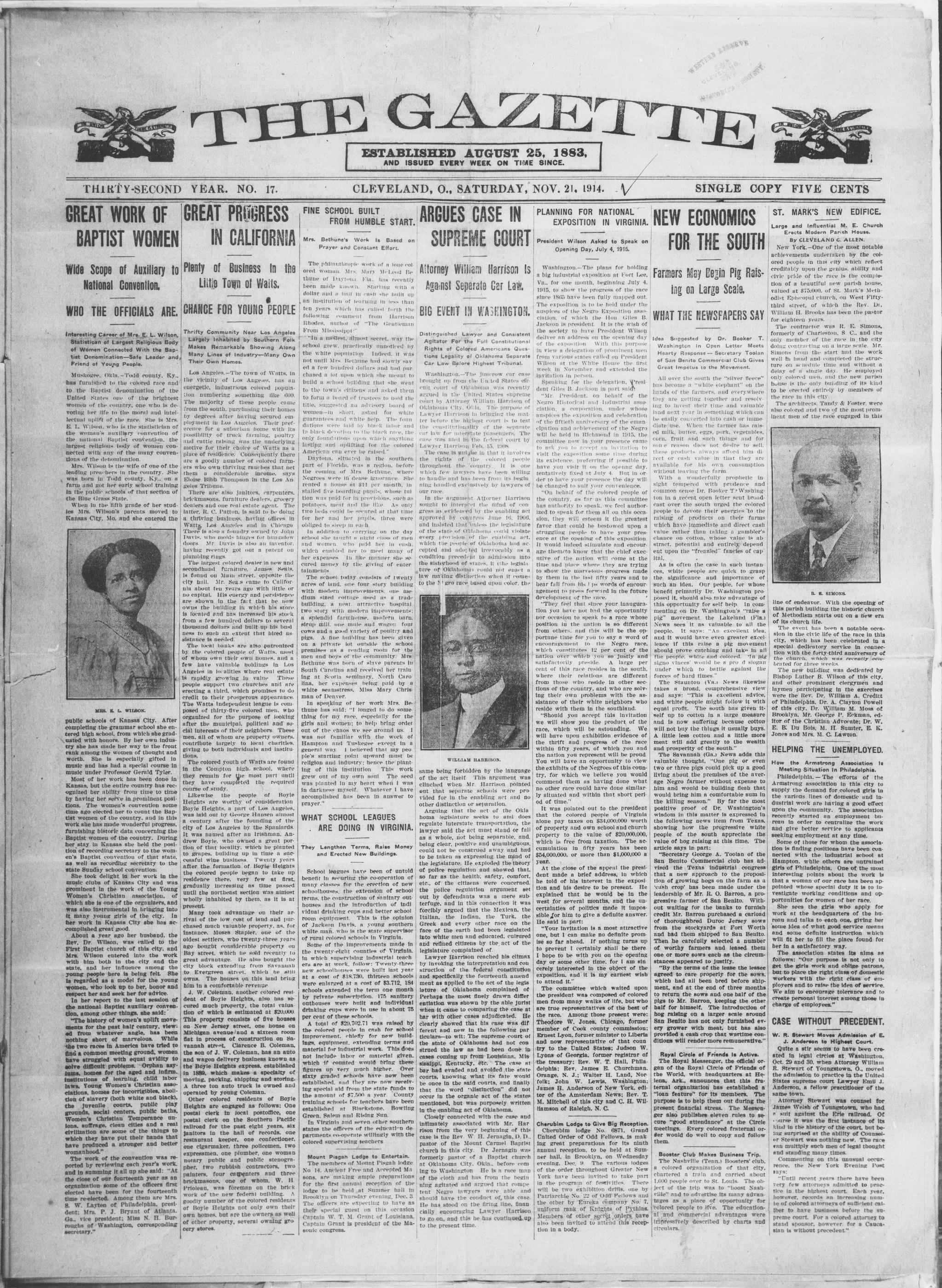
GREAT WORK OF BAPTIST WOMEN
Interesting Career of Mrs. E. L. Wilson, Statistician of Largest Religious Body of Women Connected With the Baptist Denomination—Safe Leader and Friend of Young People.
Muskogee, Okla.—Todd county, Ky., has furnished to the colored race and to the Baptist denomination of the United States one of the brightest women of the country, one who is devoting her life to the moral and intellectual uplift of the race. She is Mrs. E. I. Wilson, who is the statistician of the woman's auxiliary convention of the national Baptist convention, the largest religious body of women connected with any of the many conventions of the denomination.
Mrs. Wilson is the wife of one of the leading preachers in the country. She was born in Todd county, Ky., on a farm and got her early school training in the public schools of that section of the Blue Grass State.
When in the fifth grade of her studies Mrs. Wilson's parents moved to Kansas City, Mo. and she entered the
MES. E. L. WILSON.
public schools of Kansas City. After completing the grammar school she entered high school, from which she graduated with honors. By her own industry she has made her way to the front rank among the women of thought and worth. She is especially gifted in music and has had a special course in music under Professor Gerald Tyler
Most of her work has been done in Kansas, but the entire country has recognized her ability from time to time by having her serve in prominent positions. The women's convention some time ago elected her to count the Baptist women of the country, and in this work she has made wonderful progress, furnishing historic data concerning the Baptist women of the country. During her stay in Kansas she held the position of recording secretary to the women's Baptist convention of that state, as well as recording secretary to the state Sunday school convention.
She took delight in her work in the music clubs of Kansas City and was prominent in the work of the Young Women's Christian association, of which she is one of the organizers, and was also instrumental in bringing into it many young girls of the city. In her work in Kansas City she has accomplished great good.
About a year ago her husband, the Rev. Dr. Wilson, was called to the First Baptist church of this city, and Mrs. Wilson entered into the work with him both in the city and the state, and her influence among the young people here is being felt. She is regarded as a model for the young women, who look up to her, honor and respect her and seek her for advice.
In her report to the last session of the national Baptist auxiliary convention, among other things, she said:
"The history of women's uplift movements for the past half century, viewed from whatever angle, has been nothing short of marvelous. While the two races in America have tried to find a common meeting ground, women have struggled with equal avidity to solve difficult problems. Orphan asylums, homes for the aged and infirm, institutions of learning, child labor laws. Young Women's Christian associations, homes for incorrigible, abolition of slavery (both white and black), the juvenile courts, public play grounds, social centers, public baths, Women's Christian Temperance unions, suffrage, clean cities and a real civilization are some of the things to which they have put their hands that have produced a stronger and better womanhood."
The work of the convention was reported by reviewing each year's work, and in summing it all up she said: "At the close of our fourteenth year as an organization some of the officers first elected have been for the fourteenth time-elected. Among them are Mrs. S. W. Layden of Philadelphia, president; Mrs. P. J. Bryant of Atlanta. Ga. vice president; Miss N. H. Burroughs of Washington, corresponding secretary."
THE GAZETTE
GREAT PROGRESS IN CALIFORNIA
GREAT PROGRESS IN CALIFORNIA
Thrifty Community Near Los Angeles
Largely Inhabited by Southern Folk
Makes Remarkable Showing Along
Many Lines of Industry—Many Own
Their Own Homes.
Los Angeles.—The town of Watts, in the vicinity of Los Angeles, has an energetic, industrious colored population numbering something like 600. The majority of these people came from the south, purchasing their homes by degrees after having secured employment in Los Angeles. Their preference for a suburban home with its possibility of truck farming, poultry and cattle raising was the underlying motive for their choice of Watts as a place of residence. Consequently there are a goodly number of colored farmers who own thriving ranches that net them a considerable income, says Elise Bobb Thompson in the Los Angeles Tribune.
There are also janitors, carpenters, brickmasters, furniture dealers, grocery dealers and one real estate agent. The latter, R. C. Patton, is said to be doing a thriving business, having offices in Watts, Los Angeles and in Chicago There is also a foundation owned by John Davis, who molds hinges for bungalow doors. Mr. Davis is also an inventor, having recently got out a patent on plumbing rings.
The largest colored dealer in new and secondhand furniture, James Seats, is found on Main street, opposite the city hall. Mr. Seats is came to California about ten years ago with little or no capital. His energy and persistence are shown in the fact that he now owns the building in which his store is located and his increased his stock from a few hundred dollars to several thousand dollars and built up his business to such an extent that hired assistance is needed.
The local banks are also patronized by the colored people of Watts, most of whom own their own homes, and a few have valuable holdings in Los Angeles in localities where real estate is rapidly growing in value. These people support two churches and are erecting a third, which promises to do credit to their prosperous appearance. The Watts independent league is composed of thirty-five colored men, who organized for the purpose of looking after the municipal, political and social interests of their neighbors. These men, all of whom are property owners, contribute largely to local charities, giving to both individuals and institutions.
The colored youth of Watts are found in the Compton high school, where they remain for the most part until they have completed the required course of study.
Likewise the people of Boyle Heights are worthy of consideration Boyle Heights, a part of Los Angeles, was laid out by George Hansen almost a century after the founding of the city of Los Angeles by the Spaniards. It was named after an Irishman. Andrew Boyle, who owned a great portion of that locality, which he planted to grapes, building up in time a successful wine business. Twenty years after the formation of Boyle Heights the colored people began to take up residence there, very few at first, gradually increasing as time passed until the northeast section was almost wholly inhabited by them, as it is at present.
Many took advantage on their arrival of the low cost of land and purchased much valuable property, as, for instance, Moses Stapler, one of the oldest settlers, who twenty-three years ago bought considerable property on Bay street, which he sold recently to great advantage. He also bought the city block extending from Savannah to Evergreen street, which he still owns. The houses on this land bring him in a comfortable revenue
J. W. Coleman, another colored resident of Boyle Heights, also has secured much property, the total valuation of which is estimated at $20,000. This property consists of five houses on New Jersey street, one house on Michigan avenue and a sixteen room flat in process of construction on Savannah street. Clarence B. Coleman, the son of J. W. Coleman, has an auto and wagon delivery business known as the Boyle Heights express, established in 1889, which makes a specialty of moving, packing, shipping and storing. A three ton auto truck is owned and operated by young Coleman. Other colored residents of Boyle Heights are engaged as follows: One postal clerk in local postoffice, one postal clerk on the Southern Pacific railroad for the past eight years, six janitors in the hall of records, one restaurant keeper, one confectioner, one cigarmaker, three policemen, two expressmen, one plumber, one woman notary public and public stenographer, two rubbish contractors, two painters, four cargenters and three brickmasons, one of whom, W. H. Prioleau, was foreman on the brick work of the new federal building. A goodly number of the colored residents of Boyle Heights not only own their own homes, but are the owners as well of other property, several owning grocery stores.
ESTABLISHED AUGUST 25, 1883 AND ISSUED EVERY WEEK ON TIME SINCE.
FINE SCHOOL BUILT
FROM HUMBLE START.
Mrs. Bethune's Work Is Based on Prayer and Constant Effort.
"The philanthropic work of a lone colored woman, Mrs. Mary McLeod Bethune of Daytona, Fla., has recently been made known. Starting with a dollar and a unit in cash she built up an institution of learning in less than ten years which has called forth the following comment from Harrison Rhodes, author of "The Gentleman From Mississippi."
"In a modest, almost secret, way the school grew, practically unnoticed by the white population. Indeed, it was not until Mrs. Bethune had slowly purchased a few hundred dollars and had purchased a lot upon which she meant to build a school building that she went to the town's citizens and asked them to form a board of trustees to hold the title, suggested an advisory board of women in short, asked for white guarantees and white help. The foundations were laid by black labor and to black devotion to the black race, the only foundations upon which anything lasting and uplifting for the colored American can ever be raised."
Daytona, situated in the southern part of Florida, was a region, before the coming of Mrs Bethune, where Negroes were in dense ignorance. She rented a house at $11 per month, in stalled five boarding pupils, whose tuition was paid for in provisions, such as potatoes, meat and the like. As only two beds could be secured at that time for her and her pupils, three were obliged to sleep in each.
In addition to carrying on the day school she taught a night class of men and women, who paid her in cash, which enabled her to meet many of her expenses. In like manner she secured money by the giving of entertainments.
The school today consists of twenty acres of land, one four story building with modern improvements, one medium sized cottage used as a trade-building, a neat, attractive hospital, two story with modern improvements: a splendid farmhouse, modern barn, strup mill, one mule and wagon, four cows and a good variety of poultry and pigs. A fine building has been given on a private lot outside the school premises as a reading room for the men and boys of the community. Mrs Bethune was born of slave parents in South Carolina and received her training at Scotia seminary, North Carolina, her expenses being paid by a white seamstress, Miss Mary Christman of Denver.
In speaking of her work Mrs. Beuthne has said: "I longed to do something for my race, especially for the girls and women; to help bring order out of the chaos we see around us. I was not familiar with the work of Hampton and Tuskegee except in a general way. I believed that my people's starting point upward must be religion and industry; hence the planting of this institution. This work grew out of my own soul. The seed was planted in my heart when I was in darkness myself. Whatever I have accomplished has been in answer to prayer."
WHAT SCHOOL LEAGUES
. ARE DOING IN VIRGINIA
They Lengthen Terms, Raise Money and Erected New Buildings.
School leagues have been of untold benefit in securing the co-operation of many classes for the erection of new schoolhouses, the extension of school terms, the construction of sanitary outhouses and the introduction of individual drinking cups and better school room equipment. This is the opinion of Jackson Davis, a young southern white man, who is the state supervisor of rural colored schools in Virginia.
Some of the improvements made in the twenty-eight counties of Virginia, in which supervising industrial teachers are at work, follow: Twenty-three new schoolhouses were built last year at a cost of $18,730, thirteen schools were enlarged at a cost of $3,712, 184 schools extended the term one month by private subscription, 175 sanitary outhouses were built and individual drinking cups were in use in about 75 per cent of these schools.
A total of $29,702.71 was raised by the colored people in cash for school improvement, chiefly for new buildings, equipment, extending terms and material for industrial work. This does not include labor or material given, which if counted would bring these figures up very much higher. Over sixty graded schools have now been established, and they are now receiving special aid from the state funds to the amount of $7,500 a year. County training schools for teachers have been established at Blackstone, Bowling Green, Salem and Rising Sun.
In Virginia and seven other southern states the officers of the education departments co-operate willingly with the colored supervising teachers
Mount Pisgah Lodge to Entertain.
The members of Mount Pisgah lodge No 14. Ancient Free and Accepted Masons, are making ample preparations for the first annual reception of the lodge to be held at Summer hall in Brooklyn on Thursday evening, Dec. 3.
The officers are expecting to have as their special guest on this occasion Captain W. T. M. Grant of Louisiana, Captain Grant is president of the Masonic congress.
ARGUES CASE IN SUPREME COURT
ARGUES CASE IN SUPREME COURT
Attorney William Harrison Is Against Separate Car Law.
Distinguished Lawyer and Consistent Agitator For the Full Constitutional Rights of Colored Americans Questions Legality of Oklahoma Separate Car Law Before Highest Tribunal.
Washington.—The juncrow car case brought up from the United States efficient court of Oklahoma was recently argued in the United States supreme court by Attorney William Harrison of Oklahoma City, Ola. The purpose of Lawyer Harrison in bringing the matter before the highest court is to test the constitutionality of the separate car law for interstate passengers. The case was used in the federal court by Lawyer Harrison Feb. 15, 1908. The case is unpleasant in that it involves the rights of the colored people throughout the country. It is one which few lawyers have been willing to handle and has been from its beginning handled exclusively by lawyers of our race.
In the argument Attorney Harrison sought to interpret the mind of congress as evidenced by the enabling act approved by congress June 16, 1906, and insisted that unless the legislature of the state of Oklahoma could violate every provision of the enabling act, which the people of Oklahoma had accepted and adopted irreovocably as a condition precedent to admission into the sisterhood of states, it (the legislature of Oklahoma) could not enact a law making distinction when it comes to the Nro race based upon color, the
WILLIAM HARRISON.
same being forbidden by the language of the act itself. This argument was clinched when Mr. Harrison pointed out that separate schools were provided for in the enabling act and no other distinction or separation.
Arguing that the act of the Oklahoma legislature seeks to and does regulate interstate transportation, the lawyer said the act must stand or fail as a whole, not being separable, and, being clear, positive and unambiguous, could not be construed away and had to be taken as expressing the mind of the legislature. He exploded the theory of police regulation and showed that, so far as the health, safety, comfort, etc. of the citizens were concerned, the police regulation argument set out by defendants was a mere subterfuge, and in this connection it was forcibly argued that the Mexican, the Italian, the Indian, the Turk, the Greek and every other race on the face of the earth had been legislated into white men and educated, cultured and refined citizens by the act of the legislature complained of.
Lawyer Harrison reached his climax by invoking the interpretation and construction of the federal constitution and specifically the fourteenth amendment as applied to the act of the legislature of Oklahoma complained of Perhaps the most finely drawn differentiation was shown by the able jurist when it came to comparing the case at bar with other cases adjudicated. He clearly showed that his case was different and new in the following particular—to wit: The supreme court of the state of Oklahoma had not construed the law as had been done in cases coming up from Louisiana, Mississippi, Kentucky, etc. The case at bar had evaded and avoided the state courts, knowing what its fate would be once in the said courts, and finally that the word "distinction" did not occur in the organic act of the states mentioned, but was purposely written in the enabling act of Oklahoma.
Closely connected with the case and intimately associated with Mr. Harrison from the very beginning of this case is the Rev. W. H. Jernagin, D.D., pastor of the Mount Carmel Baptist church in this city. Dr Jernagin was formerly a pastor of a Baptist church at Oklahoma City, Okla., before coming to Washington. He is a race man of the cloth and has from the beginning agitated and argued that competent Negro lawyers were able and should have the conduct of this case. He has stood on the firing line, financially encouraging Lawyer Harrison to go on, and this he has continued up to the present time.
PLANNING FOR NATIONAL EXPOSITION IN VIRGINIA
President Wilson Asked to Speak or Open Day, July 4, 1915.
Washington—The plans for holding a big industrial exposition at Fort Lee, Va., for one month, beginning July 4, 1915, to show the progress of the race since 1853 have been fully mapped out. The exposition is to be held under the auspices of the Negro Exposition association, of which the Hon Giles B. Jackson is president. It is the wish of the society to have President Wilson deliver an address on the opening day of the exposition. With this purpose in view a delegation of prominent men from various states called on President Wilson at the White House the first week in November and extended the invitation in person. Speaking for the delegation, President Giles B. Jackson in part said:
"Mr. President, on behalf of the Negro Historical and Industrial association, a corporation, under whose auspices the exposition and celebration of the fifthth anniversary of the emancipation and achievement of the Negro will be held in Richmond in 1915, the committee now in your presence came to ask you to accept an invitation to visit the exposition some time during its existence, preferring if possible to have you visit it on the opening day, tentatively set at July 4. But in order to have your presence the day will be changed to suit your convenience.
"On behalf of the colored people of the country, as far as this committee has authority to speak, we feel authorized to speak for them all on this occasion, they will esteem it the greatest favor that could be bestowed upon a struggling people to have your presence at the opening of this exposition. It would indeed stimulate and encourage them/to know that the chief executive of the nation will come at the time and place where they are trying to show the marvelous progress made by them in the last fifty years and to bear fall from his lips of encouragement to press forward in the future development of the race.
"They feel that since your inauguration you have not had the opportunity nor occasion to speak to a race whose position in the nation is so different from others, and this will be the opportune time for you to say a word of encouragement to the Negro race which constitutes 12 per cent of the nation over which you so justify and satisfactorily preside. A large per cent of this race resides in the south, where their relations are different from those who reside in other sections of the country, and who are solving their own problems with the assistance of their white neighbors who reside with them in the southland.
"Should you accept this invitation we will show you the product of the race, which will be astounding. We will have upon exhibition evidence of the thrift and progress of the race within fifty years, of which you and the nation you represent will be proud. You will have an opportunity to view the exhibits of the Negroes of this country, for which we believe you would commend them as having done what no other race could have done similarly situated and within that short period of time."
It was pointed out to the president that the colored people of Virginia alone pay taxes on $34,000,000 worth of property and own school and church property to the value of $20,000,000, which is free from taxation. The accumulation in fifty years has been $54,000,000, or more than $1,000,000 a year.
At the close of the appeal the president made a brief address, in which he told of his interest in the exposition and his desire to be present. He explained that he would be in the west for several months, and the uncertainties of politics made it impossible for him to give a definite answer. He said in part:
"Your invitation is a most attractive one, but I can make no definite promise so far ahead. If nothing turns up to prevent I certainly shall be there. I hope to be with you on the opening day or some other time, for I am sincerely interested in the object of the exposition, and it is my earnest wish to attend it."
The committee which waited upon the president was composed of colored men from many walks of life, but who are true representatives of the best of the race. Among those present were Theodore W. Jones, Chicago, former member of Cook county commission; Ernest Lyon, former minister to Liberia and now representative of that country to the United States; Judson W. Lyons of Georgia, former registrar of the treasury; Rev. W. T. Hall, Philadelphia; Rev. James E. Churchman, Orange, N. J.; Walter H. Land, Norfolk; John W. Lewis, Washington; James H. Anderson of New York, editor of the Amsterdam news; Rev. T. M. Mitchell of this city and C. H. Williamson of Raleigh, N.C.
Charubim Lodge to Give Big Reception.
Charubim lodge No. 0871, Grand United Order of Odd Fellows, is making great preparations for its ninth annual reception, to be held at Summer hall, in Brooklyn, on Wednesday evening, Dec. 9. The various lodges of the order throughout Greater New York have been invited to take part in the program of festivities. There will be two exhibition drills, one by Patriarchie No. 22 of Odd Fellows and the other by Eureka Company No. 7, uniform tank of Knights of Pythias. Members of other secret orders have also been invited to attend this reception in a body.
SINGLE COPY FIVE CENTS
WHAT THE NEWSFAPERS SAY
Idea Suggested by Dr. Booker T. Washington In Open Letter Meets Hearty Response — Secretary Toolan of San Benito Commercial Club Gives Great Impetus to the Movement.
All over the south the "silver fleece" has become a "white elephant" on the hands of the farmers, and everywhere they are getting together and resolving to invest their time and valuable land next year in something which can be easily converted into cash or immediate/use. When the farmer has raised milk, butter, eggs, pork, vegetables, corn, fruit and such things and for some reason does not desire to sell, these products always afford him direct or cash value in that they are available for his own consumption without leaving the farm.
With a wonderfully prophetic insight tempered with prudence and common sense Dr. Booker T*Washington in a recent open letter sent broadcast over the south urged the colored people to devote their energies to the raising of products on their farms which have immediate and direct cash value rather than taking a gambler's chance on cotton, whose value is abstract, potential and entirely depend ent upon the "frenzled" facies of capital.
As is often the case in such instances, white people are quick to grasp the significance and importance of such an idea. Our people, for whose benefit primarily Dr. Washington proposed it, should also take advantage of this opportunity for self help. In commenting on Dr. Washington's "raise a pig" movement the Lakeland (Fl.) News sees it as valuable to all the people. It says: "An excellent idea, and it would have even greater excellence if this raise a pig movement should prove catching and in all the people, white and colored. "In pig sign vines" would be a pro d siglan under which to battle against the forces of hard times."
The Staunton (Va.) News likewise takes a broad, comprehensive view and says: "This is excellent advice, and white people might follow it with equal profit. The south has given itself up to cotton in a large measure and is now suffering because cotton will not buy the things it usually buys. A little less cotton and a little more meat will add greatly to the wealth and prosperity of the south."
The Savannah (Ga.) News adds this valuable thought, "One pig or even two or three pigs could pick up a good living about the premises of the average Negro farmer without expense to him and would be building flesh that would bring him a comfortable sum in the killing season." By far the most positive proof of Dr. Washington's wisdom in this matter is expressed in the following news item from Texas, showing how the progressive white people of the south appreciate the value of hog raising at this time. The article says in part:
"Secretary George A. Toolan of the San Benito Commercial club has advised the Texas industrial congress that a new approach to the proposition of growing hogs on the farm as a cush crop' has been made under the leadership of Mr. R. O. Barron, a progressive farmer of San Benito. Without waiting for the banks to furnish credit Mr. Barron purchased a carload of thoroughbred Duroc Jersey sows from the stockyards at Fort Worth and had them shipped to San Benito. Then he carefully selected a number of worthy farmers and leased them one or more sows each as the circumstances appeared to justify.
"By the terms of the lease the lessee agrees to care properly for the sows, which had all been bred before shipment, and at the end of three months to return the sows and one half of the pigs to Mr. Barron, keeping the other half for himself. The introduction of hog raising on a larger scale around San Benito has not only furnished every grower with meat, but has also provided a cash crop that wartime conditions will render more remunerative."
Royal Circle of Friends Is Active. The Royal Messenger, the official organ of the Royal Circle of Friends of the World, with headquarters at Helena, Ark., announces that this fraternal organization has established a "loan feature" for its members. The purpose is to help them out during the present financial stress. The Messenger also publishes eleven rules to secure "good attendance" at the Circle meetings. Every colored fraternal order would do well to copy and follow them.
Booster Club Makes Business Trip. The Nashville (Tenn.) Boosters' club, a colored organization of that city, chartered a train and carried about 1,000 people over to St. Louis. The object of the trip was to "boost Nashville" and to advertise its many advantages as a place of opportunity for colored people to live. The educational and commercial advantages were impressively described by charts and stenums.
THE WILLOW
BROOKLYN
BROOKLYN
ST. MARK'S NEW EDIFICE.
Large and Influential M. E. Church
Erects Modern Parish House.
By CLEVELAND G. ALLEN.
New York.—One of the most notable
achievements undertaken by the colored people in this city which reflect
creditably upon the genius, ability and civile pride of the race is the completion
of a beautiful new parish house,
valued at $75,000, of St. Mark's Methodist Episcopal church, on West Fifty-third street, of which the Rev. Dr. William H. Brooks has been the pastor for eighteen years.
The contractor was R. E. Simons,
formerly of Charleston, S. C., and the only member of the race in the city doing contracting on a large scale. Mr. Brooks started the work well in mind and completed the structure on schedule time and without a delay of a single day. He employed only colored men, and the new parish house is the only building of its kind to be erected entirely of its kind to the race in this city.
The architects, Tandy & Foster, were also colored and two of the most prominent men of the race engaged in this
R. E. SIMONS.
line of endeavor. With the opening of this parish building the historic church of Methodism starts out on a new era of its church life.
The event has been a notable occasion in the civic life of the race in this city, which has been celebrated in a special dedicatory service in connection with the forty-third anniversary of the church, which was recently celebrated for three weeks.
The new building was dedicated by Bishop Luther B. Wilson of this city, and other prominent clergymen and laymen participating in the exercises were the Rev. Dr. William A. Creditt of Philadelphia. Dr. A. Clayton Powell of this city, Dr. William M. Moss of Brooklyn, Mr. George P. Eckman, editor of the Christian Advocate; Dr. W. E. B. Du Bois, M. H. Sumter, E. K. Jones and M. M. C Lawton.
HELPING THE UNEMPLOYED.
How the Armstrong Association Is Meeting Situation In Philadelphia
Philadelphia. — The efforts of the Armstrong association in this city to supply the demand for colored girls in the various lines of domestic and industrial work are having a good effect upon the community. The association recently started employment bureau in order to centralize the work and give better service to applicants seeking employment at any time.
Some of those for whom the association is finding positions have been connected with the industrial school at Hampton, while others are untrained girls of Philadelphia. One of the most interesting points about the work is that a woman of our race has been appointed whose special duty it is to investigate working conditions and opportunities for women of her race.
She sees the girls who apply for work at the headquarters of the bureau and talks to each one, giving her some idea of what good service means and some definite instruction which will fit her to fill the place found for her in a satisfactory way.
The association states its aims as follows: "Our purpose is not only to get the girls work and oblige patrons, but to place the right class of domestic workers with the right class of employers and to raise the idea of service. We aim to encourage tolerance and to create personal interest among those in charge of employees."
CASE WITHOUT PRECEDENT.
W. R. Stewart Moves Admission of E. J. Anderson to Highest Court.
Quite a stir seems to have been created in legal circles at Washington, Oct. 20 and 30, when Attorney William R. Stewart of Youngstown, O., moved the admission to practice in the United States supreme court Lawyer Emil J. Anderson, a fellow practitioner of the same town.
Attorney Stewart was counsel for James Welsh of Youngstown, who had a suit against the Erie railroad. Of course it was the first instance of its kind in the history of the court, but being surprised at the ability of Counsel Stewart was nothing new. The race can multiply such men of legal thought and standing many times.
Commenting on this unusual occurrence, the New York Evening Post says:
"Until recent years there have been very few attorneys admitted to practice in the highest court. Each year, however, records an increasing number of colored attorneys of sufficient caliber to have business before the supreme court. For a colored attorney to stand sponsor, however, for a Caucasian is without precedent."
One Year.....$1.50.
Six Months.....1.00
Three Months......50
Subscribers are requested to remit by postoffice money order or registered letter
Entered at the postoffice In Cleveland
Ohio, as second-class matter.
Address all communications to
THE GAZETTE,
Blackstone Building, Cleveland, O.
Member Ohio Legislature: 1894
to 1896; 1896 to 1898; 1900 to 1902
THE GAZETTE is the oldest, and has the largest bona fide circulation double that of any newspaper in the interest of Afro-Americans, published in the state of Ohio, and comparison with any will immediately establish its rank as one of the NEWSIEST AND BEST in the country.
SATURDAY, NOVEMBER 21, 1914.
We trust that Governor-elect Willis, now that the election has passed, will not forget the part the faithful Afro-American Republicans of the state played in the great effort that returned Ohio to the Republican fold. They are entitled to representation in his official family over and above mere petty clerkships and messengerships, and we feel sure our former colleague in the Ohio Assembly is big and broad enough, mentally, to give it without the usual urging.
Last week, The Gazette published a letter from Philadelphia which chronicled the fact that a woman of the race, educated, cultured and good, but clearly of, at least, temporarily unsound mind, had killed herself" for love of her white husband." This week, our Toledo letter, tells how an Ohio woman of color is alleged to have "filled her her white husband full of lead," killing him, of course. We are not informed as to her education, culture and morals, but there seems to be no question as to her sanity. Nor do we think there can be. She didn't kill herself.
Governor New, mentioned in our Asheville, N. C., letter, elsewhere in this paper, today, got wealth, educated his sons and daughters, had an excellent reputation, and, as Dr. Washington said recently, "went forward and made progress," &c. &c. In spite of this, he "is on the defensive side of life"; has failed utterly "to overcome evil with good," and to "make those, who have treated him unjustly, blush with shame," and "admire the rapid strides with which he was going forward." "Twas ever thus, and always will be. Governor New and all the rest of us will "overcome" such injustice and regain rights as well as retain those we still have, by fighting in the courts for them and coattending for them "to the last ditch" outside of the courts. How silly it is, to advise otherwise, is made clear by the Governor New case.
Dr. Wm. A. Sinclair of Philadelphia, author of "The Aftermath of Slavery," a member of the faculty of Howard University, Washington, D. C., and one of our aggressive and fearless leaders, who was prevented from joining the delegation which visited the President, last week Thursday, to protest against the Southern democratic segregation in several governmental departments at Washington, sent him the following telegram, on the 11th: "I respectfully submit that such segregation violates the spirit and letter of the Constitution of the United States, forces hardships and degradations on Colored employees, undermines civilization, is subversive of American institutions, contravenes every principle of righteousness and justice and is a shameful reproach to our Christian religion. Segregation represents not the ideals of freedom but the ideals of slavery. We pray that you as the Christian president of this free and Christian nation will use your great powers, which are more than amply sufficient, to remove this foul blot from our civilization."
The Cleveland Gazette need not waste time making faces at us because we have backed it up against a stone wall, in its sweeping arrangement of us because of our defense of Dr. Washington's position on disfranchisement and segregation. Wild statements prove nothing, and a great reputation cannot be blasted by falsehoods as long as the facts are forthcoming with which to confront them.—Washington (D. C.) Sun.
But the facts have NOT come forth as yet. Better trot them "forth," if you can, Editor Timothy Thomas Fortune. Dr. Booker T. Washington failed, and signally too, to do so in his letter to Editor C. Elias Winston of St. Louis, Mo., (intended for the race press only), and we know you, confere, would have done so long ago for him, if you could. The Gazette has "backed up" and proved its "wild statements" with proof in the shape of Dr. Washington's own admissions in his "confession" letter to Editor Winston. We are not more concerned as to Dr. Washington's "great reputation" than he is now or was when in New York City, several years ago. As to the Gazette's "making faces" and being "backed up against a stone wall," in this discussion of Dr. Washington's indirect endorsement of segregation in his latest Muskogee, Okla., speech—we had forgotten the Sun's "defense" which was really none at all, as it stated at the time—it is simply one of our confere's little jokes in a very weak effort to "dodge the issue." Defending Booker T. Washington certainly must be a mighty uncomfortable job, these days.
WILSON VS. TROTTER
President Wilson is a southerner by birth and long years' residence. His cabinet and the Congress and the U.S. Supreme Court are dominated by the sentiment and beliefs of the South. That section of this country is unalterably opposed to the EQUALITY of the races. That President Wilson subscribes to this can now be no question because he refuses to regard the segregation in several governmental departments at Washington as discrimination, and said so to that Afro-American delegation, I week Thursday. More than this, he endorses the "separate as the fingers of the hand" nonesense handed to the people of this country by Dr. Booker T. Washington, years ago, in his speech at Atlanta, Ga. This also, he made clear in his talk to the delegation. It was not what Trotter said to him, that angered him, half as much as the question of equality entered into the situation. The treatment accorded the delegation, which was kept waiting, many days, if not weeks, for an audience, and the "patronizing" way the President approached the important matter that had brought the delegation before him, were enough to start the blood flowing too freely in any Afro-American filled with plenty of good, red, manly blood. And yet, both Trotter and the President said things that should not have been said, the President first giving the provocation. This latter, clearly the result of his natural opposition to all that savors of the equality of the two races. Trotter should have been more mindful of the fact that he was not in Washington representing himself but the interests of millions of our people which he could not promote by angering the President even though the provocation to do so was very great. Until there are further developments at Washington it will be impossible to tell whether he has harmed or helped us, as a result of his righteous resentment of untruthful and almost insulting, patronizing statements made to the delegation by President Wilson.
ANGERS THE PRESIDENT
THE NATIONAL INDEPENDENT LEAGUE'S DELEGATION, HEADED BY EDITOR WM. M. TROTTER.
Wilson Could Find a Few.
After leaving the president's private office, Trotter, Maurice V. Spencer and others of the delegation declared their talk had been "thoroughly disappointing." They declared they would hold a mass meeting in Washington, Sunday, to discuss the question of whether the president said in his address, to the President that the committee did not come "as wards looking for charity, but as full-fledged American citizens, vouchsafed equality of citizenship by the federal constitution." It was then that the President told the delegation to vote on the temper and to that he would not discuss the matter further with him.
The New York World in its editorial of Friday, Nov. 13, discussing this matter says: "The President thinks that this is not a political question, but he is wrong. Anything that is unjust discriminating and un-American in Government is certain to be a political question. Servants of the President are servants of the United States government, regardless of race or color." Other great dallies of the North are also condemning the President for his attitude.
THE GAZETTE, CLEVELAND, O., SATURDAY, NOVEMBER 21, 1914
WRITTEN BY "THE OLD RELIABLE" GAZETTE'S CORRESPONDENTS.
THROUGHOUT OHIO
What Our People Are Doing Each Week—Church, Personal, Social, Lodge, Literary and Musical — Marriages, Deaths, Etc.
SANDUSKY—Mr. and Mrs. Nelson Bolling are living at 606 Hays Ave. He is one of the best blacksmiths in the city.—Rev G. D. Smith is on the "grunting" list.—Miss J. R. Davis royally entertained 151 persons in honor of Miss Elnette Farlice of Cincinnati. Three umbrellas were taken from the porch while the guests were having a good time.—Miss Watkins who rooms in Center St., was taken home very ill. Sunday. She is improving.—The Baptist Iyceum was well at attendance. J. R. Davis Charles and Maud Alexander were the speakers. S. M. Scott, Mr. Mott and others participated in the program.
MANSFIELD—David H. Dummore died last Thursday. Rev Charles W. Ford and Mr. C. Davis conducted the funeral services which were largely attended. He was an old and highly respected resident.—Mrs. Fisher's home has been reeroofed.—Mr. and Mrs. Love of Chicago Junction may locate here.—Mrs. C. W. Ford assists Mrs. A. Spencer with the S. S. primary class, and Mrs. Emma Dummore is teacher of the bible class.—Mr. Anson Thompson is employed by Mr. Hughes.—Mr. J. Spencer is employed by the University of Chicago.—Miss Lillian Been sang beautifully, "Abide With Me," and Miss Daisy Barker played the piano accompaniment, at the funeral.—Mrs. Marie Wilson of Xenia, attended her brother's funeral. Also Mrs. Rose Wythe of Chicago, and Mrs. Barker.—Miss Retta E. Ford formerly of McIntyre, joined church here Sunday.—Master Homer Ford is also here.—Thanksgiving will be observed at the church and a program rendered.—The following, from out of the city, attended Mr. D. Dummore's funeral. Mrs. Howard Tate, Mr. Van Johnson, Mr. Hezekiah Tate, Mr. Artist Stowell of Mr. Vernon; Mr. and Mrs. Henry Davis, Marie Flamie, Mamie and Mr. Romella Davis and Mrs. Rose Whiting, of Cleveland; Mr. Haze Davis of Pittsburgh, and Mrs. Edna Davis of Franklin, Pa.
OBERLIN—Mrs. James. Young is quite ill.—Mr. "Tommy" Williams has been ill in bed this week.—Mrs. Laura Godette underwent an operation this week.—Mrs. Alice Shaw will hold a mock session of the Lexington conference, at Rust M. E. church, Nov. 27.—Mrs. Henderson of Meadville, Pa., will attend a grandmother, Mrs. Marth, Copes, and was entertained, Friday evening, at Mrs. Lawson's.—H. C. Tuck has returned from a visit in Pg. N. Y., and Mass. The Aid Society was royally entertained by Mrs. J. W. Lewis.—Miss Annie Hill and Mr. Willie Bins were married in Norwalk, and are living with her mother.—Miss Franklin Robinson will entertain at luncheon this week, Mrs. H. T. Evans, Mrs. J. W. Lewis, and Mrs. Woods is in the Elyria hospital. She is able to get about.—Dennis Dyer has a new auto.—A beautiful piano was donated the Mutual Improvement society for their rooms, by the Oberlin Conservatory.—Interest in the annual foot-ball game between the students and town-boys is "being fanned to a bloody fever." A student, was the guest of a motoring party, to Elyria, consisting of Mrs. Clark and Mrs. Taylor of Greenville, Pa. Miss Jones of Columbus, and chauffeur. A delightful trip was had.
LEBANON—Rev D. C. Ross, pastor of Zion Baptist church, was assisted Sunday, by the Revs. Johnson of Dayton and Samuels of Middletown.—Meedames Steele, Bridges and Hattie Glenn visited in Middletown, Sunday.—Mrs. Henry Chase will locate in Cincinnati, soon.—Mr. Samuel Tibbals will visit in Middletown.—Miss Georgiana Singleton will un dergo an operation, soon.—Mrs. George Warmack and baby, of Dayton, visited Mrs. Mills and sister, Miss Georgia Murphy, a few days.—James H. Thomas shopping in Dayton, last week.
WILMINGTON.—A number motored to Sabina, Sunday afternoon, to attend Mrs. Wault Smith's funeral.—The A.M. E. church was dedicated, Sunday. Judge Levi Mills and Rev. Brandt of the First Baptist church (white) in charge. The collection for the day was $5.—Mr. Manroe Wallace of Clintown, New York, to attend Sunday.—Mr. and Mrs. Harris (Becky Bass) of Xenia, were guests of Mrs. John Lewis.—Mrs. Lorenz Name returned Thursday from Col.—Mrs. Joseph Nance-Gibbons who attended the funeral of her aunt, Mrs. Lydia Ross, returned, last Saturday.—Mr. Cliffon Lindsev has returned from Wilberforce University.—Mr. George Moore is very ill.—Mr. Roy Edwards was in town.—Mr. John Goldin.—Mrs. Jones of Col., visited relatives here. The Woman's praying association will hold a meeting at Mrs. Helen Holmes, Thursday, from 4 to 5 p. m. She received a telegram, last week, announcing her sister's death.
YOUNGSTOWN —Dr. and Mrs. Wm P. Burton, the latter former Miss Addie Stewart, married bn the 4th, at her mother, Mrs. Mary E. Stewart's residence here, have returned from their honeymoon trip through the East and will be "at home" after Dec. 1 at 533 Burge St, this city, "Miss Addie", as she was familiarly called, is a native of this city, has a large circle of friends and acquaintances throughout northern and west-central Illinois and is. All wish the "newlyweds" long life, health and much happiness as well as prosperity—Harry Ervin and Mrs. Perkins are ill—Chas. A. Jackson is convalescent—Mrs. Mille Robinson is still ill—Mrs. Wallace Ormes of Chicago, is Mrs. Chas. Lincoln's guest. Star Whist club dance, Dec. 28. Mrs. Ella Simpson of Ravenna, is visiting her sons—Mrs. Hattie Harper who attended her mother, Mrs. Mary Mason's funeral in Toledo, has returned—Mr. and Mrs. Raymond Frisby are relicosing over the arrival of a boy-baby, Mrs. Ella Simpson of Toledo, club, Monday evening. The newly installed pipe-organ of the Third Church will be dedicated, the $24th. C. Co. Ever Ready clubs concert, under the direction of its president, Harry Ervin, was one of the best and
most successful of the season.—Mrs. Sandy Duff is convalescing.—St. Augustine's Y. P. guild will give an entertainment, Monday evening.—As next Thursday is Thanksgiving, a holiday the local respondent must have before Monday. Govern yourself accordingly if you have any news for him.
CORRESPONDENTS must mail all letters for publication at their main postoffice sufficiently early on Monday (or Sunday) of each week to have them reach The Gazette office on Tuesday morning, and always write also, their names and that of their city or town on the outside of the letter. If the letter is less than this latter is done, proper credit cannot be given you. Lists of names, wedding presents, etc., obituary notices, speeches, resolutions, poetry, inquiries for relatives and advertisements of all kinds, including items announcing entertainments to be held in the near future, must be paid for by the post office. On the line, six words to a line. Our rates for display advertisements will be sent on application. Send postal note and not stamps during warm weather.
NOTICE TO CORRESPONDENTS
Next Thursday is Thanksgiving, a
holiday. If you want your news in
the paper, next week, it will be neces
sary for you to mail it at your Post
office, AND NOT IN A LETTER-BOX
before 6 p. m., on MONDAY. Do not
forget this.
DOINGS
OF
THE
RACE
Andrew Carnegie has given a pipe-organ to our Baptist church at Bradford, Pa.
James Coleman of Akron, O., aged 109 years, died recently in the county hospital, after an illness of two days.
The New York Medical Journal recently awarded the first prize, $25 in gold, to Dr. Slyburn C. Downing, a young graduate of Howard Medical School, in a contest for the best essay on "The Treatment of Alcoholic Cirrhosis of the Liver."
In Washington, Ark., a company of our men, some months ago, secured a franchise from the city council for a light and traction company and are operating first class Electric Light houses, have built four and a half miles of interurban trolley road which, when completed, will run from Washington to Columbus, a distance of ten miles. They will have entire control of the freight, express, mail and passenger traffic.
In November, 1893, Cuyahoga (Cleveland) county, elected two Afro-American members of the Ohio Legislature—the editor of The Gazette, Hon. Harry C. Smith, and the Hon. W. H. Clifford—Ex.
Our new Louisville, Ky., Pythian building, which is being erected at a cost of $120,000, will be the most commodious of its kind in the country. Cornerstone laying, Thanksgiving day. Mrs. Mattie Wilkes and Miss Ollie Browne, who have been on the stage in Russia for the last five years, returned, a few days ago.
The press agency at Tuskegee Institute is sending out the information that Sarah Rector, the richest Colored girl in the world, is at that school. This is good news, for it takes her for awhile, at least, from her white guardian—Louisville (Ky.) News.
Paul Quinn College, Waco, Tex., an A.M. E school, has wiped out its $10,000 mortgage debt.
John Woodson is Brooklyn, N. Y.'s only Afro-American fireman in that city.
A contribution of $12,500 has been made by a St. Louis, Mo., gentleman who refuses to make public his name, and who is seeking assistance for our people at Atlanta, Ga., the land for which the Lutheran (German) church purchased. Dr. J. E. Spingarn of N. Y. City, is soon to make another tour of the country, in the interest of the race. He is a passionate and best white friends we have.
A thrilling story of a recent wild night charge by Turcos, France's African soldiers, is told by French officers. The fearless Africans captured Ramskappelle at the point of the bayonet in one of the most dramatic encounters of the war. So great was the bravery that King Albert commander of the Belgian army, went in person to Furnes, near Dunkirk northern France, to congratulate them. Dr. George Burnham Foster of the University of Chicago, who advocated the intermarriage of the white and black races, at a meeting of the N. A. A. C. P., at Orchestra Hall, Chicago. Feb. 14, 1913, reiterated his statement with emphasis, and at length, Sunday March 1, 1913, in Methodist Episcopal church, (white). Chicago The audience was entirely of that race.
County Clerk Larkworthy of St. Joseph, Mich. assists a great deal of authority when he refused a marriage license to Edward Hayes, (white) because he wished to marry Blanche Schoemaker, a young lady of color. Hayes secured a writ of mandamus ordering the clerk to issue the license. The clerk took the position that there was no provision in the law upholding such a marriage, but Judge Bridgeman assured him there was no provision in the law upholding the clerk. The Charlotte (N. C.) Observer, speaking editorially a few years ago of the lawless element of the South as "The Curse" of that section, mentioned an instance of a crippled Negro, lame in one foot, and having the use of but one hand who, in defense of his home, killed one of a couple of white brute attempting to force an entrance for the purpose of ravishing his daughter. Although at the trial of this Colored man the surviving intruder confessed his role in the Colored defender of his tle and praised him for his valor, the injury convicted and the judge sentenced him to life imprisonment.
The great cause of the failure of most Colored men is the erroneous idea that the beginning of a business career marks the end of the period of work—that is of manual labor. With the limited resources of the Negro enterprise this impression is the surest guarantee on earth that failure is only a matter of
If you knew
Nelson's Hair Dressing as we do
you would never use anything
else on your hair.
We want you to know it—
know it personally by actual use,
don't take our word for it, or any-
one else,—test it yourself.
You can do this,
send us your name and address
and we will send you,
Free of cost,
a sample box of Nelson's Hair
Dressing, also a sample of Nel-
son's Scalp and Hair Cleaner and
a sample cake of Nelson's Skin
and Complexion Soap.
Test them
in your own home, if they are
not what we claim, you are not
out anything.
We have confidence
in them and are ready and anx-
ious to prove every claim we
make.
Write to day,
enclosing two cent stamp to pay
postage on samples.
NELSON MANUFACTURING CO.,
Richmond, Virginia
NELSON'S
HAIR DRESSING
25¢
50¢
Has no superior as
a hair beautifier.
Thousands of men and
women have improved the
appearance of their hair by
using NELSON'S HAIR
DRESSING.
For those who know—it
is a toilet necessity.
Why not try it yourself?
Ask your druggist. If he
cannot supply you, send us
his name and address and we
will send you a free sample.
NELSON MFG. CO.
RICHMOND, VA.
The Answer
Is:—
NELSON'S
HAIR DRESSING
25¢
50¢
a short time. As a people we have got to the "big beginning idea" out of our heads if we would attain the largest measure of lasting success.—Petersburg (Va.) Colored Virginian. The governmental departments at Washington, D. C., are in great need of male stenographers. Our young students must make the will service examinations for these positions, at once. Pass the word along, brethren of the race press. In a contest conducted by the Washington (D. C.) Post and open to all persons under seventeen, prizes were offered for the best essay and drawing on "Animal Pets." The first prize was won by Miss May Miller, fifteen-year-old daughter of Prof. Kelly Miller of Howard University, that city. The prize is worth double the price of The Gazette. Think awhile, and see if we are not right in this, too.
The home of our ancestors is "The Land of Ham." In those days our forbears were wealthy in learning and enterprise. Africa was originally settled by the descendants of Ham, excepting his son Canaan. Ham, himself emigrated to Egypt, and Egypt, and Ham, himself emigrated to the land of Ham." There he attained eminence, Cush, the oldest, and undoubtedly the most distinguished of all the sons of Ham, appears to have been the great progenitor of the Negro race. His name also is associated with great distinction in Asia. Nimrod, his son, became the first of Kings and reared on the mighty city of Babylon and founded Nineveh. Mizraim was the father of the Egyptians. Wherever, in our version of it, we may name Egypt, the ancient Itmizraim got his education in the land of Ham, among the black people—Baltimore (Md.) Ledger.
The accumulation of wealth will not bring these priceless essentials which we must have if we would be a people. These requisites wealth cannot buy. That man of the race who is constantly shouting to the Negro to contend earnestly and ceaselessly for his civil, social, and political rights, is the one in Alabama who is urging the Negro to buy property to the disparagement of these more essential requirements...Ex.
It is a pity indeed that the actions of the committee from the National Independent Equal Rights League was such as to cause a rebuke from the president of the United States, even though that president be Woodrow Wilson. The incident is regrettable for the committee, but do us no possible good, and the enemies of the race will make the most of it. Mr. Wilson is the president of the United States, and as such is entitled to all the consideration due his high office. Perhaps there has never been a president in the White House from whom the Negro has received such a set back as from President Wilson. Profuse in his promises to prominent Negroes from all over the country, and to all the people who promise and then to turn his back upon them as he has done, is enough to stir the manhood of the race. While it is possible that Mr. Wilson deserved all that might have been said to him by Mr. Trotter, it was neither the time nor place. Mr. Wilson has proved himself to be a traitor, to be a receiver of goods under false pretenses, but the White House was not without trouble, and therefore, that the lesson has not been entirely lost on either Mr. Wilson, the committee, or the country—Baltimore (Md.) Afro-American-Ledger.
Hon. Harry C. Smith, editor of The Cleveland Gazette, will doubtless take much satisfaction out of the results of the recent election, his prophecies relative thereto be verified with almost precise accuracy—Martinsburg (W. Va.) Pioneer Press.
No race or people in the history of civilization ever endured a leadership of more consummate cowards than the Negroes. The average Negro is a coward, his life is a respect, his respect, appreciation or manly resentment, he submits to every indignity, with apology, the white man inflicts upon him. When we speak of cowards, we do not mean physical cowards, but moral and intellectual cowards; the coward who hasn't the moral courage to resent a wrong; the coward who submits to every indignity imposed upon him by cowardly newspapers; the coward who accepts every "jim-crow" accommodation offered—Omaha, some time ago the Colored press of the country and Colored people everywhere were rejoicing because the Christian County Circuit Court had fined the L. & N. railroad $500 for
Why not become a Hair Dresser? This is your chance. We will set you up in the business. We will send you the Milpark Course in Hair Dressing, gve you a Diploma from our school and furnish you with our Complete Hair Dressing Outfit. All this for the small sum of $3.50. Hundreds of satisfied graduates all over this country are earning Big Money with our Outfits. Why not you? Write today, do not delay.
MILPARK SCHOOL OF HAIR DRESSING.
EDENTON, N. C.
QUINADE
GROWS HAIR
REMOVES DANDRUFF
SEND FOR SAMPLE
QUINASOAP
THE IDEAL SHAMPOO SOAP
THOROUGHLY CLEANSSES THE SCALP
QUINACOMB
HAIR STRAIGHTENER
SHAMPOO DRYER
QUINADE 25¢ QUINACOMB 50¢ QUINADE 25¢
AT ALL DRUGGISTS
SEEBY DRUG COMPANY. NEW YORK CITY. N. Y.
---
The People's Choice GOLD BOND BEER
The Cleveland & Sandusky Brewing Co.
West 785 Central 3933
Taylor's New Shampoo Dryer and Hair Straightener!
The Best in the World!
This Comb, properly heated, and the use of LaCreole Hair Pomade will bring the most
crimpiness in hair, and the softness and shine it can bring are rare growth of the hair.
Don't put it off but send $1.00 today and get the comb by return mail.
TAYLOR'S SPECIAL ALCOHOL HEATER is the handset and most convenient method of heating the Comb, and can be closed up so that you can put it in your hand-bag. Price $30
the Comb Straighten and promote a luxurious experience. We only conduct requirements of the Comb Straighten and promote a luxurious experience. Price $30
SEND FOR MY FREE CATALOGUE Illustrating the Largest and Most Complete Line of Hair Good in this country for colored people, such as Bange, Wigs, Puffs, Switches, Pom-pads, Hair Kits, Combs, Brushes, etc.
Agents Wanted.
T. W. TAYLOR, Howell, Mich.
When writing please mention this paper
violating the separate coach law by not giving Colored passengers equal accommodations on trains with white passengers who paid no more for their tickets. This rejoicing is short-lived, as the Court of Appeals of this State, on Tuesday, reversed the opinion of the Christian Circuit Court and held
that “equality of accommodations does not mean identity of accommodations.” The fact that on separate coaches the Colored passengers had only one laboratory for both sexes is of no importance, according to the court, which says one lavatory for the Col.
(Continued on page three.)
Month FOR YOU.
Presser? This is your chance. We press. We will send you the Milk-sing, give you a Diploma from our Complete Hair Dressing sum of $3.50. Handmade of satish country are earning Big Money you. Write today, do not delay.
MOL OF HAIR DRESSING,
BUTTON, N. C.
MADE
HAIR
DANDRUFF
SAMPLE
ASOAP
CHAMPOO SOAP
ENSES THE SCALP
COMB
LIGHTENER
DRYER
$50.00 QUARSOAP25¢
BUYERS
NEW YORK CITY, N. Y.
e's Choice!
BAND BEER
Occasions
Handusky Brewing Co.
Central 3933
Shampoo Dryer
Lightener!
In the World!
Of LaCreole Hair Pomade, will bring the most stress and cause a rapid growth of the lair. Pay and get the comb by return mail.
Large, Heavy Strong and Durable. Made of
one solid piece; highly polished and fully
nickle plated; set a bolt which goes through
the end of a screw. It can be used end of
end of cuff to prevent the use the dye from
glores or coming off. Remember it all
in one piece. It will not fit or order,
will last longer.
Price of Hair Straightener and Alcohol Heater complete $1.50.
FR is the handiest and most convenient method that you can put it in your hand-bag. Price 50c made. It not only meets every requirements of at growth of the hair. Price 25c.
Instructing the Largest and Most Complete Line tie, such as Hange, Wigs, Puffs, Switches, Pom-
TAYLOR, Howell, Mich.
mention this paper
Where to Purchase the Gazette
CHAS. R. MATHEWS',
3664 Central Ave.
J. S. HALL'S,
3121 Central Ave.
L. SCHWARTZ'S,
2921 Central Ave.
*O. C. SCHROEDER'S,
Cuyahoga Bldg.
F. VALENTINE'S
2130 Central Ave.
J. E. BRANHAM'S
4401 Central Ave.
PUSHAW
Superior Arcade.
NOTICE TO SUBSCRIBERS
Subscribers not receiving The us at once. We desire every copy. We advise our patrons to care tisements before making purchase this paper should have the patron that they advertise is assurance the Local reading notices (adver words in a line).
Subscribers not receiving The Gazette regularly should notify us at once. We desire every copy delivered promptly.
We advise our patrons to carefully examine The Gazette's advertisements before making purchases. Business men who advertise in this paper should have the patronage of Afro-Americans. The fact that they advertise is assurance that they want it.
Local reading notices (advertisements) ten cents a line (six words in a line).
Our Classified Ad Department
FOR RENT.—Nice furnished room for light-housekeeping. Address, Box R, The Gazette office, Cleveland 4t
FOR RENT.—Houses and Rooms—If you have them to rent or if you want to rent, advertise in The Gazette. It brings results.
The Ministers' Alliance reduced Tuesday, to take any action on Mrs Day, the 'evangelist' from Chicago. She said the Phillips Wheatley Home association had forced her out of the house after she had paid her room rent.
Our advertisers want your trade. Those who do not ask for it in The Gazette certainly care little, if at all for it. Therefore, we urge our readers and all of our friends to patronize those who ask for your trade in this paper.
Mr. and Mrs. W. M. Morris's infant was buried in E. Cleveland cemetery.
NOTARY PUBLIC.—For such services call at The Gazette office, No. 2 Blackstone building, No. 1424 W. Third Street, near Superior Ave.
FOR SALE.—Two very prettily set "one quarter size" diamonds, for lady or gentleman. Very reasonable price. Address Box 11, The Gazette, Blackstone Bldg., Cleveland, O.
FOR SALE.—Houses or lots. If you have either or anything else to sell, or if you wish to purchase, advertise in The Gazette. If anything can bring you results, it can and will.
Cleveland Sixth City
Robt. ("Hoofy") Lawson is in Chicago, to spend the winter with his sister.
Mrs. Daniels of E. 39th St. enter
tunnel the Tuesday Afternoon Thim
ble club, this week.
St. John's Allen League C. E. society will give its monthly special program, Sunday evening.
Mrs. Bam of E. 29th St., is confined to her home quite sick. Mr. Reed Williams of Blaine Ave., is critically ill.
E. W. Gale arrived from Urbana, Monday, to spend a few days with his wife who will return with him, Sunday.
Pete Ross has closed his "Walloon-sac Inn" restaurant. A saloon is to be opened there by a white man, it is said.
Mr. Simeon Johnson of E. 29th St. was called to Knoxville, Tenn., last week, by the serious illness of his brother.
Mr. and Mrs. Augustus Douglass have moved into their own home at 3275 E. 128th St. (Mt. Pleasant), from 2220 E. 37th St.
Do not fail to read the Brown Drug Co. advertisement, elsewhere in this paner, and take advantage of your offer. Tell your friends, too.—Adv.
Mr. and Mrs. Theodore Smallwood left, Tuesday, for San Francisco. They will ston in Chicago, Omaha, Denver and Salt Lake City, en route.
Mrs. Charles Cook of E. 29th St. who has been confined in Lakeside hospital, four weeks, was able to return home, Sunday, greatly improved.
An error proceeding in the case of Geo. C. Sutton vs. W. R. University is to be tried in common pleas court, Monday.
Champion of the world, Jack Johnson, and Jess Willard, another "white hope" victim, are matched to fight for the heavyweight title. The time and place is to be settled later.
Kline & Grossman make some of the swellest men's garments in the city. Try them and be convinced. See their advertisement, elsewhere in The Gazette.—Adv.
Mr. and Mrs. Harry Menon have opened a first-class lunch room (quick service) at 2800 Central Ave. Everything new, clean and the best. Give them a trial—Adv.
Our local organizations ought to protect against the use of the insulting word "Neress," too often seen in the local daily newspapers. "The City Federation" ought to lead in this effort.
The Sterling 5 and 10 cent store, cor E. 30th St. and Central Ave. has a large and increasing trade. If you want a good bargain for a small amount of money, stop in and see the fine display of merchandise.—Adv.
Mrs. Bessie Johnson of this city, and her sister, Mrs. Cora Alexander of Detroit, wish to thank kindly the K. of P. and all friends, for kindnesses and courtesies shown their father, Mr. Geo. Herald, during his recent illness and at the time of his death.
The Gazette regularly should notify
by delivered promptly.
fully examine The Gazette's adver-
sions. Business men who advertise in
manage of Afro-Americans. The fact
that they want it.
artisements) ten cents a line (six
Personal
The Ministers' Alliance refused,
Tuesday, to take any action on Mrs.
Day, the "evangelist" from Chicago.
She said the Phillips Wheatley Home
association had forced her out of
the house after she had paid her room-
Our advertisers want your trade Those who do not ask for it in The Gazette certainly care little, if at all, for it. Therefore, we urge our readers and all of our friends to patronize those who ask for your trade in this paper.
Mr. and Mrs. W. M. Morris's infant was buried in E. Cleveland cemetery, from their residence in Arthur Ave., Nov. 18. The remains of Jefferson J. Ford were transferred from that cemetery to Lakeview cemetery, the 19th. E. F. Boyd, funeral director.
Miss Amy Williams of Washington, D. C., a former resident of this city and daughter of Harry A. Williams of that city, has finally secured a position in the Forestry Service of the government there. She passed a civil service examination, many months ago.
Send or bring locals and all business matters to The Gazette's offices, suite 2. Blackstone Bldg. If you wish, to see the editor call there, please. All matters for publication in current issues of The Gazette, must be in the office by 4 p. m. WEDNESDAY at the latest.
Robert Nathan, age 53, died, Nov. 12 at city hospital. Funeral from Wills' parlors, Saturday, Rev. W. G. Thurston officiating, Invient in E. Cleveland cemetery. Henry Rison, age 25, died at 3551 Central Ave., Nov. 13. The remains were shipped to Chatham, Va. J. W. Willis & Co., funeral directors.
Mr. H. Snowden, for years chef for some of the wealthiest families in the city and in the East, has opened dining parlors in suite 2, of the flat at 2313 E. 23th St., near Central Ave., and is serving, at all hours and at popular prices, some of the finest and best meals to be had in the city. Go and see for yourself.
Mrs. Maggie Reed died, Saturday, at her residence 1309 E. 12th St. Heart failure. Funeral, Tuesday, from Sharer's morgue, Rev. H. M. Lowery of Antloch Baptist church officiating. Interment in Woodland cemetery. Lillie Sutton desires to thank her husband for courtesies and kind favors shown her during the illness and at the death of her dear mother.
* * *
Our race paper at Springfield, Ill., the Forum, had the following item, in a recent issue, relative to a brother of Dr. J. K. Nickens: "A. L. Nickens has added more space to his grocery and the addition improves not only the working space, but the general appearance. He should have the undivided support of the Colored people of the city (Decatur, Ill.)."
"Jimmy" Reeder of Altoona, Pa., an ex-nolecman, and now a deputy constable of that state, was in the city, Sept. 13, to catch H. E. Filler, alleged murderer of Jack K. Blank at Greensburg, Pa., Aug. 18. Reeder is well acquainted with the "crooks" of the country and says he saw many, from the East in Cleveland while he was here. He is a K. P., Elk and Odd Fellow.
It was in that Forestry branch of the governmental service that Mrs. Eustace K. Blank, Ft. Lok. Va., a native of this city and, for years, stenographer in The Gazette office, was employed, several years, and until some months ago. Mr. and Mrs. Cooper have a fine baby girl. He is in the army service. She writes The Gazette that the government is in great need of male stenographers. Here is a splendid opening for many of our young men.
James W. Tucker of 2170 E. 300
St., one of our oldest residents, a veteran of the war of the rebellion and for many years a leading shoemaker of the city, died last Saturday morning. He had been failing for many months, due principally to old age. Mr. Tucker was, born in Raleigh, N.C., and came to Cleveland when quite young; was a member of St. John's A. M. E. church for 50 years, and leaves two sons, a daughter and a number of other relatives, to mourn his demise. His immediate relatives are Frank and George Tucker and Mrs. Grace Burke. Funeral, Wednesday after noon, on the pasting day. Mr. Tucker was one of the original members of the Excelsior Reed and Brass band and several of our masonic organizations; a kind and indulgent husband and father. He was well known and highly esteemed. His children have the sympathy of the community. Interment in Woodland Ave. cemetery; J. W. Wills & Co., funeral direcctions.
Triedstone Baptist church, cor. E.
25th St., and Orange Ave., gave a very enjoyable reception, last Thursday, day evening, in connection with the in-
---
stallation of their new pastor, Rev. J. H. Watkins, former pastor of Tabernacle Baptist church, N. Y. City. Those who attended the program were Rowe Lowrey, Bailey, Cotton, Clark, Woodson and Perry's choir furnished music. Letters, recommending the new pastor, from the N. Y. church and Rev. C. T. Walker of Augusta, Ga., were read. After the two hours' program, Dr. J. K. Nickens, master of ceremonies, announced that a well-prepared meal was awaiting all in the dining room which was excellently served by the ladies all of whom will be remembered for some time to come. Several of the ministers who were in such haste to go, after the program, lingered long when they got a "whiff of the odor" of fried chicken.
Dixie Melodies Barred. Boston, Mass.—The old plantation songs, "My Old Kentucky Home," "Oh, Susannah," "Massa in De Cold, Cold Ground," are insults to the race, according to speakers, both Afro-American and white, who appeared at a hearing before the school committee. Nov. 12. As a result of their protest the committee voted to withdraw from the schools a book of forty songs recently compiled by the musical director. The objections to the songs were based partly on the use of the words "darkey," "nigger" and "coon."
HOUSING SURVEY REPORT.
Sage Foundation Favors Like Standard
DOING (Continued)
pressed the number sengers. Hight led and Brown and kansas the deceived the leader. That The Going chises the liquor quests, slaps, but Cording to the coaches in and so the whites selfs." W. Arkansas ne
OHIO ELECTION RESULTS.
Hermiston Or. Nov. 8, 1914.
Editor Gaza, Dear Sir—Hurrah! and Hurrah! some more, and then again. Ohio is back safe in the Republican ranks. Of course, I’d be hapier if it were Senator Foraker, and you were in the Legislature and our great Foraker would make a splendid president of this U. S. A. I hope they will stop seeing “bogies”, now in the dear home state. Harding is a brilliant, able man but he don’t “stay hitched”, good. Keep an eye on him, and he’ll be all right.
Oregon did not do as well as she ought. She failed to elect a Republican Senator but the state government is safely returned to the Republic has decided to try probation, also. I hope it works well, but I doobt it.
Yours sincerely.
Mrs. Patricia Robison.
WHITE AND COLORED WOMEN SOUTH.
A white lady writing for publication not long since said, Southern white men did not want women to have the ballot as it would stop race misegregation and prevent further "discoloration" of the white race in the South. The Louisville (Ky.) Courier-Journal, Henry Watterson, editor, in reply to her said that there could be no discoloration of the white race as long as only the male units crossed the color line, and that it would merely be "discoloration of the Negroes." It further added that white men have never both the color and the race of persons, like the woman quoted, have often declared. Hard on the heels of the above discussions comes this shocking news from
Franklin, Ky., Nov. 11, 14. "Two white men are being tried here for the murder of Dona Gardner, a colored woman. The men are Hobby Taylor and Porter Butts. It was testified by a Colored man that he and the woman had attended a dance and on the way to the house they were going to Butts, after accusing the woman of promising not to run with Negro men, shot her three times, killing her instantly. This testimony was substantiated by Lona Whitesides, another Colored woman who said she and Dona Gardner had an engagement to meet Butts and Taylor that night.
As stated editorially by the News last week, it is very common in small towns to have white men drive their own women. This case proves that the white lady and the News are right and the Courier-Journal is wrong. Louisville (Ky.) News.
"JIM-CROW" Y. M. C. A.'s WRONG.
Madison, N. J., Nov. 15, 14'.
Editor Gazette, Dear Sir:—I have been on a jaunt to Morris Plains, Passacac and Newark, taking in Morristown and vicinity. I was surprised on returning home to be reminded of the flight of time by the enclosed notice of the death of Mr. Plains. Please find enclosed P. O. money-order for $1.50, and excuse writing with lead pencil.
I was overjoyed to read the "roasting" you gave, in the current issue, to some braggart anent the defeat of Woman Suffrage in Ohio, under the heading, "We Bent 'Em'." Also I was given the task to write by Worcester, Man, M. Y. M. C. A., on the color question. It is the only logical and consistent position any Christian organization can possibly take, and one I have been wondering for years why the American system does not incorporate and enforce in honor of the Christ Man who abolished all dishonor by discipleship—Matt. 23; 110; Cal. 4; 26-28
I also rejoice that Home Rule and local option won; although Prohibition is better when the masses become enlightened. God's Kingdom is moving on, and all sin and uncleanness and all liquor interests) shall have an end. Ever faithfully yours.
Gee. Wilson Brent (Rev.)
WINS PRIZE CONTEST!
One For Himself and Another For The Office Man Employed, In
Office He is Employed in.
Los Angeles, Calif.—In a national competition in which ten architects and artists from all sections of the country competed, a jury of three of the most prominent architects of this city have just awarded the first prize to Paul R. Williams, an Afro-American architect. The second prize was awarded to another architect. Williams is employed as designer, and this design was also planned by him. The competition called for designs for a subcivil center located in the suburban district of Pasadena, Calif., and included plans for community stores, moving-picture show, church, apartment house, library and public play ground. The designs selected for first and second were declared to be far ahead of all others submitted.
HON. GEO. W. HAYS' BIRTHDAY.
Forty-three Years in One Position and Twenty-five in Another—"Some Record."
Cincinnati, O.-Hon. Geo. W. Hays, former member of the Ohio Legislature from this (Hamilton county) city, visited in Philadelphia, New York City and Boston, in September, returning in time to celebrate, on Oct. 3, his 43d year as bailiff of the U. S. Court here, and his 25th year as superintendent Mound St. Baptist church sunday-school. On Nov. 1, he was 67 years old, and received congratulations galore from members of both races, at home and abroad, including many distinguished members of the local bar, and Mrs. Lorena Taylor, now in Tuskegee, Ala., who sent 67 beautiful flowers, one for each year of his life.
Dixie Melodies Barred.
Boston, Mass.—The old plantation songs, "My Old Kentucky Home," "Oh, Susannah," "Massa in De Cold, Cold Ground," are insults to the race according to speakers, both Afro-American and white, who appeared at a hearing before the school committee, Nov. 12. As a result of their protest the committee voted to withdraw from the school committee, centrally compiled by the musical director. The objections to the songs were based partly on the use of the words "darkey," "nigger," and "coon."
HOUSING SURVEY REPORT.
Sage Foundation Favors Like Standard of Dwellings For All.
Springfield, Ill.-In his report of the housing survey of this city for the Sage foundation Mr. John thinder of the National Housing association highly commends the most approved type of houses. But there are many features concerning which Mr. thinder does not speak so favorably. He says if Springfield is to remain it now it is a city of homes, it must take other measures than merely discouraging burrack construction. Plenty of pure water and sanitary facilities are a necessity. He says:
"In the districts where the colored people are in the majority bad housing features are among the most serious in the city. This is usual in cities that have Negro districts. Houses are more dilapidated, water supply and toilets more inadequate, everything in a more rundown, shiftless condition. Part of this may be due to the character and habits of some of the Negro people themselves in just the same way that bad living conditions among the whites are often due to shiftlessness. But there is no question in the minds of those who have studied Negro housing that a large proportion of these people desire better homes than those they are able to obtain in most of our cities.
"One who has inspected many Negro homes cannot but be impressed by the evident desire for cleanliness and order that many of the housekeepers show, even under the most discouraging conditions. My own impression is that where conditions are approximately equal the homes of Negroes are cleaner and better kept than those of several nationalities among our recent immigrants.
"But the Negro sufferers under severe handicaps. He is usually segregated, if not by law then by custom, in the poorest part of a town. Being so confined, he is more easily exploited by his landlord, who inclines to give less and charge more than he would in the case of white tenants. I was told that this is the situation in Springfield, although my stay was so short as not to allow the statement. If it is Springfield is not unique. The same situation is to be found in other cities. But that is no excuse for letting it continue.
"Nor should the white citizens of Springfield persuade themselves that to improve housing conditions in the Negro district will be a purely altruistic endower. We have learned enough in the past few years to know that if any part of the city suffers the other parts will suffer with it. Disease and immorality in the Negro district will have its effect as far away as the extreme borders of the community. To safeguard itself Springfield must set minimum housing standards that shall apply to every dwelling in the city."
FISK UNIVERSITY OPENS.
School Which Jubilee Singers Helped Make Famous Begins Briskly.
Nashville—Fisk university has begun its forty ninth scholastic year under auspicious circumstances. The enrollment is large for the opening, being 404. Last July the trustees appointed Dr. C. W. Morrow, who has been dean for the past year, as acting president, and under his leadership things have started off in good order.
A special feature of this year's opening is the social service training course, which is being conducted by the university in co-operation with the National League on Urban Conditions Among Negroes and the Women's Missionary council of the Methodist Episcopal Church South. Three college graduates have enrolled in this new training course, and several courses have been elected by members of the senior class. The course covers fifteen hours of post graduate work, including principles of sociology, practical sociology, methods of investigation, history and life of the colored race.
Eight hours of required field work in addition are carried on in connection with Bettlehem House, a social settlement in one of the districts of Nashville. The course is based on the regular college course and is the outgrowth of the emphasis the university has had on social science. Negro history and Negro life, which have been taught for the past years in the department of social science.
The course is under the direction of Dr. George E. Haynes, assisted by Miss Elie A. Walls of the university faculty and Miss Estelle Haskins of the Methodist Episcopal Training School South. Several other members of the university faculty will assist in the teaching and a number of well known experts on social problems will appear during the year in a series of lectures on such subjects as health, housing, delinquency, relief, etc. These lectures and some of the courses will be attended by members of the junior and senior classes.
A special feature of this year's program was a memorial, address by Professor T. W. Tally on the life of Mrs. Ella Shuppard-Moore, one of the original jubilee singers, who died last June.
Notable Work of Mrs. Annie Petty. Through the efforts of Mrs. Annie Petty, the congregation of the Union Holiness mission at Jefferson City, Mo., has been fortunate in raising the necessary funds for the completion of a splendid new meeting house. The ground on which the edifice stands was bought and paid for by Mrs. Petty with money which she earned by doing laundry work. She also contributed largely toward the building expenses. The congregation formerly worshiped in a rented hall.
(Continued from page two)
ordered passengers is in proportion to the number furnished the white passengers. Hopkinsville brought this fight led and encouraged by Phil H. Brown and his Saturday News. In Arkansas the Arkansas Supreme Court decided, last Monday, that the Going law of that State is constitutional. The Going law practically disfranchises the Colored voters when the liquor question is up. Two pretty hard slaps, but Colored Kentuckians, (according to Booker T.), "can beautifully the coaches they are allowed to ride in and so show they the progress that a law would make themselves." While the Colored people of Arkansas need not care whether their towns are "wet" or "dry." They should not care whether they can vote on the question or not, "they can so live as to make the white people ashamed." That is the way to look at the matter according to the "Wizard of Oz" (Booker T. Washington).—Louisville (Ky.) News.
FORCED TO LEAVE HOME
Family, Property, All—His "Crime"
was the Ownership of Valuable
Property
Asheville, N. C.—The savings of a lifetime invested in a tract of 131% acres of farming land in Greenwood County, S. C., Governor New, an aged Afro-American and his son are in Asheville, refugees from home because of the threats made by a party of fifty white ruffians who visited the New home, gave the two men railroad fare to tendersonville, N. C., and told them that sun to go down over them in that State. The old man sought a local attorney and begged him to devise plan by which his condition could be alleviated. He is penniless and said that his farm is entirely surrounded by the holdings of white people, and that a short time ago a white man offered him $4,000 for his place, which offer he refused. The farm now has eight acres of corn, with eight acres of corn. This is unquestionably one cause of his trouble. Several croppers are on the old man's place, and he fears they may have been driven off, too. It may be that his property will be destroyed or seized by the ruffians and his family sent off in another direction. The attorney to whom Mr. New made his friends and will make an effort to get the matter before Gov. Blease of South Carolina, with the hope of getting aid for the old man and bringing the alleged white-cappers to justice.
THIS ONE ALLEGED TO HAVE
KILLED HER WHITE HUS-
BOR
TOLEDO, O<sub>4</sub>—Mrs. Ida Burhert formerly Georgia Duncan, Colored, is held on the charge of murder following the death of Frank Burhert white, in a hospital Wednesday morn ing from bullet wounds.
Brown Drug Co. SPECIAL
From Nov. 20 to Dec. 20, 1914, to introduce our new
HIGH BROWN FACE POWDER,
50c, and
PURO PEROXIDE CREAM, 25c
we are going to sell BOTH FOR 9c
for one month. This EXCELLENT
COMBINATION we sell regularly
for 75c.
DO NOT FORGET THAT THE
Brown Drug Co.
has only ONE STORE and that is
at 2742 CENTRAL AVE., Con. E.
28th St.
WALKERS' MILLINERY
Latest Style Hats at Reasonable
Prices.
Remodeling and Blocking.
Feathers Dved. Cleaned and
Curled.
Mrs. Anna Walker
3965 Central Ave.
Cleveland, O.
A Complete Line
DRY GOODS, LADIES' AND GENTS'
FURNISHINGS
Double Stamps on Tuesdays and Fridays.
THE PEOPLES' DRUG STORE
F. H. WEAVER, PHAR. D. Prop.
Cor. Central Ave. and E. 33d St.
Agent for
"HIGH BROWN FACE POWDER."
WE GIVE TRADING STAMPS.
MONEY ORDERS. NEWSPAPER
ADS. TELEGRAMS.
PRESCRIPTIONS A SPECIALITY
Open late at Night.
for Colored
TEACHERS OR BOTH SEXES
at the
GREENSBORO, N. C.
will begin June 29th, 1914, and continue five weeks.
In addition to the regular work, an attractive lecture course has been aranged, in which will appear some of the most distinguished white and Colored educators in the country.
Limited accommodations. Send $ and have room reserved in advance. For further information write a once to
James B. Dudley, President, or
D. J. Jordan, Director,
A. & M. College, Greensbore, N. C
Our fine and unusual selection of Foreign and Domestic designs, in Suitings and Overcoatings, are ready for your inspection.
We design and make your suit or overcoat exclusively to your order and measure, and guarantee to satisfy you in every respect.
MEN'S HAIR
The Morgan Hair Refiner
is a new discovery that positively
straightens the hair within fifteen
minutes. No grease. No hot irons. Water
will not affect it. $ ^4 $
Absolutely harmless if used accord-
ing to directions.
Manufactured by
The G. A. Morgan
Hair Refining Co.
5202 Harlem Avenue, Cleveland, Ohio
P. H. Lewis & Son
2549 E. 30th St.
Practical House
Painters and
Paper Hangers
Mrs. A. M. Pope—Turnbo
Results of "Poro" Treatment
"PORO COLLEGE"
Largest College of the kind in the world.
300 PINE STREET, ST. LOUIS, MO.
DUI GUARANTEE
Every box of "PORO" is fully guaranteed with a valid receipt
has no expiration date. The contents of the box, PORO
PORO COLLEGE, are valid with the contents of the box.
If we are not satisfied with the contents of the box,
we will refund the full amount paid.
MERCHANTS STREET, 300 PINE STREET,
JUNE 26, 1900 8122079 STREET
ROSEDALE FACE Greasy-CREAM-Greasless
For treatment, call on or address:
MISS KATIE B. COLLIER,
4812 Payne Ave.
Cleveland, Ohio.
ROOM
ELAND, CHIO
15c
20c and 25c
rvice
Prop.
J. W. WILLS & CO.
The Leading
Fuperal Directors
Chapel In Connection.
Service First Class.
2529 Central Avenue
North 474 Central 7562-L
I. X. L. LUNCH ROOM
Dinners, 15c
Short Orders 15c, 20c and 25c
Quick Service
Harry Menon, Prop.
LOOK A
LOOK AND LIVE
Dr. J, K. Nickens Family
Remedies have cured thousands, and will cure you. DR. NICKENS BLOOD SARSAPARILLA cures Kidney, Liver and Stomach Diseases, and all the disorders of the blood. Price 50 Cents. MALE TONIC; the great nerve and Heart al Depression, and general female weak-
Remedies have cured thousands, and will cure you. DR. NICKENS BLOOD SARSAPARILLA cures Kidney, Liver and Stomach Diseases, and all the disorders of the blood. Price 50 Cents.
DR. NICKENS FEMALE TON
remedy for mental Depress
ness. Price 50 Cents.
DR. NICKENS KING OF PAIN
Price 50 Cents.
DR. NICKENS CATARRH CUR
cers, Cuts. Price 50 Cent
DR. NICKENS COUGH AND L
Colds and all Throat and L
DR. NICKENS GREAT ALKAL
Neuralgia, Sore Muscles,
kinds. Price 50 Cents a B
Orders by mail given Special a
DR. NICKENS FEMALE TONIC; the great nerve and Heart remedy for mental Depression, and general female weakness. Price 50 Cents.
DR. NICKENS KING OF PAIN for all manner of pains. Price 50 Cents.
DR. NICKENS CATARRH CURE for Old Sores, Chronic Ulcers, Cuts. Price 50 Cents.
DR. NICKENS COUGH AND LUNG SYRUP, for Coughs and Colds and all Throat and Lung Diseases. Price 50 Cents.
DR. NICKENS GREAT ALKALI LINIMENT, cures Headache, Neuralgia, Sore Muscles, Sprains and Swellings of all kinds. Price 50 Cents a Bottle.
2056 E. 4th St.
The Best is the Cheapest; hence we are the Cheapest.
A. B.
Second Floor
Arlington Pharmacy
WE WILL ACCEPT THIS ADVERTISEMENT FOR FIVE CENTS IN TRADE, TO APPLY ON ANY PURCHASE OF TWENTY-FIVE CENTS OR MORE.
E. Rutenstein, Ph. C., Prop.
S. W. Cor. Central Ave. & E.
55th St.
STERLING
5 and 10 Cent Store
3003 Central Ave.
Watch Our Windows
For Bargains
Colored Salesladies
25 cents At all Druggists.
G. G. REED
Dry Goods
Ladies' and Gents' Furnishings
Sole agents for the
AMERICAN LADY NEMO
R. @ G. COR-ETS
3222 Central Ave.
SEEKS FULL REPORT ON TURK SHIP'S ACT
United States Government Begins an Exhaustive Inquiry Info Firing On Cruiser Tennessee's Launch. RECEIVES SHORT CABLE FROM CAPTAIN
Message From Commander of American Warship Says Boat Was Attacked Without Excuse by Forts.
Washington, D. C.—Fear that the United States might become embroiled in the European war as an outcome of the firing by the Turks on the cruiser Tennessee at Smyrna was hinted at in an official statement from the navy department. It read: "Secretary Daniels has sent a message to the captains of the Tennessee and the North Carolina, both of which are in the Mediterranean, to take no action that could involve this government without specific instructions from the navy department."
Washington, D. C.—The United States government is making a persistent effort to ascertain the exact facts in the firing upon the launch of the cruiser Tennessee by the Turks in the harbor of Smyrna. A cablegram was hurried off Wednesday by Acting Secretary of State Lansing to Ambassador Morgenthai urging him to give explicit details.
Begins Exhaustive Inquiry.
The government, through the state department and navy department, began early in the day an exhaustive inquiry into the firing on the Tennessee's launch with a view to asking explanations from the Ottoman government. The solitary word given out by the navy department during the day was this paraphrase of a cable message from Capt. B. C. Decker, in command of the Tennessee: "Capt. B. C. Decker, in command of the Tennessee, wired Secretary Daniels Wednesday morning that while proceeding from Voultrau to Smyrna to make official calls boat was fired at. Consul anxious for safety of consulate. Tennessee proceeded to and left Voultrau at request of ambassador and is now anchored in the harbor of Chios, from which Capt. Decker's telegram was sent."
The salient fact which seems to demand a prompt apology by the Turkish government or drastic action by the United States is that Capt. Decker reports to the government that the launch was fired on without excuse by the Turkish forts at Smyrna. It is pointed out here by navy officers that had there been any excuse for this violation of neutrality Capt. Decker would have been eager to set that forth in his dispatch.
Given Very Wide Discretion.
The naval regulations provide that an officer is to use his discretion where American lives and property are threatened. He is given a very wide discretion how to act. As the vessel (the Tennessee) was under direction of Ambassador Morgentha the naval authorities here wish to know, as a matter affecting the honor of the navy, whether Ambassador Morgentha ordered the vessel away from Smyrna before or after she was fired upon by the Turkish forts.
State department officials recalled in September the government was informed that Smyrna was threatened with quarantine for bubonic plague. It is also recalled that Turkey had declared Smyrna to be a closed port, and that the North Carolina did not go to Smyrna because of the report that bubonic plague existed there.
Capt. Decker knew all these facts, and it is conjectured that he was bound on going in under any hazard to ascertain the condition of Americans and their property at Smyrna, on the suggestion of Consul Horton. Naval officers think that none of the things thus far disclosed was any excuse for firing at the launch.
Should Capt. Decker present the facts to the navy department and to the state department in a manner which shows he was within his rights as a navy officer, it is expected a formal demand will be sent by this government for an apology from the Turkish government.
The grave concern felt by the state department over the Tennessee incident is based largely upon the hostile feeling which is believed to be manifest in Turkey against Americans. Just now, according to the figures of the state department, there are 50 Americans in Smyrna, many of them missionaries or representatives of religious bodies. A few agents of American business houses are also there. Although Consul General Horton at Smyrna reported a few days ago that there was no danger to Americans, the state department has word that a distinctly antagonistic attitude was manifest on the part of the natives.
Ten Perish in Flames.
Tampa, Fl.—Ten inmates, of the state reform school for white boys at Marianna, Fl. were killed in a fire which destroyed the dormitories of the institution. The property loss is estimated at more than $100,000.
Eight of the dead have been identified. They are: Earl Morris, Joseph Weatherbee, Clifford Jeffords, Louis Fernandez, Walter Fisher, Clarence Darrott, Louis Hanff and Waldo Drew.
According to Marianna dispatches received here the origin of the fire has
Pioneer Passes Away.
Pioneer Passes Away.
Columbus, O.—Lafayette Backus,
aged 90, oldest native born resident
of this city, is dead in the house in
which he had lived the last 55 years.
His father also died at 90 and at
the time was the oldest citizen in Colum-
bus in point of residence. Lafayette
Backus was a Republican all his life.
He sided in organizing the Buckeye
club of this city and attended
the inauguration of every Republican
president since Hayes. Mr. Backus
was for years engaged in the furniture
and grocery business in this city.
Both Germans and Allies Rush Fresh Troops to the Front for Final Effort to Decide Battle.
Paris, France.—Apparently the Germans are engaged in the most desperate of their recently repeated thrusts at the allied line in the vicinity of Ypres. For weeks the opposed armies on this front have been engaged in the most violent warfare and Wednesday's developments indicate that the Germans have finally recognized the necessity of a final attack in overwhelming numbers which, whether it makes or breaks them, will at least give a definite result from which to compute further moves in the march on Calais and Dunkirk.
Not only does! Wednesday's statement issued by the war office, telling of "a very violent and almost uninterrupted cannonade" bear out this theory, but further confirmation is found in reports which reach Paris from neutral news sources.
Rotterdam dispatches say that the Germans have begun a movement of a large body of fresh troops from Ghent to the front in West Flanders, and Amsterdam advises hint that troops also are being transferred from the eastern area, where the Germans and Russians are engaged, to re-enforce the armies of Gens. Von Kluck and Von Boehm. It is also reported that a large number of heavy guns have been taken through Liege, apparently on the way to this same battle front. During the transfer of the troops from the eastern to the western arena all railway service has been shut off in Belgium and communication also has been interrupted between that country and Holland.
To offset this inflow of fresh troops for the German lines, the allies themselves are rushing re-enforcements and relief detachments to their fighting front around Ypres, particularly on the Ypres salient. The Belgian army, with its more continuous service than any other fighting body now engaged in the war, are gradually being sent to recuperate in camps in the rear and their places are being taken by fresh troops of the second line. Other regiments, which have served almost two months in the trenches, are being relieved.
The bloody high road from Menlin to Ypres continues to be the most stubbornly contested area of this battle front. Fresh stories of heroism come from there daily, and it is not only the allies who are fighting with astounding bravery, but the Germans are conducting themselves as a foe to be respected as well as hated, for they endure reverse after reverse and come back with that bulldog tenacity that is the mark of the fighter who does not know when he is beaten.
Advices from the region of St. Mihiel, published officially, by the war office, indicate that the siege warfare, dragging into its third month in that quarter, is still devoid of decisive result.
FURIOUS ENGAGEMENT RAGES AROUND SOLDAU
Russians and Germans Clash, Former Endeavoring at Any Cost to Avenge Their Check by the Latter.
Russians and Germans Clash, Former Endeavoring at Any Cost to Avenge Their Check by the Latter.
London, England.—A dispatch received in Paris from Petrograd by the Havas agency is as follows:
"A terrific battle of unexemplified violence has been proceeding for four days around Soldau. The cannonading has been maintained night and day. The Russians are endeavoring at any cost to avenge their check at Soldau and are throwing themselves at the Germans with indescribable fury. They have carried position after position by assault, in spite of the infernal fire of the Germans. The Germans are offering a most energetic resistance and their fighting is alternately offensive and defensive. In spite of the torrential rains, which have turned the ground into a quagmire, the Russians are advancing toward the interior of Germany. They have captured 10 big cannon, none of them damaged."
A dispatch received here from Marmoritza, on the Austro-Roumanian frontier, declares furious fighting is going on in the northern part of the crown land of Bukowina. The Russian troops are described as victorious. As they advance the Austrians are said to be fleeing in great disorder.
An official war bulletin given out in Berlin sets forth that the operations on the eastern front are progressing favorably. The Germans apparently are using their victory at Wloclawk to the greatest advantage.
Woman Falls Heir to Million.
New York City.—Mrs. Grace Fitch Conger, a niece of the late Clyde Fitch, has fallen heir to a legacy of a million dollars which comes to her unexpectedly from the man for whose sake she has for seven years sought to divorce her present husband, Ray W. Conger, a wealthy broker of the firm of Bierchow & Co. 49 Wall-st
The man, whose name is jealousy guarded, is said to have been a major in the territorial forces of the British army, who was killed at the front on Sept. 10
Aided Gen. Phil Sheridan,
Columbus, O.—Henry C. Filler,
aged 90, boyhood friend of Gen. Phil Sheridan, who was responsible for Sheridan's going to West Point as a cadet, is dead.
Both were born at Somerset, Gen. Sheridan's family being poor and Mr. Filler's wealthy. When a vacancy occurred at West Point Mr. Filler obtained the appointment with Mr. Sheridan as alternate and resigned in favor of his friend. Mr. Filler for many years was engaged in the tailoring business here.
THE GAZETTE, CLEVELAND, O.. SATURDAY, NOVEMBER 21, 1914.
AFRO-AMERICAN CULLINGS
Sam Venerable, an aged colored man, for 50 years a familiar figure in Paris, died at his home in this city, writes Tom Bodine, in the Paris (Mo.) Mercury, and it is not out of place to say that former Parispeople, wherever they he, will pause with a little touch of regret on reading the announcement. Sam stood for much that was distinctive in the life of the older Missouri towns like Paris 40 years ago, and is cushioned in the memory of a multitude. He was hideously ugly, yet very beautiful by reason of the unfailing courtesy he showed on all occasions. Sam liked everybody and could be happy under the direst circumstances.
Back in the days when cordwool was not a curiosity he officiated at every woodpile in Paris, and his coming was always an event to the children of the family, whose fast friend he was. Never was prettier music than the ring of Sam's double-bitted ax on a frosty morning, and, as we recollect nug, nobly could "talk Indian" half so well as he or a awaken laughter more eager or more joyous. All in all, those were famous autumn mornings, and looking back now it doesn't matter particularly whether "sniffenyloss" was Indian, Bulgarian, Plattschute, or just nothing at all. We don't know and we don't care it expressed something that was in the heart, and that suffices. Roots and stems are immaterial.
True, Sam got drunk, but so did the white folks for that matter—drunkenness was associated with gentility not so long ago—but one thing could always be said in Sam's favor. The drunker he got the happier he got, and the more courteous and deferential he became. True also that on such occasions, though not often, he "yelled." But still, however, notwithstanding, every man, colored or white, bond or free, is entitled to a yell now and then, whether he really has anything to yell about or not.
As for Sam, we are quite sure he is walking up the golden streets this autumn morning, smiling happily on old friends.
The recent report of the health department showing that the death rate among colored people of the District of Columbia is nearly double that of the white population received the attention of the conference of the colored Baptist ministers of Washington and vicinity, held at Zion Baptist church.
Rev. S. Gerlah Lamkins, pastor of McKinley Memorial church, recommended that inasmuch as colored ministers are in especially close touch with their congregations, the first Sunday in November be designated as a day on which all colored clergymen should call the attention of their parishioners to this fact and should point out the sanitary and other precautions tending to lower the death rate.
Rev. Lamkins further called upon members of the conference to take concerted action to reach the unsaved of the city, giving strong instances of the need of such steps.
Other speakers were Miss Margaret Simpson of the Associated Charities, Rev. O. S. Sims of Pittsburgh and E. E. Willard, a Sloux Indian, recently baptized at McKinley church.
The meeting was presided over by the executive of the conference, Rev. M. W. D. Norman, and Rev. J. I. Loving acted as secretary.
At the National Negro Business league convention at Muskogee, Okla., it was stated that the 2,000,000 Negroes living in Oklahoma, Kansas, Missouri, Arkansas, Louisiana and Texas now have under their control, as owners and renters, about $300,000,000 worth of farm property and own 60,000 farms, containing 6,000,000 acres of land with farm property, land, live stock and farming implements worth $200,000,000.
George R. Howe of Norway, Me., is planning to build on a hill in that town a fire-proof house, entirely of artificial stone, steel and glass. The floors and stairways will be of solid glass, while electricity will be used to a great extent to eliminate possibility of fire.
A mendicant who was recently sentenced to five days in the workhouse, in New York city, for street begging, was, it was discovered, the owner of the large and well-furnished apartment house in which he lived. It was apparently the joy of faking that led him to choose a life of mendicancy.
The first state tuberculosis sanatorium for colored people in this country is to be located in Delaware near Hope farm. It consists of several acres of well wooded and well watered land. A temporary building has been opened, with accommodations for about twenty patients.
The dairy herd at the Nova Scotia
agricultural college farm, consisting
of pure-bred Ayrahres, Jerseys and
Holstelres, average nearly ten thousand
pounds of milk to each cow during
1911.
Two cents is not sufficient postage
to carry a letter to South America, although many correspondents make
the error of supposing that this is the rate.
Among the poorest-paid workers in
the whole of Europe are the Sicilian farm laborers, whose average weekly wage amounts to less than fifty cents.
Mexico's foreign trade fell away to
the extent of $240,000,000 during the last six months of 1913, as compared
with the same period in 1912.
According to the preliminary report of the census bureau, although the population of Negroes in the United States has increased 993,763 since 1900, in 1910 they formed only 10.7 of the total population, against 11.6 per cent in 1900. The total number of Negroes in the United States in 1910 was 9,827,763, compared with 8,883,944 in 1900. The increase for the decade was 11.2 per cent. In the same time there was an increase of 20.8 per cent among the native whites and 20.7 per cent among the foreign born whites. The Negroes are the only race in the country showing a larger percentage of females than males.
It is gratifying to note that the Negroes grow 14.5 per cent of the rural population of the country. For years Negrd leaders have urged their people to stay on the farm and avoid the congestion of the cities. The Negro in the country is self-supporting, healthy, and in many cases better provided with this world's goods than his white neighbor on the same economic footing. This is particularly true among the small farmers of the South, where the training of the Booker T. Washington school at Tuskegee has resulted in making some highly successful Negro farmers, in addition to the other industrial pursuits for which students are fitted. The total value of farm property operated by Negroes is shown to be $1,144,181,000 in 1910, which is no inconsiderable sum and is a large increase over the valuation of $499,941,000 in 1900
These figures are highly significant as showing the large number of Negro farmers there is in the country and the rapidity with which they are developing. Of the total Negro population more than seven million live in the country. In the ten years illiteracy has decreased from 57.1 to 30.4, while the death rate has decreased in the registration area from 29.4 per cent to 25.5 per cent. In every way the Negroes seem to have made substantial progress during the last decade—Birmingham Age-Herald.
Officers of the Colored Workers conference are as follows: President, Ven. Henry Baird Delany, D.D., Raleigh, N. C.; vice-president, Rev. Walter Dorsey McClane, B.D., Cambridge, Mass.; secretary, Rev. George Freeman Bragg, D.D., Baltimore, Md.; assistant secretary, Rev. James K. Satterwhite, Raleigh, N. C.; treasurer, Mr. Archile S. Nicholson, Philadelphia, Pa.; historiographer, Rev. Freeman Bragg, D.D., Baltimore, Md.; necrologist, Rev. Emmet E. Miller, Petersburg, Va.
The academic year at the General Theological seminary has begun auspiciously. Six fellows are in residence and one is at Oxford, England. The new junior class number 38 and the total student body is 142. It has been found necessary to make use of the old west building and a number of graduate students are now quartered in it. The dean and all the faculty are now in residence except Professor Miller, who was detained in Italy by the illness and death of his mother.
On the morning of September 27, Bishop Burch, acting for the bishop of New York, instituted Rev. Charles W. Baldwin as rector of St. Mary's church, Beechwood, Scarborough, N. Y., and preached the sermon. The new rector succeeds his brother, the late B. Oakley Baldwin, who died a few months ago.
For the first time in the history of the Supreme court of the United States a colored attorney moved the admission of a white attorney to practice before the court. William R. Stewart, a colored attorney from Youngstown, O., was admitted to practice in connection with a damage suit brought by James Welsh of Youngstown against the Erie railroad, and Stewart moved the admission to practice of Emfl J. Anderson, another Youngstown attorney.
Until recent years there have been very few attorneys admitted to practice in the highest court. Each year, however, records an increasing number of colored attorneys of sufficient caliber to have business before the Supreme court. For a colored attorney to stand sponsor, however, for a Caucasian is without precedent.
The greatest tulip exhibit ever possible anywhere outside Holland will be a part of the national exhibit of the Netherlands at the Panama-Pacific International exposition at San Francisco in 1915. Two acres will be devoted to beds of these flowers.
Edmonton's newest municipally-owned public utility is a paving plant, to be established at a cost of $25,000. It is planned to lay at least 100,000 square yards of paving before the close of the season. This will provide work throughout the summer and fall months for a large number of men now unemployed.
The institute for Negro school teachers of Caldwell and Hays counties was held in Lockhart, Texas, November 9 to 13. Many prominent educators were in attendance
Official figures fix the number of cows in Hungary at 2,620,000 of which more than two million are pure-blooded animals of the best milk producing breeds.
Mound Bayou is a Mississippi town whose 700 inhabitants are all Negroes. They own and control acre of land and every enterprise.
The Canadian Northern will this year build 100 miles of railway between Oliver and St. Paul de Motis, Canadian Northwest.
EFFECT OF WAR SHOWN IN THE PREVAILING FASHIONS.
Tallored Suits Undeniably Martial, and Also Smart—Illustration Reveals How the 'idea Has Taken Feminine Fancy.
If the brass buttons and other military paraphernalia are to make an appeal now is the time. Bursting shells and the sound of drums in some corner of the world, whether it be far or near, shows a very decided military influence in the world of fashion, and the tears we shed over the tragic losses each day reveals are more than apt to fall on our own brass buttons and gold braid promptly supplied by vigilant Dame Fashion for the fitting occasion, writes Lillian E. Young in the Washington Star.
Many of the newest tailored suits and frocks are undeniably martial in appearance, and, let it be added, undeniably smart on that account.
Here, for example, is one in black velvet with collar and cuffs of white fox and buttons and braid—well, no, they aren't brass—for silver is so fashionable, you see, and goes well with black.
The long body of the coat is very slightly gathered under a corded waist line started at either side of the front and slanted to a point in back. This also forms a heading to the full coat tail. The severe double-breasted
1
The Military Influence is Felt in Tailored Suits.
fronts are appropriately trimmed with silver braid and suspended 'liver ball' buttons.
The straight lines of the long, full tunic skirt are broken at the knee
COLORS FOR COLD WEATHER
London Journal Humorously Bars
Two on Account of the War—
Some Others to Be Popular.
The one color that we may be sure
will not be popular is Saxe blue; we
shall have to rename it French blue.
The cornflower will also incur some
disfavor, because it is said to be the
kaiser's favorite flower. Brown will
be a very favorite shade, and purple
of the red wine tones which are warm
and becoming is being looked upon
with much favor. That black must
be largely worn we know; there have
been times, however, when the som-
ber hue has been assumed by smart
women from choice. Tawny tones we
shall undoubtedly see many of, and
also deep crimsons. Women are taking,
happily, their usual wholesome
interest in their clothes and there is
no reason to suppose that our sex
will not look as nice and smart and
well turned out in war time) as in
peace time—London Sketch.
EASY TO BECOME ATTRACTIVE
How to Acquire and Preserve Color
In Face—Best Method of Impart-
ing Scent to the Hair.
For giving the face a good color get
one pot of rouge and one rabbit's
foot. Bury them two miles from
home and walk out and back once a
day. Many women see their faces to
become tense and set and th' wond-
er why lines develop. Relax the
muscles, cultivate a pleasant expres
FASHION'S DICTUM IN GLOVES
Must Match the Color of the Shoe
Tops—Well to Lay in a Supply
at Onee.
Those who are thinking of purchas-
chasing new mocha gloves and wish
to possess the new shades had bet-
ter shop early and rather lavishly.
That is to say, the supply of mocha
in the much-wanted tan, biscuit and
gray shades is decidedly limited and
may not be replenished.
Already sizes are not to be had in
all the shades and all the sizes, exe-
cept in the grays.
As smart women are evincing a de-
cided liking for black-stitched-back
tans and biscuit-colored gloves, those
who wish to emulate and to possess
gloves of this sort had better act upon
the advice given in the first par-
agraph.
As gloves, this season should be
selected to match the color of one's
shoe tops, and in addition be in
perfect harmony with the tonals of one's
costume, especially, we may be forced
X
American designers have revived the eton jacket for fall wear. In this model, one of many charming ones seen on the avenue, the eton jacket is of black broadcloth. The skirt is a Russian tunic, with broad accordion plaits. A black and white striped girdle in vest form completes this three-piece garment. A rolling medicl collar gives it that chic set-off which American designers are using to such good advantage. The toque is of black velvet with black ribbon feathers.
across the sides and back by an applied cording that holds in a scant line of gathers. The underskirt is narrow and quite plain.
The modish silver-trimmed black hats are particularly well suited to such a costume as this.
Molre Watch Bracelet
The very latest wrist watch is exceedingly small, and instead of the usual bracelet of platinum, gold or silver, it is made of moire ribbon one-half inch wide, double, and fastened with a buckle or clasp. Some of the watches are scarcely larger than a five-cent piece, the face surrounded with jewels. The clasps for the ribbon are also jeweled.
Taffeta and Pique Combined.
Some ordinary morning blouses are a combination of taffeta and pique, the taffeta making the body of the blouse, the plique the collar and the cuffs. Lingerie blouses have made their reappearance in striped effects, a stripe of wide valenciennes lace alternating with a stripe of tucked batiste, making a very lacy affair.
sion, and remember that lips which curve upward and smile are much more attractive than the drooping sort.
A delightful way of imparting a delicate scent to the hair is to let it filter through in the form of steam. It sounds difficult, but it is not at all. Simply fill a small bowl with boiling water and pour some of your particular perfume upon it. The two liquids will not mingle, but if you hold your head over the bowl the steam of the water will carry the scent with it and through the air in a most satisfactory fashion.
Silver Lace and Satin.
A frock, in once piece, fastening in the back, is made with a black satin foundation and a deep, full chiffon sleeves, and there is an overblouse of satin, cut so that it hangs smooth and wrinkles from the bust and ends below the waist in a rounded outline. Silver cords reach from the under-arms seams to the back of the waist. The straight satin bodice suggests, in its lines, a coat of mail. There is a slightly rounded neck line, finished with a little rolling collar, as high in back as in front, of silver lace.
Broadcloth and Satin
Broadcloth and satin are much combined. For instance, there will be a skirt of broadcloth with a bodice of satin. Plaid broadcloth is also used. But it is plaided in dull, deep colors. These colors, which are employed in the season's plaids and stripes, are infinitely more pleasing than the vivid, garish colors used last year.
to wear white tops to our boots.
White gloves and black will become the final reduction in style.
At present the modes declare for neutral colored gloves for street wear.
For evening the suedes are the most fashionable glove to wear.
Either white, light cream and a dusty gray-white color are in vogue.
It is barely possible the one-button glove may return for evening dress adornment.
Chiffon With Velvet
In a velvet coat suit, which is made for afternoon wear, for velvet is not suitable for morning suits, there is a full skirt gathered on a shirred chiffon yoke. There is a long, flaring coat lined with chiffon. The whole suit is decidedly likable, with its interesting combination of velvet and chiffon.
Use for Old Silk Skirt.
It will make sleeves and trimming for the blouses that are being so much worn, girdles, help trim hats, also make a great many things for the little girl, the scraps into sachet bags, soft cushions, and fancy work bags.
CRY WAS NOT SYMPATHETIC
Whimpering Urchin Was Distressed
Because It Was His Banana Old
Gentleman Slipped on.
"Boo-hoo, boo-hoo."
"Some one in distress," thought the
kindly lady.
"Boo-hoo, boo-hoo, boo-hoo-o-o."
She hurried forward to the scene of
the catastrophe, and was touched to
find a little lad crying over the mis-
fortune of an elderly gentleman, who
had slipped on a banana and was still
sitting on it, collecting his scattered
faculties together.
"Good little boy!" she exclaimed,
patting him on the back. "I'm glad
you feel sorry for the poor gentleman,
and didn't laugh when he fell down
and hurt himself. But you must try
and dry your tears, dear, he isn't
badly hurt."
"No, he ain't, boo-hoo-o-o, wuss
luck," replied the whimpering urchin,
indictively. "I wish e' was: it was
my banana he did it on!"—Weekly
Telegraph.
A Frost.
"Woodhill 64987. Is the line busy, dearie?" said Mr. Gadders in a tone of voice he thought irresistible to all females.
"Nope, the line ain't busy," answered the operator, "but I am, so don't talk like a fathead during business hours."
Having paused long enough to administer this well-deserved rebuke, she connected Mr. Gadders with Brookfield 68794.
NOTHING UNUSUAL.
M. G. G.
De Witt—Ob! that's a complaint of long standing.
Hit or Miss.
Rankin—My wife has thought of a great scheme.
Phyle—What is it?
Rankin—She seeds all her cherries on the front porch in the evening.
Phyle—Is that any advantage?
Rankin—I should say so; she doesn't have to be half so particular in the dark, and we get twice as many cherries.
A Judicial Joke
"You are charged with being intoxicated."
"Your honor, my wife made me go shopping with her yesterday afternoon."
"I see. And after the dry goods stores closed you continued to shop alone in the wet ones."
A Chronic Kicker
"My neighbor has put away his lawn mower and the cold days have compelled him to close his windows, so I can hardly hear his phonograph."
"I guess you feel pretty good now."
"Oh, there's always something to bother a fellow. The steam pipes are thumping so I don't have a moment's peace."
Strangers
"Are you able to make both ends meet?"
"I should say not. It's been so long since the cost of living has met my salary that if they should come together now they'd meet as strangers."
—Detroit Free Press.
Gossips? Never!
"Men don't gossip," said the superior person.
"No," replied his wife; "they let the women gossip. The men merely come home to dinner and listen eagerly to any news their wives may have picked
"Well, did you settle your argument with Colonel Whiffersby about the Russian campaign against the Austrians?"
"No. We decided to suspend our argument until we learned how to pronounce Przemysl."
A Neat Comeback
Jokeleigh (visiting Subbubs)—And you have a grindstone, too. Will it put an edge on a dull appetite? Subbubs—Certainly, if you turn the handle long enough.
Justified Now.
"Those tortuous streets of Boston are vindicated at last."
"How so?"
"It is impossible to speed automobiles on them."
A FastIdious Pup.
"I'm sorry we can't suit you in a dog collar, madam."
"I'm sorry, too," said the lady, "but Fido doesn't seem to care for anything you have in stock"—Louisville Courier Journal.
A Proverb Suspended
"No news is good news," said the ready-made philosopher.
"Ordinarily," replied the practical person "but not when there is a competent staff of censors on the job."
Resented
"What are your political convictions?" said the inquisitive person. "There's no good getting personal," replied the boss. "I have never even been tried, much less convicted."