The Gazette
Saturday, December 26, 1914
Cleveland, Ohio
Page text (machine-generated)
THIRTY-SECOND YEAR. NO. 22
IN BETCH
HOPE AND STRENGTH
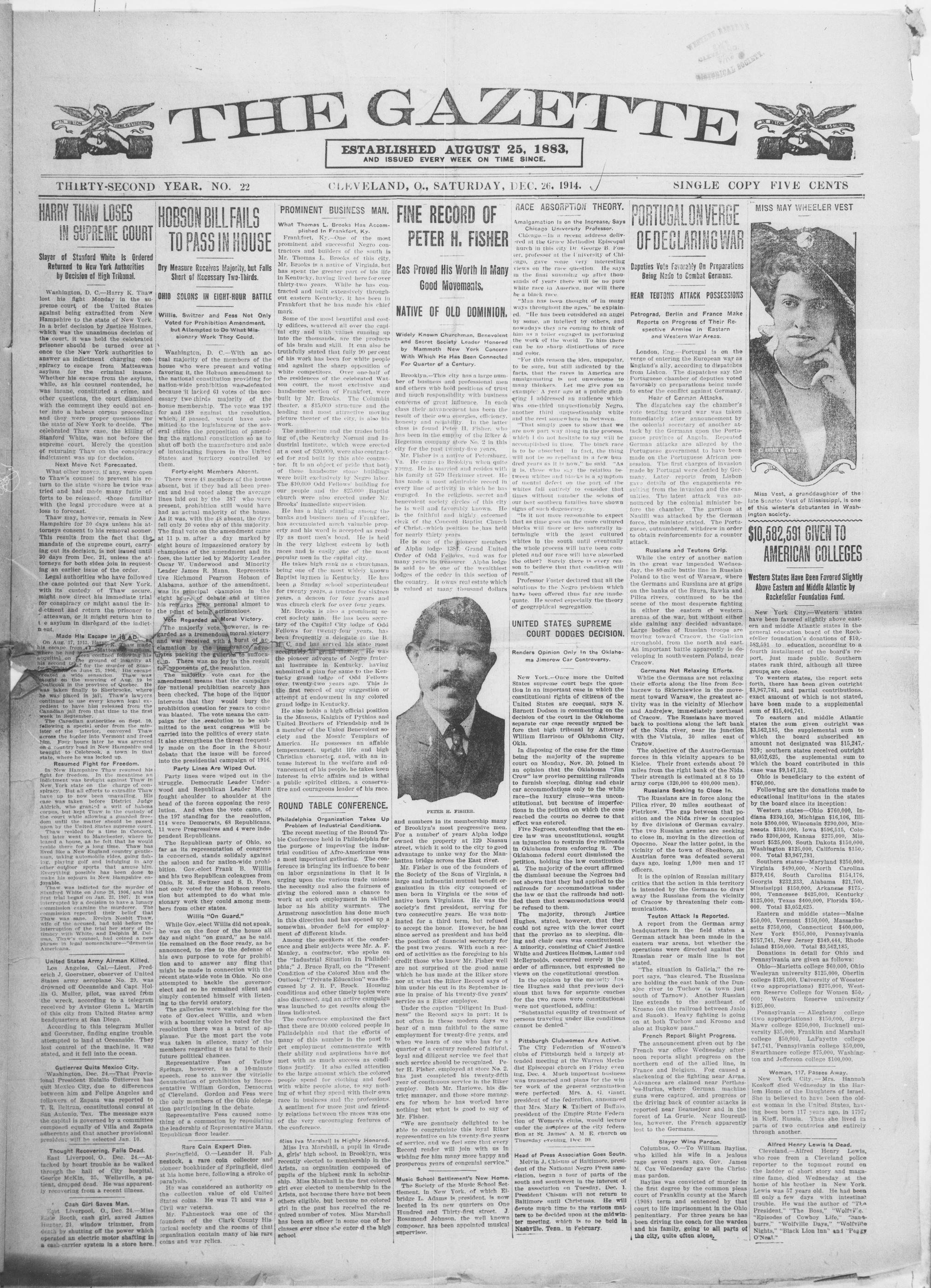
HARRY THAW LOSES IN SUPREME COURT
Slayer of Stanford White Is Ordered Returned to New York Authorities by Decision of High Tribunal.
Washington, D. C.—Harry K. Thaw lost his fight Monday in the supreme court, of the United States against being extradited from New Hamshire to the state of New York. In a brief decision by Justice Holmes, which was the unanimous decision of the court, it was held the celebrated prisoner should be turned over at once to the New York authorities to answer an indictment charging conspiracy to escape from Matewanay asylum for the criminal insane. Whether his escape from the asylum, while, as his counsel contended, he was insane, constituted a crime, and other questions, the court dismissed with the comment they could not enter into a habeas corpus proceeding and they were proper questions for the state of New York to decide. The celebrated Thaw case, the killing of Stanford White, was not before the supreme court. Merely the question of returning Thaw on the conspiracy indictment was up for decision.
Next Move Not Forecasted.
What other moves, if any, were open to Thaw's counsel to prevent his return to the state where he twice was tried and had made many futile efforts to be released, those familiar with the legal procedure were at a loss to forecast.
Thaw may, however, remain in New Hampshire for 30 days unless his attorneys consent to his removal sooner. This results from the fact that the mandate of the supreme court, carrying out its decision, is not issued until 30 days from Dec. 21, unless the attorneys for both sides join in requesting an earlier issue of the order.
Legal authorities who have followed the case pointed out that New York, with its custody of Thaw secure, might now direct his immediate trial for conspiracy or might annul the indictment and return the prisoner to the asylum, or it might return him to the asylum in disregard of the indictment.
Made His Escape in 16 AD
On Aug. 17, 1913, Harvey Thaw made his escape from 11 Massachusetts where he had been ground following his in his second trial for the murder of Stanley on June 19, 1913, created a wide sensation. Thaw was caught on the morning of Aug. 19 in Boston, was taken finally to Sherbrooke, where he was placed in jail. Thaw's lawyers continued to use every known legal expedient to have him released from the Canadian jail from that time to the first
The Canadian authorities on Sept. 10, following a special order from the minister of the interior, conveyed Thaw a letter from Vera McCormick him. Four hours later he was arrested on a country road in New Hampshire and brought to Colebrook, a town in that state, where he was locked up.
Resumed Fight for Freedom.
In Hampshire, he raised his fight for freedom. In the meantime an indictment was brought against Thaw in New York state on the charge of conspiracy. But all efforts to extradite Thaw have up to now been unavailing. His trial was adjudicated by Aldrich, who granted a writ of habeas corpus, but kept Thaw in the custody of the court while allowing a guarded freedom until the matter should be passed to the judge. Thaw resided for a time in Concord, but later went to Manchester, where he leased a house, as he felt that he would be able to afford it. He lived like a New England country gentleman, taking automobile ride, going fishing, playing golf and indulging in any other outdoor sports that amuse him. He made his sojourn in New Hampshire enjoyable.
Thaw was indicted for the murder of White on June 28, 1906, and his first trial began on Jan. 25, 1907. It was interrupted by a decision to have a lance commission examine the murderer. The commission reported their belle that they saw an unarmed man who killed the officer, had told before the interruption of the trial her story of intimacy with White, and Delphin M. Delmas, Thaw's counsel, had coined a new legal nomenclature—"demential Americana."
United States Army Airman Killed.
Los Angeles, Cal—Lieut. Frederich J. Goerstner, observer of United States army aeroplane No. 29, was drowned off Oceanside and Capt. Hollis G. Muller, pilot, was saved from the wreck, according to a telegram received by Aviator Glenn L. Martin of this city from United States army headquarters at San Diego.
According to this telegram Muller and Goerstner, finding engine trouble, attempted to land at Oceanside. They lost control of the machine, it was stated, and it fell into the ocean.
Gutierrez Quita Mexico City
Washington, Dec. 24.—That Provisional President Eulioil Gutiérrez has quit Mexico City, due to differences between him and Felipe Angeles and followers of Zapata was reported to T. R. Beltran, constitutional consul at San Antonio, Tex. The message says the capital is governed by a committee composed equally of Villa and Zapata adherents and that another provisional president will be selected Jan. 10.
Thought Recovering, Falls Dead.
East Liverpool, O., Dec. 24.—Attacked by heart trouble as he walked through the hall of City hospital, George McKim, 35, Wellsville, a patient, dropped dead. He was apparently recovering from a recent illness.
Cash Girl Saves Man.
East Liverpool, O., Dec. 24. -Miss Eileen Booth, cash girl, saved James Hunter, 21, window trimmer, from death by shutting off the power which operated an electric motor shafting in a cash-carrier system in a store here.
THE GAZETTE
HOBSON BILL FAILS TO PASS IN HOUSE
Dry Measure Receives Majority, but Falls Short of Necessary Two-Thirds.
OHIO SOLONS IN EIGHT-HOUR BATTLE
Willis, Switzer and Fess Not Only Voted for Prohibition Amendment, but Attempted to Do What Missionary Work They Could.
Washington, D. C.—With an actual majority of the members of the house who were present and voting favoring it, the Hobson amendment to the national constitution providing for nation-wide prohibition was defeated because it lacked G1 votes of the necessary two thirds majority of the house membership. The vote was 197 for and 189 against the resolution, which, if passed, would have submitted to the legislatures of the several states the proposition of amending the national constitution so as to shut off both the manufacture and sale of intoxicating liquors in the United States and territory controlled by them.
Forty-eight Members Absent.
For eight Members Absent.
There were 48 members of the house absent, but if they had all been present and had voted along the average lines laid out by the 387 who were present, prohibition still would have had an actual majority of the house. As it was, with the 48 absent, the dry fell only 20 votes shy of this majority. The final vote on the amendment came at 11 p. m. after a day marked by eight hours of impassioned oratory by champions of the amendment and itsoes, the latter led by Majority Leader Oscar W. Underwood and Minority Leader James R. Mann. Representative Richmond Pearson Hobson of Alabama, author of the amendment, was its principal champion in the eight hours of debate and at times his remarks grew personal almost to the point of being acrimonious.
Vote Regarded as Moral Victory.
The majority vote, however, is regarded as a tremendous moral victory and was received with a burst of acclamation by the temperance advocates packing the galleries to suffocation. There was no joy in the result for opponents of the resolution.
The majority vote cast for the amendment means that the campaign for national prohibition scarcely has been checked. The hope of the liquor interests that they would bury the prohibition question for years to come was blasted. The vote means the campaign for the resolution to be submitted to the next congress will be carried into the politics of every state. It also strengthens the threat frequently made on the floor in the 8-hour debate that the issue will be forced into the presidential campaign of 1916.
Party Lines Are Wiped Out.
Party lines were wiped out in the struggle. Democratic Leader Underwood and Republican Leader Mann fought shoulder to shoulder at the head of the forces opposing the resolution. And when the vote came, of the 197 standing for the resolution, 114 were Democrats, 68 Republicans, 11 were Progressives and 4 were Independent Republicans.
The Republican party of Ohio, so far as its representation of congress is concerned, stands solidly against the saloon and for nation-wide prohibition. Gov-elect Frank B. Willis and his two Republican colleagues from Ohio, R. M. Switzer and S. D. Fess, not only voted for the Hobson resolution but attempted to do what missionary work they could among members from other states.
Willis "On Guard."
While Gov.-elect Willis did not speak, he was on the floor of the house all day and night "on guard," as he said. He remained on the floor ready, as he announced, to rise to the defense of his own purpose to vote for prohibition and to answer any fling that might be made in connection with the recent state-wide vote in Ohio. No one attempted to hackle the governor-elect and so he remained silent and simply contented himself with listening to the fervid oratory.
The galleries were watching for the vote of Gov.-elect Willis, and when with a booming voice he voted for the resolution there was a burst of applause. For the most part the vote was taken in silence, many of the members regarding it as fatal to their future political chances.
Representative Fess of Yellow Springs, however, in a 10-minute speech, rose to answer the vitriolic denunciation of prohibition by Representative William Gordon, Democrat of Cleveland. Gordon and Fess were the only members of the Ohio delegation participating in the debate.
Representative Fess caused something of a commotion by repudiating the leadership of Representative Mann, Republican floor leader.
Rare Coin Expert Dies.
Springfield, O.—Leander H. Fahnestock, a rare coin collector and pioneer bookbinder of Springfield, died at his home here, following a stroke of paralysis.
He was considered an authority on the collection value of old United States coins. He was 71 and was a Civil war veteran.
Mr. Fahnestock was one of the founders of the Clark County Historical society and the rooms of that organization contain many of his rare coins and war relics.
ESTABLISHED AUGUST 25, 1883 AND ISSUED EVERY WEEK ON TIME SINCE.
PROMINENT BUSINESS MAN.
What Thomas L. Brooks Has Accompanied In Frankfort, Ky.
Frankfort, Ky.—One of the most prominent and successful Negro contractors and builders of the south is Mr. Thomas L. Brooks of this city, Mr. Brooks is a native of Virginia, but has spent the greater part of his life in Kentucky, having lived here for over thirty-two years. While he has contracted and built extensively throughout eastern Kentucky, it has been in Frankfort that he has made his chief mark.
Some of the most beautiful and costly edifices, scattered all over the capital city and with values running up into the thousands, are the products of his brain and skill. It can also be truthfully stated that fully 90 per cent of his work has been for white people and against the sharp opposition of white competitors. Over one-half of the residences of the celebrated Watson court, the most exclusive and handsome section of Frankfort, were built by Mr. Brooks. The Columbia theater, a $15,000 structure and the leading and most attractive moving picture theater of the city, is also his work.
The auditorium and the trades building of the Kentucky Normal and Industrial institute, which were erected at a cost of $30,000, were also contracted for and built by this able contractor. It is an object of pride that both of these handsome stone buildings were built exclusively by Negro labor. The $10,000 Old Fellows building for our people and the $25,000 Baptist church were also erected under Mr. Brooks' immediate supervision.
He has a high standing among the banks and business men of Frankfurt, has accumulated much valuable property and his word is accepted as readily as most men's bond. He is held in the very highest esteem by both races and is easily one of the most popular men in the capital city. He takes high rank as a churchman, being one of the most widely known Baptist laymen in Kentucky. He has been a Sunday school superintendent for twenty years, a trustee for sixteen years, a deacon for four years and was church clerk for over four years. Mr. Brooks is also a prominent secret society man. He has been secretary of the Capital City lodge of Odd Fellows for twenty-four years, has been frequently a delegate to the B. M. C, and has served his state most acceptably as grand master. He was the pioneer advocate of Negro fraternal insurance in Kentucky, having submitted a plan for same to the Kentucky grand lodge of Odd Fellows over twenty-two years ago. This is the first record of any suggestion or attempt at endowment in any colored grand lodge in Kentucky.
He also holds a high official position in the Masons, Knights of Pythias and United Brothers of Friendship and is a member of the Union Benevolent society and the Mosaic Templars of America. He possesses an affable temperament, upright life and high Christian character, and, with an intense interest in the welfare and advancement of his people, he takes keen interest in civic affairs and is with a public spirited citizen, a conservative and courageous leader of his race.
ROUND TABLE CONFERENCE.
Philadelphia Organization Takes Up Problem of Industrial Conditions.
The recent meeting of the Round Table Conference held in Philadelphia for the purpose of improving the industrial condition of Afro-Americans was a most important gathering. The conference is bringing its influence to bear on labor organizations in that it is urging upon the various trade unions the necessity and also the fairness of giving the colored man a chance to work at such employment in skilled labor as his ability warrants. The Armstrong association has done much in this direction and has opened up a somewhat broader field for employment of different kinds.
Among the speakers at the conference and their subjects were Mr. A. F. Manley, a contractor, who spoke on the "Industrial Situation In Philadelphia;" J. Bruce Ryall, on the "Present Condition of the Colored Man and the Outlook;" "Private Education" was discussed by J. R. P. Brock. Housing conditions and other timely topics were also discussed, and an active campaign was launched to get results along the lines indicated.
The conference emphasized the fact that there are 00,000 colored people in Philadelphia and that the efforts of many of this number in the past to get employment commensurate with their ability and aspirations have not met with as much success as conditions justify. It also called attention to the large amount which the colored people spend for clothing and food with white people alone, to say nothing of what they spend with their own race in business and the professions. A sentiment for more just and friendly relations between the races was one of the very encouraging features of the conference.
Miss Iva Marshall is Highly Honored. Miss Iva Marshall, a pupil in Grade A, girls' high school, in Brooklyn, was recently elected to membership in the Arista, an organization composed of pupils of the highest rank in scholarship. Miss Marshall is the first colored girl ever elected to membership in the Arista, not because there have not been others eligible, but because no colored girl in the past has received the required number of votes. Miss Marshall has been an officer in some one of her classes ever since she entered the high school
FINE RECORD OF PETER H. FISHER
Has Proved His Worth In Many Good Movements.
NATIVE OF OLD DOMINION.
Widely Known Churchman, Benevolent and Secret Society Leader Honored by Mammoth New York Concern With which He Has Been Concerned For Quarter of a Century.
Brooklyn.—This city has a large number of business and professional men and others who hold positions of trust and much responsibility with business concerns of great influence. In each class their advancement has been the result of their own energies, efficiency, honesty and reliability. In the latter class is found Peter H. Fisher, who has been in the employ of the Riker & Hegeman company store No. 2 in this city for the past twenty-five years.
Mr. Fisher is a native of Petersburg, Va. He came to Brooklyn when quite young. He is married and resides with his family at 579 Herkimer street. He has made a most admirable record in every line of activity in which he has engaged. In the religious, secret and benevolent society circles of this city he is well and favourably known. He is the faithful and highly esteemed clerk of the Concord Baptist Church of Christ, which position he, has held for nearly thirty years.
He is one of the pioneer members of Alpha lodge 1381, Grand United Order of Odd Fellows, and was for many years its treasurer. Alpha lodge is said to be one of the wealthiest lodges of the order in this section of the country. It owes real estate which is valued at many thousand dollars
PETER H. FISHER.
and numbers in its membership many of Brooklyn's most progressive men. For a number of years Alpha lodge owned the property at 129 Nassau street, which it sold to the city to good advantage to make way for the Manhattan bridge across the East river.
Mr. Fisher is one of the founders of the Society of the Sons of Virginia, a large and influential mutual benefit organization in this city composed of men born in Virginia or the sons of native born Virginians. He was the society's first president, serving for two consecutive years. He was nominated for a third term, but refused to accept the honor. However, he has since served as president and has held the position of financial secretary for the past two years. With such a record of activities as the foregoing to his credit those who know Mr. Fisher well are not surprised at the good name which he has made at the Riker store or at what the Riker Record says of him under his cut in its September issue in praise of his twenty-five years' service as a Riker employee.
Under the caption "Diligent In Business" the Record says in part: it is not often in these modern days we hear of a man faithful to the same employment for twenty-five years, and when we learn of one who has for a quarter of a century rendered faithful, loyal and diligent service we feel that such service should be recognized. Peter H. Fisher, employed at store No. 2, has just completed his twenty-fifth year of continuous service in the Riker employ. Both Mr. Harlowe, his district manager, and those store managers for whom he has worked have nothing but what is good to say of Mr. Fisher.
"We are genuinely delighted to be able to congratulate this loyal Riker representative on his twenty-five years of service, and we feel sure that every Record reader will join with us in wishing for him many more happy and prosperous years of congenial service."
Music School Settlement's New Home. The Society of the Music School Settlement, in New York, of which Elbridge L. Adams is president, is now located in its new quarters on One Hundred and Thirty-first street. J. Rosamond Johnson, the well known composer, has been appointed musical supervisor.
RACE ABSORPTION THEORY.
Amalgamation Is on the Increase, Says
Chicago University Professor.
Chicago — in a recent address delivered at the Grace Methodist Episcopal church in this city Dr. George B. Foster, professor at the University of Chicago, gave some very interesting views on the race question. He says in the final summing up after thousands of years there will be no pure white race in America, nor will there be a black race.
“Man has been thought of in many ways throughout the ages,” he explained. “He has been considered an angel by some, an intellect by others, and nowadays they are coming to think of him as a toter engaged in performing the work of the world. To him there can be no sharp distinctions of race and color.
“For this reason the idea, unpopular, to be sure, but still indicated by the facts, that the races in America are amalgamating is not unwelcome to many thinkers. Let me give you an example: A year ago at a public gathering I addressed an audience which was one-third unquestionably Negro, another third unquestionably white and the rest somewhere in between.
"That simply goes to show that we are now part way along in the process, which I do not hesitate to say will be accomplished in time. The black race is to be absorbed. In fact, the thing will not be so repellent in a few hundred years as it is now," he said. "As it is, those who say the relation between whites and blacks is a symptom of mental defect on the part of the whites fail entirely to consider that times without number the selions of our best southern families have shown signs of such degeneracy.
"Is it not more reasonable to expect that as time goes on the more cultured blacks will more or less naturally intermingle with the least cultured whites in the south until eventually the whole process will have been completed and our race will have absorbed the other? Surely there is every reason to believe that that condition will result."
Professor Foster declared that all the solutions to the Negro problem which have been offered thus far are inadequate. He scored especially the theory of geographical segregation.
UNITED STATES SUPREME COURT DODGES DECISION.
Renders Opinion Only In the Oklahoma Jimcrow Car Controversy.
New York. Once more the United States supreme court begs the question in an important case in which the constitutional rights of citizens of the United States are coequal, says N. Barnett Dodson in commenting on the decision of the court in the Oklahoma separate car case recently argued before that high tribunal by Attorney William Harrison of Oklahoma City, Okla.
In disposing of the case for the time being the majority of the supreme court on Monday, Nov. 30, joined in an opinion that the Oklahoma "Jim Crow" law proviso permitting railroads to furnish sleeping, dining and chair car accommodations only to the white race—the luxury clause—was unconstitutional, but because of imperfections in the petition on which the case reached the courts no decree to that effect was entered.
Five Negroes, contending that the entire law was unconstitutional, sought an injunction to restrain five railroads in Oklahoma from enforcing it. The Oklahoma federal court dismissed the petition, holding the law constitutional. The majority of the court affirmed the dismissal because the Negroes had not shown that they had applied to the railroads for accommodations under the law or that the railroads had notified them that accommodations would be refused to them.
The majority, through Justice Hughes, stated, however, that they could not agree with the lower court that the proviso as to sleeping, dining and chair cars was constitutional. A minority, consisting of Chief Justice White and Justice Holmes, Lamar and McReynolds, concurred merely in the order of affirmance, but expressed no views on the constitutional question. In the opinion by the majority Justice Hughes said that previous decisions that laws for separate coaches for the two races were constitutional were not questioned, adding: "Substantial equality of treatment of persons traveling under like conditions cannot be denied."
Pittsburgh Clubwomen Are Active. The City Federation of Women's clubs of Pittsburgh held a largely attended meeting at the Warren Method Episcopal church on Friday evening, Dec. 4. Much important business was transacted and plans for the winter work of the general organization were perfected Mrs. A. G. Gantt, president of the federation, announced that Mrs. Mary R. Talbert of Buffalo, president of the Empire State Federation of Women's clubs, would lecture under the auspices of the city federation at St. James' A. M. E. church on Thursday evening, Dec. 10.
Head of Press Association Goes South
Melvin J. Chisum of Baltimore, president of the National Negro Press association, began a tour of parts of the south and southwest in the interest of the association on Tuesday, Dec. 1. President Chisum will not return to Baltimore until Christmas. He will devote much time to the various matters to be decided upon at the midwinter meeting, which is to be held in Nasbville, Tenn., in February.
PORTUGALONVERGE OF DECLARING WAR
Deputies Vote Favorably On Preparations Being Made to Combat Germans.
HEAR TEUTONS ATTACK POSSESSIONS
Petrograd, Berlin and France Make Reports on Progress of Their Respective Armies in Eastern and Western War Areas.
London, Eng.-Portugal is on the verge of entering the European war as kingland's ally, according to dispatches from Lisbon. The dispatches say the Portuguese chamber of deputies voted favorably on preparations being made to enter the conflict against Germany. Hear of German Attacks.
The dispatches say the chamber's vote tending toward war was taken immediately after announcement by the colonial secretary of another attack by the Germans upon the Portuguese province of Angola. Repeated German attacks are alleged by the Portuguese government to have been made on the Portuguese African possession. The first charges of invasion made by Portugal were denied by Germany. Later reports from Lisbon gave details of the engagements resulting from the invasion and the casualties. The latest attack was announced by the colonial minister before the chamber. The garrison at Naillill was attacked by the German force, the minister stated. The Portuguese, outnumbered, withdrew in order to obtain reinforcements for a counter attack.
Russians and Teutons Grip.
While the entry of another nation in the great war impended Wednesday, the 80-mile battle line in Russian Poland to the west of Warsaw, where the Germans and Russians are at grips on the banks of the Bzura, Rawka and Pilica rivers, continued to be the scene of the most desperate fighting in either the eastern of western arenas of the war, but without either side gaining any decided advantage. Large bodies of Russian troops are moving toward Cracow, the Galician stronghold, from the north and east. An important battle apparently is developing in southwestern Poland, near Cracow.
Germans Not Relaxing Efforts
While the Germans are not relaxing their efforts along the line from Scohacewz to Skierniewice in the movement toward Warsaw, the greatest activity was in the vicinity of Miechow and Andriew, immediately northeast of Cracow. The Russians have moved back to positions along the left bank of the Nida river, near its junction with the Vistula, 30 miles east of Cracow.
The objective of the Austro-German forces in this vicinity appears to be Kielce. Their front extends about 70 miles from the right bank of the Nida. Their strength is estimated at 8 to 10 army corps (320,000 to 400,000 men).
Russians Seeking to Close In.
The Russians are in force along the Pilica river, 20 miles southeast of Pitlekrow. The gap between that position and the Nida river is occupied by five divisions of German cavalry. The two Russian armies are seeking to close in, moving in the direction of Opole, near the latter point in vicinity of the town of Sheddboro, an Austrian force was defeated several days ago, losing 1,000 men and 17 officers.
It is the opinion of Russian military critics that the action in this territory is intended by the Germans to draw away the Russians from the vicinity of Cracow by threatening their communications.
Teuton Attack Is Reported.
A report from the German army headquarters in the field states a German attack has been made in the eastern war arena, but whether the operations were directed against the Russian rear or main line is not stated.
"The situation in Galicia," the report says, "has cleared. The Russians are holding the east bank of the Dunajec river to Tuchow (a town just south of Tarnow). Another Russian line extends to the southeast of Krosno (on the railroad between Jaslo and Sanok). Heavy fighting is going on at both Tuchow and Krosno and also at Bupkow pass."
French Report Slight Progress.
Slayer Wins Pardon
Columbus, O.-T William Bayliss, who killed his wife in a jealous rage seven years ago, Gov. James M. Cox Wednesday gave the Christmas pardon. Bayliss was convicted of murder in the first degree by the common pleas court of Franklin county at the March (1908) term and sentenced by that court to life imprisonment in the Ohio penitentiary. For three years he has been driving the coach for the warden and his family, going to all parts of the city, quite often alone.
DE MIDNIGHT
THE LIGHTS
MISS MAY WHEELER VEST
C. HARRIS & SWING
Miss Vest, a granddaughter of the late Senator Vest of Mississippi, is one of this winter's debutantes in Washington society.
$10,582,591 GIVEN TO AMERICAN COLLEGES
Western States Have Been Favored Slightly Above Eastern and Middle Atlantic by Rockefeller Foundation Fund.
New York City—Western states have been favored slightly above eastern and middle Atlantic states in the general education board of the Rockefeller foundation's donations of $10,582,591 to education, according to a fourth installment of the board's report, just made public. Southern states rank third, although all three groups are close.
To western states, the report sets forth, there has been given outright $3,967,781, and partial contributions, exact amount of which is not stated, have been made to a supplemental sum of $15,469,741.
To eastern and middle Atlantic states the sum given outright was $3,562,185, the supplemental sum to which the board subscribed an amount not designated was $15,247,939; southern states received outright $3,052,625, the supplemental sum to which the board contributed in this case was $9,147,152.
Ohio is beneficiary to the extent of $760,000.
Following are the donations made to educational institutions in the states by the board since its inception:
Western states—Ohio $760,000, Indiana $230,160, Michigan $16,106, Illinois $300,000, Wisconsin $290,000, Minnesota $330,000, Iowa $596,515, Colorado $200,000, Kansas $275,000, Missouri $255,000, South Dakota $150,000, Washington $125,000, California $150,000, Total $3,967,781
Southern states—Maryland $250,000,
Virginia $490,000, North Carolina
$379,416, South Carolina $154,176,
Georgia $222,233, Alabama $21,700,
Mississippi $150,000, Arkansas $175,000,
Tennessee $625,000, Kentucky
$125,000, Texas $400,000, Florida $50,000,
Total $3,652,625.
Eastern and middle states—Maine
$50,000, Vermont $150,000, Massachusetts
$750,000, Connecticut $400,000,
New York $95,000, Pennsylvania
$757,741, New Jersey $349,444, Rhode Island $150,000, Total $3,562,185.
Donations in detail for Ohio and Pennsylvania are given as follows:
Ohio—Marietta college $60,000, Ohio Wesleyan university $125,000, Oberlin college $125,000, University of Wooster (two appropriations) $275,000, Western Reserve College for Women $50,000, Western Reserve university $125,000.
Pennsylvania — Allegheny college (two appropriations) $150,000, Bryn Mawr college $250,000, Bucknell university $35,000, Franklin and Marshall college $50,000, LaFayette college $47,741, Pennsylvania college $50,000, Swarthmore college $75,000, Washington and Jefferson college $100,000.
Woman, 117 Passes Away
New York City Mrs. Hannah Koskoff died Wednesday in the Harlem Home of the Daughters of Israel. She is believed to have been the oldest woman in the United States, having been born 117 years ago, in 1757, in Kieff, Russia. Thus she lived in parts of two centuries and entirely through another.
Alfred Henry Lewis Is Dead
Cleveland.-Alfred Henry Lewis, who rose from a Cleveland police reporter to the topmost round on the ladder of short story and magazine fame, died Wednesday at the home of his brother in New York Lewis was 57 years old. He had been ill only a few days with intestinal trouble. He was the author of "The President," "The Ross," "Wolff v. E. Episodes of Cowboy Life," "San-burrs," "Wolville Days," "Wolville Nights," "Black Lion Inn" and "Peacey O'Neal."
One Year.....$1.50.
Six Months.....1.00
Three Months......50
Subscribers are requested to re-
mit by postoffice money or
order or registered letter
Entered at the postoffice in Cleveland
Ohio, as second-class matter.
Address all communications to
Blackstone Building, Cleveland, O.
Member Ohio Legislature: 1894
to 1896; 1896 to 1898; 1900 to 1902
THE GAZETTE is the oldest, and has the largest bone fide circulation, double that of any newspaper in the interest in the state of Ohio, and comparison with any will immediately establish its rank as one of the NEWSIEST AND BEST in the country.
It is true, as a writer said recently in one of our N. Y. City contemporaries, the membership of the Ohio Republican Executive Committee granted "Buckeye" Afro-Americans, "is but an empty honor". This has been true for years, and particularly so in recent years.
According to some of the daily papers, of Tuesday, the Leo M. Frank case is to be taken to the U. S. Supreme Court on habeas corpus proceedings, in another effort to secure him a new trial. We do not believe that this effort will be any more successful than were the recent ones to get two U. S. Supreme Court justices, one (Lamar) from Georgia, to have the court consider the case.
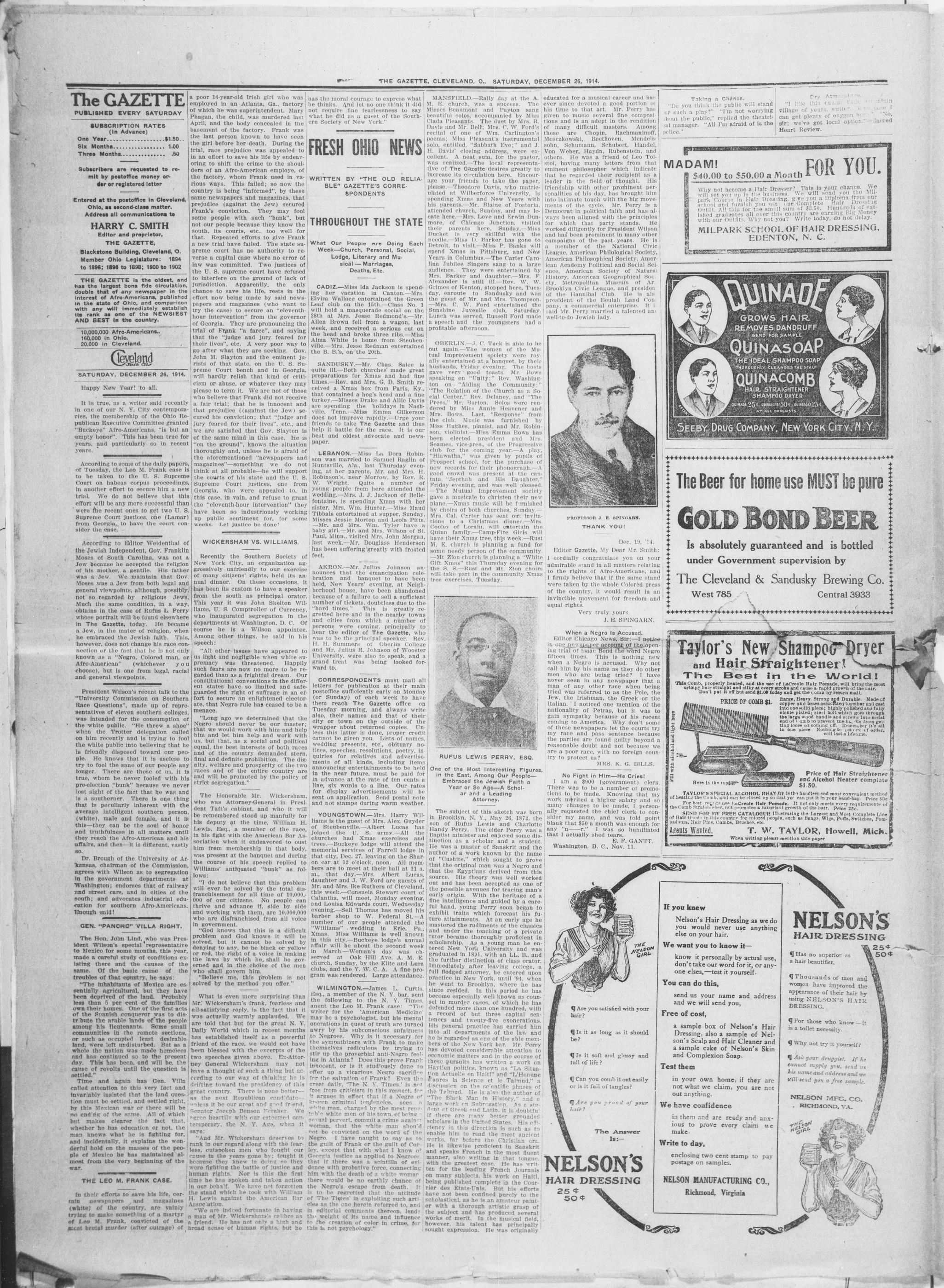
According to Editor Weidenthal of the Jewish Independent, Gov. Franklin Moses of South Carolina, was not a Jew because he accepted the religion of his mother, a gentile. His father was a Jew. We maintain that Gov. Moses was a Jew from both legal and general viewpoints, although, possibly, not so regarded by religious Jews. Much the same condition, in a way, obtains in the case of Rufus L. Perry whose portrait will be found elsewhere in The Gazette, today. He became a Jew, in the mater of religion, when he embraced the Jewish faith. This however, does not change his race connection or the fact that he is not only known as a "Negro, Colored man, or Afro-American" (whichever you choose), but is one from legal, racial and general viewpoints.
President Wilson's recent talk to the "University Commission on Southern Race Questions", made up of representatives of eleven southern colleges, was intended for the consumption of the white public. "He threw a shoe" when the Trotter delegation called on him recently and is trying to fool the white public into believing that he is friendly disposed toward our people. He knows that it is useless to try to fool the sane of our people any longer. There are those of us, it is true, whom he never fooled with his pre-election "bunk" because we never lost sight of the fact that he was and is a southerner. There is one thing that is peculiarly inherent with the average intelligent southern person, (white), male and female, and it is this—they can be the soul of honor and truthfulness in all matters until they reach the Afro-American and his affairs, and then—it is different, vastly so.
Dr. Brough of the University of Arkansas, chairman of the Commission agrees with Wilson as to segregation in the government departments at Washington; endorses that of railway and street cars, and in cities of the south; and advocates industrial education for southern Afro-Americans. Enough said!
GEN. "PANCHO" VILLA RIGHT.
The Hon. John Lind, who was President Wilson's special representative to Mexico for some months, this year, made a careful study of conditions existing there and the causes of the same. Of the basic cause of the troubles of that country, he says: "The inhabitants of Mexico are essentially agricultural, but they have been deprived of the land. Probably less than 5 per cent of the families own their homes. One of the first acts of the Spanish conqueror was to distribute the arable lands of the people among his leutenants. Some small communities in the remote sections, or such as occupied least desirable land, were left undisturbed. But as a whole the motion was made homeless and the people were the second day. This has been, and will be, the cause of revolts until the question is settled."
Time and again has Gen. VIII called attention to this very fact and invariably insisted that the land question must be settled, and settled right, by this Mexican war or there will be no ending of the same. All of which but makes clearer the fact that whether he has education or not, the man knows what he is fighting for, and incidentally, it explains the wonderful hold on the masses of the people of Mexico he has maintained almost from the very beginning of the war.
THE LEO M. FRANK CASE.
In their efforts to save his life, certain newspapers, and magazines (white) of the country, are valiant trying to make something of a martyr of Leo M. Frank, convicted of the most brutal murder (after outrage) of
a poor 14-year-old Irish girl who was employed in an Atlanta, Ga., factory of which he was superintendent. Mary Phagan, the child, was murdered last April, and the body concealed in the basement of the factory. Frank was the last person known to have seen the girl before her death. During the trial, race prejudice was appealed to in an effort to save his life by endeavoring to shift the crime to the shoulders of an Afro-American employee, of the factory, whom Frank used in various ways. This failed; so now the country is being "informed", by these same newspapers and magazines, that prejudice (against the Jew) secured Frank's conviction. They may fool some people with such "bunk", but not our people because they know the south, its courts, etc., too well for that. Repeated efforts to give Frank a new trial have failed. The state supreme court has no authority to reverse a capital case where no error of law was committed. Two justices of the U. S. supreme court have refused to interfere on the ground of lack of jurisdiction. Apparently the only chance to save his life, rests in the effort now being made by said newspapers and magazines (who want to try the case) to secure an "eleventh-hour intervention" from the governor of Georgia. They are pronouncing the trial of Frank "a farce", and saying that the "judge and jury feared their lives", etc. A very poor way to go after what they are seeking. Gov. John M. Slayton and the eminent jurists of that state, on the U. S. Supreme Court bench and in Georgia will hardly relish that kind of criticism or abuse, or whatever they may please to term it. We are not of those who believe that Frank did not receive a fair trial; that he is innocent and that prejudice (against the Jew) secured his conviction; that "judge and jury feared for their lives", etc., and we are satisfied that Gov. Slayton is of the same mind in this case. He is "on the ground", knows the situation thoroughly and, unless he is afraid of the aforementioned "newspapers and magazines"—something we do not think at all probable—he will support the courts of his state and the U. S. Supreme Court justices, one from Georgia, who were appealed to. In this case, in vain, and refuse to grant the "eleventh-hour intervention" they have been so industriously working up public sentiment for, for some weeks. Let justice be done!
WICKERSHAM VS. WILLIAMS
Recently the Southern Society of New York City, an organization aggressively unfriendly to our exercise of many citizens' rights, held its annual dinner. On these occasions, it has been its custom to have a speaker from the south as principal orator. This year it was John Skelton Williams, U. S. Controllor of Currency, who inaugurated segregation in the departments at Washington, D. C. Of course he is a Wilson appointee. Among other things, he said in his speech:
"All other issues have appeared to us light and negligible when white supremacy was threatened. Happily such fears are now no more to be regarded than as a frightful dream. Our constitutional conventions in the different states have so limited and safeguarded the right of suffrage in an effort to secure an enlightened electorate. that Negro rule has ceased to be a menace.
"Long ago we determined that the Negro should never be our master; that we would work with him and help him and let him help and work with us, but that, as a social and political equal, the best interests of both races and of the country demanded stern final and definite prohibition. The dignity, welfare and prosperity of the two races and of the entire country are and will be promoted by the policy of strict segregation."
The Honorable Mr. Wickersham, who was Attorney-General in President Taft's cabinet, and who it will be remembered stood up manfully for his deputy at the time, William H. Lewis, Esq., a member of the race, in his fight with the American Bar Association when it endeavored to oust him from membership in that body, was present at the banquet and during the course of his speech replied to Williams' antiquated "bunk" as follows:
"I do not believe that this problem will ever be solved by the total disfranchisement for all time of 10,000,000 of our citizens. No people can thrive and advance if, side by side and working with them, are 10,000,000 who are disfranchised from all voice and opinion." "God knows that this is a difficult problem and God knows it will be solved, but it cannot be solved by denying to any, be he black or yellow or red, the right of a voice in making the laws by which he, shall be governed, in the voice of the men who shall govern him." "Believe me, this problem is not solved by the method you offer."
What is even more surprising than Mr. Wickersham's frank, fearless and all-satisfying reply, is the fact that it was actually warmly applauded. We are told that but for the great N. Y. Dally World which in recent months has established itself as a powerful friend of the race, we would not have been blessed with the excerpts of the two speeches given above. Ex-Attorney General Wickersham may not have a thought of such a thing but according to our way of thinking he is driving toward the presidency of this great country. There is none better—as the next Republican candidate—unless it be our great and good friend. Senator Joseph Benson Foraker. We agree heartily with our esteemed contemporary, the N. Y. Age, when it says:
"And Mr. Wickersham deserves to rank in our regard along with the fearless, outcashed men who fought our cause in the years gone by; fought it because they knew in doing so they were fighting the battle of justice and human rights. Nor is this the first time he has spoken and taken action in our behalf. We have not forgotten the stand which he took with William H. Lewis against the American Bar Association.
"We are indeed fortunate in having a man of Mr. Wickersham's calibre as a friend. He has not only a high and broad sense of human rights, but he
THE GAZETTE, CLEVELAND, O., SATURDAY, DECEMBER 26, 1914.
has the moral courage to express what he thinks. And let no one think it did not require fine fearlessness to say that the Southern Society of, New, York."
FRESH OHIO NEWS
WRITTEN BY "THE OLD RELIA
BLE" GAZETTE'S CORRE-
$PONDENTS
THROUGHOUT THE STATE
What Our People Are Doing Each Week—Church, Personal, Social, Lodge, Literary and Musical—Marriages, Deaths, Etc.
CADIZ—Miss Ida Jackson is spending her vacation in Canton.—Mrs. Elvira Wallace entertained the Green Leaf club on the 15th—Class No. 1 will hold a masquerade social on the 29th at Mrs. Jesse Redmond's.—Mr. Allen Brown left wagon, last week, and received a serious ribs on the head and broke three ribs.—Mrs. Alma White is home from Steubenville.—Mrs. Jesse Redman entertained the B. B.'s, on the 20th.
SANDUSKY.-Mr. Chas. Salee is quite ill.-Both churches made great preparations for Xmas and had the times.-Rev. and Mrs. G. D. Smith received a Xmas box from Paris, Ky., that contained a hog's head and a fine turkey.-Misses Drake and Alle Davis are spending the holidays in Nashville, Tenn.-Miss Emma Gilkerson does not improve rapidly.-Urge your friends to take The Gazette and thus help it battle for the race. It is our best and oldest advocate and newspaper.
LEBANON.-Miss La Dora Robinson was married to Samuel Ragin of Huntsville, Ala., last Thursday evening, at her parents, Mr. and Mrs. H. Robinson's, near Morrow, by Rev. R. W. Wright. Quite a number of young people from here attended the wedding.-Mrs. J. J. Jackson of Bellefontaine, is spending Xmas with her sister, Mrs. Wm. Hunter.-Miss Maud Tibbals entertained at supper, Sunday, Misses Jessie Morton and Leola Pitts.-Mr. and Mrs. Wm. Tyler have a baby girl.-Mr. and Mrs. Wilson of St Paul, Minn., visited Mrs. John Morgan last week.-Mr. Douglass Henderson has been suffering greatly with frosted feet.
AKRON.—Mr. Julius Johnson announces that the emancipation celebration and banquet to have been held, New Years' evening, at neighborhood house, have been abandoned because of a failure to sell a sufficient number of books due to the "hard times." This is greeted gretted here and in the nearby towns and cities from which a number of persons were coming, principally to hear the editor of The Gazette, who was to be the principal speaker. Rev. H. to Summers of Oberlin College and M. to Gosper of Cooster University, were also to speak, and a grand treat was being booked forward to.
CORRESPONDENTS must mail all letters for publication at their main postoffice sufficiently early on Monday (or Sunday) of each week to have them reach The Gazette office on Tuesday morning, and always write also, their names and that of their city or town on the outside of the building. If the less this latter is done, proper credit cannot be given you. Lists of names, wedding presents, etc., obituary notices, speeches, resolutions, poetry, inquiries for relatives and advertisements of all kinds, including items announcing entertainments to be held in the near future, must be paid for by the post office. On line, six words to a line. Our rates for display advertisements will be sent on application. Send postal note and not stamps during warm weather.
YOUNGSTOWN—Mrs. Harry Williams is the guest of Mrs. Alex. Guerdy of Steubenville—Albert Lucas has joined the U. S. army. All the churches had Xmas exercises and trees. Buckeye lodge will attend the memorial services of Farrell lodge in that city, Dec. 27, leaving on the Sharon car at 12 o'clock, noon. All members of the lodge will attend, that day—Mrs. Albert Lucas daughter and J. W. Ford are guests of Mr. and Mrs. Ike Ruthers of Cleveland, this week. Consuela Stewart court of Calantha, will meet, Monday evening, and Lousia Edwards court, Wednesday evening. Sell Thomas has moved his barber shop to W. Federal St.—A number of our people attended the "Williams" wedding in Erie, Pa. Xmas. Miss Williams is well known as Buckeye lodge's annual affair will be aboard her in March. Woman's day was observed at Oak Hill Ave. A. M. E. church, Sunday, by the Elite and Lula clubs, and the Y. W. C. A. A fine program was rendered. Large attendance.
WILMINGTON—James L. Curta, Esq., a member of the N. Y. bar, sent the following to the N. Y. Times anent the Leo M. Frank case: "The writer for the 'American Medicine may be a psychologist, but his mental operations in quest of truth are turned awry by his subconscious unfairness to Negroes. Why is it necessary for the sympathizers with Frank to make sure that he tries to stir up the proverbial anti-Negroism in Atlanta? Does this prove Frank innocent, or is it studiously done to offer up a vicarious Negro sacrifice for the salvation of Frank? Even the great daily, 'The N. Y. Times,' is not free from criticism in this respect, for it argues in effect that if a Negro of known criminal tendencies, sees a white man, charged by the most rebellious white men of his town, of before a person comes to a crime against a woman, that the white man did not be convicted on the word of the Negro. I have naught to say as to the guilt of Frank or the guilt of Conley, except that with what I know of Georgia justice as applied to Negroes, that if there was a scintilla of evidence with probative force, connecting him with the death of a white woman, there would be no earthly chance of the Negro's escape from death. It is to be regretted that the attitude in exploiting such articles as the leading ones to, and in editorial comments thereon, the weight of its name and influence to the creation of color in crime, for this is not psychology."
MANSFIELD—Rally day at the A. M. E. church, was a success. The Misses Beaumont and Payton sang beautiful solos, accompanied by Miss Clada Pleasants. The duet by Mrs. R. Davis and Mr. Bell; Mrs. C. W. Ford's recital of one of Wm. Carlington's poems; Miss Pleasant's instrumental solo, entitled, "Sabbath Eve;" and J. H. Davis' closing address, were excellent. A neat sum, for the pastor, was realized. The local representative of The Gazette desires greatly to increase its circulation here. Encourage your friends to take the paper, please. Theodore Davis, who matriculated in Aberfordiversity is spending Xmab in New York with his parents. Mr. Blaine of Fostoria, attended church, Sunday, and may locate here. Mrs. Love and Erwin Dumore, of Chicago Junction, visited their parents here, Sunday. Miss Ducket is very skilful with the needle. Miss D. Barker has gone to Detroit, to visit. Miss P. Banks will spend Xmas in Pittsburg, and New Years in Columbus. The Carter Carolina Jubilee Singers sang to a large audience. They were entertained by Mrs. Barker and daughter—Mrs. F. Alexander is still ill—Rev. W. W. Prentzes of Kenton, stopped here, Tuesdays and Wednesdays, and was the guest of Mr. and Mrs. Thompson.—Mrs. C. W. Ford entertained the Sunshine Juvenile club. Saturday Lunch was served. Russell Ford made a speech and the youngsters had a profitable afternoon.
OBERLIN.—J. C. Tuck is able to be out again. The women of the Mutual Improvement society were royally entertained at a banquet, by their husbands, Friday evening. The hosts gave very good toasts, Mr. Bows speaking on "Unity," Rev. Washington on "Aiding the Community," "The Relation of the Church as a Social Center," Rev. Delaney, and "The Press," Mr. Burton. Solos were rendered as gifts to Mrs. Bows and Mrs. Bows, Last. "Response to the club, Music was furnished by Miss Hukhes, pianist, and Mr. Robinson, violinist—Miss Emma Bows has been elected president and Mrs. Seames, vice-pres, of the Progressive club for the coming year.—A play, "Hiwatha," was given by pupils of Prospect school, for the purchase of new records for their phonograph. A good crowd was present at the canta, Jephunah, and his sister day after day, was well pleased. The Mutual Improvement society gave a musical to christen their new piano—Xmas music will be furnished by cholars of both churches. Sunday. Mrs. Cal. Carter has sent our invitations to a Christmas dinner. Mrs. Cooley of Lorain, will entertain the Quinn family. Camp-Fire Girls will have their Xmas tree, this week.—Rust M. E, church is planning a fund for some needy person of the community.—M. Zion church is planning a "White Xmas" this Thursday evening for the Xmas tree. The Zion chors will take part in the community Xmas tree exercises. Tuesday.
RUFUS LEWIS PERRY, ESQ.
One of the Most Interesting Figures in the East, Among Our People—Embraced the Jewish Faith a Year or So Ago—A Scholar and a Leading
The subject of this sketch was born in Brooklyn, N. Y., May 26, 1872, the son of Rufus Lewis and Charlotte Handy Perry. The elder Perry was a Baptist minister and enjoyed some distinction as a scholar and a student. He was a master of Sanskrit and the author of a work known by the name of "Cushite," which sought to prove the original man was a Negro and that the Ephesians derived from this source. His theology was marked out and has been accepted as marked out the possible avenues for tracing man's early origin. With the heritage of a fine intelligence and guided by a careful hand, young Perry soon began to exhibit traits which forecast his future attainments. At an early age he mastered the rudiments of the classes and under the teaching of a private tutor became thoroughly proficient in teaching. As a young man he entered New York and graduated in 1891, with an LL. B., and the further distinction of class orator. Immediately after leaving college, a fledgled attorney, he entered upon practice in New York, until 94, when he went to Brooklyn, where he has since resided. In this period he has become especially well known as counsel in murder cases, of which he has defended more than one hundred, with a record of three capital sentences. His general twenty-five exonerations. Him into the career of the law he is regarded as one of the able members of the New York bar. Mr. Perry has devoted considerable attention to economic matters and in the course of these pursuits has written in a book on Haytienlapis in haunti and *La Situation Tapis la Science et le Talmud*, a discussion on the scientific phases of the Talmud. He is also the author of *The Black Man in History* and a student of Greek and Latin, it is deemed if there are many better grounded scholars in the United States. His efficiency in this direction is such as enable him to read the most ancient works, far before the Christian orn. He is likewise proficient in Sanskrit and speaks French in the most fluent manner, also writing in that tongue with the greatest ease. He has written for the leading French Journals many subjects, his work on Haiti, being published complete in the Courier Encyclopaedia, but his efforts have not been confined to the scholastic, as he is an amateur poet with a thorough artistic merit the subject and has produced several works of merit. In the musical field, however, his talent has principally sought expression. He was originally
If you knew
Nelson's Hair Dressing as we do
you would never use anything
else on your hair.
We want you to know it—
know it personally by actual use,
don't take our word for it, or any-
one elses,—test it yourself.
You can do this,
send us your name and address
and we will send you,
Free of cost,
a sample box of Nelson's Hair
Dressing; also a sample of Nelson's Scalp and Hair Cleaner and
a sample cake of Nelson's Skin
and Complexion Soap.
Test them
in your own home, if they are
not what we claim, you are not
out anything.
We have confidence
in them and are ready and anx-
ious to prove every claim we
make.
Write to day,
enclosing two cent stamp to pay
postage on samples.
NELSON'S
HAIR DRESSING
Has no superior as
a hair beautifier.
Thousands of men and
women have improved the
appearance of their hair by
using NELSON'S HAIR
DRESSING.
For those who know—it
is a toilet necessity.
Why not try it yourself?
Ask your druggist. If he
cannot supply you, send us
his name and address and we
will send you a free sample.
NELSON MFG. CO.
RICHMOND, VA.
The Answer
Is:
NELSON'S
HAIR DRESSING
25¢
50¢
NELSON MANUFACTURING CO.,
Richmond, Virginia
educated for a musical career and has ever since devoted a good portion of his time to that art. Mr. Perry has given to music several fine compositions and is an adept in the rendition of many difficult masters. Among these are Chopin, Rachmaninov, Mozzickowski, Beethoven, Mendelssohn, Schumann, Schubert, Handel, Von Weber, Haydn, Rubenstein, and others. He was a friend of Leo Tolstoi, having many letters from that eminent philosopher which indicate that he regarded their recipient as a leader in the field of thought. His friend and colleague of his day has brought him into intimate touch with the big movements of the cycle. Mr. Perry is a Democrat in political faith and has always been aligned with the principles for which that party stands. He worked diligently for President Wilson and has been prominent in many other campaigns of the past years. He is a member of the National Civic League, American Philological Society, American Philosophical Society, American Academy Political and Social Science, American Society of Natural History, American Geographical Society, Metropolitan Museum of Art, American Academy and presidents of the Hammad Club. He is als president of the Beauilh Land Company, a commercial enterprise. It is said Mr. Perry married a talented and well-to-do Jewish lady.
P. A.
Editor Gazette, My Dear Mr. Smith: I cordially congratulate you on your admirable stand in all matters relating to the rights of Afro-Americans, and I firmly believe that if the same stand were taken by the whole Colored press of the country, it would result in an invincible movement for freedom and equal rights.
When a Negro is Accused.
Editor Chicago News, Sir.: I notice in one newspaper account of the opening trial of Isaac Bond the word Negro fifteen times. This is nothing new when a Negro is accused. Why not why his life as they do other men who are being tried? I have never seen in any newspaper that a man of any other race when being tried was referred to as the Pole, the Jew, the Irishman, the Greek or the Italian. I noticed one mention of the nationality of Petras, but it was to gain sympathy because of his recent coming to America. Why don't some of these newspapers let the court try his case? Why don't the parties are found guilty beyond a reasonable doubt and not because we are a poor race, with no foreign country to protect us?
MRS. K. G. BILLS.
No Fight in Him—He Cries!
I am a a $900 (government) clerk.
There was to be a number of promotions to be made. Knowing that my work merited a higher salary and so many changes to be made, I personally requested the chief clerk to consider my name, and was told point blank that $50 a month was enough for any "married" man to be bumilated that I actually shed tears.
E. F. GANTT.
Washington, D. C., Nov. 13.
MADAM! $40.00 to $50.00 a Month FOR YOU.
Why not become a Hair Dresser? This is your chance. We will set you up in the business. We will send you the Milpark Course in Hair Dressing, give you bibbons from our school and furnish you with Complete Hair Dressing Outfit. All this for the small sum of $2.50. Hundreds of satisfied gradates all over this country are earning Big Money with our Outfits. Why not you? Write today, do not delay.
MILPARK SCHOOL OF HAIR DRESSING, EDENTON, N. C.
QUINADE
GROWS HAIR
REMOVES DANDRUFF
SEND FOR SAMPLE
QUINASOAP
THE IDEAL SHAMPOO SOAP
THOROUGHLY CLEANSSES THE SCALP
QUINACOMB
HAIR STRAIGHTENER
SHAMPOO DRYER
QUINADE 25¢ QUINASOAP 50¢ QUINASOAP 25¢
AT ALL DRUGGISTS
SEEBY DRUG COMPANY, NEW YORK CITY. N.Y.
The Beer for home use MUST be pure GOLD BOND BEER
Is absolutely guaranteed and is bottled under Government supervision by The Cleveland & Sandusky Brewing Co West 785 Central 3933
The Best in the World!
This Comb, properly heated, and the use of La croche Hair Pomade, will bring the most
crimy hair straight and silky at every stroke and cause a rapid growth of hair.
Don't put it off but send $1.00 today and get the comb by return mail.
TAYLOR'S SPECIAL ALCOHOL HEATER is the handset and most convenient method of heat-setting Comb, and can be closed up so that you can put it in your landbag. Price $50 for best Comb, and can be closed up so that you can put it in your landbag. Price $50 for best Comb. Nicole H. Pomped, not only meets requirements of the Comb Nitroleather but also grows a lot of Comb. SEND FOR MY CATALOGUE Illustrating the Largest and Most Complete Line of Comb in this country for colored people, such as Bangs, Wigs, Puffs, Switches, Pompons, Stain Plas, Combs, Brushes, etc.
Agents Wanted.
T. W. TAYLOR, Howell, Mich.
When writing please mention this paper
"Do you think the public will stand or such a play?" "I'm not worrying about the public," replied the theatrical manager. "All I'm afraid of is the olic."
Dry Atmosphere
"I like this cactus. Like mountain
village of yours, writer. I can give
I can get plenty of oxygen here."
"No,
str: we've got local option."—Sacred
Heart Review.
PURO PEROXIDE CREAM, 25c
we are going to sell BOTH FOR 39c
for one month. This EXCELLENT
COMBINATION we sell regularly
for 75c.
DO NOT FORGET THAT THE
Brown Drug Co.
has only ONE STORE and that is
at 2742 CENTRAL AVE., Cor. E.
28th St.
WALKERS'
MILLINERY
Latest Style Hats at Reasonable
Prices.
Remodeling and Blocking.
Feathers Dyed. Cleaned and
Curled.
Mrs. Anna Walker
3965 Central Ave.
Cleveland, O.
A Complete Line
DRY GOODS, LADIES' AND GENTS'
FURNISHINGS
Double Stamps on Tuesdays and Fridays.
STERLING
5 and 10 Cent Store
3003 Central Ave.
Watch Our Windows
For Bargains
Colored Salesladies
Arlington Pharmacy
WE WILL ACCEPT THIS ADVERTISEMENT F.
TRADE, TO APPLY
N.Y. PURCHASE OF
TWENTY-FIVE CENTS OR
MORE.
E. Rubenstein, Ph. C., Prop.
S. W. Cor. Central Ave. & E.
55th St.
The Fifteenth Annual Session of the State Summer School
for Colored
TEACHERS OF BOTH SEXES
at, tha
will begin June 29th, 1914, and continue five weeks.
In addition to the regular work, an attractive lecture course has been arranged, in which will appear some of the most distinguished white and Colored educators in the country.
The course will be held in the session $12.00. Tuition 25c per subject unless other arrangements have been made.
Limited accommodations. Send $1 and have room reserved in advance.
For further information write once to:
James B. Dudley, President, or
D. J. Jordan, Director,
A. M. College, Greenboro, N. C.
THE PEOPLES' DRUG STORE
F. H. WEAVER, PHAR. D., Prop.
Cor. Central Ave. and E. 33d St.
Agent for
"HIGH BROWN FACE POWDER."
WE GIVE TRADING STAMPS.
MONEY ORDERS NEWSPAPER
ADS., TELEGRAMS.
PRESCRIPTIONS A SPECIALTY
Open late at Night.
Cuy. Central 6661-L
G. G. REED
Dry Goods
Ladies' and Gents' Furnishings
Sole agents for the
AMERICAN LADY NEMO
R. @ G. COR ETS
3222 Central Ave.
Land Lest Through Erosion.
The amount of erosion going on in this world is something astonishing.
The Mississippi has stolen by erosion from the different states through which it runs enough territory to make of itself a small state.
Who Baked Them?
A little girl was sent to a neighbor's with a plate of fresh cookies that her mother had just baked. In a little while she came running back to her mother and said: "Oh, mother, Mrs. Weeks thought the cookies were just fine and she wants the 'address' for them."
Where to Purchase The Gazette
NOTICE TO SUBSCRIBERS
Subscribers not receiving The us at once. We desire every copy We advise our patrons to care tirements before making purchases this paper should have the patron that they advertise is assurance the Local reading notices (adver words in a line).
Subscribers not receiving The Gazette regularly should notify us at once. We desire every copy delivered promptly.
We advise our patrons to carefully examine The Gazette's advertisements before making purchases. Business men who advertise in this paper should have the patronage of Afro-Americans. The fact that they advertise is assurance that they want it.
Local reading notices (advertisements) ten cents a line (six words in a line).
Social and Personal
Our
Classified Ad
Department
For Rent—Five rooms, up stairs, at
2417 E. 82d St., water, gas, etc. Apply,
Room 2, Blackstone Bld.
FOR RENT.—Houses and Rooms—
If you have them to rent or if you
want to rent, advertise in The Gazette.
It brings results.
NOTARY PUBLIC.—For such services
call at The Gazette office, No. 2
Blackstone building, No. 1424 W.
Third Street, near Superior Ave.
FOR SALE.—Houses or lots. If
you have either or anything else to
sell, or if you wish to purchase, ad-
vertise in The Gazette. If anything
can bring you results, it can and
will.
FOR RENT - Lower half of house, five nice rooms, bath, gas, large cellar, yard, etc, at 2417 E. 82d St. Near Quinny Ave. Front and three side entrances. Take Scovill car. Apply Room 2. Blackstone Bldg. W. 3d St. near Superior Ave.
For Sale - 2177 East 38th St. 7 rooms and bath. Price. $2,650.00. Bank appraisal, $2,837.50. First mortgage $1,875.00 at 6%. Payable $100.00 per year and interest. Will accept 500 down. John M. Anderson, 510 Superior Bldg. Central St.
Cleveland Sixth City
Lois Depp returned to Springfield, recently.
The funeral of Mrs. Jessie Watkins,
2195 Pine Ave, took place from Shiloh
Baptist church, Monday afternoon, the
pastor officiating.
* * * *
Mrs. Crazetta Gordon of E. 31st St.
is spending the holidays with her son
and daughter-in-law, Mr. and Mrs.
Dwight Gordon of Sandusky.
* * * *
J. Andrew Patterson intimates he
didn't and Charley Sutton, Charley
Hackley and Mr. Riley says he did.
The Gazette suggests Robert Drake
as referee.
* * * *
Prof. H. C. Muckley spoke and Mrs.
Doris S. Kaiser and Mrs. Grace W.
Thompson sang, Sunday afternoon, at
St. John's A. D. Church under the
auspices of the C. A. of C. M.
* * * *
Miss Lucy Manson entertained at
dinner Christmas Day, Mrs. Wm. Mc
Intire, Mrs. Marie Perkins, Mrs. Mary
Taylor and others. Miss Manson is a
delightful hostess.
Rev. Charles Bundy preached an excellent sermon to the Allen League, Sunday morning, on "The Silent Hour." in the evening, the league held special services.
Mrs. Elizabeth Towles-Moore was called to Xenia, last week Wednesday, by the death of her sister, Miss Ocee Towles, a teacher in the public schools of that city. Miss Towles was well known in Cleveland having visited here some years ago.
Our advertisers want your trade. Those who do not ask for it in The Gazette certainly will little, if at all, Therefore, we urge our readers and all of our friends to patronize those who ask for your trade in this paper.
Mr. John White, husband of Mrs. Ella White, died last Saturday, after an illness of many months. The deceased was one of Cleveland's old and highly respected citizens and his demise is greatly felt. Funeral services, Tuesday, at the residence in E. 36th St. Mrs. White has the earnest sympathy of many friends.
Miss Edith Tocus of Youngstown, is the guest of Mrs. L. S. Jones of E. 30th St. The latter's son, Louia V. Jones, a violin student of the Boston Conservatory of Music, has greetings to the editor of The Gazette and all his Cleveland friends. He played Xanus and. Thanksgiving evenings in Providence, R. I. He is making splendid progress.
Send or bring locals and all business matters to The Gazette's offices, suite 2, Chancellor Blidg. If you wish, the editor call there, please all matters for publication in current issues of The Gazette, must be in the office by 4 p. m., WEDNESDAY at the latest.
---
---
```markdown
```
```markdown
```
The Gazette regularly should notify
by delivered promptly.
fully examine The Gazette's adver-
sence. Business men who advertise in
manage of Afro-Americans. The fact
that they want it.
arrisements) ten cents a line (six
Personal
Miss Mattie Dexter spent Xmas with
her parents at Mineral Ridge.
Miss Rachel Walker sang beautifully several selections at Mt. Zion
church, Sunday evening.
Practically all of the churches celebrated Christmas and will have watch-meeting services, New Years' eve.
The revival at Mt. Zion Congregational church is still in progress. Rev. Jackson preached very effectively at the morning and evening services, Sunday.
Will "Harold T. Jones" or the person so signing himself or herself, to a letter received by The Gazette, several weeks ago, please call at the office—2 Blackstone Bldgs.
A policeman arrested a man with a bagful of chickens, one evening last week, at the corner of Central Ave. and E. 30th St. He certainly was "getting ready for Xmas."
Wesley Jackson of Hudson Ave. has seen much of the country in recent months, being employed on the railroads. He was in New York City, last week.
Rev, J. E. Wood, formerly of this city, but now of the Louisville conference, preached at Cory M. E. church, Sunday. A large number of old friends were out to hear him.
Mrs. Edwina Seelig, who attended her parents' fiftieth wedding anniversary in Toronto, Ca. has returned. Her son, Frederic, who is attending Ohio University, will spend the holidays at home.
The Gazette is indebted to R. L. Sissle for an invitation and tickets to Cory M. E. church's "Christmas treat." Wednesday evening. A cantata, "The Child of Bothelem, with orchestral accompaniment, will be presented.
Little Miss Bragg of Detroit, age 4 years, is studying piano under Prof. Jas. B. Anderson, former resident of Detroit. The latter is stopping at Mrs. Ada Denney's, Marion Ave. He is also teaching Mrs. Wn. Brack and daughter of 1333 Central Ave.
Mrs. Wm. Saunders, wife of The Gazette's Youngstown representative, who has been visiting her brother, Mr. David Bogges of Arthur Ave., returned home, Wednesday, with Mr. Saunders, who came to the city, Tuesday morning, for her. He called on The Gazette, Tuesday afternoon.
Several communications have been sent The Gazette recently indicating great dissatisfaction among the inmates of our Old Folks' home, claiming mistreatment in several ways, one at least being very aggravating because so unnecessary and unfair. If these complaints are founded in facts, an investigation is in order.
Mrs. John T. Tuck of 3325 Central Ave., desires greatly to learn the name and address of the boy who stood in the lobby of the Grand Theater, in the room of seat 24, when she was refused a seat for which she had purposed a ticket.
Charles L. Shaw, (white), attorney,
11857 Clifton blvd., was arrested. Monday,
in his office in the American
Trust building by County Detective
Doran on a charge of embezzlement.
A secret indictment was returned by
the grand jury against Shaw, last
week Friday. The indictment charges
Shaw embezzled $400 from James
Johnson. 1516 Marion Ave., administrator of the estate of Enoch Johnson.
A second indictment charges Johnson
with embezzling $750 from Annie
Inker, Columbus. Charges of Enoch
Johnson. Charges Shaw sided and
incurred in this embezzlement. Shaw's
bail was fixed at $1,500. It was furnished by W. L. Ulmer, Cleveland
Heights.
It is not often that we are moved to charge our women with an apparent lack of race pride, but we are almost tempted to do so at this time. The second door west of E. 40th St. on the north side of Central Ave. Mrs. Anna Walker has one of the newest and nicest millinery stores in the city, stocked with the most reasonable prices to be found anywhere in Cleveland. She does remodeling and blocking; dyes cleans and curls feathers—in fact she is up-to-date in all branches of the business; is polite, agreeable, accommodating and proficient in all she attempts. Now, why is it that our women will pass and repass her place of business and carry their money to places conducted by white people, in the same business, who will not do near as well as they do. Mrs. Anna does, who do not even ask for their trade in the columns of The Gazette? Here is another practical matter that our women's clubs can give a little attention and "do themselves proud".
---
THE GAZETTE, CLEVELAND, O., SATURDAY, DECEMBER 26, 1914.
```markdown
```
---
乖 洁 洁
```markdown
```
血 管 肃
---
We commend the article, "Be a Kicker," published elsewhere in this paper. It is worthy of careful reading and thought. Then remember what Prof. Spingarn told us when he spoke at St. John's church, some months ago, and you will not only want The Gazette and its editor to do more kicking, but you will do some yourself. The race needs it.
```markdown
```
Miss Blanche L., daughter of Rev. and Mrs. H. M. Lowery, was quietly married at their home, 2337 E. 57th St., Monday, to Rev. I. A. Jacobs, pastor of a large church at Bridgeport, Conn. The marriage came as a distinct surprise to all because she was regarded as a girl who never cared for her school. The newlyweds were both graduated from Wilberforce University in 1911 and start their new life with the best wishes of a host of friends.
EDITOR TROTTER WILL SPEAK
Columbus, O.—William Mornec Trotter of Boston, has wired the local Gatzette representative that he will speak here in Commerce Auditorium, Tues day evening, and tell us all about his recent experiences with President Wilson. A large crowd will undoubtably be present to hear him.
SAM McVEY WHIPS WILLS.
He Nearly Lands Knockout in Fifteenth Rows Receives Lang-Lang in FOrd in N.
NEW ORLEANS, LA—Sam McVey won from Harry Wills, the local heavyweight, at the end of twenty rounds at the new West Side Athletic club. Sunday, McVey's slashing off offense won him the verdict. He won nine of the rounds, six were Wills' while the other five were even. Both tried desperately for knockouts. In the fifteenth McVey came closer to a knockout than at any other time in the fight. After Wills had hooked with his right, McVey sent him reeling to the ropes with a terrific left hook to the jaw and the crowd rose from their feet. Wills fell into a rope, even and saved himself. "It was announced that McVey will meet Langford here because the bout between the two in Milwaukee has been called off."
PRESIDENT WILSON'S CANT!
A White Friend of the Race Comments on His "Fine Sentiments" and "Gib Utterances," and Offers Pertinent Suggestions
President Wilson Sees America of Future.
Extract from President Wilson's Independence Day address at Philadelphia:
"And my dream is this, that as the years go on and the world knows more and more of America, it also will bring out this foundation of youth and renewal, that it will also turn to America for those moral inspirations that lie at the base of human freedom; it will never fear. America unless it finds itself engaged in some enterprise inconsistent with the rights of humanity; that America will come to that day when all shall she puts human rights above all other rights and that her flag is the flag not only of America but the flag of humanity.
"What other great people, I ask, has devoted itself to this exalted ideal? To what other nation in the world can you look for injustice, which whole body politic when men anywhere are fighting for their rights?"
Referring to the above extract of the "great," or more correctly speaking, big (large) speech of the former President of Princeton College, whom Theodore "Brownsville" Roosevelt's belt placed in the presidential chair, allow an humble American citizen, whose aspensions and ideals are to the best of his abilities, humane in their essence, to suggest that His Excellency, before he runs off more of these "fine" sentiments and gib utterances, got acquainted with the real condiment, our own republic, which hesitated frequently a nature to make us hesitate before we offer our opinions to others in ideals of accomplishments as models for them to follow. Let Mr. Wilson study the conditions in several states of the Union, east, central, west, most particularly south; let him take cognizance of, say conditions of neonage, convict-cruelties, often horrible beyond belief, yet actually true! of disfranchisements, subtile and hypocritical to a nausicing degree. Let him get, among others, the continental" a monthly published in the Philadelphia and Chicago in Prabhytarian, or Mr. Wilson's own denomination, or the "Literary Digest" of June 20, where he will find a lengthy description of the devilish cruel treatment of convicts, in his beloved "southern" states; let him read in the Chicago Journal, a democratic paper, a strong protest against the cruel punishment of Negroes in the south, guilty of small pilfering, and to take to heart the following from a sermon of the Rev John Gardner, and then to use a popular phrase, let him "put up" or "shut up. The people will get up" or later, sometimes, earlier or later, and then they rate his cant at what it is worth—that is, as "high-faluting" phrases, Dr. John Gardner, pastor of the New England Congregational Church, Chicago, in a sermon, recently, said:
"When, according to others, justice is sold for a bribe and there is a fixed schedule of charges for defacting the ends of the law; when it has taken twenty years for the conscience to awake to the fact that a poor Negro was stealing 50 cents, it is manifest that the 'superior person' is numerically strong in this land of liberty. America is the world's pioneer—let her not be so eager in clearing new trails that she herget her duty to establish justice in the earth. The superior person was the bane of the blackened barriers between himself and the illiterate poor whom he imagined not "Jacob Gebher."
IS SHE COLORED OR WHITE?
The Wife of a Prominent Society Man
—Exports Cannot Tell—Fights
Husband's Divorce Action.
Detroit, Mich.—More than a year ago Alma Wade was married to Arthur Little, son of Dr. John S. Little, one of the most prominent physicians in Detroit. Two months ago she was told by her husband that he could live with her no longer made by her husband in divorce proceeding. Two months ago, is that his golden-haired blonde with beautiful gray eyes, was the daughter of Mrs. F. Jefferson, matron of a railroad station in Cincinnati and a quadroom. He claims to have visited Mrs. Jefferson and secured affidavits from her
and other members of her family that Mrs. Little is the daughter of Thaddeus Wade and herself. Mrs. Little is pretty, educated and soon became popular in society here. She belonged to numerous clubs and entertained in style. Finally one day Little found in an old pocketbook of his wife a receipt telling how to change a black woman to a white woman, and signed it to Mrs. Jefferson's name and to see in Cincinnati to see the Cincinnati woman with the result stated above. His wife in the meantime has had the police in Denver searching the records to find where, twenty-six years ago, her real parents gave her to Mrs. Jefferson, who was at that time married to Wade. She says she was always told that her parents were white and had been in Cincinnati lived with Mrs. Jefferson she was treated as a nurse would a white child; that she was sent to the best schools and graduated from a prominent music conservatory in Denver. Then the Mr. and Mrs. Wade left her in Denver, and she made her own living until she married Little. Prof. R. E. Case, one of the leading physiologists in America, told her that she might be a white woman but after every event she he too refused to use an affidavit to her origin. Detroit society is thoroughly arused over the case and is rallying to the support of the unhappy woman.
The Southern Society of N. Y. City. By using its influence to secure places for Southern writers on the great dailies here, it at one time threatened to turn almost the whole New York press bitterly against us. For a while it published an anti-Negro pamphlet which was distributed in the seats of the theatres; its members have made it a business to register an objection to the presence of Negroes in hotels, restaurants and places of amusement, and in various other ways it has striven to keep alive a prejudice which would naturally subside in a cosmopolitan as New York. Of course, there are fair-minded, generous people who belong to the Southern Society, who are affiliated with it for purely social purposes, but that, in no way, effects these aims of the organization.-Jas. W. Johnson in N. Y. Age.
Good Basement a Necessity
No farm home should be without a large, roomy, dry and cool basement; of the kind in which you can stow away a furniture, as well as serving a comfortable workroom. Besides, any other kind is not sanitary, to say the least.
Letter Perfect.
Stage Manager—"Remember, Banges we are depending on your baby to cry lustily in the third act. Do you think he'll do his part?" Actor Father—"He ought to. He's been re-hearsing every night for months."
DOINGS OF THE RACE
The Duluth, South Shore and Atlantic Railway Co., with headquarters at Sault Ste. Marie, Mich., operates its own Sleeping Cars and Dining Cars with Colored help entirely.
Hugh Harper is a clerk in a Portland, Ore., shoe-store.
James F. Bundy, secretary of the law department of Howard University, Washington, D. C. is dead.
The statement that "Chief Sam" and his southern Afro-American immigrants, were lost in their ship which a German war vessel was alleged to have sunk, is contradicted by a letter from Galveston, Tex., which says they have arrived on the west coast of Africa.
Dr. and Mrs. J. W. Anderson, of Dallas, Tex., have given property in Nashville, Penn., valued at $10,000 the proceeds from the sale of which is to be used for the erection of an anatomical Meharry Medical Colony in Nashville.
Dr. R. C. Ransom, editor of the A. M. E. Quarterly Review, does not see much hope for the New York Negro as a factor in the race uplift. He says, "The Negroes of New York City are a big mass but they cannot be mobilized—they follow no leadership. They are well-dressed, have education and money, but they are not together."
It is the avowed purpose and determination of the Southern people, regardless of what a negligible minority among them may think, to force the Negro in this country into a permanently secondary civil and political state. Y. Age
According to daily papers, last Saturday, the Wisconsin state boxing commission has put up the bars against our fighters. A permit was refused for the proposed Sam Langford-Sam McVey fight, and a statement issued that our fighters will not be allowed to compete in that state.
Grand Worthy Master Floyd Rose of the True Reformers, has been accused of being a sexist see-saw. The Richmond, Va. courts, Buil $1,000. He was suspended from office, pending his trial.
A few days ago two Afro-Americans were tried in the police court of Norfolk union warrants sworn out by a law, charging violation of the segregation ordinance. The warrants were damned by Justice Arnold union admission of counsel for the prosecution that the evidence was insufficient to out a case for the law. Paranat - Norfolk (Va.) Journal and Guide.
But let us enter as fully as we can Christmas season, which comes but once a year and does not tarry long. Let us be temperate, sober, in our eating and drinking and in showing forth the joys and hopes that we feel. And let us share with others less fortunate than we may be the smiles and into the joys and the hopes of the greetings and little tokens that go so far to brighten the darkness that hurks always in the life of every person - Welfare Officer, Police Sergeant F. A. Robinson of Cambridge, Mass., is dead. Great honor was shown by officials and citizens, at his funeral.
A Big Cut in the Price of the Mass
NEVER BEFORE SOLD FOR LESS
Alice Moore Dunbar—A LIMITED NUMBER
FOOL TO BE WISHING A COPY FOR $1.50
READERS CAN HAVE A COPY FOR $1.50
The Masterpieces of Negro Eloquence
petition. The most brilliant men and women
of both races endorse and unqualifiedly re-
cognition, a treasure trove of valuable info-
ference book, a history, a library in its
young. It contains $1 of the greatest spe-
cial and women of America, Africa, England and
Each address is a separate gem and from
priceless.
The regular price is $2.50—thousands o
but to introduce it in as many new neig-
her of this paper a copy at almost HAL
FOR ACT NOW.
The D
Announcement
FALL & WINT
Our fine and unusual selec-
tion signs, in Suitings and Overcoat
tion.
We design and make your su-
your order and measure, and give
great respect.
Before making your selec-
tion call in and look over our line.
We can save you 25%.
Klein & C
Successor
MORRIS B.
Importing
2056 E. 4th St.
THE Masterpieces of Negro Eloquence
FOR LESS THAN $2.50 A COPY—Edited by Mrs.
D NUMBER HAS BEEN PLACED AT THE DIS-
POSITION AND THE
FOR $1.50, Postpaid.
Eloquence has neither a predecessor nor a com-
mand and woman of the race, the leading newspapers
qualifiedly recommend it. To read it is a liberal edu-
cation information accessible in no other form, a
ary in itself. No intelligent Negro home can af-
fraid to read it. The greatest speeches ever delivered by the ablest men
England and France from 1818 to the present time,
and from the standpoint of inspiration alone is
thousands of copies have been sold at that price
neighborhoods as possible we will send an
lmost HALF PRICE=$1.50. A COPY IS HERE
A Big Cut in the Price of the Masterpieces of Negro Eloquence
NEVER BEFORE SOLD FOR LESS THAN $2.50 A COPY—Edited by Mrs. Alice Moors Dumbar—A LIMITED NUMBER HAS BEEN PLACED AT THE DISPOSAL OF THIS PAPER AS AN ADVERTISING PROPOSITION AND THE READERS CAN HAVE A COPY FOR $1.50. Postpaid.
The Masterpieces of Negro Eloquence has neither a predecessor nor a competitor. The most brilliant men and women of the race, the leading newspapers of both races endorse and unqualifiedly recommend it. To read it is a liberal edi- tion, treated in a type of book of reference book, a history, a library in itself. No intelligent Negro home can afford to be without a copy as it is an inspiration to the old and a help to the young. It contains 51 of the greatest speeches ever delivered by the ablest men and women of America, Africa, England and France from 1818 to the present time. Each address is a separate gem and from the standpoint of inspiration alone is priceless. The regular price is $2.50—thousands of copies have been sold at that price but to introduce it in as many new neighborhoods as possible we will send a reader of this paper a copy at almost HALF PRICE—$1.50. A COPY IS HERE FOR YOU, ACT NOW.
The Douglass Publishing Co.
DRAWER I, HARRISBURG, PA., U. S. A.
Bouncement!
WINTER STYLES
A special selection of Foreign and Domestic de-
vercoatings, are ready for your inspec-
tive your suit or overcoat exclusively to
and guarantee to satisfy you in every
selection elsewhere, make it a point to
your line.
25%
& Grossman
Successore to
MERRIS B. NEWMAN
Importing Tailor
Second Floor
MEN'S HAIR
The M organ Hair Refiner
Announcement!
FALL & WINTER STYLES
Our fine and unusual selection of Foreign and Domestic designs, in Suitings and Overcoatings, are ready for your inspection.
We design and make your suit or overcoat exclusively to your order and measure, and guarantee to satisfy you in every respect.
Before making your selection elsewhere, make it a point to call in and look over our line.
We can save you 25%.
Klein & Grossman
Successors to
MORRIS B. NEWMAN
Importing Tailor
2036 E. 4th St.
Second Floor
Manufactured by
The G. A. Morgan
Hair Refining Co.
5202 Harlem Avenue, Cleveland, Ohio
ROSEDALE
FACE
Greasy-CREAM-Greasless
J. W. WILLS & CO.
The Leading
Funeral Directors
Chapel In Connection.
Service First Class.
2529 Central Avenue
North 474 Central 7562-L
10 Great
Serials
full of life and action, filled with the
fire of fine inspiration and followed
by 250 short stories of adventure,
will make
TH'S COMPANION
Than Ever in 1915
page, a rare Editorial Page, Boys' Page,
s Advice, and "a ton of fun." Articles of
education. From the best minds to the best
world can produce for you and everyone
I.X.L. LUNCH ROOM
2900 Central Ave. CLEVELAND, CHIO
Quick Service
The YOUTH'S
Better Than
Then the Family Page, a rare
Girls' Page, Doctor's Advice,
Travel, Science, Education.
minds, the best the world can
10 Great Serials
full of life and action, filled with the fire of fine inspiration and followed by 250 short stories of adventure, will make
Then the Family Page, a rare Editorial Page, Boys' Page, Girls' Page, Doctor's Advice, and "a ton of fun," Articles of Travel, Science, Education. From the best minds to the best minds, the best the world can produce for you and everyone in the home. There is no age limit to enthusiasm for The Youth's Companion.
CUT THIS OUT and send it (for name of this paper) with $2.00 for The COMPANION for 1915, and we will send FREE All the issues of THE COMPANION for the remaining weeks of 1914. FREE THE COMPANION HOME CALENDAR for 1915. THEN The 52 Weekly Issues of THE COMPANION for 1915.
52 Times a Year — not 12.
Send to-day to The Youth's Companion, Boston, Mass., for THE CURRENT ISSUES—FREE
52 Times a Year
—not 12.
Send to-day to The Youth's Companion, Boston, Mass., for
THREE CURRENT ISSUES—FREE
ONS RECEIVED AT THIS OFFICE
SUBSCRIPTIONS REC
Really Time Ill Spent.
Each man's mind is an unknown land to himself, so that we need not be at such pains to frame a mechanism of adventure for getting to undiscovered countries.—Samuel Butler.
Helpfulness.
In every relation of life the idea of helpfulness comes into play, not only with regard to our fellow man, but with regard to animal kingdom which surrounds us.
Only One Way to Tell
Lillian, aged six, stole into the pantry and eagerly approached a sponge cake, which the cook had just taken from the oven. Cook asked: "How do you think it looks, Lillian?" "O," said Lillian disgusted, "it looks all right, but you never can tell about that kind of a cake until you taste it."
1
Mrs. A. M. Pope—Turnbo
Results of "Poro" Treatment
"PORO COLLEGE"
Largest College of its kind in the world.
2000 PINE STREET, ST. LOUIS, MN.
OUR WARRANTIES
Every box of "Poro" is fully guaranteed without reserve
for collection. Should the student refuse the box,
EXCELLENT. Should the student refuse the purchase
of any box of our products, assured of the purchase
is not required of our customers. *
GARANTED WORK THAT IS MADE AT ALL TIMES.
JUNE 10, 1938. HOLLANDY NO. 41228
For treatment, call on or address
MISS KATIE B. COLLIER,
4812 Payne Ave.
Cleveland, Ohio.
Dinners, 15c
Short Orders 15c, 20c and 25c
Harry Menon, Prop.
How to be
Beautiful
By Using
Walker's Toilet and Hair
Preparations
It is necessary to have clear, smooth skin
as well as hair to be beautiful.
Walker's
Black-No-More
A CREAM FOR BLEACHING AND
BEAUTIFYING
50c Brown-Face Powder 25c
23 other Toilet and Hair Preparations
AGENTS WANTED: also travelers to ap-
point representation and Commission.
Enclose stamp for full information.
No samples sent; cash with each order.
Goods sent by mail 10c extra
Mrs. Matilda Walker
Box44 So. Orange, N. J
is a new discovery that positively straightens the hair within fifteen minutes. No grease. No hot irons. Water will not affect it. Absolutely harmless if used according to directions.
25 cents
At all Druggists.
love for you and everyone in the home. There is no age limit to enthusiasm for The Youth's Companion.
WEALTHY FINANCIER GROSSESTHE DIVIDE
Eugene Cimmerman of Cincinnati Passes
Away Suddenly on His Ball
FATHER OF DUCHESS OF MANCHESTER
Former President of Cincinnati, Hamilton & Dayton Railroad Served on Union Gunboats During the Civil War.
Cincinnati, O.—Eugene Zimmerman, former president of the Cincinnati, Hamilton & Dayton railroad and wealthy financier of this city, died suddenly at a club here of hemorrhage of the lungs.
Mr. Zimmerman was the father of the Duchess of Manchester.
Death Was Unexpected.
The death of Mr. Zimmerman was unexpected, although his health has not been of the best for the past few weeks. When he was seized by the fatal attack he was engaged in studying records of the Cincinnati, Hamilton & Dayton railroad preparatory, it is believed, to testifying before Commissioner Hall of the interstate commerce commission, who is conducting an investigation of the sale of that good and the Pere Marquette to J. P. Morgan & Co.
Mr. Zimmerman was active in bringing about the union of the two railroads and was prominent in the sale of the Cincinnati, Hamilton & Dayton, which, for the second time, is in the hands of a receiver. Mr. Zimmerman, besides being a financier, was a veteran of the Civil war, a 32q degree Mason and a member of the Loyal Leslon.
Served in the Civil War
He was born in Vicksburg, Miss., in 1845, but was a resident of this city when the war broke out and served on Union gunboats on the Ohio and Mississippi rivers, finally reaching the rank of commander.
After the war he engaged in railroad construction work and become a leading construction engineer. The large Chesapeake & Ohio railroad bridge over the Ohio river was designed by him and built under his supervision.
He became involved in many large financial deals, principally in railroad stocks and real estate, and his fortune is estimated in the millions.
His only child, Helena, married the Duke of Manchester in 1900, after which Mr. Zimmerman spent much of his time in Europe and New York.
Until the Duchess of Manchester can be heard from no arrangements for the funeral will be made.
MAKING OF BIG GUNS HAS REACHED LIMIT
So Say Officers Who Are Familiar With Affairs of General Naval Board and Foreign Intelligence Bureau.
Washington, D. C.—"The limit of building colossal guns for the navy of the United States has been reached." "A report has been made to the department to the effect that the new navy 16-inch gun recently tested at Indian Head, near this city, is not more effective than the existing 14-inch guns for the armament of the superdreadnaughts." These two statements of world interest were made to the I. N. S. by officers of the navy who are familiar with the affairs of the general naval board and the foreign intelligence bureau of the navy.
Officials of the latter bureau declare that they have information that Germany and England are aware of the limitations of the construction of naval guns and their secret reports show that both those countries have decided upon a 15-inch gun as "the last thing" in gun construction. The United States experts, therefore, differ by one-inch muzzle in diameter from the expert opinion of the European admiralties.
One of the leading authorities in the navy department declared that the future of effectiveness would depend upon the discovery of a new explosive or a new metal.
Wealthy Club Man Dies.
Worcester, Mass.-Lyman F. Gordon, a wealthy club man, president and treasurer of Wyman & Gordon Co. of Worcester and Cleveland member of the Chamber of Commerce and the Union club of Cleveland, died at his home in Gratton at the age of 53. Mr. Gordon was a director of several banks and corporations as well as of many Worcester organizations. He was a 32d degree Mason.
Unwritten Law Wins.
New City, N. Y.-William V. Cleary was found not guilty of the murder of Eugene Newman, his son-in-law, by a jury in Justice Morchauser's court. The verdict was a clean cut triumph for the unwritten law. It justified Anan Cleary Newman's sacrifice of her own honor and the memory of her boy husband. It established in this county, at least, the right of a father to kill in defense of his daughter's purity. It took six hours for the 12 men to decide to free Cleary.
Eight Arrested in Bald.
Lima, O. — When the police entered the St. Elmas pool room, 45 feet from police headquarters, early in the morning to purchase cigars, E. M. Archer, 25, clerk, is alleged to have touched an electric buzzer with his foot.
The officers heard a caramel in the harmment and rushing below battered down a door and arrested eight men, seven charged with gambling and one with conducting a game. Archer was arrested for interfering with an officer.
WITH CHANTILLY LACE
EXQUISITE MODEL FOR A FALL
EVENING GOWN.
Every Detail of the Present Mode
Contained in the Accompanying
Design—Favorite Black and
White Are the Colors.
The model illustrated today is typical of the fall evening gowns. Dainty and feminine looking, there is a very obvious dignity about it that marks it for the new order of things and enhances its charm to a degree.
Since black and black and white
E. M.
Black Lace is Back in Favor.
effects are so modish this season, black lace has been brought into favor once again, especially chantilly. Black lace have in general been out of the reckoning, but now it is just the thing for long transparent tunic, and there is a variety of ways of using it.
The illustrated evening gown shows a chantilly tunic effectively bordered with white fur. The body part of the corsage and the short-pouched tunic are of black chiffon velour ornamented with circles of smoked pearl beads. The V decolletage allows a glimpse of white malines folded over the bust, and there is a little daring collar of the same at the back. Chantilly is again employed in the sleeves, and these, too, are bordered with a narrow white fur banding. The lace tunic vells a white taffeta skirt, which is completed below the length of the tunic with black chiffon velours, bordered, in turn, with the white fur.
A recent twist of this idea of the lace tunic substitutes a net foundation built upon with floures of lace, wide or narrow, or it may be that the net is crossed and recrossed with lace insertions, finished about its lower edge with a wide self hem, or with a broad band of black velvet or tafeta. Velvet ribbon is playing an important part in the decorative schemes of both day and evening dresses as a tunic border.
MAKES DAINTY MENU CARD
Design That May Be Colored at Home
—Most Appropriate for Simple
Formal Dinner.
Those of our readers who are arti-
tically inclined may like to try their
hands at producing some dainty menu
cards of the nature shown in our
MENU
sketch. Gill-edged cards of various pale shades of color can be purchased very inexpensively for this purpose and they should measure about three and a half inches by four inches in size. To the back of the cards a support should be fitted made of a wedge-shaped piece of white card, hinged on at the top with a short piece of tape. Diagram A on the right at the top of the Illustration shows this, the
Suggestions That Should Be of Value to Those Thinking of Supplying Useful Articles.
At this time of the year one thinks of living room pillows—bright pillows, cozy pillows, pillows that help to diffuse a soft, warm glow over a room. One of these is the pillow with the charming, old-fashioned floral pattern of pink cosmos. They must not be a pike "washed out" pink, but a warm, glowing shade that deepens toward the centers of the flowers. These are mixed with pretty feathery foliage of rather a light green, and buzzing about the sweet blossoms are a half dozen honey bees in brown and gold.
The cosmos are divided into two bunches, one on either end of an oblong pillow, running the short way of the oblong. The material used for the pillow is a deep dark shade of green, and may be in either silk, linen or monk's cloth, or any woolen material that one happens to have on hand. The ends are fringed. The fringes should match the material is color.
the support and the back of the card another short piece of tape should be fastened with a drop of glue, to prevent the support opening too far. Diagram B illustrates this, a cross
SWEET TOOTH DAINTIES
CONFECTIONS OF FINE FLAVOR
FOR OLD-FASHION
Recipe That Has Not Be on Since Our Grar
Diagram B illustrates this, a cross again indicating the tape.
On the front of the card running down the left hand side and along the top, some pretty little floral design, such as suggested in our sketch, can be painted in water colors, and the word "Menu" can be painted in the center in a color chosen possibly to match or harmonize with the color of the blossoms. Sets of, say, half a dozen of these cards with different pretty floral designs painted upon them would make a novel feature on a stall at a bazaar and be sure to sell well.
RIBBONS IN GREAT VARIETY
All Descriptions and Shades Called Into Use Both for Girdles and ...Trimmings.
Rich satin, faille and moire ribbons are used for girdles and hat trimmings. Girdles are either plain, of striped broche, or a combination of ribbons. Velvet brocades have entire velvet figures, or satin flowers outlined with velvet. Velvet stripes appear in dark, rich roman ribbons.
Many rich ribbons are very dark, such shades as dark brown, navy, purple, mahogany, russian and stem greens, etc., and are blended with hair lines of black, yellow, scarlet, pale blue and green satin, or one wide one of black satin. Girdles and sashes of brocade have a rich effect with a plain colored gown. For evening or dancing gowns rich satin girdles are worn, and fancy stripes set off a simple serge or cotton dress. Soft finished ribbons are used for crush girdles.
Tinsel ribbons heavy with gold or silver scrolls or flowers are very handsome and are used for girdles or for collar, vest or cuffs. Ribbon tassels of black ribbon are fur tipped and used as a coquettish finish on some of the close turbans worn tipped sharply on the side.
FOR KNITTING OR CROCHET
Novel and Easily Made Bag. Which Requires Only Remnants for Its Material.
Our sketch shows a useful bag of a very novel nature that can be carried out with the aid of a remnant of almost any strong material and that is convenient to use and easy to make. It can be prepared in any size to suit the requirements of the owner.
and consists of a broad band of material, lined with sateen and bound at the edges with narrow ribbon. The side pieces are made of soft satin gathered into a little frill at the top and they are semicircular in shape and sewn on to the edges of the center piece. The handles are made of silk cord attached to small key-rings fastened on to the sides of the bag with tabs of ribbon. To open it the handles have merely to be pulled apart, and the bag can then be laid almost flat upon the table so that the whole of the contents will be exposed and any article it may contain selected in a moment.
To make the tabs for fastening on the rings, cut a short piece of ribbon into points at both ends, then pass one end through the ring, fold the ribbon and sew it together at the edges. It can afterward be sewn in place upon the side of the bag and the handle tied on in the manner shown in the sketch.
Good Plan.
A young woman who was making some soft cushions and comforts found that the cotton filling that she was using had become slightly damp. This made it difficult to thrust the needle through in tying the comfort, so she placed the cotton in the oven to dry and become slightly browned. As a result it became very light and fuzzy and held itsuffness. Treated this way it holds its resilience, and does not mat and pack down.
Chantilly Canes
Capes of chantilly, ornamented with embroidery, are formed in loose sacks, dark blue, silver and deep red appearing in the stitchery. Sometimes the chantilly is mounted over a cape of black tulle for young girls. They are just little sacks with kimono sleeves, the long fronts turned under and caught into the belt; this make a pretty little addition to a dress.
Silver Lace and Satin.
Moyen-age effects remain altogether modish. A frock in one piece is made with a black satin foundation and a deep full chiffon tunic bordered with a three-inch band of satin.
There are long chiffon sleeves, and there is an overblouse of satin, cut so that it hangs smooth and wrinkles from the bust and ends below the waist in a rounded outline. Silver cords reach from the underarm seams to the back of the waist. The straight satin bodice suggests, in its lines, a coat of mall.
There is a straight-across neck line, finished with a little rolling collar, as high in back as in front, of silver lace.
Colored Organic
Much of the new organdie neckwear is not all white. There are Roman-striped corners on some of the collars and cuffs, of bright, printed colors—stripes half an inch wide. Then there is much striping of black on collars and vests of organdie. Some of the newest things, too, are embroidered in oriental designs with red and green and other colors.
CONFECTIONS OF FINE FLAVOR,
THAT ARE REMINISCENT.
Old, but Very Good. Are These Little Tit-Bits Which Most of Us Find a Pleasure in Between Real Meals.
Date cakes are novel and good. Take one pound of dates, one-half pound of English walnuts, the same quantity of figs and the white of one egg to make these. Seed the dates and chop them fine with the figs and nuts. Mix all together with the stiffly beaten white of the egg and bake in small drop-cakes.
Peanut Crisps—Peanut crisps are a fine substitute for the usual tea cakes. Shell a quart of peanuts and chop them fine. Add one cupful of powdered sugar, a tablespoonful of flour and the whites of two eggs. Beat up lightly and drop in spoonfuls on a buttered oven.
Lemon Wafers.—Lemon wafers and orange wafers are made in the same manner. Cream a cupful of butter with two cupfuls of sugar; work in two beaten eggs. Squeeze the juice from a large lemon and grate the rind. Add this to a small cupful of cold water and mix with the other ingredients. Then put in enough flour; to make a dough stiff enough to roll. Roll very thin, cut in rounds or other shapes, and bake.
Honey Candy.—To make honey candy, put half a pound of honey into a saucepan, add half a pound of sugar, one tablespoonful of cream and a dessertspoonful of cold water; then mix and stir well. Allow to stand for one hour. Put over a moderate fire and cook, stirring gently until it is stiff enough to pull. Pour into buttered tins. When cool enough to handle pull and cut into small pieces.
Caramels.—This recipe is very old and very good. Mix two cupfuls of chocolate, two cupfuls of milk, two cupfuls of molasses, two cupfuls of brown sugar and two-thirds of a cupful of butter together. Boll until it hardens in water; but just before it hardens flavor it with vanilla.
Roast Rabbit:
Empty, skin and thoroughly wash the rabbit; wipe it dry, line the inside with sausage meat and forcemeat (the latter of bread crumbs, well seasoned and worked up). Sew the stuffing inside, skewer back the head between the shoulders, cut off the fore joints of the shoulders and legs, bring them close to the body and secure them by means of a skewer. Wrap the rabbit in buttered paper, keep it well hasted, and a few minutes before it is done remove the paper, flour and froth it and let it acquire a nice brown color. It should be done in three-quarters of an hour. Take out the skewers and serve with brown gravy and red currant jelly. To bake the rabbit proceed in the same manner as above; in a good oven it will take about the same time as roasting. Most cooks garnish the rabbit with slices of lemon and serve up with currant jelly. Sometimes the head is cut off before sending to the table, but this is a matter of individual taste.
Lemon and Orange Tart:
Grated rind and juice of one lemon, one-half cupful of butter, cupful of sugar, two eggs. Cook in double boiler till thickened, bake in puff paste shells without bolling over.
Orange Tartlets.—Grate the peel of one, add the juice of two oranges, one half to three-quarters cupful of sugar, one tablespoonful of butter, one cupful of sugar, one tablespoonful of butter, one tablespoonful of cornstarch wet with one tablespoonful of lemon or raspberry juice, one egg. Beat well and bake in puff paste.
Fig Cookies.
Five pounds sugar, three and three-fourths pounds butter and lard, one and one-half pounds figs (chopped) one and one-half pounds raisins, one quart of eggs, nine pounds flour, four ounces scream of tartar, two ounces soda, one ounce cinnamon, one quart milk. Cream together the fat and sugar, add the eggs gradually, then the figs and raisins, milk and lastly flour and baking powder. Drop out with the hand on greased pans and dust with granulated sugar.
German Potato Kloesss.
One pint mashed potatoes, one pint flour, two eggs, one even tablespoonful salt. Blend all together, form into balls the size of a plum, cook in boiling water about twelve minutes. When first put in kettle keep stirring so they will not stick to the bottom. These are fine with roast veal or pork, but you must have a first-class brown gravy and plenty of it, and have a dish of German sauerkraut. Kloesse must be eaten at once; when cold cut up and warm in gravy or butter.
The Grapeberry Tart
We are all more or less familiar with cranberry tarts. Sometimes the tart shells are filled with plain sauce, the pie crust is latticed across the top. A cupful of seeded and chopped raisins may be added by way of variation. Whole berries cooked in sirup may be used as a meringue top. If the uncooked berries are used they should be mashed and well sweetened before being placed in the crust. It requires from forty-five minutes to an hour to thoroughly make the tarts in this case.
Mushroom Stuffing.
Add a small cupful of chopped mushrooms to a similar quantity of fine breadcrumbs, one tablespoonful of finely chopped ham, $g$ teaspoonful of firely chopped parsley, a dust of powdered thyme, a pinch of lemon rind and a small portion of onion. Mix all thoroughly, then try in boiling fat, and use as a stuffing for marrow, tomatoes or large onions.
New Silver Polish
Common lump starch, powdered,
makes a very good silver polish. Rub
it on with a wet cloth, leaving it
until dry, then polish with a chamois.
Recipe That Has Not Been Improved on Since Our Grandmothers Used to Make It.
Fruit for this should be prepared in advance as follows: Six cupfuls of currants, washed, dried and picked. Three cupfuls sultana raisins, three cupfuls of citron cut in "eat strips," one half cupful candied lemon peel, two cupfuls of almonds blanched and cut in shreds. In a warm bowl mix four cupfuls of butter and four cupfuls of sugar, granulated or confectioner's, beat these together until very light. Break ten eggs into another bowl, do not beat them.
Cover a wafer with a big sheet of paper; sift four pints of flour over this, add the fruit and the following spices: two teaspoonfuls each of nutmeg, mace and cinnamon, one tablespoonful each of cloves and allspice. Mix these together and stand aside ready for use. Have ready in a little pitcher one-half pint best brandy. Select a deep cake tin and grease with butter, line it inside with white paper and on the outside and bottom with four or five thicknesses of very thick wrapping paper which you must tie on. Have your oven hot and the fire banked so it will not burn out quickly. Now beat the butter and sugar once more, add the eggs two at a time, beating the mixture after each addition. When the eggs are all used, turn in the flour and fruit with brandy, mix thoroughly, pour into the prepared cake tin, cover with several thicknesses of brown paper, and bake eight hours, keeping the oven steady and clear.
Remove from the oven and allow it to stand on tin sheet until quite cold. Ice with a thin coat of white icing top and sides and stand in a cool oven to dry, then give it a second coat of thick icing and ornament according to fancy. An icing made of white egg, a few drops of cold water and confectioner's sugar is the best for the thick icing.
BEFORE THE HEAVY COURSE
Some Delicious Appetizers That Are Not at All Hard to Acquire or Prepare.
The hors d'oeuvre is not much used by private families in America, but a dish of any of the things used will admirably set off a modest meal. For oysters or clams, cooked or raw, two hours before serving chop two or three shallots very fine and put them in a saucedish with salt, pepper, vinegar and oil. Pass this around with the shellfish, supplying small plates for holding the sauce. Another excellent hors d'oeuvre can be made of one green pepper, several slices of Bermuda onion, and one firm, fresh tomato. Peel the tomato and denude the pepper of seeds. Then cut the last in fine shreds, putting these on top of a slice of onion laid in on turn on a slice of tomato. But do this, individual arrangement after the vegetables have marinated in a dressing of olive oil, lemon juice or vinegar and salt and pepper. Anchovies, preserved in oil, are famous appetizers, and they are carved as they come or a little dish with hard-boiled eggs chopped fine, capers and minced parsley.
A Chef Suggests
That small pieces of chicken with the merest bit of its own liver pounded up with some cream and a little coraline pepper make a delicious paste to spread on thin slices of brown bread.
Before attempting to seed raisins cover them with hot water and let them stand 15 minutes; then the seeds can be removed easily without any waste.
The left-over cooked potatoes should not be piled together, as they will sour quickly; spread them out on large dish.
That a teaspoonful of curry powder added to the cream sauce in which macaroni is baked greatly improves the flavor.
Meat Fritters.
Cut cold tender cooked meat in fingers or slices and dip into batter or chop and stir into the batter seasoned with salt, pepper and herbs of chopped onion as desired.
Plain Fritter Batter.—This batter is used for all critters as fruit, meat, clams, etc. One cupful flour, one-half teaspoonful baking powder, one-fourth teaspoonful salt, two eggs, one cupful milk. Sift dry ingredients together, add beaten eggs and milk' and beat until smooth.
Save Worn Table Cloths
Probably you are convinced that you are practicing all the economies known to the up-to-date housekeeper, but have you ever turned inward the outer edges of a half-worn tablecloth? It is done exactly as a wide sheet is rejuvenated, and if a very fine seam is carefully felled down on the wrong side of the demask, the joining will never show. Try it with the tablecloth you have decided to cut up for nankins.
Golden Cream Cake
One cupful sugar, three-quarters cupful butter creamed together, one half cupful sweet milk and the beaten whites of three eggs, one and one half cupful flour, one and one half level teaspoonfuls baking powder. Bake in layers.
For Filling—Yolks of three eggs, one cupful sugar and two tablespoonfuls thick cream beaten together until very light. Flavor with vanilla. "These are very good."
The Tables Tables
If the turkey is roasted with a hard-ing of thin fat pork over his plump bosom his flavor will be improved tenfold.
Three very thin slices of pork are enough, and, of course, the good work of basting must be continued to the last moment to carry the hint of the pork through all the bird.
To Preserve Cut Flowers
Cut flowers wither quickly from the heat in a room. If a small piece of camphor is placed in the water, it will keen them fresh much longer.
HAS APPROVAL OF ALL
NO MISTAKE POSSIBLE WHEN A
SPONGE CAKE IS PROVIDED.
Method of Preparation Carefully Gives by an Expert Who Knows Just How It Should Be Put Together for Best Results.
One of the finest little things for the expert housewife to know is how to take certain portions of flour, eggs and sugar and whip them swiftly into the shape of sponge cake. Is there any man, woman or child of right mind who does not like a properly baked "sponge cake"? Echo answers none. An old hand furnished the Star with the necessary method in careful detail. Here it is:
The proper requisites for cake baking are some deep, round-bottomed bowls for mixing, one to be large enough to hold entire mixture when done; a regulation graded one-half-pint measuring cup, standard tea and tablespoon, a good perforated mixing spoon, flat egg whip and revolving egg beater.
The correct molds for cake are so constructed that they require no greasing; a German "spring form" or those with removable slides where a knife can be slipped in to cut out the cake are the best; if round molds are used select those with a tube in center; you hold up the delicate mixture while raising and cut more evenly.
The object of ungreased molds is twofold. It is decidedly cleaner, and cake baked that way is more delicate. As the batter rises it clings to sides and tube and stays there until cut out, while a greased mold lets cake slide down and sag even during the baking. The egg cakes should be inverted with the mold as soon as taken from the oven and allowed to hang while cooling; this stretches the cake and increases it materially in size. If mold has no projections for that setup set rim on three cups or rest center tube on a Mason jar; this will raise it from level of table and let air circulate freely around cake while cooling.
When whipping whites for cakes always use a flat egg whip and use it with long even stroke; this incloses air and makes cake light; on the other hand, for icings or meringue a revolving egg beater should be used, as a close-grained consistency is desired for that purpose. When told to fold in sugar or flour use a flat whip or spoon and combine material with a dipping motion, never beat, whip or stir at that stage, or cake will be tough. The care of these light cakes while baking can be summed up as follows: The first ten to twenty minutes the heat should be moderate, the cake must rise slowly to top of pan without browning, then heat can be increased. At all times watch carefully. As soon as oven gets hot open oven door and let beater escape; this will
temperature at once.
fraid that cold air make
e is the hot air escapes it w
when cold from penetrating A few
cos sheets are used to
place move or below cake if it browns
too fast. To ascertain when cakes
are done press top with finger tips, if
it rebounds without making a hissing
sound and the cake has shrunk
slightly, it is done. Take from oven,
carefully invert the mold, being care-
ful that no draft can strike it, and let
stand until cold. When cake has been
cut from mold place inverted on flat
plate, rub off the little loose furry
particles that may be on sides and top,
then cake is ready for ice.
As a last caution to the inexperienced cook let me say never substitute other material for that called for in these recipes; especially does this apply to the flour. Pasty flour is so superior to the "spring wheat" for all cakes and pastry that the small difference in price should not be considered. Granulated sugar must be fine grained, and be sure to note the difference in "powder and confectioner's sugar"—the former is extremely fine grained and used in baking, while the latter is smooth like starch and is best for icing, etc.-Washington Star.
Watch the Garbage Rail
A careful survey of this receptacle indicates the part of the kitchen supply that is lost as refuse or as waste. Poor cooking, unwarranted purchases and unwise planning contribute to this extravagance. The unnecessary waste should be eliminated by the use of good cook book and wiser planning as to the amounts needed and individual tastes.
Refrigerator Hint
To avoid buying ice in winter, the refrigerator should be kept chilled by this plan: Set a pail of water outdoors to become ice cold. Put the pail in the 'ice compartment of the refrigerator. In case the water should freeze solid, place a small stick in it. The ice will crack and rise up around the stick instead of bursting the vessel.
Fine Cake.
Two eggs, seven tablespoonfuls of cold water, pinch of salt, one teaspoonful of lemon extract, one heaping cupful of flour with two teaspoonfuls of powder sifted in. It should be thinner than sponge cake batter. Bake in two Washington pie this and use any filling. The yolks of two eggs thickened with confectioner's sugar and little lemon extract make a delicious filling. Have a good oven, but not too hot, and do not open door too much.
Lamb Erltters
Chop a cupful of cold cooked lamb.
Make a batter of one egg, well beaten.
two-thirds cupful of milk, one-fourth
teaspoonful salt and one and one-third
teaspoonful of flour sifted, with one rounding
teaspoonful baking powder
Add the chopped lamb and stir well.
Drop from spoon into deep hot lard and fry a
nice brown.
To Get Rid of Mice.
Cayenne pepper is excellent to rid cupboards of mice. The floor should be gone over carefully, and each hole should be cleaned up. In water and then in Cayenne pepper.
THRILLING CLIMAX TO STORY
Startling Results Are Seen in Novelist's Dictation to His New and Inexperienced Stenographer.
The short-story writer dictates the seventeenth chapter of his novel, "Loony With Love," to a new stenographer and this is the result: Sylvia rushed into the arms of Armand, A-m-a-n-d, comma, the wild cry of a primitive woman issuing from her warm, comma, red lips, period.
New paragraph. Clinging to his stout, manly shoulder dash—in an ecstasy of relief dash—she sobbed on her pitiful story period. New Sentence, quotes, "Armand!" exclamation point!” she cried in a convulsive sob, comma, quotes again. “I ruined three men and a rouse with an acute accent over the e. In giving one of them his conge, always underline foreign words, Miss Smithers, so the typesetter will put them in Italics I spoke to him to you and all that you had meant to me period. He said you were a capital H, and G. Human Go rilla and I had best be on my guard seme-tion; but now I know the true man behind your mask, comma, Armand, and don't forget to capitalize it.” New Haven Register.
The Humble Toiler
"You must put your shoulder to the wheel in this campaign," said the alert manager.
"I understand that," said the obsecure but willing worker. "But you want to let me know when you're going to change your mind about going ahead. The last time I put my shoulder to the wheel, the band wagon suddenly backed up and ran over me."
Those Fish Fancies
"Do you mean to support your friend in his story about catching fish with his bare hands?" "No," replied Mr. Whopkins. "He exaggerates. It's true he took a fish out of the water with his bare hands. But I had to jump overboard and swim like the deuce in order to catch the fish and hold it for him."
RETRENCHMENT NECESSARY.
DR. JURKEM DENTIV BRIDGE BUILDING STEEL CONSTRUCTION FACILITY
—What you really need
bride
five
by
—Can't
—too much bridge play.
Union Card Required.
Mistress—Mary, I'll make the pudding myself today.
Cook—If ye do, mum, I'll have to quit.
Mistress—Why so, Mary?
Cook—The rules of our union don't allow us to work in a place where nonunion labor is employed on any part of the work, mum.
Upset His Theory.
"The heavy explosions of a battle always cause rain. It rained after Waterloo, it rained after Fonteynoy, it rained after Marathon."
"But Marathon was fought with spears and arrows, my dear."
"There you go. Always throwing cold water on anything I have to say."
Sure Thing.
"I see where some dentist claims he can tell the age of people, like horses, by looking in their mouths."
"Then he would be a good one to deal with the militant suffragettes."
"Why with them?"
"Because they wouldn't show their teeth."
Diminishing Supply
Tenant (sarcastically)—I suppose the war is to blame.
Gaspard—Certainly. Haven't you read of the wholesale destruction of houses in Belgium and the suburbs of Paris—Puck.
Ready for Him Both Ways.
Tailor—This bill has been running for a long time. I will have to begin charging you interest.
Owens—It's against my principle to pay interest on my bills.
Tailor—Well, pay the principal then.
Owens—No; it's against my interest to pay the principal.
Father—My son, I worked my way through college.
'17—Maybe you don't call it work to have to wash my runabout before I can take it out every Saturday afternoon—California Pelican.
Heartfelt Wish
Pedestrian to Beggar—I have little money to give you, because I am a poet, and, what is more, my poems are not to be published until I am dead. Here's ten cents.
Beggar—Long life to ye, sir.
Love's Match.
Friend—Edith married for money, didn't she?
Clara—No, indeed. He is rich, but she is dreadfully in love with him. Why, when he comes in late she just sits and scolds him by the hour.
A. Hopeless Case
"You should assert yourself more," said Mr. Woppit to Mr. Meekson. "What's the use," wailed Mr. Meekson, "if my wife positively refuses to take me seriously!"