The Gazette
Saturday, January 9, 1915
Cleveland, Ohio
Page text (machine-generated)
THIRTY-SECOND YEAR. NO. 24.
THE WORLD'S LARGEST MUSEUM
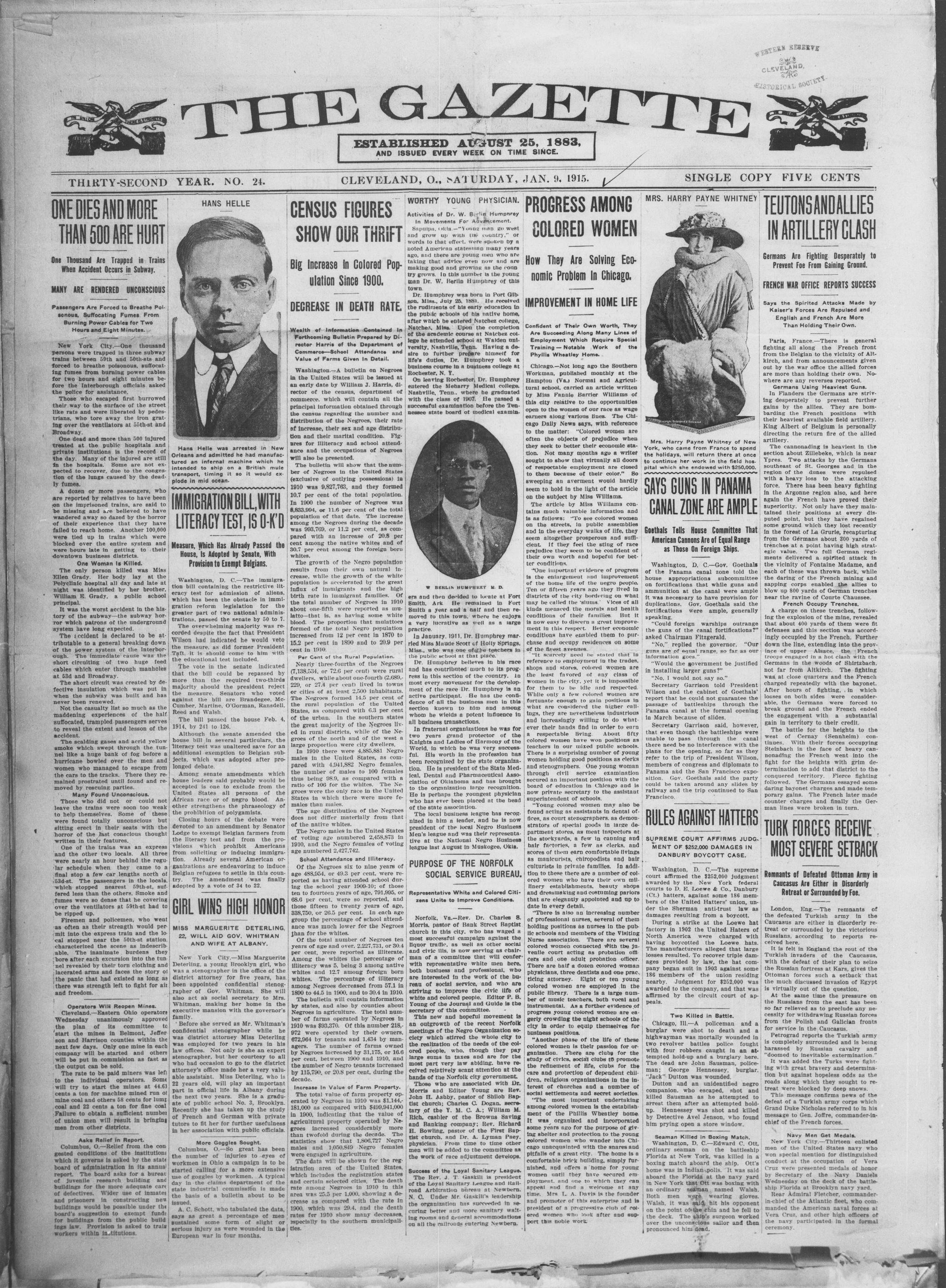
ONE DIES AND MORE THAN 500 ARE HURT
One Thousand Are Trapped in Trains When Accident Occurs in Subway.
MANY ARE RENDERED UNCONSCIOUS
Passengers Are Forced to Breathe Poisonous, Suffocating Fumes. From Burning Power Cables for Two Hours and Eight Minutes.
New York City—One thousand persons were trapped in three subway trains between 59th and 50th sts and forced to breathe poisonous, suffocating fumes from burning power cables for two hours and eight minutes before the interborough officials asked the police for assistance.
Those who escaped first burrowed their way to the surface of the street like rats and were liberated by pedestrians, who tore away the iron grating over the ventilators at 55th st and Broadway.
One dead and more than 500 injured treated at the public hospitals and private institutions is the, record of the day. Many of the injured are still in the hospital. Some are not expected to recover, to the congestion of the lungs caused by the deadly fumes.
A dozen or more passengers, who are reported by relatives to have been on the imprisoned trains, are said to be missing and are believed to have wandered away so dazed by the horror of their experience that they have gone back home. Each train which were blocked over the entire system and were hours late in getting to their downtown business districts.
One Woman is Killed.
The only person killed was Miss Ellen Grady. Her body lay at the Polyclinical hospital all day and late at night was identified by her brother, William E. Grady, a public school principal.
The worst accident in the history of the subway—the subway horror which patrons of the underground system have long expected.
The accident is declared to be attributable to a general breaking down of the power system of the Interborough. The immediate cause was the short circuiting of two huge feed cables which enter through manholes at 163d and Broadway. The cause was created by defective insulation which was put in when the subway was built and has never been renewed.
Not the casualty list so much as the maddening experiences of the half suffocated, trampled passengers serves to reveal the extent and lesson of the accident.
The scalding gases and acrid yellow smoke which swept through the tunnel like a huge bank of fog before a woman who managed to escape from the cars to the tracks. There they remained prostrated until found and removed by rescuing parties.
Many Found Unconscious.
Those who did not or could not leave the trains were soon too weak to help themselves. Some of these were found totally unconscious but sitting erect in their seats with the horror of the last conscious thought written in their features.
One of the trains 'was an express and the other two locals. All three were nearly an hour behind the regiment when they came to a final stop a few car lengths north of 53d-st. The passengers in the locals, which stopped nearest 59th-st, suffered less than the others. Smoke and fumes were so dense that he covering over the ventilators at 59th-st had to be ripped up.
Firemen and policemen, who went as often as their strength would permit into the express train and the local stopped near the 50th-st station, characterized the scene as indescribable. The inanimate burdens they bore after each excursion into the tunnel, revealed by their torn clothing and lacerated arms and faces the story of the panic that had existed as long as there was strength left to fight for air and freedom.
Operators Will Reppen, Mines.
Cleveland—Eastern Ohio operators Wednesday unanimously approved the plan of its committee to start the mines in Belmont, Jefferson and Harrison confines within the next few days. Only one mine in each company will be started and others will be put in commission as fast as the output can be sold.
The rate to be paid miners was left to the individual operators. Some will try to start the mines at 44.63 cents a ton for machine mined run of mine coal and others 68 cents for lump coal. Failure to obtain a sufficient number of union men will result in bringing men from other districts.
Aake Relief In Report
Columbus, O.—Rhelf from the con- cested conditions of the institutions which it governs is asked by the state board of administration in its annual report. The board asks for a bureat of juvenile research building and buildings for the more adequate cart of defectives. Wider use of inmates and prisoners in constructing new buildings would be possible under the board's suggestion to exempt funds for buildings from the public build ing laws. Provision is asked to trai- workers within institutions.
THE GAZETTE
HANS HELLE
Hans Helle was arrested in New Orleans and admitted he had manufactured an infernal machine which he intended to ship on a British-mule transport, timing it so it would explode in mid ocean.
IMMIGRATION BILL,WITH LITERACY TEST,IS O-K'D
Measure, Which Has Already Passed the House, Is Adopted by Senate, With Provision to Exempt Belgians.
Washington, D. C.—The immigration bill containing the restrictive literacy test for admission of aliens, which has been the obstacle in immigration reform legislation for the greater part of two national administrations, passed the senate by 50 to 7. The overwhelming majority was recorded despite the fact that President Wilson had indicated he would veto the measure, as did former President Tatt, it is should come to him with the final vote included. The vote was indicated that the bill could be repassed by more than the required two-thirds majority should the president reject the measure. Senators who voted against the bill are Brandegee, McCumber, Martine, Q'Gorman, Ransdell, Reed and Walsh. The bill passed the house Feb. 4, 1914, by 241 to 126. Although the senate amended the house bill in several particulars, the literacy test was unaltered save for an additional exemption to Belgian subjects, which was adopted after prolonged debate. Among senate amendments which house lawmakers said probably would be accepted one to exclude from the United States all persons of the African race or of negro blood. Another strengthens the phraseology of the prohibition of polygamists.
Closing hours of the debate were devoted to an amendment by Senator Lodge to exempt Belgian farmers from the literacy test and from the provisions which prohibit Americans from soliciting or inducing immigration. Already several American or foreign officials have admitted Belgian refugees to settle in this country. The amendment was finally adopted by a vote of 34 to 22.
GIRL WINS HIGH HONOR
GIRL WINS HIGH HONOR
MISS MARGUERITE DETERLING,
22 WILL AID GOV. WHITMAN
AND WIFE AT ALBANY.
New York City—Miss Marguerite
Deterling, a young Brooklyn girl, who
was a stenographer in the office of the
district attorney, for five years, has
been appointed confidential stenographer of Gov. Whitman. She will also act as social secretary to Mrs. Whitman, making her home in the executive mansion with the governor's family.
Before she served as Mr. Whitman's confidential stenographer while he was district attorney Miss Deterling was employed for two years in his law offices. Not only is she an expert stenographer, but her courtesy to all who had occasion to go to the district attorney's office made her a very valuable assistant. Miss Deterling, who is years old, was part of an official life in Albany the next two years. She is a graduate of public school No. 3, Brooklyn. Recently she has taken up the study of French and German with private tutors to fit her for further usefulness in her association with public officials.
More Goggles Bought.
Columbus, O.—So great has been the number of injuries to aeses of workmen in Ohio a campaign is to be started calling for a more extensive use of goggles by workmen. A typical day in the claims department of the state industrial commission is made the basis of a bulletin about to be issued. A. C. Schott, who tabulated the data, says as great a percentage of men sustained some form of slight or serious injury as were wounded in the European war in four months.
ESTABLISHED AUGUST 25, 1883,
AND ISSUED EVERY WEEK ON TIME SINCE.
CLEVELAND, O., SATURDAY, JAN. 9, 1915.
CENSUS FIGURES SHOW OUR THRIFT
Wealth of Information. Contained in Fortheoming Bulletin Prepared by Director Harris of the Department of Commerce—School. Attendance and Value of Farms Given in Detail.
Washington—A bulletin on Negroes in the United States will be issued at an early date by William J. Harris, director of the census, department of commerce, which will contain all the principal information obtained through the census regarding the number and distribution of the Negroes, their rate of increase, their sex and age distribution and their marital condition. Figures for illiteracy and school attendance and the occupations of Negroes will also be presented.
The bulletin will show that the number of Negroes in the United States (exclusive of outlying possessions) in 1910 was 9,827,763, and they formed 10.7 per cent of the total population. In 1000 the number of Negroes was 8,833,994, or 11.6 per cent of the total population of that date. The increase among the Negroes during the decade was 903,769, or 11.2 per cent, as compared with an increase of 20.8 per cent among the native whites and of 90.7 per cent among the foreign born whites.
The growth of the Negro population results from their own natural increase, while the growth of the white population is accelerated by the great infux of immigrants and the high birth rate in immigrant families. Of the total number of Negroes in 1910 about one-fifth were reported as mulatto—that is, as having some white blood. The proportion that mulattoes formed of the total Negro population increased from 12 per cent in 1870 to 15.2 per cent in 1890 and to 20.9 per cent in 1910.
Per Cent of the Rural Population.
The three-fourths of the Negroes (7,158,534,726 cont) were rural dwellers, while about one-fourth (2,689,229, or 27.4 per cent) lived in towns or cities of at least 2,500 inhabitants. The Negroes formed 14.5 per cent of the rural population of the United States, as compared with 6.3 per cent of the urban. In the southern states the great majority of the Negroes lived in rural districts, while of the Negroes of the north' and of the west a large proportion were city dwellers. In 1910 there were 4,885,881 Negro males in the United States, as compared with 4,941,882 Negro females, the number of males to 100 females thus being 98.0, as compared with a ratio of 100 for the whites. The Negroes were the only race in the United States in which there were more females than males. The number of the Negroes does not differ materially from that of the native whites.
The Negro males in the United States of voting age numbered 2,458,873 in 1910, and the Negro females of voting age numbered 2,427,742.
School Attendance and Illiteracy.
Of the Negroes six to nine years of age 488,954, or 49.3 per cent, were reported as having attended school during the school year 1900-10; of those ten to fourteen years of age, 701,905, or 68.6 per cent, were so reported, and those fifteen to twenty years of age, 383,750, or 26.5 per cent. In each group the percentage of school attendance was lower for the Negroes than for the whites.
Of the total number of Negroes ten years of age and over, 2.227,731, or 30.4 per cent, were reported as illiterate. Among the whites the percentage of illiteracy among Negroes decreased from 57.1 in 1800 to 45.4 in 1900, and to 30.4 in 1910.
The bulletin will contain information about states, and also by counties about Negroes. The total number of farms operated by Negroes in 1910 was 903,370. Of this number 218-972 were operated by their owners, 672,694 by tenants, and 1,434 by managers. The number of farms owned by Negroes increased by 31,175, or 16.6 per cent, between 1900 and 1910, and the number of Negro tenants increased by 117,790, or 20.8 per cent, during the decade.
Increase in Value of Farm Property.
The total value of farm property operated by Negroes in 1910 was $1,144,181,000 as compared with $499,941,000 in 1900, indicating that the value of agricultural property operated by Negroes increased considerably more than the average. The statistics show that 1,806,727 Negro males and 1,050,849 Negro females were engaged in agriculture.
The data will be shown for the registration area of the United States, which includes the registration states and certain selected cities. The death rate among Negroes in 1910 in this area was 29.5 per 1,000, showing a decrease as comcoms of the 1910 rate 29.4, and the death rates for 1910 show many decreases, especially in the southern municipalities.
WORTHY YOUNG PHYSICIAN.
Activities of Dr. W. Burling Humphrey
In Movements For Environment
In movements for Advocacy.
Sapienza, Italy. "Young man go west and grow up with the country," or words to that effect, were spoken by a noted American statistician many years ago. There are them. Taking that advice even now and making good and growing as the country grows. In this number is the young man Dr. W. Herlin Humphrey of this town.
Dr. Humphrey was born in Port Gibbon, Miss., July 25, 1881. He received the rudiment of his early education in the public schools of his native home, after which he entered Natchez college, Natchez, Miss. Upon the completion of the academic course at Natchez college he attended school at Wadon university, Nashville, Tenn. Having a desire to further prepare himself for the job, Dr. Humphrey took a business course in a business college at Rochester, N. Y.
On leaving Rochester, Dr. Humphrey entered the Meharyar Medical college, Nashville, Tenn., where he graduated with the class of 1907. He passed a successful examination before the Tennessee state board of medical examin-
W. BERLIN HUMPFREY M.D.
ers and then decided to locate at Fort
Smith, Ark. He remained in Fort
Smith a year and a half and then removed to this town, where he enjoys a very lucrative as well as a large practice.
In January, 1911, Dr. Humphrey married Miss Maude Scott of Holly Springs.
Miss., who was one of the teachers in the public school at that place.
Dr. Humphrey believes in his race and has contributed much to its progress in this section of the country. In most every movement for the development of the race Dr. Humphrey is an active participant. He has the condidence of all the business men in this section known to him and among whom he wields a potent influence in all business transactions. In fraternal organizations he was for two years grand protector of the Knights and Ladies of Harmony of the World, in which he was very successful. His worth in the profession has been recognized by the state organization, the State Medical Association, Dental and Pharmaceutical Association of Oklahoma and has brought to the organization large recognition. He is perhaps the youngest physician who has ever been placed at the head of the state association. The local business league has recognized him in a leader, and he is now president of the local Negro Business Men's league and was their representative at the National Negro Business league last August in Muskegon, Okla.
PURPOSE OF THE NORFOLK
SOCIAL SERVICE BUREAU.
Representative White and Colored Citizens Unite to Improve Conditions.
Norfolk, Va.-Rev. Dr. Charles S. Morris, pastor of Bank Street Baptist church in this city, who has waged a most successful campaign against the liquor traffic, as well as other social and civic lills, is now serving as chairman of a committee that will confer white privilege both business and professional, who are interested in the work of the bureau of social service, and who are striving to improve the civic life of white and colored people. Editor P. B. Young of the Journal and Guide is the secretary of this committee.
This new and hopeful movement is an outgrowth of the recent Norfolk meetings of the Negro Organization society which stirred the whole city to the realization of the needs of the colored people, who, though they pay large sums in taxes and are for the most part very law abiding, have received relative respect from the Norfolk city governments. Those who are associated with Dr. Morris and Editor Young are Rev. John H. Asbey, pastor of Shibbob church; Charles C. Dogan, secretary of the Y. M. C. A.; William M. Rich, casister of the Browns Saving and Banking company; Rev. Richard H. Bowling, pastor of the First Baptist church, and Dr. A. Lyman Pae, physician. From time to time other men will be added to the committee as the work of race adjustment develops.
Success of the Loyal Sanitary League. The Rev. J. T. Gaskill is president of the Loyal Sanitary League and Italian Arbination bureau at Newbern, N. C. Under Mr. Gaskill's leadership the organization has succeeded in securing better and more sanitary waiting rooms and general accommodations on all the railroads newbern.
PROGRESS AMONG COLORED WOMEN
IMPROVEMENT IN HOME LIFE
Confident of Their Own Worth, They Are Successing Along Many Lines of Employment Which Require Special Training—Notable Work of the Phyllis Whistley Home.
Chicago—Not long ago the Southern Workman, published monthly at the Hampton (Va.) Normal and Agricultural school, carried an article written by Miss Pannie Barrier Williams of this city relative to the opportunities open to the women of our race as wage earners along various lines. The Chicago Daily News says, with reference to the matter: "Colored women are often the objects of prejudice when they seek to better their economic station. Not many months ago a writer sought to show that virtually all doors of respectable employment are closed to them because of their color." So sweeping an averment would hardly seem to hold in the light of the article on the subject by Miss Williams.
The article by Miss Williams contains much valuable information and is as follows: "To see colored women on the streets, in public assemblies and in the everyday walks of life, they seem altogether prosperous and sufficient. If they feel the sting of race discrimination, they be the subject of their own worth and hopeful for better conditions.
"One important evidence of progress is the enlargement and improvement of the home life of the negro people. Ten or fifteen years ago they lived in districts of the city bordering on what may be called the slums." Vices of all kinds menaced the morals and health conditions of their families. But it is now easy to discern a great improvement in this respect. Better economic conditions have enabled them to purchase and occupy residences on some land. "It scarcely need we stated that in reference to employment in the trades, shops and stores, colored women are the least favored of any class of women in the city, yet it is impossible for them to be the title and respected. While only a few colored women are fortunate enough to gain positions in what are considered the higher callings, they are nevertheless industrious and increasingly willing to do whatever their hands find in order to earn a respectable Living. About fifty colored women have positions as teachers in our mixed public schools. There is a surprising number of young women holding good positions as clerks and photographers. One young woman through a career secured an important position with the board of education in Chicago and is now private secretary to the assistant superintendent of schools.
"Young colored women may also be found acting as assistants in dental offices, as court stochographers, as demonstrators of special goods in large department stores, as meant inspectors at the stockyards, a few in canning and hair factories, a few as clerks, and scores of them earn comfortable living as manicurists, chiropodists and hair culturists in private families. In addition to those there are a number of colored women who have their own millinery establishments, beauty shops and dressmaking and costuming parlor that are elegantly appointed and up to date in every detail.
There is also an increasing number of professional nurses, several of them holding positions in public schools and members of the Visting Nurse association. There are several colored women connected with the juvenile court acting as probation officers and one adult probation officer. There are half a dozen colored-woman physicians, three dentists and one practicing attorney. Eight or ten young colored women are employed in the public library. There is a large number of music teachers, both vocal and instrumental. As a further evidence of progress young colored women are eagerly crowding the night schools in the city in order to equip themselves for business positions.
Another phase of the life of these colored women is their passion for organization. There are clubs for study of cities, social clubs to promote the refinement of clubs for the care and protection of dependent children, religious organizations in the interest of churches and a number of social settlements and secret societies.
"The most important undertaking among colored women is the establishment of the Phillis Wheatley home. It was organized and incorporated some years ago for the purpose of giving abetter and protection to the young colored women who wander into Chicago unacquainted with the snarches and pitfalls of a great city. The home is a comfortable brick building, simply furnished, and offers a home for young women to live in. It is a well-appointed employment, and one to which they can appeal and find a welcome at any time. Mrs. L. A. Davis is the founder and promoter of this enterprise and is president of a progressive club of colored women who look after and support this noble work.
MRS. HARRY PAYNE WHITNEY
TEUTONSANDALLIES IN ARTILLERY CLAIM
Germans Are Fighting Desperately Prevent Foe From Gaining Ground
FRENCH WAR OFFICE REPORTS SUCH
Says the Spirited Attacks Made Kaiser's Forces Are Repulsed and English and French Are More Than Holding Their Own.
Paris, France.—There is good fighting all along the French from the Belgian to the vicinity of kirch, and from announcements given by the war office the allied forces are more than holding their own, where are any reverses reported.
Germans Using Heaviest Gun. In Flanders the Germans' are sitting desperately to prevent going by the allies. They are barding the French positions their heaviest available field artillery King Albert of Belgium is person
Mrs. Harry Payne Whitney of New York, who came from France to spend the holidays, will return there at once to continue her work in the field hospital which she endowed with $250,000.
SAYS GUNS IN PANAMA CANAL ZONE ARE AMPLE
Goethals Tells House Committee That American Cannons Are of Equal Range as Those On Foreign Ships.
Washington, D. C.—Gov. Goethals of the Panama canal zone told the house appropriations subcommittee on fortifications that while guns and ammunition at the canal were ample it was necessary to have provision for duplications. Gov. Goethals said the fortifications were ample, generally speaking.
"Could foreign warships outrange the guns of the canal fortifications?" said manhattan Fitzgerald.
"No." replied the governor. "Our guns are of equal range, so far as our information goes."
"Would the government be justified in installing larger guns?"
"No, I would not say so."
Secretary Garrison told President Wilson and the cabinet of Goethals report that he could not guarantee the passage of battleships through the Panama canal at the formal opening in March because of slides.
Secretary Garrison said, however, that even though the battleships were unable to pass through the canal there need be no interference with the plans for the opening, so far as they would be on the trip of President Wilson members of congress and diplomat of Panama and the San Francisco exposition. Gov. Goethals said the party could be taken around any slides by railway and the trip continued to San Francisco.
RULES AGAINST HATTERS
RULES AGAINST HATTERS
SUPREME COURT AFFIRMS JUDGMENT OF $252,000 DAMAGES IN DANBURY BOYCOTT CASE.
Washington, D. C.—The supreme court affirmed the $252,000 judgment awarded by the New York courts to D. E. Loewe & Co., Danbury (Ct.) hatters, against some 168 members of the United Hatters' union, under the Sherman anti-trust law as damages resulting from a boycott.
During a strike at the Loewe hat factory in 1902 the United Haters of North America were charged with having boycotted the Loewe hats. The manufacturers alleged that large losses resulted. To recover triple damages provided by law, the hat company began suit in 1905 against some 186 members of the Loewe hat company nearby. Judgment for $252,000 was awarded to the company, and that was affirmed by the circuit court of appeals.
Two Killed in Battle
Chicago, Ill.—A policeman and a burglar were shot to death and a highwayman was mortally wounded in two revolver battles police fought with four robbers caught in an attempted hold-up and a burghur here. The dead are John Sauman, policeman; George Hennessey, burglar; "Jack" Dutton was wounded. Dutton 'and an unidentified negro companion, who escaped, shot and killed. Sauman as he attempted to arrest them after an attempted hold-up. Hennessey was shot and killed by Detective Avel Jenson, who found him prizing open a store window.
Seaman Killed in Boxing Match
Washington, D. C.-Edward C. Ott, ordinary seaman on the battleship Florida at New York, was killed in a boxing match aboard the ship. Ott's home was in Indian-polis. It was said aboard the Florida at the navy yard in New York that Ott was boxing with an ordinary sailman, named, Walsah. Both men were wearing gloves. Walsh, it was said, hit his opponent on the point of the chin and he fell to the deck. The ship's surgeon worked over the unconscious sailor and then pronounced him dead.
EAGLE
TEUTONSANDALLIES IN ARTILLERY CLASH
Germans Are Fighting Desperately to Prevent Foe From Gaining Ground.
FRENCH WAR OFFICE REPORTS SUCCESS
Says the Spirited Attacks Made by Kaiser's Forces Are Repulsed and English and French Are More Than Holding Their Own.
Paris, France.—There is general fighting all along the French front from the Belgian to the vicinity of Alkirch, and from announcements given out by the war office the allied forces are move than holding their own. Nowhere are any reveres reported. Germans Using Havelous Units. In Flanders the Germans are striving desperately to prevent, further gains by the allies. They are bombarding the French positions with their heaviest available field artillery. King Albert of Belgium is personally directing the return fire of the allied artillery.
The cannonading is heaviest in the section about Zilbeke, which is near Ypres. Two attacks by the Germans southeast of St. Georges and in the region of the dunes, were repulsed with a heavy loss to the attacking force. There has been heavy fighting in the Argonne region also, and here again the French have proved, their own forces. Not only have they maintained their own positions, but they have regained some ground which they lost recently in the forest of La Grurle, recapturing from the Germans about 300 yards of trenches at a point having high strategic value. Two full German regiments delivered a spirited attack in the vicinity of Fontaine Madame, and each of these was thrown back, while the daring of the French mining and sapping corps, enabled the allies to blow up 800 yards of German trenches near the ravine of Courte Chaussee. A charge on these trenches, following the explosion of the mine, revealed that about 400 yards of them were fit defenses and this section was accordingly occupied by the French. Further down the line, extending into the province of upper Alsace, the French troops, engaged in a hot clash with the Germans in the woods of Shirtzbach, not far from Altkirch. The fighting was at close quarters and the French were able to capture the bayonet. After hours of fighting, in losses on both sides were considerable, the Germans were forced to break ground and the French ended the engagement with a substantial gain in territory to their credit.
The battle for the heights to the west of Cernay (Sennheim) continues. With their forces occupying Stelnbach in the face of heavy cannonading the French went into the fight for the heights with grim defenses. The district to the conquered territory was Fleiss followed. The Germans essayed some daring bayonet charges and made temporary gains. The French later made counter charges and finally the German lines were broken in turn.
TURK FORCES RECEIVE
MOST SEVERE SETBACK
London, Eng.—The remnants of the defeated Turkish army in the Caucasus are either in disorderly retreat or surrounded by the victorious Russians, according to reports received here.
It is felt in England the rout of the Turkish invaders of the Caucasus, with the defeat of their plan to seize the Russian fortress at Kars, gives the Ottoman backtrack that the much discussed invasion of Egypt is virtually out of the question.
At the same time the pressure on the Russians from the east has been so far relieved as to preclude any necessity for withdrawing Russian forces from the Polish and Gallican fronts for service in the Caucasus.
Petrograd reports the Turkish army is completely surrounded and is being harassed by Russian cavalry and "doomed to inevitable extermination."
It was added the Turks were fighting against and determination but against hopeless odds in the roads along which they sought to retreat were blocked by deep snows.
This message confirms news of the defeat of a Turkish army corps which Grand Duke Nicholas referred to in his message to Gen. Joffre, commander-in-chief of the French forces.
Navy Men Get Medal.
New York City.-Thirteen enlisted men of the United States navy who won special mention for distinguished conduct at the occupation of Vera Cruz were presented medals of honor by Secretary of the Navy Daniels Wednesday on the deck of the battleship Florida at Brooklyn navy yard. Rear Admiral Fletcher, commander-in-chief of the Atlantic fleet, who commanded the American naval forces at Vera Cruz, and other high officers of the navy participated in the formal ceremony.
One Year.....$1.50
Six Months.....1.00
Three Months.....50
Subscribers are requested to re-
mit by postoffice money or-
der or registered letter
Entered at the postoffice in Cleveland,
Ohio, as second-class matter.
Address all communications to
HARRY C. SMITH
Editor and proprietor,
THE GAZETTE,
Blackstone Building, Cleveland, O.
Member Ohio Legislature: 1894
to 1896; 1896 to 1898; 1900 to 1902
THE GAZETTE is the oldest, and has the largest bona fide circulation, double that of any newspaper in the interest of Afro-Americans, published in the state of Ohio, and comparison with any will immediately establish its rank as one of the NEWSIEST AND BEST in the country.
10,000,000 Afro-Americans..
160,000 in Ohio.
20,000 in Cleveland.
SATURDAY, JANUARY 9, 1915.
We still believe that Leo M. Frank will pay the penalty of his crime, regardless of the recent respite given him by U. S. Supreme Court Justice Lamar.
We want to warn our barbers of Ohio that the executive board of the Ohio Federation of Barbers (white) have announced their intention to make another supreme effort to secure the enacting of a license law by the Ohio assembly. A new bill is to be introduced soon. The organization claims a membership of 7,000, and unless our barbers "get busy" at once and organize for the "battle," they will not have the success won in the past.
1914 LYNCHING RECORD.
Fifty-two persons were lynched, last year, in this country, of whom forty-nine (three women, one only seven teen years old) were Afro-Americans. Of the total, 24 per cent of the lynchings were in the two states of Mississippi and Louisiana. This pre-eminence is an old story for Mississippi but a new one for Louisiana. In 1913 the former state was guilty of more of these offenses than the other, while Georgia came second. Of the fifty-two lawless executions recorded, only seven en—two white and five colored—were of men accused of crimes against womankind. The 1914 record shows an increasing tendency to lynch for any cause, however trivial, and also to disregard sex. In plainer words, the old pretense upon which lynchers formerly tried to excuse their heatenish activity has been largely abandoned by the new generation of lynch-murderers. These latter day criminals are franker; their madness ignores logic and everything else. They slay because they like to slay, and, too, in the face of the fact that not one of the Afro-Americans lynch-murdered ever receives anything that even savors of a trial, to say nothing of a fair one, something practically unknown in the Southland. North Dakota and Oregon, each with one to its discredit, were the only northern states in the total of fifteen that disgraced the country with lynch-murders, last year. Some years ago, there were only 50 or 51 lynch-murders in a single year. So last year's lynch-record and that for 1913, which was the same, as to the total number, came very near being the minimum record to date.
ANOTHER SOUTHERN "THRUST."
Last week, Thursday, by a vote of 29 to 25, the upper house of Congress adopted Senator Reed of Missouri's amendment to the immigration bill excluding from the United States, "all Negroes or other members of the black or Negro race." As the bill minus the Reed amendment and others, had passed the lower house of Congress, it was sent to a committee on conference made up of a committee by the same name of both branches of that August body. The Reed amendment is only another of the many miserably malicious thrusts at our people, made by representatives in Congress from the south, ever since Democracy gained control of that body. There are comparatively few Negro immigrants—not nearly enough to justify such contemptable Democratic national legislative action, and it is to be sincerely hoped that sufficient pressure can be brought to on that joint conference committee to have the Reed amendment rejected. If this proves impossible, then our only hope lies in a fight in the House of Representatives and, if it falls, in President Wilson's veto of the bill, which many daily newspapers have been predicting, on the ground that he once before voiced an immigration bill containing the same literacy test the present one has. And if he vetoes the bill, it will be because of his consideration for white, and not Negro immigrants. We are greatly pleased (and yet not surprised, because we expected it) to note that Congressman Frank B. Wills, Ohio's governor-elect, says that he is "bitterly opposed to the reed amendment" and that he will lead the fight in the National House of Representatives against it if the matter reaches that body before he resigns as a member to take up his duties as governor. Should Southern Democrats see that there is no hope of winning on a roll-call, this week Thursday, it is likely that the House will formally disagree to the Senate amendments and ask a conference in that case the debate on the Reed amendment is not likely to come up in the house before Mr. Willis ceases
his membership, which will probably be today. This would prove unfortunate indeed, but surely there is at least one other white friend in the House who will be manly enough to take up the fight where Mr. Willis leaves off. Our people in Massachu-
PETER H.
Gov.Elect Frank B. Willis. setts and other northern states must act quickly and find our aggressive friends in the lower house of Congress from their states and invoke their aid in this matter.
ADDITIONAL LOCALS:
The Optimistic club of Zion A. M. E. church, did some commendable work for the poor during the holiday season.
Robert Johnson, 25, 1382 E. 110th St., teamster, and Lillian Smith, 18, 1982 E. 120th St., were married, the first of the week, by Rev. W. M. Page, pastor of Mt. Zion Baptist church.
Do not fail to read, and call your friends' attention to, Klein & Grossman's advertisement elsewhere in this paper today. Here is a splendid opportunity! They make clothes that fit and guarantee them to do so. It is an old established business, too. Be sure to note their special offer. It will not last long. -Ady.
The New Year reception, given at Mr. and Mrs. T. J. Hicks', E. 74th St. by St. John's stewardess board, was a very successful and pleasing afair. Musical numbers were rendered by Mr. Hicks, Miss Olive Wells, Mr. Hancock, Alex Taylor and others
Send or bring locals and all business matters to The Gazette's offices suite 2. Blackstone Bldg. If you wish to see the editor call there, please All matters for publication in current issues of The Gazette, must be in the office by 4 p. m., WEDNESDAY at the latest.
---
The Tuesday Afternoon Thimble club held a profitable meeting at Mrs. Saul Lucas', Tuesday. Miss Bessie Cook, Miss Olive Wells and Mr. Nolan were among those who made the musical program at St. John's church, so pleasing, Sunday evening.
* * *
Thirty Afro-American orphans recommended by the Juvenile Court and Associated Charities were treated in the Phillips Wheatley home recently. Turkey furnished by Mrs. C. E. Morgan thaler (white) and candy and toys from the young ladies of the home, were thoroughly enjoyed by the little ones. Miss Jessie E. Hunter, secretary of the Association, presided.
WOULD PROVE BEST FRIENDS
Of the Race If Given the Ballot—
Woman Suffrage in *Oregon*
Ohio's Greatest, Wisest Son,
the Next, President.
Hon. Harry C. Smith, Dear Sir:—see by the Gatette that you spoke in September last, in Lebanon, Ohio That is the county seat of my native county—dear old Warren; and Lebanon! the "City of Cedars." It has been many a long year since I saw hen shaded streets.
I want to compliment you on your editorial head, "We beat 'Em". It is a shame to see men so narrow. They play the dog in the manger. Half of them fall to vote, yet they don't want the women to do so. If they don't want the women to be to the Republican fold. For ten years or more, ever since the populist document of the "Initiative and Referendum", etc., were fixed on Oregon, the Republicans have quarreled and fought each other while the Democrats have been united, with the result that all the big offices were filled by Democrats, though Oregon is normally Republican. This year the women voted; to be sure, the Democrats have everything. The better class of men were willing to enter the primaries, trusting to the women, and the worse ones dared not for fear of the women. Then, the women pledged every man who asked their support, to abide by the decision of the primary election and support the nominee. The full Republican ticket was elected, except the women who were elected to win will beat Chamberlin. The women would prove the best friends the Afro-American has, I believe. The irresponsible ones will not vote, they don't want to. It isn't fun, and the ones who do, will be the thoughtful, earnest ones, who, believing the power, to use the conferred power, will study the Constitution, their ballots as answering to God for the use of the franchise. What has any honest man to fear from such?
What a disgrace it is on Ohio that she failed to nominate her greatest, wisest son (Joseph Benson Foraker) when she had the opportunity. May be she will not "see goblins" next time. Perhaps the good God means that she will be WV HW. What a perfect President he will make. If Afro-Americans or any other Americans come to him with a grievance, they will not be treated like bad school-boys by a pompous teacher (President Wilson), fearful for his own dignity. I think I'd want to kneel, for twenty minutes in an office in the good God, if could see him at the head of the nation.
Washington, D. C., Jan. 2, 15.
Editor Gazette, My Dear Sir:—Enclosed please find Post office money order for $1.50 for The Gazette, an other year. May this new year, 1915 bring much happiness to you and to our people at large.
THE GAZETTE, CLEVELAND, O. SATURDAY, JANUARY 9, 1915
FRESH OHIO NEWS
THROUGHOUT THE STATE
What Our People Are Doing Each Week—Church, Personal, Social, Lodge, Literary and Musical — Marriages, Deaths, Etc.
COLUMBUS—William Monroe Trotter of Boston, editor, spoke in the Chamber of Commerce Auditorium, last week Tuesday evening. His speech was a fight from beginning to end against segregation. Mr. Trotter said that, "the Negro is fighting for and as long as segregation exists endure not be grasped." He plainly fought foreigners who come to this country, as a rule, consider us far inferior, as a native people of this country.
CORRESPONDENTS must mail all letters for publication at their mailers postoffice sufficiently early on Monday (or Sunday) of each week to have them reach The Gazette office on Tuesday morning, and always write also, their names and that of their names, and on the outside of the wrapper about receiptless this latter is done, proper credit cannot be given you. Lists of names, wedding presents, etc., obituary notices, speeches, resolutions, poetry, inquiries for relatives and advertisements of all kinds, including items amusing entertainment to be held in advance at the rate of ten cents a line, six words to a line. Our rates for display advertisements will be sent on application. Send postal note and not stamps during warm weather
AKRON.—Mrs. Scott of College St. was found dead by her husband about 10 p. m., Sunday. When he left Sunday morning she was apparently in good health.—Miss Eva Paris is able to be out after three weeks' illness. Rheumatism.—Mrs. Richard Jones is able to be up after four weeks' illness.—Mrs. J. P. Christian entertained the Junior B. Y. P. U. New Year's. All reported a pleasant time. Mr. Julius Johnson spent New Year's visiting relatives in Wooster.—Miss Margaret Lyons entertained Miss Scott of Cleveland, at an afternoon tea, Thursday. Mr. Julius Johnson has come to his home. Very ill.—Mr. Frank Johnson was baptized at the Second Baptist church. Sunday morning. Mr. S. Calaway has gone home to Chattanooga Tenn., to spend the winter. Mr. George Jones of Cleveland, was here Thursday, visiting his brother, Richard Jones.—Mrs. R. B. Lee will entertain, Thursday, from 8 to 12.
OBERLIN—Community Xmas tree exercises exercised New Year's night. On account of the bad weather, Tuesday afternoon. Rust M. E. and Mt. Zion choirs joined with the other choirs and sang. Thursday evening. School children, churches, as well as the community in general, participated. Every evening was well attended.—The students and town-folk, spending the vacation elsewhere, have returned.—Dec Cotton and Cotton of Henderson N. C. Rev. Cotton to talk in "The Little Things," in the evening at Mt. Zion church. Rev. Cotton has been spending a few days at Ms. Blanche Jones.—After a trial of eight weeks, the night school will open. Jan. 11, in hopes of another successful eight weeks.—Watch-meeting, at Mt. Zion church, New Year's eve.—An eight-day meeting, Jan 10-17, will be held at Rust M. E. church. Rev. Joseph Courtney, dist. supt., will preach, Thursday and Friday evenings, and will conduct communication service, Smyth's School, at Halleen left, Saturday, for home. His sister is seriously ill.—Harry Harris has been visiting 'his home in Birmingham. Ala.
LEBANON—Mr. and Mrs. Sidney Lanen entertained New Year's eve Seventeen guests present.—Mand Tibbles and Jessie Morton are visiting Mr. and Mrs. Gonie Thomas of Miamisburg—Rev. Martin of Oxford assisted Rev. D. C. Ross. Sunday—Mr. and Mrs. J. T. Henderson entertained New Year's at a five-course dinner. Twenty guests were present.—Miss Florence Gray is seriously ill.—Arl Blesses an examination, last week. For Punishment, last Penn. Line—Mr. and Mrs. Frank Morgan served dinner for a few friends, last Sunday.—Mr. and Mrs. James Schooler had as guests, last Sunday, Mr. and Mrs. Sam Raglin, Mr. and Mrs. Julius Phoenix and Miss Anna Morgan.—Mrs. Elizabeth Williams and daughter spent Sunday with Mr. and Mrs. P. A. Morton.—Mrs. Ed Grimmes is very ill.—Mrs. Davis gave a birthday party in honor of her Remond, age 9. Mr. Olive Clemens sprained his ankle severely.—Mr. and Mrs. Williams of Waynesville, visited her parents here, last week.—Miss Susie Pettis is convalescent.
SANDUSKY.—The churches were both well attended, Sunday. The Secd. on Baptist S. S. elected all the old officers: Mrs. Mary Jones, supt.; Miss Harriet Alexander, sec.; J. R. Davis, treas. The secretary reported school-money,$127. The banner class for 1914, No. 3. The piano debt $21. The B. Y. P. U. elected officers: Miss H. Alexander, pres.; Miss E. Gilkerson, vice; Mrs. B. Thompson, sec., and Mr. John Shadd, treas. A great spiritual wave is over the Secd. on Baptist church, and the pastor, Mrs. D. Smith. He will be in shape for a revival meeting, though he has been suffering with rheumatism, this winter.—A banquet was given by the young people in honor of Herbert Wallace and Roy Smith, who have been attending school at Oberlin, at Misses Emma and Lily Gilkerson's, Monday night.—Miss Beatrice Shackelford is ill—Mrs. Gordon, who is stopping at Mr. and Mrs. Chas. Taylor's, is much better. Rheumatism.
CADIZ.—Misses Caroline Lucas and Bertha Ramsey were in Steubenville, last week—Mrs. Minnie Robinson, Mrs. Hood and Miss Reba West of Massillon, were guests of Mrs. Alex. West. New Year's.—The 24th annual banquet given by the Masonic Lodge
on New Year's evening was largely attended. Those present from out-of-town were: Messrs. Clark, Kenney, Faithful and Alexander, Bridgeport; Mrs. J. B. Faithful and daughter, Miss Alice, Messrs. Hawley and Marion and Miss Wilma Kenney, Harrisville; Mr. and Mrs. Wilma its Stewart, Mr. and Mrs. Orris Munz and Mr. Ed. Cole, Flushing.—Francis Tler was in Zanewille, last week.—Noble Mason spent a few days in Steubenville, recently.—C. I. C. club gave a mock church trial at the A. M. e church, the 31st ult.—Misses Georgia Duling and Hattie Lucas entertained the H. H. club. The Mystic Six and many others, on the Ballard attended the State Examination at Columbus, last week, and was granted a life-certificate.—The Greenleaf club gave a reception, New Year's Day, from 2 to 5 p. m., at Mr. and Mrs. C. H. Christian's. Forty guests, present: Class No. 1 held a masquerade social, the 28th, at Mrs. Anna Redmond's. Miss Wilma Kenney of Harrisville, was the guest, a few days, of Miss Clara Stewart.—Miss Lucille Alexander spent, last week, in Fernald's six o'clock dinner, last Thursday evening, in honor of Mrs. Wm. Burt of Newark. Covers were laid for ten.—Misses Hattie Lucas and Georgia Dulling received thirty friends, last Tuesday evening at Miss Lucas'. The rooms were beautifully decorated with holly and other holiday trimings. The evening was spent in music and singing. An elaborate dinner was served. The out-of-town guests were: Mrs. Wm. Burt of Newark, misses Bertha Ramsey of Akron Laura White of Wilberforce University and James A. Johnson of Warren
MANSFIELD.—A banquet was given the high school graduates. Mr. T. Davis was one of the number. He has gone to Wilberforce University. Mr. Espy was caterer (at the "Southern").—Mrs. A. Spencer entertained the following during the holidays: Mrs. C. Brock and Miss Ida Beaumont of McIntyre, Mrs. B. Beaumont and daughter, Lillian, and Messrs. Bell and Beaumont.—Rev. C. W. Ford and family, received a 300 lb. hog from the farm at McIntyre. Misses Carrie and Effie Ford, formerly of McIntyre, have joined their parents here. Mrs. H. West also spent the holidays with her parents. The following persons were entertained by Mr. and Mrs. B. Dunmor, Mrs. B. Beaumont and daughter, Lillian, and Mrs. W. Smith and daughters of Palmiesville; the Tandy sisters of Toledo; Mrs. H. West of McIntyre; Mrs. C. Miss Pleasants; Mrs. H. Grant and daughter; Messrs. E. Dunmor, T. Davis, J. Hamilton and M. Duckett, Mr. R. W. Hamilton and Mrs. Johnson of Delaware, were guests of Mrs. Fisher — S. A. Blaine of Fostoria is back at the "Southern" and may loane ladies to ice cream to the entertainment in R. P. Hall.—Mr. Dunnmore was caterer for the Elks' annual banquet, Thursday evening, and was assisted by Messrs. Brecinbridge, Bell Hicks, Davis, Hamilton and Ford.—C. A. Davis will serve a banquet, Jan. 7, at the factory, for the travelling men of the firm. He is the travelled manager of the firm. Mr. and Mrs. H. Hamilton of Shelby, Mrs. W. Patterson of Nashville, Tenn. were guests of Mr. and Mrs. B. Dunmore.—The Tandy sisters played their violins for Mr. and Mrs. W. Bushnell and were highly complimented.—The A. M. E. revival was begun with a week of prayer. The entertainment at the church was enjoyed by a large number of the pastor. A Christmas program was given, Monday evening, by the A. M. E. primary class. The church was attractively decorated by Mr. Bell and Mr. Kline acted as "Santa Claus." Mrs. Fisher gives liberally to the A. M. E. church. Mr. Crockett acted as her proxy, recently.
YOUNGSTOWN—Mr. Reuben Howard, ard. died, Sunday, was buried from Emerson Chapel, Tuesday. He leaves a wife and two sisters—Mr. and Mrs. Paynter entertained at dinner. New Year's, his father, Mr. E Nickens, Mr. and Mrs. E. Jones, Mrs. F. Mayfield and children of Bellaire, Mrs. Clarence Biggs accompanied her daughter, Mrs. Mayfield, home for a few weeks visit—The Mutual club dancing party, New Year's, was an annual event. Mrs. Mayfield was in Pittsburgh this week—Mrs. Wm. Milton was organist for the A. M. E. choir, Dec. 13, at the Els' memorial excercises, and sang two solos—Mr. Wm. Logan, veteran mall-carrier, had a fall two weeks ago and does not convalesc rapidly—W. P. Stamps is improving after four weeks' suffering from rheumatism—Mrs. H. G. Emerson returned from the west, last week—Mr. and Mrs. Geo. Rideout entertained Mr. and Mrs. Thos. E. Greene, jr. and Mrs. Wm. Honesty, Sunday afternoon, in honor of the latter's graduation, from Mrs. Greene and Mr. and Mrs. Hiram Keys of Ashtabula, were week-end guests of Mr. and Mrs. Greene—After all is said, the fact remains that "the old reliable" Gazette is our best race advocate and newspaper. Give the local agent your order for a copy every week and keep up to date.
SPLENDIDLY RECEIVED
In the "Windy City"—Editor Trotter Delivers a Number of Addresses and is Royally treated by the Loyal of the Race There.
Chicago, Ill.—A great meeting at Bethel church, Thursday evening, which heard and applauded Editor Wm. Monroe Trotter as he related the anti-segregation protest of the N. I. E. R. league, a fit climax to a remarkable reception given the spokeswoman of the segregation movement, beginning with a splendid meeting in the famous Orchestra hall on New Year's eve at the emancipation celebration of the Nexro Fellowship league. Saturday night, a reception was tendered Mr. Trotter by President Frank Hamilton at the Appomattox club. On Sunday, he was heard at Walters A. M. E. Zion church, in the morning; at Grace Presbyterian S. S., at Frederick Douglass Centre, at the N. E. league where a Chicago branch of the N. I. E. R. league with an enrolled member of the church and an enrolled member given the edited and finally at Quinn chapel at night. In every instance verbal and substantial encouragement was given. Friday night, Mr. Trotter spoke in St. Paul, Minn. His Chicago address is 2234 Rhodes Ave., with Mrs. Ida B. Wells-Barnett whose guest he is while in this city. He will return here from St. Paul en route east.
Success to "The Gazette."
Washington, D. C. Jan. 2, 1915.
Dear Brother Smith. — Success and a prosperous year to you and The Gazette is the earnest wish of Yours truly.
J. Milton Wuldron.
If you knew
Nelson's Hair Dressing as we do
you would never use anything
else on your hair.
We want you to know it—
know it personally by actual use,
don't take our word for it, or any-
one else,—test it yourself.
You can do this,
send us your name and address
and we will send you,
Free of cost,
a sample box of Nelson's Hair
Dressing, also a sample of Nel-
son's Scalp and Hair Cleaner and
a sample cake of Nelson's Skin
and Complexion Soap.
Test them
in your own home, if they are
not what we claim, you are not
out anything.
We have confidence
in them and are ready and anx-
ious to prove every claim we
make.
Write to day,
enclosing two cent stamp to pay
postage on samples.
NELSON'S
HAIR DRESSING
25¢
50¢
Has no superior as
a hair beautifier.
Thousands of men and
women have improved the
appearance of their hair by
using NELSON'S HAIR
DRESSING.
For those who know—it
is a toilet necessity.
Why not try it yourself?
Ask your druggist. If he
cannot supply you, send us
his name and address and we
will send you a free sample.
NELSON MFG. CO.
RICHMOND, VA.
THE
NELSON
GIRL
Are you satisfied with your
hair?
Is it as long as it should
be?
Is it soft and glossy and
full of life?
Can you comb it out easily
or is it full of tangles?
Are you proud of your
hair?
The Answer
Is:
NELSON'S
HAIR DRESSING
25¢
50¢
NELSON MANUFACTURING CO.,
Richmond, Virginia
DOINGS OF THE RACE
Zion A. M. E. church raised $100,000 last year. Another white man, at Seneca, S. C., killed an Afro-American "for keeping company" with his colored woman. He was killed with his $7,500 building in St. Paul, Minn. Boston Clay of Muscatine, Iowa, has invented a triple button cutting machine. It has been patented and is now handled by an eastern syndicate. Within five years since its organization, The Royal Circle of Friends of Helena, Ark, has enrolled a membership of 20,000 in nine States and paid $10,000 in fees. Their ceased over $200,000, Dr. R. A. Williams is Supreme President.
Charles H. Watkins, a young man of the race, is said to be one of the best salesmen employed by the Story and Clark Piano Company of St. Louis, Mo. His sales for last year exceeded $80,000 and entitled him to the annual bonus of $150 offered by his company, which he received in 1914 in fifteen States as follows: Alabama; 2; Arkansas; 1; Florida; 4; Georgia; 2; Louisiana; 12; Mississippi; 12; Missouri; 1; New Mexico; 1; North Dakota; 1; North Carolina; 1; Oklahoma; 3; Oregon; 1; South Carolina; 4; Tennessee; 1; Texas. 6.
Associate Justice of the Supreme Court of Liberia, Africa, T. McCants Stewart, or former of Brother, 10 has been removed from the office by the legislative branch of the government of that republic.
Three of those lynched last year were women. One of them was only seventeen years old, and was charged with killing a man who had outraged her. Another of the women was accused of killing a man who had outraged while the third and her husband were charged with setting fire to a barn. In the presence of their four-year-old child they were put to death.
The mutual aid department of the U. B. F's of Texas' receipts for the last quarter of 1914 were $22,000, $21,000 of which were set aside to settle mortuary claims for that period. The Texas order has $34,000 invested in building a bond first mortgages and deposited in savings departments of national banks. Every time a Colored man or woman, especially one of respectable dress and appearance, voluntarily patronizes a "jim-crow" theater, roller-rink or other place of amusement, he or she gives impetus to the spirit of segregation which is fast descending upon the city. He is into a slavery as cruel as any in the history of the world.—Louisville (Ky). News.
CORRESPONDENTS WANTED.
The old reliable Gazette desires an active agent and correspondent in every city and town in Ohio and neighboring states having a number of Afro-American residents. Only a little time on Fridays or Saturdays is required.
We are always desirous of hearing from persons in the following named cities: Zaneset, Newark, Palm Beach, Wilmington, Milwaukee, Troy, Canton, Springfield, Pleasant, Columbus, Cambridge, Steubenville, Bellaire, St. Clairsville, Portsmouth, Washington C. H., Oxford, Sabina, Galinolins, Rendville, Urbana, Delaware, M. Ternon, East Liverpool, Wellsville, Akron, Dayton, Middletown, Bellefontaine, Lima, O., and other places where we have none.
Write to the editor of the Gazette Blackstone building, Cleveland, O, and to the editor of our promptly. Our readers will oblige us greatly by sending at once the addresses of persons in the cities named above, or others, to whom we can write relative to the matter.
Perhaps He Had None.
A fellow has his face shaved, hair cut, shoes polished, clothes pressed and hat brushed, then pays no attention whatever to his dilapidated conscience.—Toledo Blade.
Why not become a Hair Dresser? This is your chance. We will set you up in the business. We will send you the Milpark Course in Hair Dressing give you a Diploma from our school and furnish you with our Complete Hair Dressing Outfit. All this for Loe small sum of $5.50. Hundreds of satisfied graduates all over this country are earning big Money with our Outfits. Why not you? Write today, do not delay.
MILPARK SCHOOL OF HAIR DRESSING,
EDENTON, N. C.
QUINADE
GROWS HAIR
REMOVES DANDRUFF
SEND FOR SAMPLE
QUINASOAP
THE IDEAL SHAMPOO SOAP
THOROUGHLY CLEANSSES THE SCAP
QUINACOMB
HAIR STRAIGHTENER
SHAMPOO DRYER
QUIMADE 25¢ QUINACOMB 50¢ QUINASOAP 25¢
AT ALL DRUGGISTS
SEEBY DRUG COMPANY, NEW YORK CITY. N.Y.
The Beer for home use MUST be pure GOLD BOND BEER
Is absolutely guaranteed and is bottled under Government supervision by The Cleveland & Sandusky Brewing Co West 785 Central 3933
Taylor's New Shampoo Dryer and Hair Straightener!
The Best in the World!
This Comb, properly heated, and the use of LaCrete Hair Pomade, will bring the most crimpy hair straight and silky at every stroke and cause a rapid growth of the hair.
Don't put it off but send $1.06 today and get the comb by return mail.
PRIOE OF COMB $1.
Large, Heavy Strong and Durable. Made of copper and brass associated together and cast in wide pieces. Heavy polished and nickel plated. steel bolt which goes through the large wood handle and screws into metal end. End protects the hair. Front grip loops or coming off. Remember it all in one piece. Nothing to set of order, will last forever.
Price of Hair Straightener and Alcohol Heater complete $1.50.
TAYLOR'S SPECIAL ALCOHOL HEATER is the handiest and most convenient method of heating the Comb, and can be closed up so that you can put it in your hand bag. Price 800. For best regimen use la Coccinella Hair Pomade. It not only meets every requirements of the Comb Straightener, but promotes a luxurious growth of the hair. Price 25c.
SEND FOR MY FREE CATALOGUE Illustrating the Largest and Most Complete Line of Hair Goods in this country for colored people, such as Bangs, Wigs, Puffa, Switches, Pomadour, Hair Pins, Combe, Brunches, etc.
Agents Wanted.
T. W. TAYLOR, Howell, Mich.
When writing please mention this paper.
2742 Central ad. cor., E. 28th St. Cut this ad. out and present it this down. Bring Go. and receive a liberal trial size of B. AND M. HAIR DRESSING AND TONIC. This dressing is especially recommended where the hair is stubborn or curly, as it not only makes the hair soft, glossy and straight, but also easy to dress. B. AND M. HAIR DRESSING is elegantly perfumed; has a very beneficial effect on the hair and is a splendid hair-grower. DON'T FORGET THAT WE HAVE BUT ONE STORE, AND THAT IS at E. 28th St. and Central Ave.
A Complete Line
DRY GOODS, LADIES' AND GENTS
FURNISHINGS
J. LOMSKY
3816 and 3820 Central Ave.
Double Stamps on Tuesdays and
Fridays.
STERLING
5 and 10 Cent Store
3003 Central Ave.
Watch Our Windows
For Bargains
Colored Salesladies
Arlington Pharmacy
WE WILL ACCEPT THIS ADVERTISEMENT FOR FIVE CENTS IN TRADE, TO APPLY ON ANY PURCHASE OF TWENTY-FIVE CENTS OR MORE.
E. Rukenstein, Ph. C., Prop.
S. W. Cor. Central Ave. & E.
55th St.
The Fifteenth Annual Session of the
State Summer School
for Colored
TEACHERS OF BOTH SEXES
at the
GREENSBORO, N. C.
will begin June 29th, 1914, and continue five weeks.
In addition to the regular work, an attractive lecture course has been arraged, in which will appear some of the most distinguished white and Colored educators in the country.
Board and lodging for the entire session $12.00. Tuition 25c per subject unless other arrangements have been made.
Limited accommodations. Send $1 and have room reserved in advance.
For further information write a once to
James B. Dudley, President, or
D. J. Jordan, Director,
A & M. College, Greensboro, N. C.
THE PEOPLES' DRUG STORE
F. H. WEAVER, PHARAOHS 59,
Cor. Central Ave. and E. 33d St.
Agent for
"HIGH BROWNIE THE POWDER"
WE GIVE TRADING STAMPS,
MONEY ORDERS, NEWSPAPER
ADS, TELEGRAMS.
Cuy. Central 6661-L
G. G. REED
Dry Goods
Ladies' and Gents' Furnishings
Solo agents for the
AMERICAN LADY NEMO
R. @ G. CORSETS
3222 Central Ave.
Rubber Constantly In Demand.
Semi-official estimates made in India of the world's production of rubber for several years to come indicate a constant increase, passing 200,000 tons in 1910, but never equalling the demand
---
Where to Purchase The Gazette
NOTICE TO SUBSCRIBERS
Subscribers not receiving The us at once. We desire every copy We advise our patrons to care tisesments before making purchases this paper should have the patron that they advertise is assurance the Local reading notices (advert words in a line).
Subscribers not receiving The Gazette regularly should notify us at once. We desire every copy delivered promptly.
We advise our patrons to carefully examine The Gazette's advertisements before making purchases. Business men who advertise in this paper should have the patronage of Afro-Americans. The fact that they advertise is assurance that they want it.
Local reading notices (advertisements) ten cents a line (six words in a line).
Social and Personal
Our Classified Ad Department
For Rent—Five rooms, up stairs, at 2417 E. 82d St., water, gas, etc. Apply, Room 2, Blackstone Bldg.
FOR RENT.—Houses and Rooms—If you have them to rent or if you want to rent, advertise in The Gazette. It brings results.
NOTARY PUBLIC.—For such services call at The Gazette office, No. 2 Blackstone building, No. 1424 W. Third Street, near Superior Ave.
Geo. W. Johnson attended the Troster lecture in Columbus, last week as the editor's special guest.
Miss Blanche Johnson of E. 76th St., spent the holidays in Akron, visiting relatives.
The editor of The Gazette returned to the city, Monday, from a three days vacation in the country.
The first combination supper of the I. X. L. club was given at Mrs. Id Shorts, 2199 E. 28th St., Thursday evening.
Our advertisers want your trade Those who do not ask for it in The Gazette certainly care little, if at all for it. Therefore, we urge our readers and all of our friends to patronize those who ask for your trade in this
FOR SALE—Houses or lots. If you have either or anything else to sell, or if you wish to purchase, advertise in The Gazette. If anything can bring you results, it can and will.
FOR RENT. Lower half of house, five nice rooms, bath, gas, large cellar, yard, etc. at 2417 E. 82d St. Near Quincy Ave. Front and three side entrances. Take Scovill car. Apply, Room 2, Blackstone Bldg., W. 3d St., near Superior Ave.
Cleveland Sixth City
Sam Boyd is slowly improving at Lakeside hospital. Pneumonia.
"Noondy" Brasher and wife returned to Columbus, the first of the week.
Lewis E. Johnson, now located in Chicago, was the guest of his brother-in-law, Mr. Walter B. Wright, sr., Tuesday.
The seven year old daughter of Mr. and Mrs. Peter Baker, lost an eye recently while playing with a schoolmate.
Miss Inez Richardson was home for the holidays, from Wilberforce College, and was well entertained by her young friends.
Little Miss “Tennie” Richardson is spending the holidays with her grandmother, Mrs. Mitchell, in Oberlin.
Mr. John Perry who was operated on for appendicitis, at St. Clair hospital, last week Wednesday, is greatly improved.
Mrs. Emma Williams and Miss Virginia Robinson, of the East End, left last week for the British West Indies to spend the winter.
Mrs. Crawford of E. 90th St. will, leave soon for California to visit her brother whom she hasn't seen for 43 years. En route she will visit her son, Le Grand Crawford, and wife, in Chicago.
Miss Ella Cheeks, who was the guest of Mr. and Mrs. Robert R. Cheeks during the holidays, left Sunday for Winchester, Ky., where she is teacher of domestic science in the Winchester high school.
Mrs. John H. Neville and niece, little Dorothy LaForce, who spent the holidays with Mr. and Mrs. Phil H. Dennie of E. 90th St. returned to Geneva, Tuesday. Mr. and Mrs. Neville are owners of a large poultry farm.
Congressman Frank B. Willis decided, LAST WEEK, as soon as the Reed amendment to the immigration bill was adopted by the U. S. Senate, to fight it when it reached the House, if it did so before he was compelled to resign to return to Ohio to be inaugurated governor.
The Misses Imogene and Louise Wormley returned to Washington, D.C., New Year's evening, after spending the holidays here, guests of Mr. and Mrs. B. F. Whiting of E. 97th St. They were guests of honor at several delightfully appointed entertainments.
Miss Marie Bolden of E. 85th St., and Miss Juanna Thompson of Erle, Pa. returned from Cincinnati, Sunday, after spending the holidays with Miss Camille Friason. The latter is well known in Cleveland, having visited here frequently as the guest of Mr. and Mrs. Chas. Leatherman.
Mrs. J. T. Suggs of Florence, Ala., formerly Miss Fannie Shook, and Mrs. A. W. Davis of Suscumbia, Ala. A. W. Davis of Suscumbia, Ala., Mrs. B. M. Shook of with Mrs. B. M. Shook of E. 74th St., Mrs. Suggs' parents, Miss Willa Shook entertained forty guests at cards, Thursday in the honor of her sister, Mrs. Suggs, and Mrs. Davis.
---
*DR. WEAVER'S,
3315 Central Ave.
*A. GORDON,
2928 Central Ave.
*SAM FERTMAN'S,
3608 Central Ave.
*ELMER F. BOYD'S,
2604 Central Ave.
*S. A. LUCAS,
3943 Central Ave.
*NEWS STORE,
2249 E. 105th St.
cor. Arthur Ave.
The Gazette regularly should notify
delivered promptly.
fully examine The Gazette's adver-
s. Business men who advertise in
image of Afro-Americans. The fact
at they want it.
tsements) ten cents a line (six
Personal
Geo. W. Johnson attended the Trot-
ter lecture in Columbus, last week,
as the editor's special guest.
Miss Blanche Johnson of E. 76th
St., spent the holidays in Akron, visit-
ing relatives.
The editor of The Gazette returned to the city, Monday, from a three days' vacation in the country.
The first combination supper of the I. X. L. club was given at Mrs. Ida Shorts, 2199 E. 28th St., Thursday evening.
Our advertisers want your trade. Those who do not ask for it in The Gazette certainly care little, if at all, for it. Therefore, we urge our readers and all of our friends to patronize those who ask for your trade in this paper.
The mother of Messrs. John D. Bowles and Wm. Bowles, (formerly of Cleveland), died at her home in Columbus, Dec. 18, age 87. She was the grandmother of Rev. Harry Bowles, also formerly of Cleveland.
What has become of the local branch of the N. A. A. C. P? Prof. J. E. Spingarn, an officer of the national organization would like to include this city in his lecture tour of this section of the country next month.
Anyone needing advice on caring for tuberculosis patients in the home, should consult Mrs. J. W. Byrd, who is a specialist in tuberculosis cases, and a member of the Red Cross Nurse's Association (white). Address Mrs. J. W. Byrd, 2310 E. 90th St. Adv.
Two years ago, in a county convention, a prominent local member of the race, cursed, and most widely too, our local ministers. Rev. H. C. Bailey went after the man and the latter would not deny that he had done so. Ask Dr. Bailey who that man was. Other ministers were present, too.
Mr. Jesse Firse, son of Mr. and Mrs. Firse of Massie Ave., who returned from Howard University to spend the holidays with his parents, entertained the Patrician club and a number of holiday visitors, at his parents' residence, Saturday evening, Dec. 26.
The editor of The Gazette acknowledges the receipt of very pretty Xmas and New Year's card greetings from Miss Viola Holmes of this city, Miss Diana Hackley of Chicago, and others. Also a very pretty calendar for 1915, sent by Abe. Steve, a former resident of this city, now of Des Moines, Iowa.
The father of Ben. Moran of Dunn's barber shop, 3014 Central Ave., arrived in the city, last week, from Lancaster, Ky., to accompany his son, hailed from the recent weeks. His father was the guest of Mr. and Mrs. Benj. Dunn, 2249 E. 39th St.
Charley Sutton says he owes his job to James B. Ruhl, G. Norton and Geo. B. Harris (all "white"), according to the local daily Leader's Columbus correspondent, Wednesday morning, who also says Charley is to be recording clerk instead of enrolling clerk of the State Senate. The local and other Afro-Americans in Columbus are not holding Monte as because they had no standing as positive political factors, even local.
The Gazette has been asked many times, in recent weeks, whether Cory M. E. church has been paid that money, so long due it from a certain individual? Also, if the more than $200 he owes to the Sam as a loan from another more or less active local church-worker, has been paid? We respectfully refer these questions to the pastors of Cory church and St John's A. M. E. church.
At a mass meeting held, Sunday evening, in St. John's church, resolutions were adopted, protesting against the adoption of the Senate amendment to the immigration bill for the exclusion of Negro immigrants from the United States. It was decided to send Hon. John P. Green with the resolutions to Washington, and a collection was taken to raise funds and his expenses on the trip. One hundred dollars was asked for. Monday, it was said Green wanted $150. Telegrams notifying them of the meeting of protest and of the action voted were sent to Senators Theodore E. Burton and Atlee Pomerene and Representatives R. J. Kulley and William Gordon at Washington. Other pastors in Ohio were notified and were asked to further the movement in their districts. The speakers, at the meeting, were Mr. Green, Dr. Chuck Burley, Dr. J. Smith, Dr. E. A. White, Cory Church; Dr. E. A. White, Autoloch church; Rev. B. W. Paxton, St. Andrew's church; Rev. C. H. Young, St. James church; Rev. E. H. Smith, Shiloh church; J. E. Reed, C. W. Chesnutt, Esq, and Alexander H. Martin, Esq.
---
THE GAZETTE CLEVELAND, Q. SATURDAY, JANUARY 9, 1915
* * *
***
---
Dr. A. S. Scott has returned from
Cincinnati where he spent the holidays
with mother.
Mr. and Mrs. Lafayette Coles of
2545 E. 31st St., are spending the winter
with relatives at Johnson City,
Tenn. They will return about Feb. 15.
Five nice rooms, upstairs, at 2417
E. 82d St., near Quincy Ave., for rent.
Water, gas, etc. Apply at room 2.
Blackstone Bldg.
Five nice rooms, down stairs, at
2417 E. 82d St., near Quincy Ave., for
rent. Bath, gas, large cellar, yard,
&c. Apply at room 2. Blackstone
Bldg. Take Scoot car.
Mrs. Mary Diehl Richardson of E.
105th St., returned Monday from an
extended visit with relatives in Nash-
ville, Tenn., and Chicago. Her health
is much improved.
Charles Bunch of Ravenna, and Frederic Seelig of E. 71st St., students of Ohio University, returned to Athens, Monday. The former was the latter's guest for several days.
Oscar Lewis of Ravenna, is attending the embalming school here, this week, preparing for his state examination, next week, in Columbus. We wish him success.
Miss Corn Scott of 2315 E. 71st St., spent several days in Akron, the guest of Miss Majorie Lyons. A very enjoyable party was given in her honor, New Years' night. She returned, Sunday evening, having had a delightful visit.
From the number of young men who came home to spend the holidays with their parents and friends, Cleveland is well represented in several of the country's leading institutes of learning. Among those who spent the holidays here and who have returned to resume their studies are: Clarence Cheeks, University of Iowa; George Hinton, University of Illinois; Fred Seelig and W. Bunch, Ohio University; Jesse Firse, Howard University; Wilfred Smith and Robert Brooks, Oberlin Academy.
Peck's hall was the scene of a beautiful dancing party when the members of the Wisteria club entertained New Year's evening in the honor of their families, friends and visiting guests. The out-of-town guests were: Mrs. Mattie McAdoo of Boston, guest of Mr. and Mrs. Wm. R. Green; Miss J. Books of Wisteria, K. guest of Mr. and Mrs. R. C. Chuck; Frank Barret of Alliance; the Misses Mays of Detroit, guests of Mrs. Beatrice Gaines; Miss Patricia Cowan of Oberlin, guest of Mr. and Mrs. Wm. Hunley; Miss Dorothy Tuck o'Blerain, guest of Miss Dorothy Myers; Mrs. J. T. Suggs of Florence, Ala, and Mrs. A. W. Davis of Tuscumbia, Ala. Mrs. J. W. C. Mook, Mrs. Elia Cuthit of Kaiannoo, Mich. guest of Mrs. Chas, Leatherman.
---
"The annual election of officers of the Cleveland Association of Colored Men resulted in the re-election of R. R. Cheeks, pres.; Tom. Fleming, sec.; and Duff. Smith, sergt-at-arms; and the election of Andrew Edwards, vice-pres., succeeding Sam T. Boyd; and J. Walter Wills, treas., successor to Garrett E. Morgan. It was one of the organization's hottest fights of the year. The officers was asked in the bank where the Association's funds are placed: "Who make up the Cleveland Ass. of, Colored Men"? This, it was said, resulted from Treasurer Morgan's way of writing the Association's name on checks. It angered the member questioned by the bank clerk, and had much to do with Morgan's defeat. Cheeks' victory was marked because he defeated his defeat him. He was made one of the best presidents that organization has had and if given a little "freer rein" would make the best. His committee-appointments for the annual ball are an innovation in several ways.
"JIM-CROW" CARS will never cease in America until YOU use a sledgehammer on the screen which divides. Even if death overtakes YOU in the attempt, do it, and do it—d ned quick. America and her citizen have no 'God given right' to meet out to you the FILTH of her nation; nor have YOU, to clean that of other nations, after YOU have given your life's blood for its prosperity and growth. If you stand for "jim crow" dance balls, cars, rinks and parks, then look out for HELL in AMERICA when THEY get your HANDS TIED behind your back—Chicago Defender. We commend the foregoing, parade of Colored Men in the form of Colored Men which "celebrated" at color-line Luna Park, last year. A few months ago, a member of the race who was barred from the park roller rink because of his color or race, secured a judgment in the courts against the Park management, and yet you will find local Negroes say the color-line is not drawn at that park. Good Lord! Even the management has never denied barring our people from its rink, dance-hall and the swimming or bathing pool.
St. John's S. S. held its annual election of officers and teachers Tuesday evening. The following were the officers elected: Supt. P. W. Lemon; assistant, Mrs. Marie T. Perkins; enrollment sec., Miss Amy Rogers; sec., Miss Mary Arnett; asst., Miss Valera Crawford; treas., Miss Anna Hackett; missionary treas., Miss Rachel Chafin; Harbarian, Mr. John Wood; pianist, Mrs. Christie; Norman Tolbat and T. John T. Orchestra leader, Mr. Henry Cash; asst., Frank Montgomery. Superintendents of departments: cradle roll, Mrs. Lizzie McHutte; home dept., Mrs. Carrie Copeland; adult, Bertha J. Blue; senior, Mrs. Margaret Ingram; intermediate, Mrs. Allie Jones; beginners, Mrs. Ellis Ellis; junior, Miss Mabel Blue; primary, Mrs. Gussie Dean. After the election the usual enjoyable day was the S. day. The installation of officers will take place. The pastor will preach a special sermon to the newly elected officers and teachers. Judge Addams of the Juvenile court, spoke very interestingly of his work last Sunday evening. His 93 year old mother who accompanied him, was the center of attraction. The judge remained and took special interest in the mass meeting held after the regular service. The "children's party of the Easter" was last week. Ways to enjoy the day were Mrs. Maria Perkins, 2188 E. 73rd St. was a most amusing affair. "Dolly Dimpies" and "Mary Jane" were there in numbers. Those deserving special mention were: Mrs. Ethel Burroughs, Mrs. R. Hart, Mrs. H. Summerville, Mrs. Nellie Cuff and Mrs. Lida Duncan.
PERSISTENCE IN BUSINESS WINS
How Miss Cleo M. Gibbs Mastered Her Difficulties.
TELLS A THRILLING STORY.
Rose From Obacure Clerical Position to Chief Clerk In Big Business Concern. Attributes Much of Success to Doing the Little Thinja Well and Sticking to Her Job.
* Birmingham, Ala.—The story of success, no matter who the individual or what the field, is most always thrilling and interesting and commands public attention. That story must be more interesting and thrilling if the narrator happens to be an obscure colored girl, who in the very nature of things starts out in life handicapped by reason of meager opportunities and advantages.
Miss Cleo M. Gibbs, the chief clerk of the Atlanta (Alaa) Special Benefit company, of which Mr. E. W. Howell is the president and manager, is one of the most efficient clerks in Birmingham and assumes with entire satisfaction much of the harassing details of the management of the big company. She is a young woman who in her own way tells how she rose from a mere machine in the work to one of the really dependable characters.
Miss Gibbs says:
"When I first entered the work as an obscure clerk the outlook for success seemed unusually dark. I could not see my way clearly. I always looked for the road to success, whatever it might be. I worked hard in school and succeeded in finishing with class honors and came to Birmingham from Meridian, Miss. Jan. 20, 1910. I was in the city about a month before I applied for work. Then I applied at the office of E. W. Howell, who was at that time the secretary of the Atlanta Mutual insurance association. In about two weeks there was a vacancy to be filled, and my application was accepted.
"At first I did not like the insurance work and experienced difficulty in keeping all the details straight—such as the difference between lapses and transfers, life schedules, what to do when one name appeared on the laps and transfer sheet at the same time, making up office books, showing the cash, the arrears, the advances and so on."
"The first week seemed enough for me. I was ready to give up, but my people insisted on my sticking to the job and making good. I fully decided to quit and did so. I did not remain away from work long, however, and, summing up new courage, reported for work the same day I quit.
"Starting off again. Mr. Howell would send one of the agents or the special men into the office to show me what I had to do. Each day it seemed that one would show me in a different way from another, always telling me that the other was wrong. When the state inspector came all of my work was wrong, and I had to stand the consequences because it was in my handwriting. Everything seemed to work at a disadvantage. I only knew that I was sticking to my job, and I was then fully determined to stick until things went right."
"I did not get the work right until Mr. Howell told me to make no changes until he directed me to do so. Finally I was given orders to make out the summaries. I had never made any summaries, nor had I seen any made, but the secretary did not have much patience, and when he gave an order usually meant for that thing to be done. The time came for the summaries. Mr. Howell was out of town and there was no one in the office from whom I could get the necessary information. The other clerk was a stenographer and absolutely of no use to me in this emergency. I decided to look up some old reports which had been made out previously and use them as a sort of guide. This worked fairly well, and I succeeded with the task."
Step by Step Miss Gibbs tells how, by application to duty and through faithful and energetic service, she became more and more trusted and how later when the secretary, E. W. Howell, organized a new company she became the chief clerk. She is at the head of a large office force, directing every detail of the smooth working machinery, making no mistakes and brooking none. It is said of Miss Gibbs that she has never had a quarrel with a fellow employee and has never been late to work. She has only missed two and a half days in the time she has been with the company, one day on account of sickness and the other on account of death in the family. She is really unaware of the great success she has made and sums her remarkable story up in this language:
"I had to watch the little things, for in this business it is the little things that count. I firmly believe now that I could succeed at anything. I am not ashamed of working—in fact, I rather like it and would be jonesy without something to do."
High Recognition For Joseph Douglass.
A well known photograph company has engaged the services of Mr Joseph Douglass, grandson of the late renowned Frederick Douglass, to produce for the company a series of records. Joseph Douglass is one of the foremost violinists of America.
Affected the Hair.
The fair creature's head looked like a haystack. Each separate hair stood out. "What's the matter, dear? Your hair is standing on end." I put it up in curl papers last night, and the newspaper I used was filled with horrible crimes."
Reason for It.
Grandma—"In my day girls were more modest and reserved than they are now." May—"That's because you were taught that modesty and reservo were more alluring to the men."—Judge.
SPECIAL OFFICE
20 PERCENT
on all our regular this year's suit-
ing in price from $25 to $40,
saving you from
$5.00
These woolens are all the lace.
We are open evenings.
KLEIN & GRE
Merchant T
2056 E. 49
(Upstairs)
A Big Cut in the Price of the Master
NEVER BEFORE SOLD FOR LESS THAN
Alice Moore Dunbar—A LIMITED NUMBER
POSAL OF THIS PAPER AS AN ADVER
READERS CAN HAVE A COPY FOR $1.50
The Masterpiece of Negro Eloquence in
petition. The most brilliant men and women
of both race endorse and unqualified re-
tention, a treasure trove of valuable in-
ference book, a history, a library in itsse-
ford to be without a copy as it is an inspi-
sion young. It contains 51 of the greatest spe-
cies and women of America, Africa, England and
Each address is a separate gem and from a
priceless.
The regular price is $2.50—thousands of
but to introduce it in as many new/neigh-
and women of America, Africa, England and
Each address is a separate gem and from a
priceless.
The Do
DRAWER
OFFER
PER CENT OFF
Your year's suitings and overcoatings, rang-
to $40.
$5.00 to $10.00 on each.
All the latest shades and designs.
& GROSSMAN
Merchant Tailors
2056 E. 4th St.
(Upstairs).
The Masterpieces of Negro Eloquence
FOR LESS THAN $2.50 A COPY—Edited by Mrs.
D NUMBER HAS BEEN PLACED AT THE DIS-
CAN ADVERTISING PROPOSITION AND THE
Y FOR $1.50. Postpaid.
The masterpiece a predecessor nor a com-
mander of the race, the leading newspapers
qualifiedly recommend it. To read it is a liberal edu-
cal information accessible in no other form, a
library in itself. No intelligent Negro home can af-
sis an uprisonation to the old and a help to the
greatest speeches ever delivered by the ablest men
England and France from 1838 to the present time,
and from the standpoint of inspiration alone is
thousands of copies have been sold at that price
new neighborhood as possible we will send any
almost HALF PRICE-$1.50. A COPY HERE
SPECIAL OFFER
20 PER CENT OFF
on all our regular this year's suitings and overcoatings, rang-
ing in price from $25 to $40,
saving you from $5.00 to $10.00 on each.
These woolens are all the latest shades and designs.
We are open evenings.
KLEIN & GROSSMAN
Merchant Tailors
2056 E. 4th St.
(Upstairs).
A Big Cut in the Price of the Masterpieces of Ncgro Eloquence
NEVER BEFORE SOLD FOR LESS THAN $2.50 A COPY—Edited by Mrs. Alice Moore Dunbar—A LIMITED NUMBER HAS BEEN PLACED AT THE DISCIPLINE OF THE PROPOSITION AND THE READERS CAN HAVE A COPY FOR $1.50. Postpaid.
The Masterpieces of Negro Eloquence has neither a predecessor nor a competitor. The most brilliant men and women of the race, the leading newspapers of both races endorse and unqualifiedly recommend it. To read it is a liberal education. To purchase it is a reference book, a history, a library in itself. No intelligent Negro home can afford to be without a copy as it is an inspiration to the old and a help to the young. It contains 51 of the greatest speeches ever delivered by the ablest men and women of America, Africa, England and France from 1818 to the present time. The address is a separate gem and from the standpoint of inspiration alone is priceless.
The regular price is $2.50—thousands of copies have been sold at that price but to introduce it in as many new neighborhoods as possible we will send any copies at almost HALF PRICE—$1.50. A COPY IS HERE FOR YOU. NOW
The Douglass Publishing Co.
DRAWER I. HARRISBURG, PA., U. S. A.
MEN'S HAIR
The Morgan Hair Refiner
Manufactured by
The G. A. Morgan
Hair Refining Co.
5202 Harlem Avenue, Cleveland, Ohio
ROSEDALE
FACE
Greasy-CREAM-Greasless
'25 cents
At all Druggists.
J. W. WILLS & CO.
The Leading
I.X.L. LUNCH ROOM
2900 Central Ave. CLEVELAND, CHIO
Quick Service
2529 Central Avenue
North 474 Central 7562-L
The YOUTH'S
Better Than
Then the Family Page, a rare
Girls' Page, Doctor's Advice,
Travel, Science, Education.
minds, the best the world can
10 Great Serials
full of life and action, filled with the fire of fine inspiration and followed by 250 short stories of adventure, will make
Then the Family Page, a rare Editorial Page, Boys' Page, Girls' Page, Doctor's Advice, and "a ton of fun," Articles of Travel, Science, Education. From the best minds to the best minds, the best the world can produce for you and everyone in the home. There is no age limit to enthusiasm for The Youth's Companion.
CUT THIS OUT and send it (or name of this paper) with $2.00 for The COMPANION for 1915, and we will send FREE All the issues of THE COMPANION for the remaining weeks of 1914. FREE THE COMPANION HOME CALENDAR for 1915. THEN The $2 Weekly Issues of THE COMPANION for 1915.
52 Times a Year — not 12.
Send to-day to The Youth's Companion, Boston, Mass., for THREE CURRENT ISSUES—FREE
SUBSCRIPTIONS RECEIVED, AT THIS OFFICE
Mushroom Farm.
A mushroom farm in California consists of 600 square feet, the beds being in tiers in a basement. Although mushroom growing in the United States has assumed considerable proportions, the imports continue to be large.
Delicately Put.
Two sisters while visiting in Ireland in Victoria's time got into conversation one day with a tenant of their hostess. One of the girls, who is quite stout, asked the old woman if she would have known them for sisters. "Well," was the answer, "ye look aike, but yer sister's slender, while you, miss—well, you favor the quane."
Mrs. A. M. Pope—Turnbo
Results of "Poro" Treatment
"PORO COLLEGE"
Largest College of its kind in the world,
SHO PORE BYRSEY, ST. LOUIS, MO.
OUR GUARANTEE:
Every box of "PORO" is fully guaranteed, without reservation.
It is sold at our warehouse, in the premises of that店, PORO
AND BYRSEY, not used with the apparatus of our operation.
It is sold at our warehouse, in the premises of that店, PORO
and we will accept any shipping from what we
guarantee, and we will accept any shipping from what we
guarantee, and we will accept any shipping from what we
guarantee. WE SELL THE PORO AND DRYE AY.
JUNE 20, NO. 1244, GARANTY NO. 41220
For treatment, call on or address:
MISS KATIE B. COLLIER,
4812 Payne Ave.
Cleveland, Ohio.
Dinners, 15c
Short Orders 15c, 20c and 25c
Harry Menon, Prop.
Vindictive Animals
The camel, like the elephant, has a good memory for injuries done to it, and often takes revenge on its assailant in an unexpected fashion.
Castor Oil Protects Feet.
Castor oil will prevent feet from becoming sore on a long walk. It should be poured on the feet, especially between the toes.
The classical Greeks had veterinarians. But veterinary medicine and surgery did not originate with the Greeks. So far as we know to the contrary, it had its start with the Egyptians, the wonderful people who seem to have originated most of the useful arts that are here today.
is a new discovery that positively straightens the hair within fifteen minutes. No grease. No hot irons. Water will not affect it. Absolutely harmless if used according to directions.
Funeral Directors Chapel In Connection. Service First Class.
HER PECULIAR RING
What Happened When Robina's Sister Wore Her Engagement Band.
BY MOLLY M'MASTER.
Bradley strolled along the darkened street of London finding a certain pleasure in the mystery surrounding all things. He compared the dimly lit thoroughfare with the glare of his native city, and found the enforced darkness of London at least more sensational than Broadway under its myriad lights.
However, Bradley realized that he would soon again be back in New York, and that it was a privilege to have seen London during war times and shrouded in its cautious garments of shadows. The city certainly held many interests and Bradley regretted that he had not more time at his disposal that he might prolong his stay.
He drew out his cigar lighter pre- preparatory to enjoy a few puffs of smoke before entering his lodgings on Holland Park avenue. Bradley had scarcely raised his light to his pipe when a voice arrested him—an hysterical voice that came from the complete gloom of the roadway. "Oh, do please let me have that light for a moment," the girl pleaded quickly. "I have been groveling in the pitch darkness for my ring. I dropped it from my bag and don't dare to leave the spot for fear of not finding it again." Her tone was high-pitched and Bradley knew that she was frightfully upset and on the verge of tears. He knew, also, that she exhaled a delightful perfume, perhaps from her soft furs, but he could get no glimpse of her face.
"We'll find the ring in a minute," he told her with a laugh in his voice. "You just stand still where you are, so I will know where to look." He bent down and with his small benzine lighter managed to throw a tiny wedge of illumination across the path.
The stone walk was ley cold to the touch as he ran his hand over it, and it was some minutes before the diminutive searchlight probed the right shadows and flared over the lost ring.
A little cry of delight left the girl's lips. The ring was an exquisite bowknot of aquamarines and diamonds. That was all Bradley could see before the benzine lighter fluttered out. "It has done its duty anyway," he said as he handed the girl her treasure and for a fleeting second touched the cool of her silm fingers.
"But you cannot light your pipe now," she said with sweet apology in her voice. "I'm so sorry."
"Plenty of matches," said Bradley, and would have drawn out his box save that the girl held out her hand to him by way of thanks.
"I would have had to sit here until daylight had you not come along," she told him. "I thank you very much for helping me."
She slipped away into the darkness and Bradley was left with only the realization that her hand was slim and soft, and that it had sent a peculiarly pleasant wave of emotion over him.
"By Jove—I wish I would have got a glimpse of her face." She may be goggle-eyed and squinty for all I know. He managed a light for his pipe the while he pondered over the girl and her possible identity. "Sounded a bit Yankee," he decided, and felt more hopeful that she would again be flung across his path since he, too, hatched from the land of American Beauties.
"I will have to find the ring again." he muttered, "and flash my small searchlight on her face." Bradley hoped the girl was not engaged, but he felt reasonably sure that she would not have been practically in hysteries over the loss of any but a betrothal ring. However, the interests of business and the return trip to New York dispelled all memories of mysterious nights of darkness and the entrance of the girl into his horizon. She might have been a myth springing from darkened London, and Bradley had soon forgotten the incident.
He had not been home three weeks before the scene was fungi vividly across his brain. Bradley was attending an engagement party at the home of one of his friends when he suddenly caught sight of the ring he had picked up for the girl in London. At least Bradley supposed it to be the ring, and in a second he was at the side of the girl who wore it. He was in no way attracted to the girl, and her hair was not golden nor were her eyes violet—two essentials of feminine beauty in Bradley's eyes. He took out his small benzine cigar lighter and flashed it on the girl's face who was wearing the ring. After that he waited for the start of surprise from her. Robina Bassingford looked askance at Bradley. "I am not a battleship on the coast," she said with a laugh, "nor am I the enemy's encampment, so why turn the searchlight on me?" "Have you ever been in London?" Bradley asked her.
"Never—we are going on our honeymoon though." Robina blushed pretty as she said she said.
Bradley sighed. Perhaps he was glad that Robina Bassingford was not the girl whose hand had thrilled him in the dark of London. It was strange that there were two rings of so peculiarly attractive design, and Bradley wondered if he would ever see the other one again.
Suddenly, as he sat at the dinner table, a most familiar scent was wafted to him. He drew in a deep breath and again felt himself plunged into the darkness and a girl whose furs exhaled just such an odor stood beside him. More than ever was he inclined to disbelieve Robina. The ring and the scent both pointed her out as that girl of shadows.
He did not press the subject, however, but returned to the dummy girl who was sitting at his right side.
Bradley had been falling a ready victim of June McCree's violet eyes and soft smile when the ring incident had calmed his attention. Now, as he turned back to her he seemed to feel that she was going to prove the one and only girl for him.
Later, when ther were dancing a slow waltz, Bradley again became conscious that the subtle odor of the myth girl was being wafted to him from June's golden hair.
"Have you ever been in London?" he asked quickly, his heart beating more rapidly than it had when he had put the same question to Robina.
"Yes," June answered, starting out of her rather pleasant sense of rhythm. She felt her partner draw a long deep breath as if of contentment, and if she felt especially happy Bradley did not for the moment know it.
"Have you ever seen a diminutive searchlight seeking to find a lost ring on the London sidewalk? And have your furs ever sent forth a perfume so pungent as to linger in a man's sense for weeks and weeks? Tell me—have you done all these mysterious things?" Bradley had stopped dancing, and June looked straight into his eyes with a light in her own that quite made his head reel.
She laughed softly.
"How strange!" she said, because for the moment no other words sprang to her lips. June had pondered many hours over the personality of the man whose hand she had chased in London, and now that she had actually found him it seemed suddenly a most romantic situation, and her heart fluttered against her corsage of pink roses. She hoped Bradley would not notice her foolish emotion.
"But the ring—it is not yours—and you are not engaged?" he half demanded.
"It is not mine. I bought it while in London for my brother to give Robina, and I wore it rather than worry lest it be stolen when not on my finger. Brother does not know about my losing it," she added with a blush. "He thinks me careless enough now. You won't tell him, will you?" June's slim fingers went out in impulsive pleading and rested on Bradley's arm. Bradley drew a deep breath. The same thrill shot up his arm that her touch had given him once before. He stood looking happily down into her violet eyes. After a moment he spoke.
"I promise," he said slowly, "so long as you let me tell you something—within a week."
June blushed hotly. "You only met me tonight," she parried.
"Girl! I met you weeks and weeks ago—in the shadows of London. Promise me," he said softly.
"I hate to be considered careless," hesitated June.
"How can I wait a whole week?" murmured Bradley.
"I wouldn't do anything I didn't want to," laughed June.
(Copyright, 1914, by the McClure Newspa-
1914, by the McClure Newspaper Syndicate.
Famous Old Turnpike.
Among the many turnippees projected in connection with Pittsburgh 100 and more years ago, one crowding on another, was that of one between Pittsburgh and Groensburg. The initiation of this was at a meeting held December 4, 1813, at the house of John McMaster, to consider the question of applying to the legislature for a charter to incorporate a company to build this road. John Wilkins was made chairman of the meeting and Ephraim Pentland secretary. A committee consisting of Dunning McNair, William Steele, John Irwin, William McCandless and Ephraim Pentland was appointed to confer with a similar committee from Westmoreland county. This was accomplished a few days later and steps taken to secure action by the legislature, and the result was the formation of a company and the beginning of operations. At the same time another commission decided to ask for proposals in January, 1814, for the construction of the "Two-Mile Run Turnpike," the road designed to be "60 feet wide, pavement 22 feet wide and two feet deep, the latter six inches to be river gravel, and on each side was to be sufficient space for a summer road."
When Earthquakes Come
That animals are sensitive to the approach of earthquakes is a fact frequently observed, and the more recent seismic troubles in various countries give numerous examples of this singular faculty which many animals possess. For instance, in Japan horses set up an unusual agitation whenever a seismic shock is near at hand. In Central America dogs and cats flee from houses, and the inhabitants have become so accustomed to this that they follow the example of the animals and leave their dwellings so as to escape danger. In Italy it has been observed that birds left their nests and flew up to a great height in the air, but this without noise, before the earthquake took place. However, at the time when the earthquake shocks were produced the birds uttered cries which lasted for all the duration of the earthquake. It is asserted that in Sicily cocks crow and dogs howl just before an earthquake.
Pigeon Flying in Belgium
Pigeon flying is forbidden in this country just now, but it is doubtful if even the horrors of war will keep the Belgians from what is their nearest approach to a national sport. It has been said of the Belgian workman that he divides his wages into three parts, one for his family, one for himself and one for his carrier pigeons. The extent to which the sport is practiced may be gathered from the fact that the railways reap 2,000,000 francs a year from the carriage of the baskets in which pigeons are conveyed to and from the race meetings. Large prizes are offered by various clubs, and at a great race a few years since 100,000 birds competed.
Indelible.
Mrs. Gray—"The window in my hall has stained glass in it." Mrs. Green—"Too bad! Can't you find anything that'll take the stain out?"—Boston Transcript.
THE GAZETTE. CLEVELAND. O.. SATURDAY. JANUARY 9. 1915
AIM TO RUSH SHIP PURCHASING BILL
Senators Vote to Make Administration Measure Unfinished Business.
WARM FIGHT AGAINST PROPOSED ACT
Republican Members of Upper House of Congress Serve Notice That They Will Oppose the Bill as It Is Now Framed.
Washington, D. C.—Government purchase of ships as notice in the administration bill to create a shipping board, finance a $10,000,000 shipping corporation and expend not to exceed $30,000,000 for the purchase or chartering of ocean carriers became Monday the foremost issue before congress.
By a vote of 46 to 29 the senate made the ship purchase bill the unfinished business to be supplanted only by appropriation bills. This action on motion of Senator Fletcher, acting chairman of the commerce committee, precipitated a showing on the part of the opposition senators, which gave certain indication that there were breakers ahead for the proposed legislation.
Charging that an effort was being made to rush the bill with undue haste. Republican senators served no longer the measure would be fought to the last.
Fear Complications.
Minority members of the commerce committee filed a report, written by Senator Burton and indorsed by Senators Nelson, Perkins, Smith of Michigan and Oliver, asserting that the plan proposed would not relieve shipping conditions, because it would be impossible for the government to get ships enough to do any good. It pointed also to dangers of international complications arising, declaring that "every craft set afloat by the government would add one more risk of our being drawn into the present war."
Senator Fletcher, who has charge of the bill, and who recently conferred with President Wilson concerning it, urged the measure in a lengthy speech after Republican senators had issued their pronunciosity of opposition. He declared the war had produced "a ship famine" and that the interests of all people in the United States demanded that the government take immediate action to supply ships to carry American products demanded in the markets of Europe and South America. He instanced the fact that cotton sold at 19 cents a pound in Germany when it was bringing 7 cents in the United States. Germany would consume 500,000,000 pounds of cotton if she could get it, he said, and the south had 15 times that amount to sell.
When the war began, Senator Fletcher declared, England had 5,000 and Germany 2,000 vessels in the overseas trade, while the United States had only six. He said that American merchants gave annually to foreign ship owners $30,000,000 in ocean freights. Charter rates here had increased in some cases 400 per cent since the war began, he added, and ships under the American flag were not obtainable at any price. The emergency bill opening American registry to foreign built craft, Senator Fletcher said, had not met the needs of American manufacturers.
SINGER KILLS HIS WIFE
New York City.—Mrs. Frances Collins was shot and killed at her home, where she lived with her husband, William, and her two brothers. The husband is locked up, charged with murder.
Collins, who is a cabaret singer, and his wife quarreled early in the evening. When he returned home he heard her voice in an adjoining bedroom. He went to the door, peeped through the keyhole and saw her sitting in a man's lap. Collins demanded admission, was refused, and, it is charged, fired through the panel of the door. Mrs. Collins fell to the floor, fatally wounded. The man in whose lap Mrs. Collins was sitting was said to be her brother George.
Leaves Million to Charity
New York City—Miss Grace Hoadley Dodge, the philanthropist, who died in this city Dec. 27 last, left more than $1,200,000 to public and religious institutions under her will, just filed for probate. Bequests include $500,000 each to Teachers' college of Columbia university and the national board of the Young Women's Christian association of the United States.
Wills Fortune to Son
New York City—By the will of Temple Bowdin, partner of J. P. Morgan, which was filed for probate here, the bulk of the estate, which runs into millions, is bequeathed to the decedent's 16-year-old son, George Temple Bowdin. Mr. Bowdin left $100,000 to public institutions and remembered 300 employees in his will. The will also provides that each person in the employ of J. P. Morgan & Co. or Drexel & Co. of Philadelphia shall receive a sum of money equal to one month's salary.
Many Return to Work.
Chicago, Ill.—The first full working day of 1915 brought joy to thousands of toilers in Illinois.
More than 20 factories resumed operations in this state and it is estimated 10,000 men, many of whom had been idle since the closing of the factories last fall, were re-employed.
Activity was reported in several of the large manufacturing districts outside of Chicago.
In Peoria 3,000 men were re-employed and more will be taken on in a few weeks.
FANCY NEEDLEWORK
NOTHING IS PRETTI THAN THE
CROSS-STITCH.
---
Decoration Particularly Effective With
White Linen Teacoll — Guest-
Room Towels So Treated Make
Acceptable Gifts.
Not every woman is skilled in embroidery, but anyone who knows how to use a needle at all can do the cross-stitch, and, be it said, this is one of the most popular ways of decorating linens this winter. Neither is the work at all trying to the eyes, as are some of the more intricate stitches, writes Heilen Ilowe in the Washington Star.
One of the most beautiful pieces of needlework displayed at an exclusive fancy shop is a white linen teacloft bordered with a conventional rose design worked out in a deep rose pink
White Linen Teacloth.
The cloth is edged with wide clump lace and the whole is wonderfully effective. The cost of the lace would depend upon the quantity, of course, or perhaps the width, as fancy dictated. Cross-stitch is peculiarly adapted for towel decoration on account of its simplicity. While we see some adorned in punch work and satin stitch, it does seem a waste of time to put so much work on a towel. I think, too, even cross-stitch can be overdone on towel ends. The usual way is to take a band of embroidery across the entire end, while, if the design is cut up, say, into little figures or animals, using five, perhaps the result will be better and the labor less. Or a large initial in the cross-work, surrounded by a simple vine, will be equally effective and also quickly done.
The towels come ready stamped for working, and as fast-color cotton is used for working, the cost is very little. As gifts these decorated guest-room towels are sure to be liked. Bath towels also come stamped for working, but, to my thinking, a single initial worked in cross-stitch should be quite sufficient for this kind of towel. To add more is only a waste of time.
The girl who is sending her photograph as a birthday or holiday gift should inclose in a frame of her own handiwork. She will find linens for covering the frames come ready stamped for cross-stitch and in a variety of colors. A soft old rose work in white threads makes an artistic setting for the black-and-white card, but it is always a wise plan to find out, if possible, the color scheme of the room the picture will be placed in and choose the frame that will be in harmony there. Colors too light in tone for the frame are not a success.
NOVEL IDEA FOR BUTTONS
Embroidered Leather Used With Pretty Effect—Those of Ivory in Great Demand.
Some of the new buttons for tailored suits are made of embroidered leather. Very small beads and fine silks are used for the embroideries, and the colors chosen are so well harmonized that even on close inspection it is difficult to say how the button has been made.
The leather, which was in reality soft glove kid, was almost entirely covered with embroidery. Here and there little corners of plain leather gave strength to the design and the silks were in several shades of dark brown and purple. The tiny beads were iridescent, and were so small that they made a flat surface with the silk embroideries. These buttons were large and they decorated a coat of the Louis XV order, which was finished off with a square sailor, made of dark mink.
For white serge and cloth suits ivory buttons are in great demand. Some of these are carved and inset with silver; others are quite plain. ivory buttons are rimmed in rose diamonds, but these are not suitable for tailored suits. They would look well if introduced on an elaborate visiting costume which consisted of a black chiffon velvet skirt and a white charmeuse Louis XV coat.
Suit and Blouse Worn
In spite of the rivalry of the one-piece frock and the topcoat, the suit and blouse are still important items of clothing.
GOOD FOR SAGGING TISSUES
Nothing Better Than Applications of Ice, Continued for Some Reasonable Time.
Did you ever use ice as an aid to beauty? Specialists all over the country are advising its use for sagging tissues. It not only makes them firm, but acts as a general beautifier.
Try it some day, after a massage, and note the wonderful change in your appearance and feelings.
Do not imagine that one or two treatments will dispel the deep-seated wrinkles as if by magic, but the conditions will be improved, and continued and systematic use will bring lasting good.
Ice can be used at any time, but it is most beneficial after a massage. Place a small piece of ice in a soft cloth and pass slowly but firmly over the face, using always the rotary motion, around, up and out, pressing harder when going up than coming down, in order to pull back the cheek muscles and continue until the cheeks feel cool. Dry with a soft cloth, pat
HAMSTER FUR THE LATEST
Makes Up Into Most Attractive Garments That Are Bound to Be Popular.
Have you seen the new fur hamster? It is decidedly effective and it is inexpensive—two points that are favorable to its success Hamster is an odd name. For some reason it does not suggest fur. But doublest in a few months it will be as usual as fitch or kolinsky or chinchilla. The hamster is really a rodent from Russia and Germany, a big rat eight or ten inches long, plus an inch-long tail. It is a pretty little animal and it is a post, as it destroys grain crops, and for that reason it is a temptation to the trappers.
The fur is brown, white, gray, with a few patches of red and a blue tinge to some of the gray.
As the skins are small, and each is multicolored, the fur when it is made up is brown, black and white, with red and blush patches. It is made up in various ways, sometimes so that the white part forms a diagonal design, sometimes with the furs spiced so that the brown and white meet "on the bias"—in a way to suggest quartered oak—and sometimes with the furs just ranged neatly side by side. Flamster is made up into decidedly striking coats for afternoon and evening wear. It is often trimmed with some black fur. One lovely coat is made with a long waisted section and a short, flaring skirt. There is a black collar of seal and big seal buttons. Another coat shows a fringe of monkey fur below the loose, wide belt. Some of the evening coats are made with a flaring cape section.
MEANT FOR THE DEBUTANTE
Pleasure of the Dance Enhanced by
the Wearing of Dainty Frock
Of orchid taffetas, this dainty dance frock embodies new styles. The skirt, although somewhat retaining the narrow silhouette, is considerably wider than has been the vogue, and is made up of curiously pointed tunics which are trimmed at intervals with pink rosebuds. The bodice is exceedingly
MARIE MAYER
simple, the orchid taffetas being velled with pink tulle and the decolletage outlined with rosebuds. A girdle and drapery are of pink tulle.
CORSETS SHOW BIG CHANGE
Seem to Indicate a Return to the Old-Fashioned Walst Line Popular Seasons Ago.
The corset of the present year does its best to re-establish the claims of the old-fashioned waist line, low-busted and long-hipped.
Although the corset of the present may be called low-busted, there is a noticeable lengthening of the top portions of this garment, so much so that a few advanced models permit us to dispense altogether with the brassiere.
Are we returning to the genteel, "hourglass," little waist of our mothers' day? This question is answered by all of these new models which show an inward curve at the waist line ominous to those who have allowed their waists to ramble afar during the last years of emancipation.
A "V" Bare Neck
Perhaps the most interesting thing of all is the odd way in which the new stocks are worn. In days gone by their use was limited largely to a closed neck shirt or a severe tailored blouse. Now, however, they are worn with various V-neck waists, simply fastened around the neck, leaving the "V" portion bare. Thus the stock is rendered equally adaptable either for a low or for a closed neck waist.
ting the skin very gently. A dash of good powder and you will be delighted with the result.
New Boudoir Can
Some of the newest boudur caps are made with strips of heavy brocade mounted on a lace or net foundation. The brocade generally used is not of decided color. A dainty cap is made of gold net, with a band of brown and gold brocade across the top of the cap from ear to ear. Two points, wired to flare out, of gold lace relieve the heaviness of the brocade, as does also a little frill of narrow gold lace about the face. A pink velvet rose is fastened on the back of the cap.
Fruit Pudding.
A cold fruit pudding is **en** English dessert that may be made or dried fruit. Line a pudding dish with slices of bread without crust. Fill up with hot stewed fruit and as much juice as the dish will hold. Cover with slices of bread. Stand a plate on the top and weight it heavily. Leave the pudding until the next day. Turn it out and serve with cream.
ONLY THE
FUNNY
SIDE
Cleopatra Not as Beautiful as Pictured and Nero Didn't Fiddle While Rome Was Burning.
"Cleopatra was not as beautiful as she is said to have been," remarked the iconoclastic man.
"There you go!" exclaimed the old-fashioned orator, "trying to upset other people's cherished beliefs! May be Nero didn't fiddle while Rome was burning?
"I don't believe he did."
"I refuse to have anything further to do with you, sir. The beauty of Cleopatra and the perfidy of Nero have served me as an illustration in hundreds of speeches. Where would I be if either one of these so-called delusions were swept from the minds of the common people?"
TOO COMFORTABLE
"I don't believe I'll take that gown after all."
"It feels too comfortable on me to be stylish."
Danger Sign.
"More tough luck," whispered his wife.
"Well, what now?" he muttered.
"You know Miss Green never sings without her music?"
"Yes."
"Well, she's brought her music."—Musical America.
Peace Also Began at Home.
"Is it true," asked the society reporter, "that you and several other neighbors have contributed to a fund to send Mr. Brown's daughter abroad to finish her education?"
"Absolutely," replied the gentleman addressed; "as president of our local peace society I headed the list."
Relieved.
"Doppelday doesn't seem like the same fellow since Miss Oldun refused him."
"You mean he's so depressed?"
"No. He goes about with the air of a man who has done his duty and has nothing whatever to reproach himself for."
Assumption of Rank.
"Dearest," said the sentimental bridegroom after the wedding ceremony, "do you think that I'll prove to be a satisfactory mate?"
"Oh. I guess you'll do all right," responded the practical bride; "and now look me over and tell me what you think of your captain."
Parental Love.
Mrs. Brown (a visitor)—What a disagreeable neighbor you have next door!
Mrs. White—Yes; but I don't condemn the man. He is disagreeable for the sake of his boys. He is trying to exasperate me so I will up a spite fence that they can use for a backstop.—Puck.
Film Fans.
"Your streets seem crowded. That's a sign of prosperity in an industrial town."
"Oh, our streets are always crowded when the reels are turning."
"I presume you mean the wheels?"
"No; reels. These are moving picture patrons."
Between Women.
"What do you think of the men wearing wearing in their hats?"
"Bad sign." declared the other lady. "The feathers are small now, I know, but they may increase in size, and few families can afford to buy ostrich plumes for two."
To Be Pitled
Poor Mrs. de Reegur is broken-hearted. They can't send her any more Paris gowns. That suit she's wearing was made here in town."
"What a pity! I never saw her looking so well."
For the Future to Decide.
"What are you going to call the baby?"
"I don't know what we are going to call him. My wife has named him Algernon."
Mechanical Catarrh.
Jones (telephoning)—I wish you'd send a man up here to fix that phonograph you sold me. It's singing through its nose.
CUSS WORDS WERE COSTLY
CUSS WORDS WERE COSTLY
Autoist Tells Friend of His Experiences in Jay Town Where Constable Was Not Needed.
"Pearce of that Jay town ten miles out," said the autolist.
"Why so?" inquired his friend.
"There was no constable there the last time I passed."
"They don't need a constable. There's a thank-you-mam that throws your car into a ditch. Then the justice of the peace comes along and fines you $10 for obstructing the high-pay and $10 for the use of a team to pull you out. The harness is fixed to break, and that costs $5 more. By that time a man loses his temper. The justice waits until he runs out of breath and then charges him $2 a cuss word."
"Holy smoke—so it cost you a total of $2?"
"A total of what? It cost me just $105, and even at that I think he lost count."—Philadelphia Ledger.
Unwarranted. Re:il.
"This penitentiary wants reforming;" said the man who was reading the paper.
"Is something shocking going on?" inquired his wife.
"I should say so. Here's a story of a prisoner who was allowed to ride up and down Broadway in an automobile!"
"Horrors! It's bad enough to put a man in prison without encouraging him to risk his life."
Trying to Be Merry.
"I see you are being investigated," said the chatty young woman.
"Yes," replied Mr. Cumrox, with a determined air of cheerfulness. "My business affairs have been made the object of some formal curiosity."
"Are you in the manufacturing business?
"No—unless you might be pleased to call our business office a malefactory of great wealth."
Speechless.
Blondine—Hear about Gerty Gid digad?
Brunetta—What about her?
"nicked - what about her."
"Knocked speechless by a street car."
"But I just passed her a few moments ago and she spoke to me."
"I know, but she was on her way to a meeting to make an address, and when the car hit her she lost her manuscript."
His Sage Method
"How is it that young Dr. Pipsissewa has succeeded in building up a large practice so quickly?" "Oh, he tells his men patients that they work their brains far harder than their bodies, and his women patients that for some time they have kept up solely by their wills. Naturally, he cannot but succeed."—Puck.
Doubts Alay's Intentions
Ethel—Oh, dear me! I don't know what to think! Algy asked me last night if I wouldn't like to have something around the house that I could love, and that would love me. Edith—Well?
Ethel—Well, I don't know whether he means himself or whether he is thinking of buying me a dog!—Puck.
Met His Match.
"What has become of your local bad news man?" "He got his," replied the citizen of Ochre Gulch. "He was riding his horse in and out of stores and saloons the other day when a tenderfoot came along in an automobile and ran all over him."
He—Oh! don't mind me, Miss Sweet She—But I'd love to mind you, Mr Huggs.
Bystanders.
"Your constituents didn't stand by you," said the sympathetic friend! "Yes, they did," replied Senator Sorghum. "That was the exasperating part of it. They stood right alongside of me and didn't seem to care what happened to me."
Less Competition
"Years ago they used to cheer my picture when it was shown on the screen," said the disappointed statesman.
"Oh, well," replied the friend, "that was before all these moving picture stars came out."
The Trouble.
"The only trouble with my speech," said the remorseful man, "is that I didn't know when to stop."
"I'ts worse than that," replied Mr. Growcher. "The trouble is you didn't know when to begin."
Sky Effects.
"This scenery isn't what it was," complained the artist.
"I can't see no difference," declared the old farmer. "What do you miss?" "I'm looking for a cloud like the one I painted last year."-Pittsburgh Post.
Generous Arrangement
"I'm afraid we must apologize," said one Turkish official. "That's all right," replied the other. "Frame up right or three neat apologies and send 'em along in advance, to be used as needed."