The Gazette
Saturday, March 27, 1915
Cleveland, Ohio
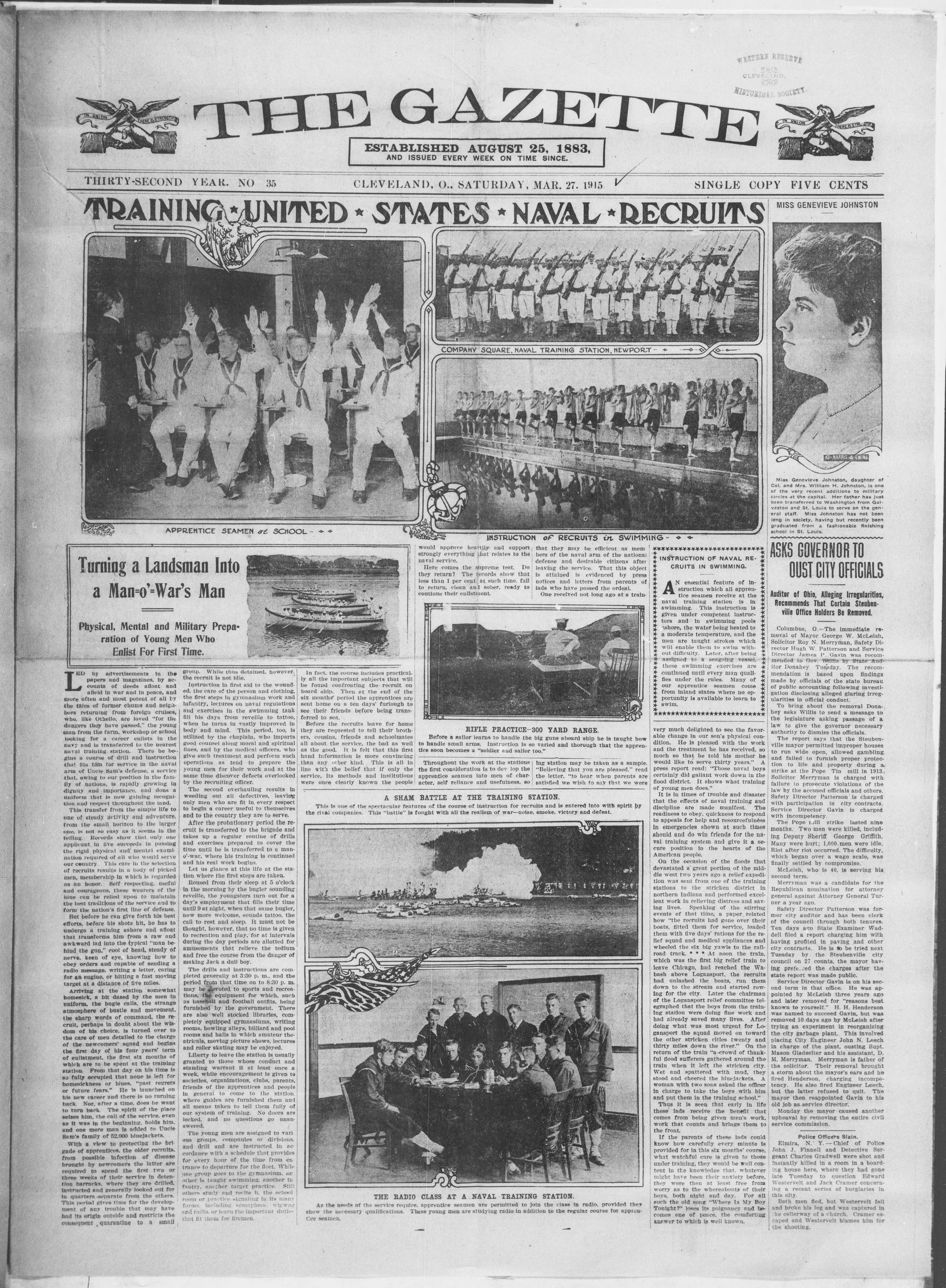
Page text (machine-generated)
Turning a Landsman Into a Man=o'=War's Man
Physical, Mental and Military Preparation of Young Men Who Enlist For First Time.
THE LORD'S PRAYER
THIRTY-SECOND
TRAINING
Turning a Landscape
a Man=o'=War'
Physical, Mental and Mentalization of Young Men
Enlist For First T
LED by advertisements in the papers and magazines, by accounts of deeds aloft and in aid in war and in peace, and more often and most potent of all by the tales of former clums and neighbors returning from foreign cruises, who, like Othello, are loved "for the dangers they have passed," the young man from the farm, workshop or school looking for a career clums in the navy and is transferred to the newest naval officer, the course of drill and instruction that fits him for service in the naval arm of Uncle Sam's defense, a service that, owing to our position in the family of nations, is rapidly growing in dignity and importance, and does a uniform that is now gaining recognition and respect throughout the land.
This transfer from the simple life to one of steady activity and adventure, from the small horizon to the larger one, is not so easy as it seems in the telling. Records show that only one applicant in five succeeds in passing the rigid physical and mental examination required of all who would serve our country. This care in the selection of results results in a body of picked men, membership in which is regarded as an honor. Self respecting, useful and courageous, these wearers of the blue can be relied upon to maintain the best traditions of the service and to form the nation's first line of defense. But before he can give forth his best efforts, before his shots hit, before undergo a training and aafect that transforms him from a raw and awkward hand to the typical 'mind behind the gun' cool of head, steady of eye, knowing how to obey orders and capable of sending a radio message, writing a letter, caring for an engine, or hitting a fast moving target at a distance of fire miles.
Arriving at the station somewhat homeschick, a bit dazed by the men in uniform, the bugle calls, the strands atmosphere of bustle and movement, the sharp words of command, the recruit, perhaps in doubt about the wisdom of his choice, is turned over to the care of men detailed to the charge of the newcomers' squad and begins the first day of his four years' term of enlistment, the first six months of which are to be spent at the training station. From that day on his time is so fully occupied that none is left for homekeeps or blues, "past rests or future fears." He is launched on his new career and there is no turning back. Nor, after a time, does he want to turn back. The spirit of the place seizes him, the call of the service, even as it was in the besting, holds him, and one more man is added to Uncle Sam's family of 62,000 blue jackets. With a view to protecting the brigade of apprentices, the older recruits brought by newcomers the latter are required to spend the first two or three weeks of their service in detention barracks, where they are drilled, instructed and generally looked out for in quarters separate from the others. This period gives time for the development of any trouble that may have had its origin outside and restricts the consequent quarantine to a small
---
THE GAZETTE
A
group. While this detailed, however, the recruit is not idle.
Instruction in first aid to the wounded, the care of the person and clothing, the first steps in gymnastism work and infantry, lectures on naval regulations and exercises in the swimming task fill his days from revelle to tattoo, when he turns in vastly improved in body and mind. This period, too, is utilized by the chaplain, who imparts good counsel along moral and spiritual lines, and by the medical officers, who give such treatment and perform such operations as tend to prepare the young men for their work and at the same time discover defects overlooked by the recruiting officer.
The second overhauling results in weeding out all defectives, leaving only men who are fit in every respect to begin a career useful to themselves and to the country they are to serve.
After the probationary period the recruit is transferred to the brigade and takes up a regular routine of drills and exercises prepared to cover the time until he is transferred to a man-o-war, where his training is continued and his real work begins.
Let us glance at this life at the station where the first steps are taken.
Housed from their sleep at 5 o'clock in the morning by the bugler sounding revellie, the youngsters out for a day's employment that fills their time until 9 at night, when that same bugler, now more welcome, sounds tattoo, the call to rest and sleep. It must not be thought, however, that no time is given to recreation and play, for at intervals during the day periods are allotted for amusements that relieve the tedium and free the course from the danger of making Jack a dull boy.
The drills and instructions are completed generally at 3:30 p. m., and the period from that time on to 8:30 p. m. may be devoted to sports and recreations, the equipment for which, such as baseball and football outfits, being furnished by the government. There are also well stocked libraries, completely equipped gymnasiums, writing rooms, bowling alleys, billiard and pool rooms and halls in which amateur theatricals, moving picture shows, lectures and roller skating may be enjoyed.
Liberty to leave the station is usually granted to those whose conduct and standing warrant it at least once a week, while encouragement is given to societies, organizations, clubs, parents, friends of the apprentices and people in general to come to the station where guides are furnished them and all means taken to tell them fully of our system of training. No doors are locked, and no questions go unanswered.
The young men are assigned to various groups, companies or divisions, and drill and are instructed in accordance with a schedule that provides for every hour of the time from entrance to departure for the boat. While one group goes to the gymnasium, another is taught swimming, another in fainty, another target practice. Still others study and recite in the school room or practice signalling in its many forms, including songpiece, wigwag and radio, or learn the important duties that fit them for firemen.
ESTABLISHED AUGUST 25, 1883 AND ISSUED EVERY WEEK ON TIME SINCE.
This is one of the spectacular features of the course of instruction for recruits and is entered into with spirit by the rival communities. This "battle" is fought with all the realism of war-nose, smoke, victory and defeat.
16
THE RADIO CLASS AT A NAVAL TRAINING STATION.
As the needs of the service require, apprentice seamen are permitted to join the class in radio, provided they show the necessary qualifications. These young men are studying radio in addition to the regular course for apprentice seamen.
In fact, the course includes practically all the important subjects that will be found confronting the recruit on board ship. Then at the end of the six months' period the apprentices are sent home on a ten days' furough to see their friends before being transferred to sea.
Before the recruits leave for home they are requested to tell their brothers, cousins, friends and schoolmates all about the service, the bad as well as the good. It is felt that this first hand information is more convincing than any other kind. This is all in line with the belief that if only the service, its methods and institutions were once clearly known the people
INSTRUCTION OF RECRUITS in SWIMMING
would approve heartily and support strongly everything that relates to the naval service.
Here comes the supreme jest. Do they return? The records show that less than 1 per cent at such time, fail to return, clean and sober, ready to continue their enlistment.
7
RIFLE PRACTICE-300 YARD RANGE.
Before a sailor learns to handle the big guns aboard ship he is taught how to handle small arms. Instruction is so varied and thorough that the apprentice soon becomes a "soldier and sailor too."$^p$
Throughout the work at the stations the first consideration is to devop the apprentice seamen into men of character, self reliance and usefulness, so ing station may be taken as a sample. "Believing that you are pleased," read the letter, "to hear when parents are satisfied we wish to say that we were
that they may be efficient as members of the naval arm of the national defense and desirable citizens, after leaving the service. That this object is attained is evidenced by press notices and letters from parents of lads who have passed the ordeal.
One received not long ago at a train.
ing station may be taken as a sample
"Bellving that you are pleased," read
the letter, "to hear when parents are
satisfied we wish to say that we were
SINGLE COPY FIVE CENTS
INSTRUCTION OF NAVAL RECRUITS IN SWIMMING.
An essential feature of instruction which all apprentice seamen receive at the naval training station is in swimming. This instruction is given under competent instructors and in swimming pools ashore, the water being heated to a moderate temperature, and the men are taught strokes which will enable them to swim without assistance to a seongotting vessel, these swimming exercises are continued until every man qualifies under the rules. Many of our apprentice seamen come from inland states where no opportunity is available to learn to swim.
very much delighted to see the favorable change in our son's physical condition. He is pleased with the work and the contract he has received, so much so that he told his mother he would like to serve thirty years' press report read: "Those naval boys certainly did gallant work down in the flood district. It shows what training of young men does."
It is in times of trouble and disaster that the effects of naval training and discipline are made manifest. The readiness to obey, quickness to respond to appeals for help and resourcefulness in emergencies shown at such times should and do win friends for the naval training system and give it a secure position in the hearts of the American people.
On the occasion of the floods, that devastated a great portion of the middle west two years ago a relief expedition was sent from one of the training stations to the stricken district in northern Indiana and performed excellent work in relieving distress and saving lives. Speaking of the stirring events of that time, a paper related how "the recruits had gone over their boats, fitted them for service, loaded them with five days' rations for the relief squad and medical appliances and wheeled the six big yawls to the railroad track. * * At poon the train, which was the first big relief train to leave Chicago, had reached the Wabash above Logansport, the recruits had unlashed the boats, run them down to the stream and started rowing for the city. Later the chafman of the relief squad left graphed that the boys from the training station were doing fine work and had already saved many lives. After doing what was most urgent for Logansport the squad moved on toward the other stricken cities twenty and thirty miles down the river." On the return of the train a "crowd of thankful food sufferers gathered around the train when it left the stricken city. Wet and spattered with mud, they stool and cheered the blue jackets. A woman with two sons asked the officer in charge to take the boys with him and put them in the training school."
Thus it is seen that early in life these lads receive the benefit that comes from being given men's work, work that counts and brings them to the front.
If the parents of these lads could know how carefully every minute is provided for in this six months' course, what watchful care is given to those under training, they would be well content in the knowledge that, whatever might have been their anxiety before, they were then at best free from worry as to the whereabouts of their boys, both night and day. For all such the old song, "Where is My Boy Tonight?" loses its poignancy and becomes one of peace, the comforting answer to which is well known.
MISS GÉNEVIEVE JOHNSTON
© HARRIS A. EWING
Mias Genevieve Johnston, daughter of Col. and Mrs. William H. Johnston, is one of the very recent additions to military circles at the capital. Her father has just been transferred to Washington from Galveston and St. Louis to serve on the general staff. Miss Johnston has not been in society, having but recently, been graduated from a fashionable finishing school in St. Louis.
ASKS GOVERNOR TO OUST CITY OFFICIALS
Auditor of Ohio, Alleging Irregularities, Recommends That Certain Steubenville Office Holders Be Removed.
Columbus, O.—The immediate removal of Mayor George W. McLoughlin, Solicitor Roy N. Merryman, Safety Director Hugh W. Patterson and Service Director James P. Gavin was recommended to Gov. Willis by State and/or Federal officials Tuesday. The recommendation is based upon judgments made by officials of the state because of public accounting following investigation disclosing alleged glaring irregularities in official conduct.
To bring about the removal Donahay asks Willis to send a message to the legislature asking passage of a law to give the governor necessary authority to dismiss the officials.
The report says that the Steubenville mayor permitted improper houses to run wide open, allowed gambling and failed to furnish proper protection to life and property during a strike at the Pope Tin mill in 1913. Solicitor Merryman is charged with failure to prosecute violations of the law by the accused officials and others. Safety Director Patterson is charged with participation in city contracts. Service Director Gavin is charged with incompetency.
The Pope Lill strike lasted nine months. Two men were killed, including Deputy Steriff George Griffith. Many were hurt; 1,000 men were idle. Riot after riot occurred. The difficulty, which began over a wago scale, was finally settled by compromise.
McLeish, who is 40, is serving his second term.
Merryman was a candidate for the Republican nomination for attorney general against Attorney General Turner a year ago.
Safety Director Petterson was former city auditor and has been clerk of the council through both tenures. Ten days ago State Examiner Waddell filed a report charging him with having profited in paving and other city contracts. He is to be tried next Tuesday, by the Steubenville city council on 27 counts, the mayor having, prefaced the charges after the state report was made public.
Service Director Gavin is on his second term in that office. He was appointed by McLeish three years ago and later removed for "reasones best known to yourself." H. H. Henderson was named to succeed Gavin, but was removed 10 days ago by McLeish after trying an experiment in reorganizing the city garbage plant. This involved placing City Engineer John N. Leech in charge of the plant, ousting Supt. Mason Gladsteel and his assistant, D. M. Merryman. Merryman is father of the solicitor. Their removal brought a storm about the mayor's cars and he fired Henderson, charging in competency. He also fired Engineer Leech, but the latter refused to quit.
The mayor then reappointed Gavin to his old job as service director.
Monday the mayor caused another upheaval by removing the entire civil service commission.
Police Umpire Stain.
Elmira, N. Y. — Chief of Police
John J. Finnell and Detective
Sergeant David Craneell woke and
actually killed in a room in a boarding
house here, where they had song
late Tuesday to question Edward
Westervelt and Jack Cramer concerning
a recent series of burglaries in
this city.
Both men fed, but Westervelt fell
and prohits the leg and was captured in
the cellway of a church. Cramer
escaped and Westervelt blames him for
the shooting.
PUBLISHED EVERY SATURDAY
SUBSCRIPTION RATES
(In Advance)
One Year.....$1.50.
Six Months.....1.00
Three Months......50
Subscribers are requested to rem-
mit by postoffice money or-
der or registered letter
Arrived at the postoffice in Cleveland
Ohio, as second-class matter.
Address all communications to
Blackstone Building, Cleveland. O.
Member Ohio Legislature: 1894
to 1896; 1896 to 1898; 1900 to 1902
THE GAZETTE is the oldest, and
has the largest bona fide circulation,
double that of any newpaper in the
interest of Afro-Americans, published
in the state of Ohio, and comparison
with any will immediately establish
its rank as one of the NEWSIEST
AND BEST in the country.
10,000,000 Afro-Americans..
160,000 in Ohio.
20,000 in Cleveland.
Cleveland
South Star
SATURDAY, MARCH 27, 1915.
Some of our boys are cadets in the
U. S. navy. No discrimination of any
kind.
We have learned that Democracy is not trustworthy in either local, state or national government.
Has a change from a Republican to a Democratic national administration made any one any better off?
Good for Mr. Theodore Pettyjohn! See Louisville, Ky, letter elsewhere in this paper. We need more of his kind.
The Democratic party won the national campaign with promises which it has broken. Having proved its pledges valueless, what can it offer to secure votes in 1916?
While it is on your mind, write to your representative in the Ohio assembly and tell them what you think ought to be done with H. B. No. 155 and Ohio's "full crew" law.
Many of the appointments made by Governor Willis have been declared "bad politics" by some of the party's managers. The governor seems determined to select who can efficiently conduct the state's affairs without reference to their value as vote getters.
With congress out of the way, it will be hard for the Wilson administration to make mistakes which will prevent an improvement in the general business situation by the enormous purchase of armament by Great Britain and France and of food and cotton by Germany—the $25,000,000 borrowed in New York by Russia to spend in this country will help some, too.
Mr. Fitzgerald, Democratic chairman of the appropriations committee, in an interview places the responsibility for the extravagant appropriations of congress—$177,000,000 greater than those of the last Republican congress—upon the administration. He says, too, that its requests for money greatly exceeded the amounts granted, which aggregated, $2,231,239,547.
A number of enterprising Colored men in the South, knowing that the race opposes the separate cars of that part of the country and only uses them when the necessity arises, have started jitney lines for the race. These lines are said to be making more money than those operated for whites, and not only have the great majority of our people ceased to ride on street cars, but the street railway companies are already feeling the loss by decreased receipts.
AMANDA SMITH
A great deal has been written relative to Amanda Smith and her great work, since her death, recently, at the advanced age of seventy-eight years, but we have failed to note any where mention of the fact that this woman, more than possibly any other possessed a religious power or influence that all felt who came in contact with her. In all our life we have never met a person, male or female, Colored or white, who equaled her in this respect. She was truly a wonderful "woman. Though uneducated, she visited, lectured and preached the gospel and temperance in England, Ireland, Scotland, Wales, India, Japan and Africa, always being entertained, even in this prejudiced country, by the very best people of both races in every community.
WHAT ABOUT THIS?
Our attention has been called to bill No. 155, now pending in the Ohio house of representative, that provides for "the licensing of elevator operators and starters and regulating the issuance of such licenses," with the request that we warn our people of this state of the danger of the loss of many such positions if this bill becomes a law, owing to the prejudice that obtains generally and the influence of certain organizations dominated by that baneful and inexcusable thing. It will be well for our people, especially those who will be directly affected by the passage of the bill, to
give the matter immediate attention and, if necessary, organize for aggressive and effective opposition to it. It will not do to sit auplyn by let the bill pass. It will then be too late to even complain.
AMEND OR KILL IT!
Ohio's "full crew" law ought to be amended or repealed. It requires a certain number of men to every train carrying a fixed number of cars or coaches. These men are designated as "trainmen." The Afro-American porter, as necessary an adjunct, and certainly as indispensable, is not classed as a "trainman." In order to provide funds with which to pay "trainmen," the Afro-American porter was eliminated, and the public deprived of his services, to make room for idle "trainmen," as required under the law. A repeal of the law will mean the reinstatement of a recognized service, and the abolition of the employment of unnecessary "trainmen" who have nothing to do but ride the trains. When Ohio's "full crew" law was enacted a number of old and faithful Afro-American railroad employees (porters) lost positions.
THE DEMISE OF THE SIXTY.THIRD
CONGRESS.
The funeral oration which follows is from a leading editorial in the Cincinnati Enquirer (Dem.);
"A dispassionate review of the work of the Sixty-third congress brings little to congratulate the people of the United States upon and much to condemn that body for. Its sins of omission and commission were many; its works, in advancement of the interests of the people and of the nation, few and far between. Brought into existence upon the summit of a wave of progressive reform; given power upon promises plainly and definitely expressed, it demonstrated incapacity from the beginning and deliberately repudiated in numerous instances policies and principles it was elected to promote and maintain. It produced a tariff law that fails to secure the revenues needed for sound administration of the country's affairs, and it enacted a levy for taxes in a time of profound peace. Need we go farther than this as an evidence of its weakness, incapacity and failure to grasp the requirements of the republic?"
No, unless you would call the attention of the country to the mistreatment of the loyal old soldiers and Afro-Americans in the departments at Washington, D. C., and elsewhere in the federal service, at home and abroad; and the patronizing, in every way, of former traitors, ex-Confederates, by the Wilson administration which, of course, includes the Southern Democratic Sixty-third congress.
REFUSES TO BE INSULTED:
Even in the Name of Christianity—A Young Man Shows Manhood and Independence When a Y. M. C.
Louisville, Ky.—Despite the fact that he had been invited and urged to attend a Y. M. C. A. conference of employed men of that organization, Mr. Theodore Pettyjohn, physical director of the Colored branch, was asked into the kitchen when the call for dinner was sounded. Following his guide from the main dining room, prepared for the other confeeers, back to the kitchen, Mr. Pettyjohn politely informed the lady that he would not eat. He turned his back on the locals and took a walkout. He then looked up the gentleman who had insisted on his being at the conference and told him a few things. The gentleman tried to defend himself by telling Mr. Pettyjohn that he ought to want to eat with his own people and that Booker T. W. Washington ate in kitchens. Mr. Pettyjohn, seeing that the "Christian" could not afford to eat with his own helper, left the conference and walked five miles on an empty stomach—when he reached the city limits he boarded a car. At this conference all present sat in the same room, read the same Bible, declared Christ and his teachings were the salvation of all men and yet he was not the master, he mistrusted and his teachings were forgotten. Mr. Pettyjohn was the only Colored delegate and fearing some unpleasantness—although it was a "Christian" conference—only attended after two insistent invitations.
Five Whites Lynched.
Back in the 80's, at the Chicago National Republican convention, we heard General Powell Clayton, of Arkansas, tell the American people what would follow the lynching of Colored people, and it has come true. He declared that it would go on until whites would turn on white and lynch them. They have done it. Five, within the past six weeks have been lynched. Martinsburg (W. Va.) Pioneer Press.
Gets Judgment for $100.
Mineola, Long Island, N. Y.-The first test of the Civil Rights law in Nassau county occurred here when Walter J. Frasier, recovered a judgment of $100 from the Sigmund Steinfeld of Philadelphia. Housed Hempstead, L. I., for not being allowed to sit in the orchestra of the Fulton Moving Picture theater during a performance.
Your copy of The Gazette after reading it, but give it to a friend or an acquaintance who might subscribe after reading a copy of the paper.
THE GAZETTE, CLEVELAND, O. SATURDAY, MARCH 27, 1915
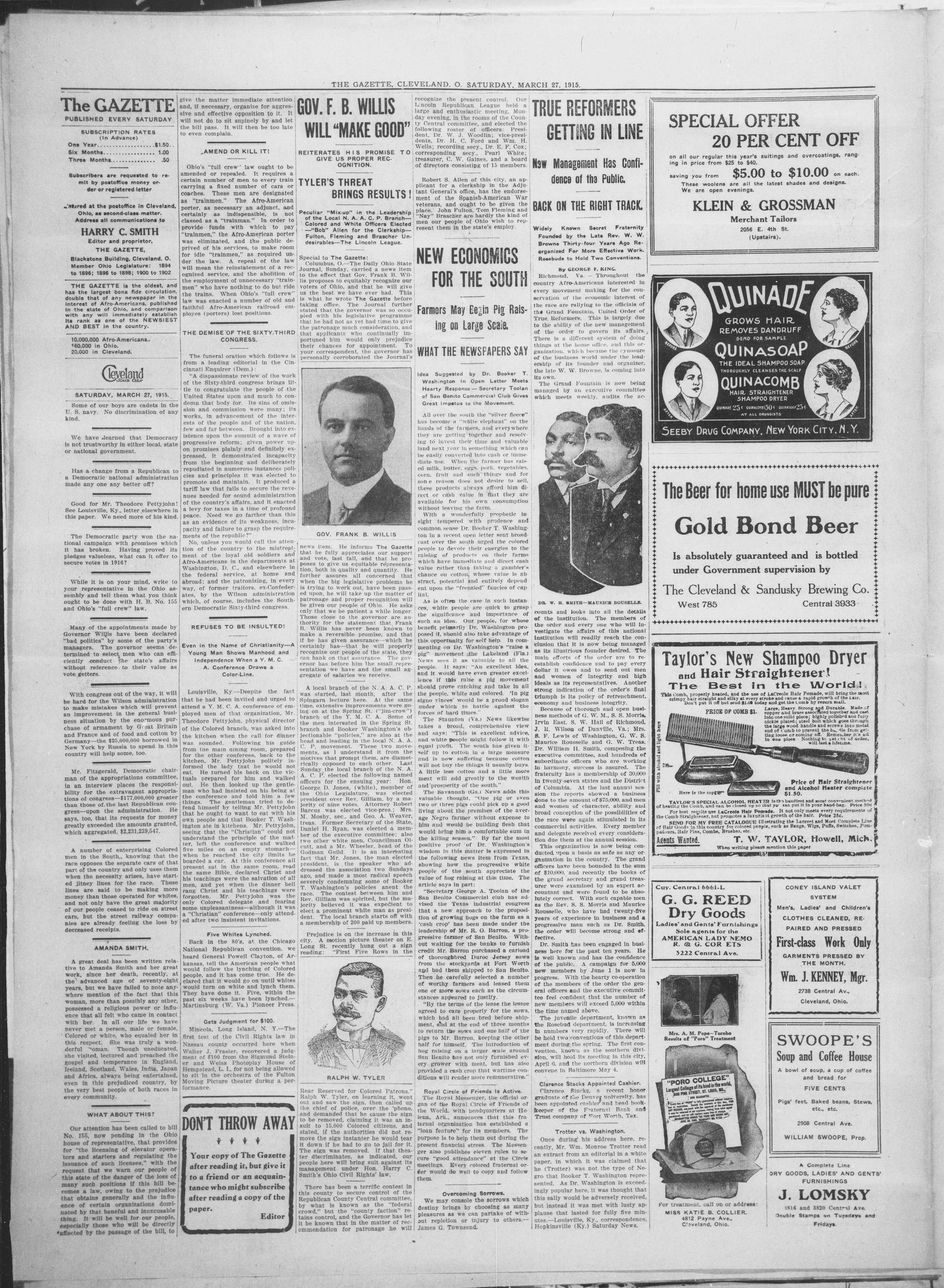
GOV. F. B. WILLIS WILL "MAKE GOOD"
REITERATES HIS PROMISE TO
GIVE US PROPER REC-
OGNITION.
TYLER'S THREAT BRINGS RESULTS
Peculiar "Mixup" in the Leadership of the Local N. A. A. C. P. Branch—Colored and White Officers Elected—"Bob" Allen for the Clerkship—Fulton, Fleming and Brascher Un desirables—The Lincoln League
Special to The Gazette:
Columbus, O.—The Daily Ohio State Journal, Sunday, carried a news item to the effect that Gov. Frank B. Willis proposes to equitably recognize our voters of Ohio, and that he will give us the best we have ever had. This is what he wrote The Gazette before taking office. The Journal further stated that the governor was so occupied with his legislative programme that he had little time for the patronage much consideration, and that applicants who continually importuned him would only prejudice their chances for appointment. To your correspondent, the governor has personally corroborated the Journal's
GOV. FRANK B. WILLIS
news item. He informs The Gazette that he fully appreciates our support and vote, last fall, and that he proposes to give us equitable representation, both in quality and quantity. He further assures all concerned that when the big legislative problems he is trying to work out, have been passed upon, he will take the matter of patronage and proper recognition will be given our people of Ohio. He asks only that we be patient a while longer. Those close to the governor are auctority for the statement that Frank B. Willis has never been known to be a noble promise, and that if he has given his opinion he certainly has—that he will properly recognize our people of the state, they can bank on that assurance. The governor has before him the small representation we have and the small aggregate of salaries we receive.
A local branch of the N. A. A. C. P. was started, last month, after the Spingarn lecture here. At the same time, extensive improvements were going on at the Stirling St. ("jim-crow") branch of the Y. M. C. A. Some of the men interested in the Spring St. branch and Booker Washington's objectable "policies," are also at the head and leading in the local N. A. A. branch of the University of Pennsylvania, as I understand it from the motives that prompt them, are diametrically opposed to each other. Last Sunday, the local branch of the N. A. A. C. P., elected the following named officers for the ensuing year: Hon. George D. Jones, (white), member of the Ohio Legislature, was elected president over Rev. Gilliam, by a man named Robert Burcus, was elected vice-pres.; Mrs. M. Mosby, sec. and Geo. A. Weaver, treas. Former Secretary of the State, Daniel H. Ryan, was elected a member of the executive committee; also two other white men, Councilman Olcutt, and a Mr. Wheeler, head of the Godman Guild. It is an interesting fact that Mr. Jones, the man elected president, is the speaker who adressed the association two Sundays ago, and the mayor, newly determined some of Booker T. Washington's policies anent the race. The contest between him and Rev. Gilliam was spirited, but the majority believed it was expedient to elect a prominent white man as president. The local branch starts off with a membership of 200 paid up members.
Prejudice is on the increase in this city. A motion picture theater on E Long St. recently hung out a sign reading: "First Five Rows in the
RALPH W. TYLER
Rear Reserved for Colored Patrons'. Ralph W. Tylier, on learning it, went out and saw the sign, then called up the chief of police, over the 'phone, and demanded that he cause the sign to be removed, claiming it was an insult to 15,000 Colored citizens, and stained the morifice; did not remove the sign instantiate he would tear it down he had to go to jail for it. The sign was removed. If that theater discriminates, as indicated, our people here will bring suit against its management under Hon. Harry C. Smith's Ohio Civil Rights' law. There has been a terrific contest in this county to secure control of the Republican County Central committee, by what is known as the "county faction" retains control, and the Governor has let it be known that in the matter of recommendation for patronage he will
recognize the present control. Our Lincoln Republican League held a large and enthusiastic meeting, Monday evening, in the rooms of the County Central committee, and elected the following roster of officers: President, Dr. W. J. Woodlin; vice-presidents, Dr. H. C. Ford and Wm. H. Wells; recording secy, Dr. E. F. Cox; corresponding secy, Pearl White; treasurer, C. W. Gaines, and a board of directors consisting of 15 members.
Robert S. Allen of this city, an applicant for a clerkship in the Adjutant General's office, has the endorsement of the Spanish-American War veterans, and ought to be given the place. John Fulton, Tom Fleming and "Nay" Brascher are hardly the kind of men our people of Ohio wish to represent them in the state's employ.
WHAT THE NEWSPAPERS SAY
Idea Suggested by Dr. Booker T. Washington in Open Letter Meets Hearty Response—Secretary Toolan of San Benito Commercial Club Gives Great Impetus to the Movement.
All over the south the "silver fleece" has become a "white elephant" on the hands of the farmers, and everywhere they are getting together and resolving to invest their time and valuable land next year in something which can be easily converted into cash or immediate use. When the farmer has raised milk, butter, eggs, pork, vegetables, corn, fruit and such things and for some reason does not desire to sell, these products always afford him direct or cash value in that they are available for his own consumption without leaving the farm.
With a wonderfully prophetic insight tempered with prudence and common sense Dr. Booker T. Washington in a recent open letter sent broadcast over the south urged the colored people to devote their energies to the raising of products on their farms which have immediate and direct cash value rather than taking a gambler's chance on cotton, whose value is abstract, potential and entirely depend ent upon the "frenzied" fancies of capital
As is often the case in such instances, white people are quick to grasp the significance and importance of such an idea. Our people, for whose benefit primarily Dr. Washington proposed it, should also take advantage of this opportunity for self help. In commenting on Dr. Washington's "raise a pig" movement the Lakeland (Fla.) News sees it as valuable to all the people. It says: "An excellent idea, and it would have even greater excellence if this raise a pig movement should prove catching and take in all the people, white and colored. 'In pig signo vinces' would be a proud slogan under which to battle against the forces of hard times."
The Staunton (Va.) News likewise takes a broad, comprehensive view and says: "This is excellent advice, and white people might follow it with equal profit. The south has given its self up to cotton in a large measure and is now suffering because cotton will not buy the things it usually buys. A little less cotton and a little more meat will add greatly to the wealth and prosperity of the south."
The Savannah (Ga.) News adds this valuable thought, "One pig or even two or three pigs could pick up a good living about the premises of the average Negro farmer without expense to him and would be building flesh that would bring him a comfortable sum in the killing season." By far the most positive proof of Dr. Washington's wisdom in this matter is expressed in the following news item from Texas, showing how the progressive white people of the south appreciate the value of hg raising at this time. The article says in part:
"Secretary George A. Toolan of the San Benito Commercial club has advised the Texas industrial congress that a new approach to the proposition of growing hogs on the farm as a 'cash crop' has been made under the leadership of Mr. R. O. Barron, a progressive farmer of San Benito. Without waiting for the banks to furnish credit Mr. Barron purchased a carload of thoroughbred Duroc Jersey sows from the stockyards at Fort Worth and bad them shipped to San Benito. Then he carefully selected a number of worthy farmers and leased them one or more sows each as the circumstances appealed to justify.
"By the terms of the lease the lessee agreed to care properly for the sows which had all been bred before shipment, and at the end of three months to return the sows and one half of the pigs to Mr. Barron, keeping the other half for himself. The introduction of bog raiding on a larger scale around San Benito has not only furnished every grower with meat, but has also provided a cash crop that wartime conditions will render more remunerative."
Royal Circle of Friends is Active. The Royal Messenger, the official organ of the Royal Circle of Friends of the World, with headquarters at Helena, Ark., announces that this fraternal organization has established a "loan feature" for its members. The purpose is to help them out during the present financial stress. The Messenger also publishes eleven rules to secure "good attendance" at the Circle meetings. Every colored fraternal order would do well to copy and follow them.
Overcoming Sorrows.
We may console the sorrows which destiny brings by choosing as many pleasures as we can partake of without repletion or injury to others.-- James G. Townsend.
BACK ON THE RIGHT TRACK.
Widely Known Secret Fraternity Founded by the Late Rev. W. W. Browne Thirty-four Years Ago Reorganized For More Effective Work. Rosebuds to Hold Two Conventions.
By GEORGE F. KING.
Richmond, Va. - Throughout the country Afro-Americans interested in every movement making for the conservation of the economic interest of the race are rallying to the officials of the Grand Fountain, United Order of True Reformers. This is largely due to the ability of the new management of the order to govern its affairs.
There is a different system of doing things at the home office, and this organization, which became the cynosure of the business world under the leadership of its founder and organizer, the late W. W. Browne, is coming into its own.
The Grand Fountain is now being managed by an executive committee which meets weekly, audits the ac-
T. H.
DR. W. H. H. SMITH-MAURICE NOUELLE counts and looks into all the details of the institution. The members of the order and every one who will instill in the affairs of this national institution will readily reach the conclusion that it is now being managed as its illustrious founder desired. The main efforts of the order are to reestablish confidence and to pay every dollar it owes and to send out men and women of integrity and high ideals as its representatives. Another strong indication of the order's final triumph is its policy of retrenchment, economy and business integrity.
Because of thorough and open business methods of G. W. M., S. S. Morris, Irvin East, S. W. Hall of Richmond, J. R. Wilson of Danville, Va.; Mrs. S. F. Lewis of Washington, G. W. S. Maurice Rousseau and G. W. Treas, Dr. William H. Smith, composing the executive committee, and hundreds of subordinate officers who are working in harmony, success is assured. The fraternity has a membership of 30,000 in twenty-seven states and the District of Columbia. At the last annual session the reports showed a business done to the amount of $75,000, and men and women of character, ability and broad conception of the possibilities of the race were again stimulated in its commercial activities. Every member and delegate received every consideration due them at the annual session.
This organization is now being conducted upon a basis as safe as any organization in the country. The grand officers have been bounded in the sum of $10,000, and recently the books of the grand secretary and grand treasurer were examined by an expert accountant and were found to be absolutely correct. With such capable men as the Rev. S. S. Morris and Maurice Rousseille, who have had twenty-five years of experience in business and a progressive man such as Dr. Smith, the order will become strong and effective.
Dr. Smith has been engaged in business here for the past ten years. He is well known and has the confidence of the public. A campaign for 5,000 new members by June 1 is now in progress. With the hearty co-operation of the members of the order the general officers and the executive committee feel confident that the number of new members will exceed 5,000 within the time named above.
The juvenile department, known as the Rosebud department, is increasing in numbers very rapidly. There will be held two conventions of this department during the spring. The first convention, known as the southern division, will hold its meeting in this city, April 6, and the northern division will convene in Baltimore May 4.
Clarence Stacks Appointed Cashier.
Clarence Stacks, a recent honor graduate of the Denver university, has been appointed cashier and head bookkeeper of the Faternal Bank and Trust company of Fort Worth, Tex.
Trotter vs. Washington
Once during his address here, recently, Mr. Wm. Monroe Trotter read an extract from an editorial in a white paper, in which it was claimed that he (Trotter) was not the type of Negro that Booker T. Washington represented. As Dr. Washington is exceedingly popular here, it was thought that this sally would be adversely received, but instead it was met with lusty apause that lasted for fully five minutes—Louisville, Ky., correspondence, Honklinville (Ky.) Saturday News.
SPECIAL OFFER
20 PER CENT OFF
on all our regular this year's suitings and overcoatings, rang-
ing in price from $25 to $40.
saving you from $5.00 to $10.00 on each.
These woolens are all the latest shades and designs.
We are open evenings.
KLEIN & GROSSMAN
Merchant Tailors
2056 E. 4th St.
(Upstairs).
QUINADE
GROWS HAIR
REMOVES DANDRUFF
SEND FOR SAMPLE
QUINASOAP
THE IDEAL SHAMPOO SOAP
THOROUGHLY CLEANSSES THE SCALP
QUINACOMB
HAIR STRAIGHTENER
SHAMPOO DRYER
QUINADE 25¢ QUINACOMB 50¢ QUINASOAP 25¢
AT ALL DRUGGISTS
SEEBY DRUG COMPANY, NEW YORK CITY, N. Y.
Is absolutely guaranteed and is bottled under Government supervision by The Cleveland & Sandusky Brewing Co. West 785 Central 3933
TAYLOR'S SPECIAL ALCOHOL HEATER is the handiest and most convenient method of heatsheat the Comb, and can be closed up so that you can put it in your hand bag. Price $26. You can purchase it at the boutique, but promotes a luxurious growth of the hair. Price $26.
SEND FOR MY FREE CATALOGUE illustrating the Largest and Most Complete Line of Hair Goods in this country for colored people, such as Bangs, Wigs, Pufts, Switches, Pom-paours, Hair Pins, Combe, Brushes, etc.
Agents Wanted
T. W. TAYLOR, Howell, Mich.
When writing please mention this paper
Ladies' and Gents' Furnishings
Sole agents for the
AMERICAN LADY NEMO
R. @ G. COR ETS
3222 Central Ave.
1.
Results of "Poro" Treatment
"PORO COLLEGE"
Largest College of its kind in the world.
3000 PINE STREET, ST. LOUIS, MO.
FOR GENERATE
Every box of "Poro" is fully guaranteed office supplies
not to repurpose, nor to destroy, nor to leak. 100
100 boxes are included with the opened box of perforated
a box is reused, and with the opened box of solid agent
materials. We will repair any box of damage.
DECARBURATED. NO. 7220.
AMOUNT TO BE DUE. $100.00. GARANTY NO. 7220.
For treatment, call on or address:
MISS KATIE B. COLLIER,
4812 Payne Ave.
Cleveland, Ohio.
Large, Heavy Strong and Durable. Made of
steel, it is very strong. It is one solid piece; highly polished and fairly
nicks plated; steel bolt which goes through
the surface; steel ring which goes through
d at cumb to prevent the skin, die from get-
ting loose or coming off. Remember it all in
one piece. It will last a lifetime, will last a lifetime.
Price of Hair Straightener and Alcohol Heater complete $1.50.
ERR is the handiest and most convenient method that you can put it in your hand-bag. Price $50 made. It not only meets every requirements of its growth of the hair. Price $24. Instructing the Larveet and Most Complete Line tie, such as Bange, Wige, Puffa, Switches, Pom-
TAYLOR, Howell, Mich.
mention this paper
CONEY ISLAND VALET
SYSTEM
Men's, Ladies' and Children's
CLOTHES CLEANED, RE-
PAIRED AND PRESSED
First-class Work Only
GARMENTS PRESSED BY
THE MONTH.
Wm. J. KENNEY, Mgr.
2738 Central Av.,
Cleveland, Ohio.
SWOOPE'S
Soup and Coffee House
A bowl of soup, a cup of coffee
and bread for
FIVE CENTS
Pigs' feet, Baked beans, Stews,
etc., etc.
2908 Central Ave.
WILLIAM SWOOPE, Prop.
A Complete Line
DRY GOODS, LADIES' AND GENTS'
FURNISHINGS
1816 and 3820 Central Ave.
Double Stamps on Tuesdays and
Fridays.
Free! Free! Free! AT THE
2742 Central Aiv., cor. E. 28th St. Cut this ad. out and present it at the Brown Drug Co., and receive a liberal trial size of B. AND M. HAIR DRESSING AND TONIC. This dressing is especially recommended where the hair is stubborn or curly, as it not only makes the hair soft, glossy and straight, but also easy to dress. B. AND M. HAIR DRESSING is elegantly perfumed, has a very beneficial effect on the scalp, and is a splendid hair-grower. DON'T FORGET THAT WE HAVE BUT ONE STORE, AND THAT IS at E. 28th St. and Central Ave.
How to be Beautiful
By Using
Walker's Toilet and Hair
Preparations
It is necessary to have clear, smooth skin
as well as hair to be beautiful.
Walker's
Black-No-More
A CREAM FOR BLACKING AND
BEAUTIFYING
50c Brower, Face Powder 25c
23 other Toilet and Hair Preparations
AGENTS WANTED; also travels to ap-
pentrepresentatives. Salary and Commis-
sion. Enclose stamp for full information.
No samples sent; cash with each order.
STERLING
5 and 10 Cent Store
3003 Central Ave.
Watch Our Windows
For Bargains
Colored Salesladies
Arlington Pharmacy
WE WILL ACCEPT THIS ADVERTISEMENT FOR FIVE CENTS IN TRADE, TO APPLY ON ANY PURCHASE OF TWENTY-FIVE CENTS OR MORE.
E. Rubenstein, Ph. C., Prop.
S. W. Cor. Central Ave. & E.
55th St.
The Fifteenth Annual Session of the
State Summer School
for Colored
TEACHERS OF BOTH SEXES
at the
Agricultural and
Mechanical College
GREENSBORO, N. C.
will begin June 29th, 1914, and continue five weeks.
In addition to the regular work, an attractive lecture course has been arranged, in which will appear some of the most distinguished white and Colored educators in the country.
Board and lodging for the entire session $12.00. Tuition 25c per subject unless other arrangements have made.
Limited accommodations. Send $1 and have room reserved in advance. For further information write a once to James B. Dudley, President, or D. J. Jordan, Director, A. A. M. College, Greenbore, N. C.
THE PEOPLES' DRUG STORE
F. H. WEAVER, PHAR. D., Prop.
Cor. Central Ave. and E. 33d St.
Agent for
"HIGH BROWN FACE POWDER."
WE GIVE TRADING STAMPS.
MONEY ORDERS, NEWSPAPER
ADS., TELEGRAMS.
PRESCRIPTIONS A SPECIALTY
Open late at Night.
ATTORNEY-AT-LAW
Main 806
312-314 Superior Building
THE OLD DOMINION
Lunch Room
at
3652 Central Ave.,
Serves THE BEST AND
QUICKEST MEALS
at
Popular Prices. Give it a Trial.
Open Day and Night
Mrs. H. C. Jones, Prop.
THE GAZETTE, CLEVELAND, O. SATURDAY, MARCH 27, 1915.
Where to Purchase The Gazette
NOTICE TO SUBSCRIBERS
The Gazette regularly should notify
delivered promptly.
fully examine The Gazette's adver-
s. Business men who advertise in
image of Afro-Americans. The fact
at they want it.
dissements) ten cents a line (six
Personal
Subscribers not receiving The Gazette regularly should notify us at once. We desire every copy delivered promptly.
We advise our patrons to carefully examine The Gazette's advertisements before making purchases. Business men who advertise in this paper should have the patronage of Afro-Americans. The fact that they advertise is assurance that they want it. Local reading notices (advertisements) ten cents a line (six words in a line).
Social and Personal
Mr. and Mrs. Robert Woods of Kansas City, Mo., are spending their honeymoon in the city, guests of the former sister, Mrs. Daniel Fairlax, E. 70th St.
* * *
Dr. S. M. Newman, president of Howard University, Washington, D. C., preached a special sermon to the Howard University club of Cleveland, Sunday morning, at St. John's A. M. E. church, and lectured, Tuesday evening, to N. Brown, also spoke, Tuesday evening, and Miss Rachel Walker sang.
* * *
There is only one way to get our race's news, local and general, and that is by taking "the old and reliable"
Gazette, every week.
Passion Sunday was most fittingly celebrated at St. Andrew's Episcopal church, last Sunday. The rector preached an appropriate sermon in the morning, and in the evening Rev. H. E. Cooke, canon of Trinity Cathedral and rector of St. John's Episcopal church, preached an able sermon. The People's Lyceum of St. Andrew's church held an interesting session, Monday evening. The subject discussed was: "Resolved, that DuBois has done more for the progress of our people than Booker T. Washington."
The presidents of the women's clubs of the city held an enthusiastic session, last Monday evening, at Mrs. C. F. Nickens, E. 85th St.
AGENTS WANTED: Two young ladies to canvass. Apply, 2555 E. 73d. St. Adv.
Send or bring locals and all business matters to The Gazette's offices, suite 2, Blackstone Bldg. If you wish to see the editor call there, please. All matters for publication in current issues of The Gazette. must be in the office by 4 p. m. WEDNESDAY at the latest.
* * * *
D. C. Fisher of Lorain, was in the city, Saturday, and with the editor of The Gazette was entertained, at dinner, by Geo. W. Johnson.
* * * *
Mrs. John M. Langston died, last week, in Washington, D. C.
* * * *
The charge of shooting to kill against James Murray, thirty-nine, 1307CVill Ave. Saturday was to be changed to murder. Murray, March 12, shot Guy Williams, twenty-six, 2314 E. 14th St. Williams died in Lakeside hospital early Saturday.
Get ready for the Metropolitan club dance, Easter Monday evening, at the Federal Athletic club auditorium, one of the finest dance floors in the city, Beaumont's Society orchestra of ten pieces (singers and instrumentalists) will furnish the music. Do not miss this social function. - Adv.
Miss Ruth Fisher of Lorain, was in the city, Tuesday.
* * * *
School enumerators make between $25 and $50, at least, for less than two weeks' work. Make application at once to Mrs. Sarah Hyre, clerk of the Board of Education at the school headquarters in the old Rockwell school, near the city hall.
Here are some little-known facts about Cleveland that Finance Director Tom Coughlin assembled, recently, for use of the "mumy" research library: Cleveland is 117 years old, has an area of 52.53 square miles, has tax duplicate of $72,355,855, 520 miles of paved streets, 325 miles of street railways, 40 miles of boulevards, 14 miles of lake frontage, 20 parks, 14 city playgrounds, four public bathhouses, two beach baths, 57 city baseball diamonds, 63 city tennis courts, 35 city skating ponds, 35 city swimming pools, 766 people, 39 fire stations and 611 firemen, 7,158 city employees, nine municipal cemeteries, three munny light plants, three munny markets, 5,450 gas lights and 5,466 are lights.
The Metropolitan club's Easter dance in the Federal Athletic篮协 auditorium, 2491 E. 55th St., near Scovill Ave. promises to be the most enjoyable social function of the season. Beaumont's Society orchestra of ten pieces, singers as well as instrumentalists, will furnish the music. This alone guarantees an exceptionally enjoyable evening. Then, too, the club members are all well-known, popular and up-to-date. Do not miss this dance. See advertisement elsewhere in this paper—Ady.
The dinner given at Mrs. Hattie Fairfax's, last week, for the benefit of the Auxiliary to the Juvenile Court and Humane Society, was a decided success and the ladies are to be complimented on the same.
J. R. Sample and J. Herbert Gray of 2359 E. 20th St., were in Detroit, last week, the latter visiting the manufacturing house of Nelson Boher & Co. on business.
---
J. S. HALL'S,
3121 Central Ave.
*O. C. SCHROEDER'S,
Guyahoga Bldg.
F. VALENTINE'S
2130 Central Ave.
J. E. BRANHAM'S
4401 Central Ave.
PUSHAW
The Arcade.
Superior Entrance.
*OPEN SUNDAYS.
Our
Classified Ad
Department
FOR RENT—Houses and Rooms
If you have them to rent or if you want to rent, advertise in The Gazette. It brings results.
NOTARY PUBLIC—For such services call at The Gazette office, No. 2 Blackstone building, No. 1424 W. Third Street, near Superior Ave.
FOR SALE—Houses or lots. If you have either or anything else to sell, or if you wish to purchase, advertise in The Gazette. If anything can bring you results, it can and will.
Cleveland
Sixth City
Mr. and Mrs. Chester Jackson and
family of Buffalo, arrived Monday to
locate.
J. H. Doggette returned, last week
Wednesday, from Brooklyn, Atlantic
City and Philadelphia where he visited
relatives.
W. M. Orr, special agent for the
American Product Company of Cincinnati, carries a fine line of facial creams and extracts. Call, Cuy.
Princeton, 2452 K.—Adv.
The Book and Thimble club was
royally entertained by the Misses
Hackett of E. 36th street, last week
Friday evening. Mrs. Saul Lucas
will entertain, next Friday evening.
The Boethian Class of St. John's S. S. was to hold its annual banquet at the Keystone restaurant, this Friday evening. Mr. Saul Lucas is teacher and J. Milton Smyles, pres.
Our advertisers want your trade. Those who do not ask for it in The Gazette certainly care little, if at all for it. Therefore, we urge our readers and all of our friends to patronize those who ask for your trade in this pauer.
Club No. 10 of St. John's church met, Tuesday evening, and perfected arrangements for a rally soon to be held. The following named officers have been elected: Mrs. R. Minator, Mr. Tulbot, sec. Mrs. Elliott treasies; and the Misses Jane Hunter, May Bushon and M. Williams, lieu tenants.
---
The Minerva Reading club will render a program at St. John's church tomorrow evening, under the auspices of the junior stewardess board. Among those expected to participate are Mesdames Seelig, Madaline Earley, Hattie Price, Mary Martin, the Misses Georgia and Cora Fields and a ladies' quartette. The S. S. attendance last Sunday, was 572.
Mr. Raymond Weaver was here from Chicago this week.
Dr. R. J. Thomas of Baltimore, Md., preached ably at Cory M. E. church, last Sunday morning and evening. He also addressed the S. S. on "Missions," and lectured, Monday evening, to a large and appreciative audience. Dr. Thomas is field secretary of the Board of Home Missions and Church Extension Society of the M. E. church.
Miss Ina Guy, who has been the guest of Mrs. J. Allen, 2213 E. 43rd St., the past three months, returned to Zanesville, last Thursday.
Mr. and Mrs. Chas. McPherson of the New Keystone restaurant, were called to Pittsburgh. Tuesday. The cafe will be closed temporarily, pending their return. * * * *
The U. S. census statistics show, for the first time, a decrease in the death rate of Afro-Americans of 57 cities with "Negro" populations exceeding 2,500 each. * * * *
Renben Sundown Charles, age 25, an Indian, the husband of one of Mr. and Mrs. Geo. Greenbrier's daughters, died. Tuesday. Mr. and Mrs. Charles were former students at Carlisle Indian school (in Pennsylvania), a government institution. They came to Cleveland soon after their marriage and he took a position as expert accountant with the Sherwin-Williams Co. He was employed there until Jan. 16, when he became ill. Living with Mr. and Mrs. Charles was Mrs. Minya Greenbrier, his mother, and Mrs. Emma Greenbrier Skull, sister. Mrs. Emma was a member of the Baraca S. S. class of Calvary Evangelical church.
---
```markdown
```
---
```markdown
```
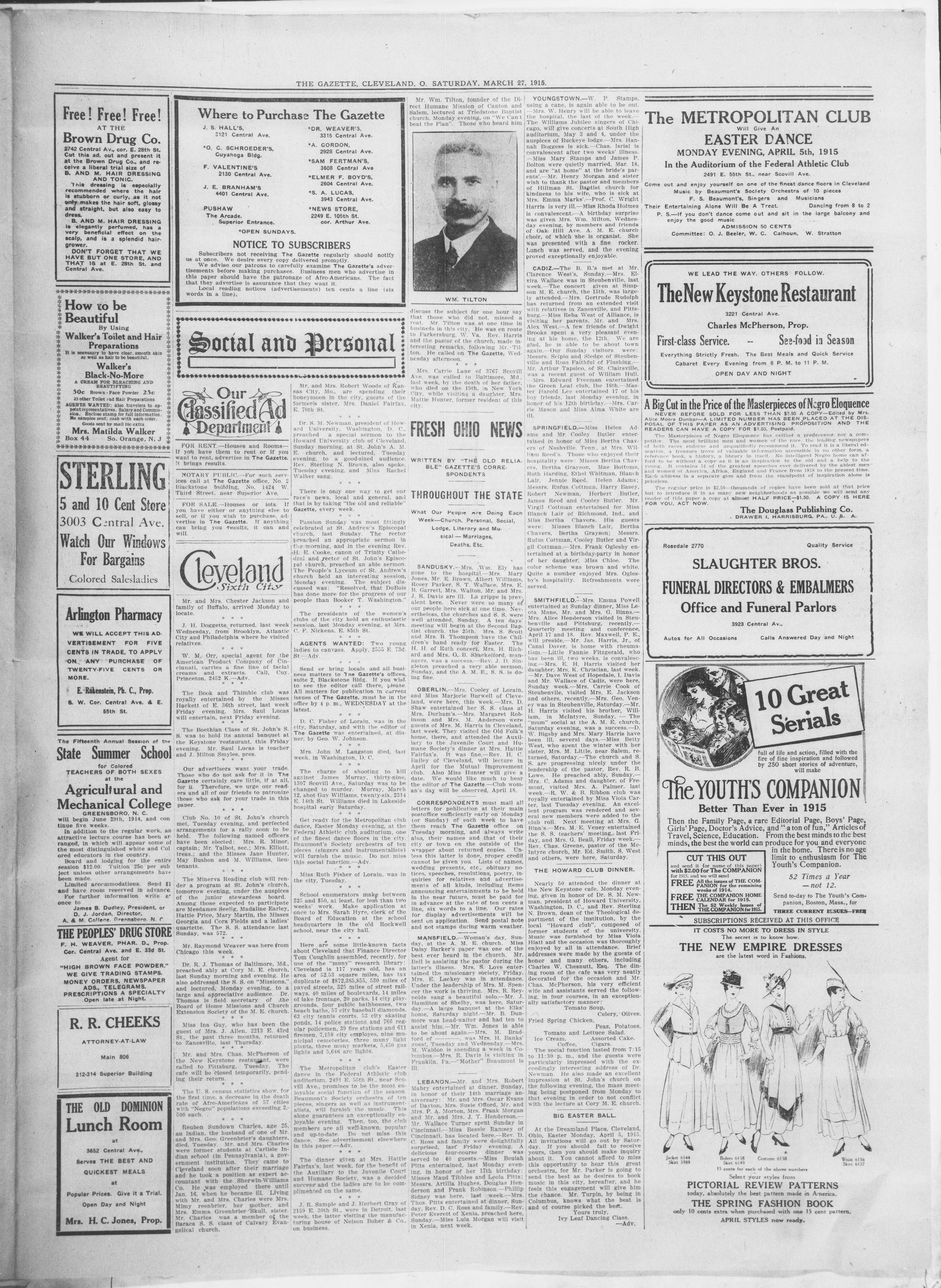
Mr. Wm. Tilton, founder of the Direct Humane Mission of Canton and Salem, lectured at Triedstone Baptist church Monday morning who heard him
WM. TILTON
discuss the subject for one hour say that those who did not, missed a reat. Mr. Tilton was at one time in business in this city. He was en route to Parkersburg, W. Va. Rev. Harris and the pastor of the church, made interesting remarks, following Mr. Tilton. He called on The Gazette, Wednesday afternoon.
Mrs. Carrie Lane of 377 Scovill Ave was called to Baltimore, Md. last week, by the death of her father, who died on the 19th, in New York City, while visiting a daughter, Mrs Mattie Hunter, former resident of this city.
FRESH OHIO NEWS
WRITTEN BY "THE OLD RELIA
BLE" GAZETTE'S CORRE.
SPONDENTS
THROUGHOUT THE STATE
What Our People Are Doing Each Week—Church, Personal, Social, Lodge, Literary and Musical — Marriages, Deaths, Etc.
SANDUSKY.—Mrs. Wm. Ely has gone to the hospital.—Mrs. Mary Jones, Mr. E. Brown, Albert Williams, Rose Parker, S. T. Wallace, Mrs. E. B. Garrett, Mrs. Walton, Mr. and Mrs. J. R. Davis are ill. La gripe is prev alent here. Never were so many of her patients at one time. Newertheless, the church is still well attended. Sunday. A ten days meeting will begin at the Second Bap tist church. The 25th. Mrs. S. Scott and Mrs. B. Thompson have the Children's band ready for Easter. The H. H. of Ruth concert, Mrs. H. Rich ard and Mrs. O. B. Shekelford, man and Mrs. B. Shekelford, man. Sinleton preached a very able sermon Sunday, and the A. M. E., S. S. is doing fine.
OBERLIN—Mrs. Cooley of Lorain, and Miss Marjorie Burwell of Cleveland, were here, this week. Mrs. D. Shaw entertained her S. s. class at Mrs. Durham's. Mrs. Margaret Robinson and Mrs. M. Anderson were guests of Mrs. M. Arries in Cleveland, home. They visited the home, there, and attended the auxiliary to the Juvenile Court and Human Society's dinner at Mrs. Hattie Fairax's. It was fine.—Rev. H. C. Bailey of Cleveland, will lecture in April for the Mutual Improvement Society's date. We would like much to heen the editor of The Gazette—Club woman's day will be observed, April 18.
CORRESPONDENTS must mail all letters for publication at their main postoffice sufficiently early on Monday (or Sunday) of each week to have them reach The Gazette office on Tuesday morning, and always write also, their names and that of the person who returned copies of the wrapper about returned copies. Unless this latter is done, proper credit cannot be given you. Lists of names, wedding presents, etc., obituary notices, speeches, resolutions, poetry, inquiries for relatives and advertisements, letters of recommendation, entering entertainments to be held in the near future, must be paid for in advance at the rate of ten cents a line, six words to a line. Our rates for display advertisements will be sent on application. Send postal note and not stamps during warm weather.
MANSFIELD—Woman's day, Sunday, at the A. M. E. church. Miss Daisy Barker's paper was one of the best ever heard in the church. Mr. Bell is assisting the pastor during the latter's illness. Mrs. S. Love entertained the missionary society, Friday. Mrs. E. Lackey was in attendance. Under the leadership of Mrs. M. Spencer the work is thriving. Mrs. R. Reynolds sang a beautiful solo. Mr. R. Hamilton of Sheby, Mrs. J. Hamilton of the Elks' home, Saturday night. Mr. B. Dummore was head-waiver and had ten to assist him. Mr. Wm. Jones is able to be about again. Mrs. M. Bradford of ... was Mrs. H. Banks' guest, Tuesday and Wednesday. Mrs. M. Walden is spending a week in Columbus. Mrs. R. Davis is visiting Franklin, Pa. "Mother" Beaumont is Ill.
LEBANON—Mr. and Mrs. Robert Mabry entertained at dinner, Sunday, in honor of their 14th marriage anniversary: Mr. and Mrs. Oscar Evans of Dayton, Mrs. Susie Offord, Mr. and Mrs. P. A. Morton, Mrs. Frank Morgan and Mr. and Mrs. J. T. Henderson. Mr. Wallace Turner spent Sunday in Cincinnati.—Miss Bessie Ramsey of Cincinnati, has located here.—Rev D. C. Ross and family were delightfully surprised, last Friday evening. A delicious four-course dinner was served to 40 guests.—Miss Boulah Pitts entertained on Monday evening, in honor of her 17th birthday; Miss Muss Tibbles and Leola Pitts; Artilla Hughes, Douglas Henderson and Franklin Robinson.—Phillip Sidney was here, last week.—Mrs. Thos. Pitts entertained at dinner, Sunday, Rev D. C. Ross and family.—Rev Peter Everett of Xenia, preached here, Sunday.—Miss Lula Morgan will visit in Xenia, next week.
YOUNGSTOWN. W. P. Stamps, using a cane, is again able to be out. —Mrs. W. Henry will be able to leave the hospital, the last of the week. The school, the last of the day, in Chicago, will give concerns at South High auditorium, May 3 and 4, under the auspices of Buckeye lodge—Mrs. Hannah Bogness is sick—Cash. Isarial is convalescent after two weeks' illness. —Miss Mary Stamps and James P. Bolton were quietly married, Mar. 18, and are "at home" at the bride's parents'. —Mr. Henry Morgan and sister wish to thank the pastor and members of Hillman St. Baptist church for kindness to his wife, who is sick at Mrs. Emma Marks'."-Prof. C. Wright Harris is very ill."—Miss Rhoda Holmes is convalescent. —A birthday surprise was given Mrs. Wm. Milton, Wednesday evening, by members and friends of Oak Hill Ave. A. M. E. church choir, of which she is organist. She was presented with a fine rocker. Lunch was served, and the evening proved exceptionally enjoyable.
CADIZ—The B. B.'s met at Mr. Clarence West's, Sunday—Mrs. Elva, Wallace was in Steubenville, last week. The concert given at Simpson M. E. church, the 15th, was largely attended. Mrs. Gertrude Rudolph has returned from an extended visit with relatives in Zanewille, and Pittsburg. Miss Reba West of Alliance, is visiting her parents, Mr. and Mrs. Alex West. A few friends of Dwight Brooks spent a very pleasant evening at his home, the 12th. We are, he is able to be about town again. Our Sunday visitors were: Messrs. Scipio and Sledge of Steubenville and Ross Faithful of Washington. Mr. Arthur Taptico, of William Hull.
was a recent guest of William Hull.—Mrs. Edward Freeman entertained the Green Leaf club, the 16th.—Master Harold Lee entertained 17 of his boy friends, last Monday evening, in honor of his 12th birthday.—Mrs. Carrie Mason and Miss Alma White are ill.
SPRINGFIELD—Miss Helen Adams and Mr. Cooley Butler entertained in honor of Miss Bertha Chavers of Nashville, Tenn., at Mrs. William Reed's. Those who enjoyed their hospitality were: Misses Bertha Chavers, Bertha Grayson, Mae Bottoms, Ruth Harding, Ethel Whitman, Blanch Lair, Jennie Reed, Helen Adams; Messrs. Rufus Cottman, Harry Easey, Robert Newman, Herbert Butler, James Reed and Cooley Butler, Mr. Virgil Cottman entertained for Miss Blanch Lair of Richmond, Ind., and Miss Bertha Chavers. His guests were: Misses Blanch Lair, Bertha Chavers, Bertha Grayson; Messrs. Rufus Cottman, Cooley Butler and Virgil Cottman—Mrs. Frank Oglebsy entertained at a birthday-party in honor of her daughter, Miss Chloe. The color scheme was brown and white. Quite a number enjoyed Mrs. Oglebsy's hospitality. Refreshments were served.
SMITHFIELD. —Mrs. Emma Powell entertained at Sunday dinner, Miss Leota Mane, Mr. and Mrs. G. Binns. —Mrs. Alice Henderson visited in Steubenville and Pittsburg, recently. —Quarterly meeting and conference, April 17 and 18. Rev. Maxwell, P. E., will preside. —Mr. Jas. Harris, Jr., of Canal Dover, is home with rheumatism. —Little Fannie Fitzgerald, who has been ill, two weeks, is convalescent daughter, Mrs. K. Christian, last week. —Mr. Dave West of Hopedale, I. Davis and Mr. Wallace of Cadiz, were here, Sunday week. —Mrs. Carrie Cook of Steubenville, visited Mrs. E. Jackson and others, recently. —Mrs. Geo. Veney was in Steubenville, Saturday. —Mr. H Harris visited his brother, William, in McIntyre, Sunday. —The "mum" social at the A. M. E. church, Saturday evening, was a success. D. Mrs. Greene, who was ill, several days. —Miss Betty West, who spent the winter with her sister, Mrs. M. Little, near Salem, returned, Saturday. —The church and S. S. are progressing nicely under the leadership of the pastor, Rev. R. B. Lowe. He preached ably, Sunday. —Mrs. C. Adams and daughter of Fremont, visited Mrs. A. Palmer, last week. —R. W. & B. Ribbon club was royally entertained by Miss Viola Carter, last Tuesday evening. An excellent program was rendered and an session on the club roll. Next meeting at Mrs. G. Binn's. —Mrs. M. E. Veney entertained the S. t. teachers' meeting, last Friday, and Mrs. G. Beall, Friday week. —Rev Chas. Greene, pastor of the McIntyre church, Mr. Ed. Smith, S. West and others, were here, Saturday.
THE HOWARD CLUB DINNER.
Nearly 50 attended the dinner at the New Keystone cafe, Monday evening, given in honor of Dr. S. M. Newman, president of Howard University, Washington, D. C., and Rev. Sterling N. Brown, dean of the Theological department of the institution, by the local "Howard club", composed of former students of the university. Music was furnished by Miss Wila Hattatt and the teacher was thoroughly enjoyed by all in attendance. Brief addresses were made by the guests of honor and many others, including Charles W. Chesnutt, Esq. The dining room of the cafe was very neatly decorated for the occasion and Mr. Chas. McPherson, his very efficient wife and assistants served the following, in four courses, in an exceptionally satisfactory manner:
Tomato Soup,
Celery, Olives,
Fried Spring Chicken,
Peas, Potatoes,
Tomato and Lettuce Salad.
Ice Cream,
Assorted Cake.
The social function lasted from 7:15 to 11:30 p. m., and the guests were particularly impressed with the exceedingly interesting address of Dr. Newman. He also made an excellent impression at St. John's church on the following evening, the mass meeting being postponed from Monday to that evening in order to not conflict with the lecture at Cory M. E. church.
BIG EASTER BALL.
At the Dreamland Place, Cleveland
Ohio, Easter Monday, April 5, 1915.
All invitations will go out by Saturday.
If you should fail to receive yours, then you should make inquiry about it. You cannot afford to miss this opportunity to hear this great orchestra, for Mr. Parker is going to send the best as he desires to book music in this city, hereafter, and he feels this engagement will give him the chance. Mr. Turpin, by being in Columbus, knows what the best is and of course the best. Yours truly,
Ivy Leaf Dancing Class.
—Adv.
The METROPOLITAN CLUB Will Give An EASTER DANCE MONDAY EVENING, APRIL 5th, 1915
2491 E. 55th St., near Scovill Ave.
out and enjoy yourself on one o
Music by Beaumont's Society
F. S. Beaumont's Singer
Entertaining Alone Will Be A T
--if you don't dance come out
enjoy the good music.
ADMISSION 5
Committee: O. J. Beeler, W. C.
WE LEAD THE WAY. O
The New Keystone
3221 Central
Charles McPho
st-class Service. --
everything Strictly Fresh. The B
cabaret Every evening from
OPEN DAY AND
Cut in the Price of the Mass
PER BEFORE SOLD FOR LESS
More Dunbar—A LIMITED NUMBER
OF THIS PAPER AS AN ADVER
IS CAN HAVE A COOPY FOR $1.5
Masterpiece of Negro Elocuence
The most brilliant men and women
traces endorse and unqualified re
a treasure trove of valuable
book, a history, a library in its
sole without a copy as it is an
inspiration of America, Africa, England
and America of Africa, England and
a separate price and from
regular price is $2.50—thousands
of introduce it in as many new neigh
this paper a in as many HAI
CT ACT.
y yourself on one of the finest dance
Beaumont's Society Orchestra of
S. Beaumont's, Singers and Music
Alone Will Be A Treat.
Dont dance come out and sit in the
good music.
ADMISSION 50 CENTS
O. O. J. Beeler, W. C. Calhoun, W.
LEAD THE WAY. OTHERS FOLLOW
New Keystone Rest
3221 Central Ave.
Charles McPherson, Prop.
Service. -- See food
Strictly Fresh. The Best Meals and
Every Evening from 6 P. M. to 11
OPEN DAY AND NIGHT
The Price of the Masterpieces of N
SOLD FOR LESS than $2.50 A C
A LIMITED NUMBER HAS BEEN PL
PAPER AS AN ADVERTISING PROP
OVE of Negro Eloquence that selfless a pro
privilen men and women of the race,
these and unqualifiedly recommend it. To
prove of valuable information accessible
history, a library in itself. No intelligent
copy as it is an inspiration to the
child of the greatest specimen of delivery
Africa, England and France from 181
aparate gem and from the standpoint of
is $2.50—thousands of copies have been
as many as new neighborhoods as posses
a copy at almost HALF PRICE—$1.50.
If on one of the finest dance floors in Cleveland's Society Orchestra of 10 pieces, the Singers and Musicians will Be A Treat. Dancing from 8 to come out and sit in the large balcony, etc.
MISSION 50 CENTS
Ceceler, W. C. Calhoun, W. Stratton
THE WAY. OTHERS FOLLOW.
Keystone Restaurant
221 Central Ave.
Les McPherson, Prop.
See-food in Season
Shish. The Best Meals and Quick Service
Evening from 6 P. M. to 11 P. M.
N DAY AND NIGHT
Of the Masterpieces of Negro Eloquence
FOR LESS THAN $2.50 A COPY-Edited by NUMBER HAS BEEN PLACED AT THE ADVERTISING PROPOSITION AND PAYMENT FOR $1.50. Postpaid
Eloquence has neither a predecessor nor a man and women of the race the leading newspaper qualifiably recommend it. To read it is a liberal information accessible in no other journal in itself. No intelligent Negro home can be an inspiration to the old and a help to greatest speeches ever delivered by the ablest England and France from 1818 to the present and from the standpoint of inspiration alo
thousands of copies have been sold at that new neighborhoods as possible we will send almost HALF PRICE-$1.50. A COPY IS H
Come out and enjoy yourself on one of the finest dance floors in Cleveland
Music by beaumont's Society Orchestra of 10 pieces
F. S. Beaumont's, Singers and Musicians
Their Entertaining Alone Will Be A Treat. Dancing from 8 to 2
P. S.—if you don't dance come out and sit in the large balcony and
enjoy the good music
WE LEAD THE WAY. OTHERS FOLLOW.
The New Keystone Restaurant
3221 Central Ave.
Charles McPherson, Prop.
First-class Service. -- See-food in Season
Everything Strictly Fresh. The Best Meals and Quick Service
Cabaret Every Evening from 6 P. M. to 11 P. M.
OPEN DAY AND NIGHT
NEVER BEFORE SOLD FOR LESS THAN $2.50 A COPY-Edited by Mrs. Alice Moore Dunbar—A LIMITED NUMBER HAS BEEN PLACED AT THE DISPOSAL OF THIS PAPER AS AN ADVERTISING PROPOSITION AND THE READERS CAN HAVE A COPY FOR $1.50, Postpaid.
The Masterpieces of Negro Eloquence has neither a predecessor nor a competitor. The most brilliant men and women of the race, the leading newspapers of both races endorse and unqualifiedly recommend it. To read it is a liberal education, a treasure, a trove of valuable information accessible in no other form, a reference book, a history, a library in itself. No intelligent Negro home can afford to be without a copy as it is an inspiration to the old and a help to the young. It contains 51 of the greatest speeches ever delivered by the ablest men and women of America, Africa, England and France from 1818 to the present time. Each address is a separate gem and from the standpoint of inspiration alone is priceless.
The regular price is $2.50—thousands of copies have been sold at that price but to introduce it in as many new neighborhoods as possible we will send any reader of this paper a copy at almost HALF PRICE—$1.50. A COPY IS HERE FOR YOU, ACT NOW.
The Douglass Publishing Co.
DRAWER I, HARRISBURG, PA., U.S. A.
closedale 2770
SLAUGHTER
UNERAL DIRECTOR
Office and Fun
3923 Centres
utos for All Occasions
The YOUTH'S
Better Than I
Then the Family Page, a rare
Girls' Page, Doctor's Advice,
Travel, Science, Education.
minds, the best the world can
LAUGHTER BROADCAST
SPECIAL DIRECTORS & EMBASSY
Service and Funeral Pa-
3923 Central Av.,
All Occasions
Calls Answered
10 Gri
Seri
full of life and action
fire of fine inspirati
by 250 short story
will m
YOUTH'S COMPANY
Better Than Ever in 19
Family Page, a rare Editorial Pa-
ce, Doctor's Advice, and "a ton of
science, Education. From the best
best the world can produce for y
in the home.
Quality Service
FIGHTER BROS.
DIRECTORS & EMBALMERS
and Funeral Parlors
3923 Central Av.,
ans Calls Answered Day and Night
10 Great Serials
full of life and action, filled with the
fire of fine inspiration and followed
by 250 short stories of adventure,
will make
TH'S COMPANION
Than Ever in 1915
Page, a rare Editorial Page, Boys' Pa-
t's Advice, and "a ton of fun," Articles
education. From the best minds to the b
world can produce for you and every
in the home. There is no o
limit to enthusiasm for T
Youth's Companion.
10 Great Serials full of life and action, filled with the fire of fine inspiration and followed by 250 short stories of adventure, will make
Then the Family Page, a rare Editorial Page, Boys' Page, Girls' Page, Doctor's Advice, and "a ton of fun," Articles of Travel, Science, Education. From the best minds to the best minds, the best the world can produce for you and everyone in the home. There is no age limit to enthusiasm for The Youth's Companion.
CUT THIS OUT and send it (for name of this paper) with 100 COMPANION for 1915, and we will send FREE All the issues of THE COMPANION for the remaining weeks of 1914. FREE THE COMPANION HOME CALENDAR for 1915. THEN The 52 Weekly Issues of THE COMPANION for 1915.
52 Times a Year — not 12.
Send to-day to The Youth's Companion, Boston, Mass., for THEN CURRENT ISSUES-FREE
UNION HOME
for 1915.
UNION for 1915.
Send to-day to The Youth's Club
panion, Boston, Mass., for
THREE CURRENT ISSUES—F
NIONS RECEIVED AT THIS OFFICE
NO MORE TO DRESS IN STYLE
The secret is to know how.
NEW EMPIRE DRESSES
the latest word in Fashions.
SUBSCRIPTIONS REC
IT COSTS NO MORE T
The secret is to
THE NEW EMP
are the latest wo
SUBSCRIPTIONS RECEIVED AT THIS
COSTS NO MORE TO DRESS IN S
The secret is to know how.
NEW EMPIRE DRI
are the latest word in Fashions.
THE NEW EMPIRE DRESSES are the latest word in Fashions.
Jacket 6144
Skirt 5989
Bolero 6158
Skirt 6149
Costume 6130
Waist 6156
Skirt 6137
PICTORIAL REVIEW PATTERNS today, absolutely the best pattern made in America. THE SPRING FASHION BOOK only 10 cents extra when purchased with one 15 cent pattern. APRIL STYLES now ready.
52 Times a Year
— not 12.
PROTESTS AGAINST TURK INDIGNITIES
United States Aroused Over Atrocious Acts On American Missionaries.
BRITISH AIR RAID ON FOE'S SUBMARINES
Bombardment of Turkish Fortifications at Dardaneles and Land Operations on Gallipoli Peninsula Have Been Launched.
Washington, D. C. — The United States ambassador at Constantinople, Mr. Morgenthaus, has just been cabled by Secretary of State Bryan to protest to Turkey against indignities by Turkish troops to American missionaries and Americans generally in Persia. The offense of Turkey is aggravated by the fact that the uprising against the American missions, especially at Uruhiah, has been led by a Turkish consul, Razib Bey. The action of the state department was taken upon a report to it from the United States consul, E. W. Smith of Batum, Russia, who is now at Tiflis, Persia.
The United States has no force to apply. Its nearest naval vessels, the cruisers Tennessee and North Carolina, are in the eastern Mediterranean. No instructions have gone to them, but by understanding between the state department and navy department, these warships are always at the disposition of Ambassador Morgenthau. He used them on previous occasions when it was reported that American interests and lives were in danger on the east Mediterranean coast.
Consul Confirms Cruelties
Senior Commisars Cruelty.
Consul Smith is reported to have confirmed statements which have been given out merely as rumors in Syria and in Russia. It is announced officially that the Turkish troops under Raghib Bey entered Urumiah and drove out the missionaries and heaped insults upon them as they and foreign priests and deacons were leaving the town. Some of the clericals are reported actually to have been beaten, thus confirming first reports. An American missionary named Allen was reported to have been insulted and beaten. This also has been verified.
Officials expect Ambassador Morgen tha'un's reply to the state department will corroborate the reports to the Persian war relief committee in New York. These reports showed the incursions of the Turks into Persia were leaving a wide path of ruin behind them; that many Persians had been killed; that women had been carried off and that there was a general flight of Christians from the French mission and throughout the Urumlah territory to Tiflis.
BRITISH AIR RAID ON GERMAN SUBMARINES,
London, Eng.—The British admiralty has just issued a statement that a British air raid had been carried out successfully on German submarines at Hoboken, three miles outside of Antwerp. Flight Commander Crossley-Meates of the British aviation service, in consequence of engine trouble while en route to make an attack on Antwerp, was obliged to land at Kruingen, according to a dispatch from The Hague to Reuter's Telegram Co. The airman was not injured. He will be interned. The text of the admiralty statement was as follows:
"The following has been received from Wing Commander Longnore; I have to report that a successful all attack was carried out Wednesday morning by five machines of the Dun kirk squadron on the German submarines being constructed at Hoboken, near Antwerp. Two of the pilots had to return, owing to thick weather, but Squadron Commander Iver T. Courtney and Flight Lieut. H. Rosher reached their objecting, and, after planing down to 1,000 feet, dropped four bombs each on the submarines. It is believed that considerable damage has been done to both the works and to two submarines. The works were observed to be on fire. In all five submarines were observed on the slip."
**Shelling of Forts Resumed.**
Bombardment of the Turkish fortifications at the Dardanelles and land operations on the Gallipoll peninsula have been launched simultaneously, according to news dispatches from reliable sources.
The allied fleet, preceded by mine sweepers, dashed into the straits and resumed pounding at the forts along the narrows, says an Athens dispatch. At the same time allied troops were landed on the Gallipoll peninsula from transports in the Gulf of Saros, says a Daily Express dispatch. The force was intended to pave the way for a large invading army which will begin a general land attack immediately on the arrival of more warships and transports which have been sent to join the battle fleet.
Woman Threatens Mayor, Jailed.
Chicago, Ill.-Mrs. Leonora Doring. 50, was arrested in the office of Mayor Carter H. Harrison in city hall after she had shouted she would kill the mayor. The woman would not give any reason for threatening the life of the city's chief executive. She said she was once the wife of a Pittsburgh banker named Montgomery, who was sentenced to prison after the failure of his business. Mrs. Doring became violent when seized by two policemen. The police said she had been arrested before.
Operator 17.
Zanesville, O.—The first suit of its kind ever filed, according to Zanesville attorneys, was entered here by the Elk Coal Co. of Roseville, Muckingum county, against 145 miners in its employ for $25,000 damages, mine owners alleging the miners broke their wage agreement and closed the mine March 17. The petition states that when the mine owners discharged three men, the miners struck instead of submitting their grievance to arbitration by district officials, according to their working agreement.
C MARHIS & EWING
Miss Anne Seymour Jones is the pretty daughter of Congressman and Mrs. W. A. Jones of Virginia and her engagement to marry Lieut. Roland Hopkina of the field of law. She has not Jate has been set for the wedding, but it will probably be celebrated in June.
PROBE OF THIRTY-SIX AX MURDERS IS REOPENED
VICTIMS OF AX MAN.
Colorado Springs, Col., September,
1911—H. C. Wayne, wife and child and
Mrs. A. J. Burnham and two children.
Monmouth, Ill., September, 1911—
William E. Dawson, wife and daughter.
Ellsworth, Kan., October, 1911—William
Showman, wife and three children.
Paola, Kan., June, 1912—Rollin Hudson
and wife.
Willisca, Ia., June, 1912—J. A.
Moore, four children and two girl
guests.
Columbia, Mo., December, 1912—
Mrs. Mary J. Wilson and Mrs. George
Moore.
Blue Island, Ill., July, 1914—Jacob
Neslesla, his wife, their daughter and
the latter's infant.
Hartburg, Mo., October, 1914—Mrs.
B. F. Matthews, 80.
St. Louis, Mo.—The investigation of 30 ax murders committed in five states since 1911 was reopened here after the arrest of Loving Mitchell, a negro. The warrant on which Mitchell was arrested charges him with the murder of William E. Dawson, his wife and daughter, who were stain in their home at Monmouth, Ill., the night of Sept. 20, 1911.
Since that time communities in Missouri, Illinois, Iowa, Colorado and Kansas have been scenes of similar crimes. In every instance the murderer with an ax killed an entire family as they slept. Scores of persons have been arrested, but invariably the police were forced to release them for lack of evidence.
In the house at Monmouth, where the Dawson family lived, the police found an electric flashlight on which were scratched the words "Colorado Springs" and "Lovey." This was practically the only bit of evidence ever found by the authorities after the discovery of the bodies of the victims.
Mitchell's arrest followed a search of more than three years. He had been employed near Monmouth, but disappeared after the murders in the Dawson home. He was traced to Independence, Mo., and from there to St. Louis. The prisoner was taken back to Monmouth by Chief of Police Morrison and Mayor Brown of that city. Before leaving, Chief Morrison said: "Dawson, his wife and daughter were murdered by three negroes, two men and a woman; revenge for attentions which the negroes believed Dawson had shown their relatives was the motive for the crime; the negro woman in the case I will arrest soon; the other man is in the Joliet (III.) penitentiary."
He added that he had no evidence that these negroes were connected with any other ax murders.
Thief Returns Stolen Gems
Akron, O. — Neatly wrapped in a bundle and accompanied by a note which told of the writer's recent conversion by Evangelist Charles Reign Scoville, $50 worth of jewels stolen from Mrs. J. McKay, Keeney-st, last summer have been returned to her. Mrs. McKay found the bundle in her mail box. Forty dollars, the former thief wrote he had stolen at the same time, will be returned as soon as he can save it. He asked Mrs. McKay's forgiveness, but did not sign his name.
Bouquet After Sixteen Years
Reunited After Sixteen Years.
Green Bay, Wls.-Efforts to find Mrs. Banche Naylor, the mother of Blanche Naylor of Madison, were successful when Mrs. Naylor appeared at the Brown County Woman's building and announced she was the person being sought. The Madison girl, according to her mother, was sent to the State Home for Dependent Children at Sparta about 18 years ago, after her father had deserted them. They had not seen nor heard of each other in 16 years, though attorneys employed by the daughter had searched diligently.
THE GAZETTE, CLEVELAND, O., SATURDAY, MARCH 27, 1915
BEST SPRING COLOR
BLUE SERGE MOST POPULAR OF
THE SEASON
For Small Girl's Wear Nothing Can Be Better—Here Is Garment That Will Make Up in Most Satisfactory Way.
As enduring as the rock of ages, blue serge comes into its own every spring. Not that it goes out at any other season—but in springtime it is as omnipresent as showers, flowers and nice earthy smells. Always popular, serviceable and in the best of taste, it holds an assured position that no upstart, short-lived rival material can oust it from.
For your small girl's between-season coat nothing could suit your purpose more satisfactorily than navy blue serge, and a splendid design by which to make up such a garment is offered in the sketch.
The odd feature is the belt, which is an extension of the right side of the coat. Starting from the neck, the overlapping right side resolves itself into a shaking five-inch band that curves gradually into the belt. The end is pointed and brought around to the center front of the coat, then fastened in place with three buttons, corresponding with the three that hold the top of the coat together. Snap buttons at the sides and back of the belt will serve to hold it in place. There
```markdown
```
Little Girl's Coat of the Ever-Popular Blue Serge.
are square, turned-back cuffs and a collar of serge, on top of which may be worn another set of white pique. The sleeves are cut in one with the body and the belting in of the coat induces a gracefulness in the skirt portion.
SLEEVES MAY BE REPAIRED
Skillfully Done, the Waist Can Be Made Prettier Than It Was at the Beginning.
If you have a kimono-sleeved waist most likely it has torn under the arms in the way that those sleeves have from the strain. A patch on such a tear shows too much to be allowable on a dress for nice wear, and the following plan makes a good substitute for the darn or patch. Cut the sleeve on top, down the center from the neck to the wrist; now insert in it some sort of appropriate trimming, such as a silk band. If this is two or three inches wide it widens both the sleeve and the waist just that much, and so makes sufficient fullness to allow for a deep seam under the arm where the soil or tear has been; and lt the waist is not only mended but dressier than ever if there has already been an insertion or lace set in along the shoulder and arm line, a wider piece may do the work.
OLD IDEAS TO BE REVIVED
For Home Decoration Crochet Work and Netting Will Be Favorites of the Future.
Lace assumes more and more an important place in the domain of home furnishing. It is so important that upholsterers have to employ lacemakers and are obliged to make lace purchases on a considerable scale.
Among other things, pianos and windows are draped with lace, leaving room for legitimate upholstery to come afterward. All styles are available.
The "renaissance" combines with lace of quite modern origin. And, combining with all and second to none in fashion or effect, is the old-fashioned crochet. The present taste for crochet denotes a remarkable revival in this kind of thing.
Another revival besides it, and making common cause with house and especially drawing room decoration, is
WORK WONDERS WITH SASH
Dressmakers Are Relying More Upon Light Touches Than Upon Distinctive Changes.
Instead of announcing drastic changes in dress the designers are giving due attention to details and make a change here and there which is very effective. They vary the appearance of the backs of frocks and coats in several attractive ways, thus relieving threatened monotony.
In their schemes the sash enters obliquely. The simplest of simple soft wool frocks were seen a couple of weeks ago in dark blue in coloring, with a center fastening down the back of the corsage instead of in front, which left the rest looking like a jersey. On the hips a black moiré sash was posed, and this ribbon, after traversing the waist, was brought forward and tied in a loose bow.
This type of frock, known as the "nursery dress," appeals less forebly to the majority of women than the corsage with a front fastening, which
MORNING FROCK
Underwood &
Underwood.
Dress of White Tulle Daintly Trimmed With Pink Roses. Sash of Chiffon With Embroidered End Drops From Corsage in Front.
the equally old-fashioned netting. For long years past this species of handwork has bene left almost exclusively to fishermen and their wives.
It served for fishing nets and that was about all. But now it is coming back as fast as it can to the place it occupied, let us say, a hundred years ago, in the repertoire of fancy work for women.
Then was the time when dainty slipper-cased feet were put forward and used in the service of the kind of fancy work known as knitting. Now machinery does a great deal of the work which human fingers aided by the foot used to do.
But whether wrought by fingers or machinery, it remains a fact that old-fashioned netting is a distinct revival and that its presence in drawing rooms throws an air of fashion around them. The effects of embroidery upon it are now more artistic than of yore, nature as well as pictures often serving as models.
WASTE BASKET MADE NEW
Small Touches Rejuvenate Receptacle
So That You Can Ornate
A Room to Room
When the old wicker waste basket has become yellowed and scarred with age it can be beautifully and easily rejuvenated by a tight covering of colored silk or lining, and then a second and top covering of crocheted lace. The round waste basket does not agree very readily with the application of crocheted lace, but the square, octagonal or paneled waste basket can be readily fitted up in this manner. Crochet panels of lace the width and length of each side of the basket. First baste each separate panel, thus crocheted, to the basket, through the wicker, and then proceed to whip the panels together with white thread and an ordinary sewing needle. Bind the top and bottom of the basket with ribbon to match the first layer of material used upon the basket and place a not-too-large bow at the side. The color used in making the basket should, of course, match the color scheme of the boudoir or bedroom for which the basket is intended.
WORTH AGAIN GETTING BUSY
Great Parisian Costumer Has Sent Out Some Hints as to Coming Spring Costumes.
Paris is beginning to take a little interest in the question of costumes just now, and the foremost couturiers are sending forth their messages of fabric line and trimming almost as in former seasons. Worth is making many wonderful frocks for the spring. A recent letter from the fashion center says:
"Worth is employing gahardine and very soft, silky and supple cloth for his walking costumes. Fallle Francaisie is also being used by him very extensively, and for his evening gown he is using a great deal of charmeuse pekine with silver. His skirts are very wide and short, showing the shoe. The sleeves of his evening dresses are elbow length; for the 'robes de ville' the sleeves are all long. The collars are all very high and close-fitting. Worth is also making underskirts, as these will now be worn with the very wide dresses."
can be diversified at the back in many ways. There is the basque arrangement to remember; not the one of old, with its severe angularity, but a drapery elongated from the folded fronts of the bodice and knotted at the back. This, by the way, is a resource for the demi-tollette, which is the only form of evening dress.
Cheese Holders.
The flat silver or silver and glass dish with the little cheese plate in the center—the flat part for wafers—by now a usual adjunct to the salad course. Somewhat newer is the flat dish with a little silver holder for a glass cup in the center—the glass cup for the softer sorts of cheese.
Saves Socks From Shine
Up-to-date bootblacks have adopted a celluloid sheet which fits over the top of an oxford, protecting the hosiery of the patron from being soiled by the polish. Its spring top keeps it clamped about the ankle, and as it can be wiped off with a cloth it is easy always to keep it clean.
LITTLE ECONOMY HINTS WORTH HEEDING.
Dress Aprons Always Useful Addition to the Housewife's Wardrobe—Treatment of Shoes That Are Spotted by Water.
Dress aprons are useful additions to the wardrobe of the woman who does her own housework, remarks the New York Times. These are seen at their best when colored linens are used. The tans, green, blue, red and brown look well with a narrow band of contrasting color or tiny piping of plain white linen bordering neck and armholes.
The same careful woman protects her hair from dust while busy about the home by wearing a dainty cap made of white mrs. and aces over a wire frame. This frame is turban shape, and is economical inasmuch as the wire frame protects the coiffure from disarrangement.
For the housewife who thinks in advance this is the time to purchase really excellent half silk hose at the surprisingly low figure of 35 cents a pair. These were shown at one of the large downtown stores in black, tan and many of the newer shades. An inventive young woman recently purchased a dozen pairs of these hose—which were plain. She then embroidered on them small delicate designs of polka dots, tiny rosebuds, and even a pattern of tiny clever blossoms done in French knots with silk of the same shade as the stockings.
If gloves or shoes of any color but black have become spotted by water and are allowed to dry there is no hope for them. They are irreparably ruined. But if, while they are still damp, they are kept on hands or feet and rubbed with a damp cloth, the spots will disappear. Then brush briskly with a dry soft woolen cloth. A young business woman manages a dainty conception in collars and cuffs over her blue serge office frock by a novel use of narrow hemstitched or embroidered edge handkerchiefs. Two handkerchiefs made a set. One is folded cornerwise and cut in half. These pieces, with the cut edge hemmed, are the cuffs. The second handkerchief is also cut in half and one half hollowed out to fit the neck. The remaining half is again cut in two parts and folded over the bodice in the form of revers. These sets are inexpensive and give an attractive touch to the office dress.
DESIGNED TO HOLD NEEDLES
Practical and Handy Little Book That Can Be Made in Materials of Many Colors.
Here is a practical and handy little needle book that is simple to make and of a very convenient size. It is carried out in cream-colored satin or art linen and lined with soft white silk, and measures when closed, 5 by 3½ inches.
It is cut out in one piece measuring 5½ inches by 10 inches, lined, and that portion which forms the pocket, foled over and sewn down at the
5 INCHES
NEEDLES
3 1/2 INCHES
sides, and it is also seamed across the center at the point where it folds together.
It is fitted with a number of leaves of flannel cut into tiny points at the edges. Across the front of the case the word "Needles" is worked in bold letters with colored silk and ribbon strings of a color to match are provided to secure the book when closed.
The upper sketch shows the case open and clearly illustrates the way in which the interior is arranged, and a packet of needles is seen placed partly in the pocket.
The lower sketch shows the case closed and secured with the ribbon
NEEDS CARE IN DECORATION
Dining Room Is One of the Most Important In the House, and Requires Thought.
In dining rooms there are certain general rules to be observed in their decoration. In even the most unassuming house the dignity of this room should be preserved. At the same time we should be careful in designing an elaborate and expensive one not to have it overwailing in the magnificence of its decorations or severe in its elegance. It should be so designed as to promote to the uttermost the feeling of geniality and good cheer, and the decoration can actually go far toward furthering this most desirable result.
The colonial dining room is apt to be cold in its effect, and I have often corrected this fault by a discreet use of potted plants, inside window boxes, etc. The Dutch dining room sometimes has an excess of platters, and I have seen a French room that was weariest in its tapestries, gildings
THE FASHION OF THE TWENTIETH CENTURY
Model by Wingrove, Paris, Shows the
Apron Tunic of White Taffeta, With
Tight Skirt of Draped Taffeta. A
Band of the Taffeta Takes the Place
of the Sleeve.
strings. For possible sale at a bazaar
it would be a good plan to make these
little books all of different colors.
DISTINCTIVE VALUE OF BLACK
Makes Most Effective Foil Ever Devised for the More Brilliant Colors.
The decorative value of black as a foil for brilliant colors, which finds its peculiarly modern expression in wide hems and bands, was no doubt suggested to the couturier by the magnificent imperial coats of the Chinese, to which special attention was attracted after the looting of Pekin in 1900. On many of these brilliant garments the gorgeous colors and the gold designs are, as it were, framed by broad bands of black, and there is no doubt that the shining dragons and radiant blossoms gain a hundredfold by contrast with this sable setting.
It is striking to notice how one slight but very definite note of color introduced on a black or dark blue toilet can give it just all the distinction in the world. It may be supplied by the long ostrich feather of flaming red or Florentine green which adorns a hat, or a splash of vivid orange against a background of dark blue or perhaps simply a large pink malmaison tucked into a waist belt.
IDEA FOR CHILDREN'S PARTY
'May Be Help to Worried Mothers at a Loss to Know How to Entertain Guests.
A charming children's party given last year at a little town on Lake Champlain displayed souvenirs that the hostess had herself made. This little lady, who was scarcely twelve years old, was gifted with her pencil and had made on various occasions a profile drawing of each little friend. These on the important day were shown cut out in black paper and mounted on white cardboard after the manner of silhouettes. The delight of the little guests can be imagined, for everybody wants a picture of herself!
It is always gracious, when it can be afforded, to give some little trifles at a child's party, for small hearts always expect gifts. But as the true spirit of giving is self-denial, the little mistress of the day should contribute some of her pocket money toward her or her mother's needs or of her own hands provides a far more elegant gift than anything which can be bought.
New Mesh Bags.
New and quant are the Gull sill
ver mesh bags with their little round
tops that clasp and gathered meshes
which suggest the bags our grand-
mothers carried.
and rococo effects. The corrective for
all of these failings, it goes without
saying, is good taste.-Kate Greenleaf
Locke, in the Kansas City Star.
Scarfs Match Hangings
The scarfs for the furniture of your room may be made to match the hangings by cutting out single motifs of cretonne and applying them to the scarf ends. Place them on the material in an attractive way and baste. They can either be sewed with an over-and over stitch around the edge or buttonhole in place. If, however, you wish a quicker method, machine stitch close to the edge around the entire motif.
White Beta
One of the white serge suits made for southern wear shows an unusual belt. It is of dull white leather, about two inches wide, perhaps narrower. It is fastened in front by means of a leather covered buckle, and on the left side, a few inches from the buckle is a little pocket, just about the width of the belt. It clasps shut with a snap fasteren.
CAP
and
BELLS
JOBS ARE SCARCE FOR THEM
Nothing Doing for Fourth of July
Salesman and Man Who Sells
Programs at Inauguration.
Julian Harris, son of the late Joel
Chandler Harris, is Sunday editor of
the New York Herald, and on his way
home in the early watches of the morn-
ing often stops to hear the wails of the
"down-and-outs" who flock for a first
peep at the "Help Wanted" ads posted
at the side of the Herald building,
says Washington Herald.
Two scantily dressed men, evidently
of the "submerged teeth," were shiver-
ing about the board, their faces blue
from the morning chill.
"Tain't likely we'll get anything to
today," chattered one.
"Naw," said the other. "Things are
a gettin' worse and worse."
"What's your line when you work?"
queried the first.
"Who—me? Why, I am a Fourth of July fireworks salesman. What's yourn?"
"I sell programs at the presidential inaugurations."
TWO GOOD AT ANY RATE.
TWO GOOD AT ANY RATE.
Little Daisy—Are all men bad, papa?
Her Father—No; you will always be safe with your grandpa and me.
The Token
Country House Host (to arriving guest)—Hlo, Jack! Drove over with Miss Cuddles, eh? Ripping sleighing, but cold going, ain't it?
Jack (cheerful)—Oh, I didn't notice it.
Host—All right, then. Come in and thaw that earring out of your mustache.—Judge.
Neutrals in England.
Cyclist—Many recruits gone from this village?
Shopkeeper—No, sir.
Cyclist—Oh, why's that?
Shopkeeper—Well, sir, after going carefully into the matter, we in this neighborhood decided to remain absolutely neutral.—London Punch.
Inherited
"What I can't understand about Billy Wiggles is why, with such a splendid, manly man for a father, Billy should be so effeminate," said Dubbleigh.
"Why, it's simple enough," said Slathers. "His mother was a wcwan."—Judge
A Sad Affair
"Why didn't you attend Jack's wedding?" asked a visiting friend of a Jacksonville girl yesterday.
"Why? Because I wanted to remember poor Jack as he looked in life," responded the latter in a pitying tone.
As Revised
"Say, Pete," queried Meandering Mike, "if youse could live all yore life over again, what would you do?" "Well, fer one t'ing," replied Ploding Pete, "I'd cut out all der days wot I ester work when I wus a kid."
Progress.
"Have you read the beautiful, new set of books the agent persuaded you to buy?" "No. I haven't read any of them yet. But I have looked at most of the pictures."
Nilly Willy.
Crawford--Did you have any regular schedule when you went on your motoring tour?
Crabshaw--Oh, no; we just naturally stopped wherever the car happened to have its breakdown--Judge.
Under Martial Law
"Now mind, Mary, if a sentry asks you who you are, you must immediately answer 'Friend.'"
"Yes'm; but what am I to say if he asks me how baby is?"—Punch.
Evidence.
"What is all that racket about in the club room?"
"They are discussing the best way of preserving harmony among the members."
The detective they've put on the robbery of your jewels used to be an automobile chauffeur." He added, "to be able to run the thieves down."