The Gazette
Saturday, April 24, 1915
Cleveland, Ohio
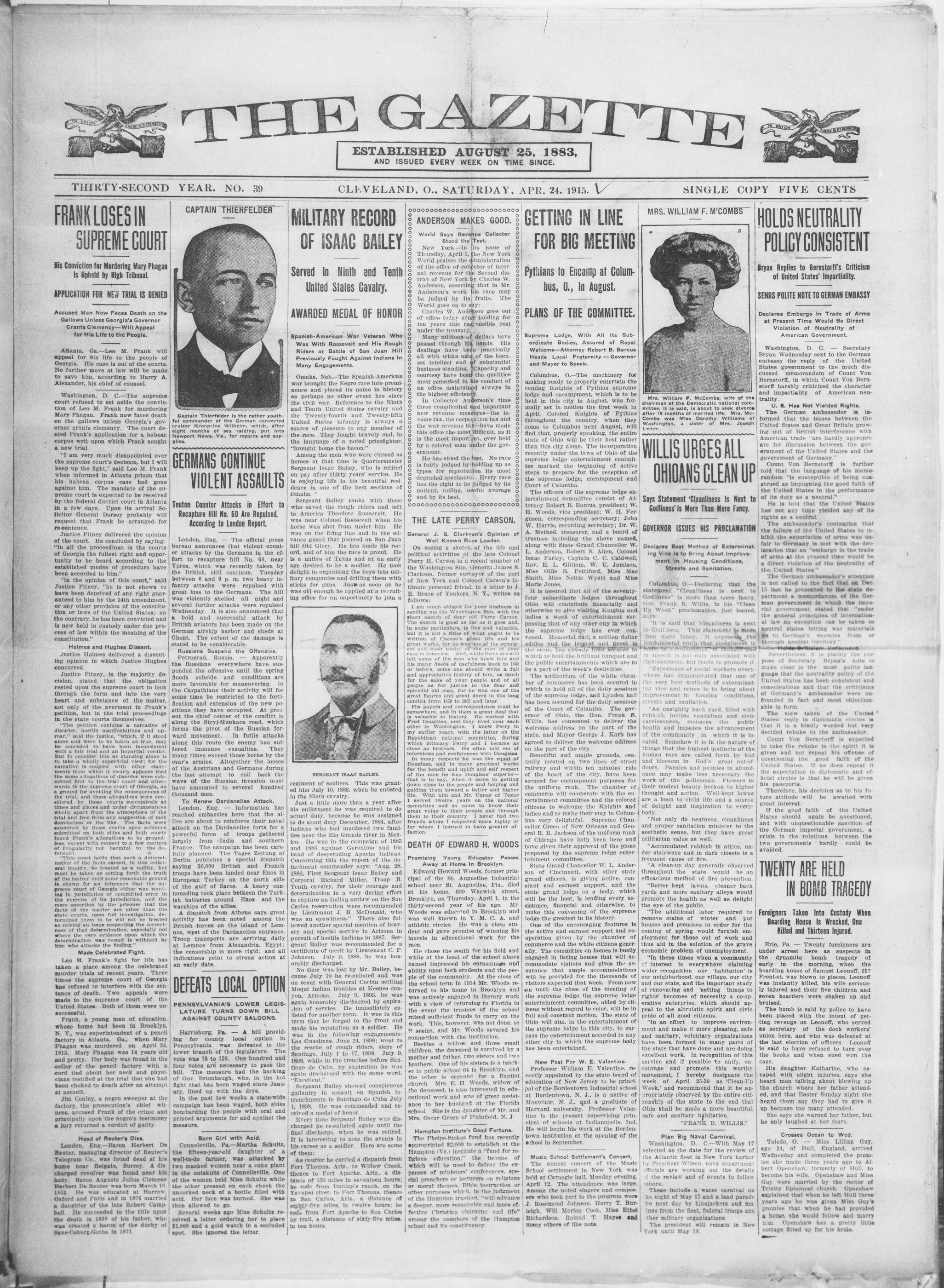
Page text (machine-generated)
IN CIVIS
UNITIS SEGREGAT
FRANK LOSES IN SUPREME COURT
His Conviction for Murdering Mary Phagan Is Uphold by High Tribunal.
APPLICATION FOR NEW TRIAL IS DENIED
Accused Man. Now Faces Death on the Gallowies Unless Georgia's Governor Grants Clemency—Will Appeal for His Life to the People.
Atlanta, Ga.—Leo M. Frank will appeal for his life to the people of Georgia. His case is out of the courts. No further move at law will be made to save him, according to Harry A. Alexander, his chief of counsel.
Washington, D. C.—The supreme court refused to set aside the conviction of Leo M. Frank for murdering Mary Phagan. Frank now faces death on the gallows unless Georgia's governor grants' clemency. The court denied Frank's application for a habeas corpus writ upon which Frank sought a new trial.
"I am very much disappointed over the supreme court's decision, but I will keep up the fight," said Leo M. Frank when informed in Atlanta prison that his habeas corpus case had gone against him. The mandate of the supreme court is expected to be received by the federal district court in Atlanta in a few days. Upon its arrival Solicitor General Dorsey probably will request that Frank be arranged for re-sentence.
Justice Pitney delivered the opinion of the court. He concluded by saying: "In all the proceedings in the courts of Georgia the fullest right and opportunity to be heard according to the established modes of procedure have been accorded to him."
"In the opinion of this court," said Justice Pitney, "he is not shown to have deprived of any right guaranteed to him by the 14th amendment, or any other provision of the constitution or laws of the United States; on the contrary, he has been convicted and is now held in custody under due process of law within the meaning of the constitution."
Holmes and Hughes Dissent.
Justice Holmes delivered a dissenting opinion in which Justice Hughes concurred.
Justice Pitney, in the majority decision, stated that the obligation rested upon the supreme court to look through the form and into the very heart and substance of the matter, not only of the averment in Frank's petition, but in the trial proceedings in the state courts themselves.
"The petition contains a narrative of disorder, hostile manifestations and uprising," said the justice, "which, if it stood unchanged, would be conceded to have been inconsistent with a fair trial and an impartial verdict. But to consider this as standing alone is not a good idea." The petition narrative is coupled with other statements from which it clearly appears that the same allegations of disorder were subdued and that the supreme court of Georgia, as a ground for avoiding the consequences of the trial, and these allegations were considered and that the supreme court wants to the supreme court of Georgia, as a ground for avoiding the consequences of the trial, and these allegations were considered and that the supreme court wants to the supreme court of Georgia, as a ground for avoiding the consequences of the trial, and free from any suggestion of mob domination or the like. The facts are submitted on both sides and both courts found Frank's allegations to be groundless, except with respect to a few matters of irregularity not harmful to the de
This court holds that such a determination of the facts cannot, in this collateral inquiry, be reasoned for, but must be tested for the truth of the matter until some reasonable ground is shown for an inference that the supreme court of Georgia either was winnings in jurisdiction, or simply a purchase of its jurisdiction, and the mere assertion by the prisoner that the facts of the matter are other than the state courts, upon full investigation, to be created arising an issue respecting the correctness of that determination, especially not where the very evidence upon which the determination was raised withheld by him who attacked the finding.
Made Celebrated Fight.
Leo M. Frank's fight for life has taken a place among the celebrated murder trials of recent years. Three times the supreme court of Georgia has refused to interfere with the sentence of death. Two appeals were made to the supreme court of the United States. Both of them were unsuccessful.
Frank, a young man of education, whose home had been in Brooklyn. N. Y., was superintendent of a pencil factory in Atlanta, Ga., when Mary Phagan was murdered on April 26, 1912. Mary Phagan was 14 years old and pretty. Her body was found in the cellar of the pencil factory with a cord tled about her neck and physicians testified at the trial that she had been choked to death after an attempt at assault.
Jim Conley, a negro sweeper at the factory, the prosecution's chief witness, accused Frank of the crime and principally upon the negro's testimony a jury returned a verdict of guilty.
Head of Reuter's Dies.
London, Eng.—Baron Herbert De Reuter, managing director of Reuter's Telegram Co. was found dead at his home near Reigate, Burray. A discharged revolver was found near his body. Baron Auguste Julius Clemens Herbert De Reuter was born March 10, 1652. He was educated at Harrow, Oxford and Paris and in 1876 married a daughter of the late Robert Campbell. He succeeded to the title upon the death in 1899 of his father, who was created a baron of the duchy of Baxe-Coburg-Gotha in 1871.
THE GAZETTE
Captain Thierfelder is the rather youthful commander of the German converted cruiser Kronprinz Wilhelm, which, after eight months of sea raiding, put into Newport News, Va., for repairs and supplies.
GERMANS CONTINUE VIOLENT ASSAULTS
Teuton Counter Attacks in Effort to Recapture Hill No. 60 Are Repulsed, According to London Report.
London, Eng. — The official press bureau announces that violent counter attacks by the Germans in the effort to recapture hill No. 60, near Ypres, which was recently taken by the British 'still continue. Tuesday between 6, and 9 p. m. two heavy infantry attacks were repulsed with great loss to the Germans. The hill was violently shelled, all night and several further attacks were repulsed Wednesday. It is also announced that a bold and successful attack by British aviators has been made on the German airship harbor and sheds at Ghont. The extent of the damage is stated to be considerable.
Russians Suspended the Offensive.
Petrograd, Russia. — Apparently the Russians, everywhere have suspended the offensive until the spring floods subside and conditions are more favorable for maneuvering. In the Carpathians their activity will for some time be restricted to the fortification and extension of the new positions they have occupied. At present the chief center of the conflict is along the Stryl.Jmukacs road, which forms the pivot of the Russian forward movement. In futile attacks along this route the enemy has suffered immense casualties. They many times exceed those borne by the carr's armies. Altogether the losses of the Austrians and Germans during the last attempt to roll back the wave' of the Russian invasion must have amounted to several hundred thousand men.
To Renew Dardanelles Attack.
London, Eng. — Information has reached embassies here that the allies are about to reinforce their naval attack on the Dardanelles forts for a powerful force of troops gathered largely from India and southern France. The campaign has been carefully planned. The Tages Zeitung of Berlin publishes a special dispatch saying 20,000 British and French troops have been landed near Enos in European Turkey on the north side of the gulf of Saros. A heavy cannonading took place between the Turkish batteries around Enos and the warships of the allies.
A dispatch from Athens says great activity has been noted among the British forces on the island of Lemnos, west of the Dardanelles entrance. Troop transports are arriving daily at Lemnos from Alexandria. Egypt; the censorship is more rigid; and all indications point to strong action at an early date.
DEFEATS LOCAL OPTION
PENNSYLVANIA'S LOWER LEGISLATURE TURNS DOWN BILL AGAINST COUNTY SALOONS.
Harrisburg, Pa. — A bill providing for county. local option in Pennsylvania was defeated in the lower branch of the legislature. The vote was 78 to 128. One hundred and four votes are necessary to pass the bill. The measure had the backing of Gov. Brumbaugh, who, in the hot fight that has been waged since January, lined up with the drys.
In the past few weeks a state-wide campaign has been waged, both sides bombarding the people with oral and printed arguments for and against the measure.
Burn Girl with Acid.
Connelsville, Pa.—Martha 'Schultz, the fifteen-year-old daughter of a well-to-do farmer, was attacked by two masked women near a coke plant in the outskirts of Connellsville. One of the women held Miss Schultz while the other pressed on each cheek the unkinned neck of a bottle filled with acid. Her face was burned. She was then allowed to go. Several weeks ago Miss Schultz received a letter ordering her to place $1,000 and a gold watch in a secluded spot. She ignored the letter.
ESTABLISHED AUGUST 25, 1883 AND ISSUED EVERY WEEK ON TIME SINCE.
MILITARY RECORD OF ISAAC BAILEY
Spanish-American War Veteran Who Was With Roosevelt and His Rough Riders at Battle of San Juan Hill Previously Fought Against Indians in Many Engagements.
Onnah, Neb.-The Spanish-American war brought the Negro race into prominence and placed its name in history as perhaps, no other event has since the civil war. Reference to the Ninth and Tenth United States cavalry and the Twenty-fourth, and Twenty-fifth United States infantry is always a source of pleasure to any member of the race. They fought bravely and, in the language of a noted prizefighter, "brought home the bacon."
Among the men who were classed as heroes at that time is Quartermaster Sergeant Isaac Bailey, who is retired or pay after thirty years' service. He is enjoying life in his beautiful residence in one of the best sections of Omaha.
Sergeant Bailey ranks with those who saved the rough riders and left to America Theodore Roosevelt. He was near Colonel Roosevelt when his horse was shot from under him. He was on the firing line and in the advance guard that planted on San Juan hill Old Glory. He has made his record, and of him the race is proud. He is a native of Texas and at an early age desired to be a soldier. He took delight in organizing the boys into military companies and drilling them with sticks for guns. Just as soon as he was old enough he applied at a recruiting office for an opportunity to join a
SERGEANT ISAACO BAILEY.
regiment of soldiers. This was granted him July 10, 1883, when he epilated in the Ninth cavalry.
Just a little more than a year after his enlistment he was required to do actual duty, because he was assigned to do scout duty December 1884, after Indians who had murdered two families near the Rio Grande river in Mexico. He was the campaign of 1885 and 1886 against Geronimo and his band against Apache Indians. Concerning this the report of the department commander says: "Aug. 28, 1886. First Sergent Isaac Bailey and Corporal Richard Miller, Troop B. Tenth cavalry, for their courage and determination in a very during effort to capture an Indian outlaw on the San Carlos reservation were recommended by Lieutenant J. B. McDonald, who was an eyewitness." There also followed another special mention of bravery and special service in Arizona in pursuit of hostile Indians in 1887. Sergeant Bailey was recommended for a certificate of merit by Lieutenant C. P. Johnson. July 9, 1888, he was honorably discharged.
No time was lost by Mr. Bailey, because July 10 he re-enslanted and was on scout with General Corbin settling Mosquit Indian troubles at Keenes canyon, Arizona. July 9, 1803, he was again honorably discharged by expulsion of service. He immediately enlisted for another term. It was in this term that he forged to the front and made his reputation as a soldier. He was in the following engagements: Las Guastimas, June 24, 1808; went to the rescue of cough riders, siege of Santiago, July 1 to 17, 1808. July 0, 1808, while in the trenches before Santiago de Cuba, by expiration he was again discharged with the same word, "Excellent."
Sergeant Bailey showed conspicuous gallantry in assault on Spanish intrenchments in Santiago de Cuba July 1, 1808. He was commended and received a medal of honor.
Every time Sergeant Bailey was discharged he reagained until the final discharge, when he was retired.
It is interesting to note the events in his career as a soldier. Here are some of them:
As courier he carried a dispatch from Fort Thomas, Artiz; to Willow Creek, thence to Fort Apache, Artiz. a distance of 130 miles in seventeen hours; he rode from Dunlap's ranch, on the Yayapa river, to Fort Thomas, thence to San Carlos, Artiz. a distance of eighty-five miles, in twelve hours; he rode from Fort Apache to San Carlos by trull, a distance of sixty-five miles, in ten hours.
ANDERSON MAKES GOOD.
World Says Revenue Collector Stood the Test.
New York.-In its issue of Thursday, April 11, the New York World praises the administration of the office of collector of internal revenue for the Second district of New York by Charles W. Anderson, assuring that in Mr. Anderson's work his race may be judged by its fruits. The World goes on to say:
Charles W. Anderson goes out of office today after holding for ten years this responsible post under the treasury.
Many millions of dollars have passed through his hands. His dealings have been practically all with white men of the keenest intellect and of substantial business standing. Capacity and courtesy have been the qualities most remarked in his conduct of an office maintained always in the highest efficiency.
In Collector Anderson's time three complicated and important new revenue measures—the income tax, the corporation tax and the war revenue tax—have made this office the most difficult, as it is the most important, ever held by a colored man under the government.
He has stood the test. No race is fairly judged by holding up as types for reproportion its most degraded specimens. Every race has the right to be judged by its patient, tolling, useful average and by its best.
```markdown
```
THE LATE PERRY CARSON.
General J. S. Clarkson's. Opinion of Well Known Race Leader.
On seeing a sketch of the life and political activities of the late Colonel Perry H. Carson in a recent number of the Washington Sun, General James S. Clarkson, former surveyor of the port of New York and Colonel Carsons intimate-personal friend, in a letter to J. E. Bruce of Youkens, N. Y., writes as follows:
I am much obliged for your kindness in sending me the Washington Sun, with the short sketch of dear old Perry Carson in his early years, in some particulars, is fine and valuable, but it is not a tittle of what ought to be written of Carson's great life and his great works, for he was one of the strongest race in America. And, while there are left of the men who knew him and his many deeds of usefulness back to 1805, I am grateful to his long and appreciative history of him, as much for the sake of your people and of all people as for justice to the dear and splendid old man, for he was one of the first to have a long conflict from 1850 to 1853 and
His papers and correspondence must be somewhere, and in them a great deal that is valuable to history. He worked with the University of Chicago and with other in Washington. I knew Perry in my earlier years, with the latter in the Republican national committee, during his intuitivity "for the better of close friends." He often told me of interviews and conferences with Douglass.
In many respects he was the equal of Douglass, and in many practical works for the benefit and purpose he was Douglass's superior that is to say, when it came to getting down close to the people and helping and guilding them toward a better and higher life. With him and Mr. Curry of Texas he was a great friend of the committee and so came to know their great value to their people and through them to their country. I never had two friends whom I respected more highly or whom I learned to have greater affection.
DEATH OF EDWARD H. WOODS
Promising Young Educator Passes
Away at Home in Brooklyn.
Edward Howard Woold, former principal of the St. Augustine Industrial school near St. Augustine, Fla., died at his home, 600 Warwick street, Brooklyn, on Thursday, April 1. In the third-second year of his age, Mr. Woods was educated in Brooklyn and was well known in Y. M. C. A. and athletic circles. He was a close student and gave promise of winning his inlures in educational work for the race.
He chose the south for his field and while at the head of the school above named impressed his earnestness and ability upon both students and the people of the community. At the close of the school term in 1914 Mr. Woods returned to his home in Brooklyn and was actively engaged in literary work with a view of returning to Florida in the event the trusigues of the school raised sufficient funds to carry on the work. This, however, was not done, so it seems, and Mr. Woods severed his connection with the institution.
Besides a $^3$ wilde and three small children, the deceased is survived by a mother and father, two sisters and two brothers. One of his sisters is a teacher in public school 64 in Brooklyn, and the other is organist for a Baptist church. Mrs. E. H. Woods, widow of the deceased, is also interested in educational work and was of great assistance to her husband at the Florida school. She is the daughter of Mr. and Mrs. Oscar Green of Plumfield, N. J.
Hampton Institute's Good Fortune.
The Phlores-Stokes fund has recently appropriated $2,000 to establish at the Hampton V.A. institute a "fund for religious education," the income of which will be used to defray the expenses of ministers' conferences, special preachers or lecturers on religious or moral themes. Bible instruction or other purposes which, in the judgment of the Hampton trustees, "will advance a deeper; more reasonable and more effective Christian character and life" among the members of the Hampton school and its constituency.
GETTING IN LINE FOR BIG MEETING
Supreme Lodge, With All Its Subordinate Bodies, Assured of Royal Welcome—Attorney Robert B. Barcus Heads Head of Fraternity — Governor and Mayor to Speak.
Columbus, O.-The machinery for making ready to properly entertain the coming Knights of Pythias supreme lodge and encampment, which is to be held in this city in August, was formally set in motion the first week in April. Colored Knights of Pythias throughout the country, when they come to Columbus next August, will find that, properly speaking, the entire state of Ohio will be their host rather than this city alone. The incorporation recently under the laws of Ohio of the supreme lodge entertainment committee marked the beginning of active steps to prepare for the reception of the supreme lodge, encampment and Court of Catania.
The officers of the supreme lodge entertainment committee consist of Attorney Robert B. Bareus, president; W. H. Woods, vice president; W. H. Ferguson, corresponding secretary; John W. Harris, recording secretary; Dr. W. A. Method, treasurer, and a board of trustees including the above named, along with State Grand, Chancellor W. L. Anderson, Robert S. Allen, Colonel Isaac Farley, Captain C. C. Caldwell, Rev. E. L. Gilliam, W. U. Jamison, Miss Ollie B. Pettiford, Miss Mace Smith, Miss Nettle Wyatt and Miss Marle Jones.
It is assured that all of the seventy-four subordinate lodges throughout Ohio will contribute financially and otherwise to give visiting Knights and a ladies of entertainment surpassing that of any other city in which the supreme lodge, has ever convened. Memorial hall, a million dollar office and the largest and finest in the state, has already been established in which to hold the lord and bishop and the public entertainments which are to be a part of the week's festivities.
The auditorium of the white chamber of commerce has been secured in which to hold all of the daily sessions of the supreme lodge, and Lynden hall has been secured for the daily sessions of the Court of Calcutta. The governor of Ohio, the Hon. Frank B. Willis, has consented to deliver the welcome address on the part of the state, and Mayor George J. Karb has agreed to deliver the welcome address on the part of the city.
Beautiful and ample grounds, centrally located on two lines of street railway and within ten minutes' ride of the heart of the city, have been secured for encampment purposes for the uniform rank. The chamber of commerce will cooperate with the entertainment committee and the colored citizens to welcome the Knights and ladies and to make their stay in Columbus very delightful. Supreme Chancellor Green of New Orleans and General R. R. Jackson of the uniform rank of Chicago have both been here and have given their approval of the plans prepared by the supreme lodge entertainment committee.
State Grand Chancellor W. L. Anderson of Cincinnati, with other state grand officers, is giving active, constant and earnest support, and the state grand lodge as a body, which will be the host, is lending every assistance, financial and otherwise, to make this convening of the supreme lodge the greatest in its history.
One of the encouraging features is the active and earnest support and cooperation given by the chamber of commerce and the white citizens generally. The committee on homes is busily engaged in listing homes that will accommodate visitors and gives the assurance that ample accommodations will be provided for the thousands of visitors expected that week. From now on until the close of the meeting of the supreme lodge the supreme lodge entertainment committee, aided by citizens without regard to color, will be in full and constant motion. The state of Ohio will aim, in the entertainment of the supreme lodge in this city, to surpass the entertainment accorded in any other city in which the supreme body has been entertained.
New Post For W. E. Valentine.
Professor William E. Valentine, recently appointed by the state board of education of New Jersey to be principal of the Bordentown Industrial school at Bordentown, N. J., is a native of Montclair, N. J., and a graduate of Harvard University. Professor Valentine is the present supervising principal of schools at Indianapolis, Ind. He will begin his work at the Bordentown institution at the opening of the school in September.
Music School Settlement's Concert.
The annual concert of the Music School settlement in New York was held at Carnegie hall, Monday evening, April 12. The attendance was large. Among the noted singers and composers who took part in the program were J. Rosemond, Johnson, Harry T. Burleigh, Will Marion Cook, Miss Ethel Richardson, Roland T. Hayes and many others of like note.
MRS. WILLIAM F. M'COMBS
Mrs. William F. McCombs, wife of the chairman of the Democratic national committee, it is said, is about to seek divorce after 18 months of married life. Mrs. McCombs was Miss Dorothy Williams of Washington, a sister of Mrs. Joseph Leiter.
WILLIS URGES ALL OHIOANS CLEAN UP
Says Statement 'Cleanliness Is Next to Godliness' Is More Than Mere Fancy.
"Not only do neatness, cleanliness and proper sanitation minister to the aesthetic sense, but they have great utilitarian value as well."
"Accumulated rubbish in attics, under stairways and in dark closets is a frequent cause of fire."
"A clean-up day generally observed throughout the state would be an efficacious method of fire prevention."
"Better kept lawns, cleaner back yards and more sanitary alleys would promote the health as well as delight the eye of the public."
"The additional labor required to remove stains of winter and put houses and premises in order for the coming of spring would furnish employment for those out of work and thus aid in the solution of the grave economic problem of unemployment.
"In these times when a community interest is everywhere claiming wider recognition our 'habitation' is our neighborhood, our village, our city and our state, and the important study of renovating and 'setting things to rights' becomes of necessity a cooperative enterprise, which should appeal to the altruistic spirit and civic pride of all good citizens."
"In an effort to improve environment and make it more pleasing, safe and sanitary, voluntary organizations have been formed in many parts of the state that have done and are doing excellent work. In recognition of this service and if possible to unity, encourage and promote this worthy movement, F. hereby designate the week of April 25-30 as 'Clean-Up Week', and recommend that it be appropriately observed by the entire citizenship of the state to the end that Ohio shall be made a more beautiful safe and sanitary habitat.
Plan Big Naval Carnival
Washington. D. C.-With May 17
selected as the date for the review of
the Atlantic fleet in New York harbor
President Wilson navy department
affiliates are working out the details
of the review and of events to follow
shore.
These include a water carnival on
the night of May 17 and a land parade
the next day by bluejackets and ma-
nies from the fleet, federal troops and
their military organizations.
The president will remain in New
York until May 17.
IN PATICK UNDERSTANDING
HOLDS NEUTRALITY POLICY CONSISTENT
Bryan Replies to Bernstorff's Criticism of United States' Impartiality.
Declares Embargo. In Trade of Arms at Present Time. Would Be Direct Violation of Neutrality of American Government.
Washington, D. C. — Secretary Bryan, Wednesday sent to the German embassy the reply to the United States government to the much discussed memorandum of Count Von Bernstorf, in which Count Von Bernstorf harshly criticized the character and impartiality of American neutrality.
U. 6. Has Not Yielded Rights.
The German ambassador is informed that the issues between the United States and Great Britain growing out of British interference with American trade are hardly appropriate for discussion between the government of the United States and the government of Germany."
Count Von Bernstorf is further told that the language of his memorandum "is susceptible of being construed as impugning the good faith of the United States in the performance of its duty as a neutral."
He is told that the United States has not any time yielded any of its rights as a neutral.
The ambassador's contention that the failure of the United States to inhibit the exportation of arms was unfair to Germany is met with the declaration that an "embargo in the trade of arms at the present time would be a direct violation of the neutrality of the United States."
The Gorianian ambassador's attention is not called to the fact that on December 15, last he presented to the state department a memorandum of the German government in which the internal government stated that "under the general principles of international law no exception can be taken to neutral states letting war materials go to Gorianian territory." It is unclear through thorough testimony.
Holden Criticism Unfounded.
pose of Sir Henry's wife to make sure in the most possible guage that the new authority of the United States has been constituted and constitutions and that the expiration of Germany's ambassador were an founded in fact and most objection able in form.
The view taken of the United States reply in diplomatic terms is that it is a kindly worded, but very decided rebuke to the ambassador. Count Von Bernstorf is expected to take the rebuke in the spirit it is given and not repeat his offense of questioning they good faith of the United States. If he does repeat it the expiration in diplomatic and of trial circles is that he will be given his passports.
Therefore, his decision as to his future attitude will be awaited with great interest.
If the good faith of the United States should again be questioned, and with unquestionable sanction of the German imperial government, a crisis in the relations between the two governments hardly could be avoided.
TWENTY ARE HELD IN BOMB TRAGEDY
Foreigners Taken Into- Custody When Boarding House Is Wrecked, One Killed and Thirteen Injured.
Erie, Pa. — Twenty foreigners are under arrest here as suspects in the dynamite bomb tragedy of early in the morning, when the boarding house of Samuel Leonoff-227 Frontst. was blown to pieces. Leonoff was instantly killed, his wife seriously injured and their five children and seven boarders were shaken up and bruised.
The bomb is said by police to have been placed with the intent of getting revenge on Leonoff, who served as secretary of the dock workers union here, and who was defeated at the last election of officers. Leonoff is said to have refused to turn over the books and when sued won the case.
His daughter Katharine, who escaped with slight injuries, says she heard men talking about blowing up the church where her father attended, and that Easter Sunday night she heard them say they had to give it up because too many attended.
She says she warned her father, but
She says she warned her father, but he only laughed at her fears.
Crosses Ocean-to Wed.
Toledo, O. — Miss Lillian, Guy, age 24, of Hull, England, arrived Wednesday and completed the promise she made three years ago to Albert Openshaw, formerly of Hull, to become his wife. Openshaw and Miss Guy were married by the rector of Trinity Episcopal church. Openshaw explained that when he left Hull three years ago he was given Miss Guy's promise that when he had provided a house, she would follow and marry Guy. Openshaw has a pretty little cottage fitted up for his bride.
PURO HERBS consist of the best possible mixture of Nature's health giving Herbs, contains no potash or not cause bruising, purely vegetable does not cause bruising, and cret compound, as it is composed of such well-known herbs as Burdock, Dandelion, Sarasparilla, Red Clover, Milton, Eillington, Prickly Ash and other herbs—all the very best approved blood purifiers.
PURO HERBS cleans the system of all impurities, restores health and ven, and drives away that tired, runneth and blooms to impurities collecting in the system during the winters.
PURO HERBS cost but 35c a box, the contents of which, boiled with one quart of water, makes one quart of water, and is used to ordinary one dollar bottles in size and better than any patent medicine, regardless of price.
PURO HERBS are also supplied in liquid form, for those who do not care to use themselves, at 75c a quart. Sold only at
BROWN DRUG CO,
2742 GENTRAL AVE., cor. 28th Street
Leading Cut-Rate Drugs
How to be
Beautiful
By Using
Walker's Toilet and Hair
Preparations
It is necessary to have clear, smooth skin
as well as hair to be beautiful.
Walker's
Black-No-More
A CREAM FOR BLEACHING AND
BEAUTIFYING
50c Brown - Face Powder 25c
23 other Toilet nd Hair Preparations
AGENTS WANTED: also travels to ap-
point representatives. Salary not Commis-
sion. Exhibe stamp for full information.
No samples sent; cash with each order.
Goods sent by mail 10c extra
Mrs. Matilda Walker
Box 44 So. Orange, N. J
**************************************************************
STERLING
5 and 10 Cent Store
3003 Central Ave.
Watch Our Windows
For Bargains
Arlington Pharmacy
WE WILL ACCEPT THIS ADVERTISEMENT FOR FIVE CENTS IN TRADE, TO APPLY ON ANY PURCHASE OF TWENTY-FIVE CENTS OR MORE.
E. Rukenstein, Ph. C., Prop.
S. W. Cor. Central Ave. & E.
55th St.
The Fifteenth Annual Session of the
State Summer School
for Colored
TEACHERS OF BOTH SEXES
at the
Agricultural and
Mechanical College
GREENSBORO, N. C.
will begin June 29th, 1914, and continue five weeks.
In addition to the regular work an attractive lecture course has been arranged, in which will appear some of the most distinguished white and Colored educators in the country.
Board and lodging for the entire session $12.00. Tuition 25c per subject unless other arrangements have been made.
Limited accommodations. Send $1 and have room reserved in advance.
For further information write once to
James B. Dudley, President, or
D. J. Jordan, Director,
A. & M. College, Greensboro, N. C
THE PEOPLES' DRUG STORE
F. H. WEAVER, PHAR. D., Prop.
Cor. Central Ave. and E. 33d St.
Agent for
"HIGH BROWN FACE POWDER."
WE GIVE TRADING STAMPS.
MONEY ORDERS, NEWSPAPER
ADS, TELEGRAMS.
PRESCRIPTIONS A SPECIALTY
Open late at Night.
THE OLD DOMINION
Lunch Room
at
3652 Central Ave.,
Serves THE BEST AND
QUICKEST MEALS
at
Popular Prices. Give it a Trial.
Open Day and Night
Mrs. H. C. Jones, Prop.
---
Where to Purchase The Gazette
NOTICE TO SUBSCRIBERS
The Gazette regularly should notify
delivered promptly.
fully examine The Gazette's adver-
s. Business men who advertise in
image of Afro-Americans. The fact
that they want it.
tirements) ten cents a line (six
Personal
Subscribers not receiving The Gazette regularly should notify us at once. We desire every copy delivered promptly.
We advise our patrons to carefully examine The Gazette's advertisements before making purchases. Business men who advertise in this paper should have the patronage of Afro-Americans. The fact that they advertise is assurance that they want it. Local reading notices (advertisements) ten cents a line (six words in a line).
Mrs. Harriet K. Price's guest, Miss Dolly David, returned to Ravenna, last week.
* * *
Mr. and Mrs. Robt. Coram have moved into their cosy home in Lakewood.
* * *
Mrs. Georgia Owsley returned to Chicago, last week, after a pleasant visit with Miss Irene Hardy, E. 25th St.
* * *
There is only one way to get our race's news, local and general, and that is by taking "the old and reliable" Gazette, every week.
* * *
The editor of The Gazette acknowledges the receipt of an invitation to attend the All-Star Whist club's third annual May party in Excelsior Parcors, Youngstown, May 11. C. B. Stewart is president of the club, W. P. Burton, sec., and T. B. Robinson, treas.
Mr. Louis Jones of E. 30th St. gave his wife a very pleasant party, last week Wednesday evening, in honor of their twenty-first wedding anniversary. Many nice presents were received.
* * *
Mr. George Carroll is able to be about again, having recovered from slight injuries sustained when hit by an auto in the Public Square, Tuesday week.
* * *
John P. Green served three terms in the Ohio Legislature, nine years as a Justice of the Peace in this city, and was a stamp clerk in the government service of Washington, D.C. for about seven years. In all of this time what has he done for his people? Can you name some material thing he has accomplished for us? Try!
* * *
Miss Camille S. Nickerson, a composer and student of Oberlin Conservatory, was the guest of Mr. and Mrs. H. J. Smith of Hudson Ave., recently.
The funeral of Mr. Paul Rose took place, Wednesday afternoon, from the family residence, 2285 E. 100th St. Interment at Amherst, Va.
* * * *
Wm. Hagley has dropped out of the local "newspaper" business just as The Gazette announced, some time ago. Another one, got enough. Next!
Mr. Walter Brown, 2335 E. 29th St. left for Cincinnati, Monday evening, and will return with his wife, Thursday.
* * * *
Rev. G. V. Clark, pastor of Mt. Zion Cong. church, had charge of the devotional exercises at each session of the sixty-second meeting, of the Cleveland Association of Congregational churches and ministers, which was held in Grace Avenue, E. 65th St. and Colgate Ave., S. E. the first of the week. He preached a special sermon to parents, Sunday morning, on "Child Training."
The A. F. and A. M. on their march,
Sunday, wore lambskin aprons valued
at $1500. The grandmaster makes
these aprons. Bishop C. Lennox, G.
M., is in receipt of a letter from the
grandmaster of Europe, malled at
Luxemburg, Germany, which he
showed a representative of The Gazette,
this week. *
Send or bring locals and all business matters to The Gazette's offices
suite 2, Blackstone Bldg. If you wish
to see the editor call there, please.
All matters for publication in current
issues of The Gazette, must be in the
office by 4 p. m., WEDNESDAY at the
latest.
Miss Minnie Mason of 2501 E. 46th
St., reports that she has been willied
$700, and a house and lot in Alexandria,
Va., by Solomon Warr, her
grandfather. She was his faivorite
and his only granddaughter. He died
March 8, 1915, aged 94.
The wedding of Mr. Arthur Wade and Miss Dazalia Underwood, last week Thursday evening, was a very pretty affair. Rev. Charles Bundy performed the ceremony at Mr. and Mrs. T. W. Cole's, Morrison Ave. Miss Airy Payne of Oberlin, played the wedding march, and little Dorothy and Louise Wade, daughters of the groom, were the flower girls. The decorations were beautiful and the he and Mrs. Wade were used by Mr. and Mrs. Wade will be "at home" to their many friends after April 25, at 31 E. 99th St.
Bishop C. Lennox announces that his grandfather has left an estate, valued at $500,000 to be divided among 10 heirs. The estate contains a large undeveloped salt well, which was leased by one Wm. Sutton. The property has never been transferred to any person or persons, according to the record, he says; also, that the heirs have the deed and abstract of the same, and that he has been appointed administrator. The property is in city limits and is known as the Lennox Farm. Bishop Lennox is in the real-estate business in this city.
*O. C. SCHROEDER'S,
Cuyahoga Bldg.
F. VALENTINE'S
2130 Central Ave.
J. E. BRANHAM'S
4401 Central Ave.
PUSHAW
The Arcade.
Superior Entrance.
*OPEN SUNDAYS.
Our
Classified Ad
Department
FOR RENT—Houses and Rooms.
If you have them to rent or if you
want to rent, advertise in The Gazette.
It brings results.
NOTARY PUBLIC—For such serv-
ices call at The Gazette office. No. 2
Blackstone building. No. 1424 W
Third Street, near Superior Ave.
FOR SALE—Houses or lots.
If you have debt or anything else
to sell, or if you wish to purchase,
advertise in The Gazette. If anything
can bring you results, it can and
will.
FOR SALE.—A bargain for cash. Desire to leave the city as early as possible. Two lots, 40 ft. each, and an eight room house; electric light and gas; in Mt. Pleasant allotment. 3228 E. 128th street. Apply to owner, Rev. J. J. Smith, or Union National Bank. Will sell, part cash and mortgage.
Rev. H. C. Bailey lectured to a fair audience in Oberlin, last week.
Miss Dazalia Underwood is now Mrs. Arthur Wade. Congratulations, Miss Daisy.
Hester O. Brown has entered Oberlin Conservatory of music. She is already a talented vocalist and violinist.
Our advertisers want your trade Those who do not ask for it in The Gazette certainly care little, if at all for it. Therefore, we urge our readers and all of our friends to patronize those who ask for your trade in this paper.
What became of the communication, directed at The Gazette, a few members of the Cleveland Assoc. of Colored Men sent to Wm. Monroe Trotter, recently, on the motion of a member who openly said at an executive committee meeting of the local branch of the N. A. A. C. P. did anything so bad in the miserable photo-play recently stopped at the Standard theater by the police on order of Gov. F. B. Wilis because it was "most" bad and extremely harmful to the race? Will some one answer?
The Peoples' Lycme held an interesting session in St. Andrew's church, Monday evening. The discussion of "Shall Women Have the Right of Suffrage" was decided in favor of the affirmative, represented by Miss Elea-nor Alexander. Mrs. John Cousins handled the negative side very creditably.
* * *
Miss Juanta Thompson, one of Erie's most popular young ladies, was the guest of the Misses Edith Wright, Marie Bolden and Clara Brooks, last week.
* * *
* A meeting of the local Branch of the National Association for the Ad- vancement of Colored People will be held in Cory M. E. church, Sunday, April 25, at 3 p. m. Judge T. M. Ken- nedy and Hon. John P. Green will be speakers. Every person who has an interest in the race and believes in equal rights should be present.—Adv.
The Central Shirt Shop at 2908 Central Av., is an innovation and a race enterprise that our people ought to take pride in patronizing. The young men in charge are courteous, obliging and know the business.
Bass & Turk have opened a neat and well conducted, cafe at 2845 Central Av., that measures up with any of the kind in the city. Both are thoroughly experienced in the business.
Mr. Edward Sutton who has been here, some months, left. Saturday, to visit his wife and grand-daughter in Chillicothe.
In the hour of trouble and distress call Slaughter Bros., funeral directors. They are members of the race and are equipped to give you the best funeral service in the city and at moderate prices. For $75 they can give a complete first-class funeral which includes a beautiful cloth-covered casket with name-plate and six silver handles, embalming, burial-robe, door-wreath, outside-box, hearse, three carriages and all professional service. Their establishment is located at Av. and their casket-display rooms are open to the public every day. Bell 'phone, Rosedale, 2770. See advertisement elsewhere in this paper.—Adv.
THE GAZETTE, CLEVELAND, O. SATURDAY, APRIL 24, 1915.
---
---
你 考 实
Constable Chas. J. Crawford was in Detroit, last week, a guest of Detectives Richardson, Dan Smith, and Mr. Wm. Helskell, former resident of this city.
S. C. Green of Cedar Ave. and Mrs. Chas Smith of E. 86th St. are again very ill. Mr. Green has sustained a third stroke of paralysis, it is said.
Mrs. Mina Harris and Mrs. L. M. Jones of this city, attended the woman's day exercises at Rust M. E. church, Oberlin, recently.
Last Sunday afternoon, the pastor of Antioch Baptist church, lectured instructively and interestingly on "Will the Negro come back? If so when and how?" Some subject to discuss, alright.
Mr. Harvey Armstrong spent about ten days in the city, last and this week, among old friends and acquaintances, coming from Los Angeles, Cal., where he has a good-paying position.
The Elyria Progressive club, 2556 E. 22d St, is an institution our men of this city have long needed. Go in and see it and be convinced; then join it. The club's Wednesday eveningality and will continue to do so just so long as the organization is as well conducted as it is.
Attorney W. H. Boyd representing the widow of F. F. Scott, has secured a settlement of her case against "The Leader and News." He was on the eve of entering suit for $5,000. She is to receive $2500. It will be remembered that Mr. Scott, a barber in the Hollenden House shop and a graduate of the Michigan Dental School and the Leader-News auto, Sept. 13, 1913 when attempting to cross E. 6th St. from the shop for the purpose of purchasing some cigars. His death, the following morning, was the result of injuries received in this accident. The settlement is regarded as a good one, under the circumstances, there being a total lack of witnesses for the assault, and the A. Myers, proprietor of the Hollenden House Barber shop, is entitled to considerable credit for assistance rendered the widow from the very beginning of the effort to recover damages for the death of her husband.
St. John's Helping Hand society has elected the following named officers for the ensuing year: Mrs. Eilee Quinn, pres.; first vice., Mrs. Della Botts; second, Mrs. M. Twine; sec., Mrs. Ida Fountain; treas., Mrs. R. Holdingsworth; critic, Mrs. Dora Adams. The Wide Awake Rally club gave a successful social at Mrs. Susie Smith's, 3845 Central Ave., Wednesday day evening. Mrs. H. Humble is the energetic captain, and Mrs. John Early, sec. The Men's congress held a profitable meeting in the church, Mrs. Humble, its able leader. The recital, under the auspices of Harmony Rally club, No. 2, Mrs. M. Anderson, captain, Monday evening, was a successful affair. The participants, all of whom acquired themselves most creditably, were: Prof. Lyndon H. Caldwell, prof. Lyman H. Huskey, Mr. Clyde Smith, violinist, Akron, and Mrs. Lillian R. Thompson, soprano, who had charge of the program.
HOWARD DREW AMONG THEM.
Over 2,000 Star Athletes to Contest in
Track and Field Classic.
Philadelphia, Pa.—Given a good day, collegiate track and field records are likely to receive a hard jolt on Friday and Saturday of this week, when the University of Pennsylvania opens the outdoor season and the university celebrates. Every important college and university in the east and middle west, with some of the Pacific coast, will send their best men. In fact, the number of contestants, which has been growing more rapidly this time approach the 2,000 mark.
Howard Drew, our wonderful little spinner, and champion, who now holds jointly the world record of 9 3-5 seconds for 100 yards, hopes to make that time on an eastern track. Drew got his record on the Pacific coast where also Dan Kelly got credit for the same time. He was the first to have less skeptical about the authenticity of the mark. Drew feels this suspicious attitude also and wants to show his eastern critics that he can run as fast as the westerners' timers caught him. It isn't likely, though, that Drew can make even better than 10 seconds on an eastern track this early in the spring. Assuming that Drew has the speed to run in 9 3-5 seconds, and the writer wants to make him a chilly for such a performance this early. To run this fast conditions have to be absolutely right and the competition very keen.
BARS COLORED CATHOLICS
Chicago, Ill.—The Auditorium Hotel management drew the color-line against Catholics on April 7, when it refused to serve our women members of the Ladies' Catholic Benevolent Association at the annual banquet held at that hotel. Our order, Order No. 67, of the L. C. B. a. was in attendance. We were invited April 4 the hotel management notified the banquet committee that our order could not be served. The banquet should have been held elsewhere.
THE ELEVATOR BILL PASSED.
Columbus, O.-The Ott bill, which provides for operators on all elevators and the licensing of elevator-operators and starters, passed the House, last week Tuesday without material amendment. It is now in the Senate. The bill was opposed in the House committee on Cincinnati business organizations. Our elevator-operators better "wake up" before it is too late.
Your copy of The Gazette after reading it, but give it to a friend or an acquaintance who might subscribe after reading a copy of the paper.
FRESH OHIO NEWS
WRITTEN BY "THE OLD RELIABLE" GAZETTE'S CORRE...
SPONDENTS
THROUGHOUT THE STATE
MT. VERNON.—The Cleveland District A. M. E. conference, which met here, recently, in a two days' session at Waynah Chapel, was very interesting. The reception tendered the members of the conference, the first evening, in the lecture room of the church, in the library. Rev. G. W. Maxwell, P. E., being ill, Rev. Charles Bundy of Cleveland, presided. Interesting papers were read and addresses delivered by conference members and visitors. The following local preachers passed successful examinations: L. M. Gordon of Youngstown and A. E. Men of Cleveland. Our people in this district may well be the forcest and generous hospitality, in entertaining the conference and visitors.
SANDUSKY. — The young men's concert, last Thursday evening, was a success. —L. V. Lacy is suffering from a mashed hand. —Mr. W. Johnson was run down by a motorcycle last week because of a critically ill at the hospital. Mrs. M. Jefferson is ill. —A number of the S. S. workers will attend the Erie County convention, lead by J. R. Davis with a delegation of ten. Mrs. Mary Jones will lead a delegation of five or more, to Toledo, to the O. S. S. semi-annual convention. Mr. O. S. S. will The A. M. E. church and S. S. was well attended, Sunday. —If you want the news, take The Cleveland Gazette.
OBERLIN,—Mr. Joe Mason visited in Lorain, Monday—Rev. F. S. Deanley is attending conference in Chicago—W. L. Henderson, for many years a barber, highly respected, died after a week's illness, April 14. Funeral services at the home, Rev. Spence, officiating. Saturday after a week's illness, lectured at M. Zion church, Friday evening, under the auspices of the M. I. Club. Attendance good.—Hester O. Brown of Cleveland, is studying in the conservatory of music.—Mrs. Mina Harris and Mrs. L. M. Jones of Cleveland, attended the woman's day exercises at Rust M. E. church. The latter spoke very encouragingly to M. Zion S. S. After two weeks' effort, M. Zion church was able to report the 100, to be collected for each and assembly hall fund. Money is to be paid in August.—Eastern Star lodge is planning to give another ladies' concert and drill.
CORRESPONDENTS must mall all letters for publication at their main postoffice sufficiently early on Monday (or Sunday) of each week to have them reach The Gazette office on Tuesday morning, and always write to the city or town on the outside of the wrapper about returned copies. Unless this latter is done, proper credit cannot be given you. Lists of names, wedding presents, etc., obituary notices, speeches, resolutions, poetry, inquiries for relatives and advertisements of all kinds, including items announcing entertainments to be held in advance at the rate of ten cents a line, six words to a line. Our rates for display advertisements will be sent on application. Send postal note and not stamps during warm weather.
CADIZ—Mr. and Mrs. William Watson of Coschoton, were called here, last week, by the serious illness of the latter's sister, Mrs. Nettie Carter. —The musicale at Simpson M. E. church, Apr. 9, was very well attended. —Mrs. Lydia Timbers was ill, last week. —Miss Reba West returned to Alliance, after a two weeks' visit with her sister, Mrs. B. S. Lee. —A number of out-of-town wolf attended the funeral of Rev. W. J. Johnson. Among them were: Mrs. Susie Morse and James A. Jackson of Warren, Mr. John and Mrs. A. J. Que of Devonville, Mrs. Mr. Hue of Kenwell, Mrs. Hargrave, Mrs. Julia Davis and Mr. Jos, Bell of Smithfield, Mrs. Arnold of Troy, and Mrs. Ed. Peterson of Uhrichville. —Mrs. Sarah Foutz and great-granddaughter, Anna Louise Thomas, are visiting the former's daughter, Mrs. F. W. Lucas. —Rev. F. H. Gray left, last week, for conference in Chicago.
YOUNGSTOWN.—Rev. J. M. Gillmore is in Washington, D.C. this week.—Mrs. Gilbert Henry, who underwent an operation at the hospital, some time ago, is convalescing at home.—Mrs. Louisa M. Williams, age 80, died Sunday at her daughter, Mrs. Fred Johnson's, in Bedford, Pa. The remains were brought here for burial. Funeral, Wednesday, from St. Columbus, Mass. Mrs. Burke her for forty years. She was the widow of the late Wesley P. Williams, and leaves four children and a host of friends to mourn her demise.—George Burk of Sharon, Pa. was in the city, Sunday.—Mrs. Walter Woods has returned from Bridgeport, accompanied by her mother, Mrs. R. Verse, who will visit her, few weeks. Mrs. Verse, sweet and fabian, has purchased a horse and wagon. Mrs. Robert Mackey is still quite ill.—Mrs. Mary Bias was called to Bridgeport, by the death of a niece.—Mrs. R. Dickerson is ill.—Mr. and Mrs. A. H. Berry of Letonia, were in the city, Sunday.
WILL NOT SHOW PICTURES:
New Law Forbids Movies Running Films of the Johnson-Willard Flasco.
Washington, D. C.—Persons who had hoped to see the Johnson-Willard fight in motion pictures will be disappointed. A federal statute expressly forbids not only the interstate transportation of fight films, but the importation of such films from foreign countries. It provides a fine of $1,000 and imprisonment for one year for each person who was passed by congress July 31, 1910, twenty-seven days after the Johnson-Jeffries fight at Reno, Nev.
Where do you buy your Collars, Shirts, Neckwear, etc.?
The Central Shirt Shop
2908 Central Ave.
Rosedale 2770
SLAUGHTER
FUNERAL DIRECTORS &
Office and Funera
RIGHTER BROS.
RECTORS & EMBALMERS
and Funeral Parlors
3923 Central Av.,
the Masterpieces of Negro Eloquence
FOR LESS THAN $2.50 A COPY—Edited by Mrs
NUMBER HAS BEEN PLACED AT THE DISPLAY
ADVERTISING PROPOSITION AND THE
FOR $1.60 Postpaid.
the Masterpieces of Negro Eloquence
has neither a predecessor nor a companion of the race, the leading newspapers officially recommend it. To read it is a liberal edible information accessible in no other form, a book in itself. No intelligent Negro home can afford it an inspiration to the old and a help to the greatest speeches ever delivered by the ablest men and France from 1818 to the present day and from the standpoint of inspiration alone in thousands of copies have been sold at that price new neighborhoods as possible we will send and almost HALF PRICE—$1.50. A COPY IS HERE
A Big Cut in the Price of the Masterpiece
NEVER BEFORE SOLD FOR LESS THAN
Alice Moore Dunbar - A LIMITED NUMBER HAS
FOR SALE THIS NUMBER A JUDGE'S
READERS CAN HAVE A COPY FOR $150. Poster
The Masterpieces of Negro Eloquence has not
peeled. The most brilliant men and women of
the two races endorse and unqualifiedly recommend
uction, a treasure trove of valuable information.
It is a library in itself. No one
ford to be without a copy as it is an inspiration
young. It contains 51 of the greatest speeches
and women of America, Africa, England and France
Each address is a separate gem and from the sta
priceless.
The regular price is $2.50—thousands of copies
but to introduce it in as many new neighborhood
reader of this paper a copy at almost HALF PRICE
A Big Cut in the Price of the Masterpieces of Ncgro Eloquence
NEVER BEFORE SOLD FOR LESS THAN $2.50 A COPY—Edited by Mrs. Alice Moore Dunbar—A LIMITED NUMBER HAS BEEN PLACED AT THE DISPLAY OF THE BOOK "A READER AS A PROPOSITION AND THE READERS CAN HAVE A COPY FOR $1.50. Postpaid."
The Masterpieces of Negro Eloquence has neither a predecessor nor a competitor. The most brilliant men and women of the race, the leading newspapers of both races endorse and unqualifiedly recommend it. To read it is a liberal education, and no one can resist a reference book, a history, a library in itself. No intelligent Negro home can afford to be without a copy as it is an inspiration to the old and a help to the young. It contains 51 of the greatest speeches ever delivered by the ablest men of America, Artem, England and France from 1388 to present. Each address is a separate gem and for the stamp of inspiration alone is priceless.
The regular price is $2.50—thousands of copies have been sold at that price but to introduce it in as many new neighborhoods as possible we will send any resident of this publisher copy at almost HALF PRICE-$1.50. A COPY IS HERE FOR YOU ACT NOW.
The Douglass Publishing Co.
DRAWER I, HARRISBURG PA., U. S. A.
10 S
10 Great Serials
10 Great Serials
full of life and action, filled with the fire of fine inspiration and followed by 250 short stories of adventure, will make
Then the Family Page, a rare Editorial Page, Boys' Page, Girls' Page, Doctor's Advice, and "a ton of fun," Articles of Travel, Science, Education. From the best minds to the best minds, the best the world can produce for you and everyone
IT COSTS NO MORE TO DRESS IN STYLE The secret is to know how. THE NEW EMPIRE DRESSES are the latest word in Fashions.
Jacket 6144
Jacket 6149
Bohoro 6158
Suit 6158
Costume 6130
Waist 6156
Waist 6157
PICTORIAL REVIEW PATTERNS today, absolutely the best pattern made in America.
THE SPRING FASHION BOOK
only 10 cents extra when purchased with one 11 cent pattern.
APRIL STYLES now ready.
MME. ALYCE H.
THOMAS.
1930
Has it ever occurred red to you, your scalp needs medical attention for dandruff, eczema, falling and breaking hair and dry scalp? No one thing will reach every case.
Mme. Thomas studied medicine in order to give to the public honest, absolutely guaranteed, money-back remission for face and scalp.
Describe scalp, enclosing piece of hair and 10 cents for sample of THOMAS' MAGIC HAIRGROWER; price, 50c and $1.
THOMAS' BLEACHING CREAM makes you three shades fairer and is harmless; price 25c.
THOMAS' STRAIGHTENING CREAM, 25c.
Start a business of your own. MME. THOMAS will teach you to treat the scalp, straighten the hair, and give you three guaranteed hair-promoter formulas for $5.00. Liberal terms to agents. Fine hair goods always in stock.
MME. ALYCE THOMAS.
No. 3407 Forest Ave, Chicago, Ill.
R. R. CHEEKS
ATTORNEY-AT-LAW
Main 806
312-314 Superior Building
Rosedale 2770
Autos for All Occasions
is neat and under good management. On
the Club gives its WEEKLY SOCIAL SESSION, and accepts members for initiation. The Club has a NICE DINING ROOM.
is the place to get Everything in the Haberdasher line.
Quality Service
AFRO-AMERICAN CULLINGS
Loyalty to the United States and Stars and Stripes, with expressions for the future welfare of ten millions of Negro people was proclaimed by the National Negro Press association at its last session at Nashville, Tenn., when the representatives from 126 publications, through their organizations, issued an address to the American people.
The facts concerning the address were given out by the corresponding secretary, Henry A. Boyd, who states that this address was prepared by a committee consisting of C. V. Roman, chairman, Nashville, Tenn.; W. E. King of Dallas, Tex.; Joseph L. Jones of Cincinnati, Ohio; Emmett J. Scott of Tuskegee Institute, Ala., and T. G. Stewart of Wilberforce, Ohio. This document, which made up the report of the committee, says, in part:
"The National Negro Press association in convention assembled, takes this opportunity to consider the condition of the country, especially in so far as it concerns the Negro.
"The student of history is alive to the fact that for the past fifty years the Afro-American element has been by law made a part of the citizenry of the republic. The National Negro Press association believes that there are many evidences everywhere covering every walk of life to show that the Christian white element is doing much to advance the civilization and progress of the Negro peoples.
"In the fields of journalism we are gratified to bear witness to the growing liberality of a large element of the white press, not confined to any section of the country.
"In the field of religious effort there has been no time when white Christians showed a higher respect for the great doctrine of the Fatherhood of God and the brotherhood of man than now.
"In the field of education we make haste to bear testimony to the great and growing philanthropy which is laying itself upon the educational altar of the race. There is unmistakable evidence that white America is coming to the unalterable opinion that the strength of the nation is not in its armies and navies and embattled cities, but rather in the virtue and intelligence of the people.
"We call specially upon those who are charged with the interpretation and enforcement of the law to attend its benefits without bias to us, to the end that the struggling millions of the colored race may continue to hope for that governmental encouragement which should be the heritage of the humblest American citizen.
"The strong need the restrictions of the law and the weak need its protection. When the former lose respect for the law and despise its restrictions, or the latter lose faith in its fairness and doubt the justice of its execution, then popular government is in danger. Fitness and not race is the only safe test for citizenship if our country is to become in reality the 'land of the free and the home of the brave.' As we can best serve the nation by faithful service to our own cultural unity, so the national welfare will be best promoted by the general acceptance of the good old democratic doctrine of 'equal and exact justice to all and special privilege to none.'
"We appreciate the growing liberality of the American press and wish to assure it that we will not disappoint it if it will only 'play us up,' empha-
A favorable report from the committee on increased accommodations of the Baltimore school board for an elementary school for colored pupils in the Fourteenth ward, which comprises all that territory between Pennsylvania avenue and the Fallsway and North and Lafayette avenues, is expected shortly. The committee has had the question of such a school under advisement for several months due to the activity of City Councilman A. C. Binswanger.
There is a Negro population in the ward of approximately 10,000, and of this there are between 1,200 and 1,500 Negro children of school age. The present accommodations are not only far from that section but are inadequate in every way. The nearest school is an annex to the building at Fremont and Pennsylvania avenues, and this school has long been overcrowded.
The need of either colored high school or an elementary school for colored children has long been agitated and as the high school is practically assured City Councilman Binswanger has endeavored to also have
A Springfield (Mo.) man took out homestead papers the other day on an $9-acre tract of land 100 miles from that city. Before applying at the land office for the paper he walked the entire distance and back in order to visit the property. When he got back he had just money enough to pay for the land and cover the necessary fees.
A tale from the Pacific relates that a steamer whose rudder unexpectedly broke was steered for several days by packing boxes hung over the sides.
American consular officers in Turkey recently procured seeds of various kinds of tobacco-grown there and forwarded them to the Philippines and California for experimental planting.
Peat covers about one-seventh of the area of Ireland and the deposits are estimated to contain nearly forty billion tons of fuel.
The Philippines produce about ten million gallons of alcohol a year, most of it being made from the sap of the sap palm.
sizing our virtues and letting our vices go into the general cauldron of crime without special label.
"Aplaud us when we run, console us when we fall, cheer us when we recover."
The organization has membership in every state in the Union and in many foreign countries. Melvin J. Chisum of Okmulgee, Okla., is president. His administration is supported by two executive committeemen from each state where the newspapers justify it. They are to hold their next executive committee meeting in Boston but the regular session is to be held in some centrally located place, like St. Louis, Mo., Louisville, Ky., Nashville, Tenn., or Cincinnati, Ohio. This matter will be decided at the coming Boston meeting.
A throng of colored men and women, which packed Bethel A. M. E. church at Baltimore to its doors, was stirred to conduct an active campaign for recognition in the state to improve their health conditions and properly care for their sick and infirm by several prominent speakers. It was the opening session of the first public health conference of the Maryland Colored Health association under the auspices of the medical and chirurgical faculty of Maryland. Resolutions were adopted by unanimous vote to petition the next legislature for adequate provision in the state for the isolation of all classes of colored people suffering from pulmonary tuberculosis.
Among the speakers were Dr. William H. Welch, one of the leading medical men of the country, and Dr. Booker T. Washington, one of the greatest Negro educators in the country. The meeting was scheduled to begin at eight o'clock and 6:30 o'clock there was a crowd outside the church. Within ten minutes after the doors were thrown open, shortly after seven o'clock, the edifice was filled. So dense was the throng outside at eight o'clock that it was necessary to lock the doors. It was estimated that several thousand persons were turned away from the doors.
A direct appeal was made by all of the speakers to be cleanly and to guard against disease as well as to continue to make strides for advancement. Doctor Washington congratulated the Negroes of Baltimore on their educational facilities. "What you get from the city in the way of education is in the right proportion," he said, "as the total population of the colored man is 15 per cent and the money spent on the education of the Negro is 15 per cent of the total appropriation for schools."
St. Louis business men forget their work for two hours at the City club when Maj. R. R. Moton, Negro commandant of Hampton institute, near Old Point Com'or, addressed them, following a score of songs by the Hampton quartet. Major Moton is a real Negro and is proud of it. He believes the Negro should be trained to work with his hands and told of the work Hampton institute is doing along that line. He said the problem might well be expressed as a question of how the two races may live together as brothers in Christ and yet not become brothers in law.
A good deal of the "dope" is misleading. If you really want your secret kept tell it to a woman.
a modern and up-to-date elementary school to properly care for the overcrowded conditions which now exist. The city councilman recently appeared before the school board with a colored delegation and after the needs of such a school had been pointed out, the question was referred to the committee on increased accommodations. Mr. Binswanger has been assured that the best efforts possible would be put forth to obtain the school.
In response to the advertisement of the United States navy department for 1,500,000 teak decking logs, a Manila lumber firm has submitted an offer of 500,000 feet of yacal, a Philippine wood resembling teak' which is regarded as the equal of teak for construction purposes. This is the first time that such offers of Philippine woods have been made to the navy.
Vertical circles of electric lights have been erected at Berlin to guide aviators, who can tell how near they are to the ground by observing the angles of the circles.
For every quarrel a man and his wife have before others, they have a hundred when alone.
You probably had noticed that the loan made by the man who knows people pretty well is nearly always secured by mortgage.
"Buzz" Hopgood is considered the biggest fool in our town. The Hopgoods spent the winter in California. Before starting "Buzz" bought a pair of arctics and a fur-lined overcoat.
There is always some talk. The neighbors are saying that the Everett Bromleighs, who recently moved to Chicago, didn't have a cuspidor in their house.
The wonderful merely is the unfa-
milar. The trick of taking rabits out
of a hat makes no particular appeal to
the man who knows how it is done
The only time some fellows are willing
to help themselves is when a
bottle and a glass are placed before
them.
THE GAZETTE, CLEVELAND, O., SATURDAY, APRIL 24, 1915.
POPULAR SPRING COLOR IS RE
MARKABLY PRETTY.
Probably Seen at Its Best in the Tafetas—Illustration Shows One of the Most Effective of the Recent Gowns.
The newest and smartest shade of blue is designated "bleu solidat" or soldier blue, and really is remarkably pleasing. It rather borders on a violet tone, but is not so dark and probably resembles the blue of gentians as nearly as any other known shade.
This is a modish spring color and is particularly good in taffetas, of which the illustrated dress is fashioned.
It will be necessary to have a white China silk waist lining, sleeveless, of course, and just serving as a foundation to which the skirt and little shirred neck yoke may be attached. The shirred yoke is merely added
1
above the round decouletage of the lining and shows inside the wide V of over-blouse.
The top of the skirt is evenly gathered all round, and an added section above is shirred and coded in three or four more rows. The lower part of the skirt is trimmed with two bands of self material, the first a trifarrower than the second, and both slightly frilled under a finishing cord. The lower edge of these bands is cut in little square tabs to correspond with the lower edge of the blouse.
In front the short unconfined edge of the blouse runs up at the center. The sides and back are held in a little, about four inches above the waist under a cording. The long sleeves show three encircling bands of self material all slashed to form square tabs.
Over either hip and below the center of the V neck a bit of dull silver embroidery is introduced, taking the form of long, narrow points that are extremely attractive as a trimming.
ALL HAVE MILITARY EFFECT
Cut and Trimming of New Blouses Are Allike in This Respect in the Season's Styles.
The military effect of trigness and trimness is carried out not only on the cut of the new blouses, but also in their trimming. Edges are bound with narrow braid, buttons are used in close ranks and bows and all sorts of silk loops and ornaments simulate military frogs. A stunning blouse of coffee-colored golden-rod satin—the supple, soft soft so liked for blouse wear—has a buttoned-up collar in choker style and link cuffs fastened with white pearl buttons. Four "frogs" of white silk cord, with loops caught over immense ball buttons covered with the coffee satin, appear to fasten the blouse fronts, but underneath are hidden snap fasteners, a safer and safer closing than the widely separated frogs. A blouse of dutch blue geogette裤 is trimmed with black edge binding braid and small eagle brass buttons in true military style.
One of the most striking new imported blouses, fresh from Paris, is a charming model of sheerest white volle, embroidered with big yellow-centered daisies, and a smart black tie. Pintucking and hemstitching and small motifs of hand embroidery add their quota of prettiness to the new spring blouses, which are so soft in material and so delectable in color.
JOIN RANKS OF TEA SERVERS
Afternoon Function is Worsty the Attention of Every Woman in the Country.
A well-appointed, well-administered tea table can be made the center of the social life of the home. Over it fast friendships are formed, by its side children may gain their first ease with strangers, may learn much of social grace.
The sort of sociability that centers around the tea table is the most intimate, the most friendly sort. In the United States "afternoon tea" used to be considered a thing of great formality. At first "afternoon tea" meant salad and bonillon, sandwiches, cake, bonbons, tea and icees, served with the assistance of many friends and the best caterer one could afford. Later on it still meant formality—but less elaborate preparation in the way of food and assisting friends. Now tea is served as much as a matter of course in many American homes as it is in English—the delightful custom
NEW IDEA IN DECORATION
People Have Learned the Value of Black and White as Means of Securing Color Effect.
Black and white have taken the world of interior decorations by storm. And the combination isn't only a fad; it promises to last, now that we have discovered how much character to articles and rooms can be given by this color effect. Even the bedroom has not been spared—or it has been honored, whichever way you look at it—with the attention of black and white, and we find black rugs on white floors, and white beds and furniture and woodwork, and sometimes black curtains, and now there have been introduced the most charming lingerie sets for the bed, dressing-table, dresser and chiffonier, the set sometimes including from one to half a dozen booster pillows. That part of the lingerie used for the bed includes a spread, bolster slip and pillows or shams. If a bolster roll is used, then only the bolster throw is needed, doing away with the necessity of the bolster slips and shams.
The black-and-white lingerie bedroom set may be embroidered in any design that you would use for the all-white embroidery set. The material used is rather heavy white linen. The design is worked in black mercerized cotton. It must be very carefully worked on the wrong side, few, if any, connecting threads being used when passing from one design to another.
If you do not wish to use black curtains at the window, lawn curtains with black figures are good substitutes. If shades are used with the curtains, they should be either all black or white. A black-and-white carpet may be used instead of all white or all black. Black carpet with white rugs, or vice versa, is also effective. The boudier pillows should be of white embroidered in black. They should not, however, be placed over black pillows, as in the case of pink or blue pillows. White pillows must be used for the purpose or the pillow slips will look soiled. A black-and-white room would prove pleasing to a man.
BLACK STOCK IS BECOMING
Properly Arranged, It Should Give Just the Right Touch to the Tailored Costume.
For a tailored waist there is nothing quite so trig as a black satin stock, high in proportions and livened by a white frill of some sort sticking out under the chin. A decidedly good-looking one of this order is made in this way: Buy half a yard of heavy black satin or grosgrain ribbon. Make this the exact size of the neck boning it so that it will not sag loosely about the throat. The ribbon should be very wide so that it can be laid over in flat plaits around the throat. These are tacked down in place. Do not fasten in the center back, but on one side, where a row of tiny white, flat pearl buttons is placed. These run up and down; a similar row being placed at the side opposite. The row of buttons should come directly under each ear.
Now comes the piece de resistance of the entire stock. These are square tabs of white fallle which unfold, petal-like, beneath the chin. One square comes directly under the chin, one on either side of the face, another directly behind each ear and a last one in the back of the collar. These square pieces are wired to stand out like a Pierrot ruff and are a very chic and pretty finish to the somber stock.
LATEST THING IN FOOTWEAR
Military Boots Similar to Those Worn by Russian Cossacks Are a New York Fad.
Military boots, made to imitate the boots worn by Russian Cossacks, are now being introduced in New York city, says an exchange, and furnish the latest surprise in feminine foot-
These Boots Are Made of Suede to Match the Costume, With Vamps, Heels and Trimmings of Patent Leather.
wear. These boots are made of suede, with vamps, heels, and trimming of patent leather, and are to be worn with a tailored suit of a military type. They come in all colors to match the costume, but are invariably trimmed in patent leather.
of taking tea at the hour in the afternoon when everyone needs cheering and refreshing.
So, if you have ever hesitated to serve tea because it was too much trouble, assure yourself that it is not too much trouble to join the ranks of tea servers. It need be no trouble. Tea and plain bread and butter sandwiches, if they are daintily served, constitute the only refreshment necessary to a perfect "afternoon tea" service. It is the service, rather than the food, that is important.
To be sure, the tea must be well made. Even if it costs no more than fifty cents a pound it must be made with water that is bubbling when it is poured over the tea. And the sandwiches must be dainty; they must be and spread daintily with sweet butter. The cups and saucers, even if they cost only ten or twenty cents each, must be in good taste—all this if your custom of serving tea is to be a delightful one.
The closer a woman gets to fifty the more she tries to dress like fifteen.
CAKE COVERS OF LACE
JUST NOW IS A GOOD TIME TO
PREPARE THEM.
Round Frame With a Dome Top Is the Prevailing Shape—Some Dainty Effects That May Easily Be Secured.
While there is no immediate need for cake covers, the present is a good time to prepare them, since one has more leisure now than in warm weather, writes Helen Howe in the Washington Star. Odds and end of lace for making the covers can be picked up cheaper now than when fly time arrives and the protection becomes necessary.
The octagonal has been the popular shape for many seasons, but this year a round frame with a dome top, something like a bird cage, has made its appearance. It is a change from the old shape, but I do not think it is as pretty. Besides, it reminds one entirely too much of the tarlatan bird cage cover put on to prevent the seeds from dropping through.
There is a wide band of lace set around the frame and another wider strip joined to the top of the first band, wide enough to reach the top of the frame, which, by the way, is best described as being bell-shaped. Then the free edge of the lace is gathered and drawn together very closely under an ornament placed in the center. This can be a ribbon rose, a rosette, artificial fruit, or whatever the sewer pleases. The cover itself is always of white lace and preferably flet, probably for the reason this lace has a loose mesh, which makes the dish of cake very attractive. Oftentimes the design of the lace is outlined with a running stitch of blue embroidery silk. This gives a very dainty effect, but I think if the silk used matched the color of the china it would be prettier. For instance, if the china were white and gold, use gold silk or gold thread on the white lace. If the dishes showed a floral or other design in several colorings, the same effect could be carried out with silk thread to match the china.
The octagon-shape cover lends itself better to the colored treatment than does the dome-shape, unless one just embroider the band and then, instead of setting on another band of lace, make the top of plain fine white
not. In covering the octagon shape the work can be lessened and the effect improved if a lace dolly is bought for the top of the cover. The band of lace is first put around the sides and firmly secured to the wires. Then if a tiny hole is made in the center of the dolly for the ring to pass through a few stitches will keep the top in place. If all-over lace is used the top is made first and sewed to the wires. Then the band is added.
ECONOMY IN USE OF LINEN
Sensible Method Employed by One
Woman Is Worth Copying by
Every Housewife.
Before buying a new supply of
linens and bedding it is a good idea
to go over the supply already on hand
and see just what is needed. Sometimes
worn linens may be cut down
and old sheets may be turned and
made to last a little while longer. One
economical woman remarked:
"Before taking advantage of these linen sales I go thoroughly over my own linen closet. Worn tablecloths are cut into small lunch cloths, and to ends, when hemmed, make attractive tray cloths. Square napkins, which have become ragged at the edges, can be cut into circular dolllies and buttonholed or neatly hemmed around the edges to serve as luncheon dolllies. The sheets that are worn in the middle I tear in two and put together the reverse way, thus bringing a new surface to stand the heaviest wear, or I cut down a large sheet for a crib sheet and use the left-over portion for a pillow case. Bath towels that have become worn I cut up and sewn neatly into new face cloths. By looking my linen over carefully in this way I know more accurately what I need, and am better prepared to lay in a new supply."
The old, many-seamed covert coat has come back, but with a difference.
EASY TO DUPLICATE MODELS
Clever Woman Should Be Able to Copy the Newest Millinery With Good Effect.
There is a splendid opportunity for a woman to see how skillful she can be when it comes to trimming her own hats. This season the shops are full of suggestions for her who longs for chic models, but who is unable to purchase on account of their exorbitant prices. By observation and limitation such a woman has the privilege of duplicating any model she admires.
Figured crepe hats are very much in vogue. They are a fine accompaniment for a dress of the same material. The material is inexpensive, and the design scattered over it makes it unnecessary to spend much money for trimmings. A bend of ribbon, carrying out the prominent color of the crepe, can be entwined around the crown and allowed to hang in streamers at the back. Surely such a hat could be created for a very small sum. The woman who is able to do neat
AFTERNOON FROCK OF SILK
Fleur-de-Peche Duvetyne is Employee for Costume That Is Decidedly Attractive.
Afternoon frock of Fleur-de-peche silk duvetyne.
The bodice is a kimono with long fitted sleeves. The neck is "V"-shaped and trimmed over the front with a simulated revers of applique lace, that also makes the small de medici collar.
The draped girdle is of the same
INTERNATIONAL
NEWS SERVICE
material, fastened with a huge violet poppy.
Three tunics bordered with flouances of applique.
The small skirt is plain and round model.
PLACE FOR THE REMNANTS
Handy Little Box in Which May Be Kept Odds and Ends of Lace and Ribbon.
Our sketch shows a charming little box for remnants of lace and ribbon; it was made from a strong cardboard box that had contained chocolates, and should one not be at hand, a suitable one may be obtained from any candy store. In this instance the box measured twelve inches in length, six inches in width, and three inches in height, but a larger or smaller box could, of course, be prepared in the same manner if desired.
The surface of the lid is first slightly padded with a thin layer of cotton wool and then covered with figured silk. This is done by turning the material over the edges of the lid and fastening it on just inside with a strong adhesive. The silk is also fastened on at the back of the box in the same way, thus strengthening the hinge. The sides are covered with some of the same silk, the material being turned over the edges and fastened on just inside and underneath the box. The interior is loosely lined with soft white silk, and a pocket is arranged in the lining of the lid in which a paper-scent sachet may be kept. The box from which our sketch was drawn was covered with cream-colored silk on which appeared a pretty design consisting of pale pink blossoms and tiny green leaves, and the ribbon
strings which secure the box when closed were selected of a color to match the flowers, as also was the broader ribbon of the rosette bow that is tacked to the right-hand corner of the box.
Dainty boxes of this kind are, of course, useful for many other purposes, and even empty they make a decorative present for an unimportant occasion.
The Side of the Skirt.
At the sides of the skirts the greatest changes have taken place. Gathers, plaits, circular insets and even pockets are introduced.
embroidery should have at least one hat on which some of her work is displayed. A stunning white satin hat, sailor shaped, could be given a smart air by embroidering the front of the crown in red silk. If you are in doubt as to the kind of a design to apply, use two little diamonds and a circle between them. All around the crown put a double row of French knots. Can't you imagine how well such a hat would look if worn with a white serge suit?
Fruit and vegetables have a very prominent place on the newest millinery. In one instance blackberries dangle over the brim of a brown barnyard straw sailor. The berries are made of brownish black braid wrapped round and round a foundation of cotton wadding. Should you decide to make the berries at home, begin to wind the braid on each berry from the bottom up. As you reach the very top, do not cut the braid, but let it go on and on to form a long stem by which the berry is to be fastened to the crown. To make the stem thicker you might wrap a layer of braid around it.
TAKE TIME
TO
SMILE
WANTED MONEY FOR SERVICE
Much to Clergyman's Disappointment
Former Ambassador Expected
His Reward in This World.
A clergyman, whose name is not
necessary to the chronicle, had invoked
the services of former Ambassador
Chatee in the settlement of a
much-involved and heavy estate. He
received his bill in due time. Mr.
Chatee, it may be remarked by way of
parenthesis, did not become a millionaire, and thus enable himself to accept an office whose annual expenses are $50,000 more than its emoluments, by omitting to send bills to clients. The clergyman, accordingly,
was not overlooked.
The client appeared in a few days
with a smile of depreciation.
"I always understood, Mr. Chatee,
he objected, "that you gentlemen of the bar, were not in the habit of charging clergyman for your services."
"You are much in error," returned Mr. Choute firmly, "much in error. You look for your reward in the next week, and the lawyers have to get ours in this."
Quite a Bother.
"Colonel Soaksby, when prohibition goes into effect and you will not be allowed to have more than a quart of liquor in your house at a time, what will you do?" "That law will cause a great deal of trouble, sir, but not so much for me as for other people. The expressman will have to call at my house every day and leave a package."
A Trifle Close.
"Your friend Grabbins is always saving: 'Take it from me.' That seems to be a favorite expression of his."
"Yes, but it means nothing whatever in Grabbins' case. All he has that worth taking is money, and I've never yet seen anybody who was able to separate him from his bank roll."
Inevitable Annoyance.
"What's the name of that automobile you have just purchased?"
"I'm not going to tell," answered the sensitive person. "You can't mention the style of car you're using without making somebody painfully envious if the price is large, or unpleasantly supercilious if it isn't."
"It depends a great deal on who happened to make the speech I read last," replied the querulous person. "I'm getting so that every time I read anybody's speech I find something in it that makes me feel like voting for somebody else."
Possibly So.
"You say there are lots of skunks out in the country where you live?"
"Yep, a right smart."
"Mercy! I don't see how you could stand them!"
"It may be, son—excuse me for movin' to windward of ye—that it's because they don't smoke cigarettes."
Josh—I followed a bear's track for two hours one day in the Rockles. Bosh—Did you catch up with him? Josh—No; I was going the other way.
Art Analysis.
"Does that emotional actress shed real tears?" asked the matinee girl. "No," replied the young man who knows everything. "You don't suppose she'd take a chance on ruining a hundred-and-fifty-dollar gown by shedding real tears on it, do you?"
Avoid Loan Sharks.
"You never catch me going about giving people good advice," said the "loan shark," with a superior air.
"That's a fact," answered his client. "Your business owes its existence to the fact that people won't take good advice when it's offered."
Wings.
"Riches have wings," said the ready-made philosopher.
"Yes," commented Mr. Cumrox.
"The problem is to keep 'em flying in your own direction."
No Limit.
Mrs. Newlywed—I want a cook, but she must be capable.
Head of Employment Agency — Madam, I have several on my books capable of anything.—Judge.