The Gazette
Saturday, July 31, 1915
Cleveland, Ohio
Page text (machine-generated)
THIRTY-THIRD YEAR. NO. 1.
IN UNION
PEACE EST SUSTENE
LINCOLN AWARDS PRIZES TO MANY
Famous Pennsylvania School Graduates Large Class.
FEATURES OF THE PROGRAM
President, Rendall, Delivers Baccalaureate, Sermon, and Liberian Consul Ernest Lyon. Addresses the Literary Societies—Graduating Class Presents the University With Check For $100.
Although the commencement exercises at Lincoln university, Pennsylvania, are always good, those which marked the close of the 1915 term were considered to have been the best in the history of the institution. The class was one of the largest that has been graduated for many years. The exercises commenced by the celebration of the anniversary of the Philosophical Literary, society and the Garnet Literary association. Hon. Ernest Lyon, consul general of the Republic of Liberia to the United States, delivered an address on "The Genius, Characteristics and Contribution of the Black Race to the Civilizations of Mankind."
the eighth annual Opdyke, prize debate was held. This is a contest between debating teams representing the two literary societies and is always an interesting event, because of the friendly rivalry between them. The question for debate this year was "The Best Interests of United States Demand a Permanent and Substantial Increase In Our Army and Navy." The affirmative fell to the lot of the Philippian society, which was represented by the following: N. A. Holmes, New Jersey; H. N. Cain, Georgia; A. W. White, Virginia; alternate, D. G. Hill, Maryland. The Garnet Literary association had the negative in the debate. It was represented by A. S. Beckham, South Carolina; H. Brown, Pennsylvania, and H. B. Burton.
The judges for the debate were Professor Samuel Dickey of McCormick Theological seminary, Chicago, formerly professor of Greek in Lincoln; Dr. W. P. Flunny of John Hopkins university, Baltimore, and Mr. John Johnson of Brazil. The presiding officer was Professor S. C. Hodge. The decision was given to the Philosophian society, which had the affirmative. The individual medal for the best debater was awarded to A. P. White.
The baccalaureate sermon was preached by the president, Dr. J. B. Rendall. At the class day exercises orations were delivered in Greek, Latin, Spanish, German and native African. They were all of high merit and delivered in the usual forceful Lincoln style. One of the features of the class-day exercises was the presentation to the university by the class of a check for $100.
In the junior orator contest there were five participants. The orations were as follows: H. B. Burton, British West Indies, "A Memorial Obligation"; A. E. Henry, British West Indies, "Immigration"; E. M. Murray, South Carolina, "Man in the Making"; C. R. Saulter, North Carolina, "Neighborhood and Brotherhood," and C. W. Wood, Virginia, "International Peace." The first prize was awarded to C. W. Wood, Virginia, and second to H. B. Burton, British West Indies.
The Latin salutary, considered one of the best in recent years, was delivered by Francis C. Sumner of Virginia. Lee R. Commissol, British West Indies, spoke on "Silent Flowers" and A. F. White of Virginia on "A Permanent Peace." The valedictory was delivered by N. A. Holmes of New Jersey. The following prizes were awarded: Bradley medal to Norman A. Holmes; the class of 1890 prize to Francis C. Sumner; temperance prize in oratory to W. G. Price; second to L. M. Chamberlain. The Moore prizes in English were awarded as follows: Sophomore class, first prize; Young; second was divided between W. H. Willis G. Price. In the freshman class, first prize to Richard T. Lockett; second to George A. Dallow, with honorable mention to Charles H. Stewart. The Annie Louise Finney prize, which is awarded to the student who best exemplifies the ideals of Lincoln university, was given to Harrison H. Calu: the Stanford memorial prize in mathematics to Winston Douglas first and Thomas J. Crawford second.
Exercises were conducted by the class in the Mary, Dodd Brown chapel after which the class banquet was held in the refectory. A large number of the alumni were present. The following is a list of the graduates: W. C. Adams, South Carolina; J. B. Barber, North Carolina; A. S. Beadley, Jr. Georgia; A. B. Beckham, South Carolina; C. G. Brown, South Carolina; H. Cain, Georgia; W. D. Carson, North Carolina; G. F. Cherry, Georgia; B. L. Commulong; B. W. L; J. B. Cooper, Georgia; L. E. Ginn, Maryland; N. A. Holmes, New Jersey; H. E. James, Pennsylvania; M. L. Kaiser, Georgia; H. McMarrow, New Jersey; H. L. Ham, New York; C. E. Peters, British Gutana; R. A. Pritchie, Pennsylvania; G. R. Summerleaf, North Carolina; F. Stewart, B. W. I. R. C. Summer, Virginia; A. H. Taylor, Canada; J. A. Walker, Georgia; A. L. Wallace, Oklahoma; L. J. Wheaton, New York; A. F. White, Virginia; A. M. Wills, District Columbia; D. H. C. Wilson, Pennsylvania; W. C. Witcher, Virginia; M. Xabs, Union of South Africa.
THE GAZETTE
IMPORTANT POST FOR THE REV. DR. A. J. CAREY.
Chicago's Mayor Appoints Minister Special Bureau Chief.
The Rev. A. J. Carey, D. D.
Ph. D., minister at the Institutional A. M. E. church, Chicago, for years a stunner friend of Mayor William Hale Thompson, has been appointed chief of a special investigation bureau in the office of the corporation counsel. He will have six assistants. The salary of the chief will be $2,400 per annum. The appointment was made by instructions from Mayor Thompson, who wished Dr. Carey to have a place which he could hold without interfering with his church duties.
Dr. Carey is one of the most prominent ministers of the A. M. E. connection and has been remarkably successful as the minister and yarden of the Institutional church, and it is likely that he will be elected bishop at the next quadrennial conference.
He is known as the militant pastor. He is a man of great obequence and moral courage. He has won fame for himself in fighting segregation in every form. It a recent public speech Mayor Thompson said: "Dr. Carey is one of my best friends, and the principal reason that I admire him is the fact that he is fearless in his fight against injustice. He never condones wrongs against the colored people, as many so called leaders have done. I admire the man who fears not to stand for the right."
The Rev. Dr. Carey is a member of the Illinois commission for the coming Lincoln jubilee and half century celebration, which opens in Chicago on Sunday, Aug. 22, with a great religious congress. He is also interested in many other good movements for the advancement of the rice.
gress. He is also interested in
SUCCEESS OF DR. S. A. MOSES.
High Street Baptist Church at Danville, Va., Has Zealous Minister. Danville, Va.—One of the most active workers in the state of Virginia and one of the leading ministers is the Rev. S. A. Moses, pastor of the High Street Baptist church in this city and vice president of the Baptist state convention. He has earned his place by hard work and study and is in a position to extend sympathy to the young people struggling to get a foothold in this country or in any part of the world. The Rev. Mr. Moses is yet a young man. He was born March 17, 1877, on a farm in Charlotte county, Va. His parents, Jefferson and Jane Moses, were not overloaded with this world's goods, so that it is needless to say that young Moses' opportunity for getting an education was meager and limited.
S. A. MOSES, D. D.
Such schools as were opened in that section of the country the little fellow attended.
He had been in the world just twenty years when he entered the Virginia Theological seminary and college under the late Professor G. W. Hayes. He stuck to it and finished the academic course and later the college course, coming out in 1904. He was then prepared for work. His first work was as superintendent of missions for the Virginia Baptist state convention, and for this he received a salary of $100 a month. Two years were spent in this position. At the close of his work he accepted a call to the First Baptist church of Harrisonburg, Va., where he put to some of his best work, making friends and at the same time adding many to the church. Dr. Moses remained in this charge for six years.
While in Harrisonburg he made himself useful in the affairs of the state, demonstrating his ability as a great orator and preacher. A number of calls were extended him during the stay, but he remained there until he had accomplished something for the people and the church.
It was in 1032 that he heard the call from the High Street Baptist church, in this city, and after prayerful consideration accepted it.
Jerry Neal Long Past Century Mark.
Jerry Neal of Cave Spring, Ga., who celebrated his one hundred and twenty-fourth birthday the third week in June, is perhaps the oldest person in the United States. Mr. Neal is the father of forty-four children, having been married three times.
ESTABLISHED AUGUST 25, 1883 AND ISSUED EVERY WEEK ON TIME SINCE.
CLEVELAND, O., SATURDAY, JULY 31, 1915.
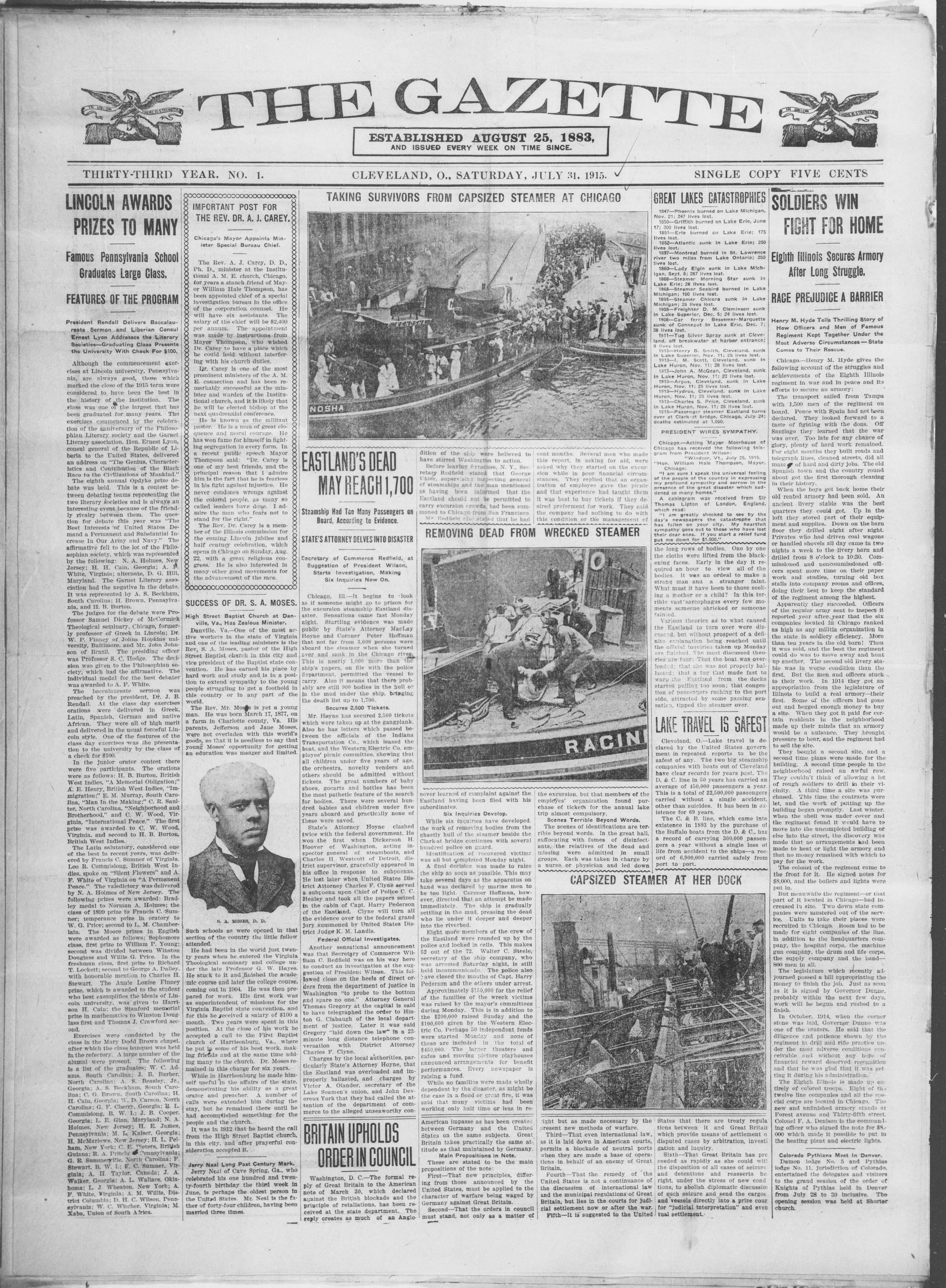
TAKING SURVIVORS FROM CAPSIZED STEAMER AT CHICAGO
NOSHA
EASTLAND'S DEAD MAY REACH1,700
Steamship Had Too Many Passengers on Board, According to Evidence.
Secretary of Commerce Redfield, at
Suggestion of President Wilson,
Starts Investigation, Making
Six Inquiries Now On.
Chicago. Ill.—It begins to look
as if someone might go to prison for
the excursion steampain Eastland disaster. Sensations came, fast Monday
night. Startling evidence was made
public by State's Attorney MacLay
Hoyne and Coroner Peter Hoffman
that not far from 3,000 persons were
aboard the steamer when she turned
over and sank in the Chicago river.
This is nearly 1,000 more than the
ship's papers, on file with the police
department, permitted the vessel to
carry. Also it means that there probably
are still 900 bodies in the sull or in
the mud under the ship. baging,
the death list up to 1,700.
Secures 2,500 Tickets.
Mr. Hoyne has secured 2,500 tickets which were taken up at the gangplank. Also he has letters which passed between the officials of the Indiana Transportation Co., which leased the boat, and the Western Electric Co., employees' plenic committee, showing that all children under five years of age, the orchestra, novelty reams and others should be permitted without tickets. There were great numbers of baby shoes, gocars and bottles has been the most pathetic feature of the search for bodies. There were several hundred babies and children under five years aboard and practically none of these were saved.
State's Attorney Hoyne clashed twice with the federal government. He won the first when Dickerson H. Hoover of Washington, acting inspector general of steamboats, and Charles H. Westcott of Detroit, district supervisor, gracefully appeared in his office in response to subpoenas. He lost later when United States District Attorney Charles F. Clyne served a subpoena upon Chief of Police C. C. Healey and took all the papers seized in the cabin of Capt. Harry Pederson of the Eastland. Clyne will turn all the evidence over to the federal grand jury summoned by United States District Judge K. M. Landis.
Federal Official Investigates.
Another sensational announcement was that Secretary of Commerce William C. Redfield was on his way here to conduct an investigation at the suggestion of President Wilson. This followed close on the department of justice in Washington to probe to the bottom and spare Go on!" Attorney General Thomas at the capital is said to have telegraphed the order to Hinton C. Clabaugh of the local department of justice. Later it was said Gregory "laid down the law" in a 23-minute long distance telephone conversation with District Attorney Charles F. Clyne.
Charges by the local authorities, particularly State's Attorney Hoyne, that the Eastland was overloaded and improperly ballasted, and charges by Victor A. Olander, secretary of the Lake Seamen's union, and John Devereux York that they had called the attention of the department of commerce to the alleged unseaworthy commerce.
BRITAIN UPHOLDS ORDER IN COUNCIL
Washington, D. D.—The formal reply of Great Britain to the American note of March 30, which declared against the British blockade and the principle of retaliations, has been received at the state department. The reply creates as much of an Anglo-
RACINI
dition of the ship were believed to have stirred Washington's reaction. Before leaving Washington, N. Y. Secretary Redfield, stated that George Uber, supervise, inspecting general of steamships and the man mentioned as having been informed that the Island should not be permitted to carry excursion crowds, had been summoned to Chicago from San Francisco. No doubt he stated that he had
REMOVING DEAD FROM
never learned of complaint against the Eastland having been filled with his subordinates.
Six Inquiries Develop.
While six inquiries have developed, the work of removing bodies from the chastity hull of the signer beside the Clarkst bridge continues with several hundred police on guard.
Identification of recovered victim was all but completed Monday night.
A final decision was made to raise the ship as soon as possible. This may take several days as the apparatus on hand was declared by marine men to be too light. Cotton Hoffman, however, directed that an attempt be made immediately. The ship is gradually settling in the mud, pressing the dead who lie under it deeper and deeper into the riverbed.
Eight more members of the crew of the Eastland were rounded up by the police and locked in cells. This makes 52 out of the 72. Walter C. Steele, secretary of the ship company, who was arrested Saturday night, is still held incommunicate. The police also have closed the months of Capt. Harry Pederson and the others under arrest.
Approximately $150,000 for the relief of the families of the wreck victims was raised by the mayor's committees during Monday. This is in addition to the $200,000 raised Sunday and the $100,000 given by the Western Electric Co. Perhaps 50 independent funds were started Monday and none of these are included in the total of $450,000. The latter threaters and cares and moving picture playhouses announced arrangements for benefit performances. Every newspaper is raising a fund. While no families were made wholly dependent by the disaster, as might be the case in a flood or great fire, it was said that many victims had been working only half time or less in re-
American impasse as has been created between Germany and the United States on the same subjects. Great Britain takes practically the same attitude as that maintained by Germany. Main Propositions in Note. These are stated to be the main propositions of the note:
First—That new principles, differing from those announced by the United States, must be applied to the character of warfare being waged by Germany against Great Britain.
Second—That the orders in council must stand, not only as a matter of
---
CAPSIZED STEAMER AT HER DOCK
court months. Several men who made this record, in asking for aid, were and why they started on the execution while in poor financial circumstances. They relied that an organization of employee gave the prison and that experience had taken them it was best to buy tickets if they desired prerun for work. They said the company had nothing to do with this condition of the management of it.
M WRECKED STEAMER
RACINI
the excursion, but that members of the employees' organization found purchase of tickets for the annual lake trip almost compulsory. Scenes Terrible Beyond Words. The scenes of identifications are terrible beyond words. In the great hall, suffocating with fumes of disinfectants, the relatives of the dead and missing were admitted in small groups. Each was taken in charge by a nurse or physician and led down
CAPSIZED STEAM
right but as made necessary by the present new methods of warfare.
Third—That even international law, as it is laid down in American courts, permits a blockade of neutral ports when they are made a base of operations in behalf of an enemy of Great Britain.
Fourth—That the remedy of the United States is not a continuance of the discussion of international law and the municipal regulations of Great Britain, but lies in the courts for judicial settlement now or after the war.
Fifth—It is suggested to the United
GREAT LAKES CATASTROPHIES
1847- Phoenix burned on Lake Michigan,
Nov. 21: 247 lives lost.
1850-Griffith burned on Lake Erie, June
17: 390 lives lost.
1851--Erie burned on Lake Erie; 175
lives lost
A creek sink in Lake Erie; 175
1852-Atlantic sunk in, Lake, Erie; 250
lives lost.
1857 - Montreal burned in St. Lawrence river two miles from Lake Ontario; 250 lives lost.
1860 - Lady Eglin sunk in Lake Michigan, Sept. 8; 287 lives lost.
1868 - Steamer - Morning - Star sunk in Lake Erie; 26 lives lost.
1870 - Seauland Seabird burned in Lake Michigan.
Michigan; 104 lives lost.
Michigan; 104 lives lost.
Michigan; 104 lives lost.
1908—Freighter D. M. Cleminson-sunk
in Lake Superior, Dec. 5; 24 lives lost.
1908—Carry Beasemer-Marquette
Cove in Lake Erie, Dec. 7;
36 lives lost.
1911—Tug Silver spray sunk at Cleveland, off breakwater at harbor entrance; 9 lives lost.
1913—Harry B. Smith, Cleveland, sunk in Lake Huron, November 11; 25 lives lost.
1913—M. Scott, Cleveland, sunk in Lake Huron, November 11; 25 lives lost.
1131—John A. McGann, Cleveland, sunk in Lake Huron, Nov. 11; 123 lives lost.
1133—Argus, Cleveland, sunk in Lake Huron, Nov. 11; 124 lives lost.
1135—Hydrus, Cleveland, sunk in Lake Huron, Nov. 11; 125 lives lost.
1138—Charles S. Price, Cleveland, sunk in Lake Huron, Nov. 11; 128 lives lost.
1155—Passenger steamer Eastland Turner of Chicago, July 24; deaths estimated at 1,000.
PRESIDENT WIRES SYMPATHY.
Chicago—Acting, Mayor "Moorehouse" of Chicago has received the following telegram from President Wilson:
"Wunder Vt. M., July 25, 1915.
"Hon. William Hale Thompson, Mayer.
"I am eager. I speak the universal feeling of the people of the country in expressing my profound sympathy and sorrow in the presence of the great disaster which saddened so many homes."
The telephone was received from Sir Thomas Lipton of London, England, which read:
"I am greatly shocked to see by the day's newspapers the catastrophe that sympathy goes out to those who have lost their dear ones. If you start a relief fund put me down for $1,000."
The long rows of bodies. One by one the clothes were lifted from the black-duffle faces. Early in the day it required an hour to view all of the bodies. It was an ordeal to make a strong man and a stranger faint. What must it have been to those seeking a mother or a child? In this terrible vast scarcophagus every few moments someone shrieked or someone can die.
Various theories as to what caused the Eastland to turn, over were discussed, but without prospect of a definite conclusion being reached until the official theories taken up Monday are laid. The most discussed theories are that the boat was overloaded, that it was not properly balanced, that it was that made fast to the dock. From the docks started puffing too soon; that congestion of passengers rushing to the port side, attracted by some passing sensation, tipped the steamer over.
LAKE TRAVEL IS SAFEST
Cleveland, O.-Lake travel is declared by the United States government in repeated reports to be the safest of any. The two big steamship companies with boats out of Cleveland have clear records for years past. The D. & C. line in 50 years has carried an average of 450,000 passengers a year. This is a total of 22,500,000 passengers carried without a single accident, other than suicides. It has been in existence for 69 years. The C. & B. line, which came into existence in 1893 by the purchase of the Buffalo boats from the D. & C. has a record of carrying 300,000 passengers a year without a single loss of life from accident to the ships—a record of 6,000,000 carried safely from port to port.
HER AT HER DOCK
States that there are treaty regulations between it and Great Britain which provide means of settlement on disputed cases by arbitration, investigation and inquiry.
Sixth—That Great Britain has proceeded as rapidly as she could with the disposition of all cases of seizure and detentions and reasserts her right, under the stress of new conditions, to abolish diplomatic discussion of such seizure and send the cargoe and vessels directly into a prize court for "judicial interpretation" and eventual settlement.
IN WATCH
HONOUR ATHLETICS
SOLDIERS WIN FIGHT FOR HOME
RAGE PREJUDICE-A BARRIER
Henry M. Hyde Tolls Thrilling Story of How Officers and Men of Famous Regiment Kept Together Under the Most Adversor Circumstances—State Comes to Their Rescue.
Chicago—Henry M. Hyde gives the following account of the struggles and achievements of the Eighth Illinois regiment in war and in peace and its efforts to secure an armory.
The transport sailed from Tampa with 1,500 men of the regiment on board. Peace with Spain had not been declared. They looked, forward to a taste of fighting with the dons. Off Santiago they learned that the war was over. Too late for any chance of glory, plenty of hard work remained. For eight months they built roads and telegraph lines, cleaned streets, did all mann of hard and dirty jobs. The old Spanish town and the country round about got the first thorough cleaning in their history.
When the boys got back home their old rented armory had been sold. An ancient livery stable was the best quarters they could get. Up in the loft they stored part of their equipment and supplies. Down on the barn floor they drilled night after night. Privates who had driven coal wagons or handled shovels all day came in two nights a week to the livery barn and drilled from 8 o'clock to 10:30. Commissioned and noncommissioned officers spent more time on their paper work and studies, turning old box stalls into company rooms and offices, doing their best to keep the standard of the regiment among the highest. Apparently they succeeded. Officers of the regular army sent to inspect it reported year after year that the six companies located in Chicago ranked as high as any militia organization in the state in soldiery efficiency. More than ten years in the old barn! Then it was sold, and the best the regiment could do was to move away and hunt up another. The second old livery stable was in worse condition than the first. But the men and officers stuck to their work. In 1914 they got an appropriation from the legislature of Illinois to build a real armory—their first. Some of the officers had gone out and begged enough money to buy a site. When they got it paid for certain residents' in the neighborhood made up their minds that an armory would be a mansure. They brought pressure to bear, and the regiment had to sell the site.
They bought a second site, and a second time plans were made for the building. A second time people in the neighborhood raised an awful row. They couldn't find of allowing a lot of rough soldiers to drill in their vicinity. A third time a site was purchased. This time the contracts were let, and the work of putting up the building began promptly. Last winter, when the shell was under cover and the regiment found it would have to move into the uncompleted building or else into the street, the discovery was made that no arrangements had been made to heat or light the armory and that no money remained with which to pay for the work.
The colonel of the regiment came to the front for it. He signed notes for $8,000, and the boilers and lights were put in.
But meanwhile the regiment—or that part of it located in Chicago—had increased in size. Two down state companies were mustered out of the service, and other nearby places were recruited in Chicago. Room had to be made for eight companies of the line, in addition to the headquarters company, the hospital corps, the machine gun company, the drum and life corps, the supply company and the life 800 men in all.
The legislature which recently adjourned passed a bill appropriating the money to finish the job. Just as soon as it is signed by governor Duncan, probably within the next few days, work will be begun and rushed to a finish.
In October, 1914, when the cornet stone was laid, Governor Dunne was one of the orators. He said that the diligence and patience shown by the regiment in drill and rifle practice under the most adverse conditions conceivable and without any hope of financial reward deserved preconception and that he was glad that it was getting it during his administration.
The Eighth Illinois is made entirely of colored troops. Eight of the twelve line companies and all the special corps are located in Chicago. The new and unfinished army stands at Forest avenue and Thirty-fifth street. Colonel F. A. Denison is the commanding officer who signed the note for $8,000 which made it possible to put in the heating plant and electric lights.
Colorado Pythian's Meet In Denver.
Damon bolge No. 5 and Pythias lodge No. 11, jurisdiction of Colorado, entertained the delegates and visitors to the grand schedule of the order of Knights of Pythias held in Denver from July 28 to 20 inclusive. The opening session was held at Shorter church.
One Year.....$1.50.
Six Months.....1.00
Three Months......50
Subscribers are requested to re-
mit by postoffice money or-
der or registered letter
Entered at the postoffice in Cleveland
Ohio, as second-class matter.
Address all communications to
Blackstone Building, Cleveland, O.
Member Ohio Legislature: 1894
to 1896; 1896 to 1898; 1900 to 1902
THE GAZETTE is the oldest, and
has the largest bona fide circulation,
double that of any newspaper in the
Interest of Afro-Americans, published
In the state of Ohio, and comparison
with any will immediately establish
the party one of the NEWSIEST
AND BEST in the country.
10,000,000 Afro-Americans.
160,000 in Ohio.
20,000 in Cleveland.
SATURDAY, JULY 31, 1915.
"I have worked at the state house for many years and I have never yet known a state official who is working as hard as Governor Willis," said a state house employee Thursday evening. "He is here in the morning before most of his clerks, and remains many nights until midnight. We wonder how he stands it. Hundreds of letters and callers, and the regular routine business, he seems somewhere to handle. If the people of the state could work in here, they would know what this governor is up against."
SMALL BORROWERS PROTECTED
The doom of loan sharks, who prey upon men with small incomes, has been sounded in Ohio by the Lloyd bill, which has just gone into effect. This bill, one of the highest class measures passed by the last legislature, limits interest rates to $3 a month, with an additional charge of $1 for loans less than $50. Besides, chattel and salary loan companies are subject to license and inspection by a special bureau of the banking department. The administration at Columbus is taking steps to see that this is enforced, and plans have already been formulated by the State Banking Superintendent, Harry T. Hall, in conference with representatives of the state remedial loan companies. "This law has teeth in it and I shall see that its provisions are enforced," says Mr. Hall. "What is needed to drive the modern Shylocks who live off the poor out of business is the aid and cooperation of the general public, and especially those who have been victims in the past." The new law will be heartily approved. It makes the poor man's loans purely a banking question. "The old days of 1,000 per cent interest, rough collection methods, blackmail, extortion and oppression are gone." Legitimate loan companies are permitted a rate of interest high enough to permit them to live. This law, enforced, as it will be, will be a great step forward under the Willis administration.
OHIO WILL HAVE AN EXHIBIT.
The Ohio Commission to the Illinois Half-Century Exposition, at Chicago, Aug. 22 to Sept. 16, this year, which consists of Miss Hallie Q. Brown of Wilberforce, Miss Dora E. Johnson of Norwalk, Wm. A. Anderson of Wilberforce, Gen. Warren Keifer of Springfield and Gen. R. B. Brown of Zanesville, informs The Gazette that it is their purpose to have an exhibit in spite of the delay in the receipt of the $5,000, appropriated by the Ohio Assembly and which attorney Gen. Edwin C. Turner has ruled will not be available until Sept. 5-6, because of the law which requires 90 days to elapse before the payment of legislative appropriations.
The Commission is sending out let- GEN. R. B. BROWN,
1930
ters daily asking our people of this state to join in the effort to place a creditable exhibit in the "Lincoln Jubilee and Exposition" and we sincerely trust that they will do so promptly. It will require aggressive action owing to the short time intervening before the opening date of the exposition. Send everything that will be creditable to the race when placed on exhibition. The expense in sending and returning what is to be exhibited will be paid by the Commission. Persons desiring additional information can secure the same by addressing Miss Hallie Q. Brown, Homewood Cottage, Wilberforce, Ohio.
The Gazette urges Ohio Afro-Americans to show the loyal race interest in this matter that has characterized similar efforts in the past. We cannot afford to have an exhibit at the exhibition that will not be worthy representation of our thrift and industry. All over this country it is generally recognized that Ohio Afro-Americans lead and this reputation must be sustained, in this instance, just as it has been in all others in the past.
LYNCH LAW
There were thirty-four persons lynched in the United States during the first half of this year. Only seven of these were accused of attacking women. Twenty-four of the lynched men were Negroes, and of these the charge of attacks on women was made against six—just one in four. Yet this offense, sentimentally dubbed the "unmentionable crime," has been reduced to the action of mob action in general and mob murder of Negroes in particular. The truth is that when the mob spirit is in control of a community any peg will do to hang a victim on. Men have been lynched for resisting an officer, for running a disorderly house, for assault and battery, for horse stealing. Yet, black though the half-year record of mob violence may be, it has one bright spot. Mobs of have been killed in斗法, of law but, thanks to the courage of former Gov. Slaton of Georgia, they have not succeeded in making the public executioner do their work.—Chicago Daily Journal.
The Journal does not go to the full length of either logic, law or morality in this matter. The Frank case was made so much of, that some queer things, connected with the great agitation in that affair, forced themselves upon thinking citizens. But this aside, if would hardly seem appropriate to pay any tributes to Gov. Slaton of Georgia or any state governor or officials of any state, where lynch-murders occurred, for their action in such cases as that of Leo Frank, the rich white man, in view of the fact that mob violence—lynch-murder—is not run down, and, after an "honest" tempt to ferret out the guilty ones in lynch-mob law, the application of the law made in punishment of the offenders when ferreted out, as is not impossible in a state that is rightly governed, is not made. After all, the consolation offered is a poor one at best and it is time that the citizens get aroused on this old shameful afair, a blot of deepest dye on the escutcheon of the American republic. Nothing short of exercise of the authority and majesty of the law will avail us anything whatever. Oh! for men like William Lloyd Garrison, Wendell Phillips, Col. Higginson, Owen Lovejoy, Thaddeus Stevens, Charles Sumner, Carl Schurz and others of the days when this republic did not allow the cowards, the hypocrites, the "mediators" to have things their own way! If we are to blot but this shame and shine we must go about it with more conscience, courage and resolution than compliments (condonements rather) for those who once in a while do their duty to a degree. Lynch-murder must be stamped out and one of the reasons is that the state puts a low standard on its value, if it is indolent or indifferent.
WITHOUT THE BALLOT
Complete American Citizenship Is Impossible, Says a White Clergyman, a Life-long Friend of the Race—He Is Right, Too.
Madison, N. J., July 26, 1915.
Editor, GAZETTE, Dear Sir:—Your two marked copies of THE GAZETTE came duly to hand as a very pleasant surprise, and as "one good turn (they say) deserves another," enclosed see stamps to the amount of selling price and postage. I desire to have a little chat with you, if you don't mind. When saw the following on the newspaper, I was my favorite expecting anything of the sort, but when I opened them and saw the marked items I dropped everything and, for one solid hour, I read and reread the editorial comments. I don't know, really, when I have gotten more pleasure out of a newspaper. But first let me say, the receipt for the subscription came and I "thank you" for the whom the beneficiary was, but happening to attend several Sabbath and weekly meetings at the Colored Men's club of the Y. M. C. A. here and finding as usual THE GAZETTE on file, and none seeming to know who was responsible for its reappearance, I thought perhaps you had misunderstood me and had continued their subscription. I honestly wish I could pay for five others! It was my sincere request that you have to have it sent to the Y. M. C. A. Colored Men's club—to increase its circulation among the reading, thinking people of color. But !!
June 26, your exposure of "New Segregation Efforts," alone, is worth the price of the paper! "No Ohio Exhibit" of Afro-Americans, at the Illinois Exposition in Chicago, is a downright shame, and yet it may be "a blessing in disguise." Almost the same thing happened here in New Jersey, i.e., the state appropriation was at rite to be spent in a certain time or what remained had to be turned over to the state treasurer and could not again be withdrawn. The facts becoming known, the colored people en masse of New Jersey made good the deficit and the Atlantic City Exposition is now a matter of history! Jive the appreciation of Hazel K. Hall, and it is a pity indeed that the race has not more of your tribe, and not if they had you would not be as a member, King Saul stood "head and shoulders" above any man in Israel, but among "giants" he was only a good sized boy! Your warning, "Be on the Lookout," is fine. Why can't you and DuBois, the N. A. A. C. P., pool your issues and fight united against the common enemy? July 3, the "scrap" item about "The Black Prince" stirred my warring fancies until I almost wished I could have had a hand in it. You would make me an unreconstructed sinner, were a regular reader of your paper by the Law Department and the acting of the Cleveland Association of Colored Men and the meanness of some Greenlaw avenue
pro-erty-holders. I shall pass the papers around just to relieve my feelings. I am getting "het up" too. I guess. Your explanation of Rosenwald's mode of encouragement is accepted.
FRESH OHIO NEW
WRITTEN BY "THE OLD RELI
I heard the "separate as the fingers of the hand" speech of Booker T. and noted exceptions to the same, but Washington is' working ideologically. I don't know what his harvest will be. There are some theories perfectly plausible and eminently satisfactory in practice" in "the business in practice". Here is one: When a Negro in America has not got all the farm-land they will allow him to acquire, without the ballot; when he has amassed a fortune, and "Negro millionaires" are common talk, but they cannot, when asked, be business shall comprise in open man with all the world, and have no voice in law, they will be treated as Russia and Poland treated the Jews—disfranchised, segregated, accursed nationally and without exception! THE NEGRO IN AMERICA MUST HAVE THE BALLOT IF HE INTENDS TO BE AN AMERICAN CITIZEN!! Vale.
DOINGS
OF
THE
RACE
J. Berry Smith has been appointed
a dining car conductor on the Penn-
sylvania railroad after eight years'
service.
The Richmond, Va., exposition
which closed, last week, was a fail-
ure owing to poor management, writes
F. Grant Gilmore from that city.
Horatio Bottomley, editor of "John Bull," a leading English publication, charges that the Johnson-Willard fight at Havana, last April, was a fake.
Armed with an affidavit to the effect that he fairly defeated and knocked down Jess Willard in a recent private exhibition at Rochester, Minn., Fred Fulton (now City College) of said place, is in New York City, and honors in the heavyweight division.
Jack Johnson sent boxing gloves and footballs to the English soldiers in France. He is in London and heard that they wanted them.
Hon. Isaac H. Smith, one of our most prominent men in North Carolina, who recently died at Newbern, willed $500 to the National Religious school, Durham, N. C., and $500 to Shaw university, Raleigh, N. C. His estate is valued at $110,000.
Our people of Richmond, Va., are assessed for taxes on personal property of $3,180,662. In the state they pay taxes on real and personal property to the amount of $34,143,656.
Henry W. Shelton, Cuban, who walked from San Francisco to New York City in 81 days, beating Weston's record, is on his return trip, hoping to win the Binga Dismond, crack runner of the University of Chicago, set up there. July 22, a new National A. A. U. record of 48 3-5 in the 440-yard dash, beating a second the old mark held by Burke, of the Boston A. A., since he won the Arto-American athlete, set a broad jump record of 24 feet 2½ inches.
Jack Johnson says, "Willard, as a fighter, is a joke," and he "hated" the fight for $100,000, and offers to fight him (Willard) for $25,000, the winner to take all and the purse money. Johnson received $50,000 bonus before leaving France and $30,000 at the ringside with exclusive rights of all foreign pictures. It is also alleged that he is getting 25 per cent of Willard's earnings for the next five years. $50,000 is still due—"John Bull." Johnson is now in London, where his mother-in-law is keeping house for him. (Yep, after all the "for" she raised.) N. Y. City Amsterdam. Other prize papers come and go while "the old reliable" Gazette remains with you. There is no publication in this part of the country that compares at all favorably with it, in circulation or otherwise. You can easily satisfy yourself as to this, if you are interested. Subscribe for and advertise in The Gazette if you want the BEST.
Lovejoy, Ill., one hour's ride from St. Louis, Mo., has a population of 1,700, about 75 of whom are white persons. All the large business concerns are directed by white people. There are three churches and the only institution in which the Negro shows unusual aptitude is the sale of liquor. There are eleven saloons, or approximately one saloon to every 154 persons. Wm. F. Pettiford of Providence, R. I, is the trap drummer of Church's American band of 25 musicians. B. R. Church, the great cornet solist, died in the east. Pettiford is the only Afro-American member of the band.
E. H. Wright, Esq., former Cook County, Ill., commissioner and well-known Chicago lawyer, has been appointed by Mayor Thompson of that city as an assistant corporation counsel with a salary of $5,000 per year. He will take the place of one Charles M. Haft, the present white incumbent, who recently objected to an Afro-American neighbor on Forrestville avenue, that city. The mayor's other Afro-American appointments are: L. B. Anderson Esq., Assistant Counsel, Rev. A J. Carry, Chief Investigator for the Law Department; George W. Blackwell, Esq., Assistant Prosecuting Attorney, and J. M. Brunfield, Esq., Assistant City Attorney, and many other minor appointments.
Willie Buckler, trainer of the Chicago "White Sox," is the only Afro-American holding such a position in the big leagues. He is an exceptionally capable and skilled athlete.
The will of Edward E. DesVernay, Savannah, Ga., has been admitted to probate there. It disposes of property valued at $50,000.
The fact that the earth is round was not an original conception of Columbus. The approximate circumference was calculated in Alexandria early in the Christian era. Seven hundred years afterward practically the same result was arrived at by the Moorish geometers in Spain, where they taught geography from a globe.
FRESH OHIO NEWS
WRITTEN BY "THE OLD RELIA
BLE" ENTER CORRE-
SPONDENTS
THROUGHOUT THE STATE
What Our People Are Doing Each Week—Church, Personal, Social, Lodge, Literary and Musical —Marriages, Deaths, Etc.
SANDUSKY.—Delegates Jas. R. Davis and Mrs. L. H. Dodd made their state S. S. convention reports, Sunday, and they were very gratifying to the school. He was chosen secretary of the finance committee of the convention and made an excellent one. Monday, Rev. G. D. Smith will go to E. Mt. Zion Baptist church, Cleveland, with a delegation of 15 to attend the N.O.B.A. The children's band will be in attendance, Sunday, when the pastor will close his year's work. Before to hear his report.—Mrs. W. Ely and Mr. Albert Williams are no better.—Mrs. Gaines is quite lame.—The A. M. E. church and S. S., and Rev. and Mrs. J. D. Singleton are doing a great work which is appreciated.—There are about 25 strangers in the city and we hope some of them will locate here. There is plenty of room for good people.—Read "the old reliable" GAZETTE.
CORRESPONDENTS must mail all letters for publication at their main postoffice sufficiently early on Monday (or Sunday) of each week to have them reach The Gazette office on Tuesday morning, and always write also, their names and that of their city or town on the outside of the postoffice. Unless this latter is done, proper credit cannot be given you. Lists of names, wedding presents, etc., obituary notices, speeches, resolutions, poetry, inquiries for relatives and advertisements of all kinds, including items announcing entertainments to be held in advance at the rate of ten cents per line, six words to a line. Our rates for display advertisements will be sent on application. Send postal note and not stamps during warm weather.
HILLSBORO. —Mr. George McCowan and family of Danville, Ky., are visiting relatives here. —Mrs. Otto Porter and family of Columbus, are guests of Mr. and Mrs. Fred Thomas. —Miss Hazen Colter left, Sunday, for Columbus to a visit with her grandmother. —Mr. George Minor is serious. —Mr. John Doyle, Miss Edith Anderson, last week, in honor of her 17th birthday. —Mrs. McGown, evangelist, of Cincinnati, preached at the Chautaqua, Saturday evening. Mrs. Hamilton, evangelist, of Cincinnati, is at the meetings, this week, and preached, Sunday morning. —The Busy Bee club gave a party, last week, in honor of Mr. Vernon Green of Leesburg, at Miss Selika Thomas' Dr. C. A. Payne of London, preached two sermons at the Chautaqua, Sunday, at the Greenfield, loh Baptist church of Greenfield, and his congregation, will be present, on day Sunday, at the Chautaqua. He will be one of the principal orators of the day. —Dr. Harvey Johnson preached at Big Zion, Sunday. —The W. M. church will entertain the Wesleyan M. annual conference in August.
CADIZ—Mrs. Anna May Adkins of Wheeling, Mrs. Henrietta Smith's guest, for several weeks, has returned home—Mrs. Alice Howard and Mrs. Sidney Johnson spent a few days in Steubenville—the Davis Shugers' home, Mrs. Alice Howard and Mrs. W. games were lost—Mrs. Verle Blanchard and Mrs. M. Allen of Cleveland, are guests of the former's mother, Mrs. Anna Redmond. Mr. and Mrs. Ollie Ramsey have moved here from Akron.—Mrs. Minnie Tucker and Mrs. Mary Clark of Uhrichsville are spending a few days here.—Many from here attended the basket meeting at Fernwood, Sunday.—Mrs. Gretchen West, of Pittsburgh, is visiting her mother, of Pittsburgh, and Mrs. Scroggins and family of Coshocton, were Sunday visitors of Mrs. Thee. Mason.—Mrs. Elvira Wallace entertained the Greenleaf club, Tuesday evening.—The W. M. M. society held its monthly meeting at Mrs. Sydney Johnson's.—The Colored Glee club held its first regular meeting at Miss Elenora Brown's—Chas. Brooks and Mrs. Elenora Brown's—Chas. Brooks and Martins Ferry on the 23rd.—Dr. Holmes (white) of Westfield, Mass., preached at the A. M. E. church Sunday evening.
SMITHFIELD.—Mrs. Myrtle Peterson and children left this week, for Steubenville and Pittsburg.—Mrs. Cairt Fitzgerald and daughter, Janet, left, Sunday, for Elwood City.—D. W. Bigsby was in Steubenville, Monday.—E. J. Smith, Rev. Chas, Greene, Mr. Ira Toney, Mesdames L. Smith and A. West of McIntyre, were here, last week.—Mr. and Mrs. D Christian enlistments at Steubenville. Mrs. A. Heinemann and Jess N. Harris entertained the Silver Leaf club, last Tuesday evening.—Mr. and Mrs. Eli Guyder and little grandson, visited her sister, Mrs. E. H. Harris.—The first chautauqua, held here last week, was largely attended and a success.—Mr. and Mrs. Wm. Smith of McIntyre, lost their infant, recently.—Rev. Chas. Greene of McIntyre and Rev. J. James of Mrs. Pleasant.—exchange pulpits.—Rev. R. Toney who is here visiting relatives preached at McIntyre, Sunday.—Mrs. Fred Ramsey and children of Cadiz were guests of Mrs. H. Harris. She was highly entertained.—Rev. R. B. Lowe returned, last week, from the S. institute at E. Liverpool, with a very pleasing report.—Mrs. Elizabeth Culpher of Troy, en route to Steubenville, E. Liverpool and Xenia spent Monday week here, the guest room of Fermont, en route to groom of Fermont, Mr. and Mrs. Harvey Parks, Miss F. Adams and Mr. Harry Agey were the Sunday guests of Mr. and Mrs. Wm. Parks.—Messrs. E. Linder, S. Brown and F. Tyler spent Sunday here.
ALLIANCE—Miss Jeannette Stokes, delegate to the A. M. E. S. S. institute at East Liverpool, has returned. —Mr. and Mrs. Wum. Till of Bolton, were here. Sunday. —Mr. David Prisby is visiting relatives in Canada. Miss Martha Peterson has returned from a visit in Minerva. —Rev. B. F. Steward of Oberlin, who has been assisting Rev. J. C. Turner in the gospel tent meeting, returned home. Monday. He was the leader of the afternoon readings. Mrs. Moore. Pittisberger, sister of Mrs. W. H. Palmer, who underwent an operation at the Alleghany hospital, Sunday, is convulsing. —Mr. W. Jenkins is convulsing.
his mother in Wheeling—Mrs. S. A. Marks and children, Arlene and Jeanette, and Mrs. M. Walker of Chicago, are visiting Mrs. E. W. Moore, who left Monday for Xenia to attend the annual meeting of the Court of Calanthe. She will return the last of the week.—Mr. and Mrs. Edward Harrell have moved into their new home, 387.9 E. Patterson street—W. P. Lewis of Chicago, spent Monday with his family—Mrs. M. P. Follensworth and Master Clarence Oliver were here, Mrs. M. Ollie Lee of Minerva visited Mrs. Ollie Lee of Minerva Mrs. Wm. Jackson entertained at dinner, Sunday, Miss Nona Mitchell of Indiana, Miss Lillian Royston, and Mrs. Maud Butler of Cleveland. Mrs. I. Roach entertained Mrs. Cora Brock, Mrs. Rebecca Pegram and daughter, Helen, of Cleveland—Mrs. Cleo Veney and daughter, Ethel, of Canton are visiting Mrs. Geo. Hall—Mr. Isaac Roach spent Sunday in Pittsburgh. Mr. R. Wilson, age 18, of Pittsburg, visited Mrs. Ollie Lee of Minerva the tent meeting, Mrs. Ida Smith of Kentucky in the afternoon, and Rev. Steward of Oberlin, in the evening. Large audiences at all the services, Sunday, Rev. Max Wertheimer, a converted Jew, is assisting this week. Be sure to hear him.
Will hold its 46th Annual Exhibition at Lexington, Ky., Sept. 7, 8, 9, 10 and 11, 1915 More and Better Attractions Than Ever Before. The 9th O. N. G. Military Band of Columbus, O., will furnish music One Big Week of Solid Pleasure. Reduced Rates on All Railroads. T. J. Wilson, Pres. A. L. Harden, Sec.
TAYLOR'S NEW SHAMPOO DRYER and Hair Straightening Comb The Best in the World! Price $1.00
MISS EDNA WALTON KILLED
Dayton, O.-Miss Edna Walton, a graduate of a local High school, and for several years a teacher in several southern states, was shot and killed at a sister, Mrs. Mary Guetst's residence in Chicago, last week, by Arthur Pickens, a southern school teacher, who was desirous of wedding her. Another sister, Mrs. Louise Scott of Toledo, took charge of the Guetst home, Mrs. Guetst was ill in a Chicago hospital and unaware of the death of her sister, Mrs. Walton had taught school in Biloxi and Gulport, Miss., Arlington, Tenn., her birthplace, and at Little Rock, Ark.
TAYLOR'S SPECIAL ALCOHOL HEATER is the easiest and most convenient method of heating the Comb, and can be closed up so that you can put it in your handbag. Price 50c.
For best results use LaCreole Hair Pomade. It not only meets every requirement
Girl Won Medals and Prizes
Newport, R. I.—At the graduation exercises of the Child's Business College of this city, July 16, Olive L. Jeter, its only Colored graduate, was awarded a Remington gold medal for writing 75 words per minute for 10 consecutive minutes on the Remington typewriter. During the exercises a typewriting test was held, at which time Miss Jeter won the first prize, a typewriter. She was equally of having the average of 66 perfect words per minute for 10 consecutive minutes. Recently she was awarded the Underwood special credential certificate for writing 63 words per minute on the Underwood typewriter.
Jacket 6144
Skirt 5989
Bolero 6158
Skirt 6149
Costume 6130
Waist 6156
Skirt 6137
Where Judge Draws the Line.
Judge Johnson—That I love publicity I never will deny, but I never walk from coast to coast to get it.
—Atchison Globe.
CORRESPONDENTS WANTED
The old reliable Gazette desires an active agent and correspondent in every city and town in Ohio and neighboring states having a number of Afro-American residents. Only a little time on Fridays or Saturdays is required. There especially deserves of hearing from persons in the following named cities: Zanesville, Newark, Lancaster, Lebanon, Chillicothe, Toledo, Troy, Canton, Springfield, Plaquia, Columbus, Cambridge, Steubenville, Bellaire, St. Clairsville, Portsmouth, Washington C. H., Oxford, Sabina, Galipolis, Rendville, Urbana, Delaware, Mt. Vernon, East Liverpool, Wellsville, Mt. Vernon, Middletown, Bellefontaine, Lima, Mt. and other places where we have none
Select your styles from
PICTORIAL REVIEW PATTERNS
today, absolutely the best pattern made in America.
THE SPRING FASHION BOOK
only 10 cents extra when purchased with one 15 cent pattern.
APRIL STYLES now ready.
Write to the editor of The Gazette. Blackstone building, Cleveland, O, and terms will be sent promptly. Our readers will oblige us greatly by sending at once the addresses of persons in the cities named above, or others, to whom we can write relative to the matter.
1865 1915
National
Half Century Anniversary
Exposition
and
The Lincoln Jubilee
The Most UNIQUE EVENT of Modern Times.
The Tribute of a United People to the
SAVIOUR of Their NATION.
CHICAGO DAY
MONDAY, AUG. 23rd, 1915
Opens
August 22nd, 1915
Closes
Sept. 16th, 1915
COLISEUM CHICAGO
PURO HERBS consist of the best possible mixture of Nature's health giving Herbs, contains no potash or mercury—being purely vegetable does not contain any of the other cretet compound, as it is composed of such well-known herbs as Burdock, Dandelion, Sarsaparilla, Red Clover, Dandelion, Sarsaparilla, Prickly Ash and other herbs—all the very best approved blood purifiers.
PURO HERBS cleans the system of all impurities, restores health and vigor, and drives away that tired, runny feeling, due to impurities collecting in the system during the winter months.
PURO HERBS cost but 35c a box, the contents of which, boiled with one quart of water, makes one quart of water, which is the ordinary one dollar bottles in size and better than any patent medicine, regardless of price.
PURO HERBS are also supplied in liquid form, for those who do not care to use themselves, at 75c a quart. Sold only on request.
BROWN DRUG CO., 2742 CENTRAL AVE., cor. 28th Street
Leading Cut-Out Duvets
North 1494-J Central 2234-L
I Take Care of Your Feet
Home Treatment if Desired
DR. G. H.
TURNER
Chiropodist
Corns, Bunions, Callouses and ingrowing Nails, Painlessly Treated
Open Evenings, Sundays & Holidays
Special Attention Given Visitors
From Out of the City
STERLING
5 and 10 Cent Store
3003 Central Ave.
Watch Our Windows
For Bargains
Colored Salesladies
During July and August we close at 6 P.M. every evening except Saturday
Arlington Pharmacy
WE WILL ACCEPT THIS ADVERTISEMENT FOR FIVE CENTS IN TRADE, TO APPLY ON ANY PURCHASE OF TWENTY-FIVE CENTS OR MORE.
E. Rukenstein, Ph. C., Prop.
S. W. Cor. Central Ave. & E.
55th St.
The Sixteenth Annual Session
State Summer School
for
TEACHERS OF BOTH SEXES
at the
Agricultural and
Technical College
GREENSBORO, N. C.
began in June and will continue five
weeks.
In addition to the regular work, an
attractive lecture course has been
arranged, in which will appear some of
the most distinguished white and colo-
red educating in the country.
Board and lodging for the entire
session $12.00. Tuition 25c per sub-
ject unless other arrangements have
been made
Limited accommodations. Send $1 and have room reserved in advance. For further information write at once to James B. Dudley, President, or S. B. Jones, Director, A. & T. College, Greenboro, N. C.
Cuy. Central 6661-L
G. G. REED
Dry Goods
Ladies' and Gents' Furnishings
Sole agents for the
AMERICAN LADY NEMO
R. @ G. COR ETS
3222 Central Ave.
DON'T THROW AWAY
Your copy of The Gazette after reading it, but give it to a friend or an acquaintance who might subscribe after reading a copy of the paper.
Editor
Where to Purchase The Gazette
Where to Purchase The Gazette
NOTICE TO SUBSCRIBERS
Subscribers not receiving The us at once. We desire every copy. We advise our patrons to car- tirements before making purchase this paper should have the patron that they advertise is assurance the Local reading notices (adver- words in a line).
Subscribers not receiving The Gazette regularly should notify us at once. We desire every copy delivered promptly.
We advise our patrons to carefully examine The Gazette's advertisements before making purchases. Business men who advertise in this paper should have the patronage of Afro-Americans. The fact that they advertise is assurance that they want it.
Local reading notices (advertisements) ten cents a line (six words in a line).
Social and Personal
Our
Classified Ad
Department
FOR SALE.—Two fine lots on E.
130th St. off Kinsman Rd. Apply at
9514 Dunlap Ave. Take E. 105th St.
car.
FOR RENT.—House of eight rooms,
bath, gas, nice yard, cellar etc., 2347
E. 86th Str., near Quincy Av. Apply,
Room 2, Blackstone Bldg., or 2246
E. 90th St.
FOR RENT.—Houses and Rooms
If you have them to rent or if you
want to rent, advertise in The Gazette.
It brings results.
NOTARY PUBLIC.—For such services
call at The Gazette office, No. 2
Blackstone building, No. 1424 W.
Third Street, near Superior Ave.
FOR SALE—Houses or lots. If you have either or anything else to sell, or if you wish to purchase, advertise in The Gazette. If anything can bring you results, it can and will.
Cleveland
Sixth City
Mr. Thos. Hightower and family have moved to Chicago.
Mr. Grant Russell of E. 90th St. was quite ill, the first of the week.
Wm. Kenney, the tailor, and Mr. and Mrs. Jos. Smith's oldest daughter were quietly married, recently.
Mrs. Callie Brook's body was shipped to Connersville, Ind., last week Monday.
Mrs. Verle Blanchard and Mrs. M. Allen are visiting the former's mother in Cincinnati.
* * * *
Miss Mattie Sands of New York city, is visiting her parents and other relatives in the city.
* * * *
Mrs. Ada Denny was called to Akron, recently, by the death of a sister. Mrs. Denny has the sympathy of many friends.
* * * *
Be sure to read carefully the articles relative to Luna park, in this paper, and call your friends' and acquaintances' attention to them.
* * * *
Ernest O. Orsburn arrived in the city, Tuesday, from Chicago to visit his niece and her husband, Mrs. and Mr. Henry Cash of E. 36th St.
* * * *
Miss Sally Fisher of Washington, D. C., is spending part of her vacation with Mr. and Mrs. Edw, Daw, 2318 E. 86th St. Also Miss Juanta Quinn of Oberlin.
J. H. Morton returned, recently, from Washington, D. C., where he went to take a civil service examination for a position as engineer in the government's service. He has sold his property on E. 36th street.
Send or bring locals and all business matters to The Gazette's offices, suite 2, Blackstone Bldg. If you wish to see the editor call there, please. All matters for publication in current issues of The Gazette, must be in the office by 4 p. m. WEDNESDAY at the latest.
Do not be satisfied with film crow accommodations in any public place. It is criminal for a Colored man to advocate separate public schools, separate public libraries, separate public play grounds or separate public institutions of any kind. There cannot be two standards of citizenship in a republic—St. Paul (Minn.) Appeal.
Attorney F. G. Carpenter notified Atty J. S.ullivan, Monday morning, that an $1800 claim had been presented, against the Rosa Boyd estate. This is independent of the Daw and Tolbert claims, and is for the care of an alleged relative of Mr. Boyd. W. B. Wright, sr. is administrator of the estate and Mr. Carpenter, attorney.
Shelby N. Farrow, messenger to U. S. Judge J. H. Clark, weat out to Luna Park several weeks ago, secured a bathing suit and was about to enjoy the soothing effects of a plunge in Luna's "ocean-surf" bathing-pool, when it was discovered that he was a member of the race, and this delight was refused him. Attorney R. R. Cheeks, to whom he carried his case, tells us that Shelby paid $1.50 on account receiving a reward for the same and that he was bathing suit. And the Cleveland Association of Colored Men are to hold an alleged "emancipation celebration" in this same park, in a few weeks, it is announced! Good Lord, have mercy!
---
*SAM FERTMAN'S,
3608 Central Ave
*S. A. LUCAS,
3943 Central Ave.
The Gazette regularly should notify
delivered promptly.
fully examine The Gazette's adver-
sions. Business men who advertise in
image of Afro-Americans. The fact
that they want it.
tisements) ten cents a line (six
Personal
J. W. Hansbary and Miss Jennie
White were married, last week Tuesday.
Miss Ruth Freeman, of Painesville,
was the guest of Miss Helen Wright
of E. 24th St., last week.
Miss Cora Fields' pupils gave a creditable recital at M. Zion Cong. church, Wednesday evening.
Garrett Morgan and Leroy Fowler have returned from Richmond, Va., where they attended the "exposition."
Mrs. Anna Ross of Central Ave., left, last Saturday, for Atlantic City and Wilmington, Del., to visit relatives.
Mrs. Ola Wheatley and daughter, Thelma, of Woodland Ave., who have been visiting relatives in Columbus, returned, Tuesday.
Mrs. Cornelia F. Nickens of E. 85th St., gave a very pleasant surprise party, last week Tuesday, in honor of her son, Armen Evans.
Mrs. Harold Jones returned to Washington, D. C., Wednesday, after a very pleasant visit with Mr. and Mrs. W. Hurd of Scovill Ave.
Mr. Lucien Hancock, one of the violinists of St. John's orchestra leaves today for an extended trip through southern Ohio and Kentucky
Mrs. Mollie Green of Cedar Ave. has returned from Piqua where she has been attending the Mite Mission ary convention and visiting old friends.
The Cradle department of St John's S. S. pierced at Gordon park Thursday, Mrs. William McIntire supt., and Mrs. Arthur Morton, sec. had charge of the little tots.
Mrs. Charles Cook and daughter Miss Bessie Cook, organist of St John's church, will visit their daughter and sister, Miss Maggie Cook, respectively, in Indianapolis, next month.
Mesdames Anna Ellis, Byers, Marie Perkins, Wingfield, Ida Owens, Amanda da Taylor and Miss Estelle Huston have returned from East Liverpool, where they attended the North Ohio A. M. E. S. S. institute.
Misses Edith and Ruth Wright, daughters of Mr. and Mrs. Walter B. Wright, sr., have gone on an extended trip through the West, visiting Chicago, San Francisco, Allensworth and other California cities.
* * * *
Cory chapel is holding a series of successful tent-meetings on E. 37th St. Rev. W. J. White, the evangelist of Columbus, is in charge. Rev. Wm. Page of Mt. Zion Baptist church, assisted in the services. Sunday.
Mrs. Florence D. Shaw of 4219 Central Ave. gave a very pretty and enjoyable children's party, last Saturday afternoon, in honor of her sister, lil. Miss Laura Goaes of Bellefontaine, who is here to spend her vacation, Games and a delicious luncheon. Mrs. Shaw was assisted by Mrs. A. F. McFall, and a making charm hostess, Seventeen young folk were in attendance.
Mrs. Mattie Hunter of New York city, who conducted a restaurant in Central Av., several years ago, was in the city, last week, visiting her sister, Mrs. Carrie Lane of 3767 Scovill Av. Mrs. Hunter left her young daughter, Lorain, with Mrs. Lane and continued her trip to the Panama-Pacific exposition, leaving Monday. They visited The Gazette sanctum, Monday morning.
The churches that gave the recent union picnic at Chippewa lake assisted materially in bringing the body of George Lewis to the city from Medina and in its interment on Tuesday afternoon of last week. Wm. Thomas' burial took place at the same time. Both were drowned in the lake while attending the picnic. Thomas' relatives live in this city and Lewis' at Asheville, N. C.
Judge Mifflin W. Gibbs, are 22, who died at his home in Little Rock, Ark. several weeks ago, and who lived in Oberlin, many years ago, had two sons, Donald and Horace, who lived in Cleveland years ago. The former is dead and the latter has been a resident of Illinois, in recent years. The two daughters are Mrs. Ida Hunt of St. Etienne, France, and Mrs. Hattie Marshall of Washington, D. C. Judge Gibbs had been a city councilman of Victoria, British Columbia; city judge of Little Rock, Ark.; a pressidential elector of that state; register of the U. S. land office for eight years, and U. S. receiver of public monies four years, at Little Rock; U. S. consul to Madagascar, and a member of Arkansas, from 1872 to 1899, national convention, from 1872 to 1899, manhood he was associated with Frederick Dgarrison in anti-slavery work. The judge was a fine man; and his death, even at his advanced age, is a distinct loss to the race.
---
THE GAZETTE, CLEVELAND, O. SATURDAY, JULY 31, 1915.
---
Mr. William Ford returned from Chicago, last week, after an absence of three years, and is stopping at the family home on Ashland road. He has joined Cory chapel choir, as violinist.
```markdown
```
Mrs. Jennie Cross of E. 1290th St. entertained the Pleasant Company club, last week Thursday evening. The club recently presented the Old Kit home with a half-dozen roller towels which were thoroughly appreciated.
***
Bishop C. T. Shaffer preached an able sermon at St. John's church, Sunday evening. The choir, under the directorship of Carroll Scott, rendered splendid music, special solo parts being taken most creditably by Mrs. Grace Willis Thompson and Miss Olive Wells.
Mr. Hays Morris and Miss Anna Gates, daughter of Headwalter Gates of the Colonial hotel, were married in Detroit, last week Thursday, leaving in the morning and returning in the evening, accompanied by his sister. Relatives witnessed the marriage ceremony. The bride's troussan is exceptionally fine, it said.
Other race papers come and go while "the old reliable" Gazette remains with you. There is no race publication in this part of the country that compares at all favorably with it, in circulation or otherwise. You can easily satisfy yourself as to this, if you are interested. Subscribe for and advertise in The Gazette if you want the BEST.
Mrs. Grant Russell gave a reception in honor of her aunts, Mrs. Blanche T. Richardson and Mrs. J. J. Taylor. Also for Mrs. W. Howard of Cincinnati, Mesdames Copeland and Hurst entertained royally in honor of the same ladies. Mrs. B. Gaines entertained Mrs. Richardson at luncheon. Mrs. Anna Hodges entertained Mesdames Taylor, Richardson and Howard, at supper. Mrs. A. F. McFall entertained the same ladies at tea, and Mesdames Russell and Richardson at dinner.
What has become of the local branch of the N. A. A. C. P, and somewhat similar organization perfected at St. John's church, some weeks ago? Our people of this community, many of whom have contributed money to the first named organization, have been looking to them all week to take some steps to stop local moving picture theaters from advertising the miserable photo-play. The courts are open, even if the mayor fails to do his duty in the matter. Come, now, give the people something material for their money. "Mass meetings" in the various churches, at which money has always been collected, surely are not all the local N. A. A. C. P was organized for. Let the good race men and women in that and the other organization "get busy."
In a large display advertisement in a Sunday paper, Luna Park advertised an "ocean-surf bathing-beach," "Luna's new dance-floor, and enlarged roller-rink." We would like to ask those persons of color who love to "boost" Luna Park, in various ways, whether they can use its "ocean-surf bathing-beach" or pool, "Luna's new dance-floor and enlarged roller-rink"? isn't it a fact that the management of the park daily refuses our people only, because they don't want to be the beach, dance-floor and roller-rink? isn't it also a fact that our people of this community have failed, except in one or two instances to punish the Luna Park management for unlawful discrimination on account of race or color? Our Ohio Civil Rights' law expressly forbids just such discrimination in all public places. Use the law and put a stop to such insults, and stop "boosting" them, instead of trying to beat them down. What do you think of members of the race who persist in doing this very thing?
Speaking of segregation in that city, the Louisville (Ky.) News said, last week, in explaining why many of our people move away from thickly populated "colored" neighborhoods: "If the city administration would prevent the opening of barrel houses and the establishment of immoral houses; would keep in good repair the streets; would enforce the tenement house or would keep in repair the houses rented by our people; would stop the raising of rent on broken down houses; would keep women out of saloons; would protect our churches, schools and educational institutions; then our people would not desire to move from one neighborhood to another. Colored people are not running from their own people, but from the filthy conditions that exist in a majority of our cities in colored neighborhoods. The (white) red-light districts in most cities are schools and children's throw of our schools and churches. Here in Louisville two of the largest immoral houses (white) in the city are on Madison street right in the heart of a colored district."
Method in His Generosity.
METHOD IN THIS CASE
Viscout Miura, who is better known by his nom-de-plume Kwanjun, was once commander of the Hiroshima garrison. One day one of his former friends called at his house in the viscount's absence and presented his family with a box of cake. On returning home the viscount was told by his wife about the gift, "Ha, ha!" laughed the general, "it is funny that people become sociable with age. When — was young, he was a rash and obstinate fellow, but at length his mind seems to have become generous." But the general experienced a rude shock when some weeks afterward a bill was handed to him in which the cost of the cake had been added!
Why Italy Loves the Army.
The Italian soldier is not only severely drilled but he is also expected to perform a good many duties not usually regarded as falling within the requirements of military service. It is considered incumbent on every man wearing the king's uniform to give aid whenever and wherever it may be needed for the protection of life and property, against crime, accident or disaster, and whenever a calamity befalls—such as the recent earthquake—the first move is always to send troops to assist the suffering. This is one reason why Italy regards her army with affection as her protection at home as well as her defender against foreign aggression.
SHAME, O, SHAME!
In spite of the fact that the management of Luna Park, this city, openly discriminates against our people in its roller-skating rink, dance-hall, and bathing-pool, and has done so constantly for several years at least, the Cleveland Association of Colored Men which boasts of having been organized for the purpose of promoting the interests of our people in this community, again announces an "emancipation celebration" to be held in that park. A few years ago, our local Minister's Alliance, headed by Rev. G. A. Sissle, pastor of Cory M. E. church, joined with The Gazette in open protest against this very thing. The mass-meeting was held in Dr. Sissle's church, and the protest was enthusiastically unanimous until just before the close of the meeting when some members of the Association filed into the church and made strenuous but
J.
PROFESSOR J. R. SPINGARE
vain efforts to break up the meeting. Dr. Sissie died some months later, and since, there seems to be no member of the Alliance courageous enough to continue the protest for that organization he inaugurated. It has remained for "the old reliable" Gazette and its faithful following to continue protesting against the Cleveland Association of Colored Men's apparently placing our people in so ambiguous, inconsistent and servile a position—carrying to the colori-le Luna Park management, on at least one day of the year, thousands of hard-earned dollars of our poor misguided people of this community and others who go for a selfish purpose. It is a SHAME and an OUTRAGE against which our men and women with self and race respect, manhood and womanhood, led by the Ministers' Alliance of this city, should cry out until their protest is heeded by a few "Negroes" of this community who would make a little money for their organization at the expense of almost any insult and sacrifice of rights and privileges of our people of this community. It is only fair to state that a minority membership of the Association was and is bitterly opposed to the reprehensible course the majority is forcing the organization to pursue in this matter. Once more do we call upon our people of Cleveland and Northern Ohio, those with self and race respect, manhood and womanhood, to stay away from Luna Park on Monday, Aug. 2, 1915, the date of the "Eighth Annual Emancipation Celebration" under the "auspices of the Cleveland Association of Colored Men."
"A LUNA PARK NEGRO."
"A Luna Park Negro" is one who, in the face of insult and discrimination, persists in spending his hard-earned money with the management of a public place that draws a color-line against him and his people because of their race or color, or both, and that publicly insults and humiliates him and them, practically every day of the year.
Even on the day selected for the alleged "emancipation celebration" heretofore, the misguided and selfish "Negroes" who went to Luna Park have been refused the use of the dance-hall and roller-skating rink until late in the day or evening, and the bathing-pool was boarded-over, or otherwise covered, preventing their use of it. As a matter of fact, the pool never yet has been open to our people on the so-called "emancipation day," or any other. Don't be "a Luna Park Negro!"
We cannot believe that there are any of our local churches or lodges that could be invigued into selling tickets for the alleged "emancipation celebration," announced to be held at Luna Park, next month. Surely our church and lodge officials have too much self and race respect, manhood and womanhood, to permit of their doing anything of the kind.
* * * *
When Prof. Joel E. Spingarn, of the N. A. A. C. P., spoke in Cleveland, last year, at St. John's A. M. E. church he denounced in strong terms the "jim-crow Negro" and implored our people of this community to be MEN and WOMEN and to fight down insult and discrimination, on account of race or color or both, in all public places. He certainly did not urge us to place a PREMIUM upon such miserable mistreatment, by carrying thousands of dollars of our hard-earned money to color-line public plates like Luna Park.
That alleged "emancipation celebration" should be denounced by our pastors from their pulpits. Aren't there members of our local Ministers' Alliance courageous enough to do this? We shall see. Dr. G. A. Sissle is dead. it is true, but there certainly must be one or more ministers in this community with the manhood, self and race respect he exhibited when he denounced that Luna Park "emancipation celebration," a few years ago.
Our advertisers want your trade. Those who do not ask for it in the Gazette or elsewhere, if at all, for it. Therefore, we urge our readers and all of our friends to patronize those who ask for your trade in this paper.
SLAUGHTER BROS.
FUNERAL DIRECTORS & EMBAR
Office and Funeral Parlo
3923 Central Av.,
RAL DIRECTORS & EMBALMERS
Office and Funeral Parlors
3923 Central Av.,
All Occasions Calls Answered Day and Night
HAITIAN REVOLUTION
By Chaplain T. G. Steward, U. S. A. :: ::
Second Edition, Agents Wanted
AND NAVY REGISTER: "No more interesting
has been written."
OR ALBERT BUSHNELL HART: "It can-
to be serviceable both for the understanding
legro race and the relations of France with
at Indies."
Address, T. G. Steward, Wilberforce, O.
Cuyahoga, Central 5727
Card Doctor's Cafe
(THE Z)
3035 Central Avenue
Jack, Prop. - - Frank Doctor, Manager
James Mabel, Chef
KINKY HAIR
3923 Central Av.,
Autos for All Occasions
THE HAITIAN
By Chaplain T.
Second Edition
ARMY AND NAVY RE
book has been written.
PROFESSOR ALBERT
not fail to be serviceable
of the Negro race and
the West Indies."
Address, T
Cuyahoga,
Edward Do
(T H
3035 Cen
Wm. Brack, Prop. -
James M
THE HAITIAN REVOLUTION
:: :: By Chaplain T. G. Steward, U. S. A. :: ::
PROFESSOR ALBERT BUSHNELL HART: "It cannot fail to be serviceable both for the understanding of the Negro race and the relations of France with the West Indies."
Address, T. G. Steward, Wilberforce, O.
KINKY HAIR
Alanta, Ga.
Exelento Medical Co.
Greatness in show you my picture to
show you how well I do in the
EXELENTO QUININE
POWERHAIR it does for
my hair. It has a
to 20% thickness long and
very soft hair. It is
soft and silky, and can
dress up any way I want to. It is
ceramically the best hair
power in the world.
Also keeps the scalp
very clean.
ANNIE JONES.
AGENTS WANTED EVERYWHERE.
Write for particular today.
GOLD BOND
THE CREAM OF
TABLE BEERS
W. 785 C. 3933
The Cleveland and Sandusky Brewing Co.
Central 3371
STARLIGHT'S CAFE
A. D. Doyle, Prop.
J. C. Hudson, Mgr.
Choice Wines, Liquors and Cigars
J. H. Starkey, Walter Parker
Mixologists
3221 Central Ave., Cleveland, O.
J. LOMSKY
3816-3820 Central Ave.
DRY GOODS
LADIES' AND GENT'S
FURNISHINGS
Try Our
Lomsky Special $1.00 Corsets,
Also our Ladies' $1.00 Waists
They are good
Your Eyes are Your Breadwinners Why Not Protect Them? In order to introduce our work, bring this advertisement with you and we will give you a regular $6.00 pair of eyeglasses and a leather case for $3.75. Thorough examination.
No. 7 Haltnorth Building, E.
55th St., near Woodland Av.
Central 3647 R.
Where do you
buy your Collars, Shirts,
Neckwear, etc?
The Central Shirt Shop
is the place to get
Everything in the Haberdasher line.
2908 Central Ave.
---
P
COLBEC
Don't be fooled by using some fake preparation which claims to straighten your hair. You are just fooling yourself by using it. You have to have hair before you can straighten it. Exelento Quinine Pomada is a Hair Grower which feeds the scals and roots of the hair and makes the hair soft. It helps to make the result by using seven scals. It is a wonderful Hair Grower. It cleans dandruff and stops itching. It bumbles, naps, looks hair soft and silky, and you can fix up your hair the way you want it. We give money to the charity. Try a box. Fries size by mail, on receipt of stamp or coin.
2556 E. 22d ST.,
is neat and under good management. On
the Club gives its WEEKLY SOCIAL SESSION, and accepts members for initiation. The Club has a NICE DINING ROOM.
The Pride of Carolina
The State Agricultural and Mechanical College of South Carolina
No Tuition, no Room Rent, no Charges for Water, Lights or Fuel. Entrance Fee $10.00. Advance $6.00 Month in Advance. Books, Laundry and Personal Expenses Extra. Every Modern Facility. Standard Equipment. A Faculty of 57 Officers and Instructors. For Information and Catalogue, Write
R. S. Wilkinson, Pres.
Orangeburg, S. C.
STOP, READ AND THINK
How do you invest your money? Why not in real estate? Something no one man or two can carry away. I have lots from $150 up, on easy terms. Also a few lots left in Mt. Pleasant. Call or address.
R. W. WINBUSH
2192 E. 35th St. Prospect 1043-J
HAITIAN REBS KILL AND FIRE PALACE
Murder General When 160 Male Political Prisoners Are Executed.
PRESIDENT FLEES TO FRENCH LEGATION
Trouble Is Started by a Regiment of Soldiers That Had Been Disbanded on Order of Ruler and Who Resented Executive's Act.
Port Au Prince, Haiti.—With 100 male political prisoners executed, the palace in flames, the capital chief of police a corpse, Gen. Oscar, governor of Port Au Prince and supporter of President Guillaume, dead at the hands of a mob and the president threatened by thousands outside the French legation, this city is in the hands of revolutionists. Included among the dead is Gen. Orestes Zamor, a former president of Haiti, who was driven out of the country last year, returned in March, 1915, and taken prisoner.
Rioting began at daybreak and incident to the first outbreak, Gen. Oscar ordered the execution of all male political prisoners held by the government.
Haiti's latest revolution was started by a regiment of soldiers that had been disbanded on order of President Guillaume. They resented his act and found thousands to aid them because of numerous persecutions recently visited upon foes of the Guillaume administration.
Mob Fires Palace.
Following the outbreak of the revolution, the soldiers and a mob of citizens rushed to the palace. They opened fire on the building shortly after 4 a.m.
The president was supported by a few loyal troops and the members of his personal staff. Gen. Oscar aided him, as did Gen. Zamor, who was killed in the fighting.
Soon the palace was in flames and President Guillaume fled to the French legation, where he asked and was accorded protection. The president's family preceded him to the legation.
When Gen. Oscar saw his resistance to the mob's attacks was unavailing he, too, fled. He sought refuge in the Dominican legation.
The mob followed him to the legation, seized Oscar and dragged him before the door of the building, where he was executed by a fusillade of rifle shots.
The mob then turned to the French legation and threatened to invade this building to compass the execution of President Guillaume.
Revolution Lasts Several Months.
The present revolution in Haiti has been going on several months. The purpose of it is to drive out President Guillaume and set up in his stead Dr. Rosalvo Bobo. Up to the present the fighting has been largely on the northern coast of the island, but the outbreak of Tuesday brings it into the capital on the southern side.
The Bobo revolt was declared a few days after Gen. Guillaume was proclaimed president of Haiti last March. Dr. Bobo raised a force of men and capture Cap Haitien. Later the Guillaume forces retook Cap Haitien and then Bobo captured it a second time.
There has been a reign of terror in Port Au Prince the past 10 days. President Guillaume, doubtless realizing his fall was but a question of a few days, started on a series of persecutions. He began causing the arrest of all Haitians of any wealth or position, without distinction of age or sex, and expelling all foreigners. He apparently recognized the fact that the spirit of revolution was growing in the country, and he knew that the rebels were marching on the capital.
Haitien women have been arrested on the streets and taken away to prison. The prisons of the city are full and the conditions in them are deplorable. Prisoners die, daily as a result of hunger and the insanitary conditions in which they are compelled to live.
MUST BE GOOD CITIZENS
Akron, O. — Jitney busses and taxicabs face a regulation of business and prices by an ordinance introduced in council. Jitney drivers must be men of good character, they must not carry more than the regular seating capacity of the machine, must not smoke while carrying passengers and they must specify, the route they expect to travel and cover it at each trip, according to the proposed measure. A blow was struck at taxicabs in the ordinance by limiting the price for fare to 25 cents a mile.
Eight Duel With Knives
Sandusky, O.-Jacob Fulton, 21, of Jackson, Miss., and Morrison Newton, 24, of Evansville, Ind., negroes, were brought to Good Samaritan hospital literally cut to pieces. Both probably will die. The men, employees of John B. Gentry, whose circus exhibited here, quarreled over the ownership of a stick of candy. They decided to settle their differences with knives and retired to a secluded corner of the grounds as the last wagons were leaving and when discovered were slashing each other murderously.
Pastors Aid Vice Probe.
Lima, Q.-With two of the most prominent ministers of the city serving as grand jurors, the common pleas court has taken charge of Lima's vice district. Two months ago, when the same grand jury found a score of indictments against vice houses, the city police quit their crusade. Since then, the district, between sessions of the jury, has been running without police regulation, it is charged. On the jury are Rev. M. B. Fuller of Trinity Methodist and Rev. Thomas Knox of Market Street Presbyterian church.
C HARRIS & EWING
John Hays Hammond, Jr., has announced that he will sell to the United States government the rights to his invention for wireless control of torpedoes.
AMERICAN BOAT IS SUNK BY GERMANS
Torpedoing of Ship by Teuton Submarine
Revises Another Issue Which Had
Been Temporarily Laid Aside.
Washington, D. C.—The state department was officially advised of the torpeding of the American ship Leelanaw by a German submarine off the coast of Scotland in the following dispatch received Monday afternoon: "American steamer Leelanaw of New York, from Archangel to Belfast with flax, torpeded and sunk by German submarine on 25th. All the crew landed at Kirkwall this morning in their own boats. Have instructed consular agent to send them to Dundee—Dennison." The dispatch was dated Sunday. E. Haldeman Dennison is the American consul at Dundee. A similar dispatch was received from Consul General Skinner at London. The state department expects a complete report from Consul Dennison within the next day or two.
The torpedoing of the Leelanaw came as a shock to officials of the state department. While it does not aggravate the pending main issue between this country and Germany, it revives another issue which had been temporarily laid aside.
The meager information which has come to the department regarding the incident indicates to officials that the German submarine probably proceeded against the American vessel according to the rules of international law as this country understands them, up to a certain point. The fact that the men were all saved, they say, shows that the submarine probably hailed and stopped the vessel, visited and searched it to ascertain definitely that it carried contraband and gave the officers and crew plenty opportunity to get away in their boats before sinking it. The view here is that in doing this the officers of the German submarine appear to have been punctilious in observing the demands laid down by the United States in its notes growing out of the Lusitania case regarding the treatment of American ships and vessels on which Americans are found.
The state department is aware of the fact that Germany declared flax absolute contraband on April 18, in retaliation against the British declaration of contraband and understands the strength of the German claim that she had a right to the seizure of the cargo.
The feature of the Leelanaw case which makes the incident one of gravity in the opinion of officials here is the fact that the submarine went beyond the seizure and destruction of the contraband cargo and sank the vessel itself, thereby disregarding and denying the position of the United States as it was stated in the case of the William P. Frye. The latter vessel was sunk on the high seas by the German commerce raider, Prinz Eitel Friedrich. In that case, which was similar in nearly all respects to the Leelanaw case, the United States charged Germany with the violation of the Prussian-American treaty of 1828.
Will Refill Drained Veins
New York City.—With a formula for artificial blood to refill the drained veins of golders, Dr. James Hogan of San Francisco is on the way to Germany. He sailed on the Norwegian-American lines Bergensfjord.
Man Tries to Kill Woman
Islesboro. Me. — A murderous attack was committed on Mrs. George W. Childs Drexel of Philadelphia near her summer home at North Islesboro. The stout branches of a spruce tree which projected from a cliff saved Mrs. Drexel from death on a rock pile at the foot of a 40-foot bank over which an unknown man had hurled her. Scoli-conscious, Mrs. Drexel swung on the tree over the rocks. Her moans brought men, who lifted her to safety. Her assailant, evidently a foreigner, escaped.
Blasts Hurt Firemen.
Poughkeepsie, N. Y.—Damage estimated at $250,000 was caused by a fire which swept an entire city block and wiped out the Wilbur Lum ber Co., the plants of Armour & Co. Nelson Morris & Co., Forsythe & Davis Paper warehouse, Janes-Soberts Chemical Co. and several dwellings. The entire city volunteer fire department, police force, junior police and 40 regular soldiers from Camp Whitman, nine miles away, were called into service. Thirty firemen were in fured by five explosions.
THE GAZETTE, CLEVELAND, O., SATURDAY, JULY 31, 1915
QUAINT, DAINTY FROCK
DESIGN ESPECIALLY SUITABLE
FOR YOUNG GIRL.
White Net and Azure Blue Taffeta
Selected for the Costume Blue
Illustrated, Though Other Materials May Be Employed.
There is always room in a girl's summer wardrobe for the quaint, dainty little frocks designed especially for her needs, of which the illustrated model is an exceptionally pretty example. It is fashioned from white net and azure blue taffeta, and also may be made up in other materials. One of the rose-sprigged pompadour taffeta would be very sweet combined with chiffon or net, or else the entire dress might be of taffeta.
In this case the pale blue taffeta makes the little peasant bodice and the deep shredd ruffel sleeve in an undulating line around the hips. Very narrow bias strips of the same are used In the fashioning of the small bowknots and festooned loops that trim the bottom of the skirt above a succession of narrow net ruffles. Narrow ribbon can be used, if preferred, but it should be taffeta ribbon and match exactly the blue of the bodice. The skirt is very full, with a close line of gathers all around the waist. It can have an underskirt of net, or simply be worn over a crepe de chine or net petticoat. The blouse, too, is of net, gathered around the neck and sleeves, then given faring "Priscilla" cuffs and collar of sheer musseline de soie.
The bodice is rounded out quite expansively in front, but the curve across the back is shallow, with the upper edge flared on the shoulder seams to stand away from the figure as illustrated. It hooks directly in front, with a shirred heading run the
1
Youthfulness is Expressed Here in a
Pretty Disposition of Net and Azure
Youthfulness is Expressed Here in a Pretty Disposition of Not and Azure Taffeta.
length of the seam and is trimmed with a tiny cluster of pink rosebuds at the top of the corsage. Two small lapels turn down over the top of either side. The underarm seams are also shirred with a finishing heading. The underarm shirring causes some graceful folds of drapery in the material across the back, but this only extends for a few inches above the waist.
DICTATES OF FASHION
Fine rep serge is a modish material.
The small girl should wear jacket effects.
There are evening coats of white taffeta.
Scaiots appear on colored linen dresses.
The dress of wash silk is cool and economical.
The all-white hat of cotton crepe is smart.
The hat with a touch of cretonne is distinctly quaint.
The loose unbelted smock makes a charming design for the small boy's suit.
When Washing Hair.
To prevent tangling, when washing the hair, at the last rinsing float the hair out straight in the water, then comb it out while dripping, and it will not tangle and pull out as it does when dried before combing.
CAREFUL DRYING AFTER BATH
Matter That Is of Much Importance, Especially When Baby's Welfare Is in Question.
It is very necessary after bathing to see that the flesh is perfectly dry, otherwise the clothing will feel damp and uncomfortable and there is danger of chill.
A brisk rub with a towel is invigorating, but when the skin is sensitive, as in the case of a baby, the mother must be careful not to chate by too rough a towel or too hard an application. A gentle patting with a Turkish towel will dry thoroughly, or with a damask towel, if the latter is of a good absorbent quality. Never attempt to dry with a new towel, which has never been previously laundered, as the glossy dressing on the unwashed material makes it more or less nonabsorbent. Never apply powder until the skin is thoroughly dry, and then powder is usually unnecessary. A child powdered in the creases where some moisture still lurks after bathing is
SATIN TOQUE
UNDERWOOD
UNDERWOOD
An undyed satin toque trimmed with rabbit-ear bows o. black velvet. Sorelli of Paris considers this one of the smartest creations of the season.
FEWER WHITE WAISTS SEEN
Pale Tints More and More In Evidence as the Warm Weather Makes Its Presence Felt.
The vogue of the all-white waistis is going out, for the new blouses are in pale tints, yellow predominating. White crepe de chine and the soft cotton crepe are first in favor as materials.
Another notable feature of these early blouses is the "outside" finish, most of the blouses being made so as to come down outside the skirt, sometimes forming a little buttoned vest, and sometimes merely ending in sashlike loops or fastening snugly with a single buckle covered with the material.
They are all far more elaborate than in former seasons, but the frill, both single and double, has been set aside. Its death knell was sounded by the introduction of the winter suits buttoning close up to the throat, and now with summer the little waistcoat is so popular that the frill has been definitely set aside.
With it has gone the deep sailor collar, the new blouses all showing either a high flaring collar or a flat, narrow one of soft material, and in some instances the neck is finished simply with a band of the material with trill or net inside to lend a soft finish close to the skin.
BUTTONS NOW IN MOLD FORM
Do Away With Trouble of Sewing Which Most of Us Have Occasion to Remember.
Have you ever said uladylaye things when you were sewing a cloth-covered button to a gown and had trouble getting the needle through the material at the back of the button? Well, you need have no more difficulty along this line, for it is now possible to procure a button mold consisting of three parts. The first part is the regular button mold—a wooden disk—the second part is a flat aluminum back and the third part is a small steel screw eye, nickel plated.
The mold is covered in the usual way by first cutting a circular piece of cloth, or whatever material you desire to use, and running a drawstring around the outer edge. The cloth is then placed over the wooden portion of the mold and the drawstring gathered in. After adjusting the gathers the metal disk, which is provided with an opening, is placed over the back of the button mold and the screw eye is inserted as a shank. The extra thread of the drawstring is then cut off and the button is complete.
Dolly Varden.
That colonial styles are returning is evident. There are the full skirts, floures, yokes and high waist lines, Dolly Vardel styles, which have not been seen for many seasons, appear with these styles of former days, and are considered as attractive as they ever were. In silks they are particularly charming and are becoming very popular. The reason given for the return of these old-fashioned styles is the increased use of American made goods and the working out of American styles to fit them.
Tussor silk and tulle are one of the new combinations.
apt to chafe, because the powder will cake.
In cold weather always warm the undergarments before putting them on after the bath, and never put on clothing still hot from ironing. Garments should always be allowed to air for several hours, at least after they come up from the "wash lady's" hands, before they are put on by anyone.
To Trim Underclothes
A crocheted pictc edge to trim underclothes and children's dresses is very pretty. Instead of making the usual foundation chain and heading, buy seam beading, trim the cloth off close and work right into the little holes of the beading. Often one can work into the material over a rolled heem, but many preter using the beading, as the trimming can thus be ripped off and used again when the garment is outgrown or worn out.
For Cool Dresses
Crepe de chine is invaluable for the traveling outfit. Not only does it make cool and noncrushable dresses, but the most delightful underwear.
HER CANNY LOVER
Instead of Open Rivalry He Used Indirect Methods That Appealed to Her.
By HARMONY WELLER.
When Mrs. Browning read the advertisement in the board and apartments wanted column she turned to her daughter Isabel.
"How would you like to board these six young men who are looking for just such a place as this?" She passed the paper to the daughter, who had flushed excitedly at the thought of six young men in the house during an entire summer.
Isabel read the advertisement aloud as if her mother had not already perused its contents.
"Wanted, by six city men, room and board for summer months. Must be near sea bathing. Plain cooking and home comforts. Fifty dollars a week for the half dozen."
The girl laughed amusedly, "One would think they were new-laced eggs rather than twentieth-century young men. I think it would be a great lark to have them." she said finally, "and perhaps I could give up my shop work for the summer and just stay home to help you. We could manage nicely on $50 a week, with the vegetables from our garden and our own fresh eggs."
"Let's sit right down then and answer them or someone else may get them as boarders," Mrs. Browning said in her usual energetic manner.
She had never taken boarders to help keep out their rather limited income, but recently she had noted with motherly apprehension that her daughter's cheeks had been gradually losing color and that her step was weary as she made her way homeward from the day's business. Mrs. Browning felt convinced that she could make enough money at least for one summer by taking in the six young men as boarders, and it would assuredly be a diversion for the too quiet Isabel. So three rooms, with great double beds, were aired and freshened up, the unused tennis court was rolled and all the possibilities for summer pleasure were made attractive. A new hammock was hung from the pear tree and quick-growing vines were planted around the summer house.
"They can't resist us." Mrs. Browning told herself, and in her heart she cherished the hope that Isabel would be in somewhere in the background as an added attraction when the young men came down to inspect the premises.
Isabel was not at home, however, when the young men came, but Mrs. Browning saw to it that, Isabel or no Isabel, she was going to have her six summer boarders.
The men were completely delighted with their new abiding place. Everything seemed so comfortable and hotlike, they declared. When the first night at dinner, Isabel came into the dining room looking like nothing so much as a newly blossomed pink rose, the six men exchanged swift glances.
"Joy!" "Peach!" "Rose in the bud!" "Some girl!" Those were only some of the quickly inspired comments that were exchanged in prudent aside and expressive facial accompaniments.
The girl herself found it rather difficult to seem perfectly calm in the trying situation of finding herself suddenly the center of admiration of six pairs of masculine eyes. Her heart quickened beneath her pink gown, and her cheeks were delightfully responsive to her emotions.
From the moment her daughter entered the dining room and was presented in turn to the six men Isabel's mother fell to wondering just how the experiment was likely to turn out. Would it, she speculated, in any way interfere with the girl's evident preference for the companionship of Donald Stewart, a fine looking young Scotchman who had been paying her considerable attention? For some time Mrs. Browning had half suspected Isabel's pale cheeks and lusterless eyes were connected with a growing attachment for Stewart, who had not yet advanced beyond the noncommittal state of friendly interest.
The first week-end that Donald spent out at the Browning cottage after the arrival of the male boarders was a trifle trying, since he passed most of the time glowering darkly at Isabel's efforts to be cheerful or in talking with her mother. Isabel had tried vainly to make him one of the joy-seeking crowd that went for a swim in the afternoon and for a long ramble through the woods toward evening. Donald held himself stubbornly aloof, and with greatly modified happiness, Isabel plunged desperately into the fun of the moment.
The summer progressed steadily, with delightful days and wonderful nights. The six boarders vied with each other in taking Isabel to yacht races, dances and matinees in the city. To all apparance each man of them was falling a willing victim to her charms.
Now, to add to the mystery and romance of the situation, some one of Isabel's admirers—she knew not which—assumed a stealthy, anonymous manner of wooing that, for her, was as charming as it was bewildering. Every morning she found at her door, hidden in a tunch of roses, a note bearing a declaration of love in such frankly expressed terms that she could not doubt the sincerity of the unknown sender. There was never a hint as to who came thus by stealth to her door and left the token of love. The girl spent many a long hour in trying to find out the identity of her secret wooper, but without coming a step nearer the solution of the puzzle. Unconsciously she was falling a victim to her stealthy lover's tactics. Try as the might, she could not excercise the spell.
Mrs. Browning seemed to be as puzzled as she was herself, although Isabel at times had indulged in the suspicion that her mother was in some way an accomplice in the mysterious affair. For a brief and glorious mo-
ment, also, Isabel suspected Donald Stewart, but her next meeting with him in town disabused her mind of the idea. The Scotchman had seemed even more gloomily reserved than usual, and Isabel returned home after luncheon and a matinee with him in a more or less depressed state of mind.
She determined to see no more of Stewart. Mrs. Browning had been quite right in her surmise. Had Isabel possessed less common sense than was her fortunate endowment she would have made herself unutterably wretched for love of Donald Stewart. As it was, however, her anonymous love affair served to lighten her depression and also to prevent her from forming a deep attachment for any of her six ardent admirers.
One morning Isabel discovered in the heart of her bouquet of deep red roses a box containing an exquisite solitaire ring. She almost flew to her mother's room, her cheeks crimson and her eyes starry.
"Mother," she cried breathlessly, holding the jewel aloft, "my stealthy lover asks me to wear this ring and thus proclaim my engagement to him! What shall I do?"
She laughed a trifle hysterically, for her heart was prompting her to slip the ring on her finger and to wear it boldly for the whole world to see.
"I think I should wear his ring, dearie," the mother suggested softly, kissing her daughter's fushed cheeks.
"It may be the only way to make him reveal himself in the flesh—now that he seems to have won you in the spirit."
"He writes that he will—he will—hold me in his arms—now." She slipped the ring on her finger and covered her burn ing face with her hands.
Mrs. Browning smiled serenely. There was a conscious look in her faded eyes. "Be patient, dearie," she counseled fondly. "I think I can foresee great happiness in store for you."
All day long Isabel was in a fever of excitement and expectation. She could not keep Donald Stewart out of her thoughts for a single moment, although she had resigned herself completely to meeting her mysterious lover and was impatient for his coming. She did not wear the solitaire publicly until evening, when she had donned her dainty pink gown for the dance at the club. She had not felt heroic enough in her secret betrothal to parade it before six pairs of inquisitive masculine eyes until then. Within half an hour after she entered the hall six pairs of keenly observant masculine eyes—not to mention half a hundred belonging to the gentler sex—had discovered the gleaming jewel. Six agitated summer boarders had compared notes, and the dean of the sextet, debonair Jimmy Rogers, had been appointed a committee of one to look into the matter.
He was making his way across the crowded room to claim Isabel for a waltz already called when another man appeared suddenly and took possession of her without so much as saying, "Madam, by your leave." The music began, Isabel's hair was brushing Donald Stewart's cheek and she could feel his unruly heart pounding hard against her. "I have redeemed my promise," he whispered, exultantly. "I am holding you in my arms." (Copyright, 1915, by the McClure News-paper Syndicate.)
With the Big Crowd.
There is something in a mob of men which does not belong to them, taken separately—a violence, a willfulness, which persuades them to do what they never would have done had they not been conglomerated into an insensate mass.
The French Revolution will provide the curious with as many examples of the crimes committed by the crowd as they could wish.
When the blameless and kindly M. de Launay, governor of the Bastille, was decapitated, the deed was done by a mere sightseer, who, breathing the spirit of the Crowd, committed a foul and purposeless murder, of which, by himself, he would have been wholly incapable.
But the Crowd, tyrannical as it is, has one limitation—it wants to be led. It asks for someone who can impose upon it. It does not want great but well-advertised men.
In the Sick Room.
No one who has ever worn a plaster of any sort can ever forget the tantalizing, nerve-racking moment of the plaster's removal.
Every pore of the skin which the plaster covers seems to cling tenaciously to the plaster's under surface, and thousands of usually quiescent nerves make their location painfully known.
Here is a method of adjusting a plaster so that the pulling-off process will not be so painful: Expand the chest or curve the back where the plaster is to go, and then press it on the expanded surface. In this way the skin will be stretched, and so removal of the plaster will not be painful.
Hand of Fate.
The Palmist—This line in your hand indicates that you have a very brilliant future ahead of you—
Young DeLay—Is that so*
The Palmist—Yes; but this other line indicates that you are too slow to ever catch with it.
For she as thinking of coming shopping tour.
He should have, called $3.98 to have attracted her attention.
The Cause.
"Smith is one of the most wide awake men I know."
"I thought you said he was not at all enterprising."
"Neither is he. He suffers from insomnia."
Sure Sign.
Gretchen—Somedings vos der madder mit dot furnace, ma'am.
Mistress—Why do you think so?
Gretchen—Der cold heat vos comin' oop.
CAP
and
BELLS
TYPO CLOSED UP FOR NIGHT
Fake Substitute, Taken With Pains,
Turned Upper Case Down Over
on the Lower One.
A printer in the Eagle office tells this: In the old days, when a typo laid off he had to provide a substitute. A printer named Jenks, wanting a layoff, was compelled to persuade a man who was not a printer to take his place at the case, explaining to him that he could be taken suddenly sled and get away from the office before the fraud was discovered. Shortly after the fake substitute lined up before the case with its curious little boxes full of loose type, he was seized with fake pains. "What's the matter with you?" asked the foreman, coming to his side.
And he reached up and turned the upper case down over the lower one.—Wichita Eagle.
VAST.
BOF DUMB DUMD
Policeman—How can you be tired when you are doing nothing?
Beggar—I guess it's because there is so much of it to do.
Clerical Error
"Although the count was fatly refused by Miss Scadson last year, he proposed again this year." "Did he offer any explanation?" "Yes. He claims it was due to a mistake of his secretary, who got Miss Scadson's name confused with the names of a number of other heiresses to whom the count has not yet proposed."
Among the Wise Men
"Are there any seats of learning hereabouts?" asked the visitor at Perkins' Corners.
"I s'pose you mean colleges," said the native. "We ain't got nothin' of that sort, but if you'll set fur a spell on a cracker box at Sam Bixley's store you kn learn all about the right way to run the goverment."
To Be Sure.
"It is true that a woman can offer up a better prayer at church when she is wearing a new hat than she could if she had on a last year's model?"
"I have no doubt she can offer up a more eloquent prayer of thanks."
A. Superwoman
"t understand Mrs. Prebson never devotes more than an hour to selecting a spring hat."
"An exceptional woman."
"Yes, indeed. But more surprising still, she never talks to anybody over the telephone longer than three or four minutes."
A Fan.
"Your friend has a remarkably strong voice. What a pity he hasn't some great message to deliver." "Yes. It seems a shame for a man with vocal cords like his to wear them out in merely abusing the umpire."
"No, sir," said Omar, "I never allow a lie to pass my lips."
"How do you manage it?" queried Heiny. "Talk through your nose?"
His Sole Inspiration.
"What makes that man look so wise?"
"I don't know unless it's the quantity of sage tea he drinks."
Beneath Him.
Farmer—I'll give you $5 a month and your board!
Applicant—Aw, shucks! What do you think I am, a college graduate?
Deductive Reasoning.
Small Tommy was interested in a caller's gold-filled tooth. Finally, he said: "Mamma, I know what makes Mrs. Blank's tooth so shiny; she talks so fast her tongue keeps it polished."
The Higher the Lower.
"The Ayres occupy the street floor, I understand. Do they associate with the people in the other apartments?" "No, indeed; they consider those who live above them beneath them."