The Gazette
Saturday, August 21, 1915
Cleveland, Ohio
Page text (machine-generated)
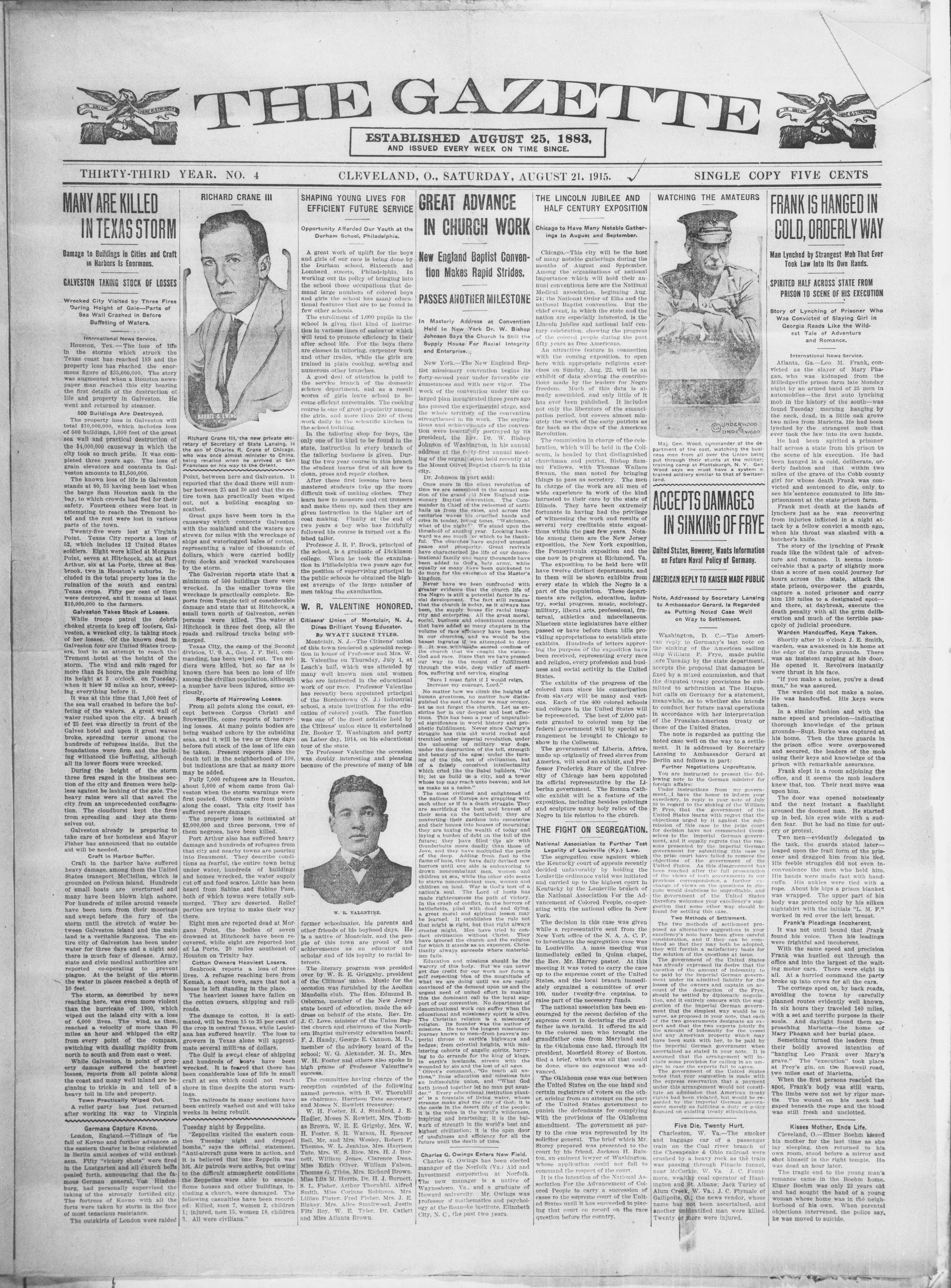
MANY ARE KILLED IN TEXAS STORM
Damage to Buildings in Cities and Craft in Harbors Is Enormous.
Wrecked City Visited by Three Fires During Helgut of Gale—Parts of Sea Wall Crashed in Before Buffeting of Waters.
Houston, Tex. — The loss of life in the storms which struck the Texas coast hgs-reached 189 and the property loss has reached the enormous figure of $35,000,000. The story was augmented when a Houston newspaper man reached this city bearing the first details of the destruction of life and property in Galveston. He went and returned by steamer.
500 Buildings Are Destroyed.
The property loss in Galveston will total $10,000,000, which includes loss of 500 buildings, 1,000 feet of the great sea wall and practical destruction of the $4,000,000 causeway in which the city took so much pride. It was completed three years ago. The loss of grain elevators and contents in Galveston amounts to $1,500,000.
The known loss of life in Galveston stands at 80, 55 having been lost when the barge Sam Houston sank in the bay, to which crowds had fled for their safety. Fourteen others were lost in attempting to reach the Tremont hotel and the rest were lost in various parts of the town.
Twenty-five were lost at Virginia Point. Texas City reports a loss of 52, which includes 12 United States soldiers. Eight were killed at Morgans Point, seven at Hitchcock, six at Port Arthur, six at La Porte, three at Seabrook, two in Houston's suburbs. Included in the total property loss is the ruination of the south and central Texas crops. Fifty per cent of them were destroyed, and it means at least $10,000,000 to the farmers.
Galveston Takes Stock of Losses.
While troops patrol the debris choked streets to keep off looters, Galveston, a wrecked city, is taking stock of her losses. Of the known dead in Galveston four are United States troopers, lost in an attempt to reach the Tremont-hotel at the height of the fire, who were killed or more than 24 hours; the gale reaching its height at 3 'o'clock on Tuesday, when it blew 92 miles an hour, sweeping everything before it.
It was at this time that 1,000 feet of the sea wall crashed in before the buffeting of the waters. A great wall of water rushed upon the city, A breach of 25 feet was directly in front of the Galvez hotel and upon it great waves broke, spreading terror among the hundreds of refugees inside. But the foundations were firm and the building withstood the buffeting, although all its lower floors were wrecked. During the height of the storm three fires raged in the business section of the city and firemen were helpless against the lashing of the gale. The heavy rains' were all that saved the city from an unprecedented confagration. The cloudburst kept the fires from spreading and they ate themselves out. Galveston already is preparing to take care of her homeless and Mayor Fisher has announced that no outside aid will be needed.
Craft In Harbor Suffer.
Craft in the harbor have suffered heavy damage, among them the United States transport McClellan, which is grounded on Pelican island. Hundreds of small boats are overturned and many have been blown high ashore. For hundreds of miles around vessels have been torn from their moorings and swept before the fury of the storm until the stretch of water between Galveston island and the main land is a veritable Sargossa. The entire city of Galveston has been under water for three days and a night and there is much fear of disease. Army, state and civil medical authorities are reported co-operating to prevent plague. At the height of the storm the water in places reached a depth of 10 feet.
The storm, as described by news reaching here, was even more violent than the hurricane of 1900, which wiped out the island city with a loss of 6,000 lives. The wind, as then, reached a velocity of more than 80 miles an hour and whipped the city from every point of the compass, switching with dazzling rapidity from north to south and from east o west.
While Galveston, in point of property damage suffered the heaviest losses, reports from all points along the coast and many well inland are beginning to trickle in and tell of a heavy toll in life and property.
Town Practically Wiped Out.
A relief party has just returned after working its way to Virginia
Germans Capture Kovno.
London, England.-Tidings of the fall of Kovno and further advances in the eastern theater is being celebrated in Berlin amid scenes of wild enthusiasm. Fifty "victory shots" were fired in the Lustgarten and all church bells pealed forth, announcing that the famous German general, Von Hindenburg, had personally supervised the taking of the strongly fortified city. The fortress of Kovno with all the forts were taken by storm in the face of most tenacious resistance.
The outskirts of London were raided
RICHARD CRANE III,'the new private secretary of Secretary of State Lansing, is the son of Charles R. Crane of Chicago, who was once a foreign minister to China, being recalled when he arrived at San Francisco on his way to the Orient.
Point, between here and Galveston. It reported that the dead there will number between 25 and 30 and that the entire town has practically been wiped out, not a building escaping unscathed.
Great gaps have been torn in the causeway which connects Galveston with the mainland and the waters are strewn for miles with the wreckage of ships and waterlogged bales of cotton, representing a value of thousands of dollars, which were carried bodily from docks and wrecked warehouses by the storm.
The Galveston reports state that a minimum of 500 buildings there were wrecked. In the smaller towns the wreckage is practically complete. Reports from Temple tail of considerable damage and state that at Hitchcock, a town north of Galveston, seven persons were killed. The water at Hitchcock is three feet deep, all the roads and railroad tracks being submerged.
Texas City, the camp of the Second division, U. S. A., Gen. J. F. Bell, commanding, has been wiped out. Ten soldiers were killed, but so far as is known there has been no loss of life among the civilian population, although a number have been injured, some seriously.
Reports of Harrowing Losses.
From all points along the coast, except between Corpus Christi and Brownsville, come reports of harrowing losses. At many points bodies are being washed apse by the subsiding seas, and it will be two or three days before full stock of the loss of life can be taken. Present reports place the death toll in the neighborhood of 100, but indications are that as many more may be added.
Fully 7,000 refugees are in Houston, about 5,000 of whom came from Galveston when the storm warnings were first posted. Others came from points along the coast. This city itself has suffered severe damage.
The property loss is estimated at $2,000,000 and three persons, two of them negroes, have been killed.
Port Arthur also has suffered heavy damage and hundreds of refugees from that city and nearby towns are pouring into Benumont. They describe conditions as fearful, the entire town being under water, hundreds of buildings and homes wrecked, the water supply cut off and food scarce. Little has been heard from Sabine and Sabine Pass, both of, which towns were totally submerged. They are deserted. Relief parties are trying to make their way there.
Eight men are reported dead at Morgan's Point, the bodies of seven drowned at Hitchcock have been recovered, while eight are reported lost at La Porte. 20 miles southeast of Houston on Trinity bay.
Cotton Owners Heaviest Losers.
Seabrook reports a loss of three lives. A refugee reaching here from Kemah, a coast town, says that not a house is left standing in the place.
The heaviest losses have fallen on the cotton owners, shipping and railroads.
The damage to cotton, it is estimated, will be from 15 to 25 per cent of the crop in central Texas, while Louisiana has suffered heavily. The loss to growers in Texas alone will approximate several millions of dollars.
The Gulf is swopt clear of shipping and hundreds of boats have been wrecked. It is feared that there has been considerable loss of life in small craft at sea which could not reach shore in time despite the storm warnings.
The railroads in many sections have been entirely washed out and will take weeks in being rebuilt.
Tuesday night by Zeppelins.
"Zeppelin visited the eastern counties Tuesday night, and 'dropped bombs'," says the official, statement, "Anti-aircraft guns were in action, and it is believed that one Zeppelin was hit. Air patrols were active, but owing to the difficult atmospheric conditions the Zeppelin were able to escape. Some houses and other buildings, including a church, were damaged. The following casualties have been recorded: Killed, seven 7, women 2, children 1; injured, ten 15, women 18, children 3. All were civilians."
ESTABLISHED AUGUST 25, 1883 AND ISSUED EVERY WEEK ON TIME SINCE.
SHAPING YOUNG LIVES FOR EFFICIENT FUTURE, SERVICE
Opportunity Afforded Our Youth at the Durham School, Philadelphia.
A great work of uplift for the boys and girls of our race is being done by the Durham school, Sixteenth and Lombard streets, Philadelphia. In working out its policy of bringing into the school those occupations that demand large numbers of colored boys and girls the school has many educational features that are to be found in few other schools.
The enrollment of 1,000 pupils in the school is given that kind of instruction in various liaisons of endeavour which will tend to promote efficiency in their after school life. For the boys there are classes in tailoring, carpenter work and other trades, while the girls are trained in plain cooking, sewing and numerous other branches.
A good deal of attention is paid to the service branch of the domestic science department, and as a result scores of girls leave school to become efficient mensuals. The cooking course is one of great popularity among the girls, and more than 200 of them work daily in the scientific kitchen in the school building.
In the tailoring shop for boys, the only one of its kind to be found in the state, instruction in every branch of the tailoring business is given. During the two year course in this branch the student learns first of all how to clean, press and repair clothes.
After these first lessons have been mastered students take up the more difficult task of making clothes. They learn how to measure and cut trousers and make them up, and then they are given instruction in the higher art of coat making. Finally at the end of two years a boy who has faithfully followed his course is turned out a finished tailor.
Professor J. R. P. Breck, principal of the school, is a graduate of Dickinson college. When he took the examination in Philadelphia two years ago for the position of supervising principal in the public schools he obtained the highest average of the large number of men taking the examination.
W. R. VALENTINE HONORED.
Citizen's Union of Montclair, N. J.
Dines Brilliant Young Educator.
Montclair, N. J.—The Citizens' union of this town tendered a splendid reception in honor of Professor and Mrs. W. R. Valentine on Thursday, July 1, at Leach's hall, which was attended by many well known men and women who are interested in the educational work of our race. Professor Valentine has recently been appointed principal of the Bordentown (N. J.) Industrial school a state institution for the education of colored youth. The function was one of the most notable held by the Citizens' union since it entertained Dr. Booker T. Washington and party on Labor day, 1914, on his educational tour of the state.
To Professor Valentine the occasion was doubly interesting and pleasing because of the presence of many of his
W. R. VALENTINE.
former schoolmates, his parents and other friends of his boyhood days. He is a native of Montclair, and the people of this town are proud of his achievements as an educator and scholar and of his loyalty to racial interests.
The literary program was presided over by W. R. E. Griggsy, president of the Citizen's union. Music for the occasion was furnished by the Aeolian Mandolin club. The Hon. Edmund B. Osborne, member of the New Jersey state board of education, made the address on behalf of the state. Rev. J. C. Love, minister of the Union Baptist church and chairman of the Northern Baptist university education board; J. H. Handy, George E. Cannon. M. D., member of the advisory board of the school; W. G. Alexander, M. D., Mrs. W. H. Foster and others also spoke in high praise of Professor Valentine's success.
The committee having charge of the reception consisted of the following named persons, with B. W. Thornhill as chairman. Harrison Tate secretary and Moses N. Rowley treasurer.
W. H. Foster, H. J. Stainfield, J. E. Haddler, Nes. Row: Nawley, Mrs. Thomas Brown, W. R. E. Griggsy, Mrs. W. H. Foster, R. W. Ratson, H. Spencer Bell, Mr. and Mrs. Wesley, Robert P. Thomas, W. L. Jenkins, Mrs. Harrison Tate, Mrs. W. S. Rice, Mrs. H. J. Burnett, William Jones, Clarence Doss, Miss Edith Oliver, William, Falson, Thomas G. Tibbs, Mrs. Richard Brown, Miss J. L. M. Harris, Dr. H. J. Burnett, S. L. Fiss, Arthur Thornbill, Alfred Smith, Miss Corinne Robinson, Mrs. Lillian Flater, Fred Fisher, Mrs. J. E. Blakey, Mrs. Alice Smallwood, Justie Fitz Roy, W. E. Tuber, Dr. Carlett and Miss Atlanta Brown.
In Masterly Address at Convention Hold In New York Dr. W. Bishop Johnson Says the Church Is Still the Supply House For Racial Integrity and Enterprise.
New York.—The New England Baptist missionary convention begins its forty-second year under favorable circumstances and with new vigor. The work of the convention under the enlarged plan inaugurated three years ago has passed the experimental stage, and the whole territory of the convention strengthened in its work. The aspirations, and achievements of the convention were beautifully portrayed by its president, the Rev. Dr. W. Bishop Johnson of Washington, in his annual address at the city first annual meeting of the organization held recently at the Mount Olivet Baptist church in this city.
Dr. Johnson in jert said: Once more in the silent revolution of time we are assembled in the annual session of the grand *Id* New England missionary, the first missionary in Chief of the rededition of earth halls us from the skies, and across the centuries waves his crucified hands and cries in tender, loving tones, "Watchman, Watchman," and "Guardian threshold of another year." Looking backward we see much or which to be thankful. The churches have enjoyed unusual devotions, and even revivals have characterised the life of our national family and many thousands have been added to God's holy army, while equally as many have been quickened to serve for the extension of the Master's kingdom.
Never have we been confronted with greater evidence that the church life of the Negro is still a potential factor in race relations. Yet that the church is today, as it always has been, the supply house for racial integrity and enterprise. All the great moral, social, business and educational concerns of the Negro community have a volume of race efficiency have been born in our churches, and we would be the basest ingrives if we attempted to deny it. It was with the sacred continuity of the God and race. Since then we have pressed our way to the mount of fulfillment through the wide, deep valley of sacrifice, suffering and service; singing "The Lord is my shepherd, I will reign, Increase my command, I will reign."
Increases your courage to climb the heights of human greatness, no matter how distinguished the seat of honor we may occupy, let us not forget the church: Let us enshrine her in our deepest and best affections. This has been a year of unparalleled success in the church of the oldest and most philistic fulfillment. Never since Calvary's struggle has this old world rocked and trembled under imperial revolution, under the unloosening of military war dogs, for the sake of the oldest and most worthy who may reach unto heaven; and let us make us a name."
The most civilized and enlightened of the nations of Europe are grappling with each other as if in a death struggle. They unleash their sons on the battlefield; they are converting their gardens into cineraries and their homes into houses of mourning; they are taxing the wealth of today and tomorrow; they are filling their future; they have filled the air with thunderbolts more deadly than those of Jove, and they have multiplied the perils of the deep. Adding fresh fuel to the fire of the battlefield, the horrors until one side is endeavoring to drown noncombatant men, women and children at sea, while the other side seeks to stare noncombatant men, women and children on land. War is God's test of a man's ability to make righteousness the path of victory. In the crash of conflict, in the horrors of battlefields, piled with dead and dying, a great moral and spiritual lesson may be learned. War is a path that might be right, but that right always creates might. Men have tried to conduct civilization without Christ. They have ignored the church and the religion for which it stands as an exponent. Christianity always succeeds where material fails.
Education and missions should be the warfare of this body. But we can never get due credit for our work nor form a plan of what we are doing until we are really convinced of the demand upon us and the urgent need of united effort in making this the dominant call to the loyal support of God the Lord with the denominational work can suffer when the educational and missionary spirit is alive. The Christian religion is a missionary religion. Its founder was the author of missions. God the Lord has known to men-from heaven's imperial throne to earth's highways and hedges; from celestial heights, with ministering cohorts of angelic spirits, hurrying to do errands for the king of kings, to serve the poor and the wounded by slain the lost of all ages. "Oliver's command," "Go teach all nations," links education and missions into an indispensable union, and the man put asunder. "Every educational institution plantie" is a fountain of living water, whose streams make glad the city of God; it is the oasis in the desert life of the people; it is the volcanic heart of heartening; it is the bulwark of strength in the world's best and highest civilization; it is the open door of usefulness and efficiency for all the future until the death of time.
Charles G. Owings' Enters New Field. Charles G. Owings has been elected manager of the Norfolk (Va.) Aid and Investment corporation at Norfolk. The new manager is a native of Waynesboro, Va., and a graduate of Howard university. Mr. Owings was professor of mathematics and psychology at the Romaine Institute, Elizabeth City, N.C., the past two years.
THE LINCOLN JUBILEE AND HALF CENTURY EXPOSITION
Chicago to Have Many Notable Gatherings In August and September.
Chicago.—This city will be the host of many notable gatherings during the months of August and September. Among the organizations of national importance which will hold their annual conventions here are the National Medical association, beginning Aug. 21; the National Order of Elks and the national Baptist convention. But the chief event, in which the state and the nation are especially interested, is the Lincoln jubilee and national half-century celebration, showing the progress of the consecrated people during the past fifty years as free Americans. An attractive feature in connection with the coming exposition, to open here with appropriate religious exercises on Sunday, Aug. 22, will be an exhibit of data showing the contributions made by the leaders for Negro freedom. Much of this data is already assembled, and only little of it has ever been published. It includes not only the liberators of the concession period, but covers almost minutely the work of the early partisans as far back as the days of the American Revolution.
The commission in charge of the celebration, which will be held in the Coliseum, is headed by that distinguished churchman and patron: Bishop Samuel Fallows, with Thomas Wallace Swann, the man noted for bringing things to pass as secretary. The men in charge of the work are all men of wide experience in work of the kind intrusted to their care by the state of Illinois. They have been extremely fortunate in having had the privilege of witnessing the work and results of several very creditable state expositions within the past few years. Notable among them are the New Jersey exposition, the New York exposition, the Pennsylvania exposition and the one now in progress at Richmond, Va. The exposition to be held here will have twelve distinct departments, and in them will be shown exhibits from every state in which the Negro is a part of the population. These departments are religion; education, industry, social progress, music, sociology, military, liberal arts, professional, fraternal, athletics and miscellaneous. Nineteen state legislatures have either passed or have before them bills providing appropriations to establish state exhibits. Hundreds of letters approving the purpose of the exposition have been received, representing every race and religion, every profession and business and social activity in the United States.
The exhibits of the progress of the colored man since his enclampation from slavery will be many and various. Each of the 400 colored schools and colleges in the United States will be represented. The host of 2,000 patients granted to colored men by the federal government will by special arrangement be brought to Chicago to show in the Coliseum.
The government of Liberin, Africa, made up originally of freed slaves from American, will send an exhibit, and Professor Frederick Starr of the University of Chicago has been appointed its official representative by the Liberian government. The Roman Catholic exhibit will be a feature of the exposition, including besides paintings and sculpture many holy relics of the Negro in his relation to the church.
THE FIGHT ON SEGREGATION.
National Association to Further Test Legality of Louisville (Ky.) Law.
The segregation case against which the Kentucky court of appeals recently decided unfavorably by holding the Louisville ordinance valid was initiated and carried up to the highest court in Kentucky by the Louisville branch of the National Association For the Advancement of Colored People, co-operating with the national office in New York.
The decision in this case was given while a representative sent from the New York office of the N. A. A. C. P. to investigate the segregation case was in Louisville. A mass meeting was immediately called in Quinn chapel, the Rev. Mr. Harvey pastor. At this meeting it was voted to carry the case up to the supreme court of the United States, and the local branch immediately organized a committee of over 100, under twenty-five captains, to raise part of the necessary funds.
The national association has been encouraged by the recent decision of the supreme court in declaring the grandfather laws invalid. It offered its aid to the colored men who brought the grandfather case from Maryland and in the Oklahoma case had, through its president, Moorefield Storey of Boston, filed a brief, which was all that could be done, since no argument was advanced.
The Oklahoma case was one between the United States on the one hand and certain registrars of voters on the other, arising from an attempt on the part of the United States government to punish the defendants for complying with the provisions of the Oklahoma amendments. The government as party to the case was represented by its solicitor general. The brief which Mr. Storey prepared was presented to the court by his friend, Jackson H. Raiston, an eminent lawyer of Washington, whose application could not fail to command the respect of the court.
"It is the intention of the National Association For the Advancement of Colored People" to carry a succession of cases to the supreme court of the United States until it has succeeded in placing that court on record on the race question before the country.
UNDERWOOD UNDERWOOD
May, Gen. Wood, commander of the department of the east, watching the business men from all over the Union being put through their stunts at the military; training camp at Pittsburgh, N. Y. Gen. Wood says we must have a system o trained soldiery similar to that of Switzerland.
ACCEPTS DAMAGES IN SINKING OF FRYE
AMERICAN REPLY TO KAISER MADE-PUBLIC
Note, Addressed by Secretary 'Lansing to Ambassador Gerard, Is Regarded as Putting Noted Case Well
Washington, D. C.-The American reply to Germany's last note on the sinking of the American sailing ship William P. Frye, made public are Tuesday by the state department, accepts the proposal that damages be fixed by a mixed commission, and that the disputed treaty provisions be submitted to arbitration at The Hague, but calls on Germany for a statement, meanwhile, as to whether she intends to conduct her future naval, operations in accordance with her interpretation of the Prussian-American treaty or those of the United States.
The note is regarded as putting the noted case well on the way to a settlement. It is addressed by Secretary Lansing to Ambassador Gerard at Berlin and follows in part:
Further Negotiations Unprofitable.
You are instructed to present the following to the German minister for foreign affairs:
Further Negotiations Unprofitable.
You are instructed to present the following note to the German minister for reign affairs:
Under instructions from my government, I have the honor to inform your celleney, in reply to your note of July in regard to the sinking of the William Frye, that the government of the United States learns with regret that the objections urged by it against the submission of this case to the prize court of decision have not commended themselves to the Imperial German government, and it equally regrets that the rea-ment presented by the imperial German government for submitting this case to a prize court have failed to remove the objections of the government of the United States. As this disagreement has been reached after the full presentation of the views of both governments in our previous correspondence, a further ex-
Two Methods of Settlement.
The two methods of settlement proposed as alternative suggestions in your consideration, and if they can be combined so that they may both be adopted, they will furnish a satisfactory basis for the solution of the questions at issue. The government of the area has made a decision that the question of the amount of indemnity to be paid by the Imperial German government under its admitted liability for the losses of the owners and captain on account of the loss of the property should be settled by diplomatic negotiation, and it entirely concurs with the suggestion of the Imperial German government that the simplest way would be to pay the two governments designate an expert and that the two experts Mintly fix the amount of indemnity for the vessel and any American property which may be lost by the Imperial German government when ascertained as stated in your note. It is assumed that the arrangement will include some provision for calling in an unpaid amount. The government of the United States notes that your suggestion is made with the express reservation that a payment under this arrangement would not constitute an admission that American treaty rights are granted by the Imperial German government merely as fulfilling a duty or policy formed on existing treaty simulations.
Five Die. Twenty Hurt.
Charleston, W. Va.—The smoker and baggage, car of a passenger train on the Coal river branch of the Chesapeake & Ohio railroad were crushed by a heavy rock as the train was passing through Pinchie tunnel, near McCorkle, W. Va. J. C. Fennimore, wealthy coal operator of Huntington and St. Albans; Jack Turkey of Alum Creek, W. Va.; J. C. Plymale of Gallipolis, O.; the news vendor, whose name has not been ascertained, and another unidentified man were killed, Twenty or more were injured.
IN UNION UNION UNION
FRANK IS HANGED IN COLD, ORDERLY WAY
Man Lynched by Strangest Mob That Ever Took Law Into Its Own Hands.
Story of Lynching of Prisoner Who Was Convicted of Slaying Girl in Georgia Reads Like the Wildest Tale of Adventure and Romance
INTERNATIONAL NEWS SERVICE.
Atlanta, Ga.-Leo M. M. Frank, convicted as the slayer of Mary Phagan, who was kidnapped from the Milledgeville prison farm late Monday by an armed band of 25 men in automobiles—the first auto lynch-mob in the history of the south—was found Tuesday morning hanging by the neck, dead in a little oak grove two miles from Marletta. He had been lynched by the strangest _mob_ that ever took the law into its own hands.
He had been spirited a prisoner half across a state from his prison to the scene of his execution. He had been hanged in a cobb, deliberear, orderly fashion and that within two miles of the grave of the Cobb county girl for whose death Frank was convicted and sentenced to die, only to see his sentence commuted to life imprisonment at the state prison farm.
Frank met death at the hands of lynchers just as he was recovering from injuries inflicted in a night attack by a fellow convict a month ago, when his throat was slashed with a butcher's knife.
The story of the lynching of Frank reads like the wildest tale of adventure and romance. It seems inconceivable that a party of slightly more than a score of men could journey for hours across the state, attack the state prison, power the guards, capture a noted prisoner and carry him 130 miles to a designated spot—and there, at daybreak, execute the death-penalty with all the grim deliberation and much of the terrible pancoly of judicial procedure.
Warden Handcuffed, Keys Taken.
Shortly after 10 o'clock J. E. Smith, warden, was awakened in his home at the edge of the farm grounds. There was an insistent rapping at his door. He opened it. Revolvers instantly were thrust in his face.
"If you make a noise, you are a dead man," he was assured.
The warden did not make a noise. He was handcuffed. His keys were taken.
In a similar fashion and with the same speed and precision—indicating thorough knowledge of the prison grounds—Supt. Burke was captured at his home. Then the three guards in the prison office were overpowered and secured, the leaders of the mob using their keys and knowledge of the prison with remarkable assurance.
Frank slept in a room adjoining the office, and it seems the mob leaders knew that, too. Their next move was upon him.
The door was opened noiselessly and the next instant a flashlight around the doomed man. He started up in bed, his eyes wide with a sudden fear. But he had no time for outcry or protest.
two men—evidently delegated to the task, the guards stated later—leaped upon the trail form of the prisoner and dragged him from his bed. His feeble struggles did not even inconvenience the men who held him. His hands were made fast with hand-cuffs. His ankles were tied with a rope. About his hips a prison blanket was wrapped. The upper part of his body was protected only by his silken nightshirt with the initials "L. M. F." worked in red over the left breast.
Frank's Pleadings incoherent. It was not until bound that Frank found his voice. Then his leadings were frightful and incoherent.
With the same speed and precision Frank was hustled, out through the office and into the largest of the waiting motor cars. There were eight in all. At a hurried command, the party broke up into crews' for all the cars.
The cortege sped on, by back roads, avoiding the towns by carefully planned routes evidently well known. In six hours they traveled 140 miles, with a set and terrific purpose in their souls. And daylight found them approaching Marietta—the home of Mary Phagan and her burial place.
Something turned the leaders from their boldly avowed intention of "hanging Leo Frank over Mary's grave." The "execution" took place at Frey's gin, on the Roswell road, two miles east of Marietta.
When the first persons reached the spot, Frank's body was still warm. The limbs' were not set by rigor mortis. The wound on his neck had gaped beneath the rope and the blood was still fresh and unclotted.
Kisses Mother, Ends Life.
Cleveland, O.—Elmer Boehm kissed his mother for the last time as she lay sleeping, then returned to his own room, stood before a mirror and shot himself in the right temple. He was dead an hour later.
The tragic end to the young man's romance came in the Boehm home. Elmer Boehm was only 23 years old and had sought the hand of a young woman whose home was in the neighborhood of his own. When parental objections intervened, the police say, he was moved to suicide.
PUBLISHED EVERY SATURDAY
One Year.....$1.50.
Six Months.....1.00
Three Months......50
Subscribers are requested to re-
mit by postoffice money or-
der or registered letter
Entered at the postoffice in Cleveland
Ohio, as second-class matter.
Address all communications to
Blackstone Building, Cleveland, O.
Member Ohio Legislature: 1894
to 1896; 1896 to 1898; 1900 to 1902
THE GAZETTE is the oldest, and
has the largest bona fide circulation,
double that of any newspaper in the
interior of Afro-Americanes published
in the state of Ohio, and comparison
with any will immediately establish
its rank as one of the NEWSIEST
AND BEST in the country.
10,000,000 Afro-Americanes.
160,000 in Ohio.
20,000 in Cleveland.
THE FRANK LYNCH-MURDER.
While there has never been any doubt in our mind as to the guilt of Leo M. Frank, and while we have all along resented the contemptible "sentimental" effort of certain daily news papers and others to foist the dastardly crime (for which Frank was clearly convicted) on his forced accomplice, a "Negro," who served a year in the Georgia penitentiary for his alleged part in the brutal outrage and murder of little Mary Phagan (white) we certainly do not endorse the dastardly lynch-murder of Frank which took place, the first of the week, in the state of Georgia. It has, however served a purpose in calling the attention of the country to a lawless condition that has existed in the South ever since the days of "reconstruction" as the lynch-murder of more than fifty others (black and white), already this year, has not done, "The Lord works in a mysterious way." Some good will surely result from the terrible Frank lynch-murder which made twenty-five or thirty-five other murders of those who participated in it. According to a dispatch to a local daily paper, three "Negroes" were also lynch-murdered in Georgia, the first of the week. If this report is true, in the first six and a half months of this year the South has furnished nearly sixty lynch-murders, more than it did all of last year; and over three thousand, in the last thirty or forty years.
THE "JIM CROW RULE" STORY
EXPLODES
In our issue of last week, we republished a Columbus letter to the Cincinnati Enquirer in which the statement was made that an Afro-American lady stenographer had recently been forced out of a position in the State Tax Commission's office, at Columbus, by the "enforcement of a jim-crow rule without the aid of any outside influence and over the resistance of the state (Willis) administration." The Enquirer's Columbus representative apparently greatly pleased, in concluding his letter said that "threats of resignations" of "employees of the State Tax Commission" secured the enforcement of the "jim-crow rule." Having long personal acquaintance with Gov. Frank B. Willis, and the Hon. James Boyle, a member of the State Tax Commission, we did not believe the "story" of the Columbus writer of the democratic Cincinnati daily paper and, as our readers know, asked an explanation from our Governor, who transmitted our request to Mr. Boyle whose letters, which follow, fully and satisfactorily explain the matter.
August 17, 1915.
Hon. Harry C. Smith,
Editor Gazette,
Cleveland, Ohio.
My Dear Friend Smith:—I have just seen the editorial page of your issue of the 14th instant, in which is an article headed "Walting to Hear, Gov. error." This article comments on a news-item in the Cincinnati Enquirer of August 3, 1915, as to the employment of a clerk in this office and the action of certain clerks resulting, as alleged, in the foreble withdrawal of the clerk first referred to on the ground of her color. I believe you know me well enough to know that I would not be a party to any such coercion or to any discrimination against or injustice to any member of your race.
The article in the Enquirer, referred to by you, in its essentials was also gether untrue although it is true that there has been some unwarranted gossip in other departments—instigated as we understand, largely by a discharged employee. The article in the Enquirer was reproduced in substance but in a more incorrect form in the Dispatch of this city. Attached is a card of mine published in the Dispatch in reply to that article.
I would say, that when I heard there was any outside gossip about the employment by this Commission of the young lady referred to I immediately declared my position to my fellow Commissioners, saying that rather than be coerced by the clerks in this office or be a party to the forcible retirement of any clerk, Colored or white, I would resign from the Commission; and I further said that the Commission was bound both in justice to the young lady and its own dignity to protect the young lady and if unable to do so, to be coerced by the Commission. Not only my Republican colleague, Chairman McGiffert, but my Democratic colleague, Mr. Peckinpaugh, endorsed my stand. These two gentlemen are now on the Pacific Coast, but before they left, the last talk I had with them was to the effect that if necessary I would take the re-
sponsibility of reorganizing the entire clerical force of this office to maintain the attitude above stated. I would say that this attitude taken by me and endorsed by my fellow Commissioners was announced before there was any publication in any newspaper on the subject, and was prompted certainly on my part and, I am sure, on the part of my fellow Commissioners, by our determination not to permit any injustice to be done to any employee of this Commission or to humiliate any employee on account of color.
Before there was publication in any newspaper as to this unfortunate incident, this Commission made earnest efforts in good faith to retain the young lady permanently as a clerk. As explained in my letter to the Dispatch, she was only an "emergency" who could not under the law she could only be retained if it was but as soon as we heard of the outside sighpion the Commission instructed the Secretary to give her a "provisional" employment which we could do by the consent of the Civil Service Commission. The latter body gave its consent and the young lady was working as a "provisional" clerk for a short time. When the first publication occurred, the case the Tax Commission sent its reports to the Civil Service Commission twice to endeavor to have her employment made "permanent" as the "provisional" employment could not be extended beyond ninety days. As stated in my letter to the Dispatch, the young lady was not eligible under the standing rules of the Civil Service Commission to permanently employment in this Commission, the young lady herself decided to accept a permanent position at a reduced salary under the State Board of Health, she being eligible for such an appointment.
The above is a truthful statement of the case. Any representations to the contrary are absolutely false. With sincere personal regards, Yourself. Yourself.
Mr. Boyle's letter to the Columbus Dispatch of Aug. 6. '15:
DIDN'T DRAW COLOR LINE
To the Editor of The Dispatch,
Sir: Ordinarily I would not write
a card to contradict any statement in
new papers relating to myself personally
a worthy and competent young lady
involved in an article in your paper of
this evening entitled "Draw Color
Line" compels me to ask that you publish
this communication, if feeling sure
to publish the truth in your news.columns
It is not true that the tax commission of Ohio yielded to opposition from the young women employed in this office to the employment of a young colored woman, and agreed to her transference of facts are directly opposite. The young colored woman in question was only employed here temporarily, as an "emergency clerk." The state tax commission made application to the state civil service commission for authority to employ her permanently. Had such permission been granted the tax commission would have put the young woman in question on the permanent commission, her work while temporarily employed, having been thoroughly satisfactory. It developed, however, that the young woman could not be certified to the tax commission for the reason that she was not eligible, under the civil service rules, to the grade from which certifications are made to this office. The young woman was acting as her a "provisional" stenographer, and she was acting as such when an opening occurred for her in the state board of health for a permanent position, to which position she was eligible under the civil service rules. The young woman decided for herself as to working for the tax commission as a "provisional appointee or accepting a position of state board of health, and she decided to take the latter.
There is no truth whatever in the report that any clerks in this office threatened to resign if the young woman in question were ours JAMES.BOYLE
Many years ago when Judge Joseph Benson Foraker was making his second canvass for gubernatorial honors—he had been defeated two years before by Judge Hoadley, largely as the result of an untrue democratic story involving our people—the writer was asked to meet Mr. Foraker in Bellefonte where he had gone to participate in a great Republican mass meeting. It was there our acquaintance began and we met Mr. Boyle for the first time. The latter was a representative of the leading Republican daily news paper of Cincinnati. It happened that he was standing next to us at the hotel counter when we registered, asked for a room in which to spend the night, and were told that all had been taken. Knowing that the little city was overcrowded with thousands of visitors who had come to attend the mass meeting and being reassured by the willingness of the hotel management to afford us dining and all other accommodations available in the (Miltenberger) hotel, we were about to go on in to dinner when the gentleman standing next to us ordered the clerk to give us the key to his room whenever we should call for it and graciously offered to share his room with us that night. That gentleman was Mr. Boyle. This began and cemented a friendship that has remained undisturbed until this day. Our people can believe Mr. Boyle's statements, as we do, and without any question whatever. We repeat what we said in The Gazette of last week, when referring to the Enquirer's Columbus "story": We did not, for a single moment, believe that it was possible for our brilliant Governor, or any of his appointees, to have been involved, in any unfavorable way, in any mistreatment of the young lady stenographer.
Drew Announces His Retirement.
Springfield, Mass.-Howard P. Drew of this city, the crack athlete, has announced his intention to retire from racing. Telegraphing from the Panama-Pacific exposition field, where he was beaten, on Aug. 7, in the 100-yard race, he was beaten in the 100-yard track and field meet. Drew said: "I was bothered with my legs a great deal today in the race, so that I pulled up lame at the finish. I have been in poor physical condition, for I now weigh only 150 pounds, and that is much below normal. I am not here but am through with open competition after this year."
THE GAZETTE, CLEVELAND, O. SATURDAY, AUGUST 21, 1915
WRITTEN BY "THE OLD RELIA
BLE" BLE' CORRE-
PENDENTS
THROUGHOUT THE STATE
What Our People Are Doing Each Week—Church, Personal, Social, Lodge, Literary and Musical—Marriages, Deaths, Etc.
SANDUSKY.—Mrs. W. Ely who suffered long, died Saturday morning. The remains were taken to Pineville, Ky., for burial.—Mrs. George Harden, son and two sisters returned, Sunday, to Indianapolis. Mr. Harden came for them. They visited their sister Mrs. James.—Roy, and Mr. George D. Smith will return for the fourth Sunday and open the Second Baptist church for another year's work. He writes that a vacation is fine in hot weather.
GEORGETOWN.—"Uncle Billy" Baker of Wallburg was buried, Sunday. Rev. W. Braxton preached the funeral. Mr. and Mrs. Grant Smith of Portsmouth, were called home again, by a death in the family.—Mrs. Geo. Burr died, recently, after a long illness.—Mrs. W. Oliver, president of the Y. W. H. of Cincinnati, has been the guest of E. H. Jamison's family for several weeks.—Rev. J. J. Burr of Hillsboro, preached at the Baptist church, Sunday.
AKRON.—P. W. Lemon and Mr. H. Gaines of Cleveland, visited Akron, Sunday, and were guests of Rev. H. H. Summers, pastor of Bethel A. M. E. church. The former addressed the S.-S and gave an effective talk. The evening service was entirely devoted to addresses on S. S. work, Mr. Lemon being the principal speaker. There was a splendid audience, which was instructed as well as entertained. The message, he delivered, will do much to put new life into our local S. S. This means new life for the church, also.
ALLIANCE—Several of our people are in Columbus, this week, attending our national K. P. encampment. Mrs. W. H. Palmer is spending her vacation in Fernwood. Mrs. M. E. Olliver and daughter, Nellie, and Mrs. F. Barrett and daughter, Florence have returned from Cleveland. Mrs. Scott and daughter, Mary, of E. Liverpool, were guests of Mrs. E. Moore. Mr. and Mrs. W. P. Lewis entertained at a 6 o'clock dinner, Wednesday at Blessington, and Mitchell at Cleveland—Mrs. Rosa Johnson of Cleveland, conducted a missionary meeting at the church, Wednesday evening.
CORRESPONDENTS must mail all letters for publication at their main postoffice sufficiently early on Monday (or Sunday) of each week to have them reach The Gazette office on Tuesday morning, and always write also, their names and that of their relatives, and that of the wrapper about returned copies. Unless this latter is done, proper credit cannot be given you. Lists of names, wedding presents, etc., obituary notices, speeches, resolutions, poetry, inquiries for relatives and advertisements of all kinds, including items announcing entertainments to be held in advance at the rate of ten cents a line, six words to a line. Our rates for display advertisements will be sent on application. Send postal note and not stamps during warm weather.
GEORGETOWN—Mrs. George Burr died here, Aug. 9. Funeral services, conducted by Rev. Silas Braxton, at the Second Baptist church. Her husband's two daughters, from Cincinnati, attended the funeral—Wm. Baker, of Wahlsburg, died, Aug. 14, and was buried Sunday—Mr. Jesse Smith is very ill. Rheumatism—Mr. John Bullard led the sisters, Sunday morning in the meeting at the Baptist church, and Revs. George and Lucian A. Bullard assisted in services here Sunday—Tom White, son and Maurice Coleman are in camp with the miliait at Yellow Springs. The S. S. is very prosperous, under the leadership of the Rev. E. F. Boston preached here. Sunday Sunday and urged our people to patronize The Gazette, Ohio's leading and oldest race paper—Rev. E. F. Boston will attend the Association in Columbus.
CINCINNATI.—Mrs. L. McGown pastor of the Daughters of Zion church, preached to a large congregation, Sunday evening. Many souls were blessed and one saved.—Mrs. Bertha Smith, Mrs. N. Hamilton, son and daughter, Nellie and Oscar, Mr. W. Steward and Mr. H. Lackey, held the service at St. Covinston, Ky., Sunday afternoon.—Mr. Landon Mceave, evangelist, is preaching in New Richmond and other places.—Mrs. W. Vanden who died, Aug. 11, left two sons, one brother and two sisters to mourn her loss.—Mrs. Gertrude Scott, Mrs. Ethel Ford and little daughter, Mary, are visiting relatives in Springfield, this week.—Mrs. Gertrude, a member of the Daughters of Zion, will begin, Aug. 20, and close Aug. 30. A large crowd is expected and all visitors will be well cared for. Everybody is welcome, too.
SMITHFIELD.—Mesdames E. H. Harris and Mary Harris visited in Dillonale, Friday.—Mr. Alexander of Bridgefort, Mrs. Faithful, Mrs. W. Steward and others of the family, motored here, Sunday, in his car.—The Palmer brothers, and friend from Fernwood spent Saturday and Sunday here.—Miss Mildred McCulough of Wheeling, was Mrs. David's Davis of Wheeling, and Mrs. Fowler, Jesse Nelson of Bradley, were here Sunday. The latter left Monday for Stewardsville.—Mr. Sanford and Chester West were here, Monday.—Mrs. B. A. Powell of Xenia, was here, last week.—Rev. R. B. Lowe preached ably, Sunday, to a large congregation.—Mrs. Bessie Thompson, Mr. and Mrs. E. Jackson and others, visited in Billonville, last week.—Mrs. Lonar, Mrs. B. Lowe, and Mrs. Cooper and others from McIntyre, were here, last week.—The annual McIntyre S. S. picnic will be held, Aug. 21.—Mrs. Julia Davis was the guest of the McMechen sisters and friends in McIntyre, Sunday.
YOUNGSTOWN—Mr. Walter Goode and son, of Steubenville, were guests of Mr. and Mrs. W. Bias—S. L. Harvey and Emma Cledum who were quietly married, recently, are at home at 414 Gardner St. Mr. has his desk at the hospital. Mrs. Terry of Ottoona, Pa. is visiting her sister, Mrs. L. Ward.—Miss Grace
Parker is sick—Capt. and Mrs. Willis Collins, Major and Mrs. Joseph Jones, Mrs. Oscar Holmes and Mrs. Josephine Finney are attending the K. P. supreme session at Columbus, this week—Louis Mitchell and Archie Riley attended the "Frogs" picnic in Pittsburg, Aug. 10—William and James Saunders attended their aunt, Mrs. Harriett Saunders' funeral in Elizabeth, Pa., Tuesday—Miss Mary Kerr entertained in honor of her guest, Miss Emily Howard of Harrisburg, Pa., and Mrs. Bismark Lavine of St. Louis, Mo., on Aug. 10, at the one-step party. Thirty guests were in attendance. The porch was lighted in attendance. The jersey lanterns—St. Augustine mission picnic at Southern park, Thursday, was a success—P. M. Fagan and sons, Joseph and Mathew, en route to the Panama Pacific exposition at San Francisco Cal., spent Saturday with his brother and Mrs. G. M. Fagan—The S. S. union picnic, at Lincoln Park, Tuesday, was a success.
HILLSBORO—Miss Cleona Carlisle of Zanesville, visited her aunt, Mrs. Lang Young—Mr. Robert Kemp visited in Loveland, and Rev. W. S. Becks, in Greenfield, recently—Mr. Earl Walker of Cleveland, is the guest of Miss Margene Kilgore—Mrs. W. S. Becks visited in Chillicot the last week—Mr. W. Sharp of Georgetown, passed through here, Tuesday, enroute to Burton and son, Vivian Hudson are visiting in Columbus—Mrs. W. S. Becks visited in Chillicot the last week—Mr. W. Sharp of Georgetown, passed through here, Tuesday, enroute to Burton and son, Vivian Hudson are visiting in Columbus, Sunday, by her niece, Mrs. America Houston's serious illness—Mr. Arthur Donaldson is sick—The Wesleyan conference will convene here, Tuesday, with Rev. G. W Jackson and congregation—Master Booker W. Atchison who attends schools in Columbus, is visiting his father, Mr. George Atchison—Rev. J. J. Burr preached in Georgetown, Sunday—William Allen Quitter, better known as "Senator," who died Aug. 14, was born here and was highly respected by both races. The funeral was held at the Church of St. John the Apostle Orr at the Baptist church, assisted by Rev. J. J. Burr. A wife, three daughters, one brother and many relatives and friends survive him—Prof. S. G. Hough of Jamestown, spent Sunday here. The basket-meeting, Sunday, was quite a success.
K. P. SUPREME LODGE
And Court of Calanthe Meet—Bien nial Encampment—Willis for President.
Special to The Gazette.
Columbus, O., Aug. 17. The supreme lodge of our K. P., with its auxiliary organizations, the U. R., and the Court of Calanthe, began a four-day session here, today, its 18th biennial encampment. There are thousands of the U. R. in camp, and about two thousand visitors in the city. The supreme lodge sessions opened with Supreme Court Drill and the Court of Calanthe with Supreme Worthy Counselor Joseph L. Jones in the chair. The uniform rank is in command of Maj. Gen. Jackson of Chicago. More than 5,000 persons gathered at Camp Gen. Harry Ward Hayes Ave. and Atchison St., to witness the ceremonies incident to the opening of the camp. They included a musical drill by the Illinois First regiment. Camp Gen. Jackson was in charge and very busy getting the camp into military order. Gov. Willis, in wet coming the K. P. to Ohio, touched a
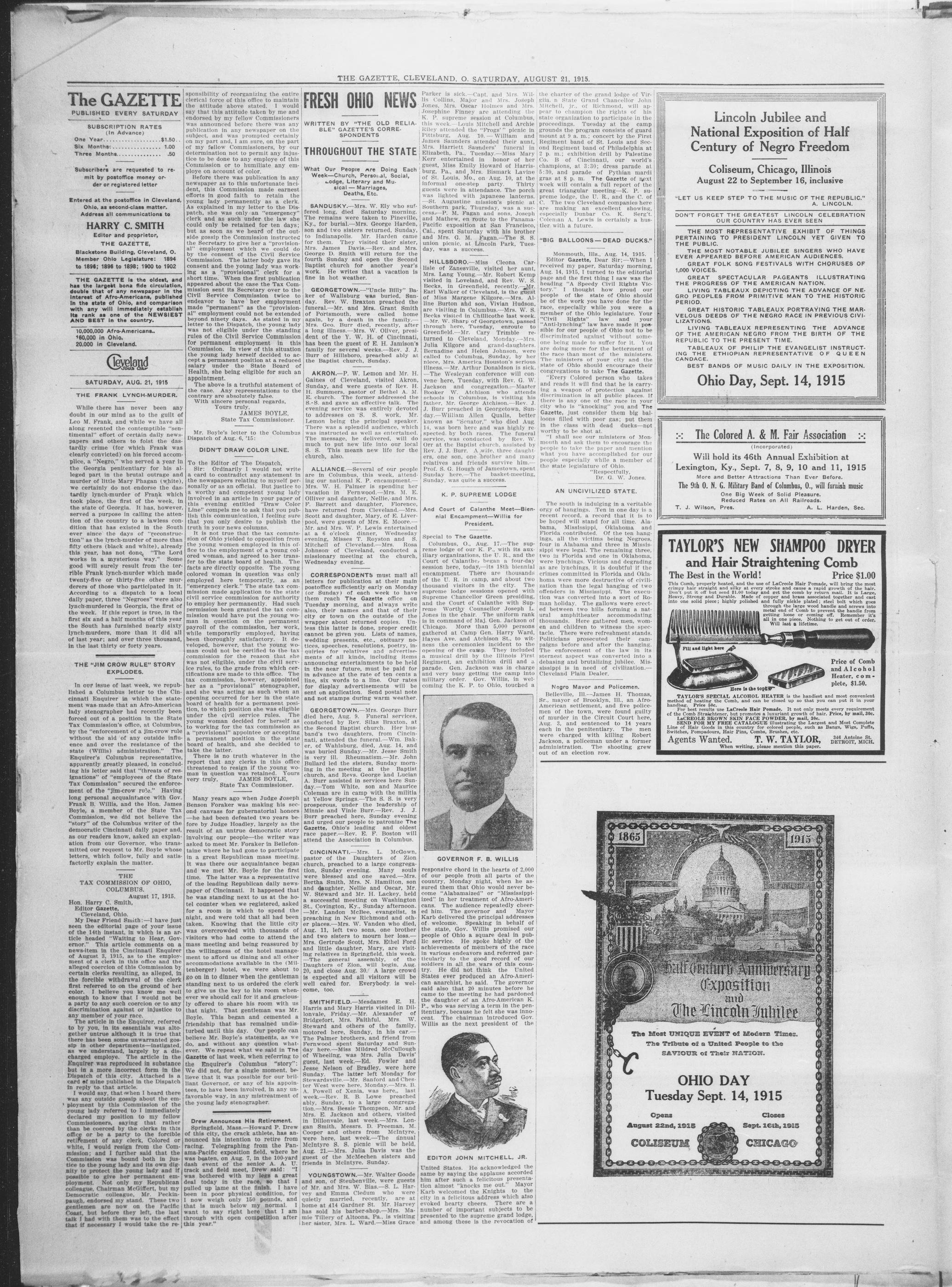
GOVERNOR F. B. WILLIS
responsive chord in the hearts of 2,000 of our people from all parts of the country. Monday night, when he assured them that Ohio would never become "Alabamaized" or "Mississippified" in her treatment of Afro-Americanans. The audience repeatedly cheered him. The governor and Mayor Karb delivered the principal addresses of welcome. Speaking in behalf of the state, Gov. Willis promised our people of Ohio a square deal in public service. He spoke highly of the achievements of members of the race in various endeavors and referred particularly to the good record of our community in this country. He did not think the United States ever produced an Afro-American anarchist, he said. The governor said also that 20 minutes before he came to the meeting he had pardoned the daughter of an Afro-American K. P., who was serving a term in the penitentiary, because he felt she was innocent. The chairman introduced Gov. Willis as the next president of the
EDITOR JOHN MITCHELL, JR.
United States. He acknowledged the same by saying the applause accorded him after such a felicitous presentation almost "knocks me out." Mayor Karb welcomed the Knights to the city in a felicitous address which also evoked hearty cheers. There are a number of important subjects to be presented to the supreme grand lodge, and among these is the revocation of
1865 1915
Half Century Anniversary
Exposition
and
The Lincoln Jubilee
The Most UNIQUE EVENT of Modern Times.
The Tribute of a United People to the
SAVIOUR of Their NATION.
OHIO DAY
Tuesday Sept. 14, 1915
Opens
August 22nd, 1915
Closes
Sept. 16th, 1915
COLISEUM CHICAGO
the charter of the grand lodge of Virginia, n State Grand Chancellor John Mitchell, jr. of Richmond, will appear to champion the rights of his state organization to participate in the proceedings. Tuesday at the camp grounds the program consists of guard mount at 9 a. m.; concert by the First Regiment band of St. Louis and Second Regiment band of Philadelphia at 2 p. m.; exhibition drill by Palestine Co. B of Cincinnati, our world's champions, at 3:30; dress parade at 5:30, and parade of Pythian mardi gras at 8 p. m. The Gazette of next week will contain a full report of the championship, and K - P, supreme lodge, the U. R. K, and C. C. The two Cleveland companies here are making an excellent showing, especially Dunbar Co. K. Sergt's Coleman A. Lewis is certainly a hustler with a future.
"BIG BALLOONS—DEAD DUCKS."
Mommouth, Ills., Aug. 14, 1915.
Editor Gazette, Dear Sir;—When I received my paper, Saturday morning, Aug. 14, 1915, I turned to the editorial page and the first thing I saw was the heading "A Speedy Civil Rights Victory," thought how proud our people of Ohio should be of the work you have done for the race, especially while you were a member of the Ohio legislature. Your "Civil Rights" law and your "Anti-lynchery" law have made it possible for our people of Ohio not to be discriminated against without one being made to suffer for it. You are doing more for the betterment of our people of Ohio than the ministers of your city and the state of Ohio should encourage their congregations to take The Gazette.
"Every Colored person who takes and reads it will find that he is carrying a weapon of protection against discrimination in all public places. If there is any race in the race of your people of Ohio, the Gazette, just consider them big hoops filled with poor gas; but them in the class with dead ducks—not worthy to be shot at.
"I shall see our ministers of Monmouth and ask them to encourage the people to take the paper and mention what you have accomplished for our people especially while a member of the state legislature of Ohio.
AN UNCIVILIZED STATE.
The south is indulging in a veritable orgy of hangings. Ten in one day is a recent record, a record that it is to be hoped will stand for all time. Alabama, Mississippi, Oklahoma and Florida contributed. Of the ten hangings, all the victims being Negroes, four in Alabama and three in Mississippi were legal. The remaining three were not. Oklahoma and Florida were lynchings, Vicious and degrading as are lynchings, it is doubtful if the crimes committed in Florida and Oklahoma were more destructive of civilization than the legal hanging of two offenders in Mississippi. The execution was converted into a sort of Roman holiday. The gallows were erected between two hills forming a natural amphitheater accommodating thousands. Here gathered men, women and children to witness the spectacle. There were refreshment stands, Politicians prosecuted their own camp, and the enforcement of the law in its sternest aspect was converted into a debasing and brutalizing jubilee. Mississippi is in need of civilization—Cleveland Plain Dealer.
Negro Mayor and Policemen.
Belleville, Ill.—James H. Thomas, Sr., mayor of Brooklyn, Ill., an Afro-American settlement, and five policemen of the town, were found guilty of murder in the Circuit Court here, Aug. 3, and sentenced to 14 years each in the penitentiary. The men were convicted with him in Robert Jackson, a police officer under a former administration. The shooting out of an election row.
Lincoln Jubilee and National Exposition of Half Century of Negro Freedom
Coliseum, Chicago, Illinois
August 22 to September 16, inclusive
"LET US KEEP STEP TO THE MUSIC OF THE REPUBLIC."
A. LINCOLN.
DON'T FORGET THE GREATEST LINCOLN CELEBRATION
OUR COUNTRY HAS EVER SEEN
THE MOST REPRESENTATIVE EXHIBIT OF THINGS
PERTAINING TO PRESIDENT LINCOLN YET GIVEN TO
THE PUBLIC.
THE MOST NOTABLE JUBILEE SINGERS WHO HAVE
EVER APPEARED BEFORE AMERICAN AUDIENCES.
GREAT FOLK SONG FESTIVALS WITH CHORUSES OF 1,000 VOICES.
GREAT SPECTACULAR PAGEANTS ILLUSTRATING THE PROGRESS OF THE AMERICAN NATION.
LIVING TABLEAUX DEPICTING THE ADVANCE OF NEGRO PEOPLES FROM PRIMITIVE MAN TO THE HISTORIC PERIOD.
GREAT HISTORIC TABLEAUX PORTRAYING THE MARVELOUS DEEDS OF THE NEGRO RACE IN PREVIOUS CIVILIZATIONS.
LIVING TABLEAUX REPRESENTING THE ADVANCE OF THE AMERICAN NEGRO FROM THE BIRTH OF THE REPUBLIC TO THE PRESENT TIME.
TABLEAUX OF PHILIP THE EVANGELIST INSTRUCTING THE ETHIOPIAN REPRESENTATIVE OF QUEEN CANDACE.
BEST BANDS OF MUSIC DAILY IN THE EXPOSITION Ohio Day, Sept. 14, 1915
Will hold its 46th Annual Exhibition at Lexington, Ky., Sept. 7, 8, 9, 10 and 11, 1915 More and Better Attractions Than Ever Before. The 9th O. N. G. Military Band of Columbus, O., will furnish music One Big Week of Solid Pleasure. Reduced Rates on All Railroads. T. L. Wilson Press. Harden, Seo
TAYLOR'S NEW SHAMPOO DRYER and Hair Straightening Comb
The Best in the World!
Price $1.00
This Comb, properly heated, and the use of LaCreole Hair Pomade, will bring the most crimpy hair straight and silky at every stroke and cause a rapid growth of the hair. Don't put it off but seed $1.00 today and get the comb by return mail. It is Large, Heavy, Strong and Durable. Made of copper and brass associated together and cast into one solid piece; highly polished and fully nickle plated; steel bolt which goes through the large wood handle and screws into metal end of Comb to prevent the handle from getting loose or coming off. Remember it's all in one piece. Nothing to get out of order.
Will last a lifetime.
Fill and light here
Price of Comb and Alcohol Heater, complete, $1.50.
Here is the topic
TAYLOR'S SPECIAL ALCOHOL HEATER is the handiest and most convenient method of heating the Comb, and can be closed up so that you can put it in your handbag. Price $50c.
For best results use LaCreole Hair Pomade. It not only meets every requirement of the manufacturer, but also provides a long-lasting finish.
LACRELOE BROWN SKIN FACE POWDER, by mail, 39c.
SEND FOR MY FREE CATALOGUE illustrating the Largest and Most Complete Line of Hair Goods in this country for colored people, such as Bangs, Wigs, Puffs, Switches, Pompades, Hair Pins, Combs, Brushes, etc.
Agents Wanted. T. W. TAYLOR, 346 Antoine St. MICHIGAN. Write writing about a writer, area.
MME.C.H.JONES' Hair Tonic and Invigorator
HER TONIC is the result of scientific study of the causes of diseases of the scalp.
Instead of treating effects of the diseases she treats the causes, eliminating the same and leaving the scalp in a healthy condition that can be maintained by using her Hair Tonic and Invigorator, according to her directions.
Madame C. H. Jones' Hair Tonic and Invigorator is guaranteed to stop the falling out of the hair and to make the hair
It has been successfully used by many
ever since 1900 and with perfect satisfac-
tion, many people have been used by
many Toledo people and elsewhere,
who will gladly furnish testimonials.
by using widely advertised scaled scopes by parsed by unscrupulous persons who have been accused of stealing.
On the other hand, MADAME JONES' HAT INVIGORATOR and INVIGORATOR is absolutely hard, and will do all that is claimed for it.
MADAME H. H. JONES' Hair Tonic and Invigorator promotes the growth of the hair, prevents and cures baldness, removes dandruff, cures scalp diseases, restores hair, and all healthy. It restores the color of the hair by supplying it with natural elements and necessary nourishment.
MADAME C. H. JONES
353 Woodland Ave.
Agents Wanted.
ATTENTION
Puro Herb
TIME IS HERE!
PURO HERBS consist of the best possible mixture of Natu-ness health giving Herbs, contains no potash or magnesium, does not cause breaking out—it not a secret compound, as it is composed of such well-known herbs as Burdock, Dandelion, Sarsaparilla, Red Clover, Mandrake, Stillingia, Prickly Ash and other herbs, very best approved blood purifiers.
PURO HERBS cleans the system of all impurities, restores health and vigor, and drives away that tired, rundown feeling, due to impurities collectively in the system during the winter months.
PURO HERBS cost but 35c a box, the contents of which, boiled with one quart of water, makes one quart of the best blood medicine, equal to three ordinary one dollar bottles in size and better than patent medicine, regardless of price.
PURO HERBS are also supplied in liquid form, for those who do not care to make it themselves, at 75c a quart. Sold only at
BROWN DRUG CO,
2742 CENTRAL AVE., cor. 28th Street
Leading Cut-Rate Drugs
STERLING
5 and 10 Cent Store
3003 Central Ave.
Watch Our Windows
For Bargains
Colored Salesladies
During July and August
we close at 6 P.M. every
evening except Saturday
Arlington Pharmacy
WE WILL ACCEPT THIS ADVERTISEMENT FOR FIVE CENTS IN TRADE, TO APPLY ON ANY PURCHASE OF TWENTY-FIVE CENTS OR MORE.
E. Rukenstein, Ph. C., Prop.
S. W. Cor. Central Ave. & E.
65th St.
Your Eyes are Your Breadwinners!
Why Not Protect Them?
In order to introduce our work, bring this advertisement with you and we will give you a regular $6.00 pair of eyeglasses and a leather case for $3.75. Thorough examination.
Louis B. Rappaport Eye Specialist
No. 7 Haltnorth Building, E.
55th St., near Woodland Av.
Central 3647 R.
DON'T THROW AWAY
Your copy of The Gazette after reading it, but give it to a friend or an acquaintance who might subscribe after reading a copy of the paper.
Editor
Where to Purchase The Gazette
J. S. HALL'S,
3121 Central Ave.
*O. C. SCHROEDER'S,
Cuyahoga Bldg.
F. VALENTINE'S
2130 Central Ave.
J. E. BRANHAM'S
4401 Central Ave.
PUSHAW
The Arcade.
Superior Entrance.
NOTICE TO SUBSCRIBERS
Subscribers not receiving The us at once. We desire every copy. We advise our patrons to care tisements before making purchase this paper should have the patro that they advertise is assurance the Local reading notices (adver words in a line).
Subscribers not receiving The Gazette regularly should notify us at once. We desire every copy delivered promptly.
We advise our patrons to carefully examine The Gazette's advertisements before making purchases. Business men who advertise in this paper should have the patronage of Afro-Americans. The fact that they advertise is assurance that they want it.
Local reading notices (advertisements) ten cents a line (six words in a line).
Social and Personal
Cleveland
Sixth City
Mrs. Wm. McIntire and grand-
niece, little Ruth McKinnie, E. 71st.
St. spent last week in Wooster. Ruth
left Saturday for Chicago to join her
mother, Mrs. Ivy McKinnie.
Mr. and Mrs. E. F. Boyd are visit-
ing relatives in Urbana, this week.
Mrs. Charles Cook, E. 29th St. re-
turned from Indianapolis, Saturday.
Her daughter, Miss Bessie, will re-
main away a week longer.
Mrs. Sadie Cisco Bolden returned
to Chicago, Saturday.
Mr. L. Robinson, Central Ave., is
visiting in Marieta and Delaware.
Mrs. Alma E. Johnson, one of the instructors at Talladega, Ala., College, was the guest of Mrs. Mary Washington, of E. 28th St., this week.
Mrs. S. A. Coleman, founder of the Coleman Industrial Home for our Boys, Pittsburgh, passed through the city, Saturday, having visited her sister, Mrs. J. W. Woods of Oberlin.
Mrs. W. T. Blue, sr., of Cedar Ave., left last week Wednesday, for short visits in Ridgway, W. Mansfield and Columbus. Miss Adeline and Master Clarence Blue have returned from Alliance.
Mrs. Robt. Hayes of E. 30th St., is visiting Mr. Hayes' relatives in W. Mansfield. Little Drexel Isom accompanied her.
Miss Sarah Bailey who has been the guest of Mrs. H. Willis of E. 40th St., three weeks, left Saturday for Chicago via Toledo and Detroit.
Miss Emma Williams of Central Av. entertained St. John's S. S. Rhoda class, Tuesday, and on Wednesday gave an enjoyable dinner party in honor of Mrs. Joseph Olivier's sister, Mrs. Tillie Johnson of Owen Sound, Can.
The editor of the *Gazette* acknowledges the receipt of an invitation to attend the wedding reception of Miss Mabelle C. Blue and Prof. Thos. H. Reynolds, Sept. 1, at the residence of the bride-elect's parents, Mr. and Mrs. Olivier, 5600 St. Mr. and Mrs. Reynolds will be "at home" after Sept. 15 at 835 Nebraska Ave., Kansas City, Kan.
The L'Allegro club held a very interesting meeting at its chairman, W. M. Wright's. In the speeches of the members of the executive board, the club's future policy was outlined. It proposes to assist in the improvement of local social conditions, and the formation of a progressive body of young men that will in time grow into a national organization. Columnist already has a chair in the club which Fester has with the younger chapter here. It will not be long until Erie and Cincinnati will also join. The club's next functions will be an outing and dance at Puritas Springs, Sept. 3, and an affair (for members only) on Labor day night.
One of the many very interesting events of the recent N. O. B. S. S. convention held at M. Zion Baptist church, which was a scientific tempe chart talk by Miss Iya Haines, a delegate from Akron, which showed the correct use of alcohol, which bad ef-
A. E. H.
MISS IVA HAINES
fects, the effects of tobacco on the lungs, heart, etc. Miss Haines maintains that temperance is moderation in healthful things and abstinence from dangerous things. She brought out many other good points, and a standing vote, of thanks, was given her by the convention. Rev. B. K. Smith's "convention sermon" was exceptional, and most favorably and generally commented upon.
* * *
* * *
The Gazette regularly should notify
delivered promptly.
fully examine The Gazette's adver-
s. Business men who advertise in
image of Afro-Americans. The fact
at they want it.
tirements) ten cents a line (six
Personal
Mr. Horace Ferguson, E. 43d St.
and Miss Stella Dickerson of E. 28th
St. were married, Wednesday.
Miss Ina Guy, of Zanesville, is the
guest of Mrs. James Allen, E. 43d St.
Mrs. John Smith, E. 36th St., has as her guests, Mrs. Jessie Ford and daughter of Salem.
Mr. Eugene Cheeks of Abingdon, Va., is visiting his brothers, Elmer and Roy.
Mrs. Phil S. Deunie, E. 90th St., is spending a few weeks in Geneva for her health.
Mr. and Mrs. Louia S. Jones of E. 30th St., have purchased for cash a beautiful home at 2256 E. 101st St. They will take possession as soon as electric lights and other improvements are made.
Mrs. Estelle Merritt of Broadway, is very ill at Lakeside hospital.
Mrs. Mabelle Biggs is temporarily filling the position as organist of St John's A. M. E. church most creditably.
Thos. H. Reynolds rendered a beautiful solo at Cory M. E. church Sunday morning.
The Bailey Co., has demoted its two Afro-American elevator starters and put "whites" in their places. In the last month or six weeks two Afro-American employees have been "fired" and two have quit. Our people spend thousands of dollars in this store every month.
Geo. J. Tate has moved his haberdashery a few doors east on Central Ave. in a store that has been fitted up especially for him, and has as neat and fine a place of business as anyone on the avenue. The Gazette wishes him increased business, and our people ought to see to it that he gets it.
Robert A. Pelham, a clerk in the government departments at Washington, D. C., was in the city last week Wednesday, enroute home to Detroit on his vacation, and called on The Gazette.
Wm. A. Webster of this city, went from Washington, D. C., to Greenville, S. C. He is having a fine visit in the southland, he writes The Gazette.
M. Seth Nickens returned from Yellow Springs, the first of the week.
B. C. Johnson of South Carolina, is visiting his brother, Thos. H. Johnson of E. 108th St.
Rev, and Mrs. Thomas and his sister-in-law, Mrs. Geo. Thomas, of youngstown, visited their aunt and uncle, Mr. and Mrs. Henry Phillips, and cousins, Mr. and Mrs. Herbert L. Taylor of E. 43d St., while in the city recently attending the Baptist convention.
Geo. W. Sampson, Jr., and family, of Xenia, are in the city visiting relatives.
Mrs. L. J. Price of Cedar Av., returned recently from an extended western trip which included Lincoln, Neb.
Mr. and Mrs. Baldwin, Allen of Xenia, were guests of Mr. and Mrs. A. T. Abbott of E. 90th St. The ladies are sisters.
Mr. and Mrs. Dublin Johnson have the sympathy of their friends in the loss of their baby.
Mr. Earl Walker visited in Hillsboro, this week, and Mr. Carey Trimble returned from there, Monday.
Among those who entertained in honor of Mrs. Blanche T. Richardson of Cincinnati, when she was in the city recently, were Mrs. W. Goode of E. 85th St., and Mrs. Hattie Richardson of E. 39th St.
Mme. C. H. Jones, whose advertisement will be found elsewhere in this paper, will spend the remainder of her time in the city, at Mrs. C. H. Blake's, 2298 E. 90th St. Anyone wishing to consult Mme. Jones, can do so, free of charge.—Adv.
Mrs. J. W. Byrd and son, of Kennedy Ave, are enjoying the delightful breezes of Atlantic City, N. J., and the daily baths at Wahl's bath house in that city.
Mrs. Irene Sharber and Miss Rena Lewis are among the many Clevelanders in Columbus, this week. The two local companies, U. R. K. of P. left, the first of the week, for the national encampment there.
Send or bring locals and all business matters to The Gazette's offices, suite 2, Blackstone Bldg. If you wish to see the editor call there, please. All matters for publication in current issues of The Gazette, must be in the office by 4 p. m., WEDNESDAY at the latest.
THE GAZETTE, CLEVELAND, O. SATURDAY, AUGUST 21, 1915
---
```markdown
```
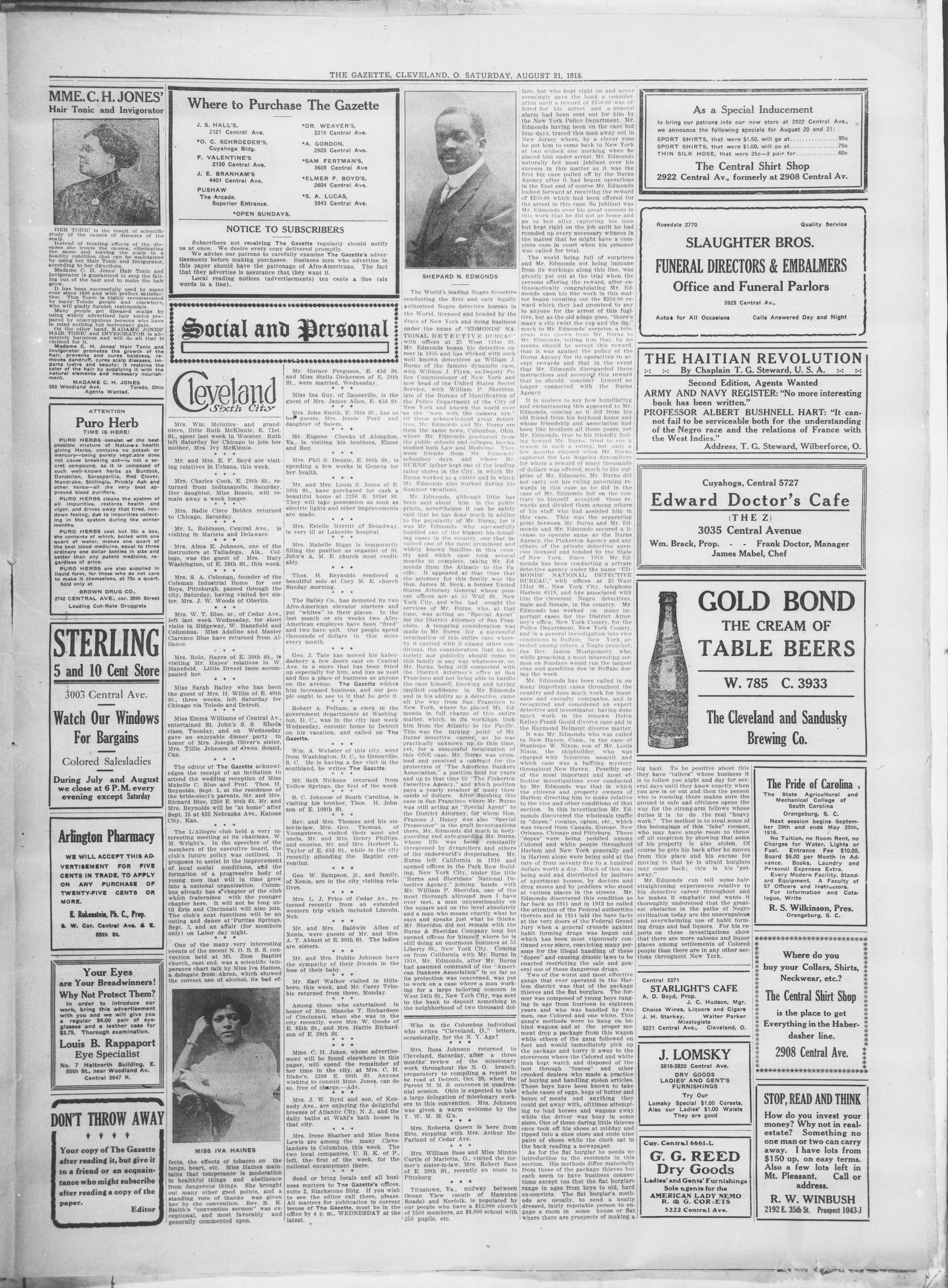
SHEPARD N. EDMONDS
The World's leading Negro detective conducting the first and only legally authorized Negro detective bureau in the World, licensed and bonded by the State of New York and doing business under the name of "EDMONDS" NATIONAL DETECTIVE BUREAU with offices at 25 West 131st St. Mr. Edmonds began his detective career in 1905 and has worked with such well known detectives as William J. Burns of the famous dynamite case with William J. Flynn, ex-Deputy Police Commissioner of New York and head of the fifth United States Secret Service in the United States, William P. Sheridan, late of the Bureau of Identification of the Police Department of the City of New York and known the world over as the "man with the camera eye." Of these acknowledged great detectives, Mr. Edmonds and Mr. Burns are from the same town, Columbus, Ohio, where Mr. Edmonds graduated from the public schools and colleges, having studied both Law and Medicine. They were friends from Mr. Edmonds' school, and where Mr. Burns' father kept one of the leading tailor stores in the City, in which Mr. Burns worked as a cutter and in which Mr. Edmonds also worked during his Summer vacations.
Who is the Columbus individual who writes "Cleveland, O.," letters, occasionally, for the N. Y. Age?
Mrs. Rosa Johnson returned to Cleveland, Saturday, after a three months' review of the missionary work throughout the N. O. branch, preparing to compiling a report to be sent to Detroit, Oct. 20, when the Parent M. M. S. convenes in quadrennial session. Ohio is expected to take a large delegation of missionary workers to this convention. Mrs. Johnson was given a warm welcome by the Y. W. M. M. G's.
Mrs. Roberta Quesen is here from Erle, stopping with Mrs. Arthur McFarland of Cedar Ave.
Mrs. William Bass and Miss Minnie Curtis of Marietta, O., visited the former's sister-in-law, Mrs. Robert Bass of E. 30th St., recently en route to Pittsburg.
Tituwan, Va., midway between Ocean View (south of Hampton Roads) and Norfolk, is populated by our people who have a $12,000 church of 1500 members, an $8,000 school with 250 punts, etc.
lars, but who kept right on and never seemingly gave the bank a consideration until a reward of $250.00 was offered for his arrest and a general alarm had been sent out for him by the New York Police Department. Mr. Edmonds having been on the case but four days, traced this man away out in New Jersey where, by a clever ruse he got him to come back to New York at two o'clock one morning. Mr. Edmonds naturally felt most bilious over his success in this matter as it was the first big case pulled off by the Burns Agency after it had begun operations in the East and of course Mr. Edmonds looked forward at receiving the reward of $250.00 which had been offered for the arrest in this case. So jubilant was Mr. Edmonds over his great success in this work that he did not go home and go to bed after capturing his man. He rounded up every person rounded up every necessary witness in the matter that he might have a complete case in court when his prisoner was called for trial.
The world being full of surprises and Mr. Edmonds not being immune from its workings along this line, was greatly put out at the trial when the persons offering the reward, after enthusiastically congratulating Mr. Edmonds upon his fine work in this matter began counting out the $250.00 reward which they had promised to pay for the reward for the fund of the invention, but as the old adage goes, "there's many a slip twixt the cup and the lip," much to Mr. Edmonds's surprise, a telegram was shown from Mr. Burns to Mr. Edmonds, telling him that, by no means should he accept this reward, that it was against the policy of the Burns Agency for its operatives to accept rewards and that in the event of a wrongful instruction and accepted this reward that he should consider himself no longer connected with the Burns Agency.
It is useless to say how humiliating and embarrassing this appeared to Mr. Edmonds, coming as it did from his old friend from his boyhood home and whose friendship and association had been like brothers all these years, yet Mr. Edmonds, true to his friendly feeling toward Mr. Burns, tried to see a reason in his absence when Mr. Burns captured the Los Angeles dynamiters for whom a reward of many thousands of dollars was offered, much to the surprise of Mr. Edmonds, Mr. Burns did not carry out his ruling governing rewards in this case as he did in the case of Mr. Edmonds but on the contrary he himself accepted these rewards and divided them among others of his staff who had assisted him in this case. This was the separating effect of the private detectives and Mr. Edmonds secured a license to operate same as the Burns Agency, the Pinkerton Agency and any others of the private detective agencies licensed and bonded by the State of New York. Since 1910 Mr. Edmonds has been conducting a private detective agency under the name "ED MOSS NATIONAL DETECTIVE BURNSUIT," Mr. Burns 131st St, New York City, telephone Harlem 6119, and has associated with him the cleverest Negro detectives, male and female, in the country. Mr. Edmonds has worked on many important cases for the District Attorney's office, New York County, for the Police Department, New York County, and in a general investigation into vice conditions in Buffalo, New York, arrested among others, a Negro探侦, while preaching a most interesting sermon on Sundays would run the largest crap and gambling den in Buffalo during the week.
Mr. Edmonds has been called in on many important cases throughout the country and does much work for insurance and casualty companies, and is recognized and considered an expert detective and investigator, having done much work in the renown Helen Kelley-Frank Gould divorce case and in the Raymond Belmont divorce matter. It was Mr. Edmonds who was called to the New York Comptroller's Stanhope Nixon son of Mr. Louis Nixon, the shipbuilder, who was charged with felonious assault and which case was a baffling mystery throughout New Haven. Possibly one of the most important and most effective investigations ever conducted by Mr. Edmonds was that in which the citizens and property owners of New York were traced to the vice and other conditions of that section. In this investigation Mr. Edmonds discovered the wholesale traffin in "dopes," cocaine, opium, etc., which was traced from Canada, Europe, New Orleans, Chicago and Pittsburg. These "dopes" were being peddled among Colored and white people throughout Harlem and New York generally and in Harlem alone were being sold at the rate of seventy-five to a hundred dollars worth a day. Much of this was being sold and distributed by janitors and drug stores and drug stores and by peddlers who stood at various places in the streets. Mr. Edmonds discovered this condition as far back as 1911 and in 1912 he called the attention of the Federal authorities thereto and in 1914 laid the bare facts at the very doors of the Federal Grand Jury when a general crusade against habit forming drugs was begun and which has been most vigorously conducted in the illegal handling of these "dopes" and causing drastic laws to be enacted restricting the sale and general use of these dangerous drugs.
Two of the worst and most effective gangs that ever operated in the Harlem district was that of the package thieves and the flat burglaries. The former was composed of young boys ranging in age from fourteen to eighteen years and who was handled by two men, one Colored and one white. This gang's methods are to hang the packages and at the moment drop a package from this wagon while others of the gang followed on foot and would immediately pick up the package and hurry it away to the storeroom where the Colored and white man kept watch and disposed of the loot through "fences" and other crooked dealers who made a practice of buying and handling stolen articles. These boys have been known to take whole cases of eggs, kegs of butter and boxes of meats and anything they could get away with, oftimes attempting to lead horses and wagons away while the driver was busy in some part of the city, once took off his shoes at midday and tipped into a shoe store and stole nine pairs of shoes while the clerk sat in the back reading a newspaper.
As for the flat burglar he needs no introduction to the residents in this section. His methods differ materially from those of the package thieves but each seem to have business connections except too that the flat burglarals range in ages from boys to old, hard ex-convicts. The flat burglar's methods are usually, to send a neatly dressed, fairly reputable person to engage a room in some house or flat where there are prospects of making a
As a Special Inducement
to bring our patrons into our
we announce the following spec
SPORT SHIRTS, that were $10
SPORT SHIRTS, that were $10
THIN SILK HOSE, that were
The Centra
2922 Central Av., form
Rosedale 2770
SLAUGHT
FUNERAL DIRECTO
Office and Fu
3923 Cent
Autos for All Occasions
THE HAITIAN
By Chaplain T. G.
our patrons into our new store at 2922 Central Ave., since the following specials for August 20 and 21:
SHIRTS, that were $1.50, will go at.....95c
SHIRTS, that were $1.00, will go at.....75c
K HOSE, that were 25c—3 pair for.....60c
The Central Shirt Shop
Central Av., formerly at 2908 Central Av.
2770 Quality Service
SLAUGHTER BROS.
RAL DIRECTORS & EMBALMERS
Office and Funeral Parlors
to bring our patrons into our new store at 2922 Central Ave.,
we announce the following specials for August 20 and 21:
SPORT SHIRTS, that were $1.50, will go at.....95c
SPORT SHIRTS, that were $1.00, will go at.....75c
THIN SILK HOSE, that were 25c—3 pair for.....60c
The Central Shirt Shop
2922 Central Av., formerly at 2908 Central Av.
3923 Central Av.,
All Occasions Calls Answered Day and Night
HAITIAN REVOLUTION
by Chaplain T. G. Steward, U. S. A.
Autos for All Occasions Calls Answered Day and Night
Second Edition. Agents Wanted
ARMY AND NAVY REG
book has been written."
PROFESSOR ALBERT B
not fail to be serviceable
of the Negro race and th
the West Indies."
Address, T.
Cuyahoga, C
Edward Do
(T H
3035 Centr
Wm. Brack, Prop. -
James Ma
BUND NAVY REGISTER: "No more interesting
has been written."
DR ALBERT BUSHNELL HART: "It can-
no be serviceable both for the understanding
negro race and the relations of France with
it Indies."
Address, T. G. Steward, Wilberforce, O.
Cuyahoga, Central 5727
Ward Doctor's Cafe
(THE Z)
3035 Central Avenue
ck, Prop. - - Frank Doctor, Manager
James Mabel, Chef
GOLD BOND
THE CREAM OF
TABLE BEERS
ARMY AND NAVY REGISTER: "No more interesting book has been written." PROFESSOR ALBERT BUSHNELL HART: "It cannot fail to be serviceable both for the understanding of the Negro race and the relations of France with the West Indies." Address, T. G. Steward, Wilberforce, O.
(THE Z)
3035 Central Avenue
Wm. Brack, Prop. - - Frank Doctor, Manager
James Mabel, Chef
GOLD BOND THE CREAM OF TABLE BEERS
W.785 C.3933
The Cleveland and Sandusky Brewing Co.
big haul. To be positive about this they have "tailers" whose business it is to follow you night and day for several days until they know exactly when you are in or out and then the person who is rooming there makes sure the ground is safe and oftimes opens the way for the strong-arm fellows whose duties it is to do the real "heavy work." The method is to steal some of the belongings of the "fake" roomer, who has a simple arm to throw off all suspicion by showing that some of his property is also stolen. Of course he gets his back after he moves from this place and his excuse for moving is that he is afraid burglaries may come back; this is his "get-away."
Mr. Edmonds can tell some hair straightening experiences relative to his detective career throughout and he makes it emphatic and wants it to be as clear as possible. He rest obstacles in the paths of Negro civilization today are the unscrupulous and overwhelming use of habit forming drugs and bad liquors. For his reports on these investigations show that Negro people live in places among settlements of Colored people than there are in any other sections throughout New York.
Central 3371
STARLIGHT'S CAFE
A. D. Boyd, Prop.
J. C. Hudson, Mgr.
Choice Wines, Liquors and Cigars
J. H. Starkey, Walter Parker
Mixologists
3221 Central Ave., Cleveland, O.
J. LOMSKY
3816-3820 Central Ave.
DRY GOODS
LADIES' AND GENT'S
FURNISHINGS
The Central Shirt Shop
is the place to get
Everything in the Haberdasher line.
2908 Central Ave.
3816-3820 Central Ave.
DRY GOODS
LADIES' AND GENT'S
FURNISHINGS
Try Our
Lomsky Special $1.00 Corsets,
Also our Ladies' $1.00 Waists
They are good
Cuy. Central 6661-L
G. G. REED
Dry Goods
Ladies' and Gents' Furnishings
Sole agents for the
AMERICAN LADY NEMO
R. @ G. CORSETS
3222 Central Ave.
---
---
COLOURS
R. S. Wilkinson, Pres.
Orangeburg, S. C.
Where do you buy your Collars, Shirts, Neckwear, etc.?
STOP, READ AND THINK
How do you invest your money? Why not in real estate? Something no one man or two can carry away. I have lots from $150 up, on easy terms. Also a few lots left in Mt. Pleasant. Call or address.
R. W. WINBUSH
2192 E. 35th St. Prospect 1043-J
AFRO-AMERICAN CULLINGS
In his "The Education of the Negro Prior to 1861" (Putnam's), C. G. Woodson says of the abolitionist agitation that it excited the more active minded of the Negroes. The story of Toussaint P'ouverture and the talk of the rights of man that followed after the French revolution were disturbing influences. About Baltimore, Norfolk, Charleston and New Orleans insurrectionary ideas were spread by Negroes coming from unhappy Santo Domingo in 1793. In 1800 "General" Gabriel, a slave, led an uprising in Virginia, and there was one in South Carolina. In 1816 Camden and in 1822 Charleston were threaten by Negro plots. Denmark Vesey, a slave who had bought his freedom, was an arch-conspirator. There were uprisings, more or less extensive, in North Carolina, and in 1831 Nat Turner's mad raid spread terror among the white folks of South ampton county, Virginia.
While these disorders were going on, however, the elementary education of the mass of the colored population was proceeding quietly. That it should do so was simply inevitable. In innumerable cases are cited of slaves, intelligent and ambitious and not at all inclined to political rebellion or anarchy, who learned to read and write and make good use of those fundamental acquisitions in advancing themselves along the road to "higher" learning. In their own upward progression they lifted others, the natural and efficient form of "uplift."
When in its later phases the colonization movement centered upon Liberia its more liberal advocates favored higher education for Negroes in the hope that enlightenment would make them so discontented with the lot of their race in this land that they would voluntarily emigrate. In the South the general feeling among colonizationists was that the education should be conditional on expression of intention to carry it away from the American Negro. The promoters of the scheme planned to educate young Negroes in "mechanic arts, agriculture, science and Biblical literature," while the exceptionally bright ones were to be fitted for professional life and for public office. A curious museum of antiquities is the result of this investigation; from a school opened at Parsippany, N. J., in 1817 to give a four-year course to "African youth" of "talent, discretion and piety" and similar efforts at Newark, N. J., and Hartford, Conn., to the African Education society and the scramble for the "Kosciuszko fund" that seems never to have existed but in the imagination of the colonizationists.
Unyielding opposition of free Negroes and abolitionists, who "could see no philanthropy in educating persons to prepare for doom in a deadly climate," kept the institutions planned by the colonizationists from materializing. At Philadelphia in 1830 a "convention of the free people of color" centralized the opposition. Thereafter the colonizing propaganda in this country was concentrated upon individual cases, and the policy of push was changed to one of pull; that is to say, the plan was to make Liberia atractive instead of making the United States repulsive.
It was in 1816 that the National Colonization society of America was organized, that strange compound of sentiment and business. Lieutenant Stockton made a treaty with native princes in 1821. The native headmen themselves were slow to give up their
When it is realized how far the Negro has come in the last fifty years it is not hard to account for the extent and degree of confidence in his future. The census of 1910 shows that two out of every five persons engaged in gainful occupations in the 16 southern states are Negroes. Of the entire Negro population in these states 63 per cent are in some form of industrial occupation. Of all the Negroes engaged in industrial activities 60 per cent are agricultural workers. Something like a million Negroes have developed from agricultural laborers to farmers in 50 years. The efforts of the colored man to help himself have been strongly in his favor, for they have inspired the confidence of the white people and made a plan of co-operation between the two much easier than it would otherwise have been. Because of this new valuation of the agricultural or industrial Negro there has come a truer appreciation of the human qualities involved
There has been the feeling that the fine qualities in the character of the faithful slave were the fruitage of
Signor Marconi has been inspecting the wireless stations of Italy, and has found them ready for any war emergency.
The erection of two universities, one at Cape Town and the other at Pretoria, is being urged by a government commission.
It is all right for a woman to pretend her dinner was a failure, but it is a wise husband who disagrees with her.
The fact that a woman accused him is considered prima facie evidence of a man's guilt.
It takes much more wit not to say some witty things than to blurt them out.
An argument consists in a series of misstatements made in turn by the parties to it.
A man may like it pretty well himself, but his wife usually is displeased with his job.
end of the slave trade, but by 1822 their objections were overcome and settlement was begun. It was in 1847 that the colony was made independent. marking the end of an extraordinary episode of mixed philanthropy and politics.
A suit was filed in the Supreme court to gain compensation for work performed by slaves during the years from 1859 to 1868, in the production of cotton in the southern states and preparation of this cotton for the market. William G. McAdoo is made the defendant in his official capacity as secretary of the treasury. The plaintiffs are H. N. Johnson of Louisiana; R. Bowers of Texas; C. B. Williams of Mississippi; and Mamie Thompson of Tennessee, who say in the bill of complaint that they sue for themselves and others similarly interested.
The bill sets forth that the secretary of the treasury of the United States obtained possession, and the defendant herein now holds the custody, of certain money which was a part of the fruit of the labor of the plaintiffs amounting to $68,072,388 under "internal revenue tax on raw cotton," and that this sum is not the legitimate property of the United States, and should be paid to those by whose labor the cotton yielding this revenue was produced.
Another paragraph of the bill reads: "Plaintiffs and such of them as claim here as heirs were subject to a system of involuntary servitude in the above named states, and other states commonly known as the Southern States."
Referring further to the conditions under which the services were rendered, the petition says:
"That the system of involuntary servitude by which plaintiffs were dominated, to wit: under and by force plaintiffs and their ancestors, against their free will of action and by coercion and justifiable fear of bodily injury or destruction, to render said labor."
The petition was filed by Attorney E. M. Hewlett, as the local attorney representing Attorneys Cornellus J. Jones of Muskogee, Oklahoma, and H. A. Guess. Jones, who is said to have prepared the bill of complaint, is a colored lawyer. The petition asks that the case be referred to a master in chancery, to take proof of the claims of the parties interested, and that a bill of discovery be issued to ascertain among whom the money shall be distributed and the amounts that each shall receive, and to have the secretary of the treasury disclose the source from which the sum held by him was derived.
When a man gets married the other fellows tell him he's a lucky dog. But there is no certainty about it either way until he has been married four or five years.
A "live wire" who visited our town last week moved on as soon as he learned that the custom here is to exact cash in advance from those who follow his profession.
If an attempt were made to pick out the meanest man in town you would get some votes and so should we.
Most of the values are fixed by fools in the possession of money.
hardships and careful training, and there was a doubt about these qualities springing from a different, freer soil. But southern whites are now coming to believe that these qualities depended not upon accidental conditions of slavery, but resided in the possibility of their human nature. The basis of this conviction is distinctly religious. White people have greater confidence in the Negro because they have greater confidence in all humanity.—Marc N. Goodnow, in the Chicago Daily News.
The North sea is the greatest fishing ground in the world, and, despite the great activity of the fishermen, there seems to be no diminution of the catch.
There is no fixed standard. Many regard the bestowal upon a candidate for initiation of the side degrees of a lodge as a highly humorous proceeding.
An extensive deposit of asphalt of high quality has been discovered in the Philippines.
If you have children of your own you will be worried by them. If you have no children you will be worried by well-meaning persons who want you to adopt children.
It is hard to improve on Eph Wiley's system. Eph gets everything he wants at home and is permitted to do as he pleases by telling his wife he loves her.
A dollar in a man's pocket is worth two that he owes.
Whale fishing is still carried on in Arctic waters.
One little handbill may promise more than the whole circus can perform.
Motion pictures are being used to teach hygiene to the less civilized Fillipinos.
A man waits until the customer just behind him is in a tremendous hurry and then discovers that he needs a hair cut.
THE GAZETTE. CLEVELAND, O., SATURDAY, AUGUST 21, 1915.
TONE IS MORE QUIET
RAIMENT LACKS BRIGHTNESS OR OTHER YEARS.
Parisian Milliners, as Well as Those in America, Are Agreed on That Point—High Turban Is Feature of the Fashions.
The milliners in Paris, and consequently here, are feeling the scarcity of plumage as their sisters, the dressmakers, are feeling the famine in new cloths. No European woman would wear aigrettes today, not from a sense of belated tenderness toward the birds whose torture they countenanced as did the Americans by making the aigrette fashionable and high-priced, but from a sense of sadness that expresses itself in sober dressing To wear jewels, gaily colored clothes, aigrettes flashing and conspicuous novelties, would be in the worst of taste. Even the gayest and most irresponsible set of women in Paris and Vienna would not so offend public opinion; it is certain that such influence must have its weight on the feminine aigrette in the world.
Thereore aligrettes are barred in Europe, also other high-priced plumage. The milliners have turned to simple effects, as they have been doing off and on for several years, but this season the simplicity is not an accompanied by soaring prices. There is moderation. Whether or not America will follow their example no one can tell but the milliners. It is probable that the same truly terrible valuation will be put on French hats or their copies with the explanation that the war risk of getting them adds to their monetary value. If the expensive plumage is lacking and only ribbons or bows of satin prevail, such as the French are wearing now, then it will be difficult to demand a hundred dollars for one hat, as has been done so often that the wealthy pay the price without cavil.
The very high turban, by the way, appears in the new Paris millinery. It is the kind that was exploited two years ago and looks remarkably strange in contrast with the flat shapes we have accepted.
The shapes are not exaggerated in any of the fashionable hats. They are not even first cousins to those curious things that were adopted by the smartly dressed to their satisfaction and by the badly dressed to their undoing. You remember the hats of yesterday that needed the most skillful posing and perfect coiffing for their success? How many unfortunates went down to their sartorial deaths wearing those shapes!
GOOD DESIGN FOR PIN TRAY
Will Keep the Small but Indispensable Articles in Their Separate Compartments.
Here is a pretty little pin tray for keeping pins of various kinds separate from each other. It is made from portions of three large-size match boxes, arranged in the diagram on the left of the illustration, and fastened together with patent fasteners run through the sides of the boxes where they touch each other. The different compartments are loosely lined with soft silk and the sides of the boxes are covered with a frill of the same, finished on at the edge with a single row of feather-stitching worked with pale blue silk.
The handle of the tray is made with two strands of wire twisted together and fastened in position by means of running the four ends of the wire in and out the sides of the boxes. This handle should, of course, be secured
In prior to covering the boxes with the silk. The wire is covered with narrow ribbon twisting around and around it until it is entirely hidden
EASILY MADE DRESSING CAPE
Most Useful Article May Be Constructed Quickly and Will Be Found of Value.
A dressing cape is a most useful article to have when tidying one's hair or shampooing; it saves a dressing-jacket and can be simply put on when there would not be time to don a more elaborate affair. This cape is simply made out of a small fine linen towel; fold the towel across in half, find the center and there cut out a circle large enough to go round the neck. The cir-
TO TELL LINEN FROM COTTON
Not Always an Easy Matter, Yet There
Are Definite Rules to Be
Observed
Linen is hard to distinguish from cotton especially when the cotton is mercerized or the material heavily starched and well finished.
If the threads are carefully examined it will be found that the cotton thread is the more exact in twist, becomes fuzzy when rubbed between the fingers and when quickly broken the tufted ends usually curl up.
The linen fibers are long and when spun into thread are strong, smooth, and lustrous. These threads are rather irregular in appearance and break with the straight uneven ends.
When burned, the ends of cotton thread spread out like a paint brush, while linen threads are even and compact.
A drop of glycerin on linen causes it to become more transparent but does not affect cotton in the same way.
There are several chemical tests for
```markdown
```
The Dress is of the Princess Style, the Waist and Skirt Being Cut in One. It is Shirred at the Waist and Hips. The Front Panel of the Dress is Plain With a Vest of Light Blue Satin Which is Embroidered With Gold Thread. The Skirt Has a Cuff Hem. The Sleeves Are of Georgette Crepe and Very Full. A Little Above the Elbow It Is Shirred and Below the Elbow at the Wrist It is Also Shirred. A Deep Plaited Ruffle Finishes the Sleeve.
icle should be cut a little lower in front than back.
Fold the towel in two again, lengthwise, and cut up the center of the front half.
The raw edges round the neck and each side front opening should be neatly hemmed, then the neck and down the front, if liked, trimmed with a narrow edging of lace or crochet, and pretty ribbon can be sewed on at the neck to tie in a bow
```markdown
```
A cape of this description will be found most useful when dressing the hair with the dress or blouse already on; often there are times when it is not convenient to take them off, and the cape will save the dress. The idea is not limited to towels; any piece of linen or print will do equally well if made in the same way. It is not intended to act as a dressing-jacket, but is a kind of emergency garment, and can be used at such times when there is not anything suitable to hand.
When dressing the hair with any wash, it is wise to put a cape of this kind over a dressing-jacket if one has one on, for often a little of the liquid spills and is most likely to stain a delicate material. The cape washes, of course, like a towel, so that nothing harms it, for after a good boiling it is as good as new again.
Effective Beads.
Yellow beads on a black cord, or heads combining green, gold and blue tones on a dull blue cord, are very effective, as are amber and jet beads on a yellow cord. Pretty combinations can be made, and, as they are not at all expensive and can be made at home, one can possess a number of them. Some are finished with a silk tassel, while others are made from small beads in tassel form, ending at the top with a large bead. Quite new are the long braided chains made of flat silk cord, using two contrasting colors to each strand and braiding as flat as possible. Finish each end with a tassel made by fringing the braid.
A Garden Apron.
You may look most attractive in your garden if you don a big flowered cretonne apron, topped by a floppy sun hat to match. Then when you kneel to weed, cleanliness is insured by a "kneeling pad." "A what? you ask. A kneeling pad is a flat cushion—cretonne on the upper side, table oilcloth next to the ground, with a filling of some fiber between. These pads splendidly protect milady's gown.
distinguishing between linen and cotton but these are not practical for the average housewife and are not always sure. The microscopic test is the only one which is absolutely certain in all cases.
If one wishes to be sure she is buying linen, it is well to remember that one seldom gets linen when paying cotton prices—Charlotte E. Carpenter, Colorado Agricultural College, Fort Collins, Colo.
Cream Filling for Layer Cake
Cream Pint for 12 cups.
One cupful powdered sugar, one-quarter cupful hot water. Let them slimmer; beat white of an egg and mix with above. When cold add one-half-capful chopped raisins, one-half-capful chopped walnuts, one tablespoonful of grated coconut.
To Extract Onion Juice
Housewives, try using a lemon squeezer to extract onion juice; there will be no injury to the eyes. Slice off the root end of the onion and proceed as with half a lemon, using a glass or aluminum lemon juice extractor.—Mo Call's Magazine.
TAKE UP SMALL HAT
NEW YORK WOMEN ENTHUSIASI
TICALLY ADOPT STYLE.
Lines of French Costume Still Form a Model That Is Accepted as the Mode—Is Really Convenient Type.
The women in New York are adopting the tiny hat with enthusiasm, probably because they realize that it may be their last chance to get the good out of it. It, too, is unusually unbecoming. Unless there is exactly the right set of features beneath it, this tip-tilted hat with its foolish little brim is exceedingly trying. It does not need a beauty to wear it; few fashions have been designed with that asset in view. It needs that quality more difficult than mere beauty: indipitable style. This asset is the fetish of our women, not loveliness. All the beauty in the world today only receives the tribute of this remark: how lovely she would be if she knew how to wear her clothes!
It would seem as though that well-known model from France that came over last spring, with straight front and back and slightly curved sides, is to be the chosen one for early autumn wear. It is featured by many of the best houses over here, made of silk and of serge, combined with satin. The lines from shoulder to hips are quite straight, chemise-like, with the sides either belted or curved to outline the figure. They are usually called redingote gowns, because they suggest the new redingote tunic that Cheruit is putting out this summer. The one-piece frock that carries out the same effect of an unbroken line from shoulder to heel is better than a two-piece ault, which gives more material to be a burden to the figure.
These belted tunics, as the dressmakers often called them, were offered in vain to the majority of our women last March and April, but they were looked at askance as being too unconventional. Now they have become the chief stock of some of the houses that make a practice of dressing the woman who wants to be in the swing of a popular fashion. They are the most convenient type of gown that one can wear. They do not confine the figure at any spot, and cover the surplus of flesh that may give too much of a curve to the figure for agreement with the modern standard.
The majority are of dark blue and many have an acceptable touch of scarlet, either through embroidery or worked buttonholes, through which is run the lacing of ribbon that holds the gown together down the front or back. This omission of hook and eyes or buttons and the substitution of ribbon or silk cord run through prominent buttonholes heavily ornamented with a colored silk is accepted on all sides.
A hostess at a tea, a woman who always has the last thing from Callot or Cheruit, wore a white chiffon frock that swung gracefully away from the figure and was laced up half its length with white satin ribbon.
(Copyright, 1915, by the McClure Newspaper Syndicate.)
Desirable in That They Are So Easily Kept Clean and Have Look of Freshness.
Washable coxy covers are very nice for everyday use, as they can be so easily kept clean and fresh-looking. We give a sketch here of a simple, dainty cover, carried out in white spotted muslin; our model was made with a lining of pale blue sateen that could easily be slipped out when the muslin is washed. Of course, the color of this
lining should be selected to suit the tea or breakfast service the cozy is used with.
A hematitched frill of plain muslin is carried quite across and loops of cord are sewn in the center for lifting purposes. The spotted muslin must be cut deep enough to allow of the edge being turned well under the inside, where it may be tacked to the cozy or fastened by press studs.
It takes a whole lot of crumbs of comfort to make a square meal.
Some men haven't any homes. And other men are married to suffragettes.
BATHS THAT ARE FRAGRANT
Oatmeal and Bran Both to Be Considered as Cheap and Luxuriant Accessories.
There is nothing more potent for beauty purposes than the all-over warm bath. It has something sweet in it—something you know is going to improve your looks—it acts like a charm, for both the senses and the imagination count with beautifying tricks.
Common oatmeal, the coarse, cheap sort that is bought in bulk, and bran are materials any home that is not in the wilderness can have, and with the use of either of these a bath that is reviving to both looks and nerves can be had for less than 5 cents. Either medium is put in a cheese-cloth bag four or six inches square, the filling rather loose than packed, and one of these, or more as liked, is agitated in the warm water until it looks a little thick and milky.
Oatmeal used in this way makes a specially delightful bath, definitely whitening to the skin after a while
FOR EARLY AUTUMN
A Useful Tailored Style Is the Design Shown Here; It May Be Carried Out In Cloth, Serge, Gaberdine or Woollen Cord. Desirable Fulness Is Given to the Skirt by Two Flat Platts That Are Made Each Side Both Front and Back; They Are Stitched Nearly to the Knees, Then Are Left to Fall Free. The Coat Has Sleeves Set In Ordinary Armholes. Hat of Dark Blue Tafetta, With Clusters of Cherries Under the Raised Brim.
POCKETS THAT ARE HANDY
Travelers Will Appreciate the Comfort That Is Afforded by These Appliances.
When traveling, a couple of roomy pockets that are quite safe yet easily got at are a great boon, and if made as shown on a sort of deep band, they can be worn under the traveling coat without showing, as it is usually loose, or might even be put under the skirt, and unless anything very bulky was put in would not much disarrange the set of the skirt.
For just holding money, jewelry, and a few letters, the band need not be more than about 6 or 7 inches deep, but one of larger size would be useful when gardening, or doing household work; as will be seen
money, jewelry, and a few letters, the band need not be more than about 6 or 7 inches deep, but one of larger size would be useful when gardening, or doing household work; as will be seen from the small sketch at top, it is just a straight band of material, which might match the skirt, and can be lined or not, according to strength needed; it is bound all round with narrow ribbon and is buttoned in front or might be fixed with press studs. The envelope pockets are sewn on and have buttoned-over flaps. The top of the band could be fixed to skirt by small safety pins or small press studs. The half of a stud sewed each side skirt would be little seen.
Pretty Porch Color Scheme
Pretty Porch Color Scheme.
A soft color scheme might be built up on willow furniture of gray. If whitish, do cushions should be covered with green, green-and-gray or green-and-gray stripes, or softly colored cinnamon. With a green grass rug, in the middle of which there is a rather large green table, on which there should be placed a bowl of soft gray-greeg, this porch is a delight. Flowers in season will add to the charm of this charming porch. Imagine in this bowl or jar, great pink-and-white popeles dahlii, rosga?
Gray Is Popular.
Gray is one of the most popular shades. It is cool, and when it is becoming is really charming. But there are many types of face and color that cannot stand gray, and it should be worn, especially in the paler shades, only after careful thought.
and imparting to it a satin softness and the most subtle fragrance. The bran is a shade less useful, but a bath with it leaves the sense of delicious cleanliness
Novel Stocking Design
So popular were the high military boots that could be worn with comfort during cold weather that designers have made it possible for women to have the military effect in footwear without having ... be encumbered with superfluous material during the warm days. A striking pair of stockings has for its design 12 simulated buttons and buttonholes along the side of each stocking and several rows of outlining done with heavy silk, giving the effect of the top and of the overlapping side of the boot. A silk tassel hangs from the middle of the top line of stitches at the front, adding to the pair of hose a true military touch.
To Prevent Tomatoes Curdling.
A pinch of bicarbonate of soda mixed with tomatoes which are to be cooked with milk or cream will prevent their curdling.
CAP
and
BELLS
PLEASED A BREEZY DRUMMER
Not At All Disturbed When Informed He Had Taken Judge Hornbuckle's Seat at Table.
"Now, this is the way I like to be treated in a hotel," said the breezy drummer, as he sat down to breakfast in the Pikeville house. "The morning paper is lying beside my plate."
"I begs yo' pardon, boss," said the head waiter, in considerable agitation. "You's in Judge Hornbuckle's seat. He's been settin' there fur twenty years an'—an'—he's due here at any minute."
"I should worry," was the drummer's only reply.
"Well, maybe you kin take keer of yo'self, boss. I guess you ain't never been befo' de judge, like I has. Dat's why I'e gwine out an' stay in de kitchen till de rucce blows over."
Safety First
Neighbor—What was the trouble in your flat this morning, Willie?
Little Willie—No trouble at all.
Neighbor—But what was all that noise?
Little Willie—Oh, that was father trying to save the price of a shave.
What's Your HUFFY?
"It takes a snail only twelve days, three hours, four minutes and twenty seconds to go a mile," she read from the newspaper. "Yes," he admitted, "but then she doesn't have to dress for theater first."
---
"I intend to do something in this affair. I don't intend to sit on a stool and look pretty."
"Well, if the worst came to the worst, you could sit on the stool, you know."
Careless of Her.
"Oh, say, who was here to see you last night?"
"Only Myrtle, fater."
"Well, tell Myrtle that she left her pipe on the piano."—University of Nebraska Awgwan.
Rained Pitchforks.
"Did you ever see it rain pitchforks here?" asked the city man in the country.
"Sure," replied the farmer, "my neighbors gave me a pitchfork 'shower' when I was married."
Some Name.
"What is your name, my little boy?"
"Caesar, sir."
"Well, you're named after a great man."
"No, I ain't, either. I was named after my uncle's dog."
Heard on the Train.
"What book is that you are reading, Jim?"
"The Sorrows of Satan."
"Well, I'll say this for you, Jim; you always do take an interest in the troubles of your friends."
His Way
"How did you become so rich? Have you always earned more than you spend?" "Not a bit of it, young man, but I've always managed to spend less than I earned."
Jack Potts—I understand that they play for pretty high stakes on these ocean steamers. Shy One—Yes. Many a man has won his wife on an ocean trip.
When It's Best
"You must get a lot of joy out of your daughter's voice. It's so sweet."
"Yes, but it always seems sweetest to me when it's floating out of the kitchen over a pan full of dishes."
Making Practice Easy
"My daughter Jane practiced for two hours on the piano yesterday." "She must like it." "It isn't that, but it took me that long to finish the housework."
"They are guessing my age. How old would you say I am?"
"My dear lady, in such matters as that I never venture an opinion. I'm strictly neutral."