The Gazette
Saturday, October 9, 1915
Cleveland, Ohio
Page text (machine-generated)
THE UNICH
THE EXPLOITATION
WILL PAY FOR THE LIVES LOST
Germany Disavows Act of Submarine Commander Who Sank the Arabic.
WILL BE NO RECURRENCE OF INCIDENT
Opens the Way to Satisfactory Settlement of All the Points in Controversy Between the Two Governments.
Washington, D. C.—The most critical of the issues between the United States and Germany was amicably settled Tuesday when the German government, through Ambassador Von Bernstorf, disavowed the act of her submarine commander who sank the White Star Liner Arabble on Aug 19, and acceded indemnity for the two American lives lost on that occasion. Formal assurances were given also that the orders under which the commanders of German submarines are now operating are so strict that there can be no recurrence of similar incidents.
Accept Demands of U. S.
This was an acceptance by Germany, without qualification, of the demands of the United States and opens the way to a satisfactory settlement of all the points in controversy between the two governments.
The next question to be taken up is the disposition of the Lusitania case. It was announced that the diplomatic negotiations in this case will soon be resumed. The impression prevails that Germany will be unable to formally disavow the act of her commander in sinking the Lusitania, because of her claim that he was acting under general instructions, but she will express her sincere regrets for the incident and will offer indemnity for the loss of the Americans who went down with the ship.
With the receipt of Ambassador Bernatortf's note to Secretary Lansing there now exists a full understanding between the two governments regarding the conduct of Germany's submarine warfare in the future—an understanding so complete in detail that it is believed there is no possibility of the repetition of any of the incidents which have threatened the friendly relations of the two countries. An outline of this definite understanding, from a most authoritative source, is as follows:
WILL GIVE WARNING.
German submarines will not torpedo miners without warning; and without provision for the safety of non-combatants, provided the vessels do not try to escape. Only a most positive demonstration that a vessel intends to ram a. submarine or destroy it by other means will justify the submarine in torpedoing it without providing for the safety of non-combatants. German submarine commanders have been instructed to give merchant vessels the benefit of the doubt, and if possible to maneuver out of the way or submerge when appearances indicate they may be resisted. The submarines will hereafter observe the recognized practice of international law in giving warning to merchant vessels and will fire shots across the bows of the vessels which they wish to halt. The display of flags or other signals will not be considered sufficient warning.
The extent to which Germany has yielded to the United States is shown by a comparison of her communication submitted to the state department and a paragraph in her note of Sept. 7, in which she said: "The German government is unable, however, to acknowledge any obligation to grant 'indemnity in the matter, even if the commander should have been mistaken as to the aggressive intentions of the Arabic."
It was said that under no circumstances will there be a further exchange of formal notes unless something develops which is not now anticipated.
Navy Advisory Board Meet
Washington, D. C.—The first general meeting of the board of civilian inventors and technicians appointed by leading scientific societies at the request of Secretary of the Navy Daniels to assist in improving the United States navy, took place here today. Secretary Daniels welcomed the scientists in his office and in a short address dwelt upon the importance of their gathering. Thomas A. Edison is chairman of the board, which consists of 23 members.
Ordered to Unload Carross
Ordered to Union Carpels.
Copenhagen, Denmark.-The Danish-
American liners Oskar II and Frederick
VIII from the United States have
been stopped by British naval vessels
and ordered to proceed to Kirkwall,
Scotland, to unload their cargoes of
bacon. It is stated that the bacon had
been bought by Danish merchants for
the home market, at the instigation of
the government, in order to lower the
cost of living in Denmark.
Find Missing Ex-Mayor
Toledo, O.—Robert H. Finch, a former mayor of Toledo, whose whereabouts has been a mystery to his family and friends for nearly six years, was located in Detroit. Mr. Finch is dying. A message from his second wife to a son in Toledo revealed to the family the man's whereabouts. Mr. Finch is said to be suffering from a complication of alliments and his recovery is doubted. It has been learned that he has been employed in the Ford auto plant for the past year.
THE GAZETTE
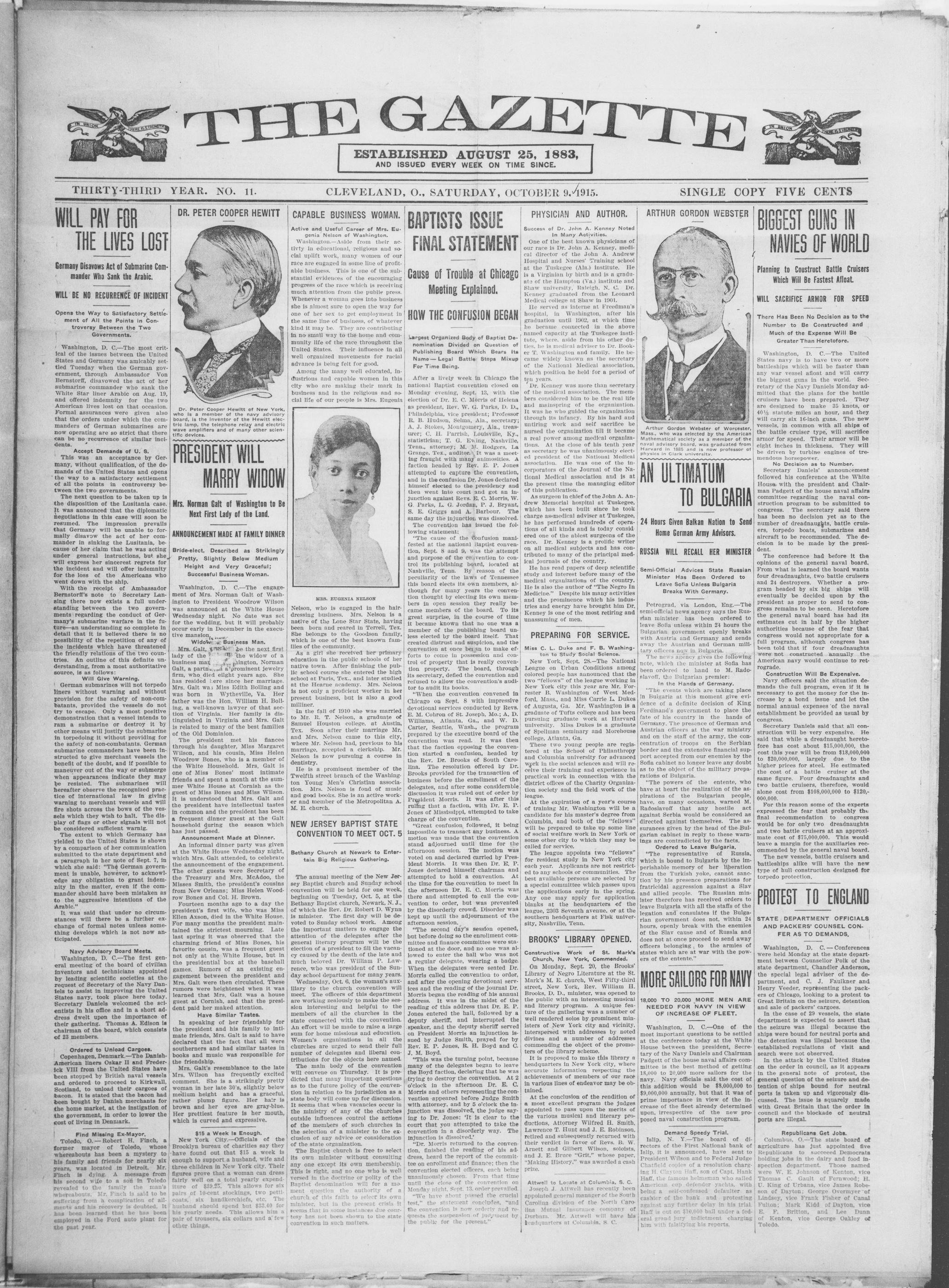
Dr. Peter Cooper Hewitt of New York, who is a member of the navy advisory board, is the inventor of the Hewitt electric inp, the telephone relay and electric wave amplifiers and of many other scientific devices.
ANNOUNCEMENT MADE AT FAMILY DINNER
Bride-elect, Described as Strikingly Pretty, Slightly Below Medium Height and Very Graceful; Successful Business.Woman.
Washington, D. C.-The engagement of Mrs. Norman Galt of Washington to President Woodrow Wilson was announced at the White House Wednesday night. No date was set for the wedding, but it will probably occur early in December in the executive mansion.
Widow Business Man
Mrs. Galt, grandmother, be the next first lady of the city. She the widow of a business man, Washington, Norman Galt, a partner, and a prominent jewelry firm, who died eight years ago. She has resided here since her marriage. Mrs. Galt was Miss Edith Bolling and was born in Wytheville, Va. Her father was the Hon. William H. Bolling, a well-known lawyer of that section of Virginia. Her family is distinguished in Virginia and Mrs. Galt is related to many of the best families of the Old Dominion.
The president, met his fiancee through his daughter, Miss Margaret Wilson, and his cousin, Miss Helen Woodrow Bones, who is a member of the White Household. Mrs. Galt is one of Miss Bones' most intimate friends and spent a month at the summer White House at Cornish as the guest of H. Bones and Mrs. Winn. Understood that Mrs. Galt and the president have intellectual tastes in common and the president has been a frequent dinner guest at the Galt household during the season which has just passed.
Announcement Made at Dinner.
An informal dinner party was given at the White House Wednesday night, which Mrs. Galt attended, to celebrate the announcement of the engagement.
The other guests were Secretary of the Treasury and Mrs. McAdoo, the Misses Smith, the president's cousins from New Orleans; Miss Helen Woodrow Bones and Col. H. Brown.
Fourteen months ago to a day the president's first-wife, who was Miss Ellen Axson, died in the White House. For many months the president maintained the strictest mourning. Late last spring it was observed that the charming friend of Miss Bones, his favorite cousin, was a frequent guest at the president's presidential box at the baseball games. Rumors of an existing engagement between the president and Mrs. Galt were then circulated. These rumors were heightened when it was learned that Mrs. Galt was a house guest at Cornish, and that the president paid her maked attention.
Have Similar Tastes.
In speaking of her friendship for the president and his family to intimate friends, Mrs. Galt is said to have declared that, the fact that all were southerners and had similar tastes in books and music was responsible for the friendship:
Mrs. Galt's resemblance to the late Mrs. Wilson has frequently excited comment. She is a strikingly pretty woman in her late 30s, slightly below medium height and has a graceful, rather plump figure. Her hair is brown and her eyes are gray-blue. Her prettiest feature is her mouth, which is curved and expressive.
$15 a Week Is Enough.
New York City—Officials of the Brooklyn bureau of charities say they have found out that $15 a week is enough to support a husband, wife and three children in New York city. Their figures prove that a woman can dress fairly well on a total yearly expenditure of $29.25. This allows for six pairs of 10-cent stockings; two petcoats, six handkerchiefs, etc. The husband should spend but $23.40 for his yearly needs. This allows hips a pair of trousers, six collars and a few other things.
ESTABLISHED AUGUST 25, 1883, AND ISSUED EVERY WEEK ON TIME SINCE.
CLEVELAND, O., SATURDAY, OCTOBER 9, 1915. CAPABLE BUSINESS WOMAN. BAPTISTS ISSUE PHYSICIAN AND AU
Active and Useful Career of Mrs. Eu-
genia Nelson of Washington.
Ask them from their activity in educational, religious and social upbring work, many women of our race are engaged in some line of profitable business. This is one of the substantial evidences of the encouraging progress of the race which is receiving much attention from the public press. Whenever a woman goes into business she is almost sure to open the way for one of her sex to get employment in the same line of business, of whatever kind it may be. They are contributing in no small way to the home and community life of the race throughout the United States. Their influence in all well organized movements for racial advance is being felt for good.
Among the many well educated, industrious and capable women in this city who are making their mark in business and in the religious and social life of our people is Mrs. Enguza
MRS. EUGENIA NELSON
Nelson, who is engaged in the hair-
dressing business. Mrs. Nelson is a
native of the Lone Star State, having
been born and reared in Terrell, Tex.
She belongs to the Goodson family,
which is one of the best known fam-
lies of the community.
As a girl she received her primary education in the public schools of her native town. After finishing the public school course she entered the high school at Paris, Tex., and later studied at the Hearne academy. Mrs. Nelson is not only a proficient worker in her present business, but is also a good milliner.
In the fall of 1910 she was married to Mr. R. T. Nelson, a graduate of Samuel Houston college, at Austin, Tex. Soon after their marriage Mr. and Mrs. Nelson came to this city, where Nelson had, previous to his marriage, accepted a clerkship. Mr. Nelson is now pursuing a course in dentistry.
He is a prominent member of the Twelfth street branch of the Washington Young Men's Christian association. Mrs. Nelson is fond of music and good books. She is an active worker and member of the Metropolitan A. M. E. church.
NEW JERSEY BAPTIST-STATE
CONVENTION TO MEET OCT. 5
Bethany Church at Newark to Entertain Big Religious Gathering.
The annual meeting of the New Jersey Baptist church and Sunday school convention will be held for one week, beginning on Tuesday, Oct. 5, at the Bethany Baptist church, Newark, N.J., of which the Rev. Dr. Robert D. Wyman is minister. The first day will be devoted to Sunday school work. Among the important matters to engage the attention of the delegates after the general literary program will be the election of a president to fill the vacancy caused by the death of the late and much beloved Dr. William P. Lawrence, who was president of the Sunday school department for many years.
Wednesday, Oct. 6, the woman's auxiliary to the church convention will meet. The officers of this department are working zealously to make the session interesting and helpful to the members of all the churches in the state connected with the convention. An effort will be made to raise a large sum for home missions and education. Women's organizations in all the churches are urged to send their full number of delegates and liberal contributions for the objects here named. The main body of the convention will convene on Thursday. It is predicted that many important questions as to the future policy of the convention in relation to its jurisdiction as a state body will come up for discussion. It seems that when vacancies occur in the ministry of any of the churches outside influences control the actions of the members of such churches in the selection of a minister, to the exclusion of any advice or consideration of the state organization.
The Baptist church is free to select its own minister without consulting any one except its own membership. This is right, and no one who is well versed in the doctrine or policy of the Baptist denomination will for a moment question the authority of a church of this faith to preside over its minister, but in the present crisis it seems that in one instance the company has not been shown to the state convention in such matters.
Largest Organized Body of Baptist Denomination Divided on Question of Publishing Board Which Bears Its Name—Legal Battle Stops Mixup For Time Being.
After a lively week in Chicago the national Baptist convention closed on Monday evening, Sept. 13, with the election of Ir. E. C. Morris of Helena as president, Rev. W. G. Parks, D. D. Philadelphia, vice president; Professor R. B. Hudson, Schma, Ala., secretary; A. J. Stokes, Montgomery, Ala., treasurer; C. H. Parrish, Louisville, Ky., statistician; T. G. Ewing, Nashville, Teen, attorney; M. M. Rodgers, La Grange, Tex., auditor. It was a meeting fraught with many animosities. A faction headed by Rev. E. P. Jones attempted to capture the convention, and in the confusion Dr. Jones elected himself elected to the presidency and then went into court and got an injunction against Revs. E. C. Morris, W. G. Parks, L. G. Jordan, P. J. Bryant, S. E. Griggs and A. Barbour. The same day the injunction was dissolved. The convention has issued the following statement:
"The cause of the confusion manifested at the national baptist convention, Sept. 8 and 9, was the attempt and purpose of the convention to control its publishing board, located at Nashville, Tenn. By reason of the peculiarity of the laws of Tennessee this board elects its own members, although for many years the convention thought by electing its own members in open-session they really became members of the board. To its great surprise, in the course of time it became known that no-one was a member of the publishing board unless elected by the board itself. That created distrust and suspicion, and the convention at once began to make efforts, to come in possession and control of property that is really convention property. The board, through its secretary, defied the convention and refused to allow the convention's auditor to audit its books.
"When the convention convened in Chicago on Sept. 8 with impressive devotional services conducted by Revs. E. M. Cobron of St. Joseph, Mo.; A. D. Williams, Attanta, Ga.; and W. D. Carter, Seattle, Wash., the program prepared by the executive board of the convention was read. It was then that the faction opposing the convention started a confusion, headed by the Rev. Dr. Brooks of South Carolina. The resolution offered by Dr. Brooks provided for the transaction of business before the enrollment of the delegates, and after some considerable discussion it was ruled out of order by President Morris. It was after this ruling that a faction, with Dr. E. P. Jones of Mississippi, attempted to take charge of the convention.
"Great confusion followed, it being impossible to transact any business. A motion was made that the convention stand adjourned until time for the afternoon session. The motion was voted on and declared carried by President Morris. It was then Dr. E. P. Jones declared himself chairman and attempted to hold a convention. At the time for the convention to meet in the afternoon Dr. E. C. Morris was there and attempted to call the convention to order, but was prevented by the disorderly crowd. Disorder was kept up until the adjournment of the afternoon session.
The second day's session opened, but before doing so the enrolment committee and finance committee were stationed at the door, and no one was allowed to enter the hall who was not a regular delegate, wearing a badge. When the delegates were seated Dr. Morris called the convention to order, and after the opening devotional services and the reading of the journal Dr. Morris began the reading of his annual address. It was in the midst of the reading of this address that Dr. E. P. Jones entered the hall, followed by a deputy sheriff, and interrupted the speaker, and the deputy sheriff served on President Morris an inunction issued by Judge Smith, prayed for by Rev. E. P. Jones, R. H. Boyd and C. J. M. Boyd.
"This was the turning point, because many of the delegates began to leave the convention, declaring that he was trying to destroy the convention. At 2 o'clock in the afternoon Dr. E. C. Morris and others representing the convention appeared before Judge Smith with attorney, and by 5 o'clock the injunction was dissolved, the judge saying to Dr. Jones: 'It is clear to the court that you attempted to take the convention in a disorderly way. The injunction is dissolved.'
"Dr. Morris returned to the convention" finished the reading of his address, heard the report of the committee on enrollment and finance; then the convention elected officers, each being unanimously chosen. From that time until the convention of March 19, 1911, Mr. Morris was in office preceded by "We have passed the crucial test" the statement concludes, "and the convention is now in good and good request the suspension of payment by the public for the present."
Success of Dr. John A. Kenney Noted
In Many Activities.
One of the best known physicians of our race is Dr. John A. Kenney, medical director of the John A. Andrew Hospital and Nurses' Training school at the Traskegree (ABl) institute. He is a Virginian by birth and is a graduate of the Hampton (Taunton) institute and Shaw university, Tailgah, N. C. Dr. Kenney graduated from the Leonard Medical college at Shaw in 1901.
He served as interate at Freedman's hospital, in Washington, after his graduation until 1922, at which time he became connected in the 'above mined capacity at the Traskegree institute, where, aside from his other duties, he is medical adviser to Dr. Booker T. Washington and family. He became widely known as the secretary of the National Medical association, which position he held for a period of ten years.
'Dr. Kenney was more than secretary of the medical association. The members considered him to be the real life and mining of the organization' it was he who guided the organization through its infancy. By his hard and metting work, and self sacrifice he nursed the organization it became a real power among the miners. At one point of his twelfth year, secretary he was unanimously elected president of the National Medical association. He was one of the incorporators of the Journal of the National Medical association and is at the present time the managing editor of this publication.
As surgeon in chief of the John A. Andrew Memorial hospital at Tuskegee, which has been built since he took charge as medical adviser at Tuskegee, he has performed hundreds of operations of all kinds and is today considered one of the oldest surgeons of the race. Dr. Kenney is a prolific writer on all medical subjects and has contributed to many of the principal medical journals of the country.
He has read papers of deep scientific study and interest before many of the medical organizations of the country. He is also the author of "The Negro in Medicine." Despite his many activities and the prominence which his industries and energy have brought him Dr. Kenney is one of the most retiring and unassuming of men.
PREPARING FOR SERVICE.
Miss C. L. Duke and F. B. Washington to Study Social Science.
New York, Sept. 25. The National League on Urban Conditions among colored people has announced that the two "fellows" of the league working in New York city this year are Mr. Forrester B. Washington of West Medford, Mass, and Miss Carrie L. Dukes of Augusta, Ga. Mr. Washington is a graduate of Tufts college and has been pursuing graduate work at Harvard university. Miss Dukes is a graduate of Spelman seminary and Morsehouse college, Atlanta, Ga.
These two young people are registrars at the school of Philanthropy and Columbia university for advanced work in the social sciences and will receive their training and experience in practical work in connection with the district offices of the Charity Organization society and the field work of the league.
At the expiration of a year's course of training Mr. Washington will be a candidate for his master's degree from Columbia, and both of the "fellows" will be prepared to take up some line of social welfare work in New York or some other city to which they may be called for service.
The league appoints two "fellows" for resident study in New York city each year. Applicants are not restricted to the best available persons are selected by a special committee which passes upon the applications early in the spring. Any one may apply for application blanks at the headquarters of the league, 2303 Seventh avenue, or at the southern headquarters at Fisk university, Nashville, Tenn.
BROOKS' LIBRARY OPENED.
Constructive Work of St. Mark's Church, New York, Commended.
On Monday, Sept. 20, the Brooks Library of Negro Literature at the St Mark's M. E. church, West Fifty-third street, New York, Rev. William H. Brooks, D. D., minister, was opened to the public with an interesting musical and literary program. A unique feature of the gathering was a number of well rendered solos by prominent ministers of New York city and vicinity, interspersed with addresses by noted divines and a number of addresses commending the object of the promoters of the library scheme.
It is proposed to make this library a headquarters in New York city, where accurate information respecting the achievements of members of our race in various lines of endeavor may be obtained.
At the conclusion of the rendition of a most excellent program the judges appointed to pass upon the merits of the various musical and literary productions, Attorney Wilfred H. Smith, Layrence T. Hunt and J. E. Robinson, retired and subsequently returned with their verdict in favor of Revs. B. W. Arnett and Gilbert Wilson, soloists, and J. E. Bruce "Grit," whose paper, "Making History," was awarded a cash prize.
Attwell to Locate at Columbia, S. C.
Joseph J. Attwell has recently been appointed general manager of the South Carolina division of the South Carolina Mutual Insurance Company of Durham. Mr. Attwell will have his ladies at Locate at Columbia, S. C.
ARTHUR GORDON WEBSTER
Arthur Gordon Webster of Worcester, Mass., who was selected by the American Mathematical Society as a member of the Royal advisory board, was graduated from Harvard in 1858 and is now professor of physics at Clark university.
24 Hours Given Balkan Nation to Send Home German Army Advisors.
Semi-Official Advices State Russian Minister Has Been Ordered to Leave Sofia Unless Bulgaria Breaks With Germany.
Petrograd, via London, England. The semi-official news agency says the Russian minister has been ordered to leave Sofia unless within 24 hours the Bulgarian government openly breaks with Austria and Germany and sends away the Austrian and German military officers now in Bulgaria.
The news agency gives the following note, which the minister at Sofia has been ordered to hand to M. Radoshov, the Bulgarian premier:
In the Hands of Congress
In the Hands of Germany.
"The events which are taking place in Bulgaria at this moment give evidence of a definite decision of King Ferdinand's government to place the fate of his country in the hands of Germany. The presence of German and Austrian officers at the war ministry and on the staff of the army, the concentration of troops on the (Serbian border and the extensive financial support accepted from our enemies by the Sofa cabinet no longer leave any doubt as to the object of the military preparations of Bulgaria. The entente, who have at heart the realization of the aspirations of the Bulgarian people, have on many occasions, warned M. Radoslavoff that any hostile act against Serbia would be considered as directed against themselves. The assurances given by the head of the Bulgarian cabinet in reply to these warnings are contradicted by the facts.
Ordered to Leave Bulgaria,
"The representative of Russia, which is bound to Bulgaria by the imperishable memory of her liberation from the Turkish yoke, cannot sanction by his presence preparations for fratriorial aggression against a Slav and allied people. The Russian minister therefore has received orders to leave Bulgaria with all the staffs of the legation and consulates if the Bulgarian government does not, within 24 hours, openly break with the enemies of the Slav cause and of Russia, and does not at once proceed to send away officers belonging, to the armies of states which are at war with the powers of the entente."
MORE SAILORS FOR NAVY
18,000 TO 20,000; MORE MEN ARE NEEDED FOR NAVY IN VIEW OF INCREASE OF FLEET.
Washington, D. C.—One of the most important questions to be settled at the conference today at the White House between the president, Secretary of the Navy Daniels and Chairman Padgett of the house naval affairs committee is the best method of getting 18,000 to 29,000 more sailors for the navy. Navy officials said the cost of this addition would be $8,000,000* to $9,000,000 annually, but that it was of prime importance in view of the increase of the fleet already determined upon, irrespective of the new-proposed naval construction program.
Demand Speedy Trial:
Isip, N. Y.—The board of directors of the First National bank of Isip, it is announced, have sent to President Wilson and to Federal Judge Charles Huffman of a resolution charitable to the nation of China, Hank Huffman, the chairman who so called Amanda Huffman, the chairman with belief in a consensual defender as a member of the bank and protecting and supporting debt in its trial. Huffman will be a federal member to be elected to charg-ing him in his reports.
IN BALGA
IN CENTS
OPY FIVE CENTS
BIGGEST GUNS IN NAVIES OF WORLD
Planning to Construct Battle Cruisers Which Will Be Fastest Afloat.
WILL SACRIFICE ARMOR FOR SPEED
There Has Been No Decision as to the Number to Be Constructed and Much of the Expense Will Be Greater than Heretofore.
Washington, D. C. - The United States navy is to have two or more battleships which will be faster than any war vessel afloat and will carry the biggest guns in the world. Secretary of the Navy Daniels Monday admitted that the plans for the battle cruisers have been prepared. They are designed to make 35 knots, or 4015 statute miles an hour, and they will carry six 16-inch guns. The new vessels, in common with all ships of the battle cruiser type, will sacrifice armor for speed. Their armor will be eight inches in thickness. They will be driven by turbine engines of tremendous horsepower.
No Decision as to Number.
Secretary Daniels' announcement followed his conference at the White House with the president and Chairman Padgett of the house naval affairs committee regarding the naval construction program to be submitted to congress. The secretary said there has been no decision yet as to the number of dreadnaughts, battle cruisers, torpedo boats, submarines and aircraft to be recommended. The decision is to be made by the president.
The conference had before, it the opinions of the general naval board. From what is learned the board wants four dreadnaughts, two battle cruisers and 24 destroyers. Whether a program headed by six big ships will eventually be decided upon by the president as proper to send to congress remains to be seen. Heretofore the general naval board has had its estimates cut in half by the higher authorities because of the fear that congress would not. appropriate for a full program, although congress has been told that if four dreadnaughts were not constructed annually the American navy would continue to retrofit.
Construction Will Be Expensive.
Navy officers said the situation demands the full program, even if it is necessary to get the money for the increase by a bond, issue and let the normal annual expenses of the naval establishment be provided as usual by congress.
Secretary Daniels said that all construction will be very expensive. He said that while a dreadnaught grecofore has cost about $15,000,000, the cost this year will be from $18,000,000 to $20,000,000, largely due to the higher prices for steel. He estimated the cost of a battle cruiser at the same figure. Four dreadnaughts and two battle cruisers, therefore, would alone cost from $108,000,000 to $120,000,000.
For this reason some of the experts expressed the fear that probably the final recommendation to congress would be for only two dreadnaughts and two battle cruisers at an approximate cost of $75,000,000. This would leave a margin for the auxiliaries recommended by the general naval board. The new vessels, battle cruisers and battleships alike will have the new type of hull construction designed for torpedo protection.
PROTEST TO ENGLAND
PROTEST TO ENGLAND
STATE DEPARTMENT OFFICIALS AND PACKERS' COUNSEL CONFERENCE AS TO DEMANDS.
Washington, D. C.—Conferences were held Monday at the state department between Counsellor Polk of the state department, Chandler Anderson, the special legal adviser of the department, and C. J. Faulkner and Henry Veeder, representing the packers of Chicago, looking to a protest to Great Britain on the seizure, detention and sale of packers' cargoes.
In the case of 29 vessels, the state department is expected to assert that the seizure was illegal because the ships were bound for neutral ports and the detention was illegal because the established regulations of visit and search were not observed.
In the attack by the United States on the order in council, as it appears in the general note of protest, the general question of the seizure and detention of ships bound for neutral ports is taken up and vigorously discussed. The issue is squarely made with Great Britain that the order in council and the blockade of neutral ports are illegal.
Republicana Get Jobs
Columbus, O.—The state-board of agriculture has just appointed five Republicans to succeed Democrats holding jobs in the dairy and food inspection department. Those named were W. F. Johnson of Kenton, vice Thomas C. Gault of Penrroth; H. U. King of Urbana, 676 James Robinson of Dayton; George Overmyer of Lindsay, vice Frank Fisher of Canal Union; Mark Kidd of Dayton, vice E. F. Britton, and Lee Dunn of Kenton, vice George Oakley of Toledo.
PUBLISHED EVERY SATURDAY
SUBSCRIPTION RATES
(In Advance)
One Year...secsceeecee eee $150.
Bix Months........cscescees 1.00
Three Months......sceeee 50
Subscribers are requested to re-
mit by postoffice money or
der or registered letter
Hntered at the postoffice In Cleveland,
‘Ohio, as second-class matter.
‘Address all communications to
HARRY C. SMITH
Editor and proprietor,
THE GAZETTE,
Blackstone Building, Cleveland, O.
Member Ohio Legislature: 1894
to 1898; 1896 to 1898; 1900 to 1902
THE GAZETTE Is the oldest, and
has the largest bona fide circulation,
double that of any newepaper In the
Interest of Afro-Americans, published
In the state of Ohio, and comparison
with any will Immediately establish
fis rank as one of the NEWSIEST
AND BEST In the country.
10,000,000 Afro-Americans.
460,000 in Ohio.
20,000 in Cleveland.
SATURDAY, OCTOBER 8, 1915.
DARE TO DO YOUR DUTY.
“Let us have faith that right
makes might, and in that faith
Iet us to the end dare to do our
duty as we understand it”"—
Abraham Lincoin.
President Wilson has pacified Hayti
‘by armed intervention. Why not
pacify Mexico; the conditions are ‘ex-
actly the same; the duty is the same.
_—_———_
‘The U. S, Supreme court has de-
cided that congress cannot legislate
against lynching; that the state legis-
Jatures must do that. It is a state
Tight to do so. Boston and Philadel-
phia race newspapers will do well to
remember this fact.
‘While we prefer not to be one of
the “nominees” to receive the con-
‘tributions because our time is too
limited, we are in hearty sympathy
with the suggestion of our esteemed
confrere, Editor Kemp of the Detroit
Leader, that the race press raise the
$4,000 needed to “lift” the mortgage
‘on Cedar Hill, Anacostia, D. C., Fred-
‘erick Douglass’ home, left to the race,
as a memorial, by his widow (white)
when she died, some years ago. Edi-
tors J. R. Clifford and W. H. Steward,
of the Martinsburg (W. Va.) Pioneer
Press and Louisville, (Ky.) American
Baptist, respectively, are “nominees”
suificient to handle the funds and
better selections could not have been
made, We promise to do our part,
both as to a personal. contribution
and as to raising additional sums.
‘Yes, Frederick Douglass is easily the
greatest Afro-American that has lived,
to date.
AMERICA’S URGENT DEMAND
STILL UNMET.
‘While the United States will wel
come a settlement of the grave ques
tions at issue, it ought not to be for.
gotten that Germany had never yet
replied to our demands for an apology
and reparation for the sinking of the
Lusitania, an outrage without a paral-
lel in modern warfare, and this delay,
which the administration has toler-
ated, does not look as though the Ger-
man government was deeply im-
pressed with the power and influence
of the United States. If it is now
actually disposed to meet our de-
mands and avert. an open breach, the
reason is to be sought elsewhere than
in Germany's respect for the moral
force of American opinion or Ameri.
can, “friendship.”
wee
ANOTHER VICIOUS PHOTOPLAY.
‘That prejudiced southerners, and
‘their northern allies, are determined
to discredit our people, in this section
of the country, in the eyes of the
northern whites, and intensify the
feeling against us to the point that it
exists in the southland, there can be
no question. Furthermore, that they
‘are using vicious, malicious and in-
famous photoplays, principally, to do
this, we are now thoroughly convinced.
Many months ago when the editor of
‘The Gaaettaatarted fhe Seht, in Obio,
‘against those two hniserable films,
“The Nigger” and “The Birth
of @ Nation,” went to Gov. Willis re-
peatedly relative to them, and con-
tinued to lead the effort against them
until they were barred from the state
by the State Board of Film Censors,
we felt that the firstnamed photo:
play was only the opening wedge for
“The Birth of a Nation” and
others of a lke nature, and told the
Governor so. We were not mistaken,
as all now know. On Tuesday even-
ing, Sept. 28, 1915, we happened in a
leading motion-picture theater in the
heart of this city and witnessed a
photoplay, “Under Southern Skies,”
Which contained several scenes that
were worthy of places in both of the
miserable films very properly barred
from Ohio by our state oMlciais. Not
only were “subtitles” of “Under
Southern Skies” extremely insulting
‘and offensive but there was a scene
‘where an especially vicious-appearing
“Negro” was shown struggling to,
overpower a white girl. And this en-
tirely foreign to the play, too! Never-
theless, {t was repeated and for a pur-
pose too obvious for even the dull
person not to understand. It was’
there to impress all who saw it with
the false idea that “Negroes” were |
continually after white women—as-|
saulting them! ‘There were other bad
ietures, We immediately notified the|
sors and received the following letter
in reply:
OHIO BOARD OF CENSORS
288 South High Street
COLUMBUS
‘October 1, 1915.
Hon. Harry C. Smith,
Editor, The Gazete,
Cleveland, Ohio.
Dear Sir:—I beg to acknowledge re-
ceipt of your favor referring to the
five-reel production, “Under Southern
Skies,” and note what you say in ref-
erence to same. The records show
that this film was approved by this
Board with the following eliminations:
Brd reel: Cut out struggle between
man and girl in yard.
4th reel: Cut out subtitle, “Steve,
you don't mean Negro blood.” Cut
out scene of struggle between man
and girl in yard. Cut out fight.
Sth reel: Cut out man bound to
tree, Cut out shooting.
With kindly regards,
Yours very truly,
CHAS, G. WILLIAMS.
In answer to the foregoing we wired
Chairman Williams that the Universal
Film Mfg. Co., which was promoting
“Under Southern Skies,” was ignor-
ing the Board’s order to eliminate the
objectionable features, noted in his
letter, and received the following tele-
gram in reply:
Columbus, O., Oct. 2, 1915.
Hon. Harry C, Smith,
Editor, The Gazette,
Cleveland, Ohio.
Have wired the company to make
the eliminations at once. You can
take it up with your local authorities
if they fail to do so.
‘The Ohio Board of Censors.
Let our people throughout Ohio be
jon the watch for this and every other
viciously harmful (to the race) photo
play, and keep The Gazette and Chair
man Williams posted, whenever it is
found necessary, just as we have done
in the case of the miserable films,
“The Nigger,” “The Birth of
a Nation” and “Under Southern
Skies.” It must be “eternal vigilance”
with us, all the time, if we are to keep
this state free from such rot.
THESE DISPOSE OF TYLER'S
STORIES.
Ralph W. Tyler of Columbus, had s
letter’ in the Chicago Defender, Ins
week, in which, among other silly
things, he told of his “swooning’
when the State Board of Censors an
nounced its decision against “Th
Birth of a Nation.” In _ the
Pittsburg Courier of the same date
Oct. 2, 1915, he undertook to give
&
fe 48
oe
Z i“ {] ois
PAN US
BINS \ \BGE
| MINN G2
RALen W. TYE:
white man (Daniel J. Ryan) “the
greatest praise and honor for shutting
out from Ohio" the vicious photoplay.
Of course this is as ridiculously un-
true as his “swoon” story. Ralph does
not eyen seem to have been present
with the delegation that “made a
brief call.” Read the following—they
are pertinent:
October 5, 1915.
Mr. Charles G. Williams,
Chairman, Board of Censors,
Columbus, 0.
‘Was any delegation in the rooms of
the Board, last week Monday, await:
ing its decision on “The Birth of a
Nation” photoplay, barred from the
state? ‘Harry C. Smith.
In his Columbus letter to the De-
fender, referred to earlier in this
leader, Tyler wrote as follows:
Ralph Tyler swoons: ‘The commit:
tee which was sent to Columbus from
every quarter of the state, and which
was headed by the ex-auditor of the
navy, (Tyler), was only before the
board 23 minutes when the president
got up and made his'statement. So
overcome was Mr. Tyler that he fell,
and it took about five minutes to re-
vive him, On regaining consciousness
he exclaimed: “Praise God, We Are
Not Weary.”
‘The following telegram was re-
celved in answer to the one given
above—sent to Chairman Williams:
Columbus, O,, Oct. 5, 1915.
Hon. Harry C. Smith,
Editor, The Gazette,
Cleveland, Ohio.
‘Messrs. Barcus, Woodlin, Alcott and
Ryan made a BRIEF’ call presenting a
protest in bebalf of several Columbus
organizations.
CHAS. G, WILLIAMS.
This is Tyler’s “committee sent to
Columbus from every quarter of the
state,” etc.! ete! Where did “Tyler
swoon"—at home? And where did he
“exclaim: “Praise God, We are Not
Weary?” Echo anwsers, WHERB!
The Columbus correspondent of the
Chicago Defender and the N. Y. Age,
is “a versatile cuss,” to say the least.
Our contemporaries will enjoy this
most, we feel sure. It is “rich.” Many
of them KNOW Ralph W. Tyler!
“GOOD PRESIDENTIAL TIMBER.”
The Associate Editor of The Portland
(Ore.) Advocate Interviews Gov-
‘ernor Willis,
‘Through the kindness of Hon. Harry
C. Smith, editor of The Cleveland Ga-
zette, we received a letter of introduc-
tion to Governor Willis of Ohio, who
visited our city Wednesday. Gover-
nor Willis stopped at the Benson hotel
while here (Portland, Oregon), and
was entertained elaborately by the
Ohio club, in the evening we inter-
viewed him and after he expressed
his appreciation and admiration for
the beauty of Portland and the great
Northwest, we asked him to tell us
his opinion of the photoplays, “The
Birth of a Nation” and “The Nigger.”
He said that he had never seen the
films, but from what his friend, Mr.
Smith of The Gazette and other friends
had told him, he was of the opinion
that they should not be shown any-
where and that they could never be
shown in his state until the Board of
Censors passed them and added, “I
Jo not think our Hoard of Censors will
ever do that, from all indications.”
The Governor said that he had met a
THE GAZETTE, CLEVELAND, 0. SATURDAY, OCTOBER 9, 1915.
number of people on his trip, who | GEoRGeTOWN.—:
Were interested in preventing the play. HIO Ni ingon of Cincinnati,
from being shown, among whom was parents, Mr and. Mr
the prosecuting attorney of Tacoma, E. F. Boston held th
Wash., who interviewed him white he a at the Baptist. churel
Mas Dae Wo cakel tie Governor lwnrven ay etoeoaLe neta | for ev. Sha
to say something about how the. pla . E Springfield. He also
was kept out of his state, for the bene BLE! GAZE Teo comne: C. M. E. chureh thers
fit of the public and he said, “Why, SPONDENTS bert Bullard is visit
tell them what I am telling you now! sees He 16 working in 7
amd added, “I shall be glad to. lend Bosc SUR viii
whatever assistance I'ean in helping | THROUGHOUT THE STATE|m tonemmnte ae
to better conditions of all kinds.” We Sense ati nilen, aie
found Governor Willis to be a whole: —— Her Mineiro
find easy {0 approiels Our opinion [Wat Our Peopie mre Doing Bee ens nn
fs that’he is good Presidential timber. | Week—Church, Personal, Social, | uanintion, was
Portland (Ore.) Advocate. iodge, Literary and Mu- Smith is here from T
sical — Marriages, Jers is visiting h
> Deathe, Ete. j"'Aunc” Emily Tatmer
£3. DOINGS galls Oklahoma-—Chas._ §
os : been on the O. it,
TE RIPLEY.—Mrs. Srofe is quite il
e's A some years, has 0
‘9 Mr, Chas. Marshall, one of our most | be. Zar hae
| Re prominent business men, died sudden-| Rev. Briggs of Prank
EAS Bo] OR [iceman ie ht eee
RA SS, esteemed and will be greatly missed | Decatur, one evenin
i NOY Va ee by all—J. C. Cossey is one of our Mere, Sunday
& €4 genial and popular business men, His —
S/S ea barber-trade is good, and he does con-| HjLLSBORO.—Mis
Re OS 1A THE siderable Job printing —Rev. Shadd, | visited in Wilminste
ROSS pastor of the Baptist church, is in| week—rs. Clifford
RASS <<; Springfeld.—Rey. Robbins will attend | Henry. Willis, visite
EF. conference in Louisville, soon.—Rev |last. Thursday.—Mrs.
Li ENS E. F. Boston of Georgetown, preached | Mrs, ‘Lawson of Ne
| Ws, Se Sunday, at the Baptist and C. M. E.| Saturday here, guest
y Ay |
ere ehurehgs. fon, Mr. Leo Carey,
PEt Bins a ee eee eeee
DOINGS
OF
THE
RACE
Geo. S. Mills of Leonia, N. J., has
purchased a $6,500, home in. the ex-
clusive residential section of that city.
Rt. Rev. Francisco Javier de Luna
‘Victoria was “the first bishop of Ne-
‘gro blood in America, and probably of
hative birth, to wear the mitre.” ‘The
cathedral of the diocese is located in
the present (new) City of Panama
and was built fiom this bishop's pri
vate purse. The See of Panama is the
Oldest on the American continent.
Dewey Green, the Tulsa, Okla., boy,
who won first prize in the Boys” Corn
Club Contest, last year, won second
prize in the ‘Boys’ Pig Club Contest
at the fair there, recently. No color
line in these contests, either. Rah!
for Dewey!
Dr. J. W. King of Bradford, Pa.
froze a Colored woman's leg with eth:
er, from hip to ankle, for Iumbago,
and turned it white. It remains so.
“The Birth of a Nation" is being
shown nightly to crowds in Chi.
cazo, New York City, Boston and
Philadelphia, too, in spite of its re-
cent riot. “Apparently our newspa-
pers and people in the first two-named
cities are making no further effort to
‘stop the infamous photoplay—Ex.
‘Miss Sarah May Talbert, through
the various press reports is spoken
of as one of the most talented must.
cians of our race, and that the entire
world gladly welcomes this new musi-
cal star. Letters from Texas, Kan-
sas, Oklahoma, Georgia, Mississippi,
Florida and Alabama have been re-
ceived by Mrs. Mary B. Talbert, of
Buffalo, and her accomplished daugh-
ter, asking them to make a trip
through this section during the com:
ing winter season.—Pittsburg Courier.
Mrs, Talbert delivered 21 lectures, re-
cently, en route to the coast and as
@ result, has added 20 new clubs to
our National Association of Women’s
elubs of which she is the vice-prest
dent at large.
Robert N. Wood, for many years
head of Tammany's Afro-American
democrats of New York City, is dead.
We are not Negroes; we are Col:
ored Americans, and our brothers in
white will please us immensely to
adopt the word “Colored” when racial
distinctions are to be made—Nash:
ville (Tenn.) Union-Review (Baptist.)
Joe Billingham, aged 33, a laborer,
and Beulah Snowden, aged 21, a seam
stress; John Palmer, aged 21, a tailor
‘and Pearl Young, age 21, seamstress,
sought marriage licenses, in Colum
bus, last week. The girls are white
All came to Ohio from Kentucky.
Four suits for $500 each have been
instituted against a Huntington, L. 1.
N. Y. restaurant-keeper as a result o}
his refusal to serve an A. M. E. minis
ter and three members of his church
Good!
low
a
‘ |
«=
Ce
<a) oe
pos S
Major Wilson Ballard and Captain
E. T. Hawkins have resigned from the
Liberian frontier force and returned
to this country. Major W. F. York
has succeeded Major Chas. Young as
commander. Persons desiring to en-
ter the service should write the lat-
ter at Monrovia, Liberia, Africa,
Mrs. Harriet S. Barnes’ will, filed
recently in N. Y. City’s Surrogate
court, gives $1,000 to Tuskegee N. &
L. Institute.
The will of Legrand Ramsey, late
ot Great Barrington, Mass., fled for
probate at Pittsfield, Mass. leaves
$2000 in trust for Mary Van Allen, his
Colored housekeeper. She is to re-
ceive the income.
Horace W. Berry of Massachusetts
willed $5,000 to Storer College, Har-
pers Ferry, Va., and $2,000 to Tuske-
e Als,, institute.
WEDDING ANNIVERSARY
Celebrated in Christ Hospital by For-
mer Senator Foraker.
Cincinnati, O.—Former Senator For-
aker celebrated his forty-sixth wed-
ding anniversary at Christ church, a
few days ago. He was surrounded by
his family, and a few intimate friends
Who were apprised of the event called
during the day to pay their respects
and offer their congratulations. The
nurses and attaches of the hospital
joined in the celebration, and singly
and collectively called at the senator's
bedside to offer their best wishes. Al
though Mr. Foraker is still confined
and will not leave the hospital for
some days to come, he is steadily re-
covering and not suffering any dis-
comfort. GOOD!
WRITTEN BY “THE OLD RELIA.
BLE” GAZETTE'S CORRE-
SPONDENTS
What Our Peopte mre Doing Each
Week—Church, Personal, Social,
Lodge, Literary and Mu-
sical — Marriages,
Deaths, Ete,
RIPLEY.—Mrs. Srofe is quite il.
Mr, Chas, Marshall, one of our most
prominent business ‘men, died sudden:
ly, last week, Monday. He was highly
esteemed and will be greatly missed
by all—J. C. Cossey Is one of our
genial and popular business men, His
barber-trade is good, and he does con.
siderable job printing—Rev. Shadd,
pastor of the Baptist church, is in
Springfield—Rey. Robbins will’ attend
conference in Louisville, soon.—Rev
E. F. Boston of Georgetown, preached
Sunday, at the Baptist and C. M. E,
‘chorehes,
ZANESVILLE.—Miss Bessie Brown
fs convalescent.—Miss Rebecea Croons
has returned from Texas.—Miss Louie
Anderson was buried, the 30th. ult
‘She was the last representative ot one
of our “pioneer” families.—Mr. Brown
Jackson will soon return to Howard
University, Washington, D. C., to re-
sume the study of medicine—Mr.
Frank Kinney has been quite ill.
‘The Young home, on Shelby St, was
the scene of quite a pretty littie so-
cial gathering, Thursday evening, in
honor of Miss Naomi, who returned to
Wilberforce, Oct. 1. "Miss Young is a
cousin of our distinguished soldier and
scholar, Major Chas, Young, U. 8. A.
—Mr. Wm. Young has been elected
the Union Baptist S. 8. delegate to
the convention at Columbus, Oct. 28-29.
SMITHFIELD.—Rev. RB. Lowe,
who has been returned to St. Paul A
M. EB. church, was made welcome.
May he and the church prosper, this
year, along all lines. He was in Steu:
benville, Monday. Rev. Chas. Greene
has also been returned to Meintyre.
Rey. J. W. Munts preached, Sunday
week. “The pastor was in Cleveland
attending conference, — Miss Lyde
Beasley of Pittsburg, was the week-
end guest of her sister, Mrs. M. E.
Veney—Mrs. G. A. Harris moved fur-
ther down on South St., recently.—
‘The rain, last Friday, ‘prevented a
number from atteyding the Cadiz tatr.
—Mrs, J, Beall returned from Elwood
City, last Saturday, She visited D. W.
Bigsby. The latter has been working
‘there. He also returned, Saturday. —
Mr. Harvey Wright of Fernwood, was
the guest, Sunday, of Mr. and ‘Mrs,
‘Wm. Parks.
YOUNGSTOWN.—Mrs, W. Smith,
Mrs. Anna Hicks and Dick Grastic are
4ill—Logan Lodge will meet, Oct. 14.—
Mrs. Charles Jackson entertained
Mrs. Hattle Harper, Saturday —Mrs,
Jessie ——— entertained, Sunday,
in honor of Mrs. M. Castle of Toledo,
—Mrs. M. E. Carter and daughter,
Elizabeth, passed through the city
Friday, en route to the Panama-Pa
cific exposition at San Francisco, Cal.
“Mrs, James Stetart Is convalescent
—Robert and Fred. Moulton were
called here by their father, Mr. Moul
ton's lilness.—Ephraim Powell spent
two weeks in Uniontown and Pitts
burg.—St. Augustine Episcopal mis
sion is arranging for its annual ba
zaar—Faward Williams was taken
seriously ill at his mother, Mrs. Hattie
Williams’, in Findlay.—Mrs. J. W.
Miller of Toledo, was called here by
her brother, Stephen Clark's, death.
SANDUSKY.—Mr. John Robinson
and Miss Essia were married in Clevé
land, Sept. 20.—Mr, Moses Thompson
is very il—Mre, A.C. Gardner has
returned from Chicago. She visited
her daughter.—Miss Bessie Brown of
Cleveland, visited her brother, J. R.
Davis, and wife, Sunday—The Bap
tist S.S. was well attended, Sunday.
The maps and blackboard ‘are very
helpful. J. R. Davis is a_ finished
teacher and is doing splendid work in
both S. S. and church. The two.
months" rally is on, Look for Rev. @.
D, Smith’s club to win the prize—Mr.
Samuel Scott's new house is nearly
completed. He will move into it, Nov.
1—Mr. Stephen Wallace has ’ com:
pleted his new house, ‘The race here
Js showing much enterprise in im:
proving thelr homes—Read The Ga
zette and keep posted. Rev. G. D.
‘Smith, agent.
CORRESPONDENTS must mail all
letters for publication at their main
ostoffice sufficiently early on Monday
(or Sunday) of each week to have
them reach The Gazette office on
‘Tuesday morning, and always write
also, their names and that of their
city or town on the outside of the
‘wrapper about returned copies. Un-
less this latter is done, proper credit
cannot be given you, Lists of names,
wedding presents, etc, obituary no-
tices, speeches, resolutions, poetry, in-
quiries for relatives and advertise.
ments of all kinds, including items
announcing entertainments to be held
in the near future, must be paid for
in advance at the rate of ten cents a
Une, six words to a line. Our rates
for display advertisements will be
sent un application, Send postal note
and not stamps during warm weather.
ALLIANCE.—Rey, J. C. Turner, who
bas been returned, was warmly wel-
comed and preached to large audi-
ences, Sunday, at the A. M. E. church.
—Mr. Robert’ Love of Smithfield, is
located at Mr. Edward Harrell’s.—A
fine program was rendered at the
Chrysanthemum club’s bazaar. Among
the participants were Mrs. Emma Al-
Jen of Cleveland, Mr. and Mrs. James
Titus and Miss Anna Bethel of Can-
ton, and Sarah and Esther Cyrus of
Salem. A beautiful yellow and black
basket quilt, made by the club ladies,
was given to Mrs. Rosa Brooks for
selling the largest number of tickets.
Mrs. George Alexander won the sec:
ond prize, Monday, from 3 to 5 p. m.,
the ladies entertained Mrs. Emmia Al
len, at Mrs. Anna Russell’s—Mr.
Frank Hamlin of Bayard, was here,
Sunday.—Mr. and Mrs. George Proctor
have a fine daughter, born in Beaver,
Pa—Mrs. Wm. Wells has returned
from a visit In Omaha, Neb—Mrs. W.
P. Lewis and Mrs. M. E. Oliver are ill
—W. H. Palmer has returned from a
visit with bis father in Fernwood.
Mr. and Mrs. T. R. Harrell, her moth-
er, and Mrs. Ed. Harrell attended Mrs.
Naney Harrington's funeral, at Han-
over, last week.—Miss Lillian Roys-
ton, formerly of Cleveland, who has
been staying here, is visiting in Cleve-
land.—Rey. C. G, Clemens of Canton,
passed through, Sunday, en route,
home from Ravenna. /
GEORGETOWN.—Mrs. Edna Rob-
inson ‘of Cincinnati, is visiting her
parents, Mr. and Mrs. Tatmon.—Rev
E. F. Boston held the regular service
at the Baptist church in Ripley, Sun-
day, for Rev. Shadd, who was in
Springfield. He also preached at the
C. M.E. church there at 3 p, m.—Gil-
bert Bullard is visiting his parents.
He is working in Toledo.—Mrs. Re-
becea Smith is visiting her son, Grant,
in Portsmouth—Mrs. Owens and Mrs,
Jones of Ripley, are visiting Mrs, AI-
fred Masterson—The emancipation
celebration at Ripley, under the man-
agement of Revs. Robbins, Shadd and
Washington, was a success.—Ran
Smith Is here from Toledo.—Clem Pet-
ers is visiting his grandmother,
“Aunt” Emily Tatmon, He came from
Oklahoma.—Chas, Smith, who has
been on the O. R, & C, railroad for
some years, has gone to Detroit —
Rey. Briggs of Frankfort, is pastor of
the A. M. E. church. He preached at
Decatur, one evening, last week, and
here, Sunday.
HILLSBORO.—Miss Raymond Day
visited In Wilmington and Xenia, Inst
Week—Mrs. Clifford Lamb and Mrs.
Henry, Willis visited ‘near Sardinia,
last ‘Thursday.—Mrs. Ida Carey and
Mrs, Lawson of New Vienna, spent
Saturday here, guests of the former's
son, Mr. Leo Carey.—Mr. Joseph Wil-
liams, and Miss Aletha Byrd of Green-
field, ‘were married there, Sept. 29,
We extend — congratulations. — Mrs,
Charity Alsop has returned to Cinein-
natl—Rev. J, M. Rosa is pastor at the
A. M. B. church. Mrs. Eliza Williams
and daughter, Mrs, Ed. Dixon, are
Visiting Rey. and Mrs. A. P. Muayle
in Columbus, Mrs. Mayle was former:
ly Miss Edith Williams.—Mr. and Mrs.
Wm, Gales have returned to Williams:
burg. —Miss Ida Nelson of Cincinnat,
fs visiting her parents, Mr. and Mrs.
James Nelson—Mr. Rother Bolden is
in Denver, Colo.—The Misses Bessie
Craig and Hazel Burkhead of Worth:
ington, are visiting the former's
grandparents, Mr. and Mrs. Richard
Craig—Miss Ara B, Warren of Co:
Jumbus, who was a teacher in Lin-
coln school, resigned and accepted a
‘similar position in Columbus. Miss
Lucile Frazier of Columbus, has been
‘employed to fll the vacancy. here
Mev. Orr will be here, Sunday.--As,
A. F. Donaldson visited her daughter,
Mrs. Walker, in Cincinnati, Saturday
and euaday:
CADIZ.—Mr. and Mrs. Chavis of
Pittsburg, are visiting Mra. Wm, Mi
ler—Mrs. Hannah West and daughter,
Miss Lula, of Scio, and Mrs. Chas.
West of Zanesville, are guests of Mrs
James Smith—Mr. Edward Brown has
returned to “Adantic. City.—Theodore
Mazon haa accepted position at Wil
herforce Vera’ Harris of Lorain, i
here visiting—Rev. Moyer ‘was. in
Steubenville, last Saturday.—The M.
E. church committee gave a concert
at Hopedale, Sept. 28—Miss Florence
Broadus has returned to Pittsburs—
Mr. and) Mrs, Samuel Taylor” of
Youngstown, visited the latter's moth
er, Mrs. Jennie Davis—Several per
sons from Steubenville and Wheeling
attended the dance at the “Auditork
uum,” Oct. 1—Warren Lawrence _o!
Cleveland, is visiting relatives.—Mr
and Mrs, R. F. Ballard entertained a
inner, Sunday: Mr. and Mrs. James
‘Smithy Mr. and Mrs. Chas. Mason
Mrs, Hannah West and daughter, Mis
Lui, Mrs. Chas. West and Mrs. Alle
‘Howard—A “Home Reading Circle’
club, 20 members, was recently or
ganized, with TF. Ballard, pres.
‘Mrs, Dora Johnson, vice-pres.; Fran
‘ces ‘Tyler, see.: Paul Thompson, asst.
sec.; Georgia Doling, treas. “Literary
Bibles of the World” is tho. firs
‘course, We hope they study Judge Al
bion W. Tourgee’s books, too,
STEUBENVILLE.—“The old _rell-
able" Gazette, is looked for with great
Interest W. C. Aesfasters, candidate
{Tor mayor, says: "1 dtd not know your
People edited such ‘an. able. paper
‘Bring me one of every issue.”—Serv-
ices at the Second Baptist church
‘wero. well’ attended, ‘Sabbath. Rev
Granaison oficiated at both services,
Shove dt Farley is taning's vaca:
‘Gon.""He wil preach Sabbath-—Mes
‘Walter Good has returned from
‘Youngstown, and. ie tn. her place in
{he cholera Blten. ‘Capito. and
laughter, Ars. Ligato Gamble, of Bel
Tate, are visting Mr, Harry. Brown,
'—The congregations at Simpson M.
church, Sabbath, were large. Rev.
6. We'Tinguil preached. ably” In’ the
morning and Rev. Fleming, in the
evening. A number of visitors en-
Joved the servicon-—Mire. Surah Mere:
Gr of Mt Pleasant, fe visiting her
daughter, Mra iN. Motullowgh:==
Mrs. Henry Davis was successfully
‘operated on at the hospital for ap-
pendlefts, last week—Joseph Ls Mere:
frlof Mt Pleanant, was’ married. in
Plusburg, recently. to a Miss "Van
Horn.sir, Pleasant Morton, Rev. G.
W. Tindutl, and Mr. George Bust mo:
tored to Cadia, Monday, in search of
fattrrels. They” say. the. woods are
full of tiom.—Quite a’ number visited
the fates at Smithteld, Cad and Bure
gettstown.—The — correspondent is
fooking for a real lve agent to handle
‘The Gazette an he hav not the time to
do full justice to this most excellent
paper—the equal of any race journal
that comes to this city and the supe-
Hor of all when ft comes to our Oo
Hews, Let us all “eet busy” and boost
"ihe" old rellable” Gazette's citcala
tion in this city.
BARS WEST INDIANS.
England's War Office Refuses the Ser.
vices of An Island Doctor, Even
Though He is An English Sub-
Ject, Because He Is Colored.
London, England.—The Glasgow
Herald ahnounced the middle of last
month that England's war office had
refused the services of a West In-
dian, Dr. W. 8. Mitchell, who sought
& commission in the Royal Army
Medical Corps, stating that commis.
sions in the It. A. M. C. could only be
uanted to men of ” pure | European
xd. Dr. Mitchell offered his serv-
ices generally and did not apply sim-
ply for a commission, These two con.
secutive paragraphs appear in a. re-
cent issue of “The West Indian,” a
newspaper published in Grenada, Brit-
ish West Indies:
“But yesterday we prayed for the
England we loved. And while we
prayed there travelled into our midst
this message from those who live in
the England of geography—You are
not of us and never can be of us;
therefore must we acquaint you that
appreciating the offer of your lite, we
cannot but ask you to remember your
irremovable inequalities which unfit
you to die in our company.’
“The people of Grenada, 98 per
cent. of whom are Colored, are burt
and insulted at this rebuff from the
War Office, and their feelings will
doubtless be shared by many others
of the same race in the West Indies.”
HOME HAS BIG ENDOWMENT
Institution That Cares for Naval Vet-
‘erans Not Worrying Over Keeping
Wolf From the Door.
One of the richest and most honor-
able institutions in Philadelphia is
one of the least well known. speak
of that eighty-nine-year-old veteran—
the United States Naval home.
Ninety-nine persons out of one hun-
dred think this is a charitable affair.
On the contrary, not only does St sup-
port itself, but as a self-supporter It
fs right up in the Stotesbury-Widener-
/Morgan-Carnegie class,
‘The naval home has over $14,000,
000 invested in bonds, It has never
cost the government one cent. Of its
Income of $420,000 last year, only $77.
000 was expended for maintenance, £0
you can see that keeping the wolt
from the door {s not a strenuows oceu-
pation at those somber-looking build-
Ings at Gray's Ferry.
‘The great $14,000,000 fund was col-
lected by the turning over of prize
Jmoney recolved by sallors and. of
ters during our various wars, More-
lover, every officer pays twenty cents
|a month, and sailors also contribute.
General Forney of the Marine corps
told me yesterday he had paid his
twenty cents every month for fifty
“No dificulty,” 1 suggested to Com-
mander F. R. Payne, executive officer
of the home, “to support your one hun-
dred or s0 occupants.”
“Seareely;” he replied, “We could
support all the saflors in all the naval
homes in the United States and ati
not exhaust our yearly Income.”
Commander Payne was one of those
who received prize money during the
Bpanish-American war for capturing
Spanish ships.
"Got my check framed as a sow-
venir,” said he, “because our govern-
‘ment has by law abolished prize
money." In future no sailor in this
fountey will proft financially by the
|eapture of an enemy's ships,
| Next to Girard college the Naval
home is the most heavily endowed in-
stitution in Pennsylvania. Were this
fund Invested in high-class municipal
bonds it might increase its yearly tn
|come by $140,000, or nearly twice the
|fmount reauired’ to support. all tt
| pecupants.—“Girard,”” in Philadelphia
j telah
STATEMENT OF THE OWNER.
SHIP, MANAGEMENT, CIRCULA-
TION, ETC. of The Gazette, pub-
lished weekly at Cleveland, Ohio, re-
quired by the Act of August 24, 1912.
Editor, managing editor, business
manager, publisher and owner—Har-
ry C. Smith
No bondholders,
Signed, Harry C. Smith.
Sworn to and subscribed before me
this the 30th day of September, 1915.
William Brown,
(Seal) Notary Public,
Qly commission expires, Jan. 26,
1916.)
| CORRESPONDENTS WANTED.
The old reliable Gazette desires an
active agent and correspondent in
every city and town in Ohfo and
neighboring states haying a number
of Afro-American residents. Only a
little time on Fridays or Saturdays is
required.
‘We are especially desirous of hear-
Ing from persons in the following
named cities: Springfleld, Dayton,
Piqua, Mt, Vernon, East Liverpool,
Akron, Lima, 0., and other places,
particularly in Ohio, where we have
none,
Write to the editor of The Gazette,
Blackstone building, Cleveland, O., and
terms will be sent promptly. ” Our
readers will oblige us greatly by send-
ing at once the addresses of persons
in the cities named and others in the
state, to whom we can write relative
to the matter.
LEE ee aE eee A
BXEMPTING ,PUBLIC pONDS FROM
TAXATION.
Be It resolved by the General Assembly of
the State of Ohios
Section J." A proposition shall be sub-
mitted to the lecugrs of the, Sate OF Oto
Gn the frst ‘Tuesday after" the first Son:
i'n November, 1015, to amends Artic
SAE of the “Consittution of" the -Sinte of
Gio hy the addltlon of Section i to ead
JOINT RESOLUTION,
Proposiny a auplement 4 avilele Xt?
oP the constitution of the, autte Ut
Onto, by the dation of a nection {o
be dengmated ‘section’ a2 of article
in “relative tothe’ exemption of
Denia from taxation,
wit easived By the General Assembly
of! the’ State of Oblo, "Phree-Atthe of the
Members lected to both houses ‘concur=
Fingthereln’
"That there shall be subrmitted to. the
electors of this state in the manner pro:
Wided by" faw, on the frat Tuesday. ateer
The"heat Mosday, in, November, 101, a
Proposal t9 supplement article SE by" an
Additional section to be destamated section
12, article Xt of the constitution of Ohio
{o/read as follows:
Scetlon 12. Bonde of the state of Ohio,
ores, iy, Rabaivinon on itsrct heat
on or after January’ 1, 1oi6p shall bere
erpt from taxation,
je it further. resolved, That at such
election above referred 10 this supplement
Shall be" placed on the oficial ballot, In
ihe manner provided by-law and deste
hated ay follows: “TQ BXEMET BONDS
ISSUED ON” OR APTER JANUARY. 1,
1a, OF THE STATE OF O10, Of ANY
SUB-DIVISION On DISTRICT THERE
OF AUTHORIZND BY LAW TO ISSUB
BONDS, FROM TAXATION.” on in other
Inmguage sulfictently clear ts designate It
If Adopted this. supplement shall take
tirect‘on the frat day of January 1916,
CHARLES ‘D, CONOVER,
Speaker of the House of Represn-atives.
©. J. HOWARD.
President pro tem of the senate,
Adopted April 2, 1816
United Staten of America,
State of Ohio,
Office of the Secretary of State,
1. C. Q. TIEDEBRANT, Secretary ot
tyotcig Pate oh 'an hereby ee
1 foregoing ie an exen
copy, carefully compared ‘by me: with the
orginal folls now on file im this office amd
in Ty official custody” as Secretary’ of
State and found to be true and correct, of
a Joint resolution, adopted ty the Genéeal
Assembly of the Bate of Oo, on the tah
dav of Apehi. A.D. 91s, an tied in this
office of, the 28th day of’ April, A.D) 1815,
entitied “Joint Hesolution t0-Amend: Arti:
cle Xit of the Constitution of Ohio by te
Sdoptlon of ‘Section 13
In ‘Teethmony Whereot, T have hereunto
subscritved ry naiue, and afised my off
Cial seni at the City of Columbus, 8a,
this 35th day of June, A.D. tats
¢.Q-HILDEBRANT,
‘Secretary of State,
sean)
AUTHORIZATION OF PUBLICATION,
Department of Public Printing of Obi
Tublication of the above.” proptwed
amendment to the Constitution Ze Ohio
under Brstioh 2 of an act ented, “AS
act relating to certain proposed. amends
Tents to tho. Constitution of Ohio aed
the Publication theres” ped by he
foneral Assembly of Ohio, ate
and ta amped Apri 8 8A mith
igen by the Department ct Puss Pris
of the State of Ohio, Pee
JOR E. cross,
Supervisor of Public Printing.
STRONG PLEA FOR
FAIR TREATMENT
Uplift Movements Should Not
Practice Race Prejudice,
UGLY SITUATION REVEALED.
PEO YEE TOE Mage reat ea ee tr iomri ee
‘ed by Dr. Robert E. Jones of New
OFleans on Anti-saloon League,
Which He Claims Draws the Color
Line In Its Work.
In a recent issue of the New York
Aue Faitor F'ved I. Moore calls the at-
tention of the pubiie aud onr race in
pavtiontar to fhe attitude of some so
alled uplifi movements Iu whieh pref
dive against the colored people is
practiced to av alarming deztes, The
Age poluts to the ats of one of these
so called uplitt movements and backs
is opinion by quoting from an edt
‘orlal weitten by Dr. Robert 1. Jones,
itor of the Southwestern Christian
Advocate at New Orleans.
‘The statement of the Age is In part
as follows:
“hose who take leadership in the
£0 called uplift movements would prob-
‘ably be the first to deny that they en-
tertain feellngs of racial prejudice
against the Negro people, yet it 1s a
matter of comment, more or less com-
‘mon among thoughtful men of the
“race, that there is more race prejudice
fu these so called uplift movements
‘than among any other groups of peo-
ple. It 4s a strange thing that this
race prejudice in carrying forward
these movements never manifests it-
self against the Germans as Germans,
‘Against Italians as Itallans, against
“Poles as Poles of against any other
group of our allen population. But
“wherever the Negro, who 1s a native
“born citizen, 1s concerned immediately
| race prejudice rears its ugly head, and.
the leaders in these uplift movements
find themselves helpless—that 1s, too
| weak to undertake a straight out, stand
‘up position in opposition to such racial
prejudice!
(“Our attention has lately been called
to the attitude and activities of the
(0 called Anti-saioon league, one of
| these uplift movements, and {ts officers.
It seems that most of their activities
during the past six or elght years have
deen devoted to the south. ‘Taking ad-
| vantage of the disfranchising laws of
| that section, which exclude the Negro
| from yoting, the officers of the Anti
saloon league, so it 1s alleged, have
gone to the southern white voters with
the cunning plea that thelr fight for
| prohibition in the south is not aimed
| so much at the whites as at the Negroes
of the south.
“Dr. Robert E. Jones, editor of the
Southwestern Christian Advocate at
| New Orleans, is one of the best known
| and one of the most unselfish lend-
ers of the Negro people. So flagrant
was the prejudice shown by the repre-
sentatives of the Antl-saloon league in
Louisiana that Dr. Jones was moved
to editorial protest against the dis-
criminations shown by the so called
‘dying squadron’ of the league. ‘The
| Negro people of Louisiana constitute
nearly one-balf of the population of the
| state, ‘They were entirely ignored and
| spurned when the Anti-saloon league
launched its movement in Louisiana,
“Not only 1s the Negro generally ex-
| cluded ,from all meetings held in the
| interest of and by whites, Dut nothing
| was done to tle to the movement the
influence of the colored people as repre-
| sented by their ministers and business
| men. In view of the prejudiced dis-
| position of the so called ‘flying squad-
ron; Dr. Jones wrote in bis paper a
full statement, which is called to the
‘attention of the Negro people that they
may know what they have to expect
when they are dealing with such ‘up-
Mfters.'"
Dr, Jones’ editorial says among other
things:
“Moreover, recognizing the situation
‘we face in this city and in the south,
the colored citizens of this city (New
Orleans) made! an effort to secure the
services of at least one of these speak.
ers in order that the Negro population
might be somewhat aroused on the
temperance question. ‘The state super-
intendent of the Antt-stloon league
was written, the chairman of the com-
mittee in charge in New Orleans was
written and other efforts were made.
‘The Ministerial alliance, composed of
all the colored ministers in the elty,
appointed a special committee to co
operate. No response came.
“During the presence of the ‘fying
squadron’ in the state the Louisiana
annual conference of the Methodist
Episcopal church was in session In
Alexandria, Bishop Napthall Luccock
| presiding. ‘This conference had upward
| of 200 ministers attending, with a lo-
| eal membership throughout the state
| of 18.00 and an additional constitu-
| eney of at least 30000. At the time
this conference was in session a mem-
ber of the ‘lying squadron’ was invited
by Bishop Luccock and the conference
to address the body and agreed to fix
an hour that was convenient to the
speaker. There was no effort to yield
to this invitation, nor was there a re
sponse.
“We reluctantly call attention to this
| matter because if we could be forgot
| ten and absolutely eliminated and
| thereby win the temperance fight we
| Would be willing, bat this procedure
| Would not win. “We will no doubt he
told that this ts a politienl Szht ond
| that the Negroes have been. disfrou-
| chised."
THEY Do!
Cleveland, Sept. 28, 1915.
Friend Smith:—The Colored people
ought to give you great credit for the
hot fight you put up for thelr good,
each week.
Yours traly,
| B.S. Driggs.
Moose Teeth of Great Value,
The teeth of a gigantic moose skull
found in the sand of a Wisconsin
creek bottom have an estimated value
‘of $50 apiece.
MME.C. H. JONES’
Hair Tonic and Invigorator
‘nee 2 x ee 4
P.M io |
| EE. |
Hiss SNe oh eae ae |
Bd ty ae ae Gaeeeae 3 ®
HER TONIC ts the result of scientific
study of the causes of diseases of the
seaip.
Tnbiead of treating effects of the dis-
gason she ‘troats. the causes, eliminating
the "same ‘tnd leaving the’ scalp” ina
Rous” condidon that can he mn tnntned
by. using her Hate Tonic and: Invigorator,
Agcording to her directions.
Madame. H. Jones" Hale Tonic and
Invigorator {8 guaranteed to stop the fall-
ing out of the hair and to'make the hair
row
Te has been successfully used by many
fever ‘since I900"nnd with perfect natistace
tion. “This ‘Tonic ts highly recommended
By'inany Toledo. people. and. elnewhere,
hag will lady futnish tentimoniaig:
funy people get diseased "scalps
using widely” savertised hair tonics pre-
dy Uunacrupulous persona who Have
fa tind nothing but mercenary gain
‘On the other’ hand, MADAIU JONES’
HAIR TONIC and INVIGORATOR Is ab-
solutely harmless and will do all that 1s
Claimed for ft.
‘Madame G. H. Jones Halr Tontc and
Invigorator promoter the growth of the
faite prevents “and ‘cures “batdness, re=
moves dangrutt, ‘cures acnip diseases, In:
Parts Iuetre and beauty; it restores the
folor of the hair by supplying it with the
Hatural elements ang necessary nourish:
ment.
MADAME C. H. JONES
1383 Woodland. Ave, “Toledo, Onto
Te kes
STERLING
5 and 10 Cent Store
3003 Central Ave.
Watch Our Windows
For Bargains
iSeloved: Sulesdanics
iin lien’ at’ 6 P:M:evary
evening except Saturday
WE WILL ACCEPT THIS AD-
VERTISEMENT FOR FIVE
CENTS IN TRADE, TO APPLY
ON ANY PURCHASE OF
TWENTY-FIVE CENTS OR
MORE.
E Rokenstein, Ph. C., Prop.
& W. Cor, Central Ave. & E.
8th St.
Your Eyes
are Your Breadwinners!
Why Not Protect Them?
In order to introduce our
work, bring this: advertisement
with you and we will give you
2 regular $6.00 pair of eye-
lasece. and a leather case for
$275. "Thorough examination.
Louis B. Rappaport
Eye Specialist
No. 7 Haltnorth Building, E.
‘5th St, near Woodland Av.
Central 3647 R.
9816-8820 Central Ave.
DRY Goops
LADIES’ AND GENT’S
FURNISHINGS,
Try Our
Lomaky Special $1.00 Corsets,
Also our Ladies’ $1.00 Waist
‘They are good =~
Central $371
STARLIGHT’S CAFE
A. D. Boyd, Prop.
J.C. Hudvon, Mgr.
J. H. Starkey, Mixologist
Choice Wines, Liquors and Cigars
3221 Central Ave Cleveland, O.
DON'T THROW AWAY
We
Your copy of The Gazette
after reading it, but give it
to a friend or ap acquain-
tance who might subscribe
after reading a copy of the
paper.
Editor
Copper.
‘The electrical conductivity of cop
per depends on the total amount of
lmpurities therein.
First Life Insurance Policy.
‘The earliest record of any Life in-
gurance policy bears the date of 1583.
Where to Purchase The Gazette
J. 8, HALLS, +R. WEAVER'S,
UR Cartes Ave, aa08 Contral Avo.
+0. 6. ecHROEDERS, Pen
Cuyahoga Bldg. 2928 Central Ave.
F. VALENTINE’S: i
*SAM FERTMAN’S,
2130 Central Ave. aes cuseall Ave
46, Brannan | Reno.
a 2604 Central Ave.
PUsHAW
calle +8. A. LUCAS,
sce eres 3543 Central Ave.
*OPEN SUNDAYS.
NOTICE TO SUBSCRIBERS
Subscribers not receiving The Gazette regularly should notify
Gai ee ye dmles a ors aclvers oases
ee ee arncta anor
Gerais Ginee pecates butter eottenn narater
this paper should have the patronage of Afro-Americans, The fact
that they advertise is assurance that they want it.
Local reading notices (advertisements) ten cents a line (six
words in a line).
Soctal and Personal
sx0
| sed
i
a ta ee
quire of Wm. Thomas, 9014 Blaine
=
eae
three hundred dollars down. 8. E.
Woods, 2828 Central Av. Bell ‘phone,
Prospect, 996.»
ee
Seo
oo
eS
FOR SALE.—Seven-room house, all
improvements, on E. 101st St., near
‘Cedar Ave, Low price to early buyer.
coe
FOR SALE.—Barber-shop in a down-
town business block. A splendid op-
‘portunity. Address George J. Brooks,
ie
oe
fees call at The Gazette office, No. 2
me ero
ee
ae ee
(down stairs) in the “East End;”
ee
eee eu
aes W. Third St, near Superior Av.
FOR SALE.—Houses or lots. It
you have either or anything else to
eae.
vertise in The Gazette. If anything
eon Se Po
oe
Clevelond
abla ie Deemie. ig anh Viethen) relalayen
in Sandusky, Sunday.
| ar. and Mrs, John Robingon of San-
‘quaky, were married here, Sept. 20.
Warren Lawrence visited relatives
in Cadiz, this week,
Miss Irene Hardy has located in
Chicago.
Mr. John Woods, E. 31st St., and
Miss Alta Robbins, are convalescent.
Mrs. Robt. Hodges has returned
from a month’s visit in Chicago.
Mrs. Dan Fairfax was called to Kan-
sas City, Tuesday, by an uncle's il-
ness,
| Miss Lillian Royston, now located in
‘Alliance, has returned’ to the eity on
a visit.
Mrs, Lula Butler of Buffalo, is the
guest of Mr. Wm. Beidleman, 3866
Central Ave.
Rumor has it that Wm. Grant, chaut-
feur, and a Miss Johnson were quietly
married, last week.
Misses Suste and Aquilla Good, of
London, are guests of Mr. and Mrs.
George Jones, E. 49th St
Miss Gertrude Byrd, of Cincinnati,
has located here and is a manicurist
in a downtown barbershop.
‘Miss Aura Walden and Mrs. Nannie
‘Hardy, of New Brighton, Pa., were
“quests, recently, of Mrs. James Wil-
‘liams, B. 38 St.
‘The Pleasant Company club, Mrs.
Jennie Brown, pres., held a very prof
itable meeting at Mrs. J. R. Pierson’s,
B. 434 St,, last week ‘Thursday.
Mrs. Arthur Wade, E. 99th St., en-
tertained at dinner, recently, in honor
of her guest, Mrs, Jane Shackleford of
Newark, Mr. and Mrs. Theo. Cole,
Mrs, Mary Taylor and Mrs. Crazetta
Gordon.
‘Augustus Epps, 3751 Central Ave.
led at the State Hospital, last, week.
Funeral from his residence, last week
Monday. The remains were shipped
to Huntington, W. Va., for interment.
Slaughter Bros., funeral directors.
Our advertisers want your trade.
‘Those who do not ask for it In The
Gazette certainly care little, if at all
for it, Therefore, we urge our read:
‘ers and all of our friends to patronize
those who ask for your trade in this
| paver
| John Carr, freshman at Western Re-
serve law school, is one of the three
deputy state oll’ inspectors for the
Cleveland district. He gets $100 a
month. His father, John Carr of Bar.
Derton, is chief state oll inspector.
The other two deputies for this dis
trict (city) are John H. Rainsberzer,
|Sherrodsvitle. a Reserve law student,
too, and Tom Fleming.
‘Neither men nor women who have
been notoriously dishonest with thelr
fellowmen, especially members of the
‘same. chureh, should be retained in
the church as members, to say noth:
ing of their being officials of the
church. They should not be allowed
‘to foist themselves on the church tn
“any way. ‘This has been the case with
[several of our leading churches, in re
[cent years and it ought to be stopped.
|Let the good members be more active
jand insist upon a “house-cleaning"—
Dr a nee oR ie ices
THE GAZETTE, CLEVELAND, 0. SATURDAY, OCTOBER 9, 1915.
aaa
Mrs. L. C. Thomas arrived, this
week, to visit her son,
Mrs. Joe Wallace is convalescent
‘after an illness of several weeks.
|__Mrs. Mary C. Jones of Cedar Ave., is
‘visiting relatives at her former home,
Athens.
Mrs. Bmma Allen, of this city, was
‘highly entertained in Alliance, last
week and sang in a concert there.
___Clarence\C. White played at Oberlin
‘Conservatory, Tuesday, and Teaves
‘this elty, for’ Chicago, Sunday.
| Mr. “Lonnie” Curtis has returned
from Youngstown, New York and Chi:
cago after an absence of two years,
| Miss Bertha Wright has returned to
Jamestown, N.Y. She was the guest
_Mrs. Blanche Gilmere authorizes
‘The Gazette to state that the rumor
being circulated, that she is married,
is absolutely false.
Five nice rooms for rent, in the
“Bast End”; bath, gas, large cellar,
yard, ete. Apply, Suite 2, Blackstone
Building, 1426 W. Third ‘St, near Su-
perlor Ave.
Wanted—1,000 men to trade regi
Jarly at the Central Shirt Shop, 2922
Central Ave. Hats, caps, neckwear,
underwear, arrow collars ‘and. shirts,
ete Adv.
The Gazette received a very pretty
souvenir post-card, last week, from
Sydney B. Thompson, of this city, who
wrote: “Houston, Texas, is very hot
today—Sept. 29, '15.”
Mrs, Ellen J. Taylor of E. 27th St.
died, Sunday.” Funeral, Tuesday after
noon, from Cory M. B. church, the
pastor officlating. She was a sister
inlaw of Mrs. Martha Bam of B.
26th St.
Rey. Sterling N. Brown, of Wash:
ington, D. C., @ former pastor of the
church, preached an excellent sermon,
Sunday morning, at Mt. Zion Cons.
church, and addressed the Y. P. C. B.
in the evening,
Mr. and Mrs. Herbert L. Taylor of
2162 E. 43d St, have returned trom a
week's visit with their cousins, Mr.
land Mrs. George Thomas of 808 Wick
‘Ave,, Youngstown. While there they
motored to Boardman and New Mid-
aletown,
Do not fall to read carefully each
week, The Gazette's editorials (in
cols. 1 and 2, page 2.) ‘They mean
much to you, reader. If you want to
Keep up to date in matiers of race
interest, you must read “the old re-
Mable” Gazette, ‘This is admitted gen-
erally,
Sond or bring locals and all bust
ness matters to Tne Gazette's offices,
sulte 2, Blackstone Bldg. If you wish
to see" the editor call there, please.
‘All matters for publication In current
issues of The Gazette, must be in the
office by 4 p. m, WEDNESDAY at the
latest.
Richard Sisslo and Frank Amold
leave, Monday, for Atlanta, Ga., to
‘enter Gammon’ Theological seminary.
‘A testimonial concert was tendered
the former at Cory M. E. church,
‘Thursday evening. On Sunday, a spe-
cial collection will be lifted for Mf.
‘Amold.
A great surprise was given @ party
of friends and members of the Lin-
coln embroidery club, Monday evening,
when they were invited by Mrs, W. H.
Whiting of B. 108d St, to witness the
marriage ceremony of Mrs. Sarah
Chambers of this city and FW. Wil:
son of Chicago. Rev. H. C. Bailey
oMiciated.
Clarence White, violin soloist,
thrilled the audience at Mt. Zfon Cong
church, Monday evening, with his ex
cellent’ renditions of his various pro
gram-numbers, Mrs. Mabel Biggs
proved a very efficient accompanist
and Mrs. Ruby Y. Slaughter and Jay
W. Nobie, vocal ‘soloists, gave ver}
pleasing numbers, too.
Mr. Robert Vactor, one of our pion
eer residents and a veteran of the
civil war, has returned from the na
tional @.'A. R. encampment, held re
cently in Washington, D. C., and says
he met many old comrades and had 2
delightful visit and trip. Mr. Vactor
has moved to his new home purchased
recently at 2537 Cedar Ave.
Mrs. Mamfe C. Goode and children
who have been visiting her parents,
Rey, and Mrs. @. V. Clark and family
lett for home, Charlotte, 8. C., Satur
day. She was accompanied by he
brother, Walter Clark, as far as Wash
ington, 'D. C., wher he entered How.
ard University, He was an active
member of Mt. Zion Cong. church
choir and secretary of the SS. He
has the best wishes of the church and
‘a host of other friends. Walter is
fine lad.
Rev. Thomas Dixon, the author of
“The Leopard’s Spots” and “The
Clansman" has committed grave
literary offenses, so grave thal
has name has become _anath
ema among a large class of Am
erican readers. A man who has usec
Face prejudice and the most disgust
ing sensationalism as the basis ot
which to build a literary reputatior
has gone far on the road toward un
‘orgivableness. These earlier books
were worse than worthless. They
| were an influence for evil in American
|life. ‘Their undoubted financial suc
|cess raised up a host of feeble and
paltry. imitators, while the Dixor
‘clientele cried for more and more
A NATION”
Decision of Mr. Chas. G. Will-
iams, Chairman of the
Ohio Board of
Censors
It devolves tupon me as a member
‘of the Ohio Board of Censors to ren
der my Individual decision as to
Whether or not the film, “The Birth
of Nation,” should be’ approved or
rejected
Many protests have been brought to
our attention from sources that indi
cate that the entire Colored race and
those especially interested in thelr
advancement seriously object to said
film. Governor Frank B. Willis has
repeatedly called the attention of the
Board to the fact that many protests
against this film have been entered
in his department. He has also. re:
peatediy requested that this Board
five ald film very careful attention,
ind if it should be found to be of
Such & character as to reflect pon the
Colored race and tend to arouse racial
hatred and prejudice, as claimed, be
has urgently recommended that we re-
ject the same,
‘On the other hand, the owners of
said fim have fled quite «number of
re QZ ae
\G
recommendations praising this photo-
play. It Is claimed by many reputa-
ble individuals citizens that said film
ought to be exlibited because of its
dramatic and historical value, It is
urged that it is the most gigantic pro-
duction from the standpoint of cast
and spectacular achievement the film
industry has yet produced.
After having very carefully consid-
ered the arguments pro and con, and
having closely inspected said film as
well as discussed the merits of the
samo with the other members of this
Board (who have equally considered
all matters pertaining to the same),
I now render my decision, looking to
the things portrayed in the film itself.
It will not be disputed but that it
has a great dramatic value and is stu-
pendous from the standpoint of cam-
era achievements, On the other hand,
by no stretch of the Imagination can
we get away from the fact that it re-
flects unfavorably upon the Colored
race. The entire latter half of said
film is devoted to scenes and sub-
titles portraying Colored men en-
gaged in all sorts of vicious conduct
towards the whites of the South dur-
ing the Civil War and the Reconstruc-
tion Period following. ‘There are
many mob scenes where Negroes are
In the most repelling way attacking
white citizens, and scenes where Ne-
gro men are forcing their attentions
upon white women and are engaged in
all sorts of, ridiculous and knavish
conduct, not’ only as individuals, but
as a race. True, they were in many
instances led by what the film terms
“scalawag carpet-baggers”; but this
only further reflects upon the goyern-
ment of that period. While the ple-
ture is based upon some historical
facts, many phases are exaggerated
in such a way that the child unfamiliar
with the real facts of history, would
upon viewing the film immediately
conclude that the result of the Civil
War was the greatest crime in the an-
nals of history, rather than the pre-
vention of human beings being driven
by the lash and sold upon the auction
block. ‘The entire film would seem to
proclaim the very doctrine which it
cost half a million lives and billions
of dollars to eradicate.
It is claimed that the film should
not be objectionable because of the
time that has elapsed since the period
when these episodes were supposed to
have taken place. With this I cannot
agree. Many soldiers of the Civil
War are still living, both in the North
and in the South.’ This film cannot
but open the wound of ill-feeling be-
tween them and their offspring. Not
only does it rekindle the feeling of
sectional hatred, but it strongly tends
to arouse hatred and prejudice among
the coming generation against a race
Dixonism. For a time the author met
‘this demand—Cleveland Plain Dealer.
Officers and trustees of the Old
‘Folks’ Home for the ensuing year are
‘as follows: Mrs. C. F, Nickens, pres.;
‘Mrs, C. A, Blue, first viee-pres.; Mrs.
‘Nannie Hicks, ‘second; Mrs. Marie
Perkins, rec. sec.; Mrs. Eifie Quinn,
assist,; ‘Mrs, Minerva Taylor, fin. sec.;
‘Mrs, Viola Burbridge, cor. sec.; Miss
Clair Dyson, assist; Mrs. Ida’ Cash,
treas.; Mrs. Lethia Fleming, chair.
man, board of lady managers; Mrs.
Bessie Kitzmiller, assist. Trustees.
Rosa Brooks, Eliza Lemon, Lethia
Fleming, Marie Perkins, Cornelia
Nickens, Etta Banks, Mima Harris,
Cornelia Blue, Viola Burbridge, Emma
‘Williams, Nannie Hicks, Ida Cash, Ef
fie Quinn, Clara Evans, Frank ‘Per-
kins, William Melntire, J. K. Nickens,
‘Hooker Page, T. W. Fleming and D. J.
DuMond,
‘The East Cleveland Herald, Frank
‘A. Bowman, editor and proprietor,
‘carried nearly column article, last
Saturday, praising the editor of The
Gazette for his “splendid work” in
Teading the successful state effort to
have barred from Ohio the maliciously
harmful photoplays, “The Nigger”
and “The Birth of a Nation.”
Tn an address, Sunday afternoon, at a
Mission, operated by the Dunham Ave.
Chureh ‘of Christ, at Orkin’s hall. By
‘community and an experienced news
paper-man, delivered @ short address
in which he spoke of Editor Smith's
energetic, untiring and efficient work
against the photo-plays mentioned and
others, and called upon the people of
the community to sive him the eredit
ae on gine amen
|that is living in our midst, 160,000 of
whom aro is ike Btalg of Ohio ‘Too,
Ihere are cleat micas of tals race
far tie Untied Seaton; ‘andvaiace. the
Saas okie Gaikat oiates pune
soessa thas suet tpulay aaa bering
taken ‘an oath to support this const
tution, I consider it wholly unwise,
unjust, dangerous and harmful to offi-
|clally approve a film that reflects upon
a ert nicer eeteet ene ceed
ieetardtng them ia tise opseus? 6
ths flim does
The play also represents the Ku
lus Kite i puch mata Sat tet
fonduet would bo applauded. it tends
to justify that organization in cap-
Gree eons set en uarked Se
fiat cromiioks Grae tea
fniehe. convicting’ thera "ot. supposed
ace onica'st he aases Ge aiate ote
ae inet sraalieloa eile nee
sat, "Without duacuasing. te, uae
souetiiot Wise setnouae af tout ay
the same spirit that urged their ac-
tivities at that time is the same that
prompts such appalling conduct in re-
ent ter atta caine Negroes
forks lonthsel uskink sg. rushing
ity a Gay of celebration, ee eum
spirit prompted masked men to take
took Frank. trom the custody of
the law and execute him Flin whlch
Get sacs oticle tetera
eer alent ss oaae eel agea
{oh uted cannot fail to bo harm:
fm
ieee terse ce
aconsa on ta scaol tue Liat heel ob
said Alin thet show the Colored vase
ina favorable sine. Bat (0 my mind,
ales constiericg ail Hes has gous
See calcd: tenes
ee utes aiws teen
Bea ar aod tien giving tue geate
See eee as ane cache
mouth.
Again, the objectionable features
above described, including the plot,
scenes and sub-titles, are so Inter-
ree eoheneei tne satire ain taal
canine We tetsoentoa to eteaste
tald” blectionstio matter:
My. individual dectafon, therefore,
is that said film should be rejected in
peepee |
ANOTHER GREAT VICTORY.
Notwithstanding the fact that Gov.
Willis aswured tho editor of ‘The Gx
zette, many months ago, when we
‘rent’ to him “with our plea_againt
that miserable photoplay, “The Nig-
ger,” the opening wedge for “The
Birth (ug) of Nation,” that “no
films. which reflect upon any class of
ou eftizens wil be exhibited in thi
state,” we had our fears, With the
assistance of the loyal and active
members of the race. throughout the
[sate, The Gazette was able to lead a
[nvceensCul ght against tho fre
[named potoplay and. have revoked
the permit that had been given it to
exhibit. Then came the repeated an
nouncement, of “movie” theater in
gern throughout the state, to the et
[fect that "The Birth of Nation” was
foon to. be exhibited, Our people
headed by "The Gazette, Kept pth
fight. The last week in September,
the. promoters of the.» mallciou
harmful photoplay applied. to. the
State Board of Film Censors, at
Columbus, for a permit to show
it in Ohio. The Columbus branch
Jot the N. A. A.C. Py Mayor Geo.
Kar of that elty, Dr. Washington
Gindden, Hx Secretary of State Dante
: Ryan, Rabbi Kornfield, Editor James
Carroll of The Catholic Columbian and
many others. of oth races hat
city signed a strong protest against
the miserable photopay, that waa I
mediately ted with the State. Boar
of Film Consors, which has been re
ceiving similar protests for many
months from Cleveland and_ other
parts of the state. ‘The promoters
Tom Dixon's infamous play, “The
Ghanaian” from whieh “The Bisth o
t Nation” was made, evidently watted
nil Gov. Wills waa out of tho stat
torapply for a permit He in the
west, The following letter, written
several weeks ago, gave us confidence,
however
Siate of Onio
exe ntnte: of Ohio.
Hon. Harry C. Smith,
Editor, The Gazette,
Cleveland, Ohio.
Dear Mr. Smith:—I am in receipt
of marked copies of newspaper call
ing attention to the objectionable
film (“The Birth of a Nation”) re
garding which we have had consider.
able correspondence. I shall place
this communication before the State
Board of Film Censors. The law
must be enforced and so far as I have
power to prevent it no films which
reflect upon any class of our citizens
will be exhibited in this state.
‘Very truly yours,
On Sept. 28 came the welcome news
that the State Board of Film Censors
hhad denfed the request of the, promot-
ers of the miserable play, and on the
morning of Sept, 29 came the splen-
id communteation from the chairman
of the board to be found elsewhere in
this paper. It is an exceptional and
unanswerable reply to the promoters’
request for approval of “The Birth
(Pilth) of a Nation” and wo congratu-
late Chairman Williams and the rest
of the members of the board on the
same. The position they take is a
credit alike to the great state of Obio,
Gov, Willis and the board itself. That
our people of the state fully apprect
ate it there can be no doubt. We
have escaped the riots and other dis
graceful results the miserable photo-
Play has thrust upon Philadelphia,
Boston, New York, Chicago and other
cities in those states. THANK THE
LORD! Meantime, do not forget HIS
instruments—our friends—Gov. Frank
B. Willis, the State Board of Film
Censors and “the old reliable” Gazette,
which is always “on the firing tine"
when the race’s rights, privileges and
interests are being assailed or are in
danger, and which ACCOMPLISHES
RESULTS, with the help of the loyal
and active of the race. Additional
satisfaction can be gained from the
knowledge that the State Industrial
|Board, whieh has Jurisdiction over the
State Board of Film Censors, has al
ready refused to rescind bana placed
on films by the State Censors,
eo
“I met some very pretty girls in
Delaware when 1 went there this sum-
mer.’ “Well, you know, Delaware al-
wads wan tedious tor te pecciaas
Cuyahoga, Central 5727
Edward Doctor’s Cafe
(THE 2)
3035 Central Avenue
Wm. Brack, Prop. - - Frank Doctor, Manager
James Mabel, Chef
SLAUGHTER BROS.
FUNERAL DIRECTORS & EMBALMERS
Office and Funeral Parlors
a GOLD BOND
pi THE CREAM OF
2 TABLE BEERS
f° W. 785 C.3933
9) The Cleveland and Sandusky
i Brewing Co.
ADVERTISE IN THE GAZETTE
TAYLOR’S NEW SHAMPOO DRYER
’ and Hair Straightening Comb
‘The Best in the World! Price $1.00
hs Goat er faa sis ie af oor ate Taal eg oak
i oe ine ee cece eet oy sae
eat eee ba ei eet ge cee area et eee
any rab Oa fre I ra Seen a es
Fe Sea a error aoe tin es at
: ple ote een’
MANDANDINND tases once ae he a
AN ARRANN AA I ee es ee
ss
a a
MASALA APR Syn
Fill and light here 4 ia
re Price of Comb
ee, A and Alcohol
fee ) Heater, com-
S = lete, $1.50,
a aiere is we topta~ meee)
SATA RPMCEAE/ALCOROL MRATER Ine tine cad meet ooretcs
a ee er car aka Phares relies aces
See
Po iy ne nica oe th ly ets oy eae
een ace ane ete ele ot pea oo met
waco Senay BEAR PACE BOWDEE' tal te
Fe eR Acai Mitsu Tas Latta and Mot Conplate
PP te Re A Repay Page
eases ae oe ees eae
‘Agents Wanted. 'T. W. TAYLOR, shia,
bed seca ee cot
aes :
wy
Southern Medicine Co.
Cuy. Central 6661-L
Dry Goods
Ladies’ and Gents’ Furnishings
Sole agents for the
AMERICAN LADY NEMO
R. @ G. COR>ETS
3222 Central Ave.
Govencion (Minh eckenmne
| The Pride of Carolina
{ The State Agricultural and
I Mechanical College of
| South Carolina
rarest aoe
Nee. sot elem, Gee
ber 29th and ends May 25th,
1916.
No Tuten ne Floom Rent no
ehergen for! Welt Ligue or
Fuel entrance. Fee $1000,
Board $600 per Month in Ag:
wee tae ees ae
Peceeat Coeanee eee
Pror wclee ne eens
ot chiens eae a
ET oftters aie Inetruchors,
For Information and Cata-
logue, Write
R. S. Wilkinson, Pres.
ae
WOMAN'S CHARM
Pretty hair lends a charm to a woman's
face and makes her attractive.
HER-TRU-LINE makes pretty hair. It
cleans and heals the scalp, removes dand-
ruff, stops the hair from falling out, break-
ing off and splitting.
HER-TRU-LINE removes the ugly kinks
and: curls, and makes the hair grow so
long and soft that it can be done up in any.
style.
This pretty picture was sent us by a
customer made happy by using HER-TRU-
LINE. Large jars 0c at drug stores and
by our agents.
‘Send us ten cents for a sample box and
you will thank us for telling you about it,
Agents wanted.
- Box 754 - - Atlanta, Ga
Where do you
buy your Collars, Shirts,
| Neckwear, ete.?
; The Central Shirt Shop
; is the place to get
Everything in the Haber-
: dasher line.
t
: 2922 Central Ave.
aoe eceritenesns
STOP, READ AND THINK
How do you invest your
money? Why not in real-
estate? Something no
one man or two can carry
away. Ihave lots from
$150 up, on easy terms.
Also a few lots left in
Mt. Pleasant. Call or
address. !
R. W. WINBUSH
2192 E. 35th St. Prospect 1043
IMPORTANT GAINS MADE BY FRENCH
Capture the Summit of Tahure Hill by Assault and Take 1,000 Prisoners.
CUT SECOND LINE OF GERMAN DEFENSE
Succeed in Driving Wedge Between the Crown Prince's Army and the Supporting Forces on His Right.
London, Eng.-The most important advance yet scored by the French in their present offensive in Champagne was made at the point of the bayonet Wednesday when they carried by infantry assault the village of Tahure and the summit of Tahure hill, taking more than 1,000 prisoners.
Artillery Has Point of Vantage. By this advance the French have cut the second line of defense of the Germans and have established themselves at a point of vantage where their heavy artillery will have a commanding sweep of the Challenger-Basecourt railway line, one of the most vital arteries of supply for the German army on this front. Not only are important German lines of communication threatened, but the French by this finally successful effort have inserted a wedge between the army of the crown prince and the supporting forces on his right.
First news of the gathering force of the French drive in this section came in the official report from Berlin. According to this statement the heavy French artillery opened the preparatory bombardment Wednesday morning. When the attack by infantry came the Germans desperately and for a while effectively opposed the onrush, the French being driven back time after time with heavy losses. Finally the concentrated shell fire and the fury of the infantry assault that followed carried the charging Frenchman past the shattered barrier. Fighting on the remainder of the front has been confined to artillery combat, which have raged with particular violence in the Artos sector and about the Glenchy woods, where the French and Germans for the past few days have won and lost trenches several times between suns.
Position Is Improved
Position is Improved.
Petrograd—Many things have combined to improve the position of the Russian armies. The natural obstacles to the German advance have been enormously increased by the exceptionally early, heavy and prolonged autumn rains. All the rivers in the sphere of operations are running high and the marshes are filled up. The vigorous Franco-British offensive has made the Germans more cautious in their movements on this side. They have paid a heavy price for their success and there are evidences that they are finding it difficult to fill their depleted ranks, even on the Dvinsk front. Their progress now is exceedingly slow and costly.
Milan, Italy.—While Bulgaria is throwing in the lot with Germany and Austria, Italy is increasing the effectiveness of her army by a fresh call of men to the colors. Although nothing has transpired concerning the share Italy may take at the side of the allies, she will have large forces ready to send anywhere.
Calls Dead Man Forger
Kansas City, Mo.—Theodor Peltzer, a wealthy real estate broker, who was killed in a fall from the fifth story window of his offices here on Sept. 30, had forged deeds of trust, notes and other papers to the amount of probably $400,000, according to the testimony of John M. Cleary, attorney for Peltzer, at the coroner's inquest here. Cleary said the administrators believe the assets of the Peltzer Co. will be enough to pay all claims.
Accused of Rifling Mails
Toledo, O.-George Dankins was arrested at Union station Wednesday by Deputy United States Marshal Birkenhauer. He is charged with rifling the mails. He is employed by the Lake Shore railroad and assists the mail clerks in handling parcel post packages. The special charge is that he opened a basket of peaches and took a number out.
Withdraws Resignation
Panama — General George W. Goethals, who arrived here on the steamer Cristobal, has cabled to Washington withdrawing his resignation, which was to take effect on Nov. 1. His action is due to the slides which have recently occurred on the job until the canal is in good shape.
Fall Kills Man
Cleveland, o.—Robert Pall, employed on the Brooklyn-Brighton bridge, was killed late Wednesday when he lost his balance while working on one of the concrete arches and fell 70 feet.
Wabash, Ind., Oct. 7.—August Bion, Wabash, Ind.—August Bion, a farmer, shot and killed his tenant, Bert Sear, and fatally injured Mrs. Sear and her two daughters Wednesday. A son, Harry, was seriously wounded. Bion was angered when he saw Sear's children picking apples on his farm.
Former Ohio Mayor Dics
Springfield, O.—H. S. Showers, 83, former mayor of this city and one of the oldest Odd Fellows in Ohio, died from pneumonia.
Three Men Injured.
Cleveland, O.—John Hunt, 22, is dying at Huron Road hospital and two other men were seriously injured in falls from the high level bridge late Tuesday. The men were at work on the steel construction almost over the river and nearly 100 feet above the ground level. The other two injured men were taken to their homes in ambulances. All three injured men are employed by the Farrell Construction Co., subcontractors, on the steel work on the high level bridge between the East and West Sides.
CAP
and
BELLS
HARD TO PLEASE EVERYBODY
Constant Round of Gaiety Got on Nerves of Convict Who Wanted to Meditate Over His Sins.
"We are now approaching our state penitentiary, where the honor system is in force. Those men in dark blue suits who are playing golf are convicts."
"Prison life isn't hard for them, I dare say."
"Oh, no. I also hear cheering and presume a baseball game is going on somewhere in the vicinity. Every evening there is a moving picture show to entertain the prisoners."
"I don't suppose any complaints are ever heard?"
"Not many. However, an honor man walked away only last week."
"So."
"He left a note to the warden, saying he had to go to a place where he could meditate over his sins, as the constant round of gatety in prison was getting on his nerves."—Birmingham Age-Herald.
Inconsolable.
Clergyman—It is bad to lose a husband, madam, but I am sure that as he was such a good man he is happy where he is.
Widow—Oh, but I know he isn't happy.
Clergyman—Why?
Wildow—Because he said he could never be happy without me.
A Valued Immunity.
"So you bought one of those automobiles they tell so many funny stories about?"
"Yes," replied Mr. Chuggins. "And it is saving me a lot of trouble and wear and tear. When your friends tell you jokes about your car they don't expect you to ask them to ride around in it."
More Distinct Still
"What I admire about that prima donna is that she enunciates every word distinctly."
"You admire that in her singing, eh?"
"Kea."
"Umph! You ought to hear her enunciation when she gives her manager a piece of her mind."
At the Pool.
"In't that a beautiful picture! Psyche at nature's mirror a young girl gazing at her reflection in the pellucid pool." "Bah: I don't care for that kind of stuff." "I suppose not. If you gazed into the water, you'd see an old crab."
HER LOSS.
He—Our marriage was certainly a failure.
She—And the worst of it is that there are not enough assets left to pay alimony.
First Steps.
"This society 'Raffles.' Now, how did he operate?"
"Well, first of all, he learned how to dance."
"Just so."
"Then he sought a first-class tailor. After that it was easy."
A Slight Jolt.
"What do you think or my week-old whiskers, Miss Cutting?" asked young Sapleigh.
"They look more like weak young whiskers to me," replied Miss Cutting with a cruel intonation of sarcasm.
Its Quality.
"A successful resolution for a club dinner is different from any other kind of motion."
"How is that?"
"It is carried and laid on the table at the same time."
"What's Dobbleday doing now?"
"He's engaged in some horticultural experiments."
"Indeed?"
"Yes. He's cultivating two society buds."
Cause and Effect
ed" Dil he leave very indeed.
The Other—Yes, he was compelled to leave everything. That's what kid' ed him.
THE GAZETTE, CLEVELAND, O. SATURDAY, OCTOBER 9, 1915
REDINGOTE WILL STAY
DECREE OF PARISIAN ARBITERS OF FASHION.
Styles Are Varied, but That Particular One Is to Be a Leading Feature of the Season—Pot Hat Goes With It.
Cheruit, leading Paris modiste, insists upon the redingote that reaches the hem of the skirt, and as Jenny also takes up the idea, it is possible that the fashion will be generally seen over here.
Jenny is not as great an artist as Cherit, but she is popular and pleases the Americans. This season she has repeated her success of last spring and she will now begin to suffer the fruits of popularity among Americans; she will be exploited by all the trade and wholesale houses, her models will be copied in every kind of cheap material and sold for $20 or less, and the fastidious woman, along with the exclusive dressmaking houses and specialty shops, will be intent upon search for and wondering where they can secure models to offer to the women who will pay good prices, but who refuse the exploited fashions of the shops.
Every great dressmaker of Paris has suffered from an excess of favoritism here. As soon as the wholesaler or those who cater to the trade of the shops offer hundreds of models from one house, the country is flooded with them, the fashion is soon done for, and the dressmakers lose trade.
Well, whatever the result, here is the redingote and the pot hat as the leading features of the season. The former is easier to wear than the latter, but they go admirably together. The redingote is able to stand a lavish amount of fur, and it looks as though women will shortly resemble the men of Peary's arctic expedition. Even the chins are to be smothered to peltry.
The simpler redingote, however, will be more dignified. The best models are in dark blue, of course, for there is no genuine diversion from this color for street clothes, and there is not an inch of trimming on it except a position collar of satin or velvet.
Fascinating Toque of Blue Velvet With Yellow Wings.
Fascinating Touque of Blue Velvet With Yellow Wings.
has a cord of silk that outlines a long, waisted effect by running through slides of the cloth placed in a slanting line around the figure. The sleeves are long, plain and finished with a posthilt cuff.
GIFTS TO PLEASE THE BRIDE
Many Simple and Inexpensive Presents That Will Be Sure to Be Appreciated.
Young girls often want to make a wedding gift that is not expensive and yet they want it to be in perfect taste and, if possible, not duplicated.
One girl has made a habit of giving a guest book or register for the new home. These can be found at a leather and novelty shop for $5. They come in all colors and when marked in gift with the name or initials make a gift sure to be enjoyed and appreciated.
Another girl says she has given several little flat, solid gold lead pencils to be carried in the gold mesh bag or purse. These also at the most famous of jewelers sell for $5, and when sent in the choicest of wrappings are certainly dainty gifts.
And a third young woman, who has made a study of appropriate and appreciated wedding gifts, claims that the little, apparently insignificant things such as sugar tongs, mustard spoons, butter ball picks, tea balls, etc., are frequently missing from a collection of gifts, so she confines her remembrances to these.
A set of the heavy bronze or metal book ends, so artistic and decorative, have been sent to brides lately and they were welcome.
Sewing. Hint.
In darning damask, if threads are drawn from one end of the material and used for the purpose, the patched place will scarcely be noticed. This is advisable when one has a very valuable piece which has accidentally been torn
Call for No Elaborate Preparations and May Easily Be Made Most Enjoyable.
The picnic season has about gone and the period for garden and porch parties is here. For such parties the preparations need not be lavish. If more than half a dozen are to be present, small tables should be arranged on the porch. A larger table for holding the supply of eatables should stand at one side or just inside one of the windows opening from the house upon the porch. This, like the smaller tables, should be spread with a white cloth, unless a pretty variety is introduced by using the dainty crepe paper covers that come in many charming designs to cover the little tables. At each of these there should be places for tour, with plates, knives, forks, spoons, glasses and napkins. A small vase of flowers should stand in the middle of each table. The refreshments for such an affair
FOR AFTERNOON AND EVENING
UNDERHORSE
UNDERWOOD
The Model of This Afternoon and Evening Dress From the House of Martial et Armand of Paris, is of Brown Chiffon Velvet. Underneath the Tunic of Velvet Is a Skirt of Chantilly Lace. The Half-Length Sleeves Are Lengthened by Chantilly Lace and Reach to the Wrist. The Waist of the Model is Overlapping, Forming a "V" at the Throat. It is Fastened at the Waist Line With Four Buttons. A Medic Collar, Edged With Lace, and a Black Velvet Band of Narrow Width About the Throat. Gives the Model the Completed "Dressy" Appearance Which the Really Good Dresser Strives to Achieve.
NEWEST DESIGNS IN SKIRTS
Varying Degrees of Width, According to the Material Employed—All Shapes of Pockets Used.
The widths of the new separate skirts vary to quite a degree, depending upon the material used. Simple tailored skirts of heavy fabrics average from two to two and a half yards in width, while some dressier skirts measure three yards. They escape the ground from three to five inches. Simple skirts are in plaited designs, with the plaits placed at the side, back or front, or in clusters in side or box plaits. Modified circular skirts are worn, as well as skirts shirred on at the waist line with the fullness at the sides and back. An outside belt at the normal waist line will continue to be used, frequently made of self-material, sometimes extending down the sides, forming pockets. Some skirts have two belts, one at the normal waist line and one slightly below. All shapes of pockets are used, some being embroidered or trimmed with braid.
Among the dressy designs are the two and three-tiered skirts, some in redingote effect and others with a slight drapery suggestion. Skirts of serge with underpetticoats of satin or taffeta are smart, as well as skirts of serge gaberdine or broadcloth, made in flounce effect with taffeta or velvet bands. Combinations of plaid and striped silk are also used. Other favored materials are satins, fallles, taffets, velvet cords, velveeens, broadcloth, serge, whipcord, poplin, tweeds, checks, plaids and stripes. Dark colors are the most prominent.
FASHION HINTS
Many of the fall dresses for street wear are of serge combined with silk. A green sash will add dash to the white gown. New parasols have the edges turned up all around. A little Irish lace is used to trim garden party frocks. Champagne seems to be the favorite color. White shoes look very smart with the taffeta dresses.
The success of a hat is largely a matter of poise and tilt.
The gay sweater over the white dress is still in good style.
New evening dresses have sleeves puffed to the elbow.
Nothing is better suited than voile to the present fashions.
need not be elaborate, but they should be well cooked and daintily served.
Meat nut, cheese or salad sandwiches,
deviled eggs, fried chicken, fruit and ice tea or milk is a good combination for such a party.
Black and White Belts
Women do not seem to tire of the black and white combinations in clothes. Some of the most interesting of the new belts are of black and white. One belt is formed of bands of black patent leather separated with cords of white silk. Another is made up of two-inch strips of black and white silk alternating with each other. Then there are black belts piped at the edges with white and white ones piped with black, and plaid black and white belts made on the bias and on the straight. Perhaps these belts are most effective when they are worn with white skirts and blouses.
An Evolution
"Women are never dignists."
"Maybe not exactly. But I know one who said her husband was a prize.
If he was she is now a prize fighter."
GOOD WAY TO KEEP MEAT
Scalding Will Not Seriously Affect Flavor and Will Increase Keeping Qualities.
When meat must for any reason be kept for unusually long periods of time or when the conditions are unfavorable in hot weather, scalding may be resorted to advantageously. Dropping the meat into boiling water for a few minutes will not seriously affect its flavor when it ultimately appears upon the table, and it will put it in a much better condition for keeping. It is important, however, that it be dipped in a large body of boiling water. If only a small amount of water is used, the introduction of the meat will lower the temperature to such an extent that the whole process becomes worthless. With such meats as veal or pork, which are always, or ought to be, thoroughly done, the precaution can be carried further and the joints partially cooked before being stored away. Care should be taken, however, to see that the recooking is thoroughly done.
SECRET OF COOKING BACON
Frying Pan Should Be Hot and Meat Should Be Ice Cold and Cut Thin.
To cook breakfast bacon so that it will be dry, crisp and a delicate brown first cut it thin and have it ice cold when put into the frying pan. The pan should be hot, but not red hot. There is no better or easier way with a gas stove than to cook it in the oven. Lay the slices in a sheet iron baking tin or spider, one slice overlapping the other, so that each strip of lean rests on a strip of fat underneath. Bacon is also improved ifirst dipped in sweet milk, then in flour, and fried in a little hot greece. It will be crisp, brown and sweet, without a strong flavor, if a little molasses is put in the pan.
Peas and Carrots a La Creme
Peas and Carrots a La Creme.
Scrape and wash quite young carrots, place in a pan of cold salt water, bring to the boil, boil for five minutes, and drain. Place two ounces of butter in a casserole with two small sprigs of mint chopped, half an onion parboiled and chopped fine, a pinch of sugar and two tablespoonfuls of milk. Add shelled peas and carrots, cover and cook gently for three quarters of an hour, stir up, add salt and pepper. Send to table with parsley sauce poured over, using all the moisture drained from the dish to mingle with the sauce.
Glass Cooking Utensils.
Glass cooking utensils are new. Already glass stew pans have been used and found practical, says the New Haven Journal-Courier. These utensils are apparently not affected in any way by intense heat under them, or by the contracting temperatures of the articles which they contain. Glass is superior to either enamel or aluminum, being affected by none of the acids or alkali found or used in cooking. Glass will not crack as enameled ware does, and is therefore more desirable.
Hints on Jam Making:
When making jam the bottom of the preserving pan should be greased with best olive oil before putting in the fruit, as it prevents the jam from burning. For every six pounds of fruit add a lump of butter size of a walnut when the jam comes to a boll after the sugar is put on. Do not let the jam boll after sugar is added until it has thoroughly melted or the jam will go thin.
Boiled Haddock
Scale, remove head and tail, wash and fold in square of cheesecloth, tie each end; place in shallow pan, cover with boiling water, to which is added one tablespoonful of salt, a large onion cut small and a pinch of red pepper; boil 30 minutes; lift the fish out on a platter; when drained remove bone and skin (though this is a matter of choice); pour over butter sauce, sprinkle with parsley.
Deviled Ham Rolls.
Make light, rather rich pastry, roll thin and cut into squares of about four inches. Spread upon each square a small quantity of deviled ham, leaving about one-half inch around the edge uncovered. Moisten the edges with cold water and roll each sheet of ham and pastry compactly, pressing the ends together, and bake.
Baked Peas.
Buy the green whole dried peas.
Soak over night. Parbell as one does beans. To one pint of dried peas put three-quarters of fat pork into bean pot. Add peas, one tablespoonful salt, one and one-half teaspoonfuls dry mustard, one and one-half teaspoonfuls sugar. Cover with boiling water and bake.
Meat Loaf.
Butter a long cake tin and line it with cold mashed potatoes, smoothed down with a spoon. Have it about an inch thick, add a layer of chopped beetsteak seasoned with salt and pepper, few drops of onion juice, moisten mashed potatoes. Smooth down. Bake in a hot oven half an hour and turn out on a platter. This is delicious served with tomato sauce.
Tomato Fig.
One-half peck green tomatoes, sliced; spritzek with one-half cupful salt and let stand overnight. In the morning drain and cook one and three-quarter hours, with one pint of vinegar, three and one-half pounds sugar, one teaspoonful cloves, one teaspoonful cinnamon, one-half teaspoonful ginger (ground spice). Seal while hot in fars.
Bed Currant Fool
This is a very dainty dessert if it is served very cold. Crush raw or stewed currants through a sieve, to remove skins and seeds. Mix them with a thick custard, and then add a little gelatin, dissolve in hot milk. Chill thoroughly and serve in glasses with a little whipped cream on top.
AFRO-AMERICAN CULLINGS
One thing that appealed most to me was a little cottage set off in the corner of the grounds—the center of several acres, surrounded by garden, orchard, poultry yard, barn and pig pen, a home of the humble type, just such a home as work will give to any thrifty Negro; or white man, who wants to live, to make a home, relates a visitor to the Tuskegee institute. This is where every girl in the school has to spend a week during the term. She is given a small amount of cash—40 cents a day, and she has to manipulate with the others living with her during the period, having each an equal amount of change. So as to make a comfortable home for themselves, here is their real lesson in household duties, with a teacher to direct. The house consists of two bedrooms, kitchen, dining room, living room, pantry, bath, front and back porches.
The furniture made by the beginners in woodwork, indicating that any body can make some furniture without much effort, at least with so much wood around have a bed, chairs, tables and a few benches. The windows are draped with cheesecloth, cross-stitched by the girls; the portieres are made from croaker sacks or other rough material, dyed by pupils; settees are made the same way; rugs, home made; the students are taught here the care of beds, of closets, of woodwork, disinfecting, dish washing, cooking, setting table and all duties pertaining to housekeeping; they work the garden, gather and prepare the vegetables, care for chickens and the stock, even learn the care of garbage. Connected with the home is a flower garden and a playground. Do our mountain people, do our rural schools have such a chance in life? Why not?
I did not go there to find out what the northern capitalists were doing to educate the Negro. I had been told all of this. I knew what money would do. I went there to find out what Booker T. Washington and his wife were doing for the Negro and how the Negro was making use of the opportunity.
I did not leave the grounds from the minute I drove in the Lincoln gate until I left for the depot. I ate and slept there in a home reserved by the school for white friends. I was treated with the same courtesy and attention as I have been accustomed to by the Negroes all of my life, and I profited by the experience and enjoyed every minute of my time.
Booker Washington was not there, but his wife was. She had done as much for the uplift of her race as he has. He has financed and planned she has executed much of the details. She was born in Macon, Miss., educated at Nashville and taught in this institution before she married.
She is a very intelligent, industrious woman, with a strong purpose, and she is working the details of this problem of the poor and helpless among her people. She hopes to see the day when every Negro is trained to give the best of his sense and energy, when he is certain that work is the only way to attain a great end.
She has a handsome home and she keeps it well. She loves the South and speaks with gratitude of her friends in the North.
This training and environment will in time give to the white people of the South the competent service that was theirs in part; intelligent work is needed in every office. This is a work for the people of both races, as I saw it on my visit.
The movement of southern Negroes toward farm ownership has been one of the marked developments of the past decade. Nevertheless, even with a general knowledge of this movement, it is a surprise to learn that one-fourth of all the Negro farmers of the South own the farms they cultivate, and that their total value is $500,000,000. These are the figures offered by Dr. E. C. Branson of the University of North Carolina, who is one of a committee charged with the expenditure of $3,500,000 for the betterment of the Negro. He reports that the colored man is solving his own problem, and is solving it in terms of industry and soil ownership. Negro population in the South is dwindling, says Doctor Branson, except in the states of Arkansas and Oklahoma, but it is increasing in the cities and decreasing in the country. The Negroes are rapidly changing from tenants to farm owners—Boston Transcript.
Talk about the intelligence of the people is discounted by the fact that a great many of them believe in maddestones—Exchange.
The Texas sweet potato crop will amount to 10,000,000 bushels this year. But residents of that expansive state are merely irritated by such diminutiveness. They say the figure should be ten times larger.
Many of the largest Japanese warships have been equipped with wireless telephones which operate successfully for distances up to 100 miles.
Ore found in the Yellow Pine mining district of Nevada contains rich platinum deposits.
A new speedometer not only indicates the rate of travel, but absolutely prevents the speed reaching a predetermined point.
Although built early in the Christian era, and built without mortar, a stone church in Ireland still is in excellent condition.
It has been estimated that there are 19,000 species of fish in the world.
The price of tin fluctuates very rapidly and widely.
Illinois day exercises brought the Lincoln Jubilee and Negro Emancipation Semi-Centennial exposition to a close at Chicago. During the four weeks the show has been in progress at the Coliseum 100,000 persons have passed through the doors. Adjutant General Frank S. Dickson, representing Governor Dunne, was the chief speaker. During the afternoon of the closing day the commission in charge of the exposition held a conference with Thomas W. Swain, the Negro deposed as secretary two weeks previous, Swain and his attorney wrestled with the problem of straightening out his books and accounting for money handled by him. It developed that John V. Clinnon, the attorney originally employed by Swann, had given up the case. It became known that new bills contracted by Swann without the knowledge of members of the commission had been presented for payment.
Total gate receipts during the four weeks of the exposition amounted to about $13,000. The most profitable day was Wednesday, when Mayor Thompson was the speaker. The amount taken in that day was $1,370, representing 5,480 paid admissions at 25 cents each. The cost of the exposition will total approximately $75,000. Of this amount $50,000 was appropriated by the legislature, and the additional amount, exclusive of gate receipts, raised by popular subscription.
Our good brother, President Leffwich, who is doing a unique work of phenomenal proportions among the Indians and Negroes of Oklahoma, was at the Hammond congress. He spoke briefly at both auditoriums, and was received with enthusiastic applause. No one who hears this humble hero for a moment doubts the feasibility of his stupendous undertaking, or his resourcefulness in carrying it through. Friends who heard him voluntarily contributed $205 of the amount needed to complete his buildings.
It is Brother Leftwich's hope that he may be able to extend the helping hand to thousands of young men and women of the Creek Indian and Negro races. President Leftwich is himself an ardent segregationist, and is at work on the problem of lifting up these needy races in a sensible way. His program is similar to that of Booker T. Washington, and so good a judge as P. H. Welshimer declares that he is not second to that great leader in fervor, good sense or eloquence.
President Leftwich needs $200 or $300 to complete his buildings.$500 would enable him to start in fine shape. The students are there ready for work, and the teachers available. Will not Standard readers supply the needed funds to launch this worthy enterprise? Where are the five men who will give $100 apiece? Let "our folks" speak out. Baptist Standard.
Point Hope, Alaska, which is in darkness during the long arctic winter, will soon have an electric plant. Storms along the coast will be harnessed by windmills to produce the electricity.
Paraffin-wax models are made of every new British battleship laid down, and these models are tested in a tank specially erected for the purpose.
The survey of the results of half a century of Negro emancipation in the United States, presented in connection with the convention in Boston of the National Negro Business league, contains impressive statistics. The progress has been especially marked in the last fifteen years, as is shown by an advance from 20,000 Negro business enterprises in 1900 to 45,000, from two banks to 51, from 149 wholesale establishments to 240, from 10,000 retail concerns to 25,000. In the short period of ten years the value of farm property owned by Negroes has advanced from $177,404,688 to $492,892,218.
The Glasgow Tramway corporation took in last year 689 tons of copper and $87^{th}$ of silver in fares. The revenue amounted to more than 1,000,000 pounds, the latter figure being in money terms, however, not avidupois.
The first Porto Rican to be graduated from West Point received his diploma the other day. His name is Luis Raoul Esteves.
Rabbit fur is said to be supplanting wool in felt hat making in Australia, where 32 factories are in operation. The fur is considered much superior to the finest Merino for this purpose, and millions of rabbit skins are used annually.
For light duty one of the largest locomotive works in the United States is turning out a locomotive that resembles the coal-burning type in outline, but is driven by an internal combustion engine with oil or gasoline fuel.
A theory has been advanced by a French scientist that electric currents can be made to take the place of food in sustaining life to a considerable degree.
In some portions of Switzerland granite is so plentiful that it is used for telegraph poles.
British Columbia has 57,608 students in its schools and colleges.
Alaska is more than twice as large as the German empire.