The Gazette
Saturday, December 11, 1915
Cleveland, Ohio
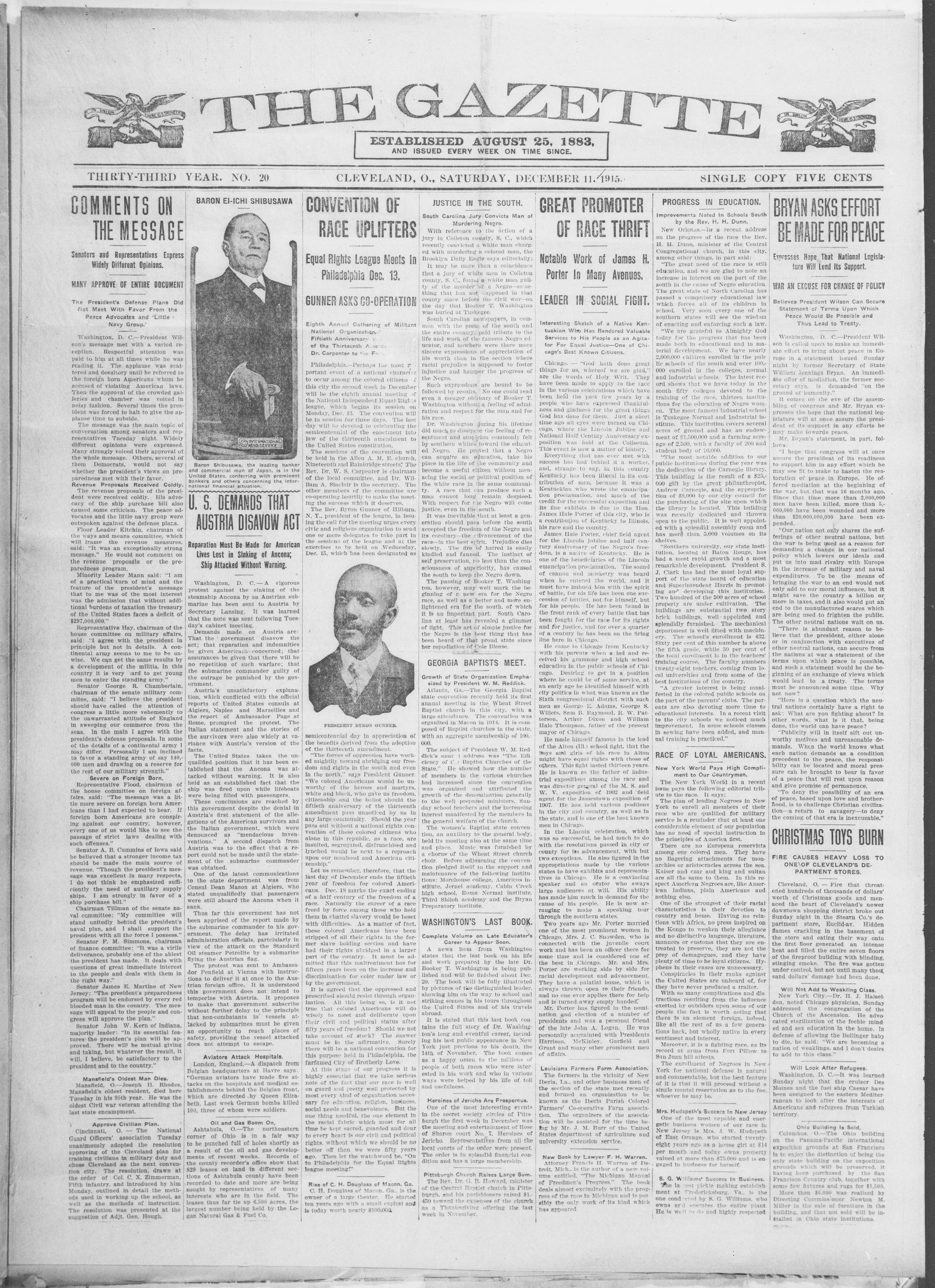
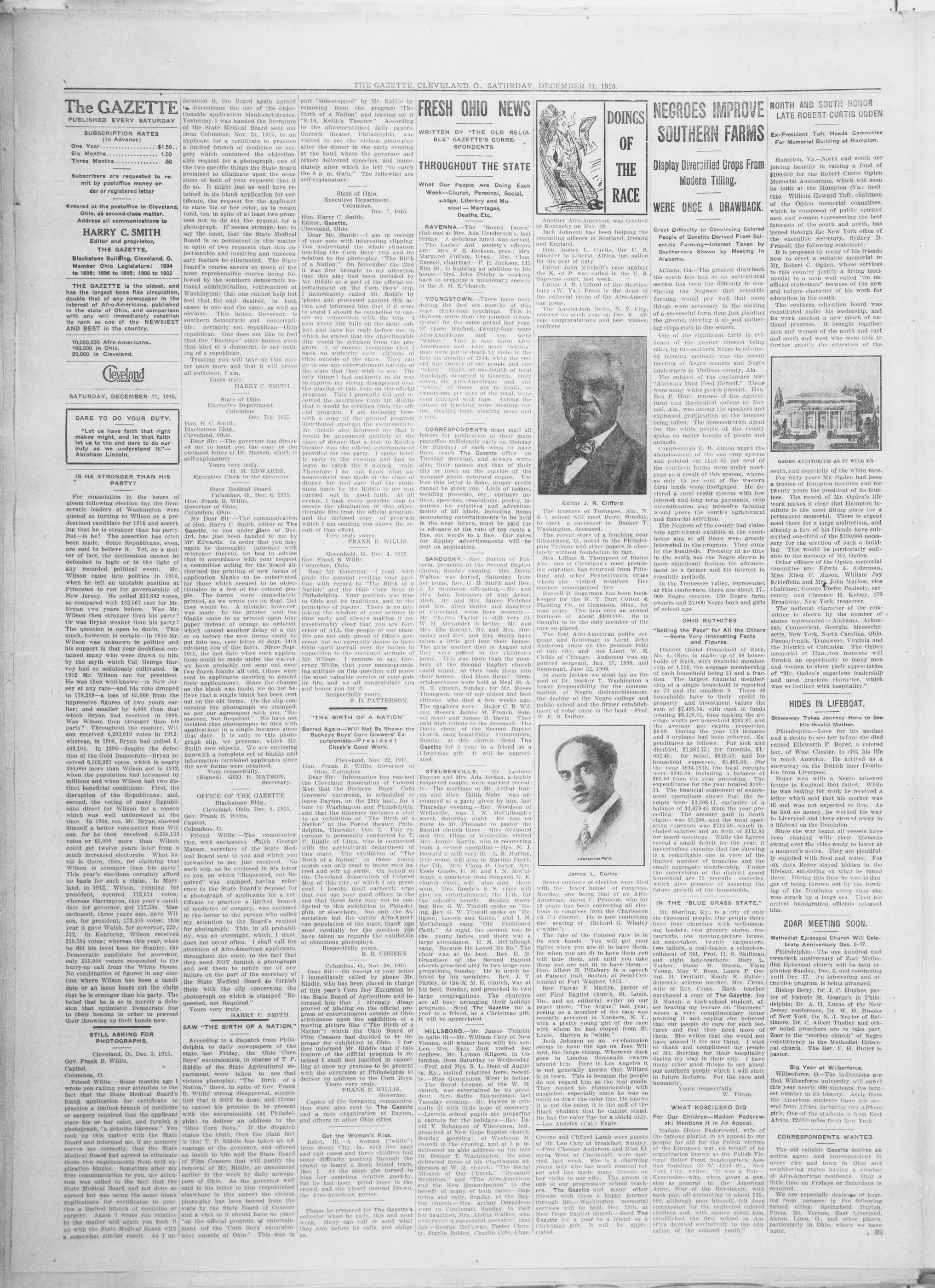
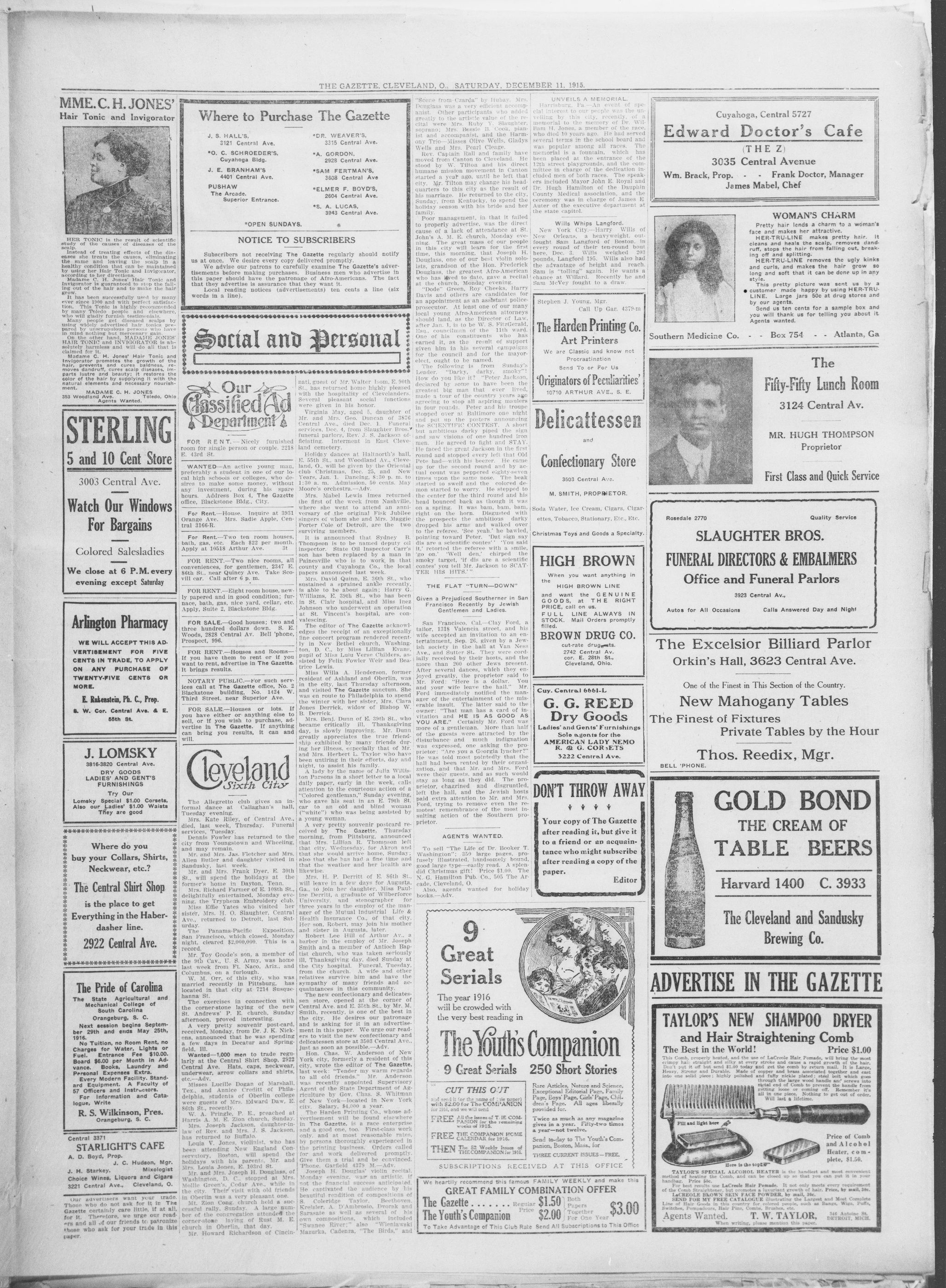
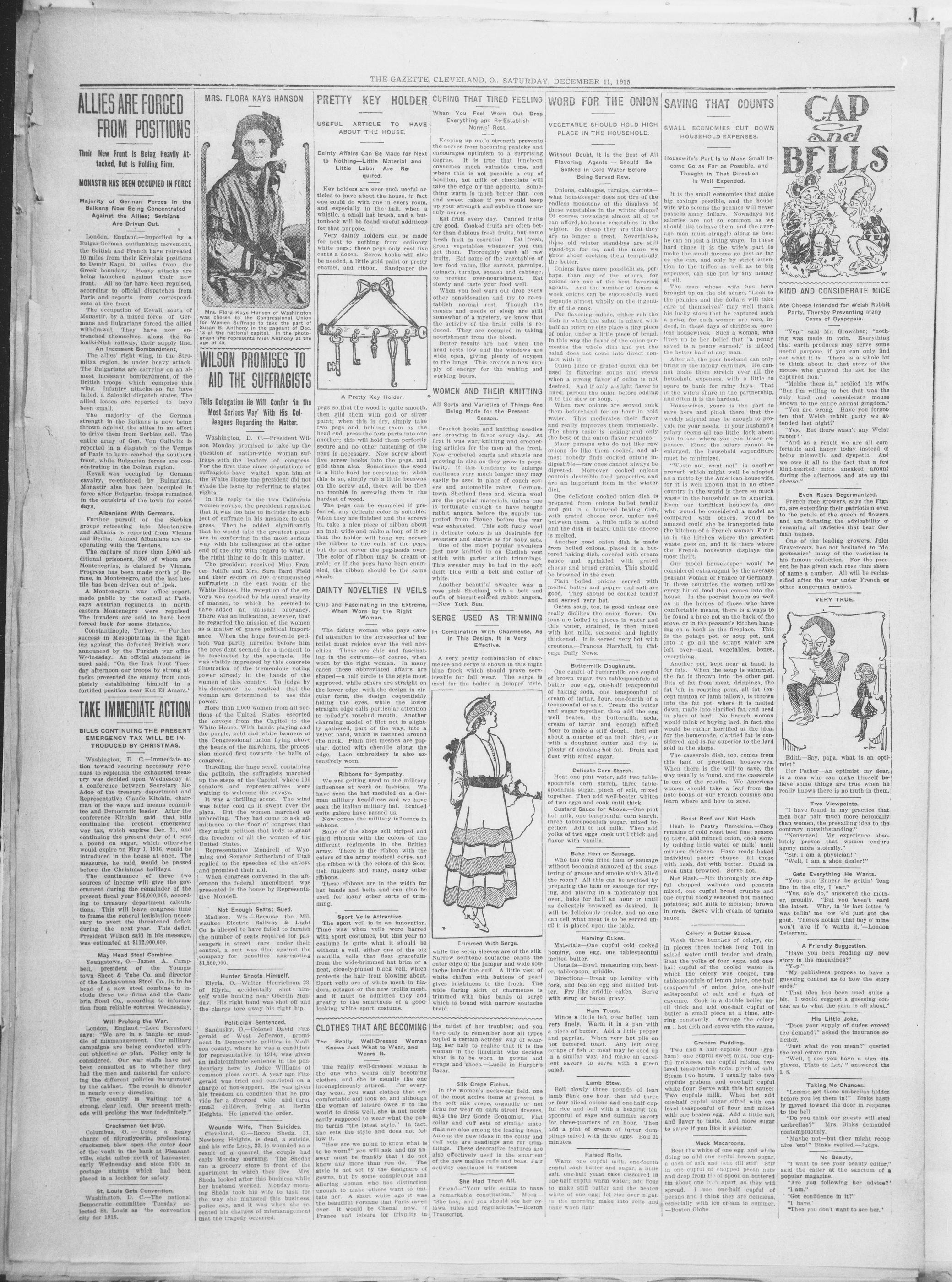
Page text (machine-generated)
IN UNION
JUSTICE STRIVED!
COMMENTS ON THE MESSAGE
Senators and Representatives Express Widely Different Opinions.
MANY APPROVE OF ENTIRE DOCUMENT
The President's Defense Plans Did Not Meet With Favor From the Peace Advocates and 'Little Navy Group.'
Washington, D. C.—President Wilson's message met with a varied reception. Respectful attention was paid to him at all times while he was reading it. The applause was scattered and desultory until he referred to the foreign born Americans whom he accused of violating American laws. Then the approval of the crowded galleries and chamber was voiced in noisy fashion. Several times the president was forced to halt to give the applause tide to subside.
The message was the main topic of conversation among signators and representatives Tuesday night. Widely different opinions were expressed. Many strongly voiced their approval of the whole message. Others, several of them Democrats, would not say whether the president's views on preparedness met with their favor.
Revenue Proposals Received Coldly.
The revenue proposals of the president were received coldly. His advocacy of the ship purchase bill also caused some criticism. The peace advocates and the little navy group were outspoken against the defense plans.
Floor Leader Kitchin, chairman of the ways and means committee, which will frame the revenue measures, said: "It was an exceptionally strong message." He would not comment on the revenue proposals, or the preparedness program.
Minority Leader Mann said: "I am of a practical turn of mind and the feature of the president's message that to me was of the most interest was the admission that without additional burdens of taxation the treasury of the United States faces a deficit of $297,000,000."
Representative Hay, chairman of the house committee on military affairs, said: "I agree with the president in principle but not in details. A continental army seems to me to be unwise. We can get the same results by a development of the militia. In this country it is very hard to get young men to enter the standing army."
Senator George R. Chamberlain, chairman of the senate military committee, said: "I believe the president should have called the attention of congress a little more vehemently to the unwarranted attitude of England in sweeping our commerce from the seas. In the main I agree with the president's defense proposals. In some of the details of a continental army I may differ. Personally I am inclined to favor, a standing army of say 140,000 men and drawing on a reserve for the rest of our military strength." Severe. on Foreign Born, Representative Flood, chairman of the house committee on foreign affairs, said: "The message was a little more severe on foreign born Americans than I had expected to hear. If foreign born Americans are conspiring against our country, however, every one of us would like to see the passage of strict laws dealing with such offenses."
Senator A. B. Cummins of Iowa said he believed that a stronger income tax should be made the main source of revenue. "Though the president's message was excellent in many respects, I do not think he emphasized sufficiently the need of auxiliary supply ships. I am strongly in favor of a ship purchase bill."
Chairman Tillman of the senate naval committee: "My committee will stand unified behind the president's naval plan, and I shall support the president with all the force I possess."
Senator F. M. Simmons, chairman of finance committee: "It was a vile deliverance, probably one of the ablest the president has made. It deals with questions of great immediate interest to the people and deals with them in the right way."
Senator James E. Martine of New Jersey: "The president's preparedness program will be endorsed by every red blooded man in the country. The message will appeal to the people and congress will approve the plan."
Senator John W. Kern of Indiana, majority leader: "In its essential features the president's plan will be approved. There will be mutual giving and taking, but whatever the result, it will. I believe, be satisfactory to the president and to the country."
Mansfield's Oldest Man Dies
Mansfield's Oldest Man Dies.
Mansfield, O.—Josepil II. Rhodes.
Mansfield's oldest resident, died here Tuesday-in his 95th year. He was the oldest Civil war veteran attending the last state encampment.
Approve Civilian Plan.
Cincinnati, O.—The National Guard Officers' association Tuesday unanimously adopted the resolution approving of the Cleveland plan for training civilians in military duty and chose Cleveland as the next convention city. The resolution, drawn at the order of Col. C. X. Zimmerman, Fifth infantry, and introduced by him Monday, outlined in detail the methods used in working up the school, as well as the methods of instruction. The resolution was presented at the suggestion of Adjt. Gen. Hough.
BARON EI-ICHI SHIBUSAWA
INTERNATIONAL MING SERVICE
Baron Shibusawa, the leading banker and commercial man of Japan, is in the United States, conferring with prominent financiers, including the international financial situation.
U. S. DEMANDS THAT AUSTRIA DISAVOW ACT
Reparation Must Be Made for American Lives Lost in Sinking of Ancona; Ship Attacked. Without Warning.
Washington, D. C. — A vigorous protest against the sinking of the steamship Ancona by an Austrian submarine has been sent to Austria by Secretary Lansing. It was learned that the note was sent following Tuesday's cabinet meeting.
Demands made on Austria are: That the government disavow the act; that reparation and indemnities be given American's concerned; that assurances be given that there will be no repetition of such warfare; that the submarine commander guilty of the outrage be punished by the government.
Austria's unsatisfactory explanation, which conflicted with the official reports of United States consuls at Algiers, Naples and Marseilles and the report of Ambassador Page at Rome, prompted the protest. The Italian statement and the stories of the survivors were also widely at variance with Austria's version of the facts.
The United States takes the unqualified position that it has been established that the Ancona was attacked without warning. It is also held as an established fact that the ship was fired upon while lifeboats were being filled with passengers.
These conclusions are reached by this government despite the denial in Austria's first statement of the allegations of the American survivors and the Italian government, which were denounced as "mendacious involvements." A second dispatch from Austria was to the effect that a report could not be made until the statement of the submarine commander was obtained.
One of the latest communications to the state department was from Consul Dean Mason at Algiers, who stated unqualifiedly that passengers were still aboard the Ancona when it sank.
Thus far this government has not been apprised of the report made by the submarine commander to his government. The delay has irritated administration officials, particularly in view of the attack on the Standard Oil steamer Petrelite by a submarine flying the Austrian flag.
The protest was sent to Ambassador Penfield at Vienna with instructions to deliver it at once to the Austrian foreign office. It is understood this government does not intend to temporize with Austria. It proposes to make that government subscribe without further delay to the principle that non-combatants in vessels attacks by submarines must be given an opportunity to reach places of safety, providing the vessel attacked does not attempt to escape.
Aviators Attack Hospitals.
London, England.—A 'dispatch from Belgian headquarters at Havervee says: "German aviators have made five attacks on the hospitals and medical establishments behind the Belgium' front, which are directed by Queen Elizabeth. Last week German bombs killed 100, three of whom were soldiers.
Oil and Gas Boom On.
Ashtabula. O.-The northeastern corner of Ohio is in a fair way to be punched full of holes shortly as a result of the oil and gas developments of recent weeks. Records of the county recorder's office show that $29 leases on land in different sections of Ashtabula county have been recorded to date and more are being sought by representatives of many interests who are in the field. The leases thus far tie up 6,500 acres, the largest number being held by the Logan Natural Gas & Fuel Co.
ESTABLISHED AUGUST 25, 1883 AND ISSUED EVERY WEEK ON TIME SINCE.
CONVENTION OF RACE UPLIFTERS
GUNNER ASKS CO-OPERATION
Eighth Annual Gathering of Militant
National Organization
Philadelphia. Perhaps the most important event of a national character to occur among the colloquial citizens of this city the second week in December will be the eighth annual meeting of the National Independent Grand Trial league, which begins its session on Monday, Dec. 12. The convention will be in session for three days. The last day will be devoted to celebrating the seminumeral of the enactment law of the Tirreth amendment to the United States constitution.
The sessions of the convention will be held of the Allen A. M. E. church, Nhectoeh and Bainbridge street. The Rev. Dr. W. S. Carpenter is chairman of the deanate committee, and Dr. William A. Shealh is the secretary. The other members of the committee are cooperating heartily to make the meeting the success which it deserves.
The Rev. Byron Gummer of Hilliard, N. X., president of the burgle, in issuing the call for the meeting urges every civic and religious organization to send one or more delegates to take part in the sessions of the burgle and at the exercises to be held on Wednesday, Dec. 15, which has been designated as
PRESIDENT BYRON GUNNER.
semicentennial day in appreciation of
the benefits derived from the adoption
of the thirteenth amendment.
"The forces of oppression have worked mightily toward abiding our freedom and rights in the south and even in the north," says President Gummer. "We colored Americans would be mortally of the heroes and martyrs, white and black, who gave us freedom, citizenship and the ballot should the fifteenth anniversary of the thirteenth amendment pass unified by us in any large community. Should the year pass out without a national rights convention of these colored citizens who alone in this republic, as a race, are insulted, segregated, distrusted and lynched would be next to a approach upon our mundum and American citizenship."
Let us remember, therefore, that the last day of December ends the fifteenth years of freedom for colored Americans. Dec. 18 marks the exact ending of a half century of the freedom of a race. Naturally the career of a race freed by force among those who hold them in chattel slavery would be beset with difficulties. As a matter of fact, these colored Americans have been stripped of all their rights in the former slave holding section and have had their rights abridged in a larger part of the country. It must be admitted that this untreatment lins for fifteen years been on the increase and discrimination for color under law or by the government.
It is agreed that the oppressed and proscribed should resist through organization. All this being so, is it not true Colored Americans will do wisely to assist and deliberate upon their civil and political status after fifty years of freedom? Should we not take account of stock? The answer must be in the affirmative. Surely there will be a national convention for this purpose held in Philadelphia, the farfamed City of Brotherly Love. At this time, of our progress it is highly essential that we take serious note of the fact that our race is well on guard and pretty well protected by most every kind of organization necessary for a nation, religion, business, social needs and benevolence. But the one thing useful, the one element in the racial tablity which must for all time be kept sacred, guarded and dear to every heart is our civil and political rights, without which we should be no better off than we were fifty years ago. Then let the watchword be, "On to Philadelphia for the Equal Rights league meeting."
Rise of C. H. Douglass of Macon, Ga. C. H. Douglass of Macon, Ga. is the owner of a large theater. He started ten years ago with a small capital and is today worth nearly $100,000.
JUSTICE IN THE SOUTH.
South Carolina Jury Convicts Man of
South Carolina Murder Negro
With reference to the action of a jury in Colleton county, S.C., which recently convicted a white man charged with murdering a colored man, the Brooklyn Dedry Leagle says credibility. It may be more than a coincidence that a jury of white man in Colleton county, S.C., found a white man guilty of the murder of a Negro as something that has not appeared in that county since before the civil war on the day that Booher T. Washington was buried at Tuskegee. South Carolina new suppes, in common with the press of the south and the entire country, paid tribute to the life and work of the famous Negro educator, and nowhere were there more sincere expressions of appreciation of its worth than in the section where racial prejudice is supposed to foster injustice and hamper the progress of the Negro. Such expressions are bound to be followed by results. No one could read even a message ordinary of Booher T. Washington without a feeling of admiration and respect for the man and forbids race.
Dr. Washington during his lifetime much to dismay in the feeling of reposition and suspicion commonly felt by southern white toward the educated Negro. He proved that a Negro can negative an education, take his place in the life of the community and become a useful citizen without mentioning the social or political position of the white race in the same community. A race that can produce such a man cannot long remain despised. With respect for the Negro will come justice, even in the south.
It was inevitable that at least a generation should pass before the south accepted the freedom of the Negro and its corollary—the advancement of the race in the best spirit. Prejudice does slowly. The fire of hatred is easily kindled and fanned. The instinct of self preservation, no less than the consciousness of superiority, has caused the south to keep the Negro down.
The passing of Booker T. Washington, however, may well mark the beginning of a new era for the Negro race, as well as a better and more enlightened era for the south, of which it is an important part. South Carolina at least has revealed a glimmer of light. This act of simple justice for the Negro is the best thing that has been heard of that proud state since her repudiation of 'Ode Blesse.
GEORGIA BAPTISTS MEET.
Growth of State Organization Emphasized by President W. M. Reddick.
Atlanta, Ga. The Georgia Baptist state convention recently held its first annual meeting in the Wheat Street Baptist church, in this city, with a large attendance. The convention was organized in Macon in 1911. It is composed of Baptist churches in the state, with an aggregate membership of 100,000.
The subject of President W. M. Reddick's annual address was "The Efficiency of 4" Baptist Churches of the State." He showed how the number of members in the various churches had increased since the convention was organized, and attributed the growth of the denomination generally to the well prepared ministers. Sunday school teachers and the increasing interest manifested by the members in the general welfare of the church.
The "women's Baptist state convention, an auxiliary to the general body, held its meeting also at the same time and place. Masle was furnished by a chorus of the Wheat Street church choir. Before adjourning the convention pledged itself to the support and maintenance of the following institutions: Morsehouse college, Amherst institute, Jernel academy, Cabin Creek high school, Rome Normal institute, Third Shiloh academy and the Bryan Preparatory institute.
WASHINGTON'S LAST BOOK
Complete Volume on Late Educator's Career It Appears Soon.
A news item from Washington states that the last book on his life and work prepared by the late Dr. Booker T. Washington is being published and will be highlighted by Dec. 20. The book will be fully illustrated by pictures of the distinguished leader, showing him on the way to school and striking scenes in his tours throughout the United States and of his travels abroad. It is stated that this last book contains the full story of Dr. Washington's long and eventful career, including his last public appearance in New York just previous to his death, the 14th of November. The book comes as a happy omen to the patients of people of both races who were interested in his work and who in various ways were helped by his life of toll and usefulness.
**Heroines of Jericho Are Prosperous.**
One of the most interesting events in the secret society circles of Pittsburgh the first week in December was the meeting and entertainment of those of Sharon court No. 7. Heroines of Jericho. Representatives from all the local courts of the order were present. The order is in scandal financial condition and has a large membership.
# B
```markdown
```
Pittsburgh Church Raissa Large Sum.
The Rev. I. B. W. Howard, minister of the Central Baptist church in Pittsburgh, and his parishioners raised $1,434 toward the expenses of the church as a Thanksgiving offering the last week in N. America.
GREAT PROMOTER OF RACE THRIFT
Interesting Sketch of a Native Kentuckian Who Has Rendered Valuable Services to His People as an Agitator For Equal Justice—Cone of Chicago's Best Known Citizens.
Chicago. "Good hath done great things for us, whereof we are great, are the words of Holy Writ. They have been made to apply to the race in the various celebrations which have been held the past few years by a people who have expressed thankfulness and gratitude for the great things that has done for them. Just a short time all eyes were turned on Chicago, where the Larson Jobbies and National Half Century Anniversary expoition was laid at the Coliseum. This event is now a matter of history. Everything that has ever met with success has had behind it a worker, and stranger to say, in this country Kentucky has been liberal in its contribution of news because it was a Kentuckian who wrote the enunciation proclamation, and much of the credit for the successful exposition and its fine exhibits is due to the Hon. James Hale Porter of this city, who is a contribution of Kentucky to Illinois, his race and the country.
James Hale Forster, chief field agent for the Lincoln jubilee and half-century anniversary of the Negro's freedom, is a native of Kentucky. He is one of the benefaries of the Lincoln emancipation formation. The sound of cotton and a history was heard when he entered the world, and it must have included him with the spirit of battle, for his life has been one succession of battle, not for himself, but for his people. He has been 'cured in the front rank of every battle that has been fought for the race for rights and for justice, and for over a quarter of a century he has been on theiring line here in Chicago.
He came to Chicago from Kentucky with his parents when a lad and received his grammar and high school education in the public schools of Chicago. Desiring to get in a position where he could be of some service, at an early age he identified himself with city politics in what was known as the Sixth congressional district with such men as George L. Adams, George S. Willets, Sam R. Raymond, R.W. Paterson, Arthur Dixon and William Hale Thompson, father of the present mayor of Chicago.
He made himself famous in the lead of the Alton Aton school light, that the boys and girls of his race in Alton might have equal rights with those of others. This light lasted thirteen years. He is known as the father of industrial expositions among the race and was director general of the M.S. and W. v. exposition of 1902 and field agent for the damneston expoion of 1907. He has held various positions in the city and country, as well as in the state, and is one of the best known men in Chicago.
In the Lincoln celebration, which was so successful, he had much to do with the resolutions passed in city of county for his advejment, with but two exceptions. He also figured in the appropriations made by the various states to have exhibits and representatives in Chicago. He is a convincing speaker and, an orator who sways large audiences at will. His ability has made him much in demand for the cause of his people. He is now arranging to make a speaking tour through the southern states.
Two years ago Mr. Porter married one of the most prominent women in Chicago, Mrs. J. C. Snowden, who is connected with the juvenile court work and has an officer there for some time and is considered one of the best in Chicago. Mr. and Mrs. Porter are working side by side for racial development and advancement. They have a palatial home, which always throws open to their friends, and no one ever applies for help and is turned away empty handed.
Mr. Porter has figured in the nomination and election of a number of presidents and was a personal friend of the late John A. Logan. He was personally associated with Presidents Harrison, McKibber, Gardelbi and Grapt and many other prominent men of gratias.
Louisiana Farmers Form Association. The farmers in the vicinity of Nebula Boria, La., and other business men of the section of the state met recently and formed an organization to be known as the Boria Parish Colored Farmers' Cooperative Farm association. The organizers of the association will be assisted for the time being by Mr. J. M. Parr of the United States department of agriculture and university extension service.
New Book by Lawyer F. H. Warren.
Attorney Farm is H. Warren of Detroit. Mih. is the author of a new volume entitled "The Michigan Manual of Producers' Progress." The book deals almost exclusively with the progress of the race in Michigan and supports the work of its kind which it has approved.
SINGLE COPY FIVE CENTS
PROGRESS IN EDUCATION.
Improvements Noted In Schools South
by the Rev. H. H. Dunn.
New Orleans in a recent address
on the progress of the race the Rev.
H. H. Dunn, minister of the Central
Congregational church. In this city,
among other things, impart said:
"The great need of the race is still education, and we are glad to note an increase in interest on the part of the south in the cause of Negro education. The great state of North Carolina has passed a compulsory educational law which forces all of its children in school. Very soon every one of the southern states will see the wisdom of enclosing and enforcing such a law. "We are grateful to Almighty God for the progress that has been made both in educational and in material development. We have nearly 200,000 children enrolled in the public schools of the south and over 100,000 enrolled in the colleges, normal and industrial schools. The latest reports show that we have today in the south fifty colleges devoted to 65 the training of the race, thirteenth institutions for the education of Negro women. The most famous industrial school is Tuskegee Normal and industrial institute. This institution covers several acres of ground and has an endowment of $15,000,000 and a farming average of 2,500, with a faculty of 200 and student body of 36,000.
"The most notable addition to our public institutions during the year was the dedication of the Carnegie library. This building is the result of a $25,000 gift by the great philanthropist, Andrew Carnegie, and the appropriation of $8,000 by our city council for the purchasing of the site upon which the library is located. This building was recently dedicated and thrown open to the public. It is well appointed with a splendid assembly room and has more than 5,000 volumes on its shelves.
"Southern university, our state institution, located at Baton Rouge, has had a most rapid growth and a most remarkable development. President S. J. Clark has had the most loyal support of the state board of education and Superintendent Harris in promoting and developing this institution. Two hundred of the 500 acres of school property are under cultivation. The buildings are substantial two story buildings, well appointed and splendidly furnished. The mechanical department is well fitted with machinery. The school's enrollment is 432, sixty per cent of this number is in the teachers' training courses. The faculty numbers twenty-eight teachers, coming from local universities and from some of the best institutions of the country.
"A greater interest is being manifested in the colored public schools on the part of the parents' clubs. The parents are also devoting more time to educational interests. In a recent visit to the city schools we noticed much improvement. In some schools classes in sowing have been added, and manual training is practiced."
RACE OF LOYAL AMERICANS
New York World Pays High Compliment to Our Country.
The New York World in a recent issue pays the following editorial tribute to the race. It says:
The plan of leading Negroes in New York to enroll all members of their race who are qualified for military service is a reminder that at least one considerable element of our population has no need of special instruction in the principles of America first.
There are no European reservists among our colored men. They have no lingering attachments to monarchies or aristocracy across the sea. Kaiser and carr and king and sultan are all the same to them. In this respect American Negroes are, like American Indians, plain Americans and nothing else.
One of the strongest of their racial characteristics is their devotion to country and home. Having no relations with Africa, no press inspired on the Kongo to weaken their allegiance and no distinctive language, literature, manners or customs that they are entrenched to preserve, they are not the prey of demagogues, and they have plenty of time to be loyal citizens. Hyphes in their cases are unnecessary.
Conspiricies in their ranks against the United States are unheard of, for they have never produced a traitor. With so many complications and distractions resulting from the influence exerted by outsiders upon some of our people the fact is worth noting that there is in element foreign, indeed, like all the rest of us a few generations back, but wholly native in every sentiment and interest. Moreover, it is a fighting race, as its record at arms from Fort Pillow to San Juan Hill attests. The entitlement of Negroes in New York for national defense is natural and commendable, but the best feature of it is that it will proceed without a single mental reservation, as to the foe, whoever be may be.
Mrs. Hudspeth's Success In New Jersey One of the most capable and evergetic business women of our race in New Jersey is Mrs. J. W. Hudspeth of East Orange, who started twenty eight years ago as a house girl at 81 per month and twenty years properly valued at more than $100,000 and enraged in business for himself.
S. G. W. Hudspeth's Success In Business. The laureate fighting establishment at Westbury, Va., is the one condemned by S. G. W. Hudspeth who owns a house plant. He is w.
IN DAILY
IN GLOBE
BRYAN ASKS EFFORT BE MADE FOR PEACE
Everresses Hope. That National Legislature Will Lend Its Support.
WAR AN EXUSE FOR CHANGE OF POLICY
Believes President Wilson Can Secure Statement of Terms Upon Which Peace Would Be Possible and Thus Lead to Treaty:
Wilson mentions, D. C. President Wilson 54—all 6 months to make an immediate date 7-7 to bring about peace in Europe in a statement issued in Europe night b. Former Secretary of State Wilson lobbies Bryan. An immediate order of administration, the former secretary presides, is demanded "on the ground of humanity."
It comes on the eve of the assembling of congress and Mr. Bryan expresses the hope that the national legislature will at once assure the president of its support in any efforts he may make towards peace.
Mr. Bryan's statement, in part, follows:
"I hope that congress will at once assemble the president of its readiness to support him in any effort which he may see fit to make to hasten the restoration of peace in Europe. He offered mediation at the beginning of the war, but that was 16 months ago. Since that time more than 2,000,000 men have been killed, more than 5,000,000 have been wounded and more than $20,000,000,000 have been expended."
"Our nation not only shares the sufferings of other neutral nations, but the war is being used as a reason for demanding a change in our national policy which lowers our ideals and put us into mad rivalry with Europe in the increase of military and naval expenditures. To be the means of bringing the war to an end would not only add to our moral influence; but it might save the country a billion or more in taxes, and it also would put an end to the manufactured scares which are being used to frighten the public. The other neutral nations wait on us. "There is abundant reason to be believe that the president, either alone or in conjunction with executives of other neutral nations; can seep from the nations at war a statement of the terms upon which peace is possible, and such a statement would be the beginning of an exchange of views which would lead to a treaty. The terms must be announced some time. Why not now? "Here is a question which the neutral nations certainly have a right to ask: What are you fighting about? In other words, what is it that, being done, the world can have peace? "Publicity will in itself sift out unworthy motives and unreasonable demands. When the world knows what each nation demands as a condition precedent to the peace, the responsibility can be located and moral pressure can be brought to bear in favor of a peace that will rest upon reason and give promise of permanence.
"To deny the possibility of an era of peace, based upon love and brotherhood—hailing at challenge—a routine of savages to dominate the coming of that era is inexcusable."
CHRISTMAS TOYS BURN
FIRE CAUSES HEAVY LOSS TO ONE OF CLEVELAND'S DEPARTMENT STORES.9
Cleveland, O. — Fire that threatened hundreds of thousands of dollars' worth of Christmas' goods and menaced the heart of Cleveland's newer downtown shopping district broke out Sunday, night in the Stearn Co.'s department store, Euclid-av. Hidden flames crackling in the basement of the store and eating their way onto the first floor generated an intense heat and filled the entire seven floors of the fireproof building with blinding, stinging smoke. The fire was gotten under control, but not until many thou sand dollars' damage had been done.
Will Not Add to Weakling Class.
New York City—Dr. H. J. Haiselden, noted Chicago physician, Sunday addressed the congregation of the Church of the Ascension: He advocated sterilization of the foeble minded and sex education in the home. In defense of allowing the Bollinger baby to die, he said: "We are becoming a nation of weaklings, and I don't desire to add to this class."
Will Look After Refugees.
Washington, D.C.—It was learned Sunday night that the cogiser Des Moines and the fuel ship Carar have been assigned to the eastern Mediterranean to look after the interests of Americans and refugees from Turkish territory.
Ohio Building Is Sold
Columbus O. O. The Dh.) building on the toronto facade international expedition arcade at Soft Francisco is to enjoy the distinction of being the only state building on the expedition arcade which will be preserved, at having been constructed by the saint Francisco y crujice club, together with some fitness and rugs for $100. More than $100 was resumed by Directing y commissioner Newton. Mr. Mitter in the role of furniture in the building and that sold will be installed on Ohio state institutions.
One Year.....$1.50.
Six Months.....1.00
Three Months......50
Subscribers are requested to re-
mit by postoffice money or
order or registered letter
Entered at the postoffice in Cleveland
Ohio, as second-class matter.
Address all communications to
Blackstone Building, Cleveland, O.
Member Ohio Legislature: 1894
to 1896; 1896 to 1898; 1900 to 1902
THE GAZETTE is the oldest, and has the largest bona fide circulation, double that of any newspaper in the interest of Afro-Americans, published in the state of Ohio, and comparison with any will immediately establish its rank as one of the NEWSIEST AND BEST in the country.
10,000,000 Afro-Americans.
160,000 in Ohio.
20,000 in Cleveland.
SATURDAY, DECEMBER 11, 1915.
"Let us have faith that right makes might, and in that faith let us to the end dare to do our work to understand it."—Abraham Lincoln.
IS HE STRONGER THAN HIS PARTY?
STILL ASKING FOR PHOTOGRAPHS.
Cleveland, O., Dec. 3, 1915.
Gov. Frank B. Willis,
Capitol,
Columbus, O.
Friend Willis:—Some months ago I wrote you calling your attention to the fact that the State Medical Board's blank application for certificate to practice a limited branch of medicine or surgery required that the applicant state his or her color, and furnish a photograph, "a genuine likeness." You took up this matter with the State Board and informed me, if my memory serves me correctly, that the State Medical Board had agreed to eliminate these two requirements from said application blanks. Sometimes after my first communication to you, my attention was called to the fact that the State Medical Board had not done as agreed but was using the same blank applications for certificates to practice a limited branch of medicine or surgery. Again I wrote you relative to the matter and again you took it up with the State Medical Board with a somewhat similar result. As I un-
derstood it, the Board again agreed to discontinue the use of the objectionable application blank-certificates. Yesterday I was handed the literature of the State Medical Board sent out from Columbus, Nov. 24, 1915, to an applicant for a certificate to practice a limited branch of medicine or surgery which contained the objectionable request for a photograph, one of the two specific things the State Board promised to eliminate upon the occasions of both of your requests that it do so. It might just as well have retained in its blank application for certificate, the request for the applicant to state his or her color, as to retain (and, too, in spite of at least two promises not to do so) the request for a photograph. It seems strange, too, to say the least, that the State Medical Board is so persistent in this matter in spite of two requests that this objectionable and insulting and unnecessary feature be eliminated. The State Board's course savors so much of the most reprehensible course being followed by the southern democratic national administration, (entrenched at Washington) that one cannot help but feel that the end desired, in both cases, is one and the same, as well as obvious. This latter, Governor, is southern democratic and contemptible; certainly not republican—Ohio republican. One does not like to feel that the "Buckeye" state houses even that kind of a democrat, to say nothing of a republican.
Trusting you will take up this master once more and that it will prove all sufficient, I am,
Yours truly,
HARRY C. SMITH.
Hon. H. C. Smith,
Blackstone Bldg.,
Cleveland, Ohio.
Dear Sir:—The governor has direct
ed me to hand you the copy of the
enclosed letter of Dr. Matson, which is
self-explanatory.
Yours very truly,
H. M. EDWARDS,
Executive Clerk to the Governor.
State Medical Board.
Columbus, O., Dec. 6, 1915.
Hon. Frank B. Willis,
Governor of Ohio.
My Dear Sir:—The communication of Hon. Harry C. Smith, editor of The Gazette, to you under the date of Dec 3rd, has just been handed to me by Mr. Edwards. In order that you may again be thoroughly informed with reference thereto, we beg to advise that in accordance with your request a committee acting for the board authorized the printing of new forms of application blanks to be substituted for those which have been issued in law of the colored people. The forms were immediately printed, as we wrote you on Sept. 2nd they would be. A mistake, however, was made by the printer and the blanks came to us printed upon blue paper instead of orange as ordered, which caused another delay of a day or so before the new forms could be put into use, (see letter of Sept. 14th advising you to date when such applications could be made under the waiver, we have probably not sent out over two dozen blanks instead, (these were sent to applicants desiring to amend their applications). Since the change on the blank was made, we do not believe that a single blank has been sent out on the old forms. On the slip concerning the photograph we stamped, as per our agreement with you. "Requested, Not Required. We have not received applications in a single instance since that date. It is only to this photograph, we presume, to which Mr. Smith now objects. We are enclosing herewith a complete set of blanks and information furnished applicants since the new forms were obtained.
Very respectfully,
(Signed) GEO. H. MATSON,
Secretary.
Cleveland, Ohio, Dec. 8, 1915.
Gov. Frank B. Willis.
Capitol.
Columbus, O.
Friend Willis:—The communication, with enclosures which George Matson, secretary of the State Medical Board sent to you and which you forwarded to me, just received. No such slip, as he enclosed in his letter to you, on which "Requested, not Required" was stamped, having reference to the State Board's request for a photograph of applicants for a certificate to practice a limited branch of medicine or surgery, was enclosed in the letter to the person who called my attention to the Board's request for photograph. This, in all probability, was an oversight, which, I trust, does not occur often. I shall call the attention of Afro-American applicants, throughout the state, to the fact that they need NOT furnish a photograph and ask them to notify me of any failure on the part of the secretary of the State Medical Board to furnish them with the slip concerning the photograph on which is stamped "Requested, not Required."
SAW "THE BIRTH OF A NATION."
According to a dispatch from Philadelphia to daily newspapers of the state, last Friday, the Ohio "Corn Boys" excursionists, in charge of T. P. Riddle of the State Agricultural department, were taken to see that vicious photoplay, "The Birth of a Nation," there, in spite of Gov. Frank B. Willis' strong disapproval, suggestion that it NOT be done, and threat to cancel his promise to be present with the excursionists (at Philadelphia) to deliver an address to the "Ohio Corn Boys." If the dispatch states the truth, then the plain fact is that T. P. Riddle has taken an advantage of the governor, and offered an insult to him and the State Board of Film Censors that will justify the removal of Mr. Riddle, as announced earlier in the week by daily newspapers of Ohio. As the governor well said in his letter to him (republished elsewhere in this paper) the vicious photo-play has been barred from the state by the State Board of Censors and a visit to it should have no place "on the official program of entertainment (of the 'Corn Boys' excursionists) outside of Ohio." This was in
part "side-stepped" by Mr. Riddle by removing from the program "The Birth of a Nation" and leaving on it "8:10, Keith's Theater." According to the aforementioned daily papers, Garrick theater, Philadelphia, was visited to see the vicious photo-play after the dinner in the early evening at the hotel where the governor and others delivered speeches, and immediately after which he left "to catch the 8 p. m. train." The following are self-explanatory:
FRESH OHIO NEWS
WRITTEN BY "THE OLD RELIABLE" GAZETTE'S CORRESPONDENTS
THROUGHOUT THE STATE
Dec. 7, 1915.
Hon. Harry C. Smith,
Editor, Gazette,
Cleveland, Ohio
Dear Mr. Smith:—I am in receipt of your note with interesting clipping. You understand the whole situation touching the Corn Boys' trip and its relation to the photo-play, "The Birth of a Nation." On November the 23rd it was first brought to my attention that this play had been included by Mr. Riddle as a part of the official entertainment on the Corn Boys' trip. I immediately called Mr. Riddle by 'phone and protested against this action and informed him that if it were to stand I should be compelled to cancel my connection with the trip. I also wrote him fully on the same subtitle that he replied before me, in which he stated that the film would be stricken from the program. I, of course, recognize that I have no authority over citizens of Ohio outside of the state. They can go to see any entertainment outside of the state that they wish to see. The only thing I had authority to do was to express my strong disapproval over the placing of this item on the official program. This I promptly did and received the assurance from Mr. Riddle that it would be stricken from the official program. I am inclosing here with copy of the printed program distributed to me by Mr. Riddle. I also informed me that it would be announced publicly at the close of dinner that a visit to Keith's theater was the official entertainment provided for the party. I spoke briefly early in the evening and had to leave to catch the 8 o'clock train. Therefore I do not know what an announcement was made at the close of dinner, but feel sure that the statement made by Mr. Riddle to me was carried out in good faith. At all events, I took every possible step to ensure that the reasonable film from the official program, and the inclosed copy of program which I am sending you shows the result of that effort.
Greenfield, O., Dec. 4, 1915.
Gov. Frank B. Willis,
Columbus, Ohio.
Dear Mr. Governor:—I read with
pride the account reciting your posi-
tion with regard to "The Birth of a
Nation" and the Ohio Corn Boys in
Philadelphia. Your position was true
to Ohio and its traditions, and to the
mind of your position. There is no mishap taking the wisdom of your actions in thus early and always making it unquestionably clear that you are Governor of ALL the people of our state.
We are not only proud of Ohio's governor, but we earnestly desire to have Ohio spirit prevail over the nation in opposition to the sectional attitude of Mr. Wilson. I venture to say, Governor Willis, that your uncompromis-
lag attitude on this subject is the most valuable service of your public life, and we all congratulate you and honor you for it.
Respectfully yours,
F. D. PATTERSON.
"THE BIRTH OF A NATION"
Barred Again--Will Not Be Shown the Buckeye Boys' Corn Growers' Excursionists—President Cheek's Good Work.
Cleveland, Nov. 22, 1915
Hon. Frank B. Willis, Governor of Ohio, Columbus
Dear Sir: Information has reached the Cleveland Association of Colored Men that the Buckeye Boys' Corn Growers' excursion, is scheduled to leave Dayton, on the 29th inst., for a tour to Washington and Philadelphia, and that the itinerary includes a visit to an exhibition of "The Birth of a Nation" at the then State House on December 2. This excursion is personally conducted by T. P. Riddle of Lima, who is connected with the agricultural department of this state. The exhibition of "The Birth of a Nation" to these young minds can only tend to incite race hatred and stir up srife. On behalf of the African-American Men of this city, of which I am president, I hereby most earnestly urge that you use your good offices to the end that these boys may not be conducted to this exhibition in Philadelphia, or elsewhere. Not only the Association but the entire Afro-American population of the state, thank you most for your position you have taken as regards the exhibition of obnoxious photonals.
Columbus, O. Nov. 26, 1915. Dear Sir: On receipt of your letter I immediately called by phone Mr. Riddle, who has been placed in charge of this year's Corn Boy Excursion by the State Board of Agriculture and informed him that I strongly disapproved the program of entertainment outside of Ohio attendance upon the exhibition of a moving picture film ("The Birth of a Nation") which the Ohio Board of Film Censors had decided to be improper for exhibition in Ohio. I further requested that the feature of the official program is retained I shall feel justified in canceling at once my promise to be present with the excursion at Philadelphia to deliver an address to the Corn Boys.
Copies of the foregoing communication were also sent to The Gazette and a race organization at Dayton and others in other Ohio cities.
Get the Woman's Kiss.
Joliet, Ill.-A woman ("white") from Sioux City, Ia., with five bags and suit cases and three children had some difficulty pushing through the crowd to board a Rock Island train, Dec. 1. At the steps she turned to kiss her assisting relative good-by, but he had been pried loose in the crowd, and she kissed instead Brown, the Arro-American porter.
Please be prepared for The Gazette's collector when he calls, this and next week. Many can call or send what they owe before he calls, and oblige us.
FRESH OHIO NEWS
WRITTEN BY "THE OLD RELIA BLE" GAZETTE'S CORRE SPONDENTS
THROUGHOUT THE STATE
What Our People Are Doing Each Week—Church, Personal, Social, Lodge, Literary and Musician—Margaret
RAVENNA—The "Round Dozen" club met at mrs. Ada Henderson's last Friday. A delicious lunch was served. —The Ladies' Aid society's officers are: Mrs. F. E. Jackson, pres.; Mrs. Margaret Foullain, treas.; Mrs. Chas Russell, chairman—P. E. Jackson, 515 E. Church, to his house—Mrs. John Prisby is working hard to organize a missionary society in the A. M. E./Church.
YOUNGSTOWN.—There have been during the first six months of this year thirty-four lynchings. This is thirteen more than the number (twenty-one) for the same period last year. Of those lynched, fourty-four were Afro-Americans and ten were "whites." This is four more Afro-Americans and nine more "whites" than were put to death by mobs in the first six months of 1914, when the record was twenty of our people and one "white." Eight, or one-fourth of total lynchings, occurred in Georgia. Only six Afro-Americans and one white, six of those put to death or twenty-one per cent of the total, were even charged with rape. Among the causes of lynching were stealing cotton, stealing hogs, stealing meat and a cow.
CORRESPONDENTS must mail all letters for publication at their all postoffice sufficiently early on Monday (or Sunday) of each week to have them reach The Gazette office on Tuesday morning, and always write also, their names and that of their city or town on the outside of the wrapper about returned copies. Unless this latter is done, proper credit cannot be given you. Lists of names, wedding presents, etc., obituary notices, speeches, resolutions, poetry, inquiries for relatives and advertisements announcing entertainments to be held in the near future, must be paid for in advance at the rate of ten cents a line, six words to a line. Our rates for display advertisements will be sent on application.
SANDUSKY.—Rev. Burton of Fostoria, preached at the Second Baptist church, Sunday evening.—Mrs. David Walton was buried, Saturday, from her home, Rev. G. D. Smith and Rev. J. D. Singleton officiating.—Mr. and Mrs. John Robinson of Ann Arbor, Mich. Mr. and Mrs. James Fletcher and Mrs. Allen Butler and daughter recently. Mr. Charles Taylor is still ill. W. H. Alexander is better.—Mr. and Mrs. Ebe Garrett, Mr. and Mrs. Hornaday and Rev. and Mrs. Smith have taken a little girl into their homes. The girls' mother died in August and they were placed in the children's home. This was more than the members of the Second Baptist church to take care of their homes. God bless them!—Memorial services were held at St. Al. M. E. church, Sunday, for Mr. Moses Thompson, one of our oldest and best citizens, who died a few weeks ago. The speakers were: Major C. B. Wilcox, Messrs. James M. French, Samuel Scott and James M. Davis. They palm hilt tribute to the deceased. The church, sang beautifully. Communion, Sunday, at this church.—Send The Gazette for a year to a friend as a Christmas gift. It will be appreciated.
STEUBENVILLE. — Mr. Latimer Boycan and Mrs. Ada Jordan, a highly respected couple, were married recently. — The marriage of Mr. Arthur Hanna and Miss Edith Nuby was announced at a party given by him, last Thursday evening. — Reed Woodson of Wellsville, was I. N. McCullough's guest, Saturday night. He was en route to M. Pleasant to pastor the church and Mrs. Hines of Wellsville, visited Mrs. Jennie Martin, who is recovering from a severe operation. — Mrs. N. J. Howard is still very ill. — I. L. Murray, lyrical tenor, will sing in Martins Ferry, the 7th, Mrs. Clara B. Carter, Mrs. Essie Goode, H. M. and I. N. McCullough, a quartette from Simpson M. E. church choir, will also sing there. Mrs. Goode's S. S. class will give an entertainment, the 17th, for the school's benefit, Sunny memorial day. Mrs. Tinduld spoke "Ating, Rev. G. Winduld spoke on "Religion; Losses and Gains", and I. N. McCullough sang "Old Fashioned Faith." At night, the sermon was to the young ladies, and there was a large attendance. H. M. McCullough sang, "Because He Loved Me So." The choir was at its best. Rev. E. M. Grandison of the Second Baptist church preached ably to two large congregations, Sunday. He is much beloved by his meneh. Church, at 3. Parley, of the M. A. M. church, was his best, Sunday, and preached to two large congregations. The churches are inviting their holiday programs. — Send The Gazette for a year to a friend, as a Christmas gift. It will be appreciated.
HILLSBORO—Mr. James Trimble is quite ill—Mr. William Cary of New Vienna, will winter here with his son, Leo—Mrs. Kate Zink visited her nephew, Mr. Lyman Kigleo in Boise. He met Mrs. Kigleo—Prof. and Mrs. R. L. Dent of Augusta, Ky., visited relatives here, recently—Miss Georgianna West is better. —The Royal League, of the W. M. church, was entertained by its president, Mrs. Sallie Zimmerman, last week. —The ill-health ill with little hope of recovery
—Lincoln school pupils are preparing a cantata for the holidays.—Rev. David V. Bohannon of Vincennes, Ind., preached at New Hope Baptist church, Sunday morning; at Wesleyan M. church in the evening, and at 3 p. m. delivered an able address on the late Dr. Booker T. Washington. He also delivered three of his Chautauqua addresses at W. m. church. "The Social Mission of Our Church." "Dynamic Evolution," and "The Afro-American and the New Emancipation" to the benefit of many of both students tising and the Bap. church—Mrs. Arthur Donaldson went to Cincinnati, Sunday, to visit her daughter, Mrs. Aetha Walker, who underwent a successful operation; that day—George McCowan, Foster Christy, Startle Bolden, Charlie Chas.
DOINGS
OF
THE
RACE
Another Afro-American was lynched
in Kentucky on Nov. 28.
Jack Johnson has been helping the recruiting officers in Scotland, Ireland, and England.
Hon. James L. Curtis, the U. S. minister to Liberia, Africa, has sailed for his post of duty.
Editor John Mitchell's case against the K. of P. was called in the U. S. Supreme court, last week.
Editor J. R. Clifford of the Martinsburg (W. Va.) Press is the dean of the editorial corps of the Afro-American Society.
The Amsterdam News, N. Y. City, entered its sixth year on Dec. 6. Accept congratulations and best wishes, confrence.
Editor J. R. Clifford
The trustees of Tuskegee, Ala., N. & I. school will meet there, Monday, to elect a successor to Booker T. Washington, deceased.
The recent story of a lynching near Gibsonburg, O., noted in the Philadelphia Tribune and other papers is absolutely without foundation in fact.
Mrs. Lillian R. Thompson of Blaine Ames, one of the land's most prominent schools, has joined Pittsburgh and other Pennsylvania climes where she visited relatives. Her mother accompanied her.
Russell B. Sugarman has been bookkeeper for the W. T. Burt Cotton & Planting C. of Gunnison, Miss., for nine years. The firm does an annual business of about $100,000. He is thought to be the only member of the race so placed.
The first Afro-American police sergeant and beutenant is Lieut. John Anderson now on the board of O. City (of) Lieut. W. E. Childs of Chicago. Anderson was appointed sergeant, Jan. 17, 1898, and beutenant, June 22, 1908.
In stern justice we must lay on the soul of Dr. Booker T. Washington a heavy responsibility for the consumption of Negro disfranchisement the decline of the Negro college and public school and the firmer establishment of color caste in the land.—Prof W. E. B. DuBois.
COMPREATIVE PETERS
James L. Curtis
Seven contests of election were filed with the lower house of congress, Monday, one being that of an Afro-American, Aaron P. Prioleau, who for 16 years has been contesting all elections to congress from the Charleston C. Court. He is now contesting the seat of Richard G. Whaley ("white"). The fate of the Colored race is in its own hands. You will get your rights when you are fit to have them, for when you are fit to have them you will take them, and until you take them you are not fit to have them.—A speech at Faneuil Hall, Boston, at Semi-Centennial of Fort Wagner, 1913. Rev. Farrar F. Martyn, pastor of our First Baptist church, St. Louis, Mo., and an editorial writer on our paper there, "The Argus," last year, posing as a member of the race was recently arrested in Yonkers, N. Y., with a pretty young girl of the race from St. Louis, Martyn is "white."
Jack Johnson as an ex-champion seems to have the ups on Jess Willard, the fungo champ. Wherever Jack goes in London thousands swarm around him. Here in Los Angeles it is not generally known that Willard is in town. This is because the people do not regard him as the real goods, but as a person with suspicion, especially since he was so quick to draw the color line. He knows it is not the color, it is the gaff of the Black phalanx that he cannot stand. He has the color line for a shield only. —Los Angeles (Cal.) Eagle.
Greene and Clifford Lamb were guests of Mr. Leo Cary at breakfast, Sunday. —Prof. Chester Anderson and Miss Elmyra West of Cincinnati, were married, last week. She is a charming young lady who has much musical talent and has made many friends on her visits to our city. The groom is one of our progressive school teachers. The Gazette and many other friends wish them a happy journey through Washington memorial service will be held, Dec. 19th, at New Hope Baptist church—Send The Gazette for a year to a friend as a Christmas gift. It will be appreciated.
WERE ONCE A DRAWBACK.
Great Difficulty In Convincing Colored People of Benefits Derived From Scientific Farming—Interest Taken by Southerners Shown by Meeting In Alabama.
Atlanta, Ga.—The greatest drawback the south has had as an agricultural section has been the difficulty in convincing the Negroes that scientific farming would pay and that more things were necessary in the making of a successful farm than just planting the ground, plowing it up and gathering crops each in due season.
One of the significant facts in evidence of the greater interest being taken by the southern Negro in advanced farming methods was the recent meeting of Negro tenants and Negro landowners in Madison county, Ala.
The subject of the conference was "Alabama Must Feed Herself." There were many white people present. Hon Ben P. Hunt, trustee of the Agricultural and Mechanical college at Normal, Ala., was among the speakers and expressed gratification at the interest being taken. The demonstration agent for the white people of the county spoke on better breeds of plants and animals.
Congressman E. B. Almon urged the abandonment of the one crop system and pointed out that 55 per cent of the southern farms were under mortgage as a result of this system, whereas only 15 per cent of the western farms were mortgaged. He declared a rural credit system with low interest and long term payments, crop diversification and intensive farming would prove the south's agricultural and financial salvation.
The Negroes of the county had elaborate agricultural exhibits at the courthouse and at all times were greatly interested in the program. They came by the hundreds. Probably at no time in the south has the Negro shown in more significant fashion his advancement as a farmer and his interest in scientific methods. In the Tennessee valley, represented at this conference, there are about 17,000 Negro tenants, 150 Negro farm owners and 25,000 Negro boys and girls of school age.
OHIO RUTHITES
"Setting the Pace" for All the Others
—Some Wonderful Interesting Facts
and Fiction
District Grand Household of Ruth, No. 4, Ohio, is made up of 48 households of Ruth, with financial membership of 1,520, the average membership of each household being 21 and a fraction. The largest financial membership of a single household is reported as 73 and the smallest 9. These 48 households have to their credit in property and income values to be $7,495.54, with cash fund totaling $6,128.51, thus making the average worth per household $283.87, and the average per capita proportion $8.88. During the year 139 inmates and 8 orphans had been relieved. Expenditures as follows: For sick and disabled, $1,882.15; for funerals, $1,902.45; for relief, $819.53; and for housekeeping, $454.08, for year 1914.15, the receipts were $454.86, including a balance of $63.90 from the year preceding. The expenditures for the year totaled $200.31. The financial statement of endowment operations shows that the receipts were $3,308.41, exclusive of a balance of $1,679.45 from the year preceding. The amount paid in death expenses was $3,400.00, expenses were $746.50, which included salaries and an item of $113.93 for board meetings. While the figures reveal a small deficit for the year, it nevertheless remains that the showing is a remarkable one in view of the limited number of branches and the small aggregate membership. Under the household are 13 juvenile societies, which give promise of assuring the future growth of the households.
IN THE "BLUE GRASS STATE."
Mt. Sterling, Ky., is a city of only six thousand people. Our people there have four churches with well-meaning leaders, two grocery stores, restaurants, one moving-picture house, an undertaker, twenty carpenters, two tailors, a coal-dealer, a school-enrollment of 341, Prof. H. S. Skillman and eight lady-teachers: Mary L. Tucker, Susie M. Brown, Viola Young, May V. Bean, Laura P. Oww, B. Vullett, Emily C. Bush, domestic science teacher, Mrs. Cross, wife of Rev. Cross. Each teacher purchased a copy of the *Gazette*, Isa B. Mason, a high-school student, after hearing my lecture on "Business" wrote a very complimentary letter praising it and saying she believed that our people do care for such lectures and that they need more of them. She writes that she would not have missed it for any thing. I wish to thank and compliment my people of Mt. Sterling for their hospitality during my visit to many other good things to say about our southern people which I will state in future lectures. For the race and humanity.
Yours respectfully. W. Tilton.
WHAT KOSCIUSKO DID
For Our Children—Madam Paderew
ski Mentions It in An Appeal,
Madam Helen Patersewki, wife of
the famous pianist, in an appeal to
our people for aid for the Polish victims
of the European war, on behalf of
an organization known as the Polish Victims' Relief Fund, headquarters, Acoulian Building, 33 W. 42nd St., New York City, writes: "It was a Pole Kosciusko—who, when given a pension as general in the American Army, War of the Revolution, with back pay, all amounting to about $15,000, although poor himself, felt deep commission of the new colored children and with money given established the first school in America devoted exclusively to the education of the colored youth."
NORTH AND SOUTH HONOR
LATE ROBERT CURTIS OGDEN
Ex-President Taft Heads Committee For Memorial Building at Hampton.
Hampton, Va.-North and south are joining heartily in raising a fund of $100,000 for the Robert Curtis Ogden Memorial Auditorium, which will soon be built at the Hampton (Va.) institute. William Howard Taft, chairman of the Ogden memorial committee, which is composed of public spirited men and women representing the best interests of the south and north, has issued through the New York office of the executive secretary, Sydney D. Frissell, the following statement:
It is proposed by many of his friends now to erect a suitable memorial to Mr. Robert C. Ogden, whose services to this country justify a fitting testimonial to a man well called "an unofficial statesman" because of the new and unique character of his work for education in the south.
The southern education board was constituted under his leadership, and its work marked a new epoch of national progress. It brought together men and women of the north and east and south and west who were able to further greatly the education of the
OGDEN AUDITORIUM AS IT WILL BE.
south, and especially of the white race. For forty years Mr. Ogden had been a trustee of Hampton institute and for twenty years the president of its trustees. The record of Mr. Ogden's life work makes it clear that Hampton institute is the most fitting place for a permanent memorial. There is urgent need there for a large auditorium, and already a few of his friends have subscribed one-third of the $100,000 necessary for the erection of such a building. This would be particularly suitable to the memory of Mr. Ogden. Other officers of the Ogden memorial committee are: Edwin A. Alderman, Miss Ellen F. Mason, William Jay Schieffelin and John Markko, vice chairman; George Foster Peabody, secretary, and Clarence H. Kelsey, 176 Broadway, New York, treasurer.
The national character of the committee is shown by the number of states represented - Alabama, Arkansas, Connecticut, Georgia, Massachusetts, New York, North Carolina, Ohio, Pennsylvania, Tennessee, Virginia and the District of Columbia. The Ogden memorial at Hampton institute will furnish an opportunity to many men and women to show their appreciation of "Mr. Ogden's sagacious leadership and most gracious character, which was so instinct with hospitality."
HIDES IN LIFEBOAT.
Stowaway Takes Journey Here to See His Invalid Mother.
Philadelphia.—Love for his mother and a desire to see her before she died caused Ellsworth P. Boyer, a colored boy, of West Chester, to risk his life to reach America. He arrived as a stowaway on the British liner Dominion from Liverpool.
Boyer was with a Negro minstrel troupe in England that failed. While he was looking for work he received a letter which said that his mother was ill and was not expected to live. As he had no money, he worked his way to Liverpool and there stowed away in a lifeboat on the Dominion.
Since the war began all vessels have been running with their lifeboats swing over the sides ready to lower at a moment's notice. They are plenitely supplied with food and water. For six days Boyer stayed hidden in the lifeboat, subsisting on what he found there. During this time he was in danger of being thrown out by the lurching of the Dominion every time she was struck by a large sea. Upon his arrival immigration officials released him.
ZOAR MEETING SOON
Methodist Episcopal Church Will Celebrate Anniversary, Dec. 5-17
Date Anniversary 2014
Philadelphia.—The one hundred and twentieth anniversary of Zoar Methodist Episcopal church will be held beginning Sunday, Dec. 5, and continuing until Dec. 17. An interesting and attractive program is being arranged.
Bishop Berry, Dr. J. C. Hughes, pastor of historic St. George's in Philadelphia; Dr. A. H. Lucas of the New Jersey conference, Dr. W. H. Brooks of New York, Dr. N. J. Naylor of Baltimore, Dr. C. Albert Tindley and other noted preachers are to take part. Zoar is the "mother church" of Negro constituency in the Methodist Episcopal church. The Rev. F. H. Butler is pastor.
Big Year at Wilberforce
Wilberforce, O.—The indications are that Wilberforce university will enroll this year nearly 400 students, the largest number in its history. Aside from the American students there are several from Africa, including two African girls. One of the students is from East Africa, 12,000 miles from New York.
CORRESPONDENTS WANTED
The old reliable Gazette desires an active agent and correspondent in every city and town in Ohio and neighboring states having a number of Afro-American residents. Only a little time on Fridays or Saturdays is required.
We are especially desirous of hearing from persons in the following named cities: Springfield, Dayton, Piqua, Mt. Vernon, East Liverpool, Akron, Lima, O., and other places, particularly in Ohio, where we have none.
HER TONIC is the result of scientific study of the causes of diseases of the scalp. Instead of treating effects of the diseases she treats the causes, eliminating the same and leaving the scalp in a healthy condition that can be maintained by using her Hair Tonic and Invigorator, according to her condition. Madame C. H. Jones' Hair Tonic and Invigorator is guaranteed to stop the falling out of the hair and to make the hair
It has been successfully used by many ever since 1900 and with perfect satisfaction. This Tonic is highly recommended by many Toledo people and elsewhere, who will gladly furnish testimonials.
Many people get diseased scalps by using widely advertised hair tonics prepared by unscrupulous persons who have in mind nothing but mercenary gain.
On the other hand, MADAME JONES' HAIR TONIC and INVIGATOR is absolutely harmless and will do all that is claimed for it.
Madame C. H. Jones' Hair Tonic and Invigorator promotes the growth of the hair, prevents and cures baldness, removes dandruff, cures scalp diseases, imparts lustre and beauty; it restores the color of the hair by supplying it with the natural elements and necessary nourishment.
MADAME C. H. JONES
353 Woodland Ave. Toledo, Ohio
STERLING
5 and 10 Cent Store
3003 Central Ave.
Watch Our Windows
For Bargains
Colored Salesladies
We close at 6 P.M. every
evening except Saturday
Arlington Pharmacy
WE WILL ACCEPT THIS ADVERTISEMENT FOR FIVE CENTS IN TRADE, TO APPLY ON ANY PURCHASE OF TWENTY-FIVE CENTS OR MORE.
E. Rubenstein, Ph. C., Prop.
S. W. Cor. Central Ave. & E.
55th St.
J. LOMSKY
3816-3820 Central Ave.
DRY GOODS
LADIES' AND GENT'S
FURNISHINGS
Try Our
Lomsky Special $1.00 Corsets,
Also our Ladies' $1.00 Waists
They are good
Where do you buy your Collars, Shirts, Neckwear, etc.?
is the place to get Everything in the Haberdasher line.
2922 Central Ave.
The Pride of Carolina
The State Agricultural and Mechanical College of South Carolina
Orangeburg, S. C.
Next session begins September 29th and ends May 25th, 1916.
No Tuition, no Room Rent, no Charges for Water, Lights or Fuel. Entrance Fee $10.00.
Board $6.00 per Month in Advance, Books, Laundry and Personal Expenses Extra.
Every Modern Facility, Standard
Equipment. A Faculty of
57 Officers and Instructors.
For Information and Catalogue, Write
R. S. Wilkinson, Pres.
Orangeburg, S. C.
Central 3371
STARLIGHT'S CAFE
A. D. Boyd, Prop.
J. C. Hudson, Mgr.
J. H. Starkey, Mixologist
Choice Wines, Liquors and Cigars
3221 Central Ave., Cleveland, O.
Our advertisers want your trade.
Those who do not ask for it in The
Gazette certainly care little, if at all,
for it. Therefore, we urge our readers
and all of our friends to patronize
those who ask for your trade in this
paper.
---
THE GAZETTE, CLEVELAND, O., SATURDAY, DECEMBER 11, 1915.
Where to Purchase The Gazette
Where to Purchase The Gazette
NOTICE TO SUBSCRIBERS
Subscribers not receiving The Gazette regularly should notify us at once. We desire every copy delivered promptly.
We advise our patrons to carefully examine The Gazette's advertisements before making purchases. Business men who advertise in this paper should have the patronage of Afro-Americans. The fact that they advertise is assurance that they want it.
Local reading notices (advertisements) ten cents a line (six words in a line).
Social and Personal
natal, guest of Mr. Walter Isom, E. 90th St., has returned home highly pleased with the hospitality of Clevelanders. Several pleasant social functions were given in his honor.
Virginia May, aged 5, daughter of Mr. and Mrs. Geo. Duncan of 3876 Central Ave. died Dec. 1. Funeral services, Dec. 4, from Slidell Bros. Interment Rev. J. S. Jackson of fictional Interment in East Cleveland cemetery.
Holiday dances at Naltorth's hall, E. 55th St. and Woodland Av., Cleveland, O. will be given by the Oriental club Christmas, Dec. 25, and New Years, Jan. 1. Dancing, J. 30 p. m. to 1:30 a. m. Admission, 50 cents. May Moore's orchestra.—Adv.
Mrs. Mabel Lewis imures returned the first of the week from Nashville, where she went to attend an amabil performance by the singers of whom she and Mrs. Maggie Porter Cole of Detroit, are the two surviving members.
It is announced that Sydney B. Thompson is to be named deputy oil inspector. State Oil Inspector Carr's son has been replaced by a man in Painesville who is to work in that county and Cuyahoga Co., the local papers announced last week. The Saint Quinn, E. 36th St., who sustained a sprained ankle recently, is able to be about again; Harry G. Williams, E. 39th St., who has been in St. Clair hospital, and Miss Inez Johnson who underwent an operation at St. Vincent's hospital, are convalescing.
The editor of The Gazette acknowledges the receipt of an exceptionally fine concert program rendered recently in New Bethel church, Washington, D.C., and in the pinail of Miss Luise Verse Childers, assisted by Felix Fowler Weir and Beatrice Lewis.
Miss Willa A. Henderson, former resident of Ashland and Oberlin, was in the city, last Thursday afternoon, and visited The Gazette sanctum. She was en route to Philadelphia to spend the winter with her sister, Mrs. Clara Jones Derrick, widow of Bishop W.
Mrs. Beni, Dunn of E. 39th St., who became critically ill. Thanksgiving day, is slowly improving. Mr. Dunn greatly appreciates the true friendship exhibited by many friends during her illness, especially that of Mr. and Mrs. Herbert L. Taylor who have been a friend to her day and night, to assist his family.
A lady by the name of Julia Willis-Parons in a short letter to a local daily paper, early in the week, calls attention to the courteous action of a "Colored gentleman," Sunday evening, who gave his seat in an E. 79th St. car to an old and blind woman who was being assisted by a young woman.
A very pretty souvenir postcard received by The Gazette, Thursday morning, from Pittsburg, announced that Mrs. Lillian R. Thompson left that city, Wednesday, for Akron and that she would arrive home, Sunday, also that she has had a fine time and that the weather and her health are
Mrs. H. P. Derritt of E. 68th St., will leave in a few days for Augusta, Ga. to join her daughter, Miss Pauline Derritt, a graduate of Wilberforce University, and stenographer for three years in the employ of the manager of the Mutual Industrial Life & Health Insurance Co., of that city. Her son, Robert, may join his mother and sister in Augusta, later. Robert Lee Hill of Arthur Av., a bachelor of philosophy, Mr. Joseph Smith and a member of Antioch Baptist church, who was taken seriously ill, Thanksgiving day, died Sunday at the City hospital. Funeral, Tuesday, from the church. A wife and other relatives survive him and have the sympathy of many friends and acquaintances in this community. The new confectionary and delicatessen store, opened at the corner of Central Ave. and E. 35th St., by Mr. M. Smith, recently, is one of the best in the city. He desires their patronage and is asking for it in an advertisement in this paper. He has been a new confectionary and delicatessen store at 3508 Central Ave. just as soon as possible. Adv.
Hon. Chas. W. Anderson of New York city, formerly a resident of this city, wrote the editor of The Gazette, last week: "Tender my warm regards to all old friends." Mr. Anderson was recently appointed Supervisory Agent on the Board of the Culture by Gov. Chas. S. Whitman of New York—located in New York city, Salary, $4,000 a year. The Harden Printing Co., whose advertisement will be found elsewhere in The Gazette, is a race enterprise and a good one, too. First-class work only, and at most reasonable rates, by persons thoroughly experienced in the printing business. The called delivery is promptly. Give them a trial and be convinced. Phone, Garfield 4379 M.—Adv. Joseph H. Douglas' violin recital, Monday evening, was an artistic, if not the financial success anticipated. He cultivated the audience by his beautiful rendition of compositions of S. Coloridge Taylor, Beethoven, Krielsler, Wagner, as well as several of his own compositions, which included "Swanee River;" also "Wienlawski Maenka Cadenza." The "Birds," and
J. E. BRANHAM'S
4401 Central Ave.
PUSHAW
The Arcade.
Superior Entrance.
*OPEN SUNDAYS.
Our
Classified Ad
Department
FOR RENT.—Nicely furnished
room for single person or couple. 2218
E. 43rd St.
WANTED—An active young man,
preferably a student in one of our local high schools or colleges, who desires to make some money, without any investment, during his spare hours. Address Box 4. The Gazette office, Blackstone Bldg. City.
For Rent.—House. Inquire at 3931
Orange Ave. Mrs. Sadie Apple, Central 3166-R.
For Rent.—Two ten room houses,
bath, gas, etc. Each $22 per month.
Apply at 10518 Arthur Ave. 3t
FOR RENT - Two nice rooms, all conveniences, for gentlemen, 2347 E. 88th St. near Quincy Ave. Take Scovill car. Call after 6 p. m.
FOR RENT - Eight room house, newly papered and in good condition; furnace, bath, gas, nice yard, cellar, etc. Apply Suite 2, Blackstone Bldg.
FOR SALE - Good houses; two and three hundred dollars down. S. E. Woods, 2828 Central Ave. Bell 'phone, Prospect, 996.
FOR RENT - Houses and Rooms—If you have them to rent or if you want to rent, advertise in The Gazette. It brings results.
NOTARY PUBLIC - For such services call at The Gazette office, No. 2 Blackstone building, No. 1424 W. Third Street, near Superior Ave.
FOR SALE - Houses or lots. If you have either or anything else to sell, you wish to purchase, advertise in The Gazette. If anything can bring you results, it can and will.
Cleveland
Sixth City
The Allegretto club gives an informal dance at Callaghan's hall, Tuesday evening.
Mrs. Kate Riley, of Central Ave., died, last week. Thursday. Funeral services, Tuesday.
Dennis Fowler has returned to the city from Youngstown and Wheeling, and may remain.
Mr. and Mrs. Jas. Fletcher and Mrs. Allen Butler and daughter visited in Sandusky, last week.
Mr. and Mrs. Frank Dyer, E. 30th St., will spend the holidays at the former's home in Dayton, Tenn.
nink, the secretary, Miss Effie Yates who visited her sister, Mrs. H. O. Slaughter, Central Ave., returned to Detroit, last Saturday.
The Panama-Pacific Exposition, San Francisco, which closed, Monday night, cleared $2,000,000. This is a record.
Mr. Toy Goode's son, a member of the 9th Cav, U. S. Army, was home last week from Ft. Naco, Ariz., and Columbus, on a furough.
W. M. Orr, of this city, who was married recently in Pittsburgh, has located in that city at 7214 Susquehanna St.
The exercises in connection with the corner-stone laying of the new St. Andrews P. E. church, Sunday afternoon, proved interesting.
A very pretty souvenir post-card, received, Monday, from Dr. J. K. Nickens, announced that he was spending a few days in Decatur and Springfield. II.
**Wanted—1,000 men to trade regularly.** The Central Shirt Shop, 2922 Central Ave. Hats, caps, neckwear, underwear, arrow collars and shirts, etc.—Adv.
Misses Lucille Dogan of Marshall, Tex., and Annice Creditt of Philadelphia, students of Oberlin college were guests of Mrs. Edward Daw, E. 86th St. recently.
W. A. Pringle, P. E. preached at Harris A. M. E. Jonch. church, Sunday. Mrs. E. Jonch. Jackson, daughter-in-law of Rev. and Mrs. J. S. Jackson, has returned to Buffalo.
Louia V. Jones, violinist, who has been attending New England Conservatory, Boston, will spend the holidays with his parents, Mr. and Mrs. Loula Jones, E. 103rd St.
Mr. and Mrs. Joseph H. Douglass, of Washington, D. C. stopped at Mrs. Mollie Green's, Cedar Ave. in the city, where she told cold friends in Indiana a very pleasant one.
Mr. Zion Cong church hold a successful rally, Sunday. A large number of the congregation attended the corner-stone laying of Rust M. E. church in Oberlin, that day.
Mr. Howard Richardson of Cincinnati.
The Youth's Companion 9 Great Serials 250 Short Stories
SUBSCRIPTIONS RECEIVED AT THIS OFFICE
"Scene from Czarda" by Hubay, Mrs. Dengluss was a very efficient accompanist. Other participants who added greatly to the artistic value of the recital were Mrs. Ruby Y. Slaughter, soprano; Mrs. Bessie C. Cook pianist and accordionist and Hugh Wells, Gladys Wells and Mrs. Pearl Clerge. Rev. Captain Rall and family have moved from Canton to Cleveland. He stood by W. Tilton and his direct humane mission movement in Canton started a year ago, until he left that city. Mr. Tilton may change his headquarters to this city as the result of his marriage. He returned to the city, Sunday, from Kentucky, to spend the summer season with his wife and her family.
Poor management, in that it failed to properly advertise, was the direct cause of a lack of attendance at St. John's A. M. E. church, Monday evening. The great mass of our people in this city will learn for the first time, this morning, that Joseph H. Douglass, one of our best violin soloists, grandson of the Hon. Frederick Douglass, the greatest Afro-American who has need to date, gave a recital at the church, Monday evening. "Dode" Green, Roy Cheeks, Harry Davis and others are candidates for an appointment as an assistant police prosecutor. At least one of our many local young Afro-American attorneys should land, a Director of Law, to be W. S. FitzGerald, Esq., councilman of the 11th ward. One of his constituents who has earned it, as the result of support given him in his several campaigns for the council and for the mayor-elect, ought to be named.
The following is from Sunday's Leader, "Darky, darky, smoky!" How do you like it? "Peter Jackson, declared by some to have been the greatest big man that ever lived, made a tour of the country years ago agreeing to stop playing at the stadium and his troups stopped over at Baltimore one night and put on the posters announcing the SCIENTIFIC CONTEST. A short but ambitious darky the sign and saw visions of one hundred iron men. He agreed to fight and STAY. He faced the great Jackson in the first round and stopped every left that Old Man Tiger had up for the second round and by actual count was peppers eighty-seven times upon the same nose. The beak started to swell and the colored demon started to worry. He stepped to the center for the third round and his head bounced back as though it was spinned up in the air right on the horn. Disgusted with the prospects the ambitious darky dropped his arms and walked over to the referee. "See yeah," he bawled, pointing toward Peter. "Dat sign say dis is a scientific contest." "You said it, retorted the referee with a smile, smoked my target, 'if dis is a scientific contest' you tell Mr. Jackson to SCATTER HIS HITS."
THE FLAT "TURN—DOWN"
Given a Prejudiced Southerner in San Francisco Recently by Jewish
San Francisco, Cal.-Clay Ford, a tailor, 1318 Valencia street, and his wife accepted an invitation to an entertainment, Sep. 26, given by a Jewish society in the hall at Van Ness Ave., and Sutter St. They were cordially received by their hosts, and the more than 200 other Jews present. After several舞会, when they entered the hall, Mr. Ford: "Here is a dollar. You and your wife leave the hall." Mr. Ford immediately notified the manager of the entertainment of the miserable insult. The latter said to the owner: "That man has a card of invitation and HE IS AS GOOD AS YOU ARE." Certainly Mr. Ford was more of a gentleman. He was attracted by the disturbance and much indignation was expressed, one asking the proprietor: "Are you a Georgia lyncher?" He was told most pointedly that the hall had been rented by their organization, and that Mr. and Mrs. Ford were their guests, and as such would stay as long as they did. The proprietor, charmied and the discredited, left the hall to the Jewish hosts and the assistant to Mr. and Mrs. Ford, trying to remove even the remotest remembrance of the most insulting action of the Southern proprietor.
AGENTS WANTED
To sell "The Life of Dr. Booker T. Washington"; 350 large pages, profusely illustrated, handsomely bound, good large type—easily read. A splendid Christmas gift! Price $1.00. The N. G. Hamilton Pub. Co., 505 The Arcade, Cleveland, O.
Also, agents wanted for holiday books—Adv.
9 Great Serials
The year 1916 will be crowded with the very best reading in
The Youth's
9 Great Serials
CUT THIS OUT
and send it (for the name of the paper)
with $2.00 for The COMPANION
for 1916, and we will send
FREE All the issues of TIE COM-
PANION for the remaining
weeks of 1816
FREE THE COMPANION HOME
CALENDAR for 1916.
THEN The 52 Weekly Issue of
THE COMPANION for 1916.
SUBSCRIPTIONS RECEI
We heartily recommend this famous
GREAT FAMILY CO.
The Gazette . . . . . . Regu
The Youth's Companion
To Take Advantage of This Club Rak
UNIVERSAL A MEMORIAL
Harrisburg, Pa.—An event of special interest to our people was the unveiling by this city, recently, of a monument to the late Burt H. Jones, a member of the race, who died 10 years ago. He had served several terms in the school board and was popular among all races. The memorial is a fountain, which has been placed at the entrance of the 12th street playgrounds, and the committee in charge of the dedication included men of both races. The speakers included Mayor John E. Royal and Dr. Hugh Hamilton of Daupin and the ceremony was in charge of James E. Auter of the executive department at the state capital.
Wills, Whins, Langford.
New York City—Harry Wills of New Orleans, a heavyweight, out-fought Sam Langford of Boston, in every round of their ten-round bout here. Dec. 3. Wills weighed 203 pounds, Langford 195. Wills also had the advantage of height and reach. Sam is "telling" again. He wants a chance at Willard. Recently he and Sam McVey fought to a draw.
Stephen J. Young, Mgr.
Call Up Gar, 4379-m
The Harden Printing Co.
Art Printers
We are Classic and know not
Procrastination
Send To or For Us
‘Originators of Peculiarities’
10710 ARTHUR AVE., S. E.
Delicattessen
and
Confectionary Store
3503 Central Ave.
M. SMITH, PROPRIETOR.
Soda Water, Ice Cream, Cigars, Cigar
ettes, Tobacco, Stationary, Etc., Etc.
Christmas Toys and Goods a Specialty
HIGH BROWN
When you want anything in
the
HIGH BROWN LINE
and want the GENUINE
GOODS, at THE RIGHT
PRICE, call on us.
FULL LINE ALWAYS IN
STOCK. Mail Orders promptly
filled.
BROWN DRUG CO.
cut-rate drugs.
2742 Central Av.
cor. E. 28th St.
Cleveland, Ohio.
Cuy. Central 6661-L
G. G. REED
Dry Goods
Ladies' and Gents' Furnishings
Sole agents for the
AMERICAN LADY NEMO
R. @ G. COR-ETS
3222 Central Ave.
DON'T THROW AWAY
Your copy of The Gazette after reading it, but give it to a friend or an acquaintance who might subscribe after reading a copy of the paper. Editor
s Companion
250 Short Stories
Rare Articles, Nature and Science,
Exceptional Editorial Page, Family
Page, Bags Page, Girl's Page, Children's Page. All ages liberally provided for.
Twice as much as any magazine gives in a year. Fifty-two times a year—not twelve.
Send to-day to The Youth's Companion, Boston, Mass, for
THREE CURRENT ISSUES—FREE.
nous FAMILY WEEKLY and make this
COMBINATION OFFER
regular Price $1.50 Both
Papers $2.00 Together
For One Year $3.00
Rate Send All Subscriptions to This Office
The
Fifty-Fifty Lunch Room
3124 Central Av.
Quality Service
LAUGHTER BROS.
DIRECTORS & EMBALMERS
and Funeral Parlors
3923 Central Av.,
Occasions Calls Answered Day and Night
Celsior Billiard Parlor
Hall, 3623 Central Ave.
Finest in This Section of the Country.
Mahogany Tables
of Fixtures
Private Tables by the Hour
os. Reedix, Mgr.
GOLD BOND
THE CREAM OF
TABLE BEERS
Autos for All Occasions Calls Answered Day and Night
The Excelsior Billiard Parlor Orkin's Hall, 3623 Central Ave.
Harvard 1400 C.3933
The Cleveland and Sandusky
Brewing Co.
SE IN THE GAZETTE
NEW SHAMPOO DRYER
Hair Straightening Comb
The World!
Price $1.00
ADVERTISE IN THE GAZETTE
TAYLOR'S SPECIAL ALCOHOL HEATER is the handiest and most convenient of heating the Comb, and can be closed up so that you can put it in your handset. For best results use LaCroole Hair Pomade. It is not only meets every requirement of heating the Comb but promotes a growth of hair. Price, by mail, 356, LaCroole BROWN AIDER, BORDER. SEND FOR MY FREE CATALOGIING THE Largest and Most Complete Lines, Pommade, Hair Fins, Combs, Brushes, etc.
A.
```markdown
```
Rosedale 2770
SLAUGH
FUNERAL DIRECT
Office and H
3923 C
Autos for All Occasions
The Excelsior
Orkin's Hall, 3
One of the Finest in
New Maho
The Finest of Fixu
Privat
Thos. R
BELL 'PHONE.
CORONA
ADVERTISE I
TAYLOR'S NEW
and Hair Str
The Best in the World
This Comb, properly hated, and the u
WOMAN'S CHARM
Pretty hair lends a charm to a woman's face and makes her attractive.
HER-TRU-LINE makes pretty hair. It cleans and heals the scalp, removes dandruff, stops the hair from falling out, breaking off and splitting.
HER-TRU-LINE removes the ugly kinks and curls, and makes the hair grow so long and soft that it can be done up in any style.
This pretty picture was sent us by a customer made happy by using HER-TRU-LINE. Large jars 50c at drug stores and by our agents.
Send us ten cents for a sample box and you will thank us for telling you about it. Agents wanted.
MR. HUGH THOMPSON Proprietor
First Class and Quick Service
Quality Service
[
Price of Comb
and Alcoh oll
Heater, com-
plete, $1.50.
ALLIES ARE FORCED FROM POSITIONS
Their New Front Is Being Heavily Attacked, But Is Holding Firm.
MONASTIR HAS BEEN OCCUPIED IN FORCE
Majority of German Forces in the Balkans Now Being Concentrated Against the Allies; Serbians Are Driven Out.
London, England.—Imperiled by a Bulgar-German outflanking movement, the British and French have retreated 10 miles from their Krivolak positions to Demir Kapu, 20 miles from the Greek boundary. Heavy attacks are being launched against their new front. All so far have been repulsed, according to official dispatches from Paris and reports from correspondents at the front.
The occupation of Kevall, south of Monastir, by a mixed force of Germans and Bulgarians forced the allied withdrawal. They have now entrenched themselves along the Saloniki-Nish railway, their supply line.
An Incessant Bombardment.
The allies' right wing, in the Strumitza region, is under heavy attack. The Bulgarians are carrying on an almost incessant bombardment of the British troops which comprise this wing. Infantry attacks so far have failed, a Saloniki dispatch states. The allied losses are reported to have been small.
The majority of the German strength in the Balkans is now being thrown against the allies in an effort to drive them from Serbian soil. The entire army of Gen. Von Gallwalt is reported in a dispatch to the Temps of Paris to have reached the southern front, while Bulgarian forces are concentrating in the Doiran region.
Kevali was occupied by German cavalry, re-enforced by Bulgarians. Monastir also has been occupied in force after Bulgarian troops remained in the outskirts of the town for some days.
Albanians With Germans.
Albanians With Germans.
Further pursuit of the Serbian groups retreating into Montenegro and Albania is reported from Vienna and Berlin. Armed Albanians are cooperating with the Teutons.
The capture of more than 2,000 additional prisoners, 300 of whom are Montenegrins, is claimed by Vienna. Progress has been made north of Berane, in Montenegro, and the last hostile has been driven out of Ipek.
A Montenegrin war office report, made public by the consul at Paris, says Austrian regiments in northeastern Montenegro were repulsed. The invaders are said to have been forced back for some distance.
Constantinople, Turkey. — Further success in Mesopotamia in the fighting against the defeated British were announced by the Turkish war office Wednesday. An official statement said: "On the Irak front Tuesday afternoon our troops by strong attacks prevented the enemy from completely establishing himself in a fortified position near Kut El Amara."
TAKE IMMEDIATE ACTION
BILLS CONTINUING THE PRESENT EMERGENCY TAX WILL BE INTRODUCED BY CHRISTMAS.
Washington, D. C.—Immediate action toward securing necessary revenues to replenish the exhausted treasury was decided upon Wednesday at a conference between Secretary McAdoo of the treasury department and Representative Claude Kitchin, chairman of the ways and means committee and Democratic leader. After the conference Kitchin said that bills continuing the present emergency war tax, which expires Dec. 31, and continuing the present duty of 1 cent a pound on sugar, which otherwise would expire on May 1, 1916, would be introduced in the house at once. The measures, he said, would be passed before the Christmas holidays.
The continuance of these two sources of income will give the government during the remainder of the present fiscal year $56,000,000, according to treasury department calculations. This will leave congress time to frame the general legislation necessary to avert the threatened deficit during the next year. This defict, President Wilson said in his message, was estimated at $112,000,000.
May Head Steel Combine.
Youngstown, O.—James A. Campbell, president of the Youngstown Sheet & Tube Co. and director of the Lackawanna Steel Co. is to be head of a new steel combine to include these two firms and the Cambrin Steel Co. according to information from reliable sources Wednesday,
Will Prolong the War
London, England.-Lord Beresford says: "We are in a tangle or muddle of mismanagement. Our military campaigns are being conducted without objective or plan. Policy only is considered. Our war staff have not been consulted as to whether they had the men and material for enforcing the different policies inaugurated by the cabinet. The result is disaster in nearly every direction. "The country is waiting for a strong, clear lead. Our present methods will prolong the war indefinitely."
Cracksmen Get $700.
Columbus, O. — Using a heavy charge of nitroglycerin, professional cracksmen blew open the outer door of the vault in the bank at Pleasantville, eight miles north of Lancaster, early Wednesday and stole $700 in postage stamps which had been placed in a lockbox for safety.
St. Louis Gets Convention
Washington, D. C.-The national Democratic committee Tuesday selected St. Louis as the convention city for 1916.
Mrs. Flora Kaye Hanson of Washington was chosen by the Congressional Union for Women Suffrage to take the part of Susan B. Anthony in the pageant of Dec. 13 at the national capital. In the photograph she represents Miss Anthony at the age of 40.
WILSON PROMISES TO AID THE SUFFRAGISTS
Talls Delegation He Will Confer 'in the Most Serious Way' With His Colleagues Regarding the Matter.
Washington, D. C.—President Wilson Monday promised to take up the question of nation-wide woman suffrage with the leaders of congress. For the first time since deputations of suffragists have waited upon him at the White House the president did not evade the issue by referring to states' rights.
In his reply to the two California women envoys, the president regretted that it was too late to include the subject of suffrage in his message to congress. Then he added significantly that he would take the greatest pleasure in conferring in the most serious way with his colleagues at the other end of the city with regard to what is the right thing to do in this matter.
The president received Miss Frances Joliffe and Mrs. Sara Bard Field and their escort of 300 distinguished suffragists in the east room of the White House. His reception of the envoys was marked by his usual suavity of manner, to which he seemed to have added an unusual buoyancy. There was an indication, however, that he regarded the mission of the women as a matter of grave political importance. When the huge four-mile petition was partly unrolled before him the president seemed for a moment to be fascinated by the spectacle. He was visibly impressed by this concrete illustration of the tremendous voting power already in the hands of the women of this country. To judge by his demeanor he realized that the women are determined to use this power.
More than 1,000 women from all sections of the United States escorted the envoys from the Capitol to the White House. With bands playing and the purple, gold and white banners of the Congressional union flying above the heads of the marchers, the procession moved first towards the halls of congress.
Untrolling the huge scroll containing the petitoin, the suffragists marched up the steps of the Capitol, where 100 senators and representatives were waiting to welcome the envoys.
It was a thrilling scene. The wind was bitter cold as it swept over the plaza. But the women marched on unheeded. They had come to ask admittance to the floor of congress that they might petition that body to grant the freedom of all the women of the United States.
Representative Mondrell, of Wyoming and Senator Sutherland of Utah replied to the speeches of the envoys and promised their aid.
When congress convened in the afternoon the federal amendment was presented in the house by Representative Mondell.
Not Enough Seats: Sued
Madison, Wis.—Because the Milwaukee Electric Railway & Light Co. is alleged to have failed to furnish the number of seats required for passengers in street cars under their control, a suit was filed against the company for penalties aggregating $1,860,000.
Hunter Shoots Himself
Elyria, O.—Walter Henrickson, 23 of Elyria, accidentally shot himself while hunting near Oberlin Monday. His right hand was shot off and the charge tore away his right hip.
Politician Sentenced.
Sandusky, O.-Colonel David Fitzgerald of West Jefferson, prominent in Democratic politics in Madison county, where he was a candidate for representative in 1914, was given an indeterminate sentence in the penitentiary by Judge Williams of common pleas court. A year ago Fitzgerald was tried and convicted on a charge of non-support. He was given his freedom on condition that he provide for a divorced wife and three small children, living at Berlin Heights. He ignored the order.
Wounds Wife Then Suicides
Wounds Wife, Then Suicides.
Cleveland, O.—Rocco Sheda, 31,
Newburg Heights, is dead, a suicide,
and his wife Lucy, 23, is wounded as a
result of a quarrel the couple had
early Monday morning. The Shedas
ran a grocery store in front of
the apartment in which they live. Mrs.
Sheda looked after this business while
her husband worked. Monday morning
Sheda took his wife to task for
the way she managed this business,
police say, and it was when she resented his charges of mismanagement
that the tragedy occurred.
THE GAZETTE, CLEVELAND, O.. SATURDAY, DECEMBER 11, 1915
USEFUL ARTICLE TO HAVE ABOUT THE HOUSE.
Dainty Affairs Can Be Made for Next to Nothing—Little Material and Little Labor. Are Be.
Key holders are ever such useful articles to have about the house, in fact one could do with one in every room, and especially in the hall, when a whistle, a small hat brush, and a buttonhook will be found useful additions for that purpose.
Very dainty holders can be made for next to nothing from ordinary white pegs; these pegs only cost five cents a dozen. Screw hooks will also be needed, a little gold paint or pretty enamel, and ribbon. Sandpaper the
A Pretty Key Holder.
pegs so that the wood is quite smooth, then gilt them with gold or silver paint; when this is dry, simply take two pegs and, holding them by the head end, press the fork parts into one another; this will hold them perfectly secure and no other fastening of the pegs is necessary. Now screw about five screw hooks into the pegs, and gild them also. Sometimes the wood is a little hard for screwing in; when this is so, simply rub a little beeswax on the screw end, there will be then no trouble in screwing them in the hardest of wood.
The pegs can be enameled if preferred, any delicate color is suitable; when they are finished and the screws in, take a nice piece of ribbon about an inch wide and make a loop of it so that the holder will hang up; secure the ribbon to the ends of the pegs, but do not cover the peg-heads over. The color of ribbon may be cream or gold; or if the pegs have been enameled, the ribbon should be the same shade.
DAINTY NOVELTIES IN VEILS
Chic and Fascinating in the Extreme,
When Worn by the Right
Woman.
The dainty woman who pays careful attention to the accessories of her toilet must rejoice over the veil novelties. These are chic and fascinating in the extreme—of course, when worn by the right woman. In many cases these abbreviated affairs are shaped—a half circle is the style most approved, while others are straight on the lower edge, with the design in circular form, the design coquettish hiding the eyes, while the lower straight edge calls particular attention to milady's rosebud mouth. Another charming model of fillet net is slightly gathered, part of the way, into a velvet band, which is fastened around the neck. Plain fillet meshes are popular, dotted with chenille along the edge. Lace embroidery is also extensively worn.
Ribbons for Sympathy
We are getting used to the military influences at work on fashions. We have seen the hat modeled on a German military headdress and we have seen the italian military hat. Braided suits galore have passed us. Now comes the military influence in ribbons. Some of the shops sell striped and plaid ribbons with the colors of the different regiments in the British army. There is the ribbon with the colors of the army medical corps, and the ribbon with the colors of the Scottish fusiliers and many, many other ribbons. These ribbons are in the width for hat bands and belts and can also be used for many other sorts of trimming.
Sport Veils Attractive
The sport veil is in an innovation. Time was when veils were barred with sport costumes, but this year no costume is quite what it should be without a veil, either one of the big mantilla veils that float gracefully from the wide-brimmed hat brim or a neat, closely-pinned black veil, which protects the hair from blowing about. Sport veils are of white mesh in fladora, octagon or the new trellis mesh, and it must be admitted they add greatly to the smartness of a good-looking white sport costume.
CLOTHES THAT ARE BECOMING
The Really Well-Dressed Woman
Knows Just What to Wear, and
What to Say
The really well-dressed woman is the one who wears only becoming clothes, and she is usually the one inconspicuously attired. For everyday wear, you want clothes that are comfortable and look so, and although the woman of leisure owes it to the world to dress well, she is not necessarily supposed to wear what the public terms "the latest style." In fact, she sets the style and does not follow it.
"How are we going to know what it to be worn?" you will ask, and my answer must be frankly that I do not know any more than you do. The style is not set by the designers of gowns, but by some conspicuous and alluring woman who has distinction enough to make others want to imitate her. A short while ago it was the beautiful Forzane that Paris raved over. It would be Chenal now, in France had leisure for frivolity in
CURING THAT TIRED FEELING
When You Feel Worn Out Drop Everything and Re-Establish Normal Rest.
Keeping up one's strength prevents the nerves from becoming panicky and encourages optimism to a surprising degree. It is true that lunchcon consumes much valuable time, and where this is not possible a cup of bouillon, hot milk or chocolate will take the edge off the appetite. Something warm is much better than ices and sweet cakes if you would keep up your strength and subdue those unruly nerves.
Eat fruit every day. Canned fruits are good. Cooked fruits are often better than dubious fresh fruits, but some fresh fruit is essential. Eat fresh, green vegetables whenever you can get them. Thoroughly wash all raw fruits. Eat some of the vegetables of low food value, like carrots, parsnips, spinach, turnips, squash and cabbage, to prevent over-nourishment. Eat slowly and taste your food well.
When you feel worn out drop every other consideration and try to re-establish normal rest. Though the causes and needs of sleep are still somewhat of a mystery, we know that the activity of the brain cells is reduced. They are occupied in taking nourishment from the blood.
Better results are had when the head rests low and the windows are wide open, giving plenty of oxygen to the lungs. This creates a new supply of energy for the waking and working hours.
WOMEN AND THEIR KNITTING
All Sorts and Varieties of Things Are Being Made for the Present Season.
Crochet hooks and knitting needles are growing in favor every day. At first it was war, knitting and crochetting articles for the men at the front. Now crocheted scarfs and shawls are growing in size as they grow in popularity. If this tendency to enlarge continues very much longer they may easily be used in place of couch covers and automobile robes. Germantown, Shetland floss and vicuña wool are the popular materials, unless one is fortunate enough to have bought rabbit angora before the supply imported from France before the war was exhausted. This soft fuzzy wool in delicate colors is as desirable for sweaters and shawls as for baby sets. One of the most popular sweaters just now knitted in an English vest stitch with garter stitch trimmings. This sweater may be had in the soft delft blue with a belt and collar of white. Another beautiful sweater was a rose pink Shetland with a belt and cuffs of biscuit-colored rabbit angora.—New York Sun.
SERGE USED AS TRIMMING
In Combination With Charmmeuse, As
In This Design, It Is Very
Effective.
A very pretty combination of charmeuse and serge is shown in this night blue frock which should prove serviceable for fall wear. The serge is used for the bodice in jumper style.
7
Trimmed With Serge.
while the set-in sleeves are of the silk
Narrow self-tone soutache bands the
outer edge of the jumper and wide
soutache bands the cuff. A little vest of
white chiffon with buttons of pearl
gives brightness to the frock. The
wide flaring skirt of charmeuse is
trimmed with bias bands of serge
which is bound with narrow soutache
braid.
the midst of her troubles; and you
have only to remember how all types
copied a certain actress' way of wearing
her hair to realize that it is the
woman in the limelight who decides
what is to be worn in gowns and
wraps and shoes—Lucile in Harper's
Bazar.
Silk Crepe Eichus.
In the women's neckwear field, one of the most active items at present is the soft silk crepe, organide or net fuchi for wear on dark street dresses, says the Dry Goods Economist. Flat collar and cuff sets of similar materials are also among the leading items. Among the new ideas in the collar and cuff sets are headings and fur trim. These are also effectively used in the smartest of the new marine ruffs and beas. Fair activity continues in vestees.
She Had Them All
Friend—"Your wife seems to have a remarkable constitution." Meek—"She has; and you should see her by regulation."—"Boston Transcript"
VEGETABLE SHOULD HOLD HIGH
PLACE IN THE HOUSEHOLD.
Onions, cabbages, turnips, carrots—what housekeeper does not tire of the endless monotony of the displays of these vegetables in the winter shops? Of course, nowadays almost all of us can afford, hothouse vegetables in the winter. So cheap they are that they are no longer a treat. Nevertheless, these old winter stand-bys are still stand-bys for us, and the more we know about cooking them temptingly the better.
Onions have more possibilities, perhaps, than any of the others, for onions are one of the best flavoring agents. And the number of times a week onion can be successfully used depends almost wholly on the ingenuity of the cook.
For flavoring salads, either rub the dish in which the salad is mixed with half an onion or else place a tiny piece of onion under a little piece of bread. In this way the flavor of the onion permeates the whole dish and yet the salad does not come into direct contact with it.
Onion juice or grated onion can be used in flavoring soups and stews when a strong flavor of onion is not desired. And if only a slight flavor is liked, parboil the onion before adding it to the stew or soup.
When hand onions are served soak them beforehand for an hour in cold water. This moderates their flavor and really improves them immensely. The sharp taste is lacking and only the best of the onion flavor remains.
Many persons who do not like raw onions do like them cooked, and almost nobody finds cooked onions indigestible—raw ones cannot always be digested. Moreover, cooked onions contain desirable food properties and are an important item in the winter diet.
One delicious cooked onion dish is prepared from onions boiled tender and put in a buttered baking dish, with grated cheese over, under and between them. A little milk is added and the dish is baked until the cheese is melted.
Another good onion dish is made from boiled onions, placed in a buttered baking dish, covered with cream sauce and sprinkled with grated cheese and bread crumbs. This should be browned in the oven.
Plain boiled onions served with melted butter and pepper and salt are good. They should be cooked tender and served very hot.
Onion soup, too, is good unless one really dislikes the onion flavor. Onions are boiled to pieces in water and this water, strained, is then mixed with hot milk, seasoned and lightly thickened. It is served very hot with croutons.—Frances Marshall, in Chicago Daily News.
Buttermilk Doughnuts
One cupful of buttermilk, one cupful of brown sugar, two tablespoonfuls of butter, one egg, one-half teaspoonful of baking soda, one teaspoonful of cream of tartar, flour, one-fourth of a teaspoonful of salt. Cream the butter and sugar together, then add the egg well beaten, the buttermilk, soda, cream of tartar and enough sifted flour to make a stiff dough. Roll out about a quarter of an inch thick, cut with a doughnut cutter and fry in plenty of smoking-hot fat. Drain and dust with sifted sugar.
Delicate Corn Starch
Heat one pint water, add two tablespoonfuls corn starch, three tablespoonfuls sugar, pinch of salt, mixed together. Then add well-beaten whites of two eggs and cook until thick.
Custard Sauce for Above.—One pint milk, one teaspoonful corn starch, two tablespoonfuls sugar, mixed to gether. Add water, milk. Then add yolks of two eggs, cook until thick and flavor with vanilla.
Bake Ham or Sausage
Who has ever fried ham or sausage without becoming annoyed at the spattering of grease and smoke which killed the room? All this can be avoided by preparing the ham or sausage for frying, and placing in a moderately hot oven, bake for half an hour or until as delicately browned as desired. It will be deliciously tender, and no one can tell what meat is to be served until it t. is placed upon the table.
Hominy Cakes.
Materials—One cupful cold cooked hominy, one egg, one tablespoonful melted butter.
Utensils—Eowl, measuring cup, beater, tablespoon, griddle.
Directions—Break up hominy with fork, add beaten egg and melted butter.
Fry like griddle cakes. Serve with sirup or bacon gravy.
Ham Toast.
Mince a little left over boiled ham very finely. Warm it in a pan with a piece of butter. Add a little pepper and paprika. When very hot pile on hot buttered toast. Any left over scraps of fish or meat may be used up in a similar way, and make an excellent savory to serve with a green salad.
Lamb Stew.
Boil slowly three pounds of lean lamb flank one hour, then add three or four sliced onions and one-half cupful rice and boil with a heaping teaspoonful of sage and summer savory for three quarters of an hour. Then add a pint of cram of tartar dumplings mixed with three eggs. Boil 12 minutes.
Raised Rolls.
Warm one cupful milk, one-fourth cupful each butter and sugar, a little salt, one-half yeast cake dissolved in one-half cupful warm water; and flour to make stiff batter and the beaten white of one egg; lise rise over night. in the morning make into rolls and bake when light
SAVING THAT COUNTS
SMALL ECONOMIES CUT DOWN
HOUSEHOLD EXPENSES.
Housewife's Part Is to Make Small Income Go as Far As Possible, and Thought in That Direction Is Well Expended.
It is the small economies that make big savings possible, and the housewife who scorns the pennies will never possess many dollars. Nowadays big salaries are not so common as we should like to have them, and the average man must struggle along as best he can on just a living wage. In these hard times it is the wife's part to make the small income go just as far as she can, and only by strict attention to the trifles as well as to big expenses, can she put by any money at all.
The man whose wife has been brought up on the old adage, "Look to the pennies and the dollars will take care of themselves" may well thank his lucky stars that he captured such a prize, for such women are rare, indeed, in these days of thriftiness, careless housewives. Such a woman, who lives up to her belief that "a penny saved is a penny earned," is indeed the better half of any man.
After all, the poor husband can only bring in the family earnings. He cannot make them stretch over all the household expenses, with a little to spare to bank for rainy days. That is the wife's share in the partnership, and often it is the hardest.
Housewives, yours is the part to save here and pinch there, that the weekly stipend may be enough to provide your needs. If your husband's salary seems all too little, look about you to see where you can lower expenses. Since the salary cannot be enlarged, the household expenditure must be minimized.
"Waste not, want not" is another proverb which might well be adopted as a motto by the American housewife, for it is well known that in no other country in the world is there so much waste in the household as in America. Even our thriftiest housewife, one who would be considered a model as compared with others, would be amazed could she be transported into the kitchen of a French woman. For it is in the kitchen where the greatest waste goes on, and it is there where the French housewife displays the most thrift.
Our model housekeeper would be considered extravagant by the average peasant woman of France or Germany. In these countries the women utilize every bit of food that comes into the house. In the poorest homes as well as in the homes of those who have comfortable means, there is always to be found a huge pot on the back of the stove, or in the peasant's kitchen hanging on a hook in the fireplace. This is the potage pot, or soup pot, and into it go all the scraps which are left over—meat, vegetables, bones, everything.
Another pot, kept near at hand, is for fats. When the soup is skimmed, the fat is thrown into the other pot. Bits of fat from meat, drippings, the fat 'eft in roasting pans, all fat (except mutton or lamb tallow), is thrown into the fat pot, where it is melted down, made into clarified fat, and used in place of lard. No French woman would think of buying lard, in fact, she would be rather horrified at the idea, for the homemade, clarified fat is considered, and is far superior to the lard sold in the shops.
The casserole dish, too, comes from this land of provident housewives. When there is the will' to save, the way usually is found, and the casserole is one of the results. We American women should take a leaf from the note books of our French cousins and learn where and how to save.
Roast Beef and Nut Hash
Hash in Pastry Ramekins.—Chop remains of cold roast beef fine; season to taste, add minced onion, cook slowly (adding little water or milk) until mixture thickens. Have ready baked individual pastry shapes; fill these with hash, dot with butter. Stand in oven until browned. Serve hot.
Nut Hash.—Mix thoroughly one cupful chopped walnuts and peanuts mixed, one cupful bread crumbs and one cupful nicely seasoned hot mashed potatoes; add milk to moisten; brown in oven. Serve with cream of tomato sauce.
Celery in Butter Sauce
Wash three buncies of celery, cut in pieces three inches long boil in salted water until tender and drain. Beat the yolks of four eggs, add one-half cupful of the cooled water in which the celery was cooked, two tablespoonfuls of lemon juice, one-half teaspoonful of onion juice, one-half saltspoonful of salt and a dash of cayenne. Cook in a double boiler until thick and add one-half cupful of butter a small piece at a time, stirring constantly. Arrange the celery on hot dish and cover with the sauce.
Graham Pudding.
Two and a half cupfuls flour (graham), one cupful sweet milk, one cupful molasses, one cupful raisins, two level teaspoonfuls soda, pinch of salt. Steam two hours. I usually take two cupfuls graham and one half cupful white flour. Serve with this hot sauce: Two cupfuls milk. When hot add one half cupful sugar sifted with one level teaspoonful of flour and mixed with one beaten egg. Add a little salt and flavor to taste. Add more sugar to sauce if you like it sweeter.
Mock Macaroons.
Beat the white of one egg, and while doing so add one cuffel brown sugar, a dash of salt and heat till stiff. Stir in one cupel of chopped pecan nuts and drop from tip of spoon on buttered tin about one inch apart, as they will spread. I use one-half cupful of pecans and I think they are delicious, especially with ice cream in summer. —Boston Globe.
CAP
and
BELLS
KIND AND CONSIDERATE MICE
Ate Cheese Intended for Welsh Rabbit
Party, Thereby Preventing Many
Cases of Dyspepsia.
"Yep," said Mr. Growcher; "nothing was made in vain. Everything that earth produces may serve some useful purpose, if you can only find out what it is. There is a whole lot to think about in that story of the mouse who gnawed the net for the captured lion." "Mebbe there is," replied his wife, "But I'm willing to bet that was the only kind and considerate mouse known to the entire animal gongdom."
"You are wrong. Have you forgot ten that Welsh rabbit party we are tended last night?"
"Yes. But there wasn't any Welsh rabbit?"
"And as a result we are all comfortable and happy today instead of being miserable and dyspeptic. And we owe it all to the fact that a few kind-hearted - mice sneaked around during the afternoon and ate up the cheese."
Even Roses Degermanized
French rose growers, says the Figaro, are extending their patriotism ever to the petals of the queen of flowers and are debating the advisability of renaming all varieties that bear German names.
One of the leading growers, Jules Gravereaux, has not hesitated to "de germanize" many of the varieties in his famous collection. For the present he has given each rose thus shorn of name a number. All will be reclassified after the war under French or other nongerman names.
VERY TRUE.
Edith—Say, papa, what is an optmist?
Edith—Say, papa, what is an optimist?
Her Father—An optimist, my dear, is a man who can make himself believe some things are true when he really knows there is no truth in them.
Two Viewpoints
"I have found in my practice that men bear pain much more heroically than women, the prevailing idea to the contrary notwithstanding."
"Nonsense! My experience absolutely proves that women endure agony more stoically."
"Sir, I am a physician!"
"Well, I am a shoe dealer!"
Gets Everything He Wants
"Your son 'Ennery be gettin' long fine in the city, I ear."
"Yus, so'e do,' answered the mother, proudly. 'But you 'aven't 'eard the latest. Why, in 'is last letter 'e was tellin' me 'ow e'd just got the gout. There's nothin' that boy o' mine won't 'ave if e' wants it."—London Telegram.
A Friendly Suggestion.
"Have you been reading my new story in the magazines?"
"Yep."
"My publishers propose to have a guessing contest as to how the story ends."
"That idea has been used quite a bit. I would suggest a guessing contest as to what the yarn is all about."
His Little Joke.
"Does your supply of dudes exceed the demand?" asked the insurance solicitor.
"Just what do you mean?" queried the real estate man.
"Well, I see you have a sign displayed, 'Flats to Let.'" answered the l. s.
Taking No Chances.
"Lemme get those umbrellas hider before you let them in!" Binks hastily moved toward the door in response to the bell.
"Do you think our guests will steal umbrellas?" Mrs. Binks demanded contemptuously.
"Maybe not—but they might recognize 'em!" Binks replied.—Judge.
No Beauty.
"I want to see your beauty editor," said the caller at the sanctum of a popular magazine.