The Gazette
Saturday, January 15, 1916
Cleveland, Ohio
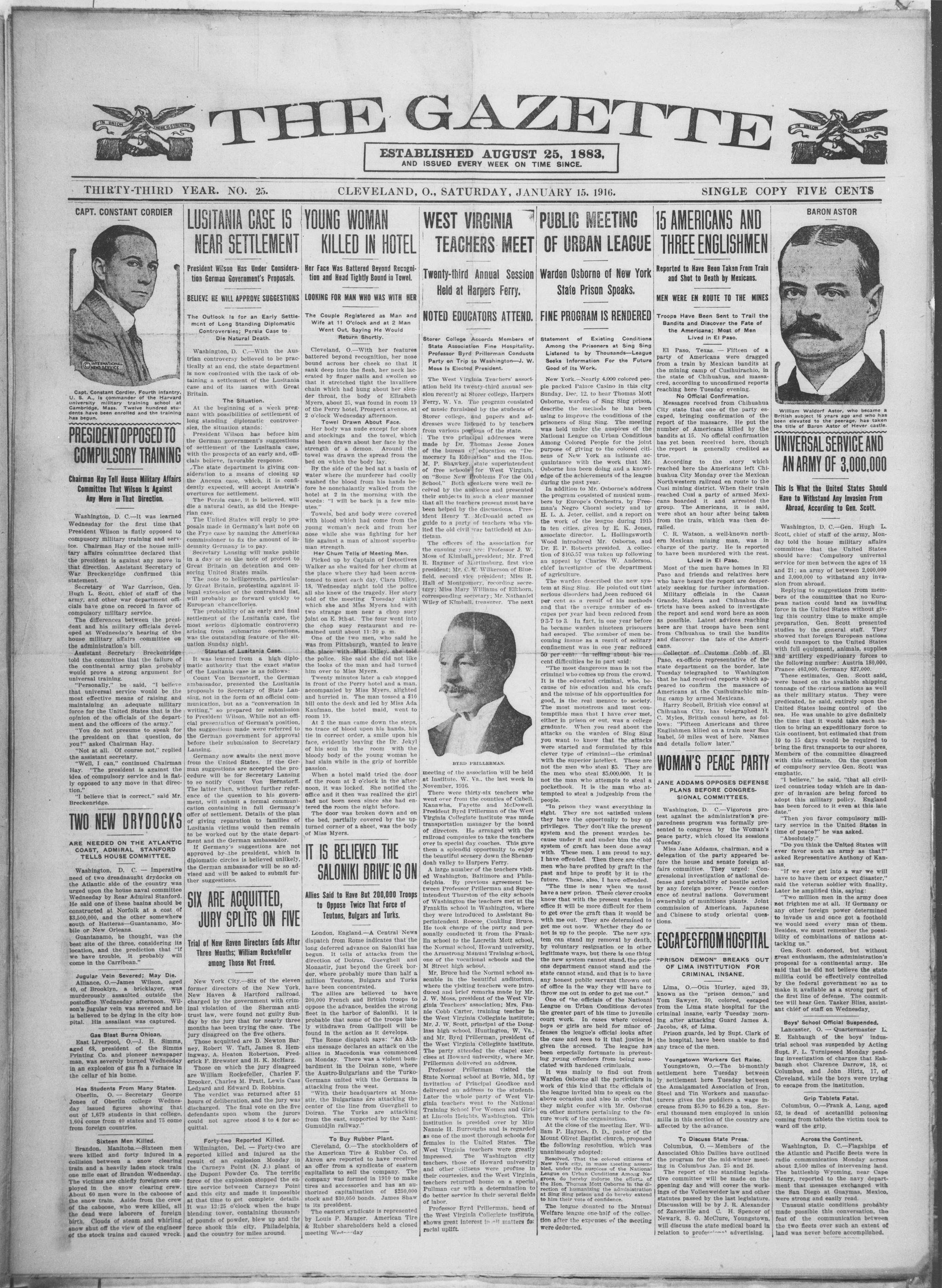
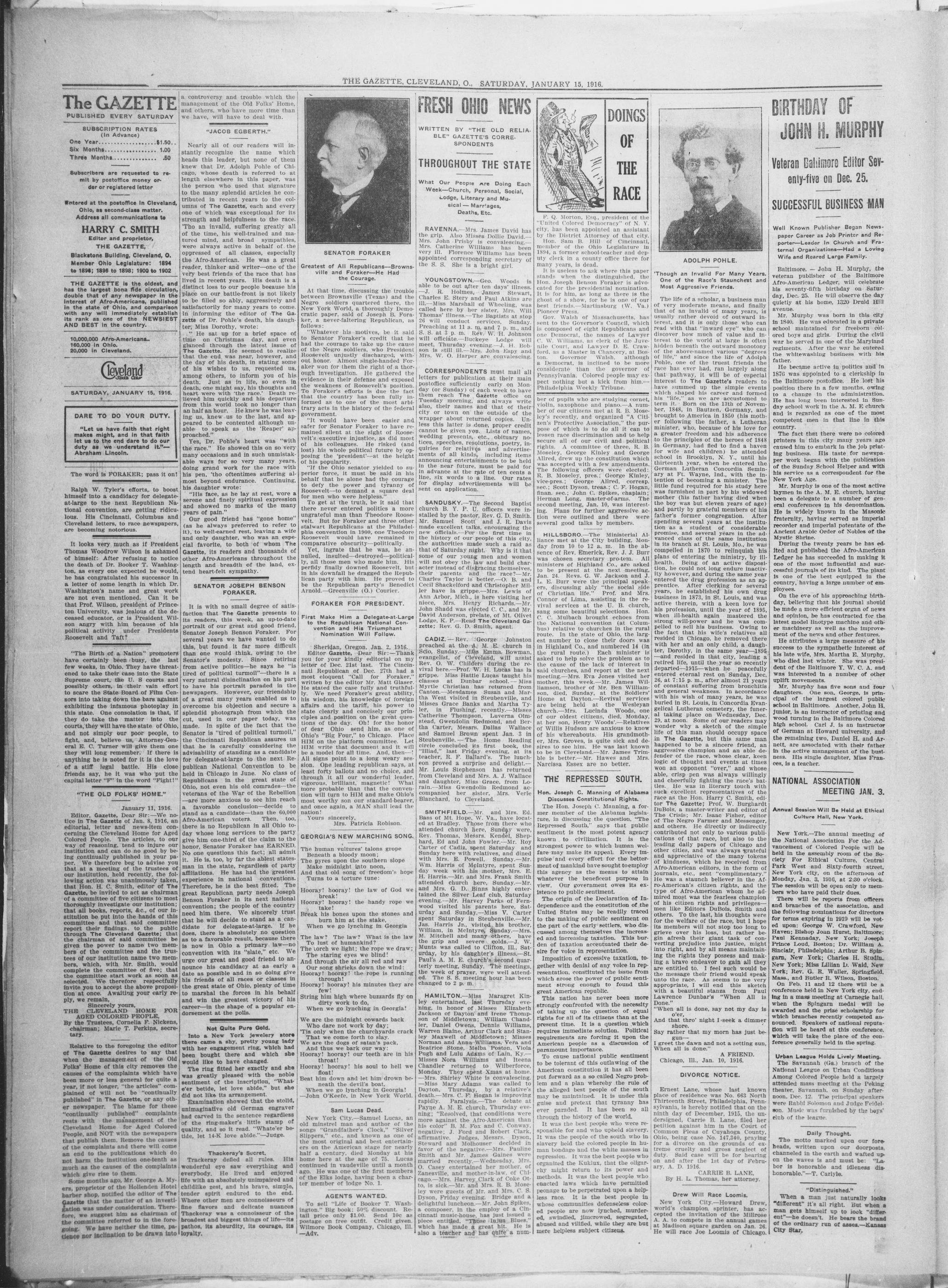
Page text (machine-generated)
Capt. Constant Cordier, Fourth Infantry, U. S. A., is commander of the Harvard university military training school at Cambridge, Mass. Twelve hundred students have been enrolled and the training has begun.
Chairman Hay Tell House Military Affairs Committee That Wilson Is Against Any Move in That Direction.
Washington, D. C. It was learned Wednesday for the first time that President Wilson is flatly opposed to compulsory military training and service. Chairman Hay of the house military affairs committee declared that the president is against any move in that direction. Assistant Secretary of War Breckenridge confirmed this statement.
Secretary of War Garrison, Gen. Hugh L. Scott, chief of staff of the army, and other war department officials have gone on record in favor of compulsory military service.
The differences between the president and his military officials developed at Wednesday's hearing of the house military affairs committee on the administration's bill.
Assistant Secretary Breckenridge told the committee that the failure of the continental army plan probably would prove a strong argument for universal training.
"Personally," he said, "I believe that universal service would be the most effective means of raising and maintaining an adequate military force for the United States that is the opiont of the officials of the department and the officers of the army."
"You do not presume to speak for the president on that question, do you?" asked Chairman Hay.
"Not at all. Of course not," replied the assistant secretary.
"Well, I can," continued Chairman Hay. "The president is against the idea of compulsory service and is flatly opposed to any move in that direction."
"I believe that is correct," said Mr. Breckenridge.
TWO NEW DRYDOCKS
ARE NEEDED ON THE ATLANTIC COAST, ADMIRAL STANFORD TELLS HOUSE COMMITTEE.
Washington, D. C. — Imperative need of two dreadnaught drydocks on the Atlantic side of the country, was urged upon the house naval committee Wednesday by Rear Admiral Stanford. He said one of these basins should be constructed at Norfolk at a cost of $3,500,000, and the other somewhere south of Hatteras—Guantanamo, Mobile or New Orleans.
Guantanamo, he thought, was the best site of the three, considering its location, and the prediction that "if we have trouble, it probably will come in the Carribean."
Jugular Vein Severed; May Die.
Alliance, O.—James Wilson, aged 40, of Brooklyn, a bricklayer, was murderously assaulted outside the postoffice, Wednesday afternoon. Wilson's jugular vein was severed and he is believed to be dying in the city hospital. His assailant was captured.
Gas Blast Burns Ohio.
East Liverpool, O.-J. H. Simms, aged 63, president of the Simms Printing Co. and 'pioneer newspaper man, was severely burned Wednesday in an explosion of gas in a furnace in the cellar of his home.
Has Students From Many States. Oberlin, O. — Secretary George Jones of Oberlin college Wednesday, issued figures showing that out of 1,679 students in that college, 1,604 come from 40 states and 75 come from foreign countries.
Sixteen Men. Killed.
Brandon, Manitoba—Sixteen men were killed and forty injured in a collision between a snow clearing train and a heavily laden stock train one mile east of Brandon Wednesday. The victims are chief foreigners employed in the snow clearing crew. About 60 men were in the caboose of the snow train. Aslide from the crew of the caboose, who were killed, all the dead were laborers of foreign birth. Clouds of steam and whirling snow shut off the view of the engineer of the stock trains and caused wreck.
THE GAZETTE
LUSITANIA CASE IS NEAR SETTLEMENT
President Wilson - Has Under Considera tion German Government's Proposals.
BELIEVE HE WILL APPROVE SUGGESTIONS
The Outlook is for an Early Settlement of Long Standing Diplomatic Controversies; Persia Case to Die Natural Death.
Washington, D. C.—With the Austrian controversy believed to be practically at an end, the state department is now confronted with the task of obtaining a settlement of the Lustania case and of its issues with Great Britain.
The Situation.
At the beginning of a week pregnant with possibilities of settlement of long standing diplomatic controversies, the situation stands:
President Wilson has before him the German government's suggestions of settlement of the Lustania case, with the prospects of an early and, officials believe, favorable response.
The state department is giving consideration to means of closing up the Ancona case, which it is confident expected, will accept Austria's overtures for settlement.
The Persia case, it is believed, will die a natural death, as did the Hesperian case.
The United States will reply to proposals made in Germany's last note on the Frye case by naming the American commissioner to fix the amount of indemnity Germany is to pay.
Secretary Lansing will make public in a day or so the note of protest to Great Britain on detention and censoring United States mails.
The note to belligerents, particularly Great Britain, protesting against illegal extension of the contraband list, will probably go forward quickly to European chancellories.
The probability of an early and final settlement of the Lusiana case, the most serious diplomatic controversy arising from submarine operations, was the outstanding feature of the situation Sunday night.
*Status of Lusiana Case.* It was learned from a high diplomatic authority that the exact status of the Lusiana case is as follows:
Count Von Bernstorff, the German ambassador, presented the Lusiana proposals to Secretary of State Lansing, not in the form of an official communication, but as a "conversation in writing," so prepared for submission to President Wilson. While not an official presentation of German's position, the suggestions made were referred to the German government for approval before their submission to Secretary Lansing.
Germany now awaits the next move from the United States. If the German suggestions are accepted the procedure will be for Secretary Lansing to so notify *Count Von Bernstorff.* The latter then, without further reference of the question to his government, will submit a formal communication containing in full Germany's offer of settlement. Details of the plan of giving repatriation to families of Lusiana victims would then remain to be worked out by the state department and the German ambassador.
If Germany's suggestions are not approved by the president, which in diplomatic circles is believed unlikely, the German ambassador will be so advised and will be asked to submit further suggestions.
Trial of New Haven Directors Ends After Three Months; William Rockefeller among Those Not Freed.
New York City.—Six of the eleven former directors of the New York' New Haven & Hartford railroad, charged by the government with criminal violation of the Sherman antitrust law, were found not guilty Sunday by the jury that for nearly three months has been trying the case. The jury disagreed on the five others.
Those acquitted are D. Newton Barney, Robert W. Taff, James S. Hemingway, A. Heaton Robertson, Frederick F. Brewster and H. K. McHarg.
Those on which the jury disagreed are William Rockefeller, Charles F. Brooker, Charles M. Pratt, Lewis Cass Ledyard and Edward D. Robbins.
The verdict was returned after 51 hours of deliberation, and the jury was discharged. The final vote on the five defendants upon whom the jurors could not agree stood 8 to 4 for acquittal.
Forty-two Reported Killed.
Wilmington, Del. — Forty-two are reported killed and injured as the result of an explosion Monday in the Carneys Point (N. J.) plant of the Dupont Powder Co. The terrific force of the explosion stopped the entire service: between Carneys Point and this city and made it impossible at that time to get complete details.
It was 12:25 o'clock when the huge blending tower, containing thousands of pounds of powder, blew up and the force shook this city, Philadelphia, and the country for miles around.
ESTABLISHED AUGUST 25, 1883 AND ISSUED EVERY WEEK ON TIME SINCE.
YOUNG WOMAN KILLED IN HOTEL
Her Face Was Battered Beyond Recognition and Head Tightly Bound in Towel.
The Couple Registered as Man and Wife at 11 O'clock and at 2 Man Went Out, Saying He Would Return Shortly.
Cleveland, O.—With her features battered beyond recognition, her nose bound across her cheek so that it sank deep into the flesh, her neck lacrime by finger nails and swollen so that it stretched tight the lavalliere chain which had hung about her stender throat, the body of Elizabeth Myers, about 25, was found in room 19 of the Perry hotel, Prospect avenue, at 2 o'clock Wednesday afternoon.
Towel Drawn About Face. Her body was nude except for shoes and stockings and the towel, which had been drawn about her face by the strength of a denon. Around the towel was drawn the spread from the bed on which the body 'lay.
By the side of the bed sat a basin of water where the murderer had coolly washed the blood from his hands before he nonchalantly walked from the hotel at 2 in the morning with the words: "I will be back in a few minutes."
Towels, bed and body were covered with blood which had come from the young woman's neck and from her nose while she was fighting for her life against a man of almost superhuman strength.
Her Chum Tells of Meeting Men.
Picked up by Captain of Detectives Walker as she waited, for her chum at the place, where they had been accustomed to meet each day, Chara Dilley, 18. Wednesday night told the police all she knew of the tragedy. Her story told of the meeting Tuesday night which she and Miss Myers had with two strange man near a chop suey joint on E. 9th-st. The four went into the chop suey restaurant and remained until about 11:30 p. m.
One of the two men, who said he was from Pittsburgh, wanted to leave the place with-Miss. Dilley, she told the police. She said she did not like the looks of the man and had hung him over to Miss Myers.
Twenty minutes later a cab stopped in front of the Perry hotel and a man, accompanied by Miss Myers, alighted and hurried in. The man tossed a $10 bill onto the desk and led, by-Miss Ada Kaufman, the hotel maid, went to room 19.
At 2 the man came down the steps, no trace of blood upon his hands, his tie in correct order, a smile upon his face, evidently leaving the Dr. Jekyl of his soul in the room with the bloody body of the young woman he had slain while in the grip of horrible passion.
When a hotel maid tried the door of the room at 2 o'clock in the afternoon, it was locked. She notified the office and it then was realized the girl had not been seen since she had entered the room the night before.
The door was broken, down and on the bed, partially covered by the 'upturned corner of a sheet, was the body of Miss Myers.
IT IS BELIEVED THE SALONIKI DRIVE IS ON
Allies Said to Have But 200,000 Troops to Oppose Twice That Force of Teutons, Bulgars and Turks.
London, England—A Central News dispatch from Rome indicates that the long deferred advance on Saloniki has begun. It tells of attacks from the direction of Dolran, Guevghell and Monastir, just beyond the Greek border, where probably more than half a million Teutons, Bulgars and Turks have been concentrated.
The allies are believed to have 200,000 French and British troops to oppose the advance, besides the strong fleet in the harbor of Saloniki. It is probable that some of the troops lately withdrawn from Gallipol will be found in the action as it develops.
The Rome dispatch says: "An Athens message declares an attack on the allies in Macedonia was commenced on Monday. There was a violent bombardment in the Dolran zone, where the Austro-Bulgarians and the Turko-Germans united with the Germans in attacking from the west.
"With their headquarters at Monastir, the Bulgarians are attacking the center of the line from Guevghell to Dolran. The Turks are attacking from the east, supported by the Xant-Gumuldjin railway."
To Buy Rubber Plant.
Cleveland, O.—The stockholders of the American Tire & Rubber Co. of Akron are reported to have received an offer from a syndicate of eastern capitalists to sell the company. The company was formed in 1910 to make tires and accessories and has an authorized capitalization of $250,000 stock and $30,050 bonds. James Shaw is its president.
The eastern syndicate is represented by Louis. P. Mauger. American Tire & Rubber shareholders held a closed meeting Wednesday
WEST VIRGINIA TEACHERS MEET
Twenty-third Annual Session Held at Harpers Ferry.
NOTED EDUGATORS ATTEND.
Storer College Accords Members of State Association Fine Hospitality, Professor Byrd Frillerman Conducts Party on Trip to Washington—J. W. Moss is Elected President.
The West Virginia Teachers' association held its twenty-third annual session recently in Storer college, Harpers Ferry, W. Va. The program consisted of music furnished by the students of Storer college and papers and addresses were listened to by teachers from various portions of the state.
The two principal addresses were made by Dr. Thomas. Jesse Jones of the bursar's education on "Democracy in Education" and the Dem. M. P. Skowkey state superintendent of free schools for West Virginia, on "Some New Problems For the Old School." Both speakers were well received by the audience and presented their subjects in such a clear manner that all the teachers present must have been helped by the discussions. President Henry T. McDonald got as guide to a party of teachers who visited the old civil war battlefield at Antietam.
The officers of the association for the ensuing year are: Professor J. W. Moss of Kimball, president; Mr. Fred R. Rayner of Martinsburg, first vice president; Mr. C. F. Wilkerson of Bluervield, second vice president; Miss R. Hall of Montgomery, recording secretary; Miss Mary Williams of Elkhorn, corresponding secretary; Mr. Nathaniel Wiley of Kimball, treasurer. The next
BYRD PHILLERMAN.
meeting of the association will be held at Institute, W. Va., the last week in November, 1916.
There were thirty-six teachers who went over from the counties of Cabell, Kanawha, Fayette and McDowell. President Byrd Prillerman of the West Virginia Collegeate institute was made transportation manager by the board of directors. He arranged with the railroad companies to take the teachers over in special day coaches. This gave them a splendid opportunity to enjoy the beautiful scenery down the Shenandoah valley to Harpers Ferry.
A large number of the teachers visited Washington, Baltimore and Philadelphia. By previous agreement between Professor Pillerman and Superintendent Thurston of the city schools of Washington the teachers met at the Franklin school in Washington, where they were introduced to Assistant Superintendent Rosece Conkling Bruce. He took charge of the party and personally conducted it from the Franklin school to the Lucretia Mott school, the Normal school, Howard university, the Arunstrong Manual Training school, one of the vocational schools and the M Street high school. Mr. Bruce had the Normal school assemble in the beautiful and/orlum, where the visiting teachers were introduced and brief remarks made by Mr. J. W. Moss, president of the West Virginia Teachers' association; Mrs. Fannie Cobb Carter, training teacher in the West Virginia Collegiate institute; Mr. J. W. Scott, principal of the Douglass high school, Huntington, W. Va., and Mr. Byrd Pillerman, president of the West Virginia Collegiate institute. The party attended the chapel exercises at Howard university, where Mr. Pillerman delivered an address.
Professor Prillerman visited the State Normal school at Bowie, Md., by invitation of Principal Goodkoe and delivered an address to the students. Later the whole party of West Virginia teachers went to the National Training School For Women and Girls at Lincoln Heights, Washington. This institution is presided over by Miss Nannie H. Burroughs and is regarded as one of the most thorough schools for females in the United States. The West Virginia teachers were greatly impressed. The Washington city teachers, those of Howard university and other citizens were profuse in their courtesies, and the West Virginia teachers returned home on a special Pullman car with a determination to do better service in their several fields of labor.
Professor Byrd Prillerman, head of the West Virginia Collegiate institute, shows great interest in all matters for racial uplift.
PUBLIC MEETING OF URBAN LEAGUE
Warden Osborne of New York State Prison Speaks.
FINE PROGRAM IS RENDERED
Statement of Existing Conditions Among the Prisoners at Sing Sing Listened to by Thousands—League Seeks Information For the Future Good of Its Work.
New York.—Nearly 4,000 colored people picked Palace Casino in this city Sunday, Dec. 12, to hear Thomas Mott Osborne, warden of Sing Sing prison, describe the methods he has been using to improve the conditions of the prisoners of Sing Sing. The meeting was held under the auspices of the National League on Urban Conditions Among Colored People for the joint purpose of giving to the colored citizens of New York an intimate acquaintance with the work that Mr. Osborne has been doing and a knowledge of the achievements of the league during the past year.
In addition to Mr. Osborne's address the program consisted of musical numbers by Europe's Orchestra, by Freeman's Negro Choir society and by H. L. A. Jeter, cellist, and a report on the work of the league during 1915 in ten cities, given by E. K. Jones, associate director. L. Hollingsworth Wood introduced Mr. Osborne, and Dr. E. P. Roberts presided. A collection of $165.57 was taken up following an appeal by Charles W. Anderson, chief investigator of the department of agriculture.
The warden described the new system at Sing Sing. He pointed out that serious disorders had been reduced to 10 per cent as a result of his methods and that the average number of escapes per year had been reduced from 0.3 to 1. In fact, in one year before he became warden nineteen prisoners had escaped. The number of men becoming insane as a result of solitary confinement was in one year reduced 50 per cent in writing about his recent difficulties he in part said:
"The most dangerous man is not the criminal who comes up from the crowd. It is the educated criminal, who, because of his education and his craft and the misuse of his opportunities for good, is the real enmity to society. The most monstrous and most contemptible man that I have ever met, either in prison or out, was a college graduate. When you read about the attacks on the warden of Sing Sing you want to know that the attacks were started and formulated by this clever type of criminal—the criminal with the superior intellect. These are not the men who steal $5. They are the men who steal $5,000,000. It is not the man who attempts to steal a pocketbook. It is the man who attempted to steal a judgship from the people.
"In prison they want everything in sight. They are not satisfied unless they have the opportunity to buy up privileges. They don't like the present system and, the present warden because under it and under him the old system of graft has been done away with. These men. I am proud to say, I have offended. There are then other men who have profited by graft in the past and have to profit by it in the future. These, also, I have offended.
"The time is near when we must have a new prison. These clever crooks know that with the present warden in office it will be more difficult for them to get over the graft than it would be with me out. They are determined to get me out now. Whether they do or not is up to the people. The new system can stand my removal by death, by voluntary resignation or in other legitimate ways, but there is one thing the new system cannot stand, the prisons department cannot stand and the state cannot stand, and that is to have any honest public servant thrown out of office in the way they will have to throw me out in order to get me out."
One of the officials of the National League on Urban Conditions devotes the greater part of his time to juvenile court work. In cases where colored boys or girls are held for minor offenses the league's official looks after the case and sees to it that justice is given the accused. The league has been especially fortunate in preventing young offenders from being associated with hardened criminals.
It was mainly to find out from Warden Osborne all the particulars in work of this kind that the officials of the league invited him to speak on the above occasion and also in order that they might confer with Mr. Osborne on other matters pertaining to the future work of the organization.
At the close of the meeting Rev. William P. Haynes, D. D., pastor of the Mount Olive Baptist church, proposed the following resolution, which was unanimously adopted:
Resolved, That the colored citizen of New York city, in mass meeting assembled, under the auspices of the National Association of Baptist Churches, do hereby endorse the efforts of the Hon. Thomas Mott Osborne in the direction of humanizing the administration at Sing Sing prison and do hereby extend to him their vote of confidence.
The league donated to the Mutual Welfare league one-half of the collection after the expenses of the meeting were deducted.
SINGLE COPY FIVE CENTS
15 AMERICANS AND THREE ENGLISHMEN
Reported to Have Been Taken From Train and Shot to Death by Mexicans.
MEN WERE EN ROUTE TO THE MINES
Troops Have Been Sent to Trail the Bandits and Discover the Fate of the Americans; Most of Men Lived in El Paso.
El Paso, Texas. — Fifteen of a party of Americans' were dragged from a train by Mexican bandits at the mining camp of Cusinhuirachio, in the state of Chihuahua, and massacred, according to unconfirmed reports reaching here Tuesday evening.
No Official Confirmation.
Messages received from Chihuahua City state: that one of the party escaped, bringing confirmation of the report of the massacre. He put the number of Americans killed by the bandits at 15. No official confirmation has yet been received here, though the report is generally credited as true.
According to the story which reached here the Americans-left Chihuahua City Monday over the Mexican Northwestern railroad en route to the Cusi mining district. When their train reached Cusi a party of armed Mexicans boarded it and arrested the group. The Americans, it is said, were shot an hour after being taken from the train, which was then derailed.
C. R. Watson, a well-known northern Mexican mining man, was in charge of the party. He is reported to have been murdered with the rest.
Lived in El Paso.
Most of the men have homes in El Paso and friends and relatives here who have heard the report are desperately seeking for further information. Military officials in the Casas Grande, Madera and Chihuahua districts have been asked to investigate the report and send word here as soon as possible. Latest advices reaching here are that troops have been sent from Chihuahua to trail the bandits and discover the fate of the Americans. Collector of Customs. Cobb of El Paso. ex-officio representative of the state department on the border, late Tuesday telegraphed to Washington that he had received reports which appeared to confirm the massacre of Americans, at the Cushuirhuca mining camp by armed Mexicans. Harry Scobell, British, vice consul at Chihuahua City, has telegraphed H. C. Myles, British consul here, as follows: "Fifteen Americans and three Englishmen killed on a train near San Isabel, 50 miles west of here. Names and details follow later."
WOMAN'S PEACE PARTY
JANE ADDAMS OPPOSES DEFENSE PLANS BEFORE CONGRESSIONAL COMMITTEES.
Washington, D. C.—Vigorous protest against the administration's preparedness program was formally presented to congress by the Woman's peace party, which closed its sessions Tuesday.
Miss Jane Addams, chairman, and a delegation of the party appeared before the house, and senate foreign affairs committee. They urged: Congressional investigation of national defense and probability of hostile action by any foreign power. Peace conference of neutral nations. Government ownership of munitions plants. Joint commission of Americans, Japanese and Chinese to study oriental questions.
ESCAPESFROM HOSPITAL
"PRISON DEMON" BREAKS OUT OF LIMA INSTITUTION FOR CRIMINAL INSANE.
Lima, O.—Otis Hurley, aged 39, known as the "prison demon," and Tom Sawyer, 30, colored, escaped from the Lima state hospital for the criminal insane; early Tuesday morning after attacking Guard James A. Jacobs, 48, of Lima.
Prison guards, led by Supt. Clark of the hospital, have been unable to find any trace of the men.
Youngstown Workers Get Raise.
Youngstown, O.—The bi-monthly settlement here Tuesday between ly settlement here Tuesday between the Analgamated Association of Iron, Steel and Tin Workers and manufacturers gives the puddlers a wage increase from $5.90 to $6.20 a ton. Several thousand men employed in union mills in this section of the country are affected by the advance.
To Discuss State Press:
Columbus, O. — Members of the Associated Ohio Dailies have outlined the program for the mid-winter meeting in Columbus Jan. 25 and 26. The report of the standing legislative committee will be made on the opening day and will cover the workings of the Vollenweider law and other statutes passed by the last legislature. Discussion will be by J. R. Alexander of Zanesville and, C. H. Spencer of Newark, S. G. McClure, Youngstown, will discuss the state medical board in relation to professional advertising.
IN PUBLIC EXCHANGE
William Waldorf Astor, who became a British subject 16 years ago and who has been elevated to the peerage, has taken the title of Baron Astor of Hever castle.
UNIVERSAL SERVICE AND AN ARMY OF 3,000,000
This Is What the United States Should Have to Withstand Any Invasion From Abroad, According to Gen. Scott.
Washington, D. C.—Gen. Hugh L. Scott, chief of staff of the army, Monday told the house military affairs committee: that the United States should have: Compulsory universal service for men between the ages of 18 and 21; an army of between 2,000,000 and 3,000,000 to withstand any invasion from abroad.
Replying to suggestions from members of the committee that no European nation could land an invading force in the United States without giving this country time to make ample preparation, Gen. Scott presented studies by the general staff. They showed that foreign European nations could transport to the United States with full equipment, animals, supplies and artillery expeditionary forces to the following number: Austria 180,000, France 403,000, Germany 827,000.
These estimates, Gen. Scott said, were based on the available shipping tonnage of the various nations as well as their military status. They were predicated, he said, entirely upon the United States losing control of the sea. He was unable to give definitely the time that; it would take each nation to bring an expeditionary force to this continent, but estimated that from 10 to 15 days would be required, to bring the first transports to our shore. Members of the committee disagreed with this estimate. On the question of compulsory service Gen. Scott was emphatic.
"I believe," he said, "that all civilized countries today which are in danger of invasion are being forced to adopt this military policy. England has been forced to it even at this late date."
"Then, you favor compulsory military service in the United States in time of peace?" he was asked.
"Absolutely."
"Do you think the United States will ever favor such an army as that?" asked Representative Anthony of Kansas.
"If we ever get into a war we will have to have them or expect disaster," said the veteran soldier with finality. Later he amplified this, saying:
"Two million men in the army does not frighten me at all. If Germany or any other foreign power determined to invade us and once got a foothold we would need every man of them. Besides, we must remember the possibility of combinations of nations attacking us."
Gen. Scott endorsed, but without great enthusiasm, the administration's proposal for a continental army. He said that he did not believe the state militia, could be effectively controlled by the federal government so as to make it available as a strong part of the first line of defense. The committee will bear Gen. Tasker Bliss, assistant chief of staff on Wednesday.
Lancaster, O. — Quartermaster L. E. Eshaughb of the boys' industrial school was suspended by Acting Supt. F. L. Turnipseed Monday pending investigation of charges that Eshaughb shot Clarence Darrow, 18, of Columbus, and John Hirtz, 17, of Cleveland, while the boys were trying to escape from the institution.
Grip Tablets Fatal.
Columbus, O. — Frank A. Lang, aged 52, is dead of acetanilid poisoning coming from tablets the victim took to ward off the grip.
Across the Continent.
Washington, D. C. — Flagships of the Atlantic and Pacific fleets—were in radio, communication Monday across about 2,500 miles of intervening land. The battleship Wyoming; near Cape Henry, reported to the navy department that messages exchanged with the San Diego at Guaymas, Mexico, were strong and easily read.
Unusual static conditions probably made possible this conversation, the feat of the communication between the two fleets over such an extent of land was never before accomplished.
The GAZETTE
PUBLISHED EVERY SATURDAY
One Year.....$1.50.
Six Months.....1.00
Three Months......50
Subscribers are requested to rem-
mit by postoffice money or-
der or registered letter
Entered at the postoffice In Cleveland
Ohio, as second-class matter.
Address all communications to
Blackstone Building, Cleveland, O.
Member Ohio Legislature: 1894
to 1896; 1896 to 1900; 1902
THE GAZETTE is the oldest, and
has the largest bona fide circulation,
double that of any newspaper in the
interest of Afro-Americans, published
in the state of Ohio, and comparison
with any will immediately establish
its rank as one of the NEWSIEST
AND BEST in the country.
10,000,000 Afro-Americans..
160,000 in Ohio.
20,000 in Cleveland.
Cleveland
State Bank
SATURDAY, JANUARY 15, 1916.
"Let us have faith that right makes might, and in that faith let us to the end dare to do our duty as we understand it."—Abraham Lincoln.
The word is FORAKER; pass it on!
Ralph W. Tyler's efforts, to boost himself into a candidacy for delegate at-large to the next Republican National convention, are getting ridiculous. His Cincinnati, Columbus and Cleveland letters, to race newspapers are becoming notorious.
It looks very much as if President Thomas Woodrow Wilson is ashamed of himself: After refusing to notice the death of Dr. Booker T. Washington, as every one expected he would he has congratulated his successor in a letter of some length in which Dr Washington's name and great work are not even mentioned. Can it be that Prof. Wilson, president of Prince ton University, was jealous of the deceased educator, or is President Wilson angry with him because of his political activity under Presidents Roosevelt and Taft?
"The Birth of a Nation" promoters have certainly been busy, the last few weeks, in Ohio. They have threatened to take their case into the State Supreme court, the U. S courts and possibly others, in their vain effort to scare the State Board of Film Censors into taking down the bars against exhibiting the infamous photoplay in this state. One consolation is that, if they do take the matter into the courts, they will have the state of Ohio and not simply our poor people, to fight, and believe us, Attorney-General E. C. Turner will give them one they will long remember. If there is anything he is not noted for it is the love of a stiff legal battle. His close friends say, he it was who put the capital letter "F" in the word "Fight!"
"THE OLD FOLKS' HOME."
January 11, 1916
Editor, Gazette, Dear Sir:—We notice in The Gazette of Jan. 8, 1916, an editorial, letter and news-item concerning the Cleveland Home for Aged Persons. We know that the way of reasoning, tend to injure our institution and can do no good by being continually published in your paper. We therefore beg to advise you that at a meeting of the trustees of our institution, held recently, the following action was unanimously taken, that Hon. H. C. Smith, editor of The Gazette, be invited to act as chairman of the committee to thoroughly investigate our institution; that all books, reports, &c., of our institution be put into the hands of this committee and that said committee report their findings, to the public through The Cleveland Gazette; that the chairman of said committee be given the power to name two members of the committee and the trustees of our institution name two members of the committee to complete the committee of five; that the committee start work as soon as selected. We therefore respectfully invite you to accept the above proposition at once. Awaiting your early reply, we remain.
Sincerely yours,
THE CLEVELAND HOME FOR
AGED COLORED PEOPLE,
By the Trustees, Cornelia F. Nickens,
chairman; Marie T. Perkins, secretary.
Relative to the foregoing the editor of
The Gazette desires to say that when the management of the Old Folks' Home of this city removes the causes of the complaints which have been more or less general for quite a year, if not longer, "the articles" complained of will not be "continually published" in The Gazette, or any other newspaper. The blame for these "continually published" complaints rests with the management of the Cleveland Home for Aged Colored People, and NOT with the newspapers that publish them. Remove the causes of the complaints and there will come an end to the publications which do not harm the institution one-tenth as much as the causes of the complaints which give rise to them.
Some months ago, Mr George A. Myers, proprietor of the Hollden Hotel barber shop, notified the editor of The Gazette that the matter of an investigation was under consideration. Therefore, we suggest him as chairman of the committee referred to in the foregoing. We have neither the time, patience nor inclination to be drawn into
a controversy and trouble which the management of the Old Folks' Home, and others, who have more time than we have, will have to deal with.
"JACOB EGBERTH."
Nearly all of our readers will instantly recognize the name which heads this leader, but none of them knew that Dr. Adolph Pohle of Chicago, whose death is referred to at length elsewhere in this paper, was the person who used that signature to the many splendid articles he contributed in recent years to the columns of The Gazette, each and every one of which was exceptional for its strength and helpfulness to the race. The an invalid, suffering greatly all of the time, his well-trained and mature mind, and broad sympathies, were always active in behalf of the oppressed of all classes, especially the Afro-American. He was a great reader, thinker and writer—one of the very best friends of the race that has lived in recent years. His death is a distinct loss to our people because his place on our battle-front is not likely to be filled so ably, aggressively and satisfactorily for many years to come. In informing the editor of The Gazette of Dr. Pohle's death, his daughter, Miss Dorothy, wrote:
"He sat up for a brief space of time on Christmas day, and even glanced through the latest issue of The Gazette. He seemed to realize that the end was near, however, and he asked himself, in sitting near of his wishes to us, requested us, among others, to inform you of his death. Just as in life, so even in death, one might say, his thoughts and heart were with 'the race'. Death relieved him quickly and his departure from this world took no longer than an half an hour. He knew he was leaving us, knew us to the last, and appeared to be contented although unpleased to speak as the 'Reaper' approached.
Yes, Dr. Pohle's heart was "with the race." He showed this on so very many occasions and in such unmistakable ways for so very many years, doing grand work for the race with his pen, 'the oftentimes suffering almost beyond endurance. Continuing, his daughter wrote:
"His face, as he lay at rest, wore a serene and finely spiritual expression and showed no marks of the many years of pain."
Our good friend has "gone home" (as he always preferred to refer to to who-earned receiving a wife and who-earned who was an especial favorite, to both of whom The Gazette, its readers and thousands of other Afro-Americans throughout the length and breadth of the land, extend heart-felt sympathy.
SENATOR JOSEPH BENSON FORAKER.
It is with no small degree of satisfaction that The Gazette presents to its readers, this week, an up-to-date portrait of our great and good friend, Senator Joseph Benson Foraker. For several years we have wanted to do this, but found it far more difficult than one would think, owing to the Senator's modesty. Since retiring from active politics—he says he "is tired of political turmoil"—there is a very natural disinclination on his part to have his portrait paraded in the newspapers. However, our friendship of a great many years enabled us to overcome his objection and secure a splendid photograph from which the cut, used in our paper today, was made. In spite of the fact that the Senator is "tired of political turmoil," the Cincinnati Republican assures us that he is carefully considering the advisability of standing as a candidate for delegate-at-large to the next Republican convention to be held in Chicago in June. No class of Republicans in the great state of Ohio, not even his old comrades—the veterans of the War of the Rebellion—are more anxious to see him reach a favorable conclusion—decide to stand as a candidate—than the 60,000 Afro-American voters. Then, too, there is no Republican in all Ohio today whose long services to the give him one-third of the claim to the honor, Senator Foraker has EARNED. No one questions this fact; all admit it. He is, too, by far the ablest statesman in the state, regardless of party affiliations. He has had the greatest experience in national conventions. Therefore, he is the best fitted. The great Republican party needs Joseph Benson Foraker in its next national convention; the people of the country need him there. We sincerely trust that he will decide to stand as a candidate for delegate-at-large. If he does, there is absolutely no question as to a favorable result, because there is now in Ohio a primary law—no convention with its "slate," etc. We urge our great and good friend to announce his candidacy at as early a date as possible and in so doing give his friends of all races or classes in the great state of Ohio, plenty of time to marshal the forces in his behalf and win the greatest victory of his career—in the shape of a popular endorsement at the polls.
Not Quite Pure Gold
Into a New York jewelry store there came a shy, pretty young lady with her engagement ring, which had been bought there and which she would like to have changed.
The ring fitted her exactly and she was greatly pleased with the noble sentiment of the inscription, "What'er betide, let love abide," but she did not like its arrangement.
Examination showed that the stolid, unimaginative old German engraver had carved in the sentence regardless of the ring-maker's little stamp of quality, and so it read, "Whatever betile, let 14-K love abide." -Judge.
Thackeray's Secret.
Trackeray defied all rules. His wonderful eye saw everything and everybody. He lived and enjoyed life with an absolutely unimpaired and childlike zeet, and his brave, simple, tender spirit endured to the end. Where other men are connoisseurs of fine flavors and delicate nuances Thackeray was a connoisseur of the broadest and biggest things of life—its pathos, its absurdity, its courage, its loyalty.
THE GAZETTE, CLEVELAND, O., SATURDAY, JANUARY 15, 1916.
FRESH OHIO NEWS
WRITTEN BY "THE OLD RELIABLE" GAZETTE'S CORRESPONDENTS
THROUGHOUT THE STATE
What Our People Are Doing Each Week—Church, Personal, Social, Lodge, Literary and Musical—Marriages, Deaths, Etc.
RAVENNA.—Mrs. James David has the grip. Also Misses Dollie David.—Mrs. John Prisby is convalescing.—Mrs. Catherine Williams has been very ill. Florence Williams has been
F. Q. Morton, Esq., "United Colored Democity, has been appointed by the District Attorn Hon. Sam B. Hill member of the Ohio 1894, a former school-b
Greatest of All Republicans—Brownville and Foraker—He Had the Courage.
At that time, discussing the trouble between Brownville (Texas) and the Negro soldiers quartered there, the New York World, a thoroughly Democratic paper, said of Joseph B. Foraker, a never-faltering Republican, as follows:
"Whatever his motives, be it said to Senator Foraker's credit that he had the courage to take up the cause of the Negro soldiers, who President Roosevelt unjustly discharged, with out honor. Almost single-handed Foraker won for them the right of a thorough investigation. He gathered the evidence in their defense and exposed the weakness of Roosevelt's position. To Foraker's efforts is due the fact that a thorough investigation has been formed as to one of the most arbitrary acts in the history of the federal government.
"It would have been easier and safer for Senator Foraker to have remained silent at the sight of Roosevelt's executive injustice, as did most of his colleagues. He risked (and lost) his whole political future by opposing the 'president'—at the height of his popularity.
"If the Ohio senator yielded to superior force, it must be said in his book that he alone had the courage to deny the authority of Roosevelt—to demand a square deal for men who were helpless."
To get at the truth, he it said that there never entered politics a more ungrateful man than Theodore Roosevelt. But for Foraker and three other stalwart Republicans at the Philadelphia convention in 1900, one Theodore Roosevelt would have remained in comparative obscurity—politically.
Yet, ingrate that he was, he anulled, insulted—destroyed—politically, all those men who made him. His failure in the downfall he dragged the Republican party with him. He proved to be the Republican party's Benedict Arnold—Greenville (O.) Courier.
FORAKER FOR PRESIDENT.
First Make Him a Delegate-at-Large to the Republican National Convention and His Triumphant Nomination Will Follow.
Sheridan, Oregon, Jan. 2, 1916.
Editor Gazette, *Dear Sir*: Thank you for your kindly editorial on my letter of Dec. 21st last. The Cincinnati Republican of Dec. 27th had a most eloquent "Call for Foraker," written by the Maitland M. Glaser, who came the case fully and closely. We need Foraker's great ability, his wisdom, his knowledge of foreign affairs and the tariff, his power to state clearly and concisely our principles and position on the great questions of the day. Oh! for the honor of dear Ohio send him, as one of our's Bigog, to Chisholm HIM on the platform committee. Let HIM write that document and it will be a model for all time. And, then—All signs point to a long aweful session. One leading republican says, at least forty ballots and no choice, and through it all our wonderful leader, vigorous, brilliant, magnetic! What more probable than that the convention will accept the most worthy son our standard-bearer, and once again, a MAN shall lead the nation!
ours sincerely.
Mrs. Patricia Robison.
GEORGIA'S NEW MARCHING SONG.
The human vultures' talons grope
Beneath a bloody moon;
The pyres upon the southern slope
Make midnight into noon,
And that old song of freedom's hope
Turns to a torture tune:
Hooray! hooray! the law of God we
break!
Hooray! hooray! the handy rope we
take!
Break his bones upon the stones and burn him at the stake. When we go lynching in Georgia
The law? The law? What is the law To lust of humankind?
The torch we light; the rope we draw; the staring eyes we blind!
The staring eyes we bind
And through the air all red and raw
Ovine! shrieks down the wind:
Hooray! hooray! the rope is running
through!
Hooray! hooray! his minutes they are
few!
String him high where buzzards fly on dirty work to do.
When we go lynching in Georgia!
We are the midnight cowards back
Who dare not work by day:
Hooray! hooray! our teeth are in his throat!
Hooray! hooray! his soul to hell we float!
Beat him down and let him drown be
neath the devil's boat.
When we go lynching in Georgia!
-John O'Keefe, in New York World
Sam Lucas Dead.
New York City,—Samuel Lucas, an old minstrel man and author of the songs "Grandfather's Clock," "Silver Slippers" etc., and known as one of the most original and best entertainers on the American stage for nearly half a century, died Monday at his home here at the age of 75. Lucas continued in vaudieville until a month ago. He was one of the first members of the Elks lodge, having been a charter member of lodge No. 1.
AGENTS WANTED.
To sell "Life of Booker T. W. Washington." Big book; 50% discount. Retail price only $1.00. Send 10c as postage on free outfit. Credit given. Willmore Book Company, Chicago, Ill.—Adv
FRESH OHIO NEWS
WRITTEN BY "THE OLD RELIABLE" GAZETTE'S CORRESPONDENTS
THROUGHOUT THE STATE
What Our People Are Doing Each Week—Church, Personal, Social, Lodge, Literary and Musical — Marriages, Deaths, Etc.
RAVENNA.—Mrs. James David has the grip. Also Misses Dolley David.—Mrs. John Prisby is convalescing.—Mrs. Catherine Williams has been very ill. Florence Williams has been appointed corresponding secretary of the S. S. She is a bright girl.
YOUNGSTOWN.—GEO. Woods is able to be out after ten days' illness.—J. R. Holmes. James Stewart. Charles E. Stery and Paul Atkins are ill.—Miss Marshall of Wheeling, was called here by her sister, Mrs. Will Thomas Thames. The Baptists at stop 26 will conduct at 11 a.m. and 7 p.m. and S. at 3 p. m. W. R. W. Johnson will officiate—Buckeye Lodge will meet, Thursday evening. J. H. Bobson is still ill.—Mrs. John Espy and Mrs. W. O. Harper are convalescing.
CORRESPONDENTS must mail all letters for publication at their main postoffice sufficiently early on Monday (or Sunday) of each week to have them reach The Gazette office on Tuesday morning, and always write also, their names and that of their city or town on the outside of the wrapper about returned copies. Unless this latter is done, proper credit cannot be given you. Lists of names, wedding presents, etc., obituary nooses, notices, notations, poetry, inquiries for relatives, and memorabilia of all kinds, including items announcing entertainments to be held in the near future, must be paid for in advance at the rate of ten cents a line, six words to a line. Our rates for display advertisements will be sent on application.
SANDUSKY.—The Second Baptist church B. Y. P. U. officers were installed by the pastor, Rev. G. D. Smith, Mr. Samuel Scott' and J. R. Davis made excellent talks, encouraging the new officials.—For the first time in the history of our people of this city, we made such a raid as that of Saturday, 11th November, some of our young men and women will not obey the law and build character instead of disgracing themselves their parents and the race?—Mr. Charles Taylor is better.—O. B. and Cecil Shackelford and Christopher Miller have la gripe.—Mrs. Lewis of Ann Arbor, Mich., is here visiting her father, Mr. John Shadda, John Shadda was elected C. C. and Mr. David Anderson, prelate, of Mt. Olive Lodge, K. P.—Read the Cleveland Gazette; Rev. G. D. Smith, agent.
CADIZ. — Rev. George Johnston preached at the A. M. E. church in Scio, Sunday. —Miss Emma Bowman, evangelist, of Cleveland, will assist Rev. O. W. Childers during the revival here. —Prof. W. H. Lucas has la gripe. Miss Hattie Lucas taught his classes at Dunbar school. —Miss Myrtle Christian has returned from the Northwest to Stusan and Mara the West visited in Stusan. —Misses Grace Banks and Martha Tler, in Flushing, recently. —Misses Catherine Thompson, Luverna Olmstead, Gwendolin redmond, and Bertha Carter, Messrs. Dallas Wallace and Samuel Brown spent Jan. 3 in Steubenville. —The Home Reading circle concluded its first book, the "Illiad." Last Friday, evening, at the R. F. Ballard's. The inunchairing of R. F. Ballard's. The inunchairing of Mr. Louis Stephenson has returned from Cleveland and Mrs. A. J. Wallace and daughter, Miss Grace, from Lorain. —Miss Gwendolin redmond accompanied her sister, Mrs. Verie Blanchard, to Cleveland.
SMITHFIELD.—Mr. and Mrs. Ed. Bass of Mt. Hope, W. Va., have located at Bradley. Those from there who attended church here, Sunday were, Rey. Thomas, Messrs. Kendel, Shephard, Ed and John Fowler. Mr. Roy Carter of Cadiz, spent Saturday and Sunday here with relatives, and dined with Mrs. E. Powell. Sunday—Mr. Harris McIntyre, spent Sunday week with his mother, Mr. E. Harris. Mr. and Mrs. Frank Smith attended church here, Sunday—Mr. and Mrs. G. D. Binns highly entertained the Silver Leaf club, Saturday evening. Mr. Harvey Parks of Fernwood visited his parents here, Saturday and Sunday. Miss V. Carter spent Saturday in Steubenville—Mr. Jas, Harris Jr., visited his brother, William, in McIntyre, Sunday—Mrs. Harris and many others, have the grip and control. Munts was called to Clifton, Ill. Saturday, by his daughter's illness. St. Paul's A. M. E. church's second quarterly meeting, Sunday. The meetings, the week of prayer, were well attended. The S. S. meeting has been changed to 2 p. m.
HAMILTON—Miss Maragret Kinley entertained, last Thursday evening, in honor of Misses Elizabeth Jackson of Dayton and Irene Thompson of Middletown; William Chandler, Daniel Owens, Dennis Williams, Warren Blaine, Arthur Clark and Stanley Maxwell of Middletown; Misses Beatrice Stone, Melba Poston, Vlola Pugh and Luhua Adams of Lain, Ky—Misses Nora Williams and Iteena Chandler returned to Wilberforce, Monday. They spent Xmas at home.—Mrs. Shirley White is convalescing.—Miss Mary Adams was called to Dayton, Thursday, by a relative's death.—Mrs. C. F. Hogan is improving rapidly. Paralysis. The debate at Payne A. M. E. church, Thursday evening; "Resolved, that conditions were more against the Afro-American way," negative; J. Ford and Robert Clark, affirmative. Judges, Messrs. Dyson, Steward and Mohouzer decided in favor of the negative.—Mrs. Pauline Smith and Mr. James Gaines were married recently.—Wednesday, Mrs. O. Casey entertained her mother, of Zanesville, and mother-in-law, of Chicago.—Mrs. Harvey Clark of Coke Otto is, sick.—Mr. and Mrs. R. B. Moseley were guests of Mr. and Mrs. Dyson, Friday evening. Bridging a and a composer, in the job of a Chincott music-house, has just issued a piece entitled, "Those Injun Blues," which has made a great hit. He is also a teacher and has quite a num
DOINGS
OF
THE
RACE
F. Q. Morton, Esq., president of the
"United Colored Democracy" of N. Y.
city, has been appointed an assistant
by the District Attorney of that city.
Hon. Sam B. Hill of Cincinnati,
member of the Ohio Legislature
in 1894, a former school-teacher and deputy
clerk in a county office there for
many years, is dead.
It is useless to ask where this paper stands when the distinguished, the Hon. Joseph Benson Foraker is advocated for the presidential nomination. It is for him, as long as there is the ghost of a show, for he is one of our best friends—Martinsburg (W. Va.) Pioneer Press. Gov. Walsh of Massachusetts, has sent to the Governor's Council, which is composed of eight Republicans and one Democrat, the names of Lawyer William Williams as clerk of Lawyer Mike Court and Lawyer E. Crawford, as a Master in Chancery, at Boston. Governor Walsh, although a Democrat, is inclined to be more considerate than the governor of Pennsylvania. Colored people may expect nothing but a kick from him. Philadelphia Weekly Tribune.
ber of pupils who are studying cornet, violin, saxophone and piano—A number of our citizens met at R. B. Moseley's recently, and organized "A Citizen's Protective Association," the purpose of which is to do all it can to lessen race discrimination and to help secure all of our civil and political rights. A committee of three, R. B. Moseley, pres.; George Kinley, vice-pres.; George Allred, corresp. sec.; Scott Dyson, trees; C. F. Hogan, fin. sec.; John C. Skepp, chaplain; and second meeting, Jan. 10, was interesting. Plans for further aggressive action were outlined and there were several good talks by members.
HILLSBORO—The Ministerial Alliance met at the City building, Monday from 10 to 12 a. m. In the absence of Rev. Emerick, Rev. J. J. Burr was chosen secretary pro-tem. All ministers of Highland Co., are asked to be present at the next meeting, Jan. 4, Revs. J. Jackson and J. E. Burr, the president, discuss ably "the social side of Christian life." Prof. and Mrs. Connor of Lima, assisting in the revival services at the U. B. church, sang some beautiful selections. Hon. C. C. Mulbach brought echoes from the national convention (at Columbus) relative to churches in the rural area. Mrs. Eva Jones set number to close their doors was in Highland Co., and numbered 14 (in the rural route). Each minister is asked to help solve the problem as to the cause of the lack of interest in said churches, and report at the next meeting—Mrs. Eva Jones visited her mother, this week—Mr. James Williams, Mrs. Eva Jones, Mrs. William Johnson, died, Sunday, at the Soldiers' Home at Dayton—Revival services are being held at the Wesleyan church, Mrs. Lucinda Woods, one of our oldest citizens, died, Monday, at her son, Henry Woods.' Relatives of Willis Hudson are anxious to know of his whereabouts. His grandmother was a widow, and his sisters to see him. He was last known to be in Cleveland. Mr. James Trimble is better—Mr. Hawes and Mrs. Narcissus Essex are no better.
THE REPRESSED SOUTH.
Hon. Joseph C. Manning of Alabama Discusses Constitutional Rights.
The Hon. Joseph C. Manning, a former member of the Alabama legislature, in discussing the question, "The Repressed South," says that public sentiment is the most potent agency known to civilization. It is the strongest power to which human welfare may make its appeal. Every impulse and every effort for the betterment of mankind have sought to employ this agency as the means to attain whatever the beneficent purpose in view. Our government owes its existence to public sentiment.
The origin of the Declaration of Independence and the constitution of the United States may be readily traced to the making of public sentiment on the part of the early settlers, who discussed among themselves the increased and increasing taxation. This burden of taxation accentuated their desire for voice in representation.
Imposition of excessive taxation, together with denial of any voice in representation, constituted the issue from which arose the power of public sentiment strong enough to found this great American republic.
This nation has never been more strongly confronted with the necessity of taking up the question of equal rights for all of its citizens than at the present time. It is a question which requires immediate solution. Political requirements are forcing it upon the American people as a discussion of paramount importance.
To cause national public sentiment to be tolerant of this outlawing of the American constitution it has all been put forward as a so called Negro problem and a plan whereby the rule of the alleged best people of the south may be maintained. It is under this guise and pretext that tyranny has ever paraded. It has been so all through the history of the world.
It was the best people who were responsible for and who upheld slavery. It was the people of the south who in slavery held the colored people in human bondage and the white masses in repression. It was the best people who organized the Kukulux, that the oligarchy might return to its power and methods. It was the best people who enacted laws which have permitted peonage to be perpetrated upon a helpless race. It is the best people in whose communities defenseless colored people are now lynched, murdered, swindled, jimcrowed, segregated, abused and vilified, while they are but mere helpless subject citizens.
ADOLPH POHLE.
Though an Invalid For Many Years. One of the Race's Staunchest and Most Aggressive Friends.
"When all is done, say not my day is o'er.
And that thro' night I seek a dimmer shore.
Say rather that my morn has just be- sun
I greet the dawn and not a setting sun.
When all is done."
DIVORCE NOTICE
Ernest Lane, whose last
place of residence was No. 663 North
Thirteenth Street, Philadelphia, Penns-
ylvania, is hereby notified that on the
ninth day of December, 1915, the
undersigned. Carrie B. Lane, filed her
petition against him in the Court of
Common Pleas of Cuyahoga County,
Ohio, being case No. 147,340, praying
for a divorce on the grounds of ex-
treme cruelty and gross neglect of
duty. Said case will be for hearing
on and after the 1st day of February,
A. D. 1916.
CARRIE B. LANE,
By H. L. H., her attorney.
Drew Will Race Loomis
New York City—Howard Drew,
world's champion spinner, has accepted
the invitation of the Milrose
A. A. to compete in the annual games
at Madison square garden on Jan. 28.
He will race Joe Loomis of Chicago.
BIRTHDAY OF
JOHN H. MURPHY
SUGGESSFUL BUSINESS MAN
Well Known Publisher Began Newspaper Career as Job Printer and Reporter—Leader in Church and Fraternal Organizations—Had a Loving Wife and Roared Large Family.
Baltimore. — John H. Murphy, the veteran publisher of the Baltimore Afro-American Ledger, will celebrate his seventy-fifth birthday on Saturday, Dec. 25. He will observe the day quietly at his home, 1320 Druld Hill avenue.
Mr. Murphy was born in this city in 1840. He was educated in a private school maintained for freeborn colored boys and girls. During the civil war he served in one of the Maryland regiments. After the war he entered the whitewashing business with his father.
He became active in politics and in 1876 was appointed to a clerkship in the Baltimore postoffice. He lost his position there in a few months, owing to a change in the administration. He has long been interested in Sunday school work in the A. M. E church and is regarded as one of the most competent men in that line in this country.
The fact that there were no colored printers in this city many years ago caused him to embark in the job printing business. His taste for newspaper work began with the publication of the Sunday School Helper and with his service as a correspondent for the New York Age.
Mr. Murphy is one of the most active laymen in the A. M. E. church, having been a delegate to a number of general conferences in his denomination.
He is widely known in the Masonic fraternity, having served as imperial recorder and imperial potentate of the Ancient Arabic Order of Nobles of the Mystic Shrine.
During the twenty years he has edited and published the Afro-American Ledger he has succeeded in making it one of the most influential and successful journals of its kind. The plant is one of the best equipped in the country, having a large number of employees.
On the eve of his approaching birthday, believing that his journal should be made a more efficient organ of news and opinion, he has contracted for the latest model linotype machine and other machinery as well as the improvement of the news and other features.
He attributes a large measure of his success to the sympathetic interest of his late wife, Mrs. Martha E. Murphy, who died last winter. She was president of the Baltimore Y, W. C. A. and was interested in a number of other uplift movements.
Mr. Murphy has five sons and four daughters. One son, George, is principal of the largest colored public school in Baltimore. Another, John H. junior, is an instructor of printing and wood turning in the Baltimore Colored high school. Carl J. is an instructor oferman at Howard university, and the retiring professor of Art and Arnett, are associated with theirin the active management of the business. His single daughter, Miss Frances, is a teacher.
NATIONAL ASSOCIATION MEETING JAN. 3.
Annual Session Will Be Held at Ethical Culture Hall, New York.
New York.—The annual meeting of the National Association For the Advancement of Colored People will be held in the assembly room of the Society For Ethical Culture, Central Park West and Sixty-fourth street, New York city, on the afternoon of Monday, Jan. 3, 1916, at 2:30 o'clock. The session will be open only to members who have paid their dues.
There will be reports from officers and branches of the association, and the following nominations for directors for terms expiring in 1919 will be voted upon: George W. Crawford, New Haven; Bishop John Hurst, Baltimore; Paul Kennaday, New York; Joseph Prince Loud, Boston; Dr. William A. Sinclair, Philadelphia; Arthur B. Springam, New York; Charles H. Studin, New York; Miss Lillian D. Wald, New York; Rev. G. R. Waller, Springfield, Mass., and Butler R. Wilson, Boston.
On Feb. 11 and 12 there will be a conference held in New York city, ending in a mass meeting at Carnegie hall, when the Spingarn medal will be awarded and the prize scholarship for which branches recently competed announced. Speakers of national reputation will be heard at this conference, which will take the place of the conference generally held in the spring.
Urban League Holds Lively Meeting.
The Savannah (Ga.) branch of the National League on Urban Conditions Among Colored People held a largely attended mass meeting at the Peking theater, Savannah, on Sunday afternoon, Dec. 12. The principal speakers were Rabbi Solomon and Judge Feidelson. Music was furnished by the boys' club of the league.
Daily Thought.
The motto marked upon our foreheads, written upon our doorposts, channeled in the earth and wafted on the waves is and must be: "Labor is honorable and idleness dishonorable." - T. Carlyle.
"Distinguished."
When a man just naturally looks "different" it's all right. But when a man gets himself up to look 'different' he doesn't. He bears the brand of the ordinary run of asses.—Kansas City Star.
HER TONIC is the result of scientific study of the causes of diseases of the scalp.
Instead of treating effects of the diseases she treats the causes, eliminating the same and leaving the scalp in a healthy condition that can be maintained by using her Hair Tonic and Invigorator, according to her direction.
Madame C. H. Jones Hair Tonic and Invigorator is guaranteed to stop the falling out of the hair and to make the hair
It has been successfully used by many ever since 1800 and with persistence it has been recommended by many Toledo people and elsewhere, who have continually turned hairs into scabs by many people diseased scabs by using widely advertised hair tonics prepared by unscrupulous persons who have been treated with MADAME JONES' On the other hand, MADAME JONES' is absolutely harmless and will do all that is claimed for it. H. Jones' Hair Tonic and Invigorator promotes the growth of the hair, prevents and balds hair, removes dandruff, cures scalp dandruff, removes scalding hair, treats the creases of the color of the hair by supplying it with the natural elements and necessary nourishment. MADAME C. H. JONES 353 Woodland Toledo, Ohio Agents Wanted.
STERLING
5 and 10 Cent Store
3003 Central Ave.
Watch Our Windows
For Bargains
Colored Salesladies
We close at 6 P.M.every evening except Saturday
Arlington Pharmacy
WE WILL ACCEPT THIS ADVERTISEMENT FOR FIVE
CENTS IN TRADE, TO APPLY
ON ANY PURCHASE OF
TWENTY-FIVE CENTS OR
MORE.
E. Rukenstein, Ph. C., Prop.
S. W. Cor. Central Ave. & E.
85th St.
J. LOMSKY
3816-3820 Central Ave.
DRY GOODS
LADIES' AND GENT'S
FURNISHINGS
Try Our
Lomsky Special $1.00 Coreets,
Also our Ladies' $1.00 Waists
They are good
buy your Collars, Shirts, Neckwear, etc.?
is the place to get Everything in the Haberdasher line.
2922 Central Ave.
The Pride of Carolina
The State Agricultural and Mechanical College of South Carolina
Orangeburg, S. C.
Next session begins September 29th and ends May 25th, 1916.
No Tuition, no Room Rent, no Charges for Water, Lights or Fuel.
Entrance Fee $10.00.
Board $6.00 per Month in Advance, Books, Laundry and Personal Expenses Extra.
Every Modern Facility. Standard Equipment. A Faculty of 57 Officers and Instructors.
For Information and Catalogue, Write
R. S. Wilkinson, Pres.
Orangeburg, S. C.
Central 3371
STARLIGHT'S CAFE
A. D. Boyd, Prop.
J. C. Hudson, Mgr.
J. H. Starkey, Mixologist
Choice Wines, Liquors and Cigars
3221 Central Ave., Cleveland, O.
Our advertisers want your trade.
Those who do not ask for it in The Gazette certainly care little, if at all,
for it. Therefore, we urge our readers and all of our friends to patronize those who ask for your trade in this paper.
---
THE GAZETTE, CLEVELAND, O., SATURDAY, JANUARY 15, 1916.
Where to Purchase The Gazette
Where to Purchase The Gazette
*DR. WEAVER'S,
3315 Central Ave.
*A. GORDON,
2928 Central Ave.
*SAM FERTMAN'S,
3608 Central Ave.
*ELMER F. BOYD'S,
2604 Central Ave.
NOTICE TO SUBSCRIBERS
The Gazette regularly should notify
delivered promptly.
fully examine The Gazette's adver-
s. Business men who advertise in
image of Afro-Americans. The fact
at they want it.
tisements) ten cents a line (six
Personal
Subscribers not receiving The Gazette regularly should notify us at once. We desire every copy delivered promptly.
We advise our patrons to carefully examine The Gazette's advertisements before making purchases. Business men who advertise in this paper should have the patronage of Afro-Americans. The fact that they advertise is assurance that they want it.
Local reading notices (advertisements) ten cents a line (six words in a line).
Social and Personal
and Mrs. E. S. Fox of New Haven, Conn. Those in attendance were: J. A. Whittington, Mr. W. Miller, H. E. Jeffero, R. W. Pulley, Dr. Zelda A. Greene, Misses N. V. Cheatwood, Ada B. Trumbone, Bessie B. Banks, Grace H. Brown, Eugenia Ballard and Jessie Dobbins. Mr. and Mrs. Fox left, last week, Thursday, for home.
The Pleasant Company club held a very interesting meeting, last week Thursday, at Mrs. Hattie Holly's. The president, Mrs. Jennie Brown, and members are planning the year's work. The next meeting at Mrs. Jessie Hutchinson's, 3106 Woodland Ave.
Miss Mary Smith, age 25, 3638 Central Ave. died, Monday at Scranton Road (city) hospital. The remains were shipped on Tuesday, from Sightseeing Boutin's Funeral Columnus, for interment. A Mr. Woods of E. 31st St., died the first of the week. Funeral Tuesday afternoon.
The Book and Thimble club gave a most enjoyable "children's party" at Mrs. Cyril Crawford's, Knowton Ave., last week Friday evening. Only ladies were present. The following are members: Steve Richard, Richardson, Crawford and Lucas, Misses Bessie Early, Ada Redman and Elizabeth Dickerson.
The new confectionery and delicatessen store, opened at the corner of Central Ave. and E. 35th St., by Mr. M. Smith, recently, is one of the best in the city. He desires our patronage and is asking for it in an advertisement in this paper. We urge our readers to visit our confectionery and delicatessen store at 3503 Central Ave., just as soon as possible.—Adv.
Ms. Mary Candis Jones, age 58, of 3033 Cedar Ave., for years a highly respected resident of this city and active church-worker, died, Saturday. Funeral services, Wednesday after 10 a.m., pastor officiating. Interment in Woodland cemetery. Slaughter Bros., funeral directors. The family has the earnest sympathy of the community.
The Harden Printing Co., whose advertisement will be found elsewhere in The Gazette, is a race enterprise and a good one, too. First-class work only, and at most reasonable rates, by persons thoroughly experienced in the printing business. Orders called Give them a trial and be convinced, Phone, Garfield 4379 M.-Adv. Four women and four men arrested, Sunday, charged with selling liquor without a license were arraigned in many criminal court Monday. They are: Irene Gold, 2621 E. 29th-st; bridge McCafferty, W. 28th-st and Vermont-av. Suspension, Vermont-av. Masonville, 425 Chester-st; Harry Schwartz, 802 Theresa-av. James McCafferty, 1374 W. 28th-st; Peter Slas, 2358 E. 30th-st, and William Satterwhite, 3102 Scovill-av.
Miss Emma Bowman is doing evangelistic work in Cadiz. Mr. Louis Stevenson has returned to that city, and Mrs. Verie Blanchard has returned from Cadiz, accompanied by her sister, Miss Gwendolin Redmond. Mrs. William Melntrite, 2285 E. 71st. St. and sister, Mrs. Araminta Black and little niece, Ruth McKinney, visits the church last of the week, guests of their sister and niece, Mrs. Williams and Cora P. Jackson. Mrs. Black and niece will return to Chicago, the last of this week.
Special evangelistic services at Allen C. E. League meeting, 6:30 p. m. Sunday, at St. John's church. Revival services will be conducted by Rev. R. A. Adams of Kansas City, at the regular evening service. Special choirs will render music. T. J. Hicks has charge of the music. The Maccabees of the S. S. are organizing a choral class. The Boethians have elected the following officers for the choir: nest P. Jackson vice-pres. Arthur Norris, rec. sec.; Eugene Cheeks, asst.; Harold Taylor, fin. sec.; Otto Johnson, treas.
John S. Carr, Western Reserve law student, again is acting as one of Cleveland's deputy oil inspectors under appointment by his father, J. A. Carr, state oil inspector. He has been on the job since Jan. 3. "The appointment is only a temporary one," said the elder Carr at Columbus Wednesday. "T. W. Fleming resigned as deputy inspector he became in the Cleveland councilment. My son will hold the place only until I have finally made up my mind on a successor." Young Carr was first appointed a deputy inspector several months ago. He resigned, and J. W. Hunter, Painesville, was appointed to succeed him.
Mr. and Mrs. Silver Britto—from Boston and New York—both of whom have had many years' experience in the business, have opened a restaurant at 3854 Central Av., (E. 39th St., stop) the need of which has been greatly felt in the Avenue for many months. It is new, neat, clean, comfortable, and what is more important, the best of home-cooking can always be found there as Mrs. Britto is the chef, and a GOOD one, too. Go in and be convinced. Mr. and Mrs. Britto are making a specialty of their Sunday dinners and wish to notify the ladies, particularly, that they need not hesitate to patronize the New York restaurant, bringing with them their families. They can go direct there from church and Sunday school. —Adv.
PUSHAW
The Arcade.
Superior Entrance
*OPEN SUNDAYS.
Our Classified Ad Department
FOR RENT.—Three-room flat, 2566
E. 14th St., Brown block, near Woodland Ave.; $9. Inquire at 1408 Woodland Ave.
FOR RENT.—Nicely furnished room for single person or couple. 2218
E. 43rd St.
WANTED—An active young man, preferably a student in one of our local high schools or colleges, who desires to make some money, without any investment, during his spare hours. Address Box 4. The Gazette office, Blackstone Bldg., City.
FOR RENT.—Houses and Rooms—
If you have them to rent or if you want to rent, advertise in The Gazette. It brings results.
NOTARY PUBLIC.—For such services call at The Gazette office, No. 2 Blackstone building, No. 1424 W. Third Street, near Superior Ave.
FOR SALE—Houses or lots. If you have either or anything else to sell, or if you wish to purchase, advertise in The Gazette. If anything can bring you results, it can and will.
Cleveland Sixth City
Mr. William Foster and Miss Gussie Brown were married recently.
The Minerva Reading club entertained at Mrs. Inez Fairfax's last Saturday.
Miss Sadie Wilkerson, 2268 E. 27th St., and Mrs. M. F. Scott, E. 82d St., are convalescing.
Mrs. E. E. Kelly, 4403 Central Ave. royally entertained the Poinsetta club, last week Tuesday. Mrs. F. H. Weaver has returned from Pittsburgh, where she spent the holiday season. Mrs. Mary Noble Allen entertained her piano students at a musical and party, last week Thursday evening.
Miss Stella Timbers, who visited her sister, Mrs. Clarence Alien, 2333 E. 29th St., has returned to Windsor, Ont.
Mr. and Mrs. Walter Isom, E. 90th St. are contemplating a trip to South America in the spring to accept lucrative employment.
He is the restaurant at the corner of Central Av. and E. 34th St. was sold last week. The purchase price is said to have been $300.
John J. Woods, president of the Burrows Bros. Co., delivered a very instructive address at the vesper service of the P. W. A., Sunday.
If you know Willis Hudson tell or send him word at once, please, that his grandmother, Mrs. Groves, is very ill at Hillsboro, and desires to see him.
Wanted—1,000 men to trade regularly at the Central Shift Shop, 2922 Central Ave. Hats, caps, neckwear, underwear, arrow collars and shirts, etc.—Adv.
W. J. Jones of E. 30th St., has the sympathy of many friends in this community. His mother died, last week Friday night after an illness of about a month. Mr. Sivor Britto is a native of the Cape Peninsula islands which are the property of Portugal. Mrs. Britto is an Afro-American. They located in Cleveland a few weeks ago. A. D. Male of W. Mansfield, one of our leading residents of that section of the state, passed through the city, Monday, en route home from the East. He called on The Gazette. Wm. Brunner, age 63, cor. E. 12th St. and Central Avenue, the worked for the Blackstone Bldg. for 28 years, died, Sunday, after a brief illness, at the City hospital. Miss Bessie Cook, pianist, and John H. Perry, tenor, were among the contributors to the program rendered at the Halle Bros., men-employees' banquet last week Friday evening. The funeral of Mr. John Wood, E. 31st St., took place from 11:00 a.m. E. M. church, The St. Johnmoon, the pastor of the Church. The deceased was a wife and daughter, Mrs. Mary W. Robinson, to mourn his loss.
Last week Wednesday evening at the residence of Mr. and Mrs. Sidney B. Thompson, B. Thompson must enjoyable reception in honor of his brother and sister, Mr.
The Youth's Companion 9 Great Serials 250 Short Stories
BARRED A SECOND TIME
The Infamous Photoplay, "The Birth
of a Nation"—Gov. Willis and
Attorney General Turn-
ner See It.
Columbus, O.—Gov. F. B. Willis and Attorney General E. C. Turner, on Monday, again gave consideration to the miserable film play, "The Birth of a Nation," exhibition of which in Ohio was forbidden, several months ago, and for a second time, last week, by the State Board of Censors because it would create prejudice, riots, Joseph Huntzman, Cincinnati natl attorney, counsel on the film producing company, was here, he said, "prepared to file an injunction suit in the state supreme court or the federal district court unless the censor board revised its ruling," which it steadily refuses to do. Once again, on Monday, the film was run in the Censors' private exhibition room for the benefit of Attorney-General Turner, who wanted to familiarize himself with the picture preparatory to defending the Censor Board if attorneys for the company carry out their decision to a court over the Board. Under the state censor law, only the supreme court of Ohio has a right to overrule the board's decisions and it is not at all likely to do so in this case.
STANDARD NEVER TOO HIGH
Well for a Man to Report to Himself Occasionally, to See if He Is Headed Right.
Look here, Mr. Man, what is the use in trying to deceive yourself about some of those mean little characteristics which cling to you?
Why should you try to make yourself believe that you're not so bad as you are. "Our family has a pretty good name; I guess if everyone were as good as we are, this world wouldn't be so bad." Yes, you'll hear this remark; and you'll know that the speaker will never be any better than his ideals.
A great chef told his class that if they had ever tasted a dish better than the one they had prepared, theirs was not good. He did not say, "Be content that you don't find many dishes better than yours."
A man is no better than his standard, and if his standard is the best in all the world, it is none too good.
Don't deceive yourself. You have a real job on your hands.
If you are not convinced of the fact, try to break yourself of certain mean little traits that crop out occasionally. Once you realize how persistently they return you'll be surprised.
Put your yourself on probation for a while. Report to yourself at intervals, and see if you haven't a job as your own probation officer—Exchange.
Useful Work Eugenists Can Do.
"It is time for the friends of eugenics," writes Dr. W. C. Rucker, assistant surgeon general United States Medical service, in the Journal of Health, "to stop promoting such legislation as that herein outlined (sterilization and restrictions on marriage) and to divers more of their energy to a broad, constructive policy for the furtherance of eugenics. They may, for example, very profitably help to:
"Promote research in heredity;
"Disseminate a knowledge of the laws of heredity;
"Create a 'eugenic conscience' in the public;
"Give the young people of their acquaintance a chance to meet and fall in love with suitable life partners;
"Further every means that will remove some of the social and economic bars to marriage and parenthood that now tell so heavily on our eugenically superior classes."
Granada.
Granada was at one time part of the Roman province of Roetia, but after the Arab invasion it became an independent Moorish kingdom. It was the last possession of the Moors in Spain, who tearfully gave up their country to their conquerors, Ferdinand and Isabella of Spain, in 1492.
AGENTS WANTED
To sell "The Life of Dr. Booker T. Washington"; 350 large pages, profusely illustrated, handsomely bound, large type. One agent sold 56 copies in less than three days. Best commission. Price $1.00. The N. G. Hamilton Pub. Co., 505, The Arcade, Cleveland, O.—Adv.
9 Great Serials
The year 1916 will be crowded with the very best reading in
The Youth's
9 Great Serials
CUT THIS OUT
and send it (or the name of this paper)
with $2.00 for The COMPANION
for 1916, and we will send
FREE All the issues of THE COMPANION for the remaining weeks of 1916.
FREE THE COMPANION HOME
CALENDAR for 1916.
THEN The 52 Weekly Issues of
THE COMPANION for 1916.
SUBSCRIPTIONS RECEI
We heartily recommend this famous
GREAT FAMILY CO
The Gazette . . . . . . Regular
The Youth's Companion
Pric
To Take Advantage of This Club Rate
CORRESPONDENTS WANTED.
The old reliable Gazette desires an active agent and correspondent in every city and town in Ohio and neighboring states having a number of Afro-American residents. Only a little time on Fridays or Saturdays is required.
We are especially desirous of hearing from persons in the following named cities: Springfield, Dayton, Piqua, Mt. Vernon, East Diverpool, Akron, Lima, O., and other places, particularly in Ohio, where we have none.
Write to the editor of The Gazette, Blackstone building, Cleveland, O, and terms will be sent promptly. Our readers will oblige us greatly by sending at once the addresses of persons in the cities named and others in the state, to whom we can write relative to the matter.
HIGH BROWN
and want the GENUINE
and want the RIGHT
PRICE, call on up.
cut-rate drugstores
2742 Central Av.
cor. E. 28th St.,
Cleveland, Ohio.
Delicattessen
and
Confectionary Store
3503 Central Ave.
M. SMITH, PROPRIETOR.
Soda Water, Ice Cream, Cigars, Cigar
ettes, Tobacco, Stationary, Etc., Etc.
Christmas Toys and Goods a Specialty
Stephen J. Young, Mgr.
Call Up Gar. 4379-m
We are Classic and know not
Procrastination
Send To or For Us
'Originators of Peculiarities'
10710 ARTHUR AVE., S. E.
Cuy. Central 6661-L
G. G. REED
Dry Goods
Ladies' and Gents' Furnishings
Sole agents for the
AMERICAN LADY NEMO
R. @ G. CORSETS
3222 Central Ave.
DON'T THROW AWAY
Your copy of The Gazette after reading it, but give it to a friend or an acquaintance who might subscribe after reading a copy of the paper.
Editor
's Companion
250 Short Stories
Rare Articles, Nature and Science,
Exceptional Editorial Page, Family
Page, Boys' Page, Girls' Page, Child-
rent's Page. All ages liberally
provided for.
Twice as much as any magazine
gives in a year. Fifty-two times
a year—not twelve.
To send to The Youth's Com-
panion, Boston, Mass., for
THREE CIRCULAR ISSUES, FREE
FAMILY WEEKLY and make this
COMBINATION OFFER
Regular Price $1.50 Both
Papers
$2.00 Together
For One Year $3.00
Rate Send All Subscriptions to This Office
The Best Home Cooking. First-class
Service. Everything New, Nest and
Clean. Home-made Bread, Pies
and Other Pastry.
Regular Meals
Try Our Rolls and Coffee.
Cuyahoga
Edward D.
(T)
3035 Cen
Wm. Brack, Prop.
James
Cuyahoga, Central 5727
ward Doctor's Cafe
(THE Z)
3035 Central Avenue
Back, Prop. . . Frank Doctor, Manager
James Mabel, Chef
Edward Doctor's Cafe
Wm. Brack, Prop. Frank Doctor, Manager James Mabel, Chef
The
Fifty-Fifty Lunch Room
3124 Central Av.
MR. HUGH THOMPSON
Proprietor
First Class and Quick Service
Rosedale 2770 Quality Service
SLAUGHTER BROS.
FUNERAL DIRECTORS & EMBAR
Office and Funeral Parl
3923 Central Av.,
RAL DIRECTORS & EMBALMERS
Office and Funeral Parlors
3923 Central Av.,
For All Occasions Calls Answered Day and Night
Excelsior Billiard Parlor
Bain's Hall, 3623 Central Ave.
of the Finest in This Section of the Country.
New Mahogany Tables
nest of Fixtures
Private Tables by the Hour
Thos. Reedix, Mgr.
GOLD BOND
THE CREAM OF
TABLE BEERS
Autos for All Occasions
The Excelsior
Orkin's Hall, S
One of the Finest in
New Mah
The Finest of Fixu
Privat
Thos. R
BELL 'PHONE.
The Excelsior Billiard Parlor Orkin's Hall, 3623 Central Ave.
Thos. Reedix, Mgr. BELL 'PHONE.
Harvard 1400 C.3933
The Cleveland and Sandusky
Brewing Co.
RTISE IN THE GAZETTE
DR'S NEW SHAMPOO DRYER
and Hair Straightening Comb
t in the World! Price $1.00
ADVERTISE IN
TAYLOR'S NEW
and Hair Str
The Best in the World
This Comb, properly heated, and the u
crumpy hair straight and silky at even
ADVERTISE IN THE GAZETTE
TAYLOR'S SPECIAL ALCOHOL HEATER is the handiest and most convenient appliance in the Couch, and can be closed up so that you can put your handbag. Price $36.
Rosedale 2770
COLETA
The Fifty-Fifty Lunch Room 3124 Central Av.
MR. HUGH THOMPSON Proprietor
First Class and Quick Service
3923 Central Av.,
Price of Comb
and Alcohol
Heater, complete,
$1.50.
MAKING IT KNOWN
By JANE OSBORN.
"Is this the man who writes up the clopements?"
Daisy Maidstone looked with trustful appeal in her blue eyes at the youngest reporter in the office of the Morning Trumpet.
"Yes, clopments and obituaries," grinned back the youth. "Anything I can do for you?"
"Yes, thank you." said Daisy, and then she drew the proffered chair close to the young man's desk with an air of having something to confide. "You see, it's this way."
The young man drew forth pencil and copy paper, conscious as he did so that the girl was very pretty and that she was totally inexperienced in the ways of newspaper offices.
"You see, I wanted to get the announcement of this elopement in for the Sunday morning paper. It is going to take place Saturday night, and I thought I'd give you plenty of time and let you have it now. You see, it is to be a complete surprise. No one but the elopers and the best man and I know anything about it. Of course, you won't tell anyone, will you?" And as the young man promised secrecy, Daley went on with her story
Half an hour later, Daisy's blue eyes were opened to the admiring gaze of Theo Drew, son of Senator Drew, the millionaire politician, who shared with her the exclusive confidence of the coming elopers. They were drinking tea at Greeley's and were soon to join the afternoon dancers who were trolling, trumping and ambling past them
"Yes," said Daisy, gracefully breaking into an English muffin, "everything is ready. I smuggled Theresa's suit case to my house this morning, and tomorrow I'll get it to the station. There isn't anything left to do tomorrow. Theresa asked me to take care of the newspapers. She said it was better to let those reporter people have the story right because they'll get it anyway, and of course we want everyone to know about it Sunday, when it is all over. I was going to send around the notice to the Morning Trumpet, so they'd get it Saturday afternoon, and then I was afraid that wasn't time enough. So I just dropped around at the office this afternoon. We thought we wouldn't let any paper but the Trumpet have it."
Theo Drew poised his teacup in midair and scrutinized Daisy intently, "Daisy, you are a little goose."
"If you give that story to the Trump pet today don't you suppose they'll come out with it tomorrow morning before the elopement has taken place and spoil everything? Theresa's old aunt will know about it and lock Theresa up and—Daisy, I'm surprised; honest I am."
"But the reporter was so nice, and he said that he wouldn't tell. I was afraid that if I left it till tomorrow it would be too late, and Theresa was so anxious that everyone should know about it after it happened. Oh. Theo, you don't suppose that nice young man will print the story tomorrow, do you?"
"Surest thing, you know," commented Theo with an air of finality. "And that, of course, means that there won't be any elopement at all. So the little game is all off and my friend Daisy is to blame for it."
"Theo, I think you are dreadfully cruel." Daisy was tumbling in her gold mesh bag for a filmy piece of lace and linen to wipe away the tears that were coming into her blue eyes.
"Well, what shall we do about it?" Theo asked himself this question rather than Daisy, but Daisy answered it.
"Silly child." Theo dismissed the suggestion. "Don't you know that Fred couldn't possibly reach here till tomorrow afternoon."
"Than I'll just go to that nice young man and tell him all about it. I'll put it up to him as a gentleman—though really, Theo. I am sure that he doesn't intend using it. He seemed so interested in the story and so grateful to me for telling him."
"All the more proof that he knew it would be good for a first-page, double-column story in the morning."
"But he was so anxious to know that nothing had been given out to the afternoon papers and that we had told no one else about it."
"That is because he wanted to make a scoop out of it. That's what you call it when your paper beats the others out of a good piece of news. And it will be a good piece of news. Society debatants don't elope every day, you know. It wouldn't be much more of a sensation if Daisy Maidstone herself ran away to be married."
"But it wouldn't matter if I did," Daisy was almost sobbing. "You see, now that I am of age there is no one to keep me, and not having any family but only a few bald-headed ex-guardians I couldn't be stopped. But Theera's saint keeps her eagle eye on her all the time. She'd just lock her up and make her life miserable." "Hard luck," muttered Theo, meditating fixedly over the slowly ascending fumes of his cigar. "Well, I'll tell you what to do, little girl. There's just one chance that the reporter man is an easy mark. If he is, he'll hold out that story. You go back to that offe_ alone as you went before. Use all your feminine persuasiveness, but don't gysterical about it, and don't let them know who you are. Perhaps it will be all right."
Half an hour later Daisy was looking intently into the callow face of the youngest reporter of the office of the Morning Trumpet. "But don't you see how dreadful it will be? Why, I am really surprised that you would think of betraying a confidence. I never would have thought such a thing if it hadn't been that Mr. Drew suggested it."
"I thought no one but you was in the secret besides the bride and groom," commented the reporter, taking mental notes of the name of Mr. Drew.
"And the best man," assented Daisy.
"What Mr. Drew is that? Theo Drew, the senator's son?"
"Yes. That is—can't tell. I think you are very unkind. Please don't use our names. Oh, you mustn't. Why, I never saw anyone so inconsiderate."
"You never were in a newspaper office before, miss?" grinned the reporter. "Folks don't generally tell their secrets to a newspaper man unless they want them made public. Honestly, I'd like to accommodate you, but we haven't had any real good local first-page stuff for a long time. The public is getting tired of wars and strikes and explosions, and now's my chance to give it to them. And that Mr. Drew being the best man just sets it off. I'll use his picture with the story. We've got it in the morgue."
"Where?" queried Daisy.
"Oh, the place where we file away the cuts. Theo Drew's pretty prominent here, you know, and we keep all those pictures on tap in case of death or something of that sort. I'm ever so much obliged to you for the additional information, miss. Good afternoon." Daisy's eyes were misty with tears when she met Theo Drew again at the Greeley at seven o'clock that night, but he had the expression of a man who sees his way out.
"I've thought of a plan, Daisy, and it all depends on you whether or not it works out. Come over here while I try to make myself clear. You know, you just said that it wouldn't so much matter if it were you—"
And seated on a deep divan in a quiet end of the Greeley foyer Theo spent ten minutes in explaining his proposition.
"Now come over to the telephone booth with me while I phone to that young news scout. Oh. I know you've got to pack four trunks and fifteen hat boxes before 9:15, but you've got to help me with this message.
"Hello. I want to talk to one of your reporters. Tall, slim, young chap. He wore a gray suit and—what was it?" this to Daisy"—yes, a blue tie, and tan button shoes and, yes— No, no moustache. Yes, that's the one.
"Oh. hello. I'm Mr. Theo Drew. Yes, I think you are wise to a little elopement that was going to be pulled off Saturday night, and, being on your job, you're going to take the public into your confidence tomorrow morning. Oh, I'm not asking you to can it, exactly. Wouldn't expect you to do that. I know the young lady didn't just understand the ways of the newspaper game. That's why she told you beforehand.
"Now, this is what I want you to do. What you want is a real live local story, a scoop for the Trumpet? Well, I'm in a position to give you a story somewhat bigger than that. My conditions are that you'll keep the other one dark till the Sunday morning paper. You give me your word of honor as a gentleman? Here goes:
"Miss Daisy Maidstone—yes, the heirs to the Maidstone millions. Yes, old Maidstone made it in the mustard business. But I haven't time to give you the dope on it. You'll find it in the morgue, I am sure. Yes, well, Miss Maidstone is about to elope with Mr. Theo Drew. Yes, I am the lucky man. You know all about me, do you? Thank you. I really didn't know I was such a celebrity. They leave on the 9:15 for parts unknown. Quite right. They are to be married—what's the name of the nearest state where you don't have to have a license? Yes, they are going to make tracks for that state and be married tonight there. Thank you for the information. No, there will be no attendants. No, one knew anything about it. It came as a total surprise. No engagement had existed between the two contracting parties so far as was known, because it was an open secret that Mr. Drew was an ardent admirer of Miss Maidstone, and had been ever since her debut a year ago. That's the kind of done you're looking for. isn't it?
"What reason for the elopement? Well, that is one of the things you don't know. No, there was no objection on the part of Miss Maidstone's family, for she had none, and Mr. Drew generally does pretty much as he pleases. Yes, you can use all the pictures of Miss Maidstone and Mr. Drew that you want to. Go as far as you like.
"But—remember the condition—that you'll can that other dope till Sunday morning. And if you tumble to the reason why the other elopement was pulled off you'll keep it to yourself. Thank you. You're a true gentleman, and I trust you."
(Copyright, 1915, by McClure Newspaper Syndicate.)
Claims Conquest of the Als
Claims Conquest of the Air.
Scientists will be very curious to know more about the wonderful apparatus which an Italian resident at Marselles has invented, and which, it is said, not only defies the law of gravitation by remaining absolutely motionless in the air, but can be navigated to any desired point without the help of any motive power except "currents" set up by magnetic forces. Even in a wind blowing at fifteen yards a second the apparatus, it is claimed, can remain stationary above the earth. As such a wind means a speed of over thirty miles an hour, and is classed in the Beaufort scale as a gale, the inventor would seem to have made a most thorough conquest of terrestrial gravitation, and left little of the difficult problem of aerial navigation for future solution—Pall Mall Gazette.
Too Emotional.
"The leading lady seems miffed about something."
"Yes. She complains that the lead in her loves to her with too much fervor."
First Urchin (playing baseball)—Gee, I wish I was an angel wid wings! Second Urchin—Wanter be dead, do yer?
First Urchin—Naw! Jest think how I could go after them high liners.
The Right Place.
"Jack is whispering soft nothings to Betty in the conservatory."
"Well, that's the proper place to unload hot air, isn't it?"
THE GAZETTE, CLEVELAND, O.. SATURDAY, JANUARY 15. 1916.
COMFORT IN NEGLIGEE
COMFORT IN NEGLIGEE
SOMETHING THAT EVERY WOM
AN CAN APPRECIATE.
Design Given Here Can Be Used as a Morning Dress If So Desired—Looks Well With or With-
Every woman knows the comfort of a well-made, attractive and yet loose and simple negligee. This design is one of the simplest possible for a negligee, which partakes of the nature of a morning dress, and can be worn as such no matter who unexpectedly calls. The top is a plain kilimop top with loosely fitted sleeves, confined to the wrist by a very dainty cuff. The collar also takes away from the kilimop idea and gives a dressy touch to the upper part of the garment. This negligee may be made with or without a short train, although a train on a short woman always gives her the appearance of greater height and grace. The best materials for making up this negligee are Japanese and Chinese cotton crepe, which are made as well in America as in the Orient. Printed challies and wash silks, and silk crepes are all admirable for making up simple negligees, because they all can be easily washed, without losing their color or shape.
The sash, which is worn with this pretty garment, can be passed through a strap at the back and not confined around the waist, except when one wishes to give the wrapper the appearance of a dress. Now that all
THE LADY OF THE ROSE GARDEN
Simple Negligee.
dresses are wider than formerly, the writer would suggest adding an extra fold of the goods in the middle of the back when cutting out the pattern.
This can be gathered to the upper portion, and in no way interfere with the general set of the design. A collar and cuff of plain color are attractive with net, or lingerie, or lace collar and cuff placed over the stationary one. This makes it possible to remove the white finishing touches and keep them always washed and fresh.
GOOD CRIB FOR THE BABY
Clothes Basket Inexpensive and Makes Ideal Sleeping Place for Small Ruler of the Household.
If you do not want to go to the expense of a bassinet that baby will soon outgrow it is a good idea to use an ordinary clothes basket, which may be turned over to its original use when baby is ready for a crib. It pays to get a good quality wicker, for if handles give away the contents will come to grief. Select a good size, too, large enough to accommodate an ordinary bed pillow snugly fitted in for a mattress. The sides should rise high enough above the pillow on the sides to keep Master Baby safely enclosed.
Line the basket with double layers of cotton waddening and after basting this in place cover it with pink, blue or white satin or camric lining. The bottom of the basket should be put in last to cover the rough edges of the sides. Now the basket is ready for the third and last covering, which may be sheer muslin or point d'esprit or plain net shirred with a heading along the top to hide the top edge of the basket. It is a little troublesome to stitch this into place, but you soon learn to find the spaces in the woven wicker, and heavy thread and a carpet needle will do the rest.
The pillow should have its ordinary white linen or cotton slip, which can be removed every day when the pillow is lifted out to air. A rubber and quilted mat will protect the pillow, and all can be frequently lifted and
NEW BORDERS IN BLANKETS
Broad Floral Patterns Have Largely Taken the Place of Stripes—Silkoline Still Used.
The staple, cream-colored blanket with the broken stripe in pink or blue never loses its popularity. It wears well and cleans perfectly, is warm and fresh looking. This year sees a variation in this line of blankets. Broad floral borders are taking the place of the stripes. These borders are in various colors to suit the color scheme of the room.
If the blankets are beautiful the comfortables are exquisite. Lamb's wool is preferred to down as a filling. It is less expensive, too, while the weight and warmth are about the same. The most luxurious comfortables have coverings of richest brocades in dainty colorings with silk to match. The blues are extremely pretty, while the combination of tan and brown is most restful, and, of course, more practical than the daintier shades.
Sateen covers are so fine and soft
THE FILM MAKES A SUCCESS OF THE FILM 'THE MAD HATTER'
One of the real novelties in millinery for this season is a combination "tam" and cap with a piquant vise reminding one very much of the military fatigue cap. The material use in the model is of black hatters' plush. The crown is full and gathered. Gray satin binding is used effectively as a trimming. A gray satin ribbon passing through a diamond-shaped steel cut buckle sets off the hat very effectively. The visor of the cap, coming well down over the eyes, is edged with gray satin binding. For motor wear this combination hat is unexcelled.
removed. The advantage of such basket is that the baby is protected from draft, and yet the basket is easily carried from one room to another or to the porch if necessary. The outside of the basket is better left uncovered because it would soon get musty and dirty from usage, and the heavy will low is sufficiently ornamental in itself if desired it can be painted white.
NOT HARD TO BEAUTIFY BACK
Massage and Cold Cream Will Be Found to Work Wonders With
the Skin.
Dame Fashion has pity on her devotees. She refuses to take into consideration their shortcomings. Thus she decrees this year that decollette gowns must be very, very decollette in the back, in spite of the fact that few women have beautiful backs to display.
Yet if we are to be in fashion this year we must wear our evening frocks cut out generously in the back, and to create a pretty effect the average woman must do something to beautify her back.
Just because you have pretty skin on your face, don't take it for ganted that your back and shoulders can boast of so fine a covering. There the skin as a rule is much coarser, its texture and color are quite different from your pink and white complexion.
Unless your back is badly formed, and few women are thus afflicted, you need not despair of beautifying this part of your anatomy. Massage will do wonders in making the skin fine, and various bleaching lotions can be applied to lighten the color. The greatest difficulty the average woman will encounter is the fact that she cannot take this treatment alone. Either a maid, a sister, a mother, or a kind friend must be pressed into service, for it is almost impossible to reach one's own back to massage it properly.
The beautifying treatment is very much like that applied to the face. First lay small bath towels or large wash cloths in water as hot as the hands can stand. Wring these out until they are almost dry, clap them on the back and cover with a dry Turkish towel. As soon as they become cool, change them for hot fresh cloths. Keep this up for about fifteen minutes, or until all the pores are opened thoroughly. Now take great dabs of cold cream and rub into the open pores. Take off with wads of absorbent cotton.
The cream you will be surprised to find, will be quite soiled, for the opened pores will emit their secretions. Apply fresh cold cream, rub in thoroughly and wipe off with clean cotton. Keep this up until the cream is as clean when it comes off as when it was applied to the back.
Shirred Rockets
A very attractive dance frock for a young girl is made of pink taffeta. On each side of the skirt there is a patch pocket, shirred at the top, and decorated with a little spray of blue and pink chiffon flowers.
The latest thing is a round, full waist line marked by a piped cording.
that it is difficult to tell them from satin. Dainty allover designs on sateen, bordered with plain, are beautiful and very different from the old-time sateen comfortable.
Silkoline is still used for covers, usually one side plain, the other figured, the tufting of baby ribbon to match. These are cotton filled.
To bind the edges of a new comfortable with a strip of white lawn about four inches wide is a great protection.
Lace on Evening Dresses.
Fallies, taffetas, vellets and velle
effects are in vogue for evening
gowns. The neck is cut round and
high, sleeves are short and puffed or
consist of draperies of net. Much
gold and silver lace is in use, and
dyed lace are much used. Skirts are
flounced from the belt to the hem, and
dancing dresses are flounced from the
knee to the hem. Iridescent metal
gauze foundations are veiled with net
and hung with flounces of silver lace
Charming models in velvet, in black
or in color, are veiled with cream net
and metal lace.
SEWING-ROOM WISDOM
SEWING-ROOM WISDOM
LITTLE THINGS THAT WILL ELIM
INATE TROUBLE.
All Preparations Should Be Made Before Actual Work on the Garments Is Commenced—Have Machine in Perfect Order.
Do you begin feeling that you will go mad before the garment is completed? Do you carry your sewing from room to room, losing this, that and the other thing, and never knowing where needles and thread are? Do you wait till the sewing day before cleaning the sewing machine? If you do any one or all of these things you are wrong. The fates of the thread and needle must be coddled—and all the job begins with a hopeful frame of mind. You have sewed successfully before this; why should you fail now?
So first buckle on your armor of faith in yourself. Then, if you haven't done so already, the week before the important business begins try to turn a good part of a light, arry room in'o the sewing establishment. If a whole room can be given up to it, and kept for the purpose, all the better. Have the room cleaned before you begin any part of the important feat, for cleanliness is a great rest to the spirit. Have a little crockery bowl or pretty pitcher somewhere with a bright flower that you can look at when your heart gets tired. Put the sewing machine near a window and arrange it and the chair so that the light will fall over your left shoulder. Clean it the day before the work is to begin, and if it seems very dusty oil it thoroughly with kerosene oil, and after cleaning it well with this put on a fresh but light supply of machine oil. On the sewing day see to it that no particle of secreta is left about the needle or foot to soil the dainty material that is to be made up by sewing a scrap over and over until the thread shows no oil.
For all the big cutting out try to have a large table, for this is more convenient than the lap board, which is never long enough for some things. Put this table conveniently near the sewing machine, and have a smaller and lower one beside it, with all the sewing traps—shears, smaller scissors, a paper of needles, one of pins, hooks, eyes, buttons, tapes and whatever linings or facings are to be used. But put the dress material on the big table on which it is to be cut out, and have somewhere in the room a bit of muslin or dress lining which may be cut up to try effects with collars, cuffs, trimmings, etc. Then fasten the shears with a long braid to your belt, put the tape measure in the pocket of your sewing apron and pin a small pincushion to the left side of your dress waist, stabbing it first with several needles and pins.
With this get-up, which is, of course, for the actual sewing day, little more than ordinary good sense is essential.
In using all flat paper models it is necessary to read the directions on them and not go contrary to their rules. They should also be bought by exact bust or waist measurements, and with any change—increasing or decreasing the size—the alterations must not be made at the edges of the model, but midway in its length or breadth.
For the rest be kind to yourself—and to the next day. Eat a good luncheon and never put up work for the night without laying each band, gusset and seam where it surely can be found the next morning. Through all the sewing—taboo the visitor and si: straight in your chair, never bending the chest or stomach.
Use basting thread; it saves making mistakes that take a long time to alter.
MATCHES ALWAYS IN PLACE
Where many members of a family happen to be smokers, boxes of matches have the most wonderful knack of disappearing never to return, and under those circumstances a holder for matches that cannot be removed is a desirable possession. It is also nice to keep matches in a bedroom in such a position that they can be easily found in the dark, and the
holder we illustrate can be hung upon the wall within easy reach of the bed. To make it: Cut out a piece of stiff cardboard measuring 6 inches by $5\frac{1}{2}$ inches. Round the upper corners and score a line across the cardboard at the point indicated by the dotted line in the diagram on the right of the illustration, and cut away the space marked with a cross. The card is smoothly covered on both sides with pale green striped silk, and the Father Kills Son and Self. Cleveland—Jacob Schwalm, a barber, shot and killed his only son, Nicholas, 18, then killed himself. The tragedy resulted from a quarrel over a new suit the father had bought the boy for New Year. The shooting occurred at the Schwalm house, 2410 St. Clair-av. Mrs. Mary Schwalm, the widow, was in another room when the tragedy occurred.
Athens. — D. L. Rathburn, aged 73, farmer of Albany, starts the new year with his fifth wife, Rosetta Bolin Rathburn, to whom he was wedded.
DANCING FROCK
DANCING PROCK
Simplicity marks this charming frock for dancing and evening wear of black net and velvet bands. The skirt reaches just above the ankles, where it is edged with a strand of beads. Broad velvet bands are used effectively on skirt and waist. The waist itself is extremely decollette. The hair is frizzled and raised high above the head like a Kaffir chief's headdress.
BOWS AND BUTTONS ARE HERE
Made Use of as Trimming in Some of the Most Effective and Charming Ways.
One of the revived ways of trimming that has met with much discussion is the lavish use of buttons and prim bows. They are placed to give line or accentuate some movement of drapery. Small black velvet and tafeta bows are put on the bodices in a way that is really more suggestive of the pictures in the gallery at Versailles than of the daguerrotype, from which so many of our styles are taken.
The best French houses use them in color as well as in black, preferably in the shade of light blue so beloved by Boucher. The bodice, which is high at the back and has its decolletage in front outlined by a soft kerchief of lace, is an admirable setting for the colored bow, but, perhaps, the rehabilitation of the one suggested the use of the other. Even primer bows are placed on skirts in a straight row and on the bodice from waist line to bust or neck.
All in One Piece
Coat frocks are very much in vogue and there is little doubt that they will be more in evidence as the season advances.
One model was of French origin and was made of old blue velour de laine. The frock at the waist at the front was made with basque effect at the sides, the lower part of which formed two tabs which fell over a crush girdle and fastened to the skirt with a single button. The large shaped cuffs were also ornamented with a large button of the material and a row of similar buttons fastened the garment at the front. The skirt was full and short.
portion marked "A" bent upwards to form the front of the tray for the matches, and to hold it in position two small triangular pieces of card covered with silk are sewn in on either side.
A piece of cardboard is next cut out rather larger than the space that has been cut away in the upper part of the holder, and a piece of sandpaper is glued to the card, and it is then glued on to the back of the holder so that the surface of the sandpaper fills up the open space. It is edged throughout with fine silk cord.
Two small rings are sewn on to the upper edges by which it is suspended. This holder is intended for containing wax matches or small wooden matches that can be struck on the sandpaper.
Jabot From a Collar.
Another use for the flat Dutch collar of value is to make it into a jabot. This will require no cutting at all. The collar should be gathered or plated at the center of the back and the two pointed ends turned directly underneath. It is then hung from the front of a stock collar. Of course, a soft collar of lace or lace-trimmed bastille will fill in this purpose best.
New Effects in Black.
The black petticoat of malines, Chantilly lace, satin and crepe Georgette is new. Frequently it accompanies the combination of black materials, the black corset and the black nightgown. It is said that this recent fad is due to the adoption of a well-known society woman whose husband was lost when the Lusitania went down.
Cincinnati, O.—Five auctions to assess the Cincinnati, Hamilton & Dayton railway and its stockholders for the deficiencies of stock of subsidiary railroads, involving an amount estimated at $20,000,000, were filed in the Hamilton county common pleas court. The amount involved is said to be the par value of the bonds alleged to have been guaranteed by the C., H. & D. when it absorbed the Cincinnati, Indianapolis & Western; the Cincinnati Dayton & Chicago; the Cincinnati, Findlay & Ft. Wayne, and the Cincinnati, Dayton & Ironton roads.
CAP
and
BELLS
WOULD OPEN JEWELRY STORE
Household Freight-Payer Tells His Better Half of Fairy Tale Related by Grandmother.
The tea things had been cleared away and the household freight-payer was trying to read the evening paper while his better half busied herself with some fancy work, and at the same time endeavored to interest him in the neighborhood gossip.
"Cordella," said he, glancing up from his paper, "did you ever hear the story of the precious gems?"
"Why, no," she replied. "What is it?
"It's an old fairy legend that my grandmother told me when I was a boy," he continued, "about a woman from whose lips there fell either a dia mond or a ruby every time she spoke a word."
"Well, go on," said his wife.
"That's all there is of it, Cordelia," he replied. "But I was just thinking it such things happened nowadays 'I'd open a wholesale jewelry store the first thing in the morning.' Then for thirteen consecutive seconds silence reigned supreme.
No Wonder
"Gadson tells me he never has any trouble with Mrs. Gadson when he gets home late."
"Lucky fellow! How does he manage?"
"He carries her a big bunch of flowers."
"Umph! I tried that once, but it didn't work."
"What was the matter?"
"I handed the flowers to my wife upside down and she noticed immediately that there was something wrong with me."
Thoughtful and Kind.
"I hate to think of parting with my daughter," said Mr. Scaworth.
"If there is one trait of mine that I feel proud of, it is my reluctance to cause other people unhappiness," replied the suitor.
"Er—yes?"
"And rather than separate you from your daughter, sir, we will gladly fore go our plans for a little bungalow and make our home with you."
Mr. Huggins, you seem to be quite a favorite with the ladies at this hotel. If I give you free room and board will you agree to flirt with all the wall flowers?"
"Not me. I'm no lemon squeezer."
A Painful Memory.
"Mrs. Naggs summoned her late husband from the spirit world last night. Went to a spiritualistic medium, you know."
"What did she want to talk to him about?"
"She wanted to know if he still thought of her."
"She might have known that he does. No man can forget a woman like Mrs. Naggs in the short time Naggs has been dead."
Faithful in Death.
"All his life Dobbs was a great booster of his home town."
"An admirable character, no doubt."
"And he kept it up after he died."
"You're joking."
"Not at all. He made arrangements for his funeral some years before he passed away and on his tombstone, following the usual epitaph, was chiseled. Next to heaven, there is no place like Chiggersville."
A Martyr.
"When we were married you said there was nothing you wouldn't do for me," said the spoiled darling.
"Well, my dear," answered her husband, patiently. "I was thinking the matter over the other day, and it seemed to me there was nothing you hadn't asked me to do for you, but if there is any little thing in your mind you haven't mentioned yet, speak and I will do the best I can."
Incomplete Comprehension.
"A great many people talk about things they don't understand."
"Of course," replied Miss Cayenne; "if we all thoroughly understood everything it is considered necessary to talk about, we should all be moderately wise — and sometimes rather impolite."