The Gazette
Saturday, January 29, 1916
Cleveland, Ohio
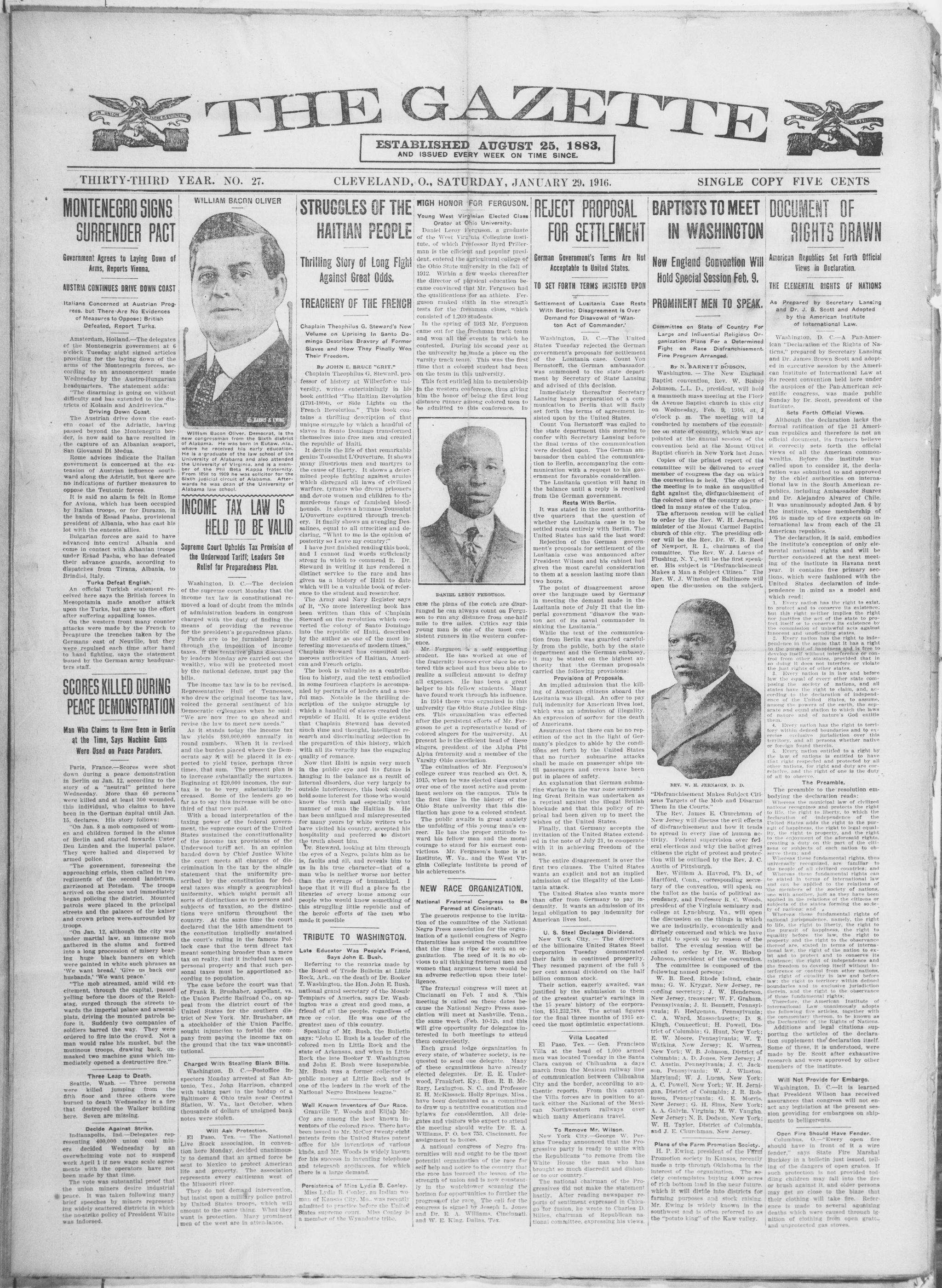
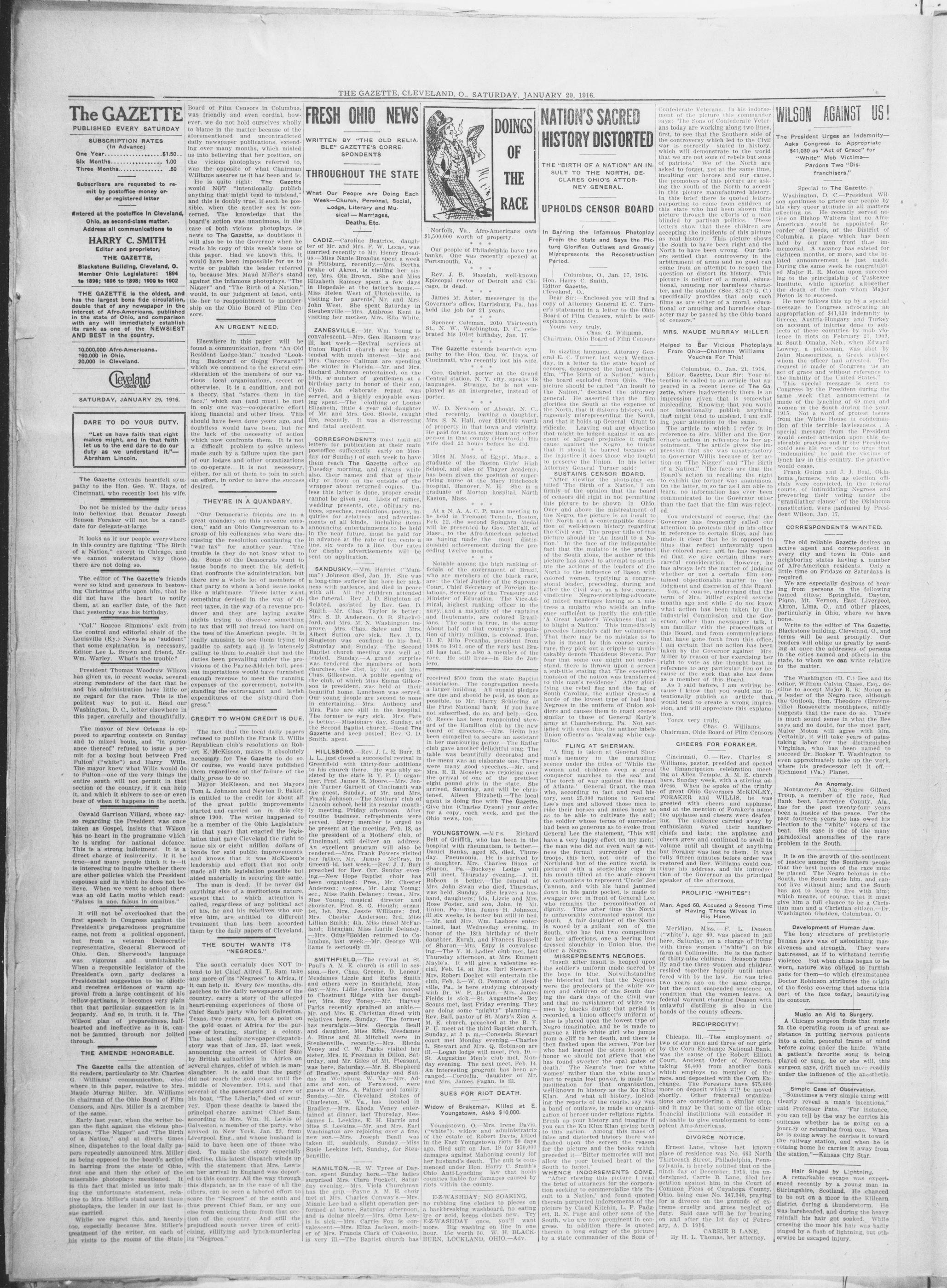
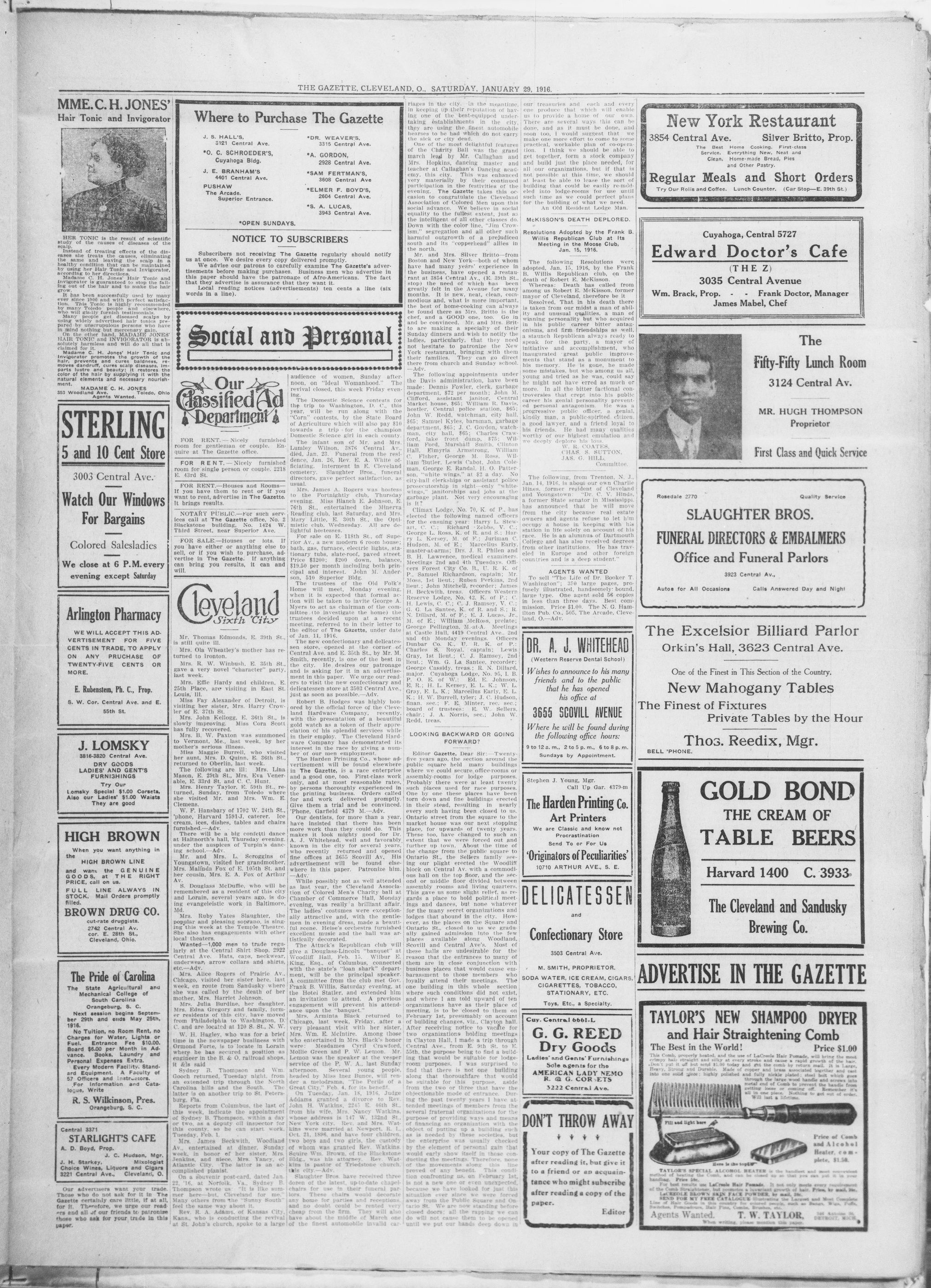
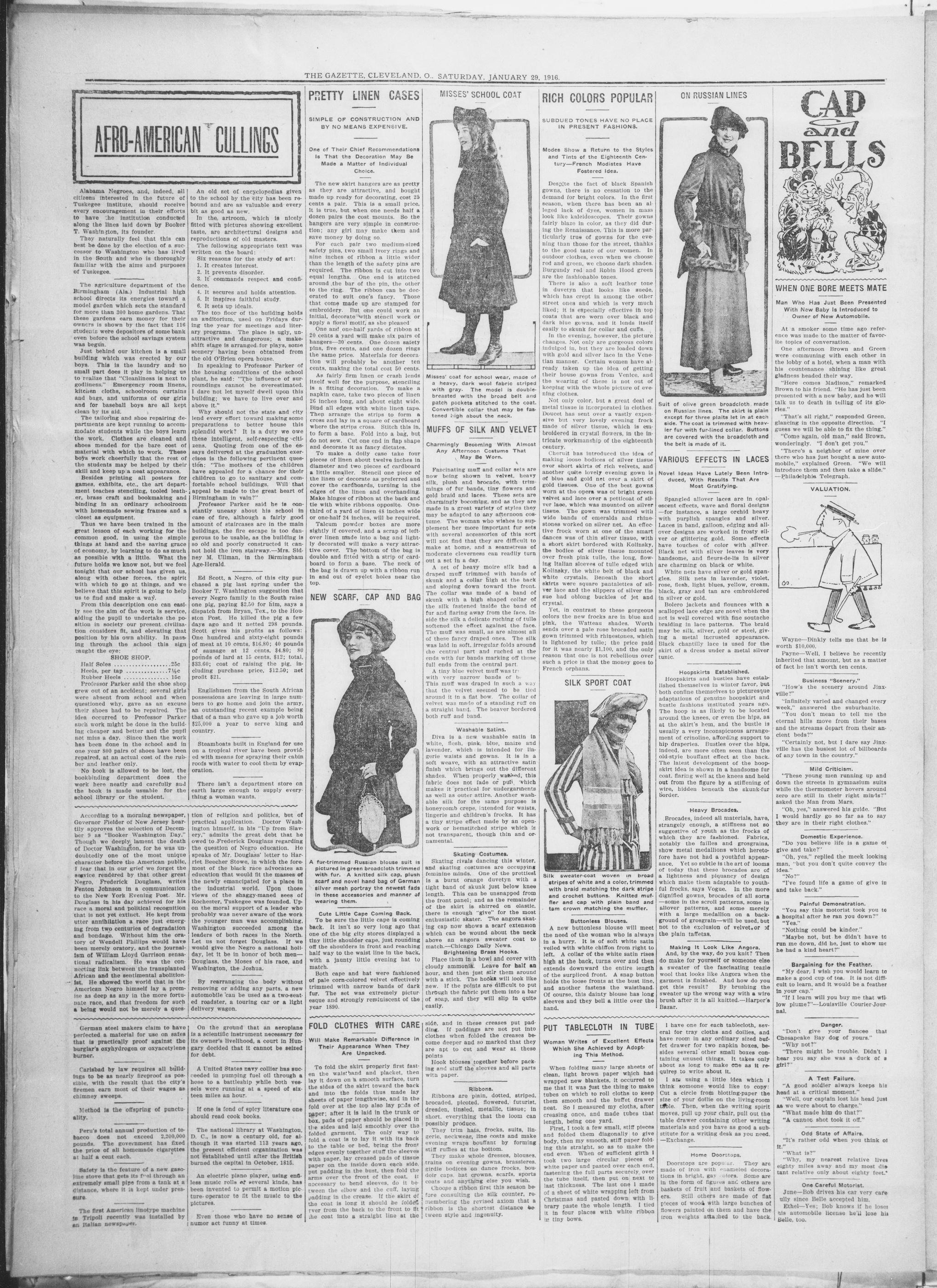
Page text (machine-generated)
THIRTY-THIRD YEAR. NO: 27.
IN ONION
HELPS STRUGGLE
MONTENEGRO SIGNS SURRENDER PACT
Government Agrees to Laying Down of Arms, Reports Vienna.
AUSTRIA CONTINUES DRIVE DOWN COAST
Italians Concerned at Austrian Progress, but There Are No Evidences of Measures to Oppose; British Defeated, Report Turka.
Amsterdam, Holland.—The delegates of the Montenegrin government at 6 o'clock Tuesday night signed articles providing for the laying down of the arms of the Montenegrin forces, according to an announcement made Wednesday by the Austro-Hungarian headquarters. The statement adds: "The disarming is going on without difficulty and has extended to the districts of Kohsin and Andrlivevica."
Driving Down Coast.
The Austrian drive down the eastern coast of the Adriatic, having passed beyond the Montenegrin border, is now said to have resulted in the capture of an Albanian seaport, San Giovanni Di Medua.
Rome advises indicate the Italian government is concerned at the extension of Austrian influence southward along the Adriatic, but there are no indications of further measures to oppose the Teutonic forces.
It is said no alarm is felt in Rome for Aviona, which has been occupied by Italian troops, or for Durazzo, in the hands of Essad Pasha, provisional president of Albania, who has cast his lot with the entente allies.
Bulgarian forces are said to have advanced into central Albania and come in contact with Albanian troops under Essad Pasha, who has defeated their advance guards, according to dispatches from Tirana, Albania, to Brindish Italy.
Turks Defeat English.
An official Turkish statement received here says the British forces in Mesonotamia made another attack upon the Turks, but gave up the effort after suffering appalling losses.
On the western front many counter attacks were made by the French to recapture the trenches taken by the Germans, east of Neuville, but they were repulsed each time after hand fighting, says the statement issued by the German army headquarters staff.
SCORES KILLED DURING PEACE DEMONSTRATION
Man Who Claims to Have Been in Berlin at the Time, Says Machine Guns Were Used on Peace Paraders.
Paris, France—Scores were shot down during a peace demonstration in Berlin on Jan. 12, according to the story of a "neutral" printed here Wednesday. More than 60 persons were killed and at least 300 wounded, this individual, who claims to have been in the German capital until Jan. 15, declares. His story follows:
"On Jan. 8 a mob composed of women and children formed in the slums of Berlin and started towards Unter Den Linden and the imperial palace. They were halted and dispersed by armed police.
"The government, foreseeing the approaching crisis, then called in two regiments of the second landstrim, garrisoned at Poisdam. The troops arrived on the scene and immediately began policing the district: Mounted patrols were placed in the principal streets and the palaces of the kaiser and crown prince were surrounded by troops.
"On Jan. 12, although the city was under martial law, an immense mob gathered in the slums and formed into a long procession of misery bearing huge black banners on which were painted in white such phrases as 'We want bread,' 'Give us back our husbands,' 'We want peace.'
"The mob streamed, amid wild excitement, through the capital, passed yelling before the doors of the Rechstag, surged through the streets towards the imperial palace and arsenalplatz, driving the mounted patrols before it. Suddenly two companies of soldiers barred the way. They were ordered to fire into the crowd. Not a man would raise his musket, but the mutinous troops, drawing back, unmasked two machine guns which, immediately opened a destructive fire."
Three Leap to Death.
Seattle. Wash. — Three persons were killed jumping from the fifth floor and three others were burned to death Wednesday in a fire that destroyed the Walker, building here. Seven are missing.
Decide Against Strike.
Indianapolis, Ind.—Delegates representing 400,000 union coal miners decided Wednesday by an overwhelming vote not to suspend work April 1 if new wage scale agreements with the operators have not been made by that time. The vote was substantial proof that the union miners desire industrial peace. It was taken following many brief speeches by miners representing widely scattered districts in which the no-strike policy of President White was indorsed.
ALEX A. LYNCH
William Bacon Oliver, Democrat, is the new congressman from the Sixth district of Alabama. He was born in Eutaw, Ala., where he received his early education. He attended the University of Alabama and also attended the University of Virginia, and is a member of the Phi Beta Kappa fraternity. From 1898 to 1909 he was solicitor for the University of Alabama. Afterwards he was dean of the University of Alabama law school.
INCOME TAX LAW IS HELD TO BE VALID
Supreme Court Upholds Tax Provision of the Underwood Tariff; Leaders See Relief for Preparedness Plan.
Washington, D. C.—The decision of the supreme court Monday that the income tax law is constitutional removed a load of doubt from the minds of administration leaders in congress charged with the duty of finding the means of providing; the revenue for the president's preparedness plans. Funds are to be furnished largely through the imposition of income taxes. If the tentative plans discussed by leaders Monday are carried out the wealthy, who will be protected most by the national defense, must pay the bills.
The income tax law is to be revised. Representative Hull of Tennessee, who drew the original income tax law, voiced the general sentiment of his Democratic colleagues when he said: "We are now free to go ahead and revise the law to meet new needs." As it stands today the income tax law yields $50,000,000 annually in round numbers. When it is revised and the burden placed the Democrats say it will be placed it is expected to yield twice, perhaps, three times, that sum. The present plan is to increase substantially the suraces. Beginning at $20,000 incomes, the surace is to be very substantially increased. Some of the leaders go so far as to say this increase will be one-third of that new paid.
With a broad interpretation of the taxing power of the federal government, the supreme court of the United States sustained the constitutionality of the income tax provisions of the Underwood tariff act. In an opinion handed down by Chief Justice White the court meets all charges of discrimination in the tax by the single statement that the uniformity prescribed by the constitution for federal taxes was simply a geographical uniformity, which might permit all sorts of distinctions as to persons and subjects of taxation, so the distinctions were uniform throughout the country. At the same time the court declared that the 16th amendment to the constitution impliedly sustained the court's ruling in the famous Pollock case that the term direct-tax meant something broader than a mere tax on royalty, that it included taxes on personal property and that such personal taxes must be apportioned according to population.
The case before the court was that of Frank R. Brushaber, appellant, vs. the Union Pacific Railroad Co., on appeal from the district court of the United States for the southern district of New York. Mr. Brushaber, as a stockholder of the Union Pacific, sought injunction to forbid the company from paying the income tax on the ground that the tax was unconstitutional.
Charged With Stealing Blank Bills.
Washington, D., C.—Postoffice
inspectors Monday arrested at San Antonio, Tex., John Harrison, charged with taking part in the holdup of a Baltimore & Ohio train near Central Station; W. Vn., last October, when thousands of dollars of unsigned bank notes were stolen.
Will Ask Protection
El Paso, Tex. -- The National Live Stock association, in convention here, Monday, decided unanimously to demand that an armed force be sent to Mexico to project American life and property. The association represents every cattleman west of the Missouri river. They do not demand intervention, but insist upon a military police patrol by United States troops, which will amount to the same thing. What they want, is protection. Many prominent men of the west are in advance.
ESTABLISHED AUGUST 25, 1883 AND ISSUED EVERY WEEK ON TIME SINCE.
STRUGGLES OF THE HAITIAN PEOPLE
Thrilling Story of Long Fight Against Great Odds.
TREACHERY OF THE FRENCH
Chaplain Theophilus G. Steward's New Volume on Uprising In Santo Domingo Describes Bravery of Former Slaves and How They Finally Won Their Freedom.
By JOHN E. BRUCE "GRIT."
Chaplain Theophilus G. Steward, professor of history at Wilberforce university, writes entertainingly in his book entitled "The Haitian Revolution (1791-1891), or Side Lights on the French Revolution." This book contains a thrilling description of that unique stuggle by which a handful of slaves in Santo Domingo transformed themselves into free men and created the republic of Haiti.
It details the life of that remarkable genius "Toussaint L'Ouverture." It shows many Illustrious men and martyrs to the cause of liberty. It shows a determined people fighting against arrains which disregard all laws of civilized warfare, tyrants who drown prisoners and devote women and children to the murderous fangs of famished bloodhounds. It shows a humane Toussaint L'Ouverture captured through treachery. It finally shows an avenging Dessalines, equal to all atrocities and declaring, "What to me is the opinion of posterity so I save my country." I have just finished reading this book, and I cannot find words sufficiently strong in which to commend it. Dr. Stewart in writing it has rendered a distinct service to the race and has given us a history of Haiti to date which will be a valuable book of reference to the student and researcher.
The Army and Navy Register says of it, "No more interesting book has been written than this" of Chaplin Steward on the revolution which converted the colony of Santo Domingo into the republic of Haiti, described by the author as one of the most interesting movements of modern times." Chaplin Steward has consulted numerous authorities of Haitian, American and French origin.
The book is valuable as a contribution to history, and the text embodied in some fourteen chapters is accompanied by portraits of leaders and a useful map. Notable is the thrilling description of the unique struggle by which a handful of shaves created the republic of Haiti. It is quite evident that Chapman Stewart has devoted much time and thought, intelligent research and discriminating selection in the preparation of this history, which with all its veracity has the engaging quality of romance.
Now that Haiti is again very much in the public eye and its future is hanging in the balance as a result of internal disorders, due very largely to outside interference, this book should hold some interest for those who would know the truth and especially what manner of man the Haitian is. He has been maligned and misrepresented for many years by white writers who have stisted his country, accepted his hospitality, and preferred to distort the truth about him.
Dr. Steward, looking at him through the eyes of a Negro, points him as he, faults, all, and, greets, him to us in his true character—that of a man who is neither worse nor better than the average of humankind. I hope that it will find a place in the libraries of every home among our people who would know something of this struggling little republic and of the heroic efforts of the men who made it possible
TRIBUTE TO WASHINGTON.
Lafé Educator Was People's Friend,
Says John F. Bush.
Referring to the remarks 'made by the Board of Trade Bulletin at Little Rock, Ark., on the death of Dr. Booker T. Washington, the Hon. John E. Bush, national grand secretary of the Mosaic Templars of America, says Dr. Washington was a great and good man, a friend of all the people, regardless of race or color. He was one of the greatest men of this country.
Speaking of Mr. Bush, the Bulletin says: "John E. Bush is a leader of the colored men in Little Rock and the state of Arkansas, and when in Little Rock the Judge Booker T. Washington and John E. Bush were inseparable. Mr. Bush was a former collector of public money at Little Rock and is one of the leaders in the work of the National Negro Business league."
Well Known Inventors of Our Race. Granville T. Woods and Elgilh McCoy are among the best known inventors of the colored race. There have been issued to Mr. McCoy twenty-eight patent offices from the United States patent office for his inventions of various kinds, and Mr. Woods is widely known for his success in investing telephone and telegraph advertisements, for which there is a large demand.
Persistences of Mrs. Lydia B. Conley. Miss Lydia B. Conley is a member of Kansas City Mosaic Templars admitted to the United States supreme court. Miss Lydia B. Conley is a member of the Wash. Ind.
HIGH HONOR FOR FERGUSON.
Young West Virginian Elected Class
Ocrater at Ohio University.
Drater at Ohio University.
Daniel Leroy Ferguson, a graduate of the West Virginia College institute, of which Professor Byrd Prillerman is the efficient and popular president, entered the agricultural college of the Ohio State university in the fall of 1912. Within a few weeks thereafter the director of physical education became convinced that Mr. Ferguson had the qualifications for an athlete. Ferguson ranked sixth in the strength tests for the freshman class, which consisted of 1,239 students.
In the spring of 1913 Mr. Ferguson came out for the freshman track team and won all the events in which he contested. During his second year at the university he made a place on the varsity track team. This was the first time that a colored student had been on the team in this university.
This feat entitled him to membership in the western conference, thus giving him the honor of being the first long distance runner among colored men to be admitted to this conference. In
DANIEL LEROY PERGUSON.
case the plans of the coach are disarranged he can always count on Ferguson to run any distance from one-half mile to five miles. Critics say this young man is one of the most consistent runners in the western conference.
Mr. Ferguson is a self supporting student. He has worked at one of the fraternity houses ever since he entered this school and has been able to realize a sufficient amount to defray all expenses. He has been a great helper to his fellow students. Many have found work through his influence. In 1914 there was organized in this university the Ohio State Jubilee Singers. This organization was effected after the persistent efforts of Mr. Ferguson to get a representative band of colored singers for the university. At present he is the efficient head of these singers, president of the Alpha Phil Alpha fraternity and a member of the Varsity Ohio association.
The culmination of Mr. Ferguson's college career was reached on Oct. 8, 1015, when he was elected class officer over one of the most active and prominent seniors on the campus. This is the first time in the history of the Ohio State university that this distinction has gone to a colored student. The public awaits in great anxiety the unfolding of this young man's career. He has the proper attitude toward his fellow man and the moral courage to stand for his earnest convictions. Mr. Ferguson's home is at Institute, W. Va., and the West Virginia Collegiate institute is proud of his achievements.
NEW RACE ORGANIZATION.
National Fraternal Congress to Be Formed at Cincinnati.
The generous response to the invitation of the committee of the National Negro Press association for the organization of a national congress of Negro fraternities has assured the committee that the time is ripe for such an organization. The need of it is so obvious to all thinking fraternal men and women that argument here would be an adverse reflection upon their intelligence.
The fraternal congress will meet at Cincinnati on Feb. 7 and 8. This meeting is called on these dates because the National Negro Press association will meet at Nashville, Tenn., the same week (Feb. 10-12), and this will give opportunity for delegates interested in both meetings, to attend them conveniently.
Each grand lodge organization in every state, of whatever society, is requested to send one delegate. Many of these organizations have already elected delegates. Dr. E. E. Underwood, Frankfort, Ky.; Ion R. B. McRary, Lexington, N. C. and Professor E. H. McKissack, Holly Springs, Miss. have been designated as a committee to draw up a tentative constitution and bylaws for consideration. All delegates and visitors who expect to attend the meeting should write Dr. E. A. Williams, P. O. box 753, Cincinnati, for assignment to homes.
A national congress of Negro fre-
ternities will and ought to be the most
potential organization of the race for
self help and notice to the country that
the race has passed the session of the
strength of union and is now constantly
in the watchfulness swaying the horizon for opportunities to further the progress of the race. The call for the congress is signed by Joseph L. Jones
and Dr. E. A. Williams, Cincinnati,
and W E. King, Fayette, Tex.
REJECT PROPOSAL FOR SETTLEMENT
Settlement of Lusitania Case Rests With Berlin; Disagreement is Over Demand for Disavowal of 'Wanton Act of Commander.'
Washington, D. C. The United States Tuesday rejected the German government's proposals for settlement of the Lusitania case. Count Von Bernstorf, the German ambassador, was summoned to the state department by Secretary of State Lansing and advised of this decision.
Immediately thereafter Secretary Lansing began preparation of a communication to Berlin that will flatly set forth the terms of agreement insisted upon by the United States.
Count Von Bernstorf was called to the state department this morning to confer with Secretary Lansing before the final terms of the communication were decided upon. The German ambassador then cabled the communication to Berlin, accompanying the communication with a request to his government for favorable consideration.
The Lusitania question will hang in the balance until a reply is received from the German government.
Rests With Berlin.
It was stated in the most authoritative quarters that the question of whether the Lusitania case is to be settled rests entirely with Berlin. The United States has said the last word:
Rejection of the German government's proposals for settlement of the Lusitania case was announced after President Wilson and his cabinet had given the most careful consideration to them at a session lasting more than two hours.
The point of disagreement arose over the language used by Germany in meeting the demand made in the Lusitania note of July 21 that the imperial government "disavow the wanion act of its naval commander in sinking the Lusitania."
While the text of the communication from Berlin was guarded carefully from the public, both by the state department and the German embassy, it may be stated on the highest authority that the German proposals carried the following provisions:
Provisions of Proposals.
An impled admission that the Killing of American citizens aboard the Lusitania was illegal. An offer to pay full indemnity for American lives lost, which was an admission of illegality. An expression of sorrow for the death of Americans. Assurances that there can be no repetition of the act in the light of Germany's pledes to abide by the conditions set forth by the United States that no further submarine attacks shall be made on passenger ships until passengers and crews have been put in places of safety. An explanation that German submarine warfare in the war zone surrounding Great Britain was undertaken as a reprisal against the illegal British blockade and that this policy of reprisal had been given up to meet the wishes of the United States. Finally, that Germany accepts the invitation of the United States extended in the note of July 21, to co-operate with it in achieving freedom of the seas. The entire disagreement is over the first two clauses. The United States wants an explicit and not an implied admission of the illegality of the Lusitania attack. The United States also wants more than offer from Germany to pay indemnity. It wants an admission of its legal obligation to pay indemnity for American lives lost.
H. S. Steel Declares Dividend.
U. S. Steel Declares Division.
New York City. — The directors of the billionaire United States Steel corporation Tuesday demonstrated their faith in continued prosperity. They resumed payment of the full 5 per cent annual dividend on the half billion common stock.
Their action, eagerly awaited, was justified by the submission to them of the greatest quarter's earnings in the 15 years' history of the corporation, $1,222,788. The actual figures for the final three months of 1915 exceed the most optimistic expectations.
Villa Located
El Paso, Tex. -- Gen. Francisco Villa at the head of 1,000 armed men was located Tuesday in the Santa Clara canyon of Chihuahua a days march from the Mexican railway line of communication between Chihuahua City and the border, according to authentic reports. From this canyon the Villa forces are in position to attack either the, National of the Mexican Northwestern railways over which many Americans travel.
To Remove Mr. Wilson
New York City — George W. Porkins Tuesday announced that the Progressive party is ready to unite with the Republicans to remove from the White House the man who has brought so much dissent and disloyalty to our country.
The national chairman of the Progressives did not make the statement hastily. After reading newspaper reports of sentiment expressed in Congress for Republican leaders, he is to Chairing the Hillary Clinton of the Republican national committee to lose his house.
SINGLE COPY FIVE CENTS
BAPTISTS TO MEET IN WASHINGTON
New England Convention Will Hold Special Session Feb. 9.
Committee on State of Country For Large and Influential Religious Organization Plans For a Determined Fight on Race Disfranchisement Fine Program Arranged.
By N. BARNETT DODSON.
Washington. — The New/ England Baptist convention, Rev. W. Bishop Johnson, L.L. D., president, will hold a mammoth mass meeting at the Florida da Avenue Baptist church in this city on Wednesday, Feb. 9, 1916, at 1 o'clock p. m. The meeting will be conducted by members of the committee on state of country, which was appointed at the annual session of the convention held at the Mount Olive Baptist church in New York last June. Copies of the printed report of the committee will be delivered to every member of congress the day on which the convention is held. The object of the meeting is to make an unqualified fight against the disfranchisement of the colored men of the country as practiced in many states of the Union.
The afternoon session will be called to order by the Rev. W. H. Jeruggin, minister of the Mount Carmel Baptist church of this city. The presiding officer will be the Rev. Dr. W. R. Reed of Newport, R. L. chapman of the committee. The Rev. W. J. Lucas of Flushing, N. Y., will be the first speaker. His subject is "Disfranchisement Makes a Man a Subject Citizen." The Rev. W. J. Winston of Baltimore will open the discussion on the subject.
REV. W. H. JERNAGIN, D. D.
"Disfranchisement Makes Subject Citizens Targets of the Mob and Disarm Them In the Courts."
The Rev. James E. Churchman of New Jersey will discuss the evil effects of disfranchisement and how it tends to spread in every line of human activity. Federal supervision over federal elections and why the ballot gives citizens the right of protest and protection will be outlined by the Rev. J. C. Austin of Pittsburgh.
Rev. William A. Harrod, Ph.D., of Hartford, Conn., corresponding secretary of the convention, will speak on the ballot as the basis of political ascendancy, and Professor R. C. Wood, president of the Virginia seminary and college at Lynchburg, Va., will open the discussion on the things in which we are industrially, economically and divinely concerned and which we have a right to speak on by reason of the ballot. The evening session will be called to order by Dr. W. Bishop Johnson, president of the convention. The committee is composed of the following named persons: W. B. Reed, Island, chairman; G. W. Kryzar, New Jersey, recording secretary; J. W. Henderson, New Jersey, treasurer; W. F. Graham, Pennsylvania; J. R. Bennett, Pennsylvania; F. Hedgeman, Pennsylvania; C. A. Ward, Massachusetts; D. S. Klugh, Connecticut; H. Powel, District of Columbia; G. Hunt, New York; E. W. Moore, Pennsylvania; W. T. Watkins, New Jersey; K. Warren, New York; W. B. Johnson, District of Columbia; A. D. Jones, New Jersey; J. C. Austin, Pennsylvania; J. C. Jackson, Pennsylvania; W. J. Winston, Maryland; W. J. Lanes, New York; A. C. Powell, New York; W. H. Jergan, District of Columbia; J. R. Robinson, Pennsylvania; G. E. Morris, New Jersey; G. H. Stus, New York; A. A. Galvin, Virginia; M. W. Vanham, New Jersey; N. B. Dobson, New York; W. H. Tayler, District of Columbia, and J. E. Chinman, New Jersey.
2. 3. 4. 5. 6. 7. 8. 9. 10. 11. 12. 13. 14. 15. 16. 17. 18. 19. 20. 21. 22. 23. 24. 25. 26. 27. 28. 29. 30. 31. 32. 33. 34. 35. 36. 37. 38. 39. 40. 41. 42. 43. 44. 45. 46. 47. 48. 49. 50. 51. 52. 53. 54. 55. 56. 57. 58. 59. 60. 61. 62. 63. 64. 65. 66. 67. 68. 69. 70. 71. 72. 73. 74. 75. 76. 77. 78. 79. 80. 81. 82. 83. 84. 85. 86. 87. 88. 89. 90. 91. 92. 93. 94. 95. 96. 97. 98. 99. 100.
Plans of the Farm Promotion Society,
H. P. Ewing, president of the Farm
Promotion Society in Kansas, recently
made a trip through Oklahoma in the
interest of the organization. The society
comprises having 1000 acres of
4500 bighorn land in the near foothills,
which it will distribute into districts for
farming purposes and stocking
Mr. Ewing is widely known in the
southwest and is active in the
operational life of the Kaw valley.
THE MASSACHUSETTS
DOCUMENT OF RIGHTS DRAWN
American Republics Set Forth Official Views in Declaration.
THE ELEMENTAL RIGHTS OF NATIONS
As Prepared by Secretary Lansing and Dr. J. B. Scott and Adopted by the American Institute of International Law.
Washington, D. C. N. Pan-American "declaration of the Rights of Nations," prepared by Secretary Lansing and Dr. James Brown Scott and adopted in executive session by the American Institute of International Law at its recent convention held here under the auspices of the Pan-American scientific congress, was made public Sunday by Dr. Scott, president of the institute.
Sets Forth Official Views.
Although the declaration lacks the formal ratification of the 21 American republics and therefore is not an official document, its trainers believe it correctly sets forth the official views of all the American commonwealths. Before the institute was called upon to consider it, the declaration was submitted to and approved by the chief authorities on international law in the South American republics, including Ambassador Suarez and Dr. Alejandro Alvarez of Chile. It was unanimously adopted Jan. 6 by the institute, whose membership of 105 is made up of five experts on international law from each of the 21 American republics.
The declaration, it is said, embodies the institute's conception of only elemental national rights and will be further considered at the next meeting of the institute in Havana next year. It contains five primary sections, which were fashioned with the United States declaration of independence in mind as a model and which read:
1. Every nation has the right to exist, to protect and to conserve its existence; but this right another implies the right not institutes the act of the state to proclaim the commission of unlawful acts against innocent and unoffending states.
2. Every nation has the right to independence in the sense that it has a right to develop itself without interference or control from other states, provided that in so doing it does not interfere or violate the right of other states.
3. Every nation has the right to law, and before law the spirit of every other state composing the society of nations, and all states have the right to claim, and, according to the doctrine of independence, to form the powers of the earth, the separate and central station to which the laws of nature and of nature's God entitle them.
4. Every nation has the right to territory within defined boundaries and to exercise exclusive jurisdiction over this territory, and all persons whether native or foreign, for right and duty are concerned, and the right of one is the duty of another.
The Preamble.
The promise to the resolution embodying the declaration reads:
Whereas the imperial law of civilized nations recognizes and protects the right to life, the right to liberty, to which the federation of independence of the United States adds the right to the purity of life, the right to property, and the right to the enforcement of the aforesaid rights, creating a duty on the part of the citizens or subjects of each nation to obey it, we desire these fundamental rights, thus universally recognized, are familiar to the people of all realized countries; and Whereas the fundamental rights can be applied to the relations of the members of the society of nations, and with another, as they have been applied in the relations of the citizens or subjects of the states forming the so-called
Whereas these fundamental rights of national independence, namely, the right to life, the right to liberty, the right to the pursuit of happiness, the right to equality and the right to the observance of the law, the right of the nation to exist and to protect and to conserve its existence, the right of independence and the freedom to develop itself without inalienable rights, the right of the city in law and before the right to territory within defined boundaries and to exclusive jurisdiction therein, and the right to the observance of these boundaries, the Institute of International Law unanimously adopts the following the articles, together with the complementary, to be known as the Declaration of the Rights of Nations. Additions and legal citations supporting the articles of the declaration supplement the declaration itself. Some of these, it is understood, were made by Dr. Scott after exhaustive research and were approved by other members of the institute.
Will Not Provide for Embargo
Washington, D. C.—It is learned that President Wilson has received assurances that congress will not enact any legislation at the present session providing for embargoes on shipments to belligerents.
Open Fire Should Have Fender.
Columbus, O. "Every open fire should have in front of it a wire former says. State Fire Marshal Burkey in a building just issued to the dangers of the fires of open fires. If such an incident is not provided to the children may fall into the fire or burn against it and older persons may not be close to the blaze that their clothing will take fire. Returnence is made to several organizing death and rescue organizations nition of a burning fire upon state
PUBLISHED EVERY SATURDAY
SUBSCRIPTION RATES
(In Advance)
One Year.....$1.50.
Six Months.....1.00
Three Months......50
Subscribers are requested to re-
mit by postoffice money or-
der or registered letter
Entered at the postoffice in Cleveland
Ohio, as second-class matter.
Address all communications to
HARRY C. SMITH
Editor and proprietor,
THE GAZETTE,
Blackstone Building, Cleveland, O.
Member Ohio Legislature: 1894
to 1896; 1896 to 1898; 1900 to 1902
THE GAZETTE is the oldest, and has the largest bona fide circulation, double that of any newspaper in the interest of Afro-Americans, published in the state of Ohio, and comparison with any will immediately establish its rank as one of the NEWSIEST AND BEST in the country.
10,000,000 Afro-Americans..
160,000 in Ohio.
20,000 in Cleveland.
SATURDAY, JANUARY 29, 1916.
DARE TO DO YOUR DUTY.
"Let us have faith that right makes might, and in that faith let us to the end dare to do our duty as we understand it"—Abraham Lincoln.
The Gazette extends heartfelt sympathy to the Hon. Geo. W. Hays, of Cincinnati, who recently lost his wife.
Do not be misled by the daily press into believing that Senator Joseph Benson Foraker will not be a candidate for delegate-at-large.
It looks as if our people everywhere in this country are fighting "The Birth of a Nation," except in Chicago, and we cannot understand why those there are not doing so.
The editor of The Gazette's friends were so kind and generous in bestowing Christmas gifts upon him, that he did not have the heart to notify them, at an earlier date, of the fact that yesterday was his birthday.
"Col." Roscoe Simmons' exit from the control and editorial chair of the Louisville (Ky.) News is so "sudden" that some explanation is necessary, Editor Lee L. Brown and friend, Mr Wm. Warley. What's the trouble?
President Thomas Woodrow Wilson has given us, in recent weeks, several strong reminders of the fact that he and his administration have little or no regard for the race. This is the politest way to put it. Read our Washington, D. C., letter elsewhere in this paper, carefully and thoughtfully.
The mayor of New Orleans is opposed to sparring contests on Sunday and to mixed bouts, and "in pursue ance thereof" refused to issue a permit for a boxing bout between Free Fulton ("white") and Harry Wills. The mayor knew what Wills would do to Fulton—one of the very things the entire south will not permit in that section of the country, if it can help it, and which it shivers to see or even hear of when it happens in the north.
Oswald Garrison Villard, whose say so regarding the President was once taken as Gospel, insists that Wilson has no heart in the programme which he is urging for national defence. This is a strong indictment. It is a direct charge of insincerity. If it be true—and many people think it is—is interesting to inquire whether there are other policies which the President espouses and in which he does not believe. When we went to school there was an old Latin motto which read: "Falsus in oo, falsus in omnibus."
It will not be overlooked that the first speech in Congress against the President's preparedness programme came, not from a political opponent, but from a veteran Democratic representative, General Sherwood of Ohio. Gen. Sherwood's language was vigorous and unmistakable. When a responsible legislator of the President's own party declares a Presidential suggestion to be idiotic and receives evidences of warm approval from a large contingent of his fellow-partisans, it becomes very plain that that particular suggestion is in jeopardy. And so, in truth, it is. The Wilson plan of preparedness, half-hearted and ineffective as it is, cannot be jammed through nor jolled through.
THE AMENDE HONORABLE
The Gazette calls the attention of its readers, particularly to Mr. Charles G. Williams' communication, elsewhere in this paper, relative to Mrs. Maude Murray Miller. Mr. Williams is chairman of the Ohio Board of Film Censors, and Mrs. Miller is a member of the same.
Early last year, when the writer began the fight against the vicious photoplays, "The Nigger" and "The Birth of a Nation," and at divers times since, dispatches to the local daily papers repeatedly announced Mrs. Miller as being opposed to the board's action in barring from the state of Ohio, first one and then the other of the miserable photoplays mentioned. It is this fact that misled us into making the fortunate statement, relative to Mrs. Miller's stand anent these photoplays, the leader in our last issue carried.
While we regret this, and keenly too, especially because Mrs. Miller's treatment of the writer, on each of his visits to the rooms of the State
Board of Film Censors in Columbus, was friendly and even cordial, however, we do not hold ourselves wholly to blame in the matter because of the aforementioned and uncontradicted daily newspaper publications, extending over many months, which misled us into believing that her position, on the vicious photoplayss referred to, was the opposite of what Chairman Williams assures us it has been and is. He is quite right: The Gazette would NOT "intentionally publish anything that might tend to mislead" and this is doubly true, if such be possible, when the gentler sex is concerned. The knowledge that the board's action was unanimous, in the case of both vicious photoplayss, is news to The Gazette, as doubtless it will also be to the Governor when he reads his copy of this week's issue of this paper. Had we known this, it would have been impossible for us to write or publish the leader referred to, because Mrs. Maud Miller's stand against the infamous photoplayss, "The Nigger" and "The Birth of a Nation," would, in our judgment at least, entitle the her to reappointment to member ship on the Ohio Board of Film Censors.
AN URGENT NEED
Elsewhere in this paper will be found a communication, from "An Old Resident Lodge-Man," headed "Looking Backward or Going Forward?" which we commend to the careful consideration of the members of our various local organizations, secret or otherwise. It is a condition, and not a theory, that "stares them in the face," which can (and must) be met in only one way—co-operative effort along financial and other lines. This should have been done years ago, and doubtless would have been, but for the lack of the necessity of action which now confronts them. It is not a difficult problem to solve unless made such by a failure upon the part of our lodges and other organizations to co-operate. It is not necessary either, for all of them to join in such an effort, in order to have the success desired.
THEY'RE IN A QUANDARY.
"Our Democratic friends are in a great quandary on this revenue question," said an Ohio Congressman to a group of his colleagues who were discussing the resolution continuing the "war tax" for another year. "The trouble is they do not know what to do. Some of the Democrats want to issue bonds to meet the big deficit that confronts the administration, but there are a whole lot of members of that party to whom a bond issue looks like a nightmare. These latter want something devised in the way of direct taxes, in the way of a revenue producer and they are laying awake nights trying to discover something to tax that will not tread too hard on the toes of the American people. It is really amusing to see them trying to paddle to safety and it is intensely galling to them to realize that had the duties been prevailing under the provisions of the Payne-Aldrich bill, present importations would have furnished enough revenue to meet the running expenses of the government, notwithstanding the extravagant and lavish expenditures of the sixty-third Congress."
CREDIT TO WHOM CREDIT IS DUE.
The fact that the local daily papers refused to publish the Frank B. Willis Republican club's resolutions on Robert E. McKisson, makes it absolutely necessary for The Gazette to do so. Of course, we would have published them regardless of the failure of the daily press to do so.
Mayor McKission, and not Mayors Tom L. Johnson and Newton D. Baker, is entitled to the credit for about all of the great public improvements started and carried on in this city since 1900. The writer happened to be a member of the Ohio Legislature (in that year) that enacted the legislation that gave Cleveland the right to issue six or eight million dollars of bonds for said public improvements, and knows that it was McKission's leadership and effort that not only made all this legislation possible but aided materially in securing the same. The man is dead. If he never did anything else of a meritorious nature, except that to which attention is called, regardless of any political act of his, he and his relatives who survive him, are entitled to different treatment than has been accorded them by the daily papers of Cleveland.
THE SOUTH WANTS ITS "NEGROES."
The south certainly does NOT intend to let Chief Alfred T. Sam take any more of its "Negroes" to Africa, if it can help it. Every few months, dispatches to the daily newspapers of the country, carry a story of the alleged heart-rending experiences of those of Chief Sam's party who left Galveston Texas, two years ago, for a point on the gold coast of Africa for the purpose of locating, starting a colony. The latest daily newspaper-dispatch story was that of Jan. 23, last week, announcing the arrest of Chief Sam by British authorities in Africa on several charges, chief of which is manlaughter. It is said that the party did not reach the gold coast until the middle of November, 1914, and that several of the passengers and crew of his boat, "The Liberia," died of scurvy. Upon these deaths is based the principal charge against Chief Sam, according to Wm. H. Lewis of Galveston, a member of the party, who arrived in New York, Jan. 23, from Liverpool, Eng., and whose husband is said to have been one of those who died. To make the story especially effective, this latest dispatch winds up with the statement that Mrs. Lewis on her arrival in England was deported to this country. All the way through this dispatch, as in the case of all the others, can be seen a labored effort to scare the "Negroes" of the south and thus prevent Chief Sam, or any one else from enticing them from that section of the country. And still the prejudiced south never tires of criticizing, vilifying and lynch-murdering its "Negroes."
THE GAZETTE, CLEVELAND, O.. SATURDAY, JANUARY 29, 1916.
FRESH OHIO NEWS
WRITTEN BY "THE OLD RELIA-
BLE" GAZETTE'S CORRE-
SPONDENTS
THROUGHOUT THE STATE
What Our People Are Doing Each Week—Church, Personal, Social, Lodge, Literary and Musical, Morning
CADIZ—Caroline Beatrice, daughter of Mr. and Mrs. F. W. Lucas, was married recently to Mr. Henry Broadus—Miss Nanie Broadus spent a week in Pittsburg, recently—Mrs. Bertha Drake of Akron, is visiting her sister, Mrs. Ola Brown. She and Miss Elizabeth Ramsey spent a few days in Hopedale Ramsey at the latter's home. Miss Helen West of Ubrichville, is visiting her parents, Mr. and Mrs. John West. She spent Saturday in Steubenville—Mrs. Ambrose Kent is visiting her mother, Mrs. Ella White.
ZANESVILLE.—Mr. Wm. Young is convalescence—Mrs. Geo. Ransom was ill, last week. Revival services at Union Baptist church are being attended with much interest.—Mr. and Mrs. Clarence Caliman are spending the winter in Florida.—Mr. and Mrs. Richard Johnson entertained, on the 10th, as number of gentlemen at a birthday party in honor of their son. In elaborate repast was served, and a high quality spending spent. The clothing of Louise Elizabeth, little 4 year old daughter of Mr. and Mrs. Geo. Steele, caught fire, recently. It was a distressing and fatal accident.
CORRESPONDENTS must mail all letters for publication at their main postoffice sufficiently early on Monday (or Sunday) of each week to have them reach The Gazette office on Tuesday morning, and always write also, their names and that of their city or town on the outside of the wrapper about returned copies. Unless this latter is done, proper credit cannot be given you. Lists of names, wedding presents, etc., obituary notices, speeches, resolutions, poetry, inquiries for relatives and advertisements of all kinds, including items in the near future, must be paid for in advance at the rate of ten cents a line, six words to a line. Our rates for display advertisements will be sent on application.
SANDUSKY—Mrs. Harriet ("Mama") Johnson died, Jan. 19. She was a long-time sufferer but bore her sickness with patience, and died in peace with all. All the children attended the funeral. Rev. J. D. Singleton of ficledon, assisted by Rev. Geo. D. Smith—Mrs. Chas, Taylor is better; Mrs. S. D. Anderson, O. B. Shackleford, and Mrs. M. N. Washington improve. Mrs. Chas, Salee and Mrs. Albert Sutton are sick. Rev. J. D. Singleton was confined to his bed, and Sunday—The Second Baptist church was visited, when it was attended, Sunday—A grand surprise was tendered the members of both churches, the 21st, by Mr. and Mrs. Chas, Gilkerson. A public opening of the club, of which Emma Gilkerson is president, was held at their beautiful home. Luncheon was served. Our young people are second to none in entertaining—Mrs. Anthony and Patreo are still in the hospital. The fosterer is very sick, is better—Missionary day, Sunday, at the Second Baptist church. Read The Gazette and keep posted; Rev. G. D. Smith, agent.
HILLSBORO—Rev J. L. E. Burr, B. L. l. just closed a successful revival in Greenfield with thirty-four additions to his church there. He was aby assisted by the B. Y. P. U. organizer, Prof. James E. Moore—Mrs. Jenie Turner Garnett of Cincinnati was the guest, Sunday, of the, and Mrs. Frank Johnson—The Mothers' club of Lincoln school, held its regular monthly meeting, Friday afternoon. After routine business, refreshments were served, and he will be present at the meeting, Feb. 18, as the president of the Mothers' club, of Cincinnati, will deliver an address. An excellent program will also be rendered—Mrs. Frank Powers visited her father, Mr. James McCray, in Greenfield ld, last week—Rev J. J. Burr preached for Rev. Orr. Sunday evening. New Hope Baptist choir has been organized; Pres. Mr. Chester Anderson; v.p. Pres. Mr. Lang Young; sec. Miss Faith Delaney; treas. Mrs. Mae Young; musical director and chorister; Prof. S. G. Coughnall; organist, Prof. S. G. Coughnall; 2nd Mrs. Chester Anderson; 2nd, Miss Lillian Smith; 4th, Miss Hazel Flander; librarian, Miss Lucie Delaney.—Mrs. Odus Golden returned to Columbus, last week—Mr. George Williams is seriously ill.
SMITHFIELD.—The revival at St Paul's A. M. E. church is still in session.—Rev. Chas. Greene, D. Lenear Mesdames Lizzie and Rufus Smith and others were in Smithfield, Monday—Mrs. Lidie Leekens has moved to Chestnut Ridge with her daughter, Mrs. Roy Toney.—Mr. Harvey Parks recently sprained an ankle.—Mr. and Mrs. K. Christian dined with relatives here, Sunday. The former has neuralgia.—Mrs. Georgia Beall and daughter, Miss Ellie Mesdames, Mrs. M. Mitchell Steubenville, recently.—Mrs. Rhoda Veney and C. W. Parks visited her sister, Mrs. E. Freeman in Dillon, Saturday, and Mr. Giles of Mt. Pleasant, was here, Saturday.—Mr. S. Shepherd of Bradley, spent Saturday and Sunday in Wellsburg, W. Va.—Mrs. Adams and son, of Fernwood, were guests of Mrs. A. Palmer and family, Sunday.—Mr. Cleveland Stokes of Charleston, W. Va. has located in Bradley.—Mrs. Rhoda Veney entertained at dinner, last Friday, Mesdames Leekins, M. H. Hurry, S. Leekins, M. H. Hurry, E. Washington are rejoicing over a fine new son.—Mrs. Joseph Beall was taken ill, suddenly, Sunday.—Miss Susie Leekins left, Sunday, for Steubenville.
HAMILTON.—B. W. Tyrce of Dayton, spent Sunday here.—The ladies surprised Mrs. Clara Puckett, Saturday evening.—Mrs. Viola Churchman has the grip.—Payne A. M. E. choir met at Mrs. Charles Conway's.—Mrs. Minnie Lee had a slight operation performed at home, Saturday afternoon, and is doing nicely.—Mrs. Oma Lewis valesent.—Mrs. Eliza Jackson, mother of Mrs. Francis Clark of Coketone, is very ill.—The Baptist church has
DOINGS
OF
THE
RACE
Norfolk, Va.. Afro-Americans own $1,500,000 worth of property.
Our people of Philadelphia have two banks. One was recently opened at Portsmouth, Va.
Rev. J. B. Massiah, well-known Episcopal rector of Detroit and Chicago, is dead.
James M. Auter, messenger in the Governor's office, Harrisburg, Pa., has held the job for 21 years.
* * * *
Spencer Coleman, 2010 Thirteenth St., N. W., Washington, D. C., celebrated his 101st birthday, Jan. 17.
* * * *
The Gazette extends heartfelt sympathy to the Hon. Geo. W. Hays, of Cincinnati, who recently lost his wife.
Geo. Gabriel, porter at the Grand Central station, N. Y. city speaks 18 languages. Strange, he is not employed as an interpreter, instead of porter.
---
W. D. Newsm of Aboki, N. C. died recently, leaving a daughter, Mrs. S. N. Hall, over $100,000 worth of property in that town and vicinity. He paid for taxes more than any other person in that county (Hertford.) His wife died 23 hours before he did.
Miss M. Moss, of Egypt, Mass., a graduate of the Boston Girls' High School, and also of Thayer Academy, has been given the position of supervising nurse at the Mary Hitchcock hospital, Hanover, N. H. She is a graduate of Morton hospital, North Easton, Mass.
---
At a N. A. A. C. P. mass meeting to be held in Tremont Temple, Boston, Feb. 22, the second Spingarn Medal will be presented by Gov. McCall, of Mass., to the Afro-American selected as having made the most distinguished achievement during the preceding twelve months.
Notable among the high ranking officials of the government of Brazil, who are members of the black race, are: the Chief Justice of the Supreme Court, Chief Secretary of Foreign Relations, Secretary of the Treasury and Minister of Education. The Vice-Admiral, highest ranking officer in the navy, and a majority of the captains and lieutenants, are colored Brazilians. The same is true, in the army about half of that country's population of thirty million, is colored Hon. H. E. Milo Pecanha, president from 1908 to 1912, one of the very best Brazil has had, is also a member of the race. He still lives—in Rio de Janeiro.
received $500 from the state Baptist association. The congregation needs a larger building. All unpaid pledges are due and should be paid, as soon as possible, to Mr. Harry Schiering at the First National bank. If you have not subscribed, do so, and help—Gee O. Reece has been reappointed steward of the Hamilton club by the new board of directors.—Mrs. Helm has been compelled to secure an assistant in her manicuring parlor. The Rather club gave another delightful stag. The table was beautifully decorated and the menu was an elaborate one. There were many good speeches.—Mr. and Mrs. R. B. Moseley are rejoicing over the victory of the prison eight pound girls in the state. She arrived, Saturday, and will be christened, Allelizabeth—The local agent is doing fine with The Gazette. Give him (Charles Dyson) your order for a copy, each week, and get the Ohio news, too.
YOUNGSTOWN. —Mrs. Richard Belt of Griffith, who has been in the hospital with rheumatism, is better. Daniel Banks, aged 85, died, Thursday. Pneumonia. He is survived by a daughter, Mrs. Charles Dixon of Sharon. Pa.-Buckeye Lodge will meet, Thursday evening. —J. H. Bobson is better. The funeral of Mrs. John Swan who died, Thursday, was held. Sunday. She leaves a husband, Rose Foster, and son, John. In Mt. Union. Pa.-Mrs. James H. Johnson, six weeks, is better but still in bed. —Mr. and Mrs. Wm. Lashore entertained, last Wednesday evening, in honor of the 18th birthday of their daughter, Eurah, and Frances Russell of Sharon. —Mrs. Espy is convalescent. The Y. M. Ladies' club met, last Thursday afternoon, at Mrs. Emmett Mayle's. It will give a valentine so sweet. The 4. at Mrs. Earl Stewart's Mrs. Robert Stewart's club, Feb. 3. —W. G. Penman of Mendville, Pa. is here studying chirpology with Dr. W. P. Burton. —Mrs. James Fields is sick. —St. Augustine's Boy Scouts meet, last Friday evening. They are doing some "mighty" planning. Rev. Ball, pastor of St. Mary's Zion A. M. E. church, preached at the B. Y. P. meet at the third Baptist church, at 3 p. m. —Consuela Stewart court met Monday evening. —Charles L. Stewart and Mrs. Q. Robbion are meeting. The 4. at St. Augustine Men's club met, Monday evening. The next meet, Feb 14. An interesting program has been arranged. —Cordelia, daughter of Mr. and Mrs. James Fagan, is ill.
SUES FOR RIOT DEATH.
Widow of Brakeman, Killed at E
Youngstown, Asks $10,000.
Youngstown, O.-M. Irene Davis, ("white"), widow and administratrix of the estate of Robert Davis, killed in the East Youngstown riots 20 days ago, filed suit on Jan. 19 for $5,000 damages against Mahoning county for her husband's death. The suit is menced under Hon. John S. Smith, with a law that holds counties liable for damages caused by riots within the county.
E.Z. WASHDAY: NO SOAKING
NATION'S SACRED HISTORY DISTORTED
THE "BIRTH OF A NATION" AN IN
SULT TO THE NORTH, DE-
CLARES OHIO'S ATTOR-
NEY GENERAL.
UPHOLDS CENSOR BOARD
In Barring the Infamous Photoplay
From the State and Says the Picture Glorifies Outlaws and Grossly Misrepresents the Reconstruction Period
Columbus, O., Jan. 17, 1916.
Hon. Harry C. Smith,
Editor Gazette,
Cleveland, O.
Dear Sir, Enclosed you will find a copy of Attorney General E. C. Turner's statement in a letter to the Ohio Board of Film Censors, which is self-explanatory.
Yours very truly,
Chas. G. Williams,
Chairman, Ohio Board of Film Censors
In sizing language, Attorney General E. C. Turner, last week Wednesday, in a letter to the state board of censors, denounced the hated picture film, "The Birth of a Nation," which the board excluded from Ohio. The picture should be called "An Insult to the Nation," declared the attorney general. He asserted that the film glorifies the South at the expense of the North, that it distorts history, outrageously misrepresenting the North, and that it holds up General Grant to leave out any objection that might be made against the account of alleged prejudice it might cause against the Negro, he thinks that it should be barred because of the injustice it does those who fought to preserve the Union. In his letter Attorney General Turner said:
SUSTAINS CENSOR BOARD.
"After viewing the photo-play entitled 'The Birth of a Nation', I am firmly of the opinion that the board of censors did right in not permitting Over and above the mistreatment of the Negro, the picture is an insult to the North and a contemptible distortion of well-known history regarding the Civil war. The proper title of this picture should be 'An Insult to a Nation'. In the face of the indisputable fact that the mulatto is the product of slavery to be allowed, the picture has dared to attempt to attribute the actions of the leaders of the North to the influence of lion with colored women, typifying a congressional leader, preceding, during and after the Civil war, as a low, coarse, vindictive. Negro-worshiping-advocate of mixed marriages having as a mistress a mulatto who wields an influence to be allowed, the situation is 'A Great Leader's Weakness' that blighted a Nation. This immediately precedes Lincoln's call for volunteers. That there may be no mistake as to who is meant by this coarse caricature, they pick out a cripple to unmistakably denote Thaddeus Stevens. For fear that some one might not understand, there is thrown upon a screen the image of the nation's mansion of the nation was transferred to this man's residence. After glorifying the rebel flag and the flag of South Carolina, the author dresses a harde of the lowest type of bad land Negroes in the uniform of Union soldiers and causes them to enact scenes similar to those of General Early's invasion of the land that not satisfied with even this, the author calls Union officers as 'scalawag white captains.'
FLING AT SHERMAN.
"A fling is taken at General Sherman's memory in the marauding scenes under the titles of 'While the women and children weep a great conqueror marches to the sea' and 'The torch of war against the breast of Atlanta.' General Grant, the man who, according to fact and real history, sent 25,000 rations to General Lee, and who led his men to ride their horses and mules home so as to be able to cultivate the soil; the soldier whose terms of surrender had been so generous as to evoke from General Lee the statement, 'This will have a very happy effect on my men'; the man who did not even wait to witness the formal surrender of the troops, this hero, not only of the Northland but of the entire world, is now the man who has his mouth tilted at the angle chosen by cartoonists to represent 'Uncle Joe Cannon, and with his hand jammed down in his pants pocket, is made to swagger over in front of General Lee, who remains the personification of dignity. Time after time the North is unfavorably contrasted against the South, who is wooed by a gallant son of the South, who has but two competitors for her affections, one a leering lout dressed slouchily in Union blue, the other a Negro.
MISREPRESENTS NEGROES.
Inrepell after insult is heaped upon the soldier's uniform made sacred by the boys in blue. Notwithstanding the historical fact that the Negroes were the protectors of the white women during the dark days of the Civil war and that no ravishment of white women by blacks during that period is recorded, a Union officer's uniform of blue is placed upon the lowest type of Negro imaginable, and he is made to pursue a little white girl who jumps from a cliff to her death, and there is then flashed upon the screen, 'For her who had learned the stern lesson of honor we should not grieve that she has found sweeter, oop gates for her white women' rather than the white women' lust to regain lost power, is made the justification for that organization, well-known in history as the Ku Klux Klan. And what all history, including the reports of the courts, say was a band of outlaws, is made an organization of heroes under religious rights. Brush up your history and imagine if you can the Ku Klux Klan giving birth to this nation. Among this mass of heroes, history does flashed upon the screen the reason for the picture and the books which preceded it—'Bitter memories will not allow the poor bruised heart of the South to forget.'
WHENCE INDORSEMENTS COME
"At viewing time I read the brief of attorneys for the corporation seeking to commercialize this Insult to a Nation," and found quoted therein purported indorsements of the picture by Claud Kitchin, L. P. Padgett, R. N. Page and other sons of the South, who are now prominent in congress. In addition there is quoted therein a long eulogy of the picture by a state commander of the Sons of
Confederate Veterans. In his indorsement of the picture this commander says: 'The Sons of Confederate Veterans today are working along two lines, first, to see that the Southern side of the controversy which led to the Civil war is correctly stated in history, which will demonstrate to the world that we are not sons of rebels but sons of patriots.' We of the North are asked to forget, yet at the same time, to honor our war heroes, the promoters of this picture are asking the youth of the North to accept in this picture manufactured history. In this brief there is quoted letters purporting to come from children of this state who had been shown this picture through the efforts of a man blinded by partisan politics. These letters are not accepted by the promoters of this picture as real history. This picture shows the South to have been right and the North to have been wrong. Our fathers settled that controversy in the arbitration of arms and no good can come from an attempt to re-open the question or distort its history. This picture is neither of a moral, educational, amusing nor harmless characier, but a serious State St. 414 (C.I.) specifically provides that only such films as are either of a moral, educational or harmless characier may be passed by the Ohio board of censors."
MRS. MAUDE MURRAY MILLER
Helped to Bar Vicious Photoplay
From Ovalhouse Williams
Louches, From This
Columbus, O. Jan. 21, 1916.
Editor, Gazette, Dear Sir: Your attention is called to an article that appeared in a recent issue of The Gazette, where inadvertently there is an impression given that is somewhat misleading. You may not intentionally publish anything that might tend to mislead, I am calling your attention to the same.
The article to which I refer is in reference to Mrs. Miller and the Governor's action in reference to her application to the Governor's pression that she was unsatisfactory to Governor Willis because of her action on "The Nigger" and "The Birth of a Nation." The facts are that the Board's action in recalling the right to exhibit the former was unanimous. On the latter, in so far as I am able to learn, the Governor communicated to the Governor other than the fact that the film was rejected.
You understand of course, that the Governor has frequently called our attention to protests filed in his office in reference to certain films, and has made it clear that he is opposed to films that reflect unfavorably upon the actions of certain individuals that we give certain films very careful consideration. However, he has always left the matter of judging whether or not a certain film contained objectionable matter to the judgment and discretion of this Board. You, of course, understand that the term of Mrs. Miller expired several months before I do not know what action has been taken. Industrial Commission and the Governor, other than newspaper talk, I am familiar with the proceedings of this Board, and from communications that have gone forth from this office, I am certain that no action has been taken by the Governor against Mrs. Miller by reason of her exercising her right to vote as she thought best in reference to any particular film or be involved in the action that has done as a member of this Board.
As I said before, I am writing because I know that you would not intentionally publish an article that would tend to create a wrong impression, and will appreciate this explanation.
Yours very truly.
Chas. G. Williams,
Chairman, Ohio Board of Film Censors
CHEERS FOR FORAKER.
Cincinnati, O.—Rev. Charles S. Williams, pastor, presided and opened the Emancipation celebration meeting at Allen Temple, A. M. E. church here, Sunday week, with a stirring ad dress. When he spoke of the trinity of chiefio Governor McKINLEY FORAKER and Governor greeted with cheers and aphlaeus and at the mention of Foraker's name the applause and cheers were deafening. The audience carried away by enthusiasm waved their handkerchiefs and hats; the applause and cheers grew and continued to swell in volume until all thought of anything but Foraker was lost to them. It was fully fifteen minutes before order was restored and Rev. Williams could converse with his introduction of the Governor as the principal speaker of the afternoon.
PROLIFIC "WHITES"!
Man, Aged 60. Accused a Second Time of Having Three Wives in His Home.
Meridian, Miss. — F. L. Deason ("white"), age 60, was placed in jail here, Saturday, on a charge of living with three women ("white") on his farm at Collinsville. He is the father of thirty-nine children. Deason's family and the three women and children resided together happily until inter-friendship began. He was tried two years ago on the charge, but the court suspended sentence condition that the women leave. A federal warrant charging Deason with unlawful distilling is also in the hands of the county officers.
RECIPROCITY!
Chicago, Ill.—The employment of two of our men and three of our girls by the Corn Exchange National Bank, was the cause of the Robert Elliott Court, Ancient Order of Foresters, taking from another bank that employs men of our race, and deposited with the Corn Exchange. The Foresters have $75,000 more on deposit which will be moved shortly. Other fraternal organizations are considering a similar step, and be that some of the other fraternal institutions will consider it advisable to give employment to competent Afro-Americans.
DIVORCE NOTICE.
Ernest Lane, whose last known place of residence was No. 663 North Thirteenth Street, Philadelphia, Pennsylvania, is hereby notified that on the ninth day of December, 1915, the undersigned, barrie B. Lane, tiled her house in Cuyahoga County, Common Pleas of Cuyahoga County, Ohio, being case No. 147,340, praying for a divorce on the grounds of extreme cruelty and gross neglect of duty. Said case will be for hearing on and after the 1st day of February, A. D. 1911. CARRIE B. LANE. By H. L. Thomas, her attorney
WILSON AGAINST US!
The President Urges an Indemnity—
Aks Congress to Appropriate
$41,030 as "Act of Grace" for
"White" Mob Victims—
Pardons Two "Dis-
franchisers."
Special to The Gazette.
Washington, D. C.—President Wilson continues to grieve our people by his very queer attitude in all matters affecting us. He recently served notice on Bishop Walters that no Afro-American would be appointed Recorder of Deeds, of the District of Columbia, a place with which he and our men front time immemorial. A vacancy has existed for eighteen months, or more, and the belated announcement is just made. During the same week he congratulated Major R. R. Moton upon succeeding to the principalship of Tuskegee Institute, while ignoring altogether the man whom Major Moton is to succeed.
He now follows this up by a special message to Congress advocating an appropriation of $41,030 indemnity to Greece, Austria-Hungary and Turkey on account of injuries done to subjects of these countries by mob violence in riots on February 11, 1915, and on behalf Edward Lowrey, a policeman, was shot by John Massourides, a Greek subject whom the officer had arrested. The request is made of Congress "as an act of grace and without reference to the liability of the United States." This special message is sent to Congress by the President during the same week in which the amount of the lynching of 69 men and women in the South during the year 1915. Not a word of protest issues from the White House in condemnation of this terrible lawlessness. A special message from the President would center attention upon this deplorable practice and if the President could see his way clear to urge that the lynching be paid the act of lynch law in this country, the practice would cease.
Frank Guinn and J. J. Beal, Oklahoma farmers, who as election officials were convicted, in the federal courts, of intimidating Negroes and preventing their voting under the "grandfather clause" of the Oklahoma constitution, were pardoned by President Wilson, Jan. 17.
CORRESPONDENTS WANTED
The old reliable Gazette desires an active agent and correspondent in every city and town in Ohio and neighboring states having a number of Afro-American residents. Only a little time on Fridays or Saturdays is required. We are especially desirous of hearing from persons in the following named cities: Springfield, Dayton, Piqua, Mt. Vernon, East Liverpool, Akron, Lima, O., and other places, particularly in Ohio, where we have none.
Write to the editor of The Gazette, Blackstone building, Cleveland, O., and terms will be sent promptly. Our readers will oblige us greatly by sending to the addresses of persons in the cities named and others in the state, to whom we can write relative to the matter.
The Washington (D. C.) Bee and its editor, William Calvin Chase, Esq., decline to accept Major R. R. Moton as a leader of the Negro race, although the Outlook, Hon. Theodore (Brownville) Roosevelt's mouthpiece, mildly suggests that the race do so. There is much sound sense in what the Bee says and no doubt, for the most part, Major Moton will agree with him. Certainly, it will take years of paints, brushes, and grits to Virginian, who has been named to succeed Dr. Booker T. Washington to even approximately take up the work, where his predecessor left it off.—Richmond (Va.) Planet.
An Anomaly
Montgomery, Ala.—Squire Gilford Troup, a member of the race, Red Bank beat. Lawrence County, Ala., has for the past twenty-four years been a justice of the peace. For the past fourteen years he has owed his election to the 'white' voters of the best bid. He is one of the many paradoxical amourods of the race problem in the South.
It is on the growth of the sentiment of justice among the Southern people that the best hopes of the race must be placed. The Negro belongs in the South, the South needs him, and cannot live without him; and the South has got to learn to live with him; and the South must give him a full chance to be a Christian man and a Christian citizen.—Dr. Washington Gladden, Columbus, O.
Development of Human Jaw
The bony structure of prehistoric human jaws was of astonishing massiveness and strength. They were buttressed, as if to withstand terrific violence. But when chins began to be worn, nature was obliged to furnish pads for them—to which circumstance Doctor Robinson attributes the origin of the fleshy covering that adorns this part of the face today, beautifying its contour.
Music an Aid to Surgery
A Chicago surgeon finds that muscle in the operating room is of great assistance in putting nervous patients into a calm, peaceful frame of mind before going under the knife. While a patient's favorite song is being played or sung, he or she will, this surgeon says, drift much more readily under the influence of the anesthetic.
Simple Case of Observation.
"Sometimes a very simple thing will clearly reveal a man's intentions," said Professor Pate. "For instance, you can tell by the way he carries his suitcase whether he is going on a journey or returning from one. When he is going away he carries it toward the railway station, and when he is coming home he carries it away from the station."—Kansas City Star.
Hair Singed by Lighttrim
Hair Singed by Lightning.
A remarkable escape was experienced recently by a young man in Stirlingshire, Scotland. He chanced to be out on a moor in the Killearn district during a thunderstorm. He was barheaded, and during the heavy rainfall his hair got soaked. While crossing the moor his hair was badly singed by a flash of lightning, but otherwise he escaped injury.
HER TONIC is the result of scientific study of the causes of diseases of the scalp. Instead of treating effects of the diseases she treats the causes, eliminating the same and healing the scalp in a healthy condition that can be maintained by using her Hair Tonic and Invigorator, according to her Beauty. Modene C. H. Jones' Hair Tonic and Invigorator is guaranteed to stop the failing out of the hair and to make the hair
It has been successfully used by many even celebrities. Tonic is highly recommended by many Toledo people and elsewhere, and is often used to treat scalds. Many people get diseased scalds by using widely advertised hair tonics prepared by unscrupulous persons who have been exposed to Tonic.
On the other hand, MADAME JONES HAIR TONIC and INVIGORATOR is a baskin robbins hair and will do all that is claimed for it.
Madame J. H. Jones' Hair Tonic and hair prevents and cures baldness, restores hair, prevents and cures dandruff, repairs lustre and beauty; it restores the color of the hair by supplying it with the natural elements and necessary nourishment.
MADAME C. H. JONES 353 Woodland Toledo, Ohio Agents Wanted.
STERLING
5 and 10 Cent Store
3003 Central Ave.
Watch Our Windows
For Bargains
Colored Salesladies
We close at 6 P.M.every
evening except Saturday
Arlington Pharmacy
WE WILL ACCEPT THIS ADVERTISEMENT FOR FIVE CENTS IN TRADE, TO APPLY ON ANY PRUCHASE OF TWENTY-FIVE CENTS OR MORE.
E. Rubenstem, Ph. C., Frop.
S. W. Cor. Central Ave. and E.
55th St.
J. LOMSKY
3816-3820 Central Ave.
DRY GOODS
LADIES' AND GENT'S
FURNISHINGS
Try Our
Lomsky Special $1.00 Corsets,
Also our Ladies' $1.00 Waists
They are good
HIGH BROWN
When you want anything in
the
HIGH BROWN LINE
and want the GENUINE
GOODS, at THE RIGHT
PRICE, call on us.
FULL LINE. ALWAYS IN
STOCK. Mail Orders promptly
filled.
cut-rat druggers
2724 Central Av.
cor. E. 28th st.
Cleveland, Ohio.
The Pride of Carolina
The State Agricultural and Mechanical College of South Carolina
Orangeburg, S. C.
Next session begins September
29th and ends May 25th,
1916.
No Tuition, no Room Rent, no Charges for Water, Lights or
Fuel. Entrance Fee $10.00.
Board $6.00 per Month in Advance
Books in Laundry and
Personal Expenses Extra.
Every Modern Facility, Standard
Equipment. A Faculty of
57 Officers and Instructors.
For Information and Catalogue, Write
R. S. Wilkinson, Pres.
Orangeburg, S. C.
Central 3371
STARLIGHT'S CAFE
A. D. Boyd, Prop.
J. C. Hudson, Mgr.
J. H. Starkey, Mixologist
Choice Wines, Liquors and Cigars
3221 Central Ave., Cleveland, O.
Our advertisers want your trade.
Those who do not ask for it in The
Gazette certainly care little, if at all,
for it. Therefore, we urge our readers
and all of our friends to patronize
those who ask for your trade in this
paper.
THE GAZETTE, CLEVELAND, O.. SATURDAY, JANUARY 29, 1916
Where to Purchase The Gazette
Where to Purchase The Gazette
*DR. WEAVER'S,
3315 Central Ave.
*A. GORDON,
2928 Central Ave.
*SAM FERTMAN'S,
3608 Central Ave.
*ELMER F. BOYD'S,
2604 Central Ave.
*S. A. LUCAS,
3943 Central Ave.
YS.
NOTICE TO SUBSCRIBERS
The Gazette regularly should notify
delivered promptly.
fully examine The Gazette's adver-
ses. Business men who advertise in
mage of Afro-Americans. The fact
that they want it.
arrisements) ten cents a line (six
Personal
Subscribers not receiving The Gazette regularly should notify us at once. We desire every copy delivered promptly.
We advise our patrons to carefully examine The Gazette's advertisements before making purchases. Business men who advertise in this paper should have the patronage of Afro-Americans. The fact that they advertise is assurance that they want it.
Local reading notices (advertisements) ten cents a line (six words in a line).
Social and Personal
audience of women, Sunday afternoon, on "Ideal Womanhood." The revival closed, this week Friday evening.
The Diverse Science contests for the trip on Washington, this year, will be run along with the "Corn" contests, by the State Board of Agriculture which will also pay $10 towards a trip for the champion Domestic Science girl in each county.
The infant son of Mr. and Mrs. Lumley Wilson, 3876 Central Av., died, Jan. 23. Funeral from the residence, Jan. 26, Rev. E. A. White officiating. Interment in E. Cleveland cemetery. Slaughter Bros., funeral services, gave perfect satisfaction, as usual.
Mrs. James A. Rogers was hostess to the Fortnightly club, Thursday evening. Miss Blanch E. Johnson, E. 76th St., entertained the Minerva Reading club, last Saturday, and Mrs. Mary Little E. 30th St., the Optima Reading club. Tailgate day. All are delightful hostesses.
For sale on E. 118th St., off Superior Av., a new modern 6 room house; bath, gas, furnace, electric lights, stationary tubs, slate-roof, paved street. Price $3200; $200 down, balance $19.50 per month including both principal and interest. John M. Anderson, 510 Superior Bldg. The trustees of the Old Folk's Home on Monday evening, when it is expected that formal action will be taken to invite George A. Myers to act as chairman of the committee (to investigate the home) the trustees decided upon at a recent meeting, referred to in their letter to the editor of The Gazette, under date of Jan. 11, 1916.
The new confectionary and delicatessen store, opened at the corner of Central Ave, and E. 35th St., by Mr. M. Smith, recently, is one of the best in the city, he is our best, and is asking for it in an advertisement in this paper. We urge our readers to visit the new confectionary and delicatessen store at 3502 Central Ave, just as soon as possible.—Adv.
Robert B. Hodges was highly honored by the official force of the Cleveland Hardware Company, recently, with the presentation of a beautiful gold watch as a token of their appreciation of his splendid services while in their employ. The Cleveland Hardware Company has demonstrated its ability to bring a number of our men employment. The Harden Printing Co. whose advertisement will be found elsewhere in The Gazette, is a race enterprise and a good one, too. First-class work only, and at most reasonable rates, by persons thoroughly experienced in the business. Employed for and work delivered promptly. Give them a trial and be convinced. Phone, Garfield 4379 M.—Adv. Our dentists, for more than a year, have insisted that there has been more work than they could do. This makes it look mighty good for Dr. A. J. Whitehead, well and favorably in the city for several years, and has been appointed fine offices at 3655 Scovill Av. His advertisement will be found elsewhere in this paper. Patronize him.—Adv.
While possibly not as well attended as last year, the Cleveland Association of Colored Men's Charity ball at Chamber of Commerce Hall, Monday evening, really comes out. The businesses were exceptionally attractive and, with the gentlemen in evening dress, made a beautiful scene. Heise's orchestra furnished excellent music and the hall was artistically decorated. The duck's bulbarian club will give a Woodlif Hall, Feb. 15, Wibur E. King, Esq., of Columbus, connected with the state's "loan shark" department, will be the principal speaker. A committee from the club met Gov. Frank B. Wills, Saturday evening, at the Hotel Statler, and extended him an invitation to attend. A previous meeting with his attendance upon the "banquet."
Mrs. Arminta Black returned to Chicago, last week, Friday, after a very pleasant visit with her sister, Mrs. Wm. E. McIntire. Among those who entertained in Mrs. Black's honor were: Mesdames (Nyril Crawford, Mrs. Wm. E. McIntire, Mrs. Lemon was the speaker at the vesper service of the P. W. A., last Sunday afternoon. Several young people, headed by Miss Inez Bunce, will render a melodrama. The Perils of a Great City, Feb. 4, for its benefit. On Tuesday, Jan. 18, 1916, Judge Addams granted a divorce to Rev. John W. McIntire from his wife, Nancy Watkins, whose address is 147 W. 132nd St, New York city, Rev. and Mrs. Watkins were married at Newport, R. L. Oct. 21, 1886, and have four children, two boys and two girls, the custody of whom was granted Rev. Watkins. Squire Wm. Brown, of the Blackstone Bldg., was his attorney. Rev Wattles was the proprietor of Triedside church, its city - Adv.
Slaughter Bros have received three dozen of the latest, up-to-date chapel-chairs for use in their funeral parlors. These chairs would decorate any home for parties and receptions, and no doubt could be rented very cheap from the firm. They will also have about the middle of March one of the finest automobile invalid car-
J. E. BRANHAM'S
4401 Central Ave.
PUSHAW
The Arcade.
Superior Entrance.
*OPEN SUNDAYS.
Our
Classified Ad
Department
FOR RENT.—Nicely furnished
room for gentleman or couple. Enquire
at The Gazette office.
FOR RENT.—Nicely furnished
room for single person or couple. E. 43rd St.
FOR RENT—Houses and Rooms—
If you have them to rent or if you
want to rent, advertise in The Gazette.
It brings results.
NOTARY PUBLIC—For such services call at The Gazette office, No. 2
Blackstone building, No. 1424 W.
Third Street, near Superior Ave.
FOR SALE—Houses or lots. If you have either or anything else to sell, or if you wish to purchase, advertise in The Gazette. If anything can bring you results, it can and will.
Mr. Thomas Edmonds, E. 39th St., is still quite ill.
Mrs. Ola Wheatley's mother has returned to Ironton.
Mrs. R. W. Winbush, E. 35th St., gave a very novel "character" party, last week.
Mrs. Effie Hardy and children, E 25th Place, are visiting in East St. Louis, IL.
Mrs. Fay Alexander of Detroit, is visiting her sister, Mrs. Harry Crowler, E. 37th St.
Mrs. John Kellogg, E. 36th St., is slowly improving. Miss Cora Scott has fully recovered.
Mrs. B. W. Paxton was summoned to Vermont, Me., last week, by her mother's serious illness. Who visited her aunt, D. Quinn, E. 36th St., returned to Oberlin, last week.
The following are ill: Mrs. Lina Mason, E. 29th St., Mrs. Eva Venerable, E. 33rd St. and C. C. Hunt.
Mrs. Henry Taylor, E. 59th St., returned, Sunday, from Toledo where she married Mr. and Mrs. Wm. E. Clemens
W. F. Hansbary of 1702 W. 24th St. 'phone, Harvard 1591 J. caterer. Ice cream, ices, dishes, tables and chairs furnished.—Adv.
There will be a big confetti dance at Haltonnorth's hall, Thursday evening, under the auspices of Turpin's dancing school.—Adv.
Mrs. L. Scroggins of Youngstown, visited her grandmother, Mrs. Malinda Fox of E. 105th St. and her cousin, Mrs. E. A. Fox of Arthur Av.
S. Douglass McDuffie, who will be remembered as a resident of this city and Lorain, several years ago, is doing evangeliele work in Baltimore, Md.
Mrs. Ruby Yates Slaughter, the popular and pleasing soprano, is singing this week at the Temple Theatre. She also has engagements with other local theaters.
Wanted: 0000 men to trade regularly at the Central Shirt Shop, 2922 Central Ave. Hats, caps, neckwear, underwear, arrow collars and shirts, etc.—Adv.
Mrs. Alice Rogers of Prairie Av. Chicago, visited her sister here, last week, en route from Sandusky where she was called by the death of her mother, Mrs. Harriet Johnson.
Mrs. Julia Burdine, her daughter, Mrs. Edna Gregory and family, former residents of this city, have moved from Philadelphia to Washington, D. C. and are located at 120 S. St. N. W. W. H. Hagley, who was for a brief in the newspaper business with Ormonde and Lorain where he has secured a position as engineer in the B. & O. railroad shops, it & is said
Sydney B. Thompson and Wm. Gooch returned, Tuesday night, from an extended trip through the North Carolina hills and the South. The latter is on another trip to St. Petersburg, Fla.
Reports from Columbus, the last of this week, indicate the appointment of Sydney B. Thompson, within a day or two, as a deputy oil inspector for this service he can start work. Tuesday Feb. 1.
Mrs. James Beckwith, Woodland Av., entertained at dinner, Sunday week, in honor of her sister, Mrs. Jenkins, and niece, Mrs. Yancy, of Atlantic City. The latter is an accomplished pianist. On a souvenir post-card, dated Jan. 22, 16, at Norfolk, Va., Sydney B. Thompson wrote us: "It is like summer here but, Cleveland for me!" Many of us remember Sunny South' for the same way about. Rev R. A. Adams, of Kansas City, Kans. is conducting the revival at St. John's church, spoke to a large
riages in the city. In the meantime, in keeping up their reputation of having one of the best-equipped undertaking establishments in the city, they are using the finest automobile hearses to be had which do not carry the sick or city dead. The most notable features of the Chalk Hall was the marshall lead by Mr. Callaghan and Mrs. Hopkins, dancing master and teacher at Callaghan's dancing academy, this city. This was enhanced very materially by their continued participation in the festivities of the evening. The Gazette takes this occasion to congratulate the Cleveland Association of Colored Men upon this social advance. We believe in social equality to the fullest extent, just as the intelligent of all other classes do. We believe in the importance ofism" segregation and all other such harmful outgrowth of a prejudiced south and its "copperhead" allies in the north.
Mr. and Mrs. Silver Britto—from Boston and New York—both of whom have had many years' experience in the business, have opened a restaurant at 3854 Central Av., (E. 39th St. at 3854 Central Av.) and have greatly felt in the Avenue for many months. It is new, neat, clean, commodious and, what is more important, the best of home-cooking can always be found there as Mrs. Britto is the chef. Mrs. Britto is also and be convinced, Mr. and Mrs. Britto are making a specialty of their Sunday dinners and wish to notify the ladies, particularly, that they need not hesitate to patronize the New York restaurant, bringing with them their families. They can go direct from church and Sunday school,ady.
The following appointments under the Davis administration, have been made: Dennis Fowler, clerk, garbage department, $72 per month; John M. Clifford, assistant janitor, Central hostel, assistant hostel, hostel, Central police station, $65; John W. Redd, watchman, city hall, $65; Samuel Kyles, barnman, garbage department, $65; J. C. Gordon, watchman, city hall, $65; Charles Crawford, lake front dump, $75; William Hall, lake front dump, $75; Elmpsy Armstrong, William C. Fisher, George M. Ross, William Butler, Lewis Cabot, John Coleman, George E. Randal, H. O. Patterson, "white wings," at $2 a day. "City-hall clerkships or assistant police prosecutorship in sight—only "white-wings"; janitorships and jobs at the city plant. Not very encouraging is it?
Climax Lodge, No. 70, K of P, has elected the following named officers for the ensuing year: Harry L. Stewart, C. C; Richard Zebbs, V. C; George L. Ross, K of R and S; Harry L. Kersey, M of F; Juriman C. Hudson, M of E; Marcellus Early, master-at-arms, Philen and Philen and medical meetings 2nd and 4th Tuesdays, Officers Forest City Co. B, U. R. K of P, Samuel Richardson, captain; Mr. Moss, 1st lieut; Ruben Perkins, 2nd lieut; John Mitchell, recorder; James H. Beckwith, treas. Officers Western Reserve Lodge, No. 42, K of P; C. H. Lewis, C. C; C. J. Ramsay, V. C; G. G. La Santee, K of H and S; R. D. Dipin, K of H and L. Lucas; G. D. William McRoss, M.at. George Pellington, M.at.A. Meetings at Castle Hall, 4419 Central Ave, 2nd and 4th Monday evenings. Officers Dunbar Co. K, U. R. K of P; Charles S. Royal, captain; Lewis Gray, 1st lieut; C. J. Ramsey, 2nd lieut; Wm. G. La Santee, recorder; George Cassidy, r丧; R. N. Dillard, major, Cuyahoga Lodge, No. 95, I. B. O. E. of H. Kersey, E. L. W. Gray, E. L. K, Marcellus Early, E. L. K; H. W. Burrell, tyer; C. J. Hudson, finan. see; E. F. Minter, rec. see; board of trustees; E. W. Sellers, chair; J. A. Norris, sec.; John W. Redd, treas.
LOOKING BACKWARD OR GOING FORWARD?
Editor Gazette, Dear Sir:—Twenty-five years ago, the section around the public square held many buildings where we could secure office-rooms or assembly-rooms for lodge purposes. Probably there were at least twenty such places used for race purposes. One by one these places have been opened in our office, the family living in their stead, resulting in nearly such having been closed to us. Ontario street from the square to the market house was our next stopping place, for upwards of twenty years. These too, have changed to such an extent that we were forced out and further up down. About the time of the change from the public square to the St. John's family setting our lodge erected the Woodliff block on Central Av. with a commodious hall on the top floor, and the second or middle room divided between assembly rooms and living quarters. This gave us some slight relief, as regards a place to hold political meetings and dances, but none whatever for the many organizations and lodges that abound in the city. How many of these organizations were located in Ontario St., closed to us we gradually gained admission into the few areas available along Woodland, Scovill and Central Ave's. Most of the halls are undesirable for the reason that the entrances to many of them are in close conjunction with business places that in whole building to those members who enjoy the office. In our office in this section where such conditions did not exist, and where I am told upward of ten organizations have as their place of meeting, is to be presumed to on February 1st, to vacate for two organizations holding meetings in Clayton Hall, I made a trip through Central Av. from E to thh and to a building that would be suitable for lodgerroom purposes. I was surprised to find that there is not one building along that thoroughfare that would be suitable for this purpose, aside from the two or three that have the objectionable mode of entrance. During the past twenty years I have attended meetings of members from the several fraternal organizations for the purpose of providing ways and means of financing an organization with the purpose of providing services as is needed by these societies, but the enterprise was usually checked by the element of personal gain that would early show itself in those conducting the meetings. Therefore none of the movements along this line proved of any benefit. This condition confronting us, on February 1st, is not a new one or even unexpected, because we have looked for just this reason. We have been away from the Public Square and Ontario St. We are now standing before closed doors; all the rapping we can do will not cause them to be opened until we put our hands deep down in
our treasuries and each and every one produce that which will enable us to provide a home of our own. There are several ways this can be done, and as it must be done, and as we must be able to make one more effort to come to some practical, workable plan of co-operation. I think we should be able to get together, form a stock company and build just the place needed, for all our organizations, but if that is not possible at this time, we should build that could be easily re-modelled into lodge-rooms for use until such time as we could perfect plans for the building of what we need.
Resolutions Adopted by the Frank B Willis Republican Club at Its Meeting in the Moose Club, Jan. 15, 1916.
The following Resolutions were adopted, Jan. 15, 1916, by the Frank B. Willis Republican club, on the death of Robert E. McKisson. Whereas, Death was called from the state, E. McKisson, former mayor of Cleveland, therefore be it.
Resolved. That in his death there is taken from our midst a man of ability and unusual qualities, a man of winning personality but who acquired in his public career bitter antagonism, firm disbelief and a staremount a republican always ready to speak for the party, a mayor of initiative and accomplishment, who inaugurated great public improvements that stand as a monument to his memory. He is gone, he made some mistakes, but who among us all, he would have been wrong, he might not have erased as much or more. In all the bitter factional controversies that crept into his public career his genial personality prevented personal antagonism. He was a progressive public officer, a genial, kindly man, a public-spirited citizen, a good lawyer, and a friend loyal to his country. He was worthy of our highest emulation and we deeply deplore his loss.
The following, from Trenton, N. J., Jan. 14, 1916, is about our own Charlie Hines, former resident of Cleveland and Youngstown: "Dr. C. V. Hinds, a former State senator in Mississippi, has announced that he will move from the city because real estate owners and agents refuse to let him occupy a house in keeping with his race. He is a graduate of his race. He is an alumnus of Dartmouth College and has also received degrees from other institutions. He has traveled in Europe and other foreign countries and is a deep student."
AGENTS WANTED
To sell "The Life of Dr. Booker T. Washington"; 350 large pages, profusely illustrated, handsomely bound, large type. One agent sold 56 copies in less than three days. Best commission. Price $1.00. The N. G. Hamilton Pub. Co., 505, The Arcade, Cleveland, O.—Adv.
DR. A. J. WHITEHEAD
(Western Reserve Dental School)
Wishes to announce to his many friends and to the public that he has opened his office at
Where he will be found during the following office hours:
9 to 12 a. m., 2 to 5 p. m., 6 to 8 p. m.
Sundays by Appointment.
Stephen J. Young, Mgr.
Call Up Gar. 4279-m
We are Classic and know not
Procrastination
Send To or For Us
'Originators of Peculiarities'
10710 ARTHUR AVE., S. E.
DELICATESSEN
and
Confectionary Store
3503 Central Ave.
M. SMITH, PROPRIETOR.
SODA WATER, ICE CREAM, CIGARS,
CIGARETTES, TOBACCO,
STATIONARY, ETC.
Toys, Etc., a Specialty.
Cuy. Central 6661-L
G. G. REED
Dry Goods
Ladies' and Gents' Furnishings
Sole agents for the
AMERICAN LADY NEMO
R. @ G. COR-ETS
3222 Central Ave.
DON'T THROW AWAY
Your copy of The Gazette after reading it, but give it to a friend or an acquaintance who might subscribe after reading a copy of the paper.
Editor
New York Restaurant
3854 Central Ave. Silver Britto, Prop.
The Best Home Cooking. First-class
Service. Everything New, Neat and
Clean. Home-made Bread, Pies
and Other Pastry.
Regular Meals and Short Orders
Try Our Rolls and Coffee. Lunch Counter. (Car Stop—E. 39th St.)
Wm. Brack, Prop. - Frank Doctor, Manager James Mabel, Chef
P. S. S.
SLAUGH
FUNERAL DIRECT
Office and
3923 0
Autos for All Occasions
The Excelsior
Orkin's Hall, 3
One of the Finest in
New Maho
The Finest of Fixt
Privat
Thos. R
BELL 'PHONE.
AUGHTER BROS.
DIRECTORS & EMBALMERS
and Funeral Parlors
3923 Central Av.,
occasions Calls Answered Day and Night
celsior Billiard Parlor
Hall, 3623 Central Ave.
Finest in This Section of the Country.
Mahogany Tables
of Fixtures
Private Tables by the Hour
os. Reedix, Mgr.
GOLD BOND
THE CREAM OF
TABLE BEERS
Harvard 1400 C. 3933
The Excelsior Billiard Parlor
Orkin's Hall, 3623 Central Ave.
One of the Finest in This Section of the Country.
New Mahogany Tables
The Finest of Fixtures
Private Tables by the Hour
Harvard 1400 C.3933
The Cleveland and Sandusky Brewing Co. SE IN THE GAZETTE
ADVERTISE IN TAYLOR'S NEW
ADVERTISE IN THE GAZETTE
TAYLOR'S NEW SHAMPOO DRYER and Hair Straightening Comb
The Best in the World!
Price $1.00
This Comb, properly heated, and the use of LaCreole Hair Pomade, will bring the most crimpy hair straight and silky at every stroke and cause a rapid growth of the hair.
Don't put it off but send $1.00 today and give the comb by return mail. It is Large, Heavy, Strong and Durable. Made of copper and brass associated together and made into one solid piece; highly polished and fully nickle plated; steel hull which goes through the large wood handle and screws into metal end of Comb to prevent the handle from getting loose or coming off. Remember it's all in one piece. Nothing to get out of order. Will last a lifetime.
Fill and light here
Here is the tool!
TAYLOR'S SPECIAL ALCOHOL HEATER is the handiest and most convenient method of heating the Comb, and can be closed up so that you can put it in your handling. Price $10.
SEND FOR MY FREE CATALOGUE Illustrating the Large and Most Complete Line of Comb Straighteners, for people such as Swear, Wig, Foil, Switches, Premade Hair, Corn, Cotton, and Agents Wanted.
T. W. TAYLOR,
348 Avenue NW,
DEBROST, WOOD
When writing, please mention this paper.
Rosedale 2770
ROYAL
BREWERY
ROYAL
BREWERY
MR. HUGH THOMPSON Proprietor
First Class and Quick Service
Quality Service
AFRO-AMERICAN CULLINGS
---
Alabama Negroes, and, indeed, all citizens interested in the future of Tuskegee institute, should receive every encouragement in their efforts to have the institution conducted along the lines laid down by Booker T. Washington, its founder. They naturally feel that this can best be done by the election of a successor to Washington who has lived in the South and who is thoroughly familiar with the aims and purposes of Tuskegee.
The agriculture department of the Birmingham (Ala.) Industrial high school directs its energies toward a model garden which sets the standard for more than 300 home gardens. That these gardens earn money for their owners is shown by the fact that 116 students were depositors of some bank even before the school savings system was begun.
Just behind our kitchen is a small building which was erected by our boys. This is the laundry and no small part does it play in helping us to realize that "Cleanliness is next to godliness." Emergency room linens, kitchen cloths, schoolroom curtains and bags, and uniforms of our girls and for baseball boys are all kept clean by its aid.
The tailoring and shoe repairing departments are kept running to accommodate students while the boys learn the work. Clothes are cleaned and shoes mended for the bare cost of material with which to work. These boys work cheerfully that the rest of the students may be helped by their skill and keep up a neat appearance.
Besides printing all posters for games, exhibits, etc., the art department teaches stenclining, tooled leath, brass craft and bookmaking and binding in an ordinary schoolroom with homemade sewing frames and a closet as equipment.
Thus we have been trained in the great lesson of each working for the common good, in using the simple things at hand and the saving grace of economy, by learning to do as much as possible with a little. What the future holds we know not, but we feel tonight that our school has given us, along with other forces, the spirit with which to go at things, and we believe that this spirit is going to help us to find and make a way. From this description one can easily see the aim of the work is service, aiding the pupil to undertake the position in society our present civilization considers fit, and elevating that position by his own ability. In passing through the school this sign caught the eve:
SHOE SHOP.
Half Soles .....25c Heels, per tap .....7½c Rubber Heels .....15c Professor Parker said the shoe shop grew out of an accident; several girls were absent from school and when questioned why, gave as an excuse their shoes had to be repaired. The idea occurred to Professor Parker such work might be done in the building cheaper and better and the pupil not miss a day. Since then the work has been done in the school and in one year 800 pairs of shoes have been repaired, at an actual cost of the rubber and leather only.
No book is allowed to be lost, the bookbinding department does the work here neatly and carefully and the book is made usable for the school library or the student.
According to a morning newspaper, Governor Fielder of New Jersey heartily approves the selection of December 9 as "Booker Washington Day." Though we deeply lament the death of Doctor Washington, for he was undoubtedly one of the most unique character before the American public, I fear that in our grief we forget the service rendered by that other great Negro, Frederick Douglass, writes Fenton Johnson in a communication to the New York Evening Post. Mr. Douglass in his day achieved for his race a moral and political recognition that is not yet extinct. He kept from utter antilation a race just emerging from two centuries of degradation and bondage. Without him the oratory of Wendell Phillips would have been merely oratory, and the journalism of William Lloyd Garrison sensational radicalism. He was the connecting link between the transplanted African and the sentimental abolitionist. He showed the world that in the American Negro himself lay a promise as deep as any in the more fortunate race, and that freedom for such a being would not be merely a ques-
German steel makers claim to have perfected a material for use on sares that is practically proof against the burglar's oxyhydrogen or oxyacetylene burner.
Carlsbad by law requires all buildings to be as nearly fireproof as possible, with the result that the city's firemen earn most of their wages as chimney sweeps.
Method is the offspring of punctuality.
Peru's total annual production of tobacco does not exceed 2,200,000 pounds. The government has fixed the price of all homemade cigarettes at half a cent each.
Safety is the feature of a new gasoline stove that gets its fuel through an extremely small pipe from a tank at a distance, where it is kept under pressure.
The first American linotype machine in Tripoli recently was installed by an Italian newspaper.
An old set of encyclopedias given to the school by the city has been rebound and are as valuable and every bit as good as new.
In the artroom, which is nicely fitted with pictures showing excellent taste, are architectural designs and reproductions of old masters.
The following appropriate text was written on the board:
Six reasons for the study of art:
1. It creates interest.
2. It prevents disorder.
3. It commands respect and confidence.
4. It secures and holds attention.
5. It inspires faithful study.
6. It sets up ideals.
The toon floor of the building holds an auditorium, used on Fridays during the year for meetings and literary programs. The place is ugly, unattractive and dangerous; a make-shift stage is arranged for plays, some scenery having been obtained from the old O'Brien opera house.
In speaking to Professor Parker of the housing conditions of the school plant, he said: "The influence of surroundings cannot be overestimated. I dare not let myself dwell upon this building; we have to live over and above it."
Why should not the state and city lend every effort toward making some preparations to better house this splendid work? It is a duty we owe these intelligent, self-respecting citizens. Quoting from one of the essays delivered at the graduation exercises is the following pertinent question: "The mothers of the children have appealed for a chance for their children to go to sanitary and comfortable school buildings. Will that appeal be made to the great heart of Birmingham in vain?"
Professor Parker said he is constantly uneasy about his school in case of fire, although a fairly good amount of staircases are in the main buildings, the fire escape is too dangerous to be usable, as the building is so old and poorly constructed it cannot hold the iron stairway.—Mrs. Sidney M. Ullman, in the Birmingham Age-Herald.
Ed Scott, a Negro, of this city purchased a pig last spring under the Booker T. Washington suggestion that every Negro family in the South raise one pig, paying $2.50 for him, says a dispatch from Bryan, Tex., to the Houston Post. He killed the pig a few days ago and it netted 298 pounds. Scott gives his profits as follows: One hundred and sixty-eight pounds of meat at 10 cents, $16.80; 40 pounds of sausage at 12 cents, $4.80; 80 pounds of lard at 15 cents, $12; total, $33.60; cost of raising the pig, including purchase price, $12.50; net profit $21.
Englishmen from the South African possessions are leaving in large numbers to go home and join the army, an outstanding recent example being that of a man who gave up a job worth $25,000 a year to serve king and country.
Steamboats built in England for use on a tropical river have been provided with means for spraying their cabin roofs with water to cool them by evaporation.
There isn't a department store on earth large enough to supply everything a woman wants.
tion of religion and politics, but of practical application. Doctor Washington himself, in his "Up from Slavey," admits the great debt that heowed to Frederick Douglass regarding the question of Negro education. He speaks of Mr. Douglass' letter to Harriet Beecher Stowe, in which the foremost of the black race advocates an education that would fit the masses of the newly emancipated for a place in the industrial world. Upon those views of the shaggy-maned sees of Rochester, Tuskegee was founded. Upon the moral support of a leader who probably was never aware of the work the younger man was accomplishing, Washington succeeded among the leaders of both races in the North. Let us not forget Douglass. If we would give the Negro a national holiday, let it be in honor of both men—Douglass, the Moses of his race, and Washington, the Joshua.
By rearranging the body without removing or adding any parts, a new automobile can be used as a two-seated roadster, a touring car or a light delivery wagon.
On the ground that an aeroplane is a scientific instrument necessary for its owner's livelihood, a court in Hungary decided that it cannot be seized for debt.
A United States navy collier has succeeded in pumping fuel oil through a hose to a battleship while both vessels were running at a speed of sixteen miles an hour.
If one is fond of spicy literature one should read cook books.
The national library at Washington, D. C., is now a century old, for although it was started 113 years ago, the present efficient organization was not established until after the British burned the capital in October, 1815.
An electric piano player, using endless music rolls of several kinds, has been invented to permit a motion picture-operator to fit the music to the pictures.
Even those who have no sense of numor act funny at times.
THE GAZETTE, CLEVELAND, O.. SATURDAY, JANUARY 29, 1916
PRETTY LINEN CASES
SIMPLE OF CONSTRUCTION AND
BY NO MEANS EXPENSIVE.
One of Their Chief Recommendations Is that the Decoration May Be Made a Matter of Individual Choice.
The new skirt hangers are as pretty as they are attractive, and bought made up ready for decorating, cost 25 cents a pair. This is a small price, it is true, but when one needs half a dozen pairs the cost mounts. So the hangers are very simple in construction; any girl may make them and save money by doing so.
For each pair two medium-sized safety pins, two small ivory rings and nine inches of ribbon a little wider than the length of the safety pins are required. The ribbon is cut into two equal lengths. One end is stitched around the bar of the pin, the other to the ring. The ribbon can be decorated to suit one's fancy. Those that come made up are stamped for embroidery. But one could work an initial, decorate with stencil work or apply a floral motif, as she pleased.
One and one-half yards of ribbon at 20 cents a yard will make six pairs of hangers—20 cents. One dozen safety pins, five, and one dozen rings the same price. Materials for decoration will probably be another ten cents, making the total cost 50 cents. As fairly firm linen or crash lends itself well for the purpose, stenciling is a fitting decoration. To make a napkin case, take two pieces of linen 26 inches long, and about eight wide. Bind all edges with white linen tape. Then arrange the strips to form a cross and lay in a square of cardboard where the strips cross. Stitch this in, to form a base. Fold into a bag, but do not sew. Cut one end in flap shape and decorate it as fancy dictates.
To make a doily case take four pieces of linen about twelve inches in diameter and two pieces of cardboard a little smaller. Stencil one piece of the linen or decorate as preferred and cover the cardboards, turning in the edges of the linen and overhanding. Make hinges of ribbon at the back and tie with white ribbons opposite. One third of a yard of linen 48 inches wide or one-half 24 inches, will be required. Talcum powder boxes are more sightly if covered, and a scrap of left-over linen made into a bag and lightly decorated will make a very attractive cover. The bottom of the bag is double and fitted with a strip of cardboard to form a base. The neck of the bag is drawn up with a ribbon run in and out of eyelet holes near the top.
NEW SCARF, CAP AND BAG
[Picture of a woman in a dark coat and hat, holding a small bag with a floral design.]
A fur-trimmed Russian blouse suit is pictured in green broadcloth trimmed with fur. A knitted silk cap, plush scarf and novel hand bag of German silver mesh portray the newest fads in these accessories and manner of wearing them.
Cute Little Cape Coming Back.
To be sure the little cape is coming back. It isn't so very long ago that one of the big city stores displayed a tiny little shoulder cape, just rounding off the shoulders in front and reaching halfway to the waist line in the back, with a jaunty little evening hat to match.
Both cape and hat were fashioned of pale corn-colored velvet effectively trimmed with narrow bands of dark fur. The set was extremely picture-quease and strongly reminiscent of the year 1890.
FOLD CLOTHES WITH CARE
Will Make Remarkable Difference in Their Appearance When They Are Unpacked.
To fold the skirt properly first fasten the waistband and placket, then lay it down on a smooth surface, turn the sides of the skirt toward the back and into the folds thus made lay sheets of paper lengthwise, and in the fold over at the top also lay pads of paper; after it is laid in the trunk or box, pads of paper should be placed in the sides and laid smoothly over the folded garment. The only way to fold a coat is to lay it with its back to the table or bed, bring the front edges evenly together stuff the sleeves with paper, lay creased pads of tissue paper on the inside down each side, put padding in the bust, then fold the arms over the front of the coat. It necessary to bend sleeves, do it between the elbow and the cuff, lay padding in the crease. If the skirt of the coat is long it should be folded over from the back to the front to fit the coat into a straight line at the
MISSES' SCHOOL COAT
1910
Misses' coat for school wear, made of a heavy, dark wool fabric striped with gray. The model is double-breasted with the broad belt and patch pockets stitched to the coat. Convertible collar that may be fastened high about the neck.
MUFFS OF SILK AND VELVET
Charmingly Becoming With Almost Any Afternoon Costume That May Be Worn.
Fascinating muff and collar sets are now being shown in velvet, heavy silk, plush and brocade, with trimming of fur bands, tiny flowers and gold braid and laces. These sets are charmingly becoming, and as they are made in a great variety of styles they may be adapted any afternoon costume. The woman who wishes to supplement her more important fur sets with several accessories of this sort will not find that they are difficult to make at home, and a seamstress of moderate cleverness can readily turn out a set in a day.
A set of heavy moire silk had a draped muff trimmed with bands of skunk and a collar high at the back and sloping down toward the front. The collar was made of a band of skunk with a high shaped collar of the silk fastened inside the band of fur and flaring away from the face. Inside the silk a delicate ruching of tulle softened the effect against the face. The muff was small, as are almost all of these fancy draped ones. The silk was laid in soft, irregular folds around the central part and ruched at the ends with fur bands marking off these full ends from the central part.
A tiny blue velvet muff was trie with very narrow bands of be- this muff was draped in such a way that the velvet seemed to be tied around it in a flat box. The collar of velvet was made of a standing ruff on a straight band. The beaver bordered both ruff and band.
Washable Satins
Diva is a new washable satin in white, flesh, pink, blue, maize and lavender, which is intended for lingerie waists and gowns. It is in a soft weave, with an attractive satin finish which brings out the different shades. When properly washed, this fabric does not fade or puff, which makes it practical for undergarments as well as outer attire. Another washable silk for the same purpose is honeycomb crepe, intended for waists, lingerie and children's frocks. It has a tiny stripe effect made by an openwork or hemstitched stripe which is not transparent, though thin and ornamental.
Skating Costumes
Skating rivals dancing this winter, and skating costumes are occupying feminine minds. One of the prettiest is a burnt orange duvetvet with a tight band of skunk just below knee length. This can be unsnapped from the front panel; and as the remainder of the skirt is shirred on elastic, there is enough "give" for the most enthusiastic skater. The angora skating cap now shows a scarf extension which can be wound about the neck above an angora sweater coat to match—Chicago Dally News.
Brightening Brass Hooks.
Place them in a bowl and cover with cloudy ammonia. Leave for half an hour, and then just stir them around with a stick. The hooks will look like new. If the points are difficult to put through the fabric put them into a bar of soap, and they will slip in quite easily.
side, and in these creases put padding. If paddings are not put into clothes when folded the creases become deeper and so marked that they are apt to cut and wear at these points
Hook blouses together before packing and stuff the sleeves and all parts with paper.
Ribbons
Ribbons are plain, dotted, striped, brocaded, plotted, flowered, futurist, dresden, tinsled, metallic, tissue; in short, everything that the loom can possibly produce.
They trim hats, frocks, suits, linier, neckwear, line coats and make evening wraps bouffant by forming stiff ruffles at the bottom.
They make whole dresses, blouses, trains on evening gowns, brassieres, girdle bodices on dance frocks, bou迪oir caps, hat cornets, scarfs, sports coats and anything else you wish.
Choose a ribbon first this season before consulting the silk counter, remembering the revised axiom that a ribbon is the shortest distance between style and ingenuity.
RICH COLORS POPULAR
SUBDUED TONES HAVE NO PLACE IN PRESENT FASHIONS.
Modes Show a Return to the Styles and Tints of the Eighteenth Century—French Modistes Have Fostered Idea.
Despite the fact of black Spanish gowns, there is no cessation to the demand for bright colors. In the first season, when there has been an allied lack of dyes, women in mass look like kaleidoscopes. Their gowns finally flaire in color, as they did during the Renaissance. This is more particularly true of gowns for the evening than those for the street, thanks to the good taste of our women. In outdoor clothes, even when we choose red and green, we choose dark shades. Burgundy red and Robin Hood green are the fashionable tones.
There is also a soft leather tone in duvetyn that looks like suede, which has crept in among the other street ones and which is very much liked; it is especially effective in top coats that are worn over black and dark blue gowns, and it lends itself easily to skunk for collar and cuffs. In the evening, however, the picture changes. Not only are gorgeous colors indulged in, but they are loaded down with gold in, and silver lace in the Venetian manner. Certain women have already taken up the idea of getting their house gowns from Venice, and the wearing of these is not out of keeping with the whole picture of evening clothes. Not only color, but a great deal of metal tissue is incorporated in clothes. Doucet has sent over a vastly expensive but very lovely evening frock made of silver tissue, which is embroidered in crystal flowers, in the intricate workmanship of the eighteenth century.
Cheruit has introduced the idea of making loose bodices of silver tissue over short skirts of rich velvet, and another quite lovely evening gown is of blue and gold net over a skirt of gold tissues. One of the best gowns worn at the opera was of bright green velvet and lace over a peticoat of silver lace, which was mounted on silver tissue. The gown was trimmed with wide bands of emeralds and rhinestone worked on silver net. An effect frock worn at one of the smart dances was of thin silver tissue, with a short skirt bordered with Kolinsky, the bodice of silver tissue mounted over fresh pink tulle, the long, flowing Italian sleeves of tulle edged with Kolinsky, the white belt of black and white crystals. Beneath the short skirts are square pantalettes of silver velce and the slippers of silver tiusse had oblong buckles of jet and crystal.
Yet, in contrast to these gorgeous colors the new frocks are in blue and pink, the Watteau shades. Worth sends over a pale rose brocaded satin gown trimmed with rhinestones, which is lightened by tulle; the price paid for it was nearly $1,100, and the only reason that one is not rebellious over such a price is that the money goes to French orphans.
SILK SPORT COAT
Silk sweater-coat woven in broad stripes of white and a color, trimmed with braid matching the dark stripe and crochet buttons. Knitted muffler and cap with plain band and tam crown matching the muffler.
Buttonless Blouses.
A new buttonless blouse will meet the need of the woman who is always in a hurry. It is of soft white satin veiled with white chiffon from right to left. A collar of the white satin rises high at the back, turns over and then extends downward the entire length of the surplice front. A snap button holds the loose front at the bust line, and another fastens the waistband. Of course, this dainty blouse has long sleeves and they bell a little over the hand.
Woman Writes of Excellent Effects Which She Achieved by Adopting This Method.
When folding many large sheets of clean, light brown paper which had wrapped new blankets, it occurred to me that it was just the thing to make tubes on which to roll cloths to keep them smooth and the buffet drawer neat. So I measured my cloths, after creasing once, and made tubes that length, being one yard.
First, I took a few small, stiff pieces and folded them diagonally to give body, then my smooth, stiff paper folding this straight, so as to make the end even. When of sufficient girth I took two large circular pieces of white paper and pasted over each end, fastening the full parts securely, over the tube itself, then put on next to last thickness. The last one I made of a sheet of white wrapping left from Christmas and pasted down with library paste the whole length. I tied it in four places with white ribbon it tiny bows.
I
Suit of olive green broadcloth made on Russian lines. The skirt is plain except for three plaits let in at each side. The coat is trimmed with heavier fur with fur-lined collar. Buttons are covered with the broadcloth and the belt is made of it.
VARIOUS EFFECTS IN LACES
Novel Ideas Have Lately Been Introduced, With Results That Are Most Gratifying.
Spangled allover laces are in opalescent effects, wave and floral designs—for instance, a large orchid heavy with purpish spangles and silver. Laces in band, galloon, edging and allover designs are worked in frosty silver or glittering gold. Some effects have touches of color with silver. Black net with silver leaves is very handsome, and fleurs-delis in silver are charming on black or white. White nets have silver or gold spangles. Silk nets in lavender, violet rose, flesh, light blues, yellow, cream, black, gray and tan are embroidered in silver or gold.
Boloer jackets and flounces with a scalloped lace edge are novel when the net is well covered with fine soutache braiding in lace patterns. The braid may be silk, silver, gold or steel, giving a metal incrusted appearance. Black chantilly lace is used for the skirt of a dress under a metal silver tunic.
Hoopskirts Established
Hoopskirts Leather
Hoopskirts and bustles have established themselves in winter favor, but both confine themselves to picturesque adaptations of genuine hoopskirt and bustle fashions instituted years ago. The hoop is as likely to be located around the knees, or even the hips, as at the skirt's hem, and the bustle is usually a very inconspicuous arrangement of crinoline, affording support to hip draperies. Bustles over the hips, indeed, are more often seen than the old-style bouffant effect at the back. The latest development of the hoopskirt idea is shown in a handsome fur coat, flaring well at the knees and held out from the figure by a stiffening of wire, hidden beneath the skunk-fur border.
Heavy Brocades.
Brocades, indeed all materials, have, strangely enough, a stiffness not so suggestive of youth as the frocks of which they are fashioned. Fabrics, notably the failles and grosgrains, show metal medallions which heretofore have not had a youthful appearance. Yet so subtle is the art of looms of today that these brocades are of a lightness and piquancy of design which make them adaptable to youthful frocks, says Vogue. In the more dignified gowns, brocades of all sorts—some in the scroll patterns, some in allover patterns, and some merely with a large medallion on a background of grosgrain—will be used, but not to the exclusion of velvet, or of the plain taffetas.
Making it look like 4
Making it Look Like Angora.
And, by the way, do you knit? Then do make for yourself or someone else a sweater of the fasching teal wool that looks like Angora when the garment is finished. And how do you get this result? By brushing the sweater up the wrong way with a wire brush after it is all knitted.—Harper's Bazar.
I have one for each tablecloth, several for tray cloths and dolls, and have room in any ordinary sized buffet drawer for two napkin boxes, besides several other small boxes containing unused things. It takes only about as long to make one as it requires to write about it.
I am using a little idea which I think someone would like to copy: Cut a circle from blotting-paper the size of your dollie on the living-room table. Then, when the writing spirit moves, pull up your chair, pull out the table drawer containing other writing materials and you have as good a substitute for a writing desk as you need. —Exchange
Home Doorstops
Doorstops are popular. They are made of iron with enameled decorations in bright, gay colors. Some are in the form of figures and others are baskets of fruit and baskets of flowers. Still others are made of flat pieces of wood with large bunches of flowers painted on them and have the iron weights attached to the back
CAP
and
BELLS
WHEN ONE BORE MEETS MATE
Man Who Has Just Been Presented With New Baby Is introduced to Owner of New Automobile.
At a smoker some time ago reference was made to the matter of favorite toques of conversation.
One afternoon Brown and Green were communing with each other in the lobby of a hotel, when a man with his countenance shining like great gladness headed their way.
"Here comes Madison," remarked Brown to his friend. "He has just been presented with a new baby, and he will talk us to death in telling of its glories."
"That's all right," responded Green, glancing in the opposite direction. "I guess we will be able to fix the thing."
"Come again, old man," said Brown, wonderingly. "I don't get you."
"There's a neighbor of mine over there who has just bought a new automobile," explained Green. "We will take it and take a slide." "Publicithth Telegraph."
VALUATION.
Wayne—Dinkly tells me that he is worth $10,000.
Payne—Well, I believe he recently inherited that amount, but as a matter of fact he isn't worth ten cents.
Business "Scenery"
"How's the scenery around Jinx-
ville?"
"Infinitely varied and changed every
week," answered the suburbate.
week, answer the question:
"You don't mean to tell me the eternal hills move from their bases and the streams depart from their ancient beds?"
"Certainly not, but I dare say Jinxville has the busiest lot of billboards of any town in the country."
Mild Criticism.
"These young men running up and down the streets in gymnasium suits while the thermometer hovers around zero are still in their right minis" asked the Man from Mars. "Oh, yes," answered his guide. "But I would hardly go so far as to say they are in their right clothes."
Domestic Experience
"Do you believe life is a game of give and take?"
"Oh, yes," replied the meek looking man, "but you don't quite convey the idea."
"No?"
"Ive found life a game of give in and take back."
Painful Demonstration.
"You say this motorist took you to a hospital after he ran you down?"
"Yes."
"Nothing could be kinder."
"Maybe not, but he didn't have to run me down, did he, just to show me he had a kind heart?"
Bargaining for the Feather
"My dear, I wish you would learn to make a good cup of tea. It is not difficult to learn, and it would be a feather in your cap."
"If I learn will you buy me that willlow plume?"—Louisville Courier-Journal.
Danger.
"Don't give your fiancee that Chesapeake Bay dog of yours."
"Why not?"
"There might be trouble. Didn't I hear you say she was a duck of a girl?"
A Test Failure.
"A good soldier always keeps his head at a critical moment."
"Well, our captain lost his head just as we were about to charge."
"What made him do that?"
"A cannox shot took it off."
Odd State of Affairs.
"It's rather odd when you think of it."
"Why, my nearest relative lives eighty miles away and my most distant relative only about eighty feet."
One Careful Motorist
very care
ully since Belle accepted him.
Ethel—Yes; Bob knows if he loses
his automobile license he'll lose his
belle, too.