The Gazette
Saturday, August 19, 1916
Cleveland, Ohio
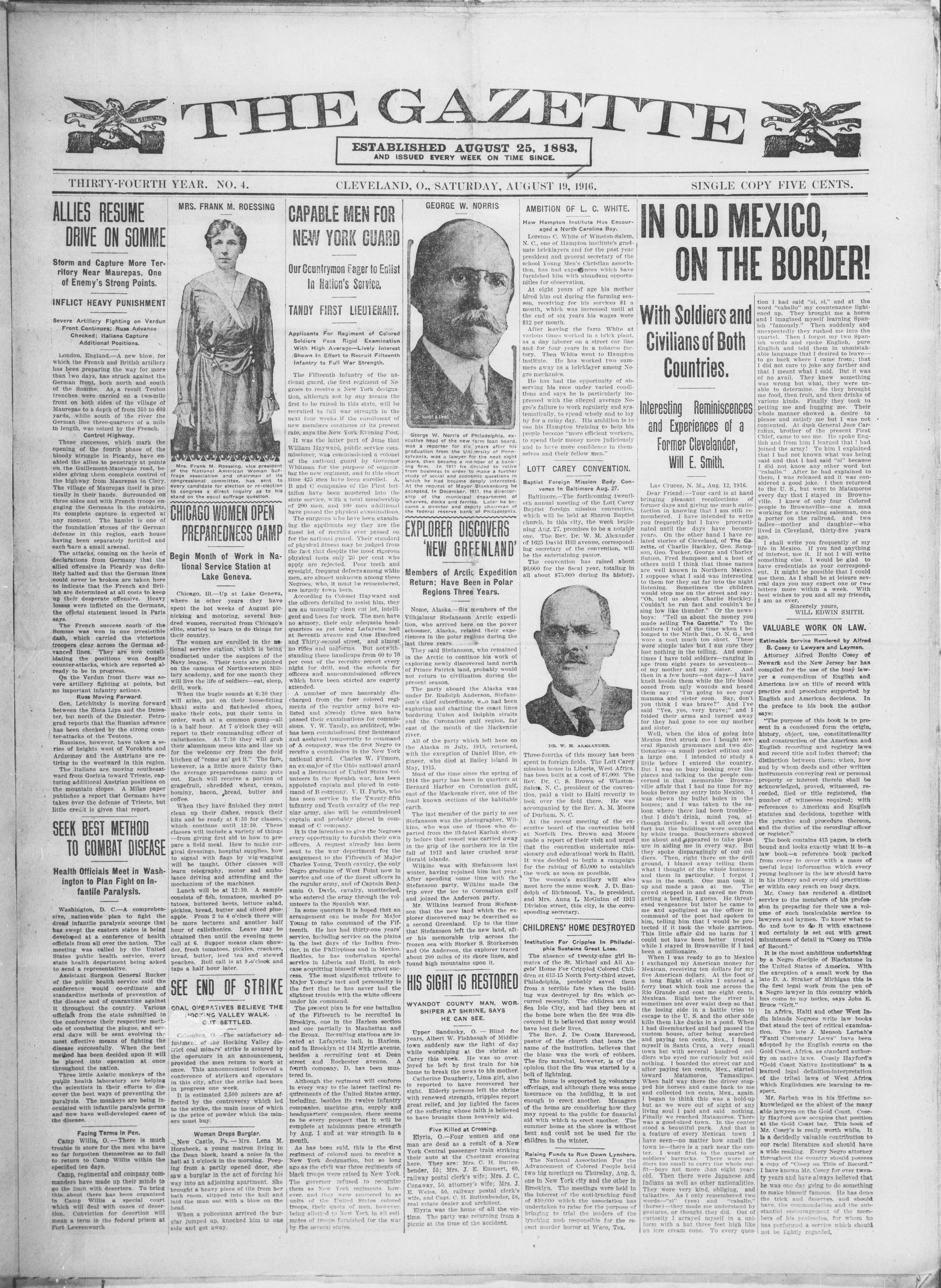
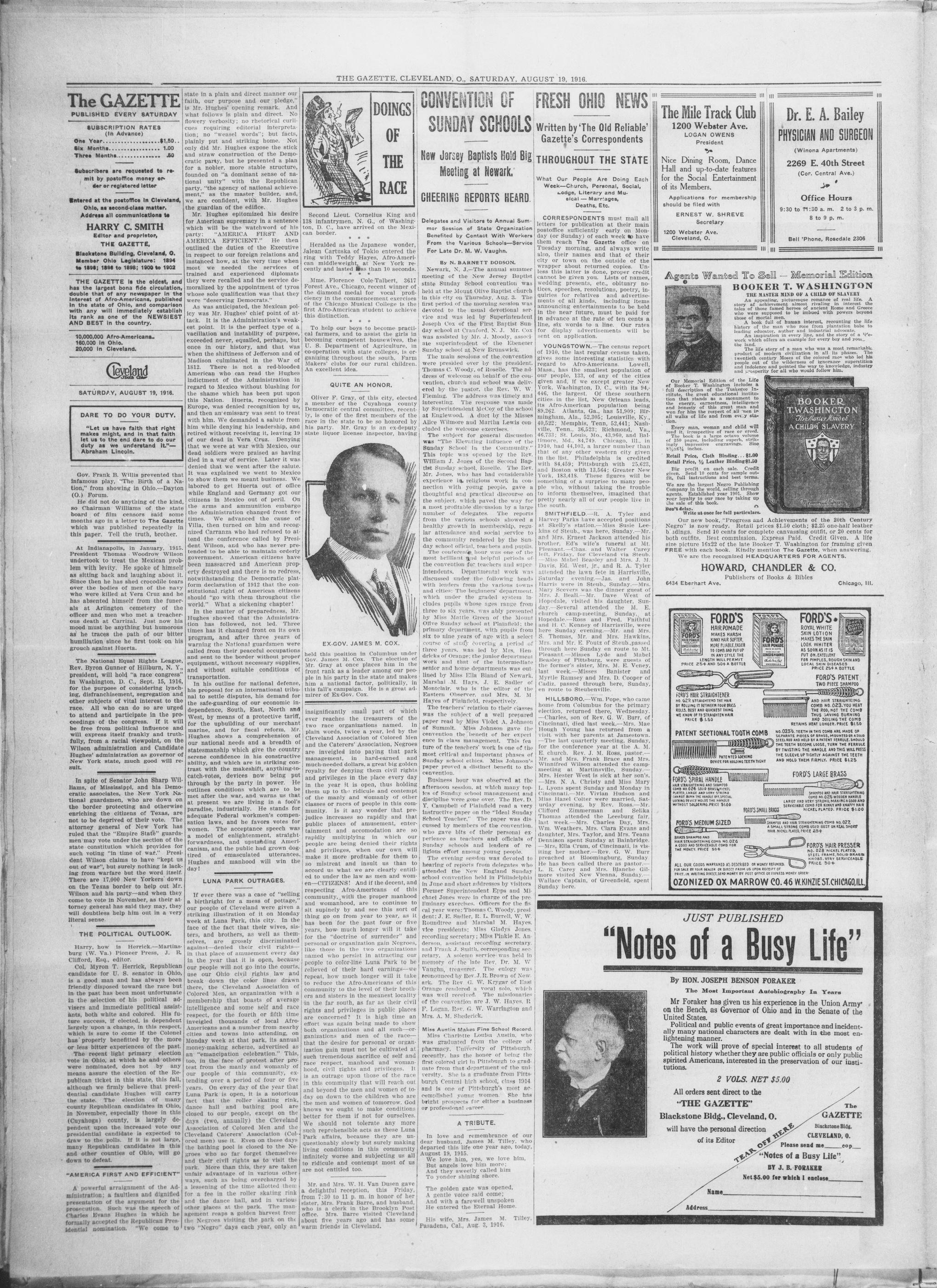
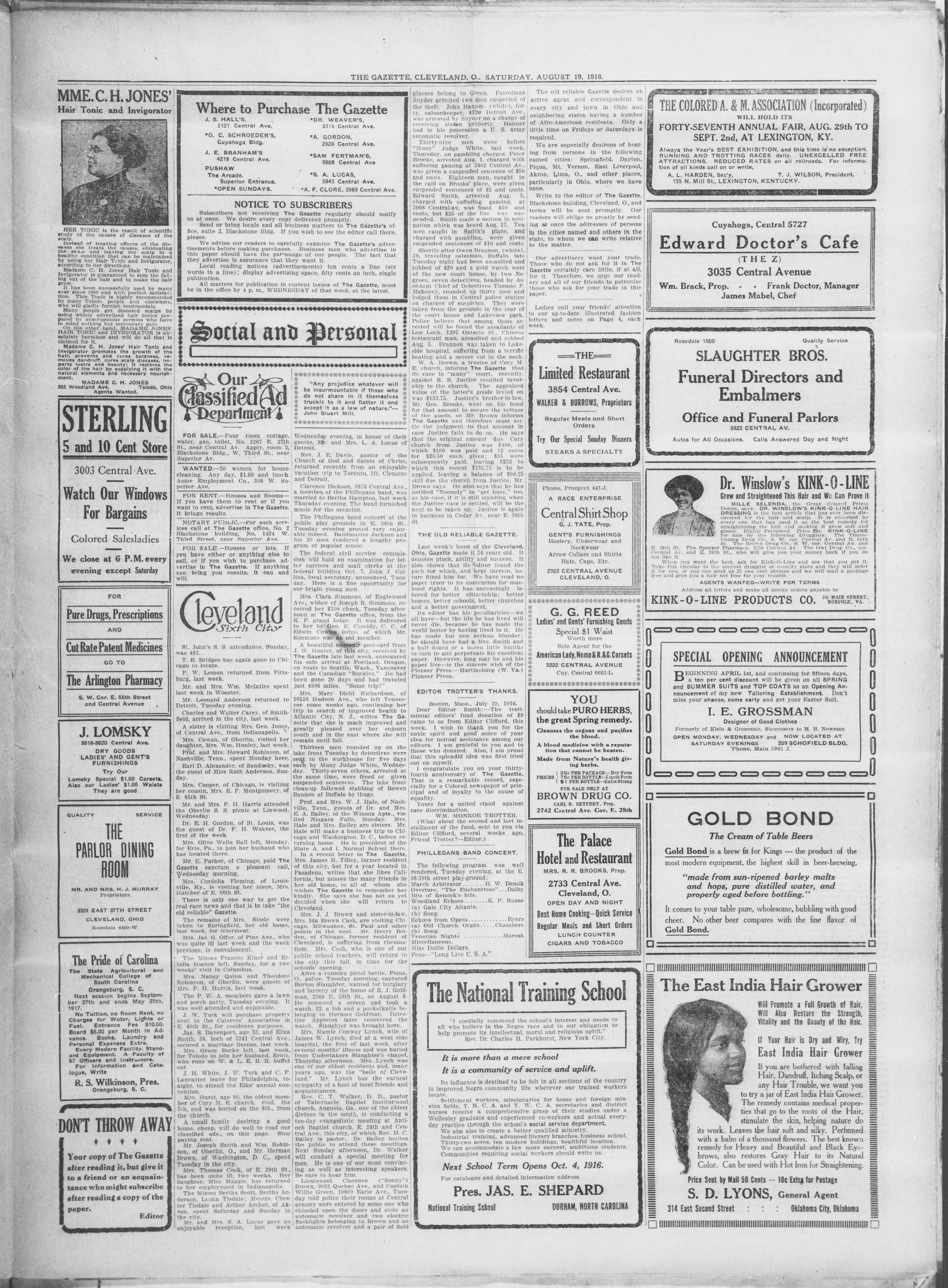
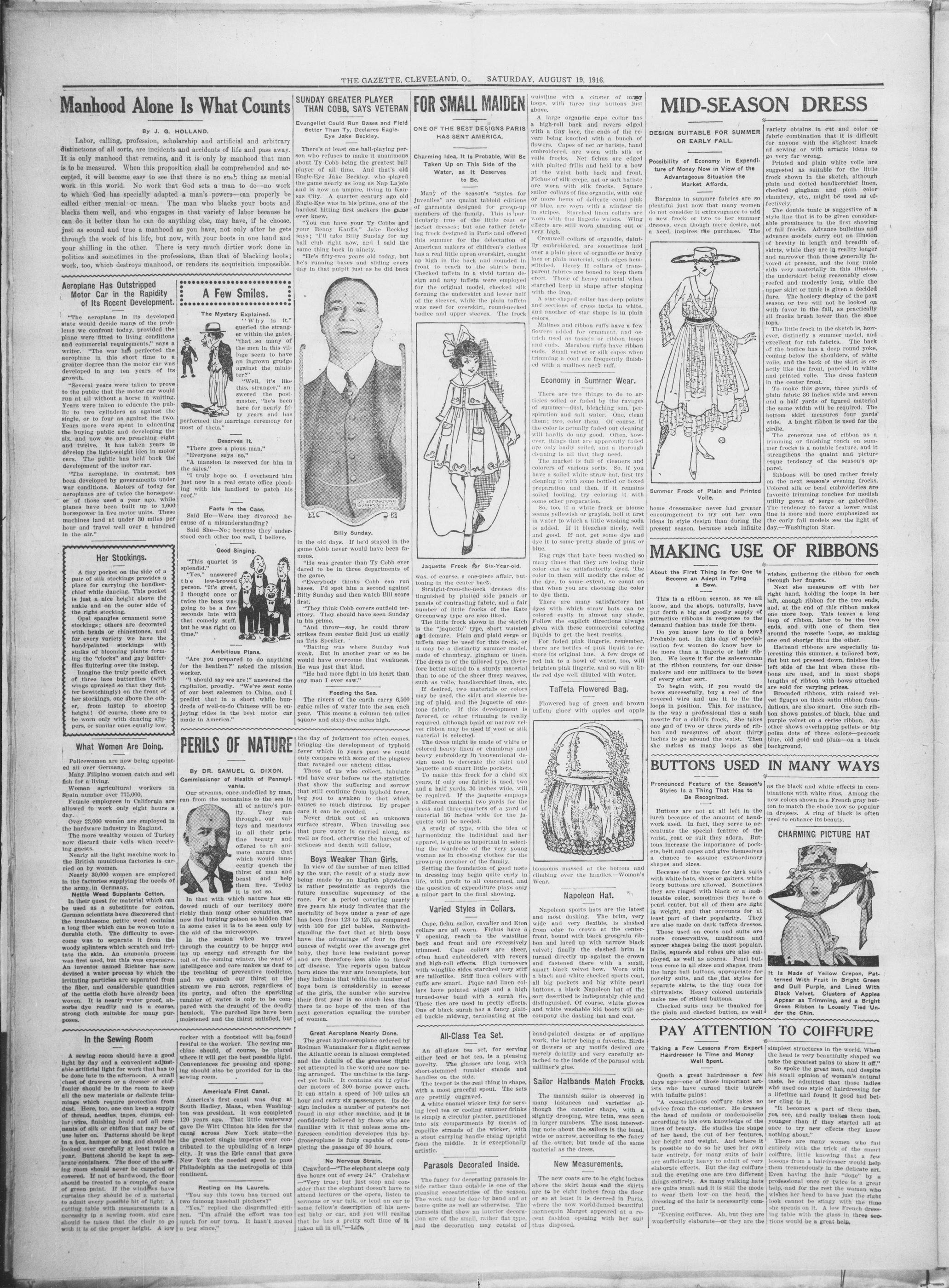
Page text (machine-generated)
THIRTY-FOURTH YEAR. NO. 4.
ALLIES RESUME
DRIVE ON SOMME
Storm and Capture More Territory Near Maurepas, One of Enemy's Strong Points.
INFLICT HEAVY PUNISHMENT
Severe Artillery Fighting on Verdund Front continues; Russ Advance Checked; Italians Capture Additional Positions.
London, England.—A new blow, for which the French and British artillery has been preparing the way for more than two days, has struck against the German front, both north and south of the Somme. As a result Teuton trenches were carried on a two-mile front on both sides of the village of Maurepas to a depth of from 350 to 600 yards, while south of the river the German life three-quarters of a mile in length, was seized by the French. Control Highway.
These successes, which mark the opening of the fourth phase of the bloody struggle in Plecardy, have enabled the allies to penetrate at points on the Gullemont-Maurepas road, besides giving them complete control of the highway from Maurepas to Clery. The village of Maurepas itself is practically in their hands. Surrounded on three sides and with French troops engaging the Germans in the outskirts, its complete capture is expected at any moment. The hamlet is one of the foundation stones of the German defense in this region, each house having been separately fortified and each barn a small arsenal.
The attacks, coming on the heels of declarations from Germany that the allied offensive in Picardy was definitely halted and that the German lines could never be broken are taken here to indicate, that the French and British are determined at all costs to keep up their desperate offensive. Heavy losses were inflicted on the Germans, the official statement issued in Paris says.
The French success south of the Somme was won in one irresistible dash, which carried the victorious troopers clear across the German advanced lines. They are now consolidating the positions won despite counterattacks, which are reported already to be in progress.
On the Verdun front there was severe artillery fighting at points, but no important infantry actions.
Russia Moving Forward.
Gen. Letchitsky is moving forward between the Ziota Lipsa and the Dniester, but north of the Dniester, Petrograd reports that the Russian advance has been checked by the strong counterattacks of the Teutons.
Russians, however, have taken a series of heights west of Vorokhta and Ardzemoy and the Austrians are retiring to the westward in this region.
The Italians are moving southeastward from Gorizia toward Trieste, capturing additional Austrian positions on the mountain slopes. A Milan paper publishes a report that Germans have taken over the defense of Trieste, but a little credit is given that report.
SEEK BEST METHOD TO COMBAT DISEASE
Health Officials Meet in Washington to Plan Fight on Infantile Paralysis.
Washington, D. C.—A comprehensive, nationwide plan to fight the dread infantile paralysis scourge that has swept the eastern states is being developed at a conference of health officials from all over the nation. The meeting was called by the United States public health service, civery state health department being asked to send a representative.
Assistant Surgeon General Rucker of the public health service said the conference would co-ordinate and standardize methods of prevention of the disease and of quarantine against it throughout the country. Various officials from the state submitted to the conference their respective methods of combating the plague, and several days will be sent evolving the most effective means of fighting the disease successfully. When the best method has been decided upon it will be placed into operation at once throughout the nation.
Three little Aslatic monkeys of the public health laboratory are helping the scientists in their efforts to discover the best ways of preventing the paralysis. The monkeys are being inoculated with infantile paralysis germs and now have well-developed cases of the disease.
Facing Terms In Pen.
Camp Willis, O. — There is much trouble in store for the men who have so far forgotten themselves as to fail to return to Camp Willis within the specified ten days.
Camp, regimental and company commanders have made up their minds to go the limit with deserters. To bring this, about there has been organized in Camp Willis a special court which will deal with cases of desertion. Conviction for desertion will mean a term in the federal prison at Fort Leavenworth
MRS. FRANK M. ROESSING
12
· Mrs. Frank M. Roessing, vice president of the National American Woman Suffrage association and chairman of its congressional committee, has sent to the House of Representatives a letter to congress a direct inquiry as to his stand on the equal suffrage-question.
CHICAGO WOMEN OPEN PREPAREDNESS CAMP
Chicago, Ill.-Up at Lake Geneva, where in other years they have spent the hot weeks of August plucking and motoring, several hundred women, recruited from Chicago's elite, started to learn to do things for their country.
The women are enrolled in the national service station, which is being conducted under the auspices of the Navy league. Their tents are pitched on the campus of Northwestern Military academy, and for one month they will live the life of soldiers—eat, sleep, drill, work.
When the bugle声 at 6:30 they will arise, put on their loose-fitting khaki suits and flat-heeled shoes, make their cots, put their tents in order, wash at a common pump—all in a half hour. At 7 o'clock they will report to their commanding officer of callisthenes. At 7:30 they will grab their aluminum mess kits and line up for the welcome cry from the field kitchen of "come an' get it." The fare, however, is a little more dainty than the average preparedness camp puts out. Each will receive a portion of grapefruit, shredded wheat, cream, hominy, bacon, bread, butter and coffee.
When they have finished they must clean up their dishes, repack their kits and be ready at 8:30 for classes, which continue until 12:30. These classes will include a variety of things—from giving first aid to how to prepare a field meal. How to make surgical dressings, hospital supplies, how to signal with flags by wig-wagging will be taught. Other classes will learn telegraphy, motor and ambulance driving and attending and the mechanism of the machines.
Lunch will be at 12:30. A sample consists of fish, tomatoes, mashed potatoes, buttered beets, lettuce salad, pickles, bread, butter and sliced pineapple. From 2 to 4 o'clock there will be more lectures and another half hour of calisthenics. Leave may be obtained until the evening mess call at 6. Supper means clam chowder, fresh tomatoes; pickles, crackers, bread, butter, ice tea and stewed peaches. Roll call is at 9 o'clock and taps a half hour later.
SEE END OF STRIKE
COAL OPERATIVES BELIEVE THE HOOKING VALLEY WALK.
OUT SETTLED.
Columbus, Ore. The satisfactory adjustment of the Hocking Valley district coal miners' strike is assured by the operators in an announcement, provided the men return to work at once. This announcement followed a conference of strikers and operators in this city, after the strike had been in progress one week. It is estimated 2,500 miners are affected by the controversy which led to the strike, the main issue of which is the price of powder which the miners must buy.
Woman Drops Burglar.
New Castle, Pa.—Mrs. Lena M. Hornbeck, a young matron living in the Dean block, heard a noise in the hall at 1 o'clock in the morning. Peeping from a partly opened door, she saw a burglar in the act of forcing his way into an adjoining apartment. She brought a heavy piece of the from her bathroom, slipped into the hall and hid the man out with a blow on the head.
When a policeman arrived the burglar jumped up, knocked him to one side and got away.
ESTABLISHED AUGUST 25, 1883 AND ISSUED EVERY WEEK ON TIME SINCE.
CLEVELAND, O., SATURDAY, AUGUST 19, 1916.
CAPABLE MEN FOR NEW YORK GUARD
Applicants For Regiment of Colored Soldiers Pass Rigid Examination With High Average—Lively Interest Shown in Effort to Recruit Fifteenth Infantry to Full War Strength.
The Fifteenth Infantry of the national guard, the first regiment of Negroes to receive a New York designation, although not by any means the first to be raised in this state, will be recruited to full war strength in the next four weeks if the enrollment of new members continues at its present rate, says the New York Evening Post. It was the latter part of June that William Hayward, public service commissioner, was commissioned a colonel of the national guard by Governor Whitman for the purpose of organizing the new regiment, and in this short time 425 men have been enrolled. A. B and C companies of the First battalion have been mustered into the state service, with a total membership of 200 men, and 100 men additional have passed the physical examinations. The surgeons who have been examining the applicants say they are the finest lot of recruits ever pressed on for the national guard. Their standard of physical fitness may be judged from the fact that despite the most rigorous physical tests only 20 per cent who apply are rejected. Poor teeth and eyesight, frequent defects among white men, are almost unknown among Negroes, who, it must be remembered, are largely born.
According to Colonel Hayward and the officers detailed to assist him, they are an unusually clean cut lot, intellect gent and keen for work. The men have no armory, their only adequate headquarters as yet being Lafayette hall at Seventh avenue and One Hundred and Thirty-second street, and almost no rifles and uniforms. But notwithstanding these handcaps from 60 to 70 per cent of the recruits report every night for drill, and the schools for officers and noncommissioned officers which have been started are eagerly attended.
A number of men honorably discharged from the four colored regiments of the regular army have collated and already three men have passed their examinations for commissions. V. W. Tandy, an architect, who has been commissioned first lieutenant and assigned temporarily to command of A company, was the first Negro to receive a commission in the New York national guard. Charles W. Filmore, an ex-major of the Ohio national guard and a lieutenant of United States volunteers in the Spanish war, has been appointed captain and placed in command of B company. V. H. Parks, who has seen service in the Twenty-fifth infantry and Tenth cavalry of the regular army, also will be commissioned captain and probably placed in command of C company.
It is the intention to give the Negroes every opportunity to furnish their own officers. A request already has been sent to the war department for the assignment to the Fifteenth of Major Charles Young. Tenth cavalry, the only Negro graduate of West Point now in service and one of the finest officers in the regular army, and of Captain Benjamin O. Davis, cavalry, unattached, who entered the army, through the volunteers in the Spanish war.
In some quarters it is hoped that an arrangement can be made for Major Young to take command of the Fifteenth. He has had thirty-one years' service, including service on the plains in the last days of the Indian frontier, in the Philippines and in Mexico. Besides, he has undertaken special service in Liberia and Haiti, in each case acquiring himself with great success. The most significant tribute to Major Young's tact and personality is the fact that he has never had the slightest trouble with the white officers under his command.
The present plan is for one battalion of the Fifteenth to be recruited in Brooklyn, one in the Harlem section and one partially in Manhattan and the Bronx. Recruiting stations are located at Lafayette hall, in Harlem, and in Brooklyn at 114 Myrtle avenue, besides a recruiting tent at Dean street and Rochester avenue. A fourth company, D, has been mastered in.
Although the regiment will conform in every way to the latest tactical requirements of the United States army, including, besides its twelve infantry companies, machine gun, supply and headquarters' companies, there seems to be every prospect that it will be complete at minimum peace strength by Aug. I and at war strength in a month.
As has been said, this is the first regiment of colored men to receive a New York designation, but so long ago as the civil war three regiments of black troops were raised in New York. The governor refused to recognize them as New York regiments, however, and they were murdered in units of the United States colored troops, their quota of men, however being allotted a New York in all estimates of troops Established for the war by the seven states.
HARRE & HENRY
George W. Norris of Philadelphia, executive head of the new farm loan board, was a reporter for six years after his graduation from the University of Penn. He served as a banker for six years, then became a mister of a banking firm. In 1911 he decided to retire from business in order to make a further study of social and economic questions in which he had become deeply interested. In 1914 he accepted, in December, 1911, the directorship of the municipal department of wharves, docks and ferries. Later he became a director and deputy chairman of the national reserve bank of Philadelphia.
EXPLORER DISCOVERS 'NEW GREENLAND'
Members of. Arctic Expedition Return; Have Been in Polar Regions Three Years.
None, Alaska.—Six members of the Vilhjalmur Stefansson Arctic expedition; who arrived here on the power schooner, Alaska, related their experiences in the polar regions during the last three years.
They said Stefansson, who retained in the Arctic to continue his work of exploring newly discovered land north of Prince Patrick land, probably would not return to civilization during the present season.
The pugly aboard the Alaska was under Dr. Rudolph Anderson, Stefansson's chief subordinate, w.o. had been exploring and charting the coast lines bordering Union and Dolphin straits and the Coronation gulf region, far east of the mouth of the Mackenzie river.
All of the party which left here on the Alaska in July, 1913, returned, with the exception of Daniel Blue, engineer, who died at Bailey Island in May, 1915.
Most of the time since the spring of 1914 the party has been in quarters at Bernard Harbor on Coronation gulf, east of the Mackenzie river, one of the least known sections of the habitable earth.
The last member of the party to see Stefansson was the photographer, Wilkins, who was one of those who departed from the ill-fated Karikh shortly before that vessel was carried away in the grip of the northern ice in the fall of 1913, and later crushed near Herald islands.
Wilkins was with Stefanson last winter, having rejoined him last year. After spending some time with the Stefanson party, Wilkins made the trip over the ice, to Coronation gulf and joined the Anderson party.
Mr. Wilkins learned from Stefanson that the new land which the explorer discovered may be described as a second Greenland. Up to the time that Stefanson left the new land, after his memorable trip across, the frozen sea with Storker S. Storkerion and Ole Anderson, the explorer traced about 200 miles of its shore lines, and found high mountains upon it.
HIS SIGHT IS RESTORED
WYAÑDOT COUNTY MAN, WORSHIPER at SHRINE, SAYS HE CAN SEE.
Upper Sandusky, O. — Blind for years, Albert W. Fishhaugh of Middletown, suddenly saw the light of day while worshiping at the shrine at Carey this week. He was so overjoyed he left by first train for his home to break the news to his mother. Catherine Daugherty, Lima girl, also is reported to have recovered her sight. Elderly persons left the shrine with renewed strength, cripples report great relief, and joy lighted the faces of the suffering whose faith is believed to have brought them heavenly aid.
Five Killed at Crossing.
Elyria, O.-Four women and one man are dead as a result of a New York Central passenger train striking their auto at the Chestnut crossing here. They are: Mrs. C. H. Bittenbender, 55; Mrs. J. E. Emmert, 60; railway postal clerk's wife; Mrs. J. C. Conaway, 50; attorney's wife; Mrs. J. E. Weis, 50; railway postal clerk's wife, and Capt. C. H. Bittenbender, 50; real estate dealer and architect. Elyria was the home of all the victims. The party was returning from a picnic at the time of the accident.
How Hampton Institute Has Encouraged a North Carolina Boy.
Lorenzo C. White of Winston-Salem, N.C., one of Hampton Institute's graduate bridgelayers and for the past year president, and general secretary of the school Young Men's Christian association, has had experiences which have furnished him with abundant opportunities for observation.
At eight years of age his mother hired him out during the fanning season, receiving, for his services $1 a month, which was increased until at the end of six years his wages were $12 per month.
After leaving the farm White at various times worked in a brick plant, as a dry laborer on a street car line and for four years in a tobacco factory. Then White went to Hampton Institute. He has worked two summers away as a bridgelayer among Negro mechanics.
He has had the opportunity of observing his race under varied conditions and says he is particularly impressed with the alleged average Negro's failure to work regularly and systematically, to spend wisely and to lay by for a rainy day. His ambition is to use his Hampton training to help his people become "more efficient workers, to spend their money more indulently, and to have more confidence in themselves and their fellow men."
LOTT CAREY CONVENTION.
Baptist Foreign Mission Body Convenes In Baltimore Aug.27.
Baltimore.—The forthcoming twentieth annual meeting of the Lott Carey Baptist foreign mission convention, which will be held at Sharon Baptist church. In this city, the week beginning Aug.27, promises to be a notable one. The Rev. Dr. W. M. Alexander of 1825 David Hill avenue, corresponding secretary of the convention, will be the entertaining pastor.
The convention has raised about $6,000 for the fiscal year, totaling in all about $75,000 during its history.
DR. W. M. Alexander.
Three-fourths of this money has been spent in foreign fields. The Lott Carey mission house in Liberth, West Africa, has been built at a cost of $7,000. The Rev. Dr. C. S. Brown of Winston Salem, N. C. president of the convention, paid a visit to Haifa recently to look over the field there. He was accompanied by the Rev. A. M. Moore of Durham, N. C.
At the recent meeting of the executive board of the convention held at Norfolk Drs. Brown and Moore made a report of their visit and urged that the convention undertake missionary and educational work in Haifa. It was decided to begin a campaign for the raising of $7,000 to establish the work as soon as possible.
The woman's auxiliary will also meet here the same week. J. D. Randolph of Richmond, Va., is president, and Mrs. Anna L. McGulian of 1403 Division street, this city, is the corresponding secretary.
CHILDRENS' HOME DESTROYED
Institution For Cripples In Philadelphia Sustaina Great Loss.
The absence of twenty-nine girl inmates of the St. Michael and All Angels' Home For Crippled Colored Children at 615-515 North Forty-third street, Philadelphia, probably saved them from a terrible fate when the building was destroyed by fire which occurred recently. The children are at Sea Isle City, and had they been at the home here when the fire was discovered it is believed that many would have lost their lives.
The Rev. J. De Costa Harewood, pastor of the church that bears the name of the institution, believes that the blaze was the work of robbers. The fire marshal, however, is of the opinion that the fire was started by a bolt of lightning.
The home is supported by voluntary offerings, and although there was some insurance on the building, it is not enough to erect another. Managers of the home are considering how they may appeal to the public for financial aid with which to erect another. The summer home at the shore is without heat and could not be used for the children in the winter.
Raising Funds to Run Down Lynchers
The National Association For the Advancement of Colored People held two big meetings on Thursday, Aug. 3, one in New York city and the other in Brooklyn. The meetings were held in the interest of the anti-lynching fund of $100,000 which the association has undertaken to raise for the purpose of blinding to trial the leaders of the Lynching mob responsible for the recent murder horror at Waco, Tex.
SINGLE COPY FIVE CENTS.
IN OLD MEXICO, ON THE BORDER!
With Soldiers and Civilians of Both Countries.
Las Cruces, N. M., Aug. 12, 1916.
Dear Friend: Your card is at hand bringing pleasant recollections of forerun days and giving me much satisfaction in knowing that I am still remembered. I have intended to write you frequently but I have procrastinated until the days have become years. On the other hand I have related stories of Cleveland, of The Gazette, of Charlie Hackley, Geo. Sappon, Geo. Tucker, George and Charley Sutton, Fred Sappon and a host of others until I think that those names are well known in Northern Mexico. I suppose what I said was interesting to them for they sat far into the night; Sometimes the children would stop the street and say "Oh, tell us about Charlie Hackley. Couldn't he run fast and couldn't be sing low like thunder." Or the newboys: "Tell us about the money you made selling 'The Gazette.' To the soldiers I told of the time when I belonged to the Ninth Bat. O. N. G., and wore a coat much short. These were simple tales but I am sure they lost nothing in the telling. And sometimes I have told soldiers—ranging in age from eight years to seventeen of my mother and my sister. And then in a few hours—not days! I have knelt beside them while the life bore on my wounds and heard them say: "I'm going to see your mamma and sister soave. Say, don't you think I was brave? And I've said 'Yes, yes, very brave,' and I folded their arms and turned away for they had gone to see my mother and sister.
Well, when the idea of going into Mexico first struck me I bought several Spanish grammars and two diacrities—a small pocket edition and a large one. I intended to study a little before I entered the country, but was busy over places and talked to the poets concerned in that memorable Brownsville affair that I had no time for my books before my entry into Mexico. I was shown the bullet holes in the houses; and I was taken to the salon where there had been trouble—but, I didn't drink, mind you, at though invited). I went all over the buildings we wiped by white troops. Southerners showed me about and appeared to take pleasure in aiding me in every way. (But they spoke disparagingly of our soldiers. Then, right there on the drill ground, I blazed away, telling them what I thought of the whole business and them in particular. I forgot. On mine up and up and made a pass at me. The crowd stepped in and saved me from getting a beating. I guess. He threatened vengeance but later he came to me and apologized as the officer in command of the post had spoken to him, telling him that I would be protected if it took the whole garrison. I thought it could not have been better treated while I stayed in Brownsville if I had been a millionaire.
When I was ready to go to Mexico I exchanged my American money for Mexican, receiving ten dollars for my five American dollars. At the foot of a long flight of stairs I entered a ferry, boat which took me across the Rio Grande and cost me eight cents, Mexican. Right here the river, is sometimes not over waist deep so that losing side up tries to bridge U.S. and S. to avoid killing them like ducks in a pond. When I had disembarked and had passed the custom house, after being searched and paying ten cents, Mex., I found myself in Santa Cruz, a very small town but with several hundred soldiers who eyed me curiously but said nothing. I boarded the street car and after paying ten cents, Mex., started toward Matamoros. Tumapilas. When half way there the driver stopped his horses and came back to me collected ten cents, Mex., again. I began to think that as long as but as we were out of sight of any living soul I paid and said nothing. Finally we reached Matamorgos. There was a good-sized town. In the center stood a beautiful park. And that is a feature of every Mexican town. I have seen—no matter how small the town is—there is a park near the center. I went first to the quartel or soldiers' barracks. There were soldiers too small to carry the whole outfit—boys not more than eight years old. Indians as well as other amusees and Indians as well as other craftsmen. They were very kind, obliqued, and talkative. As I only remembered two words—"sif" (yes) and "caballo" (horses)—they made no understand by gestures, or thought they did. Out of curiosity I arranged myself in a uniform with a hat three-foot high like an ice cream cone. To my ques
tion I had said "si, si" and at the word "caballo" my countenance lightened up. They brought me a horse and I imagined myself learning Spanish "famously." Then suddenly and unexpectedly they rushed me into the quartet. Then I forgot my two Spanish words and spoke English, pure English and told them in unmistakable language that I desired a leave. Then I did not care to joke any farther and that I mongt what I said. But it was no avail. They knew something was wrong but what, they were unable to determine. So they brought me food, then fruit, and then drinks of various kinds. Finally they took to petting, me and hugging me. Their whole manner showed a desire to please and satisfy me. I was not conented. At dusk General Jose Carrillo Chiff came to see me. He spoke English and from him I learned that! had joined the army! To him I explained that I had not known what was being said and that I had said "si" because I did not know any other word "caballo." After he had explained to them, I was released and it was considered a good joke. I then returned to the U. S., but went to Matamoros every day that I stayed in Brownsville, I kept off for a colored people in Brownsville—one a man working for a traveling salesman, a porter on the railroad, and two ladies—mother and "daughter" who lived in Cleveland, thirty-five years, ago.
I shall write you frequently of my Life in Mexico. If you find anything of interest, use it. If not I will write something else. I would be glad to have credentials as your correspondent. It might be possible that I could use them. As I shall be at a lesson several days, I will send letters more within a week. With best wishes to you and all my friends, I am as ever.
Sincerely yours,
WILL EDWIN SMITH.
VALUABLE WORK ON LAW.
Estlmable Service Rendered by Alfred
B. Reeves and Associates
B. Cosey to Lawyers and Laymen.
Attorney Alfred Bonito. Cosey of Newark and the New Jersey bar has compiled for the use of the busy lawyer a compendium of English and American law on title of record with practice and procedure supported by English and American decisions. In the preface to his book the author says:
"The purpose of this book is to present in a condensed form the origin, history, object, use, constitutionality and construction of the American and English recording and registry laws and record title and index thereof; the distinction between them; when, how and by whom deeds and other written instruments conveying real or personal property or interest therein shall be acknowledged, proved, witnessed, recorded, filed or title registered, the number of witnesses required; with references to American and English statutes and decisions, together with the practice and procedure thereon, and the duties of the recording officer or register."
The book contains 415 pages, is cloth bound and looks exactly what it is—a law book—a reference book packed from cover to cover with a mass of useful legal information which every young beginner in the law should have in his library and every old practitioner within easy reach on busy days.
Mr. Cosey has rendered a distinct service to the members of his profession in preparing for their use a volume of such incalculable service to lawyers and laymen. To know what to do and how to do it with exactness and certainty is set out with great minuteness of detail in "Cosey on Tiboe of Record."
It is the most ambitious undertaking by a Negro disciple of Blackstone in the United States of America. With the exception of a small work by the late D. A. Straker of Michigan this is the first legal work from the pen of a Negro lawyer in this country which has come to my notice; says John E. Bruce "Grit."
In Africa, Haiti and other West Indies Islands-Negroes write law books that stand the test of critical examination. The late J. Mensho Larahb "Fantl Customary Laws" have been adopted by the English courts on the Gold Coast, Africa, as standard authority on native laws. Cossy Hayford's "Gold Coast Native Institutions" is a learned legal definition-interpretation of the tribal laws of West Africa which Englishmen are learning to respect.
Mr. Sarabah was in his lifetime acknowledged as the ablest of the many lawyers on the Gold Coast. Cosey Hayford how occupies that position at the Gold Coast bar. This book of Mr. Cosey's is really worth white. It is a decidedly valuable contribution to our racial literature and should have a wide reading. Every Negro attorney throughout the country should possess a copy of "Cosey on Title of Record." I have known Mr. Cosey for over twenty years and have always believed that he was one day going to do something to make himself famous. He has done the trick and deserves, and should have the communication and the substantial one manhood of the members of his family for whom he has performed a service which should not be a shame.
PUBLISHED EVERY SATURDAY
One Year.....$1.50.
Six Months.....1.00
Three Months.....50
Subscribers are requested to re-
mit by postoffice money or-
der or registered letter
Entered at the postoffice in Cleveland
Ohio, as second-class matter.
Address all communications to
HARRY C. SMITH
Editor and proprietor,
THE GAZETTE,
Blackstone Building, Cleveland, O.
Member Ohio Legislature: 1894
to 1896; 1896 to 1898; 1900 to 1902
THE GAZETTE is the oldest, and
has the largest bona fide circulation
double that of any newspaper in the
Interest of Afro-Americans, published
in the state of Ohio, and comparison
with any will immediately establish
its rank as one of the NEWSIEST
AND BEST in the country.
10,000,000 Afro-Americans..
160,000 In Ohio.
20,000 In Cleveland.
SATURDAY, AUGUST 19, 1916.
"Let us have faith that right makes might, and in that faith let us to the end dare to do our work and stand it."—Abraham Lincoln.
Gov. Frank B. Willis prevented that infamous play, "The Birth of a Nation," from showing in Ohio—Dayton O. () Forum.
He did not do anything of the kind, so Chairman Williams of the state board of film censors said some months ago in a letter to The Gazette which was published repeatedly in this paper. Tell the truth, brother.
At Indianapolis, in January, 1915 President Thomas Woodrow Wilson undertook to treat the Mexican problem with levity. He spoke of himself as sitting back and laughing about it. Since then he has shed crocodile tears over the bodies of men of the navy who were killed at Vera Cruz and he has absented himself from the funerals at Arlington cemetery of the officer and men who met a treacherous death at Carrizal. Just now his mood must be anything but humorous as he traces the path of our bitter humiliation since he first took on his grouch against Huerta.
The National Equal Rights League Rev. Byron Gunner of Hillburn, N. Y., president, will hold "a race congress" in Washington, D. C., Sept. 15, 1916 for the purpose of considering lynching, distranchisement, segregation and other subjects of vital interest to the race. All who can do so are urged to attend and participate in the proceedings of the congress. If it will be free from political influence and will express itself frankly and truthfully, from a racial viewpoint, on the Wilson administration and Candidate Hughes' administration as governor or New York state, much good will result.
In spite of Senator John Sharp Williams, of Mississippi, and his Democratic associates, the New York National guardsmen, who are down on the border protecting and otherwise enriching the citizens of Texas, are not to be deprived of their vote. The attorney general of New York has ruled that the "Empire State" guardsmen may vote under the section of the state constitution which provides for such voting "in time of war." President Wilson claims to have "kept us out of war", but surely nothing is lacking from warfare but the word itself. There are 17,000 New Yorkers down on the Texas border to help out Mr. Wilson and his party—and when they come to vote in November, as their attorney general has said they may, they will doubtless help him out in a very literal sense.
THE POLITICAL OUTLOOK.
Harry, how is Herrick—Martinsburg (W. Va.) Pioneer Press, J. R. Clifford, Esq., editor.
Col. Myron T. Herrick, Republican candidate for U. S. senator in Ohio, is a good man and has always been friendly disposed toward the race but in the past has been most unfortunate in the selection of his political advisers and immediate political assistants, both white and colored. His future success, if elected, is dependent largely upon a change, in this respect, which is sure to come if the Colonel has properly benefited by the more or less bitter experiences of the past.
The recent light primary election vote in Ohio, at which he and others were nominated, does not by any means assure the election of the Republican ticket in this state, this fall, although we firmly believe that presidential candidate Hughes will carry the state. The election of many county Republican candidates in Ohio, in November, especially those in this (Cuyahoga) county, is largely dependent upon the increased vote our presidential candidate is expected to draw to the polls. If it is not large, many Republican candidates in this and other counties of Ohio, will go down to defeat.
"AMERICA FIRST AND EFFICIENT"
A powerful arraignment of the Administration; a faultless and dignified presentation of the argument for the prosecution. Such was the speech of Charles Evans Hughes in which he formally accepted the Republican Presidential nomination. "We come to
state in a plain and direct manner our faith, our purpose and our pledge." is Mr. Hughes' opening remark. And what follows is plain and direct. No flowery verbosity; no rhetorical curricules requiring editorial interpretation; no "weasel words"; but facts, plainly put and striking home. Not only did Mr. Hughes expose the stick and straw construction of the Democratic party, but he presented a plan for a nobler, more stable structure, founded on "a dominant sense of national unity" with the Republican party, "the agency of national achievement," as the master builder, and, we are confident, with Mr. Hughes the guardian of the edifice.
Mr. Hughes epitomized his desire for American supremacy in a sentence which will be the watchword of his party: "AMERICA FIRST AND AMERICA EFFICIENT." He then outlined the duties of the Executive in respect to our foreign relations and instanced how, at the very time when most we needed the services of trained and experienced diplomats they were recalled and the service demoralized by the appointment of tyros whose sole qualification was that they were "deserving Democrats."
As was anticipated, the Mexican policy was Mr. Hughes' chief point of attack. It is the Administration's weakest point. It is the perfect type of a vacillation and instability of purpose, exceeded never, equalled, perhaps, but once in our history, and that was when the shiftness of Jefferson and of Madison culminated in the War of 1812. There is not a red-blooded American who can read the Hughes indictment of the Administration in regard to Mexico without blushing for the shame which has been put upon this Nation. Huerta, recognized by Europe, was denied recognition by us, and then an emissary was sent to treat with him. We demanded a salute from him while denying his leadership, and retired without receiving it, leaving 19 of our dead in Vera Cruz. Denying that we were at war with Mexico, our dead soldiers were praised as having died in a war of service. Later it was denied that we went after the salute. It was explained we went to Mexico to show them we meant business. We labored to get Huerta out of office while England and Germany got our citizens in Mexico out of peril. On the arms and ammunition embargo the Administration changed front five times. We advanced the cause of Villa, then turned on him and recognized Carranza who had refused to attend the conference called by President Wilson, and who has never pretended to be able to maintain orderly government. American citizens have been massacred and American property destroyed and there is no redress, notwithstanding the Democratic platform declaration of 1912 that the constitutional right of American citizens should "go with them throughout the world." What a sickening chapter!
In the matter of preparedness, Mr. Hughes showed that the Administration has followed, not led. Three times has it changed front on its own program, and after three years of warning the National guardsmen were called from their peaceful occupations and sent to the border without proper equipment, without necessary supplies, and without suitable conditions of transportation.
In his outline for national defense his proposal for an international tribunal to settle disputes, his demand for the safe-guarding of our economic independence, South, East, North and West, by means of a protective tariff for the upbuilding of our merchant marine, and for fiscal reform, Mr. Hughes shows a comprehension of our national needs and a breadth of statesmanship which give the country serene confidence in his constructive ability, and which are in striking contrast with the makeshift, anything-to-catch-votes, devices now being put through by the party in power. He outlines conditions which are to be met after the war, and warns us that at present we are living in a fool's paradise, industrially. He stands for adequate Federal workmen's compensation laws, and he favors votes for women. The acceptance speech was a model of enlightenment, straight forwardness, and upstanding Amercianism, and the public had grown dog tired of emasculated utterances. Hughes and manhood will win the day!
LUNA PARK OUTRAGES.
If ever there was a case of "selling a birthright for a mess of pottage," our people of Cleveland were given a striking illustration of it on Monday week at Luna Park, this city. In the face of the fact that their wives, sisters, and brothers, as well as themselves, are grossly discriminated against—denied their civil rights—in that place of amusement every day in the year that it is open, because our people will not go into the courts use our Ohio civil rights law and break down the color lines drawn there, the Cleveland Association of Colored Men, an organization with a membership that boasts of average intelligence and some self and race respect, for the fourth or fifth time inveigled thousands of local Afro-Americans and a number from nearby cities and towns into attending, on Monday week at that park, its annual money-making advertisement as an "emancipation celebration." This, too, in the face of protest after protest from the manly and womanly of our people of this community, extending over a period of four or five years. On every day of the year that Luna Park is open, it is a notorious fact that the roller skating rink, dance hall and bathing pool are closed to our people, except on the days (two, annually) the Cleveland Association of Colored Men and the Cleveland Caterers' Association (Colored men) use it. Even on these days the bathing pool is closed to the Negroes who so far forget themselves and their civil rights as to visit the park. More than this, they are taken unfair advantage of in various other ways, such as being overcharged by a lessening of the time allotted them for a fee in the roller skating rink and the dance hall, and in various other places at the park. The management reaps a golden harvest from the Negroes visiting the park on the two "Negro" days each year, only an
DOINGS OF THE RACE
Second Lieut. Cornelius King and 138 infantrymen, N. G., of Washington, D. C., have arrived on the Mexican border.
CONVENTION OF SUNDAY SCHOOLS
New Jersey Baptists Hold Big Meeting at Newark.
CHEERING REPORTS HEARD.
Delegates and Visitors to Annual Summer Session of State Organization
FRESH O
Written by 'T. Gazette's C
THROUGHOU
What Our People Week—Church Lodge, Litical—Dea
CORRESPOND letters for public postoffice suffice
Heralded as the Japanese wonder, Jalean Cartuska of Tokio entered the ring with Teddy Hayes, Afro-American middleweight, at New York recently and lasted less than 10 seconds. Mme. Florence Cole-Talbert, 3617 Forest Ave. Chicago, a recent winner of the diamond medal for vocal precision in the commencement exercises of the Chicago Musical College is the first Afro-American student to achieve this distinction.
To help our boys to become practical farmers, and to assist the girls in becoming competent housewives, the U. S. Department of Agriculture, in organizing the colleges, or organizing throughout the south, Farm Makers' clubs for our rural children An excellent idea.
QUITE AN HONOR
Oliver F. Gray, of this city, elected a member of the Cuyahoga county Democratic central committee, recently, is one of the first members of the race in the state to be so honored by the state's license inspector, having state liquor license inspector, having
PETER H.
EX-GOV. JAMES M. COX.
held this position in Columbus under Gov. James M. Cox. The election of Mr. Gray at once places him in the front rank as a leader among our people in his party in the state and makes him a national factor, politically, in this fall's campaign. He is a great admirer of Ex-Gov. Cox.
insignificantly small part of which ever reaches the treasurers of the two race organizations named. In plain words, twice a year, led by the Cleveland Association of Colored Men and the Caterers' Association, Negroes are inveigled into paying that park management, in hard-earned and much-needed dollars, a great big golden royalty for denying them civil rights and privileges in the place every day in the year it is open, thus holding them up to the ridicule and contempt of the manly and womanly of other classes or races of people in this community. Is it any wonder that prejudice increases so rapidly and that public places of amusement, entertainment and accommodation are so rapidly multiplying in which our people are being denied their rights and privileges, when our own will make it more profitable for them to so mistreat and insult us than to accord us what we are clearly entitled to under the law as men and women—CITIZENS! And if the decent, and respecting Afro-Americans of this community, with the proper manhood and womanhood, are to continue to sit supinely by and see this sort of thing go on from year to year, as it has been for the past four or five years, how much the surrender and personal or organization gain Negroes, like those in the two organizations named who persist in attracting our people to line Luna Park to be relieved of their hard earnings—we reduce, how much hard will it take to reduce the Afro-Americans of this community to the level of their brothers and sisters in the meanest locality in the far south, as far as their civil rights and privileges in public places are concerned? It is high time an effort was again being made to show both organizations and all such—organizations and men of the race—that the desire for personal or organization gain must not be cultivated at such tremendous sacrifice of self and race respect, manhood and womanhood, civil rights and privileges. It is an outrage upon those of the race in this community that will reach out and beyond the men and women of today on down to the children who are the men and women of tomorrow. God knows we ought to make conditions better for them if not for ourselves. We should not tolerate any more such reprehensible acts as these Luna Park affairs, because they are unquestionably slowly but surely making living conditions in this community infinitely worse and subjecting us all to ridicule and contempt most of us are not entitled too.
Mr. and Mrs. W. H. Van Dusen gave a delightful reception, this Friday, from 7:30 to 11 p. m. in honor of her sister, Mrs. Frank Barre, and husband, who is a clerk in the Brooklyn Post office. Mrs. Barre visited Cleveland about five years ago and has some warm friends in Cleveland.
CHEERING REPORTS HEARD. Delegates and Visitors to Annual Summer Session of State Organization Benefited by Contact With Workers From the Various Schools—Service For Late Dr. M. W. Vaughn.
By N. BARNETT DODSON.
Newark, N. J.—The annual summer meeting of the New Jersey Baptist state Sunday School convention was held at the Mount Olive Baptist church in this city on Thursday, Aug. 3. The first period of the morning session was devoted to the usual devotional service and was led by Superintendent Joseph Cox of the First Baptist Sunday school at Cranford, N. J. Mr. Cox was assisted by Mr. J. Moody, associate superintendent of the Elenzen Sunday school at New Brunswick. The main sessions of the convention were presided over by the president, Thomas C. Woody, of Roselle. The address of welcome on behalf of the convention, church and school was delivered by the pastor, the Rev. W. W. Fleming. The address was timely and interesting. The response was made by Superintendent McCoy of the school at Englewood. A duct by the Misses Alice Wilmore and Martha Lewis concluded the welcome exercises.
The subject for general discussion was "The Elevating influence of the Sunday School In the Community." This topic was opened by the Rev. William J. Jones of the Second Baptist Sunday school, Roselle. The Rev. Mr. Jones, who has had considerable experience in religious work in connection with young people, gave a thoughtful and practical discourse on the subject, which paved the way for a most profitable discussion by a large number of delegates. The reports from the various schools showed a healthy growth in membership, regular attendance and social service to the community rendered by the Sunday school official, teachers and pupils.
The conference hour was one of the most brilliant and helpful periods of the convention for teachers and superintendents. Departmental work was discussed under the following heads with leaders from the various towns and cities: The beginners' department which under the graded system includes pupils whose ages range from three to six years, was widely presented by Miss Mattle Green of the Mount Olive Sunday school at Plainfield; the primary department, with pupils from six to nine years of age with a select course of study covering a period of three years, was led by Mrs. Hendricks of Orange; the junior department work and that of the intermediate senior and home departments was outlined by Miss Ella Bland of Newark Marshal M. Hays, J. E. Sadler of Montclair, who is the editor of the Eastern Observer, and Mrs. M. M Hayes of Plainfield, respectively.
The teachers' relation to their classes was the subject of a well prepared paper read by Miss Violet A. Johnson of Summit. Miss Johnson gave the convention the benefit of her experience in class management. This feature of the teachers' work is one of the most critical and important phases of Sunday school ethics. Miss Johnson's paper proved a distinct benefit to the convention.
Business hour was observed at the afternoon session, at which many topics of Sunday school management and discipline were gone over. The Rev. D. Y. Campbell of Plainfield read a very instructive paper on the "Ideal Sunday School Teacher." The paper was discussed by members of the convention, who gave bits of their personal] experience as teachers and officials of Sunday schools and leaders of religious effort among young people.
The evening session was devoted to hearing of reports from delegates who attended the New England Sunday school convention held in Philadelphia in June and short addresses by visitors. Former Superintendent Epps and Michael Jones were in charge of the preliminary exercises. Officers for the fiscal year were: Thomas C. Woody, president; J. E. Sadler, R. L. Burrell, W. Woundtreet and Marshal M. Hayes, vice presidents; Miss Gladys Jones, recording secretary; Miss Pinkie E. Anderson, assistant recording secretary, and Frank J. Smith, corresponding secretary. A solemn service was held in memory of the late Rev. Dr. M. Waugh, treasurer. The eulogy was pronounced by Rev. J. R. Brown of Newark. The Rev G. W. Krygar of East Orange rendered a vocal solo, which was well received. The missionaries of the convention are J. W. Hayes, R. F. Logan, Rev. G. W. Warrington and Mrs. A. M. Shederick.
Miss Austin Makes Fine School Record
Miss Charlotte Louisa Austin, who was graduated from the college of pharmacy. University of Pittsburgh recently, has the honor of being the first colored girl in Pittsburgh to graduate from that department of the university. She is a graduate from Pittsburgh Central high school, class 1914 and is one of Pittsburgh's most accomplished young women. She has bright prospects for either a business or professional career.
A TRIBUTE.
In love and remembrance of our dear husband, James M. Tilley, who departed this life one year ago, today August 19, 1915.
We always, yes, we love him,
But angels love him more;
And they sweetly called him
To yonder shining shore.
The golden gate was opened,
A gentle voice said come;
And with a farewell unspoken
He entered the Eternal Home.
His wife, Mrs. James M. Tilley;
Pasadena, Cal. Aug. 3, 1916.
"Notes of a Busy Life"
Written by 'The Old Reliable' Gazette's Correspondents
THROUGHOUT THE STATE
What Our People Are Doing Each Week—Church, Personal, Social, Lodge, Literary and Musical—Marriages, Deaths, Etc.
CORRESPONDENTS must mail all letters for publication at their main postoffice sufficiently early on Monday (or Sunday) of each week to have them reach The Gazette office on Tuesday morning, and always write also, their names and that of their city or town on the outside of the wrapper about returned copies. Unless this latter is done, proper credit cannot be given you. Lists of names, wedding presents, etc., obituary notices, speeches, resolutions, poetry, inquiries for relatives and advertisements of all items including items announcing entertainments to be held in the near future, must be paid for in advance at the rate of ten cents a line, six words to a line. Our rates for display advertisements will be sent on application.
YOUNGSTOWN.—The census report of 1910, the last regular census taken, gives some interesting statistics with regard to Afro-Americans. Lowell, Mass., has the smallest population of our people, 133, of any of the cities given and, if we except greater New York, Washington, D. C., with its 94, 446, the largest. Of these southern cities, 144, 446, has leads, its Afro-American population, 89, 262, Atlanta, Ga., has 51, 909, Birmingham, Ala., 52, 363; Louisville, Ky., 40, 522; Memphis, Tenn., 52, 441; Nashville, Tenn., 36, 523; Richmond, Va., 46, 733; St. Louis, Mo., 43, 960, and Baltimore, Md., 84, 749. Chicago, Ill., in 1910, had 44, 103, a larger number than that of any other western city given in the list. Philadelphia is credited with 84, 459; Pittsburgh with 25, 623; Chicago with 15, 366; Greater New York, 18, 3418. These figures will be something of a surprise to many people who, without taking the trouble to inform themselves, imagined that pretty nearly all of our people live in the south.
SMITHFIELD.—R. A. Tyler and Harvey Parks have accepted positions at Skelly's station.—Miss Sue LeeKinslow of Stebel, was here, Sunday.—Mr. and Mrs. Ernest Jackson attended his brother, Ed's wife's funeral at Mt. Pleasant.—Clas. and Walter Carey at Mt. Pleasant.—Miss Bealley and Mrs.—Miss Bealley and Mrs. J. M. Divis. Ed. West, jr., and R. A. Tyler attended the lawn fete in Harriville, Saturday evening.—Jas. and John Harris were in Stebel, Sunday.—Mrs. Mary Severs was the dinner guest of Mrs. J. Beall.—Mr. Dave West of Hopedale, visited his daughter, Sunday. Several attended the M. E. Severs, Sunday. Were Hopedale.—Ross and Fred, Faithful and H. C. Kenney of Harriville, were here Sunday evening.—Mr. and Mrs. S. Thomas, Mr. and Mrs. Hawkins, Mrs. and Mr. E. Foutz of Steuben, passed through here Sunday en route to Mt. Pleasant.—Misses Lyde and Mabel Beasley of Pittsburg, were guests of Mrs. Beasley, who was last week.—Misses Banister and Myrtle Ramsey and Mrs. D. Cooper of Cadiz, passed through here, Sunday, en route to Steubenville.
HILLSBORO—Wm. Pope, who came home from Columbus for the primary election, returned there. Wednesday—Charles, son of Rev. G. W. Burr, of Cincinnati, died last week. Mrs. Mae Hong Young has returned from a visit with her parents at Jamestown.—The last quarterly meeting, Sunday, for the conference year at the A. M. E. Center, by Rev. P. Brace, Mr. and Mrs. Frank Brace and Mrs. Winfried Wilson attended the campmeeting at Martinsville, Sunday.—Mrs. Hester West is sick at her son's.—Mrs. N. A. Christy and Miss Mary L. Lyons spent Sunday and Monday in Cincinnati.—Mr. Vivian Hudson and Miss Hazel Colter were married, Satellite by Rev. P. Brace, Clifford Zimmerman and Selika Thomas attended the Leesburg fair, last week.—Mrs. Charles Day, Mrs. Wm. Weathers, Mrs. Clara Evans and daughter, Mrs. Taylor, and Mrs. Teama Dennison spent Sunday at Bainbridge.—Mrs. Ella Crum, of Cincinnati, is visiting her mother.—Rev. G. W. Burr preached at Bloomingdale, Sunday He has been called there as pastor.—Mrs. Ella Crum more visited New Vienna, Sunday—Wallace Captain, of Greenfield, spent Sunday here.
7
Dr. E. A. Bailey
PHYSICIAN AND SURGEON
(Winona Apartments)
2269 E. 40th Street
(Cor. Central Ave.)
Office Hours
9:30 to 11:30 a. m. 2 to 3 p. m.
8 to 9 p. m.
Bell 'Phone, Rosedale 2306
Applications for membership should be filed with
ERNEST W. SHREVE
Secretary
1200 Webster Ave.
Cleveland, O.
9:30 to
Bell
Agents Wanted To Sell - M
Ed To Sell — Memorial Edition
BOOKER T. WASHINGTON
THE MASTER MIND OF A CHILD OF SLAVERY
An appealing, pictureque romance of real life. A story of achievement, almost invading in interest the tales of those famed heroes of ancient Rome and Greece who were supposed to be imbued with powers beyond those more modern.
A book full of human interest, recounting the life history of the man who rose from plantation babe to leading educator and author.
An inspiration in every line, and the story of a 'life-work which offers an example for every boy and you...
The life story of a man who was a most remarkable product of modern civilization and all its pleasures. The twentieth century Mass of the colored race who led his people out of the wilderness of ignorance superstition and indulgence and pointed the way to knowledge, industry and prosperity for all who would follow him.
BOOKER
TWASHINGTON
The Master Knife of
A CHILDREN'S SLAVERY
child will be or creed.
two volume
person, statues.
Size
$1.00
$1.00
Credit
sample out-of-best terms.
Publishing
ing through
1901. Show
taking up
Memorial Edition
progress and Achievements of the 20th Century
Retail prices $1.50 cloth; $2.25 one-half leather
for complete canvassing or 20 cents for
presentation. Express paid. Priced given. A life
late Booker T. Washington for framing given
Kindly mention The Gazette, when answering.
ized HEADQUARTERS FOR AGENTS.
FORD, CHANDLER & CO.
publishers of Books & Bibles
Chicago, III.
FORD'S
MADE
RASH
OPPER,
LEASER
PUT UP
PUT UP
THE
BOTTLE
FORD'S
HAIR POMADE
EXPRESS
EXPRESS
FORD'S
PATENT
TWO PIECE SHAMPOO
AND HAIR STRAIGHTENING
SMOKE AND VOLLEY. USED BY THE ROD, NOT THE COMB
THUS SAVING BURNING
AND SOILING THE COMB
RETAINS HEAT LONGER. PRICE $1.50
TOOTH COMB
DELICATED LOCKING
ROUGING TEETH TIGHT
NO.023'S TEETH IN THE COMB ARE MADE OF
SEPARATE PIECES OF BRASS, MOUNTED OR ASSOID
STEEL ROOF AND HEATED BY A PATENT FERULE. SHOULD
THE TEETH BECOME LOose, TURN THE FERULE
AT THIRSTING THE HANDLE AND THIS WHEEL PRESS
THE SLEEVE UP TIGHTLY AGAINST THE TEETH
AND HOLD THEM FIRMLY. PRICE $1.25
FORD'S LARGE BRASS
SHAMPOO AND HAIR STRAIGHTENING
COMB NO.025 WOODEN HANDLER
LARGE AND VERY STRONG MARINACOOD AND
SERVICABLE COMB FOR KINNY AND NAPPY HAIR
NICKEL PLATED. PRICE $1.00
FORD'S SMALL BRASS
SHAMPOO AND STRAIGHTENING COMB NO.027
WOODEN HANDLER
LARGE AND VERY STRONG MARINACOOD AND
SERVICABLE COMB USED BEAT ON REAL SHORT
HAIR. NICKEL PLATED. PRICE $2.50
FORD'S HAIR PRESSER
NO.028 NICKEL PLATED,
STEEL NAME, SOLID BRASS
HOODS, WORKS, SERVICABLE
PRICE $5.00
DESCRIBED OR MONEY REFUNDED.
FROM US UPON REceipt OF
MONEY BY POST OFFICE OR EXPRESS MONEY ORDER.
MARROW CO. 46 W.KINZIE ST. CHICAGO, ILL.
Our new book, 'Progress and Achievement Negro' is now ready. Retail prices $1.50 each bldings. Send 10 cents for complete canvases, both outfits. Best commission. Express Paid size picture 16x22 of the late Booker T. Wash FREE with each book. Kindly mention The G.
We are the recognized HEADQUARTERS
HOWARD, CHANDLER
Publishers of Books & B
6434 Eberhart Ave.
FORD'S
HAIR POMADE
MAKES HARSH
KINNY HAIR SOFTER,
MORE PLIABLE, EASER
TO COMB AND PUT UP
IN ANY STYLE THE
LENGTH HAIR FORMAT
PRICE $2.50 AND $5.00 A BOTTLE
FORD'S HAIR STRAIGHTENER
MAKES HARSH HAIR
BY ROLLING IN TWEEKEN FOUR BRASS
ROLLS, BEST AND QUICKEST THING
WE KNOW OF TO STRAIGHTEN HAIR
PRICE $1.50
PATENTED LOCKING
DEVICE FOR HOLDING TEETH TIGHT
PATENTED TOOTH COMB
PATENTED LOCKING
DEVICE FOR HOLDING TEETH TIGHT
FORD'S SPIRAL HANDLE
HAIR STRAIGHTENING AND SHAMPOO
COMB NO.024. SOLID BRASS, WELLED,
LARGE AND VERY STRONG
KNOCK BURN THE HANDLE ON SPECIAL
LOOKING HANDLE THE HANDLE ON
WITHOUT SOLDERING. PRICE $1.00
FORD'S SMALL BRASS
FORD'S MEDIUM SIZED
BRASS SHAMPOO AND
HAIR STRAIGHTENING COMB NO.026
A GOOD AND SERVICABLE COMB FOR
THE MONEY. PRICE $5.00
ALL OUR GOODS WARRANTED AS DESCRIBED OR MONEY REFUNDED.
FOR SALE BY YOUR BUYER OR DIRECT FROM US UPON RECEIPT OF
PRICE, IN WRITING DIRECT SEN MONEY BY POST OFFICE OR EXPRESS MONEY.
OZONIZED OX MARROW CO. 46 W
JUST PUBLISHED
Our new book, "Progress and Achievements of the 20th Century Negro" is now ready. Retail prices $1.50 cloth; $2.25 one-half leather bindings. Send 10 cents for complete canvassing outfit, or 20 cents for both outfits. Best commission. Express Paid. Credit Given. A life size picture 16x28 of the late Booker T. Washington for framing given FREE. Printed in the U.S.A. for the press. Answering. We are the recognized HEADQUARTERS FOR AGENTS.
FORD'S
HAIR POMADE
MAKES HARSH
KINNY HAIR SUPER
WOMAN HAIR DESIGN
TO COMB AND PUT UP
IN ANY STYLE THE
LENGTH WILL PERMIT
PRICE 2.50 AND 50 A BOTTLE
FORD'S
ROYAL WHITE
SKIN LOT ON
MASK LOT ON
LOOK WHITER
AS SOON AS IT IS
PUT ON, EXCELLENT
FOR PIMPLES, ROUGH SKIN AND
LOCATION OF STRAINING HAIR
PRICE $1.50
FORD'S PATENT
TWO PIECE SHAMPOO
NO. 022 STRAIGHTENING THE HAIR
BY ROLLING IT BETWEEN YOUR BRASS
ROLLS, BEST AND QUICKEST THING
WE WORK OF IT STRAINING HAIR
PRICE $1.50
PATENT SECTIONAL TOOTH COMB
PATENTED LOCKING
DEVICE FOR ROLLING TEETH TIGHT
FORD'S SPIRAL HANDLE
HAIR STRAIGHTENING AND SHAMPOO
COMB NO. 024 SOLID BRASS/WINEL
ROLLER, BEST AND QUICKEST THING
CANNOT BURN THE HANDLE OFF SPECIAL
LOCKING DEVICE HOLDS THE HANDLE
WITHOUT SALVERING, PRICE $1.00
FORD'S LARGE BRASS
SHAMPOO AND HAIR STRAIGHTENING
COMB NO. 026 A GOOD AND SALVERLY BRASS FOR
THE MONEY, PRICE 50*
FORD'S MEDIUM SIZED
BRASS SHAMPOO AND
HAIR STRAIGHTENING COMB NO. 026
A GOOD AND SALVERLY BRASS FOR
THE MONEY, PRICE 50*
ALL OUR COOBS WARRANTIES AS DESCRIBED OR MONEY REFURNISHED
FOR SALE BY YOUR BUYER OR DIRECT FROM US UPON RECEIPT OF
PRICE, IN WRITING DIRECT, SING MONEY BY POST OFFICE OR EXPRESS MONEY ORDER
OZONIZED OX MARROW CO. 46 W.KINZIE ST. CHICAGO, ILL
FORD'S
ROYAL WHITE
SKIN LOT ON
MASK LOT ON
LOOK WHITER
AS SOON AS IT IS
PUT ON, EXCELLENT
FOR PIMPLES, ROUGH SKIN AND
LOCATION OF STRAINING HAIR
PRICE $2.50 A BOTTLE
FORD'S PATENT
TWO PIECE SHAMPOO
AND HAIR STRAIGHTENING
COMB NO. 023 YOU HEAT
THE ROOF, NOT THE BURNING
AND SOILING THE COMB
RETAINS HEAT LONGER. PRICE $1.50
NO. 023% TEETH IN THIS COMB ARE MADE OF
SEPARATE PIECES OF BRASS, MOUNTED ON STELL AND HEAT A PENTH FERULE. SHIELD THE TEETH BEcome LOose, TURN THE FERRULE
BY TWISTING THE HANDLE AND THIS WILL PRESS THE SLEEVE UP TIGHTLY AGAINST THE TEETH
AND MOLD THEM FERNELLY. PRICE $1.25
FORD'S LARGE BRASS
SHAMPOO AND HAIR STRAIGHTENING
COMB NO. 026 A GOOD AND SALVERLY BRASS FOR
THE MONEY, PRICE 50*
LARGE AND VERY STRONG, MARKING A GOOD AND
SERVICABLE COMB NICKEL PLATTER, PRICE $1.00
SHAMPOO AND HAIR STRAIGHTENING COMB NO. 027
A SMALL STRONG COMB USED BEST ON REAL SHORT
HAIR, NICKEL PLATTER, PRICE 2.50
FORD'S HAIR PRESSER
NO. 028 INKLE PLATTER
STEEL FRAME, SOLID BRASS
KINNEL, VERY SERVICEABLE
PRICE 3.00*
By HON. JOSEPH BENSON FORAKER
The Most Important Autobiography
Mr Foraker has given us his experience in
on the Bench, as Governor of Ohio and in
United States.
Political and public events of great import
ally many national characters are dealt with
lightening manner.
The work will prove of special interest
political history whether they are public off
spirited Americans, interested in the present
tutions.
2 VOLS. NET $5.00
All orders sent direct to the
"THE GAZETTE"
Important Autobiography In Years
Given us his experience in the Union Army
governor of Ohio and in the Senate of the
e events of great importance and incident-
characters are dealt with in the most en-
ove of special interest to all students of
other they are public officials or only public
interested in the preservation of our insti-
OBS. NET $5.00
rect to the
BETTE"
The
Cleveland, O
GAZETTE
Mr Foraker has given us his experience in the Union Army on the Bench, as Governor of Ohio and in the Senate of the United States.
The work will prove of special interest to all students of political history whether they are public officials or only public spirited Americans, interested in the preservation of our institutions.
Nice Dining Room, Dance Hall and up-to-date features for the Social Entertainment of its Members.
BOOK
THE
An a
story
tale
of t
who
were
those of
m
people
A
history
of
leading
ed
in
work
when
the
land.
A
product
of
twentieth
people out
and
indulge
and
scape
Our Memorial Edition of the Life
of Hoover T. Washington includes a
full description of the Tuskegee Institute,
the greatest educational institute
in the world, as a mason of the
energy, earnestness, intelligence
and bonesty of great men.
The book is a large octavo volume
of 350 pages, including superb, strike-
81%2464 inches of engravings.
Size
Retail Price, *Cloth Binding*. $1.00
Retail Price, % *Leather Binding*. $1.50
Big price on each sale. Credit
gift, send on your example out-
line, full instructions and best terms.
We are the largest Negro Publishing
company in the world selling through
our network. We are proud of your
loyalty to our race by taking up
the majority of this book.
*Best Deals*
Write at once for full particulars.
Chicago, Ill.
HER TONIC is the result of scientific study of the causes of diseases of the scalp.
Instead of treating effects of the diseases she treats the causes, eliminating the same and leaving the scalp in a healthy condition that can be maintained by using her Hair Tonic and Invigorator, according to her directions.
Madame C. H. Jones' Hair Tonic and Invigorator is guaranteed to stop the falling out of the hair and to make the hair rosy.
It has been successfully used by many even today and with perfect satisfaction. This Toilet people and elsewhere, by many Toilet people and elsewhere, by many readily furnish testimonials. Many people willingly help by using widely advertised hair tonics prepared by unscrupulous persons who have been on the other hand, MADAMES JONES' solutely harmless and will do all that is claimed for it. H. Jones' Hair Tonic and Invigorator promotes the growth of the hair, prevents and cures baldness, restores hair color, repairs urease and beauty; it restores the color of the hair by supplying it with the natural elements and necessary nourishment. MADAME C. H. JONES 855 Woodland Hills, Toilet, Ohio, Agent Wanted.
STERLING
5 and 10 Cent Store
3003 Central Ave.
Watch Our Windows
For Bargains
Colored Salesladies
We close at 6 P.M. every
evening except Saturday
FOR Pure Drugs, Prescriptions
Cut Rate Patent Medicines GO TO The Arlington Pharmacy
GO TO
S. W. Cor. E. 55th Street
and Central Avenue
J. LOMSKY
3816-3820 Central Ave.
DRY GOODS
LADIES' AND GENT'S
FURNISHINGS
Try Our
Lomsky Special $1.00 Corsets,
Also our Ladies' $1.00 Waists
They are good
QUALITY SERVICE
THE
PARLOR DINING
ROOM
MR. AND MRS. H. J. MURRAY
Proprietors
2324 EAST 37TH STREET
CLEVELAND, OHIO
Rosedale 4400-W
The Pride of Carolina
The State Agricultural and Mechanical College of South Carolina
Orangeburg, S. C.
Next session begins September 27th and ends May 25th, 1917.
No Tuition, no Room Rent, no Charges for Water, Lights or Fuel. Entrance Fee $10.00.
Board $6.00 per Month in Advance. Books, Laundry and Personal Expenses Extra.
For Information and Catalogue, Write
R. S. Wilkinson, Pres.
Orangeburg, S. C.
DON'T THROW AWAY
Your copy of The Gazette after reading it, but give it to a friend or an acquaintance who might subscribe after reading a copy of the paper.
Editor
J. E. BRANHAM'S
4219 Central Ave.
PUSHAW
The Arcade.
Superior Entrance.
*OPEN SUNDAYS.
NOTICE TO SUBSCRIBERS
Subscribers not receiving The us at once. We desire every copy.
Send or bring locals and all but fice, suite 2, Blackstone Bldg. If you please.
We advise our readers to care tisesments before making purchases, this paper should have the patron they advertise is assurance that the Local reading notices (adver words in a line); display advertise publication.
All matters for publication in or be in the office by 4 p. m., WEDNES
Social and
Subscribers not receiving The Gazette regularly should notify us at once. We desire every copy delivered promptly.
We advise our readers to carefully examine The Gazette's advertisements before making purchases. Business men who advertise in this paper should have the par·onage of our people. The fact that they advertise is assurance that they want it.
Local reading notices (advertisements) ten cents a line (six words per line); display advertising space, fifty cents an inch, single publication.
All matters for publication in current issues of The Gazette, must be in the office by 4 p. m., WEDNESDAY of that week, at the latest.
Social and Personal
Our
Classified Ad
Department
FOR SALE.—Four room cottage,
water, gas, toilet, No. 2287 E. 27th
St., near Central Av. Apply, room 27th
Blackstone Bldg., W, Third St., near
Superior Av.
WANTED.—50 women for house
cleaning. Any day, $1.60 and lunch
Acme Employment Co., 308 W. Superi
or Ave.
FOR RENT—Houses and Rooms.
If you have them to rent or if you
want to rent, advertise in The Gazette.
It brings results.
NOTARY PUBLIC.—For such servi
ices call at The Gazette office, No. 2
Blackstone building, No. 1424 W.
Third Street, near Superior Ave.
FOR SALE—Houses or lots. If you have either or anything else to sell, or if you wish to purchase, advertise in The Gazette. If anything can bring you results, it can and will.
Cleveland
Sixth City
St. John's S. S. attendance, Sunday, was 481.
T. E. Bridges has again gone to Chicago to locate.
P. W. Lemon returned from Pittsburg, last week.
Mr. and Mrs. Wm. McIntire spent last week in Wooster.
Mr. Leonard Anderson returned to Detroit, Tuesday evening.
Charles and Walter Carey, of Smithfield, arrived in the city, last week.
of Central Ave., from Indianapolis.
Mrs. Cowan, of Oberlin, visited her daughter, Mrs. Wm. Hunley, last week.
Prof. and Mrs. Howard Robinson, of Nashville, Tenn., spent Monday here.
Earl D. Alexander, of Sandusky, was the guest of Miss Ruth Anderson, Sunday.
Mrs. Cooper, of Chicago, is visiting her cousin, Mrs. E. F. Montgomery, of E. 85th St.
Mr. and Mrs. P. H. Harris attended the Oberlin S. S. picnic at Linwood, Wednesday.
Dr. E. H. Gordon, of St. Louis, was the guest of Dr. F. H. Weaver, the first of the week.
Mrs. Olive Wells Ball left, Monday, for Erie, Pa., to join her husband who has located there.
Mr. E. Parker, of Chicago, paid The Gazette sanctum a pleasant call, Wednesday morning.
Mrs. Cordella Fleming, of Louisville, Ky., to her niece, Mrs. Hatcher of E. 36th St.
There is only one way to get the real race news and that is to take "the old reliable" Gazette.
The remains of Mrs. Sissle were taken to Springfield, her old home, last week, for interment.
Mrs. Jas. G. Offer, of Pine Ave., who was quite ill last week and the week previous, is convalescent.
The Misses Frances Kiner and Estella Huston left, Sunday, for a two weeks' visit in Columbus.
Mrs. Nancy Quinn and Theodore Robinson, of Oberlin, were guests of Mrs. P. H. Harris, last week.
The P. W. A. members gave a lawn and porch party, Tuesday evening. It was well attended and enjoyable.
Jas. S. Davenport, age 33, and Eliza Smith, 38, both of 3341 Central Ave., secured a marriage license, last week.
Mrs. Grace Burke rise, last week, for Toledo to join her husband, Ernie, who runs on W. & L. E. R. R. buffet car.
J. H. White, J. W. Turk and C. P. Lancaster leave for Philadelphia, tonight, to attend the Elks' annual convention.
Mrs. Hurst, age 80, the oldest member of Cory M. E. church, died, the 5th, and was buried on the 8th, from the 10th.
A small family desiring a good home, cheap, will do well to read our classified ads., on this page. Stop paying rent.
Mr. Joseph Smith and Wm. Robinson, of Oberlin, O., and Mr. Herman Brown, of Washington, D. C., spent Tuesday in the city.
Mr. Thomas Cook of E. 29th St., Harper, palace H., two weeks. Her daughter, Miss Maggie, has returned to her employment in Indianapolis.
The Misses Bertha Scott, Bertha Anderson, Leona Tisdale; Messrs. Chester Tisdale and Arthur Archer, of Akron, spent Saturday and Sunday in the city.
Mr. and Mrs. S. A. Lucas gave an enjoyable reception, last week
*A. GORDON,
2298 Central Ave.
*SAM FERTMAN'S,
3608 Central Ave.
The Gazette regularly should notify
delivered promptly.
business matters to The Gazette's of-
you wish to see the editor call there,
fully examine The Gazette's adver-
sor. Business men who advertise in
image of our people. The fact that
they want it.
tirements) ten cents a line (six
ing space, fifty cents an inch, single
current issues of The Gazette, must
SDAY of that week, at the latest.
Personal
"Any prejudice whatever will be insurmountable if those who do not share in it themselves truckle to it and flatter it and accept it as a law of nature."—John Stuart Mill.
Wednesday evening, in honor of their guests, Mr. and Mrs. L. A. Lucas of Detroit.
Rev. J. E. Davis, pastor of the Church of God and Saints of Christ, returned recently from an enjoyable vacation trip to Toronto, Mt. Clemens and Detroit.
Clarence Dickson, 3876 Central Ave. a member of the Phillegans band, was married to Bertha Hampton, last week Thursday evening. The band furnished music for the occasion.
The Phillegans band concert at the public play grounds in E. 38th St. Tuesday evening proved very enjoyable. Handmade Jackson and his 20 men rendered a lengthy program of popular music.
The federal civil service commission will hold an examination for letter carriers and mail clerks at the federal building Oct. 7. John J. Collins, local secretary, announced, Tuesday. Here is a fine opportunity for our bright young men.
Mrs. Clara Simmons, of Englewood Ave., received of Joseph R. Simmons, received her $300 check, Tuesday afternoon at The Gazette lodge, from the K. P. grand lodge. It was delivered to her by Geo. E. Cassidy, C. C. of Edwin Cowles lodge, of which Mr. Simmons was an old member.
A beautiful solvent? post-card from J. H. Hunter, of this city, received by The Gazette late last week, announced his son, Peter Portland, en route to Seattle, Wash, Vancouver and the Canadian "Rockies." He had been gone 20 days and had traveled just 4996 miles. "Some trib!"
Mrs. Mary Dielih Richardson, of 10526 Hudson Ave., who left Tennessee some weeks ago, continuing her trip in search of improved health to Atlantic City, N. J., writes The Gazette that she is much improved and greatly pleased over her sojourn south and in the east where she will remain until fall.
Thirteen men rounded up on the lake front Tuesday by detectives were sent to the workhouse for five days each by Muny Judge White, Wednesday. Thirty-seven others, arrested at the same time, were freed or given suspended sentences. The lake front clean-up followed stabbing of Bowen Bannon of Buffalo by thugs.
Prof. and Mrs. W. J. Hale, of Nashville, Tenn., guests of Dr. and Mrs. E. A. Bailley, of the Winona Apts., visited Mrs. Bailley, of Chicago, Mrs. Hale and Mrs. Bailley are sisters. Mrs. Hale will make a business trip to Chicago and Washington, D. C., before returning home. He is president of the State A. and J. Normal School there.
In a recent letter to The Gazette, Mrs. James M. Tilley, former resident of this city, but for a year located in Pasadena, writes that she likes California, but misses the many friends in her old home, to all of whom she wishes The Gazette to remember her kindly. She says she has not as yet decided when she will return to Cleveland. Mrs. J. B. Brown and sister-in-law, Mrs. J. A. Brown Cash, are visiting Chicago, Milwaukee, St. Paul and other points in the west. Mr. Henry Bolden, of Chicago, former resident of Cleveland, is suffering from rheumatism. Mrs. Cash, who is one of our public school teachers, will return to the city this fall, in time for the schools' opening. After a running pistol battle, Pica, O., police. Tuesday morning, captured Burton Slaughter, wanted for burglary and larceny of the home of R. J. Goldman, 2260 E. 38th St. on August 8. He removed a screen and took a watch, $2. a fob and a pocketknife belonging to former Goldman. Detective Aletson Laugher received the watch. Slaughter was brought here.
Mrs. Mamie Conway Lynch, wife of James W. Lynch, died at a west side hospital, the first of last week, after several months' illness and was buried from Undertakers Shaughter's chapel, Thursday afternoon. Mrs. Lynch was one of our oldest residents and, many years ago, was the "belle of Cleveland." Mr. Lynch has the earnest sympathy of a host of local friends and acquaintances.
Rev. C. T. Walker, D. D., pastor of Tabernacle Baptist Institutional church, Augusta, Ga. one of the ablest divines in the south, is conducting a ten-day evangelistic meeting at Antioch Baptist church, E. 24th and Central Ave. this city, of which the pastor, Belle Invites the public to attend these meetings.
Next Sunday afternoon, Dr. Walker will conduct a special meeting for men. He is one of our most convincing as well as interesting speakers.
Be sure to hear him
Lieutenant Clarence ("Sonny") Brown, 9063 Quebec Ave., and Captain Willie Green, 10809 Earle Ave., Tuesday told police their rooms at Central armory were entered by some one who chiseled open the doors and stole an automatic revolver and two electric flashlights belonging to Brown and an automatic revolver and a pair of field
THE GAZETTE, CLEVELAND, O.. SATURDAY, AUGUST 19, 1916
Gazette
ER'S,
Central Ave.
N.
MAN'S,
Central Ave.
AS,
Central Ave.
1969 Central Ave.
y should notify
The Gazette's of editor call here.
Gazette's adver-
glasses belong to Green. Patrolman Snyder arrested two men suspected of the theft. John Hanner, (white), forly, saloonkeeper, 4520 Detroit Ave. was arrested by Snyder on a charge of receiving stolen property. Hanner had in his possession a U. S. army automatic revolver.
Thirty-nine men were before "Muny" Judge White, last week, Thursday, on gambling charges. Peter Brooks, arrested Aug. 1, charged with suffering gaming at 2402 Central Av. was given a suspended sentence of $50 and Eighteen men, caught in the raid on Broome" place, were given suspended sentences of $5 and costs. Edward Smith, arrested Aug. 5, charged with suffering gaming, at 3008 Central Av. was fined $50 and costs, but $25 of the fine was suspended. Smith made a motion in mitigation which was heard Aug. 17. Ten men caught in Smith's place, and charged with gambling, were given suspended sentences of $10 and costs.
The old reliable Gazette active agent and corn every city and town in neighboring states have of Afro-American residence little time on Fridays or required.
We are especially desi-ng from persons in named cities: Springfield Piqua, Mt. Vernon, Ea Akron, Lima, O., and particularly in Ohio, whi- none.
Write to the editor of Blackstone building, Clever terms will be sent prereaders will oblige us gring at once the address in the cities named and state, to whom we can to the matter.
Shortly after Owen Brannon, (white), 39, traveling salesman, Buffalo, late Tuesday night had been assaulted and robbed of $20 and a gold watch west of the new court house, by two Negroes, seven detectives, headed by Assistant Chief of Detectives Thomas F. Mahoney, rounded up thirty men and lodged them in Central police station on charges of suspicion. They were taken from the grenade in the rear of the police station and Lakeview Police believe that among those arrested will be found the assailants of Lee Lock, 1297 Ontario St., Chinese restaurant man, assaulted and robbed Aug. 5. Brannon was taken to Lakeside hospital, suffering from a terrific beating and a severe cut in the neck.
W. A. Brown, a trustee of Cory M. E. church, informs The Gazette that its case in "nuny" court, recently, against R. S. Jury resulted favorably to the church. The appraisal value of the latter's goods levied on it $133.75. Justice's brother-in-law, Mr. Geo. Brooks, went on his bond for that amount to secure the release of the defendant. The Gazette and therefore must settle the judgment to that amount in case Justice fails to do so. He says that the original amount due Cory church from Justice was $400, of which $100 was paid and 12 notes for $20.50 each given; $85 were subsequently paid, leaving $233 to which this recent $133.75 is to be applied, leaving a balance of $99.25 still due the church from Justice, Mr. Brown says. He also says that he has notified "Noomdy" to "get busy," too, as his case, if it is still standing when the Justice case is settled, will be the next to be taken up. Justice is again at business in Cedar Av. near E. 36th St.
THE OLD RELIABLE GAZETTE
Last week's issue of the Cleveland, Ohio, Gazette made it 34 years old. It denotes pluck, ability and success. It also shows that its editor found the path for which, and kept therein, nature fitted him for. We have read no books about the nature of bood rights. It has unceasingly bettered for better citizenship; better homes, better schools, better churches and a better government. Its editor has his peculiarities—we all have—but the life he has lived will never die, because he has made the world his home. He has made but one serious blunder; he should have had a Mrs. Smith and a half dozen or a dozen little Smiths to turn to and perpetuate his excellent paper. However, long may he and his paper live—is the sincere wish of the writer—Martinsburg (W. Va.) Pioneer Press.
EDITOR TROTTER'S THANKS.
Boston, Mass., July 29, 1916.
Dear Editor Smith:—The testimonial editors' fund donation of $8 came to us from Editor Clifford, this week. I wish to thank you for the noble spirit and good sense of your idea for mutual assistance among our editors. I am grateful to you and to Matthew Clifford, am proud that this splendid idea was first tried out on myself.
I congratulate you on your thirty-fourth anniversary of The Gazette. That is a remarkable record, especially for a Colored newspaper of principal and of loyalty to the cause of equality.
Yours for a united stand against race discrimination.
WITH THE PROBE TROTTER.
(What about the second and last installment of the fund, sent to you via Editor Clifford, several weeks ago, Friend Trutter?—Editor.)
PHILLEGANS BAND CONCERT.
March Arbitrator.....G. W. Demik
Overture, "The Enchantress"...Dalby
Bits of Remick's hits.
Woodland Echoes.....E. P. Russo
(a) Gale City Altante.
(b) Song.
Echoes from Opera.....Byers
Old Church Organ.....Chambers
(b) Song.
Venetian Nights.....Maresh Miscellaneous.
Miss Dollie Dollars.
Fene—"Long Live U. S. A."
The National T
“I cordially commend the all who believe in the Negro help promote its intellectual, Rev. Dr. Charles H.
It is more than a me
It is a community of
Its influence is destined to be
in improved Negro community life
toate.
Settlement workers, mission
sion fields, Y. M. C. A. and Y.
nurses receive a comprehensive
Wellesley graduate and experien
day practice through the school's
We aim also to create a bett
Industrial training, advanced
Thirty-two acres, ten modern
We can accommodate a few
Communities requiring social
Next School Term
The National Training School
"I cordially commend the school's interest and needs to all who believe in the Negro race and in our obligation to help promote its intellectual, moral and religious uplift." Rev. Dr. Charles H. Parkhurst, New York City.
It is a community of service and uplift.
Its influence is destined to be felt in all sections of the country in improved Negro community life wherever our trained workers locate.
Settlement workers, missionaries for home and foreign mission fields, Y. M. C. A. and Y. W. C. A. secretaries and district nurses receive a comprehensive grasp of their studies under a Wellesley graduate and experienced co-workers and actual everyday practice through the school's social service department.
We aim also to create a better qualified ministry.
Industrial training, advanced literary branches, business school.
Thirty-two acres, ten modern buildings, beautiful location.
We can accommodate a few more earnest, ambitious students.
Communities requiring social workers should write us.
Next School Term Opens Oct. 4, 1916.
For catalogue and detailed information address
Pres. JAS. B
National Training School
The old reliable Gazette desires an active agent and correspondent in every city and town in Ohio and neighboring states having a number of Afro-American residents. Only a little time on Fridays or Saturdays is required.
We are especially desirous of hearing from persons in the following named cities: Springfield, Dayton, Piqua, Mt. Vernon, East Liverpool, Akron, Lima, O., and other places, particularly in Ohio, where we have none.
Write to the editor of The Gazette, Blackstone building, Cleveland, O., and terms will be sent promptly. Our readers will oblige us by sending at once the addresses of persons in the cities named and others in the state, to whom we can write relative to the matter.
Our advertisers want your trade. Those who do not ask for it in The Gazette certainly care little, if at all, for it. Therefore, we urge our readers and all of our friends to patronize those who ask for your trade in this paper.
Ladies call your friends' attention to our up-to-date illustrated fashion letters and notes on Page 4, each week.
THE
Limited Restaurant
3854 Central Ave.
WALKER & BURROWS, Proprietors
Regular Meals and Short Orders
Try Our Special Sunday Dinners
STEAKS A SPECIALTY
Phone, Prospect 441-J.
A RACE ENTERPRISE
Central Shirt Shop
G. J. TATE, Prop.
GENT'S FURNISHINGS
Hoslery, Underwear and
Neckwear
Arrow Collars and Shirts
Hats, Caps, Etc.
2922 CENTRAL AVENUE
CLEVELAND, O.
G. G. REED
Ladies' and Gents' Furnishing Goods
Special $1 Waist
Worth more
Sole Agent for the
American Lady, Nemo & R.& G. Corsets
3222 CENTRAL AVENUE
Cuy. Central 6661-L
YOU
should take PURO HERBS,
the great Spring remedy.
Cleanses the organs and purifies
the blood.
A blood medicine with a reputation
that cannot be beaten.
Made from Nature's health giving herbs.
35c PER PACKAGE -- Dry Form
PRICES 75c PER BOTTLE -- Liquid Form
$1 PER BOTTLE -- Extra Strong
FOR SALE ONLY AT
BROWN DRUG CO.
CARL R. SEYFERT, Prop.
2742 Central Ave. Cor. E. 28th
The Palace Hotel and Restaurant
MRS. R. R. BROOKS, Prop.
2733 Central Ave.
Cleveland, O.
OPEN DAY AND NIGHT
Best Home Cooking—Quick Service
Regular Meals and Short Orders
LUNCH COUNTER
CIGARS AND TOBACCO
Training School
school's interest and needs to
race and in our obligation to
moral and religious uplift."
Parkhurst, New York City.
the school
service and uplift.
felt in all sections of the country
wherever our trained workers
carries for home and foreign mis-
s. V. C. A. secretaries and district
grasp of their studies under a
secured co-workers and actual every-
social service department.
or qualified ministry.
literary branches, business school.
buildings, healthful location.
more earnest, ambitious students.
workers should write us.
Opens Oct. 4, 1916.
DURHAM, NORTH CAROLINA
FORTY-SEVENTH ANNUAL FAIR, AUG. 29th TO
SEPT. 2nd, AT LEXINGTON, KY.
Always the Year's BEST EXHIBITION, and this time is no exception.
RUNNING AND TROTTING RACES daily. UNEXCELED FREE
ATTRACTIONS. REDUCED RATES on all railroads. For information
of all kinds call on or write.
A. L. HARDEN, Sec'y. T. J. WILSON, President.
135 N. Mill St., LEXINGTON, KENTUCKY.
Cuyahoga, Central 5727
Edward Doctor's Cafe
(THE Z)
3035 Central Avenue
Wm. Brack, Prop. - - Frank Doctor, Manager
James Mabel, Chef
Rosedale 1800 Quality Service
SLAUGHTER BROS.
Funeral Directors and
Embalmers
Office and Funeral Parlors
3923 CENTRAL AV.
Autos for All Occasions. Calls Answered Day and Night
Dr. Winslow's KINK-O-LINE Grew and Straightened This Hair and We Can Prove it
MILLE SELENDA, the Great Colored Prima Donna, says: DR. WINLOSW'S KINK-O-LINE HAIR DRESSING is the best article that has ever been designed. It is the best dress for every one that has used it as the best remedy for straightening the hair and making it grow soft and glossy. Highly Perfumed. Price 25c. KINK-O-LINE Danzig Drug Co., following Drugsist A. and Thiem St. The Brown Drug Co. S. W. cor. Central Av. and St. The Brown Drug Co. S. W. cor. Central Av. and
Danzig Dr.
E. 28th St. The Spenzer Pharmacy
Central Av. and E. 38th St., who
not like it.
When you want the best, ask
Take this circular to the nearest do
it for you, or you can send us 25
free and give you a hair net free for
AGENTS WANT
Address all letters and m
KINK-O-LINE PR
SPECIAL OPENING
BEGINNING APRIL in
a ten per cent discount
and SUMMER SUITS and
nouncement of my new
miss your chance, come e
I. E. G.
Designer
Formerly of Klein & Gross
OPEN MONDAY, WEDNES
SATURDAY EVENING
'Phone
E. 28th St. The Spencer Pharmacy, 2150 Central Ave. The Owl Drug Co., cor-
tor E. and E. 38th St., who will give you your money back if you do not
it.
When you want the best, ask for Klink-O-Line and see that you get it. Take this circular to the nearest druggist or country store and they will order it for you, or you can send us 25 one cent stamps and we will mail a package free and give you a hair net free for your trouble.
KINK-O-LINE PRODUCTS CO. 241 MAIN STREET NORFOLK, VA.
---
SPECIAL OPENING ANNOUNCEMENT
BEGINNING APRIL 1st, and continuing for fifteen days, a ten per cent discount will be given on all SPRING and SUMMER SUITS and TOP COATS as an Opening Announcement of my new Tailoring Establishment. Don't miss your chance, come early and get your Easter Suit.
Formerly of Klein & Grossman, Successors to M. B. Newman
OPEN MONDAY, WEDNESDAY and NOW LOCATED AT
SATURDAY EVENINGS 209 SCHOFIELD BLDG.
'Phone, Main 5985 J.
GOLD BOND
GOLD BOND
The Cream of Table Beers
Gold Bond is a brew fi
most modern equipment,
"made from sun
and hops, pure
properly aged B
It comes to your table pur
cheer. No other beer c
Gold Bond.
The East Inc
Gold Bond is a brew fit for Kings --- the product of the most modern equipment, the highest skill in beer-brewing.
"made from sun-ripened barley malts and hops, pure distilled water, and properly aged before bottling."
It comes to your table pure, wholesome, bubbling with good cheer. No other beer compares with the fine flavor of Gold Bond.
The East India Hair Grower
to
T
tie
st
its work. Leave
with a balm of f
remedy for Hea
brows, also re
Color. Can be
Price Sent by Mail 50
S. D. LYC
314 East Second Street
its work. Leaves the hair soft and silky. Perfumed with a balm of a thousand flowers. The best known remedy for Heavy and Beautiful and Black Eyebrows, also restores Gray Hair to its Natural Color. Can be used with Hot Iron for Straightening.
314 East Second Street : : : Oklahoma City, Oklahoma
PETER H.
new fit for Kings --- the product of the
ent, the highest skill in beer-brewing,
un-ripened barley malts
pure distilled water, and
and before bottling."
pure, wholesome, bubbling with good
compares with the fine flavor of
India Hair Grower
Will Promote a Full Growth of Hair,
Will Also Restore the Strength,
Vitality and the Beauty of the Hair.
If Your Hair is Dry and Wiry, Try
East India Hair Grower
If you are bothered with falling
Hair, Dandruff, itching Scalp, or
any Hair Trouble, we want you to
try a jar of East India Hair Grower.
The remedy contains medical properties that go to the roots of the Hair,
stimulate the skin, helping nature do
save the hair soft and silky. Perfumed of a thousand flowers. The best known
Heavy and Beautiful and Black Eyecrestores Gray Hair to its Natural
be used with Hot Iron for Straightening.
Manhood Alone Is What Counts
Labor, calling, profession, scholarship and artificial and arbitrary
istinctions of all sorts, are incidents and accidents of life and pass away.
It is only manhood that remains, and it is only by manhood that man
is to be measured. When this proposition shall be comprehended and ac
copted, it will become easy to sce that there is no euch thing os menial
work in this world. No work that God sets a man to do—no work
to which God has specially adapted a man’s powers—can properly be
called either menial: or mean. The man who blacks your boots and
Blacks them well, and who engages in that variety of labor because he
can do it better than he can do anything else, may have, if he choose,
just as sound and true a manhood as you have, not only after he gets
through the work of his life, but now, with your boots in one hand and
your shilling in the other. There is very much dirtier work done in
politics and sometimes in the professions, than that of blacking boots;
work, too, which destroys manhood, or renders its acquisition impossible.
ey sate eet
Labor, calling, profession, scholarship and artificial and arbitrary
distinctions of all sorts, are incidents and accidents of life and pass away.
It is only manhood that remains, and it is only by manhood that man
is to be measured. When this proposition shall be comprehended and ac
cepted, it will become easy to see that there is no such thing as menial
work in this world. No work that God sets a man to do—no work
to which God has specially adapted a man’s powers—can properly be
called either menial: or mean. ‘The man who blacks your boots and
Dlacks them well, and who engages in that variety of labor because he
can do it better than he can do anything clse, may have, if he choose,
just as sound and true a manhood as you have, not only after he gets
through the work of his life, but now, with your boots in one hand and
your shilling in the other. ‘There is very much dirtier work done in
polities and sometimes in the professions, than that of blacking boots;
work, too, which destroys manhood, or renders its acquisition impossible.
neers
Aeroplane Has Outstripped geeeerceccceeesecccoseoers
. Motor Car in the Rapidity | A Few Smiles.
‘of Its Recent Development. | Secccccccccccccccccccccees
“The aeroplane in Its developed
state would decide many of the prob-
Jems .we confront today, provided the
plane were ‘fitted to living conditions
‘and commercial requirements,” says a
writer, “The war tif perfected. the
aeroplane in this short time to a
gronter degree than the motor car was
developed in any ten years of Its
growth,
“Several years were taken to prove
to the public that the motor. car would
run nt all without a horse in waiting.
Years were taken to educate the pub-
Ue to two cylinders as against the
single, or to four as against the two.
Yeurs more were spent In educating
the buying public and developing the
six, and now we are preaching eight
and twelve, It has tuken years to
Aévelop the light-weight idea in motor
cars, The public has held back thé
development of the motor ear.
“The aeropline, tn contrast, has
been developed by governments under
war conditions. Motors of today for
aeroplanes are of twice the horsepow-
er of those used a year ago, while
planes have been bullt up to 1,000
horsepower {n five motor units. ‘These
machines land nt under 90 miles per
hour and travel well over a hundred
fn ‘the air.”
Policewomen are now being appoint.
ed all over Germany.
Many Pilipino women catch and sell
fish for a living.
Woman agricultural workers in
Spain number over 775,000,
Female employees in California are
allowed to work only eight hours a
day.
Over 23,000 women are employed in
the hardware Industry in England.
‘The more wealthy women of Turkey
now discard their vells when recelv-
tng guests.
Nearly all the light machine work tn
the British munitions factories Is car
ried on by women.
‘Nearly 30,000 women are employed
tn the factories supplying the needs of
the army,in Germany.
Nettle Weed Supplants Cotton.
In thelr quest for materia! which can
be used as a substitute for cotton,
German sclentista bave discovered that
the troublesome nettle weed contains
‘a long fiber which can be woven Into a
durable cloth. The difficulty to over-
come was to separate It from the
woody splinters which scrateh and Irtt
tate the akin. An ammonia process
was Gest used, but this was expensive.
An Inventor named Richter has uow
devised @ water process by which the
irritating particles are separated from
the fiber, and considerable quantities
of the nettle cloth have already been
woven, It ls nearly water proof, ab-
sorbs dye readily and Is u coarse,
strong cloth suitable for many pur
poses.
A sewing room should have a good
light by day and a convenient adjust-
‘able artificial light for work that bus to
be done tate tn the afternoon. A small
\chest of drawers or a dresser or chit-
fonter should be In the room to keep
‘all the new materials or delicate trim-
mings which require protection from
dust. Here, too, one can keep « supply
‘of thread, needtes, tapes, clamps, col-
Jarywire, finishing braid and all rem-
‘nants of silk or chiffon that may be of
use later on. Patterns should be kept
ins box, hamper or bag, and should be
Hooked over carefully nt least twice a
‘year, Buttons shonld be kept tn sep-
‘arate containers. ‘The Boor of the seW-
tog room should never be carpeted or
covered. If not of hardwood, the floor
should be treated to a’ couple, of conts
Of green pant. If the wind@ws bave
curtains they should be of a material
to adunit every possible bit of light. A
catting table with measurements is a
necenaily ip a sewing room, and care
should be tuken thet the chair to go
with it ls of the proper height. A iow
Her Stockings.
A tiny pocket on the side of «
pair of alll: stockings provides a
place for carrying the handker-
chief while dancing. This pocket
is Just a nice height above the
ankle and on the outer side of
tho right stocking.
Opal spangles ornament some
stockings; others are decorated
with beads or rhinestones, and
for every variety we have the
hand-painted stockings with
stalks of blooming plants form-
ing the “clocks” and gay butter-
files fluttering over the instep.
Imagine the truly poetic effect
of three Inco butteriiles (with
wings upraised so that they flut-
ter bewitchingly) on the front of
her stockings, one dbove the oth-
er, from instep to shoetop
helght! Of course, these are to
be worn only with dancing sitp-
pers, or similar ones equally low.
pi nrnniennnhnnnnnnnnninh
What Women Are Doing.
In the Sewing Room
; A Few Smiles.
The Mystery Explained.
sWhy. ts tt?
querted the steang
n er within the gutes,
is “that .so many of
SA vie men tn this vi
ah ingrowa grads:
FARM cainst the minis
“Well, t's tke
srered ino. post
TOA ere for nearly fit
queried the strang-
fer within the gates,
Ay “that so many of
AMM te men In this vil-
Inge seem to have
i against the minis-
Nor?”
“Well, It's ke
this, stranger," an
awered the post-
master, “he's been
SA, htere for neatly iat
; GS ty years and has
performed the marriage ceremony tor
most of them.”
Deserves It.
“There goes a plous man.”
“Everyone says 80,”
“A mansion 1s reserved for him tn
the skies."
“L truly hope so. I overheard him
just now in a real estate office plead-
ing with his landlord to pateh his
root.”
Facts In the Case.
Said He—Were they divorced be-
cause of a misunderstanding?
Said She—No; because they’ under-
stood each other too well, I believe,
Good Singing.
d 50) 6
AMA Cy
& i
Wi
LD
splendid.” S) &
“Yes,” answered PWC (0
the | low-browed 0 rl
person, “its great, J iy Pe
T thought once or "f A
twice the bass was
going to be « tew iain |
seconds. late with a,
that comedy stu
time.” eee ee
‘Ambitious Plane.
“Are you prepared to do anything
tor the heathen?” asked the mission
worker,
shard wipers nes” unatiored she
capitalist, proudly. “We've sent some
of oar best salesmen to China, and 1
predict that ina short while bun-
fired of well-to-do Chinese will be en-
Dek iis Ga ber tants ae
ase Lowertca."
By DR. SAMUEL G. DIXON.
Commissioner of Health of Penney!
abi,
‘Oup sireama, orev andetied by aan,
Cee ee a et
all of nature's pur-
Ity. ‘They ran
through, our val-
leys and meadows
in all thelr pris-
tine beauty and
offered to all ant-
mate nature that
which would inno-
eently quench the
thirst of man and
beast and help
them live. ‘Today
ae ta ene en
es | Be OP eer e Per:
Coy Wy. They ran
FD iitourn, cue vat
Fae ged evs and meadows
, AF BS iv i their pris.
me offered to all ante
mate nature that
“4 whieh would tnno-
‘ ently quetich the
EV sirse of man and
B icast and help
them lve. ‘Today
it Is not s0.
In that with which nature hus en-
dowed much of our territory more
Hebly than many other countries, we
how find tarking polson so hidden that
{n some cases it Is to be seen only by
the ald of the microscope.
In the season when wo travel
through the country to be happy and
lay up energy and strength for the
toll of the coming winter, the want of
Intelligence and care makes us deat to
the teaching of preventive medicine
and we quench our thirst at the
‘stream we run across, regardless of
its purity, and often the sparkling
tunbler of water 1s only to be con
pared with the draught of the deadly
hemlock. ‘The parched Ups have been
moistened and the thirst satisfled, but
Bnav nnr Acnnnnner cor
rocker with a footstoot will be, found
restful to the worker. The sewing ma-
chine should, of course, be placed
where {t will get the best possible light.
Conveniences for pressing and spong-
ing should also be provided for in the
eee ee
America’s First Canal.
America’s frst canal wns dug at
South Hadley, Mass, when Washing-
ton was president. It was completed
120 years age, That little waterway
gave De Witt Clinton his idea for the
ang) across New York state—the
the greatest single (mpetus ever con-
tributed to the upbuilding of a lnege
city. It was the Erie cana! that gave
New York the needed speed to pass
Philadelphia as the metropolis of this
continent,
Resting on Its Laurels.
“You suy this town has turned out
two famoug baseball pitchers?”
“Yes,” replied the disgrimtled ett
zen. “I'm afraid the effort was too
much for our town. It hasn't moved
Cheeta
THE GAZETTE, CLEVELAND, 0., _ SATURDAY, AUGUST 19, 1916.
eae | waistline with a cinste
SUNDAY GREATER PLAYER FOR SMALL MAIDEN) iiznc"e"0 so
THAN COBB, SAYS VETERAN a
ee | ieeanane on
Evangelist Could Run Bases and Field | i a high-roll back andr
Better Than Ty, Declares Eagle- ONE OF THE BEST DESIGNS PARIS with a tiny lace, the end
fees Laoeenraminica, ee tee
Sere ay eat cee) canna vite iaonereiles |e any eee
about Ty Cobb betng the greatest ball] Taken Up on This Side of the | with plaited frills and hel
player of all time, And that's old Water, as It Deserves at the walst both back
Engle-Eye Jake Beckley, who -played | ene Fichus of silk crepe, net of
Lae eae :
Eagle-Eye was tn his prime, one of the or carments designed for grown-up] oF blue, are worn with
ever mew. - ileslnny, tao of Mere coat ge] Orn Wb ue llngerte
“You can have your Ty Cobbs and] (Wty; but one. eather fetch «Meets are. il worn, ota
our Benny auf" Sake Tioktey | Ket dresses Bat ane ear | ry tg
S85 TT Take a oe ee eee ae ee Gromell collars of org
ball ela lat tow, and 1 sald the | imentcan mitkers of eben’ clothes| HF embroidered, ate son
same thing back In ninety. ae a over a plain piece of orga
| has a real le apron overskirt, caught | a plain p of organ
he’s running bases and sliding ory (eee a aa atone [stitehed, Henry. IT cotta
day In that pulpit Just us he did back | ffont fo reach to the skirt's hem,|*tltehed. Henry It cotta
ey |
a, s)
. Newer
iP e
gee 4a]
Lee a
‘of i,
re ee
aN
Lan
tn the old days. If he'd stayed In the
game Cobb never would have been fa-
mous,
“He was greater than Ty Cobb ever
dared to be in three departments of
the game.
“verybody thinks Cobb can rua
bases. I'd spot him a second against
Billy Sunday and then watch Bill score
first.
“They think Cobb covers outfield ter-
ritory. ‘They should have seen Sunday
in his prime.
“and throw—say, he could throw
strikes from center fleld just as easily
as Tris Spenker.
“Batting was where Sunday was
weak, But In another year or so he
would have overcome that weakness,
He was just that kind.
“He had more fight in his heart than
any man I ever saw.”
Feeding the Sea.
‘The rivers of the earth carry 6,500
cubic miles of water Into the sea each
year. This means a column ten miles
‘square and sixty-five miles high.
the day of Judgment too often comes,
bringing the development of typhotd
fever which In years past we could
only compare with some of the plagues
that ravaged our ancient cities.
‘Those of us who collect, tabulate
and have ever before us the statistles
that show the suffering and sorrow
that still continue from typhold fever,
beg you to awaken to that which
causes 50 much distress. By proper
care It can be avolded. ,
Never drink out of an unknown
surface stream. When traveling see
that pure water 1s carried along, us
well as food, otherwise the harvest of
sickness and death will follow,
Boys Weaker Than Girls.
4n view of the number of men killed
by the war, the result of a study now
being made by an English physician
is rather pessimistle as regards the
future masculine supremacy of the
race, For @ period covering nearly
five years his study indicates that the
mortality of boys under a year of age
has been from 128 to 125, as compared
with 100 for girl bables, Nothwith-
standing the fact that at birth boys
have the advantage of four to five
ounces of weight over the average girl
baby, they have less resistant power
and ure therefore less able to throw
off disease. The reports upon babies
born since the war are Incomplete, but
they Indicate that while the number of
boys born is considerably in excess
of the girls, the number who survive
their first year 1s so much less that
there is no hope of the men of the
next generation equaling the number
of women.
a aa aes
‘The great hydroxeroplane ordered by
odmun Wanamaker for a flight across
the Atlantic ocean is almost completed
and the details of the greatest flight
yet attempted in the world are now be-
ing arranged. ‘The muchine ts the larg-
est yet built. It contains six 12 cylin-
der motors of 300 horse power each.
Tt can attain a speed of 100 wiles an
hour and carry six passengers. {ts de-
sign includes a number of paten?s not
found in any other machine, and jt ts
confidently believed by those who are
familiar with it that uoless some un-
foreseen condition developes this hy-
droneroplane 1s fully capable of com
pleting the passage of 80 hours,
_ No Nervous Strain.
Crawford—“The elephant sleeps only
five hours out of every 24." Crabshaw
—HVery true; but Just stop and con
Mder that the elephant doesn't have to
‘attend lectures or the opera, listen to
Sermons or war talk, or lend an ear to
some fellow's description of his new-
est baby or car, and you will realize
that be has a pretty soft tiwe of tt
twken ull tn all,” —Life,
ONE OF THE BEST DESIGNS PARIS
HAS SENT AMERICA.
Charming Idea, It 1s Probable, Will Be
Taken Up on This Side of the
Water, as It Deserves
to Be.
Many of the season's “styles for
Juveniles” are qualnt tabloid editions
of garments designed for rayon
touters of Getomily, ‘This llyne
Jacket drcases; bat one eather fete
tng frock Wenigned ta Davie abd offered
this samoier for the delectation of
| Amenican asakers of ehiiren's clothes
ass a reat litle apron oversklrt, enoght
ag mais Gs BAC oa otis
front to) tone Woz the: phisv hot:
Checked tamteta in a vivid. tartan de:
Siw cull airy SAAS Were emnployou
for the original ode, checked silk
formlog the underskiet und tower mnt
of the sleeves, Winb ths plaie etteta
| Seas wood for overskirt, rounded
LSReAbah andl aiipor cease StUAs ened
Sis a
[ite
Oy
8
was, of course, 2 one-piece affair, but-
toning in the center buck.
Straight-from-the-neck dresses dls:
tinguished by plalted side panels or
panels of contrasting fabric, and a fai
humber of little frocks of the Kate
Greenaway type are also Miked.
‘The little frock shown In the sketch
ts the “Jaquette” type, short waisted
aga demure. Plain and plaid serge of
taffeta may be used for this frock, or
it may be a distinctly summer mode,
made of chambray, gingham or linen.
‘The dress 1s of the tailored type, there
fore better suited to a sturdy material
than to one of the sheer flmsy weaves,
such as voile, hundkerehief linen, ete
If desired, two materials or colors
may be used, the skirt and sleeves be-
ing of plaid, and the Juguette of one-
tone fabric, If this development Is
favored, or other trimming Is really
required, sithough braid or narrow vel
vet ribbon may be used tf wool or silk
material is eelected.
‘The dress might be made of white or
colored heavy linen or chambray and
heavy embroidery In ‘conventional de-
sign used to decorate the skirt aud
Jaquette and smart little pockets.
To make this frock for a child six
years, if only one fabrie is used, two
‘and a half yards, 96 inches wide, sill
he required. If the Jaquette emptoys
4 different material two yards for the
dress und three-quarters of a yard of
material 86 inches wide for the Ja
quette will be needed.
‘A study of type, with the Idea of
harmonizing the individual and her
apparel, Is quite as important in select
Ing the wardrobe of the very young
woman as in choosing clothes for the
grown-up member of the family.
Setting the foundation of good taste
in dressing may begin quite early In
life, with profit to all concerned, and
the question of expenditure plays only
miner part ta the final showing,
Varied Styles in Collars.
Cape, fichu, sailor, eavailer and Eton
collars’ are all worn, Fichus have a
V opening, reach to the waistline
back and front and are excessively
trimmed. Cape collars are sheer,
often hand embroidered, with revers
And high-roll effects. High turnovers
with winglike aldes starched very sti
fre tallorlike, Stiff Unen collars with
enffs are smart. Pique and linen col-
lars have poluted wings and a high
turned-over band with a surah tie,
‘These ties are used In pretty effects.
One of black surah has a fancy plalt-
ed buckle midway, terminating at the
Oe Ee
All-Class Tea Set.
‘An all-glass tea set, for serving
either feed or hot tea, ls a pleasing
novelty. ‘The glasses are long, with
Short-stemmed tumbler stands and
handles on the side.
‘The teapot is the real thing in shape,
with @ most graceful spout. ‘The sets
are prettily engraved.
‘A white enamel wicker tray for sere-
Ing feed tea or cooling summer drinks
is simply a elrcular platter, partitioned
Into six compartments by means of
ropelike strands of the wicker, with
fa stout carrying handle rising upright
from the middle, It Is exceptionally
artistic.
Parasols Decorated Inside.
‘The fancy for decorating parasols 1n-
side rather than outside is one of the
pleasing eccentricities of the season.
The work way be done by hand and at
home quite as well as otherwise. ‘The
parasols that show an luterior decora-
tion are of the small, rather flat type,
ud the decoration may consist of
waistline with a cinster of may
loops, with turee tiny buttons just
above.
A large organdie eape collar has
a high-roll back and revers edged
with a tiny Ince, the ends of the re-
vers belng knotted with a bunch of
flowers. Capes of net or batiste, hand
embroidered, are worn with silk or
volle frocks, Net fichus are edged
with plated frills and held by a bow:
at the waist both back and front.
Fichns of silk crepe, net or soft batiste
are worn with silk frocks, Square
sailor collars of fine organdie, with one
or more hems of delicute coral pink
or blue, are worn with a windsor tie
in stripes. Starched tinen collars are
Worn with tine lngerle waists, Wing
‘effects are still worn standing out or
very high.
Cromwell collars of organdie, daint-
Hy embroidered, are sometimes laid
‘over a plain pieee of organdie or heavy.
Ince or plain material, with edges hem-
stitehed. Henry TH collars. of trans:
Parent fubries are boned to keep them
ereet. Those of heavy material when
sturehed keep in shape after shaping
with the fron,
A star-shaped collar has deep points
and sections of cross tucks In white,
and another of star shape Is in plain
colors.
_ Malines and ribbon rams have a few
flowers added for ornament, and os-
irleh used as tassels or ribhon loops
cmd ends, Marabou rufts have ribbon
ends, Sinall velvet or silk capes when
trimming a cout are frequently finish-
ed with a malines neck ruff.
Economy in Summer Wear.
‘There ure two things to do to ar-
ticies solled or faded by the ravages
of summer—dust, bleaching sun,’ per:
‘spirution and salt water, One, clean
thein; two, color them. Of course, If
‘the eotor is actually faded out cleaning
will hardly do any good, Often, howe
over, things that ary apparently faded
sare only budly soiled, and a thorough
leaning is all Ghat they need.
‘The market Is full of cleaners and
‘colorers of various sorts, $0, If you
have a soiled white straw hat, frst tey
cleaning it with some bottled or boxed
preparation und then, if it remains
‘soiled looking, try coloring it with
‘some other preparation.
So, too, If a white frock or blouse
seems yellowish or grayish, boll it rst
in water to which « little washing soda
is added. If tt bleaches nicely, well
and good. If not, get some dye und
dye It to some pretty shade of pin or
biue,
Rag mgs that haye been washed so
many times that they sire losing their
colof cxn be satisfactorily dyed. ‘The
color in them will modify the color of
the dye, to some extent, so count on
that When you ure choosing the color
to dye them,
‘There are many satisfactory hat
dyes with which straw hats can ve
colored easily in almost any shade.
Follow the expliclt directions always
kiven with these commercial coloring
liquids to get the best results.
For faded pink lingerie, remember,
there are bottles of pink liquid to re-
store Its original hue, A few drops of
red Ink to a bowl of water, too, will
Drighten pink lingerte, and so will w lit
Me ted Gye well aiivitod wish water:
| Taffeta Flowered Bag.
| Flowered bag of green and brown
taffeta glace with apples anil appte
| Oe
° an
ey aang
as 3 ee
ae AL yee
a ee e
| Aas = OeS
Sp CAN Was
| BET APN SORSN
Fi a
Cy pS: che aa
ag Gad by i og
AL A ] (
BAU Ea
NN is! od A
SLU TA LETS
| Ree
bloxsons massed at the bottom and
climbing over the landles,—Woman's
Wear.
| Napoleon Hat. “
Napoleon sports huts are the latest
and most dashing. ‘The brim, very
wide and very flexible, is slashed
from edge to crown at the center.
front, bound with black grosgrain rib-
bon and laced up with narrow black
velvet; finally the slashed brim is
turned directly up against the crown
and fastened there with a small,
smart black velvet bow. Worn with
a black and white checked sports coat,
all big pockets and big white pearl
buttons, a black Napoleon hat of the
sort described 1s indisputably hie and
distinguished. Of course, white gloves
and white washable kid boots will ae-
company the dashing hat and coat.
hand-painted designs or of applique
work, the latter being a favorite, Birds
or flowers or any motifs desired are
merely daintlly and very earefully at-
tuched to the inside of the parasol with
tmilliner’s glue.
Sailor Hatbands Match Frocks,
The mannish sailor 1s observed in
many instances and varieties al-
though the canotier shape, with «
slightly drooping, wire brim, was seen
in larger numbers. ‘The most Interest-
ing note about the sailors ts the band,
wide or narrow, according to the fancy
‘of the owner, but made of the suine
material ns the dress,
New Measurements,
‘The new coats are to be elght Inches
above the skirt hems and the skirts
are te be eight inches from the floor
or So at least It Is decreed in Paris,
where the now world-famed beautiful
mannequin Margot appeared at a re-
cent fushlon opening with her suit
thus disposed,
MID-SEASON DRESS
MAKING USE OF RIBBONS
BUTTONS USED IN MANY WAYS
PAY ATTENTION TO COIFFURE
Ca ee re ae ee oe le wee ee
DESIGN SUITABLE FOR SUMMER
OR EARLY FALL.
Possibility of Economy in Expendi-
ture of Money Now in View of the
Advantageous Situation the
; Market Affords.
Pargains In summer fabries are so
plentiful Just now that many women
Ao not consider It extravagance to add
a new frock or two to her summer
dresses, even though mere desire, not
a need, Inspires tHe purchase. The
<a
jg
sh I i Es =
a _
oe
ey E
ae
/ @
home dressmaker never had greater
encouragement to ty out her own
ideas In style design than during the
present season, because such infinite
About the First Thing Is for One to
Become an Adept in Tying
a Bow.
This ts a ribbon season, as we all
‘know, andthe shops, naturally, have
[put forth a big and goodly supply of
‘attractive ribbons in response to the
‘demand fashion has made for them,
Bae pamoe iets os aie
Probably not. In this day of special-
Isatloa few women do know how to
‘Me more than a Ungerle or hatr rib-
bon. We leave it for the saleswoman
at the ribbon counters, for our dress:
takers and our milliners to tle bows
of every other sort.
To begin with, if you would te
bows suecesstully, buya. reel of fine
covered wire and use it to tle the
loops in position. This, for instance,
is the way a professional ties a sash
ractte for a chilis frock, She’ uke
tne pad of tyo:or tren Sarde of Hb:
thon 7and meamices of about thirty
Inches to go atound the walst, ‘Then
she taker an Wishg lesoe ea CO
Pronounced Feature of the Season’s
Styles Is a Thing That Has to
Be Recognized.
Buttons are not at all left in the
lurch because of the amount of hand-
work sed. In fact, they serve to a¢-
centuate the special feature of the
walst, coat oF suit they adorn. But-
tons Increase the importance of pock-
ets, belt and eapes and give themselves
a chance to assume extraordinary
shapes and sizes.
Because of the vogue for dark suits
with white hats, shoes or galters, white
ivory buttons are allowed. Sometimes
they are ringed with black or a insh-
lonable color, somotimes they have
pearl center, but all of them are ight
in weight, and that accounts for at
least part of their popularity. ‘They
are also made on dark taffeta dresses.
‘hose used on coats and suits are
more conservative, mushroom und
saucer shapes being the most popular,
Balls, squares aod cubes are also exm-
ployed, as well as acorns. Pearl but.
tons come In all sizes and shapes, from
the large ball buttons. uppropriate for
novelty sults, and the ,flat styles for
separate skirts, to the tiny ones for
shirtwaists, Heavy colored materials
make use of ribbed buttons.
Checked suits muy be thanked for
ibe glain and checkeé button, as welt
Taking a Few Lessons From Expert
Hairdresser Is Time and Money
‘Well Spent.
Quoth « great hairdresser a few
days ago—one of those important art-
ists who have earned their laurea
with Infinite pains:
“A conscientious colffure takes no
advice from the customer. He dresses
the head of madam or mademolselle
according to his own knowledge of the
Ines of beauty. He studies the shape
of her head, the cut of her features,
her helght and weight. And where It
Is possible to do so he uses her own
hair entirely, for many suits of hair
are sufficiently heayy to admit of vers
elaborste effects. But the day colffure
‘and the evening one are two different
things entirely. As many walking hats
are quite smali and It {s still the mode
‘to wear them low on the head, the
dressing of the hair is necessarily com-
peet.
“Evening colffures. Ab, but they are
wonderfully elaborate—or they are the
variety obtains in ent and color or
fabric combination that it is dificult
for anyone with the slightest knnck
at sewing or with artistic Ideas to
ko very far wrong.
Printed and plain white voile are
suggested as suitable for the little
frock shown 1a the sketch, although
plain and dotted handkerchief linen,
checked gingham and plain color
chambray, ete, might bé used as ef-
fectivels.
‘The donble tunfe 19 suggestive of a
stylo line that tx to be given consider-
able prominence tn the first showing
of fall frocks. Advance bulletins and
Advance models curry out an {liusion
‘of brevity In length and breadth of,
skirts, while they are in reality longer
‘and narrower than those generally ta-
Yored ut present, and the long tunle
‘lds very materfally 4m this Ulusion,
‘the undersiirt belng reasonably. close
reefed and modestly long, while the
upper skirt or tunic is given a decided
flare, ‘The hoslery display of the past
season or two will not be looked an
with favor In the fall, as practically
Aull frocks brush lower than the shoe
tops.
‘he little frock in the sketeh Is, how-
lever, distinetly a suinmer model, and
excellent for tub fabrics. ‘The back
Of the bodice has a deep round yoke,
omiing below the shoulders, of white
volle, and the back of the skirt is ex
actly like the front, paneled In. white
find printed voile. ‘The dress fastens
In the center front.
To make this gown, three yards of
pinin fabric 36 inches wide nnd seven
find a half yards of figured material
the same width will be required. The
bottom skirt measures four yards’
wide. A bright ribbon is used for the
irate.
‘The generous use of ribbon as a
trimming or finishing touch on sum
inet frocks Is a notable feature, and It
strengthens the quaint and ‘pictur
esque tendency of the season's ap-
patel.
Ribbons will be used rather freely
on the next season's evening frocks.
Cotored silk or bead embroldertes are
favorite trimining touches for modish
utility gown of serge or gaberdine.
‘The tentlency to favor @ lower waist
line {s more and more emphasized as
the carly fall models see the light of
day.—Washington Star.
wishes, gathering the ribbon for each
theough her fingers.
Next she measures off with her
right hand, holding the loops in her
left, enough ribbon for the two ends,
‘and, at the end of this ribbon makes
‘one more loop. ‘This leaves a long
Toop of ribbon, tater to be the two
ends, and. with one of them ties
‘around the rosette ‘oops, #0 making
fone end shorter than the other.
Hatband ribbons are especially. tn-
teresting this summer, a taliored bow,
‘fat but not pressed down, finishes the
loft side of the hat when these rib-
hons are used, and in most shops
lengths of ribbon with ows attached
are sold for varying prices.
Brocaded ribbons, with rised_vel-
vet figuges on thick satin ribbon foun-
dations, are algo smart. One such rib-
bon shows pansies.of black, blue and
purple velvet on a cerise ribbon. An-
other shows overlapping pellets or big
polka dots of three colors—peacock
blue, old gold and plum—on a black
‘Gavkunennd:
as the black and white effects in com-
binations with white rims, Among the
new colors shown isa French gray but-
ton to match the shade now so popular
in dresses. A ring of black Is often
‘used to enhance its beauty.
CHARMING PICTURE HAT
(o-
ad
a = sg Sa
ad iy Ag
Le pe
ee y 4)
Pi oh a
a HY
fe NA) Vi
aN )
oA
Are
so
It 18 Made of Yellow Crepon, Pat-
terned With Fruit in Bright Green
and Dull Purple, and Lined With
Black Velvet. Clusters of Apples
Appear as Trimming, and a Bright
Green Ribbon Is Lovsely Tied Un-
eae ae
simplest structures in the world. When
the head is very beautifully shaped we
take the greatest pains to show It off.”
So spoke the great man, and despite
his small opinion of woman's natural
taste, he admitted that those Indies
wh6 used one style of hairdressing for
& lifetime and found tt good had bet-
ter cling to It.
“It becomes a part of them then,
FoR see, and really mnkes thein look
younger than if they started all at
once to try new effects they know
nothing about.”
There are many women who ful
entirely with the trick of the smut
colffire, little knowing that a few
lessons from a hairdresser would help
them tremendously in the delicate art.
Even having the hair “done” by a
professional once or twice is a greut
helpand for the rest the woman who
wisties her head to have just the right
look cannot be stingy with the tine
ste spends on It. A low French drem
ling table with the glass In three wee.
tions would be a great help,