The Gazette
Saturday, September 23, 1916
Cleveland, Ohio
Page text (machine-generated)
THIRTY-FOURTH YEAR. NO.9.
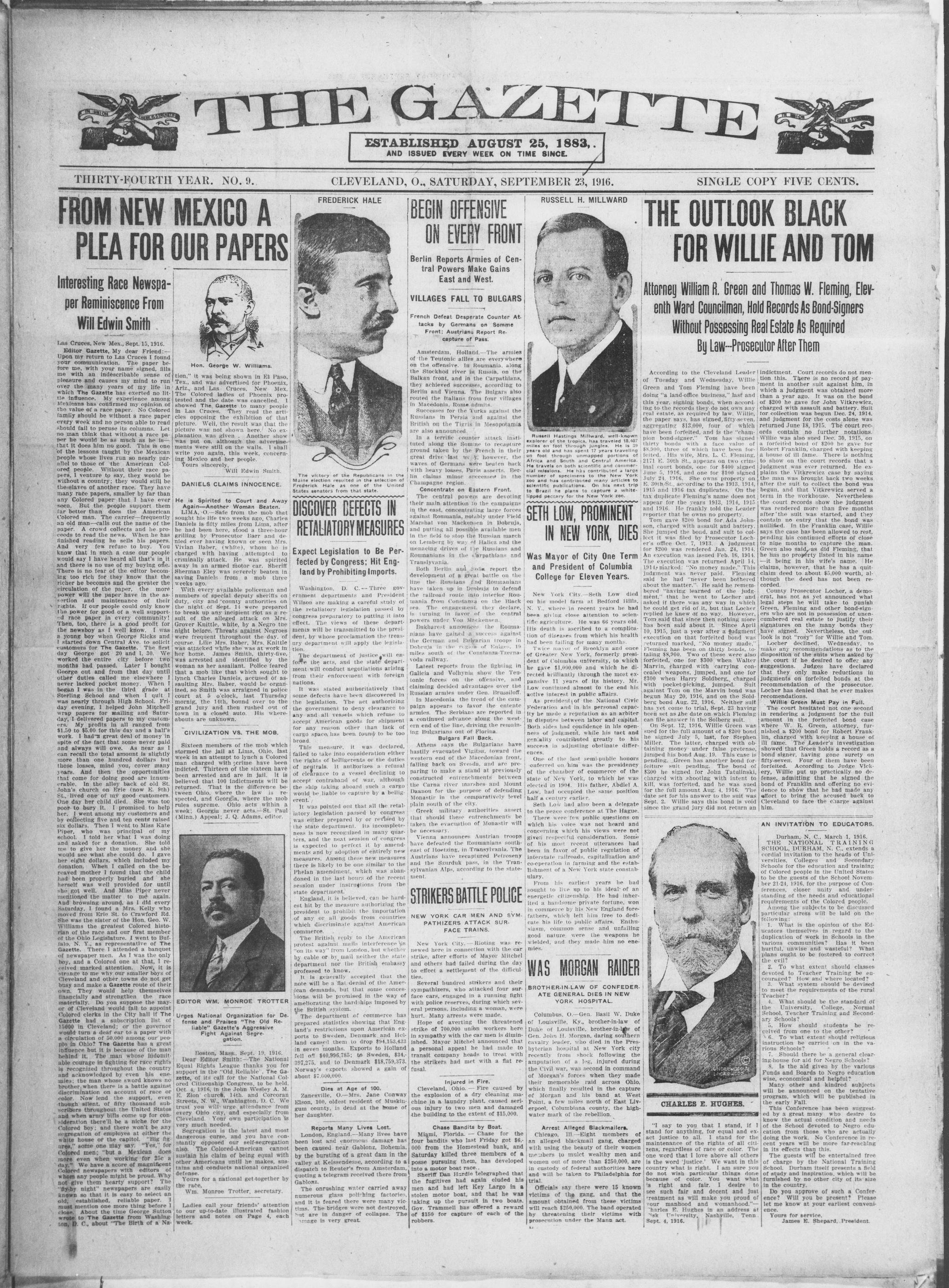
FROM NEW MEXICO A PLEA FOR OUR PAPERS
IN UNION
UNION ASSUMES
Interesting Race Newspaper Reminiscence From Will Edwin Smith
Interesting Race Newspaper Reminiscence From Will Edwin Smith
Hon. George W. Williams.
"it was being shown in El Paso, Tex., and was advertised for Phoenix, Ariz, and Las Cruces, New Mex. The Colored Lions of Phoenix protested and the date was cancelled. I showed The Gazette to many people in Las Cruces. They read the articles opposing the exhibition of that picture. Well, the result was that the picture was not shown here. No explanation was given. Another show was put on, although the advertisements were still on the walls. I shall write you again, this week, concerning Mexico and her people.
Yours sincerely,
Will Edwin Smith.
DANIELS CLAIMS INNOCENCE
He is Spirited to Court and Away
Again—Another Woman Beaten.
LIMA, O—Safe from the mob that sought his life two weeks ago, Charles Daniels is fifty miles from Lima, after he had been here, stood a three-hour grilling by Prosecutor Barr and denied ever having known or seen Mrs. Vivian Baber, (white), whom he is charged with having attempted to pull a woman away in an armed motor car. Sheriff Sherman Eley was severely beaten in saving Daniels from a mob three weeks ago.
With every available policeman and numbers of special deputy sheriffs on duty, city and county authorities on the night of Sept. 14 were prepared to break up any incipient riot as a result of the alleged attack on Mrs. Daniels. The police were right before. Threats against Negroes were frequent throughout the day, of course. Like Mrs. Baber, Mrs. Knittle was attacked while she was at work in her home. James Smith, thirty-five, was arrested and identified by the woman as her assailant. Police feared that a mob like that which sought to lynch Charles Daniels, accused of assaulting Mrs. Baber, would be organized, so Smith was arranged in police court at 5 o'clock. Last Thursday, the police had a grand jury and then rushed out of town in a closed auto. His whereabouts are unknown.
CIVILIZATION VS. THE MOB
Sixteen members of the mob which stormed the jail at Lima, Ohio, last week in an attempt to lyach a Colored man charged with crime have been indicted. Thirteen of the sixteen have been arrested and are in jail. It is believed that 100 indictments will be returned. That is the difference between Ohio, where the law is respected, and Georgia, where the mob rules supreme. Ohio acts within a week; Georgia never acts—St. Paul (Minn.) Appeal; J. Q. Adams, editor.
EDITOR WM. MONROE TROTTER
Urges National Organization for Defense and Praises "The Old Reliable" Gazette's Aggressive Fight Against Segregation.
Boston, Mass., Sept. 19, 1916.
Dear Editor Smith: "The National Equal Rights League thanks you for support in the "Old Reliable". The Gazette, of its call for the National Colored Citizenship Congress, to be held, Oct. 4, 1916, in the John Wesley A. M. E. Zion church, 14th, and Corcoran Streets, N. W., Washington, D. C. We trust you will urge attendance from every Ohio city, and especially from Cleveland. Your own participation is very much needed.
Segregation is the latest and most dangerous curse, and you have constantly opposed our self-segregation also. The Colored-American cannot sustain his claim of being equal with other Americans until he makes, sustains and conducts national organized defense.
Yours for a national get-together by the race.
Wm. Monroe Trotter, secretary.
Ladies call your friends' attention to our up-to-date illustrated fashion letters and notes on Page 4, each week.
ESTABLISHED AUGUST 25, 1883 AND ISSUED EVERY WEEK ON TIME SINCE.
FREDERICK HALE
The victory of the Republicans in the Maine election resulted in the selection of Frederick Hale as one of the United States senators from that state.
DISCOVER DEFECTS IN RETALIATORY MEASURES
Expect Legislation to Be Perfected by Congress; Hit England by Prohibiting Imports.
Washington, D. C. -- Three government departments and President Wilson are making a careful study of the retaliatory legislation passed by congress preparatory to putting it into effect. The views of these departments will be transmitted to the president, by whose proclamation the treasury department will apply the legislation.
The department of justice will enforce the acts, and the state department will conduct negotiations arising from their enforcement with foreign nations.
It was stated authoritatively that some defects have been discovered in the legislation. The act authorizing the government to deny clearance to any and all vessels which refuse to accept American goods for shipment for any reason other than lack of cargo space has been found to be too broad.
This measure, it was declared, failed to take into consideration either the rights of belligerents or the duties of neutrals. It authorizes a refusal of clearance to a vessel declining to accept contraband of war, although the ship taking aboard such a cargo would be liable to capture by a belligerent.
It was pointed out that all the retaliatory legislation passed by congress was either prepared by or revised by the state department. Its incompleteness is now recognized in many quarters, and the next session of congress is expected to perfect it by amendments and by adoption of entirely new measures. Among these new measures there is likely to be one similar to the Phelan amendment, which was abandoned in the last hours of the recent session under instructions from the state department.
England, it is believed, can be hardest hit by the measure authorizing the president to prohibit the importation of any or all goods from countries which discriminate against American commerce.
The British reply to the American protest against mails interference is "on its way" from London, but whether by cable or by mail neither the state department nor the British embassy professed to know.
It is generally accepted that the note will be a flat denial of the American demands, but that some concessions will be promised in the way of ameliorating the hardships imposed by the British system.
The department of commerce has prepared statistics showing that England's restrictions upon American exports to Sweden, Denmark and Holland caused them to drop $94,153,433 in seven months. Exports to Holland fell off $40,996,785; to Sweden, $34,437,275, and to Denmark $18,759,373. Norway's exports showed a gain of about $7,000,000.
Dies at Age of 100.
Zanesville, O.-Mrs. Jane Conway Elson, 100, oldest resident of Musklingum county, is dead at the home of her daughter.
Reporta Many Lives Lost
London, England—Many lives have been lost and enormous damage has been caused near Gablonz, Bohemia, by the bursting of a great dam in the valley at Keldesendesse, according to a dispatch to Reuter's from Amsterdam, quoting a telegram received there from Gablonz.
The onrushing water carried away numerous glass polishing factories, and it is feared there were many victims. The bridges were not destroyed, but are in danger of collapse. The damage is very great.
BEGIN OFFENSIVE ON EVERY FRONT
Berlin Reports Armies of Central Powers Make Gains East and West.
French Defeat Desperate Counter Attacks front: Germans on Somme Front: Austrians Report Recapture of Pass.
Amsterdam, Holland.—The armies of the Teutonic allies are everywhere on the offensive. In Roumania, along the Stockhod river in Russia, on the Balkan front, and in the Carpathians, they achieved successes, according to Berlin and Vienna. The Bulgars also routed the Italians from four villages in Macedonia, Rome admits.
Successes for the Turks against the Russians in Persia and against the British on the Tigris in Mesopotamia are also announced.
In a terrific counter attack instituted along the Somme to recapture ground taken by the French in their great drive last week, however, the waves of Germans were beaten back with heavy losses, Paris asserts. Berlin claims minor successes in the Champagne region.
Concentrate on Eastern Front.
The central powers are devoting their main attention to the campaigns in the east, concentrating large forces against Roumania, notably under Field Marshal von Mackensen in Dobruja, and putting all possible available men in the field to stop the Russian march on Lemberg by way of Halecz and the menacing drives of the Russians and Roumanians in the Carpathians and Transylvania.
Both Berlin and Sochi report the development of a great battle on the line the Russians and Roumanians have taken up in Drobujia to defend the railroad route into interior Roumania from Constanza on the Black sea. The engagement, they declare, is turning in favor of the central powers under Von Mackensen.
Bukharek announces the Roumanians have gained a success against the German and Bulgarian troops in Drobujia in the region of Enjuges, 19 miles south of the Constanza-Tzernavoda railway.
Latest reports from the fighting in Galicia and Volhynia show the Tentonle forces on the offensive, and claiming decided advantages over the Russian armies under Gen. Brusseloff. In Macedonia the trend of the campaign appears to favor the entente armies. The Serbians are reported in a continued advance along the western end of the line, driving the remaining Bulgarians out of Florina.
Bulgars Fall Back.
Athens says the Bulgarians have hastily evacuated Vig仙a, toward the western end of the Macedonian front, falling back on Svegna, and are preparing to make a stand at previously constructed entrenchments between the Carna river marshes and Mount Daanon for the purpose of defending Monastir in the comparatively level plain south of the city.
Greek military authorities assert that should these entrenchments be taken the evacuation of Monastir will be necessary.
Vienna announces Austrian troops have defeated the Roumanians southeast of Hoetzing, in Transylvania. The Austrians have recaptured Petroseny and the Szurduk pass, in the Transylvanian Alps, according to the statement.
STRIKERS BATTLE POLICE
NEW YORK CAR MEN AND SYMPATHIZERS ATTACK SURFACE TRAINS.
New York City. — Rioting was renewed here in connection with the car strike, after efforts of Mayor Mitchel and others had failed during the day to effect a settlement of the difficulties.
Several hundred strikers and their sympathizers, who attacked four surface cars, engaged in a running fight with police reserves, during which several persons, including a woman, were hurt. Many arrests were made.
Hope of averting the threatened strike of 700,000 union workers here in sympathy with the car men is diminished. Mayor Mitchel announced that a personal appeal he had made to transit company heads to treat with the strikers had met with a flat refusal.
Injured in Fire.
Cleveland, Ohio. — Fire caused by the explosion of a dry cleaning machine in a laundry plant, caused serious injury to two men and damaged the building to the extent of $15,000.
Chase Bandits by Boat.
Miami, Florida. — Chase for the four bandits who last Friday got $6,000 from the Homestead bank, and Saturday killed three members of a posse pursuing them, has developed into a motor boat race.
Sheriff Dan Hardie telegraphed that the fugitives had again eluded his men and had left Key Largo in a stolen motor boat, and that he was taking up the pursuit in two boats. Gov. Trammell has offered a reward of $150 for capture of each of the robbers.
RUSSELL H. MILLWARD
Russell Hastings Millward, well-known explorer of the tropics, has traveled 18,407 miles on land and through jungles, so is 90 percent of the world's travel on foot through unmapped portions of Africa and South and Central America. He travels on both scientific and commercial expeditions, and has number of specimens to the New York zoo and has contributed many articles to the New York Times. He plans to capture a whitlipped peccary for the New York zoo.
SETH LOW, PROMINENT IN NEW YORK, DIES
Was Mayor of City One Term and President of Columbia College for Eleven Years.
New York City—Seth Low died on his model farm at Bedford Hills, N. Y., where in recent years he had been giving close attention to scientific agriculture. He was 66 years old. His death is ascribed to a complication of diseases from which his health had been failing for many months. Then mayor of Brooklyn, once the first president of Columbia university, to which he gave $1,000,000 and which he directed brilliantly through the most expansive 11 years of its history. Mr. Low continued almost to the end his active interest in public affairs.
As president of the National Civic Federation and in his personal capacity he made a reputation as an arbiter in disputes between labor and capital. Both sides had confidence in his openness of judgment, while his tact and geniality contributed greatly to his success in adjusting obstinate differences.
One of the last semi-public honors conferred on him was the presidency of the chamber of commerce of the state of New York, to which he was elected in 1804. His father, Abiel A. Low, had occupied the same position half a century earlier.
Seth Low had also been a delegate to the peace conference at The Hague. There were few public questions on which his voice was not heard and concerning which his views were not given respectful consideration. Some of his most recent utterances had been in favor of public regulation of interstate railroads, capitalization and cooperation in farming and the establishment of a New York state constabulary. From his earliest years he had sought to live up to his ideal of an energetic citizenship. He had inherited a handsome private fortune, won in commerce by his New England fathers, which left him free to dedicate his life to public affairs. Enthusiasm, common sense and unfailing good nature were the weapons he wielded, and they made him no enemies.
WAS MORGAN RAIDER
BROTHER-IN-LAW OF CONFEDERATE GENERAL DIES IN NEW YORK HOSPITAL.
Columbus, O.-Gen. Basil W. Duke of Louisville, Ky., brother-in-law of Duke of Louisville, brother-in-law of Gen. John H. Morgan, daring southern cavalry leader, who died in the Presbyterian hospital at New York city recently from shock following the amputation of a leg, injured during the Civil war, was second in command of Morgan's forces when they made their memorable raid across Ohio, which finally resulted in the capture of Morgan and his band at West Point, a few miles north of East Liverpool, Columbiana county, the high-water mark of the rebellion.
Arrest Alleged Blackmailers.
Chicago, Ill.-Eight members of an alleged blackmail gang, charged with using the beauty of their women members to nuptile wealthy men and women out of more than $250,000, are in custody of federal authorities here and will be taken to Philadelphia for trial.
Officials say there were 15 known victims of the gang, and that the amount obtained from these victims will reach $250,000. The band operated by threatening their victims with prosecution under the Mann act.
SINGLE COPY FIVE CENTS.
THE OUTLOOK BLACK FOR WILLIE AND TOM
Attorney William R. Green and Thomas W. Fleming, Eleventh Ward Councilman, Hold Records As Bond-Signers Without Possessing Real Estate As Required By Law-Prosecutor After Them
According to the Cleveland Leader of Tuesday and Wednesday, Willie Green and Tom Fleming have been doing "a land-office business," last and this year, signing bonds, when according to the records they have real estate, as required by law, Willie. the paper says, has signed, fifty-seven, aggregating $13,000, four of which have been forfeited, and is the "champion bond-signer." Tom has signed thirty bonds with a face value of $8,500, three of which have been forfeited. The other three have been 2171 E. 30th St., appears on two criminal court bonds, one for $400 signed June 5, 1916, and one for $100 signed July 24, 1916. She owns property on E. 30th St., according to the 1913, 1914, 1915 and 1916 tax duplicates. On the tax duplicate Fleming's name does not appear for the years 1913, 1914, 1913 and 1914. The reporter that he owns property.
Tom gave $200 bond for Ada Johnson, charged with assault and battery. She jumped the bond, and suit to collect it was filed by Prosecutor Locher's office Oct. 7, 1913. A judgment for $200 was rendered Jan. 24, 1914. An execution was issued Feb. 16, 1914. The execution was returned April 14, 1914; marked "No money made. This judgment has never been made." said he has "never been bothered about the matter." He said he remembered "having learned of the judgment," that he went to Locher and asked if there was any way in which he could get rid of it, but that Locher replied he knew of no way. However Tom said that since then nothing more has been said about it. Since April 14, 1914, he has been executed on that forfeited bond was returned marked, "No money made." Fleming has been on thirty bonds, to taling $8,900. Two of these were also forfeited, one for $300 when Walter Marvin, charged with carrying concealed weapons, jumped, and one for $300 when Harry Soldberg, charged with pocket-picking, jumped. Suit against Tom on the Marvin bond was begun May 20, 1916, and on the Soldberg was begun May 22, 1916, and he has yet come to trial, Sept. 23 having been set as he date on which Fleming can file answer in the Solberg suit.
On Sept. 12, 1916, Willie Green was sued for the full amount of a $200 bond he signed July 5, last, for Stephen Miller. The latter, charged with obtaining money under false pretence jumped his bond Aug. 19. This case is pending. Green has another bond for failure suit pending. The bond of $300 he signed for John Tattulliusk to kill was forfeited, and he was for the full amount Aug. 4, 1916. The date set for his answer to the suit was Sept. 2. Willie says this bond is void since the grand jury did not return an
UNDERWATER
LICENSE
"I say to you that I stand, if I stand for anything, for equal and exact justice to all. I stand for the maintenance of the rights of all citizens, regardless of race or color. The one word that I love above all others is the word 'justice'. We want in this country what is right. I am sure you do not wish particular things done because of color. You want what is fair and fair. I desire to see such fair and decent and just treatment as will make you proud of your manhood and womanhood."—Charles E. Hughes in an address at Stark University, Nashville, Tennessee, 4. 1916.
indictment. Court records do not mention this. There is no record of payment in another suit against him, in which a judgment was obtained more than a year ago. It was on the bond of $200 he gave for John Vitkrewicz, charged with assault and battery. Suit for collection was begun Dec. 24, 1914, and the judgment for the suits was returned June 18, 1915. The court records contain no further notations. Willie was also sued Dec. 30, 1915, on a forfeited bond of $200 he gave for Robert Franklin, charged with keeping a house of ill fame. There is nothing to show on the court records that a judgment was ever returned. He explains the Vitkrewicz case by saying the man was brought back two weeks after the suit was begun, and that Vitkrewicz served a term in the workhouse. Nevertheless the court records show the judgment was rendered more than five months after the suit was started, and they contain no entry that the bond was nullified. In the Franklin case, Willie says the case has been allowed to rest, pending his continued efforts of close to nine months to capture the man. Green also said, as did Fleming, that he has no property listed in his name. He has no claims, however, that he has a quit claim deed to about $5,000 worth, although the deed has not been recorded.
County Prosecutor Locher, a democrat, has not as yet announced what legal steps he will take to punish Green, Fleming and other bond-signers who are not in possession of unenforceable signatures on the many bonds they have signed. Nevertheless, the outlook is not "rosy" for Willie and Tom. Locher declined, Wednesday, to make any recommendations as to the disposition of the suits when asked by the court if he desired to offer any suggestions. Judges have declared that the bond has no judgments on forfeited bonds at the recommendation of the prosecutor. Locher has denied that he ever makes recommendations. Willie Green Must Pay in Willie. The court hesitated not one second in rendering a judgment for the full amount in the forfeited bond case where in The Green, attorney, furnished a $20 bond for Robert Prank, charged with keeping a house of ill fame. The Leader's investigation showed that Green holds a record as a bond signer, having gone surely on fifty-seven. Four of them have been forfeited. According to Judge Vickery, Willie put up practically no defense, adducing that he signed the bond because he had no evidence to show that he had made any effort to bring the accused back to Cleveland to face the charge against him.
AN INVITATION TO EDUCATORS
Durham, N. C., March 1, 1916.
THE NATIONAL TRAINING SCHOOL, DURHAM, N. C., extends a cordial invitation to the heads of Universities, Colleges and Secondary Schools for the education and training of Colored people in the United States to be the guests of the School Novem-
ber 1916 for the purpose of Conferences, closer unity and understanding of the needs and educational requirements of the Colored people.
Among the subjects to be discussed particular stress will be laid on the following:
1. What is the opinion of the Educators themselves in regard to the duplication of work in Schools in the various communities? Has it been hurtful, unwise and wasted? What ought to be fostered to correct the evil?
2. To what extent should classes devoted to Teacher Training be encouraged? How and where located?
3. What system should be devised to meet the requirements of the rural Teacher?
4. What should be the standard of the university, College, Normal School, Teacher Training and Secondary Schools?
5. How should students be received from one to the other?
6. To what extent should religious instruction be carried on in the various Schools?
7. Should there be a general clearing-house for aid for Negro Schools?
8. Is the aid given by the various Funds and Boards to Negro education wise, economical and helpful?
9. What subjects will be announced on the tentative program, which will be published in the early Fall.
This Conference has been suggested by a great many who desire to know the actual condition and needs of the School devoted to Negro education from those who are actually in the Conference in recent years will be more far-reaching in its effects than this.
The guests will be entertained free of charge by the National Training School. Durham itself presents a field of study and inspiration, which will be furnished by no other city of its size in the country.
Do you approve of such a Conference? Will you be present? Please let me know at your earliest convenience.
Yours for service.
James E. Shepard, President.
One Year.....$1.50.
Six Months.....1.00
Three Months.....50
Subscribers are requested to rem-
mit by postoffice money er-
der or registered letter
Entered at the postoffice in Cleveland
Ohio, as second-class matter.
Address all communications to
HARRY C. SMITH
Blackstone Building, Cleveland, O.
Member Ohio Legislature: 1894
to 1896; 1896 to 1898; 1900 to 1902
THE GAZETTE is the oldest, and has the largest bona fide circulation, double that of any newspaper in the state of Michigan, published in the state of Ohio, and comparison with any will immediately establish its rank as one of the NEWSIEST AND BEST in the country.
10,000,000 Afro-Americans..
160,000 in Ohio.
20,000 in Cleveland.
Cleveland
SATURDAY, SEPTEMBER 23, 1916.
"Let us have faith that right makes might, and in that faith let us to the end dare to do our duty as we understand it"—Abraham Lincoln.
Will Edwin Smith, an "old Cleveland boy", and our special correspondent on the Mexican border, has another one of his exceedingly interesting and beneficial communications in this issue of The Gazette which we wish many patrons to see that their friends and acquaintances read carefully and thoughtfully, also.
There is nothing that we could say that we are not willing to say in emphasizing the importance of the call that Dr. James E. Shepard, president of the National Training School, Durham, N. C., has issued and which will be found elsewhere in this paper. Its value and importance to the race cannot be overestimated. Our leading educators must heed the call and respond.
If Governor Willis of Ohio does not bring the men who assaulted and almost murdered that Lima sheriff to justice, Ohio MUST take its place with Georgia and Florida—Chicago Defender.
Willis won't do anything, brother, but the officials of Lima will and are doing all they can to punish the brutal mobocrate. Neither "The Birth of a Nation" long run in Chicago nor Illinois mob demonstrations worse than the one at Lima, Ohio, caused the Defender to become so "het up". Wonder why?
The editor of The Gazette is indebted to The Public Press, No. 633 Plymouth Ct., Chicago, Ill., for a neatly bound (in cloth) copy of a brief but exceptionally well written "History of the Republican National Party"—its principles and policies—by Newton Wyeth; illustrated by Joseph Pierre Nuyttens. We advise our readers to send for a copy. It is needed, particularly, at this time.
We also acknowledge the receipt of a copy of the "Republican Campaign Text-Book" for 1916, sent by the Republican National Committee. It, too, is a compendium of valuable information.
Attorneys William R. Green and Thomas W. Fleming, councilman of ward 11, have placed themselves in a very serious position as the result of signing police court bail-bonds when, according to the records, they are not owners of real estate. That others, "white", are in the same predicament does not help them or the race they are identified with. It is a condition to be regretted, to say the least. It does not help; on the contrary, it hurts others than Green and Fleming. Both "knew better," but "took a chance". The result, in full, will be known later—when Democratic County Prosecutor Cyrus W. Locher "gets done with them".
The public school domestic science centers of this city announced, the first of the week, that meats and groceries cost more in the 11th ward than any other place in the city except one and that one is in the vicinity of St Clair Av. and E. 152d. St. Their figures, for a year past, are based upon the per capita cost for meats and groceries at many points in the city. This proves what The Gazette has from time to time, for years, claimed and called its readers' attention to. The meat-shops and groceries up Central Av. way have little or no "heart" in dealing with our people and the poor whites who live in that vicinity, and it is about time for our people to awaken to a full realization of the fact.
ANOTHER LIMA OUTRAGE.
Three weeks ago a "Negro" caused a riot and mob demonstration at Lima, this state that startled the whole country. Last week, another "Negro" came very near doing the same thing in that city as the result of another vicious and brutal attack on a white woman. And our" people of Lima, Cleveland and too many other cities in this state look on unmoved. Is there anything that will awaken them to a proper sense of their duty in the matter? We would like to know. The Gazette has sounded a number of notes of warning in recent months which apparently have had little or no effect. What are our ministers, who are charged with the moral wel-
fare of our people of the various communities of the state, thinking and doing that they fail to take the lead in organizing our people to work on this vitally important matter? Lima's sad experience is apt to be duplicated in your city as well as this, any day.
THAT WILLIS "BOOST" MEETING.
As announced, the Frank Willis "boost" meeting was "pulled off" at St John's A. M. E. church, SUNDAY evening, and the campaign against his reelection is now formally opened among our people here in Cleveland and throughout Ohio. We hope and trust that every right-thinking member of the race, a voter, in this community and state will scratch his name from the ticket in November. Any man, a candidate for state, especially the governor of a great state, who will so pros
GOV. FRANK B. WILLIS.
titute the sacred portals of a house of God, and on a SUNDAY, too, to base political purposes, even on the invitation of misguided and calloused persons connected with the church, is not worthy of the votes of self and race respecting, manly and God-fearing Afro-Americans. Several of our leading local clergymen have called on the editor of The Gazette, this week, to assure him that they are in full and hearty accord with the position in this matter he has taken. We cannot find words with which to express our contempt for the man and the "hog-wash" speech (to coddle his hearers) he delivered at "St. John's," last Sunday evening. It was the same old "stuff" all candidates indulge in to our people during campaigns. They will not come to us, as a rule, at any other time. Gov. Frank B. Wills has done absolutely nothing for Ohio Afro-Americans during his near-two year term. On the contrary he has not only grossly insulted us in more ways than one but, in this last instance, has added positive injury to insult. Be it said to their everlasting credit, many members of the church feel deeply and keenly the disgrace heaped on "St. John's" by the disgraceful affair of Sunday evening last.
ALL HAIL, "THE HAMMER!"
For many years we have heard a lot about throwing the "hammer" into the discard and giving time to "constructive work." Many have said: Build up; never tear down.
But knocking and tearing down are just as necessary in the economy of things, as building up. Battering down Wrong is a useful process and must usually precede the building up of Right.
"Foul as it is, hell itself is defiled by the fouler presence of John." That was the terrible verdict of the contemporaries of King John of England. In his person were combined insolence, selfishness, unbridled lust, cruelty, shamelessness and tyranny. The barons rose against him and demanded a change A. D. 1215; they invited the king to a little meeting at Runny mede and they informed the absolute monarch that there must be some material modifications in the autocratic power of the king. John did not relish the demand, but he realized that he stood alone and that the barons had their little "hammers" up their sleeves and were ready to use them, so he granted the Magna Charta. The Great Charter was discussed, agreed to, and signed in a single day. Thus modern democracy and liberty had their origin in "hammer" work.
In the sixteenth century the Catholic Church had grown corrupt. The priests were guilty of immorality, extortion and all the other crimes in the decalogue. The Inquisition was working overtime. When conditions were at their worst, Martin Luther appeared on the scene armed with a "hammer," and he battered down the Devil so strongly, entrenched in the church. Thus began the Reformation which separated the Protestant church from the Romish See, and conferred inestable benefits on mankind.
For many years the American colonies had been oppressed by England, the mother country. The colonies protested against taxation without representation. Mother England refused to heed the cries of her children, so in 1775 the colonists revolted, the first blood shed being that of Crispus Attucks, a mulatto, whose valor the Commonwealth of Massachusetts has commemorated in enduring granite and bronze on Boston Common. The continued "hammering" of the colonists finally brought the liberty which was proclaimed, July 4, 1776. In the seventeenth century, African slavery was inaugurated in America. William Wilberforce and others "hammered" at the vile wrong in England. The agitation was continued until the year 1834 saw the abolition of slavery in all British colonies.
Bond-service had a strong hold in the United States, but the abolitionists had already unsheated their "hammers." William Lloyd Garrison, Frederick Douglass, Wendell Phillips, Harriet Beecher Stowe, Charles Sumner and hundreds of others "hammered" the great evil until the slave holders' rebellion came, when "hammers" were exchanged for guns, and with the assistance of nearly 200,000 former slaves, who fought nobly, the great blot was wined from the escutcheon.
THE GAZETTE, CLEVELAND, O., SATURDAY, SEPTEMBER 23, 1916.
FRESH OHIO NEWS
Written by 'The Old Reliable' Gazette's Correspondents
THROUGHOUT THE STATE
What Our People Are Doing Each Week—Church, Personal, Social, Lodge, Literary and Musical—Marrigues, Deaths, Etc.
CADIZ.—The B. B.'s met at Wm. T. Tyler's, Sunday—Rev. O. W. Childress closed his fourth year, Sunday, at the A. M. E. church and left for conference at Steubenville, Wednesday—Rev. Moyer of the M. E. church has returned from Columbus—Rev. Thus, H. Jackson, D. D., of Wilberforce will deliver the emancipation address, Monday evening. A banquet at the church—Mr. Charles Christian of Hopedale, was the guest of Mrs. Georgie West. Mrs. Elizabeth West is there visiting her parents.
CORRESPONDENTS must mail all letters for publication at their postoffice sufficiently early on Monday (or Sunday) of each week to have them reach The Gazette office on Tuesday morning, and always write also, their names and that of their city or town on the outside of the wrapper about returned copies. Unless this latter is done, proper credit cannot be given you. Lists of names, wedding presents, etc., obituary no. queries, and other information queries for relatives and advertisements of all kinds, including items announcing entertainments to be held in the near future, must be paid for in advance at the rate of ten cents a line, six words to a line. Our rates for display advertisements will be sent on application.
YOUNGSTOWN—Mrs. L. A. R. Cunningham, of Cleveland, who came to this city, several months ago, quite ill with heart trouble, to make her home with a daughter, Mrs. Donald Berry, died last week Wednesday, and the remains were taken to that city for burial. Funeral: Saturday after 10 a.m. to Mrs. Berry and Mrs. Mannie Akerns of Cleveland, survive her and the earnest sympathy of a host of friends and acquaintances here and there.—Before leaving for annual conference at Steubenville, this week, Rev. J. M. Gilmere, pastor of Oak Hill Av. A. M. E. church, was presented with a fine suit of clothes, a goodly purse, etc., by the members and friends of the church as such, and a work as pastor. His return was asked by the congregation. Dr. Gilmere cleared the church of debt and greatly improved it in every way.
SMITHFIELD.—Rev. R. B. Lowe delivered his farewell sermon at St. Paul's A. M. E. church, Sunday evening, to a large and attentive congregation. A number from McIntyre were in attendance. Rev. Chas. W. Greene preached his farewell sermon in the morning at McIntyre. Both ministers left, Tuesday, for annual conference at Steubenville. Mr. Jas. Harris and brothers, Homer, Hays and John, spent Sunday in Wheeling with their host, M. Hargrave, from Homestead, Pa. to visit his parents. His wife and two children, who spent several weeks here, returned home with him, Monday.—Mr. H. Giles, of M. Pleasant, was here, last week.—Mr. Douglas Christian was in Steubenville, Saturday.—Mr. Chas, Ford, of Bellaire, who has been working on the new bank building, is home spend.—Mr. Chas, President of M. Pleasant, and Mrs. Ernest Freeman, of Dillonville, visited relatives here, recently.—Mrs. Myrtle Jones and Mrs. M. Jackson, of Steubenville, were called here by Mr. Jas Harris, sr.'s illness.
HILLSBORO—Mrs. Vivian Hudson is sick—Lincoln school opened Monday, with a large enrollment of pupils. Prof. S. G. Hough, principal, and the Misses Clara Smith, Florence Burns and Mary E. Williams, teachers. They desire the hearty co-operation of the community—Miss Aurelia Donaldson has located in Cincinnati—Mr. O'Neil, of Columbus, is here visiting. Mrs. Burr and Mrs. Burns both, in several days in the country, last week, guests of Mr. and Mrs. Joe Willis—Mr. Logan Jenkins, of Dayton, in the employ of the Chalmers Motor Car Co. of Dayton, visited relatives here, last week. He sends best wishes to his many friends in Mrs. John Hudson and daughter, Bernice; spent Saturday at Eunice, Sunday at Ampita; Mr. Paul Kilgore and Miss Anna Ferguson, of Columbus, visited his mother, Mrs. Charles Kilgore, Sunday. Wm. Captain, Asa Jackson and Chas. Qualls have gone to Cleveland to work—Mr. Abe Anderson, of Madisonville, and son, Edwin, visited relatives here, last week. Miss Viola Greene has returned from Columbus. Quite a number attended Eunice, at Washington C. H. Mollie, Andrew and Georgeatum, Hazel Wallace, Mary Williams, Cassie Essex, Edith Anderson, Mary Taylor and Mary Williams were among the number. Mrs. Cora Day and Mrs. Jennie Richards of Columbus were here, Sunday.
The work of the hammer is not yet complete. Thousands of social wrongs still exist which must be hammered until they disappear.
Thousands of men, such as women slavers, jinercrowists and their ilk, men who would barter their birthrights, must be hammered until they beg for mercy and reform or are knocked into hell.
Great is the hammer! Long may it exist to knock down the Wrong; to build up Right.—St. Paul (Minn.) Appeal.
CORRESPONDENTS WANTED
The old reliable Gazette desires an active agent and correspondent, in every city and town in Ohio and neighboring states having a number of Afro-American residents. Only a little time on Fridays or Saturdays is required. We are especially desirous of hearing from persons in the following named cities: Springfield, Dayton Pigna, M. T vernon, East Liverpool Akrun, Lima, O., and other places, particularly in Ohio, where we have none.
Write to the editor of The Gazette
Blackstone building. Cleveland. O. and
COLLEGIATE INSTITUTE TO BEGIN FALL TERM SEPT. 20
Notable Work of Byrd Prillerman at a West Virginia Institution.
The large number of applicants for admission to the West Virginia Collegiate institute for the coming term indicates that there will be a notable increase in the number of new students when the fall session opens on Wednesday, Sept. 20. President Byrd Prillerman has thoroughly demonstrated his ability and capacity as an educational leader of the first order by his splendid management of the affairs of the institution. The fact that the school has been raised to college rank has created great interest. Many of the new applicants will enter the college department.
It is said there is no other institution in the United States especially for the training of colored youth that gives a college course in vocational training or that places the same emphasis on vocational training as is placed on the academic studies at the West Virginia Collegiate Institute. For this reason students who have wanted a college course in home economics, agriculture or any other vocational course were compelled to attend some college or university in the north or west.
This places the young colored men and women seeking an education to a great disadvantage, for the reason that they cannot usually secure dormitory accommodations at these institutions, their expenses are extremely heavy, and they are in a great measure deprived of the advantages of social life. There are several graduates of the collegiate institute pursuing vocational courses in northern colleges that would have taken the course at their own college, and such provision has made the time for their graduation there is no other Negro college closer than 500 miles of the West Virginia Collegiate institute.
President Prillerman says: "The earning power of the Negro laborer of West Virginia is greater than that of any other state in the Union. A large number of the Negro population of West Virginia is in the coal fields. Since they do not find much opportunity for investment of their earnings in real estate, they are willing to invest in the education of their children. "The governor, the state board of control, the state regents and other state authorities have shown such interest in the education of our Negro youth that the administration of the West Virginia Collegiate institute and Negro citizens generally feel that the institution has greater opportunity for usefulness than most other similar institutions in the country."
When President Prillerman took charge of this institution seven years ago its largest enrollment to that time had been 235 students, with a faculty of twenty-two teachers. This year, 1916, it enrolled 382 students and had a faculty of twenty-five teachers. For the year 1908-9 the state appropriation for salary and wages was $17,450; for 1915-16 it was $21,500. In these seven years the student body has increased $62\frac{1}{2} per cent, while the faculty has increased in number only 4.6 per cent, and the state appropriation for salary and wages has increased only 29 1:5 per cent. All the departments of the school have been strengthened, one year has been added to the academic course, the name of the school changed, the college department added and a summer school for teachers maintained each year.
EDUCATING YOUNG FARMERS
How the Government Aids Agricultural Colleges In the South.
The movement actively started by the United States department of agriculture to co-operate with the various state colleges in the south in organizing farm makers' clubs for the colored boys and girls in the rural districts bids fair to become an important factor in racial thrift. The movement has grown rapidly and has been operated successfully in Virginia, Florida, Mississippi and North Carolina the past year.
The main object of these clubs is to encourage our people, particularly in the cotton sections, to raise some food instead of devoting their attention to a single crop. In the clubs for boys the typical plan is to encourage and help the members to use an acre one-half of which is devoted to corn one-fourth to potatoes and one-fourth to peanuts.
This teaches a desirable rotation and at the same time furnishes three food products for human consumption and two that are useful for cattle or hogs. The girl members of these clubs receive practical instruction in gardening, canning, cooking and housekeeping. According to recent reports, the county superintendents of schools and teachers of elementary schools are supporting the work actively, and state agricultural colleges and the technical schools established for the race are active co-operators in the larger phases of the work.
Bienger Race Benefactor Dies.
Pioneer Race Benefactor Dies.
Miss Esther Douglass, whose death occurred at Cedar Rapids, In. in August, was one of the most noted of the early workers for the education of colored people in the United States. She was born at Hanover, Mass., in 1824. Miss Douglass went south as a missionary among the colored people in the sixties. Many persons who were pupils of Miss Douglass forty years ago often resettled and showed her kindness in her dedicatory years.
terms will be sent promptly. Our readers will oblige us greatly by sending at once the addresses of persons in the cities named and others in the state, to whom we can write relative to the matter.
Repular Idea Some Have
Some men's idea of a good time is a time in which they haven't time to be good.
Optimistic Thought.
No omen can be bad to those whose designs are good.
PROMINENT MEN TOUR VIRGINIA
Organization Society Makes Educational Campaign.
SEVERAL COUNTIES VISITED
Many Notables Are Included In Party Which Recently Accompanied Dr. Robert R. Moton on Trip Through Important Sections of Old Virginia. Rural District People Encouraged.
Hampton, Va.—"Better homes, better farms, better schools and better health" is the motto of the Negro Organization Society of Virginia, founded by Dr. Robert R. Moton, principal of Tuskegee institute and at present president of the organization. Dr. Moton put to work in the establishment of the society one of the most important factors for the uplift of the race in the country, and its influence is farreaching in the rural districts.
At the annual session in November Dr. Moton on account of leaving Virginia will give up the presidency, and another strong map will be selected in his place. The representatives of the society have just completed a tour of some of the counties of Virginia, where talks have been delivered to the people along the line of better homes, better farms, better schools and better health.
In the party were Dr. Robert R. Moton, principal of Tuskegee institute; Major Allen Washington, commandant of Hampton institute and treasurer of the society; Professor W. T. B. Williams, Hampton agent for the Slater and Jeanne funds; Rev. A. A. Graham Phebus, chairman of the executive committee of the Organization society; Professor T. C. Erwin, Petersburg, field agent. Organization society; Professor J. M. Gandy, Petersburg, president Virginia Normal and Industrial institute; Professor M. W. Connor, Petersburg, Normal and Industrial institute; J. B. Pierce, district farm demonstrator of Virginia; Frank Trigg, president of the Virginia Collegiate institute; R. Nathaniel Detts, director of music, Hampton institute; Professor E. A. Long, principal Christiansburg institute; Rev. I. L. L. Downing, Roanoke Presbyterian church; Charles Stewart, A. M. D. D.
The party left Portsmouth, Va., over the Seaboard Air Line, going to Franklin, where the first meeting was held and was attended by a large number of people from both races. The mayor of Franklin declared that it was the most helpful meeting held in that section for the past fifty years. At night a meeting was held in Suffolk, the party returning by the Seaboard to that point, and after the meeting they were carried by automobiles to the wharf and put on the Hapton yacht, where the rest of the tour was made.
The next point made was Smithfield, where the party was met by a committee with automobiles and carried to Isle of Wight courthouse, where another interesting meeting was held. Then to Scotland county courthouse, a meeting being held in the Baptist church; thence to Ruthville. At each of these points the people turned out in large numbers. Dr. Moton was the principal speaker. The people were anxious to see and bear him, because it was the closing of his administration as president of the society and the opening of larger things for him, becoming the success of Dr. Booker T. Washington. Some wanted to see the new principal and then shake the hands of the foremost educators of his race. Dr. Moton was himself and delivered some strong practical addresses to the people. At each place his addresses were punctured with outbursts of applause. Major Allen Washington was also an important figure, because he is the successor to Dr. Moton at the Hampton Institute.
"Education" was preached to the people by one of the most noted and perhaps the best posted educators in the race. Professor W. T. B. Williams. This was his speciality, and he handed it well, while Professor Gandy hammered away on health. "Plenty soap and water" were urged to play a part in the uplift of the race. It seemed that every man was a specialist in his particular line and was prepared to instruct the people who were anxious to hear and receive the much needed advice. The party also viewed historic James Land in its first cargo of slaves landed in this country. They went through the old fort, viewing the graves of those who figured in the early settlement of Virginia and counting the time of the landing of the first slaves to the present, viewing the wonderful progress made by the race they sang "Pride God From Whom All Blessings Flow." And why not?
It was interesting to see the farmers and their families lay aside their work and go to school, as it were, for a few hours. Then to see how they honored their leaders. In the matter of better farms the organization is assisting, as well as in the matter of better schools. They are encouraging and helping to lengthen the terms in the rural distrients where they are short, helping to build substantial school buildings and advocating the employment of the very best available teachers for the rural schools, as well as those in the city. The next annual session of the Negro Organization society will be held in Bannock, Va., Nov. 5.
Natural Reasoning
Ruth lived in the country. On awakening one cold morning she asked for a drink of water, and her mamma told her she would have to wait awhile, for the pump had frozen during the night. She then asked for a drink of milk, and upon being told there was no milk either quickly replied: "What's the matter, did the cow freeze up, too?"
Optimistic Thought..
He that acquires no fame will suffer no persecution.
Regular Meals and Short Orders
Try Our Special Sunday Dinners
STEAKS A SPECIALTY
Central 2477 K.
THE SMILE
ARTHUR J. S.
Individual and Home
Photography.
H. J. C.
Signs of all kinds. Sh
a S
4207 CENTRAL AVENUE
The National
"I cordially comment
all who believe in the Ne
help promote its intellect
Rev. Dr. Charles
It is more than a n
It is a community
Its influence is destined t
in improved Negro communi
locate.
Settlement workers, mission
fields, Y. M. C. A. and
nurses receive a comprehe
Wellesley graduate and expe
day practice through the sch
We aim also to create a
Industrial training, adva
Thirty-two acres, ten mo
We can accommodate a
Communities requiring s
Next School Term
THE SMITH ST
ARTHUR J. SMITH, Photog
Individual and Home Portraiture.
Photography. Post Cards of Q
H. J. OWENS
cons of all kinds. Show Cards and Ela
a Specialty.
07 CENTRAL AVENUE CLEVEL
The National Training
"I cordially commend the school's interest
all who believe in the Negro race and in our
help promote its intellectual, moral and religious
Rev. Dr. Charles H. Parkhurst, New Y
It is more than a mere school
It is a community of service and up
Its influence is destined to be felt in all sections
improved Negro community life wherever our
Settlement workers, missionaries for home and
fields, Y. M. C. A. and Y. W. C. A. secretaries receive a comprehensive grasp of their
lesley graduate and experienced co-workers are
practice through the school's social service de
We aim also to create a better qualified minister
Industrial training, advanced literary branches,
Thirty-two acres, ten modern buildings, health
We can accommodate a few more earnest, am
Communities requiring social workers should w
Next School Term Opens Oct. 4,
ARTHUR J. SMITH, Photographer
Individual and Home Portraiture. Commercial
Photography. Post Cards of Quality.
H. J. OWENS
Signs of all kinds. Show Cards and Electric Signs
a Specialty.
The National Training School
"I cordially commend the school's interest and needs to all who believe in the Negro race and in our obligation to help promote its intellectual, moral and religious uplift." Rev. Dr. Charles H. Parkhurst, New York City.
Its influence is destined to be felt in all sections of the country in improved Negro community life wherever our trained workers locate.
Settlement workers, missionaries for home and foreign mission fields, Y. M. C. A. and Y. W. C. A. secretaries and district nurses receive a comprehensive grasp of their studies under a Wellesley graduate and experienced co-workers and actual everyday practice through the school's social service department.
We aim also to create a better qualified ministry. Industrial training, advanced literary branches, business school. Thirty-two acres, ten modern buildings, healthful location. We can accommodate a few more earnest, ambitious students. Communities requiring social workers should write us.
Next School Term Opens Oct. 4, 1916.
For catalogue and detailed information address
Pres. JAS. E. SHEPARD
National Training School
DURHAM, NORTH CAROLINA
Pres. JAS. E. SHEPA
National Training School DURHAM,
FORD'S FORD
FORD'S
HAIR POMADE
MAKES HARSH
KINNY Hair SOFTER,
MORE THAN 10 FEET
TO COMB AND PUP UP
IN ANY STYLE THE
LENGTH WILL PERMIT
PRICE 25¢ AND 50¢ A BOTTLE
FORD'S
ROYAL WHITE
SKIN LOTION
MAKES THE SKIN
LOOK, AS SOM AS IT IS
PUT ON. EXFELENT
FOR PIMPLES, ROUGH SKIN AND
LOCAL SKIN DISEASES
PRICE $25.00 A BOTTLE
FORD'S PATENT
TWO PIECE SHAMPOO
FORD'S HAIR STRAIGHTENER
NO. 022 STRAIGHTEN THE HAIR
BY ROLLING IT BETWEEN FOUR BRASS
ROLLS. BEST AND QUICEST THING
WE KNOW OF STRAIGHTEN HAIR
PRICE $1.00
PATENT SECTIONAL TOOTH COMB
PATENTED LOCKING
DEVICE FOR HOLDING TEETH TIGHT
AND HAIR STRAIGHTENING
COMB NO. 023. YOU HEAT
THE ROD, NOT THE COMB
THING. SHE SING, SURPRISE
AND SOILING THE COMB
RETAINS HEAT LONGER. PRICE $1.50
NO. 023% TEETH IN THIS COMB ARE MADE OF
SHAMPOO AND HAIR STRAIGHTENING
COMB NO. 025. OZES WORM HANDLE
LARGE AND VERY STRONG. MAKING A ROOM
SERVICEABLE FOR COMB AND KINNY Hair
NICKEL PLATED. PRICE $1.00
FORD'S SPIRAL HANDLE
HAND STRAIGHTENING AND SHAMPOO
COMB NO. 024. SOLID BRASS NICKEL
PLATED. LARGE AND SPECIAL
LOCKING HANDLE Holds THE HANDLE
WITHOUT SOLIDERING. PRICE $1.00
FORD'S SMALL BRASS
FORD'S MEDIUM SIZED
BRASS SHAMPOO AND HAIR STRAIGHTENING
COMB NO. 026. OZES WORM HANDLE
LARGE AND VERY STRONG. MAKING A ROOM
SERVICEABLE FOR COMB AND KINNY Hair
NICKEL PLATED. PRICE $1.00
SHAMPOO AND HAIR STRAIGHTENING
COMB NO. 027. A SMALL STRONG COMB USED BEST ON KEAL SHORT
HAIR. NICKEL PLATED. PRICE $2.50
ALL OUR GOODS WAREPANED AS DESIGNED OR MONEY REFUNDED.
FOR SALE BY YOUR DEaler OR DIRECT FROM US MOW RECEIPT
OR WRITING DRIED DONKEY MOW BY POST OFFICE EXPRESS MONEY OFFER:
OZONIZED XO MARROW CO. 46 W.KINZIE ST.CHICAGO,ILL
ABusyLife
Mr Foraker has given us his experience in the Union Army on the Bench, as Governor of Ohio and in the Senate of the United States. Political and public events of great importance and incidentally many national characters are dealt with in the most enlightening manner. The work will prove of special interest to all students of political history whether they are public officials or only public spirited Americans, interested in the preservation of our institutions.
The Palace Hotel and Restaurant
MRS. R. R. BROOKS, Prop.
2733 Central Ave.
Cleveland, O.
OPEN DAY AND NIGHT
Best Home Cooking—Quick Service
Regular Meals and Short Orders
LUNCH COUNTER
CIGARS AND TOBACCO
H STUDIO
H, Photographer
Portraiture. Commercial
Cards of Quality.
WENS
Cards and Electric Signs
Quality.
CLEVELAND, OHIO
Training School
school's interest and needs to
face and in our obligation to
oral and religious uplift."
Wurkhurst, New York City.
school
service and uplift.
It in all sections of the country
wherever our trained workers
es for home and foreign mis-
C. A. secretaries and district
grasp of their studies under a
a co-workers and actual every-
social service department.
qualified ministry.
library branches, business school.
buildings, healthful location.
are earnest, ambitious students.
workers should write us.
Wens Oct. 4, 1916.
DURHAM, NORTH CAROLINA
FORD'S.
ROYAL WHITE
SKIN LOTION
MAKES THE SKIN
LOOK WHITER
AS SOON AS IT IS
PUT ON EXCELENT
FOODS. BRUSH SKIN AND
MME.C.H.JONES' Hair Tonic and Invigorator
HER TONIC is the result of scientific study of the causes of diseases of the scalp. Instead of treating effects of the disease she treats the causes, eliminating the same and leaving the scalp in a healthy condition that can be maintained by using her Hair Tonic and Invigorator, according to the directions. Madame C. H. Jones Hair Tonic and Invigorator is guaranteed to stop the falling out of the hair and to make the hair
It has been successfully used by many ever since 1900 and with perfect meticulous care by many Toledo people and elsewhere, who may gladly furnish testimonials. We have used widely used hair tonics prepared by widely adscrupulous persons who have been on the other hand, MADAME JONES' solutely harmless and will do all that is claimed for it. H. H. Jones' Hair Tonic and Invigorator promotes the growth of the hair, prevents and cures baldness, removes dandruff, causes the disease of psoriasis, it beautifies the color of the hair by supplying it with the natural elements and necessary nourishment. MADAME C. H. JONES 353 Woodland Toledo, Ohio Agents Wanted.
STERLING
5 and 10 Cent Store
3003 Central Ave.
Watch Our Windows
For Bargains
Colored Salesladies
We close at 6 P.M. every
evening except Saturday
FOR
Pure Drugs, Prescriptions
AND
Cut Rate Patent Medicines
GO TO
The Arlington Pharmacy
GO TO
S. W. Cor. E. 55th Street
and Central Avenue
J. LOMSKY
3816-3820/ Central Ave.
DRY GOODS
LADIES' AND GENT'S
FURNISHINGS
Try Our
Lomsky Special $1.00 Corsets,
Also our Ladies' $1.00 Waists
They are good
QUALITY SERVICE
THE
PARLOR DINING
ROOM
MR. AND MRS. H. J. MURRAY
Proprietors
2324 EAST 37TH STREET
CLEVELAND, OHIO
Rosedale 4400-W
The Pride of Carolina
The State Agricultural and Mechanical College of South Carolina
Orangeburg, S. C.
Next session begins September 27th and ends May 25th, 1917.
No Tuition, no Room Rent, no Charges for Water, Lights or Fuel. Entrance Fee $10.00.
Board $4.00 per Month in Advance. Books, Laundry and Personal Expenses Extra.
Every Modern Facility, Standard Equipment. A Faculty of 57 Officers and Instructors.
For Information and Catalogue, Write
R. S. Wilkinson, Pres.
Orangeburg, S. C.
DON'T THROW AWAY
Your copy of The Gazette after reading it, but give it to a friend or an acquaintance who might subscribe after reading a copy of the paper.
Editor
3121 Central Ave.
*O. C. SCHROEDER'S,
Cuyahoga Bldg.
J. E. BRANHAM'S
4291 Central Ave.
NOTICE TO SUBSCRIBERS
Subscribers not receiving The us at once. We desire every copy. Send or bring locals and all bufice, suite 2, Blackstone Bldg. If you please. We advise our readers to caretiscements before making purchases, this paper should have the patron they advertise is assurance that the Local reading notices (adver words in a line); display advertise publication. All matters for publication in or be in the office by 4 p. m., WEDNES
Subscribers not receiving The Gazette regularly should notify us at once. We desire every copy delivered promptly.
Send or bring locals and all business matters to The Gazette's office, suite 2, Blackstone Bldg. If you wish to see the editor call there, please.
We advise our readers to carefully examine The Gazette's advertisements before making purchases. Business men who advertise in this paper should have the patronage of our people. The fact that they advertise is assurance that they want it.
Local reading notices (advertisements) ten cents a line (six words in a line); display advertising space, fifty cents an inch, single publication.
All matters for publication in current issues of The Gazette, must be in the office by 4 p. m. WEDNESDAY of that week, at the latest.
Social and Personal
Our
Classified Ad
Department
FOR SALE.—Four room cottage,
water, gas, toilet. No. 2267 E. 71th
St., near Central Av. Apply, room 2.
Blackstone Bldg., W. Third St., near
Superior Av.
WANTED.—50 women for house
cleaning. Any day, $1.60 and lunch.
Acme Employment Co., 308 W. Superior Ave.
FOR RENT.—Houses and Rooms—
If you have them to rent or if you
want to rent, advertise in The Gazette.
It brings results.
NOTARY PUBLIC.—For such services
call at The Gazette office, No. 2
Blackstone building, No. 1424 W.
Third Street, near Superior Ave.
FOR SALE.—Houses or lots. If you have either or anything else to sell, or if you wish to purchase, advertise in The Gazette. If anything can bring you results, it can and will.
Cleveland
Sixth City
Mrs. Wallace Bolden is visiting Mrs.
T. H. Samuels of Chicago.
Mr. Leonard Anderson spent several days in Cleveland, last week.
Mrs. Yantis, of Chicago, is visiting her daughter, Mrs. Sterrett of E. 87th St.
Rev. C. G. Fishback preached two able sermons at Shiloh Baptist church, Sunday.
H. R. Slaughter has returned from a most successful summer season on the lakes.
Mrs. Robert Bass, of E. 30th. St., will leave soon to visit a sister in central Ohio.
Mrs. E. C. Adams and two little sons, of E. 90th St., are visiting in Youngstown.
There is only one way to get the real race news and that is to take "the old reliable" Gazette.
Miss Maggie Cook, of Indianapolis, is here, called by her mother, Mrs. Thomas Cook's illness.
Wm. Captain Asa. Jackson and Chas. Qualls, of Hillsboro, have secured employment here.
Mr. F. Marshall, of Ashland, was the guest of Mr. and Mrs. R. E. Curry of Arthur Ave, the past week.
M. Earl Parker's wife, formerly Miss Mulholland of Hot Springs, Ark., arrived from San Diego, Cal., Monday.
Mrs. Mary Jackson, of Central Ave., has returned from a very pleasant visit in Ypsilanti and Ann Arbor, Mrs. Mary Trent, of N. Y. City, is in the city. Mrs. H. Nelson, of 236 W. 53d St., that city, desires her address here.
M. J. Robinson was entertained at dinner by Mr. George Matthews, of Columbus, last week Thursday evening.
Mr. and Mrs. Geo. F. Riff, who have been visiting Mr. and Mrs. Robert Riff, of E. 43rd St., have returned to Muncie, Inc.
The latest segregation order in the government's state, war and navy departments, at Washington, D. C., has been revoked.
Lenora Ford, entertained for a cousin from Ford, during the week, Mrs. P. Warwick, of Louisville, Ky. was the guest of Mrs. Murrell, of 2271 E. 49th St. this week.
Mrs. Hattie Butler Smith, wife of Mr. Samuel Smith, and a member of the Christian Alliance, died the first of the week. Funeral, Tuesday.
Mrs. John Jackson who was confined at Charity hospital, several months after an operation, died at her parents' in Oberlin, last week Tuesday.
Mrs. Carrie Crawford, of Blaine Ave., gave a dinner, last week Monday afternoon, and the Hiawatha Club entertained, Monday, in honor of Mrs. Alberta Wills.
Do not leave notes, letters, items for the paper, etc., at the editor's home.
Send or bring them to The Gazette of fice, and call THERE when you wish to see him, please.
Send Wood, of Cedar Ave., has returned from Springfield. Her brother-in-law, Mr. Aaron Wood of Chicago is expected in the city, this week, en route home from Indianapolis and Springfield.
St. John's W. M. M. S. reported at annual conference, this week, $300 raised during the year for missions. The pastor, reported $510, "dollar money," the largest in the history of the church. When you wish photographic work of all kinds, post-cards, etc., signs painted and electric signs, go to Smith & Owens, 4207 Central Ave. They are the best in the business in this city and the cheapest—Adv. Mrs. John Mann, of E. 39th. St. visited Mrs. Ellen Smith of Parkersburg, W. Va., recently. Mr. and Mrs.
*A. GORDON,
2928 Central Ave.
*SAM FERTMAN'S,
3608 Central Ave
*MRS. BESSIE KITZMILLER'S
3943 Central Ave.
*A. F. CLORE, 3969 Central Ave.
The Gazette regularly should notify delivered promptly, business matters to The Gazette's of you wish to see the editor call there, fully examine The Gazette's adver- business men who advertise in age of our people. The fact that they want it, disements) ten cents a line (six ing space, fifty cents an inch, single current issues of The Gazette, must SDAY of that week, at the latest.
"Any prejudice whatever will be insurmountable if those who do not share in it themselves truckle to it and flatter it and accept it as a law of nature."—John Stuart Mill.
Robert Napper of Harrisburg, Pa., have located here and are stopping with Mr. and Mrs. Mann. The federal civil service commission will hold an examination for letter carriers and mail clerks at the federal building Oct. 7, John J. Collins, local secretary, announced, Tuesday. Here is a fine opportunity for our bright young men.
A niece of J. C. Lightbourne, of Frank Ave. East End, died suddenly of a high school graduate and about a terma a normal school there. He has the sympathy of many friends.
The government is calling for male stenographers and typists. Officials say the demand is so great that the civil service examinations will be held monthly until further notice in 400 cities. Beginners get from $840 to $1,000 a year.
Our advertisers want your trade. Those who do not ask for it in the G.O.P. certainly cause little if at all, for it. Therefore, we urge our readers and all of our friends to patronize those who ask for your trade in this paper.
The Old Folk's Home Association and Men's Auxiliary will hold a joint meeting at the home, Friday evening. Annual reports will be read. The election of officers for the home will take place on Oct. 2, at 8 p.m. All members are urged to attend both meetings.
Chas. S. Sutton, Esq., was appointed last Saturday, by common Pleas Judge Homer G. Powell to defend John Bell, charged with manslaughter. Bell and man from said city have shown Joseph Miller from *easily* moving automobile on Woodland Ave., August 25, killing him.
Wash., in the city, Wednesday, en route to New York City. He is a chauffeur and is making the trip in an auto with his employer's son and another young man, eastern college students. He stopped over night at Mrs. H. J. Murray, 2324 E 37th St.
Miss Ruth Anna Fisher and father, D. C. Fisher, of Lorain, were in the city again, last week Friday, en route home from a week's visit with his aged brother at their native home in Romney, W. Wa. They called on The Hailer, who was trained at dinner by the editor at the Parlor Dining room, 2324 E. 37th St.
We want every patron of "the old reliable" Gazette and their friends to read carefully and thoughtfully, "ALL HAIL, THE HAMMER", a splendid editorial, from the St. Paul Appeal, which we endorse. Its entirely, and second page of this paper. Tell everybody to read it—"will do them good."
The reception given to Saul A Lucas and Louis M. Sharp, last week Friday evening at St. John's church, was an impressive affair. Addresses were made by Mrs. M. Anderson, J. L. Jones, Henry Mrs. Rey, V. J. S. Jackson, and Rev. Neverson, a senior at Gammon Theological seminary. Messrs. Neverson and Rey were among the week for Atlanta to pursue a theological course at "Gammon" responded very effectively.
Kelly King who was instructed to plead "guilty" by his attorney, so Attorney Chas. S. Sutton informs The Gazette, was sent to the Mansfield Reformatory and sentenced to from one to fourteen years. The girl (white), age 17, testified that there had been no criminal conduct between her and King. In the light of this, the sentence could be terrible until justice" Tom Fleming was King's attorney. The latter should not have been advised to plead "guilty" to something he had not done, according to the sworn testimony of the girl.
Following is a partial list of our public school teachers: Alabama school, Marie C. Bolden, Brownell, Sarah M. Bailey and Cora Bean; Central, Willa M. Shook; Dike, Harriet K. Price; Fullerton, Emma B. Tolbert and Ida B. Cash; Harmon, Estelle Huston; Hicks, Cornellia Bedford; Marlon, Inez Faltrax Mayflower, Hazel Mountain, M. Pleasant, Randa, and Nina M. Chaffin; Rand, Mabel Early; Murray Hill, Lavina Early and Bertha J. Blue; Outhwaite, Bertha Sutton; Sowkins, Mamie A. Davis; Union, Flora Douglas; Warren, Eleanor Alexander and Helen Brascher.
In honor of Jesse Firse, Barry Dabney and Walter Clarke, Miss Ruth Anderson of Arthur Ave., was hostess at a dinner party last week Friday evening, at which covers were laid for six, the color scheme being in yellow and white. The boys will return to college work at Howard University, Washington, D. C., with a wish for success from their many local friends. Miss Ruth Bozer, of Chicago, is Miss Anderson's guest. The Misses Brown, of E. 101st. St., entertained, Sunday, at dinner for Walter Clarke, Jesse Firse and Barry Dabney. The evening
THE GAZETTE, CLEVELAND, O., SATURDAY, SEPTEMBER 23, 1916.
was also pleasantly spent. The many social hours given for the boys before returning to "Howard" were brought to a close. Hall Monday evening, where assembled their boy and girl associates and friends to the number of 100. Joy reigned supreme.
THE MASCHKE-DAVIS COLO
Vincent Marco, (white), pointed an assistant police pro-early this year, after a vain been made to have a member
Rev. J. M. Gilmere, of Youngstown, called on the *Gazette*, last week Thursday, and spent several days, visiting in the city. He is completing his fourth year of great success as pastor of Oak Hill Ave. A. M. E. church, Youngstown, the town where he taught and property greatly improved under his pastorate. The return of Dr. Gilmere is earnestly requested by the church's official board and congregation. He is attending conference at Steubenville, this week. His church presented him with a fine suit of clothes, a goodly purse of money and other useful gifts. St. John's* S. S. out-of-town guests, Sunday, were Mr. Fox of M. Peacock, Santa Monica, Phi. College, Philadelphia, Mr. Harris, Norfolk Va; Miss Louise Cannable and Mrs Henderson, Detroit; Mr. and Mrs Cooper, Birmingham, Ala.; Mr. Orville Ballard, Lexington; Miss Bell Johnson, Nashville; A. O. Wells, Cincinnati; Mr. Gleason, Mobile, A. M. Mattle Jackson, Lancaster; Mr Herbert Johnson, Chattanooga; Moga Newman, New Berlin, New York, Painesville, P. H. Patterson, Nashville, Tenn.
One of the most enjoyable outings of the season was the hay-ride and garden party given the Deborah class of St. John's S. S., by Mrs. Mildred Gantz, Sept. 13, at the summer home of Mr. W. G. Marshall, Northfield. The class was met at the station by a hay笼 and driven to the grounds until 15 miles over the grounds until a most appropriate spot was reached. There amidst the superb vines, flowers and foliage, a kodak picture was made. A sumptuous repast, which consisted of chicken loaf, creamed potatoes, pickles, hot rolls, strawberry jam, ice cream, cake, coffee and bon-bons, was served. Mrs. Gantz was assisted in the kitchen by Helen and Amy Wright. Those present, Mrs. Yantis of Chicago, and Mudmeses Hazel Blake, Edgar Moore, Ina Perkins, Beulah Terrell, Alma Marshall, Pauline Scott, Minnie Serrett, Pearl Myers, Essy Wrigdely, Lotte Davis, Vera Sharp, Lilian Moten, Myrtella Case, May Wilson, Gertie Sisco, and Mrs. M. Miller. At the close of the testivities, Mrs. Gantz and an assistant, Vera Sharp, Lilian Moten, Myrtella Case, May Wilson, Gertie Sisco, and Mrs. M. Miller. At the close of the testivities, Mrs. Gantz and an assistant, Vera Sharp, Lilian Moten, Myrtella Case, May Wilson, Gertie Sisco, and Mrs. M. Miller. The wedding will take place Dec. 23. They will spend a honeymoon of two weeks in Chicago and the rest of the winter in Memphis. Tenn. The bride-to-be is the only daughter of Mrs. Henrietta Braggs, who has been in the employ of the Marshall family for 20 years. Mr. Price halts from Chicago and is an engineer.
THE 18TH B. M. C. SESSIONS
Including the Grand Parade and Exhibition Drill Successful—Most of the Old Officers of the Grand Household Also Re-Elected.
Special to The Gazette.
Washington, D. C.—The eighteenth B. M. C. and Grand Household of Ruth opened their sessions in this city, last week Monday, closing last Friday. Mrs. E. Morehead succeeded in every way. Mrs. Mary E. Parker was elected worthy grand superior and Mrs. Nannie R. Banks of Middletown, O. grand treasurer. All the other officers of the Grand Household were re-elected. The B. M. C. also re-elected Messrs. Morris, Needham and nearly all of its old officers, and decided to hold its next meeting in New York City. Several important amendments to its laws was the most important work of the B. M. C. Grand Masse Edward M. Morris' address and three parts of the various officials were excellent. Four thousand participated in the parade, last Thursday, and 10,000 witnessed the exhibition drill at the base-ball park in the afternoon Ten companies participated.
WONDER WHEN SHE "COPY-
RIGHTED" IT?
Mrs. Benj. Dunn, of the East End, received the following letter, last Thursday, and sent it by Mr. Dunn to the editor of The Gazette, last Friday
Bolton School
Cleveland, O., Sept. 14, 1916.
Mrs. Dunn;
Please do not be offended because
I ask to call your little girl "Ella."
but I do not care to call her MY
name, which I have never seen or
heard used before.
Sincerely,
Miss Rayonette R. Hessler.
Miss Hessler underscored the
word "my" and the letter "o" in "Rayonette" in signing her name.
The editor went immediately to public-school headquarters and was most courteously received by an old friend, Supt. Frederick's private secretary, Mr. Fred M. Beyer, who introduced us to Assist. Supt. Eldridge, Mr. Frederick being engaged in a conference. Prof. Eldridge assured us that Miss Hessler would call Mr. and Mrs. Dunn's lovely little daughter by her name, "Rayoette", and we left satisfied. The young teacher has undoubtedly been taught a much-needed lesson.
Importance of Being Interested.
It is a well-established fact that intense interest plus persistent effort is the prime essential to the highest success in any field of human activity.
"Being interested" is one of the most important things in the world to every one of us. The earlier we be interested—intensely interested—in some specific field of activity, the brighter our future prospects will be. But, be it early or be it late, the development of interest—or real and hearty, not a feeble and wan interest—is certain to bring to us a wonderful increase of power to achieve, power to enjoy life, and power to resist the ordinary ills to which flesh is heir.
Wanted Her Share.
"It is no use trying to get away from the solemn fact that the woman of today is a most practical and resourceful creature," said the man who has known a few.
"What makes you think so?" a friend asked.
"The unsentimental attitude of a girl I know. I told her that she had inspired some of my best poems. She didn't say a word about the poems, but she wrote to my publishers for a percentage of the royalties."
Vincent Marco, (white), was appointed an assistant police prosecutor early this year, after a vain effort had been made to have a member of the race (Roy Cheeks) appointed to the position, by a delegation of our men, headed by Rev. Elam A. White, whom Mayor Mary L. Davis refused to use Political "boss" Maurice Maschke, and Director of Law FitzGerald, who under the law is supposed to make the appointment, had "jugged" the delegation back and forth between them, finally getting rid of them by telling them they "would have to see the mayor about it," with the result already noted. Last week, Marco was asked to resign by Director FitzGerald as the result of charges preferred by a woman (white), according to the daily papers. Did Maschke, Davis or FitzGerald offer the place to Cheers or any other attorney of the race? Not so one could notice it. But they did give it to a young white lawyer. Places like this one and clerkships at the City Hall are NOT for Afro-Americans—when Maschke is the American "boss," it seems clear. It was so when the Baehr administration when he was the "boss," and has been so, up to date, that his Davis administration. Both "the republican," too, if you please. The only clerkship in the City Hall the race has is the one held by a young lady who is the civil service administration under the Baker democratic administration. Indeed, most of the jobs administration were secured by our men when Tom L. Johnson and Newton D. Baker, democrats, were Cleveland's chief executive. Two years ago also last Maschke told the editor of The Gazette, when approached on this very matter, that "there was too much prejudice to make such appointments." And yet, democrats did not find that true. Every other race nearly, represented in the republican party of this city, is represented in the higher positions at the City Hall and Police Court but ours. How do you like it? Tailorships, somewhat similar garbage and street-cleaning department jobs, and the like, are alright, but are they the highest positions OUR educated young and old members of the race competent are to be allowed to hold? It seems so, under the Maschke-Davis administration, at the City Hall and Police Court, to say the least. Well what are you going to do about it when the time arrives, next year in the fall? That is the question to ponder over. THINK!
SOUNDING THE ALARM!
Our own observation is that the class of laborers which is going North, a hundred at a clip, is the very self-same, noisy, boisterous, rowdy class which has made conditions in the South in a large measure what they are. If they carry with them into the North the same rowdyism, the same ignorance of right living, the same disregard of other people's rights and rules, then it seems to us the total result will be more harm than good.—Louisville (Ky.) News.
The Philadelphia Christian Recorder believes that the wholesale emigration of southern Afro-American laborers to the north, that has characterized the last few months, will prove helpful to those of our people who remain in that section of the country. So do we. Equality true, however, is it that it is proving harmful to our people in this section, for the very reasons so pertinently set forth in the excerpt from our esteemed contemporary, the Louisville (Ky.) News, given above. However, since they are here, many of them to remain, it is absolutely necessary "for the good and welfare" of all concerned that our good people of all concerned that our good people of every community, where there is any considerable number of them, organize to work among them and do what they can to keep down the "rowdyism" so much in evidence in many public places and, too, so very harmful; to help them to "right living," and to have decided more consideration for "other people's rights", privileges and comfort everywhere. This primarily in order to estop the curtailment of our people's rights and privileges in public places and to keep down our crime record which has been growing entirely too rapidly, in recent months, in the various communities referred to. In this work our local clergyman should lead. There can be no doubt as to the wisdom of the course The Gazette has been urging for weeks and again we advise our good people of every community to "wake up" and become active at once. All seem to see and admit the necessity and urgency of immediate action.
But our Ministers' Alliance of this city fails to take proper action for some unaccountable reason. One day last week a streetcar conductor was shot to death on the west side of this city as the result of a dispute over a dime. Had that occurred on a Central Av. car and the brutal murderer been an Afro-American, judging by the community feeling caused by the dastardly deed, there is absolutely no question as to what a mob would have done to our churches and business places from E. 9th to E. 55th streets in the Central Av. vicinity. Of course, our ministers can continue to ignore the matter, but when the unexpected happens, as it surely will, unless a change in present conditions is secured soon, they will be held to a strict accountability for their failure to act, because they are admittedly charged with the moral welfare of our people of this community. Their continued failure will, too, almost amount to criminal negligence.
Speaking of the recent mob demonstration at Lima, this state, the Cleveland Daily Plain Dealer recently said editorially and very pertinently: "Perhaps no community is wholly immune from the mad hysteria of mob violence. It strikes where least expected and has no consideration for local pride. Doubtless Lima was righteously shocked at Newark's display of a new year ago. But today Lima is the offender. Lima must pay the price." Cleveland can be the next and it is folly to think that the Central Av. district would not be the mob's first objective point.
Cuyahoga, Central 5727
Edward Doctor's Cafe
(THE Z)
3035 Central Avenue
Wm. Brack, Prop. - Frank Doctor, Manager
James Mabel, Chef
Rosedale 1800 Quality Service
SLAUGHTER BROS.
Funeral Directors and Embalmers
Office and Funeral Parlors
3923 CENTRAL AV.
Autos for All Occasions. Calls Answered Day and Night
GOLD BOND
The Cream of Table Beers
Gold Bond is a brew fit for Kings --- the product of the most modern equipment, the highest skill in beer-brewing.
"made from sun-ripened barley malts and hops, pure distilled water, and properly aged before bottling."
It comes to your table pure, wholesome, bubbling with good cheer. No other beer compares with the fine flavor of Gold Bond.
HEALTH FOR THE HAIR
COMIC PAPER'S SHORT LIFE
"Punchinello," Founded With Highest Hopes, Proved to Be Doomed to an Early Death.
In the days when Harper's Weekly was at the height of its popularity and influence it commanded the services of the foremost illustrators in America—including the cartoonists. Every once in a while a group of these artists would become dissatisfied with the Harper parental control and would leave to establish an independent illustrated paper.
Having squandered their substance in riotous printing, says Cartoons Magazine, these artists would come to themselves and return to the Harper's home, where was bread enough and to spare. No fatted calf was killed on the return of such prodigals, but Henry Mills Alden, the veteran editor of Harper's Monthly Magazine, asserted that the house of Harper never held a grudge against any contributor, whether artist or writer, who left to try other pastures. Such was the origin and such was the end of Punchinello, a comic cartoon weekly which first appeared in New York city on April 2, 1870.
In calling attention to the fact that the first number was dated the day after All Foods day, Punchinello remarked: "This is cheering; since thus it is manifest that Punchinello leaves all the fools and jesters behind, and is therefore first in the race for the crown of comic laurel and the quiver of satirical shafts." During its short life—less than a year—it was entitled to that honor.
Sufficient Unto the Day.
At a recent reception at the Colony club in the city of New York, the members of the Authors' League of America were guests, along with a considerable number of persons moving majestically in the most rigid and exclusive circles of top society.
One of the patronesses, a woman who has plenty of wealth and plenty of literary ability as well, presently spied two delegates from society's pretties regions sitting in a window seat, very much alone, and apparently not enjoying themselves to any large degree. Plainly, they were mother and daughter, a very commanding-looking mother and a rather docile, timid laughter. Being minded to make the affair a complete success, the patron lady approached the aloof pair.
"How do you do?" she said. "I amirs. So, unwould. Wouldn't you like to meet some of the authors who are present this afternoon?"
The senior lady's austere nose went up in a trifle straighter.
"No." she said with concealed po-
teness; "no, thank you. We've met
me."—Otawa Free Press.
In a Girl's Pocket
A great deal has been written about the things boys carry in their pockets, writes a high school reporter in the Foronto (Kan.) Republican, but for some reason they miss the girls, Re-
Cuyahoga, C
Edward Doyle
(T H
3035 Cent
Wm. Brack, Prop. -
James M
Rosedale 1800
SLAUGHT
Funeral Dia
Emba
Office and F
3923 CEM
Autos for All Occasions.
GOLD
The Cream of
Gold Bond is a brew fit for
most modern equipment, the
“made from sun-rite
and hops, pure and
properly aged before
It comes to your table pure,
cheer. No other beer com-
Gold Bond.
HEALTH FOR
```markdown
```
SOUTHERN MEDICINE CO
sently our investigation committee held an inquest upon a girl's pockets and found the following: One scented pocket handkerchief, one vanity case containing powder, mirror and some small change, one powder rag, one crochet hook, one ball crochet thread and work, one tatting shuttle, one button hook, one nail file, one wire hairpin, one cont button, one stick chewing gum, a note from her last beak, and three lozenges, besides numerous unidentified odds and ends of a miscellaneous nature.
Don't wait for the collector, but send or bring what you owe The Gazette to the office. It is pleasanter to all concerned.
ANNOUNCEMENT.
The opening party of the Hopkins Dancing class for members and their friends will be held at Waldo Hall on Friday evening, September 29th, 1916. Admission 50 cents per person. A. H Martin, Pres.-Adv.
G. G. REED
Ladies' and Gents' Furnishing Goods
Special $1 Waist
Worth more
Sole Agent for the
American Lady, Nemo & R. & G. Corsets
3222 CENTRAL AVENUE
Cuy. Central 6661-L
Phone, Prospect 441-J.
A RACE ENTERPRISE
Central Shirt Shop
G. J. TATE, Prop.
GENT'S FURNISHINGS
Hosiery, Underwear and
Neckwear
Arrow Collars and Shirts
Hats, Caps, Etc.
2922 CENTRAL AVENUE
CLEVELAND, O.
should take PURO HERBS
the great Spring remedy.
Cleanses the organs and purifies
the blood.
A blood medicine with a reputa-
tion that cannot be beaten.
Made from Nature's health giv-
ing herbs.
( 35c PER PACKAGE — Dry Form
PRICES 75c PER BOTTLE — Liquid Form
($ 1 PER BOTTLE — Extra Strong
FOR SALE ONLY AT
BROWN DRUG CO.
CARL R. SEYFERT, Prop.
A. B.
Editor Gazette, Dear Sir!-Some time in 1915, Gov. Frank B. Willis agreed to the appointment of a local Negro as a deputy oil inspector for this county which position he held until January 1 when his resignation caused a vacancy in the oil inspector position. Meanwhile, two or three aspirants applied for it, among the number being a local saloon-keeper who operated on the main thoroughfare of our people, where our church-goers must pass to and to trefoil to their churches, be trained to be church-out and others passing in and out.
In spite of our vigorous protests (for nearly two months) to Gov. Willis, as ministers of the gospel (representing several thousand Colored church communicants), against the appointment of a saloon-man, recommended largely by the saloon element, the Governor has appointed him and refused to appoint him, dorsed, one whom we thought, the best man, to race in an official capacity. We, as ministers, sent letters, telegrams and night-letters (telegrams) to Gov. Willis in protest against the appointment of the saloon-man and endorsing the other aspirant. The Governor, however, has deliberately and outrageously ignored our protests and endorsements by giving the position to that element which with their business (saloon) is doing more harm and causing more griefion of the city than the actual physical slavery of our parents before "bottles."
We, the ministers and churches, stand for race elevation, a virile manhood, worthy citizenship and factors in every community, and for a better manhood and life. The Governor's action in this matter is in direct opposition to all these—and what are we to do? Then these contemptible indignities are continually appealed upon us—appointing saloonmen to state and municipal jobs as a reward to the decent Negro republicans of this community, thus saying to the people, white and Colored, that SUCH men are the REPRESENTATIVES of the Negroes? We must and will organize and work to defeat any candidate for office, be he democratic or republican who will so insult us and Willis will be made to feel this, politically if he is a candidate for office in November.
Signed,
(Rev.) H. C. Bailley,
Pastor, Antioch Baptist Church,
President, Cleveland Branch,
National Association for the Advancement of Colored People.
REV. CARL W. HASKELL.
Columbus, O., March 17, 1916.
Editor Gazette, Dear Sir: I have read Dr. H. C. Balley's splendid article in The Gazette concerning the outrage committed by Gey, Frank B. Willis, in spite of the vigorous protests of Cleveland's leading ministers of the gospel and prominent citizens, and wish to register my hearty approval of the same. I have known Dr. Balley all of the years I was a true type of manhood, standing firmly for the cause of justice and the rights of our people. Shakespeare said in his "Julius Caesar":
"The evil men do, lives after them.
"The good is often intertwined with their
bones."
But thanks be to God we have some
good people who are being thought of
and recognized while they are living,
receiving flowers before the Master
bids them to lay aside life's weary
toils.
It is high time that our race awaken to these facts: The Republican party has always thought that they could carry the Negro vote regardless of whatever outrages they might commit, because they feel that they bear first honors in the emancipation of the Negro race. But God accomplished that task and his servant, Abraham Lincoln, has passed to the great beyond. Furthermore, if we ever owed the party any debt of gratitude or anything else for any part it may have played in the emancipation or during the ten or more years that followed it, God knows, in fealty, united support and vote for nearly a half century we have paid that debt and, too, with the help of our friends and been for many years, high time for the party to be considering the tremendous debt it owes the Negro for his long time united support and to be paying something far more than it has in late years on that debt.
I believe that I voice the sentiments of my good people everywhere when I say that the man and only the man who stands for the principle of righteousness and justice, he be democrat or Republican, will be supported by the intelligent Negro ballot. We must punish Gov. Willis as a matter of self respect as well as race respect. It is our clear that justice is not the party. I am a Republican.
Yours resp.
(Rev.) Carl W. Haskell.
Showing Dainty Bridal Garments FOR SCHOOL WEAR MUST BE MILITARY
ALLURING PART OF BRIDAL TROUSSEAU
THE FASHION OF THE TWENTIETH CENTURY
The nuggee is of white chiffon lined with pink and edged with white
amarabou, with belt of pink roses. The cap is of lace, wired to points and
half covered with a floating tulle vell.
---
Rich Fabrics to Be Worn
Shops Make Lavish Display o
Pretty Things That Once
Were Made at Home.
Artistry, Frivolity and Originality Have Been Combined With Wonderful Results—Gorgeous Colors Rule in Most Cases—Empire Styles Have Popularity.
While acknowledging that the young bride of today is justified in selecting for her trousseau only those bits of lingerie that are suitable for the fashions of the hour, still, one has pleasant memories of the preparation of a dozen of each, that was the sum and substance of a wedding chest of other days.
One thinks of the patience, eagerness and joy which went into the work of making those, dozens of garments and the long hours spent by the family together, cutting, basting, stitching and putting on the handwork. It was always a task of love, this preparation of the underlinden for a girl in the family, and all her intimate friends added their share. But this affectionate task, like many other things that were once considered necessary in the family life, has gone by the board.
The shops do our work for us, and it is all a part of the substitution of the radiator for the open fire, the electric stove for the charcoal and wood, the readymade gowns and suits for the home sewing room and the machine stitching for the threaded needle.
Women Have More Leisure.
In every way women are finding that drudgery is loosening its hold on their lives, and soon all they will have to do is give their time to social service, reading and the lighter forms of pleasure.
In the last few months the smart shops have made a strong effort to in-
ALLURING PART OF
The negigee is of white chiffon
amarabou, with belt of pink roses.
Half covered with a floating tulle vel
produce original house robes. They have gone to Venice and to Moscow for their inspiration.
There are negligees that look as though they had been filched from the stage of the Russian ballet, and there are others that could easily be worn in a more formal manner.
That which is known as the wrapper is dead. The calico Mother Hubbard of practical life has absolutely no place in the modern finery. Even with her simplest combing sack, the bride-elect sees to it that it is touched with artistry, frivolity and originality.
Displays Draw Customers.
The outpourings of the shops today in matinee, sleeping sacks and breakfast gowns, allure the most economical and conservative women to their windows.
One of the attractive negigees made for an October bride is of white chiffon lined with fleshi pink chiffon and edged with wide bands of white marabon. It is girdled above the waist with large pink roses, from which fall at one side loops and ends of nattier blue velvet ribbon. Invented to go with it is a piece of
Velvet and Satin Brocades Among the Materials That Will Be Popular for Fall.
The mention of velvets and woolens in summer is usually avoided as if it were an indelicacy, yet at this season we have to begin thinking about heavy fabrics and planning a fall wardrobe. Even in America there is less racing, less public life, and more and more of festivity screened behind the sheltering walls of villas, as in Italy. The echoes that reach the outside world bring little news of change and no inspiration, hardly the old demand for something new.
Lines are second in importance to fabrics. If I 'could have taken you with me through three of the greatest fabric houses in the world you would realize that the dye has already been cast and that the wonderful silks, velvets, brocades and cloth of gold shot with silver and iridescent colors, manufactured by these houses, mean a re
---
THE GAZETTE, CLEVELAND, O., SATURDAY, SEPTEMBER 23, 1916.
headscarf which is neither cap nor crown, but which borrows a suggestion from each. It is made of a fine pattern of white lace, with broad points running upward and wired to stand. Lightly brushing the tips of these points and floating away to the shoulders and back, is a vell of white tulle.
The mules are of flesh pink colored silk, with satin heels, and are touched at the instep and toe with pink rose-buds.
Gorgeous Colors for the House.
For the same trousseau there is another negligee made of white Lierce, draped over American beauty satin. In this the arms and neck are also bare, but there is a comfortable shoulder cap which keeps one from catching pneumothin.
This cap is caught at the bust with an American beauty rose, and the lace which falls away from the high waistline has two long points at the back which are weighted with crystal tassels.
Along with this negligence go silk stockings of American beauty pink and cloth of silver bedroom slippers. One of the fanciful caps which are supposed to be worn by the bride-elect in the morning when she has breakfast, is a curious cross between a nurse's cap and a Brunhilda helmet. It fits well over the forehead, but leaves the back of the head in full view.
Of Really Novel Design.
The cap in question shoots upward from the forehead in broad panels of embroidered satin, and there is a wired frill of white tulle that aspires to the heavens. It is tied on the head by a band of silver ribbon which begins with a pink rose between the eyes and finishes in a flaring bow at the nape of the neck.
No one who goes out to buy the underlinen for a trousssean be can guided by what has been worn before or by what tradition once laid down as the proper equipment for a lady. It is best to go through a few of the shops which make a speciality of original under-
BRIDAL TROUSSEAU
lined with pink and edged with white
The cap is of lace, wired to points and
ill.
clothes, and if it is not possible to pay the price, to duplicate the garments elsewhere.
One happy solution of this problem is that the department shops get out, at small prices, an amazing-assortment of dainty and fashionable lingere.
**Colors Most Favored.**
What is the tendency today? Well, it is toward flesh pink as a color, hestmilting and picot edging as trimming, blue ribbon against a pink surface and a flash of roses wherever it can be placed.
Whether or not the first empire styles will come into our afternoon and evening gowns, they are certainly here in fashionable lingere. One might think that Josephine's famous white satin robe had been taken as a model for the new nightgowns.
Some of these have the puffed sleeves, although the tendency is Grecian. There is often a surplice bodice, back and front, and draped armholes finished with hestmilting or picot.
There are crepe de chine gowns that are cut out in the form of a mandarin jacket, with a long, round decolletage edged with picot.
to Be Worn
turn, at least in materials, to the days of the second empire; there are vivid reds and robin's egg blues brocaded with huge silver roses; there are stiff, plain velvets and satins brocaded in velvet. The mixed or Persian brocades are passe, and the rage is for the single flower or motif.
Most beautiful of all are the ribbons with velvet flowers on satin foundations; they are intended for entire gowns. There are also superb braids that are almost like lace, with designs in rose patterns.
Stiff and rich as' are the materials for evening wear, the new fabrics for the street are mostly of clinging weaves. Woolens are soft, often ribbed; the variety is not great, but they meet the American woman's demand for supple weaves for street wear.—From a Paris Correspondent in Harper's Bazar.
Broad-belted Russian coats are even more than ever in favor.
DOES AWAY WITH UNTIDINESS not be allowed to shrink, which it is
A smart little outfit for school days is shown in the sketch presented here with. The little suit—a three-piece affair—is made of navy and Scotch plaid serge. The bodice is sleeveless.
1
Girl's School Suit of Plain and Plaid Serge.
to be worn with a guippe of silk or some washable fabric. The coat should be lined with a lightweight silk.
To make this garment for a girl of ten or twelve years will require four yarls of serge 36 inches wide, together with three-quarters of a yard of plaid fabric for the trimming.
Smart patch pockets give an additional style touch to the little coat, which is otherwise entirely plain and of the box type.
Many separate skirts for girls of ten to fourteen years are featured for fall wear. Serge and checked woolens, as well as corduroy, are fabrics favored
Box Into Which Used Matches May Be
Dropped Should Have Place in
Every Household.
It is a good plan to make a little
box such as is shown in our sketch,
that can be hung upon the wall by
the side of the mantelpiece and into
which all used matches can be dropped.
USED
MATCHES
Box for Used Matches.
In these days used matches are well worth saving, as when a sufficient quantity of them has been collected they will go a long way towards lighting a fire.
The little article shown can be easily made from a mustard oil or other tin of a suitable shape and size. The tin is covered with dark green silk, the material being turned over at the edges and underneath and fastened on with a strong adhesive. The upper edges are bound with narrow ribbon fastened on in a like manner. On the material covering the front of the tin the words "Used Matches" are worked with crimson silk.
At the back of the tin near the upper edge a small round hole is made, and in the little sketch at the top of the illustration the cross indicates its position, and by means of this hole the tin can be suspended from a brass-headed nail in the wall as shown in the larger sketch.
TAKE GOOD CARE OF SHOES
If Leather Is Kept Soft and Trees Used, Life of Footwear Will Be Much Extended.
With the cost of shoes going up it pays to give special care to one's footwear nowadays.
Some women seem to think that shoe trees are merely pretty ornaments, whereas they are really necessary. The leather in shoes should
Reason Why This Dress Accessory Is Given So Much Attention at This Time.
Perhaps because the hats are so bare of trimming one is reason why the veil has come into so much attention recently. The face veil of the harem description has become familiar to all who have passed even a few days at any of the fashionable resorts. It does duty not only as a hat accessory, but as a complexion preserver and protector.
One of the newest varieties is a crescent-shaped veil, the center part of which has a hexagon mesh, while the border is of chiffon. It is very wide and very long and is intended not as a face covering, but to be thrown over the back of the hat and to hang down the back in a manner suggestive of the widow's veil.
The wind-shield motor veil is for the sportswoman. The shield is like mica and it protects the face and does away with the necessity of wearing goggles.
for these serviceable little skirts, to be worn with separate blouses of challis, pongee, crepe de chine, linen, etc.
The skirts have self-attached belts, and skirt and blouse are attached by means of buttons on the waistband of the blouse and buttonholes worked in an inside belt of the skirt.
A military note is evidenced in many wool fabric dresses and suits developed for girls for fall and winter wear.
Flat braids are featured in the trimmings favored, and there is a pronounced vogue for colored wool embroideries in high colors.
Velvet and velvetteen are to be shown in both plain and dressy models for later wear.
Taffeta in plain color and plaid effects is to be used for dressy frocks for afternoon wear, and these silks are also favored as a combination for both serge and velvetten.
A normal or long waistline is the best choice for girls of the school age, except in the little party dresses developed for them, when the empire or slightly raised waistline is occasionally favored. The use of detachable collars of embroidered ornament is a feature of servileable little wool fabric models developed for school wear.
Blue Raincoats.
To be sartorially correct on a rainy day now, you must wear a blue rain-coat. These coats, made of rubberized silk, are in the exact shade of rainy-coats worn by French officers. Of blue also, are coats of pontine, a waxed material that is perfectly waterproof and has a reverse side of silk or satin in contrasting color. Ponine coats are slightly more expensive than ordinary raincoats of rubberized silk, but they are vastly smart, for this material is in great vogue and is ultra smart just now. A coat of blue pontine with a reverse of white silk is in manish box-cont style with good flare below the arms. Rows of silk stitching in white and big white pearl buttons emphasize the tailored effect, and the white satin side of the material is turned back to show like a facing, in collar and cuff.
not be allowed to shrink, which it is apt to do if shoes are taken from moist feet and left in a warm place. If trees are used the shoes will keep their shape. Wet shoes should never be dried at a stove, or on a radiator, or near a heater of any description. The effect of heat so applied is to dry the oil out of the leather and cause the shoes to crack.
Another thing not to do is to let shoes stand in a damp place, or in a close near the heat. Leather should not be allowed to become dry. It should be kept soft, quite the same as when it is in its natural condition on the animal. Natural animal oils should be rubbed over the shoes occasionally. In many cases if one would rub banana skin on the shoes it would be sufficient. This not only cleans, but keeps the leather soft. For brown shoes this is especially good, as it takes off all stains, and one using this simple cleanser is astonished at the result.
The two principal things to be remembered regarding the care of shoes are that the shoe trees should be slipped in as soon as the shoes are removed and that the leather should be kept clean and soft.
CHARMING TURBAN
AUTHORITY
BROADWAY &
MIDWAY
A dainty turban, that is simplicity its self, will undoubtedly be very popular with milady this coming season. It is of a very soft shade of taupe velvet and is trimmed with a large embroidered rose.
At the same time there are air perforations, so that there is no discomfort in the wearing. The veil is very pretty, either in waterproof chiffon or in the shadow marquise, and the color may be selected with a view to matching the sweater, the chapeau or the color of one's tonneau.
To Avoid Smoke
A simple way of avoiding the smoke and gas which always pour into the room when a fire is lit in a stove, heater or fireplace on a damp day is to put in the wood and coal as usual, but before lighting them ignite a handful of paper or shavings placed on top of the coal. This produces a current of hot air in the chimney, which draws up the smoke and gas at once.
Strengthen a Garment.
To strengthen an opening in garments that will be subjected to much strain insert a gusset.
Soutache on Hats.
There are many felt hats seen, trimmed with soutache embroidery.
---
IDEA THAT DOMINATES IN ALL
FEMININE APPAREL.
Old and Young Alike Must Bow to the Decree—Examples of It Shown in Millinery Designed for the Fall.
The military note is sounded strongly in feminine apparel for fall and winter seasons. This ruling applies to garments designed for all ages of femininity. The military note dominates dresses for girls from six to fourteen years. Sailor suits or dresses are strongly featured, and a great deal of narrow flat braid is used, gold and red on navy, white on navy, etc. Motifs done in colored wool or in gold thread appear on many little frocks.
The older members of the family find a military note voiced in the arrangement of collars, in color blendings, in the use of a great deal of military braid on suits and dresses of the tailored type, and all the warring nations
Fall and Winter Hats Show Military Influence.
are popularized sartorially in the development of the season's millinery.
Never have so many "visored" hats been seen!
The gamut from motor hat to smart street chapeau is run, and not only is the military note evidenced in the shaping of the hats, but in their decorations as well. Metal motifs, very military and smart, are popular, and upstanding military pompons are also liked.
The sketch shows three hats of the fall and winter crop that may claim military kinship. The wide model is rather Italian, with its quantily rolled brim tipped with a wool embroidered design in high color. The hat proper combines bright green and red felt and it is featured for sport wear.
The visored cap of the French soldier is shown, developed in caracul, Persian or baby lamb or other crinkly black fur, the front adorned with a single metal or gold thread emblem. This hat may be worn for motoring when midwinter winds sweep about us, and obviously it should be merely an accompaniment of a handsome coat of the same fur. The third hat is of bordure-colored velvet or hatter's plush trimmed with small buttons and gold braid. A noticeable feature of many of the smart hats developed for next season wear is the use of bandeaux. Following the bandeau vogue to its logical setting, it seems safe to assume that a low style of hair dressing will be favored through the season. Towering or tilted hats would set rather grotesquely over equally towering mounds of hair, while the hair piled low on the head or neck serves to hold them in place.—Washington Star.
AUTUMN SILKS ON DISPLAY
There is a gay display of autumn finery in the shops. Gold and bronze and copper red are favorite tones and these are found in a great many of the new fabrics, both of silk and worsted. The silks are mostly of taffeta and satin, but there are wonderful heavy oriental crepes, woven in stripes of quite fresh and original color combinations. Satin stripes of gold and bronze are frequently so burnished that they appear metallized. Another novelty is a narrow satin bar composed of Roman colors shaded into one another diagonally. These are four inches apart
IN BLUE AND GOLD
There seems to be no limit to the luxurious character that sports ralent may reach. Now comes a sports hat of gold cord, stiffened and pressed into shape in imitation of the open basket weave straw of less expensive models. A hat of this type had a binding of deep blue velvet around the edge and a narrow band and tailored bow of blue velvet ribbon. A sports coat of gold and blue silk jersey matched the hat. White washable kid shoes and a white silk sports shirt completed a netty club costume.
FALL WAISTS MOSTLY SHEER
Whether in dark colors to match the suits or in light pastel shades, sheerness is the dominant style feature of the fall waistls, says the Dry Goods Economist. It is expected that the dark waistls to match suits will be in vogue as the fall season advances, but the early buying favors the white and pastel shades. Sheer silk crepe is again taking the lead with the
and appear on a background of bronze brown.
Green is to be in great vogue this season and the shades of it most affected are those tinged with gray or silver. Hunter's green is also seen as lining for Bolivia and duvet coats which are themselves made of bordure, wood brown and plum color.
Heavy satin of the limp sort is the material being sold most largely for one-piece dresses and the colors range through the taupes and grays and wine shades, but there is not much blue to be found except in a single shade, that deep vivid blue which is variously called mazerine and old blue. This is used in trimming and lining silks and stripes of it on heavy black or beige-grosgrain dress silks make a wonderful combination.
Gray is in high feather and with its complement taupe is the chosen color of many imported gowns, especially the three-piece costumes.
One gray silk is barred with inch-wide bands of silver and along its edge is a border three inches wide of taupe-colored plush which is made to resemble fur and intended to be used just as a fur in bands for trimming.
MUCH BENEFIT IN WALKING
The girl with a thick waistline must walk a great deal. Walking breaks up the fatty deposits and a slim, graceful figure is obtained. What could be pleasanter than to get up a walking club composed of beauty seeking friends and all go out for a trump every day? Good company will make this beauty task easy. Bear in mind that in order to get the best results from this exercise the chest must be held up and out, the abdomen drawn in, the head held erect and the shoulder blades thrown back.
Holding the body in this position, start out and walk two or three miles, taking deep, exhilarating breaths as you stroll. The more fresh air you get into your lungs the better developed your bust will be and the slimmer your waist.
WRIST BAG MADE LIKE NEW
Wrist bags, like most other things, after a certain length of service become shabby and soiled, but for practical purposes remain in as good a condition as when they were new. Our sketch shows a simple and effective way of trimming an old wrist bag and giving it a second lease of life, at the same time bringing it quite up-to-date.
A narrow ribbon frill is sewn on at the top of the bag, just under the clasp, and under the frill a second frill is sewn, and so on until the bag has been entirely covered.
The same idea can be carried out with lace frills if preferred, and for summer use a bag so trimmed looks very pretty and dainty. The cord hau-
Renovated Handbag.
die and the tassel can, of course, be easily renewed. If ribbon is selected for trimming the bag, then it is a nice idea to choose it to match the costume with which the bag will be carried, but perhaps for everyday use black more ribbon or ribbon of some dark shade of color would be best.
Beauty Secrets.
Perspiration keeps the body at the proper temperature, clears out the pores of the skin, removes accumulated acids that if left in the system become poisons, and it increases circulation. During the summer few women need to suffer from blackheads even if they do not exercise, as the heat of the sun produces perspiration and the face is cleared out. The skin covering the body needs as careful attention as the skin of the face. It requires a daily bath in water not too hot and good rubbings with a rough but not too course towel. If the skin performs its proper functions every function of the body is aided, from the action of the muscles to the digestion of the food; but the greatest aid is given to the circulatory system.
early buyers. Chiffon, however, is being taken up more extensively than in the last two seasons.
Crepe de chine is a decidedly important factor in the practical walts which require service as well as attractiveness. White and flesh color crepe de chine continues to sell freely, but some of the pastel shades, such as gray, tan, and blue, are included in the orders for early shipment.
The white walts of sheer silk crepe, of chiffon and of crepe de chine, hold a strong position. Some of these are touched up with embroidery of heading in soft colors.
EFFECTIVE TRIMMINGS
Buttons, skilfully used, are one of the most effective summer trimming. One clever plan is to fasten the wide tabs of faring collars down with big and striking buttons.
Through some lamentable oversight the Smithsonian institution has no samples of wild gasoline among its curiosity.