The Gazette
Saturday, November 18, 1916
Cleveland, Ohio
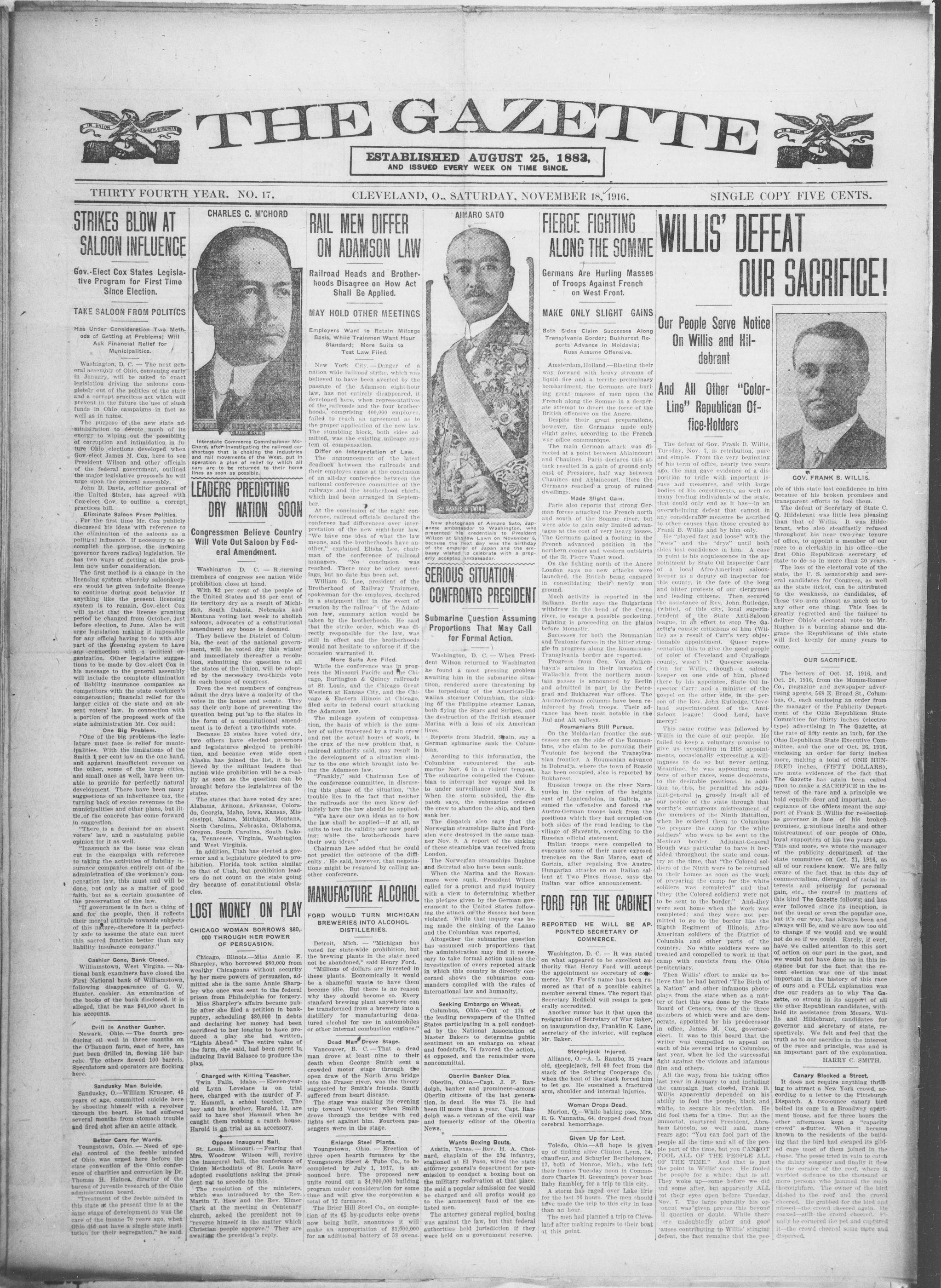
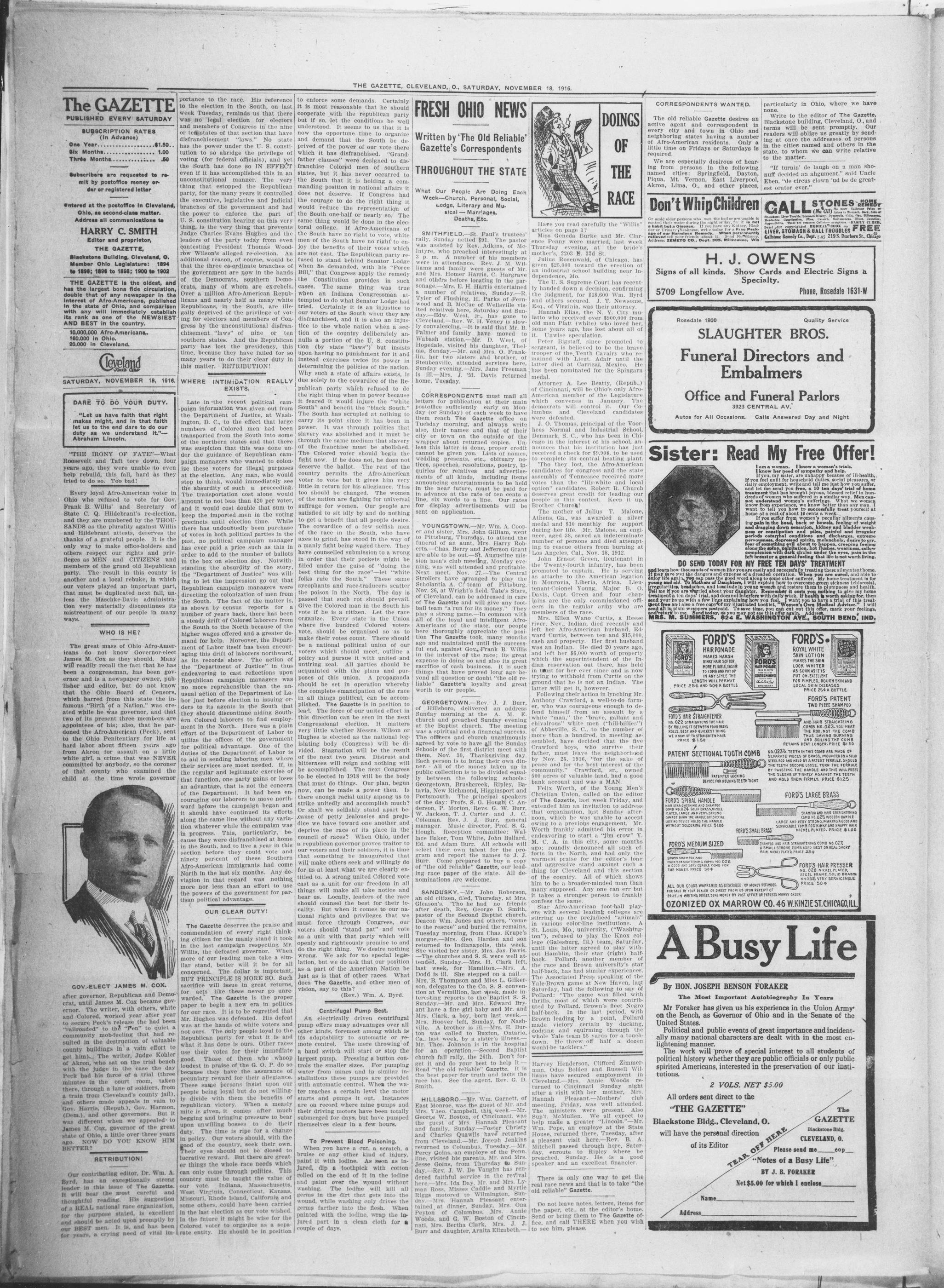
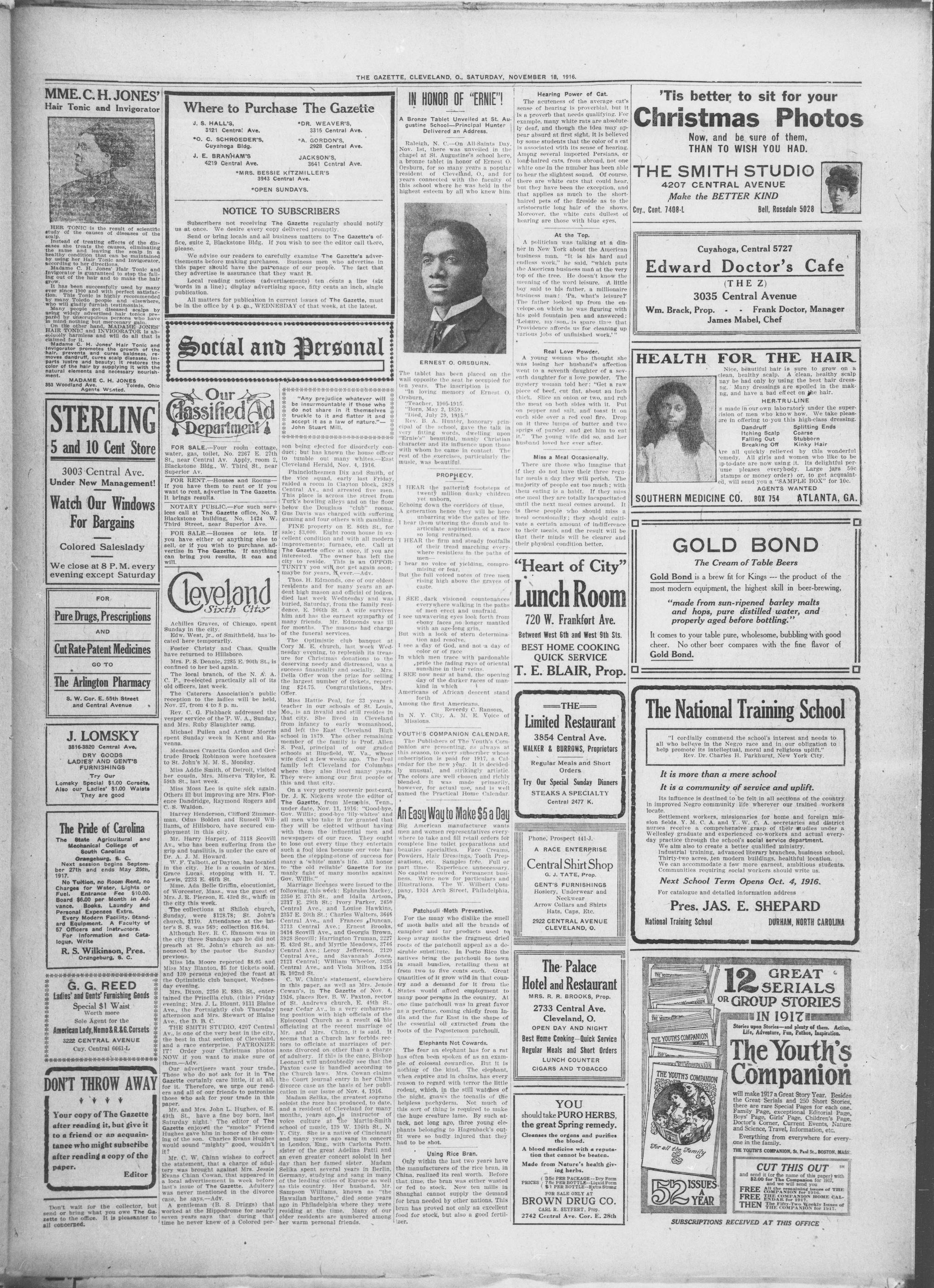
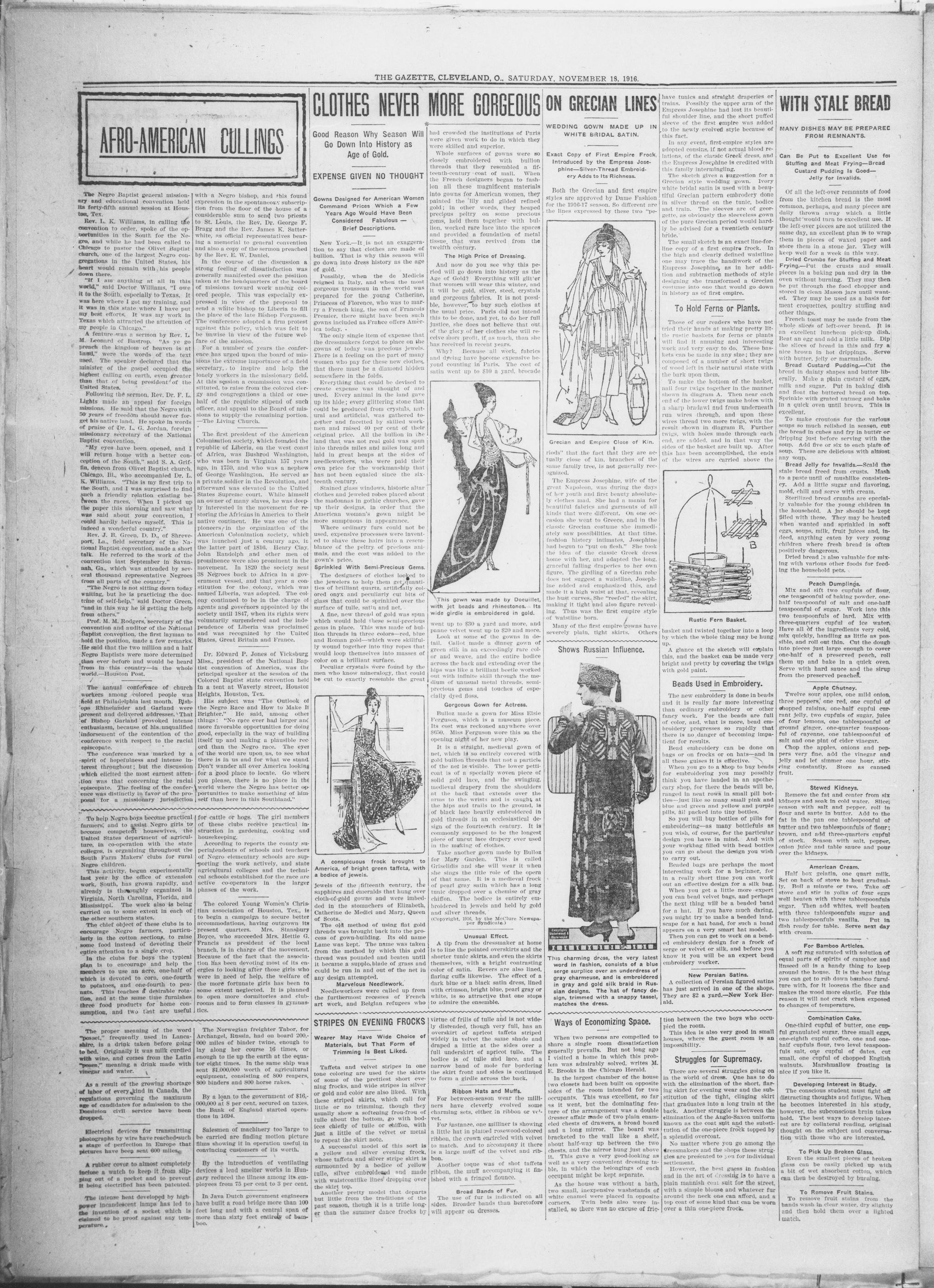
Page text (machine-generated)
THIRTY FOURTH YEAR. NO.17.
IN UNION
PROFESSIONAL
STRIKES BLOW AT SALOON INFLUENCE
Gov.-Elect Cox States Legislative Program for First Time Since Election.
TAKE SALOON FROM POLITICS
Has Under Consideration Two Meth- ods of Getting at Problems; Will Ask Financial Relief for Municipalities.
Washington, D.C. — The next general assembly of Ohio, convening early in January, will be asked to enact legislation driving the saloons completely out of the politics of the state and a corrupt practices act which will prevent in the future the use of slush funds in Ohio campaigns in fact as well as in name.
The purpose of the new state administration to devote much of its energy to wiping out the possibility of corruption and intimidation in future Ohio elections developed when Gov.elect James M. Cox, here to see President Wilson and other officials of the federal government, outlined the major legislative proposals he will urge upon the general assembly.
John D. Davis, solicitor general of the United States, has agreed with Cox-elect Gov. to outline a corrupt practice bill.
Elizabeth Saloon From Politics.
For the first time Mr. Cox publicly discussed his ideas with reference to the elimination of the saloons as a political influence. If necessary to accomplish the purpose, the incoming governor favors radical legislation. He has two ways of getting at the problem now under consideration.
The first method is a change in the licensing system whereby saloonkeepers would be given indefinite license to continue during good behavior. If anything like the present licensing system is to remain, Gov.elect Cox will insist that the license granting period be changed from October, just before election, to June. Also he will urge legislation making it impossible for any official having to do with any part of the licensing system to have any connection with a political organization. Other legislative suggestions to be made by Gov.elect Cox in his message to the general assembly will include the complete elimination of liability insurance companies as competitors with the state workmen's compensation; financial relief for the larger cities of the state and an absent voters' law. In connection with a portion of the proposed work of the state administration Mr. Cox said:
One Big Problem.
"One of the big problems the legislature must face is relief for municipalities. With the limitations of the Smith per cent law on the one hand, and apparent insufficient revenue on the other, some of the large cities, and small ones as well, have been unable to provide for perfectly natural development. There have been many suggestions of an inheritance tax, the turning back of excise revenues to the municipalities and other plans, but little of the concrete has come forward in suggestion.
"There is a demand for an absent voters' law, and a sustaining public opinion for it as well.
"Inasmuch as the issue was clear cut in the campaign with reference to taking the activities of liability insurance entirely out of the administration of the workmen's compensation law, this must and will be done, not only as a matter of good faith, but as a certain guarantee of the preservation of the law.
"If government is in fact a thing of and for the people, then it reflects their mental attitude towards subjects of this nature, therefore it is perfectly safe to assume the state can meet this sacred function better than any liability insurance company."
Cashier Gone. Bank Closed.
Williamstown, West Virginia. — National bank examiners have closed the First National bank of Williamstown, following disappearance of G. W. Hunter, cashier. An examination of the books of the bank disclosed, it is alleged, that he was $40,000 short in his accounts.
Drill In Another Gusher
Newark. Ohio. -- The fourth producing oil well in three months on the O'Bannon farm, east of here, has just been drilled in, flowing 150 barrels. The others, flowed 100 barrels. Speculators and operators are flocking here.
Syndukey Man Sulcide.
Sandusky, O.—William Krueger, 45 years of age, committed suicide here by shooting himself with a revolver through the heart. He had suffered several months from stomach trouble and fired shot after an acute attack.
Better Care for Wards.
Youngstown, Ohio. — Need of special control of the feeble minded of Ohio was urged here before the state convention of the Ohio conference of charities and correction by Dr. Thomas H. Hafnes, director of the bureau of juvenile research of the Ohio administration board.
"Treatment of the feeble minded in this state at the present time is at the same stage of development as was the care of the insane 70 years ago, when Ohio did not have a single state institution for their segregation," he said.
THE NEW YORK TIMES
Interstate Commerce Commissioner Mc-Chord, after investigating the railroad can shortage that is choking the industries and rail movements of the West, put in place a system which all open are to be returned to their home lines as soon as possible.
LEADERS PREDICTING DRY NATION SOON
Congressmen Believe Country Will Vote Out Saloon by Federal Amendment.
Washington D. C. — Returning members of congress nation wide prohibition close at hand.
With 82 per cent of the people of the United States and 85 per cent of its territory dry as a result of Michigan, South Dakota, Nebraska and Montanaaving last week to abolish saloons, advocates of a constitutional amendment say booze is doomed.
They believe the District of Columbia, the seat of the national government, will be voted dry this winter and immediately, thereafter a revolution, submitting the question to all the states of the Union, will be adopted by the necessary two-thirds vote in each house of congress.
Even the wet members of congress admit the drys have a majority of the votes in the house and senate. They say their only hope of preventing the question being put up to the states in the form of a constitutional amendment is to defeat a two-thirds vote.
Because 23 states have voted dry, two others have elected governors and legislatures pledged to prohibition, and because even wide open Alaska has joined the list, it is believed by the militant leaders that nation wide prohibition will be a reality as soon as the question can be brought before the legislatures of the states.
The states that have voted dry are Alabama, Arizona, Arkansas, Colorado, Georgia, Idaho, Kansas, Mississippi, Maine, Michigan, Montana, North Carolina, Nebraska, Oklahoma, Oregon, South Carolina, South Dakota, Tennessee, Virginia, Washington and West Virginia.
In addition, Utah has elected a governor and a legislature pledged to prohibition. Florida took action similar to that of Utah, but prohibition leads to a count on the state going dry because of constitutional obstacles.
LOST MONEY ON PLAY
CHICAGO WOMAN BORROWS $80,
000 THROUGH HER POWER
OF PERSUASION.
Chicago, Illinois.—Miss Annie E.
Sharpley, who borrowed $80,000 from
wealthy Chicagoans without security
by her mere powers of persuasion, admitted
she is the same Annie Sharpley
who once was sent to the federal prison from Philadelphia for forgery.
Miss Sharpley's affairs became public after she fled a petition in bankruptcy, scheduling $80,000 in debts and declaring her money had been sacrificed to her longing to have produced a play she had written,
"Lights Ahead." The entire value of the farm, she said, had been spent in inducing David Belasco to produce the play.
Charged with Killing Teacher.
Twin Falls, Idaho. — Eleven-year-old Lynn Lovelace is on trial here, charged with the murder of F. T. Hammil, a school teacher. The boy and his brother, Harold, 12, are said to have shot Hammil when he caught them robbing a ranch house. Harold is on trial as an accessory.
Oppose Inaugural Ball.
St. Louis, Missouri. — Fearing that Mrs. Woodrow Wilson will revive the inaugural ball, the conference of Union Methodists of St. Louis have adopted resolutions asking the president not to accede to this.
The resolution of the ministers, which was introduced by the Rev. Martin T. Haw and the Rev. Elmer Clark at the meeting in Centenary church, asked the president not to "reverse himself in the matter which Christian people approve." They are awaiting the president's reply.
ESTABLISHED AUGUST 25, 1883 AND ISSUED EVERY WEEK ON TIME SINCE.
RAIL MEN DIFFER ON ADAMSON LAW
Employers Want to Retain Milage Easis, While Trainmen Want Hour Standard; More Suits to Test Law Filed.
New York City, Manager of a nation wide railroad strike, which was believed to have been averted by the passage of the *Adamson eight hour law*, has not entirely disappeared, it developed here, when representatives of the railroads and the four brotherhoods, comprising 40,000 employees, failed to reach an agreement to the proper application of the new law. The stumbling block, both sides admitted, was the existing管理系统 of compensation.
Difference of Interpretation of Law.
The amendment of the latest deadlock between the railroads and their employees came at the conclusion of an all-day conference between the national conference committee of the railways and the brotherhood chief, which had been arranged in September.
At the conclusion of the night conference, railroad officials declared the conferences had differences over interpretation of the new eight hour law. "We have one idea of what the law means, and the brotherhoods have another," explained Elisha Lee, chairman of the conference of railroad managers. "No conclusion was reached. There may be other meetings, but no date has been set.
William G. Lee, president of the Brotherhood of Railway Tractionmen, spokesman for the employees, declared in a statement that in the event of evasion by the railroad' of the Adamson law, summary action' would be taken by the brotherhoods. He said that the strike order, which was directly responsible for the law, was still in effect and the brotherhoods would not hesitate to enforce it if the occasion warranted it.
More Suits Are Filed.
While the conference was in progress the Missouri, Pacific and the Chicago, Burlington and Quincy railways at St. Louis, and the Chicago Great Western at Kansas City, and the Chicago & Eastern Illinois at Chicago, filed suits in federal court attacking the Adamson law.
The mileage system of compensation, the basis of which is the number of miles traversed by a train crew and not the actual hours of work, is the crux of the new problem that, a railroad authority said, may result in the development of a situation similar to the one which brought info being' the Adamson Frankly'.
Mr. Chairman Log of the conference committee, in discussing his opinion of the situation, 'the trouble lies in the fact that neither the railroads' nor the men know definitely how the law should be applied.
"We have our own ideas as to how the law shall be applied—if at all, suits to test its validity are now pending; while the brotherhoods have their own ideas."
Chairman Lee added that he could not 'predict the outcome of the difficulty.' He said, however, that negotiation was occupied by calling and other conference'.
MANUFACTURE ALCOHOL
MANUFACTURE ALCOHOL
FORD 'WOULD TURN MICHIGAN BREWERIES INTO ALCOHOL DISTILLERIES.
Detroit, Mich. — "Michigan has voted for state-wide prohibition, but the brewing plants in the state need not be abandoned," said Henry Ford. "Millions of dollars are invested in those plants. Economically it would be a shameful waste to have them become idle. But there is no reason why they should become so. Every standard brewing plant anywhere can be transformed from a brewery into a distillery for manufacturing denatured alcohol for use in automobiles or other internal combustion engines."
Dead Man Drove Stage.
Vancouver, B. C.—That a dead man drove at least nine to their death when George Smith sent a crowded motor stage through the open draw of the North Arm bridge into the Fraser river, was the theory suggested by Smith's friends. Smith suffered from heart disease.
The stage was making its evening trip toward Vancouver when Smith drove through the bridge with red lights set against him. Fourteen passengers were in the stage.
Enlarge Steel Plants.
Energy
*Youngstown, Ohio. — Execution of three open health furnaces by the Youngstown Street & Tube Co. to be completed by July 1, 1917, is announced here. The proposed new unit round out a $4,000,000 building program under consideration for some time and will give the corporation a total of 12 furnaces.
The Brier Hill Steel Co. on completion of its 65 by-product coke ovens now being built, announces it will make an appropriation of $1,000,000 for an additional battery of 58 ovens.
AIMARO SATO
HARRIS & TWING
New photograph of Aimara Sato, Japanese ambassador to Washington, who visited Wilson at Shadow Lakes on November because the next day was the birthday of the emperor of Japan and the emperor with a properly accepted ambassador.
Submarine Question Assuming Proportions That May Call for Formal Action
Washington, D. C. — When President Wilson returned to Washington he found a most pressing problem awaiting him in the submarine situation, rendered more threatening by the torpedoning of the American-Hawaiian steamer Columbian, the sinking of the Philippine steamer Lanao, both flying the Stars and Stripes, and the destruction of the British steamer Marina with a loss of six American lives.
Reports from Madrid, Spain, say a German submarine sank the Columbian.
According to this information, the Columbian encountered the submarine Nov. 6 in a violent tempest. The submarine compelled the Columbian to interrupt her voyage and he to under surveillance until Nov. 5. When the storm subsided, the dispatch says, the submarine ordered the crew to abandon the ship, and then sank her.
The dispatch also says that the Norwegian steamships thalgo and Fordalen were destroyed in the same manner Nov. 9. A report of the sinking of these steamships was received from London.
The Norwegian steamships Daphnie and Seeland also have been sunk.
When the Marina and the Rowanmore were sunk, President Wilson called for a prompt and rigid inquiry with a view to determining whether the pledges given by the German government to the United States following the attack on the Sussex had been violated. While that inquiry was being made the sinking of the Lanao and the Colombian was reported. Allogated question papers had such propositions that the administration may find it necessary to take formal action unless the investigation of every reported attack in which this country is directly concerned shows the submarine commanders compiled with the rules of international law and humanity.
Seeking Embargo on Wheat.
Seeking embargo on wheat.
Columbus, Ohio—Quot of 175 of the leading newspapers of the United States participating in a poll conducted by the National Association of Master Bakers to determine public sentiment on an embargo on wheat and foodstuffs, 74 favored the action, 44 opposed, and the remainder were noncommittal.
Oberlin Banker Dies.
Oberlin, Ohio—Capt. J. F. Randolph, banker and prominent-among Oberlin citizens of the last generation, is dead. He was 75. He had been ill more than a year. Capt. Randolph was a veteran of the civil war and formerly editor of the Oberlin News.
Wants Boxing Bouts.
Aubatin, Texas. — Rev. H. A. Choiann, chapain of the 23d infantry, stationed at El Paso, wired the state attorney general's department for permission to conduct a boxing bout on the military reservation at that place. He said a popular admission fee would be charged and all profits would go to the amusement fund of the enlisted men.
The attorney general replied boxing was against the law, but that federal authorities held jurisdiction if they were held on a government reserve.
FIERCE FIGHTING ALONG THE SOMME
Both Sides Claim Successes Along Transylvania Border; Bulkarest Reports; Advance in Moldavia; Rusia Assume Offensive.
Amsterdam, Holland. Blasting their way forward with heavy streams of liquid fire and a terrible preliminary bombardment, the Germans are hurling great masses of men upon the French along the Seine in a desperate attempt to divert the force of the British offensive on the Aneu. Despite their great preparations, however, the Germans made only slight gains, according to the French war office communique.
The main German attack was directed at a point between Albanyourt and Chaines. Paris declares this attack resulted in a gain of ground only east of Pressure, half way between Chaines and Albanyourt. Here the Germans reached a group of ruined dwellings.
Made Slight Gain.
Ports also reports that strong German forces attacked the French north and south of the Somme river, but were able to gain only limited advantages at the cost of very heavy losses. The Germans gained a footing in the French advanced position in the northern corner and western outskirts of the St. Pierre Yann wood.
On the fighting north of the Ancre London says no new attacks were launched, the Prussian being engaged in consolidating their newly won ground.
Much activity is reported in the Balkan, Berlin says the Bulgarians withdrew in the lead of the Cerna river, to escape a possible pocketing. Fighting is proceeding on the plains before Montferri.
Successes for both the Romanians and Troglioni force in the bitter struggle in progress about the Romanians Transylvanian border are reported.
Progress from Gen. Von Falkenhavy's armies in their invasion of Wallachia from the northern mountain peace is announced by Berlin and admitted in part by the Petrograd and Bukharkov war offices. The Austrian German columns have been mirrored by French troops. Their advance has been most notable in the Jut and Alt valleys.
Roumanians Still Pursue
Roumanians Still Pursue.
On the Mediterranean frontier the successes are on the side of the Roumanians, who claim to be pursuing their Tenticute foe beyond the Transylvanian frontier. A Roumanian advance has been occupied, also is reported by Bukharac. troops on the river Narayana in the region of the heights east of Lipnijafolan, in Caliaia, assaulted the offensive and forced the Austro-German troops back from the positions which they had occupied on both sides of the road leading to the village of Shavoutin, according to the Russian official statement.
Italian troops were compelled to evacuate some of their more exposed trenches on the San, Marco, east of Gorizia, after repulsing five Austro-Hungarian attacks on an Italian salient at Two Pines House, says the Italian war office announcement.
FORD FOR THE CABINET
REPORTED HE WILL BE AP
POINTED SECRETARY OF
COMMERCE.
Washington, D. C. -- It was stated
on what appeared to be excellent
authority that Henry Ford will accept
the appointment its secretary of
commerce. Mr. Ford's name has been
removed as that of a possible
member several times. The report that
Secretary Redfield will resign is
generally accredited.
Another rumor has it that upon the
resignation of Secretary of War Baker,
on inauguration day, Franklin K. Lane,
secretary of the interior, will replace
Mr. Baker.
Steeplejack Injured;
*Alliance, O.-A. L. Rambo, 35 years old, steeplejack, fell 60 feet from the stack of the Sobring Cooperage Co. when the heat of the stack forced him to let go. He sustained a fractured arm, shoulder and internal injuries.
Woman Drops Dead.
Marion, Q.—While baking pies, Mrs. E. G. Vannata, 64, dropped dead from cerebral hemorrhage.
Given Up for Lost.
Toledo, Ohio.—All hope is given up of finding alive Clinton Lynn, 24, chauffeur, and Schuyler Bosthomoew, 17, both of Monroe, Mich., who left their homes Tuesday noon in Commodors Charles H. Greeening's power boat Baby Rambler, for a trip to this city.
A storm has raged over Lake Kick for the last 26 hours. The men should have made the trip to this city in less than an hour.
The men had planned a trip to Cleveland after making repairs to their boat at this point.
SINGLE COPY FIVE CENTS.
WILLIS' DEFEAT OUR SACRIFICE!
The defeat of Gov. Frank B. Willis,
Tuesday, Nov. 7, is retribution, pure
and simple. From the very beginning of
business of office, nearly two years ago,
the man gave evidence of a disposition
to trite with important issu-
sions and measures, and with larg-
itude of his constituents, as well as
man of his constituents, as well as
man could only give a hiss in, an ow-
ne being defeat that cannot in,
considerable measure be ascribed
to other causes than those created by
Frank B. Willis and his him only.
He plowed fast and loose with the "waves" and the "dryls," until both sides felt confidence in him. A case in point is his acquiescence in the appointment by State Oil Inspector Carr of a local African-American saloon keeper as a deputy oil inspector for this county, in the face of the long and bitter protests of our clergymen and leading citizens. Then secured the assistance of Rev. John Rutledge, (white), of this city, local superintendent of the State Anti-Saloon league, in an effort to stop The Gazette's canine criticisms of him (Willis) as a result of Curr's very objectious criticism of the officer. Over the course of time the good people of color of Cleveland and Cuyahoga county, wasn't it? Queuer association for Willis, though a saloon keeper on one side of him, placed there by his apprentice, State Oil Inspector Carr; and a minister of the guard on the other side, in the person of the Rev. John Rutledge, Cleveland superintendent of the Anti-Saloon League! Good Lord, have mercy!
This same course was followed by Wilkins in the case of our people. He failed to keep a voluntary promise to his recognition in HIS appointments, or as usually expressing a will impress to do so but never acting. Meanwhile, he was appointing members of other races, some democrats, to the desirable positions. In addition to this, he permitted his adjudication to grossly insult all of our people of the state through that worthy's outrages, misreatment of the members of the Ninth Battalion, when he ordered them to Columbus "to prepare the camp for the white soldiers" who were to be sent to the Mexican border. Adjutant General Hough was particular to have if her added throughout the state and country at the time, that "the Colored soldiers of the Ninth were to be returned to the Lonesome as soon as the work of preparing the camp for the white soldiers was completed", and that "they (the colored soldiers) were not to be sent to the border." And they were sent home when the work was completed; and they were not permitted to go to the border like the Eighth Regiment of Illinois, Afro-American soldiers of the District of Columbia and other parts of the country. No white soldiers were so treated and compelled to work in that camp with convicts from the Ohio penitentiary.
Then Willis' effort to make us believe that he had barred "The Birth of a Nation" and other infamous photoplasms from the state when as a matter of fact this was done by the State Board of Censors, two of the three members of which were and are democrats, appointed by his predecessor in office, James M. Cox, governor-elect. It was to this board that the writer was compelled to appeal on each of his several trips to Columbus, last year, when he led the successful fight against the vicious and infamous film and others.
All the way, from his taking office last year in January to and including the campaign just closed, Frank B. Willis apparently depended, on his ability to fool the people, black and white, to secure his rejection. He did fool them for a time. But as the immortal, manned President, Abraham Lincoln, so well said, many years ago: "You can fool part of the people all the time and all of the people part of the time, but you CANNOT POOL ALL OF THE PEOPLE ALL OF THE TIME." And that is just the point in Willis' case. He founded the people for a whiter that is all. They woke up come before we did and some after, but apparently ALL of their eyes open before Tuesday Nov. 7. The large plurality his opinion was given in the highest question on night. While there is no doubt other and good times contributing to Willis' ultimate defeat, the fact remains that the test
GOV. FRANK B. WILLIS.... ple of this state lost confidence in him because of his broken promises and transparent efforts to fool them.
The defeat of Secretary of State C. Q. Hildebrant was little less pleasing than that of Willis. It was Hildebrant, who also steadfastly refused throughout his near two-year tenure of office, to appoint a member of our race to a clerkship in his office—the first Ohio Republican secretary, of state to do so in more than 20 years. The loss of the electoral vote of the state, the U. S. senatorship and several candidates for Congress, as well as the state ticket, can be attributed to the weakness, as candidates, of these two men almost as much as to any other one thing. This loss is greatly regretted and the failure to deliver Ohio's electoral vote to Mr. Hughes is a burning shame and disgrace the Republicans of this state will feel keenly for many years to come.
Canary Blocked a Street
Canary Blocked a Street.
It does not require anything thrilling to attract a New York crowd, according to a letter to the Pittsburgh Dispatch. A two-ounce canary bird bolted its cage in a Broadway apartment house, and for three hours the other afternoon kept a "capacity crowd" a dutter. When it became known to the residents of the building that the bird had escaped its glabed cage most of them joined in the chase. The posses tried in vain to catch the defiant singer and finally it flew in the orifice of the roof, where it worked defiance to the thousand of more people who jammed the air with the pompier. The owner of the bird gladed to the roof and the crowd chanted. He grumbled for the bird and clashed the crowd chanted again. The coped with the crowd chanted. It only became the pet and copied the crowd, biped some more and copied.
PUBLISHED EVERY SATURDAY
One Year.....$1.50.
Six Months.....1.00
Three Months......50
Subscribers are requested to re-
mit by postoffice money or
order or registered letter
Entered at the postoffice in Cleveland
Ohio, as second-class matter.
Address all communications to
Blackstone Building, Cleveland, O.
Member Ohio Legislature: 1894
to 1898; 1898 to 1898; 1900 to 1902
THE GAZETTE is the oldest, and has the largest bona fide circulation, double that of any newspaper in the interest of Afro-Americans, published with an international companion with any will immediately establish its rank as one of the NEWSIEST AND BEST in the country.
10,000,000 Afro-Americans.
160,000 in Ohio.
20,000 in Cleveland.
SATURDAY, NOVEMBER 18, 1916.
DARE TO DO YOUR DUTY.
"Let us have faith that right makes might, and in that faith let us to the end dare to do our duty as we understand it."—Abraham Lincoln.
"THE IRONY OF FATE"—What Roosevelt and Taft tore down, four years ago, they were unable to even help rebuild, this fall, hard as they tried to do so. Too bad!
Every loyal Afro-American voter in Ohio who refused to vote for Gov Frank B. Willis' and Secretary of State C. Q. Hildebrand's re-election, and they are numbered by the THOU SANDS as the plurality against Willis and Hildebrand attests, deserves the thanks of a grateful people. It is the only way to make office-holders and others respect our rights and privileges as MEN and CITIZENS and members of the grand old Republican party. The result in this county is another and a local rebuke, in which our voters played an important part, that must be duplicated next fall, unless the Maschke-Davis administration very materially discontinues its mistreatment of our people in many ways.
WHO IS HE?
The great mass of Ohio Afro-Americands do not know Governor-elect James M. Cox as they should. Many will readily recall the fact that he has been a congressman, has been governor and is a newspaper owner, publisher and editor, but do not know that the Ohio Board of Censors, which barred from this state the infamous "Birth of a Nation" was created while he was governor, and that two of its present three members are appointees of his; also, that he pardoned the Afro-American (Peck), sent to the Ohio Penitentiary for life at hard labor about fifteen years ago from Akron for assault on a little white girl, a crime that was NEVER committed by anybody, so the coroner of that county who examined the child at the time wrote governor
PETER H.
GOV-ELECT JAMES M. COX.
after governor, Republican and Democrat, until James M. Cox became governor. The writer, with others, white and Colored, worked year after year to secure Peck's release (he had been "trailed to" the "Fen" to quiet a community mob-feeling that had resulted in the destruction of valuable county buildings in a vain effort to get him). The writer, Judge Kohler of Akron, who sat on the trial bench with the judge in the case the day Peck had his face of a trial (three minutes in the court room, taken there, through a lane of soldiers, from a train from Cleveland's county jail), and others made appeals in vain to Gov. Harris, (Repub), Gov. Harmon, (Dem), and other governors. But it was different when we appealed-to James M. Cox, governor of the great state of Ohio, a little over three years ago. NOW DO YOU KNOW HIM BETTER?
RETRIBUTION!
Our contributing editor, Dr. Wm. A. Byrd, has an exceptionally strong leader in this issue of The Gazette. It will bear the most careful and thoughtful reading. His suggestion of a REAL national race organization, for the purpose stated, is excellent and should be acted upon promptly by our BEST men. It is, and has been years, a crying need of vital im-
portance to the race. His reference to the election in the South, on last week Tuesday, reminds us that there was no legal election for electors and members of Congress in the nine or ten states of that section that have disfranchisement "laws." No state has the power under the U.S. constitution to so abridge the privilege of voting (for federal officials), and yet the South has done so IN EFFECT even if it has accomplished this in an unconstitutional manner. The very thing that estopped the Republican party, for the many years it controlled the executive, legislative and judicial branches of the government and had the power to enforce the part of U.S. constitution bearing on this very thing, is the very thing that prevents Judge Charles Evans Hughes and the leaders of the party today from even contesting President Thomas Woodrow Wilson's alleged re-election. An additional reason, of course, would be that the three co-ordinate branches of the government are now in the hands of the Democrats, southern Democrats, many of whom are exrebels. Over a million Afro-American Republicans and nearly half as many white Republicans, in the South, are illegally deprived of the privilege of voting for electors and members of Congress by the unconstitutional disfranchisement "laws" of nine or ten southern states. And the Republican party has lost the presidency, this time, because they have failed for so many years to do their clear duty in this matter. RETRIBUTION!
Late in the recent political campaign information was given out from the Department of Justice, at Washington, D. C., to the effect that large numbers of Colored men had been transported from the South into some of the northern states and that there was suspicion that this was done under the guidance of Republican campaign managers who wanted to colonize these voters for illegal purposes at the election. Any man, who would stop to think, would immediately see the absurdity of such a proceeding. The transportation cost alone would amount to not less than $20 per voter, and it would cost double that sum to keep the imported men in the voting precincts until election time. While there has undoubtedly been purchase of votes in both political parties in the past, no political campaign manager has ever paid a price such as this in order to add to the number of ballots in the box on election day. While standing the absurdity of the story, the "Department of Justice" was willing to let the impression go out that Republican campaign managers were directing the colonization of men from the South. The fact of the matter is, as shown by census reports for a number of years back, there has been a steady drift of Colored laborers from the South to the North because of the higher wages offered and a greater demand for help. Moreover, the Department of Labor itself has been encouraging its agents to its agents in the South that they should discontinue aiding Southern Colored laborers to find employment in the North. Here was a plain effort of the Department of Labor to utilize the offices of the government for political advantage. One of the duties of the Department of Labor is to aid in sending laboring men where their services are most needed. If, in the regular and legitimate exercise of that function, one party gains or loses an advantage, that is not the concern of the Department. It had been encouraging our laborers to move northward before the campaign began and it should have continued its efforts along the same line without any variation whatever while the campaign was in progress. This, particularly, because they were disfranchised at home in the South, had to live a year in this section before they could vote and ninety-per-cent of these Southern Afro-American immigrants had come North in the last six months. Any deviation in that regard was nothing more nor less than an effort to use the powers of the government for partisan political advantage.
OUR CLEAR DUTY
The Gazette deserves the praise and commendation of every right thinking citizen for the manly stand it took in the last campaign respecting Mr. Willis, the defeated governor. When more of our leading men take a similar stand, better it will be for all concerned. The dollar is important. BUT PRINCIPLE IS MORE SO. Such sacrifice will issue in great returns, for acts like these never go unwarred. The Gazette is the proper paper to begin a new era in politics for our race. It is to be regretted that Mr. Hughes was defeated. His defeat was at the hands of white voters and not ours. The only people loyal to the Republican party for what it is and what it has done is ours. Other races use their votes for their immediate good. Those of them who whoop loudest in praise of the G. O. P. do so because they have the assurance of pecuniary reward for their allegiance. These same persons insist upon our people being loyal but do not willingly divide with them the benefits of republican victory. When a measly mite is given, it comes after much begging and bringing pressure to bear upon unwilling bosses to do their duty. The time is ripe for a change in policy. Our voters should, with the good of the country, seek their own. Their eyes should not be closed to lucrative reward. But there are greater things the whole race needs which can only come through politics. This country must be taught the value of our vote. Indiana, Massachusetts, West Virginia, Connecticut, Kansas, Missouri, Rhode Island, California and some others, could have been carried in the last election as our vote wished. In the future it might be wise for the Colored voter to organize as a separate entity. He should be in position
THE GAZETTE, CLEVELAND, O., SATURDAY, NOVEMBER 18, 1916
to enforce some demands. Certainly it is most reasonable that he should cooperate with the republican party but if so, let the conditions be well understood. It seems to us that it is now the opportunity to demand that the South be deprived of the power of our vote which it has disfranchised. "Grandfather clauses" were designed to disfranchise Colored men of southern state, but it has never occurred to the South that it is holding a commanding in national affairs that does not deserve. If Congress had the courage to do the right thing it would reduce the representation of the South one-half or done so, the electoral college. If Afro-Americans of the South have no right to vote, white men of the South have no right to enjoy the benefits of their votes which are not cast. The Republican party refused to stand behind Senator Lodge when he demanded, with his "Force Bill," that Congress apply the remedy the Constitution provides in such cases. The same thing was true when an Indiana Congressman attempted to do what Senator Lodge had tried. Certainly it is an injustice to our voters of the South when they are disfranchised, and it is also an injustice to the whole nation when a section of the country deliberately annuls a portion of the U. S. constitution (by state "laws") but insists upon having no punishment for it and instead exercises twice its power in determining the policies of the nation. Why such a state of affairs exists, is due solely to the cowardice of the Republican party which refused to do the right thing when in power because it feared it would injure the "white South" and benefit the "black South." The South has scrupled at to carry its point since it has been in power. It was through politics that slavery was abolished and that it be through the same medium that slavery of the franchise must be abolished. The Colored voter should begin the fight now. If he does not, the rest of the country permits the Afro-American voter to vote but it gives him very little in return for his allegiance. This too should be changed. The women of the nation are fighting for universal suffrage for women and do nothing to get a benefit that all people desire. The cowardice of a few selfish men of the race in the South, who have axes to grind, has stood in the way. They have counselled submission to a wrong in order that their pockets might be filled under the guise of "doing the best thing for the race"—let "white folks rule the South." These same sycophants and race-traducers scatter the poison in the North. The day is passed that such rot should prevail. Give the Colored man in the South his vote if he is a citizen. Let the race organize. Every state in the Union where five hundred Colored voters vote, should be organized so as to make their votes count. There should be a national political union of our voters which should meet, outline a policy and pursue it with united and uniting zeal. All parties should be acquainted with the plans and purposes of this union. A propaganda should be set in operation where the complete emancipation of the race in all things political, can be accomplished. The Gazette is in position to lead. The force of our united effort in this direction can be seen in the next Congressional election. It matters very little whether Messrs. Wilson or Hughes is elected as the national legislating body (Congress) will be divided. Stagnation will be the result of the next two years. Distrust and bitterness will reign and nothing will be accomplished. The next Congress to be elected in 1918 will be the body that must do things. Our plan, begun now, can be made a power then. Is there enough racial unity among to strike unitedly and accomplish much? Or shall we selfishly stand apart because of petty jealousies and prejudice we have toward one another and deprive the race of its place in the council of races? When Ohio, under a republican governor proves traitor to our voters and their soldiers, it is time that something be inaugurated that will make others seek and willingly do for us at least what we are clearly entitled to. A strong united Colored vote cast as a unit for our freedom in all things will make all take notice and hear us. Locally, leaders of the race should counsel the best for their locality. But when it comes to our national rights and privileges that we must force through Congress, our voters should "stand pat" and vote as a unit with that party which will openly and righteously promise to and do the right thing. We desire nothing wrong. We ask for no special legislation, but we do ask that our position as a part of the American Nation be as is that of other races. What does The Gazette, and other men of vision, say to this?
(Rev.) Wm. A. Byrd.
Centrifugal Pump Best.
An electrically driven centrifugal pump offers many advantages over all other kinds, foremost among which is its adaptability to automatic or remote control. The mere throwing of a hand switch will start or stop the largest pump. Pressing a button controls the smaller sizes. For pumping water from mines and in similar installations these pumps are provided with automatic control. When the water reaches a certain level the motor starts and pumps it out. Instances are on record where mine pumps and their driving motors have been totally submerged for days, but have pumped themselves clear in a few hours.
To Prevent Blood Poisoning
When you have a cut, a scratch, a bruise or any other kind of injury, paint it with lodine. As seen as injured, dip a toothpick with cotton rolled on the end of it in the lodine and paint over the wound without washing. The lodine will kill all germs in the dirt that gets into the wound, while washing only drives the germs farther into the flesh. When painted with the lodine, wrap the injured part in a clean cloth for a couple of days.
Written by 'The Old Reliable' Gazette's Correspondents
THROUGHOUT THE STATE
What Our People Are Doing Each Week—Church, Personal, Social, Lodge, Literary and Musical—Marr'ages, Deaths, Etc.
SMITHFIELD,—St. Paul's trustees rally, Sunday netted $11. The pastor was assisted by Rev. Adkins, of McIntyre, who preached interestingly at 3 p. m. A number of his members were in attendance. Rev. J. M. Williams and family were guests of Mr. and Mrs. Homer Harris, C. Hargrave sonage—Mrs. E. H. Harris locating in the parsonage—a number of relatives, Sunday. R. Tylier of Flushing, H. Parks of Fernwood and B. McCue of Wellsville visited relatives here, Saturday and Sunday.—Edw. West, jr., has gone to Cleveland.—Rev. W. H. Veney is slowly convalescing.—It is said that Mr. B Palmer and family have moved to Bash station—Mr. D. West, of Bash station, visited his daughter, Thela, Sunday, married her, O. Franklin, her two sisters and brother, of Steubenville, attended services here, Sunday evening.—Mrs. Jane Freeman is ill.—Mrs. J. M. Davis returned home, Tuesday.
CORRESPONDENTS must mail all letters for publication at their postoffice sufficiently early on Monday (or Sunday) of each week to have them reach The Gazette office on Tuesday morning, and always write also, their names and that of their city or town on the outside of the wrapper about returned copies. Unless this latter is done, proper credit cannot be given you. Lists of names, wedding presents, etc., obtitary notices, speeches, invitations, poetry, inquiries, information, and other items of all kinds, including items announcing entertainments to be held in the near future, must be paid for in advance at the rate of ten cents a line, six words to a line. Our rates for display advertisements will be sent on application.
YOUNGSTOWN—Mr. Wm. A. Cooper and sister, Mrs. John Gilliam, went to Pittsburg, Thursday, to attend the funeral of an anunt, Mrs. Harry Roberts—Chas, Berry and Jefferson Grant are able to be able. St. Augustine mission men's club meeting, Monday evening, was well attended and profitable. The St. Augustine Strollers have arranged to play the Scholantia A. C. team of Pittsburg Nov. 28, at Wright's field. Tate's Stars of Cleveland, can be addressed in care of The Gazette and will give any foot ball team "a run for its money." They play a strong game—In common with Americans of the state, people here thoroughly appreciate the position The Gazette took, many months ago and maintained until the success ful end, against Gox, Frank B. Willis in the interest of the race; its great expense in doing so and also its great success. The Gazette has things that have proved long ago he bond all question or doubt "the old reliable" Gazette's loyalty and great worth to our people.
GEORGETOWN—Rev. J. J. Burr of Hillsboro, delivered an address Sunday morning at the A. M. E church and preached Sunday evening at the Baptist church. The meeting was a spiritual and a financial success. The officers and church unanimously approved the preaching. Schools of the first district meet with them. Nov. 30. Thanksgiving day Each person is to bring their own dinner. All of the money taken up in public collection is to be divided equally between the following schools: Georgetown, Brushcreek, Ripley, Bataqua, New Richmond, Higginsport and Barton. All schools will be on the day: Profs. S. G. Hough, C. Anderson, P. Morton, Revs. G. W. Wurk, W. Jackson, T. J. Carter and J. C. Coleman. Rev. J. J. Burr, general manager, Music director, Prof. S. G. Hough. Reception committee: Wallace Baker, Tom White, John Bullard Ed. and Adam Burr. All schools will be on the day: Profs. S. G. Hough and gram and report the names to J. J. Burr. Come prepared to buy a copy of "the old reliable" Gazette, our leading race paper of the state. All denominations are welcome.
SANDUSKY.-Mr. John Robertson, an old citizen, died, Thursday, at Mrs. Gleason's. The tho he had no friends after death, Rev. George D. Smith, pastor of the Second Baptist church, Deacon Wm. Jones and others, "came to the rescue" and buried the remains Tuesday morning, from Chas. Krupe's church. Mrs. Krupe returned to Indianapolis, this week She visited her sister, Mrs. Jas. Davis
—The churches and S. S. were well attended. Sunday…Mrs. H. Clark last, last week, for Hamilton…Mrs. A. Dodd is ill. She stepped on a nail…Mrs. B. Thompson and Miss L. Gilker son, delegates to the Co. S. S. convention at Vermillion, last week, made interesting reports to the Baptist S. S. Sunday…Mr. and Mrs. Edward Bryant have a fine girl baby and Mr. and Mrs. Clark, a boy, born last week. Mrs. Hoover left, Sunday, for N. Villa. A brother is ill. N. Burry has a sister, Austin, Ontario Ca. last week, by a sister's illness. Mr. Thos. Johnson is in the hospital for an operation—Second Baptist church fall rally, the 26th. Don't get it and do your best to help it. Read "the old reliable" Gazette. It is the best paper for truth and facts the race has. See the agent, Rev. G. D. Smith.
HILLSBORO—Mr. Wm. Garnett, of East Monroe, was the guest of Mr. and Mrs. Theo. Campbell, this week—Mr. George W. Boston, of Cincinnati, was the guest of Mrs. Hannah Pleasant and family, Sunday—Foster Christy and Charles Quailws have returned from Cleveland—Mr. Joseph Jenkins returned to Columbus, Tuesday—Mr. Percy Goins, an employee of the Penn. line, visited his parents, Mr. and Mrs. Jesse Goins, from Thursday to Sunday—Rev. J. W. D Vaughn offered faithful service in the revival here—Mrs. Ida Day, and Mrs. Lyman Ross, Misses Cuddle and Myrtle Algae, Mrs. Wilmington, Sundiales Mrs. Hannah Pleasant entertained at dinner, Sunday, Mrs. Ona Peyton of Columbus, Mrs. Annie Woods, and G. W. Boston of Cincinnati, Mrs. Bertha Clark, Mrs. J. Burr and Arnita Elizabeth—
DOINGS
OF
THE
RACE
Have you read carefully the "Willis" articles on page 1?
Miss Geneda Burke and Mr. Clarence Penny were married, last week Thursday evening, at the bride's mother, 2003 B. 33d St. Julius Rosewood, of Chicago, has given $25,000 toward the erection of an industrial school building near Independence, Mo.
The U. S. Supreme Court has recently handed down a decision, confirming the judgment, for $18,600 Wm. Byrd and others secured. J. T. Newsome, Esq., of Virginia, was their attorney. Hannah Elias, the N. City man who owned $900,000 old man Platt (white) who loved her, some years ago, has lost about all of it. Unwise speculation. Peter Bigstaff, since promoted to sergeant, is believed to be the brave trooper of the Tenth Cavalry who remained with Lieut. Adair until the latter died at Carrizal, Mexico. He has been nominated for the Spingar medal. Anne A. Lee Beatty, (Repub.) of Cincinnati, will be Ohio's only Afro-American member of the Legislature which convenes in January. The democrats will control it. Our Columbus and Cleveland candidates were defeated. J. O. Thomas, principal of the Voorhees Normal and Industrial School, Denmark, S. C., who has been in Chicago in the interest of his school an- d students, received a check for $9,908, to be used to complete its central heating plant.
The mother of Julius T. Malone, Athens, Ga, was awarded a silver medal and 10 monthly for support during her life. Mr. Malone, an engineer, aged 38, saved an indeterminate number of persons and died attempting to rescue others from burning at Los Angeles, Cal., Nov. 18, 1912, an assistant in the Twenty-fourth infantry, has been promoted to captain. He is serving as attach to the American legation in Monrovia, Liberia, Africa. Lieutenant-Colonel Young, Major B. O. Davis, Capt. Green and four chapains are the only commissioned officers in the regular army who are members of the race. He was a Lieutenant-Curtis, a Reese river, Nev., Indian, died recently and left her Afro-American husband, Edward Curtis, between ten and $15,000, cash and property. Her first husband was an Indian. He died 20 years ago, and left her $6,000 worth of property which the superintendent of the Indian reservation out there, has held in trust for her ever since and is now on the ground that he is not an Indian. The latter will get it, however.
Following their action in lynching Mr. Anthony Crawford, a well-to-do farmer, who was courageous enough to defend himself from an assault by a white "man," the "brave" gallant and courageous man, of Abbeville, S. C., to the number of more than a hundred, in meeting assembled, have decided that the five Crawford boys, who survive their father, must leave the neighborhood by Nov. 25, 1916, "for the sake of peace and for the best interest of the people," and move 500 acres of valuable land, had a good bank account and was a MAN.
Felix Worth, of the Young Men's Christian Union, called on the editor of The Gazette, last week Friday, and extended him an invitation to address that organization, last Sunday afternoon, which he was unable to accept owing to a previous engagement. Mr. Gazette, who is now endeavoring to start a "jim crow" Y. M. C. A. in this city, some months ago; roundly denounced all such efforts in the North, and had only the warmest praise for the editor's long and aggressive stand against such a thing for Cleveland and this section of the country. All of which shows him to be a broader-minded man than supposed; any one can err but takes a stronger person to frankly confess the same.
Star Afro-American foot-ball players with several leading colleges are stirring up the prejudiced "animals" in various color-line institutions. A St. Louis, Mo., university, ("Washington", refused to play the Knox college (Galesburg, Ill.) team, Saturday, until the latter agreed to play without Hamblin, their star (right) half-back. Pollard, another member of the race and Brown university's star half-back, has had similar experiences. The Associated Press press conference of the Yale-Brown game at New Haven, on Saturday, the game was filled with thrills, most of which were contributed by Pollard. Brown's fleet Negro half-back. In the last period, with Brown leading by a point, Pollard made victory certain by ducking, dodging and squirming through the whole Yale team 55 yards for a touchdown. He threw off half a dozen would-be tacklers."
Harvey Henderson, Clifford Zimmerman, Odus Bolden and Russell Williams have secured employment in Cleveland.—Mrs. Annie Woods returned to Cincinnati Sunday night after a visit with her mother, Mrs. Hannah Pleasant—Mother.—Occhabing Pleasant was well attested. The ministers were present. Also Supt. McMullen. We all expect to help make a greater "Lincoln."—Mr. Wm. House, an employee at the State House, returned there, Tuesday, after a pleasant visit here.—Rev. B. A. Mitchell passed through here. Saturday, enroute to Ripley where he preached. Sunday. He is a good speaker and an excellent financier.
There is only one way to get the real race news and that is to take "the old reliable" Gazette.
Do not leave notes, letters, items for the paper, etc., at the editor's home. Send or bring them to The Gazette office, and call THERE when you wish to see him, please.
ren CALL STONES REMED
(No 'Gill') To see the Gunn, Bari, Eid
Shakodar, Her Pravile, Homa-Sharri, Caspirals, Gola, Bore, Jundib,
Appalachite, Caspirallite, Plas, Cuvier, Norevis, Rash, Rash,
Sod for copyrighted MEDICAL BOOK on
LIVER, STOMACH & BALL TROUBLES FRE
Gallstone Remedy Co., Dept. E-65 219 S. Darberne St., Cinca
mable to
by Mind
practically
monthly
no. Wis
OWENS
How Cards and Electric Signs a Specialty.
Phone, Rosedale 1631-W
Quality Service
HTER BROS.
Directors and
balmers
Funeral Parlors
CENTRAL AV.
Calls Answered Day and Night
ad My Free Offer!
H. J. OWEN
Signs of all kinds. Show Cards and
Specialty.
5709 Longfellow Ave.
Rosedate 1800
SLAUGHTER
Funeral Director
Embalmer
Office and Funeral
3923 CENTRAL AVENUE
Autos for All Occasions. Calls Answer
Sister: Read My
H. J. OWENS
Signs of all kinds. Show Cards and Electric Signs a Specialty.
5709 Longfellow Ave. Phone, Rosedale 1631-W
Rosedale 1800 Quality Service
SLAUGHTER BROS.
Funeral Directors and Embalmers
Office and Funeral Parlors
3923 CENTRAL AV.
Autos for All Occasions. Calls Answered Day and Night
Sister: Read My Free Offer!
Sister: Read My Free Offer!
I am a woman. I know a woman's trials.
If you, my sister, are unhappy and help.
If you feel unfit for household duties, social pleasures, or daily employment, write and tell me just how you suffer, and let me send you free, a 10 ten days' trial of home treatment that has brought you, blessed relief to hundred-thousands of hundred-thousands of money. When cannot understand women's sufferings. What we women know from experience, we know better than any man. I want to tell you how to successfully treat yourself at home at a cost of about 18 cents a week.
If you suffer from women's peculiar ailments causing pain in the head, back or bowels, feeling of weight and dragging down sensation, kidney and bladder weakness or constipation and piles, painful and irregular periods catarphal conditions and discharges, extreme nervousness, depressed spirits, melancholy, desire to cry, fear of something evil about to happen, creeping feeling along the spine, palpitation, hot flushes, weariness, sallow complexion with dark circles under the eyes, pain in the left breast or a general feeling that life is not worth living.
MY FREE TEN DAYS TREATMENT are easily and successfully treating these ailments at home. of a dreaded operation. When you are cured, and nible to long to grope other treatment or to will explain how to overcome green sickness (chlorosis), young women and restore them to plumpness and health. Remember it is easy you nothing to give your home with daily work. If health is worth asking for, then you can buy it from a trusted booklet. Women's Own Medical Advisor. I will time you, can cut out this offer, mark your feelings, not see this offer again. Address: WASHINGTON AVE., SOUTH BEND, IND.
FORD'S
ROYAL WHITE
SKIN LOTION
MAKES THE SKIN
LOOK WHITER
AS SOON AS ITIS
FOR FEMMES, ROUGH SKIN AND
LOCAL SKIN DISEASES
PRICE 25¢ A BOTTLE
FORD'S PATENT
TWO PIECE SHAMPOO
AND HAIR STRAIGHTENING
COMB NO. 025. YOU HEAR
THE ROD, NOT THE COMB
THUS SAVING BURNING
AND SOILING THE COMB
RETAINING HAIR LOOK PRICE $1.25
NO. 022. TEETH THIN THIS COMB are MADE OF
SEPARATE PIECES OF BRASS, MOUNTED ON A SOLID
STEEL ROD AND HELD BY A FERULET FURBLE. SHOULD
THE TEETH BECOME LOOSER, TURN THE FERULET
BY TWISTING THE HANDLE AND THE WHEELS
THE TEETH AND MOLD THEM FIRMLY. PRICE $1.25
FORD'S LARGE BRASS
SHAMPOO AND HAIR STRAIGHTENING
COMB NO. 025 WOODEN BRASS
LARGE AND VERY FURBLE. A FERULET FURBLE. SHOULD
THE TEETH BECOME LOOSER, TURN THE FERULET
BY TWISTING THE HANDLE AND THE WHEELS
THE TEETH AND MOLD THEM FIRMLY. PRICE $1.25
SHAMPOO AND HAIR STRAIGHTENING COMB NO. 027.
A SMALL STRONG COMB USED BEST ON SHORT
RUM. NICHEL PLATED. PRICE $2.50
FORD'S HAIR PRESSER
NO. 028 NICHEL PLATED,
NICHEL, NICHEL BRASS
KNOBS, VERY SERVICABLE
PRICE $5.00
OR MONEY REFURNED
UPON RECEIPT OF
STOFF OR EXPRESS MONEY ORDER:
ROW CO. 46 W.KINZIE ST. CHICAGO, ILL
syLife
and learn how thousands of women like you are easily and successfully treating these ailments in home. If they save you the dangers and expense of a dreaded operation. When you are cured, and able to enjoy life again, you can pass the good word along to some other sufferer. My home treatment is for young and old. To Mothers of Daughters, I will explain how to overcome green sickness (chlorosis), irregularities, headaches, and lassitude in young women and restore them to plumpness and health. Tell me if you are worried about your daughter. Remember it costs you nothing to give my home treatment a ton days' trial, and does not interfere with daily work. If health is worth asking for, then send your home with a few lines explaining how you feel. I want you to have a trial of this treatment free and also a free copy of my illustrated booklet. Women's Own Medical Adviser. I will send all in plain wrappers postpaid. To save time, you can cut this offer, mark your feelings, and return to me. Send today, as you may not see this offer again. Address. MRS. M. SUMMERS, 824 E. WASHINGTON AVE, SOUTH BEND, IND.
FORD'S HAIR POMADE MAKES HARSH KINNY HAIR SMITH MORE FLUIDE, EASER TO COMB AND PUT UP IN ANY STYLE THE LENGTH WILL PERMIT PRICE 25.6 AND 50.4 BOTTLE
FORD'S HAIR STRAIGHTENER
NO.022 STRAIGHTENS THE HAIR BY ROLLING IT BETWEEN FOUR BRASS ROLLS, BEST AND QUICKEST THING WE CAN WRITE WITH HAIR PRICE $1.50
PATENT SECTIONAL TOOTH COMB
PATENT THE LOOKING DEVICE FOR HOLDING TEETH TIGHT
FORD'S SPIRAL HANDLE
HAIR STRAIGHTENING AND SHAMPOO COMB NO.024 PATENT BURSE AND VERBATOS CANNOT BURN THE HANDLE, BUT SPECIAL LOCATION DEVICE HOLDS THE HANDLE WITHOUT SOLLURING. PRICE $1.00
FORD'S SMALL BRASS
SHAMPOO AND HAIR STRAIGHTENING COMB NO.027 A SMALL-LONG BRASS USED BEST ON REAL SHORT HAIR, NICHEL PLATED. PRICE $1.00
FORD'S MEDIUM SIZED
BRASS SHAMPOO AND HAIR STRAIGHTENING COMB NO.026 A COURT AND SERVICED COMB FOR THE HONEY. PRICE $20
ALL OUR GOOD WARRANTIES AS DESCRIBED OR MONEY REQUIRED, FOR SALVATION, DEALER OR DIRECT FROM US SOME RECEIPT OF PRICE, IN WRITING DIRECT, SEND MONEY BY POST OFFICE OR MONEY MORE GREAT!
OZONIZED OX MARROW CO. 46 W.KINZIE ST.CHICAGO,ILL
FORD'S ROYAL WHITE SKIN LOTION
SKIN LOTION LOOK WHITER AS SOON AS IT PUT ON. EXCELLENT FOR PIMMLES, ROUGH SKIN AND LOCAL STRENGTH DISEASE PRICE $25 A BOTTLE
FORD'S PATENT TWO PIECE SHAMPOO
AND HAIR STRAIGHTENING COMB NO.023. YOU HEAT THE ROD, NOT THE COMB THE STAMPED THE TEETH AND SOLLING THE TEETH RETAINS HEAT LONGER. PRICE $1.50
NO.023% TEETH IN THIS COMB ARE MADE OF SEPARATE PEERS OF BRASS MOUNTAIN ON SOLD STEEL ROD AND HELD BY A PATENT FERRIBLE. SHOULD THE TEETH BECOME LOOS, TURN THE FERRULE BY TWISTING THE HANDLE AND THIS WILL PRESS THE LEVELWING TEETH AND HOLD THEM FIRMLY. PRICE $1.25
FORD'S LARGE BRASS
SHAMPOO AND HAIR STRAIGHTENING COMB NO.026 WOODEN HANDLE LARGE AND VERBATOS MAKE HAIR GOOD AND SERVICED COMB FOR HUMAN NICHEL PLATED. PRICE $1.00
ABusyLife
By HON. JOSEPH BENSON FORAKER
The Most Important Autobiograph
Mr Foraker has given us his experiences on the Bench, as Governor of Ohio and in United States.
Political and public events of great importance many national characters are dealt with lightening manner.
The work will prove of special interest political history whether they are public or spirited Americans, interested in the presentations.
2 VOLS. NET $5.00
All orders sent direct to the
"THE GAZETTE"
Autobiography In Years
his experience in the Union Army
of Ohio and in the Senate of the
ests of great importance and incidenten-
ers are dealt with in the most en-
special interest to all students of
they are public officials or only public
ed in the preservation of our insti-
NET $5.00
the
The
GAZETTE
The Most Important Autobiography In Years
Mr Foraker has given us his experience in the Union Army on the Bench, as Governor of Ohio and in the Senate of the United States.
Political and public events of great importance and incidentally many national characters are dealt with in the most enlightening manner.
The work will prove of special interest to all students of political history whether they are public officials or only public spirited Americans, interested in the preservation of our institutions.
CORRESPONDENTS WANTED.
The old reliable Gazette desires an active agent and correspondent in every city and town in Ohio and neighboring states having a number of Afro-American residents. Only a little time on Fridays or Saturdays is required.
We are especially desirous of hearing from persons in the following named cities: Springfield, Dayton, Piqua, Mt. Vernon, East Liverpool, Akron, Lima, O., and other places,
Don't Whip Children
Or as older persons who, wet the bed or are unable to dress properly in the morning or day, it is not worth but a Olesa Besson, a nurse, who can help us out of our Harmonics Memory. When personerness fulfilled their duties, we are grateful. MEMORY TO CO. 305, MILK WINDSOR.
P
particularly in Ohio, where we have pone.
Write to the editor of The Gazette, Blackstone building, Cleveland, O, and terms will be sent promptly. Our readers will oblige us greatly by sending at once the addresses of persons in the cities named and others in the state, to whom we can write relative to the matter.
"If turnin' de laugh on a man shownuff decided an argument," said Ucle Eben, "de circus clown 'ud be de greatest orator ever."
HER TONIC is the result of scientific study of the causes of diseases of the scalp.
Instead of treating effects of the diseases she treats the causes, eliminating the same and leaving the scalp in a healthy condition that can be maintained by using her Hair Tonic and Invigorator, according to her directions.
Madame C. H. Jones' Hair Tonic and Invigorator is guaranteed to stop the failing out of the hair and to make the hair grow.
It has been successfully used by many ever since 1900 and with perfect satisfaction. This Tonic is highly recommended by many Toledo people and elsewhere, who will gladly furnish testimonials.
Many people get diseased scalps by using widely advertised hair tonics prepared by unscrupulous persons who have in mind nothing but mercenary gain.
MADAME C. H. JONES
HAIR TONIC and INVIGORATOR
solubility harmless and will do all that
is claimed for it.
MADAME C. H. JONES' Hair Tonic and
Invigorator promotes the growth of the
hair, prevents and cures baldness, re-
sults in a healthier appearance, parts justre and beauty; it resumes the color of the hair by supplying it with the
natural elements and necessary nourishment.
MADAME C. H. JONES
353 Woodland, Toledo, Ohio
Agents Wanted
STERLING 5 and 10 Cent Store
3003 Central Ave.
Under New Management!
Watch Our Windows
For Bargains
Colored Saleslady
We close at 8 P.M. every
evening except Saturday
FOR
Pure Drugs, Prescriptions
AND
Cut Rate Patent Medicines
GO TO
The Arlington Pharmacy
GO TO
S. W. Cor. E. 55th Street
and Central Avenue
J. LOMSKY
3816-3820 Central Ave.
DRY GOODS
LADIES' AND GENT'S
FURNISHINGS
Try Our
Lomsky Special $1.00 Corsets,
Also our Ladies' $1.00 Waists
They are good
The Pride of Carolina
The State Agricultural and
Mechanical College of
South Carolina
Orangeburg, S. C.
Next session begins September
27th and ends May 25th,
1917
No Tuition, no Room Rent, no Charges for Water, Lights or Fuel. Entrance Fee $10.00.
Board $6.00 per Month in Advance. Books, Laundry and Personal Expenses Extra.
Every Modern Facility, Standard Equipment. A Faculty of 57 Officers and Instructors.
For Information and Cata-
For information and Catalogue, Write
R. S. Wilkinson, Pres.
Orangeburg, S. C.
G. G. REED
Ladies' and Gents' Furnishing Goods
Special $1 Waist
Worth more
Sole Agent for the
American Lady, Nemo & R. & G. Corsets
3222 CENTRAL AVENUE
Cuy. Central 6661-L
DON'T THROW AWAY
Your copy of The Gazette after reading it, but give it to a friend or an acquaintance who might subscribe after reading a copy of the paper. Editor
Don't wait for the collector, but send or bring what you owe The Gazette to the office. It is pleasanter to all concerned.
Where to Purchase The Gazette
J. S. HALL'S,
3121 Central Ave.
*O. C. SCHROEDER'S,
Cuyahoga Bldg.
J. E. BRANHAM'S
4219 Central Ave.
*MRS. BESSI
3943 C
*OPEN
*OPEN SUNDAYS.
NOTICE TO SUBSCRIBERS
Subscribers not receiving T
us at once. We desire every cop
Send or bring locals and all b
fice, suite 2, Blackstone Bldg. If
please.
We advise our readers to care
tisements before making purchases
this paper should have the parvo
they advertise is assurance that t
Local reading notices (adve
words in a line); display advertis
publication.
All matters for publication in
be in the office by 4 p. m., WEDN
Subscribers not receiving The Gazette regularly should notify us at once. We desire every copy delivered promptly.
Send or bring locals and all business matters to The Gazette's office, suite 2, Blackstone Bldg. If you wish to see the editor call there, please.
We advise our readers to carefully examine The Gazette's advertisements before making purchases. Business men who advertise in this paper should have the patronage of our people. The fact that they advertise is assurance that they want it.
Local reading notices (advertisements) ten cents a line (six words in a line); display advertising space, fifty cents an inch, single publication.
All matters for publication in current issues of The Gazette, must be in the office by 4 p.m. WEDNESDAY of that week, at the latest.
Our Classified Ad Department
FOR SALE.—Four room cottage, water, gas, toilet, No. 2267 E. 27th St., near Central Av. Apply, room 2 Blackstone Bldg., W. Third St., near Superior Av.
FOR RENT.—Houses and Rooms. If you have them to rent or if you want to rent, advertise in The Gazette. It brings results.
NOTARY PUBLIC.—For such services call at The Gazette office, No. 2 Blackstone building, No. 1424 W. Third Street, near Superior Ave.
FOR SALE.—Houses or lots. If you have either or anything else to sell, or if you wish to purchase, advertise in The Gazette. If anything can bring you results, it can and will.
Cleveland
Sixth City
Achilles Graves, of Chicago, spent
Sunday in the city.
Edw. West, jr., of Smithfield, has loca-
tated here temporarily.
Foster Christy and Chas, Qualls have returned to Hillsboro.
Mrs. P. S. Dennie, 2285 E. 90th St., is confined to her bed again.
The local branch, of the N. A. A. C. P., re-elected practically all of its old officers, last week.
The Caterers' Association's public reception to the ladies will be held, Nov. 27, from 4 to 8 p.m.
Rev. C. G. Fishback addressed the vesper service of the P. W. A. Sunday, and Mrs. Ruby Slaughter sang.
Michael Pullen and Arthur Morris spent Sunday week in Kent and Ravenna.
Mesdames Crazetta Gordon and Gertrude Brock Robinson were hostesses to St. John's M. M. S. Monday.
Miss Addie Smith of Detroit, visited her cousin, Mrs. Minerva Taylor, E. 59th St., last week.
Miss Moss Lee is quite sick again. Others ill but improving are Mrs. Florence Dandridge, Raymond Rogers and C. S. Walden.
Harvey Henderson, Clifford Zimmerman, Odus Bolden and Russell Williams, of Hillsboro, have secured employment in this city.
Mr. Harry Harper, of 3118 Scovill Av., who has been suffering from the grip and tonsilitis, is under the care of Dr. A. J. M. Howard.
W. F. Talbott, of Dayton, has located in the city. He is a cousin of Mrs. Grace Lucas, stopping with H. T. Lewis, Ade Bala Griffin, locusistion of Worcester, Mass., was the guest of Mrs. J. R. Person, E. 43rd St., whife in the city this week.
The collections at Shilol church, Sunday, were $128.78; St. John's church, $110. Attendance at the latter's S. S. was 569; collection $16.04.
Although Rev. R. C. Ransom was in the city three Sundays ago he did not preach at St. John's church as announced by the pastor the Sunday previous.
Ms. Isaac Moore reported $8.65 and Miss Mia Blanton, $5 for tickets sold, and 139 persons enjoyed the feast at the Optimistic club banquet. Wednesday evening.
Mrs. Dixon, 2250 E. 88th St., entertained the Priscilla学院 (this) Friday evening; Mrs. J. L. Blount, 9131 Blaine Ave., the Fortnightly club Thursday afternoon and Mrs. Stewart of Blaine Ave., the D. B. C.
THE SMITH STUDIO, 4207 Central Av, is one of the very best in the city, the best in that section of Cleveland, and a race enterprise. OHIO ZONE 022 of your Christmas photos NOW if you want to make sure of them—Adv.
Our advertisers want your trade, Those who do not ask for it in The Gazette certainly care little, if at all, for it. Therefore, we urge our readers and all of our friends to patronize those who ask for your trade in this paper.
Mr. and Mrs. John L. Hughes, of E 49th St., have a fine boy born, last Saturday night. The editor of The Gazette enjoy the "smoke" Friend of him in honor of the coming of the son. Charles Evans Hughes would sound "mighty" good, wouldn't it?
Mr. C. W. Chinn wishes to correct the statement, that a charge of adultery was brought against Mrs. Jessie Evans Chinn Cowan, that appeared in a local advertisement in week before last's issue of The Gazette. Adultery was never mentioned in the divorce case, he says.—Adv.
A gentleman (B. S. Driggs) that worked at the Hippodrome for nearly seven years says that during that time he never knew of a Colored per-
*A. GORDON'S,
2928 Central Ave.
JACKSON'S,
3641 Central Ave.
E KITZMILLER'S
Central Ave.
SUNDAYS.
The Gazette regularly should notify
by delivered promptly.
business matters to The Gazette's of
you wish to see the editor call there,
fully examine The Gazette's adver-
s. Business men who advertise in
image of our people. The fact that
they want it.
artisements) ten cents a line (six
ing space, fifty cents an inch, single
current issues of The Gazette, must
BUSDAY of that week, at the latest.
Personal
"Any prejudice whatever will be insurmountable if those who do not share in it themselves truckle to it and flatter it and accept it as a law of nature."—John Stuart Mill.
son being ejected for disorderly conduct; but has known the house officer to tumble out many whites.—East Cleveland Herald, Nov. 4, 1916.
Plainclothesmen Dix and Smith, of the vice squad, early last Friday, raised a room in Clayton block, 2828 Centre, to a room in the rear room. This place is across the street Turk's bowling alleys and on the floor below the Douglass "club" rooms. Gus Davis was charged with suffering gaming and four others with gambling.
FINE property on E. 86th St. for sale; $3,000. Eight room house in excellent condition and with all modern improvements; furnace, etc. Call at The Gazette office at once, if you are interested. The owner has left the room to allow this is an OPERATUNITY you will not get again soon; may for years. —Edy.—Ady.
Thos. H. Edmonds, one of our oldest residents and for many years an ardent high mason and official of lodges, died last week Wednesday and was buried, Saturday, from the family residence, E. 106th St. A wife survives him and has the earnest sympathy of Edmonds. Edmonds was ill for months. The needys had charge of the funeral services.
The Optimistic club banquet at Cory M. E. church, last week Wednesday evening, to reopen its treasure for Christmas donations to the deserving needy and distressed, was a success financially and socially. Mrs. Mia offer won the prize for selling the largest number of tickets, reporting $24.75. Congratulations, Mrs. Offer
Miss Hattie Peal, for 33 years a teacher in our schools of St. Louis, Mo, is an invalid and still resides in that city. She lived in Cleveland from infancy to early womanhood, and left the East Cleveland High school in 1879. The other remaining member of the family is Prof. Allen S. Peal, principal of our vv. graded school at the W. Vv. whose wife died a few weeks ago. The family left Cleveland for Columbus where they also lived many years. They were among our first people of this and that city.
On a very pretty souvenir post-card, Dr. J. K. Nickens wrote the editor of The Gazette, from Memphis, Tennessee, under date, Nov. 11, 1916: "Good-bye-Gov. Willis; good-bye-illy-white" and all men who take it for granted will be rewarded with them the influential men and newspapers of our race. They ought to lose out every time they entertain such a fool idea because our vote has been the stepping-stone of success for many a 'white' man's life. All honor to 'the old reliable' Gazette for its many days against Gov. Willis."
Marriage licenses were issued to the following, this week: Ephraim Mackey, 2350 E. 37th St., and Idalia Artson, 2317 E. 29th St.; Ivory Park, 2450 Central Ave., and Lonnie Hawkins, 2450 Central Ave., and Frances Duncan, 3713 Central Ave.; Ernest Brooks, 3414 Scovill Ave., and Georgia Brown, 3828 Scovill; Harrington Truman, 2227 E. 43rd St., and Myrtle Meadows, 3746 Central Ave.; Leroy Jefferson, 2120 Central Ave., and Savannah Jones, 2120 Central Ave.; William Wheeler, 3635 Central Ave., and Viola Wimble, 1254 E. 102nd St.
C. W. Chinn's statement, elsewhere in this paper, as well as Mrs. Jessie Cowan's, in The Gazette of Nov. 4, 1916, places Rev. B. W. Paxton, rector of St. Andrews church, E. 49th St. near Cedar Av. in a very embarrassing manner. It is also the Episcopal Church as a result of his officiating at the recent marriage of Mr. and Mrs. Chinn, it is said. It seems that a Church law forbids rectors to officiate at marriages of persons divorced on other than a charge of adultery. If this is the case, Bishop Leonard will undoubtedly see that the Church laws are not the Church laws. Mrs. Cowan claims the Court journal entry in her Chinn divorce case as the basis of her publication in our issue of Nov. 4, 1916.
Madam Sellika, the greatest soprano solist the race has produced, to date, and a resident of Cleveland for many months, years ago, is instructor of voice culture at the Martin-Smith school of music, W. 136th St. in New York, native of an amish and many years ago sang in concert in London, Eng., with Carolina Patti, sister of the great Adelina Patti and an even greater concert solist in her day than her famed sister. Madam Selika spent several years in Berlin, Germany, studying and sang in many of the leading cities of Europe as well as this country. Her husband, Mr. Sampson Williams, known as "the Hawaiian stone," died in 2014. Philadelphia where they were residing at the time. Many of our older residents are numbered among her warm personal friends.
---
THE GAZETTE, CLEVELAND, O., SATURDAY, NOVEMBER 18, 1916.
A Bronze Tablet Unveiled at St. Au-
gustine and Hunter
Delivered an Address
Raleigh, N. C.—On All-Saints Day, Nov. 1st, there was unveiled in the chapel at St. Augustine's school here, a bronze tablet in honor of Ernest O. Orsburg, for so many years a popular resident of Cleveland, O. and, or possibly, the city, of this school where he was held in the highest esteem by all who knew him.
ERNEST O. ORSBURN
The tablet has been placed on the wall opposite the seat he occupied for ten years. The inscription is The hard memory of Ernest O. Orsburn.
"Teacher, 1905-1915
"Born, May 2, 1859;
"Died, July 29, 1915."
Rev. B. A. Hunter, honorary principal of the school, gave the talk in very fitting words, dwelling upon "Ernie's" beautiful, manly Christian character and its influence upon those with whom he came in contact. The rest of the exercises, particularly the music, was beautiful.
PROPHECY.
1 HEAR the patterning footsteps of twenty million dusky children yet unborn,
Echoing down the corridors of time.
A generation hence they will be here unbarring wide the gates of life.
I hear them uttering the dumb and inordinate suggestions of a race so long restrained.
1 HEAR the firm and steady footfalls of their tread marching everywhere resistless in the paths of men—
I hear no voice of yielding, compromising or fear.
But their voiced notes of tree men rising high the graves of caste.
1 SEE, dark visioned countenances everywhere walking in the paths of men erect and unafraid.
I see unwavering eyes look forth from ebony faces no longer mantled with an age-long grin.
But with a look of stern determination and resolve.
I see a day of God, and not a day of color or of race
In which men trace with pardonable pride the fading rays of oriental sunshine in their veins.
I SEE now near at hand, the opening day of the darker races of mankind in which
Americans of African descent stand forth
Among the first Americans.
Reverdy C. Ransom,
in N. Y. City, A. M. E. Voice of Missions.
YOUTH'S COMPANION CALENDAR.
The Publishers of The Youth's Companion are presenting, as always at this season, to every subscriber whose subscription is paid for by a Calendar for the new year. It is decidedly unusual, and strikingly artistic.
The colors are well chosen and richly blended. It was made primarily, however, for actual use, and is well named the Practical Home Calendar.
An Easy Way to Make $5 a Day
Big American manufacturer wants men and women represent everywhere to take and fill retail orders for complete line toilet preparations and beauties specialties. Face Creams, Powders, Hair Dressings, Tooth Preparations, etc. Samples free. Full or part time. Experience unnecessary. Soap required. Permanent business. Write name and address on illustrations. The W. Wilbert Company, 1934 Arch Street, Philadelphia, Pa.
Patchouli Moth Preventive
For the many who dislike the smell of moth balls and all the brands of emphor and tur products used to keep away moths the fragment dried roots of the patchouli appeal as a desirable substitute. In Porto Rico the natives bring the patchouli to town in small bundles, retailing them at from two to five cents each. Great quantities of it grow wild in that country and a demand for it from the States would afford employment to many poor persons in the country. At one time patchouli was in great favor as a perfume, coming chiefly from India and the far East in the shape of the essential oil extracted from the roots of the Pogostemon patchouli.
Elephants Not Cowards.
The fear an elephant has for a rat has often been spoken of as an example of colossal cowardice. But it is nothing of the kind. The elephant, when captive and in chains, has every reason to regard with terror the little rodent, which, in the still watches of the night, gnaws the toenails of the helpess pachyderm. Not much of this sort of thing is required to make the huge creature lame. By such attack, not long ago, three young elephants belonging to Hagenback's outfit were so badly injured that they had to be shot.
Using Rice Bran.
Only within the last two years have the manufacturers of the rice bran, in China, realized its real worth. Before that time, the bran was either wasted or fed to stock. Now ten mills in Shanghai cannot supply the demand for bran needed by other nations. This bran has proved not only an excellent food for stock, but also a good fertilizer.
Hearing Power of Cat.
The acuteness of the average cat's sense of hearing is proverbial, but it is a proverb that needs qualifying. For example, many white rats are absolutely deaf, and though the idea may appear absurd at first sight, it is believed by some students that the color of a cat is associated with its sense of hearing. Among several imported Persians, or long-haired cats, from abroad, not one white one in the number has been able to hear the slightest sound. Of course, there are white cats that could hear, but they have been the exception, and that applies as much to the short-haired pets of the fireside as to the aristocratic long hair of the shows. Moreover, the white cats dullest of hearing are those with blue eyes.
At the Top.
A politician was talking at a dinner in New York about the American business man. "It is his hard and endless work," he said, "which puts the American business man at the very top of the tree. He doesn't know the meaning of the word leisure. A little boy said to his father, a millionaire business man: 'Pn. what's leisure?' The father looked up from the envelope, on which he was figuring with his gold fountain pen and answered: 'Leisure, my son,' is spare time that Providence affords us for cleaning up various jobs of unfinished work.'
Real Love Powder
A young woman who thought she was losing her husband's affection went to a seventh daughter of a seventh daughter for a love powder. The mystery woman told her: "Get a raw piece of beef, cut fat, about an inch thick. Slice an onion or two, and rub the meat on both sides with it. Put on pepper and salt, and toast it on each side over a red coal fire. Drop on it three lumps of butter and two sprigs of parsley and get him to eat it." The young wife did so, and her husband loved her ever after.
Miss a Meal Occasionally.
There are those who imagine that if they do not have their three regular meals a day they will perish. The majority of people eat too much; with them eating is a habit. If they miss one meal they are totally incapacitated until the next meal comes around. It is these people who should miss a meal occasionally; they should cultivate a certain amount of indifference to their meals, and the result will be that their minds will be clearer and their physical condition better.
"Heart of City" Lunch Room
Between West 6th and West 9th Sts.
BEST HOME COOKING
QUICK SERVICE
T. E. BLAIR, Prop.
THE
Limited Restaurant
3854 Central Ave.
WALKER & BURROWS, Proprietors
Regular Meals and Short
Orders
Try Our Special Sunday Dinners
STEAKS A SPECIALTY
Central 2477 K.
Phone, Prospect 441-J.
A RACE ENTERPRISE
Central Shirt Shop
G. J. TATE, Prop.
GENT'S FURNISHINGS
Hosiery, Underwear and
Neckwear
Arrow Collars and Shirts
Hats, Caps, Etc.
2922 CENTRAL AVENUE
CLEVELAND, O.
The Palace Hotel and Restaurant
MRS. R. R. BROOKS, Prop.
2733 Central Ave.
Cleveland, O.
OPEN DAY AND NIGHT
Best Home Cooking—Quick Service
Regular Meals and Short Orders
LUNCH COUNTER
CIGARS AND TOBACCO
YOU
should take PURO HERBS,
the great Spring remedy.
Cleanses the organs and purifies
the blood.
A blood medicine with a repu-
tation that cannot be beaten.
Made from Nature's health giv-
ing herbs.
( 35c PER PACKAGE -- Dry Form
PRICES
75c PER BOTTLE -- Liquid Form
$ PER BOTTLE -- Extra Strung
FOR SALE ONLY AT
BROWN DRUG CO.
CARL R. SEYFERT, Prop.
2742 Central Ave. Cor. E. 28th
Now, and be sure of them, THAN TO WISH YOU HAD.
THE SMIT
4207 CENT
Make the B
E SMITH STUDIO 4207 CENTRAL AVENUE Make the BETTER KIND
Cuya
Edward
3035
Wm. Brack, Prop.
Ja
HEALTH
Cuyahoga, Central 5727
Edward Doctor's Care
(THE Z)
3035 Central Avenue
m. Brack, Prop. - - Frank Doctor, Ma
James Mabel, Chef
Cuyahoga, Central 5727
Edward Doctor's Cafe
(THE Z)
3035 Central Avenue
Wm. Brack, Prop. - - Frank Doctor, Manager
James Mabel, Chef
HEALTH FOR THE HAIR
SOUTHERN MEDICINE
THERN MEDICINE CO. BOX 754 ATLA
GOLD BOND
Gold Bond is a br
most modern equipm
"made from
and hops,
properly ag
It comes to your table
cheer. No other be
Gold Bond.
The Nation
"I cordially com
all who believe in the
help promote its int
Rev. Dr. Ch
It is more than
It is a commun
Its influence is dest
in improved Negro com
locate.
Settlement workers
sion fields. Y. M. C. A.
nurses receive a com
Wellesley graduate and
day practice through th
We aim also to crea
industrial training,
Thirty-two acres, te
We can accommodate
Communities require
Next School
The Cream of Table Beers
Gold Bond is a brew fit for Kings --- the product of most modern equipment, the highest skill in beer-brew.
"made from sun-ripened barley malts and hops, pure distilled water, and properly aged before bottling."
comes to your table pure, wholesome, bubbling with beer. No other beer compares with the fine flask of Gold Bond.
The National Training School
"I cordially commend the school's interest and need all who believe in the Negro race and in our obligate help promote its intellectual, moral and religious uplift.
Rev. Dr. Charles H. Parkhurst, New York City
It is more than a mere school
It is a community of service and uplift.
Its influence is destined to be felt in all sections of the improved Negro community life wherever our trainedate.
Settlement workers, missionaries for home and for field. Y. M. C. A. and Y. W. C. A. secretaries and ses receive a comprehensive grasp of their studies. Lesley graduate and experienced co-workers and actus practice through the school's social service department.
We aim also to create a better qualified ministry.
Industrial training, advanced literary branches, businesses. Thirty-two acres, ten modern buildings, healthful local We can accommodate a few more earnest, ambitious Communities requiring social workers should write us.
Next School Term Opens Oct. 4, 1916
Gold Bond is a brew fit for Kings --- the product of the most modern equipment, the highest skill in beer-brewing.
"made from sun-ripened barley malts and hops, pure distilled water, and properly aged before bottling."
It comes to your table pure, wholesome, bubbling with good cheer. No other beer compares with the fine flavor of Gold Bond.
The National Training School
The National Training School
"I cordially commend the school's interest and needs to all who believe in the Negro race and in our obligation to help promote its intellectual, moral and religious uplift." Rev. Dr. Charles H. Parkhurst, New York City.
Its influence is destined to be felt in all sections of the country in improved Negro community life wherever our trained workers locate.
Settlement workers, missionaries for home and foreign mission fields. Y. M. C. A. and Y. W. C. A. secretaries and district nurses receive a comprehensive grasp of their studies under a Wellesley graduate and experienced co-workers and actual everyday practice through the school's social service department.
We aim also to create a better qualified ministry. Industrial training, advanced literary branches, business school. Thirty-two acres, ten modern buildings, healthful location. We can accommodate a few more earnest, ambitious students. Communities requiring social workers should write us.
Next School Term Opens Oct. 4, 1916.
For catalogue and detailed information address
Pres. JA
National Training School
12 GREAT SERIALS OR GROUP STORIES IN 1917
Stories upon Stories—and plenty of the Life, Adventure, Fun, Pathos, In
The Youth
Company
52 ISSUES A YEAR
CUT THIS OUT
and send it (or the name of this
$2.00 for The Companion for
and we will send you
FREE All the remaining tees
COMPANION for 1916
FREE THE COMPANION HO
EXHAIR for 1917
THEN The Fifty-Two Weeks
THE COMPANION for
SUBSCRIPTIONS RECEIVED AT THIS OFFICE
Cuy.. Cent. 7408-L
TH STUDIO
METRAL AVENUE
BETTER KIND
Bell, Rosedale 5028
hoga, Central 5727
Doctor's Cafe
(THE Z)
Central Avenue
Frank Doctor, Manager
James Mabel, Chef
FOR THE HAIR
Nice, beautiful hair is sure to grow on a clean, healthy scalp. A clean, healthy scalp may be had only by using the best hair dressing. Many dressings are spolled in the making, and have a bad effect on the hair.
made in our own laboratory under the super vision of men who know how. We take please are in offering to you this high-class dressing
are all quickly relieved by this wonderful
remedy. All girls and women who like to be
up-to-date are now using it. Its delightful perfu-
me pleases everybody. Large jars 50c
stamps or money order) or, to get acquainted,
will send you a "SAMPLE BOX" for 10c.
AGENTS WANTED
NE CO. 80X 754 ATLANTA, GA.
new fit for Kings --- the product of the
ment, the highest skill in beer-brewing,
sun-ripened barley malts
pure distilled water, and
ed before bottling."
e pure, wholesome, bubbling with good
er compares with the fine flavor of
Nual Training School
mend the school's interest and needs to
ne Negro race and in our obligation to
ellectual, moral and religious uplift."
Charles H. Parkhurst, New York City.
In a mere school
unity of service and uplift.
nced to be felt in all sections of the country
munity life wherever our trained workers
missionaries for home and foreign mis-
and Y. W. C. A. secretaries and district
orchensive grasp of their studies under a
experienced co-workers and actual every-
school's social service department.
te a better qualified ministry.
advanced literary branches, business school,
in modern buildings, healthful location.
te a few more earnest, ambitious students.
ing social workers should write us.
Term Opens Oct. 4, 1916.
DURHAM, NORTH CAROLINA
12 GREAT SERIALS OR GROUP STORIES IN 1917
Stories upon Stories—and plenty of them. Action, Life, Adventure, Fun, Pathos, Inspiration.
The Youth's Companion
will make 1917 a Great Story Year. Besides the Great Serials and 250 Short Stories, there are rare Special Pages for each one. Family Page, exceptional Editorial Page, Boys' Page, Girls' Page, Children's Page, Doctor's Corner, Current Events, Nature and Science, Travel, Information, etc. Everything from everywhere for everyone in the family.
CUT THIS OUT
and send it (or the name of this paper) with
$2.00 for The Companion for 1917,
and we will send you
FREE All the remaining issues of THE
COMPANION for 1916.
FREE THE COMPANION HOME CAL-
ENDAR for 1917.
THEN The Fifty-Two Weekly Issues of
THE COMPANION for 1917.
IS RECEIVED AT THIS OFFICE
1
AFRO-AMERICAN CULLINGS
---
---
The Negro Baptist general missionary and educational convention held its forty-fifth annual session at Houston, Tex.
Rev. L. K. Williams, in calling the convention to order, spoke of the opportunities in the South for the Negro, and while he had been called to Chicago to pastor the Olivet Baptist church, one of the largest Negro congregations in the United States, his heart would remain with his people down there.
"I if I am anything at all in this world," said Doctor Williams, "I owe it to the South, especially to Texas. It was here where I got my training, and it was in this state where I have put my best efforts. It was my work in Texas which attracted the attention of my people in Chicago."
A feature was a sermon by Rev. L. M. Leonard of Bastrop. "As ye go preach the kingdom of heaven is at hand," were the words of the text used. The speaker declared that the minister of the gospel occupied the highest calling on earth, even greater than that of being president of the United States. Following the sermon, Rev. Dr. F. L. Lights made an appeal for foreign missions. He said that the Negro with 50 years of freedom should never forget his native land. He spoke in words of praise of Dr. L. G. Jordan, foreign missionary secretary of the National Baptist convention.
"My eyes have been opened, and I will return home with a better conception of the South," said S. A. Griffin, deacon from Olivet Baptist church, Chicago, Ill., who accompanied Dr. L. K. Williams. "This is my first trip to the South, and I was surprised to find a friendly relation existing between the races. When I picked up the paper this morning and saw what was said about your convention, I could hardly believe myself. This is indeed a wonderful country."
Rev. J. B. Green, D. D., of Shreveport, La., field secretary of the National Baptist convention, made a short talk. He referred to the work of the convention last September in Savannah, Ga., which was attended by several thousand representative Negroes from all parts of the country."
"The Negro is not sitting down today waiting, but he is practicing the doctrine of self-help," said Doctor Green, "and in this way he is getting the help from others."
Prof. M. M. Rodgers, secretary of the convention and auditor of the National Baptist convention, the first layman to hold the position, made a few remarks. He said that the two million and a half Negro Baptists were more determined than ever before and would be heard from in this country—in the whole world—Houston Post.
The annual conference of church workers among colored people was field at Philadelphia last month. Bishops Rhinelander and Garland were present and delivered addresses. That of Bishop Garland provoked intense enthusiasm, because of his unqualified endorsement of the contention of the conference with respect to the racial episcopate.
The conference was marked by a spirit of hopefulness and intense interest throughout; but the discussion which elicited the most earnest attention was that concerning the racial episcopate. The feeling of the conference was distinctly in favor of the proposal for a missionary jurisdiction
To help Negro boys become practical farmers, and to assist Negro girls to become competent housewives, the United States department of agriculture, in co-operation with the state colleges, is organizing throughout the South Farm Makers' clubs for rural Negro children.
This activity, begun experimentally last year by the office of extension work, South, has grown rapidly, and already is thoroughly organized in Virginia, North Carolina, Florida, and Mississippi. The work also is being carried on to some extent in each of the other southern states.
The chief object of these clubs is to encourage Negro farmers, particularly in the cotton sections, to raise some food instead of devoting their entire attention to a single crop.
In the clubs for boys the typical plan is to encourage and help the members to use an acre, one-half of which is devoted to corn, one-fourth to potatoes, and one-fourth to peanuts. This teaches if desirable rotation, and at the same time furnishes three food products for home consumption, and two that are useful.
The proper meaning of the word "posset," frequently used in Lancashire, is a drink taken before going to bed. Originally it was milk curled with wine, and comes from the Latin "posset," meaning a drink made with vinegar and water.
As a result of the growing shortage of labor of every kind in Canada, the regulations governing the maximum age of candidates for admission to the Dominion civil service have been dropped.
Electrical devices for transmitting photographs by wire have reached such a stage of perfection in Europe that pictures have been sent 600 miles.
A rubber cover to almost completely inclose a watch to keep it from slipping out of a pocket and to prevent it being electrified has been patented.
The intense heat developed by high-power incandescent lamps has led to the invention of a socket which is claimed to be proof against any temperature.
with a Negro bishop, and this found expression in the spontaneity: subscription from the floor of the house of a considerable sum to send two priests to St. Louis, the Rev, Dr. George F. Bragg and the Rev, James K. Satterwhite, as official representatives bearing a memorial to general convention and also a copy of the sermon preached by the Rev, E. W. Daniel. In the course of the discussion a strong feeling of dissatisfaction was generally manifested over the position taken at the headquarters of the board of missions toward work among colored people. This was especially expressed in view of the proposal to send a white bishop to Liberia to fill the place of the late Bishop Ferguson. The conference adopted a firm protest against this policy, which was felt to be unwise in view of the future welfare of the mission.
For a number of years the conference has urged upon the board of missions the extreme importance of a field secretary, to inspire and help the lonely workers in the missionary field. At this session a commission was constituted, to raise from the colored clergy and congregations a third or one half of the requisite stipend of such officer, and appeal to the Board of missions to supply the remaining portion—The Living Church.
The first president of the American Colonization society, which founded the republic of Liberia, on the west coast of Africa, was Bushrod Washington, who was born in Virginia 157 years ago, in 1753, and who was a nephew of George Washington. He served as a private soldier in the Revolution, and afterward was elevated to the United States Supreme court. While himself an owner of many slaves, he was deeply interested in the movement for restoring the Africans in America to their native continent. He was one of the pioneers/in the organization of the American Colonization society, which was launched just a century ago, in the latter part of 1816. Henry Clay John Randolph and other men of prominence were also prominent in the movement. In 1820 the society sent 38 Negroes back to Africa in a government vessel, and that year a constitution for the colony, which was named Liberia, was adopted. The colony continued to be in the charge of agents and governors appointed by the society until 1847, when its rights were voluntarily surrendered and the independence of Liberia was proclaimed and was recognized by the United States, Great Britain and France.
Dr. Edward P. Jones of Vicksburg Miss., president of the National Baptist convention of America, was the principal speaker at the session of the Colored Baptist state convention held in a tent at Waverly street, Houston Heights, Houston, Tex.
His subject was "The Outlook of the Negro Race and How to Make It Brighter." He said, among other things: "No race ever had larger and more favorable opportunities for doing good, especially in the way of building itself up and making a plausible reckon than the Negro race. The eyes of the world are upon us, to see what there is in us and for what we stand. Don't wander all over America looking for a good place to locate. Go where you please, there is no place in the world where the Negro has better opportunities to make something of himself than here in this Southland."
for cattle or hogs. The girl members of these clubs receive practical instruction in gardening, cooking and housekeeping. According to reports the county superintendents of schools and teachers of Negro elementary schools are supporting the work actively, and state agricultural colleges and the technical schools established for the race are active co-operators in the larger phases of the work.
The colored Young Women's Christian association of Houston, Tex., is to begin a campaign to secure better accommodations, having outgrown its present quarters. Mrs. Stansbury Boyce, who succeeded Mrs. Hettie G. Francis as president of the local branch, is in charge of the movement. Because of the fact that the association has been devoting most of its energies to looking after those girls who were in need of help, the welfare of the more fortunate girls has been to some extent neglected. It is planned to open more dormitories and clubrooms and to form classes in gymnastics.
The Norwegian freighter Tabor, for Archangel, Russia, had on board 200,000 miles of binder twine, enough to lay along her course 16 times, or enough to tie up the earth at the equator eight times. In the same ship was sent $1,000,000 worth of agricultural equipment, consisting of 800 reapers, 800 binders and 800 horse rakes.
By a loan to the government of $16,000,000 at 8 per cent, secured on taxes, the Bank of England started operations in 1694.
Salesmen of machinery too large to be carried are finding motion picture films showing it in operation useful in convincing customers of its worth.
By the introduction of ventilating devices a lead smelter works in Hungary reduced the illness among its employees from 75 per cent to 3 per cent.
In Java Dutch government engineers have built a road bridge more than 100 feet long and with a central span of more than sixty feet entirely of bamboo.
THE GAZETTE, CLEVELAND, O., SATURDAY, NOVEMBER 18, 1916.
Good Reason Why Season Will Go Down Into History as Age of Gold.
EXPENSE GIVEN NO THOUGHT
Gowns Designed for American Women Command Prices Which a Few Years Ago Would Have Been Considered Fabulous — Brief Descriptions.
New York.—It is, not an exaggeration to say that clothes are made of bullion. That is why this season will go down into dress history as the age of gold.
Possibly, when the de Medicis reigned in Italy, and when the most gorgeous trousseau in the world was prepared for the young Catherine Princess of Florence, who was to marry a French king, the son of Francis Premier, there might have been such gowns included as France offers America today.
The only single item of expense that the dressmakers forgot to place on the gowns of today was precious jewels. There is a feeling on the part of many women who pay for these new clothes that there must be a diamond hidden somewhere in the folds.
Everything that could be devised to create expense was thought of and used. Every animal in the land gave up its hide; every glittering stone that could be produced from crystals, natural and artificial, was gathered together and faceted by skilled workmen and raised 40 per cent of their original price. All the bullion in the land that was not real gold was spun into threads miles and miles long and laid in great heaps at the sides of needleworkers, who were paid their own price for the workmanship that has not been equaled since the sixteenth century.
Stained glass windows, historic altar clothes and jewelled robes placed about the madonnas in gothic churches, gave up their designs, in order that the American woman's gown might be more sumptuous in appearance.
Where ordinary furs could not be used, expensive processes were invented to shave these hairs into a resemblance of the petrel of precious animals, and the cost was added to the gown's price.
Sprinkled With Semi-Precious Gems
The designers of clothes looked to the jewelers to help them get quantities of brilliant quartz, artificially colored onyx and peculiarly cut bits of glass that could be sprinkled over the surface of tulle, satin and net.
A fine, new thread of gold was spun which would hold these semi-precious gems in place. This was made of bulldon threads in three colors—red, blue and Roman gold—which were skillfully wound together into tiny ropes that would loop themselves into masses of color on a brilliant surface.
Peculiar crystals were found by the men who know mineralogy, that could be cut to exactly resemble the great
THE FASHION OF THE TWENTIETH CENTURY
A conspicuous frock brought to America, of bright grey taffeta, with a bodge of jewels.
Jewels of the fifteenth century, the sapphires and emeralds that hung over cloth-of-gold gowns and were imbedded in the stomachs of Elizabeth, Catherine de Medici and Mary, Queen of Scots.
The old method of using flat gold threads was brought back into the process of gown-building. Its old name Lame was kept. The name was taken from the method by which this gold thread was pounded and beaten until it became a supply, blade of grass and could be run in and out of the net in any design attempted.
Marvelous Needlework.
Needleworkers were called up from the furthermost recesses of French art work, and Belgian refugees who
Wearer May Have Wide Choice of Materials, but That Form of Trimming Is Best Liked.
Taffeta and velvet stripes In one tone coloring are used for the skirts of some of the prettiest short evening frocks, and wide stripes in silver or gold and color are also liked. With these striped skirts, which call for little or no trimming, though they usually show a softening frost-frou of tulle on the bottom, go with bodies chiefly of tulle or chiffon, with just a little of the velvet or metal to repeat the skirt note.
A successful model of this sort is a yellow and silver evening frock, whose taffeta and silver stripe skirt is surmounted by a bobble of yellow tulle, silver embroidered and made with waistcoatlike lines dropping over the skirt top.
Another pretty model that departs but little from the traditions of the past season, though it is a trifle longer than the summer dance frocks by
had crowded the institutions of Paris were given work to do in which they were skilled and superior. Whole surfaces of gowns were so closely embroidered with bullion threads that they resembled a fifteenth-century coat of mail. When the French designers began to fashion all these magnificent materials into gowns for American women, they painted the 'lily and gilded refined gold; in other words, they heaped precious petry on some precious gems, held them together with bullion, worked rare lace into the spaces and provided a foundation of metal tissue, that was revived from the twelfth century.
The High Price of Dressing.
And now do you see why this period will go down into history as the Age of Gold? Everything will glitter that women will wear this winter, and it will be gold, silver, steel, crystals and gorgeous fabrics. It is not possible, however, to buy such clothes at the usual price. Paris did not intend this to be done, and yet, to do her full justice, she does not believe that out of the glory of her clothes she will receive more profit, if as much, than she has received in recent years. Why? Because all work, fabrics and dyeing have become expensive beyond counting in Paris. The cost of satin went up to $10 a yard, brocade
T
This gown was made by Docuiller, with jet beads and rhinestones. Its wide girdle is embroidered in gold.
went up to $30 a yard and more, and panne velvet went up to $20 and more. Look at some of the gowns in detail. Called made a dinner gown of green silk in an exceedingly rare color and weave, and the entire bodice across the back and extending over the hips was like a brilliant beetle worked out with infinite skill through the medium of unusual metal threads, semi-precious gems and touches of especially dived floss.
Gorgeous Gown for Actress.
Bulloz made a gown for Miss Elise Ferguson, which is a museum piece. Its cost was reckoned anywhere over $650. Miss Ferguson wore this on the opening night of her new play.
It is a straight, medieval gown of net, which is so entirely covered with gold bullet threads that not a particle of the net is visible. The lower petticoat is of a specially woven piece of solid gold lace, and the swinging, medieval drapery from the shoulders at the back that extends over the arms to the wrists and is caught at the hips and trails to the ground, is of black lace heavily embroidered in gold threads in an ecclesiastical design of the fourteenth century. It is commonly supposed to be the longest piece of uncut lace drapery ever used in the making of clothes.
Take another gown made by Bulloz for Mary Garden. This is called Griselldis and she will wear it when she sings the title role of the opera of that name. It is a medieval frock of pearl gray satin which has a long tunic dropped over a chemise of gray chiffon. The bodice is entirely embroidered in jewels and held by gold and silver threads.
ht, 1916, by the McClure Newspaper Syndicate.)
Unusual Effect.
A tip from the dressmaker at home is to line the pointed overskirts and the shorter tunic skirts, and even the skirts themselves, with a bright contrasting color of satin. Revers are also lined, flaring cuffs likewise. The effect of a dark blue or a black satin dress, lined with crimson, bright blue, pearl gray or white, is so attractive that one stops to admire the ensemble.
virtue of frills of tulle and is not widely distended, though very full, has an overskirt of apricot taffeta striped widely in velvet the same shade and draped a little at the sides over a full underskirt of apricot tulle. The bodice is of tulle and lace, and a narrow band of mole fur bordering the skirt front and sides is continued to form a girdle across the back.
Ribbon Hats and Muffs.
For between-season wear the milliners have cleverly evolved some charming sets, either in ribbon or velvet.
For instance, one milliner is showing a little hat in plaited rosewood-colored ribbon, the crown endcled with velvet to match. And to accompany it there is a large muff of the velvet and ribbon.
Another toque was of shot taffeta ribbon, the muff accompanying it finished with a fringed flounce.
Rural Bonds of Eur
The use of fur is indicated on all sides. Broader bands than heretofore will appear on dresses.
---
WEDDING GOWN MADE UP IN WHITE BRIDAL SATIN.
Exact Copy of First Empire Frock, Introduced by the Empress Josephine—Silver-Thread Embroidery Adds to Its Richness.
Both the Grecian and first empire styles are approved by Dame Fashion for the 1916-17 season. So different are the lines expressed by these two "pe-
A
riods" that the fact that they are actually close of kin, branches of the same family tree, is not generally recognized.
The Empress Josephine, wife of the great Napoleon, was during the days of her youth and first beauty absolutely clothes mad. She had a mania for beautiful fabrics and garments of all kinds that were different. On one occasion she went to Greece, and in the classic Grecian costume she immediately saw possibilities. At that time, fashion history intimates, Josephine had begun to "put on flesh." She took the idea of the classic Greek dress home with her, and adapted the long, graceful falling draperies to her own figure. The girdling of a Grecian robe does not suggest a waistline, Josephine added and emphasized this, and made it a high waist at that, revealing the bust curves. She "reefed" the skirt, making it tight and also figure revealing. Thus was the first empire style of waistline born.
Many of the first empire towns have severely plain, tight skirts. Others Shows Russian Influence.
Copyright
Underwood &
Underwood
This charming dress, the very latest word in fashion, consists of a blue serge surplice over an underdress of gray charmeuse, and is embroidered in gray and gold silk braid in Russian designs. The hat of fancy design, trimmed with a snappy tassel, matches the dress.
Ways of Economizing Space.
When two persons are compelled to share a single room dissatisfaction generally prevails. But not long ago I visited a home in which this problem was admirably solved, writes M. E. Brooks in the Chicago Herald.
In the largest chamber of the house two closets had been built on opposite sides of the room intended for two occupants. This was excellent, so far as it went, but the dominating feature of the arrangement was a double dresser affair made of two plain enameled chests of drawers, a broad board and a long mirror. The board was bracketed to the wall like a shelf, about half-way up between the two chests, and the mirror hung just above. This gave a very good-looking as well as a very convenient dressing table, in which the belongings of each occupant might be kept separate.
As the house was without a bath, two small, inexpensive washstands of white enamel were placed in opposite corners. Twin beds also were installed, so there was no excuse of frie
have tunics and straight draperies or trains. Possibly the upper arm of the Empress Josephine had lost its beautiful shoulder line, and the short puffed sleeve of the first empire was added to the newly evolved style because of this fact. In any event, first-empire styles are adopted cousins, if not actual blood relations, of the classic Greek dress, and the Empress Josephine is credited with this family intermingling. The sketch gives a suggestion for a Grecian style wedding gown. Ivory white bridal satin is used with a beautiful Grecian pattern embroidery done in silver thread on the tunic, bodice and train. The sleeves are of georgette, as obviously the sleeveless gown of the pure Grecian period would hardly be advised for a twentieth century bride.
The small sketch is an exact line-line copy of a first empire frock. In the high and clearly defined walstine one may trace the handwork of the Empress Josephine, as in her addition and subtraction methods of style designing she transformed a Grecian in history as of first empire.
To Hold Ferns or Plants.
Those of our readers who have not tried their hands at making pretty little rustic baskets for ferns or plants will find it amusing and interesting work and very easy to do. These baskets can be made in any size; they are composed of a number of short twigs of wood left in their natural state with the bark upon them.
To make the bottom of the basket, nail four twigs together in the manner shown in diagram A. Then near each end of the lower twigs make holes with a sharp bradwail and from underneath run wires through, and upon these wires thread two more twigs, with the result shown in diagram B. Further twigs, with holes made through each end, are added, and in that way the sides of the basket are built up. After this has been accomplished, the ends of the wires are carried above the
Rustic Fern Basket.
basket and twisted together into a loop
by which the whole thing may be hung up.
A glance at the sketch will explain this, and the basket can be made very bright and pretty by covering the twigs with gold paint.
Beads Used in Embroidery.
The new embroidery is done in beads and it is really far more interesting than ordinary embroidery or other fancy work. For the beads are full of color, and, what is more, bead embroidery progresses so rapidly that there is no danger of becoming impatient for results.
Bead embroidery can be done on bags or on frocks or on hats—and in all these guises it is effective.
When you go to a shop to buy beads for embroidering you may possibly think you have landed in an apothecary shop, for there the beads will be, ranged in neat rows in small pill bottles—just like so many small pink and blue and green and yellow and purple pills, all packed into tiny bottles.
So you will buy bottles of pills for embroidering—as many bottlefuls as you wish, of course, for the particular design you have in mind. And with your workbag filled with bead bottles you can go about the design you wish to carry out.
Beaded bags are perhaps the most interesting work for a beginner, for in a really short time you can work out an effective design for a silk bag. When you get a little more expert you can bead velvet bags, and perhaps the next thing will be a beaded band for a hat. If you have much daring, you might try to make a beaded landscape for a hat band, for such a band appears on a very smart hat model. Then you can get to work on a beaded embroidery design for a frock of serge or velvet or silk, and before you know it you will be an expert bead embroidery worker.
New Persian Satins
A collection of Persian figured satins has just arrived in one of the shops. They are $2 a yard.—New York Herald.
tion between the two boys who occupied the room.
This idea is also very good in small houses, where the guest room is an impossibility.
Struggles for Supremacy
There are several struggles going on in the world of dress. One has to do with the elimination of the short, faring skirt for evening wear and the substitution of the tight, clinging skirt that graduates into a long train at the back. Another struggle is between the elimination of the Anglo-Saxon uniform known as the coat suit and the substitution of the one-piece frock topped by a splendid overcoat.
No matter where you go among the dressmakers and the shops these struggles are presented to you for individual settlement.
However, the best guess in fashion and in the art of dressing is to have a plain mannish coat suit for the street with a simple blouse and whatever fun around the neck one can afford, and a top coat of some kind that can be worn over a thin one-piece frock.
WITH STALE BREAD
MANY DISHES MAY BE PREPARED FROM REMNANTS.
Can Be Put to Excellent Use for Stuffing and Meat Frying—Bread Custard Pudding Is Good—Jelly for Invalids.
Of all the left-over remnants of food from the kitchen bread is the most common, perhaps, and many pieces are daily thrown away which a little thought would turn to excellent use. If the left-over pieces are not utilized the same day, an excellent plan is to wrap them in pieces of waxed paper and store them in a stone jar. They will keep well for a week in this way.
Dried Crumbs for Stuffing and Meat Frying—Put the crusts and small pieces in a baking pan and dry in the oven without burning. They may then be put through the food chopper and stored in clean Mason jars until wanted. They may be used as a basis for meat croquettes, poultry stuffing and other things.
French toast may be made from the whole slices of left-over bread. It is an excellent luncheon pick-up dish. Beat an egg and add a little milk. Dip the slices of bread in this and fry a nice brown in hot drippings. Serve with butter, jelly or marmalade.
Bread Custard Pudding—Cut the bread in dainty shapes and butter liberally. Make a plain custard of eggs, milk and sugar. Put in baking dish and float the buttered bread on top. Sprinkle with grated nutmeg and bake in a quick oven until brown. This is excellent.
To make croutons for the various soups so much relished in season, cut the bread in cubes and dry in butter or dripping just before serving with the soup. Add five or six to each plate of soup. These are delicious with almost any soup.
**Bread Jelly for Invalids.**—Scald the stale bread freed from crusts. Mash to a paste until of mushlike consistency. Add a little sugar and flavoring, mold, chill and serve with cream. Sterilized bread crumbs are especially valuable for the young children in the household. A jar should be kept filled with these. They may be heated when wanted and sprinkled in soft eggs, soups, milk, fruit juices and, indeed, anything eaten by very young children where fresh bread is often positively dangerous.
Dried bread is also valuable for mixing with various other foods for feeding the household pets.
Peach Dumplings.
Mix and sift two cupfuls of flour, one teaspoonful of baking powder, one-half teaspoonful of salt and one-half teaspoonful of sugar. Work into this two teaspoonfuls of lard. Mix with three-quarters cupful of ice water. Have all of the ingredients very cold, mix quickly, handling as little as possible, and roll out thin. Cut the dough into pieces just large enough to cover one-half of a preserved peach, roll them up and bake in a quick oven. Serve with hard sauce and the sirup from the preserved peaches.
Apple Chutney
Twelve sour apples, one mild onion, three peppers, one red, one curful of chopped ralsins, one-half cupful currant jelly, two cupfuls of sugar, juice of four lemons, one tablespoonful of ground ginger, one-quarter teaspoonful of cayenne, one tablespoonful of salt and one plint of cider vinegar. Chop the apples, onions and peppers very fine, add the vinegar and jelly and let simmer one hour, stirring constantly. Store as canned fruit.
Stewed Kidneys.
Remove the fat and center from six kidneys and soak in cold water. Slice season with salt and pepper, roll in flour and saute in butter. Add to the fat in the pan one tablespoonful of butter and two tablespoonfuls of flour; brown, and add three-quarters cupful of stock. Season with salt, pepper, onion juice and table sauce and pour over the kidneys.
American Cream.
Half box gelatin, one quart milk.
Set on back of stove to heat gradually.
Boll a minute or two. Take off stove and stir in yolks of four eggs well beaten with three tablespoonfuls sugar.
Then add whites, well beaten with three tablespoonfuls sugar and two tablespoonfuls vanilla. Put in dish ready for table. Serve next day with cream.
For Bamboo Articles
A soft rag saturated with solution of equal parts of spirits of camphor and linseed oil is a handy thing to keep around the house. It is the best thing you can get to rub down bamboo furniture with, it loosens the fiber and makes the wood more elastic. For this reason it will not crack when exposed to changes of temperature.
Combination Cake.
One-third cupful of butter, one cupful granulated sugar, three small eggs, one-eighth cupful coffee, one and one-half cupful flour, two level teaspoonfuls salt, one cupful of dates, cut small, one cupful of chopped English walnuts. Marshmallow frosting is nice if you like it.
Developing Interest in Study
The conscious student must fight off distracting thoughts and fatigue. When he becomes interested in his study, however, the subconscious brain takes hold. The best ways to develop interest are by collateral reading, original thought on the subject and conversation with those who are interested.
To Pick Up Broken Glass
Even the smallest pieces of broken glass can be easily picked up with a bit of wet absorbent cotton, which can then be destroyed by burling.
To Remove Fruit Stains
To remove fruit stains from the bands wash in clear water, dry slightly and then hold them over a lighted match.