The Gazette
Saturday, January 20, 1917
Cleveland, Ohio
Page text (machine-generated)
---
THIRTY FOURTH YEAR. NO. 25.
AFRO-AMERICAN CULLINGS
CIVIL WAR
Following is the address delivered by I. M. Terrell, principal of Prairie View colleges for colored youths before the State Association of Negro Teachers at the recent session in Calvert: Three fourths, or 75 per cent. of the Negro population of Texas live in the rural districts. But during the decade between 1900 and 1916 urban population increased nearly 7 per cent, while rural population had a corresponding decrease, due largely to unsettled and unattractive conditions in country communities. The conditions are the result of poor educational advantages. Over 98,000, or 27 per cent, of the 861,000 Negroes ten years of age and over living in the rural districts in 1910 were unable to read and write—were illiterate. There is no reason why the country folk should not be quite as intelligent as the city or town people.
My object in quoting the above statistics is simply to impress you with the fact that a great responsibility rests upon the teachers in the rural districts. Unless we are able to improve conditions among our people in these parts they will begin to grow more restless and finally to drift or flock to the cities in great quantities, and even to other states. There is no greater proof of this fact now than the recent wholesale migration of Negroes to various sections of the country from other southern states. Texas has not suffered appreciably in this respect, so far, attributable in large part. I believe, to the fact that so far educational advantages in this state, so far as the Negro is concerned, surpass those of most southern states. And yet, while Texas has done a good part by its Negro population in an educational way, I am convinced that the situation is not yet safe, and something more must be done in order to forestall the same restlessness and exodus of the Negro population as now is occurring in other states.
"The Negro does not seem to have been fully imbued with the spirit of rural betrayment that is gripping the country. Somebody has been delinquent. The character of the average public school is not such as to insure the firmness of the educational system as represented by the Negro element. There have been too few efforts in the state at the establishment of rural high schools among colored people. And I am sure we all appreciate the need of such schools both as a means of affording opportunities for better preparation for life to those who will not find it possible to secure college education as well as for those who wish to go direct from their home to college.
"In order to obtain or build up such schools, there must be co-operation between teachers and parents. The teacher must show his interest in the community's welfare. If he allows himself to be actuated by selfish motives, he can never hope to build up a school community. He must put the interests of the community first. He must subordinate his own to society's welfare.
"The building-up of higher educational institutions is dependent upon the efficiency of the public schools. Seven-eighths of the attendance in the colleges of the state is made up of pupils from rural districts. Wherefore, it behooves us to look to the strengthening of the public school system, if we would insure the steady progress and development of our schools for higher learning.
To the memory of Paul Laurence Dunbar, the Negro poet, educator and philanthropist, a bronze tablet was unveiled on Wednesday in the new Paul Laurence Dunbar school, Caroline and Jefferson streeta, Baltimore. The ceremonies, conducted in the assembly room, were impressive. The dead poet was eloquized as "the only man of pure African blood and of American civilization to feel the Negro life, esthetically and express it lyrically." Addresses were made by Charles J. Koch, superintendent of public schools; Hugh M. Burkett, a personal friend of Dunbar, and others. Alice Dunbar-Nelson, widow of Dunbar, unveiled the tablet.
Costa Rica now manufactures and exports Portland cement, a quarry of appropriate stone having been recently discovered. She also has sent her first shipment of manganese ore to the United States.
A Vienna physician has obtained good results and effected some cures by treating insane persons which hypodermic injections of pure oxygen.
Government investigators found health standards low among New York garment workers. Only 2 per cent were free from physical defects or diseases.
Durallium is the name given in Germany to several light but tough alloys in which aluminum plays the chief part.
Oxygen apparatus that can be carried in a man's pocket has been invented in France for reviving gas victims.
"The student gets his taste and ambition for higher, education in the public school, if he is to have it at all. Since such large proportion of our youth is trained in the rural districts, how necessary, that we should take palms to provide proper educational advantages for their early training. We should seek to impress these boys and girls that education is not merely a tool for enabling them to provide (procure a living easier, but that it is intended to better fit people to live as units of society.
"The country must not be neglected; it is the staff upon which civilization rests. As the rural, communities stand so stands the state—economically, industrially, and educationally."
Archibald H. Grimke was re-elected president of the American Negro Academy at the session of its twentieth annual gathering, which is being held at the Twelfth street branch of the Young Men's Christian association in Washington. Other officers elected for the coming year were: First vice president, Prof. Kelly Miller; second vice president, Rev. Matthew Anderson; third vice president, Rev. L. V. Johnson; fourth vice president, Bishop J. Albert Johnson; recording secretary, Arthur U. Craig; corresponding secretary, J. W. Cromwell, and treasurer, Rev. F. J. Grimke.
Prof. Kelly Miller, J. E. Moreland, J. W. Cromwell, L. W. Hershaw, F. H. M. Murray and F. J. Grimke were elected members of the auditing committee.
Prof. Kelly Miller of Howard university made an address, "Douglass from 1865 to 1895," and Judge Robert H. Terrell spoke on Douglass' work as an orator. Mr. Grimke spoke on Douglass as an anti-slavery agitator, dealing extensively with his work in the northern cities a number of years prior to the Civil war. Talks on the anti-slavery agitation prior to the advent of Douglass and on his work as a journalist were made by Carter Woodson and J. E. Bruce of New York city.
Douglas came to Washington after the close of the Civil war, where he resided until 1895, the time of his death. He was an escaped slave from Maryland, who toured the northern states in the interests of freedom for the slaves. His two sons served in the war. He was a contributor to the periodicals of his day and wrote an autobiography that is considered one of the most interesting contributions to the literature of the colored race.
The summer residents at Blue Ridge Summit, Montorey, Charmain and Buena Vista Springs, from Baltimore, Richmond, Norfolk, Philadelphia and Pittsburgh, have purchased land formerly belonging to the late George T. Ollyer of Baltimore at Blue Ridge Summit.
A church, 30 by 58 feet, is now being built, which, when completed, will be presented to the colored people of that section, to be used as a place of worship during the summer. Herefore the colored help at the many cottages had no church in which to hold religious services.
If a regiment of 1,000 men, with equipment of 60,000 pounds, murches ten miles, it does as much work as laborers raising a weight of 260,000 a distance of one foot.
The Hungarian government has established an experiment station for the study of the culture of flax and hemp.
The 1910 census shows that 69,918 farms are operated by Negroes in Texas. Twenty-one thousand, two hundred and thirty-two of these farms are owned by them, while the remaining 48,605 farms are rented.
An English lighthouse has been equipped with a lamp that can be lowered, almost to sea level in foggy weather, when it would be invisible in its regular position.
Mrs. H. H. Gilson of East Haverhill, N. H., has a duck which in one day laid three eggs, a double-yolked one in the morning, and two soft-shelled ones in the afternoon.
By royal order, the celebration of Arbor day has been made obligatory in every township and municipality in Spain, and tree-planting is to be more extensive than heretofore.
There is a shoesmaker in Kensington, Pa., who always signs his name by using his initials only, because his name takes too long to write. His name is Louis J. Sellamonuelsteinovitschki.
As a general thing land is being made by the recession of the sea along the east coast of Africa, while it is being cut away on the west coast of Europe.
In some parts of India castor oil beans are made into an illuminating gas that is said to be superior to coal gas.
A Russian naval officer is the inventor of an electrical machine for writing messages in cipher and translating such messages.
ESTABLISHED AUGUST 25, 1883 AND ISSUED EVERY WEEK ON TIME SINCE.
CLEVELAND, O., SATURDAY, JANUARY 20, 1917.
GERMAN RAIDER GETS 16 SHIPS
Twelve British, Two French and One Italian Reported Sunk, and One Jap Captured.
LOSS REACHES $20,000,000
Number of Lives Lost Is Not Known; One Report Stated 400 Perished; Americans Reported on Two of the Vessels.
New York City. — The mystery of the German sea raider that has terrorized allied shipping in South Atlantic waters for more than a month was partly cleared when it was learned that the Japanese steamship Hudson Maru, with a prize crew of German sailors aboard, last Monday evening brought into the port of Pernambuco 237 men belonging to the crews of more than a dozen ships sunk or captured by the Teuton commerce destroyer.
From the maze of conflicting dispatches regarding the number of vessels sunk, it is impossible even to estimate the number of vessels sent to the bottom, the lives possibly lost, and the amount of damage done.
From a British admiralty statement just issued, however, and a dispatch from Buenos Aires, it is clear that at least 15 vessels—12 British, 2 French and 1 Italian—were sent down, and one, the Hudson Maru, was captured. These 16 ships represent a total tonnage close to 100,000 tons. Together with their cargoes, they were worth approximately $20,000,000. Sixty-three Americans are reported to have been aboard two of the lost ships.
The three biggest vessels sunk were the British steamer Georgic, from Philadelphia to Brest, displacing 10,077 tons; the Mount Temple, British, of 9,929 tons, from Montreal to London, and the Voltaire, British, of 8,618 tons, from Liverpool to New York.
Both the Voltaire and the Georgic were long overdue at their respective ports of destination. Indeed, it was the failure of the Voltaire to arrive here by Dec. 14, "the outside limit" set for her making this port, that first gave rise to serious credence in the many reports and rumors about the German raider which were repeatedly substantiated by official British admiralty warnings.
The sinking of the Georgic, which is believed to have occurred on the North Atlantic sea, prompted the assertion in local shipping circles that the Teuton sea rover, after slipping through the British blockading cordon, must have swept the ocean from north to south.
Believe There Are Two Raiders.
A second theory, strongly supported by circumstantial evidence, is that the raider that sent the Hudson Maru to Pernambuco is not alone, but is co-operating with one or more other raiders, the latter active in North Atlantic waters.
As to the possible loss of life, there is nothing in the many contradictory dispatches to permit of any tangible conclusion. New York was stirred by the published report that it amounted to 400 lives.
This report was and is based solely upon assumption. The British admiralty statement says two vessels, the Yarrowdale and St. Theodore, were captured and that "the Yarrowdale was captured and sent away with about 400 men, the crews of others of the sunken vessels who were to be landed.
A dispatch from Buenos Aires says that both the St. Theodore and the Yarrowdale were sunk.
This fact, however, is no indication that the 400 men mentioned by the British admiralty and the two steamers' crews are dead, since it is the practice of the German raiders of almost continually transferring survivors.
50 Tons of Powder Explode
50 tons of powder. At Ttown, Penna. — With an explosion that could be heard for miles, the drying building of the Aetna Explosives & Chemicals Co.'s plant at Mt. Union, near here, blew up. Fifty tons of powder was stored in the structure, a large brick and concrete building. Chaos reigned around the plant and it has been impossible to learn whether there were any fatalities.
Urge Compulsory Training.
Washington, D. C. — Universal military training or some other method by which, an adequate second-line army could be prepared was advocated before the senate military committee by Brig. Gen. R. D. Williams of the Kentucky national guard. He questioned whether the guard ever could be recruited to the strength of a real second army.
Find Corpse In Chair
Mansfield, Ohio. — Telephone inspectors who went to the home of Mrs. Mary A. Beal Hess, 72 years old, were unable to get a response to their rappings. Assisted by neighbors, they forced an entrance and found the lifeless body of Mrs. Hess in the chair of her room. Her hand clutched a secret pocket in her dress in which was found notes and securities valued at nearly $20,000.
An exploded lamp was on a table near by, while the receiver of the telephone dangled at the end of the cord.
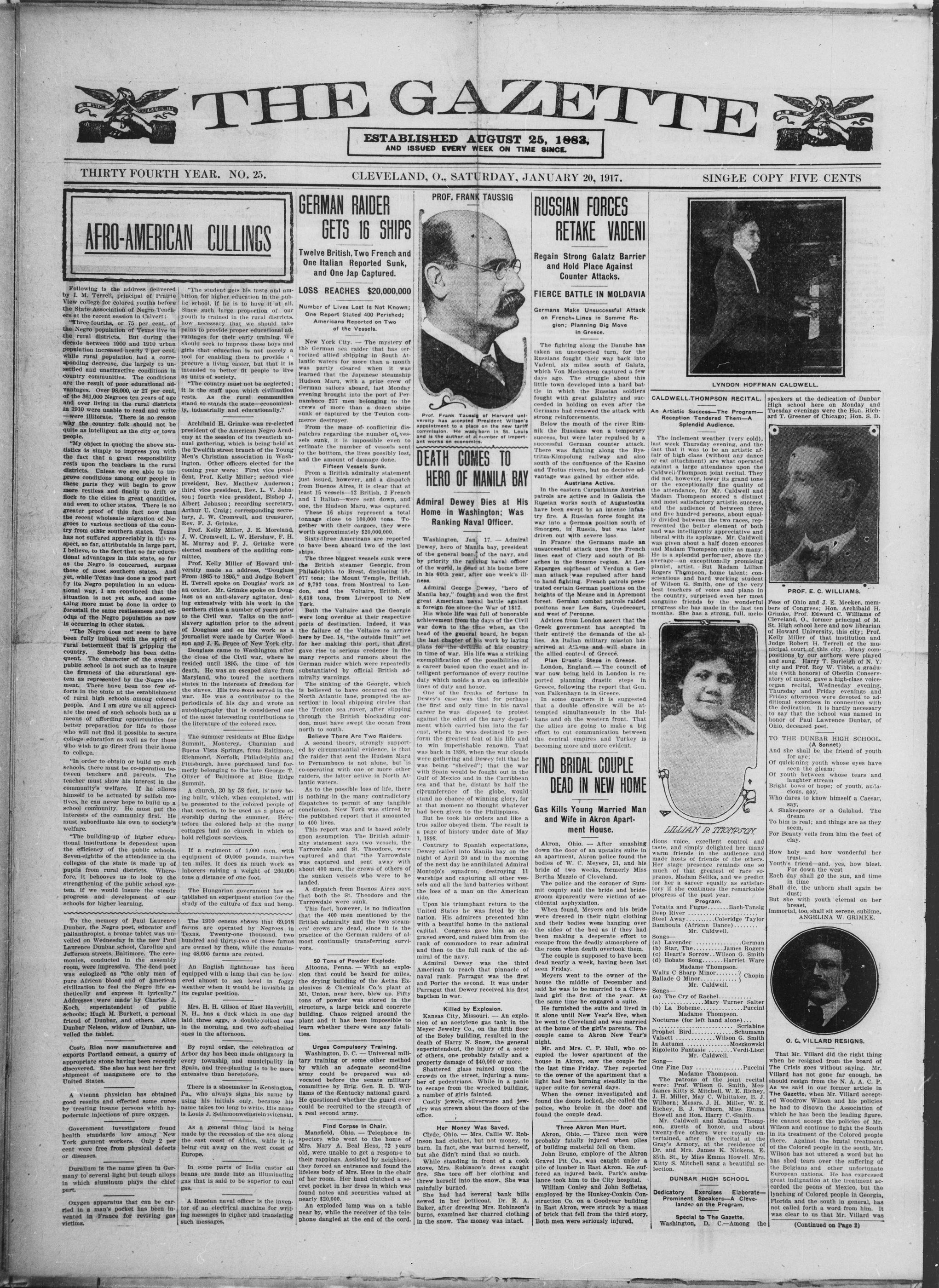
PROF. FRANK TAUSSIG
Prof. Frank Taussig of Harvard university has accepted President Wilson's appointment to a place on the new tariff commission. He was born in 33. Louis and is the author of a number of important works on economics.
DEATH COMES TO HERO OF MANILA BAY
Washington, Jan. 17. — Admiral Dewey, hero of Manila bay, president of the general board of the navy, and by priority the ranking naval officer of the world, is dead at his home here in his 80th year, after one week's illness.
Admiral George Dewey, "hero of Manila bay," fought and won the first great American naval battle against a foreign foe since the War of 1812. His whole life was full of honorable achievement from the days of the Civil war down to the time when, as the head of the general board, he began the last chapter of his work by laying plans for the defense of his country in time of war. His life was a striking exemplification of the possibilities of a career based upon the exact and intelligent performance of every routine duty which molds a man on inflexible lines of duty and honor.
One of the freaks of fortune in Dewey's case was that for perhaps the first and only time in his naval career he was disposed to protest against the edict of the navy department which carried him into the far east, where he was destined to perform the greatest feat of his life and to win imperishable renown. That was back in 1898, when the war clouds were gathering and Dewey felt that he was being "shelved"; that the war with Spain would be fought out in the Gulf of Mexico and in the Carribbean sea and that he, distant by shafl the circumference of the globe, would stand no chance of winning glory, for at that moment no thought whatever had been given to the Philippines.
But he took his orders and like a true sailor obeyed them. The result is a page of history under date of May 1, 1898.
Contrary to Spanish expectations, Dewey sailed into Manila bay on the night of April 30 and in the morning of the next day he annihilated Admiral Montojo's squadron, destroying 11 warships and capturing all other vessels and all the land batteries without the loss of a man on the American side.
Upon his triumphant return to the United States he was feted by the nation. His admirers presented him with a beautiful home in the national capital. Congress gave him an engraved sword, and raised him from the rank of commodore to rear admiral and then to the full rank of the admiral of the navy.
Admiral Dewey was the third American to reach that pinnacle of naval rank. Farragut was the first and Porter the second. It was under Farragut that Dewey received his first baptism in war.
Killed by Explosion.
Kansas' City, Missouri. — An explosion of an acetylene gas tank in the Meyer Jewelry Co., on the fifth floor of the Boley building, resulted in the death of Harry N. Snow, the general superintendent, the injury of a score of others, one probably fatally and a property damage of $40,000 or more.
Shattered glass rained upon the crowds on the street, injuring a number of pedestrians. In while in a panic to escape from the wrecked building; a number of girls fainted.
Costly jewels, silverware and jewelry was strewn about the floors of the office.
Her Money Was Saved.
Clyde, Ohio. — Mrs. Callie W. Robinson had clothes, but not money, to burn. In fact, she was burned herself, but she didn't mind that so much.
While standing in front of a cook stove, Mrs. Robinson's dress caught fire. She tore off her clothing and threw herself into the snow. She was painfully burned.
She had had several bank bills sewed in her petticoat. Dr. E. A. Baker, after dressing Mrs. Robinson's burns, examined her charred clothing in the snow. The money was intact.
RUSSIAN FORCES
RETAKE VADENI
-Regain Strong Galatz Barrier and Hold Place Against Counter Attacks.
FIERCE BATTLE IN MOLDAVIA
Germans Make Unsuccessful Attack on French Lines in Somme Region; Planning Big Move in Greece.
The fighting along the Danube has taken an unexpected turn, for the Russians fought their way back into Vadenl, six miles south of Galatz, which Von Mackensen captured a few days ago. The struggle about this little town developed into a hard battle in which the Russian soldiers fought with great galaintry and succeeded in holding on even after the Germans had renewed the attack with strong reinforcements.
Below the mouth of the river Rimnik the Russians won a temporary success, but were later repulsed by a successful German counter attack. There was fighting along the Bystritza-Kimpolung railway and also south of the confluence of the Kasino and Trotus rivers, but no decisive advantage was gained by either side.
Austrians Active.
In the eastern Carpathians Austrian patrols are active and in Gallia the Russian works south of Augustostak have been swept by an intense infantry fire. A Russian force fought its way into a German position south of Smorgen, in Russia, but was later driven out with severe loss.
In France the Germans made an unsuccessful attack upon the French lines east of Clery and south of Blachères in the Somme region. At Les Esparges southeast of Verdun a German attack was repulsed after hand to hand fighting. French patrols penetrated certain German positions on the heights of the Meuse and in Apremont forest. German combat patrols raided positions near Les Sars, Guedecourt, and west of Peronne.
Advices from London assert that the Greek government has accepted in their entirety the demands of the allies. An Italian military mission has arrived at Athens and will share in the allied control of Greece.
Plan Drastic Steps in Greece.
London, England. — The council of war now being held in London is reported planning drastic steps in Greece, following the report that Gen. von Falkenhayn is in Greece.
In some quarters it is suggested that a double offensive will be attempted simultaneously in the Balkans and on the western front. That the allies are going to make a big effort to cut communication between the central empires and Turkey is becoming more and more evident.
FIND BRIDAL COUPLE DEAD IN NEW HOME
Gas Kills Young Married Man and Wife in Akron Apartment House.
Akron, Ohio. — After smashing down the door of an upstairs suite in an apartment, Akron police found the bodies of W. C. Meyers, 21, and his bride of two weeks, formerly Miss Bertha Muzzi of Cleveland.
The police and the coroner of Summit county said the bride and bridegroom apparently were victims of accidental asphyxiation.
When found, Meyers and his bride were dressed in their night clothing and their bodies were hanging over the sides of the bed as if they had been making a desperate effort to escape from the deadly atmosphere of the room when death overtook them.
The couple is supposed to have been dead nearly a week, having been last seen Friday.
Meyers, went to the owner of the house the middle of December and said he was to be married to a Cleveland girl the first of the year. At the same time he engaged a suite.
He furnished the suite and lived in it alone until New Year's Eve, when he went to Cleveland and was married at the home of the girl's parents. The couple came to Akron New Year's night.
Mr. and Mrs. C. P. Hull, who occupied the lower apartment of the house in Akron, saw the couple for the last time Friday. They reported to the owner of the apartment that a light had been burning steadily in the upper suite for several days.
When the owner investigated and found the doors locked, she called the police, who broke in the door and found the couple dead.
Three Akron Men Hurt
Akron, Ohio. — Three men were probably fatally injured when piles of building material fell on them. John Bruno, employee of the Akron Gravel Pit Co., was caught under a pile of lumber in East Akron. He suffered an injured back. Park's ambulance took him to the City hospital. William Conley and John Soffeltin, employed by the Hunkey-Conkin Construction Co. on a Goodyear building in East Akron, were struck by a mass of brick that fell from the third story. Both men were seriously injured.
LYNDON HOFFMAN CALDWELL.
CALDWELL-THOMPSON RECITAL. speakers at the dedication
An Artistic Success—The Program— Reception Tendered Them—A Splendid Audience.
The inclement weather (very cold), last week Thursday evening, and the fact that it was to be an artistic affair of high class (without any dance or out attachment) are what operated against a large attendance upon the Caldwell-Thompson joint recital. They are the only one of the exceptionally fine quality of the attendance, for Mr. Caldwell and Madam Thompson, scored a distinct and most satisfactory artistic success, and the audience, of between three and five hundred persons, about equally divided between the two races, represented the better element of both sides, and the liberal with its applause, Mr. Caldwell was given about a half dozen encores and Madam Thompson quite as many. He is a splendid performer; above the average—an exceptionally promising pianist, artist. But Madam Lillian Rogers Thompson, home talent; conceived by the composer of Wilson G. Smith, over the very best teachers of voice and piano in the country, surprised even her most sanguine friends by the wonderful progress she has made in the last ten months. She has a strong, full, melo-
LILIAN D. TEONSON
dious voice, excellent control and taste, and simply delighted her many warm friends in the audience and made hosts of friends of the others. Her stage presence reminds one so much of that greatest of race sopranos, Madam Selika, and we predict for her a career equally as satisfactory if she continues the remarkable progress of the past year.
Program.
Tocatta and Fugue... Bach-Tansig Deep River... Coleridge Taylor Bamboula (African Dance)... Mr. Caldwell.
Songs—
(a) Lavender... German
(b) Star, The... James Rogers
(c) Heart's Sorrow, Wilson G. Smith
(d) Bobats Song... Harriet Ware Madame Thompson.
Waltz C Sharp Minor... Chopin Ballade G Minor... Mr. Caldwell.
Songs—
(a) The Cry of Rachel... Mary Turner Salter
(b) La Bohgme... Puccini Madame Thompson.
Nocturne (for left hand alone)... Scriabine
Prophet Bird... Schumam Valsett... Wilson G. Smith
In Autumn... Moszkowski Rigoleto Fantasie... Verdi-Liszt Mr. Caldwell.
Song—
One Fine Day... Puccini Madame Thompson.
the patrons of the joint recital were: Prof. Wilson G. Smith, Mesdames Kitty S. Mitchell, W. E. Richey, J. H. Miller; May C. Whittaker, B. J. Wilborn; Messrs. J. H. Miller, W. E. Richey, B. J. Wilborn, Miss-Emma Howell and Hon. Harry C.-Smith. Mr. Caldwell and Madam Thompson, guests of honor, and about twenty-five others were royally entertained, after the recital at the Gray's Armory; and the residence of Dr. and James K. Nickens, E. 85th. St., by Miss Emma Howell, Mrs. Kitty S. Mitchell sang a beautiful selection.
DUNBAR HIGH SCHOOL
Dedicatory . Exercises Elaborate—Prominent Speakers—A Cleverlander on the Program.
Special to The Gazette.
Washington, D. C.—Among the
THE EAGLE
speakers at the dedication of Dunbar High school here on Monday and Tuesday evenings were the Hon. Richard T. Greener of Chicago; Hon. S. D.
PROF. E. C. WILLIAMS.
Fess of Ohio and J. E. Meeker, members of Congress; Hon. Archibald H. Grimke, Prof. Edward C. Williams of Cleveland, O., former principal of M. St. High school here and now librarian of Howard University, this city; Prof. Kelly Miller of that institution and Judge Robert H. Terrell of the municipal court of this city. Many compositions by our authors were played and sung. Harry T. Burleigh of N. Y. city and Prof. Roy W. Tibbs, a graduate (with honors) of Oberlin Conservatory, gave big olfish voice organ recital. Wednesday evening. Thursday and Friday evenings and Friday afternoon were devoted to additional exercises in connection with the dedication. It is hardly necessary to say that the school was named in honor of Paul Lawrence Dunbar, of Ohio, deceased poet.
TO THE DUNBAR HIGH SCHOOL
(A Sonnet)
And she shall be the friend of youth for aye;
Of quick-ning youth whose eyes have seen the gleam;
Of youth between whose tears and laughter stream
Bright bows of hope; of youth, audacies, gay,
Who dares to know himself a Caesar, say.
A. Shakespeare or a Galahad. The dream
To him is real; and things are as they seem,
For Beauty veils from him the feet of clay.
How holy and how wonderful her trust—
dust;
But she with youth eternal on her breast.
Immortal, too, shall sit serene, sublime.
ANGELINA W. GRIMKE.
O. G. VILLARD RESIGNS.
That Mr. Villard did the right thing when he resigned from the board of The Crisis goes without saying. Mr. Villard has not gone far enough, he should resign from the N. A. A. C. P. As we said in our former article in The Gazette, when Mr. Villard accepted Woodrow Wilson and his policies he had to disown the Association of which he has been the leading figure. He cannot accept the policies of Mr. Wilson and continue to fight the South in its treatment of the Colored people there. Against the brutal treatment of the Colored people in the south, Mr. Wilson has not uttered a word but he has shed tears over the suffering of the Belgians and other unfortunate European nations. He has expressed great indignation at the treatment accorded the peons of Mexico, but the lynching of Colored people in Georgia, Florida and the south in general, has not called forth a word from him. It was clear to us that Mr. Villard was
(Continued on Page 2)
SUBSCRIPTION RATES
(In Advance)
One Year. $1.50.
Six Months. 1.00
Three Months. .50
Subscribers are requested to
remit by postoffice money or
der or registered letter
Entered at the postoffice in Cleveland,
Ohio, as second-class matter.
Address all communications to
HARRY C. SMITH
Editor and proprietor,
THE GAZETTE,
Blackstone Building, Cleveland, O.
Member Ohio Legislature: 1894
to 1898; 1898 to 1898; 1900 to 1902
THE GAZETTE is the oldest, and has the largest bona fide circulation, double that of any newspaper in the Interest of Afro-Americans, published in the state of Ohio, and comparison establishes its rank as one of the NEWSIEST AND BEST in the country.
10,000,000 Afro-Americans.
240,000 in Ohio.
20,000 in Cleveland.
SATURDAY, JANUARY 20, 1917.
"Let us have faith that right makes might, and in that faith put us to the end dare to do our work to understand it"—Abraham Lincoln.
MERITED APPRECIATION.
Rev. Henry N. Couden, the blind chaplain of the national house of representatives, has lately to endure a further affliction. His devoted wife, who for many years has guided his steps every morning to the capitol for the opening exercises of the house, has suffered a paralytic stroke and his daughter has now taken her place. In appreciation of his many years of service the house, on motion of one of the Republican leaders, has adopted a special resolution granting a substantial increase to Mr. Couden's salary. A Democratic member from Indiana interposed a characteristic objection to such "extravagance," but he was promptly overruled.
RIDICULOUS CARELESSNESS.
Groteges absurdities sometimes are allowed to creep into congress appropriation bills due to the careless and superficial way in which the items are considered by the Democratic authors of the measures. For instance, an item in the diplomatic and consular appropriation bill provides $5,000 "for the maintenance of U. S. prisoners in jails in China, Chosen, Slam, and Turkey." Congressman William S. Bennett, Republican of New York, who, in his trips to the orient, has taken occasion to inquire into such matters, asked the pertinent question: "Is it not a fact that they have not had any convicts in either of those prisons for the last ten years?" The Democratic chairman of the committee replied: "I could not answer that. Perhaps I ought to have that information, but I have not." The answer is characteristic of the care-free manner in which the people's money is being appropriated by the present Democratic congress.
THE NEW BURDEN.
The coming of some of the Colored population of the south to the north should be welcomed by all. Nevertheless, it should be remembered that with this people comes an added burden which must be met intelligently. The one agency that is to lead all others is the church. Is the Colored branch of the church prepared? It is a question difficult to answer. If any answer is demanded, it must be in the negative. The Colored ministry is not equal to the task. Today in the north, the Colored ministry is not superior to the ministry in the south. The greater portion of the Colored immigrants have not been reached by the southern ministry. They are not in sympathy with the church as conducted. The ministry as a whole does not command respect from them. As a professional class, it is not as efficient as those of medicine and law. Here in the north, our churches are filled almost wholly by southern men. Some of these men are the peers of the clergy of any race. The majority of them, however, are not. The average church, without regard to denomination, does not seek the best educated and scholarly minister it can find, but the minister that will suit the whimsical majority which is not educated. The Colored youth of the north receives the same training in thought, language, rhetoric, reasoning and speech that other youths receive. But the greater portion of these youths on the Sabbath day must listen to rambling and disconnected discourses, loud and boisterous ravings, ancient emotionalism and cant in addition to the murder of almost every principle of the English language. The consequence is, we have a book-learned youth but not an intelligent one. Our pulpits on the Sabbath should be the dispensers of the purest thought as well as the most chaste language. The man of slave days or the descendant of those days who did not acquire educational training, dominates official positions and determines the kind of utterances the pulpit must send forth. The placing of Colored churches in out of the way districts where the noise from them will not interfere with the rest of intelligent people, who attend church and go home at a reasonable hour, is a rule in the north as well as in the south. This should not be. If the Colored churches of the north are hoping to uplift the Colored race, they must adopt a standard of intelligence that is in keeping with the historic traditions of the intellig-
WILL SPEED UP PEACE LEAK PROBE
Committee to 'Dig' Into Secrets of Everyone Connected With Matter by Rumor or Report.
LAWSON FIRST ON THE GRILL
Committee Has Been Granted Full Powers to Punish Witnesses for Contempt if Answers to Questions Are Refused.
Washington, D. C. — "Full speed ahead" will be the motto of the house committee on rules which has reinaugurated its investigation of the alleged leak of international secrets from Washington to Wall Street. The majority members of the committee
—the Democrats—smarting under the insinuations of their Republican colleagues that they plan to smother the investigation to protect friends of the Wilson administration, were prepared to delve into the innermost secrets of every one connected by rumor or report with the alleged transmission of advance news on the recent presidential peace note. No one will be spared, Democratic leaders declare, and the first victim marked for the gridiron is Thomas W. Lawson, the only man in America who is willing to admit he made real money out of the alleged leak.
Lawson Will Be Called.
When the sessions of the rules committee are resumed, Lawson will probably be the first witness called. He told the committee a week ago that the committee was forced to the committee was fortified with the power to go seriously and thoroughly into the question as to who was let in on the committee. Lawson was forced to tell the real masters of the leakers and the beneficiaries of the great bear raid of Dec. 20 and 21 on the New York stock exchange.
Not only is the committee now tested with all the powers that Lawson demanded, but the committee has been granted full powers to punish recalcitrancy by the house. It can cite for contempt to the district attorney of the District of Columbia, or it can hale a contumacious witness before the bar of the house and send him into durance, at least until March 4, if he refuses to testify.
Will Demand Names.
One of the first questions which will be directed to Lawson will be one demanding the names of the parties to the triangular arrangement which he said he had been told of in which a cabinet officer, a senator of the United States and a prominent banker, cleared profits of speculative ventures on the stock exchange. Lawson will also be ordered to tell the committee the name of a congressman who related to him the story of the speculations of a member of the present cabinet and also the name of the cabineteer.
In addition to the coming of Lawson, the committee has also under subpenas S. B. Friday, an Oshkosh (Wis.) broker, whose office is said to have been informed of the coming of the note several hours ahead of the public announcement, members of the firm of Thompson & McKinnon of Chicago, Donald MacDonald, editor of the Financial News of Boston; members of the firm of F. M. Lockwood & Co. New York; James Reilly, editor of the Wall Street Journal, New York, and several additional representatives of the press association here.
The committee's new powers can compel the presentation of books, letters and documentary evidence and therefore the managers of the telegraph companies will be requested to bring before the committee all messages sent over their wires on Dec. 20 and 21.
Bernard Baruch will be recalled and compelled to show his books and buying and selling orders for the days in question.
gent north. No man has the right to preach to any people who is not intellectually prepared for his work. The Colored clergyman should be educationally qualified to preach sermons that are edifying to all professions for he is his leader. The decorum of the Colored churches should be improved. The wild outbursts of fanatic emotionalism should be discouraged while the saney presentation of the truth in a dignified way should be magnified. If the northern white church has failed to produce an intelligent Colored church through its missionary operations in the south, the task should be resumed in the north but the Colored clergyman should lead. (REV.) WM. A. BYRD.
OUR FARMERS IN THE COTTON BELT.
Farming in Perry County, Alabama is typical of a large region of the cotton belt. Cotton is the main source of income of its 5,143 farmers, seventy-seven per cent of whom are Afro Americans. Our 5,359 tenant farmers of the county constitute eighty-ninth percent of the tenancy, the 4,843 farms operated by a owner of a 4,843 (thirty-five per cent) are Afro-Americans. The average value per farm of all farm property in 1910 was $1,239.00. The average value of land, buildings, and machinery for our 5,400-year-old family, of the 4,843 of domestic animals, is 74.75%. Comparatively few of the large plantations remain, as is indicated by the fact that in 1910 eighty-five per cent of the farms of the county were less than 100 acres, and sixty-five per cent of the farms were less than 50 acres. The average size of the farms operated by a white farmers was 66 acres, with 45 acres of the land. For our farms the average size was 42 acres with 31 improved. The average value per farm of the 4,843-year-old family is 74.75% of an American. For the farm of Afro-Americans was $30.00; that for white farms was $102.00. This makes the average value of the tool and machine-based equipment in 1910 be higher than the average value of the 4,843-year-old family, with $2.27 the average for white farms.
THE GAZETTE, CLEVELAND, O., SATURDAY, JANUARY 20, 1917.
DOINGS OF THE RACE
The widow of the late Bishop B. W. Arnett died recently at Wilberforce.
FRESH OHIO NEWS
Written by 'The Old Reliable' Gazette's Correspondents
THROUGHOUT THE STATE
What Our People Are Doing Each Week—Church, Personal, Social, Lodge, Literary and Musical—Marriages, Deaths, Etc.
advertise.
Mickey Bros., progressive leaders of Charleston, S. C., have 5 Reo limousines and a motor hearse.
The National Equal Rights league urges our people to observe the Hon. Frederick Douglass' centenary, Feb. 14, and it should be done.
Ladies, our fashion page is the latest and best—up to date! Tell your friends and acquaintances about it, please.
The Chicago Defender is the largest and most unreliable paper in the country. it is the race's leading yellow journal and it is always quoted at a risk.—Louisville (Ky.) News.
Representative Dyer, of Missouri, recently introduced a bill in Congress to provide a commission to secure plans and designs for a monument to the African-American fight in the wars of the country, and also that $100,000 be appropriated for that purpose.
Dr. Eugene P. Roberts has been appointed a member of the Board of Education of N. Y. City for five years by Mayor John P. Mitchell. Fifteen or twenty years ago, Rev. James Poindexter and Rev. (now Bishop) Joshua H. Jones were elected members of the Board of Education of Columbus, Ohio, each serving several terms.
The Gazette is indebted to A. L. MacBeth, photo-artist, studio at 1080 Penn. Ave., Baltimore, for a fine large photograph of Rev. C. R. Uncles, of that city, one of the two or three Afro-American catholic priests. Father Uncles recently celebrated the twenty-fifth anniversary of his elevation to the priesthood at which time he was presented a testimonial gift of $1,000. He also received a leading catholic priests of Baltimore participated in the anniversary celebration services and exercises.
Col. W. C. Brown, 10th U. S. cavalry, who commanded his regiment under Gen. Pershing and led the detachment which dealt the most severe punishment to the Villa bandits, was before the House Committee on Military Affairs, recently, and told of the hardships the troops in Mexico encountered, of the forced marches and terrific pace set, adding that only thoroughly trained men and animals could have stood the strain. Col. Brown told how one time Villa his infantry had much ahead of his in Tenth troopers. Only treachery of Mexican guides prevented Villa's certain capture, Col. Brown said. He declared no force of soldiers in the world ever went thru worse hardships and achieved more than did the "Black Tenth."
O. G. VILLARD RESIGNS.
(Continued from Page 1)
"swapping horses" when he voted for and advocated the election of Mr. Wilson. If the South were treating the Colored people justly, the Association which Mr. Villard and Dr. DuBois have held together so long would be useless. We have a far higher respect for Mr. Villard since he has resigned than we had before. The suggestion that Mr. Villard favors the Booker Washington view of the "Race Problem" rather than the DuBois, does not help matters. The Colored race is not duty bound to accept the views of any man or set of men, in contending for its rights. We have nothing harsh to say of any of the dead but we say that the Booker Washington policy of accepting the treatment the southern whites give Colored people and not strike back is not the position of the late head of Tuskegee. At the close of his activities no man struck harder against oppression than he. No man plead for the liberty of his race with more zeal than he. Mr. Washington had completely changed his attack. He did not advocate, at the close of his career, what he advocated at the beginning. The DuBois point of view for his race is the same that any white MAN would have for his. In Mr. Villard's breaking with Dr. DuBois, he acknowledges that he does not believe in Colored men demanding the same for their race he would for his. Since the issue is clear cut and each has shown where he stands, Colored people with manhood will unhesitatingly support DuBois. Those of our contemporaries, who mollycoddled with Mr. Villard's flop to Wilson, may proceed to state what they will do in this crucial race conflict between a Colored champion and white flopper.
ANOTHER RIOTER SENTENCED.
A Public Apology Saves This One From the Penitentiary.
Lima, O.-W. F. Kline, one of the rioters, who attempted last summer, to lynch Charles Daniels, saved himself from a 10-year pen term, last Saturday, by agreeing to sign a public apology. It is to be printed in the newspapers of all Allen county. The apology reads:
I hereby make public apology to Shawn Eley and all other county officials, as well as to the people of Lima and Allen-co and the state of Ohio, for having shamefully participated in the riot of Aug. 30, 1916, in which I committed or helped to commit a most serious crime, not only against society and the law, but the sheriff and other officials. I desire to hereby humble myself publicly for having committed unlawful acts.
(Signed) W. N. KLINE.
The mob threatened to lynch Eley unless he told where he had taken Daniels.
COL. DENNISON HONORED!
Chicago, Ill.—Col. Franklin A. Denison, of the Eighth regiment, Illinois National Guard, has been appointed an assistant attorney general of this state by Edward J. Brundage, attorney general. Col. Denison was an assistant president of Chicago for eight years and is a veteran of the Spanish-American war.
FRESH OHIO NEWS
Written by 'The Old Reliable Gazette's Correspondents
What Our People Are Doing Each Week—Church, Personal, Social, Lodge, Literary and Musical — Marriages, Deaths, Etc.
ELYRIA.—The Y. M. W. I. club will render a musical program, Tuesday evening, Mrs. Hester Brown Gillard will be the principal performer. — The Second M. church revival will start Monday. Quinquennial meeting Sunday. Mr. Morgan Junior, able to work after a long illness. — Mr. Michael Davis has sued the Dreamland Theater Co., alleging slandering remarks.
CORRESPONDENTS must mall all letters for publication at their postoffice sufficiently early on Monday (or Sunday) of each week to have them reach The Gazette office on Tuesday morning, and always write also, their names and that of their city or town on the outside of the wrapper about returned copies. Unless this latter is done, proper credit cannot be given you. Lists of names, wedding presents, etc., obituary notices, speeches, resolutions, poetry, inventions of all kinds, pictures and advertisements of all kinds, including items announcing entertainments to be held in the near future, must be paid 9 in advance at the rate of ten cents a line, six words to a line. Our rates for display advertisements will be sent on application.
HILLSBORO, O. — Mrs. Asa Jackson has returned from a visit with relatives in Washington C. H. — Miss Ada Williams entertained Miss Arnita Burr at dinner, Sunday. — Mr. Abe Anderson, of Cincinnati, spent Sunday here with his family. — Miss Murl Denh has returned to Springfield, who has been in California, about two years, and returned to visit her mother, Mrs. Edith Jackson, has been ill since her arrival. — Mr. and Mrs. Pomp Kittrell entertained at dinner, Sunday, Rev. Orr, Rev. and Mrs. J. J. Burr. The former preached for Rev. R. C. Lowe in the revival services at Pilgrim church, Columbus, this week. — The "Maddox" property, on East Walnut St., has been purchased for our Children's Home.
SMITHFIELD. — St. Paul's revival meetings are being well attended and interest is being manifested. Rev. and Mrs. John Lord, Mr. G. Freeman, Mr. and Mrs. R. J. Burr, from McIntyre, attended, Sunday evening. Rev. Adkins preached a very interesting sermon to a large audience.
— Mrs. E. H. Harris visited her sister, Mrs. Eli Guyder, and brother, A. J. Guy, in Steubenville, last Thursday. Mrs. Jas. Harris, Jr., and Miss Nellie Mrs. Jas. Harris, Jr., and Mrs. Julia Davis visited in Wichita. Mrs. S. Freeman and Miss M. West are convalescent. — Mrs. F. Christian and Miss S. Leekins, of Steubenville, and Mrs. Leekins, of Boston, spent Sunday here. — Mr. R. Tyler, of Flushing, was here Saturday and Sunday. — Miss Eiffie Baill is here visiting her parents. — Ed. West, Jr. has returned to Cleveland. — Miss Sadie Jackson left Saturday for Steubenville.
**YOUNGSTOWN.** — Invitations are out for the Elks' annual party in March. — Mrs. Brundle
March. — Mrs. Bundy is convalescing.
— Mr. Jas, Jackson, of Pittsburg, and Miss Anna Washington were quietly married, last week, by Dr. J. M. Gill mere, of Oak Hill Av., A. M. E. church and were honor-guests at a dinner at Mr. and Mrs. Chas. Davis'. The evening was spent playing games and music. — Paris Duff, who was injured Wednesday, is out of the hospital. — Ella Hembrick is at, at this writing. Logan lodge meeting, Thursday evening. — Mrs. Chas, of James, of Cleveland, were quietly married at her parents, Mr. and Mrs. David Lee', a few friends witnessing the ceremony. They will live here. — Mrs. Chas Jackson was called to Mt. Vernon, last week. — Mr. and Mrs. Jackson and grand-daughter, Miss Maretta Highwarden, of Mt. Vernon, visited Mr. and Mrs. Jackson, of Myrtle Av., two weeks. — Mrs. Albert Fletcher's funeral was held from the funeral, interment here. Mrs. Chester Williams' relatives in Gallipolis and Columbus. — The cream of the reliable race news, the country over, can be found in The Gazette only.
CADIZ. — Mr. Fred Ramsey had a leg broken at the Hopedale mines. — Earl Linder, of Steubenville, is visiting his mother, Mrs. Alice Howard. — Mrs. Ella Wallace has returned from M. Tpleasant. — Mrs. Anna Thomas, of Steubenville, is visiting her sister, Mrs. Emma Pearl, from Johnson Robbins, former A. M. E. missionary to Monrovia, Liberia, Africa, and Miss Goldie Blanchard died. Saturday. — Rev. Chas. Bundy, P. E., preached morning and afternoon, Sunday, at the A. M. E. church. The farewell service in the old church in the evening, was addressed by Rev. O. W. Childers, W. H. Lucas and Benj. S. Lee.
O, blessed, sacred walls
With memories so dear.
When I was but a little child
My mother led me here.
It was within this sacred shrine
My heart to Him inclined.
And when I was but yet a child
I gave God my heart and mind.
Farewell well, dear old church,
Farewell, O sacred walls.
And as we pass to our new abode,
May God bless us one and all.
MRS. PARTHENA JOHNSTON.
SANDUSKY. — Mrs Wm. Jones brought a niece, Miss White, home with her from Pittsburgh, last week. — Cold weather (2 below zero), Sunday, kept many people from church and S. S. Sunday. The Second Baptist S. S. was in charge of Mr. Jas Davis, the assistant, and Mrs. Mo Smith, member of the committee on temperance. Mrs. Davis, Mrs. S. Scott and Mrs. Geo. D. Smith constitute the Sunshine committee; Mrs. Blanch Thompson and Miss Beatrice Shackelford, pianists for the school and B. Y. P. U.; Mr. D. Smith constitute the Sunshine committee; Mrs. Blanch Thompson and assistant. It will not be long, the pastor says, until it will be necessary to talk about a new
DISCLOSES NAMES, BUT NO PROOFS
Lawson Informs Committee of Alleged Participants in 'Leak' Profits.
NAMES HENRY AS INFORMANT
Secretary, Tumulty and Secretary of Treasury McAdoo Are Also Named by Financier; Causes Big Sensation.
Washington, D. C. — Piling one sensation on top of another in quick succession, Thomas W. Lawson before the rules committee opened the flood gates and disclosed the long-sought names of the high government officials for which the committee has been vainly searching in the "leak" probe for weeks.
The first shock came when Lawson, in response to a prepared question by Chairman Henry, declared that the man who gave him much of the information regarding the alleged "leak" was none other than Henry himself."
Brings in McAdoo.
The shock of this disclosure had barely passed when Lawson declared that he had been told by Representative Henry that William G. McAdoo, secretary of the treasury and son-in-law of President Wilson, was the cabinet officer mentioned in the earlier charges. Paul Warburg, member of the federal reserve board, was next named by Lawson, and the names of bankers, editors and others followed in quick succession.
Quoting a Washington woman as authority, Lawson continued his succession of sensations by stating that she had told him that Joseph P. Tumulty, secretary to the president, working through W. W. Price, reporter on a local paper, as "go between" of conveying advance secret information regarding the administration's moves to Wall Street. For this service, Mr. Lawson says he was told, Price received $5,000 and Tumulty "much more than that."
Mr. Lawson said that the reports that had reached him were to the effect that McAdoo, Pliny Fiske, a New York banker, and a United States senator, whose name begins with the letter "O", have a joint stock speculative account.
Rushing headlong with his disclosures, Mr. Lawson said that he had been told that the firm of C. D. Barney & Co., of New York, had dealings with Mr. McAdoo, through Malcolm McAdoo, brother of the cabinet member, and Stewart G. Gibboney of Brooklyn, Secretary McAdoo's close friend and business associate, through which the Barney firm was put in possession of advance information which gave it great advantages.
Says Henry Told Him of Rumors.
He declared that Chairman Henry was his informant with regard to the rumors current in Washington immediately after the wild furry in Wall Street which followed the publication of the president's peace note to the effect that high officials of the government had profited in the plundering of the public.
The hearing was by long odds the most sensational ever staged in a congressional investigation. It resulted in the issuance of a flood of subpenas directing the attendance forthwith of nearly a dozen prominent witnesses, in addition to those already under subpena, and had Washington by the ears for hours after the chairman's gavel had rapped adjournment.
Following the conclusion of Lawson's sensational testimony, Secretary to the President Tumulty issued the following brief statement:
"After the complete and definite statement which I made to the rules committee last week, it should hardly be necessary for me to say that there is not a scintilla of truth in these new filmsy charges."
Secretary McAdoo said: "No man should be called upon to notice such detestable gossip and slander, but since my name has been mentioned, I wish to say that no more shameless and wanton lie could be conceived than the rumor or suggestion that I have been interested at any time and in any manner whatsoever, in stock speculation or purchases of stock in New York or elsewhere, or that I have been connected in any manner whatever with the alleged 'leak' about the so-called peace note."
Will Address News Men.
Columbus, Ohio. — Gov. Cox, Cox, W. O. Thomson, president of Ohio State university, W. F. Wiley, managing editor of the Cincinnati Enquirer; E. E. Cook of the Columbus Citizen, Arthur C. Johnson of the Columbus Dispatch and J. Wilson Roy will be speakers at the banquet to be given at the convention of the Associated Ohio Dallies here Jan. 30. The news print situation will be discussed.
Taking Exercise Dies
Chicago, Illinois.—The body of Mrs. Charles B. Young, wife of the mechanical engineer of the Chicago, Burlington & Quincy railroad, was found hanging in her home in Riverside, a suburb.
A verdict of accidental death was returned at an inquest.
Relatives asserted that a course of health exercises which included hanging by the shoulders, had been prescribed for Mrs. Young and that while following her physician's instructions she evidently had fainted or slipped.
church. Rev. G. Clemons, pastor of the A. M. E. church, is taking it already in his church. If these church matters were personal, there would be two new churches here in a short time. — The Autumn Leaf Seed club met at Mrs. C. Miller's, last Wednesday. Mrs. Emma Smith was elected president; Mrs. Beverly Tress, the sec., and Mrs. Meyer treas. the choir is paring a program for Jan. 22. — Mr. and Mrs. M. Thompson sang a beautiful solo at the B. Y. P. U. opening meeting and Pres. Harry Alexander made a timely talk.
P. S. S.
If your hair is falling out, use GORDON'S GLORY SHAMPOO CREAM, and if splitting at the ends, rub GORDON'S GLORY HAIR-GROWER direct to the scalp and be relieved of such horrible trouble.
If your hair is f
POO CREAM, and if
HAIR-GROWER dire-
tible trouble.
GORDON'S GLO
GORDON'S GLO
GORDON'S STR
ment, $1.25.
Agents make fro
everywhere. WRITE
O. C. Gordon's
If your hair is falling out, use GORDON'S POO CREAM, and if splitting at the ends, HAIR-GROWER direct to the scalp and be rible trouble.
GORDON'S GLORY HAIR-GROWER, 50
GORDON'S GLORY SHAMPOO CREAM
GORDON'S STRAIGHTENING COME ment, $1.25.
Agents make from 10 to 15 dollars pu everywhere. WRITE.
O. C. Gordon's Laboratory WIN
GORDON'S GLORY HAIR-GROWER, 50c per box.
GORDON'S GLORY SHAMPOO CREAM, 25c per jar.
GORDON'S STRAIGHTENING COMBS, and LAMP attachment, $1.25.
Agents make from 10 to 15 dollars per day. Agents wanted everywhere. WRITE.
O. C. Gordon's Laboratory
No. 209 Roanoke St
WINSTON-SALEM, N. C.
ABusyLife
By HON. JOSEPH BENSON FORAKER
The Most Important Autobiography In Years
Mr Foraker has given us his experience in the Union Army on the Bench, as Governor of Ohio and in the Senate of the United States.
Political and public events of great importance and incidentally many national characters are dealt with in the most enlightening manner.
The work will prove of special interest to all students of political history whether they are public officials or only public spirited Americans, interested in the preservation of our institutions.
FORD'S
HAIR POMADE
MAKES THE HAIR SOFTER,
MORE PLUSABLE, UP TO
COMB AND PUT UP
IN ANY STYLE THE
LENGTH WILL PERMIT
PRICE 2.54 AND A BOTTLE
FORD'S
HAIR POMADE
MAKES THE HAIR
SOFTER,
MORE PLUSABLE, UP TO
COMB AND PUT UP
IN ANY STYLE THE
LENGTH WILL PERMIT
PRICE 2.54 AND A BOTTLE
FORD'S
ROYAL WHITE
SHAMPOO
MAKES THE SHAM
LOOK WHITER
AS SOON AS IT IS
PUT ON, EXCELLENT
FOR PIMPLES, ROUND SKIN
AND LOCAL INDUSTRIES
PRICE 2.54 & BOTTLE
FORD'S PATENT
TWO PIECE SHAMPOO
FORD'S HAIR STRAIGHTENER
NO. 022 STRAIGHTENING THE HAIR
BY ROLLING IT INTO THE POMADE
ROUTINE. BEST INDEXED THING
WE KNOW OF TO STRAIGHTEN HAIR
PRICE $1.50
PATENT SECTIONAL TOOTH COMB
PATENTED LOCKING
DEVICE FOR HOLDING TEETH TIGHT
NO. 023 STRAIGHTENING
COMB NO. 023. YOU HEAT
THE HAIR, NOT THE OWNER
AND SOILING THE COMB
RETAINS THE COMB. PRICE $1.00
NO. 023'S TEETH IN THE COMB. MADE
OF SEPARATE PIECES, MOUNTAIN OR ASU
STEEL 800 AND HELD BY A PATENT FERRULE. SHOULD
THE TEETH BECOME LOose, TURN THE FERRULE
BY TWISTING THE HANDLE AND THIS OWNER
THE SELECTION HUNTER. MAKE THE TEETH
AND HOLD THEM FIRMLY. PRICE $1.25
FORD'S SPIRAL HANDLE
HAIR STRAIGHTENING AND SHAMPOO
COMB NO. 025. SUPERPLATE,
PLATED. LARGE AND VERY STRONG
CANNOT BURN THE HANDLE OFF-SPECIAL
WITHOUT SOLDERING. PRICE $1.00
FORD'S SMALL BRASS
FORD'S LARGE BRASS
SHAMPOO AND HAIR STRAIGHTENING
COMB NO. 025. WOODEN HANDLE
LARGE AND VERY STRONG
SERVICEABLE COMB FOR KINKS AND SNAPPY HAIR
NICKEL PLATED. PRICE $1.00
FORD'S MEDIUM SIZED
BRASS SHAMPOO AND
HAIR STRAIGHTENING COMB NO. 026
A COOSE SEALING COMB FOR
THE MONKEY. PRICE $5.00
ALL, OUR GOOD WARRANTY AS DESCRIBED, OR MONEY REFURNED.
FOR SALE BY YOUR PAIRER OR DIRECT FROM US UPON RECEIPT OF
PRICE. IN WRITING DIRECT, SEND MONEY BY POST PRESS OR EXPRESS MONEY ORDER
OZONIZED OX MARROW CO. 46 W.KINZIE ST. CHICAGO, ILL
12 GREAT SERIALS
OR GROUP STORIES
IN 1917
Stories upon Stories—and plenty of them. Action,
Life, Adventure, Fun, Pathos, Inspiration.
The Youth's
Companion
will make 1917 a Great Story Year. Besides
the Great Serials and 250 Short Stories,
there are rare Special Pages for each one.
Family Page, exceptional Editorial Page,
Boys' Page, Girls' Page, Children's Page,
Doctor's Corner, Current Events, Nature
and Science, Travel, Information, etc.
Everything from everywhere for every-
one in the family.
THE YOUTH'S COMPANION, St. Paul St., BOSTON, MASS.
52 ISSUES
A YEAR
CUT THIS OUT
and send it (or the name of this paper) with
$2.00 for The Companion for 1917,
and we will send you.
FREE
All the remaining issues of THE
COMPANION for 1916.
FREE
THE COMPANION HOME CAL-
ENDAR for 1917.
THEN
The FIRST Two Weekly Issues of
THE COMPANION for 1917.
SUBSCRIPTIONS RECEIVED AT THIS OFFICE.
Subscribe for The Gazette
USE GORDON'S HAIR GROWER Then Watch the Results
This GREAT VALUE is sold with the understanding that if it does not grow the hair your money is refunded at any time. Save the empty boxes; they are worth five cents each.
Calling out, use GORDON'S GLORY SHAM-splitting at the ends, rub GORDON'S GLORY to the scalp and be relieved of such hor-
Y HAIR-GROWER, 50c per box.
RY SHAMPOO CREAM, 25c per jar.
RIGHTENING COMBS, and LAMP attach-
10 to 15 dollars per day. Agents wanted
Laboratory
No. 209 Roanoke St
WINSTON-SALEM, N. C.
usy Life
2922 CENTRAL AVENUE
CLEVELAND, O.
STERLING
5 and 10 Cent Store
3003 Central Ave.
Under New Management!
Watch Our Windows For Bargains
Colored Saleslady
We close at 8 P.M. every evening except Saturday
MME. C. H. JONES'
Hair Tonic and Invigorator
HER TONIC is the result of scientific study of the causes of diseases of the scalp.
Instead of treating effects of the diseases she treats the causes, eliminating the same and healing the scalp in a healthy condition that can be maintained by using her Hair Tonic and Invigorator, according to her directions.
Madame C. H. Jones' Hair Tonic and Invigorator is guaranteed to stop the falling out of the hair and to make the hair
Many people get diseased scabs by touching their hands, and are paired by unscrupulous persons who have in mind nothing but mercenary gain. JONES HAIR TONIC and INVIGORATOR is abounded with firmness and will do all that is claimed for Madame G. H. Jones' Hair Tonic and Tonic, which is used to hair, prevents and cures baldness, removes dandruff, cures scalp disease, imparts urethra and beauty; it restores the natural hair and cures baldness, natural elements and necessary nourishment.
IMAD
G. H. JOHN
883 Woodland Ave.
Toledo, Ohio
Agents Wanted
SPLENDID ENDORSEMENT.
Toledo, Ohio, March 15, 1810.
To Whom:
This is to certify and stimulate an acquaintance that has passed over many years of experience with evidence fortified beyond a question of doubt, the veracity of any claim made by Madame Clemens, intimately acquainted with the formula and have an adequate knowledge of every ingredient, and can truthfully affirm the accuracy of the evidence been offered to the public for Alopecia and Area, (falling off of the hair) which cured nine-tenths of the cases for which it has been prescribed. It would indeed be wise to assume that we were as certain of the medical effects of drugs as I am confident that this com-
its effect is specific, and I cheerfully recommend it to any one who may be in need of such a remedy. It is the best that the human mind has produced so far.
Truly yours.
CHAS. H. FERGUSON, M. D.
FOR
Pure Drugs, Prescriptions
AND
Cut Rate Patent Medicines
GO TO
The Arlington Pharmacy
S. W. Cor. E. 55th Street
and Central Avenue
The State Agricultural and Mechanical College of South Carolina
Orangeburg, S. C.
Next session begins September 27th and ends May 25th, 1917.
No Tuition, no Room Rent, no Charges for Water, Lights or Fuel. Entrance Fee $10.00.
Board $60.00 month in Advance. Books, Laundry and Personal Expenses Extra.
Every Modern Facility. Standard Equipment. A Faculty of 57 Officers and Instructors.
For Information and Catalogue, Write
R. S. Wilkinson, Pres.
Orangeburg, S. C.
G. G. REED
Ladies' and Gents' Furnishing Goods
Special $1 Waist
Worth more
Sale Agent for the
American Lady, Nemb & R. & G. Corsets
3222 CENTRAL AVENUE
Bell 'Phone: Prospect 1200 R.
---
Where to Purchase The Gazette
Where to Purchase The Gazette
*ERNEST P. JACKSON'S 3969 Central Ave.
*OPEN SUNDAYS.
NOTICE TO SUBSCRIBERS
Subscribers not receiving The us at once. We desire every copy Send or bring locals and all bu fice, suite 2, Blackstone Bldg. If y please.
We advise our readers to care tisements before making purchases this paper should have the patron they advertise is assurance that t
Local reading notices (adver words in a line); display advertis publication.
All matters for publication in be in the office by 4 p. m., WEDNES
Social an
Subscribers not receiving The Gazette regularly should notify us at once. We desire every copy delivered promptly.
Send or bring locals and all business matters to The Gazette's office, suite 2, Blackstone Bldg. If you wish to see the editor call there, please.
We advise our readers to carefully examine The Gazette's advertisements before making purchases. Business men who advertise in this paper should have the patronage of our people. The fact that they advertise is assurance that they want it.
Local reading notices (advertisements) ten cents a line (six words in a line); display advertising space, fifty cents an inch, single publication.
All matters for publication in current issues of The Gazette, must be in the office by 4 p. m., WEDNESDAY of that week, at the latest.
Our
Classified Ad
Department
WANTED AGENTS.—New invention, Royal Slide Comb, actually straightens kinky hair, Taylor Pharmacal Co., Box100, Atlanta, Gd.
WANTED.—Men roomers—All conveniences. Charge reasonable. Apply at 2347 E. 86fh St., between 6 and 7 p. m.
FOR RENT.—Houses and Rooms—If you have them to rent or if you want to rent, advertise in The Gazette. It brings results.
NOTARY PUBLIC.—For such services call at The Gazette office, No. 2 Blackstone building, No. 1424 W. Third Street, near Superior Ave.
FOR SALE—Houses or lots. If you have either or anything else to sell, or if you wish to purchase, advertise in The Gazette. If anything can bring you results, it can and will.
FOR SALE—Property at 2176 E. 43d. St., near Cedar Ave: eleven rooms, bath, furnace, etc., $3,000. Four hundred dollars down and the balance, $25 per month. Apply at The Gazette office.
FOR SALE—Eight room house; gas for lighting and heating; lot 55 by 96. $2500 cash. A splendid opportunity to get a good home with nice large, light rooms. Between Cedar and Quincy Ave., west of E. 79th St. Apply at The Gazette office.
ANY WOMAN CAN MAKE BIG MONEY IN HER OWN HOME. THIS IS A GREAT OPPORTUNITY! GRASP IT WITH OUR WORK. WRITE ELYN HORTON MFG.CO., 4188 W. BELLE PLACE, ST. LOUIS, MO., AND MENTION "THE GAZETTE" PLEASE.
Cleveland
Sixth City
Ed. West, Jr., has returned from
Smithfield.
Mr. Clarence Williams, of Collin
wood, is very ill.
Mrs. Ola Wheatley returned, Sunday, from Columbus. Mrs. Cora Johnson Robinson is now Mrs. Christian of Akron.
The attendance at St. John's S. S.
Sunday, was 461; Sunday week, 593.
Sunday, was 461; Sunday week, 593.
Ben, Jenkil, of E. 27th St., and
Chas, Waldon, of Central Ave., are
very ill.
Mrs. T. J. Hicks was summoned to
Columbus, last week, by the death of
her sister, Mrs. Black.
Leonard James and Miss C. Lee
were married in Youngstown, last
week, and will reside there.
Wm. Fountain who was injured on
E. 14th St., by an auto, three weeks
ago, is able to be out again.
There is only one way to get the
real race news and that is to take "the
old reliable" Gazette.
Joseph Seelig, Jr. of Blaine Ave.,
left, last week Friday for Chicago
to visit his wife who is the guest of Mrs.
Dan Richardson and a sick uncle.
Ladies, how do you like our fashion
page? It is the latest and best—thoroughly up to date! Tell your friends and acquaintances about it, please.
The Gazette has a very interesting letter from Mrs. Aria Sellers, of Macon, Ga., former resident (for many years) of this city, which it hopes to give in an early issue of this paper.
Mrs. Arminta Black, of Chicago, guest of her sister, Mrs.Wm. McIntire, spent last week in Akron with her niece, Mrs. Cora Christian, Mrs. Ivy McKinney, their niece, returned to Chicago Saturday.
Mrs. Wm. Grant, E. 39th St., was hostess at a luncheon, last week Tuesday. Among those present were: Mesdames Smith, Yancy, Jenkins, Van Austine, Walker and Misses Jones and Randolph, of Cincinnati.
Mrs. A. T. Abbott and daughter, Mrs. Mary A. Slaughter, have returned from Wil伯力force where they attended the funeral of Mrs. Mary Louise in the flow of the late Bishop B. W. Arnett.
Mrs. Nora Bedford Whittaker, who recently became Mrs. Craig and husband The Gazette sanctum a pleasant call, Tuesday afternoon. Mr. Craig is a former resident of Washington, D. C., and Chicago.
A scoundrel (white) is going to some of our girls and women, who place advertisements for work in the daily papers, grossly insulting them with immoral proposals. Some of our women ought to scald him.
Mr. and Mrs. Geo. Sampson, Sr., of E. 30th St., who spent the holiday season in Xenia with their son, George, Jr., and family, are greatly
*A. GORDON'S,
2928 Central Ave.
JACKSON'S,
3641 Central Ave.
*MRS. BESSIE KITZMILLER'S
3943 Central Ave.
SUNDAYS.
The Gazette regularly should notify
delivered promptly.
business matters to The Gazette's of-
you wish to see the editor call there,
fully examine The Gazette's adver-
Business men who advertise in
age of our people. The fact that
ey want it.
stements) ten cents a line (six
space, fifty cents an inch, single
current issues of The Gazette, must
SDAY of that week, at the latest.
Personal
"Any prejudice whatever will be insurmountable if those who do not share in it themselves truckle to it and flatter it and accept it as a law of nature."—John Stuart Mill.
pleased with the trip. The latter is principal of our high school there.
Mrs. Fannie Ramey Calloway returned to Chicago Saturday, having been called here by the death of his father, B. F. Ramey, Mrs. L. S. Jones entertained at breakfast, Saturday, Mrs. Calloway and Master Wesley Howard.
Dr. Arthur Scott, dentist, No. 3404 Central Ave., has returned from Hot Springs, much improved as a result of the treatments for a severe attack of rheumatism. The doctor will resume his practice, Monday, Jan. 22.—Ady
The editor of The Gazette acknowledges the receipt of an invitation, last week, from the Board of Education of the District of Columbia to attend the dedication of the new Paul Lawrence Dunbar High school, Jan. 15-19, at Washington, D. C.
All news for The Gazette should be in our office on WEDNESDAY at the latest. Please remember this. Do not mail on that day and expect it to be delivered the next day. Not promptly when your copy is not delivered on time.
Mrs. Rachel Walker Turner entertained the Minerva Reading club, Saturday afternoon. A pleasant and instructive session was spent with race authors. The principal participants in the program were Mesdames Inez Fairfax and C. H. Young.
St. John's Allen League, C. E., had a splendid meeting, Sunday evening, the program being rendered by Mrs. Grace W. Thompson, Miss Ruth Jackson, Miss Rose Dupree and Mr. B. Sonson. The father and sons' banquet will be held, Jan. 26. The stewards will set, Jan. 31, as "acquaintance day."
IF YOU WANT YOUR PRESCRIPTIONS FILLED WITH THE BEST DRUGS, AND MOST CAREFUL AT TENTION, TAKE THEM TO ERNSTEJACKSON'S PHARMACY, COR. E. 4TH ST. AND CENTRAL AV. WE ALSO CARRY A FINE LINE OF PICTURES, SUNFIELDS, ETC. EOME IN AND LOOK US OVER—Adv.
The "Coal Dust Twins"—Ornmond and "Noomdy"—are certainly "in bad", these days. Wouldn't it be just a little strange if Henry WARMICK should sign his name (to a letter to the public) as Henry "WORMACK"? Who signed his name to that letter and could not spell it correctly? Warmick he didn't. Ask the "Coal Dust Twins".
Mrs. Peyton Lemon, of E. 86th St., entertained at dinner, Saturday, Mrs. Louis S. Jones and guest, Master Wesley Howard. The after-dinner guests were: Mr. and Harry E. Thompson, Misses Bessie Cook, Estelle Huston, Mrs. Lightfoot, Messrs. Gibson, Cheeks and Lemon. Mr. and Mrs. Thompson contributed several beautiful numbers (vocal) and Miss Cook played several fine piano selections. The Y. M. C. U. gave its semi-monthly reception at St. John's church, last week Wednesday evening, Rev. P. O'Connell, pastor of Cory M. E. church, delivering the principal address. C. M. Dabney had charge of the program, among the contributors being Wesley Howard, violinist; Miss Edith Middleton, pianist; Miss Grace Noble, vocalist; Miss Brittany Hutton, St. John's S. S. orchestra also rendered several selections.
B. S. Driggs, white, an old friend of the race, was riding out Central Ave. one evening, the first of the week, in a street car when a hard-looking foreigner, who could hardly speak English, would be hard to read, very bad English that "down south they make the riggies ride in the back-end of the street-cars and they ought to do the same here". If the loud-mouthed Negro here is not soon curbed, we may wake up some fine day and find this same thing true here.
The editor of The Gazette is indebted to Dr. J. K. Nickens, who recently returned from a very successful lecture tour throughout the south, for two very pretty cotton-balls from the Northwest Wednesday afternoon, and gave it a very interesting account of his extensive trip.
The Cleveland Leader's motion-picture section of Sunday in refeiting to a picture being exhibited at the Stillman theater, this week, says: "the husband of a nigger" in referring to a character in the photoplay. Last week, the same paper had the insulting monogreal term "danky" in an article on its first page. Here is some more work for the local branch of the N. A. A. C. P. Another excellent thing to do would be for the organization to authorize its president to go to the various plants in the city and talk to the newcomers from the south and tell them how to conduct themselves in public places so as to help and not hurt our people of this community. This is a delicate thing and should be carefully done and not "bungled", or
THE GAZETTE, CLEVELAND, O., SATURDAY, JANUARY 20, 1917
more harm than help would result
from such visits.
cently he placed
thousand dollar o
Desperation drove Bernard Lewis to his death and undoubtedly caused Harry K. Thaw to try to do the same thing, but we did not think it would cause anyone to stoop to such methods as the flashing to the gaze of a select few, in "The Allen," a letter signed by "Henry WORMACK," 2190 E. 33d St. which Henry WARMICK, 2190 E. 33d St. represented at The Gazette, last Saturday at his home and in the presence and hearing of a Mr. R. J. Morris, he "did not write, DICTATE OR SIGN" and characterized as "AWFUL." It is not necessary for The Gazette to add that the letter is a batch of lies from beginning to end. Neither this paper nor its editor is in need of a dollar (or more) so badly as to be compelled to "importure" any person or thing for anything; nor are we driven by desire, but only because one only expects secondrails and worse to adopt, and then only as a means of self preservation. It certainly begins to look as if The Gazette is soon to witness the passing out of the "sixteenth." Fifteen have died, in this city, since The Gazette's birth, August 25, 1883. Rest assured, young, "the old reliable" will plant a few verbal flowers on the sixteenth's" grave and with citizenship papers that should have been secured and used, long ago.
In spite of the cold weather, the N. A. A. C. P. local branch's meeting at Antioch Baptist church, Sunday afternoon, was largely attended. After the installation of officers, Rev. Williams, of Boston and Chicago, who recently located in this city, made an interesting talk along race lines and introduced Rev. H. C. Bailey, who had recently been re-elected president of the branch for a second year. One year later, one year. The latter made a short talk, briefly reviewing last year's work of the organization and discussing several topics of exceptional racial in-
REV. WM. A. BYRD.
terest. He then introduced the speaker of the afternoon, the Hon. Harry C. Smith, editor of The Gazette, who for more than an hour claimed the undivided attention of the audience with an impassioned address on the four vital issues or problems of the race — Disfranchisement, Mob Violence, "Jim Crow" and Segregation—that will long be remembered by all fortunate enough to hear it. Spontaneous and hearty aplause was spontaneous and hearty, and the guidance of Francis E. Young, vicepres and President Bailley, concluded a very satisfactory and profitable afternoon session of the organization. The local branch's premier event of the season, thus far, will occur, next Wednesday evening at Antioch church, when Rev. Wm. AByr, contributing editor of The Gazette, and pastor of a fine Presbyterian church of the city, will attend from the Hon. Frederick Douglass (deceased), our greatest man and leader, to date), will deliver an address on "Disfranchisement" and kindred topics. Dr. Byrnd is one of our ablest men and stands high in the councils of the race and the Presbyterian church of this country. We cannot urge our readers too strongly to attend, next Wednesday evening, and hear this brilliant writer and speaker. Call your friend and listen to the meeting, which will open at 8 p. m. sharp, and urge them to attend. Dr. Byrnd will be introduced by the editor of The Gazette, for years his warm personal friend. Re
BROOKLYN
PALMER
SKIN
WINTERMER
A BROOKLYN FURNITURE MACHINE
CLOSING MONTHS FROM JANUARY
WILL BE BACK DOWN
MICROFURNITURE CO.
ATLANTA, CA
DR. FRED
WHIT
Whitens dark or bro
clears sallow or swa
moves all blemishes a
grow whiter.
See That You C
Terre H
The Jacobs' Pharmacy Co.,
Gentlemen:—I have be
Skin Whitener ointment, so
just grand for the skin. My
and everybody that knows g
my face. Please find enclo
boxes of Dr. Palmer's skin
soap. I do not like to be wit
Whitens dark or brown skin. Bleaches and clears sallow or swartny complexions, removes all blemishes and causes the skin to grow whiter.
Terre Haute, Ind., May 18, 1916.
The Jacobs' Pharmacy Co.
Gentlemen—I have been using Dr. Fred Palmer's Skin Whitener ointment, soap and powders and they are just grand for the skin. My skin is looking so nice now and everybody that knows me asks what I am using on my face. Please find enclosed two dollars ($2) for six boxes of Dr. Palmer's Skin Whitener ointment, two of soap. I do not like to be without it. Yours truly.
ABBIE LYLE.
2424 North 17th Street,
Terre Haute Int.
DO NOT ACCEPT IMITATIONS
Sold by druggists, or for 25c, postpaid. Re Fred Palmer's Skin W Pharmacy, Atlanta, Ga
Sold by druggists, or sent direct, anywhere, for 25c, postpaid. Remember the name, Dr. Fred Palmer's Skin Whitener. Write Jacobs' Pharmacy, Atlanta, Ga.
cently he placed a fine new three thousand dollar organ in his church at Rochester. Go to Antioch, next Wednesday evening and be there by 8 p.m. There is a possibility of Dr. Byrd's preaching for Dr. Bailey. Sunday morning.
CORRESPONDENTS WANTED.
The old reliable Gazette desires an active agent and correspondent in every city and town in Ohio and neighboring states having a number of Afro-American residents. Only a little time on Fridays or Saturdays is required. We are especially desirous of hearing from persons in the following named cities: Springfield, Dayton, Piqua, Mt. Vernon, East Liverpool, Akron, Lima, O., and other places, particularly in Ohio, where we have none.
Write to the editor of The Gazette, Blackstone building, Cleveland, O., and we will inform promptly. Readers will oblige us greatly by sending at once the addresses of persons in the cities named and others in the state, to whom we can write relative to the matter.
Our advertisers want your trade. Those who do not ask for it in The Gazette will not be allowed for it. Therefore, we urge our readers and all of our friends to patronize those who ask for your trade in this paper.
'NOTHER LIMA RIOTER.
Lima, O.—Augustus Decamp, retired merchant, who was to have been placed on trial next week charged with attacking Sheriff Sherman Eley with intent to lynch Chas. Daniels, prisoner, came into court Jan. 16, and pleaded guilty. He was sentenced to an indeterminate term in the penitentiary, but sentence was suspended on condition he make a public apology in every paper printed in the county, and pay the costs of prosecution.
SENTENCED TO 99 YEARS.
Ashdown, Ark. — Fred Edwards, white youth of Texarkana, Ark., was sentenced, last Friday, to ninety-nine years in state prison for having attacked an Afro-American girl. He was convicted in circuit court.
**Knocking Chicago.**
Nobody is too insignificant to count as population—Toledo Blade.
**PHONES:**
Studio, Rosedale 3883-J.
Home, Prospect 333-J.
Miss Bessie Blakemore Cook
TEACHER OF PIANO
Hours 10 A. M. to 6 P. M.
Evenings by Appointment
4910 CENTRAL AVE.
J. LOMSKY
3820 Central Avenue
We carry full line of Dry
Goods
Ladies and Gents Furnishings
DON'T THROW AWAY
Your copy of The Gazette after reading it, but give it to a friend or an acquaintance who might subscribe after reading a copy of the paper.
PALMER'S
SKIN
ENER
own skin. Bleaches and
arthy complexions, re-
and causes the skin to
Get the Genuine
Aute, Ind., May 18, 1916.
When using Dr. Fred Palmer's
ap and powders and they are
skin is looking so nice now
me asks what I am using on
used two dollars ($2) for six
Waitener ointment, two of
about it. Yours truly.
ABBIE LYLE.
r sent direct, anywhere,
member the name, Dr.
whitener. Write Jacobs'
3046 SCOVILL AVENUE
Corner of E. 31st St.
THE BEST MEALS and
QUICK SERVICE
at the lowest rates
B. P. Phillips
Proprietor
Cuy. 'Phone: Central 8620 W.
the lowest rates
P. Phillips
Proprietor
Phone: Central 8620 W.
35c PER PACK
PRICES
75c PER BOTTLE
$1 PER BOTTLE
FOR SALE ONLY
BROWN DR
CAPL R. SEYFERTZ
2742 Central Ave. C
FOR QUALITY Prescription Work THE OWL DRUG CO. 3743 CENTRAL AVE. Excels All Others
A. E.
Cuyahoga, C
Edward Do
(T H
3035 Cent
Wm. Brack, Prop. . . .
James M
Rosedale 1800
SLAUGHT
Funeral D
Emba
Office and F
3923 CE
Autos for All Occasions.
Cuyahoga, Central 5727
Award Doctor's Care
(THE Z)
3035 Central Avenue
Rack, Prop. . . Frank Doctor, Ma
James Mabel, Chef
Medale 1800 Quality Se
SLAUGHTER BROS.
Funeral Directors and
Embalmers
Office and Funeral Parlor
3923 CENTRAL AV.
Calls for All Occasions. Calls Answered Day and
(THE Z)
3035 Central Avenue
Wm. Brack, Prop. - - Frank Doctor, Manager
James Mabel, Chef
Office and Funeral Parlors
3923 CENTRAL AV.
Autos for All Occasions. Calls Answered Day and Night
GOLD BOND
The Cream of Table Beers
Gold Bond is a brew fit for most modern equipment, the
"made from sun-rii and hops, pure o properly aged bef
It comes to your table pure, cheer. No other beer com
Gold Bond.
Bond is a brew fit for Kings --- the product modern equipment, the highest skill in beer-brew "made from sun-ripened barley malts and hops, pure distilled water, and properly aged before bottling." es to your table pure, wholesome, bubbling with No other beer compares with the fine fla Bond.
Gold Bond is a brew fit for Kings --- the product of the most modern equipment, the highest skill in beer-brewing. "made from sun-ripened barley malts and hops, pure distilled water, and properly aged before bottling." It comes to your table pure, wholesome, bubbling with good cheer. No other beer compares with the fine flavor of Gold Bond.
The National Training School
The National Training School
"I cordially commend the school's interest and needs to all who believe in the Negro race and in our obligation to help promote its intellectual, moral and religious uplift." Rev. Dr. Charles H. Parkhurst, New York City.
It is a community of service and uplift.
Its influence is destined to be felt in all sections of the country in improved Negro community life wherever our trained workers locate.
Settlement workers, missionaries for home and foreign mission fields, Y. M. C. A. an. Y. W. C. A. secretaries and district nurses receive a comprehensive grasp of their studies under a Wellesley graduate and expoased co-workers and actual everyday practice through the school's social service department.
We aim also to create a better qualified ministry.
Industrial training, advanced literary branches, business school.
Thirty-two acres, ten modern buildings, healthful location.
We can accommodate a few more earnest, ambitious students.
Communities requiring social workers should write us.
should take PURO HERBS,
the great Spring remedy.
Cleanses the organs and purifies
the blood.
A blood medicine with a repu-
tation that cannot be beaten.
Made from Nature's health giv-
ing herbs.
35c PER PACKAGE—Dry Form
PRICES ( 75c PER BOTTLE—Liquid Form
$1 PER BOTTLE—Extra Strong
FOR SALE ONLY AT
BROWN DRUG CO.
CARL R. SEYFERT, Prop.
2742 Central Ave. Cor. E. 28th
"Heart of City"
Lunch Room
720 W. Frankfort Ave.
Between West 6th and West 9th Sts.
BEST HOME COOKING
QUICK SERVICE
T. E. BLAIR, Prop.
Prospect 1095-J J. H. COX
COX DRY CLEANING CO.
Repairing, Pressing, Cleaning, etc., on short order. Suits Pressed, 30 Cents
2738 Central Avenue CLEVELAND, O.
Central 5727
Doctor's Cafe
(TE Z)
Central Avenue
Frank Doctor, Manager
bel, Chef
Quality Service
TER BROS.
Directors and
Palmers
Cuneral Parlors
CENTRAL AV.
Calls Answered Day and Night
Kings --- the product of the highest skill in beer-brewing,
opened barley malts
distilled water, and
are bottling."
wholesome, bubbling with good
rares with the fine flavor of
LONGER SKIRTS PROMISED
---
A
BLUE SERGE APPEARS FOR SPRINGTIME.
It Is Used in a One-Piece Frock, With a Panel of Plaits in Front and Back of Skirt. The Collar, Cuffs and Belt Are of Dark Blue Taffeta, Run With Black Soutache.
gowns shorter than these first ones If we wear low shoes, the prices will without a blush or an apology and, not be reduced, and this is being said sometimes, without a good reason. to us in so many ways about every
Reasons Why New Styles for the Spring Would Seem to Be Inevitable.
LOW SHOES WORN IN PARIS
Scarcity of Leather Responsible for the Lengthening of the Frock—Present Style of Shoes Cannot Be Called Beautiful—Blue Serge for Springtime Wear.
New York.—The smart firms on Fifth avenue are turning out severely tailored and stitched suits of black satin for the south and offering them as the first choice of early spring, and it is quite probable that this fabric will supersede all others for the street, as the season turns from cold to balmy weather.
There is more than uncommon interest displayed in the rumor backed up by facts that Paris will launch longer skirts for spring than we have worn for two years. There is no evidence of this in the new Callot models, but, then, Callot never cared for long skirts. This house cut its evening gowns into a high arch or point in front that showed half the leg to the knee, at a time when other dressmaking houses wouldn't consider such an innovation.
Years and years ago, Callot and Poetret joined hands on this fashion and it was ridiculed by two continents; now every woman wears
BLUE SERGE APPEA
It Is Used in a One-Piece Frock, With of Skirt. The Collar, Cuffs and Be Black Soutache.
gowns shorter than these first ones without a blush or an apology and, sometimes, without a good reason.
Low Shoes Worn in France.
The commercial interest in the situation is stirred on account of the vast output of high shoes in this country. In Paris there is good authority for saying that this form of footwear is not in first fashion and is rapidly disappearing. The reason is simple, France has no leather, and her women have been wearing low shoes for a year. The oxford tie with the high heel, round toe and broad ribbon bow at the instep has for a year been the first choice of fashion in France, in connection with street costumery. And to meet the situation, France made her skirts longer.
The scarcity of leather is pinching the shoe industry on every side in America. Shoes have advanced from $6 a pair to $14, and even higher prices will be asked this spring. Eight dollars is asked for an ordinary pair of laced street shoes at unfashionable places, where the amount of leather used is negligible and the amount of cloth substituted conspicuous.
Longer Skirts Probable
If women can continue to pay the exorbitant prices asked for high shoes they may be able to continue to wear short skirts, but if France insists upon longer skirts and the bootmakers insist upon frightful prices, it is
COMFORT IN MOTOR COAT
In This Garment, the idea of Practical Designers, One May Enjoy Ride, No Matter What the Weather.
Cozy, snug and cold-defying is the motor coat with matching cap and likewise "cozy" fur is the name by which this fabric is sometimes known. There is richness and warmth, style and good taste, practicability and fashionability in this fabric, especially when used in so clever a design as this smart coat for travel wear.
The unique pockets are a special feature for practical use, and at the same time give an inking of the importance of pockets on spring garments. These pockets are but a fore-runner of a vogue that is sure to be.
Pockets and more pockets, pockets of every conceivable style and variety, put on in all kinds of ways, usable pockets, decorative pockets, pockets of convenience and pockets without a purpose on earth except to attract and please the eye.
We are to be "pocketed" the coming
---
a safe guess that the low shoe and the longer skirt will be inaugurated in the springtime.
It is not easy to say whether the oxford tie which has ruled in Paris for 12 months will be taken up in this country, for we have, unfortunately, gone quite mad over the subject of ugly shoes, and, although we owe the inspiration for them to eccentric social circles in Paris, we have done things so much worse than France could dream of doing that it is only fair to say that there is no allegiance between the two. We have not only twisted the shape of the foot into a serious bit of hideousness, as the Chinese do, by exaggerating the length of the vamp and running it out into a point like the one-piece shoe worn by the men in the fourteenth century, but we have added to the medieval vamp the toterting spindle heel of the seventeenth century in France. The two in combination make an uglish that no one thought possible in this day when people really struggle for beauty of line.
Points in French Shoes.
Throughout all this madness in America, France has been steadily wearing what is known as the sculptural shoe; that is, the rounded toe, the broad vamp and the side pieces that cling to the instep and hold it up. She has insisted upon straight Spanish heels for her walking shoes and in every way made herself comfortable, and she has brought her foot, which has never been notable for beauty, into a well-rounded part of her silhouette.
The leather men tell us that even
ERS FOR SPRINGTIME.
a Panel of Plaits in Front and Back
It Are of Dark Blue Taffeta, Run With
if we wear low shoes, the prices will not be reduced, and this is being said to us in so many ways about every commodity of life, that we have been gun to cease thinking about unmeasured prosperity and have turned to face the possibility of the hardships of living that existed during the Civil war in this country.
The Pinafore Sailor.
The world has blossomed out in spring hats at the first approach of winter. There is nothing startlingly novel about the new shapes, except the pinafore sailor that Reboux insists upon. This is made in straw and faced with a bright color, but even this shape has been seen for two months in a modified form, built of satin. The Muscovite turban, which comes in a straight line down from a high crown to the eyebrows, is not featured in any strength in the new models. The effort seems to be to turn the brims away from the headline, with compromise.
The dominating feature of all the new hats is the fact that they must be worn straight across the forehead, cannot be tilted right or left and must not dip a fraction of an inch in the back below the line which is established for the front. In other words, there is no coquery about the pose of the new hat; it is as military as the men under arms.
(Copyright, 1916, by the McClure Newspaper Syndicate.)
season as never before, and who will admit that this fashion feature can fail to please us and inspire in our hearts and minds a very strong and substantial desire for new clothes?
New Uses for Link Buttons
Link buttons are used in the front of a Russian blouse holding the opening, especially when the blouse is pulled over the head. More sparingly they can also be seen holding the fullness at the sides or back of the waistline. A smart woman in a New York hotel wore a gambine dress, the sleeves of which were slit almost to the elbow and held by means of link buttons. In another case a velour one-piece dress was fastened in front with such buttons and the hat, made of the same velour, showed three such buttons in front on the cuff-like brim.
New Touch.
Attractive garters are made of white organdie hand hemstitched ruffles held in the center with shirred blue satin ribbon trimmed with satin rosebuds. A narrow elastic runs through the double ribbon.
THE GAZETTE. CLEVELAND, O., SATURDAY, JANUAI
DESIGN FOR SPRING
---
Almost any perfectly plain item of outer apparel may be listed as a "sports" garment. Women, however, are not at all disturbed by this classification, and select sports skirts and blouses for home and utility wear, and sports suits and coats for general service because this type of apparel is generally most becoming, as well as smart.
The sketch illustrates a very chic little sports blouse or golf shirt, as some prefer to call it, and a sports skirt, the latter being a spring model design. The blouse is made of white wool jersey, cloth. It is of the slip-over variety. The buttoned-on belt at the front makes this possible. The neck opening is secured by means of buttonholes and loop buttons. If desired, collar, cuffs and pocket edging, as well as the detachable front belt, may be of broadcloth in color, although unquestionably more service is guaranteed if the blouse is all white. It is unlined, and, although wool jersey cloth will shrink amazingly if carelessly laundered, this can be avoided by proper handling. To make the blouse two yards of material 36 inches wide will be required.
The skirt, an advance spring model, as stated, is also a forerunner of spring in the selection of material plains will be amazingly popular.
```markdown
```
Modern Sports Skirt and Blouse.
Twelve, fifteen and even eighteen-inch-wide plaids are approved by Dane Fashion for spring sports wear. The skirt sketched is laid in wide box-plait panels and plain panels, the latter finished at the bottom with many rows of stitching at the bottom in a color to blend or contrast with the color of the plaid.
Black and white is to be smart, and plaids in very high colors will be strongly approved. As will be noted by a glance at the small upper sketch, the plaids extend to the top of the yoke, giving the skirt an unusual silhouette. Only a slender figure could wear a skirt of this exact type becoming. A more fitted yoke might, however, easily be substituted. To make the skirt four and a half yards of material 36 inches wide will be required.
BEST EFFECTS IN FURNITURE
Black and White, in Artistic Designs
Is Most Popular of Fashion-
able Furnishings.
The fad for black and white in in-
teriors still rages. In its present form
this fad is a good one, for now that we
have passed the days of overdoing the
black-and-white idea we have come
upon some really charming effects.
The rage for black has taught us
that dark furniture is often far more
effective than light furniture. And
that is something worth learning.
There are places, of course, where dark
furniture does not look well. But in
a room of rather heterogeneous color
scheme dark furniture is almost sure
to look best.
So if you have on hand any old
furniture, even of a dilapidated sort,
darken it. Use brown or black stain,
and with this stain turn the cherry
bedside stand, the golden oak rocking
chair, the battered curly maple writing
desk, the green-stained mission bureau
and dressing table, the gray enameled
bed—turn them all into a dull, dark
bedroom suite. Then place them in a
room with mustard yellow or soft blue
paper on the walls, with bright chutz
Winter Fashion Responsible for the Early Introduction of the New Season's Garments.
Every fashion has its foundation. Have you observed that there are fewer fur-trimmed suits this season than in recent years? This is due to the popularity of fur suits. Women who own one or more sets denim and trimmed suits so that they can conveniently wear their fur pieces, and also that a change can be made in the sets.
Whether the straight silhouette is responsible for the vogue of velvets and satins, or whether the materials created the straight lines is a question as tantalizing the hen-and-egg problem. Nevertheless, it is true that the one is dependent upon the other. It would be almost impossible to use soft satins and silky velvets for the bourdant lines of last year, hence the straight-from-the-shoulder cry.
The craze for long coats has lowered the demand for coat suits. As a result, it is predicted that spring styles
SPRING BONNET
Lovely lingerie Smolin "Bluebird" model of pale lavender embroidered batiste, with wide streamers of pale pink and lavender moiree ribbon caught at the side of the crown with a large pink rose. The hat is a beauty and without a doubt will be a popular favorite during the spring season.
or soft cream muslin hangings, and congratulate yourself on the result, which will most surely be a charming one.
It is really a very interesting work, this painting and staining of furniture. And the fact that it does bring harmony out of a lack of it, that it does make old and worn furniture a pleasant possibility, makes the work quite worth white.
So get a can of dark oak or dark walnut stain or of black paint or enamel and go to work to bring dark harmony out of your old furniture.
Then there is the Jacobean and Elizabethan and Tudor furniture, that has a decided vogue at the present time. This is finished in a soft dull brown that is very attractive.
USEFUL PIECE OF FURNITURE
Ottoman Can Be Made of Excellent Service in a Surprising Variety of Ways. These round humpty ottomans are very useful in a sitting room; they can be, of course, made small for a foot-stool or in larger size for a seat.
stool or in larger size for a seat.
The first thing to do is to make a round, thick cushion the size decided on; it must be very tightly stuffed so that it is quite firm; any clean pieces of rug might be cut up into small pieces for stuffing the lower part, then towards the top vegetable down or woolen flocks should be used. Cretone or furniture brocade may be used for covering; for the lower part the sides half way from middle to bottom should be covered; stretch it as tightly as possible and sew it at the top first; then turn lower edge under the bottom and sew firmly; finish by sewing a circle of lining on to cover all rough edges.
The top covering must be cut in a circle large enough to allow for the hemmed frill; stretch it over the top
Ottoman for the Floor.
and fix it by plus; get it it tight and smooth as possible, and arrange the fullness evenly for frill; stitch it round, then cover the stitches with thick furniture cord; pull this very tight and tie in a loopy bow at the side.
Handkerchief Bureau Scarf
Take three men's linen handkerchiefs with one's initials, sew insertion between each one and all around, and then the same with edging all around, fulling at the corners. A certain girl made quite a few of the bureau scarfs for gifts, which were certainly liked, as they are so different from those one can buy.
For Young Girls.
In the evening the more diaphanous the dresses of the young girls the more becoming they are, and scarves of tulle of every color are twisted round the figure and neck, just as a pretty woman knows so well how to adjust them with the most satisfactory results.
will be shown earlier than ever this year, it being impossible to wear the separate coat as long as one could use the coat suit.
Tailored Jewels.
Tailford jewels is the new name of those rather severe, extremely simple pieces which make the stepping stone in jewelry between the purely ornamental and the entirely useful pieces. But the two classes overlap; some ornamental pieces are so severely plain, such as certain plus and brooches, as to be entirely utility jewels, while other utility pieces are so decorative almost to lose sight of the name but not the purpose of absolute necessity.
Georgette Dresses in High Shades.
Georgette Dresses in High Snaubes.
Georgette afternoon dresses are much draped, some have Paisley mummings and are in high chiffon charteuse in fine. Nice green as well as mineral gray. Crepe de chines in bright colors and radium taffettes are also used for afternoon. Simple street frocks are of crepe de chine or satin, largely in straight line effects, similar to last year.
20. 1917
FASHIONS IN SHOES
THAT THEY BE MONOGRAMMED IS THE LATEST.
Means That Footwear Must Be Made to Order—Tops Match Costumes in Both Shade and Fabric—Other Popular Touches.
The monogrammed shoe is one of the latest conceits of fashion. It must, of course, be made to order, and this admits of a wide choice in the design, size and color of the letters, besides making it possible to have the monogram placed as high or as low on the shoe upper as is desired. Fashion has authorized longer skirts this season than last, and a few of her followers have obeyed the mandate, so that not always is the very top stitching of the shoes visible, as was almost uniformly the case last year.
The monogram is usually only applied to shoes combining two contrasting colors—a dark vamp and light upper—and the lettering, placed wherever desired on the upper, matches the vamp.
Due to the scarcity of leather, cloth is again largely employed in the development of shoes, and it is used in shoes of fine quality and high price, as well as in medium and low grades, so that it is not an economy fabric altogether.
Tops matching the costumes in both shade and fabric are popular, but the white-topped shoe with black patent leather tip has not lost a bit of its several seasons of popularity, and it is shown and favored this year in both the buttoned and laced styles.
One very popular shoe is the black patent leather toe with upper of gray glazed kid, buttoning at the side with white buttons. Tan shoes with white buckskin uppers are worn with tu-
A
Monogrammed Shoes a Mode of the Moment.
lored suits and frocks, and tan shoes having beige or gray buckskin uppers are also well liked. These usually have quite low, or at least sensible heels, and may almost be classed with sports shoes, immsuch as the term "sports," when used sartorially, embraces a wide range of garments.
This season's evening slippers are extremely elaborate. Fabrics embroidered with beads or colored silks are employed, and satin slippers matching the gown with which they are worn, and ornamented with rhinestones are popular. The puttee slipper continues popular, especially with the younger set, and the bracelet slipper of satin is also a favorite.
Blouses Are Less Simple.
A point worth knowing is that the severely simple "shirtwaist" affair is being replaced by a more decorative variety. A feature of the newest blouses is the embroidery in silk, wool, or even beads, that helps to relieve their Puritanic severity. A further departure from precedent is the revival of the basque—sometimes a fancy affair that falls into deep points on the hips, at others merely a gathered frill that falls just below the waistline; while, as regards color, there are decided indications of a reaction in favor of yellow, putty, peach, and pale apricot shades instead of the pink which has until later been accounted the "only wear."
The newest hats do not seem to be
Imitation Applique
That the vogue for applique work is strong is proved by the many methods resorted to in the needlework world for initiating this attractive art. Now instead of sewing on pieces of colored material to form designs on bedspread or runner or centerpiece, you may give the same effect with simple embroidery stitches, with perhaps not any less work, but more art. An instance of this is shown in darung huck toweling in bold colorings and rather close stitches. A finished flower treated this way looks very much if it were cut from chambray and stitched into place. Another way is to first stencil a design on heavy linen and then couch a heavy thread around the edge. A fruit centerpiece for a luncheon set is done in this manner.
Transformation Idea.
Wouldn't you like a frock that you could change in the twinkling of an eyelash from a plain street frock into
at all attractive, but as the fashion of a hat is more ephemeral than any other thing in dress it may safely be hoped that another week will give us more attractive models. Sometimes the millimens seem to have a brief spell of almost bad taste, and during those brief spells we get unlovely models. Only a few days ago an authority on dress said something about the very questionable taste of military models in clothes, and alluded to the military modes in hats which are to be seen here and there. She spoke of the imitation of the trench helmet, and there is now a toque very like the English service cap, which is worn on one side and caught up with a buckle on the other. The peak in front is carried round the crown as a brim. Neither as an adaptation nor as an imitation is it a success.
Really Pretty Work Bag.
Materials required for making this bag: Three-quarters yard silk, 10-inch tea mat which may be bought for
Attractive Work Bag.
about 10 cents, and a yard of satin ribbon.
I made my bag of pink silk, and lined it with white. The satin roses for the sides of bag and tied on the ends of ribbon, I bought from my milliner. The ten mat, which formed the bottom of mat, I pressed down to look like a three-cornered hat by placing flattrons on the mat in three different places. I then lined the pink silk neatly with white silk and sewed to the mat. Through the top of the bag just below heading I cut at intervals small slits, which I neatly button-holed. Through these I ran pink ribbon.—Boston Globe.
New Belts.
The chemise dress and the Russian blouse have brought separate belts to the fore again. Now the latest of these are made of many strands of gold or silver cords, caught together at intervals and fastened in the front with buckles or rings of the same metal. Some have hanging ends weighted with balls or tassels.
In Novelty Satin Stripes.
Copyright
Sherwood &
London
The boardwalk at any and all of the winter resorts is the gathering place for Dame Fashion's most ardent admirers and humble subjects. To carry oneself properly one must be becomingly garbed, and the costume must not verge toward any extreme. The above afternoon frock is ideal for Palm Beach wear. It is made of novelty satin stripe material. The collar of the waist and the cuffs are of the same material. The appron-like effect gives the tunic a most fetching little touch to the costume.
something elaborate enough for afternoon tea or reception wear? Well, this is the way to do it. Have your frock made of fine blue serge, the finer the better in this instance. The skirt is quite plain, with tucks run below the knee. The bodice is fitted slightly at the waist, and presents a plain serge front to a square neck line. A deep sailor collar of white satin is trimmed with elaborate stitchery embroidery in blue with steel beads. The sleeves are funnel-shaped, caught tight at the wrist with snaps.
To transform the frock merely unsnap the front of the bodice, which is in bib effect, and let it down to disclose a guipure of white satin elaborately embroidered to match the collar. Unsnap the sleeves and turn them back and snap again at the armhole. The undersleeve is of satin, trimmed like the vest and collar.
Beads on Her Toes
High white kid shoes have their toes and sides of uppers embroidered in white beads.
1
DELICIOUS DESSERTS THAT ARE
EASY TO PREPARE.
Charlotte an Inexpensive and Greatly
Appreciated Dish—Apple Fritters
Will Be Liked by All Members of the Family.
Apples are cheap this year, and
housewives who are trying to keep
down expenses would do well to use
them freely on the table. There are
many delicious desserts to be made of
them, and desserts are among the difficult problems for the housekeeper during the winter.
An apple charlotte is an inexpensive dish, and easily prepared. Cut bread into slices a quarter of an inch thick; then into strips one and a half inches wide and as long as the height of the mold to be used. Cut one piece to fit the top of the mold and then divide it into five or six pieces. Butter the mold, dip the slices of bread into melted butter and arrange them around the mold, overlapping the edges. Fill the center of the mold entirely with apple sauce made of tart apples stewed until tender, then broken into coarse pieces, drained and seasoned with butter and sugar. Cover the top with bread and bake in a hot oven for about thirty minutes. The bread should be of an amber color. Serve with a hard sauce.
Flaming Apples—Pare and core several apples. Stew them in sugar and water until tender, but still firm enough to hold their shape. Remove them to a serving dish and fill the centers with any sort of jam. Boll down the liquor to a thick spoon and pour over the apples. Just before serving pour several spoonfuls of brandy over the apples, and when they are on the table light the brandy with a candle. These flaming apples make a very pretty dish.
Snow Apple Pudding—Fill a baking dish half full of apple sauce, well seasoned with butter, sugar and cinnamon. Pour over it a batter made of one and one-half cupfuls of flour mixed with two heaping tablespoonfuls of baking powder, one-half teaspoonful of salt, and a tablespoonful of lard. Molten it with three-quarters cupful of milk. The batter should be thick, but not stiff. Cook in a steamer for about three-quarters of an hour and serve with a hard sauce.
Apple Fritters—Peel and core some apples, cut them into thick slices, and rub in white sugar and powdered cinnamon. Make a pancake batter, dip in the slices of apples and fry in deep fat. Drop in the batter-covered slices one or two at a time. When the fritters are a golden brown, lift them out with a frying spoon and drain on soft paper. Serve very hot with extra powdered sugar if desired.
Chicken Short Cake
Did you fancy shortcake gone with the strawberry season?
Try this chicken shortcake.
Make a biscuit shortcake and when baked, slit and butter it the same as for a berry shortcake. Have ready finely sliced cold boiled chicken, dip the slices into well-seasoned mayonnaise and fill the cake, then put on the top. The dark part of the chicken must be freed from skin and bone, finely minced and seasoned with onion juice, pepper, salt, a teaspoonful of chopped chives and enough mayonnaise to make a spreading paste. Spread the top of the shortcake, 'tickly garnishing with olives stuffed with anchovies, and serve at once.
Substantial Tea Cake
One pound of flour, half a pound of beef suet, a quarter of a pound of butter, half a pound of currants, a quarter of a pound of peel, six ounces of sugar, two teaspoonfuls of baking powder, half a teaspoonful of salt and a small quantity of milk. Mix the flour, baking powder, salt, sugar, butter, currants and peel; then add the shredded suet. Add sufficient milk to make it to a stiff paste; turn on to a slightly-floured board or slab, roll out to a thickness of about half an inch. Bake in a quick oven and serve hot; cut into diamonds.
Chicken Cream Sandwiches
Three-fourth cupful cooked chicken breast, one boiled mashed onion, one fourth cupful finely cut celery, one cupful rich milk, three tablespoonfuls flour, two tablespoonfuls butter, whites of two eggs, salt, pepper, lemon juice to taste.
Make a white sauce of flour, butter and milk. Add chicken, celery and onion. Cook until thick, then add the well-beaten egg whites and the seasoning. Turn into a mold rinsed with cold water and let stand 12 hours. Slice and place between thin slices of buttered bread.
Household Help
The failure of getting good results from vegetable food may be with the selection, for vegetables out of season are neither economical nor satisfactory; the flavor is usually in inverse ratio to the cost. The best of cooking and seasoning cannot supply the lack of flavor. Vegetables may be crisp and fresh when brought from the market, but by careless handling are wilted and spoiled.
Corn With Chicken
Put one can of corn, half-cupful flour, one tablespoonful butter, one beaten egg, half-teapoonful salt and half as much pepper in a double boiler and cook, adding a little sweet milk if it seems too thick. Lastly, add two cupfuls chicken meat. When cold cut in slices and fry in hot butter or hot chicken fat, if you have it. Serve while hot.
Sardine Toast.
This old recipe has much to recommend it. Take six sardines, two eggs and sufficient cayenne. Scale and bone the sardines, boil the eggs hard and chop them. Lay first the chopped egg or some hot butter toasted, then the sardines seasoned with cayenne, and put in the oven.