The Gazette
Saturday, February 3, 1917
Cleveland, Ohio
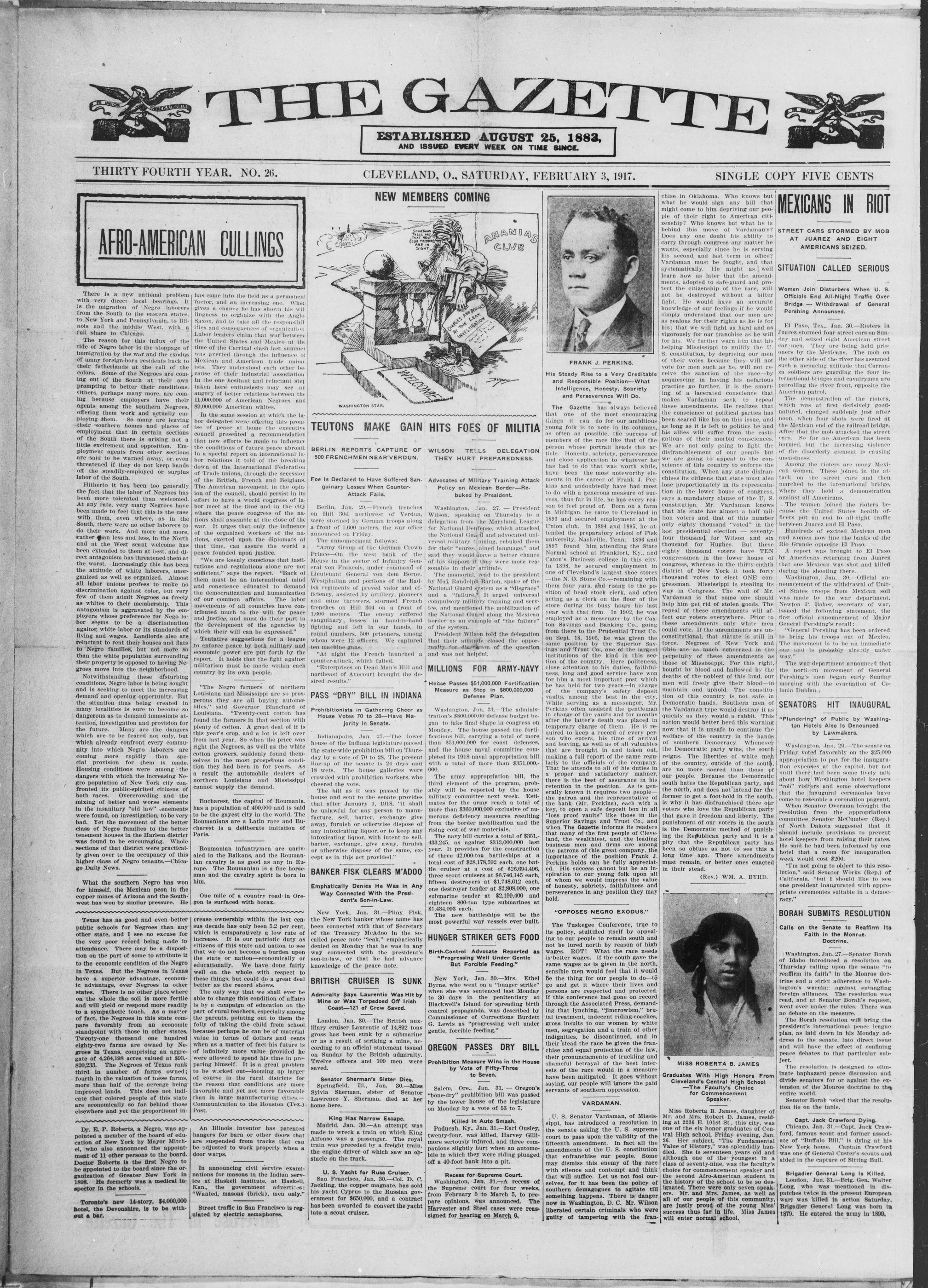
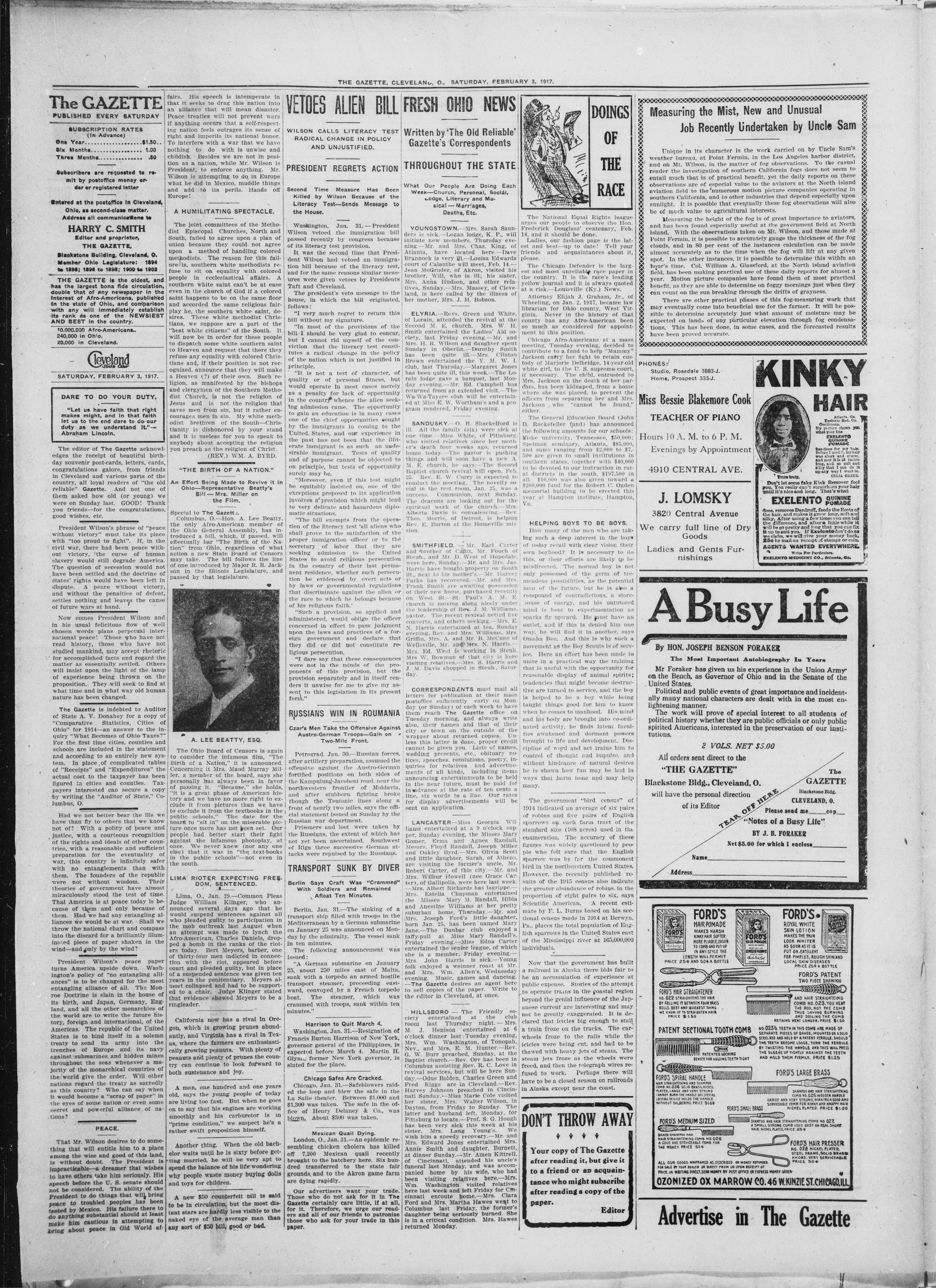
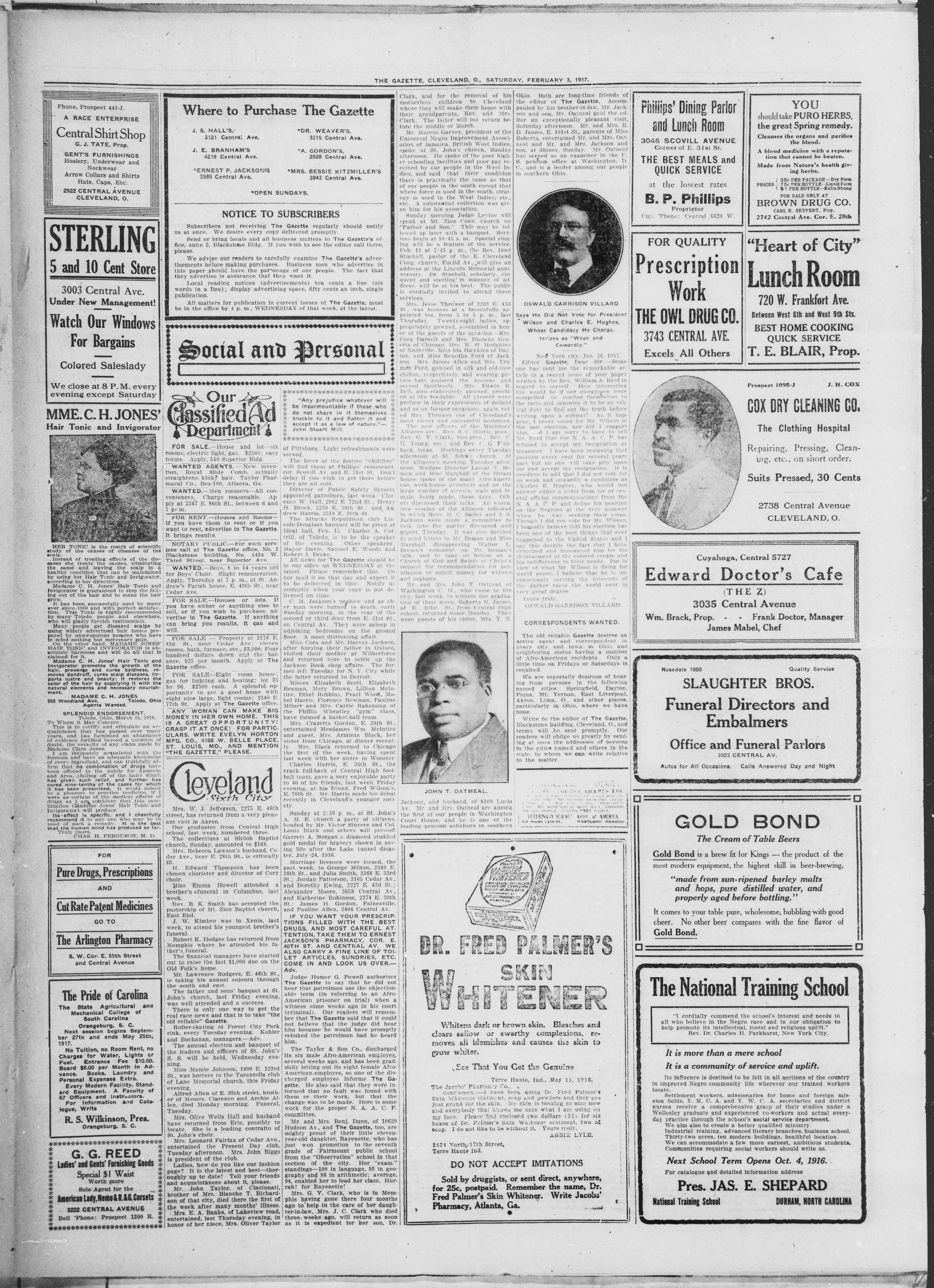
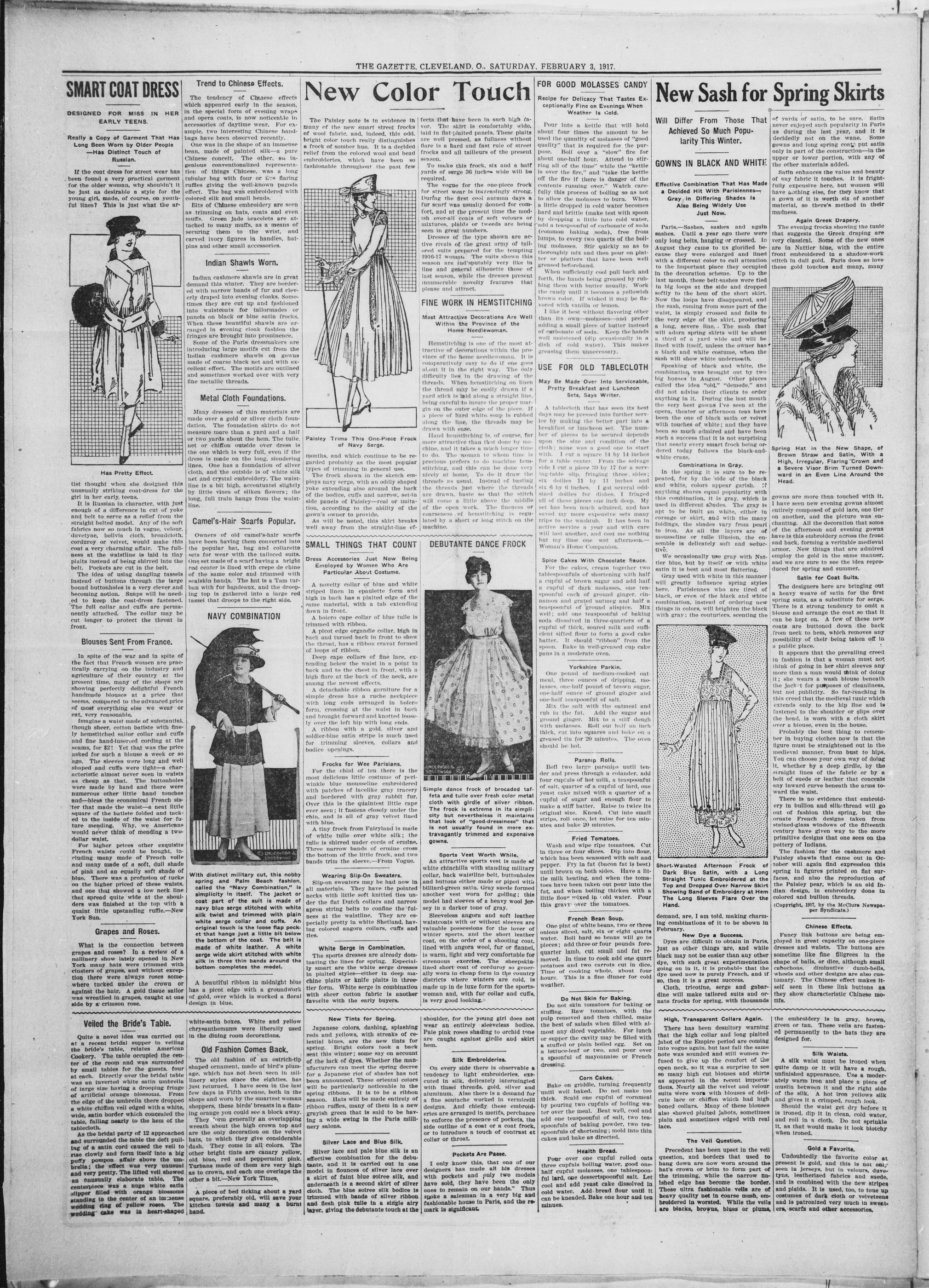
Page text (machine-generated)
```markdown
```
THIRTY FOURTH YEAR. NO.26.
AFRO-AMERICAN CULLINGS
THIRTY FOURTH
AFRO-AMERICA
There is a new national problem with very direct local bearings. It is the migration of Negro laborers from the South to the eastern states, to New York and Pennsylvania, to Illinois and the middle West, with a full share to Chicago.
The reason for this influx of the tide of Negro labor is the stoppage of immigration by the war and the exodus of many foreign-born residents back to their fatherlands at the call of the colors. Some of the Negroes are coming out of the South at their own prompting to better their conditions. Others, perhaps, many more, are coming because employers have their agents among the southern Negroes, offering them work and actually employing them. So many are leaving their southern homes and places of employment that in certain sections of the South there is arising not a little excitement and opposition. Employment agents from other sections are said to be warned away, or even threatened if they do not keep hands off the steadily-employed or surplus labor of the South.
Hitherto it has been too generally the fact that the labor of Negroes has been more tolerated than welcomed. At any rate, very many Negroes have been unde to feel that this is the case with them, even where, as in the South, there were no other laborers to do their work. And more and more, rather than less and less, in the North and at the West coast welcome has been extended to them at best, and direct antagonism has threatened them at the worst. Increasingly this has been the attitude of white laborers, unorganized as well as organized. Almost all labor unions profess to make no discrimination against color, but very few of them admit Negroes as freely as whites to their membership. This antagonism is aggravated by the employers whose preference for Negro labor seems to be a discrimination against white labor or its standards of living and wages. Landlords also are reluctant to rent their houses and flats to Negro families, but not more so than the white population surrounding their property is opposed to having Negroes move into the neighborhood.
Notwithstanding these disturbing conditions, Negro labor is being sought and is seeking to-meet the increasing demand and opening opportunity. But the situation thus being created in many localities is sure to become so dangerous as to demand immediate attention, investigation and provision for the future. Many are the dangers which are to be feared not only, but which already confront every community into which Negro laborers are coming more rapidly than special provision, for them is made. Housing conditions were among the dangers with which the increasing Negro population of New-York city confronted its public-spirited citizens of both races. Overcrowding and the mixing of better and worse elements in the insinant "old law" enements were found, on investigation, to be very bad. Yet the movement of the better class of Negro families to the better tenement houses in the Harlem district was found to be encouraging. Whole sections of that district were practically given over to the occupancy of this higher class of Negro tenants.—Chicago Daily News.
What the southern Negro has won for himself, the Mexican peon in the copper mines of Arizona and the Southwest has won by similar pressure. He
Texas has as good and even better public schools for Negroes than any other state, and I see no excuse for the very poor record being made in attendance. There may be a disposition on the part of some to attribute it to the economic condition of the Negro in Texas. But the Negroes in Texas have a superior advantage, economic advantage, over Negroes in other states. There is no other place where on the whole the soil is more fertile and will yield or respond more readily to a sympathetic touch. As a matter of fact, the Negroes in this state compare favorably from an economic standpoint with those in other states. Twenty-one thousand one hundred eighty-two farms are owned by Negroes in Texas, comprising an aggregate of 4,264,188 acres valued at $98,202,233. The Negroes of Texas rank third in number of farms owned; fourth in the valuation of these farms, more than half of the acreage being improved lands. This does not indicate that colored people of this state are economically so far behind those elsewhere and yet the proportional in Dr. E. P. Roberts, a Negro, was appointed a member of the board of education of New York by Mayor Mitchell, who also announced the appointment of 11 other persons to the board. Doctor Roberts is the first Negro to be appointed to the board since the organization of Greater New York in 1898. He formerly was a medical inspector in the schools.
Toronto's new 14-story, $4,000,000 hotel, the Devonshire, is to be without a bar.
THE GAZETTE
has come into the field as a permanent factor, and an increasing one. When given a chance he has shown his willingness to organize with the Anglo-Saxon, and to take all the responsibilities and consequences of organization. Labor leaders claim that war between the United States and Mexico at the time of the Carrizal clash last summer was averted through the influence of Mexican and American trade unionists. They understand each other because of their industrial association. In the one hostil and redicent step taken here enthusiasts may see an augury of better relations between the 11,000,000 of American Negroes and 89,000,000 American whites.
In the same session at which the labor delegates were offering this promise of peace at home the executive council presented a recommendation that new efforts be made to influence the conditions of future peace abroad. In a special report on international labor relations it told of the breaking down of the International Federation of Trade unions, through the secession of the British, French and Belgians. The American movement, in the opinion of the council, should persist in its effort to have a world congress of labor meet at the time and in the city where the peace congress of the nations shall assemble at the close of the war. It urges that only the influence of the organized workers of the nations, exerted upon, the diplomats at that time, can assure the world a peace founded upon justice.
"We are keenly conscious that institutions and regulations alone are not sufficient," says the report. "Back of them must be an international mind and conscience educated to demand the democratization and humanization of our common affairs. The labor movements of all countries have contributed much to the will for peace and justice, and must do their part in the development of the agencies by which their will can be expressed."
Tentative suggestions for a league to enforce peace by both military and economic power are put forth by the report. It holds that the fight against militarism must be made within each country by its own people.
"The Negro farmers of northern Louisiana and Mississippi are so prosperous they are all buying automobiles," said Governor Blanchard of Louisiana. "Twenty-cent cotton, this found the farmers in that section with plenty of cotton. A great deal of it is this year's crop, and a lot is left over from last year. So when the price was right the Negroes, as well as the white cotton growers, suddenly found themselves in the most prosperous condition they had been in for years. As a result the automobile dealers of northern Louisiana and Mississippi cannot supply the demand.
Bucharest, the capital of Roumania, has a population of 400,000 and is said to be the gayest city in the world. The Roumanians are a Latin race and Bucharest is a deliberate imitation of Paris.
Roumanian infantrymen are unrivaled in the Balkans, and the Roumanian cavalry is as good as any in Europe. The Roumanian is a fine horseman and the cavalry spirit is born in him.
One mile of a country road in Oregon is surfaced with borax.
crease ownership within the last census decade has only been 5.2 per cent, which is comparatively a low rate of increase. If so, our patriotic duty as a citizen of this state and nation to see that we do not become a burden upon the state or nation—economically or educationally. We have done fairly well on the whole with respect to these things, but could do a great deal better as the record shows.
The only way that we shall ever be able to change this condition of affairs is by a campaign of education on the part of rural teachers, especially among the parents, pointing out to them the folly of taking the child from school because perhaps, he can be of material value in terms of dollars and cents when as a matter of face his future is of infinitely more value provided he were allowed to spend his time in preparing himself. It is a great problem to be worked out—looting up larger of course in the rural districts for the reason that conditions are more favorable and yet not more favorable than in large manufacturing cities.—Communication to the Houston (Tex.) Post.
An Illinois inventor, has patented hangers for barn or other doors that are suspended from tracks that can be adjusted to work properly when a door warps.
In announcing civil service examinations for masons in the Indian service at Haskell institute, at Haskell, Kan., the government advertises: "Wanted, masons (brick), men only."
Street traffic in San Francisco is regulated by electric semaphore.
ESTABLISHED AUGUST 25, 1883 AND ISSUED EVERY WEEK ON TIME SINCE.
NEW MEMBERS COMING
NEW MEMBERS COMING
SOMETHING TELLS ME THAT THE CLUB MEMBERS ARE IN SIGHT
ANANIAS CLUB
CHARLES AND ANANIAS AT THE LEAK INVESTIGATION
WELCOME
WASHINGTON STAR.
SOME
TELL
THE
CLUB
ARE
SIGN
WASHINGTON STAR.
TEUTONS MAKE GAIN
BERLIN REPORTS CAPTURE OF
500 FRENCHMEN NEAR 'VERDUN.
Foe Is Declared to Have Suffered Sanguinary Losses When Counter-Attack Fails.
Berlin, Jan. 29—French trenches on Hill 304, northwest of Verdun, were stormed by German troops along a front of 1,400 meters; the war office announced on Friday.
The announcement follows:
"Army Group of the German Crown Prince" On the west bank of the Meuse in the sector of Infantry General von Francois, under command of Lieutenant General von dem Borne, Westphilian and portions of the Badsil regiments of proved Valor and efficiency, assisted by artillery, planners and mine throwers, stormed French frenches on Hill 304 on a front of 1,600 meters. The enemy suffered sanguinary losses in hand-to-hand fighting and left in our hands, in round numbers, 500 prisoners, among whom were 12 officers. We captured ten machine guns. $^a$
"At night the French launched a counter-attack, which failed."
"Enterprises or Dead Man's Hill and northeast of Avocourt brought the desired results."
PASS "DRY" BILL IN INDIANA
Prohibitionists in Gathering Cheer as House Votes 70 to 28—Have Majority in Senate.
Indianapolis, Jan. 27.—The lower house of the Indiana legislature passed the state-wide prohibition bill on Thursday by a vote of 70 to 28. The present line-up of the senate is 24 drys and 18 wets. The house galleries were crowded with prohibition workers, who cheered the vote.
The bill as it was passed by the house and sent to the senate provides that after January 1, 1918, "it shall be unlawful for any person to manufacture, sell, burtter, exchange give away, furnish or otherwise dispose of any intoxicating liquor, or to keep any intoxicating liquor, with intent to sell, burtter, exchange, give away, furnish or otherwise dispose of the same, except as in this act provided."
BANKER FISK CLEARS M'ADOO
Emphatically Denile He Was In Any Way Cause the Prel-identa Sion-In-Law.
'New York, Jan. 31. - Pliny, Fisk, the New York banker whose name has been connected with that of Secretary of the Treasury McAdoo in the so-called peace note "leak," emphatically denied on Monday that he was in any way connected with the president's son-in-law, or that he had advance knowledge of the peace note.
BRITISH CRUISER IS SUNK
Admiralty Says Laurentic Was Hit by
Mine or Was Torpedoed Off Irish
Coast—121 of Crew Saved.
London, Jan. 30.—The British aux-
niliary cruiser Laurentic of 14,892 tons
gross has been sunk by a submarine
or as a result of striking a mine,
according to an official statement issued
on Sunday by the British admiralty.
Twelve officers and 109 men were
saved.
Senator Sherman's Sister Dles.
Springfield, Ill., Jan. 30.—Miss
Sylvia Sherman, sister of Senator
Lawrence Y. Sherman, died at her
home here.
King Has Narrow Escape.
Madrid, Jan. 30.—An attempt was made to wreck a train on which King Alfonso was a passenger. The royal train was preceded by a freight train, the engine driver of which saw an obstacle on the track.
U. S. Yacht for Russ Cruiser.
San Francisco, Jan. 30.—Col. D. C. Jackling, the copper magnate, has sold his yacht Cyprus to the Russian government for $630,000, and a contract has been awarded to convert the yacht into a scout cruiser.
ANANIA'S CLUB
CHURSES AND PRINCESS
AT THE LEAK
UNICE'S INGATION
HITS FOES OF MILITIA
WILSON TELLS DELEGATION
THEY HURT PREPAREDNESS.
Advocates of Military Training Attack Policy on Mexican Border—Rebuked by President.
Washington, Jan. 27. — President Wilson, speaking on Thursday to a delegation from the Maryland League for National Defense, which attacked the National Guard and advocated universal military training, rebuked them for their "unres, naked language," and said they would have a better chance of his support if they were more reasonable in their attitude.
The memorial, read to the president by Mr. Randolph Barton, spoke of the National Guard system as a "disgrace" and a "failure." It urged universal compulsory military training and service, and mentioned the mobilization of the National Guard along the Mexican border as an example of "the failure" of the system.
President Wilson told the delegation that their attitude closed the opportunity for dissection of the question and was not helpful.
MILLIONS FOR ARMY-NAVY
House Passes $51,000,000 Fortification Measure as Step in $800,000,000 Defense Plan.
Washington, Jan. 31.—The administration's $800,000 defense budget began to take final shape on Monday. The house passed the fortifications bill, carrying a total of more than $31,000,000 for coast defenses, and the house naval committee completed its 1918 naval appropriation bill with a total of more than $351,000,000.
The army appropriation bill, the third element of the program, probably will be reported by the house military committee next week. Estimates for the army reach a total of more than $300,000,000 exclusive of numerous deficiency measures resulting from the border mobilization and the rising cost of war materials.
The navy bill carries a total of $351,433,235, as against $318,000,000 last year. It provides for the construction of three 2,400-ton battleships at a total cost of $28,178,592 each, one tank cruiser at a cost of $6,404,690, three secrutis cruisers at $6,746,145 each, fifteen destroyers at $1,748,612 each, one destroyer tender at $2,808,000, one tanker tender at $2,190,400 and eighteen 800-ton type submarines at $1,484,933 each.
The new battleships will be the most powerful war vessels ever built.
HUNGER STRIKER GETS FOOD
Birth-Control Advocate Reported as "Progressing Well Under Gentle But Forcible Feeding."
New York, Jan. 30—Mrs. Ethel Byrne, who went on a "hunger strike" when she was sentenced last Monday to 30 days in the penitentiary at Blackwell's island for spreading birth control propaganda, was described by Commissioner of Corrections Burdett G. Lewis as "progressing well under gentle, forcible feeding."
OREGON PASSES DRY BILL
Prohibition Measure Wins in the House by Vote of Fifty-Three to Seven.
Sleum, Ore., Jun. 31. — Oregon's "bone-dry" prohibition bill was passed by the lower house of the legislature on Monday by a vote of 53 to 7.
Killed in Auto Smash.
Puduchow, Ky., Jan. 31.—Earl Ousley, twenty-four, was killed, Harvill Gerry more seriously injured; and three companions slightly hurt when an automobile in which they were riding plunged off a 40-foot bank into a pit.
Access for Supreme Court
Washington, Jan. 31.—A recess of the Supreme court for four weeks, from February 5 to March 5, to prepare opinions, was announced. The Harvester and Steel cases were re-signed for hearing on March 6.
```markdown
```
PETER H.
His Steady Rise to a Very Creditable and Responsible Position—What Intelligence, Honesty, Sobriety and Perseverance Will Do.
The Gazette has always believed that one of the most encouraging things it can do for our ambitious young folk is to note in its columns, as often as possible, the success of members of the race like that of the person whose portrait heads this article. Honesty, sobriety, perseverance and close application to whatever he has had to do that was worth while, have been the most noteworthy elements in the career of Frank I. Perkins and undoubtedly have had most to do with a generous measure of success, thus far in life, he has every reason to feel proud of. Born on a farm in Michigan, he came to Cleveland in 1893 and secured employment at the Union club. In 1894 and 1895, he attended the preparatory school of Fisk university, Nashville, Tennessee. In 1896 and 1897, found him at attending the State Normal school at Frankfurt, Ky., and Caton's Business, college in this city. In 1898, he secured employment in one of Cleveland's largest shoe stores—the N. O., Stone Co.—remaining with them four years, and rising to the position of head stock, and often acting as a clerk on the floor of the store during its busy hours his last year with that firm. In 1902, he was employed as a messenger by the Caton Savings and Banking Co., going on to the Prudential Trust Co. on September 18, 1905, he was the kind of person with a measurer by the Caton Savings and Banking Co., one of the largest institutions of the country. Here politeness, close attention to his duties, faithfulness, long and good duty, have won for him a most important post which he has held for two years—in charge of the company's safety deposit vaults, among the best in the city. Perkins often the guardian of the company in charge of the death was placed in temporary charge of them. He is required to keep a record of every person who enters, his time of arrival and leaving, as well as of all valuables that are brought in and taken out, making a full account of the company. He attends to all of his duties in a proper and satisfactory manner, there is the best of assurance in his retention in the position. As is generally known it requires two people—the patron and the representative of the bank (Mr. Perkins), each key to open the can in all of his valuables like those in the Superior Savings and Trust Co., and when The Gazette informs its readers that many of the first people of Cleveland, the wealthiest, and the leading business men and firms are among the patrons of this great company, the importance of the position of Perkins can be fully appreciated. His success cannot but be an inspiration to our young folk upon all of whom we would impress the value of honesty, sobriety, faithfulness and perseverance in any position they may hold.
"OPPOSES NEGRO EXODUS."
The Tuskegee Conference, true to its policy, stultified itself by appealing to our people to remain south and not be lured north by reason of high wages. ROT! What the race needs is better wages. What the south gave the same wages as is given in the north, sensible men would feel that it would be the thing for our people to do—to go and get it where their lives and persons are respected and protected. If this conference had gone on record through the Associated Press, demanding that lynching, "jimcrowism," brutal treatment, indecent riding-coaches, gross insults to our women by white men, segregation and a train of other indigities, be discontinued, and in their stead the race be given the franchise and equal protection of the law, their pronunciamento of truckling and shameful betrayal of the best interests of the race would in a measure have been mitigated. It goes without saying, our people will ignore the paid servants of southern oppression.
VARDAMAN.
U. S. Senator Vardaman, of Mississippi, has introduced a resolution in the senate asking the U. S. supreme court to pass upon the validity of the fifteenth amendment. In fact all the amendments of the U. S. constitution that enfranchise our people. Some may dismiss this enemy of the race with silence and contempt and think that will suffice. Let us not fool ourselves, for it has been the policy of southern demagogues to agitate till something happens. There is danger now in Washington, D. C. Mr. Wilson liberated certain criminals who were guilty of tampering with the fran-
SINGLE COPY FIVE CENTS
chise in Oklahoma. Who knows but what he would sign any bill that might come to him depriving our people of their right to American citizenship? Who knows but what he is behind this move of Vardaman? Does any one doubt his ability to carry through congress any matter he wants, especially since he is serving his second and last term in office? Vardaman must be fought, and that systematically. He might as well learn now as later that the amendments adopted to safeguard and protect the citizenship of the race, will not be destroyed without a bitter fight. He would have an accurate knowledge of our feelings he would simply understand that our men are as zealous for their rights as he is for his; that we will fight, as hard and as vigorously for our franchise as he will for his. We further warn him that his Mississippi to nullify the U.S. constitution, by depriving our men of their votes because they will not vote for men such as he, will not receive the sanction of the race—by requesting in having his educational practice go further. It is the smarting of a lacerated conscience that makes Vardaman seek to "repeat these amendments." He realizes that the conscience of political parties has been scared like his on this issue, and as long as it is left to politics he and his allies will suffer from the castigations of their morbid consciences. We are not only going to fight the disfranchisement of our people but we are going to appeal to the conscience of this country to enforce the constitution. When any state disfranchises its citizens that state must also lose proportionately in its representation in the lower house of Congress, says a mandatory clause of the U.S. constitution. Mr. Vardaman knows that his state has almost a half million voters and that of this number only eight thousand "voted" in the last presidential election— seventy-four thousand for Wilson and six thousand for Hughes. But these eight thousand voters have TEN congressmen in the lower house of Congress, whereas in the thirty-eighth district of New York it took forty thousand votes to elect ONE congressman. Mississippi is stealing its way in Congress. The wall of Mr. Vardaman is that some one should help him get rid of stolen goods. The repeal of these amendments will affect our voters everywhere. Prior to these amendments only white men could vote. If the amendments are unconstitutional, that statute is still in force. Negroes of New York and Ohio are as much concerned in the perpetuity of these amendments as those of Mississippi. For this right, bought by blood and hallowed by the deaths of the noblest of this land, our men will freely give their blood—to maintain and uphold. The constitution of this country is not safe in Democratic hands. Southern men of the Vardaman type would destroy it as quickly as they would a rabbit. This nation would better heed this warning now that it is unsafe to continue the welfare of the country in the hands of southern Democracy. Whenever the Democratic party wins, the south reigns. The liberties of white men of the country, outside of the south, are no more sacred than those of our people. Because the Democratic south hates the Republican party, and the north, and does not intend for the former to get a foot-hold in the south, is why it has disfranchised their voters who love the Republican party that gave it freedom and liberty. The punishment of our voters in the south is the Democratic method of punishing the Republican party and it is a pity that the Republican party has been so obsebut as not to see this a long time ago. Those amendments must remain, or better ones enacted in their stead.
MISS ROBERTA B. JAMES
Graduates With High Honors From
Cleveland's Central High School
—The Faculty's Choice
for Commencement
Speaker.
Miss Roberta B. James, daughter of Mr. and Mrs. Robert D. James, residing at 2236 E. 101st St, this city, was one of the six honor graduates of Central High school, Friday evening, Jan. 26. Her subject, "The Fundamental Value of History," was splendidly handled. She is seventeen years old and although one of the youngest, in a class of seventy-nine, was the third school speaker and the second Afro-American student in the history of the school to be so designated. There were only seven speakers. Mr. and Mrs. James, as well as all of our people of this community, are justly proud of the young Miss' success thus far in life. Miss James will enter normal school.
VOLUNTARY
STREET CARS STORMED BY MOB
AT JUAREZ AND EIGHT
AMERICANS SEIZED.
Women Join Disturbers When U. S. Officials End All-Night Traffic Over, Bridge — Withdrawal of General Porching Announced
El Paso, Tex., Jan. 30. — Rioters in Juarez stormed four street cars on Sunday and seized eight American street car men. They are being held prisoners by the Mexicans. The mob on the other side of the river has assumed such a mourning attitude that Curranzo soldiers are guarding the four international bridges and cavalrymen are patrolling the river front, opposite the American patrol.
The demonstration of the rioters, which was at first derisively good-matured, changed suddenly just after noon, when four shots were fired at the Mexican end of the railroad bridge. After that the mob attacked the street cars. So far no American has been harmed, but the increasing violence of the disorderly element is causing unmeaniness.
Among the rioters are many Mexican women. These joined in the attack on the street cars and then marched to the international bridge where they hold a demonstration against all Americans.
The women joined the rioters because the United States health officers put an end to all-night traffic between Juarez and El Paso.
Hundreds of excited Mexican men and women now line the banks of the Rio Grande opposite El Paso.
A report was brought to El Paso by Americans returning from Jurez that one Mexican was shot and killed during the shooting there.
Washington, Jan. 30.—Official announcement of the withdrawal of United States troops from Mexican soil was made by the war department, Newton P. Baker, secretary of war, issued the following statement, the first official announcement of Major General Pershing's recall:
"General Pershing has been ordered to bring his troops out of Mexico. The movement is to be an immediate one and is probably already under way."
The war department announced that the northern movement of General Pershing's men began early Sunday morning with the evacuation of Colonia Dublan.
SENATORS HIT INAUGURAL
"Plundering" of Public by Washington Hotels Also Is Denounced by Lawmakers.
Washington, Jan. 29.—The senate on Friday voted favorably on the $25,000 appropriation to pay for the inauguration expenses at the capitol; but not until there had been some lively talk about how Washington hotel keepers "roll" visitors and some observations that the inaugural ceremonies have come to resemble a coronation pageant. When Senator Overman brought the resolution "from the appropriations committee Senator McCumber (Rep.) of North Dakota suggested that, it should include provisions to prevent hotel keepers from raising their rates. He said he had been informed by one hotel that a room for inauguration week would cost $200.
"I'm not going to object to this resolution," said Senator Works (Rep.) of California, "but I should like to see one president inaugurated with appropriate ceremonies suitable in a democracy."
BORAH SUBMITS RESOLUTION
Calls on the Senate to Reaffirm Its Faith in the Monroe. Doctrine.
Washington. Jan. 27.—Senator Borah of Idaho introduced a resolution on Thursday calling upon the separe "to reaffirm its faith" in the Monroe doctrine and a strict adherence to Washington's warnings against entangling foreign alliances. The resolution was read, and at Senator Borah's request, went over under the rules. There was no debate on the measure.
The Borah resolution will bring the president's international peace league plan, as laid down in his Monday address to the senate, into direct issue and will have the effect of confining peace debates to that particular subject.
The resolution is designed to eliminate haphazard peace discussion and divide senators for or against the extension of the Monroe doctrine to the entire world.
Senator Borah asked that the resolution lie on the table.
Capt. Jack Crawford Dying.
Chicago. Jan. 31.—Capt. Jack Crawford, famous scout and former associate of "Buffalo Bill," is dying at his New York home. Captain Crawford was one of General Custer's scouts and added in the capture of Sitting Bull.
Brigadier General Long is Killed.
London, Jan. 31—Brig. Gen. Walter
Long, who was mentoned in dispatches twice in the present European war was killed in action Saturday.
Brigadier General Long was born in 1870. He entered the army in 1890.
One Year.....$1.50.
Six Months.....1.00
Three Months......50
Subscribers are requested to re-
mit by postoffice money or
der or registered letter
Entered at the postoffice in Cleveland
Ohio, as second-class matter.
Address all communications to
Blackstone Building, Cleveland, O.
Member Ohio Legislature: 1894
to 1898; 1896 to 1898; 1900 to 1902
THE GAZETTE is the oldest, and has the largest bona fide circulation, double that of any newspaper in the
American countryside, published
in the state of Ohio, and comparison
with any will immediately establish
its rank as one of the NEWSIEST
AND BEST in the country.
10,000,000 Afro-Americanes.
240,000 in Ohio.
20,000 in Cleveland.
SATURDAY, FEBRUARY 3, 1917.
DARE TO DO YOUR DUTY.
"Let us have faith that right makes might, and in that faith let us to the end dare to do our duty as we understand it."—Abraham Lincoln.
The editor of The Gazette acknowledges the receipt of beautiful birthday souvenir post-cards, letters, cards, congratulations galore, from friends in Cleveland and various parts of the country, all loyal readers of "the old reliable" Gazette. And not one of them asked how old (or young) we were on Sunday last. GOOD! Thank you friends—for the congratulations, good wishes, etc.
President Wilson's phrase of "peace without victory" must take its place with "too proud to fight". If, in the civil war, there had been peace without victory, 'the curse of human slavery would still degrade America. The question of secession would not have been settled and the doctrine of states' rights would have been left in dispute. A peace without victory, and without the penalties of defeat, settles nothing and leaves the cause of future wars at hand.
Now comes President Wilson and in his usual felicitous flow of well chosen words plans perpetual international peace! Those who have not read history, those who have not studied mankind, may accept rhetoric for accomplished facts and regard the matter as essentially settled. Others will insist upon the light of the lamps of experience being thrown on the proposition. They will seek to find at what time and in what way old human nature has been changed.
The Gazette is indebted to Auditor of State A. V. Donahay for a copy of "Comparative Statistics, Cities of Ohio" for 1914—an answer to the inquiry "What Becomes of Ohio Taxes?" For the first time cities, counties and schools are included in the statement and according to an entirely new system. In place of complicated tables of "Receipts" and "Expenditures" the actual cost to the taxpayer has been figured in cities and counties. Taxpayers interested can secure a copy by writing the "Auditor of State," Columbus, O.
Had we not better bear the ills we have than fly to others that we know not of? With a policy of peace and justice, with a courteous recognition of the rights and ideals of other countries, with a reasonable and sufficient preparation for the eventuality of war, this country is infinitely safe with no entanglements than with them. The founders of the republic were not without wisdom. Their theories of government have almost miraculously stood the test of time. That America is at peace today is because of them and only because of them. Had we not any entangling alliances we would be at war. Shall we throw the national chart and compass into the discard for a brilliantly illuminated piece of paper shaken in the wind—and only by the wind?
President Wilson's peace paper turns America upside down. Washington's policy of "no entangling alliances" is to be changed for the most entangling alliance of all. The Monroe Doctrine is slain in the house of its birth, and Japan, Germany, England, and all the other monarchies of the world are to write the future history, foreign and international, of the Americas. The republic of the United States is to bind itself in a solemn treaty to send its army into the trenches of Europe and its navy against submarines, and hidden mines throughout the seas whenever a majority of the monarchical countries of the world give the order. Will other nations regard the treaty as sacredly as this country? Who can say when it would become a "scrap of paper" in the eyes of some nation or even some secret and powerful alliance of nations?
PEACE.
That Mr. Wilson desires to do something that will entitle him to a place among the wise and good of this land, is without doubt. The President is impracticable—a dreamer that wishes to have others take him seriously. His speech before the U. S. senate should not be considered. The ability of the President to do things that will bring peace to troubled peoples has been tested by Mexico. His failure there to do anything substantial should at least make him cautious in attempting to bring about peace in Old World af-
fairs. His speech is intemperate in that it seeks to drag this nation into an alliance that will mean disaster. Peace treaties will not prevent wars if anything occurs that a self-respecting nation feels outrages its sense of right and imperils its national honor. To interfere with a war that we have nothing to do with is unwise and childish. Besides we are not in position as a nation, while Mr. Wilson is President, to enforce anything. Mr. Wilson is attempting to do in Europe what he did in Mexico, muddle things and add to its perils. Hands off Europe!
A HUMILITATING SPECTACLE.
The joint committees of the Methodist Episcopal Churches, North and South, failed to agree upon a plan of union because they could not agree upon a method of handling colored methodists. The reason for this failure is, southern white methodists refuse to sit on equality with colored people in ecclesiastical affairs. A southern white saint can't be at ease even in the church of God if a colored saint happens to be on the same floor and accorded the same religious fair play he, the southern white saint, desires. These white methodist Christians, we suppose are a part of the "best white citizens" of the South. It will now be in order for these people to dispatch some white southern saint to Heaven and request that there they refuse any equality with colored Christians and, if their position is not recognized, announce that they will make a Heaven (?) of their own. Such religion, as manifested by the bishops and clergymen of the Southern Methodist Church, is not the religion of Jesus, and is not the religion that saves men from sin, but it rather enlightens men in My white method of worship of the South. Christianity is dishonored by the stand and it is useless for you to speak to anybody about accepting the religion you preach as the religion Christ. (BREV) WM A. BRYD
"THE BIRTH OF A NATION."
An Effort Being Made to Revive it in Ohio—Representative Beatty's Bill—Mrs. Miller on the Film
Special to The Gazett :
Columbus, O.-Hon. A. Lee Beatty, the only Afro-American member of the Ohio General Assembly, has introduced a bill, which, if passed, will effectually bar "The Birth of the Nation" from Ohio, regardless of what action a new State Board of Censors would take. The bill of one introduced by Major R. R. Jackson in the Illinois Legislature, and passed by that legislature.
A. LEE BEATTY, ESO.
The Ohio Board of Censors is again to consider the infamous film, "The Birth of a Nation," it is announced, Concerning it, Mrs. Maud Murray Miller, a member of the board, says she personally has always been in favor of passing it, "Because," she holds, "the picture of American history and we have no more right to exclude it from pictures than we have to exclude it from the textbooks in the public schools." The date for the board to "sit in" on the miserable picture once more has not been set. Our people had better start their fight against the infamous photophagy, at least, before it became else) that it was in "the textbooks in the public schools"—not even in the south.
LIMA/ RIOTER EXPECTING FREE
DOM, SENTENCED.
Lima, O., Jan. 29.—Common Pleas Judge William Klinger, who announced several days ago that he would suspend sentences against all who pleaded guilty to participation in the mob outbreak last August when an attempt was made to lynch the Afro-American, Charles Daniels, dropped a bomb in the ranks of the rioters and killed seven members, one of thirty-four men indicted in connection with the riot, appeared before court and pleaded guilty, but in place of a suspended sentence was given ten years in the penitentiary. Meyers almost collapsed and had to be supported to a chair. Judge Klinger stated that evidence showed Meyers to be a ringleader.
California now has a rival in Oregon, which is growing prunes abundantly, and Virginia has a rival in Texas, where the farmers are enthusiastically growing peanuts. With plenty of peanuts and plenty of prunes the country can continue to look forward to both sustenance and joy.
A man, one hundred and one years old, says the young people of today are living too fast. But when he goes on to say that his engines are working smoothly and his carburetor is in "prime condition," we suspect he's a rather swift proposition himself.
Another thing. When the old bachelor waits until he is sixty before getting married, he will be very apt to spend the balance of his life wondering why people waste money buying dolls and toys for children.
A new $50 counterfeit bill is said to be in circulation, but the most distant stars are hardly less visible to the naked eye of the average man than any sort of $50 bill, good or bad.
THE GAZETTE; CLEVELAND, O., SATURDAY, FEBRUARY 3, 1917.
VETOES ALIEN BILL
VETOES ALIEN BILL
WILSON CALLS LITERACY TEST
RADICAL CHANGE IN POLICY
AND UNJUSTIFIED.
PRESIDENT REGRETS ACTION
Second Time Measure Has Been
Killed by Wilson Because of the
Literacy Test—Sends Message to
the House.
Washington, Jan. 31. — President
Wilson vetoed the immigration bill
passed recently by congress because
of its literacy test provision.
It was the second time that President
Wilson had vetoed an immigration bill because of the literacy test, and for the same reasons similar measures were given vetoes by Presidents
Taft and Cleveland.
The president's veto message to the
house, in which the bill originated,
follows:
"I very much regret to return this
bill without my signature.
"In most of the provisions of the
bill I should be very glad to concur,
but I cannot rid myself of the con-
viction that the literacy test constitutes a radical change in the policy
of the nation which is not justified in
principle.
"It is not a test of character, of quality or of personal fitness, but would operate in most cases merely as a penalty for lack of opportunity in the country whence the alien seeking admission came. The opportunity to gain an education is in many cases one of the chief opportunities sought by the immigrants in coming to the United States, and our experience in the past has not been that the illiterate immigrant is as such an undesirable immigrant. Tests of quality and of purpose cannot be objected to on principle, but tests of opportunity surely may be.
"Moreover, even if this test might be equitably insisted on, one of the exceptions proposed to its application involves if provision which might lead to very delicate and hazardous diplomatic situations.
"The bill exempts from the operation of the literacy test 'all aliens who shall prove to the satisfaction of the proper immigration officer or to the secretary of labor that they are seeking admission to the United States to avoid religious persecution in the country of their last permanent residence, whether such persecution be evidenced by overt acts or by laws or governmental regulations that discriminate against the alien or the race to which he belongs because of his religious faith.' "Such a provision, so applied and administered, would oblige the officer concerned in effect to pass judgment upon the laws and practices of a foreign government and declare that they did or did not constitute religious persecution.
"I dare say that these consequences were not in the minds of the proponents of this provision, but the provision separately and in itself renders it unwise for me to give my assent to this legislation in its present form."
RUSSIANS WIN IN ROUMANIA
Czar's Men Take the Offensive Against Austro-German Troops—Gain on Two-Mile Front.
Petrograd, Jan. 30.—Russian forces, after artillery preparation, assumed the offensive against the Austro-German fortified positions on both sides of the Kampulping-Jacobeben road, near the northwestern frontier of Moldavia, and after stubborn fighting broke though the Teutonic lines along a front of nearly two miles, says the official statement issued on Sunday by the Russian war department.
Prisoners and loot were taken by the Russians, the extent of which has not yet been ascertained. Southwest of Riga three successive German attacks were repulsed by the Russians.
TRANSPORT SUNK BY DIVER
Berlin Says Craft Was "Crammed"
With Soldiers and Remained
Affloat Ten Minutes.
Berlin, Jan. 31.—The sinking of a
transport ship filled with troops in the
Mediterranean by a German submarine
on January 25 was announced on Monday
by the admiralty. The vessel sank
in ten minutes.
The following announcement was
issued:
"A German submarine on January
25, about 250 miles east of Malta,
sank with a torpedo an armed hostile
transport steamer, proceeding east-
ward, convoyed by a French torpedo
boat. The steamer, which was
crammed with troops, sank within ten
minutes."
Harrison to Quit March 4
Washington, Jan. 31.—Resignation of Francis Burton Harrison of New York, governor general of the Philippines, is expected before March 4. Martin H. Glym, former New York governor, is slated for the place.
Chicago Safes Are Cracked.
Chicago, Jan. 31. — Safeblowers raided the loop and blew the safe in the La Salle theater. Between $1,000 and $1,300 was taken. The safe in the office of Henry Delaney & Co., was blown. About $300 was taken.
Mexican Quail Dying
London, O., Jan. 31.—An epidemic resembling chicken cholera has killed off 7,200 Mexican quail recently brought to the hatchery here. Six hundred transferred to the state fair grounds, and to the Akron game farm are dying rapidly.
Our advertisers want your trade. Those who do not ask for it in the Gazette certainly care little, if at all, for their farm经营管理, even and all of our friends to patronize those who ask for your trade in this paper.
FRESH OHIO NEWS
FRESH OHIO NEWS
Written by 'The Old Reliable' Gazette's Correspondents
THROUGHOUT THE STATE
What Our People Are Doing Each Week—Church, Personal, Social, Lodge, Literary and Musical — Marriages.
YOUNGSTOWN.—Mrs. Sarah Saunders is sick.—Logan Lodge, K. P., will initiate new members, Thursday evening.—Mr. and Mrs. Chas. King, of Atlanta, have located here.—Dave Brannock is very ill.—Louisa Edwards court of Calanthe will meet, Feb. 14.—Jean McGruder, of Akron, visited his brother, Will, who is ill; his sister Mrs. Anna Hudson, and other relatives, Sunday.—Mrs. Massey, of Cleverland, is here called by the illness of her mother. Mrs. J. H. Bobson.
ELYRIA—Revs, Green and White, of Lorain, attended the revival at the Second M. E. church, Mrs. W. H. Smith entertained the Ladies' Aid society, last Friday evening—Mr. and Mrs. H. R. Wilson and daughter spent Sunday in Oberlin.—Dorothy Smith has been quite ill—Mrs. Clinton Brown entertained the Y. M. W. I. Smith has been quite ill, has been quite ill, this week.—The Lora lodge lodge a banquet, last Monday evening—Mr. E. Campbell has returned from an extended visit.—The Wa-Wa-Taysee club will be entertained at Miss E. W. Worthum's and a program rendered, Friday evening.
SANDUSKY.—O. B. Shackelford is ill. The family (six) were sick at one time. Miss White, of Pittsburgh, who visited relatives since her mother's death four weeks ago, returned home today. The pastor is pushing things and will soon have a new A. M. E. church, he says. The Second Baptist church revival will open, Feb 25. Rev. E. W. Curry is expected to conduct the meeting. The novelty social in the restroom, Jan. 25, will be a Community, next Sunday. The deacons are looking out for the spiritual work of the church—Mrs. Alberta Davis is convalescing.—Rev Thos. Morris, of Detroit, is helping Rev. E. Burton at the Homeville mission.
SMITHFIELD. — Mr. Earl Carter and brother of Caliz, Mr. Touch of Steub, and Mr. D. West of Hopeled, were here, Sunday. — Mr. and Mrs. Jas. Harris have bought property on South St. next to his mother's. — Mr. Harvey Parks has recovered. — Mr. and Mrs. Frank Smith are awaiting possession of their new home, purchased recently on West St. — St. Paul's A. M. E church is moving along nicely under the leadership of Rev. J. M. Williams, pastor. The recent revival netted five converts, and others seeking. — Mrs. E. N. Harris entertained at tea, and Mrs. Williams, Mrs. Griffin, Mrs. A. and Mr. B. McCune of Wellsville, Mr. and Mrs. N. Harrels. — Mrs. Ed. West is working in Steub, Mrs W. Bowman of that city is here visiting relatives. — Mrs. S. Harris and J. M. Davis shipped in Steub, Saturday.
CORRESPONDENTS must mail all letters for publication at the main postoffice sufficiently early on Monday (or Sunday) of each week to have them reach The Gazette office on Tuesday morning, and always write also, their names and that of their city or town on the outside of the wrapper about returned copies. Unless this latter is done, proper credit cannot be given you. Lists of names wedding present in, lists of names resolutions, poetry, inquiries for relatives and advertisements of all kinds, including items announcing entertainments to be held in the near future, must be paid for in advance at the rate of ten cents a line, six words to a line. Our rates for display advertisements will be sent on application.
LANCASTER—Miss Georgia Williams entertained at a 9 o'clock supper, Sunday evening, the Misses Mary Gorma, Erma and Agnes Randall, Messrs. Floyd Randall, Joseph Muller and Oakley Byrd.—Mrs. Olivia Scott and little daughter, Sarah, of Athens, are visiting the former's uncle, Mr. Robert Carter, of this city.—Mr. and Mrs. Wilbur Howell nowell, of this city.—Mrs. Robert Byrd are last week.—Mrs. Albert Richards has lagripe.—Mrs. Estella Chapman entertained the Misses Mary M. Randall, Hilda and Anestine Williams at her pretty suburban home, Thursday.—Mr. and Mrs. Joseph Ford's little daughter, born Jan. 25, has been named Mary Jane.—The Dunbar club enjoyed a taffy-pull at Miss Mary Randall's Friday evening.—Miss Edna Carter entertained the senior league, of which she is a member, Friday evening.—Mrs. John Hawkins young enjoyed a twiener roast at Mr. and Mrs. Wm. Allen's, Wednesday evening. Music, games and dancing.—The Gazette desires an agent here to sell copies of the paper. Write to the editor in Cleveland, at once.
HILLSBORO — The Friendly society entertained at the club room last Thursday night. — Mrs. M. J. Henison entertained at 6 o'clock dinner last Tuesday evening, Mrs. Wm. Washington, of Tonopah, Nev. and E. M. Hunter. — Rev. G. W. Burr preached, Sunday, at the Baptist church. Rev. Orr has been in Columbus as pastor, Re. R.C. Carr has been in business, but will be here Sunday. — Odus Bolden, Charles Green and Fred Riggs are in Cleveland. — Rev. Harvey Johnson preached in Cincinnati Sunday. — Miss Marie Cole visited her sister, Mrs. Walter Wilson, in Dayton, from Friday to Sunday. the latter and husband left, Monday, for Pittsburgh to locate. Prof. S. G. Hough has been very sick this week at the hospital, and Mrs. Wm. wish him a speedy recovery. — Mr. and Mrs. Edward Jones entertained Mrs. Annie Smith and daughter, Burnett, at dinner Sunday. — Mr. Amen Kittrell, of Cincinnati, attended his uncle's funeral last Monday, and was accompanied home by his wife, who had been visiting relatives here. — Mrs. Wm. Washington visited relatives here last week and left Friday in Cincinnati. — Mrs. Clara Ford and Mrs. Martha Hawes wagt to Columbus last Friday, the former's daughter being seriously burned. She is in a critical condition. Mrs. Hawes returned Monday.
DOINGS
OF
THE
RACE
The National Equal Rights league urges our people to observe the Hon. Frederick Douglass' centenary, Feb. 14, and should be done. Ladies, if fashion page is the latest and best—up to date! Tell your friends and acquaintances about it, please.
The Chicago Defender is the largest and most unreliable race paper in the country. It is the race's leading yellow journal and it is always quoted at a risk—Louisville (Ky.) News.
Attorney Elijah J. Graham, Jr., of Wheeling, on Jan. 2, 1917, became law librarian for Ohio county, West Virginia. Never in the history of that county has any Afro-American been so much as considered for appointment to this position.
Chicago Afro-Americans at a mass meeting. Tuesday evening, decided to contribute to a fund to help "Mammy" Jackson carry her fight to retain custody of Marjorie Delbridge, 14-year-old white girl, to the U. S. supreme court, if necessary. The child, entrusted to Jackson on one death of her parents, was been kidnapped, where she was placed, to prevent the officers from separating her and Mrs. Jackson, who "cannot be found," either.
The General Education Board (John D. Rockefeller (jnd) has announced the following amounts for our schools: Elsie university, Tennessee, $50,000; Spelman seminary, Atlanta, $85,000; and sums ranging from $2,000 to $7,500 are given to small institutions in southern states, together with $40,000 to be devoted to our instruction in rural districts in the south, $197,500 in all. $10,000 was also given toward a memorial building to be erected this year at Hampton institute, Hampton, Va.
HELPING BOYS TO BE BOYS.
How many of the men who are taking such a deep interest in the boys of today recall with clear vision their own boyhood? It is necessary to do this, or their efforts are likely to be misdirected. The normal boy is not only possessed of the germ of tremendous possibilities, as the potential man of the future, but he is also a compound of contradictions, a storehouse of energy, and his untutored mind is bent to experimentation as sparks fly upward. He must have an outlet, and if this is denied him one way, he will find it in another, says Omaha Bee. And this is why such a movement as the Boy Scouts is of service. Here an effort has been made to unite in a practical way the training that is useful with the opportunity for reasonable display of animal spirits; tendencies that might become destructive are turned to service, and the boy is helped to be a boy while being taught things good for him to know when he comes to manhood. His mind and his body are brought into co-ordinated activity, he finds latent faculties awakened and dormant powers brought to life and development. Discipline of word and act trains him to control of thought and impulse, and without hindrance of natural desires he is shown how fun may be had in ways that harm none and may help many.
The government "bird census" of 1914 indicated an average of six pairs of robins and five pairs of English sparrows on each farm tract of the standard size (108 acres) used in the enumeration. The accuracy of these figures was widely questioned by people who felt sure that the English sparrow was by far the commonest bird in the northernern United States. However, the recently published results of the 1915 census also indicate the greater abundance of robins, in the proportion of eight pairs to six, says Scientific American. A recent estimate by F. L. Burns based on his sectional census made in 1914 at Berwyn, Pa., places the total population of English sparrows in the United States east of the Mississippi river at 165,000,000 individuals.
Now that the government has built a railroad in Alaska there bids fair to be an accumulation of experience at public expense. Stories of the attempt to operate trans in the coastal region beyond the genial influence of the Japanese current are interesting and may not be greatly exaggerated. It is declared that icicles big enough to stall a train froze on the tracks. The carwheels froze to the rails while the icicles were being cut, and had to be thawed with heavy jets of steam. The steam jets froze as the wheels were freed, and then the telegraph wires refused to work. Perhaps there will have to be a closed season on railroads in Alaska except near the coast.
DON'T THROW AWAY
Your copy of The Gazette after reading it, but give it to a friend or an acquaintance who might subscribe after reading a copy of the paper.
Editor
Measuring the Mist, New and Unusual Job Recently Undertaken by Uncle Sam
Measuring the Mist, New and Unusual Job Recently Undertaken by Uncle Sam
Unique in its character is the work carried on by Uncle Sam's weather bureau, at Point Fermin, in the Los Angeles harbor district, and on Mt. Wilson, in the matter of fog observations. To the casual reader the investigation of southern California fogs does not seem to entail much that is of practical benefit, yet the daily reports on these observations are of especial value to the aviators at the North island aviation field to the "numerous motion picture companies operating in southern California, and to other industries that depend especially upon sunlight. It is possible that eventually these fog observations will also be of much value to agricultural interests.
Measuring the height of the fog is of great importance to aviators, and has been found especially useful at the government field at North island. With the observations taken on Mt. Wilson, and those made at Point Fermin, it is possible to accurately gauge the thickness of the fog clouds, and in 80 per cent of the instances calculation can be made almost accurately as to the time when the fog will lift at any given spot. In the other instances, it is possible to determine this within an hour's time. Col. William A. Glassford, at the North island aviation field, has been making practical use of these daily reports for almost a year. Motion picture companies have found them of most practical benefit, as they are able to determine on foggy mornings just when they can count on the sun breaking through the drifts of grayness.
There are other practical phases of this fog-measuring work that may eventually come into beneficial use for the farmer. It will be possible to determine accurately just what amount of moisture may be expected on lands of any particular elevation through fog condensations. This has been done, in some cases, and the forecasted results have been proved accurate.
ABusyLife
The Most Important Autobiography In Years
Mr Foraker has given us his experience in the Union Army on the Bench, as Governor of Ohio and in the Senate of the United States.
Political and public events of great importance and incidentally many national characters are dealt with in the most enlightening manner.
The work will prove of special interest to all students of political history whether they are public officials or only public spirited Americans, interested in the preservation of our institutions.
2 VOLS. NET $5.00
All orders sent direct to the
"THE GAZETTE"
Blackstone Bldg., Cleveland, O.
will have the personal direction of its Editor
TEAR OFF HERE
The GAZETTE
Blackstone Bldg.
CLEVELAND, O.
Please send me cop
"Notes of a Busy Life"
BY J. B. FORAKER
Net $5.00 for which I enclose
Name
Address
FORD'S HAIR POMADE MAKES HARSH MORE RELIABLE, EASER TO COMB AND PUT UP IN ANY STYLE THE LENGTH WILL PERMIT PRICE 25£ AND 50£ A BOTTLE
FORD'S ROYAL WHITE SKIN LOTION MAKES HARSH LOOK WHITER AS SOON AS IT IS PUT ON. EXCELLENT FOR PIMPLES, ROUGH SKIN AND LOCAL SENSITIVE SKIN.
FORD'S PATENT TWO PIECE SHAMPOO
FORD'S HAIR STRAIGHTENER NO.022 STRAIGHTENS THE HAIR BY ROLLING IT BETWEEN FOUR BRASS ROLLS BEST AND QUICKEST THING WE CAN STRENGTHEN HAIR PRICE $1.50
AND HAIR STRAIGHTENING COMB NO.023. YOU HEAT THE ROD, NOT THE COMB TIGHTENING COMB AND SOILING THE COMB RETAINS HEAT LONGER. PRICE $1.50
PATENT SECTIONAL TOOTH COMB
PATENT LAWING DEVICE FOR HOLDING TEETH TIGHT
NO.023' TEETH THE COMB IS OF SEPARATE PIECES OF BRASS, MOUNTED ON A SOLID STEEL ROD AND HELD BY A PATENT FERRULE. SHOULD THE TEETH BECOME LOose, TURN THE FERRULE BY TWISTING THE HANDLE AND THIS WILL PRESS THE SLEEVE UP THE TEETH AND MOLD THEM FIRMLY. PRICE $1.25
FORD'S SPIRAL HANDLE HAIR STRAIGHTENING AND SHAMPOO COMB NO.024. PLATED, LARGE AND VERY STRONG CANNOT BURN THE HANDLE OF SPECIAL LOCATION DEVICE HOLDS THE HANDLE WITHOUT SOILERING. PRICE $1.00
FORD'S LARGE BRASS SHAMPOO AND HAIR STRAIGHTENING COMB NO.025. LARGE AND VERY STRONG, MAKING GROOD AND LARGE AND VERY STRONG, MAKING GROOD AND LARGE AND VERY STRONG, MAKING GROOD AND NICHEL PLATED. PRICE $1.00
FORD'S MEDIUM SIZED BRASS SHAMPOO AND HAIR STRAIGHTENING COMB NO.026 A SMALL, STRONG COMB USED BEST ON MEAL SHORT HAIR. MICHEL PLATED. PRICE $2.00
ALL OUR WOODS WAREMED AS DESCRIBED OR MONEY REFURNISHED. FOR SALE BY YOUR DEaler OR DIRECT FROM US WORK RECEIPT OF PRICE. IN WETTING DIRECT. DENOMY BY POST OFFICE OR EXPRESS MONEY GREENER
OZONIZED OX MARROW CO. 46 W.KINZIE ST. CHICAGO, ILL
Advertise in The Gazette
4910 CENTRAL AVE.
```markdown
```
MICHAEL JACKSON
Colored Saleslady
We close at 8 P.M. every evening except Saturday
HER TONIC is the result of scientific study of the causes of diseases of the scalp.
Instead of treating effects of the disease the treat the causes, thus treating the same and leaving the scalp in a healthy condition that can be maintained by using her Hair Tonic and Invigorator, according to her directions.
Madame C. H. Jones' Hair Tonic and Invigorator is guaranteed to stop the falling out of the hair and to make the hair
It has been successfully used by many people for this application. This Tonic is highly recommended by many Toledo people and elsewhere, who who desire dullly testimonial tests, possibly by using widely advertised hair tonics prepared by unscrupulous persons who have been exposed to Tonic.
On the other hand, MADAME JONES HAIR TONIC and INVIGORATOR is ababled for it, and will do all that it is claimed for it.
Madame C. H. Jones' Hair Tonic, and InvisiGorator are designed for hair, prevenes and cures baldness, removes dandruff, cures scalp disease, improves hair color, and provides the color of the hair by supplying it with the natural elements and necessary nourish-
MADAME C. H. JONES
853 Woodland Hills
Toledo, Ohio
Agents Wanted
SPLENDID ENDOSMEMENT.
On March 15, 1910, To Whom it May Concern:
This is to certify and stimulate an acquaintance that has passed over many years of experience with the evidence fortified beyond a question of doubt, the veracity of any claim made by Madame Toussaint, to im intimately acquainted with the formula and have an adequate knowledge of the medical effects of drugs in firm that no combination of drugs have been offered to the public for Alopecia and other conditions, and given such relief, and further has cured nine-tenths of the cases for which it has been prescribed. I have indeed been offered the medical effects as were certain of the medical effects of drugs as any concoction that this company (Madame Toussaint) Tonic and Involigator) will produce.
its-effect is specific, and I cheerfully recommend it to any person. It is the best that the human mind has produced so far.
Truly a great achievement.
CHAS, H. FERGUSON, M. D.
FOR
Pure Drugs, Prescriptions
AND
Cut Rate Patent Medicines
GO TO
The Arlington Pharmacy
S. W. Cor. E. 55th Street
and Central Avenue
The State Agricultural and Mechanical College of South Carolina
Orangeburg, S. C.
Next session begins September 27th and ends May 25th, 1917.
No Tultion, no Room Rent, no Charges for, Water, Lights or Fuel.
Browse Fee $10.00.
Board $6.00 per Month in Advance.
Books, Laundry and Personal Expenses Extra.
R. S. Wilkinson, Pres.
Orangeburg, S. C.
G. G. REED
Ladies' and Gents' Furnishing Goods
Special $1 Waist
Worth more
Sole Agent for the
American Lady, Nemo & R. & G. Corsets
3222 CENTRAL AVENUE
Bell 'Phone: Prospect 1200 R.
Where to Purchase The Gazette
J. E. BRANHAM'S
4219 Central Ave.
*ERNEST P. JACKSON'S
3969 Central Ave.
*OPEN SUNDAYS.
NOTICE TO SUBSCRIBERS
Subscribers not receiving The us at once. We desire every copy. Send or bring locals and all bus face, suite 2, Blackstone Eldg. If you please.
We advise our readers to caref tises before making purchases, this paper should have the parson they advertise is assurance that the Local reading notices (advert words in a line); display advertisi publication.
All matters for publication in c be in the office by 4 p. m., WEDNES
Subscribers not receiving The Gazette regularly should notify us at once. We desire every copy delivered promptly.
Send or bring locals and all business matters to The Gazette's office, suite 2, Blackstone Bldg. If you wish to see the editor call there, please.
We advise our readers to carefully examine The Gazette's advertisements before making purchases. Business men who advertise in this paper should have the patronage of our people. The fact that they advertise is assurance that they want it.
Local reading notices (advertisements) ten cents a line (six words in a line); display advertising space, fifty cents an inch, single publication.
All matters for publication in current issues of The Gazette, must be in the office by 4 p. m., WEDNESDAY of that week, at the latest.
Our Classified Ad Department
FOR SALE.....House and lot—si-
rooms, electric light, gas, $2500; easy
terms. Apply 510 Superior Bldg.
WANTED AGENTS.....New in-
vention, Royal Shine Comb, actually
straightens, knink hair. Taylor Phar-
macal Co., Box-100, Atlanta, Ga.
WANTED...Men roomers—All con-
veniences, Charge reasonable. Apply
at 2347 E. 86th St., between 6 and
7 p.m.
FOR RENT.....Houses and Rooms—
If you have them to rent or if you
want to rent, advertise in The Gazette.
It brings results.
NOTARY PUBLIC—For such services
call at The Gazette office, No. 2
Blackstone building, No. 1424 W.
Third Street, near Superior Ave.
WANTED...Boys, 8 to 14 years old
for boys' Choir. Slight remuneration.
Apply, Thursday at 7 p.m. at St. A-
drew's Parish house, E. 49th St., near
Cedar Ave.
FOR SALE—Houses or lots. If you have either or anything else to sell, or if you wish to purchase, advertise in The Gazette. If anything can bring you results, it can and will.
FOR SALE—Property at 2176 E. 43d. St., near Cedar Ave; eleven rooms, bath, furnace, etc., $3,000. Four hundred dollars down and the balance, $25 per month. Apply at The Gazette office.
FOR SALE—Eight room house; gas for lighting and heating; lot by 96. $2500 cash. A splendid opportunity to get a good home with eight nice large, light rooms; 2340 E. 77th St. Apply at The Gazette office.
ANY WOMAN CAN MAKE BIG MONEY IN HER OWN HOME. THIS IS A GREAT OPPORTUNITY! GRASP IT AT ONCE! FOR PARTICULARS, ULLS, AND MEN. GRASP IT AT 4188 W. BELLE PLACE, ST. LOUIS, MO, AND MENTION "THE GAZETTE" PLEASE.
Cleveland
Sixth City
Mrs. W. J. Jefferson, 2275 E. 46th street, has returned from a very pleasant visit in Akron.
Our graduates from Central High school, have work, numbered three.
The collections at Shiloh Baptist church, Sunday, amounted to $168.
Mrs. Rebecca Lawson's husband, Cedar Ave., near E. 28th St., is critically ill.
H. Edward Thompson has been chosen chorister and director of Cory choir.
Miss Emma Howell attended a brother's funeral in Columbus, last week.
Rev. B. K. Smith has accepted the pastorship of M. Zion Baptist church, East End.
J. W. Kimbro was in Xenia, last week, to attend his youngest brother's funeral.
Martt K. Hodges has returned from Memphis where he attended his father's funeral.
The financial managers have started out to raise the last $1,000 due on the Old Folk's home.
Lawrence Rodgers, E. 46th St., is taking his annual sojourn through the south and east.
The father and son's banquet at St. John's church, last Friday evening, was well attended and a success.
There is only one way to get the real race and that is to take "the oblique" Gazette.
Roller-skating at Forest City Park rink, every Tuesday evening. Kohlen and Buchanan, managers—Ady.
The annual election and banquet of the leaders and officers of St. John's S. S. will be held, Wednesday evening.
Miss Mamie Johnson, 1400 E. 123rd St. was hostess to the Tarantella club of Lane Memorial church, this Friday evening.
Miss Memorial Allen of E. 35th street, brother of Messrs. Clarence and Archie Allen, died Monday morning. Funeral, Tuesday.
Miss Olive Wells Hall and husband have returned from Erie, possibly to locate. She is a leading contralto of St. John's choir.
Miss Leonard Fairfax of Cedar Ave. entertained the Present Day club, Tuesday afternoon. Mrs. John Biggs is president of the club. How do you like our fashion page? It is the latest and best—thoroughly up to date! Tell your friends and acquaintances about it, please.
Mr. John Taylor, of Cincinnati, brother of Mrs. Blanche T. Richardson of that city, died there the first of the week after many months' illness.
Mrs. E. A. Banks, of Lakeview road, entertained, last Thursday evening, in
honor of her niece, Mrs. Oliver Taylor
*DR. WEAVER'S,
3315 Central Ave.
*A. GORDON'S,
2928 Central Ave.
*MRS. BESSIE KITZMILLER'S,
3943 Central Ave.
Gazette regularly should notify delivered promptly. Business matters to The Gazette's of you wish to see the editor call there, fully examine The Gazette's adver- Business men who advertise in age of our people. The fact that they want it. Dissements) ten cents a line (six big space, fifty cents an inch, single current issues of The Gazette, must SDAY of that week, at the latest.
"Any prejudice whatever will be insurmountable if those who do not share in it themselves truckle to it and flatter it and accept it as a law of nature."—John Stuart Mill.
*******************************************************************************
of Pittsburgh. Light refreshments were served.
The lover of the festive "chittilins" will find them at Phillips restaurant, cor. Scovill Av. and E. 31st St. Don't delay if you wish to get there before they are all sold.
Director of Public Safety Sprosty appointed patrolmen, last week: Claray H. Brock, 2238 E. 38th St.; Henry H. Brock, 2238 E. 38th St.; and Andrew Harris, 2518 E. 20th St.
The Attucks Republican club Lincoln-Douglass banquet will be given at ideal hall, Feb. 15. Charles A. Cottrill, of Toledo, is to be the speaker of the evening. Other speakers: Mayor Davis, Samuel E. Woods and John Stuart Mill.
All news for The Gazette should be in our office on WEDNESDAY at the latest. Please remember this. Do not mail it on that day and expect it to be delivered in time. Notify us promptly when your copy is not delivered on time.
C. M. Jackson's nephew and another man were burned to death, early Sunday morning, in the rear of the second or third door from E. 31st St., on Central Av. They were asleep in adjoining bedrooms on the ground floor. A most distressing affair.
Miss Cora and Mr. Harvey Jackson, after burying their father in Oxford, visited their mother at Wilberforce and returned here to settle up the Jackson Book shop affairs. The former left Tuesday for N. Y. City while the latter returned to Detroit.
Misses Elizabeth Scott, Elizabeth Beaman, Mary Brown, Lillian McIntire, Ethel Robbins, Pearl Wood, Mabel Harris, Florence Newman, Pauline Milner and Mrs. Carrie Rahaming of the Phillis Wheatley "gym" class, have formed a basketball team.
Mrs. Crazetta Gordon, E. 39th St., entertained Mesdames Wm. McIntire and guest, Mrs. Armina Black, her sister from Chicago, at dinner recently. Mrs. Black returned to Chicago the first of the week, having spent last week with her sister in Wooster. Charles Harris, E. 36th St., the crack full-back of Central High football team, gave a very enjoyable party to 40 of his friends, last week Friday evening, at his friend, Fred Wilson's, E. 76th St. Mr. Harris made his debut prominently in Cleveland's younger society. Sunday at 3:30 p. m., at St. John's A. M. E. church a party of citizens, headed by Mr. Victor Sincere and Col. Louis Black and others will present Garrett A. Morgan a diamond studded gold medal for bravery shown in saving life after the Lake tunnel disaster. July 24, 1916.
Marriage licenses were issued, the past week, to George Milton, 2349 E. 38t St., and Julia Smith, 2368 E. 33rd St.; Jordain Patterson, 3165 Cedar Ave., and Dorothy Ewing, 2227 E. 43d St.; Alexander Moore, 3658 Central Av., and Katherine Robinson, 2174 E. 30th St.; James H. Gordon, Painesville, and Pauline Allen, 2404 Central Av.
IF YOU WANT YOUR PRESCRIPTIONS FILLED WITH THE BEST DRUGS, AND MOST CAREFUL ATTENTION, TAKE THEM TO ERNEST PHARMACY OR AVE. 40TH ST. AND CENTRAL AV. WE ALSO CARRY A FINE LINE OF TOULET ARTICLES, SUNDRIES, ETC. COME IN AND LOOK US OVER.—Adv.
Judge Homer G. Powell authorizes The Gazette to say that he did not hear that patrolman use the objectionable term (in referring to an Afro-American prisoner on trial) when a witness some weeks ago in his court (criminal). Our readers will remember that Gazette should not believe that the judge did hear him because he would promptly rebuked the patrolman he heard him. The Taylor & Son Co., discharged its six male Afro-American employees, several weeks ago, and has been gradually letting out its eight female Afro-American-employees, so one of the discharged employees informs The Gazette. He also said that they were informed that no fault was found with the patrolman, and the change was to be made. Here is some work for the proper N. A. A. C. P. committee.
Mr. and Mrs. Benj. Dunn, of 10629 Hudson Av., and The Gazette, too, are mighty proud of their little eleven-year-old daughter, Rayenette, who has just won promotion to the seventh grade of Fairmount public school from the "Observation" school in that section of the city. Her "exam" standings—100 in language, 95 in geography and 98 in arithmetic; average, 94, enabled her to lead her class. Hurrah! for Rayenette!
Mrs. G. V. Clark, who is in Memphis having gone there four months ago to help in the care of her daughter-in-law, Mrs. J. C. Clark who died three weeks ago, will return as soon as it is expedient for her son, Dr.
THE GAZETTE, CLEVELAND, O., SATURDAY, FEBRUARY 3, 1917
Clark, and for the removal of his motherless children to Cleveland where they will make their home with their grandparents, Rev. and Mrs. Clark. The latter will not return before the middle of March.
Mr. Marcus Garvey, president of the Universal Negro Improvement Association of Jamaica, British West Indies, and the poor, Saturday afternoon. He spoke of the poor higher schooling facilities and poor pay received by our people in the West Indies, and said that their condition there is practically the same as that of our people in the south except that where force is used in the south, strategy is used in the West Indies; etc., etc. A substantial collection was given him for his association.
Ohio. Both are longtime the editor of the *The Gazette* panied by his brother-in-law and son, Mr. Omaine, author an exceptionally畅销 Saturday afternoon. Mr. D. James, E. 101st St., pa Roberta, entertained Mr. neal and Mr. and Mrs. at dinner. Sunday has served as an examin S. pension office at W. C., and is a leader amo in southern Ohio.
Sunday morning Judge Levine will speak at Mt. Zion Cong. church on "Father and Son." This may be followed up later with a banquet. Services begin at 10:45 a.m. M. special singling will be a feature of the service. Feb. 11 at 7:45 p. m., the Rev. Doeet Stutchell, pastor of the E. Cleveland Cong. church, Euclid Av., will give an address at the Lincoln Memorial anniversary. Dr. Stutchell, scholarly, olo and starling, name of address will be at his best. The public is cordially invited to attend these services.
Mrs. Jesse Thrower of 2203 E. 432d St. was hostess at a beautifully appointed tea, from 3 to 5 p. m., last Thursday. Twenty-eight ladies, appropriately gowned, assembled in honor of the guests of the occasion—Mrs. Cora Darnell and W. Blanche Genetta of Chicago, Mrs. W. H. Hodgkins of Naples, Miss Ida Tankins of Dayton, Miss Elaine Kirk of Sonoma, Mrs. James Allen and Mrs. Trumph Ford, gowned in silk and old-rose chiffon, respectively, and wearing picture hats, assisted the hostess and served faultlessly, Mrs. Edwin R. Bell, also elaborately gowned, presided at the tea-table. All present were profuse in their expressions of delight and as on former occasions, again voted Mrs. Thrower one of Cleveland's most clever and successful hostesses. Alliance are: Rev. S. C. Harris, pres; Rev. G. V. Clark, vice-pres; Rev. C. H. Young, sec.; and Rev. C. G. Fishback, treas. Meetings every Tuesday afternoon at St. John's church. At the Alliance's meeting, Tuesday afternoon, Welfare Director Lamar T. Beman and Miss Marshall of the Hiram house spoke of the many Ameri-can workhouse prisoners and on the male, being made, these days. Others discussed their talks. An executive session of the Alliance followed in which Revs. H. C. Bailley and J. S. Jackson were made a committee to look into the matter discussed and report. Tuesday. It was also decided to send letters to Mr. Beman and Miss Marshall disapproving Walter L. Brown's comment on Mr. Beman's talk; to take an interest in the request of G. Beman and Saints of its brass for recommendation for permission to solicit money for widows and orphans.
Mr. and Mrs. John T. Oatneal of Washington C. H., who came to the city, last week, to witness the graduation of their niece, Roberta B. James, or E. Ida St. from Central High School. Mr. and Mrs. were guests of his sister, T. M.
JOHN T. OATMEAL.
Jackson, and husband, of 819 Lucia Av. Mr. and Mrs. Oatine are among the first of our people in Washington leading pension solicitors in southern
DR. FRED
WHIT
Whitens dark or bro
clears sallow or swa
moves all blemishes
grow whiter.
DR. FRED PALMER'S
SKIN
WHITENER
Whitens dark or brown skin. Bleaches and clears sallow or swarthy complexions, removes all blemishes and causes the skin to grow whiter.
See That You Get the Genuine
Terre Haute, Ind., May 18, 1916.
The Jacobs' Pharmacy Co..
Gentlemen—I have been using Dr. Fred Palmer's Skin Whitener ointment, soap and powders and they are just grand for the skin. My skin is looking so nice now and everybody that knows me asks what I am using on my face. Please find enclosed two dollars ($2), for six boxes of Dr. Palmer's Skin Whitener ointment, two of soap. I do not like to be without it. Yours truly.
ABBIE LYLE.
Terre Haute, Ind., May 18, 1916.
The Jacobs' Pharmacy Co.
Gentlemen—I have been using Dr. Fred Palmer's Skin Whitener ointment, soap and powders and they are just grand for the skin. My skin is looking so nice now and everybody that knows me asks what I am using on my face. Please enclosed two dollars ($2), for six boxes of Dr. Palmer's Skin Whitener ointment, two of soap. I do not like to be without it. Yours truly.
ABBIE LYLE.
2424 North, 17th Street,
Terre Haute Ind.
DO NOT ACCEPT IMITATIONS
Sold by druggists, o
for 25c, postpaid. Re
Fred Palmer's Skin W
Pharmacy, Atlanta, G
Sold by druggists, or sent direct, anywhere, for 25c, postpaid. Remember the name, Dr. Fred Palmer's Skin Whitener. Write Jacobs' Pharmacy, Atlanta, Ga.
Ohio. Both are long-time friends of the editor of The Gazette. Accompanied by his brother-in-law, Mr. Jackson son and son, Mr. Oatmeal paid the editor an exceptionally pleasant visit Saturday afternoon. Mr. and Mrs. R. D. James, E. 101st St., parents of Miss Roberta, entertained Mr. and Mrs. Oatmeal and Mr. and Mrs. Jackson and son, at dinner, Sunday. Mr. Oatmeal has served as an examiner in the U.S. pension office at Washington, D.C., and is a leader among our people in southern Ohio.
OSWALD GARRISON VILLARD
Says He Did Not Vote for President
Wilson and Charles E. Hughes,
Whose Candidacy He Charac-
New York city, Jan. 26, 1917.
Editor Gazette, Dear Sir!—Some one has sent me the remarkable article in a recent issue of your paper written by the Rev. William A. Byrd in regard to myself. How interesting life would be if our clergymen were compelled to confine themselves to the facts and conceive it to be the truth by writing it forth before writing upon a subject! As it happens, I never voted for Mr. Wilson in the last election, nor did I support him, and I am sorry to have to tell Mr. Byrd that the N. A. A. C. P has refused to accept my resignation as treasurer. I have been resigning that position every year for several years past but no one will take pity upon me and accept my resignation. It is needless to add that I did not vote for so weak and cowardly a candidate and could not answer either a letter from me or several official communications from the N. A. A. C. P and define his position on the Negroes at the very moment when he was seeking their votes. Though I did not vote for Mr. Wilson, I honestly believe that his election has been one of the best things that ever happened to the United States and I say this despite the fact that I have criticized and denounced him for his treatment of the colored men and their needs. But in view of what Mr Wilson is doing for world peace, I believe that he is unconsciously serving the interests of the darker races the world over in very great degree.
ROSS MAYLE
OWALD GARRISON VILLARD
The old reliable Gazette desires an active agent and correspondent in every city and town in Ohio and neighboring states having a number of Afro-American residents. Only a couple on Fridays or Saturdays is required.
We are especially desirous of hearing from persons in the following named cities: Springfield, Dayton, Piqua, M. Ternon, East Liverpool, Akron, Lima, O., and other places, particularly in Ohio, where we have none.
Write to the editor of The Gazette, Blackstone building, Cleveland, O, and terms will be sent promptly.
Our readers will oblige us greatly by sending us a letter of thanks in the cities named and others in the state to whom we can write relative to the matter.
# THE MUSEUM OF ARTS & CULTURE
We are proud to announce that our museum will be open for business this time. The museum know-how office will be open from 10:00 a.m. to 5:00 p.m. throughout the week. We welcome all visitors to our museum. The museum is dedicated to providing a free basket of food for every visitor.
VETERINARY DEPENDENCY ASSOC. OF AMERICA
10th Street 11th St. PORTLAND, OREGON
PALMER'S
SKIN
ENER
own skin. Bleaches and
arthy complexions, re-
and causes the skin to
Haute, Ind., May 18, 1916.
When using Dr. Fred Palmer's soap and powders and they are my skin is looking so nice now, I ask what I am using on used two dollars ($2); for six a Whitener ointment, two of without it. Yours truly.
ABBIE LYLE.
or sent direct, anywhere, remember the name, Dr. Whitener. Write Jacobs' sa.
FOR QUALITY Prescription Work THE OWL DRUG CO. 3743 CENTRAL AVE. Excels All Others
A. B.
Cuyahoga, C
Edward Do
(T H
3035 Cent
Wm. Brack, Prop. . .
James M
Cuyahoga, Central 5727
Edward Doctor's
(THE Z)
3035 Central Avenue
Brack, Prop. - Frank Doctor
James Mabel, Chef
Rosedale 1800 Qual
SLAUGHTER BRO
Funeral Directors
Embalmers
Office and Funeral Pa
3923 CENTRAL AV.
Autos for All Occasions. Calls Answered Day
GOLD BON
(THE Z)
3035 Central Avenue
Wm. Brack, Prop. Frank Doctor, Manager
James Mabel, Chef
Rosedale 1800
SLAUGHT
Funeral D
Embal
Office and F
3923 CE
Autos for All Occasions.
SLAUGHTER BROS. Funeral Directors and Embalmers
The Cream of Table Beers
Gold Bond is a brew fit for most modern equipment, the
"made from sun-r
and hops, pure
properly aged be
It comes to your table pure, cheer. No other beer con
Gold Bond.
The National
"I cordially commend all who believe in the Nega help promote its intellectual Rev. Dr. Charles B
Gold Bond is a brew fit for Kings --- the pr
ist modern equipment, the highest skill in
"made from sun-ripened barley
and hops, pure distilled water
properly aged before bottling."
comes to your table pure, wholesome, bubb
beer. No other beer compares with the f
Gold Bond.
The National Training
"I cordially commend the school's interest,
all who believe in the Negro race and in our
help promote its intellectual, moral and religio
Rev. Dr. Charles H. Parkhurst, New Y
Gold Bond is a brew fit for Kings --- the product of the most modern equipment, the highest skill in beer-brewing. "made from sun-ripened barley malts and hops, pure distilled water, and properly aged before bottling." It comes to your table pure, wholesome, bubbling with good cheer. No other beer compares with the fine flavor of Gold Bond.
The National Training School
The National Training School
"I cordially commend the school's interest and needs to all who believe in the Negro race and in our obligation to help promote its intellectual, moral and religious upift." Rev. Dr. Charles H. Parkhurst, New York City.
It is more than a mere school
It is a community o
Its influence is destined to
in improved Negro community
locate.
Settlement workers, missi
sion fields, Y. M. C. A. and Y
nurses receive a comprehen
Wellesley graduate and exper
day practice through the scho
We aim also to create a b
Industrial training, advan
Thirty-two acres, ten mod
We can accommodate a fe
Communities requiring so
Next School Term
For catalogue and detailed
It is a community of service and use.
Its influence is destined to be felt in all sections improved Negro community life wherever our Settlement workers, missionaries for home in fields, Y. M. C. A. and Y. W. C. A. secreta sesceive a comprehensive grasp of their lesley graduate and experienced co-workers a practice through the school's social service de We aim also to create a better qualified minis Industrial training, advanced literary branches Thirty-two acres, ten modern buildings, health We can accommodate a few more earnest, an Communities requiring social workers should
Next School Term Opens Oct. 4
For catalogue and detailed information address
Pres. JAS. E. SHEPA
Its influence is destined to be felt in all sections of the country in improved Negro community life wherever our trained workers locate.
Settlement workers, missionaries for home and foreign mission fields, Y. M. C. A. and Y. W. C. A. secretaries and district nurses receive a comprehensive grasp of their studies under a Wellesley graduate and experienced co-workers and actual everyday practice through the school's social service department.
We will create a better qualified military Industrial training, advanced literary branches, business school.
Thirty-two acres, ten modern buildings, healthful location.
We can accommodate a few earnest, ambitious students.
Communities requiring social workers should write us.
YOU
should take PURO HERBS,
the great Spring remedy.
Cleanses the organs and purifies
the blood.
A blood medicine with a reputation
that cannot be beaten.
Made from Nature's health giving herbs.
( 35c PER PACKAGE -- Dry Form
PRICES 75c PER BOTTLE -- Liquid Form
$1 PER BOTTLE -- Extra Strong
FOR SALE ONLY AT
BROWN DRUG CO.
CARL R. SEYFERT, Prop.
2742 Central Ave. Cor. E. 28th
"Heart of City"
Lunch Room
720 W. Frankfort Ave.
Between West 6th and West 9th Sts.
BEST HOME COOKING
QUICK SERVICE
T. E. BLAIR, Prop.
Prospect 1095-J J. H. COX
COX DRY CLEANING CO.
Repairing, Pressing, Cleaning, etc., on short order. Suits Pressed, 30 Cents
2738 Central Avenue CLEVELAND, O.
central 5727
Doctor's Cafe
(SE Z)
Central Avenue
Frank Doctor, Manager
bel, Chef
Quality Service
TER BROS.
Directors and
Palmers
Funeral Parlors
CENTRAL AV.
Calls Answered Day and Night
BOND
Kings --- the product of the highest skill in beer-brewing,
opened barley malts distilled water, and more bottling."
wholesome, bubbling with good pares with the fine flavor of
Training School
the school's interest and needs to race and in our obligation to moral and religious uplift."
Parkhurst, New York City.
service and uplift.
We felt in all sections of the country
life wherever our trained workers
naries for home and foreign mis-
s. W. C. A. secretaries and district
live grasp of their studies under a
nced co-workers and actual every-
's social service department.
After qualified ministry.
ed literary branches, business school.
on buildings, healthful location.
more earnest, ambitious students.
al workers should write us.
Opens Oct. 4, 1916.
Information address
E. SHEPARD
DURHAM, NORTH CAROLINA
---
SMART COAT DRESS
DESIGNED FOR MISS IN HER
EARLY TEENS.
Really a Copy of Garment That Has
Long Been Worn by Older People
—Has Distinct Touch of
Russian.
If the coat dress for street wear has
been found a very practical garment
for the older woman, why shouldn't it
be just as desirable a style for the
young girl, made, of course, on youthful lines? This is just what the ur-
10
Has Pretty Effect.
tist thought when she designed this unusually striking coat-dress for the girl in her early teens.
It is Russian in character, with just enough of a difference in cut of yoke and belt to serve as a relief from the straight belted model. Any of the soft fabrics now so much in vogue, velour, duvet, jacket, a broad-brimmed jacket or velvet, would make this coat a very charming affair. The fullness at the waistline is laid in tiny plaits instead of being shirred into the belt. Pockets are cut in the belt.
The idea of using dangling tassels instead of buttons through the large bound buttonholes is a very clever and becoming notion. Snaps will be needed to keep the coat-dress fastened. The full collar and cuffs are permanently attached. The collar may be cut longer to protect the throat in front.
Blouses Sent From France.
In spite of the war and in spite of the fact that French women are practically carrying on the industry and agriculture of their country at the present time, many of the shops are showing perfectly delightful French handmade blouses at a price that seems, compared to the advanced price of most everything else we wear or eat, very reasonable.
Imagine a waist made of substantial, though sheer, cotton batiste with finely hemstitched sailor collar and cuffs and fine hand-inserted cording at the seams, for $21. Yet that was the price asked for such a blouse a week or so ago. The sleeves were long and well shaped and cuffs were tight—a characteristic almost never seen in walstas as cheap as that. The buttonholes were made by hand and there were numerous other little hand touches and—bless the economical French sister that made the waist—a neat little square of the batiste folded and tacked to the inside of the waist for future mending. Why, we Americans would never think of mending a two-dollar waist.
For higher prices other exquisite French waistls could be bought, including many made of French volle and many made of a soft, dull shade of pink and an equally soft shade of blue. There was a profusion of tucks on the higher predeed of these waistls, and one that showed a low neck line that spread quite wide at the shoulders was finished at the top with a quaint little upstanding ruffle.—New York Sun.
Grapes and Roses
What is the connection between grapes and roses? In a review of a multiflora show lately opened in New York many hats were trimmed with clusters of grapes, and without exception there were always roses somewhere tucked under the crown or against the hair. A gold tissue sailor was wreatled in grapes, caught at one side by a crimson rose.
Veiled the Bride's Table.
Quite a novel idea was carried out at a recent bridal supper in velling the bride's table, relates American Cookery. The table occupied the center of the room and was surrounded by small tables for the guests, four at each. Directly over the bridal table was an inverted white satin umbrella of large size having a drooping fringe of artificial orange blossoms. From the edge of the umbrella there dropped a white chiffon veil edged with a white, wide, skin border which concealed the table, falling nearly to the hem of the tablecloth.
As the bridal party of 12 approached and surrounded the table the deft pulling of a satin cord caused the veil to rise clowly and form itself into a big pompom affair above the umbrella; the effect was very unusual and very pretty. The lifted veil showed an unusually elaborate table. The centerpiece was a huge white satin slipper filled with orange blossoms standing in the center of an immense wedding ring of yellow roses. The wedding cake was in heart-shaped
Trend to Chinese Effects.
The tendency of Chinese effects which appeared early in the season, in the special form of evening wrape and opera coats, is now noticeable in accessories of daytime wear. For example, two interesting Chinese handbags have been observed recently.
One was in the shape of an immense bean, made of painted silk—a pure Chinese conceit. The other, an ingenious conventionalized representation of things Chinese, was a long tubular bag with four or five flaring ruffles giving the well-known pagoda effect. The bag was embroidered with colored silk and small beads.
Bits of Chinese embroidery are seen as trimming on hats, coats and even muffs. Green jade bracelets are attached to many muffs, as a means of securing them to the wrist, and carved ivory figures in handles, hattins and other small accessories.
Indian Shawls Worn.
Indian cashmere shawls are in great demand this winter. They are bordered with narrow bands of fur and cleverly draped into evening cloaks. Sometimes they are cut up and fashioned into waistcoats for tailormades or panels on black or blue satin frocks. When these beautiful shawls are arranged in evening cloak fashion the fringes are brought into prominence. Some of the Paris dressmakers are introducing large motifs cut from the Indian cashmere shawls on gowns made of coarse black net and with excellent effect. The motifs are outlined and sometimes worked over with very fine metallic threads.
Metal Cloth Foundations.
Many dresses of thin materials are made over a gold or silver cloth foundation. The foundation skirts do not measure more than a yard and a half or two yards about the hem. The tule, net or chiffon outside over dress is the one which is very full, even if the dress is made on the long, slendering lines. One has a foundation of silver cloth, and the outside is of white silk net and crystal embroidery. The waistline is a bit high, accentuated slightly by little vines of silken flowers; the long, full train hangs from the waistline.
Camel's-Hair Scarfs Popular.
Owners of old camel's-hair scarfs have been having them converted into the popular hat, bag and collarette sets for wear with the tailored suits. One set made of a scarf having a bright red center is lined with crepe de chine of the same color and trimmed with scalkins bands. The hat is a Tamburian with fur bandeaux, and the drooping top is gathered into a large red tassel that droops to the right side.
NAVY COMBINATION
NAVY COMBINATION
© UNION CIVIL AFFAIRS
UNION CIVIL AFFAIRS
With distinct military cut, this nobly spring and Palm Beach fashion, called the "Navy Combination," is simplicity in itself. The jacket or coat part of the suit is made of navy blue serge stitched with white silk twist and trimmed with plain white serge collar and cuffs. An original touch is the loose flap pocket that hangs just a little bit below the bottom of the coat. The belt is made of white leather. A white serge wide skirt stitched with white silk in three thin bands around the bottom completes the model.
A beautiful ribbon in midnight blue has a picot edge with a groundwork of gold, over which is worked a floral design in blue.
white-satin boxes. White and yellow chrysanthemums were liberally used in the dining room decorations.
Old Fashion Comes Back.
The old fashion of an ostrich-tip shaped ornament, made of bird's plumage, which has not been seen in millinery styles since the eighties, has just returned. I have seen in the last few days in Fifth avenue, both in the shops and worn by the smartest woman shoppers, these birds' breasts in a flaming orange you could see a block away. They 'orn generally an overlapping wreath about the high crown top and are the only decoration on the velvet hats, to which they give considerable dash. They come in all colors. The other bright tints are canny yellow, old blue, red and pepperpink. Turbans made of them are very high as to crown, and each one overlaps the other a bit—New York Times.
A piece of bed ticking about a yard square, preferably old, will save your kitchen towels and many a burnt hand.
THE GAZETTE, CLEVELAND, O.. SATURDAY, FEBRUARY 3. 1917
New Color Touch
---
The Paisley note is in evidence in many of the new smart street frocks of wool fabric, and, indeed, this odd, bright color touch really distinguishes a frock of somber hue. It is a decided relief from the colored wool and bead embroideries, which have been so fashionable throughout the past few
1
Paisley Trims This One-Piece Frock of Navy Serge.
months, and which continue to be regarded probably as the most popular types of trimming in general use.
The frock shown in the sketch employs navy serge, with an oddly shaped yoke extending also around the back of the bodice, cuffs and narrow, set-in side panels of Paisley—real or imitation, according to the ability of the gown's owner to provide.
As will be noted, this skirt breaks well away from the straight-line ef-
SMALL THINGS THAT COUNT
Dress Accessories Just Now Being Employed by Women Who Are Particular About Costume.
A novelty collar of blue and white striped linen in epaulette form and high in back has a plaited edge of the same material, with a tab extending down in front.
A bolero cape collar of blue tulle is trimmed with ribbon.
A pictet edge organdie collar, high in back and turned back in front to show the throat, has a ribbon cravat formed of loops of ribbon.
Deep ceap collars of fine lace, extending below the waist in a point in back and to the chest in front, with a high flare at the back of the neck, are among the newest effects.
A detachable ribbon garniture for a simple dress has a ruche neckpiece with long ends arranged in bolo form, crossing at the waist in back and brought forward and knotted loosely over the left hip with long ends.
A ribbon with a gold, silver and soldier-blue satin stripe is much used for trimming sleeves, collars and bodice openings.
Frocks for Wee Parisians
For the child of ten there is the most delicious little costume of periwinkle blue mousseline embroidered with patches of lacelike gray tracery and bordered with gray rabbit fur. Over this is the quaintest little cape ever seen; it fastens closely under the chin, and is all of gray velvet lined with blue.
A tiny frock from Fairland is made of white tulle over white silk; the tulle is shirred under cords of ermine. Three narrow bands of ermine cross the bottom of the little frock, and two bands trim the sleeve. —From Vogue.
Wearing Slip-On Sweaters
Slip-on sweaters may be had now in all materials. They have the pointed necks with little soft knitted ties under the flat Dutch collars and narrow apron string belts to confine the fulness at the waistline. They are especially pretty in white Shetland, having colored angora collars, cuffs and ties.
White Serge in Combination
The sports dresses are already dominating the lines for spring. Especially smart are the white serge dresses in plaited styles—either in deep machine plaits or knife plaits in three-tier form. White serge in combination with sheer cotton fabric is another favorite with the early buyers.
New Tints for Spring.
Japanese colors, dashing, splashing reds and yellows, with streaks of celestial blues, are the new tints for spring. Bright colors took a back seat this winter; some say on account of the lack of dyes. Whether the manufacturers can meet the spring decree for a Japanese riot of shades has not been announced. These oriental colors will be particularly noticeable in the spring ribbons. It is to be a ribbon season. Hats will be made entirely of ribbon ruffles, many of them in a new grayish green that is said to be having a wide swing in the Paris millinery salons.
Silver Lace and Blue Silk
Silver lace and pale blue silk is an effective combination for the debuante, and it is carried out in one model in fountes of silver lace over a skirt of faint blue soiere silk, and underneath is a second skirt of silver cloth. The blue soiere silk bodice is trimmed with bands of silver ribbon and flesh pink tulle in a single airy laver, giving the debuante touch at the
fects that have been in such high favor. The skirt is comfortably wide, laid in flat-plaited panels. These plaits are well pressed, as fullness without dure is a hard and fast rule of street frocks and all tailleurs of the present season.
To make this frock, six and a half yards of serge 36 inch wide will be required.
The vogue for the one-piece frock for street wear is increasingly strong. During the first cool autumn days a fur scarf was usually donned for comfort, and at the present time the modish over-all coats of soft velours or mixtures, plaids or tweeds are being seen in great numbers.
Dresses of the type shown are active rivals of the great army of tailored suits prepared for the tempting 1916-17 woman. The suits shown this season are ind'pudutably very like in line and general silhouette those of last season, while the dresses present innumerable novelty features that pluse and attract.
FINE WORK IN HEMSTITCHING
Most Attractive Decorations Are Well Within the Province of the Home Needlewoman.
Hemstitching is one of the most attractive of decorations within the province of the home needlewoman. It is comparatively easy to do if one goes about it in the right way. The only difficulty lies in the drawing of the threads. When hemstitching on them the thread may be easily drawn if a yard stick is laid along a straight line, being careful to insure the proper margin on the outer edge of the piece. If a piece of hard white soap is rubbed along the line, the threads may be drawn with ease.
Hand hemstitching is, of course, far more attractive than that done by machine, and it takes a much longer time to do. The woman to whom time is precious prefers to do machine hemstitching, and this can be done very nicely at home. To do it draw the threads as usual. Instead of basting the threads just where the threads are drawn, baste so that the stitch will come a little above the middle of the open work. The fineness or coarseness of hemstitching is regulated by a short or long stitch on the machine.
DEBUTANTE DANCE FROCK
UNDERWOOD
UNDERWOOD
Simple dance frock of brocaded tafel feta and tulle over fresh color metal cloth with girdle of silver ribbons. The frock is extreme in its simplicity but nevertheless it maintains that look of "good-dressiness" that is not usually found in more extravagantly trimmed and expensive gowns.
Sports Vest Worth While
An attractive sports vest is made of white chinchilla with standing military collar, back waistline belt, buttonholes and buttons either made or piped with billard-green satin. Gray suede formed another vest worn for golfing; this model had sleeves of a heavy wool jersey in a darker tone of gray.
Sleeveless angora and soft leather waistcoats with or without sleeves are valuable possessions for the lover of winter sports, and the short leather coat, on the order of a shooting coat, lined with angora wool, fur or flannel, is warm, light and very comfortable for strenuous exercise. The sheepskin-lined short coat of corduroy so generally worn in cheap form in the country districts where winters are cold, is made up in de luxe form for the sportswoman and, with fur collar and cuffs, is very good looking.
shoulder, for the young girl does not wear an entirely sleeveless bodice. Pale pink roses shading to orchid tone are caught against girdle and skirt
Silk Embroideries.
On every side there is observable a tendency to light embroideries, executed in silk, delicately intermingled with tinsel threads, gold, silver and aluminum. Also there is a demand for a fine soutache worked in vermicelli designs. And chiefly these embroideries are arranged in motifs, perchance to enforce the presence of pockets, the side outline of a coat or a coat frock, or to introduce a touch of contrast at collar or throat.
Rockets Are Passe.
I only know this, that one of our designers has made all his dresses with pockets and only two models have sold, they have been the only ones to remain on our hands." Thus spoke a salesman in a very big and fashionable house in Paris, and the remark is significant.
FOR GOOD MOLASSES CANDY
Recipe for Delicacy That Tastes Exceptionally Fine on Evenings When Weather Is Cold.
Pour into a kettle that will hold about four times the amount to be used the quantity of molasses of "good quality" that is required for the purpose. Boll over a "slow" fire for about one-half hour. Attend to stirring all of the time" while the "kettle is over the fire," and "take the kettle off the fire if there is danger of the contents running over." Watch carefully this process of boiling so as not to allow the molasses to burn. When a little dropped in cold water becomes hard and brittle (make test with spoon by dropping a little into cold water, add a teaspoonful of carbonate of soda (common baking soda), free from lumps, to every two quartes of the boiling molasses. Stir quickly so as to thoroughly mix and then pour on platter or platters that have been well greased beforehand.
When sufficiently cool pull back and forth, the hands being greased by rubbing them with butter usually. Work the candy until it becomes a yellowish brown color. If wished it may be flavored with vanilla or lemon. I like it best without flavoring other than its own—molasses—and prefer adding a small piece of butter instead of carbonate of soda. Keep the hands well moistened (dip occasionally in a dish of cold water). This makes greasing them unnecessary.
USE FOR OLD TABLECLOTH
May Be Made Over Into Serviceable, Pretty Breakfast and Luncheon Sets, Says Writer.
A tablecloth that has seen its best days may be pressed into further service by making the better part into a breakfast or luncheon set. The number of pieces to be secured depends upon the size and condition of the cloth; mine was a good one to start with. I cut a square 14 by 14 inches for a table center. From the selvage side I cut a piece 39 by 17 for a serving-table slip, fringing three sides; six dollles 11 by 11 inches and six 6 by 6 inches. I got several old-sized dishes for dishes. I fringed all of these pieces one inch deep. My set has been much adduced, and has saved my more expensive sets many trips to the washtub. It has been in active service a year and with care will last another, and cost me nothing but my time one wet afternoon.—Woman's Home Companion.
Spice Cakes With Chocolate Sauce.
For the cakes, cream together two tablespoonfuls of shortening with half a cupful of brown sugar and add half a cupful of dark molasses, one teaspoonful each of ground ginger, cinnamon and grated nutmeg and half a teaspoonful of ground allspice. Mix well; add one teaspoonful of baking soda dissolved in three-quarters of a cupful of thick, soured milk and sufficient sifted flour to form a good cake batter. It should "ribbon" from the spoon. Bake in well-greased cup cake pans in a moderate oven.
Yorkshire Parkin
One pound of medium-cooked oatmeal, three ounces of dripping, molasses, one-half pound of brown sugar, one-half ounce of ground ginger and one-half teaspoonful of salt.
Mix the salt with the oatmeal and rub in the fat. Add the sugar and ground ginger. Mix to a stiff dough with molasses. Roll out half an inch thick, cut into squares and bake on a greased tin for 20 minutes. The oven should be hot.
Parsnip Rolls.
Boll two large parsnips until tender and press through a colander, add four cupcups of hot milk, a teaspoonful of salt, quarter of a cupful of lard, one yeast cake mixed with a quarter of a cupful of sugar and enough flour to make a stiff batter. Raise to twice its original size. Knead. Cut into small strips, roll once, let raise for ten minutes and bake 20 minutes.
Fried Tomatoes.
Wash and wipe ripe tomatoes. Cut in three or four slices. Dip into flour, which has been seasoned with salt and pepper. Fry in fat (bacon fat is best) until brown on both sides. Have a little milk beating, and when the tomatoes have been taken out pour into the fat, and when boiling thicken with a little four mixed in cold water. Pour this gravy over the tomatoes.
French Bean Soup.
One plint of white beans, two or three onions sliced, salt, six or eight quarts water. Boll hard so beans will go to pieces; add three or four pounds fore-quarter lamb, cut small and fat removed. In time to cook add one quart potatoes and two carrots cut in dice. Time of cooking whole, about four hours. This is a fine dinner for cold weather.
Do Not Skin for Baking
Do not skin tomatoes for baking or stuffing. Raw tomatoes, with the pulp removed and then chilled, make the best of salads when filled with almost any diced vegetable. For lunch or supper the cavity may be filled with a stuffed or plain boiled egg. Set on a lettuce-leaf or two, and pour over a spoonful of mayonnaise or French dressing.
Corn Cakes.
Bake on griddle, turning frequently until well baked. Do not make too thick. Scall one cupful of cornmeal by pouring two cupfuls of boiling water over the meal. Beat well, cool and add one teaspoonful of salt, two teaspoonfuls of baking powder, two teaspoonfuls of shortening; mold into thin cakes and bake as directed.
Health Bread.
Pour over one cupful rolled oats three cupfuls boiling water, good one-half cupful molasses, one tablespoonful lard, one dessertspoonful salt. Let cool and add yeast cake dissolved in cold water. Add bread flour until it can be kneaded. Bake one hour and ten minutes.
New Sash for Spring Skirts
---
Will Differ From Those That Achieved So Much Popularity This Winter.
GOWNS IN BLACK AND WHITE
Effective Combination That Has Made
a Decided Hit With Parisiennes
Gray, in Differing Shades Is
Also, Being Widely Use
Paris.—Sashes, sashes and again sashes. Until a year ago there were only long belts, hanging or crossed. In August they came to us glorified because they were enlarged and lined with a different color to call attention to the important place they occupied in the decoration scheme. Up to the last month, these belt-sashes were tied in big loops at the side and dropped softly to the hem of the short skirt. Now the loops have disappeared, and the sash, coming from some part of the waist, is simply crossed and falls to the very edge of the skirt, producing a long, severe line. The sash that will adorn spring skirts will be about a third of a yard wide and will be lined with itself, unless the owner has a black and white costume, when the sash will show white underneath.
Speaking of black and white, the combination was brought out by two big houses in August. Other places called the idea "old," "demode," and did not advise their clients to order anything in it. During the last month the very best gowns I've seen at the opera, theater or afternoon teas have been the one of black satin or velvet with touches of white; and they have been so much admired and have been such a success that it is not surprising that nearly every smart frock being ordered today follows the black-and-white craze.
Combinations in Gray.
In the spring it is sure to be repeated, for by the side of the black and white, colors appear garish. If anything shares equal popularity with this combination, it is gray, which is used in different shades. The gray is apt to be built on white, either in corsage or skirt, and with the many foldings, the shades vary from pearl to iron. As all the layers are of mousseline or tulle illusion, the ensemble is delicately soft and seductive.
We occasionally use gray with Natter blue, but by itself or with white satin it is best and most flattering.
Gray used with white in this manner will greatly influence spring styles here. Parisiennes who are tired of black, or even of the black and white combination, instead of ordering new things in colors, will brighten the black with gray; the courtiers, scenting the
THE FASHION OF THE WORLD
Short-Waisted Afternoon Frock of Dark Blue Satin, with a Long Straight Tunic Embroidered at the Top and Dropped Over Narrow Skirt Showing Band of Embroidery at Hem The Long Sleeves Flare Over the Hand.
Short-Waisted Afternoon Frock of Dark Blue Satin, with a Long Straight Tunic Embroidered at the Top and Dropped Over Narrow Skirt Showing Band of Embroidery at Hem The Long Sleeves Flare Over the Hand.
demand, are, I am told, make charming combinations of it to be shown in February.
New Dye a Success.
Dyes are difficult to obtain in Paris, just as other things are, and while black may not be easier than any other dye, with such great experimentation going on in it, it is probable that the dye used now is purely French, and if so, then it is a great success. Cloth, tricotine, serge and gabardine will make tailored suits and ornate frocks for spring, with thousands
High. Transparent Collars Again.
There has been desultory warning that the high collar and long plaited jabot of the Empire period are coming into vogue again, but last fall the same note was sounded and still women refused to give up the comfort of the open neck, so it was a surprise to see so many high cut blouses and shirts as appeared in the recent importations. Nearly all the velvet and velour suits were worn with blouses of delicate lace or chiffon which had high boned collars. Many of these blouses also showed plaited jabots, sometimes plain and sometimes edged with real lace.
The Veil Question.
Precedent has been upset in the vell question, and borders that used to hang down are now worn around the hat's crown or brim to form part of the trimming, while the narrow finished edge has become the border. These ultra fashionable vells are of heavy quality net in coarse mesh, embroidered in worsted. While the vells are blacks, browns, blues or olums.
1
of vards of satin, to be sure. Satin never enjoyed such popularity in Paris as during the last year, and it is decidedly not on the wane. Some gowns and long spring cost, put satin only in part of the construction—in the upper or lower portion, with any of the other materials added. Satin enhances the value and beauty of any fabric it touches. It is frightfully expensive here, but women will have nothing else, for they know that a gown of it is worth six of another material, so there's method in their madness.
Again Greek Drapery
The evening frocks showing the tunic that suggests the Greek draping are very classical. Some of the new ones are in Nattier blue, with the entire front embroidered in a shadow-work stitch in dull gold. Paris does so love these gold touches and many, many
M. W. H.
Spring Hat in the New Shape, of Brown Straw and Satin, With a High, Irregular, Flaring Crown and a Severe Visor Brim Turned Downward in an Even Line Around the Head.
gowns are more than touched with it. I have seen new evening gowns almost entirely composed of gold lace, one tier on another, and the picture was enchanting. All the decoration that some of the afternoon and evening gowns have is this embroidery across the front and back, forming a veritable medieval armor. New things that are admired employ the gold in the same manner, and we are sure to see the idea reproduced for spring and summer.
Satin for Coat Suits.
The designers here are bringing out a heavy weave of satin for the first spring suits, as a substitute for serge. There is a strong tendency to omit a blouse and arrange the coat so that it can be kept on. A few of these new coats are buttoned down the back from neck to hem, which removes any possibility of their being taken off in a public place.
It appears that the prevailing creed in fashion is that a woman must not think of going in her shirt sleeves any more than a man would think of doing it; she wears a wash blouse beneath the jacket for purposes of cleanliness, but not publicity. So far-reaching is this creed that the medieval tunic which extends only to the hip line and is fastened to the shoulder or slips over the head, is worn with a cloth skirt over a blouse, even in the house.
Probably the best thing to remember in buying clothes now is that the figure must be straightened out in the medieval manner, from bust to hips. You can choose your own way of doing it, whether by a deep girdle, by the straight lines of the fabric or by a belt of suede or leather that conceals any inward curve beneath the arms toward the waist.
There is no evidence that embroidery in bullion and silk thread will go out of fashion this spring, but the ornate French designs taken from stained-glass windows of the fifteenth century have given way to the more primitive designs that one sees on the pottery of Indians.
The fashion for the cashmere and Paisley shawls that came out in October will again find expression this spring in figures printed on flat surfaces, and also the reproduction of the Paisley pear, which is an old Indian design, in embroidery done in colored and bullion threads.
(Copyright, 1917, by the McClure Newspaper Syndicate.)
Chinese Effects.
Fancy link buttons are being employed in great capacity on one-piece dresses and waists. The buttons are sometime like fine filgrees in the shape of balls, or dice, although small cabochons, diminutive dumb-bells, wheels and other designs are also customary. The Chinese effect makes itself seen in these link buttons as they show characteristic Chinese motifs.
the embroidery is in gray, brown, green or tan. These veils are fastened permanently to the hats they are designed for.
Silk Waista.
A silk waist must be ironed when quite damp or it will have a rough, unfinished appearance. Use a moderately warm iron and place a piece of muslin between it and the right side of the silk. A hot iron yellows silk and gives it a crimped, rough look. Should the waist get dry before it is ironed, dip it in clean, cold water, and roll in a cloth. Do not sprinkle it, as that would make it look blotchy when ironed.
Gold a Favorite
Undoubtedly the favorite color at present is gold, and this is not only seen in jerseys, but in velours, duvet-tyns, leatherized fabrics and suede, and is combined with the new stripes and plaids. It is used, too, to tone up costumes of dark cloth or velvetteens and is patronized very much in sweaters, scarfs and other accessories.