The Gazette
Saturday, May 26, 1917
Cleveland, Ohio
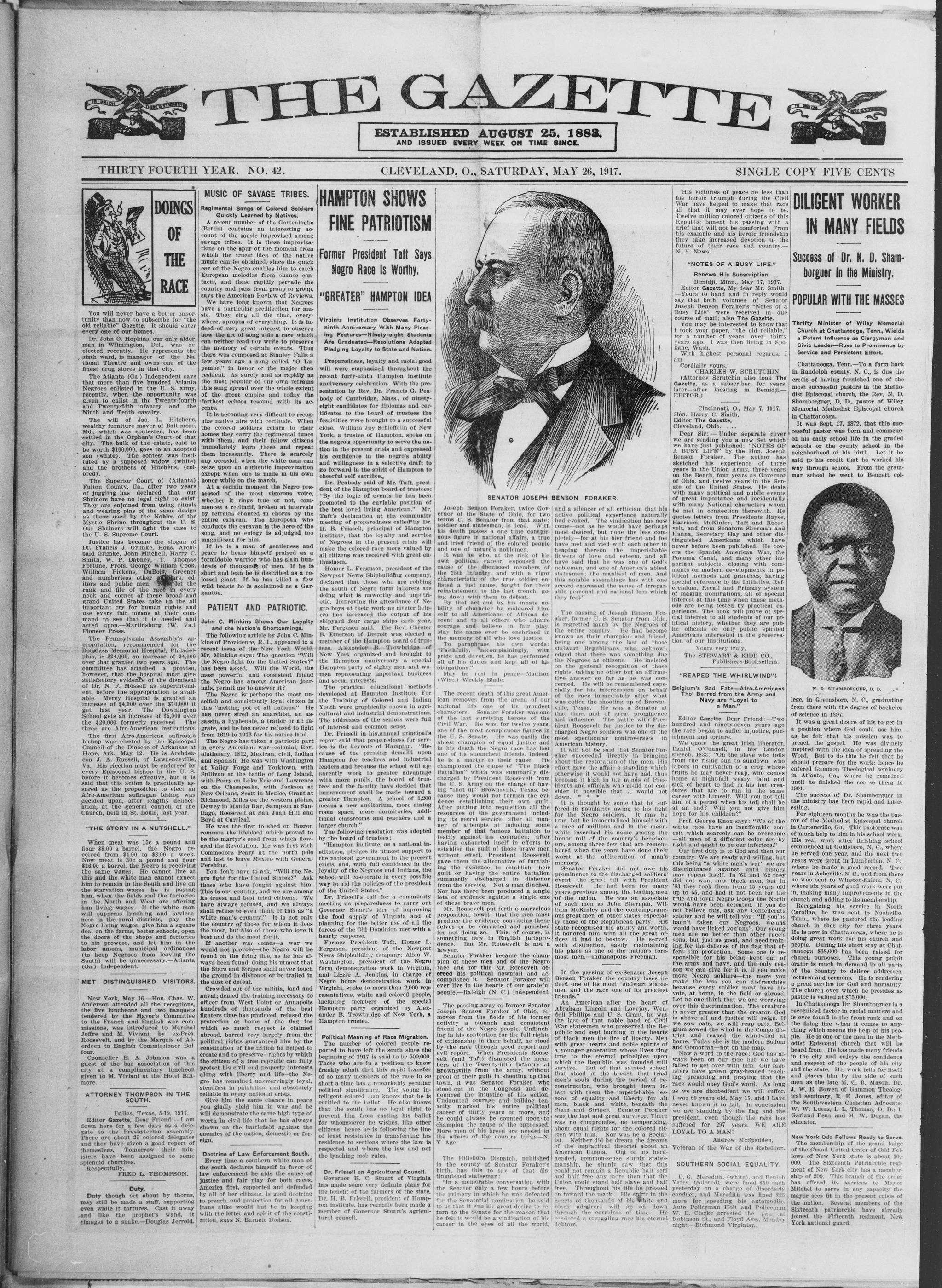
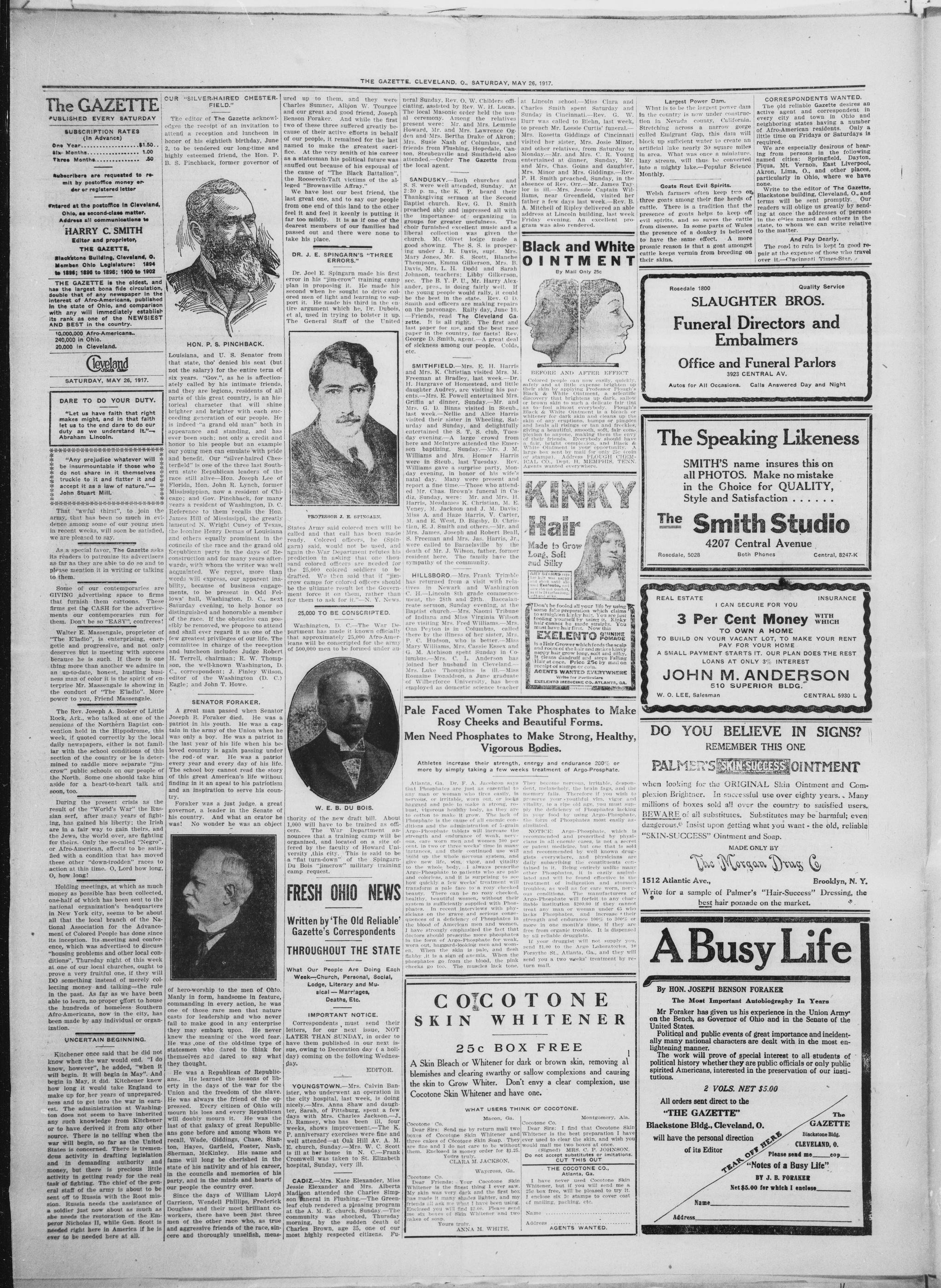
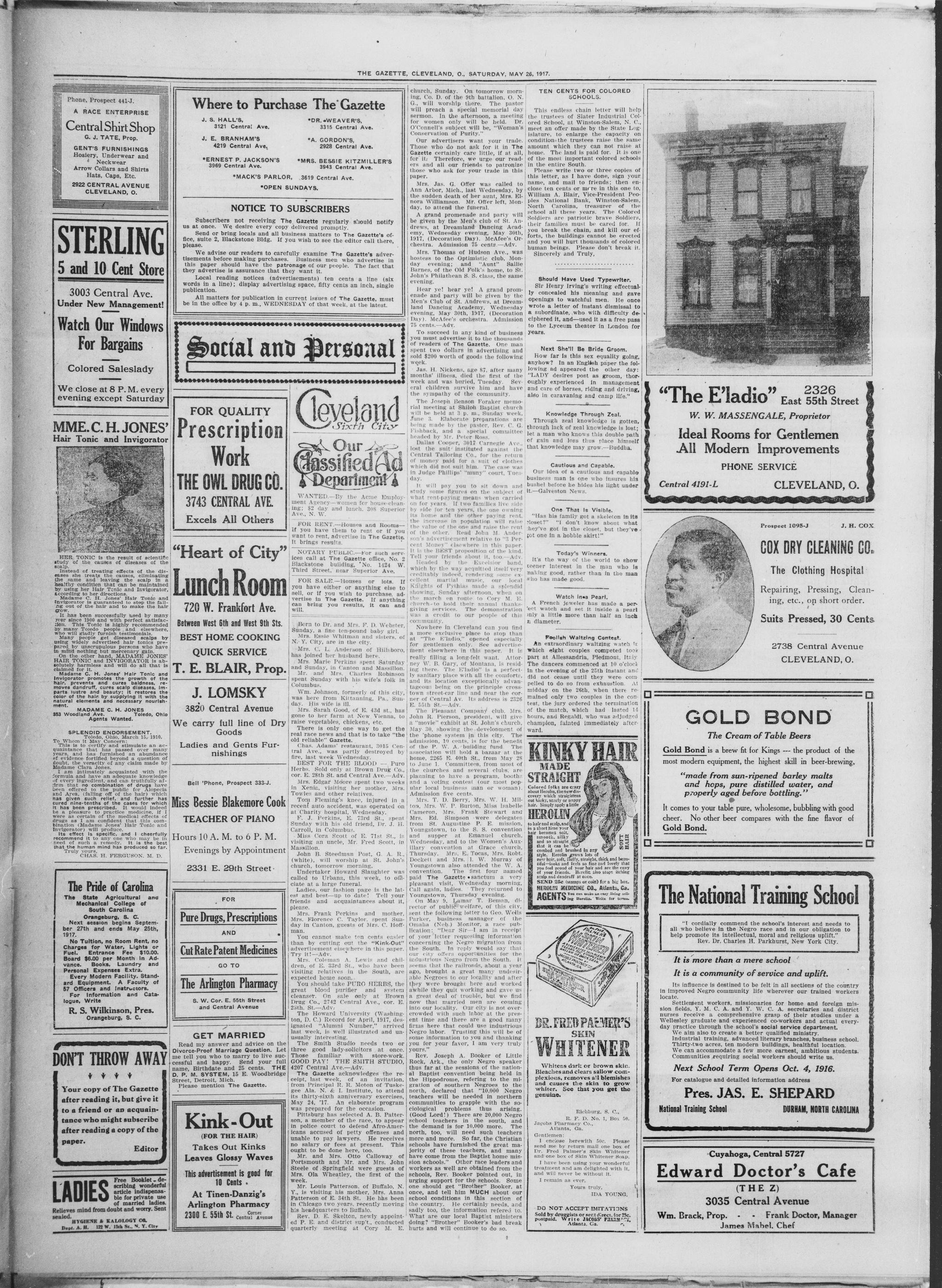
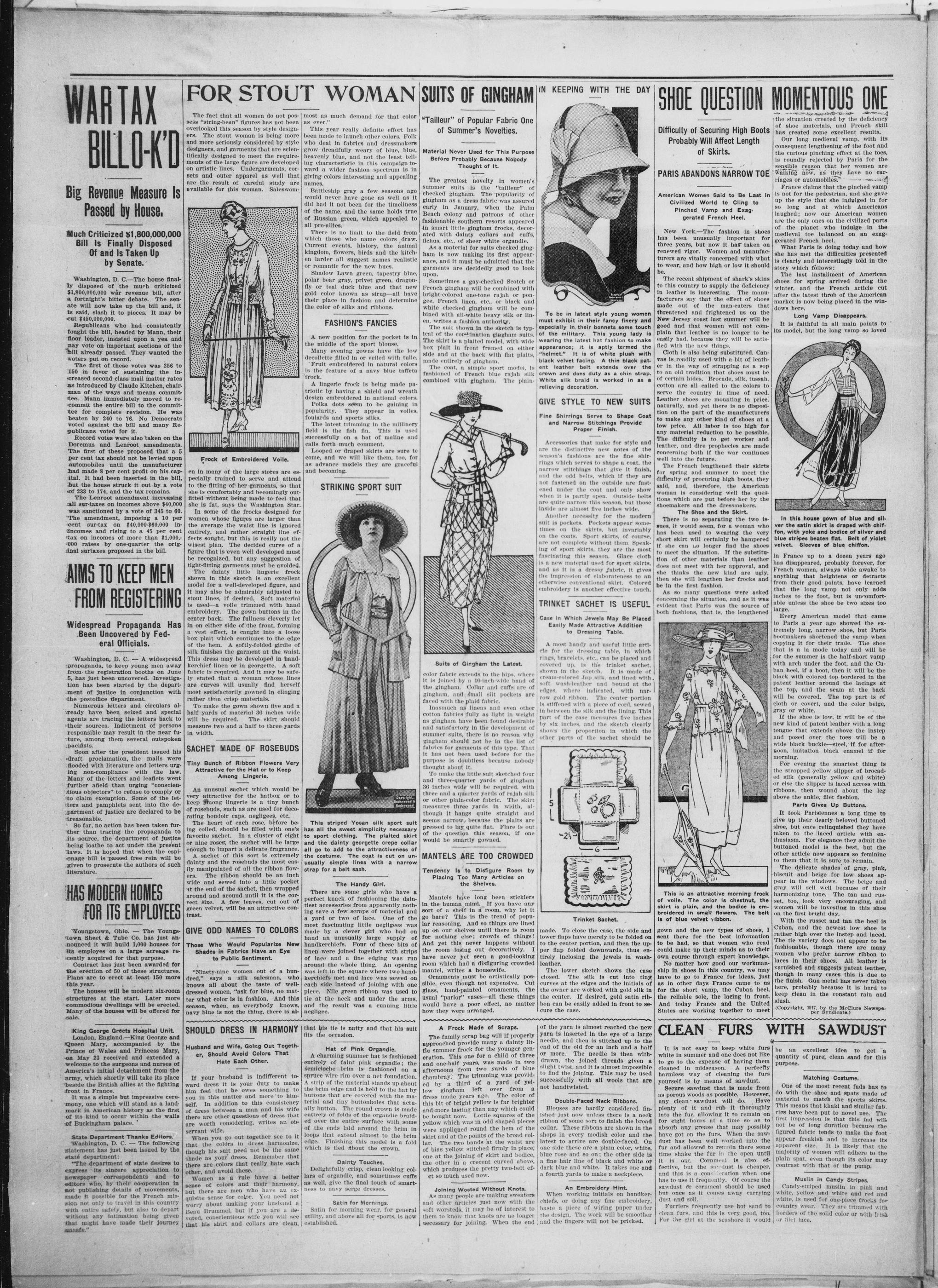
Page text (machine-generated)
THIRTY FOURTH YEAR. NO. 42.
IN UNION THERE IS TRUTH
DOINGS OF THE RACE
You will never have a better opportunity than now to subscribe for "the old reliable" Gazette. It should enter every one of our homes.
Dr. John O. Hopkins, our only alderman in Wilmington, Del., was re elected recently. He represents the sixth ward, is manager of the National Theatre and owns one of the finest drug stores in that city.
The Atlanta (Ga.) Independent says that more than five hundred Atlanta Negroes relished in the U.S. army recently, when the opportunity was given to enlist in the Twenty-fourth and Twenty-fifth infantry and the Ninth and Tenth cavalry.
the will of Jas. L. Hitchens, the wealthy furniture mover of Baltimore, Md., which was contested, has been settled in the Orphan's Court of that city. The bulk of the estate, said to be worth $100,000, goes to an adopted son (white). The contest was instituted by a supposed widow (white) and the brothers of Hitchens, (colored).
The Superior Court of (Atlanta) Fulton County, Ga., after two years of juggling has declared that our Shriners have no legal right to exist. They are enjoined from using rituals and wearing pins of the same derm used by the Nobles of the Mystic Shrine throughout the U. S. Our Shriners will fight the case to the U. S. Supreme Court.
Justice has become the slogan of Dr. Francis J. Grimke, Hons. Archibald Grimke, John Mitchell, Harry C. Smith, W. P. Dabney, T. Thomas Fortune, Profs. George William Cook, William Pickens, DuBois, Greener and numberless other editors, editors and public men. N. let the rank and file of the race in every nook and corner of these broad and grand United States take up the all-important role in the fight, using every fair means at their command to see that it is heeded and acted upon.—Martinsburg (W. Va.) Pioneer Press.
The Pennsylvania Assembly's appropriation, recommended for the Douglass Memorial Hospital, Philadelphia, is $24,000, an increase of $4,000 over that granted two years ago. The committee has attached a provisio, however, that the hospital must give satisfactory evidence of the dismissal of the inmate, before the appropriation is available. Mercy Hospital is granted an increase of $4,000 over the $10,000 it got last year. The Downington School gets an increase of $5,000 over the $20,000 formerly received. The three are Afro-American institutions. The first Afro-American suffragan bishop was elected by the Episcopal Council of the Diocese of Arkansas at Hope, Ark., May 12. He is Archdeacon J. A. Russell, of Lawrenceville, Va. His election must be endorsed by the governor before it becomes effective, but it is said that this action is practically assured as the proposition to elect an Afro-American suffragan bishop was decided upon, after lengthy deliberation, at the general council of the Church, held in St. Louis, last year.
"THE STORY IN A NUTSHELL."
When meat was 15c a pound and flour $8.00 a barrel, the Negro received from $4.00 to $8.00 a week. Now meat is 30c a pound and flour $16.00 a barrel, the Negro is receiving the same wages. He cannot live at this and the white man cannot expect to live in the fields and the starvation wages he is paying him, when the fields and the factories in the North and West are offering him living wages. If the white man will suppress lynching and lawlessness in the rural districts, pay the Negro living wages, give him a square deal on the farms, better schools, open schools, and land to his prowess, and let him in the labor unions, municipal ordinances (to keep Negroes from leaving the South) will be unnecessary.-Atlanta (Ga.) Independent.
MET DISTINGUISHED VISITORS
New York, May 16—Hon. Chas. W. Anderson attended all the receptions the five luncheons and two banquets tendered by the Mayor's Committee to the French and English war commissions, was introduced to Marsha Joffre and M. Viviani, by ex-Pres Roosevelt, and by the Marquis of Aberdeen to English Commissioner Balfour.
Counseler E. A. Johnson was a guest of the bar association of this city at a complimentary luncheon given to M. Viviani at the Hotel Bilt more.
ATTORNEY THOMPSON IN THE SOUTH.
Dallas, Texas, 5-19, 1917.
Editor Gazette, Dear Friend: I am down for a few days as a delegate to the Presbyterian assembly. There are about 25 colored delegates and they have given a good report of themselves. Tomorrow their ministers have been assigned to some splendid churches.
Respectfully.
FRED L. THOMPSON.
Duty.
Duty though set about by thorns, may still be made a staff, supporting even while it tortures. Cast it away and like the prophet's wand, it changes to a snake.-Douglas Jerrold.
THE GAZETTE
MUSIC OF SAVAGE TRIBES.
Regimental Songs of Colored Soldiers Quickly Learned by Natives
A recent number of the Gartenlaube (Berlin) contains an interesting account of the music improvised among savage tribes. It is these improvisations on the spur of the moment from which the truest idea of the native music can be obtained, since the quick ear of the Negro enables him to catch European melodies from chance contacts, and these rapidly pervade the country and pass from group to group, says the American Review of Reviews. We have long known that Negroes have a particular predication for music. They sing all the time, everywhere, apropos of everything. It is indeed of very great interest to observe how the art of song aids a race which can neither read nor write to preserve the memory of certain events. Thus there was composed at Stanley Falls a few years ago a song called "O Lupembe," in honor of the major then resident. As surely and as rapidly as the most popular of our own refrains this song spread over the whole extent of the great empire and today the farthest echoes resound with its accents. It is becoming very difficult to recognize native airs with certitude. When the colored soldiers return to their homes they carry the regimental tunes with them, and their fellow citizens immediately learn these and repeat them incessantly. There is scarcely any occasion when the white man can seize upon an authentic improvization except when one is made in his own honor while on the march.
At a certain moment the Negro possessed of the most vigorous voice, whether it rings true or not, commences a recitatif, broken at intervals by refranks chanted in chorus by the entire caravan. The European who conducts the caravan is the hero of the song, and no eulogy is adjudged too magnificent for him. If he is a man of gentleness and peace he hears himself praised as a formidable warrior who has slain hundreds of thousands of men. If he is short and lean he is described as a colossal giant. If he has killed a few wild beasts he is acclaimed as a Gargantua.
PATIENT AND PATRIOTIC
John C. Minkins Shows Our Loyalty and the Nation's Shortcomings.
The following article by John C. Minkins of Providence, R. L., appeared in a recent issue of the New York World, Mr. Minkins says: The question "Will the Negro fight for the United States?" has been asked. Will the World, the most powerful and consistent friend the Negro has among American journals, permit me to answer it?
The Negro is perhaps the most unselfish and consistently loyal citizen in this "melting pot of all nations." He has never used an anarchist, an assassin, a hymenate, a traitor or an ingrate, and he has never refused to fight from 1619 to 1696 for his native land. Negro has taken a patriotic part in every American war—colonial, Revolutionary, 1812, Mexican, civil, Indian and Spanish. He was with Washington at Valley Fonge and Yorktown, with Sultun at the battle of Long Island, with Perry on Lake Erie and Lawrence on the Chesapeake, with Jackson at New Orleans, Scott in Mexico, Grant at Richmond, Miles on the western plains, Dewey in Manila Bay, Sampson at Santiago, Roosevelt at San Juan Hill and Boyd at Carrizal.
He was the first to shed on Boston common the lifeblood which proved to be the martyr's seed from which flowed the Revolution. He was first with Commodore Peary at the north pole and last to leave Mexico with General Pershing.
You don't have to ask, "Will the Negro fight for the United States?" Ask those who have fought against him. This is our country, and we are among its truest and best tried citizens. We have always refused, and we always shall refuse to even think of this as "a white man's country." It is not only the country of those for whom it does the most, but also of those who love it best and do the most for it.
If another war comes—a war we would not provoke—the Negro will be found on the firing line, as he has always been found, doing his utmost that the Stars and Stripes shall never touch the ground in dishonor or be trailed in the dust of defeat.
Crowded out of the militia, land and naval; denied the training necessary to officer from West Point or Annapolis hundreds of thousands of the best fighters time has produced, refused the protection at home of the flag for which so much respect is claimed abroad, barred very largely from the political rights guaranteed him by the constitution of the nation he helped to create and to preserve—rights by which the citizen of a free-republic can fully protect his civil and property interests along with liberty and life—the Negro has remained unswervingly loyal, steadfast in patriotism and absolutely reliable in every national crisis.
Give him the same chance in peace you gladly yield him in war and he will demonstrate the same high type of worth in civil life that he has always shown on the battlefield against the enemies of the nation, domestic or foreign.
Doctrine of Law Enforcement South.
Every time a southern white man of the south declares himself in favor of law enforcement he aids the cause of justice and fair play for both races. America first, supported and defended by all of her citizens, is good doctrine to preach, and protection for all Americans alike would but be in keeping with the letter and spirit of the constitution, says N. Barnett Dodson.
ESTABLISHED AUGUST 25, 1883 AND ISSUED EVERY WEEK ON TIME SINCE.
CLEVELAND, O., SATURDAY, MAY 26, 1917.
HAMPTON SHOWS FINE PATRIOTISM
Virginia Institution Observes Fortyninth Anniversary With Many Pleasing Features—Ninety-eight Students Are Graduated—Resolutions Adopted Pledging Loyalty to State and Nation.
Preparedness, loyalty and racial good will were emphasized throughout the recent forty-ninth Hampton institute anniversary celebration. With the presentation by Rev. Dr. Francis G. Peabody of Cambridge, Mass., of ninety-eight candidates for diplomas and certificates to the board of trustees the festivities were brought to a successful close. William Jay Schleffelin of New York, a trustee of Hampton, spoke on the negro's opportunity to serve the nation in the present crisis and expressed his confidence in the negro's ability and willingness in a selective draft to go forward in the spirit of Hampton to cheerful self sacrifice.
Dr. Peabody said of Mr. Taft, president of the Hampton board of trustees: "By the logic of events he has been promoted to the enviable position of the best loved living American." Mr. Taft's declaration at the community meeting of preparedness called by Dr. H. B. Frissell, principal of Hampton institute, that the loyalty and service of Negroes in the present crisis will make the colored race more valued by all citizens was received with great enthusiasm.
Homer L. Ferguson, president of the Newport News Shipbuilding company, declared that those who are robbing the south of Negro farm laborers are doing what is unworthy and unpriotic. Improving the attendance of Negro boys at their work as riveter helpers has increased the output of his shipyard four cargo ships each year. Mr. Ferguson said. The Rev. Chester B. Emerson of Detroit was elected a member of the Hampton board of trustees. Alexander R. Towbridge of New York organized and brought to the Hampton anniversary a special Hampton party of eight men and women representing important business and social interests.
The practical educational methods developed at Hampton Institute For the Training of Colored and Indian Youth were graphically shown in agricultural and industrial demonstrations. The addresses of the seniors were full of interest and common sense.
Dr. Frissell in his annual principal's report said that preparedness for service is the keynote of Hampton. "Because of the pressing demand upon Hampton for teachers and industrial leaders and because the school will apparently work to greater advantage with more pupils, the board of trustees and the faculty have decided that improvement shall be made toward a greater Hampton. A school of 1,200 means a new auditorium, more dining room space, more dormitories, additional classrooms and teachers and a larger church."
The following resolution was adopted by the board of trustees:
"Hampton institute, as a national institution, pledges its utmost support to the national government in the present crisis, and, with full confidence in the joyfulness of the Negroes and Indians, the school will co-operate in every possible way to aid the policies of the president of the United States."
Dr. Frissell's call for a community meeting on preparedness to carry out Governor Stuart's idea of improving the food supply of Virginia and of planning for the better use of all the forces of the Old Dominion met with a hearty response.
Former President Taft, Homer L. Ferguson, president of the Newport News Shipbuilding company: Allen W. Washington, president of the Negro farm demonstration work in Virginia, and Lizzie A. Jenkins, in charge of Negro home demonstration work in Virginia, spoke to more than 2,000 representatives, white and colored people, including members of the special Hampton party organized by Alexander B. Trowbridge of New York, a Hampton trustee.
Political Meaning of Race Migration.
The number of colored people reported to have left the south since the beginning of 1917 is said to be 500,000. Those who are in a position to know frankly admit that this rapid transfer of so many members of the race in so short a time has a remarkably peculiar political significance. The young intelligent colored man knows that he is entitled to the ballot. He also knows that the south has no legal right to prevent him from casting his ballot for whomsoever he wishes, like other citizens; hence he is following the line of least resistance in transferring his residence to sections where the law is respected and where the law and not the lynching mob rules.
Dr. Frissell on Agricultural Council.
Governor H. C. Stuart of Virginia has made some very definite plans for the benefit of the farmers of the state. Dr. H. B. Frissell, president of Hampton institute, has recently been made a member of Governor Stuart's agricultural council.
SENATOR JOSEPH BENSON FORAKER.
Joseph Benson Foraker, twice Governor of the State of Ohio, for two terms U. S. Senator from that state; soldier and statesman, is dead. His death passes a one time conspicuous figure. In national affairs, a true and tried friend of the colored people and one of nature's noblemen.
It was he who, at the risk of his own political career, espoused the cause of the dismissed members of the 25th Infantry, and with a vigor characteristic of the true soldier enlisted a just cause, fought for their reinstatement to the last trench, going down with them to defeat.
By that act and by his innate nobility of character he endeared himself to all Americans of African descent and to all others who admire courage and believe in fair play. More ever he enlisted in the memory of all who love justice.
To paraphrase his own words: "Faithfully, incomplainingly, with pride and devotion, he has performed all of his duties and kept all of his obligations."
May he rest in peace—Madison (Wisc.) Weekly Blade.
and a silencer of all active political expections had evoked. The vinice—come as he woum most desired, but not pletely—for at his bishop have wived him, having there the flowers of love and have said that he woum noblemen, and one of statesmen; the manli this notable assemblia accord expressed the able personal and nat they feel."
The passing of Joseph aker, former U. S. Se is regretted much by the entire country, known as their cham being one among the stalwart Republicans edged that there was the Negroes as citizen on the general reco rights, taking no other tive answer so far.
The recent death of this great American removes from the arena of our national character. Senator Foraker was one of the last surviving heroes of the Civil War. He was, for twelve years, one of the most conspicuous figures in the U. S. Senate. He was easily the ablest champion of equal justice and in his death the Negro race has lost its power. He was also the hero he is a martyr to their cause. He championed the cause of "The Black Battalion" which was summarily discharged by President Roosevelt from the U. S. Army on the charge of having "shot up" Brownville, Texas, because they would not furnish the evidence establishing their own guilt. After putting into requisition all the men who had been executed in its secret service; after all manner of attempts at inducing some member of that famous battalion to testify against his comrades; after having exhausted itself in efforts to establish the guilt of those brave men without effect, President Roosevelt gave them the alternative of furnishing the evidence to establish their guilt or having the entire battalion killed. He was the first to remove from the service. Not a man finchett, nor has there been produced a single lota of evidence against a single one of these brave men. Mr. Roosevelt put forth a marvelous proposition, to-wit: that the men must prove the evidence convicting themselves or be convicted and punished for not doing so. This, of course, is something new in English jurisprudence. But Mr. Roosevelt is not a lawyer.
Senator Foraker became the champion of these men and of the Negro race and for this Mr. Roosevelt decreed his political downfall and accomplished it. Senator Foraker will ever live in the hearts of our grateful people—Haleigh (N. C.) Independent.
The passing away of former Senator Joseph Benson Foraker of Ohio, removed from the fields of activity a staunch and consistent friend of the Negro people. Unflinching in his contention for the full rights of citizenship in their behalf, he stood by the race through good report and evil report. When Presidents Roosevelt (and Taft) dismissed the members of the Twenty-fifth Infantry at Brownville from the army, without proof of their identity up there, he Senator Foraker stood out in the Congress and denounced the injustice of his action. Undaunted courage and bulldog tenacity marked his entire political career of thirty years or more, and he could always be counted upon to champion the cause of the oppressed. More men of his breed are needed in the affairs of the country today—N. Y. Age.
The Hillsboro Dispatch, published in the county of Senator Foraker's birth, has this to say of that distinguished statesman:
"In a memorable conversation with the Senator only a few hours before the primary in which he was defeated was over, he said to us that it was his great desire to return to the Senate for the reason that he felt it would be a vindication of his career in the eyes of all the world,
and a silencer of all criticism that his active political experience naturally had evoked. The vindication has now come—not as he would have perhaps most desired, but none the less completely—for at his bier friend and foe have met and vied with each other in heaping thereon the imperishable flowers of love and esteem, and all have said that he was one of God's noblemen, and one of America's ablest missionaries, the most of whom this notable assemblage has with one accord expressed the sense of irreparable personal and national loss which they feel."
The passing of Joseph Benson Foraker, former U. S. Senator from Ohio is regretted much by the Negroes of the entire country. He had become known as their champion and friend, being one among the last of those stalwart Republicans who acknowledged that there was something due the Negroes as citizens. He insisted on the general recognition of those rights, taking no other but an affirmative answer so far as he was concerned. He will be remembered especially for his intercession on behalf of the race immediately after what was called the shooting up of Brownville, Texas. He was a Senator at State House and great promoter and influence. The battle with President Roosevelt for justice to the discharged Negro soldiers was one of the most spectacular controversies in American history.
It will not be said that Senator Foraker succeeded directly in bringing about the restoration of the men. His effort gave the affair a standing which otherwise it would not have had, thus keeping it high in the minds of Presidents and officials who could not consider it possible that it would not down.
It is thought by some that he suffered in popularity owing to his fight for the Negro soldiers. It may be true, but he immortalized himself with a race of millions and in the meanwhile inscribed his name among the honor roll of the country's benefactors, among those few that are remembered when the years have done their worst at the obliteration of man's memory.
Senator Foraker did not owe his prominence to the discharged soldiers' event—the great tilt with President Roosevelt. He had been for many years previous among the leading men of the nation. He was an associate of such men as John Sherman, William McKinley and the contemporaneous great men of other states, especially those of the Republican states. His state recognized his ability and worth, it honored him with all the great offices it had to bestow. He served with distinction, easily maintaining his place as one of the nation's foremost men.—Indianapolis Freeman.
In passing of ex-Senator Joseph Benson Foraker the country loses indeed one of its most "stalwart statesmen and the race one of its greatest friends."
An American after the heart of Abraham Lincoln and Lovejoy, Wendell Phillips and U. S. Grant, he was the last of that noble band of Civil War statesmen who preserved the Republic and kept burning in the hearts of black men the fire of liberty. Men with great hearts and noble spirits of a younger generation whose lives ring true to the eternal principles upon which the Republic was founded still survive. But of that saintified school stood a man who men's souls during the period of reconstruction, who brought down intact with them the imperishable lessons of equality and liberty for all men, black and white, beneath the Stars and Stripes. Senator Foraker was the last and great survivor. There was no compromise, no temporizing, about equal rights for the colored citizen with him. Nor was he a Socialist. Neither did he dream the dreams of the impractical theorist about an American Utopia. Out of his hardhead, common-sense sturdy statesmanship, he simply saw that this could not remain a Republic half serif and half free any more than that the Union could stand half slave and half free through his life he prepared on toward the mark. His spirit in the hearts of thousands of his white and black admirers will go on down through the corridors of time. He condemned a struggling race his eternal debtors.
SINGLE COPY FIVE CENTS
His victories of peace no less than his heroic triumph during the Civil War have helped to make that race all that it may ever hope to be. Twelve million colored citizens of this Republic lament his passing with a grief that will not be comforted. From his example and his heroic friendship they take increased devotion to the future of their race and country.—N. Y. News.
"NOTES OF A BUSY LIFE."
Renews. His Subscription.
Bimidji, Minn., May 17, 1917.
Editor Gazette, My dear Mr. Smith:
—Yours to hand and in reply would
say that both volumes of Senator
Joseph Benson Foraker's "Notes of a
Busy Life" were received in due
course of mail; also The Gazette.
You may be interested to know that
I took your paper, "the old reliable,"
for a number of years over thirty
years ago. I was then living in Spokane, Wash.
With highest personal regards, I am
Cordially yours,
CHARLES W. SCRUTCHIN.
(Attorney Scrutchin also took The
Gazette, as a subscriber, for years,
later—after locating in Bemidji—
EDITOR.)
Cincinnati, O., May 7, 1917.
Hon. Harry C. Smith,
Editor The Gazette,
Cleveland, Ohio.
Dear Sir: — Under separate cover we are sending you a new Set which we have just published: “NOTES OF A BUSY LIFE” by the Hon. Joseph Benson Foraker. The author has sketched his experience of three years in the Union Army, three years on the Bench, four years as Governor of the State and five years as Senate of the United States. He deeds with many political and public events of great importance and incidentally with many National characters whom he met in connection therewith. He quotes letters from Presidents Hayes, Harrison, McKinley, Taft and Roosevelt, and from Senators Sherman and Hanna, Secretary Hay and other distinguished Americans which have never before published. We officers the Spanish American War, the Panama Canal, and many other important subjects, closing with comments on modern developments in political methods and practices, having special reference to the Initiative, Referendum, Recall and Primary system of making nominations, all of special interest at this time when these methods are being tested by practical exertions. We have special interest to all students of political history, whether they are public officials or only public spirted Americans interested in the preservation of our institutions.
Yours very truly,
The STEWART & KIDD CO.,
Publishers-Booksellers.
"REAPED THE WHIRLWIND"
Belgium's Sad Fate—Afro-Americans
Theo' Barred from the Army and
Navy are "Loyal to
a Man."
Editor Gazette, Dear Friend;—two hundred and ninety-seven years ago the race began to suffer injustice, punishment and torture.
We quote the great Irish librarian, Daniel O'Connell, in his London speech, 1833: "Oh the slave who tolls the slave who labors in cultivation of a crop whose fruits he may never reap, who comes home at night-fall weary, faint and sick of heart to find in his hut creatures that are to run in the same career with himself. Will you not tell him of a period when his toil shall be at an end? Will you not give him hope for his children?" George Knox says: "We of the white race are in sufferable conceit which scarcely can be overcome—all men of a different color are by right and ought to be our inferiors."
Our first duty is to God and then our country. We are ready and willing, but this being "a white man's war" we are discriminated against until history may repeat itself. In '61 and '62 they did not want any black men, but in '63 they took them from 15 years old up to 65, and had it not been for the true and loyal Negro troops the North would have been defeated. If you do not have a soldier, you should be a soldier and he will tell you: "If you hadn't taken our Negroes, we-uns would have licked you'un's. Our young men are no better than other race's sons, but just as good, and need training for the defense of the flag that offers him protection. Some one is responsible for his being kept out of the army and navy, and the only reason we can give for it is, if you make more Negro soldiers—the more you make the less you can disfranchise because every soldier must have his vote, at home, in the field or abroad, and that we are worrying over this discrimination, the creature is never greater than the creature is above all and justice will reign. If we sow oats, we will reap oats. Belgium sowed the wind in the Congo district and reaped the whirlwind at home. Today she is the modern Sodom and Gomorrah—not on the map.
Now a word to the race: God has always been on our side but we have failed to get over with him. Our ministers have grown gray-headed teaching, preaching and praying that the race would obey God's word. As long as we are disobedient we will suffer. I was 69 years old, May 15, and I have never known it to fail. In conclusion we are standing by the flag and the president, even though the race has suffered for 297 years. WE ARE LOYAL TO A MAN!
Andrew McSpadden, Veteran of the War of the Rebellion
SOUTHERN SOCIAL EQUALITY.
D. G. Meredith, (white), and Beuth Yates, (colored), were fined $50 each yesterday on a charge of disorderly conduct, and Meredith was fined $25 more for speeding his automobile Auto Policeman Holt and Policeman Kramer, both paid at Robinson St. and Floyd Ave. Monday night, -Richmond Virginian.
THE EAGLE
HANDS
DILIGENT WORKER IN MANY FIELDS
Success of Dr. N. D. Shamborguer In the Ministry.
POPULAR WITH THE MASSES
Thrifty Minister of Wiley Memorial Church at Chattanooga, Tenn., Wields a Potent Influence as Clergyman and Civic Influence—Rose to Prominence by Service and Persistent Effort.
Chattanooga, Tenn.—To a farm back in Randolph county, N. C., is due the credit of having furnished one of the most successful pastors in the Methodist Episcopal church, the Rev. N. D. Shambarguer, D. D., pastor of Wiley Memorial Methodist Episcopal church in Chattanooga.
It was Sept. 17, 1872, that this successful pastor was born and commenced his early school life in the graded schools or the county school in the neighborhood of his birth. Let it be said to his credit that he worked his way through school. From the grammar school he went to Bennett col-
N. D. SHAMBORGUER, D. D.
lege, in Greensboro, N. C., graduating
from there with the degree of bachelor
of science in 1897.
It was a great desire of his to get in a position where God could use him, as he felt that his mission was to preach the gospel. He was divinely inspired with the idea of spreading the Word. But to do this he felt that he should prepare for the work; hence he entered Gammon Theological seminary in Atlanta, Ga., where he remained until he finished the course there in 1901.
The success of Dr. Shamborgner in the ministry has been rapid and interesting.
For eighteen months he was the pastor of the Methodist Episcopal church Cartersville, Ga. This pastorate was of much help to him in his school work. His real work after finishing school commenced at Goldshore, N.C., where he served one year, and the next two years were spent in Lumberton, N.C., where he made a good record. Two years in Asheville, N.C., and from there he was sent to Winston-Salem, N.C., where six years of good work were put in, making many improvements in the church and adding to its membership.
Recognizing his service in North Carolina, he was sent to Nashville, Tennessee, where he pastored the leading church in that city for three years. He is now in Chattanooga, where he is doing great work for his church and people. During his short stay at Chattanooga $38,000 has been raised for church purposes. This young pulpit orator is much in demand in all parts of the country to deliver addresses, lectures and sermons. He is rendering a great service for God and humanity. The church over which he presides as pastor is valued at $75,000.
In Chattanooga Dr. Shamborgner is a recognized factor in racial matters and is ever found in the front rank and on the fireline line when it comes to anything which means the help of his people. He is one of the men in the Methodist Episcopal church that will be heard from. He has made many friends in the city and enjoys the confidence and respect of the people of his city and the state. His work tells for itself and places him by the side of such men as the late M. C. B. Mason, Dr. J. W. E. Bowen of Gammon Theological seminary, R. E. Jones, editor of the Southwestern Christian Advocate; W. W. Lucas, I. L. Thomas, D. D.; G. Garland Penn and M. W. Dogan, the educator.
New York Odd Fellows Ready to Serve.
The membership of the grand lodge of the Grand United Order of Odd Fellows of New York state is about 10,000. The Sixteenth Patriarchie regiment of New York city has a membership of 200. This branch of the order has offered its services to Mayor Mitchel to serve in any capacity the mayor sees fit in the present crisis of the nation. Several members of the Sixteenth patriarchie have already joined the Fifteenth regiment, New York national guard.
The GAZETTE
One Year.....$1.50.
Six Months.....1.00
Three Months......50
Subscribers are requested to remit by postoffice money order or registered letter
Entered at the postoffice in Cleveland Ohio, as second-class matter.
Address all communications to
Blackstone Building, Cleveland, O.
Momben Ohio Legislature: 1894
to 1896; 1896 to 1898; 1900 to 1902
THE GAZETTE is the oldest, and
has the largest bona fide circulation,
double that of any newspaper in the
American publications published
in the state of Ohio, and comparison
with any will immediately establish
its rank as one of the NEWSIEST
AND BEST in the country.
10,000,000 Afro-American.
240,000 in Ohio.
20,000 in Cleveland.
SATURDAY, MAY 26, 1917
DARE TO DO YOUR DUTY.
"Let us have faith that right make me might, and in that faith let us to the end dare to do our work to understand it."—Abraham Lincoln.
"Any prejudice whatever will be insurmountable if those who do not share in it themselves truckle to it and flatter it and accept it as a law of nature."—John Stuart Mill.
That "awful thirst", to join the army, that has been so much in evidence among some of our young men in recent weeks, will soon be satisfied, we are pleased to say.
As a special favor, The Gazette asks its readers to patronize its advertisers as far as they are able to do so and to please mention it in writing or talking to them.
Some of our contemporaries are GIVING advertising space to firms that furnish their cartoons. These firms get the CASH for the advertisements our contemporaries run for them. Don't be so "EASY", conferels!
Walter E. Massengale, proprietor of "The Eladio", is enterprising, energetic and progressive, and not only deserves but is meeting with success because he is such. If there is one thing more than another we admire in an up-to-date, honest, hustling business man of color it is the spirit of enterprise Mr. Massengale is showing in the conduct of "The Eladio". More power to you, Friend Massengale.
The Rev. Joseph A. Booker of Little Rock, Ark., who talked at one of the sessions of the Northern Baptist convention held in the Hippodrome, this week, if quoted correctly by the local daily newspapers, either is not familiar with the school conditions of this section of the country or he is determined to saddle more separate "jim-crow" public schools on our people of the North. Some one should take him aside for a heart-to-heart talk and soon, too.
During the present crisis as the result of the "World's War" the Russian serf, after many years of fighting, has gained his liberty; the Irish are in a fair way to gain thelars, and the Jews, the world over, are fighting for thelars. Only the so-called "Negro," or Afro-American, affects to be satisfied with a condition that has moved these other "down-trodden" races to action at this time. O, Lord how long, O, how long!
Holding meetings, at which as much money as possible has been collected, one-half of which has been sent to the national organization's headquarters in New York city, seems to be about all that the local branch of the National Association for the Advancement of Colored People has done since its inception. Its meeting and conference, which was advertised to discuss "housing problems and other local conditions", Thursday night of this week at one of our local churches, ought to prove a very fruitful one, if they will DO something instead of merely collecting money and talking—the rule in the past. As far as we have been able to learn, no proper effort to house the hundreds of homeless Southern Afro-Americans, now in the city, has been made by any individual or organization.
UNCERTAIN BEGINNING.
Kitchener once said that he did not know when the war would end. "I do know, however", he added, "when it will begin. It will begin in May." And begin in May, it did. Kitchener knew how long it would take England to make up for her years of unpreparedness and to get into the war in earnest. The administration at Washington does not seem to have inherited any such knowledge from Kitchener or to have derived it from any other source. There is no telling when the war will begin, so far as the United States is concerned. There is tremendous activity in drafting legislation and in demanding authority and money, but there is precious little activity in getting ready for the real task of fighting. The chief of the general staff of the army is about to be sent off to Russia with the Root mission. Russia needs the assistance of a soldier just now about as much as she needs the restoration of the Emperor Nicholas II, while Gen. Scott is needed right here in America if he is ever to be needed here at all.
OUR "SILVER-HAIRED CHESTER- FIELD."
The editor of The Gazette acknowledges the receipt of an invitation to attend a reception and luncheon in honor of his eighteenth birthday, June 2, to be tendered our long-time and highly esteemed friend, the Hon. P. B. S. Pinchback, former governor of
HON. P. S. PINCHBACK.
Louisiana, and U. S. Senator from that state, the 'denied his seat (but not the salary) for the entire term of six years. "Gov.", as he is affectionately called by his intimate friends, and they are legions, residents of all parts of this great country, is an historical character that will shine brighter and brighter with each succeeding generation of our people. He is indeed "a grand old man" both in appearance and standing, and has ever been such; not only a credit and honor to his people but an example of our young men can emulate with pride and benefit. Our "silver-haired Chesterfield" is one of the three last Southern state Republican leaders of the race still alive—Hon. Joseph Lee of Florida, Hon. John R. Lynch, former Mississippi, now a resident of Chicago; and Gov. Pinchback, for many years a resident of Washington, D. C. Reference to them recalls the Hon. James Hill of Mississippi, the greatly lamented N. Wright Cuney of Texas, the leonine Henry Demas of Louisiana and others equally prominent in the councils of the race and the grand old Republican party in the days of Reconstruction and for many years afterwards, with whom the writer was well acquainted. We regret, more than words will express, our apparent inability, because of business engagements, to be present in Odd Fellows' hall, Washington, D. C., next Saturday evening, to help honor so distinguished and honorable a member of the race. If the obstacles can possibly be removed, we propose to attend and shall ever regard it as one of the few greatest privileges of our life. The committee in charge of the reception and luncheon includes Judge Robert H. Terrell, chairman; R. W. Thompson, the well-known Washington, D. C., correspondent; J. Finley Wilson, editor of the Washington (D. C.) Eagle; and John T. Howe.
SENATOR FORAKER.
A great man passed when Senator Joseph B. Foraker died. He was a patriot in his youth. He was a captain in the army of the Union when he was only a boy. He was a patriot in the last year of his life when his beloved country is again passing under the rod-of war. He was a patriot every year and every day of his life. The school boy cannot read the story of this great American's life without finding in it an appeal to his patriotism and an inspiration to serve his country. Foraker was a just judge, a great governor, a leader in the Senate of his country. And what an orator he was! No wonder he was an object
PETER H. H.
of hero-worship to the men of Otho.
Manly in form, handsome in feature,
commanding in every action, he was
one of those rare men that nature
casts for leadership and who never
fall to make good in any enterprise
they may embark upon. He never
knew the meaning of the word fear.
He was, one of the old-time type of
statesmen who dared to think for
themselves and dared to say what
they thought.
He was a Republican of Republicans. He learned the lessons of liberty in the days of the war for the Union and the freedom of the slave. He was always the friend of the oppressed. Every citizen of Ohio will mourn his loss and every Republican will doubly mourn it. He was the last of that galaxy of great Republicans gone before and among whom we recall, Wade, Giddings, Chase, Stanton, Hayes, Garfield, Foster, Nash, Sherman, McKinley. His name and fame will long be cherished in the state of his nativity and of his career, in the councils and memories of his party, and in the minds and hearts of our people the country over.
Since the days of William Lloyd Garrison, Wendell Phillips, Frederick Douglass and their most brilliant coworkers, there have been just three men of the other race who, as true and aggressive friends of the race, sincere and thoroughly unselfish, meas-
THE GAZETTE, CLEVELAND, O., SATURDAY, MAY 26, 1917
ured up to them, and they were Charles Sumner, Allijon W. Tourgee and our great and good friend, Joseph Benson Foraker. And while the first two of these three suffered greatly because of their active efforts in behalf of our people, it remained for the last named to make the greatest sacrifice. At the very zenith of his career as a statesman his political future was snuffed out because of his espousal of the cause of "The Black Battalion," the Roosevelt-Taft victims of the alleged "Brownsville Affray." We have lost our best friend, the last great one, and to say our people from one end of this land to the other feel it and feel it keenly is putting it far too mildly. It is as if one of the dearest members of our families had passed out and there were none to take his place.
DR. J. E. SPINGARN'S "THREE ERRORS."
Dr. Joel E. Spingarn made his first error in his "jim-crow" training camp plan in proposing it. He made his second when he sought to drive colored men of light and learning to support it. He made his third in the en camp. He was also in training at et al, used in trying to bolster it up. The General Staff of the United
M.
PROFESSOR J. E. SPINGAIN.
States Army said colored men will be called and that call has been made ready. Colored officers, he (Spingain) said, would not be used, and again the War Department refutes his prediction in saying that one man and colored officers are needed for the 25,000 colored soldiers to be drafted. We then said that "jim-crow camps for colored officers should be the ultimate result let the Government force it on them, rather than for them to ask for it." N. Y. News.
25.000 TO BE CONSCRIPTED
Washington, D. C.—The War De partment has made it known officially that approximately 25,000 Afro-Americans will be conscripted for the army of 500,000 men to be formed under au
W. E. B. DU BOIS.
thority of the new draft bill. To 1,000 will have to be trained as officers. The War Department announces that a training camp will be organized, and located on a site offered by the faculty of Howard University "stay at home" and said to be a "flat turn-down" of the Springau Du Bois "jimcrow" military training camp request.
FRESH OHIO NEWS
Written by 'The Old Reliable Gazette's Correspondents
What Our People Are Doing Each Week—Church, Personal, Social, Lodge, Literary and Musical — Marriages, Deaths, Etc.
IMPORTANT NOTICE
Correspondents must send their letters, for our next issue, NOT LATER THAN SUNDAY, in order to have them published in our next issue, owing to Decoration day ( a holiday) coming on the following Wednesday.
EDITOR.
YOUNGSTOWN—Mrs. Calvin Bantler, who underwent an operation in the city hospital, last week, is doing nicely—Mrs. Anna Shaw and daughter, Sarah, of Pittsburg, spent a few days with Mrs. Charles Jackson—J. D. Ramsey, who has been ill, four weeks, shows improvement. The K. P. anniversary exercises were fine and well attended—at Oak Hill Av. A. M. E. church, Sunday—Mrs. W. C. Scott is ill at her home in N. C.—Frank Cromwell was taken to St. Elizabeth hospital, Sunday, very ill.
CADIZ—Mrs. Kate Eleander, Miss Jessie Eleander and Mrs. Alberta Madison attended the Charles Simpson annual in Flushing—The Greenleaf club rendered a pleasing program at the A. M. E. church, Sunday—The community was shocked, Thursday morning, by the sudden death of Charles Brown, age 35, one of our most hbily respected citizens. Fu-
neral Sunday, Rev, O, W. Childers officiating, assisted by Rev, W. H. Lucas. The local Masonic order held the usual ceremony. Among the relatives present were: Mr. and Mrs. Lemmie Howard, Mr. and Mrs. Lawrence Ogden and Mrs. Bertha Drake of Akron; Mrs. Susie Nash of Columbus, and friends from Flushing, Hopedale, Canton, Steubenville and Smithfield also attended.—Order The Gazette from the local agent.
SANDUSKY—Both churches and S. S. were well attended, Sunday. At 2:30 p. m., the K. P. heard their Thanksgiving sermon at the Second Baptist church. Rev. G. D. Smith preached ably and impressed all with the importance of organizing in groups for greater usefulness. The choir furnished excellent music and a liberal collection was given the church. M. Olivet lodge made a show. The S. S. is showing under J. R. Davis, sunt. Mrs. Mary Jones, Mr. S. Scott, Blanche Thompson, Emma Gilkerson, Mrs. B. Davis, Mrs. L. H. Dodd and Sarah Johnson, teachers; Libby Gilkerson, sec. The B. Y. P. U, Mr. Harry Alexander, press, is doing fairly well. If the young people would rally, it could be the best in the state. Rev. G. D. Smith and officers are making repairs on the parsonage. Rally day, June 10. Friends, read The Cleveland Gazette. It is all right. The first and last paper in the country, for facts! Rev George D. Smith, agent. —A great of sickness among our people. Colds etc.
SMITHFIELD.—Mrs. E. H. Harris and Mrs. K. Christian visited Mrs. M. Freeman at Bradley, last week.—Dr. H. Harrage of Homestead, and little daughter Audrey, are visiting his parents.—Mrs. E. Powell entertained Mrs. Griffin at dinner, Sunday.—Mr. and Mrs. G. D. Binns visited in Steub, last week.—Nellie and Alice Harris visited their sister in Wheeling, Saturday and Sunday, and delightfully entertained the S. T. S. club, Tuesday evening.—A large crowd from the community were invited the Emerson baptizing, Sunday.—Mr. M. Williams and Homer Harris were in Steub, last Tuesday. Rev. Williams gave a surprise party, Monday evening, in honor of his wife's natal day. Many were present and report a fine time.—Those who attended Mr. Chas. Brown's funeral in Cadiz, Sunday, were: Mr. and Mrs. H. Harris, Mesdames K. Christian, M. E. Veney, M. Jackson and M. J. Davis; Miss A. and Haze Harris, V. Carter, M. and E. West, D. Bigsby, D. Christie, M. Jackson and M. J. Davis; Mrs. James, Joseph and Robert Behr, S. Freeman and Mrs. Jas. Harris, Jr. were called to Barnelville by the death of Mr. J. Wilson, father, former resident here. The family have the sympathy of the community.
HILLSBORO—Mrs. Frank Trimble has returned from a visit with relatives in Newark and Washington C. H.—Lincoln 8th grade commencement, the 28th and 29th. Baccalaureate speech, Sunday evening, at the Baptist church—Mrs. Naomi Tribune of Indiana and Miss Virginia Wilson of Kentucky. Ona Peyton is in Columbus, called there by the illness of her sister, Mrs. P. C. Hudson, who is better.—Miss Mary Williams, Mrs. Cassie Essex and G. M. Atchison spent Sunday in Columbus.—Mrs. C. L. Anderson has joined her husband in Cleveland. Mrs Luke Thompson is in Newark. Jae graduate of Wilberforce University, has been employed as domestic science teacher
Pale Faced Women Take Rosy Cheeks and Men Need Phosphates to Vigorous Athletes increase their strength more by simply taking a few we
Pale Faced Women Take Phosphates to Make Rosy Cheeks and Beautiful Forms. Men Need Phosphates to Make Strong, Healthy, Vigorous Bodies.
Athletes increase their strength, energy and endurance 200% or more by simply taking a few weeks treatment of Argo-Prophase.
Atlanta, Ga. Dr. F. A. Jacobson says that Phosphates are just as essential to any man or woman who three easily, is nervous, or irritable, worn out, or looks haggard and pale to make a strong, robust, vigorous healthy body, as they are to cotton to make it grow. The lack of health is the common condition of all human conditions and the administration of 5-grain Argo-Phosphate tablets will increase the strength and endurance of weak, nervous, care worn men and women 300 per cent. In two or three weeks' time in many instances, and their continued use will build up the whole nervous system and give new life to the human, as it is often a whole body, always prescribe Argo-Phosphate to patients who are pale and colorless, and it is surprising to see how quickly a few weeks' treatment will transform a pale face to a rosy checked beauty. There can be no rosy checked, healthy, beautiful women, without their system is sufficiently supplied with physical conditions in the new state of life. With physicians on the grave and serious consequences of a deficiency of Phosphates in the blood of American men and women, I have strongly emphasized the fact that doctors should prescribe more phosphates in the form of Argo-Phosphate for weak, worn out, haggard-looking women who are weak. When it is, we are in a pale, and flesh-flabby state is a sign of anemia. When the phosphates go from the blood, the pink cheeks go too. The muscles lack tone.
COCO
SKIN WH
25c BO
A Skin Bleach or Whitener for c
blemishes and clearing swarthy or
the skin to Grow Whiter. Don
Cocotone Skin Whitener and haw
COCOTONE SKIN WHITENER
A Skin Bleach or Whitener for dark or brown skin, removing albemishes and clearing swarthy or sallow complexions and causing the skin to Grow Whiter. Don't envy a clear complexion, use Cocotone Skin Whitener and have one.
WHAT USERS THINK OF COCOTONE
Cocotone Co. Inc.
Dear Sirs: Send me by return mail two boxes of Cocotone Skin Whitener and three cakes of Cocotone Skin Soap. They are fine and I do not care to be without them. Enclosed is money order for $1.25
Cocotone Co.
Dear Friends: Your Cocotone Skin Whitener is the finest thing I ever saw. My skin was very dark and the first box has made it many shades lighter, and my friends all ask me what I have been using. Enclosed you will find $2.00. Please send me six boxes of Skin Whitener and two cakes of soap.
Yours truly.
ANNA M. WHITE.
at Lincoln school—Miss Clara and Charles Smith spent Saturday and Sunday in Cincinnati—Rev G. W. Burr was called to Biehn, last week, to preach Mr. Lossie Curtis' funeral—Mrs. Rosetta Giddings of Cincinnati visited her sister, Mrs. Josie Minor, and other relatives, from Saturday to Monday—Mr. and Mrs. C. R. Young entertained at dinner, Sunday, Mr. and Mrs. Chas. Goins and daughter, Mrs. Minor and Mrs. Giddings—Rev P. H. Smith preached, Sunday, in the absence of Rev Orr. Orr, Mr. James Taylor is ill—Mrs. Jesse Captain Will Hams, near Greenfield, visited her and Mrs. last week. Rev A. Mitchell of Rifle delivered a address at Lincoln building, last week Friday evening. An excellent program was also rendered.
Black and White
OINTMENT
By Mail Only 25c
Colored people can now easily, quickly, safely and at little expense brighten up their skin by applying Professor Flouches in a discovery that brightens up dark, sallow or brown skin to such a delicate fair that Black & White Ointment is a bleach or black & White Ointment is a bleach or skin of any eruptions, bumps or pinples and heals all rishings or tan and freckles, giving a beautiful, smooth, soft, fair complexion. Everyone should have a fair, bright complexion, and Black & White ointment large box sent by mail for only 23c (ceil of stamps). Address BLOUGH CLEMEN, Agents wanted everywhere.
KINKY
Hair
Made to Grow
Long, Soft
and Silky
Amy Starr says
her hair was happy
when she waltzed
and Excito, and
once she minnibit,
as she did at parties,
off and with
EXELENTO QUINNIE
FORMAL
In a Hair Grower which feeds the scalp
and roots of the hair and mats kinky
nappy hair and makes long, soft and silky.
It cleans dandruff and aries Falling
Hair at once. Price 25c by mail on
receipt of sampes or coin.
ACENTS WANTS EVERYWHERE
Write for Particulars
EXELENTO MEDICINE CO., ATLANTA, GA.
Make Phosphates to Make
Beautiful Forms.
To Make Strong, Healthy,
Bodies.
energy and endurance 200% or
kecks treatment of Argo-Prophate.
They become nervous, irritable, dependent, melancholy, the brain fags, and the memory falls. Therefore if you wish to preserve your youthful vim, vigor and memory, you should apply the deficiency of Phosphates lacking in your food by using Argo-Phosphate, the form of Phosphates most easily assimilated.
**NOTE:** Argo-Phosphate, which is recommended and prescribed by physicians in all enicemic cases, is not a secret or patent medicine, but one that is sold and recommended by well known drugstores. Phosphates are daily subscribing the constituents contained in it. Being entirely unlike many other Phosphates, it is easily assimilated and when used, it is the result of the limitation of sediment and spasmic troubles, as well as for care worm, nervous conditions. The manufacturers of Argo-Phosphate will forfeit to any charitable institution or woman under 65 who lacks Phosphates, and increase *their strength and endurance* 100% to 300% or more in one month's time, if they are free from organic trouble. It is dispensed
If your druggist will not supply you, send $1.00 to the Argo Laboratories, 10 Forsythe St., Atlanta, Ga., and they will send you a two weeks' treatment by return mail.
STONE WHITENER
X FREE
dark or brown skin, removing al
sallow complexions and causing
it envy a clear complexion, use
one.
Cocotone Co. 65.
I find that Cocotone Ski
Whitener is the best preparation I have
ever used to clear the skin, and wish you
would mail me two boxes at once.
(Signed) MRS. C. P. JOHNSON.
Do not accept substitutes or imitations.
I have never used Cocotone Skin Whitener, but if you will send me a 25c box free, will be pleased to try it. I enclose six 2c stamps to cover cost of mailing, packing, etc.
Name ...
Address ...
AGENTS WANTED.
CORRELL
The old reliable Gazette desires an active agent and correspondent in every city and town in Ohio and neighboring states having a number of Afro-American residents. Only a little time on Fridays or Saturdays is required.
We are especially desirous of hearing from persons in the following named cities: Springfield, Dayton, Piqua, Mt. Vernon, East Liverpool, Akron, Lima, O., and other places, particularly in Ohio, where we have none.
Rosedale 1800
SLAUGHTER
Funeral Directive
Embalmer
Office and Funeral
3923 CENTRAL AV
Autos for All Occasions. Calls Answer
The Speaking
SMITH'S name insures
all PHOTOS. Make
in the Choice for Q
Style and Satisfaction
The Smith S
4207 Central A
Rosedale, 5028 Both Phones
REAL ESTATE
I CAN SECURE FOR
3 Per Cent Mo
TO OWN A HOM
TO BUILD ON YOUR VACANT LOT, T
PAY FOR YOUR HO
A SMALL PAYMENT STARTS IT. OUR
LOANS AT ONLY 3% IN
JOHN M. AND
510 SUPERIOR B
W. O. LEE, Salesman
DO YOU BELIEVE
REMEMBER THIS
PALMER'S SKIN-SUCCESS
when looking for the ORIGINAL Sk
plexion Brightner. In successful use ove
millions of boxes sold all over the cou
BEWARE of all substitutes. Substitute
dangerous. Insist upon getting what you
"SKIN-SUCCESS" Ointment and Soap.
Rosedale 1800 Quality Service
SLAUGHTER BROS.
Funeral Directors and
Embalmers
Office and Funeral Parlors
3923 CENTRAL AV.
Autos for All Occasions. Calls Answered Day and Night
The Speaking Likeness
SMITH'S name insures this on
all PHOTOS. Make no mistake
in the Choice for QUALITY,
Style and Satisfaction . . .
The Smith Studio
4207 Central Avenue
Rosedale, 5028 Both Phones Central, 8247-K
REAL ESTATE INSURANCE
I CAN SECURE FOR YOU
3 Per Cent Money WITH WHICH
TO OWN A HOME
TO BUILD ON YOUR VACANT LOT, TO MAKE YOUR RENT
PAY FOR YOUR HOME
A SMALL PAYMENT STARTS IT. OUR PLAN DOES THE REST
LOANS AT ONLY 3% INTEREST
JOHN M. ANDERSON
510 SUPERIOR BLDG.
W. O. LEE, Salesman CENTRAL 5930 L
DO YOU BELIEVE IN SIGNS?
REMEMBER THIS ONE
PALMER'S SKIN-SUCCESS OINTMENT
when looking for the ORIGINAL Skin Ointment and Complexion Brightner. In successful use over eighty years. Many millions of boxes sold all over the country to satisfied users. BEWARE of all substitutes. Substitutes may be harmful; even dangerous. Insist upon getting what you want - the old, reliable "SKIN-SUCCESS" Ointment and Soap. MADE ONLY BY
Write for a sample of Palmer's "Hair-Success" Dressing, the best hair pomade on the market.
Write for a sample of Palmer's "Hair best hair pomade on the ABusy
ABusyLife
By HON. JOSEPH BENSON FORAKER
The Most Important Autobiography
Mr Foraker has given us his experience on the Bench, as Governor of Ohio and in United States.
Political and public events of great importance many national characters are dealt with lightening manner.
The work will prove of special interest political history whether they are public or spirited Americans, interested in the presentations.
2 VOLS. NET $5.00
All orders sent direct to the
"THE GAZETTE"
The Most Important Autobiography In Years
Mr Foraker has given us his experience in the Union Army on the Bench, as Governor of Ohio and in the Senate of the United States.
Political and public events of great importance and incidentally many national characters are dealt with in the most enlightening manner.
The work will prove of special interest to all students of political history whether they are public officials or only public spirited Americans, interested in the preservation of our institutions.
2 VOLS. NET $5.00
All orders sent direct to the
"THE GAZETTE"
Blackstone Bldg., Cleveland, O.
will have the personal direction
of its Editor
TEAR OFF HERE
The
GAZETTE
Blackstone Bldg.
CLEVELAND, O.
Please send me___cop___
"Notes of a Busy Life"
BY J. B. FORAKER
Net $5.00 for which I enclose___
Name___
Address___
Largest Power Dam.
Largest Power Dam
What is to be the largest power dam
in the country is now under construction
in Nevada county, California.
Stretching across a narrow gorge
called Emigrant Gap, this dam will
block up sufficient water to create an artificial lake nearly 30 square miles in area. What was once a miniature lazy stream, will thus be converted into a mighty lake—Popular Science Monthly.
Goats Rout Evil Spirits
Welsh farmers often keep two on three goats among their fine herds of cattle. There is a tradition that the presence of goats helps to keep off evil spirits, and so saves the cattle from disease. In some parts of Wales the presence of a donkey is believed to have the same effect. A more prosaic reason is that a goat amongst cattle keeps vermin from breeding on their skins.
1512 Atlantic Ave.,
CORRESPONDENTS WANTED.
Write to the editor of The Gazette, Blackstone building, Cleveland, O., and terms will be sent promptly. Our readers will oblige us by sending at once the addresses of persons in the cities named and others in the state, to whom we can write relative to the matter.
And Pay Dearly.
The road to ruin is kept in good repair at the expense of those who travel over it—Cincinnati Times-Star.
Central Shirt Shop
G. J. TATE, Prop.
GENT'S FURNISHINGS
Hosiery, Underwear and
Neckwear
Arrow Collars and Shirts
Hats, Caps, Etc.
2922 CENTRAL AVENUE
CLEVELAND, O.
STERLING
5 and 10 Cent Store
3003 Central Ave.
Under New Management!
Watch Our Windows
For Bargains
Colored Saleslady
We close at 8 P.M. every
evening except Saturday
MME.C.H.JONES' Hair Tonic and Invigorator
HER TONIC is the result of scientific study of the causes of diseases of the scalp.
Instead of treating effects of the diseases she treats the causes, eliminating the same and having the scalp in a healthy condition that can be maintained by using her Hair Tonic and Invigorator, Localline to use Novocastor.
Madame C. H. Jones' Hair Tonic and invigorator is guaranteed to stop the failing out of the hair and to make the hair
It has been successfully used by many skin conditions. This Tonie is highly recommended by many Toledo people and elsewhere, and is used by many people get diseased scalp by using widely advertised hair tonics pre-treatment. Many people have in mind nothing but prevent gain. On the other hand, MADAME JONES HAIR TONIC and INVIGORATOR is abolished and will do all that is claimed for it.
Madame C. H. Jones' Hair Tonic and Invigorator is used for hair, prevents and cures baldness, removes dandruff, cures scalp disease, improves color of the hair by supplying it with the natural elements and necessary nourish-
MADAM C. H. JONES
853 Woodland Ave. Toledo, Ohio
Agents Wanted
SPLENDID ENDORSEMENT.
Toledo, Ohio, March 15, 1910.
To Whom It May Concern:
I am acquaintance that has passed over many years, and has furnished an abundance of acquaintance to the public, to doubt, the veracity of any claim made by Madame Clara Jones.
I am acquainted with the formula and have an adequate knowledge of every ingredient, and can truthfully affirm that the formula has been offered to the public for Alopecia and Area, (falling off of the hair) which cured nine-tenths of the cases for which it has been prescribed. It would indeed be a pleasure to practice medicine, if I were to prescribe drugs as I am confident that this composition Jones' Hair Tonile and Involverator) will cure its effect is specific, and I cheerfully recommend it to any one who may be in need of medicine. I am confident that the human mind has produced so far.
Truly
CHAS. H. FERGUSON, M. D.
The State Agricultural and Mechanical College of South Carolina
Orangeburg, S. C.
Next session begins September 27th and ends May 25th, 1917.
No Tultion, no Room Rent, no Charges for Water, Lights or Fuel. Entrance Fee $10.00.
Board $6.00 per Month in Advance. Books, Laundry and Personal Expenses Extra.
Every Modern Facility, Standard Equipment A Faculty of 57 Officers and Instructors.
For Information and Catalogue, Write
R. S. Wilkinson, Pres.
Orangeburg, S. C.
DON'T THROW AWAY
Your copy of The Gazette after reading it, but give it to a friend or an acquaintance who might subscribe after reading a copy of the paper.
LADIES
Free Booklet describing wonderful article indispensable for private use of married ladies.
Relieves mind from doubt and worry. Sent sealed.
HYGIENE & RALOLOGY CO.
Dept. A. H. 122 W. 13th St., N. Y. City
Where to Purchase The Gazette
J. E. BRANHAM'S
4219 Central Ave.
*ERNEST P. JACKSON'S
3969 Central Ave.
NOTICE TO SUBSCRIBERS
Subscribers not receiving The us at once. We desire every copy. Send or bring locals and all bice, suite 2, Blackstone Bldg. If please. We advise our readers to care tisements before making purchases this paper should have the pat they advertise is assurance that the Local reading notices (adver words in a line); display advertis publication. All matters for publication in be in the office by 4 p. m., WEDN
Social an
Subscribers not receiving The Gazette regularly should notify us at once. We desire every copy delivered promptly.
Send or bring locals and all business matters to The Gazette's office, suite 2, Blackstone Bldg. If you wish to see the editor call there, please.
We advise our readers to carefully examine The Gazette's advertisements before making purchases. Business men who advertise in this paper should have the patronage of our people. The fact that they advertise is assurance that they want it.
Local reading notices (advertisements) ten cents a line (six words in a line); display advertising space, fifty cents an inch, single publication.
All matters for publication in current issues of The Gazette, must be in the office by 4 p. m., WEDNESDAY of that week, at the latest.
FOR QUALITY Prescription Work THE OWL DRUG CO. 3743 CENTRAL AVE. Excels All Others
"Heart of City"
Lunch Room
720 W. Frankfort Ave.
Between West 6th and West 9th Sts.
BEST HOME COOKING
QUICK SERVICE
T. E. BLAIR, Prop.
3820 Central Avenue
We carry full line of Dry Goods
Ladies and Gents Furnishings
Bell 'Phone, Prospect 333-J.
Miss Bessie Blakemore Cook
TEACHER OF PIANO
Hours 10 A.M. to 6 P.M.
Evenings by Appointment
2331 E. 29th Street
FOR
Pure Drugs, Prescriptions
AND
Cut Rate Patent Medicines
GO TO
The Arlington Pharmacy
S. W. Cor. E. 55th Street
and Central Avenue
GET MARRIED
Read my answer and advice on the Divorce-Proof Marriage Question. Let me tell you who to marry to live successful and happy and make the best THE D. P. M. SYSTEM, 15 E. Woodbridge Street, Detroit, Mich.
Please mention The Gazette.
Kink-Out
(FOR THE HAIR)
Takes Out Kinks
Leaves Glossy Waves
This advertisement is good for
10 Cents .
At Tinen-Danzig's
Arlington Pharmacy
2300 E. 55th St. Corner
Central Avenue
---
*DR. *WEAVER'S,
3315 Central Ave.
*A. GORDON'S,
2928 Central Ave.
*MRS. BESSIE KITZMILLER'S
3843 Central Ave.
The Gazette regularly should notify delivered promptly. business matters to The Gazette's of you wish to see the editor call there, fully examine The Gazette's advert. Business men who advertise in promotion of our people. The fact that they want it. attirements) ten cents a line (sixing space, fifty cents an inch, single current issues of The Gazette, must SESDAY of that week, at the latest.
Cleveland
Sixth City
Our
Classified Ad
Department
WANTED. By the Acme Employment
ment Agency—women for house-cleaning; $2 day and lunch. 308 Superior
Ave., N. W.
FOR RENT.—Houses and Rooms—
if you have them to rent or if you
want to rent, advertise in The Gazette.
It brings results.
NOTARY PUBLIC—For such services call at The Gazette office, No. 2 Blackstone building, 'No. 1424 W. Third Street, near Superior Ave.
FOR SALE—Houses or lots. If you have either or anything else to sell, or if you wish to purchase, advertise in The Gazette. If anything can bring you results, it can and will.
Born to Dr. and Mrs. F. D. Webster, Sunday, a fine ten-pound baby girl, Mrs. Essie Whitman and sisters, of N. Y. City, are in the city.
Mrs. C. L. Anderson of Hillsboro, has joined her husband here.
Mrs. Marie Perkins spent Saturday and Sunday in Canton and Massillon. Mr. and Mrs. Charles Robinson spent Sunday with his wife's folk in Columbus.
Wm. Johnson, formerly of this city, was here from Kittanning, Pa., Sunday. His wife is ill.
Mrs. Sarah Good, of E. 43d st., has gone to her farm at New Vienna, to raise vegetables, chickens, etc.
There is only one way to get the real race news and that is to take "the old reliable" Gazette. Chas. Adams' restaurant, 3015 Century Place, was destroyed by fire, last week Wednesday. BEST FOR THE BLOOD — Puro Herbs. Sold only at Brown Drug Co. cor. E. 28th St. and Central Ave.—Adv. Mrs. Edgar Moore spent two weeks in Xenin, visiting her mother, Mrs. Towles and other relatives. Tom Fleming's knee, injured in a recent auto accident, was operated on at Charity hospital. Wednesday. Veritas, E. 73rd St., spent Sunday with his old friend, Dr. J. H. Carroll, in Columbus. Miss Cora Scott of E. 71st St., is visiting an uncle, Mr. Fred Scott, in Massillon. John B. Steedman Post, G. A. R. (white), will worship at St. John's church, tomorrow morning. Dr. J. Slaughter was called to Urbana, this week, to officiate at a large funeral.
Ladies, our fashion page is the latest and best—up to date! Tell your friends and acquaintances about it, please.
Mrs. Frank Perkins and mother, Mrs. Florence C. Taylor, spent Sundays in Canton, guests of Mrs. C. Hoffman.
You cannot make ten cents easier than by cutting out the "kink-Out" advertisement elsewhere in this paper. Try it!—Adv.
Mrs. Coleman A. Lewis and children, of E. 33rd St., who have been visiting relatives in the South, are expected home soon. PUR HERBS, the great blood purifier and system cleanser. On sale only at Brown Drug Co., 2742 Central Ave., cor. E. 23th. St.—Adv.
The Howard University (Washington, D. C.) Record for April, 1917, designated "Alumni Number," arrived last week, is well illustrated and unusually interesting.
The Smith Studio needs two or three psychologists at once. Those familiar with store-work, GOOD PAY! THE SMITH STUDIO, 4207 Central Ave.—Adv.
The Gazette acknowledges the receipt, last week, of an invitation, from Principal R. R. Moton of Tuskegee Ala. N. & L. Institute, to attend university sixth anniversary exercises, May 24, 17. An elaboratory program was prepared for the occasion.
Pittsburgh has selected A. B. Patterson, a member of the race, to appear in police court to defend Afro-Americans accused of petty offenses and unable to pay lawyers. He receives no salary or fees at present. This ought to done here, too.
Mr. and Mrs. Calloway of Portsmouth and Mr. and Mrs. John Steele of Springfield were guests of Mrs. Ola Wheatley, the first of the week.
Mr. Louis Patterson of Buffalo, N. Y., is visiting his mother, Mrs. Anna Patterson of E. 34th St. He has been in Chicago two years, recently moving his house to New York. Rev. D. E. Skelton, newly appointed P. E. and district supt., conducted quarterly meeting at Corry M. E.
---
THE GAZETTE, CLEVELAND, O., SATURDAY, MAY 26, 1917.
Gazette
YS.
I Ave.
I Ave.
IZMILLER'S
I Ave.
Should notify Gazette's office call there.
church, Sunday. On tomorrow morning, Co. D. of the 9th battalion, O. N. G., will worship there. The pastor will preach a special memorial day sermon. In the afternoon, a meeting for women only will be held. Dr. O'Connell's subject will be, "Woman's Conservation of Purity."
Our advertisers want your trade. Those who do not ask for it in the Gazette certainly care little, if at all, for it. Therefore, we urge our readers and all our friends to patronize those who ask for your trade in this paper.
Mrs. Jas. G. Offer was called to Ann Arbor, Mich., last Wednesday, by the sudden death of her aunt, Mrs. Elnora Williamson. Mr. Offer left, Monday, to attend the funeral.
A grand promenade and party will be given by the Men's club of St. Andrews, at Dreamland Dancing Academy, Wednesday evening, May 30th, 1917. (Decoration Day). McAfee's Air Admission 75 cents—Adv.
TEN
This is the true ordered Society meet an islature condic tion amount home. of the in the Pleas this letter name, a close tei Williamples N. North school Soldiers their fair you bre forts, the and you
Mrs. Thomas of Hudson Ave., was hostess to the Optimistic club, Monday evening; and "Aunt" Sallie Barnes, of the Old Folk's home, to St. John's Philathean S. S. class, the same evening.
Hear ye! hear ye! A grand promenade and party will be given by the Men's Club of St. Andrews, at Dreamland Dancing Academy, Wednesday evening, May 30th, 1917, (Decoration Day). McAfee's orchestra. Admission 75 cents.—Ady.
To succeed in any kind of business you must advertise it to the thousands of readers of The Gazette. One man spent two dollars in advertising and sold $200 worth of goods the following week.
Jas. H. Nickens, age 87, after many months' illness, died the first of the week and was buried, Tuesday. Several children survive him and have the sympathy of the community.
The Joseph Benson Foraker memorial meeting at Shiloh Baptist church will be held at 3 p. m., Sunday week, June 2. Elaborate preparations are made and by the pastor, Rev C. G. Fishback, and the pastor's committee headed by Mr. Peter Ross. Dallas Cooper, 2017 Carnegie Ave., lost the suit instituted against the Central Tailoring Co., for the return of money paid for a suit of clothes which did not suit him. The case was in Judge Phillips "muny" court, Tuesday. I will pay you to sit down and study some figures on the subject of what rent-paying means when carried on for years. If two families live side by side for ten years, the one owning its home and the other paying rent, the increase in population will raise the value of the one and raise the rent of the other. Read John M. Andersson's investment relative to "33 Percent" in the BEST proposition it is in the BEST proposition of the kind. Tell your friends about it, too—Ady.
Headed by the Excelsior band which by the way acquired itself very creditably indeed, rendering some excellent martial music, our local band is showing, Sunday afternoon, when a march on route to Cory M. E. Church-to hold their annual thanksgiving services. The demonstration was a credit to our people of this community.
Nowhere in Cleveland can you find a musical inclusive place to stop at "The Eladio," especially for gentlemen only. See advertisement elsewhere in this paper. It is really filling a long-felt want. Attorney W. B. Gary, of Montana, is residing there. The Eladio is a perfectly sanitary place with all the comforts and its location exceptionally advantageous being on the principle cross-walk between the and the corner of Cenat-Cav. Its address is 2326 E. 55th St.-Adry.
The Pleasant Company club, Mrs John R. Pierson, president, will give a "movie" exhibit at St. John's church, May 30, showing the development of the 'phone system in this city. The admission, 10 cents, is for the benefit of the P. W. A. building fund. The association will hold a bazaar at the home, 2265 E. 40th St., from May 28 to June 1. Committees, from most of the seven clubs, are planning to have a meeting, a voting contest (our most popular local business man or woman) Admission five cents.
Mrs. T. D. Berry, Mrs. W. H. Milton, Mrs. T. D. P. Burton, Miss Isabelle Cameron, Mrs. Frank Stewart and Mrs. Ed. Simpson were delegates from St. Augustine P. E. mission, Youngstown, to the S. S. convention and supper at Emanuel church Wednesday, and to the Women's Auxiliary convention at Grace church Thursday, Mrs. E. Tocas, Mrs. Robt Dockett and Mrs. I. W. Murray of Youngstown also attended the W. A. convention. The first four named present the *Gaceo* plaque visit Wednesday morning. Call again, ladies. They returned to Youngstown, Thursday evening.
On May 9, Lamar T. Beman, director of public welfare, of this city, sent the following letter to Geo. Wells Parker, business manager of the Omaha (Neb.) Monitor, a race publication: "Dear Sir—I am in receipt of your letter requesting information concerning the Negro migration from the city to the city offer opportunities for the industrious Negro from the South. It seems that the railroads, about a year ago, brought a great many undesirable Negroes to our locality and after they were brought here and worked awhile they quit working and gave us a great deal of trouble, but we find now that married men are coming into our locality. Our city is not overcrowded with such labor at the present time and there are a good many firms here that could use industrious labor. We have some information to you and thanking you for your favor, I am very truly yours."
Rev. Joseph A. Booker of Little Rock, Ark., the only Negro speaker thus far at the sessions of the national Baptist convention being held in the Hippodrome, referring to the migration of southern Negroes to the north, declared that "10,000 Negro teachers will be needed in northern Arkansas for the need of sociological problems thus arising (Good Lord!) There are 20,000 Negro school teachers in the south, and the demand is for 10,000 more. The north, too, will need such teachers more and more. So far, the Christian schools have furnished the great majority of these teachers, and many have come from the Baptist home mission schools." Other race leaders and workers as well are obtained from the schools, Rev. Booker pointed out, in urging support for the schools. Some one should get "Brother" Booker, at once, and tell him "Must we about our institutions in this country. He certainly needs, and sadly too, the information referred to. What are our local Baptist ministers doing? "Brother" Booker's bad break hurts and will continue to do so.
TEN CENTS FOR COLORED SCHOOLS.
This endless chain letter will help the trustees of Slater Industrial Colored School, at Winston-Salem, N. C. meet an offer made by the State Legislature, to enlarge the capacity on condition the trustees raise the same amount which they can not raise at home. The land is paid for. It is one of the most important colored schools in the entire South.
Please write two or three copies of this letter, as I have done, sign your name, and mail to friends; then enclose ten cents or mre in this one to, William A. Blair, Vice-President People's National Bank, Winston-Salem, North Carolina, treasurer of the school all these years. The Colored Soldiers are patriotic brave Soldiers, their fearless brave defenders. If you break the brain, and kill our efforts, the buildings cannot be erected and you will hurt thousands of colored human beings. Please don't break it.
Sincerely and Truly.
Should Have Used Typewriter
Sir Henry Irving's writing effectively concealed his meaning and gave openings to watchful men. He once wrote a letter of instant dismissal to a subordinate, who with difficulty deciphered it, and—used it as a free pass to the Lyceum theater in London for years.
Next She'll Be Bride Groom
How far is this sex equality going, anyhow? In an English paper the following ad appeared the other day: "LADY desires post as groom, thoroughly experienced in management and care of horses, riding and driving, also in caravanning and camp life."
Knowledge Through Zeal
Knowledge Through Zeal.
Through zeal knowledge is gotten,
through lack of zeal knowledge is lost;
let a man who knows this double path
of gain and loss thus place himself
that knowledge may grow—Buddha.
Cautious and Capable
Our idea of a cautious and capable business man is one who insures his bushel before he hides his light under it.—Galveston News.
One That Is Visible
“Has his family got a skeleton in its closet?” “I don’t know about what they’ve got in the closet, but they’ve got one in a hobble skirt!”
It's the way of the world to show
teener interest in the man who is
making good, rather than in the man
who has made good.
Watch in a Pearl
A French jeweler has made a perfect watch and set it inside a pearl only a little more than half an inch in diameter.
Foolish Waltzing Contest
An extraordinary waltzing watch it which eight couples competed took part at Allessandria, Pledmont, Italy. The dancers commenced at 10 o'clock in the evening of the 25th instant and did not cease until they were compelled to do so from exhaustion. At midday on the 28th, when there remained only two couples in the contest, the jury ordered the termination of the match, which had lasted 14 hours, and Regaldi, who was adjudged champion, fainted immediately afterward.
MADE STRAIGHT
Colored folks are crazy about Hercolin, the new discovery which straightens out kinky, usually or unhappy hair, blindingly applies to hair
HEROLIN
to hair and scalp, and in a short time your hair becomes shiny, silky and so straight that it can be manicured and brushed in any style. Hercolin grows lots of new hair, soft, fluffy, straight, thick and beautiful—likes and feels so fine and lovely that you can see it on your burg and are the copy of your friends. Hercolin also stops itching scalp and dandruff at once.
Scalp care is easy for a big box.
HEROLIN MEDICINE CO., Atlanta, Ga.
AGENTS
You can make an easy living selling Hercolin. Write for terms.
PAEMER'S
WASHINGTON
WHITENER
PAEMER'S
WASHINGTON
WHITENER
PAEMER'S
WASHINGTON
DR. FRED PAEMER'S
SKIN
WHITENER
Whitens dark or brown skin.
Bleaches and clears sallow complexions, removes oil blotches and causes the skin to grow whiter. See that you get the genuine.
Bloeburg, S. C.
R. F. D. No. 1, Box 50.
Jacobs Pharmacy Co.
Atlanta, Ga.
Gentlemen:
I enclose herewith 50c. Please
send me by return mail one box of
Dr. Fred Palmer's Skin Whitener
and one box of Skin Whitener Soap.
I have been using your wonderful
treatment and am delighted with it,
and will never be without it.
DO NOT ACCEPT LIMITATIONS
Sold by druggists or sent direct, for 25c.
postpaid. Write JACOBS' PHARMA
Atlanta, Ga.
THE HOME OF THE MAYOR OF NEW YORK
"The E'ladio" 2326 East 55th Street W. W. MASSENGALE, Proprietor Ideal Rooms for Gentlemen All Modern Improvements PHONE SERVICE
Central 4191-L
A. E.
GOLD BOND
The Cream of Table Beers
Gold Bond is a brew fit for most modern equipment, the
"made from sun-rise and hops, pure properly aged beverage. It comes to your table pure, cheer. No other beer comes from Gold Bond.
The National
"I cordially commend the all who believe in the Negro help promote its intellectual growth. Rev. Dr. Charles H.
Gold Bond is a brew fit for Kings --- the product of the most modern equipment, the highest skill in beer-brewing.
"made from sun-ripened barley malts and hops, pure distilled water, and properly aged before bottling."
comes to your table pure, wholesome, bubbling with good beer. No other beer compares with the fine flavor of Gold Bond.
The National Training School
"I cordially commend the school's interest and needs to all who believe in the Negro race and in our obligation to help promote its intellectual, moral and religious uplift."
Rev. Dr. Charles H. Parkhurst, New York City.
Gold Bond is a brew fit for Kings --- the product of the most modern equipment, the highest skill in beer-brewing. "made from sun-ripened barley malts and hops, pure distilled water, and properly aged before bottling." It comes to your table pure, wholesome, bubbling with good cheer. No other beer compares with the fine flavor of Gold Bond.
The National Training School
The National Training School
"I cordially commend the school's interest and needs to all who believe in the Negro race and in our obligation to help promote its intellectual, moral and religious uplift."
Rev. Dr. Charles H. Parkhurst, New York City.
It is more than a mere school
It is a community of service and uplift.
Its influence is destined to be felt in all sections of the county in improved Negro community life wherever our trained worker locate.
Settlement workers, missionaries for home and foreign mission fields, Y. M. C. A. and Y. W. C. A. secretaries and district nurses receive a comprehensive grasp of their studies under Wellesley graduate and experienced co-workers and actual every day practice through the school's social service department.
We aim also to create a better qualified ministry.
Industrial training, advanced literary branches, business school Thirty-two acres, ten modern buildings, healthful location.
We can accommodate a few more earnest, ambitious student Communities requiring social workers should write us.
Next School Term Opens Oct. 4, 1916.
It is a community of service and uplift.
Its influence is destined to be felt in all sections of the country improved Negro community life wherever our trained workers ate.
Settlement workers, missionaries for home and foreign mis- fields, Y. M. C. A. and Y. W. C. A. secretaries and district ses receive a comprehensive grasp of their studies under a lesley graduate and experienced co-workers and actual every-practice through the school's social service department.
We aim also to create a better qualified ministry.
Industrial training, advanced literary branches, business school. Thirty-two acres, ten modern buildings, healthful location.
We can accommodate a few more earnest, ambitious students.
Communities requiring social workers should write us.
Next School Term Opens Oct. 4, 1916.
It is a community of service and uplift.
Its influence is destined to be felt in all sections of the country in improved Negro community life wherever our trained workers locate.
Settlement workers, missionaries for home and foreign mission fields, Y. M. C. A. and Y. W. C. A. secretaries and district nurses receive a comprehensive grasp of their studies under a Wellsley graduate and experienced co-workers and actual everyday practice through the school's social service department.
Next School Term Opens Oct. 4, 1916.
For catalogue and detailed information address
Pres. JAS. E. SHEPARD
National Training School
DURHAM, NORTH C
Cuyahoga, Central 5727
Edward Doctor's Ca
Cuyahoga, Central 5727
Edward Doctor's Cafe
(THE Z)
3035 Central Avenue
Wm. Brack, Prop. . Frank Doctor, Manager
James Mabel, Chef
CLEVELAND, O.
Prospect 1095-J
COX DRY CLEANING CO.
The Clothing Hospital Repairing, Pressing, Cleaning, etc., on short order. Suits Pressed, 30 Cents
2738 Central Avenue CLEVELAND, O.
DURHAM, NORTH CAROLINA
WARTAX BILLO-K'D
Big Revenue Measure Is Passed by House.
Much Criticized $1,800,000,000 Bill Is Finally Disposed Of and Is Taken Up by Senate.
Washington, D. C.—The house finally disposed of the much criticized $1,800,000,000 war revenue bill, after a fortnight's bitter debate. The senate will now take up the bill and, it is said, slash it to pieces. It may be cut $450,000,000.
Republicans who had consistently fought the bill, headed by Mann, their floor leader, insisted upon a yea and may vote on important sections of the bill already passed. They wanted the voters put on record.
The first of these votes was 256 to 150 in favor of sustaining the increased second class mail matter rates as introduced by Claude Kitchen, chairman of the ways and means committee. Mann immediately moved to recommit the entire bill to the committee for complete revision. He was beaten by 240 to 76. No Democrats voted against the bill and many Republicans voted for it.
Record votes were also taken on the Doremus and Lenroot amendments.
The first of these proposed that a 5 per cent tax should not be levied upon automobiles until the manufacturer had made 8 per cent profit on his capital. It had been inserted in the bill, but the house struck it by a vote of 233 to 174 and the tax remains.
The Lenroot amendment increasing all sur-taxes on incomes above $40,000 was sanctioned by a vote of 345 to 60. The amendment, imposing a 10 per cent sur-tax on $40,000-$60,000 in incomes and rising to a 45 per cent tax on incomes of more than $1,000,000 raises by one-quarter the original sur-taxes proposed in the bill.
AIMS TO KEEP MEN FROM REGISTERING
Widespread Propaganda Has Been Uncovered by Federal Officials.
Washington, D. C. — A widespread propaganda, to keep young men away from the registration booths on June 5, has just been uncovered. Investigation has been started by the department of justice in conjunction with the postoffice department.
Numerous letters and circulars already have been seized and special agents are tracing the letters back to their sources. Indictment of persons responsible may result in the near future, among them several outspoken pacifists.
Soon after the president issued his draft proclamation, the mails were flooded with literature and letters urging non-compliance with the law. Many of the letters and leaflets went further afield than urging "conscientious objectors" to refuse to comply or to claim exemption. Some of the letters and pamphlets sent into the department of justice are declared to be treasonable. So far, no action has been taken further than tracing the propaganda to its source, the department of justice being loathe to act under the present laws. It is hoped that when the espionage bill is passed free rein will be given to prosecute the authors of such literature.
HAS MODERN HOMES FOR ITS EMPLOYEES
Youngstown, Ohio. — The Youngstown Sheet & Tube Co. has just announced it will build 1,000 houses for its employees on a large acreage recently acquired for that purpose.
Contract has just been awarded for the erection of 50 of these structures. Plans are to erect at least 150 more this year.
The houses will be modern six-room structures at the start. Later more commodious dwellings will be erected. Many of the houses will be offered for sale.
King George Greets Hospital Unit.
London, England—King George and Queen Mary, accompanied by the Prince of Wales and Princess Mary, on May 23 received and extended a welcome to the surgeons and nurses of America's initial detachment from the army, which shortly will take its place beside the British allies at the fighting front in France.
It was a simple but impressive ceremony, one which will stand as a landmark in American history as the first of its kind to occur within the walls of Buckingham palace.
State Department Thanke Editors.
Washington, D. C. — The following statement has just been issued by the state department:
"The department of state desires to express its sincere appreciation to newspaper correspondents and to editors who, by their co-operation in not publishing details of movements, made it possible for the French mission not only to travel in this country with entire safety, but also to depart without any intimation being given that might have made their journey unsafe."
FOR STOUT WOMAN
The fact that all women do not possess "string-bean" figures has not been overlooked this season by style designers. The stout woman is being more and more seriously considered by style designers, and garments that are scientifically designed to meet the requirements of the large figure are developed on artistic lines. Undergarmments, corsets and outer apparel as well that are the result of careful study are available for this woman. Saleswom
(2)
Frock of Embroidered Voile.
en in many of the large stores are especially trained to serve and attend to the fitting of her garments, so that she is comfortably and becomingly outfitted without being made to feel that she is fat, says the Washington Star.
In some of the frocks designed for women whose figures are larger than the average the waist line is ignored entirely, and rather straight line effects sought, but this is really not the wisest plan. The decided curve of a figure that is even well developed must be recognized, but any suggestion of tight-fitting garments must be avoided.
The dalinity little lingerie frock shown in this sketch is an excellent model for a well-developed figure, and it may also be admirably adjusted to stout lines, if desired. Soft material is used—a volletrimaded with hand embroidery. The gown buttons in the center back. The fullness cleverly let in on either side of the front, forming a vest effect, is caught into a loose box plait which continues to the edge of the hem. A softly-folded girdle of silk finishes the garment at the waist. This dress may be developed in handkerchief linen or in georgette. A soft fabric is required. And it may be safely stated that a woman whose lines are curves will usually find herself most satisfactorily gowned in clinging rather than crisp materials.
To make the gown shown five and a half yards of material 36 inches wide will be required. The skirt should measure two and a half to three yards in width.
SACHET MADE OF ROSEBUDS
Tiny Bunch of Ribbon Flowers Very Attractive for the Hat or to Keep Among Lingerie.
An unusual sachet which would be very attractive for the hatbox or to keep among lingerie is a tiny bunch of rosebuds, such as are used for decorating boudou caps, negliges, etc.
A sachet of this sort is extremely dainty and the rosebuds the most easily manipulated of all the ribbon flowers. The ribbon should be an inch wide and sewed into a little pocket at the end of the sachet, then wrapped around and around until it is the correct size. A few leaves, cut out of green velvet, will be an attractive contrast.
GIVE ODD NAMES TO COLORS
Those Who Would Popularize New Shades in Fabrics Have an Eye to Public Sentiment.
"Ninety-nine women out of a hundred," says a silk salesman, who knows all about the taste of well-dressed women, "ask for blue, no matter what color is in fashion. And this season, when, as everybody knows, navy blue is not the thing, there is al-
Husband and Wife, Going Out Together, Should Avoid Colors That Hate Each Other.
If your husband is indifferent toward dress it is your duty to make him feel that he owes something to you in this matter and more to himself. In addition to this consistency of dress between a man and his wife there are other questions of dress that are worth considering, writes an observant wife.
When you go out together see to it that the colors in dress harmonize, though his suit need not be the same shade as your dress. Remember that there are colors that really hate each other, and avoid these.
Women as a rule have a better sense of colors and their harmony, but there are men who have an exquisite sense for color. You need not worry about making your husband a Beau Brummel, but if you are a devoted, conscientious wife you will see that his shirt and collars are clean.
most as much demand for that color as ever."
This year really definite effort has been made to launch other colors. Folk who deal in fabrics and dressmakers grow dreadfully weary of blue, blue, heavenly blue, and not the least telling characteristic in this campaign toward a wider fashion spectrum is in giving colors interesting and appealing names.
Battleship gray a few seasons ago would never have gone as well as it did had it not been for the timeliness of the name, and the same holds true of Russian green, which appealed to all pro-alles.
There is no limit to the field from which those who name colors draw. Current events, history, the animal kingdom, flowers, birds and the kitchen larder all suggest names realistic or romantic for the new hues.
Shadow Lawn green, tapestry blue, polar bear gray, privet green, dragonfly or teal duck blue and that new gold color known as sirup—all have their place in fashion and determine the color of silks and ribbons.
FASHION'S FANCIES
A new position for the pocket is in the middle of the sport blouse.
Many evening gowns have the low decolletie filled in or velled with tulle.
Fruit embroidered in natural colors is the feature of a navy blue taffetu frock.
A lingerie frock is being made patriotic by having a shield and wreath design embroidered in national colors.
Polka dots seem to be gaining in popularity. They appear in volles, fonkards and sports silks.
The latest trimming in the millinery field is the fish fin. This is used successfully on a hat of malline and culls forth much comment.
Looped or draped skirts are sure to come, and we will like them, too, for as advance models they are graceful and becoming.
STRIKING SPORT SUIT
Copyright
Baderwood
Baderwood
This striped Yosan silk suit suit has all the sweet simplicity necessary to sport clothing. The plaited skirt and the dainty georgette crepe collar all go to add to the attractiveness of the costume. The coat is cut on unusually simple lines with a narrow strap for a belt sash.
The Handy Girl.
There are some girls who have a perfect knack of fashioning the daintest accessories from apparently nothing save a few scraps of material and a yard or two of lace. One of the most fascinating little negligees was made by a clever girl who had on hand an unusually large supply of handkerchiefs. Four of these bits of linen were joined together with strips of lace and a fine edging was run around the whole thing. An opening was left in the square where two handkerchiefs met and lace was sewed on each side instead of joining with one piece. Nile green ribbon was used to tie at the neck and under the arms, and the result was a cunning little negligee.
that his tie is natty and that his suit fits the occasion.
Hat of Pink Organdie
A charming summer hat is fashioned entirely of faint pink organdie; the semiecole brim is fashioned on a spruce wire rim over a net foundation. A strip of the material stands up about the brim edge and is held to the hat by buttons that are covered with the material and tiny buttonholes that actually button. The round crown is made entirely of folds of the organdie brushed over the entire surface with some of the ends laid around the brim in loops that extend almost to the brim edge. Finishing this model is a fold which is tied about the crown.
Dainty Touches
Delightfully crisp, clean looking collars of organdie, and sometimes cuffs as well, give the final touch of smartness to navy serge dresses.
Satin for Mornings.
Satin for morning wear, for general utility, and above all for sports, is now established.
SUITS OF GINGHAM
"Tailleur" of Popular Fabric One of Summer's Novelties.
Material Never Used for This Purpose Before Probably Because Nobody Thought of It.
The greatest novelty in women's summer suits is the "tailleur" of checked gingham. The popularity of gingham as a dress fabric was assured early in January, when the Palm Beach colony and patrons of other fashionable southern resorts appeared in smart little gingham frocks, decorated with dainty collars and cuffs, fuchsia, etc., of sheer white organdle. As a material for suits checked gingham is now making its first appearance, and it must be admitted that the garments are decidedly good to look upon.
Sometimes a gay-checked Scotch or French gingham will be combined with bright-colored one-tone rajah or pongee. French linen, etc., or black and white checked gingham will be combined with all-white heavy silk or linen, writes a fashion authority.
The suit shown in the sketch is typical of the combination gingham suits. The skirt is a plaited model, with wide box plait in front framed on either side and at the back with flat plats made entirely of gingham. The coat, a simple sport model, is fashioned of French blue rajah silk combined with gingham. The plain
100
Suits of Gingham the Latest.
color fabric extends to the hips, where it is joined by a 10-inch-wide band of the gingham. Collar and cuffs are faced with the plaid fabric.
Inasmuch as lines and even other cotton fabrics fully as light in weight as gingham have been found desirable and satisfactory in the development of summer suits, there is no reason why gingham should not be in the list of fabrics for garments of this type. That it has not been used before for the purpose is doubtless because nobody thought about it.
To make the little suit sketched four and three-quarter yards of gingham 36 inches wide will be required, with three and a quarter yard of rajah silk or other plain-color fabric. The skirt measures three yards in width, although it hangs quite straight and seems narrow, because the plaits are pressed to lay quite flat. Flare is out of the question this season, if one would be smartly gowned.
MANTELS ARE TOO CROWDED
Tendency Is to Disfigure Room by
Placing Too Many Articles on
the Shelves.
Mantels have long been sticklers
in the human mind. If you have any
sort of a shelf in a room, why let it
go bare? This is the trend of popu-
lar reasoning. And so things are lined
up on our shelves until there is room
for nothing else; crowds of things!
And yet this never happens without
the room losing out decoratively. I
have never yet seen a good-looking
room which had a disfiguring crowded
mantel, writes a housewife.
Ornaments must be artistically possi-
sible, even though not expensive. Cut
glass, hand-painted ornaments, the
usual "parlor" vases—all these things
would have a poor effect, no matter
how they were arranged.
The family scrap bag will if properly approached provide many a dainty little summer frock for the younger generation. This one for a child of three and one half years, was made in two afternoons from two yards of blue chambray. The trimming was provided by a third of a yard of yellow gingham left over from a dress made years ago. The color of this bit of bright yellow is far brighter and more lasting than any which could be bought now. Lottie squares of the yellow which was in odd shaped pieces were applauded round the hem of the skirt and at the points of the broad collar. The two bands at the waist are of bliss yellow stitched firmly in place, one at the joining of skirt and bodice, the other in a crecant curved above, which produces the pretty two-belt effect so much used now.
Joining Wasted Without Knots
As many people are making sweaters and other articles just now with the soft worsteds, it may be of interest to them to know that knots are no longer necessary for joining. When the end
BAYMOUTH
BOWLING
BOWLING
To be in latest style young women must exhibit in their fancy finery and especially in their bonnets some touch of the military. This young lady is wearing the latest hat fashion to make appearance; it is aptly termed the "helmet." It is of white plush with black velvet facing. A thin black patent leather belt extends over the crown and does duty as a chin strap. White silk braid is worked in as a relieving decoration.
GIVE STYLE TO NEW SUITS
Fine Shirring Serve to Shape Coat and Narrow Stitchings Provide Proper Finish.
Accessories that make for style and are the distinctive new notes of the season's fashions are the fine shirrings which serves to shape a coat, the narrow stitchings that give it finish, and the odd belts, which if they are not fastened on the outside are fastened under the coat and only show when it is partly open. Outside belts are quite narrow this season, but those inside are almost five inches wide. Another necessity for the modern suit is pockets. Pockets appear sometimes on the skirts, but invariably on the coats. Sport skirts, of course, are not complete without them. Speaking of sport skirts, they are the most fascinating this season. Glace cloth is a new material used for sport skirts, and as it is a dressy fabric, it gives the impression of elaborateness to an otherwise conventional skirt. Colored embroidery is another effective touch.
TRINKET SACHET IS USEFUL
Case in Which Jewels May Be Placed Easily Made Attractive Addition to Dressing Table.
A most handy and useful little article for the dressing table, in which rings, bracelets, etc., can be placed and covered up, is the trinket sachet, shown in the sketch. It is made of cream-colored Jap silk, and lined with soft wash-leather and bound at the edges, where indicated, with narrow gold ribbon. The center portion is stiffened with a piece of cord, sewed in between the silk and the lining. This part of the case measures five inches by six inches, and the sketch clearly shows the proportion in which the other parts of the sachet should be
15 L
-2 1/2 -
6
Trinket Sachet.
made. To close the case, the side and lower flaps have merely to be folded on to the center portion, and then the upper flap folded downwards, thus entirely inclosing the jewels in wash-leather.
The lower sketch shows the case closed. The silk is cut into tiny curves at the edges and the initials of the owner are worked with gold silk in the center. If desired, gold satin ribbon can be easily added in front to secure the case.
of the yarn is almost reached the new yarn is inserted in the eye of a large needle, and then is stitched up to the end of the old for an inch and a half or more. The needle is then withdrawn, the joined threads given a slight twist, and it is almost impossible to find the joining. This may be used successfully with all wools that are not handtwisted.
Double-Faced Neck Ribbons
Blouses are hardly considered finished just now unless there is a neck ribbon of some sort to finish the broad collar. These ribbons are shown in the shops in every modish color and the latest to arrive are double-faced. On one side these are a plain color, white, blue rose and so on; the other side is a fine hair line of black and white or dark blue and white. It takes one and a fourth yards to make a neckpiece.
An Embroidery Hint
When working initials on handkerchiefs, or doing any fine embroidery, baste a piece of wiring paper under the design. The work will be smoother and the fingers will not be pricked.
SHOE QUESTION
Difficulty of Securing High Boots Probably Will Affect Length of Skirts.
PARIS ABANDONS NARROW TOE
American Women Said to Be Last in Civilized World to Cling to Pinched Vamp and Exaggerated French Heel.
New York.—The fashion in shoes has been unusually important for three years, but now it has taken on renewed vigor. Women and manufacturers are vitally concerned with what to wear, and how high or low it should be.
The recent shipment of shark's skins to this country to supply the deficiency in leather is interesting. The manufacturers say that the effect of shoes made out of the man-eaters that threatened and frightened us on the New Jersey coast last summer will be good and that women will not complain that leather is no longer to be easily had, because they will be satisfied with the new tikes.
Cloth is also being substituted. Canvas is readily used with a bit of leather in the way of strapping as a sop to an old tradition that shoes must be of certain hides. Brocade, silk, tussah, cotton are all called to the colors to serve the country in time of need. Leather shoes are mounting in price, naturally, and yet there is no disposition on the part of the manufacturers to make any other kind of shoes at a low price. All labor is too high for any material reduction to be possible. The difficulty is to get worker and leather, and dire prophecies are made concerning both if the war continues well into the future.
The French lengthened their skirts for spring and summer to meet the difficulty of procuring high boots, they said, and, therefore, the American woman is considering well the questions which are put before her by the sheoemakers and the dressmakers.
The Shoe and the Skirt.
There is no separating the two issues, it would seem, for a woman who has been used to wearing the very short skirt will certainly be hampered if she can no longer find the shoes to meet the situation. If the substitution of other materials than leather does not meet with her approval, and she thinks the new kind are ugly, then she will lengthen her frocks and be in the first fashion.
As so many questions were asked concerning the situation, and as it was evident that Paris was the source of both fashions, that is, the lengthened
1
This is an attractive morning frock of voile. The color is chestnut, the skirt is plain, and the bodice is embroidered in small flowers. The belt is of blue velvet vibbon.
gown and the new types of shoes, I sent there for the best information to be had, so that women who read could make up their minds as to their own course through expert knowledge.
No matter how good our workmanship in shoes in this country, we may have to go to France for ideas, just as in other days France came to us for the short vamp, the Cuban heel, the reliable sole, the lacing in front. And today France and the United States are working together to meet
It is not easy to keep white wurs
white in summer and one does not like
to go to the expense of having them
cleaned in midseason. A perfectly
harmless way of cleaning the furs
yourself is by means of sawdust.
Secure sawdust that is made from
as porous woods as possible. However,
any clean sawdust will do. Have
plenty of it and rub it thoroughly
into the fur, allowing it to remain on
for eight hours at a time so as to
absorb any grease that may possibly
have got on the furs. When the sawdust
has been well worked into the fur
and allowed to remain there some
time shake the fur in the open until
it is out. Cornmeal is also
effective, but the sawdust is cheaper,
and this is a consideration when one
has to use it frequently. Of course the
sawdust dr cornmeal should be used
but once as it comes away carrying
dust and soil.
Furriers frequently use hot sand to
clean furs, and this is very good, too.
For the girl at the seashore it would
the situation created by the deficiency of shoe materials, and French skill has created some excellent results.
of shoe materials, and French skill has created some excellent results.
Our long medieval vamp, with its consequent lengthening of the foot and the curious pinching effect at the toes, is roundly rejected by Paris for the sensible reason that her women are walking now, as they have no carriages or automobiles.
France claims that the pinched vamp is not for the pedestrian, and she gave up the style that she indulged in for so long and at which Americans laughed; now our American women are the only ones on the civilized parts of the planet who indulge in the medieval toe balanced on an exaggerated French heel.
What Paris is doing today and how she has met the difficulties presented is clearly and interestingly told in the story which follows:
The last installment of American shoes for spring arrived during the winter, and the French article cut after the latest throb of the American market is now being placed in the windows here.
Long Vamp Disappears.
It is faithful in all main points to its model, but the long vamp so loved
O
In this house gown of blue and silver the satin skirt is draped with chiffon, with yoke and bodice of silver and blue stripes beaten flat. Belt of violet velvet. Sleeves of blue chiffon.
In France up to a dozen years ago has disappeared, probably forever, for French women, always wide awake to anything that heightens or detracts from their good points, have learned that the long vamp not only adds inches to the foot, but is uncomfortable unless the shoe be two sizes too large.
Every American model that came to Paris a year ago showed the extremely long, narrow shoe, but Paris bootmakers shortened the vamp when copying it for their trade. The shoe that is a la mode today and will be for the summer is the half-short vamp with arch under the foot, and the Cuban heel, if a boot, then it will be the black with colored top bordered in the patent leather around the lacings at the top, and the seam at the back will be covered. The top part is of cloth or covert, and the color beige, gray or white.
If the shoe is low, it will be of the new kind of patent leather with a long tongue that extends above the instep and posed over the toes will be a wide black buckle—steel, if for after-poon, imitation black enamel if for morning.
For evening the smartest thing is the strapped yellow slipper of brocaded silk (generally yellow and white) or else the slipper is laced across with ribbons, then wound about the leg above the ankle, fillet fashion.
Paris Gives Up Buttons.
It took Parisiennes a long time to give up their dearly beloved buttoned shoe, but once relinquished they have taken to the laced article with enthusiasm. For elegance they admit the buttoned model is the best, but the other article now appears so feminine to them that it is sure to remain. The delicate shades of gray, pink, biscuit and beige for low shoes appear in the windows. The beige and gray will sell well because of their harmonizing tone. The tan and russet, too, look very encouraging, and women will be investing in this shoe on the first bright day.
With the russet and tan the heel is Cuban, and the newest low shoe is rather high over the instep and laced. The tie variety does not appear to be fashionable, though there are many women who prefer narrow ribbon to laces in their shoes. All leather is varnished and suggests patent leather, though in many cases this is due to the finish. Gun metal has never taken here, probably because it is hard to keep clean in the constant rain and slush.
(Copyright, 1917, by the McClure Newspaper Syndicate.)
be an quantity purpose.
excellent idea to get a of pure, clean sand for this
Matching Costume.
One of the most recent fads has to do with the shoe and spats made of material to match the sports skirts. This means that khaki and similar fabrics have been put to novel use. The first impression is that this fad will not be of long duration because the figured fabric tends to make the foot appear freakish and to increase its apparent size. It is likely that the majority of women will adhere to the plain spat, even though its color may contrast with that of the pump.
Muslin in Candy Strikes
Candy-striped muslin in pink and white, yellow and white and red and white, is used for one-piece frocks for country wear. They are trimmed with borders of the solid color or with Irish or file lace.