The Gazette
Saturday, December 10, 1927
Cleveland, Ohio
Page text (machine-generated)
COOLIDGE MENTIONS THE "NEGRO"!
IN UNION
IS STRONGER
FORTY-FIFTH YEAR
COOK
Widows and
Spanish War II
PHONE GAM
See Us First for A
JOHN
Prices Reasonable.
JEWELER A
8183 Central Ave., Cleveland
X -
NOW IS THE TIME to
By Buying
YOU SAVE MONE
Famous C
4507 CEN
Hats and Caps
FORTY-FIFTH YEAR No.18.
X-MAS
THE TIME to buy that NEW HAT OR CAP
By Buying at the Factory
SAVE MONEY — NEWEST STYLES
amous Cap Factory
4507 CENTRAL AVENUE
Caps
"Factory To You"
NOW IS THE TIME to buy that NEW HAT OR CAP
By Buying at the Factory
YOU SAVE MONEY — NEWEST STYLES
Famous Cap Factory
4507 CENTRAL AVENUE
Hats and Caps
"Factory To You"
THIS IS YOUR CHANCE
To learn Dickinson Shorthand position. Send
Your Manuscripts Neatly and Efficient Service
Dickinson Shorthand is the s way to better pay. The sim
most natural and logical way simple system before the pul
tro three to six weeks.
SEND FOR FI
R. B. MAXWELL, Authors A
Jinson Shorthand in three to six weeks, for a better position. Send for free information.
Descripts Neatly and Accurately Typed. Prompt, Efficient Service at Reasonable Rates.
Shorthand is the shortest of shorthands—the modern pay. The simplest system of rapid writing, the logical way to take dictations. The shortest in before the public, today, and you can learn it in six weeks.
SEND FOR FREE INFORMATION
BELL, Authors Agent, P. O. Box 270, Blocton, Ala.
To learn Dickinson Shorthand in three to six weeks, for a better position. Send for free information.
Your Manuscripts Neatly and Accurately Typed. Prompt, Efficient Service at Reasonable Rates.
Dickinson Shorthand is the shortest of shorthands—the modern way to better pay. The simplest system of rapid writing, the most natural and logical way to take dictations. The shortest simple system before the public, today, and you can learn it in three to six weeks.
SEND FOR FREE INFORMATION
R. B. MAXWELL, Authors Agent, P. O. Box 270, Blocton, Ala.
SAVE A LIFE
"Flu" or deadly pneumonia from neglected colds. Never cold settle in your chest or For a few cents you can get a Bulgarian Herb (Blood) Tea your druggist.
KILL THAT COLD AND SAVE A LIFE
Get your Bulgarian Herb (Blood) Tea now. Remember, nutrition, indigestion, sour stomach, liver or kidney trouble, blood) Tea should make you feel 10 to 30 years younger. Logist for a package today. Insist on having it—tell him the Bulgarian Herb (Blood) Tea in the red and yellow sizes, 35s, 75c and $1.25, or will send you my large box Address me, H. H. Von Schlick, Marvel Products Com-mervel Building, Pittsburgh, Pa.
Kett's Music Store
4921 SCOVILL AVE.
carries a Full Stock of Records
June Victor Okeh
Brunswick Vocalion
Columbia Paramount
Sheet Music and Q. R. S. Piano Rolls
Fill Promptly All Out-of-Town Orders
'Phone, Ran. 5496
Initial zeros in Cleveland telephone numbers are part of the numbers and should be given by subscribers in calling calls. These zeros are being used now in preparation for the advent of dial telephone service.
Example, if you are calling MA in 0074, repeat the full number to the operator—"MA in 0-6-7-4." Unless this is done, will require special handling and delay will result.
Measure prompt service, give the full number as listed telephone directory.
Don't wait. Get your Bulgarian if you have constipation, indigestion, Bulgarian Herb (Blood) Tea should See your druggist for a pack you want the genuine Bulgarian box. Sold in three sizes, 35c, 75c postpaid for $1.25. Address me, H pany, Dept. J, Marvel Building, P
Pickett's
4921 SC
Carries a Full
The Victor Brunswick Columbia
Sheet Music and
We Fill Promptly
'Phone,
MAir
THE initial zeros in Clever of the numbers and making calls. These are aration for the advent of di
For example, if you are number to the operator—'N the call will require specif
To insure prompt service in the telephone directory.
Don't wait. Get your Bulgarian Herb (Blood) Tea now. Remember, if you have constipation, indigestion, sour stomach, liver or kidney trouble, Bulgarian Herb (Blood) Tea should make you feel 10 to 30 years younger. See your druggist for a package today. Insist on having it—tell him you want the genuine Bulgarian Herb (Blood) Tea in the red and yellow box. Sold in three sizes, 35c, 75c and $1.25, or will send you my large box postpaid for $1.25. Address me, H. H. Von Schlick, Marvel Products Company, Dept. J, Marvel Building, Pittsburgh, Pa.
MAin-0074
THE initial zeros in Cleveland telephone numbers are part of the numbers and should be given by subscribers in making calls. These zeros are being used now in preparation for the advent of dial telephone service.
For example, if you are calling MA in 0074, repeat the full number to the operator—"MA in 0-6-7-4." Unless this is done, the call will require special handling and delay will result.
To insure prompt service, give the full number as listed in the telephone directory.
The Ohio Bell Telephone Company
E. H. GUSTAFSON, Commercial Superintendent
A Greater Telephone System for a Greater Cleveland
A Greater Telephone System for a Greater Cleveland
```markdown
```
BANK OF NEW YORK
THE GAZETTE
SAVE A LIFE
"Flu" or deadly pneumonia come from neglected colds. Never let a cold settle in your chest or lungs. For a few cents you can get a box of Bulgarian Herb (Blood) Tea from your druggist.
KILL THAT COLD
AND SAVE A LIFE
MILITARY CENTER
MILITARY CENTER
ESTABLISHED, AUGUST 25, 1883 And Issued Every Week on Time Since
CLEVELAND, OHIO, SATURDAY, DECEMBER 10, 1927.
FRESH OHIO NEWS
WRITTEN BY "THE OLD RELIABLE" GAZETTE'S CORRESPONDENTS.
What Our People Are Doing Each Week—Church, Personal, Social, Lodge, Literary and Musical— Marriages, Deaths, Etc.
CORRESPONDENTS must mail all letters for publication at their main postoffice sufficiently early on Monday (or Sunday) of each week to have them reach The Gazette office on Tuesday morning, and always write their names and that of their city or town on the outside of the wrapper about returned copies. Unless this latter is done, proper credit will be given to the names, wedding presents, etc., obituary notices, inquiries for relatives and advertisements of all kinds, including items announcing entertainments to be held in the near future, must be paid for in advance at the rate of 25 cents a line, six words to a line. Our rates for display advertisements will be sent on apples.
CADIZ.—Mrs. Emma Tyler spent the week-end in Steubenville.—Simpson M. E. church will give an entertainment. Friday evening, children will be taken to Pittsburgh by an accident to their son, George, who was shot while out hunting.—Many A. M. E. ministers attended the funeral services of Bishop I. N. Ross in Allen Temple, Cincinnati, Monday. He had pastored in Pittsburgh, Columbus and Washington, D. C.—Rev. and Mrs. W. E. Watson were in Columbus, Mrs. Vincella M. Jones a dramatic reader, of Pittsburgh, will give a recital at St. James A. M. E. church, Friday evening.—Mr. and Mrs. Earl Tyler spent Thanksgiving in Marrietta.
ALLIANCE—Mr. and Mrs. G. H. Wilson and Mr. and Mrs. J. Motley and little daughter of Indianapolis, guests of Mr. and Mrs. G. H. Wilson of Sebring were entertained, Sunday, at Mr. and Mrs. Wm. Crossland's.—Mrs. Chas, Garner, Mrs. Lucy Frazier, Mr. and Mrs. Geo. Sanders motorized to Salem, last Thursday, to attend Mrs. Marsh, funerals, to attend Mrs. Mart, funerals, to attend Mrs. Frazier, funerals, held, last Tuesday, from Second Baptist church, Rev. Chapman officiating.—The Ky. Harmony Singers concerted Thursday evening and Sunday afternoon, at St. Luke's A. M. E. church to packed houses and at several white churches here and in this part of the state. They sing spirituals, Mrs. Louise Malone Braxton, manager of the quintet, possesses a wonderful voice which has been well-trained. Her several solos were most enthusiastically received and enriched. The quintet are the best spiritual singers to visit this city in years.—Friendship Circle (G. R.) will play, Dec. 9, entitled "Jym & Jerry," at Romania hall.—Mr. Joe Howard, a saxophone player who has been traveling around the world, visited his mother, Mrs. Ethel Childs, Howard, Sunday.—Mrs. Ethel Childs visited her sister, Mrs. Adelle Childs, in Canton, Sunday.—Miss Pauline Sanders entertained the Y. W. auxiliary of the M. S. Tuesday evening.
HILLSBORO:—Miss Cassie Essex entertained her pastor, Rev. A. Ware, at dinner, Sunday.—Mr. and Mrs. Wm. Blakey, Mrs. C. M. Gragston, Mrs. M. Calloway of Ripley were in Wilmington, Sunday afternoon, and organized a household of Ruth.—Mrs. Richard Rickman is ill.—Mrs. Maggie Williams entertained Mr. and Mrs. Samuel Williams and daughter, Mr. and Harley Rickman and daughters, at dinner, Sunday.—Mr. and Mrs. Ronald Highen ordered him, Mrs. Ralph Wooda, Sunday, at a 3 p. m. luncheon. In the evening they motored to Jamestown and were accompanied home by Mrs. Chas. Colter, for a visit.—Mr. Tom Pipler suffered a stroke of paralysis, last week, and is still in a serious condition.—Mrs. Wm. Young, Mrs. Clarence Lamb, Mrs. James West and Mrs. Archie Cole shopping in Dayton, last Friday. Oscar Hampton, Jr., died of Wickliffe stopped here, Saturday. Were guests of Mr. and Mrs. James Blanton.—Rev. R. L. Bray preached a practical and impressive sermon. Sunday evening.—Miss Sarah Newman of Greenfield spent the weekend with her aunt, Mrs. Edward Jones, Mrs. Herbert Blackburn of Chicago is visiting her mother, Mrs. Lucinda Young.—During the winter months, the Baptist S. S. last from 3 to 4 p. m.—Mrs. Vernon Young and Miss Janee Goins entertained with a party, last Thursday evening, the latter.—Delicious refreshments of the coffee, Mrs. Harnan.—Mr. and Mrs. A. Harnan and sons visited in Cincinnati. Sunday. Their cousin, Mrs. Cordella Clinton, accompanied them here for a visit.—Joseph Cole, Mrs. James West and Mrs. Archie Cole visited in
Washington C. H. Saturday—Glenn Jones, Mr. and Mrs. Vernon Young and Miss Sarah Newman visited Mr. and Mrs. Harley Hill in Xenia, Sunday—Rev. and Mrs. J. J. Burr received the sad news of Mrs. Mary Keller's death in Wilmington, Thursday—Miss Helen Woods is in Spring-field attending Mrs. Ona Lewis, who is ill.
NEW P. W. A. BUILDING
To Be Surrendered, Monday—Officies Ready, Next March—New Nine-Story Girls' Home a "Buffer" for the Local Y. Home w. C. A.
The new nine-story building of the Philips Wheatley Association, which has risen at E. 461st. St. and Cedar Ave., since Nov. 15. 15, 26 will be turned over to David E. Green (white) chairman of the building committee of the P. W. A., on Monday. The work of furnishing the building will be started immediately. The cafeteria, on the second floor, which will be furnished, will be the end of next week. At the same tir a quick lunch counter to cater to men, who want speed and informality, will also be started. It will be March before the offices, clubs and residents can be moved into the new building. To the right of the foyer will be the information desk, with the bookkeeper's room behind it. To the left, Miss J. Hunt, exec. and her private secretary will be the rear of the foyer, where callers will be entertained, is to be decorated in green and provided with attractive draperies and pictures. The third floor will be devoted to 57 clubs, which now have a membership of 689. There will be a lounge, reading room, adult club room, domestic science kitchen, model dining room, sewing room, children's club room and the Girl. Reserve room. The rest will be interested by interested individuals and groups. A beauty parlor will be given space in the basement, where also will be housed a large room for dramatic work, a girls' club room, and the employment department.
BLOCTON, ALA., NOTES
Miss Lugenia Fowlkes of Brent is visiting relatives, Mr. and Mrs. Ed. Blakeley.—Mr. Felix Caddell, of Lynch, Ky., will spend the winter with relatives, Mr. and Mrs. Square Caddell of W. Bloxton.—Miss Annie M. Berry and Miss Charsie Conwill of Centersville, are guests of Mr. and Mrs. Johnnie Gibson.—Mrs. Kate Gibson, very ill for four weeks, and Miss Leler Williams of E. Bloxton, who recently broke her right leg, are improving rapidly.—W. M. Jackson, recently operated on in the T. C. I hospital at Fairfield, is at home doing fine.—Rev. D. A. Butcher, who has been pastoring New Hope A. M. E. church, will begin immediately to pastor the First A. M. E. church at Dolomite, and Mulga.—Rev. C. W. Haten of Gadsden will preach, Dec. 11, at 11:30 a. m., at New Hope A. M. E. church.—Mr. Arthur Hudson, after a week's stay with relatives in Tuscaloosa, has returned.—The B. Y. P. U. will meet, Dec. 11, 4 p. m., at Liberty Baptist church. Everybody is cordially invited.
FAITHFULNESS AND HONESTY
Well Rewarded in the Case of F. "Pat." Carey, Former Cleveland Street-car Motorman, for Years a Resident of Detroit.
F. "Pat." Carey is in the city circulating among his many friends. Thirty-three years ago, Carey was a popular motorman on the Central Ave. line in this city. Then he went to Detroit, where he worked for twenty-seven years, most of the time as a motorman. During the eighties he eighth failed him in part. Carey, promoted to higher service by the street-car company, was brought into immediate contact daily with thousands of dollars of its money. Result: When he left his employ, he was given three thousand dollars and other favors including the check for one hundred and fifty dollars handed him, last week, to visit this city. Even with impaired sight, Carey is a picture of health and property and added, O. I. Wim fixed. This sure tickles greatly his host of friends and acquaintances in Cleveland. He will return to Detroit, the middle of next week.
A FORMER COUNTY CLERK
Critizes the City Manager's Bond Policy—Hopkins' Act "Raw"—Still Loyal to the Rich.
Editor Plain City Manager—Sir: At the last election City Manager Hopkins asked for a bond issue of $30,000,000 to be used for additional pavement and sewer extension in connection with the proposed $60,000,000 boulevard along the lake front. That bond issue was defeated at the election. Before even the official count was certified Manager Hopkins has a resolution issued and passed the City Council authorizing an issue of $1,500,000 worth of bonds without the consent of the people to be used for the very purpose that but ten days before the people had voted against. I do not recall in the history of the city when any mayor, manager or City Council has so flagrantly tried to defeat the express wish of the people. To circumvent or treat with contempt the voice of the people as expressed at the polls is dangerous to the very principles of self-government.
The Ball Field
Now it's the Cleveland ball club that's reaching its hands into the city treasury. Mr. Hopkins steps forward and shows his good spirit and disregard for public funds—by offering to build a stadium for the small sum of $1,000,00 or more. If the new owners of the ball club want larger grounds, Mr. Hopkins will build the Yankee Stadium, the Polo Grounds and other major league baseball parks, the public or the private interests who are the ones who cash in? Let's let the same persons build one here. If Mr. Bradley, the Van Sweringens, et al. would have a modern mammoth stadium like them, G. LOLDSMITH. Our readers should remember that no Afro-American is permitted to play in the big league clubs that will use the million dollar stadium Mr. Hopkins wants the taxpayers of this city to build for the local American League ball club. This should be remembered by the Davis Amendment, next spring. Why should WE vote for a million of bonds to build a stadium?—Editor.
SAINT ANDREW CELEBRATED
And Senior Warden, Ex-State Senator John P. Green, Honored at a Banquet—Bishop Leonard's Sermon.
On the evening of Nov. 30, '27, St. Andrew's Episcopal church of this city celebrated the day of its patron saint—Saint Andrew—by giving a banquet in honor of the day and her senior warden, ex-State Senator John P. Green, now nearing his birth. He wished to imbibe his twenty-eight year of unbroken morning attendance, without being late, at some Christian church or other religious service. Covers were laid for one hundred and fifty-one persons, and notwithstanding that the wind and rain were almost prohibitive, yet the tables were all filled, not to mention a coterie of beautiful ladies who efficiently served the bountiful repast.
Rev. Fr. W. B. Suthern, Jr., after relating a honeymoon and lauding Mr. Green's record, a knowledge of which, he said, was now nationwide, introduced him to the audience. Senator Green spoke in humorous vein for a brief period, disclaiming any right to special praise for his record and said that if he could be punctual as a justice of the peace for nine years and at court for nearly fifty-eight years, it was a small matter for him to attend church punctually and give thanks to Almighty God and give thanks to Almighty God to do so. In concluding his remarks Mr. Green recited a poem entitled "Sall on and on, On," which greatly enthused the audience.
In the church, immediately after the banquet, Rt. Rev. W. A. Leonard, D. D., Episcopal bishop of Ohio preached a most eloquent and helpful sermon in which he paid a splendid tribute to Senator Green, saying among other things, in substance, that Mr. Green's record, as a churchman and a citizen, has been honorable and helpful to all.
The Indiana Republicans at Gary are sure "running true to form", these days. They are "hooked up" with the Ku Klux Klan in an effort to promote "jim crow" schools for that little city.
"The Old Reliable" Gazette claims to be the first to name U. S. Senator Frank B. Willis as the Republican candidate for President, next year. This it did, many months ago, and we are certainly pleased greatly to see how nicely the Republican decks of Ohio have already been cleared for his candidacy. He will have the undivided support of Ohio Republicans. This is as it should be.
The San Diego N. A. A. C. P. branch was victorious in its fight for admittance of our girls as nurses in the San Diego county hospital. Hear, HEAR! Cleveland N. A. A. C. P. branch!
SINGLE COPY FIVE CENTS
NOTHING NEW--SAME OLD"STORY"
NO REFERENCE TO HIS ADMINISTRATION'S SEG- REGATION OF OUR CLERKS Which He Promised, Many Months Ago, to Gradually Wipe Out—Gov. "Al." Smith and the South— Senator Cole Blease Again in the "Limelight" Disfranchisement.
Washington, D. D.—Galling upon Florida and the Democracy of the South to support Gov. "Al" Smith of New York, should he become the Democratic nominee for President, next year, John S. Beard, of Pensacola, Fla., former "advance agent" of the late William Jennings Bryan, is quoted as saying that there is not a possible debt but that Smith would be the solid electoral vote of the South, if he is nominated. "Because," continues Beard, "the South has not forgotten the dark days of reconstruction. The South realizes that absolute white rule and supremacy in the South demands a solid white party, and that the Democratic party is now, always has been, and always will be a white man's party." "Nuff sed!"
In his annual message to the Congress, the first of the week, President Calvin Coolidge had the following (as usual) of interest to our people:
"The Negro"
History does not anywhere record so much progress made in the same length of time as that which has been accomplished by the Negro race in the United States since the Emancipation Proclamation. They have come up from slavery to be prominent in education, the professions, art, science, agriculture, and commerce. It is estimated that 550,000 of them are on the government payrolls, drawing about $50,000,000 each year. They have been the recipients of presidential appointments and their professional ability has arisen to a sufficiently high plane so that they have been intrusted with the entire management and control of the great veterans' hospital at Tuskegee, where their conduct has taken high rank. They have shown that they have been worthy of the encouragement they have received. Nevertheless, they are too often subjected to thoughtless and inconsiderate treatment, unworthy alike of the white or colored races. They have especially been made the target of the foul crime of lynching. For several years these acts of unlawful violence had been diminishing. In the last year they have shown an increase. Every principle of order and liberty is opposed to this crime. The Congress should enact any legislation it can under the constitution to provide for its elimination.
Misinterprets the Constitution.
Mustbereview the U. S. Senator Cole Blease, Democrat of South Carolina, the recently flicked across the spotlight of the Afr-Americ world of by offering to defend in the courts of his state the negligent state officials who permitted the Lowmans, members of the race, to be lynched after the state supreme court had ordered a new trial for the accused, is the latest Democrat to attempt to overturn a conviction for happy pastime which Democratic leaders are relentlessly pursuing, week in and week out. Blease declares that law which cannot be enforced ought to be repealed, because it creates a situation where law is not only disregarded, but where non-enforcement is upheld. That is why South Carolina is concerned, has been amply proven by the Lowman lynching and similar atrocities which have taken place in that state in absolute contravention of the U. S. Constitution. Upon the Senator's theory, those sections of the Constitution which guarantee trial by jury, due process of justice, and the right to be repealed. Thousands upon thousands of our people in Senator Blease's state have long since testified, mutely and otherwise, that non-enforcement reigns supreme in the Palmetto state. The Senator closed his unconstitutional discourse with a follow-up meeting after being addressed at Gov. "Al" Smith of New York, whose nomination, Blease says, means Democratic defeat:
"We must let the leaders know that duck hunting and eating the food of galvanized and climatized Yankees and being entertained in homes in New York of agents and employees of Wall Street, drinking water and having a sufficient guarantee to southerners that we will be treated right."
Speaks at Birthplace of William Wilberforce
A letter from Walter White, an assistant secretary of the N. A. A. C., on a year's leave in Europe to do creative writing, reports that he has addressed a mass meeting of English people in Hull, the birth-
IN UNION IS STRENGTH
THE COPY FIVE CENTS
GRO"!
GAME OLD"STORY"
ADMINISTRATION'S SEG-
F OUR CLERKS
y Months Ago, to Gradually
Smith and the South—
gain in the "Limelight"
achisement.
place of William Wilberforce, the great English anti-slavery champion.
Sift Disfranchisement.
One of the 4300 resolutions presented in the House as Congress opened, the first of the week, calls for investigation of disfranchisement of southern voters. Representative G. H. Tinkham, Massachusetts Republican, said such a measure would be a step toward forcing reapportionment of congressional representation on the basis of the 1930 census.
The Warren Book Co., of Staten Island, N. Y. City, is selling books of our authors.
White physicians have been placed in charge of the Kansas City, Mo., "jim crow" hospital.
Jack Johnson has come out for Gov. "Al" Smith for President. That settles his candidacy.
"Hannah" Polpus, age 35, cook, was found to be a man when "she" died, last week, at Winchester, Va.
Dr. Howard E. Young, pharmacist, has been appointed by the mayor of Baltimore, Md., a member of the jail board of that city.
John D. Rockefeller, Jr., has given Provident Hospital and Free Dispensary, Chicago, $55,000, toward its drive for $150,000.
Marcus Garvey was paroled from Atlanta penitentiary and sent to New Orleans, last week, from whence he was deported to Jamaica, B. W. I., his native home. His first wife says he has $500,000.
Relatives of Mrs. Lula Chaney, a servant who died recently, at Kansas City Mo. leaving an estate of $6,000, are suing her employer, Kathleen Fox, (white), for alleged fraud. Mrs. Chaney, they say, did not authorize the will which has been probated leaving her entire estate to her employer.
Nearly 175 unmasked white brutes shot Leonard Wood, age 29, to death near Fleming, Ky., last week Tuesday, and then bu nced his eagle-snaked body. Wood had killed Marion Deaton, (white), mine boss, who had insulted two women companions of Woods. The mob had no resistance when they broke into Whitesburg jail, which was guarded by a lone woman.
"SOCIAL EQUALITY"
As Practiced All Over the South—One of Our Girls Kills the White Dad of Her Child.
Wrightsville, Ga.—Leona Rogers, age 30, was arrested, last week Tuesday, and charged with the murder of Fred Daley, prominent business man (white), who was found short to the knee. Front of his hoo, last week Monday morning. The young woman denied the shooting and declared: "I have not seen him in ten days. He promised to give me some money to buy Christmas presents for our child, at that time, and I have not seen him since." In spite of her protest of innocence, the coroner declared she was responsible for the death of Daley and pointed out that the body were identical with hers and that the gloves found underneath the body belonged to her. The shooting and subsequent arrest of Miss Rogers but disclosed another one of the many "inter-racial associations" between white men and colored here, and sanctioned by white folks as long as it is kept under cover. The police also asked the ago he decided to abandon his colored sweetheart to marry a young woman of his own race and the choosing of his family. This caused a decided rift and is thought to have led up to the shooting.
FISK GETS $12,000.
Nashville, Tenn.—Fisk University, under a final settlement of the estate of Miss Emeline Cushing, (white), of Boston, received $12,000. When she died in 1895 she left $18,000 and expressed a desire to aid our education, but without specifying what schools should receive the money. After allowing the $18,000 to increase by drawing interest until it reached $36,000 three institutions, Fisk, Atlanta University, and Calhoun Ala. School, were approved.
GEORGES - MEET ISS TUND- A | WELL-HOW ABOUT A DAOC OITH ‘}] Youe wiee Tes me TH You) THEM) DAYS ARE i
: eo 5 JIcKED BRE QUITE A DANKER--- IS
a oF tne «OO. UKs | met~ a Pe SO? GONE FOREVER!
SS zr = cg iin K hrcA y lal ayige aa LE DE
© SLO PO ge, G2 =| | Slee O88 - coBAeBer 29 (7) fe
Be Ole (RI & eS ar ett LENS, oe
Ee CS ala EN eae Sg MS (JAS S35
ey wees WSS Coke Eee fl ag
pe ee > OR ae pig oo ee | Ae) oe
i > 4 Ad CaS Ih ® of alailag a — v4 if é es #
ed | Qa OR ; yf Cl oo
ee 1h =i 1 = . Ra LNG Aine
oo : es, he ee ee ean
SN : :
| AER aR ii =
aaa aa = Cmca ss
ee
=
Se
—
as
=
Fn Eh
yb
PUBUSHED EVERY SATURDAY
SUBSCRIPTION RATES
(in Advance)
@me Year cece eee nes ene on 62.00
Bix Months .....eeeeeeeeee 1.00
Subscribers are requested to remit
by postoffice money order oF
registered letter.
Watered at the postoffice In Cleve-
land, Ohio, as second-class
mail matter
Address all communications to
HARRY ©. SMITH
Editor and Proprietor
‘THE GAZETTE
226 W. Superior Ave., Cleveland, 0.
(Bell "Phone: Cherry 1259)
Member Ohio Legislature: 1894 to
1896; 1896 to 1898; 1900 to 1902
‘THE GAZETTE 1s the oldest and
bas the largest bona fide circulation,
double that of any newspaper in the
interest of Afro-Americans publish-
ed or circulated in the state of Ohio,
and comparison with any will im-
mediately establish its rank as one
of the NEWSIEST AND BEST in
the country.
10,000,000 Afro-Americans.
850,000 in Ohio. )
40,000 tn Cleveland,
peal Ss Sa ie SEE
SATURDAY, DECEMBER 10, 1927.
THE NEXT PRESIDENT!
FRANK B. WILLIS OF OHIO.
What is it “jim crow Negroes,”
“lack Klansmen” won't do, to pro-
mote their selfish ends or to cater
to others with a view to doing that
very thing?
S| ae
Will Assistant Secretary Robert
W. Bagnall, of the N. A. A. C. P.,
please tell the local branch “how
to expand" its work here in this
city? He fs to be in Cleveland, Sun-
day, and the branch sure needs that
Information. :
ST
‘The bonded indebtedness of the
city of Cleveland has been increased
nearly thirty million dollars in the
last four years under City Manager
Wm. R. Hopkins and the city man-
ager plan of local government, and
your taxes have doubled in that pe-
vine ob tine:
On Nov. 27, '27, the U. 8. su-
preme court upheld a lower court
decision invaliding University Hets.
zoning ordinance and permitting the
erection of $1,750,000 JEWISH or-
phan home on the Heights. In the
foregoing can be seen the same
court's “Warley” decision. of 1917
invalidating residential segregation.
Our people, the country over, should
note this fact for future use.
—illli—
More jobs for common labor in
the elty parks department were made
available, Saturday, as a result of
City Manager Hopkins’ ordering
Park Director Sam Newman to have
ail dead trees removed trom clty
property throughout the city. ‘Those
of our men who need work, and
there are many who do, ee make
application, at once, at the Park
department in the city hall.
Counciiman Louis Petrash’s reso-
lution asking for improved service
on the Broadway line, was adopted
In the City Council, Monday evening.
Ballon said new cars would be added
to this line at anearly date. Has
any one ever heard of Councilman
‘Tom Fleming's asking for improved
service on the Central Ave. car line
where the service is positively the
worst in the city? Here is some-
thing for Councilmen-elect Gregg
and George to do soon after they
take ‘office, Jan. 1, 1928.
ge
City Manager Wm. R. Hopkins’
and Director Barry's efforts to nulll-
fy the effect of Councilman Peter
Witt’s truthful charges, in his re-
cent Hotel Cleveland speech, by
rushing into the daily newspapers
with “comebacks” and a challenge
are really ridiculous, especially so
to those who live in “The Roaring
Third" and know Witt has not told
one-half of the truth about the rot-
ten, immoral and unlawful condi-
tions existing there. Peter could
Uterally “‘skin” William in a debate
on that subject. Take him on, Peter!
‘and do the job thoroly.
Newell. N. Puckett, a W. R. U-
professor, did not please all with
‘hig address on southern superstition
at St. James A. M. B. church forum,
last Sunday afternoon, Prof. Puck-
ett’s talks and newspaper publica-
tions do not make clear (and there's
the “rub’) the fact that such super-
stition is more or less general among
both groups (or classes, or races)
in his native section of the country.
‘This he well knows. Why not say
0, publicly, Professor? In closing
he did say, however, that “nine-
tenths of the superstitions are of
European and white origin.” That
helps some, but not enough.
erik
‘Once again, we remind our peo-
ple of this community that at least
once @ year we should give a big
benefit entertainment, the proceeds
‘of which should be divided among
the local hospitals that do so very
‘much for members of the race un-
able to pay anything for services
THEM DAYS ARE GONE FOREVER
rendered. It, the proceeds, would
show some appreciation and be “an
earnest of good will." We give en-
Urely too ttle for the charity many
of our poorest people are daily re-
ceiving, especially in the hospitals.
We can do this even it we are finan-
cially unable and should not try to
maintain an institution of the kind.
—illi—
AGAIN, “THE ROARING THIRD”
In a speech before the annual din-
ner of the Cleveland Freight raftic
Association in Hotel Cleveland, last
week Friday. evening, Councilman
Peter Witt said:
“The vicious and criminal element
operates in the “Roaring Third” pre-
cinet through the connivance of city
authorities. The police department
has been built up by political ma-
chination, Its methods are obsolete.
Beats are patrolled as they were in
the days before the telephone. There
is one officer to every five privates.
The department is not free.
“The Roaring Third does not mean
that the great majority of people in
the district are vicious, but that the
criminals are suffered to operate
there.
“Any vice or erime condition in
any city can be eliminated in twenty-
four hours if the authorities want
The residents ot “The Roaring
Third” want to thank Councilman
Peter Witt for the foregoing. It is
the truth and nothing but the truth.
It anything, he has been a little too
lenient, especially when he says
“peats are patrolled as they were in
the days before the telephone.” As
a matter of fact there is practically
no patrolling of beats in that police
precinet, Director Barry saying many
months ago that “police patrolling
beats was obselete.” And remem-
ber, “The Roaring Third” now cov-
ers the territory between E. 9th and
B, 105th streets and between Wood-
land and Cedar avenues. It is there
that immoral conditions and pro-
tected infractions of law are worse
than in any other part of the ‘city,
Since Councilman Tom Fleming
has for years absolutely refused to
say or do anything to help improve
the section in which he lives, it is
sineerely hoped that Councilmen-
elect Gregg and George, who also
live in the notorious “Third,” will at
least make an effort to do so. That
part of the city has for nearly ten
years been made an immoral and
criminal “dump” by those in con-
trol of the city.
A WARNING
‘The defunct movement to turn
the old and abandoned St. Luke's
hospital property in Carnegie Ave.
over to certain persons for a “jim
crow” hospital/has been revived.
This time certain city officials are
working thru others, some Afro-
Americans. ‘Their excuse is that ad-
ditional hospital facilities are need-
ed and their “toll,” the statement
that this hospital could be placed
under the immediate supervision of
Afro-American physicians. ‘They
know but ignore the very harmful
fact that this very thing would close
the doors of every other hospital in
the city to our people in a local ef-
fort to force all of our patients into
the “jim crow" affair. A Dr. Stan-
ley Brown, it 1s said, has been sent
to Washington, D. ©., and other
southern cities to study how the
“jim crow” hospital idea is “work-
ed out” there with a view to aiding
City Manager Wm. R. Hopkins to
help put a “jim crow” hospital over
here and also escape opening up the
clty hospital school for nurses and
internes to our boys and girls. If
that man Hopkins keeps this thing
going and continues to refuse to
open up all of the city hospital fa-
ellities to our people, next Aprit
when the Davis Amendment is again
to be voted on there will be only
one Afro-American voter in the city
with him and his city managershfp
plan of local government, and the vot-
er will not dare to tell it too freely.
Again we urge our people to cease
fighting the city hospital matter in
the newspapers and take it into the
courts and force City Manager Hop-
kins to open up that public institu-
tion to our people in common with
al others in this community. Mean-
time; will some one furnish “The
Old Reliable” Gazette, with a list yot
the names of the “Negroes” who
are willing tools of Hopkins and
others in this revival of the “jim
crow” hospital movement? Lord,
eh alee’
THE GAZETTE, CLEVELAND, 0. SATURDAY, DECEMBER 10, 1927.
National Emblem of Parisians Prefer Hats
Wales Is Red Dragon Which Expose One Eye
While the harp is a Welsh national || Boylsh manners have gone with ——
Instrument, it is not recognized as the | bovish fashions, and now Parisians | PUMTIMMIMIII
national emblem. ‘The national em. |Drefer hats which expose one eye, an | =
blem for Wales Is the red dragon of | *id to flirtation. Sr
Cadwallader, the last of the Welsh | Much millinery 1s worn with the | ==
kings. This emblem had a place in |brim cut away abruptly in front or | =
the royal arms of Great Britain as a | turned back in such a way that one | |=
supporter in the reign of King Henry | ¢Ye Is hidden and the other height- | [=
VII, but that king, toward the end of | ened. SI
his’ reign, changed the supporters, | Occasionally there tsa small flat =
which were the two white lions of | bow of velvet Just over the Jog in the | |=
March, to the Welsh dragon on the | hat brim, One milliner holds back the | |E=|
dexter slde, with the white greyhound | brim with a small ostrich feather, | |E=4
‘on the sinister. ‘The latter emblem {Which curls back over the crown of | [==
was representative of elther the De | the hat. | &
Beauforts, his own sncestors, or the | However, nearly all of the dress- = 4
Nevilles, ‘the ancestors of his wife, | makers who are also milliners of Im- =
both of these families ustng the white | portance show a few large velvet hats | |=
greyhound as a family badge. In 1528 | for winter, =
his son, Henry VII, used for support | Redfern not only shows big hats, | /E4
ers to the royal arms the golden lon | but includes a tricorner shape which | [E=4
om she dexter, while the red dragon | has attracted some attention. it is | [ES
of veates, which is father had used | designed for wear with a gray velvet | [=|
‘on the dexter, he retegated to the sin | coat trimmed with gray fox. ‘The | |=
ister side, ‘These supporters continued | hat 1s also gray velvet and rolls toa | |=
in use until the accession (in 1602) | point in front. Small hats and big =|
of James VI of Scotland as James 1 | Collars are the usual rule of the sea- Ey
of England. James kept the golden | Son. Redfern combines a big hat and —
lion on the dexter, but changed the | @ big fur collar. Ey
red dragon of Wales on the sinister te | Hats of stitched velvet promise to | |=} \
the unicorn, as in the royal arms ot | be among the most popular this win- | [=
entiation embitens of parity. ter, ‘The forms are quite similarsto | |=
“Star-Spangled Banner”
Finished in Rowboat
The last tines of “Lke Star-Span
gled Banner” were written In a row.
boat by Francis Scott Key and were
aot penned In the hold of @ prison
ship as the old school books taught.
Legendary istory was that Key
was a prisoner of war while watching
the British bombardment of Baltimore
and Fort Metienry during the war of
1812. The correct story bas ‘been
brought to light by the Woman's
Home Companion, which shows that
Key was permitted to go to the Brit:
ish flagship under a truce signal to
obtain the release of a friend who had
been taken prisoner, and arrived Just
as the enemy was ready to open fire.
‘The young poet developed his verses
during the anxiety of the night, but
It was while returning to shore In a
small boat the following morning that
he wrote ‘exultantly “ "Tis the Star.
Spangled Banner. Oh! long may it
wave o'er the lund of the free and the
home of the brave.”
Then the Fun Began
Ay FE: Ree ee ey SOC erEran eee
had to present himself for an examl-
nation In which he was expected to
read a short thesis on Greek tragedy.
Knowing nothing of the subject, he
asked the help of a friend, who was
an expert. This gentleman wrote and
gave him a masterly little treatise, of
which the only fault lay in the pen
manship.
At the examination all went well
until the young man started his audi-
ence with the sentence, “We now come
to the tragedies of Bophocles.”
“Dhe tragedies ot whom?" gasped
one of the examiners.
“You mean Sophocles!” exclaimed
another.
For some moments the young man
gazed earnestly at the manuscript
Then he looked up with a reassured
smile, and said, “No, it is distinctly
Bophocles here.”
Oe
Don’t hire a man with light hair and
blue eyes for an oflce Job unless
you're going to give him a great deal
to do and a heup of credit for doing it.
‘Men work harder if they think they
are appreciated. Half an executive's
Job fs to learn when and how to praise
men under him.
Most of our great students, phi
losophers and scientists have rather
dark complexions. Most of our lead:
ers, pioneers and executives have had
a leaning toward light hair, eyes and
skin.
To reach people you have to ap:
proach them as friends, not ‘as police-
men or teachers.
Golfer’s Alibi
On the St. Andrews links an en-
thusiastic player with a most irascible
temper was faced with a critical short
putt, He addressed his ball, studied
the line, steadied himself carefully,
putted—and missed.
Instinctively he glared round but
the entire party might have been so
many statues—not a caddie had
moved, not a player had budged. His
eyes roved the horizon in vain. No
fone outside the match was in sight.
‘Then he gazed aloft, while breath-
less silence Invested the scene. At
last the explosion came:
“D—n that lark!"
Talking Much
“Talking much is 4 sign of vanity,
for he that Is lavish in words Is 2 nig.
eard In deeds.”—Sir Walter Raleigh.
pes RINE Clean, Clear, Healthy
Th jx Beautiful Eyes
! ra Are a Wonderful Asset,
RRA Mae Serie | |
Your EYES 1.320 | |
MutinGe DAHLE, EOMNSC Cine Recon Rewer | |
Re Sample This on Your Sousaphcne.
Parisians Prefer Hats
Which Expose One Eye
Boyish manners have gone with
boyish fashions, and now Parisians
prefer hats which expose one eye, an
ald to flirtation.
Much millinery 1s worn with the
brim cut away abruptly in front or
turned back in such a way that one
eye Is hidden and the other height
ened.
Occasionally there 1s a small flat
bow of velvet Just over the Jog in the
hat brim. One milliner holds back the
brim with a small ostrich feather,
which curls back over the crown of
the hat.
However, nearly all of the dress-
‘makers who are also milliners of 1m-
‘portance show a few large yelvet hats
for winter.
Redfern not only shows big hats,
but includes a tricorner shape which
has attracted some attention, It is
designed for wear with a gray velvet
coat trimmed with gray fox. The
hat Is also gray velvet and rolls to a
point in front. Small hats and big
‘collars are the usual rule of the sea-
son. Redfern combines a big hat and
‘a big fur collar.
Hats of stitched velvet promise to
‘be among the most popula this win
ter, ‘The forms are quite similar-to
the stitched taffetas of a season ago,
with small brims, tallored crowns and
narrow bands of the stitched velvet,
which tie in a bow at the side.
Silver and gold stitched on dark
blue, brown, dark red and black are
much used. ‘These hats are shown
for daytime wear only. ‘Toques and
turbans dominate evening hat styles.
For sports wear, shetland wool felt
hats and matching wool hose are the
latest word in style for exclusive Eu-
ropean golf courses. The hats, in a
variety of two-tone mixtures, have
narrow brims. Belge and brown and
dark blue and light blue, two shades
of red, and dark and light green are
much worn, Light weight kasha
blouses with high collars are popular
this season for the woman golfer,
Parisian Boutonniere
Wee Cluster of Buds
‘The real Parisian boutonniere ts a
wee cluster of buds in different, har-
montously assembled colors, ‘These
are composed of all the Dresden flow-
ers—in blue, pink, yellow, mauve, with
touches of silver and gilt and little
green leaves to Yorm a border. ‘These
all haye a fantastic, frosty surface
that Is very decoxative. Glass dowers
niade to fiiitate the natural blossoms,
and precious stones as well, are as
finely concelved and put together as if
they were the sapphires, emeralds, to-
paz and opals they so closely resemble,
They have a decided charm, are very
chic and in the best phices very ex-
pensive, Nothing more poetic in flow.
er ornaments has been designed than
the single dogwood blossoms, both
pink and white, made of some fri-
descent material that resembles moth-
er-of-pearl. +
Subtle Color Schemes
‘There 1s a revival of interest in ar
tifleial flowers for street wear. One
of the most charming combinations
consisted of a large bunch of violets
dyed a pinky beige and worn with
sheer silk stockings the exact shade
of the flowers. ‘These violets now
come in a number of shades of beige
and fawn and gray.
Work Took Patience
Oswaldus Northingerus of England
has been honored for turning out 1,600
tvory dishes, each complete and per:
fect In detail, but so smal! that all of
them could be put into an ordinary-
size cup.
: CHARACTER, 1
} Character, like a fine old tree, 3
matures Slowly and is » riper 3
3 growth than success that is 3
Z forced as hothouse products are §
3 forced. Character in a news-
2 paper develops through years of §
I Gervice “to the people For |
z forty-three years The Gazette
2 has been serving our people of. =
= this country. It has gathered a
{reader clientele whose tastes it 3
3 reflects, and whose power and §
>> responsiveness to bay are direct j
J measures of its present tmapor- §
+ nce to every advertiser. :
i eprror.
STMT TET aa ALN Coens :
= . Hy
=| Ye 2 \
| Your uestion
Sq ini H
=h How can I, a woman without training and q
= experience, earn the money so necessary to the wel- |
5 fare and happiness of myself and those I love?
= : TBE
| Our Answer
at Become a Representative of ‘Porto College = AO i
EH Our answer has solved the problem for thousands of Race H
=| | Women, who make nice profits through PORO- \ |
ey You can have a profitable occupation right in your own home H
=| and build for yourself a permanent income by serving your neighbors, |
eM friends, acquaintances and others with PORD Hair and Scalp Treatments, 4
en supplying them with PORM Hair and Toilet Preparations and feaching the iH
=| PORD SYSTEM OF HAIR AND BEAUTY CULTURE. : ]
=| ; eos ;
EH PORO COLLEGE or a nearby PURO AGENT will teach you R
=I] quickly at surprisingly small cost. No large outlay of money is necessary. )
=) 4
EH ‘The tremendous demand for h
= Ao PORD makes it easy to build a profitable ]
E a a business. 8
=| et (ad 7 Hs '
= ‘3 \) Write today for particulars. \
ESM! - Wy WY ADDRESS K
1-2} |
S| / PORO COLLEGE !
= A) di 4300 St. Ferdinand Avenue hy
=| i AN ST. LOUIS, MO., U.S. A. le
3 ew = F
=| By iN
Faw BZ BoD oe Re
GE ask Pane i
eG fe = —— ie
4) ! Nee Sy le
A “ call
if Bh a rr ar 3
| Ueto iii MMMM MUM
Attention! Readers!
Our advertisers want your
trade. Those who do not ask
for it in the columns of “The
Old Reliable” Gazette certain-
ly care little, if at all, for it.
Therefore, we urge our read-
ders and all of our friends to
patronize those who ask in
this paper for your patronage.
Bditor.
GOLD"!
Cleveland, O., Aug. 28th, 1925.
Hon. Harry C, Smith,
Editor, Gazette,
Dear Priend:—I have read
‘the latest copy of The Gazette
through and after reading it,
I can truthfully say: It is
worth its weight in gold!
I admire true manhood—a
man who, seeing injustice and
oppression, dares, within the
limits of the law. to expose it
and, if possible smite it. You
and I have frequently, during
the forty-two years since the
birth of The Gazette, been, as
the Seoteh would say, like two
MeNeiis, but when I find a man,
sueh as you, who consistently,
and persistently, through near-
ly half a century, puts his race
foremost in his'life struggle,
I take off my hat to him, as
being a true friend of our
class, Long life to you and
The Gazette.
‘Yours for the right,
John P. Green.
(Former Member, Ohio State
Senate.)
dlp XY goa RE
1977 Vihar |
ey OT
| oe ers IER
RK ig
AO) Sie =f ‘ o
Bes ee em :
ne. ¢ Ce?
i ea ERE eee
, ee
gener a =:
Children are the parents of
tomorrow. Help guard their
health. Buy Christmas Seals. ~
s danviTioWh ojersre ane nek ae Re ET nee ead
De eaea ae
SUP Nee Saar ees
oe ee
Le! ees
Saar:
ii SRS
aa soa a
Dr. LeROYN. BUNDY, Dentist,
Cedar Branch Y. M. C. A.
Cor. Cedar Ave. and E. 77th St.
A HOME FOR YOUNG MEN!
RESTAURANT - HOME COOKING
Individual Beds $2.50-$3.00
Randolph $288.
MRS. L. S. BRADLEY
2374 E. 84th St.,
Cleveland, O.,
Has Houses For Sale
or Rent
JOHN P. GREEN
Attorney-at-Law
Room 510, Blackstone Bldg.
1426 West 3rd Street
CLEVELAND, OHIO
Notary Public
Office Phone: Main 2912
Res.: 614 East 107th St.
'Phone, Glen, 3458.
O. K. Printing Co.
W. J. Foster - John M. Smith
Commercial and Job
PRINTING
PROMPT SERVICE
3113 Central Avenue
Prospect 2600
Don't Fuss With Mustard Plasters
Musterole, made of pure oil of mustard and other helpful ingredients, will do all the work of the old-fashioned mustard plaster — without the blister. Musterole usually gives prompt relief from bronchitis, sore throat, coughs, colds, croup, neuralgia, headache, congestion, rheumatism, sprains, sore muscles, bruises, and all aches and pains. It may prevent pneumonia. All drug-gists — 35c and 65c jars and tubes — hospital size $3.
Better than a mustard plaster
MUSTEROLE
WILL NOT BLISTER
Stage Favorite Praises Exelento
Alltter Harris says Excelento is great!
Alltter Harris, one of the country's outstanding actresses, says she owes her beautiful, silky hair to the regular use of
EXELENTO
QUININE POMADE
You, too, can have just as pretty hair by using Exelento on the roots of the hair by applying the scalp and the pimple it, your hair is longer and more beautiful than ever. Beauty experts recommend Exelento because it is the original quinine pomade that helps keep the skin smooth, velvety and free from pimples and other blisters. So confident and sure, you will be preparing and use these remarkable preparations and use them regularly that we can keep on hand. We sample of each. We will also send you, absolutely free, a valuable book of beauty tips and a specialiser of the hair and skin. Attractive proposition open if you will show and recommend our preparation to you.
EXELENTO MEDICINE COMPANY
ATLANTA, GEORGIA
AGENTS WANTED EVERYWHERE
Write For Particulars.
I shall be glad to advise and help you on the free will offering plan, knowing that the heater gets more joy and blessing in helping than does the patient even. It is a PRIVILEGE to SERVE. You have heard of the Little White Mother, America's Illustrious Adviser—this is your chance to write me freely, frankly and confidentially. Do NOT send money or stamps, your inquiry will be answered if you state when and where you read this announcement.
GRACE GRAY DeLONG
2022 Northwest Third Avenue
MIAMI, FLORIDA.
Madam DeLong is celebrating her 25th Jubilee Year in this great work—you may have confidence in her teachings.
---
Where To Purchase The Gazette
H. SMITH'S
3007 Scovill Ave.
FRANK L. HANDY'S
4401 Central Ave.
J. S. HALL'S
3133 Central Ave.
*Open, Sundays.
NOTICE TO SUBSCRIBERS
Subscribers not receiving The us at once. We desire every Send or bring locals and all office, Suite 302, Johnson Block site the Hotel Cleveland. If there, please.
We advise our readers to advertisements before making advertise in this paper should The fact that they advertise is All reading matter for put Gazette must be in the office week, at the latest. Display 4 p. m., WEDNESDAYS!
HARRY
226 West Superior
(Opposite, Ho
Notary Public
Subscribers not receiving The Gazette regularly should notify us at once. We desire every copy delivered promptly.
Send or bring locals and all business matters to The Gazette office, Suite 302, Johnson Block, 226 Superior Ave., West, opposite the Hotel Cleveland. If you wish to see the editor call there, please.
We advise our readers to carefully examine The Gazette's advertisements before making purchases. Business men who advertise in this paper should have the patronage of our people. The fact that they advertise is assurance that they want it.
All reading matter for publication in current issues of The Gazette must be in the office by noon, WEDNESDAY, of that week, at the latest. Display advertisements accepted until 4 p. m., WEDNESDAYS!
HARRY C. SMITH,
226 West Superior Avenue, Cleveland, O.
(Opposite, Hotel Cleveland.)
Notary Public
Bell 'Phone: Cherry 1259
CLEVELAND Social and Personal
CLEVELAND Social and Personal
Mrs. Joseph R. Seelig's mother lied, recently in Chicago.
Little Elizabeth Johns is recovering. Infantile paralysis.
Raymond Lyons has recovered from an attack of tonsilitis.
Mrs. Chrisse Mashone and Mr. Allen Lyons are ill.
The O. V. M. S. met, Sunday afternoon, at Lee A. M. E. chapel.
Miss Verna Lewis, Homer Winslow and Alfred Alston motorized to youngstown, Sunday.
Atty, John Rountree left, the past week, for Kansas City, to be present at the funeral of a brother (Pred).
The Allen Stars were entertained, Saturday afternoon, at Miss Elnora Henderson's. A dainty luncheon.
Mrs. Henrietta Braggs and daughter, Mrs. Mildred Gants, E. 98th St., entertained, recently, at a buffet supper.
Rev. John Williams of Mt. Veron has been holding revival meetings in Sheridan Ave. A. M. E. church, E. Liverpool.
The W. A. S. (girls) basketball team met, Monday evening, at Miss Mary Jones'. Miss Helena Bush will entertain them, Monday evening.
The Famous Cap Factory, 4507 Central Ave., will positively save you money! If you want a new hat or cap, go there for it. Tell your friends, too.
Naomi class of St. John's S. S. will give a musicale at the Metropolitan club, Sunday, from 4 to 6 p. m., in the interest of charity. Admission free.
Atty. and Mrs. Alex. H. Martin and sons were in Columbus, Thanksgiving, with their daughters and sisters, respectively, Misses Lydia and Sarah Martin, co-eds at O. S. U.
Alvin D. Price, after many months in the city, has returned to Richmond, Va. He is a nephew of one of our long-time residents, Mr. Leroy J. Price of Orinoco Ave.
Mr. and Mrs. J. L. Schooler, 90th St., entertained at dinner, recently, in honor of Rev. and Mrs. E. A. White of Indianapolis, formerly of Cory M. E. church, this city.
Rev. Chas. Gee, well known A. M. E. minister who died, last week, in southern Ohio, was an uncle of Mrs. C. F. Hunnicutt of Kempton Ave., this city. She attended the funeral.
Mrs. E. A. White, formerly of Cleveland, stopped off here, recently, to visit Mrs. James L. Allen, E. 61st St., and other friends en route to Indianapolis from Philadelphia.
Probate Judge Geo. S. Addams spoke, Wednesday evening, at St John's church, under the auspices of the women's department of the
THEM DAYS
TEE HEE - I'M QU
TOO ROMANTIC,!
TEE HEE- I'M QUITE ROMANTIC --
TOO ROMANTIC, I'VE BEEN TOLD...
YOU'RE JUST THE TYPE I DREAM
ABOUT-- YOU'RE DASHING, FEARLESS,
GOLD!
*M. KLEINMAN'S
2028 Central Ave.
*THE S. & S. DRUG CO.
7325 Central Ave.
ROSENBERG'S DRUG STORE,
N. W. Cor. Central Ave. and
E. 554 St.
The Gazette regularly should notify
copy delivered promptly
of business matters to The Gazette
at 226 Superior Ave., West, oppo-
you wish to see the editor call
carefully examine The Gazette's
purchases. Business men who
have the patronage of our people,
assurance that they want it.
lication in current issues of The
by noon, WEDNESDAY, of that
advertisements accepted until
C. SMITH,
Avenue, Cleveland, O.
tel Cleveland.)
Bell 'Phone: Cherry 1259
Federated churches. The W. M. M.
society served tea.
The Jolly Women's Social club met at Mrs. Alice Chandler, Nov. 17, sewed and transacted business, the hostess serving a delicious lunchon. Mrs. M. Butler, pres.; Mrs. M. Hensley, see.; Mrs. E. Fears, treas.; Mrs. S. Maxwell, reporter.
Robert Anderson and granddaughter, Little Anna Cox, and nephew, Herbert Jackson, motored from Lancaster, recently, to visit his daughter, Mrs. Lola Cochran, E. $9t. St. and Mr. and Mrs. Louia S. Jones, E. 101st St.
Every local N. A. A, C. P. branch in the country seems to be active except the one in Cleveland. Even the one in Detroit is busy. With so very much here to be done, one would think our local branch would be "up on its toes," too.
Mr. and Mrs. W. R. Jackson royally entertained twelve guests at a delicious Thanksgiving dinner, especially prepared by Mr. Jackson, for years one of the best caterers in the city. Mrs. Jackson assisted her husband in preparing and serving.
Mrs. Alex. O. Taylor received word, last week Wednesday, of the death of her father, Mr. Lazarus James of Scottsburg, Va., in a hospital at Danville, Va., after a lingering illness. Mr. James was one of our prosperous farmers in southern Virginia, highly respected by both races.
Miss Jordan, a student of Oberlin Conservatory of Music, was a recent guest of Dr. and Mrs. Oliver A. Taylor of Crawford Rd. Miss Jordan's home is in Richmond, Va. Miss Jordan is a graduate of Thanksgiving in Philadelphia, returning to resume a post-graduate course at W. R. U. college for women.
Mrs. R. T. Sims, of Canton, Miss., editor of "The Cradle Roll," and a director of the "Penn. S. Publishing board, Navigating Team," stopped in the first of the week, while en route home from a board meeting in N. Y. City, to spend a few days with her old friend, Mrs. Carrie L. Warfield, 9015 Blaine Ave.
Our people were well represented in the recent operetta at Central High school. Florence Henderson and Charles Welch were among the principals. Vivian Weaver has been chosen for the second year as pianist of Central High orchestra and Boys' Glee club, and Doris Weaver is one of the two girls playing first violin.
"Show Boat," as you know, is a hurricane at the Ohio and business men are offering substantial largesges to get into the theater. Bob Pank, of the State, says there is only one way to do it. Go black-up and sneak in by the stage entrance with the colored gentry who form so large a part of Ziegfeld's troupe.—Cleveland Plain Dealer.
Mrs. Ruth B. Hayes, E. 86th St. was honored, the evening of Nov. 29th, with what proved to be an exceptionally delightful birthday surprise party by her mother, Mrs. Geo. W. Edwards, and Mrs. Reginald Newland, at the former's residence in E. 78th St. A delicious lunch was served and cards enjoyed until the wee sma hours of the morning.
ARE GONE FOREV
TE ROMANTIC --
I'VE BEEN TOLD --
YOU'RE
ABOUT--
THE GAZETTE, CLEVELAND, O. SATURDAY, DECEMBER 10, 1927.
Buckeye lodge and Orchid chapter, Moose, held an "ingathering" of old and new members at Spiro's hall, this week Friday evening. J. Frank Gardner, supreme dictator, Columbus, and Mrs. Vena Stout, president, were present. Atty. Chester K. Gillespie, chair, and Mrs. Marie T. Browne, sec. of the committee of arrangements.
Mrs. LeRoy N. Bundy, who has been in St. Louis, several weeks, helping her mother attend her father who died, Tuesday was joined, Wednesday, by Dr. Bundy. He was one of our leading residents of Missouri's largest city and with his wife among our very best people of St. Louis, and family have "The Old Reliable" Gazette's heartfelt sympathy.
The annual Thanksgiving dinner of the Hamlett family at Mrs. George Marshall's and Mrs. Robert G. Reynolds', E. 82d St., was an exceptional affair. Those present, in addition to Mr. and Mrs. Louis Hamlett, the parents were: Mr. and Mrs. Marsha, Mrs. and Mrs. Reynolds, Dr. and Mrs. Jose Bridgeman, Mr. and Mrs. Clarence Pool and Mr. and Mrs. Chester M. Lottier and children.
The annual community dinner at the home of Mr. and Mrs. Harry E. Thompson of Earle Ave., Thanksgiving, was an enjoyable success. Among those present were: Mr. and Mrs. W. E. McInline, Mr. and Mrs. P. W. Lomon and son, James, Mr. and Mrs. George G. Jones, Mr. and Mrs. Arthur Morton and Mrs. Minerva Taylor.
Pickett's music store, 4921 Scoville Ave., carries a full and fine stock of records, sheet music and Q. R. S. piano rolls. We want our readers to remember this and patronize this race enterprise. Mr. and Mrs. Jos. Pickett will be pleased to have you come in at any time and will always give you courteous treatment. Patronize Pickett's music store The Xmas holidays are near, you know.
The Junior Dramatic-Art club of our Women's Council meets regularly at Cedar "Y" Club on Fridays. Enrollment 38; average attendance 20. The officers elected recently, are: Grace Madison, pres; Geneva Scott, vice pres; Winifred T. sec; Jamesates Billups, assist; Irma Dixon, treas; Geneva Potts, reporter; Mildred Coleman, parliamentarian; Mrs. Susie Williams, directress.
The Elks' team could not get their scoring machine opened up for some time, Monday night, against the Springfield Y quintet, but finally romped off with a 22 to 13 win at Elks' hall. Neither club scored in the last seven minutes of play, Sherman Mitchell, lanky Elk center, found the range for his, teammates and led the five to victory, sinking nine points himself. Towell-Cadillacs nosed out the Frazier-Wynne-Lewis undertakers in the prelim, 23 to 21.
Boulah Carmichael, aged 19, former actress at the Globe theater, was given an indeterminate sentence in Marysville reformatory, last week Wednesday, by Judge Silbert. She was found guilty of manslaughter, last week Monday, by a jury. The girl, who told Silbert she "didn't mind going to Marysville because she'd been there before, stabbed her in the back in Clayton block, 2828 Central Ave, during a "chttitting" party. She left the courtroom smiling.
Incidently, the number of players in the revue, "The Show Boat," is so large that they cannot be contained in the Ohio's dressing rooms. The colored contingent is obliged to dress across the way in the basement of the State theater and the run through the alley, between these two doors must be a little chilly these days when you consider what is not worn by the Ziegfeld mimes. The Plain Dealer. There are over forty of our people in the revue. Pretty "tough" on the "colored contingent."
Joseph Weaver, convicted of the murder of Pasper Russell (white), must die in the electric chair, Dec. 15, ruled the court of appeals, recently, in affirming the sentence of the common pleas court. Weaver's attorneys are taking the fight to save his life to the state supreme court. Russell was night watchman at the Midland Steel Products Co. Weaver's pal, Alexey Jaynor, (white), who accidentally "scaled" the training state's evidence, was sentenced to life imprisonment for participating in the same crime. Weaver's attorneys are contending for no severer sentence for him.
Guaranteed and Efficient Work TWENTY YEARS' EXPERIENCE 'Phone: Bell, Randolph 6978 Sundays by Appointment
WE BOUGHT THE STOCK
845 PROSPECT AVE. 1935 WEST 25TH ST. 1930 EAST 9TH ST.
Rose Bldg. (Opp. Meckes' Dept. Store) (Opp. The Union Trust)
5622 BROADWAY 5305 WOODLAND AVE.
(At East 55th St.) (At East 55th St.)
I WANT SOMEONE TO LOVE ME LIKE
THE GALLANT KNIGHTS OF OLD--
THEM DAYS' ARE
GONE FOREVER!
Mrs. Grace W. Brown and Geo. W. Edwards were quietly married, Nov. 21, '27, giving their many friends a real surprise. The newlyweds are located at 2176 E. 78th St. Mr. Edwards is a captain at the Cleveland Athletic club and a popular member of the shriners and King Tutt lodge, Elks. Mrs. Edwards is a longtime resident of the city, well and most favored by B. Hayes, 2250 E. 86th St. Congratulations and best wishes, Mr. and Mrs. Edwards, from "The Old Reliable" Gazette, a regular reader of which the latter has been for years.
The annual meeting of the local N. A. A. C. P. branch will be held, Thursday evening, Dec. 15, at Mt. Zion Cong. church, when officers for the ensuing year will be elected. Members year will be nominated to admit names for the consideration of the (officers) nominating committee should get in touch at once with Rev. Russell S. Brown, chair, 'Phone, Ran. 3844. An assistant secretary of the national organization, headquarters, N. Y. City, Robert W. Bagnall, a former georgetown law professor, will speak at Cory M. E. church, 3500 Scovill Ave. Sunday afternoon.
CORRESPONDENTS WANTED!
"The Old Reliable" Gazette desires an active agent and correspondent in every city and town in Ohio and neighboring states having a number of Afro-American residents. Only a little time on Fridays or Saturdays is required.
We are especially desirous of hearing from persons in the following named cities: Springfield, Columbus, Toledo Steubenville, Zanesville, Wintersville, Wexham, Wellington, OH, H. Lancaster, Hamilton, Piqua, Lima, O., and other places, particularly in Ohio, where we have none.
Write to the editor of The Gazette, 226 West Superior Ave., Cleveland, O., and terms will be promptly. Our readers will oblige us greatly, by sending at once the addresses of others in the state to whom we can write relative to the matter.
Samaria was the central province of Palestine at the time of our Lord's earthly ministry. It was situated between Judea on the south and Gillee on the north. In much earlier times it was the seat of the kingdom of Israel. The city of the same name was the capital of the kingdom. The city of Samaria was about forty miles northwest of Jerusalem, the capital of Judah.
MADAM LOUELLA'S SCIENTI
FIC METHOD OF BEAUTY
CULTURE AND SCALP
Diseases
New Hair in 90 Days
Madam Louella is the only woman in America who can trust that your hair will grow on bald heads. If your hair won't grow, find the condition of your scalp and find out your scalp trouble.
Gentlemen, are you bald, hair falling and thin? Haver Sawton Tonic $21.0 New Hair in 90 Days or Money Retounded. Send 60 for trial box.
No C. O. D. Cash with order. Add to Dept. 945. For information write.
Madam Louella Williams, beauty and scalp specialist. 2214 Fifth Ave., New York City. Agents wanted in every town and city.
LISTERINE
THROAT
TABLETS
Antiseptic
Prevent
& Relieve
Hoarseness
Sore Throat
Coughs
Cause of the Parting
"I hear that you and Bill are on the outs again." "He's too darn fresh!" I told him my father had locomotive ataxia and the brute wanted to know if he whistled at crossings."—Pathfinder Magazine.
Take a Look at Your Tongue
If you aren't feeling just right, go to the mirror and look at your tongue.
That coated tongue tells you why the least exertion tires you out; why you have pains in the bowels, gas, sour stomach and dizzy spells; why you have no appetite and can't sleep. Try Tanlac and see how much the first bottle helps you. The cost is less than 2c a dose.
Tanlac contains no mineral drugs; it is made of barks, herbs and roots — nature's own medicines for the sick. Get a bottle from your druggist today. Your money back if it doesn't help you.
Tanlac
52 MILLION BOTTLES USED
Your Home Prettier Your Furniture Bright Your Work Less Use
Don't Throw Away Your Copy of The GAZETTE After Reading It But give it to a Friend or Acquaintance wh might Subscribe after Reading a Copy of it
Dame Fashion Smiles
By Grace Jewett Austin
(© 1927, Western Newspaper Union.)
In these days of simple and artistic
patterns, widespread knowledge of the
sewing art, and
unusually beautiful
materials
there are a great
many dresses be-
ing created in
homes.
PETER HARRIS
Dame Fashion stood the other day and studied for quite a long while some soft beautiful material, and could seem to vision little schoolgirls, and all sorts
Grace J. Auclin. vision little school-girls, and all sorts of women wearing it. One reason why Dame Fashion studied it was because it has been practically off the market for a number of years; it is "challile." There were dark, dignified hair-line stripes for the elderly and matronly woman, and figures of all kinds, down to the pretty little blossom-clusters that look so sweet on little girls, especially when there is a sash or hair-bibon of blue or rose somewhere to give color-emphasis.
"Hair-ribbons, Dame Fashion!" some one says; "Aren't they as extinct as the dodo?" Ah, but they are coming back. It would be unthinkable to let a whole generation of little girls grow up without the happiness of having a collection of pretty hair-ribbons. For some time now French mothers have begun again to send little daughters to school with gay-colored hair-ribbons, and the fashion has already crossed the water. One bow-maker in a famous New York retail shop has now, for over a month, averaged tying 75 hair-hows a day. Most of them go with a clasp that can cling tightly to a lock of bobbed hair. For long braids and long curls are still rare on school girls.
But coming back to these "challies." Where do you suppose they are made? With two guesses you might say Massachusetts or South Carolina. But it is not so. They, too, have traveled in great boxes in a ship's hold, and they, too, are the clever Czechoslovakians. Wouldn't it make quite a tour of travel if we could journey to see the sheep, perhaps of Montenegro, which were sheared to make this cloth, and watch all the individuals who have worked upon it before it came to us?
Not but what America makes plenty of beautiful cloth. Dame Fashion lifted exquisite breadths of chiffon velvet, "I suppose this comes from France?" "Not at all," declared the director. "This is a true American product." And nothing could be loveller if it had crossed a dozen oceans. Black velvet, like a popular novel, is a "best seller," and yet there are so many rich and wonderful shades in color. Can you not see "cockcocks red" in your mind; "bishop purple," "wood thrush brown" or "Cleopatra blue"?
Satin or satin-faced crepe combines so well with these velvets, and if there proves to be a spot that seems to lack something, that is the place either for a rhinestone ornament or a velvet bow; you may have your choice, for both are equally good. Dame Fashion saw a most modish gown of simple and perfect lines which looked not so hard for the home dressmaker. It was a black velvet dress, really one piece, though it simulated two, and from the flat belt of velvet at the low waistline there frilled out a pretty four-inch wide knife plaiting of satin, while at the side front of the skirt there was a straight panel of the same width plaits, running up and down.
And New York is naming now such pretty dresses as "Sunday-Night Frocks." They are long-sleeved, and have such a gracious appearance of adaptation for a time of special pleasure, yet after all, an informal function.
Peach Karakul Trimmed
With Rich Peach Fox Fur
THE FASHION WEEKLY
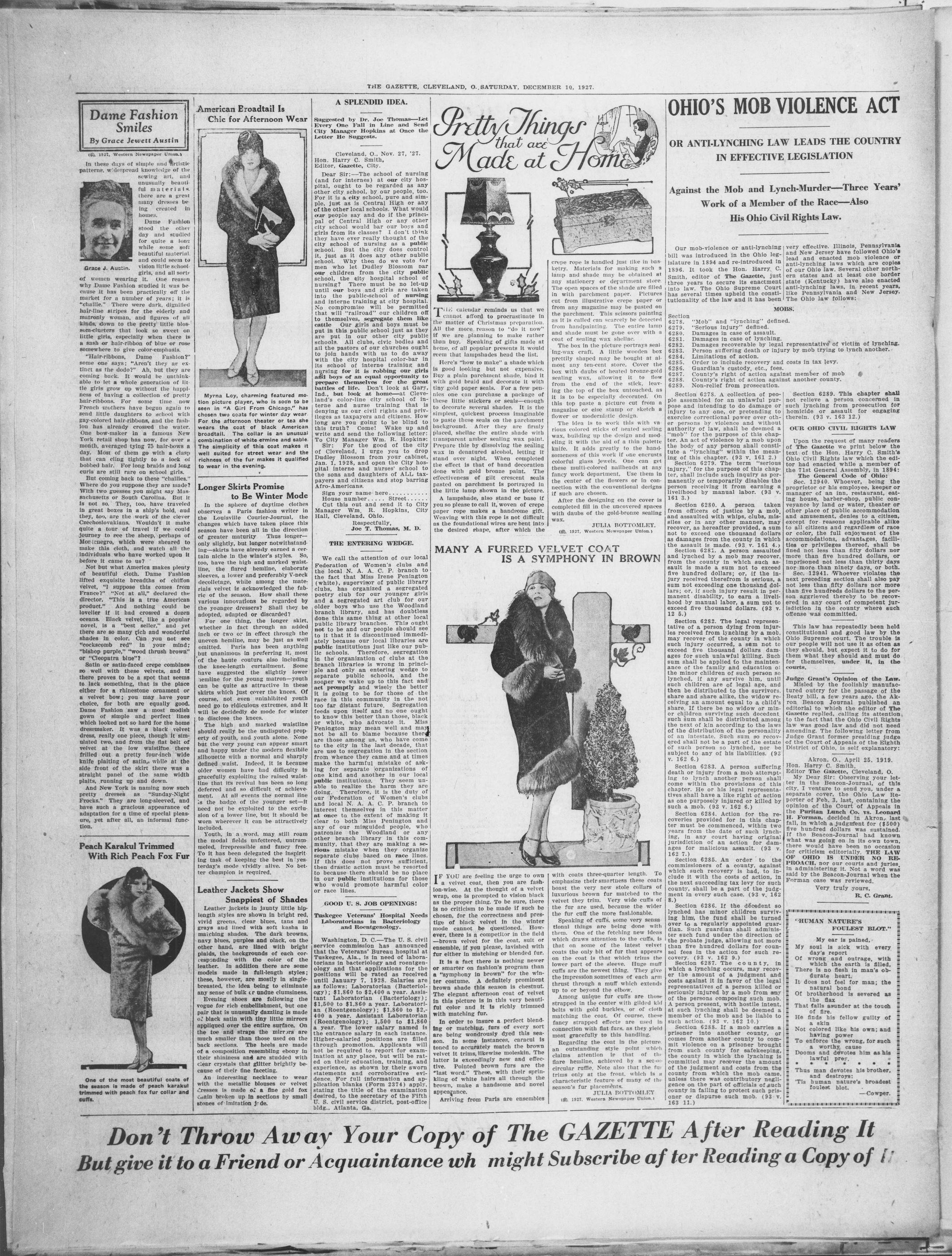
One of the most beautiful coates of the season is made of peach karakul trimmed with peach fox fur collar and cuffs.
American Broadtail Is Chic for Afternoon Wear
THE FASHION WEEKLY
Myrna Loy, charming featured motion picture player, who is soon to be seen in "A Girl From Chicago," has chosen two coats for winter day wear. For the afternoon theater or tea she wears the coat of black American broadtail. The collar is an unusual combination of white ermine and sable. The simplicity of this coat makes it well suited for street wear and the richness of the fur makes it qualified to wear in the evening.
Longer Skirts Promise to Be Winter Mode
In the sphere of daytime clothes observes a Paris fashion writer in the Louisville Courier-Journal, the changes which have taken place this season have been all in the direction of greater maturity. Thus longer—only slightly, but longer notwithstanding—skirts have already earned a certain niche in the winter's styles. So, too, have the high and marked waistline, the flared hemline, elaborate sleeves, a lower and preferably V-neck decolletage, while among the materials velvet is acknowledged the fabric of the season. How shall these various innovations be regarded by the younger dressers? Shall they be adopted, adapted or discarded?
For one thing, the longer skirt, whether in fact through an added inch or two or in effect through the uneven hemline, may be just as well omitted. Paris has been anything but unanimous in preferring it, most of the haute couture also including the knee-length curtailment. Some have suggested the slightly lower hemline for the young matron—youth can be quite as attractive in these skirts which just cover the knees. Of course, not even uninhibited youth need go to ridiculous extremes, and it will be decidedly de mode for winter to disclose the knees.
The high and marked waistline should really be the undisputed property of youth, and youth alone. None but the very young can appear smart and happy under the modern flexible silhouette with a normal and sharply defined waist. Indeed, it is because older women have had difficulty in gracefully exploiting the raised waistline that its revival has been so long deferred and so difficult of achievement. At all events the normal line is the badge of the younger set—It need not be exploited to the exclusion of a lower line, but it should be worn wherever it can be attractively included. Youth, in a word, may still roam the modal fields unfettered, unrammeled, irrepressible and fancy free. To it has been delegated the inspiring task of keeping the best in yesterday's mode vividly alive. No better champion is required.
Leather Jackets Show
Snappiest of Shades
Leather jackets in jaunty little hip-length styles are shown in bright red, vivid greens, clear blues, tans and grays and lined with soft kasha in matching shades. The dark browns, navy blues, purples and black, on the other hand, are lined with bright plaids, the backgrounds of each corresponding with the color of the leather. In addition there are some models made in full-length styles; these, however, are mostly in single-breasted, the idea being to eliminate any sense of bulk or undue clumsiness. Evening shoes are following the vogue for rich embellishment, but one pair that is unusually dazzling is made of black satin with tiny little mirrors applauded over the entire surface. On the toe and straps the mirrors are much smaller than those used on the back sections. The heels are made of a composition resembling ebony in their shininess and are studded with clear crystals that glitter brightly because of their fine faceting.
An interesting necklace to wear with the metallic blouses or velvet dresses is made of a fine gold fox chain broken up in sections by small stones of imitation jade.
THE GAZETTE, CLEVELAND, O. SATURDAY, DECEMBER 10, 1927.
A SPLENDID IDEA
Suggested by Dr. Joe Thomas—Let
Every One Fall in Line and Send
City Manager Hopkins at Once the
Letter He Suggests.
Cleveland, O., Nov. 27, '27.
Hon. Harry C. Smith.
Editor, Gazette, City.
Dear Sir:—The school of nursing (and for interns) at our city hospital, ought to be regarded as any other city school, by our people, too. For it is a city school, pure and simple, just as is Central High or any of the other local schools. What would our people say and do if the principal of Central High or any other city school would bar our boys and girls from its classes? I don't think they have ever really thought of the city school of nursing as a public school. But the city does control it, just as it does any other public school. Why then do you for men who have blossom par children from the city public school, the city hospital school of nursing? There must be no let-up until our boys and girls are taken into the public-school of nursing and interne training at city hospital. No compromise will be permitted that will "railroad" our children off to themselves, segregate them like cattle. Our girls and boys must be put in this public school just as they are put in our other city public schools. All clubs, civic bodies and all the pastors of our churches ought to join hands with us to do an important work in our city school in its of internet training and nursing for it is robbing our girls and boys of an equal opportunity to prepare themselves for the great battles of life. Don't look at Gary, Ind., but look at home—at Cleveland's color-line city school of interne and nurse training that is denying us our civil rights and privileges as taxpayers and citizens. How long are you going to be blind to this truth? Come! Wake up and write and send the form to Terry T. Walker, M.R. Hopkins; Sir: For the good of the city of Cleveland. I urge you to drop Dudley Blossom from your cabinet, Jan. 1, 1928, and open the City hospital interne and nurses' school to the sons and daughters of ALL tax-payers and citizens and stop barring Afro-Americans.
Sign your name here.....
House number.... Street.....
Cut this out and send it to City
Manager, R. R. Hopkins, City
Hall, Cleveland, Ohio.
Respectfully,
Joe T. Thomas, M. D.
THE ENTERING WEDGE.
We call the attention of our local Federation of Women's clubs and the local N. A. A. C. P. branch to the food that Miss Irene Pennington (white), supervisor of public library clubs, has organized a segregated poetry club for our younger girls and a segregated art club for our older boys who use the Woodland branch library, and has doubtless done this same thing at other local public library branches. This ought not to be and our people should see to it that it is discontinued immediately because our younger libraries are just like our public schools. Therefore, segregation in the organization of clubs at the branch libraries is wrong in principle and only an entering wedge to separate public schools, and the sooner we wake up to this fact and act promptly and wisely the better it is to be for those of the race in this community in the not too far distant future. Segregation feeds upon itself and no one ought to know this, who advocate it. Miss Pennington may mean well and may not be all to blame because there are those among us, who have come to the city in the last decade, that are use to segregation in the section from whence they came and at times make the harmful mistake of asking for separate organizations of one kind and another in our local institutions. They seem unable to do this, therefore, it is the duty of our Federation of Women's clubs and local N. A. A. C. P. branch to interest themselves in this matter at once to the extent of making it clear to both Miss Pennington and any of our misguided people, who patronize the Woodland or any other branch library in this community, that they are making a serious mistake when they on their own bases used race lines. If this does not prove sufficient, then drastic action must be resorted to because there should be no place in our public institutions for those who would promote harmful color or race lines.
GOOD U. S. JOB OPENINGS!
Tuskegee Veterans' Hospital Needs
Laboratory Neuroscience and
Rosenteguegenology
Washington, D. C.—The U. S. civil service commission has announced that the Veterans' Bureau hospital at Tuskegee, Ala., is in need of laborarians in bacteriology and roentgenology and that applications for the positions will be rated as received until January 7, 1928. Salaries are as follows: Laboratorian (Bacteriology); $1,860 to $2,400 a year. Assistant Laboratorian (Bacteriology); $1,500 to $1,800 a year. Laboratorian (Bacteriology); $1,500 to $1,800 a year. Assistant Laboratorian (Roentgenology); $1,500 to $1,800 a year. The lower salary named is the entrance salary in each instance. Higher-salaried positions are filled through promotion. Applicants will not be required to report for examination at any place, but will be rated on their education, training, and experience, as shown by their sworn statements and corroborative evidence in their application blanks (Form 2374) stating the title of the examination desired, to the secretary of the Fifth U. S. civil service district, post-office bldg., Atlanta, Ga.
Pretty Things that are Made at Home
MANY A FURRED VELVET COAT IS A SYMPHONY IN BROWN
T
```markdown
```
THE calendar reminds us that we cannot afford to procrastinate in the matter of Christmas preparation. All the more reason to "do it now" if we are planning to make rather than buy. Speaking of gifts made at home, of all popular presents it would seem that lampshades head the list.
Here's "how to make" a shade which is good looking but not expensive. Buy a plain parchment shade, bind it with gold braid and decorate it with tiny gold paper seals. For a few peninsula one can purchase a package of these little stickers or seals—enough to decorate several shades. It is the simplest, quickest process imaginable to paste these seals on the parchment background. After they are firmly placed, shellac the entire shade with transparent amber sealing wax paint. Prepare this by dissolving the sealing wax in denatured alcohol, letting it stand over night. When completed the effect is that of hand decoration done with gold bronze paint. The effectiveness of gilt crescent seals pasted on parchment is portrayed in the little lamp shown in the picture.
A lampshade, also stand or base if you so please to call it, woven of crepe paper rope makes a handsome gift. Weaving with this rope is not difficult as the foundational shapes are bent into the desired shape, after which the
MANY A FURRED V
IS A SY
IF YOU are feeling the urge to own a velvet coat, then you are fashion-wise. At the thought of a velvet wrap, one is prompted to vision black as the proper thing. To be sure, there is no criticism to be made if such be chosen, for the correctness and prestige of black velvet in the winter mode cannot be questioned. However, there is a competitor in the field—brown velvet for the coat, suit or ensemble, if you please, lavished with fur either in matching or blended fur. It is a fact there is nothing newer or smarter on fashion's program than a "symphony in brown" for the winter costume. A definitely prominent brown shade this season is chestnut. The elegant afternoon coat of velvet in this picture is in this very beautiful color and it is richly trimmed with matching fur.
In order to insure a perfect blending or matching, furs of every sort are being wondrously dyed this season. In some instances, caracol is toned to accurately match the brown velvet it trims, likewise moleskin. The latter is exceedingly new and effective. Pointed brown furs are the "last word." These, with their sprinkling of white hairs all through the brown, make a handsome and novel appearance.
Arriving from Paris are ensembles
copy of Thee see wh might
crepe rope is handled just like in basketry. Materials for making such a lamp and shade may be obtained at any stationery or department store. The open spaces of the shade are filled in with parchment paper. Pictures cut from illustrative crepe paper or from any magazine may be pasted on the parchment. This scissors painting as it is called can scarcely be detected from handpainting. The entire lamp and shade must be gone over with a coat of sealing wax shellac.
The box in the picture portrays sealing-wax craft. A little wooden box pretty shaped may be bought at almost any ten-cent store. Cover the box with daubs of heated bronze-gold sealing wax, allowing it to flow from the end of the stick, leaving the top of the box untouched, as it is to be especially decorated. On this top paste a picture cut from a magazine or else stamp or sketch a flower or modernistic design.
The idea is to work this with various colored sticks of heated sealing wax, building up the design and modeling it with the aid of a thin palette knife. It adds greatly to the handsomeness of this work if one encrusts colorful glass jewels. One can get these multi-colored nailheads at any fancy work department. Use them in the center of the flowers or in connection with the conventional designs if such are chosen.
After the designing on the cover is completed fill in the uncovered spaces with daubs of the gold-bronze sealing wax.
JULIA BOTTOMLEY.
(© 1827, Western Newspaper Union.)
VELVET COAT
Symphony IN BROWN
with coats three-quarter length. To emphasize their smartness these coats boast the very new stole collars of luxurious brown fur matched to the velvet they trim. Very wide cuffs of the fur are used, because the wider the fur cuff the more fashionable. Speaking of cuffs, some very sensational things are being done with them. One of the fetching new ideas which draws attention to the cuffs, is that on some of the latest velvet coats the only bit of fur that appears on the coat is that which trims the lower part of the sleeve. Huge muff cuffs are the newest thing. They give the impression sometimes of each arm thrust through a muff which extends up to or beyond the elbow. Among unique fur cuffs are those strapped in the center with gilded kilt belts with gold buckles, or of cloth matching the coat. Of course, these fancy strapped effects are used in connection with flat fur, as they yield most gracefully to this handling.
Regarding the coat in the picture an outstanding style point which claims attention is that of the flare hemline, achieved by a seton circular ruffle. Note also that the fur trims only at the front, which is a characteristic feature of many of the season's fur placements.
JULIA BOTTOMLEY
(© 1927, Western Paper Union.)
GAZETTE
Subscribe af
OHIO'S MOB VIOLENCE ACT
OR ANTI-LYNCHING LAW LEADS THE COUNTRY IN EFFECTIVE LEGISLATION
Against the Mob and Lynch-Murder-Three Years' Work of a Member of the Race-Also His Ohio Civil Rights Law.
Section
6278. "Mob" and "lynching" defined.
6279. "Serious injury" defined.
6280. Damages in case of assault.
6281. Damages in case of lynching.
6282. Damages recoverable by legal representative of victim of lynching.
6283. Person suffering death or injury by mob trying to lynch another.
6284. Limitations of action.
6285. Order to include recovery and costs in tax levy.
6286. Guardian's custody, etc., fees.
6287. County's right of action against member of mob
6288. County's right of action against another county.
6289. Non-relief from prosecution.
Our mob-violence or anti-lynching bill was introduced in the Ohio legislature in 1894 and re-introduced in 1896. It took the Hon. Harry C. Smith, editor of The Gazette, just three years to secure its enactment into law. The Ohio Supreme Court has several times upheld the constitutionality of the law and it has been
Section 6278. A collection of people assembled for an unlawful purpose and intending to do damage or injury to any one, or pretending to exercise correctional power over other persons by violence and without the "mob" for the purpose of this chapter. An act of violence by a mob upon the body of any person shall constitute a "lynching" within the meaning of this chapter. (93 v. 161 2.) Section 6279. The term "serious injury," for the purpose of this chapter, is defined as manically or temporarily disables the person receiving it from earning a livelihood by manual labor. (93 v. 161 3.) Section 6280. A person taken from officers of justice by a mob, and assaulted with whips, clubs, missiles or in any other manner, may recover, as hereafter provided, a sum not to exceed one thousand dollars damages from the county in which the assault is made. (93 v. 161 4.)
Section 6281. A person assaulted and lynched by a mob may recover, from the county in which such assault is made a sum not to exceed five hundred dollars; or, if the injury received therefrom is serious, a sum not exceeding one thousand dollars; or, if such injury result in permanent disability, to earn a livelihood by manual labor, a sum not to exceed five thousand dollars. (93 v. 12 5.)
Section 6282. The legal representative of a person dying from injuries received from lynching by a mob may recover of the county in which such injury occurred, a sum not to exceed five thousand dollars damages for such unlawful killing. Such sum shall be applied to the maintenance of the family and education of the minor children of such person so lynched, if any survive him, until such children are of legal age, and then be distributed to the survivors, share and share alike, the widow receiving an amount equal to a child's share. If there be no widow or minor, such children be distributed such sum shall be distributed among the next of kin according to the laws of the distribution of the personality of an intestate. Such sum so recovered shall not be a part of the estate of such person so lynched, nor be subject to any of his liabilities. (93 v. 162 6.)
Section 6283. A person suffering death or injury from a mob attempting to lynch another person shall come within the provisions of this chapter. He or his legal representatives shall have a like right of action as one purposely injured or killed by such a mob. (93 v. 162 6.)
Section 6284. Action for the recoveries provided for in this chapter shall be commended within two years from the date of such lynching, in any court having original jurisdiction of an action for damages for malicious assault. (93 v. 162 7.)
Section 6285. An order to the commissioners of a county, against which such recovery is had, to include it with the costs of action, in the next succeeding tax levy for such county, shall be a part of the judgment in every such case. (93 v. 162 8.)
Section 6286. If the decedent so lynched has minor children surviving him, the fund shall be turned over to a regularly appointed guardian. Such guardian shall administer such fund under the direction of the probate judge, allowing not more than five hundred dollars for counsel fees in the action for such recovery. (93 v. 162 9.)
Section 6287. The county, in which a lynching occurs, may recover the amount of a judgment and costs against it in favor of the legal person. If the person or seriously injured by a mob from some of the persons composing such mob. A person present, with hostile intent, at such lynching shall be deemed a member of the mob and be liable to such action. (93 v. 162 10.)
Section 6288. If a mob carries a prisoner into another county, or comes from another county to commit violence on a prisoner brought into the county, it can be forcibly taken the county in which the lynching is committed may recover the amount of the judgment and costs from the county from which the mob came, unless there was contributory negligence in the lynching of such county in failing to protect such prisoner or disperse such mob. (93 v. 163 11.)
very effective. Illinois, Pennsylvania and New Jersey have followed Ohio's lead and enacted mob violence or anti-lynching laws which are copies of our Ohio law. Several other northern states and at least one border state (Kentucky) have also enacted anti-lynching laws, in recent years, like Pennsylvania and New Jersey. The Ohio law follows:
**BBS.**
ed.
representative of victim of lynching. try by mob trying to lynch another.
costs in tax levy.
just member of mob
just another county.
Section 6289. This chapter shall not relieve a person concerned in such lynching from prosecution for homicide or assault for engaging therein. (93 v. 163 12.)
OUR OHIO CIVIL RIGHTS LAW
Upon the request of many readers of The Gazette we print below the text of the Hon. Harry C. Smith's Ohio Civil Rights law which the editor had enacted while a member of the 71st General Assembly, in 1894: The General Code of Ohio: Sec. 12940. Whoever, being the proprietor or his employee, keeper or manager of an inn, restaurant, eating house, barber-shop, public conveyance by land or water, theater or other place of public accommodation and amusement, denies to a citizen, except for reasons applicable alike to all citizens and regardless of race or color, the full enjoyment of the community, or privileges therein, shall be fined not less than fifty dollars nor more than five hundred dollars, or imprisoned not less than thirty days nor more than ninety days, or both.
Sec. 12941. Whoever violates the next preceding section shall also pay not less than fifty dollars nor more than five hundreds dollars to the person aggrieved thereby to be recovered in any court of competent jurisdiction in the county where such offense was committed.
This law has repeatedly been held constitutional and good law by the Ohio Supreme court. The trouble is our people will not use it as often as they should, but expect it to do for them what they should and must do for themselves, under it, in the courts.
Judge Grant's Opinion of the Law
Misled by the foolishly manufactured outcry for the passage of the Beaty bill, a few years ago, the Akron Beacon Journal published an editorial to which the editor of The Gazette replied, calling its attention to the fact that the Ohio Civil Rights law was good law and did not need amending. The following letter from Judge Grant former presiding judge of the Court of Appeals of the Eighth District of Ohio, is self explanatory:
Akron, O., April 25, 1919.
Hon. Harry C. Smith.
Editor The Gazette, Cleveland, O.
My Dear Sir: Observing your letter in the Beacon-Journal, of this city, I ventured to separate cover, the Ohio Law Reporter of Feb. 3, last, containing the opinion of the Court of Appeals in the Puritan Lunch Co. vs. Leonard H. Forman, decided in Akron, last fall, in which a judgment for ($500) five hundred dollars was sustained. What was going on in its own town there would have been no occasion for criticism editorially. THE LAW OF OHIO IS UNDER NO REPROACH, nor our courts and juries, in administering it. Not a word was said by the Beacon-Journal when the Forman case was reviewed.
Very truly yours,
R. C. Grant.
My ear is pained,
My soul is sick with every
day's report
Of wrong and outrage, with
which the earth is filled.
There is no flesh in man's ob-
durate heart.
It does not feel for man; the
natural bond
Of brotherhood is severed as
the flax
That falls asunder at the touch
of fire.
He finds his fellow guilty of
a skin
Not colored like his own; and
having power
To enforce the wrong, for such
a shame the cause
Dooms and devotes him as his
lawful prey
* * * * * * * *
Thus man devotes his brother,
and destroys:
Tis human nature's broadest
foulest blot.
—Cowper.
ading It a Copy of it