The Gazette
Saturday, February 27, 1932
Cleveland, Ohio
Page text (machine-generated)
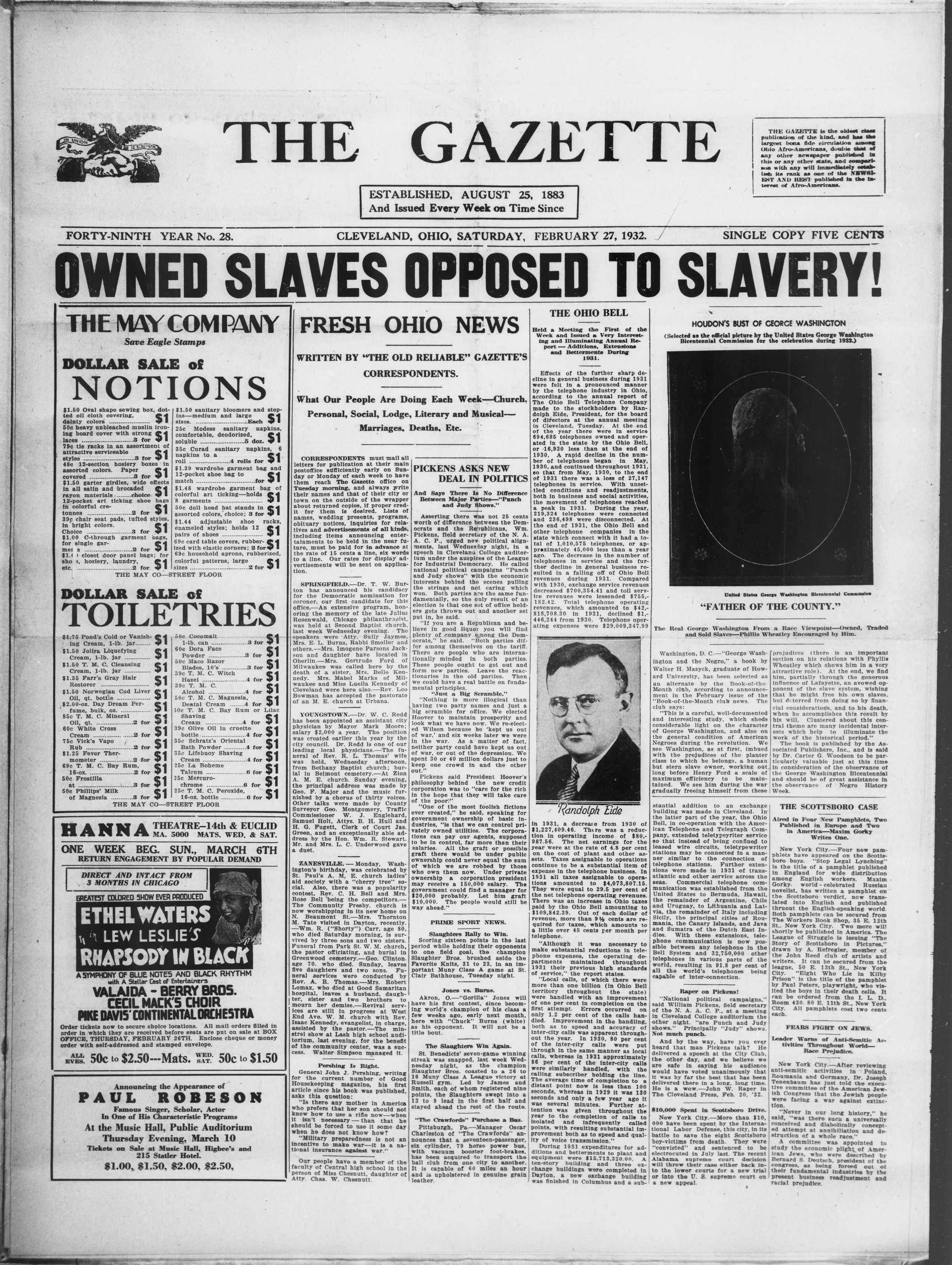
OWNED SLAVES OPPOSED TO SLAVERY!
IN UNION
IS STRONGER
FORTY-NINTH
OWN
THE MAY
SIXTH YEAR NOW
NED
MAY COM
FORTY-NINTH YEAR No. 28.
Save Eagle Stamps
DOLLAR SALE of NOTIONS
$1.75 Pond's Cold or Vanishing Cream, 1-lb. jar ... $1
$1.50 Jolira Liquefying Cream, 1-lb. jar ... $1
$1.50 T. M. C. Cleansing Cream, 1-lb. jar ... $1
$1.35 Farr's Gray Hair Restorer ... $1
$1.50 Norwegian Cod Liver Oil, qt. bottle ... $2.00-oz. Day Dream Perfume, bulk, oz ... $85c T. M. C. Mineral Oil, qt. ... $2 for
60c White Cross Cream ... $2 for
75c Vick's Vapo Rub ... $2 for
$1.25 Fever Thermometer ... $2 for
69c T. M. C. Bay Rum, 16-oz. ... $2 for
50c Frostilla at ... $3 for
50c Phillips' Milk of Magnesia ... $3 for
50c Cocoalmalt 1-lb. can ... $3 for
60c Dora Face Powder ... $3 for
50c Maco Razor Blades, 10's ... $3 for
39c T. M. C. Witch Hazel ... $4 for
39c T. M. C. Alcohol ... $4 for
50c T. M. C. Magnesia, Dental Cream ... $4 for
50c T. M. C. Bay Rum or Lilac Shaving Cream ... $4 for
39c Olive Oil in cruette bottle ... $4 for
35c Schratz's Oriental Bath Powder ... $4 for
35c Lifebuoy Shaving Cream ... $4 for
25c La Boheme Talcum ... $6 for
25c Mercuro-chrome ... $6 for
25c T. M. C. Peroxide, 16-oz. bottle ... $6 for
THE MA CO—STREET FLOOR
HANNA THEATRE-14th & EUCLID MA. 5000 MATS. WED. & SAT.
ONE WEEK BEG. SUN., MARCH 6TH
RETURN ENGAGEMENT BY POPULAR DEMAND
DIRECT AND INTACT FROM
3 MONTHS IN CHICAGO
GREATEST COLDRED SHOW EVER PRODUCED
ETHEL WATERS
LEW LESLIE'S
RHAPSODY IN BLACK
A SYMPHONY OF BLUE NOTES AND BLACK RHYTHM
with A Stellar Cost of Entertainers
VALAIDA - BERRY BROS.
CECIL MACK'S CHOIR
PIKE DAVIS' CONTINENTAL ORCHESTRA
Order tickets now to secure choice locations. All mail orders filled in
order in which they are received before seats are put on sale at BOX
OFFICE, THURSDAY, FEBRUARY 26TH. Enclose cheque or money
order with self-addressed and stamped envelope.
ALL EVES. 50c to $2.50---Mats. WED. SAT. 50c to $1.50
Announcing the Appearance of
PAUL ROBESON
Famous Singer, Scholar, Actor
In One of His Characteristic Programs
At the Music Hall, Public Auditorium
Thursday Evening, March 10
Tickets on Sale at Music Hall, Higbee's and
215 Statler Hotel.
$1.00, $1.50, $2.00, $2.50,
THE GAZETTE
ESTABLISHED, AUGUST 25, 1883 And Issued Every Week on Time Since
CLEVELAND, OHIO, SATURDAY, FEBRUARY 27, 1932.
FRESH OHIO NEWS
FRESH OHIO NEWS
WRITTEN BY "THE OLD RELIABLE" GAZETTE'S CORRESPONDENTS.
What Our People Are Doing Each Week—Church, Personal, Social, Lodge, Literary and Musical Marriages, Deaths, Etc.
CORRESPONDENTS must mail all letters for publication at their main postoffice sufficiently early on Sunday or Monday of each week to have them reach The Gazette office on Tuesday morning, and always write their names and that of their city or town on the outside of the wrapper about returned copies, if proper credit for them is desired. Lists of names, wedding presents, programs, obituary notices, inquiries for relatives and advertisements of all kinds, including items announcing entertainments to be held in the near future, must be paid for in advance at the rate of 15 cents a line, six words to a line. Our rates for display advertisements will be sent on application.
SPRINGFIELD.—Dr. T. W. Burton has announced his candidacy for the Democratic nomination for coroner, our first candidate for this office.—An extensive program, honoring the memory of the late Julius Rosenwald, Chicago philanthropist, was held at Second Baptist church, last week Wednesday evening. The speakers were Atty. Silly Jaymes, Mrs. E. L. Burns, Rabbi Smoller and others.—Mrs. Imogene Parsons Jackson and daughter have located in the Bronx, where she and Milwaukee was called here by the death of a sister, Mrs. Belle Kennedy. Mrs. Mabel Marks of Milwaukee and Miss Luella Kennedy of Cleveland were here also.—Rev. Leo Bowman has accepted the pastorate of an M. E. church at Urbana.
YOUNGSTOWN —Dr. W. C. Redd has been appointed an assistant city physician by Mayor Mark Moore; salary $2,000 a year. The position was created earlier this year by the city council. Dr. Redd is one of our leading local physicians. —The funeral of Rev R. L. Thomas' wife wife held here, Holly W. Redd from Bethany Baptist church; burial in Belmont cemetery. —At Zion A. M. E. church. Sunday evening, the principal address was made by Geo. F. Major and the music furnished by a chorus of thirty voices. Other talks were made by County Surveyor Geo. Montgomery, Traffic Commissioner W. J. Englehard, Samuel Holt, Attys. B. H. Hull and James Green, and an exceptionally able address by the Hon. Wm. R. Stewart, Mr. and Mrs. L. C. Underwood gave a duet.
ZANESVILLE. — Monday, Washington's birthday, was celebrated by St. Paul's A. M. E. church ladies aid society with a "cherry tree" social. Also, there was a popularity contest, Rev. C. H. Bell and Mrs. Rose Bell being the competitors. The Community Presbych. church is now worshipping its new home on N. Beaumont St.—Mrs. Thornton M. Tate visited in Dayton, recently. —Wm. R. ("Shorty") Carr, age 80, who died Saturday morning, is survived by three sons and two sisters. Funeral from Park St. W. M. church, the pastor officiating, and burial in Greenwood cemetery. —Geo. Clinton age 70, who died. Sunday, leaves five daughters and two sons. Funeral services were conducted by Rev. A. R. Thurton Robert Lomax, who died at Good Samaritan hospital, leaves a husband, daughter, sister and two brothers to mourn her demise. —Revival services are still in progress at West End Ave. W. M. church with Rev. Isaac Kennedy, evangelist, in charge, assisted by the pastor. —The minister show at Lash high school auditorium, last evening, for the benefit of the community center, was a success. Walter Simpson managed it.
Pershing Is Right
General John J. Pershing, writing for the current number of Good Housekeeping magazine, his first article since his book was published, asks this question:
"Is there any mother in America who prefers that her son should not know how to use a rifle now—when it isn't necessary—than that he should be forced to use it some day when he does not know how?
"Military preparedness is not an incentive to make war—it is a national insurance against war."
Our people have a member of the faculty of Central high school in the person of Miss Chesnut, daughter of Atty. Chas. W. Chesnut
PICKENS ASKS NEW DEAL IN POLITICS
And Says There Is No Difference Between Major Parties—"Punch and Judy Shows."
Asserting there was not 25 cents worth of difference between the Democrats and the Republicans, Wm. Pickens, field secretary of the N. A. A. C. P., urged new political alignments, last Wednesday night, in a speech in Cleveland College auditorium under the auspices of the League for Industrial Democracy. He called national political campaigns "Punch and Judy shows" with the economic interest behind the scenes pulling the strings and not eating won. Both parties are the same fundamentally, so the only result of an election is that one set of office holders gets thrown out and another set put in, he said.
"If you are a Republican and believe in good liquor you will find plenty of company among the Democrats," he said. "Both parties differ among themselves on the tariff. There are people who are internationally minded in both parties. these people ought to get out and from these cities. Let them do the nationaries in the old parties. Then we could have a real battle on fundamental principles.
"Just a Big Scramble."
Just a big scenario.
"Nothing is more illogical than having two party names and just a big scramble for them. We elected Hoover to maintain prosperity and look what we have now. We re-elected Wilson because he 'kept us out of war' and six weeks later we were in the war. As a matter of fact, neither party could have kept us out of war, or out of the depression. We spent 30 or 40 million dollars just to keep one crowd in and the other out."
Pickens said President Hoover's philosophy behind the new credit corporation was to "care for the rich in the hope that they will take care of the poor."
"One of the most foolish fictions ever created," he said, speaking for government ownership of basic industries, "is that we can control privately owned utilities. The corporations can pay our agents, supposed to be the most valuable salaries. All the graft or possible graft there would be under public ownership could never equal the sum of which we are robbed by those who own them now. Under private ownership a corporation president may receive a 150,000 salary. The government would probably allow $20,000. Let him graft $10,000. The people would still be way ahead."
PRIME SPORT NEWS.
Slaughters Rally to Win
Scoring sixteen points in the last period while holding their opponents to one field goal, the champion Slaughter Bros. brushed aside the favorite Muny Class A in an impetuous Muny Class A game at St. Clair Bathhouse, Tuesday night.
Jones vs. Burns.
Akron, O.—"Gorilla" Jones will have his first contest, since becoming world's champion of his class a few weeks ago, early next month, as he "Chuck" Burns (white) as his opponent. It will not be a title bout.
The Slaughters Win Again
St. Benedicts' seven-game winning streak was snapped, last week Wednesday night, as the champion Slaughter Bros. coasted to a 26 to 16 Muny Class A League victory at Russell gym. Led by James and Smith, each of whom registered nine points, the Slaughters swept into a 13 to 9 lead in the first half and stayed ahead the rest of the route.
"The Crawfords" Purchase a Bus. Pittsburgh, Pa—Manager Oscar Charleston of "The Crawfords" announces that a seventeen-passenger, six cylinder, 79 horse power bus, with vacuum booster foot-brakes, has been acquired to transport the ball club from one city to another. It is capable of 60 miles an hour and is upholstered in genuine grain leather.
THE OHIO BELL
Held a Meeting the First of the Week and Issued a Very Interesting and Illuminating Annual Report Addresses and Betterments During
Effects of the further sharp decline in general business during 1931 were felt in a pronounced manner by the telephone industry in Ohio, according to the annual report of The Ohio Bell Telephone Company made to the stockholders by Randolph Eide, President, for the board of directors at the annual meeting in Cleveland, Tuesday. At the end of the year there were in service 694,685 telephones owned and operated in the state by the Ohio Bell, or 16,930 less than at the end of 1931, the number of telephones began in May, 1930, and continued throughout 1931, so that from May, 1930, to the end of 1931 there was a loss of 2,7147 telephones in service. With unsettled conditions and readjustments, both in business and social activities, the movement of telephones reached a peak in 1931. During the year, 219,324 telephones were connected and 236,498 were disconnected. At the end of 1931, the Ohio Bell and other telephone companies in the state which connect with it had a total of 1,010,575 telephones, or approximately 45,000 less than a year ago. The decrease in the number of telephones in service and the turbulence in the market suited in a falling off of Ohio Bell revenues during 1931. Compared with 1930, exchange service revenues decreased $700,354.41 and toll service revenues were lessended $755.182.42. Total telephone operating revenues, which amounted to $42,818,708.30 in 1931, declined $1,446,244 from 1930. Telephone operating expenses were $29,009,347.99
PETER H.
Randolph Eide
in 1931, a decrease from 1930 of $1,227,409.46. There was a reduction in operating income of $80,-987.56. The net earnings for the year were at the rate of 4.8 per cent on the cost of plant and other assets. Taxes assignable to operations to be a substantial item of expense in the telephone business. In 1931 all taxes received amounted to $4,073,807.15. They were equal to 29.5 per cent of the net telephone operating revenues. There was an increase in Ohio taxes paid by the Ohio Bank amounting to $109,842.39. Out of each dollar of revenue, more than 9 1/2 cents are required for taxes, which amounts to a little over 48 cents per month per telephone.
"Although it was necessary to make substantial reductions in telephone expenses, the operating departments maintained throughout 1931 their previous high standards of service," the report states.
"Local calls, of which there were more than one billion (in Ohio Bell territory throughout the state) were handled with an improvement of one per cent in completion on the first attempt. Errors occurred on only 1.2 per cent of the calls handled, improvement in the handling, both as a result of the accuracy of inter-city calls was apparent out the year. In 1930, 80 per cent of the inter-city calls were put through in the same manner as local calls, whereas in 1931 approximately 86 per cent of the inter-city calls were similarly handled, with the calling subscriber holding the line. The average time of completion to a distant point now is less than 100 seconds, whereas in 1929 it was 130 seconds and only a few year ago it was a few minutes. Further attention was given throughout the year to the completion of calls isolated and infrequently called points, with resulting substantial improvement both as to speed and quality of voice transmission."
During 1931 expenditures for additions and betterments to plant and equipment were $15,713,320.00. All three exchange buildings and three exchange buildings completed in Dayton, a new exchange was finished in Columbus and a mine.
SINGLE COPY FIVE CENTS
HOUDON'S BUST OF GEORGE WASHINGTON
(Selected as the official picture by the United States George Washington Bicentennial Commission for the celebration during 1932.)
[Portrait of a man in profile, wearing a hat and a coat, set against a dark background with a decorative border. The image is monochromatic, with shades of black and white. There are no visible texts or markings.]]
The Real George Washington From a Race Viewpoint—Owned, Traded and Sold Slaves—Phillis Wheatley Encouraged by Him.
Washington, D. C.—"George Washington and the Negro," a book by Walter H. Mazyck, graduate of Howard University, has been selected as an alternate by the Book-of-the-Month according to announcement in the February issue of the "Book-of-the-Month club news. The club says:
"This is a careful, well-documented and interesting study, which sheds considerable light on the character of George Washington, and also on the general condition of American Negroes during the revolution. We see Washington, as at first, imbued with the prejudices of the planter class to) which he belongs, a humble but stern slave owner, working out long before Henry Ford a scale of maximum efficiency to be maintained. We see him during the war gradually freeing himself from these prejudices (there is an important section on his relations with Phyllis Wheatley which shows him in a very attractive role). At the end, we find him, partially through the generous influence of Lafayette, an avowed opponent of the slave, that he might free his own slaves, but deterred from doing so by financial considerations, and to his death, when he accomplishes this result by his will. Clustered about this central theme are many incidental interests which help to illuminate the work of the historical period."
The book is published by the Associated Publishers, Inc., and is said by Dr. Carter G. Woodson to be particularly valuable just at this time in consideration of the observance of the George Washington Bicentennial and should be of great assistance in the observance of Negro History Week.
stantial addition to an exchange building was made in Cleveland. In the latter part of the year, the Ohio Bell, in co-operation with the American Telephone and Telegraph Company, extended teletypewriter service so that instead of being confined to leased wire circuits, teletypewriter stations may be connected in a manifold similar to the connection of telephone stations. These stations were made in 1931 of transatlantic and other service across the seas. Commercial telephone communication was established from the United States to Bermuda, Hawaii, the remainder of Argentine, Chile and Uruguay, to Lithuania and Latvia, the remainder of Italy including Sicily, the principal cities of Roumania, the Canary Islands, and Java and Sumatra of the Dutch East Indies. With these extensions, telephone communication is now possible between any telephone in the Bell System and 32,750,000 other telephones in various parts of the world, resulting in 91.8 per cent of all the world's telephones being capable of inter-connection.
Raper on Pickens!
"National political campaigns," said William Pickens, field secretary of the N. A. A. C. P., at a meeting in Cleveland College auditorium the other night. "are Punch and Judy shows." Principally "Judy" shows. Not much punch.
And by the way, have you ever heard that man Pickens talk? He delivered much to those who the other day and we believe we are safe in saying his audience would have voted unanimously that it was by far the best that has been delivered there in a long, long time. He is a wow.—John W. Raper in The Cleveland Press, Feb. 20, '32.
$10,000 Spent in Scottsboro Drive.
New York City—More than $10,000 have been spent by the International Labor Defense, this city, in its battle to save the eight Scottsboro boy-victims from death. They were "convicted" and sentenced to be electrocuted in July last. The recent Alabama supreme court decision will throw their case either back into the lower courts for a new trial or into the U. S. supreme court on a new appeal.
THE GAZETTE is the oldest class publication of the kind, and has the largest bona fide circulation among Ohio Afro-Americans, double that of any other newspaper published in this or any other state, and comparison with any will immediately establish its rank as one of the NEWBIEST AND BEST published in the interest of Afro-Americans.
GE COPY FIVE CENTS
VERY!
OF GEORGE WASHINGTON
by the United States George Washington
for the celebration during 1932.)
George Washington Bicentennial Commission
F THE COUNTY.”
from a Race Viewpoint—Owned, Traded
as Wheatley Encouraged by Him.
prejudices (there is an important section on his relations with Phyllis Wheaty which shows him in a very attractive role). At the end, we find him, partially through the generous influence of Lafayette, an avowed opponent of the slave system, wishing that he free his own slaves, but desired from it by financial considerations, and to his death, when he accomplishes this result by his will. Clustered about this central theme are many incidental interests which help to illuminate the work of the historical period." The book is published by the Associated Publishers, Inc., and is said by Dr. Carter G. Woodson to be particularly valuable just at this time in consideration of the observance of the George Washington Bicentennial and should be of great assistance in the observance of Negro History Week.
THE SCOTTSBORO CASE
Aired in Four New Pamphlets, Two Published in Europe and Two in America—Maxim Gorky Writes One.
New York City.—Four new pamphlets have appeared on the Scottboro boys. "Stop Legal Lynching" is the title of a pamphlet published in England for wide distribution among English workers. Maxim Gorky. world-celebrated Russian novelist, has written a pamphlet on the Scottboro verdict, now translated into English and published throughout the English-speaking world. Both pamphlets can be secured from The Workers Book Shop, 35 E. 12th St. New York City. Two more will shortly be published in America. The league of Struggle is issuing the Story of Scottboro in Pictures, drawn by A. Freigrier, member of the John Reefriger, of artists and writers. It can be secured from the league, 50 E. 13th St. New York City. "Eight Who Lie in Kill Prison" is the title of the pamphlet by Paul Peters, playwright, who visited the boys in their death cells. It can be ordered from the I. L. D. Room 430. 80 E. 11th St. New York City. All pamphlets cost two cents each.
FEARS FIGHT ON JEWS.
Leader Warns of Anti-Semitic Activities Through World—
Racism Predicates
New York City.—After reviewing anti-semitic activities in Poland, Roumania and Germany, Dr. Joseph Tenebanua has just told the executive committee of the American Jewish Congress that the Jewish people were facing a war against extinction.
“Never in our long history,” he said, “was there such a universally conceived and diabolically concepted attempt at annihilation and destruction of a whole race.” The committee was appointed to study the economic plight of American Jews, who were described by Bernard S. Deutsch, president of the congress, as being out of their fundamental industries by the present business readjustment and racial prejudice.
---
One Year ..... $2.00
Six Months ..... 1.00
Subscribers are requested to remit
by postoffice money order or
registered letter.
Entered at the postoffice in Cleveland, Ohio, as second-class mail matter
Address all communications to
HARRY C. SMITH
Editor and Proprietor
THE GAZETTE
$26 W. Superior Ave., Cleveland, O.
(Bell 'Phone: Cherry 1259)
Member Ohio Legislature: 1894 to 1896; 1896 to 1898; 1900 to 1902.
IN UNION IS STRENGTH
10,000,000 Afro-Americans.
825,000 in Ohio.
75,000 in Cleveland.
SATURDAY, FEBRUARY 27, 1932
Ethel Waters paid Cleveland a four-performance visit at the Hanna theater at Christmas time, but rushed along to Chicago with her "Rhapsody in Black" revue to fill a previous booking. The local engagement was a remarkable success, financially and artistically. "We'll be back here," was the comment of the producer, Lew Leslie. So she and her revue will be back at the Hanna for an entire week, starting Sunday, March 6.
Again last Friday, former Mayor John D. Marshall, president of the City Council and head of its finance committee said, in response to the latest demand for a second downtown emergency hospital which certain "Negroes" hoped to make a "jim-crow" affair, that "The city couldn't operate St. Ann's, or any other hospital. If it was presented as a gift. It hasn't enough funds to run the hospitals it now owns." Wow!
Our people of Cleveland again have occasion to thank Mr. Maurice Maschke, head of the local Republican organization, and Messrs. Jack Harris and Walter E. Cook, Republican members of the board of county commissioners, for their prompt action in acceding to our request for at least one of the ten investigators for the county soldiers' and sailors' relief commission, appointed promptly, last week, as requested by Boydston Post of the American Legion and several members of the race.
Last week, President Hoover appointed Judge Cardozo, a Democrat of New York City, an associate justice of the U. S. supreme court, cut down the Republican membership of that august body to five, with four Democrats. This appointment gives the Jewish people two members of the court. He hasn't given our people a single first-class appointment and very few of any kind. And yet his success at the polls in November is dependent upon our balance-of-power-vote in at least a half dozen states. Food for that!
William Pickens isn't wrong when he says, "There is very little difference between Republicans and Democrats" nowadays (having reference to their platforms). How they have changed in the last quarter of a century! What difference still exists is in the leadership of the two great parties, that (southern) of the Democratic party being not only a menace to all of our people but a stench in their nostrils. This is why no sane sensible and loyal member of the race can really become a Democrat even tho he may associate himself with local Democrats and call himself a "Democrat."
After all is said and done, it must be admitted that Abraham Lincoln was and still is the greatest figure in U. S. history. Not only because he "saved the union" but also because of his outstanding ability which still overshadows that of George Washington, "father of his country," and all other great characters in American history. This same thing is true of Frederick Douglass in the case of Afro-American history. The great John M. Langston was not only a gentleman, scholar and statesman, learned in the law, but sustained the same relation to Frederick Douglass that George Washington sustains to Abraham Lincoln.
I Do the Very Best I Can.
I do the very best I know how;
the very best I can; and I mean
to keep doing so until the end.
If the end brings me out all
right, what is said against me
won't amount to anything. If the
end brings me out wrong, ten
angels swearing I was right would
make no difference. — Abraham
Lincoln.
NOT LOYAL TO THEIR OWN!
"The Colored troops fought nobly" again, as usual, on the recent election day. They gave Daniel E. Morgan, defeated candidate for mayor, 27,214 votes in wards 11, 12, 17, 18 and 19; 5,789 in the 11th ward, 6,101 in the 12th, 5,042 in the 17th, 5,557 in the 18th, and 4,725 in the 19th ward. Practically all the Republican vote in the 11th, 12th and 17th were colored voters, as were two-thirds of the Republican vote in the 18th and 19th wards.
In these same wards, Ray T. Miller, Democratic candidate for mayor, received only 7,319 votes, nearly all of them cast by white persons (mainly Jewish, Irish and Italians), particularly in wards 18 and 19; 1,370 in the 11th ward, 1,087 in the 12th, 1,117 in the 17th, 1,170 in the 18th, and 2,575 in the 19th ward.
There are also three settlements of colored voters on the west side, two in the 30th ward, one in Glenville and one in Collinwood, in addition to the colored vote of a number of other wards of the city, totaling according to the last U. S. census over 47,000 votes, at least 40,000 of which were cast at the recent election. nearly all Republican.
Daniel E. Morgan's total vote (Republican) was 94,929. Therefore, very near half of the vote cast for him was given him by our people. Our two settlements in ward 30 netted at least 500 votes; the three on the west side, including West Park, easily the same number; the one in Glenville, 800; that in Collinwood, 400, etc. To these, must be added, the large scattering colored vote in wards of the city not mentioned, easily making a total vote cast for Morgan of more than forty thousand.
Most of the Jewish Republican vote went to Miller, insuring his election. Wards 24, 25, 27 and 30 are the "Jewish" (settlement) wards. In ward 24, the Republican majority was only 890 when it should have been 2,000 or more. In ward 25 it was 1,382 when it should have been 2,300 at least. In ward 27, it was only 244 when it should have been at least 2,000, and ward 30 gave a Democratic majority of 1,094 when Morgan should have been given a Republican majority of over 3,000 which would have insured Morgan's triumphant election. In plain words, the Jews of the city refused to support the Jewish control of the Republican party and the city of Cleveland. They were not loyal to their own!
J. E. Edwards, of 2234 E. 71st St. died, Feb. 10, 1932, at 7:30 P. M. He was grand master of York Rite Masons of the State of Ohio, national deputy grand master of the U. S. A., past high grand priest of Royal Arch Masons, past grand high commander of Knights Templar, 32d degree; and a member of Vival Consistory. He was a deacon of Antioch Baptist church. Mr. Edwards, age 62, was born in Nashville, Tenn.; educated in Hoopton III. Was elected in 1918; was an electrical engineer by trade, and was buried with masonic honors from Antioch Baptist church, the pastor, Rev. W. H. McKinney conducting the services.
Masonic services were presided over by Prof. S. S. Simmons, most worshipful national grand master of Masons of the United States. Mr. Edwards' remains were able cared for by the Leland D. French Undertaking establishment. The funeral procession moved from French's mortuary to Cedar Ave. to E. 40th St. to Central Ave. to Antioch church. From the church to Scovill Ave. to E. 31st St. to Woodland Ave. to cemetery. Among the notables of high masonry in attendance upon the funeral were: Dr. Sweet of Detroit and Prof. S. S. Simmons. In attendance also were the president and a professor from Western Reserve University, their families and many other professional and prominent people in all walks of life. Mr. Edwards is survived by his widow, two daughters and four sons, respectively: Fannie, Evelyn Winfield and N. B. Edwards; J. E. J. George M. James F. and Theodore Also six grandchildren and one brother, Wm. Phillip Edwards, of Nashville.
The great choir of St. John's A. M. E. church furnished musical selections and Hesko Parker sang the solos "I Need Thee Every Hour" and "My God, I Love Thee."
By order of St. Mathews York Masonic lodge, No. 11, Cleveland, O. National Compact, Prince Hall origin.
Respectfully submitted,
Jesse Henderson, Sec'y.,
7203 Montgomery Ave.,
Madison Williams, N. M.,
10625 Arthur Ave., Cleveland, O.
PAUL ROBESON COMING.
Mr. Paul Robeson who appears at Music Hall, Public. Auditorium, March 11th, is one of the few who is blessed with outstanding achievement in more than one field. He won a scholarship at Rutgers College, where he not only won his in four major sports, but also his Harvard key, showing his collegiate standings to be over 90%. After earning his law degree in Columbia University, he attracted the attention of Eugene O'Neill and was persuaded by him to star in "The Emperor, Jones." Since that time his progress has been phenomenal. Not only in New York but all over Europe he is acclaimed as one of the greatest singers and this generation. His appearance has been a treat to anyone who loves music and admires a real man.
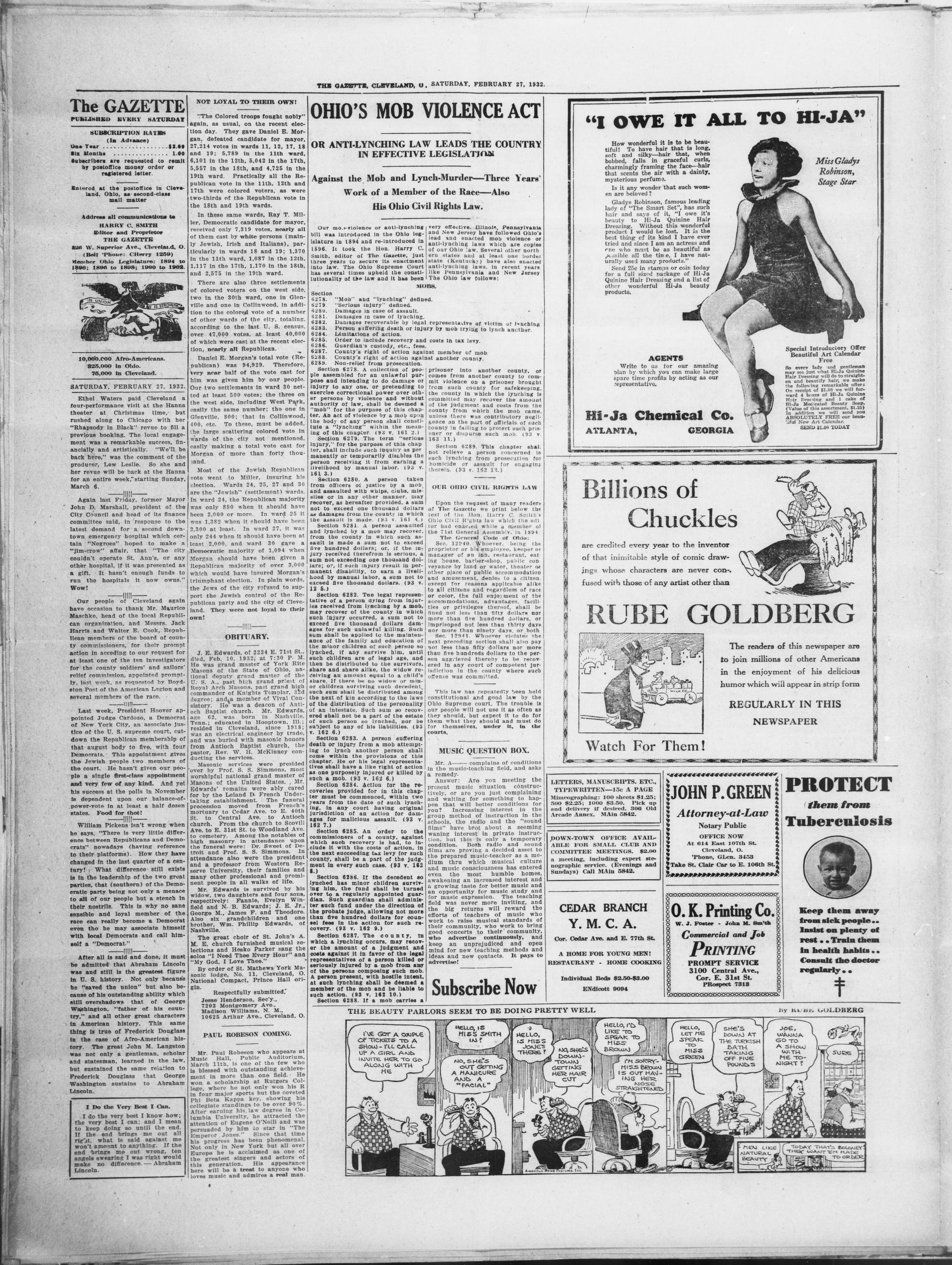
THE GAZETTE, CLEVELAND, O., SATURDAY, FEBRUARY 27, 1932
OHIO'S MOB VIOLENCE ACT
OR ANTI-LYNCHING LAW LEADS THE COUNTRY IN EFFECTIVE LEGISLATION
6278. "Mob" and "lynching" defined.
6279. "Serious injury" defined.
6280. Damages in case of assault.
6281. Damages in case of lynching.
6282. Damages recoverable by legal representative of victim of lynching.
6283. Person suffering death or injury by mob trying to lynch another.
6284. Limitations of action.
6285. Order to include recovery and costs in tax levy.
6286. Guardian's custody, etc., fees.
6287. County's right of action against member of mob.
6288. County's right of action against another county.
6289. Non-relief from prosecution.
I'VE GOT A COUPLE OF TICKETS TO A SHOW - I'LL CALL UP A GIRL AND INVITE HER TO GO ALONG WITH ME
HELLO, IS MISS SMITH IN?
NO, SHE'S OUT GETTING A MANICURE AND A "FACIAL"
HELLO, IS MISS JONES THERE?
NO, SHE'S DOWN-TOWN GETTING HER HAIR CUT
HELLO, I'D LIKE TO SPEAK TO MISS BROWN
I'M SORRY-MISS BROWN IS OUT HAING HER NOSE STRAIGHTENED
HELLO, LET ME SPEAK TO MISS GREEN
SHE'S DOWN AT THE TURKISH BATH TAKING OFF FINE POUNDS
JOE, WANNA GO TO A SHOW WITH ME TO-NIGHT?
SURE
MEN LIKE NATURAL BEAUTY
TODAY THAT'S BOLONEY THEY WANT EM MADE TO ORDER
Our moir-violence or anti-lynching bill was introduced in the Ohio legislature in 1894 and re-introduced in 1896. It took the Hon. Harry C. Smith, editor of The Gazette, just three years to secure its enactment into law. The Ohio Supreme Court has several times upheld the constitutionality of the law and it has been
Section 6278. A collection of people assembled for an unlawful purpose and intending to do damage or injury to any one, or pretending to exercise correctional power over other persons by violence and without authority of law, shall be deemed a "mob" for the purpose of this chapter. An act of violence by a mob upon the body of any person shall constitute a "lynching" within the meaning of Section 6279 (w. s. 161. 1). Section 6279. The term "serious injury" for the purpose of this chapter, shall include such inquiry as per manently or temporarily disables the person receiving it from earning a livelihood by manual labor. (93 v. 161. 3.)
Section 6280. A person taken from officers of justice by a mob and assaulted with whips, clubs, missiles or in any other manner, may recover, as hereafter provided, a sum not to exceed one thousand dollars as damages from the county in which such assault was made by a mob may recover, from the county in which such assault is made a sum not to exceed five hundred dollars; or, if the injury received therefrom is serious, a sum not exceeding one thousand dollars; or, if such injury result in permanent injury, to earn a live blood by manhandling a sum not to exceed five thousand dollars. (93 v. 12 5.)
Section 6282. The legal representative of a person dying from injuries received from lynching by a mob, may recover the county in which such injury occurred, a sum not to exceed $10,000, and ages for such unlawful killing. Such sum shall be applied to the maintenance of the family and education of the minor children of such person so lynched, if any survive him, until such children are of legal age, and then be distributed to the survivors, share and share alike, the widow or minor children surviving such decedent, such sum shall be distributed among the next of kin according to the laws of the distribution of the personality of an intestate. Such sum so recovered shall not be a part of the estate of such person so lynched, nor be any of his liabilities. (83 v. 162. 6.)
Section 6283. A person suffering death or injury from a mob attempting to lynch another person shall come within the provisions of this chapter. He or his legal representatives shall have a like right of action as one purposely injured or killed by such a mob (93 v. 162 6.) or for the recoveries provided for in this chapter must be commenced, within two years from the date of such lynching, in any court having original jurisdiction of an action for damages for malicious assault. (93 v. 162 7.) Section 6285. An order to the commissioners of a county, against which such recovery is bad, to inquire into the case of an officer in the next succeeding tax levy for such county, shall be a part of the judgment in every such case. (93 v. 162 8.)
Section 6256. If the decedent so lynched has minor children surviving him, the fund shall be turned over to a regularly appointed guardian. Such guardian shall administer such fund under the direction of the probate judge, allowing not more fees for counsel fees in the action for such recovery. (93 v. 162 9.)
Section 6257. The county, in which a lynching occurs, may recover the amount of a judgment and costs against it in favor of the legal representatives of a person killed or seriously injured by a mob from any of the persons composing such mob. A person present, with hostile intent, at such lynching shall be deemed a member of the mob and be liable to such action. (93 v. 162 10.)
Section 6288. If a mob carries a
very effective, Illinois, Pennsylvania and New Jersey have followed Ohio's lead and enacted mob violence or anti-lynching laws which are copies of our Ohio law. Several other north ern states and at least one border state (Kentucks) have also enacted anti-lynching laws, in recent years like Pennsylvania and New Jersey The Ohio law follows:
OBS.
ed.
representative of victim of lynching by mob trying to lynch another.
costs in tax levy.
just member of mob
just another county.
prisoner into another county, or comes from another county to commit violence on a prisoner brought from such county for safekeeping, the county in which the lynching is committed, or the county of the judgment and costs from the county from which the mob came, unless there was contributory negligence on the part of officials of such county in failing to protect such prisoner or dispurse such mob (93 v. 181 A). Section 6289. This chapter shall not relieve a person concerned in such lynching from prosecution for homicide or assault for engaging theroin. (93 v. 163 12.)
OUR OHIO CIVIL RIGHTS LAW
Upon the request of many readers of The Gazette we print below the text of the Hon. Harry C. Smith's Ohio Civil Rights law which the editor had enclosed while a member of the 71st General Assembly, in 1894 the General Code of Ohio:
Sec. 1240 (Rule of Ohio):
the proprietor or his employee, keeper or manager of an inn, restaurant, eating house, barbershop, public conveyance by land or water, theater or other place of public accommodation and amusement, denies to a citizen, except for reasons applicable alike to all citizens and regardless of race or color, the full enjoyment of the facilities or privileges thereof, shall be denied not less than fifty dollars nor more than five hundred dollars, or imprisoned not less than thirty days nor more than ninety days, or both.
Sec. 1241. Whoever violates the next preceding section shall also pay not less than fifty dollars nor more than fifty dollars to the person aggrieved thereby to be reeremed in any court of competent jurisdiction in the county where such offense was committed.
This law has repeatedly been held constitutional and good law by the Ohio Supreme court. The trouble is our people will not use it as often as they should, but expect it to do for them what they should and must do for themselves, under it, in the courts.
MUSIC QUESTION BOX.
Mr. A. Armstrong, complains of conditions in acoustic-teaching field, and asks her, remedy.
Answer: Are you meeting the present music situation constructively, or are you just complaining and waiting for something to happen that will better conditions for you? Increasing interest in the group method of instruction in the schools, the radio and the "sound films" have bribe about a seeming waning interest in private instruction in music, and the condition. Both radio and sound films are proving a decided asset to the prepared music-teacher as a medium thru which musical culture and music consciousness has entered even the most humble homes, awakening an increased interest and a growing taste for better music and an opportunity for music study and for music expression. The teaching field was never more well rewarded the efforts of teachers of music who work to raise musical standards of their community, who work to bring good concerts to their community, who advertise continuously, and keep an unprejudiced and open mind for new teaching methods and ideas and new contacts. It pays to advertise!
Subscribe Now
LORS SEEM TO BE DOING PRE
HELLO, IS
MISS SMITH
IN?
HELLO,
IS MISS
JONEE
THERE
NO, SHE'S
OUT GETTING
A MANICURE
AND A
"FACIAL"
"I OWE IT ALL TO HI-JA"
How wonderful it is to be beautiful. To have hair that is long, soft and silky—hair that, when bobbed, falls in graceful curls, charmingly framing the face—hair that scents the air with a dainty, mysterious perfume.
Is it any wonder that such women are beloved?
Gladys Robinson, famous leading lady of "The Smart Set", has such hair and says of it, "I owe it's beauty to Hi-Ja Quinine Hair Dressing. Without this wonderful product I would be lost. It is the best thing of its kind I have ever tried and since I am an actress and one who must be as beautiful as anyone else the time I have naturally used many products."
Send 252 in stamps or coin today for a full sized package of Hi-Ja Quinine Hair Dressing and a list of other wonderful Hi-Ja beauty products.
---
AGENTS
Write to us for our amazing plan by which you can make large spare time profits by acting as our representative.
Hi-Ja Che
ATLANTA,
Billion
Ch
are credited every ye
of that inimitable sty
ings whose character
fused with those of an
RUBE
Hi-Ja Chemical C
ATLANTA, GEORG
Billions of
Chuckle
are credited every year to the invent
of that inimitable style of comic draw
ings whose characters are never co
fused with those of any artist other th
RUBE GO
Hi-Ja Chemical Co.
ATLANTA, GEORGIA
Billions of Chuckles
are credited every year to the inventor of that inimitable style of comic drawings whose characters are never confused with those of any artist other than
RUBE GOLDBERG
Watch For Them!
Watch For Them!
LETTERS, MANUSCRIPTS. ETC.,
TYPEWRITTEN—15c A PAGE
Mimeographing: 100 sheets $1.25;
500 $2.25; 1000 $3.50. Pick up
and delivery if desired. 306 Old
Arcade Annex. MAin 5842.
DOWN-TOWN OFFICE AVAILABLE FOR SMALL CLUB AND COMMITTEE MEETINGS. $2.00 a meeting, including expert stenographic service. (Evenings and Sundays) Call MAIN 5842.
CEDAR BRANCH
Y. M. C. A.
Cor. Cedar Ave. and E. 77th St.
A HOME FOR YOUNG MEN!
RESTAURANT - HOME COOKING
Individual Beds $2.50-$3.00
ENdicott 9094
ETTY WELL
NO, SHE'S DOWN-TOWN GETTING HER HAIR CUT
HELLO, I'D LIKE TO SPEAK TO HISS BROWN
I'M SORRY-MISS BROWN IS OUT HAING HER NOSE STRAIGHTENED
HELLO, I'D LIKE TO SPEAK TO MISS BROWN
HELLO, LET ME SPEAK TO MISS GREEN
I'M SORRY-MISS BROWN IS OUT HAVING HER NOSE STRAIGHTENED
```markdown
```
mical Co.
GEORGIA
GOLDI
Them!
JOHN P.GREEN
Attorney-at-Law
Notary Public
OFFICE NOW
At 614 East 107th St.
Cleveland, O.
'Phone, GLen. 3453
Take St. Clair Car to E. 106th St.
O. K. Printing Co.
W. J. Foster - John M. Smith
Commercial and Job
PRINTING
PROMPT SERVICE
3100 Central Ave.,
Cor. E. 31st St.
PRospect 7313
HELLO,
LET HE
SPEAK
TO
MISS
GREEN
SHE'S
DOWN AT
THE TURKISH
BATH
TAKING
OFF FIVE
POUNDS
ANCHOR
The readers of this newspaper are to join millions of other Americans in the enjoyment of his delicious humor which will appear in strip form REGULARLY IN THIS NEWSPAPER
Miss Gladys Robinson, Stage Star
So every lady and gentleman may see just what HI-Ja Quinnie brighten and beautify hair, we make the following remarkable offer: On receipt of the hair of HI-Ja Quinnie Hair Dressing and 1 cake of HI-Ja Medicated Beauty $1.25. In addition we will send you ABSOLUTELY FREE our beautiful New Art Calendar for 2019 OCTOBER
PROTECT
Keep them away from sick people.. Insist on plenty of rest . Train them in health habits.. Consult the doctor regularly..
BayerTablets
of Aspirin
Genuine
Demand
UNLESS you see the name Bayer-and
the word genuine on the package as
pictured above you can never be sure that
you are taking the genuine Bayer Aspirin
that thousands of physicians prescribe
in their daily practice.
The name Bayer means genuine Aspirin. It is your guarantee of purity—your protection against some imitation. Millions of users have proved it is safe.
Genuine Bayer Aspirin promptly relieves:
Headaches Neuritis
Colds Neuralgia
Sore Throat Lumbago
Rheumatism Toothache
Headaches Neuritis
Colds Neuralgia
Sore Throat Lumbago
Rheumatism Toothache
No harmful after-effects follow its use.
It does not depress the heart.
What should women do to keep their bowels moving freely? A doctor should know the answer. That is why pure Syrup Pepsin is so good for women. It just suits their delicate organism. It is the prescription of an old family doctor who has treated thousands of women patients. It is fine for children, too. They love its taste. Let them have it every time their tongues are coated and their skin is sallow. Dr. Caldwell's Syrup Pepsin is made from fresh laxative herbs, pure pepsin and other harmless ingredients. When you've a sick headache, can't sat, are bilious or sluggish; and at the times when you are most apt to be constipated, take a little of this famous prescription (all drug stores keep it), and eat it. Why Dr. Caldwell's Syrup Pepsin is the favorite laxative of over a million women.
ASSASSIN
A Drinker of Hashish!
In eleventh-century Persia, a secret order was founded by Hassan ben Sabbah, indulging in the use of the Oriental drug hashish, and, when under its influence, in the practice of secret murder. The murderous drinker of hashish came to be called hasbah in the Arabic and from that origin comes our English word assasin!
Write for Free Booklet, which suggests how you may obtain a command of English through the knowledge of word origin included in
WEBSTER'S NEW
INTERNATIONAL
DICTIONARY
THE
GARDEN
OF
THE
WEST
G. & C. MERRIAM
COMPANY
SPRINGFIELD
MASS.
Restless
CHILDREN
CHILDREN will fret, and often for no apparent reason. But there's always Castoria! As harmless as the recipe on the wrapper; mild and bland as it tastes. Yet its gentle action will soothe a youngster more surely than a more powerful medicine.
That's the beauty of this special children's remedy! It may be given the tiniest infant — as often as there is need. In cases of colic, disturbance or similar disturbance it is invaluable. A coated tongue calls or just a few drops to ward off constipation; so does any suggestion of bad breath. Whenever children don't eat well, don't rest well, or have any little upset—this pure vegetable preparation is usually all that's needed.
Where To Purchase The Gazette
FRANK L. HANDY'S,
4401 Central Ave.
NOTICE TO SUBSCRIBERS
Subscribers not receiving T
us at once. We desire every
Send or bring locals and a
office, Suite 302, Johnson Bloc
site the Hotel Cleveland. If
there, please.
We advise our readers to
advertisements before making
advertise in this paper should
The fact that they advertise in
All reading matter for put
Gazette must be in the office
week, at the latest. Display
4 p. m., WEDNESDAYS!
HARRY
226 West Superior
(Opposite, H
Notary Public
Classified Advertise
Subscribers not receiving The Gazette regularly should notify us at once. We desire every copy delivered promptly.
Send or bring locals and all business matters to The Gazette office, Suite 302, Johnson Block, 226 Superior Ave., West, opposite the Hotel Cleveland. If you wish to see the editor call there, please.
We advise our readers to carefully examine The Gazette's advertisements before making purchases. Business men who advertise in this paper should have the patronage of our people. The fact that they advertise is assurance that they want it.
All reading matter for publication in current issues of The Gazette must be in the office by moon. WEDNESDAY, of that week, at the latest. Display advertisements accepted until 4 p. m., WEDNESDAYS!
HARRY C. SMITH
226 West Superior Avenue, Cleveland, O.
(Opposite, Hotel Cleveland.)
Notary Public
Bell 'Phone: CHerry 1259
Classified Advertising Department
FOR RENT.—Five nice good-sized rooms (up) at 2417 E. 82d St. Front and back entrance, electric lights, gas, etc. Rent, $25 per month. Call CHerry 1259 in the afternoon.
WANTED.—A needy mother of four children wants work, washing, cleaning or house work, if she can bring her baby with her. Will also work in exchange for clothes for herself and four children. Address Mrs. Margaret Clark, 2181 W. 61 St.
CLEVELAND Social and Personal
Mrs. J. W. Turk, widow, is very ill in City hospital, it is said.
Paul Robeson, the great actor-baritone, is soon to give a recital in this city.
Boydston Post's annual homecoming dinner at the P. W. A., Wednesday evening, was the usual success. Everybody had a good time.
Among the callers at The Gazette office, Monday, were the Misses Lang and Elizabeth Meade of E. 130th St., students of Kent Normal school.
Local Republican judges made Judge Leighley county prosecutor, last week. See how many Republicans our new Democratic mayor will appoint to office, or give jobs.
The Gazette is indebted to President Robert Shaw Wilkinson for a copy of the "Thirty-Fifth Annual Report" of the State Agricultural and Mechanical College, Orangeburg, S. C.
A relative of the Hon. Harry E. Davis, president of the City Civil Service Commission, has announced that the latter is to stand as a candidate for judge of the municipal or common pleas court.
Frank Thomas (white), a member of the I. L. D., was found guilty of race prejudice at Akron, O., recently, and suspended from the organization for one year. A mixed jury of colored and white workers tried him.
Deputy Sheriff Clarence Shaw, evicted from a polling booth on election day for carrying his gun and badge within, was under indictive suspicion before the Court. Chief Deputy Fred Alber said he would investigate a reported attack on Shaw in a Central Ave. restaurant, also on election day.
James W. Fletcher, age 82, an old resident, died. Tuesday, at his daughter, Mrs. Alice Collins', E. 85th St. Funeral services, yesterday (Friday) afternoon, at Antioch Baptist church of which he was a deacon. Rev. Horace C. Bailey officiated, assisted by the pastor, Rev. W. H. Mckinney. He leaves four children, seven grandchildren and three great-grandchildren.
The monthly meeting of Melrose chapter, Daughters of the British Empire, was held, Thursday afternoon, at Mrs. S. H. Maglaighlin's, Dellwood Rd., Cleveland Heights. The speaker was Mrs. W. S. H. Hall of Westburn Rd., Colonial Heights, who reviewed the play "Green Pastures" by Mrs. M. Blegen of Allendale Rd., East Cleveland, sang a group of spirituals from the play, accompanied by Mrs. Vera Newstead Rowley, new regent of Melrose chapter.
Appointment of welfare workers at City hospital was termed illegal in a taxpayers' suit filed in common pleas court, last week, by Mrs. Iola Wimbs Ellis, E. 87th St., through her attorney, Alex. H. Martin. The petition claimed Welfare Director Dudley S. Blossom, instead of selective workers from the civil service list, made temporary appointments and continued them over an illegal period of time. Mrs. Ellis asked that the money, more than $10,000, paid the workers be returned to the city.
Mrs. Hazel Bass Powell, E. 80th St., age 27, died, Monday evening, at Western Reserve Maternity hospital. Funeral services at Second Emanuel Baptist church. Thursday afternoon, the pastor, Rev. C. R. Jones officiating. Mrs. Powell served many months, prior to her marriage, and for several months thereafter as stenographer in the office of The Gazette. She was a fine young aldy, modest, unassuming, efficient, and had a host of friends in this community. Her husband, Israel Powell, an aunt and other relatives survive the deceased, and have the earnest sympathy of the community.
---
H. SMITH'S
3007 Scovill Ave.
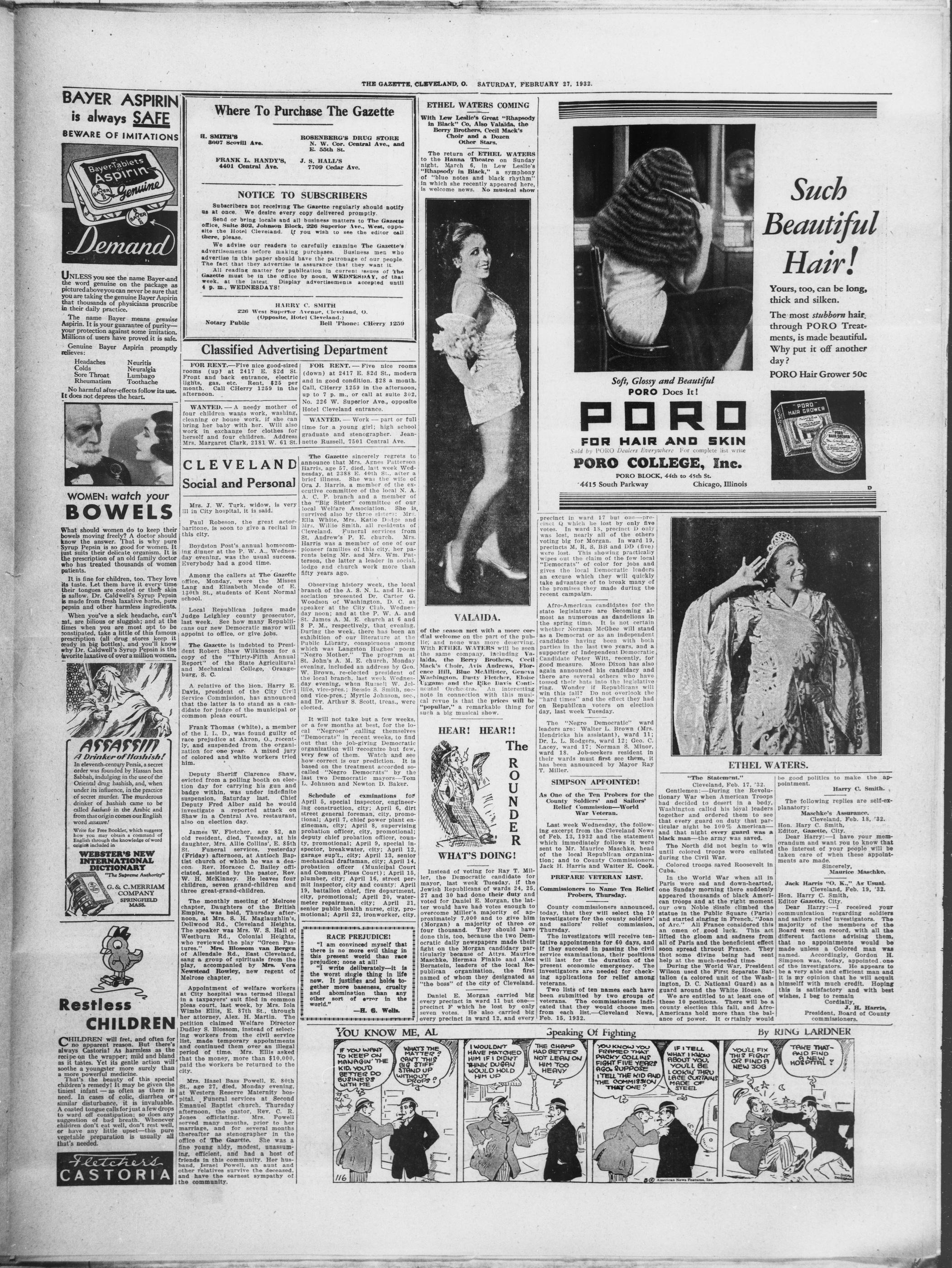
THE GAZETTE, CLEVELAND, O. SATURDAY, FEBRUARY 27, 1932
YOU KNOW ME, AL
Speaking Of Fighting
By RING LARDNER
IF YOU WANT TO KEEP ON MANAGING THE KID, YOU'D BETTER DO BUSINESS WITH ME
WHAT'S THE MATTER? CAN'T THIS BIG STIFF STAND UP WITHOUT PROPS?
I WOULDN'T HAVE MATCHED HIM IF I DIDN'T THINK DUGAN WOULD HOLD HIM UP
THE CHAMP HAD BETTER NOT LEAN ON HIM TOO HEAVY
YOU KNOW YOU FRAMED THAT PACKY COLLINS FIGHT FIVE YEARS AGO. SUPPOSE I TELL THE KID AND THE COMMISSION THAT ONE?
IF I TELL WHAT KNOW ABOUT YOU YOU'LL BE LOOKING THRU LACE CURTAINS MADE OF STEEL
YOU'LL FIX THIS FIGHT OR FIND A NEW SOB
TAKE THAT- AND FIND A NEW HOSPITAL?
BIGGON DOGGAL
ROSENBERG'S DRUG STORE
N. W. Cor. Central Ave., and
E. 55th St.
J. S. HALL'S
7709 Cedar Ave.
FOR RENT. — Five nice rooms (down) at 2417 E. 82d St., modern and in good condition. $28 a month. Call, Cherry 1259 in the afternoon, up to 7 p. m., or call at suite 302, No. 226 W. Superior Ave., opposite Hotel Cleveland entrance.
WANTED. — Work — part or full time for a young girl; high school graduate and stenographer. Jeanne Russell, 7501 Central Ave.
The Gazette sincerely regrets to announce that Mrs. Agnes Patterson Harris, age 57, died, last week Wednesday, at age 288. E. 400 St., after a brief illness. She was the wife of Ora J. Harris, a member of the executive committee of the local N. A. A. C. P. branch and a member of the "Big Sister" committee of our local Welfare Association. She is survived also by Mrs. Katie Daltze and Willie Willie, all residents of Cleveland. Funeral services from St. Andrew's P. E. church. Mrs. Harris was a member of one of our pioneer families of this city, her parents being Mr. and Mrs. Wm. Patterson, the latter a leader in social, lodge and church work more than fifty years ago.
Observing history week, the local branch of the A. S. N. L. and H. association presented Dr. Carter G. Woodson of Washington, D. C. as speaker at the City Club, Wednesday noon; and at the P. W. A. and St. James A. M. E. church at 6 and 11 a.m. During the week, there has been an exhibition of our literature at the Public Library, conspicuous among which was Langston Hughes' poem "Negro Mother." The program at St. John's A. M. E. church, Monday evening, included an address by Geo. W. Brown, re-elected president of the local branch, last week Wednesday. Jeffie J. Jeffie, vice-pres.; Bessie S. Smith, second vice-pres.; Myrtle Johnson, sec. and Dr. Arthur S. Scott, treas., were elected.
It will not take but a few weeks, or a few months at best, for the local "Negroes" calling themselves "Democrats" in recent weeks, to find out that the job-giving Democratic organization will recognize but few, very few of them. Watch and see how correct is our prediction. It is based on the treatment accorded so-called "Negro Democrats" by the last two Democratic mayors—Tom L. Johnson and Newton D. Baker.
Schedule of examinations for April 5, special inspector, engineering construction, city; April 6, dirt street general foreman, city, promotional; April 7, chief power plant engineer, city; April 8, supervising probation officer, city, promotional; deputy chief probation officer, county, promotional; water, city; April 12, garage sup.t, city; April 13, senior mechanical draftman, city; April 14, plumber, city; April 15, and Common Pieas Court); April 15, plumber, city; April 16, street permit inspector, city and county; April 19, battalion chief, fire department, city, promotional; April 20, watermeter repairman, city; April 21, senior public health nurse, city, promotional; April 22, ironworker, city,
"I am convinced myself that there is no more evil thing in this world than race prejudice; none at all"
"I write deliberately—it is the worst single thing in life now. It justifies and holds together more baseness, cruelty and abomination than any other sort of error in the world."
—H. G. Wells.
ETHEL WATERS COMING
With Lew Leslie's Great "Rhapsoys in Black" Co. Also Valida, the Berry Brothers, Cecil Mack's Choir and a Dozen Other Stars.
The return of ETHEL WATERS to the Hanna Theatre on Sunday night. March 6. Lew Leslie's "Rhapsoys in Black" Lew Leslie'sphony of "blue notes and black rhythm" in which she recently appeared here, is welcome news. No musical show
THE BARBARA
VALAIDA.
of the season met with a more cordial welcome on the part of the public; and none was more deserving. WITH ETHEL WATERS will be seen the same company, including Valalda, the Berry Brothers, Cecil Mack's Choir, Avis Andrews, Florence Hill, Blue Mellister, Geneva Uggams, the Ethel Davis Uggams and the Rike Davis Continental Orchestra. An interesting note in connection with this musical revue is that the prices will be "popular," a remarkable thing for such a big musical show.
HEAR! HEAR!! The ROUNDER
Instead of voting for Ray T. Miller, the Democratic candidate for mayor, last week Tuesday, if the Jewish Republicans of wards 24, 25, 27 and 30 had done their duty and voted for Daniel E. Morgan, the latter would have had votes enough to overcome Miller's majority of approximately 7,000 and to give him (Morgan) a majority and to throw the vote to曼斯and. They should have done this, too, because the two Democratic daily newspapers made their fight on the Morgan candidacy particularly because of Attys. Maurice Maschke, Herman Finkle and Alex Bernstein, leaders of the local Republican organization, the first named of whom they designated as "the boss" of the city of Cleveland.
Daniel E. Morgan carried big every precinct in ward 11 but one—precinct F which he lost by only seven votes. He also carried big every precinct in ward 12, and every
THE HAIR CARE
Soft, Glossy and Beautiful
PORO Does It!
PO
FOR HAIR
Sold by PORO Dealers Every
PORO COL
PORO BLOCK
4415 South Parkway
precinct in ward 17 but one—precinct Q which he lost by only five votes. In ward 18, precinct D only was lost, nearly all of the others voting big for Morgan. In ward 19, precincts M, R, S, B and DD (five) were lost. This showing practically wipes out the claim of the few local "Democrats" of color for jobs and gives the local Democratic leaders an excuse which they will quickly take advantage of to break many of the promises they made during the recent campaign.
Afro-American candidates for the state legislature are becoming almost as numerous as dandelions in the spring time. It is not certain whether Norman McGhee will stand as a Democrat or as an independent candidate having been with both parties in the last two years, and a supporter of Independent Democratic Candidate Peter Witt, recently, for good measure. Mose Dixon has also again announced his candidacy and there are several others who have tossed their hats into the legislative ring. Wonder if Republicans will win this fall? Do not overlook the "hard times" and the effect they had on Republican voters on election day, last week Tuesday.
The "Negro Democratic" ward leaders are: Walter L. Brown (Mrs. Hendricks his assistant), ward 11; Dr. L. L. Rodgers, ward 12; Geo C. Lacey, ward 17; Norman S. Minor, ward 18. Job-seekers resident in their wards must first see them, it has been announced by Mayor Ray T. Miller.
SIMPSON APFOINTED!
As One of the Ten Probs for the County Soldiers' and Sailors' Relief Commission—World War Veteran.
Last week Wednesday, the following excerpt from the Cleveland News of Feb. 13, 1932 and the statement that Mr. Maurice Maschke, head of the local Republican organization; and to County Commissioners Jack H. Harris and Watter E. Cook
PREPARE VETERAN LIST.
Commissioners to Name Ten Relief Probers, Thursday.
County commissioners announced, today, that they will select the 10 investigators for the county soldiers' and sailors' relief commission, Thursday.
The investigators will receive tentative appointments for 60 days, and if they succeed in passing the civil service examinations, their positions will last for the duration of the present economic emergency. The investigators are needed for checking applications for relief among veterans.
Two sets of ten names each have been submitted by two groups of veterans. The commissioners indicated that they would choose men from each list.—Cleveland News, Feb. 15, 1932.
Speaking Of Fighting
THE CHAMP
HAD BETTER
NOT LEAN ON
HIM TOO
HEAVY
YOU KNOW YOU
FRAME THAT
PACKEY COULD JUST
FIGHT FIVE YEARS
AGO, SUPPOSE
I TELL THE KID AN
THE COMMISSION
THAT ONE?
RO
AND SKIN
where For complete list write
BLEGE, Inc.
K, 44th to 45th St.
Chicago, Illinois
MISS BETTY BROWN
"The Statement."
Cleveland, Feb. 17, '32.
Gentlemen:—During the Revolutionary War when American Troops had decided to desert in a body, Washington called his loyal leaders together and ordered them to see that every guard on duty that particular night be 100% American—and that night every guard was a black man—the army was saved.
The North did not begin to win until colored troops were enlisted during the Civil War.
Colored troops saved Roosevelt in Cuba.
In the World War when all in Paris were sad and down-hearted, one Sunday morning there suddenly appeared thousands of black American troops and at the right moment our own Noble Sissle climbed the statue in the Public Square (Paris) and started singing in French, "Joan of Arc." All France considered this an omen of good luck. This act lifted the gloom and sadness from all of Paris and the beneficial effect soon spread throut France. They thot some divine being had sent help at the much-needed time. During the World War, President Wilson used a colored unit of the Washington, D.C. National Guard) as a guard around the White House. We are entitled to at least one of these 10 positions. There will be a county election this fall, and Afro-Americans hold more than the balance of power. It certainly would
By
IF I TELL
WHAT I KNOW
ABOUT YOU,
YOULL BE
LOOKIN' THRU
LACE CURTAINS
MADE OF
STEEL
YOU'LL FIX
THIS FIGHT
OR FIND A
NEW JOB
Illinois
ETHEL WATERS.
By RING L
YOU'LL FIX
THIS FIGHT
OR FIND A
NEW SOB
TAKEN
AND
A
HOSA
Such Beautiful Hair!
Yours, too, can be long thick and silken.
The most stubborn hair through PORO Treatments, is made beautiful. Why put it off another day?
PORO Hair Grower 50c
"PORO"
HAIR GROWER
PORO
HAIR GROWER
PORO
HAIR GROWER
D
be good politics to make the appointment.
Harry C. Smith.
The following replies are self-explanatory:
Maschke's Assurance.
Cleveland, Feb. 18, '32.
Hon. Hary C. Smith.
Editor, Ganette, City.
Dear Harry, I have your memorandum and want you to know that the interest of your people will be taken care of when these appointments are made.
Jack Harris "O. K." As Usual. Cleveland, Feb. 19, '32. Hon. Harry C. Smith, Editor Gazette, City. Beat Harry. I received your communication regarding soldiers and sailors relief investigators. The majority of the members of the Board went on record, with all the different factions advising them, that no appointments would be made unless a Colored man was named. Accordingly, Gordon H. Simpson was, today, appointed one to be a very able and efficient man; it is my opinion that he will acquaint himself with much credit. Hoping this is satisfactory and with best wishes, I beg to remain
BY RING LARDNER
TAKE THAT-
AND FIND
A NEW
HOSPITAL?
Harry C. Smith.
Maschke's Assurance.
Sincerely,
Maurice Maschke.
J. H. Harris, President, Board of County commissioners
Don't Throw Away Your Copy of The GAZETTE After Reading It But Give it to a Friend or an Acquaintance who might Subscribe after Reading It
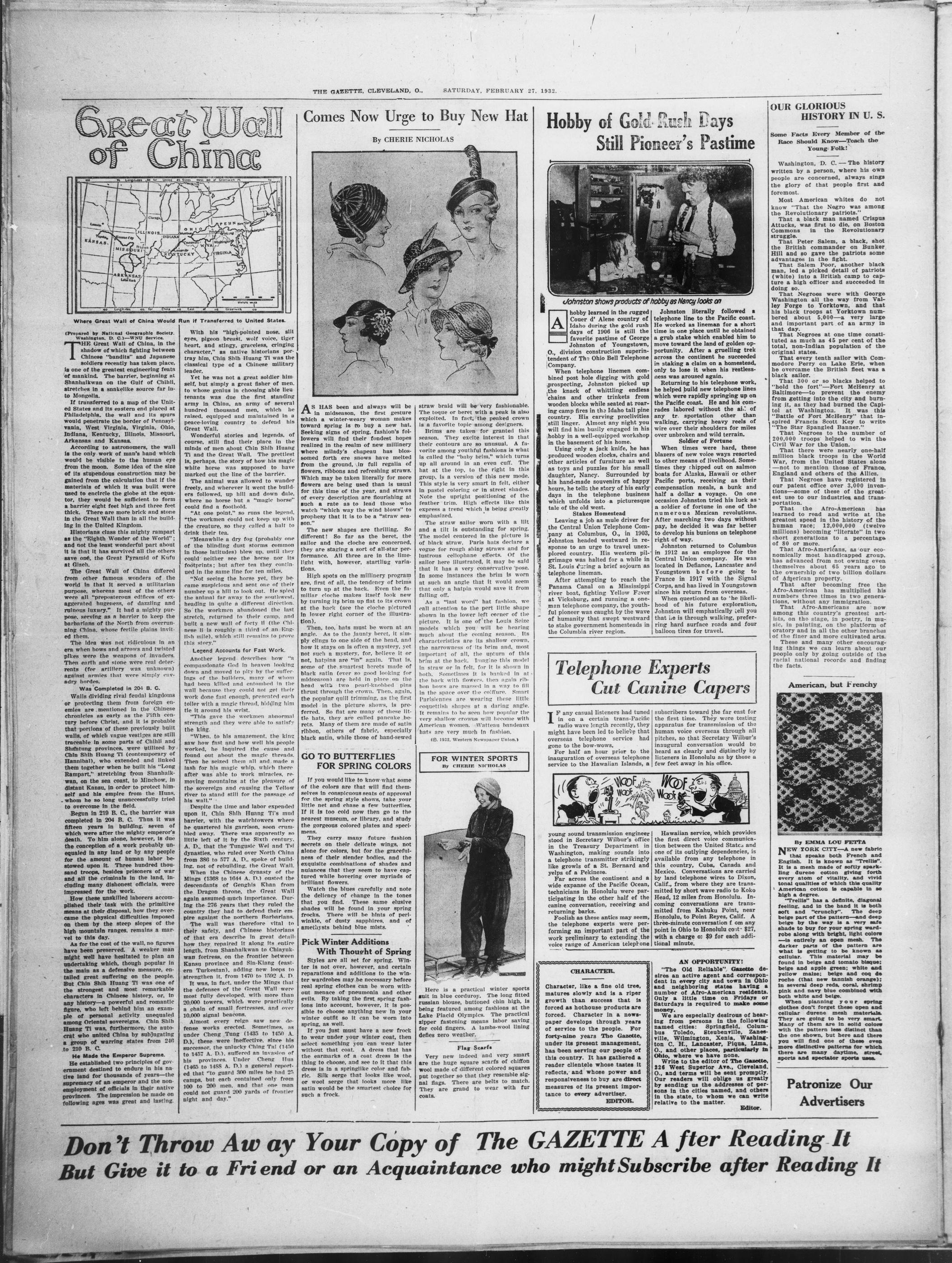
Great Wall of China
Where Great Wall of China Would Run if Transferred to United States.
(Prepared by National Geographic Society.
With his "high-pointed nose.
soldiers recently has taken place, is one of the greatest engineering feats of mankind. The barrier, beginning at Shanhakwan on the Gulf of Chihli, stretches in a snakelike source far into Mongolia.
If transferred to a map of the United States and its eastern end placed at Philadelphia, the wall and its spurs would penetrate the border of Pennsylvania, West Virginia, Virginia, Ohio, Indiana, Kentucky, Illinois, Missouri, Arkansas and Kansas.
According to astronomers, the wall is the only work of man's hand which would be visible to the human eye from the moon. Some idea of the size of its stupendous construction may be gained from the calculation that if the materials of which it was built were used to enclure the globe at the equator, they would be sufficient to form a barrier eight feet high and three feet thick. There are more brick and stone in the Great Wall than in all the building in the United Kingdom.
Historians class this mighty rampart as the "Eighth Wonder of the World"; and not the least wonderful part about it is that it has survived all the others save one, the Great Pyramid of Kufu at Gizeh.
The Great Wall of China differed from other famous wonders of the world in that it served a utilitarian purpose, whereas most of the others were all "preposterous edifices of exaggerated humeness, of dazzling and rulous luxury." It had a mighty purpose, serving as a barrier to keep the barbarians of the North from overrunning China, whose fertile plains invited them.
The idea was not ridiculous in an era when hows and arrows and twisted plikes were the weapons of invaders. Then earth and stone were real deterents (for arillery was unknown) against armies that were simply cavalry hordes.
Was Completed in 204 B. C.
Was Completed in 2014 B. C.
Walls rivaled rival royal kingdoms or protecting them from foreign enemies are mentioned in the Chinese chronicles as early as the Fifth century before Christ, and it is probable that portions of these previously built walls, of which vague vestiges are still traceable in some parts of Chihil and Shantung provinces, were utilized by Chin Shih Huang Ti (contemporary of Hannibal), who extended and linked them together when he built his "Long Rampart," stretching from Shanhalkow, on the sea coast, to Minchow, in distant Kansu, in order to protect himself and his empire from the Huns, whom he so long unsuccessfully tried to overcome in the field.
Begun in 219 B. C., the barrier was completed in 204 B. C. Thus it was fifteen years in building, seven of which were after the mighty emperor's death. To him alone, however, is due the conception of a work probably unequaled in any land or by any people for the amount of human labor bestowed upon it. Three hundred thousand troops, besides prisoners of war and all the criminals in the land, including many dishonest officials, were impressed for the work.
How these unskilled laborers accomplished their task with the primitive means at their disposal, how they overcame the physical difficulties imposed on them by the steep slopes of the high mountain ranges, remains a marvel to this day.
As for the cost of the wall, no figures have been preserved. A weaker man might well have hesitated to plan an undertaking which, though popular in the main as a defensive measure, entailed great suffering on the people. But Chin Shih Huang TI was one of the strongest and most remarkable characters in Chinese history, or, in any history—a powerful and romantic figure, who left behind him an example of personal activity unequaled among Oriental sovereigns. Chin Shih Huang TI was, furthermore, the autocrat who united China by subligating a group of warring states from 240 to 210 B. C.
He Made the Emperor Supreme.
He established two principles of government destined to endure in his native land for thousands of years—the supremacy of an emperor and the non-employment of officials in their native provinces. The impression he made on following ages was great and lasting.
With his "high-pointed nose, slit eyes, pigeon breast, wolf voice, tiger heart, and stingy, graceless, cringing character," as native historians portray him, Chin Shih Huang TI was the classical type of a Chinese military leader.
Yet he was not a great soldier himself, but simply a great fisher of men, to whose genius in choosing able lieutenants was due the first standing army in China, an army of several hundred thousand men, which he raised, equipped and maintained in a peace-loving country to defend his Great Wall.
Wonderful stories and legends, of course, still find their place in the minds of men about Chin Shih Huang TI and the Great Wall. The prettiest is, perhaps, the story of how his magic white horse was supposed to have marked out the line of the barrier.
The animal was allowed to wander freely, and wherever it went the builders followed, up hill and down dale, where no horse but a "magic horse" could find a foothold.
"At one point," so runs the legend, "the workmen could not keep up with the creature, so they called a halt to drink their tea.
"Meanwhile a dry fog (probably one of the blinding dust storms common in those latitudes) blew up, until they could neither see the horse nor its footprints; but after tea they continued in the same line for ten miles.
"Not seeing the horse yet, they became suspicious and sent one of their number up a hill to look out. He spied the animal far away to the southwest, heading in quite a different direction. So the workmen abandoned the last stretch, returned to their camp, and built a new wall of forty II (the Chinese II is roughly a third of an English mile), which still remains to prove this story."
Legend Accounts for Fast Work.
Another legend describes how "a compassionate God in heaven looking down and moved to pity by the sufferings of the builders, many of whom had been killed and entombed in the wall because they could not get their work done fast enough, presented each toiler with a magic thread, bidding him tle it around his wrist.
"This gave the workmen abnormal strength and they were able to satisfy the king.
"When, to his amazement, the king saw how fast and how well his people worked, he inquired the cause and found out about the magic threads. Then he seized them all and made a lash for his magic wiph, which there after was able to work miracles, removing mountains at the pleasure of the sovereign and causing the Yellow river to stand still for the passage of his wall."
Despite the time and labor expended upon it, Chin Shih Hung Tui's mud barrier, with the watchtowers where he quartered his garrison, soon crumbling away. There was apparently so little left of it by the Sixth century, A. D., that the Tungusic Wei and Tsi dynasties, who ruled over North China from 386 to 577 A. D., spoke of building, not of rebuilding, the Great Wall. When the Chinese dynasty of the Mings (1388 to 1644 A. D.) ousted the descendants of Genghis Khan from the Dragon throne, the Great Wall again assumed much importance. During the 276 years that they ruled the country they had to defend their empire against the northern Barbarians. The wall was therefore vital to their safety, and Chinese historians of that era describe in great detail how they repaired it along its entire length, from Shanhakwan to Kyaukwan fortress, on the frontier between Kansu province and Sin-Klang (eastern Turkestan), adding new loops to strengthen it, from 1470 to 1592 A. D.
It was, in fact, under the Ming that the defenses of the Great Wall were most fully developed, with more than 20,000 towers, which were practically a chain of small fortresses, and over 10,000 signal beacons.
Almost every reign saw new defense works erected. Sometimes, as under Cheng Tung (1435 to 1450 A.D.), these were ineffective, since his successor, the unlucky Ching Tai (1450 to 1457 A.D.), suffered an invasion of his provinces. Under Cheng Hun (1465 to 1488 A.D.) a general reported that "to guard 300 miles he had 25 camps, but each contained only from 100 to 200 men, and that one man could not guard 200 yards of frontier night and day."
THE GAZETTE, CLEVELAND, O., SATURDAY, FEBRUARY 27, 1932.
Comes Now Urge to Buy New Hat
THE HAT
AS HAS been and always will be in midseason, the first gesture which a winter-weary woman makes toward spring is to buy a new hat. Seeking signs of spring, fashion's followers will find their fondest hopes realized in the realm of new millinery where milady's chapean has blossomed forth ere snores have melted from the ground, in full regalia of flowers, ribbons and refreshing straws. Which may be taken literally for more flowers are being used than is usual for this time of the year, and straws of every description are flourishing at such a rate as to lead those who watch "which way the wind blows" to prophesy that it is to be a "straw season."
The new shapes are thrilling. So different! So far as the beret, the sailor and the cloche are concerned, they are staging a sort of all-star performance. All three are in the lime-light with, however, startling variations.
High spots on the millinery program are, first of all, the tendency of brims to turn up at the back. Even the familiar cloak makes itself look new by turning its brim up flat to its crown at the back (see the cloche pictured in lower right corner of the illustration).
Then, too, hats must be worn at an angle. As to the jaunty beret, it simply clings to one side of the head, and how it stays on is often a mystery, yet not such a mystery, for believe it or not, hatpins are "in" again. That is, some of the smartest berets made of black satin (ever so good looking for midseason) are held in place on the head with two pearl-knobbed pins thrust through the crown. Then, again, the popular quill trimming, as the first model in the picture shows, is preferred. So flat are many of these little hats, they are called pancake herets. Many of them are made of satin ribbon, others of fabric, especially black satin, while those of hand-sewed
GO TO BUTTERFLIES
FOR SPRING COLORS
If you would like to know what some of the colors are that will find themselves in conspicuous seats of approval for the spring style shows, take your little net and chase a few butterflies. If it is too cold now then go to the nearest museum, or library, and study the gorgeous colored plates and specimens.
They carry many future fashion secrets on their delicate wings, not alone for colors, but for the gracefulness of their slender bodies, and the exquisite combinations of shades and nuances that they seem to have captured while hovering over myriads of brilliant flowers.
Watch the blues carefully and note the delicacy of change in the tones that you find. These same elusive shades will be found in your spring frocks. There will be blints of perlwinkle, of dusty sapphires, and of amethysts behind blue mists.
Pick Winter Additions
With Thought of Spring
Styles are all set for spring. Winter is not over, however, and certain reparations and additions to the winter wardrobes may be necessary before real spring clothes can be worn without menace of pneumonia and other evils. By taking the first spring fashions into account, however, it is possible to choose anything new in your winter outfit so it can be worn into spring, as well.
If you just must have a new frock to wear under your winter coat, then select something you can wear later without that coat. A dress that has the earmarks of a coat dress is the thing to choose, and to see it that this dress is in a springlike color and fabric. Silk serge that looks like wool, or wool serge that looks more like satin would be the smartest choice for such a frock.
straw braid will be very fashionable. The toque or beret with a peak is also exploited. In fact, the peaked crown is a favorite topic among designers. Brims are taken for granted this season. They excite interest in that their contours are so unusual. A favorite among youthful fashions is what is called the "baby brim," which turns up all around in an even cuff. The hat at the top, to the right in this group, is a version of this new mode. This style is very smart in felt, either in pastel coloring or in street shades. Note the upright positioning of the feather trim. High effects like this express a trend which is being greatly emphasized.
The straw sailor worn with a lift and a tilt is outstanding for spring. The model centered in the picture is of black straw, Paris hats declare a vogue for rough shiny straws and for lustrous cellophane effects. Of the sailor here illustrated, it may be said that it has a very conservative pose. In some instances the brim is worn at such an angle that it would seem that only a hatpin would save it from falling off.
As a "last word" hut fashion, we call attention to the pert little shape shown in the lower left corner of the picture. It is one of the Louis Seize models which you will be hearing much about the coming season. Its characteristics are its shallow crown, the narrowness of its brim and, most important of all, the upturn of this brim at the back. Imagine this model in straw or in felt, for it is shown in both. Sometimes it is banked in at the back with flowers, then again ribbon bows are massed in a way to fill in the space over the collar. Smart Parisiennes are wearing these little coquettish shapes at a daring angle. It remains to be seen how popular the very shallow crowns will become with American women. Wattane bandaneaux hats are very much in fashion.
© 1922, Western News Union.
FOR WINTER SPORTS
By CHERIE NICHOLAS
Here is a practical winter sports suit in blue corduroy. The long fitted russian blouse, buttoned chin high, is being featured among fashions at the Lake Placid Olympics. The practical zipper fastening means labor saving for cold fingers. A lams-wool lining defies zero weather.
Flag Scarfs
Very new indeed and very smart are the huge square scarfs of chiffon wool made of different colored squares put together so that they resemble signal flags. There are belts to match. They are grand to wear with fur coats.
Hobby of Gold-Rush Days Still Pioneer's Pastime
Hobby of Gold-Rush Days Still Pioneer's Pastime
Johnston shows products of hobby as Nancu looks on
Telephone Experts Cut Canine Capers
WOOF
WOOF
WOOF
WOOF
hobby learned in the rugged Couer d' Alene country of Idaho during the gold rush days of 1906 is still the favorite pastime of George Johnston of Youngtown, O., division construction superintendent of The Ohio Bell Telephone Company. When telephone linemen combined post hole digging with gold prospecting, Johnston picked up the knack of whitling endless chains and other trinkets from wooden blocks while seated at roaring camp fires in the Idaho tall pine. His carving proclivities still linger. Almost any night you will find him busily engaged in his hobby in a well-equipped workshop in the basement of his home.
Using only a jack knife, he has produced wooden clocks, chairs and other articles of furniture as well as toys and puzzles for his small daughter, Nancy. Surrounded by his hand-made souvenirs of happy hours, he tells the story of his early days in the telephone business which unfolds into a picturesque tale of the old west.
Stakes Homestead
Leaving a job as mule driver for the Central Union Telephone Company at Columbus, O., in 1903, Johnston headed westward in response to an urge to travel unexplored country. His western pilgrimage was halted for a while in St. Louis during a brief sojourn as telephone lineman.
After attempting to reach the Panama Canal on a Mississippi river boat, fighting Yellow Fever at Vicksburg, and running a one-man telephone company, the youthful pioneer was caught by the wave of humanity that swept westward to stake government homesteads in the Columbia river region.
Telephone Cut Car
radio wave length recently, they might have been led to believe that overseas telephone service had gone to the bow-wows.
For half an hour prior to the inauguration of overseas telephone service to the Hawaiian Islands, a young sound transmission engineer stood in Secretary Wilbur's office in the Treasury Department in Washington, making sounds into a telephone transmitter strikingly like growls of a St. Bernard and veins of a Pekinese.
Far across the continent and a wide expanse of the Pacific Ocean, technicians in Honolulu were participating in the other half of the canine conversation, receiving and returning barks.
Foolish as these antics may seem, the telephone experts were performing an important part of the work preliminary to extending the voice range of American telephone
CHARACTER.
Character, like a fine old tree, matures slowly and is a riper growth than success that is forced as hothouse products are forced. Character in a newspaper develops through years of service to the people. For forty-nine years The Gazette, under its present management, has been serving our people of this country. It has gathered a reader clientele whose tastes it reflects, and whose power and responsiveness to buy are direct measures of its present importance to every advertiser.
EDITOR.
GAZETTE o might Sub
Johnston literally followed a telephone line to the Pacific coast. He worked as lineman for a short time in one place until he obtained a grub stake which enabled him to move toward the land of golden opportunity. After a gruelling trek across the continent he succeeded in staking a claim on a homestead, only to lose it when his restlessness was aroused again.
Returning to his telephone work, he helped build new telephone lines which were rapidly springing up on the Pacific coast. He and his comrades labored without the aid of any tr. sportation other than walking, carrying heavy reels of wire over their shoulders for miles over unbroken and wild terrain.
Soldier of Fortune
Soldier of Fortune
When times were hard, these blazers of new voice ways resorted to other means of livelihood. Sometimes they shipped on salmon boats for Alaska, Hawaii or other Pacific ports, receiving as their compensation meals, a bunk and half a dollar a voyage. On one occasion Johnston tried his luck as a soldier of fortune in one of the numerous Mexican revolutions. After marching two days without pay, he decided it was far better to develop his bunions on telephone right of way.
Johnston returned to Columbus in 1912 as an employee for the Central Union company. He was located in Defiance, Lancaster and Youngstown before going to France in 1917 with the Signal Corps, and has lived in Youngstown since his return from overseas.
When questioned as to 'he likelihood of his future exploration, Johnston will emphatically tell you that lie is through walking, preferring hard surface roads and four balloon tires for travel.
Experts nine Capers
subscribers toward the far east for the first time. They were testing apparatus for transmission of the human voice overseas through all pitches, so that Secretary Wilbur's inaugural conversation would be heard as clearly and distinctly by listeners in Honolulu as by those a few feet away in his office.
Woof Woof
Hawaiian service, which provides the first direct voice communication between the United States and one of its outlying dependencies, is available from any telephone in this country, Cuba, Canada and Mexico. Conversations are carried by land telephone wires to Dixon, Calif., from where they are transmitted by short wave radio to Koko Head, 12 miles from Honolulu. Incoming conversations are transmitted from Kahuku Point, near Honolulu, to Point Reyes, Calif. A three-minute conversation f om any point in Ohio to Honolulu cost $27, with a charge of $9 for each additional minute.
AN OPPORTUNITY!
"The Old Reliable" Gazetto desires an active agent and correspondent in every city and town in Ohio and neighboring states having a number of Afro-American residents. Only a little time on Fridays or Saturdays is required to make some money. We are especially desirous of hearing from persons in the following named cities: Springfield, Columbus Toledo, Steubenville, Zanesville, Wilmington, Xenia, Washington C. H., Lancaster, Plqua, Lima, O., and other places, particularly in Ohio, where we have none. Gazetto, 225 West Superior Ave., Cleveland, O, and terms will be sent promptly. Our readers will oblige us greatly by sending us the addresses of persons in the cities named, and others in the state, to whom we can write relative to the matter.
After Read subscribe after
OUR GLORIOUS HISTORY IN U. S.
Some Facts Every Member of the Race Should Know—Teach the Young Folk!
Washington, D. C. — The history written by a person, where his own people are concerned, always sings the glory of that people first and foremost.
Most American whites do not know "That the Negro was among the Revolutionary patriots."
That a black man named Crispus Attucks, was first to die, on Boston Commons in the Revolutionary struggle.
That Peter Salem, a black, shot the British commander on Bunker Hill and so gave the patriots some advantages in the fight.
That Salem took another black man, led a picked detail of patriots (white) into a British camp to capture a high officer and succeeded in doing so.
That Negroes were with George Washington all the way from Valley Forge to Yorktown, and that his black troops at Yorktown numbered about 5,000—a very large and important part of an army in that region. That Negroes at one time constituted as much as 45 per cent of the total, non-Indian population of the original states. That every tenth sailor with Commodore Perry on Lake Erie, when he overcame the British fleet was a black sailor. Or so blacks helped to "hold the fort"—Fort McHenry at Baltimore—to prevent the enemy from getting into the city and burning it, as they had burned the Capitol at Washington. It was this "Battle of Fort McHenry" that inspired Francis Scott Key to write "The Star Spangled Banner." He came to the number of 200,000 troops helped to win the Civil War for the Union.
That there were nearly one-half million black troops in the World War, from the United States alone—not to mention those of France, England and others of the Allies. In our patent office over 3,000 inventions—some of these of the greatest use to our industries and transportation.
That the Afro-American has learned to read and write at the greatest speed in the history of the human race: 12,000,000 (twelve million) becoming "iterate" in two short generations to a percentage of 80 or more.
That Afro-Americans, as our economically most handicapped group, has advanced from not owning even themselves about 65 years ago to the ownership of two billion dollars of American property.
That after becoming free the Afro-American has multiplied his numbers three times in two generations, without any immigration.
That Afro-Americans are now among this country's greatest artists, on the stage, in poetry, in music, in painting, on the platform of oratory and in all the other branches of the finer and more cultivated arts. And many other things we can learn about our people only by going outside of the racial national records and finding the facts.
Bz EMMA LOU FETTA
NEW YORK CITY—A new fabric that speaks both French and English. It is known as "Trellis." It is a mesh made of softly sparkling durum cotton giving forth every atom of vitality, and vivid color. While white cotton is American cotton is capable in so high a degree. "Trellis" has a definite, diagonal feeling, and in the hand it is both soft and "crunchy". The deep beige part of the pattern—and deep beige by the way is a very safe shade by the way is a very safe shade along with bright, light colors—is entirely an open mesh. The darker parts of the pattern are what is getting to be known as cellular. This material may be found in beige and tomato brique; beige and apple green; white and yellow maize; beige and coq roche (that new tannish orange); beige and pink and navy blue combined with both white and beige.
When planning your spring clothes don't forget these open and cellular durene mesh materials. They are going to be very smart. Many of them are in solid colors with the pattern less distinct than the ones you see. You will find one of these even more distinctive patterns for which there are many daytime, street sports and spectator sports use.
Patronize Our Advertisers