The Gazette
Saturday, March 12, 1932
Cleveland, Ohio
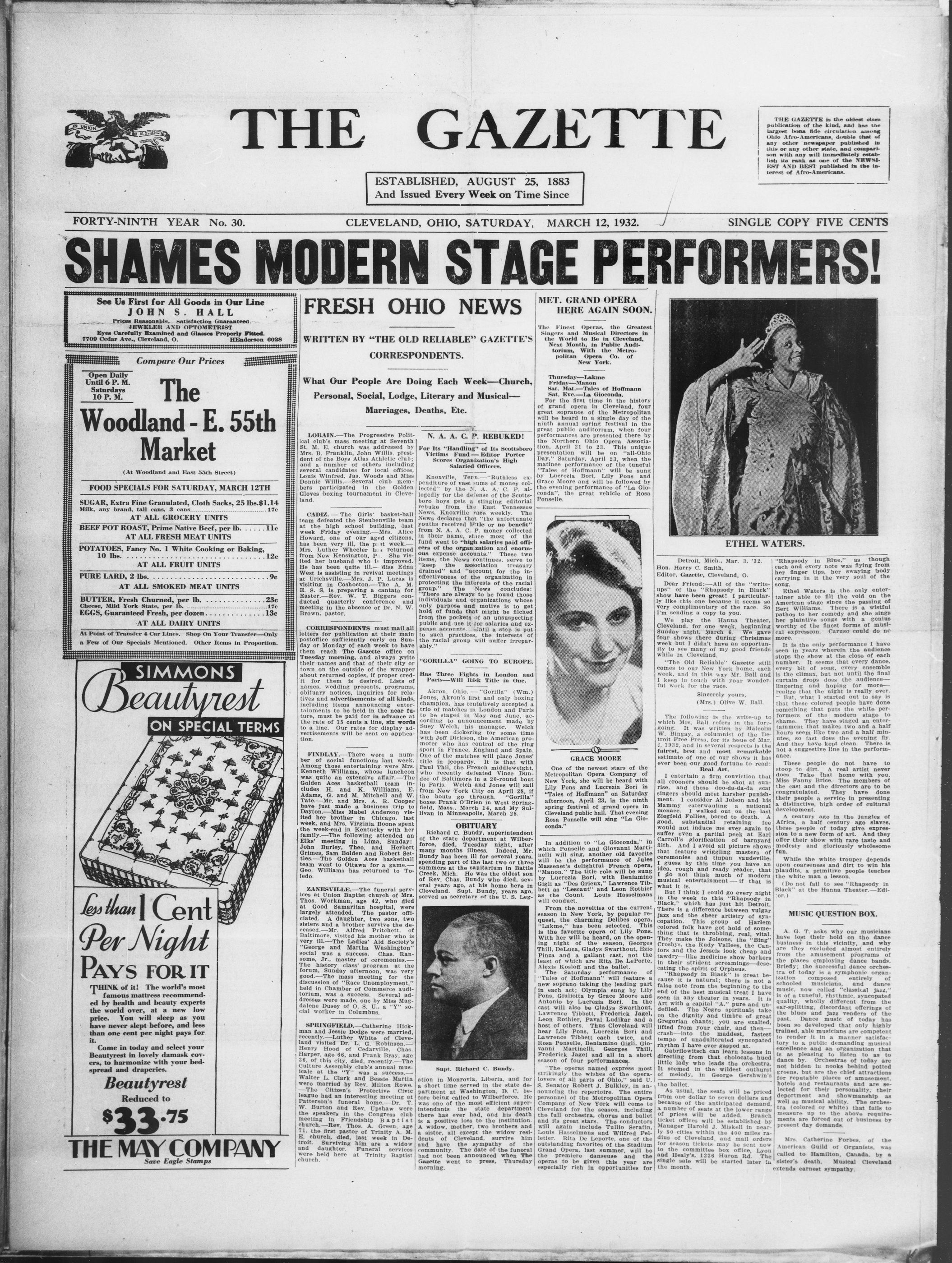
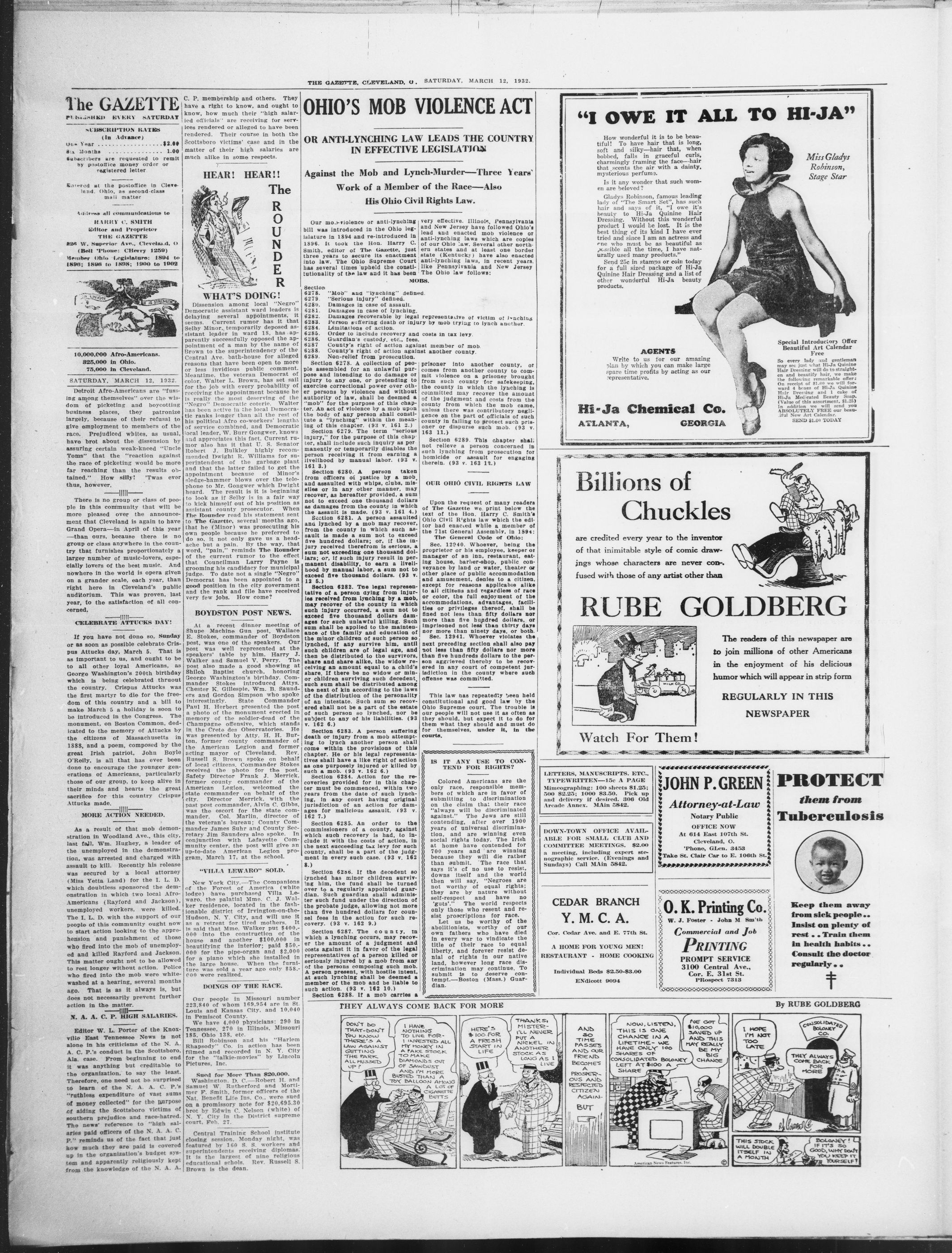
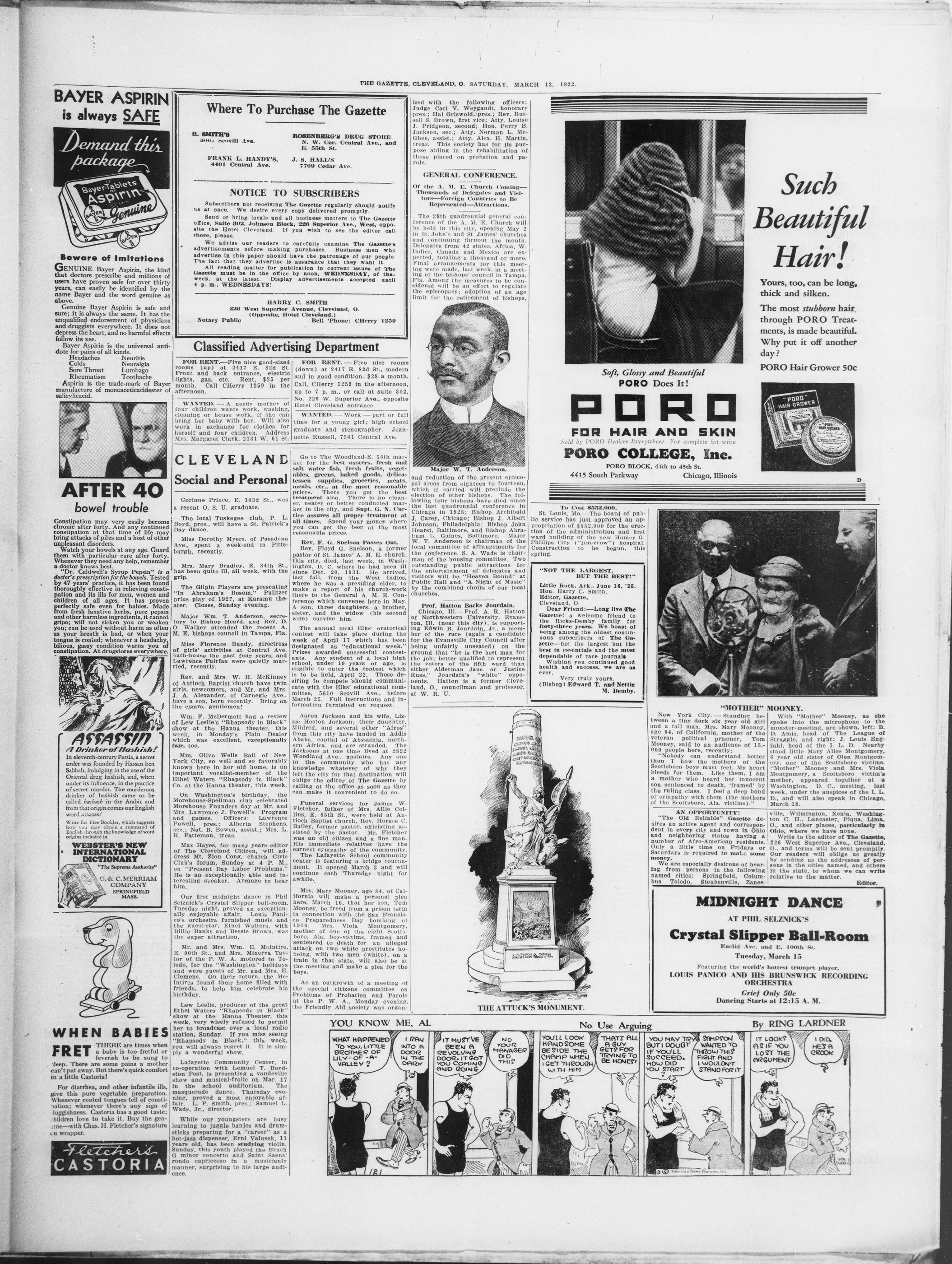
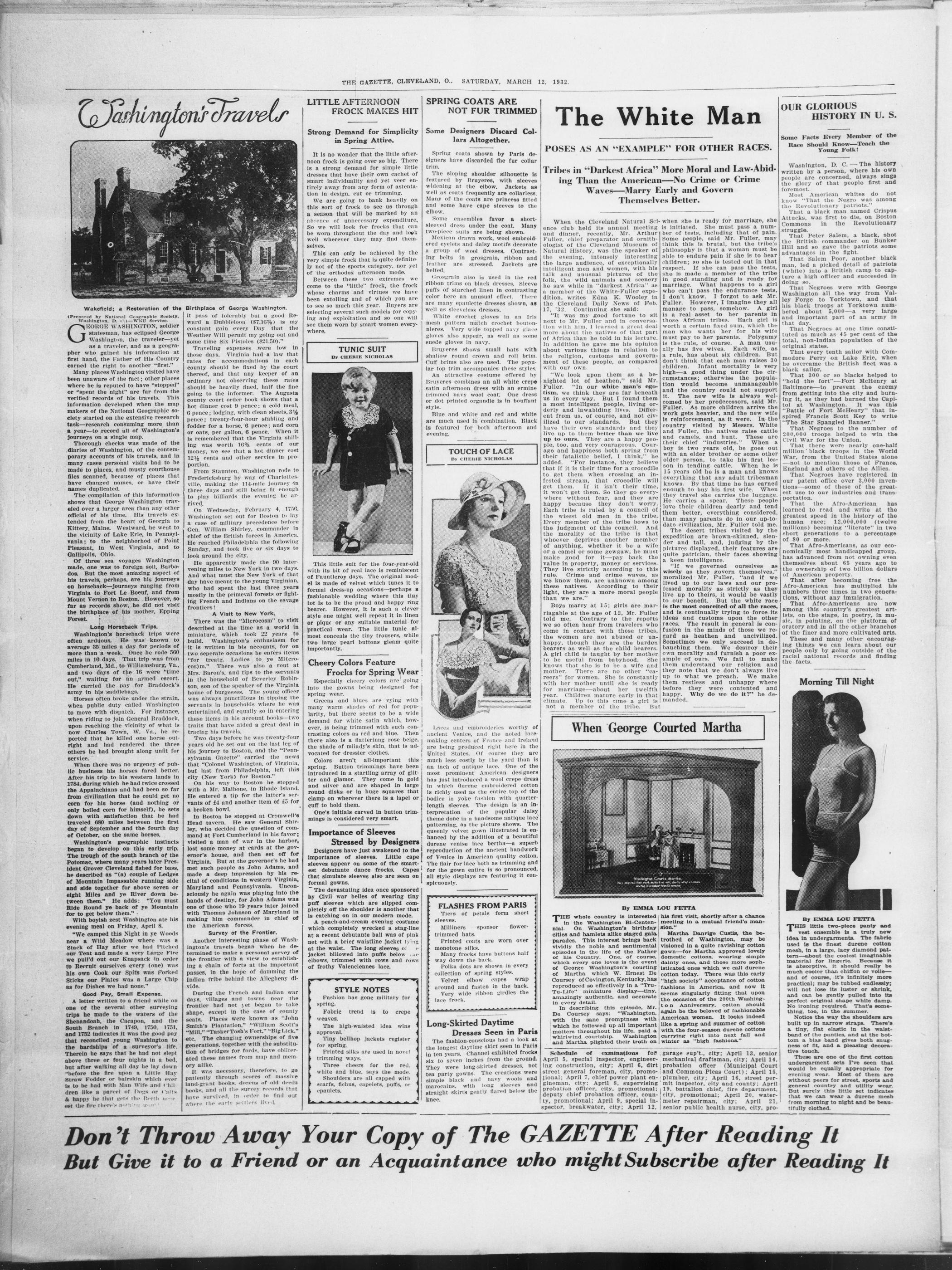
Page text (machine-generated)
SHAMES MODERN STAGE PERFORMERS!
IN UNION IS STRENGTH
FORTY-NINTH Y
SHAM
See Us First for a
JOHN
Prices Reasonable.
JEWELER A
Eyes Carefully Examine
7709 Cedar Ave., Cleveland,
Company
Open Daily
Until 6 P. M.
Saturdays
10 P. M.
Woodland
NINTH YEAR No. 3
AMES
Is First for All Goods in Our
JOHN S. HALL
Prices Reasonable. Satisfaction Guarantee
JEWELER AND OPTOMETRIST
Carefully Examined and Glasses Properly
Ave., Cleveland, O.
Compare Our Prices
The
Godland - E. 5
Market
FORTY-NINTH YEAR No.30.
Open Daily Until 6 P.M. Saturdays 10 P.M. The Woodland - E. 55th Market
(At Woodland and East 55th Street)
FOOD SPECIALS FOR
SUGAR, Extra Fine Granu
Milk, any brand, tall cans,
AT ALL G
BEEF POT ROAST, Prime
SPECIALS AT SATURDAY, MAR
Extra Fine Granulated, Cloth Sacks, 1
and, tall cans, 3 cans
AT ALL GROCERY UNITS
ROAST. Prime Native Beef, per ll
FOOD SPECIALS FOR SATURDAY, MARCH 12TH
SUGAR, Extra Fine Granulated, Cloth Sacks, 25 lbs.$1.14
Milk, any brand, tall cans, 3 cans.....17c
AT ALL GROCERY UNITS
BEEF POT ROAST, Prime Native Beef, per lb.....11c
AT ALL FRESH MEAT UNITS
POTATOES, Fancy No. 1 White Cooking or Baking,
10 lbs.....12c
AT ALL FRUIT UNITS
PURE LARD, 2 lbs.....9c
AT ALL SMOKED MEAT UNITS
At Point of Transfer 4 Car Lines. Shop On Your Transfer—Only a Few of Our Specials Mentioned. Other Items in Proportion.
SIMMONS
Beautyrest
ON SPECIAL TERMS
Less than 1 Cent
Per Night
PAYS FOR IT
THINK of it! The world's most
famous mattress recommend-
ed by health and beauty experts
the world over, at a new low
price. You will sleep as you
have never slept before, and less
than one cent per night pays for it.
Come in today and select your
Beautyrest in lovely damask cov-
ers, to harmonize with your bed-
spread and draperies.
Beautyrest
Reduced to
$33.75
THE MAY COMPANY
Save Eagle Stamps
THE GAZETTE
ESTABLISHED, AUGUST 25, 1883 And Issued Every Week on Time Since
CLEVELAND, OHIO, SATURDAY, MARCH 12, 1932.
FRESH OHIO NEWS
FRESH OHIO NEWS
WRITTEN BY "THE OLD RELIABLE" GAZETTE'S CORRESPONDENTS.
What Our People Are Doing Each Week—Church Personal, Social, Lodge, Literary and Musical Marriages, Deaths, Etc.
LOIRAIN.—The Progressive Political club's mass meeting at Seventh St. M. E, church was addressed by Mrs. B. Franklin, John Willis, president of the Boys Atlas Athletic club; and a number of others including several candidates for local offices, Louis Winsford, Jas. Woods and Miss Donnie Willis.—Several club members participated in the Golden Gloves boxing tournament in Cleveland.
CADIZ. — The Girls' basket-ball team defeated the Steubenville team at the high school building, last week Friday evening. — Mrs. Alice Howard, one of our aged citizens, has been very ill. The p it week. — Mrs. Alice Howard, one of our aged from New Kensington, P. She visited her husband who is improved. He has been quite ill. — Miss Edna West is assisting in revival meetings at Urchinsville. — Mrs. J. P. Lucas is visiting in Coshotheo. — The A. M. S. S is preparing a cantata for Easter for conducted quarterly conference and meeting in the absence of Dr. N. W. Brown, pastor.
CORRESPONDENTS must mail all letters for publication at their main postoffice sufficiently early on Sunday or Monday of each week to have them reach The Gazette office on Tuesday morning, and always write their names and that of their city or town on the outside of the wrapper on the cover. They must list it for them is desired. Lists of names, wedding presents, programs, obituary notices, inquiries for relatives and advertisements of all kinds, including items announcing entertainments to be held in the near future, must be paid for in advance at the rate of 15 cents a line, six words a line. Written rates for display verticements will be sent on application.
FINDLAY.—There were a number of social functions last week. Among those entertaining were Mrs. Kenneth Williams, whose luncheon was quite an extensive affair.—The Golden Aces basketball team includes H. and K. Williams, E. Adams, G. and M. Mitchell and W. T. and M. and Mrs. Trip have just made a business trip to Dayton.—Miss Mabel Anderson visited her brother in Chicago, last week, and Mrs. Virginia Boone spent the week-end in Kentucky with her family.—The following attended an Elks' meeting in Lima, Sunday: John Burley, Theo, and Herbert Grimes, Sam Solden and Robert Sette.—The Golden Aces basketball team went to Ottawa for a game. Geo. Williams has returned to Toledo.
ZANESVILLE.—The funeral services at Union Baptist church of Mrs. Thos. Workman, age 42, who died at Good Samaritan hospital, were largely attended. The pastor officiated. A daughter, two sons, two sisters and a brother survive the death of Samaritan. The pastor of Baltimore, visited his mother who very ill.—The Ladies' Aid Society's "George and Martha Washington" social was a success. Chas. Ransome, Jr., master of ceremonies.—The history class' program at the forum, Sunday afternoon, was very good. The mass meeting for the event "Race Unemployment," held in Chambersburg, was a court audioturium, was a success. Seven addresses were made, one by Miss Magdalene Dusey of O. S. U., a "Y" social worker in Columbus.
SPRINGFIELD.—Catherine Hickman and Jessie Dodge were married, recently.—Luther White of Cleveland visited Dr. L. G. Robinson.—Henry Hood of Cedarville, Chas Harper, age 66, and Frank Bray, age 36, of this city, died, recently.—The club's annual musical at the "Walter L. Clark and Bessie Martin were married by Rev. Milton Rowe.—The Citizen's Protective Civic league had an interesting meeting at Patterson's funeral home.—Dr. T. W. Burton and Rev. Upshaw were the speakers in the Congress club meeting in Friendship Baptist Rev. Thos. A. Milton, age 71, the first patron of Trinity A. M. E. church, died, last week in Detroit. Surviving him are a widow and daughter. Funeral services were held here at Trinity Baptist church.
For Its "Handling" of Its Scottborss Victims Fund — Editor Porter Scores Organization's High Salaried Officers.
Knoxville, Tenn.—Ruthless expenditure of *vast sums of money collected* by the N. A. A. C. P. allegedly for the defense of the Scottsboro boys gets a stinging editorial rebuke from the East Tennessee News, Knoxville race weekly. The News declares that "the unfortunate youths received little or no benefit" from N. A. A. C. P. money collected in their name, share most of the high salaries paid officers of the organization and expenses accounted. These two items, the News continues, serve to "keep the association treasury drained" and "account for the effectiveness of the organization in protecting the interests of the racial group." The News concludes: "There are always to be found those individuals and organizations whose only purpose and motive is to get hold of funds that might be filched up in the pocket of an unsuspecting public and use it for a sensible purpose accounts. Until a step is put to such practices, the interests of the racial group will suffer irreparably."
Has Three Fights in London and Paris—Will Risk Title in One.
Akron, Ohio. — "Gorilla" (Wm.) Jones, Akron's first and only boxing champion, has tentatively accepted a trio of matches in London and Paris to be staged in May and June, according to announcement made by Suey Welch, his manager. Welch has been dickering for some time with Jeff Dickson, the American promoter who has control of the ring sport in France, England and Spain. one of the matches will place Jones' one in seopard. It is that with Paul Tillis that the French midwife, who recently defeated Vince Dunne, dee of Baltimore in a 20-round bout in Paris. Welch and Jones will sail from New York City on April 28, if the bouts go through. "Gorilla" boxes Frank O'Brien in West Springfield, Mass. March 14, and My Sullivan in Minneapolis, March 28.
OBITUARY
Richard C. Bundy, superintendent of the state department at Wilberforce, died, Tuesday night, after many months illness. Indeed, Mr. Bundy has been ill for several years, spending part of the last two or three summers at the sanitarium in Battle Creek, Mich. He was the oldest son of Rev. Chas. Bundy who died, several years ago, at his home here in Cleveland. Supt. Bundy, years ago, served as secretary of the U. S. Leg-
Sunt. Richard C. Bundy.
ation in Monrovia, Liberia, and for a short time served in the state department at Washington, D. C., before being called to Wilberforce. He was one of the most efficient superintendants the state department there has ever had, and his death is a positive loss to the institution. A widow, mother, two brothers and a sister, all except the widow residents of Cleveland, survive him and have the sympathy of the community. The date of the funeral had not been announced when The Gazette went to press. Thursday morning.
Detroit, Mich., Mar. 3. '32.
Hon. Harry C. Smith,
Editor, Gazette, Cleveland, O.
Dear Friend:—All of the "write-ups" of the "Rhappeau in black" show have been great! I particularly like this one because it seems so very complimentary of the race. So I'm sending a copy to you.
We play the Hanna Theater, Cleveland, for one week, beginning Sunday night, March 6. We gave four shows there during Christmas week but I didn't have an opportunity to see many of my good friends while in Cleveland.
The Old Reliable' Gazette still comes to our New York home, each week, and in the way Mr. Ball and I keep in touch with your wonderful work for the race.
The following is the write-up to which Mrs. Ball refers in the forgoing. It was written by Malcolm W. Bingay, a columnist of the Detroit Free Press, for its issue of Mar. 2, 1922, and in several respects is the fairest, best and most remarkable estimate of one of our shows it has ever been our good fortune to read: Real Art.
I entertain a firm conviction that all crooners should be shot at sunrise, and these doo-da-da-da-sa singer shoots both the orchestra and performance. I consider Al Jolson and Mammy caterwailing a national menace. I walked out on the last Ziegfeld Follies, bored to death. A good, substantial retaining fee would not induce me ever again to suffer even a partial peek at Earl Carroll's glorification of barnyard filth. And I avoid all picture shows that feature wriggling masters of ceremonies and tinpan vaudeville. Press by this time you have an idea, and read a reader, that I do not think much of modern musical entertainment — if that is what it is.
But I think I could go every night in the week to this "Rhapsody in Black," which has just hit Detroit. There is a difference between vulgar jazz and the sheer artistry of syncopation. This group of Harlem colored folk have got hold of something that is throbbing, real, vital. They make the Jolsons, the "Bing" Crossbys, the Rudy Vallees, the Cantors and tawdry like the medicine show barkers in their strident screamings—described the spirit of Orpheus. "Rhapsody in Black" is great because it is natural; that is not a false note from the beginning end of the best musical treat I have seen in any theater in years. It is Art with a capital "A." pure and undefiled. The Negro spirituals take on the dignity and timbre of great Gregorian chants; you are exalted, lifted from your chair, and then—crash—into the maddest, fastest tempo of unadulterated syncopated rhythm I have ever gasped at.
Gabriilowitsch can learn lessons in directing from that cholocate hued little lady who leads the orchestra. It seemed in the wildest outburst of melody, in George Gershwins'
the ballet
As usual, the seats will be priced from one dollar to seven dollars and because of the anticipated demand, a number of seats at the lower range of prices will be added. Branch ticket offices will be established by Manager Harold J. Miskell in nearly 50 cities within the 400 miles radius of Cleveland, and mail orders for season tickets may be sent now to the committee box office, Lyon and Healy's. 1226 Huron Rd. The single sale will be started later in the month.
MET. GRAND OPERA HERE AGAIN SOON.
The Finest Operas, the Greatest Singers and Musical Directors in the World to Be in Cleveland, Next Month, in Public Auditorium, With the Metropolitan Opera Co. of New York.
Thursday—Lakme
Friday—Manon
Sat. Mat.—Tales of Hoffmann
Sat. Eve.—La Glorinda
For the first time in the history of grand opera in Cleveland, four great sopranos of the Metropolitan will be heard in a single day of the ninth annual spring festival in the great public auditorium, when four sopranos of the Northern Ohio Opera Association, April 21 to 23. This unique presentation will be on "all-Ohio Day." Saturday, April 23, when the matinee performance of the tuneful "Tales of Hoffmann" will be sung by Lucresis Bort Lily Pons and Ira Stern. Bort Lily Pons will be the evening performance of "La Gliconda," the great vehicle of Rosa Ponselle.
O
GRACE MOORE
One of the newest stars of the Metropolitan Opera Company of New York, she will be heard with Lily Pons and Lucezia Bori in "Tales of Hoffmann" on Saturday afternoon, April 23, in the ninth spring festival of grand opera in Cleveland public hall. That evening Rosa Ponselle will sing "La Gioconda."
In addition to "La Gioconda," in which Ponselle and Giovanni Martini will sing, another old favorite will be the performance of Tales of Monson's delightful French opera, "Manson." The title role will be sung by Lucezia Bori, with Beniamino Gigli as "Des Grieux," Lawrence Tibbett as "Lescaut" and Leon Rothier as the Count. Louis Hasselmans will conduct.
From the novelties of the current season in New York, by popular request, the charming Delibes opera, "Lakme," has been selected. This is the favorite opera of Lily Pons. With her will be heard, on the opening night of the season, Georges Thill, DeLuca, Gladys Swarthout, Ezio Pinza and a gallant cast, not the least of which are Rita De LePorte, Alexis Kosloff and the ballet. The Saturday performance of "Tales of Hoffmann" will feature a new soprano taking the leading part in the Olympic song by Lily Pons. Unlit, Glynn sung by Antonio by Luceira Bori. In the cast will also be Gladys Swarthout, Lawrence Tibbett, Frederick Jagel, Leon Rothier, Paval Ludikar and a host of others. Thus Cleveland will hear Lily Pons, Luceira Bori and Lawrence Tibbett, each twice, and Rosa Ponselle, Beniamino Gigli, Giovanni Martinielli, Georges Thill, Frederick Jagel and all in a short season of four performances.
"The operas named express most strikingly the wishes of the operalovers of all parts of Ohio," said U. S. Senator Robert J. Bulkley, in announcing the repertoire. The entire personnel of the Metropolitan Opera Company of New York will come to Cleveland for the opera, the full orchestra, chorus and ballet and its great stars. The conductors will again include Tullio Serafin, Louis Hasselmans and Wilfred Pelletier. Rita De Leporte, one of the outstanding favorites of the Stadium Grand Opera, last summer, will be given access to the operas to be given in years and especially rich in opportunities for
SINGLE COPY FIVE CENTS
MISS BETTY BROWN
ETHEL WATERS.
THE GAZETTE is the oldest class publication of the kind, and has the largest bona fide circulation among Ohio Afro-Americans, double that of any other newspaper published in this or any other state, and comparison with any will immediately establish its rank as one of the NEWSIEST AND BEST published in the interest of Afro-Americans.
E COPY FIVE CENTS
MERS!
"Rhapsoy in Blue," as though each and every note was flying from her finger tips, her swaying body carrying in it the very soul of the song.
Ethel Waters is the only entertainer able to fill the void on the American stage since the passing of Bert Williams. There is a wistful pathos to her comedy and she sings her plaintive songs with a genius worthy of the finest forms of musical expression. Caruso could do no more.
It is the only performance I have seen in years wherein the audience stops the show at the close of each number. It seems that every dance, every bit of song, every ensemble, the climax, but not until the final curtain drops does the audience lingering and hoping for more—that the night is really over
But, what I started out to say that these colored people have done something that puts the white performers of the modern stage to shame. They have staged an entertainment that makes two and a half hours seem like two and a half minutes, so fast does the evening fly. And they have kept clean. There is not a suggestive line in the performance.
These people do not have to stoop to dirt. A real artist never does. Take that home with you. Miss Fanny Brice. The members of the cast and the directors are to be congratulated. They have done their people a service in presenting a distinctive, high order of cultural development.
A century ago in the jungles of Africa, a half century ago slaves, these people of today give expression to a new form of art. And they offer their show with rare taste and modesty and gloriously wholesome fun.
While the white trouper depends upon coarseness and dirt to win his plaudits, a primitive people teaches the white man a lesson. (Do not fall to see "Rhapsody in Bibendum" at the Hanna Theater.—Editor.)
MUSIC QUESTION BOX
A. G. T. asks why our musicians have lost their hold on the dance business in this vicinity, and why are they excluded almost entirely from the amusement programs of the places employing dance bands. Briefly; the successful dance orchestra of today is a symphonic organization composed entirely of schooled musicians, and dance music, now called "classical jazz," is of a tuneful, rhythmic, syncopated quality, wholly different from the ear-splitting, discordant offerings of the blues and jazz vendors of the past. Dance music of today has been so developed that only highly trained, able musicians are competent to render it in a manner satisfactory to a public demanding musical excellence and an organization that is as pleasing to listen to as to dance by. Orchestras of today are not hidden in nooks behind potted greens, but are the chief attractions for reputable places of amusement, hotels and restaurants and are selected for their personality, their deportment and showmanship as well as musical ability. The orchestra (colored or white) that falls to measure up to the above requirements are forced out of business by present day demands.
Mrs. Catherine Forbes. of the American Guild of Organists, was called to Hamilton, Canada, by a sister's death. Musical Cleveland extends earnest sympathy.
PUBLISHED EVERY SATURDAY
One Year ..... $2.00
Six Months ..... 1.00
Subscribers are requested to remit
by postoffice money order or
registered letter
Entered at the postoffice in Cleveland, Ohio, as second-class mail matter
226 W. Superior Ave., Cleveland, O.
(Bell 'Phone: CHerry 1259)
Member Ohio Legislature: 1894 to
1896; 1896 to 1898; 1900 to 1902
UNION
IT IS STRONG
Detroit Afro-Americans are "fussing among themselves" over the wisdom of picketing and boycotting business places, they patronize largely, because of their refusal to give employment to members of the race. Prejudiced whites, as usual, have brot about the dissension by assuring certain weak-kneed "Uncle Toms" that the "reaction against the race of picketing would be more far reaching than the results obtained." How silly! "Twas ever thus however
---
There is no group or class of people in this community that will be more pleased over the announcement that Cleveland is again to have Grand Opera—in April of this year—than ours, because there is no group or class anywhere in the country that furnishes proportionately a larger number of music-lovers, especially lovers of the best music. And nowhere in the world is opera given on a grander scale, each year, than right here in Cleveland's public auditorium. This was proven, last year, to the satisfaction of all concerned.
CELEBRATE ATTUCKS DAY!
If you have not done so, Sunday or as soon as possible celebrate Crispus Attucks day, March 5. That is as important to us, and ought to be to all other loyal Americans, as George Washington's 200th birthday which is being celebrated throughout the country. Crispus Attucks was the first martyr to die for the freedom of this country and a bill to make March 5 a holiday is soon to be introduced in the Congress. The monument, on Boston Common, dedicated to the memory of Attucks by the citizens of Massachusetts in 1888, and a poem, composed by the great Irish patriot, John Boyle O'Reilly, is all that has ever been done to encourage the younger generations of Americans, particularly those of our group, to keep alive in their minds and hearts the great sacrifice for this country Crispus Attucks made.
MORE ACTION NEEDED
As a result of that mob demonstration in Woodland Ave., this city last fall, Wm. Hughey, a leader of the unemployed in the demonstration, was arrested and charged with assault to kill. Recently his release was secured by a local attorney (Miss Yetta Land) for the I. L. D. which doubtless sponsored the demonstration in which two local Afro-Americans (Rayford and Jackson), unemployed workers, were killed. The I. L. D. with the support of our people of this community ought now to start action looking to the apprehension and punishment of those who fired into the mob of unemployed and killed Rayford and Jackson. This matter ought not to be allowed to rest longer without action. Police who fired into the mob were white washed at a hearing, several months ago. That is as it always is, but does not necessarily prevent further action in the matter.
N. A. A. C. P. HIGH SALARIES.
Editor W. L. Porter of the Knoxville East Tennessee News is not alone in his criticisms of the N. A. A. C. P.'s conduct in the Scottsboro, Ala. case. From beginning to end it was anything but creditable to the organization, to say the least. Therefore, one need not be surprised to learn of the N. A. A. C. P.'s "ruthless expenditure of vast sums of money collected" for the purpose of aiding the Scottsboro victims of southern prejudice and race-hatred. The news reference to "high salaries paid officers of the N. A. A. C. P." reminds us of the fact that just how much they are paid is covered up in the organization's budget system and apparently religiously kept from the knowledge of the N. A. A.
C. P. membership and others. They have a right to know, and ought to know, how much their "high salaried officials" are receiving for services rendered or alleged to have been rendered. Their course in both the Scottsboro victims' case and in the matter of their high salaries are much alike in some respects.
HEAR! HEAR!!
The
ROUNDER
WHAT'S DOING!
Discussion among local "Negro" Democratic assistant ward leaders is delaying several appointments, it seems. Current rumor has it that Selby Minor, temporarily deposed assistant leader in ward 18, has apparently successfully opposed the appointment of a man by the name of Brown to the superintendent of the Central Ave. bath-house for alleged reasons that have been open to more or less invidious public comment. Meantime, the veteran Democrat of color, Walter L. Brown, has a very probable probability of receiving the appointment because he is really the most deserving of the "Negro" Democratic coterie. Walter has been active in the local Democrat ranks longer than the all rest of his political Afro co-workers' lengths of service combined, and Democratic local leader, W. Burr Gonger, knows and appreciates this fact. Current rumor also has it that U. S. Senator Robert J. Bukley will only recommended the latter to the garbage plant and that the latter failed to get the appointment because of Minor's sledge-hammer blows over the telephone to Mr. Gonger which Dwight heard. The result is it is beginning to look as if Selby is in a fair way to kick himself out of his position as assistant county prosecutor. When The Rounder read his statement sent to The Gazette, several months ago that he (Minor) was prosecuting his own people because he preferred to do so, it not only because of us as assistant county prosecutor. By the way, that word, "pain," reminds The Rounder of the current rumor to the effect that Councilman Larry Payne is grooming his candidacy for municipal judge. To date not a single "Negro" Democrat has been appointed to a good position in the city government and the rank and file have received very few jobs. How come?
BOYDSTON POST NEWS
At a recent dinner meeting of Shupe Machine Gun post, Wallace E. Stokes, commander of Boydpost, was one of the speakers. Our post was well represented at the speakers' table by him. Harry J. Walker and Samuel V. Perry. The post also made a good showing at Bihloh Baptist church in Boydpost, Winston Churchill's birthday Commander Stokes introduced Attys, Chester K. Gillespie, Wm. B. Saunders and Gordon Simpson who spoke interestingly. State Commander Paul H. Herbert presented the post a photo of the monument erected in memory of the soldier-dead of the Champagne offensive, which stands in the Crete des Observatories. He was presented by Atty. H. H. Burton, former county commander of the American Legion and acting mayor of Cleveland, Rev. Russell S. Brown spoke on behalf of local citizens. Commander Stokes received the photo for the post. Safety Director Frank J. Merrick, former county commander of the American Legion, welcomed the state commander on behalf of the city. Director Merrick, with the past post commander, Alvin C. Gibbs, was the escort for the commander of the Milk director the veneer's bureau. County Commander James Suhr and County Secretary Jim Saunders also spoke. In conjunction with Lafayette Community center, the post will give an up-to-date American Legion program, March 17, at the school.
"VILLA LEWARO" SOLD.
New York City.—The Companions of the Forest of America (white lodge) have purchased Villa Laewaro, the palatial Mme. C. J. Walker residence, located in the fashionable district of Irvington-on-the-Hudson, N. Y. City, and will use it as a retreat for tired mothers. It is said that Mme. Walker put $400,000 into the construction of the house and canteen $100,000 in furnishing the interior; paid $50,000 for the pipe-organ and $2,000 for a piano which she installed in the large house. When the furniture was sold a year ago only $55.000 were realized.
DOINGS OF THE RACE.
Our people in Missouri number 223,840 of whom 169,954 are in St. Louis and Kansas City, and 10,040 in Pemiscot County.
We have 4,000 physicians: 290 in Tennessee, 270 in Illinois, Missouri 185, Ohio 138, etc.
Bill Robinson and his "Harlem Rhapsody" Co. in action has been filmed and recorded in N. Y. City for the "talkie-movies" by Lincoln Pictures, Inc.
Succel for More Than $20,000.
Washington, D. C—Robert H. and Samuel W. Rutherford and Mortimer F. Smith, former officers of the Nat. Benefit Life Ins. Co., were sued on a promissory note for $20,695.30 brot by Edwin C. Nelson (white) of N. Y. City in the District supreme court, Feb. 27.
Central Training School institute closing session. Monday night, was featured by 160 S. S. workers and superintendents receiving diplomas. It is the largest of nine religious educational schools. Rev. Russell S. Brown is the dean.
THE GAZETTE, CLEVELAND, O. SATURDAY, MARCH 12, 1932.
OHIO'S MOB VIOLENCE ACT
OR ANTI-LYNCHING LAW LEADS THE COUNTRY IN EFFECTIVE LEGISLATION
His Ohio Civil Rights Law.
Our moo.violence or anti-lynching bill was introduced in the Ohio legislature in 1894 and re-introduced in 1896. It took the Hon. Harry C. Smith, editor of The Gazette, just three years to secure its enactment into law. The Ohio Supreme Court has several times upheld the constitutionality of the law and it has been
MOBS.
Section
6278. "Mob" and "lynching" defined.
6279. "Serious injury" defined.
6280. Damages in case of assault.
6281. Damages in case of lynching.
6282. Damages recoverable by legal representative of victim of lynching.
6283. Person suffering death or injury by mob trying to lynch another.
6284. Limitations of action.
6285. Order to include recovery and costs in tax levy.
6286. Hardiness, custody, etc., fees.
6287. County's right of action against member of mob.
6288. County's right of action against another county.
6289. Non-relief from prosecution.
Section 6278. A collection of people assembled for an unlawful purpose and intending to do damage or injury to any one, or pretending to exercise correctional power over other persons by violence and without consent to any mob" for the purpose of this chapter. An act of violence by a mob upon the body of any person shall constitute a "lynching" within the meaning of this chapter. (93 v. 161 2.) Section 6279. The term "serious injury," for the purpose of this chapter, shall include such an act which disables the person receiving it from earning a livelihood by manual labor. (93 v. 161 3.) Section 6280. A person taken from officers of justice by a mob, and assaulted with whips, clubs, missiles or in any other manner, may recover, as hereafter provided, a sum not to exceed one thousand dollars in which the assault is made. (93 v. 161 4.)
Section 6281. A person assaulted and lynched by a mob may recover, from the county in which such assault is made a sum not to exceed $10,000. A person may receive therefrom is serious, a sum not exceeding one thousand dollars; or, if such injury result in permanent disability, to earn a livelihood by manual labor, a sum not to exceed five thousand dollars. (93 v. 3)
Section 6282. The legal representative of a person dying from injuries received from lynching by a mob, may recover of the county in which such injury occurred, a sum not to exceed five thousand dollars damnation, sum shall be applied to the maintenance of the family and education of the minor children of such person so lynched, if any survive him, until such children are of legal age, and then be distributed to the survivors, share and share alike, the widow rejoices, and share. If there be no widow or minor children surviving such decedent, such sum shall be distributed among the next of kin according to the laws of the distribution of the personality of an intestate. Such sum so recovered shall not be a part of the estate of a person of unincorporated, or subject to any of his liabilities. 93 v. 162. 6.
Section 6283. A person suffering death or injury from a mob attempting to lynch another person shall come within the provisions of this chapter. He or his legal representatives shall have a like right of action as one purposely injured or killed by a mob. Section 6284. Action for the recoveries provided for in this chapter must be commenced, within two years from the date of such lynching, in any court having original jurisdiction of an action for damages for malicious assault. (93 v. 162 7.) Section 6285. An order to the commissioners of a county, against such recovery, is had, include it with the costs of action, in the next succeeding tax levy for such county, shall be a part of the judgment in every such case. (93 v. 162 8.)
Section 6256. If the decedent so lynched has minor children surviving him, the fund shall be turned over to a regularly appointed guardian. Such guardian shall administer such fund under the direction of the probate judge, allowing not more than five hundred dollars for counsel fees in the court for such recovery. (93 v. 162 9.)
Section 6287. The county, in which a lynching occurs, may receive payment and costs against it in favor of the legal representatives of a person killed or seriously injured by a mob from any of the persons composing such mob. A person present, with hostile intent, at such lynching shall be deemed a member of the mob and be liable to such action. (93 v. 162 10.)
THEY ALWAYS COME BACK FOR MORE
DON'T DO THAT-DON'T YOU KNOW THERE'S A LAW AGAINST GETTING THE PARK ALL HUSSED UP?
I HAVE NOTHING TO LIVE FOR I INVESTED ALL MY HONEY IN A FAKE STOCK TO MAKE DIAMONDS OUT OF SAWDUST AND I'M MORE BUSTED THAN A TOY BALLOON AHONG A LOT OF CIGARETTE BUTTS
HERE'S $100 FOR A FRESH START IN LIFE
THANKS, MISTER-ILL NEVER PUT A NICKEL IN ANOTHER STOCK AS LONG AS I LIVE
AND SO TIME PASSES AND OUR FRIEND BECOMES A PROPER- OUS AND RESPECTED CITIZEN AGAIN- BUT
NOW, LISTEN, THIS IS ONE CHANCE IN A LIFETIME WE HAVE ONLY 100 SHARES OF CONSOLIDATED BOLONEY LEFT AT $100 A SHARE
WE GOT $10,000 SAVED UP AND THIS MAY REALLY BE MY BIG CHANCE
I HOPE I'M NOT TOO LATE
CONSOLIDATED BOLONEY CO.
THEY ALWAYS COME BACK FOR MORE
THIS STOCK WILL DOUBLE ITSELF IN A MONTH
BOLONEY! IF IT'S SO GOOD, WHY DON'T YOU NEED YOURSELF!
very effective. Illinois, Pennsylvania and New Jersey have followed Ohio's lead and enacted mob violence or anti-lynching laws which are copies of our Ohio law. Several other north states and at least one border state (Kentucky) have also enacted anti-lynching laws, in recent years, like Pennsylvania and New Jersey. The Ohio law follows:
OBS.
ed.
representative of victim of lynching try by mob trying to lynch another.
costs in tax levy.
must member of mob.
just another county.
prisoner into another county, or comes from another county to commit violence on a prisoner brought from such county on a safekeeping, the county in which the lynching is the judge, the accuser the amount of the judgment and cost of the county from which the mob came, unless there was contributory negligence on the part of officials of such county in failing to protect such prisoner or dis pursue such mob. (93 v. 163 11.)
Second 6289 This chapter shall not believe a person concerned in such lynching from prosecutor for homicide or assault for engaging therein. (93 v. 163 12.)
OUR OHIO CIVIL RIGHTS LAW
Upon the request of many readers of The Gazette we print below the text of the Hon. Harry C. Smith's Ohio Civil Rights law which the editor had enacted while a member of the 71st General Assembly, in 1894: The General Code of Ohio: Sec. 12940. Whoever, being the proprietor or his employee, keeper or manager of an inn, restaurant, eating house, barber-shop, public conveyance by land or water, theater or other place of public accommodation and amusement, denies to a citizen, except for reasons applicable alike to all citizens and regardless of race or color, the full enjoyment of the accommodations, advantages, facilities or privileges thereof, shall be fine. The public may be more than five hundred dollars or imprisoned not less than thirty days nor more than ninety days or both.
Sec. 12941. Whoever violates the next preceding section shall also pay not less than fifty dollars nor more than five hundred dollars to the person aggrieved thereby to be recovered in any court of competent jurisdiction in the county where such offense was committed.
This law has repeatedly been held constitutional and good law by the Ohio Supreme court. The trouble is our people will not use it as often as they should, but expect it to do for them what they should and must do for themselves, under it, in the courts.
IS IT ANY USE TO CON-
TEND FOR RIGHTS?
Colored Americans are the only race, responsible members of which are in favor of submitting to discrimination on the claim that their race "always will be discriminated against." The Jews are still contending, after a long years of bribery, discrimination and are winning even social rights today. The Irish at home have contended for 700 years and are winning because they will die rather than submit. The race that says it's of no use to resist, downs itself and the world then will say. "Negroes are not worthy of equal rights; the white people respect and have no 'guts.'" The world respects only those who resent and resist proscriptions for race.
Let us be worthy of the abolitionists, worthy of our own fathers who have died in every war to vindicate the ability of their race to equal liberty and forever resist denial of rights in our native land, however long race discrimination may continue. To submit is to deserve contempt.—Boston (Mass.) Guardian.
HOME BACK FOR MORE
ME
ING
THE
QUE
FOR
CHESTED
ALL
MONEY IN
THE
STOCK
LIKE
ANDS OUT
INDUST
MY MORE
THAN A
GOOD AMONG
A LOT OF
CIGARETTE
BUTTTS
HERE'S
$100 FOR
A FRESH
START IN
LIFE
THAN
MIST
I'LL NOW
PUT A
NICKED
ANOTHER
STOCK
LOOK
"I OWE IT ALL TO HI-JA"
How wonderful it is to be beautiful! To have hair that is long, soft and silky—hair that, when bobbed, falls in graceful curls, charmingly framing the face—hair that scents the air with a dainty, mysterious perfume.
Is it any wonder that such women are beloved?
Gladys Robinson, famous leading lady of "The Smart Set", has such hair and says of it, "I owe it's beauty to Hi-Ja Quinine Hair Dressing. Without this wonderful product I would be lost. It is the best thing of its kind I have ever tried and since I am an actress and one who must be as beautiful as you all the time, I have naturally used many products."
Send 252 in stamps or coin today for a full sized package of Hi-Ja Quinine Hair Dressing and a list of other wonderful Hi-Ja beauty products.
---
AGENTS
Write to us for our amazing plan by which you can make large spare time profits by acting as our representative.
Hi-Ja Che
ATLANTA,
Billion
Ch
are credited every y
of that inimitable st
ings whose character
fused with those of a
RUBE
Hi-Ja Chemical C
ATLANTA, GEORG
Billions of
Chuckle
are credited every year to the invent
of that inimitable style of comic dra
ings whose characters are never c
fused with those of any artist other th
RUBE GO
Hi-Ja Chemical Co.
ATLANTA, GEORGIA
Billions of Chuckles
are credited every year to the inventor of that inimitable style of comic drawings whose characters are never confused with those of any artist other than
RUBE GOLDBERG
Watch For Them!
Watch For Them!
LETTERS, MANUSCRIPTS. ETC.,
TYPEWRITTEN—15c A PAGE
Mimeographing: 100 sheets $1.25;
500 $2.25; 1000 $3.50. Pick up
and delivery if desired. 306 Old
Arcade Annex. MAin 5842.
DOWN-TOWN OFFICE AVAILABLE FOR SMALL CLUB AND COMMITTEE MEETINGS. $2.00 a meeting, including expert stenographic service. (Evenings and Sundays) Call MAIN 5842.
CEDAR BRANCH
Y. M. C. A.
Cor. Cedar Ave. and E. 77th St.
A HOME FOR YOUNG MEN!
RESTAURANT - HOME COOKING
Individual Beds $2.50-$3.00
EN迪cott 9094
S.
R-
ER
IN
R
ER
S
AS I
LINE
AND
SO
TIME
PASSES
AND OUR
FRIEND
BECOMES
A
PROPER-
OUS AND
RESPECTED
CITIZEN
AGAIN.
NOW, L
THIS IS O
CHANCE
LIFETIME
HAVE ONLY
SHARES O
CONSOLIDATE
LEFT AT $
SHARE
BUT
AND
SO
TIME
PASSES
AND OUR
FRIEND
BECOMES
A
PROPER-
OUS AND
RESPECTED
CITIZEN
AGAIN-
BUT
NOW, LISTEN,
THIS IS ONE
CHANCE IN A
LIFETIME - WE
HAVE ONLY 100
SHARES OF
CONSOLIDATED BOLONEY
LEFT AT $100 A
SHARE
WE GO
$10,000
SAVED
AND T
MAY RE
BE
B
CHA
```markdown
```
mical Co.
GEORGIA
GOLDI
Them!
JOHN P. GREEN
Attorney-at-Law
Notary Public
OFFICE NOW
At 614 East 107th St.
Cleveland, O.
'Phone, GLen. 3453
Take St. Clair Car to E. 106th St.
O.K. Printing Co.
W. J. Foster - John M Sm'th
Commercial and Job
PRINTING
PROMPT SERVICE
3100 Central Ave.,
Cor. E. 31st St.
PRospect 7313
TEN,
NE
A
WE
100
BOLONEY
O A
WE GOT $19,000
SAVED UP
AND THIS
MAY REALLY
BE MY
BIG CHANCE
I HOPE
I'M NOT
TOO
LATE
A
The readers of this newspaper are to join millions of other Americans in the enjoyment of his delicious humor which will appear in strip form REGULARLY IN THIS NEWSPAPER
Miss Gladys Robinson, Stage Star
Special Introductory Offer
Beautiful Art Calendar
Free
So every lady and gentleman may see just what HI-Ja Quinine
Hair Dressing will do to straighten and beautify hair, we make
on receipt of $1.00 we will forward 4 boxes of HI-Ja Quinine
Hair Dressing and a cake of
HILA Medici Beauty Soap
(Value of this assortment, $1.25)
In addition we will send you
ABSOLUTely our beautiful
Art Calendar
SEND $1.00 TODAY
PROTECT them from Tuberculosis
Keep them away from sick people.. Insist on plenty of rest . Train them in health habits.. Consult the doctor regularly..
is alw ACFE
ays SAF
é
Densmaae TN
RCA aed
EAbaeate
) er
\\e \ Ao
\
sc
(ar &
Beware of Imitations
GENUINE Bayer Aspirin, the kind
that doctors prescribe and millions of
users have proven safe for over thirty,
years, can easily be identified by the
mame Bayer and the word genuine as
above.
Genuine Bayer Aspirin is safe and
sure; it is always the same. It has the
unqualified endorsement of physicians
and druggists everywhere. It does not
depress the heart, and no harmful effects
follow its use.
Bayer Aspirin is the universal anti-
dote for pains of all kinds.
Headaches: Neuritis
Colds Neuralgia
Sore Throat Lumbago
Rheumatism Toothache
Aspirin is the trade-mark of Bayer
manufacture of monoaceticacidester of
galicvlicacid.
| ale ee
bowel trouble
Constipation may very easily become
Sironieatcr fue. Ae Say Snel
estuaries tae Cra
being attacks of piles and a host of other
eee disorders.
atch your bowels at any age. Guard
them with particular care after forty.
‘Whenever they need any help, remember
a doctor knows best.
“Dr. Caldwell’s Syrup Pepsin” is a
doctor's prescription for the bowels. Tested
a 47 years" peciees it has been found
roughly elective in relieving const
pation and its ills for men, women and
children of all ages. It has proven
perfecily safe even for babies. Made
from fresh laxative herbs, pure pepsin
and other harmless ingredients, it cannot
Gripe; will not sicken you or weaken
You; can be used without harm as often
3s your breath is bad, or when your
tongue is coated; whenever a headachy,
bilious, gassy condition warns you of
‘constipation. At drugstores everywhere.
a ey OPA
Beat iy eM
Ber ae is A
tits WW Sf
a aU) d
Wer A
Ya qo
eo poh
,) 4
J&B “A 1)
A Drinker of Hashish!
In eleventh-century Persia, a secret
order was founded by Hassan ben
Sabbeh, indulging in the use of the
Oriental drug hashish, and, when
nee ee ee
ff eccre imasder the eederons
oe
Gilled basbaib in the Arabic and
from that origin comes our English
‘ie for Fee Booklet, which suegea
Saree cares
estan acied
‘WEBSTER’S NEW
* INTERNATIONAL
DICTIONARY
Oo =* “The Supreme Authority”
SB
FSS G.& C. MERRIAM
ge Sy COMPANY
©, SPRINGFIELD
i MOSS
SL
ie
S (
WHEN BABIES
FRET eect’
Yep. There are some pains a mother
can’t pat away. But there’s quick comfort
in a little Castoria!
For diarrhea, and other infantile ills,
give this pure vegetable preparation.
Dieser casted tongues tal of coasts
ration; whenever there’s any sign of
luggishness. Castoria has a good taste;
hildren love to take it. Buy the gen-
sine—with Chas. H. Fletcher's signature
aoe.
FLLCALRAL.
EEE
Where To Purchase The Gazette
a, SMITH'S ROSENBERG'S DRUG STORE
Snr omit) ame. hh tor Oana Sone one
; E soins
FRANK L. HANDY’S, J.8. HALLS
4401 Contra Ave, 7400 Codar Ave.
NOTICE TO SUBSCRIBERS
Subscribers not recelving The Gasette regularly should notity
sa da anes Weldesten arory expr dsliveces: Gregus
Send or bring locals and all business matters to The Gazette
office, Suite 302, Johnson Block, 286 Superior Ave., West, opps,
sie the Hownl Cleveland. If you wist' to. ten, the editor mel
there, please
We) adviae ont readers 10 carstally examine ‘Ths: Geseuey
advertisements ‘before making purchases, Business’ men whe
sdvertios in this paper should have the patronage of our people
Thailiel Cass tueeivariise utasumucerton ater, seocis
AKG reap ist aoe acl pubuications ia current fwd wot ame
Gasecto “must be ta the office by acon, WADNESDAT? of ant
Ree SAU euioie: sa Diapiee edrartienenta yammapios ates
1m. WEDNESDAYS!
HARRY ©. SMITH
1228 \Went Supermr Avenue, Clevetand, ©.
\Gppentia, Hotel Cleveland’)
Notary Pubile ell "Phone: CHeery 1250
ee uate na ril Be
Classified Advertising Department
FOR RENT.— Five nice good-sized
rooms, (up) at 2411 B30. at
Brout and back entrance, ‘electri
lights, gas, etc. Rent, $25 per
month. Call CHerry 1259 in the
titorabon,
WANTED. A weody mother of
eo rea) oes
bring Her baby ‘with her. Will also
work in exchange for clothes for
herself and’ four children: Address
Airs: Margaret lark, 2181 W. 61 St
Social and Berson’
Corinne Prince, B, 1034 St., was
a recent 0. S. U. graduate,
| ‘The local Tuskegee club, P. L.
| Boyd, pres., will have a St. Patrick's
Day dance,
Miss Dorothy Myers, of Pasadena
Ave., spent a week-end in Pitts-
burgh, recently.
Mrs. Mary Bradley, B. 84th St.,
has been quite ill, all week, with the
grip.
‘The Gilpin Players are, presenting
“In Abraham's Bosom,” Pulitzer
prize play of 1927, at Karamu the-
ater, Closes, Sunday evening.
tary to Bishop Heard, and Rev. D.
©. Walker attended the recent’ A.
M. E. bishops couneil in Tampa, Fla.
| Miss Florence Bundy, directress
of girls’ activities at Central Ave.
‘bath-house the past four years, and
Lawrence Fairfax were quietly mar-
ried, recently.
Rey. and Mrs, W. H. McKinney
of Antioch Baptist church have twin
girls, newcomers, and Mr. and Mrs,
J. A. Alexander, of Carnegie Ave.,
have’a son, born’ recently. Bring on
the cigars,’ gentlemen!
Wm. F. McDermott had a review
ot Lew Leslie's “Rhapsody in Black”
show at the Hanna theater, this
week, in Monday's Plain Dealer
which was excellent, exceptionally
fair, too.
Mrs. Olive Wells Ball of New
York City, so well and so favorably
known here in her old home, is an
important vocalist-member of the
Ethel Waters “Rhapsody in Black”
Co. at the Hanna theater, this week.
On Washington's birthday, the
Morehouse-Spellman club celebrated
Morehouse Founders day at Mr. and
Mrs, Lawrence J. Powell's. Program
and games. Officers: Lawrence
Powell, pres.; Alberta Stephens,
sec.; Nat. B. Bowen, assist.; Mrs, L.
R. Patterson, treas.
Max Hayes, for many years editor
of The Cleveland Citizen, will ad-
Gress Mt, Zion Cong. church Civic
Club's forum, Sunday at 4 P. M.,
on “Present Day Labor Problems.”
He is an exceptionally able and in-
teresting speaker. Atrange to hear
him,
Our first midnight dance in Phi
Selanick’s Crystal Slipper ball-room,
Tuesday night, proved an exception-
ally enjoyable affair, Louis Pani-
co's orchestra furnished music and
the guest-star, Ethel Walters, with
Billie Banks and Bessie Brown, was
the super attraction,
Mr. and Mrs, Wm. E. McIntire,
B. 90th St., and Mrs, Minerva Tay-
lor of the P, W. A. motored to To-
ledo, for the “Washington” holidays
and ‘were guests of Mr, and Mrs. E.
Clemens. On their return, the Me-
Intires found their home filled with
friends, to help him celebrate his
birthday.
Lew Leslie, producer of the great
Ethel Waters “Rhapsody in Black”
show at the Hanna Theater, this
week, very wisely refused to permit
her to broadcast over a local radio
station, Sunday. If you miss seeing
“Rhapsody in Black,” this week,
you will always regret it. It is sim”
ply a wonderful show.
Lafayette Community Center, in
co-operation with Lemuel T. Boyd-
ston Post, is presenting a vaudeville
show and musical-frolic on Mar. 17
in the school auditorium. The
masquerade dance, Thursday eve-
ning, proved a most enjoyable af
fair.” L. P. Smith, pres.; Samuel L.
Wade, Jr., director.
While our youngsters are busy
learning to juggle banjos and drum-
sticks preparing for a “career” as a
hot-jazz dispenser, Erni Valusek, 11
years old, has been studying violin,
Sunday, this youth played the Bruch
G minor concerto and Saint Saens*
rondo capriccoso in’ a musicianly
manner, surprising to his large audi-
ence,
THE GAZETTE, CLEVELAND, 0. SATURDAY, MARCH 12, 1932.
y B. WT Youtt Loox Jf aul] y % } SVT on VA
nT, Ubied sateae) ieee Dit musrve Y/ oe V4 faups Bar Fen ie pesenonls too ] we 3
ROMER OF A Coot See Ge YW Manacer # IGeSioe THe ¥ SETSFoe | lie YootL Amo ms Lost THE) | cRooK
Crore Rrrne | |Gocectreor fi. 20 CHAMP WHEN | TRYING To! |succeeD. | Feu ano | | aS@umenT,
VALLEY 2 Seren | | ¥o0 Coming] \ THIS TGET THROUGH | SE HONEST! | How OID 1 WOULONT
OND GOING wit HIM _J |rou srarr_) steno Foe ir
Fy ry LS ¢ < \ =
go> al
af % >, j K
pre 6A) rs THC 1 PCS
)) i ee te Yea & \ . Nae,
ie Gach hats ee ii oN
UM eS oe DRS
fB\ Gx Wee NS = } WRAY
wae, ys We EL tee & mS Nall
Uy. b hg GB 2 pp i
si \ 1s NS I d Lefer
Eee ye) Sage aS. y (MN Gl WO creo RIS J
FOR RENT. — Five nice rooms
(down) at 2417 E. 82d St., modern
and in good condition. $28 a month.
Call, CHerry 1259 in the afternoon,
up to 7 p. m., or call at suite 302,
No. 226 W. Superior Ave., opposite
Hotel Cleveland entrance.
WANTED. — Work — part or full
time for a young girl; high school
graduate and stenographer. Jean-
nette Russell, 7501 Central Ave.
Go to The Woodland-E. 55th mar-
ket for the best oysters, fresh and
salt water fish, fresh fruits, veget-
ables, greens, baked goods,” delica-
tessen supplies, groceries, meats,
meals, ete at the most reasonable
prices. There you get the best
treatment also. ‘There is no clean-
er, neater or better conducted mar-
ket in the city, and Supt. G. N. Cur-
tice assures all proper treatment at
all times. Spend your money where
you can get the best at the most
reasonable prices.
Rev. F. G, Snelson Passes Out.
|_ Rev. Floyd G. Snelson, a former
pastor of St. James’ A. M. E. church,
this city, died, last week, in Wash-
ington, D. C. where he had been ill
since Dec. 30, 1931. He arrived,
last’ fall, from the West Indies,
where he was a presiding elder, to
make a report of his church-work
there to the General A. M, E. Con-
ference which convenes here in May.
A son, three daughters, a brother,
Sister, and the widow (his second
wife)’ survive him.
‘The annual tocat Elks’ oratorical
contest will take place during the
week of April 17 which has been
designated as “educational week.”
‘Prizes awarded successful contest
ants. Any student of a local high
school, under 19 years of age, is
eligible to enter the contest which
is to bo held, April 22. Those de-
siring to compete ‘should communi-
cate with the Elks’ educational com-
mittee, 5610 Scovill Ave., before
March’ 25, Full instructions and in-
formation furnished on request
| Aaron Jackson and his wife, Liz-
Mildred, and several other ‘Afros"
from this city have landed in Addis
Ababa, capital of Abyssinia, north-
ern Africa, and are stranded. ‘The
Jacksons at one time lived at 2822
Woodland Ave., upstairs. Any one
in the community who has any
knowledge whatever of why they
left the city for that destination will
oblige the editor of The Gazette by
calling at the office as soon as they
can make it convenient to do so.
Funeral services for James W.
Pletcher, father of Mrs, Allie Col-
lins, E. "85th St., were held at An-
toch Baptist chureh, Rev. Horace C.
Bailey, former pastor. officiating as
sisted by the pastor. Mr. Fletcher
was an old citizen and a fine man.
His immediate relatives have the
earnest sympathy of the community.
‘The Lafayette School community
center is featuring a bridge tourna-
ment. It opened March 3 and will
continue each Thursday night for
awhile,
Mrs. Mary Mooney, age 84, of Cal-
ifornia will make a personal plea
here, March 16, that her son, Tom
Mooney, be freed from a prison term
in connection with the San Francis.
co Preparedness Day bombing 01
/1916. "Mrs. Viola” Montgomery,
| mother of one of the eight Scotts:
| boro, Ala. boy-victims, framed and
sentenced to death for an alleged
attack on two white prostitutes ho-
boing, with two men (white), on a
trainin that state, will also’ be at
the meeting and make a plea for the
boys.
As an outgrowth of a meeting of
the special citizens committee ox
Problems of Probation and Parole
at the P. W. A., Monday evening
the Friendly Aid society was organ.
YOU KNOW ME. AL
| at
es
ge a /
if i A 7;
eae N| ag a
“_ & 2 g BC
ga Se
$ RE Bs,
Xe
_——s
na
7 | TT
fam | Sa og
Ba \~ gy ee
i Ze.
a aoaere pe E
tS vances.
<— ae
Fee
WET IREGEns OEE
ized with the following officers:
Judge Carl V. Weygandt, honorary
pres.; Hal Griswold, pres.; Rey. Rus-
sell §. Brown, first vice; Atty. Louise
J. Pridgeon, second; Hon. Perry B.
Jackson, sec.; Atty. Norman L. Me-
Ghee, assist.;' Atty. Alex. H, Martin,
treas. This society has for its pur-
pose aiding in the rehabilitation of
those placed on probation and pa-
role,
GENERAL CONFERENCE.
Of the A.M. E, Church Coming—
‘Thousands of Delegates and Visi-
tors—Foreign Countries to Be
Represented—Attractions.
‘The 29th quadrennial general con-
ference of the A, M. EB. Church will
be held in this city, opening May 2
in St. John’s and St. James’ churches
and continuing thruout the month.
Delegates from 42 states, Africa, W.
Indies, Canada and Mexico are’ ex-
pected, totaling a thousand or more,
Final ‘arrangements for this meet-
ing were made, last week, at a meet-
ing of the bishops’ council in Tampa,
Fla, Among the measures to be con-
sidered will be an effort to regulate
the episcopacy; adoption of an age
limit for the retirement of bishops,
ey ee
Ere ON
(Cy law F
eo
= es
Ver Pe oa
“yA
AN SNES
pei a Rae
RM SRN
EC
Maior W. T. Anderson.
and reduction of the present episco-
pal areas from eighteen to fourteen,
which if carried will preclude the
election of other bishops. The fol-
lowing four bishops have died since
the last quadrennial conference in
Chicago in 1928; Bishop Archibald
J. Carey, Chicago; Bishop J. Albert
Johnson, Philadelphia; Bishop Jobn
Hearst, Baltimore, and Bishop Abra.
ham _L. Gaines, Baltimore. Major
W. T. Anderson is chairman of the
local committee of arrangements for
the conference. 8. A. Wade is chair-
man of the housing committee. Two
outstanding public attractions for
the entertainment of delegates and
visitors will be “Heaven Bound” at
Public Hall and “A Night of Music”
by the combined choirs of our local
churches.
Prof. Hatton Backs Jourdain.
Chicago, I.—Prof. A. R. Hatton
of Northwestern University, Evans-
ton, Ill. (near this <ity), is support-
ing’ Edwin B. Jourdain, Jr., a mem-
ber of the race (again a candidate
for the Evansville City Couneil after
being unfairly unseated) on the
ground that “he is the best man for
the job; better qualified to represent
the ‘Voters of the fifth ward than
either Alderman Jans or Justice
Russ," Jourdain’s “white” oppo-
nents. Hatton is a former Cleve-
land, 0. councilman and professor,
at W. R. U.
L ne ]
- Fe La ™
, eet es
ae i 6/]
FN mm 8 Deautifu
| 2 A
in oe Bs f
| Hair!
sie y g Yours, too, can be long,
~ 7 thick and silken.
\e The most stubborn hair.
+
.. | through PORO Treat-
Woe ments, is made beautiful.
ee Why put it off another
? day?
Soft, Glossy and Beautiful BORG Este Groyer 20c
PORO Does It!
PORO &
ees
\\ny es
FOR HAIR AND SKIN Ese ee i
Sold by PORO Dealers Everywhere For complete list write & SSS]
CSS,
PORO COLLEGE, inc. =
PORO BLOCK, 44th to 45th St.
4415 South Parkway Chicago, Ilinois %
————SSSE-_========—=
SSS
To Cost $552,000.
St. Louis, Mo.—The board of pub-
lie service has just approved an ap-
propriation of $552,000 for the erec-
tion of the administration and first
ward building of the new Homer G.
Phillips City (‘“jim-crow"") hospital.
Construction to be begun, this
spring.
“NOT THE LARGEST,
BUT THE BEST!"
Little Ruck, Ark., June 16, ‘25.
Hon. Harry C. Smith,
Editor, Gazette,
Cleveland, 0.
Dear Friend:—Long live @he
Gazette! a welcome friend to
the Ricks-Demby family tor
forty-three years. We boast of
being among the oldest contin-
uous subscribers of The Ga-
zette—not the largest but the
best in essentials and the most
dependable of race journal
Wishing you continued good
health and success, we are as
ever,
Very truly yours,
(Bishop) Edvard T. and Nettie
M. Demby.
No. Use Arguing
4 V7
] |Your Loon Ye -tHars au] | y
4 | HANDSOME 7) @ GUY Be
B |GESIOE THe Vf SETS For | |\e
CHAMP WHEN} TRYING TO! |
1GET THROUGH TY Tea
with
ae ¢ N
S G
BE ea
i. <2
ge? Gee a
, Cae /
a> <a ge
ws No ee F
De ae
im a hon eo \ ; 4
‘ 7 a , a
) “MOTHER” MOONEY.
New York City. — Standing be-
tween a tiny dark six year old girl
and a tall man, Mrs. Mary Mooney,
age 84, of California, mother of the
Veteran political prisoner, Tom
Mooney, said to an audience of 15,-
000 people here, recently:
“Nobody can’ understand better
than I how the mothers of the
Scottsboro boys must feel, My heart
bleeds for them. Like them, I am
a mother who heard her innocent
son sentenced to death, ‘framed’ by
the ruling class. I feel a deep bond
of sympathy with them (the mothers
of the Scottsboro, Ala, vietims).””
AN OPPORTUNITY:
“The Old Reliable” Gazette de-|ton C. H., Lancaster, Piqua, Lim
sires an active agent and correspon: |G. and oiher places, partieniarly
dent in overy ‘ity and vown iu Glo Ohta; where we have Rone,
tnd. neighboring. states” having «| Write to the editos of The Gazet
Bumbor of AfrorAmerican residents, 228 West Superior Aven Clovelne
Oniy "a little. time ‘on Fridays of Ge and tore will be seat oroees
Saturdays i required to make soone Our saa wi eee eee
Wverkre oepesially dusisves oc-henre| toon ety te eae erate
ing from persons in the following |in the state, to whom we can wr!
named cities: Springfield, Colum- | relative to the matter.
‘bus Toledo, Steubenville, Zanes- Editor.
|
| MIDNIGHT DANCE '
AT PHIL SELZNICK’S
| Crystal Slipper Ball-Room
Tuesday, March 15.
Teatsiing tes wacie modest eres piace
LOUIS PANICO AND HIS BRUNSWICK RECORDING
ORCHESTRA
Grief Only 50
Dancing Starts at 12:15 A. M.
Whe Mother Moony, 25 ose
spoke into the microphone to the
monster: meeting, are shown, left: B.
D. Amis, head of The League of
Struggle, and right: J. Louis Eng-
dahl, head of the I. L. D. Nearby
stood little Mary Alice Montgomery,
6 year old sister of Olen Montgom-
ery, one of the Scottsboro victims.
“Mother” Mooney and Mrs. Viola
Montgomery, a Scottsboro victim's
mother, appeared together at a
Washington, D. C., meeting, last
week, under the auspices of the I. L.
D., and will also speak in Chicago,
March 18.
ville, Wilmington, Xenia, Washing-
ton C. H., Lancaster, Piqua, Lima,
., and other places, particularly im
Ohio, where we have none.
Write to the editor of The Gazette,
226 West Superior Ave., Cleveland,
0., and terms will be sent promptly.
Our readers will oblige us greatly
by sending us the addresses of per-
sons In the cities named, and others
in the state, to whom we can write
relative to the matter.
Kaitos.
Don't Throw Away Your Copy of The GAZETTE After Reading It But Give it to a Friend or an Acquaintance who might Subscribe after Reading It
Washington's Travels
(Prepared by National Geographic Society, Washington, D. C.)—NWU Service
GEORGE WASHINGTON, soldier statesman, has eclipsed George Washington, the traveler—yet as a traveler, and as a geographer who gained his information at first hand, the Father of His Country earned the right to another "first."
Many places Washington visited have been unaware of the fact; other places where he is reputed to have "stopped" or "spent the night" are far from the verified records of his travels. This information developed when the map makers of the National Geographic society started on the extensive research task—research consuming more than a year—to record all of Washington's journeys on a single map.
Thoroung checks was made of the diaries of Washington, of the contemporary accounts of his travels, and in many cases personal visits had to be made to places, and musty courthouse files scanned, because of places that have changed names, or have their names duplicated.
The compilation of this information shows that George Washington traveled over a larger area than any other official of his time. His travels extended from the heart of Georgia to Kittery, Maine, Westward, he went to the vicinity of Lake Erie, in Pennsylvania; to the neighborhood of Point Pleasant, in West Virginia, and to Gallipolis, Ohio.
Of three sea voyages Washington made, one was to foreign soil, Barbados. But the most amazing aspect of his travels, perhaps, are his journeys on horseback—journeys ranging from Virginia to Le Boeuf, and from Mount Vernon to Boston. However, so far as records show, he did not visit the birthplace of his mother, Epping Forest.
Long Horseback Trips.
Washington" horseback trips were often anxious. He was known to average 35 miles a day for periods of more than a week. Once he rode 500 miles in 16 days. That trip was from Cumberland, Md., to Williamsburg, Va., and two days of the 16 were "time out," waiting for an armed escort. He carried the pay for Braddock's army in his saddlebags. Horses often broke under the strain, when public duty called Washington to move with dispatch. For instance, when riding to join General Braddock, upon reaching the vicinity of what is now Charles Town, W. Va., he reported that he killed one horse outright and had rendered the three others he had brought along unfit for service.
When there was no urgency of business his horses fared better. After his trip to his western lands in 1784, during which he had twice crossed the Appalachians and had been so far from civilization that he could get no corn for his horse (and nothing or only boiled corn for himself), he sets down with satisfaction that he had traveled 680 miles between the first day of September and the fourth day of October, on the same horses.
Washington's geographic instincts began to develop on this early trip. The trough of the south branch of the Potomac, where many years later President Grover Cleveland fished for bass, he described as "(a) couple of Ledges of Mountain Impassable running side and side together for above seven or eight Miles and ye River down between them." He adds: "You must Ride Round ye back of ye Mountain for to get below them."
With boyish zest Washington ate his evening meal on Friday, April 8.
"We camped this Night in ye Woods near a Wild Meadow where was a Stack of Hay after we had Pitched our Tent and made a very Large Fire we pull'd out our Knapsack in order to Recruit ourselves every (one) was his own Cook our Spits was Forked Sticks our Plates was a Large Chip as for Dishes we had none."
Good Pay, Small Expense.
A letter written to a friend while on one of the several other surveying trips he made to the waters of the Shenandoah, the Cacapon, and the South Branch in 1749, 1750, 1751, and 1752 indicates it was the good pay that reconciled young Washington to the hardships of a surveyor's life. Therein he says that he had not slept above three or four nights in a bed, but after walking all day he lay down "before the fire upon a Little Hay Straw Fodder or bairnskin which ever is to be had with Man Wife and Children like a parcel of Dogs or Cats & happy he that gets the Earth near the fire there nothing want."
Birthplace of George Washington.
It pass of tolerably but a good Reward a Dubbleloon ($87.16%) is my constant gain every Day that the Weather Will permit my going out and some time Six Pistoles ($21.50)."
Traveling expenses were low in those days. Virginia had a law that rates for accommodations in each county should be fixed by the court thereof, and that any keeper of an ordinary not observing these rates should be heavily fined, half the fine going to the informer. The Augusta county court order book shows that a hot dinner cost 9 pence; a cold meal, 6 pence; lodging, with clean sheets, 3½ pence; twenty-four-hour stabling and fodder for a horse, 6 pence; and corn or oats, per gallon, 6 pence. When it is remembered that the Virginia shilling was worth 16% cents of our money, we see that a hot dinner cost 12% cents and other service in proportion.
From Staunton, Washington rode to Fredericksbury by way of Charlotteville, making the 114-mile journey in three days and still being fit enough to play billiards the evening he arrived.
On Wednesday, February 4, 1756, Washington set out for Boston to lay a case of military precedence before Gen. William Shirley, commander in chief of the British forces in America. He reached Philadelphia the following Sunday, and took five or six days to look around the city.
He apparently made the 90 intervening miles to New York in two days. And what must the New York of that day have meant to the young Virginian, who had spent the last three years mostly in the primal forests or fighting French and Indians on the savage frontiers!
A Visit to New York.
There was the "Microcosm" to visit described at the time as a world in miniature, which took 22 years to build. Washington's enthusiasm for it is written in his accounts, for on two separate occasions he enters items "for treatg. Ladies to ye Mi(crocosm)m." There was also a rout at Mrs. Baron's, and tips to the servants in the household of Beverley Robinson, son of the speaker of the Virginia house of burgesses. The young officer was always punctilious in tipping the servants in households where he was entertained, and equally so in entering these items in his account books—two traits that have aided a great deal in tracing his travels.
Two days before he was twenty-four years old he set out on the last leg of his journey to Boston, and the "Pennsylvania Gazette" carried the news that "Colonel Washington, of Virginia, but last from Philadelphia, left this city (New York) for Boston."
On his way to Boston he stopped with a Mr. Malbone, in Rhode Island. He entered a tip for the latter's servants of £4 and another item of £5 for a broken bowl.
In Boston he stopped at Cromwell's Head tavern. He saw General Shirley, who decided the question of command at Fort Cumberland in his favor; visited a man of war in the harbor, lost some money at cards at the governor's house, and then set off for Virginia. But at the governor's he had met such people as John Adams, and made a deep impression by his recital of conditions in western Virginia, Maryland and Pennsylvania. Unconsciously he again was playing into the hands of destiny, for John Adams was one of those who 19 years later joined with Thomas Johnson of Maryland in making him commander in chief of the American forces.
Survey of the Frontier.
Another interesting phase of Washington's travels began when he determined to make a personal survey of the frontier with a view to establishing a chain of forts at the important passes, in the hope of damming the Indian tribe behind the Allegheny divide.
During the French and Indian war days, villages and towns near the frontier had not yet begun to take shape, except in the case of county seats. Places were known as "John Smith's Plantation," "William Scott's Mill," "TaskerTosh's Fort," "Big Lick," etc. The changing ownerships of five generations, together with the substitution of bridges for fords, have obliterated these names from map and memory alike.
It was necessary, therefore, to go patiently through scores of massive land-grant books, dozens of old deeds books, and all the survey records that have survived, in order to find out where the early settlers lived.
THE GAZETTE, CLEVELAND, O., SATURDAY, MARCH 12. 1932
LITTLE AFTERNOON
FROCK MAKES HIT
Strong Demand for Simplicity in Spring Attire.
It is no wonder that the little afternoon frock is going over so big. There is a strong demand for simple little dresses that have their own cachet of smart individuality and yet veer entirely away from any form of astentation in design, cut or trimming.
We are going to bank heavily on this sort of frock to see us through a season that will be marked by an absence of unnecessary expenditure. So we will look for frocks that can be worn throughout the day and look well wherever they may find themselves.
This can only be achieved by the very simple frock that is quite definitely not of the sports category, nor yet of the orthodox afternoon mode.
Between these two extremes we come to the "little" frock, the frock whose charms and virtues we have been extolling and of which you are to see so much this year. Buyers are selecting several such models for copying and exploitation and so one will see them worn by smart women everywhere.
1930
This little suit for the four-year-old with its bit of real lace is reminiscent of Fauntleroy days. The original model is made of velvet which tunes it to formal dress-up occasions—perhaps a fashionable wedding where this tini to is to be the proud and happy ring bearer. However, it is such a clever style one might repeat it in linen or plqur or any suitable material for practical wear. The little tunic almost conceals the tiny trousers, while two large pearl buttons gleam quite importantly.
Cheery Colors Feature
Frocks for Spring Wear
Especially cheery colors are going into the gowns being designed for spring wear.
Greens and blues are vying with many warm shades of red for popularity, but there seems to be a wide demand for white satin which, however, is being trimmed with such contrasting colors as red and blue. Then there also is a flattering rose beige, the shade of milady's skin, that is advocated for dressier clothes.
Colors aren't all-important this spring. Button trimmings have been introduced in a startling array of glitter and glamor. They come in gold and silver and are shaped in large round disks or in huge squares that clamp on wherever there is a lapel or cuff to hold them.
One's initials carved in button trimmings is considered very smart.
Importance of Sleeves
Designers have just awakened to the importance of sleeves. Little cape sleeves appear on some of the smartest debutante dance frocks. Capes that simulate sleeves also are seen on formal gowns.
The devastating idea once sponsored by Civil war belles of wearing tiny puff sleeves which are slipped completely off the shoulder is another that is catching on in our modern mode.
A peach-and-cream evening costume which completely wrecked a stagline at a recent debutante ball was of pink net with a brief waistline jacket tying at the waist. The long sleeves of a jacket billowed into puffs below the elbows, trimmed with rows and rows of frothy Valenciennes lace.
STYLE NOTES
Fashion has gone military for spring.
Fabric trend is to crepe weaves.
The high-waisted idea wins approval.
Tiny bellhop jackets register for spring.
Printed silks are used in novel trimming ways.
Three cheers for the red, white and blue, says the mode.
Shoulders are all capped with scarfs, fuchs, capelets, puffs, or epaulets.
Your Copy or an Acqu
SPRING COATS ARE NOT FUR TRIMMED
Some Designers Discard Collars Altogether.
Spring coats shown by Paris designers have discarded the fur collar trim.
The sloping shoulder silhouette is featured by Bruyeres, with sleeves widening at the elbow. Jackets as well as coats frequently are collarless. Many of the coats are princess fitted and some have cape sleeves to the elbow.
Some ensembles favor a short-sleeved dress under the coat. Many two-piece suits are being shown.
Mexican drawn work, wool embroidered ceyetels and dalsy motifs decorate a group of wool dresses. Contrasting belts in grosgrain, ribbon and leather are stressed. Jackets are belted.
Grosgrain also is used in the red ribbon trims on black dresses. Sleeve puffs of starched linen in contrasting color here an unusual effect. There are many epaulette dresses shown, as well as sleeve dresses.
White crochet gloves in an iris mesh pattern match crochet boutonnières. Very wide topped navy glaze gloves also appear, as well as some suede gloves in navy.
Bruyeres shows small hats with shallow round crown and roll brim. Cuff brims also are used. The popular top trim accompanies these styles. An attractive costume offered by Bruyeres combines an all white crepe satin afternoon dress with an ermine trimmed navy wool coat. One dress or dot printed organdie is in bountiful style.
Blue and white and red and white are much used in combination. Black is featured for both afternoon and evening.
THE FASHION WEEKLY
Laces and embroideries worthy of ancient Venice, and the noted lace-making centers of France and Ireland are being produced right here in the United States. Of course they are much less costly by the yard than is an inch of antique lace. One of the most prominent American designers has just introduced a wool crepe dress in which durene embroidered cotton is richly used as the entire top of the bodice in yoke fashion with quarter-length sleeves. The design is an interpretation of the popular daisy theme done in a handsome antique lace patterning, as the picture shows. The queenly velvet gown illustrated is enhanced by the addition of a beautiful durene venise lace bertha—a superb reproduction of the ancient handwork of Venice in American quality cotton. The flair for lace both as trimming and for the gown entire is so pronounced, all style displays are featuring it conspicuously.
FLASHES FROM PARIS
Tiers of petals form short sleeves.
Milliners sponsor flower-trimmed hats.
Printed coats are worn over monotone silks.
Many frocks have buttons half way down the back.
Polka dots are shown in every collection of spring styles.
Velvet elbow capes wrap around and fasten in the back.
Very wide ribbon girdles the lace frock.
Long-Skirted Daytime
Dresses Seen in Iris
The fashion-conscious had a look at the longest daytime skirt seen in ten years. Channel exhibited frocks six to seven inches from the ground.
They were long-skirted dresses, not party garments. The creations were simple skirt and navy wools and maracinks, with long sleeves and straight skirts gently flared below the knee.
The White Man
POSES AS AN "EXAMPLE" FOR OTHER RACES.
Tribes in "Darkest Africa" More Moral and Law-Abiding Than the American—No Crime or Crime Waves—Marry Early and Govern Themselves Better.
When the Cleveland Natural Science club held its annual meeting and dinner, recently, Mr. Arthur Fuller, chief preparator and ornithologist of the Cleveland Museum of Natural History, was the speaker of the evening, intensely interesting the large audience, of exceptionally intelligent men and women, with his own questioning the folk, the wild animals and scenery he saw while in "darkest Africa" as a member of the White-Fuller expedition, writes Edna K. Woolley in the Cleveland Daily News of Feb. 17, "32. Continuing she said: "It was my good fortune to sit next to Mr. Fuller and in conversation with him, I learned a great deal more about the natives of that part of Africa than he told in his lecture, and I learned his life about various things in relation to the religion, customs and government of these people, as compared with our own.
"We look upon them as a benighted lot of heathen," said Mr. Fuller. "In our white man's egotism, we think they are far beneath us in every way. But I found them a most intelligent people, living orderly and lawabiding lives. Different from us, of course, and not civilized to our standards. But they use their own standards and they live up to them better than we up to ours. They are a happy people, too, and very courageous. Courage and happiness both spring from their fatalistic belief, I think, he added. "For instance, they believe that if it is their time for a crocodile to get them when crossing an infested stream, that crocodile will get them. If it isn't their time, it won't get them. So they go every day, and they are happy because they don't worry. Each tribe is ruled by a council of the wisest old men in the tribe. Every member of the tribe bows to the judgment of this council. And the morality of the tribe is that whoever deprives another member of anything, whether it be a wife or a camel or some gewgaw, he must make good for it—pay back the value in property, money or services. They live strictly according to this rule. We know them, are unknown among these natives. According to their light, they are a more moral people than we are."
Boys marry at 15; girls are marriagable at the age of 12, Mr. Fuller told me. Contrary to the reports we so often hear from travelers who come in contact with these tribes, the women are not abused or unhappy, though they are the burden bearers as well as the child bearers. The women are not to be useful from babyhood. She knows that she is to be a wife and mother. There are no other "careers" for women. She is constantly with her mother until she is ready for marriage—about her twelfth year. Children mature early in that age, but not a member of the tribe. Bu
When George C. Washington C. They appeared later in the same year.
When George Courted Martha
Washington Courts Museum.
They specialize in the study and study of her common
morning in a modest court's room.
By EMMA LOU FETTA
THE whole country is interested in the Washington Bi-Centennial. On Washington's birthday cities and hamlets alike staged gala parades. This interest brings back vividly the noble and sentimental spirit of his Country. One, of course, which every one loves is the event of George Washington's courting of Martha which W. Ernest De Coursey of Covington, Kentucky, has reproduced so effectively in "The Myth of the Myth," that amazingly authentic, and accurate in every detail. In describing this episode, Mr. De Coursey says: "Washington, with the sane promptness with which he followed up all impulses of his life, and with a whirlwind courtship, Washington and Martha plighted their troth on
Schedule of examinations for April 5, special inspector, engineering construction, city; April 6, dirt street general foreman, city, promotional; April 7, chief power plant engineer, city; April 8, supervising probation officer, city, promotional; deputy chief probation officer, county, promotional; April 9, special inspector, breakwater, city; April 12,
AZETTE A
ho might Sub
when she is ready for marriage, she is initiated. She must pass a number of tests, including that of pain. Some people, said Mr. Fuller, may think this is brutal, but the tribes philosophy is that a woman must be able to endure pain if she is to bear children; so she is tested out in that respect. If she can pass the tests, the man must be able to endure the trials in good standing and is ready for marriage. What happens to a girl who can't pass the endurance tests, I don't know. I forgot to ask Mr. Fuller. However, I imagine they all manage to pass, somehow. A girl is a real asset to her parents in those African tribes. Each girl is worth a certain fixed sum, which the man must pay to her parents. The man must pay to her parents. Polygamy is the rule, of course. A man usually has five wives. Each wife, as a rule, has about six children. But don't think that each man raises 30 children. Infant mortality is very high—a good thing under the population would become unmanageable and the country could not support it. The new wife is always welcomed and the man must pay to her parents. As more children arrive the work gets heavier, and the new wife is reinforcement, as it were. In the country visited by Messrs. White and Fuller, the natives raise cattle and camels, and hunt. These are their chief "industries." When a boy is two years old, he goes out with an elder brother or some other older person, to take his first leisure. When he is 15 years old he is a man and knows everything that any adult tribesman knows. By that time he has earned enough to buy his first wife. When they travel she carries the luggage. He carries a spear. These people love their children dearly and tend them better, everything considered, than many parents do in our up-to-date civilization. Mr. Fuller told me. The desert tribes visited by the expedition are brown-skinned, slender, and pictures displayed, their features are quite patrician, their faces showing a keen intelligence.
"If we governed ourselves as wisely as they govern themselves," moralized Mr. Fuller, "and if we lived up to our laws and our professed morality as strictly as they live up to theirs, it would be vastly to our benefit. But the white race that the men succeeded to the end and is continually trying to force its ideas and customs upon the other races. The result in general is confusion in the minds of those we regard as heathen and uncivilized. Sometimes we only succeed in debauching them. We destroy their own morality and furnish a poor example of ours. We fail to make them understand our religion and that we don't always live up to what we preach. We make them restless and unhappy where before they were contented and happy. Why do we do it?" he demanded.
Courted Martha
his first visit, shortly after a chance meeting in a mutual friend's mansion.
Martha Danrige Custis, the betrothed of Washington, may be visioned in a quite ravishing cotton dress, a domestic cottons, wearing simple dainty ones, and those more sophisticated ones which we call dureme cottons today. There was this early "high society" acceptance of cotton fashions in America, and now it seems singularly fitting that upon the occasion of the 200th Washington Anniversary, cotton should again be the beloved of fashionable American women. It looks like a spring and summer cotton with the footwear of domestic cottons into next fall and winter as "high fashions."
garage supt. t., city; April 13, senior mechanical draftman, city; April 14, probation officer (Municipal Court and Common Pleas Court); April 15, plumber, city; April 16, street permit inspector, city and county; April 19, battalion chief, fire department, city, promotional; April 20, watermeter repairman, city; April 21, senior public health nurse, city, pro
After Reading
subscribe after
OUR GLORIOUS
HISTORY IN U. S.
Some Facts Every Member of the Race Should Know—Teach the Young Folk!
Washington, D. C. — The history written by a person, where his own people are concerned, always sings the glory of that people first and foremost.
Most American whites do not know "That the Negro was among the Revolutionary patriots."
That a black man named Crispus Attucks, was first to die, on Boston Commons in the Revolutionary struggle.
That Peter Salem, a black, shot the British commander on Bunker Hill and so gave the patriots some advantages in the fight.
That Salem Poor, another black man, led a picked detail of patriots (white) into a British camp to capture a high officer and succeeded in
That Negroes were with George Washington all the way from Valley Forge to Yorktown, and that his black troops at Yorktown numbered about 5,000—a very large and important part of an army in that day. That Negroes at one time constituted as much as 45 per cent of the total, non-Indian population of the original states. That every tenth sailor with Commodore Perry on Lake Erie, when he overcame the British fleet was a black sailor. Or so blacks helped to "hold the fort"—Fort McHenry at Baltimore—to prevent the enemy from getting into the city and burning it, as they had burned the Capitol at Washington. It was this "Battle of Fort McHenry" that inspired Francis Scott Key to write "The Star Spangled Banner." That Negroes to the number of 200 troops helped to win the Civil War for the Union.
That there were nearly one-half million 'black troops in the World War, from the United States alone—not to mention those of France, England and others of the Allies.
That Negroes have registered in our country in numerous situations—some of these of the greatest use to our industries and transportation.
That the Afro-American has learned to read and write at the greatest speed in the history of the human race; 12,000,000 (twelve millions) becoming "literate" in two short generations to a percentage of the more.
That Afro-Americans, as our economically most handicapped group, has advanced from not owning even themselves about 65 years ago to the ownership of two billion dollars of American property.
That after becoming free the Afro-American has multiplied his numbers three times in two generations, without any immigration.
That Afro-Americans are now among this country's greatest artists, on the stage, in poetry, in music, in painting, on the platform of oratory and in all the other branches of the finer and more cultivated arts. These and many other encouraging things have created people only by going outside of the racial national records and finding the facts.
Morning Til Night
THIS little two-piece panty and vest ensemble is a truly new idea in undergarments. The fabric used is the finest durene cotton mesh, in a large, lacy diamond pattern—about the coolest imaginable material for lingerie. Because it absorptive, it can be much cooler than chiffon or voile—and of course, it's infinitely more practical; may be tubbed endlessly; will not lose its luster or shrink, and can be gently pulled into its perfect original shape while damp. It can be used to dress something, too, in the summer. Notice the way the shoulders are built up in narrow straps. There's a tiny, flat elastic in the waistband of the panties, and at the bottom a blazer band gives both snugness and a pleasing decorative touch.
These are one of the first cotton undergarment sets I've seen that would be equally appropriate for a child. They are not without peers for street, sports and general country and utility wear. But surely this little set indicates that we wear a durene mesh from morning to night and be beautifully clothed.