Colorado Statesman
Saturday, February 29, 1908
Denver, Colorado
Page text (machine-generated)
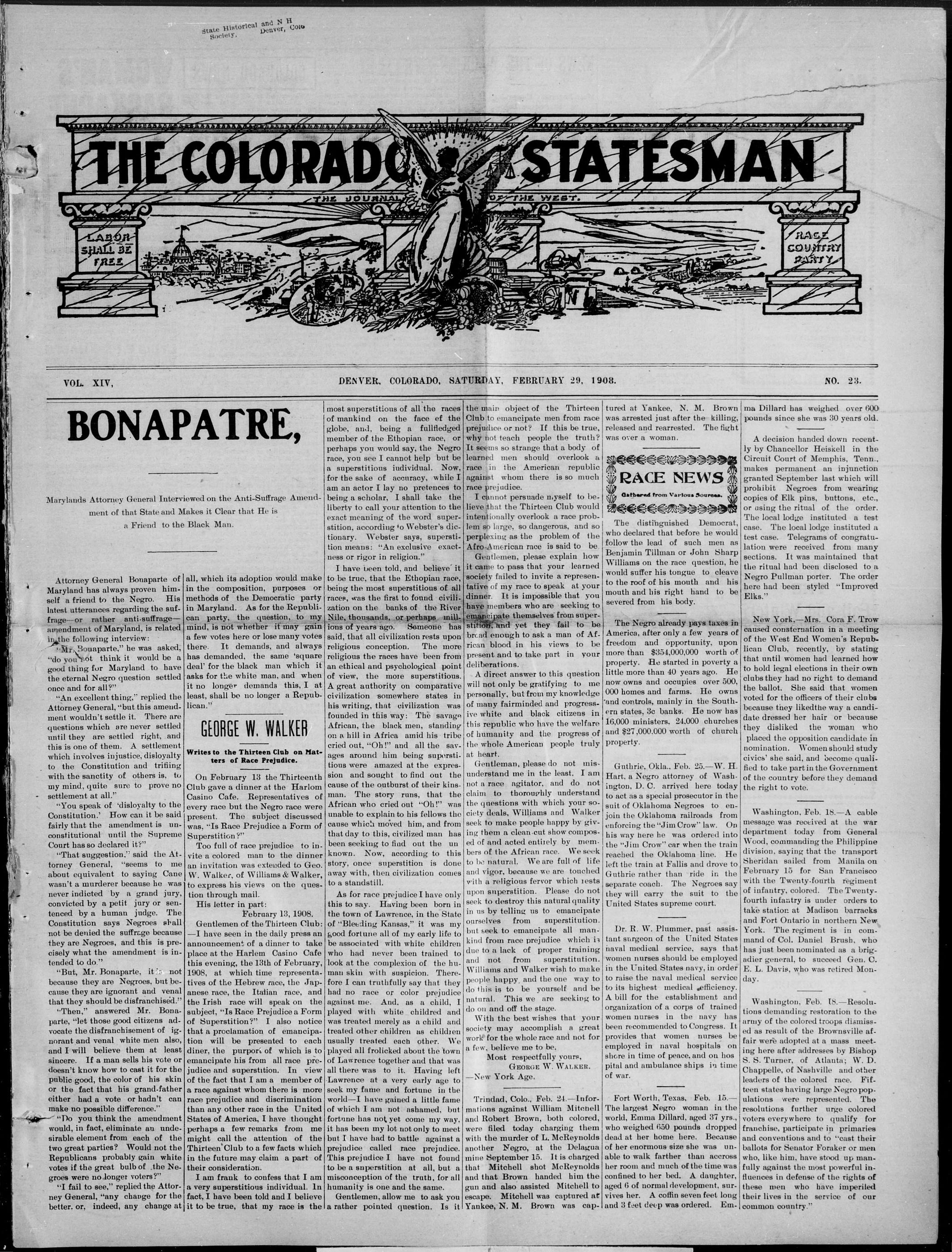
THE COLORADO STATESMAN
THE JOURNAL OF THE WEST.
LABOR SHALL BE FREE
RAGE COUNTRY PARTY
BONAPATRE,
Marylands Attorney General Interviewed on the Anti-Suffrage Amendment of that State and Makes it Clear that He is a Friend to the Black Man.
BONAPE
Marylands Attorney General Interv
ment of that State and M
a Friend to the
Attorney General Bouaparte of
Maryland has always proven him-
self a friend to the Negro. His
latest utterances regarding the suffrage—or rather anti-suffrage—amendment of Maryland, is related in the following interview:
"Mr. Bonaparte," he was asked, "do you not think it would be a good thing for Maryland to have the eternal Negro question settled once and for all?"
"An excellent thing," replied the Attorney General, "but this amendment wouldn't settle it. There are questions which are never settled until they are settled right, and this is one of them. A settlement which involves injustice, disloyalty to the Constitution and trifling with the sanctity of others is, to my mind, quite sure to prove no settlement at all."
"You speak of 'disloyalty to the Constitution.' How can it be said fairly that the amendment is unconstitutional until the Supreme Court has so declared it?"
"That suggestion." said the Attorney General, "seems to me about equivalent to saying Cane wasn't a murderer because he was never indicted by a grand jury, convicted by a petit jury or sentenced by a human judge. The Constitution says Negroes shall not be denied the suffrage because they are Negroes, and this is precisely what the amendment is intended to do."
"But, Mr. Bonaparte, it is not because they are Negroes, but because they are ignorant and venal that they should be disfranchised."
"Then," answered Mr. Bonaparte, "let those good citizens advocate the disfranchisement of ignorant and venal white men also, and I will believe them at least sincere. If a man sells his vote or doesn't know how to cast it for the public good, the color of his skin or the fact that his grand-father either had a vote or hadn't can make no possible difference."
"Do you think the amendment would, in fact, eliminate an undesirable element from each of the two great parties? Would not the Republicans probably gain white votes if the great bulb of the Negroes were no longer voters?"
"I fail to see," replied the Attorney General, "any change for the better. or, indeed, any change at
all, which its adoption would make in the composition, purposes or methods of the Democratic party in Maryland. As for the Republican party, the question, to my mind, is not whether it may gain a few votes here or lose many votes there. It demands, and always has demanded, the same 'square deal' for the black man which it asks for the white man, and when it no longer demands this, I at least, shall be no longer a Republican."
GEORGE W. WALKER
Writes to the Thirteen Club on Matters of Race Prejudice.
On February 13 the Thirteenth Club gave a dinner at the Harlom Casino Cafe. Representatives of every race but the Negro race were present. The subject discussed was, "Is Race Prejudice a Form of Superstition?"
Too full of race prejudice to invite a colored man to the dinner an invitation was extended to Geo. W. Walker, of Williams & Walker, to express his views on the question through mail.
His letter in part:
Gentlemen of the Thirteen Club: I have seen in the daily press an announcement of a dinner to take place at the Harlem Casino Cafe this evening, the 13th of February, 1908, at which time representatives of the Hebrew race, the Japanese race, the Italian race, and the Irish race will speak on the subject, "Is Race Prejudice a Form of Superstition?" I also notice that a proclamation of emancipation will be presented to each diner, the purpose of which is to emancipate his from all race prejudice and superstition. In view of the fact that I am a member of a race against whom there is more race prejudice and discrimination than any other race in the United States of America, I have thought perhaps a few remarks from me might call the attention of the Thirteen Club to a few facts which in the future may claim a part of their consideration.
I am frank to confess that I am a very superstitious individual. In fact, I have been told and I believe it to be true, that my race is the
DENVER, COLORADO, SATURDAY, FEBRUARY 29, 1908.
most superstitious of all the races of mankind on the face of the globe, and, being a fullfledged member of the Ethiopian race, or perhaps you would say, the Negro race, you see I cannot help but be a superstitious individual. Now, for the sake of accuracy, while I am an actor I lay no pretences to being a scholar, I shall take the liberty to call your attention to the exact meaning of the word superstition, according to Webster's dictionary. Webster says, superstition means: "An exclusive exactness or rigor in religion."
I have been told, and believe it to be true, that the Ethiopian race, being the most superstition of all races, was the first to found civilization on the banks of the River Nile, thousands, or perhaps millions of years ago. Someone has said, that all civilization rests upon religious conception. The more religious the races have been from an ethical and psychological point of view, the more superstition. A great authority on comparative civilization somewhere states in his writing, that civilization was founded in this way: The savage African, the black men, standing on a hill in Africa amid his tribe cried out, "Oh!" and all the savages around him being superstition were amazed at the expression and sought to find out the cause of the outburst of their kinsman. The story runs, that the African who cried out "Oh!" was unable to explain to his fellows the cause which moved him, and from that day to this, civilized man has been seeking to find out the unknown. Now, according to this story, once superstition is done away with, then civilization comes to a standstill.
As for race prejudice I have only this to say. Having been born in the town of Lawrence, in the State of "Bleeding Kansas," it was my good fortune all of my early life to be associated with white children who had never been trained to look at the complexion of the human skin with suspicion. Therefore I can truthfully say that they had no race or color prejudice against me. And, as a child, I played with white childred and was treated merely as a child and treated other children as children usually treated each other. We played all frollicked about the town of Lawrence together and that was all there was to it. Having left Lawrence at a very early age to seek my fame and fortune in the world—I have gained a little fame of which I am not ashamed, but fortune has not yet come my way, it has been my lot not only to meet but I have had to battle against a prejudice called race prejudice. This prejudice I have not found to be a superstition at all, but a misconception of the truth, for all humanity is one and the same.
Gentlemen, allow me to ask you a rather pointed question. Is it
the main object of the Thirteen Club to emancipate men from race prejudice or not? If this be true, why not teach people the truth? It seems so strange that a body of learned men should overlook a race in the American republic against whom there is so much race prejudice.
I cannot persuade myself to believe that the Thirteen Club would intentionally overlook a race problem so large, so dangerous, and so perplexing as the problem of the Afro-American race is said to be.
Gentlemen, please explain how it came to pass that your learned society failed to invite a representative of my race to speak at your dinner. It is impossible that you have members who are seeking to emancipate themselves from superstition, and yet they fail to be broad enough to ask a man of African blood in his views to be present and to take part in your deliberations.
A direct answer to this question will not only be gratifying to me personally, but from my knowledge of many fairminded and progressive white and black citizens in this republic who have the welfare of humanity and the progress of the whole American people truly at heart.
Gentleman, please do not misunderstand me in the least. I am not a race agitator, and do not claim to thoroughly understand the questions with which your society deals, Williams and Walker seek to make people happy by giving them a clean-cut show composed of and acted entirely by members of the African race. We seek to be natural. We are full of life and vigor, because we are touched with a religious fervor which rests upon superstition. Please do not seek to destroy this natural quality in us by telling us to emancipate ourselves from superstitution, but seek to emancipate all mankind from race prejudice which is due to a lack of proper training and not from superstitution. Williams and Walker wish to make people happy and the one way to do this is to be yourself and be natural. This we are seeking to do on and off the stage.
With the best wishes that your society may accomplish a great work for the whole race and not for a few, believe me to be.
Most respectfully yours,
GEORGE W. WALKER.
—New York Age.
Trindad, Colo., Feb. 24.—Informations against William Mitchell and Robert Brown, both colored, were filed today charging them with the murder of L. McReynolds another Negro, at the Delagua mine September 15. It is charged that Mitchell shot McReynolds and that Brown handed him the gun and also assisted Mitchell to escape. Mitchell was captured at Yankee, N. M. Brown was cap-
tured at Yankee, N. M. Brown was arrested just after the killing, released and rearrested. The fight was over a woman.
RACE NEWS
Gathered from Various Sources.
The distinguished Democrat, who declared that before he would follow the lead of such men as Benjamin Tillman or John Sharp Williams on the race question, he would suffer his tongue to cleave to the roof of his mouth and his mouth and his right hand to be severed from his body.
The Negro already pays taxes in America, after only a few years of freedom and opportunity, upon more than $354,000,000 worth of property. He started in poverty a little more than 40 years ago. He now owns and occupies over 500,000 homes and farms. He owns and controls, mainly in the Southern states, 3c banks. He now has 16,000 ministers, 24,000 churches and $27,000,000 worth of church property.
Guthrie, Okla., Feb. 25.—W. H. Hart, a Negro attorney of Washington, D. C. arrived here today to act as a special prosecutor in the suit of Oklahoma Negroes to enjoin the Oklahoma railroads from enforcing the "Jim Crow" law. On his way here he was ordered into the "Jim Crow" car when the train reached the Oklahoma line. He left the train at Fallis and drove to Guthrie rather than ride in the separate coach. The Negroes say they will carry the suit to the United States supreme court.
Dr. R. W. Plummer, past assistant surgeon of the United States naval medical service, says that women nurses should be employed in the United States navy, in order to raise the naval medical service to its highest medical efficiency. A bill for the establishment and organization of a corps of trained women nurses in the navy has been recommended to Congress. It provides that women nurses be employed in naval hospitals on shore in time of peace, and on hospital and ambulance ships in time of war.
Fort Worth, Texas, Feb. 15. The largest Negro woman in the world, Emma Dillard, aged 37 yrs., who weighed 650 pounds dropped dead at her home here. Because of her enormous size she was unable to walk farther than accross her room and much of the time was confined to her bed. A daughter, aged 6 of normal development, survives her. A coffin seven feet long and 3 feet deep was ordered. Em-
NO. 23.
ma Dillard has weighed over 600 pounds since she was 30 years old.
A decision handed down recently by Chancellor Heiskell in the Circuit Court of Memphis, Tenn., makes permanent an injunction granted September last which will prohibit Negroes from wearing copies of Elk pins, buttons, etc., or using the ritual of the order. The local lodge instituted a test case. The local lodge instituted a test case. Telegrams of congratulation were received from many sections. It was maintained that the ritual had been disclosed to a Negro Pullman porter. The order here had been styled "Improved Elks."
New York,—Mrs. Cora F. Trow caused consternation in a meeting of the West End Women's Republican Club, recently, by stating that until women had learned how to hold legal elections in their own clubs they had no right to demand the ballot. She said that women voted for the officers of their clubs because they liked the way a candidate dressed her hair or because they disliked the woman who placed the opposition candidate in nomination. Women should study civics' she said, and become qualified to take part in the Government of the country before they demand the right to vote.
Washington, Feb. 18.—A cable message was received at the war department today from General Wood, commanding the Philippine division, saying that the transport Sheridan sailed from Manila on February 15 for San Francisco with the Twenty-fourth regiment of infantry, colored. The Twenty-fourth infantry is under orders to take station at Madison barracks and Fort Ontario in northern New York. The regiment is in command of Col. Daniel Brush, who has just been nominated as a brigadier general, to succeed Gen. C. E. L. Davis, who was retired Monday.
Washington, Feb. 18.—Resolutions demanding restoration to the army of the colored troops dismissed as result of the Brownsville affair were adopted at a mass meeting here after addresses by Bishop S. S. Turner, of Atlanta; W. D. Chappelle, of Nashville and other leaders of the colored race. Fifteen states having large Negro populations were represented. The resolutions further urge colored voters everywhere to qualify for franchise, participate in primaries and conventions and to "cast their ballots for Senator Foraker or men who, like him, have stood up manfully against the most powerful influences in defense of the rights of these men who have imperiled their lives in the service of our common country."
```markdown
```
So STRAIGHTENS KINKY OR CURLY HAIR that it can be put up in any style desired consistent storage.
So the H&R Formad was formerly known as "OZONIZED OX MARROW" and is the only safe preparation known to use that has shown above, its use makes the most sub-born, harsh, kinky or curly hair soft, pimpy, and so-called "red-red" form. It may be obtained from one treatment; 2 to 4 bottles are usually sufficient for a year. The previous year, the previous year, prevents dandruff, rolleves itching, invigrates the scalp, stops the hair from falling out, and is a good one for the nourishing the roots, gives it new life and vigor. Being elegantly perfumed and healthier, the new life is a very good one for the nourishing, and children.
For the H&R Formad has been made and sold continuously since about 158, and a label "OZONIZED OX MARROW" has be so regarded in the United States. Patent Office, in 1874, he were to get Ford's as little as makes the hair STRAIGHTEN. In 1878, the H&R Formad is a new product of the H&R Formad. Remember that Ford's H&R Formad is put up only in 50 ct. size, and is made only in 100 ct. size. The H&R Formad is a signature, Charles Ford, Prest, on each package. Refuse all others. Full directions with the H&R Formad are only for druggists and dealers. If your drugist or dealer can not supply you, he can get it for you. For the H&R Formad is a complete postpaid, or $1.40 for three bottles of $2.50 for six bottles, express paid. For the postage, express paid. For the 100 ct. U.S. Postage, When ordering send postal or express money order, and mention name of this paper. Write your name and address place.
The Ozonized Ox Marrow Co.
(None genuine without my signature)
Charles Ford Press
153 E. KINZIE ST., CHICAGO, ILL.
Agents wanted everywhere.
THE
Broadhurst
and Barnett
SHOE CO.
823 SIXTEENTH ST.
ALL
THE
Fall and Winter
Shoes
Are here. We are showing an endless variety at $3.50 and Up
Ward Auction Co
The Old and Only.
1728.30 Arapahoe St.
Denver, Colorado
Private Residence
Sales a Specialty
Regular Sales every day in the
week (except Sunday)
TELEPHONE 1675
Furniture and bankrupt Stocks
bought for cash or sold on commi-
mission.
J. T. JOHNSON.
Minnesota Grain Belt Beer
Also Western Agent for D. Carnegie
& Co. Swedish Porter, Gothenburg.
Sweden.
1644 Larimer St. Denver, Cola
W. J. ADDIE,
Choice old Califorina wines and brandies from the Hermitage vineyard, also bottled beer, Kentucky whisky, cigars and tobacco.
228 16th St. Telephone 2675
J. W. Rummell,
WINES, L OUORS & CIGARS
PHONE 1432 MAIN
2257 W Denver, C
Western Hospitality Unappreciated.
"While going south on a Frisco train a few days ago," said the Rev. Paul Jenkins of the Linwood Boulevard Presbyterian church, last night, "a young fellow in the next seat pulled out a flask and offered me a drink. 'Have one?' he inquired, as if he thought that was necessary on a railroad train. 'No,' I replied rather shortly. I don't want one, why should I?
"My manner didn't hurt him. He looked at the man across the aisle, who was reading. There, he thought, was a man who would join him. He reached over, pushed the flask in front of him, and said: 'Have a drink stranger?'
"The stranger glared at him. 'No,' he roared, 'I won't; I sell the stuff.' 'Well,' said the young man, still unabashed, 'I'll drink alone.' And he did."—Kansas City Star.
Many Phrases for Lunacy
In order to avoid the blunt word "mad," many euphemisms are resorted to in the English language. While "lunacy" refers to the supposed influence of the moon, "insane" simply means unhealthy; "imbecile" signifies only weak, and "crazy," meaning decrept, almost corresponds to the slang "cracked." "A tile off," "not all there," "a bee in his bonnet" are only a few of the efforts slang has made to carry off the sad fact with an uneasy joke. "Lunatic asylum," for the old "madhouse," represents not only a great improvement in the institution but also in the term used to designate
Hydrophobia Plus.
A little girl came running to tell about a mad dog she had seen. "We saw a mad dog!" she gasped, but the words seemed too tame to do justice to the situation. "Oh, he was mad! mad!" she added, frowning and pumping her fists. "He was furious!"—Harper's Weekly.
Poet Somewhat Vain.
At a recent auction in Paris an unpublished letter was offered, written by the poet Heine, who said therein (the letter is dated April 21, 1824): "I am to-day the best German author. Among the blind the one-eyed man is king. But since I have two eyes, no doubt can remain."
Experiments in Italy
Italy is eagerly awaiting the result of the experiments being made in its swamps with the Australian malaria fish (pseudomugil signifier) which thrives in shallow water and lives chiefly on the larvae of mosquitoes. The government imported a few thousand of them in June
Many Trees Used for Camphor.
The camphor bureau of Formosa prohibits the cutting down of trees of a less age than 50 years for the making of camphor. At the present rate of cutting, the supply of old trees will become exhausted in less than 50 years. To meet this contingency the government will plant hereafter 750,000 trees a year.
The Inter-Ocean Investment and Brokerage Co.
AND COLLATERAL BANK.
1436 Curtis Street.
Loans negotiated, available securities
handled, cash advances made on all
kinds of collateral securities.
Real Estate Loans a
special feature.
Business Strictly Confidential.
Eat Macklem Bread
And Save Trouble
At all Grocers.
ook for the laible "Macklem Brune
on every loaf.
Ladies Attention
Mrs. M. A. Holly, who has spent some time in St. Louis perfecting herself in the scalp and hair treatment of Mrs. A. M. Pope has come. She is now prepared to do the same work as is done in the originator's parlors. She is the sole agent for the famed preparation, "Poro." Address her at 211 Arapahoe street, or Phone Olive 1984.
Hours, 9 to 11 a. m. 1 to 4, 7 to 8 p. m.
Sundays, 10 to 11:30 a. m., 2 to 4 p. m.
Dr. P. E. Spratlin,
Good Block-1557 Larimer St.
Residence 2230 Clarkson St
Denver. Colorado
ILLUSTRATORS
DESIGNERS
HAIR-TONE,
ZINC WOOD &
COPPER PAINT
ENGRAVING
WORK
THE DENVER
ENGRAVING CO.
DENVER
THONE
782
GOOD
WORK
1814 CURTIS STREET ON TIME
NEWS OF THE WEEK
Most Important Happenings of the Past Seven Days.
Interesting Items Gathered From all Parts of the World Condensed Into Small Space for the Benefit of Our Readers.
Congressional.
A bill introduced in congress provides for the retirement on full pay of any federal judge who has served ten years and reached the age of 70 years.
A bill has been introduced in the house providing for an appropriation of $20,000 to purchase a site for a postoffice building at Beloit, Kan.
Articles of impeachment were read in the house recently against Judge Wilfley of the United States court at Shanghai, China.
Senator Latimer of South Carolina died recently in Washington as the result of a surgical operation for appendicitis. He was 57 years of age and had been in the senate since 1903. The bill to establish postal savings banks was introduced in the senate recently by Senator Knox of Pennsylvania. The measure embodies the plan outlined by Postmaster General Meyer in his annual report and is designed to encourage thrift and economy.
The house committee on coinage has unanimously voted to restore the motto "In God We Trust" to gold coins. One member suggested that clearing house certificates have printed on them the Biblical quotation "I know that my Redeemer liveth."
The senate has confirmed John Embry as United States attorney for the western district of Oklahoma.
The senate has ratified the arbitration treaty between the United States and France and the naturalization treaty with Peru.
In a speech in the senate Senator Hale said the cost of the new navy as it exists to-day was $1,200,000,000.
Miscellaneous.
Gov. Haskell of Oklahoma has ordered Attorney General West to begin proceedings to dissolve an alleged merger between the Rock Island and Frisco railroads in the new state.
The thirteenth anniversary of the uprising that initiated the war of Cuban independence was celebrated at Havana.
Five thousand officers and men from the battleship fleet witnessed a bull fight at Lima, Peru, where President Pardo occupied the royal box.
Judge Peter S. Grosscup, presiding judge of the United States circuit court at Chicago, and six other directors of the Illinois Traction company have been arraigned at Chicago on a charge of manslaughter as a result of an interurban collision when 18 persons were killed.
Gov. Hoch has appointed a commission to revise the Kansas school laws, Gen. Stoessel, who surrendered Port Arthur to the Japanese during the Russo-Japanese war has been condemned to death by a Russian military court but recommendation is made that the sentence be commuted to ten years imprisonment. Gen. Fock was reprimanded and Gen. Smirnoff and Gen. Reiss were acquitted.
President Roosevelt has sent a letter to the interstate commerce commission in which he urges action by that body to head off trouble between railroads and their employees.
A trolley car with 20 passengers on board was recently snow bound in Illinois for 24 hours. The passengers suffered for lack of food.
The American battleship fleet has reached Callao, Peru, after an uneventful voyage up the coast from Punta Arenas. Admiral Evans was still ill and had given the vessels in charge of Rear Admiral Thomas. The Peruvians gave the fleet an enthusiastic welcome.
Another print paper trust is in process of formation at Appleton, Wis., which includes all the mills in Minnesota, Wisconsin and Michigan.
A movement has been inaugurated at Burlington, la., to drive all gamblers out of the state.
Mrs. Stinson, aged 96 years was burned to death at Winterset, la., recently and Mrs. Mills, a neighbor, dropped dead while watching the disaster.
Heedless of government protests people on returning to their old homes in St. Pierre, Island of Martinique, where six years ago the great loss of life occurred by the eruption of Mont Pelee. The federal court at Omaha, Neb., has declared the Union stock yards a common carrier which virtually places the corporation under the jurisdiction of the state railroad commission. Fourteen English miners were killed recently by the explosion in a coal mine at Newcastle-on-Tyne. The state department denies that any protests have been received or will be made by this county regarding Japan's aggressive policy in Manchuria. Baron Takahira, the Japanese ambassador, was formally received by President Roosevelt at the White house recently.
A call has been issued for a statement of the condition of all national banks at the close of business on February 14 last.
Fourteen Italians, who led a riot in Philadelphia in which 1,000 men fought with the city police, have been held in bail to court.
By the will of the late Mrs. Amy Sheldon, filed recently at Newport, R. L, a bequest of $300,000 to Harvard university is made.
The supreme court has sustained the constitutionality of the Oregon law forbidding the employment of females at mechanical labor for more than ten hours per day.
Thomas F. Baldwin has been awarded a contract to furnish the government a dirigible balloon in 150 days for $6,750.
The secretary of the treasury has issued a call upon national banks for 25 per cent of public funds held in depositories where such deposits amount to $100,000 or more.
The supreme court has decided adversely to the Great Northern Railway company holding that the Hepburn law did not repeal Section 1 of the Elkins act prohibiting rebates.
By a decision of the supreme court the Sissition and Wahpeton bands of Sioux Indians are entitled to recover from the government $788,971 by virtue of an old treaty entered into in 1851.
Sixteen persons were injured, five of them seriously, when a car on a Denver Scenic railway left the track and plunged to the ground below.
Fifty persons were made ill by eating canned fruit at a hotel dinner at Solomon, Kan.
An effort to rob a passenger train on the Missouri Pacific railroad by removing a rail near Otterville, Mo., resulted in wrecking a freight train and seriously injuring the train crew.
Charles B. Ullmo, an ensign in the French navy, has been sentenced to life imprisonment in a fortress for selling naval secrets to a foreign power.
Police Commissioner Bingham of New York states that his city is the dumping ground for the criminals of Europe and blames the immigration authorities for the fact.
An Italian anarchist shot and instantly killed Father Leo Heinrichs while he was administering the sacrament in St. Elizabeth's Catholic church in Denver.
The first tunnel for passenger traffic under the Hudson between New York City and Jersey City has been completed after 34 years of almost constant effort.
While a St. Louis woman was down town shopping four burglarls with a moving van stole the entire house furnishings including the stoves with fire in them.
The democratic state convention at Hutchinson, Kan., elected John H. Atwood national committeeman. The four delegates at large to the Denver convention are W. H. L. Pepperill, Charles H. Sawyer, J. E. Andrews and W. A. Harris. They are instructed to vote solidly for William J. Bryan for president.
The grand jury at Kansas City has returned 11 indictments against J. E. Brady, former president of the failed Merchants' Refrigerating company. The indictments allege embezzlement and wrongful issue of warehouse receipts.
The Santa Fe railroad has ordered a reduction of 18 per cent in the mechanical force all over the system.
Judge Ball at Chicago has dissolved the temporary injunction granted to Stuyvesant Fish by which 286,231 shares of the Illinois Central were enjoined from being voted at the annual election. The decision is a complete victory for E. H. Harriman. By an explosion of ten tons of dynamite in a powder mill near Berkeley, Cal., four white men and 24 Chinamen were killed. The shock shook the entire bay region like an earthquake. The first test of the Oklahoma guarantee bank deposit law resulted in a victory for the state. The district court at Guthrie holds that banks are corporations and as such are accountable to the legislature. Seven men were injured by the explosion of a boiler in a manufacturing plant at Lowell, Mass., recently.
Two deaths from yellow fever have occurred on the steamer Crispin at Galveston, Tex.
The enumeration of school children in Oklahoma, just completed, shows a total of 475,847.
Because salaries of more than $50,-000 a year are paid to some of their officers, the Metropolitan, Equitable and Prudential Life Insurance companies will be refused licenses to do business in Missouri.
One man was killed and another badly injured by an explosion in a coal mine at Pittsburg, Kan., recently.
The cruiser Chicago has arrived at Punta Arenas on its way from the Pacific to Annapolis, Md.
Personal.
J. H. Edmiston failed to appear in federal court at Omaha to answer to a charge of perjury in connection with land frauds and his bond of $10,000 was forfeited.
Andrew Carnegie has contributed $125,000 to the Robert Koch institute at Berlin for the investigation of tuberculosis.
Brig. Gen. F. S. Dodge, U. S. A., retired, is dead at his home in Washington, aged 66 years.
There is talk of the president sending John Mitchell, the retiring president of the United Mine Workers, to Panama the coming summer to make a report on labor conditions there.
Crosby S. Noyes, the veteran editor of the Washington Evening Star, is dead in Pasedena, Cal., where he had gone in the hope of benefiting his failing health.
Mrs. Harriet Hosmer, a noted American sculpture, died recently at her home in Watertown, Mass.
George A. Robertson, a widely known journalist and former secretary of the late President Garfield, is dead in Cleveland, Ohio.
Justice Henry F. Mason of the Kansas supreme court, has been elected grand master of the Masonic grand lodge of Kansas.
COLORADO NEWS
The contract for furnishing the Denver auditorium will call for providing ten thousand chairs.
Bicycle thieves have been getting in their work at the rate of three or four wheels a day at Pueblo.
The walls of the new Odd Fellows hall at Coal Creek have been completed and the building will be finished in March.
A six-day campaign is being organized in Boulder to raise funds for furnishing the new Y. M. C. A. building, now nearly completed.
By an order issued by the school board the fraternity and the sorority which have existed in the Leadville high school have been disbanded.
William Hildebrand, who built the cog railway up Pike's Peak, and who was one of the foremost civil engineers in the country, died in New York City February 21st.
The Lamar National bank of Lamar has been authorized to begin business with $50,000 capital. M. Strain is president, B. T. McClave, vice president, and L. F. Adams, cashier.
The annual meeting of the Grand Valley Cantaloupe Association was held at Grand Junction February 21st. B. C. Oyder was elected president and A. J. Chesley secretary-treasurer.
One of the biggest livestock deals ever made in this county has just been closed by T. Witcher, of Cotopaxi, all his cattle, between 2,000 and 3,000 head being sold to Samuel Pepper and associates of Denver.
The application of J. N. Akey, James M. Allen, L. C. Schmidt, R. S. Dickey and J. A. Challgren to organize the Farmers' National Bank of Windsor, with $25,000 capital has been approved by the comptroller of the currency.
Senator Guggenheim is making an effort to have the salaries of laborers at the Leadville fish hatchery raised in the sundry civil appropriation bill from $600 to $720 per annum and the cook at the hatchery from $480 to $720. The counties of Fremont and Teller will jointly build a bridge over Four Mile creek connecting the road from Florence to Cripple Creek. Last winter the flood waters swept out this bridge and several miles of road, which has been rebuilt. The Colorado Game and Fish Protective Association has extended the Beaver Land & Irrigation Company a vote of thanks because the company has announced it will take measures to protect the trout in Beaver creek, Fremont county.
The Florence & Cripple Creek railroad is using every available freight car on its line between Florence and Cripple Creek, its business having increased to such an extent in the last thirty days that the present rolling stock is inadequate.
More than thirty Japanese laborers were shipped into Florence on the 18th inst. to work on the Rio Grande railroad. Every section man on the division was laid off, but all foremen were retained. The Japanese will work between Salida and Pueblo.
The United States Portland Cement Company has most of the building erected at its new plant, seven miles east of here, and has commenced installing machinery. Already $300,000 has been spent on the project and work at the mill will be started about April 1.
A conference of the Baptist ministers of the state will be held at Colorado Springs April 29th to May 1st. The principal business will be discussion as to the best methods of carrying on evangelistic work. The chief speaker will be Dr. James A. Francis of New York. The town of Coal Creek, Fremont county, which burned down last July, has been rapidly rebuilt, many frame houses from Florence having been moved there, but now the business men on main street are beginning the erection of more substantial buildings of stone, brick and cement. By way of preparation for the influx of settlers expected to result from the building of the Moffat road, Hayden is having an artesian well drilled to provide the town with a good water system. If the anticipated flow is of sufficient volume other wells will be drilled to furnish irrigation supply.
Henry Hurley, a noted robber who made a number of rich hauls in Denver a few years ago and later was sentenced to the Missouri penitentiary for a robbery at Independence, escaping from the jail at Kansas City, was arrested in Pueblo a few days since and has been extradited by Governor Buchtel.
The cornerstone of the new Carnegie library building in Loveland was laid on Washington's birthday under the auspices of the grand lodge of Masons. An address was made by Grand Orator Meldrum Edwards of Denver, and President B. O. Aylesworth of the State Agricultural college delivered the address of the day.
J. B. Dawson proposes to start a herd of mountain sheep to grazing on his ranch near Hayden before summer. He has made his ranch famous by domesticating sixteen elk and by having a number of buffalo and a mixed herd of polled angus cattle and buffalo grazing on his pasture. The task of catching the mountain sheep has been assigned to Weldon Rider, of Hayden.
The society of the Union Colony, which founded Greeley was organized in 1895 and now has nearly 200 members, more than three-fourths of whom are ploneers of Greeley. Among those present at the recent meeting was Ovid Plumb, who attended the first meeting held in Cooper union, New York City, in December, 1868, at which the colony, formed on temperance principles, was organized.
The Fremont County Fair Association will hold its annual fair at Canon City September 9th, 10th and 11th, which will be during the week preceding the state fair at Pueblo. Owing to the fruit failure in the Arkansas valley, no fair was held last fall. The outlook now is encouraging for a splendid crop this year and the directors are confident that the forthcoming exhibition will be better than any of its predecessors.
WOMAN'S BACKACHE
A
The back is the mainspring of woman's organism. It quickly calls attention to trouble by aching. It tells, with other symptoms, such as nervousness, headache, pains in the loins, weight in the lower part of the body, that a woman's feminine organism needs immediate attention. In such cases the one sure remedy which speedily removes the cause, and restores the feminine organism to a healthy, normal condition is
LYDIA E. PINKHAM'S VEGETABLE COMPOUND
Mrs. Will Young, of 6 Columbia Ave., Rockland, Me., says:
"I was troubled for a long time with dreadful backaches and a pain in my side, and was miserable in every way. I doctored until I was discouraged and thought I would never get well. I read what Lydia E. Pinkham's Vegetable Compound had done for others and decided to try it; after taking three bottles I can truly say that I never felt so well in my life."
Mrs. Augustus Lyon, of East Earl, Pa., writes to Mrs. Pinkham:
"I had very severe backaches, and pressing-down pains. I could not sleep, and had no appetite. Lydia E. Pinkham's Vegetable Compound cured me and made me feel like a new woman."
For thirty years Lydia E. Pinkham's Vegetable Compound, made from roots and herbs, has been the standard remedy for female ills, and has positively cured thousands of women who have been troubled with displacements, inflammation, ulceration, fibroid tumors, irregularities, periodic pains, backache, that bearing-down feeling, flatulency, indigestion, dizziness, or nervous prostration.
CUT OUT FOR A FINANCIER.
Shrewd Rascal Made Good Thing Out of Whistling Geese
Two rogues passed a poultry shop. Seeing two geese hung up for sale one of the rogues inserted in the gullet of the goose a little bulb with whistle attached. When the bulb was pressed the whistle sounded.
Then, entering the store, he told the proprietor that he had hanging outside a very rare kind of whistling goose. The proprietor at once sold the goose for a big sum to a very learned professor, who was astonished to hear about the whistling goose. Seeking the man who had placed the whistle in the gullet of the bird, the proprietor asked him if he knew where others like it could be obtained.
"Well," said the crafty fellow, "I know of only one place, and if you will pay me a big price I will get several for you."
So the rogue brought a dozen fowls, in the gullet of each of which he thrust a whistle, and was paid an exorbitant price for them before the hoax was discovered.
Things Mixed.
Little Willie, who had been listening to some scientific talk about the brain's functions, pondered over some new expressions he had heard, and that night when he was going to bed asked earnestly:
"Mamma, when people's hair begins to turn, is it because the gray matter in their brains is leaking through?"
Why not the Natural laxative, Garfield Tea? It's Pure, Mild and Potent. Made of Herbs. Write for samples. Garfield Tea Co., Brooklyn, N. Y.
It is the confounding nature of some women that makes them want to tell you their family troubles before you have known them ten minutes.
ONLY ONE "BROMO QUININE"
That is a LAWY QUININE. Look for the signature of E. W. GROVE. Used the World ever to Cure a Cold in One Day. 25c.
You will be surprised to find how much good there is in the world if you'll sit up and take notice.
Mrs. Winslow's Soothing Syrup.
For children teething, softens the gums, reduces inflammation, always pain, curses wind colic. 25c a bottle.
It is up to the dental student to take drawing lessons.
DODD'S
KIDNEY
PILLS
FOR ALL KIDNEY DISEASES
FOR RHEUMATISM
BRIGHT'S DISEASE
DIABETES.BACKACHE
375 "Guarantee"
YIP RESTAURANT
Noodles, Chop Suey, Chili
Privare Dining Rooms
REGULAR DINNER 20 CENTS.
QUICK LUNCH.
Imported Tea for Sale.
The Denver Barber's Supply C.
1008 FIFTEENTH STREET, DENVER, COLO.
The Enter
Fine Wine
SPECIAL PR
2200-2 Larimer St.
L
2132-2148 ARAPAHOE
Tel. 2449.
you want a fine
High Grade Cig
"Old Nobili
When you Smoke "O
When you want a fine
3 for 25c. 10c and 2 for 25c 10 Sizes
The Baxt
Baxter Cigar Comp
The Baxter Cigar Company,
2048 Railroad
Billiards Refres
Pool and Billiards
FIVE PO
Phone York 1710
WESTE
Pool and Billiards Refreshments
York 1710 2552 Washing
ESTERN UNIVERSITY
Phone York 1710 2552 Washington Ave
WESTERN UNIVERSITY
The Leading Educational Institution for Negroes in the West.
A Faculty of Eighteen Thoroughly Equipped Teachers from the Leading institutions in America.
MAGNIFICENT BUILDINGS,
Steom Heated and Electric Lighted.
DEPARTMENTS
Theological, Classical, Normal, Sub-normal, State Industrial embracing courses in Architecture, Carpentry, Mechanical Drawing, Printing, Book-binding, Tailoring, Business Course Dress-making, Millinery, Cooking, Laundrying and Farming.
Thorouge Discipline, Christian Influence Careful Supervision.
Fine Military Band and Orchestra.
Logical, Classical, Normal, Sub-normal, State Incl ing courses in Architecture, Carpentry, Mng Printing, Book-binding, Tailoring, Business king, Millinery, Cooking, Laundrying and Fa morouge Discipline, Christian Influenc Careful Supervision. Fine Military Band and Orchestra.
Theological, Classical, Normal, Sub-normal, State Industrial, embracing courses in Architecture, Carpentry, Mechanical Drawing, Printing, Book-binding, Tailoring, Business Course, Dress-making, Millinery, Cooking, Laundrying and Farming. Thorouge Discipline, Christian Influence Careful Supervision.
Phone Main 6692
Phone Main 2048
Family Trade a Specialty
prise Liquor Co.
, Liquors and Cigars
HAISNER, Manager.
ES TO PULLMAN PORTERS.
WM. EHMKE,
MANAGER
EAST TURNER HALL.
2132-2148 ARAPAHOE ST.
Tel. 2449. Denver
ant a fine
high Grade Cigar
d Nobility"
r Cigar Company, Denver.
ards Refreshments POINTS. SOCIAL CLUB DENVER, COLO. THOS. CLINGMAN, MGB.
2552 Washington Ave
DEPARTMENTS
Normal, Sub-normal, State Industrial, Architecture, Carpentry, Mechanical binding, Tailoring, Business Course. Cooking, Laundrying and Farming. Scriptine, Christian Influence Useful Supervision. Bury Band and Orchestra. All information write to PROF. SHELTON FRENCH,
Denver. Colo.
Railroad Building
IMPROVE OUR WATERWAYS
PLEA OF PRESIDENT ROOSEVELT IN SPECIAL MESSAGE TO CONGRESS.
COMMISSION'S REPORT
NO OTHER CIVILIZED COUNTRY MAKES SO LITTLE USE OF ITS RIVERS.
Washington.— President Roosevelt Wednesday sent a special message to Congress inclosing the report of the commission on inland waterways and urging immediate action looking to the improvement of inland streams in the interests of increased prosperity and commercial growth of the country.
The message of the president was in part as follows:
"To the Senate and House of Representatives: I transmit herewith a preliminary report from the inland waterways commission, which was appointed by me last March in response to a widespread interest and demand from the people. The basis of this demand lay in the general and admitted inability of the railroads to handle the traffic of the country, and especially the crops of the previous fall.
"This report is well worth your attention. It is thorough, conservative, sane and just. It represents the mature judgment or a body of men exceptionally qualified by personal experience and knowledge of conditions throughout the United States, to understand and discuss the great problem of how best to use our waterways in the interest of all the people.
"Our river systems are better adapted to the needs of the people than those of any other country. In extent, distribution, navigability and ease of use, they stand first. Yet the rivers of no other civilized country are so poorly developed, so little used, or play so small a part in the industrial life of the nation as those of the United States.
"The commission finds that it was unregulated railroad competition which prevented or destroyed the development of commerce on our inland waterways. The Mississippi, our greatest natural highway, is a case in point. At one time the traffic upon it was without a rival in any country. The report shows that commerce was driven from the Mississippi by the railroads. Throughout the country the railways have secured such control of canals and steamboat lines that today inland waterway transportation is largely in their hands. This was natural and doubtless inevitable under the circumstances, but it should not be allowed to continue under careful government regulation.
"The development of our inland waterways will have results far beyond the immediate gain of commerce. Deep channels along the Atlantic and gulf coasts and from the gulf to the great lakes will have high value for the national defense. The use of water power will measurably relieve the drain upon our diminishing supplies of coal, and transportation by water instead of rail will only tend to conserve our iron. Forest protection, without which river improvement cannot be permanent, will at the same time help to postpone the threatened timber famine, and will secure us against a total dearth of timber by providing for the perpetuation of the remaining woodlands. Irrigation will create the means of a livelihood for millions of people, and supplies of pure water will powerfully promote the public health.
"We cannot afford needlessly to sacrifice power to irrigation, or irrigation to domestic water supply, when by taking thought we may have all three. While we delay our rivers remain unused, our traffic is periodically congested and the material wealth and natural resources of the country related to waterways are being steadily absorbed by great monopolies.
"Among these monopolies, as the report of the commission points out, there is no other which threatens, or has ever threatened, such intolerable interference with the daily life of the people as the consolidation of companies controlling water power. I call your special attention to the attempt of the power corporations, through bills introduced at the present session, to escape from the possibility of government regulation in the interests of the people. These bills are intended to enable the corporations to take possession in perpetuity of national forest lands for the purposes of their business, where and as they please, wholly without compensation to the public.
"The questions of organizations, powers and appropriations are now before the congress. There is urgent need for prompt and decisive action."
Smelter Manager Threatened.
Pueblo. — Superintendent G. M. Marsh of the Ellers smelter of the American Smelting and Refining Company has received two letters in the past few days in which he is threatened with death unless the plant resumes operations at once, giving employment to the men who are idle. The first letter was received Tuesday and was written in an almost legible hand. After blaming him for shutting down the plant, the letter ends with the following threat: "Me blow you up if you don't give us work."
Another letter was received Wednesday in which the same threat was made. The letters have been turned over to the United States and city officers. There were about 500 men employed at the plant, most of whom were Italians. The plant was closed down a few weeks ago with the exception of the roasters, and most of the men were thrown out of employment.
GREAT INVENTOR IN PERIL.
Life of Thos. A. Edison Endangered By Operation.
New York.—Thomas A. Edison is in a critical condition at the Manhattan Eye, Ear and Throat hospital, No. 210 East Sixty-fourth street.
A second operation on his ear, following the one of last Sunday, was performed at 4 o'clock Thursday afternoon to relieve an infection of the inner wall of the mastoid cells. The operation was performed by Dr. Arthur B. Duel and Mr. Edison regained consciousness, but his condition is so serious that his wife, son and daughter are at the hospital with him. His family physician, Dr. J. H. Bradshaw, of Orange, N. J., also was at the hospital throughout the night.
Mr. Edison is sixty-one years of age and while it was admitted that a recurrence of his earlier allment had brought about a grave condition, it was believed by those in attendance that he would recover from the serious operation.
At night Mr. Edison was resting as comfortably, it was said, as could be expected. Dr. Duel said:
"The second operation, this time for mastoiditis, was decided upon this afternoon at a consultation in which Dr. James S. McKeernon and Dr. W. C. Wylle participated. Mr. Edison's family physician was also present. The operation, though serious, appears to have been successful and we look for the patient's recovery. His condition is satisfactory under the circumstances."
Independent Sugar Factory.
Denver:—A Manzanola dispatch of February 26th says: Incorporation papers for the new independent beet sugar factory to be erected at this place were drawn up today and will be filed with the secretary of state tomorrow. The name of the company is the Arkansas Valley Beet Sugar Manufacturing Company. The capital stock is $1,000,000.
The thirteen incorporators and directors of the company are Jasper N. Beaty, Horace B. Dye, Thomas J. Stanley, James N. Johnston, George W. Hallows, Daniel W. Sheldon, Eugene Brewer, William L. Clowes, William B. Ebbert, William H. CcCaskill, Thomas J. Bartow, James F. Legge and Frank Hays, Jr.
Two weeks ago a mass meeting was held here for the purpose of getting together on the erection of a sugar factory. A large number of farmers, dissatisfied with the cut of the American company in the price of beets from $5 to $4.50 per ton, expressed their willingness to stand by the proposition. More than 10,000 acres have been subscribed, and this with very little effort on the part of solicitors. The contracts are written for five years at $5 per ton and 50 cents for siling. The Holbrook and Vineland farmers have expressed a willingness to subscribe acreage if it becomes necessary. The committee of seven has started plans for securing capital, and a subcommittee, headed by Mayor Thomas J. Stanley, left today for the East. The factory will be independent in every sense, and farmers will have the opportunity of subscribing for as much stock as they desire. The directors are determined to build the factory for this year's campaign.
Scale of Farm Wages.
Greeley.—The officers of the Farmers' Institute of this district have received numerous letters during the last month showing that the scale of farm wages adopted at the institute meeting here last month and published in local newspapers has been generally copied all over the country. Many letters have come from Michigan, New York and Iliwa from laboring men, inquiring for places to work on farms at the prices stipulated. One man in New York city wants to make arrangements to furnish laborers to the farmers.
All of this, the farmers believe, means relief from the scarcity of help here to handle crops during the harvest season. At the request of the government immigration department the scale of wages has been sent to it so that foreigners seeking employment in agriculture may know of work in the potato and beet belt of Colorado. The scale quotes regular monthly farm wages with board at $30 a month, ordinary work by the day on farms at $1.25 to $2 with board, higher wages to be paid for special work and for irrigation, and 4 cents a sack, without board, for picking potatoes. The demand for good laborers will be greater the coming season than heretofore, as each successive season brings from 2,500 to 4,000 acres more under cultivation.
Coloradan Reported Killed.
Denver.—Information that Thomas E. Beans, a well known Colorado mining man, was mysteriously killed at Gold Circle, Nevada, Wednesday night, has revealed the fact that about the middle of the month Beans had a long race with some prospectors whom he beat to a rich mineral claim by twenty minutes. Although the telegram announcing his death stated only that no clue to the murderers had been discovered, A. P. Mackey of Denver believes that a letter sent to him when Beans made his location will offer the Gold Circle authorities a clue which may prove to be a correct one. He believes that the men who raced with Beans to locate upon the claim had something to do with his death.
Money for Wolf Bounty.
Denver.—A Las Animas dispatch says: The Bent and Prowers County Cattle and Horse Growers' Association at the annual meeting here, elected James Cushney president; M. H. Murray, vice president; Marceena McMillan of Lamar, secretary, and P. G. Scott of Las Animas treasurer. An assessment of 2 cents per head was levied on all cattle for expenses, including a wolf bounty. The sheep men heretofore have not paid any definite sum for killing wolves and coyotes, but they have organized into the Southeastern Colorado Sheep Growers' Association and agreed to pay 35 per cent of the $10 per head bounty.
T
WHITE SWAN
TELEPHONE TELEPHONE
1866 1866
LAUNDRY
Not in the Trust. We have Reduced the Prices
OUR PRICE
1 Shirt Walt . . . 3
1 Shirt . . . 3
1 Apron . . . 3
1 Dress, Lady's . . . 3
1 Chemise . . . 3
1 Corset Cover . . . 3
1 Pair Drawers . . . 3
1 Night Dress . . . 3
1 Union Suit . . . 3
1 Under Shirt . . . 3
1 Shirt Work . . . 3
1 Night Shirt . . . 3
Total . . . 36
PHONE MAIN
1866
2200 Blake St.
ROUGH DRY
12c to 35c per
Dozen
TRUST PRICE
1 Shirt Walt . . . 5
1 Shirt . . . 5
1 Apron . . . 3
1 Dress, Lady's . . . 3
1 Chemise . . . 3
1 Corset Cover . . . 3
1 Pair Drawers . . . 3
1 Night Dress . . . 4
1 Union Suit . . . 6
1 Under Shirt . . . 4
1 Shirt, Work . . . 4
1 Night Shirt . . . 3
Total . . . 48
Best collar and cuff work in the city. Send us all your family washing. Automobiles and wagons everywhere. We use soft artesian water. We do no hospital work.
LEAP YEAR SURPRISE
Musical Treat to the Denver Public Auspices of the Denver Division of U. O. True Reformers] EAST TURNER HALL, Thursday, February 27, '08. A Two Act Drama, "Tell Your Wife." The Azalia Hackley Choral Club. Rev. W. L. Anderson, Deputy General of the Western Grand Division of U. O. True Reformers, will be present to give information upon the work.
Committee of Arrangements, the Messengers of Fountains.
H. B. Brown.....Colo. Enterprise No. 1621
Mrs. Irene Fife....."I Will" No. 2548
J. R. Contee.....Forward 3rd in Denver No. 2656
A. M. Lawhorn.....Ideal No. 2790
Mrs. M. Thomas.....Denver No. 2791
Allen Davis.....Columbine No. —
No Postponement on account of the Weather.
Ticket, Adults 35 Cents; Children under 12, 15 Cents
A. C. CASH,
Chief of Division.
MURRAY AND EDWARDS, PROPS.
A Convenient Place to have Your Mail Directed The Finest Equipped Pool and Club Rooms west of the Mississippi River. Drop in and see us. Just around the corner from the Union Depot.
WILL BE THE
ALLEN DAVIS,
Chairman Committee.
THE COLORADO STATESMAN
MARSH ABBLE BE AFFECT.
MACE COMMON PARTY
JOS. D. D. RIVERS.....Proprietor S. H. HOBSON .....City Editor
1824 Curtis Street, Room 25.
I
Remittances should be made by Express Money Order, Postoffice Money Order, Registered Letter or Bank Draft. Postage stamps will be received the same as cash for the fractional part of a dollar. Only 1-cent and 2-cent stamps taken.
Reading notices, ten lines or less, 10 cents per line. Each additional line over ten lines, 5 cents per line.
Display advertising 50 cents per square. A square contains ten agate lines. No discounts allowed on less than three months' contract. Cash must accompany all orders from parties unknown to us. Further particulars on application.
All communications of a personating nature that are not complimentary will be withheld from the columns of this paper.
It occasionally happens that papers sent to subscribers are lost or stolen. In case you do not receive any number when due, inform us by postal card and we will cheerfully forward a duplicate of the missing number.
Communications to receive attention must be newsy, upon important subjects, plainly written only upon one side of the paper; must reach us Tuesdays if possible, anyway not later than Wednesdays, and bear the signature of the author. No manuscript returned, unless stamps are sent for postage.
Entered as second-class matter at the postoffice in the city of Denver, Colorado.
THOUGHT THINKING.
IF white men who think had ever thought it wise to think over the thoughts of black men who think, and had thought themselves black while thinging, there would have been a whole lot less trouble for white men who don't think, and who act as they imagine other white men think. Think that over. Then think of the laws aimed at Negroes that are now hitting white men; and of the practices originated to condemn the Negro which now condemns and executes the white man. Long ago Negro newspapers published wide the prophesies that these things would come to pass. But white men thought that nobody's thought but their own thought was worth thinking.
THE CLOVEN HOOF.
THE National House of Representatives was the scene of one of those periodical outbreaks last Saturday which southern Democrats bring about by their wild determination to inject the race question into all legislation where the social relations of the white and black citizen can in any measure be touched upon.
A bill carrying an appropriation for the street railway system in the District of Columbia was the means chosen this time, and an amendment offered by a southern congressman, providing that separate accommodations for white and colored people should thereafter be required on the street car system of Washington, was the method employed to bring on such a clash of sentiment as had not been heard in Washington for some time. When the southerners assumed, however, that they were going to chase the northern defenders of the Negro's rights into their holes, they reckoned sadly with their host, for while the statesmen of the North prefer to avoid such debates, as useless and unreasonable, they are none the less convinced that true American citizenship does not contemplate or even tolerate the narrow, biased standard which bourbon Democracy hugs so tightly to its bosom as one of the great inspirations for its buffoon brand of statesmanship.
Mr. Foster of Vermont, Mr. Madden of Illinois, and Mr. Campbell of Kansas, led the debate on the Republican side, and opened upon the southerners such a flood of wholesome, reasonable, righteous, humane argument, without any false show of political bluster, that the Democratic position looked anything but wise or sane.
The Jim Crow amendment was ultimately defeated by a vote of 140 to 59. A number of northern Democrats probably voted with the majority, but the incident refreshes the colored man's conviction that the Democratic party is incapable of legislating or governing justly or even humanely, upon any matter involving the rights or the welfare of a cosmopolitan citizenship.
At times it has seemed that the southern spirit of hateful oppression was making strong headway in the Nation, but the experience of last Saturday is re-assuring, and goes a long way toward re-establishing confidence in the conscience of the Nation.
Likewise it renews the belief that the South has no statesmen who can rise to the requirements of the office of the executive of the Nation, either by election or succession.
BACK TO NATURE
What outlook does the future hold for the social and industrial development of the Negro, in view of the increasing friction between the races, as the world's greatest fields of natural enterprise become absorbed?
Of course, there is vast room yet for world development, but nearly all possible, undeveloped resources are practically under Caucasian control or being competed for by scarcely less stronger races. If these controlling races showed less disposition to count other peoples out of the benefits of the general scheme for the progress of humanity, we might feel justified in nursing a hope and a faith in a natural rule of relative development, by which the Negro and other laggard races might eventually improve upon the conditions which mere contact with the ruling nations fortunately imposed upon them, but one must blind himself entirely to the ever increasing menace of race repulsion to rest complacently under such a hope. Here in the United States, in spite of the fact that we are making certain necessary strides in the way of personal or small community improvement, we are in fact but trailing along in the after-current of the white man's independent progress, and to a great extent, and more and more, are begrudged the fodder to which our services even as beasts of burden entitle us.
For us, industrial competition, which is the main source of social development, takes on a phase of limitation and restriction which does not promise to lead us to the heights of human progress but rather threatens to make and keep us a race of serfs. By 'social development' we do not refer to the mere improvement of personal relations between individuals, but to the development of that capacity for community growth which reflects a peoples' standard of civilization, regardless of their intercourse with other peoples. Restricted industrial activity dwarfs a peoples' social development, and that is just the condition against which the Negro is struggling.
He may not be struggling in the right direction, however, to overcome these conditions. Perhaps it is time that we had learned that under immediate industrial contact this conflict is inevitable and never ending. Perhaps it is time that we were beginning to learn that the rush of our people from the country toward the cities is the first direct cause of increased friction.
In the dazzle and glamor of the white man's progress, we rush straight into the flame of his wrath. We must soon learn even that the cry of 'injustice' is mavailing.
We must learn that the true source of all development is the country and the land itself. Independent, self-development is the only kind that has ever availed any people, and it starts at the grass roots. So, while the white man leads, the world over, and greedily lays claim to the earth, he cannot absorb it, nor restrict the development of other peoples who apply themselves to the problems of life in the manner which nature intended.
SPRING HATS
Rural Delivery Worth Many Times What It Has Cost
Every Stetson bears the Stetson Name
By N. J. BACHELDER,
Master National Grange, Patrons of Husbandry.
DO not understand why the word "free" is used in connection with rural delivery. Is it any more applicable to rural delivery than to city delivery?
The Stetson Hat
In regard to rural mail delivery I will say, while I have no figures upon the subject, it is conceded on every hand that it is worth several times its cost. The deficit charged to rural mail delivery is only nominal, for it does not take into account the increase in receipts of the postal department from the increased postal business on account of it.
It's the man who looks into things carefully, the man who is particular, who always insists upon the Stetson.
If the matter were stated in detail I believe there would be no deficit, but on the other hand there would be a profit from the rural mail delivery. Outside of the direct result it has had such an effect in raising farm values, in increasing the intelligence among rural people and in bringing rural sections into direct communication with centers of wealth and population, that it has been worth all it cost were there no additional receipts to credit to it.
We have the Stetson Soft and Derby Hats in all the latest styles.
It is my opinion that no money expended by the federal government has brought greater returns to the country as a whole than the money expended in sustaining rural mail delivery routes, even were there no revenue therefrom. I believe it is a question upon which there is but one opinion and that every argu-
Also Our own Special in all the Latest Blocks At $3 THE Johnson-Noel Co
The economical woman is she who has acquired the habit of saving. She economizes in order to save.
The Virtue of Economy
By REV. MADISON C. PETERS, D. D.,
Noted Preacher and Lecturer.
1005 16TH ST.
OPP. TABOR GRAND.
Saving is akin to thrift, which is simply accumulation by means of saving, and both are opposed to penury,
What Do You Know About This
Proposition? Did you ever visit the Sample Exchange where they sell nothing but Traveling Men's Samples of Ladies Petticoats, Ladies Jackets, Shirtwist and Skirts at Manufacturers' cost? Look at this beautiful Petticoat at $4.85; retail value $8.00; $4.85 in colors and black.
The saving woman is not to be confounded with the niggardly woman who denies herself the necessities in order to hoard money.
Economy may be called a virtue in those whose means will not allow a lavish expenditure, or in fact, an expenditure that will carry them beyond the means they can practically afford. It is frugality, the frugal and judicious use of what they can command and which the dictates of reason and common sense regulate according to circumstances.
A woman can be as frugal and economical on an income of $10,000 a year as on one of $1,000, provided she keeps within her limit, and so orders her affairs as to correspond with her purse.
Circumstances must always regulate the expenditure. It would be very foolish for the laborer's wife to try to emulate the woman of millions. Such would be repeating the folly of the foolish frog who tried to rival the ox and in the attempt only burst itself with its own vanity.
In order that a woman in any walk of life may be frugal and saving, it is not at all necessary for her to be parsimonious, or, in other words, deny herself the comforts of life, nay, the necessities, to her love for gain.
Ladies Skirts in Panama, Voils and Fancy mixtures from $1.75 to $6.00. Ladies silk Net and Lawn waist from 75c to $3.50. One of our men has just got home with 100 samples of Spring Jackets to which will be put on sale MONDAY MORNING and as long as they last at manufacturers' cost.
On the other hand, the woman who is frugal and economizes, not merely for her own sake, but because she realizes that unnecessary expenditure is waste, not alone does good to herself, but confers a benefit on her kind.
SAMPLE EXCHANGE, 406 CHARLES BLDG. 15th and Curtis Streets.
She sets the example of moderation and thriftiness, while at the same time conserving the interests of the future by economizing the present. A small income can be turned into a comparatively large one by the woman of economy, for she can make a dollar go as far as a gold piece by her care and foresight. She can turn every penny to the best possible advantage for herself and others. In any woman economy joined to industry is a dowry more valuable than gold.
MADISON
PETTER
ROBERT JOHNSON
Steam and Gas Fitter Connect Coal or Gas Range, Wafer Heater, Grate or Log $2.00; Guaranteed.
20 Years Experience in Denver.
Phone South 1432
835 Lincoln Avenue
Unity of Mankind Is Attainable
By ANNIE BESANT.
Intellectual, artistic, spiritual wealth increases in the sharing, each who shares adding to the store. This is the fundamental reason why progress towards peace and contentment must be towards intellectuality, artistic development
OPEN DAY AND NIGHT
PHONE MAIN 6123
THE A. M. LAWHORN & CO.
Undertakers and Funeral Directors. J. R. CONTEE Pres. WM. SPRAGUE. Sec. & Treas.
and spiritual life, and not towards material splendor and the vulgarity of outer ostentation. These are for the undeveloped; the others for the developed. And, inasmuch as the ignorant will copy the more advanced and the lowly the highly placed, the example must be set by those who lead the social and intellectual world.
R. E. HANDY. A. M. LAWHORN. LOUIS HUBBARD. Licened Embalmer. Manager. Assistant CARRIAGES FURNISHED FOR ALL OCCASIONS
A man will ruin himself to pay a "debt of honor," while he seeks to evade a debt enforceable by law—a perverted sense of duty truly, but still eloquent of the important truth that more can be done by appealing to a sense of obligation imposed by the social opinion surrounding a man than by compulsion of an impersonal law. If the sense of honor, of duty to a class, can be expanded to include the nation, we shall have at work in our midst the most binding form of obligation. Duty will become the keynote of life, each asking, "What do I owe?" instead of "What can I successfully demand?"
1110 18th Street.
Denver, Colo
[Name]
It seems possible that in the future we may arrive, even by the slow method of failure, at some scheme of government in which the wisest shall hold the reins of power and obedience shall be gladly rendered to recognized superiors, and at some economic system in which wealth shall be distributed according to needs. Then the maxim will be acted upon—noblest of all maxims when given by love, not by hate:
"From every man according to his capacities; to every man according to his needs."
That which has been the battle cry of men maddened by suffering shall become the axiom of distribution in the rational human family.
Most certainly the putting forward of such ideas as are here suggested will not change social conditions in a moment, but no permanent improvement can be wrought in sudden fashion. Yet are they on the line of progress, of the upward evolution of man.
1859 Champa St. Denver, Colo.
JAS. F. CLARK
N J W
CITY NEWS. : Y
SSCS CESS
Richard Campbell of Topeka, Kansas,
is in the city,
Rev. W. R. Hardy of Pueblo, spent
Sunday aud Monday in Denver.
Rev. D. D. Cole spent a few days in
Boulder this week on business.
Mr. and Mrs. R. B. Anderson left last
Wednesday for their home in Leadville.
Miss Pansy Johnson and Mr. L. Nel-
son were united in marriage last ‘Thurs-
day.
Mrs. Nellie Porter, after spending sev-
eral weeks in Denver, has returned to
Omaha.
Mrs. Julia Lee of 1864 Humboldt St.,
after an illness of several weeks is able
to be out.
Mrs. W. Sheppard of Greeley, Colo,
was in the city this week the guest of
Mrs. Thenis Jones.
J.B, Conway an employe of the Dan-
iels & Fisher Store, is on the sick list at
2229 ‘Tremont Place.
Mr. and Mrs, J. J. Bates and little
daughter, Gladdis, left Monday for their
homo in Salida, Colo.
‘The Ultra Art club will meet March
Sth, at the home of Mrs. Harvey Groves,
1211 Kalamath street.
James Hill aged 24 years, son of Mrs.
G. Collier died Monday at 2840 Glenarm
Place after an illness of several weeks.
Join the big crowd at the big ball to
be given at East Turner hall next Mon-
day night by the Business Men’s club.
‘The many friends of Dr. Justina L.
Ford will be glad to know that she is
able tobe out after an illness of six
weeks.
Mr. and Mrs. Hughes gave a reception
in honor of Rev. Anderson Wednesday
evening. Rev. Anderson is high in the
‘Prue Reformers.
Mr, and Mrs, I. ©. McKenzie are now
@located at 433 Emerson street, where
they will be pleased to have their friends
call and see them.
Roy Harris died at the County hospit-
al last Wednesday. ‘The funeral ar-
rangements have not been made at this
writing, The body lies in the morgue
‘of Lawhorn & Co.
Do you remember the good time you
had at the ball given by the Business
Mens club a few weeks ago? Well they
will echpse that event on March 2nd at
East Turner hall.
Mrs, Elvira Reynolds entertained at
the residence of Mrs, J, E. Travick last
‘Puesday evening in honor of Richard BR.
Harrison of Los Angelest California.
An enjoyable evening was spent.
‘A reception was given at the resi-
dence of Mrs, N. J. Skillern last Satur-
day night by Mrs. Corrinne Overton in
honor of Richard B, Harrison of Los
Angeles, California,
All who are in need of plumbing work
can save money by having itdone by
Robert Johnson of 835 Lincoln avenue;
Phone South 1432. All work guaranteed.
A specialty of connecting coal and gas
ranges.
Charles D, Clem, the poet, will recite
at Boulder on March 13th for the bene-
fit of the A. M. E. church at that place.
‘The citizens of Boulder will do them-
selves an injustice if they fail to hear
Mr. Clem.
After his reading at Zion Baptist
church last Monday night, Richard B,
Harrison of Los Angeles, California, was
tendered a reception by Mrs. Moral
Keelon, 2610 Welton street, where a de-
lightful time was spent by all.
Morgan E. Robinson of Leadville,
passed through the city this week from
anenjoyable say of a month in Los
Angeles, California, and other points on
the Pacific coast. Mrs. Robinson and
little daughter Marion, will remain in
Los Angeles several weeks before re-
turning to Uolorado.
Mr. Willis 8. Evans of Colo. Springs,
and Miss Mary E. Williams of Denver,
were quietly married at the residence of
the brides’ sister, Mrs. Walter Cooper,
1609 Clarkson street, at high noon, Tues-
day, February 25, 1908, After the mar-
riage ceremony a wedding breakfast was
served. Only the immediate friends
were present,
“It doth now appear what we can be,’
will be the subject of discourse in Lucas
Hall, 2012-14 Curtis street next Tuesday
March 3rd at 8 o'clock sharp. Dr. Lucas
informs us of a crowded house at his|
opening last Tuesday and much appre-|
ciation from all after tlie two hours |
talk. ‘The question box and charts ere
features most helpful. Each one is’
privileged to write 3. questions concern.
ing “things he or she wishes to know”
about self, Everybody welcome.
Phe Advisory Board of the Colorado
the Political Club met at 2100
Arapahoe street last Monday night and
completed arrangements for the spring
campeign which will soon be on. Precivet
committeemen were appointed to repre-
sent every precinct in the city and liter-
ature advising the colored citizens of
their best political interest, will be dis-
tributed throughout the city, The mem-
bers of the club comprises some of the
most influential citizens of the state
and nothing will be left undone to meet
the issues fora “square deal” for the
‘Negroes.
Richard B, Harrison of Los Angeles,
California, the most popular dialectian
in the West, read before a large audi-
ence at Zion Baptist church last Mon-
day night. Mr. Harrison reads Negro
dialect as a specialty and inthis phase
of literature, as he is in that of a more
heavier class, critics have failed to rate
him other than one of the bestin the
country, infact, the sentiment of the
audience was as that of the late Paul
Laurence Dunbar who said: “Mr. Har-
rison hasno equal as areaderof my
verse.” The most fastidious audience
never failto express its appeciation of
his abilty. Besides the numbers ren-
dered by Mr. Harrison, Mrs. W. A.
Jones and Clarence Clarke, two of Den-
ver's favorites, sang solos, which were
received with an ear of appreciation
Mrs. Lizzie Ratley left the city
Tuesday for Topeka.
One of the children of Mr. and
Mrs. Frank Orborne was seriously
injured Thursday by falling down
Been
‘The Sunshine club will meet
Whursday evening, March 5, at the
home of Mrs. A. E. Holly, 2537
Glezarm Place.
J. H.Smithea has returned from
Chihuahno, Mexico, where he erect-
ed several bake ovens. Mr. Smith-
ea is enthusiastic over that coun-
try.
The entertainment given last
Thursday night by the Denver
Division U. O. 'frne Reformers,
was a big success, and the com-
mittee in charge are very jubilent
over their achievement.
Miss Hattie Elliot entertained
at Mrs, Lees’ 1864 Humboldt St.
Those present were Miss N. Elgin
Mrs, R. Elgin, Miss Leon Johnson
W? M. Gipson, Mr. Glover, Dr. W.
S, Crosby and Mr. and Mrs. L. W.
Beaty. The evening was spent in
playing progressive whist, after-
which delicious refreshments were
peer
Mrs. Thenis Jones entertained
at cards at the residence of Mrs.
Chas. Wicks last Saturday in hon-
or of Mrs. Walter E. Sheppard of
Greeley, Colo. Flags and chains
of national colors rrom which hung
bells of the same hue comprised
the decorations. Prizes were
awarded in the following manner
for those scoring the greatest num-
ber of points: Ladies; Mrs. Fred
Ratley, Japanese cup and saucer;
Mrs. Walter Pritchett, brass can-
dle stick; Mrs. Chas. Hall, hatchet
filled with cherries. Gentlemen;
Mr. Baker, stein; Mr. T. A. Ed-
wards tie; Mr. Will Seals, mug;
aiss Edna Hall won ladies prize
in general, a beautiful red, white
and blue picture. Refreshments
were served and ata late hour the
jolly crowd dispersed.
CHURCH NOTICE.
Quarterly meeting at Shorter A.
M.E, church, Sunday March 1,
Order of services. Preaching
by Presiding Elder J. H. Hubbard
atll a, m. Sanday School at
12:45 p.m. Holy communion at
3p. m, Sermon by Rev. J.S.
Payne, Allen ©. E, Leagte’ at
HELLO! WHAT IS THIS?
THE -BU@seNESS MEN'S CLUB
Is Going to Give Its
SECOND GRAND BALL,
Monday, March 2,
EAS LT -TURNER HALL.
~@Come and Enjoy Yourself Before Lent.<
Committee is Sparing no Expense to make Everything Pleasant.
Admission 50 Cents. Wraps Checked Free.
=COMMIPTEE=
: O. H. BAKER, Chairman.
Lawrence Stephen, Thomas Lewis, J. M. Johnson, Dr. J. H. P. Westbrook, J. A. Whittaker,
H. Pinn, J. F. Clark, Gaz Walton, J. W. McA’Dow, I. G. Gilmore, J, B. Moore, Thomas Clingman,
Tal Green, George Lewis, R. Porter
HARRIS’ ORCHESTRA.
6:30 p.m. The pastor will preach
at 7:30, subject, The besetting sin,
an address to the young converts.
The city pastors and their con-
gregations have been invited and
expected to be present at the after-
noon meeting.
The revival services will be held
next week at Campbell chapel to
which every member is expected.
Rey. A. M. Warp, Pastor.
CHURCH OF THE REDEEMER.
22ND. AVE AND HUMBOLDT.
The United Missionary meeting
of the Womans’ Auxilliary will be
held at the Church of the Redeem-
eron Monday March 2nd at 2
o'clock p. m. The Rev. W. P.
Williams has very kindly under-
taken to give the address on the
allotted subject of “Missionary
Work in the South” upon which
he will be able to speak from per-
sonal experience and with warm
interest. Everyone should hear
him.
Ash Wednesday March 4th will
be the first Day of Lent, There
will be evening service at the
church at 7:45 p. m. with the Ser-
mon by the Rey. W. P. Williams,
pastor of St. Pauls church, Visi-
tors are cordially invited to all
Menten services. Special preach-
ers every Sunday evening.
Hall for Rent.
Lectures, entertainments, social, polit-
tical and religions clubs will rejoice to
know that Lucas Hall 2012 14 Curtis
St.is for rent. ‘Terms reasonable. Ap
ply on premises.
Local Notices.
Hair cut 15 cents, 1847 Blake street
Don't miss the Tindell Dry Goods
stores’ closing out sale—2707 Welton St.
‘The Elk’s club. 1855 Arapahoe street.
A popular and favorite resort. ‘Thos.
Clingman, proprietor.
For Rent—1815 Marion street, clean
sunny five-room cottage. Gas, bath, 818.
Owner 685 So. Washington,
Farnest Howard, the carpenter has
opened a carpenter shop at 2010 Curtis
street. Phone Main 3160.
Mrs. G. W. Anderson of 429 24th St.
has all kinds of hair goods for sale
Pompadours and switches made to
order.
For Rent, nice front room for gentle-
man at 1946 Pennsylvania avenue, Phone
White 1905.
Hrnest Howard, carpenter and all
kinds of job work done at reasonable
prices. Residence 353 Warren ayenue.
Phone 2129 Brown. |
.
One nicely furnished room for rent at
2920 High street, All modern convenien-
ces.
Nicely furnished modern front
room for rent at 2333 Glenarm
Place.
‘The Life and Works of Paul Laurence
Dunbar containing his complete poems
and best short stories. J. H. Doniphan,
agent, 2836 Stout street, Address him
acard and he will call and show you the
book.
_ Agrand musical entertainment. will
be given at Dania hall 27th and Arapa-
hoe streets, ‘Thursday, March 19th by
the Progressive Concert Brass Band and
Orchestra. Admission 15 cents.
thee
‘A. J. Vitzpatrick, carpenter, con-
tractor, general repairing, 2646 Califor
nia,
Blankets, comforts, underwear, hois.
ery and etc., below cost at the ‘Dindell
Dry Goods store, 2707 Welton’ St.
‘Pwo furnished rooms for rent for la
dies or gentlemen at 1050 Logan avenue
T have just received several extra cop-
ies of Dunbar’s works bound in cloth.
Price 81.75.
J, A. DoxtpHan,
2846 Stout Street.
Furnished room for rent to man
and wife, with the use of the kitch-
en. Light and heat furnished, ap-
ply 1813 Clarkson street.
JOSEPH H. STUART
Practice in all courts, Examining
abstract of title and drawing
up legal instruments given
careful attention.
329 Kittredge Bld. Phone Olive 294
Res, 2562 Lincoln Ay.
SADDLE OF HUMAN 8Kin.
Remarkable Object in Possession
Phifadelphia Man.
Human skin can be prepared, tan
ned and made into durable articles
as successfully as can the skin of
horses and other animals. The result.
ing leather is very much like dogskin
or pigskin. William Hansell of Phila-
delphia has the largest article which
has ever. been known to be made
from human skin—a beautiful pure
white saddle—and any one examing it
would be at a loss to tel! the kind
of skin from which it {s made. The
pores have a familiar look, but the
skix itself is of an astonishing thick-
ness. The saddle was made from the
skin of a man. A woman's skin, gex
erally speaking, would be too delicate.
Human skin leather is a very rare
article and there is no general trade
m it, Sometimes a physician will
have a piece, made into a cover for
an instrument case, and occasionally
medical students get enough to be
ade into a purse or a pair of slip.
gers. Patients sometim’s have a belt
or a book made from a Umb which has
been amputated.
SWINGING ROCK FIRMLY FIXED
Tel Ee AT Oe ee ee
fied Dictator of Argentine.
One of the strangest of natura’
wonders of South America, is the
swinging rock of Tandil (La piedrs
hovediza), says the Philadelphia Rec
ord, The stone lies about half ar
hour's walk from the city of Tandil
province of Buenos Ayres, Argentine
Republic, upon the highest summit of
a little rocky ridge. When seen from
the ravine it has the form of a giant
pyramid, while from another view It
resembles an enormous cone. It fs
twenty-one feet long and twenty-eight
feet high, and its weight is judged to
be about 12,500 hundredweight, or
about 627 tons. From the distance the
stone presents a peeuliar aspect. It is
so highly pois.d on the rocky slope
that it seems as if we were watehing
a stone roll down tbe hill and resting
for a second upon a very swall base
But when we approach this swingins
rock we are astonished by a new
wonder. We can set the stone in mo
tion by merely pushing it with the
hand. Very. often the traveler fs
spared even the trouble of pushing
the stone, as the wind will cause It
to swing.
Early in the nineteenth century the
Argentine Republic was ruled by the
dictator Rosa with unparalle’ed cruel
ty for about twenty-five years. To
show his supretire power the tyrant
ordered that the stone be encirciea
with ropes and many horses to be
harnessed to these ropes—but the
stone could not be moved one inch
from its resting place.
Longing for Country Life.
A strange thing is the universal
longing of professional men and others
who have come to the city and have
prospered as they advance in life to
get back to the country. It is seldom
that they do return, and when they
do there is often disappointment and
things do not appear as :hey did long
ago. The change fs in (4e man him-
self, but he thinks it is in the country
Nevertheless, the desire to get back
to the old country place to end one's
days is very general. Sir Walter Scott
refers to it and compares the course
of a man through the word to that of
the hare which is started from her
lair and after a long chase and mak-
tog a large circle ends by returning
to the nest from which she started.
A Skating One.
Yvette Gullbert, the famous French
xctress, is an excellent skater. In the
Bois de Boulogne, in Paris, there is an
‘ce rink where Mme. Guilbert’s skating
Is one of the principal attractions.
Talking about skating in New Yorh
one day, Mme. Guilbert sald:
“It is only through perseverance
that one learns to skate well. I am
sure no one eyer suffered more than
J im learning to skate.
“I remember one day in my girl
aood, the second or third time I hac
ever been on the ice, I was returning
hume in a crowded omnibus, and a
kind old man got up and offered me
his seat,
“I shook my head, and the old mar
taughed a good deal when I said:
“‘No, thank you, I've been skating
and I'm tired of sitting down.”
‘Traffic on European Rivers.
A European river 40 feet wide han-
dies as much freight as an ordinary
American rallroad, while the Rhine
carries more business to a block than
half the Hudson nver. Splendid tug-
boats, flue barges and handsome swift
steamers do the work, with anchored
chain boats to pull the big loads up
the rapids.
READY WITH ADVICE
WORDS OF “WigDOM FROM THE
SOUSED ONE.
Gentleman Tenednon the Water
Wagon Referred Disparagingly
to Object Which Offended
‘Min Geneal ot. Best.
There entered a downtown barber
shop, a day or two ago, a man who
had climbed down from the water
wagon to make room for those who
desired seats.
He came in and looked about him
genially. The boy came up to him to
take his coat and hat, but he con-
tinued to just look about him and size
things up. He wore good clothes, and
the eight-day growth on his counten-
ance didn’t harmonize, but if he want-
ed a shave he didn’t seem in any rush
about it. He just looked around
In the third chair was a man with
one of those big bushy, drooping wal-
rus mustaches. That mustache seemea
to catch the eye of the soused one.
He walked over to get a better look
at it.
“Why dontchuh cut it off?” he in-
quired of the barber, Then he put a
similar query to the man in the chair.
“Why don’t you have him chop it off,
8o you'll look like somebody?” he sug-
gested.
The man in the chair looked around
at him: “What are you talkin’ about?”
he asked.
“You know very well what I'm talk-
in’ about,” says the soused one. “I’m
talkin’ about that wild grasa. Why
don’t you have the man go over it
with his scythe?”
The barber was disposed to be good
natured with the visitor, as he seemed
harmless enough, and probably came
in to get work done. Therefore he
made no effort to chase him away.
‘The stranger went on to observe
“Tt wouldn't take a minute for the
man to clip it off.”
“Say, what are you talking about?”
demanded the one in the chair again
“What do you want with such a
thing anyway?” went on the other one
frrelevantly.
‘The man in the chair merely gave
him a look of disgust, but the other
one kept right on: “I'll pay the man
to clip it off for you if you want me
to.”
‘The owner of the mustache demand-
ed once more: “Say, fellow, what are
you getting at, anyway?”
“Aw,” snapped the pickled one, “you
think I don’t know what it is, eh? I
‘know what ft is all right, if want to
tell. It’s a mustache, that’s what it
is. Why don’t you have it cut off?”
And then he walked out without
even getting a shave—Cleveland Plaiv
Dealer. :
“Could Have Had It, Andy.”
A writer on a morning daily says «
‘Wall street man is responsible for
‘this: “Did you ever hear of a man los-
ing $100,000,000 in cold cash because
he forgot to ask for it?” asked a vet
eran stock exchange man. “Well, there
is such a man,” he continued, “and his
name is Andrew Carnegie. When the
Laird of Skibo sold out his steel inter-
ests to J. P. Morgan he got $300,000,-
000 in 5 per cent. bonds for his prop-
erties. You know that, don’t you?
Shortly after the steel corporation was
put into working order Carnegie and
Morgan were on their way to Europe
on the same steamer. Suddenly Car
negie said: ‘John, don’t you know I
think that 1 ought to have got $400,-
000,000 instead of $300,000,000 for my
holdings?’ Morgan looked at him with
that cold and sinister expression he
always carries on his face when he
is about to say something particularly
soothing, and replied: ‘Well, Andy,
you could have had it.”
‘The Beagar “Talked Shop.”
“S've asked more'n a hundred people
for the price of a cup of coffee to-day,”
said the beggar, approaching a man in
‘Thirty-sixth street the other evening.
“And how many cups of coffee did
you win?” inquired the victim, handing
over a dime.
“Honest,” replied the beggar, “that’s
the first dime I've got today. I took in
a whole lot o' pennies’an’ a few nick-
els, but that's the first dime. Every
time there's hard times us folks is the
first to feel it. People’s allus generous
to us when they've got money, but
when they're pinched we poor folks is
most allus turned down. An’ it aint
right. We got to live somehow.” And
the beggar shuMed off as happy as the
ordinary man who ts allowed to talk
shop for a few minutes without being
interrupted.—New York Globe.
‘Champion’taver:
“What are you going to do with that
loggerhead turtle?” asked the tourist
in Florida.
“Going to send it to President
Roosevelt,” responded the old water-
man,
“H'm! Don't you think it would be
more appropriate to send him @
bear?”
“No, I'm going to send him this
old turtle because she is so opposed
to race suicide. Just laid 399 eggs,
by gosh.”
Weather or Not.
A Germantown woman discovered
one morning recently that her maid
Nora had broken the thermometer that
hung in the reception hall.
“Well, Nora,” sighed the mistress of
the house, in a resigned way, “you've
managed to break the thermometer,
haven't you?”
“Yis, mum,” replied the maid, in a
tone equally resigned. “And, now,
mum, we'll jist have to take the weath-
er as it comes!”—Harper’s Weekly.
H. J. HESPER. J. H. WEIOMHAN
TELEPHONE MAIN 4271.
THE N. & W. LIQUOR CO.
DEALERS IN
Imported and Domestic Wines and Liquors.
FAMILY TRADE OUR SPECIALTY.
1118 BROADWAY.
TRELL'S PHARMACY
GOODS-WHISKEY, WINES, BEER, ETC., A SPECIALTY.
rugs, hot an cold drinks, toilet articles and
-Prescriptions carefully compounded by Reg-
Pharmist. Prompt delivery to any part of city.
BOTTLED GOODS-WHISKEY, WINES, BEER, ETC., A SPECIALTY. Pure drugs, hot an cold drinks, toilet articles and cigars—Prescriptions carefully compounded by Registered Pharmist. Prompt delivery to any part of city.
LOOD'S MARKET Denver
Most Anti-Trust Meat Market in the West.
ESALE AND RETAIL
Restaurant, Hotel and Boarding House Businees
Given Special Attention.
Restaurant, Hotel and Boarding House Businees Given Special Attention.
HIRST PARLORS,
THIRST PARLORS.
J. L. PENNINGTON, Proprietor. Fine Wines, Liquors and Cigars.
Know DR. DAMERON has reduced his prices for all Dental Work?
of Teeth for $5.00; $10 Sets for $7.00; $15 Sets for Crowns only. $5.00 Gold Teeth, $4.00; Silver Do up; Gold and Platina, $1.00 up. Painless Ex-ALBANY DENTAL PARLORS,
Opp. the P. O. DR. DAMERON, Prop
Do You Know DR. DAMERON has reduced his prices for all Dental Work?
$7.00 Sets of Teeth for $5.00; $10 Sets for $7.00; $15 Sets for $10; Gold Crowns only. $5.00 Gold Teeth, $4.00; Silver Fillings, 50c up; Gold and Platina, $1.00 up. Painless Extracting. ALBANY DENTAL PARLORS, rapahoe street, Opp. the P. O. DR. DAMERON, Pr
THE HINE CAFE
THE RHINE CAFE
Phone Main 7039. First-Class Meals Served.
Phone Main 7039. First-Class Meals Served. Dinner from 11:30 a.m. to 4:30 p.m.
We please you tell Others. If you don't tell us.
St. Denver, Colo
Columbine"
ZANG'S
"Columbine" ZANG'S
Columbine Beer Is guaranteed absolutely pure Try a Sample Case and you will use no other TELEPHONE 1285
All Goods Delivered.
OPEN DAY AND NIGHT
COTTRE
BOTTLED GOODS-W
Pure drugs, hot
cigars—Prescri
istered Pharmals
2100 Arapahoe St.
FLOOD
Largest Anti-
WHOLESA
Restaurant, H
G
Phone Main 3824.
THIRD
J. L.
Fine Win
1745 Curtis St.
Do You Know
$7.00 Sets of Teeth
$10; Gold Crowns
Fillings, 50c up; G
tracting.
Arapahoe street, Opp. 11
S
RHI
T.
First-
If We please
1129-31 19th St.
"Col
Denver, Cola
PHONE MAIN 8280
D. J. COTTRELL
Denver, Colorado
1015 1017 15th St
Telephone 816 Main.
Denver, Colo
Superior Laundry
ALL HAND WORK.
J. W. CASEY, Proprietor Telephone 2132.
1735 Lawrence St.
(Under New Management)
T. R. HERRON, Prop.ietor.
We guarantee Satisfaction
Denver. Colo
THE AFFRAY AT BROWNSVILLE
SENATE COMMITTEE FINDS
SHOOTING WAS DONE BY
NEGROES.
MINORITY DISAGREES
FIGHT WILL NOW BE CARRIED TO FLOOR OF THE SENATE
Washington.—That the shooting affray at Brownsville, Texas, the night of August 13-14, 1906, was done by some negro soldiers of the Twenty-Fifth United States infantry and that the testimony taken before the senate committee on military affairs fails to identify the guilty persons, is the opinion of eight members of the committee.
Four members of the committee voted against this decision, and one member did not vote.
The resolution declaring the guilt of the negroes was submitted by Senator Lodge and was adopted after five resolutions by Senator Foraker, one by Senator Dupont and one by Senator Scott, all of which were offered as substitutes, had been voted down.
The vote Tuesday was reached after prolonged investigation extending over two sessions of Congress and after evidence had been taken covering thousands of pages.
Practically every negro of the three companies of infantry dishonorably discharged by President Roosevelt testified in his own behalf, while evidence in support of the President was given by many army officers and citizens of Brownsville. Throughout the entire controversy, which in many sections of the country had been made a political issue, the anti-administration side has been directed by Senator Foraker. In the final vote in the committee a majority by the Republican members came to his support. The Ohio senator expressed himself as gratified at this, as it was apparent from the outset that all of the Democratic members were convinced that the negroes did the shooting.
The fight will be carried to the floor of the Senate. The reports of the committee will not be made for about ten days, as Senator Warner, who conducted the examination of witnesses on behalf of the administration, will be absent from Washington for that period. Action by the committee therefore will be postponed until his return. After the reports have been made to the Senate it is expected that Senator Foraker will press the matter to a vote there. If he should secure the same proportion of the Republican members of the Senate as he had in the committee, the vote will be closer than has been anticipated. The Ohio senator purposes also to introduce a bill to restore to the military service such of the discharged negroes as were shown beyond a reasonable doubt to have been innocent of any offense connected with the affray.
The committee was in session Tuesday for nearly three hours. It was in the main harmonious. Practically the only passages at arms were of a parliamentary nature.
The lineup defined so clearly that the senators wasted no time in trying to change each other's views. Senator Lodge offered a resolution as follows:
"That in the opinion of this committee the shooting affray in Brownville on the night of August 13-14, 1906, was done by some of the soldiers belonging to the Twenty-fifth United States infantry, then stationed at Fort Brown, Texas."
Senator Foraker offered as a substitute the following:
"The testimony wholly fails to identify the individuals or any of them, who participated in the shooting affray."
The Foraker substitute was defeated by a vote of eight to five, and the Lodge resolution was adopted by the same division.
Ward Succeeds Cranston.
Denver.—Attorney Thomas Ward, Jr., was sworn in as United States district attorney for the district of Colorado, to succeed Earl M. Cranston, who resigned several weeks ago and will now retire to private practice of the legal profession. The oath was administered in the Federal Court room by Judge John A. Riner of Cheyenne. Immediately after the administration of the oath of office Judge Riner paid a brief but impressive tribute to the service that Mr. Cranston has done during the seven years of his occupancy of the district attorney's office. He said that Mr. Cranston had given faithful, able and long service to the government, that he was held in the high esteem by courts and lawyers wherever he appeared, and that if Mr. Ward does as well he will deserve the heartiest commendation.
The taking of the oath of office made Mr. Ward the official district attorney at once, and from the moment it was taken he and he alone had power to sign documents and perform the other functions of the office. But for several days Mr. Ward and Mr. Cranston will be in consultation in order that the great mass of information now held by Mr. Cranston may be made thoroughly familiar to Mr. Ward.
A number of indictments are now pending trial in the Federal Court, and as a great part of the evidence has been gathered and classified under the direction of Mr. Cranston, it is considered likely that he will be requested to assist in the prosecutions from time to time. Violations of postal laws, counterfeiting, and various classes of land frauds are the most important cases that Mr. Ward will have to prosecute.
Judge Lewis is now enjoying a month's vacation in the South, having left Denver last week. Judge Riner of Cheyenne will hear a few cases for him.
English License Bill.
London.—Chancellor of the Exchequer Asquith introduced the licensing bill in the House of Commons today. This is the principal government measure for the present session of Parliament, and involves vast money and labor interests. The capital invested in licensed property in this country is not less than $1,200,000,000, while over 2,000,000 people are employed in the traffic.
Briefly, the bill provides for the compulsory reduction within a specified period and on a uniform scale of the number of saloon licenses throughout the country. The number of saloons to be licensed is based mainly on the density of the population.
In cities it is proposed to allow one saloon for every 750 inhabitants and in the country districts one saloon for every 400 persons. This regulation, it is estimated, will wipe out in the neighborhood of 30,000 licenses, about one-third of the present total.
The bill proposes that this reduction be effected within twenty years. The system of compensating those entirely deprived of their licenses is to lapse after a period of fourteen years from the time the act goes into force and an end will thus be put to the vested interests in licenses. Local option is to govern the issuance of new licenses and a majority of the parochial electors is sufficient to prohibit the granting of a license for a period of three years, at the expiration of which a new vote may be taken.
Chancellor Asquith's bold and drastic license bill is raising a storm of denunciation in the opposition press. Mr. Balfour gave his party a lead in a brief speech stigmatizing the measure as "robbery."
The tremendous strength of the brewing interests throughout the country will be brought to bear in an endeavor to prevent the passage of the bill or to obtain an extensive amendment, especially in the direction of securing a longer time limit than fourteen years, which is regarded as likely to inflict serious injury to the interests of the shareholders of the brewing companies, representing a capital of $1,200,000,000.
Governor Discusses Crime
Denver.—Speaking of the prevailing wave of crime that has swept over Colorado in the last few weeks, Governor Buchtel Tuesday sounded a warning against too drastic condemnation of any criminals who might fall into the toils of the law while excitement over recent crimes is still at fever heat. "I wish to express my judgment that murderers who take life in cold blood should receive the extreme penalty and should never be pardoned," he said. "But by reason of the popular indignation which has just been aroused against all murderers, we are in danger of imposing the extreme penalty on men guilty only of involuntary manslaughter. We are likely to go to the other extreme and start butchering all criminals as a reaction from the trials heretofoe, many of which have been mere travesties on justice.
"It has been my observation that the work of criminal courts is very unequal, and that it is made so by the whims of juries. Jurors are apt to be influenced by what is popularly called 'the higher law,' and the result is that many people who should receive severe penalties escape unscathed. The judge should see that such feeling does not militate against the ends of justice, and now that popular sentiment is flowing the other way there should be an equally vigorous attempt to insure the accused against the caprice of a jury that is inspired by prejudice due to current events."
Inheritance Tax Decision.
Denver.—Inheritance taxes may be drawn upon as part of the general appropriation fund, according to a decision handed down by Judge George W. Allen of the District Court in the case of the various state institutions against the state treasurer and auditor. By this decision the Stratton inheritance tax of $375,000, which has been held intact, will be split up and from it $110,600 be paid to the State School of Mines, the Colorado Agricultural college, University of Colorado and School for the Deaf and Blind, in accordance with the appropriations made at the Last General Assembly. State Auditor George D. Statler and State Treasurer Alfred E. Bent have refused to issue warrants or cash them because the question of which fund the inheritance taxes shall be classed under has never before been decided and they feared that by making payments from it they would become liable under their bonds.
The decision will effect all inheritance taxes, and if upheld they will be turned into the general appropriation fund in the future. Attorney General Dickson has all the time held the opinion that money collected for this purpose could be drawn upon for other purposes but contested the petition of the complaining boards to settle the legality of such a course beyond all dispute.
Bonus for Moffat Road.
Denver.—A Steamboat Springs dispatch says: A committee is circulating a subscription paper to raise a bonus of $15,000 to be paid the Moffat road if its line is established into Steamboat Springs by July 1, 1909, with trains running between here and Denver. Already nearly $11,000 of the amount has been raised. The people of Steamboat Springs are subscribing liberally, nearly 90 per cent of them giving something, the pledges ranging from $25 to $1,000. Two of those who have subscribed the latter amounts are J. H. Crawford, one of the earliest settlers of Steamboat, who is interested in the coal fields near here, and F. A. Metcalfe, a prominent real estate dealer.
The company promises to have the road into Steamboat by December 1, 1908, and more than 500 men have been working all winter on the grade between here and Yarmony, sixty miles distant. The citizens of Steamboat Springs subscribed $15,000 to be paid the company if the road reached here by July 1st last, but this was forfeited.
JOHN H. HARRIS
LAWRENCE STEPHEN CAMPBEL Staple Groceries
CAMPBELL BROS.
Staple Groceries and Fresh Meats.
1864 Curtis Srreet, Cor. 19th.
J. C. H.
J. D. ORACO.
'Phone M
C. & C. LIC
DIRECT IM
Wines and Liquors for Me
2206 CHAMB
Denver,
When You Want The
Heads, Feet, Tails, Snouts, Ea
or any other part of the h
EAST'S
2300.6 Larimer St.
Miss M. Cowden
Heads, Feet, Tails, Snouts, Ears, Neckbones or Chitterlings or any other part of the hog except the squeal go to EAST'S MARKET
Hair Dressing Parlor.
Shampoo, cutting and curling. Scalp treatment, hair tonics, hair straightening, manicuring. Stage wigs for rent; theatrical use and masquerades.
Goods delivered out of the city. All shades of hair matched by sending a ssmple of hair; alsoombings made up.
CHEAPEST SWITCHES 50 CENTS.
(219 21st St. Denver, Colo.
THE BEST ICE CREAM AND CANDIES AT
O. P. Baur & Co., CATERERS and CONFECTIONERS.
IF YOU WISH TO
Meet the Boys
of the
Shuffle and Hoe
Call at
Joe Bergers
AT THE OLD CORNER
24th and Larimer Sts. Denver.
---
Phone 3028 Main
PHONE 188.
512 Curtis St.
Our Reading Room Comprize all the latest Papers, Books and Magazines.
Headquarters for Cooks, Walters and Railroad Porters.
2149 Curtis Street.
Phone Main 8232.
Denver. Colorado.
LL BROS.
and Fresh Meats.
"IT'S SO DIFFERENT"
THE PASTIME SOCIAL CLUB.
The best Equipped Pleasuae Resort in the West.
Ping Pong Pool and Billiards.
Phone Main 3044
Lunch Served.
H. PINN, Prop.
1821 Arapahoe Street.
Denver, Colorado
QUOR CO.,
IMPORTERS,
Medicinal Use Our Specialty.
PA STREET.
Colorado
rss, Neckbones or Chitterlings
nog except the squeal go to
MARKET
Phone 1461 Main
Always Staunch
And True
The Denver Republican has always avoided the fallacies and knaveries of yellow journalism and its steadily increasing Circulation proves conclusively that its policy of telling the plain Truth without exaggeration or misrepresentation, standing fast for the Right, is heartily approved with growing force by the intelligent Public to which it appeals.
To read it is a liberal Education, and the citizen who goes without it does a positive harm to himself, to his family, and to the community.
In no other way can the investment of 2% cents per day for that is all The Republican costs any subscriber—bring such rich results in that Knowledge which is both Power and Pleasure. Information, instruction and entertainment fill its columns and it leaves a good taste in the mouth of the reader. It stands for Law and Order in the State—for Peace, Prosperity and Happiness in the Home. If you are not already enrolled among its splendid list of Patrons send on your subscription and give it a fair trial at 75 cents per month for Daily and Sunday.
---
Denver, Colorado
N. M. CAMPIGLIA
Phone 1461 Maip
DO YOU KNOW THAT The Colorado Statesman
Is Now Prepared To Do
All Kinds of Job Printing?
Commercial. Fraternal. Church, Book and Stationery Jobs a Specialty
BALL AND CONCERT PROGRAMS, BILL AND LETTER HEADS, CALLING CARDS, WEDDING CARDS, ENVELOPES AND EVERYTHING IN THE PRINTING LINE TURNED OUT IN NEATEST STYLE PROMPTLY ON SHORT NOTICE.
We have supplied our office with job press and type of up-to-date style and our work will be on a par with the Very Best
Give Us a Trial and We will Give You Satisfaction
PRICES AS REASONABLE AS THOSE OF ANY JOB OFFICE IN DENVER.
The Colorado Statesman
1824 CURTIS STREET
ROOM 25.
Modes of the Moment
ENRICH DUMM
The gown that is in good taste is that suited to the time of the day and the place where one wears it and its suitability to one's age—perhaps U should say apparent age. None other is. There is no excuse whatever for the woman of wealth and leisure being inappropriately gowned. The woman of small means is limited, of course, in her expenditures for dress, and must of necessity sometimes strain a sartorial point, but even she may sometimes forego an elaborate velvet reception gown and wrap and purchase instead a simple crepe de chine and a plain, tailored street costume, with the result that she will appear to far better advantage.
It is rumored from the fashion centers that yellow is to be the color of the coming hour. It is a light apricot shade and it appears in cloth embroidered with white braid, and it is crowned with a black chip hat and feathers, the shape of the hat turning very much up at one side of the front and down at the other with waving plumes resting on a mass of hair. This suggestion of a pale yellow dress trimmed with white braid thus crowned leaves a distinctly pleasant impression.
Another fashion chronicled is that of dark green or purple shoes; these being made of the finest kid, supplied with the best quality silk stockings to match, are adopted by the prodigal, who also take their footsteps abroad in the evening in shoes of gold and silver kid. However, these last have been superseded by shoes of woven gold and silver stuff, the kid being regarded as of too tinsel a surface to display any discretion, and discretion being the abiding quality, we should look for it in our shoes.
Stripes, of late the favorite of fashion, are to be relegated to a back seat this spring and the ever popular checks will again come to the fore. Stripes will be, of course, worn to a limited extent, the same as checks are now, the latter having been worn right along, not only in the costumes "held over" from a former season, but in late new costumes.
Truth to tell, checks seem better suited to street gowns and stripes to those for more formal occasions. The black and white shepherd's plaid, now in vogue some years, has been a favorite with the women of the modish world, and deserve to be.
The new checks will come in all sorts of colors and sizes and variations, and will be seen in the thin dressy materials as well as those fabrics best suited to coat and skirt costumes for walking.
Checks will, however, be worn more by the fashionable few rather than the general public, as the market has been flooded with striped materials and large quantities of ready-made costumes, many of them handsome, many of them chic, and these the manufacturers and shop-keepers will naturally endeavor to dispose of before featuring the newer checks.
The smart tailor and the Parisian couturiers will turn out many smart costumes in checks for their modish and wealthy customers. Novelties in stripes will be two high tones of the same color.
Shadow stripes are the safest if one desires stripes. This stripe is made by reversing the twist of the warps so that the color shades differently, but is decidedly unobtrusive.
The several shades of blue will doubtless be the most worn this spring, and these shades run through the ever-popular navy, royal, Copenhagen and electric. Brown may be
ranked second, and the shades will vary from tobacco brown to biscuit color.
In greens the dull reseda shades and in reds the coral tones and crimson will be seen, while violet comes last in the ranking.
In two-toned worsteds there are to be the smart herringbone shadow stripes and surah and storm serges, and in worsted fancy materials two-toned stripes in blue and in brow, and also in two shades of green and two of tan, are to be in evidence.
Mohairs will be much worn in their different grades and under different names, including brilliantine and sicilinenne.
In the mohairs there are the black siciliennes, striped, and plain colored
WILLIAM
1897
WALKING COSTUME FOR YOUNG LADY.
Of Striped Tweed Trimmed with Black Velvet and Velvet Buttons.
brilliantines, cream-colored mohairs, and the black brilliantines. The latter, unless beautifully made, of perfect cut and trimmed with handsome braid, are mediocre in the extreme, but well suited to the uses of innumerable women.
Rough weaves in silks are to be used this spring and the following summer. These simulate the products of Oriental handlooms, and in color the darker shades will be more used.
In material for spring costumes designed for traveling and for morning wear nothing excels the serges, especially the so-called surah serge. The storm serge is more appropriate for winter and autumn wear, but will also be used for sea-going suits.
The costumes sketched in our large illustration are for afternoon wear.
The costume on the left is of champagne face cloth, the bodice trimmed with passementerie and braid, the blouse of white tucked lawn.
The sketch on the right shows a skirt and blouse of black face cloth. The blouse is edged with black silk braid, the under-blouse of Irish lace. Black hat with white plumes.
S&K
GARMENT STORE
.925-16TH ST. - OPP. JOSLINS
Closing Out All
Odd lots of Ladies Ready-to-Wear less of former regular prices. A good values in new spring Suits $7.50 CLOAK SALE
of Ladies Ready-to-Wear Garments to close
former regular prices. At the same time we
s in new spring Suits, Jackets, Skirts and W
Odd lots of Ladies Ready-to-Wear Garments to close out regardless of former regular prices. At the same time we are offering good values in new spring Suits, Jackets, Skirts and Waists.
Take your pick of any Black or Colored Longcloth Cloak in the house that sold up to $17.50. Some of them are lined throughout with satin, all are well tailored. A good assortment of large sizes in the lot, in both loose and fitted back styles.
RAINCOATS $10.00
Satin or Cloth, the regular
$15.00 kind on sale for $10.00
LONG KIMONOS $1.19
Fancy Flanelette Kimonos, trimmed with $2\frac{1}{2}$ inch satin band; regular price $2.00, now $1.19.
SHORT KIMONOS 98c.
Fancy Cotton Eiderdown Kimonos, mostly light colors, trimmed with 2½ inch satin band; regular price $1.50, now 98c.
DON'T FORGET--ANY FUR NECK
Silversmith &
FORGET--ANY FUR NECKPIECE IN STOCK AT HALL
smith & Hiller, 925 10
OPP. JOB
and Night Phone
CORE, Undertaker and Licened Embalm
Carriages Furnished for all Occasion
Oce St.
DON'T FORGET--ANY FUR NECKPIECE IN STOCK AT HALF PRICE
Silversmith & Hiller, 925 16th st.
OPP, IOSLIN'S
Q. J. GILMORE, Undertaker and Carriages Furnishe
1921 Arapahoe St.
Q. J. GILMORE, Undertaker and Licened Embalmer No. 234
Carriages Furnished for all Occasions.
1921 Arapahoe St. Denver, Colo
DICK FRAZIER AND TOM LEWIS
PROPRIETORS
A First-Class Resort
For Gentlemen
e St.
Scholl's Modern
Hand Laundry
1841 ARAPANDE-PHONE 817
Scholl's Hand
Scholl's Modern Hand Laundry 1841 ARAPAHOE-PHONE 817 Finest hand work in the city. 2317-19 Larim
Closing For the New Our Entire Stock Will be Sold The Tindell Dr
Closing Out S
For the Next 10 Days
Entire Stock Of Winter
Will be Sold Below Cost.
Tindell Dry Goods S
St.
L. McMAHAN'S PRESCRIPTION
HARMACE
The line of Toilet Articles, Perfumes, Cigars, I
pure Drugs. Courteous Treatment. Remem
u use the freshest and purest drugs in our pr
in fact our prescription department is as co
in the city. Prices Right.
Options a Specialty Goods Deliver
n 4956.
Cor. 19th and Arapahoe Sts, D
GIVE ME A CALL.
Closing Out Sale
For the Next 10 Days Our Entire Stock Of Winter Goods Will be Sold Below Cost.
The Tindell Dry Goods Store.
L. L. McMAHA
Fine line of Toilet Article
Fresh pure Drugs. Courteous
always use the freshest and
tions, in fact our prescription
as any in the city. Prices
Prescriptions a Specialty
Phone Main 4956. Cor. 19th
GIVE ME
L. L. McMAHAN'S PRESCRIPTION HARMACY
Fine line of Toilet Articles, Perfumes, Cigars, Etc Fresh pure Drugs. Courteous Treatment. Remember we always use the freshest and purest drugs in our prescriptions, in fact our prescription department is as complete as any in the city. Prices Right.
Phone Main 4956. Cor. 19th and Arapahoe Sts, Denver, Colo
GIVE ME A CALL.
L. L. McMAHAN, Proprietor.
---
Open Day and Night
Phone Main 7413
1845Arapahoe St.
2707 Welton St.
r Garments to close out regard
the same time we are offering
Jackets, Skirts and Waists.
ANOTHER SKIRT
BARGAIN
$7.50 for choice of a lot of
Finest Chiffon and Worsted
Panama Cloth Skirts, and some
elegant Voile Skirts, that have
been $12.50. All good styles,
and one of the best Skirt Bargains we have ever offered.
WOOL WAISTS $1.25
One lot of Brilliantine and all
Wool Albatross Waists, long
sleeves; regular prices were
$1.95 and $2.50, choice now $1.25
To close out balance of our stock of Ladies Hoisery we offer them at 1/2 regular price—2 pairs for the price of one. Size 81/2 only.
JAP SILK UNDERWAISTS
In pink, light blue and black; regular $2.00 grade; here $1.50.
IECE IN STOCK AT HALF PRICE
Miller, 925 16th St.
OPP, JOSLIN'S
and Licened Embalmer No. 234
for all Occasions.
Denver, Colo
Wines, Liquors and Cigars
dern
a Laundry
APAHOE-PHONE 817
2317-19 Larimer Street
Out Sale
xt 10 Days
Of Winter Goods
Below Cost.
Goods Store.
N'S PRESCRIPTION HARMACY
s, Perfumes, Cigars, Etc
is Treatment. Remember we
ourest drugs in our prescrip-
department is as complete
right.
Goods Delivered Free
and Arapahoe Sts, Denver, Colo.
A CALL.
---
Phone Main 3725
Denver, Colo
Denver, Colo.
TABLE DELICACIES
GOOD THINGS TO SET BEFORE THE FAMILY.
Present Fancy Is for Jellies—Some of the Best Filling for Pies—Prune Pudding an Appetizing Dessert.
Everything seems to be jellied of late that was never so used before, such as cucumbers, mint, etc. Now it is sweet pickle. This is to be served with roast meats. Take good, sweet-pickled peaches, pears, mangoes or melons. Gelatine is dissolved and hot pickle sirup added. When cooled the cut-up pickle is put in, with some cut-up fresh orange and a few teaspoonfuls of maraschino cherries, both fruit and sirup. Cool like any gelatine and serve with lamb or beef or poultry.
Filling for Pies. — Canned blueberries, flavored with wine, may now be used for pies or tartlets. Pineapple makes nice filling, also, and a chocolate cream filling with meringue in flaky pastry is another change. Peaches and pears canned, but not sweetened, make excellent salad with lettuce. Serve mayonnaise whitened with considerable whipped cream. A little orange and apricot may be used with the other two fruits, or a very firm not over-ripe banana. This is suitable for a last course at luncheon instead of the customary dessert of pastry or sweets.
Prune Pudding.—A prune pudding, which is a favorite when once known, may be made from a cupful of prunes stewed soft, the beaten whites of six eggs, a half cupful of sugar and some vanilla. Stone and mash the cooked prunes and stir them into the white of egg. Sift a half teaspoonful of cream of tartar into the half cupful of sugar; add one teaspoonful of vanilla. Bake in a round earthen dish until firm. Serve at once with whipped cream. Do not jar this souffle while baking, as it is likely to fall. It should be of a pale brown color. Dried Peaches.—Dried peaches may be soaked in a sirup of sugar and water, and wine or brandy added, for a compote without cooking. That is one expedient of light housekeeping. Of course, they must be devoid of skins.
Dried peach pie should be made with care, else it is tough and bitter. Soak the peaches and stew gently. Throw away the water first used if it seems bitter, for both peaches and apricots are improved and made more delicate by this seeming waste. Add the liquid to the vinegar keg, if you have one. After the peaches are boiled and sifted add sugar and either a little fresh butter or some cream, about a half cupful for two medium-sized pies. A little lemon rind or sherry are not amiss in dried peach pie. Canned apricots and peaches combined make nice pies, and plain canned apricots make a delicious dessert. They may be used also for tartlets or for short-cake in winter. On these use whipped cream and garnish with crystallized cherries if desired more fanciful. If at all unripe stew the apricots as if they were fresh fruit. Serve with fancy crackers or cake.
Springerle.
One pound of flour, one pound sugar, four eggs, a lump of butter the size of a walnut, one level teaspoonful of baking potash dissolved in a tablespoonful of milk. Mix sugar and butter, then add the eggs and beat for 15 minutes, stir in the flour, the potash and the milk and knead well. Reserve one-half cup of the flour for use on the pastry board and mold. Roll out a quarter of an inch thick, press well into the figures of a springerle mold (be sure the mold is well floured, but do not have the crevices filled), cut apart and place on a table, upon which is a light sprinkling of anise seed; leave there over night and in the morning bake in a moderate oven on waxed or oiled tins.
A Novel Ham Dish.
Thicken a quart of rich milk by letting it stand in a warm, but not hot, place over night. Then put into a cheese-cloth bag and let it drain thoroughly. When it will drip no longer beat the drained milk for a few minutes or until it is smooth and creamy; add half a teacupful of sweet cream, with pepper and salt to taste, and, at the last moment, cold boiled ham from which all the fat has been removed. Stir together thoroughly, and serve on crisp lettuce leaves garnished with sliced olives—Delineator
Bird's Nest Pudding
Pare six apples and take out the cores without breaking them. Put the apples in an earthen dish, fill the holes with sugar. Make a batter of one pint of milk, two teaspoonfuls of flour and three eggs. Pour this over the apples and bake till fruit is soft. Serve with sauce.
Cream Sauce—One-half cup butter beaten till real light, one cup sugar, one-half cup milk, two teaspoons flour. Set dish in cup of hot water and stir till creamy.
To Produce Gloss on Linen.
To give a gloss to linen, pour one pint of boiling water on two ounces of gum arabic. Cover until next day, then strain carefully and put into a clean bottle. A tablespoonful of this liquid stirred into a pint of ordinary starch will give collars and cuffs an appearance of newness.
Rosettes.
These are similar to the bouche cases, only the batter is sweetened slightly and the rosettes are filled with whipped cream or jelly instead of the mixtures suitable for patties.