Colorado Statesman
Saturday, June 7, 1913
Denver, Colorado
Page text (machine-generated)
OUR OFFICE PHONE MAIN 7417
THE COLORADO STATESMAN
THE JOURNAL OF THE WEST.
LABOR SHALL BE FREE
RAGE COUNTRY PARTY
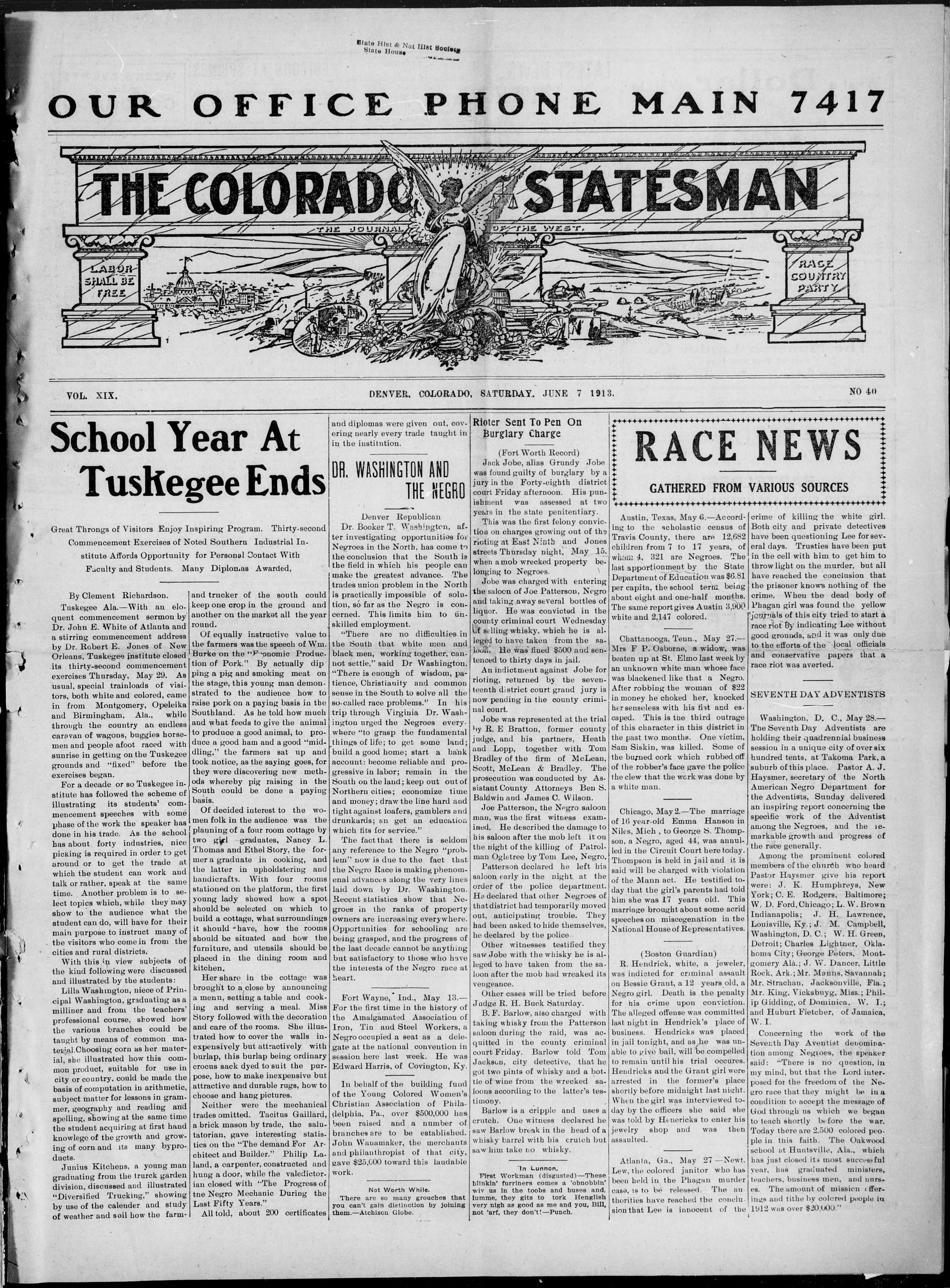
School Year At Tuskegee Ends
Great Throngs of Visitors Enjoy Inspiring Program. Thirty-second Commencement Exercises of Noted Southern Industrial Institute Affords Opportunity for Personal Contact With Faculty and Students. Many Diplomas Awarded,
VOL. XIX.
School Y
Tuskege
Great Throngs of Visitors Enjoy H
Commencement Exercises of N
institute Affords Opportunity
Faculty and Students. M
By Clement Richardson
Tuskegee Ala.—With an eloquent commencement sermon by Dr. John E. White of Atlanta and a stirring commencement address by Dr. Robert E. Jones of New Orleans, Tuskegee institute closed its thirty-second commencement exercises Thursday, May 29. As usual, special trainloads of visitors, both white and colored, came in from Montgomery, Opeleika and Birmingham, Ala., while through the country an endless caravan of wagons, buggies horsemen and people afoot raced with sunrise in getting on the Tuskegee grounds and "fixed" before the exercises began.
For a decade or so Tuskegee institute has followed the scheme of illustrating its students' commencement speeches with some phase of the work the speaker has done in his trade. As the school has about forty industries, nice picking is required in order to get around or to get the trade at which the student can work and talk or rather, speak at the same time. Another problem is to select topics which, while they may show to the audience what the student can do, will have for their main purpose to instruct many of the visitors who come in from the cities and rural districts.
With this in view subjects of the kind following were discussed and illustrated by the students:
Lilla Washington, niece of Principal Washington, graduating as a milliner and from the teachers' professional course, showed how the various branches could be taught by means of common material. Choosing corn as her material, she illustrated how this common product, suitable for use in city or country, could be made the basis of computation in arithmetic, subject matter for lessons in grammar, geography and reading and spelling, showing at the same time the student acquiring at first hand knowledge of the growth and growing of corn and its many byproducts.
Junius Kitchens, a young man graduating from the trurck garden division, discussed and illustrated "Diversified Trucking," showing by use of the calendar and study of weather and soil how the farm-
---
and trucker of the south could keep one crop in the ground and another on the market all the year round. Of equally instructive value to the farmers was the speech of Wm. Burke on the "Economic Production of Pork." By actually dipping a pig and smoking meat on the stage, this young man demonstrated to the audience how to raise pork on a paying basis in the Southland. As he told how much and what feeds to give the animal to produce a good animal, to produce a good ham and a good "middling," the farmers sat up and took notice, as the saying goes, for they were discovering new methods whereby pig raising in the South could be done a paying basis.
Of decided interest to the women folk in the audience was the planning of a four room cottage by two girl graduates, Nancy L. Thomas and Ethel Story, the former a graduate in cooking, and the latter in upholdstering and handicrafts. With four rooms stationed on the platform, the first young lady showed how a spot should be selected on which to build a cottage, what surroundings it should have, how the rooms should be situated and how the furniture, and utensils should be placed in the dining room and kitchen.
Her share in the cottage was brought to a close by announcing a menu, setting a table and cooking and serving a meal. Miss Story followed with the decoration and care of the rooms. She illustrated how to cover the walls inexpensively but attractively with burlap, this burlap being ordinary crocus sack dyed to suit the purpose, how to make inexpensive but attractive and durable rugs, how to choose and hang pictures.
Neither were the mechanical trades omitted. Tacitus Gaillard, a brick mason by trade, the salutatorian, gave interesting statistics on the "The demand For Architect and Builder." Philip Laland, a carpenter, constructed and hung a door, while the valedictorian closed with "The Progress of the Negro Mechanic During the Last Fifty Years."
All told, about 200 certificates
DENVER, COLORADO, SATURDAY, JUNE 7 1913.
State Hist & Nat Hist Society
State House
CE PI
ADO
NE JOURNAL
DENVER, COLORADO
and diplomas were given out, covering nearly every trade taught in in the institution.
DR. WASHINGTON AND THE NEGRO
Dr. Booker T. Washington, after investigating opportunities for Negroes in the North, has come to the conclusion that the South is the field in which his people can make the greatest advance. The trades union problem in the North is practically impossible of solution, so far as the Negro is concerned. This limits him to unskilled employment.
"There are no difficulties in the South that white men and black men, working together, cannot settle," said Dr Washington. "There is enough of wisdom, patience, Christianity and common sense in the South to solve all the so-called race problems." In his trip through Virginia Dr. Washington urged the Negroes everywhere "to grasp the fundamental things of life; to get some land; build a good home; start a bank account: become reliable and progressive in labor; remain in the South on the land; keep out out of Northern cities; economize time and money; draw the line hard and tight against loafers, gamblers and drunkards; an get an education which fits for service."
The fact that there is seldom any reference to the Negro "problem" now is due to the fact that the Negro Race is making phenomenal advances along the very lines laid down by Dr. Washington. Recent statistics show that Negroes in the ranks of property owners are increasing everywhere. Opportunities for schooling are being grasped, and the progress of the last decade cannot be anything but satisfactory to those who have the interests of the Negro race at heart.
Fort Wayne, Ind., May 13. For the first time in the history of the Amalgamated Association of Iron, Tin and Steel Workers, a Negro occupied a seat as a delegate at the national convention in session here last week. He was Edward Harris, of Covington, Ky.
In behalf of the building fund of the Young Colored Women's Christian Association of Philadelphia, Pa., over $500,000 has been raised and a number of branches are to be established. John Wauamaker, the merchants and philanthropist of that city, gave $25,000 toward this laudable work.
There are so many grouches that you can't gain distinction by joining them.—Atchison Globe.
Rioter Sent To Pen On Burglary Charge
(Fort Worth Record)
Jack Jobe, alias Grundy Jobe, was found guilty of burglary by a jury in the Forty-eighth district court Friday afternoon. His punishment was assessed at two years in the state penitentiary.
This was the first felony conviction on charges growing out of the rioting at East Ninth and Jones streets Thursday night, May 15, when a mob wrecked property belonging to Negroes.
Jobe was charged with entering the saloon of Joe Patterson, Negro and taking away several bottles of liquor. He was convicted in the county criminal court Wednesday of selling whisky, which he is alleged to have taken from the saloon. He was fined $500 and sentenced to thirty days in jail.
An indictment against Jobe for rioting, returned by the seventeenth district court grand jury is now pending in the county criminal court.
Jobe was represented at the trial by R. E Bratton, former county judge, and his partners, Heath and Lopp, together with Tom Bradley of the firm of McLean, Scott, McLean & Bradley. The prosecution was conducted by Assistant County Attorneys Ben S. Baldwin and James C. Wilson.
Joe Patterson, the Negro saloon man, was the first witness examined. He described the damage to his saloon after the mob left it on the night of the killing of Patrolman Ogletree by Tom Lee, Negro.
Patterson declared he left his saloon early in the night, at the order of the police department. He declared that other Negroes of that district had temporarily moved out, anticipating trouble. They had been asked to hide themselves, he declared by the police.
Other witnesses testified they saw Jobe with the whisky he is alleged to have taken from the saloon after the mob had wreaked its vengeance.
Other cases will be tried before Judge R. H. Buck Saturday.
B. F. Barlow, also charged with taking whisky from the Patterson saloon during the raid, was acquitted in the county criminal court Friday. Barlow told Tom Jackson, city detective, that he got two pints of whisky and a bottle of wine from the wrecked saloons according to the latter's testimony.
Barlow is a cripple and uses a crutch. One witness declared he saw Barlow break in the head of a whisky barrel with his crutch but saw him take no whisky.
In Lunnon.
First Workman (disgusted)—These blinkin' furriers comes a 'obnobbin' wiv us in the tooabs and buses and, lumme, they gits to tork Henglish very nigh as good as me and you, Bill, not 'art, they don't!—Punch.
RACE NEWS
GATHERED FROM VARIOUS SOURCES
Austin, Texas, May 6.—According to the scholastic census of Travis County, there are 12,682 children from 7 to 17 years, of whom 4, 321 are Negroes. The last apportionment by the State Department of Education was $6.81 per capita, the school term being about eight and one-half months. The same report gives Austin 3,900 white and 2,147 colored. crime of killing the white girl. Both city and private detectives have been questioning Lee for several days. Trusties have been put in the cell with him to get him to throw light on the murder, but all have reached the conclusion that the prisoner knows nothing of the crime. When the dead body of Phagan girl was found the yellow journals of this city tried to start a
Chattanooga, Tenn., May 27.—Mrs F P. Osborne, a widow, was beaten up at St. Elmo last week by an unknown white man whose face was blackened like that a Negro. After robbing the woman of $22 in money he choked her, knocked her senseless with his fist and escaped. This is the third outrage of this character in this district in the past two months. One victim, Sam Siskin, was killed. Some of the burned cork which rubbed off of the robber's face gave the police the clew that the work was done by a white man.
Chicago, May 2.—The marriage of 16 year-old Emma Hanson in Niles, Mich, to George S. Thompson, a Negro, aged 44, was annulled in the Circuit Court here today. Thompson is held in jail and it is said will be charged with violation of the Mann act. He testified today that the girl's parents had told him she was 17 years old. This marriage brought about some acrid speeches on miscegenation in the National House of Representatives.
(Boston Guardian)
R. Hendrick, white, a jeweler, was indicted for criminal assault on Bessie Grant, a 12 years old, a Negro girl. Death is the penalty for his crime upon conviction. The alleged offense was committed last night in Hendrick's place of business. Hendricks was placed in jail tonight, and as he was unable to give bail, will be compelled to remain until his trial occurs. Hendricks and the Grant girl were arrested in the former's place shortly before midnight last night. When the girl was interviewed today by the officers she said she was told by Henericks to enter his jewelry shop and was then assaulted.
Atlanta, Ga., May 27—Newt. Lew, the colored janitor who has been held in the Phagan murder case, is to be released. The authorities have reached the conclusion that Lee is innocent of the
NO 40
crime of killing the white girl. Both city and private detectives have been questioning Lee for several days. Trusties have been put in the cell with him to get him to throw light on the murder, but all have reached the conclusion that the prisoner knows nothing of the crime. When the dead body of Phagan girl was found the yellow journals of this city tried to start a race riot by indicating Lee without good grounds, and it was only due to the efforts of the local officials and conservative papers that a race riot was averted.
SEVENTH DAY ADVENTISTS
Washington, D. C., May 28. The Seventh Day Adventists are holding their quadrennial business session in a unique city of over six hundred tents, at Takoma Park, a suburb of this place. Pastor A. J. Haysmer, secretary of the North American Negro Department for the Adventists, Sunday delivered an inspiring report concerning the specific work of the Adventist among the Negroes, and the remarkable growth and progress of the race generally.
Among the prominent colored members of the church who heard Pastor Haysmer give his report were: J. K. Humphreys, New York; C. E. Rodgers, Baltimore; W. D. Ford, Chicago; L. W. Brown Indianapolis; J. H. Lawrence, Louisville, Ky.; J. M. Campbell, Washington, D. C.; W. H. Green, Detroit; Charles Lightner, Oklahoma City; George Peters, Montgomery Ala.; J. W. Dancer, Little Rock, Ark.; Mr. Munns, Savannah; Mr. Strachan, Jacksonville, Fla.; Mr. King, Vicksbuyg, Miss.; Philip Gidding, of Dominica, W. I.; and Huburt Fletcher, of Jamaica, W. I.
Concerning the work of the Seventh Day Aventist denomination among Negroes, the speaker said: "There is no question, in my mind, but that the Lord interposed for the freedom of the Negro race that they might be in a condition to accept the message of God through us which we began to teach shortly before the war. Today there are 2,500 colored people in this faith. The Oakwood school at Huntsville, Ala., which has just closed its most successful year, has graduated ministers, teachers, business men, and nurses. The amount of mission offerings and title by colored people in 1912 was over $20,000."
What a Dollar Will Do
THE MONARCH
WINE & LINEDRCO
You Can Get
One Case of Good, Ste
ized Beer, 24 Pints
Or One Gallon of Pure
California Port, Sherry
Muscatel Wine.
Or One Full Quart o
Bond Rye or Bourb
The Monarch L
PHONE CHAMPA
1516 Court Place
SEEDS
Your back yard will help pay you
BARTELD
"WESTERN SEEDS FOR WES
THE BARTELDES S
1521-1525 Fifteenth St.
The Largest Poultry Supply H
Case of Good, Steamed, Steril- leer, 24 Pints to the Case. The Gallon of Pure 8 Year Old Annia Port, Sherry, Angelica or Angel Wine. The Full Quart of Bottled in Rye or Bourbon Whiskey. Monarch Liquor Co PHONE CHAMPA 1231
One Case of Good, Steamed, Sterilized Beer, 24 Pints to the Case.
Or One Gallon of Pure 8 Year Old California Port, Sherry, Angelica or Muscatel Wine.
Or One Full Quart of Bottled in Bond Rye or Bourbon Whiskey.
The Monarch Liquor Co.
PHONE CHAMPA 1231
SEEDS
hard will help pay your rent if you plan
BARTELDES'
SEEDS FOR WESTERN PLANTER
E BARTELDES SEED CO.
North St. Denver, Col
est Poultry Supply House in the West
Y MILLER & C
1939 BROADWAY
GRAVEL ROOFING
AND CEMENT WORK
Your back yard will help pay your rent if you plant BARTELDES'
THE BARTELDES SEED CO.
1521-1525 Fifteenth St. Denver, Colorado
The Largest Poultry Supply House in the West
GRAVEL ROOFING AND CEMENT WORK Cement Ash Pits, $5 Up Repairing Promptly Done Tin Roofs Painted
All Work Guaranteed Give Us
Phone Main 1062
N. F. Davis
Plumbing Inspector for City and County of
g, Heating and Ventilation
and Tests for Sewer Gases On All
defective buildings
Estimates Given
PHONE SOUTH 855 DENVER
WER & SCHUCK
All Work Guaranteed Give Us a Trial
Phone Main 1062
W. F. D.
(12 Years Chief Plumbing Inspector for
Plumbing, Heating and
Examination and Tests for Sewer
defective build
Estimates G
842 BROADWAY PHONE SOUTH
BROWER &
W.F.Davis
(12 Years Chief Plumbing Inspector for City and County of Denver) Plumbing, Heating and Ventilation Examination and Tests for Sewer Gases On All Old defective buildiugs
REAL ESTATE
311 Cooper Building
DENVER, COLORADO
JOHN ENG
K & Engstrom
Beck & En
Beck & Engstrom
WHOLESALE DEALERS IN
Wines, Liquors
Cigars
Western Agents for Minneapolis Grain Belt Beer and C
Imported Beer and Bock Ol.
1644-46-48-50 Larimer S
Phone Main 1053
es, Liquors and Cigars
Minneapolis Grain Belt Beer and Carnegie Port
Imported Beer and Bock Ol.
4-46-48-50 Larimer Street
Western Agents for Minneapolis Grain Belt Beer and Carnegie Porter, Pripps Imported Beer and Bock Ol.
---
HENRY
THE WATER TANK
HENRY BECK
Denver, Colo.
rent if you plant
S'
ERN PLANTERS"
ED CO.
Denver, Colorado
se in the West
R & CO.
ROOFING
ENT WORK
Give Us a Trial
tain 1062
avis
(ly and County of Denver)
Ventilation
Gases On All Old
ys
ven
DENVER, COLO
CHUCK
RM LANDS
Telephone Champa 1962
Residence Phone Main 7345
JOHN ENGSTROM
strom
S IN
rs and
and Carnegie Porter, Pripps
Ol.
er Street
Denver, Colorado
LATEST NEWS EPITOMIZED
FROM TELEGRAPHIC REPORTS THAT COVER THE WEEK'S EVENTS.
OF MOST INTEREST
KEEPING THE READER POSTED ON MOST IMPORTANT CURRENT TOPICS.
Western Newspaper Union News Service.
WESTERN.
Mayor Rolph drove the last horse car in San Francisco on its last trip from the ferry building to the scrap heap.
Harrison R. Albee will be Portland's first mayor under the commission form of government, adopted at the recent charter election.
Henry H. Rose, police magistrate, was elected mayor of Los Angeles by about 1,700 majority over John W. Shenk, municipal conference candidate.
Mrs. Cora Prescott of Mason City, Ia. was shot by her former husband. The bullet struck a corset steel and was deflected, leaving only a minor flesh wound.
Fire caused by lightning destroyed the barns of the Tri-City Railwav Company at Rock Island, Ill., together with forty cars, causing a loss of $400,000.
An aftermath of the Ohio floods came in the wreck of a Big Four freight train west of Lafayette, Ind. Two rescues were killed and five seriously injured.
In Chicago physicians removed a toy cannon from the stomach of Coleman Shaughnessy, three years old, who swallowed it while celebrating Memorial Day.
Miss Angeline Schefer, twenty choked to death at Chicago on a false tooth which became loosened as she was laughing heartily at a story told by her fiance. Monroe Gohlson, a miner, committed suicide at Joplin, Mo., by laying down in his back yard, placing a stick of dynamite on his stomach and lighting the fuse. His body was scattered over a good portion of South Joplin.
CONGRESSIONAL
House organization was completed and committee appointments ratified. Senator O'Gorman introduced bill to create commission on prison labor to study prison labor question and recommend uniform Legislation. The Senate immigration committee voted to report favorably nomination of Anthony Caminetti as commissioner General of Immigration. Representative Murdock introduced a bill for a naturalization commission to investigate, recommend and draft bill in the interest of admitted aliens. Leaders Underwood, Mann and Murdock made gentleman's agreement to transact no important business until June 23, adjourning three days at a time.
Representative Steenerson introduced bill to grant foreign vessels right to participate in American coastwise trade through Panama canal.
Representative Hinebaugh introduced resolution to direct interstate commerce commission to investigate St. Louis and San Francisco railroad management for past year.
Senators Jones and Chamberlain of the territories committee have agreed to submit to the committee a bill to authorize an issue of $40,000,000 in bonds for the building of a government Alaskan railroad.
WASHINGTON.
Reversing its former action in voting to place wheat, flour, oatmeal and fresh meats on the durable list, the Senate finance sub-committee in charge of the agricultural schedule voted to place live stock, wheat and oats on the free list.
"This looks like a grasshopper year," says Professor F. M. Webster of the bureau of entomology, after the fourth outbreak of the invaders had been reported to him. The latest appearance of the "hoppers" is in Kansas, previous states afflicted being New Mexico, Idaho and California.
A proposed increase by the Southwestern lines of about 6 cents a hundred pounds in the freight rates on potatoes and other vegetables from points in Louisiana, Texas and Arkansas to Denver, common points, was suspended by the Interstate Commerce Commission until September 20.
The demand for beef far exceeds the supply and high prices are the result, gays a bulletin issued by the department of agriculture.
The condition of the cotton crop of the United States on May 25 was 79.1 per cent of a normal, the Department of Agriculture announced.
Viscount Chinda, ambassador from Japan, called on Secretary Bryan with formal notification that Japan had accepted in principle the proposed plan advanced by the United States for universal peace.
FOREIGN.
Gluseppe, Cardinal Vives Toto, grand inquisitor of Spain is gravely ill.
Alfred Austin, British poet laureate since 1896, died in London at the age of seventy-seven.
Elliott Northcutt, United States minister to Venezuela, has resigned from the diplomatic corps.
Four hundred were reported killed in a battle between Chihuahua City and Santa Rosalia, Chihuahua state.
After four hours' fighting it was reported the city of Matamoras, Mexico, had been captured by the Constitutionalists.
Pope Pius, besides innumerable congratulations, recived many presents in commemoration of his seventy-eighth birthday.
Forty-five thousand Greeks, who were planning to seize Kavala on the Aegean, are practically in the hands of the Bulgarian army. The city of Rome has just completed the celebration of the 2,663rd anniversary of its foundation. This places the birth of the city in the year 750 B. C. The chamber of deputies by a vote of 127 to 17 at Bucharest authorized the government to accept Russia's mediation in the territorial difficulties with Bulgaria. Walter de Mumm, well-known French soothing man, and Miss Florence Scoville, daughter of C. C. Scoville of Seneca, Kan., were married at the fashionable church of St. George's, Hanover Square, London.
Count Alvaro de Romanones, who, on May 30, resigned as premier, together with all his ministry, has consented to resume office. He returns to the premiership at the request of King Alfonso after his majesty had consulted all the leaders.
SPORT.
Won. Lost. Pet.
Denver ..... 28 14 ..... 667
St. Joseph ..... 26 16 ..... 619
Omaha ..... 23 19 ..... 548
Lincoln ..... 21 19 ..... 545
Los Moines ..... 20 21 ..... 488
Sioux City ..... 18 22 ..... 450
Topeka ..... 17 24 ..... 415
Wichita ..... 12 30 ..... 286
James Colovan, an amateur aviator, was killed at Chicago when his biplane struck a tree and was overturned.
The alumni of Keio university gave a banquet at Tokio in honor of the baseball team from Leland Stanford junior of California. The most cordial feeling prevailed.
Jimmy Clabby, the Hammond, Ind., middleweight boxer, and Jack Dillon of Indianapolis, winner of the bout with Frank Klaus of Pittsburgh have been matched to fight at Indianapolis July 4.
Funeral services over the body of Luther McCarty, clamant of the white heavyweight championship, who was killed in a prize fight with Arthur Pelkey at Calgary, Alberta, were held at Piqua, Ohio.
Edward Payson Weston, the famous long-distance pedestrian who has twice crossed the continent afoot, started from New York on a 1,500-mile tramp to Minneapolis. The seventy-five year old walker expects to complete the journey in sixty days.
William McCarney, manager of the late Luther McCarty, champion white pugilist, who was killed in a ring at Calgary, Alberta, went to Springfield, Mo., with Mrs. McCarty, widow of the fighter, to see about the disposition of the dead pugilist's estate, estimated to be worth $15 000.
GENERAL.
Philadelphia hotels are making a specialty of "Roosevelt punch," the drink consisting of brandy, milk and sugar.
In memory of the 267 officers and men who were lost with the battleship Maine in Havana harbor 15 years ago the National Maine monument was dedicated at New York.
Eight men are now under arrest at Council Bluffs, la., in connection with the attempt to lynch Guidice, the young Italian, who is charged with the murder of Howard Jones.
Mrs, Isabel Patterson Springer, the woman in the Henwood case, has disappeared from her lodgings at 19 East Fifty-sixth street, New York, where she took refuge following the divorce proceedings in Denver two years ago.
The directors of the Maryland Jockey club, which recently conducted a race meet at Pimlico, near Baltimore, ordered that $10,000 be expended for poor persons suffering from tuberculosis. The Babies' milk fund and the fresh Air fund each received $1,000.
Comanche, a 2,000-pound buffalo bull rated by Professor William T. Hornaday, president of the American Bison society, as the finest specimen of the breed, was killed in a battle with a younger rival for the supremacy of Colonel Trexler's herd at Schnecksville, Pa.
Colonel Theodore Roosevelt won his libel suit in Marquette, Mich., against George A. Newett, who charged the colonel with drunkenness. The colonel waived damages after the defendant had uttered a retraction, and was awarded by the jury the nominal damages of six cents provided in such cases by the law of Michigan. Each party to the suit will have to pay his own expenses. Violence followed the inauguration of a strike at Boston by several hundred barbers and bootblacks.
EDITORS AT SPRINGS
MEETING OF NATIONAL PRESS ASOCIATION JUNE 17.
After Business Sessions Are Completed, Several Days Will Be Spent Sight-seeing.
Western Newspaper Union News Service.
Colorado Springs, Colo.—Editors will take their vacation this year in "America's Scenic Playground," for Colorado Springs has been selected for the annual meeting place of the National Press Association of America. The convention will begin June 17 and after the business sessions are completed, several days will be spent sight-seeing. Trips to the summit of Pike's Peak; to Cripple Creek, the world's greatest gold mining camp; over the Crystal Park auto route; to Mt. Manitou park; to the Cave of the Winds; to the Ancient Cliff Dwellings; through the Garden of the Gods; South Cheyenne Cañon and the Seven Falls; Stratton park and many other places will be in order. The editors will also visit the Union Printers' Home and they will be given automobile rides over some of Colorado's splendid mountain roads.
Following the Colorado Springs program, the delegates will go to Denver and will visit the famous irrigated sections of Northern Colorado.
Funeral of Mrs. Roosa.
Boulder.—The funeral of the late Mrs. Lillian Roosa, victim of the tragic street car accident on Memorial day, was held from the Methodist church. The building was crowded with mourners, and the high esteem in which the deceased was held by all who knew her was evidenced by the collection of flowers than which a larger or more beautiful display has seldom been seen in the city.
Dies With Baby Brother in Arms.
Eaton.—When she was told that her death was but a matter of a few minutes, Anna Ruth Johnson, eighteen, daughter of Albert Johnson, a rich farmer of this section, asked members of the family to come bid her goodby, asking especially to see her baby brother. She said she wanted to put her arms around him, and she died with his face nestled close to hers and held to her breast.
Veterans Gather at Camp Fire.
Denver.—A campfire at the Auditorium closed the second day of the annual meeting of the G. A. R., department of Colorado and Wyoming. A reception to the veterans by the Daughters of Veterans and the Ladies of the G. A. R. was another feature of the day.
Body Lies Unburied a Month.
Fort Collins.—The body of Mrs. Alice McMillen, who was frozen to death in a blizzard in the mountains west of here five months ago, is unburied. The body was recovered from the snow one month ago and has since that time lain in an undertaker's morgue awaiting word from relatives.
Woman Is Freed.
Greeley.—In the District Court on motion of the District Attorney the case against Mrs. J. T. Kester, who was accused of poisoning her husband with felonious intent, was dismissed. This action was taken at the request of Kester, who paid all costs.
Rancher Shoots Wife Son and Self.
Greeley, Colo.—A coroner's jury which returned three verdicts as the result of the deaths of Robert M. Stanley, 28, his wife, Charlotte, 22, and his scn, Benton, 6, declared that Stanley was guilty of killing his wife first, his scn next and then taking his own life,
Gophers to Be Dynamited.
Gill.—J. S. Harrison has determined to use dynamite in an effort to obliterate gophers in this vicinity. He plans to plant several sticks of the explosive and set it off with electricity at a safe distance. The gophers have learned that poisoned meat is not healthy and let it alone.
Creamery Begins Operations
Meeker.—The White River Creamery has begun operations with a capacity of 1,200 pounds of butter per day—enough to supply practically all of the Western slope. Blooded Holstein cows provide the cream.
Let Boundhouse Contract
Grand Junction.—The Rio Grande railroad has let the contract for the new roundhouse here to Mortimus Nelson. His bid was $63,500 and it is understood that work will be started at once.
Output at Cripple Creek.
Cripple Creek.—The output of the Cripple Creek district for May amounted to 80,394 tons, valued at $1,207,752.
Parker Returns and Marries Widow.
Fort Collins.—T. C. Parker, age 72, who, on May 8, deserted his 65-year-old bride-to-be, Mrs. Nancy C. Pennington, and departed without even telling her good-by, returned from Kansas and went straight to her home, where he begged her forgiveness and the venerable couple were married while seated in an automobile in front of the home of the Rev. Charles A. Rowand, pastor of the Methodist church, who performed the ceremony.
WEEK'S EVENTS IN COLORADO
Western Newspaper Union News Service.
DATES FOR COMING EVENTS.
June 16.—Midsummer Meeting Colorado Editorial Association at Colo-
rado
June 17-19.—National Press Association
Meeting at Colorado Springs.
June 18-20.—Meeting Colorado State
Pharmaceutical Association at Glen-
wood Springs.
June 22-29.—German Turnfest at Denver.
June 26-27—W. C. T. U. Seventh District Convention at Akron.
June 26-29. Colorado Christian Endeavor Convention at Longmont.
June 26-29. Christian Endeavor State Convention at Longmont.
July 9-10. Meeting Colorado Postmasters' Association at Colorado Springs.
July 28. Pacific Jurisdiction, W. O. College of Law, Colorado Springs.
Aug. 12-15. Thirty-second Triennial Conclave of Knights Templar, Denver.
Aug. 18-20. American Association of Park Superintendents, at Denver.
Aug. 18-20. American Philippines National Society, at Denver.
Aug. Grand Council of Order of Red Men, at Denver.
Aug. 25.—Conference of Governors at Colorado Springs.
Aug. 26.—Knights of Pythias Grand Lodge Meeting at Trinidad.
Sept. 15-20.—Colorado State Fair at Pueblo.
Sept.—National Association of First-Class Postmasters, at Denver.
Oct. 1-3.—State W. C. T. L. Convention at Salida.
Oct. 21.—Colorado State Baptist Association at Salida.
1915.—Last Grand Council of North American Indians, Denver.
Fort Collins Elks have arranged to celebrate Flag Day, June 14.
Robbers secured $500 in jewelry from the store of Grant Bates at Debeque.
Fears of an indian uprising alarm settlers in the extreme Southwest corner of Colorado.
H. L. Montgomery, twenty-five, was fined $10 and costs in Police Court at Fort Collins because he struck his mother.
Mrs. Sam C. Reid, wife of County Commissioner Reid, died in Yampa of cancer of the stomach. She was a Colorado pioneer. George W. Temple, former state auditor under Governor Charles Thomas, is seriously ill with heart trouble at his home in Denver. A total of twenty-four boys and thirteen girls were born in Colorado Springs last month, according to records compiled by the city health department. Dr. James M. Perkins was elected mayor and Isaac N. Stevens city attorney by the five new commissioners sitting in their first meeting as a council in Denver.
The board of examiners for coal mine inspectors has been completed by the appointment of E. H. Weitzel of Trinidad and James Dalrymple, chief inspector of coal mines by Governor Ammons.
Mrs. E. W. Cottrill of Trinidad was stunned by a lightning stroke during a severe electrical storm and is in a serious condition. The shock resulted in a severe nervous prostration.
Prosecution and defense in the trial of Harold F. Henwood for the killing of George E. Copeland have accepted eleven jurors, and would have accepted the full jury of twelve had it not been for the illness of Juror George R. McIntosh.
Through the granting of a temporary writ of injunction in the District Court at Trinidad, the Huerfano county water users of water district No. 16 will receive water enough from the Huerfano river to irrigate their growing crops.
With the martial strain of the Memorial day parade ringing in his ears and brooding over his inability to march with his comrades, Andrew J. Lochbaum, civil war veteran and a pioneer of Denver, ended a life of suffering by taking poison.
Miss Winnie Grandstaff accidentally shot herself in the leg while moving a rifle from a corner in the kitchen of her home at Meeker. An X-ray examination revealed the ball lodged in the knee. It is feared that the leg will have to be amputated.
Walter T. Barnes, thirty-nine years old, former librarian of the University of Colorado, died at Boulder. He was the son of the late Milton Barnes, for several terms secretary of state of Ohio. The body will be taken to Westerville, Ohio, for burial.
While standing on the brink of an abandoned well at Golden with his little girl playmate, Everett Crompton, four, lost his balance, fell into the water and was drowned. Elizabeth Leesemann, five, who was with the boy, ran for assistance, but when help arrived the baby was dead.
The railroad commission has set July 15 for hearing arguments by representatives of the Greelely Commercial Club on its contention against the Union Pacific and the Colorado & Southern Railroad Companies. The commercial organization has asked that freight rates between Greeley and Denver be reduced, and has made the claim that the present rate is exorbitant. Daughters of the Confederacy, Confederate veterans and their friends paid tribute to the memory of Jefferson Davis with memorial services at City park in Denver, and memorial services were followed by an old-fashioned Southern chicken dinner. In the evening there were reminiscences by the veterans, songs and music by an orchestra.
Governor Ammons has named A. D. Barrow of Routt county water commissioner for District No. 3, and Laura B. Croft of Denver member of the State Board of Nurse Examiners.
VETERANS TO MEET ON BATTLEFIELD
Big Reunion of Survivors of Civil War at Gettysburg on July 1.
40,000 EXPECTED TO ATTEND
Men Who Wore the Blue and Gray to Again Gather on Ground Made Memorable by Historic Conflict.
By EDWARD B. CLARK.
WASHINGTON. — During the first four days of July the battlefield of Gettysburg, Pa., will again be the scene of a meeting of the Blue and the Gray, but this time they will meet in emity and affection. A half-century will have passed since last these men of two great American armies met on this northern field. Then they were face to face in deadly conflict, for the issue, it was well understood to both contending forces, was the success of the southern cause, or the beginning of its defeat, to be followed by the restoration of the Union as it had been before the first shot was fired at Fort Sumter.
The United States government and the government of nearly every state in the Union have combined to make the Gettysburg reunion of the soldiers of the north and south one of the great peace events of the century. The state of Pennsylvania some time ago appointed a "Fiftieth Anniversary of the Battle of Gettysburg commission" to make preparations for the four days' reunion, at which Pennsylvania as a state was to act as host to the veterans of the war between the states and to the thousands of visitors who would follow their march to the field of battle, and appropriated $150,000 for the purpose of entertaining the veterans.
40,000 Veterans Expected.
It is expected that 40,000 veterans of the war, not all of them, however, survivors of the Gettysburg battle, will be found encamped upon the field when reveille sounds on the morning of July 1. It will be a different reveille than that which the fife and drum corps of the two great armies sounded fifty years ago. The call to awakening will be a call to a peaceful celebration while the call to the awakening in July, 1863, was a call of armies to conflict and, to thousands of men, a call to death.
For years the veterans have been looking forward to this reunion. It is probable that there will be present many thousands of survivors of the battle. The United States government under an act of congress has appropriated money for the preparation of the camps and for the messing of the soldier visitors. The average age of the men engaged in the Civil war was only eighteen years, but fifty years have passed since these soldier boys fought at Gettysburg, and so if the computation of age was a true one the average years of the veterans who will meet in Pennsylvania in July will be about sixty-eight years. Many of them, of course, will be much older and a good many of them, men who entered at ages ranging from fourteen to seventeen years, will be younger, but all will be old men as the world views age.
Many of the states of the Union, north as well as south, have made appropriations to send their veterans to the Gettysburg reunion and to pay all other expenses. The battle of Gettysburg is recognized as the turning point of the war between the states. It has been called time and again one of the decisive battles of the world. Generally it is recognized that Gettysburg decided the great conflict, helped in the decision probably by the fall of Vicksburg on the Mississippi, which took place virtually at the moment that the conflict on the Pennsylvania field was decided in favor of the northern arms.
The preparations which the government is making to care for the veterans at Gettysburg are interesting. They have been under the charge of James B. Aleshire, quartermaster general of the United States army, and Henry G. Sharpe, commissary general of the United States army. Two years ago last March 14,000 regular troops were gathered in camp at Texas. The health of the soldiers throughout the Texas encampment was almost perfect, made so by the plans which had been carefully laid to see that perfect sanitation was maintained. The United States army was taught a lesson by the Spanish war, when lack of proper sanitary precautions and unpreparedness in other ways cost the government the lives of more men than were sacrificed to the bullets of the Spanish.
The estimates of the commissary and quartermaster authorities are based upon an attendance of 40,000 veterans. It probably will cost the government about $360,000 to act in part as host to the survivors of the battle and other veterans who attend the Gettysburg reunion.
Blg Task to Feed Men.
Big Task of the war from the north and south who will be present, being old men, must be cared for in a way which would not have been necessary fifty years ago. The messing of the veterans will require 400 army ranges, 1 great field bakery, 40,000 mess kits, 800 cooks, 800 kitchen helpers and 130 bakers. This helping personnel will be required to be in camp for at least seven days, and many of
ORIGINAL IN POOR CONDITION
them for a longer period, for the purpose of installing the field bakery, the field ranges and in dismantling, cleaning, packing and storing material after the encampment is over. The old soldiers are to be supplied with fresh meat directly from refrigerator cars drawn upon the field. They will be given fresh vegetables and special bread with the best coffee and tea which the market affords. For them it will not be a case of hardtack, bootleg and poor bacon.
The Battle of Gettysburg commission of the state of Pennsylvania has a large sum of money at its disposal for the entertainment of the visiting veterans, and the thousands of persons who will accompany them. Hospitality is to mark the days. Fifty years ago Pennsylvania aided in the work of repelling the visitors from the south. In early July next the same state will have its arms wide open in welcome to the men wearing the gray. Entertainments of various kinds will be offered the visiting veterans, but it is pretty well understood that their deep interest in revisiting the scenes where they fought, Little Round Top, Oak Ridge, Cemetery Hill, Culp's Hill Rock Creek, the Stone Wall and other places will hold them largely to the pleasures and to the sadnesses of personal reminiscences. Arm in arm with the Union soldiers the Confederate soldiers will tramp the battleground. They will look over the field of Pickett's desperate charge. They will retrace the marching steps of Long street's corps. They will go to the place where Meade had his headquarters and to the place from which Lee directed his southern forces in battle
Pennsylvania is going to make a great celebration of peace of this fifteenth anniversary of what probably was the decisive battle of the war, although it was fought nearly two years before the war ended. Other states will help Pennsylvania in its work, and from every section of the country, north, east, south and west, the veterans will assemble, most of them probably to see for the last time in life the field upon which they were willing to die for the sake of their respective causes.
the veterans will not be directly encamped in the Gettysburg park, which is dotted with monuments to the various commands which took part in the fight and which is laid out in approved park fashion, with fine drives and beautifully kept lawns. There will be two camps, known as No. 1 and No. 2. No. 1 will cover 149 acres and No. 2 will cover 44 acres. The layouts of these camps are based on the use of conical tents, each of which will, without crowding, accommodate eight persons. Inasmuch as accommodations are to be furnished for 40,000 visitors 5,000 tents will be required to give quarters to the visiting hosts.
Visitors to Be Cared For.
Visitors to Be Cared For. Every possible care is to be taken of the visitors. The sanitary arrangements which have been made are said to be the best that are possible and they are the result of careful study by medical officers of the service. All the experience of the past has been drawn upon to make it certain that the health of the veterans will be conserved while they are in camp.
With so many thousands of old soldiers in attendance, and taking into consideration the probability that the weather will be warm, it is expected that there will be sickness, but the United States government and the state of Pennsylvania are preparing for a hospital service which shall be adequate to any contingency. There will be hospital corps detachments present ready to render first aid to the injured, and there will be many field hospitals with surgeons in attendance, where the sick can receive instant attendance.
It is said that this contemplated reunion has induced more interest among the old soldiers of the north and the south than any event which has happened since the day that the war closed. There is today at Gettysburg a great national park, in which is included a cemetery where thousands of soldier dead are buried. The United States government and the legislature of Pennsylvania worked together to make a park of the battlefield and to mark accurately every point in it which has historic interest. When one goes to the field he can tell just where this brigade or that brigade was engaged, just where this charge or that charge was made and just where the desperate defenses of positions were maintained until the tide of battle brought either victory or defeat to one of the immediate commands engaged.
It was in 1895 that congress established a national park at Gettysburg and gave the secretary of war authority to name a commission "to superintend the opening of additional roads, mark the boundaries, ascertain and definitely mark the lines of battle of troops engaged, to acquire lands which were occupied by infantry, cavalry and artillery, and such other adjacent lands as the secretary of war may deem necessary to preserve the important topographical features of the battlefield."
When the Union and the Confederate veterans reach Gettysburg on June 30 next they will find on the scene of the old conflict between five and six hundred memorials raised in commemoration of the deeds of their commands on the great fields of the Pennsylvania battlefield. There are, moreover, 1,000 markers placed to designate historic spots. There are great towers built upon the field by the government so that bird's-eye views can be obtained of the entire scene of the battle. Fine roads have been constructed and everywhere attention has been paid to every detail of the least importance in setting forth the history of one of the greatest battles ever known to warfare
AFRO-AMERICAN CULLINGS
The history of womanhood in America would be incomplete without note being taken of the heroic struggle of the colored women born in this country, who, from the time of their liberation from slavery, have been exerting every effort to overcome in their race the effects of a bondage extending over unnumbered centuries, writes Frederic J. Haskin. The Afro-American woman demonstrates more than do most others the tender, maternal instinct of the primeval woman, who would labor and suffer and bear strong sons whose vigor might add to the greatness of the world.
The development of this great nation necessitated the freedom of the one-time slave. Unequipped with the training and education needed for the new duties and responsibilities freedom brought to them, the colored women from the beginning keenly felt the responsibility of preparing her family for the new life dawning upon them.
No greater task ever came to the women of any nation, and the loyalty with which they are fulfilling it must appeal to any one who will consider for a moment some of their achievements in the face of great obstacles. The colored woman recognizes the value of education far more than the colored man, as is evidenced by the much larger number of colored women than men now found in the higher schools. It was only the exceptional colored woman, a generation or two ago, who, by the aid of some kindly disposed friends, and usually by untold sacrifice and exertion on her own part, was able to secure an education which demonstrated her fitness for something more than the menial drudgery which had been considered the lot of the women of her race. Having achieved an advantage for herself, she did not selfishly enjoy it, but, in almost every instance, devoted her added advantage to help others of her race.
Like the white woman, the progressive colored woman realized the value of organization. When the great Federation of Women's clubs was organized several of the clubs, composed of educated colored women, were credulous enough to believe that the motto "Unity in Diversity" was broad enough to include the enlightened women of their race, who were working toward the general uplift of humanity. The refusal of the general federation to admit Mrs. Ruffin, as a delegate from the New Era club of Boston, answered this assumption. Stung by this rebuff, the colored women realized that for the present they must receive aid from organizations composed entirely of their own race.
The National Association of Colored Women in the United States now fills a greater place in the development of the colored women of the country than does the general federation for the white women. Its bonds are closer and more sympathetic because of the discouragements its members so frequently receive. This organization, which has grown from a comparatively small body, organized in Washington in 1896, now represents more than 150,000 colored women in its membership. It has state federations in most of the states and is strongest in the south. The association recognizes the fact that whether cultured or not, the colored woman receives practically the same treatment from the white public. The women who have culture therefore really help themselves in helping those who have not, and the spirit of
Disunion is the result of perverted judgment or a lack of understanding which, in either case, is hurtful. Ignorance is a fruitful producer of woes and it is a grave misfortune not to know or realize its baneful effects. Success in life hinges upon a proper use of the materials employed in its making; and we sink or swim in accordance with the execution of our plans. The Negro occupies a position not envied by the others of mankind; but his opportunities are many and he may with readiness pull the load, if he rightly puts his shoulder to the wheel.
Chinkapin chains, a novelty just over from London, are made of large, polished wood beads in black and costume colors, strung on knotted silk or fastened with metal links. They come in the form of lorgnette chains, purse chains, and graduated necklaces, and retail at from 34 to 44 cents.
A hitherto unknown clan of Jews has been discovered in the interior desert of Arabia.
Have you really got as much faith in God, and your religion as you say you have? If so, why is it you resort to methods that are not of God in order to accomplish some things? Why don't you put the matter in his hands, as you say he will fight your battles for you?—The Interstate Reporter.
The fishermen of Maine, making use of power boats, are generally making use of a mixture of gasoline and lubricating oil, which is said to keep the cylinders thoroughly oiled without the use of lubricating cups.
the association is one of general helpfulness, which is expressed in its motto, "Lifting as We Climb." Most of the problems which confront the white wife and mother come also to her colored sister. The difficulties of the latter are largely increased by the barriers of race. The colored women are just as anxious to educate their children and to have a high standard of living as the white women. The number of uneducated women who will toll over a wash tub all day long in order to keep their children in school demonstrates this. But their ambitions are gained only by a constant struggle such as the white woman has never even imagined.
In all the history of its pioneer work in the development of the Negro folk songs, Flisk university had never given such a concert as was presented to an enthusiastic audience last night in Ryman auditorium, the largest hall in the city. This immense audience gave the 300 Negro students round after round of applause, demanding an encore for every number on the program. Nowhere else in the United States could there be gathered such a company of select Negro voices under such leadership, for the singing of these songs, as that which greeted the music lovers of Nashville on this occasion. From the opening song of "Brethren, Rise," to the closing, "Swing Low, Sweet Charlot," led by Mrs. Ella Sheppard Moore, one of the original jubilee singers, this mammoth chorus held the audience in wrap attention. The chorus was assisted by the University orchestra, the Men's Glee club, and the Women's Glee club, whose rendition of Mendelssohn's "Lift Thine Eyes" was as pure a piece of vocal harmony as one seldom has a chance to hear. The choral work was under the direction of Professor John W. Work, the noted leader of Negro folk songs. His solo, "Onaway, Awake Beloved," by Coleridge-Taylor, was one of the features of the evening.
This concert was given as a part of the strenuous effort the university is making to raise the balance of nearly $100,000 to complete a much needed endowment fund. The raising of this fund will meet a great crisis in the history of this noted institution. Cash and pledges to the amount of $202,000 have been secured. Many of the pledges are conditions on the raising of the balance of a $300,000 fund ov June 1, 1913. The following is the program of the concert, without the encores, which followed each selection:
Orchestra
Brethren, Rise...Negro Folk Song
Witness for My Lord...Negro Folk Song
Led by Miss Green.
Lift Thine Eyes...Mendelsohn
Women's Glee Club.
Steal Away to Jesus...Negro Folk Song
Rosary
Meadames C. O. Hedley and J. W. Work,
Mears, J. W. Work and A. G. Price.
Great Camp Meeting...Negro Folk Song
Led by Mrs. C. O. Hadley.
Remarks...By Friends of Fisk
PART II.
Couldn't Hear Nobody Pray ...Negro Folk Song
Led by J. A. Myers.
Onaway, Awake, Beloved ...Negro Folk Song
J. W. Work.
I'm Goln' to do all I can for My Lord...
...Negro Folk Song
Led by A. G. Price.
There, Little Girl, Don't Cry...Westendorf
Men's Glee Club.
Readings from the Works of Dunbar
Swing Low, Sweet Charlot...
Led by Mrs. G. W. Moore, of the Original
Jubilee Singers.
The students of the Atlanta Baptist College (Georgia) held spell-bound an audience of four thousand people in the Armory auditorium in Atlanta recently with a program from Negro composers. One marked feature of the occasion was the rendition of the grand chorus, "Gallia," by 250 male voices. Both races were there. Atlanta's very best and most cultured, and they were unanimous and enthusiastic in rendering the verdict that it was a wonderful performance. Mme. Azalia Hackley trained the program. President Hope wisely encouraged it.
There is a class which makes great pretensions to interest as to to the welfare of their fellow-men, but when the opportunity for manifesting it appears, excuses ready coined are dragged from their covert to brace the fibs they tell. Such characters, selfish in purpose are of little benefit to themselves and none whatever to the society of which they form a part.
The pawnbroker won't advance a cent on your self-esteem.
Samuel Coleridge-Taylor, one of the best known modern composers, and the most prominent of Negro composers, died in London, England. The deceased was one of England's leading writers, and was well known in this country, having made several visits to America. In Washington, D. C., a few years ago, he produced a part of his greatest work—his Hiawatha trilogy—"Hiawatha's Wedding Feast," and was a composer of marked ability by both press and public. His last visit to the United States was two seasons ago.
FLORAL DESIGNS PUT UP WHILE YOU WAIT
CHOICE PLANTS AND CUT FLOWERS CONSTANTLY ON HAND
GREENHOUSES: Thirty-Fourth and Curtis Streets
TELEPHONE, MAIN 1511 DENVER, COLO
2735 Welton St. Main 6363
The Central Bottling & Distributing Co.
Agents for the famous
CAPITOL BEER---IT'S CAPITAL
Try a case, 2 doz. pints for $1.10, delivered promptly; empties called for.
Family Liquors, Wines, and Cordials
Genuine Goods at Popular Prices
A glass of good wine will improve your Sunday dinner, and aid digestion.
The Champa Pharmacy
Twentieth and Champa,
Is the place to get your
DRUGS, CHEMICALS AND PATENT MEDICINES
Prescriptions Our Specialty.
Phone us and we will deliver the goods to all parts of the city.
JAMES E. THRALL, PROPR.
PHONE MAIN 2425.
THE CAPITAL CITY SHOE REPAIRING CO. SEWED HALF SOLES 60 cts. and 75 cts. HENRY WARNECKE, President
Boost Colorado Products Patronize Home Industry
ZANG'S
DELICIOUS TABLE BEERS
COLUMBINE,
VIENNA AND
PILSENER
Guaranteed Absolutely Pure.
Dellvered Dally to All Parts of the City.
The Ph. Zang Brewing Co.
TELEPHONE GALLUP 395.
We Boost for Colorado You Should Boost for Us
DAY OR NIGHT. PHONE MAIN 6243
A. M. LAWHORN
Undertakers
A first-class Mortuary establishment. First aid to the bereaved in the
time of death of loved ones. Prices below competitors. Polite service
LAWRENCE JONES, Licenced Embalmer
LOUIS HUBBARD, Funeral Director
PARLORS 1925 Arapahoe Street
The Denver Sanitary Laundry. PHONE MAIN 5670 1082 Broadway. Denver, Colo.
THE COLORADO STATESMAN
JOS. D. D. RIVERS.....Proprietor
1824 Curtis Street, Room 25.
Phone Main 7417.
One Year ..... $2.00
Six Months ..... 1.00
Taree Months ..... .60
PAYABLE IN ADVANCE.
Entered as second-class matter at the postoffice in the city of Denver, Colorado.
All communications of a personating nature that are not complimentary will be withheld from the columns of this paper.
Display advertising, 25 cents per square. A square contains ten agate lines.
Reading notices, ten lines or less, 10 cents per line. Each additional line over ten lines, 5 cents per line.
No discounts allowed on less than three months' contract. Cash must accompany all orders from parties unknown to us. Further particulars on application.
Remittances should be made by Express Money Order, Postoffice Money Order, Registered Letter or Bank Draft. Postage stamps will be received the same as cash for the fractional part of a dollar. Only 1-cent and 2-cent stamps taken.
Communications to receive attention must be newsy, upon important subjects, plainly written only upon one side of the paper; must reach us Tuesdays, if possible, anyway, not later than Wednesdays, and bear the signature of the author. No manuscript returned, unless stamps are sent for postage.
It occasionally hapens that papers sent to subscribers are lost or stolen. In case you do not receive any number when due, inform us by postal card and we will cheerfully forward a duplicate of the missing number.
THINK THIS OVER.
to repeat quite often in deal with the Colored office of official representation office holders is some Denver, and it appears those for whom it speaks those who represent employ a valet or a house wishes in the matter, upon the people as they in the kind of person that not mean to say that determine whom an office, but we believe colored people to have a make his selection agree have contributed material easy thing to do, and a for purely personal requirements to be consider to have many elective appointive positions in we can have quite as manyarge voting element as consultation with a few beside the point, and the final candidates need not driving the colored peoentent, would deprive the would be terrible even the Commissioners of Dug with the colored voteion among the more
It becomes necessary to repeat quite often to our political friends the admonition that a square deal with the Colored brother is a proper thing to insert in the program of official representation. Colored representation on the official rosters of office holders is something which should not require further appeal in Denver, and it appears just as reasonable to the Colorado Statesman and those for whom it speaks that the kind of representatives chosen should be those who represent the active, working forces among their people.
If a man wishes to employ a valet or a housekeeper, it is sufficient to consult his own personal wishes in the matter, but an officeholder has no right to foist any person upon the people as their political representative, when it is easy to ascertain the kind of person they would themslves choose to represent them. We do not mean to say that the colored people should hold a second election to determine whom an officeholder should appoint to represent them in this office, but we believe that every official who recognizes the right of the colored people to have a representative in his office force should endeavor to make his selection agreeable to the active workers among that element who have contributed materially to his own success at the polls. This is an easy thing to do, and a much wiser thing than to make a careless selection for purely personal reasons. There is always the future effect of such appointments to be considered. Under a condition in which a people cannot expect to have many elective offices thrown theirway, the interest aroused over appointive positions is unusually sharp, and the character of the appointee can have quite as much to do with the conciliation or pacification of a large voting element as the character of the chief office-holder himself. Consultation with a few representative colored men and women will easily decide the point, and the fact that opposing delegations may recommend rival candidates need not at all flurry the official or give him excuse for depriving the colored people of any representative. Such an excuse, if consistent, would deprive the government of office-holders and such a calamity would be terrible even to contemplate.
We are hopeful that the Commissioners of Denver will get on a foundation of clear understanding with the colored voters and thereby make active organization and co-operation among the more desirable and effective and more readily achieved.
ARE WE GROWING?
among the pessimists we passing through, but seem monstrously unjust are, after all, necessa
We cannot be classed among the pessimists who never see any good in the conditions that we are passing through, but we are inclined to believe that many things which seem monstrously unjust and hard, as their crushing weight falls upon us, are, after all, necessary to our development, and therefore blessings in disguise. There are some facts, however, connected with the race problem in the United States which, we believe, are not the rightful source of so much complacent assurance as a hopeful but tolerant people are inclined to give them. We are making indisputable progress in the channels of material success as the years go by, but the actual result of that progress is not altogether what we are prone to consider it. At the beginning of the present year the colored people of the United States own more land and more personal property than they ever owned before. They can boast a higher educational standing, a material advance along the lines of intellectual and moral development and a greater adaptation to those industrial forces by which the strength and worth of a people are measured. We are growing along all lines which tend to make a people worthy of consideration and respect, and every sensible Negro can feel a high sense of satisfaction over the realization of this evidence of our advancement. But when we attempt to fix the comparative position which we should occupy as citizens among the country's associated elements, the expected ratio does not hold good. Up to a certain point our rights seem to be definitely recognized. That point is fixed more by a universal legal necessity than by any equitable or moral obligation. We are permitted to own property and generally to enjoy the fruits of it and of our labors upon it. We are permitted to share, to a certain extent, in the educational facilities of the country, and to apply our education to our own further class development. Among ourselves we may instigate and carry out such moral or material movements or labors as may suggest themselves to our sense of self-improvement.
But in the realm of civil and political liberty—that great source of associated governmental and business intercourse—we are worse off today than we were twenty-five years ago. In the South the pretended fear of Negro domination is made a pretext to deprive us of almost all political privilege. In the North a general and carefully-nursed but no less efficient bias makes our participation in political affairs almost as fruitless, and all indications point to a still greater diminution of political benefits which other elements are able to safeguard by a change of political allegiance. Our business relations with other elements, like those political, are hampered and hedged in by unwavering rules of prejudice. In these two great branches of progress we are at a standstill, and neither individual or race can see over the wall of racial separation. It does not augur well for future tranquility, though, as we stated in the beginning, it may be for the best. At any rate, we will go ahead along the lines on which we are not hampered. We will increase our wealth, our knowledge and our worth; we will rely more upon ourselves and develop more within ourselves. We are a patient, tolerant people and time is proving that we are not without inherent capabilities which must some day, somewhere, lead us to the full enjoyment of a freeman's rights.
or their employers cannot plead ignorance. Is it possible that living in this Christian era and in a great city that is literally filled with churches anyone can plead ignorance? Surely the Bible is spread through every nook and corner of our great land, and this Bible teaches us to "remember the Sabbath day."
Some people who believe in the Bible, but not the old law of Moses, sadly lack some great factor in their religious makeup. The old law is in operation now, just as it was some 1,900 years ago. It is a pitiful sight to see a Christian nation like ours break this holy day. Can a nation afford to break it? If the great American government does not respect this day, how can it expect its citizens to do so? God will not tolerate it forever. As soon as a nation disobeys the law of God respecting the Sabbath it is bound to decay.
Some twenty-five years ago an eminent man said after visiting France: "I beheld things that happened on the Sabbath in Paris that were a shame and shocked us all. Sunday was broken. If one did not know it was Sunday he could not tell it by the people. If they continue it, the great empire of France will decay." Look at it today. Gradually it has waned.
America is in the height of its glory, and must it, too, decay on account of breaking God's commandment? History always repeats itself and will in this nation, too, if it disregards its citizens' religious views and God's commandments. Let me illustrate with a story:
A farmer met a friend who was continually breaking the Sabbath, and who paid no heed to his warning and entreaties. The farmer said to him: "John, you know I got paid last night and received only $7. I met a friend of mine and he asked me for the loan of a dollar, telling me about his wife and family and his needs. I said, 'William, I have a wife and family myself, but I will give you $6. How is that?' Whereupon he fell upon me, threw me down, and stole the other dollar from me. Now, John, what do you think of such a man?" John replied: "The wretch! Was not he satisfied with the $6, and must he steal the other one?" "Well, John," the farmer answered, "you are that man! God out of his goodness, generosity and grace gave you six days and kept only one day for himself, and yet you must steal that one day, too!" He went away thinking and he broke the Sabbath no more.
defended. In the first place, what is there in sitting on a motorcycle which makes a girl not respectable?
Do not other sports require the use of divided skirts? Is it not proper for a girl to ride sideways on a spring luggage carrier?
Then again it was stated that the vibration sets the blood circulating. This is the first law of good health. In fact, it is not the vibration, for a good carrier is more comfortable than the average motor car, but it is the deep breaths of fresh air that set the blood tingling and the fact alone that one is close to nature is enough to make one feel like living and feel more and more the beauty of the open country and the gifts which nature bestows upon us?
All this can be got without mortgaging a home, by getting a two-wheeled automobile.
It was also remarked that the two persons could not carry on a conversation. This only goes to further show the ignorance of the writer on this subject.
Even with the oldest models a conversation can be carried on easily, and I challenge anyone to prove that the opposite is true. Do you think that my sweetheart would ride on my tandem if we could not talk to one another?
heart. The production of the stingless bee is announced from London.
For the present we do not even know the full name of the genius who has thus converted the busy bee into a perfectly harmless worker. All that has been thus far vouchsafed concerning him is that he is a Mr. Burrows, an apiarist of Loughton in Essex, that he has devoted two years to experiments and that he has finally evolved the stingless bee by mating the Cyprian drone with the Italian queen. Fuller and more detailed information will doubtless follow. So great a benefactor to the race will not be permitted to hide his light under a bushel for very long.
The coming of the stingless bee should make us all bold. No longer from a respectful distance will we watch the wizard or hypnotist encourage bees to swarm on his hands and arms that he may transfer them to another hive. On the contrary, we will all blithely and with no thought of serious consequences invade the domain of the honey makers. At least, we will as soon as we have received positive assurance that the old race of stinging bees has been exterminated, or else that a sure way of labeling their innocuous successors has been invented. During the period of transition it will hardly be wise or safe to take too much for granted.
press himself in a very limited number of sounds, accompanied with pantomime, which he learned and inherited from his nearest allies.
The study of comparative anatomy teaches us that so far as cerebral structure goes man differs less from the chimpanzee or the orang than these do even from the monkeys, and that the difference between the brains of the chimpanzee and of man is almost insignificant when compared with that between the chimpanzee brain and that of a lemur.
As regards cranial capacity, the difference in weight of brains between the highest and lowest men is far greater, both relatively and absolutely, than between the lowest man and the highest ape.
The present geological and ethnological researches show plainly the insignificance of the barrier which intervenes between the early man and the highest ape.
Many People Do Not Observe Holy Sabbath By Ward M. Miller, Chicago
or their employers cannot plead ignorance. this Christian era and in a great city that is anyone can plead ignorance? Surely the Bible and corner of our great land, and this Bible, Sabbath day."
Some people who believe in the Bible, he sadly lack some great factor in their religious operation now, just as it was some 1,900 years see a Christian nation like ours break this he to break it? If the great American govern how can it expect its citizens to do so? God As soon as a nation disobeys the law of it is bound to decay.
Some twenty-five years ago an eminent man "I beheld things that happened on the Sabbath and shocked us all. Sunday was broken. Sunday he could not tell it by the people. empire of France will decay." Look at it too.
America is in the height of its glory, and of breaking God's commandment? History is in this nation, too, if it disregards its citizen commandments. Let me illustrate with a story.
A farmer met a friend who was continue who paid no heed to his warning and entreated "John, you know I got paid last night and recited of mine and he asked me for the loan of a wife and family and his needs. I said, 'Will myself, but I will give you $6. How is that me, threw me down, and stole the other dollar do you think of such a man?' John replied satisfied with the $6, and must he steal the other farmer answered, "you are that man! God or and grace gave you six days and kept only you must steal that one day, too!" He went the Sabbath no more.
Propriety of Young Women on the Tandem By Maude Mueller, Kenosha, Wis.
defended. In the first place, what is there in makes a girl not respectable?
Do not other sports require the use of di for a girl to ride sideways on a spring lugge Then again it was stated that the vibrat This is the first law of good health. In fact good carrier is more comfortable than the deep breaths of fresh air that set the bloo that one is close to nature is enough to make more and more the beauty of the open county bestows upon us?
All this can be got without mortgaging wheeled automobile.
It was also remarked that the two pers versation. This only goes to further show on this subject.
Even with the oldest models a conversa and I challenge anyone to prove that the op that my sweetheart would ride on my tan one another?
Modern Little Honey Bee is Stingless By J. K. GRANT, Cincinnati, Ohio
heart. The production of the stingless bee. For the present we do not even know that has thus converted the busy bee into a pet that has been thus far vouchsafed concern Burrows, an apiarist of Loughton in Essex, to experiments and that he has finally evolve the Cyprian drone with the Italian queen. Himation will doubtless follow. So great a be permitted to hide his light under a bush. The coming of the stingless bee should from a respectful distance will we watch the age bees to swarm on his hands and arms another hive. On the contrary, we will all of serious consequences invade the domain of we will as soon as we have received positive of stinging bees has been exterminated, or their innocuous successors has been inver transition it will hardly be wise or safe to t
Primitive Man and Highest Ape By THOMAS JELINEK, New York
press himself in a very limited number of a tomime, which he learned and inherited from
The study of comparative anatomy teat structure goes man differs less from the one these do even from the monkeys, and the brains of the chimpanzee and of man is a paired with that between the chimpanzee brains.
As regards cranial capacity, the differerer the highest and lowest men is far greater, than between the lowest man and the highest
The present geological and ethnologic insignificance of the barrier which intervene the highest ape
When one goes to church on Sunday and sees the corps of men fixing the street or the street-car lines, his religious nature revolts and he cannot help but protest against it. Surely they
Is it possible that living in literally filled with churches he is spread through every nook teaches us to "remember the but not the old law of Moses, its makeup. The old law is in its ago. It is a pitiful sight to only day. Can a nation afford does not respect this day, and will not tolerate it forever. God respecting the Sabbath can said after visiting France: in Paris that were a shame. If one did not know it was if they continue it, the great day. Gradually it has waned. must it, too, decay on account always repeats itself and will has religious views and God's worry: only breaking the Sabbath, andoses. The farmer said to him: received only $7. I met a friend dollar, telling me about his um, I have a wife and family? Whereupon he fell upon from me. Now, John, what: "The wretch! Was not he her one?" "Well, John," the hat of his goodness, generosity one day for himself, and yet away thinking and he broke
A recent article on motorcycling by a well-known woman beauty and expert aroused me to a point where I think that certain outrageous assertions should be contradicted and the right
sitting on a motorcycle which
divided skirts? Is it not proper
age carrier?
On sets the blood circulating.
It is not the vibration, for a
average motor car, but it is
tingling and the fact alone
one feel like living and feel
y and the gifts which nature
g a home, by getting a two-
ms could not carry on a con-
the ignorance of the writer
ion can be carried on easily,
posite is true. Do you think
them if we could not talk to
The man who is fond of honey, but who has hitherto hesitated to establish an apiary in his back yard, through a natural fear of the stinging tendencies of the honey bee may now take
he is announced from London. He full name of the genius who perfectly harmless worker. Allong him is that he is a Mr. that he has devoted two years and the stingless bee by mating fuller and more detailed informefactor to the race will not fail for very long. make us all bold. No longer is wizard or hypnotist encouragethat he may transfer them to blithely and with no thought to the honey makers. At least, is assurance that the old race use that a sure way of labelinged. During the period of like too much for granted.
In speaking on the subject of mental evolution in animals it would be proper to leave out the ill-fitting expression "dumb animals." Man in his primitive, barbarous condition could ex-
bounds, accompanied with pan-
men his nearest allies.
aches us that so far as cerebral
nimpanzee or the orang than
at the difference between the
most insignificant when com-
in and that of a lemur.
ce in weight of brains between
booth relatively and absolutely,
at ape.
I researches show plainly the
ties between the early man and
PUSHMATAHA'S GRAVE
PUSHMATAHA'S GRAVE
CHOCTAW CHIEF BURIED IN CONGRESSIONAL CEMETERY
Went to Washington in 1824 to Visit "Great White Father" for the Purpose of Cementing More Closely Bonds of Friendship.
"Pushmataha, a Choctaw chief, lies here." So runs the inscription on a sin ple but imposing weather-worn tombstone in the Congressional cemetery. Pushmataha, the only Indian buried in this section of the country, lies side by side with the great generals and statesmen of the American nation! And there
ing weather-worn tombstone in the Congressional cemetery. Pushmataha, the only Indian buried in this section of the country, lies side by side with the great generals and statesmen of the American nation! And there both the redskin and the paleface have found a common "happy hunting ground."
The memory of Pushmatah is still alive; he 'is still the beloved chief among his people. Many of the Choctaw Indians have visited Washington, yet few know that the body of their great leader lies so close to the home of the "Great White Father." A young Choctaw student, strolling through the cemetery a few years ago, suddenly found himself reading this epitaph:
Pushmatah, a Choctaw chief, lies here. This monument to his memory is erected by his brother chiefs, who were associated with him in a delegation from their government of the United States. Pushmatah was a warrior of great distinction. He was wise in council, eloquent in an extraordinary degree, and well educated under circumstances the white man's friend. He died in Washington on the 24th of December, 1824, of the group, in the sixteenth year of his age. Among most words were the following: "When I am gone let the big guns be flare over me."
Later on this young Choctaw Indian remarked: "The grave of Pushmataha is sacred in the eyes of a 'tubbie' (a full blood), like myself."
Sleep on. sleep peaceful here;
The traveler from thy native land will clean this from thy eyes.
And give to thee what kingly tombs have
And give to thee what kingly tombs have not,
The tribute of a tear!
Pushmataha was born about the year 1764 and at the age of twenty was already a "Minco-chitoh," a war chief, and a recognized great hunter. This chief was not descended from any distinguished family, but while yet a young man his talents and prowess showed that he was born to command. He was always poor, yet kind and generous to those even less fortunate, and always hospitable to the stranger within his gates.
In 1824 Pushmataha came to Washington as one of a deputation sent to visit the "Great White Father" for the purpose of cementing more closely the bonds of friendship between the American people and the Choc-taws. The venerable Lafayette, then upon his memorable and triumphal tour through the United States, happened to be in Washington at the same time. When the Indian chiefs paid their respects to him Pushmataha was among those who addressed him. The wording of his speech was as beautiful and as simple as was the nature of this Indian leader:
"Nearly fifty snows have melted since you drew the sword as a companion of Washington. With him you fought the enemies of America. You mingled your blood with that of the enemy and proved yourself a warrior. After you finished that war you returned to your own country, and now you are come back to visit a land where you are honored by a numerous and powerful people. You see everywhere the children of those by whose side you went to battle, crowding around you and shaking your hand, as the hand of a father. We have heard these things told in our distant villages and our hearts longed to see you. We have come, we have taken you by the hand and are satisfied. This is the first time we have seen you; it will probably be the last. We have no more to say. The earth will part us forever."
When the old warrior pronounced these solemn words he little dreamed that within a very few days "the earth would part them forever," for, soon after, he became ill with an attack of the croup and found his "happy hunting ground" in a strange land far from his native tribe.
His deathbed scene was characteristic of the man. When he felt that the end was approaching he called his companions around him, and desired them to raise him up, to bring his weapons and to decorate him with his ornaments, that his death might be that of a man. He was particularly anxious that his interment should be accompanied with military honors, and when a promise was made that his wishes should be fulfilled he became cheerful and conversed with composure until the thread of life was cut. In conversation with his Indian friends, shortly before his death, he said: "I shall die, but you will return to our brethren. As you go along the paths you will see the flowers and hear the birds sing, but Pushmataha will see them and hear them no more. When you shall come to our home they will ask you, 'Where is Pushmataha?' and you will say to them, 'He is no more!' They will hear the tidings like the sound of a mighty oak in the stillness of the woods."
The old chief had said, "When I am gone let the big guns be fired over me," and they were fired, for his funeral was of a very imposing nature.
CORBELS AND STONE FACES
These Queer Images Peer at One From Capital Churches and Public Buildings.
On each side of the main Tenth street entrance to St. Patrick's church is the head of an animal, a dog's head of one's zoology is not at fault. Each of the heads is on an outstretched neck and the body of the animal is not visible, only the neck projecting from the stone wall. The heads are in the north and south angles of the wall or on the north and south sides of the porch, and are themselves of the same stone as the walls of the church. The necks and the heads reach upward as well as outward and are about the height of the doorway above the ground.
Under the eaves of the Church of the Ascension, at the northwest corner of Massachusetts avenue and Twelfth street, and close up to the roof line on the west and the eats sides, is a row of what, at that height, seem to be the graven faces of men and animals and of rosettes so cut that, with the aid of a little fancy, they may be studied into the images of living things. The writer was told by one person that these are "corbels," a form of bracket used in Gothic architecture for the purpose of supporting the ends of timbers, arches, parapets, floors, cornices and the like. A corbel is a projecting block of stone usually carved in a fantastic manner. In Scott's "Lay of the Last Minstrel" is this: "The corbels were carved grotesque and grim."
Faces stare at one from the balustrade which separates the north lawn of the department of agriculture into the upper and lower gardens. The difference in the level between the two parts of the garden, or the grounds, is measured by an east-west brownstone wall, the middle of which is pierced by a flight of five brownstone steps and marked at each end by a tall summer house, containing old-fashioned all-iron benches, which once were used in the public parks, but which one sees now, as a rule, only in cemeteries. These faces peer out from the middle of the panels of the balustrade. They alternate with big ironwork rosettes. Beginning at the east summer house the first panel is ornamented with the head of a hunting dog, the second panel has a rosette, the third a ram's head, the fourth a rosette, the fifth the head of a young girl, the sixth a rosette, the seventh a ram's head, the eighth a rosette, the ninth the hunting dog, the tenth the rosette, the eleventh the dog, the twelfth he ram and the thirteenth the rosette.
SECRETARY HOLDS A RECORD
Pedigo Is Dean of the Corps, Having Served Four Succeeding War Secretaries.
Those congressmen who have business with the secretary of war are gratified over the reappointment by Secretary Garrison of Walter R. Pedigo as private secretary. In visiting a secretary a congressman is always admitted at once, when the private secretary knows him as a congressman; otherwise he is held up with the throng until he can establish his identity or take his turn. Hence congressmen prefer a private secretary who has them tabbed in his mind. In fact, he is dean of the private secretary's corps, if there is such a corps; or eligible for the presidency of private secretary's union whenever one is organized. No one else ever made the record he has established, for he has served four succeeding secretaries of war. When Luke Wright became secretary of war in 1908, Mr. Pedigo, then a clerk in the bureau of insular affairs, was taken over to the secretary's office as private secretary. When Jacob M. Dickinson succeeded Mr. Wright under President Taft, he found that he needed Mr. Pedigo and kept him. Secretary Stimson reappointed Mr. Pedigo and now Secretary Garrison has done the same.
LOOKED LIKE A WEDDING
So Much So That Secretary Franklin K. Lane Had to Kiss the "Bride."
One incident connected with the swearing into office of Franklin K. Lane as the new secretary of the interior escaped general notice. Mr. Lane was summoned to the Supreme court the same day President Wilson announced his cabinet appointments, and the oath was administered so that he might appear at once in a case directed against the secretary of the interior.
Associate Justice McKenna, minus his black robes and wearing a business-like office suit, came out of his rooms to administer the oath. Mr. Lane's family and several friends were grouped about, and Mrs. Lane stood close to his side as he repeated the oath after Justice McKenna.
"Well, this reminds me of a wedding," said the justice, as he finished. "Then I'll have to kiss the bride," said Secretary Lane. The justice approved, and Mrs. Lane didn't object.
Redfield Designs New Symbol.
The department of commerce found itself on March 4 without a seal, owing to the split of the Department of Commerce and Labor in two. Secretary Redfield has devised a new symbol of authority. It consists of a shield, on the upper half of which is a vessel with full sail set to the wind, while the lower half displays a light house, shedding its light to the distant horizons. Above the crest the American eagle keeps guard
David Stewart, 2522 Glenarm Place, is on the sick list this week.
Mrs. T. E. McClain, who has been on the sick list, is able to be out.
Mr. and Mrs. Louis Parks were in the city the first of the week.
John C. Porter the veteran letter carrier is taking his annual vacation.
work. Large crowds attended the ercles and the boys come in for very much applause. Further success whatever sphere you choose is wish.
A BEAUTIFUL WEDDING.
A very beautiful wedding took place on last Wednesday evening, when R. Henry B. Brown performed the pre-ceremony which made Miss Ro
Gus. Dyer left Tuesday night for Hot Springs, Arkansas, in the interest of his health.
Bruce Reynolds, who has been in Denver several weeks, returned to his home in Colorado Springs this week.
Oddman Bennett arrived in the city Saturday from New York. He is stopping at 2456 Glenarm Place.
Invitations are out announcing the marriage of Miss Pearl Thrashley and Mr. Jonas S. Cooper, to take place Wednesday evening, June 18th.
```markdown
```
Frank Hall visited his father, who has been very ill at his home in Boulder, Monday and reported his father's condition much improved.
Mrs. Ida McAllister, and daughter Miss Melvina Euper left the city last Wednesday for Phoenix, Ariz., to remain indefinitely.
Mrs. J. R. Contee arrived home this week from Los Angeles, Calif., where she spent several months in the interest of her health.
Wm. Robinson of Colorado Springs attended the Grand Army of Republic reunion of Colorado and Wyoming which convened in Denver this week.
Mrs. Lula Johnson, who died at the county hospital Saturday, May 31, funeral will be held Sunday 2 p. m. from Campbell church. Douglas will be in charge. (Riverside).
Mrs. P. L. Dorman, of Little Rock, Ark, arrived in the city Monday, and is the guest of Mrs. Dan Williams, 2811 Welton street.
Mr. A. J. Fitzpatrick announces the engagement of his daughter, Ida Katherine, to Mr. F. S. Maddison of Huston, Texas. The wedding will take place the latter part of June.
Mrs. A. Armstrong arrived home Thursday of last week from a very enjoyable visit with relatives and friends in San Antonio, Texas. While there she was the honored guest of many social functions.
The picnic given at Bloomfield Park's On Decoration Day by Progress Lodge No. 12, Knights of Pythias, proved to be a success in every particular, for which the committee in charge deserves much credit.
Miss Bonzetta Stafford of Emporia is the guest of Miss Vivian Rivers this week. She will leave tomorrow to visit with her sister, Mrs. L. J. Parks of Wattenberg, Colo. Several young people will accompany her.
Mr. and Mrs. B. Johnson left the city Wednesday for Mexico, Mo., on a visit to their relatives. After remaining there a few weeks they will go to St. Louis to remain for an indefinite time.
Have you heard the latest? No.
Well, Mr. Curtis Harris and Miss Vera
Ward are to be married at Campbell
Chapel, Thursday eve., June 19th, at
8:30.
Going? You bet!
Tommy Lewis begs to inform the
public that he is the sole proprietor
of the Newport saloon and café and
requests the continued patronage of
the public, as from the recent remodeling,
it is the most up-to-date place of
its kind in the city.
Rocky Mountain Lodge No.1 A. F. & A. M., elected officers Monday night for the ensuring year as follows; J. A. Montier, worshipful master; Carl Wilson, senior warden; Spencer J. Smithea, junior warden; J. R. Contea, treasurer; Wm. Sprague, secretary; Trustees; Titus S. Rector and Jas. C. Cooper, for 3 years; Francis T. Bruce and Geo. A. Derry, for two years, and T. R. Herron, for one year.
Mrs. Hattie Overman returned Saturday from Topeka, where she attended the obsequies of Rev. F. Mendenhall, her brother-in-law, who died recently, in whose death the race has lost one of its ablest men. Rev. Mendenhall was postmaster at Buxton, Iowa, as well as pastoring the largest Baptist church until failing health caused him to give up his position. Rev. Mendenhall is survived by a widow, one son, other relatives and a host of friends.
Congratulations from the Colorado Statesman to Masters Charles Wilfred Brickler, William Andrew Dean, Clarence Fitzhugh Holmes, Theodore Holley Von Dickersohn, who graduated from the Manual Training high school and George William Cooper and Lawrence Earl George from the East Denver high. The exercises were held at Trinity Methodist church at 10 a. m. and 2:30 p. m. respectively. Nearly all of these graduates had honors in both academic and manual
ORIGINAL IN POOR CONDITION
work. Large crowds attended the exercises and the boys come in for very much aplause. Further success in whatever sphere you choose is our wish.
A BEAUTIFUL WEDDING.
A very beautiful wedding took place on last Wednesday evening, when Rev. Henry B. Brown performed the pretty ceremony which made Miss Rosie Bell and Mr. George W. Anderson Jr. man and wife. The event occurred at the residence of the bride's mother, Mrs. M. Bell, 2442 Glenarm, only relatives and intimate friends being present.
The bride was attired in a beautiful gown of white charmeuse, the bodice being draped with shadow lace and studded with rhinestones, and carried a shower bouquet of bridal roses.
Mrs. S. A. Huff, sister of the bride was matron of honor, Mr. J. Will. Brasher being best man.
While the guests were assembling, Mme R. Chambers, sister of the groom delighted them with a classy musical program. Many pretty presents were received by the newly wed.
Mr. and Mrs. Anderson will be at home to their friends, June 8th at 2442 Glenarm.
CAMPBELL NOTES
Campbell Chapel A. M. E. church corner 23rd and Lawrence streets, Rev. H. Franklin Bray, D. D., pastor. The pastor will preach at each service tomorrow and with the officers and members will unite with Central Baptist church at 3 p. m. in their rally. The hours for service are as follows: Sabbath School 9:45 a. m. Preaching 11:00 a. m. Class meeting 12:45 p. m. Good singing and a hearty welcome to all. Mrs. Laura Johnson one of the most faithful and devoted members of this church passed away to her long rest last Monday evening after a brief illness. The funeral arrangements had not been made when we went to press. A spiral shake down and Motto contest under the management of the pastor's aid will be given at the home of Mi. and Mrs. Pierson. 2132 Stout street, Tuesday evening. Don't miss it.
All over Denver about all you can hear is the coming wedding of Mr. Curtis Harris and Miss Vera Ward which is to take place here on Thursday evening, June 19th. "I expect to lay off that day, "I expect to get off at 4 o'clock, and "I expect to top off at noon, "are some of the expressions you can hear from the hundreds who expect to crowd the church for this occasion.
Our third Quarterly meeting will take place Sunday, June 15th. Wayman Ward will arrive from Wilberfort on that date and preach for us in the evening. Let all Denver give him a royal welcome home.
The trustees rally is on and the first installment was received last Sunday. Remember the date of the final effort Sunday, June 29.
SHORTER CHAPEL'S NOTES.
The order of service at Shorter to-
morrow will be as follows:
6:30 a. m. Baptism by immersion.
10:00 Sunday school, lesson: Joseph Forgives His Brethren, Gen.
45:1-15.
11:00 Sermon on Digging Wells for Water of Life by the pastor.
6:45 p. m. Allen C. E. League. Topic: Seeking Peace and Pursuing it. I Pet. 3:8-18.
8:00 Sermon on Joshua, the Father of his Country by the pastor.
Our congregation is invited to assist in the rally at Central Baptist church tomorrow afternoon.
The baby contest last week, sisters Mary E. Wade and Mahala Philips managers, was a shouting success, Bertram Patrick ($65), Roberta De-Frantz ($30) and Sarah Sullivan ($20) were the youthful victors, winning gold coins in sums of $10, $5 and $2.50 respectively. Through the magna rimity of the management, each baby in the contest was kindly remembered. Upward of $175 was raised and clubs 67 and 91 were advanced to the head of the column amidst great rejoicing.
At the Echo meeting last Sunday evening, the several delegates gave good accounts of themselves at Boulder, and had there been at hand another convention, the entire delegation would have been re-elected by a unanimous vote.
Denver's lovers of innocent amusement are greatly indebted to Sisters Nora Fairbanks and Lucy J. Breedlove, captains of clubs 100 and 9, for the wealth of entertainment afforded through the Grand Opera at Shorter last Thursday evening. Among those to appear were Misses Vera Ward and Gwendolen Gaines, Mesdames Mary Montgomery, Carrie Jones, Lillie Lewis, Janie M. Pope, Irene Fife, Lillian Jones, — Rose, Sadie Gwyn, M. J. Ewing, Minnie Hayes, Ada Downing, Angeline Brookins, Elizabeth Branford, Wm. Obryant, Minnie Robinson, Josie Andrews and Mae, E. Byrd.
The strong and timely address delivered by Dr. J. P. Westbrook on the evening of the sacred concert, stamped the good doctor as a leader with a clear head, a warm heart and a large vision, and one who is perfectly at home when discussing race issues. The inspiring audience heard him gladly and each one left the room with a more exalted idea of the Negro's claim to American citizenship and with greater inspiration to keep up the fight for it.
IN LOVING MEMORY OF JESSE A.
One year now has passed since he left us in sorrow, and sad was the shock we received on that day. But some day we will meet and enjoy him forever in the House of our Savior, who called him away. MRS. ELIZA BURNS and FAMILY.
PRINCE KABO MISSION, 31ST AND BLAKE STREETS.
You will find a cordial welcome at the above named place of worship. Elder T. E. Henderson will preach Sunday, June 8th. Mrs. S. J. Reed will sing. Services begin at 3 o'clock and close at 4:30 sharp. Come and enjoy the services. Sister Cole, secretary; Brotler W. R. Glenn, minister.
The undersigned will receive bids for the refreshment privileges on the excursion to Tolland, July 14, 1913. No bids will be considered after June 24, 1913. Half of the amount must accompany each bid. The committee reserves the right to reject any and all bids.
H. FRANKLIN BRAY,
2320 Lawrence St.
Owing to the increased cost of publication, it becomes necessary to make a nominal charge of 50 cents, payable in advance, for all cards of thanks, notices of condolence and resolutions. The price of room rent ads and other liners that run on a monthly rate of 50 cents must be paid in advance, as small a rate and pay a collector's commission. No items of this nature accepted without a cash payment.
Brickler's New Barber Shop is located at 2208 Larmer street, Shave, 10c. Hair Cut, 25c; Children, 15c.
"I was glad when they said unto me, let us go into the house of the Lord.—Psa. 122:1.
Dear friend: A personal and cordial invitation is extended to you to attend the services conducted by the Seventh-Day Adventist, in the chapel of the People's Presbyterian church, corner E. 23rd avenue and Washington street.
Sabbath school (Saturday) 10:30 a.m.
Preaching, 11:15 a.m.
Young People's Miss'y Volunteer society (Saturday), 1:30 p.m.
Prayer meeting (Tuesday), 8 p.m.
Bible lecture (Sunday), 7:30 p.m.
A special program will be rendered once each month, to be composed of sacred music, recitations, etc., bearing on some special phase of the Gospel.
Bibles and other religious literature may be obtained from any of our agents, or direct from the conference office. 1112 Kalamath St.
Elder, J. W. Owens, Pastor, 2941
Glenarm Place, Phone Main 6646.
Mrs. W. G. Campbell of 2835 Stout street, the popular hair-culturist, has just received a full line of Natural Creole hair from Boston. All who desire to purchase braids, transformation pieces or who desire scalp treatment, are requested to call before going elsewhere. Phone Olive 1304.
Furnished apartments. 2 and 3
rooms, with hot and cold water in
each kitchen. Also front room, singla
electric lights and gas. Modern
throughout. Rates very reasonable.
2352 Ogden St. Cor. 24th Ave.
Phone York 6707. Mrs. R. M. Blakey.
13 CENTS A DAY BUYS A PIANO.
WITH MUSIC LESSONS FREE. PIANOS FROM $88 UP. COLUMBINE MUSIC CO., 920-924 15th STREET,
CHARLES BUILDING.
When Y
The Heads, Feet, Ta
or Chiterlings or any
except the sq
East's
When You Want
The Heads, Feet, Tails Snouts, Neckbones or Chiterlings or any other part of the hog except the squeal go to East's Market
The Colorado and Paint WALL PAPE OILS AN
The Colorado Wall Paper and Paint Company
WALL PAPER, PAINTS, OILS AND GLASS
Interior and Exterior Decoration. We do House Painting, Coach Colors, Paints and Varnishes. Agents for John W. Masury & Sons. TELEPHONE MAIN 871.
728 W. Colfax Ave., Foot of Welton St. Denver, Colorado
NOTICE.
NOTICES TO BE PAID FOR.
SEVENTH-DAY ADVENTIST
CHURCH.
Preaching, 11:15 a. m.
CREOLE HAIR GOODS.
THE DE LUXE.
2300-6 Larimer Street.
J. R. DRESSOR
The Central Bottling and Distributing Co. have moved to 2727 Welton street, to a more desirable location.
Nicely furnished alcove front room for rent with all modern conveniences. Telephone Olive 1608, Mrs. Howard Steele, 2222 Curtis street.
$1.00 reward to the first party giving us the correct address of Mrs. Andrew C. Ballard who recently moved from 2349 Tremont place. Columbine Music Co., 924 Fifteenth street.
When you want Lawyer Townsend, call Champa 618. Office, 313 Kittredge building.
Modern furnished rooms for rent. Mrs. A. Arnold, 2318 Arapahoe.
NOTICE OF PROCEEDING FOR DE-TERMINATION OF HEIRSHIP
AND FINAL SETTLEMENT.
IN the Matter of the Estate of Mary
Fern.
Fern, Deceased
Monday, the 30th day of June, A. D.
gave up one of the regular days
of the May 15th of the regular days
of the City and County of Denver, in
the State of Colorado, I. Nicolino Fern,
an administrator of sale estate, will appear
after the settlement as such administrator,
pray the approval of the same, and
apply to be discharged as such administrator,
such administrator, and place any person in interest may appear and present objections to the
same, and any there.
Notice in above given that Nicolino Fern has filed his duly verified petition alleging that he is an heir at
aw of sale deceased and the only heir
at sale of deceased and known to said petitioner as follows:
Nicolino Fern, 1905 Curtis; husband.
Accordingly on said date hereinbelieved that he may pay which such hearing may then be continued, the said Court will proceed to ascertain and determine who are heirs or said deceased and as such entitled to or right or tenant's heiraments, hereditaments or other property, real or personal, constituting all or a part of the estate of said deceased, and enter into a contract with all persons claiming to be heirs at law of said deceased may appear and present their proofs.
Dated at Denver, Colorado, May 15, 1913. NICOLINO FERN.
Administrator of the Estate of Mary
Fern, Deceased.
W. H. Hunt, Attorney.
Date of first publication May 24,
1913.
Date of last publication June 28,
1913.
ORIENTAL CAFE
1848
Arapahoe
Street
PHONE
MAIN
4896
THE TIVOLI UNION BREWING CO.
DENVER, COLOR.
ou Want ils Snouts, Neckbones other part of the hog neal go to Market
WILLIAM CLOW
Wall Paper Company
ER, PAINTS,
D GLASS
Phone Main 1461
A. B. CLOW
PHONE MAIN 6123—Day or Night
RESIDENCE PHONE YORK 1669.
PARLORS, 1830 ARAPAHOE ST.
THE DOUGLASS UNDERTAKING COMPANY
F
POLITE SERVICE TO ALL.
Ambulance and Carriages Furnished for A
The CAPITOL BREWING COMPANY
DRINK CAPITOL BEER
DENVER'S PRIDE
The purity of Capitol Beer is demonstrated by its and strength-giving qualities. It's capital.
HAVE A CASE SENT HOME.
The Capitol Brewing Co.
Phone Champa 356.
Deliver
SHOE REPAIR
1023 EIGHTEENTH ST.
We Have the Best Equipped Outfit in the West to Pr
Sewed Soles ... 60c 75c, $1.00
Nailed Soles ... 50c 65c, 75c
Heels ... 25c, 35c, 50c
Rubber Heels ... 50c
Turn Rips ... 15c to 25c
Patches ... 15c to 25c
We Use the Best Oak Lether.
Resolving from hee new bottom and heel
SHOES MADE
Tailor Made
WE CAN FIT DEFORM
REPAIRING WHILE YOU WAIT
WALTER CAMBERS
NICE TO ALL.
Furnished for All Occasions
BREWING COMPANY
ITOL BEER,
IS PRIDE
demonstrated by its superior flavor
capital.
SENT HOME.
Brewing Co.
Delivered Anywhere.
PAIRING
SEVENTH ST.
In the West to Produce the Goods
Resoling from heel to heel, entire
new bottom
and heel ..... $1.50
SHOES MADE TO ORDER.
Tailor Made ..... $10
WE CAN FIT ANY KIND OF
DEFORMED FOOT.
MIBERS
1023
Eighteenth St
Ambulance and Carriages Furnished for All Occasions
The CAPITOL BREWING COMPANY
The purity of Capitol! Beer is demonstrated by its superior flavor and strength-giving qualities. It's capital. HAVE A CASE SENT HOME.
THE SEWING MACHINE
SHOE REPAIRING
SHOE REPAIRING
WALTER CAMBERS 1023 Eighteenth St
The Best Place in the City to Get a Home-Cooked Meal Is at the Holmes
nes Cafe
oprietress
PHONE
OLIVE 1117
Holmes Cafe
MRS. L. P. HOLMES, Proprietress
Before You Buy Property, Let Lawyer
J. H. BIGGINS
Furniture Repairing and Upholstering. All work Cash.
PHONE YORK 7602
1417 East 24th Ave Denver.
---
J. R. CONTEE
Pres. and Mgr.
Licensed
Embalmer
Frank Rogers
Assistant
Funeral
Director.
2121 Arapahoe Street
W. B. TOWNSEND
EXAMINE THE TITLE AND MAKE YOUR CONTRACT. LAWYER TOWN-SEND MAKES A SPECIALTY OF COLLECTING FROM INSURANCE COMPANIES, ALSO ENDOWMENT MONIES.
OFFICE 313 KITTREDGE BUILDING
CURTIS M.
HARRIS
Asst. Manager
and Funeral
Director.
A woman carrying a tray.
HIS REAL DAUGHTER
How a Father Discovered the True Meaning of the Word "Daughter."
Marjorie told her chum the good news even before she told her aunt. "See!" she cried, excitedly, waving the letter. "My father has written—he's coming to see me!" Helen's face clouded. "He's coming to take you away!" she suspected. "I guess so. He says he has a proposition to lay before me." At the torrent of unhappiness that flowed from Helen's lips, Marjorie's eyes opened wide. "Don't you want me to have a daddy, too?" she reproached. "You ought to want me to go away with him—and be happy. Oh, I'll be like you with your father!"
Helen's jolly, big-hearted father had always been a source of envy to Marjorie. On a holiday, he would stroll across the lawn to where Helen was playing tennis and stand and watch her as if he asked no greater pleasure of life; pride was written on his face when he drove home nightly from the depot beside his pretty daughter.
"I have always loved my father," Marjorie confided suddenly. "I loved him even when mother was alive and used to talk against him. I have always wished he would love me and try to find me. I don't care if he is married and has another daughter; I'm his daughter, too—his first daughter!" Her voice rang on the last words, and she started through the hedge towards her aunt's house.
"Wait!" cried Helen, holding her back. "Are you going to forget all about me, Margie? Aren't you going to care that I'll be lonely here without you? Won't you even visit me sometimes?"
"I think I'll wear my lavender dress," answered Marjorie. "He comes on the 4:30 train—Oh, yes, of course, Helen. I'll visit you sometimes!"
She broke away and flew up the steps of her veranda. Passing her aunt in the hall, she tossed her the beloved letter, and ran up to her room.
"And I'll wear my gold beads, too," she planned flutteringly, "and lavender ribbons in my hair!"
At half-past four, she was at the gate all ready to welcome her father. Behind the locked door of her room stood a packed trunk.
"Oh!" she breathed excitedly, as a covered carriage drew near.
The man that alighted from it was older and more iron-haired than the man her memory pictured.
"Father!" she cried gladly, running forward.
He kissed her, but not as she expected him to; somehow his manner chilled her, made her feel ill at east. It was a relief when Aunt Jennie came forward to shake hands with him.
"My child, you must take me for a little walk," were his first words to her. "I have much to say to you. Have you a garden to stroll in?"
She strove for ease in her answer.
"No, we have no garden; but we could go into the orchard back of the house—"
As they started for the orchard, she fought again for self-possession and naturalness.
"That's where my chum lives," she informed him, waving her hand toward Helen's house. "See, there she is now—on the tennis court! Why, her horse is hitched up already—and she doesn't have to go to the depot until 5:30."
Swiftly her father pulled out his watch.
"Five-thirty," he repeated. "That's my train back. We have barely an hour for our talk, my dear, so we had best go straight to my proposition. How would you like to go to college this fall?" She did not answer. She could not; something had come up into her throat that threatened to strangle her. "Would you like that?" repeated her father in a voice that bespoke his certainty of her liking it. "You shall have all your expenses paid, an ample allowance, and the privilege of choosing the college."
Marjorie swallowed hard, and winked very fast. At last her voice came. "No, thank you—father."
He stood still in the path. He stared at her, first incredulously, then a little angrily.
"Don't you want to accept it from me?" he asked.
She searched wildly for an excuse. "Oh, no! It's not that! It's just—that I couldn't bear to leave Aunt Jennie!"
The absurdity of this reason almost turned the emotion raised by disappointment into wild, hysterical laughter; what young girl would from choice remain with a spartan-minded, self-sufficient person like Aunt Jennie?
"I couldn't bear to leave her," she reaffirmed nervously. "She'd be so lonely without me! I couldn't imagine myself away from her!"
She had succeeded in convincing him.
"Very well," he said, starting again to walk. "Then you must name some other thing that I can do for you. Perhaps you and your aunt would like to take a trip somewhere? You must let me do something for you, my dear, for I feel that I would like to." She could think of nothing—nothing but the longing hidden deep in her heart. She walked on beside him in dumb misery. At last, under pressure of his questioning glances, she framed a wish.
It was a wish her aunt had expressed a week ago:
"If you could only rent the Berkley place—"
"The Berkley place?" he caught up quickly. "Tell me about it, my dear!"
She described the rambling, old homestead with such enthusiasm as she could feign.
"And it has a stable," she ended. "and a garden, and a fountain in the front yard."
Her father drew out a notebook and scribbled hastily.
"You shall have horses in the stable," he promised, "and plenty of flowers in the garden, and a tennis court like your little chum's, if you wish—"
She interrupted him sharply!
She could not have explained why she said this; she knew only that she on her tennis court could never be like Helen on hers—for some reason. But her father demanded no explanation; he was once more writing in the note book.
"You said the agent's address was River road?" he asked. "Let me see," he pulled out his watch, "I have just twenty minutes in which to see him and catch my train."
She was glad when they neared the house and the strain of the call was at an end.
Yet she detained him a moment at the gate; she could not bear to let him go before finding out why he had no love to give her. Questions about his other daughter—the daughter who had grown up beside him—sprang to her lips and forced themselves out:
"Tell me about my—sister! I suppose she wouldn't go to college for anything?"
A look of pain®crossed her father's face.
"On the contrary, she wouldn't stay at home for anything," he said a little bitterly.
Marjorie could have murdered her half sister at that moment. She saw the whole situation—saw the father's pain at the coolness of the child he had watched grow up—saw why he had no love to give the first daughter.
And she no longer asked for his love; she knew at last that she had no right to it—that she was not his real daughter.
"Good bye!" she said, more brightly than she had been able to speak throughout the entire hour. "And thank you ever and ever and ever so much!"
Even with resignation in her heart, she watched him disappear down the street.
"I shall be happy again, now," she told herself. "For of course there's no reason in the world for me to be disappointed—there never was a reason. As the politicians say, "It isn't an issue!""
Cheerfully she went up to her room. She sat down on her trunk. With locked hands she stared clear-eyed out of the window.
"I wonder if I look—actressy—in this lavender dress?" was the thought that presented itself most persistently to her mind.
She got up and walked to the mirror and stood looking long at her reflection.
"I think these gold beads make me look—garish," said her lips as though speaking independently of her will.
Through the open window she saw Helen and her father drive up to their door. She watched the man take his arm from his daughter's shoulders as one watches the actress of a beautiful play.
Then suddenly her calmness went; she sprang alert and stool listening. Her heart almost suffocated her.
"Marjorie!" came up the stairs in her father's voice.
He found her on the floor beside the trunk. He would have flown for doctor—water—stimulants, but, seeing him, she sat up; she needed no other stimulant than his arms.
"My child!" he said tenderly, "why didn't you tell me that you love me?"
She clung to him.
"I should never have known it if your little chum had not run up to me at the depot and asked me to let you visit her sometimes. Marjorie, why did you let me think that you wouldn't leave your aunt?"
She clung to him.
"I thought 'daughter' meant a child who found companionship only in young people of her own age," he defined.
"Now I know the real meaning of the word."
She clung to him.
(Copyright, 1913, by the McClure News-
paper Syndicate.)
"Hailstorm Belt" in England.
Hallstorm Belt in England. An eccentricity of English weather of especial interest to farmers has been discovered by the board of agriculture. The hall period begins in April and continues till August; but it only has the dignity of a season over certain narrow and distinct parts of England. Again and again the hallstorms have cut a straight path, with well-defined edges, through the crops in Huntingdonshire and Bedfordshire, and less thoroughly in Lincoln, Norfolk and Cambridgeshire, while other counties have been exempt.
One theory of this peculiarity is that the hailstorms coming from the east do not fall until they touch the first bit of rising ground, and this rising ground quite empties them. It is a general belief that years which begin eccentricly in regard to weather are apt to continue eccentric, and the recent hall, earlier than usual in the season, suggests that its recurrence in the summer is also more than usually likely.—London Globe.
Remedy.
Mrs. Growler—Then, why don't you quit talking?
Adjunct of Every-Day Life of Great Antiquity.
In Crudest Form It Was Doubtless Natural Thorn—Machine Now Used to Make Them the Invention of a Massachusetts Man.
From the earliest times the pin has been an adjunct of every-day life. In its crudest form it was doubtless a natural thorn of the sort still used as a fastening by the peasant women of Upper Egypt. The name itself goes far toward indicating the origin, spina being, of course, the Latin for a thorn, while the spina christi is the great thorn tree. Centuries ago the Welsh used "pindraem," thorns scraped and dried, for fastening their clothing, while even today in England gypsies use the long, sharp shafts of the blackthorn for this purpose. The Red Indians and the central Asian tribes have the same habit.
After this primary form of pin came the bone pin of the prehistoric age—an instrument made from the bone of some animal, split and then rubbed to a point. From this emerged the bronze pin of the bronze age, polished and finely tempered, and it was during the bronze period that the safety pin came into being. The first efforts in the latter direction were bow-shaped and awkward, but these soon fined down to a virtual replica of the pin seen today. There were also long stiltetto pins with ribbed handles, many of which have been found in Egyptian deposits of 1400 B. C., and in Cyprus and Sparta. Needless to say, these could prove dangerous weapons in violent hands, apropos of which Herodotus tells a strange story of the disastrous expedition undertaken by the Atheniaus in the sixth century. One man alone returned to Athens, a fact which so enraged the wives of the slain that they set upon the unfortunate survivor and slew him with the stout pins which fastened their dresses. After this the ladies of Athens were officially debarred from the use of these dangerous stillettos.
Hairpins have been elaborated as a means of decoration since the earliest times. Particularly beautiful is the variety and delicacy of their workmanship, two of the finest specimens being the gold pins which were found at Salamis in Cyprus, and are now in the British museum. Even more handsome were the Saxon pins of a later date, with their shanks of brass, head of gold and embellishment of garnets and pearls. These were, too, the larger sort of pins so conspicuously and frequently mentioned in the Bible. The instrument driven by Jael through the temple of Sistera was probably a tent pin, while Delilah fastened the web of Samson's hair with a pin or batten. In the middle ages pins were a great fashion—indeed, a necessity—in France, and we have it on record that in 1347 12,000 pins were removed from the royal wardrobe for one of the French princesses.
The convenience was probably a little later in reaching England, but in 1540 we hear of Queen Catharine (Howard) importing pins from France. In 1560 the ti..de underwent considerable change, brass superseded iron, while at the same time the price was lowered. During the reign of James I, the metal pin came into fashion. In 1817 a machine for producing entire pins was invented by an American, Seth Hunt, but it remained for Samuel Wright of Massachusetts to patent in 1824 the wonderful pinmaking machine which is generally used today.
Poor Girl.
"How long have you been married?"
"It will be six months next Thursday?"
"And do you still regard your husband as the most wonderful man who ever was born?"
Then the poor girl broke down and sobbed piteously. When she could trust herself to speak again she said: "No. Charles has disappointed me terribly. I'm afraid I have wrecked my life. Last night when I asked him to get up and see if there wasn't a burglar in our room he bumped his nose against the edge of the open door and he said three simple awful swear words just as if they came natural to him."—San Francisco Star.
Hunger Strike of Long Ago.
As long ago as the reign of Edward III, the hunger strike was known in England. Cecilia, wife of John de Rygeway, was in 1357 confined in Nottingham jail on a charge of murdering her husband, and there, according to the old records, she abstained from meat and drink for forty days. Which, being reported to the king, he was "moved by piety, and for the glory of God and the Blessed Virgin to grant the woman a pardon." The records say nothing of her guilt or innocence, nor do they throw any light on fourteenth century ideas of forcible feeding.
Young Entomologist.
Saturday afternoon when I was fixing the screens for windows and doors in our house, my son Robert, three and one-half years old, was an interested and very inquisitive spectator. Among other things he asked: "Why do you put the screen door on, pa?" "Well," I answered, "so the files won't eat you up." He pondered a second upon this, and then suddenly burst out: "The files can't eat me; you got only little mouth-es." -Exchange.
Prospector Says He Has Unearthed Spanish Claims.
Also Says That Life Down There Is Worse Than Dante's Inferno—Digs Up Relics of Days Long Past —Quinine Steady Diet.
Col. John S. Wilbur, veteran prospector, who has participated in more gold rushes than he has years in his life, and that means a few, for the grizzled seeker of El Dorados has seen the tail lights of a half century go glimmering down the corridors of time, arrived in New York the other day aboard the steamship Santa Marta. The gold man is back from the wilds of Columbia where he has secured claims on the very ground that brought wealth to the adventurers of Spain as far back as 1650.
For two long, feverish, insect infested and nightmarish years Colonel Wilbur scoured the dense jungles of the South American country before he made his discovery and found fortune at his feet. The doughty prospector with a belt full of nuggets and gold dust has now returned to visit his family in Chicago for two brief weeks, then to return to the land of golden promise.
Colonel Wilbur believes that he has discovered the gold workings that made Spanish galleons so sought after by the cutthroat pirates of the old days. Colonel Wilbur's claims are located along the Attrato river in the Choco district and near the town of Quibdo. The workings are about 300 miles inland and in a country that would daunt most white men.
"It is placer gold of the finest quality that I have discovered," said the veteran prospector. "And my lands are the same that the early Spanlards washed for gold. As a matter of fact, I am using the same ditches that were dug by the dons almost three centuries ago. Through these ditches I fetch the water to wash the golden sands.
"I have dug up many relics of the Spanish days, such as picks and other iron tools. And a few days before I left one of the native workmen brought to light a steel helmet, or casque, such as were worn by the fighting Spaniards of those days. The Spanish mners simply worked off the top of the land and made it necessary for me to sink shafts and dig tunnels.
"The gold runs between $4 and $20 to the cubic yard and is worth $18 an ounce. If it were not for the fevers I believe that this section of Colombia would be every bit as wealthy in gold as the choicest districts of Alaska. The next objection is that foreigners are not permitted to purchase land outright, but must lease it from the natives.
"The Choco district is no place for a man who holds life too dearly. There you may contract all the fevers ever thought of and a few more. I have gulped so much quinine in the last two years that my ears ring like cathedral chimes.
"And then there are the insects. They all bite and bite hard in that country. Every insect has a bite peculiar unto itself and one that makes a white man think of Dante's inferno as a haven of joy. Why, even the butterflies bite in that accursed country.
"All the animals are thin almost to transparency. That is because they are always on the run. Every beast has another one constantly chasing it and when a white man comes along they seem to concentrate their forces and efforts to make him hit the hurdles.
"Vegetation seems to grow more rapidly than any place else on earth. Talk about mushrooms, why, I've seen things grow almost as I watched them. And every thirty days I have to set the natives to cutting down the jungle about the workings or the sunlight would soon be hidden from us. "But I'm going back the first part of June, not because I like fever or enjoy being chawed by insects, but because of the wealth in those Spanish workings."
Colonel Wilbur had a narrow escape in getting out of his land of gold. He journeyed by canoe down the Attrato river. The first night of his journey his boat hit a half submerged log and the prospector, his two natives and his baggage went headlong into the river. The colonel and his men managed to get hold of the overturned boat and clung to it for over an hour before they drifted opposite an opening in the jungle where they could struggle ashore. The prospector spent two days fishing in the tropic stream for his belongings and rescued a small trunk.
Woman's Mission.
Woman's mission is a striking illustration of the truth that happiness consists in doing the work for which we are naturally fitted. Their mission is always the same; it is summed up in one word—Love. It is the only work in which there can never be too many workers; it grows by co-operation; it has nothing to fear from competition. Women are charged with the education of sympathy, the source of real human unity; and their highest happiness is reached when they have the full consciousness of their vocation and are free to follow it. It is the admirable feature of their social mission, that it invites them to cultivate qualities which are natural to them, to call into exercise emotions which all allow to be the most pleasurable.—Auguste Comte.
DID YOU EVER TRY Neef Bros.' Beer?
It's made right, and tastes right. None better made anywhere and This is a Strictly Colorado Production BE SURE AN TRY IT. PHONE MAIN 3028 RES. PHONE GALLUP
JOHN K. RETTIG
Fancy and Staple Gr
1864 CURTIS STREET
eenth.
THE ZOBEL BROTHER
AMPLE ROO
Nineteenth Street, Corner of
Meats, Fancy a 1864 CU
Meats, Fancy and Staple Groceries 1864 CURTIS STREET
THE ZOBE
SAMPL
1004 Nineteenth
1004 Nineteenth Street, Corner of Curtis
FINE WINES, LIQUORS AND CIGARS COORS' CELEBRATED BEER ON TAP
DENVER CO
DENVER CO
FIRST TREATMENT $1.50
OTHER TREATMENTS EACH $1.00
RATES BY THE MONTH
ADD 3 CENTS FOR POSTAGE
MADAM M. A. HOLL
Manufacturer Of
ADD 3 CENTS FOR POSTAGE
ADAM M. A. HOLL
Manufacturer Of
Manufacturer Of Madam Holly's Wonderful Hair Grower PHONE YORK 2229 2618 DOWNING STREET.
Supply Your Home with the Celebrated Tivoli Beer BOTTLED BY THE EMPIRE BOTTLING CO. Phone Gallup 245
J. A. GARFIELD, Pres. C. A. BRYANT, Mgr.
If you have a warm spot in your heart for the Maceo Ice Cream and Confectionery Parlors, stop in and get cool.
THE MACEO
Fountain Drinks, Confectionery and Cigars
ICE CREAM, DAIRY LUNCHES
Our Specialty, Hot Drinks, Chili and Spaghetti.
2712½ WELTON STREET. DENVER, COLORADO.
WE RENDER OUR OWN LARD
2601 Lafayette Street Telephone York 1979
Five-Points Pool and Billiard Parlor CIGARS, TOBACCO and SOFT DRINKS
Corner Nineteenth.
RES. PHONE GALLUP 942
RETTIG
Staple Groceries
STREET
ROOM
, Corner of Curtis
oil 60 CENTS
DISCOUNT TO CUSTOMER
TREATED 10 CENTS
FOR POSTAGE
A. HOLLY
Owner Of
Paul Hair Grower
2618 DOWNING STREET.
Home with the
Ivoli Beer
BY
DOTTLING CO.
p 245
C. A. BRYANT, Mgr.
Maceo Ice Cream and Confectionery
get cool.
ACEO
Stationery and Cigars
LY LUNCHES
Chili and Spaghetti.
DENVER, COLORADO.
and Grocery
Want
Fish Meats and
Vegetables
OWN LARD
Telephone York 1979
Billiard Parlor
BACCO
DRINKS
STREET.
E. R. PAGE, Prop.
Denver, Colo.
COLORADO
Tide of ‘Immigration Reaches a
Record Point.
More Foreigners Admitted to Uncle
Sam's Domain During This Year
Than in Any of the Three Pre-
ulous Years, Figures Show.
wWashtrgton.—Immigration to the
United States has been heavier this
year than during the three previous
years, 747,998 immigrant aliens having
been admitted to this country during
the mine months from July, 1912, to
and including March, in addition to
which 140,901 non-immigrant aliens
were admitted, making a total of 888,-
399. “
A total of 12,557 aliens were de
barred for various causes. Emigrant
aliens departing numbered 247,798 and
non-emigrant aliens 198,065,
‘American citizens going abroad dur-
ing the nine months numbered 242,-
159; those returning 223,478. These
departures and arrivals made the pas-
senger movement during that period
total 1,124,934 arrivals and 688,022 de-
partures, .
More Japanese entered the country
during the nine months than during
the entire previous year, 6,435, com-
pared with 6,172 while 591 returned
to Japan, compared with 1,501 during
1912. Immigrants from the Russian
empire predominated during the pe
riod, 176,252 persons from there hav:
ing entered, compared with 162,395 in
1912. Italians were next with 150,383,
compared with 157,284 in 1912.”
By occupation the majority of immi.
grants were farm laborers, 172,639
haying entered; other laborers were
133,214; servants, 90,832, and tailors,
16,648. One significant ieature of the
statistics 1s the fact that the number
of laborers departing exceeded the
number arriving. During the nine
months 164,025 sailed and during the
previous year 209,279, compared with
133,214 arrivals in the period and 135,-
726 for 1912.
GOVERNMENT MUST PAY.
The commonwealth of New Hamp:
shire the other day lodged a claim for
35 cents against the federal govern:
ment of the United States, and the
worst of it is the United States has
to pay, notwithstanding that econ-
omy must be the watchword of the ad
ministration in the face of tariff re-
vision.
Zealous state authorities in an un
relenting campaign against pests in-
vaded the back yard of the postoffice
building at Dover, N. H., and dis.
covered three browntafl moth nests in
a lonely tree that sheds its shade up-
on the hard-working postal employes
of Dover during their rest periods.
‘The state “bugologists” without much
ado destroyed the nests of the per
nicious bugs and nonchalantly pre-
sented a bill for 35 cents, evidently
at the established rate of 15 cents for
the first nest and 10 cents for each
of the others.
The postmaster protested vigorous.
ly, with the declaration that he him
self could have annihilated the moths
without expense if the state had point
ed them out. An issue was threat.
ened and the quarrel was referred to
the treasury department.
Sherman Allen, assistant secretary
of the treasury, who learned diplo
macy as an assistant secretary to
President Taft, conceded the point
After a formal bill and voucher was
rendered a treasury warrant was sent
to the state.
SHOWS BIG GAIN.
More than 150,000,000 parcel post
packages were handled in the postal
service during the first three months
the new system was In operation, ac
cording to reports submitted to Post.
master General Burleson. These fig
ures, which are based on the amount
of business done at the 50 largest post-
offices, show that approximately 62,
000,000 parcels were handled during
the month of March or about 12,000,
000 more than were handled in Febru-
ary, when the total exceeded January
‘by 10,000,000, Approximately, 55 per
cent. more business was handled in
March than in January.
‘As during the first two months, Chi-
cago led all other cities in the number
of parcels handled with a total of
6,895,744; New York city handled
5,973,075 and Boston 1,657,039. The
most noticeable gain was made in De-
troit by jumping from eighth place in
January and ninth in February to
fourth in March, with a total of 1,420,-
000; following in order are Philadl-
phia with a total of 1,294,954; Cleve
land, 1,209,000; St. Louis, 1,148,586;
Brooklyn, 983,180; Jersey City, 863,
648, and Kansas Clty with 687,000.
CHINA'S FOREIGN TRADE.
China’s total foreign trade for 1912
‘was approximately 900,000,000 taels.
or $585,000,000 in United States
money. This is an increase of $33,-
000,000 over 1911. The combination of
the revolution in 1911 and bumper
crops in 1912 was responsible for the
jump. However, the imports con-
tinued to be somewhat in excess of
the exports.
America’s participation in the trade
with China in 1912 kept pace with
previous years, except in cotton piece
goods. In 1911 China took 16,000,000
pieces, but only 11,250,000 pieces in
1912. The American contribution of
2,500,000 pieces in 1911 was cut to
1,700,000 pieces last year, represent:
ing $7,000,000 and $4,500,000, repec-
tively,
BILLIONS OF EGGs COLLECTED
The annually increasing value ot
the work of the United States bureau
of fisheries is shown by the fact that
in the first eight months of the pres-
ent fiscal year the number of eggs col.
lected for planting exceeds by 834,
000,000 the number gathered in the
same period last year. The number
So far this year reaches the gigantic
total of 2,185,000,000, against 1,351,-
000,000 in 1912.
The greatest gain has been in white-
fish eggs from the great lakes, where
this year’s take has been 524,000,000,
&n increase of 380,000,000. In lake
trout the increase has been from 539,-
00,000 to 69,000,000.
In the New England coast this
year's gathering of pollock eggs has
been 867,000,000. At Gloucester, Mass,
last year's haddock egg collection to-
taled 160,000,000 and this year's will
exceed that by many millions. All the
haddock eggs are taken from fish
caught for market, so that eggs that
Would otherwise be sold and eaten are
saved for ‘urther propagation.
Dog salmon egg collection shows
the largest gain on the Pacific coast,
this year's take having been 20,000,
000, against 9,300,000 last year.
MONEY ALMOST GERM PROOF.
‘Those who have hesitated to amass
wealth because of the warning to “be.
ware the billions of bacteria that lurk
in every gill” need hesitate no longer,
according to Dr. W. C. Rucker, assist-
ant surgeon general of the public
health service. He declared the other
day that tests and examination of
currency, both washed and unwashed
Dills, showed them to be singularly
free from germs. He attributed this
to the ink used in printing the bills,
which he said had proved to be an
almost perfect germicide.
“The public health service was call-
ed upon to examine the soiled money
returned to the treasury,” said Dr.
Rucker, “after it had traveled around
the country and had passed through
the hands of thousands of persons.
To our surprise it was found to be
singularly free from bacteria, and the
ink used in the bills is given the
f credit.”
‘The ingredients used in the gov-
ernment’s ink are not made public,
the recipe for the manufacture of the
ink for the bureau of engraving and
printing being zealously guarded.
| PRICES CUT DOWN.
Prices received by producers in the
United States for staple crops In-
creased 2.3 per cent. from April 1 to
May 1, according to a report by the
department of agriculture. ‘The in.
crease for the same period a year ago
was 8.4 and the average increase dur-
ing April for the last flve years was
3.4. On May 1 prices of staple crops
averaged about 30.1 per cent. lower
than on May 1, 1912, according to the
department.
‘The average prices for meat ant-
mals increased 3.7 per cent. from
March 15 to April 15, as compared
with an increase of 10.7 per cent. for
the same period of 1912. On April 15
prices of meat animals averaged 16.7
per cent. higher than on April 15, 1912.
On April 15, 1911, the prices for meat
animals were 26.6 per cent. lower than
they were on April 15 this year.
VAST “COOKBOOK” ISSUE.
More than 12,000,000 copies of the
various “cookbooks” ‘prepared by the
department of agriculture, the latest
of which is one on how to serve mut-
ton, in a number of delectable forms,
have been issued since this line of
government activity began. By far
the largest number published was of
a bulletin on the “Economic Use of
Meat in the Home,” which ran up to
the enormous total of 2,235,000. Con:
gress itself printed 500,000 copies in
addition to those distributed by the
department.
Of the bread-making pamphlet,
nearly 500,000 have been distributed,
and of the cheese leaflet almost 300,
000 have been sent out. Of the mut-
ton bulletin, just out, 50,000 copies
have been ordered printed for initial
distribution.
Six-mile Depth Near Philippines.
A surveying ship of the German
navy has recently discovered the
deepest known spot in the ocean. It
is near the Philippines, about forty
sea miles off the north coast of Min-
danao.
Great depths were found to be nu-
merous in this region, but the record
sounding showed the amazing result
of 9,780 meters, or 406 feet more than
six miles.
‘The greatest ocean depth hitherto
known was found by the United
States cable steamer Nero in 1901.
‘This spot was to the south of the
Island of Guam, and the deep sea lead
indicated 9,635 meters—fust a little
less than six miles.
Finds Moonlight Calls Forth Germs.
Strange powers always have been
assigned to the moon, and it 1s not
surprising to learn that a South Afrt-
can belief is that moonlight hastens
the decomposition of fish.
But it is surprising to find this be
lef brought forward as more than a
superstition. D. E. Hutchins says he
has obtained experimental proof of
this action of the moon, and suggested
that it is due to some low form of life
called forth or stimulated to action by
moonlight.
eee | at mean
“So you think that new turtle cure
will be expensive?” said one doctor.
“Well,” replied the other, “it may
depend on whether it employs ordi:
nary mud turtle or terrapin.”
PRINCESS AUGUSTINE VICTORIA TO WED SOON
SUPREME COURT ADMITS ANOTHER PORTIA
AGUINALDO AS FARMER TYPICAL OF EVOLUTION
RECENTLY ELECTED PRESIDENT OF THE D. A. R.
Emperor William. so completely
overshadows the members of his
house by the im-
Z oh He) portance of the
ere place which he
: me | occupies as ruler
«eed! ot one of the
a y mightiest of the
M@ml great powers of
y the world that
eS B| one is likely vo
er forget that there
eo are other Hoheu-
ee zollerns, and that,
ONS » | strictly speaking,
é the line to which
é _ + | he belongs is the
younger branch
ee ee 7" | portance of the
ee gf) place which he
“ Ba cornea a8) ruler
wed] of one of the
a }| mightiest of the
Mm| great powers of
e the world that
_s B| one is likely vo
v forget that there
pao are other Hohen-
hee zollerns, and that,
Oe = | strictly speaking,
is the line to which
Pe + | he belongs s the
<a younger branch
of the dynasty. It needs an event
such as the betrothal of ex-King
Manuel of Portugal to Princess AUu-
gustine Victoria of Hohenzollern,
which was officially announced last
Week, to recall the fact that the Sig-
maringen Hohenzollerns are the
senfor branch, although the members
have for more than two hundred
years past been willing to recognize
the supremacy of the ruler of Prussia
by reason of his importance among
the monarchs of Europe,
The relationship between the two
lines is very remote indeed. It is
necessary to go back for hundreds of
years in order to find it, and, although
there has always existed a series of
agreements or treaties between the
Hohenzollerns of Suabia and those of
Mrs. Josiah Quincy Kern, author,
newspaper woman and lawyer, mas |
been admitted to
the bar of the Su-
Bi preme court of
gee the United States.
ee Her admission
Ry was moved by
ate gy | Mrs. Ellen Spen-
GB @ | cer mussey, dean
& of the Washing-
Me “@@ | ton Colloge of
4 | law.
aw Mrs, Kern, the
Rae Seeicuesg? | wite of Judge Jo-
free siah Quincy Kern,
eo is a graduate of
v Mrs. Mussey’s col-
aa) tae era ee
Senet name cern ees
Bi preme court of
gee the United States.
ee Her admission
Ry was moved by
ate gy | Mrs. Ellen Spen-
GH @ | cer mussey, dean
& of the Washing-
| “@G@ | ton Colloge of
4 | law.
a Mrs, Kern, the
Rae Stecuesg? | wite of Judge Jo-
reas siah Quincy Kern,
eo is a graduate of
v Mrs. Mussey’s col-
lege. She gradu-
ated in 1907 ,and was admitted during
that year to the district supreme court
and the district court of appeals. Mrs.
Kern is active in club and education-
al circles,
It was Mrs. Kern who was elected
a member of the Washington board of
education this year to succeed Mrs.
Blizabeth Hoeke, a place for which
Miss Mabel Boardman was previously
selected, but felt compelled to decline
‘on account of the pressure of her Red
Cross work.
‘Among the many positions in club-
Aguinaldo, erstwhile rebel leader,
engaged in farming and in the manu-
facture of a spe-
cial brand of
hemp braid for
hats, is the entic-
ing picture of
@% GE™ | Phitippine indus-
Se | trial conditions
‘ts drawn by J. \C.
ee Muerman, formez-
ly division school
5 superintendent of
P| cebu, P. 1, now a
| rural school spe-
cialist. in the
s United States bu-
eee) wu of education.
cial brand of
hemp braid for
hats, is the entic-
ing picture of
@& G2" | Puilippine indus.
Sj | trial conditions
\ ine drawn by J. \C.
a Muerman, forme:-
e ly division school
superintendent of
E| Cebu, P. 1, now a
: rural school spe-
5 cialist in the
s United States bu-
—— reau of education.
Aguinaldo’s peaceful pursuit is typi-
cal of the change that has taken place
in the Philippines during the past
few years.
Mr, Muerman describes the remark-
able educational advance in the is-
lands since the day the first American
teachers disembarked from the United
States transport Thomas a dozen years
ago.
Unhampered by academic tradition,
‘The newly elected president of the
National Society of the Daughters of
the American
“geo. | Revolution has
eg | Poo? 2 member ot
ied, tho society for a
eg fj] number of years.
f2| Being a woman of
f wonderful poise
"ee and gracious per-
sonality she
e makes an impres:
<a sive presiding ot|
~ I ficer, and as the
“= XM head of several |
SO) large — organiza-|
= eee | tions has dem-|
- = etne tad h atlene
GEE. | Revolution has
ee \ Pod a member of
Ae sedges] the society for a
eg fj] number of years.
fb¢| Being a woman of
‘ wonderful poise
é and gracious per-
Pes sonality she
_L makes an impres:
7S sive presiding of-
RA) ficer, and as the
~. QAM nead of several
Sou large organiza.
<4) | tions has dem-
onstrated her ex-
ecutive ability on many occasions.
Descended from a line of ancestors
who settled in New York in 1613, Mrs
Story is connected with many of tue
most prominent Dutch families of that
state. She is the only daughter of Dr.
James Hart Allen and Frances Lup-
ton Porter Allen, Her grandfather,
Stephen Allen, was at one time
mayor of New York. She has held
the following offices: State regent of
New York; state treasurer; first
New York state director of the D.
A. R.; president of the New York
City Federation of Women’s Clubs;
first vice-president of the New York
State Federation of Women’s Clubs;
vice-president Washington Headquar-
Prussia with regard to the disposition
of the family property, yet there
have been relatively few matrimonial
alliances between them, this being
largely due to the circumstance that,
whereas the house of Prussia has
always been identified with Lutheran:
ism, the Hohenzollerns of the south,
who recelved their title of Prince of
the Holy Roman Empire from Charles
Y., have ever been faithful adherents
of the Church of Rome. It is because
of their creed that Dom Manuel has
been able to find a bride among their
fairest daughters.
Princess Augustine Victoria of
Hohenzollern, according to the etl
quette which has long prevailed at
the monarchical courts of Europe, will
become entitled on her marriage to
the style of queen and to the predi-
cate of majesty, since a dethroned
sovereign retains his rank by cour
tesy. She is related to her future
husband by ties of blood, though not
sufficiently close to offer any obstacle
to the union on the score of consan:
guinity. For her father’s mother ts
the Infanta Antonia of Portugal, sis
ter of Dom Manuel's grandfather, the
late king Luis of Portugal. She made
the acquaintance of her husband, the
late Prince Leopold of Hohenzollera
when he escorted his lovely sister
Princess Stephanie, to Lisbon to be
come the wife of King Pedro of Por
tugal. The princess, according to her
friends, will not adopt the coveted title
dom held by Mrs, Kern are pre ident
of the Notional League of Pen Wo-
men; a director of the College Wo-
man’s club; chairman of the commit-
tees on club extension and comic sup-
plements of the District Federation of
Woman's clubs; member of the Twen-
tieth Century club and president of
th> Toner-Grant Home School assocla-
tion.
Mrs. Kern {s a native of Harvard,
Il. As {s customary when a woman
is admitted to the bar of the Supreme
‘court of the United States, she was
dressed in black. Tho large picture
hat, long black gloves and furs were
left in an ante room. This is a set
rule when a woman appears to take
the solemn oath admitting her to prac
tice before the highest court in the
land. Just after the ceremonies, Mrs.
Kern said: “I do not believe that 1
shall practice law, but shall devote my
time to writing and speaking on edu
cational subjects, and shall continue
my studies '- 41e proper education of
children. For the past few years my
time has been so taken up that I have
not had the opportunity to write as
much as I should lke, but I have now
80 arranged my affairs that I will bé
able to take up that work, as I mucl
prefer that line of endeavor,”
and face to face with problems of ed
ucation that were as big as clviliza
tion itself, these educators and those
who followed them have gradually de
veloped a system of Filipino schools
under Filipino teachers that is rap-
idly transforming the social and indus-
trial life of the islands.
Compulsory industrial training, fit
ted for the needs of everyday Filipino
life, is the most distinctive feature of
the island schools. The Americans
have carefully studied the possibili-
ties of the valuable raw materials
abundantly at hand in the islands,
and are able to show the Filipinos
how to make the most of them. Every
Filipino schoolboy is required to do
a certain amount of work with native
woods and fibers; every one must
learn to till the soil by actually doing
it in the school garden and in a plat
of his own, and every Filipino school-
girl is taught certain essentials of
sewing and other home-making arts.
All the children in the schools are
obliged to pass through this period of
elementary training in the everyday
tasks of life.
ters association, founded by the D.
A. R., and is now honorary state re-
gent of New York; vice president of
the National Society of Patriotic
Women of America; historian of the
Washington Headquarters assocta-
tion, D. A. R.; a member of the So-
ciety of Colonial Dames in the state
of New York, and regent of Manhat
tan Chapter,
Say “We,” Not “He.”
Is nct that a great thought, that we
can escape the bondage of mere servi-
tude by simply rising above our work,
putting our heart into it and doing
‘our best? Do not envy the “boss.”
Many are his perplexities, great his
problems to make his venture succeed.
Heartily co-operate to help him and
begin to say “we,” not “he.” “We”
are going to grow the best corn this
year in the north 40 that was ever
seen. “We” are fitting the best lot of
calves for the International e« seen.
Compel that employer to tax. Jou at
once into an invisible partnership just
by using the word “we” and putting
your heart into the work.—Breeder's
Gazette.
Not Long So.
“Sir, your daughter is peerless.”
“Well, that’s her own fault. | cowlé
have bought her a peer any time she
wanted one.”
DENVER PHONE
COMPANY OUSTED
FRANGHISE HAS EXPIRED
Wentern Newspaper Union News Service,
__ Denver.—That the Mountain States
Telephone & Telegraph Company is a
usurper on the streets of Denver, hay-
ing no franchise or other might to oc-
cupy the streets\with its poles and
wires, was the substance of a deci-
sion by Judge John H, Denison of the
District Court.
“The decision is just as I expected,”
said Mr. Brown. “I think it is up to
‘the telephone company now to either
accept that Brown ordinance or get a
franchise. I believe they will accept
the ordinance. In that case there will
be no need of the hearing of the other
suits.”
In brief, Judge Denison held in his
decision that:
The Mountain States Telephone &
‘Telegraph Company has no franchise
for the use of Denver streets.
That any rights which may have
been granted by the State Legislature
or action of city officials have expired
by limitation of law. The life of a
franchise is limited to the life of the
grantee.
That the grant of a perpetual right
in 1887 to a telegraph company fot
the use of the city streets fur tele
Grajh liney, cannot be construed tc
mean telephone lines also, as tele
Phones were unknown at that time.
There are no federal statutes regu
lating the telephone business betweer
states. Bach state has control of th
companies doing business within its
borders.
‘The people are sovereign in the con
trol of their highways.
Telephone attorneys announce the}
will appeal from Judge Denison’s de
cision to the Supreme Court.
SUFFRAGETTE FATALLY HURT.
Ran Out on Track and Tried to Stop
King’s Horse in Derby.
Epsom; Eng.—The most dramatic
‘Derby ever run on the historic course
at Epsom Downs was accompanied by
a series af events of the most start:
Ing character.
Just before the finish, a suffragette
sttempted to seize the bridle of the
king's entry, Ameer, while he was run-
ning at his topmost speed.
The woman was fataily injured
when the horse fell, and the jockey
was badly hurt. The king and queen
‘and scores of royalties witnessed the
Ancident.
The race itself was unusual, The
favorite, Craganour, crossed the line
first, but was ‘promptly disqualified
for “bumping” and was displaced by
Aboyeur, a 100-to-1 shot.
In the race immediately following
the Derby, Jockey Whalley was seri-
ously injured and his horse had to be
shot.
‘etn gah GA fone ia Ban,
Cheyenne, Wyo.—Frederick Clark of
Orin Junction, who pleaded guilty to
assaulting Mrs. Littel Sniveley and
her niece, was sentenzed co 106 years
in the state penitentiary. Benjamin
Castello was given a life sentence in
the Federal Court, for asseulting Mary
Kinear, an Indian,
Stock Market Hits Toboggan.
New York.—The irregularity and
heaviness which have been the dis-
tinguishing feature of the local mar-
Ket recently culminated in an ava-
lanche of liquidation greater than any
witnessed for many months. which car-
ried prices of important issues to low-
est quotations registered in a consider-
able time.
Town Near Destruction in Fire.
Valley Center, Kan—Four buildings
were destroyed, a number of others
damaged and the entire town threat-
ened with destruction by fire. Fire-
men summoned from Wichita, with
their equipment, put out the blaze,
State Executives Meet at Salt Lake.
Salt Lake—Governor Ammons of
Colorado is attending the meeting of
governors of ten western states in this
city.
‘suey in ‘Manwood Caen, Secured:
Denver.—A jury to try Harold F.
Henwood for the killing of George Fi.
Copeland was selected and the trial
started Wednesday.
Sundance to Have Railroad.
Sundance, Wyo.—W. H. Lyman and
associates of Kewanee, Ill, who re-
cently bid in the thirteen-mile rail
road of the McLaughlin Tie & Timber
Company, extending from Belle
Fourche, S. D., three miles into Wyo
ming, propose to extend the line
twenty miles to this place.
Boy Scouts to Hike Across Continent.
New York—The latest thing in
hikes is that to be undertaken by a
company of American boy scouts
from New York to San Francisco,
A Big Gift to the Public
THE DENVER
REPUBLICAN
DELIVERED TO SUBSCRIBERS AT
SIXTY CENTS A MONTH.
A reduction of more than 20 per
cent on former rates.
At this price THE REPUBLI-
CAN is the cheapest and best pa-
per published in Denver,
Neither money nor labor will be
spared to make THE REPUBLI-
CAN, as it has always been in the
past, the best and most reliable pa-
per in the West.
THE REPUBLICAN’S news
service has no equal. The Assoc~
iated Press, supplemented by the
‘splendid New York Herald news
‘service, gives our readers every
| morning all the news yathered from
every part of the world.
THE ILLUSTRATED SUN-
DAY MAGAZINE section of
THE REPUBLICAN contains
stories by the leading authors and
humorists of the day and many
pages of photographs of great in-
| terest.
|SENDIN YOUR SUBSORIP-
| TION TODAY
Please fill out and forward this
blank.
‘Tue Rerusrican Pusisuixe Co.
Dexyar, Coto,
Send to my address until I order
it discontinued, Tuz Denves Re-
PuBLICAN, Duily and Sunday.
Name......seseeseeeeeoene
Address......-2seeceeeeoeee
SIXTY CENTS A MONTH.
Stine
WARD AUCTION :
| «COMPANY
- Sales Daily at 2 p.m. Office Fur
: niture a Specialty.
- =
PRIVATE. SALES. AT ALL TIMES
HAVE Nee
; "1723-39 GLENARM ST.-@@ ;
PHONE MAIN 1675. -
3
:
| Miss M. Cowden
Iss lvi, Lowden :
: : e :
| Hair Dressing Parlor
|
Shampoo, cutting and curling. +
| Scalp treatment, hair tontes, |
hair straightening, manicuring, |
| Stage wigs for rent; theatrical
! use and masquerades,
Goods delivered out of tne |
; city. All shadeg of hair matched {
by sending sample of hair; also |
combings made up. !
: {
MIS cy :
C .
| Cheapest Switches 50 Cents |
1219 2ist St. Denver, Colo,
SLR TORSO REELS IN AEGON REE
THE BEST ICE CREAM AND -
CANDIES AT
¢ O.P.BAUR @ CO. ;
CATERERS AND
——_—_= ;
< CONFECTIONERS :
Phone: 168. :
1512 Curtis Street, Denver, Colo. °
PFFSOC TIC SOTO GOS OU
4
A Word to the
Borrower
Uhh
IF you are a bor-
rower of this
paper, don’t you
think it is an in-
Justice to the man who is
ying for it? He may be
: ise forit at this very
; moment. Make it areg-
ular visitor to your home.
‘The subscription price is
an investment that will
repay you well.
o4
Do You Know That The Colorado Statesman Is Prepared to Do All Kinds of Job Printing?
Commercial, Fraternal, Church, Book and Stationery Jobs a Specialty
Ball and Concert Programs, Bill and Letter Heads, Calling Cards, Wedding Cards, Envelopes and Everything in the Printing Line Turned Out in Neatest and Best Style Promptly on Short Notice.
We have supplied our office with job press and type of up-to-date style and our work will be on a par with the
Very Best
Give Us a Trial and We Will Give You Satisfaction
PRICES AS REASONABLE
AS THOSE OF ANY JOB
OFFICE IN DENVER.
THE
Colorado
Statesman
1824 Curtis Street
UNFINISHED STORY FROM THE FAITHFUL
By JEAN DOUGLAS.
Mary Preston, teacher of English in a select school for young ladies, sat in the vine-clad summer house of her aunt's lovely garden. Scattered about on the table before her were books, paper and pencils. She reread the page just completed, made a few corrections and began to write another, when a hummingbird flew into the bower to filch the sweets from the trumpet flowers. She watched it, poising gracefully in the air, gorging itself with honey, not daring to move for fear of frightening the timid creature. When the flowers' treasure was exhausted the tiny robber departed.
The pretty teacher had dreamed for years of writing a romance of the days of chivalry, but many vacations ended with the story untold. She determined to have the manuscript ready for the publisher when September arrived, and to accomplish this she had sacrificed a summer spent at the mountain cottage with chums to come to Fairview with her Aunt Eliza, who was deaf and not at all companionable.
Her vacation was almost ended and the story but half told. The thoughts refused to form clearly, so Mary walked to the garden and picked bouquets for the house.
In the next garden the professor was endeavoring to train the refractory honeysuckle vines in the way they should go.
"Good morning, Miss Molly," he called cheerly. "How goes the adventurous knight today?"
"Very slowly, my good neighbor, I am loath to confess. In return may I ask how the translations from the Arabian poets are progressing? Your light still burned after midnight and we agreed not to work later."
"I became so absorbed that our compact was forgotten. Pardon me!" He drew nearer to the hedge. "I knew you were writing in the summer house, and longed to interrupt your work, for it is a glorious morning for tennis, but, knowing how anxious you are to complete the book, I bade Satan get behind me. Noticing the neglected tangle of vines I decided to help them to a higher plane."
"But why aren't you translating this morning? Yesterday you said we must waste no more precious hours or we would both return to our labors with comparatively nothing accomplished."
"I must leave here sooner than I expected. A letter came this morning from the president of the college, requesting me to spend the last two weeks with him, to discuss some changes in my department. When I realize that only ten days remain for me to enjoy the beauties of this place, the Arabian poets no longer charm. Are you going to condemn me to solitary ramblings or do you prefer the company of the tenth-century knight?" "I dare not waste any more time in pleasure. You can imagine how the girls would ridicule me if I returned without the book."
"Well, I'm off for the country club. Goodby, and good luck to your knight."
Mary worked furiously that afternoon, but now and again she found herself gazing absently through the vine-curtained door to the hills beyond.
At sundown her neighbor returned and called cheerly across the hedge, "You missed packs of fun for the sake of your knight; we had three exciting sets and I actually won two. Surely, you are not going to work tonight?"
Mary nodded her head in the positive. "You are unkind to continually remind me of the sacrifice I am making."
"There is to be a moonlight sail on the bay and I wanted you for my mate. That is all," he said, sadly, and swung up the path toward the house.
She did not change her frock that evening, for fear of changing her mind with it, and ate such a small bit for dinner that Aunt Eliza protested.
She strolled into the garden to take one last look at the flowers in the moonlight. The professor came out, apparently for the same reason, and catching a glimpse of her white dress among the tall shrubbery, he called, "Come with me! This night is too glorious to be spent indoors."
She felt her good resolutions crumble, like a house of cards.
"Wait until I get my coat," she said. "I will go."
Two hours later they were skimming over the unruffled surface of the bay. The wind wafted snatches of songs from the other sailboats and the professor locked the wheel and came to Mary.
"I want to take you back with me," he said. "Will you marry me tomorrow?"
"I don't want to marry," she gasped. "Yes you do!" he insisted.
Well, then, there's my book. "Hang your old book," said the professor, clasping her to his breast. The poor knight still rides through the forest, and the noble lady remains a prisoner in the tower.—New York Press.
United States Radium Production.
Dr. Otto Brill, the first man to manufacture radium in this country, is an Austrian chemist, who came to the United States seven months ago to direct and develop the radium manufacturing plant at Pittsburgh. This country now leads the world in the production of the chemical, and the six grams a year is greater than the rest of the world combined is produc-
Much Money Collected in the Temples of Japan.
Offertory Chests Yield Piles of Small Coin That Are Regularly Collected and Applied to Needs of Edifices.
Among the many oddities in Japan which are enormously big in the outward form, but are in reality exceedingly small, we must count the Kwannon of Askusa, which is scarcely three inches in height and yet is housed in a colossal edifice known as the Kwannon Temple.
On the other hand, there are not a few things which at first sight appear extremely small and insignificant and which in truth assume gigantic dimensions. To this latter category belongs the saisen (offerings) daily, hourly, nay, every minute, unceasingly thrown into the offertory chests before the same Kwan-non Temple of Askusa. The Nichi Nichi has an interesting paragraph concerning the receipts of the Kwan-non Temple accruing from the 20 offertory boxes placed at various places within the temple compound. The following is the latest information upon the subject:
At certain stated days all the saisen coffers are emptied under the joint supervision of four responsible priests, and mountains of coins of various descriptions are piled up. One-half of these coins are five rin copperes, while 40 per cent. of the whole are sen coins, the remainder being nickels, small silver and old-fashioned rin coins with square holes. Sometimes the priests find paper money, even of as high denomination as 5 yen and 10 yen.
Every 10 days these heterogeneous masses of small coins are exchanged into convenient and uniform currency or checks. Two money changers named Messrs. Yamada and Hayakawa are regularly intrusted with this custom. The receipts vary according to various seasons, and in the festive season of the flower season, such as the present, no less than 1,500 yen is obtained every 10 days. Even when the season is unfavorable the receipts will not go below 700 or 800 yen, and the average monthly income from the 20 offertory coffers amount to 4,000 yen.
The manner of exchange is somewhat unique. It is not conducted on the commission basis usually adopted. The coins are exchanged, not ad valorem, but specifically, so to say. All the coins are jumbled out upon large scales and weighed, and the exchangers take them all indiscriminately by weight, paying 5 yen for every kwan of the heterogeneous coins. The regular monthly takings of 4,000 yen from the offertory chests alone is certainly a good income; but we are reminded at the same time that the expenditures defrayed by the temple authorities regularly is by no means inconsiderable. When we are told that for the repairs of the temple buildings alone an outlay of from 6,000 yen to 10,000 yen is required per annum we can form some idea of the expenses in other directions.
Spiked Her Guns.
One of the neatest callings down we ever hear or heard of was that one administered by the matron of an old Western Reserve family to an upstart would-be, last week. The latter said: "Harold has just introduced me to an acquaintance of his who is quite impossible. He is educated, I understand, and he is well dressed and polite. But his father was a bricklayer. If I refuse to treat him as an intimate, do you think he will become offended?"
"No, dear," answered the older lady. "Nothing foolish or illbred that you or any of your set may do will surprise him in the least."—Cleveland Plain Dealer.
Italian War Strength.
The figures for the year 1911 give Italy a peace strength of 225,000; a war strength of 525,000, and "available for duty unorganized," 1,200,000. The latter figures are, of course, based on the estimated male population of military age, and are probably correct. Figures for the same year give Italy 7 modern battleships, 5 other battleships, 7 first class cruisers, 3 second class cruisers, 13 third class cruisers, 13 gunboats, 33 destroyers, 75 torpedo boats and 19 submarines. Personnel of navy, officers and men, 29,941.
Country's Voting Laws.
No alien can vote in any one of the United States. Before a man can exercise the ballot in Massachusetts, New York, Georgia or any one of the forty-eight states, he must have received his naturalization papers and thus become a citizen of the United States. The laws regarding voting vary considerably in the various states, but, very naturally, they are a unit on this matter of United States citizenship.
Pompeii.
Pompeii was overwhelmed by an eruption of Vesuvius on the night of August 24. A. D. 79. The city lay buried in ashes for 15 centuries when a man turning up the ground found a bronze figure which led to further search, with the result that the whole city was at last uncovered. The finds at Pompeii have caused the rewriting of much history and the realignment of many opinions about the ancient world in general and the Roman world in particular.
THE LUCKY OLD RING
By JOSEPH E. SMITH.
Ithaca, N. Y., Jan. 27, 190—
Dear Old Dad: We have always been such awfully good friends about everything that I thought I would tell you how it happened.
Of course it Jim's sister. You remember Jim. He was one of the boys in the old frat back at Yale. You know we were both on the eleven for old Ell, and it made it no end jolly that when I got it for coach here he should get it for trainer, too. At first I liked Edith because she was Jim's sister. I took her to things and tried to give her a good time. Pretty soon, I got to like her for her own sake, and then finally it happened—only after I had made a thousand fools of myself.
You see, since Jim and I were such chums, I got to know Edith pretty well, and we became great friends. If it hadn't been for the ring, it might never have happened. It was a heavy Egyptian scarab, with an engraved setting. It was a particular thing in the frat, and you know you couldn't let a girl wear it unless you were engaged. A scarab is supposed to bring luck, and mine certainly did. One night I had come back home from taking Edith to a reception. I glanced down at my hand and saw that my ring was gone from my little finger. It upset me considerably. Not that the ring was valuable, only a fellow hates to lose anything like that. I could not see any way that I could possibly have lost it. After I had hunted everywhere I gave it up
I was out of town for a week or so, but the next time I saw Edith, you can imagine what I felt when I saw my ring on her finger. It knocked me flat with surprise. At first I couldn't think of any way that she could have gotten it, until at last it came to me, that the night of the reception she had asked me to hold her muff for a moment. My ring must have slipped off in it then, and the next day she probably found it.
It was the fact that she wore it that gave me courage to speak at last. As long as she was Jim's sister, I knew that she must know what it meant for a girl to wear that ring, and so I was in a fool's heaven of happiness.
It was good weather for sleighing and so I took Edith out the first chance I got. Nothing seemed to come right to bring up the subject until she took her glove off, for some reason or other. It happened to be on the hand that had the ring on. I looked at it and said:
"You know what that ring means, don't you, Edith?"
She looked rather surprised.
"Of course."
We were way out in the country and I guess my happiness went to my head and made me all kinds of a presumptuous fool. She pulled her hand away with a jerk. The air had brought the color to her face, but it was not the air which made it deepen. She did not say a word, but just looked at me.
"But the ring—" I stammered.
"What has the ring got to do with—"
"Why, you know what it means, and I thought you understood." She stared at me incredulously. "Jack, what do you mean? I don't understand at all." It was my turn to stare at her. "Why, didn't you find my ring in your muff?"
"Your ring in my muff! How should it come there?"
"I lost my ring the night of the reception, and when I saw you with that on, I thought you had found it. Your wearing it gave me hope for something I had never dared dream of. You must know that I—"
Edith looked at me a moment and then she laughed.
"This ring? It has always had a fascination for me. I have tried to persuade Jim to let me wear it and he never would. So when I found it on his dresser last night I appropriated it."
Then all of a sudden it came over me what a fool I'd been. I might have known it was Jim's, but I was so ready in my conceit to think it was mine that I never stopped to consider anything else.
"I don't suppose there's anything I can say. I am sorry to have made a fool of myself and have spoiled everything."
There was a long silence after I had headed the horse around. I thought of all the things I might say, and didn't.
It must have been the courage of despair that made me ask:
"Can't we keep on being friends, only in another way?"
And then it happened. I could hardly believe that Edith could care for a fellow like me.
But, Dad, here's where I come to the* joke of the thing. The next time I had on my evening coat, it was cold and I dug my hands deep into my pockets to keep them warm. Down in a corner I felt something cold and hard. I fished it out, and what do you think? That lucky old scarab ring! It had slipped off in my pocket and been there all the time.
But I'll choke off this yarn. Send me your congratulations, Dad.
Yours as ever,
JACK.
Copyright by Daily Story Pub. Co.)
One Hundred Dollars Fee.
Young Doctor—What are you doing with that Latin dictionary?
Old Doctor—Mr. Gotrocks has a cold and I'm looking for a name.
THE HAT
Hat for afternoon wear. Tricorne in "tete de negre" chip, covered with tulle pleatings in same shade. Long feather with vein of pleated tulle.
Hat for afternoon wear. Tricorne in "tete de negre" chip, covered with tulle pleatings in same shade. Long feather with vein of pleated tulle.
Delicate Net Waist and Corset Cover Are to Be Fastened to the Same Belt.
A clever New York designer has made use of a French idea in devising blouses of French net, known as tulle or blonde and other extremely sheer fabrics. By themselves, as every woman knows, net waisties are so delicate that the wearing of them is a somewhat trying and uncertain proceeding. It is practically impossible to anchor them securely in any one position. And there can be no such quality as "fit" because of the necessity of having them large in order to keep them from breaking out.
This New York designer has got around these objections by putting a corset cover of lace, embroidery and ribbons inside the net waist and fastening both corset cover and waist to the same belt. The ribbons can be run in and taken out at will and the combination corset cover and blouse easily laundered in one piece. These blouses are a distinct novelty and quite an inexpensive one. Another model by the same designer is in white cotton crepe with a regular Montenegrin jacket, also of the crepe, but with a Persian border. The coloring is repeated in the buttons and the bow at the neck.
REALLY WILL WHITEN HANDS
Mixture of Yellow Cornmeal and Kerosene Removes Coarseness Within a Short Time.
For softening and whitening the hands vanity has another assistant besides cold cream. It is the simplest of home remedies, and has the great merit of being far quicker in its effects and less bother to use than the cream. It is just a mixture of yellow cornmeal and kerosene.
Take a handful of the meal, as one would take soap, moisten this with the kerosene as with water, and rub the hands as though they were being washed. After this wash them in warm water. That is the whole process. Yet the results, particularly if one must do housework, by which the hands are always coarsened, is truly satisfactory.
No odor of kerosene is left after rinsing, and, strange as it may seem, the effect is excellent on the tiny cuts and bruises which come with housework. Of course kerosene and yellow meal have not a dalinity sound, but the condition which they produce is daintiness, so that the important point is reached after all.
CORRECT FOR WRITING TABLE
Stationery Is of the Daintiest Order,
and Most Attractive in Its
Completeness.
Seven by five and one-half inch
sheets are fashionable for correspond-
ence stationery which, when doubled
once, fit into envelopes with deeply
pointed flaps and of extreme size.
These receptacles are additionally
unique because lined with pebble-sur-
faced tissue paper sprinkled over with
sprays of fine flowers and leaves. Like the sheets, which at the right upper corner are engraved with the home address, the envelopes are of a sort of parchment paper in old ivory—a tone which, at the moment, is ultra-smart in stationery.
Long oblong sheets of glazed-surface paper with a half-inch lap-over at one end and fitting into extremely narrow envelopes with straight flaps, are another stationery novelty of this season. These sheets and envelopes come in French gray, cream and light brown shades and to match them are two by six inch correspondence cards—also with lap-over ends—and exceedingly narrow envelopes.
A new idea in mourning stationery is the envelope in pure white save for a fine line of black defining its deeply pointed flap but with a black tissue paper lining. The sheets are merely edged with black and the address engraved in black skeleton lettering. CHIC AFTERNOON GOWN
An afternoon gown of old rose chameuse with full blouse waist. The fullness of the skirt is gathered in by the back panel.
An afternoon gown of old rose chameuse with full blouse waist. The fullness of the skirt is gathered in by the back panel.